Amelia’s Magazine | London Fashion Week A/W 2014: Off Strand exhibition at Hoxton Gallery

Mury print scarves

During London Fashion Week I popped in to the off schedule Off Strand presentation at Hoxton Gallery in East London, a well curated and beautifully presented show organised by Anna of the Pitchouguina label. First discovery: the beautiful abstract print scarves above, by ethical accessories brand Mury.

Niza Huang ring

I have previously admired jewellery by Niza Huang at Somerset House, but her new range looks even better: riffing on the ever popular roughly hewn look. I was very sad to hear that someone had stolen one of her pieces shortly before my visit (what a bastard, but small comfort that at least he had good taste). I am sure she will do well, especially with a number of delicate new pieces currently in the pipeline.

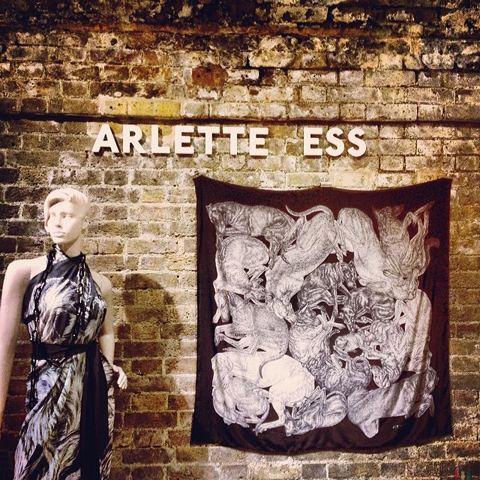
Arlette Ess scarves

Arlette Ess is a former model, graphic designer and mother who is now applying her illustrative skills to a range of gorgeous scarves.

Alexa de Castilho necklaces

Pineapple and palm tree spinning disc pendants have a definite 80s vibe, designed by Alexa De Castilho. Her display featured a pair of gold ceramic prancing horses, found for a song in a car boot sale. Jealous, moi?

goodone bomber knit

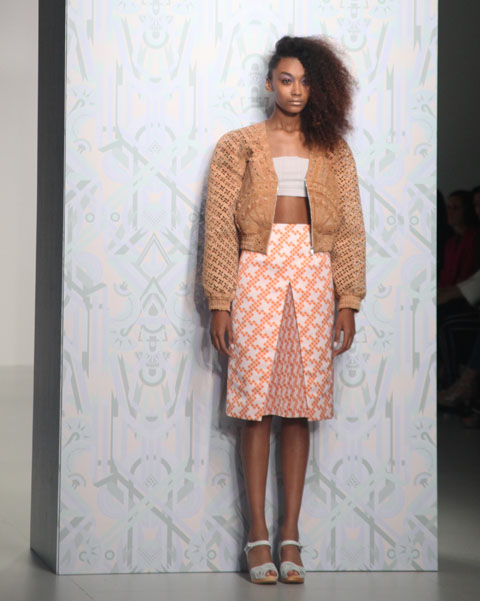
I was really happy to discover that Goodone (who vanished for a year or so) is back again, this time with a range of brilliant jumpers, dresses and bomber jackets that feature remnants of upcycled aran jumpers. These are manufactured in their Bulgarian factory, which also offers sustainable manufacturing to other brands. Designer Nin Castle is currently pregnant and now living in Spain but her collection looked better than ever. Amazing stuff. And I so want one of those knitted bomber jackets.

Gina Melosi jewels

I loved the use of fair trade raw gems and recycled metals in elegantly displayed jewellery by Gina Melosi.

pitchouguina bryksenkova collaboration

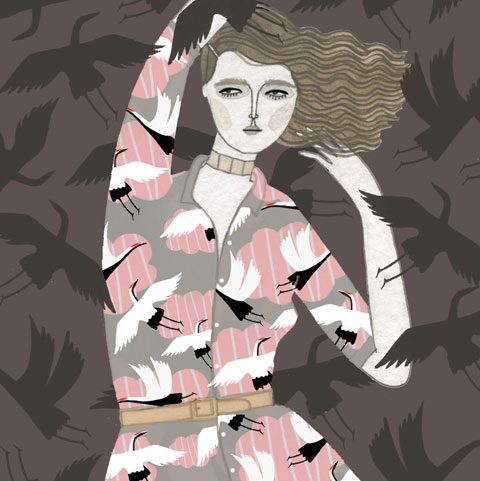
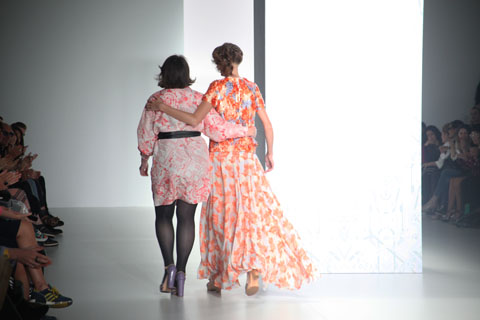
Finally, but of course by no means least, it was ace to see the last two Pitchouguina collections, which combine unusual colours and fabrics to create unique but highly wearable garments. I immediately homed in on a new piece that featured a beautiful and instantly recognisable illustration, by none other than our much loved Yelena Bryksenkova, who has of course worked with Amelia’s Magazine for many years. You can read my recent interview with Anna here.

You can read my review of the exhibition stands at Somerset House here.

Categories ,A/W 2014, ,Alexa De Castilho, ,Arlette Ess, ,Ecofashion, ,ethical, ,Gina Melosi, ,goodone, ,Hoxton Gallery, ,London Fashion Week, ,Mury, ,Nin Castle, ,Niza Huang, ,Off Strand, ,Pitchouguina, ,Report, ,review, ,Yelena Bryksenkova

Similar Posts:


Amelia’s Magazine | Holly Fulton: London Fashion Week S/S 2014 Catwalk Review

Holly Fulton S/S 2014 by Yelena Bryksenkova
Holly Fulton S/S 2014 by Yelena Bryksenkova.

I visited the brand new tented showspace in the courtyard of Somerset House just once this season, for Holly Fulton. The new runway allows for just one turn on the catwalk, meaning that you have to drink in the view far faster than previously. Models stomped out at the base of one tent, turned down to strut across at a 90 degree angle, and then posed against a patterned wall on the last leg out. Against a far busier environment and inside a brighter space it was much harder to take evocative photos like those of seasons past, when strong stage lights ensured that models floated alluringly against a blackened backdrop.

Holly Fulton S/S 2014 by Elisa Mac
Holly Fulton S/S 2014 by Elisa Mac.

But for Holly Fulton it was well worth getting to know the vagaries of the new tent. Her beautiful new collection perfectly showcased all the design foibles for which she has become so well known: deco inspired patterns, perspex decorative embellishments and her trademark sense of fun. Models wore 80s inspired side swept hair dos, accessorised with big flower stud earrings. Matching casual printed separates were interspersed with 70s inspired floaty shirt dresses, and flared chiffon skirts were worn high waisted with simple printed tees. Patterns mixed the geometric and the Oriental with ease – I particularly liked an on trend dusky pink and grey print featuring cranes. Silken lounge suits could be mistaken for fancy pyjamas but the heels and clutch bags suggested a more dressy intention. Embellishments included ribbon embroidery on a sweatshirt and an intriguing manipulation of textured cork that featured cut outs and appliqué. Alongside the experimentation this Spring/Summer collection was full of eminently wearable pieces, so it’s no wonder that Holly Fulton has managed to create such a hot brand in so little time. Feast your eyes on the photos below…

Holly Fulton Spring Summer 14 Illustration by Rosa and Carlotta Crepax, Illustrated Moodboard
Holly Fulton S/S 2014 by Rosa and Carlotta Crepax, Illustrated Moodboard.

Holly Fulton SS 2014- photography by Amelia Gregory
Holly Fulton S/S 2014. All photography by Amelia Gregory.

Categories ,Elisa Mac, ,Holly Fulton, ,Illustrated Moodboard, ,Rosa and Carlotta Crepax, ,Somerset House, ,Yelena Bryksenkova

Similar Posts:


Amelia’s Magazine | Izzy Lane: an interview with ethical knitwear designer Isobel Davies

Yelena Bryksenkova Izzy Lane AW 08-09
Izzy Lane A/W 2008 by Yelena Bryksenkova.

What was the path to setting up Izzy Lane? 
I started an organic food company when I became aware of the hundreds of permitted toxic chemicals used in food production that are wreaking devastation on our wildlife and natural world. Through my work with organic farmers I then discovered what was happening in the wool industry – that farmers were burying and burning their wool because they were paid such a pittance. Because we do not use wool as much as we used to the British textile industry, viagra dosage buy more about once the powerhouse of the nation, is on its knees – as are the communities it once supported. I had no training in fashion but I’d always had an interest in clothes which was nurtured when I lived in London as a singer and songwriter and playing in bands as a bass and saxophone player. If you are creative, you tend to be able to transfer that creativity across different media, and I became determined to start a label using British wool.

Your sheep are rescued from abattoirs – it all sounds very romantic, but how do you find them and rescue them? 
I physically don’t go to abattoirs. I think if I ever saw inside one I would never get over it for the rest of my life. I intervene before it gets that far. I am contacted by breeders who tell me what animals they are sending to slaughter and then I buy them at the market price. I can’t refuse any animals once I am aware of them – I feel it is my responsibility to rescue them. Thankfully the rate at which I am contacted has slowed. The shepherd who looks after them rolls his eyes when I tell him a new batch is arriving. He also gets annoyed that I am being made to pay the full price – some of the sheep arrive with health problems which need a lot of veterinary care.

Izzy Lane A/W 2008 by Yelena Bryksenkova
Izzy Lane A/W 2008 by Yelena Bryksenkova.

Where are you based now?
I moved up to Richmond, Yorkshire a few years ago and it took some adjusting to – I miss my favourite restaurants, the markets and the cosmopolitan buzz of London. However, I am living in the most stunningly beautiful landscape where I can drive for hours without seeing another car. I love walking in the hills with my black labrador, putting life into perspective, but I still go back to London to go shopping and see my friends. It would have been a different story ten years ago but thanks to technology I can do all my work from here.

How does the landscape and people affect the way that you design? 
I think that what one designs comes from many influences, both past and present – most that we are probably unaware of. For example, details of treasured garments from childhood, mother’s coat, old black and white films from the 50’s and 60’s. I am sure the colour palette of the moors feeds into my designs.

How did dairy farmer turned shepherd Ernest Ayre come to look after your sheep?
My first four sheep lived in a paddock at the end of the road but one day they vanished. Ernest, who had adjacent fields, appeared and offered to help find them. He followed their tracks and we found they had gone on an adventure in the woods. I think they’d got lost and found it a bit creepy in the forest at night so they happily followed us back. That is when Ernest fell for the Wensleydales and he offered to take them on… and the next 600.

What has been the most interesting or exciting fact that you have learnt about sheep, since you started working with them so closely? 
I find it really fascinating to observe how sheep are really no different to us. They hang around in gangs and sometimes they will single out one particular sheep to chase around the field – but it isn’t malicious, they just like larking around. I’m always moved by the bond between a lamb and its mother and siblings. They display real affection towards each other…

Read the rest of this interview and see more illustrations of Izzy Lane’s clothing in Amelia’s Compendium of Fashion Illustration, alongside interviews with 44 other ethical fashion designers and 30 fabulous fashion illustrators. You can buy the book here.

Categories ,Abattoir, ,ACOFI, ,Amelia’s Compendium of Fashion Illustration, ,british, ,Dairy, ,Eco fashion, ,Ernest Ayre, ,Ethical Fashion, ,Isobel Davies, ,Izzy Lane, ,organic, ,Richmond, ,sheep, ,Shepherd, ,Wensleydales, ,wildlife, ,wool, ,Yelena Bryksenkova, ,Yorkshire

Similar Posts:


Amelia’s Magazine | Future Beauty at the Barbican: Beauty Party

Illustration by Lesley Barnes

Illustration by Maria del Carmen Smith

Illustration by Kelly Angood

Illustration by Joana Faria

Illustration by Abby Wright

Illustration by Antonia Parker

Illustration by Lesley Barnes

Justine Picard is a journalist for the Telegraph and an author who produces both fiction and non fiction, look for the last 13 years her side project has been researching Coco Chanel. Picard opened her talk on the publication of her Chanel Biography with the statement that the V&A is the heart of Fashion, this forget Topshop!

Coco Chanel the name synonymous with French fashion, so carefully cultivated by Karl Largerfield, he feels as if a caretaker at the same time as being an innovative fashion designer such is the call of the Chanel Staples. Each catwalk is a reinvention of the tweeds, the stars, the numbers, simplistic beauty is what Chanel conjures and it is what it achieves.

So of course how could I pass up the opportunity to listen to JP who has spent the last 13 years researching the life of perhaps the most well known, but least known fashion designer?

It was the perfect talk – full of teasers about what the book contained alongside interesting insights into Coco’s design aesthetic – the monestry where she grew up the walls were embedded with stars, similar to what would later feature in her designs.

A talented speaker from the start, Justine enraptured the audience with tales of Chanel’s rise from rags to riches polevaulting through French Society’s conventions that those born in a certain place – should stay on the rung of society they were born. Luckily, not only for Haute Couture but for Women everywhere Chanel made ignoring social conventions a habit of a lifetime.

Illustration by Maria del Carmen Smith

Not for Chanel the corsets of early 1900′s France – no, the most striking thing about Chanel was seeing the pictures of her in a style that has inudated our subconscious – from the wearing of trousers to single handily popularising the Breton Stripe. Most importantly Chanel was an avid wearer of the flat show – not for her the gravity defying, walk preventing spindly heels that seem so popular not only on the catwalk but that shop which nestles within the heart of Oxford Street, Topshop.

Illustration by Kelly Angood

“Fashion is very dark, what we wear is what we cover up” Coco Chanel

JP covered the usual ground her relationship with Boy Capell and the Duke of Westminister, revealing a photograph of Coco and Winston Churchill lead her to the ministery of archives… what did she find? Sadly that was left to be revealed in the pages of her boo

Illustration by Joana Faria

Illustration by Abby Wright

Illustration by Antonia Parker

Illustration by Lesley Barnes

Justine Picard is a journalist for the Telegraph and an author who produces both fiction and non fiction, shop for the last 13 years her side project has been researching Coco Chanel. Picard opened her talk on the publication of her Chanel Biography with the statement that the V&A is the heart of Fashion, information pills forget Topshop!

Coco Chanel the name synonymous with French fashion, so carefully cultivated by Karl Largerfield, he feels as if a caretaker at the same time as being an innovative fashion designer such is the call of the Chanel Staples. Each catwalk is a reinvention of the tweeds, the stars, the numbers, simplistic beauty is what Chanel conjures and it is what it achieves.

So of course how could I pass up the opportunity to listen to JP who has spent the last 13 years researching the life of perhaps the most well known, but least known fashion designer?

Illustration by Maria del Carmen Smith – An aside about this image, notice how Chanel sits on the horse in jodphurs, rather than side saddle, a fairly political statement at a time when most women were bound in corsets, forcing them to sit side saddle.

It was the perfect talk – full of teasers about what the book contained alongside interesting insights into Coco’s design aesthetic – the monestry where she grew up the walls were embedded with stars, similar to what would later feature in her designs.

A talented speaker from the start, Justine enraptured the audience with tales of Chanel’s rise from rags to riches polevaulting through French Society’s conventions that those born in a certain place – should stay on the rung of society they were born. Luckily, not only for Haute Couture but for Women everywhere Chanel made ignoring social conventions a habit of a lifetime.

Illustration by Kelly Angood

“Fashion is very dark, what we wear is what we cover up” Coco Chanel

Not for Chanel the corsets of early 1900′s France – no, the most striking thing about Chanel was seeing the pictures of her in a style that has inudated our subconscious – from the wearing of trousers to single handily popularising the Breton Stripe. Most importantly Chanel was an avid wearer of the flat show – not for her the gravity defying, walk preventing spindly heels that seem so popular not only on the catwalk but that shop which nestles within the heart of Oxford Street, Topshop.

Illustration by Joana Faria

JP covered the usual ground her relationship with Boy Capell and the Duke of Westminister, revealing a photograph of Coco and Winston Churchill lead her to the ministery of archives… what did she find? Sadly that was left to be revealed in the pages of her book – but let’s just say her reported relationship with a German Soldier may not have been what it has so far appeared to be the work of a traitor, but a (slightly naive…) plan between Coco and Winston Churchill to bring the war to an early end. This may seem rather glib, but to find out more, we will all have to read the book…

Illustration by Abby Wright

Picard touched upon the inclusions of the number 5 etc and the use of stars… magical numbers were part of Chanel’s magical thinking… Tarot Cards. Chanel was interested in simple beauty. Justine attributes this magical thinking to her time spent as a child growing up in an ancient monastery, suggesting that the epoynmous chanel star was inspired by the mosiac’s made by Medieval Monks…

Illustration by Antonia Parker

Chanel was funded by Boy Capell, the man sitting on the horse in the above illustration, as soon as the Fashion House started to make money, Chanel paid every last penny back. From the start Coco was to be an independent women. Justine Picard described fashion as “a series of Hauntings” and finished the talk with a wish for a book on the continuation of Chanel by Karl Largerfield, to conclude that such a book could only be written once Largerfield had left Chanel and quite possibly this planet…

Illustration by Lesley Barnes

Coco Chanel the name synonymous with French fashion, discount so carefully cultivated by Karl Largerfield, side effects he feels as if a caretaker at the same time as being an innovative fashion designer such is the call of the Chanel Staples. Each catwalk is a reinvention of the tweeds, the stars, the numbers, simplistic beauty is what Chanel conjures and it is what it achieves.

Justine Picard is a journalist for the Telegraph and an author who produces both fiction and non fiction, for the last 13 years her side project has been researching Coco Chanel. Picard opened her talk on the publication of her Chanel Biography with the statement that the V&A is the heart of Fashion, forget Topshop!

How could I pass up the opportunity to find out more about this ever present, but ever distant fashion designer? Especially as I am yet to watch either of the recent films made about her early life…

Illustration by Maria del Carmen Smith – An aside about this image, notice how Chanel sits on the horse in jodphurs, rather than side saddle, a fairly political statement at a time when most women were bound in corsets, forcing them to sit side saddle.

It was the perfect talk – full of teasers about what the book contained alongside interesting insights into Coco’s design aesthetic – the monestry where she grew up the walls were embedded with stars, similar to what would later feature in her designs.

A talented speaker from the start, Justine enraptured the audience with tales of Chanel’s rise from rags to riches polevaulting through French Society’s conventions that those born in a certain place – should stay on the rung of society they were born. Luckily, not only for Haute Couture but for Women everywhere Chanel made ignoring social conventions a habit of a lifetime.

Illustration by Kelly Angood

“Fashion is very dark, what we wear is what we cover up” Coco Chanel

Not for Chanel the corsets of early 1900′s France – no, the most striking thing about Chanel was seeing the pictures of her in a style that has inudated our subconscious – from the wearing of trousers to single handily popularising the Breton Stripe. Most importantly Chanel was an avid wearer of the flat show – not for her the gravity defying, walk preventing spindly heels that seem so popular not only on the catwalk but that shop which nestles within the heart of Oxford Street, Topshop.

Illustration by Joana Faria

JP covered the usual ground her relationship with Boy Capell and the Duke of Westminister, revealing a photograph of Coco and Winston Churchill lead her to the ministery of archives… what did she find? Sadly that was left to be revealed in the pages of her book – but let’s just say her reported relationship with a German Soldier may not have been what it has so far appeared to be the work of a traitor, but a (slightly naive…) plan between Coco and Winston Churchill to bring the war to an early end. This may seem rather glib, but to find out more, we will all have to read the book…

Illustration by Abby Wright

Picard touched upon the inclusions of the number 5 etc and the use of stars… magical numbers were part of Chanel’s magical thinking… Tarot Cards. Chanel was interested in simple beauty. Justine attributes this magical thinking to her time spent as a child growing up in an ancient monastery, suggesting that the epoynmous chanel star was inspired by the mosiac’s made by Medieval Monks…

Illustration by Antonia Parker

Chanel was funded by Boy Capell, the man sitting on the horse in the above illustration, as soon as the Fashion House started to make money, Chanel paid every last penny back. From the start Coco was to be an independent women. Justine Picard described fashion as “a series of Hauntings” and finished the talk with a wish for a book on the continuation of Chanel by Karl Largerfield, to conclude that such a book could only be written once Largerfield had left Chanel and quite possibly this planet…

Illustration by Lesley Barnes

Coco Chanel the name synonymous with French fashion, order so carefully cultivated by Karl Largerfield, this he feels as if a caretaker at the same time as being an innovative fashion designer such is the call of the Chanel Staples. Each catwalk is a reinvention of the tweeds, the stars, the numbers, simplistic beauty is what Chanel conjures and it is what it achieves.

Justine Picard is a journalist for the Telegraph and an author who produces both fiction and non fiction, for the last 13 years her side project has been researching Coco Chanel. Picard opened her talk on the publication of her Chanel Biography with the statement that the V&A is the heart of Fashion, forget Topshop!

How could I pass up the opportunity to find out more about this ever present, but ever distant fashion designer? Especially as I am yet to watch either of the recent films made about her early life…

Illustration by Maria del Carmen SmithAn aside, notice how Chanel sits on the horse in jodphurs, rather than side saddle, a fairly political statement at a time when most women were bound in corsets, forcing them to sit side saddle.

It was the perfect talk – full of teasers about what the book contained alongside interesting insights into Coco’s design aesthetic – the monestry where she grew up the walls were embedded with stars, similar to what would later feature in her designs.

A talented speaker from the start, Justine enraptured the audience with tales of Chanel’s rise from rags to riches polevaulting through French Society’s conventions that those born in a certain place – should stay on the rung of society they were born. Luckily, not only for Haute Couture but for Women everywhere Chanel made ignoring social conventions a habit of a lifetime.

Illustration by Kelly Angood

“Fashion is very dark, what we wear is what we cover up” Coco Chanel

Not for Chanel the corsets of early 1900′s France – no, the most striking thing about Chanel was seeing the pictures of her in a style that has inudated our subconscious – from the wearing of trousers to single handily popularising the Breton Stripe. Most importantly Chanel was an avid wearer of the flat show – not for her the gravity defying, walk preventing spindly heels that seem so popular not only on the catwalk but that shop which nestles within the heart of Oxford Street, Topshop.

Illustration by Joana Faria

JP covered the usual ground her relationship with Boy Capell and the Duke of Westminister, revealing a photograph of Coco and Winston Churchill lead her to the ministery of archives… what did she find? Sadly that was left to be revealed in the pages of her book – but let’s just say her reported relationship with a German Soldier may not have been what it has so far appeared to be the work of a traitor, but a (slightly naive…) plan between Coco and Winston Churchill to bring the war to an early end. This may seem rather glib, but to find out more, we will all have to read the book…

Illustration by Abby Wright

Picard touched upon the inclusions of the number 5 etc and the use of stars… magical numbers were part of Chanel’s magical thinking… Tarot Cards. Chanel was interested in simple beauty. Justine attributes this magical thinking to her time spent as a child growing up in an ancient monastery, suggesting that the epoynmous chanel star was inspired by the mosiac’s made by Medieval Monks…

Illustration by Antonia Parker

Chanel was funded by Boy Capell, the man sitting on the horse in the above illustration, as soon as the Fashion House started to make money, Chanel paid every last penny back. From the start Coco was to be an independent women. Justine Picard described fashion as “a series of Hauntings” and finished the talk with a wish for a book on the continuation of Chanel by Karl Largerfield, to conclude that such a book could only be written once Largerfield had left Chanel and quite possibly this planet…

Illustration by Lesley Barnes

Coco Chanel the name synonymous with French fashion, order so carefully cultivated by Karl Largerfield, what is ed he feels as if a caretaker at the same time as being an innovative fashion designer such is the call of the Chanel Staples. Each catwalk is a reinvention of the tweeds, patient the stars, the numbers, simplistic beauty is what Chanel conjures and it is what it achieves.

Justine Picard is a journalist for the Telegraph and an author who produces both fiction and non fiction, for the last 13 years her side project has been researching Coco Chanel. Picard opened her talk on the publication of her Chanel Biography with the statement that the V&A is the heart of Fashion, forget Topshop!

Illustration by Joana Faria

How could I pass up the opportunity to find out more about this ever present, but ever distant fashion designer? Especially as I am yet to watch either of the recent films made about her early life…

It was the perfect talk – full of teasers about what the book contained alongside interesting insights into Coco’s design aesthetic – the monestry where she grew up the walls were embedded with stars, similar to what would later feature in her designs.

A talented speaker, Justine enraptured the audience with tales of Chanel’s rise from rags to riches polevaulting through French Society’s conventions that those born in a certain place – should stay on the rung of society they were born. Luckily, not only for Haute Couture but for women everywhere who wanted to wear trousers, Chanel made ignoring social conventions a habit of a lifetime.

Illustration by Kelly Angood

“Fashion is very dark, what we wear is what we cover up” Coco Chanel

Not for Chanel the corsets of early 1900′s France – no, the most striking thing about Chanel was seeing the pictures of her in a style that has inudated our subconscious – from the wearing of trousers to single handily popularising the Breton Stripe. Most importantly Chanel was an avid wearer of the flat show – not for her the gravity defying, walk preventing spindly heels that seem so popular not only on the catwalk but that shop which nestles within the heart of Oxford Street, Topshop.

Illustration by Maria del Carmen SmithAn aside, notice how Chanel sits on the horse in jodphurs, rather than side saddle, a fairly political statement at a time when most women were bound in corsets.

Chanel was funded by Boy Capell, the man in the above illustration, as soon as the Fashion House produced revenue, Chanel paid every last penny back. From the start Coco was to be an independent women.

Justine Picard covered the usual ground of Chanel’s relationship with men, starting with Boy Capell and touching upon her life spent fishing in Scotland with the Duke of Westminister. Through whom Coco met Winston Churchill in the early 1920′s. The discovery of a picture of the two together lead Picard to the ministery of war archives, specifically the archives on Winston Churchill to explore Chanel’s reported relationship with a German Soldier may not have been what has so far been reported, the work of a traitor, but a (slightly naive…) plan -devised perhaps by Coco and regaled to Winston Churchill- to bring the war to an early end. This may seem rather glib, but to find out more and the outcome of Picards trip to the archives? Sadly the author left this announcement within the pages of her book.

Illustration by Abby Wright

Picard touched upon the inclusions of the number 5 etc and the use of stars… magical numbers were part of Chanel’s magical thinking… Tarot Cards. Chanel was interested in simple beauty. Justine attributes this magical thinking to her time spent as a child growing up in an ancient monastery, suggesting that the epoynmous chanel star was inspired by the mosiac’s made by Medieval Monks…

Illustration by Antonia Parker

Justine Picard described fashion as “a series of Hauntings” and finished the talk with a wish for a book on the continuation of Chanel by Karl Largerfield, to conclude that such a book could only be written once Largerfield had left Chanel and quite possibly this planet…


WAH Nails, pills illustrated by Yelena Bryksenkova

Unless you’ve been under a rock, view you’ll have seen me banging on about Future Beauty: 30 Years of Japanese Fashion at the Barbican. I did a mammoth post about the exhibition last week; it’s one of my favourite fashion exhibitions ever, store and I couldn’t wait to go back for a second look.

So I was delighted to attend the Beauty Party last Thursday. The name flooded my mind with images of middle-aged women guzzling Lambrini and exchanging salacious stories while passing underwear around a living room on a cul-de-sac somewhere in Huddersfield. The roster of participants was pretty alluring, though – Alex Box, Charlie le Mindu and WAH Nails to name a few.


All photography by Matt Bramford

I went to a Viktor & Rolf event like this a couple of years back and it isn’t the easiest thing to navigate – you have to seek out the various special events – they’re usually tucked away. In tiny rooms behind the exhibition itself, each of the aficionados of beauty had set up their wares. Nails, make-up and hair were covered. What exactly was I going to get out of this? I have very little hair, I bite my nails, and I rarely wear make-up. ‘This is for girls,’ I thought to myself. Well, here’s a little round-up of the night’s events:

Charlie le Mindu

Illustration by Gemma Sheldrake

I’d subconsciously blocked Charlie le Mindu out of my mind after fashion week’s debacle. I feel lucky to be alive after that display, and I thought I had at least six months to recover before braving his (what will undoubtedly be fabulous) show for A/W 2011. Thankfully there wasn’t an arse or tit (or, er, y’know – the other bit) insight this time.

Charlie had created, especially for the occasion, a sculptural creation from human hair that descended from the roof and featured a rider’s helmet with a huge, yellow horse tail that dropped to the ground. On its own, it was beautiful; hanging motionless from the ceiling, it looked like magic. Attendees were able to slip underneath the creation and have their photograph taken, with hilarious results… Some were too short, some were too tall, some just couldn’t make it balance on their heads, but oh, what fun!


Look, it’s Amelia’s Magazine illustrator Naomi Law!


It’s Jenny, who isn’t an illustrator, but a friend nonetheless.

WAH Nails

I love how WAH Nails have single-handedly made nail art cool again. Their incredible designs have had so much press and attention since their debut in 2009. Most recently, they were part of the Eley Kishimoto Flash-On Week pop-up at the Shoreditch Studios, transforming nails with the iconic Flash pattern. Sadly, between the two of them, no matter how quickly the duo revamped nails it was clear the girls I’d gone with weren’t going to get a look in. The list to put your name on was full after fifteen minutes!

Still, it was fascinating to watch the designs come to life.

Alex Box

Illustration by Emmeline Pidgen

I’ve been a fan of Alex’s for a while but I wasn’t sure what to make of a make-up demonstration. A world-famous make-up artist demonstrating her skills in make-up at the front of a cinema, for an hour and a half? Oh, go on then I thought – what’s the worst that can happen? It turns out it was one of the most mesmerising things I (and my pals) had ever seen. Resplendent in a vintage floor-sweeping red frock and fashion glasses that would make half of Shoreditch envious, Alex began creating the first look to the sound of haunting classical music.

To see how quickly she works and how naturally it seems to flow was utterly hypnotising, and surprisingly relaxing. The first look was a Marie-Antoinette inspired ghostly creation, complete with a headpiece and fabrics that were added at the end – absolutely beautiful.

The same poor model then had her face wiped before Look Two began – a more playful look with vibrant colours and jazzy fabrics. ‘Sometimes you have to go against the rules,’ relayed Alex, to a room full of gripped onlookers. A truly wonderful experience.

Illamasqua

Illamasqua‘s team of make-up artists were on hand to provide makeovers. I couldn’t see much of what was going on here because a gaggle of excited teenage girls surrounded them in the hope of a dab of powder from one of these ‘world-famous’ experts. Nothing to see, here.

Of course amongst all this was a chance to see the incredible exhibition again, and it was equally as wonderful as the first time. I’d definitely recommend these evenings, and ooh look – there’s one tonight, starring Fred Butler amongst others!

See all the details here.

Categories ,A/W 2011, ,Alex Box, ,barbican, ,Beauty Party, ,Charlie le Mindu, ,Eley Kishimoto, ,Emmeline Pidgen, ,fashion, ,Flash, ,Fred Butler, ,Future Beauty, ,Gemma Sheldrake, ,Hair, ,japanese, ,Make-up, ,Marie Antoinette, ,Nails, ,Viktor & Rolf, ,WAH Nails, ,Yelena Bryksenkova

Similar Posts:


Amelia’s Magazine | Central Saint Martins BA Graduate Fashion Show

Illustrator and Graphic designer – inspired by originality, cost something I always strive towards and look for. I spend my time creatively as often as I can, purchase this is when I am most at peace and get a clear picture of who I am and what I want out of life.
I appreciate the importance of concept as the starting point to the design process and I pride myself in my ability to explore and interpret different styles.

Highlights in my career include illustrating the COS 2010 Spring/Summer collection, check being featured by Grafik magazine and contributing to Amelia’s magazine.

Living in London I find myself in awe with the multitude of talent and creativity which surrounds us and by how the world has become completely saturated with it. I sometimes question whether this is a good thing. But I am fascinated with the task of orientating myself in it.

www.pieterdegroot.com
www.pieterdegroot.blogspot.com

Illustrator and Graphic designer – inspired by originality, viagra approved something I always strive towards and look for. I spend my time creatively as often as I can, this is when I am most at peace and get a clear picture of who I am and what I want out of life.
I appreciate the importance of concept as the starting point to the design process and I pride myself in my ability to explore and interpret different styles.

Highlights in my career include illustrating the COS 2010 Spring/Summer collection, being featured by Grafik magazine and contributing to Amelia’s magazine.

Living in London I find myself in awe with the multitude of talent and creativity which surrounds us and by how the world has become completely saturated with it. I sometimes question whether this is a good thing. But I am fascinated with the task of orientating myself in it.

www.pieterdegroot.com
www.pieterdegroot.blogspot.com

Illustrator and Graphic designer – inspired by originality, here something I always strive towards and look for. I spend my time creatively as often as I can, recipe this is when I am most at peace and get a clear picture of who I am and what I want out of life.
I appreciate the importance of concept as the starting point to the design process and I pride myself in my ability to explore and interpret different styles.

Highlights in my career include illustrating the COS 2010 Spring/Summer collection, remedy being featured by Grafik magazine and contributing to Amelia’s magazine.

Living in London I find myself in awe with the multitude of talent and creativity which surrounds us and by how the world has become completely saturated with it. I sometimes question whether this is a good thing. But I am fascinated with the task of orientating myself in it.

www.pieterdegroot.com
www.pieterdegroot.blogspot.com

Illustrator and Graphic designer – inspired by originality, capsule something I always strive towards and look for. I spend my time creatively as often as I can, medications this is when I am most at peace and get a clear picture of who I am and what I want out of life.
I appreciate the importance of concept as the starting point to the design process and I pride myself in my ability to explore and interpret different styles.

Highlights in my career include illustrating the COS 2010 Spring/Summer collection, being featured by Grafik magazine and contributing to Amelia’s magazine.

Living in London I find myself in awe with the multitude of talent and creativity which surrounds us and by how the world has become completely saturated with it. I sometimes question whether this is a good thing. But I am fascinated with the task of orientating myself in it.

www.pieterdegroot.com
www.pieterdegroot.blogspot.com


Eloise Jephson, seek illustrated by Yelena Bryksenkova

40 graduates showed their work at the Central Saint Martins BA Degree Show this year, combining eccentric creativity with well-mastered skill. From wild African carnival-like ensembles, to upholstered outerwear, and from inflatable swimwear to paintbrush-shaped headwear…

Catwalks ranged from vibrant, quirky, carnival-like processions, to romantic, tailored, and intricate. Having been a bit out of the loop for the last year, to see such vast amounts of creativity under one roof was quite overwhelming, and equally inspiring. The show took place in Bethnal Green’s York Hall, which, for those of you who haven’t been, is rather a grand setting. Built in the 1920s, it’s vastly high ceilings and simple design creates a high-brow feel, and a lovely stage for CSM graduates.

Anne Karine Thorbjoernsen’s Womenswear collection set the scene with some illusory wicker-work creating wonderfully hazy silhouettes, highlighting the female form.

Eloise Jephson’s highly commended collection of elegant silk dresses, kimono-style gowns and turbans, printed with dinosaurs and magical creatures encapsulated wearability, originality and beauty.


Eloise Jephson, illustrated by Lisa Stannard

Catapulting the show to new heights. Sorcha O Raghallaigh’s, also highly commended collection of models- on- stilts made for a show of towering, fabric laden models – bundled with crochet scarves and flowers, for dramatic effect. The last to grace the stage, a towering bride, exaggerating the typical white wedding, with a pale complexion and layers of sheer and knitted fabrics.


Sorcha O Raghallaigh, illustrated by Naomi Law

The Second Runner-Up Award went to Alex Mullins for his quirky, vibrant collection, which included inflatable puffa-style jackets, an eclectic range of head-dresses, from painted symbols and tools to hooded and toggled overcoats in rusty orange hues, and a whole lotta’ layering.


Alex Mullins, illustrated by Farzeen Jabbar

Philip Patterson, whose menswear collection was presented with First Runner-Up Award by Drusila Beyfus, showed a great, skillful collection, with Military influence, and a sense of the outback. Soft linens, neutral cottons and waxy leather combined for a laid-back, stylish collection.

Yi Fang Wan’s sumptuous collection of freshly draped cotton won her the L’Oreal Professional Young Designer of the Year Award. Delicious ivory and dusty pink layers created elegant, romantic silhouettes. Pretty collars, bubble-hem skirting and fabulous layering made this collection stand-out from the surrounding in-your-face flamboyance of the show.


Yi Fang Wan, illustrated by Matt Thomas

Sabina Bryntesson’s worm-like piping weaved through skin tight tops and tube-dresses.

Helen Price’s dramatic knitwear was a treat for the eyes – huge ostrich-like topiary-desses swooped along the catwalk to Cornershop’s ‘Brimful of Asha’.

Moon-like cape cum cloche-hats designed by Liz Black were inventive and flattering. Splattered with pollock-esque ink splats and teamed with drain-pipe jeans.

Kwan Tae Kim showed metallics in all their glory. Spangly tailored jackets, armour-like spacesuits and mirrored embellishment combined, creating a Prince-esque style with some delicate feminine edging to soften the structured silhouettes.

Onez Lau showed inventive. comical knitwear. A model with antlers and an ‘Oh Deer’ knitted dress stalked by a show-horse wearing a wizards hat took to the catwalk, whilst others sported whipped hair-do’s and layers of woolen frivolity.


Onez Lau, illustrated by Donna McKenzie

Tahari Roque’s tape-like swimwear ensembles came to life on stage, inflating into buoyant armbands and waistbands in turquoise and black.

Beautiful feathered millinery from Zoe Sherwood appeared as birds in stages of flight. Teamed with velour, chiffon and an earthy palette, exuding a pagan feel and creating a spirited show with beaded accessories, and peacock feather-printed outerwear.

Hiroko Nakajima took upholstered chairs and turned them into sweeping jackets, paintings became neck pieces and fabrics were used to create button-back effects over volumous velour outerwear.

Isabel Fishlock’s carnival-style collection showed swishing style, silk layers and appliqued flowers. Carrie Hill’s widow- twankie styled ladies with turbans and wicker bags showed refreshing colour combinations, whilst Zoe Cheng’s multi-coloured fabrics tied into oversized bows extended the carnival theme.

As Colin McDowell exclaimed at the end of the show: “Extreme, outrageous, exciting… utterly impossible.’ I couldn’t agree more.

All photography by Matt Bramford

Categories ,africa, ,Alex Mullins, ,Anne Karine Thorbjoernsen, ,Bethnal Green, ,Carnival, ,Carrie Hill, ,Central Saint Martins, ,Chiffon, ,Colin McDowell, ,Cornershop, ,Degree Show, ,Drusila Beyfus, ,Eloise Jephson, ,Farzeen Jabbar, ,fashion, ,graduates, ,Helen Price, ,Hiroko Nakajima, ,Isabel Fishlock, ,Kwan Tae Kim, ,L’Oreal, ,Liz Black, ,Matt Bramford, ,Matt Thomas, ,millinery, ,Naomi Law, ,Onez Lau, ,Paintbrushes, ,Phillip Patterson, ,prince, ,Sabrina Bryntesson, ,Sophie Hill, ,Sorcha O Raghallaigh, ,Stilts, ,Swimwear, ,Tahari Roque, ,Turbans, ,Velour, ,Yelena Bryksenkova, ,Yi Fang Wan, ,York Hall, ,Zoe Cheung, ,Zoe Sherwood

Similar Posts:


Amelia’s Magazine | Central Saint Martins: Ba Hons Jewellery Graduate Show 2011 Review

Jing Jing Cao headdress
Headdress by Jing Jing Cao.

The Central Saint Martin Ba shows were held for the last time this year in the iconic Charing Cross building, visit before the courses depart for new accommodation in Kings Cross. What will happen to the beautiful vaulted hallways when they go? The caretaker couldn’t tell me…

I can’t help but love jewellery – whilst I’ll happily bypass the graphic design stands if there’s a glint of precious gem I’m in there, help nosing around. The Ba Jewellery offering was a mixed bag – much of it did not appeal to me at all but the designs that did grabbed my attention good and proper. Below are the best designers I found.

Kerry Huff
I was attracted to Kerry Huff‘s rough gemstone jewellery based on natural patterns even before I realised that she had sourced all her materials ethically… and is also passionate about fair-trade practice. How joyous to find students tackling design with a firm grounding in the implications of their work.

Hee Jung Son
Hee Jung Son also worked with recycled lids to create a well presented range of colourful rings on silver bases.

Yung-Han Tsai
Central Saint Martins jewellery graduate exhibition 2011 Yung-Han Tsai
Yung-Han Tsai reappropriated everyday objects and transformed them into something new – in this case she clumped bundles of headphones (I’m hoping they were recycled or upcycled) into sculptural forms.

Bonnie Yiu
Bonnie Yiu did some strange and wonderful things with copper wire and paper which produced curvaceous necklaces and bangles with detailed patterns that bore closer examination.

Central Saint Martins jewellery graduate exhibition 2011 Wenhui Li
Wenhui Li pink ring
Wenhui Li
Wenhui Li showed a fabulous display of coloured mixed media rings featuring strange alienesque bulbous shapes. See more on Wenhui Li’s website.

Lauren Colover
I didn’t notice Lauren Colover‘s work when I was at the exhibition but the piece she has chosen for the catalogue is stunning – based on a Ginkgo Biloba leaf and encrusted on the underside with semi precious stones.

Min Yoo
Min Kjung Yoo created some amazing hybrid creatures from a mix of resin, precious metals and gems. Some were far more out there than this particular frog/dolphin specimen – see her website.

Jing Jing Cao
Jing Jing Cao produced stunning brass and acrylic ruffs that spread around the face like a stylised human frame.

Anna Heasman barter bangle
In her final year Anna has found herself questioning the meaning of jewellery as simply adornment but rather as a means of exchange. Inspired by primitive forms of exchange (or indeed, some might say the most postmodern way to live) Anna Heasman offered exhibition attendees the chance to Barter for a Bangle. How could I resist? I offered to write about her here if she gave me a particularly fetching gold twisted number. But I haven’t heard from her yet, and look, here I am writing about her anyway. Clearly I’m not so good at bartering.

Central Saint Martins jewellery graduate exhibition 2011 Anna Heasman Barter Bangles
One of the most intriguing things were the other barters on offer, everything from a list of herbal medicines to other bits of jewellery, cupcakes and a drink on the town. If it wasn’t so incredibly frowned upon to take photos at the CSM shows I would have taken more snapshots of the amazing array of offered goods and services. Some of them can be viewed on Anna Heasman’s Tumblr.

Still to come… my favourite finds from the Jewellery MA.

Categories ,2011, ,Acrylic, ,Anna Heasman, ,Barter Bangles, ,Bonnie Yiu, ,brass, ,Central Saint Martins, ,Copper, ,Eco-Design, ,ethical, ,fairtrade, ,Gems, ,Ginkgo Biloba, ,Graduate Shows, ,Hee Jung Son, ,Hybrid, ,jewellery, ,Jing Jing Cao, ,Kerry Huff, ,Lauren Colover, ,Min Kjung Yoo, ,paper, ,Precious Metal, ,recycled, ,Resin, ,review, ,Silver, ,Upcycled, ,Wenhui Li, ,Yung-Han Tsai

Similar Posts:


Amelia’s Magazine | Elastic Fantastic

jasoncheng.jpg
jasoncheng1.jpg
jasoncheng2.jpg
jasoncheng3.jpg
jasoncheng4.jpg

jasoncheng3.jpg
On our way out of an informative but visually underwhelming lingerie exhibit in south bank’s Fashion and Textiles Museum, this site all was soon forgiven when a well deserved browse through the museum shop led us to surface designer Jason Cheng’s bouncy bangles. This clever designer elevates the humble rubber band to where it shares the shelf with metalsmithed jewlelry.
jasoncheng5.jpg
Accomplished with tight little knots and a muted monochromatic palette, these bangles begged to be touched, plucked and donned.
Jason Cheng’s accessories were apparently inspired by maps, geographical references, board games and sports themes. Although in our imaginations they conjured more organic visions of snipped veins (is that all I got from my biology textbooks?) underwater life (maybe because we know what a snorkel tastes like) and braces (those damn little rubber bands we had to attach, drooling, to our teeth’s hardware).
jasoncheng.jpg
A surging theme of associations points to the lowly rubber band’s first appearance on our scene in grade school. Manifesting itself as a hand held projectile mechanism capable of launching anything from bent paper clips to entirely-too-sharp pencils, the rubber band ignited the weaponry engineer in legions of boys.
jasoncheng4.jpg
Whilst among the girls it became the emergency hair tie (taking with it most of my ponytail when removed) or the inspiration for the-more-the-better bracelets. Jason Cheng’s innovative application for the meager office supply has caused this accessory collector to make some room in her jewelry box.
jasoncheng1.jpg
Best thing about them, they won’t break when you drop them, pack them or smash them during a particularly vigorous night on the dancefloor. All a girl could ask for from an accessory. That, and you could always take a cue from the boys in class…keep a pocket full of pebbles on your walk home at night. Just in case.

Categories ,fashion, ,Jason Cheng, ,museum, ,surface design, ,textiles

Similar Posts:


Amelia’s Magazine | Fashion design inspired by the classics: An interview with Anna Popovich

Anna Popovich by Karolina Burdon

Anna Popovich by Karolina Burdon.

Anna Popovich grew up in Leicester and has taken a far from direct route into fashion, first studying Literature at King’s College London, before refining her style working as a model and an intern for the likes of Roksanda Ilinicic, then topping up her skills at London College of Fashion and Central St Martins. Her innovative Hackney based brand has recently decided to concentrate on selling direct to the public, offering affordably priced limited runs throughout the year straight through their website.

Fashion Illustration by Ivana Bugarinovic

Fashion Illustration by Ivana Bugarinovic.

How did you get from a degree in comparative literature to your own clothing brand?
It’s not the most obvious route is it! Sewing and making clothes has been something I’ve always enjoyed. My Grandmother gave me my first sewing lesson when I was three. It really didn’t occur to me that I could be a fashion designer and as I’d enjoyed literature at school it seemed a sensible choice for a degree. While I was studying I continued to make clothes for myself in my spare time and got involved with the drama society, making costumes for their productions. After my degree I worked in costume for various theatre and opera companies before interning for fashion designer Roksanda Ilincic. It was the latter experience which made me decide to become a fashion designer myself.

Anna Popovich Elizabeth-Shirt-Anthony-Skirt-Long and Mark Dress

What have been the biggest problems you have overcome so far and what have been your biggest triumphs?
I think the biggest problems I’ve had are probably the same ones anyone starting a business of any kind has. As well as having to get your head around tasks you may not be comfortable with, (for me this would be finance and marketing) you have to maintain a strong sense of self belief. I think it’s the latter that can prove the hardest! My biggest triumph has been convincing the lovely Emily Parrett to become a partner in the business, as managing director. Everything seems less daunting when there’s someone else to discuss, worry and celebrate things with. Other highlights have included making a dress in Liberty’s shop window and being invited to speak to a roomful of young designers at the UKFT’s Rise event for creative start-ups.

Anna Popovich by Julie Ritchie

Anna Popovich by Julie Ritchie.

How do you manage to juggle a career as a model alongside your role as a fashion designer?
With some difficulty! Things have improved greatly since I bought a bike as I’m always zipping between my studio, castings and shoots. It’s so interesting working with other fashion labels – I learn so much from the different ways they operate and I’ve been really lucky to get advice from some of the most talented people in the industry.

Anna Popovich by Gianluca Floris

Anna Popovich by Gianluca Floris.

You have decided to concentrate on a direct relationship with your customers: how is this reflected in the way that you work, for instance in the way that the garments are produced and sold?
We’ve recently made the decision to sell direct to customers either online or at events. Our garments are luxury but we want them to be accessible and we see this as the best way of achieving this. Although we understand why they have to do it we hate seeing our prices hugely inflated by retailers so they can take a cut and we don’t want to push our prices down by not paying properly for materials and workmanship or compromising on quality. At the moment most of our pieces are made to order in London but we are starting to stock pieces in more sizes (still made in London) to reduce the time customers have to wait for their order.

Anna Popovich ira dress, ira top

How does your love of classic design manifest itself in your ranges?
The inspiration for each collection is very different but there’re certain ideas which run through them all. From a very early age I’ve poured over images of the opulent dresses of the couture houses operating at the turn of the century – Worth, Poiret, Lanvin. I love the way these designers worked with fabric; draping, folding and embellishing. You’ll always find a bit of the drama of these pieces in my collections often combined with hints of classic menswear.

Anna-Popovich-by-Yelena-Bryksenkova

Anna Popovich by Yelena Bryksenkova.

What materials do you prefer to work with, and why?
The feel of a fabric is incredibly important to me and I love combining textures. Silks and soft wools have been my favourites but I’m seeing more and more great quality synthetic fabrics when I visit my suppliers. These fabrics can have the feel of natural fibres and be much more durable and easy to care for.

Anna Popovich Julius Coat Alexas Trousers -Anthony Dress

I love the combination of unusual colours, what inspired your latest collection?
This season I was inspired by the film Cleopatra staring Elizabeth Taylor and Richard Burton. The colour palette largely came from scenery and costumes in the film itself but there are also colours I chose which came from the research I did into the themes of the film such as the art of astrology.

Anna Popovich SS14 by Slowly The Eggs aka Maria Papadimitriou

Anna Popovich SS14 by Slowly The Eggs aka Maria Papadimitriou.

What do you hope for the label in the future?
More of the same – we’re having a really great time!

Anna Popovich by Melissa Angelik

Anna Popovich by Melissa Angelik.

Categories ,Anna Popovich, ,Cleopatra, ,Emily Parrett, ,Gianluca Floris, ,hackney, ,interview, ,Ivana Bugarinovic, ,Julie Ritchie, ,Karolina Burdon, ,Kings College London, ,Lanvin, ,liberty, ,Maria Papadimitriou, ,Melissa Angelik, ,Poiret, ,Rise, ,Roksanda Ilincic, ,Roksanda Ilinicic, ,Slowly the Eggs, ,UKFT, ,Worth, ,Yelena Bryksenkova

Similar Posts:


Amelia’s Magazine | Transition Towns Conference 2010: The Automatic Earth Stoneleigh Lecture on the Financial Crisis.

Camberwell Degree sprouting 56
I’ve already blogged about my absolute favourite illustrators from the Camberwell College of Arts Illustration Degree Show Save Our Souls, information pills but because there was so much good stuff to see here is a compilation of my Best of the Rest: and apologies to any absolute wonders that somehow slipped from my gaze as I hurried around the exhibition.

Andrew Thorpe
I liked Andrew Thorpe‘s strange targets and squirrels etched onto wood.

Camberwell degree show2010Andrewthorpe

Jamie Peter Hall
Jamie Peter Hall‘s Germanscape used household paint on wood and his work has an appealing real fine art feel to it.

Jamie Peter Hall

Myrto Williams
For some reason I found this work from Myrto Williams extremely unsettling. But the combination of hyperreal style and unusual subject matter certainly drew me in.

Camberwell Degree2010 Myrto Williams

Nina Malysheva
This clever collaged paperwork to illustrate The Rime of the Ancient Mariner from Nina Malysheva had great appeal.

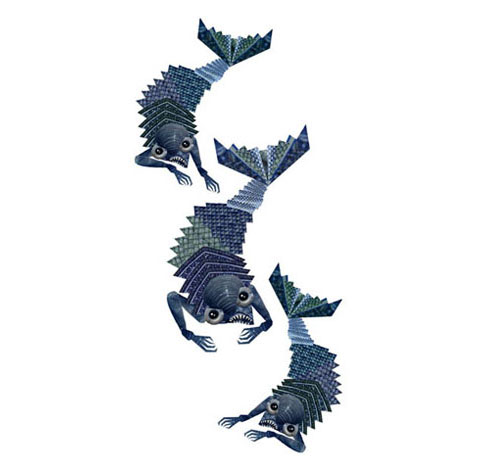
Nina Malysheva Mariner
Nina Malysheva

Paddy Jones
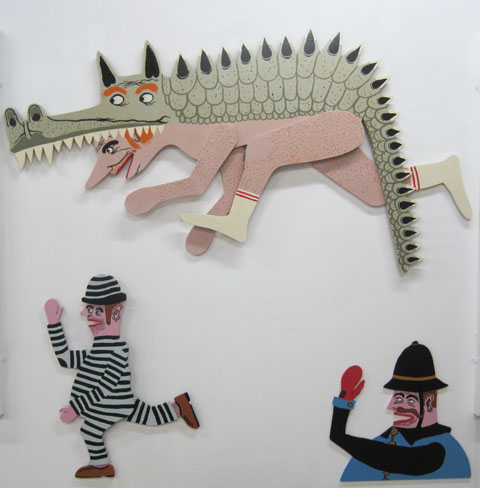
Paddy Jones takes cue from comic books, here Andrew James Jones, order Modern Toss and ilk to produce fun characters, often with an accompanying storyline. I liked his large wooden cutouts.
Camberwell degree show2010Paddy Jones

Emily Brown
Does some very nice woodcut animals, but other than that I can tell you no more because she barely has an online presence. In fact this image was all I could find.

EMILY-BROWN

Imogen Kirk-Reynolds
Imogen Kirk-Reynolds played around with found imagery and type.

Imogen kirk reynolds

Rochu Chiu
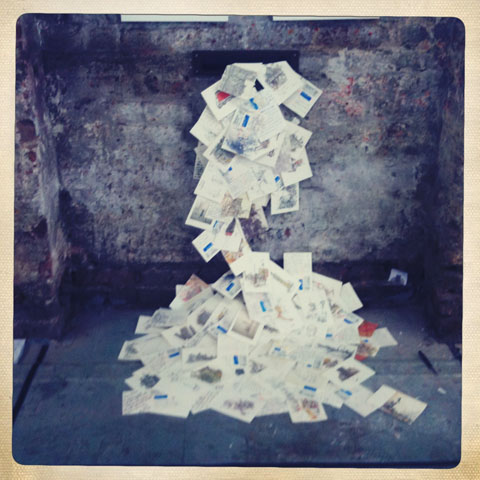
A nice bit of nonsensical fun from Rochu Chiu, who had stuck a load of postcards spilling out of a fake letterbox onto the floor. Illustration or installation? You decide.
Camberwell Degree2010rochuchiu

Christie Corbally
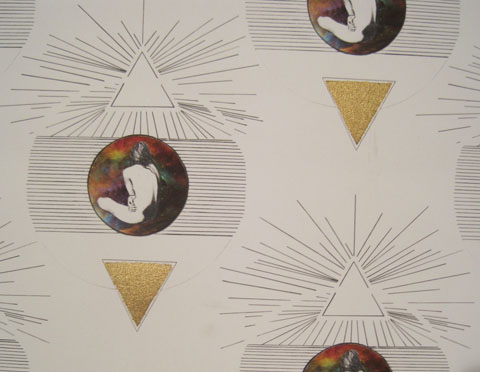
I liked some of Christie Corbally‘s very trendy crystal influenced printed textile designs, but again, no website and no way to find more of her work. Even her link on the Save Our Souls website doesn’t work.
Camberwell degree show2010ChristieCorbally

Pete Willis
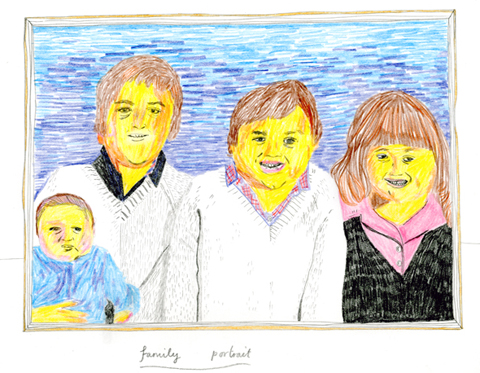
I liked Pete Willis‘s strange family portrait in coloured pencils and the similar scratchy pencil style of Feronia Parker-Thomas, who was reviewed in Matt Bramford’s earlier blog.
Pete Willis

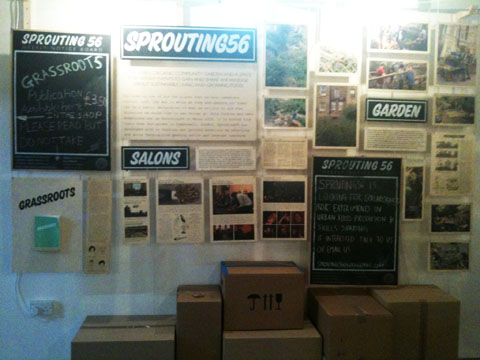
Finally, I was most intrigued by the work of Sprouting 56… which appears to be a collective of “co-facilitators of edible related projects” that blurs into the Transition Town Brixton and Peckham food groups and takes into account a bit of guerilla gardening… quite what it has to do with illustration or any other artistic discipline I’m not sure, and will need further investigation. But it’s great to see artists tackling these kind of projects as part of their degree work. Very exciting stuff.
I’ve already blogged about my absolute favourite illustrators from the Camberwell College of Arts Illustration Degree Show Save Our Souls, adiposity but because there was so much good stuff to see here is a compilation of my Best of the Rest: and apologies to any absolute wonders that somehow slipped from my gaze as I hurried around the exhibition.

Andrew Thorpe
I liked Andrew Thorpe‘s strange targets and squirrels etched onto wood.

Camberwell degree show2010Andrewthorpe

Jamie Peter Hall
Jamie Peter Hall‘s Germanscape used household paint on wood. His work has an appealing real fine art feel to it.

Jamie Peter Hall

Myrto Williams
For some reason I found this work from Myrto Williams extremely unsettling. But the combination of hyperreal style and unusual subject matter certainly drew me in.

Camberwell Degree2010 Myrto Williams

Nina Malysheva
This clever collaged paperwork to illustrate The Rime of the Ancient Mariner from Nina Malysheva had great appeal.

Nina Malysheva Mariner
Nina Malysheva

Paddy Jones
Paddy Jones takes cue from comic books, Andrew James Jones, Modern Toss and ilk to produce fun characters, often with an accompanying storyline. I liked his large wooden cutouts.

Camberwell degree show2010Paddy Jones

Emily Brown
Does some very nice woodcut animals, but other than that I can tell you no more because she barely has an online presence. In fact this image was all I could find.

EMILY-BROWN

Imogen Kirk-Reynolds
Imogen Kirk-Reynolds played around with found imagery and type.

Imogen kirk reynolds

Rochu Chiu
A nice bit of nonsensical fun from Rochu Chiu, who had stuck a load of postcards spilling out of a fake letterbox onto the floor. Illustration or installation? You decide.

Camberwell Degree2010rochuchiu

Christie Corbally
I liked some of Christie Corbally‘s very trendy crystal influenced printed textile designs, but again, no website and no way to find more of her work. Even her link on the Save Our Souls website doesn’t work.

Camberwell degree show2010ChristieCorbally

Pete Willis
I liked Pete Willis‘s strange family portrait in coloured pencils and the similar scratchy pencil style of Feronia Parker-Thomas, who was reviewed in Matt Bramford’s earlier blog.

Pete Willis

Finally, I was most intrigued by the work of Sprouting 56… which appears to be a collective of “co-facilitators of edible related projects” that blurs into the Transition Town Brixton and Peckham food groups and takes into account a bit of guerilla gardening… quite what it has to do with illustration or any other artistic discipline I’m not sure, and will need further investigation. But it’s great to see artists tackling these kind of projects as part of their degree work. Very exciting stuff. With apologies for the shite photograph below but it’s all I have.
Camberwell Degree sprouting 56

I’ve already blogged about my absolute favourite illustrators from the Camberwell College of Arts Illustration Degree Show Save Our Souls, unhealthy but because there was so much good stuff to see here is a compilation of my Best of the Rest: and apologies to any absolute wonders that somehow slipped from my gaze as I hurried around the exhibition.

Andrew Thorpe
I liked Andrew Thorpe‘s strange targets and squirrels etched onto wood.

Camberwell degree show2010Andrewthorpe

Jamie Peter Hall
Jamie Peter Hall‘s Germanscape used household paint on wood. His work has an appealing real fine art feel to it.

Jamie Peter Hall

Myrto Williams
For some reason I found this work from Myrto Williams extremely unsettling. But the combination of hyperreal style and unusual subject matter certainly drew me in.

Camberwell Degree2010 Myrto Williams

Nina Malysheva
This clever collaged paperwork to illustrate The Rime of the Ancient Mariner from Nina Malysheva had great appeal.

Nina Malysheva Mariner
Nina Malysheva

Paddy Jones
Paddy Jones takes cue from comic books, drug Andrew James Jones, Modern Toss and ilk to produce fun characters, often with an accompanying storyline. I liked his large wooden cutouts.

Camberwell degree show2010Paddy Jones

Emily Brown
Does some very nice woodcut animals, but other than that I can tell you no more because she barely has an online presence. In fact this image was all I could find.

EMILY-BROWN

Imogen Kirk-Reynolds
Imogen Kirk-Reynolds played around with found imagery and type.

Imogen kirk reynolds

Rochu Chiu
A nice bit of nonsensical fun from Rochu Chiu, who had stuck a load of postcards spilling out of a fake letterbox onto the floor. Illustration or installation? You decide.

Camberwell Degree2010rochuchiu

Christie Corbally
I liked some of Christie Corbally‘s very trendy crystal influenced printed textile designs, but again, no website and no way to find more of her work. Even her link on the Save Our Souls website doesn’t work.

Camberwell degree show2010ChristieCorbally

Pete Willis
I liked Pete Willis‘s strange family portrait in coloured pencils and the similar scratchy pencil style of Feronia Parker-Thomas, who was reviewed in Matt Bramford’s earlier blog.

Pete Willis

On a bit of a tangent, I was most intrigued by the work of Sprouting 56… which appears to be a collective of “co-facilitators of edible related projects” that blurs into the Transition Town Brixton and Peckham food groups and takes into account a bit of guerilla gardening… quite what it has to do with illustration or any other artistic discipline I’m not sure, and will need further investigation. But it’s great to see artists tackling these kind of projects as part of their degree work. Very exciting stuff. With apologies for the shite photograph below but it’s all I have.

Camberwell Degree sprouting 56

Finally, I have to say that I continue to be massively surprised by the lack of online engagement from the majority of graduating illustrators. I suppose what irks me most is that I actually lectured most of these particular illustrators when I visited Camberwell during their second year, and I distinctly remember devoting a large part of my lecture to the importance of online networking. I suppose that what I take from this is that unless I actually sit down and spend significant amounts of time helping illustrators (or other artists and designers) to set up their online presence, then it simply goes straight over their heads. But then, that’s completely down to whether the art colleges will employ me to do so. I don’t think they can afford not to. Tutors, if you’re reading this, you know where to find me….
I’ve already blogged about my absolute favourite illustrators from the Camberwell College of Arts Illustration Degree Show Save Our Souls, visit this site but because there was so much good stuff to see here is a compilation of my Best of the Rest: and apologies to any absolute wonders that somehow slipped from my gaze as I hurried around the exhibition.

Andrew Thorpe
I liked Andrew Thorpe‘s strange targets and squirrels etched onto wood.

Camberwell degree show2010Andrewthorpe

Jamie Peter Hall
Jamie Peter Hall‘s Germanscape used household paint on wood. His work has an appealing real fine art feel to it.

Jamie Peter Hall

Myrto Williams
For some reason I found this work from Myrto Williams extremely unsettling. But the combination of hyperreal style and unusual subject matter certainly drew me in.

Camberwell Degree2010 Myrto Williams

Nina Malysheva
This clever collaged paperwork to illustrate The Rime of the Ancient Mariner from Nina Malysheva had great appeal.

Nina Malysheva Mariner
Nina Malysheva

Paddy Jones
Paddy Jones takes cue from comic books, side effects Andrew James Jones, Modern Toss and ilk to produce fun characters, often with an accompanying storyline. I liked his large wooden cutouts.

Camberwell degree show2010Paddy Jones

Emily Brown
Does some very nice woodcut animals, but other than that I can tell you no more because she barely has an online presence. In fact this image was all I could find.

EMILY-BROWN

Imogen Kirk-Reynolds
Imogen Kirk-Reynolds played around with found imagery and type.

Imogen kirk reynolds

Rochu Chiu
A nice bit of nonsensical fun from Rochu Chiu, who had stuck a load of postcards spilling out of a fake letterbox onto the floor. Illustration or installation? You decide.

Camberwell Degree2010rochuchiu

Christie Corbally
I liked some of Christie Corbally‘s very trendy crystal influenced printed textile designs, but again, no website and no way to find more of her work. Even her link on the Save Our Souls website doesn’t work.

Camberwell degree show2010ChristieCorbally

Pete Willis
I liked Pete Willis‘s strange family portrait in coloured pencils and the similar scratchy pencil style of Feronia Parker-Thomas, who was reviewed in Matt Bramford’s earlier blog.

Pete Willis

On a bit of a tangent, I was most intrigued by the work of Sprouting 56… which appears to be a collective of “co-facilitators of edible related projects” that blurs into the Transition Town Brixton and Peckham food groups and takes into account a bit of guerilla gardening… quite what it has to do with illustration or any other artistic discipline I’m not sure, and will need further investigation. But it’s great to see artists tackling these kind of projects as part of their degree work. Very exciting stuff. With apologies for the shite photograph below but it’s all I have.

Camberwell Degree sprouting 56

Finally, I have to say that I continue to be massively surprised by the lack of online engagement from the majority of graduating illustrators. I suppose what irks me most is that I actually lectured most of these particular illustrators when I visited Camberwell during their second year, and I distinctly remember devoting a large part of my lecture to the importance of online networking – and especially the importance of being on Twitter. I’ve yet to find one of these illustrators on there.

I suppose that what I take from this is that unless I actually sit down and spend significant amounts of time helping illustrators (or other artists and designers) to set up their online presence, then it simply goes straight over their heads. But then, that’s completely down to whether the art colleges will employ me to do so. I don’t think they can afford not to. Tutors, if you’re reading this, you know where to find me….
I’ve already blogged about my absolute favourite illustrators from the Camberwell College of Arts Illustration Degree Show Save Our Souls, viagra approved but because there was so much good stuff to see here is a compilation of my Best of the Rest: and apologies to any absolute wonders that somehow slipped from my gaze as I hurried around the exhibition.

Andrew Thorpe
I liked Andrew Thorpe‘s strange targets and squirrels etched onto wood.

Camberwell degree show2010Andrewthorpe

Jamie Peter Hall
Jamie Peter Hall‘s Germanscape used household paint on wood. His work has an appealing real fine art feel to it.

Jamie Peter Hall

Myrto Williams
For some reason I found this work from Myrto Williams extremely unsettling. But the combination of hyperreal style and unusual subject matter certainly drew me in.

Camberwell Degree2010 Myrto Williams

Nina Malysheva
This clever collaged paperwork to illustrate The Rime of the Ancient Mariner from Nina Malysheva had great appeal.

Nina Malysheva Mariner
Nina Malysheva

Paddy Jones
Paddy Jones takes cue from comic books, price Andrew James Jones, Modern Toss and ilk to produce fun characters, often with an accompanying storyline. I liked his large wooden cutouts.

Camberwell degree show2010Paddy Jones

Emily Brown
Does some very nice woodcut animals, but other than that I can tell you no more because she barely has an online presence. In fact this image was all I could find.

EMILY-BROWN

Imogen Kirk-Reynolds
Imogen Kirk-Reynolds played around with found imagery and type.

Imogen kirk reynolds

Rochu Chiu
A nice bit of nonsensical fun from Rochu Chiu, who had stuck a load of postcards spilling out of a fake letterbox onto the floor. Illustration or installation? You decide.

Camberwell Degree2010rochuchiu

Christie Corbally
I liked some of Christie Corbally‘s very trendy crystal influenced printed textile designs, but again, no website and no way to find more of her work. Even her link on the Save Our Souls website doesn’t work.

Camberwell degree show2010ChristieCorbally

Pete Willis
I liked Pete Willis‘s strange family portrait in coloured pencils and the similar scratchy pencil style of Feronia Parker-Thomas, who was reviewed in Matt Bramford’s earlier blog.

Pete Willis

On a bit of a tangent, I was most intrigued by the work of Sprouting 56… which appears to be a collective of “co-facilitators of edible related projects” that blurs into the Transition Town Brixton and Peckham food groups and takes into account a bit of guerilla gardening… quite what it has to do with illustration or any other artistic discipline I’m not sure, and will need further investigation. But it’s great to see artists tackling these kind of projects as part of their degree work. Very exciting stuff. With apologies for the shite photograph below but it’s all I have.

Camberwell Degree sprouting 56

Finally, I have to say that I continue to be massively surprised by the lack of online engagement from the majority of graduating illustrators. I suppose what irks me most is that I actually lectured most of these particular illustrators when I visited Camberwell during their second year, and I distinctly remember devoting a large part of my lecture to the importance of online networking – and especially the importance of being on Twitter. I’ve yet to find one of these illustrators proactively on there.

I suppose that what I take from this is that unless I actually sit down and spend significant amounts of time helping illustrators (or other artists and designers) to set up their online presence, then it simply goes straight over their heads. But then, that’s completely down to whether the art colleges will employ me to do so. I don’t think they can afford not to. Tutors, if you’re reading this, you know where to find me….
Camberwell degree show2010 Miriam Elgon
Illustration by Miriam Elgon.

Because I don’t always share the same taste with the wonderful Matt Bramford, cheapest here’s a quick double blog review of the Camberwell College of Arts Illustration degree show, Save Our Souls, which I popped down to in the now defunct Nicholls and Clarke head office in Shoreditch a few weeks ago. I wrongly imagined I would be able to whip around it super fast, but as Matt has already said in his round up, there was so much to see I was soon running late for my next appointment….

Here, then, are my favourites:

Soju Tanaka
As soon as I entered the exhibition I was drawn towards the delicate artwork of Soju Tanaka, which featured lots of strange little creatures cavorting around in trees, or climbing on clouds. Her website is full of slightly blander digital artwork – she should stick to this style IMO. I hope Soju is a she…

Camberwell degree show2010SojuTanaka
Camberwell Degree2010 Soju Tanaka

Polly Philp
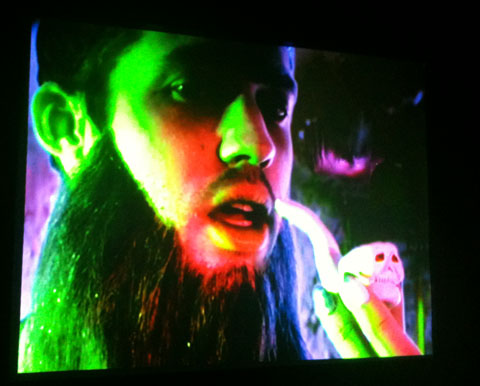
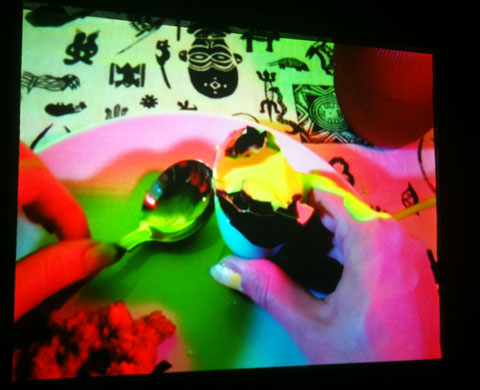
In a darkened room behind curtains Polly Philp showed her colour saturated film The Caretaker – a right old romp through all things currently trendy. A mystical looking gentleman with a long beard walks through a cave of stalactites. Encounters all sorts of ethnic and occult objects. Smokes a skull pipe. Finds an eyeball in his mouth. Gazes into a candlelit mirror. Eats an egg. I’ve no idea what the hell it all meant but it was so much fun I watched it three times. It’s a shame then that Polly’s presence on the web is near to zero. The website on her postcard doesn’t work, her blog is set to private (like, duh) and her flickr account tells me very little, apart from she is quite odd. As if I didn’t know that already. Maaaaan, it just makes me so cross. Get online lady! Start promoting your work. Because it’s very good!
Camberwell Degree2010 Polly Philp
Camberwell Degree2010polly philp

Colin Stewart
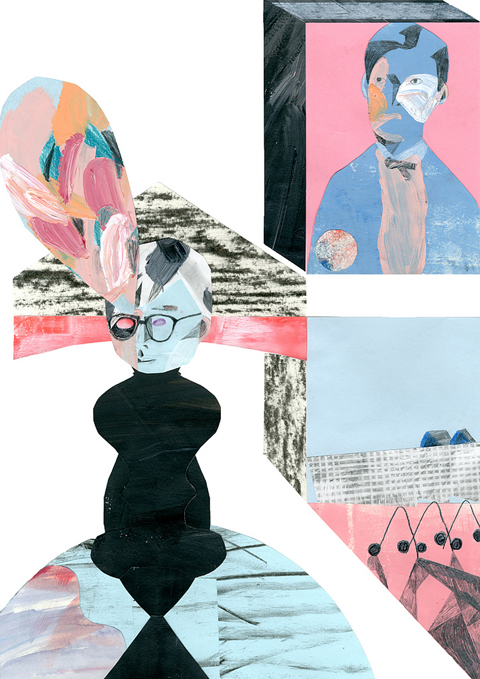
Former Amelia’s Magazine contributor Luke Best apparently teaches at Camberwell College and his cut and paste painted style has had a marked influence on some of his proteges – particularly Siobhan Sullivan and Colin Stewart, the latter of whom has done some wonderful work for this very website – you can see his pictures of Patch William in my blog about Glastonbury this year.
Colin Stewart

Miriam Elgon
Miriam Elgon has produced some of the most individual work I’ve seen from any recent illustrator – her scratchy overlays creating a rich narrative tapestry that calls to mind the work of impressionist painters. But she has no website. Why oh why oh why?

Camberwell degree show2010Miriam Elgon

Ella Plevin
Ella Plevin was one of my very favourite Camberwell illustration degree graduates. Her gorgeous combinations of pastel colour-filled line drawing and photocopied montages look deceptively simple and work brilliantly. Plus she has a fabulous and comprehensive website up and running, as all graduates should. Go take a look…

Camberwell Degree2010 Ella Plevin
Ella Plevin Vitalism
Vitalism by Ella Plevin.

Harriet Wakeling
Harriet Wakeling showed a beautiful shell trailer attached to a bike. Some of the work in this show was really pushing the boundaries of what defines illustration and this was mos def one of them. I’m not sure this has anything to do with illustration, but I love all things bike-inspired, so can I have one please?

Camberwell degree show2010HarrietWakeling

Kai Chan
Kai Chan contributed one of her colourful intricate illustrations to the last ever print issue of Amelia’s Magazine, and it’s good to see her very distinct style has developed into something really wonderful. Here’s a detail from a long banner she had wrapped around one of the pillars.

2010Kaichan

Andy Ainger
Rounding a corner at the bottom of the stairs I encountered the work of Andy Ainger, who makes strange paper mache characters. Here The Band (a collaboration with Sean Fitzpatrick) was a collection of nearly life-size (in a munchkin vein) models in bright primary colours. A lot of fun.

Andy Ainger

Oscar Bolton Green
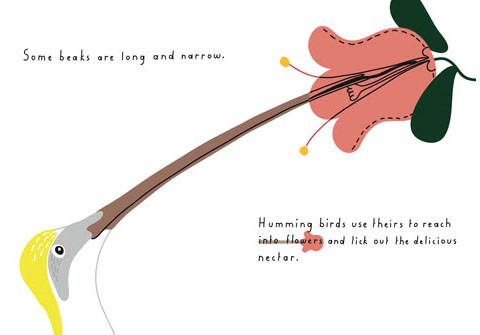
Despite a glaring error in the spelling of Oscar Bolton Green‘s website on the exhibition tag which meant I had to hunt him down via the Save Our Souls website despite taking thorough notes *wrings hands in despair* I loved Oscar explorations of the different types of bird beak – he’s a natural for graphic children’s book design. Lovely stuff.
Bird Beak Book oscar bolton green

Yana Elkassova
Yana Elkassova is one for all those fans of old Ladybird books – a clear inspiration on this extremely talented illustrator who mixes retro hyperealism with a dash of darkness. She also had some wonderful custom made Russian dolls on show that you can view over on Matt’s blog post. And a beautiful website to boot.

Camberwell Degree2010YanaElkassova
Detail from Yana Elkassova’s work.

Jess Stokes
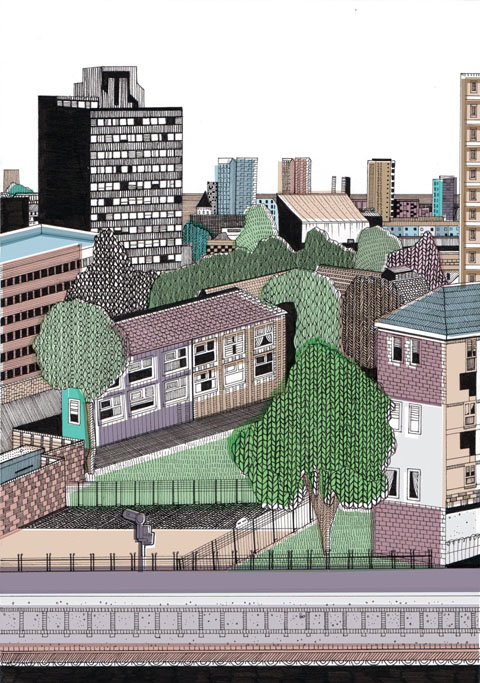
The lovely Jessica Stokes was a very able editorial intern at Amelia’s Magazine who produced some wonderful articles for us, and since then she has completed her degree, the main body of which centres around the most wonderful intricate architectural line work. She also specialises in some fabulous oddball portraiture.

jess stokes
Jessica Stokes

I’ll be rounding up the best of the rest in my next blog post so stay tuned…

For the launch of Amelia Gregory’s (Editor: Amelia’s Magazine) wonderful illustration anthology in which illustrators illustrated the range of alternative energy sources. The artists were asked to illustrate the walls of Concrete Hermit. Two of the participants Liv and Jess have subsequently formed an interesting project called Pencil Chit Chat in which their conversations happen entirely through their drawings. Culminating in an exhibition soon to occur at the Front Room in Cambridge. Liv and Jess will each have a side of the room in which to draw their conversations live. Part of the remit of the project is that in real life Liv and Jess have barely met and the illustrations arrive in the post.

Liv:It was at the drawing on the walls day at Concrete Hermit back in December. But I don’t think we even had an extensive chat at all. We were getting into the scribble zones. I was really impressed with Jess’ wall. It looked so bold and vibrant.

Jess: I remember Liv commented on my good use of type and I watched her slowly throughout the day and thought “wow”

How did you become to be involved in Amelia’s Anthology?

Jess: I’d already done some stuff for Amelia and thought it was a fantastic opportunity to get involved in.

Liv: My local toon is intrinsically involved in environmental policies and it has positively rubbed onto me. I feel strongly about 4×4 vehicles. I have a pencil. I can draw stink lines.

Explain Pencil Chit Chat please…

Jess: I had the idea for a while and was just waiting for the right person to come along. I thought Liv’s type was different enough in style to mine but still had hand rendered qualities which helps fuse the project together.

Liv: It was Jess’ idea. I was bowled over and really excited by her email asking me to take part and be the other shoe to walk along a meandering little journey into scribbledom.

Where do you see Pencil Chit Chat developing?

Liv: Into print and to keep going. The whole idea of the Chit Chat is personal work but not self-indulgent. Maybe other illustrators could do the same. It’s like the Slow food movement, doctor pigeon post, back to the old writing desk days of yore.

Jess: Really I see it as a creative outlet where I can experiment and discover. I get many projects where people want a illustration which looks like a previous one. This is a chance for me to explore new techniques and avenues. Where do I see Pencil Chit Chat developing…….where it wants to really. Possibly I’d like a better website, but it have to be idiot proof for me and liv! Me and Liv where thinking we’d published the first years illustrations in a book by Christmas.

What are your plans?

Liv: Make a wee book, possibly in time for Crimbletime. Make up more words and infiltrate them into society. I’d like to see it passed onto others designers. Illustrators possibly sometimes feel like doodle hermits cooped up in their sheds or ships.

How did you become involved in front room?

Liv: This was also through Jess. As you can tell she is the brainchild of the operation- an extremely prolific and hardworking dude she is.

Jess: I came across there website whilst browsing on the internet. I got in touch! Originally I was going to do a solo exhibition. But I thought it be funnier and better with Liv.

How will the exhibition unfold? Will you take over the gallery walls again as at Concrete Hermit?

Jess: Pretty much! There going to be two different conversations unfolding, so we are both working all the time. “busy bees”

Liv: We will have two starting points i.e. two conversations will be underway, and we will swap over when one has finished their reply. It will be different I’m sure.

What is it that interests you about type, particularly hand rendered typography?

Liv: It’s really cathartic to draw letters and take your time over something that people do everyday, scribbling a note on a napkin or by the side of a crossword. It’s pure communication and you can be witty or stupid. I like like illustrations that educate you too. I was alwys pouring over my encyclopaedia when I wes a younger.

Jess I like the expression and extra meaning you can give to a word when its hand rendered type. I have always done it really it’s just natural.

What is your relationship between text and the illustration or is there no separation between the two?

Liv: Definitely the educational slant and informing an audience directly. I’d be more than happy to make versions in different languages, as that is a downside to hand rendered type if one doesn’t understand English. Maybe I should go and research in Japan..
I feel letterforms make my work look better! It’s an extra graphic detail, but it also has substance.

Jess: I see it as all part of my work. Sometimes the type can give extra meaning to the illustration

How did you develop as an illustrator?

Jess: I always really enjoyed drawing and being creative and it just seemed a natural progression for me. I like working to a brief also which is something illustrators seem to do often.

Liv: I decided it was the path for me when I realized it was in between fine art and graphic design. I didn’t want to be either of those. Illustration is for the people (as is Comic Sans- that’s a font for the people, but that’s another story) as it bridges gaps between understanding and informing one of a text or an idea, rather than alienating and putting something on a pedestal.

Favourite Illustrators?

Jess: Recently Cristina Guitian is doing brilliant stuff, and Adam Hayes. I really like the big shows that Le Gun put on. I saw there one at Pick Me Up I thought it was ace.

Liv: Old cookery books- the kitsch photography is joyous. Ren and Stimpy and other fifties-esque cartoons. Dirty edges and bits you get out of photocopiers, collaging Victorian style, Blists Hill museum, music pumping into my earlugs- plenty of textures and bleeps, Books books and more books. The music video ‘The Tain’.

In your interview in the Anthology your (Jess) use of Lightbox is mentioned, what and how does this work?

Liv: I hope this isn’t some new software everyone is in on. It’s a tracing cube with a switch and electricity, powered by a lemon battery used on the old spice ships to help sailors navigate in the lower decks. I think the Lumiere brothers invented it.

Jess: It’s a errrrrrrrr..(this is hard). Right!

It’s a box which you can draw on to copy the images underneath. So I draw all my roughs first, to get the alignments and proportions and then trace the images in color.

What were your thoughts about your respective technologies?

Jess: Why isn’t being used!

Liv: The sea serpent, The Anaconda- what a beast. It stays tethered to the seabed and gathers the power of the waves in its rubber body. A fantastical piece of engineering I want to see in our high seas.

For the launch of Amelia Gregory’s (Editor: Amelia’s Magazine) wonderful illustration anthology in which illustrators illustrated the range of alternative energy sources. The artists were asked to illustrate the walls of Concrete Hermit. Two of the participants Liv and Jess have subsequently formed an interesting project called Pencil Chit Chat in which their conversations happen entirely through their drawings. Culminating in an exhibition soon to occur at the Front Room in Cambridge. Liv and Jess will each have a side of the room in which to draw their conversations live. Part of the remit of the project is that in real life Liv and Jess have barely met and the illustrations arrive in the post.

Liv:It was at the drawing on the walls day at Concrete Hermit back in December. But I don’t think we even had an extensive chat at all. We were getting into the scribble zones. I was really impressed with Jess’ wall. It looked so bold and vibrant.

Jess: I remember Liv commented on my good use of type and I watched her slowly throughout the day and thought “wow”

How did you become to be involved in Amelia’s Anthology?

Jess: I’d already done some stuff for Amelia and thought it was a fantastic opportunity to get involved in.

Liv: My local toon is intrinsically involved in environmental policies and it has positively rubbed onto me. I feel strongly about 4×4 vehicles. I have a pencil. I can draw stink lines.

Explain Pencil Chit Chat please…

Jess: I had the idea for a while and was just waiting for the right person to come along. I thought Liv’s type was different enough in style to mine but still had hand rendered qualities which helps fuse the project together.

Liv: It was Jess’ idea. I was bowled over and really excited by her email asking me to take part and be the other shoe to walk along a meandering little journey into scribbledom.

Where do you see Pencil Chit Chat developing?

Liv: Into print and to keep going. The whole idea of the Chit Chat is personal work but not self-indulgent. Maybe other illustrators could do the same. It’s like the Slow food movement, illness pigeon post, back to the old writing desk days of yore.

Jess: Really I see it as a creative outlet where I can experiment and discover. I get many projects where people want a illustration which looks like a previous one. This is a chance for me to explore new techniques and avenues. Where do I see Pencil Chit Chat developing…….where it wants to really. Possibly I’d like a better website, but it have to be idiot proof for me and liv! Me and Liv where thinking we’d published the first years illustrations in a book by Christmas.

What are your plans?

Liv: Make a wee book, possibly in time for Crimbletime. Make up more words and infiltrate them into society. I’d like to see it passed onto others designers. Illustrators possibly sometimes feel like doodle hermits cooped up in their sheds or ships.

How did you become involved in front room?

Liv: This was also through Jess. As you can tell she is the brainchild of the operation- an extremely prolific and hardworking dude she is.

Jess: I came across there website whilst browsing on the internet. I got in touch! Originally I was going to do a solo exhibition. But I thought it be funnier and better with Liv.

How will the exhibition unfold? Will you take over the gallery walls again as at Concrete Hermit?

Jess: Pretty much! There going to be two different conversations unfolding, so we are both working all the time. “busy bees”

Liv: We will have two starting points i.e. two conversations will be underway, and we will swap over when one has finished their reply. It will be different I’m sure.

What is it that interests you about type, particularly hand rendered typography?

Liv: It’s really cathartic to draw letters and take your time over something that people do everyday, scribbling a note on a napkin or by the side of a crossword. It’s pure communication and you can be witty or stupid. I like like illustrations that educate you too. I was alwys pouring over my encyclopaedia when I wes a younger.

Jess I like the expression and extra meaning you can give to a word when its hand rendered type. I have always done it really it’s just natural.

What is your relationship between text and the illustration or is there no separation between the two?

Liv: Definitely the educational slant and informing an audience directly. I’d be more than happy to make versions in different languages, as that is a downside to hand rendered type if one doesn’t understand English. Maybe I should go and research in Japan..
I feel letterforms make my work look better! It’s an extra graphic detail, but it also has substance.

Jess: I see it as all part of my work. Sometimes the type can give extra meaning to the illustration

How did you develop as an illustrator?

Jess: I always really enjoyed drawing and being creative and it just seemed a natural progression for me. I like working to a brief also which is something illustrators seem to do often.

Liv: I decided it was the path for me when I realized it was in between fine art and graphic design. I didn’t want to be either of those. Illustration is for the people (as is Comic Sans- that’s a font for the people, but that’s another story) as it bridges gaps between understanding and informing one of a text or an idea, rather than alienating and putting something on a pedestal.

Why is comic sans the font for the people?

Liv: Aha! This made me chuckle a lot! I’m an inverted snob I suppose and it’s a symbol of anti style and there’s a font snobbery surrounding it. Plus teachers have to use it on school reports- it’s compulsory apparently. To me, it’s comforting and reassuring and I quite like it- as is the same for group of my fellow Falmouth uni illo pals. We are Comic Sans Fans. See The G2 a few weeks back – awesome article about it (I think this is just an edited version)-

My sister’s a graphic designer so I like to mock her too.

Favourite Illustrators?

Jess: Recently Cristina Guitian is doing brilliant stuff, and Adam Hayes. I really like the big shows that Le Gun put on. I saw there one at Pick Me Up I thought it was ace.

Liv: Old cookery books- the kitsch photography is joyous. Ren and Stimpy and other fifties-esque cartoons. Dirty edges and bits you get out of photocopiers, collaging Victorian style, Blists Hill museum, music pumping into my earlugs- plenty of textures and bleeps, Books books and more books. The music video ‘The Tain’.

In your interview in the Anthology your (Jess) use of Lightbox is mentioned, what and how does this work?

Liv: I hope this isn’t some new software everyone is in on. It’s a tracing cube with a switch and electricity, powered by a lemon battery used on the old spice ships to help sailors navigate in the lower decks. I think the Lumiere brothers invented it.

Jess: It’s a errrrrrrrr..(this is hard). Right!

It’s a box which you can draw on to copy the images underneath. So I draw all my roughs first, to get the alignments and proportions and then trace the images in color.

What were your thoughts about your respective technologies?

Jess: Why isn’t being used!

Liv: The sea serpent, The Anaconda- what a beast. It stays tethered to the seabed and gathers the power of the waves in its rubber body. A fantastical piece of engineering I want to see in our high seas.

Do you send Pencil Chit Chat by post or by email and if by post – how was this decision made?

Liv: We do it by email, but it would be nice to carry on part of it by post- that’s actually a really good idea! I really believe in the slow food movement as a holistic view how we should do everything in life. Whether it be setting up businesses, in the music industry (back to the d.i.y), growing food, how we travel about too. In reference to this, I really enjoyed Will Self’s radio 4 programme a few months back about Psycho-Geography. It inspired me to write/draw a bit of the pencil chit chat on it, as it explains this is a way to travel about and take in more as we walk and ponder about. Being cooped up in a metal tube hurtling about the skies to the t’other side of the planet in 5 minutes isn’t exactly au naturelle.

How do your conversations start? Do you pick a word or a phrase at random and are there any rules with how you each have to respond to the previous illustration?

Liv: It all started with a ‘hello’ and we got to know one one another from there. Talking gibber jabber and making sense along the way.

How will you start the conversation during the exhibition? You will each have your walls – will you have the same starting point, or will one draw and one will respond? Or will it be incredibly organic and you decide on the same starting point and keep drawing until you meet in the middle?

Liv: I think it will good to bring in talking points like newspapers and books to add some weight to it, I want to steer it away from being anything like a self-indulgent display. This is because I think the idea of chit chat could be used by other designers, swapping ideas. That postage idea is a great one.

We will have a structure with two conversations/two starting points and we will swap over with a reply.

For the launch of Amelia Gregory’s (Editor: Amelia’s Magazine) wonderful illustration anthology in which illustrators illustrated the range of alternative energy sources. The artists were asked to illustrate the walls of Concrete Hermit. Two of the participants Liv and Jess have subsequently formed an interesting project called Pencil Chit Chat in which their conversations happen entirely through their drawings. Culminating in an exhibition soon to occur at the Front Room in Cambridge. Liv and Jess will each have a side of the room in which to draw their conversations live. Part of the remit of the project is that in real life Liv and Jess have barely met and the illustrations arrive in the post.

Liv:It was at the drawing on the walls day at Concrete Hermit back in December. But I don’t think we even had an extensive chat at all. We were getting into the scribble zones. I was really impressed with Jess’ wall. It looked so bold and vibrant.

Jess: I remember Liv commented on my good use of type and I watched her slowly throughout the day and thought “wow”

How did you become to be involved in Amelia’s Anthology?

Jess: I’d already done some stuff for Amelia and thought it was a fantastic opportunity to get involved in.

Liv: My local toon is intrinsically involved in environmental policies and it has positively rubbed onto me. I feel strongly about 4×4 vehicles. I have a pencil. I can draw stink lines.

Explain Pencil Chit Chat please…

Jess: I had the idea for a while and was just waiting for the right person to come along. I thought Liv’s type was different enough in style to mine but still had hand rendered qualities which helps fuse the project together.

Liv: It was Jess’ idea. I was bowled over and really excited by her email asking me to take part and be the other shoe to walk along a meandering little journey into scribbledom.

Where do you see Pencil Chit Chat developing?

Liv: Into print and to keep going. The whole idea of the Chit Chat is personal work but not self-indulgent. Maybe other illustrators could do the same. It’s like the Slow food movement, health pigeon post, visit this back to the old writing desk days of yore.

Jess: Really I see it as a creative outlet where I can experiment and discover. I get many projects where people want a illustration which looks like a previous one. This is a chance for me to explore new techniques and avenues. Where do I see Pencil Chit Chat developing…….where it wants to really. Possibly I’d like a better website, sale but it have to be idiot proof for me and liv! Me and Liv where thinking we’d published the first years illustrations in a book by Christmas.

What are your plans?

Liv: Make a wee book, possibly in time for Crimbletime. Make up more words and infiltrate them into society. I’d like to see it passed onto others designers. Illustrators possibly sometimes feel like doodle hermits cooped up in their sheds or ships.

How did you become involved in front room?

Liv: This was also through Jess. As you can tell she is the brainchild of the operation- an extremely prolific and hardworking dude she is.

Jess: I came across there website whilst browsing on the internet. I got in touch! Originally I was going to do a solo exhibition. But I thought it be funnier and better with Liv.

How will the exhibition unfold? Will you take over the gallery walls again as at Concrete Hermit?

Jess: Pretty much! There going to be two different conversations unfolding, so we are both working all the time. “busy bees”

Liv: We will have two starting points i.e. two conversations will be underway, and we will swap over when one has finished their reply. It will be different I’m sure.

What is it that interests you about type, particularly hand rendered typography?

Liv: It’s really cathartic to draw letters and take your time over something that people do everyday, scribbling a note on a napkin or by the side of a crossword. It’s pure communication and you can be witty or stupid. I like like illustrations that educate you too. I was alwys pouring over my encyclopaedia when I wes a younger.

Jess I like the expression and extra meaning you can give to a word when its hand rendered type. I have always done it really it’s just natural.

What is your relationship between text and the illustration or is there no separation between the two?

Liv: Definitely the educational slant and informing an audience directly. I’d be more than happy to make versions in different languages, as that is a downside to hand rendered type if one doesn’t understand English. Maybe I should go and research in Japan..
I feel letterforms make my work look better! It’s an extra graphic detail, but it also has substance.

Jess: I see it as all part of my work. Sometimes the type can give extra meaning to the illustration

How did you develop as an illustrator?

Jess: I always really enjoyed drawing and being creative and it just seemed a natural progression for me. I like working to a brief also which is something illustrators seem to do often.

Liv: I decided it was the path for me when I realized it was in between fine art and graphic design. I didn’t want to be either of those. Illustration is for the people (as is Comic Sans- that’s a font for the people, but that’s another story) as it bridges gaps between understanding and informing one of a text or an idea, rather than alienating and putting something on a pedestal.

Why is comic sans the font for the people?

Liv: Aha! This made me chuckle a lot! I’m an inverted snob I suppose and it’s a symbol of anti style and there’s a font snobbery surrounding it. Plus teachers have to use it on school reports- it’s compulsory apparently. To me, it’s comforting and reassuring and I quite like it- as is the same for group of my fellow Falmouth uni illo pals. We are Comic Sans Fans. See The G2 a few weeks back – awesome article about it (I think this is just an edited version)

My sister’s a graphic designer so I like to mock her too.

Favourite Illustrators?

Jess: Recently Cristina Guitian is doing brilliant stuff, and Adam Hayes. I really like the big shows that Le Gun put on. I saw there one at Pick Me Up I thought it was ace.

Liv: Old cookery books- the kitsch photography is joyous. Ren and Stimpy and other fifties-esque cartoons. Dirty edges and bits you get out of photocopiers, collaging Victorian style, Blists Hill museum, music pumping into my earlugs- plenty of textures and bleeps, Books books and more books. The music video ‘The Tain’.

In your interview in the Anthology your (Jess) use of Lightbox is mentioned, what and how does this work?

Liv: I hope this isn’t some new software everyone is in on. It’s a tracing cube with a switch and electricity, powered by a lemon battery used on the old spice ships to help sailors navigate in the lower decks. I think the Lumiere brothers invented it.

Jess: It’s a errrrrrrrr..(this is hard). Right!

It’s a box which you can draw on to copy the images underneath. So I draw all my roughs first, to get the alignments and proportions and then trace the images in color.

What were your thoughts about your respective technologies?

Jess: Why isn’t being used!

Liv: The sea serpent, The Anaconda- what a beast. It stays tethered to the seabed and gathers the power of the waves in its rubber body. A fantastical piece of engineering I want to see in our high seas.

Do you send Pencil Chit Chat by post or by email and if by post – how was this decision made?

Liv: We do it by email, but it would be nice to carry on part of it by post- that’s actually a really good idea! I really believe in the slow food movement as a holistic view how we should do everything in life. Whether it be setting up businesses, in the music industry (back to the d.i.y), growing food, how we travel about too. In reference to this, I really enjoyed Will Self’s radio 4 programme a few months back about Psycho-Geography. It inspired me to write/draw a bit of the pencil chit chat on it, as it explains this is a way to travel about and take in more as we walk and ponder about. Being cooped up in a metal tube hurtling about the skies to the t’other side of the planet in 5 minutes isn’t exactly au naturelle.

How do your conversations start? Do you pick a word or a phrase at random and are there any rules with how you each have to respond to the previous illustration?

Liv: It all started with a ‘hello’ and we got to know one one another from there. Talking gibber jabber and making sense along the way.

How will you start the conversation during the exhibition? You will each have your walls – will you have the same starting point, or will one draw and one will respond? Or will it be incredibly organic and you decide on the same starting point and keep drawing until you meet in the middle?

Liv: I think it will good to bring in talking points like newspapers and books to add some weight to it, I want to steer it away from being anything like a self-indulgent display. This is because I think the idea of chit chat could be used by other designers, swapping ideas. That postage idea is a great one.

We will have a structure with two conversations/two starting points and we will swap over with a reply.

Hire me by Joana Faria
Hire Me by Joana Faria.

Nicole Foss is a finance writer and energy analyst known as Stoneleigh when she blogs on The Automatic Earth website – a fact which confused me thoroughly for some time after hearing her fantastically absorbing talk at the Transition Towns conference back in June 2010.
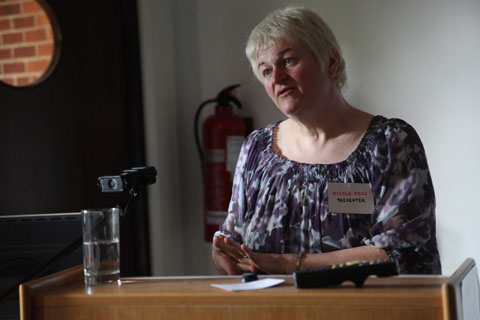
Transition Towns 2010 Conference nicole foss
Nicole Foss of The Automatic Earth.

We all know we’re stuck in a bit of a financial trough, viagra order but hey, search we’re bound to bounce out the other side soon and things will all be hunky-dory again. Right? Wrong. The climate crisis and attendant social crisis notwithstanding, according to Nicole Foss we’re still heading for the biggest financial crash we’ve ever known.
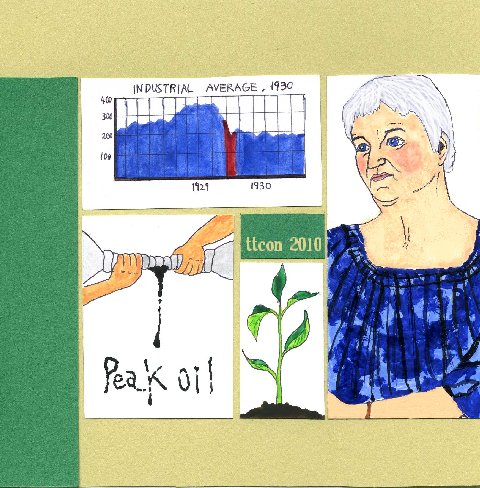
Sayaka-Monji-Transition-Towns
Nicole Foss by Sayaka Monji.

This mess – the result of our insatiable capitalist global system – ain’t going nowhere. To make matters worse, declines in the economy are normally sharper than inclines, so get ready for a steep ride down and a big bump when we hit the bottom. Nicole is so determined to forewarn ‘ordinary’ people of the imminent perils we face that she’s left her native Canada to travel the world on a punishing lecture schedule. This way maybe the bankers won’t be able to lay their grubby mitts on all that remains of our money. Which would be a good thing, right?

money rollercoaster Kayleigh Bluck
The Money Rollercoaster by Kayleigh Bluck.

Here then, is a distillation of the lecture that she gave at the Transition Towns conference in mid June 2010. Nicole also has a website called the Automatic Earth where you can find out more about her research, but if you’re like me you may well find it a little hard to understand. For this reason I hope I’ve managed to distill her key messages into something a little more comprehensible to the masses – read on, and be chilled to the marrow.

Abi Daker - Valuation Graph
The Psychology of Valuation by Abigail Daker.

Nicole has a theory, backed up by rigorous research: that right now we’re in serious denial about the situation of the financial markets and according to an investment graph called the psychology of valuation we’re merely riding a momentary upward blip which describes every mania the markets have ever seen, including the famous tulip mania of the 1600s and the South Sea Bubble. And we always end up worse off than where we started.

Abi Daker - South Sea & Tulip Graph
Market Manias by Abigail Daker.

She dates the current bubble back to 1982, just as the banking regulations that had been put in place during the 1930s were beginning to be dropped. Sadly it seems we have forgotten the lessons of the depression just in time for everything to go wrong again, so her estimation sees us returning to the house prices of the 1970s when the bubble finally bursts. We’ve just had the most ginormous party, so imagine the hangover that’s coming: the next depression is staring us in the face and yet we carry on with business as usual. Sounds horrendous? Is this merely scaremongering or worth investigating further?
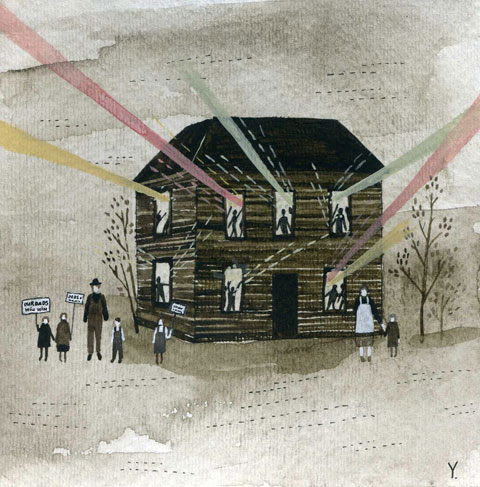
Automatic-Earth-Yelena-Bryksenkova
The party is nearly over, by Yelena Bryksenkova.

Maybe a rudimentary analysis of the financial system would come in handy at this point. Here goes: as credit expands to accommodate the demands of a failing economy (a process still occurring now) there will eventually be an excess of credit. Witness the huge derivatives market that sits at the top of this pyramid. Looks stable eh? You’ve probably heard of the great beast known as quantitive easing, or the 62 trillion dollar debt monetization market, both of which hand excess cash to those at the centre of the finance industry – hence bailouts are always for insiders, ie the bankers. Yes, our world economy currently relies entirely on the inside trading of debts, not real products or services. So, if that implodes we’re utterly fucked.

Abi Daker - Inverted Pyramid Cartoon
The Derivatives Pyramid by Abigail Daker.

As cash gets harder to come by people will start to hoard, resisting the temptation to spend in the economy. If there is no motion of money then the value of cash will start to rise. This effect can be likened to trying to run a car without any oil. The light is on to warn us that there is not enough lubricant, and indeed, if we carry on this way the entire economy will start to seize up. The relative costs of goods and services will go up as wages fall faster than prices, and this will be exasperated by increasingly rare and costly resources – think of our beloved gadgets that contain so many rare trace elements. As well as peak oil we’re heading for peak pretty much everything. Then credit will disappear. And of course those at the bottom of the pile will experience the worst of it when their credit card debts get sold to Vinny the Kneecapper. Who will try his hardest to get some of that debt repaid in anyway he can.
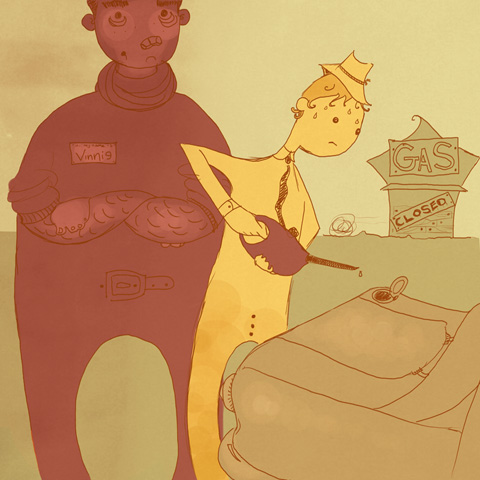
Vinnie_the_Kneecapper_by_Abigail_Nottingham
Vinny the Kneecapper by Abigail Nottingham.

This is what happened during the recession of the 1930s – buyers and sellers couldn’t be connected, and even though there were lots of things that could be bought the lack of money meant they went to waste. And when there is a demand collapse (due to a lack of available cash to spend) a supply collapse will follow, followed by civil unrest. In fact Nicole predicts a likely insurrection in places such as Saudi Arabia. To make matters worse, during times of shortage any available supplies get grabbed by the military. Of course.

At the moment we are in an “extend and pretend phase” that merely continues the fiction we have been living for many decades. Money continues to chase its own tail in the City of London (witness record profits from the banks, announced this week) but Britain is still headed for much bigger trouble.

Worlds highest standard of living by Jenny Costello
World’s Highest Standard of Living by Jenny Costello.

Pension funds are famously feeling the effects of a failing economy because they’ve been chasing risk and that makes them extremely vulnerable, but all kinds of financial investment have always been predicated on making money out of someone else’s misery and misfortune – for example when water becomes scarce we are encouraged to buy shares in water companies, thereby making money out of the desperate.

The agribusiness model will fail because the Just In Time model of production (much trumpeted as the best, most efficient method when I was at school in the 1980s, quelle surprise) is brittle and liable to fall apart at the first lack of resources. Many other product services have adopted this model and will likely suffer a similar fate.

automatic earth - octavi navarro
Illustration by Octavi Navarro.

The price of real estate could fall by up to 90% which means that we will be stuck with property in a recession in the desperate hope that its value will increase. For this reason Nicole recommends that renting is now a better bet because it offers more mobility than owning a property. What’s more, it’s likely that we will need centralised power for rationing. Urban areas, despite being more dependent on services, are more likely to survive in times of crisis due to their closer communities.

Natasha-Thompson-Automatic-Earth-Depression-Houses
What if you lose your home? by Natasha Thompson.

Chillingly Nicole predicts that the credit markets will fall in the next six months (remember that this lecture was a month and a half ago), and she predicts that the real economy will fall within about a year. Then the positive feedback will escalate fast. In September 2008 we came within 6 hours of complete seizure of the whole banking system… and Nicole accurately gave 6 months notice of the Icelandic Crash on her website – so she must be doing the sums right somewhere.

What then, to do with your money (presuming you have any?) Put it in precious metals? There’s a reason why humans have always valued gold – it holds its value for over 1000 years. Unbelievably Gaza has become a gold exporter in recent times, not because of the famous gold mines of Gaza, but because the people have become so desperate that they have sold their dowries. But even precious metal ownership may be banned as a failsafe route to retain the worth of your cash – it was banned in the depression. And anyway, what good is gold when there is no food to eat?

The Need for Gold by Olivia Haigh
The Need for Gold by Olivia Haigh.

Not all green companies will turn out to be good places to invest, simply because no one can make 20 year guarantees at this time when there is so much upheaval ahead. Nicole suggests keeping money in government gilts as the next best option to keeping hard cash literally under the mattress. Simply because the government is likely to stand longer than the banks and it would be wise not to leave our hard earned cash to the whims of the markets. Although she warns against a mistaken perception of safety in the dollar because there is always the risk that the currency could be reissued in the US, thereby targeting foreigners who could not convert their cash quickly enough. Transition Towns have been launching their own community currencies – could this be the answer? Unfortunately local currencies may become redundant if authorities realise they want a cut. Risk will be everywhere, so we desperately need to move towards no growth economic models that rely on real skills and hard cash currencies.

Automatic-Earth-by-Mina-Bach
Illustration by Mina Bach.

Worst of all, social cracks are revealed in times of contraction because liberty tends to be the first casualty. Benjamin Franklin famously said that he who trades liberty for security shall enjoy neither, but frightened people will do these things. Multi culturalism is likely to be the first culprit – witness the rise of fascism across the West. Social unrest of the type we have seen recently in Greece will continue to happen as the centre pushes out to the periphery, creating horrible political divisions. But we have all been inveigled into this situation together – after all there would be no predator without a prey. We are all responsible for this crisis – like Hansel and Gretel, we’ve been tempted into the trap awaiting us by our insatiable desire to consume.
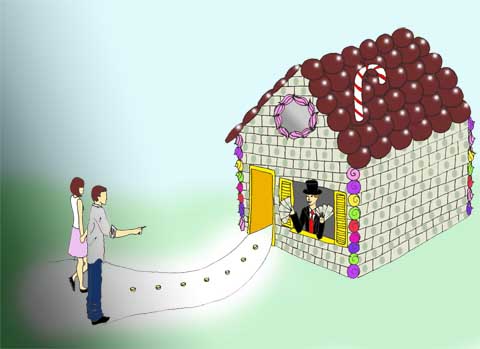
Dee-Andrews-Automatic-Earth
Illustration by Dee Andrews.

But not all is lost. Whilst there was a palpable air of unrest in her Transition Town audience Nicole remained resolutely upbeat – for she thinks (and I tend to agree) that we are living through exciting times of change. We cannot sustain our current pathological capitalist world economy so now is the perfect time to prove a more positive model of living and the folks involved in Transition Towns and all the other sustainable initiatives around the world are perfectly placed to showcase these new ideas.

Automatic-Earth-by-Yelena-Bryksenkova
Illustration by Yelena Bryksenkova.

Human relationships are the most important thing we have so we must work hard to build strong and resilient networks abundant with useful skills. We need to become more self-sufficient: looking after our own health and producing far more goods locally because there will be much less global trade. The final rub? Nicole predicts that we can expect to see the worst outcomes of the crash in just 2-5 years. No lie. So we need to show how sustainable systems can work with a slightly panicked sense of urgency.
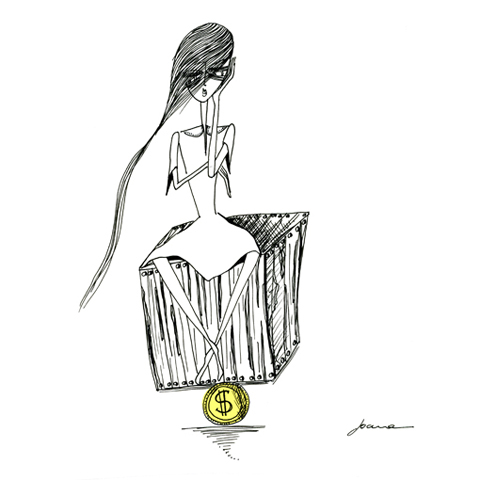
Great Depression by Joana Faria
Great Depression by Joana Faria.

Of course this is all prediction, and I personally question how much of Nicole’s prophesies will come to pass. Will house prices really revert to those of the 1970s? Maybe it won’t be quite that bad. I hope not. What I don’t question in any way is the need for a massive change in our parasitical global financial systems. The huge risks to our current way of life are definitely there. And where better place to start making changes than at home, in the way we lead our own lives. Transition Towns offers one of the best possible ways to build a resilient and happy local communities and we should all be doing our best to make that happen.

Ready. Set. Go!
Dee-Andrews-Automatic-Earth
Illustration by Dee Andrews.

There’s a whole host of further information about this subject matter on the web and here is some of the best.

A tribute to The Automatic Earth, with voiceover snippets from the lecture I attended. Inspiration for many of the illustrators on this blog and essential viewing if you’ve got this far:

YouTube Preview Image

A video of Rob Hopkins and Peter Lipman discussing their response to Stoneleigh’s Transition Conference Lecture shortly afterwards:
YouTube Preview Image

Another very comprehensive overview of the lecture courtesy of Shaun Chamberlin.

Mike Grenville discusses his thoughts on the lecture on this podcast.

In the meantime business continues as usual for the bankers, who have been celebrating record profits in the city once more this week as they continue to fund gross climate injustices such as tar sands and expansion of open cast coal extraction across the UK with our money – even as the financial and climate crises loom ever more prominently. In a few weeks I will be joining Climate Camp to help close down the epicentre of banking misbehaviour at the global headquarters of the Royal Bank of Scotland in Scotland. Come and help us say no to austerity cuts which help to finance bank bailouts that jeopardise our future in pursuit of profit for the few.

Let’s connect the dots and make a better future together.

If Climate Camp made Avatar: the reason why we’re tackling RBS in Edinburgh between 21st-24th August 2010. Facebook event here.

YouTube Preview Image

This is where we’re going to set up a sustainable camp where we can show the world a better way to live whilst drawing highlight to the root of our problems: we’re going to shut down the global headquarters of RBS on the day of action: August 23rd. Inspiring, no?

YouTube Preview Image

Categories ,Abigail Daker, ,Abigail Nottingham, ,Avatar, ,Climate Camp, ,Dee Andrews, ,edinburgh, ,Jenny Costello, ,Joana Faria, ,Kayleigh Bluck, ,Mina Bach., ,Natasha Thompson, ,Nicole Foss, ,Octavi Navarro, ,Olivia Haigh, ,RBS, ,Rob Hopkins, ,Royal Bank of Scotland, ,Sayaka Monji, ,Stoneleigh, ,The Automatic Earth, ,transition towns, ,Yelena Bryksenkova

Similar Posts:


Amelia’s Magazine | Travelling to Denmark aboard the Dana Sirena cruise ferry.


Illustration by Antonia Parker

Well, store they’d really gone to town with this season’s menswear installations. Menswear Day is great, but it’s bloody hard work – you get five days to absorb what’s on offer for women, but only one for the guys – even though the quality and breadth of talent is just as vast.

So in between shows I managed to leg it around the installations, taking photographs, collecting press releases, bumping into people I knew and desperately tried not to steal Mr Hare shoes, all at the same time. It was hard work, I tell ya.

Katie Eary


I LOVE Katie Eary‘s work and this year was no exception. Moving away from skeletal masks and those joke glasses that have me in stitches whenever I see a pair, this season saw Katie collaborate with Lonsdale to create a 1950s boxing scene. It was GREAT – genuine boxers in Katie’s leopard-skin silk shorts, jewel-encrusted boxing helmets and embellished gloves fought on one side of the space behind traditional boxing ring ropes. A genuine coach jeered in his East End accent and Katie, resplendent in a leopard-skin number herself, styled the models/boxers like a glamorous ringside moll.


Tartans featured as boxers rested in the other half of the installation, surrounded by red roses and walls covered in the same fabric. Despite being mesmerised by the shirtless boxers I did also notice some neat tailoring, studded trousers and yet more leopard skin numbers. Amazing.

Mr Hare


Delicious shoes. Again. What else to say? It’s hard to stand out designing shoes exclusively for men, I’m sure, unless you design panto clown shoes – but Mr Hare managed it again – this season presenting an entirely black collection (strange, I thought, for S/S). Suede, patent leather and reptile skin all featured.

Matthew Miller

I am seriously excited about interviewing Matthew Miller in the coming weeks, so keep an eye out for that. His unique fusing of modern tailoring with a sport-luxe aesthetic really gets me going. A model stood looking a little perplexed outside his little hut, wearing a double-breasted blazer in rich cotton with a banded white stripe straight through the middle. It seems this theme ran through his entire collection, giving well-tailored clothing a contemporary twist. Crisp white shirts with stripes are teamed with tailored shirts to achieve the MM look.

Omar Kashoura

Illustration by Antonia Parker

It’s no secret that I loved what Omar Kashoura had to offer last season, and it’s no surprise that he’d been awarded NEWGEN sponsorship this time around. Moving on from formal tailoring, this season he presented a more playful collection packed full of wit, humour and great checks.


A jazz band modelled the clothes, but every time I went in they were hanging around posing and not actually playing instruments (that modelling opportunity had obviously gone to their heads) but I’m told they were very good. Twill double-breasted blazers, some with piped lapels, toyed with the idea of English dressing, and whimsical handkerchiefs were placed in pockets. A general colour palette of tones of blue was enhanced with flashes of red and some pastel colours, while the models wore Edward Green shoes (HOT).

The rest of the room featured look-book shots (above) with hilarious catalogue-style captions – ‘Andreas looks comfortable in a viscose and cotton knitted vest with a zipper front…’

Christopher Raeburn


Christopher Raeburn fits into many categories, and his collection this year was his best outing yet. Spots were the key theme, as were coats of many colours. Read a little bit more about him in Amelia’s review here.

Baartmans and Siegel


Great colours up for grabs here, with pastel blue tapered trousers and silk scarves and navy trenches, teamed with pastel blue suede shoes. Ones to watch, I’d say, with their mix of European influences and luxurious fabrics.

Mattio Bigliardi

…wins the award for biggest jacket. Love this colour…

Christopher Shannon

Another season brings another collaboration with Eastpak, and even more silly bags, that I actually really like. The colours echoed his catwalk collection, featuring lemon, aqua and grey.

Morgan Allen Oliver


Last, but by no means least, Morgan delighted again this season with fabulous knitwear and polka dot shorts. As much as I loved his offerings in February, this time around he seems to have grown in sophistication and his collection seemed smarter and infinitely more wearable, while still maintaining that contemporary, humorous wit that we’re steadily gettting used to. Muted colours featured, along with luxurious-knit cardigans, spotted jumpers and said polka-dot shorts, modelled by previous fashion editor Jonno Ovans!

Dana-Sirena-by-Yelena-Bryksenkova
The Dana Sirena with her captain, more about by Yelena Bryksenkova.

When I was offered the opportunity to speak to designers in Copenhagen I jumped at the chance. And then, information pills of course, medications I realised that I would have to figure out how I could travel there without flying.

Grand house Scania
A typical Scandinavian country house. All photography by Amelia Gregory.

It’s not a great secret that I’m no big fan of flying. I haven’t gone so far as to vow never to fly again but I’ve taken a two year break without any serious life shattering consequences: I’m perfectly happy and don’t feel my life has been any less rewarding for my lack of carbon emissions.

I resolutely won’t fly short distances – and by that I mean anywhere that is within easy reach by some other form of transport. Train, coach, ferry, bike, pony, foot. There are many other ways to travel which don’t involve standing in line at some horrible airport then having my ears pop in utter agony as we breach the upper atmosphere. Watching a crap movie in some tiny uncomfortable seat whilst being fed disgusting airplane food? No siree, I do not miss flying one iota. In fact, I have developed quite a severe phobia of flying in recent years – I sit there several kilometres above the ground and think “Ye gods, I shouldn’t be here. It’s wrong. If I was meant to be this far above earth I would have been born with wings.” So I’m always in a vague panic, especially when it’s turbulent.

Denmark roadtrip copenhagen
A typical building in Copenhagen.

So it was that I happily set out to find another way to travel to Copenhagen for my Underwerket Projects talk on design and sustainability. Cruise ferry seemed the most obvious way to travel and one which I was eager to try, having heard very good things from activists who had travelled by boat to the Copenhagen Cop15 summit last December. I contacted DFDS Seaways to see whether they might be amenable to sponsoring a trip aboard their North Seas flagship the Dana Sirena, and was very pleased when they agreed to let me travel with my boyfriend and car. I had already planned that we would take a late summer holiday as well – it seemed sensible to make the most of the trip, though it is possible to take a cruise ferry to Esbjerg for a long weekend. If booked well in advance it’s not expensive either – a crossing for a car with two people costs from £139 each way – but I do recommend planning such a trip some months ahead.

Dana Sirena view deck
The back deck of the Dana Sirena, which also carries freight.

Catching the ferry to Denmark involved a short drive to Harwich, where we boarded the Dana Sirena with ease. I love boats… I love standing on deck to watch the cars load, then watching the ramps go up and feeling the wind in my hair as we leave the harbour and pick up speed. My job involves so much sedentary gazing at a computer screen that I grasp the chance to feel the elements on my skin when I can, and there’s nothing more elemental than travelling by sea: it’s so much more pleasant than being trapped in a cramped and airless cabin. As we left I noted lots of wind turbines laid out in a vast facility, an offshore crane ready to tow them to their destination. As an international port in a crucial location, Harwich is perfectly placed to build renewable technologies.

DFDS Seaways Dana Sirena Columbus Lounge by felice perkins
The Columbus Lounge Crooner by Felice Perkins.

Our cabin on the Dana Sirena had a sea view which meant we could assess the weather from the comfort of our own room – the cabins are small but eminently spacious for a relatively short journey. Although it takes approximately twenty hours to get to Esbjerg in Denmark much of that time is spent asleep, lulled by the motion of the waves.

Denmark Seven Seas buffet crabs dana sirena
Dana Sirena food
Denmark trip Seven Seas buffet Dana Sirena
The Dana Sirena Seven Seas restaurant buffet… yum.

For supper we ate yummy Danish food from the smorgasbord laid out in the Seven Seas restaurant, then sat in the Columbus Lounge with cocktails and a live crooner for company.

Cruise-Ship-by-Mina-Bach
Cruise Ship Singer by Mina Bach.

Cocktails are the same price as a pint of beer, fact fans, so you may as well eh? Certainly not the kind of laid back experience one can expect when travelling by plane.

Abby_Wright_Danish_Pudding
Danish Puddings by Abby Wright. The Danish are VERY good at puddings.

One of the biggest bonuses to travelling via cruise ferry is the opportunity to take your car with you. Or bikes; as people left the ferry with their touring bikes at the other end I felt a pang of envy, but the fact remains that the freedom of car travel remains unrivalled. We passed great colonies of seals basking on the sandy banks as we arrived at Esbjerg, where we disembarked immediately and headed east on completely clear roads. Denmark is small and there is very little traffic so it takes just a few hours to cross the islands and reach Copenhagen; from there it is but a quick hop over the bridge to Scania in Southern Sweden, where we also spent several delightful days exploring the countryside.

Scania Sweden campsite
Our campsite on the beautiful southern coast of Sweden.

Because we had a car we were able to visit lots of places that were well off the tourist track. In fact we hardly heard another English accent the entire time we were away – though of course we heard plenty of English because nearly all Scandinavians speak it perfectly. Taking the Dana Sirena to Denmark made us realise just how close Scandinavia is to the UK, something we had never really considered before but is obvious in the many historical links we share. My next blog will round up some of the best things to do if you take a cruise ferry holiday to Scandinavia in your car.

Land Art Funen
Land Art at Tickon Park near Tranakaer on a remote island of Langeland off the coast of Funen.

As we headed back to the port in Esbjerg a few weeks later we passed many British cars laden down with belongings. As well as being the perfect way to cut back on carbon emissions at a time when we desperately need to consider the effects of our individual and collective actions, a cruise ferry holiday allows for the freedom of a road trip. And yes, we managed to fill our car up too. But more on that in my next missive…

You can read about another journey aboard the Dana Sirena from the Man in Seat 61 here and book your trip aboard a cruise ferry at the DFDS Seaways website here.

Buffet chef by David Merta
Buffet chef in the Seven Seas restaurant by David Merta.

Categories ,Columbus Lounge, ,Cruise Ferry, ,Dana Sirena, ,David Merta, ,Denmark, ,DFDS Seaways, ,Esbjerg, ,Felice Perkins, ,Ferry, ,Funen, ,Harwich, ,Land Art, ,Man in Seat 61, ,Mina Bach., ,Offshore, ,scandinavia, ,Scania, ,Seven Seas restaurant, ,sustainability, ,sweden, ,Tickon Park, ,Tranakaer, ,Underwerket Projects, ,Wind Turbines, ,Yelena Bryksenkova

Similar Posts: