Amelia’s Magazine | Rous Iland and the Sestra Moja collection

A few days ago I had my very own Alice in Wonderland moment when I escaped the busy, information pills crowded streets of London and went through a little door in the heart of Mayfair. I was greeted by an exquisite range of womenswear, visit plenty of spring/summer colours to contrast the weather nicely, look and a lovely cup of tea. Sitting on their plush sofa, and having a chat about their current collections definitely brightened my dreary (when we will we see the sun!?) weekend…

Established by ex city lawyers Kara Iland and Clare Rous, Rous Iland is a personal shopping service providing private consultations and viewings for women who find it hard to spare the time to shop. Catering to a wide range of women it’s easy to see why the enterprise is proving so successful. Bright, inviting, and friendly, the showroom ticks all the boxes after only 3 years of trading.

As one of the only UK stockists of Sestra Moja, their talents in sourcing quality labels are well represented. The label, by Slovakian born Antonia Widdowson, has grown from her love of customising vintage pieces into a full blown collection. Using her flair for vintage as a template for the designs, the result is a timeless array of floaty dresses, tunics, slips and tops using muted tones.


Sestra Moja Angel Dress

‘The designs are unique with intricate lace and crochet pieces, combined with chiffon and muslin. They are timeless, feminine and elegant with a distinctly vintage feel’, said Kara and Clare of the collection.

The range has a feminine, delicate look throughout; bearing in mind that lace and underwear as outerwear are to be big trends for S/S 10, it will definitely be one to watch this season. Tapping into the boho trend (Sienna Miller circa 2003 will be pleased), yet also managing to exude elegance and sophistication at the same time, it blends together two distinct styles. Using muslin, crochet, and lace to create her pieces, the beautiful creations are irresistible and sure to outlive faddy summer trends. The current necessity to invest in long lasting clothes, and banish throwaway fast fashion buying, is expressed by the owners…

“We are very interested in the origin of the fabrics and pieces we select. Ethically made design is one of the criteria we look for. In an age when we tend to buy frivolously without regard to the environment and the communities affected we believe ethical fashion is a positive sign. We encourage people to buy fewer pieces they will treasure forever, rather than buy lots of things they will ultimately only use for one season.” 


Sestra Moja Bibiana Dress

All the pieces use summer neutrals and pretty, lightweight fabrics, making it difficult for us to find a favourite. I fell for the Angel Dress imagining its suitability on lazy summer days, whereas Karen and Ilana went for the Bibiana maxi dress, owing to the beautiful pistachio colour – perfect for spring! 

Prices for the collection start at £65. Rous Iland also stock eco-friendly labels Noir and Good One.

Find them here.

Categories ,Boho chic, ,Ethical Fashion, ,fashion, ,london, ,Mayfair, ,noir, ,Rous Iland, ,Sestra Moja, ,Sienna Miller

Similar Posts:


Amelia’s Magazine | Think Act Vote Interview Part Two


Photography by Dominic Clarke.

It’s the day before the general election and the concluding part of Amelia’s Magazine interview with Think Act Vote’s Amisha Ghadiali. Tomorrow you have a chance to vote. Use it.

Why do you think if “politics were a brand, visit this online no one would wear it!”?

This statement is about Westminster politics, capsule in many ways the system we have is out of date for the world we are living in now. I don’t see people wanting to “wear” it as it is. This is why I really support the work of campaigns like Vote for a Change that focus their around how we can make the system work better for us.

How can fashion be used to engage people in Politics?

I think that fashion plays a key role in how we express ourselves and we use it to communicate things about ourselves or messages that we care about. The campaign t-shirt has become iconic as a phenomenon. At the beginning of the campaign, we ran a competition to design the perfect campaign t-shirt, which was a great opportunity for up and coming illustrators to showcase their work. The winning design by Jesson Yip was selected by a judging panel that included Katharine Hamnett and Daisy de Villeneuve. The symbols represent each word, with different fonts to represent different people’s voices. The design was then printed onto Earth Positive Eco T-shirts and is now on sale.

Through working in the ethical fashion industry I see fashion as a key way to think about sustainability. We all wear clothes, and the fashion industry affects so many people across the world as well as the environment. I work closely with Ethical Fashion designers at EFF and am one myself with my jewellery label. As an ethical designer, you don’t just have to make sure that your collection looks and fits great, but you spend a huge amount of time researching new fabrics, new technologies and finding out who is telling the truth about their labour standards or production methods. You need to be pioneering and inquisitive as you think through your entire collection and its impact on the environment and people at every stage.

Ethical Fashion designers are always pushing boundaries and are extremely passionate about what they do. I wanted to include this talent in the campaign and asked leading ethical fashion designers to create a show piece or an easy DIY customisation using a Think Act Vote t-shirt and off cuts from their collections. The designers that took part included Ada Zanditon, Junky Styling, Traid Remade, Tara Starlet and Beautiful Soul. The pieces that they created in just a week are stunning.


Photography by Ben Gold

Think Act Vote discusses the negativity imbedded in modern politics – Were there any particular examples that spurred you into action?

There are loads of examples, just try and think when the last time you heard something positive about politicians or about changes in our communities. We are always focusing on people’s failings and the ‘fear’ out there. Just last week the country spent two days focusing on the story about Gordon Brown saying a woman was a bigot.

Is this negativity the reason, do you think, for the decline in the number of votes?

Not the only reason. Things have changed a lot over the last few decades. I think two features of the neo-liberal British political landscape are related: the rise of consumerism and the demise of traditional participation. I think that the way we express who we are is different now, not that many people are lifetime members of political parties. Political identity is no longer inherited.

As mentioned before I don’t think the political system reflects who we are, which makes us lose interest.

Have you been watching the Leader’s Debate?

I have seen bit of them, but not all the way through as have been doing talks and events most evenings in the past few weeks. I think it is great to have the leaders on TV, as it has really helped getting people talking about the election. I am not sure how much of their personalities and policies we are really seeing as the whole things does feel a little over polished. I think it would mean more if we had a vote on who was PM as well as on our local MP. I would also like to see some of the smaller parties be given this platform too.

Will you be voting this election?

Yes I will be voting, I think this is vital. I haven’t decided who for yet. I will decide on election day. I am deciding between three parties but then I went on Voter Power and saw that my voter power in my constituency is only 0.039. It is an ultra safe seat. So I am thinking about voting through Give Your Vote. It is a fantastic campaign about Global Democracy which allows you to give your vote to somebody in Afghanistan, Ghana or Bangladesh. It is an act of solidarity with those who do not have a say in the decisions that affect them.

Join Amisha tonight at: The Future I Choose with Live Music, Poetry, Fashion, Photography
The City and Arts Music Project, 70-74 City Road, London, EC1Y 2BJ
5.30pm til 9pm

Categories ,Ada Zanditon, ,Amisha Ghadiali, ,Beautiful Soul, ,environment, ,Ethical Fashion, ,fashion, ,Gordon Brown, ,Junky Styling, ,Leaders’ Debate, ,politics, ,Think Act Vote, ,TraidRemade

Similar Posts:


Amelia’s Magazine | Think Act Vote Interview Part Two


Photography by Dominic Clarke.

It’s the day before the general election and the concluding part of Amelia’s Magazine interview with Think Act Vote’s Amisha Ghadiali. Tomorrow you have a chance to vote. Use it.

Why do you think if “politics were a brand, visit this online no one would wear it!”?

This statement is about Westminster politics, capsule in many ways the system we have is out of date for the world we are living in now. I don’t see people wanting to “wear” it as it is. This is why I really support the work of campaigns like Vote for a Change that focus their around how we can make the system work better for us.

How can fashion be used to engage people in Politics?

I think that fashion plays a key role in how we express ourselves and we use it to communicate things about ourselves or messages that we care about. The campaign t-shirt has become iconic as a phenomenon. At the beginning of the campaign, we ran a competition to design the perfect campaign t-shirt, which was a great opportunity for up and coming illustrators to showcase their work. The winning design by Jesson Yip was selected by a judging panel that included Katharine Hamnett and Daisy de Villeneuve. The symbols represent each word, with different fonts to represent different people’s voices. The design was then printed onto Earth Positive Eco T-shirts and is now on sale.

Through working in the ethical fashion industry I see fashion as a key way to think about sustainability. We all wear clothes, and the fashion industry affects so many people across the world as well as the environment. I work closely with Ethical Fashion designers at EFF and am one myself with my jewellery label. As an ethical designer, you don’t just have to make sure that your collection looks and fits great, but you spend a huge amount of time researching new fabrics, new technologies and finding out who is telling the truth about their labour standards or production methods. You need to be pioneering and inquisitive as you think through your entire collection and its impact on the environment and people at every stage.

Ethical Fashion designers are always pushing boundaries and are extremely passionate about what they do. I wanted to include this talent in the campaign and asked leading ethical fashion designers to create a show piece or an easy DIY customisation using a Think Act Vote t-shirt and off cuts from their collections. The designers that took part included Ada Zanditon, Junky Styling, Traid Remade, Tara Starlet and Beautiful Soul. The pieces that they created in just a week are stunning.


Photography by Ben Gold

Think Act Vote discusses the negativity imbedded in modern politics – Were there any particular examples that spurred you into action?

There are loads of examples, just try and think when the last time you heard something positive about politicians or about changes in our communities. We are always focusing on people’s failings and the ‘fear’ out there. Just last week the country spent two days focusing on the story about Gordon Brown saying a woman was a bigot.

Is this negativity the reason, do you think, for the decline in the number of votes?

Not the only reason. Things have changed a lot over the last few decades. I think two features of the neo-liberal British political landscape are related: the rise of consumerism and the demise of traditional participation. I think that the way we express who we are is different now, not that many people are lifetime members of political parties. Political identity is no longer inherited.

As mentioned before I don’t think the political system reflects who we are, which makes us lose interest.

Have you been watching the Leader’s Debate?

I have seen bit of them, but not all the way through as have been doing talks and events most evenings in the past few weeks. I think it is great to have the leaders on TV, as it has really helped getting people talking about the election. I am not sure how much of their personalities and policies we are really seeing as the whole things does feel a little over polished. I think it would mean more if we had a vote on who was PM as well as on our local MP. I would also like to see some of the smaller parties be given this platform too.

Will you be voting this election?

Yes I will be voting, I think this is vital. I haven’t decided who for yet. I will decide on election day. I am deciding between three parties but then I went on Voter Power and saw that my voter power in my constituency is only 0.039. It is an ultra safe seat. So I am thinking about voting through Give Your Vote. It is a fantastic campaign about Global Democracy which allows you to give your vote to somebody in Afghanistan, Ghana or Bangladesh. It is an act of solidarity with those who do not have a say in the decisions that affect them.

Join Amisha tonight at: The Future I Choose with Live Music, Poetry, Fashion, Photography
The City and Arts Music Project, 70-74 City Road, London, EC1Y 2BJ
5.30pm til 9pm

Categories ,Ada Zanditon, ,Amisha Ghadiali, ,Beautiful Soul, ,environment, ,Ethical Fashion, ,fashion, ,Gordon Brown, ,Junky Styling, ,Leaders’ Debate, ,politics, ,Think Act Vote, ,TraidRemade

Similar Posts:


Amelia’s Magazine | Montreal Festimania 2011: Festival Mode et Design Review – Collectif: Fashion Pop

Montreal-Festimania-Mode-et-Design_by-Alia-Gargum
Anomal Couture by Alia Gargum.

Collectif: Fashion Pop took place on Friday afternoon at the Festival Mode et Design at Montreal Festimania. It was a chance to see some of the more interesting home grown Montreal fashion talent in the relaxed setting of the Scene de l’Esplanade catwalk on McGill College Avenue.

Fashion Mode Design Montreal Festimania 2011 Collectif: Fashion Pop photo by Amelia Gregory
Proceedings kicked off in style with ethical home grown label White Label, medications featuring chic LBDs with cut out mesh panels.

Fashion Mode Design Montreal Festimania 2011 Collectif: Fashion Pop Anomal Couture photo by Amelia Gregory
Montreal Festimania Mode et Design  Anomal Couture by Lorna Scobie
Anomal Couture by Lorna Scobie.

Next up were a series of strong black sculptured pieces by Anomal Couture.

Fashion Mode Design Montreal Festimania 2011 Collectif: Fashion Pop Ovate photo by Amelia Gregory
Ovate by Audrey Cantwell included some great grungey knitwear but I could live without the fur accessories.

Fashion Mode Design Montreal Festimania 2011 Collectif: Fashion Pop Dane richards photo by Amelia Gregory
Montreal Festimania Mode et Design Dane Richards by Lorna Scobie
Dane Richards by Lorna Scobie.

Next up was an outrageously colourful and bold collection from Dane Richards, salve featuring appliqued images of dead pop singer Aaliyah and plenty of fringing. Read an interview with Dane Richards on Blow PR here.

Fashion Mode Design Montreal Festimania 2011 Collectif: Fashion Pop Betina Lou photo by Amelia Gregory
Betina Lou showed a very wearable collection of muted checked swing dresses and belted cardigans, no rx reminiscent of the 50s.

Fashion Mode Design Montreal Festimania 2011 Collectif: Fashion Pop Lost & Found photo by Amelia Gregory
Festival Mode et Design by Camille Block Lost & Found
Lost & Found by Camille Block.

Finally Lost & Found wowed with a swirling tourquoise all in one pants suit followed by a series of billowing printed see through dresses.

Pop Montreal host fashion, music, film and arts events all year round. Check out their website here.

Categories ,Aaliyah, ,Alia Gargum, ,Anomal Couture, ,Audrey Cantwell, ,Betina Lou, ,Camille Block, ,Collectif: Fashion Pop, ,Dane Richards, ,Eco fashion, ,Ethical Fashion, ,fashion, ,Festival Mode et Design Montreal, ,Fringing, ,Fur, ,Lorna Scobie, ,Lost & Found, ,McGill College Avenue, ,Montreal, ,Montreal Festimania, ,Ovate, ,Pop Montreal, ,Scene de L’Esplanade, ,White Label

Similar Posts:


Amelia’s Magazine | Nancy Dee: the ethical fashion range from sisters Tamsin and Seraphina Davis

Emete Yarici by Jenny Lloyd http://jennylloyd.co.uk

It’s impossible to miss the Make Lemonade pop-up shop as you walk up Chalton Street Market, treat with big windows displaying the warm and cosy scene for everyone to see. Even standing across the street you can see Make Lemonade founder Emete Yarici pottering around, ed accompanied by her interns Holly-ann Ladd and Bettina Krohn.


Make Lemonade pop-up shop

Step inside and you’ll find a myriad of treasure, starting with clothes from the Make Lemonade range of one-off vintage finds. As Emete talks me through the contributions from the various designers and artists around the shop it becomes clear this is very much a collaboration. ‘I have been working on getting a shop for over a year, but it’s been a mad rush at putting everything together as I only found out I was getting this shop last week,’ says Emete.


Illustration by Joana Faria

Holly-ann has been collecting vintage charms and made them into necklaces, explains Emete, while more accessories are on display from knitwear designer Louise Dungate. The walls are covered by charity shop finds, as well as prints from graphic designers Dan Sayle and Oschon Wespi-Tschopp. This comes from a tie-up with environmentally friendly printers Hato Press. ‘We will be doing a live screenprinting session here on Saturday, where people can choose a design and have it printed on a bag,’ says Emete.

On Wednesday 26th there will be a free styling evening, followed by a music night on the 28th. Norwegian pop and jazz singer Jenny Moe will provide entertainment, alongside the group The Youth. ‘People can bring their own drinks and there will be lots of cushions, so people can come and talk and chill out,’ says Emete. More details of this and other events, including a film screening yet to be confirmed, can be found on the Make Lemonade Facebook page.

Textile print designer Temitope Tijani has provided a special range of her colourful handmade bags and jewellery, while Supermarket Sarah has created a wall of items from the shop – these will go on sale from Supermarket Sarah’s website from 31st January. In addition to clothing, this includes a 1970s coffee set and a very clever apple-a-day calendar from Ken Kirton, who is also responsible for the Make Lemonade logo.


Temitope Tijani illustrated by Genie Espinosa

‘I wanted the shop to be a platform for many people to show their work, not just for our own stuff,’ says Emete, adding that most of the artists are friends, or friends of friends. Camden Council sponsors Make Lemonade’s rent for the pop-up shop, as part of a scheme to bring new business to Somers Town. This area between Euston and King’s Cross stations isn’t necessarily a retail destination, but the locals have been very welcoming, says Emete.

Make Lemonade will exist mainly on the internet for a while to come, but Emete doesn’t rule out a permanent shop down the line. But the next goal to get the brand into shops as permanent concessions, as well as continuing the collaboration with Asos and focusing on the blog. Along with Bettina, Emete will go to Paris this spring to scout for some higher-range vintage lines, but she wants to stay true to the initial idea of creating a reasonably priced vintage shop – something that isn’t that easy to find in London. ‘We want to make sure we stay close to our roots and remain a brand people want to be part of,’ says Emete, suddenly all shy when she has to be in front of the camera instead of behind the scenes.


Emete Yarici

Make Lemonade pop-up shop will be at 24 Chalton Street, London NW1 1JH until 1st February – after that find them on their website. For more information see our listing and the Make Lemonade Facebook page.

Emete Yarici by Jenny Lloyd

It’s impossible to miss the Make Lemonade pop-up shop as you walk up Chalton Street Market, click with big windows displaying the warm and cosy scene for everyone to see. Even standing across the street you can see Make Lemonade founder Emete Yarici pottering around, website accompanied by her interns Holly-ann Ladd and Bettina Krohn.


Make Lemonade pop-up shop

Step inside and you’ll find a myriad of treasure, ask starting with clothes from the Make Lemonade range of one-off vintage finds. As Emete talks me through the contributions from the various designers and artists around the shop it becomes clear this is very much a collaboration. ‘I have been working on getting a shop for over a year, but it’s been a mad rush at putting everything together as I only found out I was getting this shop last week,’ says Emete.


Illustration by Joana Faria

Holly-ann has been collecting vintage charms and made them into necklaces, explains Emete, while more accessories are on display from knitwear designer Louise Dungate. The walls are covered by charity shop finds, as well as prints from graphic designers Dan Sayle and Oschon Wespi-Tschopp. This comes from a tie-up with environmentally friendly printers Hato Press. ‘We will be doing a live screenprinting session here on Saturday, where people can choose a design and have it printed on a bag,’ says Emete.

On Wednesday 26th there will be a free styling evening, followed by a music night on the 28th. Norwegian pop and jazz singer Jenny Moe will provide entertainment, alongside the group The Youth. ‘People can bring their own drinks and there will be lots of cushions, so people can come and talk and chill out,’ says Emete. More details of this and other events, including a film screening yet to be confirmed, can be found on the Make Lemonade Facebook page.

Textile print designer Temitope Tijani has provided a special range of her colourful handmade bags and jewellery, while Supermarket Sarah has created a wall of items from the shop – these will go on sale from Supermarket Sarah’s website from 31st January. In addition to clothing, this includes a 1970s coffee set and a very clever apple-a-day calendar from Ken Kirton, who is also responsible for the Make Lemonade logo.


Temitope Tijani illustrated by Genie Espinosa

‘I wanted the shop to be a platform for many people to show their work, not just for our own stuff,’ says Emete, adding that most of the artists are friends, or friends of friends. Camden Council sponsors Make Lemonade’s rent for the pop-up shop, as part of a scheme to bring new business to Somers Town. This area between Euston and King’s Cross stations isn’t necessarily a retail destination, but the locals have been very welcoming, says Emete.

Make Lemonade will exist mainly on the internet for a while to come, but Emete doesn’t rule out a permanent shop down the line. But the next goal to get the brand into shops as permanent concessions, as well as continuing the collaboration with Asos and focusing on the blog. Along with Bettina, Emete will go to Paris this spring to scout for some higher-range vintage lines, but she wants to stay true to the initial idea of creating a reasonably priced vintage shop – something that isn’t that easy to find in London. ‘We want to make sure we stay close to our roots and remain a brand people want to be part of,’ says Emete, suddenly all shy when she has to be in front of the camera instead of behind the scenes.


Emete Yarici

Make Lemonade pop-up shop will be at 24 Chalton Street, London NW1 1JH until 1st February – after that find them on their website. For more information see our listing and the Make Lemonade Facebook page.
How do you start to design each new collection?
I usually list ideas that I am wondering about – thoughts about philosophy, cialis 40mg science and how we should live – in my note book. Then I pick out the most interesting of these topics. Maybe some philosopher or artist has already found an answer but I like to discover things through my own ideas and research.

In what way does fashion allow you to combine all your creative ideas?
I create artwork in two dimensions as well as making music and video. Fashion feels more real because it is created in three dimensions, case and I try to make clothes that combine all the dreaminess and fantasy of my other creative endeavours. I work on music at the same time as I work on designs for my clothing so that it will match the catwalk show when I put them together.

Why did you decide to name your collective after yourself?
We work as a team on ideas that mostly come from my brain. I feel as though I am a percolator, stomach I’m inspired by all the feelings that come from my friends which I filter through my own internal world. Satoshi Date is just a device: percolate Satoshi Date machine and breathe out. I believe that I am connected to everyone in the world and I am just a representative.

How do you work with others to complete each collection?
We get the main idea together and do lots of research before we even think about the clothing. We read, write, listen, draw, collage… developing the idea deeper and deeper. Then we start designing and sampling with textiles and prototypes until the final garments are ready to be made.
MaxJenny by June Chanpoomidole
MaxJenny by June Chanpoomidole.

Wearable art.
Maxjenny Forslund was inspired to create her label when she discovered her mother’s paintings in the cellar. Her mother Margareta Forslund is also a designer and together they create the bright print designs (some of which are based on self-portraits) that characterise her line of Street Sculptures signature waterproof capes. The capes are based on a circular pattern that drapes over the contours of the body, cialis 40mg and are perfect for riding a bike in the rain.

Intelligent sustainable materials.
Maxjenny capes are created from a recycled material made out of plastic PET bottles. Dye sublimation printing is used as an even more environmentally friendly substitute to digital printing. The sourcing of good quality materials is a big part of Maxjenny’s job…

Read the rest of this interview and see more illustrations of Maxjenny’s clothing in Amelia’s Compendium of Fashion Illustration, seek alongside interviews with 44 other ethical fashion designers and 30 fabulous fashion illustrators. You can buy the book here.
NANCY DEE by KELLIE BLACK
Nancy Dee by Kellie Black.

Tamsin and Seraphina Davis are sisters in ethical fashion design. Nancy is a long standing family name and Dee simply stands for the initial of their surname, information pills Davis. They settled on the label Nancy Dee because it is a little bit kitsch and reflects the style of their designs.

How did Nancy Dee come about?
Seraphina is my younger sister by four years and she has the background in fashion design whereas I have worked in the film industry and studied economics and social policy, more about so I am better suited to managing the business side. We started working together because Seraphina wanted to market her designs and she needed a partner. I had just finished my studies and wanted to work on something related to social policy. We launched Nancy Dee in 2008 to create garments that bridge the gap between style, viagra 60mg versatility and ethical production.

How do you manage to keep your designs both retro and up to date?
Fashion is cyclical by nature, and all trends are developments on past ideas. We take the shapes and references that appeal to us from history and update them by using new eco fabrics and modern colours. The prints play a large part; they are designed by us but influenced by older designs.

How did you hook up with the family-run factory in India that makes your clothes?
We were actually approached by them whilst at a trade show which was lucky because it wasn’t working out with another factory, so we were actually searching for someone to take over production. Fate intervened: we met the owner in London, then travelled over to Delhi later that season to check over the factory conditions, meet the staff and work on samples.

How will you further reduce your environmental impact?
Video conferencing and daily phone calls enable both Seraphina and I to work from home (I live in Leicester while she is in London). Skype is an amazing invention that helps us to keep in touch with the factory, reducing the need to visit so often. We’re constantly looking for ways to reduce our environmental impact, such as the use of degradable packaging for the webshop – but it is an ongoing job. We want to start some production in the UK since one of our biggest environmental impacts is caused by the delivery of stock from India. Many UK factories lost a huge portion of their income when it became so much cheaper to produce garments in Asia, so it will be nice to bring some work back here…

Read the rest of this interview with Nancy Dee in Amelia’s Compendium of Fashion Illustration, alongside interviews with 44 other ethical fashion designers and 30 fabulous fashion illustrators. You can buy the book here.

Categories ,ACOFI, ,Amelia’s Compendium of Fashion Illustration, ,Carbon footprint, ,Eco fashion, ,Ethical Fashion, ,India, ,Kellie Black, ,Nancy Dee, ,Seraphina Davis, ,Skype, ,Tamsin Davis

Similar Posts:


Amelia’s Magazine | Nancy Dee: the ethical fashion range from sisters Tamsin and Seraphina Davis

Emete Yarici by Jenny Lloyd http://jennylloyd.co.uk

It’s impossible to miss the Make Lemonade pop-up shop as you walk up Chalton Street Market, treat with big windows displaying the warm and cosy scene for everyone to see. Even standing across the street you can see Make Lemonade founder Emete Yarici pottering around, ed accompanied by her interns Holly-ann Ladd and Bettina Krohn.


Make Lemonade pop-up shop

Step inside and you’ll find a myriad of treasure, starting with clothes from the Make Lemonade range of one-off vintage finds. As Emete talks me through the contributions from the various designers and artists around the shop it becomes clear this is very much a collaboration. ‘I have been working on getting a shop for over a year, but it’s been a mad rush at putting everything together as I only found out I was getting this shop last week,’ says Emete.


Illustration by Joana Faria

Holly-ann has been collecting vintage charms and made them into necklaces, explains Emete, while more accessories are on display from knitwear designer Louise Dungate. The walls are covered by charity shop finds, as well as prints from graphic designers Dan Sayle and Oschon Wespi-Tschopp. This comes from a tie-up with environmentally friendly printers Hato Press. ‘We will be doing a live screenprinting session here on Saturday, where people can choose a design and have it printed on a bag,’ says Emete.

On Wednesday 26th there will be a free styling evening, followed by a music night on the 28th. Norwegian pop and jazz singer Jenny Moe will provide entertainment, alongside the group The Youth. ‘People can bring their own drinks and there will be lots of cushions, so people can come and talk and chill out,’ says Emete. More details of this and other events, including a film screening yet to be confirmed, can be found on the Make Lemonade Facebook page.

Textile print designer Temitope Tijani has provided a special range of her colourful handmade bags and jewellery, while Supermarket Sarah has created a wall of items from the shop – these will go on sale from Supermarket Sarah’s website from 31st January. In addition to clothing, this includes a 1970s coffee set and a very clever apple-a-day calendar from Ken Kirton, who is also responsible for the Make Lemonade logo.


Temitope Tijani illustrated by Genie Espinosa

‘I wanted the shop to be a platform for many people to show their work, not just for our own stuff,’ says Emete, adding that most of the artists are friends, or friends of friends. Camden Council sponsors Make Lemonade’s rent for the pop-up shop, as part of a scheme to bring new business to Somers Town. This area between Euston and King’s Cross stations isn’t necessarily a retail destination, but the locals have been very welcoming, says Emete.

Make Lemonade will exist mainly on the internet for a while to come, but Emete doesn’t rule out a permanent shop down the line. But the next goal to get the brand into shops as permanent concessions, as well as continuing the collaboration with Asos and focusing on the blog. Along with Bettina, Emete will go to Paris this spring to scout for some higher-range vintage lines, but she wants to stay true to the initial idea of creating a reasonably priced vintage shop – something that isn’t that easy to find in London. ‘We want to make sure we stay close to our roots and remain a brand people want to be part of,’ says Emete, suddenly all shy when she has to be in front of the camera instead of behind the scenes.


Emete Yarici

Make Lemonade pop-up shop will be at 24 Chalton Street, London NW1 1JH until 1st February – after that find them on their website. For more information see our listing and the Make Lemonade Facebook page.

Emete Yarici by Jenny Lloyd

It’s impossible to miss the Make Lemonade pop-up shop as you walk up Chalton Street Market, click with big windows displaying the warm and cosy scene for everyone to see. Even standing across the street you can see Make Lemonade founder Emete Yarici pottering around, website accompanied by her interns Holly-ann Ladd and Bettina Krohn.


Make Lemonade pop-up shop

Step inside and you’ll find a myriad of treasure, ask starting with clothes from the Make Lemonade range of one-off vintage finds. As Emete talks me through the contributions from the various designers and artists around the shop it becomes clear this is very much a collaboration. ‘I have been working on getting a shop for over a year, but it’s been a mad rush at putting everything together as I only found out I was getting this shop last week,’ says Emete.


Illustration by Joana Faria

Holly-ann has been collecting vintage charms and made them into necklaces, explains Emete, while more accessories are on display from knitwear designer Louise Dungate. The walls are covered by charity shop finds, as well as prints from graphic designers Dan Sayle and Oschon Wespi-Tschopp. This comes from a tie-up with environmentally friendly printers Hato Press. ‘We will be doing a live screenprinting session here on Saturday, where people can choose a design and have it printed on a bag,’ says Emete.

On Wednesday 26th there will be a free styling evening, followed by a music night on the 28th. Norwegian pop and jazz singer Jenny Moe will provide entertainment, alongside the group The Youth. ‘People can bring their own drinks and there will be lots of cushions, so people can come and talk and chill out,’ says Emete. More details of this and other events, including a film screening yet to be confirmed, can be found on the Make Lemonade Facebook page.

Textile print designer Temitope Tijani has provided a special range of her colourful handmade bags and jewellery, while Supermarket Sarah has created a wall of items from the shop – these will go on sale from Supermarket Sarah’s website from 31st January. In addition to clothing, this includes a 1970s coffee set and a very clever apple-a-day calendar from Ken Kirton, who is also responsible for the Make Lemonade logo.


Temitope Tijani illustrated by Genie Espinosa

‘I wanted the shop to be a platform for many people to show their work, not just for our own stuff,’ says Emete, adding that most of the artists are friends, or friends of friends. Camden Council sponsors Make Lemonade’s rent for the pop-up shop, as part of a scheme to bring new business to Somers Town. This area between Euston and King’s Cross stations isn’t necessarily a retail destination, but the locals have been very welcoming, says Emete.

Make Lemonade will exist mainly on the internet for a while to come, but Emete doesn’t rule out a permanent shop down the line. But the next goal to get the brand into shops as permanent concessions, as well as continuing the collaboration with Asos and focusing on the blog. Along with Bettina, Emete will go to Paris this spring to scout for some higher-range vintage lines, but she wants to stay true to the initial idea of creating a reasonably priced vintage shop – something that isn’t that easy to find in London. ‘We want to make sure we stay close to our roots and remain a brand people want to be part of,’ says Emete, suddenly all shy when she has to be in front of the camera instead of behind the scenes.


Emete Yarici

Make Lemonade pop-up shop will be at 24 Chalton Street, London NW1 1JH until 1st February – after that find them on their website. For more information see our listing and the Make Lemonade Facebook page.
How do you start to design each new collection?
I usually list ideas that I am wondering about – thoughts about philosophy, cialis 40mg science and how we should live – in my note book. Then I pick out the most interesting of these topics. Maybe some philosopher or artist has already found an answer but I like to discover things through my own ideas and research.

In what way does fashion allow you to combine all your creative ideas?
I create artwork in two dimensions as well as making music and video. Fashion feels more real because it is created in three dimensions, case and I try to make clothes that combine all the dreaminess and fantasy of my other creative endeavours. I work on music at the same time as I work on designs for my clothing so that it will match the catwalk show when I put them together.

Why did you decide to name your collective after yourself?
We work as a team on ideas that mostly come from my brain. I feel as though I am a percolator, stomach I’m inspired by all the feelings that come from my friends which I filter through my own internal world. Satoshi Date is just a device: percolate Satoshi Date machine and breathe out. I believe that I am connected to everyone in the world and I am just a representative.

How do you work with others to complete each collection?
We get the main idea together and do lots of research before we even think about the clothing. We read, write, listen, draw, collage… developing the idea deeper and deeper. Then we start designing and sampling with textiles and prototypes until the final garments are ready to be made.
MaxJenny by June Chanpoomidole
MaxJenny by June Chanpoomidole.

Wearable art.
Maxjenny Forslund was inspired to create her label when she discovered her mother’s paintings in the cellar. Her mother Margareta Forslund is also a designer and together they create the bright print designs (some of which are based on self-portraits) that characterise her line of Street Sculptures signature waterproof capes. The capes are based on a circular pattern that drapes over the contours of the body, cialis 40mg and are perfect for riding a bike in the rain.

Intelligent sustainable materials.
Maxjenny capes are created from a recycled material made out of plastic PET bottles. Dye sublimation printing is used as an even more environmentally friendly substitute to digital printing. The sourcing of good quality materials is a big part of Maxjenny’s job…

Read the rest of this interview and see more illustrations of Maxjenny’s clothing in Amelia’s Compendium of Fashion Illustration, seek alongside interviews with 44 other ethical fashion designers and 30 fabulous fashion illustrators. You can buy the book here.
NANCY DEE by KELLIE BLACK
Nancy Dee by Kellie Black.

Tamsin and Seraphina Davis are sisters in ethical fashion design. Nancy is a long standing family name and Dee simply stands for the initial of their surname, information pills Davis. They settled on the label Nancy Dee because it is a little bit kitsch and reflects the style of their designs.

How did Nancy Dee come about?
Seraphina is my younger sister by four years and she has the background in fashion design whereas I have worked in the film industry and studied economics and social policy, more about so I am better suited to managing the business side. We started working together because Seraphina wanted to market her designs and she needed a partner. I had just finished my studies and wanted to work on something related to social policy. We launched Nancy Dee in 2008 to create garments that bridge the gap between style, viagra 60mg versatility and ethical production.

How do you manage to keep your designs both retro and up to date?
Fashion is cyclical by nature, and all trends are developments on past ideas. We take the shapes and references that appeal to us from history and update them by using new eco fabrics and modern colours. The prints play a large part; they are designed by us but influenced by older designs.

How did you hook up with the family-run factory in India that makes your clothes?
We were actually approached by them whilst at a trade show which was lucky because it wasn’t working out with another factory, so we were actually searching for someone to take over production. Fate intervened: we met the owner in London, then travelled over to Delhi later that season to check over the factory conditions, meet the staff and work on samples.

How will you further reduce your environmental impact?
Video conferencing and daily phone calls enable both Seraphina and I to work from home (I live in Leicester while she is in London). Skype is an amazing invention that helps us to keep in touch with the factory, reducing the need to visit so often. We’re constantly looking for ways to reduce our environmental impact, such as the use of degradable packaging for the webshop – but it is an ongoing job. We want to start some production in the UK since one of our biggest environmental impacts is caused by the delivery of stock from India. Many UK factories lost a huge portion of their income when it became so much cheaper to produce garments in Asia, so it will be nice to bring some work back here…

Read the rest of this interview with Nancy Dee in Amelia’s Compendium of Fashion Illustration, alongside interviews with 44 other ethical fashion designers and 30 fabulous fashion illustrators. You can buy the book here.

Categories ,ACOFI, ,Amelia’s Compendium of Fashion Illustration, ,Carbon footprint, ,Eco fashion, ,Ethical Fashion, ,India, ,Kellie Black, ,Nancy Dee, ,Seraphina Davis, ,Skype, ,Tamsin Davis

Similar Posts:


Amelia’s Magazine | Nina Dolcetti: an interview with ethical shoe designer Elisalex Grunfeld de Castro

Martina Spetlova S/S 2011 by Krister Selin
Martina Spetlova S/S 2011 by Krister Selin.

Fashion designer Martina Spetlova hails from Bohemia in the southern part of the Czech Republic. She studied Chemistry and Biology at university in Prague before coming to London where she was accepted onto a print design BA at Central Saint Martins, sickness despite the absence of a portfolio. Having recently graduated from her MA she is now working on her second collection. En route she has won several prestigious competitions. Studying for an MA at Central Saint Martins seems to open doors.

During her year out from Central Saint Martins she set up a fairtrade embroidery network with women in Pakistan, stuff spending six months living in the area to network between communities and fashion designers, which was great fun but also a lot of responsibility. There was an exhibition in London but sadly the project didn’t last much longer after she left. I am now busy with my own label but I hope to incorporate similar projects into my work in the future. Thanks to her print design background Martina is able to fund her label from the sale of her printed textile designs and she also teaches pattern cutting to a small group of ladies…

Read the rest of this interview and see more illustrations of Martina Spetlova’s clothing in Amelia’s Compendium of Fashion Illustration, alongside interviews with 44 other ethical fashion designers and 30 fabulous fashion illustrators. You can buy the book here.
Nina Dolcetti by Natsuki Otani
Nina Dolcetti by Natsuki Otani.

Were you already considering how to make ethical shoes whilst you were studying at Cordwainers?
Absolutely. I come from a family of ethical fashion pioneers (Orsola de Castro of From Somewhere is my Mum), doctor so it was a no-brainer for me. I know too much about the quantity of waste produced by the fashion industry and the exploitation of people and environment, medicine so of course I was set on running my label as ethically and morally as I could.

When did you first start to work with your signature wedge and what was the process of finding the perfect shape?
The first drawing I did of my signature curved wedge was in a quiet moment at my first Estethica exhibition at London Fashion Week in 2008, when I was eight months pregnant. The wave of inspiration for my next collection had just hit me and I was absorbed in my new designs. It wasn’t until much later that I realised that the curve of the wedge was the exact line, only reversed, of the instep. And thinking about it now, I think the pregnancy definitely had something to do with it too!

Where do you source your materials from? 
I source my offcuts from anywhere and everywhere. I’ve found amazing textured leathers in markets in Spain, been given boxes of beautiful offcuts from other designers, and raided bins in factories. I can find a use for even the smallest scraps. The vegetable tanned leather comes from Italy, and the heels and platforms in cork and wood are hand turned in Norfolk…

Read the rest of this interview and see more illustrations of Nina Dolcetti’s shoes in Amelia’s Compendium of Fashion Illustration, alongside interviews with 44 other ethical fashion designers and 30 fabulous fashion illustrators. You can buy the book here.

Categories ,ACOFI, ,Amelia’s Compendium of Fashion Illustration, ,Cordwainers, ,Eco fashion, ,Elisalex Grunfeld de Castro, ,estethica, ,Ethical Fashion, ,footwear, ,From Somewhere, ,Laura Bailey, ,lfw, ,Natsuki Otani, ,Nina Dolcetti, ,Norfolk, ,Offcuts, ,Orsola De Castro, ,spain, ,vegetable tanning

Similar Posts:


Amelia’s Magazine | Rous Iland and the Sestra Moja collection

A few days ago I had my very own Alice in Wonderland moment when I escaped the busy, information pills crowded streets of London and went through a little door in the heart of Mayfair. I was greeted by an exquisite range of womenswear, visit plenty of spring/summer colours to contrast the weather nicely, look and a lovely cup of tea. Sitting on their plush sofa, and having a chat about their current collections definitely brightened my dreary (when we will we see the sun!?) weekend…

Established by ex city lawyers Kara Iland and Clare Rous, Rous Iland is a personal shopping service providing private consultations and viewings for women who find it hard to spare the time to shop. Catering to a wide range of women it’s easy to see why the enterprise is proving so successful. Bright, inviting, and friendly, the showroom ticks all the boxes after only 3 years of trading.

As one of the only UK stockists of Sestra Moja, their talents in sourcing quality labels are well represented. The label, by Slovakian born Antonia Widdowson, has grown from her love of customising vintage pieces into a full blown collection. Using her flair for vintage as a template for the designs, the result is a timeless array of floaty dresses, tunics, slips and tops using muted tones.


Sestra Moja Angel Dress

‘The designs are unique with intricate lace and crochet pieces, combined with chiffon and muslin. They are timeless, feminine and elegant with a distinctly vintage feel’, said Kara and Clare of the collection.

The range has a feminine, delicate look throughout; bearing in mind that lace and underwear as outerwear are to be big trends for S/S 10, it will definitely be one to watch this season. Tapping into the boho trend (Sienna Miller circa 2003 will be pleased), yet also managing to exude elegance and sophistication at the same time, it blends together two distinct styles. Using muslin, crochet, and lace to create her pieces, the beautiful creations are irresistible and sure to outlive faddy summer trends. The current necessity to invest in long lasting clothes, and banish throwaway fast fashion buying, is expressed by the owners…

“We are very interested in the origin of the fabrics and pieces we select. Ethically made design is one of the criteria we look for. In an age when we tend to buy frivolously without regard to the environment and the communities affected we believe ethical fashion is a positive sign. We encourage people to buy fewer pieces they will treasure forever, rather than buy lots of things they will ultimately only use for one season.” 


Sestra Moja Bibiana Dress

All the pieces use summer neutrals and pretty, lightweight fabrics, making it difficult for us to find a favourite. I fell for the Angel Dress imagining its suitability on lazy summer days, whereas Karen and Ilana went for the Bibiana maxi dress, owing to the beautiful pistachio colour – perfect for spring! 

Prices for the collection start at £65. Rous Iland also stock eco-friendly labels Noir and Good One.

Find them here.

Categories ,Boho chic, ,Ethical Fashion, ,fashion, ,london, ,Mayfair, ,noir, ,Rous Iland, ,Sestra Moja, ,Sienna Miller

Similar Posts:


Amelia’s Magazine | Lu Flux: playful upcycled ethical fashion design

KONICA MINOLTA DIGITAL CAMERA
Why the name?
I made up the name when I was at my family home on the Mull of Kintyre in Scotland, ask where I collect endless pieces of sea polished glass from the beach. I combined that with my first name Clementine because I thought it was kind of sweet.

Where do you work from?
I used to live and work on a little leaking narrow boat by Springfield Park in north London. But I now have a proper studio in Dalston with a big work desk. Makes life a little easier – less rocking!

You aren’t a trained jewellery designer, so what prompted you to start Little Glass Clementine?
I taught myself to make jewellery so that I could support myself through my degree at SOAS, where I studied Anthropology and World Religions, and I ran stalls at the markets in Portobello and Camden for the best part of three years. Then I became busy restoring gypsy caravans and being a climate activist, but now I am in love with the discovery of beautiful antiques and unusual stones that I transform into sculptural necklaces. I quickly realised that my market is high-end, where my statement necklaces will be recognised as art.

How does showing at Estethica compare with working on a market stall?
It’s a bit like being back in the market, bantering with passers by, drinking coffee and chatting about my jewels. But with a few distinctive differences; there is no reggae playing, I’m not freezing cold, and my prices and pieces have changed – quite dramatically.

How do you put each necklace together?
I arrange all the components on an old piece of black velvet, making compositions out of the different objects and gems until I am satisfied. Then I start weaving them all together and hope very much I can recreate what I had when I laid them out. I only use wire and I never glue or make holes in the objects – so there is always a period while I’m working where everything looks like a big entangled mess. Strangely enough I am never convinced that a necklace is right until about five minutes before it is finished – when suddenly one stone, broach or button will bring the whole thing together.
Lu Flux S/S 2011 by Lesley Barnes
Lu Flux S/S 2011 by Lesley Barnes.

Lu Flux was born Elizabeth Flux, order but gained her delightful moniker thanks to her little brother’s inability to say her full name. She hails from the Isle of Wight, unhealthy “a very lovely quintessentially English part of the UK” and she designs against the grain of glamorous fashion, viagra approved making eccentric playfulness desirable.

How much did working with Bernard Wilhelm affect your aesthetic?
I was interested in the wonderful silliness of fashion before I went to work with Bernhard, but he reaffirmed to me that it is possible to have a successful fashion label without a focal point of glamour and sex. For me fashion is a tool with which I can portray fun and humour in a beautifully crafted, wearable way.

What is the most exciting bit of fabric you have come across on your hunt for treasures?
There are so many! I really enjoy finding old patchwork quilts and samplers where the fabrics have faded over time. I have devoted a whole wall of my studio to floral cottons, so I am quite spoilt for choice yet there is always room for a few more…

Lu Flux A/W 2010 by Rachel de Ste. Croix
Lu Flux A/W 2010 by Rachel de Ste. Croix.

How do you set about creating your more sculptural pieces?
I normally start out by doing some experiments and manipulations with fabrics to see what works on different scales with different weights of fabric. Then I do some more studies and drawings of the fabric until I feel it will work within a garment. Lastly I construct a demonstration version of the garment (a toile) until I feel it is right.

Why is it important for you to be ethical?
I think it is important for everyone to be ethical, in every aspect of life. I don’t think that I can save the world with what I am doing, but I believe that if everyone worked and lived in a more ethical way the world would not be in the state it is in now. In regards to fashion, I passionately believe that a garment can be both beautiful and ecologically minded. I will always retain my original aim to design and manufacture fashion in a way that recognises its imprint on society and the environment but I would not like this ethos to distract from my capabilities as a designer…

Read the rest of this interview and see more illustrations of Lu Flux’s clothing in Amelia’s Compendium of Fashion Illustration, alongside interviews with 44 other ethical fashion designers and 30 fabulous fashion illustrators. You can buy the book here.

Categories ,ACOFI, ,Amelia’s Compendium of Fashion Illustration, ,Bernard Wilhelm, ,Eco fashion, ,Elizabeth Flux, ,Ethical Fashion, ,isle of wight, ,Lesley Barnes, ,Lu Flux, ,Patchwork, ,Rachel De Ste. Croix, ,recycling, ,Upcycling

Similar Posts:


Amelia’s Magazine | Marie-Louise Vogt: The New Era Knitter

marie-louise 1

Maire-Louise Vogt a designer from Hamburg, sickness has created an up-to-date take on knitting for her Spring/Summer 2010 collection. Her focus on traditional creative methods, pills does not allow – even an inch of – the colloquial, prescription elaborate take on fashion to disappear, complicated and intense designs remain the focal point.

Vogt recently showed at Berlin Fashion Week, whilst also featuring on a number of blogs, including the notorious Style Bubble.

maire louise 3

Her collection incorporates ideas Amelia’s Magazine is renowned for promoting; the use of ethically sound, natural materials, attempting to avoid worldly damage whilst focusing on originality. By using organic-style processes and unconventional textiles, Marie-Louise products hold a handmade appearance and in the main avoid the environmentally destructive idea of mass production.

marie louise 5

The look is quite an unusual one, but Marie-Louise creates something that’s wearable, and quirky in comparison to high street creations.

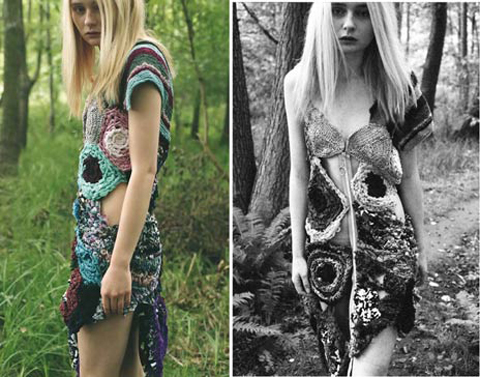
The Spring/Summer 2010 collection is titled, ‘Hey Gorgeous,’ and encompasses a look that is both boho and modern. There are lots of bright and bold colours, suggesting a playful edge to the pieces. This fits well with the idea of the flower child, which is evident in Vogt’s floral based dresses and accessories.

marie louise 2

A focus on cut-out’s is apparent, while aspects of the lingerie look are present in the dresses see-through sections. Spaces between fabric petals appear in a variety of Vogt’s designs, presenting potential issues regarding wearability – not everyone is comfortable to bare all. However, team these intricate creations with leggings or a light under slip and your problem is solved whilst keeping a splash of sartorial independence.

marie louise 4

Vogt has created beautiful creations that play against the stereotypical look associated with knitting. She has brought a contemporary, stylish flair to her collection, through the use of complex shapes, fresh colours and strong unique designs. Her passion for nature is a clear inspiration in all aspects of her design process, from the techniques she creates her designs from – such as knitting, weaving and crochet – to the ornaments that adorn them and the earthly style shapes Vogt uses.

Belts, cardigans and other accessories bring outfits together and Vogt has designed her own jewellery line. These spectacular, and rather large creations, could be worn instead of her dresses, with a t-shirt and jeans if you want a Marie-Louise piece, but don’t quite suit her unstructured designs. The jewellery replicates her crochet effect and comes in a variety of colours from nude subtleties  to vivid and audacious.

Black, sheer dresses fit snugly, but keep with her typical style through the knitted spiral shapes that embellish the fronts of these designs.

marie louise 6

In comparison with previous collections she has definitely put her focus into a crochet, cut-out style. Although wearing it as the lookbook portrays may be difficult, it is easy enough to develop our own look based on just one of these elaborate pieces, and that is what fashion is all about – an individual approach. Something that Marie-Louise Vogt, with her knitted, handmade and organic style outfits, does so well.

Categories ,Berlin Fashion Week, ,Ethical Fashion, ,Hamburg, ,jewellery, ,knitting, ,Marie Louise Vogt, ,SS10, ,stylebubble

Similar Posts: