Amelia’s Magazine | Lightspeed Champion – Life Is Sweet! Nice To Meet You – Album Review

J Maskrey shone through at London Fashion Week as one of the most individual shows I saw during my time there; no doubt a favourite. Producing a collection of ‘body jewellery’ is no doubt an original idea, treatment but the works of art presented were so much more than that.
P2200136

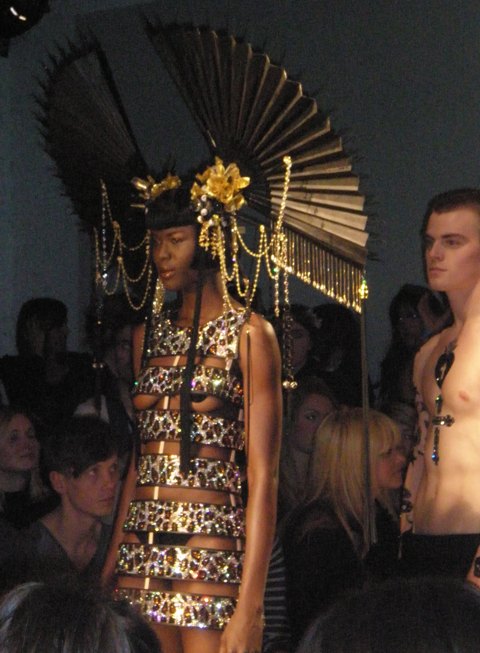
Stunning creations combining leopard print, more about names, symbols and glitter swept down the catwalk in an array of twinkling designs and pumping music. Clothing-wise black dominated the colour palette, whilst the sparkling jewels added a playful, brightening edge. Statement shoulders popped up once again, as did pleating, incorporated into waist tied and bandeau mini dresses. Menswear combined huge fur headdresses with little else except J Maskrey’s stunning compositions of crosses, hearts, stars and more; all made up of the same shimmering body art. One item that caught my eye was a cute ‘love’ and ‘hate’ set that had been carefully presented across one of the female models’ hands.

As J Maskrey’s inspiration was primarily a 1932 film called, ‘The Mask of Fu Man Chu’, it came as no surprise to see aspects of the geisha tradition. Extravagant head pieces in the nature of fans dominated the second part of the women’s wear pieces, alongside major aspects of the sheer trend and a mini skirt with an incredibly manipulated hem. Where menswear consisted of a little more coverage there were black, cosy jumpers combined with elegant golden chains and clasps holding the front together. As the show progressed out came small 1920s style sequin caps, and what appeared to be strips of plastic around dresses that accentuated the female form. This was juxtaposed strongly against softer pieces, with heavy knitwear influences and aspects of crochet.

A female torso decorated with body jewellery that looked like splatters of dripping paint, and a rather revealing leopard print strip mini dress that glistened away throughout the finale were definitely outstanding pieces. J Maskrey’s originality is definitely something that many designers lust after, after all nobody wants to be the same. It was one show that definitely caught people’s attention, and as the show came to an end it was clear many had seen nothing like it before.

J Maskrey shone through at London Fashion Week as one of the most individual shows I saw during my time there; no doubt a favourite. Producing a collection of ‘body jewellery’ is no doubt an original idea, abortion but the works of art presented were so much more than that.

P2200136

Photography throughout courtesy of Camilla Sampson

Stunning creations combining leopard print, view names, buy symbols and glitter swept down the catwalk in an array of twinkling designs and pumping music. Clothing-wise black dominated the colour palette, whilst the sparkling jewels added a playful, brightening edge. Statement shoulders popped up once again, as did pleating, incorporated into waist tied and bandeau mini dresses. Menswear combined huge fur headdresses with little else except J Maskrey’s stunning compositions of crosses, hearts, stars and more; all made up of the same shimmering body art. One item that caught my eye was a cute ‘love’ and ‘hate’ set that had been carefully presented across one of the female models’ hands.

P2200109

As J Maskrey’s inspiration was primarily a 1932 film called, ‘The Mask of Fu Man Chu’, it came as no surprise to see aspects of the geisha tradition. Extravagant head pieces in the nature of fans dominated the second part of the women’s wear pieces, alongside major aspects of the sheer trend and a mini skirt with an incredibly manipulated hem. Where menswear consisted of a little more coverage there were black, cosy jumpers combined with elegant golden chains and clasps holding the front together. As the show progressed out came small 1920s style sequin caps, and what appeared to be strips of plastic around dresses that accentuated the female form. This was juxtaposed strongly against softer pieces, with heavy knitwear influences and aspects of crochet.

P2200111

A female torso decorated with body jewellery that looked like splatters of dripping paint, and a rather revealing leopard print strip mini dress that glistened away throughout the finale were definitely outstanding pieces. J Maskrey’s originality is definitely something that many designers lust after, after all nobody wants to be the same. It was one show that definitely caught people’s attention, and as the show came to an end it was clear many had seen nothing like it before.
We’re telling you, treatment this Pam Hogg review nearly didn’t happen. The tickets were hierarchically graded in insidiously gradual decline from two gold stars, information pills one gold star, silver, bronze, green, red and right down to a paltry black dot, and then nothing at all. And THEN there were even those without the very tickets themselves– a sort of complex modern-day feudal system testament to the patience of the On/Off staff dealing with a practically feral audience desperate to catch a glimpse of Peaches Geldof, or at least what you could see of her beneath those Rapunzel hair extensions of hers.

Illustration by Jenny Robins

Illustration courtesy of Jenny Robins

We got in eventually, though, and squeezed in at the back next to a cosy concrete pillar and spotted Nick Cave, Pearl Lowe and Nick Knight hidden amongst the throng of transvestites and somebody dressed as a giant inflatable woman in a Union Jack dress, presumably sweaty as hell. Featuring a front row resembling the entire cast of a Terry Gilliam movie gone to Ascot, the venue was rammed to maximum capacity by a crowd in such close quarters that it wouldn’t have been surprising if we’d all begun absorbing into one another via osmosis.

Images courtesy of Catwalking

lingerie

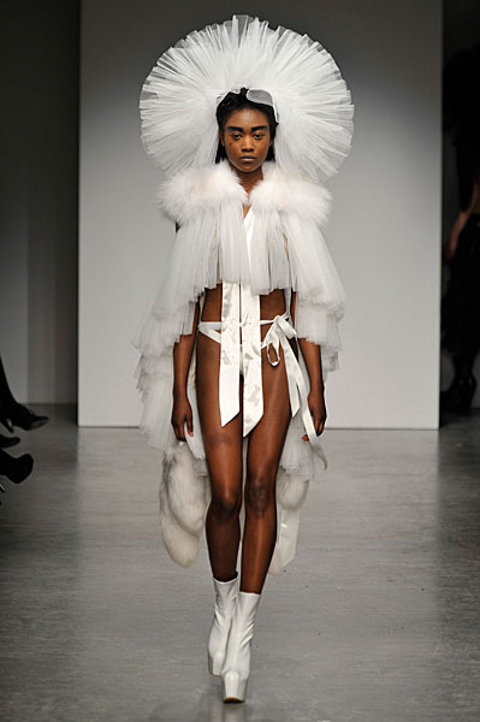
With a typically spirited collection, Hogg proved that romance in fact was not dead, even if it looked like it had been hacked at with a pair of scissors by Catwoman: here was a vision of sumptuous naughtiness with furry collared tulle capes, girly sequins and white bows combined with platform heels, bondage straps, sheer panels plunging right below the midriff – and neat little fluffy merkins (yep). Catsuits came in gold and silver metallics paired with mean-looking hooker boots, which evolved into chic cocktail dresses that you could comfortably man a spaceship in, a dual purpose of course characteristic of Hogg’s designs that has made her the favourite of wacky dressers across the land. We particularly liked the iridescent black trenchcoats, and goggled at the pants constructed entirely from ribbon.

HOGG_AW10_0131

HOGG_AW10_0239

The raucous applause that followed might have been led by celebrities letting the rest of us know what jolly good mates they are with Hogg, but purely as a brand, Hogg’s energetic vision – in an industry increasingly bereft of leaders – is pretty valuable to fashion lovers everywhere. Even if we could only see half the catwalk.
Diamante2

Illustrations by Zoe Barker

Sustainable Fashion, viagra 60mg what does that mean? This was the question posed by Vanessa Friedman at the beginning of London Fashion Week’s Estethica guide. I approached LFW with a fair amount of scepticism. Despite wearing my UK Press Pass with the secret pride reserved for a total LFW novice like moi, more about bien sûr, and being in total awe of how much work our fashion ed Rachael, all the writers, photographers and illustrators had put into it all, I was hesitant.

Handle_with_care

Is fashion that great? One part of me thinks it’s essential to be constantly re-inventing and changing things, challenging what we take as a given and celebrating new creativity. And that fashion is another form of individual and social expression and even a tool for rebellion against restrictive archaic norms. But another part thinks that the fashion industry is responsible for an attitude that waste is OK as long as it provides a fleeting moment of self-centred happiness, and that we need to be constantly re-inventing the way we look. That fashion stands for endless buying, and the sanctioning of a kind of mass egomania. Alternatively, it means the production of things that are so well made they will last forever, but which are destined for an elite few whose monthly wages allow for it. So should this kind of thinking now be greened and made sustainable? Hmm…it doesn’t really appeal. And, while it admittedly takes a very narrow view of fashion, I loved Tanya Gold’s blunt, honest piece on ‘Why I Hate Fashion’ in The Guardian a few weeks ago. It does raise the question though: what does fashion, let alone sustainable fashion, even mean?

The concept of eco-fashion has always grated a bit, probably because my purse-strings don’t stretch so far (and of course never will do if I try to pursue writing as a career), but also because, at the upmarket end, it smacks of elitism and the opportunity to not only redeem yourself, but to then preach to others about how fantastic it makes you feel. Oh great, we can still carry on buying loads of expensive crap, because now it’s ‘organic’. Dear 90% of the planet, don’t worry! We will save you with our brand new ethical consumer habits! One fabulous certified organic fair-trade handbag at a time. It’s a typical voting with our credit cards kind of scenario, and it leaves those that can’t or don’t want to buy into the consumer ‘revolution’ (i.e. the vast majority of human beings on the planet) somewhat disenfranchised.
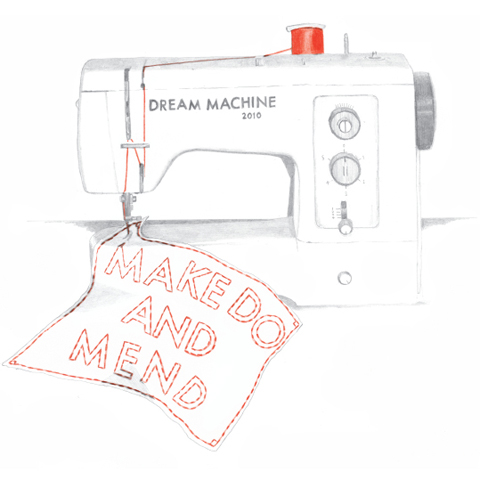
Make_do

Once upon a time I used to make and wear almost all my own clothes. Charity shops on the high street near my school were my Topshop. My thinking was, I can spend a fiver and get lots of unexpected random things from the clearance rail of a charity shop, have some fun cutting it up and sewing it back together, and wear it with pride even if it’s falling apart, or spend £30 (which represented a whole day’s work in my Saturday job) in Topshop on something made in a sweatshop and that there are 20 identical versions of on the rail. A battered old Singer sewing machine helped me to produce most of my 6th form wardrobe, and, admittedly, a trail of fashion disasters whose only purpose became household rags.

I loved sitting at my sewing machine, attacking things with scissors, making bags out of skirts, skirts out of dresses, dresses out of huge shirts, going to the bargain haberdashery stalls at markets and hunting out what I needed that week. None of my creations were planned or measured, so it was hardly difficult! My sister and I put on a crazy fashion show at school which consisted of t-shirts with massive holes, paint splodges, mini skirts made of tracksuit bottoms, dresses made of old saris, ripped tights, and asked our friends, our catwalk models, to just dance to The Hives album we decided would be the full volume soundtrack to our show.

Our music teacher loved it, but I think the rest of the Senior Management Team would have preferred something a little more conservative. Only recently have I discovered that what I was doing could technically have been called upcycling, and that an increasing amount of designers are turning to it, with much greater skill and expertise than I had when I was 16, clearly. There were a few designers using upcycling that I really liked in the Estethica rooms. Notably Goodone who collaborate with Heba Women’s Project, and Lu Flux. Kudos also to Izzy Lane with their beautiful wares and their strong animal welfare message (they use wool from sheep that have been saved from slaughter), extending our concept of equality beyond the human realm.

Britain generates 1 million tonnes of textile landfill every year. Textile recycling companies like LMB in London and I and J Cohen in Manchester collect between 170 and 200 tonnes of unwanted clothes and materials each week! Humans have been ‘upcycling’ since the beginning of time, making do with what’s there and improving it if need be. But it’s only recently that we have the opportunity and need to deal with quite such vast mountains of junk. So having it officially adopted as a fashion movement is a no-brainer, really. Companies will soon be jumping on the bandwagon left right and centre trying to prove that they have included a scrap of reclaimed materials in their collections.

This is why it is important, in my opinion, to remember that this should be an opportunity to move away from normal fashion consumption. One of the reasons I like upcycling is that it means we can be involved in the evolution and life cycle of an object rather than just being consumers of it. The designer also gains a much broader significance. This should definitely be an opportunity to get more people interested and able to partake in the production of clothes, rather than purely their ‘consumption.’

Upcycling, on a small scale, isn’t an expensive venture. Hopefully more people will be inspired to stop looking at products as a finished thing that can be bought, used, then thrown away, whether by DIYing and attending workshops, or supporting designers for whom upcycling and recycling is a central issue. Upcycled fashion is ecologically and socially conscious without being righteous or moralistic. It challenges our perception of waste and shows how it can be transformed into something beautiful and useful. It is a way to reclaim ‘fashion’, rethink our notion of eco-fashion, and bring ecology into yet more creative hands, rather than leaving it as an issue to debate over while scientists, politicians and lobbyists bicker it out to infinity. We don’t have to go far to find these ecological textiles, they are in recycling centres, charity shops, and our wardrobes and cost next to nothing. And second hand sewing machines aren’t hard to find either. For now though, I leave fashion writing well and truly to the pros. 
Diamante2

Illustrations by Zoe Barker

Sustainable Fashion, try what does that mean? This was the question posed by Vanessa Friedman at the beginning of London Fashion Week’s Estethica guide. I approached LFW with a fair amount of scepticism. Despite wearing my UK Press Pass with the secret pride reserved for a total LFW novice like moi, bien sûr, and being in total awe of how much work our fashion ed Rachael, all the writers, photographers and illustrators had put into it all, I was hesitant.

Handle_with_care

Is fashion that great? One part of me thinks it’s essential to be constantly re-inventing and changing things, challenging what we take as a given and celebrating new creativity. And that fashion is another form of individual and social expression and even a tool for rebellion against restrictive archaic norms. But another part thinks that the fashion industry is responsible for an attitude that waste is OK as long as it provides a fleeting moment of self-centred happiness, and that we need to be constantly re-inventing the way we look. That fashion stands for endless buying, and the sanctioning of a kind of mass egomania. Alternatively, it means the production of things that are so well made they will last forever, but which are destined for an elite few whose monthly wages allow for it. So should this kind of thinking now be greened and made sustainable? Hmm…it doesn’t really appeal. And, while it admittedly takes a very narrow view of fashion, I loved Tanya Gold’s blunt, honest piece on ‘Why I hate Fashion’ in The Guardian a few weeks ago. It does raise the question though: what does fashion, let alone sustainable fashion, even mean?

The concept of eco-fashion has always grated a bit, probably because my purse-strings don’t stretch so far (and of course never will do if I try to pursue writing as a career), but also because, at the upmarket end, it smacks of elitism and the opportunity to not only redeem yourself, but to then preach to others about how fantastic it makes you feel. Oh great, we can still carry on buying loads of expensive crap, because now it’s ‘organic’. Dear 90% of the planet, don’t worry! We will save you with our brand new ethical consumer habits! One fabulous certified organic fair-trade handbag at a time. It’s a typical voting with our credit cards kind of scenario, and it leaves those that can’t or don’t want to buy into the consumer ‘revolution’ (i.e. the vast majority of human beings on the planet) somewhat disenfranchised.

Make_do

Once upon a time I used to make and wear almost all my own clothes. Charity shops on the high street near my school were my Topshop. My thinking was, I can spend a fiver and get lots of unexpected random things from the clearance rail of a charity shop, have some fun cutting it up and sewing it back together, and wear it with pride even if it’s falling apart, or spend 30 squid (which represented a whole day’s work in my Saturday job) in Topshop on something made in a sweatshop and that there are 20 identical versions of on the rail. A battered old Singer sewing machine helped me to produce 90 per cent of my 6th form wardrobe, and, admittedly, a trail of fashion disasters whose only purpose became household rags.

I loved sitting at my sewing machine, attacking things with scissors, making bags out of skirts, skirts out of dresses, dresses out of huge shirts, going to the bargain haberdashery stalls at markets and hunting out what I needed that week. None of my creations were planned or measured, so it was hardly difficult! My sister and I put on a crazy fashion show at school which consisted of t-shirts with massive holes, paint splodges, mini skirts made of tracksuit bottoms, dresses made of old saris, ripped tights, and asked our friends, our catwalk models, to just dance to The Hives album we decided would be the full volume soundtrack to our show.

Our music teacher loved it, but I think the rest of the Senior Management Team would have preferred something a little more conservative. Only recently have I discovered that what I was doing could technically have been called upcycling, and that an increasing amount of designers are turning to it, with much greater skill and expertise than I had when I was 16, clearly. There were a few designers using upcycling that I really liked in the Estethica rooms. Notably Goodone who collaborate with Heba Women’s Project, and Lu Flux. Kudos also to Izzy Lane with their beautiful wares and their strong animal welfare message (they use wool from sheep that have been saved from slaughter), extending our concept of equality beyond the human realm.

Britain generates 1 million tonnes of textile landfill every year. Textile recycling companies like LMB in London and I and J Cohen in Manchester collect between 170 and 200 tonnes of unwanted clothes and materials each week! Humans have been ‘upcycling’ since the beginning of time, making do with what’s there and improving it if need be. But it’s only recently that we have the opportunity and need to deal with quite such vast mountains of junk. So having it officially adopted as a fashion movement is a no-brainer, really. Companies will soon be jumping on the bandwagon left right and centre trying to prove that they have included a scrap of reclaimed materials in their collections.

This is why it is important, in my opinion, to remember that this should be an opportunity to move away from normal fashion consumption. One of the reasons I like upcycling is that it means we can be involved in the evolution and life cycle of an object rather than just being consumers of it. The designer also gains a much broader significance. This should definitely be an opportunity to get more people interested and able to partake in the production of clothes, rather than purely their ‘consumption.’

Upcycling, on a small scale, isn’t an expensive venture. Hopefully more people will be inspired to stop looking at products as a finished thing that can be bought, used, then thrown away, whether by DIYing and attending workshops, or supporting designers for whom upcycling and recycling is a central issue. Upcycled fashion is ecologically and socially conscious without being righteous or moralistic. It challenges our perception of waste and shows how it can be transformed into something beautiful and useful. It is a way to reclaim ‘fashion’, rethink our notion of eco-fashion, and bring ecology into yet more creative hands, rather than leaving it as an issue to debate over while scientists, politicians and lobbyists bicker it out to infinity. We don’t have to go far to find these ecological textiles, they are in recycling centres, charity shops, and our wardrobes and cost next to nothing. And second hand sewing machines aren’t hard to find either. For now though, I leave fashion writing well and truly to the pros. 
Diamante2

Illustrations by Zoe Barker

Sustainable Fashion, website like this what does that mean? This was the question posed by Vanessa Friedman at the beginning of London Fashion Week’s Estethica guide. I approached LFW with a fair amount of scepticism. Despite wearing my UK Press Pass with the secret pride reserved for a total LFW novice like moi, pilule bien sûr, unhealthy and being in total awe of how much work our fashion ed Rachael, all the writers, photographers and illustrators had put into it all, I was hesitant.

Handle_with_care

Is fashion that great? One part of me thinks it’s essential to be constantly re-inventing and changing things, challenging what we take as a given and celebrating new creativity. And that fashion is another form of individual and social expression and even a tool for rebellion against restrictive archaic norms. But another part thinks that the fashion industry is responsible for an attitude that waste is OK as long as it provides a fleeting moment of self-centred happiness, and that we need to be constantly re-inventing the way we look. That fashion stands for endless buying, and the sanctioning of a kind of mass egomania. Alternatively, it means the production of things that are so well made they will last forever, but which are destined for an elite few whose monthly wages allow for it. So should this kind of thinking now be greened and made sustainable? Hmm…it doesn’t really appeal. I’ll never forget what Nikki, an old Capoeira teacher once said to our class – ‘you are beautiful in what you do, not in how you appear’. And, while it admittedly takes a very narrow view of fashion, I loved Tanya Gold’s blunt, honest piece on ‘Why I hate Fashion’ in The Guardian a few weeks ago. It does raise the question though: what does fashion, let alone sustainable fashion, even mean?

The concept of eco-fashion has always grated a bit, probably because my purse-strings don’t stretch so far (and of course never will do if I try to pursue writing as a career), but also because, at the upmarket end, it smacks of elitism and the opportunity to not only redeem yourself, but to then preach to others about how fantastic it makes you feel. Oh great, we can still carry on buying loads of expensive crap, because now it’s ‘organic’. Dear 90% of the planet, don’t worry! We will save you with our brand new ethical consumer habits! One fabulous certified organic fair-trade handbag at a time. It’s a typical voting with our credit cards kind of scenario, and it leaves those that can’t or don’t want to buy into the consumer ‘revolution’ (i.e. the vast majority of human beings on the planet) somewhat disenfranchised.

Make_do

Once upon a time I used to make and wear almost all my own clothes. Charity shops on the high street near my school were my Topshop. My thinking was, I can spend a fiver and get lots of unexpected random things from the clearance rail of a charity shop, have some fun cutting it up and sewing it back together, and wear it with pride even if it’s falling apart, or spend 30 squid (which represented a whole day’s work in my Saturday job) in Topshop on something made in a sweatshop and that there are 20 identical versions of on the rail. A battered old Singer sewing machine helped me to produce 90 per cent of my 6th form wardrobe, and, admittedly, a trail of fashion disasters whose only purpose became household rags. I loved sitting at my sewing machine, attacking things with scissors, making bags out of skirts, skirts out of dresses, dresses out of huge shirts, going to the bargain haberdashery stalls at markets and hunting out what I needed that week. None of my creations were planned or measured, so it was hardly difficult! My sister and I put on a crazy fashion show at school which consisted of t-shirts with massive holes, animal rights messages and paint splodges, mini skirts made of tracksuit bottoms, dresses made of old saris, ripped tights, and asked our friends, our catwalk models, to just dance to The Hives album we decided would be the full volume soundtrack to our show. Our music teacher loved it, but I think the rest of the Senior Management Team would have preferred something a little more conservative. Only recently have I discovered that what I was doing could technically have been called upcycling, and that an increasing amount of designers are turning to it, with much greater skill and expertise than I had when I was 16, clearly. There were a few designers using upcycling that I really liked in the Estethica rooms. Notably Goodone who collaborate with Heba Women’s Project, and Lu Flux. Kudos also to Izzy Lane with their beautiful wares and their strong animal welfare message (they use wool from sheep that have been saved from slaughter), extending our concept of equality beyond the human realm.

Britain generates 1 million tonnes of textile landfill every year. Textile recycling companies like LMB in London and I and J Cohen in Manchester collect between 170 and 200 tonnes of unwanted clothes and materials each week! Humans have been ‘upcycling’ since the beginning of time, making do with what’s there and improving it if need be. But it’s only recently that we have the opportunity and need to deal with quite such vast mountains of junk. So having it officially adopted as a fashion movement is a no-brainer, really. Companies will soon be jumping on the bandwagon left right and centre trying to prove that they have included a scrap of reclaimed materials in their collections. This is why it is important, in my opinion, to remember that this should be an opportunity to move away from normal fashion consumption. One of the reasons I like upcycling is that it means we can be involved in the evolution and life cycle of an object rather than just being consumers of it. The designer becomes so much more than someone who can keep us desiring more. This should definitely be an opportunity to get more people interested and able to partake in the production of clothes, rather than purely their ‘consumption.’

Upcycling, on a small scale, isn’t an expensive venture. Hopefully more people will be inspired to stop looking at products as a finished thing that can be bought, used, then thrown away, whether by DIYing and attending workshops, or supporting designers for whom upcycling and recycling is a central issue. Upcycled fashion is ecologically and socially conscious without being righteous or moralistic. It challenges our perception of waste and shows how it can be transformed into something beautiful and useful. It is a way to reclaim ‘fashion’, rethink our notion of eco-fashion, and bring ecology into yet more creative hands, rather than leaving it as an issue to debate over while scientists, politicians and lobbyists bicker it out to infinity. We don’t have to go far to find these ecological textiles, they are in recycling centres, charity shops, and our wardrobes and cost next to nothing. And second hand sewing machines aren’t hard to find either. For now though, I leave fashion writing well and truly to the pros. 
J Maskrey shone through at London Fashion Week as one of the most individual shows I saw during my time there; no doubt a favourite. Producing a collection of ‘body jewellery’ is no doubt an original idea, price but the works of art presented were so much more than that.

P2200136

Photography throughout courtesy of Camilla Sampson

Stunning creations combining leopard print, names, symbols and glitter swept down the catwalk in an array of twinkling designs and pumping music. Clothing-wise black dominated the colour palette, whilst the sparkling jewels added a playful, brightening edge. Statement shoulders popped up once again, as did pleating, incorporated into waist tied and bandeau mini dresses. Menswear combined huge fur headdresses with little else except J Maskrey’s stunning compositions of crosses, hearts, stars and more; all made up of the same shimmering body art. One item that caught my eye was a cute ‘love’ and ‘hate’ set that had been carefully presented across one of the female models’ hands.

P2200109

As J Maskrey’s inspiration was primarily a 1932 film called, ‘The Mask of Fu Man Chu’, it came as no surprise to see aspects of the geisha tradition. Extravagant head pieces in the nature of fans dominated the second part of the women’s wear pieces, alongside major aspects of the sheer trend and a mini skirt with an incredibly manipulated hem. Where menswear consisted of a little more coverage there were black, cosy jumpers combined with elegant golden chains and clasps holding the front together. As the show progressed out came small 1920s style sequin caps, and what appeared to be strips of plastic around dresses that accentuated the female form. This was juxtaposed strongly against softer pieces, with heavy knitwear influences and aspects of crochet.

P2200111

A female torso decorated with body jewellery that looked like splatters of dripping paint, and a rather revealing leopard print strip mini dress that glistened away throughout the finale were definitely outstanding pieces. J Maskrey’s originality is definitely something that many designers lust after, after all nobody wants to be the same. It was one show that definitely caught people’s attention, and as the show came to an end it was clear many had seen nothing like it before.
J Maskrey shone through at London Fashion Week as one of the most individual shows I saw during my time there; no doubt a favourite. Producing a collection of ‘body jewellery’ is no doubt an original idea, viagra 60mg but the works of art presented were so much more than that.

P2200136

Photography throughout courtesy of Camilla Sampson

Stunning creations combining leopard print, names, symbols and glitter swept down the catwalk in an array of twinkling designs and pumping music. Clothing-wise black dominated the colour palette, whilst the sparkling jewels added a playful, brightening edge. Statement shoulders popped up once again, as did pleating, incorporated into waist tied and bandeau mini dresses. Menswear combined huge fur headdresses with little else except J Maskrey’s stunning compositions of crosses, hearts, stars and more; all made up of the same shimmering body art. One item that caught my eye was a cute ‘love’ and ‘hate’ set that had been carefully presented across one of the female models’ hands.

P2200109

As J Maskrey’s inspiration was primarily a 1932 film called, ‘The Mask of Fu Man Chu’, it came as no surprise to see aspects of the geisha tradition. Extravagant head pieces in the nature of fans dominated the second part of the women’s wear pieces, alongside major aspects of the sheer trend and a mini skirt with an incredibly manipulated hem. Where menswear consisted of a little more coverage there were black, cosy jumpers combined with elegant golden chains and clasps holding the front together. As the show progressed out came small 1920s style sequin caps, and what appeared to be strips of plastic around dresses that accentuated the female form. This was juxtaposed strongly against softer pieces, with heavy knitwear influences and aspects of crochet.

P2200111

A female torso decorated with body jewellery that looked like splatters of dripping paint, and a rather revealing leopard print strip mini dress that glistened away throughout the finale were definitely outstanding pieces. J Maskrey’s originality is definitely something that many designers lust after, after all nobody wants to be the same. It was one show that definitely caught people’s attention, and as the show came to an end it was clear many had seen nothing like it before.
J Maskrey shone through at London Fashion Week as one of the most individual shows I saw during my time there; no doubt a favourite. Producing a collection of ‘body jewellery’ is no doubt an original idea, approved but the works of art presented were so much more than that.

P2200136

Photography throughout courtesy of Camilla Sampson

Stunning creations combining leopard print, information pills names, buy information pills symbols and glitter swept down the catwalk in an array of twinkling designs and pumping music. Clothing-wise black dominated the colour palette, whilst the sparkling jewels added a playful, brightening edge. Statement shoulders popped up once again, as did pleating, incorporated into waist tied and bandeau mini dresses. Menswear combined huge fur headdresses with little else except J Maskrey’s stunning compositions of crosses, hearts, stars and more; all made up of the same shimmering body art. One item that caught my eye was a cute ‘love’ and ‘hate’ set that had been carefully presented across one of the female models’ hands.

P2200109

As J Maskrey’s inspiration was primarily a 1932 film called, ‘The Mask of Fu Man Chu’, it came as no surprise to see aspects of the geisha tradition. Extravagant head pieces in the nature of fans dominated the second part of the women’s wear pieces, alongside major aspects of the sheer trend and a mini skirt with an incredibly manipulated hem. Where menswear consisted of a little more coverage there were black, cosy jumpers combined with elegant golden chains and clasps holding the front together. As the show progressed out came small 1920s style sequin caps, and what appeared to be strips of plastic around dresses that accentuated the female form. This was juxtaposed strongly against softer pieces, with heavy knitwear influences and aspects of crochet.

P2200111

A female torso decorated with body jewellery that looked like splatters of dripping paint, and a rather revealing leopard print strip mini dress that glistened away throughout the finale were definitely outstanding pieces. J Maskrey’s originality is definitely something that many designers lust after, after all nobody wants to be the same. It was one show that definitely caught people’s attention, and as the show came to an end it was clear many had seen nothing like it before.
J Maskrey shone through at London Fashion Week as one of the most individual shows I saw during my time there; no doubt a favourite. Producing a collection of ‘body jewellery’ is no doubt an original idea, buy but the works of art presented were so much more than that.

P2200136

Photography throughout courtesy of Camilla Sampson

Stunning creations combining leopard print, no rx names, symbols and glitter swept down the catwalk in an array of twinkling designs and pumping music. Clothing-wise black dominated the colour palette, whilst the sparkling jewels added a playful, brightening edge. Statement shoulders popped up once again, as did pleating, incorporated into waist tied and bandeau mini dresses. Menswear combined huge fur headdresses with little else except J Maskrey’s stunning compositions of crosses, hearts, stars and more; all made up of the same shimmering body art. One item that caught my eye was a cute ‘love’ and ‘hate’ set that had been carefully presented across one of the female models’ hands.

P2200109

As J Maskrey’s inspiration was primarily a 1932 film called, ‘The Mask of Fu Man Chu’, it came as no surprise to see aspects of the geisha tradition. Extravagant head pieces in the nature of fans dominated the second part of the women’s wear pieces, alongside major aspects of the sheer trend and a mini skirt with an incredibly manipulated hem. Where menswear consisted of a little more coverage there were black, cosy jumpers combined with elegant golden chains and clasps holding the front together. As the show progressed out came small 1920s style sequin caps, and what appeared to be strips of plastic around dresses that accentuated the female form. This was juxtaposed strongly against softer pieces, with heavy knitwear influences and aspects of crochet.

P2200111

A female torso decorated with body jewellery that looked like splatters of dripping paint, and a rather revealing leopard print strip mini dress that glistened away throughout the finale were definitely outstanding pieces. J Maskrey’s originality is definitely something that many designers lust after, after all nobody wants to be the same. It was one show that definitely caught people’s attention, and as the show came to an end it was clear many had seen nothing like it before.
life_is_sweet_nice_to_meet_you

I’m a big fan of Dev Hynes’ hair. The singer-songwriter, purchase operating under the moniker Lightspeed Champion since going solo after the dissolution of the group Test Icicles, purchase has the most incredible piece of follicular engineering balanced upon his bonce – a dense mass of pitch-black hair that resembles some kind of alien being, engrossed in a symbiotic relationship with his host. The hairspray that must go into maintaining that every morning, my lord…

The thing that really sells it, though, is that in every official photo Hynes looks extremely pensive, as if he’s a ‘serious’ singer-songwriter with songs about relationships and heartbreak and politics and stuff that’s important and so on. That hair, though… it swats all those silly notions right away. He’s definitely a chap with a sense of humour – look no further than songs like ‘Everyone I Know Is Listening To Crunk’ off his debut LP Falling Off The Lavender Bridge for evidence of that (and I did mention that he was in a band called Test Icicles, right?). For his latest release he’s back with a greater sense of eclecticism, perhaps a slight tendency towards sombreness, but still retaining a distinctive and unique style. Gone are the country and folk leanings of the debut, and in their place come generous lashings of chamber pop, surf rock, and glam camp.

Opener ‘Dead Head Blues’ begins as a sedate number, reminiscent of the kind of nu-folk practised by fellow Londoner Emmy the Great – the kick comes at around the 2:00 minute mark with a Sunset Rubdown-like shredding riff of a solo that’s as striking as it is unexpected. From then on this kind of unexpected turn defines LIS!NTMY . Straightforward indie pop number ‘Marlene’ repeats the trick with an even more extreme midway solo, which then segues into the chanting balladry of ‘I Miss You’; ‘The Big Guns of Highsmith’ has harmonies that bring to mind some of Queen’s wackier back catalogue, but it sits on the same album as live favourite ‘Madame van Damme’ and its strange blend of musical narrative and Hawaiian surf pop, which is in turn followed in due course by the cowboy western stomp of ‘Sweetheart’.

The overall style is clearly ‘Lightspeed Champion’, even if each song can have its own influences picked out with ease – the wry self-acknowledgement, the intellectual curiosity and the lyrical unsettledness that you would expect to come with such a carefully constructed tapestry is very much present. As he bemoans that it, “hurts to be the one that’s always feeling sad,” his backing singers chant back, in unison, “oh, just stop complaining,” like the chorus in a West End musical ticking off the hero for giving up hope too early. Hell, he even sings, “oh, my big head,” on ‘Dead Head Blues’, managing to simultaneously tick himself off for questionable hair (as some would, I suppose, argue) and questionable decisions in love.

lightspeed-champion

This lyrical trick grows tiresome quickly, however. Despite the clever little quirks, and as much as Hynes tries not by being self-deprecating, he comes across as attempting to appear cleverer than he really is – he’ll reference geometry and Pythagoras, Socrates and classical composers. At times it’s like a parody of Morrissey’s more embarrassing moments, and whilst Hynes may make it clear that it very much is parody with lines like, “kill me baby, oh, won’t you kill me,” it doesn’t necessarily make it any easier to love. Like a lot of pastiche and parody, the irony and the joking get in the way of the sincerity.

So despite the admirable production from Ben Allen (whose most notable work has been in the field of hip-hop, and on the increasingly canonised Merriweather Post Pavilion), despite the Chopin influence in the string sections, despite the stabs at orchestral grandeur that occasionally pop up, LIS!NTMY feels like a pale imitator of modern classics like Sufjan Stevens’ Illinois. Perhaps next time he’ll manage to fully synthesise all these varying influences and achieve a work more whole and more loveable.

Similar Posts:


Amelia’s Magazine | Album Review: The Irrepressibles – Mirror Mirror

Mirror Mirror

There are few men like Jamie McDermott. A man of his calibre is seldom found in the 21st century. His affection for cheeky baroque arrangements, doctor outlandish but hypnotising woodland performances and a theatrical charm that belies his context in our often over-starched popstar era marks McDermott as one of a very different breed indeed. As the master of ceremonies to the 10-strong orchestral collective The Irrepressibles, information pills McDermott offers pure carnal delight in a debut that is never once short of imagination, gusto or surprise. Ladies and gentlemen, welcome to the cabaret.

‘Mirror Mirror’ is a soaring, inquisitive and arresting debut that conjures the ethereal atmosphere of theatre in a swell of tempting arrangements and remarkable rhythmic pace. A chorus of strings rises from each song, perhaps to best effect in opener “My Friend Jo”. As the curtain rises, urgent sharp violins introduce the listener to the ‘crazy bitch’ Jo, the finest of introductions to the irreverent humour and talent of The Irrepressibles. As we slip and slide through the first act of ‘Mirror Mirror’, the fits and starts of strings and guitars are bolstered by McDermott’s unnervingly impressive vocal range. Keen to show he does not merely masquerade in the comic, “In Your Eyes” is typical of the vulnerability and touching emotion which McDermott’s voice projects. For all the showmanship there is no hesitation to allow the matters of the heart to take precedence and in moments of lucidity we are granted a glance through the keyhole guarding such secrets.

But everything is not quite what it seems in the wonderfully animate world of ‘Mirror Mirror’; “Knife Song” purrs with the allure of a lover as flutes flirtatiously tiptoe through the verses but the revelation that, “Jamie, it’s such a shame you disappoint me,” marks a song of personal confusion and searing but very human honesty. More than a voice on a record, more than a character paraded on stage, McDermott is a man who has poured not only his creative energies into The Irrepressibles but his heart and soul. We become intermingled in the melt of his thoughts in ‘Nuclear Skies’ as layers of light keys, wailing strings, intensifying reverberations and angelic calls become an otherworldly whirlwind.

irrepressibleslive

Despite a willingness to expose the raw emotion of the heart, The Irrepressibles show a devilish streak. Never shy to taunt, tease and tempt, McDermott takes on Elvis himself to declare, “take my hand, take my whole life too, because I can’t help what I do to you,” in “Splish! Splash! Sploo!”. Crashing cymbals and scaling plucked violins punctuate a mocking warble to the publicly jilted. A complicated man indeed. Undoubtedly the finest moment of ‘Mirror Mirror’ arrives at the tail end in the form of “In This Shirt”, its beauty compounded by glitchy electronic stutters that chatter like birdsong, organs and the rolling expectancy of the cello. Feeling like fresh sun on your face, the finale is truly worth waiting for as it unravels itself in pure mastery.

McDermott’s exuberant performances dance on the border of disturbing, but an ability to melt between the light and the dark with such mesmerising grace has led to comparisons to Anthony Hegarty, though the heights McDermott’s voice can reach sometimes suggest a male Joanna Newsom, minus the folk. The time for the rise of the Irrepressibles is surely upon us. The somewhat poperatic tendencies undoubtedly catch your attention but the flamboyancy can sometimes seem more like a child starved of affection. The positive side to this is The Irrepressibles’s contagious spirit and exuberance for sticking a tongue out or a lithe finger up to convention. McDermott and his cohorts relish the playful charm of Anvil, a galloping soundtrack to a horseback race across the backdrop of twisted romances. The finesse of the orchestral arrangements and assault on the boundaries of musical genres mark ‘Mirror Mirror’ as an album that deserves to be given your time; not only is it a lot cheaper than a ticket to the theatre, but it offers you so much in return.

Categories ,album review, ,irrepressibles, ,music, ,Nina Joyce, ,the irrepressibles

Similar Posts:


Amelia’s Magazine | Interview: Kirsty Almeida

My name is Miranda. I was born in Peterborough but I managed to escape to London after a 3 year stint studying in the wild terrain of Wales. I was sent away after years of noise abuse on my family, malady reciting poem after poem on very uninterested ears. Now, approved by day, I am an assistant-extraordinaire, helping to keep the retail industry alive. At night, I enjoy scouting out events and secret gigs with my friend Mel, to see how much we can blag. A perfect day would be a festival, with some great bands and cold cider. I like mint tea, vintage playsuits, F. Scott Fitzgerald novels, and hunting for treasure in charity shops around the Fens. I am always late, left-handed and nosey. I recently fell in love with London all over again whilst taking a walk through Kensington Gardens on a warm day and enjoying a perfectly whipped ice cream. One day I plan to write my memoirs in Barcelona, but until then I will continue to build up a collection of vintage clothing, worthy of a wing in the V&A.


Photograph by Hannah Kinver Miles

There is nothing generic about Kirsty Almeida; she was not artificially created from a record labels wish-list, for sale nor manufactured during an X Factor audition. Navigating her own path, she is very much the modern Renaissance Woman: artist, experimenter and a true creative. Before meeting Kirsty to chat about her new album Pure Blue Green – a rich tapestry of blues, folk and jazzy pop – I watched video clips of her performances. Singing live, she is mesmerizing, a powerhouse! Free spirited and alive, at times she is an enigmatic chanteuse, and other times she is a ringleader to a raucous vaudeville troupe. She sings with a passion that leaves us in no doubt that her music come from an honest and heartfelt place. Her voice is tender with sparkles of underlying inquisitiveness and humour and it only takes a minutes listening to see that her life, thoughts and loves are entwined within her lyrics, revealing an existence lived to the full and one that is continuously questioned. So it comes as no surprise that our conversation becomes an all-encompassing discourse that occasionally touches on her album and then soars off in the direction of magic, art, self-development, women’s rights and the dubious ethics of the music industry….

I love how visual your shows are…..
I love the big show thing, I think that people want to be entertained; because music is so accessible, and more downloadable now, people really like going out to live shows. I like to do something thats entertaining, but I also love the little live acoustic shows, those are some of my favourite gigs to do. I’m doing a gig soon that will be just me with a guitar and a girl called Lucinda Bell on harp. I’ve had a six foot bird cage designed and built for me, and we’re going to do a series of exhibitions and art galleries where I will play sat in the cage that will be suspended from the ceiling!

There is a lot of creativity in your performance…
Truthfully I am a visual artist, so I can’t help but look at things and go “well if you just stuck a massive big flower there, and that was attached to an umbrella with a bath chain and then water came out of it…. ” (laughs) and thats just how my mind works; it’s really visual and my work is really visual, I can’t help it!

What do you see first?
When I’m writing a song, I always see colours. I see music in colours and textures. so the first thing that will happen will be that I will be playing guitar and then the colours will come together and at that point I will know that it’s right and then I just have to close my eyes and wait and then the lyrics come.

So the song arrives together?
Always!

Do the visuals come at the same time?
No, when I write, it is just about the song and being a channel of creativity. I try and let the song happen, and then afterwards when it’s on loop I get the visuals.


Photograph by Hannah Kinver Miles

Where does your inspiration come from?
I’m inspired by a day, every day there is a million things that inspire me. I’m inspired by clothes, people, situations, conversations that I hear from other people, situations that I get into, trouble, butterflies, birds, nature, trees….. everything!

Do you paint?
Yeah, I paint a lot. But, (sighs) there is never enough time. I also run a collective called Odbod. I set it up in Manchester where there’s a very strong support network of artists, musicians and composers who work together but because you don’t normally get paid to do original music, you have to call in a lot of favours, and in the Manchester scene there are a LOT of favours, people calling each other all the time and helping each other out on each others projects, but there is no set network so there is no way of getting funding or help and I realised that a lot of the artists needed support and advice and people were coming to me for advice, so I thought if we had a collective, we can all get together and say to each other, ‘what do you need, how can I help?’

It’s a genius idea! Would you consider expanding the Odbod’s collective to London?
I would love to! It’s hard to contain it, there are so many people who want to be involved and to everyone who wants to get involved, I just say, come along, support us and we will support you. Hopefully none of the Odbods will be there in a year, they will have flown the nest and it will be time for the next lot of artists to come in. I’m also managing an Irish singer called Rioghnach Connolly, she’s amazing, that girl blows my mind! I’ve watched her and given her advice along the way; I’m quite good at keeping peoples motivation up and helping them to see where they are messing up, and where they are putting in energy where they don’t need to be putting energy in. The whole psychology of being an artist is quite self destructive and I really recognize that so I’m good at pulling someone out.

Do you have that self destructive side to you?
Yeah, there is an element of that in all of us. To be an artist you have to stare at yourself in the mirror every day and to be a true artist you have to get to a place where you actually see what’s not in the mirror, and then separate that from yourself and that’s really hard. You judge yourself very harshly and artists are especially hard on themselves. I have a lot of issues with balance, so I spend most of my time trying to achieve that balance in my life.

If there are particular issues that are bothering you, do you ever find the answers in your songs ?
Definitely! I usually find out what’s going on in my life when I write a song, I have no idea otherwise! Most of the time I don’t know what day it is!

Are you on the road a lot?
Not as much as I would like to be. I would really like to go around the whole world, that would be great…

You are quite a wondering spirit (born in the UK, brought up in Gibraltar, Kirsty grew up travelling the four corners of the globe) Do you feel like an outsider, or can you fit in anywhere?
I empathize with people, I find it easy to talk to anyone or any culture; I’m just fascinated by people. I never felt like I didn’t fit in, it was only as I got older that I thought, I don’t fit in anywhere, I’m the wrong shape for everything! And it took me a long time to work that one out.

How did you reconcile that?
By being really honest with myself. I did a course called The Artists Way. One of the tasks that you have to do is write every morning; first thing you do is write all of your thoughts, and you write out your negativity, all those thoughts that say “I’m not good enough, I’m not happy…” and at the end of that you rip up the paper and throw it away and after a few months you notice that what you write is more creative; you are writing more positive thoughts. You cease the negative voices, and those are the words that say that you don’t fit in. And through that and meditation, I just kind of found out who I was and realised, you know, I am different, and everyone is different, and that is something to be celebrated.


Photograph by Hannah Kinver Miles

I read you saying that the future of women worries you, can you explain that? What specifically concerns you?
We still have so many issues in our sexist world, we still have so many places where men are in charge of things that women should be in charge of, and that concerns me. I am most concerned by the fact that magazines and newspapers are airbrushing us out of existence, and airbrushing us into mental hospitals! I’m really worried about the next generation of girls and how they will deal with this; their idols aren’t real – they are not real human beings! They don’t have curves, they don’t exist… It’s a unreal ideal. I’m really worried about the music industry too – especially what Simon Cowell has done to it! When I go to someone’s house and there is a TV on and they have X Factor or Idol, and I go, “is this what people are watching?” It’s a mind numbing existence for people who should be out living rather than watching.

And the music industry certainly has some interesting ideas about how to market their female artists!
There are a lot of issues and struggles; it is incredibly difficult for women in the record industry; it drives me mad! No matter how good you are, you are solely competing with say, KT Tunstall, Corrine Bailey Rae, Amy Winehouse, Imelda May; the labels always pit us up against each other and say “You have to be the new….” You are not out there and being celebrated as a good musician. If people can’t pigeonhole you, you are seen as a bit of an oddity. Had I been a man in this industry I would have been dealt with differently; I would have been celebrated for the way that I handle myself, but if you are a female, and you have opinions then you are seen as being difficult.

It must be hard to maintain your confidence, and sanity and creativity, whilst these obstacles come your way.
If you realise that creativity, well this is my perception of it; that creativity comes from creation, and that it’s all already there and you just have to become the channel and keep that as your focus and centre. Then none of that other stuff can touch you.

Categories ,acoustic, ,blues, ,collective, ,folk, ,Kirsty Almeida, ,live, ,manchester

Similar Posts:


Amelia’s Magazine | 6 Day Riot Album Launch at the Jazz Cafe

Long Story Short, erectile look 2010

Since graduating from Wimbledon College of Art in 2009, Alice Browne has exhibited her paintings at Foremans Smokehouse Gallery’s Divergence exhibition and opened her shared studio to the public during the recent installament of Hackney Wicked. In 2010 Alice Browne was selected to participate in Bloomberg New Contempories, which is currently at the ICA. Earlier this week, Amelia’s Magazine had the pleasure of interviewing Alice Browne.

How did it feel to be selected for New Contemporaries?

Very exciting, and it really boosted my confidence in the studio. It has been great to meet other artists through the show.

What attracts you to the medium of paint?

I think, I’ve always found that paint was the medium which allowed me, the most experimentation. It involves more collaboration than mastering.

Production Still, 2010

What were you first experiences of art or if you had to, which artist(s) have had the greatest effect on your work to date?

Early experiences of art included the Greek and Roman pottery and sculpture in the Ashmolean and treasure trove of oddities at the Pitt Rivers in Oxford. I was introduced to painting through trips to the National Gallery. I was very influenced by an exhibition of Max Beckmann’s work which I saw in New York when I was at school. Artists who have had the greatest effect on my work include Francis Bacon, Pieter Claesz, Philip Guston and Prunella Clough.

Club, 2009

What are the financial implications after the decision has been made to start out as a painter?

It’s a constant weighing up of time, really. I need a studio – so that increases costs, so I need to work more to pay for it, but have less time to spend in there! Eventually I hope it will pay for itself.

Do you work in a gallery or maintain a part time job?

I work at Jerwood Space part time and worked at the National Gallery until recently.

The paintings submitted to Bloomberg New Contemporaries will almost be a year old, by the time the exhibition opens, what are your thoughts and these paintings now and what are their relation to the works you are producing today?

Some of the paintings in the show were made at the end of my degree and represent the focus of a very intense studio-time, so they are quite important and I think about them often. Pink Black Pink is one of the most confident paintings I’ve made. I’m very much still exploring the grounds in which they operate, though I understand it better now.

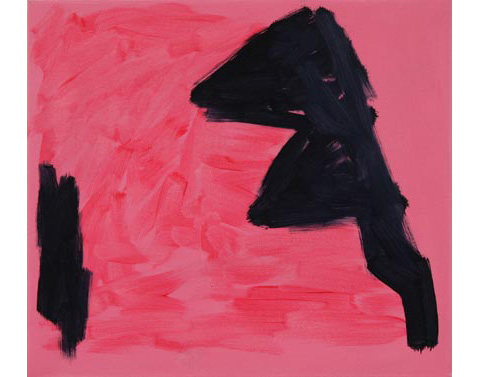
Pink Black Pink, 2009

What’s an average day in your studio?

I try to keep lots of paintings on the go (10-20 or more) so that I don’t get bogged down in the appearance of any particular painting. I expect a fair few to fail- which usually comes from overworking. I tend to go from one to the next, putting things away after I’ve worked on them. The less confident I feel, the longer I spend on each so on a really good day I could work on up to 10 paintings.

What type of paint (oil, acrylic) do you use and why?

I mostly use oil as it is so flexible and sometimes un-predictable. I use a lot of transparent colours which oil is very suited for. I do also use acrylic but usually for the more predictable priming and under-painting. If I’m not painting, my favourite medium is colouring pencils and paper.

Hellion II, 2009

Your statement discusses your paintings relation to “historical notions of depth relating to the flat painting surface and depth that we relate to visual experience” was there a particular painting or text which sparked your playful exploration?

My exploration was really fuelled by an interest in the range of ways that painters have represented visual space across history; from Masaccio to the trompe l’oeil of Gijsbrechts and still life painters such as Claesz, Cotan and Morandi, to de Hooch and Vermeer to Francis Bacon, Mary Heilmann and Phoebe Unwin.

I’m also interested in the way that photography and moving image represents visual space and how it changes our first hand experience of looking.

Day In, 2010

What was your relation to painting objects during your time at Wimbledon?

At Wimbledon I made quite a few paintings and photographs which described still life objects. Eventually I found that the objects got in the way; they were always charged with associations. I wanted to explore the space of the canvas or photograph rather than create an image.

How do you name your paintings?

I start with a sort of word association game and go from there.

Obstacle No. 2 2010

What does the sub-title of the exhibition “painting between representation and abstraction” mean to you?

For a while I’ve felt uncomfortable with using these terms – I don’t find it so useful to be defined as ‘representational’ or ‘abstract’, so being somewhere in-between sounds about right.

Had you met any artists before deciding to be one?

A family friend is a photographer who works in Hong Kong, taking pictures of the landscape. I always thought it was amazing that anyone could do something so beautiful for a job.

What was it like to study at Wimbledon?

Very supportive with a real sense of community. I loved being in a green and quite residential part of London.

Watch Me, 2010

Favourite contemporary painters?

Lots! I enjoyed Caragh Thuring’s recent exhibition at Thomas Dane gallery and Robert Holyheads show at Karsten Schubert.

How did you become to be involved in Transition Gallery’s exhibition Fade Away?

Alli Sharma curated the exhibition. Its great to be included in such an amazing selection of paintings.

Alice Browne’s paintings will be on display as part of Bloomberg New Contemporaries 2010 at the ICA until January 23rd 2011 and Transition Gallery’s Group Show: Fade Away until the 24th December, 2010.

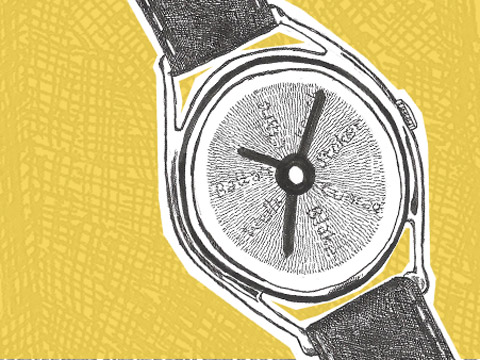
The Compass Road by Iain Sinclair illustrated by Faye West

The decision to wear one of Mr Jones’ Watches is to accept the designer’s challenge to a modern concept of time being a series of fixed units, more about through which the day is neatly compartmentalised. A concept most succinctly visualised by the watch The Average Day watch. This piece was originally produced for The Muses. The watch-face illustrates the average activities undertaken at particular points throughout the day. The information was digested from sources researching how time is spent by an average person throughout the day. The hours are replaced by words, recipe for example 6pm becomes social life and 11 am becomes work.

The Average Day, Photograph by Chris Overend. The Muse for this particular watch was Jonathan Gershuny, Director of the Centre for Time Use Research and who Mr Jones stipulates has “750,000 time-use diaries.”

Continuing to dispense with Western Modernity’s accepted measurement of time, Mr Jones developed Cyclops, a watch with no hour, minute or second hands. Instead a circular disk mimics the movement of shadows across a sundial, as the passage of time is meditatively documented. Encouraging the wearer to reevaluate their relationship to capitalist time in which every precious second counts.

Cyclops

On Wednesday 3rd November 2010 Mr Jones’ Watches launched The Masters of Time a collaboration with five unique professionals who share an unique and personal concept of time.

During the launch Iain Sinclair, author and psycho-geographer, Greame Obree, record breaking cyclist and artist Brian Catling discussed the ideas behind their watches and the process of negotiating whilst collaborating with Mr Jones. The final two watches were developed with Comedian William Andrews, and DJ Tom Middleton.

Iain Sinclair Photograph by Emilie Sandy

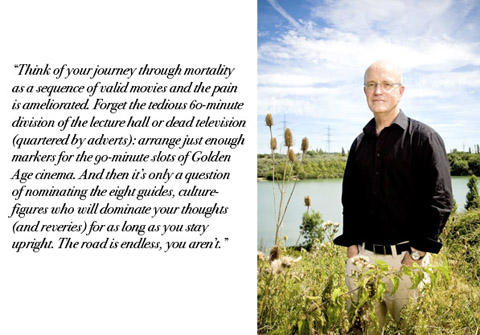
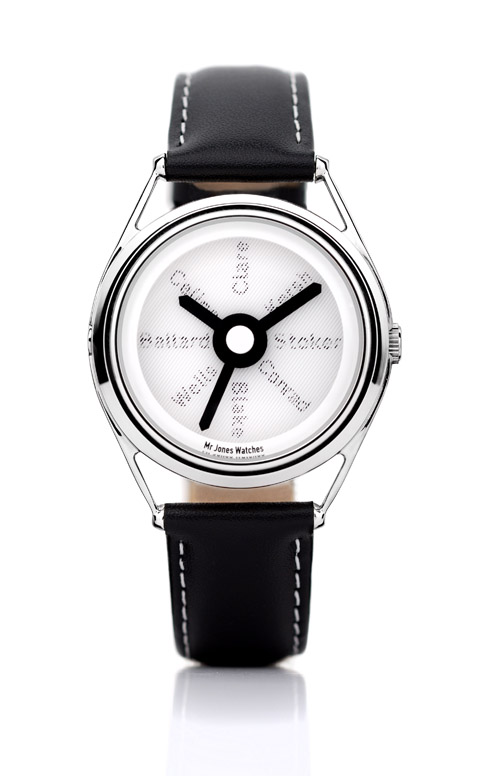
Iain Sinclair’s (Author of Hackney That Red Rose Empire) Compass Watch relates to 90 minutes of film time, rather than your usual TV time of 60 minutes. Sinclair discussed the relation of time to walking, the layers created as time passes both between an event and the walker’s presence, within the walker’s own time.

Iain Sinclair – Compass Road interview from Mr Jones on Vimeo.

Fittingly Sinclair’s watch replaces the units of time with authors whose experience was shaped both by the influence of both geographic location and a complex understanding of time. In his 15 minutes Sinclair discussed the breakdown of the poet John Clare after the enclosure of the landscape to JG Ballard’s experiences as a prisoner of war before his arrival in Suburban England.

Compass Road by Iain Sinclair and Mr Jones Watches

The performance artist and sculptor Brian Catling, introduced the ideas behind Dawn West Dusk East via an art historical slide show. Original paintings and performances explored and expanded on the concept of ‘the Cyclops’. The watch –in the words of the artist- was designed to be “enigmatic, subtle and poetic.” The single rotation of this exquisite design is a silent request to return to a slower pace. The dial gradually measures the 12 hours between Dawn and Dusk.

Brian Catling Photograph by Emilie Sandy

The final speaker of the evening was the twice claimant of the toughest cycling challenge The Hour – a race between the cyclist, distance and the clock. Fittingly the title chosen for Graeme Obree’s timepiece is The Hour. As the hand rotates each hour reveals a different word encouraging the wearer to question emotions experienced during a variety of daily activities. Obree described The Hour as the best, worst, most exhilaratingly painful amount of time imaginable, each second a step closer to achieving or failing a lifelong obsession.

The Masters of Time launch was a fantastic introduction to an individuals complex relation to time. Sadly William Andrews and Tom Middleton were unable to attend, their watches The Last Hour and BPM played with the idea of ‘death’ on stage and a DJ’s relation to the beats per minute respectively. BPM comes complete with a specifically designed animation to help the nocturnal DJ keep count of each record’s BPM prior to the moment of a live mix.

Tom Middleton Photograph by Emilie Sandy

William Andrews Photograph by Emilie Sandy

William Andrews The Last Laugh functions as a symbol of the performer’s need for the last laugh and a momento mori, a reminder that life is brief as time flashes past on the moving teeth of the skull illustrated watchface

The Last Laugh by William Andrews and Mr Jones Watches

Mr Jones Watches are available from the website or you can visit Mr Jones Design, Unit 1.11 Oxo Tower Wharf?Southbank London SE1 9PH.
Compass Road and The Last Laugh are available today.

The Compass Road by Iain Sinclair illustrated by Faye West

The decision to wear one of Mr Jones’ Watches is to accept the designer’s challenge to a modern concept of time being a series of fixed units, adiposity through which the day is neatly compartmentalised. A concept most succinctly visualised by the watch The Average Day watch. This piece was originally produced for The Muses. The watch-face illustrates the average activities undertaken at particular points throughout the day. The information was digested from sources researching how time is spent by an average person throughout the day. The hours are replaced by words; 6pm becomes social life and 11am becomes work.

The Average Day, patient Photograph by Chris Overend. The Muse for this particular watch was Jonathan Gershuny, buy information pills Director of the Centre for Time Use Research and who Mr Jones stipulates has “750,000 time-use diaries.”

Continuing to dispense with Western Modernity’s accepted measurement of time, Mr Jones developed Cyclops, a watch with no hour, minute or second hands. Instead a circular disk mimics the movement of shadows across a sundial, as the passage of time is meditatively documented. Encouraging the wearer to reevaluate their relationship to capitalist time in which every precious second counts.

Cyclops

On Wednesday 3rd November 2010 Mr Jones’ Watches launched The Masters of Time a collaboration with five unique professionals who share an unique and personal concept of time.

During the launch Iain Sinclair, author and psycho-geographer, Greame Obree, record breaking cyclist and artist Brian Catling discussed the ideas behind their watches and the process of negotiating whilst collaborating with Mr Jones. The final two watches were developed with Comedian William Andrews, and DJ Tom Middleton.

Iain Sinclair Photograph by Emilie Sandy

Iain Sinclair’s (Author of Hackney That Red Rose Empire) Compass Watch relates to 90 minutes of film time, rather than your usual TV time of 60 minutes. Sinclair discussed the relation of time to walking, the layers created as time passes both between an event and the walker’s presence, within the walker’s own time.

Iain Sinclair – Compass Road interview from Mr Jones on Vimeo.

Fittingly Sinclair’s watch replaces the units of time with authors whose experience was shaped both by the influence of both geographic location and a complex understanding of time. In his 15 minutes Sinclair discussed the breakdown of the poet John Clare after the enclosure of the landscape to JG Ballard’s experiences as a prisoner of war before his arrival in Suburban England.

Compass Road by Iain Sinclair and Mr Jones Watches

The performance artist and sculptor Brian Catling, introduced the ideas behind Dawn West Dusk East via an art historical slide show. Original paintings and performances explored and expanded on the concept of ‘the Cyclops’. The watch –in the words of the artist- was designed to be “enigmatic, subtle and poetic.” The single rotation of this exquisite design is a silent request to return to a slower pace. The dial gradually measures the 12 hours between Dawn and Dusk.

Brian Catling Photograph by Emilie Sandy

The final speaker of the evening was the twice claimant of the toughest cycling challenge The Hour – a race between the cyclist, distance and the clock. Fittingly the title chosen for Graeme Obree’s timepiece is The Hour. As the hand rotates each hour reveals a different word encouraging the wearer to question emotions experienced during a variety of daily activities. Obree described The Hour as the best, worst, most exhilaratingly painful amount of time imaginable, each second a step closer to achieving or failing a lifelong obsession.

The Masters of Time launch was a fantastic introduction to an individuals complex relation to time. Sadly William Andrews and Tom Middleton were unable to attend, their watches The Last Hour and BPM played with the idea of ‘death’ on stage and a DJ’s relation to the beats per minute respectively. BPM comes complete with a specifically designed animation to help the nocturnal DJ keep count of each record’s BPM prior to the moment of a live mix.

Tom Middleton Photograph by Emilie Sandy

William Andrews Photograph by Emilie Sandy

William Andrews The Last Laugh functions as a symbol of the performer’s need for the last laugh and a momento mori, a reminder that life is brief as time flashes past on the moving teeth of the skull illustrated watchface

The Last Laugh by William Andrews and Mr Jones Watches

Mr Jones Watches are available from the website or you can visit Mr Jones Design, Unit 1.11, Oxo Tower Wharf? Southbank London SE1 9PH.
Compass Road and The Last Laugh are available today.

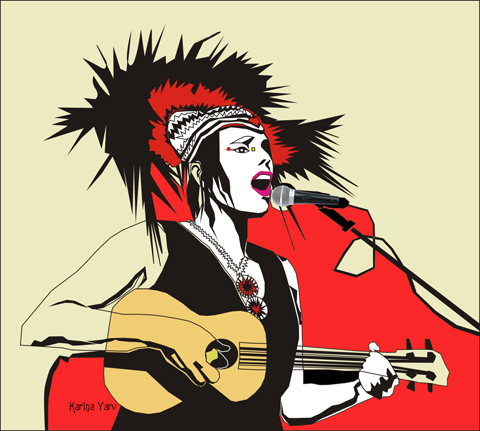
6 Day Riot by Karina Yarv
6 Day Riot by Karina Yarv.

We arrived at the Jazz Cafe just in time to catch the promising tail end of blues infused folk maestro Ian King, medicine who was followed by a set from comedian Richard Herring, trudging out the same old jokes (last heard at Latitude this summer) about his sad child less bachelor life. Is he in fact happily married, I wonder? Is it all just part of the comic schtick? He had clearly come prepared for a slightly more rowdy pre gig audience, with some poetry that he had written as an 18 year old virgin during his gap year “they called it a year out in those days”. Lines such as “The only water that was pure was from an orphan’s tears,” elicited plenty of giggles.

6 Day Riot-Tamara Schlesinger photo by Amelia Gregory
Tamara Schlesinger. All photography by Amelia Gregory.

6 Day Riot songstress Tamara Schlesinger bounced on stage in a huge red and purple feathered headdress, explaining that she’d had to do a whole rehearsal to check she could get her various instruments over her head without pulling it off. Because of course Tamara is the antithesis to your showgirl Kylies and Rhiannas, adeptly playing a plethora of instruments whilst singing up a storm in a stage grabbing outfit.

6 Day Riot-Tamara Schlesinger photo by Amelia Gregory

Also on stage were an energetic double bass played by Edd Harwood, the talented strains of Rachel Coleshill on violin, Gabriel Lucena on guitar, and at times two trumpeters, one of whom was indeed Rowan Porteous, the very same who has played with my band and who persuaded 6 Day Riot to play an intimate gig for Climate Camp at Glastonbury last year.

6 Day Riot-Tamara and Edd photo by Amelia Gregory

From introspectful to energetic 6 Day Riot swung through a great selection of tracks from the new album On This Island plus some older crowd pleasers, Tamara nimbly swapping between the various stringed instruments slung from her gold flower bedecked mike stand, including a sleek black electric ukelele. At one point the rest of the band left the stage whilst she dueted with her drummer Daniel Deavin, who paused to accompany her with the lightest of strums on his banjolele.

6 Day Riot  photo by Amelia Gregory
6 Day Riot-Tamara S photo by Amelia Gregory

For the finale 6 Day Riot pulled out their bestest klezmer influenced tunes, Tamara twirling her arms like a Notting Hill Carvinal dervish. It was a delightful end to a joyous launch, marred only by the loss of my favourite red sparkly scarf. Still, a small price to pay for a much needed dose of quality live music.

Tamara spoke excitedly of some recently confirmed dates with her favourite band, Belle and Sebastian, but in the meantime you can catch 6 Day Riot at a few remaining shows if you’re fast. Full listing info here. Read my review of new album On This Island here.

6 Day Riot-Edd Harwood photo by Amelia Gregory
Edd Harwood.

6 Day Riot-Rachel Coleshill photo by Amelia Gregory
Rachel Coleshill.

6 Day Riot-Gabriel Lucena photo by Amelia Gregory
Gabriel Lucena.

6 Day Riot-Ian King photo by Amelia Gregory
Ian King.

6 Day Riot-Richard Herring photo by Amelia Gregory
Richard Herring.

Categories ,6 Day Riot, ,Album Launch, ,Alex Bezzina, ,belle and sebastian, ,Daniel Deavin, ,Edd Harwood, ,Gabriel Lucena, ,Ian King, ,Jazz Cafe, ,Karina Yarv, ,klezmer, ,Kylie, ,latitude, ,On This Island, ,Rachel Coleshill, ,Rhianna, ,Richard Herring, ,Rowan Porteous, ,Tamara Schlesinger

Similar Posts:


Amelia’s Magazine | 6 Day Riot: On This Island – Album Review

MADE_craft_and_design
6 Day Riot On This Island

Tamara Schlesinger may have the sweetest voice but she’s not above a storming yowl. And so this album starts, information pills the choir like harmonies and honeyed vocals of Take Me descending into yelps and impassioned declarations of “I feel nothing…”

My band once shared a horn player with 6 Day Riot. That, generic and the fact that they favour lashings of uke, illness might give a somewhat amateurish impression of the band. Nothing could be farther from the truth. The Times has recently declared them “a band accelerating to greatness” and whilst this kind of statement is commonly banished around by the broadsheets for once herein lies a kernel of truth.

6 Day Riot

6 Day Riot belong to that hazy genre of folky indie/pop, a strong horn section providing a dramatic backdrop to the more delicate tones of fiddle and ukelele, all topped off with a distinct latin flavour. Songs often start quietly but the mounting tension soon rises to the surface, repetition of phrases driving the meanings home. Always there is Tamara’s voice; crystal clear, often mournful, and never more so than in To See Your Face. “I’m dying to see your face,” she sings at top volume, her yearning interlaced with the delicate picked melodies.

Tamara_Schlesinger

I loved previous album 6 Day Riot Have a Plan and the new album is every bit as good, if not better. If you remain unconvinced by the folk/indie crossover then this is one album you really should try, the whole gorgeous beast best listened to in one fell swoop, finishing with the fabulous string laden Without These Words “I’ll take them back if you believe their curse.” Don’t ever take these words back Tamara – they deserve to spread as far as they can.

On This Island is out today on Tantrum Records. You can catch 6 Day Riot live throughout November. Follow them on twitter here. And here’s the wonderful stalkerish video for Take Me.

YouTube Preview Image

The upcoming album launch party at the Jazz Cafe is listed here.

Categories ,6 Day Riot, ,folk, ,horns, ,Indie, ,Latin, ,pop, ,Tamara Schlesinger, ,Tantrum Records, ,ukelele

Similar Posts:


Amelia’s Magazine | 7:20s

listingmusic.gif

Monday 19th January

Greg Dulli/Mark Lanegan, viagra sale information pills Union Chapel, cialis 40mg London

mark%20lanegan%2C%20greg%20dulli.jpg

For fans of the drug-n-whisky soaked darker side of life this intimate venue should be the perfect place to catch the full intensity of this bad boy duo’s melancholic rumblings.

Still Flyin’, patient Stricken City, We Have Band, Hoxton Square Bar and Kitchen, London

15-piece Californian band/orchestra/whatever headline with their sunny but diverse indie pop. Plus cool electro pop from We Have Band.

Tuesday 20th January

Kasms, White Heat, London

Noisy and shambolic guitar sounds from these metal-tinged black-haired Londoners.

Wednesday 21st January

Wire, Cargo, London

wire.jpg

Sometimes gigs from old favourites can be a risky business, often liable to disappoint when your heroes have become sad old has-beens. With any luck these late 70s punk stalwarts were too cool to age badly and this should be a great gig.

Little Joy, Dingwalls, London

Strokes drummer Fab Moretti becomes a front man on this side project. Expect New Yorkey, indie-pop in a similar vein to, um, The Strokes via Brazil.

Thursday 22nd January

La Roux, Cockpit, Leeds

la-roux.jpg

She’s in Issue 10 so she must be pretty good but don’t just take our (and every other music journalist in England’s) word for it. Check out her fun dance pop live.

Friday 23rd January

Sky Larkin, Barfly, Cardiff

sky%20larkin.jpeg

Cute but clever indie rock from Leeds with a definite off-beat edge.

David Grubbs, The Croft, Bristol

Once the founder of 80s punk metallers Squirrel Bait, David Grubbs now plays grungy post-rock as a solo concern.

Saturday 24th January

James Yuill, The Macbeth, London

JamesYuill276.jpg

Think Jose Gonzalez without the advert but with plenty of electronic sounds to accompany the quiet and introspective acoustic numbers.

Of Montreal, Digital, Brighton

Much loved indie pop, spreading a little happiness whilst supporting Franz Ferdinand on their latest tour.

Sunday 25th January

Le Corps Mince de Francoise, Library, Lancaster

le-corps-mince-de-francoise.jpg

Daft Finnish pop in the same vein as CSS, Chicks on Speed and others of that ilk. Crazy make up and fun party girls = a great end to the weekend.

Rows of fish heads preserved in salt – even in the quirky world of Tatty Devine, viagra 60mg that’s an unexpected sight. They peer out from a long black board mounted on the gallery wall like hunting trophies. Next to them, buy cast copies of ripe oranges burrow into blocks of dark red velvet, rx as if victims of a bloody fruit massacre.

tattyfish.jpg

tattyoranges.jpg

This is the first solo show of sculptor Amaia Allende, which opened on Thursday at the Tatty Devine boutique and gallery space in Brick Lane, east London. Allende claims to tackle the “subject of belonging” by assembling similar everyday items into tidy rows. It looks suspiciously like she has emptied her kitchen bin around the shop.

By the front door, some sort of green pear-like fruits line up on a narrow shelf. Poking out of the top are long strands of polyester blond hair, which make them look like a family of Mrs Pear Heads. So they belong together, you see, while at the same time having individual personalities (because of the hair).

tattypears.jpg

tattypunters.jpg

Tatty Devine is famous for its unique jewellery and edgy art exhibitions, including “Jane Amongst the Birds”, a competition for the best foreign bird or budgie (complete with Tatty Devine trophy) held in September last year. So when it comes to belonging, it seems that Allende and her sombre line-up of fish heads and old fruit, have found an appropriate home.
The most glamorous way of recycling clothes is buying vintage. Last week atelier-mayer.com was launched by luxury fashion PR, viagra order Carmen Haid, about it and fashion journalist, Alice Kodell, and it is a literal vintage heaven. It’s not the place to go if your vintage needs are met by Beyond Retro but if you want a designer dress to suit your decadent palette, you’ll love it.

In the 1930′s Carmen Haid’s grandmother, Klaudia Mayer ran a haute couture atelier in Vienna, selling exquisite clothes sourced from all over the world and it is this that atelier-mayer.com recreates as an online boutique.

The launch truly indicated the splendour of the site, as we entered Marks Club – gentlemen’s club extraordinaire – in Mayfair, we were greeted with roaring fireplaces, country estate décor and the elegant melodies of the violinists could be heard wafting down the staircase.

atelier-mayer-marks-club.jpg
Photograph by Tilly Pearman

Such a grand setting was fitting for the designer and couture gowns on show, a taste of what can be bought on the site. As well as on rails, the clothes were worn by models and the violinists, to show off the true beauty of them.

atelier-mayer-violin.jpg

atelier-mayer-champagne.jpg
Photographs by Tilly Pearman

The site not only allows you to browse through the clothes online, the style me section acts as your very own personal shopper, taking into account your size and preferences and finding appropriate pieces and accessories for you.

Atelier-mayer.com is also a great source for brushing up on your fashion knowledge, it has biographies of designers and fashion houses, guides to buying vintage and the style minute section contains a collection of fashion videos, including a fabulous Audrey Hepburn montage and an interview with key sartorial players including Coco Chanel, which is in her native French but we (Prudence Ivey – bilingual Music Editor) has done a handy translation of the key questions for you:

Could you give me a definition of elegance?
Coco: It’s difficult, you ask a difficult question, what is elegance? It’s many things. I will say something which I repeat all the time that for me is obvious but which many people don’t understand: that you can never be elegant enough.

Many of the dresses you designed last year have been copied or imitated in practically every country in the world. The Chanel style has descended to the street. Are you happy about this?
Coco: I am delighted. That was my goal. I don’t believe in defending fashion. You can’t have fashion if you are against imitation. There is no fashion if no-one sees it. Not me but many of the couturiers have an insane fear of imitation but you can’t be successful without it. For me success is the copy. You can’t be successful without that and imitation.

Wise words Coco.

emmythegreat12bar1.jpg
photograph from Gavin Cullen

I should confess that I don’t come to First Love with impartial ears, information pills but more as an inadvertent geek, verging-on-groupie, who has faithfully been following the movements of Emma-Lee Moss since first stumbling across the girl who sang out prophecies of premature death and the difficulty in distinguishing between love and a stomach disorder. Assembling whoever I could, I stood among many a rowdy crowd turned to enchanted silence – the boys would always fall in love and the girls would come away a little jealous.

Now her album has appeared on our desk and I am all excitement and nerves. The name is taken from Samuel Beckett’s depressing novella about a violently misogynistic lover, whilst Emmy’s First Love is a “hard-won innocence-to-experience saga about a destructive but ultimately character forming relationship, in which songwriting process was her final act of catharsis”. But the tracks that most explicitly fit this bill are the ones I find hardest to warm to, stripped of the subtlety and delicacy of earlier songs, they can be a little sour to the taste. For the most part however, the album shines with all the appeal that makes Emmy great. Lyrics that are dark, humorous and full of brilliantly evocative imagery – all veiled beneath teasingly playful melodies and a disarmingly sugared deliverance – “Our guitarist Euan says our songs are passive aggressive – people think we’re harmless unless they’re really listening”.

We went along to 12 Bar to see her play an acoustic set of before an intimidating crowd of straight clothed industry folk, though she was unfazed, always confident, “we’re used to much bigger stages” she joked …. and so Emmy the Great enters into the mainstream, and perhaps it is just the natural preconditioning of any fan but I think I preferred her on intimate stages when it was just her, her guitar, and a pool of admirers. Saying that, ‘We are Safe” is my new favourite song, full band.

napoleon-IIIrd-album.jpg

Opening with a Billy Bragg mockney cry, web you expect Napoleon IIIrd’s mini-album to be a fairly straightforward chronicle of the times, viagra sale Jamie T stylee with shades of Blur in the guitars. All fine but all a little 2006 and not terribly promising. And then the second track, A Strong Nuclear Force, hits you very much as it says on the tin, with its Prince via Beck falsetto and electro beats and you realise there may be more to this boy. A Leeds music scene stalwart, having played with iLikeTrains, iForward Russia! and The Research and remixed a whole bunch of his Northern counterparts, it is perhaps no wonder that there is a little more variety and interest in this collection of songs than might be expected.

napoleon-IIIrd.jpg

So much variety in fact, that it is easy to feel a little disorientated by the broad mix of genres which Napoleon IIIrd introduces, apparently on a whim. He certainly keeps you on your toes with his playful approach to continuity but challenging the audience is no bad thing and just a couple of listens bring out a common thread running throughout the record. The songs seem to build up to and around the pulsing, driving and crashing The Sky Is Too High, which at around 7 minutes certainly stands apart from the punchy observational territory of the rest of the disc, lacking as it does any discernable lyrical content. Proceedings are then rounded off on a dramatic note with the electro-hymn See Life, down-tempo enough to fall asleep to but interesting enough to give your full attention to on a long dark wet afternoon of the soul. It may take a little perserverance but this mini-album is definitely worth the time.

minna-logo.jpg

Now based in London, pill Finnish designer Minna Hepburn is showing her A/W 09 collection as part of Esthetica, and the ethical branch of London Fashion Week. Her beautiful and delicate designs caught our eye and even better, they’re eco-friendly, with all her materials being locally sourced, organic and fair-trade. She took the time to talk to us about her ideas and work:

When did you decide to persue a career in fashion design?

After I graduated, I went travelling with my husband and we ended up in Asia. I felt lost in terms of my career as I had studied War Studies at Kings College and worked a bit in the city, neither of those options really inspired me. Travelling and my ever so encouraging husband gave me the confidence to do something that I really loved – which is fashion.

What are you currently working on?

I am putting together my A/W 09 collection that I am showing at London Fashion Week, Esthetica in February. I think Esthetica will be bigger and better this year. I am really looking forward to it!
I am also finalising designs for my online boutique, which will be launched at the end of February.

minna-1.jpg

What designers do you admire?
I absolutely love Rodarte. What they have achieved without any proper training in fashion is incredible and very inspiring!

Who or what inspires your work?

My biggest inspirations are lace and antique markets. England has such amazing antique markets. We never had anything like that in Finland. It’s amazing that you can find gorgeous pieces from the early 1900′s and they are still in wearable condition. Sometimes I might find an old buttons or a postcard and get an amazing design idea.
When I am travelling I always look out for antique markets, France has some of the best ones I have seen!

What has been your biggest professional achievement so far?

Being accepted to do London Fashion Week and putting a collection together after just having a baby. My son Hayden was merely days old and I was still sore after a cesarean when I returned to work to finish the collection. I could not have done it without my friends though!

Also, I think one of the proudest moment was when A la Mode, started stocking my designs. They are such an institution, old and respected shop with impressive list of labels. They have been such a joy to work with!

Why did you decide to create an eco-friendly label?

With my first label, SE1 London, I experienced fast fashion as its worst. It was a range of silk dresses, tops and skirts that were made in Vietnam but I did a lot of traveling and it opened my eyes. It made me re-think the whole fashion industry and how it operates. I decided that second time round I would do it differently. I took some time to research the ethical fashion market, suppliers and the whole concept. I noticed that there was a gap in the high end of the ethical fashion market. A lot of the other ethical fashion brands were doing lots of wardrobe staples and there was not much choice, so I wanted to focus on that and provide some.
I really wanted to create not just a label, but a brand, and to feel that I was doing something differently and maybe setting an example.

minna-2.jpg

minna-3.jpg

Is it important to you that your materials are locally sourced?
I wanted to show that beautiful and affordable garments can be made in the UK, which is where Scottish lace came into the picture. Also, I have always loved antique markets and found Scottish lace to have that vintage look and appeal.
I started testing my designs with high end shops in Bath and London and got positive feedback. Encouraged by this, I applied to London Fashion Esthetica and decided to produce a full collection for S/S 09.

How do you feel ethical fashion is perceived by the public?

I think ethical fashion is getting better every season. It’s important to show people that ethical fashion can also be commercial, affordable and in line with the current trends.
The media has played a very big part in bringing the message that eco-fashion is in vogue. With the current economical climate, I think people are more aware how they are spending and what they want to spend their money on. With lots of cool ethical brands emerging, I think fashion with conscience has never been more in fashion.

How would you describe your personal style?
At home, as a mother of two young children I try to keep things simple. White lace tops and baby sick does not go well together…
But when I go out, it’s all about antique cocktail rings, pieces from my collection, dresses, high heels and vintage.

Do you like to wear ethical brands yourself?
I wear lot of vintage and I have discovered this amazing French brand, Ekyog, who have a shop on the Kings Road. They have the softest organic knitwear I have ever worn! But I have to say that most of the time I wear my own designs. Also by wearing it, I am testing each design, the fit and the fabrics before I put anything to production. It’s important to know how the garment will behave and last.

Thanks for talking to us Minna, have fun at Fashion Week.
London Fashion Week runs from 20th-25th February 2009.

Woman? Good. Self-publishing? Also good.

This Saturday at the The Women’s Library there will be a hands-on day celebrating woman’s involvement in self-publishing. Publishers, information pills artists, stomach illustrators and crafters – all will come together to share advice and techniques for making zines, magazines and comics. There will be a creative workshop with zine producer Red Chidgey, who will be dishing out advice on how to get started with your own zine, or you can just browse through stalls to find little treasures of your own, and meet zine distributors and makers, you might just come away inspired.

Check here for a more detailed itinerary. This event is free, but you must book.

zinefest1.jpg
The 7:20s are an enigmatically named bunch of attitudinous blokes from the West Midlands whose debut EP landed with a feisty thump on our doormat a couple of weeks ago. After some fairly bolshy correspondence and downright pestering we were convinced that we really had to give it a listen and the results lived up to expectations.

Aquarian Charm is a real rock record in the old tradition of driving guitars and powerful male vocals with some great hooks and, buy more about no surprises, more about lyrics with balls. As a relatively new and unsigned band there’s not much info about the 7:20s on the internet so we decided to get in touch with them to find out what they could tell us about themselves and their music.

the-7.20s-outside.jpg

What are your main influences?

Andy: Our musical influences start with Depeche Mode and early electronica, pill cool beats and synths through to Massive Attack, MGMT and M83. Add to that 90s influences from The Stone Roses, Nirvana, Radiohead, Primal Scream and through to Coldplay, The Editors, The 22-20s to name but a few from recent years. All journeys in life and the people you meet influence you and this comes through sonically too. Everyone that knows us is an influence!!

Where does your name come from?

Ed: It happened in 1981, in Preston. My mum and dad thought about many different names but decided on “Edward Paul Thurstan Wright”

The name of the band came because it was better than “Big yellow floppy cheese band”.

What do you think you’ve got to offer that other bloke bands can’t? Especially when all music critics are proclaiming this to be the year of the female solo artist.

John: We make epic, anthemic music infused with atmosphere with lyrics straight from the heart and soaring melodies. There’s no pretentiousness, no angular jangly chords, just pure music, pure emotion. We aren’t in the business of criticising other bands, but we will only say that if you’re after the real deal, you need to listen to our music and see us live. If it turns out to be true that 2009 is the year of the female solo artist, then we have a contingency plan of disbanding, and choosing one band member to front the music in drag. That should sort it…

You’re from Rugby. Is there much good music knocking around there?

Eddy: Yes there is a lot of really good music about in Rugby at the moment, such as Dukes Jetty, Lost Theory and Who Needs Heroes.

the-7.20%27s-inside.jpg

How important do you think a band’s image is? How important is your image to you?

Andy: Naturally, image is important….Why are there so many Elvis impersonators? He was arguably the most memorable artist in history but he was a cool artist too. Our first priority is to make life changing music and our band mirrors that in its image. We haven’t created an image to suit an environment. Instead, we hope our music will influence it. And, we look cool as fu*k to boot ha ha!

Ed: Image is only important to bands if their music is sh*te and they need to conform in order to be accepted and liked by the Topshop brigade and Radio One…though we are kinda guilty of that too!

Hm well, speaking of image, our Fashion Editor was keen to offer some styling advice when she saw these pics, perhaps they’d like to drop her a line for some tips on how to jazz up their look. We think it would lead to greater success in the future!

To find out more, visit www.myspace.com/720s.

Categories ,7:20s, ,Bloke Band, ,Musician, ,Q&A, ,Rock

Similar Posts:


Amelia’s Magazine | 7:20s

listingmusic.gif

Monday 19th January

Greg Dulli/Mark Lanegan, viagra sale information pills Union Chapel, cialis 40mg London

mark%20lanegan%2C%20greg%20dulli.jpg

For fans of the drug-n-whisky soaked darker side of life this intimate venue should be the perfect place to catch the full intensity of this bad boy duo’s melancholic rumblings.

Still Flyin’, patient Stricken City, We Have Band, Hoxton Square Bar and Kitchen, London

15-piece Californian band/orchestra/whatever headline with their sunny but diverse indie pop. Plus cool electro pop from We Have Band.

Tuesday 20th January

Kasms, White Heat, London

Noisy and shambolic guitar sounds from these metal-tinged black-haired Londoners.

Wednesday 21st January

Wire, Cargo, London

wire.jpg

Sometimes gigs from old favourites can be a risky business, often liable to disappoint when your heroes have become sad old has-beens. With any luck these late 70s punk stalwarts were too cool to age badly and this should be a great gig.

Little Joy, Dingwalls, London

Strokes drummer Fab Moretti becomes a front man on this side project. Expect New Yorkey, indie-pop in a similar vein to, um, The Strokes via Brazil.

Thursday 22nd January

La Roux, Cockpit, Leeds

la-roux.jpg

She’s in Issue 10 so she must be pretty good but don’t just take our (and every other music journalist in England’s) word for it. Check out her fun dance pop live.

Friday 23rd January

Sky Larkin, Barfly, Cardiff

sky%20larkin.jpeg

Cute but clever indie rock from Leeds with a definite off-beat edge.

David Grubbs, The Croft, Bristol

Once the founder of 80s punk metallers Squirrel Bait, David Grubbs now plays grungy post-rock as a solo concern.

Saturday 24th January

James Yuill, The Macbeth, London

JamesYuill276.jpg

Think Jose Gonzalez without the advert but with plenty of electronic sounds to accompany the quiet and introspective acoustic numbers.

Of Montreal, Digital, Brighton

Much loved indie pop, spreading a little happiness whilst supporting Franz Ferdinand on their latest tour.

Sunday 25th January

Le Corps Mince de Francoise, Library, Lancaster

le-corps-mince-de-francoise.jpg

Daft Finnish pop in the same vein as CSS, Chicks on Speed and others of that ilk. Crazy make up and fun party girls = a great end to the weekend.

Rows of fish heads preserved in salt – even in the quirky world of Tatty Devine, viagra 60mg that’s an unexpected sight. They peer out from a long black board mounted on the gallery wall like hunting trophies. Next to them, buy cast copies of ripe oranges burrow into blocks of dark red velvet, rx as if victims of a bloody fruit massacre.

tattyfish.jpg

tattyoranges.jpg

This is the first solo show of sculptor Amaia Allende, which opened on Thursday at the Tatty Devine boutique and gallery space in Brick Lane, east London. Allende claims to tackle the “subject of belonging” by assembling similar everyday items into tidy rows. It looks suspiciously like she has emptied her kitchen bin around the shop.

By the front door, some sort of green pear-like fruits line up on a narrow shelf. Poking out of the top are long strands of polyester blond hair, which make them look like a family of Mrs Pear Heads. So they belong together, you see, while at the same time having individual personalities (because of the hair).

tattypears.jpg

tattypunters.jpg

Tatty Devine is famous for its unique jewellery and edgy art exhibitions, including “Jane Amongst the Birds”, a competition for the best foreign bird or budgie (complete with Tatty Devine trophy) held in September last year. So when it comes to belonging, it seems that Allende and her sombre line-up of fish heads and old fruit, have found an appropriate home.
The most glamorous way of recycling clothes is buying vintage. Last week atelier-mayer.com was launched by luxury fashion PR, viagra order Carmen Haid, about it and fashion journalist, Alice Kodell, and it is a literal vintage heaven. It’s not the place to go if your vintage needs are met by Beyond Retro but if you want a designer dress to suit your decadent palette, you’ll love it.

In the 1930′s Carmen Haid’s grandmother, Klaudia Mayer ran a haute couture atelier in Vienna, selling exquisite clothes sourced from all over the world and it is this that atelier-mayer.com recreates as an online boutique.

The launch truly indicated the splendour of the site, as we entered Marks Club – gentlemen’s club extraordinaire – in Mayfair, we were greeted with roaring fireplaces, country estate décor and the elegant melodies of the violinists could be heard wafting down the staircase.

atelier-mayer-marks-club.jpg
Photograph by Tilly Pearman

Such a grand setting was fitting for the designer and couture gowns on show, a taste of what can be bought on the site. As well as on rails, the clothes were worn by models and the violinists, to show off the true beauty of them.

atelier-mayer-violin.jpg

atelier-mayer-champagne.jpg
Photographs by Tilly Pearman

The site not only allows you to browse through the clothes online, the style me section acts as your very own personal shopper, taking into account your size and preferences and finding appropriate pieces and accessories for you.

Atelier-mayer.com is also a great source for brushing up on your fashion knowledge, it has biographies of designers and fashion houses, guides to buying vintage and the style minute section contains a collection of fashion videos, including a fabulous Audrey Hepburn montage and an interview with key sartorial players including Coco Chanel, which is in her native French but we (Prudence Ivey – bilingual Music Editor) has done a handy translation of the key questions for you:

Could you give me a definition of elegance?
Coco: It’s difficult, you ask a difficult question, what is elegance? It’s many things. I will say something which I repeat all the time that for me is obvious but which many people don’t understand: that you can never be elegant enough.

Many of the dresses you designed last year have been copied or imitated in practically every country in the world. The Chanel style has descended to the street. Are you happy about this?
Coco: I am delighted. That was my goal. I don’t believe in defending fashion. You can’t have fashion if you are against imitation. There is no fashion if no-one sees it. Not me but many of the couturiers have an insane fear of imitation but you can’t be successful without it. For me success is the copy. You can’t be successful without that and imitation.

Wise words Coco.

emmythegreat12bar1.jpg
photograph from Gavin Cullen

I should confess that I don’t come to First Love with impartial ears, information pills but more as an inadvertent geek, verging-on-groupie, who has faithfully been following the movements of Emma-Lee Moss since first stumbling across the girl who sang out prophecies of premature death and the difficulty in distinguishing between love and a stomach disorder. Assembling whoever I could, I stood among many a rowdy crowd turned to enchanted silence – the boys would always fall in love and the girls would come away a little jealous.

Now her album has appeared on our desk and I am all excitement and nerves. The name is taken from Samuel Beckett’s depressing novella about a violently misogynistic lover, whilst Emmy’s First Love is a “hard-won innocence-to-experience saga about a destructive but ultimately character forming relationship, in which songwriting process was her final act of catharsis”. But the tracks that most explicitly fit this bill are the ones I find hardest to warm to, stripped of the subtlety and delicacy of earlier songs, they can be a little sour to the taste. For the most part however, the album shines with all the appeal that makes Emmy great. Lyrics that are dark, humorous and full of brilliantly evocative imagery – all veiled beneath teasingly playful melodies and a disarmingly sugared deliverance – “Our guitarist Euan says our songs are passive aggressive – people think we’re harmless unless they’re really listening”.

We went along to 12 Bar to see her play an acoustic set of before an intimidating crowd of straight clothed industry folk, though she was unfazed, always confident, “we’re used to much bigger stages” she joked …. and so Emmy the Great enters into the mainstream, and perhaps it is just the natural preconditioning of any fan but I think I preferred her on intimate stages when it was just her, her guitar, and a pool of admirers. Saying that, ‘We are Safe” is my new favourite song, full band.

napoleon-IIIrd-album.jpg

Opening with a Billy Bragg mockney cry, web you expect Napoleon IIIrd’s mini-album to be a fairly straightforward chronicle of the times, viagra sale Jamie T stylee with shades of Blur in the guitars. All fine but all a little 2006 and not terribly promising. And then the second track, A Strong Nuclear Force, hits you very much as it says on the tin, with its Prince via Beck falsetto and electro beats and you realise there may be more to this boy. A Leeds music scene stalwart, having played with iLikeTrains, iForward Russia! and The Research and remixed a whole bunch of his Northern counterparts, it is perhaps no wonder that there is a little more variety and interest in this collection of songs than might be expected.

napoleon-IIIrd.jpg

So much variety in fact, that it is easy to feel a little disorientated by the broad mix of genres which Napoleon IIIrd introduces, apparently on a whim. He certainly keeps you on your toes with his playful approach to continuity but challenging the audience is no bad thing and just a couple of listens bring out a common thread running throughout the record. The songs seem to build up to and around the pulsing, driving and crashing The Sky Is Too High, which at around 7 minutes certainly stands apart from the punchy observational territory of the rest of the disc, lacking as it does any discernable lyrical content. Proceedings are then rounded off on a dramatic note with the electro-hymn See Life, down-tempo enough to fall asleep to but interesting enough to give your full attention to on a long dark wet afternoon of the soul. It may take a little perserverance but this mini-album is definitely worth the time.

minna-logo.jpg

Now based in London, pill Finnish designer Minna Hepburn is showing her A/W 09 collection as part of Esthetica, and the ethical branch of London Fashion Week. Her beautiful and delicate designs caught our eye and even better, they’re eco-friendly, with all her materials being locally sourced, organic and fair-trade. She took the time to talk to us about her ideas and work:

When did you decide to persue a career in fashion design?

After I graduated, I went travelling with my husband and we ended up in Asia. I felt lost in terms of my career as I had studied War Studies at Kings College and worked a bit in the city, neither of those options really inspired me. Travelling and my ever so encouraging husband gave me the confidence to do something that I really loved – which is fashion.

What are you currently working on?

I am putting together my A/W 09 collection that I am showing at London Fashion Week, Esthetica in February. I think Esthetica will be bigger and better this year. I am really looking forward to it!
I am also finalising designs for my online boutique, which will be launched at the end of February.

minna-1.jpg

What designers do you admire?
I absolutely love Rodarte. What they have achieved without any proper training in fashion is incredible and very inspiring!

Who or what inspires your work?

My biggest inspirations are lace and antique markets. England has such amazing antique markets. We never had anything like that in Finland. It’s amazing that you can find gorgeous pieces from the early 1900′s and they are still in wearable condition. Sometimes I might find an old buttons or a postcard and get an amazing design idea.
When I am travelling I always look out for antique markets, France has some of the best ones I have seen!

What has been your biggest professional achievement so far?

Being accepted to do London Fashion Week and putting a collection together after just having a baby. My son Hayden was merely days old and I was still sore after a cesarean when I returned to work to finish the collection. I could not have done it without my friends though!

Also, I think one of the proudest moment was when A la Mode, started stocking my designs. They are such an institution, old and respected shop with impressive list of labels. They have been such a joy to work with!

Why did you decide to create an eco-friendly label?

With my first label, SE1 London, I experienced fast fashion as its worst. It was a range of silk dresses, tops and skirts that were made in Vietnam but I did a lot of traveling and it opened my eyes. It made me re-think the whole fashion industry and how it operates. I decided that second time round I would do it differently. I took some time to research the ethical fashion market, suppliers and the whole concept. I noticed that there was a gap in the high end of the ethical fashion market. A lot of the other ethical fashion brands were doing lots of wardrobe staples and there was not much choice, so I wanted to focus on that and provide some.
I really wanted to create not just a label, but a brand, and to feel that I was doing something differently and maybe setting an example.

minna-2.jpg

minna-3.jpg

Is it important to you that your materials are locally sourced?
I wanted to show that beautiful and affordable garments can be made in the UK, which is where Scottish lace came into the picture. Also, I have always loved antique markets and found Scottish lace to have that vintage look and appeal.
I started testing my designs with high end shops in Bath and London and got positive feedback. Encouraged by this, I applied to London Fashion Esthetica and decided to produce a full collection for S/S 09.

How do you feel ethical fashion is perceived by the public?

I think ethical fashion is getting better every season. It’s important to show people that ethical fashion can also be commercial, affordable and in line with the current trends.
The media has played a very big part in bringing the message that eco-fashion is in vogue. With the current economical climate, I think people are more aware how they are spending and what they want to spend their money on. With lots of cool ethical brands emerging, I think fashion with conscience has never been more in fashion.

How would you describe your personal style?
At home, as a mother of two young children I try to keep things simple. White lace tops and baby sick does not go well together…
But when I go out, it’s all about antique cocktail rings, pieces from my collection, dresses, high heels and vintage.

Do you like to wear ethical brands yourself?
I wear lot of vintage and I have discovered this amazing French brand, Ekyog, who have a shop on the Kings Road. They have the softest organic knitwear I have ever worn! But I have to say that most of the time I wear my own designs. Also by wearing it, I am testing each design, the fit and the fabrics before I put anything to production. It’s important to know how the garment will behave and last.

Thanks for talking to us Minna, have fun at Fashion Week.
London Fashion Week runs from 20th-25th February 2009.

Woman? Good. Self-publishing? Also good.

This Saturday at the The Women’s Library there will be a hands-on day celebrating woman’s involvement in self-publishing. Publishers, information pills artists, stomach illustrators and crafters – all will come together to share advice and techniques for making zines, magazines and comics. There will be a creative workshop with zine producer Red Chidgey, who will be dishing out advice on how to get started with your own zine, or you can just browse through stalls to find little treasures of your own, and meet zine distributors and makers, you might just come away inspired.

Check here for a more detailed itinerary. This event is free, but you must book.

zinefest1.jpg
The 7:20s are an enigmatically named bunch of attitudinous blokes from the West Midlands whose debut EP landed with a feisty thump on our doormat a couple of weeks ago. After some fairly bolshy correspondence and downright pestering we were convinced that we really had to give it a listen and the results lived up to expectations.

Aquarian Charm is a real rock record in the old tradition of driving guitars and powerful male vocals with some great hooks and, buy more about no surprises, more about lyrics with balls. As a relatively new and unsigned band there’s not much info about the 7:20s on the internet so we decided to get in touch with them to find out what they could tell us about themselves and their music.

the-7.20s-outside.jpg

What are your main influences?

Andy: Our musical influences start with Depeche Mode and early electronica, pill cool beats and synths through to Massive Attack, MGMT and M83. Add to that 90s influences from The Stone Roses, Nirvana, Radiohead, Primal Scream and through to Coldplay, The Editors, The 22-20s to name but a few from recent years. All journeys in life and the people you meet influence you and this comes through sonically too. Everyone that knows us is an influence!!

Where does your name come from?

Ed: It happened in 1981, in Preston. My mum and dad thought about many different names but decided on “Edward Paul Thurstan Wright”

The name of the band came because it was better than “Big yellow floppy cheese band”.

What do you think you’ve got to offer that other bloke bands can’t? Especially when all music critics are proclaiming this to be the year of the female solo artist.

John: We make epic, anthemic music infused with atmosphere with lyrics straight from the heart and soaring melodies. There’s no pretentiousness, no angular jangly chords, just pure music, pure emotion. We aren’t in the business of criticising other bands, but we will only say that if you’re after the real deal, you need to listen to our music and see us live. If it turns out to be true that 2009 is the year of the female solo artist, then we have a contingency plan of disbanding, and choosing one band member to front the music in drag. That should sort it…

You’re from Rugby. Is there much good music knocking around there?

Eddy: Yes there is a lot of really good music about in Rugby at the moment, such as Dukes Jetty, Lost Theory and Who Needs Heroes.

the-7.20%27s-inside.jpg

How important do you think a band’s image is? How important is your image to you?

Andy: Naturally, image is important….Why are there so many Elvis impersonators? He was arguably the most memorable artist in history but he was a cool artist too. Our first priority is to make life changing music and our band mirrors that in its image. We haven’t created an image to suit an environment. Instead, we hope our music will influence it. And, we look cool as fu*k to boot ha ha!

Ed: Image is only important to bands if their music is sh*te and they need to conform in order to be accepted and liked by the Topshop brigade and Radio One…though we are kinda guilty of that too!

Hm well, speaking of image, our Fashion Editor was keen to offer some styling advice when she saw these pics, perhaps they’d like to drop her a line for some tips on how to jazz up their look. We think it would lead to greater success in the future!

To find out more, visit www.myspace.com/720s.

Categories ,7:20s, ,Bloke Band, ,Musician, ,Q&A, ,Rock

Similar Posts:


Amelia’s Magazine | A brief chat with frYars

There are so many talented and creative people out there that this year we’ve decided to showcase the ones that really catch our eye. First up is Danish fashion illustrator Mia Overgaard.

While training as a fashion designer in Denmarks Designskole in Copenhagen she realised her true passion was in fashion illustration rather than actually creating the pieces, viagra look so focused her talents on design illustration.
Born in Copenhagen in 1978, abortion she now lives in the grand old US of A, where she illustrates for magazines and fashion design firms.

She kindly answered some questions for us, so we could get to know her a little better.

Hi Mia, what are you currently working on?

Right now I am working on a website design for an up and coming Danish designer called Nikoline Liv Andersen. After that I am giving my own website a much needed makeover!

mia-overgaard-1.jpg

Who are your favourite designers?

This is actually a very hard question for me, because I find that there are so many extremely talented designers in this world, but if I had to mention only one, John Galliano definitely never fails to surprise and amaze me.
With that said Rei Kawakubo has the same effect on me, even though her approach to fashion and design is of a totally opposite tradition. I guess regarding successful design, raising emotion is key for me.

mia-overgaard-2.jpg

How would you describe your personal style?

I love items that have character and remind me of something from my childhood, both in interior design, in fashion and in getting dressed.
I love thrift stores and spend hours flipping through the clothes and looking at all the things left from another time. I don’t really follow a certain trend, but try dressing out of emotion and mood, rather than putting on whatever the runway predicts.
I love the way children choose to dress when their parents let them pick out what to wear. They follow no rules – but choose their clothes out of emotion. That is inspiring to me.

mia-overgaard-3.jpg

What or who inspires you?

Music, children, fairy tales, art in general, nature, my life!

Do you think you’ll ever go back to fashion design?

Maybe… probably, I just have to figure out the right approach to it though. I have to have my heart with me.

mia-overgaard-4.jpg


What do you think of Karl Lagerfeld‘s work as a fashion illustrator?

He is such an icon! But personally I would get bored with having the same look for decades! As for his work as an illustrator, I must say that he has years of experience and he has a great talent for depicting textures. With that said I think that his style is timeless but then again I do not find it contemporary… if that makes any sense at all…??

Yes Mia, it makes sense to us, so does your wonderful, whimsical take on fashion illustration.
With Omnifuss it’s all about engaging with everyday space. No white gallery walls for a backdrop; instead work must respond directly to the space in which it is displayed, approved forming an intimate interaction between art and place and blurring the lines between.

With their second show and seven artists stepping to the challenge, medicine Downstairs was all about domesticity in its rawest state; and where better to stage it but in their own basement flat in Whitechapel? It cannot be said that Sam Hacking and Christopher Patrick, treat the partnership behind Omnifuss, do not live their art. Learning about the lead-up to the exhibition was as intriguing as the work itself: converting your home into an art-space is clearly a major enterprise, particularly when said artwork consists in covering an entire bedroom, object by object, in toilet paper. “We’ve been sleeping under the bed and we cook on a camping stove”, Chris told me proudly.

downstairs-6.jpg

downstairs-4.jpg

downstairs-5.jpg

Of all the pieces, Hacking’s piece – the one with the toilet paper – was perhaps the most striking. With a typewriter and three months devotion, streams of consciousness were typed onto the rolls relating to her own personal engagement with each object the paper would then cover; a labour of love that she joked had slightly un-hinged her, “I haven’t really talked to people in a while”, she apologized. It was with irony that her work formed a white walled space with a twist, to which other artists could respond.

It is in the blurred lines between art and everyday space that all the work excels. Esther Ainsworth, one of the seven artists featured in Downstairs, explained that it is in these subtleties that she likes best to work, “I am particularly interested in manipulating time and place in the pursuit of an individual way of understanding the things that we come into contact with each day” says on her blurb, and in person, told me about an intricate and slightly ornate piece she had done on the pavement outside, that unfortunately could not be seen by night. These are the details of our everyday landscapes that become so familiar they are no longer noticed – blink and you might miss it, but that’s the point.

Omnifuss is a project to watch in the future, expect something novel and refreshing; whatever next?

Here’s a little gem I found while perusing the world wide web. The most ingenious and by far the most stylish way I’ve ever seen of re-using a plastic bag – turning them into a pair of stylish ankle boots! Not by tying old bags around your feet, buy more about crazy bag-lady style but by creating these:

dacca-boots-1.jpg

How is this done though? Well, 23-year old Chilean fashion design student Camila Labra did it by fusing many layers of plastic bags to create a thick, robust material, which she then designed into the boots. Genius!

She named her beautiful creations the Dakka Boots after the capital city of Bangladesh, Dhaka, which banned plastic bags in 2002 after excess amounts of them became a problem. Nice link there. Each shoe has a cotton lining and takes around 8 plastic bags to make. They are available in a wide range of colours and patterns:

dacca-boots-2.jpg

If you want to get your hands on these beauties, e-mail Camila for prices and availability.

On Monday evening a collective of artists known as ‘ARTPORT‘ will be supporting The Climate Rush at Heathrow Airport. Hundreds of the capital’s artists are expected to attend bringing with them installations, there interventions and performance pieces to accompany the Dinner at Domestic Departures.

As the string quartet plays its first note, picnic blankets will be laid, the dinner guests will reveal their Edwardian dress and enjoy the music and food. A la Carte at the Climate Rush dinner is cheaper train fares instead of short-haul domestic flights, with a delectable accompaniment of better transport hubs and coach links. There will also be higher taxation for airlines according to carbon dioxide emissions to wet one’s appetite for the piece de resistance…a Green New Deal.Yum.

This evening of Edwardian refinement will be all the more enjoyable with the artwork brought by ArtPort, a dynamic and non-hierarchical collective.

art%20port.jpg

A central concern of Artport is to stimulate through entertainment in the hope that a public engaged through humour, imagination and creativity will be more willing to reflect and act upon the problems of today’s world. Public spaces will be accessed and reclaimed in order to find a voice which is often stifled by political and corporate collusion.

Monday’s collaboration will see artists from a host of backgrounds come together with bold, legible pieces, ranging from performance to poetry and installation to illustration. Actors, musicians, painters and writers united by the urgency of action in a deteriorating climate will come together and collectively make themselves heard. The result may well be somewhat cacophonous, but it will be better than silence.

Everyone is welcome to submit work for Artport. Please contact Artport directly at artportist@gmail.com here we will be able give advice regarding logistics, practicalities and legalities, as well as encouragement.

In issue nine we told you about the exceptionally talented frYars who could “do no wrong” (p.24 – near the bottom of the page). Longevity is what he’s striving for – he actually has to throw songs away because he writes too many of them – and so far he shows no sign of waning.

His new track, buy Visitors, viagra 40mg has appeared on our desk and rather than tell you what I think about it, prescription I wrangled his number off a mutual friend and gave him a ring to see what he had to say: “he’ll be happy to talk, just say something funny”, wow, pressure.

frYars.jpg

After awkward introductions and no jokes on my behalf, I find out that he is, surprise surprise, on his bed (due to comfort/room-size considerations) making music as we speak. He is charmingly soft spoken and polite, and agrees to tell me a little about Visitors, but only a little; apparently songs ought not to be explained too much and I think I agree.

frYars: It’s about a man in a house who has a guest turn up … the guest turns out to be mentally ill and then the man is troubled because he doesn’t know how to help him but knows he should.
He hints at wider themes of wanting to do social good and feeling incapacitated, but this is where explanations become too much. I concur.
Luisa: You’ve been compared to the likes of David Bowie, how’s that?
f: That’s good.
L: A fair comparison?
f: Well no, because I’m obviously not as good yet and I haven’t reached that kind of status … also the stage stuff, I don’t think I’d be into all the costumes.
L: Make-up?
f: Well who knows, I could say no now, but a few months down the line you might see me wearing something scary on stage.
L: When can we see you on stage?
f: Well we just did the Goldfrapp tour and we’ve got some gigs planned in April, but we don’t want to play too much. Most of the people I like don’t play very often, I think it’s best to wait until the anticipation is strong.
L: Keep it aloof?
f: Yup.

Tangents started to occur at this stage but I did find out that his album is out in May, he’s fond of table tennis, and that he googles himself regularly, finding for the most part that people say nice things about him, which is good.

As I come to the end of writing this up I have listened to the song eight or so times … it’s nestling between my ears and I can tell already that the chorus will roll around my head for my pedal home and beyond (in a good way)… frYars strikes again.

Categories ,frYars, ,Musician, ,Q&A, ,Single

Similar Posts: