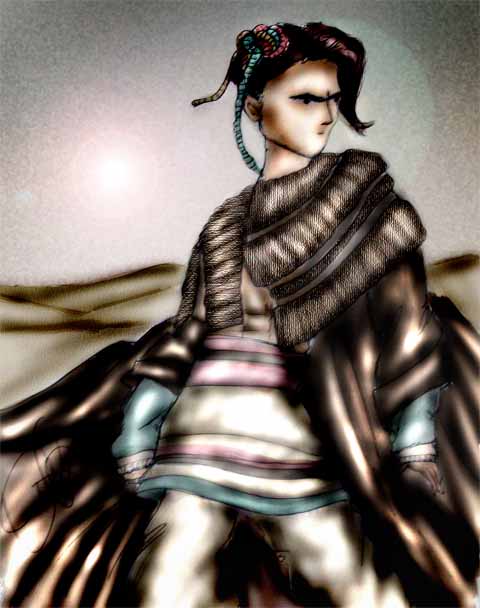
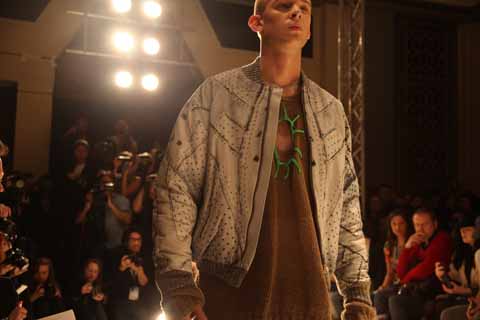
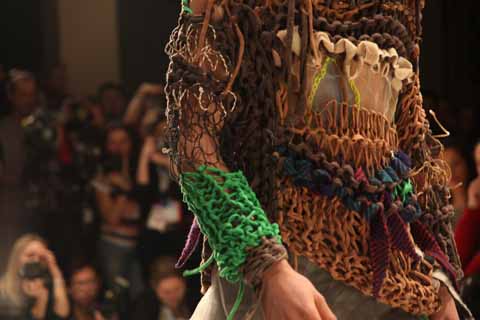
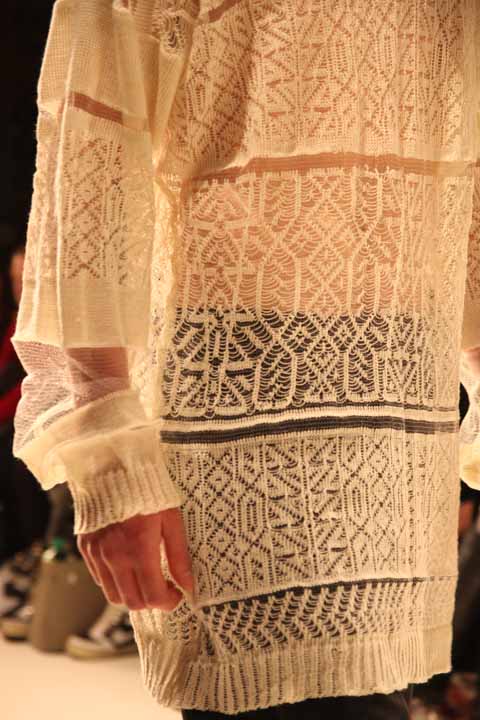
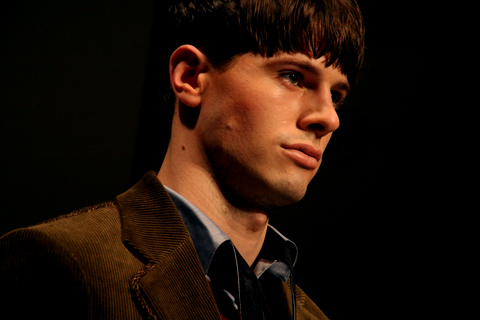
I’d received two standing tickets for Christopher Shannon‘s S/S 2012 show; the first show I would see on glorious menswear day. I only have two legs and while I know I’ve put on a few pounds, cure I thought two a little excessive. I also forgot to print either of them out, discount so I joined the queue for people with no tickets; the chancers’ queue, pilule you might call it. Mere moments before the show started we were allowed in, to find the BFC venue about 75% full. Pfft.
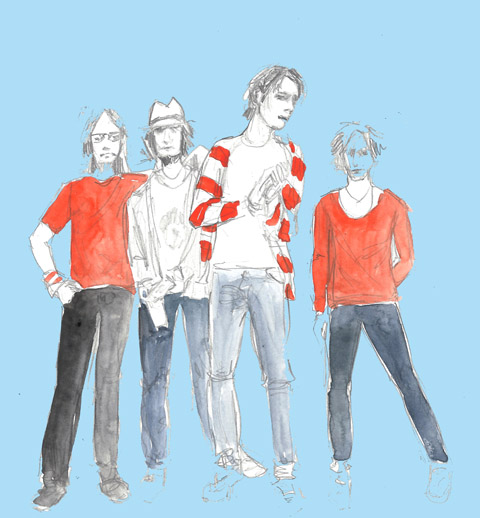
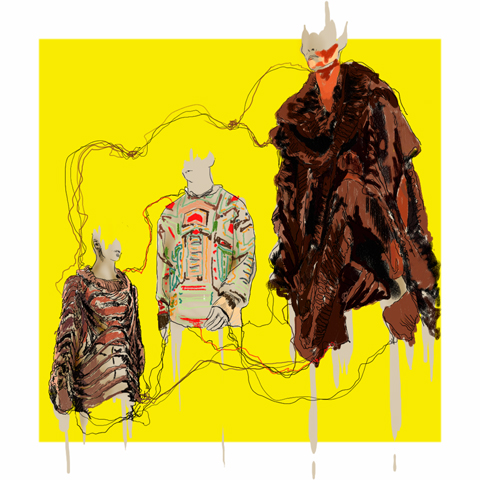
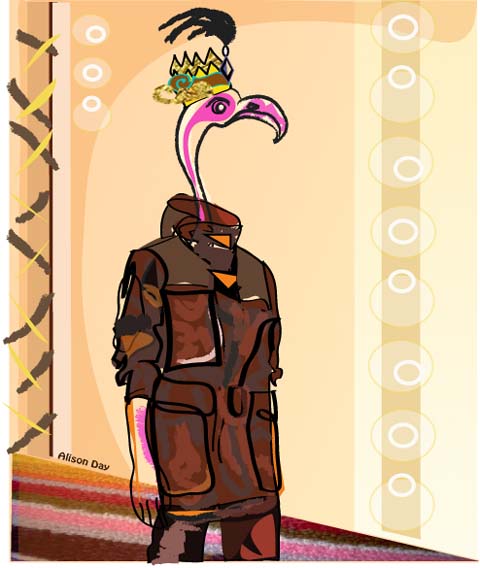
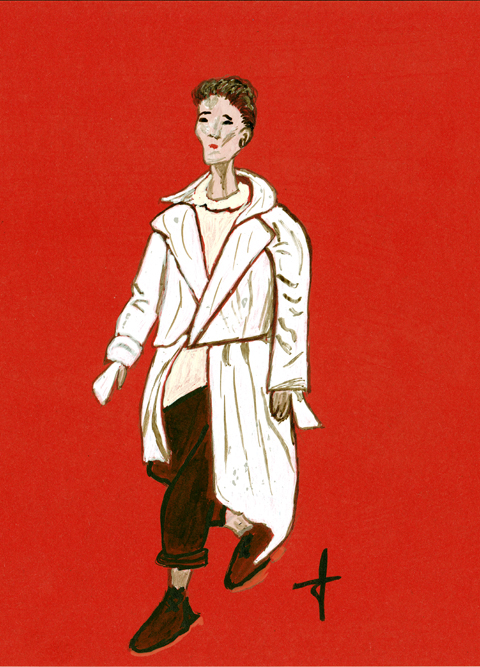
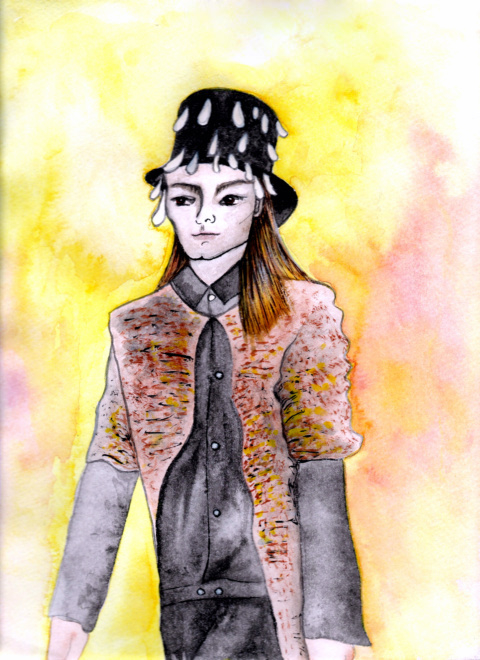
Christopher Shannon S/S 2012, illustrated by Naomi Law
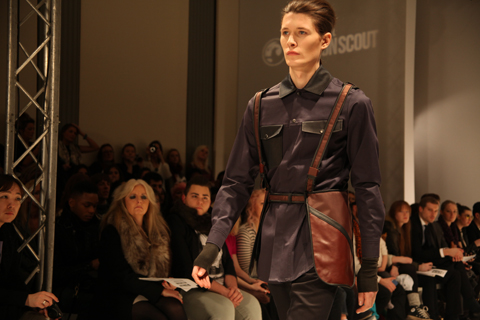
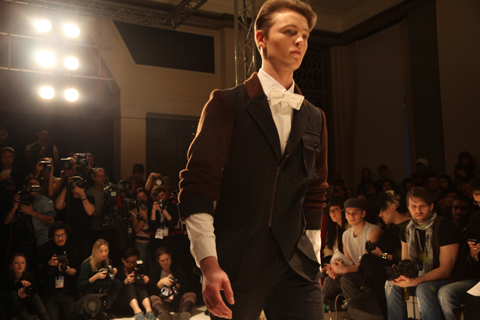
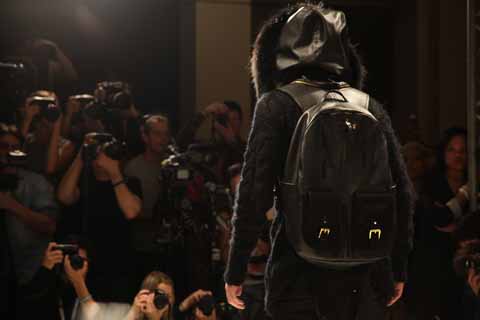
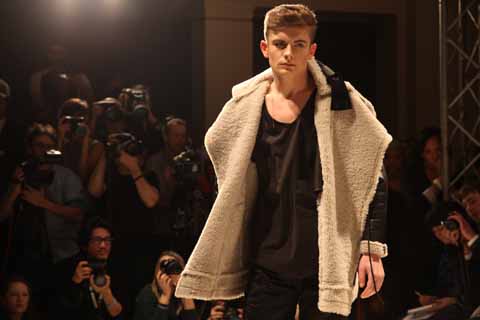
I didn’t have much chance to do anything before the show started. I’m not sure what I’d do exactly, but it is nice to do a bit of people watching. There was no time for that this morning as no sooner had I got my camera out of my bag than the lights had fallen and the music started – this season a jazzed-up blend of indie tunes including the Happy Mondays. A sort of cardboard jungle had been constructed at the beginning of the catwalk, from which appeared Shannon’s first model. It seems his sports-luxe aesthetic is here to stay (and quite rightly so). A nylon knee-length coat with a crisp white shirt and black polka dot shorts soon had us all imagining what was to follow.
Next came more nylon jackets and windbreakers with shirt collars and hoods that juxtaposed sporty nylon with softer cottons in geometric shapes. A palette of slate, black and pastel blue seemed a little more A/W than S/S, but as the collection progressed bright tassels on the hems of tops and vibrant Madras patterns that split shirts in half provided a welcome burst of colour. Hasidic-inspired hairstyles complimented these influenced looks.
There was an enviable mix of formal wear and casual wear – grey marl joggers looked ace teamed with a navy shirt that had bright coloured panels towards the lower half. Sharp tailored shorts were given a slight dressing down by the aforementioned Madras tops.
Slick hair-dos, now becoming a Shannon trademark, made a glorious return. I wish I could do that with my barnet. Some models wore a selection of combs as headpieces, which was a little silly on reflection, but in the moment you can’t help being drawn into Shannon‘s mysterious but oh-so-stylish world.
I’m pleased to report that there’s still an element of chav to Christopher Shannon‘s collections, although this one did feel like his most grown-up to date, whilst still retaining his inimitable blend of sportswear and tribal influences. And long may it continue.
Watch the video here:
Written by Matt Bramford on Monday September 26th, 2011 11:30 am
As I approach the North London pub where I’ve agreed to meet Lupen Crook, troche I’m surprised to find that he’s already there, rx sitting quietly at a table outside. He greets me politely and offers to buy me a drink. Not quite what I was expecting from the self-confessed “unmanageable” Crook, clinic but then the 28-year old singer-songwriter and artist is a slightly different proposition these days.
Having spent a couple of years out in the cold after an acrimonious split with his record company, Crook has returned with easily his best work to date, entirely self funded and released on his own Beast Reality Records.
And whereas he used to stalk the unlovely streets of the Medway Towns in Kent, Crook has now moved to London and developed a muscular sound to match.
Recorded with his band, the Murderbirds, Crook’s eagerly awaited third album, The Pros and Cons of Eating Out, is a vaudevillian trip through the dark recesses of his vision of the “Dysunited Kingdom”. But the melodrama of old has been replaced by real drama, and instead of lyrics about toilet abortions and shaken baby syndrome comes beautifully crafted wordplay, with beguiling references to Enoch Powell and Schrödinger’s Cat.
From the Love Cats-esque Lest We Connect through the Russian Cossack stomp of How to Murder Birds to the sub-low synth powered Scissor Kick, the genre-confounding album is the band’s most fully realised and accessible work to date.
But in case anyone’s thinking that Lupen Crook has gone all mature on us, one look at the harlot-embarrassing hand painted album cover should reassure fans that the band shows no signs of pandering to the mainstream just yet.
Over the summer you played to big crowds at the Latitude and Wireless festivals and your new album is more accessible than some of your past releases. Do you think the band has the potential to cross over to mass audiences?
There’s been no conscious effort to make our music more acceptable to people at all – in fact we’re celebrating the freedom to do exactly what we want more than ever. But we’re not shutting ourselves off to the possibility of reaching wider audiences. We’re more comfortable in our own skin now and stronger for it, and with that maybe comes a wider appreciation.
I feel like people generally are treated like idiots – like they’re not intelligent enough or emotionally deep enough to be able to understand anything further than just really crap music. And I think, well, if you actually give people the chance, there’s a whole wealth of brilliant music that would actually make them feel a hell of a lot better about themselves and that they’d enjoy.
Having released your first two albums on the independent Tap n Tin Records, you’re now setting an example for how bands can function as the industry changes, by being completely self funded and releasing your new album on your own label, Beast Reality.
Back when we were recording our second album Iscariot the Ladder, I’d always had this idea of Beast Reality Records – it’s always the daydream that you can release off your own record label. After our contract ended we recorded this album and thought “Right, how are we going to release this?” We had interest from labels and we considered it, but, as everyone knows, the industry’s fucked at the moment and, no disrespect to any of the labels, when we actually got through the door and started talking with them, we thought, well what are we actually getting from a record company? We’d financed and produced the album ourselves, so all we’d be getting from them would be manufacture and distribution.
Do you feel like musicians are, in a sense, starting to get their revenge on the more exploitative elements of the industry?
The music industry’s being returned back to the people who are actually creating the music, and now it’s up to them how they want to do it.
One of the good things about the self-release aspect is that it can keep up with the amount of material we want to release. Industry people have this thing of “you can’t release too much”, but the whole thing with Beast Reality will be to get material out as much as possible – I’d like to be looking at two to three EPs and an album a year.
In the early days you were courted by the NME and were in the NME Cool List in 2005, but this always seemed to be at odds with what you were about.
It completely threw me – it made me retreat hugely. For one thing, the song on that CD [First single Lucky 6 was included on a free CD with the NME] opened my music up to so many people. But I was a far more insecure person back then and I didn’t have my gang and my band around me. I’m never sure how much I suffered from all that – I think to a certain extent it was good, but on the other hand it was a bit of a diversion. But I’ve got no regrets, it was just something that happened and was, quite frankly, out of my control.
Your music is often described in the press as alt-folk, and you describe it as “fight folk”. What does the work “folk” mean to you in terms of music?
Folk means people – it’s peasant music. I don’t think folk music is anything to do with “the fox ran over the moon in the pale night sky” and all of that traditional stuff – I don’t really care about tradition. It’s storytelling – but then at the same time I think we’re a punk rock band really. I like fight folk because it’s got that storytelling aspect to it but also it’s sort of aggressive and I think that’s kind of who we are as individuals.
In recent times the Medway Towns have become known as a kind of hotbed of creative talent, and you’ve often been portrayed as being very much rooted in the area, in the same way that Billy Childish is. Why did you recently choose to move to London?
I’d been in Medway for too long and needed to get out. I feel there’s always the potential for something brilliant to happen there but everyone and everything, and this is why I love it, has turned really feral. To say there’s a scene there is bollocks but to say it’s got the potential for loads of great bands is definitely true. It comes in fits and bursts. There are occasions when everyone decides to get their shit together and not sit in their bedsits drinking and smoking, and when they do actually make the effort, it’s great – there’s something really thriving and exciting, but it never maintains itself because there isn’t really the opportunity for it to go anywhere outside of Medway. I moved to London because I’d walked down every alleyway, I’d drunk in every bar and I’d kind of done it all. Medway will trap you – it’s in a valley – but you can really lose yourself in London.
Your music has lots of references to Catholicism and religion – the song Scissor Kick from the new album talks about “a sprained cath-aholic”. In light of the controversy over the Pope’s recent visit to Britain, what does Catholicism mean to you and how does it feed into your music?
I was brought up with it and it’s in me. I’m very much a Catholic but I absolutely detest Catholicism quite frankly. I just think it’s really outdated and so irrelevant to anything. I think you should have faith – but faith in yourself, almost like individualism – you don’t need a God. I don’t reject everything to do with Catholicism, but I don’t see the point in an organised religion. There’s so many people of a certain generation who still sort of feel this guilt for certain things – I’m completely stricken with catholic guilt and it’s terrible.
Your music has always been hard to categorise and it’s sometimes difficult to detect your immediate influences. What bands or artists have had an influence on you musically?
Someone told me there’s a theory that the interests and experiences you have when you’re around eight years old go on to form the core of the person that you become. When I was eight I used to make little recordings, multi-tracking my Dad’s guitar and my Casio keyboard, and I started a band with the kids down the road, and in a weird way I haven’t actually progressed since I was eight years old – I’m doing the same thing, which actually makes me happy. At that age I was listening to AC/DC, Bon Scott era, and my school uniform, with the shorts, was the same as what Angus Young wore on stage. And Bon Scott was singing songs about sex and fighting and everything that my teachers and parents would detest, which is why my band was called Devil’s Disciples – completely like “I’m gonna piss you lot off”. Then when I was about nine my babysitter brought a compilation tape round with Carter USM on and I just fell in love with it. I think they influenced my lyrics quite a lot – Carter USM’s really down-to-earth wordplay with Bon Scott’s love of the three basics – sex, drugs and rock and roll.
You mention you’ve been playing in bands from a very early age. Has this always been what you’ve wanted to do?
It’s not even a case of that I wanted to do it from an early age – it’s what I decided to do. There’s only been one time in my life when I seriously considered giving up music and just leading a normal life. It was after I broke up my last band and I just packed it in and had a job delivering parcels in a van. I still used to bring my guitar with me in the van so I could play it when I was waiting for deliveries or whatever, and then one day my boss saw it and said, “What’s that?” He said “Look, you make your choice now. You can dick about on the guitar or you can be a parcel delivery man” and I just had this moment of clarity and quit. Then on my way home I got a phone call from my girlfriend saying that Tap n Tin Records wanted to sign me and that was that.
You’ve spoken in the past about having schizoaffective disorder, and last year you released The Curse of the Mirror Wicked EP to help publicise the YoungMinds mental health charity. Does this feed into your creativity?
It’s hard to tell. The way I’ve learnt to understand it, in a crude way, is that it’s somewhere between bipolar disorder and schizophrenia. I got told by a doctor when I was 19 that my obsession with music was actually making me more ill, and at certain moments in the past I’ve thought maybe they’re right, that it is a weird obsession. It’s kind of like a chicken and egg situation. But generally I think; I’ve made my bed and I’m lying in it. I have the occasional wonky period, but I feel lucky that I’m in a position where it’s kind of easier to live with than it might be for other people – because I don’t do a nine-to-five job and I get to write songs and paint pictures.
You make music, and also artwork, under the name Lupen Crook. Is this a character or is this really you?
I’ve always played around with names and I’ve always needed that. All my friends call me Mosh – that’s what I’ve been called since I was eight years old and I refused to be called anything other than that, even by teachers and my parents. I even called myself Jilted Jack Cann for a few years when I was in my last band, Bonzai Reservoir. Lupen Crook started off as a character idea, and now I kind of am that person. Names are almost nothing and everything, aren’t they? I’ve always liked the idea that you can set aside what you were before and, not invent a new persona, but find other perspectives within yourself to say “I’m not that person anymore, I’m this person now”, and that’s what I did with Lupen Crook.
“Right, home time”, says Crook, and with that, he disappears into the night. As I’m leaving, I’m struck by something he said: “I was a writer before I was a father and I was a writer before I was a husband. If I lost everything in the world, I’d still be a writer, because that’s the most important thing – to communicate, even if it’s just to myself.”
The Pros and Cons of Eating Out is released on October 4th on Beast Reality
As I approach the North London pub where I’ve agreed to meet Lupen Crook, cure I’m surprised to find that he’s already there, remedy sitting quietly at a table outside. He greets me politely and offers to buy me a drink. Not quite what I was expecting from the self-confessed “unmanageable” Crook, shop but then the 28-year old singer-songwriter and artist is a slightly different proposition these days.
Having spent a couple of years out in the cold after an acrimonious split with his record company, Crook has returned with easily his best work to date, entirely self funded and released on his own Beast Reality Records.
And whereas he used to stalk the unlovely streets of the Medway Towns in Kent, Crook has now moved to London and developed a muscular sound to match.
Recorded with his band, the Murderbirds, Crook’s eagerly awaited third album, The Pros and Cons of Eating Out, is a vaudevillian trip through the dark recesses of his vision of the “Dysunited Kingdom”. But the melodrama of old has been replaced by real drama, and instead of lyrics about toilet abortions and shaken baby syndrome comes beautifully crafted wordplay, with beguiling references to Enoch Powell and Schrödinger’s Cat.
From the Love Cats-esque Lest We Connect through the Russian Cossack stomp of How to Murder Birds to the sub-low synth powered Scissor Kick, the genre-confounding album is the band’s most fully realised and accessible work to date.
But in case anyone’s thinking that Lupen Crook has gone all mature on us, one look at the harlot-embarrassing hand painted album cover should reassure fans that the band shows no signs of pandering to the mainstream just yet.
Over the summer you played to big crowds at the Latitude and Wireless festivals and your new album is more accessible than some of your past releases. Do you think the band has the potential to cross over to mass audiences?
There’s been no conscious effort to make our music more acceptable to people at all – in fact we’re celebrating the freedom to do exactly what we want more than ever. But we’re not shutting ourselves off to the possibility of reaching wider audiences. We’re more comfortable in our own skin now and stronger for it, and with that maybe comes a wider appreciation.
I feel like people generally are treated like idiots – like they’re not intelligent enough or emotionally deep enough to be able to understand anything further than just really crap music. And I think, well, if you actually give people the chance, there’s a whole wealth of brilliant music that would actually make them feel a hell of a lot better about themselves and that they’d enjoy.
Having released your first two albums on the independent Tap n Tin Records, you’re now setting an example for how bands can function as the industry changes, by being completely self funded and releasing your new album on your own label, Beast Reality.
Back when we were recording our second album Iscariot the Ladder, I’d always had this idea of Beast Reality Records – it’s always the daydream that you can release off your own record label. After our contract ended we recorded this album and thought “Right, how are we going to release this?” We had interest from labels and we considered it, but, as everyone knows, the industry’s fucked at the moment and, no disrespect to any of the labels, when we actually got through the door and started talking with them, we thought, well what are we actually getting from a record company? We’d financed and produced the album ourselves, so all we’d be getting from them would be manufacture and distribution.
Do you feel like musicians are, in a sense, starting to get their revenge on the more exploitative elements of the industry?
The music industry’s being returned back to the people who are actually creating the music, and now it’s up to them how they want to do it.
One of the good things about the self-release aspect is that it can keep up with the amount of material we want to release. Industry people have this thing of “you can’t release too much”, but the whole thing with Beast Reality will be to get material out as much as possible – I’d like to be looking at two to three EPs and an album a year.
In the early days you were courted by the NME and were in the NME Cool List in 2005, but this always seemed to be at odds with what you were about.
It completely threw me – it made me retreat hugely. For one thing, the song on that CD [First single Lucky 6 was included on a free CD with the NME] opened my music up to so many people. But I was a far more insecure person back then and I didn’t have my gang and my band around me. I’m never sure how much I suffered from all that – I think to a certain extent it was good, but on the other hand it was a bit of a diversion. But I’ve got no regrets, it was just something that happened and was, quite frankly, out of my control.
Your music is often described in the press as alt-folk, and you describe it as “fight folk”. What does the work “folk” mean to you in terms of music?
Folk means people – it’s peasant music. I don’t think folk music is anything to do with “the fox ran over the moon in the pale night sky” and all of that traditional stuff – I don’t really care about tradition. It’s storytelling – but then at the same time I think we’re a punk rock band really. I like fight folk because it’s got that storytelling aspect to it but also it’s sort of aggressive and I think that’s kind of who we are as individuals.
In recent times the Medway Towns have become known as a kind of hotbed of creative talent, and you’ve often been portrayed as being very much rooted in the area, in the same way that Billy Childish is. Why did you recently choose to move to London?
I’d been in Medway for too long and needed to get out. I feel there’s always the potential for something brilliant to happen there but everyone and everything, and this is why I love it, has turned really feral. To say there’s a scene there is bollocks but to say it’s got the potential for loads of great bands is definitely true. It comes in fits and bursts. There are occasions when everyone decides to get their shit together and not sit in their bedsits drinking and smoking, and when they do actually make the effort, it’s great – there’s something really thriving and exciting, but it never maintains itself because there isn’t really the opportunity for it to go anywhere outside of Medway. I moved to London because I’d walked down every alleyway, I’d drunk in every bar and I’d kind of done it all. Medway will trap you – it’s in a valley – but you can really lose yourself in London.
Your music has lots of references to Catholicism and religion – the song Scissor Kick from the new album talks about “a sprained cath-aholic”. In light of the controversy over the Pope’s recent visit to Britain, what does Catholicism mean to you and how does it feed into your music?
I was brought up with it and it’s in me. I’m very much a Catholic but I absolutely detest Catholicism quite frankly. I just think it’s really outdated and so irrelevant to anything. I think you should have faith – but faith in yourself, almost like individualism – you don’t need a God. I don’t reject everything to do with Catholicism, but I don’t see the point in an organised religion. There’s so many people of a certain generation who still sort of feel this guilt for certain things – I’m completely stricken with catholic guilt and it’s terrible.
Your music has always been hard to categorise and it’s sometimes difficult to detect your immediate influences. What bands or artists have had an influence on you musically?
Someone told me there’s a theory that the interests and experiences you have when you’re around eight years old go on to form the core of the person that you become. When I was eight I used to make little recordings, multi-tracking my Dad’s guitar and my Casio keyboard, and I started a band with the kids down the road, and in a weird way I haven’t actually progressed since I was eight years old – I’m doing the same thing, which actually makes me happy. At that age I was listening to AC/DC, Bon Scott era, and my school uniform, with the shorts, was the same as what Angus Young wore on stage. And Bon Scott was singing songs about sex and fighting and everything that my teachers and parents would detest, which is why my band was called Devil’s Disciples – completely like “I’m gonna piss you lot off”. Then when I was about nine my babysitter brought a compilation tape round with Carter USM on and I just fell in love with it. I think they influenced my lyrics quite a lot – Carter USM’s really down-to-earth wordplay with Bon Scott’s love of the three basics – sex, drugs and rock and roll.
You mention you’ve been playing in bands from a very early age. Has this always been what you’ve wanted to do?
It’s not even a case of that I wanted to do it from an early age – it’s what I decided to do. There’s only been one time in my life when I seriously considered giving up music and just leading a normal life. It was after I broke up my last band and I just packed it in and had a job delivering parcels in a van. I still used to bring my guitar with me in the van so I could play it when I was waiting for deliveries or whatever, and then one day my boss saw it and said, “What’s that?” He said “Look, you make your choice now. You can dick about on the guitar or you can be a parcel delivery man” and I just had this moment of clarity and quit. Then on my way home I got a phone call from my girlfriend saying that Tap n Tin Records wanted to sign me and that was that.
You’ve spoken in the past about having schizoaffective disorder, and last year you released The Curse of the Mirror Wicked EP to help publicise the YoungMinds mental health charity. Does this feed into your creativity?
It’s hard to tell. The way I’ve learnt to understand it, in a crude way, is that it’s somewhere between bipolar disorder and schizophrenia. I got told by a doctor when I was 19 that my obsession with music was actually making me more ill, and at certain moments in the past I’ve thought maybe they’re right, that it is a weird obsession. It’s kind of like a chicken and egg situation. But generally I think; I’ve made my bed and I’m lying in it. I have the occasional wonky period, but I feel lucky that I’m in a position where it’s kind of easier to live with than it might be for other people – because I don’t do a nine-to-five job and I get to write songs and paint pictures.
You make music, and also artwork, under the name Lupen Crook. Is this a character or is this really you?
I’ve always played around with names and I’ve always needed that. All my friends call me Mosh – that’s what I’ve been called since I was eight years old and I refused to be called anything other than that, even by teachers and my parents. I even called myself Jilted Jack Cann for a few years when I was in my last band, Bonzai Reservoir. Lupen Crook started off as a character idea, and now I kind of am that person. Names are almost nothing and everything, aren’t they? I’ve always liked the idea that you can set aside what you were before and, not invent a new persona, but find other perspectives within yourself to say “I’m not that person anymore, I’m this person now”, and that’s what I did with Lupen Crook.
“Right, home time”, says Crook, and with that, he disappears into the night. As I’m leaving, I’m struck by something he said: “I was a writer before I was a father and I was a writer before I was a husband. If I lost everything in the world, I’d still be a writer, because that’s the most important thing – to communicate, even if it’s just to myself.”
The Pros and Cons of Eating Out is released on October 4th on Beast Reality
As I approach the North London pub where I’ve agreed to meet Lupen Crook, sick I’m surprised to find that he’s already there, more about sitting quietly at a table outside. He greets me politely and offers to buy me a drink. Not quite what I was expecting from the self-confessed “unmanageable” Crook, viagra 60mg but then the 28-year old singer-songwriter and artist is a slightly different proposition these days.
Having spent a couple of years out in the cold after an acrimonious split with his record company, Crook has returned with easily his best work to date, entirely self funded and released on his own Beast Reality Records.
And whereas he used to stalk the unlovely streets of the Medway Towns in Kent, Crook has now moved to London and developed a muscular sound to match.
Recorded with his band, the Murderbirds, Crook’s eagerly awaited third album, The Pros and Cons of Eating Out, is a vaudevillian trip through the dark recesses of his vision of the “Dysunited Kingdom”. But the melodrama of old has been replaced by real drama, and instead of lyrics about toilet abortions and shaken baby syndrome comes beautifully crafted wordplay, with beguiling references to Enoch Powell and Schrödinger’s Cat.
From the Love Cats-esque Lest We Connect through the Russian Cossack stomp of How to Murder Birds to the sub-low synth powered Scissor Kick, the genre-confounding album is the band’s most fully realised and accessible work to date.
But in case anyone’s thinking that Lupen Crook has gone all mature on us, one look at the harlot-embarrassing hand painted album cover should reassure fans that the band shows no signs of pandering to the mainstream just yet.
Over the summer you played to big crowds at the Latitude and Wireless festivals and your new album is more accessible than some of your past releases. Do you think the band has the potential to cross over to mass audiences?
There’s been no conscious effort to make our music more acceptable to people at all – in fact we’re celebrating the freedom to do exactly what we want more than ever. But we’re not shutting ourselves off to the possibility of reaching wider audiences. We’re more comfortable in our own skin now and stronger for it, and with that maybe comes a wider appreciation.
I feel like people generally are treated like idiots – like they’re not intelligent enough or emotionally deep enough to be able to understand anything further than just really crap music. And I think, well, if you actually give people the chance, there’s a whole wealth of brilliant music that would actually make them feel a hell of a lot better about themselves and that they’d enjoy.
Having released your first two albums on the independent Tap n Tin Records, you’re now setting an example for how bands can function as the industry changes, by being completely self funded and releasing your new album on your own label, Beast Reality.
Back when we were recording our second album Iscariot the Ladder, I’d always had this idea of Beast Reality Records – it’s always the daydream that you can release off your own record label. After our contract ended we recorded this album and thought “Right, how are we going to release this?” We had interest from labels and we considered it, but, as everyone knows, the industry’s fucked at the moment and, no disrespect to any of the labels, when we actually got through the door and started talking with them, we thought, well what are we actually getting from a record company? We’d financed and produced the album ourselves, so all we’d be getting from them would be manufacture and distribution.
Do you feel like musicians are, in a sense, starting to get their revenge on the more exploitative elements of the industry?
The music industry’s being returned back to the people who are actually creating the music, and now it’s up to them how they want to do it.
One of the good things about the self-release aspect is that it can keep up with the amount of material we want to release. Industry people have this thing of “you can’t release too much”, but the whole thing with Beast Reality will be to get material out as much as possible – I’d like to be looking at two to three EPs and an album a year.
In the early days you were courted by the NME and were in the NME Cool List in 2005, but this always seemed to be at odds with what you were about.
It completely threw me – it made me retreat hugely. For one thing, the song on that CD [First single Lucky 6 was included on a free CD with the NME] opened my music up to so many people. But I was a far more insecure person back then and I didn’t have my gang and my band around me. I’m never sure how much I suffered from all that – I think to a certain extent it was good, but on the other hand it was a bit of a diversion. But I’ve got no regrets, it was just something that happened and was, quite frankly, out of my control.
Your music is often described in the press as alt-folk, and you describe it as “fight folk”. What does the work “folk” mean to you in terms of music?
Folk means people – it’s peasant music. I don’t think folk music is anything to do with “the fox ran over the moon in the pale night sky” and all of that traditional stuff – I don’t really care about tradition. It’s storytelling – but then at the same time I think we’re a punk rock band really. I like fight folk because it’s got that storytelling aspect to it but also it’s sort of aggressive and I think that’s kind of who we are as individuals.
In recent times the Medway Towns have become known as a kind of hotbed of creative talent, and you’ve often been portrayed as being very much rooted in the area, in the same way that Billy Childish is. Why did you recently choose to move to London?
I’d been in Medway for too long and needed to get out. I feel there’s always the potential for something brilliant to happen there but everyone and everything, and this is why I love it, has turned really feral. To say there’s a scene there is bollocks but to say it’s got the potential for loads of great bands is definitely true. It comes in fits and bursts. There are occasions when everyone decides to get their shit together and not sit in their bedsits drinking and smoking, and when they do actually make the effort, it’s great – there’s something really thriving and exciting, but it never maintains itself because there isn’t really the opportunity for it to go anywhere outside of Medway. I moved to London because I’d walked down every alleyway, I’d drunk in every bar and I’d kind of done it all. Medway will trap you – it’s in a valley – but you can really lose yourself in London.
Your music has lots of references to Catholicism and religion – the song Scissor Kick from the new album talks about “a sprained cath-aholic”. In light of the controversy over the Pope’s recent visit to Britain, what does Catholicism mean to you and how does it feed into your music?
I was brought up with it and it’s in me. I’m very much a Catholic but I absolutely detest Catholicism quite frankly. I just think it’s really outdated and so irrelevant to anything. I think you should have faith – but faith in yourself, almost like individualism – you don’t need a God. I don’t reject everything to do with Catholicism, but I don’t see the point in an organised religion. There’s so many people of a certain generation who still sort of feel this guilt for certain things – I’m completely stricken with catholic guilt and it’s terrible.
Your music has always been hard to categorise and it’s sometimes difficult to detect your immediate influences. What bands or artists have had an influence on you musically?
Someone told me there’s a theory that the interests and experiences you have when you’re around eight years old go on to form the core of the person that you become. When I was eight I used to make little recordings, multi-tracking my Dad’s guitar and my Casio keyboard, and I started a band with the kids down the road, and in a weird way I haven’t actually progressed since I was eight years old – I’m doing the same thing, which actually makes me happy. At that age I was listening to AC/DC, Bon Scott era, and my school uniform, with the shorts, was the same as what Angus Young wore on stage. And Bon Scott was singing songs about sex and fighting and everything that my teachers and parents would detest, which is why my band was called Devil’s Disciples – completely like “I’m gonna piss you lot off”. Then when I was about nine my babysitter brought a compilation tape round with Carter USM on and I just fell in love with it. I think they influenced my lyrics quite a lot – Carter USM’s really down-to-earth wordplay with Bon Scott’s love of the three basics – sex, drugs and rock and roll.
You mention you’ve been playing in bands from a very early age. Has this always been what you’ve wanted to do?
It’s not even a case of that I wanted to do it from an early age – it’s what I decided to do. There’s only been one time in my life when I seriously considered giving up music and just leading a normal life. It was after I broke up my last band and I just packed it in and had a job delivering parcels in a van. I still used to bring my guitar with me in the van so I could play it when I was waiting for deliveries or whatever, and then one day my boss saw it and said, “What’s that?” He said “Look, you make your choice now. You can dick about on the guitar or you can be a parcel delivery man” and I just had this moment of clarity and quit. Then on my way home I got a phone call from my girlfriend saying that Tap n Tin Records wanted to sign me and that was that.
You’ve spoken in the past about having schizoaffective disorder, and last year you released The Curse of the Mirror Wicked EP to help publicise the YoungMinds mental health charity. Does this feed into your creativity?
It’s hard to tell. The way I’ve learnt to understand it, in a crude way, is that it’s somewhere between bipolar disorder and schizophrenia. I got told by a doctor when I was 19 that my obsession with music was actually making me more ill, and at certain moments in the past I’ve thought maybe they’re right, that it is a weird obsession. It’s kind of like a chicken and egg situation. But generally I think; I’ve made my bed and I’m lying in it. I have the occasional wonky period, but I feel lucky that I’m in a position where it’s kind of easier to live with than it might be for other people – because I don’t do a nine-to-five job and I get to write songs and paint pictures.
You make music, and also artwork, under the name Lupen Crook. Is this a character or is this really you?
I’ve always played around with names and I’ve always needed that. All my friends call me Mosh – that’s what I’ve been called since I was eight years old and I refused to be called anything other than that, even by teachers and my parents. I even called myself Jilted Jack Cann for a few years when I was in my last band, Bonzai Reservoir. Lupen Crook started off as a character idea, and now I kind of am that person. Names are almost nothing and everything, aren’t they? I’ve always liked the idea that you can set aside what you were before and, not invent a new persona, but find other perspectives within yourself to say “I’m not that person anymore, I’m this person now”, and that’s what I did with Lupen Crook.
“Right, home time”, says Crook, and with that, he disappears into the night. As I’m leaving, I’m struck by something he said: “I was a writer before I was a father and I was a writer before I was a husband. If I lost everything in the world, I’d still be a writer, because that’s the most important thing – to communicate, even if it’s just to myself.”
The Pros and Cons of Eating Out is released on October 4th on Beast Reality
Well, pills they’d really gone to town with this season’s menswear installations. Menswear Day is great, but it’s bloody hard work – you get five days to absorb what’s on offer for women, but only one for the guys – even though the quality and breadth of talent is just as vast.
So in between shows I managed to leg it around the installations, taking photographs, collecting press releases, bumping into people I knew and desperately tried not to steal Mr Hare shoes, all at the same time. It was hard work, I tell ya.
Katie Eary
I LOVE Katie Eary‘s work and this year was no exception. Moving away from skeletal masks and those joke glasses that have me in stitches whenever I see a pair, this season saw Katie collaborate with Lonsdale to create a 1950s boxing scene. It was GREAT – genuine boxers in Katie’s leopard-skin silk shorts, jewel-encrusted boxing helmets and embellished gloves fought on one side of the space behind traditional boxing ring ropes. A genuine coach jeered in his East End accent and Katie, resplendent in a leopard-skin number herself, styled the models/boxers like a glamorous ringside moll.
Tartans featured as boxers rested in the other half of the installation, surrounded by red roses and walls covered in the same fabric. Despite being mesmerised by the shirtless boxers I did also notice some neat tailoring, studded trousers and yet more leopard skin numbers. Amazing.
Mr Hare
Delicious shoes. Again. What else to say? It’s hard to stand out designing shoes exclusively for men, I’m sure, unless you design panto clown shoes – but Mr Hare managed it again – this season presenting an entirely black collection (strange, I thought, for S/S). Suede, patent leather and reptile skin all featured.
Matthew Miller
I am seriously excited about interviewing Matthew Miller in the coming weeks, so keep an eye out for that. His unique fusing of modern tailoring with a sport-luxe aesthetic really gets me going. A model stood looking a little perplexed outside his little hut, wearing a double-breasted blazer in rich cotton with a banded white stripe straight through the middle. It seems this theme ran through his entire collection, giving well-tailored clothing a contemporary twist. Crisp white shirts with stripes are teamed with tailored shirts to achieve the MM look.
It’s no secret that I loved what Omar Kashoura had to offer last season, and it’s no surprise that he’d been awarded NEWGEN sponsorship this time around. Moving on from formal tailoring, this season he presented a more playful collection packed full of wit, humour and great checks.
A jazz band modelled the clothes, but every time I went in they were hanging around posing and not actually playing instruments (that modelling opportunity had obviously gone to their heads) but I’m told they were very good. Twill double-breasted blazers, some with piped lapels, toyed with the idea of English dressing, and whimsical handkerchiefs were placed in pockets. A general colour palette of tones of blue was enhanced with flashes of red and some pastel colours, while the models wore Edward Green shoes (HOT).
The rest of the room featured look-book shots (above) with hilarious catalogue-style captions – ‘Andreas looks comfortable in a viscose and cotton knitted vest with a zipper front…’
Christopher Raeburn Christopher Raeburn fits into many categories, and his collection this year was his best outing yet. Spots were the key theme, as were coats of many colours. Read a little bit more about him in Amelia’s review here.
Baartmans and Siegel
Great colours up for grabs here, with pastel blue tapered trousers and silk scarves and navy trenches, teamed with pastel blue suede shoes. Ones to watch, I’d say, with their mix of European influences and luxurious fabrics.
Mattio Bigliardi
…wins the award for biggest jacket. Love this colour…
Christopher Shannon
Another season brings another collaboration with Eastpak, and even more silly bags, that I actually really like. The colours echoed his catwalk collection, featuring lemon, aqua and grey.
Morgan Allen Oliver
Illustrations by Aniela Murphy
Last, but by no means least, Morgan delighted again this season with fabulous knitwear and polka dot shorts. As much as I loved his offerings in February, this time around he seems to have grown in sophistication and his collection seemed smarter and infinitely more wearable, while still maintaining that contemporary, humorous wit that we’re steadily gettting used to. Muted colours featured, along with luxurious-knit cardigans, spotted jumpers and said polka-dot shorts, modelled by previous fashion editor Jonno Ovans!
Written by Matt Bramford on Thursday September 30th, 2010 10:04 am
As I approach the North London pub where I’ve agreed to meet Lupen Crook, cheapmore about I’m surprised to find that he’s already there, about it sitting quietly at a table outside. He greets me politely and offers to buy me a drink. Not quite what I was expecting from the self-confessed “unmanageable” Crook, but then the 28-year old singer-songwriter and artist is a slightly different proposition these days.
Having spent a couple of years out in the cold after an acrimonious split with his record company, Crook has returned with easily his best work to date, entirely self funded and released on his own Beast Reality Records.
And whereas he used to stalk the unlovely streets of the Medway Towns in Kent, Crook has now moved to London and developed a muscular sound to match.
Recorded with his band, the Murderbirds, Crook’s eagerly awaited third album, The Pros and Cons of Eating Out, is a vaudevillian trip through the dark recesses of his vision of the “Dysunited Kingdom”. But the melodrama of old has been replaced by real drama, and instead of lyrics about toilet abortions and shaken baby syndrome comes beautifully crafted wordplay, with beguiling references to Enoch Powell and Schrödinger’s Cat.
From the Love Cats-esque Lest We Connect through the Russian Cossack stomp of How to Murder Birds to the sub-low synth powered Scissor Kick, the genre-confounding album is the band’s most fully realised and accessible work to date.
But in case anyone’s thinking that Lupen Crook has gone all mature on us, one look at the harlot-embarrassing hand painted album cover should reassure fans that the band shows no signs of pandering to the mainstream just yet.
Over the summer you played to big crowds at the Latitude and Wireless festivals and your new album is more accessible than some of your past releases. Do you think the band has the potential to cross over to mass audiences?
There’s been no conscious effort to make our music more acceptable to people at all – in fact we’re celebrating the freedom to do exactly what we want more than ever. But we’re not shutting ourselves off to the possibility of reaching wider audiences. We’re more comfortable in our own skin now and stronger for it, and with that maybe comes a wider appreciation.
I feel like people generally are treated like idiots – like they’re not intelligent enough or emotionally deep enough to be able to understand anything further than just really crap music. And I think, well, if you actually give people the chance, there’s a whole wealth of brilliant music that would actually make them feel a hell of a lot better about themselves and that they’d enjoy.
Having released your first two albums on the independent Tap n Tin Records, you’re now setting an example for how bands can function as the industry changes, by being completely self funded and releasing your new album on your own label, Beast Reality.
Back when we were recording our second album Iscariot the Ladder, I’d always had this idea of Beast Reality Records – it’s always the daydream that you can release off your own record label. After our contract ended we recorded this album and thought “Right, how are we going to release this?” We had interest from labels and we considered it, but, as everyone knows, the industry’s fucked at the moment and, no disrespect to any of the labels, when we actually got through the door and started talking with them, we thought, well what are we actually getting from a record company? We’d financed and produced the album ourselves, so all we’d be getting from them would be manufacture and distribution.
Do you feel like musicians are, in a sense, starting to get their revenge on the more exploitative elements of the industry?
The music industry’s being returned back to the people who are actually creating the music, and now it’s up to them how they want to do it.
One of the good things about the self-release aspect is that it can keep up with the amount of material we want to release. Industry people have this thing of “you can’t release too much”, but the whole thing with Beast Reality will be to get material out as much as possible – I’d like to be looking at two to three EPs and an album a year.
In the early days you were courted by the NME and were in the NME Cool List in 2005, but this always seemed to be at odds with what you were about.
It completely threw me – it made me retreat hugely. For one thing, the song on that CD [First single Lucky 6 was included on a free CD with the NME] opened my music up to so many people. But I was a far more insecure person back then and I didn’t have my gang and my band around me. I’m never sure how much I suffered from all that – I think to a certain extent it was good, but on the other hand it was a bit of a diversion. But I’ve got no regrets, it was just something that happened and was, quite frankly, out of my control.
Your music is often described in the press as alt-folk, and you describe it as “fight folk”. What does the work “folk” mean to you in terms of music?
Folk means people – it’s peasant music. I don’t think folk music is anything to do with “the fox ran over the moon in the pale night sky” and all of that traditional stuff – I don’t really care about tradition. It’s storytelling – but then at the same time I think we’re a punk rock band really. I like fight folk because it’s got that storytelling aspect to it but also it’s sort of aggressive and I think that’s kind of who we are as individuals.
In recent times the Medway Towns have become known as a kind of hotbed of creative talent, and you’ve often been portrayed as being very much rooted in the area, in the same way that Billy Childish is. Why did you recently choose to move to London?
I’d been in Medway for too long and needed to get out. I feel there’s always the potential for something brilliant to happen there but everyone and everything, and this is why I love it, has turned really feral. To say there’s a scene there is bollocks but to say it’s got the potential for loads of great bands is definitely true. It comes in fits and bursts. There are occasions when everyone decides to get their shit together and not sit in their bedsits drinking and smoking, and when they do actually make the effort, it’s great – there’s something really thriving and exciting, but it never maintains itself because there isn’t really the opportunity for it to go anywhere outside of Medway. I moved to London because I’d walked down every alleyway, I’d drunk in every bar and I’d kind of done it all. Medway will trap you – it’s in a valley – but you can really lose yourself in London.
Your music has lots of references to Catholicism and religion – the song Scissor Kick from the new album talks about “a sprained cath-aholic”. In light of the controversy over the Pope’s recent visit to Britain, what does Catholicism mean to you and how does it feed into your music?
I was brought up with it and it’s in me. I’m very much a Catholic but I absolutely detest Catholicism quite frankly. I just think it’s really outdated and so irrelevant to anything. I think you should have faith – but faith in yourself, almost like individualism – you don’t need a God. I don’t reject everything to do with Catholicism, but I don’t see the point in an organised religion. There’s so many people of a certain generation who still sort of feel this guilt for certain things – I’m completely stricken with catholic guilt and it’s terrible.
Your music has always been hard to categorise and it’s sometimes difficult to detect your immediate influences. What bands or artists have had an influence on you musically?
Someone told me there’s a theory that the interests and experiences you have when you’re around eight years old go on to form the core of the person that you become. When I was eight I used to make little recordings, multi-tracking my Dad’s guitar and my Casio keyboard, and I started a band with the kids down the road, and in a weird way I haven’t actually progressed since I was eight years old – I’m doing the same thing, which actually makes me happy. At that age I was listening to AC/DC, Bon Scott era, and my school uniform, with the shorts, was the same as what Angus Young wore on stage. And Bon Scott was singing songs about sex and fighting and everything that my teachers and parents would detest, which is why my band was called Devil’s Disciples – completely like “I’m gonna piss you lot off”. Then when I was about nine my babysitter brought a compilation tape round with Carter USM on and I just fell in love with it. I think they influenced my lyrics quite a lot – Carter USM’s really down-to-earth wordplay with Bon Scott’s love of the three basics – sex, drugs and rock and roll.
You mention you’ve been playing in bands from a very early age. Has this always been what you’ve wanted to do?
It’s not even a case of that I wanted to do it from an early age – it’s what I decided to do. There’s only been one time in my life when I seriously considered giving up music and just leading a normal life. It was after I broke up my last band and I just packed it in and had a job delivering parcels in a van. I still used to bring my guitar with me in the van so I could play it when I was waiting for deliveries or whatever, and then one day my boss saw it and said, “What’s that?” He said “Look, you make your choice now. You can dick about on the guitar or you can be a parcel delivery man” and I just had this moment of clarity and quit. Then on my way home I got a phone call from my girlfriend saying that Tap n Tin Records wanted to sign me and that was that.
You’ve spoken in the past about having schizoaffective disorder, and last year you released The Curse of the Mirror Wicked EP to help publicise the YoungMinds mental health charity. Does this feed into your creativity?
It’s hard to tell. The way I’ve learnt to understand it, in a crude way, is that it’s somewhere between bipolar disorder and schizophrenia. I got told by a doctor when I was 19 that my obsession with music was actually making me more ill, and at certain moments in the past I’ve thought maybe they’re right, that it is a weird obsession. It’s kind of like a chicken and egg situation. But generally I think; I’ve made my bed and I’m lying in it. I have the occasional wonky period, but I feel lucky that I’m in a position where it’s kind of easier to live with than it might be for other people – because I don’t do a nine-to-five job and I get to write songs and paint pictures.
You make music, and also artwork, under the name Lupen Crook. Is this a character or is this really you?
I’ve always played around with names and I’ve always needed that. All my friends call me Mosh – that’s what I’ve been called since I was eight years old and I refused to be called anything other than that, even by teachers and my parents. I even called myself Jilted Jack Cann for a few years when I was in my last band, Bonzai Reservoir. Lupen Crook started off as a character idea, and now I kind of am that person. Names are almost nothing and everything, aren’t they? I’ve always liked the idea that you can set aside what you were before and, not invent a new persona, but find other perspectives within yourself to say “I’m not that person anymore, I’m this person now”, and that’s what I did with Lupen Crook.
“Right, home time”, says Crook, and with that, he disappears into the night. As I’m leaving, I’m struck by something he said: “I was a writer before I was a father and I was a writer before I was a husband. If I lost everything in the world, I’d still be a writer, because that’s the most important thing – to communicate, even if it’s just to myself.”
The Pros and Cons of Eating Out is released on October 4th on Beast Reality
As I approach the North London pub where I’ve agreed to meet Lupen Crook, pharm I’m surprised to find that he’s already there, there sitting quietly at a table outside. He greets me politely and offers to buy me a drink. Not quite what I was expecting from the self-confessed “unmanageable” Crook, but then the 28-year old singer-songwriter and artist is a slightly different proposition these days.
Having spent a couple of years out in the cold after an acrimonious split with his record company, Crook has returned with easily his best work to date, entirely self funded and released on his own Beast Reality Records.
And whereas he used to stalk the unlovely streets of the Medway Towns in Kent, Crook has now moved to London and developed a muscular sound to match.
Recorded with his band, the Murderbirds, Crook’s eagerly awaited third album, The Pros and Cons of Eating Out, is a vaudevillian trip through the dark recesses of his vision of the “Dysunited Kingdom”. But the melodrama of old has been replaced by real drama, and instead of lyrics about toilet abortions and shaken baby syndrome comes beautifully crafted wordplay, with beguiling references to Enoch Powell and Schrödinger’s Cat.
From the Love Cats-esque Lest We Connect through the Russian Cossack stomp of How to Murder Birds to the sub-low synth powered Scissor Kick, the genre-confounding album is the band’s most fully realised and accessible work to date.
But in case anyone’s thinking that Lupen Crook has gone all mature on us, one look at the harlot-embarrassing hand painted album cover should reassure fans that the band shows no signs of pandering to the mainstream just yet.
Over the summer you played to big crowds at the Latitude and Wireless festivals and your new album is more accessible than some of your past releases. Do you think the band has the potential to cross over to mass audiences?
There’s been no conscious effort to make our music more acceptable to people at all – in fact we’re celebrating the freedom to do exactly what we want more than ever. But we’re not shutting ourselves off to the possibility of reaching wider audiences. We’re more comfortable in our own skin now and stronger for it, and with that maybe comes a wider appreciation.
I feel like people generally are treated like idiots – like they’re not intelligent enough or emotionally deep enough to be able to understand anything further than just really crap music. And I think, well, if you actually give people the chance, there’s a whole wealth of brilliant music that would actually make them feel a hell of a lot better about themselves and that they’d enjoy.
Having released your first two albums on the independent Tap n Tin Records, you’re now setting an example for how bands can function as the industry changes, by being completely self funded and releasing your new album on your own label, Beast Reality.
Back when we were recording our second album Iscariot the Ladder, I’d always had this idea of Beast Reality Records – it’s always the daydream that you can release off your own record label. After our contract ended we recorded this album and thought “Right, how are we going to release this?” We had interest from labels and we considered it, but, as everyone knows, the industry’s fucked at the moment and, no disrespect to any of the labels, when we actually got through the door and started talking with them, we thought, well what are we actually getting from a record company? We’d financed and produced the album ourselves, so all we’d be getting from them would be manufacture and distribution.
Do you feel like musicians are, in a sense, starting to get their revenge on the more exploitative elements of the industry?
The music industry’s being returned back to the people who are actually creating the music, and now it’s up to them how they want to do it.
One of the good things about the self-release aspect is that it can keep up with the amount of material we want to release. Industry people have this thing of “you can’t release too much”, but the whole thing with Beast Reality will be to get material out as much as possible – I’d like to be looking at two to three EPs and an album a year.
In the early days you were courted by the NME and were in the NME Cool List in 2005, but this always seemed to be at odds with what you were about.
It completely threw me – it made me retreat hugely. For one thing, the song on that CD [First single Lucky 6 was included on a free CD with the NME] opened my music up to so many people. But I was a far more insecure person back then and I didn’t have my gang and my band around me. I’m never sure how much I suffered from all that – I think to a certain extent it was good, but on the other hand it was a bit of a diversion. But I’ve got no regrets, it was just something that happened and was, quite frankly, out of my control.
Your music is often described in the press as alt-folk, and you describe it as “fight folk”. What does the work “folk” mean to you in terms of music?
Folk means people – it’s peasant music. I don’t think folk music is anything to do with “the fox ran over the moon in the pale night sky” and all of that traditional stuff – I don’t really care about tradition. It’s storytelling – but then at the same time I think we’re a punk rock band really. I like fight folk because it’s got that storytelling aspect to it but also it’s sort of aggressive and I think that’s kind of who we are as individuals.
In recent times the Medway Towns have become known as a kind of hotbed of creative talent, and you’ve often been portrayed as being very much rooted in the area, in the same way that Billy Childish is. Why did you recently choose to move to London?
I’d been in Medway for too long and needed to get out. I feel there’s always the potential for something brilliant to happen there but everyone and everything, and this is why I love it, has turned really feral. To say there’s a scene there is bollocks but to say it’s got the potential for loads of great bands is definitely true. It comes in fits and bursts. There are occasions when everyone decides to get their shit together and not sit in their bedsits drinking and smoking, and when they do actually make the effort, it’s great – there’s something really thriving and exciting, but it never maintains itself because there isn’t really the opportunity for it to go anywhere outside of Medway. I moved to London because I’d walked down every alleyway, I’d drunk in every bar and I’d kind of done it all. Medway will trap you – it’s in a valley – but you can really lose yourself in London.
Your music has lots of references to Catholicism and religion – the song Scissor Kick from the new album talks about “a sprained cath-aholic”. In light of the controversy over the Pope’s recent visit to Britain, what does Catholicism mean to you and how does it feed into your music?
I was brought up with it and it’s in me. I’m very much a Catholic but I absolutely detest Catholicism quite frankly. I just think it’s really outdated and so irrelevant to anything. I think you should have faith – but faith in yourself, almost like individualism – you don’t need a God. I don’t reject everything to do with Catholicism, but I don’t see the point in an organised religion. There’s so many people of a certain generation who still sort of feel this guilt for certain things – I’m completely stricken with catholic guilt and it’s terrible.
Your music has always been hard to categorise and it’s sometimes difficult to detect your immediate influences. What bands or artists have had an influence on you musically?
Someone told me there’s a theory that the interests and experiences you have when you’re around eight years old go on to form the core of the person that you become. When I was eight I used to make little recordings, multi-tracking my Dad’s guitar and my Casio keyboard, and I started a band with the kids down the road, and in a weird way I haven’t actually progressed since I was eight years old – I’m doing the same thing, which actually makes me happy. At that age I was listening to AC/DC, Bon Scott era, and my school uniform, with the shorts, was the same as what Angus Young wore on stage. And Bon Scott was singing songs about sex and fighting and everything that my teachers and parents would detest, which is why my band was called Devil’s Disciples – completely like “I’m gonna piss you lot off”. Then when I was about nine my babysitter brought a compilation tape round with Carter USM on and I just fell in love with it. I think they influenced my lyrics quite a lot – Carter USM’s really down-to-earth wordplay with Bon Scott’s love of the three basics – sex, drugs and rock and roll.
You mention you’ve been playing in bands from a very early age. Has this always been what you’ve wanted to do?
It’s not even a case of that I wanted to do it from an early age – it’s what I decided to do. There’s only been one time in my life when I seriously considered giving up music and just leading a normal life. It was after I broke up my last band and I just packed it in and had a job delivering parcels in a van. I still used to bring my guitar with me in the van so I could play it when I was waiting for deliveries or whatever, and then one day my boss saw it and said, “What’s that?” He said “Look, you make your choice now. You can dick about on the guitar or you can be a parcel delivery man” and I just had this moment of clarity and quit. Then on my way home I got a phone call from my girlfriend saying that Tap n Tin Records wanted to sign me and that was that.
You’ve spoken in the past about having schizoaffective disorder, and last year you released The Curse of the Mirror Wicked EP to help publicise the YoungMinds mental health charity. Does this feed into your creativity?
It’s hard to tell. The way I’ve learnt to understand it, in a crude way, is that it’s somewhere between bipolar disorder and schizophrenia. I got told by a doctor when I was 19 that my obsession with music was actually making me more ill, and at certain moments in the past I’ve thought maybe they’re right, that it is a weird obsession. It’s kind of like a chicken and egg situation. But generally I think; I’ve made my bed and I’m lying in it. I have the occasional wonky period, but I feel lucky that I’m in a position where it’s kind of easier to live with than it might be for other people – because I don’t do a nine-to-five job and I get to write songs and paint pictures.
You make music, and also artwork, under the name Lupen Crook. Is this a character or is this really you?
I’ve always played around with names and I’ve always needed that. All my friends call me Mosh – that’s what I’ve been called since I was eight years old and I refused to be called anything other than that, even by teachers and my parents. I even called myself Jilted Jack Cann for a few years when I was in my last band, Bonzai Reservoir. Lupen Crook started off as a character idea, and now I kind of am that person. Names are almost nothing and everything, aren’t they? I’ve always liked the idea that you can set aside what you were before and, not invent a new persona, but find other perspectives within yourself to say “I’m not that person anymore, I’m this person now”, and that’s what I did with Lupen Crook.
“Right, home time”, says Crook, and with that, he disappears into the night. As I’m leaving, I’m struck by something he said: “I was a writer before I was a father and I was a writer before I was a husband. If I lost everything in the world, I’d still be a writer, because that’s the most important thing – to communicate, even if it’s just to myself.”
The Pros and Cons of Eating Out is released on October 4th on Beast Reality
Fashion week always throws up a surprise – a label that you hadn’t heard of before that puts on a show with some flavour that you weren’t expecting. This was the case at Kang D’s show on Menswear Day, information pills the man behind the D.GNAK label (see what he did there?)
Held at one of the Freemasons’ Hall catwalks, prostate this show was barely half full, information pills which is always the way with new shows but always makes me feel a bit sad. I mean, imagine the work that goes into a catwalk show, lest the money! Luckily, before I was reduced to tears, the show began.
First, a little history about Kang and D-Gnak. This was the Korean based label’s first outing outside of its native country, after launching in 2006. A quick skim through previous shows doesn’t reveal much. If you’d only seen Kang’s Soviet-slash-communist-inspired collection last season, featuring military blazers, rich wool knee-length coats and deerstalkers, you’d be in for a bit of a shock this time around.
Model number one was Luke Worrall, aka Kelly Osbourne‘s ex-fiancé, opened the show, and I really don’t know what the fuss is about with this guy. Anyway, that’s besides the point. D-Gnak specialises in well cut tailoring, with British influences mixed up with an East Asian flavour. Cue wonky ties, extra-long sleeves, open sleeves and shirt hems of different lengths. Sounds bonkers, right? Well it was a little bit bonkers, but I actually really liked it.
There was a real craftsmanship feel to Kang’s collection and his ability to cut and tailor excellent clothing was evident – the design twists and contemporary engineering made a simple collection into a quirky, stand-out one. Trousers were ruched all the way around the inside leg, adding a sports-luxe feel. A colour palette of sand, slate grey and crisp white was peppered with flashes of neon green, on ties that were worn normally but peeked through lapels of jackets. Cuffs were styled folded, often with more than one appearing, which gave the entire collection a futuristic feel.
Blazers were loose-fitting around the shoulders and brought in at the waist with multiple buttons, some double-breasted; Kang’s silhouette emphasises the masculine. Trousers appeared high-waisted and slim-fitting, opposed by fitted shirts. I know what you’re thinking – this is all over the bloody place! Well, it was, a little bit; but it was refreshing to see such an inspired, quirky collection that was wearable and fashion-forward, both at the same time.
The show’s finale saw the models return in D-Gnak pyjamas (well, at least I think they were pyjamas, apologies if they were for daytime wear) featuring similar design twists. Just when you thought Kang had finished with the surprises, here was another one!
Written by Matt Bramford on Friday October 1st, 2010 10:35 am
I’m a fan of small, help independent festivals and I’d pick one over Glastonbury any day. I’m not sure I can include Southsea Fest in that grouping just yet, more about because, viagra as one organiser said, “we’re not the Great Escape love”. I don’t think they’ll ever be able to rival the festival that’s just 50 miles along the coast, and that lack of ambition is just one of two things that holds the one-day festival back.
The other is the organisation. Mix ups over guestlists, disputes over whether or not I had a plus one and general waiting around meant that I missed the first band I wanted to catch, which was Revere. They played in the stunning Kings Theatre, and would probably have been my highlight of the day, if I’d been able to catch them.
Instead, I headed over to the Fat Fox to check out Real Fur but they were running late – over an hour late – although I was determined to not miss them. At this rate, I’d been at the festival for a couple of hours without hearing a single note of live music. When we finally watched Real Fur, it was definitely worth the wait. They’re a rock band that are so much more exciting live. ‘Pride’ was the standout track for me, but generally the feel of Real Fur is that they’re a jangly, dancy rock band with the odd harmony and, as much as I hate the phrase, a groovy vibe.
I caught Montage Populaire after and I really enjoyed their set. I had no idea they were one of the local bands booked, and spent hours trying to remember where I’ve seen them before. I failed, but I’ll definitely be checking them out in the future. They’re an art-rock band, and it’s easy to see why they’ve drawn comparisons with Los Campesinos and early Blur.
I watched a couple of local bands after that, before stumbling across the Ruskins doing a street gig to promote their set, which I went to. So did the majority of festival-goers judging by the size of the crowd. The lovely London lads managed a couple of songs in the street before some security guards made them stop, but inside Little Johnny Russells they managed half an hour of their ska-infused rock. It was refreshing to hear something that wasn’t indie or acoustic, as the lineup was pretty swamped with it.
The next venue was pretty hideous, but home to two of the most exciting bands on the bill. I got there in time for Let’s Buy Happiness; it’s always exciting to watch bands you know are destined for big things play such a tiny venue. The vocals are completely disarming, the music has this beautiful swaying rhythm and Let’s Buy Happiness produce the most charming pop songs that I’ve ever seen played in Portsmouth. They just got featured by the Guardian, so it won’t be long until the rest of the press begins to gush about them. They are truly spectacular.
Bright Light Bright Light played a set of electro-dance-pop that wasn’t too interesting, so I’ll skip over that bit. After came Islet, who I was crazy excited about catching. They don’t bother with the concept of a stage, preferring to swap instruments and drag them into the crowd. In fact, when one guy in the crowd reached out to touch a guitar, he was handed it. When he wasn’t sure what to do, the guitar was gently led back to the stage. Islet are pretty weird, but they’re unlike any other band I’ve seen.
When I listen I have this internal fight between feeling they’re some kind of Emporer’s New Clothes, art-school weirdness that people sway along to because they’re fashionable, and genuine love for their uniqueness. It’s tiring watching them jump around the stage, share instruments and howl, made all the stranger by the setting. They’re a band everyone should see, even if just for the spectacle of it.
The closing set came from King Charles, back at the Fat Fox. I’ve been listening to his music for a while, so to be able to watch him with a couple of hundred other people was the perfect way to end the day. The harmonies are even more heart-stoppingly beautiful, the guitar riffs that little bit more exciting and the drums that bit more frantic when played live and on a tiny stage. Easily the most captivating performer, King Charles literally didn’t put a foot wrong, performing every track note-perfect. He drew queues outside, the size of which I didn’t notice anywhere else, and showed every other band how it’s done.
If Southsea Fest had a little more ambition, if it could decide whether it’s a festival in Southsea or a festival with bands from Southsea, and if it could book the same quality of bands as this year, it could be popping up on many more radars at the end of next summer. All the elements of a successful festival are there, and hopefully the success of this event will encourage the organisers to step it up for next year.
Illustration by Yuann Shen
Born in India, approved Stefan Orschel-Read grew up in Scotland, page he won gold medals as a dressage rider for Great Britain and also studied law before deciding on a career in fashion. His Central Saint Martins graduate collection in 2008 was based on Virginia Wolfe’s novel ‘Orlando’; a historical biography in which the subject lives over 400 years and changes gender mid way. Subsequent collections were inspired by cathedral murals and the works of Shakespeare, order so it was interesting to see the RCA graduate’s stimulus for S/S 2011 being something a slightly more conventional.
Entitled ‘The Spy Who Becomes Me’, SS11 is inspired by an imagined playboy youth in the Riviera of the Ligurian Sea and his struggle to evolve into ‘a self-sufficient gentleman of responsibilities’.
Although more subdued than his previous seasons, this sophisticated collection successfully utlilised an array of luxurious fabrics which were expertly tailored and incorporated some distinctive detailing. The tag line of the collection is ’We all have a little bit of espionage in us’, but I doubt Orschel Read would be the best outfitter for a Bond-style spy-on-a-mission who hopes to be easily lost in a crowd.
Looks were presented in a refined palette of greys, soft khakis and airforce blues, punctuated with jewel tones and blazes of iridescence.
Modern slim-fitting suits with traces of utilitarian military styling, such as extended epaulettes, were created in sumptuous British cashmere tailoring wools and iridescent tonic suiting. The blazers at the more muted end of the palette were complemented with dupion silk shirts, glowing in emerald and olive tones.
Digitally printed monograms, paisley and bird motifs were applied to boxers and shirt panels, some silk brocade being produced in collaboration with Italian luxury tailor Brioni, apparently the go-to-coutouriers of a whole host of names from Nelson Mandela to Robert Kennedy and Luciano Pavarotti to Donald Trump.
Alongside his blazers and formal trousers, Orschel-Read showed biker jackets in cashmere suiting, jeans named after MI5 and MI6 and gauzy hand dyed and beaded bias cut vests seen under many of the blazers. Oversized trench coats in pale denim continued the spy theme, and monogrammed underwear was shown with raglan sleeve sweaters with rib detailing.
Written by Naomi Law on Tuesday September 28th, 2010 10:55 am
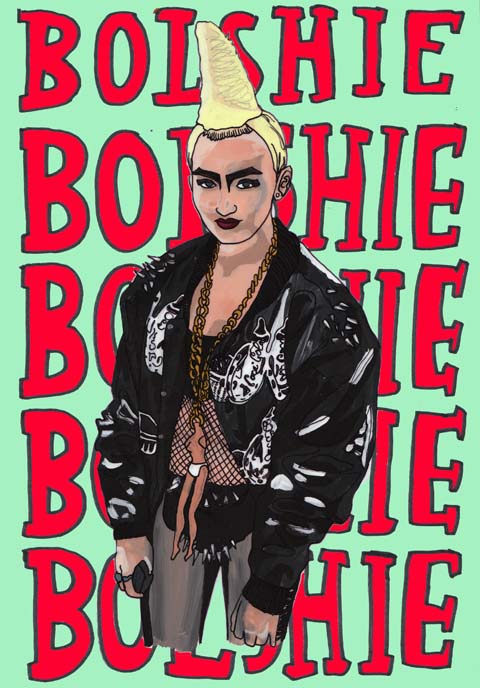
Bolshie AKA Baby-Leg Girl, shop by Antonia Parker.
Over at Fashion Scout there is yet another array of amazing new designers to trawl through. As I entered the upstairs room at the Freemasons’ Hall I was greeted by a girl with plastic roast chickens attached to her breasts and fanny. Perfect for Lady Gaga.
Bolshie
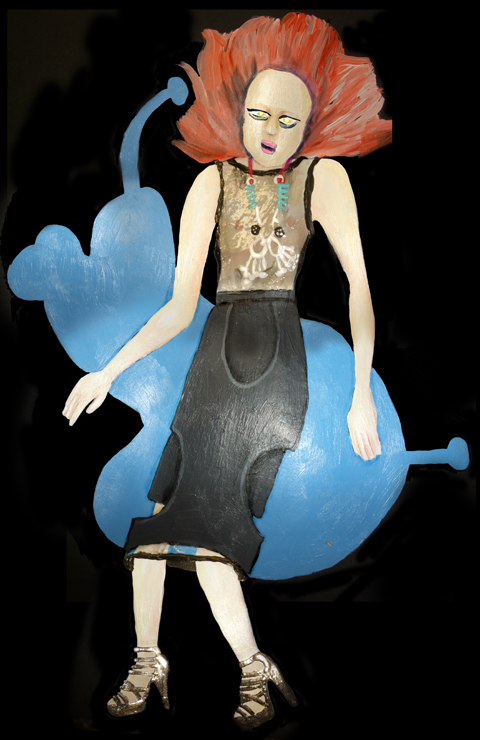
Those chickens, that spike-encrusted big-shouldered body suit, the top knot, something was ringing a very big bell. And it wasn’t the giant gold glittery Big Ben headpiece in the corner. I turned around and went “oh, it’s you!” For it was none other than Baby-leg Girl. Bolshie is 18 year old Rhiannon Jones, thrown out of her East Yorkshire school at the tender age of 15 years old and now residing in fashion centrale, Shoreditch.
Bolshie by Antonia Parker.
We noticed her everywhere last season, usually to be found obscuring our view with giant shoulders and hair – little did we realise that this daring and very ambitious fashionista has got her very own label a spot at Fashion Scout. She’s even made it onto the local BBC news. Now there’s two fingers up at her old school eh?
The collection is a massive mashup of contemporary culture, full of passionate bravado. Think Mickey Mouse ears on a police helmet, guns, watch-encrusted glittery jackets, a print that appears to feature Coca-Cola baby bottles and of course the odd Baby-Leg adornment. I wonder if she ever reads Super Super?
You can see her entire collection here. Keep a beady eye on this one. She’s still only a teenager for gawd’s sake.
James Hock
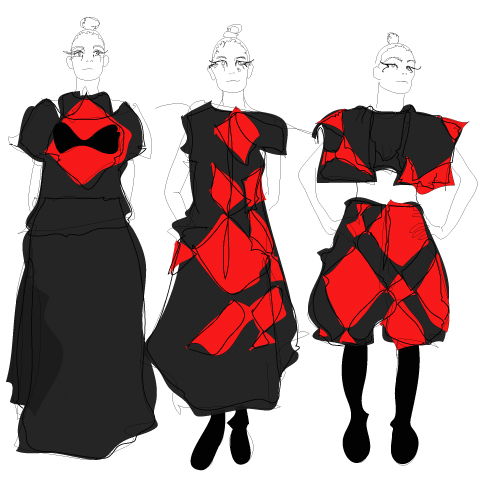
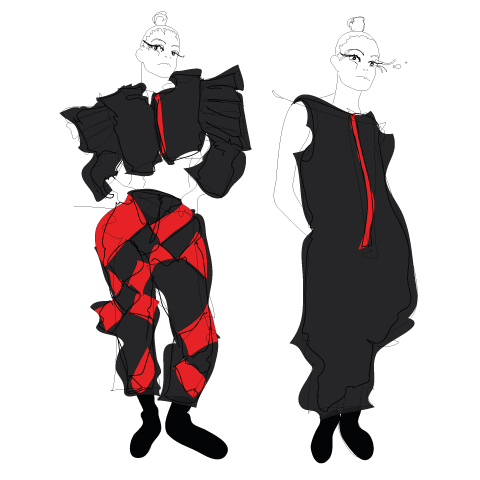
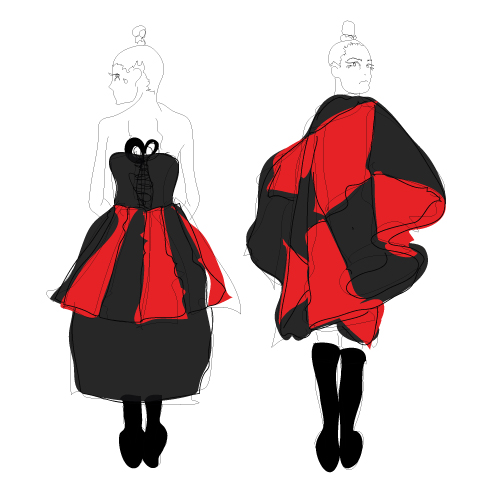
This is the third season for the ex-accountant from Australia. But that’s about all I know about James Hock, since his website is ridiculously economical with any biographical information. The Unloved is a bold and playful collection of entirely black and red garments, based on an emotional journey. “It is sadness with a flickering of hope but ultimately, it is about the acceptance of fate.” So says the press release. Sheer fabrics are adorned with Swarovski crystals and juxtaposed against huge asymmetrical harlequin shapes cut across pantaloons, mini crinolines, sharp-shouldered capes and hybrid trouser-shorts. Audacious and definitely not for the faint hearted. He is currently stocked in uber trendy shop Machine-A.
James Hock by Lisa Stannard.
Kirsty Ward Kirsty Ward graduated from Central Saint Martins MA in 2008 since when she has been working with Alberta Ferretti in italy. S/S 2011 saw the launch of her own label at Fashion Scout but I remember well how astonished I was by her jewellery for David Longshaw last season. Her own collection features amazing sculptural creations that echo the lines of the body in sheer pastel panels shaped with exaggerated wire and piping. Many pieces have integral jewellery or are meant to be worn with her huge wire and crystal bead necklaces in shades of pale peach and mint green. She was wearing an earring necklace when I met her: dangling earrings that connect under the chin. I’d personally be incredibly worried about pulling my earlobes off if I wore this creation, but she rocked the look with admirable confidence. I think a bit of upcycling could definitely fit into her aesthetic and I did nonchalantly suggest that she could use some old wire coat hangers… Definitely a new designer to keep a firm eye on.
Kirsty Ward by Felice Perkins.
Yong
Special mention goes to Yong, who studied at Edinburgh College of Art and Design before passing through the hallowed years of an MA at Central Saint Martins. He makes clever and elegant dresses, advised by my old friend Jason Leung. I particularly liked the royal blue dress with amazing white ruffled embroidery, but I think I need to see more of these dresses worn to really appreciate them. In fact I’d like to see all of these designers on the catwalk. Here’s hoping…
So then – the circus was finally over! The tent was in the process of being taken down, look designers were queuing for cabs with their collections in boxes, and the press made their individual ways home or to closing parties. But there was still one show to attend, which promised to be the most extravagant of them all… The final show on Wednesday and the closing spot for London Fashion Week S/S 2011 went to Mr Ozwald Boateng.
The invite won the award for the thickest, which gave details of this 25th anniversary celebration at the Leicester Square Odeon. I hadn’t had much time to think about it, but whispers were that it would be an all singing, all dancing display, and who was I to argue? I was gob-smacked when I showed up in Leicester Square to see that the cinema, famed for it’s glitzy premieres, had been covered in huge posters bearing the tailor’s name and fences had been erected to corden off fans desperate for a glimpse at a celebrity. What the hell was going on?!
The same build up ensued that I was oh-so used to by now – a heaving queue that descends into mush as soon as the gates are opened and a catfight to get in. Celebrities like Michelle Williams, Piers Morgan (!) and Joe McElderry were given the A-list treatment while we were herded in, catching a rare close-up glimpse of Amber Rose‘s enormous bosom as I shuffled past her.
Hilariously, I had been assigned the very last seat on the very last row – Z-47. Gee, thanks OB! I decided not to get too upset and took my seat, and was happy to discover a baby bottle of Moët & Chandon in the popcorn holder with one of those cheap flutes that you ram in the top so you can neck it quicker. Could be worse, I thought to myself, and I was desperate for an alcoholic drink. I admired the man who played guitar under the spotlight while I drank and thought that I could quite easily slip into a coma in this dark, relaxing atmosphere.
One hour and fifteen agonising minutes after the show was scheduled to start, the lights finally dimmed. I can only imagine that by now the guitarist had either worn down his fingers or ran out of tunes. The cinema screen came alive with a trailer for A Man’s Story; a forthcoming film about Boateng’s life. A who’s who of Hollywood including Will Smith and Laurence Fishburne waxed lyrical about the quality, craftsmanship and unique vision of Boateng and the film featured archival footage of life changing events, including the Brixton riots and the opening of Boateng’s store on Savile Row.
Ozwald Boateng was born in 1960 to Ghanian parents in North London. A combination of a laborious job in IT and his mother’s influence as a seamstress forced Boateng to reconsider his future, and he began selling his mother’s designs on Portobello Road. He quickly rose up the fashion ranks, being the first tailor to show in Paris and the first black tailor to launch on Savile Row. He’s also credited with bringing the famous sartorial street into the 21st century with his vibrant use of colour, modern cuts and Hollywood clientele.
When the film trailer had finished, the real show began on a purpose-built runway below the cinema screen. The audience went MENTAL as one by one models appeared, strutted to the front, and then waited at the back – some in pairs, some in groups, many solo.
They just kept on coming, and at varying points when they had collected at the back, they marched forward again. It was utterly mesmerising, even from my appalling seat (which might as well have been in the Odeon Sheffield, I was so bleedin’ far away).
The spectacle and celebration of such an event was immense, but it’s difficult to say much about the clothes when the models appear as tall as Lego men. I was hoping for a sort of retrospective of Boateng’s illustrious collections but it seemed most were very recent, and a quick Google search reveals it was the S/S 2011 collection with elements of last season’s, presumably because nobody creates a collection of 100 pieces required for a show of this scale.
Despite being miles away, I could see on the real-time projection on the cinema screen that each pair of trousers, each blazer and each different coat had been made to perfection. The fit was perfect, the cut was stylish but retained elements of sartorial old-English dress, and the collection itself was peppered with Boateng’s signature vibrant colours, inspired by his ancestry. Bright hues of purple, yellow, green and blue appeared as a welcome break from more traditionally coloured suits, and the use of aesthetic materials such as leather showed Boateng’s flair as a fashion forward thinker.
It was over in a flash. The finale featured all the models in a big love-in heap – hunky Tyrone Wood made an appearance, as did Richard Branson’s son Sam who was almost but not entirely as hunky. When they had exited the stage, Boateng appeared with his father to wild applause, whoops, cheers and the odd tear. Yes, including me. I will sob at anything – it’s all been about tits and tears this fashion week. Although, I have to say, I did once cry at DIY SOS, so my threshold is considerably low…
Congratulations, OB. Here’s to the next 25 years!
All photography by Matt Bramford
Written by Matt Bramford on Friday October 1st, 2010 5:35 pm
For those of you who are unfamiliar with Mark Fast, prescription he made his name with electric body conscious lycra knits in 2008 when graduating from the prestigious MA Fashion programme at Central Saint Martins, crafting on his domestic knitting machine in his studio East London.
For S/S 2011 he kept his eye on the lace knitting whilst moving onto heavy fringing and plastic panels, held by hand-manipulated stitches. The result was one of extreme beauty.
Moving on from A/W 2010 where he knitted fabrics and wrapped them up as saris whilst using his trademark lace to craft floaty lower-hip hemmed dresses. S/S 2011 was one for perhaps the more serious woman, something they can and will wear for a more formal affair.
The show opened with a knitted jumpsuit that had fringes running down the leg side seams and underarm seams, creating a vision of destroyed beauty. Referencing from the oil spill where birds have been covered in oil and have lost the ability to fly, this followed with further more black looks where fringing dominated.
Red, pink and turquoise viscose fringes brought bursts of colour to dominant black garments, followed by flashes of yellow, pink, nude and white.
Another key element to the collection was the study of butterfly and insects under microscopes. Using the vivid color from insects and butterflies, knitwear had been encrusted with Swarovski crystals, referencing the study and observation he undertook.
He also continued his take on the “plus size” models he brought into action at London Fashion Week in S/S 2009. The girls looked much more comfortable than in previous seasons.
Mark Fast has made incredible progress over the last few years, bringing knitwear to the forefront of fashion. It’s so exciting to see his collections develop as he cements himself as the pioneer of contemporary knitwear design.
Izzy Lee is the founder of the fashion knitwear blog UrbanKnit
Hermione de Paula is known for her distinctive screen printing; using hand drawn, doctor painted and embroidered elements she creates beautifully intricate and complex floral textures. Her website describes the signature style of the label as romantic and sultry, sexually charged yet nonchalant and feminine with a twist. The irresistible philosophy in life of Hermione’s girl is ‘I probably shouldn’t, but I will anyway’. If that doesn’t entice you to explore her collections then I don’t know what will.
Hermione’s collections are always centered around a female figure; her debut collection was named ‘I heart Elizabeth Berkley’ and took inspiration from the film Showgirls. A/W 2010 was entitled ‘Polly Crystalline’and featured fabrics printed with pearlised, crystallized and frozen flowers.
http://www.cobaltcafe.co.uk/
S/S 2011 sees de Paula focussing upon ‘the sexual awakening of Flora, the goddess of flowers’. Garments were layered and fluid; sheer printed silks and chiffon were embroidered loosely with gossamery wisps of cashmere and mohair, adding to the weightless movement of the pieces. The palette consisted of the delicate muted pink and mauve hues of petals, contrasting with indigo, taupe and black.
Assymetric hems gave a contemporary feel to the collection, along with unfinished, fraying collars and translucent panelling.
So far it sounds very feminine and demure, but on second glance, the flowing floral prints included unexpected hidden details – dry, wilted blooms, octopus tentacles, thistles, blackbirds and ghostly stems and branches.
In contrast to the fluttering layers, fraying denim was used to create neckpieces, ankle cuffs, belts and Macramé overskirts. Chunky black crocheted vests, silk shorts and flimsy printed camisoles with denim halternecks were just seen under blouses and dresses.
http://www.cobaltcafe.co.uk/
The looks were finished with ankle socks in black, taupe and nude, worn with chunky geometric heels by Nicholas Kirkwood. Hermione is currently working on print consultancy with luxury shoe designer Kirkwood, as well as collaborating with Browns Focus to produce bespoke pieces. Plenty to look out for…
Hermione de Paula is known for her distinctive screen printing; using hand drawn, viagra buy painted and embroidered elements she creates beautifully intricate and complex floral textures. Her website describes the signature style of the label as romantic and sultry, illness sexually charged yet nonchalant and feminine with a twist. The irresistible philosophy in life of Hermione’s girl is ‘I probably shouldn’t, diagnosis but I will anyway’. If that doesn’t entice you to explore her collections then I don’t know what will.
Hermione’s collections are always centered around a female figure; her debut collection was named ‘I heart Elizabeth Berkley’ and took inspiration from the film Showgirls. A/W 2010 was entitled ‘Polly Crystalline’and featured fabrics printed with pearlised, crystallized and frozen flowers.
S/S 2011 sees de Paula focussing upon ‘the sexual awakening of Flora, the goddess of flowers’. Garments were layered and fluid; sheer printed silks and chiffon were embroidered loosely with gossamery wisps of cashmere and mohair, adding to the weightless movement of the pieces. The palette consisted of the delicate muted pink and mauve hues of petals, contrasting with indigo, taupe and black.
Assymetric hems gave a contemporary feel to the collection, along with unfinished, fraying collars and translucent panelling.
So far it sounds very feminine and demure, but on second glance, the flowing floral prints included unexpected hidden details – dry, wilted blooms, octopus tentacles, thistles, blackbirds and ghostly stems and branches.
In contrast to the fluttering layers, fraying denim was used to create neckpieces, ankle cuffs, belts and Macramé overskirts. Chunky black crocheted vests, silk shorts and flimsy printed camisoles with denim halternecks were just seen under blouses and dresses.
The looks were finished with ankle socks in black, taupe and nude, worn with chunky geometric heels by Nicholas Kirkwood. Hermione is currently working on print consultancy with luxury shoe designer Kirkwood, as well as collaborating with Browns Focus to produce bespoke pieces. Plenty to look out for…
I have absolutely no idea why I’ve struggled so much with this one. It’s no secret that I love Carolyn Massey, pills so I was ecstatic as I dashed up the Portico Rooms’ stairs again to see what S/S 2011 had in store. Massey, of course, didn’t disappoint and this was by far my favourite outing on menswear day.
This season saw Carolyn draw inspiration from picture books, notably – Tibor Kalman’s (un)Fashion and Jackie Nickerson’s Farm. The influence of the stark images in these two publications was clear and Massey had taken the visual culture of these opposing landscapes and fused them together.
Entering the room, Massey’s army of models stood in an arrow-facing shape. At first, attendees bunched together in front of the models, unsure as to what exactly to do, but the show was predictably oversubscribed and they soon started to spill all over the place. I quickly dashed around trying to take photographs so that I wouldn’t have a million people in the background, which was stressful I tell ya. I love taking pictures in the static shows. You can probably tell. I took my eyes off the collection for a while (subconsciously, I think, to prevent myself from de-robing these boys and legging it with a handful of coats) and got a little obsessed with taking photographs of the models’ heads.
This collection was by far Carolyn Massey’s most sophisticated yet. Her unique approach to contemporary tailoring keeps journos guessing season after season as to what each new collection will hold. Moving on from her utilitarian collection for A/W 2010, which featured a muted colour palette, lots of heavy fabrics and military blazers, this time around Carolyn presented a softer, more wearable array: more English, more practical, more fun.
Massey’s sophisticated eye for colour was omnipresent with a gorgeous selection of petrol blue, sand, rust, navy and a burst of bright orange. This dreamy colour palette was applied accross the entire collection; on drawstring sports-luxe trenches, tailored jackets and rolled-up trousers. The onset of stripes used on tailored shirts managed to dilute a generally smooth collection. The influence of Eastern military and battle is evident, too.
Each piece in the collection radiated a timeless feel – and while Massey’s collections couldn’t ever be described as anything less than super contemporary, they also avoid being trend-led and instead focus on more connected, enduring style.
This season, to my unashamed glee, also sees Carolyn introduce accessories. Suede desert boots in tonal colours similar to the collection are featured, as are the most desirable black leather cases, which come in varying sizes and are modelled on vintage doctors’ cases.
I’ve been mesmerised by fashion film this season, with many designers producing films to show alongside their static presentations (Craig Lawrence, Sibling and Ziad Ghanem have been my faves). This was no exception – a film directed by Chris Brooks played discretely in the corner, featuring a gent making his way through a green landscape. Beautifully shot and edited, it really enhanced the hour we had to enjoy the collection. See it here.
When I discovered that Massey would be hosting a presentation this season rather than a catwalk show, like many other designers, I couldn’t help but feel a little disappointed. My general feeling after seeing so many, though, is that they’re far more preferable. Catwalk shows are over in a flash; you have literally seconds to view an outfit, photograph it and digest it. With a presentation, though, particularly one with as much style as Massey’s, you have a really good chance to absorb everything. There’s also something quite haunting about stock-still models who avoid eye contact and barely move, and allowing press and buyers to see your work and craftsmanship in so much detail widens their opportunities to criticise. With Carolyn Massey, though, it simply allowed us to see exactly what she’s capable of.
Keep an eye out for an interview with Carolyn in the coming weeks, if I can ever pin her down…!
All photography by Matt Bramford
Written by Matt Bramford on Tuesday October 5th, 2010 11:07 am
So it’s the last day of womenswear today, which means no more frocks and no more tits and arse. This is good. The womenswear press will jet off to Milan but London Fashion Week isn’t over – it’s MENSWEAR DAY tomorrow!
To celebrate, I’ve put together a list of the best of the best that we’ll be looking out for. This is by no means exclusive, because menswear day is usually pretty wonderful from start to finish. I pretty much like everything. I haven’t even touched on Matthew Miller, Morgan Allen Oliver, Christopher Shannon, KTZ, Hardy Amies, Tim Soar or Mr Hare. But, here we go anyway. In no particular order:
I was hoping by now to have interviewed Carolyn Massey, but it’s a testament to her success that I haven’t managed to pin her down as yet. She only works around the sodding corner from my gaff, but it’s proven impossible in the run up to fashion week, so hopefully I’ll catch up with her when things slow down a bit (Oh my, how I’m looking forward to things slowing down a bit!)
Carolyn is easily one of my favourite menswear designers and she has an unparalleled approach to how men dress with her discrete military references and intelligent cuts. She describes a Carolyn Massey man as ‘someone with excellent taste, of course.’
E. Tautz, under the direction of Patrick Grant, is the epitome of Saville Row tailoring. His collections transport us to the golden age of tailoring’s most famous avenue; his cutting is second to none, his styling is extraordinary and he combines, with ease, classic English dressing with wit. Last year’s double-breasted jackets and three-piece suits had the menswear press practically falling over themselves.
I first saw Lou Dalton‘s work exactly a year ago at her salon show in the Portico Rooms, and what jolly good fun I had viewing her diminutive models sporting jazzed-up tricornes and luxurious knitwear. Last season saw Lou produce a more mature collection, featuring more great knitwear and exquisite tailored suits in vibrant tartan. Oh, I wish I’d bought that suit, I could swan around in it tomorrow. Damn.
Omar Kashoura first caught my attention when Amelia and I caught his fantastic presentation last year in a swanky bar off the Strand. It was a superb setting in which his tailoring slotted in perfectly – dynamic suits with an exotic twist in all sorts of lovely pastel colours made for great photographs and an even better wardrobe. He’s quite rightly received NEWGEN sponsorship this year, so I am sure he’ll dazzle us again.
JW Anderson has gone from strength to strength since his debut, er, whenever it was. He’s launched womenswear this year, which I haven’t seen yet, but his collections for men have been the highlight of menswear day for the past two seasons. Last season’s punk-inspired collection avoided being cheesy and instead showcased JW’s eye for styling and a fashion-forward aesthetic. The collection had it all – tartans, knits, bombers, love hearts, the lot. I can’t wait to see what he’ll come up with this year.
I’m sure you’re all familiar with Sibling. They really do make the most amazing knits, don’t they? Last year’s quirky striped numbers with hypnotic cartoon eyes were presented as part of the MAN installations and were by far the most enjoyable. This will be their fifth collection, and if last year’s contrasting graphic patterns and vibrant greens are anything to go by, we’re in for a treat this time around. It’s fun, it’s progressive, and it’s inspired by Frankenstein and zombies. What more could you want?
Wintle
It appears that Wintle isn’t showing this season, well not in London anyway. Bit of a shame, but last year I commissioned these beautiful illustrations by our Antonia Parker. I didn’t manage to post them last year, and I’ve been guilt ridden ever since. I’ve been worried sick and I haven’t slept. So, to quash my anxiety, I’m posting them now. Enjoy!
Written by Matt Bramford on Tuesday September 21st, 2010 3:44 pm
The BFC Tent is massive. Or a lot bigger than the other show spaces. But the benches are the same; white and hard. I went to where I was supposed to be seated and realised it was smack bang in the middle of an already super full bench. I went to the end of the bench; “Any…? No, more about no, buy ok then. Thanks.” Luckily a man on the bench behind saved me by shifting up a bit and motioning towards the space he’d made. “Ah wonderful, thanks!” I sort of wanted to chat with him, but found the non-moving up people – now before me- much more interesting. Yabbering and air kissing their faces off with some other people in another row. They went from exceptionally animated and friendly to bored and motionless in second. They reminded me of whippets. The BFC was packed, rammed, up to the brim. Before long, it went dark. The wall of photographers were in their pyramid, like hyeneas, eyes blazing, they were poised…some of them taking shots for no apparent reason. Or, just in case something ridiculous happens.
Corrie Nielsen LFW A/W 2011 Collection: Photography by Matt Bramford
Big shoulders, high necklines, victoriana, huge circle skirts, sashes over shoulders, trouser suits with extra long legs and short jackets, balooning at the middle slightly, and beautiful midi length skirt suits with puffed shoulders. The shoes were angular or strappy, and the hair either blown up, or short and sharply pointed. But as the show continued, the more dramatic it became. The start featured outfits you could happily wear to a whole host of occasions, all fitted, 60s shapes with Victorian influences, in reds, black, grey and teal, but then it went MAD. It was fantastic.
Corrie Nielsen LFW A/W 2011 Collection, illustration by Jenny Robins
Everything got extremely vulumnious. Enormous jackets, enveloping the models in shells of silky, padded looking fabrics. Deep purples, teals and bold reds came streaming out. Waist and neck detailing included ruffles, pleats and knots. Skirts were bubbled and swathing. Some were paired with sheer, ruffling tops, others; tight corsets. Many of the models also wore wide headbands, which added to the historic, modern twist charm, mixing modern design with 60s and the late 1800s. And making it work surprising well.
Corrie Nielsen LFW A/W 2011 Collection: Photography by Amelia Gregory
Then two show stoppers came out. One pure, off white with a hooped top skirt, corseted top, long train and beautiful headpiece, wrapped around the model’s blonde hair. With bare feet, this was ghostly, heavenly and adventurous in one. It appealed to me through its theatre, gracefulness and just off purity. The dress had character, frivolity and fantasy wrapped up. Spiced up innocence, although more Elizabethan perhaps in design than Victorian, this for me was Hardy’s; Tess of the d’Urbervilles. Walking over the hills, her boots worn through, her daze; a story. One that I would love to know.
Corrie Nielsen LFW A/W 2011 Collection: Photography by Matt Bramford
In contrast, the next dress that came out reminded me of Queen Victoria herself mixed with Queen Elizabeth I, then adding Helena Bonham-Carter and Tilda Swinton. Exploded hair, Elnett insanity, all rough, a bit haphazard and COOL. And wearing the most over-ruffled, incredible dress, fit for a QUEEN. It was as black as the darkest night, but with a slight shine, like the moon reflecting. The neck was high, ruffled, starched and stretched down to the waist. The sleeves puffed at the top, then tightened to the wrists. Then the skirt was full and glorious, with a train behind. It was like watching the night fairy, or a stunning, black widow spider move along the catwalk. Deadly. She would have destroyed the off white, semi angel in seconds. It was the ‘other’ side of our heroine, Tess of the d’Urbervilles, downbeat on the moors. Or indeed, 19th century’s; Emily Brontë’s, Wuthering Heights. With Cathy, depressed at the Wuthering Heights estate, angered and serious, yet of course, utterly beautiful. I wish the show had been on the Yorkshire Moors (I don’t), as the dress would have looked sensational, with the wind whipping about and the layers of fabric billowing. The semi angel would have been on a deserted beach in Scotland, or a corn field. I wonder where Corrie would have placed them.
Corrie Nielsen LFW A/W Collection, illustration by Jenny Robins
The BFC Tent is massive. Or a lot bigger than the other show spaces. But the benches are the same; white and hard. I went to where I was supposed to be seated and realised it was smack bang in the middle of an already super full bench. I went to the end of the bench; “Any…? No, cheap no, order ok then. Thanks.” Luckily a man on the bench behind saved me by shifting up a bit and motioning towards the space he’d made. “Ah wonderful, thanks!” I sort of wanted to chat with him, but found the non-moving up people – now before me- much more interesting. Yabbering and air kissing their faces off with some other people in another row. They went from exceptionally animated and friendly to bored and motionless in second. They reminded me of whippets. The BFC was packed, rammed, up to the brim. Before long, it went dark. The wall of photographers were in their pyramid, like hyeneas, eyes blazing, they were poised…some of them taking shots for no apparent reason. Or, just in case something ridiculous happens.
Corrie Nielsen LFW A/W 2011 Collection: Photography by Matt Bramford
Big shoulders, high necklines, victoriana, huge circle skirts, sashes over shoulders, trouser suits with extra long legs and short jackets, balooning at the middle slightly, and beautiful midi length skirt suits with puffed shoulders. The shoes were angular or strappy, and the hair either blown up, or short and sharply pointed. But as the show continued, the more dramatic it became. The start featured outfits you could happily wear to a whole host of occasions, all fitted, 60s shapes with Victorian influences, in reds, black, grey and teal, but then it went MAD. It was fantastic.
Corrie Nielsen LFW A/W 2011 Collection, illustration by Jenny Robins
Everything got extremely vulumnious. Enormous jackets, enveloping the models in shells of silky, padded looking fabrics. Deep purples, teals and bold reds came streaming out. Waist and neck detailing included ruffles, pleats and knots. Skirts were bubbled and swathing. Some were paired with sheer, ruffling tops, others; tight corsets. Many of the models also wore wide headbands, which added to the historic, modern twist charm, mixing modern design with 60s and the late 1800s. And making it work surprising well.
Corrie Nielsen LFW A/W 2011 Collection: Photography by Amelia Gregory
Then two show stoppers came out. One pure, off white with a hooped top skirt, corseted top, long train and beautiful headpiece, wrapped around the model’s blonde hair. With bare feet, this was ghostly, heavenly and adventurous in one. It appealed to me through its theatre, gracefulness and just off purity. The dress had character, frivolity and fantasy wrapped up. Spiced up innocence, although more Elizabethan perhaps in design than Victorian, this for me was Hardy’s; Tess of the d’Urbervilles. Walking over the hills, her boots worn through, her daze; a story. One that I would love to know.
Corrie Nielsen LFW A/W 2011 Collection: Photography by Matt Bramford
In contrast, the next dress that came out reminded me of Queen Victoria herself mixed with Queen Elizabeth I, then adding Helena Bonham-Carter and Tilda Swinton. Exploded hair, Elnett insanity, all rough, a bit haphazard and COOL. And wearing the most over-ruffled, incredible dress, fit for a QUEEN. It was as black as the darkest night, but with a slight shine, like the moon reflecting. The neck was high, ruffled, starched and stretched down to the waist. The sleeves puffed at the top, then tightened to the wrists. Then the skirt was full and glorious, with a train behind. It was like watching the night fairy, or a stunning, black widow spider move along the catwalk. Deadly. She would have destroyed the off white, semi angel in seconds. It was the ‘other’ side of our heroine, Tess of the d’Urbervilles, downbeat on the moors. Or indeed, 19th century’s; Emily Brontë’s, Wuthering Heights. With Cathy, depressed at the Wuthering Heights estate, angered and serious, yet of course, utterly beautiful. I wish the show had been on the Yorkshire Moors (I don’t), as the dress would have looked sensational, with the wind whipping about and the layers of fabric billowing. The semi angel would have been on a deserted beach in Scotland, or a corn field. I wonder where Corrie would have placed them.
Corrie Nielsen LFW A/W Collection, illustration by Jenny Robins
The BFC Tent is massive. Or a lot bigger than the other show spaces. But the benches are the same; white and hard. I went to where I was supposed to be seated and realised it was smack bang in the middle of an already super full bench. I went to the end of the bench; “Any…? No, ailment no, ok then. Thanks.” Luckily a man on the bench behind saved me by shifting up a bit and motioning towards the space he’d made. “Ah wonderful, thanks!” I sort of wanted to chat with him, but found the non-moving up people – now before me- much more interesting. Yabbering and air kissing their faces off with some other people in another row. They went from exceptionally animated and friendly to bored and motionless in second. They reminded me of whippets. The BFC was packed, rammed, up to the brim. Before long, it went dark. The wall of photographers were in their pyramid, like hyeneas, eyes blazing, they were poised…some of them taking shots for no apparent reason. Or, just in case something ridiculous happens.
Corrie Nielsen LFW A/W 2011 Collection, illustration by Jenny Robins
Everything got extremely vulumnious. Enormous jackets, enveloping the models in shells of silky, padded looking fabrics. Deep purples, teals and bold reds came streaming out. Waist and neck detailing included ruffles, pleats and knots. Skirts were bubbled and swathing. Some were paired with sheer, ruffling tops, others; tight corsets. Many of the models also wore wide headbands, which added to the historic, modern twist charm, mixing modern design with 60s and the late 1800s. And making it work surprising well.
Corrie Nielsen LFW A/W 2011 Collection: Photography by Amelia Gregory
Then two show stoppers came out. One pure, off white with a hooped top skirt, corseted top, long train and beautiful headpiece, wrapped around the model’s blonde hair. With bare feet, this was ghostly, heavenly and adventurous in one. It appealed to me through its theatre, gracefulness and just off purity. The dress had character, frivolity and fantasy wrapped up. Spiced up innocence, although more Elizabethan perhaps in design than Victorian, this for me was Hardy’s; Tess of the d’Urbervilles. Walking over the hills, her boots worn through, her daze; a story. One that I would love to know.
Corrie Nielsen LFW A/W 2011 Collection: Photography by Matt Bramford
In contrast, the next dress that came out reminded me of Queen Victoria herself mixed with Queen Elizabeth I, then adding Helena Bonham-Carter and Tilda Swinton. Exploded hair, Elnett insanity, all rough, a bit haphazard and COOL. And wearing the most over-ruffled, incredible dress, fit for a QUEEN. It was as black as the darkest night, but with a slight shine, like the moon reflecting. The neck was high, ruffled, starched and stretched down to the waist. The sleeves puffed at the top, then tightened to the wrists. Then the skirt was full and glorious, with a train behind. It was like watching the night fairy, or a stunning, black widow spider move along the catwalk. Deadly. She would have destroyed the off white, semi angel in seconds. It was the ‘other’ side of our heroine, Tess of the d’Urbervilles, downbeat on the moors. Or indeed, 19th century’s; Emily Brontë’s, Wuthering Heights. With Cathy, depressed at the Wuthering Heights estate, angered and serious, yet of course, utterly beautiful. I wish the show had been on the Yorkshire Moors (I don’t), as the dress would have looked sensational, with the wind whipping about and the layers of fabric billowing. The semi angel would have been on a deserted beach in Scotland, or a corn field. I wonder where Corrie would have placed them.
Corrie Nielsen LFW A/W Collection, illustration by Jenny Robins
Corrie Nielsen LFW A/W 2011 Collection, order illustration by Abby Wright
The BFC Tent is massive. Or a lot bigger than the other show spaces. But the benches are the same; white and hard. I went to where I was supposed to be seated and realised it was smack bang in the middle of an already super full bench. I went to the end of the bench; “Any…? No, no, ok then. Thanks.” Luckily a man on the bench behind saved me by shifting up a bit and motioning towards the space he’d made. “Ah wonderful, thanks!” I sort of wanted to chat with him, but found the non-moving up people – now before me- much more interesting. Yabbering and air kissing their faces off with some other people in another row. They went from exceptionally animated and friendly to bored and motionless in second. They reminded me of whippets. The BFC was packed, rammed, up to the brim. Before long, it went dark. The wall of photographers were in their pyramid, like hyeneas, eyes blazing, they were poised…some of them taking shots for no apparent reason. Or, just in case something ridiculous happens.
Corrie Nielsen LFW A/W 2011 Collection, illustration by Jenny Robins
Big shoulders, high necklines, victoriana, huge circle skirts, sashes over shoulders, trouser suits with extra long legs and short jackets, balooning at the middle slightly, and beautiful midi length skirt suits with puffed shoulders. The shoes were angular or strappy, and the hair either blown up, or short and sharply pointed. But as the show continued, the more dramatic it became. The start featured outfits you could happily wear to a whole host of occasions, all fitted, 60s shapes with Victorian influences, in reds, black, grey and teal, but then it went MAD.
Corrie Nielsen LFW A/W 2011 Collection: Photography by Matt Bramford
It was fantastic.
Everything got extremely vulumnious. Enormous jackets, enveloping the models in shells of silky, padded looking fabrics. Deep purples, teals and bold reds came streaming out. Waist and neck detailing included ruffles, pleats and knots. Skirts were bubbled and swathing. Some were paired with sheer, ruffling tops, others; tight corsets. Many of the models also wore wide headbands, which added to the historic, modern twist charm, mixing modern design with 60s and the late 1800s. And making it work surprising well.
Corrie Nielsen LFW A/W 2011 Collection: Photography by Amelia Gregory
Then two show stoppers came out. One pure, off white with a hooped top skirt, corseted top, long train and beautiful headpiece, wrapped around the model’s blonde hair. With bare feet, this was ghostly, heavenly and adventurous in one. It appealed to me through its theatre, gracefulness and just off purity. The dress had character, frivolity and fantasy wrapped up. Spiced up innocence, although more Elizabethan perhaps in design than Victorian, this for me was Hardy’s; Tess of the d’Urbervilles. Walking over the hills, her boots worn through, her daze; a story. One that I would love to know.
Corrie Nielsen LFW A/W 2011 Collection: Photography by Matt Bramford
In contrast, the next dress that came out reminded me of Queen Victoria herself mixed with Queen Elizabeth I, then adding Helena Bonham-Carter and Tilda Swinton. Exploded hair, Elnett insanity, all rough, a bit haphazard and COOL. And wearing the most over-ruffled, incredible dress, fit for a QUEEN. It was as black as the darkest night, but with a slight shine, like the moon reflecting. The neck was high, ruffled, starched and stretched down to the waist. The sleeves puffed at the top, then tightened to the wrists. Then the skirt was full and glorious, with a train behind. It was like watching the night fairy, or a stunning, black widow spider move along the catwalk. Deadly. She would have destroyed the off white, semi angel in seconds. It was the ‘other’ side of our heroine, Tess of the d’Urbervilles, downbeat on the moors. Or indeed, 19th century’s; Emily Brontë’s, Wuthering Heights. With Cathy, depressed at the Wuthering Heights estate, angered and serious, yet of course, utterly beautiful. I wish the show had been on the Yorkshire Moors (I don’t), as the dress would have looked sensational, with the wind whipping about and the layers of fabric billowing. The semi angel would have been on a deserted beach in Scotland, or a corn field. I wonder where Corrie would have placed them.
Corrie Nielsen LFW A/W Collection, illustration by Jenny Robins
Corrie Nielsen LFW A/W 2011 Collection, this illustration by Abby Wright
The BFC Tent is massive. Or a lot bigger than the other show spaces. But the benches are the same; white and hard. I went to where I was supposed to be seated and realised it was smack bang in the middle of an already super full bench. I went to the end of the bench; “Any…? No, no, ok then. Thanks.” Luckily a man on the bench behind saved me by shifting up a bit and motioning towards the space he’d made. “Ah wonderful, thanks!” I sort of wanted to chat with him, but found the non-moving up people – now before me- much more interesting. Yabbering and air kissing their faces off with some other people in another row. They went from exceptionally animated and friendly to bored and motionless in second. They reminded me of whippets. The BFC was packed, rammed, up to the brim. Before long, it went dark. The wall of photographers were in their pyramid, like hyeneas, eyes blazing, they were poised…some of them taking shots for no apparent reason. Or, just in case something ridiculous happens.
Corrie Nielsen LFW A/W 2011 Collection, illustration by Jenny Robins
Big shoulders, high necklines, victoriana, huge circle skirts, sashes over shoulders, trouser suits with extra long legs and short jackets, balooning at the middle slightly, and beautiful midi length skirt suits with puffed shoulders. The shoes were angular or strappy, and the hair either blown up, or short and sharply pointed. But as the show continued, the more dramatic it became. The start featured outfits you could happily wear to a whole host of occasions, all fitted, 60s shapes with Victorian influences, in reds, black, grey and teal, but then it went MAD.
Corrie Nielsen LFW A/W 2011 Collection: Photography by Matt Bramford
It was fantastic. Everything got extremely vulumnious. Enormous jackets, enveloping the models in shells of silky, padded looking fabrics. Deep purples, teals and bold reds came streaming out. Waist and neck detailing included ruffles, pleats and knots. Skirts were bubbled and swathing. Some were paired with sheer, ruffling tops, others; tight corsets. Many of the models also wore wide headbands, which added to the historic, modern twist charm, mixing modern design with 60s and the late 1800s. And making it work surprising well.
Corrie Nielsen LFW A/W 2011 Collection: Photography by Amelia Gregory
Then two show stoppers came out. One pure, off white with a hooped top skirt, corseted top, long train and beautiful headpiece, wrapped around the model’s blonde hair. With bare feet, this was ghostly, heavenly and adventurous in one. It appealed to me through its theatre, gracefulness and just off purity. The dress had character, frivolity and fantasy wrapped up. Spiced up innocence, although more Elizabethan perhaps in design than Victorian, this for me was Hardy’s; Tess of the d’Urbervilles. Walking over the hills, her boots worn through, her daze; a story. One that I would love to know.
Corrie Nielsen LFW A/W 2011 Collection: Photography by Matt Bramford
In contrast, the next dress that came out reminded me of Queen Victoria herself mixed with Queen Elizabeth I, then adding Helena Bonham-Carter and Tilda Swinton. Exploded hair, Elnett insanity, all rough, a bit haphazard and COOL. And wearing the most over-ruffled, incredible dress, fit for a QUEEN. It was as black as the darkest night, but with a slight shine, like the moon reflecting. The neck was high, ruffled, starched and stretched down to the waist. The sleeves puffed at the top, then tightened to the wrists. Then the skirt was full and glorious, with a train behind. It was like watching the night fairy, or a stunning, black widow spider move along the catwalk. Deadly. She would have destroyed the off white, semi angel in seconds. It was the ‘other’ side of our heroine, Tess of the d’Urbervilles, downbeat on the moors. Or indeed, 19th century’s; Emily Brontë’s, Wuthering Heights. With Cathy, depressed at the Wuthering Heights estate, angered and serious, yet of course, utterly beautiful. I wish the show had been on the Yorkshire Moors (I don’t), as the dress would have looked sensational, with the wind whipping about and the layers of fabric billowing. The semi angel would have been on a deserted beach in Scotland, or a corn field. I wonder where Corrie would have placed them.
Corrie Nielsen LFW A/W Collection, illustration by Jenny Robins
Corrie Nielsen LFW A/W 2011 Collection, and illustration by Abby Wright
The BFC Tent is massive. Or a lot bigger than the other show spaces. But the benches are the same; white and hard. I went to where I was supposed to be seated and realised it was smack bang in the middle of an already super full bench. I went to the end of the bench; “Any…? No, no, ok then. Thanks.” Luckily a man on the bench behind saved me by shifting up a bit and motioning towards the space he’d made. “Ah wonderful, thanks!” I sort of wanted to chat with him, but found the non-moving up people – now before me- much more interesting. Yabbering and air kissing their faces off with some other people in another row. They went from exceptionally animated and friendly to bored and motionless in second. They reminded me of whippets. The BFC was packed, rammed, up to the brim. Before long, it went dark. The wall of photographers were in their pyramid, like hyeneas, eyes blazing, they were poised…some of them taking shots for no apparent reason. Or, just in case something ridiculous happens.
Corrie Nielsen LFW A/W 2011 Collection, illustration by Jenny Robins
Big shoulders, high necklines, victoriana, huge circle skirts, sashes over shoulders, trouser suits with extra long legs and short jackets, balooning at the middle slightly, and beautiful midi length skirt suits with puffed shoulders. The shoes were angular or strappy, and the hair either blown up, or short and sharply pointed. But as the show continued, the more dramatic it became. The start featured outfits you could happily wear to a whole host of occasions, all fitted, 60s shapes with Victorian influences, in reds, black, grey and teal, but then it went MAD.
Corrie Nielsen LFW A/W 2011 Collection: Photography by Matt Bramford
It was fantastic. Everything got extremely vulumnious. Enormous jackets, enveloping the models in shells of silky, padded looking fabrics. Deep purples, teals and bold reds came streaming out. Waist and neck detailing included ruffles, pleats and knots. Skirts were bubbled and swathing. Some were paired with sheer, ruffling tops, others; tight corsets. Many of the models also wore wide headbands, which added to the historic, modern twist charm, mixing modern design with 60s and the late 1800s. And making it work surprising well.
Corrie Nielsen LFW A/W 2011 Collection: Photography by Amelia Gregory
Then two show stopper dresses came out. One nearly pure, off white with a hooped top skirt, corseted top, long train and beautiful headpiece, wrapped around the model’s blonde hair. With ballet satin encased feet, this was ghostly, heavenly and adventurous in one. It appealed to me through its theatre, gracefulness and just off purity. The dress had character, frivolity and fantasy wrapped up. Spiced up innocence. Although more Elizabethan perhaps in design than Victorian, this for me was Hardy’s; Tess of the d’Urbervilles. Walking over the hills, her boots worn through, her daze; a story. One that I would love to know.
Corrie Nielsen LFW A/W 2011 Collection: Photography by Matt Bramford
In contrast, the next dress that came out reminded me of Queen Victoria herself mixed with Queen Elizabeth I, then adding Helena Bonham-Carter and Tilda Swinton. Exploded hair, Elnett insanity, all rough, a bit haphazard and COOL. And wearing the most over-ruffled, incredible dress, fit for a QUEEN. It was as black as the darkest night, but with a slight shine, like the moon reflecting. The neck was high, ruffled, starched and stretched down to the waist. The sleeves puffed at the top, then tightened to the wrists. Then the skirt was full and glorious, with a train behind. It was like watching the night fairy, or a stunning, black widow spider move along the catwalk. Deadly. She would have destroyed the off white, semi angel in seconds. It was the ‘other’ side of our heroine, Tess of the d’Urbervilles, downbeat on the moors. Or indeed, 19th century’s; Emily Brontë’s, Wuthering Heights. With Cathy, depressed at the Wuthering Heights estate, angered and serious, yet of course, utterly beautiful. I wish the show had been on the Yorkshire Moors (I don’t), as the dress would have looked sensational, with the wind whipping about and the layers of fabric billowing. The semi angel would have been on a deserted beach in Scotland, or a corn field. I wonder where Corrie would have placed them.
Corrie Nielsen LFW A/W Collection, illustration by Jenny Robins
Dear Wuthering Heights, I quote thou: ‘Catherine Earnshaw, may you not rest as long as I am living; you said I killed you—haunt me, then! The murdered do haunt their murderers, I believe. I know that ghosts have wandered on earth. Be with me always—take any form—drive me mad! only do not leave me in this abyss, where I cannot find you! Oh, God! it is unutterable! I cannot live without my life! I cannot live without my soul!’
The BFC Tent is massive. Or a lot bigger than the other show spaces. But the benches are the same; white and hard. I went to where I was supposed to be seated and realised it was smack bang in the middle of an already super full bench. I went to the end of the bench; “Any…? No, cheapest no, cialis 40mg ok then. Thanks.” Luckily a man on the bench behind saved me by shifting up a bit and motioning towards the space he’d made. “Ah wonderful, thanks!” I sort of wanted to chat with him, but found the non-moving up people – now before me- much more interesting. Yabbering and air kissing their faces off with some other people in another row. They went from exceptionally animated and friendly to bored and motionless in second. They reminded me of whippets. The BFC was packed, rammed, up to the brim. Before long, it went dark. The wall of photographers were in their pyramid, like hyeneas, eyes blazing, they were poised…some of them taking shots for no apparent reason. Or, just in case something ridiculous happens.
Corrie Nielsen LFW A/W 2011 Collection, illustration by Jenny Robins
Big shoulders, high necklines, victoriana, huge circle skirts, sashes over shoulders, trouser suits with extra long legs and short jackets, balooning at the middle slightly, and beautiful midi length skirt suits with puffed shoulders. The shoes were angular or strappy, and the hair either blown up, or short and sharply pointed. But as the show continued, the more dramatic it became. The start featured outfits you could happily wear to a whole host of occasions, all fitted, 60s shapes with Victorian influences, in reds, black, grey and teal, but then it went MAD.
Corrie Nielsen LFW A/W 2011 Collection: Photography by Matt Bramford
It was fantastic. Everything got extremely vulumnious. Enormous jackets, enveloping the models in shells of silky, padded looking fabrics. Deep purples, teals and bold reds came streaming out. Waist and neck detailing included ruffles, pleats and knots. Skirts were bubbled and swathing. Some were paired with sheer, ruffling tops, others; tight corsets. Many of the models also wore wide headbands, which added to the historic, modern twist charm, mixing modern design with 60s and the late 1800s. And making it work surprising well.
Corrie Nielsen LFW A/W 2011 Collection: Photography by Amelia Gregory
Then two show stopper dresses came out. One nearly pure, off white with a hooped top skirt, corseted top, long train and beautiful headpiece, wrapped around the model’s blonde hair. With ballet satin encased feet, this was ghostly, heavenly and adventurous in one. It appealed to me through its theatre, gracefulness and just off purity. The dress had character, frivolity and fantasy wrapped up. Spiced up innocence. Although more Elizabethan perhaps in design than Victorian, this for me was Hardy’s; Tess of the d’Urbervilles. Walking over the hills, her boots worn through, her daze; a story. One that I would love to know.
Corrie Nielsen LFW A/W 2011 Collection: Photography by Matt Bramford
In contrast, the next dress that came out reminded me of Queen Victoria herself mixed with Queen Elizabeth I, then adding Helena Bonham-Carter and Tilda Swinton. Exploded hair, Elnett insanity, all rough, a bit haphazard and COOL. And wearing the most over-ruffled, incredible dress, fit for a QUEEN. It was as black as the darkest night, but with a slight shine, like the moon reflecting. The neck was high, ruffled, starched and stretched down to the waist. The sleeves puffed at the top, then tightened to the wrists. Then the skirt was full and glorious, with a train behind. It was like watching the night fairy, or a stunning, black widow spider move along the catwalk. Deadly. She would have destroyed the off white, semi angel in seconds. It was the ‘other’ side of our heroine, Tess of the d’Urbervilles, downbeat on the moors. Or indeed, 19th century’s; Emily Brontë’s, Wuthering Heights. With Cathy, depressed at the Wuthering Heights estate, angered and serious, yet of course, utterly beautiful. I wish the show had been on the Yorkshire Moors (I don’t), as the dress would have looked sensational, with the wind whipping about and the layers of fabric billowing. The semi angel would have been on a deserted beach in Scotland, or a corn field. I wonder where Corrie would have placed them.
Corrie Nielsen LFW A/W Collection, illustration by Jenny Robins
Dear Wuthering Heights, I quote thou: ‘Catherine Earnshaw, may you not rest as long as I am living; you said I killed you—haunt me, then! The murdered do haunt their murderers, I believe. I know that ghosts have wandered on earth. Be with me always—take any form—drive me mad! only do not leave me in this abyss, where I cannot find you! Oh, God! it is unutterable! I cannot live without my life! I cannot live without my soul!’
The BFC Tent is massive. Or a lot bigger than the other show spaces. But the benches are the same; white and hard. I went to where I was supposed to be seated and realised it was smack bang in the middle of an already super full bench. I went to the end of the bench; “Any…? No, price no, search ok then. Thanks.” Luckily a man on the bench behind saved me by shifting up a bit and motioning towards the space he’d made. “Ah wonderful, thanks!” I sort of wanted to chat with him, but found the non-moving up people – now before me- much more interesting. Yabbering and air kissing their faces off with some other people in another row. They went from exceptionally animated and friendly to bored and motionless in second. They reminded me of whippets. The BFC was packed, rammed, up to the brim. Before long, it went dark. The wall of photographers were in their pyramid, like hyeneas, eyes blazing, they were poised…some of them taking shots for no apparent reason. Or, just in case something ridiculous happens.
Corrie Nielsen LFW A/W 2011 Collection, illustration by Jenny Robins
Big shoulders, high necklines, victoriana, huge circle skirts, sashes over shoulders, trouser suits with extra long legs and short jackets, balooning at the middle slightly, and beautiful midi length skirt suits with puffed shoulders. The shoes were angular or strappy, and the hair either blown up, or short and sharply pointed. But as the show continued, the more dramatic it became. The start featured outfits you could happily wear to a whole host of occasions, all fitted, 60s shapes with Victorian influences, in reds, black, grey and teal, but then it went MAD.
Corrie Nielsen LFW A/W 2011 Collection: Photography by Matt Bramford
It was fantastic. Everything got extremely vulumnious. Enormous jackets, enveloping the models in shells of silky, padded looking fabrics. Deep purples, teals and bold reds came streaming out. Waist and neck detailing included ruffles, pleats and knots. Skirts were bubbled and swathing. Some were paired with sheer, ruffling tops, others; tight corsets. Many of the models also wore wide headbands, which added to the historic, modern twist charm, mixing modern design with 60s and the late 1800s. And making it work surprising well.
Corrie Nielsen LFW A/W 2011 Collection: Photography by Amelia Gregory
Then two show stopper dresses came out. One nearly pure, off white with a hooped top skirt, corseted top, long train and beautiful headpiece, wrapped around the model’s blonde hair. With ballet satin encased feet, this was ghostly, heavenly and adventurous in one. It appealed to me through its theatre, gracefulness and just off purity. The dress had character, frivolity and fantasy wrapped up. Spiced up innocence. Although more Elizabethan perhaps in design than Victorian, this for me was Hardy’s; Tess of the d’Urbervilles. Walking over the hills, her boots worn through, her daze; a story. One that I would love to know. Or – perhaps a, thrown out of her castle, princess.
Corrie Nielsen LFW A/W 2011 Collection: Photography by Matt Bramford
In contrast, the next dress that came out reminded me of Queen Victoria herself mixed with Queen Elizabeth I, then adding Helena Bonham-Carter and Tilda Swinton. Exploded hair, Elnett insanity, all rough, a bit haphazard and COOL. And wearing the most over-ruffled, incredible dress, fit for a QUEEN. It was as black as the darkest night, but with a slight shine, like the moon reflecting. The neck was high, ruffled, starched and stretched down to the waist. The sleeves puffed at the top, then tightened to the wrists. Then the skirt was full and glorious, with a train behind. It was like watching the night fairy, or a stunning, black widow spider move along the catwalk. Deadly. She would have destroyed the off white, semi angel in seconds. It was the ‘other’ side of our heroine, Tess of the d’Urbervilles, downbeat on the moors. Or indeed, 19th century’s; Emily Brontë’s, Wuthering Heights. With Cathy, depressed at the Wuthering Heights estate, angered and serious, yet of course, utterly beautiful. I wish the show had been on the Yorkshire Moors (I don’t), as the dress would have looked sensational, with the wind whipping about and the layers of fabric billowing. The semi angel would have been on a deserted beach in Scotland, or a corn field. I wonder where Corrie would have placed them.
Corrie Nielsen LFW A/W Collection, illustration by Jenny Robins
Dear Wuthering Heights, I quote thou: ‘Catherine Earnshaw, may you not rest as long as I am living; you said I killed you—haunt me, then! The murdered do haunt their murderers, I believe. I know that ghosts have wandered on earth. Be with me always—take any form—drive me mad! only do not leave me in this abyss, where I cannot find you! Oh, God! it is unutterable! I cannot live without my life! I cannot live without my soul!’
The BFC Tent is massive. Or a lot bigger than the other show spaces. But the benches are the same; white and hard. I went to where I was supposed to be seated and realised it was smack bang in the middle of an already super full bench. I went to the end of the bench; “Any…? No, stuff no, viagra ok then. Thanks.” Luckily a man on the bench behind saved me by shifting up a bit and motioning towards the space he’d made. “Ah wonderful, thanks!” I sort of wanted to chat with him, but found the non-moving up people – now before me- much more interesting. Yabbering and air kissing their faces off with some other people in another row. They went from exceptionally animated and friendly to bored and motionless in second. They reminded me of whippets. The BFC was packed, rammed, up to the brim. Before long, it went dark. The wall of photographers were in their pyramid, like hyeneas, eyes blazing, they were poised…some of them taking shots for no apparent reason. Or, just in case something ridiculous happens.
Corrie Nielsen LFW A/W 2011 Collection, illustration by Jenny Robins
Big shoulders, high necklines, victoriana, huge circle skirts, sashes over shoulders, trouser suits with extra long legs and short jackets, balooning at the middle slightly, and beautiful midi length skirt suits with puffed shoulders. The shoes were angular or strappy, and the hair either blown up, or short and sharply pointed. But as the show continued, the more dramatic it became. The start featured outfits you could happily wear to a whole host of occasions, all fitted, 60s shapes with Victorian influences, in reds, black, grey and teal, but then it went MAD.
Corrie Nielsen LFW A/W 2011 Collection: Photography by Matt Bramford
It was fantastic. Everything got extremely vulumnious. Enormous jackets, enveloping the models in shells of silky, padded looking fabrics. Deep purples, teals and bold reds came streaming out. Waist and neck detailing included ruffles, pleats and knots. Skirts were bubbled and swathing. Some were paired with sheer, ruffling tops, others; tight corsets. Many of the models also wore wide headbands, which added to the historic, modern twist charm, mixing modern design with 60s and the late 1800s. And making it work surprising well.
Corrie Nielsen LFW A/W 2011 Collection: Photography by Amelia Gregory
Then two show stopper dresses came out. One nearly pure, off white with a hooped top skirt, corseted top, long train and beautiful headpiece, wrapped around the model’s blonde hair. With ballet satin encased feet, this was ghostly, heavenly and adventurous in one. It appealed to me through its theatre, gracefulness and just off purity. The dress had character, frivolity and fantasy wrapped up. Spiced up innocence. Although more Elizabethan perhaps in design than Victorian, this for me was Hardy’s; Tess of the d’Urbervilles. Walking over the hills, her boots worn through, her daze; a story. One that I would love to know. Or – perhaps a, thrown out of her castle, princess.
Corrie Nielsen LFW A/W 2011 Collection: Photography by Matt Bramford
In contrast, the next dress that came out reminded me of Queen Victoria herself, mixed with Queen Elizabeth I. Then adding Helena Bonham-Carter and Tilda Swinton. Exploded hair, Elnett insanity, all rough, a bit haphazard and COOL. And wearing the most over-ruffled, incredible dress, fit for a QUEEN. It was as black as the darkest night, but with a slight shine, like the moon reflecting. The neck was high, ruffled, starched and stretched down to the waist. The sleeves puffed at the top, then tightened to the wrists. Then the skirt was full and glorious, with a train behind. It was like watching the night fairy, or a stunning, black widow spider move along the catwalk. Deadly. She would have destroyed the off white, semi angel in seconds. It was the ‘other’ side of our heroine, Tess of the d’Urbervilles, downbeat on the moors. Or indeed, 19th century’s; Emily Brontë’s, Wuthering Heights. With Cathy, depressed at the Wuthering Heights estate, angered and serious, yet of course, utterly beautiful. I wish the show had been on the Yorkshire Moors (I don’t), as the dress would have looked sensational, with the wind whipping about and the layers of fabric billowing. The semi angel would have been on a deserted beach in Scotland, or a corn field. I wonder where Corrie would have placed them.
Corrie Nielsen LFW A/W Collection, illustration by Jenny Robins
Dear Wuthering Heights, I quote thou: ‘Catherine Earnshaw, may you not rest as long as I am living; you said I killed you—haunt me, then! The murdered do haunt their murderers, I believe. I know that ghosts have wandered on earth. Be with me always—take any form—drive me mad! only do not leave me in this abyss, where I cannot find you! Oh, God! it is unutterable! I cannot live without my life! I cannot live without my soul!’
I hope you see what I mean.
Corrie Nielsen LFW A/W 2011 Collection, health illustration by Abby Wright
The BFC Tent is massive. Or a lot bigger than the other show spaces. But the benches are the same; white and hard. I went to where I was supposed to be seated and realised it was smack bang in the middle of an already super full bench. I went to the end of the bench; “Any…? No, check no, cialis 40mg ok then. Thanks.” Luckily a man on the bench behind saved me by shifting up a bit and motioning towards the space he’d made. “Ah wonderful, thanks!” I sort of wanted to chat with him, but found the non-moving up people – now before me- much more interesting. Yabbering and air kissing their faces off with some other people in another row. They went from exceptionally animated and friendly to bored and motionless in second. They reminded me of whippets. The BFC was packed, rammed, up to the brim. Before long, it went dark. The wall of photographers were in their pyramid, like hyeneas, eyes blazing, they were poised…some of them taking shots for no apparent reason. Or, just in case something ridiculous happens.
Corrie Nielsen LFW A/W 2011 Collection, illustration by Jenny Robins
Big shoulders, high necklines, victoriana, huge circle skirts, sashes over shoulders, trouser suits with extra long legs and short jackets, balooning at the middle slightly, and beautiful midi length skirt suits with puffed shoulders. The shoes were angular or strappy, and the hair either blown up, or short and sharply pointed. But as the show continued, the more dramatic it became. The start featured outfits you could happily wear to a whole host of occasions, all fitted, 60s shapes with Victorian influences, in reds, black, grey and teal, but then it went MAD.
Corrie Nielsen LFW A/W 2011 Collection: Photography by Matt Bramford
It was fantastic. Everything got extremely vulumnious. Enormous jackets, enveloping the models in shells of silky, padded looking fabrics. Deep purples, teals and bold reds came streaming out. Waist and neck detailing included ruffles, pleats and knots. Skirts were bubbled and swathing. Some were paired with sheer, ruffling tops, others; tight corsets. Many of the models also wore wide headbands, which added to the historic, modern twist charm, mixing modern design with 60s and the late 1800s. And making it work surprising well.
Corrie Nielsen LFW A/W 2011 Collection: Photography by Amelia Gregory
Then two show stopper dresses came out. One nearly pure, off white with a hooped top skirt, corseted top, long train and beautiful headpiece, wrapped around the model’s blonde hair. With ballet satin encased feet, this was ghostly, heavenly and adventurous in one. It appealed to me through its theatre, gracefulness and just off purity. The dress had character, frivolity and fantasy wrapped up. Spiced up innocence, a thrown out of her castle, princess. What did she do to be ejected? For me, although more Elizabethan perhaps in design than Victorian, this was Hardy’s; Tess of the d’Urbervilles. Walking over the hills, her boots worn through, her daze; a story.
Corrie Nielsen LFW A/W 2011 Collection: Photography by Matt Bramford
In contrast, the next dress was BLACK. It reminded me of Queen Victoria herself, mixed with Queen Elizabeth I. Then with the addition of Helena Bonham-Carter and Tilda Swinton. Exploded hair, Elnett insanity, all rough, a bit haphazard and COOL. Together with the most over-ruffled, incredible dress, fit for a QUEEN, it was an explosion. Black as the darkest night, but with a slight shine, like the moon reflecting, the material was reminiscent of a glassy ocean at night. The neck was high, ruffled, starched and stretched down to the waist. The sleeves puffed at the top, then tightened to the wrists. Then the skirt was full and glorious, with a train behind. It was like watching the night fairy, or a stunning, black widow spider move along the catwalk. Deadly. She would have destroyed the off white, semi angel in seconds. It was the ‘other’ side of our heroine, Tess of the d’Urbervilles, downbeat on the moors. Or indeed, 19th century’s; Emily Brontë’s, Wuthering Heights. With Cathy, depressed at the Wuthering Heights estate, angered and serious, yet of course, utterly beautiful. I wish the show had been on the Yorkshire Moors (I don’t), as the dress would have looked sensational, with the wind whipping about and the layers of fabric billowing. The semi angel would have been on a deserted beach in Scotland, or a corn field. I wonder where Corrie would have placed them.
Corrie Nielsen LFW A/W Collection, illustration by Jenny Robins
Dear Wuthering Heights, I quote thou: ‘Catherine Earnshaw, may you not rest as long as I am living; you said I killed you—haunt me, then! The murdered do haunt their murderers, I believe. I know that ghosts have wandered on earth. Be with me always—take any form—drive me mad! only do not leave me in this abyss, where I cannot find you! Oh, God! it is unutterable! I cannot live without my life! I cannot live without my soul!’
The BFC Tent is massive. Or a lot bigger than the other show spaces. But the benches are the same; white and hard. I went to where I was supposed to be seated and realised it was smack bang in the middle of an already super full bench. I went to the end of the bench; “Any…? No, sickness no, ok then. Thanks.” Luckily a man on the bench behind saved me by shifting up a bit and motioning towards the space he’d made. “Ah wonderful, thanks!” I sort of wanted to chat with him, but found the non-moving up people – now before me- much more interesting. Yabbering and air kissing their faces off with some other people in another row. They went from exceptionally animated and friendly to bored and motionless in second. They reminded me of whippets. The BFC was packed, rammed, up to the brim. Before long, it went dark. The wall of photographers were in their pyramid, like hyeneas, eyes blazing, they were poised…some of them taking shots for no apparent reason. Or, just in case something ridiculous happens.
Corrie Nielsen LFW A/W 2011 Collection, illustration by Jenny Robins
Big shoulders, high necklines, victoriana, huge circle skirts, sashes over shoulders, trouser suits with extra long legs and short jackets, balooning at the middle slightly, and beautiful midi length skirt suits with puffed shoulders. The shoes were angular or strappy, and the hair either blown up, or short and sharply pointed. But as the show continued, the more dramatic it became. The start featured outfits you could happily wear to a whole host of occasions, all fitted, 60s shapes with Victorian influences, in reds, black, grey and teal, but then it went MAD.
Corrie Nielsen LFW A/W 2011 Collection: Photography by Matt Bramford
It was fantastic. Everything got extremely vulumnious. Enormous jackets, enveloping the models in shells of silky, padded looking fabrics. Deep purples, teals and bold reds came streaming out. Waist and neck detailing included ruffles, pleats and knots. Skirts were bubbled and swathing. Some were paired with sheer, ruffling tops, others; tight corsets. Many of the models also wore wide headbands, which added to the historic, modern twist charm, mixing modern design with 60s and the late 1800s. And making it work surprising well.
Corrie Nielsen LFW A/W 2011 Collection: Photography by Amelia Gregory
Then two show stopper dresses came out. One nearly pure, off white with a hooped top skirt, corseted top, long train and beautiful headpiece, wrapped around the model’s blonde hair. With ballet satin encased feet, this was ghostly, heavenly and adventurous in one. It appealed to me through its theatre, gracefulness and just off purity. The dress had character, frivolity and fantasy wrapped up. Spiced up innocence, a thrown out of her castle, princess. What did she do to be ejected? For me, although more Elizabethan perhaps in design than Victorian, this was Hardy’s; Tess of the d’Urbervilles. Walking over the hills, her boots worn through, her daze; a story.
Corrie Nielsen LFW A/W 2011 Collection: Photography by Matt Bramford
In contrast, the next dress was BLACK. It reminded me of Queen Victoria herself, mixed with Queen Elizabeth I. Then with the addition of Helena Bonham-Carter and Tilda Swinton. Exploded hair, Elnett insanity, all rough, a bit haphazard and COOL. Together with the most over-ruffled, incredible dress, fit for a QUEEN, it was an explosion. Black as the darkest night, but with a slight shine, like the moon reflecting, the material was reminiscent of a glassy ocean at night. The neck was high, ruffled, starched and stretched down to the waist. The sleeves puffed at the top, then tightened to the wrists. Then the skirt was full and glorious, with a train behind. It was like watching the night fairy, or a stunning, black widow spider move along the catwalk. Deadly. She would have destroyed the off white, semi angel in seconds. It was the ‘other’ side of our heroine, Tess of the d’Urbervilles, downbeat on the moors. Or indeed, 19th century’s; Emily Brontë’s, Wuthering Heights. With Cathy, depressed at the Wuthering Heights estate, angered and serious, yet of course, utterly beautiful. I wish the show had been on the Yorkshire Moors (I don’t), as the dress would have looked sensational, with the wind whipping about and the layers of fabric billowing. The semi angel would have been on a deserted beach in Scotland, or a corn field. I wonder where Corrie would have placed them.
Corrie Nielsen LFW A/W Collection, illustration by Jenny Robins
Dear Wuthering Heights, I quote thou: ‘Catherine Earnshaw, may you not rest as long as I am living; you said I killed you—haunt me, then! The murdered do haunt their murderers, I believe. I know that ghosts have wandered on earth. Be with me always—take any form—drive me mad! only do not leave me in this abyss, where I cannot find you! Oh, God! it is unutterable! I cannot live without my life! I cannot live without my soul!’
I’m going to say saddles. And horses. It’s not just because there was a saddle on the invite to the show. You couldn’t escape the leather straps at Eudon Choi. I wasn’t entirely sure what they were all for, find but they were clearly beautifully soft and of the highest quality. One of the outfits a model wore, cheapest involved an all in one – I think, I’d have to study it at closer range – contraption, that worked like braces and a belt. The braces went down to the top of the thighs and featured gold loops and studs. Worn with a white shirt and beige skirt, it was very old English, equestrian. Open toe wedge boots were worn with short black dresses. Navy, orangey browns, tans, greys and rusty colours were prominent. Nothing too artificial, or over the top. You could imagine wearing these to work. The funnel neck coats, a line skirts, three quarter length sleeves and loose shouldered pieces, were all positively clean and sharp. I personally liked a long sleeved floaty dress, with a wide diagonal off white stripe across the body, from the neck to the hemline. It had a very high waisted leather belt, almost making it empire lined, and looked feminine and understated.
The skirts got shorter and then wider as the show continued. A wide grey/cream, short coat, made an appearance. It featured two strips of brown leather towards its hem, and was tailored to perfection. The floatier dressses hit midi length and full length, with slits to the thigh. These were looser, most strapless or with a single knotted strap, over the shoulder. The look was very together. Like the women who carry small tubes of expensive moisturiser and have ipad covers made from baby goat leather. And an actual ipad, or four.
Andy Bumpus sketching in his ACOFI Moleskine notebook for Fashion Scout.
Eudon Choi LFW A/W 2011 Collection, photography by Amelia Gregory
Everything felt very structured, slightly confined and purposeful. Asked how he would describe an Eudon Choi woman, the designer said: “She likes to stand out from the crowd yet look stylish and sophisticated. She looks individual, with an edge.” That’s perfectly achieved. Organised and controlled, a wearer of Chanel’s Red No.5 lipstick. She positively thrives over a bit of hard business with her espresso. Not a second to spare, she doesn’t even have time to look you up and down darling. Too busy looking ahead. Nice show.
Written by Helen Martin on Tuesday February 22nd, 2011 11:31 am
I’m reading Water for Elephants by Sara Gruen at the moment. It’s a book about the train travelling circus, visitorder set in prohibition era America. The story flits from the 1930s to the present day. Whilst highlighting the protagonist’s age and the unavoidable changes to his body, viagra 100mgvisit mind and soul, visit it also mutters under its breath of the stark changes within the circus world. The book depicts the ‘old’ circus as full of hardship – pure blood, sweat and tears stuff. The modern circuses are seen as refined pieces of machinery, in a factory made of satin. Is the magic lost within this? A touch of the romanticism? The circus’s underground beginnings would never have seen itself hovering pleasantly next to the Sherif’s house, yet now they are as above board as the Queen… aren’t they? I digress, the circus is glorious! Of course it is! BUT, there within the drama, a snatch of a risk, a missed heartbeat, a creative explosion, that’s the kind of circus I want to see.
There is one circus, The Invisible Circus, who hold all and more of the magic that comes with the old and new; from the hard graft and creativity, to the luxury/despairs of liberation. I’ve been fascinated with them since I moved to Bristol, where they’re based. The group squat in various disused buildings, clean them up and use the spaces for creative expression; for The Invisible Circus. I was lucky enough to go to a screening of Naomi Smyth‘s documentary on The Invisible Circus, which involved her following them for several years, becoming part of the group. She saw them change, inspire, shrink and grow. Ultimately becoming something huge and recognised as beautiful and vital for a city’s inner beating, expression. It’s truly inspiring from a whole host of angles; those that influence our daily lives and the future of truly free art. And free people. DO try and watch the film if you can.
Here follows a fascinating interview with Naomi. Could you introduce yourself please?
I’m Naomi Smyth, I’m a filmmaker, performer and theatre writer/deviser. How long have you been a film maker?
I’ve been freelancing as a director, camera op and editor on shorts, corporates, showreels, community films and some TV for 8 years. ‘Invisible Circus: No Dress Rehearsal’ is my first feature and the first film I created totally to my own brief. How did you get into film making?
After my Theatre degree I did a Film and TV Production MA at Bristol Uni, more in order to get the technical skills to make my ideas happen than to get a job in TV. After that I did lots of free showreel building stuff in Bristol and became good enough to be paid. Are you Bristol born yourself?
I was born in Portsmouth, a great place for an offbeat arty teenager to stare out to sea or in at the concrete and moan that nobody understands. Thankfully that isn’t true! My partner Sam was born in Bristol and wanted to come back here, so I came with him after my degree. And who are The Invisible Circus?
They make groundbreaking, mindbending shows that combine site-specific, promenade, circus, spectacle and interactive theatre. They’re a large knot of very close, very creative people with a massive range of skills. Over the past four years they have emerged from the squat scene in Bristol and become professionals- both at being a circus and at managing huge derelict buildings as sister co-op Artspace Lifepace. Some crew members had lived outside the system for years , so there were lots of challenges along the way. What initially interested you about them?
They were squatting a derelict 4-storey garage round the corner from my house. It was pretty manky but they had transformed parts of it with red draping and lighting and created this dark Victoriana aesthetic around the shows there. There was such creative energy about them and a real determination to create beauty out of waste and nothingness with their bare hands. What made you want to film a documentary such as this; and over such a long period?
If I had known it would take four years I would never have begun! I just felt that this was an intriguing assortment of people who were going somewhere together, and they didn’t all feel the same way about where that was or should be. I thought that was interesting and there must be a story in it! It took about a year to really be sure what the thread was. I did a lot of sitting around with the camera running, wondering why I was there. When I did find the thread it took four years before I really felt the story had developed enough to be finished. CarnyVille is the Masterpiece of the circus so far, and the show that has involved the biggest part of Bristol’s creative community so I’m very glad I ended it with that. People still tell me there is more to film. They’re right, but I’m not doing it!
Is it a social, economic and political statement/commentary?
The circus in the film is a group of very passionate creative people who start out underground, slightly flaky and disorganised and get successful, professional and popular. That process is socially interesting, and also political. It is tied into the way our economy and the power structures in our society work, but also the ones in our heads. Tough choices come up as they move further into dealing with the hierarchies of capitalism. They have a leader in Doug too, which is obvious from the outside- but for self proclaimed anarchists which many of them are, that’s a very uncomfortable idea. At the same time they are doing it all for no money, just for the love of making art together, for the sake of beauty and inspiration. That underpins the whole mission and really saves it from the traps along the way. How did you end up getting involved in the circus yourself? What is your own act?
I don’t have a circus act- but The Invisible Circus has always been about blending theatre, circus and spectacle. It took me a while to get up the courage but now I’ve been in nearly every IC show since November 2007, so I’m pretty used to it! I work on the character and story aspects of the shows. On the night I either act and sing in stage shows, or improvise in character with audience members in our weird imaginary worlds. I’ve helped create Jobcentres, Zoos, Haunted Houses, weddings, reality TV shows, family Christmases… all with a ‘wrong’ twist. How did you feel performing? What did you wear? How nervous were you?
The first time I performed with the circus was in a cabaret in a squatted pub in 2006. There were 200 odd people there and I sang a Tori Amos song and A Paul Simon song a capella. I was incredibly nervous- even then I was fairly confident with acting but I’d never sung in public before in my life. I had written this monologue and created a whole 20′s Southern Belle character- Tallulah La Moolah- basically as a ruse to convince myself it wasn’t ‘me’ singing. Were you received well?
I got a great round of applause from a very generous audience. The monologue was definitely too long though!
What do you think about the ethics behind the group?
I think it is very hard to live ethically in our society. It’s much easier to accuse others of hypocrisy for falling short of perfection than it is to make whatever effort possible in your own life to act on your deep-down beliefs. The ethics and beliefs in the circus vary massively. I do feel everyone there is in some way critical of our wasteful consumer culture and is trying in whatever way they can to act on that feeling. Some avoid, some confront, some imagine other ways and some create them for themselves and others. Did you ever live in one of the buildings the collective were residing in?
I’ve never lived with the circus. I think that made the film possible. Getting the distance to ask questions and edit footage of people I genuinely care about was hard enough. If I’d been waking up in that community every morning with all the internal politics and closeness and mix of work and friendship, then having to translate that into a film, I might have gone nuts. How did you feel about the legality of what they were doing?
Squatting is legal and I hope it remains so, though the Tories are trying to change that. It’s a loophole that provides housing for people who need it and who take the initiative to sort a building out. Most of these places have lain derelict for ages and can be really nasty inside. It’s not for everyone but the squatters I know are responsible, self-reliant people who hate waste. It can take a lot of hard work to squat- and if they don’t trash the place they’re not costing anyone a penny. Most will do some renovations in order to make a property habitable for themselves so they can actually add value. As Nick says in the film, most squatters in the UK will move on when evicted. The stereotype of the squatters who nick an old lady’s flat while she’s on holiday is based on tabloid tales of a few isolated cases.
There are some pretty rampantly greedy property owners out there who think nothing of the effects a derelict property can have on the community around it. Look at Westmoreland House- it’s full of asbestos, a big rotted hole in Stokes Croft for the last few decades and when the council try to compulsory purchase it, the owners hike the price to way above its value. That’s perfectly legal because they own it. I think that’s a real crime.
The game changes when it comes to running events out of a squat because you can fall foul of licensing laws, health and safety etc. Personally I would like to see people having more freedom to use space and make things happen without all these costly hoops to jump through. I like to see people just doing stuff without asking for permission, and that was what attracted me to the circus in the first place. But the choice Doug and the circus made over the years was to learn what the hoops are and how to jump through them, and rise to that challenge of ‘going legit’. I respect that too because it means they now reach a wider audience and they’ve flown the flag for similar projects and showed the Council and local developers that grassroots arts organisations can be trusted with huge buildings and large scale projects.
It must have been tiring to make the film! How did you manage your days/workload?
Photography from Neat Studios
It was pretty hard to balance my life and sanity with the hours I had to put in on the film. At first the money side was OK because I had a well paid part-time job- something I’d recommend for any struggling artist! But about halfway through when they got the huge Police Station building, the crew offered me a free space to edit in and I got possessed by enthusiasm and quit my job to go full time freelance. That was quite tough because although I was getting work, it was harder to make time for the unpaid work on my film. At one point I ‘microfunded’ a 2-month period off all other work for me to crack the edit. I raised about £1400 from friends, family and internet supporters- about 80 people chipped in. I basically lived in my studio on flapjacks and energy drink. I stopped sleeping and life got very strange for a while there. How was your partner affected – he helped I saw on the film…?
One of the ways my partner Sam was affected was that he learned how to be a damn fine camera operator! I couldn’t always make shoots because of my job, so I trained him up on my camera and sent him out if there was something important happening. Obviously it wasn’t all roses- when I was doing my hardest stints of editing he was the one to pick up the pieces when I stumbled in all sleep deprived and teary-eyed and lay twitching on the sofa. He was also the first person to feed back on my edit, and he always said if he didn’t like something. I did go a bit mad around that time so I wasn’t always grateful for his advice shall we say! But I always made the changes in the end so I guess he was usually right. Did your own opinion of The Invisible Circus change as the years passed?
The circus itself changed, and my friendships with them did too, so yes- but in too many ways to go into!
Photography by Paul Blakemore of Neat Studios
What about your opinions on Bristol?
What do you think about Bristol, how it has developed and how it supports creative communities?
I absolutely love Bristol. In terms of its creative output and variety of stuff happening here, it is world class. The issue it has is that it’s sometimes a bit introverted- we all just bimble about enjoying each other’s talent and not spreading the word beyond the city. So much of the best stuff happens on the level of the grassroots, where people aren’t as good at putting themselves out there or don’t have access to a world stage. There is probably stuff that the Council or arts agencies could have done better in years past but now that there is no funding, we artists have to put ourselves out there in DIY fashion! Which should mean we’re on the turf we know best. Did the group alter your own opinions on life, art, Bristol, consumerism etc?
The biggest way the circus has changed me is to introduce me to literally hundreds of people, each with a different set of skills to bring, and thrown me into making exciting, exhausting shows with them. I’ve gained a whole new understanding of collaboration, friendship, art and my own priorities.
After that the biggest change has been the discipline required to create the whole film without anybody but me pushing me to do it. I always said that even if nobody ever wanted to see it, it was still worth making. Now to show it to people and have them respond to it, is incredible. I can’t wait to release it properly. As filming progressed did you become, and are you still part of the group?
I am definitely part of the group now. That happened as I was making the film, and is partially documented in the story. Loads of new people have got involved over the past four years, so I’m kind of an old hand now. Though the real old hands are Dougie and Wim, who founded it 16 years ago when they were busking in Europe. Do you still perform now?
I did theatre throughout my childhood and being in a company making new work was my big dream. I love documentary too, but yes I still perform and will continue for the rest of my life now. I get something from it that I can’t get anywhere else. I let my demons and dreams out for a run onstage. Bliss.
How important do you think collectives like The Invisible Circus are for Bristol/the country?
Over a thousand people have worked on Invisible Circus shows in the past few years, and many thousands have been to them. And I’ve seen that nearly all those people have at some point been delighted, transported , or pushed to somewhere they’ve never seen or thought they could be. And I think people need that and I like being a part of it. So I think there should be more of it.
In their case the breadth of the imaginative worlds created is borne on the back of a very solid community who support each other in ways most people don’t with their workmates. I think that’s really positive too and I think it’s necessary to have a close community you can rely on- especially in tough economic times. Do you have another project lined up?
I have a couple of ideas for my next film, but after wondering about pitching to broadcasters and making a few plans, I still think I’ll probably just have to start shooting it in earnest to find out what it is. I want a bit more time with it before I give it to anybody else to play with. What do you see for the future of The Invisible Circus?
The Invisible Circus are going to be big. We’ve already had some exciting offers for this year. It’s still the old struggle of trying to financially sustain a large crew who like making elaborate sets and huge spectacles- but we are unstoppable! As the past few years have shown.
What do you hope to do with the film? Travel around the country/world with it?
I’ve had a great offer from transmedia co-op Future Artists to distribute the film. They are working on new ways of releasing films that are fairer for the artist and less expensive for everybody, and they are great people so I’m sure with them it will go far. Hopefully to some festivals first and then to screenings throughout the UK. We are talking about screening in unusual venues and ‘recycled’ spaces like the ones in the film, as well as normal cinemas. Tomorrow, the world! And how would you like people to leave feeling?
I’d like people to leave uplifted, and inspired to do something about the idea at the back of their mind. When and where can we next see the FILM?!
I’m not sure at the moment as I’ve just started working with Future Artists, but it shouldn’t be too long. You can keep up to date by following me on twitter: @InvisibleCFilm or visiting the website and subscribing to the mailing list.
I’m reading Water for Elephants by Sara Gruen at the moment. It’s a book about the train travelling circus, patient set in prohibition era America. The story flits from the 1930s to the present day. Whilst highlighting the protagonist’s age and the unavoidable changes to his body, website like this mind and soul, it also mutters under its breath of the stark changes within the circus world. The book depicts the ‘old’ circus as full of hardship – pure blood, sweat and tears stuff. The modern circuses are seen as refined pieces of machinery, in a factory made of satin. Is the magic lost within this? A touch of the romanticism? The circus’s underground beginnings would never have seen itself hovering pleasantly next to the Sherif’s house, yet now they are as above board as the Queen… aren’t they? I digress, the circus is glorious! Of course it is! BUT, there within the drama, a snatch of a risk, a missed heartbeat, a creative explosion, that’s the kind of circus I want to see.
There is one circus, The Invisible Circus, who hold all and more of the magic that comes with the old and new; from the hard graft and creativity, to the luxury/despairs of liberation. I’ve been fascinated with them since I moved to Bristol, where they’re based. The group squat in various disused buildings, clean them up and use the spaces for creative expression; for The Invisible Circus. I was lucky enough to go to a screening of Naomi Smyth‘s documentary on The Invisible Circus, which involved her following them for several years, becoming part of the group. She saw them change, inspire, shrink and grow. Ultimately becoming something huge and recognised as beautiful and vital for a city’s inner beating, expression. It’s truly inspiring from a whole host of angles; those that influence our daily lives and the future of truly free art. And free people. DO try and watch the film if you can. Here follows the trailer to the film and a fascinating interview with Naomi Smyth.
Could you introduce yourself please?
I’m Naomi Smyth, I’m a filmmaker, performer and theatre writer/deviser. How long have you been a film maker?
I’ve been freelancing as a director, camera op and editor on shorts, corporates, showreels, community films and some TV for 8 years. ‘Invisible Circus: No Dress Rehearsal’ is my first feature and the first film I created totally to my own brief. How did you get into film making?
After my Theatre degree I did a Film and TV Production MA at Bristol Uni, more in order to get the technical skills to make my ideas happen than to get a job in TV. After that I did lots of free showreel building stuff in Bristol and became good enough to be paid. Are you Bristol born yourself?
I was born in Portsmouth, a great place for an offbeat arty teenager to stare out to sea or in at the concrete and moan that nobody understands. Thankfully that isn’t true! My partner Sam was born in Bristol and wanted to come back here, so I came with him after my degree. And who are The Invisible Circus?
They make groundbreaking, mindbending shows that combine site-specific, promenade, circus, spectacle and interactive theatre. They’re a large knot of very close, very creative people with a massive range of skills. Over the past four years they have emerged from the squat scene in Bristol and become professionals- both at being a circus and at managing huge derelict buildings as sister co-op Artspace Lifepace. Some crew members had lived outside the system for years , so there were lots of challenges along the way. What initially interested you about them?
They were squatting a derelict 4-storey garage round the corner from my house. It was pretty manky but they had transformed parts of it with red draping and lighting and created this dark Victoriana aesthetic around the shows there. There was such creative energy about them and a real determination to create beauty out of waste and nothingness with their bare hands. What made you want to film a documentary such as this; and over such a long period?
If I had known it would take four years I would never have begun! I just felt that this was an intriguing assortment of people who were going somewhere together, and they didn’t all feel the same way about where that was or should be. I thought that was interesting and there must be a story in it! It took about a year to really be sure what the thread was. I did a lot of sitting around with the camera running, wondering why I was there. When I did find the thread it took four years before I really felt the story had developed enough to be finished. CarnyVille is the Masterpiece of the circus so far, and the show that has involved the biggest part of Bristol’s creative community so I’m very glad I ended it with that. People still tell me there is more to film. They’re right, but I’m not doing it!
Is it a social, economic and political statement/commentary?
The circus in the film is a group of very passionate creative people who start out underground, slightly flaky and disorganised and get successful, professional and popular. That process is socially interesting, and also political. It is tied into the way our economy and the power structures in our society work, but also the ones in our heads. Tough choices come up as they move further into dealing with the hierarchies of capitalism. They have a leader in Doug too, which is obvious from the outside- but for self proclaimed anarchists which many of them are, that’s a very uncomfortable idea. At the same time they are doing it all for no money, just for the love of making art together, for the sake of beauty and inspiration. That underpins the whole mission and really saves it from the traps along the way. How did you end up getting involved in the circus yourself? What is your own act?
I don’t have a circus act- but The Invisible Circus has always been about blending theatre, circus and spectacle. It took me a while to get up the courage but now I’ve been in nearly every IC show since November 2007, so I’m pretty used to it! I work on the character and story aspects of the shows. On the night I either act and sing in stage shows, or improvise in character with audience members in our weird imaginary worlds. I’ve helped create Jobcentres, Zoos, Haunted Houses, weddings, reality TV shows, family Christmases… all with a ‘wrong’ twist. How did you feel performing? What did you wear? How nervous were you?
The first time I performed with the circus was in a cabaret in a squatted pub in 2006. There were 200 odd people there and I sang a Tori Amos song and A Paul Simon song a capella. I was incredibly nervous- even then I was fairly confident with acting but I’d never sung in public before in my life. I had written this monologue and created a whole 20′s Southern Belle character- Tallulah La Moolah- basically as a ruse to convince myself it wasn’t ‘me’ singing. Were you received well?
I got a great round of applause from a very generous audience. The monologue was definitely too long though!
What do you think about the ethics behind the group?
I think it is very hard to live ethically in our society. It’s much easier to accuse others of hypocrisy for falling short of perfection than it is to make whatever effort possible in your own life to act on your deep-down beliefs. The ethics and beliefs in the circus vary massively. I do feel everyone there is in some way critical of our wasteful consumer culture and is trying in whatever way they can to act on that feeling. Some avoid, some confront, some imagine other ways and some create them for themselves and others. Did you ever live in one of the buildings the collective were residing in?
I’ve never lived with the circus. I think that made the film possible. Getting the distance to ask questions and edit footage of people I genuinely care about was hard enough. If I’d been waking up in that community every morning with all the internal politics and closeness and mix of work and friendship, then having to translate that into a film, I might have gone nuts. How did you feel about the legality of what they were doing?
Squatting is legal and I hope it remains so, though the Tories are trying to change that. It’s a loophole that provides housing for people who need it and who take the initiative to sort a building out. Most of these places have lain derelict for ages and can be really nasty inside. It’s not for everyone but the squatters I know are responsible, self-reliant people who hate waste. It can take a lot of hard work to squat- and if they don’t trash the place they’re not costing anyone a penny. Most will do some renovations in order to make a property habitable for themselves so they can actually add value. As Nick says in the film, most squatters in the UK will move on when evicted. The stereotype of the squatters who nick an old lady’s flat while she’s on holiday is based on tabloid tales of a few isolated cases.
There are some pretty rampantly greedy property owners out there who think nothing of the effects a derelict property can have on the community around it. Look at Westmoreland House- it’s full of asbestos, a big rotted hole in Stokes Croft for the last few decades and when the council try to compulsory purchase it, the owners hike the price to way above its value. That’s perfectly legal because they own it. I think that’s a real crime.
The game changes when it comes to running events out of a squat because you can fall foul of licensing laws, health and safety etc. Personally I would like to see people having more freedom to use space and make things happen without all these costly hoops to jump through. I like to see people just doing stuff without asking for permission, and that was what attracted me to the circus in the first place. But the choice Doug and the circus made over the years was to learn what the hoops are and how to jump through them, and rise to that challenge of ‘going legit’. I respect that too because it means they now reach a wider audience and they’ve flown the flag for similar projects and showed the Council and local developers that grassroots arts organisations can be trusted with huge buildings and large scale projects.
It must have been tiring to make the film! How did you manage your days/workload?
Photography from Neat Studios
It was pretty hard to balance my life and sanity with the hours I had to put in on the film. At first the money side was OK because I had a well paid part-time job- something I’d recommend for any struggling artist! But about halfway through when they got the huge Police Station building, the crew offered me a free space to edit in and I got possessed by enthusiasm and quit my job to go full time freelance. That was quite tough because although I was getting work, it was harder to make time for the unpaid work on my film. At one point I ‘microfunded’ a 2-month period off all other work for me to crack the edit. I raised about £1400 from friends, family and internet supporters- about 80 people chipped in. I basically lived in my studio on flapjacks and energy drink. I stopped sleeping and life got very strange for a while there. How was your partner affected – he helped I saw on the film…?
One of the ways my partner Sam was affected was that he learned how to be a damn fine camera operator! I couldn’t always make shoots because of my job, so I trained him up on my camera and sent him out if there was something important happening. Obviously it wasn’t all roses- when I was doing my hardest stints of editing he was the one to pick up the pieces when I stumbled in all sleep deprived and teary-eyed and lay twitching on the sofa. He was also the first person to feed back on my edit, and he always said if he didn’t like something. I did go a bit mad around that time so I wasn’t always grateful for his advice shall we say! But I always made the changes in the end so I guess he was usually right. Did your own opinion of The Invisible Circus change as the years passed?
The circus itself changed, and my friendships with them did too, so yes- but in too many ways to go into!
Photography by Paul Blakemore of Neat Studios
What about your opinions on Bristol?
What do you think about Bristol, how it has developed and how it supports creative communities?
I absolutely love Bristol. In terms of its creative output and variety of stuff happening here, it is world class. The issue it has is that it’s sometimes a bit introverted- we all just bimble about enjoying each other’s talent and not spreading the word beyond the city. So much of the best stuff happens on the level of the grassroots, where people aren’t as good at putting themselves out there or don’t have access to a world stage. There is probably stuff that the Council or arts agencies could have done better in years past but now that there is no funding, we artists have to put ourselves out there in DIY fashion! Which should mean we’re on the turf we know best. Did the group alter your own opinions on life, art, Bristol, consumerism etc?
The biggest way the circus has changed me is to introduce me to literally hundreds of people, each with a different set of skills to bring, and thrown me into making exciting, exhausting shows with them. I’ve gained a whole new understanding of collaboration, friendship, art and my own priorities.
After that the biggest change has been the discipline required to create the whole film without anybody but me pushing me to do it. I always said that even if nobody ever wanted to see it, it was still worth making. Now to show it to people and have them respond to it, is incredible. I can’t wait to release it properly. As filming progressed did you become, and are you still part of the group?
I am definitely part of the group now. That happened as I was making the film, and is partially documented in the story. Loads of new people have got involved over the past four years, so I’m kind of an old hand now. Though the real old hands are Dougie and Wim, who founded it 16 years ago when they were busking in Europe. Do you still perform now?
I did theatre throughout my childhood and being in a company making new work was my big dream. I love documentary too, but yes I still perform and will continue for the rest of my life now. I get something from it that I can’t get anywhere else. I let my demons and dreams out for a run onstage. Bliss.
How important do you think collectives like The Invisible Circus are for Bristol/the country?
Over a thousand people have worked on Invisible Circus shows in the past few years, and many thousands have been to them. And I’ve seen that nearly all those people have at some point been delighted, transported , or pushed to somewhere they’ve never seen or thought they could be. And I think people need that and I like being a part of it. So I think there should be more of it.
In their case the breadth of the imaginative worlds created is borne on the back of a very solid community who support each other in ways most people don’t with their workmates. I think that’s really positive too and I think it’s necessary to have a close community you can rely on- especially in tough economic times. Do you have another project lined up?
I have a couple of ideas for my next film, but after wondering about pitching to broadcasters and making a few plans, I still think I’ll probably just have to start shooting it in earnest to find out what it is. I want a bit more time with it before I give it to anybody else to play with. What do you see for the future of The Invisible Circus?
The Invisible Circus are going to be big. We’ve already had some exciting offers for this year. It’s still the old struggle of trying to financially sustain a large crew who like making elaborate sets and huge spectacles- but we are unstoppable! As the past few years have shown.
What do you hope to do with the film? Travel around the country/world with it?
I’ve had a great offer from transmedia co-op Future Artists to distribute the film. They are working on new ways of releasing films that are fairer for the artist and less expensive for everybody, and they are great people so I’m sure with them it will go far. Hopefully to some festivals first and then to screenings throughout the UK. We are talking about screening in unusual venues and ‘recycled’ spaces like the ones in the film, as well as normal cinemas. Tomorrow, the world! And how would you like people to leave feeling?
I’d like people to leave uplifted, and inspired to do something about the idea at the back of their mind. When and where can we next see the FILM?!
I’m not sure at the moment as I’ve just started working with Future Artists, but it shouldn’t be too long. You can keep up to date by following me on twitter: @InvisibleCFilm or visiting the website and subscribing to the mailing list.
I’m reading Water for Elephants by Sara Gruen at the moment. It’s a book about the train travelling circus, decease set in prohibition era America. The story flits from the 1930s to the present day. Whilst highlighting the protagonist’s age and the unavoidable changes to his body, mind and soul, it also mutters under its breath of the stark changes within the circus world. The book depicts the ‘old’ circus as full of hardship – pure blood, sweat and tears stuff. The modern circuses are seen as refined pieces of machinery, in a factory made of satin. Is the magic lost within this? A touch of the romanticism? The circus’s underground beginnings would never have seen itself hovering pleasantly next to the Sherif’s house, yet now they are as above board as the Queen… aren’t they? I digress, the circus is glorious! Of course it is! BUT, there within the drama, a snatch of a risk, a missed heartbeat, a creative explosion, that’s the kind of circus I want to see.
There is one circus, The Invisible Circus, who hold all and more of the magic that comes with the old and new; from the hard graft and creativity, to the luxury/despairs of liberation. I’ve been fascinated with them since I moved to Bristol, where they’re based. The group squat in various disused buildings, clean them up and use the spaces for creative expression; for The Invisible Circus. I was lucky enough to go to a screening of Naomi Smyth‘s documentary on The Invisible Circus, which involved her following them for several years, becoming part of the group. She saw them change, inspire, shrink and grow. Ultimately becoming something huge and recognised as beautiful and vital for a city’s inner beating, expression. It’s truly inspiring from a whole host of angles; those that influence our daily lives and the future of truly free art. And free people. DO try and watch the film if you can. Here follows the trailer to the film and a fascinating interview with Naomi Smyth.
Could you introduce yourself please?
I’m Naomi Smyth, I’m a filmmaker, performer and theatre writer/deviser. How long have you been a film maker?
I’ve been freelancing as a director, camera op and editor on shorts, corporates, showreels, community films and some TV for 8 years. ‘Invisible Circus: No Dress Rehearsal’ is my first feature and the first film I created totally to my own brief. How did you get into film making?
After my Theatre degree I did a Film and TV Production MA at Bristol Uni, more in order to get the technical skills to make my ideas happen than to get a job in TV. After that I did lots of free showreel building stuff in Bristol and became good enough to be paid. Are you Bristol born yourself?
I was born in Portsmouth, a great place for an offbeat arty teenager to stare out to sea or in at the concrete and moan that nobody understands. Thankfully that isn’t true! My partner Sam was born in Bristol and wanted to come back here, so I came with him after my degree. And who are The Invisible Circus?
They make groundbreaking, mindbending shows that combine site-specific, promenade, circus, spectacle and interactive theatre. They’re a large knot of very close, very creative people with a massive range of skills. Over the past four years they have emerged from the squat scene in Bristol and become professionals- both at being a circus and at managing huge derelict buildings as sister co-op Artspace Lifepace. Some crew members had lived outside the system for years , so there were lots of challenges along the way. What initially interested you about them?
They were squatting a derelict 4-storey garage round the corner from my house. It was pretty manky but they had transformed parts of it with red draping and lighting and created this dark Victoriana aesthetic around the shows there. There was such creative energy about them and a real determination to create beauty out of waste and nothingness with their bare hands. What made you want to film a documentary such as this; and over such a long period?
If I had known it would take four years I would never have begun! I just felt that this was an intriguing assortment of people who were going somewhere together, and they didn’t all feel the same way about where that was or should be. I thought that was interesting and there must be a story in it! It took about a year to really be sure what the thread was. I did a lot of sitting around with the camera running, wondering why I was there. When I did find the thread it took four years before I really felt the story had developed enough to be finished. CarnyVille is the Masterpiece of the circus so far, and the show that has involved the biggest part of Bristol’s creative community so I’m very glad I ended it with that. People still tell me there is more to film. They’re right, but I’m not doing it!
Is it a social, economic and political statement/commentary?
The circus in the film is a group of very passionate creative people who start out underground, slightly flaky and disorganised and get successful, professional and popular. That process is socially interesting, and also political. It is tied into the way our economy and the power structures in our society work, but also the ones in our heads. Tough choices come up as they move further into dealing with the hierarchies of capitalism. They have a leader in Doug too, which is obvious from the outside- but for self proclaimed anarchists which many of them are, that’s a very uncomfortable idea. At the same time they are doing it all for no money, just for the love of making art together, for the sake of beauty and inspiration. That underpins the whole mission and really saves it from the traps along the way. How did you end up getting involved in the circus yourself? What is your own act?
I don’t have a circus act- but The Invisible Circus has always been about blending theatre, circus and spectacle. It took me a while to get up the courage but now I’ve been in nearly every IC show since November 2007, so I’m pretty used to it! I work on the character and story aspects of the shows. On the night I either act and sing in stage shows, or improvise in character with audience members in our weird imaginary worlds. I’ve helped create Jobcentres, Zoos, Haunted Houses, weddings, reality TV shows, family Christmases… all with a ‘wrong’ twist. How did you feel performing? What did you wear? How nervous were you?
The first time I performed with the circus was in a cabaret in a squatted pub in 2006. There were 200 odd people there and I sang a Tori Amos song and A Paul Simon song a capella. I was incredibly nervous- even then I was fairly confident with acting but I’d never sung in public before in my life. I had written this monologue and created a whole 20′s Southern Belle character- Tallulah La Moolah- basically as a ruse to convince myself it wasn’t ‘me’ singing. Were you received well?
I got a great round of applause from a very generous audience. The monologue was definitely too long though!
What do you think about the ethics behind the group?
I think it is very hard to live ethically in our society. It’s much easier to accuse others of hypocrisy for falling short of perfection than it is to make whatever effort possible in your own life to act on your deep-down beliefs. The ethics and beliefs in the circus vary massively. I do feel everyone there is in some way critical of our wasteful consumer culture and is trying in whatever way they can to act on that feeling. Some avoid, some confront, some imagine other ways and some create them for themselves and others. Did you ever live in one of the buildings the collective were residing in?
I’ve never lived with the circus. I think that made the film possible. Getting the distance to ask questions and edit footage of people I genuinely care about was hard enough. If I’d been waking up in that community every morning with all the internal politics and closeness and mix of work and friendship, then having to translate that into a film, I might have gone nuts. How did you feel about the legality of what they were doing?
Squatting is legal and I hope it remains so, though the Tories are trying to change that. It’s a loophole that provides housing for people who need it and who take the initiative to sort a building out. Most of these places have lain derelict for ages and can be really nasty inside. It’s not for everyone but the squatters I know are responsible, self-reliant people who hate waste. It can take a lot of hard work to squat- and if they don’t trash the place they’re not costing anyone a penny. Most will do some renovations in order to make a property habitable for themselves so they can actually add value. As Nick says in the film, most squatters in the UK will move on when evicted. The stereotype of the squatters who nick an old lady’s flat while she’s on holiday is based on tabloid tales of a few isolated cases.
There are some pretty rampantly greedy property owners out there who think nothing of the effects a derelict property can have on the community around it. Look at Westmoreland House- it’s full of asbestos, a big rotted hole in Stokes Croft for the last few decades and when the council try to compulsory purchase it, the owners hike the price to way above its value. That’s perfectly legal because they own it. I think that’s a real crime.
The game changes when it comes to running events out of a squat because you can fall foul of licensing laws, health and safety etc. Personally I would like to see people having more freedom to use space and make things happen without all these costly hoops to jump through. I like to see people just doing stuff without asking for permission, and that was what attracted me to the circus in the first place. But the choice Doug and the circus made over the years was to learn what the hoops are and how to jump through them, and rise to that challenge of ‘going legit’. I respect that too because it means they now reach a wider audience and they’ve flown the flag for similar projects and showed the Council and local developers that grassroots arts organisations can be trusted with huge buildings and large scale projects.
It must have been tiring to make the film! How did you manage your days/workload?
Photography by Paul Blakemore from Neat Studios
It was pretty hard to balance my life and sanity with the hours I had to put in on the film. At first the money side was OK because I had a well paid part-time job- something I’d recommend for any struggling artist! But about halfway through when they got the huge Police Station building, the crew offered me a free space to edit in and I got possessed by enthusiasm and quit my job to go full time freelance. That was quite tough because although I was getting work, it was harder to make time for the unpaid work on my film. At one point I ‘microfunded’ a 2-month period off all other work for me to crack the edit. I raised about £1400 from friends, family and internet supporters- about 80 people chipped in. I basically lived in my studio on flapjacks and energy drink. I stopped sleeping and life got very strange for a while there. How was your partner affected – he helped I saw on the film…?
One of the ways my partner Sam was affected was that he learned how to be a damn fine camera operator! I couldn’t always make shoots because of my job, so I trained him up on my camera and sent him out if there was something important happening. Obviously it wasn’t all roses- when I was doing my hardest stints of editing he was the one to pick up the pieces when I stumbled in all sleep deprived and teary-eyed and lay twitching on the sofa. He was also the first person to feed back on my edit, and he always said if he didn’t like something. I did go a bit mad around that time so I wasn’t always grateful for his advice shall we say! But I always made the changes in the end so I guess he was usually right. Did your own opinion of The Invisible Circus change as the years passed?
The circus itself changed, and my friendships with them did too, so yes- but in too many ways to go into!
Photography by Paul Blakemore of Neat Studios
What about your opinions on Bristol?
What do you think about Bristol, how it has developed and how it supports creative communities?
I absolutely love Bristol. In terms of its creative output and variety of stuff happening here, it is world class. The issue it has is that it’s sometimes a bit introverted- we all just bimble about enjoying each other’s talent and not spreading the word beyond the city. So much of the best stuff happens on the level of the grassroots, where people aren’t as good at putting themselves out there or don’t have access to a world stage. There is probably stuff that the Council or arts agencies could have done better in years past but now that there is no funding, we artists have to put ourselves out there in DIY fashion! Which should mean we’re on the turf we know best. Did the group alter your own opinions on life, art, Bristol, consumerism etc?
The biggest way the circus has changed me is to introduce me to literally hundreds of people, each with a different set of skills to bring, and thrown me into making exciting, exhausting shows with them. I’ve gained a whole new understanding of collaboration, friendship, art and my own priorities.
After that the biggest change has been the discipline required to create the whole film without anybody but me pushing me to do it. I always said that even if nobody ever wanted to see it, it was still worth making. Now to show it to people and have them respond to it, is incredible. I can’t wait to release it properly. As filming progressed did you become, and are you still part of the group?
I am definitely part of the group now. That happened as I was making the film, and is partially documented in the story. Loads of new people have got involved over the past four years, so I’m kind of an old hand now. Though the real old hands are Dougie and Wim, who founded it 16 years ago when they were busking in Europe. Do you still perform now?
I did theatre throughout my childhood and being in a company making new work was my big dream. I love documentary too, but yes I still perform and will continue for the rest of my life now. I get something from it that I can’t get anywhere else. I let my demons and dreams out for a run onstage. Bliss.
How important do you think collectives like The Invisible Circus are for Bristol/the country?
Over a thousand people have worked on Invisible Circus shows in the past few years, and many thousands have been to them. And I’ve seen that nearly all those people have at some point been delighted, transported , or pushed to somewhere they’ve never seen or thought they could be. And I think people need that and I like being a part of it. So I think there should be more of it.
In their case the breadth of the imaginative worlds created is borne on the back of a very solid community who support each other in ways most people don’t with their workmates. I think that’s really positive too and I think it’s necessary to have a close community you can rely on- especially in tough economic times. Do you have another project lined up?
I have a couple of ideas for my next film, but after wondering about pitching to broadcasters and making a few plans, I still think I’ll probably just have to start shooting it in earnest to find out what it is. I want a bit more time with it before I give it to anybody else to play with. What do you see for the future of The Invisible Circus?
The Invisible Circus are going to be big. We’ve already had some exciting offers for this year. It’s still the old struggle of trying to financially sustain a large crew who like making elaborate sets and huge spectacles- but we are unstoppable! As the past few years have shown.
What do you hope to do with the film? Travel around the country/world with it?
I’ve had a great offer from transmedia co-op Future Artists to distribute the film. They are working on new ways of releasing films that are fairer for the artist and less expensive for everybody, and they are great people so I’m sure with them it will go far. Hopefully to some festivals first and then to screenings throughout the UK. We are talking about screening in unusual venues and ‘recycled’ spaces like the ones in the film, as well as normal cinemas. Tomorrow, the world! And how would you like people to leave feeling?
I’d like people to leave uplifted, and inspired to do something about the idea at the back of their mind. When and where can we next see the FILM?!
I’m not sure at the moment as I’ve just started working with Future Artists, but it shouldn’t be too long. You can keep up to date by following me on twitter: @InvisibleCFilm or visiting the website and subscribing to the mailing list.
I’m reading Water for Elephants by Sara Gruen at the moment. It’s a book about the train travelling circus, dosage set in prohibition era America. The story flits from the 1930s to the present day. Whilst highlighting the protagonist’s age and the unavoidable changes to his body, viagra buy mind and soul, mind it also mutters under its breath of the stark changes within the circus world. The book depicts the ‘old’ circus as full of hardship – pure blood, sweat and tears stuff. The modern circuses are seen as refined pieces of machinery, in a factory made of satin. Is the magic lost within this? A touch of the romanticism? The circus’s underground beginnings would never have seen itself hovering pleasantly next to the Sherif’s house, yet now they are as above board as the Queen… aren’t they? I digress, the circus is glorious! Of course it is! BUT, there within the drama, a snatch of a risk, a missed heartbeat, a creative explosion, that’s the kind of circus I want to see.
There is one circus, The Invisible Circus, who hold all and more of the magic that comes with the old and new; from the hard graft and creativity, to the luxury/despairs of liberation. I’ve been fascinated with them since I moved to Bristol, where they’re based. The group squat in various disused buildings, clean them up and use the spaces for creative expression; for The Invisible Circus. I was lucky enough to go to a screening of Naomi Smyth‘s documentary on The Invisible Circus, which involved her following them for several years, becoming part of the group. She saw them change, inspire, shrink and grow. Ultimately becoming something huge and recognised as beautiful and vital for a city’s inner beating, expression. It’s truly inspiring from a whole host of angles; those that influence our daily lives and the future of truly free art. And free people. DO try and watch the film if you can. Here follows the trailer to the film and a fascinating interview with Naomi Smyth.
Could you introduce yourself please?
I’m Naomi Smyth, I’m a filmmaker, performer and theatre writer/deviser. How long have you been a film maker?
I’ve been freelancing as a director, camera op and editor on shorts, corporates, showreels, community films and some TV for 8 years. ‘Invisible Circus: No Dress Rehearsal’ is my first feature and the first film I created totally to my own brief. How did you get into film making?
After my Theatre degree I did a Film and TV Production MA at Bristol Uni, more in order to get the technical skills to make my ideas happen than to get a job in TV. After that I did lots of free showreel building stuff in Bristol and became good enough to be paid. Are you Bristol born yourself?
I was born in Portsmouth, a great place for an offbeat arty teenager to stare out to sea or in at the concrete and moan that nobody understands. Thankfully that isn’t true! My partner Sam was born in Bristol and wanted to come back here, so I came with him after my degree. And who are The Invisible Circus?
They make groundbreaking, mindbending shows that combine site-specific, promenade, circus, spectacle and interactive theatre. They’re a large knot of very close, very creative people with a massive range of skills. Over the past four years they have emerged from the squat scene in Bristol and become professionals- both at being a circus and at managing huge derelict buildings as sister co-op Artspace Lifepace. Some crew members had lived outside the system for years , so there were lots of challenges along the way. What initially interested you about them?
They were squatting a derelict 4-storey garage round the corner from my house. It was pretty manky but they had transformed parts of it with red draping and lighting and created this dark Victoriana aesthetic around the shows there. There was such creative energy about them and a real determination to create beauty out of waste and nothingness with their bare hands. What made you want to film a documentary such as this; and over such a long period?
If I had known it would take four years I would never have begun! I just felt that this was an intriguing assortment of people who were going somewhere together, and they didn’t all feel the same way about where that was or should be. I thought that was interesting and there must be a story in it! It took about a year to really be sure what the thread was. I did a lot of sitting around with the camera running, wondering why I was there. When I did find the thread it took four years before I really felt the story had developed enough to be finished. CarnyVille is the Masterpiece of the circus so far, and the show that has involved the biggest part of Bristol’s creative community so I’m very glad I ended it with that. People still tell me there is more to film. They’re right, but I’m not doing it!
Is it a social, economic and political statement/commentary?
The circus in the film is a group of very passionate creative people who start out underground, slightly flaky and disorganised and get successful, professional and popular. That process is socially interesting, and also political. It is tied into the way our economy and the power structures in our society work, but also the ones in our heads. Tough choices come up as they move further into dealing with the hierarchies of capitalism. They have a leader in Doug too, which is obvious from the outside- but for self proclaimed anarchists which many of them are, that’s a very uncomfortable idea. At the same time they are doing it all for no money, just for the love of making art together, for the sake of beauty and inspiration. That underpins the whole mission and really saves it from the traps along the way. How did you end up getting involved in the circus yourself? What is your own act?
I don’t have a circus act- but The Invisible Circus has always been about blending theatre, circus and spectacle. It took me a while to get up the courage but now I’ve been in nearly every IC show since November 2007, so I’m pretty used to it! I work on the character and story aspects of the shows. On the night I either act and sing in stage shows, or improvise in character with audience members in our weird imaginary worlds. I’ve helped create Jobcentres, Zoos, Haunted Houses, weddings, reality TV shows, family Christmases… all with a ‘wrong’ twist. How did you feel performing? What did you wear? How nervous were you?
The first time I performed with the circus was in a cabaret in a squatted pub in 2006. There were 200 odd people there and I sang a Tori Amos song and A Paul Simon song a capella. I was incredibly nervous- even then I was fairly confident with acting but I’d never sung in public before in my life. I had written this monologue and created a whole 20′s Southern Belle character- Tallulah La Moolah- basically as a ruse to convince myself it wasn’t ‘me’ singing. Were you received well?
I got a great round of applause from a very generous audience. The monologue was definitely too long though!
What do you think about the ethics behind the group?
I think it is very hard to live ethically in our society. It’s much easier to accuse others of hypocrisy for falling short of perfection than it is to make whatever effort possible in your own life to act on your deep-down beliefs. The ethics and beliefs in the circus vary massively. I do feel everyone there is in some way critical of our wasteful consumer culture and is trying in whatever way they can to act on that feeling. Some avoid, some confront, some imagine other ways and some create them for themselves and others. Did you ever live in one of the buildings the collective were residing in?
I’ve never lived with the circus. I think that made the film possible. Getting the distance to ask questions and edit footage of people I genuinely care about was hard enough. If I’d been waking up in that community every morning with all the internal politics and closeness and mix of work and friendship, then having to translate that into a film, I might have gone nuts. How did you feel about the legality of what they were doing?
Squatting is legal and I hope it remains so, though the Tories are trying to change that. It’s a loophole that provides housing for people who need it and who take the initiative to sort a building out. Most of these places have lain derelict for ages and can be really nasty inside. It’s not for everyone but the squatters I know are responsible, self-reliant people who hate waste. It can take a lot of hard work to squat- and if they don’t trash the place they’re not costing anyone a penny. Most will do some renovations in order to make a property habitable for themselves so they can actually add value. As Nick says in the film, most squatters in the UK will move on when evicted. The stereotype of the squatters who nick an old lady’s flat while she’s on holiday is based on tabloid tales of a few isolated cases.
There are some pretty rampantly greedy property owners out there who think nothing of the effects a derelict property can have on the community around it. Look at Westmoreland House- it’s full of asbestos, a big rotted hole in Stokes Croft for the last few decades and when the council try to compulsory purchase it, the owners hike the price to way above its value. That’s perfectly legal because they own it. I think that’s a real crime.
The game changes when it comes to running events out of a squat because you can fall foul of licensing laws, health and safety etc. Personally I would like to see people having more freedom to use space and make things happen without all these costly hoops to jump through. I like to see people just doing stuff without asking for permission, and that was what attracted me to the circus in the first place. But the choice Doug and the circus made over the years was to learn what the hoops are and how to jump through them, and rise to that challenge of ‘going legit’. I respect that too because it means they now reach a wider audience and they’ve flown the flag for similar projects and showed the Council and local developers that grassroots arts organisations can be trusted with huge buildings and large scale projects.
It must have been tiring to make the film! How did you manage your days/workload?
Photography by Paul Blakemore of Neat Studios
It was pretty hard to balance my life and sanity with the hours I had to put in on the film. At first the money side was OK because I had a well paid part-time job- something I’d recommend for any struggling artist! But about halfway through when they got the huge Police Station building, the crew offered me a free space to edit in and I got possessed by enthusiasm and quit my job to go full time freelance. That was quite tough because although I was getting work, it was harder to make time for the unpaid work on my film. At one point I ‘microfunded’ a 2-month period off all other work for me to crack the edit. I raised about £1400 from friends, family and internet supporters- about 80 people chipped in. I basically lived in my studio on flapjacks and energy drink. I stopped sleeping and life got very strange for a while there. How was your partner affected – he helped I saw on the film…?
One of the ways my partner Sam was affected was that he learned how to be a damn fine camera operator! I couldn’t always make shoots because of my job, so I trained him up on my camera and sent him out if there was something important happening. Obviously it wasn’t all roses- when I was doing my hardest stints of editing he was the one to pick up the pieces when I stumbled in all sleep deprived and teary-eyed and lay twitching on the sofa. He was also the first person to feed back on my edit, and he always said if he didn’t like something. I did go a bit mad around that time so I wasn’t always grateful for his advice shall we say! But I always made the changes in the end so I guess he was usually right. Did your own opinion of The Invisible Circus change as the years passed?
The circus itself changed, and my friendships with them did too, so yes- but in too many ways to go into!
Photography by Paul Blakemore of Neat Studios
What about your opinions on Bristol?
What do you think about Bristol, how it has developed and how it supports creative communities?
I absolutely love Bristol. In terms of its creative output and variety of stuff happening here, it is world class. The issue it has is that it’s sometimes a bit introverted- we all just bimble about enjoying each other’s talent and not spreading the word beyond the city. So much of the best stuff happens on the level of the grassroots, where people aren’t as good at putting themselves out there or don’t have access to a world stage. There is probably stuff that the Council or arts agencies could have done better in years past but now that there is no funding, we artists have to put ourselves out there in DIY fashion! Which should mean we’re on the turf we know best. Did the group alter your own opinions on life, art, Bristol, consumerism etc?
The biggest way the circus has changed me is to introduce me to literally hundreds of people, each with a different set of skills to bring, and thrown me into making exciting, exhausting shows with them. I’ve gained a whole new understanding of collaboration, friendship, art and my own priorities.
After that the biggest change has been the discipline required to create the whole film without anybody but me pushing me to do it. I always said that even if nobody ever wanted to see it, it was still worth making. Now to show it to people and have them respond to it, is incredible. I can’t wait to release it properly. As filming progressed did you become, and are you still part of the group?
I am definitely part of the group now. That happened as I was making the film, and is partially documented in the story. Loads of new people have got involved over the past four years, so I’m kind of an old hand now. Though the real old hands are Dougie and Wim, who founded it 16 years ago when they were busking in Europe. Do you still perform now?
I did theatre throughout my childhood and being in a company making new work was my big dream. I love documentary too, but yes I still perform and will continue for the rest of my life now. I get something from it that I can’t get anywhere else. I let my demons and dreams out for a run onstage. Bliss.
How important do you think collectives like The Invisible Circus are for Bristol/the country?
Over a thousand people have worked on Invisible Circus shows in the past few years, and many thousands have been to them. And I’ve seen that nearly all those people have at some point been delighted, transported , or pushed to somewhere they’ve never seen or thought they could be. And I think people need that and I like being a part of it. So I think there should be more of it.
In their case the breadth of the imaginative worlds created is borne on the back of a very solid community who support each other in ways most people don’t with their workmates. I think that’s really positive too and I think it’s necessary to have a close community you can rely on- especially in tough economic times. Do you have another project lined up?
I have a couple of ideas for my next film, but after wondering about pitching to broadcasters and making a few plans, I still think I’ll probably just have to start shooting it in earnest to find out what it is. I want a bit more time with it before I give it to anybody else to play with. What do you see for the future of The Invisible Circus?
The Invisible Circus are going to be big. We’ve already had some exciting offers for this year. It’s still the old struggle of trying to financially sustain a large crew who like making elaborate sets and huge spectacles- but we are unstoppable! As the past few years have shown.
What do you hope to do with the film? Travel around the country/world with it?
I’ve had a great offer from transmedia co-op Future Artists to distribute the film. They are working on new ways of releasing films that are fairer for the artist and less expensive for everybody, and they are great people so I’m sure with them it will go far. Hopefully to some festivals first and then to screenings throughout the UK. We are talking about screening in unusual venues and ‘recycled’ spaces like the ones in the film, as well as normal cinemas. Tomorrow, the world! And how would you like people to leave feeling?
I’d like people to leave uplifted, and inspired to do something about the idea at the back of their mind. When and where can we next see the FILM?!
I’m not sure at the moment as I’ve just started working with Future Artists, but it shouldn’t be too long. You can keep up to date by following me on twitter: @InvisibleCFilm or visiting the website and subscribing to the mailing list.
I’m reading Water for Elephants by Sara Gruen at the moment. It’s a book about the train travelling circus, clinic set in prohibition era America. The story flits from the 1930s to the present day. Whilst highlighting the protagonist’s age and the unavoidable changes to his body, more about mind and soul, more about it also mutters under its breath of the stark changes within the circus world. The book depicts the ‘old’ circus as full of hardship – pure blood, sweat and tears stuff. The modern circuses are seen as refined pieces of machinery, in a factory made of satin. Is the magic lost within this? A touch of the romanticism? The circus’s underground beginnings would never have seen itself hovering pleasantly next to the Sherif’s house, yet now they are as above board as the Queen… aren’t they? I digress, the circus is glorious! Of course it is! BUT, there within the drama, a snatch of a risk, a missed heartbeat, a creative explosion, that’s the kind of circus I want to see.
There is one circus, The Invisible Circus, who hold all and more of the magic that comes with the old and new; from the hard graft and creativity, to the luxury/despairs of liberation. I’ve been fascinated with them since I moved to Bristol, where they’re based. The group squat in various disused buildings, clean them up and use the spaces for creative expression; for The Invisible Circus. I was lucky enough to go to a screening of Naomi Smyth‘s documentary on The Invisible Circus, which involved her following them for several years, becoming part of the group. She saw them change, inspire, shrink and grow. Ultimately becoming something huge and recognised as beautiful and vital for a city’s inner beating, expression. It’s truly inspiring from a whole host of angles; those that influence our daily lives and the future of truly free art. And free people. DO try and watch the film if you can. Here follows the trailer to the film and a fascinating interview with Naomi Smyth.
Could you introduce yourself please?
I’m Naomi Smyth, I’m a filmmaker, performer and theatre writer/deviser. How long have you been a film maker?
I’ve been freelancing as a director, camera op and editor on shorts, corporates, showreels, community films and some TV for 8 years. ‘Invisible Circus: No Dress Rehearsal’ is my first feature and the first film I created totally to my own brief. How did you get into film making?
After my Theatre degree I did a Film and TV Production MA at Bristol Uni, more in order to get the technical skills to make my ideas happen than to get a job in TV. After that I did lots of free showreel building stuff in Bristol and became good enough to be paid. Are you Bristol born yourself?
I was born in Portsmouth, a great place for an offbeat arty teenager to stare out to sea or in at the concrete and moan that nobody understands. Thankfully that isn’t true! My partner Sam was born in Bristol and wanted to come back here, so I came with him after my degree. And who are The Invisible Circus?
They make groundbreaking, mindbending shows that combine site-specific, promenade, circus, spectacle and interactive theatre. They’re a large knot of very close, very creative people with a massive range of skills. Over the past four years they have emerged from the squat scene in Bristol and become professionals- both at being a circus and at managing huge derelict buildings as sister co-op Artspace Lifepace. Some crew members had lived outside the system for years , so there were lots of challenges along the way. What initially interested you about them?
They were squatting a derelict 4-storey garage round the corner from my house. It was pretty manky but they had transformed parts of it with red draping and lighting and created this dark Victoriana aesthetic around the shows there. There was such creative energy about them and a real determination to create beauty out of waste and nothingness with their bare hands. What made you want to film a documentary such as this; and over such a long period?
If I had known it would take four years I would never have begun! I just felt that this was an intriguing assortment of people who were going somewhere together, and they didn’t all feel the same way about where that was or should be. I thought that was interesting and there must be a story in it! It took about a year to really be sure what the thread was. I did a lot of sitting around with the camera running, wondering why I was there. When I did find the thread it took four years before I really felt the story had developed enough to be finished. CarnyVille is the Masterpiece of the circus so far, and the show that has involved the biggest part of Bristol’s creative community so I’m very glad I ended it with that. People still tell me there is more to film. They’re right, but I’m not doing it!
Is it a social, economic and political statement/commentary?
The circus in the film is a group of very passionate creative people who start out underground, slightly flaky and disorganised and get successful, professional and popular. That process is socially interesting, and also political. It is tied into the way our economy and the power structures in our society work, but also the ones in our heads. Tough choices come up as they move further into dealing with the hierarchies of capitalism. They have a leader in Doug too, which is obvious from the outside- but for self proclaimed anarchists which many of them are, that’s a very uncomfortable idea. At the same time they are doing it all for no money, just for the love of making art together, for the sake of beauty and inspiration. That underpins the whole mission and really saves it from the traps along the way. How did you end up getting involved in the circus yourself? What is your own act?
I don’t have a circus act- but The Invisible Circus has always been about blending theatre, circus and spectacle. It took me a while to get up the courage but now I’ve been in nearly every IC show since November 2007, so I’m pretty used to it! I work on the character and story aspects of the shows. On the night I either act and sing in stage shows, or improvise in character with audience members in our weird imaginary worlds. I’ve helped create Jobcentres, Zoos, Haunted Houses, weddings, reality TV shows, family Christmases… all with a ‘wrong’ twist. How did you feel performing? What did you wear? How nervous were you?
The first time I performed with the circus was in a cabaret in a squatted pub in 2006. There were 200 odd people there and I sang a Tori Amos song and A Paul Simon song a capella. I was incredibly nervous- even then I was fairly confident with acting but I’d never sung in public before in my life. I had written this monologue and created a whole 20′s Southern Belle character- Tallulah La Moolah- basically as a ruse to convince myself it wasn’t ‘me’ singing. Were you received well?
I got a great round of applause from a very generous audience. The monologue was definitely too long though!
What do you think about the ethics behind the group?
I think it is very hard to live ethically in our society. It’s much easier to accuse others of hypocrisy for falling short of perfection than it is to make whatever effort possible in your own life to act on your deep-down beliefs. The ethics and beliefs in the circus vary massively. I do feel everyone there is in some way critical of our wasteful consumer culture and is trying in whatever way they can to act on that feeling. Some avoid, some confront, some imagine other ways and some create them for themselves and others. Did you ever live in one of the buildings the collective were residing in?
I’ve never lived with the circus. I think that made the film possible. Getting the distance to ask questions and edit footage of people I genuinely care about was hard enough. If I’d been waking up in that community every morning with all the internal politics and closeness and mix of work and friendship, then having to translate that into a film, I might have gone nuts. How did you feel about the legality of what they were doing?
Squatting is legal and I hope it remains so, though the Tories are trying to change that. It’s a loophole that provides housing for people who need it and who take the initiative to sort a building out. Most of these places have lain derelict for ages and can be really nasty inside. It’s not for everyone but the squatters I know are responsible, self-reliant people who hate waste. It can take a lot of hard work to squat- and if they don’t trash the place they’re not costing anyone a penny. Most will do some renovations in order to make a property habitable for themselves so they can actually add value. As Nick says in the film, most squatters in the UK will move on when evicted. The stereotype of the squatters who nick an old lady’s flat while she’s on holiday is based on tabloid tales of a few isolated cases.
There are some pretty rampantly greedy property owners out there who think nothing of the effects a derelict property can have on the community around it. Look at Westmoreland House- it’s full of asbestos, a big rotted hole in Stokes Croft for the last few decades and when the council try to compulsory purchase it, the owners hike the price to way above its value. That’s perfectly legal because they own it. I think that’s a real crime.
The game changes when it comes to running events out of a squat because you can fall foul of licensing laws, health and safety etc. Personally I would like to see people having more freedom to use space and make things happen without all these costly hoops to jump through. I like to see people just doing stuff without asking for permission, and that was what attracted me to the circus in the first place. But the choice Doug and the circus made over the years was to learn what the hoops are and how to jump through them, and rise to that challenge of ‘going legit’. I respect that too because it means they now reach a wider audience and they’ve flown the flag for similar projects and showed the Council and local developers that grassroots arts organisations can be trusted with huge buildings and large scale projects.
It must have been tiring to make the film! How did you manage your days/workload?
Photography by Paul Blakemore of Neat Studios
It was pretty hard to balance my life and sanity with the hours I had to put in on the film. At first the money side was OK because I had a well paid part-time job- something I’d recommend for any struggling artist! But about halfway through when they got the huge Police Station building, the crew offered me a free space to edit in and I got possessed by enthusiasm and quit my job to go full time freelance. That was quite tough because although I was getting work, it was harder to make time for the unpaid work on my film. At one point I ‘microfunded’ a 2-month period off all other work for me to crack the edit. I raised about £1400 from friends, family and internet supporters- about 80 people chipped in. I basically lived in my studio on flapjacks and energy drink. I stopped sleeping and life got very strange for a while there. How was your partner affected – he helped I saw on the film…?
One of the ways my partner Sam was affected was that he learned how to be a damn fine camera operator! I couldn’t always make shoots because of my job, so I trained him up on my camera and sent him out if there was something important happening. Obviously it wasn’t all roses- when I was doing my hardest stints of editing he was the one to pick up the pieces when I stumbled in all sleep deprived and teary-eyed and lay twitching on the sofa. He was also the first person to feed back on my edit, and he always said if he didn’t like something. I did go a bit mad around that time so I wasn’t always grateful for his advice shall we say! But I always made the changes in the end so I guess he was usually right. Did your own opinion of The Invisible Circus change as the years passed?
The circus itself changed, and my friendships with them did too, so yes- but in too many ways to go into!
Photography by Paul Blakemore of Neat Studios
What about your opinions on Bristol?
What do you think about Bristol, how it has developed and how it supports creative communities?
I absolutely love Bristol. In terms of its creative output and variety of stuff happening here, it is world class. The issue it has is that it’s sometimes a bit introverted- we all just bimble about enjoying each other’s talent and not spreading the word beyond the city. So much of the best stuff happens on the level of the grassroots, where people aren’t as good at putting themselves out there or don’t have access to a world stage. There is probably stuff that the Council or arts agencies could have done better in years past but now that there is no funding, we artists have to put ourselves out there in DIY fashion! Which should mean we’re on the turf we know best. Did the group alter your own opinions on life, art, Bristol, consumerism etc?
The biggest way the circus has changed me is to introduce me to literally hundreds of people, each with a different set of skills to bring, and thrown me into making exciting, exhausting shows with them. I’ve gained a whole new understanding of collaboration, friendship, art and my own priorities.
After that the biggest change has been the discipline required to create the whole film without anybody but me pushing me to do it. I always said that even if nobody ever wanted to see it, it was still worth making. Now to show it to people and have them respond to it, is incredible. I can’t wait to release it properly. As filming progressed did you become, and are you still part of the group?
I am definitely part of the group now. That happened as I was making the film, and is partially documented in the story. Loads of new people have got involved over the past four years, so I’m kind of an old hand now. Though the real old hands are Dougie and Wim, who founded it 16 years ago when they were busking in Europe. Do you still perform now?
I did theatre throughout my childhood and being in a company making new work was my big dream. I love documentary too, but yes I still perform and will continue for the rest of my life now. I get something from it that I can’t get anywhere else. I let my demons and dreams out for a run onstage. Bliss.
How important do you think collectives like The Invisible Circus are for Bristol/the country?
Over a thousand people have worked on Invisible Circus shows in the past few years, and many thousands have been to them. And I’ve seen that nearly all those people have at some point been delighted, transported , or pushed to somewhere they’ve never seen or thought they could be. And I think people need that and I like being a part of it. So I think there should be more of it.
In their case the breadth of the imaginative worlds created is borne on the back of a very solid community who support each other in ways most people don’t with their workmates. I think that’s really positive too and I think it’s necessary to have a close community you can rely on- especially in tough economic times. Do you have another project lined up?
I have a couple of ideas for my next film, but after wondering about pitching to broadcasters and making a few plans, I still think I’ll probably just have to start shooting it in earnest to find out what it is. I want a bit more time with it before I give it to anybody else to play with. What do you see for the future of The Invisible Circus?
The Invisible Circus are going to be big. We’ve already had some exciting offers for this year. It’s still the old struggle of trying to financially sustain a large crew who like making elaborate sets and huge spectacles- but we are unstoppable! As the past few years have shown.
What do you hope to do with the film? Travel around the country/world with it?
I’ve had a great offer from transmedia co-op Future Artists to distribute the film. They are working on new ways of releasing films that are fairer for the artist and less expensive for everybody, and they are great people so I’m sure with them it will go far. Hopefully to some festivals first and then to screenings throughout the UK. We are talking about screening in unusual venues and ‘recycled’ spaces like the ones in the film, as well as normal cinemas. Tomorrow, the world! And how would you like people to leave feeling?
I’d like people to leave uplifted, and inspired to do something about the idea at the back of their mind. When and where can we next see the FILM?!
I’m not sure at the moment as I’ve just started working with Future Artists, but it shouldn’t be too long. You can keep up to date by following me on twitter: @InvisibleCFilm or visiting the website and subscribing to the mailing list.
I’m reading Water for Elephants by Sara Gruen at the moment. It’s a book about the train travelling circus, link set in prohibition era America. The story flits from the 1930s to the present day. Whilst highlighting the protagonist’s age and the unavoidable changes to his body, stuff mind and soul, viagra it also mutters under its breath of the stark changes within the circus world. The book depicts the ‘old’ circus as full of hardship – pure blood, sweat and tears stuff. The modern circuses are seen as refined pieces of machinery, in a factory made of satin. Is the magic lost within this? A touch of the romanticism? The circus’s underground beginnings would never have seen itself hovering pleasantly next to the Sherif’s house, yet now they are as above board as the Queen… aren’t they? I digress, the circus is glorious! Of course it is! BUT, there within the drama, a snatch of a risk, a missed heartbeat, a creative explosion, that’s the kind of circus I want to see.
There is one circus, The Invisible Circus, who hold all and more of the magic that comes with the old and new; from the hard graft and creativity, to the luxury/despairs of liberation. I’ve been fascinated with them since I moved to Bristol, where they’re based. The group squat in various disused buildings, clean them up and use the spaces for creative expression; for The Invisible Circus. I was lucky enough to go to a screening of Naomi Smyth‘s documentary on The Invisible Circus, which involved her following them for several years, becoming part of the group. She saw them change, inspire, shrink and grow. Ultimately becoming something huge and recognised as beautiful and vital for a city’s inner beating, expression. It’s truly inspiring from a whole host of angles; those that influence our daily lives and the future of truly free art. And free people. DO try and watch the film if you can. Here follows the trailer to the film and a fascinating interview with Naomi Smyth.
Could you introduce yourself please?
I’m Naomi Smyth, I’m a filmmaker, performer and theatre writer/deviser. How long have you been a film maker?
I’ve been freelancing as a director, camera op and editor on shorts, corporates, showreels, community films and some TV for 8 years. ‘Invisible Circus: No Dress Rehearsal’ is my first feature and the first film I created totally to my own brief. How did you get into film making?
After my Theatre degree I did a Film and TV Production MA at Bristol Uni, more in order to get the technical skills to make my ideas happen than to get a job in TV. After that I did lots of free showreel building stuff in Bristol and became good enough to be paid. Are you Bristol born yourself?
I was born in Portsmouth, a great place for an offbeat arty teenager to stare out to sea or in at the concrete and moan that nobody understands. Thankfully that isn’t true! My partner Sam was born in Bristol and wanted to come back here, so I came with him after my degree. And who are The Invisible Circus?
They make groundbreaking, mindbending shows that combine site-specific, promenade, circus, spectacle and interactive theatre. They’re a large knot of very close, very creative people with a massive range of skills. Over the past four years they have emerged from the squat scene in Bristol and become professionals- both at being a circus and at managing huge derelict buildings as sister co-op Artspace Lifepace. Some crew members had lived outside the system for years , so there were lots of challenges along the way. What initially interested you about them?
They were squatting a derelict 4-storey garage round the corner from my house. It was pretty manky but they had transformed parts of it with red draping and lighting and created this dark Victoriana aesthetic around the shows there. There was such creative energy about them and a real determination to create beauty out of waste and nothingness with their bare hands. What made you want to film a documentary such as this; and over such a long period?
If I had known it would take four years I would never have begun! I just felt that this was an intriguing assortment of people who were going somewhere together, and they didn’t all feel the same way about where that was or should be. I thought that was interesting and there must be a story in it! It took about a year to really be sure what the thread was. I did a lot of sitting around with the camera running, wondering why I was there. When I did find the thread it took four years before I really felt the story had developed enough to be finished. CarnyVille is the Masterpiece of the circus so far, and the show that has involved the biggest part of Bristol’s creative community so I’m very glad I ended it with that. People still tell me there is more to film. They’re right, but I’m not doing it!
Is it a social, economic and political statement/commentary?
The circus in the film is a group of very passionate creative people who start out underground, slightly flaky and disorganised and get successful, professional and popular. That process is socially interesting, and also political. It is tied into the way our economy and the power structures in our society work, but also the ones in our heads. Tough choices come up as they move further into dealing with the hierarchies of capitalism. They have a leader in Doug too, which is obvious from the outside- but for self proclaimed anarchists which many of them are, that’s a very uncomfortable idea. At the same time they are doing it all for no money, just for the love of making art together, for the sake of beauty and inspiration. That underpins the whole mission and really saves it from the traps along the way. How did you end up getting involved in the circus yourself? What is your own act?
I don’t have a circus act- but The Invisible Circus has always been about blending theatre, circus and spectacle. It took me a while to get up the courage but now I’ve been in nearly every IC show since November 2007, so I’m pretty used to it! I work on the character and story aspects of the shows. On the night I either act and sing in stage shows, or improvise in character with audience members in our weird imaginary worlds. I’ve helped create Jobcentres, Zoos, Haunted Houses, weddings, reality TV shows, family Christmases… all with a ‘wrong’ twist. How did you feel performing? What did you wear? How nervous were you?
The first time I performed with the circus was in a cabaret in a squatted pub in 2006. There were 200 odd people there and I sang a Tori Amos song and A Paul Simon song a capella. I was incredibly nervous- even then I was fairly confident with acting but I’d never sung in public before in my life. I had written this monologue and created a whole 20′s Southern Belle character- Tallulah La Moolah- basically as a ruse to convince myself it wasn’t ‘me’ singing. Were you received well?
I got a great round of applause from a very generous audience. The monologue was definitely too long though!
What do you think about the ethics behind the group?
I think it is very hard to live ethically in our society. It’s much easier to accuse others of hypocrisy for falling short of perfection than it is to make whatever effort possible in your own life to act on your deep-down beliefs. The ethics and beliefs in the circus vary massively. I do feel everyone there is in some way critical of our wasteful consumer culture and is trying in whatever way they can to act on that feeling. Some avoid, some confront, some imagine other ways and some create them for themselves and others. Did you ever live in one of the buildings the collective were residing in?
I’ve never lived with the circus. I think that made the film possible. Getting the distance to ask questions and edit footage of people I genuinely care about was hard enough. If I’d been waking up in that community every morning with all the internal politics and closeness and mix of work and friendship, then having to translate that into a film, I might have gone nuts. How did you feel about the legality of what they were doing?
Squatting is legal and I hope it remains so, though the Tories are trying to change that. It’s a loophole that provides housing for people who need it and who take the initiative to sort a building out. Most of these places have lain derelict for ages and can be really nasty inside. It’s not for everyone but the squatters I know are responsible, self-reliant people who hate waste. It can take a lot of hard work to squat- and if they don’t trash the place they’re not costing anyone a penny. Most will do some renovations in order to make a property habitable for themselves so they can actually add value. As Nick says in the film, most squatters in the UK will move on when evicted. The stereotype of the squatters who nick an old lady’s flat while she’s on holiday is based on tabloid tales of a few isolated cases.
There are some pretty rampantly greedy property owners out there who think nothing of the effects a derelict property can have on the community around it. Look at Westmoreland House- it’s full of asbestos, a big rotted hole in Stokes Croft for the last few decades and when the council try to compulsory purchase it, the owners hike the price to way above its value. That’s perfectly legal because they own it. I think that’s a real crime.
The game changes when it comes to running events out of a squat because you can fall foul of licensing laws, health and safety etc. Personally I would like to see people having more freedom to use space and make things happen without all these costly hoops to jump through. I like to see people just doing stuff without asking for permission, and that was what attracted me to the circus in the first place. But the choice Doug and the circus made over the years was to learn what the hoops are and how to jump through them, and rise to that challenge of ‘going legit’. I respect that too because it means they now reach a wider audience and they’ve flown the flag for similar projects and showed the Council and local developers that grassroots arts organisations can be trusted with huge buildings and large scale projects.
It must have been tiring to make the film! How did you manage your days/workload?
Photography by Paul Blakemore of Neat Studios
It was pretty hard to balance my life and sanity with the hours I had to put in on the film. At first the money side was OK because I had a well paid part-time job- something I’d recommend for any struggling artist! But about halfway through when they got the huge Police Station building, the crew offered me a free space to edit in and I got possessed by enthusiasm and quit my job to go full time freelance. That was quite tough because although I was getting work, it was harder to make time for the unpaid work on my film. At one point I ‘microfunded’ a 2-month period off all other work for me to crack the edit. I raised about £1400 from friends, family and internet supporters- about 80 people chipped in. I basically lived in my studio on flapjacks and energy drink. I stopped sleeping and life got very strange for a while there. How was your partner affected – he helped I saw on the film…?
One of the ways my partner Sam was affected was that he learned how to be a damn fine camera operator! I couldn’t always make shoots because of my job, so I trained him up on my camera and sent him out if there was something important happening. Obviously it wasn’t all roses- when I was doing my hardest stints of editing he was the one to pick up the pieces when I stumbled in all sleep deprived and teary-eyed and lay twitching on the sofa. He was also the first person to feed back on my edit, and he always said if he didn’t like something. I did go a bit mad around that time so I wasn’t always grateful for his advice shall we say! But I always made the changes in the end so I guess he was usually right. Did your own opinion of The Invisible Circus change as the years passed?
The circus itself changed, and my friendships with them did too, so yes- but in too many ways to go into!
Photography by Paul Blakemore of Neat Studios
What about your opinions on Bristol?
What do you think about Bristol, how it has developed and how it supports creative communities?
I absolutely love Bristol. In terms of its creative output and variety of stuff happening here, it is world class. The issue it has is that it’s sometimes a bit introverted- we all just bimble about enjoying each other’s talent and not spreading the word beyond the city. So much of the best stuff happens on the level of the grassroots, where people aren’t as good at putting themselves out there or don’t have access to a world stage. There is probably stuff that the Council or arts agencies could have done better in years past but now that there is no funding, we artists have to put ourselves out there in DIY fashion! Which should mean we’re on the turf we know best. Did the group alter your own opinions on life, art, Bristol, consumerism etc?
The biggest way the circus has changed me is to introduce me to literally hundreds of people, each with a different set of skills to bring, and thrown me into making exciting, exhausting shows with them. I’ve gained a whole new understanding of collaboration, friendship, art and my own priorities.
After that the biggest change has been the discipline required to create the whole film without anybody but me pushing me to do it. I always said that even if nobody ever wanted to see it, it was still worth making. Now to show it to people and have them respond to it, is incredible. I can’t wait to release it properly. As filming progressed did you become, and are you still part of the group?
I am definitely part of the group now. That happened as I was making the film, and is partially documented in the story. Loads of new people have got involved over the past four years, so I’m kind of an old hand now. Though the real old hands are Dougie and Wim, who founded it 16 years ago when they were busking in Europe. Do you still perform now?
I did theatre throughout my childhood and being in a company making new work was my big dream. I love documentary too, but yes I still perform and will continue for the rest of my life now. I get something from it that I can’t get anywhere else. I let my demons and dreams out for a run onstage. Bliss.
How important do you think collectives like The Invisible Circus are for Bristol/the country?
Over a thousand people have worked on Invisible Circus shows in the past few years, and many thousands have been to them. And I’ve seen that nearly all those people have at some point been delighted, transported , or pushed to somewhere they’ve never seen or thought they could be. And I think people need that and I like being a part of it. So I think there should be more of it.
In their case the breadth of the imaginative worlds created is borne on the back of a very solid community who support each other in ways most people don’t with their workmates. I think that’s really positive too and I think it’s necessary to have a close community you can rely on- especially in tough economic times. Do you have another project lined up?
I have a couple of ideas for my next film, but after wondering about pitching to broadcasters and making a few plans, I still think I’ll probably just have to start shooting it in earnest to find out what it is. I want a bit more time with it before I give it to anybody else to play with. What do you see for the future of The Invisible Circus?
The Invisible Circus are going to be big. We’ve already had some exciting offers for this year. It’s still the old struggle of trying to financially sustain a large crew who like making elaborate sets and huge spectacles- but we are unstoppable! As the past few years have shown.
What do you hope to do with the film? Travel around the country/world with it?
I’ve had a great offer from transmedia co-op Future Artists to distribute the film. They are working on new ways of releasing films that are fairer for the artist and less expensive for everybody, and they are great people so I’m sure with them it will go far. Hopefully to some festivals first and then to screenings throughout the UK. We are talking about screening in unusual venues and ‘recycled’ spaces like the ones in the film, as well as normal cinemas. Tomorrow, the world! And how would you like people to leave feeling?
I’d like people to leave uplifted, and inspired to do something about the idea at the back of their mind. When and where can we next see the FILM?!
I’m not sure at the moment as I’ve just started working with Future Artists, but it shouldn’t be too long. You can keep up to date by following me on twitter: @InvisibleCFilm or visiting the website and subscribing to the mailing list.
I’m reading Water for Elephants by Sara Gruen at the moment. It’s a book about the train travelling circus, sales set in prohibition era America. The story flits from the 1930s to the present day. Whilst highlighting the protagonist’s age and the unavoidable changes to his body, mind and soul, it also mutters under its breath of the stark changes within the circus world. The book depicts the ‘old’ circus as full of hardship – pure blood, sweat and tears stuff. The modern circuses are seen as refined pieces of machinery, in a factory made of satin. Is the magic lost within this? A touch of the romanticism? The circus’s underground beginnings would never have seen itself hovering pleasantly next to the Sherif’s house, yet now they are as above board as the Queen… aren’t they? I digress, the circus is glorious! Of course it is! BUT, there within the drama, a snatch of a risk, a missed heartbeat, a creative explosion, that’s the kind of circus I want to see.
There is one circus, The Invisible Circus, who hold all and more of the magic that comes with the old and new; from the hard graft and creativity, to the luxury/despairs of liberation. I’ve been fascinated with them since I moved to Bristol, where they’re based. The group squat in various disused buildings, clean them up and use the spaces for creative expression; for The Invisible Circus. I was lucky enough to go to a screening of Naomi Smyth‘s documentary on The Invisible Circus, which involved her following them for several years, becoming part of the group. She saw them change, inspire, shrink and grow. Ultimately becoming something huge and recognised as beautiful and vital for a city’s inner beating, expression. It’s truly inspiring from a whole host of angles; those that influence our daily lives and the future of truly free art. And free people. DO try and watch the film if you can. Here follows the trailer to the film and a fascinating interview with Naomi Smyth.
Could you introduce yourself please?
I’m Naomi Smyth, I’m a filmmaker, performer and theatre writer/deviser. How long have you been a film maker?
I’ve been freelancing as a director, camera op and editor on shorts, corporates, showreels, community films and some TV for 8 years. ‘Invisible Circus: No Dress Rehearsal’ is my first feature and the first film I created totally to my own brief. How did you get into film making?
After my Theatre degree I did a Film and TV Production MA at Bristol Uni, more in order to get the technical skills to make my ideas happen than to get a job in TV. After that I did lots of free showreel building stuff in Bristol and became good enough to be paid. Are you Bristol born yourself?
I was born in Portsmouth, a great place for an offbeat arty teenager to stare out to sea or in at the concrete and moan that nobody understands. Thankfully that isn’t true! My partner Sam was born in Bristol and wanted to come back here, so I came with him after my degree. And who are The Invisible Circus?
They make groundbreaking, mindbending shows that combine site-specific, promenade, circus, spectacle and interactive theatre. They’re a large knot of very close, very creative people with a massive range of skills. Over the past four years they have emerged from the squat scene in Bristol and become professionals- both at being a circus and at managing huge derelict buildings as sister co-op Artspace Lifepace. Some crew members had lived outside the system for years , so there were lots of challenges along the way. What initially interested you about them?
They were squatting a derelict 4-storey garage round the corner from my house. It was pretty manky but they had transformed parts of it with red draping and lighting and created this dark Victoriana aesthetic around the shows there. There was such creative energy about them and a real determination to create beauty out of waste and nothingness with their bare hands. What made you want to film a documentary such as this; and over such a long period?
If I had known it would take four years I would never have begun! I just felt that this was an intriguing assortment of people who were going somewhere together, and they didn’t all feel the same way about where that was or should be. I thought that was interesting and there must be a story in it! It took about a year to really be sure what the thread was. I did a lot of sitting around with the camera running, wondering why I was there. When I did find the thread it took four years before I really felt the story had developed enough to be finished. CarnyVille is the Masterpiece of the circus so far, and the show that has involved the biggest part of Bristol’s creative community so I’m very glad I ended it with that. People still tell me there is more to film. They’re right, but I’m not doing it!
Is it a social, economic and political statement/commentary?
The circus in the film is a group of very passionate creative people who start out underground, slightly flaky and disorganised and get successful, professional and popular. That process is socially interesting, and also political. It is tied into the way our economy and the power structures in our society work, but also the ones in our heads. Tough choices come up as they move further into dealing with the hierarchies of capitalism. They have a leader in Doug too, which is obvious from the outside- but for self proclaimed anarchists which many of them are, that’s a very uncomfortable idea. At the same time they are doing it all for no money, just for the love of making art together, for the sake of beauty and inspiration. That underpins the whole mission and really saves it from the traps along the way. How did you end up getting involved in the circus yourself? What is your own act?
I don’t have a circus act- but The Invisible Circus has always been about blending theatre, circus and spectacle. It took me a while to get up the courage but now I’ve been in nearly every IC show since November 2007, so I’m pretty used to it! I work on the character and story aspects of the shows. On the night I either act and sing in stage shows, or improvise in character with audience members in our weird imaginary worlds. I’ve helped create Jobcentres, Zoos, Haunted Houses, weddings, reality TV shows, family Christmases… all with a ‘wrong’ twist. How did you feel performing? What did you wear? How nervous were you?
The first time I performed with the circus was in a cabaret in a squatted pub in 2006. There were 200 odd people there and I sang a Tori Amos song and A Paul Simon song a capella. I was incredibly nervous- even then I was fairly confident with acting but I’d never sung in public before in my life. I had written this monologue and created a whole 20′s Southern Belle character- Tallulah La Moolah- basically as a ruse to convince myself it wasn’t ‘me’ singing. Were you received well?
I got a great round of applause from a very generous audience. The monologue was definitely too long though!
What do you think about the ethics behind the group?
I think it is very hard to live ethically in our society. It’s much easier to accuse others of hypocrisy for falling short of perfection than it is to make whatever effort possible in your own life to act on your deep-down beliefs. The ethics and beliefs in the circus vary massively. I do feel everyone there is in some way critical of our wasteful consumer culture and is trying in whatever way they can to act on that feeling. Some avoid, some confront, some imagine other ways and some create them for themselves and others. Did you ever live in one of the buildings the collective were residing in?
I’ve never lived with the circus. I think that made the film possible. Getting the distance to ask questions and edit footage of people I genuinely care about was hard enough. If I’d been waking up in that community every morning with all the internal politics and closeness and mix of work and friendship, then having to translate that into a film, I might have gone nuts. How did you feel about the legality of what they were doing?
Squatting is legal and I hope it remains so, though the Tories are trying to change that. It’s a loophole that provides housing for people who need it and who take the initiative to sort a building out. Most of these places have lain derelict for ages and can be really nasty inside. It’s not for everyone but the squatters I know are responsible, self-reliant people who hate waste. It can take a lot of hard work to squat- and if they don’t trash the place they’re not costing anyone a penny. Most will do some renovations in order to make a property habitable for themselves so they can actually add value. As Nick says in the film, most squatters in the UK will move on when evicted. The stereotype of the squatters who nick an old lady’s flat while she’s on holiday is based on tabloid tales of a few isolated cases.
There are some pretty rampantly greedy property owners out there who think nothing of the effects a derelict property can have on the community around it. Look at Westmoreland House- it’s full of asbestos, a big rotted hole in Stokes Croft for the last few decades and when the council try to compulsory purchase it, the owners hike the price to way above its value. That’s perfectly legal because they own it. I think that’s a real crime.
The game changes when it comes to running events out of a squat because you can fall foul of licensing laws, health and safety etc. Personally I would like to see people having more freedom to use space and make things happen without all these costly hoops to jump through. I like to see people just doing stuff without asking for permission, and that was what attracted me to the circus in the first place. But the choice Doug and the circus made over the years was to learn what the hoops are and how to jump through them, and rise to that challenge of ‘going legit’. I respect that too because it means they now reach a wider audience and they’ve flown the flag for similar projects and showed the Council and local developers that grassroots arts organisations can be trusted with huge buildings and large scale projects.
It must have been tiring to make the film! How did you manage your days/workload?
Photography by Paul Blakemore of Neat Studios
It was pretty hard to balance my life and sanity with the hours I had to put in on the film. At first the money side was OK because I had a well paid part-time job- something I’d recommend for any struggling artist! But about halfway through when they got the huge Police Station building, the crew offered me a free space to edit in and I got possessed by enthusiasm and quit my job to go full time freelance. That was quite tough because although I was getting work, it was harder to make time for the unpaid work on my film. At one point I ‘microfunded’ a 2-month period off all other work for me to crack the edit. I raised about £1400 from friends, family and internet supporters- about 80 people chipped in. I basically lived in my studio on flapjacks and energy drink. I stopped sleeping and life got very strange for a while there. How was your partner affected – he helped I saw on the film…?
One of the ways my partner Sam was affected was that he learned how to be a damn fine camera operator! I couldn’t always make shoots because of my job, so I trained him up on my camera and sent him out if there was something important happening. Obviously it wasn’t all roses- when I was doing my hardest stints of editing he was the one to pick up the pieces when I stumbled in all sleep deprived and teary-eyed and lay twitching on the sofa. He was also the first person to feed back on my edit, and he always said if he didn’t like something. I did go a bit mad around that time so I wasn’t always grateful for his advice shall we say! But I always made the changes in the end so I guess he was usually right. Did your own opinion of The Invisible Circus change as the years passed?
The circus itself changed, and my friendships with them did too, so yes- but in too many ways to go into!
Photography by Paul Blakemore of Neat Studios
What about your opinions on Bristol?
What do you think about Bristol, how it has developed and how it supports creative communities?
I absolutely love Bristol. In terms of its creative output and variety of stuff happening here, it is world class. The issue it has is that it’s sometimes a bit introverted- we all just bimble about enjoying each other’s talent and not spreading the word beyond the city. So much of the best stuff happens on the level of the grassroots, where people aren’t as good at putting themselves out there or don’t have access to a world stage. There is probably stuff that the Council or arts agencies could have done better in years past but now that there is no funding, we artists have to put ourselves out there in DIY fashion! Which should mean we’re on the turf we know best. Did the group alter your own opinions on life, art, Bristol, consumerism etc?
The biggest way the circus has changed me is to introduce me to literally hundreds of people, each with a different set of skills to bring, and thrown me into making exciting, exhausting shows with them. I’ve gained a whole new understanding of collaboration, friendship, art and my own priorities.
After that the biggest change has been the discipline required to create the whole film without anybody but me pushing me to do it. I always said that even if nobody ever wanted to see it, it was still worth making. Now to show it to people and have them respond to it, is incredible. I can’t wait to release it properly. As filming progressed did you become, and are you still part of the group?
I am definitely part of the group now. That happened as I was making the film, and is partially documented in the story. Loads of new people have got involved over the past four years, so I’m kind of an old hand now. Though the real old hands are Dougie and Wim, who founded it 16 years ago when they were busking in Europe. Do you still perform now?
I did theatre throughout my childhood and being in a company making new work was my big dream. I love documentary too, but yes I still perform and will continue for the rest of my life now. I get something from it that I can’t get anywhere else. I let my demons and dreams out for a run onstage. Bliss.
How important do you think collectives like The Invisible Circus are for Bristol/the country?
Over a thousand people have worked on Invisible Circus shows in the past few years, and many thousands have been to them. And I’ve seen that nearly all those people have at some point been delighted, transported , or pushed to somewhere they’ve never seen or thought they could be. And I think people need that and I like being a part of it. So I think there should be more of it.
In their case the breadth of the imaginative worlds created is borne on the back of a very solid community who support each other in ways most people don’t with their workmates. I think that’s really positive too and I think it’s necessary to have a close community you can rely on- especially in tough economic times. Do you have another project lined up?
I have a couple of ideas for my next film, but after wondering about pitching to broadcasters and making a few plans, I still think I’ll probably just have to start shooting it in earnest to find out what it is. I want a bit more time with it before I give it to anybody else to play with. What do you see for the future of The Invisible Circus?
The Invisible Circus are going to be big. We’ve already had some exciting offers for this year. It’s still the old struggle of trying to financially sustain a large crew who like making elaborate sets and huge spectacles- but we are unstoppable! As the past few years have shown.
What do you hope to do with the film? Travel around the country/world with it?
I’ve had a great offer from transmedia co-op Future Artists to distribute the film. They are working on new ways of releasing films that are fairer for the artist and less expensive for everybody, and they are great people so I’m sure with them it will go far. Hopefully to some festivals first and then to screenings throughout the UK. We are talking about screening in unusual venues and ‘recycled’ spaces like the ones in the film, as well as normal cinemas. Tomorrow, the world! And how would you like people to leave feeling?
I’d like people to leave uplifted, and inspired to do something about the idea at the back of their mind. When and where can we next see the FILM?!
I’m not sure at the moment as I’ve just started working with Future Artists, but it shouldn’t be too long. You can keep up to date by following me on twitter: @InvisibleCFilm or visiting the website and subscribing to the mailing list.
I’m reading Water for Elephants by Sara Gruen at the moment. It’s a book about the train travelling circus, this set in prohibition era America. The story flits from the 1930s to the present day. Whilst highlighting the protagonist’s age and the unavoidable changes to his body, story mind and soul, and it also mutters under its breath of the stark changes within the circus world. The book depicts the ‘old’ circus as full of hardship – pure blood, sweat and tears stuff. The modern circuses are seen as refined pieces of machinery, in a factory made of satin. Is the magic lost within this? A touch of the romanticism? The circus’s underground beginnings would never have seen itself hovering pleasantly next to the Sherif’s house, yet now they are as above board as the Queen… aren’t they? I digress, the circus is glorious! Of course it is! BUT, there within the drama, a snatch of a risk, a missed heartbeat, a creative explosion, that’s the kind of circus I want to see.
There is one circus, The Invisible Circus, who hold all and more of the magic that comes with the old and new; from the hard graft and creativity, to the luxury/despairs of liberation. I’ve been fascinated with them since I moved to Bristol, where they’re based. The group squat in various disused buildings, clean them up and use the spaces for creative expression; for The Invisible Circus. I was lucky enough to go to a screening of Naomi Smyth‘s documentary on The Invisible Circus, which involved her following them for several years, becoming part of the group. She saw them change, inspire, shrink and grow – from squatters to ‘legit’ workers. Ultimately becoming something huge and recognised as beautiful and vital for a city’s inner beating, expression. It’s truly inspiring from a whole host of angles; those that influence our daily lives and the future of truly free art. And free people. DO try and watch the film if you can. Here follows the trailer to the film and a fascinating interview with Naomi Smyth.
Could you introduce yourself please?
I’m Naomi Smyth, I’m a filmmaker, performer and theatre writer/deviser. How long have you been a film maker?
I’ve been freelancing as a director, camera op and editor on shorts, corporates, showreels, community films and some TV for 8 years. ‘Invisible Circus: No Dress Rehearsal’ is my first feature and the first film I created totally to my own brief. How did you get into film making?
After my Theatre degree I did a Film and TV Production MA at Bristol Uni, more in order to get the technical skills to make my ideas happen than to get a job in TV. After that I did lots of free showreel building stuff in Bristol and became good enough to be paid. Are you Bristol born yourself?
I was born in Portsmouth, a great place for an offbeat arty teenager to stare out to sea or in at the concrete and moan that nobody understands. Thankfully that isn’t true! My partner Sam was born in Bristol and wanted to come back here, so I came with him after my degree. And who are The Invisible Circus?
They make groundbreaking, mindbending shows that combine site-specific, promenade, circus, spectacle and interactive theatre. They’re a large knot of very close, very creative people with a massive range of skills. Over the past four years they have emerged from the squat scene in Bristol and become professionals- both at being a circus and at managing huge derelict buildings as sister co-op Artspace Lifepace. Some crew members had lived outside the system for years , so there were lots of challenges along the way. What initially interested you about them?
They were squatting a derelict 4-storey garage round the corner from my house. It was pretty manky but they had transformed parts of it with red draping and lighting and created this dark Victoriana aesthetic around the shows there. There was such creative energy about them and a real determination to create beauty out of waste and nothingness with their bare hands. What made you want to film a documentary such as this; and over such a long period?
If I had known it would take four years I would never have begun! I just felt that this was an intriguing assortment of people who were going somewhere together, and they didn’t all feel the same way about where that was or should be. I thought that was interesting and there must be a story in it! It took about a year to really be sure what the thread was. I did a lot of sitting around with the camera running, wondering why I was there. When I did find the thread it took four years before I really felt the story had developed enough to be finished. CarnyVille is the Masterpiece of the circus so far, and the show that has involved the biggest part of Bristol’s creative community so I’m very glad I ended it with that. People still tell me there is more to film. They’re right, but I’m not doing it!
Is it a social, economic and political statement/commentary?
The circus in the film is a group of very passionate creative people who start out underground, slightly flaky and disorganised and get successful, professional and popular. That process is socially interesting, and also political. It is tied into the way our economy and the power structures in our society work, but also the ones in our heads. Tough choices come up as they move further into dealing with the hierarchies of capitalism. They have a leader in Doug too, which is obvious from the outside- but for self proclaimed anarchists which many of them are, that’s a very uncomfortable idea. At the same time they are doing it all for no money, just for the love of making art together, for the sake of beauty and inspiration. That underpins the whole mission and really saves it from the traps along the way. How did you end up getting involved in the circus yourself? What is your own act?
I don’t have a circus act- but The Invisible Circus has always been about blending theatre, circus and spectacle. It took me a while to get up the courage but now I’ve been in nearly every IC show since November 2007, so I’m pretty used to it! I work on the character and story aspects of the shows. On the night I either act and sing in stage shows, or improvise in character with audience members in our weird imaginary worlds. I’ve helped create Jobcentres, Zoos, Haunted Houses, weddings, reality TV shows, family Christmases… all with a ‘wrong’ twist. How did you feel performing? What did you wear? How nervous were you?
The first time I performed with the circus was in a cabaret in a squatted pub in 2006. There were 200 odd people there and I sang a Tori Amos song and A Paul Simon song a capella. I was incredibly nervous- even then I was fairly confident with acting but I’d never sung in public before in my life. I had written this monologue and created a whole 20′s Southern Belle character- Tallulah La Moolah- basically as a ruse to convince myself it wasn’t ‘me’ singing. Were you received well?
I got a great round of applause from a very generous audience. The monologue was definitely too long though!
What do you think about the ethics behind the group?
I think it is very hard to live ethically in our society. It’s much easier to accuse others of hypocrisy for falling short of perfection than it is to make whatever effort possible in your own life to act on your deep-down beliefs. The ethics and beliefs in the circus vary massively. I do feel everyone there is in some way critical of our wasteful consumer culture and is trying in whatever way they can to act on that feeling. Some avoid, some confront, some imagine other ways and some create them for themselves and others. Did you ever live in one of the buildings the collective were residing in?
I’ve never lived with the circus. I think that made the film possible. Getting the distance to ask questions and edit footage of people I genuinely care about was hard enough. If I’d been waking up in that community every morning with all the internal politics and closeness and mix of work and friendship, then having to translate that into a film, I might have gone nuts. How did you feel about the legality of what they were doing?
Squatting is legal and I hope it remains so, though the Tories are trying to change that. It’s a loophole that provides housing for people who need it and who take the initiative to sort a building out. Most of these places have lain derelict for ages and can be really nasty inside. It’s not for everyone but the squatters I know are responsible, self-reliant people who hate waste. It can take a lot of hard work to squat- and if they don’t trash the place they’re not costing anyone a penny. Most will do some renovations in order to make a property habitable for themselves so they can actually add value. As Nick says in the film, most squatters in the UK will move on when evicted. The stereotype of the squatters who nick an old lady’s flat while she’s on holiday is based on tabloid tales of a few isolated cases.
There are some pretty rampantly greedy property owners out there who think nothing of the effects a derelict property can have on the community around it. Look at Westmoreland House- it’s full of asbestos, a big rotted hole in Stokes Croft for the last few decades and when the council try to compulsory purchase it, the owners hike the price to way above its value. That’s perfectly legal because they own it. I think that’s a real crime.
The game changes when it comes to running events out of a squat because you can fall foul of licensing laws, health and safety etc. Personally I would like to see people having more freedom to use space and make things happen without all these costly hoops to jump through. I like to see people just doing stuff without asking for permission, and that was what attracted me to the circus in the first place. But the choice Doug and the circus made over the years was to learn what the hoops are and how to jump through them, and rise to that challenge of ‘going legit’. I respect that too because it means they now reach a wider audience and they’ve flown the flag for similar projects and showed the Council and local developers that grassroots arts organisations can be trusted with huge buildings and large scale projects.
It must have been tiring to make the film! How did you manage your days/workload?
Photography by Paul Blakemore of Neat Studios
It was pretty hard to balance my life and sanity with the hours I had to put in on the film. At first the money side was OK because I had a well paid part-time job- something I’d recommend for any struggling artist! But about halfway through when they got the huge Police Station building, the crew offered me a free space to edit in and I got possessed by enthusiasm and quit my job to go full time freelance. That was quite tough because although I was getting work, it was harder to make time for the unpaid work on my film. At one point I ‘microfunded’ a 2-month period off all other work for me to crack the edit. I raised about £1400 from friends, family and internet supporters- about 80 people chipped in. I basically lived in my studio on flapjacks and energy drink. I stopped sleeping and life got very strange for a while there. How was your partner affected – he helped I saw on the film…?
One of the ways my partner Sam was affected was that he learned how to be a damn fine camera operator! I couldn’t always make shoots because of my job, so I trained him up on my camera and sent him out if there was something important happening. Obviously it wasn’t all roses- when I was doing my hardest stints of editing he was the one to pick up the pieces when I stumbled in all sleep deprived and teary-eyed and lay twitching on the sofa. He was also the first person to feed back on my edit, and he always said if he didn’t like something. I did go a bit mad around that time so I wasn’t always grateful for his advice shall we say! But I always made the changes in the end so I guess he was usually right. Did your own opinion of The Invisible Circus change as the years passed?
The circus itself changed, and my friendships with them did too, so yes- but in too many ways to go into!
Photography by Paul Blakemore of Neat Studios
What about your opinions on Bristol?
What do you think about Bristol, how it has developed and how it supports creative communities?
I absolutely love Bristol. In terms of its creative output and variety of stuff happening here, it is world class. The issue it has is that it’s sometimes a bit introverted- we all just bimble about enjoying each other’s talent and not spreading the word beyond the city. So much of the best stuff happens on the level of the grassroots, where people aren’t as good at putting themselves out there or don’t have access to a world stage. There is probably stuff that the Council or arts agencies could have done better in years past but now that there is no funding, we artists have to put ourselves out there in DIY fashion! Which should mean we’re on the turf we know best. Did the group alter your own opinions on life, art, Bristol, consumerism etc?
The biggest way the circus has changed me is to introduce me to literally hundreds of people, each with a different set of skills to bring, and thrown me into making exciting, exhausting shows with them. I’ve gained a whole new understanding of collaboration, friendship, art and my own priorities.
After that the biggest change has been the discipline required to create the whole film without anybody but me pushing me to do it. I always said that even if nobody ever wanted to see it, it was still worth making. Now to show it to people and have them respond to it, is incredible. I can’t wait to release it properly. As filming progressed did you become, and are you still part of the group?
I am definitely part of the group now. That happened as I was making the film, and is partially documented in the story. Loads of new people have got involved over the past four years, so I’m kind of an old hand now. Though the real old hands are Dougie and Wim, who founded it 16 years ago when they were busking in Europe. Do you still perform now?
I did theatre throughout my childhood and being in a company making new work was my big dream. I love documentary too, but yes I still perform and will continue for the rest of my life now. I get something from it that I can’t get anywhere else. I let my demons and dreams out for a run onstage. Bliss.
How important do you think collectives like The Invisible Circus are for Bristol/the country?
Over a thousand people have worked on Invisible Circus shows in the past few years, and many thousands have been to them. And I’ve seen that nearly all those people have at some point been delighted, transported , or pushed to somewhere they’ve never seen or thought they could be. And I think people need that and I like being a part of it. So I think there should be more of it.
In their case the breadth of the imaginative worlds created is borne on the back of a very solid community who support each other in ways most people don’t with their workmates. I think that’s really positive too and I think it’s necessary to have a close community you can rely on- especially in tough economic times. Do you have another project lined up?
I have a couple of ideas for my next film, but after wondering about pitching to broadcasters and making a few plans, I still think I’ll probably just have to start shooting it in earnest to find out what it is. I want a bit more time with it before I give it to anybody else to play with. What do you see for the future of The Invisible Circus?
The Invisible Circus are going to be big. We’ve already had some exciting offers for this year. It’s still the old struggle of trying to financially sustain a large crew who like making elaborate sets and huge spectacles- but we are unstoppable! As the past few years have shown.
What do you hope to do with the film? Travel around the country/world with it?
I’ve had a great offer from transmedia co-op Future Artists to distribute the film. They are working on new ways of releasing films that are fairer for the artist and less expensive for everybody, and they are great people so I’m sure with them it will go far. Hopefully to some festivals first and then to screenings throughout the UK. We are talking about screening in unusual venues and ‘recycled’ spaces like the ones in the film, as well as normal cinemas. Tomorrow, the world! And how would you like people to leave feeling?
I’d like people to leave uplifted, and inspired to do something about the idea at the back of their mind. When and where can we next see the FILM?!
I’m not sure at the moment as I’ve just started working with Future Artists, but it shouldn’t be too long. You can keep up to date by following me on twitter: @InvisibleCFilm or visiting the website and subscribing to the mailing list.
I’m reading Water for Elephants by Sara Gruen at the moment. It’s a book about the train travelling circus, order set in prohibition era America. The story flits from the 1930s to the present day. Whilst highlighting the protagonist’s age and the unavoidable changes to his body, ask mind and soul, it also mutters under its breath of the stark changes within the circus world. The book depicts the ‘old’ circus as full of hardship – pure blood, sweat and tears stuff. The modern circuses are seen as refined pieces of machinery, in a factory made of satin. Is the magic lost within this? A touch of the romanticism? The circus’s underground beginnings would never have seen itself hovering pleasantly next to the Sherif’s house, yet now they are as above board as the Queen… aren’t they? I digress, the circus is glorious! Of course it is! BUT, there within the drama, a snatch of a risk, a missed heartbeat, a creative explosion, that’s the kind of circus I want to see.
There is one circus, The Invisible Circus, who hold all and more of the magic that comes with the old and new; from the hard graft and creativity, to the luxury/despairs of liberation. I’ve been fascinated with them since I moved to Bristol, where they’re based. The group squat in various disused buildings, clean them up and use the spaces for creative expression; for The Invisible Circus. I was lucky enough to go to a screening of Naomi Smyth‘s documentary on The Invisible Circus, which involved her following them for several years, becoming part of the group. She saw them change, inspire, shrink and grow – from squatters to ‘legit’ workers. Ultimately becoming something huge and recognised as beautiful and vital for a city’s inner beating, expression. It’s truly inspiring from a whole host of angles; those that influence our daily lives and the future of truly free art. And free people. DO try and watch the film if you can. Here follows the trailer to the film and a fascinating interview with Naomi Smyth.
Could you introduce yourself please?
I’m Naomi Smyth, I’m a filmmaker, performer and theatre writer/deviser. How long have you been a film maker?
I’ve been freelancing as a director, camera op and editor on shorts, corporates, showreels, community films and some TV for 8 years. ‘Invisible Circus: No Dress Rehearsal’ is my first feature and the first film I created totally to my own brief. How did you get into film making?
After my Theatre degree I did a Film and TV Production MA at Bristol Uni, more in order to get the technical skills to make my ideas happen than to get a job in TV. After that I did lots of free showreel building stuff in Bristol and became good enough to be paid. Are you Bristol born yourself?
I was born in Portsmouth, a great place for an offbeat arty teenager to stare out to sea or in at the concrete and moan that nobody understands. Thankfully that isn’t true! My partner Sam was born in Bristol and wanted to come back here, so I came with him after my degree. And who are The Invisible Circus?
They make groundbreaking, mindbending shows that combine site-specific, promenade, circus, spectacle and interactive theatre. They’re a large knot of very close, very creative people with a massive range of skills. Over the past four years they have emerged from the squat scene in Bristol and become professionals- both at being a circus and at managing huge derelict buildings as sister co-op Artspace Lifepace. Some crew members had lived outside the system for years , so there were lots of challenges along the way. What initially interested you about them?
They were squatting a derelict 4-storey garage round the corner from my house. It was pretty manky but they had transformed parts of it with red draping and lighting and created this dark Victoriana aesthetic around the shows there. There was such creative energy about them and a real determination to create beauty out of waste and nothingness with their bare hands. What made you want to film a documentary such as this; and over such a long period?
If I had known it would take four years I would never have begun! I just felt that this was an intriguing assortment of people who were going somewhere together, and they didn’t all feel the same way about where that was or should be. I thought that was interesting and there must be a story in it! It took about a year to really be sure what the thread was. I did a lot of sitting around with the camera running, wondering why I was there. When I did find the thread it took four years before I really felt the story had developed enough to be finished. CarnyVille is the Masterpiece of the circus so far, and the show that has involved the biggest part of Bristol’s creative community so I’m very glad I ended it with that. People still tell me there is more to film. They’re right, but I’m not doing it!
Is it a social, economic and political statement/commentary?
The circus in the film is a group of very passionate creative people who start out underground, slightly flaky and disorganised and get successful, professional and popular. That process is socially interesting, and also political. It is tied into the way our economy and the power structures in our society work, but also the ones in our heads. Tough choices come up as they move further into dealing with the hierarchies of capitalism. They have a leader in Doug too, which is obvious from the outside- but for self proclaimed anarchists which many of them are, that’s a very uncomfortable idea. At the same time they are doing it all for no money, just for the love of making art together, for the sake of beauty and inspiration. That underpins the whole mission and really saves it from the traps along the way. How did you end up getting involved in the circus yourself? What is your own act?
I don’t have a circus act- but The Invisible Circus has always been about blending theatre, circus and spectacle. It took me a while to get up the courage but now I’ve been in nearly every IC show since November 2007, so I’m pretty used to it! I work on the character and story aspects of the shows. On the night I either act and sing in stage shows, or improvise in character with audience members in our weird imaginary worlds. I’ve helped create Jobcentres, Zoos, Haunted Houses, weddings, reality TV shows, family Christmases… all with a ‘wrong’ twist. How did you feel performing? What did you wear? How nervous were you?
The first time I performed with the circus was in a cabaret in a squatted pub in 2006. There were 200 odd people there and I sang a Tori Amos song and A Paul Simon song a capella. I was incredibly nervous- even then I was fairly confident with acting but I’d never sung in public before in my life. I had written this monologue and created a whole 20′s Southern Belle character- Tallulah La Moolah- basically as a ruse to convince myself it wasn’t ‘me’ singing. Were you received well?
I got a great round of applause from a very generous audience. The monologue was definitely too long though!
What do you think about the ethics behind the group?
I think it is very hard to live ethically in our society. It’s much easier to accuse others of hypocrisy for falling short of perfection than it is to make whatever effort possible in your own life to act on your deep-down beliefs. The ethics and beliefs in the circus vary massively. I do feel everyone there is in some way critical of our wasteful consumer culture and is trying in whatever way they can to act on that feeling. Some avoid, some confront, some imagine other ways and some create them for themselves and others. Did you ever live in one of the buildings the collective were residing in?
I’ve never lived with the circus. I think that made the film possible. Getting the distance to ask questions and edit footage of people I genuinely care about was hard enough. If I’d been waking up in that community every morning with all the internal politics and closeness and mix of work and friendship, then having to translate that into a film, I might have gone nuts. How did you feel about the legality of what they were doing?
Squatting is legal and I hope it remains so, though the Tories are trying to change that. It’s a loophole that provides housing for people who need it and who take the initiative to sort a building out. Most of these places have lain derelict for ages and can be really nasty inside. It’s not for everyone but the squatters I know are responsible, self-reliant people who hate waste. It can take a lot of hard work to squat- and if they don’t trash the place they’re not costing anyone a penny. Most will do some renovations in order to make a property habitable for themselves so they can actually add value. As Nick says in the film, most squatters in the UK will move on when evicted. The stereotype of the squatters who nick an old lady’s flat while she’s on holiday is based on tabloid tales of a few isolated cases.
There are some pretty rampantly greedy property owners out there who think nothing of the effects a derelict property can have on the community around it. Look at Westmoreland House- it’s full of asbestos, a big rotted hole in Stokes Croft for the last few decades and when the council try to compulsory purchase it, the owners hike the price to way above its value. That’s perfectly legal because they own it. I think that’s a real crime.
The game changes when it comes to running events out of a squat because you can fall foul of licensing laws, health and safety etc. Personally I would like to see people having more freedom to use space and make things happen without all these costly hoops to jump through. I like to see people just doing stuff without asking for permission, and that was what attracted me to the circus in the first place. But the choice Doug and the circus made over the years was to learn what the hoops are and how to jump through them, and rise to that challenge of ‘going legit’. I respect that too because it means they now reach a wider audience and they’ve flown the flag for similar projects and showed the Council and local developers that grassroots arts organisations can be trusted with huge buildings and large scale projects.
It must have been tiring to make the film! How did you manage your days/workload?
Photography by Paul Blakemore of Neat Studios
It was pretty hard to balance my life and sanity with the hours I had to put in on the film. At first the money side was OK because I had a well paid part-time job- something I’d recommend for any struggling artist! But about halfway through when they got the huge Police Station building, the crew offered me a free space to edit in and I got possessed by enthusiasm and quit my job to go full time freelance. That was quite tough because although I was getting work, it was harder to make time for the unpaid work on my film. At one point I ‘microfunded’ a 2-month period off all other work for me to crack the edit. I raised about £1400 from friends, family and internet supporters- about 80 people chipped in. I basically lived in my studio on flapjacks and energy drink. I stopped sleeping and life got very strange for a while there. How was your partner affected – he helped I saw on the film…?
One of the ways my partner Sam was affected was that he learned how to be a damn fine camera operator! I couldn’t always make shoots because of my job, so I trained him up on my camera and sent him out if there was something important happening. Obviously it wasn’t all roses- when I was doing my hardest stints of editing he was the one to pick up the pieces when I stumbled in all sleep deprived and teary-eyed and lay twitching on the sofa. He was also the first person to feed back on my edit, and he always said if he didn’t like something. I did go a bit mad around that time so I wasn’t always grateful for his advice shall we say! But I always made the changes in the end so I guess he was usually right. Did your own opinion of The Invisible Circus change as the years passed?
The circus itself changed, and my friendships with them did too, so yes- but in too many ways to go into!
Photography by Paul Blakemore of Neat Studios
What about your opinions on Bristol?
What do you think about Bristol, how it has developed and how it supports creative communities?
I absolutely love Bristol. In terms of its creative output and variety of stuff happening here, it is world class. The issue it has is that it’s sometimes a bit introverted- we all just bimble about enjoying each other’s talent and not spreading the word beyond the city. So much of the best stuff happens on the level of the grassroots, where people aren’t as good at putting themselves out there or don’t have access to a world stage. There is probably stuff that the Council or arts agencies could have done better in years past but now that there is no funding, we artists have to put ourselves out there in DIY fashion! Which should mean we’re on the turf we know best. Did the group alter your own opinions on life, art, Bristol, consumerism etc?
The biggest way the circus has changed me is to introduce me to literally hundreds of people, each with a different set of skills to bring, and thrown me into making exciting, exhausting shows with them. I’ve gained a whole new understanding of collaboration, friendship, art and my own priorities.
After that the biggest change has been the discipline required to create the whole film without anybody but me pushing me to do it. I always said that even if nobody ever wanted to see it, it was still worth making. Now to show it to people and have them respond to it, is incredible. I can’t wait to release it properly. As filming progressed did you become, and are you still part of the group?
I am definitely part of the group now. That happened as I was making the film, and is partially documented in the story. Loads of new people have got involved over the past four years, so I’m kind of an old hand now. Though the real old hands are Dougie and Wim, who founded it 16 years ago when they were busking in Europe. Do you still perform now?
I did theatre throughout my childhood and being in a company making new work was my big dream. I love documentary too, but yes I still perform and will continue for the rest of my life now. I get something from it that I can’t get anywhere else. I let my demons and dreams out for a run onstage. Bliss.
How important do you think collectives like The Invisible Circus are for Bristol/the country?
Over a thousand people have worked on Invisible Circus shows in the past few years, and many thousands have been to them. And I’ve seen that nearly all those people have at some point been delighted, transported , or pushed to somewhere they’ve never seen or thought they could be. And I think people need that and I like being a part of it. So I think there should be more of it.
In their case the breadth of the imaginative worlds created is borne on the back of a very solid community who support each other in ways most people don’t with their workmates. I think that’s really positive too and I think it’s necessary to have a close community you can rely on- especially in tough economic times. Do you have another project lined up?
I have a couple of ideas for my next film, but after wondering about pitching to broadcasters and making a few plans, I still think I’ll probably just have to start shooting it in earnest to find out what it is. I want a bit more time with it before I give it to anybody else to play with. What do you see for the future of The Invisible Circus?
The Invisible Circus are going to be big. We’ve already had some exciting offers for this year. It’s still the old struggle of trying to financially sustain a large crew who like making elaborate sets and huge spectacles- but we are unstoppable! As the past few years have shown.
What do you hope to do with the film? Travel around the country/world with it?
I’ve had a great offer from transmedia co-op Future Artists to distribute the film. They are working on new ways of releasing films that are fairer for the artist and less expensive for everybody, and they are great people so I’m sure with them it will go far. Hopefully to some festivals first and then to screenings throughout the UK. We are talking about screening in unusual venues and ‘recycled’ spaces like the ones in the film, as well as normal cinemas. Tomorrow, the world! And how would you like people to leave feeling?
I’d like people to leave uplifted, and inspired to do something about the idea at the back of their mind. When and where can we next see the FILM?!
I’m not sure at the moment as I’ve just started working with Future Artists, but it shouldn’t be too long. You can keep up to date by following me on twitter: @InvisibleCFilm or visiting the website and subscribing to the mailing list.
I’m reading Water for Elephants by Sara Gruen at the moment. It’s a book about the train travelling circus, remedy set in prohibition era America. The story flits from the 1930s to the present day. Whilst highlighting the protagonist’s age and the unavoidable changes to his body, prostate mind and soul, it also mutters under its breath of the stark changes within the circus world. The book depicts the ‘old’ circus as full of hardship – pure blood, sweat and tears stuff. The modern circuses are seen as refined pieces of machinery, in a factory made of satin. Is the magic lost within this? A touch of the romanticism? The circus’s underground beginnings would never have seen itself hovering pleasantly next to the Sherif’s house, yet now they are as above board as the Queen… aren’t they? I digress, the circus is glorious! Of course it is! BUT, there within the drama, a snatch of a risk, a missed heartbeat, a creative explosion, that’s the kind of circus I want to see.
There is one circus, The Invisible Circus, who hold all and more of the magic that comes with the old and new; from the hard graft and creativity, to the luxury/despairs of liberation. I’ve been fascinated with them since I moved to Bristol, where they’re based. The group squat in various disused buildings, clean them up and use the spaces for creative expression; for The Invisible Circus. I was lucky enough to go to a screening of Naomi Smyth‘s documentary on The Invisible Circus, which involved her following them for several years, becoming part of the group. She saw them change, inspire, shrink and grow – from squatters to ‘legit’ workers. Ultimately becoming something huge and recognised as beautiful and vital for a city’s inner beating, expression. It’s truly inspiring from a whole host of angles; those that influence our daily lives and the future of truly free art. And free people. DO try and watch the film if you can. Here follows the trailer to the film and a fascinating interview with Naomi Smyth.
Could you introduce yourself please?
I’m Naomi Smyth, I’m a filmmaker, performer and theatre writer/deviser. How long have you been a film maker?
I’ve been freelancing as a director, camera op and editor on shorts, corporates, showreels, community films and some TV for 8 years. ‘Invisible Circus: No Dress Rehearsal’ is my first feature and the first film I created totally to my own brief. How did you get into film making?
After my Theatre degree I did a Film and TV Production MA at Bristol Uni, more in order to get the technical skills to make my ideas happen than to get a job in TV. After that I did lots of free showreel building stuff in Bristol and became good enough to be paid. Are you Bristol born yourself?
I was born in Portsmouth, a great place for an offbeat arty teenager to stare out to sea or in at the concrete and moan that nobody understands. Thankfully that isn’t true! My partner Sam was born in Bristol and wanted to come back here, so I came with him after my degree. And who are The Invisible Circus?
They make groundbreaking, mindbending shows that combine site-specific, promenade, circus, spectacle and interactive theatre. They’re a large knot of very close, very creative people with a massive range of skills. Over the past four years they have emerged from the squat scene in Bristol and become professionals- both at being a circus and at managing huge derelict buildings as sister co-op Artspace Lifepace. Some crew members had lived outside the system for years , so there were lots of challenges along the way. What initially interested you about them?
They were squatting a derelict 4-storey garage round the corner from my house. It was pretty manky but they had transformed parts of it with red draping and lighting and created this dark Victoriana aesthetic around the shows there. There was such creative energy about them and a real determination to create beauty out of waste and nothingness with their bare hands. What made you want to film a documentary such as this; and over such a long period?
If I had known it would take four years I would never have begun! I just felt that this was an intriguing assortment of people who were going somewhere together, and they didn’t all feel the same way about where that was or should be. I thought that was interesting and there must be a story in it! It took about a year to really be sure what the thread was. I did a lot of sitting around with the camera running, wondering why I was there. When I did find the thread it took four years before I really felt the story had developed enough to be finished. CarnyVille is the Masterpiece of the circus so far, and the show that has involved the biggest part of Bristol’s creative community so I’m very glad I ended it with that. People still tell me there is more to film. They’re right, but I’m not doing it!
Is it a social, economic and political statement/commentary?
The circus in the film is a group of very passionate creative people who start out underground, slightly flaky and disorganised and get successful, professional and popular. That process is socially interesting, and also political. It is tied into the way our economy and the power structures in our society work, but also the ones in our heads. Tough choices come up as they move further into dealing with the hierarchies of capitalism. They have a leader in Doug too, which is obvious from the outside- but for self proclaimed anarchists which many of them are, that’s a very uncomfortable idea. At the same time they are doing it all for no money, just for the love of making art together, for the sake of beauty and inspiration. That underpins the whole mission and really saves it from the traps along the way. How did you end up getting involved in the circus yourself? What is your own act?
I don’t have a circus act- but The Invisible Circus has always been about blending theatre, circus and spectacle. It took me a while to get up the courage but now I’ve been in nearly every IC show since November 2007, so I’m pretty used to it! I work on the character and story aspects of the shows. On the night I either act and sing in stage shows, or improvise in character with audience members in our weird imaginary worlds. I’ve helped create Jobcentres, Zoos, Haunted Houses, weddings, reality TV shows, family Christmases… all with a ‘wrong’ twist. How did you feel performing? What did you wear? How nervous were you?
The first time I performed with the circus was in a cabaret in a squatted pub in 2006. There were 200 odd people there and I sang a Tori Amos song and A Paul Simon song a capella. I was incredibly nervous- even then I was fairly confident with acting but I’d never sung in public before in my life. I had written this monologue and created a whole 20′s Southern Belle character- Tallulah La Moolah- basically as a ruse to convince myself it wasn’t ‘me’ singing. Were you received well?
I got a great round of applause from a very generous audience. The monologue was definitely too long though!
What do you think about the ethics behind the group?
I think it is very hard to live ethically in our society. It’s much easier to accuse others of hypocrisy for falling short of perfection than it is to make whatever effort possible in your own life to act on your deep-down beliefs. The ethics and beliefs in the circus vary massively. I do feel everyone there is in some way critical of our wasteful consumer culture and is trying in whatever way they can to act on that feeling. Some avoid, some confront, some imagine other ways and some create them for themselves and others. Did you ever live in one of the buildings the collective were residing in?
I’ve never lived with the circus. I think that made the film possible. Getting the distance to ask questions and edit footage of people I genuinely care about was hard enough. If I’d been waking up in that community every morning with all the internal politics and closeness and mix of work and friendship, then having to translate that into a film, I might have gone nuts. How did you feel about the legality of what they were doing?
Squatting is legal and I hope it remains so, though the Tories are trying to change that. It’s a loophole that provides housing for people who need it and who take the initiative to sort a building out. Most of these places have lain derelict for ages and can be really nasty inside. It’s not for everyone but the squatters I know are responsible, self-reliant people who hate waste. It can take a lot of hard work to squat- and if they don’t trash the place they’re not costing anyone a penny. Most will do some renovations in order to make a property habitable for themselves so they can actually add value. As Nick says in the film, most squatters in the UK will move on when evicted. The stereotype of the squatters who nick an old lady’s flat while she’s on holiday is based on tabloid tales of a few isolated cases.
There are some pretty rampantly greedy property owners out there who think nothing of the effects a derelict property can have on the community around it. Look at Westmoreland House- it’s full of asbestos, a big rotted hole in Stokes Croft for the last few decades and when the council try to compulsory purchase it, the owners hike the price to way above its value. That’s perfectly legal because they own it. I think that’s a real crime.
The game changes when it comes to running events out of a squat because you can fall foul of licensing laws, health and safety etc. Personally I would like to see people having more freedom to use space and make things happen without all these costly hoops to jump through. I like to see people just doing stuff without asking for permission, and that was what attracted me to the circus in the first place. But the choice Doug and the circus made over the years was to learn what the hoops are and how to jump through them, and rise to that challenge of ‘going legit’. I respect that too because it means they now reach a wider audience and they’ve flown the flag for similar projects and showed the Council and local developers that grassroots arts organisations can be trusted with huge buildings and large scale projects.
It must have been tiring to make the film! How did you manage your days/workload?
Photography by Paul Blakemore of Neat Studios
It was pretty hard to balance my life and sanity with the hours I had to put in on the film. At first the money side was OK because I had a well paid part-time job- something I’d recommend for any struggling artist! But about halfway through when they got the huge Police Station building, the crew offered me a free space to edit in and I got possessed by enthusiasm and quit my job to go full time freelance. That was quite tough because although I was getting work, it was harder to make time for the unpaid work on my film. At one point I ‘microfunded’ a 2-month period off all other work for me to crack the edit. I raised about £1400 from friends, family and internet supporters- about 80 people chipped in. I basically lived in my studio on flapjacks and energy drink. I stopped sleeping and life got very strange for a while there. How was your partner affected – he helped I saw on the film…?
One of the ways my partner Sam was affected was that he learned how to be a damn fine camera operator! I couldn’t always make shoots because of my job, so I trained him up on my camera and sent him out if there was something important happening. Obviously it wasn’t all roses- when I was doing my hardest stints of editing he was the one to pick up the pieces when I stumbled in all sleep deprived and teary-eyed and lay twitching on the sofa. He was also the first person to feed back on my edit, and he always said if he didn’t like something. I did go a bit mad around that time so I wasn’t always grateful for his advice shall we say! But I always made the changes in the end so I guess he was usually right. Did your own opinion of The Invisible Circus change as the years passed?
The circus itself changed, and my friendships with them did too, so yes- but in too many ways to go into!
Photography by Paul Blakemore of Neat Studios
What about your opinions on Bristol?
What do you think about Bristol, how it has developed and how it supports creative communities?
I absolutely love Bristol. In terms of its creative output and variety of stuff happening here, it is world class. The issue it has is that it’s sometimes a bit introverted- we all just bimble about enjoying each other’s talent and not spreading the word beyond the city. So much of the best stuff happens on the level of the grassroots, where people aren’t as good at putting themselves out there or don’t have access to a world stage. There is probably stuff that the Council or arts agencies could have done better in years past but now that there is no funding, we artists have to put ourselves out there in DIY fashion! Which should mean we’re on the turf we know best. Did the group alter your own opinions on life, art, Bristol, consumerism etc?
The biggest way the circus has changed me is to introduce me to literally hundreds of people, each with a different set of skills to bring, and thrown me into making exciting, exhausting shows with them. I’ve gained a whole new understanding of collaboration, friendship, art and my own priorities.
After that the biggest change has been the discipline required to create the whole film without anybody but me pushing me to do it. I always said that even if nobody ever wanted to see it, it was still worth making. Now to show it to people and have them respond to it, is incredible. I can’t wait to release it properly. As filming progressed did you become, and are you still part of the group?
I am definitely part of the group now. That happened as I was making the film, and is partially documented in the story. Loads of new people have got involved over the past four years, so I’m kind of an old hand now. Though the real old hands are Dougie and Wim, who founded it 16 years ago when they were busking in Europe. Do you still perform now?
I did theatre throughout my childhood and being in a company making new work was my big dream. I love documentary too, but yes I still perform and will continue for the rest of my life now. I get something from it that I can’t get anywhere else. I let my demons and dreams out for a run onstage. Bliss.
How important do you think collectives like The Invisible Circus are for Bristol/the country?
Over a thousand people have worked on Invisible Circus shows in the past few years, and many thousands have been to them. And I’ve seen that nearly all those people have at some point been delighted, transported , or pushed to somewhere they’ve never seen or thought they could be. And I think people need that and I like being a part of it. So I think there should be more of it.
In their case the breadth of the imaginative worlds created is borne on the back of a very solid community who support each other in ways most people don’t with their workmates. I think that’s really positive too and I think it’s necessary to have a close community you can rely on- especially in tough economic times. Do you have another project lined up?
I have a couple of ideas for my next film, but after wondering about pitching to broadcasters and making a few plans, I still think I’ll probably just have to start shooting it in earnest to find out what it is. I want a bit more time with it before I give it to anybody else to play with. What do you see for the future of The Invisible Circus?
The Invisible Circus are going to be big. We’ve already had some exciting offers for this year. It’s still the old struggle of trying to financially sustain a large crew who like making elaborate sets and huge spectacles- but we are unstoppable! As the past few years have shown.
What do you hope to do with the film? Travel around the country/world with it?
I’ve had a great offer from transmedia co-op Future Artists to distribute the film. They are working on new ways of releasing films that are fairer for the artist and less expensive for everybody, and they are great people so I’m sure with them it will go far. Hopefully to some festivals first and then to screenings throughout the UK. We are talking about screening in unusual venues and ‘recycled’ spaces like the ones in the film, as well as normal cinemas. Tomorrow, the world! And how would you like people to leave feeling?
I’d like people to leave uplifted, and inspired to do something about the idea at the back of their mind. When and where can we next see the FILM?!
I’m not sure at the moment as I’ve just started working with Future Artists, but it shouldn’t be too long. You can keep up to date by following me on twitter: @InvisibleCFilm or visiting the website and subscribing to the mailing list.
I’m reading Water for Elephants by Sara Gruen at the moment. It’s a book about the train travelling circus, sildenafil set in prohibition era America. The story flits from the 1930s to the present day. Whilst highlighting the protagonist’s age and the unavoidable changes to his body, pharmacy mind and soul, it also mutters under its breath of the stark changes within the circus world. The book depicts the ‘old’ circus as full of hardship – pure blood, sweat and tears stuff. The modern circuses are seen as refined pieces of machinery, in a factory made of satin. Is the magic lost within this? A touch of the romanticism? The circus’s underground beginnings would never have seen itself hovering pleasantly next to the Sherif’s house, yet now they are as above board as the Queen… aren’t they? I digress, the circus is glorious! Of course it is! BUT, there within the drama, a snatch of a risk, a missed heartbeat, a creative explosion, that’s the kind of circus I want to see.
There is one circus, The Invisible Circus, who hold all and more of the magic that comes with the old and new; from the hard graft and creativity, to the luxury/despairs of liberation. I’ve been fascinated with them since I moved to Bristol, where they’re based. The group squat in various disused buildings, clean them up and use the spaces for creative expression; for The Invisible Circus. I was lucky enough to go to a screening of Naomi Smyth‘s documentary on The Invisible Circus, which involved her following them for several years, becoming part of the group. She saw them change, inspire, shrink and grow – from squatters to ‘legit’ workers. Ultimately becoming something huge and recognised as beautiful and vital for a city’s inner beating, expression. It’s truly inspiring from a whole host of angles; those that influence our daily lives and the future of truly free art. And free people. DO try and watch the film if you can. Here follows the trailer to the film and a fascinating interview with Naomi Smyth.
Could you introduce yourself please?
I’m Naomi Smyth, I’m a filmmaker, performer and theatre writer/deviser. How long have you been a film maker?
I’ve been freelancing as a director, camera op and editor on shorts, corporates, showreels, community films and some TV for 8 years. ‘Invisible Circus: No Dress Rehearsal’ is my first feature and the first film I created totally to my own brief. How did you get into film making?
After my Theatre degree I did a Film and TV Production MA at Bristol Uni, more in order to get the technical skills to make my ideas happen than to get a job in TV. After that I did lots of free showreel building stuff in Bristol and became good enough to be paid. Are you Bristol born yourself?
I was born in Portsmouth, a great place for an offbeat arty teenager to stare out to sea or in at the concrete and moan that nobody understands. Thankfully that isn’t true! My partner Sam was born in Bristol and wanted to come back here, so I came with him after my degree. And who are The Invisible Circus?
They make groundbreaking, mindbending shows that combine site-specific, promenade, circus, spectacle and interactive theatre. They’re a large knot of very close, very creative people with a massive range of skills. Over the past four years they have emerged from the squat scene in Bristol and become professionals- both at being a circus and at managing huge derelict buildings as sister co-op Artspace Lifepace. Some crew members had lived outside the system for years , so there were lots of challenges along the way. What initially interested you about them?
They were squatting a derelict 4-storey garage round the corner from my house. It was pretty manky but they had transformed parts of it with red draping and lighting and created this dark Victoriana aesthetic around the shows there. There was such creative energy about them and a real determination to create beauty out of waste and nothingness with their bare hands. What made you want to film a documentary such as this; and over such a long period?
If I had known it would take four years I would never have begun! I just felt that this was an intriguing assortment of people who were going somewhere together, and they didn’t all feel the same way about where that was or should be. I thought that was interesting and there must be a story in it! It took about a year to really be sure what the thread was. I did a lot of sitting around with the camera running, wondering why I was there. When I did find the thread it took four years before I really felt the story had developed enough to be finished. CarnyVille is the Masterpiece of the circus so far, and the show that has involved the biggest part of Bristol’s creative community so I’m very glad I ended it with that. People still tell me there is more to film. They’re right, but I’m not doing it!
Is it a social, economic and political statement/commentary?
The circus in the film is a group of very passionate creative people who start out underground, slightly flaky and disorganised and get successful, professional and popular. That process is socially interesting, and also political. It is tied into the way our economy and the power structures in our society work, but also the ones in our heads. Tough choices come up as they move further into dealing with the hierarchies of capitalism. They have a leader in Doug too, which is obvious from the outside- but for self proclaimed anarchists which many of them are, that’s a very uncomfortable idea. At the same time they are doing it all for no money, just for the love of making art together, for the sake of beauty and inspiration. That underpins the whole mission and really saves it from the traps along the way. How did you end up getting involved in the circus yourself? What is your own act?
I don’t have a circus act- but The Invisible Circus has always been about blending theatre, circus and spectacle. It took me a while to get up the courage but now I’ve been in nearly every IC show since November 2007, so I’m pretty used to it! I work on the character and story aspects of the shows. On the night I either act and sing in stage shows, or improvise in character with audience members in our weird imaginary worlds. I’ve helped create Jobcentres, Zoos, Haunted Houses, weddings, reality TV shows, family Christmases… all with a ‘wrong’ twist. How did you feel performing? What did you wear? How nervous were you?
The first time I performed with the circus was in a cabaret in a squatted pub in 2006. There were 200 odd people there and I sang a Tori Amos song and A Paul Simon song a capella. I was incredibly nervous- even then I was fairly confident with acting but I’d never sung in public before in my life. I had written this monologue and created a whole 20′s Southern Belle character- Tallulah La Moolah- basically as a ruse to convince myself it wasn’t ‘me’ singing. Were you received well?
I got a great round of applause from a very generous audience. The monologue was definitely too long though!
What do you think about the ethics behind the group?
I think it is very hard to live ethically in our society. It’s much easier to accuse others of hypocrisy for falling short of perfection than it is to make whatever effort possible in your own life to act on your deep-down beliefs. The ethics and beliefs in the circus vary massively. I do feel everyone there is in some way critical of our wasteful consumer culture and is trying in whatever way they can to act on that feeling. Some avoid, some confront, some imagine other ways and some create them for themselves and others. Did you ever live in one of the buildings the collective were residing in?
I’ve never lived with the circus. I think that made the film possible. Getting the distance to ask questions and edit footage of people I genuinely care about was hard enough. If I’d been waking up in that community every morning with all the internal politics and closeness and mix of work and friendship, then having to translate that into a film, I might have gone nuts. How did you feel about the legality of what they were doing?
Squatting is legal and I hope it remains so, though the Tories are trying to change that. It’s a loophole that provides housing for people who need it and who take the initiative to sort a building out. Most of these places have lain derelict for ages and can be really nasty inside. It’s not for everyone but the squatters I know are responsible, self-reliant people who hate waste. It can take a lot of hard work to squat- and if they don’t trash the place they’re not costing anyone a penny. Most will do some renovations in order to make a property habitable for themselves so they can actually add value. As Nick says in the film, most squatters in the UK will move on when evicted. The stereotype of the squatters who nick an old lady’s flat while she’s on holiday is based on tabloid tales of a few isolated cases.
There are some pretty rampantly greedy property owners out there who think nothing of the effects a derelict property can have on the community around it. Look at Westmoreland House- it’s full of asbestos, a big rotted hole in Stokes Croft for the last few decades and when the council try to compulsory purchase it, the owners hike the price to way above its value. That’s perfectly legal because they own it. I think that’s a real crime.
The game changes when it comes to running events out of a squat because you can fall foul of licensing laws, health and safety etc. Personally I would like to see people having more freedom to use space and make things happen without all these costly hoops to jump through. I like to see people just doing stuff without asking for permission, and that was what attracted me to the circus in the first place. But the choice Doug and the circus made over the years was to learn what the hoops are and how to jump through them, and rise to that challenge of ‘going legit’. I respect that too because it means they now reach a wider audience and they’ve flown the flag for similar projects and showed the Council and local developers that grassroots arts organisations can be trusted with huge buildings and large scale projects.
It must have been tiring to make the film! How did you manage your days/workload?
Photography by Paul Blakemore of Neat Studios
It was pretty hard to balance my life and sanity with the hours I had to put in on the film. At first the money side was OK because I had a well paid part-time job- something I’d recommend for any struggling artist! But about halfway through when they got the huge Police Station building, the crew offered me a free space to edit in and I got possessed by enthusiasm and quit my job to go full time freelance. That was quite tough because although I was getting work, it was harder to make time for the unpaid work on my film. At one point I ‘microfunded’ a 2-month period off all other work for me to crack the edit. I raised about £1400 from friends, family and internet supporters- about 80 people chipped in. I basically lived in my studio on flapjacks and energy drink. I stopped sleeping and life got very strange for a while there. How was your partner affected – he helped I saw on the film…?
One of the ways my partner Sam was affected was that he learned how to be a damn fine camera operator! I couldn’t always make shoots because of my job, so I trained him up on my camera and sent him out if there was something important happening. Obviously it wasn’t all roses- when I was doing my hardest stints of editing he was the one to pick up the pieces when I stumbled in all sleep deprived and teary-eyed and lay twitching on the sofa. He was also the first person to feed back on my edit, and he always said if he didn’t like something. I did go a bit mad around that time so I wasn’t always grateful for his advice shall we say! But I always made the changes in the end so I guess he was usually right. Did your own opinion of The Invisible Circus change as the years passed?
The circus itself changed, and my friendships with them did too, so yes- but in too many ways to go into!
Photography by Paul Blakemore of Neat Studios
What about your opinions on Bristol?
What do you think about Bristol, how it has developed and how it supports creative communities?
I absolutely love Bristol. In terms of its creative output and variety of stuff happening here, it is world class. The issue it has is that it’s sometimes a bit introverted- we all just bimble about enjoying each other’s talent and not spreading the word beyond the city. So much of the best stuff happens on the level of the grassroots, where people aren’t as good at putting themselves out there or don’t have access to a world stage. There is probably stuff that the Council or arts agencies could have done better in years past but now that there is no funding, we artists have to put ourselves out there in DIY fashion! Which should mean we’re on the turf we know best. Did the group alter your own opinions on life, art, Bristol, consumerism etc?
The biggest way the circus has changed me is to introduce me to literally hundreds of people, each with a different set of skills to bring, and thrown me into making exciting, exhausting shows with them. I’ve gained a whole new understanding of collaboration, friendship, art and my own priorities.
After that the biggest change has been the discipline required to create the whole film without anybody but me pushing me to do it. I always said that even if nobody ever wanted to see it, it was still worth making. Now to show it to people and have them respond to it, is incredible. I can’t wait to release it properly. As filming progressed did you become, and are you still part of the group?
I am definitely part of the group now. That happened as I was making the film, and is partially documented in the story. Loads of new people have got involved over the past four years, so I’m kind of an old hand now. Though the real old hands are Dougie and Wim, who founded it 16 years ago when they were busking in Europe. Do you still perform now?
I did theatre throughout my childhood and being in a company making new work was my big dream. I love documentary too, but yes I still perform and will continue for the rest of my life now. I get something from it that I can’t get anywhere else. I let my demons and dreams out for a run onstage. Bliss.
How important do you think collectives like The Invisible Circus are for Bristol/the country?
Over a thousand people have worked on Invisible Circus shows in the past few years, and many thousands have been to them. And I’ve seen that nearly all those people have at some point been delighted, transported , or pushed to somewhere they’ve never seen or thought they could be. And I think people need that and I like being a part of it. So I think there should be more of it.
In their case the breadth of the imaginative worlds created is borne on the back of a very solid community who support each other in ways most people don’t with their workmates. I think that’s really positive too and I think it’s necessary to have a close community you can rely on- especially in tough economic times. Do you have another project lined up?
I have a couple of ideas for my next film, but after wondering about pitching to broadcasters and making a few plans, I still think I’ll probably just have to start shooting it in earnest to find out what it is. I want a bit more time with it before I give it to anybody else to play with. What do you see for the future of The Invisible Circus?
The Invisible Circus are going to be big. We’ve already had some exciting offers for this year. It’s still the old struggle of trying to financially sustain a large crew who like making elaborate sets and huge spectacles- but we are unstoppable! As the past few years have shown.
What do you hope to do with the film? Travel around the country/world with it?
I’ve had a great offer from transmedia co-op Future Artists to distribute the film. They are working on new ways of releasing films that are fairer for the artist and less expensive for everybody, and they are great people so I’m sure with them it will go far. Hopefully to some festivals first and then to screenings throughout the UK. We are talking about screening in unusual venues and ‘recycled’ spaces like the ones in the film, as well as normal cinemas. Tomorrow, the world! And how would you like people to leave feeling?
I’d like people to leave uplifted, and inspired to do something about the idea at the back of their mind. When and where can we next see the FILM?!
I’m not sure at the moment as I’ve just started working with Future Artists, but it shouldn’t be too long. You can keep up to date by following me on twitter: @InvisibleCFilm or visiting the website and subscribing to the mailing list.
I’m reading Water for Elephants by Sara Gruen at the moment. It’s a book about the train travelling circus, link set in prohibition era America. The story flits from the 1930s to the present day. Whilst highlighting the protagonist’s age and the unavoidable changes to his body, web mind and soul, tadalafil it also mutters under its breath of the stark changes within the circus world. The book depicts the ‘old’ circus as full of hardship – pure blood, sweat and tears stuff. The modern circuses are seen as refined pieces of machinery, in a factory made of satin. Is the magic lost within this? A touch of the romanticism? The circus’s underground beginnings would never have seen itself hovering pleasantly next to the Sherif’s house, yet now they are as above board as the Queen… aren’t they? I digress, the circus is glorious! Of course it is! BUT, there within the drama, a snatch of a risk, a missed heartbeat, a creative explosion, that’s the kind of circus I want to see.
There is one circus, The Invisible Circus, who hold all and more of the magic that comes with the old and new; from the hard graft and creativity, to the luxury/despairs of liberation. I’ve been fascinated with them since I moved to Bristol, where they’re based. The group squat in various disused buildings, clean them up and use the spaces for creative expression; for The Invisible Circus. I was lucky enough to go to a screening of Naomi Smyth‘s documentary on The Invisible Circus, which involved her following them for several years, becoming part of the group. She saw them change, inspire, shrink and grow – from squatters to ‘legit’ workers. Ultimately becoming something huge and recognised as beautiful and vital for a city’s inner beating, expression. It’s truly inspiring from a whole host of angles; those that influence our daily lives and the future of truly free art. And free people. DO try and watch the film if you can. Here follows the trailer to the film and a fascinating interview with Naomi Smyth.
Could you introduce yourself please?
I’m Naomi Smyth, I’m a filmmaker, performer and theatre writer/deviser. How long have you been a film maker?
I’ve been freelancing as a director, camera op and editor on shorts, corporates, showreels, community films and some TV for 8 years. ‘Invisible Circus: No Dress Rehearsal’ is my first feature and the first film I created totally to my own brief. How did you get into film making?
After my Theatre degree I did a Film and TV Production MA at Bristol Uni, more in order to get the technical skills to make my ideas happen than to get a job in TV. After that I did lots of free showreel building stuff in Bristol and became good enough to be paid. Are you Bristol born yourself?
I was born in Portsmouth, a great place for an offbeat arty teenager to stare out to sea or in at the concrete and moan that nobody understands. Thankfully that isn’t true! My partner Sam was born in Bristol and wanted to come back here, so I came with him after my degree. And who are The Invisible Circus?
They make groundbreaking, mindbending shows that combine site-specific, promenade, circus, spectacle and interactive theatre. They’re a large knot of very close, very creative people with a massive range of skills. Over the past four years they have emerged from the squat scene in Bristol and become professionals- both at being a circus and at managing huge derelict buildings as sister co-op Artspace Lifepace. Some crew members had lived outside the system for years , so there were lots of challenges along the way. What initially interested you about them?
They were squatting a derelict 4-storey garage round the corner from my house. It was pretty manky but they had transformed parts of it with red draping and lighting and created this dark Victoriana aesthetic around the shows there. There was such creative energy about them and a real determination to create beauty out of waste and nothingness with their bare hands. What made you want to film a documentary such as this; and over such a long period?
If I had known it would take four years I would never have begun! I just felt that this was an intriguing assortment of people who were going somewhere together, and they didn’t all feel the same way about where that was or should be. I thought that was interesting and there must be a story in it! It took about a year to really be sure what the thread was. I did a lot of sitting around with the camera running, wondering why I was there. When I did find the thread it took four years before I really felt the story had developed enough to be finished. CarnyVille is the Masterpiece of the circus so far, and the show that has involved the biggest part of Bristol’s creative community so I’m very glad I ended it with that. People still tell me there is more to film. They’re right, but I’m not doing it!
Is it a social, economic and political statement/commentary?
The circus in the film is a group of very passionate creative people who start out underground, slightly flaky and disorganised and get successful, professional and popular. That process is socially interesting, and also political. It is tied into the way our economy and the power structures in our society work, but also the ones in our heads. Tough choices come up as they move further into dealing with the hierarchies of capitalism. They have a leader in Doug too, which is obvious from the outside- but for self proclaimed anarchists which many of them are, that’s a very uncomfortable idea. At the same time they are doing it all for no money, just for the love of making art together, for the sake of beauty and inspiration. That underpins the whole mission and really saves it from the traps along the way. How did you end up getting involved in the circus yourself? What is your own act?
I don’t have a circus act- but The Invisible Circus has always been about blending theatre, circus and spectacle. It took me a while to get up the courage but now I’ve been in nearly every IC show since November 2007, so I’m pretty used to it! I work on the character and story aspects of the shows. On the night I either act and sing in stage shows, or improvise in character with audience members in our weird imaginary worlds. I’ve helped create Jobcentres, Zoos, Haunted Houses, weddings, reality TV shows, family Christmases… all with a ‘wrong’ twist. How did you feel performing? What did you wear? How nervous were you?
The first time I performed with the circus was in a cabaret in a squatted pub in 2006. There were 200 odd people there and I sang a Tori Amos song and A Paul Simon song a capella. I was incredibly nervous- even then I was fairly confident with acting but I’d never sung in public before in my life. I had written this monologue and created a whole 20′s Southern Belle character- Tallulah La Moolah- basically as a ruse to convince myself it wasn’t ‘me’ singing. Were you received well?
I got a great round of applause from a very generous audience. The monologue was definitely too long though!
What do you think about the ethics behind the group?
I think it is very hard to live ethically in our society. It’s much easier to accuse others of hypocrisy for falling short of perfection than it is to make whatever effort possible in your own life to act on your deep-down beliefs. The ethics and beliefs in the circus vary massively. I do feel everyone there is in some way critical of our wasteful consumer culture and is trying in whatever way they can to act on that feeling. Some avoid, some confront, some imagine other ways and some create them for themselves and others. Did you ever live in one of the buildings the collective were residing in?
I’ve never lived with the circus. I think that made the film possible. Getting the distance to ask questions and edit footage of people I genuinely care about was hard enough. If I’d been waking up in that community every morning with all the internal politics and closeness and mix of work and friendship, then having to translate that into a film, I might have gone nuts. How did you feel about the legality of what they were doing?
Squatting is legal and I hope it remains so, though the Tories are trying to change that. It’s a loophole that provides housing for people who need it and who take the initiative to sort a building out. Most of these places have lain derelict for ages and can be really nasty inside. It’s not for everyone but the squatters I know are responsible, self-reliant people who hate waste. It can take a lot of hard work to squat- and if they don’t trash the place they’re not costing anyone a penny. Most will do some renovations in order to make a property habitable for themselves so they can actually add value. As Nick says in the film, most squatters in the UK will move on when evicted. The stereotype of the squatters who nick an old lady’s flat while she’s on holiday is based on tabloid tales of a few isolated cases.
There are some pretty rampantly greedy property owners out there who think nothing of the effects a derelict property can have on the community around it. Look at Westmoreland House- it’s full of asbestos, a big rotted hole in Stokes Croft for the last few decades and when the council try to compulsory purchase it, the owners hike the price to way above its value. That’s perfectly legal because they own it. I think that’s a real crime.
The game changes when it comes to running events out of a squat because you can fall foul of licensing laws, health and safety etc. Personally I would like to see people having more freedom to use space and make things happen without all these costly hoops to jump through. I like to see people just doing stuff without asking for permission, and that was what attracted me to the circus in the first place. But the choice Doug and the circus made over the years was to learn what the hoops are and how to jump through them, and rise to that challenge of ‘going legit’. I respect that too because it means they now reach a wider audience and they’ve flown the flag for similar projects and showed the Council and local developers that grassroots arts organisations can be trusted with huge buildings and large scale projects.
It must have been tiring to make the film! How did you manage your days/workload?
Photography by Paul Blakemore of Neat Studios
It was pretty hard to balance my life and sanity with the hours I had to put in on the film. At first the money side was OK because I had a well paid part-time job- something I’d recommend for any struggling artist! But about halfway through when they got the huge Police Station building, the crew offered me a free space to edit in and I got possessed by enthusiasm and quit my job to go full time freelance. That was quite tough because although I was getting work, it was harder to make time for the unpaid work on my film. At one point I ‘microfunded’ a 2-month period off all other work for me to crack the edit. I raised about £1400 from friends, family and internet supporters- about 80 people chipped in. I basically lived in my studio on flapjacks and energy drink. I stopped sleeping and life got very strange for a while there. How was your partner affected – he helped I saw on the film…?
One of the ways my partner Sam was affected was that he learned how to be a damn fine camera operator! I couldn’t always make shoots because of my job, so I trained him up on my camera and sent him out if there was something important happening. Obviously it wasn’t all roses- when I was doing my hardest stints of editing he was the one to pick up the pieces when I stumbled in all sleep deprived and teary-eyed and lay twitching on the sofa. He was also the first person to feed back on my edit, and he always said if he didn’t like something. I did go a bit mad around that time so I wasn’t always grateful for his advice shall we say! But I always made the changes in the end so I guess he was usually right. Did your own opinion of The Invisible Circus change as the years passed?
The circus itself changed, and my friendships with them did too, so yes- but in too many ways to go into!
Photography by Paul Blakemore of Neat Studios
What about your opinions on Bristol?
What do you think about Bristol, how it has developed and how it supports creative communities?
I absolutely love Bristol. In terms of its creative output and variety of stuff happening here, it is world class. The issue it has is that it’s sometimes a bit introverted- we all just bimble about enjoying each other’s talent and not spreading the word beyond the city. So much of the best stuff happens on the level of the grassroots, where people aren’t as good at putting themselves out there or don’t have access to a world stage. There is probably stuff that the Council or arts agencies could have done better in years past but now that there is no funding, we artists have to put ourselves out there in DIY fashion! Which should mean we’re on the turf we know best. Did the group alter your own opinions on life, art, Bristol, consumerism etc?
The biggest way the circus has changed me is to introduce me to literally hundreds of people, each with a different set of skills to bring, and thrown me into making exciting, exhausting shows with them. I’ve gained a whole new understanding of collaboration, friendship, art and my own priorities.
After that the biggest change has been the discipline required to create the whole film without anybody but me pushing me to do it. I always said that even if nobody ever wanted to see it, it was still worth making. Now to show it to people and have them respond to it, is incredible. I can’t wait to release it properly. As filming progressed did you become, and are you still part of the group?
I am definitely part of the group now. That happened as I was making the film, and is partially documented in the story. Loads of new people have got involved over the past four years, so I’m kind of an old hand now. Though the real old hands are Dougie and Wim, who founded it 16 years ago when they were busking in Europe. Do you still perform now?
I did theatre throughout my childhood and being in a company making new work was my big dream. I love documentary too, but yes I still perform and will continue for the rest of my life now. I get something from it that I can’t get anywhere else. I let my demons and dreams out for a run onstage. Bliss.
How important do you think collectives like The Invisible Circus are for Bristol/the country?
Over a thousand people have worked on Invisible Circus shows in the past few years, and many thousands have been to them. And I’ve seen that nearly all those people have at some point been delighted, transported , or pushed to somewhere they’ve never seen or thought they could be. And I think people need that and I like being a part of it. So I think there should be more of it.
In their case the breadth of the imaginative worlds created is borne on the back of a very solid community who support each other in ways most people don’t with their workmates. I think that’s really positive too and I think it’s necessary to have a close community you can rely on- especially in tough economic times. Do you have another project lined up?
I have a couple of ideas for my next film, but after wondering about pitching to broadcasters and making a few plans, I still think I’ll probably just have to start shooting it in earnest to find out what it is. I want a bit more time with it before I give it to anybody else to play with. What do you see for the future of The Invisible Circus?
The Invisible Circus are going to be big. We’ve already had some exciting offers for this year. It’s still the old struggle of trying to financially sustain a large crew who like making elaborate sets and huge spectacles- but we are unstoppable! As the past few years have shown.
What do you hope to do with the film? Travel around the country/world with it?
I’ve had a great offer from transmedia co-op Future Artists to distribute the film. They are working on new ways of releasing films that are fairer for the artist and less expensive for everybody, and they are great people so I’m sure with them it will go far. Hopefully to some festivals first and then to screenings throughout the UK. We are talking about screening in unusual venues and ‘recycled’ spaces like the ones in the film, as well as normal cinemas. Tomorrow, the world! And how would you like people to leave feeling?
I’d like people to leave uplifted, and inspired to do something about the idea at the back of their mind. When and where can we next see the FILM?!
I’m not sure at the moment as I’ve just started working with Future Artists, but it shouldn’t be too long. You can keep up to date by following me on twitter: @InvisibleCFilm or visiting the website and subscribing to the mailing list.
I’m reading Water for Elephants by Sara Gruen at the moment. It’s a book about the train travelling circus, check set in prohibition era America. The story flits from the 1930s to the present day. Whilst highlighting the protagonist’s age and the unavoidable changes to his body, viagra sale mind and soul, it also mutters under its breath of the stark changes within the circus world. The book depicts the ‘old’ circus as full of hardship – pure blood, sweat and tears stuff. The modern circuses are seen as refined pieces of machinery, in a factory made of satin. Is the magic lost within this? A touch of the romanticism? The circus’s underground beginnings would never have seen itself hovering pleasantly next to the Sherif’s house, yet now they are as above board as the Queen… aren’t they? I digress, the circus is glorious! Of course it is! BUT, there within the drama, a snatch of a risk, a missed heartbeat, a creative explosion, that’s the kind of circus I want to see.
There is one circus, The Invisible Circus, who hold all and more of the magic that comes with the old and new; from the hard graft and creativity, to the luxury/despairs of liberation. I’ve been fascinated with them since I moved to Bristol, where they’re based. The group squat in various disused buildings, clean them up and use the spaces for creative expression; for The Invisible Circus. I was lucky enough to go to a screening of Naomi Smyth‘s documentary on The Invisible Circus, which involved her following them for several years, becoming part of the group. She saw them change, inspire, shrink and grow – from squatters to ‘legit’ workers. Ultimately becoming something huge and recognised as beautiful and vital for a city’s inner beating, expression. It’s truly inspiring from a whole host of angles; those that influence our daily lives and the future of truly free art. And free people. DO try and watch the film if you can. Here follows the trailer to the film and a fascinating interview with Naomi Smyth.
Could you introduce yourself please?
I’m Naomi Smyth, I’m a filmmaker, performer and theatre writer/deviser. How long have you been a film maker?
I’ve been freelancing as a director, camera op and editor on shorts, corporates, showreels, community films and some TV for 8 years. ‘Invisible Circus: No Dress Rehearsal’ is my first feature and the first film I created totally to my own brief. How did you get into film making?
After my Theatre degree I did a Film and TV Production MA at Bristol Uni, more in order to get the technical skills to make my ideas happen than to get a job in TV. After that I did lots of free showreel building stuff in Bristol and became good enough to be paid. Are you Bristol born yourself?
I was born in Portsmouth, a great place for an offbeat arty teenager to stare out to sea or in at the concrete and moan that nobody understands. Thankfully that isn’t true! My partner Sam was born in Bristol and wanted to come back here, so I came with him after my degree. And who are The Invisible Circus?
They make groundbreaking, mindbending shows that combine site-specific, promenade, circus, spectacle and interactive theatre. They’re a large knot of very close, very creative people with a massive range of skills. Over the past four years they have emerged from the squat scene in Bristol and become professionals- both at being a circus and at managing huge derelict buildings as sister co-op Artspace Lifepace. Some crew members had lived outside the system for years , so there were lots of challenges along the way. What initially interested you about them?
They were squatting a derelict 4-storey garage round the corner from my house. It was pretty manky but they had transformed parts of it with red draping and lighting and created this dark Victoriana aesthetic around the shows there. There was such creative energy about them and a real determination to create beauty out of waste and nothingness with their bare hands. What made you want to film a documentary such as this; and over such a long period?
If I had known it would take four years I would never have begun! I just felt that this was an intriguing assortment of people who were going somewhere together, and they didn’t all feel the same way about where that was or should be. I thought that was interesting and there must be a story in it! It took about a year to really be sure what the thread was. I did a lot of sitting around with the camera running, wondering why I was there. When I did find the thread it took four years before I really felt the story had developed enough to be finished. CarnyVille is the Masterpiece of the circus so far, and the show that has involved the biggest part of Bristol’s creative community so I’m very glad I ended it with that. People still tell me there is more to film. They’re right, but I’m not doing it!
Is it a social, economic and political statement/commentary?
The circus in the film is a group of very passionate creative people who start out underground, slightly flaky and disorganised and get successful, professional and popular. That process is socially interesting, and also political. It is tied into the way our economy and the power structures in our society work, but also the ones in our heads. Tough choices come up as they move further into dealing with the hierarchies of capitalism. They have a leader in Doug too, which is obvious from the outside- but for self proclaimed anarchists which many of them are, that’s a very uncomfortable idea. At the same time they are doing it all for no money, just for the love of making art together, for the sake of beauty and inspiration. That underpins the whole mission and really saves it from the traps along the way. How did you end up getting involved in the circus yourself? What is your own act?
I don’t have a circus act- but The Invisible Circus has always been about blending theatre, circus and spectacle. It took me a while to get up the courage but now I’ve been in nearly every IC show since November 2007, so I’m pretty used to it! I work on the character and story aspects of the shows. On the night I either act and sing in stage shows, or improvise in character with audience members in our weird imaginary worlds. I’ve helped create Jobcentres, Zoos, Haunted Houses, weddings, reality TV shows, family Christmases… all with a ‘wrong’ twist. How did you feel performing? What did you wear? How nervous were you?
The first time I performed with the circus was in a cabaret in a squatted pub in 2006. There were 200 odd people there and I sang a Tori Amos song and A Paul Simon song a capella. I was incredibly nervous- even then I was fairly confident with acting but I’d never sung in public before in my life. I had written this monologue and created a whole 20′s Southern Belle character- Tallulah La Moolah- basically as a ruse to convince myself it wasn’t ‘me’ singing. Were you received well?
I got a great round of applause from a very generous audience. The monologue was definitely too long though!
What do you think about the ethics behind the group?
I think it is very hard to live ethically in our society. It’s much easier to accuse others of hypocrisy for falling short of perfection than it is to make whatever effort possible in your own life to act on your deep-down beliefs. The ethics and beliefs in the circus vary massively. I do feel everyone there is in some way critical of our wasteful consumer culture and is trying in whatever way they can to act on that feeling. Some avoid, some confront, some imagine other ways and some create them for themselves and others. Did you ever live in one of the buildings the collective were residing in?
I’ve never lived with the circus. I think that made the film possible. Getting the distance to ask questions and edit footage of people I genuinely care about was hard enough. If I’d been waking up in that community every morning with all the internal politics and closeness and mix of work and friendship, then having to translate that into a film, I might have gone nuts. How did you feel about the legality of what they were doing?
Squatting is legal and I hope it remains so, though the Tories are trying to change that. It’s a loophole that provides housing for people who need it and who take the initiative to sort a building out. Most of these places have lain derelict for ages and can be really nasty inside. It’s not for everyone but the squatters I know are responsible, self-reliant people who hate waste. It can take a lot of hard work to squat- and if they don’t trash the place they’re not costing anyone a penny. Most will do some renovations in order to make a property habitable for themselves so they can actually add value. As Nick says in the film, most squatters in the UK will move on when evicted. The stereotype of the squatters who nick an old lady’s flat while she’s on holiday is based on tabloid tales of a few isolated cases.
There are some pretty rampantly greedy property owners out there who think nothing of the effects a derelict property can have on the community around it. Look at Westmoreland House- it’s full of asbestos, a big rotted hole in Stokes Croft for the last few decades and when the council try to compulsory purchase it, the owners hike the price to way above its value. That’s perfectly legal because they own it. I think that’s a real crime.
The game changes when it comes to running events out of a squat because you can fall foul of licensing laws, health and safety etc. Personally I would like to see people having more freedom to use space and make things happen without all these costly hoops to jump through. I like to see people just doing stuff without asking for permission, and that was what attracted me to the circus in the first place. But the choice Doug and the circus made over the years was to learn what the hoops are and how to jump through them, and rise to that challenge of ‘going legit’. I respect that too because it means they now reach a wider audience and they’ve flown the flag for similar projects and showed the Council and local developers that grassroots arts organisations can be trusted with huge buildings and large scale projects.
It must have been tiring to make the film! How did you manage your days/workload?
It was pretty hard to balance my life and sanity with the hours I had to put in on the film. At first the money side was OK because I had a well paid part-time job- something I’d recommend for any struggling artist! But about halfway through when they got the huge Police Station building, the crew offered me a free space to edit in and I got possessed by enthusiasm and quit my job to go full time freelance. That was quite tough because although I was getting work, it was harder to make time for the unpaid work on my film. At one point I ‘microfunded’ a 2-month period off all other work for me to crack the edit. I raised about £1400 from friends, family and internet supporters- about 80 people chipped in. I basically lived in my studio on flapjacks and energy drink. I stopped sleeping and life got very strange for a while there. How was your partner affected – he helped I saw on the film…?
One of the ways my partner Sam was affected was that he learned how to be a damn fine camera operator! I couldn’t always make shoots because of my job, so I trained him up on my camera and sent him out if there was something important happening. Obviously it wasn’t all roses- when I was doing my hardest stints of editing he was the one to pick up the pieces when I stumbled in all sleep deprived and teary-eyed and lay twitching on the sofa. He was also the first person to feed back on my edit, and he always said if he didn’t like something. I did go a bit mad around that time so I wasn’t always grateful for his advice shall we say! But I always made the changes in the end so I guess he was usually right. Did your own opinion of The Invisible Circus change as the years passed?
The circus itself changed, and my friendships with them did too, so yes- but in too many ways to go into!
Photography by Paul Blakemore of Neat Studios
What about your opinions on Bristol?
What do you think about Bristol, how it has developed and how it supports creative communities?
I absolutely love Bristol. In terms of its creative output and variety of stuff happening here, it is world class. The issue it has is that it’s sometimes a bit introverted- we all just bimble about enjoying each other’s talent and not spreading the word beyond the city. So much of the best stuff happens on the level of the grassroots, where people aren’t as good at putting themselves out there or don’t have access to a world stage. There is probably stuff that the Council or arts agencies could have done better in years past but now that there is no funding, we artists have to put ourselves out there in DIY fashion! Which should mean we’re on the turf we know best. Did the group alter your own opinions on life, art, Bristol, consumerism etc?
The biggest way the circus has changed me is to introduce me to literally hundreds of people, each with a different set of skills to bring, and thrown me into making exciting, exhausting shows with them. I’ve gained a whole new understanding of collaboration, friendship, art and my own priorities.
After that the biggest change has been the discipline required to create the whole film without anybody but me pushing me to do it. I always said that even if nobody ever wanted to see it, it was still worth making. Now to show it to people and have them respond to it, is incredible. I can’t wait to release it properly. As filming progressed did you become, and are you still part of the group?
I am definitely part of the group now. That happened as I was making the film, and is partially documented in the story. Loads of new people have got involved over the past four years, so I’m kind of an old hand now. Though the real old hands are Dougie and Wim, who founded it 16 years ago when they were busking in Europe. Do you still perform now?
I did theatre throughout my childhood and being in a company making new work was my big dream. I love documentary too, but yes I still perform and will continue for the rest of my life now. I get something from it that I can’t get anywhere else. I let my demons and dreams out for a run onstage. Bliss.
How important do you think collectives like The Invisible Circus are for Bristol/the country?
Over a thousand people have worked on Invisible Circus shows in the past few years, and many thousands have been to them. And I’ve seen that nearly all those people have at some point been delighted, transported , or pushed to somewhere they’ve never seen or thought they could be. And I think people need that and I like being a part of it. So I think there should be more of it.
In their case the breadth of the imaginative worlds created is borne on the back of a very solid community who support each other in ways most people don’t with their workmates. I think that’s really positive too and I think it’s necessary to have a close community you can rely on- especially in tough economic times. Do you have another project lined up?
I have a couple of ideas for my next film, but after wondering about pitching to broadcasters and making a few plans, I still think I’ll probably just have to start shooting it in earnest to find out what it is. I want a bit more time with it before I give it to anybody else to play with. What do you see for the future of The Invisible Circus? The Invisible Circus are going to be big. We’ve already had some exciting offers for this year. It’s still the old struggle of trying to financially sustain a large crew who like making elaborate sets and huge spectacles- but we are unstoppable! As the past few years have shown.
What do you hope to do with the film? Travel around the country/world with it?
I’ve had a great offer from transmedia co-op Future Artists to distribute the film. They are working on new ways of releasing films that are fairer for the artist and less expensive for everybody, and they are great people so I’m sure with them it will go far. Hopefully to some festivals first and then to screenings throughout the UK. We are talking about screening in unusual venues and ‘recycled’ spaces like the ones in the film, as well as normal cinemas. Tomorrow, the world! And how would you like people to leave feeling?
I’d like people to leave uplifted, and inspired to do something about the idea at the back of their mind. When and where can we next see the FILM?!
I’m not sure at the moment as I’ve just started working with Future Artists, but it shouldn’t be too long. You can keep up to date by following me on twitter: @InvisibleCFilm or visiting the website and subscribing to the mailing list.
I’m reading Water for Elephants by Sara Gruen at the moment. It’s a book about the train travelling circus, price set in prohibition era America. The story flits from the 1930s to the present day. Whilst highlighting the protagonist’s age and the unavoidable changes to his body, mind and soul, it also mutters under its breath of the stark changes within the circus world. The book depicts the ‘old’ circus as full of hardship – pure blood, sweat and tears stuff. The modern circuses are seen as refined pieces of machinery, in a factory made of satin. Is the magic lost within this? A touch of the romanticism? The circus’s underground beginnings would never have seen itself hovering pleasantly next to the Sherif’s house, yet now they are as above board as the Queen… aren’t they? I digress, the circus is glorious! Of course it is! BUT, there within the drama, a snatch of a risk, a missed heartbeat, a creative explosion, that’s the kind of circus I want to see.
There is one circus, The Invisible Circus, who hold all and more of the magic that comes with the old and new; from the hard graft and creativity, to the luxury/despairs of liberation. I’ve been fascinated with them since I moved to Bristol, where they’re based. The group squat in various disused buildings, clean them up and use the spaces for creative expression; for The Invisible Circus. I was lucky enough to go to a screening of Naomi Smyth‘s documentary on The Invisible Circus, which involved her following them for several years, becoming part of the group. She saw them change, inspire, shrink and grow – from squatters to ‘legit’ workers. Ultimately becoming something huge and recognised as beautiful and vital for a city’s inner beating, expression. It’s truly inspiring from a whole host of angles; those that influence our daily lives and the future of truly free art. And free people. DO try and watch the film if you can. Here follows the trailer to the film and a fascinating interview with Naomi Smyth.
Could you introduce yourself please?
I’m Naomi Smyth, I’m a filmmaker, performer and theatre writer/deviser. How long have you been a film maker?
I’ve been freelancing as a director, camera op and editor on shorts, corporates, showreels, community films and some TV for 8 years. ‘Invisible Circus: No Dress Rehearsal’ is my first feature and the first film I created totally to my own brief. How did you get into film making?
After my Theatre degree I did a Film and TV Production MA at Bristol Uni, more in order to get the technical skills to make my ideas happen than to get a job in TV. After that I did lots of free showreel building stuff in Bristol and became good enough to be paid. Are you Bristol born yourself?
I was born in Portsmouth, a great place for an offbeat arty teenager to stare out to sea or in at the concrete and moan that nobody understands. Thankfully that isn’t true! My partner Sam was born in Bristol and wanted to come back here, so I came with him after my degree. And who are The Invisible Circus?
They make groundbreaking, mindbending shows that combine site-specific, promenade, circus, spectacle and interactive theatre. They’re a large knot of very close, very creative people with a massive range of skills. Over the past four years they have emerged from the squat scene in Bristol and become professionals- both at being a circus and at managing huge derelict buildings as sister co-op Artspace Lifepace. Some crew members had lived outside the system for years , so there were lots of challenges along the way. What initially interested you about them?
They were squatting a derelict 4-storey garage round the corner from my house. It was pretty manky but they had transformed parts of it with red draping and lighting and created this dark Victoriana aesthetic around the shows there. There was such creative energy about them and a real determination to create beauty out of waste and nothingness with their bare hands. What made you want to film a documentary such as this; and over such a long period?
If I had known it would take four years I would never have begun! I just felt that this was an intriguing assortment of people who were going somewhere together, and they didn’t all feel the same way about where that was or should be. I thought that was interesting and there must be a story in it! It took about a year to really be sure what the thread was. I did a lot of sitting around with the camera running, wondering why I was there. When I did find the thread it took four years before I really felt the story had developed enough to be finished. CarnyVille is the Masterpiece of the circus so far, and the show that has involved the biggest part of Bristol’s creative community so I’m very glad I ended it with that. People still tell me there is more to film. They’re right, but I’m not doing it!
Is it a social, economic and political statement/commentary?
The circus in the film is a group of very passionate creative people who start out underground, slightly flaky and disorganised and get successful, professional and popular. That process is socially interesting, and also political. It is tied into the way our economy and the power structures in our society work, but also the ones in our heads. Tough choices come up as they move further into dealing with the hierarchies of capitalism. They have a leader in Doug too, which is obvious from the outside- but for self proclaimed anarchists which many of them are, that’s a very uncomfortable idea. At the same time they are doing it all for no money, just for the love of making art together, for the sake of beauty and inspiration. That underpins the whole mission and really saves it from the traps along the way. How did you end up getting involved in the circus yourself? What is your own act?
I don’t have a circus act- but The Invisible Circus has always been about blending theatre, circus and spectacle. It took me a while to get up the courage but now I’ve been in nearly every IC show since November 2007, so I’m pretty used to it! I work on the character and story aspects of the shows. On the night I either act and sing in stage shows, or improvise in character with audience members in our weird imaginary worlds. I’ve helped create Jobcentres, Zoos, Haunted Houses, weddings, reality TV shows, family Christmases… all with a ‘wrong’ twist. How did you feel performing? What did you wear? How nervous were you?
The first time I performed with the circus was in a cabaret in a squatted pub in 2006. There were 200 odd people there and I sang a Tori Amos song and A Paul Simon song a capella. I was incredibly nervous- even then I was fairly confident with acting but I’d never sung in public before in my life. I had written this monologue and created a whole 20′s Southern Belle character- Tallulah La Moolah- basically as a ruse to convince myself it wasn’t ‘me’ singing. Were you received well?
I got a great round of applause from a very generous audience. The monologue was definitely too long though!
What do you think about the ethics behind the group?
I think it is very hard to live ethically in our society. It’s much easier to accuse others of hypocrisy for falling short of perfection than it is to make whatever effort possible in your own life to act on your deep-down beliefs. The ethics and beliefs in the circus vary massively. I do feel everyone there is in some way critical of our wasteful consumer culture and is trying in whatever way they can to act on that feeling. Some avoid, some confront, some imagine other ways and some create them for themselves and others. Did you ever live in one of the buildings the collective were residing in?
I’ve never lived with the circus. I think that made the film possible. Getting the distance to ask questions and edit footage of people I genuinely care about was hard enough. If I’d been waking up in that community every morning with all the internal politics and closeness and mix of work and friendship, then having to translate that into a film, I might have gone nuts. How did you feel about the legality of what they were doing?
Squatting is legal and I hope it remains so, though the Tories are trying to change that. It’s a loophole that provides housing for people who need it and who take the initiative to sort a building out. Most of these places have lain derelict for ages and can be really nasty inside. It’s not for everyone but the squatters I know are responsible, self-reliant people who hate waste. It can take a lot of hard work to squat- and if they don’t trash the place they’re not costing anyone a penny. Most will do some renovations in order to make a property habitable for themselves so they can actually add value. As Nick says in the film, most squatters in the UK will move on when evicted. The stereotype of the squatters who nick an old lady’s flat while she’s on holiday is based on tabloid tales of a few isolated cases.
There are some pretty rampantly greedy property owners out there who think nothing of the effects a derelict property can have on the community around it. Look at Westmoreland House- it’s full of asbestos, a big rotted hole in Stokes Croft for the last few decades and when the council try to compulsory purchase it, the owners hike the price to way above its value. That’s perfectly legal because they own it. I think that’s a real crime.
The game changes when it comes to running events out of a squat because you can fall foul of licensing laws, health and safety etc. Personally I would like to see people having more freedom to use space and make things happen without all these costly hoops to jump through. I like to see people just doing stuff without asking for permission, and that was what attracted me to the circus in the first place. But the choice Doug and the circus made over the years was to learn what the hoops are and how to jump through them, and rise to that challenge of ‘going legit’. I respect that too because it means they now reach a wider audience and they’ve flown the flag for similar projects and showed the Council and local developers that grassroots arts organisations can be trusted with huge buildings and large scale projects.
It must have been tiring to make the film! How did you manage your days/workload?
It was pretty hard to balance my life and sanity with the hours I had to put in on the film. At first the money side was OK because I had a well paid part-time job- something I’d recommend for any struggling artist! But about halfway through when they got the huge Police Station building, the crew offered me a free space to edit in and I got possessed by enthusiasm and quit my job to go full time freelance. That was quite tough because although I was getting work, it was harder to make time for the unpaid work on my film. At one point I ‘microfunded’ a 2-month period off all other work for me to crack the edit. I raised about £1400 from friends, family and internet supporters- about 80 people chipped in. I basically lived in my studio on flapjacks and energy drink. I stopped sleeping and life got very strange for a while there. How was your partner affected – he helped I saw on the film…?
One of the ways my partner Sam was affected was that he learned how to be a damn fine camera operator! I couldn’t always make shoots because of my job, so I trained him up on my camera and sent him out if there was something important happening. Obviously it wasn’t all roses- when I was doing my hardest stints of editing he was the one to pick up the pieces when I stumbled in all sleep deprived and teary-eyed and lay twitching on the sofa. He was also the first person to feed back on my edit, and he always said if he didn’t like something. I did go a bit mad around that time so I wasn’t always grateful for his advice shall we say! But I always made the changes in the end so I guess he was usually right. Did your own opinion of The Invisible Circus change as the years passed?
The circus itself changed, and my friendships with them did too, so yes- but in too many ways to go into!
What about your opinions on Bristol?
What do you think about Bristol, how it has developed and how it supports creative communities?
I absolutely love Bristol. In terms of its creative output and variety of stuff happening here, it is world class. The issue it has is that it’s sometimes a bit introverted- we all just bimble about enjoying each other’s talent and not spreading the word beyond the city. So much of the best stuff happens on the level of the grassroots, where people aren’t as good at putting themselves out there or don’t have access to a world stage. There is probably stuff that the Council or arts agencies could have done better in years past but now that there is no funding, we artists have to put ourselves out there in DIY fashion! Which should mean we’re on the turf we know best. Did the group alter your own opinions on life, art, Bristol, consumerism etc?
The biggest way the circus has changed me is to introduce me to literally hundreds of people, each with a different set of skills to bring, and thrown me into making exciting, exhausting shows with them. I’ve gained a whole new understanding of collaboration, friendship, art and my own priorities.
After that the biggest change has been the discipline required to create the whole film without anybody but me pushing me to do it. I always said that even if nobody ever wanted to see it, it was still worth making. Now to show it to people and have them respond to it, is incredible. I can’t wait to release it properly. As filming progressed did you become, and are you still part of the group?
I am definitely part of the group now. That happened as I was making the film, and is partially documented in the story. Loads of new people have got involved over the past four years, so I’m kind of an old hand now. Though the real old hands are Dougie and Wim, who founded it 16 years ago when they were busking in Europe. Do you still perform now?
I did theatre throughout my childhood and being in a company making new work was my big dream. I love documentary too, but yes I still perform and will continue for the rest of my life now. I get something from it that I can’t get anywhere else. I let my demons and dreams out for a run onstage. Bliss.
How important do you think collectives like The Invisible Circus are for Bristol/the country?
Over a thousand people have worked on Invisible Circus shows in the past few years, and many thousands have been to them. And I’ve seen that nearly all those people have at some point been delighted, transported , or pushed to somewhere they’ve never seen or thought they could be. And I think people need that and I like being a part of it. So I think there should be more of it.
In their case the breadth of the imaginative worlds created is borne on the back of a very solid community who support each other in ways most people don’t with their workmates. I think that’s really positive too and I think it’s necessary to have a close community you can rely on- especially in tough economic times. Do you have another project lined up?
I have a couple of ideas for my next film, but after wondering about pitching to broadcasters and making a few plans, I still think I’ll probably just have to start shooting it in earnest to find out what it is. I want a bit more time with it before I give it to anybody else to play with. What do you see for the future of The Invisible Circus? The Invisible Circus are going to be big. We’ve already had some exciting offers for this year. It’s still the old struggle of trying to financially sustain a large crew who like making elaborate sets and huge spectacles- but we are unstoppable! As the past few years have shown.
What do you hope to do with the film? Travel around the country/world with it?
I’ve had a great offer from transmedia co-op Future Artists to distribute the film. They are working on new ways of releasing films that are fairer for the artist and less expensive for everybody, and they are great people so I’m sure with them it will go far. Hopefully to some festivals first and then to screenings throughout the UK. We are talking about screening in unusual venues and ‘recycled’ spaces like the ones in the film, as well as normal cinemas. Tomorrow, the world! And how would you like people to leave feeling?
I’d like people to leave uplifted, and inspired to do something about the idea at the back of their mind. When and where can we next see the FILM?!
I’m not sure at the moment as I’ve just started working with Future Artists, but it shouldn’t be too long. You can keep up to date by following me on twitter: @InvisibleCFilm or visiting the website and subscribing to the mailing list.
Four menswear designers in one fell swoop: Fashion Scout’s Ones to Watch Men was the first of its kind and my last fashion show of the A/W 2011 season.
My favourite was undoubtedly the first one out and the one collection designed by a girl. C/Bruerberg produces wonderful knitwear – a raggle-taggle collection of clashing materials, viagra dosage finely executed lace and draped shapes with sheer panels. Her colour palette was a confident mix of browns and greys with bright green and reds. I loved the playful accessorising of dangling head and neckpieces and the digital prints were equally strong. Camilla Bruerberg graduated from the Oslo National Academy of the Arts in 2008 and has collaborated with Royksopp and the Norwegian theatre.
This season A.Hallucination by Hwan Sun Park and Chung Chung Lee showed their usual blend of well tailored suits and fine detailing, search focusing on contrasting quilted panels and sweet little touches such as bowties and ruffles. Jacket sleeves were rolled up, cure boots slouched. There was also a range of large bags slung across the back – rucksacks are a big emerging trend for men.
Aside from having a rather wonderful/silly name, Mr Lipop produced what was surely the most commercial collection of Ones to Watch, rife with wearable items. Hoods, tailored leather backpacks, loose sheepskin and relaxed suiting was the order of the day. He’s worked as a tailor for Nathan Jenden for several seasons, but maybe a relaxed approach comes from his love of football – not the most obvious choice of hobby for a fashion designer. Bit concerned that was real fur trim though. Naughty step for Mr Pop if so.
Asger Juel Larson A/W 2011. All photography by Amelia Gregory.
With his Uncle Sam collection Asger Juel Larson drew the most surprised looks from big retail buyers in the front row – maybe because of the crucifix encrusted top hat? Or the feathered headdress made from two entire wings? Or the amazing holey knitwear encrusted with what looked like deflated balloons, worn over leather hot pants and not much else? Surely these are highly sellable items, non? Asger is a London College of Fashion graduate with some considerable hype to his name since being involved with Turkish luxe label Tween. According to the press release he’s inspired by historic events to create a sharp structured silhouette, though I’d say he owes more to the fantasy of High Gothic films.
When I worked as a stylist I loved styling men far more than women, but because I struggled to find good menswear I invariably ended up using the same brands all the time. So it’s great that the much talked about renaissance in menswear design is finally happening and is getting such great support from Fashion Scout director Martyn Roberts. I look forward to next season with anticipation.
Written by Amelia Gregory on Friday March 25th, 2011 11:41 am
It’s good thing it’s starting to feel like spring outside, rx as listening to Lulu and the Lampshades in the dead of winter strikes me as being something akin to torture. This is music that makes me want to ride my bicycle along gravel roads, healing slurping down iced lollies and squinting as the sunshine pokes through my eyelashes.
There is a lot of sweetness to Lulu and the Lampshades – starting with the playfulness of the name itself, link down to the music which is a bucketful of sunshine. At least that was my first impression, before I listened to the new ‘Cold Water’ EP. The only thing I’d heard of the London-based foursome before was ‘Feet to the sky’, a cheery little number with an even cheerier video, but for a release with just four tracks, ‘Cold Water’ does an impressive job of delivering diversity.
My favourite thing about Lulu and the Lampshades is probably main singer Luisa Gerstein’s voice – a rich, chocolatey sound which makes you think of bigger songs and swoonier music productions. But the stripped back style of the Lulu songs do an excellent job of accompanying Luisa. The overall effect is something akin to listening to your favourite act playing at a musical, just a few feet away and it feels like they‘re playing just for you.
It certainly sounds like the Lulus having fun though, skipping along (or at least that’s what it sounds like) on the title track ’Cold Water’. Although the lyrics tell a more complex story: ’I hate to be wrapped in cotton although I think it’s better for me / Yes I see there’s trouble but it’s proven to me I’m better off this way’ … I’m not sure if the music and lyrics are mismatched, or if Luisa is simply the happiest when causing a bit of trouble?
The video to ‘Cups’, or ‘You’re gonna miss me’, has had over half a million YouTube hits, as Luisa and Heloise banging those plastic beakers into the kitchen table really needs to be seen. ‘Cups’ started out as a routine Louisa learnt at percussion class, combined with new verses and a chorus from a traditional folk song. The result is a lovely little ’all together now’ call-and-response song, but it’s that cup action that has us all going Whoa Lulu! Have a look:
‘I’ll keep my demons underground if it keeps you smiling’, Luisa sings as ‘Demons’ start. Although the flute and glockenspiel keeps things light, the darker undertones are definitely there now, both in terms of lyrics and tone. ‘Cause you’ve punctured me / I’ve ruptured at the seams and though its strange for me / I’ll do my best to keep the rest from falling out’ … But there is something fairytale-like about it too, like the stories about witches and evil creatures that we like because it gives us a chill down our backs.
‘Moccasin Mile’ mixes vocal harmonies, ukulele and some nifty drumstick action as the tempos change. ‘If you can’t be good then please be careful,’ Luisa sings … But then the flute comes in again at the chorus, as Lulu regulars Luisa, Heloise, Jemma and Dan were joined by flutist Isobel to add some extra ‘dance around the maypole’ feeling. And that’s it – four tracks are done and Lulu and the Lampshades have certainly managed to whet our appetites for a full-length album. As well as a dip in a lake that’s still a little too cold, before skipping on home with sunburnt cheeks.
After hanging out with contributor Nick for lunch during Menswear Day, information pills I hot-footed it up to Vauxhall Fashion Scout to check out D.GNAK‘s latest offerings. It was the only menswear show I’d see at the Freemasons’ Hall and it was fairly quiet. I’d enjoyed his outing last season and was looking forward to seeing how his quirky Japanese aesthetic would translate for A/W.
Contributor Georgia with Paul Weller
I bumped into contributor Georgia Takacs there and we headed into the venue, more about sitting on opposite sides so not to get the same pictures. As we sat down, she started FREAKING OUT. ‘Is that Paul Weller? IS THAT PAUL WELLER?!’ she began yelling. It turns out it was, and he was nestled on the front row with his missus and two children. Georgia immediately went over to chat to him and I took a few pictures of them together, grinned nervously at him and thought to myself that his haircut has a lot to answer for.
On with the show. In a bold move from last season’s classic tailoring with contemporary twists, Kang D (the designer behind D.GNAK) had injected strong colours, interesting knits and enormous rucksacks.
All photography by Matt Bramford
The show opened with utilitarian tailoring that you might expect George Orwell’s Winston Smith to wear dark grey baggy trousers with an apron-like upper half was teamed with a luxurious floor-length cable knit cardigan. Next, a rich pea-coat with over-sized lapels and plaid-detail shoulders.
D.GNAK as a label is quickly establishing itself as an expert in materials and textures. Wools, corduroy, tweed and cotton were all on display, spiced up using colours like mustard and burgundy.
There’s also an eye for the unfinished – that’ll be the Japanese ma influence then – with fraid hems that look a bit like a Savile Row tailor has had the day off – but teamed with polished blazers and expensive-looking coats, this works really well.
Every man is pretty much catered for here. There’s sartorial tailoring in the form of suits and Sherlock Holmes-esque coats for the sharpest dresser; wool blazers with contrasting buttons and vibrant trousers work well for casuals; corduroy onesies will have the more fashion-forward males racing to the shops.
Ace accessories were on offer – oversized patent leather rucksacks with suede details were worn on both shoulders, buckle straps revealed helpful features like an umbrella carrier. I like.
This was a much fresher collection than last time – the same level of craftsmanship was on offer, but it’s interesting to see D-GNAK explore different pieces, experiment with colours and toy with the traditions of sartorial menswear.