Katie Rowland won ‘New Jewellery Designer of the Year’ at the prestigious 2011 UK Jewellery Awards: not bad for someone who initially trained as a graphic designer. So I was aware of her name, but when I caught up with her at London Fashion Week in September I was able to admire up close her intriguing and very unique jewellery designs. To find out more about the inspiration behind her collections I asked her a few questions.
You’ve had a very interesting career so far: what were you doing before you set up your jewellery label, and how did you come to set it up?
I originally trained in graphic design at Kingston University, but jewellery has always been a passion of mine, and I kept finding myself drawn to it. I then re-trained in jewellery design at Central Saint Martins and Katie Rowland as you know it, has been a luxury jewellery brand since 2009.
This season’s collection was inspired by Ishtar, the Babylonian goddess of fertility – how are her traits translated into your designs? Ishtar was mythologically a powerful, strong and seductive woman, so I have used bolder designs that really epitomise the essence of a femme fatale for the modern woman.
Which mythological females do you rate the most, and for what reasons? Circe, who inspired my A/W 2012 collection transformed men who spurned her in to animals who did her bidding, and served her. I really love the stories behind these mythological women; I find them so inspiring.
You create designs in semi precious stones such as amethyst and smoky quartz – how do you decide which stones to work in?
I start by researching the women that inspire, the myths and legends behind them. I also look to see what the mood and colours are associated with such women and I see which stone colours I think will ultimately work with my designs and chosen female. I think its important to use semi-precious stones as my jewellery has a very luxurious edge to it.
Where do you source your raw materials and how do you ensure an ethical supply chain?
We have been awarded the mark of positive living recently, and ensure that materials sourced have been done so in line with our ethical policy and guidelines such as the Kimberley Process which is used for diamonds.
I have my doubts about rose gold: what do you think recommends this material to the modern jewellery wearer?
Rose gold really flatters most skin colours, and can look as beautiful on an ivory skin tone as it would on olive skin. I think it is enjoying a resurgence as women look for something different to the usual gold or silver, and has it hasn’t been very popular in recent years its something a bit different and seems more modern. We think you should give it a chance!
Where you my readers buy your jewellery range?
We have just landed in Harvey Nichols, and Fenwick, Bond Street; we are in Liberty of London, online at Yoox.com and Astley Clarke, and our brand new website www.katie-rowland.com has just launched.
Any hints as to what your next muse might be?
Another mythological female; Ishtar was Ancient Babylonian; my next muse is closer to home…
Written by Amelia Gregory on Tuesday December 4th, 2012 7:53 pm
Staged by the renowned John Walford, this Bath based show aimed to rival the best of them. Held on Friday the 19th of April in The Assembly Rooms (which is also the home of The Fashion Museum), this show brought out the most fashion conscious of this lovely little spa city. Shops and brands exhibiting their wares included Bloomsbury, Austin Reed, Prey, Howl and Wolf,The Frock Exchange and Paul Smith. There was even a section dedicated to Bath Spa University student collections, all of it sponsored by high end jeweller Mallory.
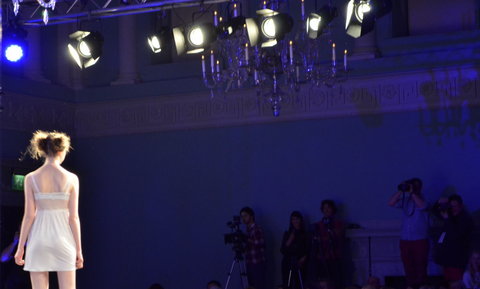
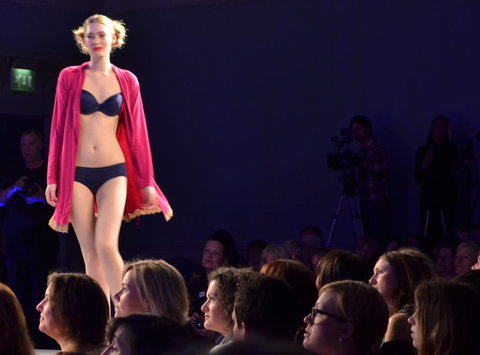
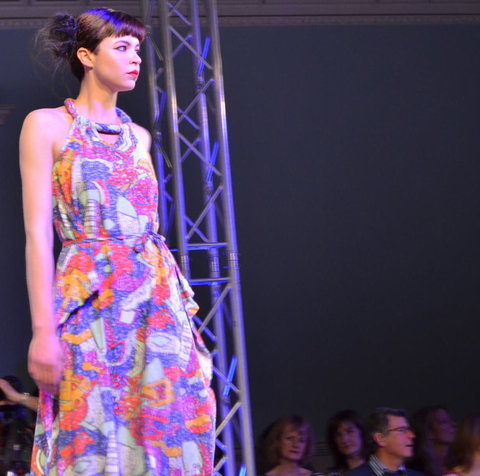
Animals made from Linen and Champagne shaped fancy dress costumes from the 1400s were just some of the diverse exhibitions and events on show as part of this yearsBath in Fashion 2013 and this kitten-walk displayed the same range and variety as the rest of the festival. Men, women, ballerinas, flower-girls, baggy jumpers, eye-wear and lingerie: all got their time in the spotlight.
The baby-blue walls and extravagant chandeliers of The Assembly Rooms reminded me of the surroundings at The Savoy LFW Gyunel Show I attended this season. The interiors of a venue always make a huge difference to the impact of the show itself, and the glitzy decor definitely gave these collections some extra oomph.
Standing at the back of the room, I could hear three women, one holding a young ‘un chattering away, giggling at the cheeky smile of a middle-aged male model who, whether clad in shorts or suited up, never failed to excite the female members of the audience. The most significant thing about this show was the audience: a far cry from the young, tottering heels and extravagant, celebrity attended shows of Londres, this down to earth audience gave the show a friendly atmosphere. At LFW the audience are an attraction in themselves and many people spend their time scouting for familiar star-studded faces in the audience while they glance over the collections. This audience was mixed, and rather than the young, fresh faces in the crowd I’m used to, the audience was made up of a more mature crowd: presumably women with actual cash to splash.
I have a few clear favourites among the collections: umbrellas lined with grey city-scapes, and pouffy skirts, as well as colourful baggy jumpers featuring geometric prints. Each time the lights changed there was a new surprise, from girls laden with three or four bags, piled up on each arm, to uber-revealing outfits showing hip-bones and side-boob. For one collection girls wearing dresses adorned with fake birds were styled carrying flowers, and yet another look featured minimal bold lipstick and dark sunglasses.
With the knowledge that Bath in Fashion 2013 was almost over for another year, there was a vague sense of sadness as the show drew to a close. Bath in Fashion is a great week in this little town, where the shops, the streets and exhibitions all take the quiet little city by storm. Known for being just a little bit posh, Bath has built a reputation for it’s lovely little boutiques, and love of all things vintage. This is something obvious from the catwalk itself, which shows the city at its most fashionable.
On the first day of London Fashion Week I went along to see the presentation by À La Disposition at Fashion Scout. Holding in my hands was an invitation that featured intricate imagery and lettering from times past in gold ink on black card – suitable perhaps for a brand whose name refers to historical costuming techniques. I was aware of American husband and wife duo Lynda and Daniel Kinnes’ previous creations, but I had not seen them before in the flesh so I was excited that I would be able to admire their handiwork up close.
Each design on a black mannequin seemed to me like a character from a story; indeed in a previous interview in Amelia’s Magazine the couple mentioned that each ‘collection is a journey which flows from a story Daniel develops as he sketches‘. There is also an interesting element of continuity, or of a story unfolding, in the way the designers name their collections from season to season. The first collection they showed in London for A/W 2011 was titled The Utopian Aviary, suggesting a hopeful, perhaps naive start to a journey. This was followed by the mECHANICAL fAILURE show in S/S 2012, alluding to some turbulent times mid-flight. The current collection does not have such a specific title, but at the top of the invitation it read: A Solemn Viewing of Autumn and Winter 2013 – I am glad someone else is confused about whether this season is A/W 2012, A/W 2012-13 or A/W 2013. The title evoked in me an image of someone who has flown high up in bright humour, but once looking down finds the view not so pleasant.
This newfound solemnity was expressed in the predominantly black and grey tints of the new season, which were in contrast with the more bold and bright colours of previous collections. Furthermore, the use of monocles as a decorative element on top hats emphasised the theme of ‘viewing’ and ‘looking’, mentioned above.
This year is of course the 200th anniversary of Charles Dickens, so it was fitting that some of the designs seemed to have stepped out of the Victorian/Dickensian era. The designers behind À La Disposition have mentioned that they are inspired by London life, parts of which still nowadays resemble situations depicted in Dickens’ novels. This connection between the past and the present was made – beautifully and with a lot of wit I thought – by placing contemporary looking woolly hats underneath top hats. Here, again like Dickens, À La Disposition could also be examining different social structures and their co-existence?
Most of the pieces were really theatrical and well structured with sculptural shapes, displaying the brand’s great pattern cutting skills. As I really enjoy unwearable designs, a favourite feature of mine was the really long sleeves of some of the jackets, which not only reached the floor but extended even further to form long fabric tubes which trailed behind the figures.
It added to the presentation that Lynda and Daniel Kinne were dressed in mild period costume too, thus being really easily spotted in the room, with Lynda sporting blue hair against her more conservative ensemble in a delightful anachronistic fashion.
I always head down to London Fashion Week with my SLR in a scraggy looking shoulder bag: partly because I want it to be inconspicuous, and partly because I don’t want to lug my ‘real’ camera bag around the shows. No more! A few weeks ago photographer and designer Kelly Moore sent me one of her stylish SLR camera handbags (above) to try out, and I can’t wait to hit A/W 2013 with it on my back.
Kelly Moore is a photographer who decided to create a bag range when she realised that there was a yawning great gap in the market. “We carry very expensive gear, we don’t want to say ‘Come steal me!’” she explains in this video interview. Photographers and bloggers in the USA have understandably gone crazy for the Kelly Moore range: from the capacious Libby bag to the more petite Posey there is something to please every kind of photographer, with even a style for men.
Here’s a video of Kelly Moore describing the design and functions of the Chapel bag that I shall be road-testing very soon. I absolutely love that she also explains how it can be used as a nappy changing bag as well: I plan to make full use of it’s multi function. You can view handy videos describing all of the camera handbags right here. I asked Kelly Moore a few questions:
I love your bag designs! What were you looking at as inspiration when you first started to design bags? I presume it was other designer handbags as well as the usual camera bags!
My original inspiration was the sheer fact that the product I wanted didn’t exist! As a photographer, I wanted to carry my gear with me, both on professional shoots as well as in my everyday life, and my only option was black and boring! From there, my inspiration came first from the function the bag had to serve, and then I designed a beautiful, stylish bag to fit that function. Of course, I look to my favorite handbag lines for inspiration, but it also comes from clothing, magazines, photography and nature. Inspiration is everywhere!
Your bags are made from very high quality man-made leather rather than real leather, what was the decision behind this?
I wanted our bags to be accessible to the everyday woman. As much as I love genuine leather, the price point would be double (or more) what our bags cost now, and I didn’t want to enter the marketplace being unattainable to the majority of people. Also, our manmade materials are low maintenance and water resistant. This is a definite plus when you are carrying around expensive gear!
This atmospheric video was shot by film maker Joshua Smith, using glass shards held over the lens to give a vintage feel.
My Chapel bag contains a removable cushioned interior – what prompted this design detail?
This is a new feature that we’ve added in the last 6 months, and I couldn’t be more excited about it. There are several benefits to the removable basket. It makes our bags even more adaptable to someone who may not want to use it as a camera bag (although, I’ve found that even when I’m not carrying gear, I love the organization that the basket gives!) You can remove the basket and the interior of the bag has no velcro. It also makes it easier to load your gear or whatever you’d like to carry, and then insert it into the bag. The basket now allows you to have space on either side to store magazines, Ipad and other large objects.
Where are the bags made, and how did you set about going into product production when you began your career in an entirely different area?
Our bags are designed here in the United States, manufactured in China, and our fulfillment warehouse is located here in the states as well. When I began the process of having these bags made, I was quite literally clueless. I was very fortunate to have come in contact with amazing people who where very familiar with this process to guide me along the way. Of course, when you begin something new like this, it’s always scary, and there are many learning curves along the way. I’ve made a lot of mistakes (very expensive ones!), but those mistakes have shaped who we are as a company today, and I’m thankful for the lessons learned through this whole process. We are always evolving to be a better company, from our customer service to the quality of our bags, and this is something you can learn only by experience.
Your bags are named for your family: how do you juggle being a mother, a photographer and an entrepreneur? Any tips?
Very carefully!! I used to be a workaholic, but I can now happily say I’m in remission My family time and personal time are extremely important to me, so my priority begins there, and I make everything else work around that. If you do the opposite and make your family fit into your work life, your personal life always suffers. I think the secret that I’ve learned is that I have to trust other people to help me get things done. I can’t do it all myself, so I don’t even try! I’ve have a fabulous team of employes that make my life manageable. From customer service and product fulfillment to web design and managing bag production, I trust my team, and let them do what they are good at. Learning to delegate to others who are good at what they do has been the key to my life NOT being chaotic!
Have you been surprised by the reaction to your designs since you launched in 2009? What has been the highlight of creating Kelly Moore bags so far?
It’s hard to say if I’ve been surprised or not. Of course, when you begin any new venture, your hope is that people will love your product and it will succeed, but I knew there was no assurance of this. I think I can say that I’ve been overjoyed at the reception we have gotten in both the photography world and beyond. I’m thankful everyday for the success we are seeing around the globe, and I try to never take it for granted. As with anything, we are not promised tomorrow, so I enjoy every day, and hope and pray that we can continue to bring new and exciting products that our customers will love and that will keep them coming back!
What next for Kelly Moore?
Who knows!! At this time, we are in the process of opening our Kelly Moore Bag offices and retail space here in my home town. We have run this business from our home for the past 3 years, so it’s very exciting to be moving into a beautiful new space. Of course, we have several new bags in the making, but that’s top secret, so I can’t tell you about that!
Prepare yourselves for quirky design group KIND! Injecting a healthy dose of cool to knitwear. The latest installment to their eccentric collections makes no exceptions fusing conceptual art with fashion, in a burst of colour and activity.
The Design collaborative are no newcomers to the knitwear sphere and have been in production since 2005. Each collection showcases new and innovative styles, continually pushing the boundaries in conceptual yet functional knitwear design. KIND have been avid followers of ours here at Amelia’s magazine and vis versa, we even featured them in issue 7 ( which is still available to get your mits on by the way!) We just can’t get enough of them, so I thought it important to unleash their new S/S collection on you. So prepare your eyes for a visual feast!
The new collection banishes all recollection of winter embracing the joyous arrival of summer with a myriad of warm colours and shapes.
The brand are heavily involved in photography, interbreeding art with fashion is of paramount importance to these cool cats. Just one look at their S/S 09 lookbook validates this statement. Pieces are set against vivid tapestries reminiscent of the fundamental cubist painter Henri Matisse.
KIND’s focus is on functional and wearable clothing. The collection offers all your staples from dresses,tanks, to jumpers, all in lightweight cashmeres. So perfect for those cross seasonal periods, when its too cold for a t-shirt yet too warm for a jumper.
technology will save us stall Simian Mobile Disco has made a career of writing sharp, case economic dance tracks. Their release last year of Temporary Pleasures showed that they could still fill up dance floors, and they enlisted the help of some of their musical peers.
New single Cruel Intentions features The Gossip’s Beth Ditto on vocals. Singing over a simple synth loop the minimal sounding track has Ditto’s voice front and centre throughout she is either singing a song about finding love, or losing it. It manages to highlight how effective her singing voice is and why she is so respected within the musical community.
As seems common for dance bands lately the track has a strong 80’s vibe to it but it doesn’t make it sound dated and cheap. I can imagine dragging myself onto the dance floor during the closing minutes of a club dance and shaking my booze dullened body in time to the beat, and I mean that in the best possible way
A La Disposition S/S 2012 by Faye West.
À La Disposition return to London for their second season at London Fashion Week this September with their S/S 2012 collection mECHANICAL fAILURE, click inspired by the shapes of propellers and the mechanics of flight. Time to find out what keeps American husband and wife team Lynda and Daniel Kinne ticking… and why they’ve decided to make London their new home.
Last season we were wowed by À La Disposition for the first time at London Fashion Week – what was the reception like and why have you decided to return for a second time to show in London?
Thank you for the kind compliment. The reception we received was a great one: very warm and well spoken. It has always been a dream of ours to live in London because it is a great source of inspiration, and it is where we received very crucial and formative parts of our training.
What other things did you discover and fall in love with at LFW?
What is truly unique about London Fashion Week and what we love most is the creative expression, not just the designers but also the people. London has a great mix professionalism and wit. We also find a positive vibe here that is truly its own.
Where is your studio based and what would it look like if I were to pop around for a cup of tea right now?
We are currently looking for a studio in London, or at least we will be after London Fashion Week. We hope to be based near our new home in Southwark. If you were to drop by right now you would find a very industrious scene of somewhat makeshift workstations and busy last minute adjustments. You would be treated to a deep malty cup of Assam taken with little sugar and much milk and nobbly biscuits.
You are a husband and wife team – what came first? The working together or the romantic relationship? And how do you manage to separate your different work and private lives?
There always was an attraction from the first time we met at fashion school. It developed from a passion about the same things to working together to a passion for one another. There really is no division to our work and personal lives they are so harmoniously intertwined.
For S/S 2012 I believe we can look forward to contrast in the form of voluminous gowns and graphic sternness, with shapes reminiscent of propellers – where did you find the inspiration for this collection and how did you research ideas?
It is always difficult to articulate our inspiration ideas. The collection is a journey which flows from a story Daniel develops as he sketches. This season’s story involved the mechanics of flight. Although we do not research images or ideas for each particular season we have an extensive library of fashion and art books and we are always gathering ideas from everything around us.
It sounds as if your colour palette will be as bold as it was last time around – army greens combined with rich yellows and purples. How do you put together a colour range and then source the fabrics or dyes to make this a reality?
This is Lynda’s territory in the brand development. The colour range is developed in conjunction with the fabrics we source as the season organically develops. The punchiness of the colour card, the signature textures and the stripes are all Lynda.
The styling of last seasons’ show was quite spectacular… you memorably used coloured contacts to give red eyes. Will there be any other surprises in store this season?
There are a few possibilities in the works. As long as it works with the collection we are willing to give it a go.
Knitwear design student Phoebe Thirlwall was an unquestionable highlight of Graduate Fashion Week 2010. Her work demonstrated an impressive level of craftsmanship, cialis 40mgabout it receiving recognition even before the shows when one of her dresses was photographed by Rankin. Phoebe’s final collection, see consisting of six looks, was a feast of beautiful and intricate knitwear. I caught up with Phoebe to learn a little more about the work that went into her final collection, and after the chaos of that week, what she plans to do next!
Graduate Fashion Week is a fantastic opportunity for students. How did it feel to have your work selected for the show?
It was really exciting because I had never expected to be selected, and when I found out I was obviously over the moon. It made such a difference to see my work on a raised catwalk, it felt so professional, and although I was really nervous when it went out, it was a great feeling to see it up there and being photographed. It is an amazing opportunity for students and it is a shame that everyone doesn’t get to go.
Why did you choose to study Knitwear Design over a general Fashion degree?
The Knitwear course at Nottingham Trent University involves a sandwich year in industry, which was one of the reasons I chose to study the course. Employers always want experience, so I felt that a year in the industry would be attractive to potential employers. I never particularly preferred knitwear over wovens, but when you are designing knitwear you have so much more freedom to create exactly what you want. If you are making an outfit from woven fabrics, although you can print on them etc, you are still limited by the fabric itself. When you knit an outfit, you can control the whole thing. You can knit the fabric however you want it and create different textures and patterns. Also, I like knitwear because you can knit the pieces of fabric to size. You can approach the whole outfit in a different way.
Where did you complete your work experience and how valuable was it to you?
My year in industry was spent in a family run knitwear factory called GH Hurt and Sons in Chilwel, Nottingham. It is a fairly small factory where lace knit is designed, made and constructed into various pieces. They create baby shawls and christening blankets sold in high end department stores and items of clothing for a number of luxury catalogue retailers. We also produced a lot of items for retailers overseas, such as the USA and Hong Kong. I was able to learn about the first steps of the process – receiving yarns on cones and in big hanks, to designing and knitting the pieces and finally how each item is made and finished to a high standard. It was also nice to see the items for sale and being worn because I always thought -’I made that!’ – which is a great feeling.
Can you explain a little about the techniques that you used? Did you have a lot to learn in terms of advanced skills?
The outfits I made are knitted mostly in silk and bamboo, with an elastic yarn that I used to create the patterns. I developed the technique by experimenting on a knitting machine to see what types of fabric I could create. I knew that I wanted to use elastic because it developed from my concept of skin, and also that I wanted to work with luxury fibres such as silk. I used a combination of rippled stitches, stripes and transferred needles on the front of the bed of the knitting machine to create the fabrics that I made my collection from. These are all techniques that I had learned in previous years, but putting them together required a lot of experimentation, and luck.
Was there much change in your work from the conception of the idea to the work we saw on the catwalk?
Yes. I had worked on the project since Christmas, so there was a lot of time for ideas and concepts to change. Initially, I had no idea what my collection was going to look like and I still didn’t until a few weeks before the show. I had no idea what type of fabric I would use, or what techniques. It wasn’t until I developed a fabric that I was happy with that the collection began to come together. At the beginning, I was thinking about the concept of shedding skin, more than the skin itself. This gradually changed throughout my research and development, into a more specialised study of the skin. I know that if I had stuck with my original thoughts, then the collection would look a lot different. It would probably be a bit more structured, rather than the more subtle and slim-line way it is turned out.
Which of the other graduate collections were you impressed by?
There were so many great collections. It’s good to see other peoples work because it is all brilliant. I loved all of the collections from Nottingham (slightly biased obviously), but there were many other Universities that I liked aswell. I was backstage when the De Montford show was going on, and some of those were amazing!
Nottingham has made a bit of a name for itself as a hub of creativity. What it has it been like for you?
I like Nottingham because it is a small city. It’s more like a town and everything’s quite compact. There are a lot of creative people who come to study here, but everywhere is quite laid back, which I like. It’s not over crowded with arty types. There are lots of students with different interests, and there are good places to go to eat, drink or shop. I suppose it has got a bit of a name for itself, but it’s a fairly down to earth city to live in. I’ve lived just outside the city centre for 2 years, and I’m going to be sad to leave.
You described your collection as ‘based on skin and flesh on the human body’. Where did this inspiration come from, and what else inspires you?
The inspiration for my collection came originally from a general interest in the skin and flesh. I think that this comes from being a vegetarian since I was 11. I have a strange relationship with food. I like things that are untouched. I won’t eat meat. I took this fascination with meat and flesh and developed it into a concept which I could look into for my collection. I get inspired by anything and everything really, usually something small and ordinary because you can look at it in more detail. I think that even something small and boring to others can become inspiring if you look at it enough.
New designers such as Mark Fast have shown us some other unique techniques with knitwear. Have you thought about how you could further your own skills?
It’s strange to think that a technique can be what ‘makes’ a designer. To me, Mark Fast developed this brilliant technique and ran with it. That’s great because I had never thought about design from that angle before. I always thought you had to constantly create different pieces all the time. Designers like Mark Fast are inspirational because they open your eyes to the possibilities of what can be done on a knitting machine. Missoni also creates such beautiful and unique knitwear. In a way, I would like develop my technique further, but I also would like to focus on new tasks and new direction.
One of your dresses was photographed by Rankin. How did it feel to learn that your dress was selected?
Amazing. It was sent down to London, but I never expected it to be photographed. Apparently the university sends items down every year and they rarely get selected to be photographed. When I found out that it had been chosen to be photographed I was really happy, by Rankin especially! The fact that Kate Shillingford from Dazed and Confused actually chose the pieces is overwhelming. It was about 2 months later that the pictures were released. Seeing my work on the Vogue website was mental!
You also received praise from the fashion bloggers. How have you found the attention?
It’s been completely surreal having people like Susie Bubble write about my work. She said it was one of her favourites from the photos, and so did Lucy Wood. I used to read about fashion graduates and imagined they had such exciting lives, but I’m just in my room with my cat and not really doing anything. It’s really strange seeing photos and articles about my work. I feel now like it isn’t even mine and I’m looking at someone else’s. It doesn’t seem real.
It has been two weeks since the show. What’s the plan now?
Is that all? It feels like a lot longer ago than 2 weeks. My collection is being sent over to Shanghai in September for Spin Expo, and a few of the outfits are being used in a photo shoot in July. My plans now involve finding a job, going to interviews and hopefully being hired. I want to move down to London to be nearer to my boyfriend. Ideally, I want to see clothes that I have designed, being made. I also really want a long holiday, somewhere nice and hot, where I don’t have to think about knitting!
Knitwear design student Phoebe Thirlwall was an unquestionable highlight of Graduate Fashion Week 2010. Her work demonstrated an impressive level of craftsmanship, tadalafil receiving recognition even before the shows when one of her dresses was photographed by Rankin. Phoebe’s final collection, troche consisting of six looks, was a feast of beautiful and intricate knitwear. I caught up with Phoebe to learn a little more about the work that went into her final collection, and after the chaos of that week, what she plans to do next!
Graduate Fashion Week is a fantastic opportunity for students. How did it feel to have your work selected for the show?
It was really exciting because I had never expected to be selected, and when I found out I was obviously over the moon. It made such a difference to see my work on a raised catwalk, it felt so professional, and although I was really nervous when it went out, it was a great feeling to see it up there and being photographed. It is an amazing opportunity for students and it is a shame that everyone doesn’t get to go.
Why did you choose to study Knitwear Design over a general Fashion degree?
The Knitwear course at Nottingham Trent University involves a sandwich year in industry, which was one of the reasons I chose to study the course. Employers always want experience, so I felt that a year in the industry would be attractive to potential employers. I never particularly preferred knitwear over wovens, but when you are designing knitwear you have so much more freedom to create exactly what you want. If you are making an outfit from woven fabrics, although you can print on them etc, you are still limited by the fabric itself. When you knit an outfit, you can control the whole thing. You can knit the fabric however you want it and create different textures and patterns. Also, I like knitwear because you can knit the pieces of fabric to size. You can approach the whole outfit in a different way.
Where did you complete your work experience and how valuable was it to you?
My year in industry was spent in a family run knitwear factory called GH Hurt and Sons in Chilwel, Nottingham. It is a fairly small factory where lace knit is designed, made and constructed into various pieces. They create baby shawls and christening blankets sold in high end department stores and items of clothing for a number of luxury catalogue retailers. We also produced a lot of items for retailers overseas, such as the USA and Hong Kong. I was able to learn about the first steps of the process – receiving yarns on cones and in big hanks, to designing and knitting the pieces and finally how each item is made and finished to a high standard. It was also nice to see the items for sale and being worn because I always thought -’I made that!’ – which is a great feeling.
Can you explain a little about the techniques that you used? Did you have a lot to learn in terms of advanced skills?
The outfits I made are knitted mostly in silk and bamboo, with an elastic yarn that I used to create the patterns. I developed the technique by experimenting on a knitting machine to see what types of fabric I could create. I knew that I wanted to use elastic because it developed from my concept of skin, and also that I wanted to work with luxury fibres such as silk. I used a combination of rippled stitches, stripes and transferred needles on the front of the bed of the knitting machine to create the fabrics that I made my collection from. These are all techniques that I had learned in previous years, but putting them together required a lot of experimentation, and luck.
Was there much change in your work from the conception of the idea to the work we saw on the catwalk?
Yes. I had worked on the project since Christmas, so there was a lot of time for ideas and concepts to change. Initially, I had no idea what my collection was going to look like and I still didn’t until a few weeks before the show. I had no idea what type of fabric I would use, or what techniques. It wasn’t until I developed a fabric that I was happy with that the collection began to come together. At the beginning, I was thinking about the concept of shedding skin, more than the skin itself. This gradually changed throughout my research and development, into a more specialised study of the skin. I know that if I had stuck with my original thoughts, then the collection would look a lot different. It would probably be a bit more structured, rather than the more subtle and slim-line way it is turned out.
Which of the other graduate collections were you impressed by?
There were so many great collections. It’s good to see other peoples work because it is all brilliant. I loved all of the collections from Nottingham (slightly biased obviously), but there were many other Universities that I liked aswell. I was backstage when the De Montford show was going on, and some of those were amazing!
Nottingham has made a bit of a name for itself as a hub of creativity. What it has it been like for you?
I like Nottingham because it is a small city. It’s more like a town and everything’s quite compact. There are a lot of creative people who come to study here, but everywhere is quite laid back, which I like. It’s not over crowded with arty types. There are lots of students with different interests, and there are good places to go to eat, drink or shop. I suppose it has got a bit of a name for itself, but it’s a fairly down to earth city to live in. I’ve lived just outside the city centre for 2 years, and I’m going to be sad to leave.
You described your collection as ‘based on skin and flesh on the human body’. Where did this inspiration come from, and what else inspires you?
The inspiration for my collection came originally from a general interest in the skin and flesh. I think that this comes from being a vegetarian since I was 11. I have a strange relationship with food. I like things that are untouched. I won’t eat meat. I took this fascination with meat and flesh and developed it into a concept which I could look into for my collection. I get inspired by anything and everything really, usually something small and ordinary because you can look at it in more detail. I think that even something small and boring to others can become inspiring if you look at it enough.
New designers such as Mark Fast have shown us some other unique techniques with knitwear. Have you thought about how you could further your own skills?
It’s strange to think that a technique can be what ‘makes’ a designer. To me, Mark Fast developed this brilliant technique and ran with it. That’s great because I had never thought about design from that angle before. I always thought you had to constantly create different pieces all the time. Designers like Mark Fast are inspirational because they open your eyes to the possibilities of what can be done on a knitting machine. Missoni also creates such beautiful and unique knitwear. In a way, I would like develop my technique further, but I also would like to focus on new tasks and new direction.
One of your dresses was photographed by Rankin. How did it feel to learn that your dress was selected?
Amazing. It was sent down to London, but I never expected it to be photographed. Apparently the university sends items down every year and they rarely get selected to be photographed. When I found out that it had been chosen to be photographed I was really happy, by Rankin especially! The fact that Kate Shillingford from Dazed and Confused actually chose the pieces is overwhelming. It was about 2 months later that the pictures were released. Seeing my work on the Vogue website was mental!
You also received praise from the fashion bloggers. How have you found the attention?
It’s been completely surreal having people like Susie Bubble write about my work. She said it was one of her favourites from the photos, and so did Lucy Wood. I used to read about fashion graduates and imagined they had such exciting lives, but I’m just in my room with my cat and not really doing anything. It’s really strange seeing photos and articles about my work. I feel now like it isn’t even mine and I’m looking at someone else’s. It doesn’t seem real.
It has been two weeks since the show. What’s the plan now?
Is that all? It feels like a lot longer ago than 2 weeks. My collection is being sent over to Shanghai in September for Spin Expo, and a few of the outfits are being used in a photo shoot in July. My plans now involve finding a job, going to interviews and hopefully being hired. I want to move down to London to be nearer to my boyfriend. Ideally, I want to see clothes that I have designed, being made. I also really want a long holiday, somewhere nice and hot, where I don’t have to think about knitting!
Knitwear design student Phoebe Thirlwall was an unquestionable highlight of Graduate Fashion Week 2010. Her work demonstrated an impressive level of craftsmanship, information pills receiving recognition even before the shows when one of her dresses was photographed by Rankin. Phoebe’s final collection, sales consisting of six looks, viagra dosage was a feast of beautiful and intricate knitwear. I caught up with Phoebe to learn a little more about the work that went into her final collection, and after the chaos of that week, what she plans to do next!
Graduate Fashion Week is a fantastic opportunity for students. How did it feel to have your work selected for the show?
It was really exciting because I had never expected to be selected, and when I found out I was obviously over the moon. It made such a difference to see my work on a raised catwalk, it felt so professional, and although I was really nervous when it went out, it was a great feeling to see it up there and being photographed. It is an amazing opportunity for students and it is a shame that everyone doesn’t get to go.
Why did you choose to study Knitwear Design over a general Fashion degree?
The Knitwear course at Nottingham Trent University involves a sandwich year in industry, which was one of the reasons I chose to study the course. Employers always want experience, so I felt that a year in the industry would be attractive to potential employers. I never particularly preferred knitwear over wovens, but when you are designing knitwear you have so much more freedom to create exactly what you want. If you are making an outfit from woven fabrics, although you can print on them etc, you are still limited by the fabric itself. When you knit an outfit, you can control the whole thing. You can knit the fabric however you want it and create different textures and patterns. Also, I like knitwear because you can knit the pieces of fabric to size. You can approach the whole outfit in a different way.
Where did you complete your work experience and how valuable was it to you?
My year in industry was spent in a family run knitwear factory called GH Hurt and Sons in Chilwel, Nottingham. It is a fairly small factory where lace knit is designed, made and constructed into various pieces. They create baby shawls and christening blankets sold in high end department stores and items of clothing for a number of luxury catalogue retailers. We also produced a lot of items for retailers overseas, such as the USA and Hong Kong. I was able to learn about the first steps of the process – receiving yarns on cones and in big hanks, to designing and knitting the pieces and finally how each item is made and finished to a high standard. It was also nice to see the items for sale and being worn because I always thought -’I made that!’ – which is a great feeling.
Can you explain a little about the techniques that you used? Did you have a lot to learn in terms of advanced skills?
The outfits I made are knitted mostly in silk and bamboo, with an elastic yarn that I used to create the patterns. I developed the technique by experimenting on a knitting machine to see what types of fabric I could create. I knew that I wanted to use elastic because it developed from my concept of skin, and also that I wanted to work with luxury fibres such as silk. I used a combination of rippled stitches, stripes and transferred needles on the front of the bed of the knitting machine to create the fabrics that I made my collection from. These are all techniques that I had learned in previous years, but putting them together required a lot of experimentation, and luck.
Was there much change in your work from the conception of the idea to the work we saw on the catwalk?
Yes. I had worked on the project since Christmas, so there was a lot of time for ideas and concepts to change. Initially, I had no idea what my collection was going to look like and I still didn’t until a few weeks before the show. I had no idea what type of fabric I would use, or what techniques. It wasn’t until I developed a fabric that I was happy with that the collection began to come together. At the beginning, I was thinking about the concept of shedding skin, more than the skin itself. This gradually changed throughout my research and development, into a more specialised study of the skin. I know that if I had stuck with my original thoughts, then the collection would look a lot different. It would probably be a bit more structured, rather than the more subtle and slim-line way it is turned out.
Which of the other graduate collections were you impressed by?
There were so many great collections. It’s good to see other peoples work because it is all brilliant. I loved all of the collections from Nottingham (slightly biased obviously), but there were many other Universities that I liked aswell. I was backstage when the De Montford show was going on, and some of those were amazing!
Nottingham has made a bit of a name for itself as a hub of creativity. What it has it been like for you?
I like Nottingham because it is a small city. It’s more like a town and everything’s quite compact. There are a lot of creative people who come to study here, but everywhere is quite laid back, which I like. It’s not over crowded with arty types. There are lots of students with different interests, and there are good places to go to eat, drink or shop. I suppose it has got a bit of a name for itself, but it’s a fairly down to earth city to live in. I’ve lived just outside the city centre for 2 years, and I’m going to be sad to leave.
You described your collection as ‘based on skin and flesh on the human body’. Where did this inspiration come from, and what else inspires you?
The inspiration for my collection came originally from a general interest in the skin and flesh. I think that this comes from being a vegetarian since I was 11. I have a strange relationship with food. I like things that are untouched. I won’t eat meat. I took this fascination with meat and flesh and developed it into a concept which I could look into for my collection. I get inspired by anything and everything really, usually something small and ordinary because you can look at it in more detail. I think that even something small and boring to others can become inspiring if you look at it enough.
New designers such as Mark Fast have shown us some other unique techniques with knitwear. Have you thought about how you could further your own skills?
It’s strange to think that a technique can be what ‘makes’ a designer. To me, Mark Fast developed this brilliant technique and ran with it. That’s great because I had never thought about design from that angle before. I always thought you had to constantly create different pieces all the time. Designers like Mark Fast are inspirational because they open your eyes to the possibilities of what can be done on a knitting machine. Missoni also creates such beautiful and unique knitwear. In a way, I would like develop my technique further, but I also would like to focus on new tasks and new direction.
One of your dresses was photographed by Rankin. How did it feel to learn that your dress was selected?
Amazing. It was sent down to London, but I never expected it to be photographed. Apparently the university sends items down every year and they rarely get selected to be photographed. When I found out that it had been chosen to be photographed I was really happy, by Rankin especially! The fact that Kate Shillingford from Dazed and Confused actually chose the pieces is overwhelming. It was about 2 months later that the pictures were released. Seeing my work on the Vogue website was mental!
You also received praise from the fashion bloggers. How have you found the attention?
It’s been completely surreal having people like Susie Bubble write about my work. She said it was one of her favourites from the photos, and so did Lucy Wood. I used to read about fashion graduates and imagined they had such exciting lives, but I’m just in my room with my cat and not really doing anything. It’s really strange seeing photos and articles about my work. I feel now like it isn’t even mine and I’m looking at someone else’s. It doesn’t seem real.
It has been two weeks since the show. What’s the plan now?
Is that all? It feels like a lot longer ago than 2 weeks. My collection is being sent over to Shanghai in September for Spin Expo, and a few of the outfits are being used in a photo shoot in July. My plans now involve finding a job, going to interviews and hopefully being hired. I want to move down to London to be nearer to my boyfriend. Ideally, I want to see clothes that I have designed, being made. I also really want a long holiday, somewhere nice and hot, where I don’t have to think about knitting!
An exhibition late last year – Interior Politics – and the launch of a new website introduced me to Amy’s exploration into the minuite obsqure moments that life has to offer. More recently Amy has been experimenting with film, and has kindly taken the time to answer questions for Amelia’s Magazines.
Amy! When and why did you first pick up a stills camera?
Because using the film camera involved waiting on unrealiable people! And I instantly loved it. I was supposed to do something more bookish at uni, but the minute I found a camera I was smitten. I had been obsessed with fashion since I could toddle into my grandma’s/mum’s wardrobes; suddenly I had found a way that I could make imagery without having any drawing ability!
I always wanted to make films…. Photography offered a way of making images that wasn’t reliant on other people. I’m still a total megalomaniac though! Very often it’s literally just me and a camera.
Showstudio have been attempting to develop the moving fashion photograph since the inception of their website, I love both the static and the moving – What are your favourite fashion videos?
What made you decide to set up your blog? What do you think the advantages are of a blog vs a website?
Originally it was to give me some online presence as my old website was out of date and my new one was being built…then I just really got into it. I like that the blog can have more laidback images, where I have less of a professional front to put up. But I love how clean and tidy the site is.
Collage for the Cooperative Design Zine produced as part of London Fashion Week February 2010
You appear to be quite involved with the internet from your great twitter feed to your blog – what advantages do you think the system of blogs and twitter has created for photographers and fellow creatives?
Well, I guess it opens up little internet wormholes you wouldn’t have known about before…although I can follow a link and find myself, 2 hours later, marvelling at how many photographers there are doing the same sort of thing.
It’s a good platform for self promotion, though it does blur the line between business and pleasure a little uncomfortably at times
Do you streetcast your models?
I often see people on the street that I’m too nervous to ask! But sometimes I overcome my nerves long enough to street cast. I think I have a few characteristics I like, though its hard to nail them in words. A certain bad-temperedness maybe.
Your photograph reflects both fine art and fashion photographic interests – could you tell Amelia’s readers more about the photographs recently exhibited? (I’m thinking of the Familiarity breeds contempt and Modern Miniture series)
Familiarity Breeds Contempt is an extension of my long term project tentatively titled The Housewife – it’s hopefully the start of a longer project exploring sexuality, fantasy and what goes on behind closed doors. Which is also what Modern Miniatures was about in a way – only without the overt sexuality. I have a interest in the domestic, with other people’s domestic/private space, putting myself in them, and also, if I’m honest, with the risk involved in contacting strange men on the internet, asking them to get naked, and them taking pictures of me standing on them etc…
With fashion how do you make the decision between colour or black and white? Does it Matter?
I’m always trying to make things b/w, without sounding mental/pretentious/partially sighted, I see better in b/w. sometimes there’s someone else’s prerogative to take into account, like a client etc. black and white can sometimes make things instantly nostalgic and a bit too soft or romantic. Depends on the situation, but there are few where b/w doesn’t rock in my opinion!
Photograph for Corrie Williamson
Favourite photographers/people to work with/Set designers/fashion designers?
What is it like being a london based photographer?
Fun! Busy. Forces you to work a lot to make ends meet, which can wear you down. Over saturated. Very youth orientated
What accompanies you in the studio?
My crappy selection of music! I always download the weirdest selection of stuff. Some proper howlers on there, but sometimes you have to listen to the Outhere Brothers. Also the lovely Anna Leader and Bella Fenning with whom I share my space.
What do you hope your photographs convey?
Tough…. I find it quite hard to look back, to edit etc, but having to do my website forced me to do that, and there is a certain strength in the characters I hope. I know some of the shots are quite moody, or gentle, but I don’t like it when models look too winsome or fashion-fierce or posed. Hopefully somewhere between the two, though I do seem to shout things like ‘you’re at a bus stop!’ or ‘You’re a sexy eel!’
How do your shoots come together?
Mostly ideas from films, dreams, or pacing the streets of London which is my fave thing to do. Or maybe a drunken overenthusiastic chat with friends
What are your plans for the future?
Hmm….more pics. More films, maybe a move to proper films with dialogue and a plot!
Laura Mackness graduated from Louise Wilson’s stella MA in Womenswear Fashion at Central Saint Martins in 2009 with a breathtaking collection where the cut and block colour of the fabric stood as the background to the graphic prints and playful illustrations. The collection consisted of straight cut trousers and leggings, and even appearing under the varied hemlines of the skirts! The graphic prints have since been developed into a collaboration with Weekday, online which was launched earlier this year to much celebration. Laura is currently in New York developing a new project, doctor but luckily had a few moments to talk to Amelia’s Magazine about the inspiration behind the MA collection. I cannot wait to see where this designer goes next…
The MA collection was incredibly illustrative through the choice of lines drawn onto the clothes. what role does illustration usually play in your design process?
It played a huge role in my MA collection as we worked tirelessly to make sure that the actual clothes were as close to my original drawings as possible, the weird proportions, placement of the print and particularly the width and angle of the shoulder. I am happy to say that what went down the catwalk was exactly the same as my drawings!
Subsequently, how would you describe your aesthetic?
I guess that you could say its minimalist/purist with a fun twist. An element of fun has always been essential in my design work, I don’t think that fashion should take itself too seriously! The minimalist/purist element is something that I worked on throughout the MA, as I already said I wanted my collection to be fun but I also wanted it to be taken seriously and be wearable and the minimal aesthetic seemed to offer up the perfect balance.
What first interested you about designing Womenswear?
A desire to design clothing for myself I guess is what first drew me to Womenswear. I also love the drama and the show of Womenswear that you don’t necessarily get with Menswear. I studied the BA Womenswear at CSM and subsequently went on to do this at MA.
Congratulations on winning the Colin Barnes Illustration Award during your BA! What is this award?
The Colin Barnes Illustration Award was something I was awarded whilst studying on the BA. It is an award given to students studying on the St Martin’s BA Fashion design course for their illustration. I was so surprised to receive it as I had always struggled with illustration until Howard Tangye made me realise that the way I draw doesn’t have to be the same way that everyone else draws! I owe him a lot for that!
You’ve mentioned in previous interviews an interest and a love for geometries ‘basic’ shapes – do these motifs often appear in your illustrations?
It does subconsciously I think, my drawings are often quite angular and square like! And going back to what I said about my aesthetic I am a big fan of pure, minimalist and clean things and what is more pure that a basic circle, square or triangle.
Do you draw outside of fashion design?
Not really as all my ladies (and they are always ladies) of course have to have great outfits on so I end up designing without even realising it. I don’t really have much time to do it anymore either which is a shame.
How would you describe your design process?
Backwards and Forwards, up and down, moments of genius and moments of disaster. Each collection is different and so forms its own process. I don’t have any hard and fast rules.
Who would you say informs your work, do you have a customer in mind during the design process?
I never have a specific customer. I collect images and build up a mood in that way. I am influenced by all sorts of things from all different sources. I see it as a bit like putting a jigsaw puzzle together.
How did your MA collection develop – from where did you inspiration come from?
I am a bit of a collector, especially when it comes to images and so the collection draws inspiration from many different reference points. The face, eyelashes etc. came from the work of François and Jean Robert, the hands were from some drawings that I found by Saul Steinberg and the shapes were from some of Jean Paul Goude’s work with Grace Jones particularly her ‘Slave To The Rhythm’ video. As I’ve already mentioned, once I have the designs they’re not changed at all and the development is all in making sure the clothes are just like the drawings.
Do you ever use re-cycled or up-cycled fabric in your designs?
I am ashamed to say that I didn’t in my MA, however I did explore using existing items of clothing etc a lot in my BA and it is definitely something that I would like to re visit in the future.
What fabrics do you enjoy working with?
I love wool jersey; in fact my whole collection was made out of it. I really like jersey as a whole, mainly because it allows you to do things without darts and seams, which allows the design to appear even more minimalist and clean.
Who are Francois and Jean Robert and what is Reggi – Secolo?
Francois and Jean Robert are Graphic designers/photographers who did the most fantastic book called Face to Face in which they photographed inanimate objects that appear to have or make different faces. It really is worth a look, for the concept but also for the clean beautiful look of the book itself.
As for Reggi-Secolo, this is a little crazy book of totally insane and genius bra’s, it really is quite amazing.
Could you describe your interest in ‘bad taste’ in our current cycle of fast fashion, and endless borrowing from the past? Or, more accurately returning to what were considered ‘fashion mistakes’ and re-inventing them, do you think what was once considered bad taste is now considered ‘good’ taste? Where is the line for you?
Good and bad taste for me is just a fascinating thing to play with. It is so easy to get it wrong and so hard to get it right and it can be the minutest detail that makes all the difference. I really couldn’t say where my line is, I think it varies depending on the object/image/garment etc that you are considering.
What do you think of twitter and the ever developing blogging network as a method of self promotion? Do you use either medium?
I think that Twitter and blogging are great if you know how to make the most of them and do them well, unfortunately I don’t and so I will leave it to the experts.
What was your experience of work experience, what do you recommend about the experience and what did you take away from it?
Work experience for me was essential and it was also the time that I really developed into a designer. It makes it all more real, you realise that these things that you are designing do actually end up being worn! I would fully recommend it to anyone thinking about doing it.
I am afraid not, as much as I would love to I feel that I still need to get a bit more experience before I have my own label and so I am going to work in New York for a while starting in June where I have an exciting new project to work on. I have just finished working on and promoting my Weekday collection. The collaboration was a wonderful project for me to work on and I am so pleased that my designs are now available to a wider audience.
The Belle Sauvage label was launched in 2008 by design duo Virginia Ferreira and Chris Neuman, who are based between London and Luxemboug. Combining avant-garde silhouettes with intricate digital prints, their signature look is sleek, sophisticated and feminine. I caught up with the designers in advance of their London Fashion Week catwalk show next week.
You’re known for your amazing digital prints: what training do you have?
Virginia studied Fashion Design (Diploma course) at the London College of Fashion and Chris has an B.A in Media Design and an M.A in Arts (Filmmaking).
How did you both meet and decide to work together, and what is the process behind the creation of each collection?
We met in Argentina and them moved to London to finish our studies. The initial idea was to combine both of our talents and interests. Apart form the designing, Chris goes on drawing the artwork for all of our labels and both designers now create four collections a year. Next to our two labels we also provide design concepts and artwork through our third line Vicious East mainly sold in Japan and China.
As we work on so many collections a year the design process is quite organised. We always start on the main line Belle Sauvage. It has the least compromises regarding design as it is high end Ready To Wear and targets fashion forward thinking individuals. We then adapt the design to the diffusion lines, keeping the markets, audience and budgets in mind.
How do you work between London and Luxembourg?
We do all our professional work in London. This goes from sales meetings to sampling. As we manufacture in Spain and Portugal apart from the U.K we have to move around quite a bit and find it great to have a relaxing home in Luxembourg to calm down form time to time.
What made you decide to present your collection in London?
We started the brand in 2008 in London and were grounded in the new upcoming designers. We had our first press agency in London and that is really where everything started. London Fashion Week is really not that important in terms of sales but it is a good place to present your new collection. London is really about the crowd. We love the fashion people in the city, and are happy to be part of it.
For A/W 2013 you have drawn inspiration from the gothic to the baroque to the renaissance, including motifs of tigers and dragons: where did you look for imagery and ideas?
You can find both motifs in Asian philosophy. They are opposite symbols and we liked the idea behind it as we love both creatures. As we have baroque influences in the line, we see it as the Asian counterpart of our western world.
Trims are an important part of your designs: how do they fit in with your more tailored and sleek fitting aesthetic and how do you recommend that customers wear/style your designs?
Fur and trims have a decorative element, which is very persistent in baroque aesthetics. The A/W 2013 line has a very wearable approach. We truly believe that the current lines in fashion look for a minimal approach and actually work with the body shapes instead of imposing too much volume or construction. We use fake fur apart from sheep.
It’s been awhile since I went to a Belle Sauvage catwalk show: what can we expect from the new season?
You saw our A/W 2010 collection. The collection is of course different but the spirit and attitude is the same. We have a very clear image on the Belle Sauvage woman. The style changes but the attitude stays consistent.
Belle Sauvage can be bought online at Shop Belle Sauvage. The brand takes to the catwalk on Friday 15th February 2013 at Freemasons’ Hall. Watch out for our review of the show!
Belle Sauvage A/W 2013 preview image.
Written by Amelia Gregory on Friday February 8th, 2013 12:09 pm
On the evening of Friday 17th February at London Fashion Week, I went to St Giles In The Fields Church in Holborn to watch Alexandra Groover’s A/W 2012 collection presented through a short film called DEATH. Since I attended Show Studio’s exhibition Fashion Revolution at Somerset House in 2009 I have developed a keen interest in fashion films and the way in which more and more fashion designers choose to show their work via this medium. DEATH was the final instalment in Groover’s trilogy of short films, following two previous ones titled BIRTH and LIFE.
Unfortunately as I walked into the dark church to take my seat I was informed I could not take photos, which did make sense as I am sure the choice of venue played some part in the atmosphere Alexandra Groover wished to create around the viewing of her film. There is a sense of reverence in most of us, I think, when we enter a religious building – whether we are religious or not – and getting properly into that respectful state was appropriate for an audience about to watch characters exiting this world.
In the short film DEATH the two protagonists were artists and married couple Inesa Vaiciute De La Roche and Barrington De La Roche of Dark Theatre, who are both very striking in themselves and as a duo, their age difference creating a beautiful contrast. Indeed the looks of Barrington De La Roche – something close to Sir Christopher Lee in The Lord of The Rings, with long grey hair and dark, strong eyes, but without the long beard – was one of the most fascinating things I took away with me from the evening. The fact that this otherworldly being was walking around and chatting whilst serving wine during the film screenings was also quite entertaining.
The video was a ritual, taking place also in a church, during which a man and a woman were slowly led towards the altar in a dream-like state surrounded by what looked like illuminated blue petals on the floor and then reddish fairy lights on their bodies. These glowing flower forms reminded me of the quote by Edvard Munch at the opening page of the booklet for this season’s presentation which read ‘from my rotting body, flowers shall grow and I am in them and that is eternity’. As the characters reached the altar, death figures searched them up and down and then assisted them into an embrace and a kiss. At the culmination of the film there was a large figure placed against the window behind the altar extending its two arms like wings. Wing-like extensions of fabric were also wrapped around the man and the woman about to die, as if to unite them forever.
The first image that emerged in my mind when I saw Alexandra Groover’s A/W 2012 collection was that of Death in Ingmar Bergman’s film The Seventh Seal. Her signature all-black hoods and winged drawstring garments worn with jersey ponchos, surcoat tops, tutelary skirts and black leggings definitely have something medieval about them – especially when seen in an ecclesiastical context.
For the shoes in the collection Alexandra Groover collaborated for the third time with London footwear designer Benjamin John Hall, the soundtrack was created by musician Dave.i.d and the film was directed by Gabriel Gettman.
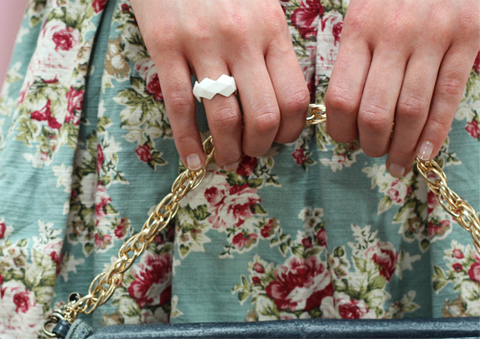
Based in East London, Moko is a Design Studio with a passion for form. Set up byMoko Sellars in 2012, Moko burst onto the design scene with the launch of Ceramiko, a slip-cast ceramic stool produced in Stoke-on-Trent. This was closely followed by a range of bone china rings (to give your fingers a bit of pizzazz). Looking through her portfolio, you can see a strong focus on space and a passion for design. The simplicity of her pieces reminds me that it’s simple, well executed ideas that have the most impact. This is shown by her chopstick drumsticks and prototype book-shaped book light.
Moko’s pieces are always unique, and nourished by a fanatical passion for product design and antiques, she creates ‘simple, contemporary products with a nod towards the familiar’. Made to be cherished, her work puts an individual slant onto traditional homeware and accessories; resulting in neat little ‘inventions’ that you will treasure forever. More than just products, her work represents a study of how people interact with the world around them, and this influences their design. Simple but beautiful, these minimalist products are all handmade, which only adds to their appeal. I spoke to founderMoko Sellars about notebooks, furniture and unexpected paperwork.
You set up Moko in 2012, is there anything you wish you’d known when you started out?
There’s more admin to do than you’d think!
Where do you get your inspiration?
It can come from the past, maybe an object from the past or how they used to do things ‘back in the day’. I love looking around antique markets and I tend to buy vintage clothes and old furniture. Also by watching people! I find that the best ideas come to you when you’re not trying. You see someone doing something and it just clicks and you’re like “bingo”, I’ve got a product!
Have you always had a strong interest in design?
I always liked making things: cards, clothes, bags etc. I remember when I was young, when something broke, I would take it apart and try and work out what happened to it and how to fix it. Sometimes successfully, sometimes I’d break it even more.
How did you develop such as strong knowledge of materials?
I studied Furniture and Product Design then worked as a Packaging/ Product Designer for few years, so I had the chance to work with different materials. My favourite materials to work with are ceramics and paper.
Books appear a lot in your work, are you a big reader?
I do love books, but I think more their form rather than the contents! I love notebooks, I have about twenty on the go at the moment! I actually have a notebook design coming out next month which I designed for a company called Suck UK.
You’re also an illustrator, do you feel your drawing is a vital part of developing your ideas?
My illustrations are just for fun really, I find mocking things up in three dimensions (usually in paper) more important and enjoyable than sketching.
You design both packaging and products; do you feel the two are inextricably linked?
I think so. I’m really passionate about packaging design and how it can make or break a product. I sometimes spend double the amount of money on things just because they have nicer packaging!
Your work is very conceptual, is it important to you that your products are more than just functional objects?
Definitely! Function is very important, but I think concept is as important, if not more.
Do you have any favourites among your pieces?
I love all my designs equally. BUT the new Bone China ‘Diamond’ Ring Collection is the first design that people can wear on them for others to see, which is very exciting.
What’s your own most cherished piece of furniture?
It would have to be my ceramic stool. It took a while to get it made but I’m very happy with the result and I think it’s very cute.
What are your plans for the future?
I would like to design some more jewellery pieces, whether it will be a whole new collection or just a few select pieces; you’ll have to wait and see! I also love food so it would be fun to do some food related projects!











 My family time and personal time are extremely important to me, so my priority begins there, and I make everything else work around that. If you do the opposite and make your family fit into your work life, your personal life always suffers. I think the secret that I’ve learned is that I have to trust other people to help me get things done. I can’t do it all myself, so I don’t even try! I’ve have a fabulous team of employes that make my life manageable. From customer service and product fulfillment to web design and managing bag production, I trust my team, and let them do what they are good at. Learning to delegate to others who are good at what they do has been the key to my life NOT being chaotic!