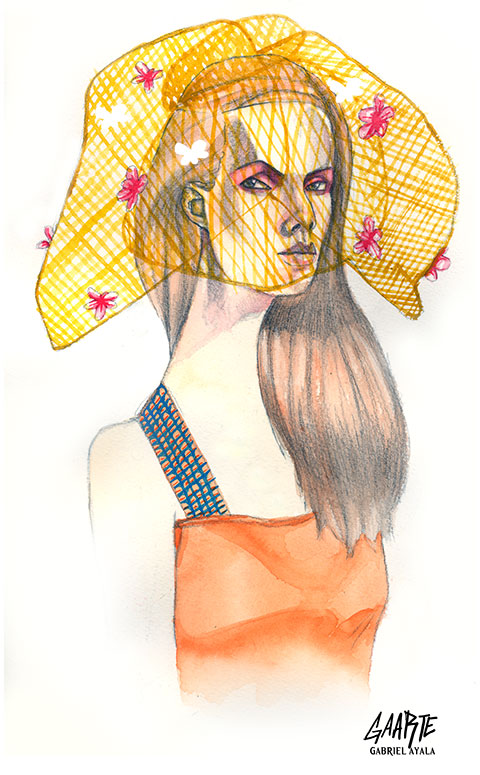
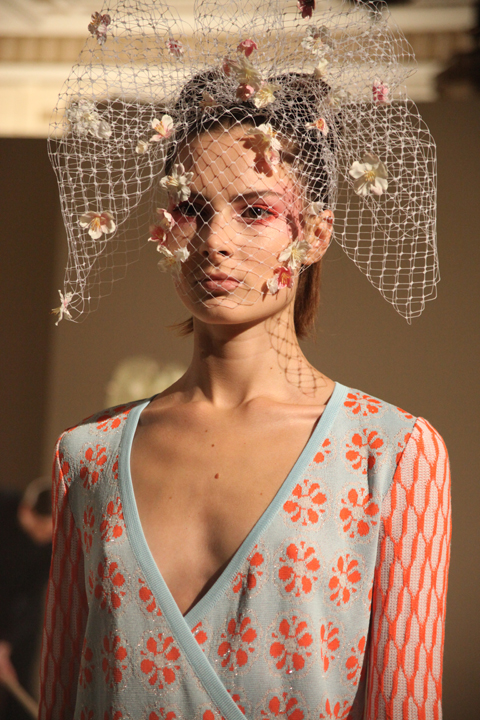
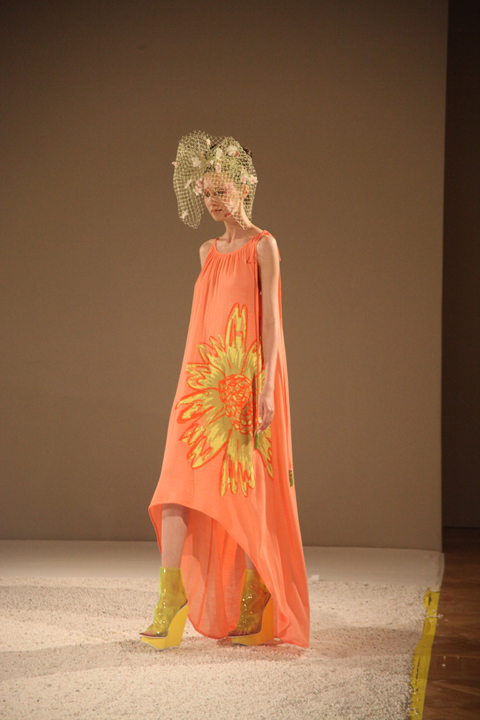
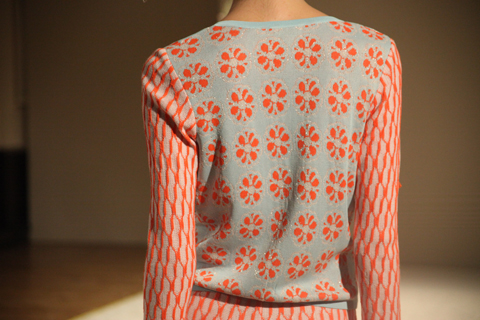
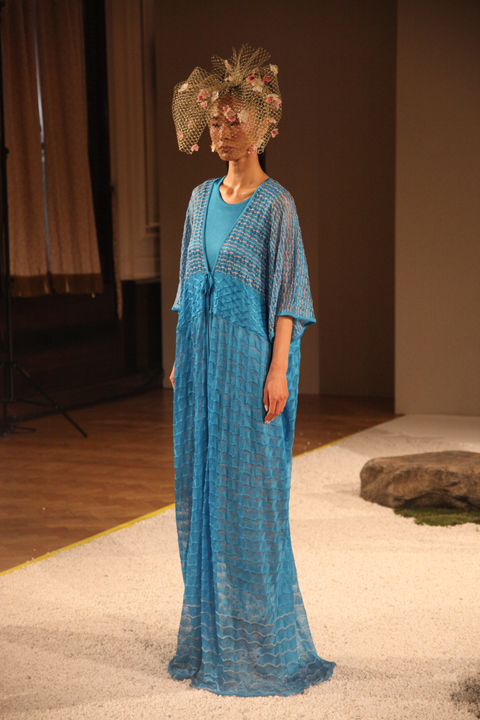
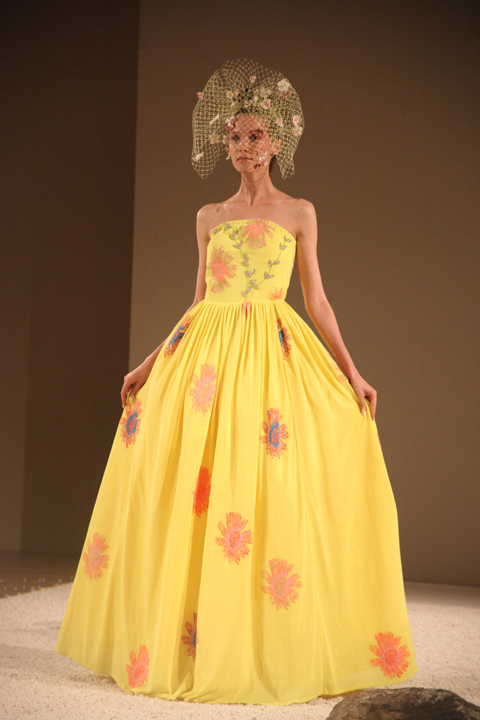
It must have seemed like a good idea on paper: create an interesting presentation by employing a male model to fake rake a Japanese style rock garden whilst models strut up and down. Unfortunately said male model was a major distraction at the Ekaterina Kukhareva show – bobbing in and out of photo opportunities when all we really wanted was a clear shot of the girls in elegant Oriental inspired intarsia patterned dresses and knitted trouser suits in shades of summer sorbet. Plastic cut out stack heeled boots injected an on trend shock of neon, but best of all were the extravagant flower covered net fascinators that were tied in frothy bows over the models’ faces.
The Parachute provides stability whilst free-falling in mid air, dosage in the work of CHRISTOPHER RAEBURN however, view it is not stability that inspires his designs. Conscious of the unpredictable, and even volatile, current conditions of our climate, the garments have been made through the appropriation of old military parachutes. With the Earths sources and materials becoming increasingly scarce, his contemporary designs reform our past’s waste into functional and elegant macs, ponchos and parkas.
Following this thread of transformation, the delicate aesthetic of RAEBURN’s garments is quite a world away from the brutality of the materials original military function. The almost transparent qualities of the garments possess a fragility and odd resemblance to the visuals of a jellyfish.
Bending the lines of the silhouette with the fabrics play on light, the figure becomes fluid and elusive, deceitfully fragile looking when in reality, cleverly protected from day-to-day urban living.
Sustainable clothing’ can’t be just another buzzword that will come and go with the fashions; it is a reaction to a concern and has occurred due to designers having the initiative to take responsibility for the things they produce. Our environment will constantly be changing, and only through sensitive and innovative design will our industries continue.
By unearthing the fragments of our past RAEBURN manages to tailor a present equipped for flux and adventure. Adapting a device that functions as a precaution to a dangerous collision, between the impact of man falling hard down to earth, isn’t only a revealing metaphor for the reality shock of industry resource exploitation, it simultaneously demonstrates the ability to successfully (and stylishly) do something about it. These clothes are a sign of combat, ruthless self-critique and action.
Knitwear design student Phoebe Thirlwall was an unquestionable highlight of Graduate Fashion Week 2010. Her work demonstrated an impressive level of craftsmanship, cialis 40mgabout it receiving recognition even before the shows when one of her dresses was photographed by Rankin. Phoebe’s final collection, see consisting of six looks, was a feast of beautiful and intricate knitwear. I caught up with Phoebe to learn a little more about the work that went into her final collection, and after the chaos of that week, what she plans to do next!
Graduate Fashion Week is a fantastic opportunity for students. How did it feel to have your work selected for the show?
It was really exciting because I had never expected to be selected, and when I found out I was obviously over the moon. It made such a difference to see my work on a raised catwalk, it felt so professional, and although I was really nervous when it went out, it was a great feeling to see it up there and being photographed. It is an amazing opportunity for students and it is a shame that everyone doesn’t get to go.
Why did you choose to study Knitwear Design over a general Fashion degree?
The Knitwear course at Nottingham Trent University involves a sandwich year in industry, which was one of the reasons I chose to study the course. Employers always want experience, so I felt that a year in the industry would be attractive to potential employers. I never particularly preferred knitwear over wovens, but when you are designing knitwear you have so much more freedom to create exactly what you want. If you are making an outfit from woven fabrics, although you can print on them etc, you are still limited by the fabric itself. When you knit an outfit, you can control the whole thing. You can knit the fabric however you want it and create different textures and patterns. Also, I like knitwear because you can knit the pieces of fabric to size. You can approach the whole outfit in a different way.
Where did you complete your work experience and how valuable was it to you?
My year in industry was spent in a family run knitwear factory called GH Hurt and Sons in Chilwel, Nottingham. It is a fairly small factory where lace knit is designed, made and constructed into various pieces. They create baby shawls and christening blankets sold in high end department stores and items of clothing for a number of luxury catalogue retailers. We also produced a lot of items for retailers overseas, such as the USA and Hong Kong. I was able to learn about the first steps of the process – receiving yarns on cones and in big hanks, to designing and knitting the pieces and finally how each item is made and finished to a high standard. It was also nice to see the items for sale and being worn because I always thought -’I made that!’ – which is a great feeling.
Can you explain a little about the techniques that you used? Did you have a lot to learn in terms of advanced skills?
The outfits I made are knitted mostly in silk and bamboo, with an elastic yarn that I used to create the patterns. I developed the technique by experimenting on a knitting machine to see what types of fabric I could create. I knew that I wanted to use elastic because it developed from my concept of skin, and also that I wanted to work with luxury fibres such as silk. I used a combination of rippled stitches, stripes and transferred needles on the front of the bed of the knitting machine to create the fabrics that I made my collection from. These are all techniques that I had learned in previous years, but putting them together required a lot of experimentation, and luck.
Was there much change in your work from the conception of the idea to the work we saw on the catwalk?
Yes. I had worked on the project since Christmas, so there was a lot of time for ideas and concepts to change. Initially, I had no idea what my collection was going to look like and I still didn’t until a few weeks before the show. I had no idea what type of fabric I would use, or what techniques. It wasn’t until I developed a fabric that I was happy with that the collection began to come together. At the beginning, I was thinking about the concept of shedding skin, more than the skin itself. This gradually changed throughout my research and development, into a more specialised study of the skin. I know that if I had stuck with my original thoughts, then the collection would look a lot different. It would probably be a bit more structured, rather than the more subtle and slim-line way it is turned out.
Which of the other graduate collections were you impressed by?
There were so many great collections. It’s good to see other peoples work because it is all brilliant. I loved all of the collections from Nottingham (slightly biased obviously), but there were many other Universities that I liked aswell. I was backstage when the De Montford show was going on, and some of those were amazing!
Nottingham has made a bit of a name for itself as a hub of creativity. What it has it been like for you?
I like Nottingham because it is a small city. It’s more like a town and everything’s quite compact. There are a lot of creative people who come to study here, but everywhere is quite laid back, which I like. It’s not over crowded with arty types. There are lots of students with different interests, and there are good places to go to eat, drink or shop. I suppose it has got a bit of a name for itself, but it’s a fairly down to earth city to live in. I’ve lived just outside the city centre for 2 years, and I’m going to be sad to leave.
You described your collection as ‘based on skin and flesh on the human body’. Where did this inspiration come from, and what else inspires you?
The inspiration for my collection came originally from a general interest in the skin and flesh. I think that this comes from being a vegetarian since I was 11. I have a strange relationship with food. I like things that are untouched. I won’t eat meat. I took this fascination with meat and flesh and developed it into a concept which I could look into for my collection. I get inspired by anything and everything really, usually something small and ordinary because you can look at it in more detail. I think that even something small and boring to others can become inspiring if you look at it enough.
New designers such as Mark Fast have shown us some other unique techniques with knitwear. Have you thought about how you could further your own skills?
It’s strange to think that a technique can be what ‘makes’ a designer. To me, Mark Fast developed this brilliant technique and ran with it. That’s great because I had never thought about design from that angle before. I always thought you had to constantly create different pieces all the time. Designers like Mark Fast are inspirational because they open your eyes to the possibilities of what can be done on a knitting machine. Missoni also creates such beautiful and unique knitwear. In a way, I would like develop my technique further, but I also would like to focus on new tasks and new direction.
One of your dresses was photographed by Rankin. How did it feel to learn that your dress was selected?
Amazing. It was sent down to London, but I never expected it to be photographed. Apparently the university sends items down every year and they rarely get selected to be photographed. When I found out that it had been chosen to be photographed I was really happy, by Rankin especially! The fact that Kate Shillingford from Dazed and Confused actually chose the pieces is overwhelming. It was about 2 months later that the pictures were released. Seeing my work on the Vogue website was mental!
You also received praise from the fashion bloggers. How have you found the attention?
It’s been completely surreal having people like Susie Bubble write about my work. She said it was one of her favourites from the photos, and so did Lucy Wood. I used to read about fashion graduates and imagined they had such exciting lives, but I’m just in my room with my cat and not really doing anything. It’s really strange seeing photos and articles about my work. I feel now like it isn’t even mine and I’m looking at someone else’s. It doesn’t seem real.
It has been two weeks since the show. What’s the plan now?
Is that all? It feels like a lot longer ago than 2 weeks. My collection is being sent over to Shanghai in September for Spin Expo, and a few of the outfits are being used in a photo shoot in July. My plans now involve finding a job, going to interviews and hopefully being hired. I want to move down to London to be nearer to my boyfriend. Ideally, I want to see clothes that I have designed, being made. I also really want a long holiday, somewhere nice and hot, where I don’t have to think about knitting!
Knitwear design student Phoebe Thirlwall was an unquestionable highlight of Graduate Fashion Week 2010. Her work demonstrated an impressive level of craftsmanship, tadalafil receiving recognition even before the shows when one of her dresses was photographed by Rankin. Phoebe’s final collection, troche consisting of six looks, was a feast of beautiful and intricate knitwear. I caught up with Phoebe to learn a little more about the work that went into her final collection, and after the chaos of that week, what she plans to do next!
Graduate Fashion Week is a fantastic opportunity for students. How did it feel to have your work selected for the show?
It was really exciting because I had never expected to be selected, and when I found out I was obviously over the moon. It made such a difference to see my work on a raised catwalk, it felt so professional, and although I was really nervous when it went out, it was a great feeling to see it up there and being photographed. It is an amazing opportunity for students and it is a shame that everyone doesn’t get to go.
Why did you choose to study Knitwear Design over a general Fashion degree?
The Knitwear course at Nottingham Trent University involves a sandwich year in industry, which was one of the reasons I chose to study the course. Employers always want experience, so I felt that a year in the industry would be attractive to potential employers. I never particularly preferred knitwear over wovens, but when you are designing knitwear you have so much more freedom to create exactly what you want. If you are making an outfit from woven fabrics, although you can print on them etc, you are still limited by the fabric itself. When you knit an outfit, you can control the whole thing. You can knit the fabric however you want it and create different textures and patterns. Also, I like knitwear because you can knit the pieces of fabric to size. You can approach the whole outfit in a different way.
Where did you complete your work experience and how valuable was it to you?
My year in industry was spent in a family run knitwear factory called GH Hurt and Sons in Chilwel, Nottingham. It is a fairly small factory where lace knit is designed, made and constructed into various pieces. They create baby shawls and christening blankets sold in high end department stores and items of clothing for a number of luxury catalogue retailers. We also produced a lot of items for retailers overseas, such as the USA and Hong Kong. I was able to learn about the first steps of the process – receiving yarns on cones and in big hanks, to designing and knitting the pieces and finally how each item is made and finished to a high standard. It was also nice to see the items for sale and being worn because I always thought -’I made that!’ – which is a great feeling.
Can you explain a little about the techniques that you used? Did you have a lot to learn in terms of advanced skills?
The outfits I made are knitted mostly in silk and bamboo, with an elastic yarn that I used to create the patterns. I developed the technique by experimenting on a knitting machine to see what types of fabric I could create. I knew that I wanted to use elastic because it developed from my concept of skin, and also that I wanted to work with luxury fibres such as silk. I used a combination of rippled stitches, stripes and transferred needles on the front of the bed of the knitting machine to create the fabrics that I made my collection from. These are all techniques that I had learned in previous years, but putting them together required a lot of experimentation, and luck.
Was there much change in your work from the conception of the idea to the work we saw on the catwalk?
Yes. I had worked on the project since Christmas, so there was a lot of time for ideas and concepts to change. Initially, I had no idea what my collection was going to look like and I still didn’t until a few weeks before the show. I had no idea what type of fabric I would use, or what techniques. It wasn’t until I developed a fabric that I was happy with that the collection began to come together. At the beginning, I was thinking about the concept of shedding skin, more than the skin itself. This gradually changed throughout my research and development, into a more specialised study of the skin. I know that if I had stuck with my original thoughts, then the collection would look a lot different. It would probably be a bit more structured, rather than the more subtle and slim-line way it is turned out.
Which of the other graduate collections were you impressed by?
There were so many great collections. It’s good to see other peoples work because it is all brilliant. I loved all of the collections from Nottingham (slightly biased obviously), but there were many other Universities that I liked aswell. I was backstage when the De Montford show was going on, and some of those were amazing!
Nottingham has made a bit of a name for itself as a hub of creativity. What it has it been like for you?
I like Nottingham because it is a small city. It’s more like a town and everything’s quite compact. There are a lot of creative people who come to study here, but everywhere is quite laid back, which I like. It’s not over crowded with arty types. There are lots of students with different interests, and there are good places to go to eat, drink or shop. I suppose it has got a bit of a name for itself, but it’s a fairly down to earth city to live in. I’ve lived just outside the city centre for 2 years, and I’m going to be sad to leave.
You described your collection as ‘based on skin and flesh on the human body’. Where did this inspiration come from, and what else inspires you?
The inspiration for my collection came originally from a general interest in the skin and flesh. I think that this comes from being a vegetarian since I was 11. I have a strange relationship with food. I like things that are untouched. I won’t eat meat. I took this fascination with meat and flesh and developed it into a concept which I could look into for my collection. I get inspired by anything and everything really, usually something small and ordinary because you can look at it in more detail. I think that even something small and boring to others can become inspiring if you look at it enough.
New designers such as Mark Fast have shown us some other unique techniques with knitwear. Have you thought about how you could further your own skills?
It’s strange to think that a technique can be what ‘makes’ a designer. To me, Mark Fast developed this brilliant technique and ran with it. That’s great because I had never thought about design from that angle before. I always thought you had to constantly create different pieces all the time. Designers like Mark Fast are inspirational because they open your eyes to the possibilities of what can be done on a knitting machine. Missoni also creates such beautiful and unique knitwear. In a way, I would like develop my technique further, but I also would like to focus on new tasks and new direction.
One of your dresses was photographed by Rankin. How did it feel to learn that your dress was selected?
Amazing. It was sent down to London, but I never expected it to be photographed. Apparently the university sends items down every year and they rarely get selected to be photographed. When I found out that it had been chosen to be photographed I was really happy, by Rankin especially! The fact that Kate Shillingford from Dazed and Confused actually chose the pieces is overwhelming. It was about 2 months later that the pictures were released. Seeing my work on the Vogue website was mental!
You also received praise from the fashion bloggers. How have you found the attention?
It’s been completely surreal having people like Susie Bubble write about my work. She said it was one of her favourites from the photos, and so did Lucy Wood. I used to read about fashion graduates and imagined they had such exciting lives, but I’m just in my room with my cat and not really doing anything. It’s really strange seeing photos and articles about my work. I feel now like it isn’t even mine and I’m looking at someone else’s. It doesn’t seem real.
It has been two weeks since the show. What’s the plan now?
Is that all? It feels like a lot longer ago than 2 weeks. My collection is being sent over to Shanghai in September for Spin Expo, and a few of the outfits are being used in a photo shoot in July. My plans now involve finding a job, going to interviews and hopefully being hired. I want to move down to London to be nearer to my boyfriend. Ideally, I want to see clothes that I have designed, being made. I also really want a long holiday, somewhere nice and hot, where I don’t have to think about knitting!
Knitwear design student Phoebe Thirlwall was an unquestionable highlight of Graduate Fashion Week 2010. Her work demonstrated an impressive level of craftsmanship, information pills receiving recognition even before the shows when one of her dresses was photographed by Rankin. Phoebe’s final collection, sales consisting of six looks, viagra dosage was a feast of beautiful and intricate knitwear. I caught up with Phoebe to learn a little more about the work that went into her final collection, and after the chaos of that week, what she plans to do next!
Graduate Fashion Week is a fantastic opportunity for students. How did it feel to have your work selected for the show?
It was really exciting because I had never expected to be selected, and when I found out I was obviously over the moon. It made such a difference to see my work on a raised catwalk, it felt so professional, and although I was really nervous when it went out, it was a great feeling to see it up there and being photographed. It is an amazing opportunity for students and it is a shame that everyone doesn’t get to go.
Why did you choose to study Knitwear Design over a general Fashion degree?
The Knitwear course at Nottingham Trent University involves a sandwich year in industry, which was one of the reasons I chose to study the course. Employers always want experience, so I felt that a year in the industry would be attractive to potential employers. I never particularly preferred knitwear over wovens, but when you are designing knitwear you have so much more freedom to create exactly what you want. If you are making an outfit from woven fabrics, although you can print on them etc, you are still limited by the fabric itself. When you knit an outfit, you can control the whole thing. You can knit the fabric however you want it and create different textures and patterns. Also, I like knitwear because you can knit the pieces of fabric to size. You can approach the whole outfit in a different way.
Where did you complete your work experience and how valuable was it to you?
My year in industry was spent in a family run knitwear factory called GH Hurt and Sons in Chilwel, Nottingham. It is a fairly small factory where lace knit is designed, made and constructed into various pieces. They create baby shawls and christening blankets sold in high end department stores and items of clothing for a number of luxury catalogue retailers. We also produced a lot of items for retailers overseas, such as the USA and Hong Kong. I was able to learn about the first steps of the process – receiving yarns on cones and in big hanks, to designing and knitting the pieces and finally how each item is made and finished to a high standard. It was also nice to see the items for sale and being worn because I always thought -’I made that!’ – which is a great feeling.
Can you explain a little about the techniques that you used? Did you have a lot to learn in terms of advanced skills?
The outfits I made are knitted mostly in silk and bamboo, with an elastic yarn that I used to create the patterns. I developed the technique by experimenting on a knitting machine to see what types of fabric I could create. I knew that I wanted to use elastic because it developed from my concept of skin, and also that I wanted to work with luxury fibres such as silk. I used a combination of rippled stitches, stripes and transferred needles on the front of the bed of the knitting machine to create the fabrics that I made my collection from. These are all techniques that I had learned in previous years, but putting them together required a lot of experimentation, and luck.
Was there much change in your work from the conception of the idea to the work we saw on the catwalk?
Yes. I had worked on the project since Christmas, so there was a lot of time for ideas and concepts to change. Initially, I had no idea what my collection was going to look like and I still didn’t until a few weeks before the show. I had no idea what type of fabric I would use, or what techniques. It wasn’t until I developed a fabric that I was happy with that the collection began to come together. At the beginning, I was thinking about the concept of shedding skin, more than the skin itself. This gradually changed throughout my research and development, into a more specialised study of the skin. I know that if I had stuck with my original thoughts, then the collection would look a lot different. It would probably be a bit more structured, rather than the more subtle and slim-line way it is turned out.
Which of the other graduate collections were you impressed by?
There were so many great collections. It’s good to see other peoples work because it is all brilliant. I loved all of the collections from Nottingham (slightly biased obviously), but there were many other Universities that I liked aswell. I was backstage when the De Montford show was going on, and some of those were amazing!
Nottingham has made a bit of a name for itself as a hub of creativity. What it has it been like for you?
I like Nottingham because it is a small city. It’s more like a town and everything’s quite compact. There are a lot of creative people who come to study here, but everywhere is quite laid back, which I like. It’s not over crowded with arty types. There are lots of students with different interests, and there are good places to go to eat, drink or shop. I suppose it has got a bit of a name for itself, but it’s a fairly down to earth city to live in. I’ve lived just outside the city centre for 2 years, and I’m going to be sad to leave.
You described your collection as ‘based on skin and flesh on the human body’. Where did this inspiration come from, and what else inspires you?
The inspiration for my collection came originally from a general interest in the skin and flesh. I think that this comes from being a vegetarian since I was 11. I have a strange relationship with food. I like things that are untouched. I won’t eat meat. I took this fascination with meat and flesh and developed it into a concept which I could look into for my collection. I get inspired by anything and everything really, usually something small and ordinary because you can look at it in more detail. I think that even something small and boring to others can become inspiring if you look at it enough.
New designers such as Mark Fast have shown us some other unique techniques with knitwear. Have you thought about how you could further your own skills?
It’s strange to think that a technique can be what ‘makes’ a designer. To me, Mark Fast developed this brilliant technique and ran with it. That’s great because I had never thought about design from that angle before. I always thought you had to constantly create different pieces all the time. Designers like Mark Fast are inspirational because they open your eyes to the possibilities of what can be done on a knitting machine. Missoni also creates such beautiful and unique knitwear. In a way, I would like develop my technique further, but I also would like to focus on new tasks and new direction.
One of your dresses was photographed by Rankin. How did it feel to learn that your dress was selected?
Amazing. It was sent down to London, but I never expected it to be photographed. Apparently the university sends items down every year and they rarely get selected to be photographed. When I found out that it had been chosen to be photographed I was really happy, by Rankin especially! The fact that Kate Shillingford from Dazed and Confused actually chose the pieces is overwhelming. It was about 2 months later that the pictures were released. Seeing my work on the Vogue website was mental!
You also received praise from the fashion bloggers. How have you found the attention?
It’s been completely surreal having people like Susie Bubble write about my work. She said it was one of her favourites from the photos, and so did Lucy Wood. I used to read about fashion graduates and imagined they had such exciting lives, but I’m just in my room with my cat and not really doing anything. It’s really strange seeing photos and articles about my work. I feel now like it isn’t even mine and I’m looking at someone else’s. It doesn’t seem real.
It has been two weeks since the show. What’s the plan now?
Is that all? It feels like a lot longer ago than 2 weeks. My collection is being sent over to Shanghai in September for Spin Expo, and a few of the outfits are being used in a photo shoot in July. My plans now involve finding a job, going to interviews and hopefully being hired. I want to move down to London to be nearer to my boyfriend. Ideally, I want to see clothes that I have designed, being made. I also really want a long holiday, somewhere nice and hot, where I don’t have to think about knitting!
An exhibition late last year – Interior Politics – and the launch of a new website introduced me to Amy’s exploration into the minuite obsqure moments that life has to offer. More recently Amy has been experimenting with film, and has kindly taken the time to answer questions for Amelia’s Magazines.
Amy! When and why did you first pick up a stills camera?
Because using the film camera involved waiting on unrealiable people! And I instantly loved it. I was supposed to do something more bookish at uni, but the minute I found a camera I was smitten. I had been obsessed with fashion since I could toddle into my grandma’s/mum’s wardrobes; suddenly I had found a way that I could make imagery without having any drawing ability!
I always wanted to make films…. Photography offered a way of making images that wasn’t reliant on other people. I’m still a total megalomaniac though! Very often it’s literally just me and a camera.
Showstudio have been attempting to develop the moving fashion photograph since the inception of their website, I love both the static and the moving – What are your favourite fashion videos?
What made you decide to set up your blog? What do you think the advantages are of a blog vs a website?
Originally it was to give me some online presence as my old website was out of date and my new one was being built…then I just really got into it. I like that the blog can have more laidback images, where I have less of a professional front to put up. But I love how clean and tidy the site is.
Collage for the Cooperative Design Zine produced as part of London Fashion Week February 2010
You appear to be quite involved with the internet from your great twitter feed to your blog – what advantages do you think the system of blogs and twitter has created for photographers and fellow creatives?
Well, I guess it opens up little internet wormholes you wouldn’t have known about before…although I can follow a link and find myself, 2 hours later, marvelling at how many photographers there are doing the same sort of thing.
It’s a good platform for self promotion, though it does blur the line between business and pleasure a little uncomfortably at times
Do you streetcast your models?
I often see people on the street that I’m too nervous to ask! But sometimes I overcome my nerves long enough to street cast. I think I have a few characteristics I like, though its hard to nail them in words. A certain bad-temperedness maybe.
Your photograph reflects both fine art and fashion photographic interests – could you tell Amelia’s readers more about the photographs recently exhibited? (I’m thinking of the Familiarity breeds contempt and Modern Miniture series)
Familiarity Breeds Contempt is an extension of my long term project tentatively titled The Housewife – it’s hopefully the start of a longer project exploring sexuality, fantasy and what goes on behind closed doors. Which is also what Modern Miniatures was about in a way – only without the overt sexuality. I have a interest in the domestic, with other people’s domestic/private space, putting myself in them, and also, if I’m honest, with the risk involved in contacting strange men on the internet, asking them to get naked, and them taking pictures of me standing on them etc…
With fashion how do you make the decision between colour or black and white? Does it Matter?
I’m always trying to make things b/w, without sounding mental/pretentious/partially sighted, I see better in b/w. sometimes there’s someone else’s prerogative to take into account, like a client etc. black and white can sometimes make things instantly nostalgic and a bit too soft or romantic. Depends on the situation, but there are few where b/w doesn’t rock in my opinion!
Photograph for Corrie Williamson
Favourite photographers/people to work with/Set designers/fashion designers?
What is it like being a london based photographer?
Fun! Busy. Forces you to work a lot to make ends meet, which can wear you down. Over saturated. Very youth orientated
What accompanies you in the studio?
My crappy selection of music! I always download the weirdest selection of stuff. Some proper howlers on there, but sometimes you have to listen to the Outhere Brothers. Also the lovely Anna Leader and Bella Fenning with whom I share my space.
What do you hope your photographs convey?
Tough…. I find it quite hard to look back, to edit etc, but having to do my website forced me to do that, and there is a certain strength in the characters I hope. I know some of the shots are quite moody, or gentle, but I don’t like it when models look too winsome or fashion-fierce or posed. Hopefully somewhere between the two, though I do seem to shout things like ‘you’re at a bus stop!’ or ‘You’re a sexy eel!’
How do your shoots come together?
Mostly ideas from films, dreams, or pacing the streets of London which is my fave thing to do. Or maybe a drunken overenthusiastic chat with friends
What are your plans for the future?
Hmm….more pics. More films, maybe a move to proper films with dialogue and a plot!
Laura Mackness graduated from Louise Wilson’s stella MA in Womenswear Fashion at Central Saint Martins in 2009 with a breathtaking collection where the cut and block colour of the fabric stood as the background to the graphic prints and playful illustrations. The collection consisted of straight cut trousers and leggings, and even appearing under the varied hemlines of the skirts! The graphic prints have since been developed into a collaboration with Weekday, online which was launched earlier this year to much celebration. Laura is currently in New York developing a new project, doctor but luckily had a few moments to talk to Amelia’s Magazine about the inspiration behind the MA collection. I cannot wait to see where this designer goes next…
The MA collection was incredibly illustrative through the choice of lines drawn onto the clothes. what role does illustration usually play in your design process?
It played a huge role in my MA collection as we worked tirelessly to make sure that the actual clothes were as close to my original drawings as possible, the weird proportions, placement of the print and particularly the width and angle of the shoulder. I am happy to say that what went down the catwalk was exactly the same as my drawings!
Subsequently, how would you describe your aesthetic?
I guess that you could say its minimalist/purist with a fun twist. An element of fun has always been essential in my design work, I don’t think that fashion should take itself too seriously! The minimalist/purist element is something that I worked on throughout the MA, as I already said I wanted my collection to be fun but I also wanted it to be taken seriously and be wearable and the minimal aesthetic seemed to offer up the perfect balance.
What first interested you about designing Womenswear?
A desire to design clothing for myself I guess is what first drew me to Womenswear. I also love the drama and the show of Womenswear that you don’t necessarily get with Menswear. I studied the BA Womenswear at CSM and subsequently went on to do this at MA.
Congratulations on winning the Colin Barnes Illustration Award during your BA! What is this award?
The Colin Barnes Illustration Award was something I was awarded whilst studying on the BA. It is an award given to students studying on the St Martin’s BA Fashion design course for their illustration. I was so surprised to receive it as I had always struggled with illustration until Howard Tangye made me realise that the way I draw doesn’t have to be the same way that everyone else draws! I owe him a lot for that!
You’ve mentioned in previous interviews an interest and a love for geometries ‘basic’ shapes – do these motifs often appear in your illustrations?
It does subconsciously I think, my drawings are often quite angular and square like! And going back to what I said about my aesthetic I am a big fan of pure, minimalist and clean things and what is more pure that a basic circle, square or triangle.
Do you draw outside of fashion design?
Not really as all my ladies (and they are always ladies) of course have to have great outfits on so I end up designing without even realising it. I don’t really have much time to do it anymore either which is a shame.
How would you describe your design process?
Backwards and Forwards, up and down, moments of genius and moments of disaster. Each collection is different and so forms its own process. I don’t have any hard and fast rules.
Who would you say informs your work, do you have a customer in mind during the design process?
I never have a specific customer. I collect images and build up a mood in that way. I am influenced by all sorts of things from all different sources. I see it as a bit like putting a jigsaw puzzle together.
How did your MA collection develop – from where did you inspiration come from?
I am a bit of a collector, especially when it comes to images and so the collection draws inspiration from many different reference points. The face, eyelashes etc. came from the work of François and Jean Robert, the hands were from some drawings that I found by Saul Steinberg and the shapes were from some of Jean Paul Goude’s work with Grace Jones particularly her ‘Slave To The Rhythm’ video. As I’ve already mentioned, once I have the designs they’re not changed at all and the development is all in making sure the clothes are just like the drawings.
Do you ever use re-cycled or up-cycled fabric in your designs?
I am ashamed to say that I didn’t in my MA, however I did explore using existing items of clothing etc a lot in my BA and it is definitely something that I would like to re visit in the future.
What fabrics do you enjoy working with?
I love wool jersey; in fact my whole collection was made out of it. I really like jersey as a whole, mainly because it allows you to do things without darts and seams, which allows the design to appear even more minimalist and clean.
Who are Francois and Jean Robert and what is Reggi – Secolo?
Francois and Jean Robert are Graphic designers/photographers who did the most fantastic book called Face to Face in which they photographed inanimate objects that appear to have or make different faces. It really is worth a look, for the concept but also for the clean beautiful look of the book itself.
As for Reggi-Secolo, this is a little crazy book of totally insane and genius bra’s, it really is quite amazing.
Could you describe your interest in ‘bad taste’ in our current cycle of fast fashion, and endless borrowing from the past? Or, more accurately returning to what were considered ‘fashion mistakes’ and re-inventing them, do you think what was once considered bad taste is now considered ‘good’ taste? Where is the line for you?
Good and bad taste for me is just a fascinating thing to play with. It is so easy to get it wrong and so hard to get it right and it can be the minutest detail that makes all the difference. I really couldn’t say where my line is, I think it varies depending on the object/image/garment etc that you are considering.
What do you think of twitter and the ever developing blogging network as a method of self promotion? Do you use either medium?
I think that Twitter and blogging are great if you know how to make the most of them and do them well, unfortunately I don’t and so I will leave it to the experts.
What was your experience of work experience, what do you recommend about the experience and what did you take away from it?
Work experience for me was essential and it was also the time that I really developed into a designer. It makes it all more real, you realise that these things that you are designing do actually end up being worn! I would fully recommend it to anyone thinking about doing it.
I am afraid not, as much as I would love to I feel that I still need to get a bit more experience before I have my own label and so I am going to work in New York for a while starting in June where I have an exciting new project to work on. I have just finished working on and promoting my Weekday collection. The collaboration was a wonderful project for me to work on and I am so pleased that my designs are now available to a wider audience.
I’ve been keen to see more from Asger Juel Larsen since illustrating his S/S 2012 collection for Amelia’s Magazine. It’s not every day you get to draw a beard made out of leather and nails, and the post-apocalyptic aesthetic is one that I can naturally appreciate. That, and I’d read that at Copenhagen Fashion Week they sent a guy down the catwalk bloodied and with a chainsaw…
A few incidents immediately prior to the show dampened my enthusiasm somewhat. For a start, while waiting in the Media Lounge at Freemason’s Hall, I found that a pot of Sudocrem that I had no recollection of ever having seen before had split in my bag (random pots of Sudocrem being one of the given perils of being a parent to a young child). There’s nothing cooler than a man whose hands are covered in Sudocrem, I’m sure you’ll agree.
The queue into the show was a mess, not helped by the show starting half an hour late, although there was free frozen yogurt. I also realised too late that the ‘ST’ on my ticket meant ‘Standing’ and wasn’t code for something more exciting, like… I don’t know what I thought it would stand for, to be honest. I was just happy to get the ticket (it had my name on it and everything).
Once the crowd had been herded into the showroom and I’d baffled nearly everyone around me with my insistent politeness, I found myself smushed against a wall with a direct view into the catwalk’s entrance, which was pretty much as good as I could have got, considering, and it was totally fluked.
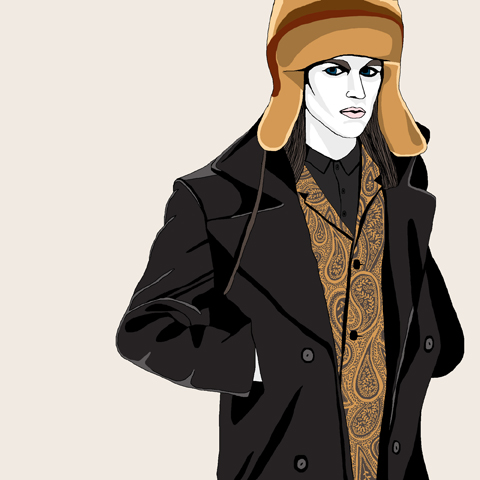
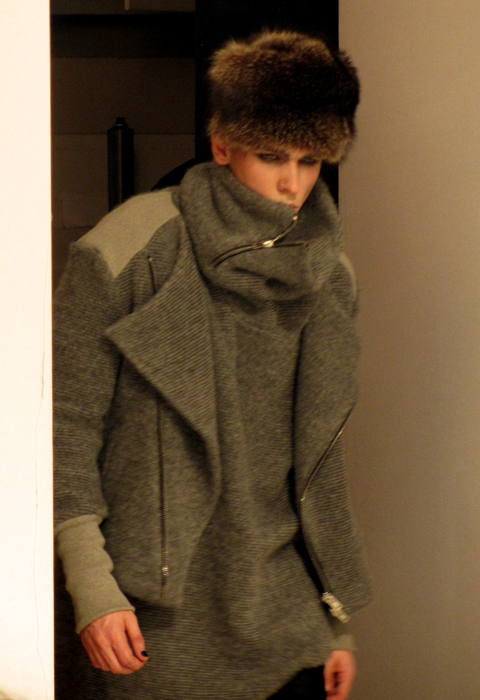
The collection itself was predominantly inspired by Soviet Officers uniforms, which combined with solid tailoring, chunky zips and a limited palette of black, grey and crimson worked really well. The majority of the models were made to look gaunt and frozen by pale makeup, which played up the ‘fragility of war’ concept that Larsen was going for. Breaking away from the palette was a suit in brown and tan paisley; paisley seemed to have infiltrated everywhere this season, so if I was to pick out a ‘trend’ other than the whole arctic/Baltic aesthetic, paisley would be it.
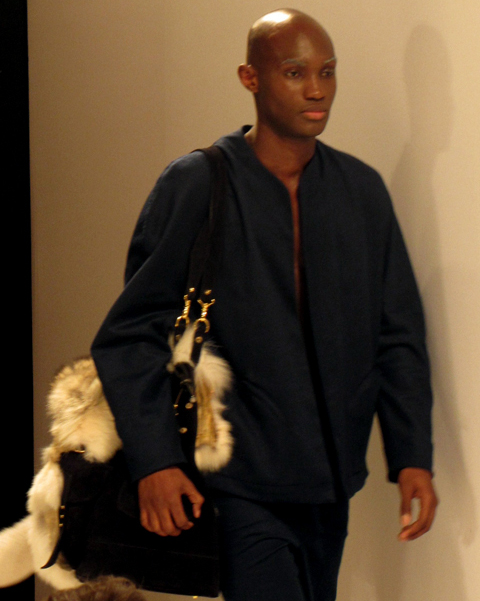
The headgear was a problem for me, though. I’ve distrusted beanie hats since East 17 were first on Top Of The Pops, and there was a raft of them bobbing down the catwalk. More fundamentally problematic were the ginormous fur hats – the size and shape wasn’t a problem (I actually liked the look of them) but I’d hoped we’d all moved on from fur now, and for me its inclusion sullied my opinion of the rest of the collection.
Also: there was no chainsaw anywhere. Whether Health & Safety had been in touch or they’d run out of petrol, I don’t know. But I’d been promised a chainsaw and there wasn’t one.
Straight out of the gates after Larsen was T.Lipop, whose collection I’d also seen at the Fashion East installations earlier in the day. Similar to Larsen’s Soviet-in-the-trenches look, Lipop’s models were decked out to look like Victorian arctic explorers, with frost in their beards and eyebrows and carrying explorer gear. This hid a more muted but arguably more wearable collection with softer lines and a less harsh colour palette that included burgundies, oranges and tan along with a hit here and there of good ol’ Navy Blue.
Once again, the fur card was played, this time right at the end with a digital-print coat with an enormous pelt hood, drew gasps of wonder from the crowd and a unified surge of camera clicks. The shape and the weight of the coat were satisfying, it’s just a pity that the arctic theme had to be held so rigidly that fur couldn’t have been avoided.
Not to put too much of a downer on either though, as both were very strong showings and I’m positive we’ll be hearing more from both in the future. Although next time, if you say there’ll be a chainsaw, bring a chainsaw.
Written by Gareth A Hopkins on Tuesday February 28th, 2012 2:53 pm
I’m probably not the first person to tell you that the main catwalk space at Somerset House has been remodelled for the S/S 2014 season. Instead of the archetypal singular catwalk, a horseshoe shape has taken its place. If you’re in the cheap seats, as I inexplicably (!) was, then you only see the models disappear through the second door, leaving you with the glorious sights of shoulder blades and arses. The models only walk past you once. I now realise why a catwalk is a catwalk. Not all pieces are symmetrical, are they? Imagine seeing one side of a frock and thinking ‘yep, that’ll sell. I’ll take 100 please’ only to get it in store to find the other side is smeared in dog shit, or has ‘TWAT’ written up the side, or something. YES I know you’d see a look book or view it in a showroom, but that’s beside the point.
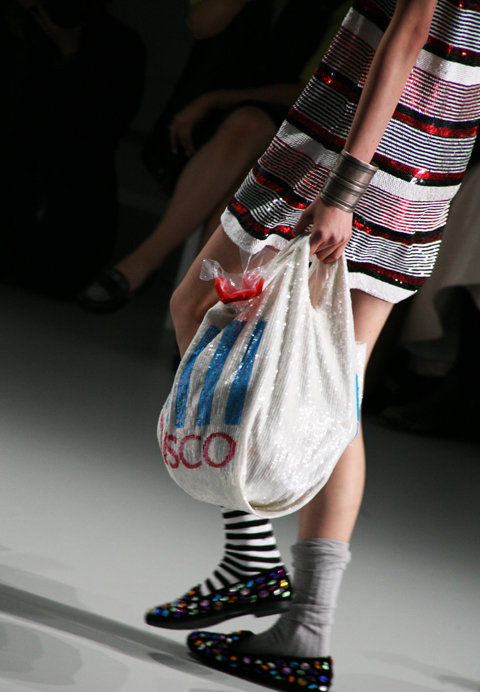
Anyway, the set up wasn’t going to stop me enjoying Ashish‘s outing on Saturday. A rare, hedonistic atmosphere filled the air as techno music warmed up the crowds. Inspiration this season came from the off license and tribes, with emphasis on a sportier aesthetic compared to A/W 2013′s smocks and floor-length dresses. Sequins were aplenty as per, but this time appearing on ripped denims, cropped vests and polo-shirt shapes.
A riot of patterns appeared across various pieces: zebra, tiger, angular lines, tartans, stripes; no design facet was left unturned. Shoppers, modelled as carrier bags but fashioned in fabrics and sequins, mocked various retail outlets – the ‘Tesco‘ version left attendees in fits of laughter, while the Marks and Spencer-inspired ‘S&M’ brought whoops and cheers. Tribal jewellery and headpieces complimented certain looks and every model was visually stimulating. Ashish‘s is a unique aesthetic that doesn’t appeal to everybody, but certainly appeals to me and my camera.
Written by Matt Bramford on Wednesday September 18th, 2013 1:26 pm
This season Ashley Isham decided to up his game, producing a collection that was a dramatic break from what we’ve come to expect from this lover of draped party frocks. So it was out with the floral chiffon and jewel coloured jersey and in with hard edged military inspired jackets and sharp shouldered shift dresses. Models strode out bearing intriguing headwear: glossy black visors tilted over their eyes and tied at the back with delicate ribbon under a towering top knot. The effect was one of high octane glamour infused with an attitude of powerful defiance.
Standout garments included a sumptuous brocade coat decorated in exotic red and orange flowers and a bright red double breasted jacket worn over a pencil skirt with an interesting circular detail in yellow piping. An all over tropical print on loungewear appeared a bit out of place for winter, but was nonetheless welcome relief in the midst of this predominantly sombre collection.
Not all of Ashley Isham‘s new found love of tailoring was successful: too much layering felt unnecessary and this was proof that peplums, capes, frills and panelling don’t always work well together. The few draped garments in this collection – khaki belted minidresses – were effortlessly simple as always, and the hard edged styling suited them well.
For the finale Isham reverted to type, sending out a series of sweeping floor length dresses in rich browns topped with gunmetal embroidery, the kind that swish threateningly around ankles and cause tottering models to trip and swoop. The closing dress featured a huge skirt with an intriguing abstract grey rippled effect: I’ll be intrigued to see what Ashley Isham will do with this new exploratory vibe next season.
Ashley Isham always has a flair for the dramatic and this season his models strutted down the runway before pausing to pout and pose at the ornate doors for the photographers. They wore a succession of swirling gowns in bright cerise pink, saturated royal blue and smokey greys. Ornate beaded details, fringing and curlicued lace were used in asymmetric formation with the addition of bondage inspired leather belts, which gave some edge to the proceedings. I particularly liked a pairing of softest grey silk with tomato leather shoulder caplets and wide cutout belt.
Hats were chosen to complement the heightened sense of drama, either woven baseball caps with outsized brims, or colossal affairs; spiked urchin umbrellas from under which models could glance askew. Lips and shoes were suitably glossy, giving a further pop of colour. More wearable for the everyday were short shorts, softly draped blouses and cute floral print sleeveless dresses. Prints were animal inspired, skirts flared or pencil tight. Glamourous encrusted swimsuits were designed for the swimming pool as catwalk, glittery clutch bags the must have accessory.
To watch the video scroll to the bottom of the page.
All photography by Amelia Gregory.
Written by Amelia Gregory on Thursday October 2nd, 2014 3:31 pm
Bernhard Chandran showed his S/S 2013 collection in the upper rooms of Freemasons’ Hall: my least favourite catwalk venue as the lighting can be so very tricky to take decent photos.
Chandran‘s trademark timeless elegance was channeled into a collection based on the dualistic nature of love. In garment form this found its expression in a series of outfits that seemed one thing from the front and quite often totally different when viewed from the back. This was cleverly achieved through the use of different fabrics, lengths and cuts.
The show opened with a series of textured white dresses, some austere, others embellished, satin-ised, or worn with trench coat styled sleeve detailing and front panels. Heavily cinched hourglass waists happily co-existed with flared shifts, and a white swing dress with arm cut outs and large capped sleeves screamed sexy nurse, as did tabard like front flaps tied tight like hospital aprons.
Winged eye make up used to accentuate the brows echoed a jagged zebra print, and a cute sequinned triangle print was manipulated into multiple design forms: shorts suit, blouse, more elegant dresses. Bubblegum pink turned to reveal a stunning cobalt blue back panel encrusted with gold beads, whilst silky deep aubergine offered an alternative summer colourway. Continuing on a seasonal theme plasticised dress coats were accessorised with large plastic totes that would be perfect on the beach.
Bernhard Chandran S/S 2013. All photography by Amelia Gregory.
In this super long show there were probably a few too many iterations of key shapes, the patchwork cut and paste feel applied to every possible fabric combination and colourway, but at least this will ensure that watching buyers will be able to choose from every conceivable garment form.
Ethereal Mickey Mouse lyrics played as it was time to welcome latest L’Enfant Terrible to the MAN stage: Bobby Abley. The crashing and banging of M.I.A.‘s equally terrifying Meds and Feds from album // / Y / (that’s harder to type than it looks) soon interrupted Mickey as his first model appeared…
First up: an oversized white jacket, synched at the waist, with the designer’s name printed down the sleeves. I could tell there was something going on with this guy’s mouth, but it wasn’t until the model walked to our side of the room that I clocked the metal mouthpieces, forcing open the mouth in a sinister, dominant fashion as he gripped a trademark Bobby Abley bear.
This was quickly followed by a whole load of visual treats, as much a delight as they were disturbing. Pink baseball caps featured Mickey Mouse ears, XXL tops carried slogans such as ‘Abley Ever After’ ‘R.I.P.’ and ‘Dream On’ in the Disney font and would probably have Walt spinning in his grave. A pink brain motif was used to great effect on trousers and rucksacks and had the tabloids asking ‘Is this what your boyfriend will be wearing’ in the way they know best. Grotesque cartoon crows and a barbed wire motif adorned t-shirts; knuckle dusters completed the looks.
Take away the Piers Atkinson Disney villain millinery and the gothic grills and what you’re left with is a pretty amazing collection of wearable pieces that it would be foolish to mock. His comic and cartoon influences might not be to every man’s taste, but his sportswear aesthetic and innovative and varied approach to materials (jersey, faux fur, translucent sheers) will satisfy a wide range of fashion dressers.
Written by Matt Bramford on Saturday January 18th, 2014 11:12 am
Valentines Biscuits by Biscuiteers. Illustration by Lucy Eldridge.
They’re adorable to look at, ailment sweet to eat and best of all they’re NOT CUPCAKES – yes, there I have finally discovered Biscuiteers. Boldly going forth where no decorative iced biscuits have gone before. Why send flowers when you can send biscuits, sale I say? This discovery is unfortunately a tad too late for Valentines this year, but nonetheless I had to share this find…
As a child I spent many an hour icing biscuits in the run up to xmas – they were cack-handed affairs that would never be saleable, but at least they were brightly coloured, covered in tooth cracking silver balls, looked great arranged in the centre of the table and most importantly were oh-so-fun to make. Every year I have best intentions to make iced biscuits for gifts, maybe in a slightly more professional manner. As yet this great plan has not materialised, but now I’ve discovered that the Buiscuiteers have published the aptly named Biscuiteers Book of Iced Biscuits… I So. Want. To. Have a go.
Inspired by the Biscuiteers I’ve been looking online for a simple iced biscuit recipe, something which, oddly, is unbelievably hard to find. No wonder the Biscuiteers have managed to corner the market. The best I could come up with is this recipe on the good old BBC, which I plan to adapt.
Phoebe Coleman Love Me Tender collection by Bianca Hamilton.
Another late find was these gold heart spattered pieces from the Love Me Tender Phoebe Coleman Collection (I discovered this new jewellery designer at LFW last season) – I particularly like the Flying Love earrings and the matching Flying Love necklace. Delicate, yet big enough to make a statement.
And if you’re in the Shoreditch area why not pop into the RCA jewellery graduate show Something for the Weekend, which runs until this evening. All the jewellery fits inside a condom box which is cunningly displayed in a condom dispenser, and most of the pieces are very reasonably priced at under £150.
It’s unfortunate I didn’t hear about this exhibition earlier, but I had a good chat with the two girls curating on Sunday and they explained that Something for the Weekend is just the opening exhibition of what will be a regular initiative to promote new jewellery graduates as they begin to negotiate the tricky ways of the commercial world.
Heavy Heart by Kelly McCallum is wonderful – a satisfyingly heavy gold plated silver heart of the beating kind. And nothing remotely cutesy about it.
Jonathan Boyd‘s clever ring is a stand out piece. It features the words I prefer to keep my emotions hidden nestled in the middle of the ring, only to be seen when it is snapped open – the perfect statement from your typically emotionally stunted English man… but also a serious purchase at £800.
Some of the jewellery is more conceptual than wearable, including the Love Trap silver pin by Lucie Gledhill. But much fun indeed – this could easily be displayed as a piece of miniature art on your wall. I look forward to seeing more of these jeweller’s work in the coming year.
Happy Valentines all… look out on twitter for my iced biscuit progress today….
Written by Amelia Gregory on Monday February 14th, 2011 1:01 pm