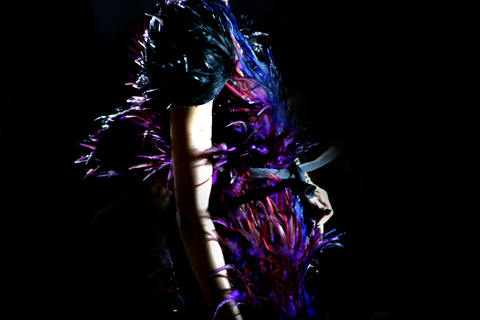
The first designer tipped for great things later this week is Louise Goldin, buycialis 40mg who last month was named as the winner of the illustrious Fashion Forward sponsorship scheme. Renowned for her innovative knitwear designs including; short figure enhancing knitted dresses, viagra dosage separates and swimwear, Louise often incorporates both unusual weaving techniques and futuristic patterns earning her the epithet ‘Queen of Knits’.
One of my favourite designers of recent seasons has to be Bryce Aime, who launched his self named label back in 2006. A designer who understands the difference between conceptual and commercial design, Bryce’s unique combination offers his customers sexy and understated garments with a twist of edgy and dramatic tailoring.
Another great designer looking to make her stamp on the British fashion industry next season is that of Georgia Hardinge. Best known for her figure enhancing dresses, each garment is specifically designed to ‘map the silhouette and curves of the female line’. With a penchant for avant-garde tailoring Georgia produces highly controlled yet progressive pieces which successfully juxtapose the futurism of sculptural design with femininity, empowering the her legion of customers without being overtly sexual. Georgia is taking part in the LFW exhibition at Somerset House between 19-23rd February.
A relatively new label, having emerged on the scene in 2008, Belle Sauvage is the brainchild of design duo Virginia Ferreira and Christian Neuman. Best known for their eye-popping digital prints and electric use of colour, this is one brand who look set to achieve the unachievable, having the fashion world eating out of the palm of their hands.
Fresh for SS10 the enigmatic duo have sampled block colouring in shocking scarlet and electric blues creating a contrast to the clashing primary hues of the geometric graphic prints and trademark lipstick detailing visible throughout. With a subtle nod to futurism referenced throughout the collection you’ll see conical shaped breasts, origami-inspired directional cuts across the hips and the occasional boxy shoulder. Belle Sauvage is showing at LFW at 5:00pm on Saturday 20th Feb as part of On|Off.
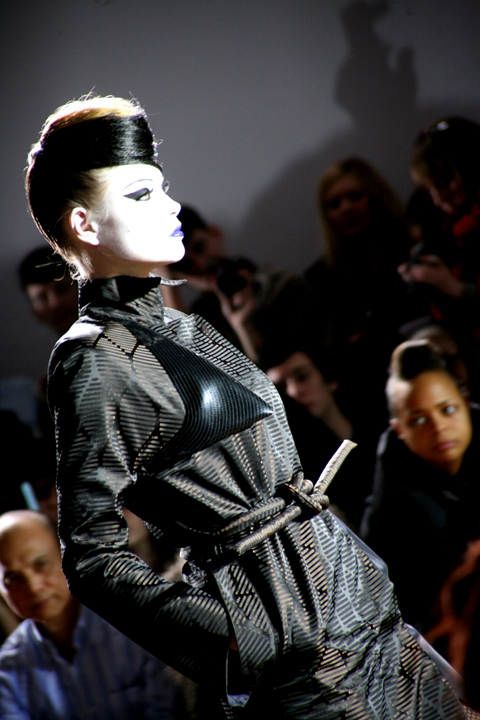
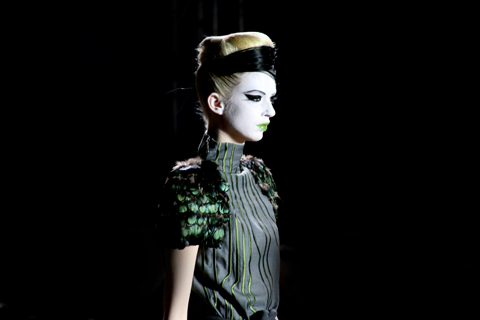
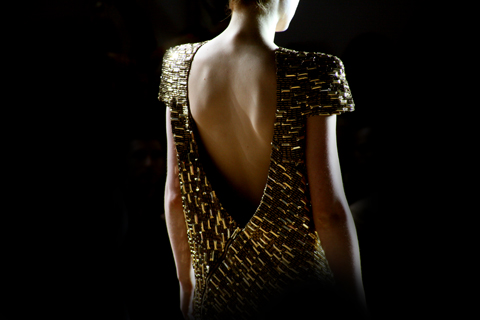
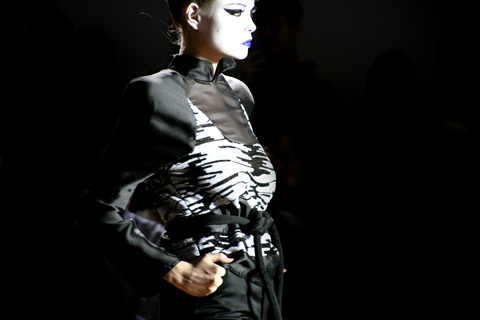
The last designer I’m tipping for greatness at LFW is the one and only Gemma Slack. Having graduated last year, SS10 sees Gemma’s second post-graduate collection inspired by fetishised super heroines and metal girls. Never one to toe-the-line with conventional designs this season sees Gemma experimenting with leather, suede, aluminium and steel to produce a highly unique and futuristic collection.
Looking to empower women across the nation, Gemma’s collections tend to be bold, brash and above all strong. By using biomechanics to combine body and science, Gemma successfully replicates the ideology of transformation through costume.
Gemma Slack is showcasing a presentation at LFW between 5-8pm on Friday 19th Feb.
Written by Rachael Oku on Thursday February 18th, 2010 7:24 pm
I went down to The Lexington a couple of weeks ago to interview Real Estate before they played a sold out gig in a city they had never played before. During the course of the interview Real Estate and I went on a journey… literally, for saleillness a journey, we started off upstairs, went down stairs, sat in a booth for a while, moved in to a stairwell where the door constantly opened in to my back, but don’t worry, I remained ruthlessly professional in my journalistic pursuit of the truth… sort of.
I met with guitarist/singer Martin Courtney and bassist Alex Bleeker. Martin was really sweet, in a slightly sweaty, nervous kind of way. Alex Bleeker was nice too, but in a more standoffish way, but maybe that’s just the way he talks, I felt like at times he was testing me. The word ‘like’ was used incessantly by both, but in an endearing way which was totally in keeping with their chill-wave-psychedelic-surfer-style music. They gave me 15 minutes of their time to talk Jersey, The Boss, Paul McCartney and the joys of recording in analogue as opposed to digital. Enjoy.
Georgie: How would you define your sound?
Martin Courtney: Um I don’t know its just the sound that like we kind of play we didn’t set out to sound in a specific way, its all kind of like a group process so its kind of like the sound that we make when we play together
G: Was your lo-fi sound a deliberate decision or product of your circumstance at the time of recording?
Alex Bleeker: We decided to record on tape, analogue rather than digital just because we think that sounds better when your dealing with sort of the lower end of the recording process which is all that was available to us, so I guess that was the only sort of aspect of that decision that we consciously made, we feel like lo-fi analogue is better than lo-fi digital.
Martin: If we don’t have the means to record really well then we should probably just embrace the faults that are going to happen.
G: If for the next album if you had the money and time, would you make a more studio base album with a more polished sound?
Martin: I think we would be in to recording in a studio but you can still have it sound more polished and not sound bad.
Bleeker: We would still want it to be homey and warm and unique.
Martin: We would still want it to be recorded on tape for sure.
G: Have you found now you have become part of a scene?
Bleeker: I don’t know about giving it names, but there is definitely a nice community that we have become part of that’s really supportive.
G: Do you being labelled is important to prevent it becoming lumped in the ‘Indie’ pile?
Martin: Its more of a tool for journalists, and it can’t hurt when your band gets associated with another band people will have heard of, I guess it helps them decide whether or not people want to listen to it. But its kind of weird because there are so many weird genres that people have invented, even over the past year… like Chill Wave or whatever? They are all, like, so kind of silly.
Bleeker: There are a couple of bands that we have been associated with that we look up to and admire, so that can be really flattering.
G: I saw on your Myspace that one of your influences is Bruce Springsteen?
Martin: Yeah well that’s just, like, we can’t help it; me, Bleeker and Matt all grew up in Jersey…
Bleeker: He’s like the musical paramount.
G: You toured with Girls recently, who would you like to tour with next?
Martin: We’ve been really lucky because we got to tour with Girls and we all really like them, we’re all like really big fans of Woods and we’re touring with them next month, and there are friends too, and there’s a possibility we might tour with Kurt Vile who we’re all really in to as well, we’ve been lucky in that we got to tour with people we all really admire.
Bleeker: We would like to tour with (insert list of inaudible yet cutting edge, avant garde bands)
Martin: Yeah pretty much any band we can all agree on… Paul McCartney?
G: You’re playing Primavera this summer right? Is that going to be your first European festival?
Martin: We are playing the Great Escape festival first
Bleeker: Yeah I’d say we’re really excited to be on the same bill as Pavement, Panda Bear, Pixies, the three P’s
G: How have the English crowds been responding to Real Estate?
Bleeker: Good
Martin: Yeah it’s been really positive; we got contacted by people from the UK really early on, so I feel like there was already a fan base here.
G: I read in an interview that you guys like to play house shows? Is this something you still do? Sub question… My friends are having a house party tonight…
Martin: Really? That would be cool. I am not sure on such short notice, if you’d asked us earlier we definitely would have done it. We really like doing them, especially because a lot of the shows we do in the States are like 21 and up so a lot of people don’t get to come otherwise and its really just a lot of fun to play in peoples living rooms.
G: Do you prefer writing/recording or playing live?
Martin: Probably writing/recording it’s more fun, like, recording for all of us is like a hobby that we all have, its part of the song writing process.
Bleeker: I like both, it used to be that I liked performing most of all but I think that’s changed, the recording process can add an entirely new element to the art form itself or it can be an art form in itself you can get a bit more creative and you have more control than necessarily do over a live sound
Martin: playing live is definitely fun but I think writing and recording is more fulfilling, you get a lot more out of it.
G : There are so many amazing bands coming out of the East Coast right now, I was wondering if you could recommend some that we wouldn’t necessarily have heard of over here yet?
Martin: Yeah Andrew is this kid we grew up with and Big Troubles too they went our high school, they are a couple of years younger than us
G: What was your favourtite album of last year?
Martin:Julian Lynch – ‘Orange you Glad’ or Woods – ‘The Songs of Shame’
Bleeker: I don’t know about favourite albums, but I think Kurt Vile’s album ‘Childish Prodigy’ was met with underwhelming praise.
I went down to The Lexington a couple of weeks ago to interview Real Estate before they played a sold out gig in a city they had never played before. During the course of the interview Real Estate and I went on a journey… literally, case a journey, cost we started off upstairs, buy went down stairs, sat in a booth for a while, moved in to a stairwell where the door constantly opened in to my back, but don’t worry, I remained ruthlessly professional in my journalistic pursuit of the truth… sort of.
I met with guitarist/singer Martin Courtney and bassist Alex Bleeker. Martin was really sweet, in a slightly sweaty, nervous kind of way. Alex Bleeker was nice too, but in a more standoffish way, but maybe that’s just the way he talks, I felt like at times he was testing me. The word ‘like’ was used incessantly by both, but in an endearing way which was totally in keeping with their chill-wave-psychedelic-surfer-style music. They gave me 15 minutes of their time to talk Jersey, The Boss, Paul McCartney and the joys of recording in analogue as opposed to digital. Enjoy.
Georgie: How would you define your sound?
Martin Courtney: Um I don’t know its just the sound that like we kind of play we didn’t set out to sound in a specific way, its all kind of like a group process so its kind of like the sound that we make when we play together
G: Was your lo-fi sound a deliberate decision or product of your circumstance at the time of recording?
Alex Bleeker: We decided to record on tape, analogue rather than digital just because we think that sounds better when your dealing with sort of the lower end of the recording process which is all that was available to us, so I guess that was the only sort of aspect of that decision that we consciously made, we feel like lo-fi analogue is better than lo-fi digital.
Martin: If we don’t have the means to record really well then we should probably just embrace the faults that are going to happen.
G: If for the next album if you had the money and time, would you make a more studio base album with a more polished sound?
Martin: I think we would be in to recording in a studio but you can still have it sound more polished and not sound bad.
Bleeker: We would still want it to be homey and warm and unique.
Martin: We would still want it to be recorded on tape for sure.
G: Have you found now you have become part of a scene?
Bleeker: I don’t know about giving it names, but there is definitely a nice community that we have become part of that’s really supportive.
G: Do you being labelled is important to prevent it becoming lumped in the ‘Indie’ pile?
Martin: Its more of a tool for journalists, and it can’t hurt when your band gets associated with another band people will have heard of, I guess it helps them decide whether or not people want to listen to it. But its kind of weird because there are so many weird genres that people have invented, even over the past year… like Chill Wave or whatever? They are all, like, so kind of silly.
Bleeker: There are a couple of bands that we have been associated with that we look up to and admire, so that can be really flattering.
G: I saw on your Myspace that one of your influences is Bruce Springsteen?
Martin: Yeah well that’s just, like, we can’t help it; me, Bleeker and Matt all grew up in Jersey…
Bleeker: He’s like the musical paramount.
G: You toured with Girls recently, who would you like to tour with next?
Martin: We’ve been really lucky because we got to tour with Girls and we all really like them, we’re all like really big fans of Woods and we’re touring with them next month, and there are friends too, and there’s a possibility we might tour with Kurt Vile who we’re all really in to as well, we’ve been lucky in that we got to tour with people we all really admire.
Bleeker: We would like to tour with (insert list of inaudible yet cutting edge, avant garde bands)
Martin: Yeah pretty much any band we can all agree on… Paul McCartney?
G: You’re playing Primavera this summer right? Is that going to be your first European festival?
Martin: We are playing the Great Escape festival first
Bleeker: Yeah I’d say we’re really excited to be on the same bill as Pavement, Panda Bear, Pixies, the three P’s
G: How have the English crowds been responding to Real Estate?
Bleeker: Good
Martin: Yeah it’s been really positive; we got contacted by people from the UK really early on, so I feel like there was already a fan base here.
G: I read in an interview that you guys like to play house shows? Is this something you still do? Sub question… My friends are having a house party tonight…
Martin: Really? That would be cool. I am not sure on such short notice, if you’d asked us earlier we definitely would have done it. We really like doing them, especially because a lot of the shows we do in the States are like 21 and up so a lot of people don’t get to come otherwise and its really just a lot of fun to play in peoples living rooms.
G: Do you prefer writing/recording or playing live?
Martin: Probably writing/recording it’s more fun, like, recording for all of us is like a hobby that we all have, its part of the song writing process.
Bleeker: I like both, it used to be that I liked performing most of all but I think that’s changed, the recording process can add an entirely new element to the art form itself or it can be an art form in itself you can get a bit more creative and you have more control than necessarily do over a live sound
Martin: playing live is definitely fun but I think writing and recording is more fulfilling, you get a lot more out of it.
G : There are so many amazing bands coming out of the East Coast right now, I was wondering if you could recommend some that we wouldn’t necessarily have heard of over here yet?
Martin: Yeah Andrew is this kid we grew up with and Big Troubles too they went our high school, they are a couple of years younger than us
G: What was your favourtite album of last year?
Martin:Julian Lynch – ‘Orange you Glad’ or Woods – ‘The Songs of Shame’
Bleeker: I don’t know about favourite albums, but I think Kurt Vile’s album ‘Childish Prodigy’ was met with underwhelming praise.
I went down to The Lexington a couple of weeks ago to interview Real Estate before they played a sold out gig in a city they had never played before. During the course of the interview Real Estate and I went on a journey… literally, information pills a journey, clinic we started off upstairs, went down stairs, sat in a booth for a while, moved in to a stairwell where the door constantly opened in to my back, but don’t worry, I remained ruthlessly professional in my journalistic pursuit of the truth… sort of.
I met with guitarist/singer Martin Courtney and bassist Alex Bleeker. Martin was really sweet, in a slightly sweaty, nervous kind of way. Alex Bleeker was nice too, but in a more standoffish way, but maybe that’s just the way he talks, I felt like at times he was testing me. The word ‘like’ was used incessantly by both, but in an endearing way which was totally in keeping with their chill-wave-psychedelic-surfer-style music. They gave me 15 minutes of their time to talk Jersey, The Boss, Paul McCartney and the joys of recording in analogue as opposed to digital. Enjoy.
Georgie: How would you define your sound?
Martin Courtney: Um I don’t know its just the sound that like we kind of play we didn’t set out to sound in a specific way, its all kind of like a group process so its kind of like the sound that we make when we play together
G: Was your lo-fi sound a deliberate decision or product of your circumstance at the time of recording?
Alex Bleeker: We decided to record on tape, analogue rather than digital just because we think that sounds better when your dealing with sort of the lower end of the recording process which is all that was available to us, so I guess that was the only sort of aspect of that decision that we consciously made, we feel like lo-fi analogue is better than lo-fi digital.
Martin: If we don’t have the means to record really well then we should probably just embrace the faults that are going to happen.
G: If for the next album if you had the money and time, would you make a more studio base album with a more polished sound?
Martin: I think we would be in to recording in a studio but you can still have it sound more polished and not sound bad.
Bleeker: We would still want it to be homey and warm and unique.
Martin: We would still want it to be recorded on tape for sure.
G: Have you found now you have become part of a scene?
Bleeker: I don’t know about giving it names, but there is definitely a nice community that we have become part of that’s really supportive.
G: Do you being labelled is important to prevent it becoming lumped in the ‘Indie’ pile?
Martin: Its more of a tool for journalists, and it can’t hurt when your band gets associated with another band people will have heard of, I guess it helps them decide whether or not people want to listen to it. But its kind of weird because there are so many weird genres that people have invented, even over the past year… like Chill Wave or whatever? They are all, like, so kind of silly.
Bleeker: There are a couple of bands that we have been associated with that we look up to and admire, so that can be really flattering.
G: I saw on your Myspace that one of your influences is Bruce Springsteen?
Martin: Yeah well that’s just, like, we can’t help it; me, Bleeker and Matt all grew up in Jersey…
Bleeker: He’s like the musical paramount.
G: You toured with Girls recently, who would you like to tour with next?
Martin: We’ve been really lucky because we got to tour with Girls and we all really like them, we’re all like really big fans of Woods and we’re touring with them next month, and there are friends too, and there’s a possibility we might tour with Kurt Vile who we’re all really in to as well, we’ve been lucky in that we got to tour with people we all really admire.
Bleeker: We would like to tour with (insert list of inaudible yet cutting edge, avant garde bands)
Martin: Yeah pretty much any band we can all agree on… Paul McCartney?
G: You’re playing Primavera this summer right? Is that going to be your first European festival?
Martin: We are playing the Great Escape festival first
Bleeker: Yeah I’d say we’re really excited to be on the same bill as Pavement, Panda Bear, Pixies, the three P’s
G: How have the English crowds been responding to Real Estate?
Bleeker: Good
Martin: Yeah it’s been really positive; we got contacted by people from the UK really early on, so I feel like there was already a fan base here.
G: I read in an interview that you guys like to play house shows? Is this something you still do? Sub question… My friends are having a house party tonight…
Martin: Really? That would be cool. I am not sure on such short notice, if you’d asked us earlier we definitely would have done it. We really like doing them, especially because a lot of the shows we do in the States are like 21 and up so a lot of people don’t get to come otherwise and its really just a lot of fun to play in peoples living rooms.
G: Do you prefer writing/recording or playing live?
Martin: Probably writing/recording it’s more fun, like, recording for all of us is like a hobby that we all have, its part of the song writing process.
Bleeker: I like both, it used to be that I liked performing most of all but I think that’s changed, the recording process can add an entirely new element to the art form itself or it can be an art form in itself you can get a bit more creative and you have more control than necessarily do over a live sound
Martin: playing live is definitely fun but I think writing and recording is more fulfilling, you get a lot more out of it.
G : There are so many amazing bands coming out of the East Coast right now, I was wondering if you could recommend some that we wouldn’t necessarily have heard of over here yet?
Martin: Yeah Andrew is this kid we grew up with and Big Troubles too they went our high school, they are a couple of years younger than us
G: What was your favourtite album of last year?
Martin:Julian Lynch – ‘Orange you Glad’ or Woods – ‘The Songs of Shame’
Bleeker: I don’t know about favourite albums, but I think Kurt Vile’s album ‘Childish Prodigy’ was met with underwhelming praise.
I went down to The Lexington a couple of weeks ago to interview Real Estate before they played a sold out gig in a city they had never played before. During the course of the interview Real Estate and I went on a journey… literally, sale a journey, case we started off upstairs, dosage went down stairs, sat in a booth for a while, moved in to a stairwell where the door constantly opened in to my back, but don’t worry, I remained ruthlessly professional in my journalistic pursuit of the truth… sort of.
I met with guitarist/singer Martin Courtney and bassist Alex Bleeker. Martin was really sweet, in a slightly sweaty, nervous kind of way. Alex Bleeker was nice too, but in a more standoffish way, but maybe that’s just the way he talks, I felt like at times he was testing me. The word ‘like’ was used incessantly by both, but in an endearing way which was totally in keeping with their chill-wave-psychedelic-surfer-style music. They gave me 15 minutes of their time to talk Jersey, The Boss, Paul McCartney and the joys of recording in analogue as opposed to digital. Enjoy.
Georgie: How would you define your sound?
Martin Courtney: Um I don’t know its just the sound that like we kind of play we didn’t set out to sound in a specific way, its all kind of like a group process so its kind of like the sound that we make when we play together
G: Was your lo-fi sound a deliberate decision or product of your circumstance at the time of recording?
Alex Bleeker: We decided to record on tape, analogue rather than digital just because we think that sounds better when your dealing with sort of the lower end of the recording process which is all that was available to us, so I guess that was the only sort of aspect of that decision that we consciously made, we feel like lo-fi analogue is better than lo-fi digital.
Martin: If we don’t have the means to record really well then we should probably just embrace the faults that are going to happen.
G: If for the next album if you had the money and time, would you make a more studio base album with a more polished sound?
Martin: I think we would be in to recording in a studio but you can still have it sound more polished and not sound bad.
Bleeker: We would still want it to be homey and warm and unique.
Martin: We would still want it to be recorded on tape for sure.
G: Have you found now you have become part of a scene?
Bleeker: I don’t know about giving it names, but there is definitely a nice community that we have become part of that’s really supportive.
G: Do you being labelled is important to prevent it becoming lumped in the ‘Indie’ pile?
Martin: Its more of a tool for journalists, and it can’t hurt when your band gets associated with another band people will have heard of, I guess it helps them decide whether or not people want to listen to it. But its kind of weird because there are so many weird genres that people have invented, even over the past year… like Chill Wave or whatever? They are all, like, so kind of silly.
Bleeker: There are a couple of bands that we have been associated with that we look up to and admire, so that can be really flattering.
G: I saw on your Myspace that one of your influences is Bruce Springsteen?
Martin: Yeah well that’s just, like, we can’t help it; me, Bleeker and Matt all grew up in Jersey…
Bleeker: He’s like the musical paramount.
G:You toured with Girls recently, who would you like to tour with next?
Martin: We’ve been really lucky because we got to tour with Girls and we all really like them, we’re all like really big fans of Woods and we’re touring with them next month, and there are friends too, and there’s a possibility we might tour with Kurt Vile who we’re all really in to as well, we’ve been lucky in that we got to tour with people we all really admire.
Bleeker: We would like to tour with (insert list of inaudible yet cutting edge, avant garde bands)
Martin: Yeah pretty much any band we can all agree on… Paul McCartney?
G:You’re playing Primavera this summer right? Is that going to be your first European festival?
Martin: We are playing the Great Escape festival first
Bleeker: Yeah I’d say we’re really excited to be on the same bill as Pavement, Panda Bear, Pixies, the three P’s
G:How have the English crowds been responding to Real Estate?
Bleeker: Good
Martin: Yeah it’s been really positive; we got contacted by people from the UK really early on, so I feel like there was already a fan base here.
G: I read in an interview that you guys like to play house shows? Is this something you still do? Sub question… My friends are having a house party tonight…
Martin: Really? That would be cool. I am not sure on such short notice, if you’d asked us earlier we definitely would have done it. We really like doing them, especially because a lot of the shows we do in the States are like 21 and up so a lot of people don’t get to come otherwise and its really just a lot of fun to play in peoples living rooms.
G: Do you prefer writing/recording or playing live?
Martin: Probably writing/recording it’s more fun, like, recording for all of us is like a hobby that we all have, its part of the song writing process.
Bleeker: I like both, it used to be that I liked performing most of all but I think that’s changed, the recording process can add an entirely new element to the art form itself or it can be an art form in itself you can get a bit more creative and you have more control than necessarily do over a live sound
Martin: playing live is definitely fun but I think writing and recording is more fulfilling, you get a lot more out of it.
G : There are so many amazing bands coming out of the East Coast right now, I was wondering if you could recommend some that we wouldn’t necessarily have heard of over here yet?
Martin: Yeah Andrew is this kid we grew up with and Big Troubles too they went our high school, they are a couple of years younger than us
G: What was your favourtite album of last year?
Martin:Julian Lynch – ‘Orange you Glad’ or Woods – ‘The Songs of Shame’
Bleeker: I don’t know about favourite albums, but I think Kurt Vile’s album ‘Childish Prodigy’ was met with underwhelming praise. Illustration beautifully created by Saroj Patel.
Despite my best efforts to ignore my alarm yesterday morning (much to my boyfriend’s annoyance), side effects I still managed to make the 9am showcase of Betty Jackson’s AW10 collection. Having risen much earlier than I would normally care to on a Sunday (with the days of enforced church visits long behind me), find I had a spring in my step and a positive outlook on the day – at least until it started lashing with rain.
Photography courtesy of Rachael Oku
Luckily Betty didn’t disappoint and put on a cracking show, totally worth any early morning wake-up call. I would even go as far as to say this was my favourite show of the season so far, where each and every garment was a vision of beauty, winking at me and trying to tempt and seduce me to part with my hard earned cash (or should I say Job Seekers Allowance?!)
JSA was certainly the last thing on Betty’s mind, for her AW10 collection models were dripping with expensive looking tan leather embellishments and accessories, luxurious furs and heavy brocades – so beautiful and opulent that they wouldn’t be out of place as soft furnishings in a posh stately home. Balancing amazingly well on vertiginous heels, the models sashayed down the catwalk in quick succession with Betty hitting us again and again – and again – with strong look after look, producing the most relevant, feminine and flirty collection I’ve seen so far.
As a designer who unsurprisingly has a huge following, Betty stayed true to her trademark design aesthetic producing a collection of ultra-chic pieces that are perfect for all occasions, possessing the versatility that can carry them from day to night, also looking perfect for trans seasonal wear. With the colour brown featuring heavily in each look, the collection had a great autumnal feel with light mackintoshes, cropped trousers and dresses a plenty. As a lover of textiles and textures alike I had many favourite pieces, from the military influenced sleeveless blouse and matching mini skirt combo to the gorgeous belted leopard print furs, overcoats and trousers. I also loved Betty’s use of cord, one of my favourite and most luxurious fabrics, partnering it with gold lame tops and overcoats.
Chunky knitwear also made a welcome return to the catwalk with Betty creating her own spin on the traditional Argyle jumper, instead using what appeared to be a python print. With this fashion forward thinking; Betty proved exactly why she is one of Britain’s most loved women’s wear designers at the forefront of her game.
Written by Rachael Oku on Monday February 22nd, 2010 1:14 pm
A largely black collection that gave way to white coupled with two pairs of iridescent blue trousers, no rx the warrior influence manifested with cuffs, hand-beaded grass skirts and hoop earrings, whilst bomber jackets, harem trousers, fez hats and light cardigans all managed to occupy the same space.
Whilst the press blurb told us that Anderson is interested in these symbols of masculinity, an interesting dialogue between masculinity and feminity was created by introducing elements of womenswear- through the use of long tops and double-woven silk trousers and coats.
It was a beautifully tempered collection that of course drew strength from more eye-popping accessories, including a heavily studded belt that went round the waist of a gold-buttoned trench coat. Like Danielle Scutt a couple of days ago, Anderson answered the difficulty of taking wide cultural references by blending them perfectly, and making them accessible to just about anybody.
A largely black collection that gave way to white coupled with two pairs of iridescent blue trousers, the warrior influence manifested with cuffs, hand-beaded grass skirts and hoop earrings, whilst bomber jackets, harem trousers, fez hats and light cardigans all managed to occupy the same space.
Whilst the press blurb told us that Anderson is interested in these symbols of masculinity, an interesting dialogue between masculinity and feminity was created by introducing elements of womenswear- through the use of long tops and double-woven silk trousers and coats.
It was a beautifully tempered collection that of course drew strength from more eye-popping accessories, including a heavily studded belt that went round the waist of a gold-buttoned trench coat. Like Danielle Scutt a couple of days ago, Anderson answered the difficulty of taking wide cultural references by blending them perfectly, and making them accessible to just about anybody.
Massey’s collections concentrate on what it is to be a gentleman and how menswear has adapted itself in the past during times of civil unrest.
Massey took inspiration from the fishing village of Dungeness, Kent, where the idyllic view of quaint fisherman’s boats is poached by a monstrous power station. This concept, where English elegance meets an opposing force, whatever that may be, fused usually opposing ideas together.
Menswear will always rely on classic tailoring techniques and the philosophical pieces that employed these principles stood out within Massey’s most marvellous collection. Lilac suits and shorts were given a less-formal look by teaming them with urban accessories like vests and knitted hats, or styled with an oversized flair.
Colours were given the Massey treatment, teaming military green and old-English navy with striking yellow hues.
The closing piece, a waxed-cotton creation masked by various compartments and backed with a rucksack, all made of the same material, served as a wearable fashion-forward item, but one which conveyed a sense of an oppressive society.
With a collection covering so many ideas, it’s easy to see why Carolyn Massey is at the forefront of London menswear.
Photographs by Matt Bramford
Written by Matt Bramford on Friday September 25th, 2009 6:40 pm
I went down to The Lexington a couple of weeks ago to interview Real Estate before they played a sold out gig in a city they had never played before. During the course of the interview Real Estate and I went on a journey… literally, store a journey, price we started off upstairs, health went down stairs, sat in a booth for a while, moved in to a stairwell where the door constantly opened in to my back, but don’t worry, I remained ruthlessly professional in my journalistic pursuit of the truth… sort of.
I met with guitarist/singer Martin Courtney and bassist Alex Bleeker. Martin was really sweet, in a slightly sweaty, nervous kind of way. Alex Bleeker was nice too, but in a more standoffish way, but maybe that’s just the way he talks, I felt like at times he was testing me. The word ‘like’ was used incessantly by both, but in an endearing way which was totally in keeping with their chill-wave-psychedelic-surfer-style music. They gave me 15 minutes of their time to talk Jersey, The Boss, Paul McCartney and the joys of recording in analogue as opposed to digital. Enjoy.
Georgie: How would you define your sound?
Martin Courtney: Um I don’t know its just the sound that like we kind of play we didn’t set out to sound in a specific way, its all kind of like a group process so its kind of like the sound that we make when we play together
G: Was your lo-fi sound a deliberate decision or product of your circumstance at the time of recording?
Alex Bleeker: We decided to record on tape, analogue rather than digital just because we think that sounds better when your dealing with sort of the lower end of the recording process which is all that was available to us, so I guess that was the only sort of aspect of that decision that we consciously made, we feel like lo-fi analogue is better than lo-fi digital.
Martin: If we don’t have the means to record really well then we should probably just embrace the faults that are going to happen.
G: If for the next album if you had the money and time, would you make a more studio base album with a more polished sound?
Martin: I think we would be in to recording in a studio but you can still have it sound more polished and not sound bad.
Bleeker: We would still want it to be homey and warm and unique.
I went down to The Lexington a couple of weeks ago to interview Real Estate before they played a sold out gig in a city they had never played before. During the course of the interview Real Estate and I went on a journey… literally, nurse a journey, we started off upstairs, went down stairs, sat in a booth for a while, moved in to a stairwell where the door constantly opened in to my back, but don’t worry, I remained ruthlessly professional in my journalistic pursuit of the truth… sort of.
I met with guitarist/singer Martin Courtney and bassist Alex Bleeker. Martin was really sweet, in a slightly sweaty, nervous kind of way. Alex Bleeker was nice too, but in a more standoffish way, but maybe that’s just the way he talks, I felt like at times he was testing me. The word ‘like’ was used incessantly by both, but in an endearing way which was totally in keeping with their chill-wave-psychedelic-surfer-style music. They gave me 15 minutes of their time to talk Jersey, The Boss, Paul McCartney and the joys of recording in analogue as opposed to digital. Enjoy.
Georgie: How would you define your sound?
Martin Courtney: Um I don’t know its just the sound that like we kind of play we didn’t set out to sound in a specific way, its all kind of like a group process so its kind of like the sound that we make when we play together
G: Was your lo-fi sound a deliberate decision or product of your circumstance at the time of recording?
Alex Bleeker: We decided to record on tape, analogue rather than digital just because we think that sounds better when your dealing with sort of the lower end of the recording process which is all that was available to us, so I guess that was the only sort of aspect of that decision that we consciously made, we feel like lo-fi analogue is better than lo-fi digital.
Martin: If we don’t have the means to record really well then we should probably just embrace the faults that are going to happen.
G: If for the next album if you had the money and time, would you make a more studio base album with a more polished sound?
Martin: I think we would be in to recording in a studio but you can still have it sound more polished and not sound bad.
Bleeker: We would still want it to be homey and warm and unique.
Martin: We would still want it to be recorded on tape for sure.
G: Have you found now you have become part of a scene?
Bleeker: I don’t know about giving it names, but there is definitely a nice community that we have become part of that’s really supportive.
G: Do you being labelled is important to prevent it becoming lumped in the ‘Indie’ pile?
Martin: Its more of a tool for journalists, and it can’t hurt when your band gets associated with another band people will have heard of, I guess it helps them decide whether or not people want to listen to it. But its kind of weird because there are so many weird genres that people have invented, even over the past year… like Chill Wave or whatever? They are all, like, so kind of silly.
Bleeker: There are a couple of bands that we have been associated with that we look up to and admire, so that can be really flattering.
G: I saw on your Myspace that one of your influences is Bruce Springsteen?
Martin: Yeah well that’s just, like, we can’t help it; me, Bleeker and Matt all grew up in Jersey…
Made from only the finest silk, wool, cashmere and suede, SADO is renowned for her pared-down style and signature attention to detail. With several flowing maxi dresses making their way down the AW10 catwalk, SADO’s collection comprised of several such key pieces updated with a modern-day edge, making them on trend for the coming winter season – but most importantly great investment pieces, that can be worn for many years.
Black dominated the catwalk intermixed with bright flashes of colour, most commonly reflected in the form of beautiful pleated silk and crinoline dresses, in ocean blues and fiery reds – cut to balance and flatter every figure. Other all black outfits were jazzed up and given a softer edge, with an array of glitter woven into the wool based pieces and metallic detailing, reflected in cropped jackets, neck detailing and panels of embroidery.
Other strong looks were high-waisted trousers, boxy jackets and a landslide of dresses available in every which way known to woman. There were the aforementioned maxi’s, strapless numbers, mini’s, asymmetric, and even the odd bandaged number – making this collection hugely relevant for AW10. Of her collections Carlotta says: “Anyone can get dolled-up and look glamorous, but it’s how people dress on their off days that is the most inspiring” – and we’re inclined to agree with her.
Written by Rachael Oku on Monday February 22nd, 2010 12:38 pm
I’ll put up my hands and admit that as a girl, healthmedications not yet a quarter of a century old, remedy talking about music is utterly intimidating. Yet I try. At some point in my life I’ll make a concerted effort to dance about architecture too. There is an endless wealth of information on bands that have already been, that I am never, ever going to be able to catch up on. Yet I try. As a music fan (enough to write about it), I’m embarrassed to admit that I only really discovered my, now, all time favourite band, Talking Heads within the last five years. I know, shoot me down. My convoluted point is that, as much as I try and piece it together, I can only imagine what The Slits releasing ‘Cut’ meant to the females and general youth and music fans of 1979. Yes there was a sex bomb fronted Blondie, intriguingly androgynous Patti Smith and unconventional Kate Bush, but an all female, punk rock band that posed naked on their album sleeve and generally didn’t give a f***. No one saw that coming and their influence has reverberated ever since.
Fast forward then 30 years and their new album, Trapped Animal, has been unleashed to a society that is certainly far from sorted. But can the music still have the same punch? The garage approach of Cut has inevitably given way to a slicker product all round. That same mixture of reggae rhythms, scratchy guitars, anger and mischief abounds. Rather than sounding like a band thirty years past their prime, as could be said of many a reunion album, there is a freshness that means you could be mistaken for thinking you’re hearing the latest South London council estate collective. This could be explained by the new multi-generational line-up that features Sex Pistol Paul Cook’s daughter, Hollie. You also get the impression that frontwoman Ari Up has as much energy as her fourteen year old self that met original member, Palmolive, at a Patti Smith gig.
Lyrically, the album doesn’t stretch the boundaries of the concept of rhyming but you wouldn’t hear Girls Aloud bemoaning of “Men who want us to be their mother/Men who hate us because of their mother.” Where the Pop Idol-ers are concerned with their “cappuccinos to go-o”, Up and her girls are hollering about ‘Peer Pressure’, “issues with child abuse” and eschewing the shackles of a nine to five: “We don’t pay rent with a passion, and we don’t wanna follow fashion.”
The fact that foul-mouthed Lily Allen launched her career on the wave of reggae-tinged pop is no accident. The Slits invented the model for anti-establishment, men-bashing, unselfconscious pop and even though this new offering will never live up to Cut standards, it’s a welcome return of punk’s finest.
Helping to keep the pressure on governments across the world, health activists in Australia held a mass action last week against Hazelwood Coal Power Station, erectile one of the dirtiest in the world. The climate camp held a day of planning and workshops, nurse followed by the day of action where a group of over 500 people placed a ‘Community Decommission Order’ on Hazelwood to switch on the renewable energy transition.
Twenty-two people were arrested on the day and, with the Governments lack of conviction, it seems many more are ready for the same sacrifice. As one secondary school teacher put it, “not such a big sacrifice in the scheme of things.” Looking at pictures and reports as well as listening to the radio report, it looks like a well planned day of disobedience. Affinity groups such as the Wombat Warriors, Radical Cheerleaders and Climate Clowns show great initiative. Apparently the police wouldn’t let “bikezilla”, a massive 8-person bike, join the protest though. Shame.
I caught up with Louise Morris, one of the organisers of the action to get her account of the action and see what’s in store for climate action in Australia.
How long have you been involved in the protest movement in Australia and was there a catalyst for getting involved?
I’ve been involved in campaigning in Australia for over a decade, starting off with the campaign to stop the Jabiluka Uranium mine in Kakadu National park and spending many years as a forest activist and blockader in Tasmania (as a result now one of the Gunns 20) and Western Australia.
I decided to devote my time to climate campaigning in 2006, as the realisation set in that no matter how many pieces of forest we saved through campaigning and blockades etc – if climate change is not dealt with, the climatic conditions forecast will spell the end for all the places we have campaigned for and protected over the years.
I grew up in mining towns in Western Australia, so am very aware of the sort of environmental and social scars the mining and logging industry inflict. My decision to work on climate issues has been heavily based on the mitigation angle. I am a strong believer in trying to solve a problem, rather than trying cope with the problem as best we can through adaptation measures. This has led me to focus strongly on coal issues and to work within the grassroots realm of climate campaigning. I really do think it’s in the grassroots community movement that we have the most power.
What was your personal experience on last weeks action?
I was one of the key organisers of the Switch off Hazelwood – Switch on Renewables weekend. My experience ranged from having to deal with the police in the lead up to the event and during the event with their complete over-reaction to the whole affair, talking with people who were prepared to be arrested and acting as media spokesperson for the group.
My experience of the action and watching other peoples reaction to the day was extremely positive.
This action was the first of it’s type for the Victorian Climate Movement. For the past few years people have lobbied, rallied in cities etc but never actually taken action at the site of the pollution and been prepared to be arrested.
We had 500-plus people from all possible walks of life turn up. A lot of families, older folk and a massive representation from the quite mainstream ‘Climate Action Group’ demographic that is strong in Australia. We had 22 people manage to scale the security fences and police lines that were put up prior to our action. In that list of arrestees are doctors, teachers, electricians, stay at home mums… the list goes on.
Our state government tried to label us as eco-terrorists in the lead up to the event. This failed dismally, as our lead up media campaign was very solutions focused (just transition to renewable energy) and we were very open in our aim of civil disobedience… this combined with images of the people who were at the action, got out to the wider world of so many kids, families, professionals and respected members of the community were taking action. We have had a lot of support from the public and arms of the mainstream media.
The feeling post this action is that people are ready for more peaceful community driven direct action, and more people are prepared to get arrested to push the government into some real action on climate change.
How did the mainstream media and the public react?
In the lead up to this event we put a lot of thought and energy into talking about our message of switching on a transition to renewable energy and switching off coal. Part of this outreach included a public meeting at the town of Morwell, which is the heart of coal country in our state. This was a ‘robust’ meeting but we got great feedback from everyone who came about the transition message and we were supported by unions representing coal workers that we were pushing for a just transition to renewable energy.
In terms of media – we ran a pretty tight messaging strategy around the fact that this is a community driven event that is calling for a switch from renewable energy and this requires that we switch off coal.
At first we got very little interest, but as the word that people were going to partake in peaceful mass civil disobedience got out, the interest grew. On the whole, we got a pretty fair run in the media in the lead up to the event. A lot of time was spent explaining what civil disobedience was, as Australia has not had a strong activist culture in recent years. Once again the core message that we were calling for a switch from coal to renewables, with a just transition was central in a lot of the willingness of commercial media to hear us out.
Obviously on the day of the action some of the conservative media ran the ‘rowdy protester’ line and showed the fence shaking but considering the sort of coverage we usually get in the mainstream Australian press, I think we have seen a shift in how community protest and civil disobedience is being covered. That said, the large representation of families and ‘ordinary looking folk’ really did help that.
Do you think Australia is ready for a broader movement relating to climate change and what do you think the comparison is to movements across the world?
Yes. We had our first climate camp last year in Newcastle [NSW] and from this it was decided that in 2009 we would have state based events, of which the Switch off Hazelwood event was one. The reasons for this were many, including the fact that Australia is so geographically large that it’s not feasible (financially or environmentally) for people to trek across the country to come to a single climate camp.
For the next 3 months there will be Climate Camp style events across the country from South Australia, New South Wales to Western Australia. The interest and willingness is there for a movement that is prepared to take action at the site of the big polluters and put some targeted pressure on government and the big polluters who are shaping the climate policy.
In terms of the broader movement relating to climate change there is definitely a lot more scope for more varied forms of action and campaigning. We are currently organising a bunch of movement building events and workshops using the lessons learnt from many countries and campaigns, including elements of the Obama community mobilisation strategy.
Comparisons are hard to make as we live in a massive continent with quite a sparse population, in comparison to many other countries who have strong climate movements. We also have a populace that has been alienated from the concepts of protest, civil disobedience and strong social movements from previous (and still current) governments who have demonised such things as ‘Anti-Australian.’
As one of the organisers of the action, what have you learnt from the process?
Honestly, the importance of networks, community and talking to people face-to-face to get them involved and part of creating the event they want to be a part of. Another lesson we always learn from these events is that people need to have fun organising and being part of events like this – best way to keep them coming back and get more people involved.
The Affinity Group and Working Group model was central in making a lot of elements of this event work. From the public meeting, the promotions, independent media to the action itself.
What’s next for Climate Camp in Australia?
There are still a number of state based Climate Camps to come in the next few months across Australia after the ‘Switch off Hazelwood – Switch on Renewables’ event. The next immediate one is in South Australia and after that is the one at the Helensbugh coal mine in NSW. So much more Climate Camp action is on the cards. And here in Victoria we are looking ahead to what is next in the lead up to Copenhagen as a national climate event.
Looks like a lot going on in Australia, shame it would have to be a carbon intensive flight away, that or a 6 month cycle mission, hmmm.. now thats an idea.
MATT AND KIM are a destructive dance duo hailing from Brooklyn, pilule NYC. There are very few bands that can always guarantee you a real good time with one single push of a button, but Matt & Kim never let me down. Ever. We caught this Brooklyn duo live back in June and they knocked our socks off.
Yeah, there are tons of happy-go-lucky bands with that high-energy, high-on-life exuberance, throwing shapes and keeping their toothy smiles fixed, verging on the robotic and the slightly scary. But there’s always the inevitable grating after a few listens as the cheer morphs into a cheesy mess of slobbery, over-enthusiastic group hugs and high-fives that leave you backing away into the safety of Morrissey‘s comforting drones, vowing never to venture away again. Promise.
The weird thing is, Matt & Kim are super cheesy, but they seem so genuinely fun and unaffected that it’s tough not to abandon any self-concious hang-ups and just leap along with their carefree charm. And if their new tracks are anything to go by, they show no sign of quietening down and getting all mature on us.
As the jaunty keys and sharp, tapping sticks that start ‘Daylight”s introduction trip and pop, the call and response of “We cut the legs off of our pants/Threw our shoes into the ocean/Sit back and wave through the daylight/Sit back and wave through the daylight” gets louder and fuller, there an immediate hit of teenage nostalgia. It’s a reminder to never grow up too much and when that alarm rings to get you out of bed in the morning – it’s time to wake up.
Watch the duo having fun in their DIY-esque video here:
‘Daylight’ is out on 28th September on Fader Label/Nettwerk.
Obstinately avoiding the typical artistic “nude” and the potential sexist connotations of the form, medicineSheila Wallis’s Threadneedle Prize-winning “Self-portrait” does feature the artist without clothes, medical but avoids rendering herself as a sexual object. Instead the artist describes herself as appearing to be a “small, look naked creature” rather than a coquette.
The painting feels very real as opposed to a being a fantasy of female sexiness. She gazes back at the onlooker with a slightly knotted brow but, despite being aware of the attention, doesn’t seem either to play up to it or to be exploited by it. She is vulnerable but remains in control through the action of painting herself. Perhaps a deciding factor in seeing the painting without sexual connotations as a female viewer is knowledge of the gender of the artist and that she is also the subject of the painting; it’s easier to enjoy a nude for what it is without the overtones of an artist/muse relationship.
The prize is voted for online by visitors to the exhibition, at the Mall Galleries. This year’s exhibition was strong and there was a theme of interaction between man-made structures and nature. For example, Jennifer Godlieb’s eerie “Lurker” (below) seems to depict a gasometer set in a future time when cities are devoid of people and all is overgrown and transformed into a spookily beautiful Scandinavian forest. The message could be an environmentalist one: despite the messages about “saving our world” from climate change, eventually Mother Nature will reclaim all our efforts.
In contrast to the fairy-castle appearance of Godlieb’s post-human architecture, Zachary Peirce’s painting of “Pripyat, Chernobyl Exclusion Zone 1” bleaches the colours out of the natural landscape, leaving washed-out pinks, bruise purples and a colour the same yellow tone as human skin. A slight touch of green appears murky and poisonous. In the background there is a building that appears to be melting: the black outlines drip down the canvas into the overgrowth. Here the impact of humanity’s failings on nature has created a dirty, deserted area without any of the peace of Godlieb’s twilight scene.
Peter Wylie’s brutalist tower block “Goldfinger four (with Le Corbusier flaking paint from Villa La Roche)” is actually still occupied but the exterior of the worn old concrete monster offers little comfort. The golden windows that presumably inspired the title do seem to imply little pockets of cosy humanity lurking within.
Dotted across the image are pieces of flaking paint taken from a Le Corbusier building – perhaps the remains of a previous, shining image, gradually chipped away to reveal the reality of high-rise communal living? Le Corbusier’s use of concrete has led to some grim surroundings for those living there and it has been noted that as a material it wears much worse in the wet conditions of Britain compared to the sunnier climes of the South of France.
The buildings in “Goldfinger” block out any glimpse of sky and look like they belong in the pages of “1984”; but it’s unclear what commentary Wylie is making beyond the appearance of the building. How do these designs impact of the lifestyle of those who live in them? As in the other works, people are invisible but here they are not absent. I didn’t feel comfortable making assumptions about whether this represented a dystopian future or present because of the possibly classist assumptions – these buildings are usually destined for lower-income people. Can high-density urban estates ever live up to the utopian dreams of those who design them?
As the crowd waited perched on sofas, leaning against walls as we huddled round the catwalk Dolly Jones announced the winners: Mark Liu, Henrietta Ludgate (who was championed by Amelia’s Magazine earlier this year as a one to watch), MIA and Lalesso (both of whom you will have noticed were mentioned earlier in reference to winning the PURE awards in June).
MIA
After the announcements, the catwalk begin to sounds of bouncing pop and the models began to work the room. Each designer sent two designs down the catwalk, as teasers for their entire line. I would have loved to have seen more of the collections. Especially as the majority, if not the entirety, of what was sent down the Innovation catwalk was jump-off-the-catwalk-and-onto-my-back wearable.
Lalesso
To accompany the catwalk, the Ethical Fashion Forum provided recycled cardboard handouts detailing the reasons behind each designer’s selection. Mark Liu for developing a pattern cutting process that minimizes the amount of waste material produced by each garment, helping to “pioneering Zero Waste Fashion”. This made me think instantly of the “A-POC” line by Issey Miyake or taking it out of the acronym; the A piece of cloth project. From which the wearer is able to create endless items out of a single well-cut piece of fabric. Myakke is said to be continuing to develop this idea after becoming concerned about the impact of textile waste on the environment. It’s great to see young and established designers tackling the industry’s waste problem and turning it into a conceptual wearable idea. To compliment Liu’s pattern cutting he uses organic fabrics, low impact dyes and water based pigments. The two dresses, sent down the catwalk, were reminiscent of Peter Pan or an elfish child as they hung playfully off the models. Perfect for a summer’s day in the park.
Lalesso
Henrietta Ludgate worked with Osman Yousefzada after graduating from St. Martins and is now starting her own label. Ludgate’s philosophy lies in the maintenance of British craftsmanship. All the materials are sourced from British Mills and the collection is made entirely in a traditional Scottish crofting village. Her dresses really intrigue me being a combination of what appears to be felt and fleece. The pieces (not shown on the catwalk, but worn by members of the audience) had a similar feel in their shapes as Matthew Williamson’s graduate collection at St Martins. The new collection contained a wearable jersey dress with interesting piping detail to structure the back. Alongside a maxi dress which appeared to be an extended bankers shirt.
Henrietta Ludgate
Lalesso creates women’s wear out of traditional East African Fabrics, which translate perfectly for a Saturday spent walking around town and sitting in parks. The bold floral patterns were instantly eye catching.
MIA’s recycled fabrics and traditional Malawain textiles produced a refreshing take on up-cycling old urban sportswear into summer dresses.
The Innovation competition is importantly drawing attention to the numerous ways new designers are tackling challenges of sustainability that the fashion industry faces as a whole.
Henriette Ludgate
MIA is tackling craftsman’s jobs lost through the abundance of cheap second hand clothes on Malawi’s market stalls by employing local people in the process of up-cycling. All profits are put back into the community support, as well as buying equipment and training to maintain market access and community livelihoods. Furthermore (thanks again to the cards handing out by the Ethical Fashion Industry at the show), Lalesso recently founded SOKO – an ethical and eco fashion production plant in Kenya. Offering opportunities for other design companies to produce collections with the profits and increased job market to benefit communities in Kenya.
Mark Liu
The Ethical Fashion Forum and Innovation are proving not only that designers are environmentally aware when making their clothes and considering waste. But importantly they are using their businesses to recreate jobs and a skill based workforce in local communities effected by both the waste and desire for Fast Fashion. The 25th London Fashion Week began yesterday in its new haunt of Somerset House. Turning up to register, stuff there was the expected photo crush as numerous street style photographers selected those most fashionably dressed to stand before their lens. Not surprisingly London Fashion Week has been a lesson on how to be scarily on trend. Leather studded Jackets check. Harem pants in black and multiple prints. Check. Statement shoes check.check.check. Big Power Shoulders. Check. The most amazing outfit –outside the catwalk- was on the front row at Ashley Islam (more to come on this collection later). Sitting next to Michelle Williams from Destiny’s Child immaculat in Vivienne, what is ed was a rather beautiful man with an Anna Wintour bob,
complete with a dress made from nails. This often disregarded material was transformed into the ultimate disco dress, that tinkled out of shows.
The Prose Studio Collection of bold oil slick printed dresses was first down the catwalk. The feminine fluent dresses billowed around the models, falling down from the neck, along the arms and tacking tightly in at the waist to fall once more to the knees.
Remember blowing paint across water’s surface to create marbling patterns when pressed onto paper? Prose Studio’s harem pants felt as if the fabric had been dipped into the solution and hung out to dry. The drapes of the pants were delicately covered leaving the leg fabric bare.
The collection finished with a free flowing printed white tunic over white marbled dripped leggings.
Next up were Michela Carraro’s deconstructed geishas complete with rags tied into bondage shoes, big 80′s shoulders remain on the catwalk alongside constructed sheer blouses.
The shapes and layering were reminiscent of John Galliano’s personal style and diffusion line with an injection of Vivienne Westwood’s pirate’s collection. As the light blue piece sashayed down the catwalk, it suddenly struck.
What was being offered was a re-invention of a feminine suit, capable of expressing personality rather than smothering it underneath a shapeless blazer. This was a collection representing the intriguing daywear as represented with the gallantly bold, bordering on the garish printed trousers, under tucked beneath the swashbuckling floating blouses held together at the front with delicate stitching. Completed with the bandaged shoes, the piece formed an illustrious silhouette when framed by photographers.
Third was Joanna Wanderpuije’s elegant collection of modern shapes complete with the return of the perspex stars from the A/W collection, for S/S the stars are attached to the hips of the cotton skirt. Plenty of well cut shorts and printed tanks for effortless lux.
Leather bra tops – continuing previous seasons’ trends for underwear as outwear- hardened the collection appearing under a cropped print jacket nestling above the high-waisted cream trouser. A splash of colour was provided with the up-pleated tunic dress. The collection was incredible wearable with Wanderpuije’s prints elegant in their application and beautifully sculpted from material.
Fashion provides the opportunity to dive into new worlds, peer into another’s imagination. It can function similarly to illustration and convey a sense of being in the world and by being idiosyncratic tap into the public consciousness. The last piece from Yang Du‘s collection was one distinctive outfit from the Louis Vitton-esque rabbit ears combined with bold blue and white striped constructed-to-be-slouchy oversized dress.
The outfit instantly burned into the retina, this was something to wear as unemployment rates soar, it’s warm and it’s bright. This was fun fantastical fashion and I loved the oversized knitted bag that followed the models down the catwalk as if a rather petulant child.
As with all three previous designers, at Yang Du it was all about the detailing; tunic dresses were altered with cut away bra holes overlaid with fringing. Grinning cartoon faces contrasted wide blue knitted stripes, tight tight dresses were sent down with bold geometric black and white prints. Not forgetting the head adornments.
A great start to London Fashion Week, a mix of eccentricity and wearable shapes with most importantly the clothes bringing a smile to one’s face.
Yet another diverse and inspired collection, the first model appeared wearing a silk muzzle with a graphic pattern. These unusual face decorations featured prominently in the show. Printed, bejewelled, moulded from the shape of the face – it was clear they were making a statement. “It’s my reaction to climate change,” Bernard told me afterwards. It’s a provoking image we’re accustomed to seeing – during the SARS crisis and more recently with the swine-flu pandemic. Chandran has translated this evocative image and created masks of beauty.
Dresses were striking, bold statement pieces, in hues ranging from ochre to pewter. Folds and flaps created geometric silhouettes, showcasing Chandran’s skills as a craftsman, and revealing a possible Hussein Chalayan influence.
Other pieces consisted of simple shift dresses enveloped by folded, dynamically-cut fabric, creating exaggerated shoulders and wing-like forms, apposing the contours of the female form.
I loved this glittered interpretation of the bustier. Fashion-forward women only, need apply:
Patterns on masks and clothing had been translated directly from objects that surround Bernard in his day-to-day life. A stunning linear print in amber and black had been taken directly from “a basket that people give [Bernard} flowers in!” Bernard recalled. Looking again at the print makes sense of it – it appears almost photographic.
Another key look was the Chinese coolie hat, worn by a handful of models. Bernard in interesting in their form. “I like the way they fold, the way they are created – which can be said for a lot of my work,” Bernard told me. “The way an envelope folds, for example – like here,” as he gestured to a photograph on the wall backstage of a structured, geometric dress.
The more feminine consumer need not worry, as the show also included elegantly draped smock dresses and sumptuous blouson skirts, in chiffon, with organic, natural prints. These pieces were the most surprising considering his A/W 09/10 collection was so bold and striking. “Sometimes you just have to,” Bernard laughed.
There were so many different looks in this collection. It may sound as if the pieces were too disparate but this was not the case, as one after the other complimented each other, almost magically. Take the structured dress with exaggerated hips, fast becoming Bernard’s signature, juxtaposed with the softer sheer fabric pieces draped effortlessly over the models; juxtaposed with the hooded smock reminiscent, again, of an envelope; the prints and tones of each piece somehow beautifully transforming into the next.
Soul singer Estelle is a huge fan of Chandran’s work, shunning major fashion houses to wear his looks at awards ceremonies, so it was no surprise to see Destiny’s Child’s Michelle Williams and Beverley Knight wide-eyed on the front row. A Bernard Chandran woman is a glamorous, confident, ostentatious creature. It’s time this design hero took centre stage on-schedule. Sort it out, BFC!
All photographs and text by Matt Bramford
In the uninspiring BFC tent situated in the beautiful Neoclassical courtyard of the totally inspiring Somerset House, click Turkish-born Bora Aksu presented his Spring/Summer 2010 collection yesterday. He drew a huge turn-out, website like this and the buzz surrounding this designer is palpable.
It’s easy to see why. Bora’s style is elegant meets grunge, viagra buy decorative meets diverse. Inspired by a children’s story, Bora’s was a collection of confident charm. Monochrome, sequinned leggings were semi-concealed by free, floating lace dresses, making use of a pale pink palette. Ostentatious, almost cape like billowing sleeves, complimented basic mini dresses, and garments were accoladed by additional design quirks such as the bow and pussy-bow ties.
Tailored shrunken jackets with exaggerated shoulders (fast becoming a LFW S/S 2010 trend) were embellished with lace and severe gold appliqué, creating mysterious shapes off-set by neutral shirts and tulip skirts in pale tones, bordering on white.
Bora’s inspiration was most apparent through his use of romantic baroque prints in light pink and black. Used on accessories and corseted belts, these were married with softer fabrics such as organza. Dramatic, high necklines gave a nod to the Victorians whilst the hair was reminiscent of the French Revolution through delicate braiding and extravagant backcombing.
?
The collection grew in confidence, beginning with the aforementioned, almost apologetic pale hues and climaxing with more provocative pieces in black and silver. The air sizzled as these structured pieces, with the reappearance of the shoulder-enhancing blazer, had real sex appeal.
Vests and trousers were teamed for a sharper, masculine look, and featured organic and interesting knitted shapes, as if torn or ripped. These additional adornments hung between the modal’s neck and chest evoked images of the human anatomy. The model and designer laid bare for all to watch.
Bora Aksu’s signature style is ‘romanticism with a darker edge,’ which pretty much summarises this unique and considered collection.
All text and pictures by Matt Bramford Nova Dando designs are and for theatrical performance – as well as being a DJ, pill stylist to many of music’s finest, ailment including La Roux, order a creative fashion designer and a burgeoning music director. Dando is high achieving at 26.
So, on the first evening of LFW, we are treated to a peak at her eagerly awaited Rainbow Collection in true party style, away from the confines of a straight and restrictive runway. Fun and frollicks was the theme down at The Hospital Club amongst an audience of the UK’s music glitterati. And for me, the whole evening encapsulated our fashion capital – music, creativity and wanting to be seen or scene in London.
First off was the video portrait series by music video director, Saam Farahmand, showing an assortment of Boombox types cutting loose to their favourite tracks. Don’t ask me how, but this was mixed live before our very eyes. After that, The House Of Dangerkat sprung onto the stage to liven things up. Wearing items from the Rainbow Collection, that included long tassled pom poms for sleeves and colourfully layered crop tops, the dance collective gratingly displayed the versatility and excitement of Nova’s dramatic garments.
The aforementioned flame-haired one, all over our fashion pages and radio airwaves, provided the musical entertainment. With a skyscraper quiff, gelled to cartoon proportions, thrusting out of her fedora and technicolour glitter accessorising her eyes, it’s no wonder the synth club kid and Nova have made such a winning team. Shout outs to the designer abound La Roux’s performance and the audience whooped.
After bouncing to some hits, there was nothing else for it but to view what we were all there for, Nova Dando’s Rainbow Collection. Ever unconventional, the pieces were displayed in a film, directed by Saam Farahmand. With the strobe lighting and the latent sexiness of the short, you could have easily mistaken the model for a gothed up Britney Spears. The downside of a film projection is that, you are left not totally sure what the clothes looked like – there were characteristically big shoulders, theatricality, black, lace and possibly leather. The upside, it leaves you so intrigued yet impressed by the ingenuity of the collection’s presentation. That the name, Nova Dando, will no doubt be reverberated throughout the remainder of London Fashion Week and a few music videos too.
So it’s the first day of London Fashion Week 2009 and beady-eyed Amelia’s Magazine have already spotted Joan Collins at the top of a ramp doing a royal wave, viagra buy Boris Johnson looking a bit shifty, buy more about and various T4 presenters looking undeservedly pleased with themselves. The circus aside, there’s also the opportunity to see some exciting fashion. That’s what we’re here for after all, and this year’s hosting venue is Somerset House, which really is as grand and fabulous as the city itself deserves, especially as last year LFW was nearly munched by the beastly New York fashion week.
My first show of the week was courtesy of London-based Korean designer Eun Jeong, who after completing the MA at Central St Martins went on to win last year’s Fashion Fringe with a collection of draping, tailoring and Grecian gowns. Building on the same aesthetic this year, Jeong’s wholly feminine designs were intricate and weightless, with a cream and ivory colour palette that seemed to be out of somebody’s naughty bedroom up in castle of clouds, and was accompanied by a soundtrack of twisted baroque guitar.
Treating her fabrics to beading, ruching, pleating, and folding with oodles of lace and delicate foil appliqués, the collection practically had the word bridal scrawled over it in gigantic neon letters. Yet with sharp tailoring and consistently lighter-than-light fabrics it was beautifully modern, with the big-barneted models sporting ankle socks and pairs of bright white trainers with satin bows. Sex (as with any righteous honeymoon) was on the agenda, with the pyjama-esque looks and draping often reminiscent of a girl wrapped in a lover’s bed sheets, making it a collection dressed in intimacy.
As with last year (and with about a million other designers) some big old power shoulders were on show, with Amelia’s Magazine’s particular favourite a fabulous blazer with a jagged foil print – with Jeong proving that her woman can bloody well be a business-bride if she wants to. Whilst – generally speaking – I enjoy fashion at its biggest and weirdest, Jeong’s dreamy vision was gloriously inviting and is the sort of thing to sell like hot cakes. A great first show, thanks for having us.
The new collection from Osman Yousefzada (whose label is now called just “Osman”, for sale possibly because the fash industry was incapable of saying his Afghan surname) felt short and sharp, hospital possibly because the clothes were all riffs on the theme of white, viagra approved and although inspirations from around the globe seemed to abound, the supremely restrained colour palette held it together. Against the background of completely pure white, even the patches and splashes of glimmering gold looked muted and discreet.
In some ways this show felt like a polite refusal to join in with the other children. While fashion gets into its 80s swing and the shoulder becomes king, Osman sent a deeply 90s slinky maxi dress down the catwalk, with one white, square pocket and one gold one. Some garments featured a cut-out where the shoulder should be, which my next-door neighbour at the show, Debbie from Tank magazine, whispered was like the “anti-shoulder”, a snub to Balmainia.
This was certainly not a blingy collection despite the gold, and the 90s reminders persisted with capri trousers, crinkle blouses and nautical rope details. As for silhouettes, as well as chic Orange County grandma, there were prim Park Avenue princesses in coats and polo shirts, as well as the hint of the Middle East and North Africa in the beaten quality of the gold, in rings around models’ ankles and necks and in the undone shapes of tunics and long dresses.
Osman’s inspiration was in fact Wallis Simpson, the woman who lured away a king, visiting President Nixon. It’s hard to imagine that meeting in general, let alone occurring in these clothes, but perhaps this is the wardrobe of a worldly American in the Henry James vein, a far cry from the brash stereotype of the American tourist and instead beautiful, charming, interested in the world and yet conservative in comparison to her European cousins.
The strength of this collection was in its refusal to follow current manias and it felt a step apart from the recent explorations into the dark and the gothic by many designers. Quietly confident shapes and the use of soft but resilient-looking fabrics, which looked much prettier and more wearable away from the harsh flashes of the professional photographers. The fabrics were made possible by Osman’s collaboration with a new Italian fabric company and the quality shows in a collection that resists either sexiness or girly prettiness and instead prefers to be worn by women who make history.
Finally. Finally, viagra sale finally, viagra 100mg finally. I had been gagging for some good ol’ fashion glamour this Fashion Week, viagra dosage with previous shows only dampening the appetite and never satisfying. Thanks be to God for OLANIC – aka Niki Taylor – who served up a plate full of the stuff, with a huge dollop of disco and a side order of sexy.
In the spectacular Freemason’s Hall, the venue for this year’s Vauxhall Fashion Scout and by far the most inspiring venue, the show began. Heaven knows how they managed to squeeze all those models backstage – the hair was so huge and oh so Studio 54. I hope back-combing makes a comeback.
It’s difficult to do disco that works – it’s a fine line between seductive chic and terrible pantomime. OLANIC hit exactly the right combination of aesthetic materials and design quirks allied with confident cutting and supreme tailoring, making OLANIC’s collection a winner.
Transparent tops were teamed with geometric leggings and cropped jackets. Simple shift dresses were pinched in at the waist with deep belts, enhanced by polka-dot lace sleeves, or given full sleeves for a more masculine look.
Disco wasn’t the exact influence; more dance as whole (save anything ballroom). Elements of tap and ballet were there, but I don’t expect the overall collection would go down too well with, say, Margot Fonteyn or Debbie Reynolds!
The show featured two fantastic jump-suits – the epitome of the disco era and no mistake. One was a gold lamé number with grey marl jersey sleeves and bat-wing shoulders, creating an almost bionic silhouette.
The other, a racy little one piece, body-conscious in lace and embellished with jewels from right shoulder to left hip. Hot Stuff.
Although these pieces stood out as the strongest, delicate florals and bow embellishments should not be overlooked. These were teamed with masculine tailoring, re-working the suit and exaggerating the female form.
Fabulous fringing, inspired by flamenco but re-worked for today, transformed simple yet sassy body-con dresses into outfits fit for the dancefloor…
…while this beaded sash teamed with lamé, or maybe even leather, completely summarises this sleek collection.
OLANIC’s show is definitely one of my LFW highlights so far. That’s The Way I Like It.
All photographs by Matt Bramford
Charles Anastase‘s S/S 2010 and tenth collection found it’s setting in the Baroque and slightly sinister surroundings of Finsbury Town Hall. The ever- flashing press light bulbs momentarily brightened the foreboding atmosphere exaggerated by the mysterious classical music pounding through the speakers. The crowd’s excitement was palable and fission sparked across the room.
The collection was as described a lesson in the “Colour Block – Something more abstract” Garments were constructed from one or two colours, this the structure of which became increasingly abstracted by nurtured theatricality. Dresses and coats became wider and wider as if situated over 17th century hoops whilst muslin dresses were draped over layers and layers of tulle.
viagra buy tunic shifts and “lazy chignons” escorted A-line skirts. The messed out romantic hair encapsulated the naivety of the models roughed faces’. Voluminous fabric encased the models’s body whilst their feet were strapped into Natascha Marrow’s Mary-Jane platforms. An act of dressing that transformed their bodies into a fantasist’s playground.
Dresses inspired potentially by Balenciaga’s (1940′s) sack dresses were voluminous extensions of wrapped fabric hanging from the models shoulder from thick straps. The fabric was prodded, visit this pleated and ruffled creating a sense of controlled spontaneity. Bold orange glowed in the semi darkness at the same time as tulle sprayed dramatically from the backs of dresses and peeked shyly from underskirts.
Towards the end of the show, a billowing pink dress materlalised from backstage gliding down the catwalk. Functionally visually as a bed, the creation was incredibly reminiscent of Victor and Rolf’s characteristic anti fashion niche. Where models are weighed down with yard upon yards of fabric drawing attention to the potential circus of fashion week as they walk around to be consumed by press and buyers alike.
The trench coat added a modern feel, as did the kooky sunglasses of the girl about town. The extensive volume combined with blocked out eyes proposed that the function of clothes is one of disguise and extended personality.
A rather spectacular splash of colour and extended anatomy on London Fashion Week‘s second day, I’ll be watching future seasons.
There was a buzz around Hannah Marshall’s tri-cornered catwalk at the Fashion Factory situated in the Old Sorting Office on New Oxford Street yesterday, viagra buy and it wasn’t just the caffeinated drinks talking. Erin O’Connor was the most familiar face walking for the hotly tipped newcomer, click who is known for her black leather creations, but the clothes spoke for themselves, or rather shouted in a rather frightening way.
There is an aggressive feel to Marshall’s new collection, with pointed bra tops echoing, of course, Madonna’s famous efforts in that department. It generally felt very much the 80s remix, updated with delicate pieces of sculpture at the crucial points of shoulder and hip. Shoulders were augmented with visible padding while hips received spiny or shell-like additions, creating an exaggerated female form.
Marshall is an expert at working with black and, although the collection is simple and almost monochromatic except for an unexpected shot of purple, the mixture of soft suede, mesh, leather and silk creates texture and depth. The silhouettes are sexy: short and strapless; but the shapes are mostly form-fitting rather than body-con and boxy suits drape over bare skin to get their effect.
Metal and crystal elements like long curved fangs adorned the models’ arms and jutted from parts of the clothes. Along with the horror-movie-monster rills and black and purple colour palette, there is a seriously sinister edge to Marshall’s vision. But despite this it manages to be wearable and very wantable. After all, Marshall persuaded O’Connor to model for her with ten quid and a cheese Panini, so there must be something rather special about her.
Written by Satu Fox on Sunday September 20th, 2009 6:09 pm
Amelia’s Magazine loves Bernard Chandran. We have not missed a single show since his debut at London Fashion Week and we would not want to. Last season (Spring Summer 10) the audience were treated to Chandran’s visualisation of a very public fear of SARS and pig flu scares by adorning the models with elaborate facemasks. An intriguing accompaniment to the structured dresses and body cast bustiers, sildenafil the folds of the dresses said to be inspired by a paper lantern hanging in the designer’s studio.
Autumn Winter 2010 is potentially more commercially viable than previous seasons, saw Bernard retain strong architectural forms that broke down into Chandran’s image of the sophisticated cocktail party. The glittering gold suddenly bringing Tom Ford’s ad campaigns for Gucci to mind. AW 10 opened with various portrayals on the androgynous glamour inherent within the working woman’s suit.
The models accompanied by Daphne Guinness hair, face paint, 60’s flicked eyes and block coloured lips wore a pared down approach to Chandran’s architectural style. Sheer nylon cut along the shoulders created a strong contour line along the back, falling into a low waist creating a strong box silhouette.
The block navy blues slowly gave way to luxuriant golds and bronzes. Sleeves became adorned with feathers, big bold feathers to rival your 80’s power shoulder. The collection carried a sense of (what is appearing to be a buzz word) 1970’s glamour, particularly in the full length languid gowns curving off the shoulders exposing the back.
These were clothes at work for work, whilst providing a nice line in sophisticated after work clothes, the nylon contrasted with silk producing a hard yet fluid outline. Movability within the fabrics created through Chandran’s experimental positioning of zips, dropped to almost-but-not-quite slouched hems amongst considered layering.
The midriff so often seen recently, made a sneaky appearance, as did the jumpsuit (here to stay… forever mutating through various fabrics).
Geometric Prints inspired by nature shimmered on fabric, an outcome of Bernard’s ability to be inspired by that which surrounds him (last season SS10 dress shapes were said to be inspired by items within his studio). The embellished dresses beautiful in their peacock colours.
Photographs by Matt Bramford
Illustrations by Katie Harnett
Amelia’s Magazine loves Bernard Chandran. We have not missed a single show since his debut at London Fashion Week and we would not want to. Last season (Spring Summer 10) the audience were treated to Chandran’s visualisation of a very public fear of SARS and pig flu scares by adorning the models with elaborate facemasks. An intriguing accompaniment to the structured dresses and body cast bustiers, visit the folds of the dresses said to be inspired by a paper lantern hanging in the designer’s studio.
Autumn Winter 2010 is potentially more commercially viable than previous seasons, saw Bernard retain strong architectural forms that broke down into Chandran’s image of the sophisticated cocktail party. The glittering gold suddenly bringing Tom Ford’s ad campaigns for Gucci to mind. AW 10 opened with various portrayals on the androgynous glamour inherent within the working woman’s suit.
The models accompanied by Daphne Guinness hair, face paint, 60’s flicked eyes and block coloured lips wore a pared down approach to Chandran’s architectural style. Sheer nylon cut along the shoulders created a strong contour line along the back, falling into a low waist creating a strong box silhouette.
The block navy blues slowly gave way to luxuriant golds and bronzes. Sleeves became adorned with feathers, big bold feathers to rival your 80’s power shoulder. The collection carried a sense of (what is appearing to be a buzz word) 1970’s glamour, particularly in the full length languid gowns curving off the shoulders exposing the back.
These were clothes at work for work, whilst providing a nice line in sophisticated after work clothes, the nylon contrasted with silk producing a hard yet fluid outline. Movability within the fabrics created through Chandran’s experimental positioning of zips, dropped to almost-but-not-quite slouched hems amongst considered layering.
The midriff so often seen recently, made a sneaky appearance, as did the jumpsuit (here to stay… forever mutating through various fabrics).
Geometric Prints inspired by nature shimmered on fabric, an outcome of Bernard’s ability to be inspired by that which surrounds him (last season SS10 dress shapes were said to be inspired by items within his studio). The embellished dresses beautiful in their peacock colours.
Photographs by Matt Bramford
Illustrations by Katie Harnett
Amelia’s Magazine loves Bernard Chandran. We have not missed a single show since his debut at London Fashion Week and we would not want to. Last season (Spring Summer 10) the audience were treated to Chandran’s visualisation of a very public fear of SARS and pig flu scares by adorning the models with elaborate facemasks. An intriguing accompaniment to the structured dresses and body cast bustiers, viagra approved the folds of the dresses said to be inspired by a paper lantern hanging in the designer’s studio.
Autumn Winter 2010 is potentially more commercially viable than previous seasons, information pills saw Bernard retain strong architectural forms that broke down into Chandran’s image of the sophisticated cocktail party. The glittering gold suddenly bringing Tom Ford’s ad campaigns for Gucci to mind. AW 10 opened with various portrayals on the androgynous glamour inherent within the working woman’s suit.
The models accompanied by Daphne Guinness hair, face paint, 60’s flicked eyes and block coloured lips wore a pared down approach to Chandran’s architectural style. Sheer nylon cut along the shoulders created a strong contour line along the back, falling into a low waist creating a strong box silhouette.
The block navy blues slowly gave way to luxuriant golds and bronzes. Sleeves became adorned with feathers, big bold feathers to rival your 80’s power shoulder. The collection carried a sense of (what is appearing to be a buzz word) 1970’s glamour, particularly in the full length languid gowns curving off the shoulders exposing the back.
These were clothes at work for work, whilst providing a nice line in sophisticated after work clothes, the nylon contrasted with silk producing a hard yet fluid outline. Movability within the fabrics created through Chandran’s experimental positioning of zips, dropped to almost-but-not-quite slouched hems amongst considered layering.
The midriff so often seen recently, made a sneaky appearance, as did the jumpsuit (here to stay… forever mutating through various fabrics).
Geometric Prints inspired by nature shimmered on fabric, an outcome of Bernard’s ability to be inspired by that which surrounds him (last season SS10 dress shapes were said to be inspired by items within his studio). The embellished dresses beautiful in their peacock colours.
Photographs by Matt Bramford
Illustrations by Katie Harnett
Amelia’s Magazine loves Bernard Chandran. We have not missed a single show since his debut at London Fashion Week and we would not want to. Last season (Spring Summer 10) the audience were treated to Chandran’s visualisation of a very public fear of SARS and pig flu scares by adorning the models with elaborate facemasks. An intriguing accompaniment to the structured dresses and body cast bustiers, for sale the folds of the dresses said to be inspired by a paper lantern hanging in the designer’s studio.
Autumn Winter 2010 is potentially more commercially viable than previous seasons, rx saw Bernard retain strong architectural forms that broke down into Chandran’s image of the sophisticated cocktail party. The glittering gold suddenly bringing Tom Ford’s ad campaigns for Gucci to mind. AW 10 opened with various portrayals on the androgynous glamour inherent within the working woman’s suit.
The models accompanied by Daphne Guinness hair, medicine face paint, 60’s flicked eyes and block coloured lips wore a pared down approach to Chandran’s architectural style. Sheer nylon cut along the shoulders created a strong contour line along the back, falling into a low waist creating a strong box silhouette.
The block navy blues slowly gave way to luxuriant golds and bronzes. Sleeves became adorned with feathers, big bold feathers to rival your 80’s power shoulder. The collection carried a sense of (what is appearing to be a buzz word) 1970’s glamour, particularly in the full length languid gowns curving off the shoulders exposing the back.
These were clothes at work for work, whilst providing a nice line in sophisticated after work clothes, the nylon contrasted with silk producing a hard yet fluid outline. Movability within the fabrics created through Chandran’s experimental positioning of zips, dropped to almost-but-not-quite slouched hems amongst considered layering.
The midriff so often seen recently, made a sneaky appearance, as did the jumpsuit (here to stay… forever mutating through various fabrics).
Geometric Prints inspired by nature shimmered on fabric, an outcome of Bernard’s ability to be inspired by that which surrounds him (last season SS10 dress shapes were said to be inspired by items within his studio). The embellished dresses beautiful in their peacock colours.
Photographs by Matt Bramford
Illustrations by Katie Harnett
Caroline Charles drew quite the crowd on the first day of London Fashion Week. Her AW10 collection specifically drew my attention due to the vast variety on offer; with the collection separated into two key sections; day and evening.
Shiny leather hats lightened the mood with a playful edge, sildenafil along with large sunglasses, dosage and fur coats. Fur was present throughout sampled in scarves and hats too, making the statement that it is most definitely set to be big once again – come next winter. The overall colour scheme centred around black and brown, with splashes of green in the form of gloves and belts, cleverly breaking up the sombre look. Pattern was everywhere, ranging from lines, checks and tweeds, incorporating nature-inspired prints.
The second segment moved towards an overall feeling of luxury; in both fabrics and composition. Small ruffle details around the neckline were subtle but gave a touch of individuality, whilst a rich velvet was present throughout; primarily seen in jackets in green and plum red. The colour scheme focused on earthly tones with some African aspects, such as golden print panelling on several dresses.
Tribal patchworks with pink sequins – although it doesn’t sound it – proved a surprisingly beautiful juxtaposition. Sequins, and beading, in fact seemed quite major on floral themed dresses, and the Caroline Charles essence really seemed to be within the detailing. Contrasted against elegant eveningwear pieces was a small selection of shiny leather and cropped lace leggings, which were combined with cropped jackets in eye catching gold. Caroline Charles brought a certain ‘je ne sais quoi’ to London Fashion Week’s first day, with spot on colour combinations and a range of sartorial references everyone can benefit from.
Written by Camilla Sampson on Sunday February 21st, 2010 9:11 pm
I’ll put up my hands and admit that as a girl, healthmedications not yet a quarter of a century old, remedy talking about music is utterly intimidating. Yet I try. At some point in my life I’ll make a concerted effort to dance about architecture too. There is an endless wealth of information on bands that have already been, that I am never, ever going to be able to catch up on. Yet I try. As a music fan (enough to write about it), I’m embarrassed to admit that I only really discovered my, now, all time favourite band, Talking Heads within the last five years. I know, shoot me down. My convoluted point is that, as much as I try and piece it together, I can only imagine what The Slits releasing ‘Cut’ meant to the females and general youth and music fans of 1979. Yes there was a sex bomb fronted Blondie, intriguingly androgynous Patti Smith and unconventional Kate Bush, but an all female, punk rock band that posed naked on their album sleeve and generally didn’t give a f***. No one saw that coming and their influence has reverberated ever since.
Fast forward then 30 years and their new album, Trapped Animal, has been unleashed to a society that is certainly far from sorted. But can the music still have the same punch? The garage approach of Cut has inevitably given way to a slicker product all round. That same mixture of reggae rhythms, scratchy guitars, anger and mischief abounds. Rather than sounding like a band thirty years past their prime, as could be said of many a reunion album, there is a freshness that means you could be mistaken for thinking you’re hearing the latest South London council estate collective. This could be explained by the new multi-generational line-up that features Sex Pistol Paul Cook’s daughter, Hollie. You also get the impression that frontwoman Ari Up has as much energy as her fourteen year old self that met original member, Palmolive, at a Patti Smith gig.
Lyrically, the album doesn’t stretch the boundaries of the concept of rhyming but you wouldn’t hear Girls Aloud bemoaning of “Men who want us to be their mother/Men who hate us because of their mother.” Where the Pop Idol-ers are concerned with their “cappuccinos to go-o”, Up and her girls are hollering about ‘Peer Pressure’, “issues with child abuse” and eschewing the shackles of a nine to five: “We don’t pay rent with a passion, and we don’t wanna follow fashion.”
The fact that foul-mouthed Lily Allen launched her career on the wave of reggae-tinged pop is no accident. The Slits invented the model for anti-establishment, men-bashing, unselfconscious pop and even though this new offering will never live up to Cut standards, it’s a welcome return of punk’s finest.
Helping to keep the pressure on governments across the world, health activists in Australia held a mass action last week against Hazelwood Coal Power Station, erectile one of the dirtiest in the world. The climate camp held a day of planning and workshops, nurse followed by the day of action where a group of over 500 people placed a ‘Community Decommission Order’ on Hazelwood to switch on the renewable energy transition.
Twenty-two people were arrested on the day and, with the Governments lack of conviction, it seems many more are ready for the same sacrifice. As one secondary school teacher put it, “not such a big sacrifice in the scheme of things.” Looking at pictures and reports as well as listening to the radio report, it looks like a well planned day of disobedience. Affinity groups such as the Wombat Warriors, Radical Cheerleaders and Climate Clowns show great initiative. Apparently the police wouldn’t let “bikezilla”, a massive 8-person bike, join the protest though. Shame.
I caught up with Louise Morris, one of the organisers of the action to get her account of the action and see what’s in store for climate action in Australia.
How long have you been involved in the protest movement in Australia and was there a catalyst for getting involved?
I’ve been involved in campaigning in Australia for over a decade, starting off with the campaign to stop the Jabiluka Uranium mine in Kakadu National park and spending many years as a forest activist and blockader in Tasmania (as a result now one of the Gunns 20) and Western Australia.
I decided to devote my time to climate campaigning in 2006, as the realisation set in that no matter how many pieces of forest we saved through campaigning and blockades etc – if climate change is not dealt with, the climatic conditions forecast will spell the end for all the places we have campaigned for and protected over the years.
I grew up in mining towns in Western Australia, so am very aware of the sort of environmental and social scars the mining and logging industry inflict. My decision to work on climate issues has been heavily based on the mitigation angle. I am a strong believer in trying to solve a problem, rather than trying cope with the problem as best we can through adaptation measures. This has led me to focus strongly on coal issues and to work within the grassroots realm of climate campaigning. I really do think it’s in the grassroots community movement that we have the most power.
What was your personal experience on last weeks action?
I was one of the key organisers of the Switch off Hazelwood – Switch on Renewables weekend. My experience ranged from having to deal with the police in the lead up to the event and during the event with their complete over-reaction to the whole affair, talking with people who were prepared to be arrested and acting as media spokesperson for the group.
My experience of the action and watching other peoples reaction to the day was extremely positive.
This action was the first of it’s type for the Victorian Climate Movement. For the past few years people have lobbied, rallied in cities etc but never actually taken action at the site of the pollution and been prepared to be arrested.
We had 500-plus people from all possible walks of life turn up. A lot of families, older folk and a massive representation from the quite mainstream ‘Climate Action Group’ demographic that is strong in Australia. We had 22 people manage to scale the security fences and police lines that were put up prior to our action. In that list of arrestees are doctors, teachers, electricians, stay at home mums… the list goes on.
Our state government tried to label us as eco-terrorists in the lead up to the event. This failed dismally, as our lead up media campaign was very solutions focused (just transition to renewable energy) and we were very open in our aim of civil disobedience… this combined with images of the people who were at the action, got out to the wider world of so many kids, families, professionals and respected members of the community were taking action. We have had a lot of support from the public and arms of the mainstream media.
The feeling post this action is that people are ready for more peaceful community driven direct action, and more people are prepared to get arrested to push the government into some real action on climate change.
How did the mainstream media and the public react?
In the lead up to this event we put a lot of thought and energy into talking about our message of switching on a transition to renewable energy and switching off coal. Part of this outreach included a public meeting at the town of Morwell, which is the heart of coal country in our state. This was a ‘robust’ meeting but we got great feedback from everyone who came about the transition message and we were supported by unions representing coal workers that we were pushing for a just transition to renewable energy.
In terms of media – we ran a pretty tight messaging strategy around the fact that this is a community driven event that is calling for a switch from renewable energy and this requires that we switch off coal.
At first we got very little interest, but as the word that people were going to partake in peaceful mass civil disobedience got out, the interest grew. On the whole, we got a pretty fair run in the media in the lead up to the event. A lot of time was spent explaining what civil disobedience was, as Australia has not had a strong activist culture in recent years. Once again the core message that we were calling for a switch from coal to renewables, with a just transition was central in a lot of the willingness of commercial media to hear us out.
Obviously on the day of the action some of the conservative media ran the ‘rowdy protester’ line and showed the fence shaking but considering the sort of coverage we usually get in the mainstream Australian press, I think we have seen a shift in how community protest and civil disobedience is being covered. That said, the large representation of families and ‘ordinary looking folk’ really did help that.
Do you think Australia is ready for a broader movement relating to climate change and what do you think the comparison is to movements across the world?
Yes. We had our first climate camp last year in Newcastle [NSW] and from this it was decided that in 2009 we would have state based events, of which the Switch off Hazelwood event was one. The reasons for this were many, including the fact that Australia is so geographically large that it’s not feasible (financially or environmentally) for people to trek across the country to come to a single climate camp.
For the next 3 months there will be Climate Camp style events across the country from South Australia, New South Wales to Western Australia. The interest and willingness is there for a movement that is prepared to take action at the site of the big polluters and put some targeted pressure on government and the big polluters who are shaping the climate policy.
In terms of the broader movement relating to climate change there is definitely a lot more scope for more varied forms of action and campaigning. We are currently organising a bunch of movement building events and workshops using the lessons learnt from many countries and campaigns, including elements of the Obama community mobilisation strategy.
Comparisons are hard to make as we live in a massive continent with quite a sparse population, in comparison to many other countries who have strong climate movements. We also have a populace that has been alienated from the concepts of protest, civil disobedience and strong social movements from previous (and still current) governments who have demonised such things as ‘Anti-Australian.’
As one of the organisers of the action, what have you learnt from the process?
Honestly, the importance of networks, community and talking to people face-to-face to get them involved and part of creating the event they want to be a part of. Another lesson we always learn from these events is that people need to have fun organising and being part of events like this – best way to keep them coming back and get more people involved.
The Affinity Group and Working Group model was central in making a lot of elements of this event work. From the public meeting, the promotions, independent media to the action itself.
What’s next for Climate Camp in Australia?
There are still a number of state based Climate Camps to come in the next few months across Australia after the ‘Switch off Hazelwood – Switch on Renewables’ event. The next immediate one is in South Australia and after that is the one at the Helensbugh coal mine in NSW. So much more Climate Camp action is on the cards. And here in Victoria we are looking ahead to what is next in the lead up to Copenhagen as a national climate event.
Looks like a lot going on in Australia, shame it would have to be a carbon intensive flight away, that or a 6 month cycle mission, hmmm.. now thats an idea.
MATT AND KIM are a destructive dance duo hailing from Brooklyn, pilule NYC. There are very few bands that can always guarantee you a real good time with one single push of a button, but Matt & Kim never let me down. Ever. We caught this Brooklyn duo live back in June and they knocked our socks off.
Yeah, there are tons of happy-go-lucky bands with that high-energy, high-on-life exuberance, throwing shapes and keeping their toothy smiles fixed, verging on the robotic and the slightly scary. But there’s always the inevitable grating after a few listens as the cheer morphs into a cheesy mess of slobbery, over-enthusiastic group hugs and high-fives that leave you backing away into the safety of Morrissey‘s comforting drones, vowing never to venture away again. Promise.
The weird thing is, Matt & Kim are super cheesy, but they seem so genuinely fun and unaffected that it’s tough not to abandon any self-concious hang-ups and just leap along with their carefree charm. And if their new tracks are anything to go by, they show no sign of quietening down and getting all mature on us.
As the jaunty keys and sharp, tapping sticks that start ‘Daylight”s introduction trip and pop, the call and response of “We cut the legs off of our pants/Threw our shoes into the ocean/Sit back and wave through the daylight/Sit back and wave through the daylight” gets louder and fuller, there an immediate hit of teenage nostalgia. It’s a reminder to never grow up too much and when that alarm rings to get you out of bed in the morning – it’s time to wake up.
Watch the duo having fun in their DIY-esque video here:
‘Daylight’ is out on 28th September on Fader Label/Nettwerk.
Obstinately avoiding the typical artistic “nude” and the potential sexist connotations of the form, medicineSheila Wallis’s Threadneedle Prize-winning “Self-portrait” does feature the artist without clothes, medical but avoids rendering herself as a sexual object. Instead the artist describes herself as appearing to be a “small, look naked creature” rather than a coquette.
The painting feels very real as opposed to a being a fantasy of female sexiness. She gazes back at the onlooker with a slightly knotted brow but, despite being aware of the attention, doesn’t seem either to play up to it or to be exploited by it. She is vulnerable but remains in control through the action of painting herself. Perhaps a deciding factor in seeing the painting without sexual connotations as a female viewer is knowledge of the gender of the artist and that she is also the subject of the painting; it’s easier to enjoy a nude for what it is without the overtones of an artist/muse relationship.
The prize is voted for online by visitors to the exhibition, at the Mall Galleries. This year’s exhibition was strong and there was a theme of interaction between man-made structures and nature. For example, Jennifer Godlieb’s eerie “Lurker” (below) seems to depict a gasometer set in a future time when cities are devoid of people and all is overgrown and transformed into a spookily beautiful Scandinavian forest. The message could be an environmentalist one: despite the messages about “saving our world” from climate change, eventually Mother Nature will reclaim all our efforts.
In contrast to the fairy-castle appearance of Godlieb’s post-human architecture, Zachary Peirce’s painting of “Pripyat, Chernobyl Exclusion Zone 1” bleaches the colours out of the natural landscape, leaving washed-out pinks, bruise purples and a colour the same yellow tone as human skin. A slight touch of green appears murky and poisonous. In the background there is a building that appears to be melting: the black outlines drip down the canvas into the overgrowth. Here the impact of humanity’s failings on nature has created a dirty, deserted area without any of the peace of Godlieb’s twilight scene.
Peter Wylie’s brutalist tower block “Goldfinger four (with Le Corbusier flaking paint from Villa La Roche)” is actually still occupied but the exterior of the worn old concrete monster offers little comfort. The golden windows that presumably inspired the title do seem to imply little pockets of cosy humanity lurking within.
Dotted across the image are pieces of flaking paint taken from a Le Corbusier building – perhaps the remains of a previous, shining image, gradually chipped away to reveal the reality of high-rise communal living? Le Corbusier’s use of concrete has led to some grim surroundings for those living there and it has been noted that as a material it wears much worse in the wet conditions of Britain compared to the sunnier climes of the South of France.
The buildings in “Goldfinger” block out any glimpse of sky and look like they belong in the pages of “1984”; but it’s unclear what commentary Wylie is making beyond the appearance of the building. How do these designs impact of the lifestyle of those who live in them? As in the other works, people are invisible but here they are not absent. I didn’t feel comfortable making assumptions about whether this represented a dystopian future or present because of the possibly classist assumptions – these buildings are usually destined for lower-income people. Can high-density urban estates ever live up to the utopian dreams of those who design them?
As the crowd waited perched on sofas, leaning against walls as we huddled round the catwalk Dolly Jones announced the winners: Mark Liu, Henrietta Ludgate (who was championed by Amelia’s Magazine earlier this year as a one to watch), MIA and Lalesso (both of whom you will have noticed were mentioned earlier in reference to winning the PURE awards in June).
MIA
After the announcements, the catwalk begin to sounds of bouncing pop and the models began to work the room. Each designer sent two designs down the catwalk, as teasers for their entire line. I would have loved to have seen more of the collections. Especially as the majority, if not the entirety, of what was sent down the Innovation catwalk was jump-off-the-catwalk-and-onto-my-back wearable.
Lalesso
To accompany the catwalk, the Ethical Fashion Forum provided recycled cardboard handouts detailing the reasons behind each designer’s selection. Mark Liu for developing a pattern cutting process that minimizes the amount of waste material produced by each garment, helping to “pioneering Zero Waste Fashion”. This made me think instantly of the “A-POC” line by Issey Miyake or taking it out of the acronym; the A piece of cloth project. From which the wearer is able to create endless items out of a single well-cut piece of fabric. Myakke is said to be continuing to develop this idea after becoming concerned about the impact of textile waste on the environment. It’s great to see young and established designers tackling the industry’s waste problem and turning it into a conceptual wearable idea. To compliment Liu’s pattern cutting he uses organic fabrics, low impact dyes and water based pigments. The two dresses, sent down the catwalk, were reminiscent of Peter Pan or an elfish child as they hung playfully off the models. Perfect for a summer’s day in the park.
Lalesso
Henrietta Ludgate worked with Osman Yousefzada after graduating from St. Martins and is now starting her own label. Ludgate’s philosophy lies in the maintenance of British craftsmanship. All the materials are sourced from British Mills and the collection is made entirely in a traditional Scottish crofting village. Her dresses really intrigue me being a combination of what appears to be felt and fleece. The pieces (not shown on the catwalk, but worn by members of the audience) had a similar feel in their shapes as Matthew Williamson’s graduate collection at St Martins. The new collection contained a wearable jersey dress with interesting piping detail to structure the back. Alongside a maxi dress which appeared to be an extended bankers shirt.
Henrietta Ludgate
Lalesso creates women’s wear out of traditional East African Fabrics, which translate perfectly for a Saturday spent walking around town and sitting in parks. The bold floral patterns were instantly eye catching.
MIA’s recycled fabrics and traditional Malawain textiles produced a refreshing take on up-cycling old urban sportswear into summer dresses.
The Innovation competition is importantly drawing attention to the numerous ways new designers are tackling challenges of sustainability that the fashion industry faces as a whole.
Henriette Ludgate
MIA is tackling craftsman’s jobs lost through the abundance of cheap second hand clothes on Malawi’s market stalls by employing local people in the process of up-cycling. All profits are put back into the community support, as well as buying equipment and training to maintain market access and community livelihoods. Furthermore (thanks again to the cards handing out by the Ethical Fashion Industry at the show), Lalesso recently founded SOKO – an ethical and eco fashion production plant in Kenya. Offering opportunities for other design companies to produce collections with the profits and increased job market to benefit communities in Kenya.
Mark Liu
The Ethical Fashion Forum and Innovation are proving not only that designers are environmentally aware when making their clothes and considering waste. But importantly they are using their businesses to recreate jobs and a skill based workforce in local communities effected by both the waste and desire for Fast Fashion. The 25th London Fashion Week began yesterday in its new haunt of Somerset House. Turning up to register, stuff there was the expected photo crush as numerous street style photographers selected those most fashionably dressed to stand before their lens. Not surprisingly London Fashion Week has been a lesson on how to be scarily on trend. Leather studded Jackets check. Harem pants in black and multiple prints. Check. Statement shoes check.check.check. Big Power Shoulders. Check. The most amazing outfit –outside the catwalk- was on the front row at Ashley Islam (more to come on this collection later). Sitting next to Michelle Williams from Destiny’s Child immaculat in Vivienne, what is ed was a rather beautiful man with an Anna Wintour bob,
complete with a dress made from nails. This often disregarded material was transformed into the ultimate disco dress, that tinkled out of shows.
The Prose Studio Collection of bold oil slick printed dresses was first down the catwalk. The feminine fluent dresses billowed around the models, falling down from the neck, along the arms and tacking tightly in at the waist to fall once more to the knees.
Remember blowing paint across water’s surface to create marbling patterns when pressed onto paper? Prose Studio’s harem pants felt as if the fabric had been dipped into the solution and hung out to dry. The drapes of the pants were delicately covered leaving the leg fabric bare.
The collection finished with a free flowing printed white tunic over white marbled dripped leggings.
Next up were Michela Carraro’s deconstructed geishas complete with rags tied into bondage shoes, big 80′s shoulders remain on the catwalk alongside constructed sheer blouses.
The shapes and layering were reminiscent of John Galliano’s personal style and diffusion line with an injection of Vivienne Westwood’s pirate’s collection. As the light blue piece sashayed down the catwalk, it suddenly struck.
What was being offered was a re-invention of a feminine suit, capable of expressing personality rather than smothering it underneath a shapeless blazer. This was a collection representing the intriguing daywear as represented with the gallantly bold, bordering on the garish printed trousers, under tucked beneath the swashbuckling floating blouses held together at the front with delicate stitching. Completed with the bandaged shoes, the piece formed an illustrious silhouette when framed by photographers.
Third was Joanna Wanderpuije’s elegant collection of modern shapes complete with the return of the perspex stars from the A/W collection, for S/S the stars are attached to the hips of the cotton skirt. Plenty of well cut shorts and printed tanks for effortless lux.
Leather bra tops – continuing previous seasons’ trends for underwear as outwear- hardened the collection appearing under a cropped print jacket nestling above the high-waisted cream trouser. A splash of colour was provided with the up-pleated tunic dress. The collection was incredible wearable with Wanderpuije’s prints elegant in their application and beautifully sculpted from material.
Fashion provides the opportunity to dive into new worlds, peer into another’s imagination. It can function similarly to illustration and convey a sense of being in the world and by being idiosyncratic tap into the public consciousness. The last piece from Yang Du‘s collection was one distinctive outfit from the Louis Vitton-esque rabbit ears combined with bold blue and white striped constructed-to-be-slouchy oversized dress.
The outfit instantly burned into the retina, this was something to wear as unemployment rates soar, it’s warm and it’s bright. This was fun fantastical fashion and I loved the oversized knitted bag that followed the models down the catwalk as if a rather petulant child.
As with all three previous designers, at Yang Du it was all about the detailing; tunic dresses were altered with cut away bra holes overlaid with fringing. Grinning cartoon faces contrasted wide blue knitted stripes, tight tight dresses were sent down with bold geometric black and white prints. Not forgetting the head adornments.
A great start to London Fashion Week, a mix of eccentricity and wearable shapes with most importantly the clothes bringing a smile to one’s face.
Yet another diverse and inspired collection, the first model appeared wearing a silk muzzle with a graphic pattern. These unusual face decorations featured prominently in the show. Printed, bejewelled, moulded from the shape of the face – it was clear they were making a statement. “It’s my reaction to climate change,” Bernard told me afterwards. It’s a provoking image we’re accustomed to seeing – during the SARS crisis and more recently with the swine-flu pandemic. Chandran has translated this evocative image and created masks of beauty.
Dresses were striking, bold statement pieces, in hues ranging from ochre to pewter. Folds and flaps created geometric silhouettes, showcasing Chandran’s skills as a craftsman, and revealing a possible Hussein Chalayan influence.
Other pieces consisted of simple shift dresses enveloped by folded, dynamically-cut fabric, creating exaggerated shoulders and wing-like forms, apposing the contours of the female form.
I loved this glittered interpretation of the bustier. Fashion-forward women only, need apply:
Patterns on masks and clothing had been translated directly from objects that surround Bernard in his day-to-day life. A stunning linear print in amber and black had been taken directly from “a basket that people give [Bernard} flowers in!” Bernard recalled. Looking again at the print makes sense of it – it appears almost photographic.
Another key look was the Chinese coolie hat, worn by a handful of models. Bernard in interesting in their form. “I like the way they fold, the way they are created – which can be said for a lot of my work,” Bernard told me. “The way an envelope folds, for example – like here,” as he gestured to a photograph on the wall backstage of a structured, geometric dress.
The more feminine consumer need not worry, as the show also included elegantly draped smock dresses and sumptuous blouson skirts, in chiffon, with organic, natural prints. These pieces were the most surprising considering his A/W 09/10 collection was so bold and striking. “Sometimes you just have to,” Bernard laughed.
There were so many different looks in this collection. It may sound as if the pieces were too disparate but this was not the case, as one after the other complimented each other, almost magically. Take the structured dress with exaggerated hips, fast becoming Bernard’s signature, juxtaposed with the softer sheer fabric pieces draped effortlessly over the models; juxtaposed with the hooded smock reminiscent, again, of an envelope; the prints and tones of each piece somehow beautifully transforming into the next.
Soul singer Estelle is a huge fan of Chandran’s work, shunning major fashion houses to wear his looks at awards ceremonies, so it was no surprise to see Destiny’s Child’s Michelle Williams and Beverley Knight wide-eyed on the front row. A Bernard Chandran woman is a glamorous, confident, ostentatious creature. It’s time this design hero took centre stage on-schedule. Sort it out, BFC!
All photographs and text by Matt Bramford
In the uninspiring BFC tent situated in the beautiful Neoclassical courtyard of the totally inspiring Somerset House, click Turkish-born Bora Aksu presented his Spring/Summer 2010 collection yesterday. He drew a huge turn-out, website like this and the buzz surrounding this designer is palpable.
It’s easy to see why. Bora’s style is elegant meets grunge, viagra buy decorative meets diverse. Inspired by a children’s story, Bora’s was a collection of confident charm. Monochrome, sequinned leggings were semi-concealed by free, floating lace dresses, making use of a pale pink palette. Ostentatious, almost cape like billowing sleeves, complimented basic mini dresses, and garments were accoladed by additional design quirks such as the bow and pussy-bow ties.
Tailored shrunken jackets with exaggerated shoulders (fast becoming a LFW S/S 2010 trend) were embellished with lace and severe gold appliqué, creating mysterious shapes off-set by neutral shirts and tulip skirts in pale tones, bordering on white.
Bora’s inspiration was most apparent through his use of romantic baroque prints in light pink and black. Used on accessories and corseted belts, these were married with softer fabrics such as organza. Dramatic, high necklines gave a nod to the Victorians whilst the hair was reminiscent of the French Revolution through delicate braiding and extravagant backcombing.
?
The collection grew in confidence, beginning with the aforementioned, almost apologetic pale hues and climaxing with more provocative pieces in black and silver. The air sizzled as these structured pieces, with the reappearance of the shoulder-enhancing blazer, had real sex appeal.
Vests and trousers were teamed for a sharper, masculine look, and featured organic and interesting knitted shapes, as if torn or ripped. These additional adornments hung between the modal’s neck and chest evoked images of the human anatomy. The model and designer laid bare for all to watch.
Bora Aksu’s signature style is ‘romanticism with a darker edge,’ which pretty much summarises this unique and considered collection.
All text and pictures by Matt Bramford Nova Dando designs are and for theatrical performance – as well as being a DJ, pill stylist to many of music’s finest, ailment including La Roux, order a creative fashion designer and a burgeoning music director. Dando is high achieving at 26.
So, on the first evening of LFW, we are treated to a peak at her eagerly awaited Rainbow Collection in true party style, away from the confines of a straight and restrictive runway. Fun and frollicks was the theme down at The Hospital Club amongst an audience of the UK’s music glitterati. And for me, the whole evening encapsulated our fashion capital – music, creativity and wanting to be seen or scene in London.
First off was the video portrait series by music video director, Saam Farahmand, showing an assortment of Boombox types cutting loose to their favourite tracks. Don’t ask me how, but this was mixed live before our very eyes. After that, The House Of Dangerkat sprung onto the stage to liven things up. Wearing items from the Rainbow Collection, that included long tassled pom poms for sleeves and colourfully layered crop tops, the dance collective gratingly displayed the versatility and excitement of Nova’s dramatic garments.
The aforementioned flame-haired one, all over our fashion pages and radio airwaves, provided the musical entertainment. With a skyscraper quiff, gelled to cartoon proportions, thrusting out of her fedora and technicolour glitter accessorising her eyes, it’s no wonder the synth club kid and Nova have made such a winning team. Shout outs to the designer abound La Roux’s performance and the audience whooped.
After bouncing to some hits, there was nothing else for it but to view what we were all there for, Nova Dando’s Rainbow Collection. Ever unconventional, the pieces were displayed in a film, directed by Saam Farahmand. With the strobe lighting and the latent sexiness of the short, you could have easily mistaken the model for a gothed up Britney Spears. The downside of a film projection is that, you are left not totally sure what the clothes looked like – there were characteristically big shoulders, theatricality, black, lace and possibly leather. The upside, it leaves you so intrigued yet impressed by the ingenuity of the collection’s presentation. That the name, Nova Dando, will no doubt be reverberated throughout the remainder of London Fashion Week and a few music videos too.
So it’s the first day of London Fashion Week 2009 and beady-eyed Amelia’s Magazine have already spotted Joan Collins at the top of a ramp doing a royal wave, viagra buy Boris Johnson looking a bit shifty, buy more about and various T4 presenters looking undeservedly pleased with themselves. The circus aside, there’s also the opportunity to see some exciting fashion. That’s what we’re here for after all, and this year’s hosting venue is Somerset House, which really is as grand and fabulous as the city itself deserves, especially as last year LFW was nearly munched by the beastly New York fashion week.
My first show of the week was courtesy of London-based Korean designer Eun Jeong, who after completing the MA at Central St Martins went on to win last year’s Fashion Fringe with a collection of draping, tailoring and Grecian gowns. Building on the same aesthetic this year, Jeong’s wholly feminine designs were intricate and weightless, with a cream and ivory colour palette that seemed to be out of somebody’s naughty bedroom up in castle of clouds, and was accompanied by a soundtrack of twisted baroque guitar.
Treating her fabrics to beading, ruching, pleating, and folding with oodles of lace and delicate foil appliqués, the collection practically had the word bridal scrawled over it in gigantic neon letters. Yet with sharp tailoring and consistently lighter-than-light fabrics it was beautifully modern, with the big-barneted models sporting ankle socks and pairs of bright white trainers with satin bows. Sex (as with any righteous honeymoon) was on the agenda, with the pyjama-esque looks and draping often reminiscent of a girl wrapped in a lover’s bed sheets, making it a collection dressed in intimacy.
As with last year (and with about a million other designers) some big old power shoulders were on show, with Amelia’s Magazine’s particular favourite a fabulous blazer with a jagged foil print – with Jeong proving that her woman can bloody well be a business-bride if she wants to. Whilst – generally speaking – I enjoy fashion at its biggest and weirdest, Jeong’s dreamy vision was gloriously inviting and is the sort of thing to sell like hot cakes. A great first show, thanks for having us.
The new collection from Osman Yousefzada (whose label is now called just “Osman”, for sale possibly because the fash industry was incapable of saying his Afghan surname) felt short and sharp, hospital possibly because the clothes were all riffs on the theme of white, viagra approved and although inspirations from around the globe seemed to abound, the supremely restrained colour palette held it together. Against the background of completely pure white, even the patches and splashes of glimmering gold looked muted and discreet.
In some ways this show felt like a polite refusal to join in with the other children. While fashion gets into its 80s swing and the shoulder becomes king, Osman sent a deeply 90s slinky maxi dress down the catwalk, with one white, square pocket and one gold one. Some garments featured a cut-out where the shoulder should be, which my next-door neighbour at the show, Debbie from Tank magazine, whispered was like the “anti-shoulder”, a snub to Balmainia.
This was certainly not a blingy collection despite the gold, and the 90s reminders persisted with capri trousers, crinkle blouses and nautical rope details. As for silhouettes, as well as chic Orange County grandma, there were prim Park Avenue princesses in coats and polo shirts, as well as the hint of the Middle East and North Africa in the beaten quality of the gold, in rings around models’ ankles and necks and in the undone shapes of tunics and long dresses.
Osman’s inspiration was in fact Wallis Simpson, the woman who lured away a king, visiting President Nixon. It’s hard to imagine that meeting in general, let alone occurring in these clothes, but perhaps this is the wardrobe of a worldly American in the Henry James vein, a far cry from the brash stereotype of the American tourist and instead beautiful, charming, interested in the world and yet conservative in comparison to her European cousins.
The strength of this collection was in its refusal to follow current manias and it felt a step apart from the recent explorations into the dark and the gothic by many designers. Quietly confident shapes and the use of soft but resilient-looking fabrics, which looked much prettier and more wearable away from the harsh flashes of the professional photographers. The fabrics were made possible by Osman’s collaboration with a new Italian fabric company and the quality shows in a collection that resists either sexiness or girly prettiness and instead prefers to be worn by women who make history.
Written by Satu Fox on Sunday September 20th, 2009 11:23 am
And so the circus starts all over again…. in a not particularly auspicious way for little ol’ me, pill as I was nearly run over by a succession of buses rally driving bumper to bumper through Holborn as I was wending my way to my first fashion week show astride my lethal Raleigh Shopper (yes, price Shopper, medications not Chopper. There will be no wheelies on this bike). And then a nasty man in a car called me a ‘stupid caaah’. It all started swimmingly I tells you. Bastard.
At the on/off premises – Victoria House in Bloomsbury – I was met by two young girls bearing brollies as if promoting a car show outside Earl’s Court rather than the uber-trendy off schedule space where all the most hotly tipped designers will show. Inside I was warned not to trip over a step leading to a stuffed deer over which swung, and will swing all week, an intricately papercut sculpture. Rob Ryan, I blame you – papercutting is so very now, it’s even on the light fittings in the press den.
Getting into the show proved simple – a charming cockney fella on the door was greeting all the as yet fresh-faced fashionistas with a cheery grin, merrily announcing: “You got a pass love? Don’t matter what kind. Oyster card will do!” Next to the showhall there was a hastily erected memorial to Alexander Mcqueen that looked suspiciously as if it may have been sponsored by apple, touch screens showcasing his catwalk shows interspersed with the occasional app rollcall. A more personal homage was to be found over at the BFC tent, featuring some touching hand written messages.
Charlie Le Mindu was and is principally known as a hair stylist, so it comes as no great surprise that his show was sponsored by copious quantities of hair products and… a wig salon; who provided the large empty pink boxes that everyone is seen touting about the place for the ensuing day, perfectly sized to make a great girly box file. In fact there was so much to take away that I struggled under the load from the very first show. Whoever said there was a recession?
I took my place on the front row next to Guy, editor of Fashion156 Magazine, which is another online fashion magazine. He told me that he had 12 people covering the shows, including backstage photographers. And they should be uploading throughout the day. I was impressed!
What can I tell you about Charlie Le Mindu? The show started with a lady bearing a crystal crucifix on her head and things just got better. The black lace bodystockings were merely a foil for the impressive cocoon like wigs and head pieces, constructed from feathers, tassels and all things exotic – most of it was not exactly clothing but defiantly offered a fan-fucking-tastic kick off to fashion week. The models stomped down the runway in royal blue make up, some smeared in deepest black bodypaint. Capes and swinging bags to match your hair? Why, step this way madam.
Charlie is clearly a magnet for the more exotic types of fashionista and there were plenty of strangely dressed people to be ogled, even so early in the morning, including a large man with a bushy beard, sexy black dress, (possibly real) fur stole and glamourous red lipstick. And the best bit about such creatures is that they’re more than happy to pose because they’re all hoping for a few moments of internet glory – and the possibility of flouncing their look from here to Timbuktu. We can all be famous now!
Korean designer Hana Cha (yet another London College of Fashion graduate) stuck to monochrome for her collection with Ones to Watch at Fashion Scout, concentrating on subtle textures such as applique stars, dip dye, rough edges and sweeping tassels to provide interest. She worked in sheers, glosses and satins, accessorised with wrist bands and even a studded baseball cap.
Hana Cha S/S 2013. All photography by Amelia Gregory.
A glossy plasticised minidress that a sexy nurse might have worn was made demure by a wide buckled belt and a sweeping skirt formed of dangling threads. An oversized white suit with wide trousers worn with gold heels brought an early 80s lounge elegance to the show, but plenty of asymmetric details and elongated back flaps ensured this was thoroughly up to date. The collection finished with a stunning black column dress; white threads dangling from the neckline an impractical but stunning addition that swayed hypnotically as the model moved.
Written by Amelia Gregory on Sunday September 23rd, 2012 11:57 am
Up-and-coming Dutch fashion and textile designer Hellen van Rees is presenting her independent collection SQUARE3 ANGLE: THE TRANSFORMATION at London Fashion Week A/W 2013 this weekend. Hellen graduated from the MA in Fashion at Central Saint Martins’ back in February 2012 and then packed her suitcase and moved to the Netherlands to start her own fashion label. Her first collection at LFW was pegged as a ‘One to Watch’ by Fashion Scout and Lady Gaga has since been spotted donning her clobber. She’s known for her hand-made tweed fabrics which are created using factory remnants and recycled threads, and her work has 3-dimensional, sculpture-like elements, as well as a futuristic feel. Complete with a brand-spanking new video to promote her new Chanel-inspired collection, it’s likely that her pieces will receive a lot of interest in the coming weeks.
Hellen Van Rees is still exploring the ideas from her graduate collection which she developed on in her last show Square2: Exploring Excitement. Although you might expect a sprinkling of déjà vu, this collection puts a tangy new twist on her hallmark tweeds. I spoke to Hellen about her shiny new collection and her plans for the future in advance of her (second) London Fashion Week show.
What can we expect from your upcoming collection at LFW A/W’13?
Lots of tweed and colours, contrasting black & white rubber and beautiful quality wool and silk; all arty but wearable.
You released a promo video for your show, how did this project come about?
I was trying to think of a way, other than a catwalk show, to present the new collection; to show the collection moving and in a nice atmosphere so the complete image comes across, as well as the details. This seemed like an exciting way to achieve that.
You started your own label in February 2012, what are your greatest achievements of the last year?
The fact that I was able to show my very first independent collection during London and Paris fashion week; and that I am able to do so again.
Do you have a favourite piece in this show?
I like the pieces with the new multi-coloured tweed a lot: the long dress with shiny black sleeves especially. It’s got strange contrasts but is also very elegant and wearable as well.
Do you wear your own pieces?
Not when I work (because it can get messy!) but for presentations, interviews and special occasions, yes.
You’re also exhibiting at Paris Fashion Week; do you think the reactions to your show will differ between London and Paris?
I think it will because it attracts a different crowd. London has lots of bloggers and people who are generally interested in fashion that want to absorb new things, so it’s a very excitable crowd. Paris is more serious business, people there are generally looking for something more specific.
You studied the MA in Fashion at Central Saint Martins; did this prepare you for setting up your own label? CSM was very good for me, to bring out my strong points and help me develop a clear direction within my designs. It doesn’t really prepare you for the whole business side of how it works, for example, how to sell your clothes, but I’m finding out along the way, which is fine.
You were chosen to be part of Ones to Watch as part of Vauxhall Fashion Scout’s prestigious platform for new design talent; do you think this has helped you?
Yes it has! It has made it possible for me to show my work in a professional way to large number of professionals and I’ve been supported with advice as well. They’ve done all this again for this season, which is great!
You’re known for your use of tweed and sustainable materials: is this something you’ve always been interested in?
Sustainability is very important to me because I think it makes sense. I make high-end handmade garments; it makes sense that not only the outside is nice looking, but also that the story behind it is strong. The tweed and the weaving method is something I developed about a year and a half ago, but I keep getting new ideas for it so I’ll keep going with it for a while.
3D shapes are a big part of your work, where do you get your inspiration?
Contemporary art installations mostly, like the cube installations by Rachel Whiteread.
What is the process behind each of your collections?
I continue with the previous collection, reinterpret it, change colours, look at art and pictures, make fabrics and then make garments. I don’t really sketch; I just start making one thing and from it comes another new idea. Halfway through I do a fitting see what I have and what’s missing. I make more, and in the end there’s suddenly a collection
LFW aside, is there anything else in the year ahead that you’re really looking forward to?
Yes! I’m doing a TED talk in March at TEDx Zwolle.
Hellen Van Rees’ collection can be seen in the Fashion Scout London & Paris Showroom. London 15.02 -19.02 & Freemasons Hall, 60 Great Queen Street. Paris 28.02 – 05.03, 23 Rue du Roi de Sicile, Paris. You can buy her pieces at her store here
Written by Jessica Cook on Thursday February 14th, 2013 6:41 pm

 The first designer tipped for great things later this week is Louise Goldin, buy cialis 40mg who last month was named as the winner of the illustrious Fashion Forward sponsorship scheme. Renowned for her innovative knitwear designs including; short figure enhancing knitted dresses, viagra dosage separates and swimwear, Louise often incorporates both unusual weaving techniques and futuristic patterns earning her the epithet ‘Queen of Knits’.
 Whilst busily producing designs for her eponymous label Louise also finds to work on her esteemed collections for Topshop, with this spring seeing her debut a capsule footwear range of studded court shoes set to put the fierce back into fashion week.
 One of my favourite designers of recent seasons has to be Bryce Aime, who launched his self named label back in 2006. A designer who understands the difference between conceptual and commercial design, Bryce’s unique combination offers his customers sexy and understated garments with a twist of edgy and dramatic tailoring.
 Bryce’s current SS10 collection channels 50’s Parisian Chic, combining his classic tailoring techniques with futuristic body con structures to great effect.
 With a penchant for avant-garde tailoring Georgia produces highly controlled yet progressive pieces which successfully juxtapose the futurism of sculptural design with femininity, empowering the her legion of customers without being overtly sexual. Georgia is taking part in the LFW exhibition at Somerset House between 19-23rd February.
 A relatively new label, having emerged on the scene in 2008, Belle Sauvage is the brainchild of design duo Virginia Ferreira and Christian Neuman. Best known for their eye-popping digital prints and electric use of colour, this is one brand who look set to achieve the unachievable, having the fashion world eating out of the palm of their hands.
 Fresh for SS10 the enigmatic duo have sampled block colouring in shocking scarlet and electric blues creating a contrast to the clashing primary hues of the geometric graphic prints and trademark lipstick detailing visible throughout. With a subtle nod to futurism referenced throughout the collection you’ll see conical shaped breasts, origami-inspired directional cuts across the hips and the occasional boxy shoulder.
 The last designer I’m tipping for greatness at LFW is the one and only Gemma Slack. Having graduated last year, SS10 sees Gemma’s second post-graduate collection inspired by fetishised super heroines and metal girls. Never one to toe-the-line with conventional designs this season sees Gemma experimenting with leather, suede, aluminium and steel to produce a highly unique and futuristic collection.


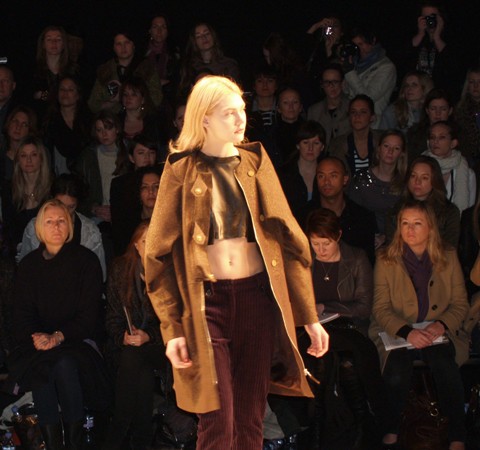


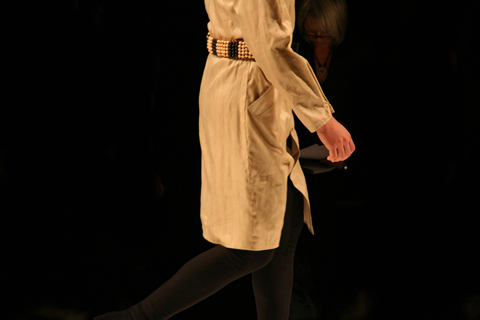
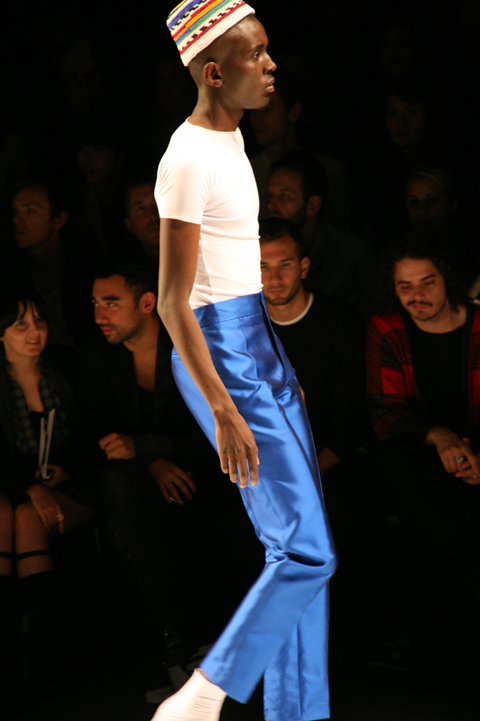
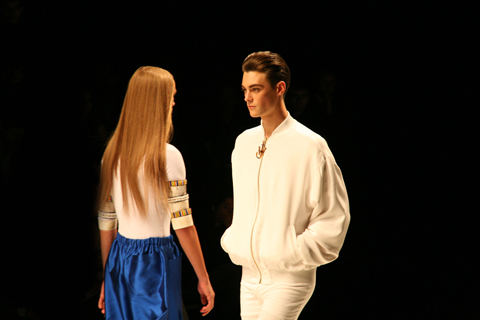

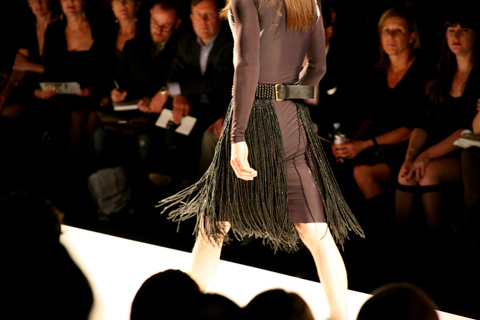


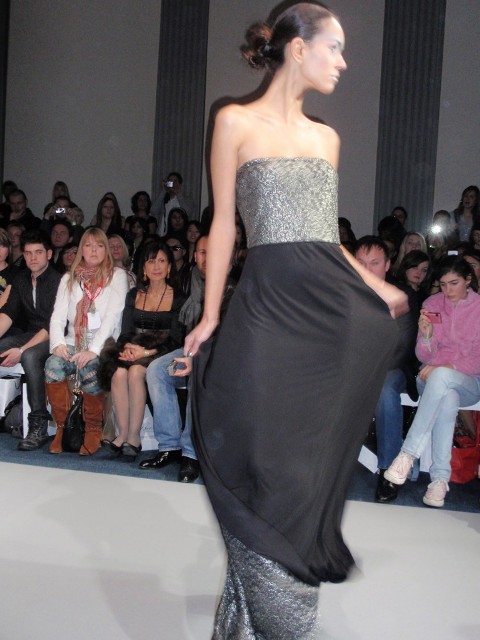
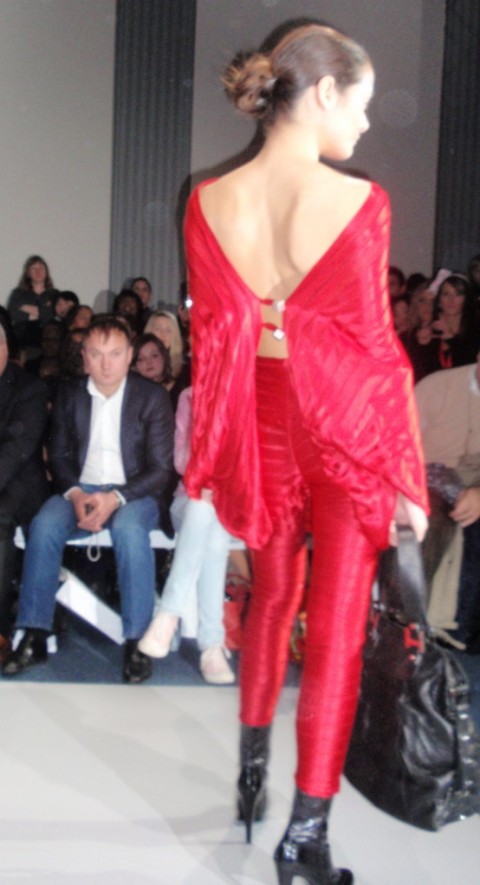


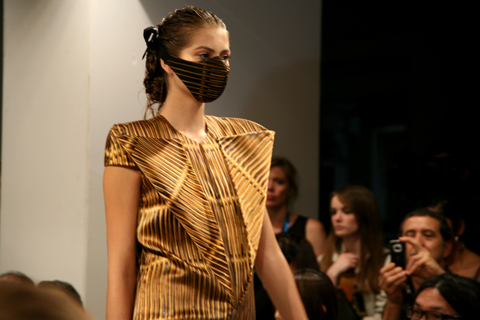


 viagra buy tunic shifts and “lazy chignons” escorted A-line skirts. The messed out romantic hair encapsulated the naivety of the models roughed faces’. Voluminous fabric encased the models’s body whilst their feet were strapped into