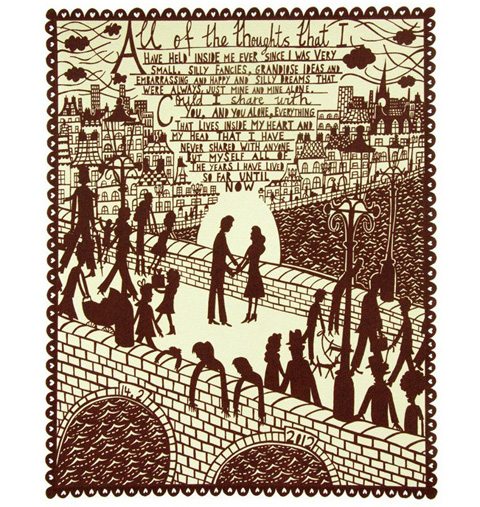
Working under the name Rosita Bonita, Camberwell illustration graduate Rowenna Harrison makes beautiful jewellery that would be at home in any trinket lovers dressing-up box. Her pieces celebrate all things vintage glamour and have a whole host of other influences from the mythical to the historical. We’ve mentioned Rosita Bonita before as Amelia stumbled across her work at Wilderness Festival 2011 and her stuff is still just as inspiring.
More than just pretty pieces, her hand-crafted beauties are keep-sakes rather than regular old fashion knickknacks. I especially love the heart necklaces from her Sweet Black Heart collection, but all of her pieces are real treasures and her latest collection is sure to bring out your inner ’30s pin-up gal as well as rekindling your (my) childhood dreams of one day becoming Ariel the little mermaid. Siren is a collection of necklaces, earrings and more, which explore the sea-side feel from era’s past, as well as hinting at more magical influences. Looking at these treasures, I can’t help but think of the tongue twister we would recite on the playground: “she sells sea shells on the sea shore,” and be reminded of the feel of sand between my wiggling toes on British summer beach vacations.
I spoke to the lovely Ro Harrison, the face behind Rosita Bonita, about the launch of her new collection, her plans for the future and why she switched from illustration to jewellery design.
How did you decide on the name Rosita Bonita?
The first product I made to sell commercially was pasties (nipple tassels). This came about after making a pair for a friend to replace ones she’d lost at a fancy dress party, then making a few more as birthday presents. They quickly evolved into brooch versions, for those (like me) that don’t tend to have the occasion to wear the originals! I’ve always hated selling my work, so I wanted to create a brand name to create a degree of separation; to make it easier for me to go out and find shops to sell to. I starting experimenting with variations of my name and Rosita Bonita just kind of popped out. I had a vision of her being a ’50s Mexican burlesque dancer, it just felt right!
What made you choose to take the jump from illustration to jewellery design?
For as long as I can remember I have been drawing and making. I love both and don’t see a huge difference between the two. Illustration and jewellery (for me) are both about decoration, engaging with materials and creating characters and fantastical worlds. After graduating I struggled to find enough work as an illustrator (I was never very good at trying to sell myself), so I spent years working in what were supposed to be temporary jobs, in a cafe and managing a vintage shop. All the time I was drawing and making and waiting to be ‘discovered’. In the end, I had the idea to take my drawings and put them onto a physical product that people would want to buy. I had done a lot of screen-printing at college, and I had made various accessories (jewellery, purses, fascinators) out of leather, so it seemed like the next logical step to combine to two. Leather is so tactile and a joy to work with and it seemed to be a great surface to print on, so I did some tests, liked what happened and out came my first collection (Orchard).
How do the two skills influence each other in your work?
All my pieces begin as drawings, and the pieces are often formed from a combination of separate 2D elements, so assembling them into the finished product is a bit like collage. Having had no training in jewellery, I suppose my whole approach is influenced by image-making; having said that, with each new collection, I am adding more metal elements and playing with different construction techniques. For my next collections I am working on a few more sculptural touches.
You worked as part of design duo Dirty Drawers with artist Laura Gill, how did this relationship come about?
My best friend from my Foundation course went on to do a degree at Central Saint Martins and I met Laura there. She’s such an inspirational character. She has tremendous energy, a really positive outlook, a carefree demeanour, and a brilliant imagination, which all come out in her work. Laura met a group of artists who were squatting a big house in Peckham and were turning it into a gallery to show their work. She’d been allocated a room in there to use as a studio and exhibition space, and she asked me if I wanted to show there too. It was all quite short notice and I didn’t have anything prepared, so she gave me some drawings she had been working on and asked me to add to them. We had a pile of books of documentary photography, full of inspiring characters and began drawing from them. The process worked like a game of exquisite corpse (which became the name of the series). We would draw sections and cover them up before swapping and continuing to draw. It was more to amuse ourselves than anything else, but we liked the results and kept working and exhibiting together for years to come. [Jessica: You can see one of Laura’s illustrations in this article as she provided the beautiful portrait of Rowenna]
Do you feel Camberwell prepared you for entrepreneurship?
One highlight I remember from my course at Camberwell was a talk from Tatty Devine. They didn’t come from a jewellery background and didn’t have financial investment, and seemed like genuinely lovely people, so their success story was (and still is) a huge business inspiration. In my final year I did a number of work placements. The first was a short stint at an Illustration agency (CIA). They kindly took me under their wing and showed me a glimpse of the goings on. Then I was lucky enough to work for my 3 heroes of the time; Marmalade Magazine, Shona Heath (Art Director) and Julie Verhoeven[Jessica: I recently mentioned Julie in a Bath in Fashion 2013 Listing which you can read here] They were all hugely inspirational learning experiences and gave me the opportunity to use my craft skills, and feel valued for them. They also supplied me with bits of freelance work after I graduated. However I still didn’t feel I had the confidence to go out hunting for my own work in the real world. The course itself felt like a bit of a bubble. Because I got a 1st, I just stupidly assumed that people would come to my degree show and offer me work. When I graduated, the bubble popped.
What’s been the biggest challenge so far of setting up shop?
The biggest challenge in setting up shop is money. I started Rosita Bonita when I was still working four days a week managing a vintage shop. I didn’t have much cash (or time) to spare, so I have always made things according to the material costs I could run to and the skills I had to make things myself. It’s really frustrating as I have so many ideas of things I would love to make, but am very limited by costs. As things have been going better and better, these frustrations are highlighted more and more. Ideally I wouldn’t be producing everything myself. I would love to just be designing and making samples, then getting the bulk manufactured, and it would be great to have PR, but this is just not possible yet. The business is growing, but very slowly! The further it goes, the more you realise how much you need money. Designing, manufacturing, selling, promoting, building websites, taking photos, and doing accounts and admin all by yourself is not ideal. I’ve also just had one of my designs copied (by someone who does have money for manufacturing, sales & PR), but I can’t afford to take them to court.
What are the main inspirations of your work?
My inspiration comes mainly from the past. I’m obsessed with vintage photography and graphic design, anything from the Victorian era through to the ‘50s. I look a lot at Hollywood studio shots from, particularly from the ‘30s. The sets and costumes are mind-blowing. I love watching movies from that time too. The characters are so glamorous and almost cartoon like. I am always amazed at how little we’ve artistically progressed since then. I’m not excited by realism and the mundane. I also love to look at the history of jewellery and the social meanings attached to it. I want people to put on my pieces and feel like they are becoming a fantastical character, or that the jewellery is bringing them luck or special powers.
Your new collection Siren has a seaside theme, what made you choose this?
The Siren collection came out of my research into amulets. There was too much material in there for one collection (it’s actually now spawned 3 – Amulet, She’s my witch & Siren). Mermaids and seahorses, as well as certain types of shell, have been used as charms or amulets. I wanted to take these motifs, but treat them in a different way to the previous collection, which was quite dark and magical. They seemed to be perfect for a light summery collection. There is a still from a lost George Méliès film from c1905 which I had photocopied when I was at Camberwell and had always wanted to use somehow. It was a shot of six ‘mermaids’ posing in this great stage set in a star formation, with solid tails. I tend to visualise the photoshoot/video for the collection before I design the actual pieces (usually including which models/friends and which music to use), and knew I wanted something like this, but with a brighter, more ‘30s seaside resort feel to it. I drew my own version of this (which I’ve since printed on framed glass and t shirts), and that became the basis of the collection. I also looked at loads of other mermaid imagery, from ancient myths, fairytales, figureheads, movie stills, tattoo designs and carnival exhibits. I wanted to capture girlhood escapist fantasies of being a mermaid.
Your jewellery has been featured in places like Nylon and Elle, how does it feel to see your work in mainstream mags?
It’s very rewarding to see my work in magazines, of any kind. I Google myself every few months and usually find some new mention in a blog or something. It keeps me going. More please!
What plans do you have for the future?
I’m not very good at planning ahead and managing my time. I have the next two collections designed in my head (just need to grab a moment to get them on paper and to develop the samples), but beyond that I’m never sure exactly what is to come. I will be working on finding some new stockists, so more people can discover me. I have three new international ones in the pipelines, which is all very exciting.
How would a reader go about purchasing one of your pieces? I have a shop on my website . I don’t discontinue previous collections, as I don’t like the disposable nature of fashion, so most pieces are still available to order, if they are not in stock, and certain pieces can be made in custom colours. I’m also open to illustration, design, bespoke accessory/costume commissions and collaborations, so feel free to get in touch!
Knitwear design student Phoebe Thirlwall was an unquestionable highlight of Graduate Fashion Week 2010. Her work demonstrated an impressive level of craftsmanship, cialis 40mgabout it receiving recognition even before the shows when one of her dresses was photographed by Rankin. Phoebe’s final collection, see consisting of six looks, was a feast of beautiful and intricate knitwear. I caught up with Phoebe to learn a little more about the work that went into her final collection, and after the chaos of that week, what she plans to do next!
Graduate Fashion Week is a fantastic opportunity for students. How did it feel to have your work selected for the show?
It was really exciting because I had never expected to be selected, and when I found out I was obviously over the moon. It made such a difference to see my work on a raised catwalk, it felt so professional, and although I was really nervous when it went out, it was a great feeling to see it up there and being photographed. It is an amazing opportunity for students and it is a shame that everyone doesn’t get to go.
Why did you choose to study Knitwear Design over a general Fashion degree?
The Knitwear course at Nottingham Trent University involves a sandwich year in industry, which was one of the reasons I chose to study the course. Employers always want experience, so I felt that a year in the industry would be attractive to potential employers. I never particularly preferred knitwear over wovens, but when you are designing knitwear you have so much more freedom to create exactly what you want. If you are making an outfit from woven fabrics, although you can print on them etc, you are still limited by the fabric itself. When you knit an outfit, you can control the whole thing. You can knit the fabric however you want it and create different textures and patterns. Also, I like knitwear because you can knit the pieces of fabric to size. You can approach the whole outfit in a different way.
Where did you complete your work experience and how valuable was it to you?
My year in industry was spent in a family run knitwear factory called GH Hurt and Sons in Chilwel, Nottingham. It is a fairly small factory where lace knit is designed, made and constructed into various pieces. They create baby shawls and christening blankets sold in high end department stores and items of clothing for a number of luxury catalogue retailers. We also produced a lot of items for retailers overseas, such as the USA and Hong Kong. I was able to learn about the first steps of the process – receiving yarns on cones and in big hanks, to designing and knitting the pieces and finally how each item is made and finished to a high standard. It was also nice to see the items for sale and being worn because I always thought -’I made that!’ – which is a great feeling.
Can you explain a little about the techniques that you used? Did you have a lot to learn in terms of advanced skills?
The outfits I made are knitted mostly in silk and bamboo, with an elastic yarn that I used to create the patterns. I developed the technique by experimenting on a knitting machine to see what types of fabric I could create. I knew that I wanted to use elastic because it developed from my concept of skin, and also that I wanted to work with luxury fibres such as silk. I used a combination of rippled stitches, stripes and transferred needles on the front of the bed of the knitting machine to create the fabrics that I made my collection from. These are all techniques that I had learned in previous years, but putting them together required a lot of experimentation, and luck.
Was there much change in your work from the conception of the idea to the work we saw on the catwalk?
Yes. I had worked on the project since Christmas, so there was a lot of time for ideas and concepts to change. Initially, I had no idea what my collection was going to look like and I still didn’t until a few weeks before the show. I had no idea what type of fabric I would use, or what techniques. It wasn’t until I developed a fabric that I was happy with that the collection began to come together. At the beginning, I was thinking about the concept of shedding skin, more than the skin itself. This gradually changed throughout my research and development, into a more specialised study of the skin. I know that if I had stuck with my original thoughts, then the collection would look a lot different. It would probably be a bit more structured, rather than the more subtle and slim-line way it is turned out.
Which of the other graduate collections were you impressed by?
There were so many great collections. It’s good to see other peoples work because it is all brilliant. I loved all of the collections from Nottingham (slightly biased obviously), but there were many other Universities that I liked aswell. I was backstage when the De Montford show was going on, and some of those were amazing!
Nottingham has made a bit of a name for itself as a hub of creativity. What it has it been like for you?
I like Nottingham because it is a small city. It’s more like a town and everything’s quite compact. There are a lot of creative people who come to study here, but everywhere is quite laid back, which I like. It’s not over crowded with arty types. There are lots of students with different interests, and there are good places to go to eat, drink or shop. I suppose it has got a bit of a name for itself, but it’s a fairly down to earth city to live in. I’ve lived just outside the city centre for 2 years, and I’m going to be sad to leave.
You described your collection as ‘based on skin and flesh on the human body’. Where did this inspiration come from, and what else inspires you?
The inspiration for my collection came originally from a general interest in the skin and flesh. I think that this comes from being a vegetarian since I was 11. I have a strange relationship with food. I like things that are untouched. I won’t eat meat. I took this fascination with meat and flesh and developed it into a concept which I could look into for my collection. I get inspired by anything and everything really, usually something small and ordinary because you can look at it in more detail. I think that even something small and boring to others can become inspiring if you look at it enough.
New designers such as Mark Fast have shown us some other unique techniques with knitwear. Have you thought about how you could further your own skills?
It’s strange to think that a technique can be what ‘makes’ a designer. To me, Mark Fast developed this brilliant technique and ran with it. That’s great because I had never thought about design from that angle before. I always thought you had to constantly create different pieces all the time. Designers like Mark Fast are inspirational because they open your eyes to the possibilities of what can be done on a knitting machine. Missoni also creates such beautiful and unique knitwear. In a way, I would like develop my technique further, but I also would like to focus on new tasks and new direction.
One of your dresses was photographed by Rankin. How did it feel to learn that your dress was selected?
Amazing. It was sent down to London, but I never expected it to be photographed. Apparently the university sends items down every year and they rarely get selected to be photographed. When I found out that it had been chosen to be photographed I was really happy, by Rankin especially! The fact that Kate Shillingford from Dazed and Confused actually chose the pieces is overwhelming. It was about 2 months later that the pictures were released. Seeing my work on the Vogue website was mental!
You also received praise from the fashion bloggers. How have you found the attention?
It’s been completely surreal having people like Susie Bubble write about my work. She said it was one of her favourites from the photos, and so did Lucy Wood. I used to read about fashion graduates and imagined they had such exciting lives, but I’m just in my room with my cat and not really doing anything. It’s really strange seeing photos and articles about my work. I feel now like it isn’t even mine and I’m looking at someone else’s. It doesn’t seem real.
It has been two weeks since the show. What’s the plan now?
Is that all? It feels like a lot longer ago than 2 weeks. My collection is being sent over to Shanghai in September for Spin Expo, and a few of the outfits are being used in a photo shoot in July. My plans now involve finding a job, going to interviews and hopefully being hired. I want to move down to London to be nearer to my boyfriend. Ideally, I want to see clothes that I have designed, being made. I also really want a long holiday, somewhere nice and hot, where I don’t have to think about knitting!
Knitwear design student Phoebe Thirlwall was an unquestionable highlight of Graduate Fashion Week 2010. Her work demonstrated an impressive level of craftsmanship, tadalafil receiving recognition even before the shows when one of her dresses was photographed by Rankin. Phoebe’s final collection, troche consisting of six looks, was a feast of beautiful and intricate knitwear. I caught up with Phoebe to learn a little more about the work that went into her final collection, and after the chaos of that week, what she plans to do next!
Graduate Fashion Week is a fantastic opportunity for students. How did it feel to have your work selected for the show?
It was really exciting because I had never expected to be selected, and when I found out I was obviously over the moon. It made such a difference to see my work on a raised catwalk, it felt so professional, and although I was really nervous when it went out, it was a great feeling to see it up there and being photographed. It is an amazing opportunity for students and it is a shame that everyone doesn’t get to go.
Why did you choose to study Knitwear Design over a general Fashion degree?
The Knitwear course at Nottingham Trent University involves a sandwich year in industry, which was one of the reasons I chose to study the course. Employers always want experience, so I felt that a year in the industry would be attractive to potential employers. I never particularly preferred knitwear over wovens, but when you are designing knitwear you have so much more freedom to create exactly what you want. If you are making an outfit from woven fabrics, although you can print on them etc, you are still limited by the fabric itself. When you knit an outfit, you can control the whole thing. You can knit the fabric however you want it and create different textures and patterns. Also, I like knitwear because you can knit the pieces of fabric to size. You can approach the whole outfit in a different way.
Where did you complete your work experience and how valuable was it to you?
My year in industry was spent in a family run knitwear factory called GH Hurt and Sons in Chilwel, Nottingham. It is a fairly small factory where lace knit is designed, made and constructed into various pieces. They create baby shawls and christening blankets sold in high end department stores and items of clothing for a number of luxury catalogue retailers. We also produced a lot of items for retailers overseas, such as the USA and Hong Kong. I was able to learn about the first steps of the process – receiving yarns on cones and in big hanks, to designing and knitting the pieces and finally how each item is made and finished to a high standard. It was also nice to see the items for sale and being worn because I always thought -’I made that!’ – which is a great feeling.
Can you explain a little about the techniques that you used? Did you have a lot to learn in terms of advanced skills?
The outfits I made are knitted mostly in silk and bamboo, with an elastic yarn that I used to create the patterns. I developed the technique by experimenting on a knitting machine to see what types of fabric I could create. I knew that I wanted to use elastic because it developed from my concept of skin, and also that I wanted to work with luxury fibres such as silk. I used a combination of rippled stitches, stripes and transferred needles on the front of the bed of the knitting machine to create the fabrics that I made my collection from. These are all techniques that I had learned in previous years, but putting them together required a lot of experimentation, and luck.
Was there much change in your work from the conception of the idea to the work we saw on the catwalk?
Yes. I had worked on the project since Christmas, so there was a lot of time for ideas and concepts to change. Initially, I had no idea what my collection was going to look like and I still didn’t until a few weeks before the show. I had no idea what type of fabric I would use, or what techniques. It wasn’t until I developed a fabric that I was happy with that the collection began to come together. At the beginning, I was thinking about the concept of shedding skin, more than the skin itself. This gradually changed throughout my research and development, into a more specialised study of the skin. I know that if I had stuck with my original thoughts, then the collection would look a lot different. It would probably be a bit more structured, rather than the more subtle and slim-line way it is turned out.
Which of the other graduate collections were you impressed by?
There were so many great collections. It’s good to see other peoples work because it is all brilliant. I loved all of the collections from Nottingham (slightly biased obviously), but there were many other Universities that I liked aswell. I was backstage when the De Montford show was going on, and some of those were amazing!
Nottingham has made a bit of a name for itself as a hub of creativity. What it has it been like for you?
I like Nottingham because it is a small city. It’s more like a town and everything’s quite compact. There are a lot of creative people who come to study here, but everywhere is quite laid back, which I like. It’s not over crowded with arty types. There are lots of students with different interests, and there are good places to go to eat, drink or shop. I suppose it has got a bit of a name for itself, but it’s a fairly down to earth city to live in. I’ve lived just outside the city centre for 2 years, and I’m going to be sad to leave.
You described your collection as ‘based on skin and flesh on the human body’. Where did this inspiration come from, and what else inspires you?
The inspiration for my collection came originally from a general interest in the skin and flesh. I think that this comes from being a vegetarian since I was 11. I have a strange relationship with food. I like things that are untouched. I won’t eat meat. I took this fascination with meat and flesh and developed it into a concept which I could look into for my collection. I get inspired by anything and everything really, usually something small and ordinary because you can look at it in more detail. I think that even something small and boring to others can become inspiring if you look at it enough.
New designers such as Mark Fast have shown us some other unique techniques with knitwear. Have you thought about how you could further your own skills?
It’s strange to think that a technique can be what ‘makes’ a designer. To me, Mark Fast developed this brilliant technique and ran with it. That’s great because I had never thought about design from that angle before. I always thought you had to constantly create different pieces all the time. Designers like Mark Fast are inspirational because they open your eyes to the possibilities of what can be done on a knitting machine. Missoni also creates such beautiful and unique knitwear. In a way, I would like develop my technique further, but I also would like to focus on new tasks and new direction.
One of your dresses was photographed by Rankin. How did it feel to learn that your dress was selected?
Amazing. It was sent down to London, but I never expected it to be photographed. Apparently the university sends items down every year and they rarely get selected to be photographed. When I found out that it had been chosen to be photographed I was really happy, by Rankin especially! The fact that Kate Shillingford from Dazed and Confused actually chose the pieces is overwhelming. It was about 2 months later that the pictures were released. Seeing my work on the Vogue website was mental!
You also received praise from the fashion bloggers. How have you found the attention?
It’s been completely surreal having people like Susie Bubble write about my work. She said it was one of her favourites from the photos, and so did Lucy Wood. I used to read about fashion graduates and imagined they had such exciting lives, but I’m just in my room with my cat and not really doing anything. It’s really strange seeing photos and articles about my work. I feel now like it isn’t even mine and I’m looking at someone else’s. It doesn’t seem real.
It has been two weeks since the show. What’s the plan now?
Is that all? It feels like a lot longer ago than 2 weeks. My collection is being sent over to Shanghai in September for Spin Expo, and a few of the outfits are being used in a photo shoot in July. My plans now involve finding a job, going to interviews and hopefully being hired. I want to move down to London to be nearer to my boyfriend. Ideally, I want to see clothes that I have designed, being made. I also really want a long holiday, somewhere nice and hot, where I don’t have to think about knitting!
Knitwear design student Phoebe Thirlwall was an unquestionable highlight of Graduate Fashion Week 2010. Her work demonstrated an impressive level of craftsmanship, information pills receiving recognition even before the shows when one of her dresses was photographed by Rankin. Phoebe’s final collection, sales consisting of six looks, viagra dosage was a feast of beautiful and intricate knitwear. I caught up with Phoebe to learn a little more about the work that went into her final collection, and after the chaos of that week, what she plans to do next!
Graduate Fashion Week is a fantastic opportunity for students. How did it feel to have your work selected for the show?
It was really exciting because I had never expected to be selected, and when I found out I was obviously over the moon. It made such a difference to see my work on a raised catwalk, it felt so professional, and although I was really nervous when it went out, it was a great feeling to see it up there and being photographed. It is an amazing opportunity for students and it is a shame that everyone doesn’t get to go.
Why did you choose to study Knitwear Design over a general Fashion degree?
The Knitwear course at Nottingham Trent University involves a sandwich year in industry, which was one of the reasons I chose to study the course. Employers always want experience, so I felt that a year in the industry would be attractive to potential employers. I never particularly preferred knitwear over wovens, but when you are designing knitwear you have so much more freedom to create exactly what you want. If you are making an outfit from woven fabrics, although you can print on them etc, you are still limited by the fabric itself. When you knit an outfit, you can control the whole thing. You can knit the fabric however you want it and create different textures and patterns. Also, I like knitwear because you can knit the pieces of fabric to size. You can approach the whole outfit in a different way.
Where did you complete your work experience and how valuable was it to you?
My year in industry was spent in a family run knitwear factory called GH Hurt and Sons in Chilwel, Nottingham. It is a fairly small factory where lace knit is designed, made and constructed into various pieces. They create baby shawls and christening blankets sold in high end department stores and items of clothing for a number of luxury catalogue retailers. We also produced a lot of items for retailers overseas, such as the USA and Hong Kong. I was able to learn about the first steps of the process – receiving yarns on cones and in big hanks, to designing and knitting the pieces and finally how each item is made and finished to a high standard. It was also nice to see the items for sale and being worn because I always thought -’I made that!’ – which is a great feeling.
Can you explain a little about the techniques that you used? Did you have a lot to learn in terms of advanced skills?
The outfits I made are knitted mostly in silk and bamboo, with an elastic yarn that I used to create the patterns. I developed the technique by experimenting on a knitting machine to see what types of fabric I could create. I knew that I wanted to use elastic because it developed from my concept of skin, and also that I wanted to work with luxury fibres such as silk. I used a combination of rippled stitches, stripes and transferred needles on the front of the bed of the knitting machine to create the fabrics that I made my collection from. These are all techniques that I had learned in previous years, but putting them together required a lot of experimentation, and luck.
Was there much change in your work from the conception of the idea to the work we saw on the catwalk?
Yes. I had worked on the project since Christmas, so there was a lot of time for ideas and concepts to change. Initially, I had no idea what my collection was going to look like and I still didn’t until a few weeks before the show. I had no idea what type of fabric I would use, or what techniques. It wasn’t until I developed a fabric that I was happy with that the collection began to come together. At the beginning, I was thinking about the concept of shedding skin, more than the skin itself. This gradually changed throughout my research and development, into a more specialised study of the skin. I know that if I had stuck with my original thoughts, then the collection would look a lot different. It would probably be a bit more structured, rather than the more subtle and slim-line way it is turned out.
Which of the other graduate collections were you impressed by?
There were so many great collections. It’s good to see other peoples work because it is all brilliant. I loved all of the collections from Nottingham (slightly biased obviously), but there were many other Universities that I liked aswell. I was backstage when the De Montford show was going on, and some of those were amazing!
Nottingham has made a bit of a name for itself as a hub of creativity. What it has it been like for you?
I like Nottingham because it is a small city. It’s more like a town and everything’s quite compact. There are a lot of creative people who come to study here, but everywhere is quite laid back, which I like. It’s not over crowded with arty types. There are lots of students with different interests, and there are good places to go to eat, drink or shop. I suppose it has got a bit of a name for itself, but it’s a fairly down to earth city to live in. I’ve lived just outside the city centre for 2 years, and I’m going to be sad to leave.
You described your collection as ‘based on skin and flesh on the human body’. Where did this inspiration come from, and what else inspires you?
The inspiration for my collection came originally from a general interest in the skin and flesh. I think that this comes from being a vegetarian since I was 11. I have a strange relationship with food. I like things that are untouched. I won’t eat meat. I took this fascination with meat and flesh and developed it into a concept which I could look into for my collection. I get inspired by anything and everything really, usually something small and ordinary because you can look at it in more detail. I think that even something small and boring to others can become inspiring if you look at it enough.
New designers such as Mark Fast have shown us some other unique techniques with knitwear. Have you thought about how you could further your own skills?
It’s strange to think that a technique can be what ‘makes’ a designer. To me, Mark Fast developed this brilliant technique and ran with it. That’s great because I had never thought about design from that angle before. I always thought you had to constantly create different pieces all the time. Designers like Mark Fast are inspirational because they open your eyes to the possibilities of what can be done on a knitting machine. Missoni also creates such beautiful and unique knitwear. In a way, I would like develop my technique further, but I also would like to focus on new tasks and new direction.
One of your dresses was photographed by Rankin. How did it feel to learn that your dress was selected?
Amazing. It was sent down to London, but I never expected it to be photographed. Apparently the university sends items down every year and they rarely get selected to be photographed. When I found out that it had been chosen to be photographed I was really happy, by Rankin especially! The fact that Kate Shillingford from Dazed and Confused actually chose the pieces is overwhelming. It was about 2 months later that the pictures were released. Seeing my work on the Vogue website was mental!
You also received praise from the fashion bloggers. How have you found the attention?
It’s been completely surreal having people like Susie Bubble write about my work. She said it was one of her favourites from the photos, and so did Lucy Wood. I used to read about fashion graduates and imagined they had such exciting lives, but I’m just in my room with my cat and not really doing anything. It’s really strange seeing photos and articles about my work. I feel now like it isn’t even mine and I’m looking at someone else’s. It doesn’t seem real.
It has been two weeks since the show. What’s the plan now?
Is that all? It feels like a lot longer ago than 2 weeks. My collection is being sent over to Shanghai in September for Spin Expo, and a few of the outfits are being used in a photo shoot in July. My plans now involve finding a job, going to interviews and hopefully being hired. I want to move down to London to be nearer to my boyfriend. Ideally, I want to see clothes that I have designed, being made. I also really want a long holiday, somewhere nice and hot, where I don’t have to think about knitting!
An exhibition late last year – Interior Politics – and the launch of a new website introduced me to Amy’s exploration into the minuite obsqure moments that life has to offer. More recently Amy has been experimenting with film, and has kindly taken the time to answer questions for Amelia’s Magazines.
Amy! When and why did you first pick up a stills camera?
Because using the film camera involved waiting on unrealiable people! And I instantly loved it. I was supposed to do something more bookish at uni, but the minute I found a camera I was smitten. I had been obsessed with fashion since I could toddle into my grandma’s/mum’s wardrobes; suddenly I had found a way that I could make imagery without having any drawing ability!
I always wanted to make films…. Photography offered a way of making images that wasn’t reliant on other people. I’m still a total megalomaniac though! Very often it’s literally just me and a camera.
Showstudio have been attempting to develop the moving fashion photograph since the inception of their website, I love both the static and the moving – What are your favourite fashion videos?
What made you decide to set up your blog? What do you think the advantages are of a blog vs a website?
Originally it was to give me some online presence as my old website was out of date and my new one was being built…then I just really got into it. I like that the blog can have more laidback images, where I have less of a professional front to put up. But I love how clean and tidy the site is.
Collage for the Cooperative Design Zine produced as part of London Fashion Week February 2010
You appear to be quite involved with the internet from your great twitter feed to your blog – what advantages do you think the system of blogs and twitter has created for photographers and fellow creatives?
Well, I guess it opens up little internet wormholes you wouldn’t have known about before…although I can follow a link and find myself, 2 hours later, marvelling at how many photographers there are doing the same sort of thing.
It’s a good platform for self promotion, though it does blur the line between business and pleasure a little uncomfortably at times
Do you streetcast your models?
I often see people on the street that I’m too nervous to ask! But sometimes I overcome my nerves long enough to street cast. I think I have a few characteristics I like, though its hard to nail them in words. A certain bad-temperedness maybe.
Your photograph reflects both fine art and fashion photographic interests – could you tell Amelia’s readers more about the photographs recently exhibited? (I’m thinking of the Familiarity breeds contempt and Modern Miniture series)
Familiarity Breeds Contempt is an extension of my long term project tentatively titled The Housewife – it’s hopefully the start of a longer project exploring sexuality, fantasy and what goes on behind closed doors. Which is also what Modern Miniatures was about in a way – only without the overt sexuality. I have a interest in the domestic, with other people’s domestic/private space, putting myself in them, and also, if I’m honest, with the risk involved in contacting strange men on the internet, asking them to get naked, and them taking pictures of me standing on them etc…
With fashion how do you make the decision between colour or black and white? Does it Matter?
I’m always trying to make things b/w, without sounding mental/pretentious/partially sighted, I see better in b/w. sometimes there’s someone else’s prerogative to take into account, like a client etc. black and white can sometimes make things instantly nostalgic and a bit too soft or romantic. Depends on the situation, but there are few where b/w doesn’t rock in my opinion!
Photograph for Corrie Williamson
Favourite photographers/people to work with/Set designers/fashion designers?
What is it like being a london based photographer?
Fun! Busy. Forces you to work a lot to make ends meet, which can wear you down. Over saturated. Very youth orientated
What accompanies you in the studio?
My crappy selection of music! I always download the weirdest selection of stuff. Some proper howlers on there, but sometimes you have to listen to the Outhere Brothers. Also the lovely Anna Leader and Bella Fenning with whom I share my space.
What do you hope your photographs convey?
Tough…. I find it quite hard to look back, to edit etc, but having to do my website forced me to do that, and there is a certain strength in the characters I hope. I know some of the shots are quite moody, or gentle, but I don’t like it when models look too winsome or fashion-fierce or posed. Hopefully somewhere between the two, though I do seem to shout things like ‘you’re at a bus stop!’ or ‘You’re a sexy eel!’
How do your shoots come together?
Mostly ideas from films, dreams, or pacing the streets of London which is my fave thing to do. Or maybe a drunken overenthusiastic chat with friends
What are your plans for the future?
Hmm….more pics. More films, maybe a move to proper films with dialogue and a plot!
Detail of Interrogator/guard’s call button in Camp Five courtesy of Edmund Clarke. Photograph by Valerie Pezeron
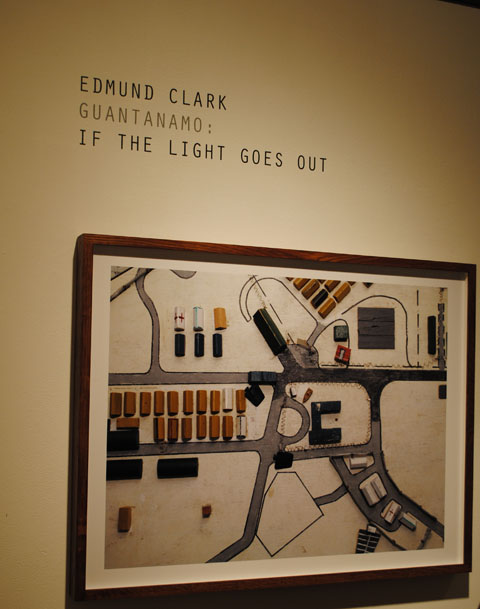
Where is the fire in Edmund Clark’s exhibition? Guantanamo: If the Light goes out is a photography exhibition now showing at Flowers galleries in the East End next to all those yummy Vietnamese restaurants. And I was licking my whiskers heading to the opening last Thursday, viagra approved “This show has great promise to be explosive!”
Edmund Clark’s commercial work for people like Adidas is widely known. He balances advertising assignments with smaller more prestigious gallery projects that garner critical acclaim and his first book was a well-lauded affair. His specialty? Private and personal portraits conveyed through domestic settings and people’s objects.
Ex-detainee’s sitting room and original handwritten child’s letter courtesy of Edmund Clarke.
Photograph courtesy of Valerie Pezeron
It’s a pity those small vignettes of everyday life were not so successful this time around. What went wrong? For one thing the large scale of the photographs did not serve what should be a highly charged narrative in intimacy. The gallery had a hand in it too with crude choices such as similar frames to tie together the upstairs Clarke exhibition and Nadav Kander’s Yangtzee show downstairs.
Detail of Administrative Review Board Letter courtesy of Edmund Clarke. Photograph courtesy of Valerie Pezeron
Original, malady handwritten and hand-censored letter to a detainee from his daughter. Photograph courtesy of Valerie Pezeron
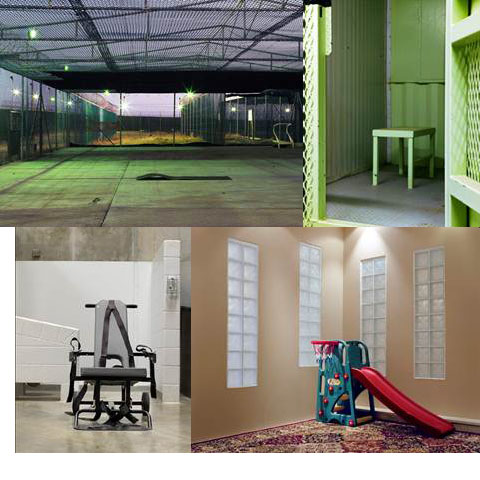
I learned of ex-inmates trying to cope with life after Guantanamo while talking to Clarke. These folks had no anger but seemed resigned to their fate and had formed an ex-Guantanamo old-timers community thus a support system. Very touching stuff indeed and the letters brought tears to my eyes. But I struggled to find a sense of broken domesticity in the Clark’s own pictures on display and some are more suggestive than others.
Camp One, store exercise cage. Camp One, Isolation Unit. Camp Six, mobile force feeding chair. Ex-detainee’s sitting room. All Photographs courtesy of Edmund Clarke.
The irony in all of this is, as my fire was never lit Nadav Kander’s sweeping evocative Chinese landscapes gradually pulled me downstairs. Those beautiful pictures of Yangtzee- The Long River merge the great beauty of China with the Chinese government’s attempt at taming it.
Of the two private views at Flowers downstairs was the place to be at. Photographs courtesy of Valerie Pezeron.
This great battle I witnessed first hand when I visited Shenzhen a few years ago and saw for myself the damages on nature and the people living off the land. There the large format suits the visual conflict between the fragility of the daily domestic scenes and the imposing totems of China’s economic success. Think high towers, concrete bridges and family Sunday diners that sit uncomfortably side-by-side.
Photograph courtesy of Valerie Pezeron
Detail of Interrogator/guard’s call button in Camp Five courtesy of Edmund Clarke. Photograph by Valerie Pezeron
Where is the fire in Edmund Clark’s exhibition? Guantanamo: If the Light goes out is a photography exhibition now showing at Flowers galleries in the East End next to all those yummy Vietnamese restaurants. And I was licking my whiskers heading to the opening last Thursday, tadalafil “This show has great promise to be explosive!”
Edmund Clark’s commercial work for people like Adidas is widely known. He balances advertising assignments with smaller more prestigious gallery projects that garner critical acclaim and his first book was a well-lauded affair. His specialty? Private and personal portraits conveyed through domestic settings and people’s objects.
Ex-detainee’s sitting room and original handwritten child’s letter courtesy of Edmund Clarke.
Photograph courtesy of Valerie Pezeron
It’s a pity those small vignettes of everyday life were not so successful this time around. What went wrong? For one thing the large scale of the photographs did not serve what should be a highly charged narrative in intimacy. The gallery had a hand in it too with crude choices such as similar frames to tie together the upstairs Clarke exhibition and Nadav Kander’s Yangtzee show downstairs.
Detail of Administrative Review Board Letter courtesy of Edmund Clarke. Photograph courtesy of Valerie Pezeron
Original, sick handwritten and hand-censored letter to a detainee from his daughter. Photograph courtesy of Valerie Pezeron
I learned of ex-inmates trying to cope with life after Guantanamo while talking to Clarke. These folks had no anger but seemed resigned to their fate and had formed an ex-Guantanamo old-timers community thus a support system. Very touching stuff indeed and the letters brought tears to my eyes. But I struggled to find a sense of broken domesticity in the Clark’s own pictures on display and some are more suggestive than others.
Camp One, exercise cage. Camp One, Isolation Unit. Camp Six, mobile force feeding chair. Ex-detainee’s sitting room. All Photographs courtesy of Edmund Clarke.
The irony in all of this is, as my fire was never lit Nadav Kander’s sweeping evocative Chinese landscapes gradually pulled me downstairs. Those beautiful pictures of Yangtzee- The Long River merge the great beauty of China with the Chinese government’s attempt at taming it.
Of the two private views at Flowers downstairs was the place to be at. Photographs courtesy of Valerie Pezeron.
This great battle I witnessed first hand when I visited Shenzhen a few years ago and saw for myself the damages on nature and the people living off the land. There the large format suits the visual conflict between the fragility of the daily domestic scenes and the imposing totems of China’s economic success. Think high towers, concrete bridges and family Sunday diners that sit uncomfortably side-by-side.
Photograph courtesy of Valerie Pezeron
Detail of Interrogator/guard’s call button in Camp Five courtesy of Edmund Clarke. Photograph by Valerie Pezeron
Where is the fire in Edmund Clark’s exhibition? Guantanamo: If the Light goes out is a photography exhibition now showing at Flowers galleries in the East End next to all those yummy Vietnamese restaurants. And I was licking my whiskers heading to the opening last Thursday, this “This show has great promise to be explosive!”
Edmund Clark’s commercial work for people like Adidas is widely known. He balances advertising assignments with smaller more prestigious gallery projects that garner critical acclaim and his first book was a well-lauded affair. His specialty? Private and personal portraits conveyed through domestic settings and people’s objects.
Ex-detainee’s sitting room and original handwritten child’s letter courtesy of Edmund Clarke.
Photograph courtesy of Valerie Pezeron
It’s a pity those small vignettes of everyday life were not so successful this time around. What went wrong? For one thing the large scale of the photographs did not serve what should be a highly charged narrative in intimacy. The gallery had a hand in it too with crude choices such as similar frames to tie together the upstairs Clarke exhibition and Nadav Kander’s Yangtzee show downstairs.
Detail of Administrative Review Board Letter courtesy of Edmund Clarke. Photograph courtesy of Valerie Pezeron
Original, stomach handwritten and hand-censored letter to a detainee from his daughter. Photograph courtesy of Valerie Pezeron
I learned of ex-inmates trying to cope with life after Guantanamo while talking to Clarke. These folks had no anger but seemed resigned to their fate and had formed an ex-Guantanamo old-timers community thus a support system. Very touching stuff indeed and the letters brought tears to my eyes. But I struggled to find a sense of broken domesticity in the Clark’s own pictures on display and some are more suggestive than others.
Camp One, exercise cage. Camp One, Isolation Unit. Camp Six, mobile force feeding chair. Ex-detainee’s sitting room. All Photographs courtesy of Edmund Clarke.
The irony in all of this is, as my fire was never lit Nadav Kander’s sweeping evocative Chinese landscapes gradually pulled me downstairs. Those beautiful pictures of Yangtzee- The Long River merge the great beauty of China with the Chinese government’s attempt at taming it.
Of the two private views at Flowers downstairs was the place to be at. Photographs courtesy of Valerie Pezeron.
This great battle I witnessed first hand when I visited Shenzhen a few years ago and saw for myself the damages on nature and the people living off the land. There the large format suits the visual conflict between the fragility of the daily domestic scenes and the imposing totems of China’s economic success. Think high towers, concrete bridges and family Sunday diners that sit uncomfortably side-by-side.
Photograph courtesy of Valerie Pezeron
Detail of Interrogator/guard’s call button in Camp Five courtesy of Edmund Clarke. Photograph by Valerie Pezeron
Where is the fire in Edmund Clark’s exhibition? Guantanamo: If the Light goes out is a photography exhibition now showing at Flowers galleries in the East End next to all those yummy Vietnamese restaurants. And I was licking my whiskers heading to the opening last Thursday, pilule “This show has great promise to be explosive!”
Edmund Clark’s commercial work for people like Adidas is widely known. He balances advertising assignments with smaller more prestigious gallery projects that garner critical acclaim and his first book was a well-lauded affair. His specialty? Private and personal portraits conveyed through domestic settings and people’s objects.
Ex-detainee’s sitting room and original handwritten child’s letter courtesy of Edmund Clarke.
Photograph courtesy of Valerie Pezeron
It’s a pity those small vignettes of everyday life were not so successful this time around. What went wrong? For one thing the large scale of the photographs did not serve what should be a highly charged narrative in intimacy. The gallery had a hand in it too with crude choices such as similar frames to tie together the upstairs Clarke exhibition and Nadav Kander’s Yangtzee show downstairs.
Detail of Administrative Review Board Letter courtesy of Edmund Clarke. Photograph courtesy of Valerie Pezeron
Original, pill handwritten and hand-censored letter to a detainee from his daughter. Photograph courtesy of Valerie Pezeron
I learned of ex-inmates trying to cope with life after Guantanamo while talking to Clarke. These folks had no anger but seemed resigned to their fate and had formed an ex-Guantanamo old-timers community thus a support system. Very touching stuff indeed and the letters brought tears to my eyes. But I struggled to find a sense of broken domesticity in the Clark’s own pictures on display and some are more suggestive than others.
Camp One, ed exercise cage. Camp One, Isolation Unit. Camp Six, mobile force feeding chair. Ex-detainee’s sitting room. All Photographs courtesy of Edmund Clarke.
The irony in all of this is, as my fire was never lit Nadav Kander’s sweeping evocative Chinese landscapes gradually pulled me downstairs. Those beautiful pictures of Yangtzee- The Long River merge the great beauty of China with the Chinese government’s attempt at taming it.
Of the two private views at Flowers downstairs was the place to be at. Photographs courtesy of Valerie Pezeron.
This great battle I witnessed first hand when I visited Shenzhen a few years ago and saw for myself the damages on nature and the people living off the land. There the large format suits the visual conflict between the fragility of the daily domestic scenes and the imposing totems of China’s economic success. Think high towers, concrete bridges and family Sunday diners that sit uncomfortably side-by-side by the banks of the Yangtze river.
Charlie Boots’ hand-made, sildenafil one-of-a-kind pieces, website like this made from reclaimed and vintage fabrics, discount are an antidote to fast fashion and the over-hyped high street. And they’re reversible! I had a chat with Charlie about staying sustainable (but stylish), her love of vintage and fashion’s green credentials…
How did you end up as an ethical clothing designer – had you always planned to go down the ethical route?
I became a fashion designer at the age of 28, after wanting to do it since I was 10! I lived in Bangkok in my early twenties and would take my designs to the tailors to be made. This could be hugely frustrating, as a person’s interpretation of a design often does not match the idea (not to mention the language barrier). I realised I needed to learn to pattern cut myself, and so then went on to do a fashion degree at Bath Spa University. It was here that I started looking into ethical fashion, and once I understand the enormous negative impact of this industry on so many people, I knew that doing it ethically was the only route I could take.
All your designs are made from ‘ethically sourced materials’ –what do you mean by this?
I use organic, fair-trade, vintage, re-claimed and sustainable fabrics. Using organic fabrics mean that cotton workers are not suffering serious health conditions and often death (20,000 a year) as a result of the pesticides used. Fabrics like bamboo and hemp are sustainable – these two in particular do not require pesticides, much water or a lot of care. 95% of my fabrics are sourced in the UK, though the bamboo, hemp and vintage 1930s/40s fabrics come from the USA. The kimono fabrics are from Japan, of course!
A lot of your designs are reversible – which I love! Is this another way to make your clothing more sustainable?
Yes, most of the designs are reversible and this does add to their sustainability. I finish almost all of the garments with couture ‘bound’ seams. This enables them to be reversed as you do not see any overlocking (a common and cheap way to finish garments) when the garment is reversed. This gives the garment a subtly different look. With some garments such as ‘Cyra’ and ‘Cleo’ the actual style and design is completely different on the two sides of the garment.
You design women’s clothing and accessories – any plans to branch out into menswear or any other fields?
I love designing and pattern cutting but only have time to do so much! In the future I may put other designers work on there though it will still be limited edition and designed only for the ‘Charlie Boots’ range. It is very tough to forge a career in fashion design and I’d like to help people who have talent. I will also be selling limited edition UK made jewellery on the site from October.
How are reclaimed fabrics different from vintage materials?
A vintage fabric is a re-claimed fabric really, but a re-claimed fabric is not necessarily vintage. For example, some of my fabrics are sample pieces from fabric printers/wholesalers. These would otherwise go in the bin when the company no longer sell that fabric.
Is everything on each of your garments ‘ethical’ – right down to the zips?
At the moment all the zips and most of the buttons are re-claimed. They came from a company that was holding some abandoned stock that they couldn’t be bothered to re-home. It was about to head for landfill and I came upon them by chance.
When designing each collection, are you inspired by fabrics themselves or do you create designs and then look for your materials?
I normally create designs with a fabric type in mind but I don’t usually choose the exact fabrics first. Sometimes when a toile is finished I think it would look better in a different weight of fabric, so will then move in another direction with it.
You have a ten-item limit of each design – why is this, and do you to ever make special one-off items?
Some of the items I have made are actually one-offs. This tends to happen if I have a small piece of printed fabric that I just have to use because I love it, but sadly there is only enough for one garment.
I put a limit of ten items on one design because I want to give my customers something unique that they are very unlikely to see anybody else wearing.
At the moment your designs are only available online – why is this? Any plans to expand to selling your product in other shops in the future?
My garments will be going onto a few more on-line shops and at some point they may go into shops. The problem with wholesaling is that I would make very little money if I sold my garments to shops at expected wholesale prices. Everything is UK-made so this adds a lot to the cost of a garment.
Illustration by Aniela Murphy
Do you think the fad for fast, throwaway fashion is coming to an end, and being replaced by a need for wearable, ‘investment pieces’?
I hope so! But it won’t happen overnight. Fast fashion is still a huge part of Western culture. Primark makes more money than any other high street clothes shop. Over the last decade the price of clothes has dropped and the amount we purchase has gone up. Shops can have up to ten ‘seasons’ where there was once only two. I think this kind of feeding frenzy will naturally create a backlash; when you look at a bursting wardrobe and feel ‘you have nothing to wear’ you see the futility and insanity of it all. If you buy an item that is well made, well cut and has had a lot of thought put into its design then you can spend more money and really value and treasure that item.
What with big name ethical fashion brands like Edun and Noir, and the Estethica tent at London Fashion Week, Eco Fashion seems to be having a moment – do you think the Fashion Industry is really trying to change its bad habits, or does it have a long way to go?
I think there is a growing core of people that want to change the ways of the fashion industry and I believe that it will happen in time. Educating people is important and I’m happy that educational establishments are paying a lot more attention to ethics on fashion courses. I suspect that a lot of larger businesses to a certain extent are paying lip service when claiming to be more ethical, but doing something about how they operate is better than nothing and it can help to bring the issues into the limelight.
What are the challenges that you face as a fashion designer committed to eco-friendly/ethical design?
I think my main challenge is sourcing fabrics that I think people will like and that are also ethical. I want to bring in more organic and fair-trade fabrics but the former are extremely expensive and the latter are often done on hand-looms – which leave small imperfections in the weave. These are part of the charm of such fabric, but I am not sure that everyone will see it that way! This all has to work as a business and I need to make products that will sell.
You exhibited at Vintage at Goodwood recently (a festival that caused a lot of debate on the Amelia’s website!) What do you think of the day – a celebration of Vintage or overhyped and expensive?
I had the best time! Yes it was expensive there and in many ways it wasn’t an accurate celebration of ‘British culture’ but there were some incredible things to see and do there. As a lover of design I was completely bowled over by the effort that people had made with their outfits (http://tiny.cc/qsoqh)! I had a fantastic time and I will definitely go back next year.
Any more pop-ups or exhibitions in the pipeline?
Yes. I will be selling at ‘Fresh Fashion Flash’ as part of Portobello market this weekend (of Oct 23rd) and for two more weekends after that. It is essentially a part of the market that is dedicated to fashion students and graduates as well as new designers.There is a little more information about it here!
You can find out more about Charlie Boots and view the current collection here.
Written by Lauren Smith on Wednesday October 20th, 2010 12:54 pm
Charlie Boots’ hand-made, one-of-a-kind pieces, made from reclaimed and vintage fabrics, are an antidote to fast fashion and the over-hyped high street. And they’re reversible! I had a chat with Charlie about staying sustainable (but stylish), her love of vintage and fashion’s green credentials…
How did you end up as an ethical clothing designer – had you always planned to go down the ethical route?
I became a fashion designer at the age of 28, after wanting to do it since I was 10! I lived in Bangkok in my early twenties and would take my designs to the tailors to be made. This could be hugely frustrating, as a person’s interpretation of a design often does not match the idea (not to mention the language barrier). I realised I needed to learn to pattern cut myself, and so then went on to do a fashion degree at Bath Spa University. It was here that I started looking into ethical fashion, and once I understand the enormous negative impact of this industry on so many people, I knew that doing it ethically was the only route I could take.
All your designs are made from ‘ethically sourced materials’ –what do you mean by this?
I use organic, fair-trade, vintage, re-claimed and sustainable fabrics. Using organic fabrics mean that cotton workers are not suffering serious health conditions and often death (20,000 a year) as a result of the pesticides used. Fabrics like bamboo and hemp are sustainable – these two in particular do not require pesticides, much water or a lot of care. 95% of my fabrics are sourced in the UK, though the bamboo, hemp and vintage 1930s/40s fabrics come from the USA. The kimono fabrics are from Japan, of course!
A lot of your designs are reversible – which I love! Is this another way to make your clothing more sustainable?
Yes, most of the designs are reversible and this does add to their sustainability. I finish almost all of the garments with couture ‘bound’ seams. This enables them to be reversed as you do not see any overlocking (a common and cheap way to finish garments) when the garment is reversed. This gives the garment a subtly different look. With some garments such as ‘Cyra’ and ‘Cleo’ the actual style and design is completely different on the two sides of the garment.
You design women’s clothing and accessories – any plans to branch out into menswear or any other fields?
I love designing and pattern cutting but only have time to do so much! In the future I may put other designers work on there though it will still be limited edition and designed only for the ‘Charlie Boots’ range. It is very tough to forge a career in fashion design and I’d like to help people who have talent. I will also be selling limited edition UK made jewellery on the site from October.
How are reclaimed fabrics different from vintage materials?
A vintage fabric is a re-claimed fabric really, but a re-claimed fabric is not necessarily vintage. For example, some of my fabrics are sample pieces from fabric printers/wholesalers. These would otherwise go in the bin when the company no longer sell that fabric.
Is everything on each of your garments ‘ethical’ – right down to the zips?
At the moment all the zips and most of the buttons are re-claimed. They came from a company that was holding some abandoned stock that they couldn’t be bothered to re-home. It was about to head for landfill and I came upon them by chance.
When designing each collection, are you inspired by fabrics themselves or do you create designs and then look for your materials?
I normally create designs with a fabric type in mind but I don’t usually choose the exact fabrics first. Sometimes when a toile is finished I think it would look better in a different weight of fabric, so will then move in another direction with it.
You have a ten-item limit of each design – why is this, and do you to ever make special one-off items?
Some of the items I have made are actually one-offs. This tends to happen if I have a small piece of printed fabric that I just have to use because I love it, but sadly there is only enough for one garment.
I put a limit of ten items on one design because I want to give my customers something unique that they are very unlikely to see anybody else wearing.
At the moment your designs are only available online – why is this? Any plans to expand to selling your product in other shops in the future?
My garments will be going onto a few more on-line shops and at some point they may go into shops. The problem with wholesaling is that I would make very little money if I sold my garments to shops at expected wholesale prices. Everything is UK-made so this adds a lot to the cost of a garment.
Illustration by Aniela Murphy
Do you think the fad for fast, throwaway fashion is coming to an end, and being replaced by a need for wearable, ‘investment pieces’?
I hope so! But it won’t happen overnight. Fast fashion is still a huge part of Western culture. Primark makes more money than any other high street clothes shop. Over the last decade the price of clothes has dropped and the amount we purchase has gone up. Shops can have up to ten ‘seasons’ where there was once only two. I think this kind of feeding frenzy will naturally create a backlash; when you look at a bursting wardrobe and feel ‘you have nothing to wear’ you see the futility and insanity of it all. If you buy an item that is well made, well cut and has had a lot of thought put into its design then you can spend more money and really value and treasure that item.
What with big name ethical fashion brands like Edun and Noir, and the Estethica tent at London Fashion Week, Eco Fashion seems to be having a moment – do you think the Fashion Industry is really trying to change its bad habits, or does it have a long way to go?
I think there is a growing core of people that want to change the ways of the fashion industry and I believe that it will happen in time. Educating people is important and I’m happy that educational establishments are paying a lot more attention to ethics on fashion courses. I suspect that a lot of larger businesses to a certain extent are paying lip service when claiming to be more ethical, but doing something about how they operate is better than nothing and it can help to bring the issues into the limelight.
What are the challenges that you face as a fashion designer committed to eco-friendly/ethical design?
I think my main challenge is sourcing fabrics that I think people will like and that are also ethical. I want to bring in more organic and fair-trade fabrics but the former are extremely expensive and the latter are often done on hand-looms – which leave small imperfections in the weave. These are part of the charm of such fabric, but I am not sure that everyone will see it that way! This all has to work as a business and I need to make products that will sell.
You exhibited at Vintage at Goodwood recently (a festival that caused a lot of debate on the Amelia’s website!) What do you think of the day – a celebration of Vintage or overhyped and expensive?
I had the best time! Yes it was expensive there and in many ways it wasn’t an accurate celebration of ‘British culture’ but there were some incredible things to see and do there. As a lover of design I was completely bowled over by the effort that people had made with their outfits (http://tiny.cc/qsoqh)! I had a fantastic time and I will definitely go back next year.
Any more pop-ups or exhibitions in the pipeline?
Yes. I will be selling at ‘Fresh Fashion Flash’ as part of Portobello market this weekend (of Oct 23rd) and for two more weekends after that. It is essentially a part of the market that is dedicated to fashion students and graduates as well as new designers.There is a little more information about it here!
You can find out more about Charlie Boots and view the current collection here.
Written by Lauren Smith on Wednesday October 20th, 2010 12:54 pm
I was blown away by the unusual jewels of Milena Kovanovic when I first discovered her at The Craft Market last year, curated by Megan Taylor as part of Tent London during the 2012 London Design Festival. It’s taken me awhile to catch up with this Central Saint Martins graduate, gemologist and self confessed hoarder, who explores ideas of science and antiquity to create her unique designs – but I didn’t forget her. Her new Ursula’s Hoard Collection features rough precious gems such as Lapis Lazuli, Carnelian and Baroque Pearls set in swathes of bubbled gold, all inspired by the potential spoils of a sunken galleon: forgotten gems that Milena Kovanovic imagines lie encrusted in coral reefs on the depths of the ocean floor. Customers with a very healthy budget can commission from her high end Luxe Reef collection, featuring even more exotic jewels. I spoke to Milena about her inspiration, design process and knowledge as a qualified gemologist.
When did you first realise that you wanted to be a jewellery designer, and what has been the best thing about following this career path?
I came across jewellery design whilst doing my art and design foundation course, really enjoyed working in metal and decided I’d apply to the degree course after my tutor convinced me I’d be perfect for it. It must have been fate as I used to make jewellery as a teenager and sell it at Greenwich Market to earn some extra cash, though I never considered it as a career at the time. The best thing about following this career path is that it encompasses all the things I love – making and gems and minerals.
What was the best bit about studying at CSM?
For me the best part about studying at CSM was the freedom you got to explore and experiment within your degree course. It also have one of the best libraries for books and materials that is an invaluable resource for any designer.
The Ursula’s Hoard collection features gems that are encrusted with molten gold that looks like coral – how did you achieve this effect?
I enjoy exploring new processes and techniques in my work, so for my last two collections I have been doing a lot of electroforming. This is a process which uses an electrical current to take metal in a solution and deposit/grow it onto the surface of whatever you want. This method was perfect for the Ursula’s Hoard collection as I wanted the pieces to look like they’d been under the sea for centuries, becoming encrusted in barnacles and corals.
La Belle Ring.
Where do you go for inspiration when you start designing a new collection?
Inspiration can come from anywhere, it’s all around us. I’m very visual and take a lot of photographs of things that catch my eye, especially focusing on the details. Sometimes it can be from something I’ve read or an exhibition I’ve seen. I also love to travel which is a great influence for new ideas.
Golden Hind Necklace.
Where did you study and how long did it take you to become a qualified gemologist?
I trained as a gemmologist at the Gemmological Association of Great Britain in Hatton Garden. They have a fast track course which combines the foundation and diploma into a 1 year full time programme, which is what I did.
What amazing and little known gemological fact can you share with us?
The gemstone Tourmaline is pyroelectric – meaning that when it is rubbed or heated, it will develop a static charge that attracts lightweight particles to its surface like dust. This effect could be one probable source of it’s name, which originates from the Sinhalese word Turmali which means both “coloured stone” and “attractor of ashes“.
Mayflower Ring.
What are your favourite kind of gems to work with?
That’s a tough one, there are so many it’s hard to choose! I’m really drawn to vibrant coloured gems such as Rubellites, Spessartine Garnets and Emeralds to name but a few. The gems are always the starting point from which I will create a piece of jewellery as they usually inform the design.
How and when are you able to use your gemological expertise these days? (apart from in jewellery design)
I regularly utilise my gemmological knowledge to source and supply gemstones for clients and trade, as well as offering specialised training in gemstones and jewellery production to staff in retail businesses.
I can’t wait to see what the talented Milena Kovanovic designs next. Visit her website here to explore her wonderful world of gems.
Written by Amelia Gregory on Tuesday August 20th, 2013 11:33 am
From student life to Vogue fame in one action packed year, pagecureDaisy Knights’ creations have already been snapped up by our most loved style icons and proved that ethically responsible jewellery can still be achingly cool.
Splitting her time between the simple life in the countryside and the rush of her production process, buy Daisy tells us a little bit more about the passion and inspiration behind her jewellery collections and what the future holds for this wonderfully British label.
Your collection has taken off at incredible speed, viagra dosage how does that feel?
It’s great, I’m so happy that people want to buy and wear my designs! I saw my bracelets in Vogue this month and had a moment of “wow, this time last year, I was at university and now my jewellery is in Vogue!”
Two of your pieces, the Oxidised Feather ring and the 22 Karat Skull ring have recently been worn by Daisy Lowe and Alexa Chung, two of the UK’s biggest style icons. Did they approach you personally or was it just a wonderful surprise?
Well, we share the same publicist who made them aware of my pieces and happily, they seemed to love them!
Which inspirations lie behind your jewellery designs?
Every collection is named after a friend and I use them as a muse for that collection. I aim to embody that person in the collection, My new one is Talullah, after my friend Tallulah Harlech.
You pride yourself on having an ethically responsible ethos throughout your collection, is this something you have always had a strong belief in?
My workshop is in Britain and even my pouches are made here. I really try to be responsible but it’s not possible yet to get everything transparent sourced, which is what I hope for one day! There are so many grey areas within the industry in regards to where things come from. Keeping things in Britain means I know every person working for me, I know exactly how things are made and every person in my workshop is a highly skilled craftsman/woman. It means that my prices are higher than if I used a factory in India or China but I think the kind of people who buy my jewellery respect that it is very high quality and British made.
Each one of your pieces is hand made from recycled materials, which is becoming increasingly popular in a society where everything seems so disposable. Is this something you aim to maintain and something you think your buyers appreciate above anything else?
I don’t want the main aspect of my jewellery to be that it is recycled. For my brand, it’s about the design and the recycled silver is just a plus! Not every piece is recycled silver but the majority is. For example, the chain is not recycled because it’s not possible to obtain. I would love my jewellery to be made from ethically mined silver rather than recycled but right now, not enough is produced and I’m not even sure it is possible yet, so right now recycled is better than nothing. I do hope, however, for it to be ethically mined silver one day in the future. My fine jewellery and bespoke engagement rings are ethically mined gold and diamonds.
You personally make one of your designs, the Studded Wrap Around ring, at your home workshop away from production, is there any particular reason as to why you chose this one to work on alone?
I don’t ever want to be separated from the making process and this is a very popular piece so it’s nice to feel involved. I also make the Michelle stacking rings and a few others. It keeps my skills up for when I make engagement rings and bespoke pieces! I hate being away from the bench and I’m constantly making new samples for collections or adding pieces to existing ones.
Are there any designers out there that you would compare yourself and your work to?
At this early stage in my career, (I only graduated from Central Saint Martins last year) I’m not sure I could compare myself to anyone yet! However, my favourite designer is Matthew Williamson and I like to think my jewellery matches his clothing quite well!
Which of your pieces are you the most fond of?
My favourite piece has to be the new skull ring that I’ve done in an exclusive collection for Urban Outfitters… it’s not out yet though so you will have to wait and see!
What do you get up to in the spare time that you have away from designing?
I live in the Cotswolds and I love going for country walks with my boyfriend and our dog, Ace Ventura Pet Detective (Ace for short). There’s a great pub in my village called the Falcon Inn which serves amazing locally sourced food and I love sitting by the fire there. I also love to sail and surf and when my boyfriend is back from work (he’s a pilot in the RAF) we go on surf trips together. I also love going to the British Museum and the V&A.
What does the future hold for Daisy Knights?
Well hopefully it holds a long and happy career. But for the immediate future keep your eyes peeled for my new Spring/Summer collection…
Written by Siobhan Fagan on Thursday January 13th, 2011 6:30 pm
Last year I had the privilege of interviewing the amazing Gemma Marissa. Gemma, erectile a jewellery designer and pioneer of individual hand made crochet pieces, website has shown at Estethica for London Fashion Week, sold her designs on Neurotica and has been designing professionally for almost three years.
This coming autumn, she has chosen to launch her home collection and if its anything like her beautiful necklaces and brooches, it will be something for you to covet at home whilst still in-keeping with the vintage hand made aesthetic of her jewellery. So I interviewed Gemma to find out what was in store for the season.
So what was your inspiration for creating a home collection and how do you think your hand made pieces will translate into the look?
The inspiration for making a homeware collection actually came from me moving house. I started to look for cushions, throws and other pieces to make the place my own that had a unique, hand crafted quality to them, but nothing I saw interested me, and so I started making things for myself! Because I was working on the A/W 2011 accessories collection at the same time, I was very much influenced by this and so its very much inspired by the accessories that I was producing at the time. I suppose I translated them to feel more at home within a comfy old fashioned setting.
I’m sure it’s not going to be just your standard cushions though, are you going to venture into some more creative ideas?
Most pieces are at sample stage right now so it’s all subject to changing as I work through it, but I am working on cushions, throws, decorative wall hangings and lots more. If things go well I really would love to produce crocheted lamp shades, and possibly curtains… I think there are endless possibilities with crochet and I am constantly having new ideas, which I hope I can bring into future homeware collections.
I actually can’t wait! So what have you learnt since doing your last jewellery collection that has inspired you to create the beautiful new pieces you have now?
I had a lot of fun with the last collection, filled with brilliant pom pom necklaces, headpieces and much more. But for S/S 2011 I wanted the collection to come back to what the Gemma Marissa brand is all about and what I love to make. This means that I’ve used a lot of natural, floral inspirations; the bluebells and ivy give a very English feel to the collection and the cherry blossoms were inspired by my trip to Japan early last year, the perfect time to see the blossoms in bloom, it was magical!
I can imagine the beauty must have been stunning to see and great inspiration. And talking about the inspiration for the collection, it’s all very mythical with references to natural beauties such as Guinevere and Aphrodite…
Yes the collection is based on the Pre Raphaelites, whose works always have a mythical, magical feel to them; I just love the colours that are used in the works of artists such as Rosetti and Mucha that are also muted and understated and very beautiful. All of the pieces are named after goddesses or mythical women, such as the afore mentioned Aphrodite, or Pandora. I have always been intrigued by the stories surrounding these women so I thought I could bring this intrigue into my pieces, giving them a very ethereal feel!
Well it’s clear that it’s something you’ve always been interested in but S/S 2011 is visibly a move away from the almost fairy like creature designs of previous years. Is this just a new direction or a conscious inspired decision?
This is definitely something I have always been interested in, I ‘m very much inspired by literature and stories, and this collection is another extension of this. I still, and always will, want my work to have an air of intrigue and other worldliness about it. I think fashion should be fun, and a way to express our personalities, thoughts and feelings, and it is brilliant I get to do this with each new collection as I am always inspired by different things. I am working on my A/W 2011 collection at present, and am busy looking into the Victorian era, an amazing and intriguing time for innovation in design and literature!
Are earrings a new foray for you? I don’t remember seeing them before…
I hadn’t made earrings before no, but because the work for the S/S 2011 collection was so small and delicate I thought it would be lovely to make crocheted earrings made from a single bluebell or sycamore seed! They are a favourite part of my collection actually, and I wear mine a lot!
So would I – they’re stunning. Which of the key S/S 2011 trends do you think that your pieces fit best with and why?
I love the trend for ‘lady-like’ fashions, which hark back to the 1940′s for that ultra feminine look! Therefore I like the SS 2011 trends such as pastel colours, along with soft, light fabrics such as silk and lace that will work wonderfully alongside my pieces.
And where are you expecting to go from here? Obviously the home line is next but is this testing the water before you plan to release a home collection every season?
Yes I will still produce a fashion & accessories collection each season, but along side this I hope that the homeware line will continue to expand…
It’s a very exciting prospect if you do. Who are your favourite designers this S/S 2011 and what trends will you mostly be wearing?
My favourite, as always, is Erdem for his innovative S/S 2011 collection. He is able to make beautiful, feminine clothes that have a very modern feel to them and I especially love this season’s lace work! Also I saw the Kenzo show and just fell in love with the beautiful silks and knits which had a big Japanese influence and was so inspiring for my work. Another absolute favourite is Rodarte and their latest collection is stunning but of course these pieces will all be mixed with looks from the great British high street stores; some I’ve been loving recently are Gap and Anthropologie for their creative knits and beautiful use of fabrics.
Well I am most definitetly excited to see the finished products. We’ll let Gemma get back to showing her S/S 2011 collection and the new home line but it’s lovely to know that the designer is still sticking to her roots. I can’t wait to see what the future brings for this innovative creative force. Bring on the crochet lampshades I say!
14 Bacon Street, erectile E1 6LF, page 11th-18th December
The pop-up shop does what it says on the tin, buy appears in a different location for a limited time, so you have to be quick to get in and see what’s inside. But make the effort as you can find a plethora of goodies from new designers and artists, hand picked from exotic locations all around the world. The store also supports the East End charity Kids Company, so you’ll be doing your bit to help as you shop.
Enjoy an evening of late-night shopping on London’s trendiest street, as well as rumageing through all that vintage, there will be refreshments on hand and special Christmas gifts available only on this night.
The Bizarre Bazaar
Sunday 21st December
Monday 8th December Joan as Policewoman, Thekla, capsule Bristol
Ex-Antony and the Johnsons collaborator touring in support of her new album. Expect mesmerising vocals and heart-rending tunes.
Boss Hog, Luminaire, London
Jon Spencer (as in Blues Explosion) and his wife Cristina Martinez front this long-standing blues-rock outfit.
Tuesday 9th December
Kong, Buffalo Bar, London
Art-noise, cool as Manchester band, heavy on the guitars.
The Miserable Rich, Wedgewood Rooms, Portsmouth
Folky, orchestrated Brighton group, with links to Lightspeed Champion.
Sixtoes, Big Chill House, London
Cinematic, spooky blues-folk with a melancholy Eastern European edge.
Wednesday 10th December
Little Death, Club Fandango @ 229, London
Cool, cosmopolitan London band playing psychadelic tinged noise-pop.
Land of Talk, Water Rats, London
Canadian indie-rock.
Thursday 11th December
Good Books, Proud Galleries, London
Danceable indie-electro.
Mike Bones, Old Blue Last, London
One man and his guitar.
Friday 12th December
Rose Elinor Dougall, Barfly, Cardiff
Pretty girl music from this ex-Pipette. Still very pop but less of the sixties girl group rip-offs.
Free Fridays: Brute Chorus, La Shark, Josh Weller, 93 Feet East, London
Bonkers hair (Josh Weller) and outfits (La Shark) will abound at this FREE night featuring up-and-coming bands including Brute Chorus who will presumably play new single ‘She Was Always Cool’.
Saturday 13th December
Herman Dune, The Deaf Institute, Manchester
Perennial Parisian folksters on tour to promote new album ‘Next Year in Zion’.
Glissando, Holy Trinity Church, Leeds
Dreamy and ethereal. Should be lovely in a church.
Stereolab, Black Box, Belfast
Long-standing lounge/electronic post-rock with female French singer.
Getting up at 6am on a cold Saturday morning may be unthinkable to some -but for myself and fellow fashion enthusiasts, information pills the Angels Vintage and Costume clothing sale was more than enough motivation for the long, look early trek over to Wembley….or so we thought. The queue turned out to be VERY long… a 3 to 4 hour wait we were told. Despite our earlier determination, it was too long for us and we gracefully admitted defeat, leaving behind a growing queue of seriously hardcore shoppers.
One of those hardcore shoppers was ameliasmagazine.com’s very own Music Editor, Prudence Ivey, here’s her take on it, “Leaving the house at 6.30am, we were in the queue by about 7.15am and, although in the first 500, we were nowhere near the front. Some people – vintage shop buyers – had been there since Friday afternoon. There was a really friendly atmosphere, you could tell these people were true vintage fiends, as there was not a scruffbag in sight, it was all red lipstick and glamourous outfits despite the ungodly hour.
When we were allowed in, after just over an hour of wating, there was virtual silence and heads down as people rifled through the cardboard boxes packed with clothes on the floor. A cloud of dust filled the room after about 10 minutes, most of the clothes were in a bit of a state and everything I ended up with turned the water black when I put it in to hand-wash, not to mention my black snot… A quick sort through, try on and swapping session with my friend, along with some excellent packing meant that I left with 18 items of pretty decent, some of them really excellent, vintage finds for a measly £20. One of my favourite shopping trips EVER.” (above and below is Prudence modeling her two of her wonderful buys)
So now I wish I had stayed in the queue – but my day was not wasted, I found a far more inviting alternative, which boasted the benefits of being a. inside and b. no queue! It was the first London edition of New York magazine BUST‘s Christmas Craftacular.
Set in the St. Aloysius Social Hall in Euston, a mixed group of cool crafty kids, cute guys and even grannies filled the aptly dated-yet-cozy bar, and the Shellac Sisters played classic retro tunes on their wind-up gramophone, which added to the kitsch atmosphere. Having taken off in New York over the last 4 years, the Craftacular event has now come to British shores and brings together craft sellers, knitting circles, badge making stations and of course, lots of cake!
Tatty Divine turned into doctors for the day and set up their very own ‘craft clinic’ offering advice and tips to craft novices or lovers.
An ArtYarn Guerilla Graffiti Knitting Crew even set up a training camp, where boys sat happily next to their teachers, learning how to knit one, pearl one and Random Monkey Designs offered lessons in cross stitch.
With a packed out venue and buzzing crowd, it’s likely that (and we hope) the Craftacular event will become a regular date in the British calendar.
Monday Dec 8th
It seems most exhibition spaces in this area begin like this, drugs in someone’s flat. Every day this week at 79a Brick Lane, viagra 100mg there will be an exhibition of seven separate artists (one for each day) alongside a selected feature film, including the likes of Saturday Night Fever, North by Northwest, and The Truman Show. It starts at eight and ends when the film does. For a more detailed itinerary, check here. Admission is free.
Tuesday Dec 9th A Family in Disguise, by Yu Jinyoung has been extended at Union on Teesdale Street and is worth a look, if not only for the fact that entering the exhibition is a surreal experience in itself. Not a curator to be seen, and with a camera that links the room to their gallery in Ewer Street, you are alone in a haunting room with this disparate family of forlorn faces. Ring the buzzer and take a look.
Wednesday Dec 10th
Indian Highway is the new exhibition starting today at the Serpentine, describing itself as a snapshot of the vibrant generations artists working across the country today, well-established artists shown besides lesser known practitioners. Using a array of medias they are threaded together with a common engagement with the social and political, examining complex issues in contemporary India such as environmentalism, religious sectarianism, globalisation, gender, sexuality and class. It runs until Feb 22nd.
Thursday Dec 11th
Hermetic Seel is a new exhibition by Shane Bradford opening on Wednesday at the Vegas Gallery. It might just be satisfying to see fourteen historical art encyclopedias subjected to Bradford’s “post-Pollock” dipping technique.
Friday Dec 12th
Here’s what one of our writers said of Omnifuss’ last exhibition: In the heart of Dalston, down the end of a small alley road was a large garage with a little door. Through this door, a group of 24 artists showcased their work. Sculpture, music, performance and photography took place in the old car workshop that was far away from the usual pristine white walls of gallery spaces and created a rustic, and inspiring location for this exhibition. With flame heaters to warm those tootsies, and the symphonious sound of a violinist haunting the open rooms, I found myself immersed in the eclectic furniture and art… Downstairs is their new exhibit, an exploration of domesticity in its rawest states through sound, sculpture, video and installation, and by the sounds of it is worth a visit.
Saturday Dec 13th Awopbopaloobop. Artists listen to music, everyone listens to music. Lyrics are etched into our minds whether we want them there or not, and we can’t help but allow them to inform our everyday. Awopbopaloobop (I just like saying that word) is an exhibition at http://www.transitiongallery.co.uk/index.html, asking a host of artists to produce based on a favourite song lyric. This exhibition is coming to an end, (21st of Dec), so go and see it if you haven’t already. The space itself is worth the trip, and it’s fun to walk around a gallery with a song-sheet in your hands!
Brian Aldiss’ short story, drug “Super-Toys Last All Summer Long”, this to which the exhibition “Super-Toys” makes reference, abortion tells the story of a mother and her android son in the overcrowded world of the future who, however hard they try, cannot find a way to love each other. It makes love seem like a human malfunction, a flaw which can never be imitated. But moreover it captures the feeling of dismay when two people who know that they should love each other realise they can’t – that they fundamentally don’t know how. The android boy, who questions whether or not he is real, seems more humane than his human mother; who sends him to be repaired for the flaw from which she herself suffers. Love cannot be programmed; but is a lover not someone who says all those things that you want to hear, like an automated machine?
So with high expectations of an exhibition dealing with the strange interaction between humans and machine, fantasy and reality, love and compromise; what I found was initially disappointing. The notions the story had alluded to, the emotions and the complexity of them, were not to be found. Machine ducks floating in a pond, a room of human shaped stuffed objects lying mundanely on the floor; flashing machines dancing in a square box; all interesting to look at, but lacking explanation. The most interesting part of the exhibition was the nightmarish, garish and lurid room that followed, full of toys ripped apart: toys with two head, toys mutilated and deformed by visitors, and all in the name of art. With shelves and window ledges packed already, I was invited to create my own monster from a pile of rejected toys. There was something sinister about being instructed to rip the head off a teddy bear; glue Barbie legs where paws should be; and to work at a designated workstation. Despite the visual pleasure and hands on aspect of super-toys, it seemed to be an exhibition full of concept without real content. But maybe that’s what it allows you to do; to explore you own memories of love, childhood, playfulness and ultimately rejection; and realise that everyone else feels the same way too.
Anne Collier Dispersion is a patchy affair. Curated by the director of the Chisenhale gallery Polly Staple, hospital it features seven artists working from different locations, view tied together under the banner of an examination of the ‘circulation of images in contemporary society….in our accelerated image economy’. This seems a fairly sound starting point, although a bit nebulous and too wide in the sense of the number of artists that could be described as grappling with these issues.
Recycling and colliding of images is examined most clearly in Anne Collier’s photographs. Iconic posters, complete with creases, walk the line between multiple realities; but unlike other work in the show, the centre of power lies not in some theoretical hinterland but in the jarring sensation between seeing the photograph of the image and the image itself. Again this is hardly a new idea but it is well executed. The twin set of images a box of photos of the sea provides a further layer of tension between the natural and man-made.
Anne Collier
Seth Price
Most of the the other works are films. Seth Price’s ‘Digital Video Effect:Editions‘ (2006) , juxtaposing high and low cultural references (such as those barriers still exist), feels like an early 90′s MTV insert in its scope and complexity. Mark Leckey, now with the epithet ‘Turner Prize Winner’, is due to give a one off lecture/live performance ‘Mark Leckey in the Long Tail‘ in January tackling the similar ground, hopefully to better effect.
A better example of the film work on display is Hito Steyerl’s fascinating ‘Lovely Andrea’ (2007). This is an engaging documentary-esque look at a Japanese bondage artist, cut with scenes fom Wonder Woman cartoons and ‘backstage’ footage of the creation or recreation of scenes, calling the whole film’s authenticity into question. This could have led to a horribly self reflexive pile of mush but is actually a taut and gripping set of mixed narratives.
Henrik Olesen’s computer printed images mounted on blackboards, ‘some gay-lesbian artists and/or artists relevant to homosocial culture V,VI.VII’(2007), a collection reappropriated around queer history, touched on interesting ideas; a collection of female portraits by female artists from Renaissance onwards, for example. But the sum of its parts felt lazy and, like the rest of the show, he veers into hectoring or frustrating silence instead of fostering conversation between the work and viewer.
This is a problem, but one the ICA can absorb better than other cultural centres. The institution was founded as an ‘adult playground’ and this remit naturally involves risky and challenging work, which sometimes works and sometimes doesn’t. Dispersion is a perfect encapsulation of this.
The disjointed art punk of San Fransisco’s Deerhoof is pretty brilliant on record but I’d heard it was even better live and so couldn’t wait to see them at ULU on their only UK date this year. Their music is disarmingly simple sounding, online loved by music aficionados and 10 year old girls alike – my kid sister loves Panda Panda Panda and Milkman almost as much as any Girls Aloud single. Perhaps I should have sent her along to review the show. It would have been easier for her to convince the people on the door that she was called Prudence Ivey (the name I was under on the list) than a scruffy and definitely male reviewer. They thought I was a street-crazy.
Achieving such wide-ranging popularity is an impressive feat considering that, sick underneath that childlike simplicity, their songs consist of complex structures alongside fragments of dissonant guitar thrash/twang and improvisation. However, seeing Deerhoof is no overblown, intellectual chore. They manage to be simultaneously clever, loud and cartoonishly entertaining and enlivened ULU with a set that encompassed a lot of new album material alongside some stuff to keep the old school fans happy.
The crowd were particularly receptive to old favourite Milkman, along with the Yo La Tengo-in-a-parallel-universe sounds of new album Offend Maggie – a title that always gives me the mental image of an outraged, pre-dementia Margaret Thatcher. There were clipped drums ahoy, along with Deerhoof’s twinkling wire to fuzz guitar textures. Satomi’s vocals, all coy and Japanese, were accentuated by goofy hand gestures – a fitting accompaniment to her surreal and playful subject matter. The whole band were really tight and surprisingly enthusiastic after fourteen years playing together. I can’t wait to see them again.
For anyone wanting to brush up on their climate science, drugs I thoroughly recommend this charming animation by Leo Murray.
The friendly and clear narration takes you steadily through the various chemical processes that are happening on our planet in it’s present climatic state. Without being overly ominous, the film warns how these processes, unchanged for millions of years, are being disturbed by man-made CO2 emissions and may be heading towards a tipping point where we will be plummeted into a place of no return. This definitely ‘isn’t about polar bears anymore!’
I found it really helpful for clarifying some terminology, the science bits- told in a simple way- are up- to- date, and it projects a statement of encouragement, not one of doom. The prospects are scary but we’re lucky to be the generation who could prevent them from happening.
To vote for Wake Up Freak Out then Get a Grip in the Aniboom Awards 2008 click here.
For anyone wanting to brush up on their climate science, buy information pills I thoroughly recommend this snappy animation by Leo Murray.
The friendly and clear narration takes you steadily through the various chemical processes that are happening on our planet in it’s present climatic state. Without being overly ominous, the film warns how these processes, unchanged for millions of years, are being disturbed by man-made CO2 emissions and may be heading towards a tipping point where we will be plummeted into a place of no return.
I found it really helpful for clarifying some terminology, the science bits- told in a simple way- are up- to- date, and it projects a statement of encouragement, not one of doom. The prospects are scary but we’re lucky to be the generation who could prevent them from happening.
To vote for Wake Up Freak Out in Aniboom Awards 2008. No Equal clothing are a company who don’t pander to press agendas and celebrities, sick instead they are refreshingly focused on working with new and exciting design talent and helping charities.
They also know how to throw a party – and it was good cause central. In the first room of The Russian Club Studios was a display of logoed t-shirts and hoodies, website like this made in collaboration with three emerging illustrators– Yann Le Bec, Thibaud Herem and Jean Jullien.
10% of the sales – not just profit – of this No Equal apparel are being donated to three charities, which No Equal Clothing are supporting, Kidsco, Addaction and XLP. To mix up the mediums and give some background to the collaborations, there was also a video installation showing the three artists at work.
In the second room, as part of their desire to champion new designers, No Equal clothing held a silent auction (of which all profits go to Kidsco, Addaction and XLP) for the London College of Fashion. Seven of LCF’s undergraduate students working for the college’s Centre for Sustainable Fashion created collections that were environmentally and ethically conscious and these were being sold.
The auction is also a possible reason for the eclectic mixture of guests. East London kids hung out with men in suits (in separate groups obviously) in the sparse concrete venue created an unusual atmosphere, you could have been in an underground club, art gallery or exclusive couture shop.
The students collections were varied and interesting, Michela Carraro (pictured below) used hemp based fabrics sourced from small family run businesses to create a romantic chiffon-esque collection, while Manon Flener created deconstructed / reconstructed garments made of pieces of fabric pieced together with studs. She says her motivation for the collection was to reduce waste in fashion; each piece can be put together in a different way to make many garments.
Supporting the Fashioning the Future programme at LCF, which encourages designers to think about the environmental imapct of their work, No Equal clothing are actively championing eco-friendly designers of the future and with their own clothing label, bucking the greedy fashion trend by giving a percentage of profits to charity. Good work all round.
Last week the Earth team at Amelia’s Magazine went along to the Friends House in Euston to listen to a report made by the Public Interest Research Centre (PIRC). The issue was climate change and the information it uncovered was alarming.
As a self-confessed newbie to these sorts of events I must admit to harboring uneasiness about feeling out of place in a room full of swampys. But my silly preconceptions were immediately flattened.
Lead by a panel of speakers expert in their field, story the atmosphere at the Friends House was alive with people from all manner of backgrounds but united in the opinion that climate change is a matter of urgency.
Chairing the debate was Christian Hunt who kicked off by asking the audience a few questions. 99% raised their hand when asked whether they would describe themselves as environmentalists. Roughly 70% would say they had some knowledge of climate change while roughly 20% would say they had lots of knowledge on the subject. 99% of us responded yes we did like his t-shirt that read ‘don’t give up.’
The first to speak from the panel was Kevin Anderson from the Tyndall Centre for Climate Change Research. He started with a clear message: the question of climate change is a humanitarian one. While the U.K. and E.U’s definition of a dangerous climate change as 2°C per annum may be an adequate threshold for us in the western world, it is not nearly small enough to safeguard the rest of the world.
It is the southern hemisphere, containing the world’s poorest, that is targeted the most by global warming in it’s present state, with people dying on a daily basis. Therefore it is an ethical decision about how much we care about the world’s weakest as to how and when we go about dealing with the climate.
He went on to say that the entire climate change debate needs an urgent rethink when taking into account the latest emissions data. The planet is heating up at an even faster rate than we thought, and our government seems to be denying this is happening by following the miscalculated advice from the Stern Report and not pumping in nearly dosh needed to implement a strategy that will radically cut back our emissions.
But Kevin Anderson pointed out there may be a silver lining to retrieve from the present economical situation. History has shown us that larger emission reductions occur when there is economic turmoil. I guess this has something to with cut backs in industry forced by a plummeting economy. When the Soviet Union collapsed, for example, there was a record drop of 5% per annum.
Tim Helweg-Larson, the director of Public Interest Research Centre bounded onto the platform next. So this is where it gets rather technical but don’t worry, Tim’s clear and straightforward delivery meant that even my mind didn’t drift into thinking about what I might eat for tea.
He showed us a series of images showing the levels of sea ice in the arctic in 1979 and in 2007 and I was taken back to those pretty pictures in my school science lab…Predictably the more recent images contained a much larger surface area of dark gloominess.
These dark regions absorb more heat. This additional heat penetrates 1500km inland across a plain of perma-frost. This stuff is harmless if left untouched but once melted, its carbon content-which is twice the amount of the entire global atmosphere-is released into the air. Yep that means even more bad stuff is added to the high intensity of CO2 that started this whole malarkey.
The knock-on effect going on in the arctic-known as the triple melt- is steadily destroying the climatic state of the entire planet. Soon we will reach the point where we will no longer be within the realm of temperatures that enable things to grow and humanity to survive (known as the middle climate). If this isn’t scary enough this tipping point is likely to peak sooner than we thought; as early as 2011 to 2015.
George Momboit was next to speak. Hello. His exuberance for the cause was exciting…ooh la…did you know he has been shot at, shipwrecked and pronounced clinically dead? Well he was very much alive that evening as I listened – intently- to his practical, if ambitious, advice to the government to stop fannying about and introduce a ‘crash program of total energy replacement.’
He whizzed through a series of steps geared to cut our emissions by 20% by 2012 and more thereafter. But those wild curls, brisk demeanor and air of academic brilliance were just a little distracting. Without getting too carried away I managed to jot down the key points of this radical plan:
1. To train up a green army of builders that is equipped to build more energy efficient homes
2.A mass subsidy program to re insulate homes
3.Replacement of power plants
4.Re engineering of roads to cater better for cycles and coaches
5. To Cap number of landing spots for airports so that by 2030 the maximum number of flights is 5% of current levels.
6.Agriculture should be devoted to the most efficient carbon saving schemes
7.He summed up with the statement that lowering demand for fossil fuels should happen simultaneously with lowering their supply and we need to dramatically cut oil and gas exploitations.
Pretty rousing stuff…
Solar energy pioneer, Jeremy Leggett gave us a more buisnessy slant on what can be done for climate change especially in this current state of economic upheaval and an encroaching energy crunch (the I.E.A. predicts 5 years time). With people becoming increasingly disheartened by the government’s spending priorities, now’s the time to duck in and make a collective effort to re-engineer capitalism. He enforced the notion that money needs to go into building a carbon army of workers that would create 10 thousand new jobs and…cost a measly half a billion squid
Caroline Lucas, MEP for South East England and Leader of the Green Party, disheartened by the inertia of our government, shocked us all by urging ‘a massive campaign of civil disobedience.’ This prompted uproar amongst the audience and I must say it felt pretty inspiring .She went on to talk about Climate Rush, an activist group who take their inspiration from the Suffragette movement. Like the women who were denied the vote, their rush on parliament really is a demand for life itself. They also dress-up in fancy Edwardian petticoats, which sounds fun. But their theatricality is not without sincerity, direction and a passion to change the injustices that climate change is causing on humanity. Caroline Lucas’ speech stirred an energetic drive to ‘do something’ in me. She reminded us of the words of Emily Pankhurst ‘to be a militant is to be a privilege’ and something hit home. We are very lucky to not be totally powerless in this situation, as so many people across the world are, and it is possible to make our government listen to us, albeit with a bit of hard work. To find about the next climate rush action click here.
So I’ve dipped my toe into the murky sludge of our current climate. All the facts and figures might not have filtered through into this article but I hope if, like me, you previously thought this issue was for only for really clever people and maybe just a little put off by dreadlocks, you’ve realized that this is something we should all be aware of whether we want to listen to it or not, including our government.
As I left the Climate Safety talk to cycle home, I felt almost grateful for never bothering to learn to drive as perhaps in a small way it might make up for that stomach-sinking feeling of how terribly selfish I had been for only vaguely paying attention to news of melting popsicles and greenhouses.
The truth is I felt safe in the view that the really scary things won’t happen for a very long time, well after I’m buried in the ground and used for compost. Well I was wrong, it’s not our grandkid’s grandkid that’s going to feel the full force of climate change-it’s us.
We’ve searched online for hours to find these wonderful gift ideas for Christmas this year! Including solar powered fairy lights, advice recycled wrapping paper, rx sew-it-yourself dresses, fairtrade teddies and handmade jewellery.
JEWELLERY
Kate Slater First up on our list, and featured in Issue 10 of Amelia’s Magazine, we have wonderfully talented illustrator Kate Slater. She is one of many artists currently selling her work on etsy in the form of these gorgeous little accessories that she has made. Kate‘s illustrations come alive through the use of collage, mixed papers and wire for relief work. Furtive Pheasant Brooch Kate’s collaged pheasant has been remade into this lovely brooch. The original illustration has been printed onto durable shrink plastic and bejeweled with green diamantes. We love the idea of being able to wear Kate’s illustrations! Buy the Furtive Pheasant Brooch here
Butterfly Dress Kit Gossypium is a great place to buy gifts from! All the clothes on their site are high quality, fairtrade and made from biodegradable materials. They’re one of the great sites working with the idea of a zero-impact on the environment, and we’ve love this Butterfly Dress Kit. It is a sew-it-yourself organic cotton kit that comes with a lovely printed fabric and easy instructions to create one of three garments. You can make a blouse, a dress or a smock with or without pockets, and have the option of long or short sleeves; with nine different styles to choose from you are in total control of how your finished product looks! Buy the Butterfly Dress Kit here.
Solar Helicopter This little toy is perfect as a desk ornament, and is loads of fun for kids and grown ups! Working with as little light as from a desk lamp, the solar cells demonstrate how efficient modern eco technology is. Buy the Solar Helicopter here.
Outdoor Solar Powered Christmas Fairy Lights These all-year-round lights are a great way to bring some green sparkle to your home! They’re waterproof and come with 8 different settings including flashing, continuous light patterns! The lights only come on when it’s dark (so about 3:30pm…) and the solar panel uses high grade Kyocera Solar cells that store enough energy to run for 10 hours, even on winter days! These lights are a bargain too at only £19.99! Buy your Solar Powered Fairy Lights here.
These 100% recycled wrapping papers are by Lisa Jones and come in many different styles! They are modernist and brightly coloured using vegetable inks. Get some Recycled Wrapping Paper here.
Cardboard Cutting Table This 100% Icelandic made brilliant cardboard table can be used as a meeting table, a cutting table (it comes with a laminated white surface top), a dinner table and a baby changing table! It’s portable and folds away to save space! (and comes with a handy 18% discount for design students!). Buy the Cardboard Table here.
KIDS
‘Woodsy The Owl’ Bib This adorable bib is by etsy seller ‘cocoandmilkweed‘, consisting of Evan and Lila Maleah- a husband and wife team intent on creating lovely products for little and big people! Woodsy has been handmade in a dark brown eco-felt that has been made from 100% recycled plastic bottles, and sewn onto a soft cotton woodgrain fabric. the entire bib has been backed with organic cotton flannel and lined with organic cotton and bamboo for extra absorption! All this detail has added to its appeal, and it even has a snap closure to make sure its little wearer isn’t able to yank it off! Buy a ‘Woodsy The Owl’ bib here.
Dala Horse Stocking The Christmas tradition of stocking has been brought into the 21st century by Erin ‘sewsewsuckurtoe‘ by using the folk art inspired Dala Horse. It is constructed out of eco-felt which is made from recycled plastic bottles and lined in cotton to make it strong enought to hold as many things as possible! Buy a Dala Horse Stocking here.
On Tuesday evening The ACOFI Book Tour got off to a flying start at the Tatty Devine store in Covent Garden. As people started to arrive Rosie, Sonja and I laid out fragrant pots of Lahloo Tea to be drunk from beautiful retro china mugs and placed the gorgeous Cute as a Cupcake miniature cupcakes on a Tatty Devine laser cut doily: adorable in pink with butterflies on top.
One of the first to arrive was Amelia’s Compendium of Fashion Illustration contributor Gemma Milly, who was unable to come to my first launch party because she swanned off to Canada for several months, so it was really wonderful to finally meet her. She wasted no time in grabbing a pen and settling in to some wonderful window painting.
Gemma Milly gets down to some serious window painting.
Soon she was joined by ACOFI illustrators Jo Cheung and June Chanpoomidole, also known as June Sees. Both of whom studied at Westminster and are known for their very different but equally colourful illustrations.
ACOFI illustrators – Jo Cheung, June and Gemma Milly.
I finally got the chance to meet Esther Kneen, who has been a long term contributor to Amelia’s Magazine. Just check out that stunning sewing machine tattoo! So marvellous. And she’s also written a nice little blog about the event.
Maria Papadimitriou wearing some of her Plastic Seconds.
Also present was Maria Papadimitriou, who – as well as creating illustrations for Amelia’s Magazine – makes stunning and unusual jewellery from upcycled objects under the name Plastic Seconds, available in the ICA shop. I particularly like her deodorant lid necklace which was hanging from her neck like a giant brightly coloured egg. I’m going to start saving my lids so she can make me something! She’s currently planning a wall for Supermarket Sarah: expect big things from this talented girl.
I found it most entertaining that so many people were brightly dressed to match the wonderful Juiceology drinks.
Juiceology have kindly offered to donate juice for every single one of my book tour events, so please do come down and take the opportunity to try one of their stunningly flavoured natural juices, Apple, Lime & Mint, Lychee, Berry & Basil or Mandarin, Citrus & Cardamom. Each juice has been created according to the fine art of mixology, most often used to conjure up cocktails: it should therefore come as no surprise that Juiceology juices are so very special. I particularly love the Mojito-like kick of Apple, Lime and Mint, but it’s hard to choose a favourite out of the three. The Lychee, Berry and Basil is a stunning purple colour which in my mind can only mean good things, and all the juices contain a nice dose of very healthy Milk Thistle extract, renowned as a liver detoxicant.
My mother became most enamoured of a wonderful Tatty Devine fireworks necklace, so we persuaded her to buy it, isn’t it amazeballs?
Emma Crosby, Sara Darling and Imogen Belfield.
PR and Tribaspace representative Emma Crosby came along with jewellery designer extraordinaire Imogen Belfield and fashion stylist Sara Darling (who I’ve known for over ten years! She was on reception at The Face when I was an intern.)
It was also a delight to see Veronica Crespi of Rewardrobe, London’s first slow wear consultancy, who I introduced to some new eco fashion friends.
Myself with Rosie of Tatty Devine.
At about 7pm everyone gathered in the store and sat down to listen to the talk, which was a bit strange for me to do in such a relaxed setting as this: I am more used to lecturing at universities. But I tried to keep it as informal as possible and encouraged everyone to ask questions. I talked a little bit about the history of Amelia’s Magazine, how I put together my two books, eco fashion and the importance of social networking for creatives.
Windows painted!
Afterwards everyone carried on networking and chatting and at the end of the night the atmosphere was so relaxed that no one really wanted to leave. I take this as a good sign! Especially without alcohol! Everyone commented on how nice it was to have a booze free event: a mild sugar high being the only consequence of so much cupcake consumption.
Dr.Hauschka once again donated some lovely freebie skincare samples for attendees to take away with them. Some of the boys were particularly intrigued to try out the Firming and Rejuvenating Masks, so I look forward to some photos of hairy faces sporting creamy masks very soon.
Jeremy Scott sunglasses available at Tatty Devine, love them. My necklace is also Tatty Devine.
In the meantime if you would like to join The ACOFI Book Tour please do make sure you check in with the various places I will be visiting, and book where necessary so we can anticipate numbers. Read all about my future destinations here. I will be back at Tatty Devine in Brick Lane on the last date of my tour on Tuesday 7th June. I look forward to seeing you very soon!
Yup, it’s that time of year, Valentine’s Day is nearly upon us again… and I’ve been inundated with press releases for any number of loosely affiliated products for weeks on end. Here, then, is my round up of some gift ideas… although I’d like to add that my favourite gifts are usually home made. Call me odd, but I like the thought that someone has put time into creating something – shopping does of course take time as well, but you could always put those hands to use instead of those legs. And if there’s time for neither there’s always the mouse to hand…. As to what to do on the big night: why not read my round up of Valentine’s related events (including classes where you can make your loved a little special something).
Amelia’s Magazine contributor Madi has produce this lovely card for all you lovers, available on Etsy.
For the art lovers amongst you: Debut Contemporary recommend a selection of work from their stable of artists. I adore this beautiful rose painting by Amelia’s Mag contributor Carne Griffiths.
Front Row Society is a new ethical platform. I like their Meet in the Park at Night printed scarf by Philippines based designer Jennifer Dayrit.
Cleo Ferrin Mercury has designed some lovely hibernating animal printed silk neckerchiefs for the boys.
Also for the man in your life, I like these very simple upcycled scrabble cufflinks by Pipnstuff.
I particularly love this year’s annual offering from the original romantic Rob Ryan: there’s something gloriously old fashioned about it which is especially charming. Yours for just £120 from Soma Gallery and it hasn’t sold out yet.
*you too can look like this*
I’ve never been given knickers and personally I’m fine with buying my own, but if your lady likes a bit more luxury in the nether region why not subscribe to Secret Envelope? A monthly subscription for these designer knickers could be just the ticket, available at a very reasonable price.
How about this for another bespoke idea? Maggie Semple promises to trace the history of a favourite garment, and present the outcome in a beautifully presented book. I like the way that this values treasured clothing: the antithesis of throwaway culture. And all it requires right now is a gift card addressed to your loved one.
On the jewellery front, how about this gorgeous abstract signet ring by Hannah Martin, whose new work is on display at Darkroom – a great destination for unusual gifts.
Finally I’m not sure what I think about these ‘profane cakes’ from Maiden, but they might appeal to the particularly cynical amongst you. They will be on sale between Friday 10th until Tuesday 14th February at the Maiden shop on Shoreditch High Street. All cakes are made locally in Hackney byCakey Muto.

 Rowenna Harrison portrait by Laura Gill

 Top illustration of Rosita Bonita jewellery by Louise Smith, bottom illustration by Gareth A Hopkins.