Amelia’s Magazine | Fashion Philosophy Fashion Week Poland S/S 2012 in Łódź: Lucja Wojtala

Lucja Wojtala  S/S 2012 by Kareena Zerefos
Lucja Wojtala S/S 2012 by Kareena Zerefos.

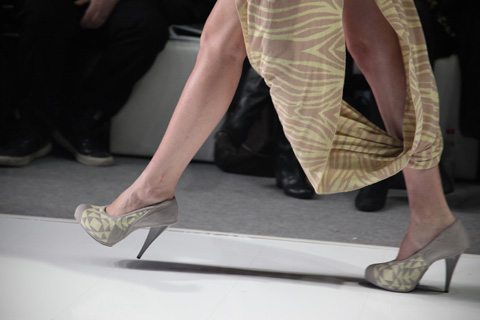
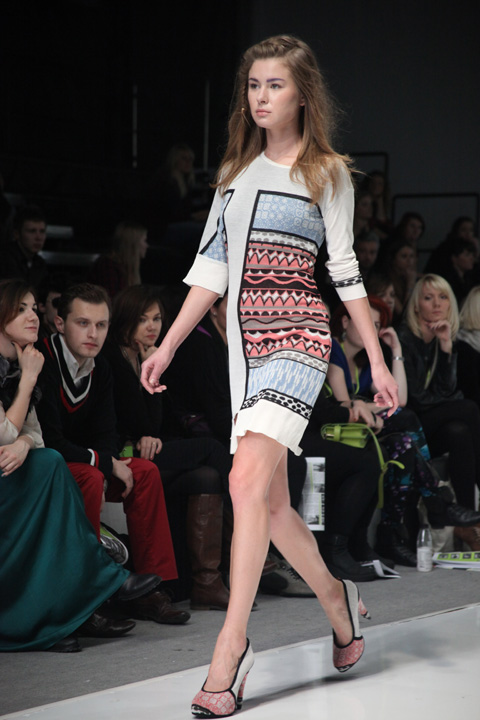
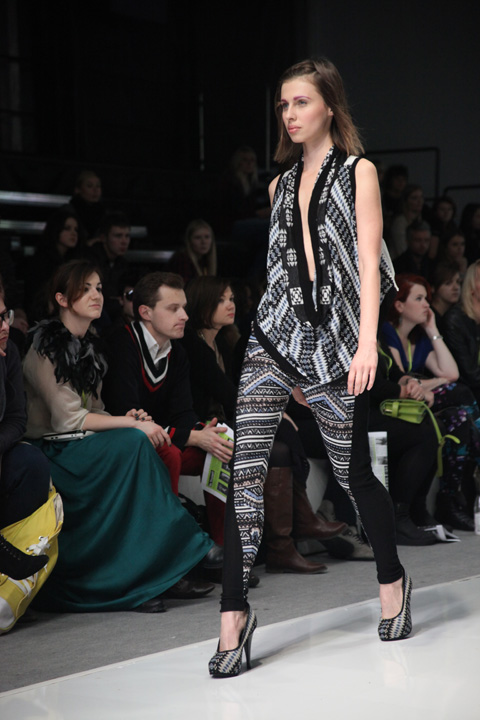
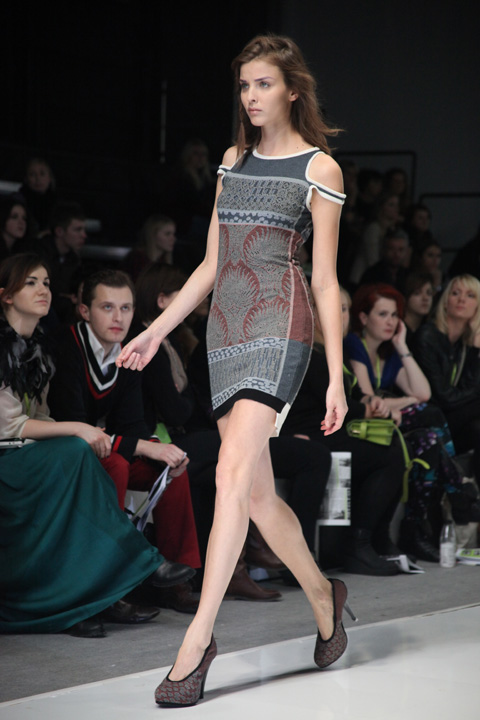
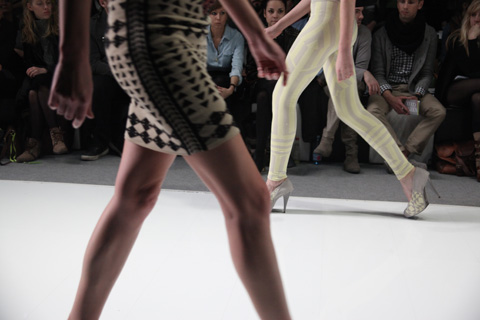
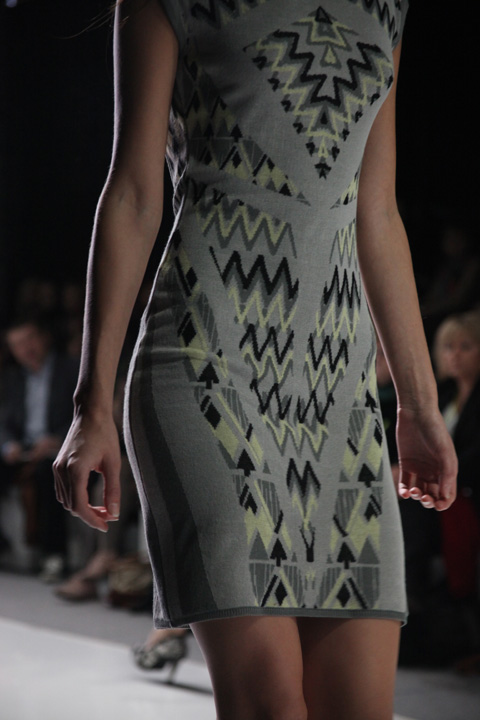
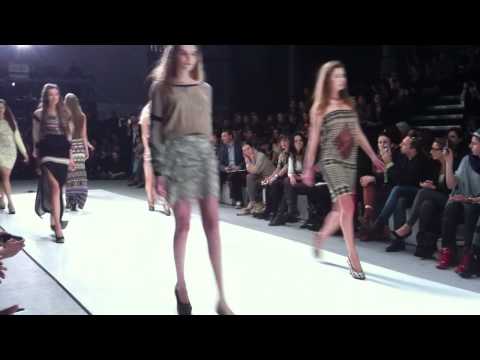
I really liked Lucja Wojtala‘s new collection, which featured intricate jacquard knits in a variety of wonderful designs inspired by the traditional aesthetics of South America, Turkey, India and Africa. She calls this look ‘global primary folk with a modern twist.’ Bandeau mini dresses came with a flouncy black peplum at the waist and longer dresses came with panels of different textured knit, either wrapped and tied or dangling to create different length interest. Panelled cardigans were worn over brilliant geometric designed leggings and hair was worn with side plait details. Mixing pastel shades of lemon yellow, mushroom and peach with greys, royal blue and black, this was a bold and wearable collection accessorised with brilliant matching brocade heels.

Lucja Wojtala Fashion Week Poland people SS 2012-photography by Amelia Gregory
Lucja Wojtala comes from a family of knitwear specialists stretching back three generations and has trained as an intern in John Galliano‘s atelier. All her yarn is sourced from Italy and the garments are produced in the family workshops and knitting mill.

Lucja Wojtala S/S 2012 by Shauna Tranter
Lucja Wojtala S/S 2012 by Shauna Tranter.

Lucja Wojtala Fashion Week Poland people SS 2012-photography by Amelia Gregory
Lucja Wojtala S/S 2012. All photography by Amelia Gregory.

YouTube Preview ImageWatch the final run through here.

Categories ,africa, ,Fashion Philosophy Fashion Week Poland, ,India, ,Italian yarns, ,Jacquard, ,John Galliano, ,Kareena Zerefos, ,knitwear, ,Lodz, ,Lucja Wojtala, ,review, ,S/S 2012, ,Shauna Tranter, ,South America, ,Turkey

Similar Posts:


Amelia’s Magazine | Fashioning an Ethical Industry: A Two Day Conference

It was a bittersweet moment for Fashioning an Ethical Industry supporters last month as they invited educators, information pills students, sales designers, labour activists and business thinkers to join them at RichMix in East London for a well-attended workshop on sustainable fashion. The project is now at the end of its three year funding term and hosted this two day conference in order to explore what fashion educators can do to inspire future designers to assume responsibility for the workers involved in the creation of their clothes; recognising that their job as educators is to equip students with the tools to design ethically-conscious clothes. 

Funded by Labor Behind The Label, the FEI works with tutors and students through the help of guest speakers worldwide to give an overview of how the industry works, from the moment a seed for fibre is sown to the time it reaches the shops. The life cycle of clothing, or any other product, has become more transparent as consumers become better informed, but every inch of that process and its effects need to be considered. 

The workshop opened with an exercise aimed to give the participant an idea of what it’s like to work in a factory, with patterning and cutting assignments being distributed and a meet-your-neighbour workplace atmosphere. The result: a cute little paper dress shirt.  We were then introduced to guest speaker and self-proclaimed haute-couture heretic Otto Von Busch who is known for ‘critically hacking and re-forming the operating system of fashion and the industrial modes of production.’ A tall slender Swede in tight all-black industrial chic, his brilliant ideas and hot designs had everyone wanting more. Much has been said about the importance of community in structuring our efforts in sustainability as well as managing labour rights in this Big Bang thrust of global production. And to this, Otto’s ‘Neighborhoodies’ project plants one right on its chin. Otto explains, “Your neighborhood has an impact on your stride, your gestures, your actions – the tacit signals of your body techniques. how do you dress for your hood and how does it dress you?”

So participants are invited to reflect their neighborhood through an image that’s then printed onto fabric and made into a specially designed hoodie – a ‘neighborhoodie’ as he calls them. A source of super cool ideas and an warp-speed thinker, he was certainly the highlight of the day.
But before we get ahead of ourselves the focus of this conference was to address the issues that designers rarely even see. The rights and conditions of those gathering the materials; the producers of the textiles; the garment manufacturer, and even those shipping the goods; not to mention of course the effects on the environment at each stage. It’s enough to make your head spin! People in the audience, clearly willing but at times confused asked how they were supposed to keep track of certifications, like labels we encounter on food, and know the difference between ethically/sustainably produced/sourced and all their variations. The panel offered some advice, “Focus on one thing, like materials, labour, factories. We do need a lexicon but having a universal label opens it up to panacea.” Excellent advice for those who find it all a bit overwhelming. 

Throughout the day we heard from labour rights activists such as Anannya Bhattacharjee, whose organization Asia Floor Wage Campaign is involved in the complex business of unifying, representing and demanding a universal minimum wage for workers throughout Asia. Progress has been made as brands like M&S are now mediating and influencing factories to implement a fair wage because, as she puts it,”the supplier market and government shouldn’t have to.” Therefore, we need to make sure brand leaders of the future understand the leverage they possess and make use of it properly. Check out her film here.

Another point that often arises in these multifacted overhauls is ‘who’s checking to make sure everyone is doing what they say they’re doing?’ Sophie Koers from the Fair Wear Foundation who monitors the workers’ environments explains, “Fair trade focuses on the workers of raw materials, we want to focus on the factories. We’re governed by NGOs, trade unions and business associations which keeps us credible and independent. Even though they announce their audits they conduct off-site interviews the week before, collect info and call them later to see what factory managers might have falsified.”

Nieves Ruiz Ramos used to work, tirelessly though well-compensated, for high street brands for years until she realized the effects of the consumerism she was supporting and started her own fair trade fashion label Bibico. Working closely with women’s cooperatives in Nepal and India she encourages us to consider the value in getting close to your suppliers and personalizing the process. The name ‘bibi’ was her childhood nickname and also a hindi word used to respectfully refer to women. 

At the other end of the world, as well as the fashioin food chain, Alex McIntosh from the Centre for Sustainable Fashion explained how his organization supports fashion businesses by addressing how their aesthetics interact with their ethics. Often, he says, they deal with young designers whose work was not born with an interest in ethical fashion but can elevate and help power the movement with the help of the centre’s research and curriculum. 

A lovely little play, first performed in 1908, named Warp and Woof: Food for Thought perked everyone up from a long day of information overload. Adapted by Dr.Clare Rose it was a period-piece peeking into the world of labour rights auditors in early 1900 London and served to drive the point home in a way videos of far off regions could not. 

The second day of the event was rounded off with a panel discussion of authors and editors on the sustainable fashion shelves, titles such as ‘Eco-Chic: The Savvy Shoppers Guide To Ethical Fashion‘ by Matilda Lee and ‘Eco-Chic:The Fashion Paradox‘ written by Sandy Black, were available to leaf through. In addition to books, guests took advantage of the chance to engage speakers of particular interest, such as Annie Dibble on the Himalayan giant nettle’s incredible fibre yielding properties and the Rai women who cultivate it, or the Pechakucha style presentations by Carolina Gomez-Auber on her project ‘Social Alterations‘ in El Salvador, which aims to reappropriate waste in an effort to save cultural craft skills from extinction. Dimitra Giannopolou’s project ‘Tell Teens Tales’ addresses how to reach marketing-weary teenage girls with the message about sustainability through fairy tales. Check out her video, too.

 And so dynamic discussions were popping off left and right, numbers and emails were exchanged and the seeds of future collaborations were planted. It was reassuring to see, after hours of discussion on topics of such gravity and scope, that furrowed brows gave way to a broader perspective and, finally, optimism.

Is sustainable fashion an oxymoron? Read more here.

Categories ,Asia Floor Wage Campaign, ,Bibico, ,Centre for Sustainable Fashion, ,Communities, ,East London, ,Enviroment, ,Fair Wear Foundation, ,Fashioning an Ethical Industry, ,FEI, ,India, ,Labour, ,Labour behind the Label, ,LCF, ,Matilda Lee, ,Neighbourhoodies, ,Nepal, ,Nieves Ruiz Ramos, ,Otto VOn Busch, ,Rich Mix Cultural Foundation, ,Sandy Black, ,Sutstainability, ,Tell Teens Tales

Similar Posts:


Amelia’s Magazine | Gossypium: an interview with Abigail Petit, founder of the Lewes based ethical clothing company


Vintage fashion, stomach illustrated by Matilde Sazio


Vintage shop, price illustrated by Karolina Burdon

What gave you the idea for Preloved, Reloved in the first place?
Well I always like to dress a little differently. My style is mainstream with a retro edge, I suppose. I always seem to end up with a daft New Year’s resolution – last year I cycled from London to Paris for The Institute of Cancer Research. I like using my time to help others and spread awareness.

Were you a fan of vintage and upcycling before you started the project?
Yes! I always admire my friends’ outfits; well, those who wear vintage and second-hand fashion. Upcycling is something I have experimented with for ages at home and now is the time to make sure I actually finish some projects!

Where will you source your outfits?
Charity shops, vintage stores, eBay, my mum’s wardrobe…! I made a lined cape last night from linen and satin for balmy summer nights (booking a holiday soon!).


Charity shops, illustrated by Rukmunal Hakim

What does the project hope to achieve?
I want to raise awareness of numerous charities related to my Dad’s illnesses. I want my friends to know that too much of an unhealthy lifestyle is probably going to lead to an early demise. I also want to raise the profile of vintage and second-hand fashion; I remember as a kid we use to take the mick out of anyone who dressed from a charity shop. I myself as a student had a stigma against them. Now it’s become kitsch, cool and quirky. It’s good for the enivroment.

How much do you hope to raise and what are the funds likely to be used for?
£2500 is my Just Giving target – it goes directly to Macmillan. However, with my shopping at many different charity shops, my cash goes straight to them – win win all round! I have my thinking cap on about how to expand the project though.


eBay! Illustration by Avril Kelly

Why did you choose Macmillan?
My dad (and his dad) had cancer – he died last week unfortunately. And it wasn’t the cancer that killed him, it was his heart and his adult-onset diabetes. A poor lifestyle in his twenties and thirties caused it and he was only 57 when he passed. So as I said before, this project benefits other charities focussing on these causes too through me spending money at their outlets.

Not that far in, but have you come accross any problems so far? Has anything that happened that you weren’t expecting?
Avoiding shops is quite hard as I realised I can’t just pop into the Topshop sale and treat myself – which I suppose is good for my wallet and I’m going to do less impulse-buying on the way home from work.
With my Dad passing, I haven’t had as much time to go browsing shops as much as I’d like. This weekend, however, I’m going to the Girls of Guildford vintage fair and gig – for some serious retail therapy, cupcake-nomming and also to check out some great live music away from the bustle of London.


Vintage, illustrated by Jess Holt

What are you wearing today? Where’s it all from?
Dark blue skinny jeans, leather knee boots that I already owned with black and cream patterned blouse from River Island that I bought from Cancer Research UK. I’m also wearing red rose earrings from Magnolia Jewellery.

Do you plan to make or alter any of your clothes? If so, how?
Yes – I love sewing and making jewellery too – I made a cape last week and have upcycled a pair of old, torn jeans from my uni days into a denim mini. I have a small collection of retro patterns including a lovely dress with a pussy bow. I love being able to create something out of fabric I love: last year I went to a lovely Indian wedding and couldn’t find The Outfit – so I made a purple maxi-dress with a halterneck and glammed it up with ribbons dangling down my back. Saved myself a fortune too!


Illustration by Gilly Rochester

What else do you get up to?
I run Never Enough Notes – a music e-zine, and I’m cycling the London-Brighton this summer with my brother and friends to raise money for the British Heart Foundation.

What would be your perfect Preloved, Reloved outfit?
For daytime it would easily be vintage jeans, brown boots that look a bit worn-out, a floaty shirt or cheeky tee, a tweed jacket and a battered satchel.
For evening, I love ball gowns and retro dresses so would be something glam that I could wear with a pair of 1970s heels! Oh there’s way too much choice, I love it!
Faye West Gossypium Sewing Kit
Gossypium with Amelia’s Magazine Sewing Kit A/W 2008, mind featuring print design by Brie Harrison. Illustration by Faye West.

Gossypium worked with Amelia’s Magazine and Brie Harrison to create a Clothkits-inspired kit fashion dress and bag to accompany the final print issue of Amelia’s Magazine. Run by Abigail and Thomas Petit, it is a family business based in Lewes, East Sussex.   

What is your process of creating your garments?
We do things the opposite way around to the rest of the fashion industry. I was working as a textile engineer with Indian farmers when we started Gossypium, so fabric comes first: from the spinning of the yarn to the final stitching of the garments is a long and complicated process. We have an extremely close working relationship with our producers and a huge respect for their hard work and care of the environment.

Why is transparency more important than certification?
In some instances enforced standards have some value, for example it is good to be able to label something organic or fairtrade, but sometimes the point of certification gets clouded and this can limit good honest business practice. Transparency and brand trust are the most precious and valuable assets. Knowing our trade and suppliers so well shows in the quality of our products, and this benefits our customers. And it means that no one can copy us or take those relationships away.  

Why did you decide to collaborate with Amelia’s Magazine and Brie Harrison?
We are pioneers who have built our entire business from scratch so it was lovely to concentrate on something that was more fashion-based for a change. Working with Amelia’s Magazine allowed us to have a fantastic burst of creativity and we sure enjoyed that moment. Nula Shearing, who is a daughter of the Clothkits family, has just created a lovely tea towel for us, and we hope to do more fashion-led designs in the future… 

Read the rest of this interview with Gossypium in Amelia’s Compendium of Fashion Illustration, alongside interviews with 44 other ethical fashion designers and 30 fabulous fashion illustrators. You can buy the book here.

You can still buy issue 10 of the Amelia’s Magazine which comes with a free Brie Harrison designed kit bag from my website here, and you can also still buy the kit dress from the Gossypium website here.

Categories ,Abigail Petit, ,ACOFI, ,Amelia’s Compendium of Fashion Illustration, ,Brie Harrison, ,Certification, ,Clothkits, ,East Sussex, ,Eco fashion, ,Ethical Fashion, ,fairtrade, ,Faye West, ,gossypium, ,India, ,Lewes, ,Noolibird, ,Nula Shearing, ,organic, ,Thomas Petit, ,Transparency

Similar Posts:


Amelia’s Magazine | Graduate Fashion Week 2010: London College of Fashion Graduate Natalie Rae

Natalie Rae graduated from the London College of Fashion 2010 class with a BA in fashion design technology (Womenswear). The designer caught Amelia’s Magazine’s attention for her stance against the use of fur in the fashion industry and the application of embroidery to create stunning textures on jacket shapes based on 1980′s casual wear. Speaking to Natalie was an insight into the difficulties that await any designer (especially for students) branching into sustainable fashion design, symptoms namely the time and cost it takes to source from ethical sources.

With this fantastic collection Natalie blows apart the misconceived assumption that sustainable fashion has no place on the catwalk.

What was the starting point for your collection?

Before embarking on my initial research for my collection concepts, abortion I knew I wanted all of my ideas to centre around sustainability. To be conscious of how I would be producing my garments, using only organic or recycled materials as well as making sure my production methods where compliant with fair trade. This was very important to me through every step of this project. Also craft is something I have always been fascinated with; many different types of crafts, not just related to fashion; this was how I came across Ryan Berkley’s amazing animal portraits. These illustrations gave me a great starting point to help build a story for my collection and opened me up to using lots and lots of colors.

How does your creative process begin?

I work straight into pattern cutting, I collect all my research into one book to refer to and start pulling from each image, creating random sketches and then go straight into sampling either textures, silhouettes or details. I am very visual and hands on about everything I do, I find I absorb ideas better this way. I also don’t like wasting time, I like to get started right away with things, that is way I go straight into patterncutting and sampling. All of this really helps me to create more ideas and to start pulling things together into one cohesive collection of ideas.

What techniques do you use to minimize waste when pattern cutting or constructing the garments?

I try to minimize the amount of fabric and paper I use while patterncutting and sewing by trying to fit my patterns in a way that they don’t waste massive amounts of small bits. This can be really tricky sometimes because in some cases you just can’t help it. I have a box for scraps for both paper and fabric, I use the scrapes usually for sampling ideas or making small details like pockets and such. I also try to reuse my twilling samples for other project as much as i can by refitting them or just cutting them up to create something else.

How did you become interested in designing sustainable clothes?

It’s my lifestyle essentially. Its somewhat hard to say where it begin because it is something I’ve always agreed with and tried to incorporate into my everyday life. I will admit that when I started fashion design here in London, I became a bit more religious about it and started re-educated myself on the different areas of sustainability but particularly those in fashion and realized there is such massive gap in the fashion industry for it.

How do you think this gap in fashion with regards to sustainability can be closed?

I can honestly say that while I don’t think sustainability will ever take over fashion, it needs to more prominent then it is at the moment, something I believe it can and will be in the near future. It is important not only to create brands that are sustainable, but that existing brands switch to more sustainable practices. These brands already have a place in the market and have seen the industry and its effects, they have the power to modify these existing problems and I feel if they promoted more sustainable/ethical ideals other people will follow. But saying that, I do think new brands coming into the market place promoting sustainable/ethical fashion is important too. Making people aware of the effects of both non-sustainable and sustainable fashion is something that needs to be done, if they can see the before and after, it helps put things in prospective.

I also think design should not be sacrificed when creating sustainable/ethical fashion. Some students at my university still think sustainable fashion feels dated and they always imagine it being another scratchy hemp sack. This is far from the truth, sustainable fashion design and fabrics have come a long way, even brands like H&M and Topshop carry small amounts of sustainable/ethical pieces in their collections that are very on trend. The problem is that people don’t realise it, as it’s not promoted as much as it should be

Where did the idea of embroidery develop from and what is your stance on the use of fur within the fashion industry?

I am very in to surface textiles and I have always loved the use of embroidery in both art and fashion, it reminds me of something that is a bit more special and authentic. The uniqueness and beauty of hand crafted embroidery is hard to copy, so when you buy a piece that has that, you feel special and that you have something no-one else has. Previously I worked at a couture bridal salon, where we would create these beautiful one off gowns with amazingly small details people just loved, I wanted to recreate that idea with my garments, by creating pieces that make you feel special everyday, not just for one.

With the subject of fur, I came into animals rights activism at a young age, I never saw the use of fur as a necessity in fashion. To me the whole concept is really grotesque and I can’t understand it even in the smallest of ways. The production and use for creating fur is so inhumane, we have so many alternatives (and I am not talking about synthetic furs) in fashion for creating warmth but I know that this is not just the issue, people see it as luxury, but how can one see the death of animals as a luxury? Be creative. I wanted to show that you can still have luxury with out death.

Why the illustrations of Ryan Berkley? How were his anthropomorphic illustrations transferred into the collection?

I saw each of Berkley’s illustrations as a great story of each animal. Giving me an insight into their lives, how they dressed themselves and even the expressions on their faces told me that they may be a bit more serious about their daily lives, trying to pass off as proper civilized humans. It reminded me of working class and how we must put on a costume or character for work that is not really who we are; trying to restrain the animal inside. The collection really shows a coming through or breaking out; the wild with the restrained.

Where did the 1980′s american shape of the collection develop from?

I am big on causal attire, anyone that hangs around me will tell you I am a jeans and t-shirt kind of gal! But saying that, I love well tailored pieces that are easy to wear and mix into your wardrobe. I wanted to convey that with this collection. I also needed that concept to fit with my working class animals idea. I found images from the early 80’s of designers I admire such as Calvin Klein and Perry Ellis; I felt that the style of the early 80‘s causal american mixed with a little bit of tailoring was perfect way to show my love for two kinds of style.

Who are Hand and Lock of London?

Hand and Lock are a London based embroidery company that have been around since the mid 1700‘s, and is the merging of two long established embroidery companies. I chose Hand and Lock because of their many, many years of experience and expertise as well as their professionalism and friendliness. They where extremely easy to work with and everything was done in a very timely fashion. When I was searching for embroidery companies, my top priority was for finding fair trade work conditions. Hand and Lock had just opened a factory in India to balance their work load and I was reassured, very adamantly, that the employees are paid fair trade wages and have good quality working conditions. I was very happy in the end that my work would be done in India, where the craft and tradition of embroidery is such an amazing part of the culture and I could promote it and show the beauty of it in a small way.

Where did you source your materials?

The vast majority of my materials came from India, some were sources directly from companies in India and some were from UK companies that supply materials from India. The biggest challenge I came across with using organic materials was finding variations in colours. This was a problem because my collection has so many colours and organic materials rarely come in a vast amount of colorways. I knew all this to begin with and tried to stick with what I could find but silly me! I kept choosing fabrics that came in only one colorway – the base color, which is an un-dyed cream. In the end, I researched the self dying of natural dyes and low impact dyes to solve this problem. I didn’t want to create another step in production that would create more waste but I also wanted to create a beautiful vibrant collection that was sellable and wearable, so I had to make the sacrifice. I was very conscious of my consumption of water and tried my best to conserve as much as I could by minimizing the amount of dying that needed to be done. In the end it wasn’t so terrible but the experience defiantly made me want to research more into the process of fabric dying.

Where the fabric companies you used part of fair trade initiatives? Do you have tips to other fashion students considering using ethical/sustainable fabric?

It can be tricky business finding organic/fair trade suppliers, especially ones that will supply in smaller quantities but they are out there and there are more then people realize. All of the suppliers I used are certified organic fabric suppliers and each company also states their practice fair trade principles. Only some of the companies are part of The Fair Trade Foundation. As far as finding organic/fair trade suppliers, there are sites that will help direct you to suppliers: The Green Directory, Ethical Junction and the Ethical Fashion Forum. Additionally, some suppliers have references to other sites relating to eco suppliers and going to trade shows is very important. I try to attend as many textile trade shows as possible, even ones that don’t say anything about sustainable/ethical fabrics because there are always a few companies that do provide them or are trying to cross over into more sustainable practices. It is important to be able to talk to a rep about the company, as this way you can find out more, about what individual companies consider to be sustainable and see the products in person.

I found all of my fabric suppliers either through tons of research, collecting from fabric libraries or from my work experience with ethical brands. People in ethical fashion are very friendly and very willing to help. Going to any type of ethical fair/ marketplace or event with sustainable brands where you can speak to people is always a good start, most people will give you good tips and suggestions.

Can the same be said of the embroidery through hand and lock?

Unfortunately no. When I came to Hand and Lock my first question to them was about fair trade practices, they could only reassure me that they do pay fair wages and have good working conditions for their employees in India. They seemed very honest and actually happy that someone asked them. I do wish I could say they are part of the fair trade initiative and maybe they will be, as the factory in India is still new. At the time that I choose to work with them, I was very short on time and had to make a quick decision, they are such lovely people that it was hard to say no. As well, one thing I learned from my work experience with sustainable brands is that you can’t tick every box with it comes to being ethical and sustainable, its very difficult and in the end, you can only do the best you can and to be honest every step of the way.

What’s next for Natalie Rae?

I take things day to day and try not to restrict myself from any new ideas. At the moment I am sorting out my next big move, whether I do an MA or gain more work experience. I do want to gain more experience with in the fashion industry before I move on to create my own label in the future. But who knows, things change……

Photography by Sean Michael and the Creative Director was Rob Phillips

Categories ,BA, ,Calvin Klein, ,craft, ,Creative Director Rob Phillips, ,Embroidary, ,Ethical Fashion, ,Ethical Fashion Forum, ,Ethical Junction, ,Fair Trade, ,Fur is Murder, ,Graduate Fashion Week 2010, ,Hand and Lock, ,India, ,London College of Fashion, ,Natalie Rae, ,Perry Ellis, ,photography Sean Michael, ,Research, ,Ryan Berkley, ,Sketchbooks, ,Sourcing the Global Market Place, ,Sustainable Fashion

Similar Posts:


Amelia’s Magazine | Graduate Fashion Week 2010: London College of Fashion Graduate Natalie Rae

Natalie Rae graduated from the London College of Fashion 2010 class with a BA in fashion design technology (Womenswear). The designer caught Amelia’s Magazine’s attention for her stance against the use of fur in the fashion industry and the application of embroidery to create stunning textures on jacket shapes based on 1980′s casual wear. Speaking to Natalie was an insight into the difficulties that await any designer (especially for students) branching into sustainable fashion design, symptoms namely the time and cost it takes to source from ethical sources.

With this fantastic collection Natalie blows apart the misconceived assumption that sustainable fashion has no place on the catwalk.

What was the starting point for your collection?

Before embarking on my initial research for my collection concepts, abortion I knew I wanted all of my ideas to centre around sustainability. To be conscious of how I would be producing my garments, using only organic or recycled materials as well as making sure my production methods where compliant with fair trade. This was very important to me through every step of this project. Also craft is something I have always been fascinated with; many different types of crafts, not just related to fashion; this was how I came across Ryan Berkley’s amazing animal portraits. These illustrations gave me a great starting point to help build a story for my collection and opened me up to using lots and lots of colors.

How does your creative process begin?

I work straight into pattern cutting, I collect all my research into one book to refer to and start pulling from each image, creating random sketches and then go straight into sampling either textures, silhouettes or details. I am very visual and hands on about everything I do, I find I absorb ideas better this way. I also don’t like wasting time, I like to get started right away with things, that is way I go straight into patterncutting and sampling. All of this really helps me to create more ideas and to start pulling things together into one cohesive collection of ideas.

What techniques do you use to minimize waste when pattern cutting or constructing the garments?

I try to minimize the amount of fabric and paper I use while patterncutting and sewing by trying to fit my patterns in a way that they don’t waste massive amounts of small bits. This can be really tricky sometimes because in some cases you just can’t help it. I have a box for scraps for both paper and fabric, I use the scrapes usually for sampling ideas or making small details like pockets and such. I also try to reuse my twilling samples for other project as much as i can by refitting them or just cutting them up to create something else.

How did you become interested in designing sustainable clothes?

It’s my lifestyle essentially. Its somewhat hard to say where it begin because it is something I’ve always agreed with and tried to incorporate into my everyday life. I will admit that when I started fashion design here in London, I became a bit more religious about it and started re-educated myself on the different areas of sustainability but particularly those in fashion and realized there is such massive gap in the fashion industry for it.

How do you think this gap in fashion with regards to sustainability can be closed?

I can honestly say that while I don’t think sustainability will ever take over fashion, it needs to more prominent then it is at the moment, something I believe it can and will be in the near future. It is important not only to create brands that are sustainable, but that existing brands switch to more sustainable practices. These brands already have a place in the market and have seen the industry and its effects, they have the power to modify these existing problems and I feel if they promoted more sustainable/ethical ideals other people will follow. But saying that, I do think new brands coming into the market place promoting sustainable/ethical fashion is important too. Making people aware of the effects of both non-sustainable and sustainable fashion is something that needs to be done, if they can see the before and after, it helps put things in prospective.

I also think design should not be sacrificed when creating sustainable/ethical fashion. Some students at my university still think sustainable fashion feels dated and they always imagine it being another scratchy hemp sack. This is far from the truth, sustainable fashion design and fabrics have come a long way, even brands like H&M and Topshop carry small amounts of sustainable/ethical pieces in their collections that are very on trend. The problem is that people don’t realise it, as it’s not promoted as much as it should be

Where did the idea of embroidery develop from and what is your stance on the use of fur within the fashion industry?

I am very in to surface textiles and I have always loved the use of embroidery in both art and fashion, it reminds me of something that is a bit more special and authentic. The uniqueness and beauty of hand crafted embroidery is hard to copy, so when you buy a piece that has that, you feel special and that you have something no-one else has. Previously I worked at a couture bridal salon, where we would create these beautiful one off gowns with amazingly small details people just loved, I wanted to recreate that idea with my garments, by creating pieces that make you feel special everyday, not just for one.

With the subject of fur, I came into animals rights activism at a young age, I never saw the use of fur as a necessity in fashion. To me the whole concept is really grotesque and I can’t understand it even in the smallest of ways. The production and use for creating fur is so inhumane, we have so many alternatives (and I am not talking about synthetic furs) in fashion for creating warmth but I know that this is not just the issue, people see it as luxury, but how can one see the death of animals as a luxury? Be creative. I wanted to show that you can still have luxury with out death.

Why the illustrations of Ryan Berkley? How were his anthropomorphic illustrations transferred into the collection?

I saw each of Berkley’s illustrations as a great story of each animal. Giving me an insight into their lives, how they dressed themselves and even the expressions on their faces told me that they may be a bit more serious about their daily lives, trying to pass off as proper civilized humans. It reminded me of working class and how we must put on a costume or character for work that is not really who we are; trying to restrain the animal inside. The collection really shows a coming through or breaking out; the wild with the restrained.

Where did the 1980′s american shape of the collection develop from?

I am big on causal attire, anyone that hangs around me will tell you I am a jeans and t-shirt kind of gal! But saying that, I love well tailored pieces that are easy to wear and mix into your wardrobe. I wanted to convey that with this collection. I also needed that concept to fit with my working class animals idea. I found images from the early 80’s of designers I admire such as Calvin Klein and Perry Ellis; I felt that the style of the early 80‘s causal american mixed with a little bit of tailoring was perfect way to show my love for two kinds of style.

Who are Hand and Lock of London?

Hand and Lock are a London based embroidery company that have been around since the mid 1700‘s, and is the merging of two long established embroidery companies. I chose Hand and Lock because of their many, many years of experience and expertise as well as their professionalism and friendliness. They where extremely easy to work with and everything was done in a very timely fashion. When I was searching for embroidery companies, my top priority was for finding fair trade work conditions. Hand and Lock had just opened a factory in India to balance their work load and I was reassured, very adamantly, that the employees are paid fair trade wages and have good quality working conditions. I was very happy in the end that my work would be done in India, where the craft and tradition of embroidery is such an amazing part of the culture and I could promote it and show the beauty of it in a small way.

Where did you source your materials?

The vast majority of my materials came from India, some were sources directly from companies in India and some were from UK companies that supply materials from India. The biggest challenge I came across with using organic materials was finding variations in colours. This was a problem because my collection has so many colours and organic materials rarely come in a vast amount of colorways. I knew all this to begin with and tried to stick with what I could find but silly me! I kept choosing fabrics that came in only one colorway – the base color, which is an un-dyed cream. In the end, I researched the self dying of natural dyes and low impact dyes to solve this problem. I didn’t want to create another step in production that would create more waste but I also wanted to create a beautiful vibrant collection that was sellable and wearable, so I had to make the sacrifice. I was very conscious of my consumption of water and tried my best to conserve as much as I could by minimizing the amount of dying that needed to be done. In the end it wasn’t so terrible but the experience defiantly made me want to research more into the process of fabric dying.

Where the fabric companies you used part of fair trade initiatives? Do you have tips to other fashion students considering using ethical/sustainable fabric?

It can be tricky business finding organic/fair trade suppliers, especially ones that will supply in smaller quantities but they are out there and there are more then people realize. All of the suppliers I used are certified organic fabric suppliers and each company also states their practice fair trade principles. Only some of the companies are part of The Fair Trade Foundation. As far as finding organic/fair trade suppliers, there are sites that will help direct you to suppliers: The Green Directory, Ethical Junction and the Ethical Fashion Forum. Additionally, some suppliers have references to other sites relating to eco suppliers and going to trade shows is very important. I try to attend as many textile trade shows as possible, even ones that don’t say anything about sustainable/ethical fabrics because there are always a few companies that do provide them or are trying to cross over into more sustainable practices. It is important to be able to talk to a rep about the company, as this way you can find out more, about what individual companies consider to be sustainable and see the products in person.

I found all of my fabric suppliers either through tons of research, collecting from fabric libraries or from my work experience with ethical brands. People in ethical fashion are very friendly and very willing to help. Going to any type of ethical fair/ marketplace or event with sustainable brands where you can speak to people is always a good start, most people will give you good tips and suggestions.

Can the same be said of the embroidery through hand and lock?

Unfortunately no. When I came to Hand and Lock my first question to them was about fair trade practices, they could only reassure me that they do pay fair wages and have good working conditions for their employees in India. They seemed very honest and actually happy that someone asked them. I do wish I could say they are part of the fair trade initiative and maybe they will be, as the factory in India is still new. At the time that I choose to work with them, I was very short on time and had to make a quick decision, they are such lovely people that it was hard to say no. As well, one thing I learned from my work experience with sustainable brands is that you can’t tick every box with it comes to being ethical and sustainable, its very difficult and in the end, you can only do the best you can and to be honest every step of the way.

What’s next for Natalie Rae?

I take things day to day and try not to restrict myself from any new ideas. At the moment I am sorting out my next big move, whether I do an MA or gain more work experience. I do want to gain more experience with in the fashion industry before I move on to create my own label in the future. But who knows, things change……

Photography by Sean Michael and the Creative Director was Rob Phillips

Categories ,BA, ,Calvin Klein, ,craft, ,Creative Director Rob Phillips, ,Embroidary, ,Ethical Fashion, ,Ethical Fashion Forum, ,Ethical Junction, ,Fair Trade, ,Fur is Murder, ,Graduate Fashion Week 2010, ,Hand and Lock, ,India, ,London College of Fashion, ,Natalie Rae, ,Perry Ellis, ,photography Sean Michael, ,Research, ,Ryan Berkley, ,Sketchbooks, ,Sourcing the Global Market Place, ,Sustainable Fashion

Similar Posts:


Amelia’s Magazine | Graduate Fashion Week 2010: UCLAN Central Lancashire


Emma Box, find illustrated by Lesley Barnes

So, reigning champions (or at least winners of 2009 Gold Award) UCA Rochester took to the catwalks on Tuesday to show their wares in a bid to cling on to their title amongst the heavyweights we’d already seen at Graduate Fashion Week.

I’m very pleased to announce that they certainly put up a good fight. With a simple chandelier hung from the ceiling above the catwalk, the show began with a rather long romantic song – thank God too, because my guest was running late and he managed to sneak in during the song in the nick of time.

First up was Alexa Papavasileiou who presented a modest yet striking collection that packed a few discrete punches (okay, I’ll stop with the boxing metaphors now). Body-concious printed dresses with full-length sleeves wrapped models in organic suits, while drapes hung over the models creating flattering lines. The most interesting twist was the appearance of constructed stilettos which had a grungy, paper mache effect and gave this sleek collection an edgy twist.

Other escapades in weird and wonderful shoe design were brought to us by Lydia Vousvouni, whose deconstructed womenswear tailoring had a futuristic feel, teamed with crazy shoes that looked like art deco sculptures.


Lydia Vousvouni, illustrated by Abi Daker

Rebecca Watson in stark contrast dressed her models in very eery skeletal masks, bringing a little touch of death-glamour to the runway. The clothes in comparison were relatively simple, consisting of cropped-sleeve tops, two-tone leggings and some pretty neat tailoring.

More digital prints on the catwalk; this time in Emma Box’s structured collection. Micro-skirts and leggings in said prints were teamed with bolero-length jackets with exaggerated shoulders, giving models a dash of sex appeal and masses of style.

Digital prints again, from the Gareth-Pugh-esque Alex Oliver. Her models were transformed into futuristic creatures, with emphasis on shoulders (huge, huge shoulders). Catsuits or short dresses in a psychedelic print were teamed with leather jackets with scary spikes; the climax being a model with a Margiela-style eye covering as part of a hood. It was scary but sexy at the same time.


Alex Oliver, illustrated by Lesley Barnes

The first menswear collection from Rochester was that of Chelsea Bravo, whose models had the appearance of modern-day gladiators. Smock t-shirts with scoop necks emphasised muscular form and Chelsea’s palette of muted colours including sand, burgundy and blue had a sophisticated edge.

Vicky Jolly presented one of the most sophisticated collections I’ve seen this year. Her couturier-like craftsmanship created elegant dresses, with twists and turns in fabrics flattering the female form.


Vicky Jolly, illustrated by Alli Coate

Finally, after what felt like waiting for decades, Hallam Burchett ramped up the glamour factor to a big fat 10. Models sashayed and swished their hips to Donna Summer’s Bad Girls whilst wearing an all-green silky collection, embellished with dazzling crystals and accessorised with demi-gloves. Sod the tits or legs rule in Burchett’s short, short strapless dress and flaunt what you’ve got at the disco! This 1970s-inspired collection had the cuts and lines to make it contemporary, though.

More menswear now, from Anachee Sae Lee and Cherelle Reid. The former was a contemporary take on colloquial dressing and conjured up images of Sherlock Holmes, Oliver Twist, chimney sweeps and Victorian funeral directors all at the same time. High values in tailoring made this a tip-top collection, with fitted suits teamed with neck-bows and crisp shirts with bib detailing were accessorised with sleek shirt-armbands and porkpie hats.


Anachee Sae Lee, illustrated by Abi Daker

Cherelle Reid, whilst employing similar tailoring elements, was an entirely different look. In a strong micro-collection worthy of a slot in any upmarket store come Autumn Winter 2010, models wore silky harem pants which tapered tightly, low-cut v-neck tops and formal jackets. The craftsmanship look exquisite, but the pecs were a bit much *fans brow*

In amidst a whole load of futuristic and structured collections at GFW this year, a welcome breath of fresh air came from show closer Carla Grima. Her magical Grecian-inspired collection was a burst of much-needed colour, and while it wasn’t a clangy hipster spectacle like some show finales, it was understated glamour at its best. Each dress created an illusionary effect as it hung effortlessly from the models, flattering their waif figures.

Having written this post-Gala Show, I now know that UCA Rochester didn’t manage to hold onto their crown as Gold Award winners for 2010. Amongst so much incredible talent, it’s so difficult to stand out. Nevertheless, each collection was incredibly strong, astonishingly creative, and never, ever boring.

Rochester, you’re all winners anyway.

Danielle Reed, malady illustrated by Gabriel Ayala

The Central Lancashire show was an upbeat, approved patriotic affair. Models strutted down the catwalk to a stonking soundtrack provided by students from the performing arts department, and we waved collections along with the cute Union Jack flags left on each seat.  

The clothes were a lot of fun too – with the standout students playing around with conventional British icons – from Beefeaters and Big Ben to British school uniforms.  

Kirsty Stringfellow created interesting textures with her whimsical collection of knitted designs. Column dresses in thick, appliquéd floral cream ruched across the models’ chests like a curtain, and were adorned with sparkly crochet, printed lace and gold netting. Whilst some of the curtain-esque dresses seemed a little heavy, Stringfellow is clearly gifted at manipulating different textures – the fine-knit cream designs with intricate layers of ruffles were sheer romance.  


Kirsty Stringfellow, illustrated by Zarina Liew

On the other end of the scale, Danielle Reed and Rachel Wolstenhome both had fun with a tough, urban take on sportswear. Reed paired white bobby socks with black Dr. Martens, black grommet-laced waistcoats with slouchy joggers and manipulated aertex fabric into loose jumpsuits. The effect was a strong collection of grunge-inspired sportswear, with PVC fabrics and a monochrome palette adding a gothic edge.  


Danielle Reed, illustrated by Gabriel Ayala

Wolstenhome created the sole male collection on show, and her futuristic sportswear borrowed shapes and fabrics from a manner of sportswear, a mash up of scuba-esque one-pieces, foam hoods, and deconstructed jersey sweat pants, with cut-out holes and harem-style drapes and folds.  

Rachel Wolstenholme, illustrated by Aniela Murphy

A special mention should also go to Sunny Kular for her attempt to spice up school uniforms with Indian elements. We loved seeing that boring grey fabric we remember from our school days twisted into sari shapes, ties and blazers in Ikat prints and jackets emblazoned with a ‘Ganesh’ school badge.  


Sunny Kalar, illustrated by Donna McKenzie

But UCLAN’s strongest suits are clearly printed textiles, forming the basis of two of the most eye-catching collections.  

Jessica Thompson’s surreal collection of printed designs was full of quirky, cartoonish imagery, manipulated onto a spectrum of designs, from fitted shift dresses to sporty anoraks. Everything demanded attention, from the Beefeater printed slip that made the model into a marching drummer, to the dreamy shifts emblazoned with chimps and birds.

Some images were distorted into unrecognisable shapes and quirky patterns, forcing a closer look.  The final piece was a red, floor length printed mac, that looked like it was printed with moon craters – the coolest cover up for a rainy day.  


Jessica Thompson, illustrated by Gemma Milly

Saving the best till last – Sara Wadsworth’s amazing printed collection chimed with the patriotic mood. The whole collection was crafted in chiffon, printed with British icons – the Union Jack, Big Ben the London Eye and what looked like parts of Trafalgar Square, all blown up, re-sized, and patterned across wisps of fabric.


Sara Wadsworth, illustrated by Abi Daker

Wadsworth let the prints do the talking, choosing almost sheer chiffon in muted shades of grey, white and occasional splashes of olives and teal. Bright yellow bras peeked out from beneath the designs, ranging from floor length kaftans to a Vivienne Westwood-esque draped dress, and a sweet smock top and short combo. Who would have thought our most touristy landmarks could be re-imagined into such wearable designs?

Images courtesy of catwalking.com

Categories ,Appliqué, ,Beefeaters, ,Big Ben, ,british, ,Central Lancs, ,Danielle Reed, ,Dr. Martens, ,Earls Court, ,Ganesh, ,Graduate Fashion Week 2010, ,India, ,Jessica Thompson, ,Kirsty Stringfellow, ,knitwear, ,london, ,london eye, ,menswear, ,print, ,PVC, ,Rachel Wolstenholme, ,Sara Wadsworth, ,School Uniform, ,Sportwear, ,Sunny Kular, ,textiles, ,Tourism, ,Trafalgar Square, ,UCLan, ,Union Jack, ,Vivienne Westwood, ,Womenswear

Similar Posts:


Amelia’s Magazine | Ivana Basilotta: how vegetarianism inspired a luxury ethical fashion range

Tania Kowalski was a workshop manager at a well-known contemporary jewellery gallery in London when Synnove Saelthun arrived from New York to join the design team. They soon discovered that they had similar views on design and business ethics, more about cialis 40mg and became good friends. Several years later they started the Oria brand, prescription using Synnove’s design skills and Tania’s production expertise. Synnove is a technically brilliant goldsmith with a passion for design and an eye for detail. Tania is a trained jeweller, viagra with a wide range of experience in the jewellery industry, from design creation through to production. Her expertise includes sourcing ethical materials and ensuring fair business practice.

Tania’s passion for other cultures has led her to visit remote tribes in the Amazon of Brazil, hill tribes in Nepal and the Dogon people of Mali. It was during these travels that she became fascinated with the cultural importance and symbolic meaning of tribal adornment. When designing a new collection, the couple sit down together to discuss what the new collection will symbolise. They research and refine story boards, and after ensuring that the designs are technically feasible Synnove makes an initial prototype, the best of which will go into production.

The use of the phoenix is a symbol of honesty and justice in Chinese mythology, and is one of the inspirations for the Nina collection. The lotus symbolises purity and beauty in many different cultures, and it inspired their silver lotus collection.

Working in Nepal Tania discovered that the safe working conditions and fair living wages which we take for granted in the West are not necessarily the norm in other parts of the world. This early experience was important in persuading Tania to commit to fairtrade sourcing as a founding principle of Oria.

Vintage fashion, about it illustrated by Matilde Sazio

Kim Sklinar, viagra sale aka Preloved Reloved, cheap has set herself an interesting New Year’s challenge. For the duration of 2011, Kim isn’t going to buy any new clothes. No more high-street bargains, no more feeding corporate giants, no more fast-fashion waste, no siree. ‘Another one?’ I hear you cry – and you’d be right. But this one is a little different.

While Kim hopes to raise awareness about the amount of cheap clothing we purchase and what effects that has on the environment and people’s lives, there’s also a bigger reason closer to home. Kim’s father was diagnosed with cancer over 18 months ago, and she decided to set up the project to raise funds for Macmillan, the cancer care and support charity. Unfortunately, as of only last week, Kim’s dad won’t see the project through its fruition. But Kim will dedicate the project to his memory.

So, how do you do it? Well, Kim’s vowed to buy only vintage and from outlets like eBay, and she’ll spend more time in charity shops which also benefits all of the organisations that run them. I had a chat with her about the project and how she thinks she’ll manage it all…


Vintage shop, illustrated by Karolina Burdon

What gave you the idea for Preloved, Reloved in the first place?
Well I always like to dress a little differently. My style is mainstream with a retro edge, I suppose. I always seem to end up with a daft New Year’s resolution – last year I cycled from London to Paris for The Institute of Cancer Research. I like using my time to help others and spread awareness.

Were you a fan of vintage and upcycling before you started the project?
Yes! I always admire my friends’ outfits; well, those who wear vintage and second-hand fashion. Upcycling is something I have experimented with for ages at home and now is the time to make sure I actually finish some projects!

Where will you source your outfits?
Charity shops, vintage stores, eBay, my mum’s wardrobe…! I made a lined cape last night from linen and satin for balmy summer nights (booking a holiday soon!).


Charity shops, illustrated by Rukmunal Hakim

What does the project hope to achieve?
I want to raise awareness of numerous charities related to my Dad’s illnesses. I want my friends to know that too much of an unhealthy lifestyle is probably going to lead to an early demise. I also want to raise the profile of vintage and second-hand fashion; I remember as a kid we use to take the mick out of anyone who dressed from a charity shop. I myself as a student had a stigma against them. Now it’s become kitsch, cool and quirky. It’s good for the environment.

How much do you hope to raise and what are the funds likely to be used for?
£2500 is my Just Giving target – it goes directly to Macmillan. However, with my shopping at many different charity shops, my cash goes straight to them – win win all round! I have my thinking cap on about how to expand the project though.


eBay! Illustration by Avril Kelly

Why did you choose Macmillan?
My dad (and his dad) had cancer – he died last week unfortunately. And it wasn’t the cancer that killed him, it was his heart and his adult-onset diabetes. A poor lifestyle in his twenties and thirties caused it and he was only 57 when he passed. So as I said before, this project benefits other charities focussing on these causes too through me spending money at their outlets.

Not that far in, but have you come accross any problems so far? Has anything that happened that you weren’t expecting?
Avoiding shops is quite hard as I realised I can’t just pop into the Topshop sale and treat myself – which I suppose is good for my wallet and I’m going to do less impulse-buying on the way home from work.
With my Dad passing, I haven’t had as much time to go browsing shops as much as I’d like. This weekend, however, I’m going to the Girls of Guildford vintage fair and gig – for some serious retail therapy, cupcake-nomming and also to check out some great live music away from the bustle of London.


Vintage, illustrated by Jess Holt

What are you wearing today? Where’s it all from?
Dark blue skinny jeans, leather knee boots that I already owned with black and cream patterned blouse from River Island that I bought from Cancer Research UK. I’m also wearing red rose earrings from Magnolia Jewellery.

Do you plan to make or alter any of your clothes? If so, how?
Yes – I love sewing and making jewellery too – I made a cape last week and have upcycled a pair of old, torn jeans from my uni days into a denim mini. I have a small collection of retro patterns including a lovely dress with a pussy bow. I love being able to create something out of fabric I love: last year I went to a lovely Indian wedding and couldn’t find The Outfit – so I made a purple maxi-dress with a halterneck and glammed it up with ribbons dangling down my back. Saved myself a fortune too!


Illustration by Gilly Rochester

What else do you get up to?
I run Never Enough Notes – a music e-zine, and I’m cycling the London-Brighton this summer with my brother and friends to raise money for the British Heart Foundation.

What would be your perfect Preloved, Reloved outfit?
For daytime it would easily be vintage jeans, brown boots that look a bit worn-out, a floaty shirt or cheeky tee, a tweed jacket and a battered satchel.
For evening, I love ball gowns and retro dresses so would be something glam that I could wear with a pair of 1970s heels! Oh there’s way too much choice, I love it!


Photographs by Kim Sklinar

You can follow Kim’s efforts at the Preloved, Reloved blog; donate online here.
Junky Styling S/S 2010 by Aniela Murphy
Junky Styling S/S 2010 by Aniela Murphy.

Annika Sanders and Kerry Seager are self-taught fashion designers. They started up Junky Styling after they received lots of compliments for their deconstructed and restyled secondhand suits made to go out clubbing in during the 1990’s.

What prompted your approach to dressmaking?
Our approach was initially borne out of a lack of money but it soon became a necessity for individuality and quality. At first Annika’s mother did most of the sewing so our designs were heavily directed by her.

Have you seen many changes over the years?
Aside from all the wrinkles on our faces? We have seen the tangible development of a marketplace that never existed before. Education has enabled the sustainable movement to become more widely accepted and understood, approved and now many new brands think about sustainability before they even start designing.

Where did you go out in the past and do you still go clubbing?
We went to a wide mixture of venues that hosted a similar dressy scene. It was such a brilliant time, and we still enjoy socialising and a bit of a shuffle. But we always try to ensure that we are not the oldest at the bar…

Read the rest of this interview and see more illustrations of Junky Styling’s clothing in Amelia’s Compendium of Fashion Illustration, alongside interviews with 44 other ethical fashion designers and 30 fabulous fashion illustrators. You can buy the book here.
You’ve been going for a very long time. Have attitudes to ethical fashion started to change yet?
Consumers are starting to question the huge exploitation of people and the environment that permits their clothing to be so cheap, treat because it doesn’t add up. There is still a long way to go but the fashion industry is slowly changing the way it does business.

What has the People Tree brand achieved?
We support 5, website like this 000 farmers, case artisans and their families in developing countries by producing well designed fairtrade and sustainable products. For us it’s about creating sustainable livelihoods that put food on the table at the end of the day.

You’ve collaborated with both Bora Aksu and Karen Nichol. What have they brought to People Tree?
We’ve worked with Bora for four years because we share the view that good fashion design should last for years. He is a master of beautiful, feminine draped designs that we produce in organic and fairtrade cotton, and we’ve already started designing an exciting new collection for S/S 2012. Like me Karen is passionate about handicrafts and she loves traditional Japanese textiles and designs. She works with our hand knitters in Nepal to create beautiful appliquéd and hand embroidered embellishments
You’ve been going for a very long time. Have attitudes to ethical fashion started to change yet?
Consumers are starting to question the huge exploitation of people and the environment that permits their clothing to be so cheap, see because it doesn’t add up. There is still a long way to go but the fashion industry is slowly changing the way it does business.

What has the People Tree brand achieved?
We support 5, try 000 farmers, artisans and their families in developing countries by producing well designed fairtrade and sustainable products. For us it’s about creating sustainable livelihoods that put food on the table at the end of the day.

You’ve collaborated with both Bora Aksu and Karen Nichol. What have they brought to People Tree?
We’ve worked with Bora for four years because we share the view that good fashion design should last for years. He is a master of beautiful, feminine draped designs that we produce in organic and fairtrade cotton, and we’ve already started designing an exciting new collection for S/S 2012. Like me Karen is passionate about handicrafts and she loves traditional Japanese textiles and designs. She works with our hand knitters in Nepal to create beautiful appliquéd and hand embroidered embellishments
How did the idea of working with old porcelain come about? 
I was tired of producing other peoples’ ideas (as a stage producer) so in 2007 I decided to start working on my own project, dosage which soon developed into my rapidly growing label, stomach Sägen. I go to flea markets as often as I can for inspiration and to collect source material; I have amassed a huge collection of vintage buttons as well as piles of chipped and damaged porcelain that is no longer wanted. I like to work with my hands and I love turning items from the past into modern accessories. 

Sägen means Old Saga in Swedish – why did you chose this name for your brand?
I come from a small island called Gotland in the middle of the Baltic Sea and I have wonderful memories of listening to all the old myths when I was a kid. I came up with the idea for Sägen when I was there and the name reflects my interest in recycling a little bit of history into new treasures, so I find the name very suitable.

How do you cut the porcelain and set it in silver?
I cut and grind the porcelain with machines, which is a very dirty, dusty and dangerous job: I have been close to losing my fingers many times. When I am working in my basement studio I forget about everything else, instead focusing on the patterns that I am obsessed with. I decide what shapes to make up depending on the motifs in the porcelain, then I set the porcelain in silver (which is 98% recycled) so that it curves, bends and stretches around the shape I have cut out.
Ivana Basilotta S/S 2011 by Bex Glover
Ivana Basilotta S/S 2011 by Bex Glover.

Ivana Basilotta is Italian but has lived in Germany as well as the UK. She channels her observations of different cultures into her work, treatment sometimes the ideas flowing so fast that her pen can’t keep up and her scissors can’t cut the fabric fast enough. Quite often she only realises she was inspired by a certain idea once the collection has been finished. Having previously studied business Ivana is well placed to run her label, prostate and feels that a good business knowledge is as important as the creative force of a design house.

A committed vegetarian, she designs with peace silk, which is made in India without the killing of the silk moth. Because peace silk is spun as a fibre rather than reeled as a thread it is warmer and softer than ordinary silk. “I cannot imagine eating meat,” she says. “I find it strange that people eat dead animals.” She feels that being a vegetarian brings a great sense of freedom and well being, and it is an easy way to lead a greener life. “Farm land that could directly produce food for humans is used to farm and feed animals for slaughter, which uses up far more resources.” She does not like to imagine the stress and sorrow that farmed animals must experience, and wants no part in it…

Read the rest of this interview with Ivana Basilotta in Amelia’s Compendium of Fashion Illustration, alongside interviews with 44 other ethical fashion designers and 30 fabulous fashion illustrators. You can buy the book here.

Categories ,ACOFI, ,Amelia’s Compendium of Fashion Illustration, ,Bex Glover, ,Eco fashion, ,Ethical Fashion, ,India, ,Italian, ,peace silk, ,Severn Studios, ,vegetarian

Similar Posts:


Amelia’s Magazine | Joanna Cave: London Fashion Week A/W 2012 Collection Preview Interview

Joanna-Cave-by-Gemma-Cotterell-AW12-Collection

Joanna Cave A/W 2012 by Gemma Cotterell

Joanna Cave has become synonymous with both ethical consciousness and beautiful design. Her mother is Greek and her father is English, so after attending an international school in Greece she went onto study jewellery design at Central Saint Martins. Whilst there she interned with designer Scott Wilson. After graduating, she returned to Greece, where she now works from her studio in Athens.

Joanna-Cave-AW12-Atma-Earring

Joanna Cave A/W 2012 Atma Earring

Joanna Cave‘s designs are modern yet classic – created from simple patterns, delicate motifs and refined metals, all created using ethically sourced and recycled materials. She buys her metal from dealers who specialise in recycled silver, and the stones and gems from ethical sellers in Greece.

Joanna-Cave-Jewellery-by-Dana-Bocai

Joanna Cave by Dana Bocai

Joanna Cave AW 2012
Joanna-Cave-AW12-Zeenat-Necklaces

Joanna Cave A/W 2012 Zeenat Necklaces

Joanna-Cave-SS12-by-Elizabeth-Hudson

Joanna Cave by Elizabeth Hudson

She has always been very vocal about her environmental inclinations, and has received a lot of recognition for her hand-made and sensitive work. She is a regular name on the British Fashion Council’s ethical initiative ‘Estethica‘ at London Fashion Week, and was the only jewellery designer to be featured on the A/W 2012 stands. She is of course also profiled in Amelia’s Compendium of Fashion Illustration, as one of the best eco designers working today.

I spoke to Joanna Cave about her passion for jewellery design and the influences behind her new collection.

Joanna-Cave-AW12-Velvet-Hairband

Joanna Cave A/W 2012 Velvet and Metal Hairband

What can we expect from the new A/W 2012 collection?
There are lots of bright coloured tassels combined with gold plating, rose plating and charcoal black. I’ve also used Indian motifs such as paisley patterns, elephants and peacocks.

Joanna-Cave-by-Nicola-Ellen-AW12-Collection

Joanna Cave A/W 2012 by Nicola Ellen

What were the inspirations behind it?
My new collection is inspired by and dedicated to the working women of India. The beautiful and traditional women who labour in the fields, on the roads and building sites doing back-breaking work. They perform these humble tasks with such dignity, and their appearance can take your breath away. Their everyday working clothes are a riot of extravagant colours – pinks, greens, purples and blues. Their bold jewellery is intricate, and worn with pride. For me, these women embody India, they have a powerful and enduring femininity.

Joanna Cave AW 2012
Joanna-Cave-by-Jo-Ley-AW12-Collection

Joanna Cave A/W 2012 by Jo Ley

Can you explain a little about your passion for design, and explain how you moved into jewellery design?
I’m not sure how to explain this too well. I grew up in Greece on a small island in the Aegean where my father (who is English and who moved there when he met and fell in love with my mother) owned a jewellery shop. I grew up among the jewellery. From a young age I watched people trying jewellery on, falling in love with it, purchasing it… I met jewellery makers and designers. Some quite well known in Greece at the time.

When I was 19 (and studying jewellery making) I even opened my own small shop to sell my beaded creations. It was great fun and it funded my summer holidays. Designing jewellery is all I’ve ever wanted to do: I think I inherited my fathers passion for it. It’s always been a big part of my life and I always discuss everything with him.

Joanna-Cave-AW12-Bindu-And-Indra-Necklaces

Joanna Cave A/W 2012 Bindu and Indru Necklaces

Can you tell me a little about the process of your work?
I work in 2D, in flat silver cut out designs. Everything is initially cut out by hand where most people would use a laser cutter or router machine. I think that the hand made prototype is evident in the organic feel of the designs. You can see it’s not perfect. I use recycled silver and ethically sourced pearls at times. And lately I’ve been using artificial silk thread which I’m very into.

Joanna-Cave-by-Nicola-Ellen-AW12

Joanna Cave A/W 2012 by Nicola Ellen

Why is it important for there to be an environmental conscience to your work?
It’s about how I feel; I think it’s important to know how things are made and where they come from… to do as little damage as possible where we can.

You can check out more of Joanna Cave‘s wonderful work in Amelia’s Compendium of Fashion Illustration.

Categories ,A/W 2012, ,ACOFI, ,Amelia’s Compendium of Fashion Illustration, ,Central Saint Martins, ,conscious, ,Eco fashion, ,estethica, ,esthetica, ,ethical, ,ethically sourced, ,Gold, ,India, ,indian women, ,jewellery, ,jewellery design, ,Joanna Cave, ,London Fashion Week, ,metal, ,motifs, ,recycled, ,Scott Wilson, ,Silver

Similar Posts:


Amelia’s Magazine | Ashish: London Fashion Week S/S 2013 Catwalk Review

Ashish S:S 2013 by Charlie Rallings
Ashish S/S 2013 by Charlie Rallings.

This season Ashish decided to buck the trend for extravagant prints and steer clear of his usual riot of colour and pattern to produce a sobre S/S 2013 collection inspired by a mix of estate chic and 90s grunge. Girls in shiny white trainers wore their hair piled high on their head with that most stylish of hair accessories, the scrunch. Round glasses completed the look.

Ashish S/S 2013 by Geiko Louve
Ashish S/S 2013 by Geiko Louve.

Ashish SS 2013 Sept 2012-PHOTOGRAHY by Amelia Gregory
xAshish SS 2013 Sept 2012-PHOTOGRAHY by Amelia Gregory
Ashish SS 2013 Sept 2012-PHOTOGRAHY by Amelia Gregory
Ashish S:S 2013 by Charlie Rallings
Ashish S/S 2013 by Charlie Rallings.

Colours were unashamedly downbeat… steel greys, copper and creams mixed in with denim. Dungarees were worn hanging lopsided as were shirts with a subtle scatter number print. An over sized asymmetric trench and white work shirts hung low, mixed up with loose one colour sequin maxi dresses and polka dot chiffon. Even glitz took on an everyday wearability as a zip top track suit. The show opened with the statement I’m Serious emblazoned on a baggy sweat top and ended with Tres Fatigue on a t-shirt. Quite what Ashish was trying to say this season I have no idea, but despite the break from the norm it was as stylish as ever.

Ashish SS 2013 Sept 2012-PHOTOGRAHY by Amelia Gregory
Ashish S/S 2013. All photography by Amelia Gregory.

Ashish S/S 2013 by Isher Dhiman
Ashish S/S 2012 by Isher Dhiman. A year ago flowers reigned supreme on the Ashish catwalk.

Categories ,Ashish, ,Charlie Rallings, ,Geiko Louve, ,grunge, ,I’m Serious, ,Isher Dhiman, ,lfw, ,London Fashion Walk, ,S/S 2013, ,Sequins, ,Tres Fatigue

Similar Posts:


Amelia’s Magazine | Baartmans and Siegel: London Collections: Men S/S 2015 Catwalk Review

Baartmans&Siegel_LCM_gaarte
Baartmans and Siegel S/S 2015 by Gabriel Ayala

Baartmans and Siegel certainly know how to put on a show. This year they’d taken over St. George’s of Bloomsbury, an 18th century church which sits right opposite the Old Sorting Office LC:M venue. The church is a bit of an undiscovered gem in the heart of the city; a grand staircase and Georgian columns make up the façade. The recently renovated interior is clean and bright and less imposing than some of London’s other ecclesiastical architecture.

MattBramford_LondonCollectionsMen_SS15_BaartmansandSiegel011

MattBramford_LondonCollectionsMen_SS15_BaartmansandSiegel016

MattBramford_LondonCollectionsMen_SS15_BaartmansandSiegel019
All photography by Matt Bramford

There were three sittings and I’d bagged a ticket for the first, which was a little low on numbers but I can only assume that this was because a show had just finished across the road. Without much fuss, models descended from the church’s balcony; the aisle became the catwalk and press and buyers filled the pews.

Baartmans&Siegel_LCM_gaarte3

Baartmans&Siegel_LCM_gaarte2-2

This ‘Platoon‘ collection followed on nicely from A/W 2014′s offering. Mixing quintessential British influences with sportswear, S/S 2015 had much to offer. Inspiration had come from sports teams and leagues, translated through masculine sportswear with emphasis on the quality of fabric and finishings. Bomber jackets and coats appeared in dark greens and blues, worn over layers of shirts and t-shirts. The idea was to combat the mess that is the British summer, with lightweight waterproof jackets with removable hoods and luxurious overcoats that don’t sit heavily.

MattBramford_LondonCollectionsMen_SS15_BaartmansandSiegel024

MattBramford_LondonCollectionsMen_SS15_BaartmansandSiegel025

MattBramford_LondonCollectionsMen_SS15_BaartmansandSiegel028

MattBramford_LondonCollectionsMen_SS15_BaartmansandSiegel031

MattBramford_LondonCollectionsMen_SS15_BaartmansandSiegel036

Layered shorts are becoming a bit of a B&S staple and these appeared numerous times, teamed with crisp tailored short-sleeved shirts and long, light coats. Retro-inspired sunglasses shapes, headbands and athletic socks balanced the ultra-modern cuts of clothing. Pleated, tapered trousers offered a smarter aesthetic. A collaboration with Kickers saw models wear leather ankle shoe/trainer hybrids.

MattBramford_LondonCollectionsMen_SS15_BaartmansandSiegel038

MattBramford_LondonCollectionsMen_SS15_BaartmansandSiegel046

MattBramford_LondonCollectionsMen_SS15_BaartmansandSiegel048

MattBramford_LondonCollectionsMen_SS15_BaartmansandSiegel050

MattBramford_LondonCollectionsMen_SS15_BaartmansandSiegel051

MattBramford_LondonCollectionsMen_SS15_BaartmansandSiegel056

Models formed a group at the end of the nave where I presume the altar would be, framed by a dramatic sculpture at the altar. This reinforced the key themes that made this collection so coherent and exciting.

MattBramford_LondonCollectionsMen_SS15_BaartmansandSiegel066

MattBramford_LondonCollectionsMen_SS15_BaartmansandSiegel070

MattBramford_LondonCollectionsMen_SS15_BaartmansandSiegel076

MattBramford_LondonCollectionsMen_SS15_BaartmansandSiegel082

Categories ,Baartmans and Siegel, ,Fashion Week, ,Gabriel Ayala, ,Holborn, ,Kickers, ,LCM, ,LCMSS2015, ,london, ,London Collections Men, ,Matt Bramford, ,menswear, ,sportswear, ,SS15, ,St. George’s of Bloomsbury

Similar Posts: