Amelia’s Magazine | A Look into the Herby World of Tea

Illustration by Nina Hunter

I went travelling this summer and it was an amazing experience…but don’t worry I’m not going to bore all readers with stories of finding myself whilst contemplating life on the top of a mountain. One thing I did do though, pilule was visit a tea plantation in the Cameron Highlands. It was the Boh plantation and I was taken on a nice little tour of the factory and the fields – it all looked very pretty and appealing. I realise now that the tea they were growing was more than likely sprayed with chemicals and had extras added once it had dried.

Tea is big, stuff competitive business, especially here in the UK. Pukka Teas are one of the few companies to recognise the new demands consumers are making on what they drink, for example where it has come from and what good it will do to the body. I spoke to founder and herbologist Sebastian Pole to find out why he has developed the fairtrade, organic company.

The press day was a very relaxed affair at the Crimson Bar in the Soho Hotel, with every tea from the range available plus a lovely selection of cakes and biscuits. After settling down, Sebastian explained the ethos behind the business to me ‘I didn’t just want to sell, there are enough companies out there looking for sales’. A herbologist by trade, making money in the big bad world of business is far from his mind, ‘I wanted people to start looking for quality when they buy their tea. Any tea that is not organic is likely to have been sprayed and there is no reason for this’ he told me.

Illustration by Laurie King

At the moment the majority of the range is tea, but they are expanding. With health supplements proving to be successful, Sebastian told me that he is using his contacts in India and Sri Lanka to source more sustainably produced supplements. Based on foods (such as new superfood mushroom) instead of chemicals, the nutrients they release into the body last much longer.

Already making ripples in the consumer market, Pukka Teas has picked up a celebrity fan in the shape of supermodel Erin O’Connor (star of M&S campaigns, read our interview of their illustrator here). She was so keen on the teas she set up the sanctuary spa at London Fashion Week 2008 as an area for the models to relax and unwind with Detox teas. For the moment, Sebastian is working on getting all of the teas certified as fair trade, and will continue to practice the brands lifestyle choice of ‘ayurveda’, the art of living wisely.

Sebastian founded the Pukka Teas company with Tim Westwell in 2001

Categories ,Erin O’Connor, ,Fair Trade, ,India, ,Laurie King, ,London Fashion Week, ,M&S, ,Nina Hunter, ,organic, ,Pukka Teas, ,Sebastian Pool, ,Soho Hotel, ,Sri Lanka

Similar Posts:


Amelia’s Magazine | Dirty White Gold: new documentary-in-the-making unpicks cotton

Life Is Precious sign from Dirty White Gold
Roadside sign in India, from the film’s trailer

Dirty White Gold is Leah Borromeo‘s film about cotton. It exposes a whole crop of problems with our clothes by unspooling high street supply chains right back to cotton seeds. Even what you think is a sweatshop-free t-shirt unravels to reveal a thread supplier using child labour, or a farmer in such heavy debt he’s killed himself. These cotton-to-coffin suicides are destroying Indian farming families.

Dirty White Gold
Blood on the maps: film poster design by Peter Kennard @at_earth

Dirty White Gold “goes right the way back to seeds,” says Leah. “It’s a Saturday night date film.” Ha ha.

We’re here on a sunny Sunday afternoon as part of the Stoke Newington Literary Festival, and Leah‘s been invited by new magazine Stir to talk about her film. It’s not unusual now to promote and campaign around a film while you’re still making it, and after a successful round of crowdfunding, filming in India is complete and Dirty White Gold is now on its London leg.

Until a few years ago, Leah was deputy foreign editor at Sky News. That job ended when she made the news herself while protesting in her bra at the G20 summit. She was arrested for impersonating a police officer (there was also a truncheon and a tank involved).

Leah Borromeo, Dirty White Gold
Leah Borromeo filming Dirty White Gold

Leah comes across as both fun and formidable. On second hand clothing, she says. “No, it doesn’t smell of death. New clothes smell of death. You know that ‘new clothes’ smell you get when you walk into a shopping centre? That’s formaldehyde. On clothes marked 100% cotton, often they’re only 73% cotton. The rest is chemicals.”

I knew that ‘new clothes’ smell was too good to be true.

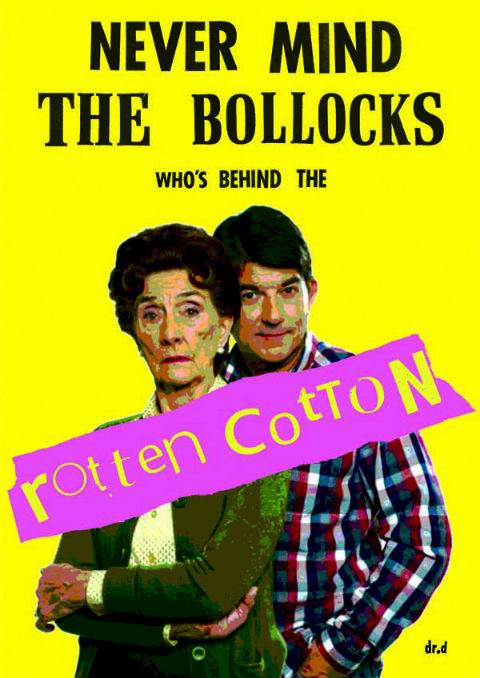
Who's Behind The Rotten Cotton - Dirty White Gold
Dot questions where her cardigan was made: poster by Dr.D

It all comes back down to our old friend, capitalism. As the trailer says, “what you are witnessing is the death throes of smallholder agriculture, under the onslaught of corporations”. Farmers are tempted away from subsistence farming by cash crops, produced for their commercial value rather than for use by the farmer. So the farmer buys a box of cotton seeds, plus licenses, pesticides and insecticides (the Indian government has a 15% holding in one of the largest insecticide companies). He pays for labour to spray all those chemicals, and the money he gets back isn’t enough to make up what was spent. Plus, he’s competing on unlevel fields against US and EU farmers who get subsidies.

Trailer: watch the cotton industry unravel

So what can be done about rotten cotton?

“You can’t wander in with a colonial attitude,” says Leah. “It has to be organic. There are resistances in India, there needs to be education. There are collectives which support farmers switching to organic, and then make sure they get a fair price. But the market has to be there. At the moment farmers aren’t going for it because they’re scared.”

There are stats and facts, and then we’re onto actions we can take when we’re shopping.

“Ask yourself: do I need to buy it?” says Leah. “It’s not so much what you buy, as whether you should be buying in the first place.”

Secondly, “pick up a needle. There are lots of people who can repair clothes for you. The Denim Doctor is a guy in Salford who repairs jeans like new.”

Lastly, “think about where you buy.” Leah recommends shopping second hand or from Traid, and Claire from Traid who is in the audience explains that Traid supports the Pesticide Action Network and other projects to help improve the global textile supply chain. This makes me like their TRAIDremade label (available online) even more.

The clothing supply chain was an issue I thought I had all sewn up, especially with articles after the Savar building collapse about which high street stores are supposedly okay to shop from. But this film looks set to unpick the way we shop, and hopefully the way our clothes are made. Right back to the seed.

Follow the progress of the film: @dirtywhitegold and Dirty White Gold on Facebook

Categories ,cotton, ,Denim Doctor, ,Dirty White Gold, ,Dr. D, ,g20, ,India, ,Leah Borromeo, ,Pesticide Action Network, ,peter kennard, ,Savar, ,Sky News, ,STIR, ,Stir Magazine, ,Stoke Newington Literary Festival, ,traid, ,Traid Remade

Similar Posts:


Amelia’s Magazine | Fine Craft Textiles with Japanese Flair: An interview with designer Nazanin Kamali

Cushion Collection, Nazanin Kamali
Furniture and Interiors designer Nazanin Kamali introduced her debut textiles collection at the Home London show in January – here she explains the reasons why she has turned to fine craft and what inspired the designs of her new range of cushions, embroideries and wallhangings.

Nazanin Kamali 2010
Chrysanthemum 2 (Styled), Nazanin Kamali
I recently discovered your debut textiles collection at Home London earlier this year – what was the reception like at this show?
It was the first time I had shown my textile designs so it was great to receive feedback on the range, particularly from bloggers and stylists who were very complimentary.

Hexagon Cushion (styled), Nazanin Kamali
You originally trained as a furniture designer, receiving an MA from the RCA, what prompted the move into textile design in more recent years?
I’ve always been more interested in craft than commercial design, even though my career path initially led me down that route. I’m drawn to the storytelling aspect of crafting and when my mother passed away in 2006 shortly before I fell pregnant, I found myself turning to the therapeutic craft processes of embroidery to help me work things through. I was inspired by Isabel Allende’s familial novel The House of the Spirits, which I first read as a teenager, and began to create a vast patchwork blanket constructed from seventy-seven hand-sewn squares, each one reflective of a different aspect of my life. The blanket took two and a half years to complete but the process helped to focus and heal my mind, and led me down the path I’m on today.

Crane Cushion (styled), Nazanin Kamali
Chrysanthemum 1 (Styled), Nazanin Kamali
How does this textile interiors brand sit alongside your other design work?
As a founding designer for Case Furniture my furniture designs reflected the attention to precision detail and intricate repetitive forms found in Japanese arts, which have long fascinated me. But whereas my previous furniture designs have always fit within specific design parameters, my textile collections are deeply rooted in my own personal fascination with cultural mythology, with an underlying melancholia and hint of the macabre.

Shrimps Cushion (styled), Nazanin Kamali
The cushion designs which form the backbone of the brand feature embroidered designs inspired by Japanese heraldic symbols: how did you choose the designs and what do they mean?
My interest in Japanese Kamons stems from work I did on the interior of Brighton-based restaurant Oki-Nami back in 1994. The six Mon designs – Chicken, Crane, Shrimp, Hexagon and Chrysanthemum (1 & 2) – were mostly chosen for their beauty, but a unifying mythological undercurrent runs through all the designs. The Crane symbolises 1,000 years while the Shrimp, with its resemblance to an old man hunched over with a beard, represents longevity. The Hexagon, resembling the shell of a wise tortoise, represents good luck.

Wedding Vows Runner (styled), Nazanin Kamali
Suicide Suitcase, Bespoke Commission by Nazanin Kamali
Why did you decide to concentrate on embroidery techniques and where do you get your products made?
My mother was a dressmaker and had taught me when I was younger, so I returned back to the craft after she passed away as a way of feeling closer to her. All my original prototypes and bespoke pieces I make by hand myself, while my collection pieces are produced in India. It was very important to me to find a manufacturer that offered a high quality of material and the production methods they use have allowed me to offer much more intricate embroidery details than I could ever have produced by hand.

Patchwork Tapestry, Bespoke Commission, Nazanin Kamali
Your height chart and advent calendar are based on original designs made for your son: how do you scale these into mass production?
I work very closely with my manufacturers to ensure their capabilities in turning my prototypes into high quality production pieces and consulted on all steps of the process. It was really fascinating to see the evolution of the project through, and I am delighted with the final results.

Chicken Cushion (styled), Nazanin Kamali
Do you have any other exciting projects in the pipeline that you can share with us?
I have a number of exciting things in the pipeline and, amongst others, am beginning work on a project involving giant embroidered buttons for an upholstered headboard, as well as designs for felt doll chess pieces.

Categories ,Case Furniture, ,Chicken, ,Chrysanthemum, ,craft, ,Crane, ,embroidery, ,Furniture, ,Hexagon, ,Home London, ,India, ,Interior Design, ,Interiors, ,interview, ,Isabel Allende, ,Japanese Kamons, ,Mon, ,Nazanin Kamali, ,Oki-Nami, ,rca, ,Shrimp, ,textiles, ,The House of the Spirits

Similar Posts:


Amelia’s Magazine | An Interview with Photographer Vikram Kushwah

Looking through Vikram Kushwah‘s dream-like work, it’s clear to see that the New Delhi-born photographer is a real fantasist at heart. Growing up in a boarding school with the enchanting Himalayas as the backdrop, Vikram’s childhood and love for all things magical has clearly influenced his work today.

Vikram Kushwah Photography
All photography by Vikram Kushwah

Vikram moved to London just three years ago and his career is already proving successful. With three critically acclaimed exhibitions under his belt, not to mention an international artist award and interest from the likes Vogue Italia, big things are predicted for Vikram Kushwah. I caught up with the ambitious photographer to find out a little bit more about his work and the inspiration behind his current book project Memoirs of a Lost Time, a collaboration with writer, Trisha Sakhlecha.

Vikram Kushwah by Estelle Morris
Vikram Kushwah Illustration by Estelle Morris

What first inspired you to start taking pictures?

The fact that photography is a direct representation of reality, yet it almost never fails to lie. It does so by allowing you to stage a setting, something that reality doesn’t allow you to do. It just exists and takes shape on its own. There’s this tension that I’ve always associated with photography and reality. You think of something and a picture is like a memento you keep, to remind you of your thoughts.

Vikram Kushwah Photography

You grew up in a boarding school in the Himalayas. How does your background inspire your work today?

It was a very big school and I had a lot of free time to explore and to read children’s storybooks. I took the stories as real happenings since there was nobody there to tell me otherwise. I was also close to nature and a bit of a dreamer; I was bound to be growing up in a place like that. Every Sunday I would watch tadpoles in a pond for hours, waiting for ‘papa frog’ to turn up and make a big splash.

Students were given a lot of freedom to discover themselves in this way. I saw magic and sorcery as real life, holding a very strong bond with wildlife and the natural world. When I studied the mystery filled art of Surrealism and the romantics’ pastoral, it took me right back to my childhood. Each of these elements play a strong part in my work today; some conscious and some sub-conscious.

Vikram Kushwah Photography

How much of your Indian heritage can be found in your work?

None. My formative years, from when I was two up until sixteen, were spent in a boarding school. Although it was in India it was a typically English school, maybe because it was founded by an English lady during the British rule during 1937. Though I come from a very traditional Indian family, my roots actually took shape at school where I spent two-thirds of every year since I was thirteen.

Vikram Kushwah Photography

What encouraged you to move to London?

It has to be the rich art and cultural heritage of Britain. The exposure, the opportunities to progress, innovate and transform, the resources to learn, the vast open country. All of this creates, within me, a mental space from where I can continue to grow as a photographer and artist.

Vikram Kushwah Photography

Do you think living in London has inspired your work in any way?

There’s so much for this ‘mental space’ to soak up here. The English countryside takes me back to my school days, back to my storybooks about pastoral landscapes and wooden cottages surrounded by forests and meadows, peasants and farmers. I keep looking for a tumbling Alice, ghoulish wolves and evil stepmothers; I sometimes do find them.

Vikram Kushwah Photography

Earlier this year you shot the photography for Hairspray: The musical. What was it like working with team behind the production?

It was a totally new experience. I enjoyed the rehearsals as much as I enjoyed photographing the play. I was left on my own and given complete freedom, and I really enjoyed the space on the balcony where I shot from. The atmosphere was exceptional and one could really see the hard work being put in by the very young actors and crew. By the end of it I knew all the lines by heart!

Vikram Kushwah Photography

Your work tends to combine both elements of fine art and fashion editorial; is there one medium you most enjoy?

There’s a definite crossover no matter how much I want to pull them apart. I have these peculiar ideas and strange stories in my head, which inform my pictures, and they never escape the thought of fashion. Not just in terms of clothing, but also in the sense of time and place. For example, there was this one picture that I only wanted shot with a certain type of Peter Pan collar. Afterwards I knew the picture wouldn’t have worked without it.

There are lots of elements in my photos that act as pieces of information about my work. Fashion is essentially one of them. The information is subject to interpretation and that’s when the mind starts to wander and stories begin to take shape.

Vikram Kushwah Photography

What is the story behind Ofelea?

The Ofelea series is a portrait of my imagination and memories, often twisted by the dark underlying layers of the storybooks I read as a child. The series of pictures is a juxtaposition of the Freudian concept The Uncanny; the constantly recurring mysterious environments in the Surrealist art movement and reconstructions of my distant childhood imagination.

There is an interesting story behind the name ‘Ofelea’. To begin with, my Ofelea had nothing to do with Shakespeare’s Hamlet. Ophelia is in fact the protagonist of one of my favourite films, Pan’s Labyrinth; this is what originally drew me to the name. During the research stage of my project, I studied both romantic and surrealist art. Here I came across the famous painting Ophelia by English painter John Everett Millais, a co-founder of the Pre-Raphaelite Brotherhood. I learnt that Millais‘ drowning of Ophilea was a depiction of Shakespeare’s very own character, thus bringing all three Ophelias (very co-incidentally) into the equation.

Vikram Kushwah Photography

What was the inspiration behind your new book Memoirs of a Lost Time?

This book project was actually Trisha’s idea. She knows my work really well and we both draw inspiration from similar aspects – escapism, daydreams and so on. We all know what clothes designers make, what song musicians write, but we wanted to know more about the formative days of such creative individuals: the elements of childhood that ultimately inspire their work today. So we set about capturing the memories of their bygone days in our own dream-like style. They themselves feature in the photographs, though nothing too defined. We’ve left the images open-ended – just like dreams and fading memory – yet there’s a strong flavour to each story.

Each chapter takes you into the personal and never seen before world of our subjects, presenting photographs, a short story and an insightful interview. Each section weaves in and out of reality where you begin to drift into a realm of imaginative possibilities, yet always remaining attached to the facts that were. It’s a representation of not only what was, but also a very whimsical take on what could have been.

Vikram Kushwah Photography

What was it like working with Trisha Sakhlecha?

In a way it’s like working with myself. We share a common paradigm in terms of aesthetics. We’re the best of friends too, which always helps. We can rubbish each others’ ideas without hesitation and more importantly the process of storytelling and taking pictures doesn’t feel like work to us; it feels like we’re in a trance. We definitely compliment each other well: she’s the more organised one, whereas I can lift heavy things. It’s a balance.

What can we expect to see next from you?

Memoirs of Lost Time; it’s only half complete. There are some real surprises yet to come in the forthcoming chapters. We’re hoping to release the book mid-2012.
Oh and Vogue Italia are also interested! They’re publishing one of my photographs in their January 2012 issue, featuring London-based fashion designer Elizabeth Lau.

Exciting times lie ahead!

Vikram Kushwah Vogue Italia

Categories ,art, ,books, ,elizabeth lau, ,Estelle Morris, ,Freudian, ,Hairspray: The Musical, ,Hamlet, ,Himalayas, ,India, ,John Everett Millais, ,london, ,Memoirs of a lost Time, ,Ophelia, ,Pan’s Labyrinth, ,photography, ,Sarah Deane, ,Shakespeare, ,Surrealist Art, ,Trisha Sakhlecha, ,Vikram Kushwah, ,Vogue Italia

Similar Posts:


Amelia’s Magazine | An interview with Sadhna Prasad: Amelia’s Colourful Colouring Companion featured artist.

MA_ProjectSpread3_SadhnaPrasad
Indian artist Sadhna Prasad contributes a vibrant page to Amelia’s Colourful Colouring Companion, inspired by her interest in parallel worlds. Here she shares her colour rich take on life, weaving together a love of dreams, memory and fantasy.

Portrait2_SadhnaPrasad
Sadhna Prasad_colouring
What is your colouring book artwork inspired by? It’s very intriguing.
I am currently obsessing over the existence of parallel worlds and researching about how the idea of the same came about. The illustration for the Coloring Book is an experiment for this relationship between humans and spaces. It is to define the two worlds which will connect in multiple ways, depending on the person filling the colors in to finish the image.

MA_ProjectSpread2_SadhnaPrasad
How did you come to study at Camberwell, and how does a London education differ from a Mumbai education?
I had researched a lot about the Illustration courses and the course-structure at Camberwell sounded very exciting and challenging. My education in India was under-graduation hence guided constantly by professionals and I was referred to as a student. In London, I was a professional who had taken up a year to finish a particular project, experimenting along the way with the feedback of tutors. That’s the difference. I was moulded into a complete professional.

Quote2_SadhnaPrasad
Why are you so interested in memories, dreams and fantasy?
I have always believed that my work should resonate with my personality. Memories create that relatable added layer. I am way more expressive when I relate to situations and scenarios personally. Dreams and fantasy is my gateway to edit the existing world.

MA_ProjectSpread1_SadhnaPrasad
Where would you most like to create a mural and why?
I would love to create a narrative-mural at intervals from Kashmir to Kanyakumari in India. It covers the two extreme points of the country. (Kashmir-North India, Kanyakumari-South India). This is an ideal roadtrip journey across India and it would be a story for people to travel through and will also help them travel further. The mural would be spaced on the roadtrip route from Kashmir to Kanyakumari. Now that I have pitched the idea, I am excited to work towards it.

MA_research1_SadhnaPrasad
Adobe_ColossalANIMALS_SadhnaPrasad
Can you tell us more about your involvement in the worlds Biggest Student Art Show?
I use Behance quite frequently to look for freelance opportunities or to follow and look at other peoples work. I stumbled upon this competition under Behance’s Job Portal and I thought I should give it a try. Everything worked out perfectly and I was chosen as one of the ten students around the world to be featured in Adobe’s Worlds Biggest Student Art show where each of us got an amazing opportunity to contribute a design piece to be painted on a wall in Brooklyn by Colossal Media. We were given a common theme – ‘to show our unique perspective of the world‘.

Adobe_Colossal_SadhnaPrasad
Why do you like entering competitions and which ones have you entered recently?
Competitions keep the adrenaline rush going for me. I love working under strict guidelines and time restrictions. Apart form that, it gives you various opportunities to travel and connect with people form all over the world who illustrate to make a change. I have recently entered two for Film Festival Official Poster Competition and I am working on one due in January for a picture book.

Quote3_SadhnaPrasad
How are you exploring animations?
I am currently experimenting with a software called Cinema 4D, to see what 3D elements I can add to my illustrations. I intend to start the experimentation with a common theme and small GIFS till I conclude in the form of an elaborate motion graphic video.

Quote1_SadhnaPrasad
What is you personal project Life’s Little Instruction Book?
I came across this tiny little book at a bookstore in India called “Life’s Little Instruction Book” and decided to pick it up. After reading all the quotes I realised the book is a confusion of emotions by the author, where he is telling you what is right and wrong. After the one year hiatus with work, I decided I would illustrate what the quotes meant to me, literally or satirically. It is the long term project with which I plan to record my work changes.

MA_research2_SadhnaPrasad
You have just been on a road trip across India, can you tell us more?
The roadtrip was one of a kind, because it was a collaboration with 15 other creatives whom I hadn’t known before. Such a surprise the trip turned out with some great collaborations on the trip, painting murals/boats while we travelled and millions of ideation for future opportunities to work together. It also gave me an opportunity to dwell further into the topic of stereotypes and spaces. Moreover it gave me time to think, reflect and meet some amazing people.

MA_Projectcover__SadhnaPrasad
Where are you based at present and why?
I am currently based in Mumbai, India, working as a freelance illustrator as well as looking for other work opportunities while connecting to the illustration community in India and elsewhere.

Portrait1_SadhnaPrasad
Artwork by Sadhna Prasad features in Amelia’s Colourful Colouring Companion alongside 40 other artist, funding now on Kickstarter. Get your copy for Christmas!

Categories ,#ameliasccc, ,Adobe’s Worlds Biggest Student Art, ,Adult Coloring Book, ,Adult Colouring, ,Adult Colouring Book, ,Amelia’s Colourful Colouring Companion, ,Behance, ,brooklyn, ,Cinema 4D, ,Colossal Media, ,Colouring Book, ,Film Festival Official Poster Competition, ,India, ,Indian, ,interview, ,Kanyakumari, ,Kashmir, ,Kickstarter, ,Life’s Little Instruction Book, ,Mumbai, ,Sadhna Prasad

Similar Posts:


Amelia’s Magazine | An interview with painter, Jethro Buck

Oxford

Edgar Degas’ statement; “Art is not what you see, mind medicine but what you make others see, viagra 100mg ” pre-empts the paintings of Jethro Buck. Whilst Buck and Degas’ individual work relates to painting’s ability to convey emotional expressions by their manifold, their similarity lies in an ability to push the audience’s understanding of what it is to see the world.

Jethro Buck’s most recent paintings explore the geometry and non-linear perspective employed within Indian and Persian Miniatures in the creation of multiple narratives on a single picture plane. Subsequently Buck asks the audience to reconsider Western Perspective’s reliance on a single point of vision (or a single point of view) to create a static narrative within the illusion of 3D space.

What drew you to painting, as a medium?

Paint is an amazingly versatile material that can be turned, pretty much, into anything you want. It is pure pigment mixed with a binding medium, but when you squeeze it onto a palette, you have a little colourful blob of potential. Sometimes I’m quite happy just to leave it at that!

The rock where the pigment comes from is like a caterpillar, the manipulation of paint in the studio is the chrysalis and the painting is the golden Butterfly. What was a blob is transformed! Whereas, the art historians and the critics of the world are interested in the butterfly, the painters are more interested in the miracle of the chrysalis.

Whilst painting I find myself thinking in the language of paint. When visiting a museum, you’re meant to step back and think about the painting and its subject and ideas. I am always getting told off in galleries for looking so closely at a painting that my nose scrapes the surface! The closer I am to the painting, the closer I am to the world of the studio and artist’s thoughts as they mixed, diluted, scraped and brushed.

Do you find yourself follow traditional rules when constructing a painting?

Inevitably, through painting a lot, established rules are learnt and knowledge is acquired and the more of these rules you discover. However, in order for me to think differently and follow a creative process beyond a known craft, I think rules need to be broken. It is however, a good practice to learn as many rules as you can, so you know which rules to break later.

It has occurred to me that I really do not know the many rules of Indian miniature painting; For example, the relation between symbolism and the meaning of colour. The upside is that I am free to do whatever I want. However, I would like to know what rules I am breaking, as I don’t know what I’m missing. Ideally, I would like to return to India and study as an apprentice.

What is it that interests you about the possibilities of the surreal?

When a painting becomes surreal I am no longer confined by the rules of physics and therefore there are more possibilities.

I think I became interested in experimenting with the surreal after returning from India. It can feel surreal being in a different culture. What’s real to you is surreal to someone else and vice versa.

Pink and Grey

Does the subject matter of your painting change depending on the scale of the canvas?

It does, slightly, I tend to paint really big or really small. I like art to be removed from the everyday and the medium –to me- represents the everyday. I like the extreme ends of spectrums. I like the sense of intimacy produced by a small painting, as the viewer has to engage in a one-on-one level with the piece. Which is not to say big paintings cannot be intimate, when a subject is large in scale; it feels as if, it is perceptively closer to you.

Which leads to the inevitable question: Who or what are you artistic inspirations?

Nature, Matisse, Marrakech, India, miniatures, rugs, textiles, old natural history prints and TED lectures. I am interested in the relative, cyclic and none dualistic nature of Indian mythology, there is no definite yes or no meaning to my paintings.

What do you think enables a single painting to tell 1000 words?

Henri Matisse once said:

“The only valuable thing in art is the one thing that cannot be explained, to explain away the mystery of a great painting would do irreplaceable harm, for whenever you explain or define something you substitute the explanation or the definition for the image of the thing.”

The Fall

With this in mind, how do you approach the process of titling your work? For instance with a work such as “Fall” What’s the story behind this title?

I paint and then I write the first thing that comes to my head. ‘Fall’ comes from a photo of a really happy scene – some boys in India were jumping and flipping into a river. As the river can’t be seen in my painting, the image of a falling figure can become a metaphor for taking a leap into the unknown. The fall can be a weightless, disorientating and scary experience or an amazing, life-filled, liberating one.

‘Bird carpet bird’ was inspired by various world textile patterns and colours. ‘Oxford’ was painted in November and the colours appear muted compared to the Indian ones, because it’s a response to the sandy colours of Oxford. ‘A Zebra, on the moon?’ is less about colour and more about a zebra on the moon.

A Zebra, on the Moon

Which leads me to ask… How did A Zebra on the Moon develop? What is the story behind the image?

Zebra on the moon was born out of a conversation with Lilly (4) and Daisy Palmer (7). One day I asked Lilly what I should draw, and she replied.., “a flower eating a lorry!”

Children often possess the divergent thinking skills considered a sign of genius in adults. As we grow up, we unlearn this way of thinking, but my conversations with Lilly and Daisy have engaged this part of my mind.

As an English painter you must find yourself negotiating incredible rapid weather changes, do the differing quality of light impact upon your work?

The quality of light definitely affects my paintings. Whilst getting off a train in India, the boy sitting next to me asked, “what is your favourite thing about India?” In a hurry I said, “the people and the light“. The quality of light changes everywhere you go, in India, the sky would turn an amazing shade of red in the dusty light.

Generally, as an English painter it’s great to go to sunny countries with lots of light. The more light there is, the more vibrant colours become. I don’t think there is anywhere more colourful than India. Leaving a grey wintery England and landing in India is like suddenly discovering you have a colour saturation dial – on what you thought was only a black and white TV. On my return, my work, has unquestionably become more saturated.

Creative Goose

What impact do you think the development of Western Perspective has had on narration within paintings?

With the invention of perspective came the ability to create illusionary 3D space on a flat plane. These days’ cameras create this illusion all the time on our behalf. Photography and perspective rely on a similar principle, for the illusion to work; you have to have a single point of vision. A camera has to be still, in one place and in one time, in order to capture what is in front of it. Essentially what you end up with is an image representing a singular frozen moment – for me, perspective stops time.

This development created a way of representing the world, which –as an example- was very unlike the Bayeux tapestry or a Persian miniature, where lots of temporal events are represented simultaneously in one piece of work. It is easier to fit a wider time range on a non-perspective piece of work.

Haiku

Have you found this secondary impact of perspective as a time ‘freezer’ constraining as a painter?

It’s not a constraining idea, because it doesn’t really come into mind during the process of painting. Painting at its best is an action that happens in the here and now. I find the less thought there is usually the better a painting goes.

Does your interest in the possibilities of representing ideas of universality through geometry, stem from your own interest in biology and nature?

In a way, yes, there are many organic forms and occurrences in nature that have a flowing sort of chaotic order. I love the cracked, sun-baked earth ripples, clouds, cracked paint, the braches of a tree and the similar shapes of veins in the leaves, nerve cells and lung alveoli when looked at under a microscope. The forms repeat themselves in seemingly disparate areas of nature but there appears to be a common blueprint networking its way through everything; acting as a record of the flow of energy. Geometric patterns found on carpets and tiles are similar to these occurrences; they just happened to be straighter and neater versions.

Bird Carpet Carpet Bird

Which in turn – it could be said- relates to your long running interest in decoration and pattern?

I’ve always been drawn to pattern and if you walk around the Ashmolean or any museum, it will appear that most of humanity always has. Pattern seems to occur in cultures across all of time. It’s beautiful. Recently, my patterns have become more organised due to an increased interest in geometry. I’ve only scraped the surface of a vast discipline, but the first time I saw truly breath taking geometry was when I visited the Alhambre in Spain. As the Islamic world has studied geometry more deeply than any other culture, it makes sense –if one is interested in pattern- to study the magnificent geometric patterns of Islamic palaces and mosques.

The more I look at nature, the more geometry I see in it and the more I look at geometry, the more of nature I see in it. An obvious example of geometry in nature is the Romanesco cauliflower. I like to notice strikingly similar formations in widely different circumstances; such as the branches of trees, arteries, ripples and clouds.

Forever

An exhibition of Jethro Buck’s most recent paintings are currently on display at the North Wall Arts Centre, Oxford.
The gallery is open from 11am – 4pm Monday to Saturday and the exhibition runs from the 6th to the 18th December 2010.

Categories ,Alhambra, ,Degas, ,Falling, ,India, ,Jethro Buck, ,matisse, ,Oxford, ,painting, ,Persia, ,Port Meadow, ,spain, ,Summertown, ,Ted Lectures, ,The North Wall, ,Western Perspective

Similar Posts:


Amelia’s Magazine | A Review of ILLUMinations at the Arsenale, Venice Biennale 2011: part two

Venice Biennale 2011 Swatch review-Nicholas Hlobo
Here’s my second half of a round up of the best art that I found at the ILLUMinations exhibition at the Arsenale, more about part of the 54th Venice Biennale.

Venice Biennale 2011 Swatch review-Venice Biennale 2011 Swatch review-Nicholas Hlobo
Nicholas Hlobo‘s massive Iimpundulu Zonke Ziyandilandela skull, more about rubber, viagra approved tyre, leather and ribbon installation was one of my favourite pieces at the Arsenale. This vast sculpture refers to South African myths and in particular the vampire bird of Xhosa folk songs. Spooky, enigmatic and affecting.

Venice Biennale 2011 Swatch review-Mariana Castillo Deball
I also really liked the work of Mexican artist Mariana Castillo Deball. Having studied ancient Aztec manuscripts, she has reproduced her interpretation in the form of a long script, re-imagining their long lost meanings.

Venice Biennale 2011 Swatch review-Fabian Marti
Fabian Marti has built a huge structure from boxes of plywood, stacked with curiously relaxed ceramic incense holders. Visitors enter a cave inside to witness a trance like video of the sun shining through trees in India. Sun Oh! was inspired by Brion Gysin‘s experimental hallucinations brought on by light flickering through trees.

Venice Biennale 2011 Swatch review-Urs Fischer
We were all captivated by Urs Fischer‘s Untitled – a huge wax installation which has been slowly burning to the ground as the Biennale progresses. The decapitated head of a man lies on the floor at the foot of a disintegrating chair – a truly grotesque vision that is also curiously humorous.

Venice Biennale 2011 Swatch review-Corinne Wasmuht
Corinne Wasmuht paints huge pieces that straddle the worlds of reality and fiction. Her pixelated artwork Bibliotheque CDG BSL offers a dreamlike experience to viewers, who recognise in its blinding colours the brightness of a digital screen.

Venice Biennale 2011 Swatch review-josh smith
Josh Smith displays a huge collage of artwork that would not look out of place pasted on to a wall on a side street off Brick Lane.

Venice Biennale 2011 Swatch review-Giulia Piscitelli
Giulia Piscitelli‘s long skeins of iridescent silk, Spica (2011), are painted with bleach to create intricate bone like patterns. Beautiful – and perfect for a corporate environment.

Venice Biennale 2011 Swatch review-Klara Liden
Klara Liden has made an installation of garbage cans, which are hung against artfully peeling brick walls. By displaying the most banal of street furniture as art she aims to make viewers question their aesthetic tastes.

Venice Biennale 2011 Swatch review-Monica Bonvicini
The final room of this section presents the work of Monica Bonvicini, who has been very vocal about what she thinks of the circus that is the Biennale and in fact the art world in general. She only agreed to be involved in this years show if she could make an installation that questioned the vacuousness of it all. Thus her huge room is dominated with a series of staircases to nowhere. Suitably powerful and dramatic.

Venice Biennale 2011 Swatch review-Arsenale
Venice Biennale 2011 Swatch review-The Geppetto Pavilion
Outside Loris Gréaud has planted a life size replica of a beached whale, which lies gasping on a pile of sand. The Geppetto Pavilion takes its name from the story of Pinocchio, who is swallowed by Monstro the whale. It is a strange and unlikely thing to encounter amongst the cranes and docks of the old Arsenale.

The Venice Biennale continues until the 27th November 2011. Don’t forget to look at part one of my review.

Categories ,Arsenale, ,Aztec, ,Bibliotheque CDG BSL, ,Brion Gysin, ,collage, ,Corinne Wasmuht, ,digital, ,Fabian Marti, ,Giulia Piscitelli, ,Iimpundulu Zonke Ziyandilandela, ,ILLUMinations, ,India, ,Josh Smith, ,Klara Liden, ,Mariana Castillo Deball, ,Mexican, ,Monica Bonvicini, ,Monstro, ,Nicholas Hlobo, ,Pinocchio, ,South African, ,Spica (2011), ,Sun Oh!, ,The Geppetto Pavilion, ,Untitled, ,Urs Fischer, ,Venice Biennale, ,Xhosa

Similar Posts: