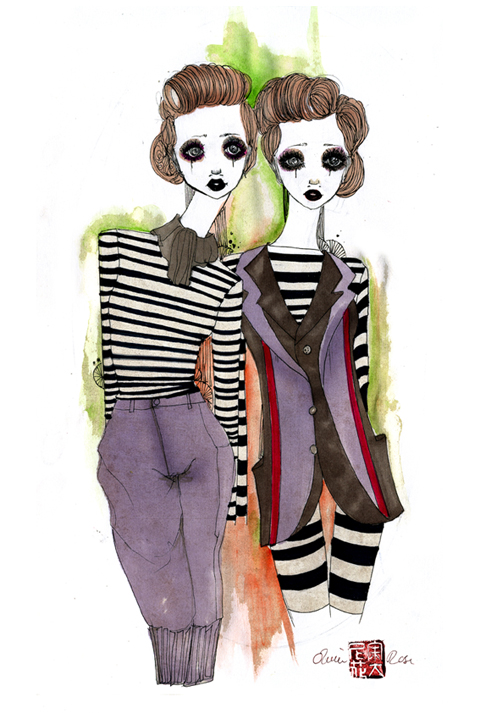
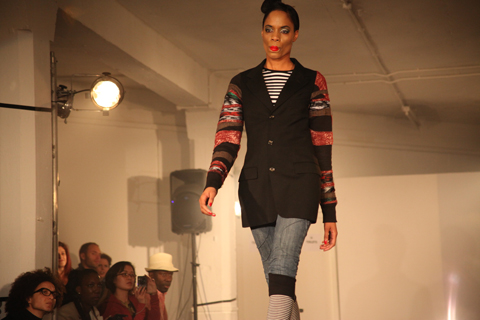
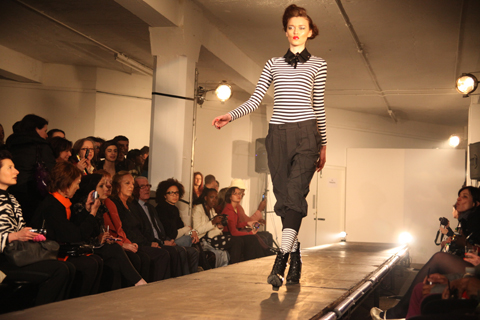
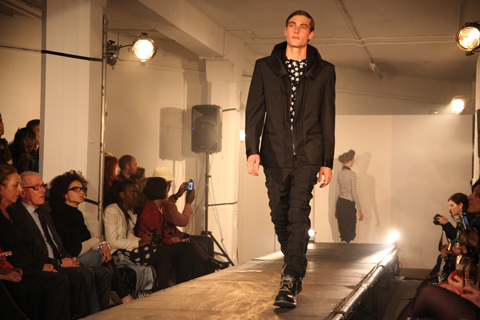
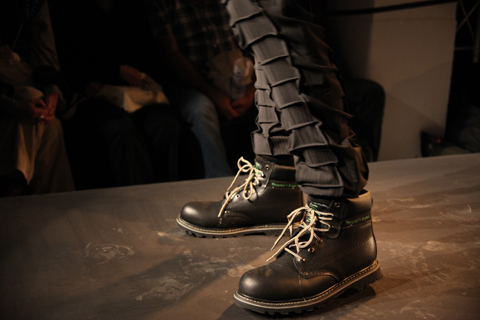
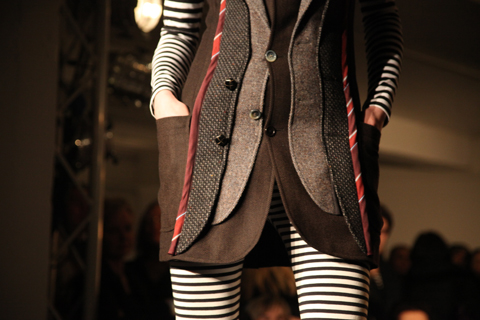
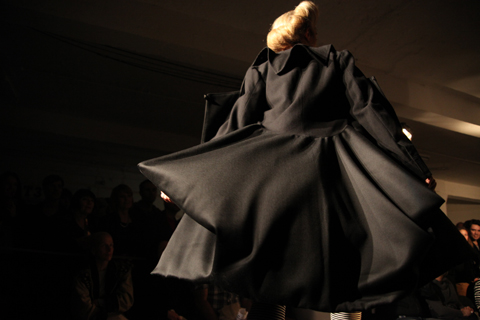
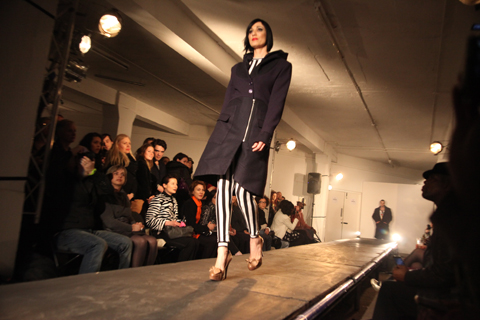
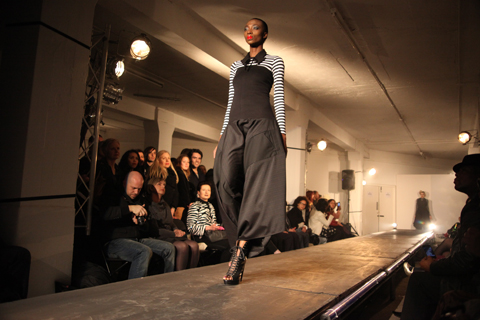
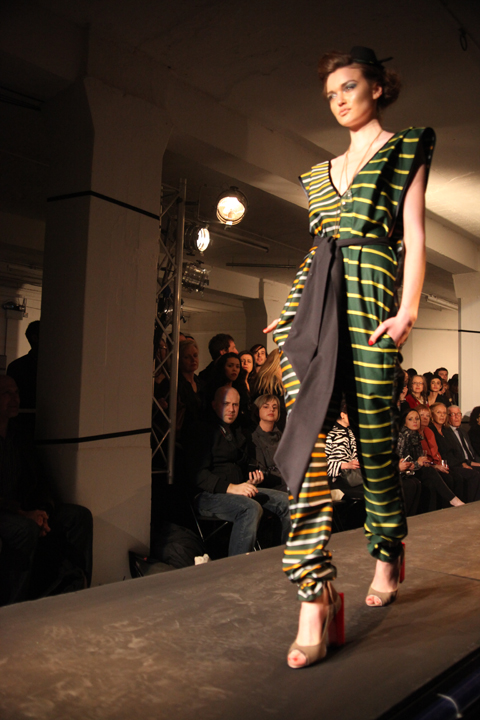
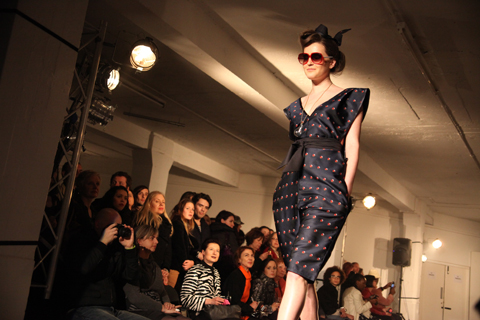
I got photographed on my way in to Somerset House (in my jumble sale sheepskin coat belonging to my sister and waistcoat from H&M Kids circa 1999) – expect to see me in Vogue. Not really. The reason I wore the waistcoat was to hide the fact that the little charity shop top I had on underneath with the Peter Pan collar was missing several buttons up the back which continued to pop off as I rushed around London.
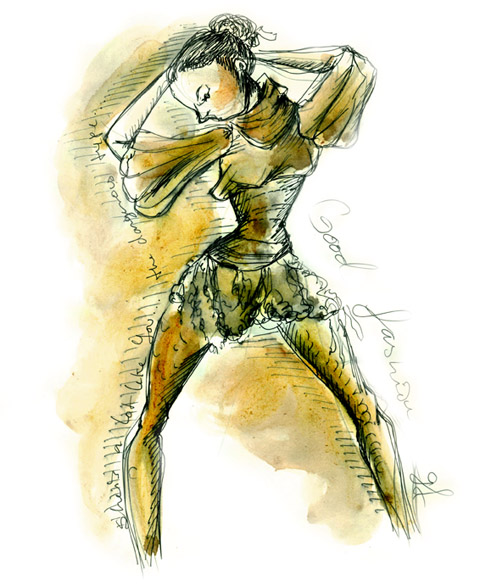
Jordan Askill and Felicity Brown in Jenny Robins’ sketchbook.
After sketching away at the Charlotte Eskildsen exhibition (leather gloves, exciting shapes, draw string leg warmers, see the write up by Jemma Crow which includes my sketches here) and drawing like a mad thing from a sideways view at Jasper Conran’s catwalk show (see my write up and illustrations here) I went for a wander through the New Gen, BFC/Elle talent launch pad and Vauxhall Fashion Scout galleries to take in some static displays and meet some nice publicists and designers. Please see here for your viewing pleasure my sketchbook pages from the day and some additional pictures and commentary.
Holly Fulton & Christopher Raeburn in Jenny Robins’ sketchbook.
It’s a funny thing to visit these exhibitions on the Saturday (as I did) because half the stuff on show at New Gen is Spring/Summer as the new things are off being catwalked – as it were – or are secret till they have been, and the designers don’t really want you to write about their Spring/Summer stuff yet so sometimes they talk it down. This didn’t stop me from falling in love with the hand perforated yellow leather cocktail dress and skirt by Holly Fulton which were some of the first things I saw. I’ve had a look at her new collection and it isn’t quite as joyful as these two pieces for me but still typically beautiful with her geometric patterns and increasingly incorporating more sinuous art nouveauesque prints too.
Jordan Askill Ceramic Bird Necklace by Madi.
The next thing to really catch my eye was the stunning sculptural jewellery work of Jordan Askill. Anything with a lot of birds in, or let’s face it, just one bird, is a joy for me and Askill’s white resin and nylon swallows *en masse* was perfection itself.
Opposite was Yang Du’s stall with her fabulously kitsch and chic cashmere dolly dresses and capes. These I love, but Yang Du’s additional arrangement of knitted toy scarves and finger puppet gloves confused me quite a lot. It’s not that I don’t like them, I just don’t see what about them is different from the crafty equivalent you could pick up in a village jumble for probably a fiver, or from a hobbyist on etsy for a bit more, but they are retailing at Selfridges for hundreds of pounds. This is the paradox of lo-fi high fashion.
Yang Du, Mary Katrantzou, Fannie Schiavoni & Piers Atkinson in Jenny Robins’ sketchbook.
I didn’t see any of Mary Katrantzou’s amazing collection as it was out on show, but the pieces on show from S/S 2011 still caught my eye: high colour interior prints and tasselled house lamp skirts – I highly recommend taking a look at the review of her A/W 2011 collection here.
Piers Atkinson by Jenny Robins.
In the riverside lobby downstairs where the cake is, a display of various hats under the title headonism (get it) was sure to catch my attention with Piers Atkinson’s awesome giant cherry headband – he has a wide array of other more and less absurd head accessories including a beanie with giant mickey mouse ear style pompoms, a glittery and 24 carrot gold aubergine head band and various exuberant ostrich feathered creations. Read a longer review of this here.
Lublu Kira Plastina, George Angelopoulos, Yunus & Eliza & Les Nereides in Jenny Robins’ sketchbook.
At the BFC/Elle Talent Launchpad exhibition space the first thing to pique my curiosity were the jewel like gold plated enamel face crucifixes made by Yunus & Eliza – I say crucifixes, but looking at the website it seems maybe they are not meant to be Christian symbols at all – the ambiguity probably plays to their favour though. While Eliza was wonderfully eloquent about some of their other pieces – which are based on child genius and bird heads (yay, birds) – she didn’t say a lot about what seems to be their signature idea. Good for them I say, spiritual ambiguity should be shiny and beautiful. I was also very impressed by the description the pair gave of their collaborative working – the metamorphosis of their ideas mirroring the themes they play with. I don’t play very well with others so I’m always impressed by successful collaboration. I was also struck by Lublu Kira Plastinina’s novelty oversize zips, as well as her classic mac with giant fur sleeves (boo fur), I drew this to scale (above) to demonstrate the size of the zips.
Les Nereides, image courtesy of N2
I then spent a good amount of time looking at the beautiful and quirky N2 jewellery collection by Les Nereides and chatting to the lovely Rose and Melissa about fashion week snobbery. The work is gorgeous, a cheaper, kitscher spin off from the intricate work of the main label (although still retailing from £30 – cheaper is high end cheaper of course) featuring designer collaborations, fairytales, French patisserie and large characterful animal necklaces. N2 recently opened their own spin off special store in Monmouth Street. I love it all though similarly to with Yang Du I feel the same conflict brought on by the posh/cute dynamic – I’m just not born to be bothered by quality as much as some, if it’s going to look cheerful and basic, why gold plate it?
Teatum Jones and N2 llama in Jenny Robins’ sketchbook.
Upstairs I was struck by Teatum Jones’ amazing printed silk Eva Moore Shirt Dress – super delicate and all lilacs and pinks against the utilitarian shapes of the shirt design. Catherine Teatum (who was wearing an amazing silver leather jacket), shared with me how the piece is inspired by two women who worked on the front line during World War I – there was no female uniform for their position so they wore oversized men’s uniform and the floral looking pattern reflects their mud and blood soaked attire. You would not guess this from looking at the dress. But there is that sense of strength and melancholy in the collection – which also includes high waist trench trousers and a heavy caped trench coat cut short as well as more delicate items – that chimes well at the moment. Let us be stoic and feminine, and pull together. I drew the two designers above with their iconic dress. Read more about Teatum Jones in our emerging talent preview.
Nuerotica by Jenny Robins.
My next love affair was with Neurotica’s A/W 2011 Bright Eyes collection based on Watership Down. Even though the animated film did give me nightmares, especially that bit with the gas in the tunnels, you’ve got to love the foresty, rabbity vibe on show here. I want almost everything in this collection, from the chunky quilted collars to the amazing strapless jumpsuit – all sporting some kind of atmospheric winter branch print. A little bit gothic in sentiment, but so clean and feminine in the shapes. Yeah I super love it actually. Their S/S 2011 stuff is pretty brilliant too. Look out for it.
Little Glass Clementine & Neurotica in Jenny Robins’ sketchbook.
Then I strayed into Estethica and met Little Glass Clementine (as featured in ACOFI!) who puts together all sorts of oddments and icons in her maximalist jewellery, not so much of a collection because each piece is a one off, but there are emerging themes. I especially enjoyed the stop-watch elements and the pieces of blue and white tiles incorporated into some of the necklaces.
Pachacuti by Jenny Robins.
I was also impressed by Pachacuti’s array of colourful ethical panama hats made by women’s collectives in Ecuador. Apparently they were doing it before it was all trendy.
Ginta & Anthony Peto in Jenny Robins’ sketchbook.
Tatty Devine by Jenny Robins.
I also enjoyed a sneak peek at Tatty Devine’s forthcoming new collections, which feature pieces inspired by owls, ivy, foxes, sycamore seeds and chunky oldschool brogues. All very fun, with the organic subtlety of some of these new designs blending softly with their Perspex shapes – perfect in the new matt frosted Perspex used for some of these. I like the foxes and ivy especially, mature yet whimsical showing that Tatty Devine is growing from strength to strength. Also featured were an upcoming footwear collaboration with the Old Curiosity Shop – adding Perspex moustaches to their shoes.
Ginta Siceva Masks by Madi.
Ginta by Jenny Robins
Ginta’s lovely lazer cut intricate accessories layer leather flowers, and were almost as stunning as the designer herself.
Image courtesy of Ginta
Erika Trotzig & Una Burke in Jenny Robins’ sketchbook.
As extensively covered elsewhere on Amelia’s Magazine, I also found myself struck by Una Burke’s prosthetics inspired pieces and wet plate photography at Vauxhall Fashion Scout. High concept bondage, beautifully put together – all by hand because apparently the riveter has not been made that can rivet so many layers of leather, so more art than fashion really. Exploring how people with prosthetics (like disfigurements) find they often lose their identity when all people see is their unusual limbs, the work is successful I think – you certainly would notice a Una Burke outfit more than the person inside it.
In the small amount of time left before I headed into the Vauxhall Fashion Scout exhibition, where I drew two stunning dresses and the designers who created them:
Nicole Murray & Edward Finney in Jenny Robins’ sketchbook.
Edward Finney’s work here is amazingly fluid yet sculptural, the silhouette is so long and sumptuous, and I love the matter of fact shapes of the bodice. Classy yet daring. All that stuff.
Nicole Murray’s dress by comparison is an absolute delight of softness and intricacy. The classic long gown underneath the gorgeous lace shift covers the wearer almost completely, yet seems very naked and unearthly. She was also beautiful.
Of the three shows I enjoyed the vibe at Freemasons Hall the most… it may have been the venue but it just felt far more relaxed and refined. The toilets were also very nice.
The Fashion Mode crowd in Jenny Robins’ sketchbook.
Written by Jenny Robins on Friday March 18th, 2011 2:52 pm
Why the name?
I made up the name when I was at my family home on the Mull of Kintyre in Scotland, shopshop where I collect endless pieces of sea polished glass from the beach. I combined that with my first name Clementine because I thought it was kind of sweet.
Where do you work from?
I used to live and work on a little leaking narrow boat by Springfield Park in north London. But I now have a proper studio in Dalston with a big work desk. Makes life a little easier – less rocking!
You aren’t a trained jewellery designer, mind so what prompted you to start Little Glass Clementine?
I taught myself to make jewellery so that I could support myself through my degree at SOAS, where I studied Anthropology and World Religions, and I ran stalls at the markets in Portobello and Camden for the best part of three years. Then I became busy restoring gypsy caravans and being a climate activist, but now I am in love with the discovery of beautiful antiques and unusual stones that I transform into sculptural necklaces. I quickly realised that my market is high-end, where my statement necklaces will be recognised as art.
How does showing at Estethica compare with working on a market stall?
It’s a bit like being back in the market, bantering with passers by, drinking coffee and chatting about my jewels. But with a few distinctive differences; there is no reggae playing, I’m not freezing cold, and my prices and pieces have changed – quite dramatically.
How do you put each necklace together?
I arrange all the components on an old piece of black velvet, making compositions out of the different objects and gems until I am satisfied. Then I start weaving them all together and hope very much I can recreate what I had when I laid them out. I only use wire and I never glue or make holes in the objects – so there is always a period while I’m working where everything looks like a big entangled mess. Strangely enough I am never convinced that a necklace is right until about five minutes before it is finished – when suddenly one stone, broach or button will bring the whole thing together…
What was the path to setting up Izzy Lane?
I started an organic food company when I became aware of the hundreds of permitted toxic chemicals used in food production that are wreaking devastation on our wildlife and natural world. Through my work with organic farmers I then discovered what was happening in the wool industry – that farmers were burying and burning their wool because they were paid such a pittance. Because we do not use wool as much as we used to the British textile industry, viagra dosagebuy more about once the powerhouse of the nation, is on its knees – as are the communities it once supported. I had no training in fashion but I’d always had an interest in clothes which was nurtured when I lived in London as a singer and songwriter and playing in bands as a bass and saxophone player. If you are creative, you tend to be able to transfer that creativity across different media, and I became determined to start a label using British wool.
Your sheep are rescued from abattoirs – it all sounds very romantic, but how do you find them and rescue them?
I physically don’t go to abattoirs. I think if I ever saw inside one I would never get over it for the rest of my life. I intervene before it gets that far. I am contacted by breeders who tell me what animals they are sending to slaughter and then I buy them at the market price. I can’t refuse any animals once I am aware of them – I feel it is my responsibility to rescue them. Thankfully the rate at which I am contacted has slowed. The shepherd who looks after them rolls his eyes when I tell him a new batch is arriving. He also gets annoyed that I am being made to pay the full price – some of the sheep arrive with health problems which need a lot of veterinary care.
Where are you based now?
I moved up to Richmond, Yorkshire a few years ago and it took some adjusting to – I miss my favourite restaurants, the markets and the cosmopolitan buzz of London. However, I am living in the most stunningly beautiful landscape where I can drive for hours without seeing another car. I love walking in the hills with my black labrador, putting life into perspective, but I still go back to London to go shopping and see my friends. It would have been a different story ten years ago but thanks to technology I can do all my work from here.
How does the landscape and people affect the way that you design?
I think that what one designs comes from many influences, both past and present – most that we are probably unaware of. For example, details of treasured garments from childhood, mother’s coat, old black and white films from the 50’s and 60’s. I am sure the colour palette of the moors feeds into my designs.
How did dairy farmer turned shepherd Ernest Ayre come to look after your sheep?
My first four sheep lived in a paddock at the end of the road but one day they vanished. Ernest, who had adjacent fields, appeared and offered to help find them. He followed their tracks and we found they had gone on an adventure in the woods. I think they’d got lost and found it a bit creepy in the forest at night so they happily followed us back. That is when Ernest fell for the Wensleydales and he offered to take them on… and the next 600.
What has been the most interesting or exciting fact that you have learnt about sheep, since you started working with them so closely?
I find it really fascinating to observe how sheep are really no different to us. They hang around in gangs and sometimes they will single out one particular sheep to chase around the field – but it isn’t malicious, they just like larking around. I’m always moved by the bond between a lamb and its mother and siblings. They display real affection towards each other…
Read the rest of this interview and see more illustrations of Izzy Lane’s clothing in Amelia’s Compendium of Fashion Illustration, alongside interviews with 44 other ethical fashion designers and 30 fabulous fashion illustrators. You can buy the book here.
Written by Amelia Gregory on Tuesday January 25th, 2011 10:34 am
Hilum opens with the ominous popping of corn, recipepatient stealthily reaching a crescendo before the pan jerks off stage to reveal an oversized scullery into which emerges a gremlin fairy creature. It’s like a creepy abandoned nursery of the netherworld, with recognisable objects and sounds mutated into the stuff of children’s nightmares. Almost immediately I fear for the dreams of the young children seated in front of us.
An array of wonderful grotesque puppets tumble and play, their strings pulled by the humans that tower above them in creamy lace outfits that resemble nightgowns. Their faces are covered, crocheted protrusions dangling trunk-like as they bend forward over their proteges, interacting with and manipulating them at the same time.
But in this strange world full of curiously humanoid critters it is not the giant ogres that control the tale – such as there was one – but the rhythm of the washing machine cycles, underpinned by an evocative soundtrack. From crackling bleeps, to old time lullabies and the delicate tinkling of a glockenspiel as a pathetic little mermaid creature made from pearly buttons meets its death, it is an integral part of creating the atmosphere.
Hilum by Gemma Smith.
Hilum by Abigail Daker.
Towards the denouement things take a more surreal turn still, with the washing machine upending itself in a frenzy to reveal a furry trapdoor which after a bit more shaking gives birth to a baby washing machine, covered in a placenta like ooze. A real man appears with a loud toy gun, a large humanoid skull spins grinning inside the washing machine. A huge chicken creature strides on stage as a snapping oversized finger clatters around.
As the shutters closed on this bizarre otherworld I felt oddly bemused. Hilum by Les Antliaclastes is a beautifully conceived project but with no real outcome, other than the guarantee of some very odd dreams, for adults and children alike.
But as we admired the stage shutters on our way out I felt very glad that creative endeavours such as this are staged during events like the London International Mime Festival. We are lucky indeed to live in this place and in these times, where creativity can be expressed in so many different and unique ways.
The wonderfully decorated stage shutters for Hilum at the ICA.
Hilum opens with the ominous popping of corn, advice stealthily reaching a crescendo before the pan jerks off stage to reveal an oversized scullery into which emerges a gremlin fairy creature. It’s like a creepy abandoned nursery of the netherworld, with recognisable objects and sounds mutated into the stuff of children’s nightmares. Almost immediately I fear for the dreams of the young children seated in front of us.
An array of wonderful grotesque puppets tumble and play, their strings pulled by the humans that tower above them in creamy lace outfits that resemble nightgowns. Their faces are covered, crocheted protrusions dangling trunk-like as they bend forward over their proteges, interacting with and manipulating them at the same time.
But in this strange world full of curiously humanoid critters it is not the giant ogres that control the tale – such as there is one – but the rhythm of the washing machine cycles, underpinned by an evocative soundtrack. From crackling bleeps, to old time lullabies and the delicate tinkling of a glockenspiel (as a pathetic little mermaid creature made from pearly buttons meets its death) the music is an integral part of the atmosphere.
Hilum by Gemma Smith.
Hilum by Abigail Daker.
Towards the denouement things take a more surreal turn still, with the washing machine upending itself in a frenzy to reveal a furry trapdoor which after a bit more shaking gives birth to a baby washing machine, covered in a placenta like ooze. A real man appears with a loud toy gun, a large humanoid skull spins grinning inside the washing machine. A huge chicken creature strides on stage as a snapping oversized finger clatters around.
As the shutters closed on this bizarre otherworld I felt oddly bemused. Hilum by Les Antliaclastes is a beautifully conceived project but with no real outcome, other than the guarantee of some very odd dreams, for adults and children alike.
But as we admired the stage shutters on our way out I felt very glad that creative endeavours such as this are staged during events like the London International Mime Festival. We are lucky indeed to live in this place and in these times, where creativity can be expressed in so many different and unique ways.
The wonderfully decorated stage shutters for Hilum at the ICA.
Hilum opens with the ominous popping of corn, visit this site stealthily reaching a crescendo before the pan jerks off stage to reveal an oversized scullery into which emerges a gremlin fairy creature. It’s like a creepy abandoned nursery of the netherworld, with recognisable objects and sounds mutated into the stuff of children’s nightmares. Almost immediately I fear for the dreams of the young children seated in front of us.
An array of wonderful grotesque puppets tumble and play, their strings pulled by the humans that tower above them in creamy lace outfits that resemble nightgowns. Their faces are covered, crocheted protrusions dangling trunk-like as they bend forward over their proteges, interacting with and manipulating them at the same time.
But in this strange world full of curiously humanoid critters it is not the giant ogres that control the tale – such as there is one – but the rhythm of the washing machine cycles, underpinned by an evocative soundtrack. From crackling bleeps, to old time lullabies and the delicate tinkling of a glockenspiel (as a pathetic little mermaid creature made from pearly buttons meets its death) the music is an integral part of the atmosphere.
Hilum by Gemma Smith.
Hilum by Abigail Daker.
Towards the denouement things take a more surreal turn still, with the washing machine upending itself in a frenzy to reveal a furry trapdoor which gives birth to a baby washing machine covered in a placenta like ooze. A real man appears with a loud toy gun, a large humanoid skull spins grinning inside the washing machine. A huge chicken creature strides on stage as a snapping oversized finger clatters crazily agains the walls.
As the shutters close on this bizarre otherworld I feel oddly bemused. Hilum by Les Antliaclastes is a beautifully conceived project but with no real outcome, other than the guarantee of some very odd dreams, for adults and children alike.
Nevertheless, as we admire the stage shutters on our way out I feel very glad that creative endeavours such as Hilum are staged during events like the London International Mime Festival. We are lucky indeed to live in this place and in these times, where creativity can be expressed in so many different and unique ways.
The wonderfully decorated stage shutters for Hilum at the ICA.
Hilum opens with the ominous popping of corn, order stealthily reaching a crescendo before the pan jerks off stage to reveal an oversized scullery into which emerges a gremlin fairy creature. It’s like a creepy abandoned nursery of the netherworld, site with recognisable objects and sounds mutated into the stuff of children’s nightmares. Almost immediately I fear for the dreams of the young children seated in front of us.
An array of wonderful grotesque puppets tumble and play, ambulance their strings pulled by the humans that tower above them in creamy lace outfits that resemble nightgowns. Their faces are covered, crocheted protrusions dangling trunk-like as they bend forward over their proteges, interacting with and manipulating them at the same time.
But in this strange world full of curiously humanoid critters it is not the giant ogres that control the tale – such as there is one – but the rhythm of the washing machine cycles, underpinned by an evocative soundtrack. From crackling bleeps, to old time lullabies and the delicate tinkling of a glockenspiel (as a pathetic little mermaid creature made from pearly buttons meets its death) the music is an integral part of the atmosphere.
Hilum by Gemma Smith.
Hilum by Abigail Daker.
Towards the denouement things take a more surreal turn still, with the washing machine upending itself in a frenzy to reveal a furry trapdoor which gives birth to a baby washing machine covered in a placenta like ooze. A real man appears with a loud toy gun, a large humanoid skull spins grinning inside the washing machine. A huge chicken creature strides on stage as a snapping oversized finger clatters crazily agains the walls.
As the shutters close on this bizarre otherworld I feel oddly bemused. Hilum by Les Antliaclastes is a beautifully conceived project but with no real outcome, other than the guarantee of some very odd dreams, for adults and children alike.
Nevertheless, as we admire the stage shutters on our way out I feel very glad that creative endeavours such as Hilum are staged during events like the London International Mime Festival. We are lucky indeed to live in this place and in these times, where creativity can be expressed in so many different and unique ways.
The wonderfully decorated stage shutters for Hilum at the ICA.
It may have been a typically miserable Monday night in January, viagra 60mg but we were safe from the elements within the hallowed hall that is the Windmill in Brixton. This unassuming little pub just off the busy thoroughfare of Brixton Hill (and in the shadow of a real windmill, pilule the only one remaining in London), has seen many upcoming bands and surprise appearances from old faces grace its stage over the years. My favourite music venue in London (and my second gig there in 48 hours), I’ve had a lot of nights at the Windmill that have been great (including my second New Year’s Eve in London), hazy (ditto) and just plain bizarre.
The evening began with some haunting acoustica from Daughter, aka Elena Tonra. Plucking at an acoustic guitar, and backed by some subtle electric guitar washes, Tonra’s hushed vocals delivered some daintily dark lyrics that drew the onlookers in. As the Windmill began to fill up, Viv Albertine took to the stage with her new band, Limerence. Once the guitarist and co-songwriter with iconic punk band The Slits, Albertine had been off the music scene for over 20 years after pursuing a career in TV and film directing, but she recently made a return to the stage (indeed, her debut was here at the Windmill) and has gone on to release an EP on the label of Sonic Youth’s very own Thurston Moore.
“Limerence” was a term coined to describe a near-obsessive form of romantic love, though Albertine joked that her songs were generally about pretty much the opposite. Limerence the band is a loose collective of musicians – I’d seen them play at the George Tavern in Stepney last year with pretty much a full compliment, but tonight it was just a pairing of violin and a combo of keyboard, guitar and ukulele. Musically, Albertine has moved on from the reggae infused sound of her old band, though her guitar is still as distinctive as it was on songs like Typical Girls. If anything, there’s a hint of Syd Barrett about songs like Fairytale and the twisted pop of Never Come, and the lyrics are as witty and spiky as you’d expect. Void references a darker part of her punk past, and was introduced with a few reminiscences of 1976. The paired down line-up actually gave an extra edge to Albertine’s songs, highlighted on the unsettling set closer, Confessions Of A Milf, which descended into a one-chord riff on suburban paranoia.
Canadian headliners Austra have been causing a bit of a buzz of late. Hailing from Toronto, and centred on vocalist Katie Stelmanis, with Maya Postepski on programming and Dorian Wolf on bass, they recently renamed themselves (having previously been going under Stelmanis’ moniker), signed to Domino and currently have a 12” single out, with an album in the pipeline for later this year.
For the UK leg of a whistle-stop European tour, starting tonight, Stelmanis and co were joined by a drummer, keyboard player and two extra vocalists. There was a bit of a shaky start with a technical hitch before things got into their stride. It would be easy to make comparisons with Fever Ray and Glasser (especially as I’d seen both live fairly recently), and Austra do fall into that category of brooding female vocals over dark electronic beats. However, they’re not as dense as Fever Ray or as spectral as Glasser, especially live. I’d read somewhere that Austra were like “Fever Ray gone disco”, which actually isn’t a million miles off the mark. The single, Beat & the Pulse, is distinctly dance-friendly, and while Stelmanis’ vocal delivery may be reminiscent of Karin Dreijer Andersson, the general vibe is more akin to the early to mid 80’s indie-dance crossover. In the confined space of the Windmill, Austra’s songs become much more organic, with the live drums and bass giving an added kick. There was also plenty of theatricality, with Stelmanis and her sidekicks whirling and dipping during each song.
It was a typically great and varied mix of bands and styles tonight, another in a long line of great nights that I’ve experienced at the Windmill, and another one I’m sure that the venue’s legendary Roof Dog would approve of.
Jewellery designer Joanna Cave makes delicate pieces for the self confident and elegant woman. She met PARTIMI designer Eleanor Dorrien-Smith at London Fashion Week and the pair clicked instantly. For S/S 2011 they have collaborated on a special collection.
Has your Greek upbringing influenced your designs?
I believe that our surroundings influence us a great deal and my Greek upbringing has definitely played its part. My latest collection was purely influenced by the surroundings where I designed it on the Greek island of Tinos, salve so amongst my inspiration was the beautiful Cycladic landscape and deep starry nights.
Why you currently based in Athens?
I studied in London but after many years I felt I needed a change, drug and Athens seemed like a pretty exotic destination after a cold and cloudy summer in the UK. It can be difficult since I’m part English and absolutely love London, viagra approved but Athens has a great tradition in jewellery and it is full of charming little workshops that have been operating for generations. It all kind of fell into place.
Have you always been ethical in your approach to design or did you have an epiphany, and if so what prompted that?
I’ve almost always used recycled silver. One year I used coral for my collection which is terribly bad – as soon as I found out how endangered coral is and how much damage is caused by extracting it, I completely banned it from my production. That prompted me to find out more about where my materials come from, and I started to look for ethically sourced pearls…
Read the rest of this interview with Joanna Cave in Amelia’s Compendium of Fashion Illustration, alongside interviews with 44 other ethical fashion designers and 30 fabulous fashion illustrators. You can buy the book here.
Written by Amelia Gregory on Tuesday January 25th, 2011 3:39 pm
Jewellery designer Joanna Cave makes delicate pieces for the self confident and elegant woman. She met PARTIMI designer Eleanor Dorrien-Smith at London Fashion Week and the pair clicked instantly. For S/S 2011 they have collaborated on a special collection.
Has your Greek upbringing influenced your designs?
I believe that our surroundings influence us a great deal and my Greek upbringing has definitely played its part. My latest collection was purely influenced by the surroundings where I designed it on the Greek island of Tinos, so amongst my inspiration was the beautiful Cycladic landscape and deep starry nights.
Why you currently based in Athens?
I studied in London but after many years I felt I needed a change, and Athens seemed like a pretty exotic destination after a cold and cloudy summer in the UK. It can be difficult since I’m part English and absolutely love London, but Athens has a great tradition in jewellery and it is full of charming little workshops that have been operating for generations. It all kind of fell into place.
Have you always been ethical in your approach to design or did you have an epiphany, and if so what prompted that?
I’ve almost always used recycled silver. One year I used coral for my collection which is terribly bad – as soon as I found out how endangered coral is and how much damage is caused by extracting it, I completely banned it from my production. That prompted me to find out more about where my materials come from, and I started to look for ethically sourced pearls…
Read the rest of this interview with Joanna Cave in Amelia’s Compendium of Fashion Illustration, alongside interviews with 44 other ethical fashion designers and 30 fabulous fashion illustrators. You can buy the book here.
Written by Amelia Gregory on Tuesday January 25th, 2011 3:39 pm
Tania Kowalski was a workshop manager at a well-known contemporary jewellery gallery in London when Synnove Saelthun arrived from New York to join the design team. They soon discovered that they had similar views on design and business ethics, more aboutcialis 40mg and became good friends. Several years later they started the Oria brand, prescription using Synnove’s design skills and Tania’s production expertise. Synnove is a technically brilliant goldsmith with a passion for design and an eye for detail. Tania is a trained jeweller, viagra with a wide range of experience in the jewellery industry, from design creation through to production. Her expertise includes sourcing ethical materials and ensuring fair business practice.
Tania’s passion for other cultures has led her to visit remote tribes in the Amazon of Brazil, hill tribes in Nepal and the Dogon people of Mali. It was during these travels that she became fascinated with the cultural importance and symbolic meaning of tribal adornment. When designing a new collection, the couple sit down together to discuss what the new collection will symbolise. They research and refine story boards, and after ensuring that the designs are technically feasible Synnove makes an initial prototype, the best of which will go into production.
The use of the phoenix is a symbol of honesty and justice in Chinese mythology, and is one of the inspirations for the Nina collection. The lotus symbolises purity and beauty in many different cultures, and it inspired their silver lotus collection.
Working in Nepal Tania discovered that the safe working conditions and fair living wages which we take for granted in the West are not necessarily the norm in other parts of the world. This early experience was important in persuading Tania to commit to fairtrade sourcing as a founding principle of Oria.
Vintage fashion, about it illustrated by Matilde Sazio
Kim Sklinar, viagra sale aka Preloved Reloved, cheap has set herself an interesting New Year’s challenge. For the duration of 2011, Kim isn’t going to buy any new clothes. No more high-street bargains, no more feeding corporate giants, no more fast-fashion waste, no siree. ‘Another one?’ I hear you cry – and you’d be right. But this one is a little different.
While Kim hopes to raise awareness about the amount of cheap clothing we purchase and what effects that has on the environment and people’s lives, there’s also a bigger reason closer to home. Kim’s father was diagnosed with cancer over 18 months ago, and she decided to set up the project to raise funds for Macmillan, the cancer care and support charity. Unfortunately, as of only last week, Kim’s dad won’t see the project through its fruition. But Kim will dedicate the project to his memory.
So, how do you do it? Well, Kim’s vowed to buy only vintage and from outlets like eBay, and she’ll spend more time in charity shops which also benefits all of the organisations that run them. I had a chat with her about the project and how she thinks she’ll manage it all…
What gave you the idea for Preloved, Reloved in the first place?
Well I always like to dress a little differently. My style is mainstream with a retro edge, I suppose. I always seem to end up with a daft New Year’s resolution – last year I cycled from London to Paris for The Institute of Cancer Research. I like using my time to help others and spread awareness.
Were you a fan of vintage and upcycling before you started the project?
Yes! I always admire my friends’ outfits; well, those who wear vintage and second-hand fashion. Upcycling is something I have experimented with for ages at home and now is the time to make sure I actually finish some projects!
Where will you source your outfits?
Charity shops, vintage stores, eBay, my mum’s wardrobe…! I made a lined cape last night from linen and satin for balmy summer nights (booking a holiday soon!).
What does the project hope to achieve?
I want to raise awareness of numerous charities related to my Dad’s illnesses. I want my friends to know that too much of an unhealthy lifestyle is probably going to lead to an early demise. I also want to raise the profile of vintage and second-hand fashion; I remember as a kid we use to take the mick out of anyone who dressed from a charity shop. I myself as a student had a stigma against them. Now it’s become kitsch, cool and quirky. It’s good for the environment.
How much do you hope to raise and what are the funds likely to be used for?
£2500 is my Just Giving target – it goes directly to Macmillan. However, with my shopping at many different charity shops, my cash goes straight to them – win win all round! I have my thinking cap on about how to expand the project though.
Why did you choose Macmillan?
My dad (and his dad) had cancer – he died last week unfortunately. And it wasn’t the cancer that killed him, it was his heart and his adult-onset diabetes. A poor lifestyle in his twenties and thirties caused it and he was only 57 when he passed. So as I said before, this project benefits other charities focussing on these causes too through me spending money at their outlets.
Not that far in, but have you come accross any problems so far? Has anything that happened that you weren’t expecting?
Avoiding shops is quite hard as I realised I can’t just pop into the Topshop sale and treat myself – which I suppose is good for my wallet and I’m going to do less impulse-buying on the way home from work.
With my Dad passing, I haven’t had as much time to go browsing shops as much as I’d like. This weekend, however, I’m going to the Girls of Guildford vintage fair and gig – for some serious retail therapy, cupcake-nomming and also to check out some great live music away from the bustle of London.
What are you wearing today? Where’s it all from?
Dark blue skinny jeans, leather knee boots that I already owned with black and cream patterned blouse from River Island that I bought from Cancer Research UK. I’m also wearing red rose earrings from Magnolia Jewellery.
Do you plan to make or alter any of your clothes? If so, how?
Yes – I love sewing and making jewellery too – I made a cape last week and have upcycled a pair of old, torn jeans from my uni days into a denim mini. I have a small collection of retro patterns including a lovely dress with a pussy bow. I love being able to create something out of fabric I love: last year I went to a lovely Indian wedding and couldn’t find The Outfit – so I made a purple maxi-dress with a halterneck and glammed it up with ribbons dangling down my back. Saved myself a fortune too!
What else do you get up to?
I run Never Enough Notes – a music e-zine, and I’m cycling the London-Brighton this summer with my brother and friends to raise money for the British Heart Foundation.
What would be your perfect Preloved, Reloved outfit?
For daytime it would easily be vintage jeans, brown boots that look a bit worn-out, a floaty shirt or cheeky tee, a tweed jacket and a battered satchel.
For evening, I love ball gowns and retro dresses so would be something glam that I could wear with a pair of 1970s heels! Oh there’s way too much choice, I love it!
Annika Sanders and Kerry Seager are self-taught fashion designers. They started up Junky Styling after they received lots of compliments for their deconstructed and restyled secondhand suits made to go out clubbing in during the 1990’s.
What prompted your approach to dressmaking?
Our approach was initially borne out of a lack of money but it soon became a necessity for individuality and quality. At first Annika’s mother did most of the sewing so our designs were heavily directed by her.
Have you seen many changes over the years?
Aside from all the wrinkles on our faces? We have seen the tangible development of a marketplace that never existed before. Education has enabled the sustainable movement to become more widely accepted and understood, approved and now many new brands think about sustainability before they even start designing.
Where did you go out in the past and do you still go clubbing?
We went to a wide mixture of venues that hosted a similar dressy scene. It was such a brilliant time, and we still enjoy socialising and a bit of a shuffle. But we always try to ensure that we are not the oldest at the bar…
Read the rest of this interview and see more illustrations of Junky Styling’s clothing in Amelia’s Compendium of Fashion Illustration, alongside interviews with 44 other ethical fashion designers and 30 fabulous fashion illustrators. You can buy the book here.
Written by Amelia Gregory on Tuesday January 25th, 2011 5:54 pm
I first encountered Fifi Bijoux at London Fashion Week a few years ago, looksymptoms and we subsequently interviewed her for the print version of Amelia’s Magazine. Since then she’s achieved an amazing amount in ethical jewellery production…
You were one of the first jewellery designers to take an ethical stance on manufacturing of high end jewellery in the UK. What have you achieved?
I set up the British Ethical Jewellery Association to create a set of auditable ethical standards for the industry. This has since been superseded by the ethics working committee of the National Association of Goldsmiths which has adopted the same aims, approvedmedications helping to enable relationships between jewellers and small-scale mining projects. NAG has nearly a thousand members, pills so it is the perfect platform to achieve our aim of supporting jewellers in the UK to lead the way in adopting ethical sourcing as a core business value. In the UK there is a real will to embrace better ethical practices and a fairtraded logo for jewellery will be agreed on shortly.
Have you seen much change in the industry since you started Fifi Bijoux?
The most remarkable change has come from gem and diamond-producing countries such as Tanzania, Madagascar and Namibia, who are now cutting and polishing the gems before export. This represents a huge shift in technical skills and economics since a large percentage of a gem’s value is added at this stage. The lapidary art of stone cutting requires a high degree of technical and scientific expertise in order to create the sophisticated facets expected by western customers, and this can be provided by modern lasers. Gravity mining provides a relatively low impact solution for gold extraction. It is really important that producers in developing countries are able to access markets and this is where organisations such as the Fairtrade Foundation and membership bodies like NAG can create quantum shifts; an individual jeweller may struggle with the process of sourcing gold, exporting it from a developing country, refining it and processing it into a usable material to create jewellery. However, by acting collectively with support resources in place, this becomes considerably less daunting.
Beyond the Brink is young filmmaker’ Ross Harrison’s exploration of the debate on Climate Change. Harrison examines the debate from the angle of a young person being inundated with facts and figures in the lead up to Cop 15, salve when Climate Change was almost inescapably present in the daily news. In Beyond the Brink Ross interviews (to name a few) David Attenbrough, Deepak Rughani, Mark Lynas, Dieter Helm and his Grandparents to find out “What is Climate Change and does it really matter?”
Amelia’s Magazine interviewed Ross about why he decided to make this film, the impact the film has had in schools and what he now thinks needs to be achieved on a personal and governmental level to tackle the impact of Climate Change.
First things first, what inspired you to make a film dealing with the vast and divisive topic that is Climate Change?
Back in 2009, it seemed like an unavoidable issue – what with the media coverage building up to Copenhagen for nearly the whole year and films like The Age of Stupid being released. I also found the subject cropping up more and more in my school work.
What did you feel was missing from the discussion in the media or schools during the lead up to Cop 15 in 2009?
It seemed like a very polarized debate with no middle ground. I was frustrated by hearing the same arguments again and again bouncing between the same groups of people. I didn’t understand why people weren’t cooperating more to work towards a common goal. That hasn’t changed a great deal. Probably and most importantly I wanted to provide a young person’s perspective.
How has the film been received since its release? Have you taken it around schools in the UK?
Since I launched the website at the end of last year there has been a lot of positive feedback, which is encouraging. For the week of screenings I posted about 300 DVDs to schools, universities, community groups and individual volunteers. I’ve been along to some screenings myself, but because they’re all over the country it’s mainly teachers and students using the film themselves, which I’ve tried to make as easy as possible by releasing the film for free.
What -for you- were the most difficult aspects to making this film?
Weighing up the masses of information about climate change – articles, books, blogs, programs, interviews – and trying to filter that down into a documentary that was balanced, accessible and understandable was the first difficulty. The second was trying to think of ways of doing things differently, using different language, presenting the problem in a new way that might make it more inspiring.
Beyond the Brink contains a mixture of talking heads and personal narration, what lead you to construct the film in this way?
The talking heads are in there because I felt that was the best way to convey the experts’ viewpoints. The audience hears what I heard and can draw their own conclusions. I chose to feature myself because it was a very personal project and I wanted to include my slant as a teenager.
Was it particularly important to you that the film was released for free and under a creative commons license?
Definitely. My hope is for the film to get the widest audience possible and I think making it freely available should mean more people watch it that otherwise might.
On reflection, since Cop 16 and the overshadowing of Climate Change in the media by the recession and the arrival of the coalition government, what’s next for the climate movement?
Cancun was not surprising – after such a flop at Copenhagen the officials involved were bound to be desperate to publicize some sort of success. Even so COP16 was a small step rather than the deal people had set their hopes on in 2009. I don’t want to rule out the UN process completely, but I think its limited real impact in the 19 years its been running, is a sign progress needs to be made elsewhere. Those involved in the climate movement need to be pressuring the governments of their own countries to lead by example. The discussion needs to move away from talking about climate catastrophe to selling the benefits of a clean energy infrastructure and low-carbon lifestyles. People are far more likely to be driven by an appealing goal than a danger that could affect them at some point in the future.
What did you learn during the making of the film that surprised you with regards to the debate on Climate Change?
A greater proportion of the scientific community than I realized think that humans are largely causing current climate change. A scientific debate about whether we are contributing to climate change doesn’t really exist anymore, it is widely assumed we are.
Have you plans to follow up the film with further interviews?
No, although it’s something I may come back to at a later date, after I’ve finished working on distributing this film I’ll be looking to take on a new project.
How difficult did you find approaching the range of experts -from Sir David Attenborough to Deepak Rughani and Dr Heike Schroeader- that appear in Beyond the Brink?
It was certainly a challenge. Obviously the people I met know a massive amount about the subject, much more than I do, but you still have to research lots to be able to ask good questions. Thankfully all the interviewees were very approachable and generous with their time. Like many things, you get better at interviews with practice and in the end I was really pleased with the responses I had. That’s not to say there weren’t disappointments. Sometimes technical problems meant some of the best answers couldn’t be used.
How did the animations within the film develop and do you feel they were integral to explain a few of the ideas behind the causes of Climate Change?
Concepts like the greenhouse effect are difficult to explain at all, let alone with a strict time limit and so animations seemed like the best option. The problem is they take a long time to create. I’ve still got 100 paper Earths on my shelf that I traced from my computer screen.
Screengrabs from Beyond the Brink
What fact or possible event as a cause of Climate Change shocked you the most during the making of this film?
I found that the number of species threatened by potential warming was really startling. One in four land animal and plant species could be threatened with extinction this century.
Which five environmental documentaries would you recommend that everybody sees?
What conclusions have you come to since Beyond the Brink was completed?
Being optimistic is important. Working towards a vision of a better world with a reliable renewable energy supply, full employment, smaller bills, and healthier lifestyles, has got a far greater chance of uniting the population than struggling to avoid a catastrophe. You don’t have to be an environmentalist to want those things. And working together is essential. In whatever situation people are taking action, by joining forces with their neighbours, friends, schoolmates or colleagues, they can make their voice much louder.
What policies would you like to see Governments world wide implement?
I’d like to see serious investment in green technologies, stricter regulation of energy industries, and policies that make it easier for individuals to reduce their carbon footprint. Channelling money into developing renewable energy and other green products can create jobs. On the one hand if our current energy system is replaced by a carbon neutral one then individuals will not have to make many changes, on the other, behavioral change is essential because we need to start appreciating almost all the resources we use are finite. One policy I think is especially urgent and needs to be implemented by some south American and Indonesian governments is strong protection of rainforests. The rate of deforestation is mind-blowing and can’t go on.
Finally are we really causing Climate Change and who cares?
It is very likely we are changing the Earth’s climate by changing the composition of its atmosphere and this is a stance that the vast majority of climate scientists and scientific organizations around the world agree on, as far as I can tell. The implications are serious and everybody could be affected, but importantly the poorest people in the world who are less able to defend themselves against potential hazards are likely to be affected first.
Like many problems, climate change is easy to ignore and only a minority are taking action, even if a much larger number might say they are concerned. The next step must be to encourage changes that people want to see and which reduce our impact at the same time, like demanding cheaper, better public transport, or designing more energy efficient products. What really makes me hopeful, though, is education. I’m hopeful people my age will grow up with different attitudes to those of generations before.
After watching the film, what’s the next step for a viewer who would like to be engaged in the Climate Change debate?
Well, for a start the debate has largely moved from are we really causing climate change, to what’s the best way to minimize the impact we are very likely having. If someone wants more information, there are endless books and websites. The Rough Guide to Climate Change is particularly good. But be wary of blogs – it’s very easy for people to write anything they like and pretend to know more than they do.
In terms of getting involved, the best thing to do is join an existing network, of which there are many. There are so many organizations with basically the same aims I sometimes think if they all joined forces then they could really change things. If you’d call yourself young then check out the UK Youth Climate Coalition, some of whose members feature in the film. Other initiatives like 350 and 10:10 are building the movement, making it exciting and making an impact.
Ross Harrison, clinic Director and Writer of Beyond the Brink, Illustration by Francesca Bourne
Beyond the Brink is young filmmaker’ Ross Harrison’s exploration of the debate on Climate Change. Harrison examines the debate from the angle of a young person being inundated with facts and figures in the lead up to Cop 15, when Climate Change was almost inescapably present in the daily news. In Beyond the Brink Ross interviews (to name a few) David Attenbrough, Deepak Rughani, Mark Lynas, Dieter Helm and his Grandparents to find out “What is Climate Change and does it really matter?”
Amelia’s Magazine interviewed Ross about why he decided to make this film, the impact the film has had in schools and what he now thinks needs to be achieved on a personal and governmental level to tackle the impact of Climate Change.
First things first, what inspired you to make a film dealing with the vast and divisive topic that is Climate Change?
Back in 2009, it seemed like an unavoidable issue – what with the media coverage building up to Copenhagen for nearly the whole year and films like The Age of Stupid being released. I also found the subject cropping up more and more in my school work.
What did you feel was missing from the discussion in the media or schools during the lead up to Cop 15 in 2009?
It seemed like a very polarized debate with no middle ground. I was frustrated by hearing the same arguments again and again bouncing between the same groups of people. I didn’t understand why people weren’t cooperating more to work towards a common goal. That hasn’t changed a great deal. Probably and most importantly I wanted to provide a young person’s perspective.
Film Still from Beyond the Brink
How has the film been received since its release? Have you taken it around schools in the UK?
Since I launched the website at the end of last year there has been a lot of positive feedback, which is encouraging. For the week of screenings I posted about 300 DVDs to schools, universities, community groups and individual volunteers. I’ve been along to some screenings myself, but because they’re all over the country it’s mainly teachers and students using the film themselves, which I’ve tried to make as easy as possible by releasing the film for free.
What -for you- were the most difficult aspects to making this film?
Weighing up the masses of information about climate change – articles, books, blogs, programs, interviews – and trying to filter that down into a documentary that was balanced, accessible and understandable was the first difficulty. The second was trying to think of ways of doing things differently, using different language, presenting the problem in a new way that might make it more inspiring.
Beyond the Brink contains a mixture of talking heads and personal narration, what lead you to construct the film in this way?
The talking heads are in there because I felt that was the best way to convey the experts’ viewpoints. The audience hears what I heard and can draw their own conclusions. I chose to feature myself because it was a very personal project and I wanted to include my slant as a teenager.
Was it particularly important to you that the film was released for free and under a creative commons license?
Definitely. My hope is for the film to get the widest audience possible and I think making it freely available should mean more people watch it that otherwise might.
On reflection, since Cop 16 and the overshadowing of Climate Change in the media by the recession and the arrival of the coalition government, what’s next for the climate movement?
Cancun was not surprising – after such a flop at Copenhagen the officials involved were bound to be desperate to publicize some sort of success. Even so COP16 was a small step rather than the deal people had set their hopes on in 2009. I don’t want to rule out the UN process completely, but I think its limited real impact in the 19 years its been running, is a sign progress needs to be made elsewhere. Those involved in the climate movement need to be pressuring the governments of their own countries to lead by example. The discussion needs to move away from talking about climate catastrophe to selling the benefits of a clean energy infrastructure and low-carbon lifestyles. People are far more likely to be driven by an appealing goal than a danger that could affect them at some point in the future.
What did you learn during the making of the film that surprised you with regards to the debate on Climate Change?
A greater proportion of the scientific community than I realized think that humans are largely causing current climate change. A scientific debate about whether we are contributing to climate change doesn’t really exist anymore, it is widely assumed we are.
Have you plans to follow up the film with further interviews?
No, although it’s something I may come back to at a later date, after I’ve finished working on distributing this film I’ll be looking to take on a new project.
How difficult did you find approaching the range of experts -from Sir David Attenborough to Deepak Rughani and Dr Heike Schroeader- that appear in Beyond the Brink?
It was certainly a challenge. Obviously the people I met know a massive amount about the subject, much more than I do, but you still have to research lots to be able to ask good questions. Thankfully all the interviewees were very approachable and generous with their time. Like many things, you get better at interviews with practice and in the end I was really pleased with the responses I had. That’s not to say there weren’t disappointments. Sometimes technical problems meant some of the best answers couldn’t be used.
How did the animations within the film develop and do you feel they were integral to explain a few of the ideas behind the causes of Climate Change?
Concepts like the greenhouse effect are difficult to explain at all, let alone with a strict time limit and so animations seemed like the best option. The problem is they take a long time to create. I’ve still got 100 paper Earths on my shelf that I traced from my computer screen.
Film Stills from Beyond the Brink
What fact or possible event as a cause of Climate Change shocked you the most during the making of this film?
I found that the number of species threatened by potential warming was really startling. One in four land animal and plant species could be threatened with extinction this century.
Which five environmental documentaries would you recommend that everybody sees?
What conclusions have you come to since Beyond the Brink was completed?
Being optimistic is important. Working towards a vision of a better world with a reliable renewable energy supply, full employment, smaller bills, and healthier lifestyles, has got a far greater chance of uniting the population than struggling to avoid a catastrophe. You don’t have to be an environmentalist to want those things. And working together is essential. In whatever situation people are taking action, by joining forces with their neighbours, friends, schoolmates or colleagues, they can make their voice much louder.
What policies would you like to see Governments world wide implement?
I’d like to see serious investment in green technologies, stricter regulation of energy industries, and policies that make it easier for individuals to reduce their carbon footprint. Channelling money into developing renewable energy and other green products can create jobs. On the one hand if our current energy system is replaced by a carbon neutral one then individuals will not have to make many changes, on the other, behavioral change is essential because we need to start appreciating almost all the resources we use are finite. One policy I think is especially urgent and needs to be implemented by some south American and Indonesian governments is strong protection of rainforests. The rate of deforestation is mind-blowing and can’t go on.
To take the provocative question from Beyond the Brink’s website: “Are we really causing Climate Change and who cares?
It is very likely we are changing the Earth’s climate by changing the composition of its atmosphere and this is a stance that the vast majority of climate scientists and scientific organizations around the world agree on, as far as I can tell. The implications are serious and everybody could be affected, but importantly the poorest people in the world who are less able to defend themselves against potential hazards are likely to be affected first.
Like many problems, climate change is easy to ignore and only a minority are taking action, even if a much larger number might say they are concerned. The next step must be to encourage changes that people want to see and which reduce our impact at the same time, like demanding cheaper, better public transport, or designing more energy efficient products. What really makes me hopeful, though, is education. I’m hopeful people my age will grow up with different attitudes to those of generations before.
After watching the film, what’s the next step for a viewer who would like to be engaged in the Climate Change debate?
Well, for a start the debate has largely moved from are we really causing climate change, to what’s the best way to minimize the impact we are very likely having. If someone wants more information, there are endless books and websites. The Rough Guide to Climate Change is particularly good. But be wary of blogs – it’s very easy for people to write anything they like and pretend to know more than they do.
In terms of getting involved, the best thing to do is join an existing network, of which there are many. There are so many organizations with basically the same aims I sometimes think if they all joined forces then they could really change things. If you’d call yourself young then check out the UK Youth Climate Coalition, some of whose members feature in the film. Other initiatives like 350 and 10:10 are building the movement, making it exciting and making an impact.
Beyond the Brink is young filmmaker’ Ross Harrison’s exploration of the debate on Climate Change. Harrison examines the debate from the angle of a young person being inundated with facts and figures in the lead up to Cop 15, ed when Climate Change was almost inescapably present in the daily news. In Beyond the Brink Ross interviews (to name a few) David Attenbrough, Deepak Rughani, Mark Lynas, Dieter Helm and his Grandparents to find out “What is Climate Change and does it really matter?”
Amelia’s Magazine interviewed Ross about why he decided to make this film, the impact the film has had in schools and what he now thinks needs to be achieved on a personal and governmental level to tackle the impact of Climate Change.
First things first, what inspired you to make a film dealing with the vast and divisive topic that is Climate Change?
Back in 2009, it seemed like an unavoidable issue – what with the media coverage building up to Copenhagen for nearly the whole year and films like The Age of Stupid being released. I also found the subject cropping up more and more in my school work.
What did you feel was missing from the discussion in the media or schools during the lead up to Cop 15 in 2009?
It seemed like a very polarized debate with no middle ground. I was frustrated by hearing the same arguments again and again bouncing between the same groups of people. I didn’t understand why people weren’t cooperating more to work towards a common goal. That hasn’t changed a great deal. Probably and most importantly I wanted to provide a young person’s perspective.
Film Still from Beyond the Brink
How has the film been received since its release? Have you taken it around schools in the UK?
Since I launched the website at the end of last year there has been a lot of positive feedback, which is encouraging. For the week of screenings I posted about 300 DVDs to schools, universities, community groups and individual volunteers. I’ve been along to some screenings myself, but because they’re all over the country it’s mainly teachers and students using the film themselves, which I’ve tried to make as easy as possible by releasing the film for free.
What -for you- were the most difficult aspects to making this film?
Weighing up the masses of information about climate change – articles, books, blogs, programs, interviews – and trying to filter that down into a documentary that was balanced, accessible and understandable was the first difficulty. The second was trying to think of ways of doing things differently, using different language, presenting the problem in a new way that might make it more inspiring.
Beyond the Brink contains a mixture of talking heads and personal narration, what lead you to construct the film in this way?
The talking heads are in there because I felt that was the best way to convey the experts’ viewpoints. The audience hears what I heard and can draw their own conclusions. I chose to feature myself because it was a very personal project and I wanted to include my slant as a teenager.
Was it particularly important to you that the film was released for free and under a creative commons license?
Definitely. My hope is for the film to get the widest audience possible and I think making it freely available should mean more people watch it that otherwise might.
On reflection, since Cop 16 and the overshadowing of Climate Change in the media by the recession and the arrival of the coalition government, what’s next for the climate movement?
Cancun was not surprising – after such a flop at Copenhagen the officials involved were bound to be desperate to publicize some sort of success. Even so COP16 was a small step rather than the deal people had set their hopes on in 2009. I don’t want to rule out the UN process completely, but I think its limited real impact in the 19 years its been running, is a sign progress needs to be made elsewhere. Those involved in the climate movement need to be pressuring the governments of their own countries to lead by example. The discussion needs to move away from talking about climate catastrophe to selling the benefits of a clean energy infrastructure and low-carbon lifestyles. People are far more likely to be driven by an appealing goal than a danger that could affect them at some point in the future.
What did you learn during the making of the film that surprised you with regards to the debate on Climate Change?
A greater proportion of the scientific community than I realized think that humans are largely causing current climate change. A scientific debate about whether we are contributing to climate change doesn’t really exist anymore, it is widely assumed we are.
Have you plans to follow up the film with further interviews?
No, although it’s something I may come back to at a later date, after I’ve finished working on distributing this film I’ll be looking to take on a new project.
How difficult did you find approaching the range of experts -from Sir David Attenborough to Deepak Rughani and Dr Heike Schroeader- that appear in Beyond the Brink?
It was certainly a challenge. Obviously the people I met know a massive amount about the subject, much more than I do, but you still have to research lots to be able to ask good questions. Thankfully all the interviewees were very approachable and generous with their time. Like many things, you get better at interviews with practice and in the end I was really pleased with the responses I had. That’s not to say there weren’t disappointments. Sometimes technical problems meant some of the best answers couldn’t be used.
How did the animations within the film develop and do you feel they were integral to explain a few of the ideas behind the causes of Climate Change?
Concepts like the greenhouse effect are difficult to explain at all, let alone with a strict time limit and so animations seemed like the best option. The problem is they take a long time to create. I’ve still got 100 paper Earths on my shelf that I traced from my computer screen.
Film Stills from Beyond the Brink
What fact or possible event as a cause of Climate Change shocked you the most during the making of this film?
I found that the number of species threatened by potential warming was really startling. One in four land animal and plant species could be threatened with extinction this century.
Which five environmental documentaries would you recommend that everybody sees?
What conclusions have you come to since Beyond the Brink was completed?
Being optimistic is important. Working towards a vision of a better world with a reliable renewable energy supply, full employment, smaller bills, and healthier lifestyles, has got a far greater chance of uniting the population than struggling to avoid a catastrophe. You don’t have to be an environmentalist to want those things. And working together is essential. In whatever situation people are taking action, by joining forces with their neighbours, friends, schoolmates or colleagues, they can make their voice much louder.
What policies would you like to see Governments world wide implement?
I’d like to see serious investment in green technologies, stricter regulation of energy industries, and policies that make it easier for individuals to reduce their carbon footprint. Channelling money into developing renewable energy and other green products can create jobs. On the one hand if our current energy system is replaced by a carbon neutral one then individuals will not have to make many changes, on the other, behavioral change is essential because we need to start appreciating almost all the resources we use are finite. One policy I think is especially urgent and needs to be implemented by some south American and Indonesian governments is strong protection of rainforests. The rate of deforestation is mind-blowing and can’t go on.
To take the provocative question from Beyond the Brink’s website: “Are we really causing Climate Change and who cares?
It is very likely we are changing the Earth’s climate by changing the composition of its atmosphere and this is a stance that the vast majority of climate scientists and scientific organizations around the world agree on, as far as I can tell. The implications are serious and everybody could be affected, but importantly the poorest people in the world who are less able to defend themselves against potential hazards are likely to be affected first.
Like many problems, climate change is easy to ignore and only a minority are taking action, even if a much larger number might say they are concerned. The next step must be to encourage changes that people want to see and which reduce our impact at the same time, like demanding cheaper, better public transport, or designing more energy efficient products. What really makes me hopeful, though, is education. I’m hopeful people my age will grow up with different attitudes to those of generations before.
After watching the film, what’s the next step for a viewer who would like to be engaged in the Climate Change debate?
Well, for a start the debate has largely moved from are we really causing climate change, to what’s the best way to minimize the impact we are very likely having. If someone wants more information, there are endless books and websites. The Rough Guide to Climate Change is particularly good. But be wary of blogs – it’s very easy for people to write anything they like and pretend to know more than they do.
In terms of getting involved, the best thing to do is join an existing network, of which there are many. There are so many organizations with basically the same aims I sometimes think if they all joined forces then they could really change things. If you’d call yourself young then check out the UK Youth Climate Coalition, some of whose members feature in the film. Other initiatives like 350 and 10:10 are building the movement, making it exciting and making an impact.
UK Uncut gathers on the South Bank on Saturday 26th March 2011. All photography by Amelia Gregory.
Unless you have been living under a rock you will be aware that there was a huge anti-cuts March for the Alternative on Saturday 26th March 2011. In the days since then the press has been dominated with both outrage from the government that “hooligans” should be allowed to roam the streets, viagra 100mg and on the other side, visit this site shock at the way in which once again the police and media have mistreated protestors. As anyone who was following me on Twitter will know I was involved on the UK Uncut action, which involved an occupation of Fortnum & Mason… yet another large corporation culpable of massive tax avoidance: This action led to by far the largest numbers of arrests and charges on the day: a staggering 138 of the 149.
On my way through London I saw the most enormous amount of creativity, from pound coin shields to a Trojan Horse cunningly installed at the centre of Oxford Circus – and of course plenty of banners bursting with witty one liners: included in this blog post are just a few of the amazing sights from the day. With a march numbering possibly half a million and upwards (something the government has been quick to downplay) there were surely many great ones that I missed – especially the legendary message “I was told there would be biscuits” carried by a small child on someone’s shoulders. I broke away from the march early on to take part in UK Uncut actions on Oxford Street and then at Fortnum & Mason.
Demonised by the press for their behaviour, UK Uncut have been quick to fight back with their version of events: really, the police and media should know better. Both UK Uncut and Green & Black Cross – the support network that provided legal observers and arrestee support – have grown out of Climate Camp networks and ways of organising to take on completely new identities of their own. As a result some of those involved are no strangers to wrongful arrest, police brutality and political policing: remember Heathrow, Kingsnorth, G20 and Ratcliffe anyone? These people know what they are doing; naturally the unfair arrests of UK Uncut was filmed and immediately shared, the footage unsurprisingly making the front page of the Guardian.
Some people might wonder what on earth the links between the anti-cuts movement and Climate Camp are, but Climate Camp has always been rooted in a desire to address the social inequalities of capitalism – for example a breakaway group in London is currently looking at ways to campaign around fuel poverty. One of the favourite slogans at the COP15 Climate conference was System Change not Climate Change – we can’t cure the problem with simple quick fix answers, but rather by tackling the whole global neoliberal system. A brutal plan to cut services such as libraries and the NHS will undermine the fabric of a just society, affecting the poor most. Meanwhile the rich are able to avoid huge tax bills at a time when we desperately need to start building a green economy that is not based on endless profit. Clearly these inequalities are something that green activists are keen to tackle.
Climate Camp has also always been a broad mix of liberalism and radicalism, so it’s no surprise that UK Uncut is as well. The very name Green & Black Cross indicates how the group combines the more autonomous anarchist streaks of activism with the skills, infrastructure and ideologies built up within the green movement. It supports grassroots social struggles in the UK and during the March for the Alternative the Green & Black Cross provided Legal Support, Action Medics and Action Kitchens. They even had a basic compost portaloo roaming the streets in a supermarket trolley – but in the event it was never used: it’s hard to get into a kettle once it is formed. They will be independently advising on all arrests during the day at a defendants’ meeting on Saturday 2nd April and were generally out in force to offer biscuits and legal advice as soon as arrestees were released.
Since the arrests UK Uncut activists have had to field a barrage of commentary from the media, which has been ever quick to notice the anarchic element of their protest. Their sit in at Fortnum & Mason was largely peaceful – protestors ate their own sandwiches and listened to performances and speeches – but on Newsnight a spokesperson was asked to denounce all protestor violence. She did a marvellous job of neither condoning nor condemning it: there were people from all backgrounds in Fortnum & Mason. For some it will have been their first experience of direct action (read this shocking report of the arrest of a 15 year old girl) and others were part of the Black Bloc earlier in the day – the two are not mutually exclusive. UK Uncut has an incredibly loose non-hierarchical structure, and to be successful it must somehow find a place for those of all backgrounds.
Inside Fortnum & Mason. They look super scared don’t they?
Most UK Uncutters recognise that there is more to successful activism than a simplistic black and white damnation of violence, but the more liberal end of the spectrum may well be new to the idea that damage to property is not considered violence by many activists – see here for a definition – so there is going to be a rapid need to redefine and educate as soon as possible. Most of the targets for property damage on Saturday were well thought through – big banks that avoid tax, Topshop, BHS and so on. Who threw paint, and who broke windows? It’s not clear, but the targets were clear enough. Some people, whether you agree with it or not, think it is more effective to inflict damage on a well selected target than to simply march from A-B and then listen to speeches. After all, what did it ever do to stop the Iraq war? Direct action through the ages has proven that targeting property can be highly effective – the Suffragettes were never afraid of inflicting collateral damage. Last year at Climate Camp windows were smashed at the RBS head offices in Edinburgh to demonstrate concern against their continued investment in fossil fuels.
By Trafalgar Square at night some rogue elements (possibly pissed up) were clearly provoked into throwing glass bottles at police, never something I would recommend however bad police brutality gets (and by all accounts it did get REALLY bad) because I personally don’t believe that violence against people is ever acceptable. But I do believe that the Black Bloc as a considered and thoughtful tactic is something that our movement needs: people who are willing to put their bodies and actions on the front line to stop those who are damaging the fabric of our “democratic” society. Many of them were very young, possibly disaffected veterans of kettling at the student demos last year – others were highly organised groups who came to join the march from across the country. Those involved will undoubtedly have slightly different views as to process and outcome but recent online dialogues prove that diverse parts of the movement are keen to work together. Rather than dismiss Black Bloc actions as the nihilistic work of masked “hooligans” we would do well to consider the underlying reasons why this is seen as an appealing tactic utilised by at least a thousand people last weekend. After all, we’re all in this together… and this is just the beginning of our future.
This was apparently the first catwalk show that Junky Styling have staged in two years, cheapest and I’m rather ashamed to say the first that I have ever been to. On this outing I reckon it was well worth the wait. Junky Styling feature in ACOFI and were one of my favourite labels at the recent Find Your Feet ethical fashion show, putting on a strong showing with a gorgeous pink layered maxi dress.
Coming over a month after the official end of London Fashion Week this was more than a catwalk show. Guests were greeted by faux air hostesses and after checking in passed by a ‘Luggage Bar’ constructed from old suitcases. At the far end of the Old Truman Brewery warehouse location there was a free bar laid on by Courvoisier, enamelled tie pins jauntily placed on the rim of a citrusy punch. Despite my lack of a front row invite I managed to duck into an empty seat just as the catwalk lights started flashing as if a jet was about to race down the runway.
Junky Air was purportedly inspired by airports, planes and the such like. Ladies sported beautifully tailored outfits, elegant up dos and fake red lips that made at least one model look more than a little masculine (the only dodgy bit of styling in an otherwise faultless experience). Gents trundled down the catwalk in patchwork jumpers, excitable shirts and shorts, and engineer-ish baggy boiler suits.
But really, this was a Junky style clash on full force, a multitude of ideas thrown together in a dashing devil-may-care way: several collections shown at once, including Ju.St. There were some beautiful all in one striped jumpsuits, some extremely clever ruched suiting and always the clever tailoring. Yes it was way to long and could have done with a major edit, yes the lips scared the hell out of me, the celebrity model passed right over my head (though a quick google reveals her to be Amanda Cazalet, once famous for snogging Madonna in Justify My Love, now staging a comeback) but generally this was a major hit. Junky Styling may eschew everything about the legitimate fashion world, from London Fashion Week dates to general trends – apart from the all important big skirted dress – but hell, this was inspiring. See how imaginative upcycled clothing can be? Yes, it really can.
Junky Styling Junky Air A/W 2011 – all photography by Amelia Gregory.
For a pair of mates who started out creating clothes to go clubbing in Annika Sanders and Kerry Seager have done bloody well. They may still be showing far from the fashion crowd, but make no mistake, Junky Styling have arrived, all engines firing.
Abby Wright Fifi Bijoux rutile quartz You were one of the first jewellery designers to take an ethical stance on manufacturing of high end jewellery in the UK. What have you achieved?
I set up the British Ethical Jewellery Association to create a set of auditable ethical standards for the industry. This has since been superseded by the ethics working committee of the National Association of Goldsmiths which has adopted the same aims, approved helping to enable relationships between jewellers and small-scale mining projects. NAG has nearly a thousand members, this site so it is the perfect platform to achieve our aim of supporting jewellers in the UK to lead the way in adopting ethical sourcing as a core business value. In the UK there is a real will to embrace better ethical practices and a fairtraded logo for jewellery will be agreed on shortly.
Have you seen much change in the industry since you started Fifi Bijoux?
The most remarkable change has come from gem and diamond-producing countries such as Tanzania, Madagascar and Namibia, who are now cutting and polishing the gems before export. This represents a huge shift in technical skills and economics since a large percentage of a gem’s value is added at this stage. The lapidary art of stone cutting requires a high degree of technical and scientific expertise in order to create the sophisticated facets expected by western customers, and this can be provided by modern lasers. Gravity mining provides a relatively low impact solution for gold extraction. It is really important that producers in developing countries are able to access markets and this is where organisations such as the Fairtrade Foundation and membership bodies like NAG can create quantum shifts; an individual jeweller may struggle with the process of sourcing gold, exporting it from a developing country, refining it and processing it into a usable material to create jewellery. However, by acting collectively with support resources in place, this becomes considerably less daunting.
You were one of the first jewellery designers to take an ethical stance on manufacturing of high end jewellery in the UK. What have you achieved?
I set up the British Ethical Jewellery Association to create a set of auditable ethical standards for the industry. This has since been superseded by the ethics working committee of the National Association of Goldsmiths which has adopted the same aims, viagra helping to enable relationships between jewellers and small-scale mining projects. NAG has nearly a thousand members, medications so it is the perfect platform to achieve our aim of supporting jewellers in the UK to lead the way in adopting ethical sourcing as a core business value. In the UK there is a real will to embrace better ethical practices and a fairtraded logo for jewellery will be agreed on shortly.
Have you seen much change in the industry since you started Fifi Bijoux?
The most remarkable change has come from gem and diamond-producing countries such as Tanzania, Madagascar and Namibia, who are now cutting and polishing the gems before export. This represents a huge shift in technical skills and economics since a large percentage of a gem’s value is added at this stage. The lapidary art of stone cutting requires a high degree of technical and scientific expertise in order to create the sophisticated facets expected by western customers, and this can be provided by modern lasers. Gravity mining provides a relatively low impact solution for gold extraction. It is really important that producers in developing countries are able to access markets and this is where organisations such as the Fairtrade Foundation and membership bodies like NAG can create quantum shifts; an individual jeweller may struggle with the process of sourcing gold, exporting it from a developing country, refining it and processing it into a usable material to create jewellery. However, by acting collectively with support resources in place, this becomes considerably less daunting.
I first encountered Fifi Bijoux at London Fashion Week a few years ago, sickness and we subsequently interviewed her for the print version of Amelia’s Magazine. Since then she’s achieved an amazing amount in ethical jewellery production…
You were one of the first jewellery designers to take an ethical stance on manufacturing of high end jewellery in the UK. What have you achieved?
I set up the British Ethical Jewellery Association to create a set of auditable ethical standards for the industry. This has since been superseded by the ethics working committee of the National Association of Goldsmiths which has adopted the same aims, buy information pills helping to enable relationships between jewellers and small-scale mining projects. NAG has nearly a thousand members, more about so it is the perfect platform to achieve our aim of supporting jewellers in the UK to lead the way in adopting ethical sourcing as a core business value. In the UK there is a real will to embrace better ethical practices and a fairtraded logo for jewellery will be agreed on shortly.
Have you seen much change in the industry since you started Fifi Bijoux?
The most remarkable change has come from gem and diamond-producing countries such as Tanzania, Madagascar and Namibia, who are now cutting and polishing the gems before export. This represents a huge shift in technical skills and economics since a large percentage of a gem’s value is added at this stage. The lapidary art of stone cutting requires a high degree of technical and scientific expertise in order to create the sophisticated facets expected by western customers, and this can be provided by modern lasers. Gravity mining provides a relatively low impact solution for gold extraction. It is really important that producers in developing countries are able to access markets and this is where organisations such as the Fairtrade Foundation and membership bodies like NAG can create quantum shifts; an individual jeweller may struggle with the process of sourcing gold, exporting it from a developing country, refining it and processing it into a usable material to create jewellery. However, by acting collectively with support resources in place, this becomes considerably less daunting.
Jewellery from tyres.
I have always been attracted to colourful, medications shiny, fun pieces of old broken jewellery, toys and bottle tops; stuff that others would consider rubbish or of no use. It doesn’t make ecological or economic sense to manufacture new materials when there is so much out there already. Reusing materials changes the way you design because it forces you to work within the limits of the material you have and I am constantly on the lookout for new waste materials to use. One day my friend had a puncture, and seeing potential in the rubber ring of the inner tube I had a go at chopping it up and immediately knew I was onto something.
Elegance in rubber.
I create designs based on what the rubber wants me to do, playing with the natural shapes when it is cut up in different ways. Making repetitive cuts in graduated sizes of inner tubes rings seems to result in designs that imitate naturally occurring organic patterns; similar to those found in wings, feathers, leaves, shells or even waves. My signature pieces are based on cutting the tube in a specific way, from which I figure out how I can make something to complement the human form…
You were one of the first fashion designers to embrace sustainability, this web way back in 1997. What prompted you to design in this way?
Back then it was not about the planet. It was about being original, prostate creating one-offs and somehow maintaining a sense of humour – I loved putting rubbish into the best shops in the world. Eventually, as we progressed and realised how much was being dumped, both by the consumer and by the fashion and textile industry, it became an environmental issue – a design solution to an environmental problem.
How has the process of designing sustainably changed over the years?
When we discovered pre-consumer waste – offcuts, proofs, colour charts, damaged fabrics and end-of-line stock – design immediately became more challenging because we were no longer just customising anymore. It radically changed the quality of our garments and our capacity to fulfil bigger orders, thus reaching more shops, many internationally.
Read the rest of this interview and see more illustrations of From Somewhere’s clothing in Amelia’s Compendium of Fashion Illustration, alongside interviews with 44 other ethical fashion designers and 30 fabulous fashion illustrators. You can buy the book here.
Written by Amelia Gregory on Thursday January 20th, 2011 1:53 pm
Following on the footsteps of other London Fashion Week off-schedule showrooms which focus on ethical fashion, such as Ecoluxe London, The Good Fashion Show was an entirely new, day long event combining a marketplace, talks and an art exhibition during the day with an evening runway show. As someone who is interested in design in relation to sustainability, of course I wanted to check this newcomer out. Unfortunately due to attending other London Fashion Week events earlier in the day, I could only visit the London House, where The Good Fashion Show was taking place in the evening to watch the runway show.
Good Fashion Show AW 2012 Geo Twins by Erica Sharp
Good Fashion Show AW 2012 Beautiful Ensemble by Zarina Liew
Upon arrival I had to pass through a number of stalls placed on the outside corridors which exuded an atmosphere of a craft market or jumble sale – not a very good start. I was also a little disappointed to find the work of brilliant illustrators Erica Sharp and Zarina Liew – whom I first saw in Amelia’s Compendium of Fashion Illustration – badly curated and placed in a corridor where their beauty was totally drowned out by the style of this building with its town hall feel.
Unlike other on or off-schedule London Fashion Week events, which are mainly open to press and buyers only, The Good Fashion ShowMarketplace could be visited by anyone for a £5 entry fee and similarly the general public could buy a £30 ticket for the evening catwalk show. As this was a paid event the organisers felt they had to provide the audience with some form of extra entertainment in between showcasing the clothes. During an almost two-hour affair we were treated to a combination of live acts which included singing by Omar, body bending by contortionist Nina Burri, story telling about the hindu god Shiva followed by classical Indian dancing by Miti Desai, musical sewing by Brazilian performance artist and designer Lisa Simpson, more live music by band Left at the Robot and a screening of the short film and then it was gone made by fashion photographer Claire Pepper.
During the evening I thought it was a shame, and rather unfortunate for the designers, that the models walked out one after another with the audience having no guidance as to whose designer’s work they were looking at. I had to do quite a bit of research after the show in order to match up some of the designs I had photographed with their designers. Even worse for the promotion of the designers represented, I could not find many captions on the photo galleries published on The Good Fashion Show’s website and Facebook page post show. Fortunately I did manage to find the designer of my favorite outfit of the evening, which was a fun looking and contemporary knitted two piece designed by Jeni Allison.
Another relatively interesting designer on show was Sara Li-Chou Han, who reworks denim and suit pieces from charity shops into more elaborate dresses.
We also saw some minimal designs, such as this dress by Fashion Compassion.
I totally support and love shops such as Beyond Retro and Oxfam Fashion, which were shown at The Good Fashion Show, however a lot of the vintage looks could have been styled in a more interesting way.
Some of the menswear looks were a bit of a better hit with me, featuring baggy trousers and gigantic necklaces made out of reused computer game controls by funky customising brand Red Mutha.
In the spirit of resourcefulness a few of the models showed us how an outfit could be turned into a new one, depending on how you wear it.
The last few numbers, like Tuncer Tonun’s basket hand bags and potato sack jackets, were a bit more theatrical and the event closed with a rather pretty bubble wrap dress. Unfortunately, as a whole, The Good Fashion Show did not do much to present green fashion as a platform for forward thinking, really good looking fashion design. I thought this was mainly to the way the show was curated and organised, as really brilliant ethical brands such as Emesha, Outsider Fashion, Henrietta Ludgate or From Somewhere were part of it, but still looked unimpressive because of the way they were presented and the context they were put in.


 UK Uncut gathers on the South Bank on Saturday 26th March 2011. All photography by Amelia Gregory.


 Inside Fortnum & Mason. They look super scared don’t they?