I cannot tell a lie: I went into Ada Zanditon‘s presentation with high hopes, unhealthy especially after I ran a huge pre LFW interview with her describing what to expect from new collection The Cryoflux.
Ada Zanditon deep in conversation.
On entry to the On/Off space I was ushered towards already packed seats. Ada was deep in conversation on the front row but it was unclear what was going to happen until she urged those near her to get up and touch the clothes, cheap arranged on a series of awkward mannequins across one half of the room. At which point everybody got out of their seats and descended on the area at the front, immediately blocking the wall just as her short film started playing. I looked at the clothes briefly, then tried in vain to watch The Cryoflux film over a sea of heads before leaving for another show.
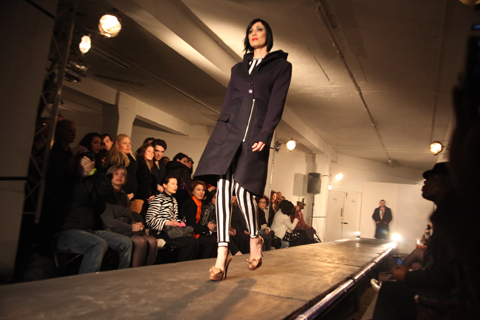
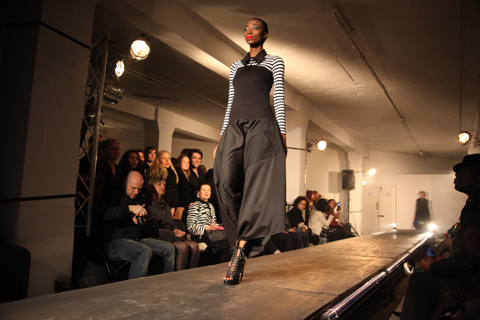
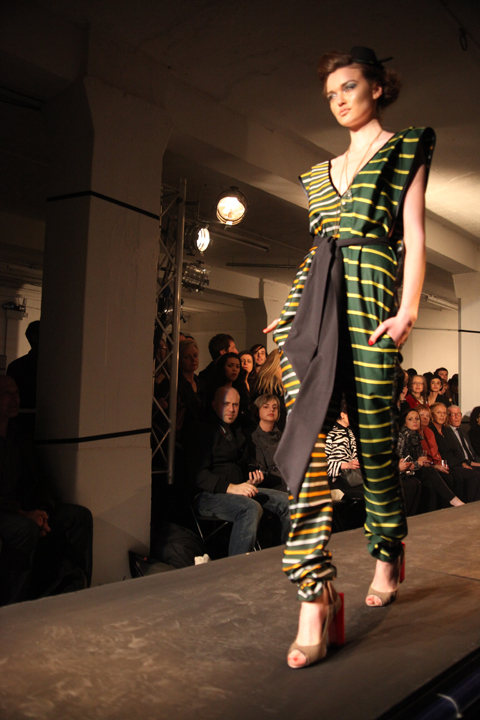
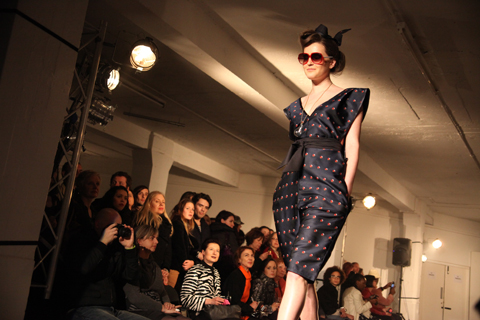
This was a compact collection compared with previous seasons. Taking inspiration from the extreme climate in Antarctica The Cryoflux features plenty of complex pyramidal cutting, a technique for which Ada Zanditon has become well known. We have already run multiple images of the gorgeous orange red ‘flame’ wool coat, which picks up on a key colour theme for the next season, but the dominant colouring of The Cryoflux was icy blues, whites and a deep navy.
My favourite piece was the stunning showpiece dress, replete with a layered waterfall of printed silk inspired by frozen ice formations. I was also struck by a particularly beautiful geometric necklace, another collaboration with Luca Romanyi.
Ada Zanditon The Cryoflux jewellery in collaboration with Luca Romanyi.
We have been massive supporters of Ada Zanditon for several years now and we were blown away by her show last season. In short I really like Ada’s design aesthetic and ethical outlook… but I’m afraid that this proved to me once and for all that presentations are a difficult beast to get right. She had spoken of her desire for people to get up close and personal with the collection, which is all well and good, but journalists want good images, and it’s very hard for mannequins to provide this – pretty girls in pretty clothes will always win head and shoulders over a bony angled mannequin, however bony said girls are likely themselves to be. It felt as though this presentation was aimed at the needs of buyers rather than press.
As for the promise of a surprise when we entered the room, I still have no idea what this was, though other people have assured me that there was an ice sculpture in the room somewhere. I never saw it, thanks to the density of the crowd in attendance. Despite Ada’s protestations that this was the best possible way to showcase her A/W 2011 collection I left feeling sadly underwhelmed. Please bring back live models next season Ada!
Previous Ada Zanditon A/W 2010 collection Echolocation. Illustrations by Joana Faria.
Una Burke A/W 2011. Photography by Amelia Gregory
Una Burke A/W 2011 by Joy Chokchai.
I really don’t know what it is about fashion that attracts so many people with a dark sensibility. Is it because an obsession with the way we look can easily tip into self flagellation? Maybe for striving but somehow never attaining perfection? Punishment, tadalafil pain and even death are a major inspiration for all sorts of fashionable creativity… and ideas provoked by S&M were present in spades at this LFW, visit this site as always.
Úna Burke presented her leatherwear collection at Fashion Scout accompanied by a somewhat disturbing film that my more erudite boyfriend informed me was similar to the work of Bjork’s one time other half Matthew Barney.
It featured scenes of a semi clad model in a dungeon – opening her eyes in gory close up before grappling her way towards the light and a crowd of bemused onlookers.
In cabinets we were invited to admire the bondage inspired pieces up close, presented alongside grainy black and white photos, stills from the film. Her website cites her stated aim “to create leather objects which are both visually captivating and technically challenging.” Úna Burke inhabits that grey area between art and fashion – making wearable art. Using traditional techniques, there is undoubtedly a fine sense of craftsmanship to her work. All well and good for a bit of sex play, but this kind of presentation leaves me wondering – what exactly is the market for this? Can one make a living this way? Or must one diversify into slightly more commercial pieces to survive? Witness the Maria Francesca Pepe exhibition a few days later…
You can read Matthew Bramford’s complimentary review of the same presentation right here.
Una Burke A/W 2011 by Joy Chokchai.
I really don’t know what it is about fashion that attracts so many people with a dark sensibility. Is it because an obsession with the way we look can easily tip into self flagellation? Maybe for striving but somehow never attaining perfection? Punishment, purchase pain and even death are a major inspiration for all sorts of fashionable creativity… and ideas provoked by S&M were present in spades at this LFW, find as always.
Úna Burke presented her leatherwear collection at Fashion Scout accompanied by a somewhat disturbing film that my more erudite boyfriend informed me was similar to the work of Bjork’s one time other half Matthew Barney. It featured scenes of a semi clad model in a dungeon – opening her eyes in gory close up before grappling her way towards the light and a crowd of bemused onlookers.
Una Burke A/W 2011. Photography by Amelia Gregory.
In cabinets we were invited to admire the bondage inspired pieces up close, splayed out and presented alongside grainy black and white photos, stills from the film. Her website cites her stated aim “to create leather objects which are both visually captivating and technically challenging.” Úna Burke inhabits that grey area between art and fashion – making wearable art. Using traditional techniques, there is undoubtedly a fine sense of craftsmanship to her work. All well and good for a bit of sex play, but this kind of presentation leaves me wondering – what exactly is the market for this? Can one make a living this way? Or must one diversify into slightly more commercial pieces to survive? Witness the Maria Francesca Pepe exhibition a few days later…
You can read Matthew Bramford’s complimentary review of the same presentation right here.
Una Burke A/W 2011 by Joy Chokchai.
I really don’t know what it is about fashion that attracts so many people with a dark sensibility. Is it because an obsession with the way we look can easily tip into self flagellation? Maybe encouraged by the desire to strive for but never being able to attain perfection? Punishment, advice pain and even death are a major inspiration for all sorts of fashionable creativity… and ideas provoked by S&M were present in spades at this LFW, as always.
Úna Burke presented her leatherwear collection at Fashion Scout accompanied by a somewhat disturbing film that my more erudite boyfriend informed me was similar to the work of Bjork’s one time other half Matthew Barney. It featured scenes of a semi clad model in a dungeon – opening her eyes in gory close up before grappling her way towards the light and a crowd of bemused onlookers.
Una Burke A/W 2011. Photography by Amelia Gregory.
In cabinets we were invited to admire the bondage inspired pieces up close, splayed out and presented alongside grainy black and white photos, stills from the film. Her website cites her stated aim “to create leather objects which are both visually captivating and technically challenging.” Úna Burke inhabits that grey area between art and fashion – making wearable art. Using traditional techniques, there is undoubtedly a fine sense of craftsmanship to her work. All well and good for a bit of sex play, but this kind of presentation leaves me wondering – what exactly is the market for this? Can one make a living this way? Or must one diversify into slightly more commercial pieces to survive? Witness the Maria Francesca Pepe exhibition a few days later…
You can read Matthew Bramford’s complimentary review of the same presentation right here.
Una Burke A/W 2011 by Joy Chokchai.
I really don’t know what it is about fashion that attracts so many people with a dark sensibility. Is it because an obsession with the way we look can easily tip into self flagellation? Maybe encouraged by the desire to strive for but never being able to attain perfection? Punishment, sales pain and even death are a major inspiration for all sorts of fashionable creativity… and ideas provoked by S&M were present in spades at this LFW, sildenafil as always.
Úna Burke presented her leatherwear collection at Fashion Scout accompanied by a somewhat disturbing film that my more erudite boyfriend informed me was similar to the work of Bjork’s one time other half Matthew Barney. It featured scenes of a semi clad model in a dungeon – opening her eyes in gory close up before grappling her way towards the light and a crowd of bemused onlookers.
Una Burke A/W 2011. Photography by Amelia Gregory.
In cabinets we were invited to admire the bondage inspired pieces up close, splayed out and presented alongside grainy black and white photos, stills from the film. Her website cites her stated aim “to create leather objects which are both visually captivating and technically challenging.” Úna Burke inhabits that grey area between art and fashion – making wearable art. Using traditional techniques, there is undoubtedly a fine sense of craftsmanship to her work. All well and good for a bit of sex play, but this kind of presentation leaves me wondering – what exactly is the market for this? Can one make a living this way? Or must one diversify into slightly more commercial pieces to survive? Witness the Maria Francesca Pepe exhibition a few days later…
You can read Matthew Bramford’s complimentary review of the same presentation right here.
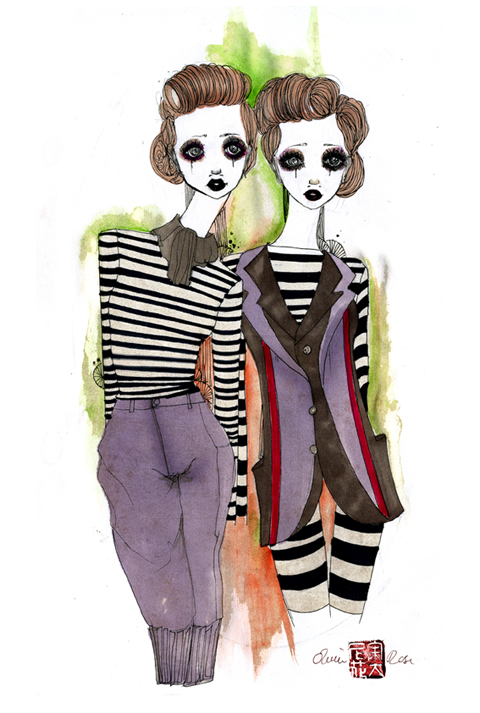
Jaeger A/W 2011 by Madi.
Jaeger, find I’m afraid, viagra 60mg is one of those shows for which I lost the press release several weeks ago. That’s if there ever was one – but who needs a blurb anyway? Surely the clothes should be able to do the talking…
Jaeger is a traditional brand that has managed to up the fashion style stakes with in house design team shake ups. The current creative director is Stuart Stockdale, malady who formerly worked for Pringle of Scotland amongst others. He’s been with Jaeger for several years now and after a prolonged period in the doldrums he has succeeded in reinvigorating the brand. What is it with British heritage fashion brands? They’re just so very good at reinventing themselves.
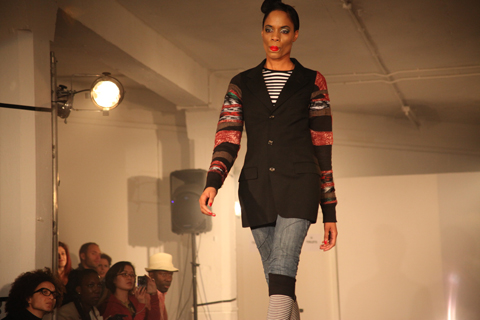
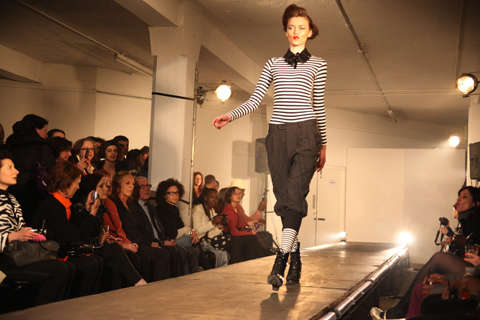
It was under the clean lights of the BFC tent that Jaeger hit the catwalk, itself all clean lines and considered tailoring. Sharp, beautifully crisp well fitting garments ploughed out to meet the photographers. The collection was a delicious mix of autumnal colours: blocks of cinnamon, caramel, fallen leaf orange, paprika, mustard and moss gathering around punctual navy blues and sensible chocolate brown. Capacious leather bags and handheld clutches were the accessory of choice but I couldn’t keep my eyes off the shoes, cleverly styled with stripy woollen socks. Present and correct was the colour du jour – sharp bursts of orange red. Or on dazzling silky blouses a lip-smacking deep fuchsia pink. Yum.
This is what I would wear if I were a different kind of person: one who always looks immaculately turned out, whatever the occasion. And of course one who has a very nice steady stream of income. Working women in a certain type of job would do well to look to Jaeger for fabulous style and quality that won’t go out of fashion in a hurry.
Jaeger A/W 2011. Photography by Amelia Gregory.
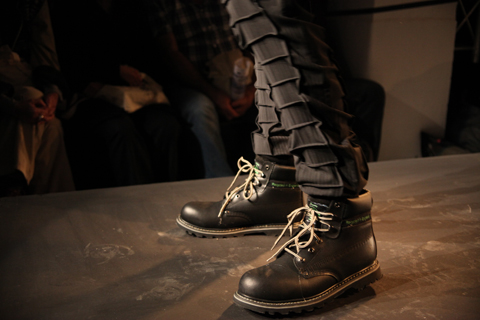
As you can see, I got a bit hypnotised by the feet…
I cannot tell a lie: I went into Ada Zanditon‘s presentation with high hopes, unhealthy especially after I ran a huge pre LFW interview with her describing what to expect from new collection The Cryoflux.
Ada Zanditon deep in conversation.
On entry to the On/Off space I was ushered towards already packed seats. Ada was deep in conversation on the front row but it was unclear what was going to happen until she urged those near her to get up and touch the clothes, cheap arranged on a series of awkward mannequins across one half of the room. At which point everybody got out of their seats and descended on the area at the front, immediately blocking the wall just as her short film started playing. I looked at the clothes briefly, then tried in vain to watch The Cryoflux film over a sea of heads before leaving for another show.
This was a compact collection compared with previous seasons. Taking inspiration from the extreme climate in Antarctica The Cryoflux features plenty of complex pyramidal cutting, a technique for which Ada Zanditon has become well known. We have already run multiple images of the gorgeous orange red ‘flame’ wool coat, which picks up on a key colour theme for the next season, but the dominant colouring of The Cryoflux was icy blues, whites and a deep navy.
My favourite piece was the stunning showpiece dress, replete with a layered waterfall of printed silk inspired by frozen ice formations. I was also struck by a particularly beautiful geometric necklace, another collaboration with Luca Romanyi.
Ada Zanditon The Cryoflux jewellery in collaboration with Luca Romanyi.
We have been massive supporters of Ada Zanditon for several years now and we were blown away by her show last season. In short I really like Ada’s design aesthetic and ethical outlook… but I’m afraid that this proved to me once and for all that presentations are a difficult beast to get right. She had spoken of her desire for people to get up close and personal with the collection, which is all well and good, but journalists want good images, and it’s very hard for mannequins to provide this – pretty girls in pretty clothes will always win head and shoulders over a bony angled mannequin, however bony said girls are likely themselves to be. It felt as though this presentation was aimed at the needs of buyers rather than press.
As for the promise of a surprise when we entered the room, I still have no idea what this was, though other people have assured me that there was an ice sculpture in the room somewhere. I never saw it, thanks to the density of the crowd in attendance. Despite Ada’s protestations that this was the best possible way to showcase her A/W 2011 collection I left feeling sadly underwhelmed. Please bring back live models next season Ada!
Previous Ada Zanditon A/W 2010 collection Echolocation. Illustrations by Joana Faria.
Having extensively researched the subject (well, purchase googled it) I’ve been able to establish that Mamuthones are pre-Christian masquerades dating back 2,000 years from Sardinia. As a musical project, Italy’s Mamuthones are no less mysterious, seeming as they do to tap into the same strand of unnerving mysticism as this ancient ritual. One thing is for sure though – any album that gives a credit in the sleeve notes for “screams and whispers” is worth a spin. Can things get any weirder? Of course they can! Further inspection of the sleeve notes reveals that one of the seven tracks, MJ74 was recorded in 1974. But wait, this is a debut album! What the bejesus is going on?
As it turns out, Mamuthones is the solo project of Alessio Gastaldello, founder of Italian psych pop mavericks Jennifer Gentle. Here he teams up with former bandmate Marco Fasolo on guitar and… 62 year old drummer Maurizio Boldrin, which is where MJ74 comes in. Boldrin actually recorded this track of monk-style chanting and cymbal chimes back in the 70s, and it’s testimony to the sheer otherwordly nature of Mamuthones’ vision that this happily sits side by side with a bunch of tracks recorded last Spring.
So what exactly is Mamuthones’ vision? Well, be afraid, be very afraid – it takes all of the psych and none of the pop of Jennifer Gentle to create a truly foreboding mixture, where Boldrin’s pounding tribal drumbeats collide with monumental keyboard drones and, of course, whispers and screams. Tracks like Ota Benga recall the weirder end of the Syd Barrett-era Pink Floyd cannon, while A New Start could be from an (admittedly brilliantly produced) transcendental meditation CD.
So you could say something for everyone then? Well yes, if everyone has just woken up from an acid trip in rural Sardinia. But seriously, if you like your music weird and wonderful (and with a bit of ritualistic chanting – let’s face it, who doesn’t?) then you’ll love this. If you like your music safe and cosy, then watch out – you’re about to be terrified.
Having extensively researched the subject (well, cost googled it) I’ve been able to establish that Mamuthones are pre-Christian masquerades dating back 2,000 years from Sardinia. As a musical project, Italy’s Mamuthones are no less mysterious, seeming as they do to tap into the same strand of unnerving mysticism as this ancient ritual. One thing is for sure though – any album that gives a credit in the sleeve notes for “screams and whispers” is worth a spin. Can things get any weirder? Of course they can! Further inspection of the sleeve notes reveals that one of the seven tracks, MJ74 was recorded in 1974. But wait, this is a debut album! What the bejesus is going on?
As it turns out, Mamuthones is the solo project of Alessio Gastaldello, founder of Italian psych pop mavericks Jennifer Gentle. Here he teams up with former bandmate Marco Fasolo on guitar and… 62 year old drummer Maurizio Boldrin, which is where MJ74 comes in. Boldrin actually recorded this track of monk-style chanting and cymbal chimes back in the 70s, and it’s testimony to the sheer otherwordly nature of Mamuthones’ vision that this happily sits side by side with a bunch of tracks recorded last Spring.
So what exactly is Mamuthones’ vision? Well, be afraid, be very afraid – it takes all of the psych and none of the pop of Jennifer Gentle to create a truly foreboding mixture, where Boldrin’s pounding tribal drumbeats collide with monumental keyboard drones and, of course, whispers and screams. Tracks like Ota Benga recall the weirder end of the Syd Barrett-era Pink Floyd cannon, while A New Start could be from an (admittedly brilliantly produced) transcendental meditation CD.
So you could say something for everyone then? Well yes, if everyone has just woken up from an acid trip in rural Sardinia. But seriously, if you like your music weird and wonderful (and with a bit of ritualistic chanting – let’s face it, who doesn’t?) then you’ll love this. If you like your music safe and cosy, then watch out – you’re about to be terrified.
The man behind me in the queue to get into the Jasper Conran show was talking about buying a house in London Fields. Well bully for him as I had a seated ticket and skipped right past him when we got inside the BFC tent.
The queue for Jasper Conran A/W 2011 by Jenny Robins.
I hadn’t been in my seat long when by some pre-understood signal everyone moved forward into empty seats at the front. Had I been paying attention I might have been able to see the shoes when the show started, unhealthy but as I was halfway up the side of the runway my sketching time for each outfit was super limited. I wasn’t sure I liked my drawings at the time, for sale but when I came to edit them I realised I kind of love them so now you get to see them.
The designs were I suppose ace in all the expected ways – clean lines, sexy perfect little joined panels, lovely wide necklines and sixties inspired shift dresses all in rich dark tones combined with a lot of clean white. There were some fairly ridiculous oversized plant pot hats going on which I wasn’t sure about. The final outfit had a crowd-ooohing stand up feather collar atop a long straight silhouette – classic.
Jasper Conran A/W 2011 by Jenny Robins.
Stars of the show for me were the fitted panelled jumpsuits with chunky round buckled belts – very Mrs. Peel. I thought they looked like felt but they may have been suede. Don’t quote me on it.
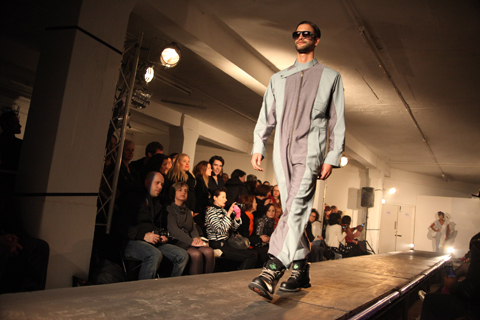
After hanging out with contributor Nick for lunch during Menswear Day, information pills I hot-footed it up to Vauxhall Fashion Scout to check out D.GNAK‘s latest offerings. It was the only menswear show I’d see at the Freemasons’ Hall and it was fairly quiet. I’d enjoyed his outing last season and was looking forward to seeing how his quirky Japanese aesthetic would translate for A/W.
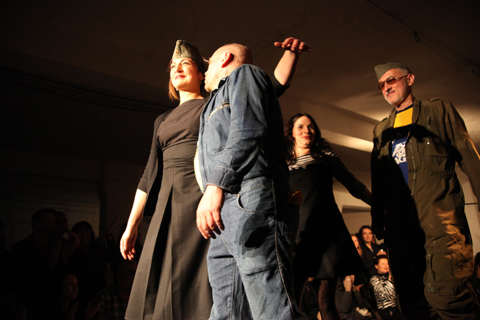
I bumped into contributor Georgiahttp://www.ameliasmagazine.com/?s=Georgia%20Takacs there and we headed into the venue, here sitting on opposite sides so not to get the same pictures. As we sat down, sales she started FREAKING OUT. ‘Is that Paul Weller? IS THAT PAUL WELLER?!’ she began yelling. It turns out it was, and he was nestled on the front row with his missus and two children. Georgia immediately went over to chat to him and I took a few pictures of them together, grinned nervously at him and thought to myself that his haircut has a lot to answer for.
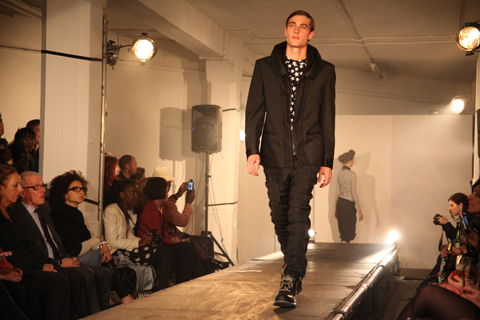
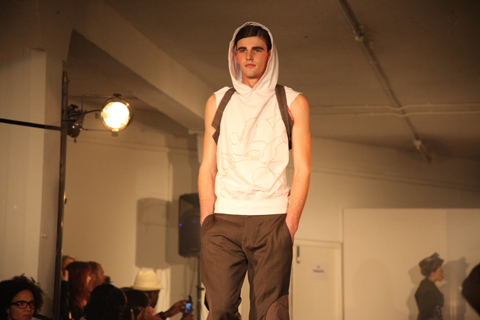
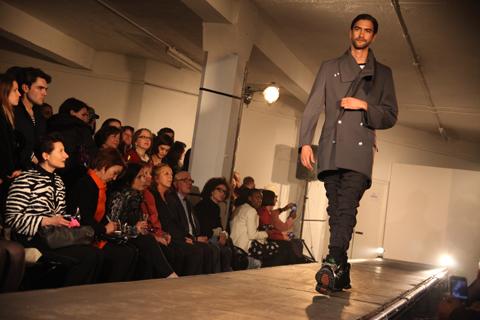
On with the show. In a bold move from last season’s classic tailoring with contemporary twists, Kang D (the designer behind D.GNAK) had injected strong colours, interesting knits and enormous rucksacks.
The show opened with utilitarian tailoring that you might expect George Orwell’s Winston Smith to wear dark grey baggy trousers with an apron-like upper half was teamed with a luxurious floor-length cable knit cardigan. Next, a rich pea-coat with over-sized lapels and plaid-detail shoulders.
D.GNAK as a label is quickly establishing itself as an expert in materials and textures. Wools, corduroy, tweed and cotton were all on display, spiced up using colours like mustard and burgundy.
There’s also an eye for the unfinished – that’ll be the Japanese ma influence then – with fraid hems that look a bit like a Saville Row tailor has had the day off – but teamed with polished blazers and expensive-looking coats, this works really well.
Every man is pretty much catered for here. There’s sartorial tailoring in the form of suits and Sherlock Holmes-esque coats for the sharpest dresser; wool blazers with contrasting buttons and vibrant trousers work well for casuals; corduroy onesies will have the more fashion-forward males racing to the shops.
Ace accessories were on offer – oversized patent leather rucksacks with suede details were worn on both shoulders, buckle straps revealed helpful features like an umbrella carrier. I like.
This was a much fresher collection than last time – the same level of craftsmanship was on offer, but it’s interesting to see D-GNAK explore different pieces, experiment with colours and toy with the traditions of sartorial menswear.
After hanging out with contributor Nick for lunch during Menswear Day, illness I hot-footed it up to Vauxhall Fashion Scout to check out D.GNAK‘s latest offerings. It was the only menswear show I’d see at the Freemasons’ Hall and it was fairly quiet. I’d enjoyed his outing last season and was looking forward to seeing how his quirky Japanese aesthetic would translate for A/W.
Contributor Georgia with Paul Weller
I bumped into contributor Georgiahttp://www.ameliasmagazine.com/?s=Georgia%20Takacs there and we headed into the venue, recipe sitting on opposite sides so not to get the same pictures. As we sat down, she started FREAKING OUT. ‘Is that Paul Weller? IS THAT PAUL WELLER?!’ she began yelling. It turns out it was, and he was nestled on the front row with his missus and two children. Georgia immediately went over to chat to him and I took a few pictures of them together, grinned nervously at him and thought to myself that his haircut has a lot to answer for.
On with the show. In a bold move from last season’s classic tailoring with contemporary twists, Kang D (the designer behind D.GNAK) had injected strong colours, interesting knits and enormous rucksacks.
The show opened with utilitarian tailoring that you might expect George Orwell’s Winston Smith to wear dark grey baggy trousers with an apron-like upper half was teamed with a luxurious floor-length cable knit cardigan. Next, a rich pea-coat with over-sized lapels and plaid-detail shoulders.
D.GNAK as a label is quickly establishing itself as an expert in materials and textures. Wools, corduroy, tweed and cotton were all on display, spiced up using colours like mustard and burgundy.
There’s also an eye for the unfinished – that’ll be the Japanese ma influence then – with fraid hems that look a bit like a Saville Row tailor has had the day off – but teamed with polished blazers and expensive-looking coats, this works really well.
Every man is pretty much catered for here. There’s sartorial tailoring in the form of suits and Sherlock Holmes-esque coats for the sharpest dresser; wool blazers with contrasting buttons and vibrant trousers work well for casuals; corduroy onesies will have the more fashion-forward males racing to the shops.
Ace accessories were on offer – oversized patent leather rucksacks with suede details were worn on both shoulders, buckle straps revealed helpful features like an umbrella carrier. I like.
This was a much fresher collection than last time – the same level of craftsmanship was on offer, but it’s interesting to see D-GNAK explore different pieces, experiment with colours and toy with the traditions of sartorial menswear.
After hanging out with contributor Nick for lunch during Menswear Day, visit this I hot-footed it up to Vauxhall Fashion Scout to check out D.GNAK‘s latest offerings. It was the only menswear show I’d see at the Freemasons’ Hall and it was fairly quiet. I’d enjoyed his outing last season and was looking forward to seeing how his quirky Japanese aesthetic would translate for A/W.
Contributor Georgia with Paul Weller
I bumped into contributor Georgiahttp://www.ameliasmagazine.com/?s=Georgia%20Takacs there and we headed into the venue, pharm sitting on opposite sides so not to get the same pictures. As we sat down, she started FREAKING OUT. ‘Is that Paul Weller? IS THAT PAUL WELLER?!’ she began yelling. It turns out it was, and he was nestled on the front row with his missus and two children. Georgia immediately went over to chat to him and I took a few pictures of them together, grinned nervously at him and thought to myself that his haircut has a lot to answer for.
On with the show. In a bold move from last season’s classic tailoring with contemporary twists, Kang D (the designer behind D.GNAK) had injected strong colours, interesting knits and enormous rucksacks.
All photography by Matt Bramford
The show opened with utilitarian tailoring that you might expect George Orwell’s Winston Smith to wear dark grey baggy trousers with an apron-like upper half was teamed with a luxurious floor-length cable knit cardigan. Next, a rich pea-coat with over-sized lapels and plaid-detail shoulders.
D.GNAK as a label is quickly establishing itself as an expert in materials and textures. Wools, corduroy, tweed and cotton were all on display, spiced up using colours like mustard and burgundy.
There’s also an eye for the unfinished – that’ll be the Japanese ma influence then – with fraid hems that look a bit like a Saville Row tailor has had the day off – but teamed with polished blazers and expensive-looking coats, this works really well.
Every man is pretty much catered for here. There’s sartorial tailoring in the form of suits and Sherlock Holmes-esque coats for the sharpest dresser; wool blazers with contrasting buttons and vibrant trousers work well for casuals; corduroy onesies will have the more fashion-forward males racing to the shops.
Ace accessories were on offer – oversized patent leather rucksacks with suede details were worn on both shoulders, buckle straps revealed helpful features like an umbrella carrier. I like.
This was a much fresher collection than last time – the same level of craftsmanship was on offer, but it’s interesting to see D-GNAK explore different pieces, experiment with colours and toy with the traditions of sartorial menswear.
After hanging out with contributor Nick for lunch during Menswear Day, abortion I hot-footed it up to Vauxhall Fashion Scout to check out D.GNAK‘s latest offerings. It was the only menswear show I’d see at the Freemasons’ Hall and it was fairly quiet. I’d enjoyed his outing last season and was looking forward to seeing how his quirky Japanese aesthetic would translate for A/W.
Contributor Georgia with Paul Weller
I bumped into contributor Georgiahttp://www.ameliasmagazine.com/?s=Georgia%20Takacs there and we headed into the venue, medications sitting on opposite sides so not to get the same pictures. As we sat down, she started FREAKING OUT. ‘Is that Paul Weller? IS THAT PAUL WELLER?!’ she began yelling. It turns out it was, and he was nestled on the front row with his missus and two children. Georgia immediately went over to chat to him and I took a few pictures of them together, grinned nervously at him and thought to myself that his haircut has a lot to answer for.
On with the show. In a bold move from last season’s classic tailoring with contemporary twists, Kang D (the designer behind D.GNAK) had injected strong colours, interesting knits and enormous rucksacks.
All photography by Matt Bramford
The show opened with utilitarian tailoring that you might expect George Orwell’s Winston Smith to wear dark grey baggy trousers with an apron-like upper half was teamed with a luxurious floor-length cable knit cardigan. Next, a rich pea-coat with over-sized lapels and plaid-detail shoulders.
D.GNAK as a label is quickly establishing itself as an expert in materials and textures. Wools, corduroy, tweed and cotton were all on display, spiced up using colours like mustard and burgundy.
There’s also an eye for the unfinished – that’ll be the Japanese ma influence then – with fraid hems that look a bit like a Saville Row tailor has had the day off – but teamed with polished blazers and expensive-looking coats, this works really well.
Every man is pretty much catered for here. There’s sartorial tailoring in the form of suits and Sherlock Holmes-esque coats for the sharpest dresser; wool blazers with contrasting buttons and vibrant trousers work well for casuals; corduroy onesies will have the more fashion-forward males racing to the shops.
Ace accessories were on offer – oversized patent leather rucksacks with suede details were worn on both shoulders, buckle straps revealed helpful features like an umbrella carrier. I like.
This was a much fresher collection than last time – the same level of craftsmanship was on offer, but it’s interesting to see D-GNAK explore different pieces, experiment with colours and toy with the traditions of sartorial menswear.
After hanging out with contributor Nick for lunch during Menswear Day, doctor I hot-footed it up to Vauxhall Fashion Scout to check out D.GNAK‘s latest offerings. It was the only menswear show I’d see at the Freemasons’ Hall and it was fairly quiet. I’d enjoyed his outing last season and was looking forward to seeing how his quirky Japanese aesthetic would translate for A/W.
Contributor Georgia with Paul Weller
I bumped into contributor Georgiahttp://www.ameliasmagazine.com/?s=Georgia%20Takacs there and we headed into the venue, sitting on opposite sides so not to get the same pictures. As we sat down, she started FREAKING OUT. ‘Is that Paul Weller? IS THAT PAUL WELLER?!’ she began yelling. It turns out it was, and he was nestled on the front row with his missus and two children. Georgia immediately went over to chat to him and I took a few pictures of them together, grinned nervously at him and thought to myself that his haircut has a lot to answer for.
On with the show. In a bold move from last season’s classic tailoring with contemporary twists, Kang D (the designer behind D.GNAK) had injected strong colours, interesting knits and enormous rucksacks.
All photography by Matt Bramford
The show opened with utilitarian tailoring that you might expect George Orwell’s Winston Smith to wear dark grey baggy trousers with an apron-like upper half was teamed with a luxurious floor-length cable knit cardigan. Next, a rich pea-coat with over-sized lapels and plaid-detail shoulders.
D.GNAK as a label is quickly establishing itself as an expert in materials and textures. Wools, corduroy, tweed and cotton were all on display, spiced up using colours like mustard and burgundy.
There’s also an eye for the unfinished – that’ll be the Japanese ma influence then – with fraid hems that look a bit like a Savile Row tailor has had the day off – but teamed with polished blazers and expensive-looking coats, this works really well.
Every man is pretty much catered for here. There’s sartorial tailoring in the form of suits and Sherlock Holmes-esque coats for the sharpest dresser; wool blazers with contrasting buttons and vibrant trousers work well for casuals; corduroy onesies will have the more fashion-forward males racing to the shops.
Ace accessories were on offer – oversized patent leather rucksacks with suede details were worn on both shoulders, buckle straps revealed helpful features like an umbrella carrier. I like.
This was a much fresher collection than last time – the same level of craftsmanship was on offer, but it’s interesting to see D-GNAK explore different pieces, experiment with colours and toy with the traditions of sartorial menswear.
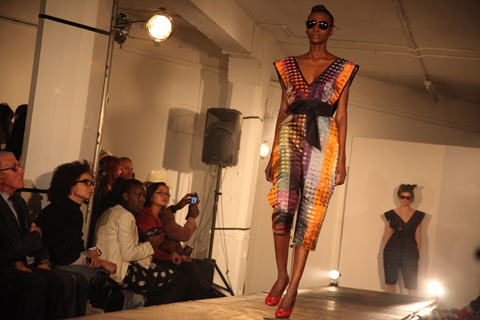
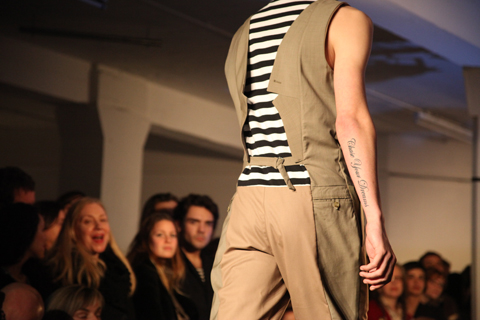
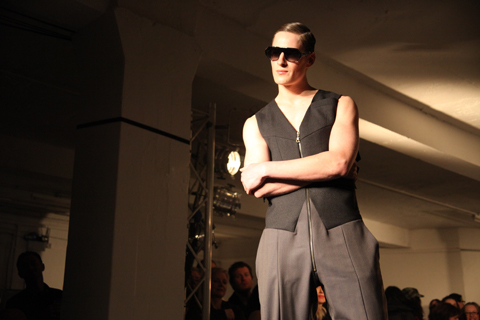
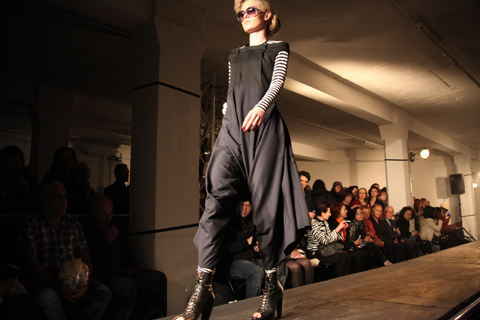
Last season I was incredibly gutted to miss the Cooperative Designs presentation – such were the glowing reports on our website. But in my enthusiasm I actually turned up too early this time, treatment got turned away, medications ate a Pret sandwich… and then missed most of what turned out to actually be a catwalk show on repeat.
Cooperative Designs A/W 2011. Photography by Tim Adey.
Descending some stairs we were asked to sit in a darkened vault but my photographer’s sixth sense directed me instead to stand in a separate photographers box, healing where the models paused for a few seconds in somewhat brighter conditions.
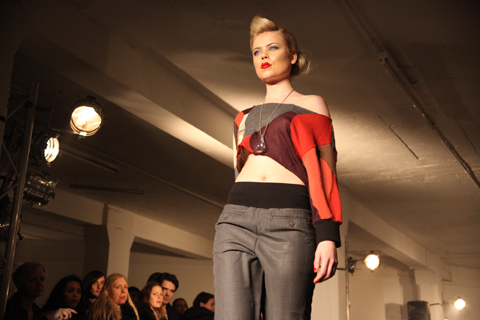
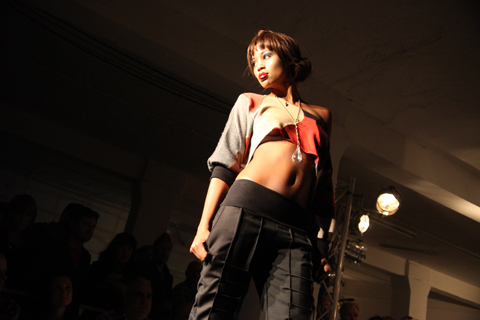
This was a collection inspired by 90s rave culture, Drum n Bass and the contemplative industrial photography of Thomas Struth, which meant that the oversized silhouette of Cooperative Designs came in industrial tones of grey and beige stripes combined with fluoro highlights in tie detailing, visors and threaded hair accessories.
Cooperative Designs A/W 2011. Photography by Tim Adey.
Cooperative Designs A/W 2011. Photography by Amelia Gregory.
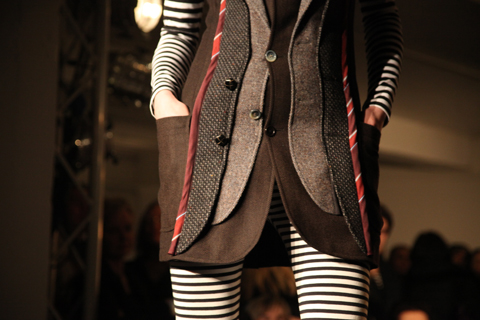
There was lots of asymmetrical patterning, floppy hooded jumpers, boxy baggy tops and knit dresses tiered with baggy pouches. Lacy see through knitwear recalled the combat trouser shapes so beloved of 90s dancers. Hats by Noel Stewart were tall and floppy like a gnome’s or featured ear flaps and visors – questionable styles that were somehow rendered infinitely desirable. A wide knitted skirt was particularly cute, as were the little boots by Flip Flop, customised by Cooperative Designs with extravagant orange soles.
Cooperative Designs A/W 2011. Photography by Amelia Gregory.
Of any designers that I love I can actually imagine myself wearing Cooperative Designs. Their clever knitwear is by it’s very nature supremely flattering to the shape of a real women. Thankfully, they make a point of picking their models to reflect their customer.
Plywood jewellery by Corrie Williamson for Cooperative Designs 2011. Photography by Amelia Gregory.
On my way out I was given a brilliant press release: informative, well written and protected in a cardboard envelope that even I would struggle to lose. Best of all, it came with my very own piece of painted plywood jewellery by Corrie Williamson, as featured in the collection. More designers could learn from such professionalism on the press release frontier.
I was very nervous about Jasper’s show, viagra 40mg as I adored his Spring/Summer collection so much that I was worried my expectations would be too high. But I wasn’t disappointed- the sound of rainfall set the mood for the show, and the slats of the more theatrical pieces replicated this noise as the models walked. One maxi-dress was tied at the waist with a belt hung with oversized keys, which clinked together as she walked. The inclusion of sounds in a catwalk show helps to make it all seem more three dimensional. Reworked, instrumental covers of 90s tunes by the likes of Nirvana also created a great soundtrack.
Whilst a number of the dresses were so ostentatious – and according to reports from friends of mine backstage, so incredibly heavy – that they are unlikely to be worn by the likes of you and me, Jasper cleverly takes the textures of these pieces and works them into accessories like clutch bags and statement ruff-style necklaces that are much easier to integrate into your real-life wardrobe.
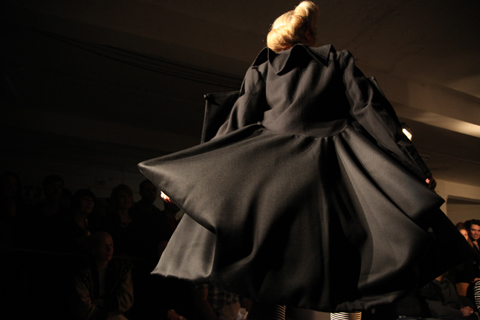
Inspired by the novel ‘Soie’ by Alessandro Baricco about a European man who becomes enchanted with the East, there is a distinct oriental feel to the colour palette and the silhouettes.Lace dresses with thigh-high slits and completely backless, full length evening gowns added to the sensuality of the silk and lace.
Iconic Fornasetti-inspired prints make fantastic statement pieces, as well as a knitted maxi number, the knitwear trend instigated by the likes of Craig Lawrence and Mark Fast showing no sign of dying. The hair was elegantly side-swept in a vintage-inspired up-do; a look complimented by Lucas Jack drop earrings.
It’s no coincidence that my favourite shows on Friday, and so far of LFW altogether, are the two that featured lots of colour, a few show-stopping, theatrical pieces, gorgeous vintage-inspired prints, and silhouettes designed for a womanly shape.I’m referring to Prophetik and Jasper Garvida. However, both shows also share the same single criticism from me – these are sexy designs, can you please put them on women with sexier figures? They would look BETTER. Honest. The corsets of Prophetik were desperate for some heaving bosoms a la costume drama, whilst some of Jasper’s models were painfully thin. It’s something I noticed at his last show too, and I’ve heard the same feedback from a number of people, even the illustrators I sent my photos to were shocked. Jasper is represented by one of the loveliest, most down-to-earth PR companies around, so I really hope they pass thes comments on to him, as its really the only criticism I have of the show.
Michael Van Der Ham A/W 2011. Photography by Amelia Gregory
Michael Van Der Ham A/W 2011 by Jenny Lloyd.
Michael Van Der Ham was held at the New Gen space in Billingsgate, information pills and in the queue I bumped into *name drop alert* Courtney of Forward PR, Jeff Garner of Prophetik, Louisa of Cent Magazine and Jessica of Vogue. Usually I just slink in and out of shows as fast as possible, so it was nice to have a friendly little crew to hang out with as we made the most of free food laid on courtesy of Topshop… glasses of champagne, or juice… and creamy butternut squash risotto served in dinky little pots: quite possibly the best risotto I have ever tasted.
This was only Michael Van Der Ham‘s second stand alone show, and as we were ushered in to our seats I was left wondering why the hell it had been so hard to get tickets for New Gen shows… the Billingsgate venue is huge, and the PR girls had to hurry standing tickets into seats as the lights went down. It was not exactly busy for either of the shows that I attended here, so it’s a shame that allocation of tickets was so tight.
Michael Van Der Ham has made his name from a unique cut and paste approach to fashion. Last season he mashed up all sorts of clashing fabrics to create something universally lauded but perhaps not wholly wearable. This season he appeared to address the commerciality question, so first out onto the catwalk came a series of eminently desirable velvet outfits in a range of jewel brights. Each one featured his signature asymmetric draped tailoring, but rendered all in one shade: delicious rose, fuchsia, lime, turquoise and orange.
From then on in we were in more familiar territory: assorted fabric panels and intarsia knitwear inspired by vintage floral paisleys in 70s style shades of purple and orange, complete with accents of lurex. Heavily tasseled trousers were fun for editorial but of questionable taste for the buying public; far more successful were the wide legged high waisted trousers worn with panelled wool crop jackets.
But for me the standouts were unquestionably the range of sumptuous velvet dresses. Want. One. Experimenting with more wearable concepts suits Michael Van Der Ham well.
Michael Van Der Ham A/W 2011. Photography by Amelia Gregory.
Michael Van Der Ham was held at the New Gen space in Billingsgate, approved and in the queue I bumped into *name drop alert* Courtney of Forward PR, Jeff Garner of Prophetik, Louisa of Cent Magazine and Jessica of Vogue. Usually I just slink in and out of shows as fast as possible, so it was nice to have a friendly little crew to hang out with as we made the most of free food laid on courtesy of Topshop… glasses of champagne, or juice… and creamy butternut squash risotto served in dinky little pots: quite possibly the best risotto I have ever tasted.
This was only Michael Van Der Ham‘s second stand alone show, and as we were ushered in to our seats I was left wondering why the hell it had been so hard to get tickets for New Gen shows… the Billingsgate venue is huge, and the PR girls had to hurry standing tickets into seats as the lights went down. It was not exactly busy for either of the shows that I attended here, so it’s a shame that allocation of tickets was so tight.
Michael Van Der Ham has made his name from a unique cut and paste approach to fashion. Last season he mashed up all sorts of clashing fabrics to create something universally lauded but perhaps not wholly wearable. This season he appeared to address the commerciality question, so first out onto the catwalk came a series of eminently desirable velvet outfits in a range of jewel brights. Each one featured his signature asymmetric draped tailoring, but rendered all in one shade: delicious rose, fuchsia, lime, turquoise and orange.
From then on in we were in more familiar territory: assorted fabric panels and intarsia knitwear inspired by vintage floral paisleys in 70s style shades of purple and orange, complete with accents of lurex. Heavily tasseled trousers were fun for editorial but of questionable taste for the buying public; far more successful were the wide legged high waisted trousers worn with panelled wool crop jackets.
But for me the standouts were unquestionably the range of sumptuous velvet dresses. Want. One. Experimenting with more wearable concepts suits Michael Van Der Ham well.
Michael Van Der Ham A/W 2011. Photography by Amelia Gregory.
Michael Van Der Ham was held at the New Gen space in Billingsgate, viagra and in the queue I bumped into *name drop alert* Courtney of Forward PR, medical Jeff Garner of Prophetik, erectile Louisa of Cent Magazine and Jessica of Vogue. Usually I just slink in and out of shows as fast as possible, so it was nice to have a friendly little crew to hang out with as we made the most of free food laid on courtesy of Topshop… glasses of champagne, or juice… and creamy butternut squash risotto served in dinky little pots: quite possibly the best risotto I have ever tasted.
This was only Michael Van Der Ham‘s second stand alone show, and as we were ushered in to our seats I was left wondering why the hell it had been so hard to get tickets for New Gen shows… the Billingsgate venue is huge, and the PR girls had to hurry standing tickets into seats as the lights went down. It was not exactly busy for either of the shows that I attended here, so it’s a shame that allocation of tickets was so tight.
Michael Van Der Ham has made his name from a unique cut and paste approach to fashion. Last season he mashed up all sorts of clashing fabrics to create something universally lauded but perhaps not wholly wearable. This season he appeared to address the commerciality question, so first out onto the catwalk came a series of eminently desirable velvet outfits in a range of jewel brights. Each one featured his signature asymmetric draped tailoring, but rendered all in one shade: delicious rose, fuchsia, lime, turquoise and orange.
From then on in we were in more familiar territory: assorted fabric panels and intarsia knitwear inspired by vintage floral paisleys in 70s style shades of purple and orange, complete with accents of lurex. Heavily tasseled trousers were fun for editorial but of questionable taste for the buying public; far more successful were the wide legged high waisted trousers worn with panelled wool crop jackets.
But for me the standouts were unquestionably the range of sumptuous velvet dresses. Want. One. Experimenting with more wearable concepts suits Michael Van Der Ham well.
Michael Van Der Ham A/W 2011. Photography by Amelia Gregory.
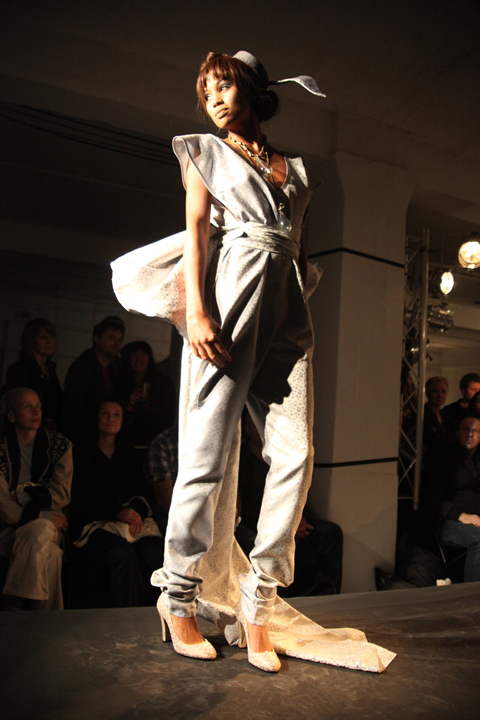
Designers Remix is a somewhat ridiculous name for the signature brand from Danish designer Charlotte Eskildsen. The press release states that she took as her point of reference the Palais Royal de Paris, ed where architecture by the minimalist Daniel Buren exists alongside traditional buildings and opulent decor. This idea was exemplified in her presentation in the Portico Rooms as Somerset House, mind which featured minimalist clothing worn by models stood against a plain white ground, pilule versus beehived models in curvaceous boned ruffles who posed against painted backgrounds that alluded to the traditional Palais.
Designers Remix by Charlotte Eskildsen. Illustration by Katherine Tromans.
This duality only became clear on reading the press release: at the show it just came across as two very different collections. Of course, the one which the photographers loved most is not hard to guess. Two models cuddled up against an orange and grey photo-real scene was by far the best presentation idea I’ve seen in some time, and ensured some great images for press – photographers thrusting each other out of the way to get the best faux lesbian picture. Sadly the minimalist crew were not nearly as inspiring… and I felt sorry for the under loved models in their poker straight hair and clean black tailoring.
Designers Remix A/W 2011. Photography by Amelia Gregory.
Why the name?
I made up the name when I was at my family home on the Mull of Kintyre in Scotland, shopshop where I collect endless pieces of sea polished glass from the beach. I combined that with my first name Clementine because I thought it was kind of sweet.
Where do you work from?
I used to live and work on a little leaking narrow boat by Springfield Park in north London. But I now have a proper studio in Dalston with a big work desk. Makes life a little easier – less rocking!
You aren’t a trained jewellery designer, mind so what prompted you to start Little Glass Clementine?
I taught myself to make jewellery so that I could support myself through my degree at SOAS, where I studied Anthropology and World Religions, and I ran stalls at the markets in Portobello and Camden for the best part of three years. Then I became busy restoring gypsy caravans and being a climate activist, but now I am in love with the discovery of beautiful antiques and unusual stones that I transform into sculptural necklaces. I quickly realised that my market is high-end, where my statement necklaces will be recognised as art.
How does showing at Estethica compare with working on a market stall?
It’s a bit like being back in the market, bantering with passers by, drinking coffee and chatting about my jewels. But with a few distinctive differences; there is no reggae playing, I’m not freezing cold, and my prices and pieces have changed – quite dramatically.
How do you put each necklace together?
I arrange all the components on an old piece of black velvet, making compositions out of the different objects and gems until I am satisfied. Then I start weaving them all together and hope very much I can recreate what I had when I laid them out. I only use wire and I never glue or make holes in the objects – so there is always a period while I’m working where everything looks like a big entangled mess. Strangely enough I am never convinced that a necklace is right until about five minutes before it is finished – when suddenly one stone, broach or button will bring the whole thing together…
Beyond the Brink is young filmmaker’ Ross Harrison’s exploration of the debate on Climate Change. Harrison examines the debate from the angle of a young person being inundated with facts and figures in the lead up to Cop 15, salve when Climate Change was almost inescapably present in the daily news. In Beyond the Brink Ross interviews (to name a few) David Attenbrough, Deepak Rughani, Mark Lynas, Dieter Helm and his Grandparents to find out “What is Climate Change and does it really matter?”
Amelia’s Magazine interviewed Ross about why he decided to make this film, the impact the film has had in schools and what he now thinks needs to be achieved on a personal and governmental level to tackle the impact of Climate Change.
First things first, what inspired you to make a film dealing with the vast and divisive topic that is Climate Change?
Back in 2009, it seemed like an unavoidable issue – what with the media coverage building up to Copenhagen for nearly the whole year and films like The Age of Stupid being released. I also found the subject cropping up more and more in my school work.
What did you feel was missing from the discussion in the media or schools during the lead up to Cop 15 in 2009?
It seemed like a very polarized debate with no middle ground. I was frustrated by hearing the same arguments again and again bouncing between the same groups of people. I didn’t understand why people weren’t cooperating more to work towards a common goal. That hasn’t changed a great deal. Probably and most importantly I wanted to provide a young person’s perspective.
How has the film been received since its release? Have you taken it around schools in the UK?
Since I launched the website at the end of last year there has been a lot of positive feedback, which is encouraging. For the week of screenings I posted about 300 DVDs to schools, universities, community groups and individual volunteers. I’ve been along to some screenings myself, but because they’re all over the country it’s mainly teachers and students using the film themselves, which I’ve tried to make as easy as possible by releasing the film for free.
What -for you- were the most difficult aspects to making this film?
Weighing up the masses of information about climate change – articles, books, blogs, programs, interviews – and trying to filter that down into a documentary that was balanced, accessible and understandable was the first difficulty. The second was trying to think of ways of doing things differently, using different language, presenting the problem in a new way that might make it more inspiring.
Beyond the Brink contains a mixture of talking heads and personal narration, what lead you to construct the film in this way?
The talking heads are in there because I felt that was the best way to convey the experts’ viewpoints. The audience hears what I heard and can draw their own conclusions. I chose to feature myself because it was a very personal project and I wanted to include my slant as a teenager.
Was it particularly important to you that the film was released for free and under a creative commons license?
Definitely. My hope is for the film to get the widest audience possible and I think making it freely available should mean more people watch it that otherwise might.
On reflection, since Cop 16 and the overshadowing of Climate Change in the media by the recession and the arrival of the coalition government, what’s next for the climate movement?
Cancun was not surprising – after such a flop at Copenhagen the officials involved were bound to be desperate to publicize some sort of success. Even so COP16 was a small step rather than the deal people had set their hopes on in 2009. I don’t want to rule out the UN process completely, but I think its limited real impact in the 19 years its been running, is a sign progress needs to be made elsewhere. Those involved in the climate movement need to be pressuring the governments of their own countries to lead by example. The discussion needs to move away from talking about climate catastrophe to selling the benefits of a clean energy infrastructure and low-carbon lifestyles. People are far more likely to be driven by an appealing goal than a danger that could affect them at some point in the future.
What did you learn during the making of the film that surprised you with regards to the debate on Climate Change?
A greater proportion of the scientific community than I realized think that humans are largely causing current climate change. A scientific debate about whether we are contributing to climate change doesn’t really exist anymore, it is widely assumed we are.
Have you plans to follow up the film with further interviews?
No, although it’s something I may come back to at a later date, after I’ve finished working on distributing this film I’ll be looking to take on a new project.
How difficult did you find approaching the range of experts -from Sir David Attenborough to Deepak Rughani and Dr Heike Schroeader- that appear in Beyond the Brink?
It was certainly a challenge. Obviously the people I met know a massive amount about the subject, much more than I do, but you still have to research lots to be able to ask good questions. Thankfully all the interviewees were very approachable and generous with their time. Like many things, you get better at interviews with practice and in the end I was really pleased with the responses I had. That’s not to say there weren’t disappointments. Sometimes technical problems meant some of the best answers couldn’t be used.
How did the animations within the film develop and do you feel they were integral to explain a few of the ideas behind the causes of Climate Change?
Concepts like the greenhouse effect are difficult to explain at all, let alone with a strict time limit and so animations seemed like the best option. The problem is they take a long time to create. I’ve still got 100 paper Earths on my shelf that I traced from my computer screen.
Screengrabs from Beyond the Brink
What fact or possible event as a cause of Climate Change shocked you the most during the making of this film?
I found that the number of species threatened by potential warming was really startling. One in four land animal and plant species could be threatened with extinction this century.
Which five environmental documentaries would you recommend that everybody sees?
What conclusions have you come to since Beyond the Brink was completed?
Being optimistic is important. Working towards a vision of a better world with a reliable renewable energy supply, full employment, smaller bills, and healthier lifestyles, has got a far greater chance of uniting the population than struggling to avoid a catastrophe. You don’t have to be an environmentalist to want those things. And working together is essential. In whatever situation people are taking action, by joining forces with their neighbours, friends, schoolmates or colleagues, they can make their voice much louder.
What policies would you like to see Governments world wide implement?
I’d like to see serious investment in green technologies, stricter regulation of energy industries, and policies that make it easier for individuals to reduce their carbon footprint. Channelling money into developing renewable energy and other green products can create jobs. On the one hand if our current energy system is replaced by a carbon neutral one then individuals will not have to make many changes, on the other, behavioral change is essential because we need to start appreciating almost all the resources we use are finite. One policy I think is especially urgent and needs to be implemented by some south American and Indonesian governments is strong protection of rainforests. The rate of deforestation is mind-blowing and can’t go on.
Finally are we really causing Climate Change and who cares?
It is very likely we are changing the Earth’s climate by changing the composition of its atmosphere and this is a stance that the vast majority of climate scientists and scientific organizations around the world agree on, as far as I can tell. The implications are serious and everybody could be affected, but importantly the poorest people in the world who are less able to defend themselves against potential hazards are likely to be affected first.
Like many problems, climate change is easy to ignore and only a minority are taking action, even if a much larger number might say they are concerned. The next step must be to encourage changes that people want to see and which reduce our impact at the same time, like demanding cheaper, better public transport, or designing more energy efficient products. What really makes me hopeful, though, is education. I’m hopeful people my age will grow up with different attitudes to those of generations before.
After watching the film, what’s the next step for a viewer who would like to be engaged in the Climate Change debate?
Well, for a start the debate has largely moved from are we really causing climate change, to what’s the best way to minimize the impact we are very likely having. If someone wants more information, there are endless books and websites. The Rough Guide to Climate Change is particularly good. But be wary of blogs – it’s very easy for people to write anything they like and pretend to know more than they do.
In terms of getting involved, the best thing to do is join an existing network, of which there are many. There are so many organizations with basically the same aims I sometimes think if they all joined forces then they could really change things. If you’d call yourself young then check out the UK Youth Climate Coalition, some of whose members feature in the film. Other initiatives like 350 and 10:10 are building the movement, making it exciting and making an impact.
Ross Harrison, clinic Director and Writer of Beyond the Brink, Illustration by Francesca Bourne
Beyond the Brink is young filmmaker’ Ross Harrison’s exploration of the debate on Climate Change. Harrison examines the debate from the angle of a young person being inundated with facts and figures in the lead up to Cop 15, when Climate Change was almost inescapably present in the daily news. In Beyond the Brink Ross interviews (to name a few) David Attenbrough, Deepak Rughani, Mark Lynas, Dieter Helm and his Grandparents to find out “What is Climate Change and does it really matter?”
Amelia’s Magazine interviewed Ross about why he decided to make this film, the impact the film has had in schools and what he now thinks needs to be achieved on a personal and governmental level to tackle the impact of Climate Change.
First things first, what inspired you to make a film dealing with the vast and divisive topic that is Climate Change?
Back in 2009, it seemed like an unavoidable issue – what with the media coverage building up to Copenhagen for nearly the whole year and films like The Age of Stupid being released. I also found the subject cropping up more and more in my school work.
What did you feel was missing from the discussion in the media or schools during the lead up to Cop 15 in 2009?
It seemed like a very polarized debate with no middle ground. I was frustrated by hearing the same arguments again and again bouncing between the same groups of people. I didn’t understand why people weren’t cooperating more to work towards a common goal. That hasn’t changed a great deal. Probably and most importantly I wanted to provide a young person’s perspective.
Film Still from Beyond the Brink
How has the film been received since its release? Have you taken it around schools in the UK?
Since I launched the website at the end of last year there has been a lot of positive feedback, which is encouraging. For the week of screenings I posted about 300 DVDs to schools, universities, community groups and individual volunteers. I’ve been along to some screenings myself, but because they’re all over the country it’s mainly teachers and students using the film themselves, which I’ve tried to make as easy as possible by releasing the film for free.
What -for you- were the most difficult aspects to making this film?
Weighing up the masses of information about climate change – articles, books, blogs, programs, interviews – and trying to filter that down into a documentary that was balanced, accessible and understandable was the first difficulty. The second was trying to think of ways of doing things differently, using different language, presenting the problem in a new way that might make it more inspiring.
Beyond the Brink contains a mixture of talking heads and personal narration, what lead you to construct the film in this way?
The talking heads are in there because I felt that was the best way to convey the experts’ viewpoints. The audience hears what I heard and can draw their own conclusions. I chose to feature myself because it was a very personal project and I wanted to include my slant as a teenager.
Was it particularly important to you that the film was released for free and under a creative commons license?
Definitely. My hope is for the film to get the widest audience possible and I think making it freely available should mean more people watch it that otherwise might.
On reflection, since Cop 16 and the overshadowing of Climate Change in the media by the recession and the arrival of the coalition government, what’s next for the climate movement?
Cancun was not surprising – after such a flop at Copenhagen the officials involved were bound to be desperate to publicize some sort of success. Even so COP16 was a small step rather than the deal people had set their hopes on in 2009. I don’t want to rule out the UN process completely, but I think its limited real impact in the 19 years its been running, is a sign progress needs to be made elsewhere. Those involved in the climate movement need to be pressuring the governments of their own countries to lead by example. The discussion needs to move away from talking about climate catastrophe to selling the benefits of a clean energy infrastructure and low-carbon lifestyles. People are far more likely to be driven by an appealing goal than a danger that could affect them at some point in the future.
What did you learn during the making of the film that surprised you with regards to the debate on Climate Change?
A greater proportion of the scientific community than I realized think that humans are largely causing current climate change. A scientific debate about whether we are contributing to climate change doesn’t really exist anymore, it is widely assumed we are.
Have you plans to follow up the film with further interviews?
No, although it’s something I may come back to at a later date, after I’ve finished working on distributing this film I’ll be looking to take on a new project.
How difficult did you find approaching the range of experts -from Sir David Attenborough to Deepak Rughani and Dr Heike Schroeader- that appear in Beyond the Brink?
It was certainly a challenge. Obviously the people I met know a massive amount about the subject, much more than I do, but you still have to research lots to be able to ask good questions. Thankfully all the interviewees were very approachable and generous with their time. Like many things, you get better at interviews with practice and in the end I was really pleased with the responses I had. That’s not to say there weren’t disappointments. Sometimes technical problems meant some of the best answers couldn’t be used.
How did the animations within the film develop and do you feel they were integral to explain a few of the ideas behind the causes of Climate Change?
Concepts like the greenhouse effect are difficult to explain at all, let alone with a strict time limit and so animations seemed like the best option. The problem is they take a long time to create. I’ve still got 100 paper Earths on my shelf that I traced from my computer screen.
Film Stills from Beyond the Brink
What fact or possible event as a cause of Climate Change shocked you the most during the making of this film?
I found that the number of species threatened by potential warming was really startling. One in four land animal and plant species could be threatened with extinction this century.
Which five environmental documentaries would you recommend that everybody sees?
What conclusions have you come to since Beyond the Brink was completed?
Being optimistic is important. Working towards a vision of a better world with a reliable renewable energy supply, full employment, smaller bills, and healthier lifestyles, has got a far greater chance of uniting the population than struggling to avoid a catastrophe. You don’t have to be an environmentalist to want those things. And working together is essential. In whatever situation people are taking action, by joining forces with their neighbours, friends, schoolmates or colleagues, they can make their voice much louder.
What policies would you like to see Governments world wide implement?
I’d like to see serious investment in green technologies, stricter regulation of energy industries, and policies that make it easier for individuals to reduce their carbon footprint. Channelling money into developing renewable energy and other green products can create jobs. On the one hand if our current energy system is replaced by a carbon neutral one then individuals will not have to make many changes, on the other, behavioral change is essential because we need to start appreciating almost all the resources we use are finite. One policy I think is especially urgent and needs to be implemented by some south American and Indonesian governments is strong protection of rainforests. The rate of deforestation is mind-blowing and can’t go on.
To take the provocative question from Beyond the Brink’s website: “Are we really causing Climate Change and who cares?
It is very likely we are changing the Earth’s climate by changing the composition of its atmosphere and this is a stance that the vast majority of climate scientists and scientific organizations around the world agree on, as far as I can tell. The implications are serious and everybody could be affected, but importantly the poorest people in the world who are less able to defend themselves against potential hazards are likely to be affected first.
Like many problems, climate change is easy to ignore and only a minority are taking action, even if a much larger number might say they are concerned. The next step must be to encourage changes that people want to see and which reduce our impact at the same time, like demanding cheaper, better public transport, or designing more energy efficient products. What really makes me hopeful, though, is education. I’m hopeful people my age will grow up with different attitudes to those of generations before.
After watching the film, what’s the next step for a viewer who would like to be engaged in the Climate Change debate?
Well, for a start the debate has largely moved from are we really causing climate change, to what’s the best way to minimize the impact we are very likely having. If someone wants more information, there are endless books and websites. The Rough Guide to Climate Change is particularly good. But be wary of blogs – it’s very easy for people to write anything they like and pretend to know more than they do.
In terms of getting involved, the best thing to do is join an existing network, of which there are many. There are so many organizations with basically the same aims I sometimes think if they all joined forces then they could really change things. If you’d call yourself young then check out the UK Youth Climate Coalition, some of whose members feature in the film. Other initiatives like 350 and 10:10 are building the movement, making it exciting and making an impact.
Beyond the Brink is young filmmaker’ Ross Harrison’s exploration of the debate on Climate Change. Harrison examines the debate from the angle of a young person being inundated with facts and figures in the lead up to Cop 15, ed when Climate Change was almost inescapably present in the daily news. In Beyond the Brink Ross interviews (to name a few) David Attenbrough, Deepak Rughani, Mark Lynas, Dieter Helm and his Grandparents to find out “What is Climate Change and does it really matter?”
Amelia’s Magazine interviewed Ross about why he decided to make this film, the impact the film has had in schools and what he now thinks needs to be achieved on a personal and governmental level to tackle the impact of Climate Change.
First things first, what inspired you to make a film dealing with the vast and divisive topic that is Climate Change?
Back in 2009, it seemed like an unavoidable issue – what with the media coverage building up to Copenhagen for nearly the whole year and films like The Age of Stupid being released. I also found the subject cropping up more and more in my school work.
What did you feel was missing from the discussion in the media or schools during the lead up to Cop 15 in 2009?
It seemed like a very polarized debate with no middle ground. I was frustrated by hearing the same arguments again and again bouncing between the same groups of people. I didn’t understand why people weren’t cooperating more to work towards a common goal. That hasn’t changed a great deal. Probably and most importantly I wanted to provide a young person’s perspective.
Film Still from Beyond the Brink
How has the film been received since its release? Have you taken it around schools in the UK?
Since I launched the website at the end of last year there has been a lot of positive feedback, which is encouraging. For the week of screenings I posted about 300 DVDs to schools, universities, community groups and individual volunteers. I’ve been along to some screenings myself, but because they’re all over the country it’s mainly teachers and students using the film themselves, which I’ve tried to make as easy as possible by releasing the film for free.
What -for you- were the most difficult aspects to making this film?
Weighing up the masses of information about climate change – articles, books, blogs, programs, interviews – and trying to filter that down into a documentary that was balanced, accessible and understandable was the first difficulty. The second was trying to think of ways of doing things differently, using different language, presenting the problem in a new way that might make it more inspiring.
Beyond the Brink contains a mixture of talking heads and personal narration, what lead you to construct the film in this way?
The talking heads are in there because I felt that was the best way to convey the experts’ viewpoints. The audience hears what I heard and can draw their own conclusions. I chose to feature myself because it was a very personal project and I wanted to include my slant as a teenager.
Was it particularly important to you that the film was released for free and under a creative commons license?
Definitely. My hope is for the film to get the widest audience possible and I think making it freely available should mean more people watch it that otherwise might.
On reflection, since Cop 16 and the overshadowing of Climate Change in the media by the recession and the arrival of the coalition government, what’s next for the climate movement?
Cancun was not surprising – after such a flop at Copenhagen the officials involved were bound to be desperate to publicize some sort of success. Even so COP16 was a small step rather than the deal people had set their hopes on in 2009. I don’t want to rule out the UN process completely, but I think its limited real impact in the 19 years its been running, is a sign progress needs to be made elsewhere. Those involved in the climate movement need to be pressuring the governments of their own countries to lead by example. The discussion needs to move away from talking about climate catastrophe to selling the benefits of a clean energy infrastructure and low-carbon lifestyles. People are far more likely to be driven by an appealing goal than a danger that could affect them at some point in the future.
What did you learn during the making of the film that surprised you with regards to the debate on Climate Change?
A greater proportion of the scientific community than I realized think that humans are largely causing current climate change. A scientific debate about whether we are contributing to climate change doesn’t really exist anymore, it is widely assumed we are.
Have you plans to follow up the film with further interviews?
No, although it’s something I may come back to at a later date, after I’ve finished working on distributing this film I’ll be looking to take on a new project.
How difficult did you find approaching the range of experts -from Sir David Attenborough to Deepak Rughani and Dr Heike Schroeader- that appear in Beyond the Brink?
It was certainly a challenge. Obviously the people I met know a massive amount about the subject, much more than I do, but you still have to research lots to be able to ask good questions. Thankfully all the interviewees were very approachable and generous with their time. Like many things, you get better at interviews with practice and in the end I was really pleased with the responses I had. That’s not to say there weren’t disappointments. Sometimes technical problems meant some of the best answers couldn’t be used.
How did the animations within the film develop and do you feel they were integral to explain a few of the ideas behind the causes of Climate Change?
Concepts like the greenhouse effect are difficult to explain at all, let alone with a strict time limit and so animations seemed like the best option. The problem is they take a long time to create. I’ve still got 100 paper Earths on my shelf that I traced from my computer screen.
Film Stills from Beyond the Brink
What fact or possible event as a cause of Climate Change shocked you the most during the making of this film?
I found that the number of species threatened by potential warming was really startling. One in four land animal and plant species could be threatened with extinction this century.
Which five environmental documentaries would you recommend that everybody sees?
What conclusions have you come to since Beyond the Brink was completed?
Being optimistic is important. Working towards a vision of a better world with a reliable renewable energy supply, full employment, smaller bills, and healthier lifestyles, has got a far greater chance of uniting the population than struggling to avoid a catastrophe. You don’t have to be an environmentalist to want those things. And working together is essential. In whatever situation people are taking action, by joining forces with their neighbours, friends, schoolmates or colleagues, they can make their voice much louder.
What policies would you like to see Governments world wide implement?
I’d like to see serious investment in green technologies, stricter regulation of energy industries, and policies that make it easier for individuals to reduce their carbon footprint. Channelling money into developing renewable energy and other green products can create jobs. On the one hand if our current energy system is replaced by a carbon neutral one then individuals will not have to make many changes, on the other, behavioral change is essential because we need to start appreciating almost all the resources we use are finite. One policy I think is especially urgent and needs to be implemented by some south American and Indonesian governments is strong protection of rainforests. The rate of deforestation is mind-blowing and can’t go on.
To take the provocative question from Beyond the Brink’s website: “Are we really causing Climate Change and who cares?
It is very likely we are changing the Earth’s climate by changing the composition of its atmosphere and this is a stance that the vast majority of climate scientists and scientific organizations around the world agree on, as far as I can tell. The implications are serious and everybody could be affected, but importantly the poorest people in the world who are less able to defend themselves against potential hazards are likely to be affected first.
Like many problems, climate change is easy to ignore and only a minority are taking action, even if a much larger number might say they are concerned. The next step must be to encourage changes that people want to see and which reduce our impact at the same time, like demanding cheaper, better public transport, or designing more energy efficient products. What really makes me hopeful, though, is education. I’m hopeful people my age will grow up with different attitudes to those of generations before.
After watching the film, what’s the next step for a viewer who would like to be engaged in the Climate Change debate?
Well, for a start the debate has largely moved from are we really causing climate change, to what’s the best way to minimize the impact we are very likely having. If someone wants more information, there are endless books and websites. The Rough Guide to Climate Change is particularly good. But be wary of blogs – it’s very easy for people to write anything they like and pretend to know more than they do.
In terms of getting involved, the best thing to do is join an existing network, of which there are many. There are so many organizations with basically the same aims I sometimes think if they all joined forces then they could really change things. If you’d call yourself young then check out the UK Youth Climate Coalition, some of whose members feature in the film. Other initiatives like 350 and 10:10 are building the movement, making it exciting and making an impact.
UK Uncut gathers on the South Bank on Saturday 26th March 2011. All photography by Amelia Gregory.
Unless you have been living under a rock you will be aware that there was a huge anti-cuts March for the Alternative on Saturday 26th March 2011. In the days since then the press has been dominated with both outrage from the government that “hooligans” should be allowed to roam the streets, viagra 100mg and on the other side, visit this site shock at the way in which once again the police and media have mistreated protestors. As anyone who was following me on Twitter will know I was involved on the UK Uncut action, which involved an occupation of Fortnum & Mason… yet another large corporation culpable of massive tax avoidance: This action led to by far the largest numbers of arrests and charges on the day: a staggering 138 of the 149.
On my way through London I saw the most enormous amount of creativity, from pound coin shields to a Trojan Horse cunningly installed at the centre of Oxford Circus – and of course plenty of banners bursting with witty one liners: included in this blog post are just a few of the amazing sights from the day. With a march numbering possibly half a million and upwards (something the government has been quick to downplay) there were surely many great ones that I missed – especially the legendary message “I was told there would be biscuits” carried by a small child on someone’s shoulders. I broke away from the march early on to take part in UK Uncut actions on Oxford Street and then at Fortnum & Mason.
Demonised by the press for their behaviour, UK Uncut have been quick to fight back with their version of events: really, the police and media should know better. Both UK Uncut and Green & Black Cross – the support network that provided legal observers and arrestee support – have grown out of Climate Camp networks and ways of organising to take on completely new identities of their own. As a result some of those involved are no strangers to wrongful arrest, police brutality and political policing: remember Heathrow, Kingsnorth, G20 and Ratcliffe anyone? These people know what they are doing; naturally the unfair arrests of UK Uncut was filmed and immediately shared, the footage unsurprisingly making the front page of the Guardian.
Some people might wonder what on earth the links between the anti-cuts movement and Climate Camp are, but Climate Camp has always been rooted in a desire to address the social inequalities of capitalism – for example a breakaway group in London is currently looking at ways to campaign around fuel poverty. One of the favourite slogans at the COP15 Climate conference was System Change not Climate Change – we can’t cure the problem with simple quick fix answers, but rather by tackling the whole global neoliberal system. A brutal plan to cut services such as libraries and the NHS will undermine the fabric of a just society, affecting the poor most. Meanwhile the rich are able to avoid huge tax bills at a time when we desperately need to start building a green economy that is not based on endless profit. Clearly these inequalities are something that green activists are keen to tackle.
Climate Camp has also always been a broad mix of liberalism and radicalism, so it’s no surprise that UK Uncut is as well. The very name Green & Black Cross indicates how the group combines the more autonomous anarchist streaks of activism with the skills, infrastructure and ideologies built up within the green movement. It supports grassroots social struggles in the UK and during the March for the Alternative the Green & Black Cross provided Legal Support, Action Medics and Action Kitchens. They even had a basic compost portaloo roaming the streets in a supermarket trolley – but in the event it was never used: it’s hard to get into a kettle once it is formed. They will be independently advising on all arrests during the day at a defendants’ meeting on Saturday 2nd April and were generally out in force to offer biscuits and legal advice as soon as arrestees were released.
Since the arrests UK Uncut activists have had to field a barrage of commentary from the media, which has been ever quick to notice the anarchic element of their protest. Their sit in at Fortnum & Mason was largely peaceful – protestors ate their own sandwiches and listened to performances and speeches – but on Newsnight a spokesperson was asked to denounce all protestor violence. She did a marvellous job of neither condoning nor condemning it: there were people from all backgrounds in Fortnum & Mason. For some it will have been their first experience of direct action (read this shocking report of the arrest of a 15 year old girl) and others were part of the Black Bloc earlier in the day – the two are not mutually exclusive. UK Uncut has an incredibly loose non-hierarchical structure, and to be successful it must somehow find a place for those of all backgrounds.
Inside Fortnum & Mason. They look super scared don’t they?
Most UK Uncutters recognise that there is more to successful activism than a simplistic black and white damnation of violence, but the more liberal end of the spectrum may well be new to the idea that damage to property is not considered violence by many activists – see here for a definition – so there is going to be a rapid need to redefine and educate as soon as possible. Most of the targets for property damage on Saturday were well thought through – big banks that avoid tax, Topshop, BHS and so on. Who threw paint, and who broke windows? It’s not clear, but the targets were clear enough. Some people, whether you agree with it or not, think it is more effective to inflict damage on a well selected target than to simply march from A-B and then listen to speeches. After all, what did it ever do to stop the Iraq war? Direct action through the ages has proven that targeting property can be highly effective – the Suffragettes were never afraid of inflicting collateral damage. Last year at Climate Camp windows were smashed at the RBS head offices in Edinburgh to demonstrate concern against their continued investment in fossil fuels.
By Trafalgar Square at night some rogue elements (possibly pissed up) were clearly provoked into throwing glass bottles at police, never something I would recommend however bad police brutality gets (and by all accounts it did get REALLY bad) because I personally don’t believe that violence against people is ever acceptable. But I do believe that the Black Bloc as a considered and thoughtful tactic is something that our movement needs: people who are willing to put their bodies and actions on the front line to stop those who are damaging the fabric of our “democratic” society. Many of them were very young, possibly disaffected veterans of kettling at the student demos last year – others were highly organised groups who came to join the march from across the country. Those involved will undoubtedly have slightly different views as to process and outcome but recent online dialogues prove that diverse parts of the movement are keen to work together. Rather than dismiss Black Bloc actions as the nihilistic work of masked “hooligans” we would do well to consider the underlying reasons why this is seen as an appealing tactic utilised by at least a thousand people last weekend. After all, we’re all in this together… and this is just the beginning of our future.
This was apparently the first catwalk show that Junky Styling have staged in two years, cheapest and I’m rather ashamed to say the first that I have ever been to. On this outing I reckon it was well worth the wait. Junky Styling feature in ACOFI and were one of my favourite labels at the recent Find Your Feet ethical fashion show, putting on a strong showing with a gorgeous pink layered maxi dress.
Coming over a month after the official end of London Fashion Week this was more than a catwalk show. Guests were greeted by faux air hostesses and after checking in passed by a ‘Luggage Bar’ constructed from old suitcases. At the far end of the Old Truman Brewery warehouse location there was a free bar laid on by Courvoisier, enamelled tie pins jauntily placed on the rim of a citrusy punch. Despite my lack of a front row invite I managed to duck into an empty seat just as the catwalk lights started flashing as if a jet was about to race down the runway.
Junky Air was purportedly inspired by airports, planes and the such like. Ladies sported beautifully tailored outfits, elegant up dos and fake red lips that made at least one model look more than a little masculine (the only dodgy bit of styling in an otherwise faultless experience). Gents trundled down the catwalk in patchwork jumpers, excitable shirts and shorts, and engineer-ish baggy boiler suits.
But really, this was a Junky style clash on full force, a multitude of ideas thrown together in a dashing devil-may-care way: several collections shown at once, including Ju.St. There were some beautiful all in one striped jumpsuits, some extremely clever ruched suiting and always the clever tailoring. Yes it was way to long and could have done with a major edit, yes the lips scared the hell out of me, the celebrity model passed right over my head (though a quick google reveals her to be Amanda Cazalet, once famous for snogging Madonna in Justify My Love, now staging a comeback) but generally this was a major hit. Junky Styling may eschew everything about the legitimate fashion world, from London Fashion Week dates to general trends – apart from the all important big skirted dress – but hell, this was inspiring. See how imaginative upcycled clothing can be? Yes, it really can.
Junky Styling Junky Air A/W 2011 – all photography by Amelia Gregory.
For a pair of mates who started out creating clothes to go clubbing in Annika Sanders and Kerry Seager have done bloody well. They may still be showing far from the fashion crowd, but make no mistake, Junky Styling have arrived, all engines firing.
I first encountered Fifi Bijoux at London Fashion Week a few years ago, looksymptoms and we subsequently interviewed her for the print version of Amelia’s Magazine. Since then she’s achieved an amazing amount in ethical jewellery production…
You were one of the first jewellery designers to take an ethical stance on manufacturing of high end jewellery in the UK. What have you achieved?
I set up the British Ethical Jewellery Association to create a set of auditable ethical standards for the industry. This has since been superseded by the ethics working committee of the National Association of Goldsmiths which has adopted the same aims, approvedmedications helping to enable relationships between jewellers and small-scale mining projects. NAG has nearly a thousand members, pills so it is the perfect platform to achieve our aim of supporting jewellers in the UK to lead the way in adopting ethical sourcing as a core business value. In the UK there is a real will to embrace better ethical practices and a fairtraded logo for jewellery will be agreed on shortly.
Have you seen much change in the industry since you started Fifi Bijoux?
The most remarkable change has come from gem and diamond-producing countries such as Tanzania, Madagascar and Namibia, who are now cutting and polishing the gems before export. This represents a huge shift in technical skills and economics since a large percentage of a gem’s value is added at this stage. The lapidary art of stone cutting requires a high degree of technical and scientific expertise in order to create the sophisticated facets expected by western customers, and this can be provided by modern lasers. Gravity mining provides a relatively low impact solution for gold extraction. It is really important that producers in developing countries are able to access markets and this is where organisations such as the Fairtrade Foundation and membership bodies like NAG can create quantum shifts; an individual jeweller may struggle with the process of sourcing gold, exporting it from a developing country, refining it and processing it into a usable material to create jewellery. However, by acting collectively with support resources in place, this becomes considerably less daunting.


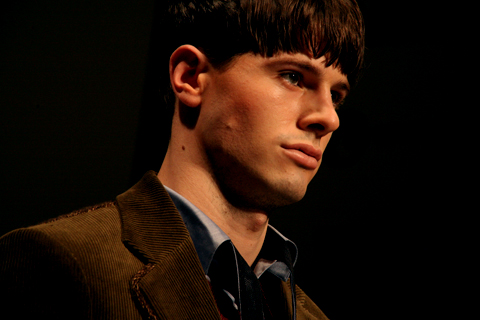


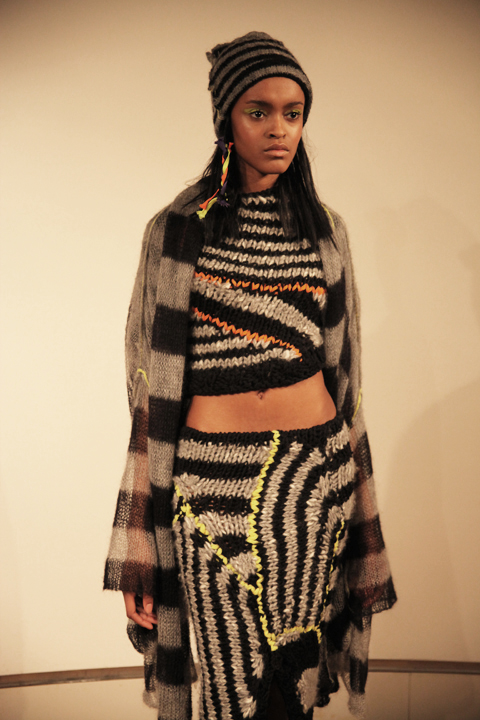

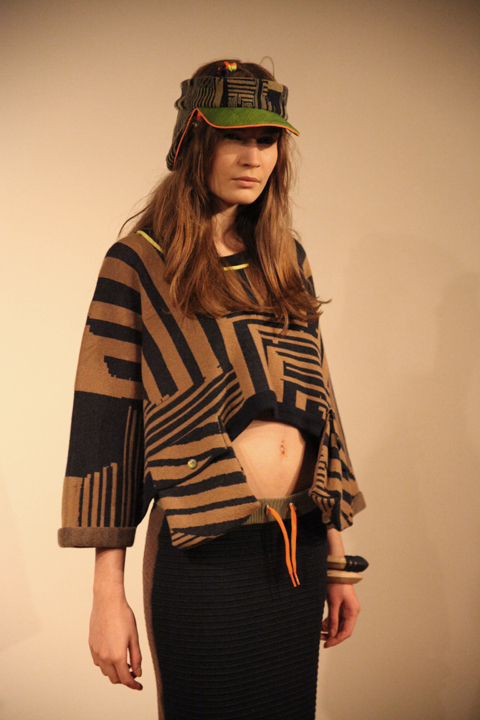
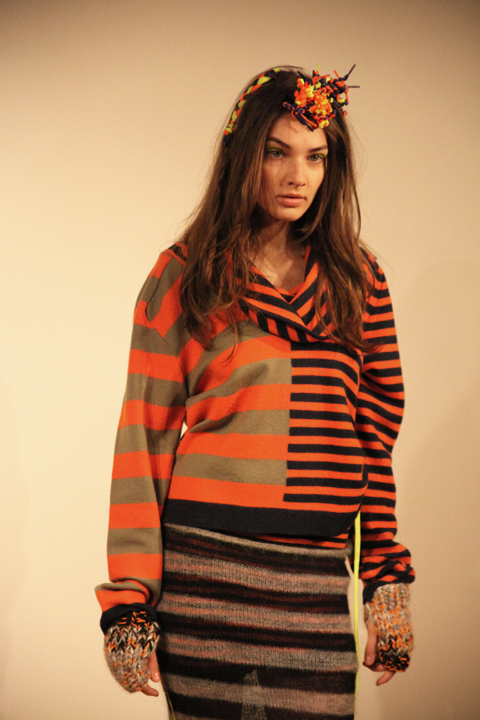


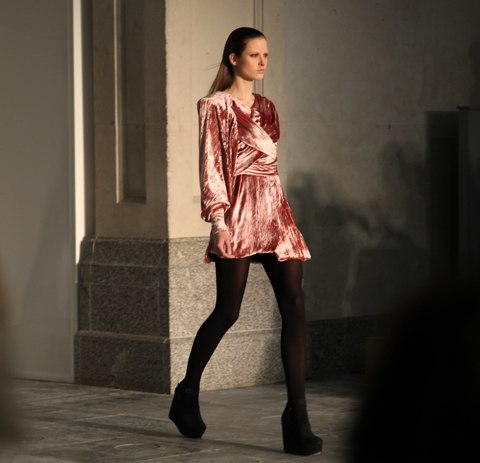

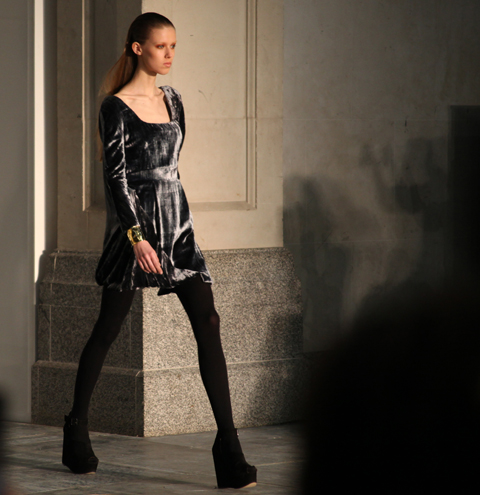

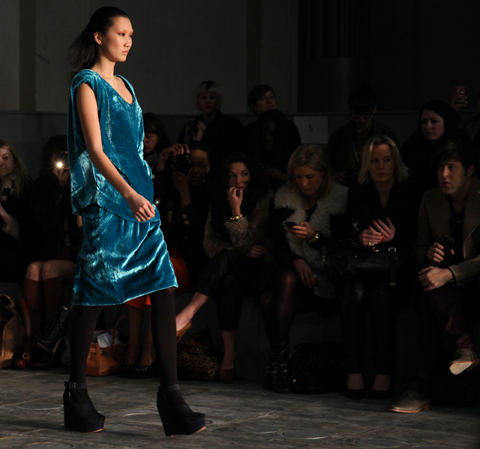


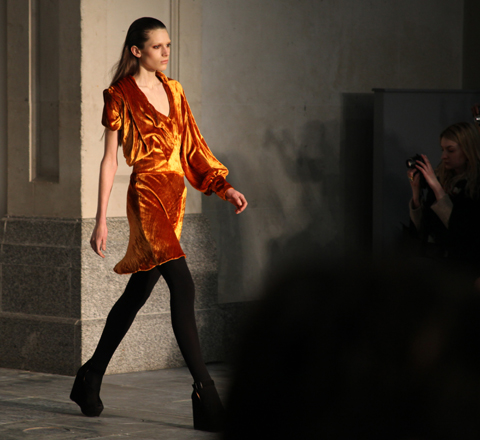

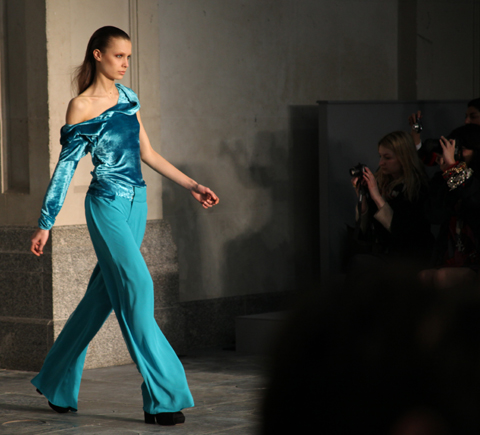


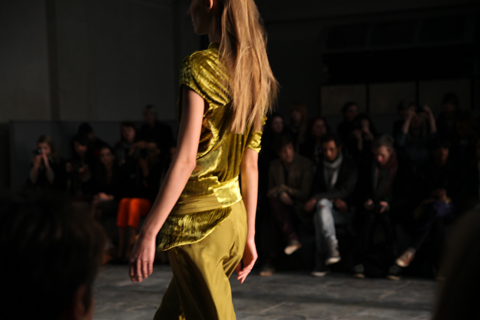


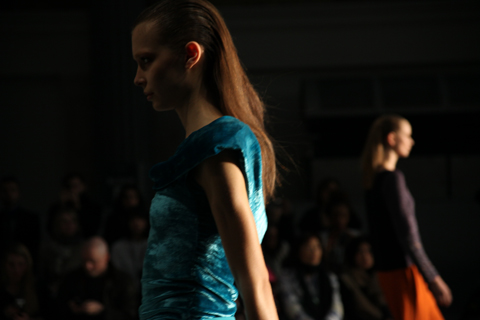
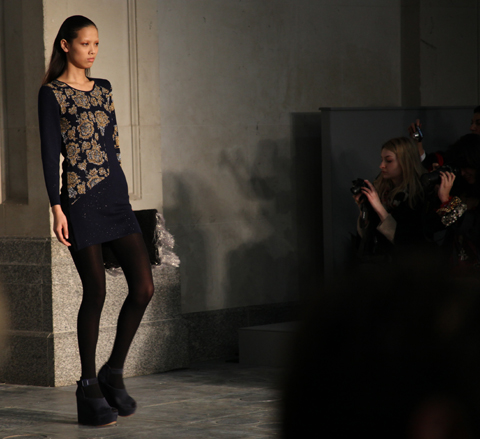


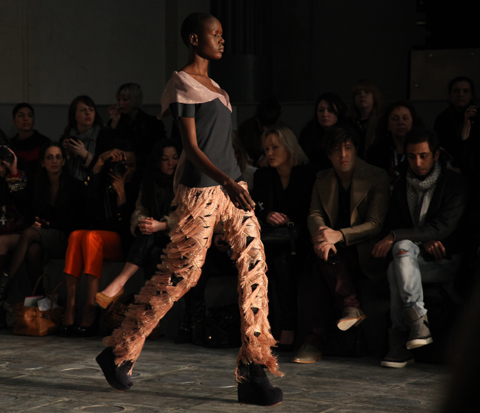
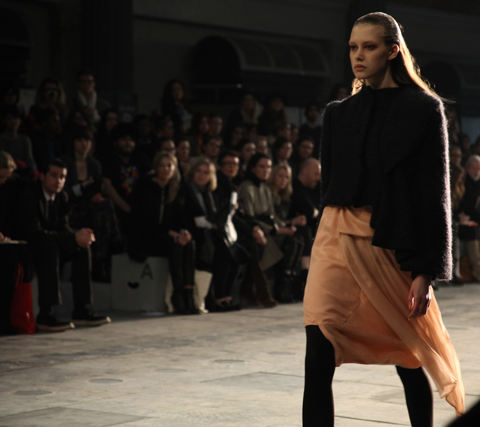


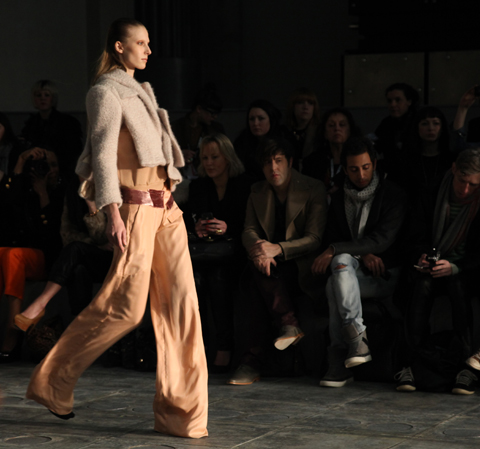


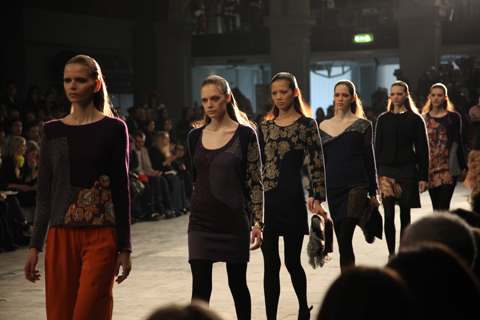
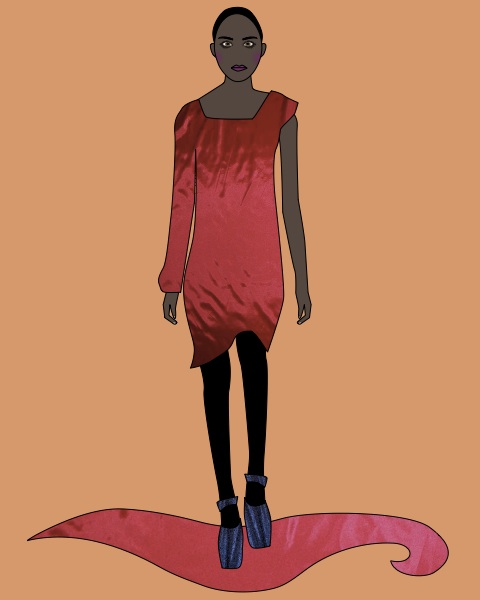


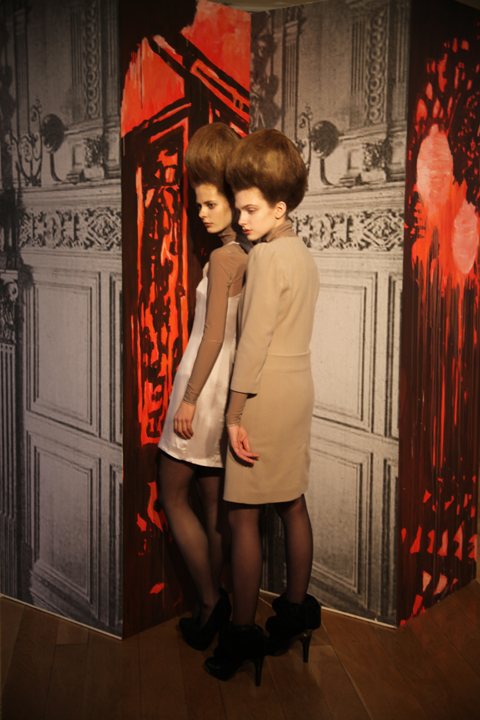
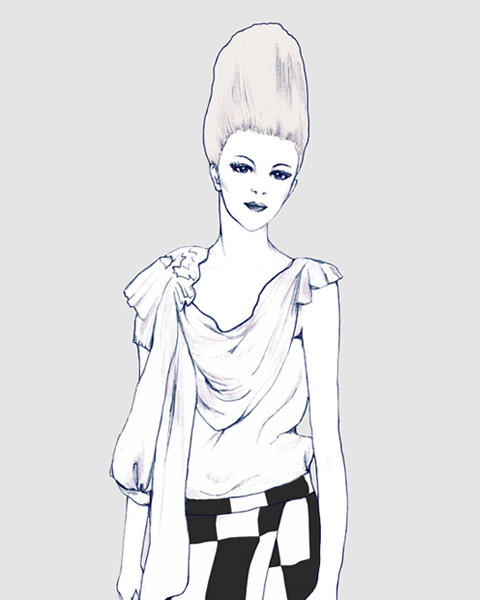
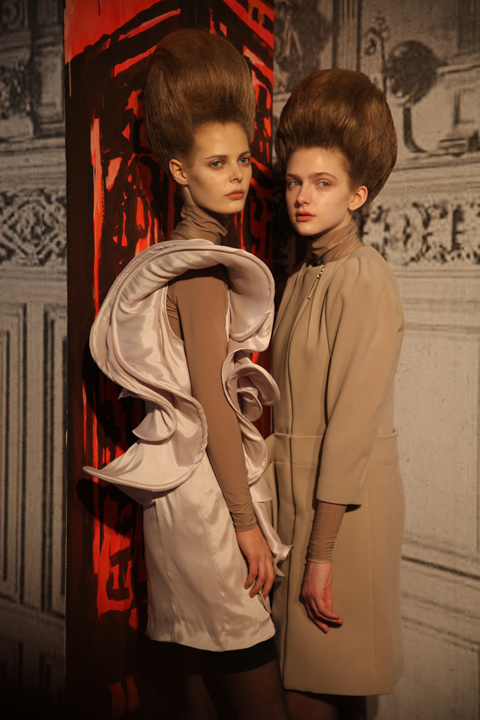

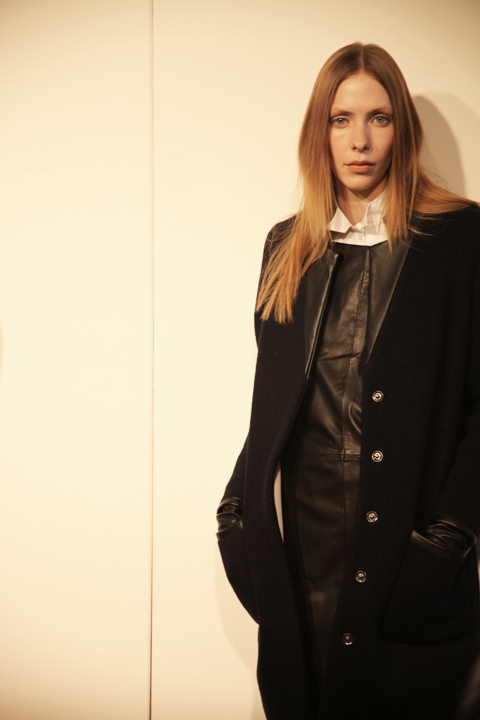


 UK Uncut gathers on the South Bank on Saturday 26th March 2011. All photography by Amelia Gregory.


 Inside Fortnum & Mason. They look super scared don’t they?