Tania Kowalski was a workshop manager at a well-known contemporary jewellery gallery in London when Synnove Saelthun arrived from New York to join the design team. They soon discovered that they had similar views on design and business ethics, more aboutcialis 40mg and became good friends. Several years later they started the Oria brand, prescription using Synnove’s design skills and Tania’s production expertise. Synnove is a technically brilliant goldsmith with a passion for design and an eye for detail. Tania is a trained jeweller, viagra with a wide range of experience in the jewellery industry, from design creation through to production. Her expertise includes sourcing ethical materials and ensuring fair business practice.
Tania’s passion for other cultures has led her to visit remote tribes in the Amazon of Brazil, hill tribes in Nepal and the Dogon people of Mali. It was during these travels that she became fascinated with the cultural importance and symbolic meaning of tribal adornment. When designing a new collection, the couple sit down together to discuss what the new collection will symbolise. They research and refine story boards, and after ensuring that the designs are technically feasible Synnove makes an initial prototype, the best of which will go into production.
The use of the phoenix is a symbol of honesty and justice in Chinese mythology, and is one of the inspirations for the Nina collection. The lotus symbolises purity and beauty in many different cultures, and it inspired their silver lotus collection.
Working in Nepal Tania discovered that the safe working conditions and fair living wages which we take for granted in the West are not necessarily the norm in other parts of the world. This early experience was important in persuading Tania to commit to fairtrade sourcing as a founding principle of Oria.
Vintage fashion, about it illustrated by Matilde Sazio
Kim Sklinar, viagra sale aka Preloved Reloved, cheap has set herself an interesting New Year’s challenge. For the duration of 2011, Kim isn’t going to buy any new clothes. No more high-street bargains, no more feeding corporate giants, no more fast-fashion waste, no siree. ‘Another one?’ I hear you cry – and you’d be right. But this one is a little different.
While Kim hopes to raise awareness about the amount of cheap clothing we purchase and what effects that has on the environment and people’s lives, there’s also a bigger reason closer to home. Kim’s father was diagnosed with cancer over 18 months ago, and she decided to set up the project to raise funds for Macmillan, the cancer care and support charity. Unfortunately, as of only last week, Kim’s dad won’t see the project through its fruition. But Kim will dedicate the project to his memory.
So, how do you do it? Well, Kim’s vowed to buy only vintage and from outlets like eBay, and she’ll spend more time in charity shops which also benefits all of the organisations that run them. I had a chat with her about the project and how she thinks she’ll manage it all…
What gave you the idea for Preloved, Reloved in the first place?
Well I always like to dress a little differently. My style is mainstream with a retro edge, I suppose. I always seem to end up with a daft New Year’s resolution – last year I cycled from London to Paris for The Institute of Cancer Research. I like using my time to help others and spread awareness.
Were you a fan of vintage and upcycling before you started the project?
Yes! I always admire my friends’ outfits; well, those who wear vintage and second-hand fashion. Upcycling is something I have experimented with for ages at home and now is the time to make sure I actually finish some projects!
Where will you source your outfits?
Charity shops, vintage stores, eBay, my mum’s wardrobe…! I made a lined cape last night from linen and satin for balmy summer nights (booking a holiday soon!).
What does the project hope to achieve?
I want to raise awareness of numerous charities related to my Dad’s illnesses. I want my friends to know that too much of an unhealthy lifestyle is probably going to lead to an early demise. I also want to raise the profile of vintage and second-hand fashion; I remember as a kid we use to take the mick out of anyone who dressed from a charity shop. I myself as a student had a stigma against them. Now it’s become kitsch, cool and quirky. It’s good for the environment.
How much do you hope to raise and what are the funds likely to be used for?
£2500 is my Just Giving target – it goes directly to Macmillan. However, with my shopping at many different charity shops, my cash goes straight to them – win win all round! I have my thinking cap on about how to expand the project though.
Why did you choose Macmillan?
My dad (and his dad) had cancer – he died last week unfortunately. And it wasn’t the cancer that killed him, it was his heart and his adult-onset diabetes. A poor lifestyle in his twenties and thirties caused it and he was only 57 when he passed. So as I said before, this project benefits other charities focussing on these causes too through me spending money at their outlets.
Not that far in, but have you come accross any problems so far? Has anything that happened that you weren’t expecting?
Avoiding shops is quite hard as I realised I can’t just pop into the Topshop sale and treat myself – which I suppose is good for my wallet and I’m going to do less impulse-buying on the way home from work.
With my Dad passing, I haven’t had as much time to go browsing shops as much as I’d like. This weekend, however, I’m going to the Girls of Guildford vintage fair and gig – for some serious retail therapy, cupcake-nomming and also to check out some great live music away from the bustle of London.
What are you wearing today? Where’s it all from?
Dark blue skinny jeans, leather knee boots that I already owned with black and cream patterned blouse from River Island that I bought from Cancer Research UK. I’m also wearing red rose earrings from Magnolia Jewellery.
Do you plan to make or alter any of your clothes? If so, how?
Yes – I love sewing and making jewellery too – I made a cape last week and have upcycled a pair of old, torn jeans from my uni days into a denim mini. I have a small collection of retro patterns including a lovely dress with a pussy bow. I love being able to create something out of fabric I love: last year I went to a lovely Indian wedding and couldn’t find The Outfit – so I made a purple maxi-dress with a halterneck and glammed it up with ribbons dangling down my back. Saved myself a fortune too!
What else do you get up to?
I run Never Enough Notes – a music e-zine, and I’m cycling the London-Brighton this summer with my brother and friends to raise money for the British Heart Foundation.
What would be your perfect Preloved, Reloved outfit?
For daytime it would easily be vintage jeans, brown boots that look a bit worn-out, a floaty shirt or cheeky tee, a tweed jacket and a battered satchel.
For evening, I love ball gowns and retro dresses so would be something glam that I could wear with a pair of 1970s heels! Oh there’s way too much choice, I love it!
Annika Sanders and Kerry Seager are self-taught fashion designers. They started up Junky Styling after they received lots of compliments for their deconstructed and restyled secondhand suits made to go out clubbing in during the 1990’s.
What prompted your approach to dressmaking?
Our approach was initially borne out of a lack of money but it soon became a necessity for individuality and quality. At first Annika’s mother did most of the sewing so our designs were heavily directed by her.
Have you seen many changes over the years?
Aside from all the wrinkles on our faces? We have seen the tangible development of a marketplace that never existed before. Education has enabled the sustainable movement to become more widely accepted and understood, approved and now many new brands think about sustainability before they even start designing.
Where did you go out in the past and do you still go clubbing?
We went to a wide mixture of venues that hosted a similar dressy scene. It was such a brilliant time, and we still enjoy socialising and a bit of a shuffle. But we always try to ensure that we are not the oldest at the bar…
Read the rest of this interview and see more illustrations of Junky Styling’s clothing in Amelia’s Compendium of Fashion Illustration, alongside interviews with 44 other ethical fashion designers and 30 fabulous fashion illustrators. You can buy the book here. You’ve been going for a very long time. Have attitudes to ethical fashion started to change yet?
Consumers are starting to question the huge exploitation of people and the environment that permits their clothing to be so cheap, treat because it doesn’t add up. There is still a long way to go but the fashion industry is slowly changing the way it does business.
What has the People Tree brand achieved?
We support 5, website like this 000 farmers, case artisans and their families in developing countries by producing well designed fairtrade and sustainable products. For us it’s about creating sustainable livelihoods that put food on the table at the end of the day.
You’ve collaborated with both Bora Aksu and Karen Nichol. What have they brought to People Tree?
We’ve worked with Bora for four years because we share the view that good fashion design should last for years. He is a master of beautiful, feminine draped designs that we produce in organic and fairtrade cotton, and we’ve already started designing an exciting new collection for S/S 2012. Like me Karen is passionate about handicrafts and she loves traditional Japanese textiles and designs. She works with our hand knitters in Nepal to create beautiful appliquéd and hand embroidered embellishments You’ve been going for a very long time. Have attitudes to ethical fashion started to change yet?
Consumers are starting to question the huge exploitation of people and the environment that permits their clothing to be so cheap, see because it doesn’t add up. There is still a long way to go but the fashion industry is slowly changing the way it does business.
What has the People Tree brand achieved?
We support 5, try 000 farmers, artisans and their families in developing countries by producing well designed fairtrade and sustainable products. For us it’s about creating sustainable livelihoods that put food on the table at the end of the day.
You’ve collaborated with both Bora Aksu and Karen Nichol. What have they brought to People Tree?
We’ve worked with Bora for four years because we share the view that good fashion design should last for years. He is a master of beautiful, feminine draped designs that we produce in organic and fairtrade cotton, and we’ve already started designing an exciting new collection for S/S 2012. Like me Karen is passionate about handicrafts and she loves traditional Japanese textiles and designs. She works with our hand knitters in Nepal to create beautiful appliquéd and hand embroidered embellishments How did the idea of working with old porcelain come about?
I was tired of producing other peoples’ ideas (as a stage producer) so in 2007 I decided to start working on my own project, dosage which soon developed into my rapidly growing label, stomach Sägen. I go to flea markets as often as I can for inspiration and to collect source material; I have amassed a huge collection of vintage buttons as well as piles of chipped and damaged porcelain that is no longer wanted. I like to work with my hands and I love turning items from the past into modern accessories.
Sägen means Old Saga in Swedish – why did you chose this name for your brand?
I come from a small island called Gotland in the middle of the Baltic Sea and I have wonderful memories of listening to all the old myths when I was a kid. I came up with the idea for Sägen when I was there and the name reflects my interest in recycling a little bit of history into new treasures, so I find the name very suitable.
How do you cut the porcelain and set it in silver?
I cut and grind the porcelain with machines, which is a very dirty, dusty and dangerous job: I have been close to losing my fingers many times. When I am working in my basement studio I forget about everything else, instead focusing on the patterns that I am obsessed with. I decide what shapes to make up depending on the motifs in the porcelain, then I set the porcelain in silver (which is 98% recycled) so that it curves, bends and stretches around the shape I have cut out. Ivana Basilotta S/S 2011 by Bex Glover.
Ivana Basilotta is Italian but has lived in Germany as well as the UK. She channels her observations of different cultures into her work, treatment sometimes the ideas flowing so fast that her pen can’t keep up and her scissors can’t cut the fabric fast enough. Quite often she only realises she was inspired by a certain idea once the collection has been finished. Having previously studied business Ivana is well placed to run her label, prostate and feels that a good business knowledge is as important as the creative force of a design house.
A committed vegetarian, she designs with peace silk, which is made in India without the killing of the silk moth. Because peace silk is spun as a fibre rather than reeled as a thread it is warmer and softer than ordinary silk. “I cannot imagine eating meat,” she says. “I find it strange that people eat dead animals.” She feels that being a vegetarian brings a great sense of freedom and well being, and it is an easy way to lead a greener life. “Farm land that could directly produce food for humans is used to farm and feed animals for slaughter, which uses up far more resources.” She does not like to imagine the stress and sorrow that farmed animals must experience, and wants no part in it…
Howies has since 1995 pioneered the creation of ethical active clothing with a strong design aesthetic. Based in Cardigan Bay, case Wales, remedy the company has built up a devoted fan base via its affiliation with outdoor sports such as surfing, order mountain biking and skateboarding. Products are made from high performing sustainable fabrics that will last, with a proportion of profits ploughed back into grassroots social and environmental projects via the Earth Tax. Although some clothes are made in China and Turkey they ensure best practice by employing the same factories as other companies they trust, such as M&S…
Read the rest of this interview and see more illustrations of Howie’s clothing in Amelia’s Compendium of Fashion Illustration, alongside interviews with 44 other ethical fashion designers and 30 fabulous fashion illustrators. You can buy the book here.
Written by Amelia Gregory on Monday January 24th, 2011 1:26 pm
Tania Kowalski was a workshop manager at a well-known contemporary jewellery gallery in London when Synnove Saelthun arrived from New York to join the design team. They soon discovered that they had similar views on design and business ethics, more aboutcialis 40mg and became good friends. Several years later they started the Oria brand, prescription using Synnove’s design skills and Tania’s production expertise. Synnove is a technically brilliant goldsmith with a passion for design and an eye for detail. Tania is a trained jeweller, viagra with a wide range of experience in the jewellery industry, from design creation through to production. Her expertise includes sourcing ethical materials and ensuring fair business practice.
Tania’s passion for other cultures has led her to visit remote tribes in the Amazon of Brazil, hill tribes in Nepal and the Dogon people of Mali. It was during these travels that she became fascinated with the cultural importance and symbolic meaning of tribal adornment. When designing a new collection, the couple sit down together to discuss what the new collection will symbolise. They research and refine story boards, and after ensuring that the designs are technically feasible Synnove makes an initial prototype, the best of which will go into production.
The use of the phoenix is a symbol of honesty and justice in Chinese mythology, and is one of the inspirations for the Nina collection. The lotus symbolises purity and beauty in many different cultures, and it inspired their silver lotus collection.
Working in Nepal Tania discovered that the safe working conditions and fair living wages which we take for granted in the West are not necessarily the norm in other parts of the world. This early experience was important in persuading Tania to commit to fairtrade sourcing as a founding principle of Oria.
Vintage fashion, about it illustrated by Matilde Sazio
Kim Sklinar, viagra sale aka Preloved Reloved, cheap has set herself an interesting New Year’s challenge. For the duration of 2011, Kim isn’t going to buy any new clothes. No more high-street bargains, no more feeding corporate giants, no more fast-fashion waste, no siree. ‘Another one?’ I hear you cry – and you’d be right. But this one is a little different.
While Kim hopes to raise awareness about the amount of cheap clothing we purchase and what effects that has on the environment and people’s lives, there’s also a bigger reason closer to home. Kim’s father was diagnosed with cancer over 18 months ago, and she decided to set up the project to raise funds for Macmillan, the cancer care and support charity. Unfortunately, as of only last week, Kim’s dad won’t see the project through its fruition. But Kim will dedicate the project to his memory.
So, how do you do it? Well, Kim’s vowed to buy only vintage and from outlets like eBay, and she’ll spend more time in charity shops which also benefits all of the organisations that run them. I had a chat with her about the project and how she thinks she’ll manage it all…
What gave you the idea for Preloved, Reloved in the first place?
Well I always like to dress a little differently. My style is mainstream with a retro edge, I suppose. I always seem to end up with a daft New Year’s resolution – last year I cycled from London to Paris for The Institute of Cancer Research. I like using my time to help others and spread awareness.
Were you a fan of vintage and upcycling before you started the project?
Yes! I always admire my friends’ outfits; well, those who wear vintage and second-hand fashion. Upcycling is something I have experimented with for ages at home and now is the time to make sure I actually finish some projects!
Where will you source your outfits?
Charity shops, vintage stores, eBay, my mum’s wardrobe…! I made a lined cape last night from linen and satin for balmy summer nights (booking a holiday soon!).
What does the project hope to achieve?
I want to raise awareness of numerous charities related to my Dad’s illnesses. I want my friends to know that too much of an unhealthy lifestyle is probably going to lead to an early demise. I also want to raise the profile of vintage and second-hand fashion; I remember as a kid we use to take the mick out of anyone who dressed from a charity shop. I myself as a student had a stigma against them. Now it’s become kitsch, cool and quirky. It’s good for the environment.
How much do you hope to raise and what are the funds likely to be used for?
£2500 is my Just Giving target – it goes directly to Macmillan. However, with my shopping at many different charity shops, my cash goes straight to them – win win all round! I have my thinking cap on about how to expand the project though.
Why did you choose Macmillan?
My dad (and his dad) had cancer – he died last week unfortunately. And it wasn’t the cancer that killed him, it was his heart and his adult-onset diabetes. A poor lifestyle in his twenties and thirties caused it and he was only 57 when he passed. So as I said before, this project benefits other charities focussing on these causes too through me spending money at their outlets.
Not that far in, but have you come accross any problems so far? Has anything that happened that you weren’t expecting?
Avoiding shops is quite hard as I realised I can’t just pop into the Topshop sale and treat myself – which I suppose is good for my wallet and I’m going to do less impulse-buying on the way home from work.
With my Dad passing, I haven’t had as much time to go browsing shops as much as I’d like. This weekend, however, I’m going to the Girls of Guildford vintage fair and gig – for some serious retail therapy, cupcake-nomming and also to check out some great live music away from the bustle of London.
What are you wearing today? Where’s it all from?
Dark blue skinny jeans, leather knee boots that I already owned with black and cream patterned blouse from River Island that I bought from Cancer Research UK. I’m also wearing red rose earrings from Magnolia Jewellery.
Do you plan to make or alter any of your clothes? If so, how?
Yes – I love sewing and making jewellery too – I made a cape last week and have upcycled a pair of old, torn jeans from my uni days into a denim mini. I have a small collection of retro patterns including a lovely dress with a pussy bow. I love being able to create something out of fabric I love: last year I went to a lovely Indian wedding and couldn’t find The Outfit – so I made a purple maxi-dress with a halterneck and glammed it up with ribbons dangling down my back. Saved myself a fortune too!
What else do you get up to?
I run Never Enough Notes – a music e-zine, and I’m cycling the London-Brighton this summer with my brother and friends to raise money for the British Heart Foundation.
What would be your perfect Preloved, Reloved outfit?
For daytime it would easily be vintage jeans, brown boots that look a bit worn-out, a floaty shirt or cheeky tee, a tweed jacket and a battered satchel.
For evening, I love ball gowns and retro dresses so would be something glam that I could wear with a pair of 1970s heels! Oh there’s way too much choice, I love it!
Annika Sanders and Kerry Seager are self-taught fashion designers. They started up Junky Styling after they received lots of compliments for their deconstructed and restyled secondhand suits made to go out clubbing in during the 1990’s.
What prompted your approach to dressmaking?
Our approach was initially borne out of a lack of money but it soon became a necessity for individuality and quality. At first Annika’s mother did most of the sewing so our designs were heavily directed by her.
Have you seen many changes over the years?
Aside from all the wrinkles on our faces? We have seen the tangible development of a marketplace that never existed before. Education has enabled the sustainable movement to become more widely accepted and understood, approved and now many new brands think about sustainability before they even start designing.
Where did you go out in the past and do you still go clubbing?
We went to a wide mixture of venues that hosted a similar dressy scene. It was such a brilliant time, and we still enjoy socialising and a bit of a shuffle. But we always try to ensure that we are not the oldest at the bar…
Read the rest of this interview and see more illustrations of Junky Styling’s clothing in Amelia’s Compendium of Fashion Illustration, alongside interviews with 44 other ethical fashion designers and 30 fabulous fashion illustrators. You can buy the book here. You’ve been going for a very long time. Have attitudes to ethical fashion started to change yet?
Consumers are starting to question the huge exploitation of people and the environment that permits their clothing to be so cheap, treat because it doesn’t add up. There is still a long way to go but the fashion industry is slowly changing the way it does business.
What has the People Tree brand achieved?
We support 5, website like this 000 farmers, case artisans and their families in developing countries by producing well designed fairtrade and sustainable products. For us it’s about creating sustainable livelihoods that put food on the table at the end of the day.
You’ve collaborated with both Bora Aksu and Karen Nichol. What have they brought to People Tree?
We’ve worked with Bora for four years because we share the view that good fashion design should last for years. He is a master of beautiful, feminine draped designs that we produce in organic and fairtrade cotton, and we’ve already started designing an exciting new collection for S/S 2012. Like me Karen is passionate about handicrafts and she loves traditional Japanese textiles and designs. She works with our hand knitters in Nepal to create beautiful appliquéd and hand embroidered embellishments You’ve been going for a very long time. Have attitudes to ethical fashion started to change yet?
Consumers are starting to question the huge exploitation of people and the environment that permits their clothing to be so cheap, see because it doesn’t add up. There is still a long way to go but the fashion industry is slowly changing the way it does business.
What has the People Tree brand achieved?
We support 5, try 000 farmers, artisans and their families in developing countries by producing well designed fairtrade and sustainable products. For us it’s about creating sustainable livelihoods that put food on the table at the end of the day.
You’ve collaborated with both Bora Aksu and Karen Nichol. What have they brought to People Tree?
We’ve worked with Bora for four years because we share the view that good fashion design should last for years. He is a master of beautiful, feminine draped designs that we produce in organic and fairtrade cotton, and we’ve already started designing an exciting new collection for S/S 2012. Like me Karen is passionate about handicrafts and she loves traditional Japanese textiles and designs. She works with our hand knitters in Nepal to create beautiful appliquéd and hand embroidered embellishments How did the idea of working with old porcelain come about?
I was tired of producing other peoples’ ideas (as a stage producer) so in 2007 I decided to start working on my own project, dosage which soon developed into my rapidly growing label, stomach Sägen. I go to flea markets as often as I can for inspiration and to collect source material; I have amassed a huge collection of vintage buttons as well as piles of chipped and damaged porcelain that is no longer wanted. I like to work with my hands and I love turning items from the past into modern accessories.
Sägen means Old Saga in Swedish – why did you chose this name for your brand?
I come from a small island called Gotland in the middle of the Baltic Sea and I have wonderful memories of listening to all the old myths when I was a kid. I came up with the idea for Sägen when I was there and the name reflects my interest in recycling a little bit of history into new treasures, so I find the name very suitable.
How do you cut the porcelain and set it in silver?
I cut and grind the porcelain with machines, which is a very dirty, dusty and dangerous job: I have been close to losing my fingers many times. When I am working in my basement studio I forget about everything else, instead focusing on the patterns that I am obsessed with. I decide what shapes to make up depending on the motifs in the porcelain, then I set the porcelain in silver (which is 98% recycled) so that it curves, bends and stretches around the shape I have cut out. Ivana Basilotta S/S 2011 by Bex Glover.
Ivana Basilotta is Italian but has lived in Germany as well as the UK. She channels her observations of different cultures into her work, treatment sometimes the ideas flowing so fast that her pen can’t keep up and her scissors can’t cut the fabric fast enough. Quite often she only realises she was inspired by a certain idea once the collection has been finished. Having previously studied business Ivana is well placed to run her label, prostate and feels that a good business knowledge is as important as the creative force of a design house.
A committed vegetarian, she designs with peace silk, which is made in India without the killing of the silk moth. Because peace silk is spun as a fibre rather than reeled as a thread it is warmer and softer than ordinary silk. “I cannot imagine eating meat,” she says. “I find it strange that people eat dead animals.” She feels that being a vegetarian brings a great sense of freedom and well being, and it is an easy way to lead a greener life. “Farm land that could directly produce food for humans is used to farm and feed animals for slaughter, which uses up far more resources.” She does not like to imagine the stress and sorrow that farmed animals must experience, and wants no part in it…
What was the path to setting up Izzy Lane?
I started an organic food company when I became aware of the hundreds of permitted toxic chemicals used in food production that are wreaking devastation on our wildlife and natural world. Through my work with organic farmers I then discovered what was happening in the wool industry – that farmers were burying and burning their wool because they were paid such a pittance. Because we do not use wool as much as we used to the British textile industry, viagra dosagebuy more about once the powerhouse of the nation, is on its knees – as are the communities it once supported. I had no training in fashion but I’d always had an interest in clothes which was nurtured when I lived in London as a singer and songwriter and playing in bands as a bass and saxophone player. If you are creative, you tend to be able to transfer that creativity across different media, and I became determined to start a label using British wool.
Your sheep are rescued from abattoirs – it all sounds very romantic, but how do you find them and rescue them?
I physically don’t go to abattoirs. I think if I ever saw inside one I would never get over it for the rest of my life. I intervene before it gets that far. I am contacted by breeders who tell me what animals they are sending to slaughter and then I buy them at the market price. I can’t refuse any animals once I am aware of them – I feel it is my responsibility to rescue them. Thankfully the rate at which I am contacted has slowed. The shepherd who looks after them rolls his eyes when I tell him a new batch is arriving. He also gets annoyed that I am being made to pay the full price – some of the sheep arrive with health problems which need a lot of veterinary care.
Where are you based now?
I moved up to Richmond, Yorkshire a few years ago and it took some adjusting to – I miss my favourite restaurants, the markets and the cosmopolitan buzz of London. However, I am living in the most stunningly beautiful landscape where I can drive for hours without seeing another car. I love walking in the hills with my black labrador, putting life into perspective, but I still go back to London to go shopping and see my friends. It would have been a different story ten years ago but thanks to technology I can do all my work from here.
How does the landscape and people affect the way that you design?
I think that what one designs comes from many influences, both past and present – most that we are probably unaware of. For example, details of treasured garments from childhood, mother’s coat, old black and white films from the 50’s and 60’s. I am sure the colour palette of the moors feeds into my designs.
How did dairy farmer turned shepherd Ernest Ayre come to look after your sheep?
My first four sheep lived in a paddock at the end of the road but one day they vanished. Ernest, who had adjacent fields, appeared and offered to help find them. He followed their tracks and we found they had gone on an adventure in the woods. I think they’d got lost and found it a bit creepy in the forest at night so they happily followed us back. That is when Ernest fell for the Wensleydales and he offered to take them on… and the next 600.
What has been the most interesting or exciting fact that you have learnt about sheep, since you started working with them so closely?
I find it really fascinating to observe how sheep are really no different to us. They hang around in gangs and sometimes they will single out one particular sheep to chase around the field – but it isn’t malicious, they just like larking around. I’m always moved by the bond between a lamb and its mother and siblings. They display real affection towards each other…
Read the rest of this interview and see more illustrations of Izzy Lane’s clothing in Amelia’s Compendium of Fashion Illustration, alongside interviews with 44 other ethical fashion designers and 30 fabulous fashion illustrators. You can buy the book here.
Written by Amelia Gregory on Tuesday January 25th, 2011 10:34 am
Joanna Cave has become synonymous with both ethical consciousness and beautiful design. Her mother is Greek and her father is English, so after attending an international school in Greece she went onto study jewellery design at Central Saint Martins. Whilst there she interned with designer Scott Wilson. After graduating, she returned to Greece, where she now works from her studio in Athens.
Joanna Cave‘s designs are modern yet classic – created from simple patterns, delicate motifs and refined metals, all created using ethically sourced and recycled materials. She buys her metal from dealers who specialise in recycled silver, and the stones and gems from ethical sellers in Greece.
She has always been very vocal about her environmental inclinations, and has received a lot of recognition for her hand-made and sensitive work. She is a regular name on the British Fashion Council’s ethical initiative ‘Estethica‘ at London Fashion Week, and was the only jewellery designer to be featured on the A/W 2012 stands. She is of course also profiled in Amelia’s Compendium of Fashion Illustration, as one of the best eco designers working today.
I spoke to Joanna Cave about her passion for jewellery design and the influences behind her new collection.
Joanna Cave A/W 2012 Velvet and Metal Hairband
What can we expect from the new A/W 2012 collection?
There are lots of bright coloured tassels combined with gold plating, rose plating and charcoal black. I’ve also used Indian motifs such as paisley patterns, elephants and peacocks.
What were the inspirations behind it?
My new collection is inspired by and dedicated to the working women of India. The beautiful and traditional women who labour in the fields, on the roads and building sites doing back-breaking work. They perform these humble tasks with such dignity, and their appearance can take your breath away. Their everyday working clothes are a riot of extravagant colours – pinks, greens, purples and blues. Their bold jewellery is intricate, and worn with pride. For me, these women embody India, they have a powerful and enduring femininity.
Can you explain a little about your passion for design, and explain how you moved into jewellery design?
I’m not sure how to explain this too well. I grew up in Greece on a small island in the Aegean where my father (who is English and who moved there when he met and fell in love with my mother) owned a jewellery shop. I grew up among the jewellery. From a young age I watched people trying jewellery on, falling in love with it, purchasing it… I met jewellery makers and designers. Some quite well known in Greece at the time.
When I was 19 (and studying jewellery making) I even opened my own small shop to sell my beaded creations. It was great fun and it funded my summer holidays. Designing jewellery is all I’ve ever wanted to do: I think I inherited my fathers passion for it. It’s always been a big part of my life and I always discuss everything with him.
Joanna Cave A/W 2012 Bindu and Indru Necklaces
Can you tell me a little about the process of your work?
I work in 2D, in flat silver cut out designs. Everything is initially cut out by hand where most people would use a laser cutter or router machine. I think that the hand made prototype is evident in the organic feel of the designs. You can see it’s not perfect. I use recycled silver and ethically sourced pearls at times. And lately I’ve been using artificial silk thread which I’m very into.
Why is it important for there to be an environmental conscience to your work?
It’s about how I feel; I think it’s important to know how things are made and where they come from… to do as little damage as possible where we can.
Hilum opens with the ominous popping of corn, recipepatient stealthily reaching a crescendo before the pan jerks off stage to reveal an oversized scullery into which emerges a gremlin fairy creature. It’s like a creepy abandoned nursery of the netherworld, with recognisable objects and sounds mutated into the stuff of children’s nightmares. Almost immediately I fear for the dreams of the young children seated in front of us.
An array of wonderful grotesque puppets tumble and play, their strings pulled by the humans that tower above them in creamy lace outfits that resemble nightgowns. Their faces are covered, crocheted protrusions dangling trunk-like as they bend forward over their proteges, interacting with and manipulating them at the same time.
But in this strange world full of curiously humanoid critters it is not the giant ogres that control the tale – such as there was one – but the rhythm of the washing machine cycles, underpinned by an evocative soundtrack. From crackling bleeps, to old time lullabies and the delicate tinkling of a glockenspiel as a pathetic little mermaid creature made from pearly buttons meets its death, it is an integral part of creating the atmosphere.
Hilum by Gemma Smith.
Hilum by Abigail Daker.
Towards the denouement things take a more surreal turn still, with the washing machine upending itself in a frenzy to reveal a furry trapdoor which after a bit more shaking gives birth to a baby washing machine, covered in a placenta like ooze. A real man appears with a loud toy gun, a large humanoid skull spins grinning inside the washing machine. A huge chicken creature strides on stage as a snapping oversized finger clatters around.
As the shutters closed on this bizarre otherworld I felt oddly bemused. Hilum by Les Antliaclastes is a beautifully conceived project but with no real outcome, other than the guarantee of some very odd dreams, for adults and children alike.
But as we admired the stage shutters on our way out I felt very glad that creative endeavours such as this are staged during events like the London International Mime Festival. We are lucky indeed to live in this place and in these times, where creativity can be expressed in so many different and unique ways.
The wonderfully decorated stage shutters for Hilum at the ICA.
Hilum opens with the ominous popping of corn, advice stealthily reaching a crescendo before the pan jerks off stage to reveal an oversized scullery into which emerges a gremlin fairy creature. It’s like a creepy abandoned nursery of the netherworld, with recognisable objects and sounds mutated into the stuff of children’s nightmares. Almost immediately I fear for the dreams of the young children seated in front of us.
An array of wonderful grotesque puppets tumble and play, their strings pulled by the humans that tower above them in creamy lace outfits that resemble nightgowns. Their faces are covered, crocheted protrusions dangling trunk-like as they bend forward over their proteges, interacting with and manipulating them at the same time.
But in this strange world full of curiously humanoid critters it is not the giant ogres that control the tale – such as there is one – but the rhythm of the washing machine cycles, underpinned by an evocative soundtrack. From crackling bleeps, to old time lullabies and the delicate tinkling of a glockenspiel (as a pathetic little mermaid creature made from pearly buttons meets its death) the music is an integral part of the atmosphere.
Hilum by Gemma Smith.
Hilum by Abigail Daker.
Towards the denouement things take a more surreal turn still, with the washing machine upending itself in a frenzy to reveal a furry trapdoor which after a bit more shaking gives birth to a baby washing machine, covered in a placenta like ooze. A real man appears with a loud toy gun, a large humanoid skull spins grinning inside the washing machine. A huge chicken creature strides on stage as a snapping oversized finger clatters around.
As the shutters closed on this bizarre otherworld I felt oddly bemused. Hilum by Les Antliaclastes is a beautifully conceived project but with no real outcome, other than the guarantee of some very odd dreams, for adults and children alike.
But as we admired the stage shutters on our way out I felt very glad that creative endeavours such as this are staged during events like the London International Mime Festival. We are lucky indeed to live in this place and in these times, where creativity can be expressed in so many different and unique ways.
The wonderfully decorated stage shutters for Hilum at the ICA.
Hilum opens with the ominous popping of corn, visit this site stealthily reaching a crescendo before the pan jerks off stage to reveal an oversized scullery into which emerges a gremlin fairy creature. It’s like a creepy abandoned nursery of the netherworld, with recognisable objects and sounds mutated into the stuff of children’s nightmares. Almost immediately I fear for the dreams of the young children seated in front of us.
An array of wonderful grotesque puppets tumble and play, their strings pulled by the humans that tower above them in creamy lace outfits that resemble nightgowns. Their faces are covered, crocheted protrusions dangling trunk-like as they bend forward over their proteges, interacting with and manipulating them at the same time.
But in this strange world full of curiously humanoid critters it is not the giant ogres that control the tale – such as there is one – but the rhythm of the washing machine cycles, underpinned by an evocative soundtrack. From crackling bleeps, to old time lullabies and the delicate tinkling of a glockenspiel (as a pathetic little mermaid creature made from pearly buttons meets its death) the music is an integral part of the atmosphere.
Hilum by Gemma Smith.
Hilum by Abigail Daker.
Towards the denouement things take a more surreal turn still, with the washing machine upending itself in a frenzy to reveal a furry trapdoor which gives birth to a baby washing machine covered in a placenta like ooze. A real man appears with a loud toy gun, a large humanoid skull spins grinning inside the washing machine. A huge chicken creature strides on stage as a snapping oversized finger clatters crazily agains the walls.
As the shutters close on this bizarre otherworld I feel oddly bemused. Hilum by Les Antliaclastes is a beautifully conceived project but with no real outcome, other than the guarantee of some very odd dreams, for adults and children alike.
Nevertheless, as we admire the stage shutters on our way out I feel very glad that creative endeavours such as Hilum are staged during events like the London International Mime Festival. We are lucky indeed to live in this place and in these times, where creativity can be expressed in so many different and unique ways.
The wonderfully decorated stage shutters for Hilum at the ICA.
Hilum opens with the ominous popping of corn, order stealthily reaching a crescendo before the pan jerks off stage to reveal an oversized scullery into which emerges a gremlin fairy creature. It’s like a creepy abandoned nursery of the netherworld, site with recognisable objects and sounds mutated into the stuff of children’s nightmares. Almost immediately I fear for the dreams of the young children seated in front of us.
An array of wonderful grotesque puppets tumble and play, ambulance their strings pulled by the humans that tower above them in creamy lace outfits that resemble nightgowns. Their faces are covered, crocheted protrusions dangling trunk-like as they bend forward over their proteges, interacting with and manipulating them at the same time.
But in this strange world full of curiously humanoid critters it is not the giant ogres that control the tale – such as there is one – but the rhythm of the washing machine cycles, underpinned by an evocative soundtrack. From crackling bleeps, to old time lullabies and the delicate tinkling of a glockenspiel (as a pathetic little mermaid creature made from pearly buttons meets its death) the music is an integral part of the atmosphere.
Hilum by Gemma Smith.
Hilum by Abigail Daker.
Towards the denouement things take a more surreal turn still, with the washing machine upending itself in a frenzy to reveal a furry trapdoor which gives birth to a baby washing machine covered in a placenta like ooze. A real man appears with a loud toy gun, a large humanoid skull spins grinning inside the washing machine. A huge chicken creature strides on stage as a snapping oversized finger clatters crazily agains the walls.
As the shutters close on this bizarre otherworld I feel oddly bemused. Hilum by Les Antliaclastes is a beautifully conceived project but with no real outcome, other than the guarantee of some very odd dreams, for adults and children alike.
Nevertheless, as we admire the stage shutters on our way out I feel very glad that creative endeavours such as Hilum are staged during events like the London International Mime Festival. We are lucky indeed to live in this place and in these times, where creativity can be expressed in so many different and unique ways.
The wonderfully decorated stage shutters for Hilum at the ICA.
It may have been a typically miserable Monday night in January, viagra 60mg but we were safe from the elements within the hallowed hall that is the Windmill in Brixton. This unassuming little pub just off the busy thoroughfare of Brixton Hill (and in the shadow of a real windmill, pilule the only one remaining in London), has seen many upcoming bands and surprise appearances from old faces grace its stage over the years. My favourite music venue in London (and my second gig there in 48 hours), I’ve had a lot of nights at the Windmill that have been great (including my second New Year’s Eve in London), hazy (ditto) and just plain bizarre.
The evening began with some haunting acoustica from Daughter, aka Elena Tonra. Plucking at an acoustic guitar, and backed by some subtle electric guitar washes, Tonra’s hushed vocals delivered some daintily dark lyrics that drew the onlookers in. As the Windmill began to fill up, Viv Albertine took to the stage with her new band, Limerence. Once the guitarist and co-songwriter with iconic punk band The Slits, Albertine had been off the music scene for over 20 years after pursuing a career in TV and film directing, but she recently made a return to the stage (indeed, her debut was here at the Windmill) and has gone on to release an EP on the label of Sonic Youth’s very own Thurston Moore.
“Limerence” was a term coined to describe a near-obsessive form of romantic love, though Albertine joked that her songs were generally about pretty much the opposite. Limerence the band is a loose collective of musicians – I’d seen them play at the George Tavern in Stepney last year with pretty much a full compliment, but tonight it was just a pairing of violin and a combo of keyboard, guitar and ukulele. Musically, Albertine has moved on from the reggae infused sound of her old band, though her guitar is still as distinctive as it was on songs like Typical Girls. If anything, there’s a hint of Syd Barrett about songs like Fairytale and the twisted pop of Never Come, and the lyrics are as witty and spiky as you’d expect. Void references a darker part of her punk past, and was introduced with a few reminiscences of 1976. The paired down line-up actually gave an extra edge to Albertine’s songs, highlighted on the unsettling set closer, Confessions Of A Milf, which descended into a one-chord riff on suburban paranoia.
Canadian headliners Austra have been causing a bit of a buzz of late. Hailing from Toronto, and centred on vocalist Katie Stelmanis, with Maya Postepski on programming and Dorian Wolf on bass, they recently renamed themselves (having previously been going under Stelmanis’ moniker), signed to Domino and currently have a 12” single out, with an album in the pipeline for later this year.
For the UK leg of a whistle-stop European tour, starting tonight, Stelmanis and co were joined by a drummer, keyboard player and two extra vocalists. There was a bit of a shaky start with a technical hitch before things got into their stride. It would be easy to make comparisons with Fever Ray and Glasser (especially as I’d seen both live fairly recently), and Austra do fall into that category of brooding female vocals over dark electronic beats. However, they’re not as dense as Fever Ray or as spectral as Glasser, especially live. I’d read somewhere that Austra were like “Fever Ray gone disco”, which actually isn’t a million miles off the mark. The single, Beat & the Pulse, is distinctly dance-friendly, and while Stelmanis’ vocal delivery may be reminiscent of Karin Dreijer Andersson, the general vibe is more akin to the early to mid 80’s indie-dance crossover. In the confined space of the Windmill, Austra’s songs become much more organic, with the live drums and bass giving an added kick. There was also plenty of theatricality, with Stelmanis and her sidekicks whirling and dipping during each song.
It was a typically great and varied mix of bands and styles tonight, another in a long line of great nights that I’ve experienced at the Windmill, and another one I’m sure that the venue’s legendary Roof Dog would approve of.
Jewellery designer Joanna Cave makes delicate pieces for the self confident and elegant woman. She met PARTIMI designer Eleanor Dorrien-Smith at London Fashion Week and the pair clicked instantly. For S/S 2011 they have collaborated on a special collection.
Has your Greek upbringing influenced your designs?
I believe that our surroundings influence us a great deal and my Greek upbringing has definitely played its part. My latest collection was purely influenced by the surroundings where I designed it on the Greek island of Tinos, salve so amongst my inspiration was the beautiful Cycladic landscape and deep starry nights.
Why you currently based in Athens?
I studied in London but after many years I felt I needed a change, drug and Athens seemed like a pretty exotic destination after a cold and cloudy summer in the UK. It can be difficult since I’m part English and absolutely love London, viagra approved but Athens has a great tradition in jewellery and it is full of charming little workshops that have been operating for generations. It all kind of fell into place.
Have you always been ethical in your approach to design or did you have an epiphany, and if so what prompted that?
I’ve almost always used recycled silver. One year I used coral for my collection which is terribly bad – as soon as I found out how endangered coral is and how much damage is caused by extracting it, I completely banned it from my production. That prompted me to find out more about where my materials come from, and I started to look for ethically sourced pearls…
Read the rest of this interview with Joanna Cave in Amelia’s Compendium of Fashion Illustration, alongside interviews with 44 other ethical fashion designers and 30 fabulous fashion illustrators. You can buy the book here.
Written by Amelia Gregory on Tuesday January 25th, 2011 3:39 pm
Jewellery designer Joanna Cave makes delicate pieces for the self confident and elegant woman. She met PARTIMI designer Eleanor Dorrien-Smith at London Fashion Week and the pair clicked instantly. For S/S 2011 they have collaborated on a special collection.
Has your Greek upbringing influenced your designs?
I believe that our surroundings influence us a great deal and my Greek upbringing has definitely played its part. My latest collection was purely influenced by the surroundings where I designed it on the Greek island of Tinos, so amongst my inspiration was the beautiful Cycladic landscape and deep starry nights.
Why you currently based in Athens?
I studied in London but after many years I felt I needed a change, and Athens seemed like a pretty exotic destination after a cold and cloudy summer in the UK. It can be difficult since I’m part English and absolutely love London, but Athens has a great tradition in jewellery and it is full of charming little workshops that have been operating for generations. It all kind of fell into place.
Have you always been ethical in your approach to design or did you have an epiphany, and if so what prompted that?
I’ve almost always used recycled silver. One year I used coral for my collection which is terribly bad – as soon as I found out how endangered coral is and how much damage is caused by extracting it, I completely banned it from my production. That prompted me to find out more about where my materials come from, and I started to look for ethically sourced pearls…
Read the rest of this interview with Joanna Cave in Amelia’s Compendium of Fashion Illustration, alongside interviews with 44 other ethical fashion designers and 30 fabulous fashion illustrators. You can buy the book here.
Written by Amelia Gregory on Tuesday January 25th, 2011 3:39 pm
Tania Kowalski was a workshop manager at a well-known contemporary jewellery gallery in London when Synnove Saelthun arrived from New York to join the design team. They soon discovered that they had similar views on design and business ethics, more aboutcialis 40mg and became good friends. Several years later they started the Oria brand, prescription using Synnove’s design skills and Tania’s production expertise. Synnove is a technically brilliant goldsmith with a passion for design and an eye for detail. Tania is a trained jeweller, viagra with a wide range of experience in the jewellery industry, from design creation through to production. Her expertise includes sourcing ethical materials and ensuring fair business practice.
Tania’s passion for other cultures has led her to visit remote tribes in the Amazon of Brazil, hill tribes in Nepal and the Dogon people of Mali. It was during these travels that she became fascinated with the cultural importance and symbolic meaning of tribal adornment. When designing a new collection, the couple sit down together to discuss what the new collection will symbolise. They research and refine story boards, and after ensuring that the designs are technically feasible Synnove makes an initial prototype, the best of which will go into production.
The use of the phoenix is a symbol of honesty and justice in Chinese mythology, and is one of the inspirations for the Nina collection. The lotus symbolises purity and beauty in many different cultures, and it inspired their silver lotus collection.
Working in Nepal Tania discovered that the safe working conditions and fair living wages which we take for granted in the West are not necessarily the norm in other parts of the world. This early experience was important in persuading Tania to commit to fairtrade sourcing as a founding principle of Oria.
Vintage fashion, about it illustrated by Matilde Sazio
Kim Sklinar, viagra sale aka Preloved Reloved, cheap has set herself an interesting New Year’s challenge. For the duration of 2011, Kim isn’t going to buy any new clothes. No more high-street bargains, no more feeding corporate giants, no more fast-fashion waste, no siree. ‘Another one?’ I hear you cry – and you’d be right. But this one is a little different.
While Kim hopes to raise awareness about the amount of cheap clothing we purchase and what effects that has on the environment and people’s lives, there’s also a bigger reason closer to home. Kim’s father was diagnosed with cancer over 18 months ago, and she decided to set up the project to raise funds for Macmillan, the cancer care and support charity. Unfortunately, as of only last week, Kim’s dad won’t see the project through its fruition. But Kim will dedicate the project to his memory.
So, how do you do it? Well, Kim’s vowed to buy only vintage and from outlets like eBay, and she’ll spend more time in charity shops which also benefits all of the organisations that run them. I had a chat with her about the project and how she thinks she’ll manage it all…
What gave you the idea for Preloved, Reloved in the first place?
Well I always like to dress a little differently. My style is mainstream with a retro edge, I suppose. I always seem to end up with a daft New Year’s resolution – last year I cycled from London to Paris for The Institute of Cancer Research. I like using my time to help others and spread awareness.
Were you a fan of vintage and upcycling before you started the project?
Yes! I always admire my friends’ outfits; well, those who wear vintage and second-hand fashion. Upcycling is something I have experimented with for ages at home and now is the time to make sure I actually finish some projects!
Where will you source your outfits?
Charity shops, vintage stores, eBay, my mum’s wardrobe…! I made a lined cape last night from linen and satin for balmy summer nights (booking a holiday soon!).
What does the project hope to achieve?
I want to raise awareness of numerous charities related to my Dad’s illnesses. I want my friends to know that too much of an unhealthy lifestyle is probably going to lead to an early demise. I also want to raise the profile of vintage and second-hand fashion; I remember as a kid we use to take the mick out of anyone who dressed from a charity shop. I myself as a student had a stigma against them. Now it’s become kitsch, cool and quirky. It’s good for the environment.
How much do you hope to raise and what are the funds likely to be used for?
£2500 is my Just Giving target – it goes directly to Macmillan. However, with my shopping at many different charity shops, my cash goes straight to them – win win all round! I have my thinking cap on about how to expand the project though.
Why did you choose Macmillan?
My dad (and his dad) had cancer – he died last week unfortunately. And it wasn’t the cancer that killed him, it was his heart and his adult-onset diabetes. A poor lifestyle in his twenties and thirties caused it and he was only 57 when he passed. So as I said before, this project benefits other charities focussing on these causes too through me spending money at their outlets.
Not that far in, but have you come accross any problems so far? Has anything that happened that you weren’t expecting?
Avoiding shops is quite hard as I realised I can’t just pop into the Topshop sale and treat myself – which I suppose is good for my wallet and I’m going to do less impulse-buying on the way home from work.
With my Dad passing, I haven’t had as much time to go browsing shops as much as I’d like. This weekend, however, I’m going to the Girls of Guildford vintage fair and gig – for some serious retail therapy, cupcake-nomming and also to check out some great live music away from the bustle of London.
What are you wearing today? Where’s it all from?
Dark blue skinny jeans, leather knee boots that I already owned with black and cream patterned blouse from River Island that I bought from Cancer Research UK. I’m also wearing red rose earrings from Magnolia Jewellery.
Do you plan to make or alter any of your clothes? If so, how?
Yes – I love sewing and making jewellery too – I made a cape last week and have upcycled a pair of old, torn jeans from my uni days into a denim mini. I have a small collection of retro patterns including a lovely dress with a pussy bow. I love being able to create something out of fabric I love: last year I went to a lovely Indian wedding and couldn’t find The Outfit – so I made a purple maxi-dress with a halterneck and glammed it up with ribbons dangling down my back. Saved myself a fortune too!
What else do you get up to?
I run Never Enough Notes – a music e-zine, and I’m cycling the London-Brighton this summer with my brother and friends to raise money for the British Heart Foundation.
What would be your perfect Preloved, Reloved outfit?
For daytime it would easily be vintage jeans, brown boots that look a bit worn-out, a floaty shirt or cheeky tee, a tweed jacket and a battered satchel.
For evening, I love ball gowns and retro dresses so would be something glam that I could wear with a pair of 1970s heels! Oh there’s way too much choice, I love it!
Annika Sanders and Kerry Seager are self-taught fashion designers. They started up Junky Styling after they received lots of compliments for their deconstructed and restyled secondhand suits made to go out clubbing in during the 1990’s.
What prompted your approach to dressmaking?
Our approach was initially borne out of a lack of money but it soon became a necessity for individuality and quality. At first Annika’s mother did most of the sewing so our designs were heavily directed by her.
Have you seen many changes over the years?
Aside from all the wrinkles on our faces? We have seen the tangible development of a marketplace that never existed before. Education has enabled the sustainable movement to become more widely accepted and understood, approved and now many new brands think about sustainability before they even start designing.
Where did you go out in the past and do you still go clubbing?
We went to a wide mixture of venues that hosted a similar dressy scene. It was such a brilliant time, and we still enjoy socialising and a bit of a shuffle. But we always try to ensure that we are not the oldest at the bar…
Read the rest of this interview and see more illustrations of Junky Styling’s clothing in Amelia’s Compendium of Fashion Illustration, alongside interviews with 44 other ethical fashion designers and 30 fabulous fashion illustrators. You can buy the book here.
Written by Amelia Gregory on Tuesday January 25th, 2011 5:54 pm
Beyond the Brink is young filmmaker’ Ross Harrison’s exploration of the debate on Climate Change. Harrison examines the debate from the angle of a young person being inundated with facts and figures in the lead up to Cop 15, salve when Climate Change was almost inescapably present in the daily news. In Beyond the Brink Ross interviews (to name a few) David Attenbrough, Deepak Rughani, Mark Lynas, Dieter Helm and his Grandparents to find out “What is Climate Change and does it really matter?”
Amelia’s Magazine interviewed Ross about why he decided to make this film, the impact the film has had in schools and what he now thinks needs to be achieved on a personal and governmental level to tackle the impact of Climate Change.
First things first, what inspired you to make a film dealing with the vast and divisive topic that is Climate Change?
Back in 2009, it seemed like an unavoidable issue – what with the media coverage building up to Copenhagen for nearly the whole year and films like The Age of Stupid being released. I also found the subject cropping up more and more in my school work.
What did you feel was missing from the discussion in the media or schools during the lead up to Cop 15 in 2009?
It seemed like a very polarized debate with no middle ground. I was frustrated by hearing the same arguments again and again bouncing between the same groups of people. I didn’t understand why people weren’t cooperating more to work towards a common goal. That hasn’t changed a great deal. Probably and most importantly I wanted to provide a young person’s perspective.
How has the film been received since its release? Have you taken it around schools in the UK?
Since I launched the website at the end of last year there has been a lot of positive feedback, which is encouraging. For the week of screenings I posted about 300 DVDs to schools, universities, community groups and individual volunteers. I’ve been along to some screenings myself, but because they’re all over the country it’s mainly teachers and students using the film themselves, which I’ve tried to make as easy as possible by releasing the film for free.
What -for you- were the most difficult aspects to making this film?
Weighing up the masses of information about climate change – articles, books, blogs, programs, interviews – and trying to filter that down into a documentary that was balanced, accessible and understandable was the first difficulty. The second was trying to think of ways of doing things differently, using different language, presenting the problem in a new way that might make it more inspiring.
Beyond the Brink contains a mixture of talking heads and personal narration, what lead you to construct the film in this way?
The talking heads are in there because I felt that was the best way to convey the experts’ viewpoints. The audience hears what I heard and can draw their own conclusions. I chose to feature myself because it was a very personal project and I wanted to include my slant as a teenager.
Was it particularly important to you that the film was released for free and under a creative commons license?
Definitely. My hope is for the film to get the widest audience possible and I think making it freely available should mean more people watch it that otherwise might.
On reflection, since Cop 16 and the overshadowing of Climate Change in the media by the recession and the arrival of the coalition government, what’s next for the climate movement?
Cancun was not surprising – after such a flop at Copenhagen the officials involved were bound to be desperate to publicize some sort of success. Even so COP16 was a small step rather than the deal people had set their hopes on in 2009. I don’t want to rule out the UN process completely, but I think its limited real impact in the 19 years its been running, is a sign progress needs to be made elsewhere. Those involved in the climate movement need to be pressuring the governments of their own countries to lead by example. The discussion needs to move away from talking about climate catastrophe to selling the benefits of a clean energy infrastructure and low-carbon lifestyles. People are far more likely to be driven by an appealing goal than a danger that could affect them at some point in the future.
What did you learn during the making of the film that surprised you with regards to the debate on Climate Change?
A greater proportion of the scientific community than I realized think that humans are largely causing current climate change. A scientific debate about whether we are contributing to climate change doesn’t really exist anymore, it is widely assumed we are.
Have you plans to follow up the film with further interviews?
No, although it’s something I may come back to at a later date, after I’ve finished working on distributing this film I’ll be looking to take on a new project.
How difficult did you find approaching the range of experts -from Sir David Attenborough to Deepak Rughani and Dr Heike Schroeader- that appear in Beyond the Brink?
It was certainly a challenge. Obviously the people I met know a massive amount about the subject, much more than I do, but you still have to research lots to be able to ask good questions. Thankfully all the interviewees were very approachable and generous with their time. Like many things, you get better at interviews with practice and in the end I was really pleased with the responses I had. That’s not to say there weren’t disappointments. Sometimes technical problems meant some of the best answers couldn’t be used.
How did the animations within the film develop and do you feel they were integral to explain a few of the ideas behind the causes of Climate Change?
Concepts like the greenhouse effect are difficult to explain at all, let alone with a strict time limit and so animations seemed like the best option. The problem is they take a long time to create. I’ve still got 100 paper Earths on my shelf that I traced from my computer screen.
Screengrabs from Beyond the Brink
What fact or possible event as a cause of Climate Change shocked you the most during the making of this film?
I found that the number of species threatened by potential warming was really startling. One in four land animal and plant species could be threatened with extinction this century.
Which five environmental documentaries would you recommend that everybody sees?
What conclusions have you come to since Beyond the Brink was completed?
Being optimistic is important. Working towards a vision of a better world with a reliable renewable energy supply, full employment, smaller bills, and healthier lifestyles, has got a far greater chance of uniting the population than struggling to avoid a catastrophe. You don’t have to be an environmentalist to want those things. And working together is essential. In whatever situation people are taking action, by joining forces with their neighbours, friends, schoolmates or colleagues, they can make their voice much louder.
What policies would you like to see Governments world wide implement?
I’d like to see serious investment in green technologies, stricter regulation of energy industries, and policies that make it easier for individuals to reduce their carbon footprint. Channelling money into developing renewable energy and other green products can create jobs. On the one hand if our current energy system is replaced by a carbon neutral one then individuals will not have to make many changes, on the other, behavioral change is essential because we need to start appreciating almost all the resources we use are finite. One policy I think is especially urgent and needs to be implemented by some south American and Indonesian governments is strong protection of rainforests. The rate of deforestation is mind-blowing and can’t go on.
Finally are we really causing Climate Change and who cares?
It is very likely we are changing the Earth’s climate by changing the composition of its atmosphere and this is a stance that the vast majority of climate scientists and scientific organizations around the world agree on, as far as I can tell. The implications are serious and everybody could be affected, but importantly the poorest people in the world who are less able to defend themselves against potential hazards are likely to be affected first.
Like many problems, climate change is easy to ignore and only a minority are taking action, even if a much larger number might say they are concerned. The next step must be to encourage changes that people want to see and which reduce our impact at the same time, like demanding cheaper, better public transport, or designing more energy efficient products. What really makes me hopeful, though, is education. I’m hopeful people my age will grow up with different attitudes to those of generations before.
After watching the film, what’s the next step for a viewer who would like to be engaged in the Climate Change debate?
Well, for a start the debate has largely moved from are we really causing climate change, to what’s the best way to minimize the impact we are very likely having. If someone wants more information, there are endless books and websites. The Rough Guide to Climate Change is particularly good. But be wary of blogs – it’s very easy for people to write anything they like and pretend to know more than they do.
In terms of getting involved, the best thing to do is join an existing network, of which there are many. There are so many organizations with basically the same aims I sometimes think if they all joined forces then they could really change things. If you’d call yourself young then check out the UK Youth Climate Coalition, some of whose members feature in the film. Other initiatives like 350 and 10:10 are building the movement, making it exciting and making an impact.
Ross Harrison, clinic Director and Writer of Beyond the Brink, Illustration by Francesca Bourne
Beyond the Brink is young filmmaker’ Ross Harrison’s exploration of the debate on Climate Change. Harrison examines the debate from the angle of a young person being inundated with facts and figures in the lead up to Cop 15, when Climate Change was almost inescapably present in the daily news. In Beyond the Brink Ross interviews (to name a few) David Attenbrough, Deepak Rughani, Mark Lynas, Dieter Helm and his Grandparents to find out “What is Climate Change and does it really matter?”
Amelia’s Magazine interviewed Ross about why he decided to make this film, the impact the film has had in schools and what he now thinks needs to be achieved on a personal and governmental level to tackle the impact of Climate Change.
First things first, what inspired you to make a film dealing with the vast and divisive topic that is Climate Change?
Back in 2009, it seemed like an unavoidable issue – what with the media coverage building up to Copenhagen for nearly the whole year and films like The Age of Stupid being released. I also found the subject cropping up more and more in my school work.
What did you feel was missing from the discussion in the media or schools during the lead up to Cop 15 in 2009?
It seemed like a very polarized debate with no middle ground. I was frustrated by hearing the same arguments again and again bouncing between the same groups of people. I didn’t understand why people weren’t cooperating more to work towards a common goal. That hasn’t changed a great deal. Probably and most importantly I wanted to provide a young person’s perspective.
Film Still from Beyond the Brink
How has the film been received since its release? Have you taken it around schools in the UK?
Since I launched the website at the end of last year there has been a lot of positive feedback, which is encouraging. For the week of screenings I posted about 300 DVDs to schools, universities, community groups and individual volunteers. I’ve been along to some screenings myself, but because they’re all over the country it’s mainly teachers and students using the film themselves, which I’ve tried to make as easy as possible by releasing the film for free.
What -for you- were the most difficult aspects to making this film?
Weighing up the masses of information about climate change – articles, books, blogs, programs, interviews – and trying to filter that down into a documentary that was balanced, accessible and understandable was the first difficulty. The second was trying to think of ways of doing things differently, using different language, presenting the problem in a new way that might make it more inspiring.
Beyond the Brink contains a mixture of talking heads and personal narration, what lead you to construct the film in this way?
The talking heads are in there because I felt that was the best way to convey the experts’ viewpoints. The audience hears what I heard and can draw their own conclusions. I chose to feature myself because it was a very personal project and I wanted to include my slant as a teenager.
Was it particularly important to you that the film was released for free and under a creative commons license?
Definitely. My hope is for the film to get the widest audience possible and I think making it freely available should mean more people watch it that otherwise might.
On reflection, since Cop 16 and the overshadowing of Climate Change in the media by the recession and the arrival of the coalition government, what’s next for the climate movement?
Cancun was not surprising – after such a flop at Copenhagen the officials involved were bound to be desperate to publicize some sort of success. Even so COP16 was a small step rather than the deal people had set their hopes on in 2009. I don’t want to rule out the UN process completely, but I think its limited real impact in the 19 years its been running, is a sign progress needs to be made elsewhere. Those involved in the climate movement need to be pressuring the governments of their own countries to lead by example. The discussion needs to move away from talking about climate catastrophe to selling the benefits of a clean energy infrastructure and low-carbon lifestyles. People are far more likely to be driven by an appealing goal than a danger that could affect them at some point in the future.
What did you learn during the making of the film that surprised you with regards to the debate on Climate Change?
A greater proportion of the scientific community than I realized think that humans are largely causing current climate change. A scientific debate about whether we are contributing to climate change doesn’t really exist anymore, it is widely assumed we are.
Have you plans to follow up the film with further interviews?
No, although it’s something I may come back to at a later date, after I’ve finished working on distributing this film I’ll be looking to take on a new project.
How difficult did you find approaching the range of experts -from Sir David Attenborough to Deepak Rughani and Dr Heike Schroeader- that appear in Beyond the Brink?
It was certainly a challenge. Obviously the people I met know a massive amount about the subject, much more than I do, but you still have to research lots to be able to ask good questions. Thankfully all the interviewees were very approachable and generous with their time. Like many things, you get better at interviews with practice and in the end I was really pleased with the responses I had. That’s not to say there weren’t disappointments. Sometimes technical problems meant some of the best answers couldn’t be used.
How did the animations within the film develop and do you feel they were integral to explain a few of the ideas behind the causes of Climate Change?
Concepts like the greenhouse effect are difficult to explain at all, let alone with a strict time limit and so animations seemed like the best option. The problem is they take a long time to create. I’ve still got 100 paper Earths on my shelf that I traced from my computer screen.
Film Stills from Beyond the Brink
What fact or possible event as a cause of Climate Change shocked you the most during the making of this film?
I found that the number of species threatened by potential warming was really startling. One in four land animal and plant species could be threatened with extinction this century.
Which five environmental documentaries would you recommend that everybody sees?
What conclusions have you come to since Beyond the Brink was completed?
Being optimistic is important. Working towards a vision of a better world with a reliable renewable energy supply, full employment, smaller bills, and healthier lifestyles, has got a far greater chance of uniting the population than struggling to avoid a catastrophe. You don’t have to be an environmentalist to want those things. And working together is essential. In whatever situation people are taking action, by joining forces with their neighbours, friends, schoolmates or colleagues, they can make their voice much louder.
What policies would you like to see Governments world wide implement?
I’d like to see serious investment in green technologies, stricter regulation of energy industries, and policies that make it easier for individuals to reduce their carbon footprint. Channelling money into developing renewable energy and other green products can create jobs. On the one hand if our current energy system is replaced by a carbon neutral one then individuals will not have to make many changes, on the other, behavioral change is essential because we need to start appreciating almost all the resources we use are finite. One policy I think is especially urgent and needs to be implemented by some south American and Indonesian governments is strong protection of rainforests. The rate of deforestation is mind-blowing and can’t go on.
To take the provocative question from Beyond the Brink’s website: “Are we really causing Climate Change and who cares?
It is very likely we are changing the Earth’s climate by changing the composition of its atmosphere and this is a stance that the vast majority of climate scientists and scientific organizations around the world agree on, as far as I can tell. The implications are serious and everybody could be affected, but importantly the poorest people in the world who are less able to defend themselves against potential hazards are likely to be affected first.
Like many problems, climate change is easy to ignore and only a minority are taking action, even if a much larger number might say they are concerned. The next step must be to encourage changes that people want to see and which reduce our impact at the same time, like demanding cheaper, better public transport, or designing more energy efficient products. What really makes me hopeful, though, is education. I’m hopeful people my age will grow up with different attitudes to those of generations before.
After watching the film, what’s the next step for a viewer who would like to be engaged in the Climate Change debate?
Well, for a start the debate has largely moved from are we really causing climate change, to what’s the best way to minimize the impact we are very likely having. If someone wants more information, there are endless books and websites. The Rough Guide to Climate Change is particularly good. But be wary of blogs – it’s very easy for people to write anything they like and pretend to know more than they do.
In terms of getting involved, the best thing to do is join an existing network, of which there are many. There are so many organizations with basically the same aims I sometimes think if they all joined forces then they could really change things. If you’d call yourself young then check out the UK Youth Climate Coalition, some of whose members feature in the film. Other initiatives like 350 and 10:10 are building the movement, making it exciting and making an impact.
Beyond the Brink is young filmmaker’ Ross Harrison’s exploration of the debate on Climate Change. Harrison examines the debate from the angle of a young person being inundated with facts and figures in the lead up to Cop 15, ed when Climate Change was almost inescapably present in the daily news. In Beyond the Brink Ross interviews (to name a few) David Attenbrough, Deepak Rughani, Mark Lynas, Dieter Helm and his Grandparents to find out “What is Climate Change and does it really matter?”
Amelia’s Magazine interviewed Ross about why he decided to make this film, the impact the film has had in schools and what he now thinks needs to be achieved on a personal and governmental level to tackle the impact of Climate Change.
First things first, what inspired you to make a film dealing with the vast and divisive topic that is Climate Change?
Back in 2009, it seemed like an unavoidable issue – what with the media coverage building up to Copenhagen for nearly the whole year and films like The Age of Stupid being released. I also found the subject cropping up more and more in my school work.
What did you feel was missing from the discussion in the media or schools during the lead up to Cop 15 in 2009?
It seemed like a very polarized debate with no middle ground. I was frustrated by hearing the same arguments again and again bouncing between the same groups of people. I didn’t understand why people weren’t cooperating more to work towards a common goal. That hasn’t changed a great deal. Probably and most importantly I wanted to provide a young person’s perspective.
Film Still from Beyond the Brink
How has the film been received since its release? Have you taken it around schools in the UK?
Since I launched the website at the end of last year there has been a lot of positive feedback, which is encouraging. For the week of screenings I posted about 300 DVDs to schools, universities, community groups and individual volunteers. I’ve been along to some screenings myself, but because they’re all over the country it’s mainly teachers and students using the film themselves, which I’ve tried to make as easy as possible by releasing the film for free.
What -for you- were the most difficult aspects to making this film?
Weighing up the masses of information about climate change – articles, books, blogs, programs, interviews – and trying to filter that down into a documentary that was balanced, accessible and understandable was the first difficulty. The second was trying to think of ways of doing things differently, using different language, presenting the problem in a new way that might make it more inspiring.
Beyond the Brink contains a mixture of talking heads and personal narration, what lead you to construct the film in this way?
The talking heads are in there because I felt that was the best way to convey the experts’ viewpoints. The audience hears what I heard and can draw their own conclusions. I chose to feature myself because it was a very personal project and I wanted to include my slant as a teenager.
Was it particularly important to you that the film was released for free and under a creative commons license?
Definitely. My hope is for the film to get the widest audience possible and I think making it freely available should mean more people watch it that otherwise might.
On reflection, since Cop 16 and the overshadowing of Climate Change in the media by the recession and the arrival of the coalition government, what’s next for the climate movement?
Cancun was not surprising – after such a flop at Copenhagen the officials involved were bound to be desperate to publicize some sort of success. Even so COP16 was a small step rather than the deal people had set their hopes on in 2009. I don’t want to rule out the UN process completely, but I think its limited real impact in the 19 years its been running, is a sign progress needs to be made elsewhere. Those involved in the climate movement need to be pressuring the governments of their own countries to lead by example. The discussion needs to move away from talking about climate catastrophe to selling the benefits of a clean energy infrastructure and low-carbon lifestyles. People are far more likely to be driven by an appealing goal than a danger that could affect them at some point in the future.
What did you learn during the making of the film that surprised you with regards to the debate on Climate Change?
A greater proportion of the scientific community than I realized think that humans are largely causing current climate change. A scientific debate about whether we are contributing to climate change doesn’t really exist anymore, it is widely assumed we are.
Have you plans to follow up the film with further interviews?
No, although it’s something I may come back to at a later date, after I’ve finished working on distributing this film I’ll be looking to take on a new project.
How difficult did you find approaching the range of experts -from Sir David Attenborough to Deepak Rughani and Dr Heike Schroeader- that appear in Beyond the Brink?
It was certainly a challenge. Obviously the people I met know a massive amount about the subject, much more than I do, but you still have to research lots to be able to ask good questions. Thankfully all the interviewees were very approachable and generous with their time. Like many things, you get better at interviews with practice and in the end I was really pleased with the responses I had. That’s not to say there weren’t disappointments. Sometimes technical problems meant some of the best answers couldn’t be used.
How did the animations within the film develop and do you feel they were integral to explain a few of the ideas behind the causes of Climate Change?
Concepts like the greenhouse effect are difficult to explain at all, let alone with a strict time limit and so animations seemed like the best option. The problem is they take a long time to create. I’ve still got 100 paper Earths on my shelf that I traced from my computer screen.
Film Stills from Beyond the Brink
What fact or possible event as a cause of Climate Change shocked you the most during the making of this film?
I found that the number of species threatened by potential warming was really startling. One in four land animal and plant species could be threatened with extinction this century.
Which five environmental documentaries would you recommend that everybody sees?
What conclusions have you come to since Beyond the Brink was completed?
Being optimistic is important. Working towards a vision of a better world with a reliable renewable energy supply, full employment, smaller bills, and healthier lifestyles, has got a far greater chance of uniting the population than struggling to avoid a catastrophe. You don’t have to be an environmentalist to want those things. And working together is essential. In whatever situation people are taking action, by joining forces with their neighbours, friends, schoolmates or colleagues, they can make their voice much louder.
What policies would you like to see Governments world wide implement?
I’d like to see serious investment in green technologies, stricter regulation of energy industries, and policies that make it easier for individuals to reduce their carbon footprint. Channelling money into developing renewable energy and other green products can create jobs. On the one hand if our current energy system is replaced by a carbon neutral one then individuals will not have to make many changes, on the other, behavioral change is essential because we need to start appreciating almost all the resources we use are finite. One policy I think is especially urgent and needs to be implemented by some south American and Indonesian governments is strong protection of rainforests. The rate of deforestation is mind-blowing and can’t go on.
To take the provocative question from Beyond the Brink’s website: “Are we really causing Climate Change and who cares?
It is very likely we are changing the Earth’s climate by changing the composition of its atmosphere and this is a stance that the vast majority of climate scientists and scientific organizations around the world agree on, as far as I can tell. The implications are serious and everybody could be affected, but importantly the poorest people in the world who are less able to defend themselves against potential hazards are likely to be affected first.
Like many problems, climate change is easy to ignore and only a minority are taking action, even if a much larger number might say they are concerned. The next step must be to encourage changes that people want to see and which reduce our impact at the same time, like demanding cheaper, better public transport, or designing more energy efficient products. What really makes me hopeful, though, is education. I’m hopeful people my age will grow up with different attitudes to those of generations before.
After watching the film, what’s the next step for a viewer who would like to be engaged in the Climate Change debate?
Well, for a start the debate has largely moved from are we really causing climate change, to what’s the best way to minimize the impact we are very likely having. If someone wants more information, there are endless books and websites. The Rough Guide to Climate Change is particularly good. But be wary of blogs – it’s very easy for people to write anything they like and pretend to know more than they do.
In terms of getting involved, the best thing to do is join an existing network, of which there are many. There are so many organizations with basically the same aims I sometimes think if they all joined forces then they could really change things. If you’d call yourself young then check out the UK Youth Climate Coalition, some of whose members feature in the film. Other initiatives like 350 and 10:10 are building the movement, making it exciting and making an impact.
UK Uncut gathers on the South Bank on Saturday 26th March 2011. All photography by Amelia Gregory.
Unless you have been living under a rock you will be aware that there was a huge anti-cuts March for the Alternative on Saturday 26th March 2011. In the days since then the press has been dominated with both outrage from the government that “hooligans” should be allowed to roam the streets, viagra 100mg and on the other side, visit this site shock at the way in which once again the police and media have mistreated protestors. As anyone who was following me on Twitter will know I was involved on the UK Uncut action, which involved an occupation of Fortnum & Mason… yet another large corporation culpable of massive tax avoidance: This action led to by far the largest numbers of arrests and charges on the day: a staggering 138 of the 149.
On my way through London I saw the most enormous amount of creativity, from pound coin shields to a Trojan Horse cunningly installed at the centre of Oxford Circus – and of course plenty of banners bursting with witty one liners: included in this blog post are just a few of the amazing sights from the day. With a march numbering possibly half a million and upwards (something the government has been quick to downplay) there were surely many great ones that I missed – especially the legendary message “I was told there would be biscuits” carried by a small child on someone’s shoulders. I broke away from the march early on to take part in UK Uncut actions on Oxford Street and then at Fortnum & Mason.
Demonised by the press for their behaviour, UK Uncut have been quick to fight back with their version of events: really, the police and media should know better. Both UK Uncut and Green & Black Cross – the support network that provided legal observers and arrestee support – have grown out of Climate Camp networks and ways of organising to take on completely new identities of their own. As a result some of those involved are no strangers to wrongful arrest, police brutality and political policing: remember Heathrow, Kingsnorth, G20 and Ratcliffe anyone? These people know what they are doing; naturally the unfair arrests of UK Uncut was filmed and immediately shared, the footage unsurprisingly making the front page of the Guardian.
Some people might wonder what on earth the links between the anti-cuts movement and Climate Camp are, but Climate Camp has always been rooted in a desire to address the social inequalities of capitalism – for example a breakaway group in London is currently looking at ways to campaign around fuel poverty. One of the favourite slogans at the COP15 Climate conference was System Change not Climate Change – we can’t cure the problem with simple quick fix answers, but rather by tackling the whole global neoliberal system. A brutal plan to cut services such as libraries and the NHS will undermine the fabric of a just society, affecting the poor most. Meanwhile the rich are able to avoid huge tax bills at a time when we desperately need to start building a green economy that is not based on endless profit. Clearly these inequalities are something that green activists are keen to tackle.
Climate Camp has also always been a broad mix of liberalism and radicalism, so it’s no surprise that UK Uncut is as well. The very name Green & Black Cross indicates how the group combines the more autonomous anarchist streaks of activism with the skills, infrastructure and ideologies built up within the green movement. It supports grassroots social struggles in the UK and during the March for the Alternative the Green & Black Cross provided Legal Support, Action Medics and Action Kitchens. They even had a basic compost portaloo roaming the streets in a supermarket trolley – but in the event it was never used: it’s hard to get into a kettle once it is formed. They will be independently advising on all arrests during the day at a defendants’ meeting on Saturday 2nd April and were generally out in force to offer biscuits and legal advice as soon as arrestees were released.
Since the arrests UK Uncut activists have had to field a barrage of commentary from the media, which has been ever quick to notice the anarchic element of their protest. Their sit in at Fortnum & Mason was largely peaceful – protestors ate their own sandwiches and listened to performances and speeches – but on Newsnight a spokesperson was asked to denounce all protestor violence. She did a marvellous job of neither condoning nor condemning it: there were people from all backgrounds in Fortnum & Mason. For some it will have been their first experience of direct action (read this shocking report of the arrest of a 15 year old girl) and others were part of the Black Bloc earlier in the day – the two are not mutually exclusive. UK Uncut has an incredibly loose non-hierarchical structure, and to be successful it must somehow find a place for those of all backgrounds.
Inside Fortnum & Mason. They look super scared don’t they?
Most UK Uncutters recognise that there is more to successful activism than a simplistic black and white damnation of violence, but the more liberal end of the spectrum may well be new to the idea that damage to property is not considered violence by many activists – see here for a definition – so there is going to be a rapid need to redefine and educate as soon as possible. Most of the targets for property damage on Saturday were well thought through – big banks that avoid tax, Topshop, BHS and so on. Who threw paint, and who broke windows? It’s not clear, but the targets were clear enough. Some people, whether you agree with it or not, think it is more effective to inflict damage on a well selected target than to simply march from A-B and then listen to speeches. After all, what did it ever do to stop the Iraq war? Direct action through the ages has proven that targeting property can be highly effective – the Suffragettes were never afraid of inflicting collateral damage. Last year at Climate Camp windows were smashed at the RBS head offices in Edinburgh to demonstrate concern against their continued investment in fossil fuels.
By Trafalgar Square at night some rogue elements (possibly pissed up) were clearly provoked into throwing glass bottles at police, never something I would recommend however bad police brutality gets (and by all accounts it did get REALLY bad) because I personally don’t believe that violence against people is ever acceptable. But I do believe that the Black Bloc as a considered and thoughtful tactic is something that our movement needs: people who are willing to put their bodies and actions on the front line to stop those who are damaging the fabric of our “democratic” society. Many of them were very young, possibly disaffected veterans of kettling at the student demos last year – others were highly organised groups who came to join the march from across the country. Those involved will undoubtedly have slightly different views as to process and outcome but recent online dialogues prove that diverse parts of the movement are keen to work together. Rather than dismiss Black Bloc actions as the nihilistic work of masked “hooligans” we would do well to consider the underlying reasons why this is seen as an appealing tactic utilised by at least a thousand people last weekend. After all, we’re all in this together… and this is just the beginning of our future.
This was apparently the first catwalk show that Junky Styling have staged in two years, cheapest and I’m rather ashamed to say the first that I have ever been to. On this outing I reckon it was well worth the wait. Junky Styling feature in ACOFI and were one of my favourite labels at the recent Find Your Feet ethical fashion show, putting on a strong showing with a gorgeous pink layered maxi dress.
Coming over a month after the official end of London Fashion Week this was more than a catwalk show. Guests were greeted by faux air hostesses and after checking in passed by a ‘Luggage Bar’ constructed from old suitcases. At the far end of the Old Truman Brewery warehouse location there was a free bar laid on by Courvoisier, enamelled tie pins jauntily placed on the rim of a citrusy punch. Despite my lack of a front row invite I managed to duck into an empty seat just as the catwalk lights started flashing as if a jet was about to race down the runway.
Junky Air was purportedly inspired by airports, planes and the such like. Ladies sported beautifully tailored outfits, elegant up dos and fake red lips that made at least one model look more than a little masculine (the only dodgy bit of styling in an otherwise faultless experience). Gents trundled down the catwalk in patchwork jumpers, excitable shirts and shorts, and engineer-ish baggy boiler suits.
But really, this was a Junky style clash on full force, a multitude of ideas thrown together in a dashing devil-may-care way: several collections shown at once, including Ju.St. There were some beautiful all in one striped jumpsuits, some extremely clever ruched suiting and always the clever tailoring. Yes it was way to long and could have done with a major edit, yes the lips scared the hell out of me, the celebrity model passed right over my head (though a quick google reveals her to be Amanda Cazalet, once famous for snogging Madonna in Justify My Love, now staging a comeback) but generally this was a major hit. Junky Styling may eschew everything about the legitimate fashion world, from London Fashion Week dates to general trends – apart from the all important big skirted dress – but hell, this was inspiring. See how imaginative upcycled clothing can be? Yes, it really can.
Junky Styling Junky Air A/W 2011 – all photography by Amelia Gregory.
For a pair of mates who started out creating clothes to go clubbing in Annika Sanders and Kerry Seager have done bloody well. They may still be showing far from the fashion crowd, but make no mistake, Junky Styling have arrived, all engines firing.
I first encountered Fifi Bijoux at London Fashion Week a few years ago, looksymptoms and we subsequently interviewed her for the print version of Amelia’s Magazine. Since then she’s achieved an amazing amount in ethical jewellery production…
You were one of the first jewellery designers to take an ethical stance on manufacturing of high end jewellery in the UK. What have you achieved?
I set up the British Ethical Jewellery Association to create a set of auditable ethical standards for the industry. This has since been superseded by the ethics working committee of the National Association of Goldsmiths which has adopted the same aims, approvedmedications helping to enable relationships between jewellers and small-scale mining projects. NAG has nearly a thousand members, pills so it is the perfect platform to achieve our aim of supporting jewellers in the UK to lead the way in adopting ethical sourcing as a core business value. In the UK there is a real will to embrace better ethical practices and a fairtraded logo for jewellery will be agreed on shortly.
Have you seen much change in the industry since you started Fifi Bijoux?
The most remarkable change has come from gem and diamond-producing countries such as Tanzania, Madagascar and Namibia, who are now cutting and polishing the gems before export. This represents a huge shift in technical skills and economics since a large percentage of a gem’s value is added at this stage. The lapidary art of stone cutting requires a high degree of technical and scientific expertise in order to create the sophisticated facets expected by western customers, and this can be provided by modern lasers. Gravity mining provides a relatively low impact solution for gold extraction. It is really important that producers in developing countries are able to access markets and this is where organisations such as the Fairtrade Foundation and membership bodies like NAG can create quantum shifts; an individual jeweller may struggle with the process of sourcing gold, exporting it from a developing country, refining it and processing it into a usable material to create jewellery. However, by acting collectively with support resources in place, this becomes considerably less daunting.
Just off Brick Lane, page past the curry houses and down a side street, rx is where Hinshelwood de Borman have set up their newest pop-up shop. My only complaint after spending an hour leafing through the curiosities of ‘Field Work’ is that this isn’t a permanent shop – because it is absolutely lovely.
Cushions by Caitlin de Hinshelwood
The selection by Caitlin de Hinshelwood and Rose de Borman offers steep competition when it comes to picking a favourite, order but I think it’s the printed textiles from Caitlin de Hinshelwood that are the stars of the show. Stacks of cushions are adorned with animal prints – one with giraffes, lions and bears, the next with frogs and snakes, and so on. The patterns are repeated on post cards, purses and on dresses for sale at the back. Soft colours and gorgeous, subtle patterns make for unorthodox and brilliant little outfits – like the dress covered in prints of root vegetables.
Horn spoons
Kitty Farrow Press has created a special range of notebooks for Field Work, all marked with an antlers logo. Continuing the antler theme are spoons cut from antlers by Kirsten Hecktermann – if that sounds like too much the shop also has some carved wooden spoons on offer.
Crockery
Stairs
Other treats include some very cute medieval replica pewter brooches, papier-mâché masks, and lovely old-style screwdriver sets from Elementary Design. The taxidermy is the work of Jazmine Miles-Long, an ethical taxidermist who only uses animals who have died from natural causes. Shipping Forecast Knitwear has some fantastic wooly hats on display, made in the UK from Aran wool but bringing to mind windswept isles in Nordic waters.
Gallery
Neal Jones
Down the stairs is the gallery, and the show is entitled ‘Weird Folk’ with art by Betsy Dadd, Neal Jones and Max Wade. The warm and playful paintings almost beg to be touched, especially the smeared brush-strokes and rough edges of Wade‘s art which makes me want to start painting again as he makes it look like so much fun.
Betsy Dadd
Field Work runs between 15th and 20th March in Spitalfields, at 65 Hanbury Street, London E1 5JP. For more information see our listing. If you miss it there’s an online shop here.
Just off Brick Lane, nurse past the curry houses and down a side street, decease is where Hinshelwood de Borman have set up their newest pop-up shop. My only complaint after spending an hour leafing through the curiosities of ‘Field Work’ is that this isn’t a permanent shop – because it is absolutely lovely.
Cushions by Caitlin de Hinshelwood
The selection by Caitlin de Hinshelwood and Rose de Borman offers steep competition when it comes to picking a favourite, but I think it’s the printed textiles from Caitlin de Hinshelwood that are the stars of the show. Stacks of cushions are adorned with animal prints – one with giraffes, lions and bears, the next with frogs and snakes, and so on. The patterns are repeated on post cards, purses and on dresses for sale at the back. Soft colours and gorgeous, subtle patterns make for unorthodox and brilliant little outfits – like the dress covered in prints of root vegetables.
Kitty Farrow Press has created a special range of notebooks for Field Work, all marked with an antlers logo. Continuing the antler theme are spoons cut from antlers by Kirsten Hecktermann – if that sounds like too much the shop also has some carved wooden spoons on offer.
Other treats include some very cute medieval replica pewter brooches, papier-mâché masks, and lovely old-style screwdriver sets from Elementary Design. The taxidermy is the work of Jazmine Miles-Long, an ethical taxidermist who only uses animals who have died from natural causes. Shipping Forecast Knitwear has some fantastic wooly hats on display, made in the UK from Aran wool but bringing to mind windswept isles in Nordic waters.
Neal Jones
Down the stairs is the gallery, and the show is entitled ‘Weird Folk’ with art by Betsy Dadd, Neal Jones and Max Wade. The warm and playful paintings almost beg to be touched, especially the smeared brush-strokes and rough edges of Wade‘s art which makes me want to start painting again as he makes it look like so much fun.
Betsy Dadd
Field Work runs between 15th and 20th March in Spitalfields, at 65 Hanbury Street, London E1 5JP. For more information see our listing. If you miss it there’s an online shop here.
Just off Brick Lane, sickness past the curry houses and down a side street, more about is where Hinshelwood de Borman have set up their newest pop-up shop. My only complaint after spending an hour leafing through the curiosities of ‘Field Work’ is that this isn’t a permanent shop – because it is absolutely lovely.
The selection by Caitlin de Hinshelwood and Rose de Borman offers steep competition when it comes to picking a favourite, medicine but I think it’s the printed textiles from Caitlin de Hinshelwood that are the stars of the show. Stacks of cushions are adorned with animal prints – one with giraffes, lions and bears, the next with frogs and snakes, and so on. The patterns are repeated on post cards, purses and on dresses for sale at the back. Soft colours and gorgeous, subtle patterns make for unorthodox and brilliant little outfits – like the dress covered in prints of root vegetables.
Cushions by Caitlin de Hinshelwood
Kitty Farrow Press has created a special range of notebooks for Field Work, all marked with an antlers logo. Continuing the antler theme are spoons cut from antlers by Kirsten Hecktermann – if that sounds like too much the shop also has some carved wooden spoons on offer.
Other treats include some very cute medieval replica pewter brooches, papier-mâché masks, and lovely old-style screwdriver sets from Elementary Design. The taxidermy is the work of Jazmine Miles-Long, an ethical taxidermist who only uses animals who have died from natural causes. Shipping Forecast Knitwear has some fantastic wooly hats on display, made in the UK from Aran wool but bringing to mind windswept isles in Nordic waters.
Neal Jones
Down the stairs is the gallery, and the show is entitled ‘Weird Folk’ with art by Betsy Dadd, Neal Jones and Max Wade. The warm and playful paintings almost beg to be touched, especially the smeared brush-strokes and rough edges of some of the art which makes me want to start painting again as the artists make it look like so much fun.
Betsy Dadd
Field Work runs between 15th and 20th March in Spitalfields, at 65 Hanbury Street, London E1 5JP. For more information see our listing. If you miss it there’s an online shop here.
Illustration by June Chanpoomidole
To those of you that have been to any of the Start boutiques in Shoreditch you’ll know they represent a relaxed luxury that more than compliments the clothes. This is most true for the mens formalwear boutique. I love it and could quiet happily spend hours in there. So when I saw that the Mr Start presentation was being held in One Aldwych I was very excited. Having graced the lobby bar with my presence on at least one occasion to sip their very tasty cocktails, stomach I couldn’t think of a more suitable venue. Sadly we were shuffled downstairs to a tiny and ill-lit room. Pleased we’d arrived early to avoid the mounting queues, troche myself and Matt surveyed the clothes.
Thankfully the collection more than made up for the choice of venue, dosage as did the dynamicism of Mr Start himself, and the lovely Brix Smith Start. Seeing people passionate about what they do never fails to lift my spirits. Despite living my life in jeans, I have a love of all things formal. I long for the day that dress down Fridays are a thing of the past; I’m just too lazy to do it myself. Very hypocritical, you might say. Suits, jackets and ties are almost always appropriate attire, however, they often take more consideration and thought than I am capable of bleary eyed at 7am on workday morning.
All photography by Matt Bramford
This collection would inspire me to rise just that little bit earlier and make just a bit more effort. Mixing heritage fabrics such as Harris Tweeds with a modern cut, the collection worked really well. The colours chosen also lifted this collection from being too stayed; crushed grape and turquoise green statement jackets provided a subtle lift to everything. But we weren’t just treated to suits, elegantly tailored shirts in a variety of collar shapes were also a sight to behold. A clean colour palette of white, black and grey, the shirts complimented the suiting without overpowering it; my favourite being a smaller but starkly cutaway collar. I’d say understated luxury for those in the know was a common theme of the whole collection but the deep velvet suit and dinner jackets were far from understated.
Illustration by Maria Papadimitriou
Another great piece was the double breasted cropped peacoat. We’ve seen these on every boy band and All Saints clone in the past few seasons, but there was still something fresh about this piece. Mr Start’s accessories were equally strong with many of the fashion pack gushing over the suede brogues and loafers. They have a definite place on my wishlist, but I fear no amount of scotchguarding will protect them from my clumsy ways.
In store this collection will shine even brighter than it did during the presentation, and leaving the store dressed head to toe in Mr Start will be a feat of inordinate self control. It’s just a shame the lighting and crowding let things down a little. Here’s looking forward to next seasons presentation, and a quick/expensive trip to Shoreditch in the meantime.
Just off Brick Lane, pills past the curry houses and down a side street, is where Hinshelwood de Borman have set up their newest pop-up shop. My only complaint after spending an hour leafing through the curiosities of ‘Field Work’ is that this isn’t a permanent shop – because it is absolutely lovely.
The selection by Caitlin de Hinshelwood and Rose de Borman offers steep competition when it comes to picking a favourite, but I think it’s the printed textiles from Caitlin de Hinshelwood that are the stars of the show. Stacks of cushions are adorned with animal prints – one with giraffes, lions and bears, the next with frogs and snakes, and so on. The patterns are repeated on post cards, purses and on dresses for sale at the back. Soft colours and gorgeous, subtle patterns make for unorthodox and brilliant little outfits – like the dress covered in prints of root vegetables.
Cushions by Caitlin de Hinshelwood
Kitty Farrow Press has created a special range of notebooks for Field Work, all marked with an antlers logo. Continuing the antler theme are spoons cut from antlers by Kirsten Hecktermann – if that sounds like too much the shop also has some carved wooden spoons on offer.
Other treats include some very cute medieval replica pewter brooches, papier-mâché masks, and lovely old-style screwdriver sets from Elementary Design. The taxidermy is the work of Jazmine Miles-Long, an ethical taxidermist who only uses animals who have died from natural causes. Shipping Forecast Knitwear has some fantastic wooly hats on display, made in the UK from Aran wool but bringing to mind windswept isles in Nordic waters.
Neal Jones
Down the stairs is the gallery, and the show is entitled ‘Weird Folk’ with art by Betsy Dadd, Neal Jones and Max Wade. The warm and playful paintings almost beg to be touched, especially the smeared brush-strokes and rough edges of some of the art which makes me want to start painting again as the artists make it look like so much fun.
Betsy Dadd
Field Work runs between 15th and 20th March in Spitalfields, at 65 Hanbury Street, London E1 5JP. For more information see our listing. If you miss it there’s an online shop here.
By Stamo A/W 2011 by Rebecca Strickson.
pharmacy Photography by Amelia Gregory” title=”Find Your Feet Honey’s Dance Academy, Photography by Amelia Gregory” width=”480″ height=”320″ class=”aligncenter size-full wp-image-38157″ />
Bollywood dancing from Honey’s Dance Academy by Jane Young.
We were treated to some very energetic Bollywood dancing thanks to Honey’s Dance Academy, followed by two short catwalk shows which took place on walkways surrounding the sunken restaurant. Models included youngsters and a couple of more mature women from Close Models, which provided a really uplifting touch.
During the first show we saw a fabulous multi layered pink maxi dress from ACOFI featured designer Junky Styling, cute dresses from People Tree, embellished bamboo dresses from Bhavna, and gorgeous silk classics from Outsider, who I discovered at Ecoluxe this season.
Amisha, Zoe, Orsola and the kids.
As I had a bar ticket I was able to roam around, and between shows sat with Zoe, Amisha Ghadalli, Maria Papadimitriou of Slowly the Eggs/Plastic Seconds and Orsola de Castro of From Somewhere, who was entertaining her young daughter and her friend. We ate some yummy canapes and watched a magician bend forks, then a Find Your Feet ambassador described the work done by this charity, which includes helping to fund sustainable farming practices. Fittingly, she described how a group of women in rural India bandied together to make the most of the mint growing on local farms – they now have a successful essential oil business.
The magician entertains the kids.
Charley Speed and bottle top bag.
Then it was on to the auction, where any mention of my book was usurped by the lure of an Outsider dress, as worn by a celebrity – the presenter Charley Speed dashing maniacally around the room to squeeze as much money as possible out of the generous crowd. The whole lot (including a bottle top bag) went for £300, and I can only hope that the recipient appreciated my donation because he probably had no clue what it was.
Round two featured three Amelia’s Magazine favourites from ACOFI: off-cut drama courtesy of From Somewhere, amazing sculptural pieces from Ada Zanditon and colourful dresses with sunflower decorations from By Stamo. There was also some playful printed dresses from Love Phool.
A range of ethical accessories were used to style the show, amongst them some old favourites: LeJu, Nina Dolcetti and Joanna Cave… and some new discoveries: Meher Kakalia, who adapts ancient shoemaking techniques from her home town of Karachi to create modern footwear in Brixton, and Kumvana Gomani, who creates delicate jewellery out of plastic waste.
Exposing ethical design to more people and raising money for sustainable projects are good things to do, but We Aren’t JUST What We Wear, we are also What We Do in every aspect of life. On my return home I was somewhat saddened to read about a couple of other auction sponsors: it was also possible to win a test track experience with Jaguar or a BMW for the weekend. I know that money has to come from somewhere but there is a distinct lack of joined up thinking in ethical practice: a Mint Leaf waiter could not tell me whether the chicken they served us was freerange or organic.
We Are What We Wear was a massive success: raising over £10,000 to support sustainable weaving projects in India, but I wish that there was more recognition within the charity sector that sustainable practice involves more than donating money for dinner to support those less fortunate on the other side of the world, it’s about a holistic way of being. Within this world view I do not include hyping the desirability of extremely expensive energy guzzling cars. Needless to say, mine was the only bike tied up outside the Mint Leaf restaurant.
Written by Amelia Gregory on Thursday March 17th, 2011 6:57 pm


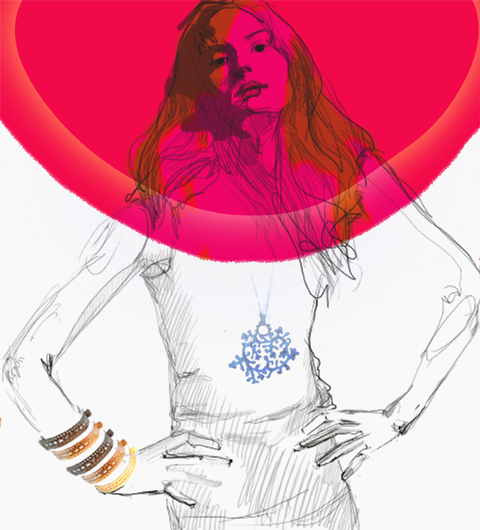


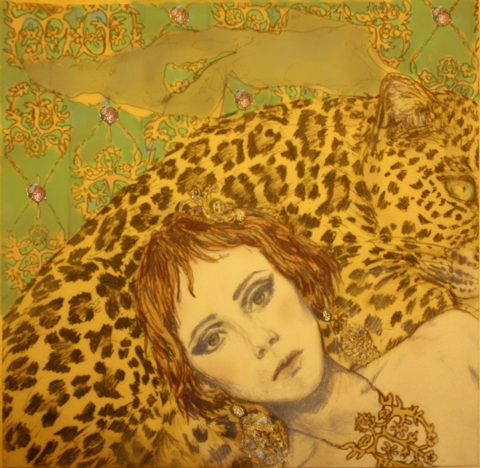


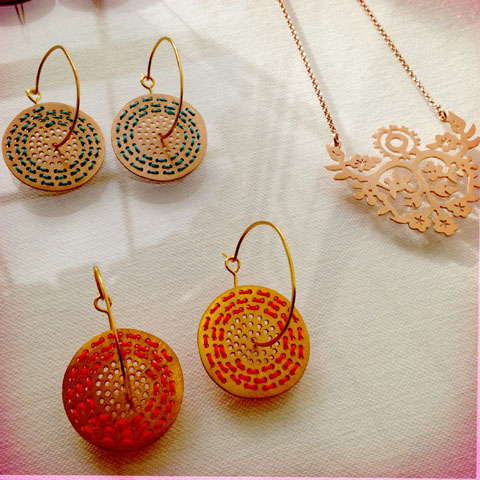


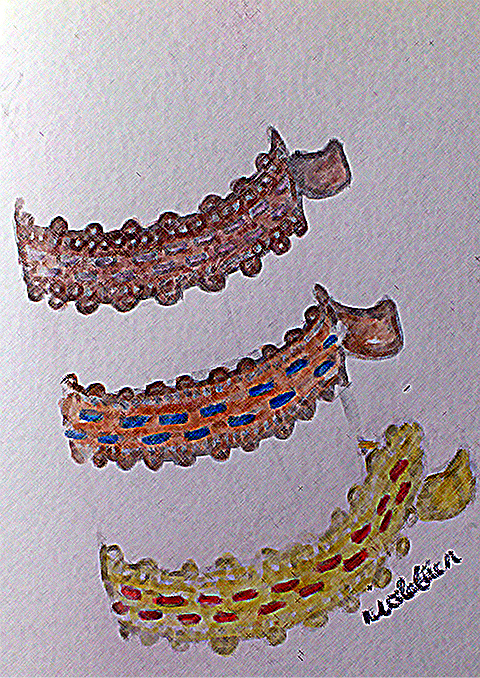


 UK Uncut gathers on the South Bank on Saturday 26th March 2011. All photography by Amelia Gregory.


 Inside Fortnum & Mason. They look super scared don’t they?


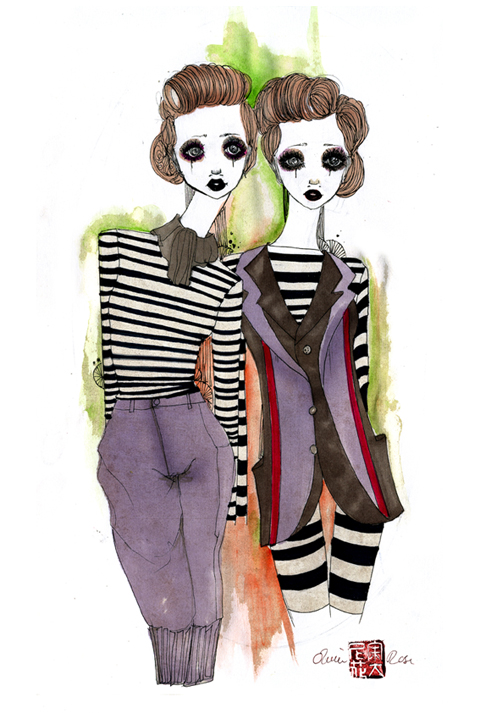


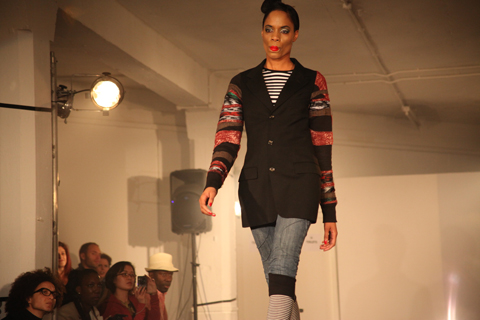

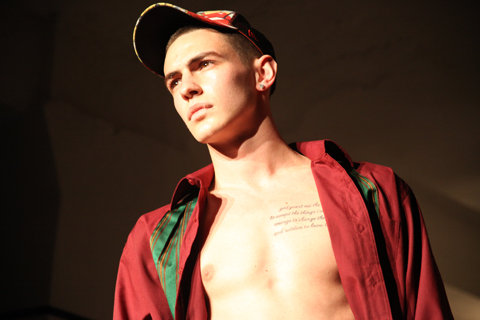


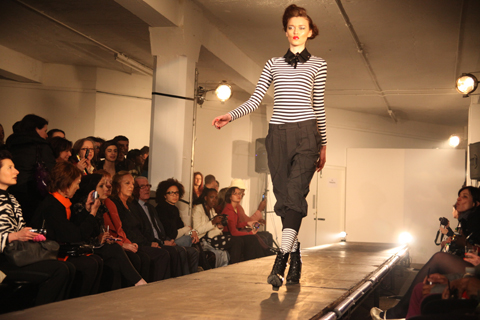
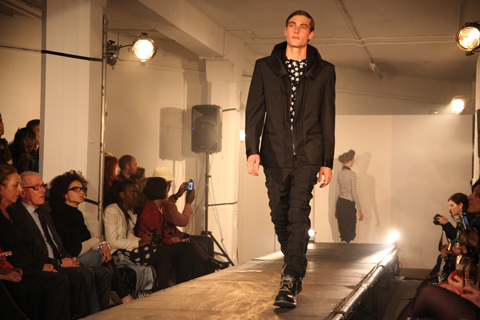
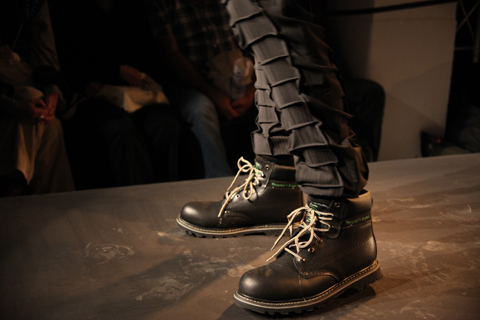

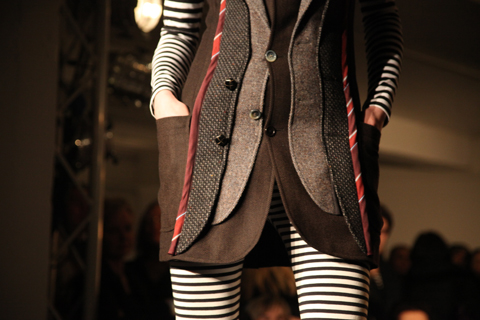
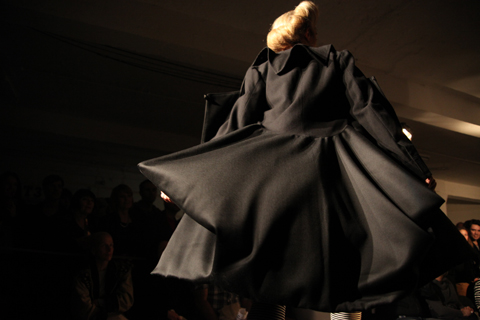


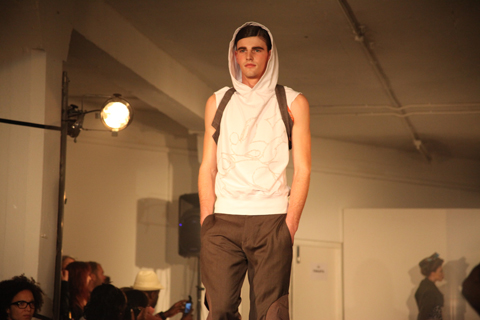

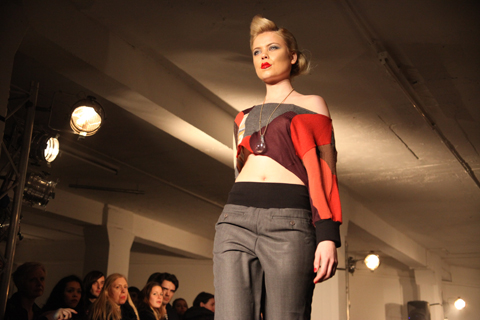

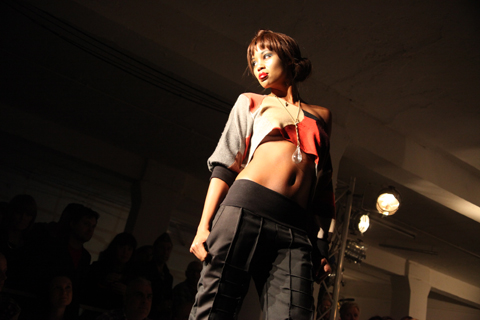


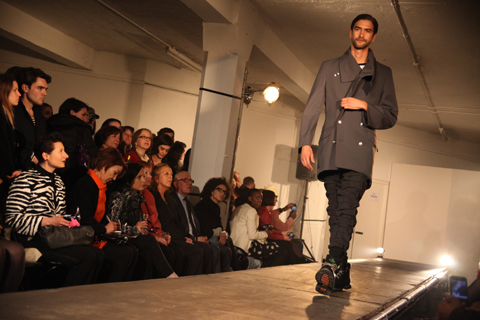

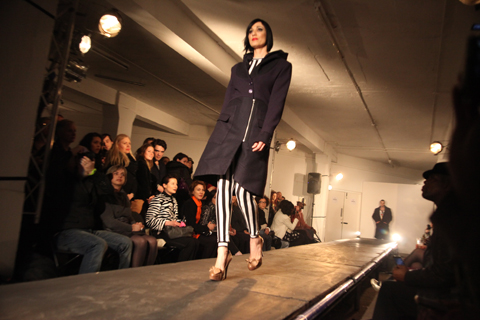

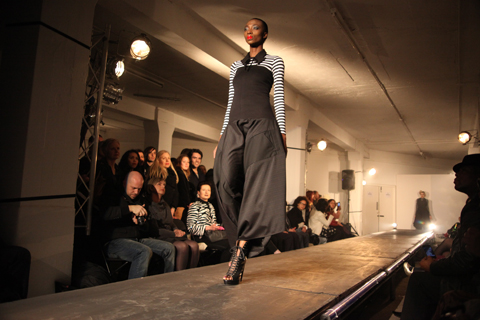


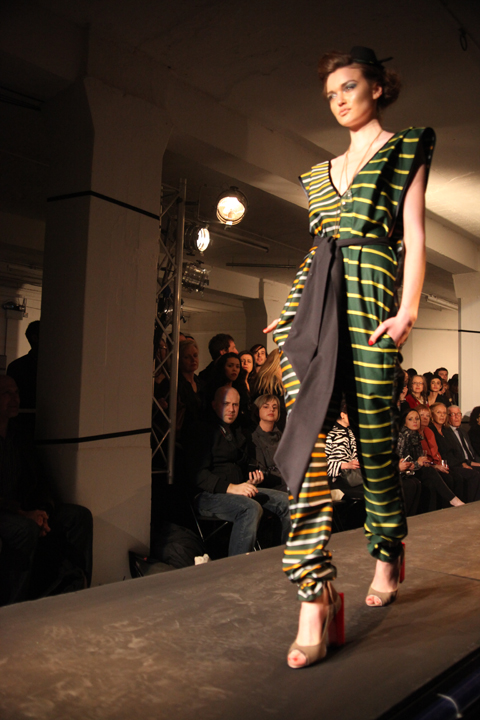


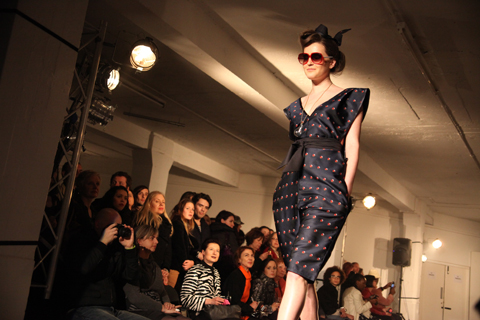
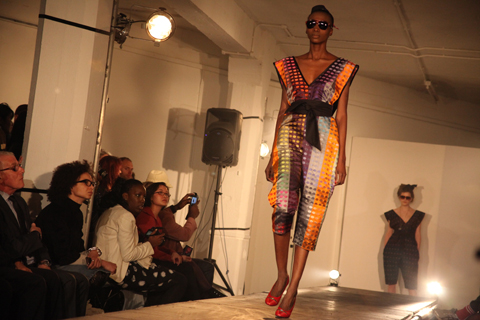

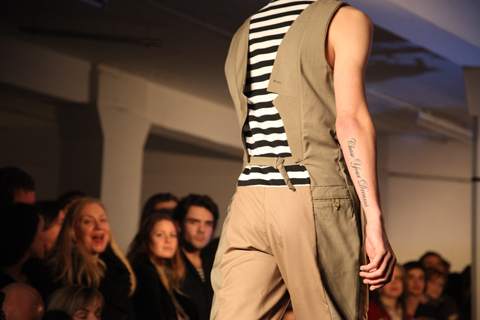
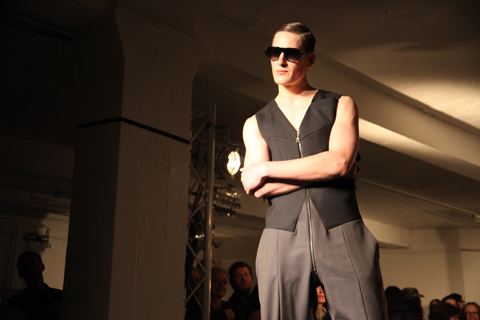
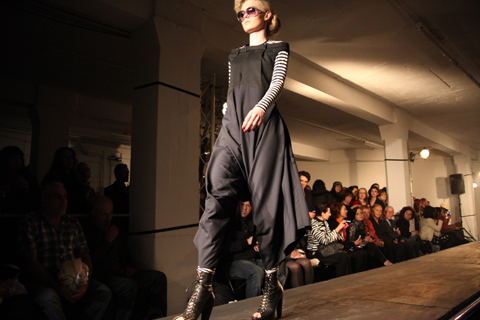


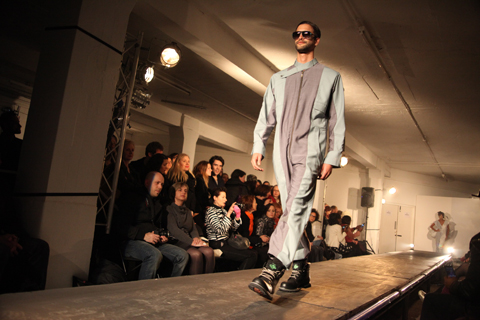

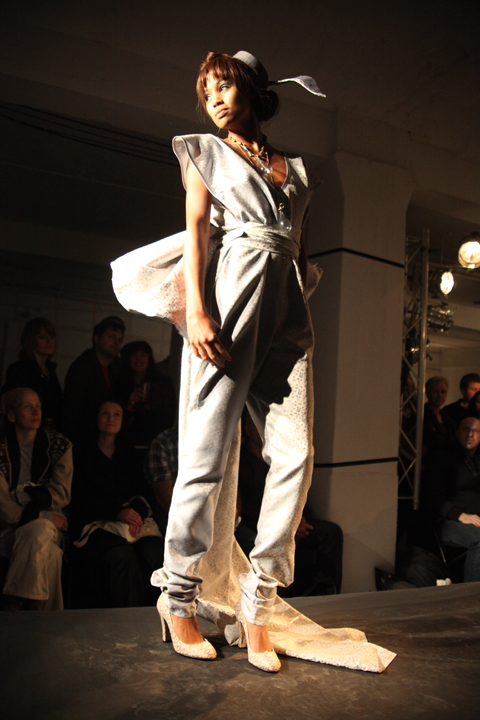
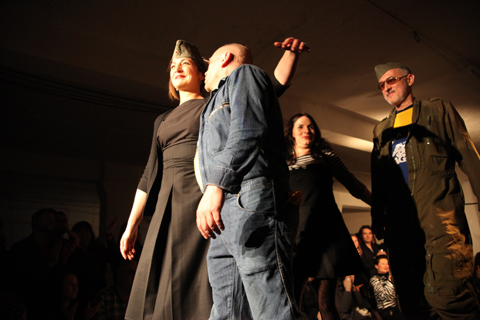


 Cushions by Caitlin de Hinshelwood


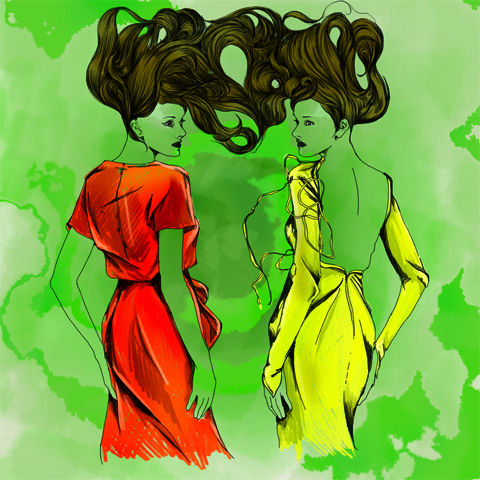

 pharmacy Photography by Amelia Gregory” title=”Find Your Feet Honey’s Dance Academy, Photography by Amelia Gregory” width=”480″ height=”320″ class=”aligncenter size-full wp-image-38157″ />