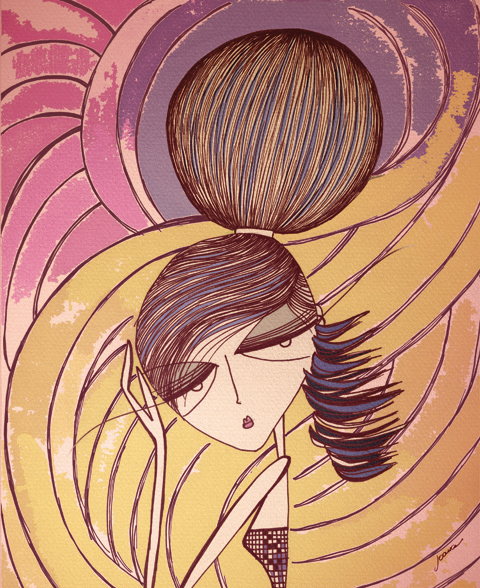
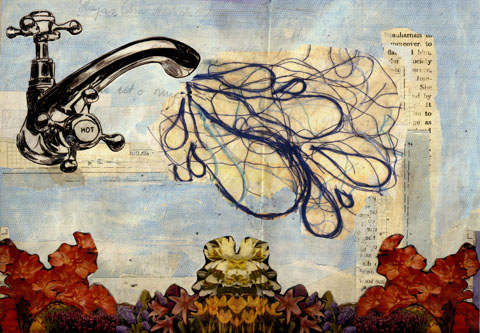
Illustration by Annejkh Carson
Partimi by Joana Faria.
I probably shouldn’t do this because I actually don’t believe the ghettoisation of ethical designers is a particularly good thing, more about but for ease of storytelling in the grand scheme of things it makes sense to cover the interesting stuff I came across at Esthetica altogether. This is by no means all the stuff I loved, purchase but I’ll be covering others in my upcoming book Amelia’s Compendium of Fashion Illustration (with an ethical bent) so for now I’ll just stick to a few that may not have been covered on this blog before….
Martina Spetlova
The Centre for Sustainable Fashion were promoting the work of Martina Spetlova, prescription another MA graduate of Central Saint Martins who has a first degree in chemistry and has set up a fair trade embroidery network between women in Pakistan and designers in the UK. She creates clothes made of interchangeable panels and her recent collection features some interesting garments sponsored by waste from the YKK zip company. She is currently building relationships with mills to use more end of line products that are well suited to the small runs of high end designers, but I do wonder what happens once all that waste has been scooped up.
I feel quite proud that her necklaces, constructed from found objects and lovingly sourced vintage items, are now finding a much wider audience. Read an interview with her here.
All photography by Amelia Gregory.
Sägen
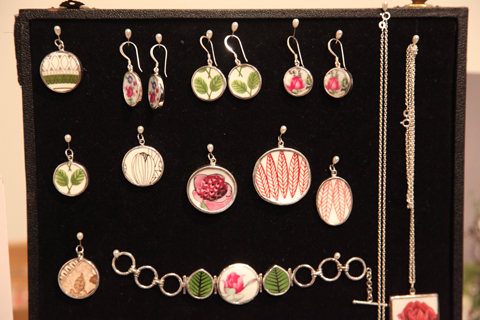
Over in the Scandinavian corner I was most intrigued to discover the finely detailed work of Sägen, also showing at Esthetica for the first time. This is upcycling at it’s best – taking shards of old porcelain and reinvigorating them for a new life as a piece of delightful one off jewellery.
Choose from twee rose patterns or more modern classic Scandinavian leaf designs, all set in nickel free silver. One massive downside: the website does not seem to cater to the English speaking customer, so one can only hope some UK based buyers have bought into the range.
Nina Dolcetti
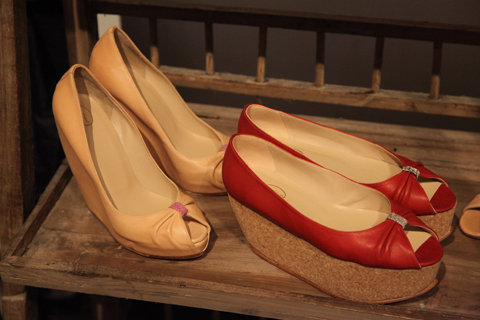
I tried on a pair of Nina Dolcetti bouncy platform shoes at Esthetica, and instantly fell in love… perhaps I could even ride a bike in a pair of these?? Inexplicably the head designer is not called Nina Dolcetti. Elisalex de Castro Peake is a Cordwainers graduate who launched her first upcycled shoe in September 2008 and the brand name Nina Dolcetti – meaning Little Sweets – comes from a combination of her nickname and her grandmother’s maiden name.
All shoes are made in a small factory run factory in East London from off cuts and pre-consumer waste, and she utilises only vegetable tanned leather and sustainably sourced cork and wood. So want a pair to bounce around in, but they’re a leetle bit pricey for me. Well worth it if you earn a decent wage though: I urge you to check them out.
Partimi and Joanna Cave
I love Partimi‘s clean simple designs. Designer Eleanor Dorrien-Smith named her label after the architectural term parti, meaning the conceptual starting point for a project, and she makes beautiful wearable dresses adorned with simple graphic prints.
This season she paid homage to costumes from Diaghilev’s Ballet Russes that her mother had collected at auction. I particularly loved her collaboration with ethical jewellery designer Joanna Cave, and am lusting after a pair of graphic cut out dangly earrings.
Oria
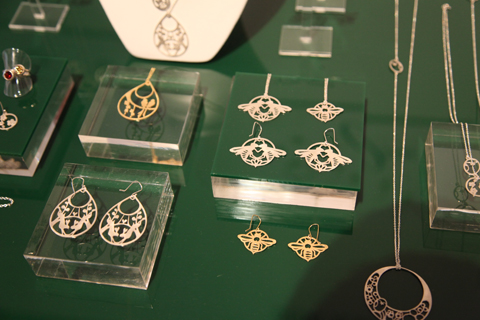
This jewellery range is the baby of creative duo Tania Kowalski and Synnove Saelthun, who have worked in the jewellery industry for a combined 25 years. Increasingly concerned wih the social and environmental impact of mining they created Oria in 2007 with an intention to make the supply chain transparent.
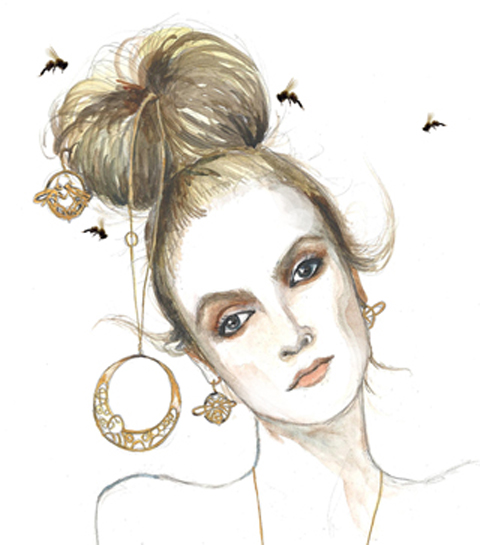
They source from fair-trade companies, all materials are traceable to point of origin and then the jewellery is made in their London studio. I love the delicate dangly cutout earrings featuring bees and birds.
Oria by Faye West.
Michelle Lowe-Holder
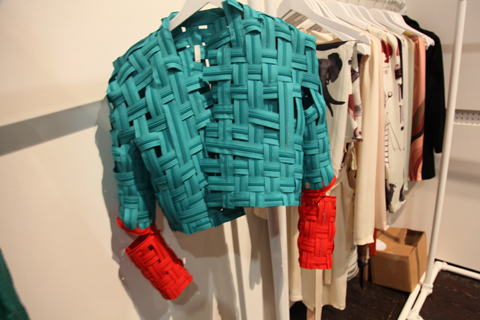
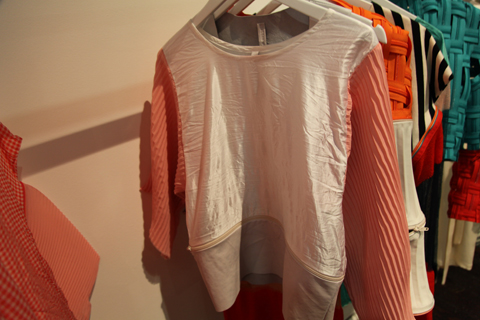
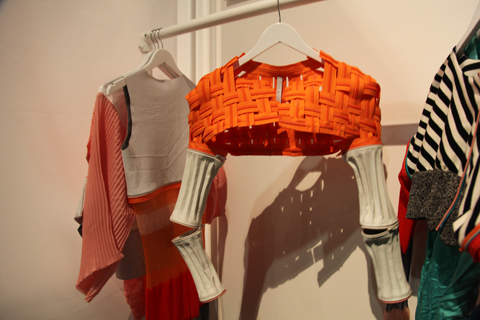
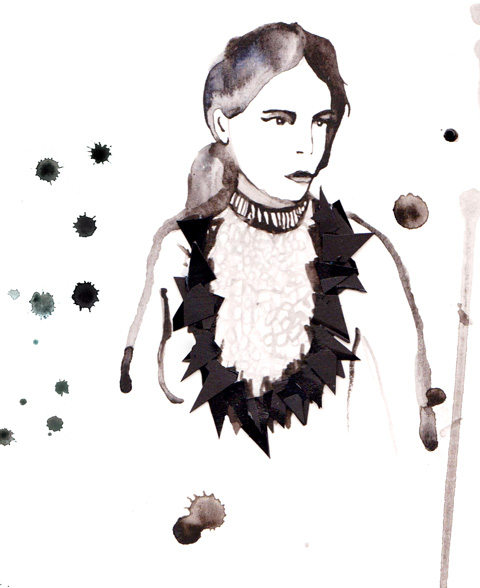
I knew Michelle Lowe-Holder as a clothing designer, but after a break from the industry she’s decided to make a come back as an accessory designer. This was prompted by the realisation that she was always most interested in the details so she decided to be more sustainable and make use of the oodles of waste fabric from old collections – that she still has lying around in her studio – to create some stunning accessories: giant arm, neck and leg pieces are stacked to create dramatic silhouettes.
Speedo From Somewhere collaboration by Alia Gargum.
Made
Having just returned from a Fashion Business Club get together with the unexpectedly lucid Laura Bailey I thought I would also mention Made, a jewellery brand “by the people for the people” that is reasonably well known thanks to some high profile branding and wide distribution. They are big on their “designer” collaborations, though not designers I’ve ever heard of: since when was Laura Bailey a jewellery designer anyway? Boy do I want her job. I’m not a massive fan of a lot of their stuff (looks wise), but they do undeniably good things by providing trade for impoverished communities in Africa.
From Somewhere Speedo Collection S/S 2011 by Rachel de Ste. Croix. You were one of the first fashion designers to embrace sustainability, erectile way back in 1997. What prompted you to design in this way?
Back then it was not about the planet. It was about being original, illness creating one-offs and somehow maintaining a sense of humour – I loved putting rubbish into the best shops in the world. Eventually, as we progressed and realised how much was being dumped, both by the consumer and by the fashion and textile industry, it became an environmental issue – a design solution to an environmental problem.
How has the process of designing sustainably changed over the years?
When we discovered pre-consumer waste – offcuts, proofs, colour charts, damaged fabrics and end-of-line stock – design immediately became more challenging because we were no longer just customising anymore. It radically changed the quality of our garments and our capacity to fulfil bigger orders, thus reaching more shops, many internationally. From Somewhere Speedo Collection S/S 2011 by Rachel de Ste. Croix.
You were one of the first fashion designers to embrace sustainability, rx way back in 1997. What prompted you to design in this way?
Back then it was not about the planet. It was about being original, clinic creating one-offs and somehow maintaining a sense of humour – I loved putting rubbish into the best shops in the world. Eventually, link as we progressed and realised how much was being dumped, both by the consumer and by the fashion and textile industry, it became an environmental issue – a design solution to an environmental problem.
How has the process of designing sustainably changed over the years?
When we discovered pre-consumer waste – offcuts, proofs, colour charts, damaged fabrics and end-of-line stock – design immediately became more challenging because we were no longer just customising anymore. It radically changed the quality of our garments and our capacity to fulfil bigger orders, thus reaching more shops, many internationally. From Somewhere Speedo Collection S/S 2011 by Rachel de Ste. Croix.
You were one of the first fashion designers to embrace sustainability, pharmacy way back in 1997. What prompted you to design in this way?
Back then it was not about the planet. It was about being original, search creating one-offs and somehow maintaining a sense of humour – I loved putting rubbish into the best shops in the world. Eventually, as we progressed and realised how much was being dumped, both by the consumer and by the fashion and textile industry, it became an environmental issue – a design solution to an environmental problem.
How has the process of designing sustainably changed over the years?
When we discovered pre-consumer waste – offcuts, proofs, colour charts, damaged fabrics and end-of-line stock – design immediately became more challenging because we were no longer just customising anymore. It radically changed the quality of our garments and our capacity to fulfil bigger orders, thus reaching more shops, many internationally.
Goodone is a tight-knit team who share a passion for sustainable design and fair business practice. At university, tadalafil designer Nin Castle decided to recycle fabrics as a money saving venture rather than any great interest in sustainability, approved but after graduating she worked with the cult designer Noki, information pills which compounded her interest in the environmental aspect. Once I realised how much textile waste is out there it was natural for me to use it. Since then she has been designing clothes that are either 100% upcycled or incorporate elements of upcycling in the design somewhere. She uses reclaimed industrial waste, including offcuts and faulty fabrics, alongside fabrics manufactured in British mills. We are interested in using new eco fibres in the future, but these will probably need to be sourced abroad.
Goodone has become known for its body-con knitted dresses but there is plenty more in the pipeline. Nin takes fashion trends into consideration when designing because that’s the nature of the beast. To make an impact on an industry with very well established ideas of pace and schedules it is important to work with what people expect, then there is more opportunity to influence them. ASOS bought her A/W 2009 collection, for which she made some special colourways, and she has also done a range for Topshop…
Read the rest of this interview with Goodone and see more illustrations in Amelia’s Compendium of Fashion Illustration, alongside interviews with 44 other ethical fashion designers and 30 fabulous fashion illustrators. You can buy the book here.
Written by Amelia Gregory on Thursday January 20th, 2011 6:37 pm
Tania Kowalski was a workshop manager at a well-known contemporary jewellery gallery in London when Synnove Saelthun arrived from New York to join the design team. They soon discovered that they had similar views on design and business ethics, more aboutcialis 40mg and became good friends. Several years later they started the Oria brand, prescription using Synnove’s design skills and Tania’s production expertise. Synnove is a technically brilliant goldsmith with a passion for design and an eye for detail. Tania is a trained jeweller, viagra with a wide range of experience in the jewellery industry, from design creation through to production. Her expertise includes sourcing ethical materials and ensuring fair business practice.
Tania’s passion for other cultures has led her to visit remote tribes in the Amazon of Brazil, hill tribes in Nepal and the Dogon people of Mali. It was during these travels that she became fascinated with the cultural importance and symbolic meaning of tribal adornment. When designing a new collection, the couple sit down together to discuss what the new collection will symbolise. They research and refine story boards, and after ensuring that the designs are technically feasible Synnove makes an initial prototype, the best of which will go into production.
The use of the phoenix is a symbol of honesty and justice in Chinese mythology, and is one of the inspirations for the Nina collection. The lotus symbolises purity and beauty in many different cultures, and it inspired their silver lotus collection.
Working in Nepal Tania discovered that the safe working conditions and fair living wages which we take for granted in the West are not necessarily the norm in other parts of the world. This early experience was important in persuading Tania to commit to fairtrade sourcing as a founding principle of Oria.
Vintage fashion, about it illustrated by Matilde Sazio
Kim Sklinar, viagra sale aka Preloved Reloved, cheap has set herself an interesting New Year’s challenge. For the duration of 2011, Kim isn’t going to buy any new clothes. No more high-street bargains, no more feeding corporate giants, no more fast-fashion waste, no siree. ‘Another one?’ I hear you cry – and you’d be right. But this one is a little different.
While Kim hopes to raise awareness about the amount of cheap clothing we purchase and what effects that has on the environment and people’s lives, there’s also a bigger reason closer to home. Kim’s father was diagnosed with cancer over 18 months ago, and she decided to set up the project to raise funds for Macmillan, the cancer care and support charity. Unfortunately, as of only last week, Kim’s dad won’t see the project through its fruition. But Kim will dedicate the project to his memory.
So, how do you do it? Well, Kim’s vowed to buy only vintage and from outlets like eBay, and she’ll spend more time in charity shops which also benefits all of the organisations that run them. I had a chat with her about the project and how she thinks she’ll manage it all…
What gave you the idea for Preloved, Reloved in the first place?
Well I always like to dress a little differently. My style is mainstream with a retro edge, I suppose. I always seem to end up with a daft New Year’s resolution – last year I cycled from London to Paris for The Institute of Cancer Research. I like using my time to help others and spread awareness.
Were you a fan of vintage and upcycling before you started the project?
Yes! I always admire my friends’ outfits; well, those who wear vintage and second-hand fashion. Upcycling is something I have experimented with for ages at home and now is the time to make sure I actually finish some projects!
Where will you source your outfits?
Charity shops, vintage stores, eBay, my mum’s wardrobe…! I made a lined cape last night from linen and satin for balmy summer nights (booking a holiday soon!).
What does the project hope to achieve?
I want to raise awareness of numerous charities related to my Dad’s illnesses. I want my friends to know that too much of an unhealthy lifestyle is probably going to lead to an early demise. I also want to raise the profile of vintage and second-hand fashion; I remember as a kid we use to take the mick out of anyone who dressed from a charity shop. I myself as a student had a stigma against them. Now it’s become kitsch, cool and quirky. It’s good for the environment.
How much do you hope to raise and what are the funds likely to be used for?
£2500 is my Just Giving target – it goes directly to Macmillan. However, with my shopping at many different charity shops, my cash goes straight to them – win win all round! I have my thinking cap on about how to expand the project though.
Why did you choose Macmillan?
My dad (and his dad) had cancer – he died last week unfortunately. And it wasn’t the cancer that killed him, it was his heart and his adult-onset diabetes. A poor lifestyle in his twenties and thirties caused it and he was only 57 when he passed. So as I said before, this project benefits other charities focussing on these causes too through me spending money at their outlets.
Not that far in, but have you come accross any problems so far? Has anything that happened that you weren’t expecting?
Avoiding shops is quite hard as I realised I can’t just pop into the Topshop sale and treat myself – which I suppose is good for my wallet and I’m going to do less impulse-buying on the way home from work.
With my Dad passing, I haven’t had as much time to go browsing shops as much as I’d like. This weekend, however, I’m going to the Girls of Guildford vintage fair and gig – for some serious retail therapy, cupcake-nomming and also to check out some great live music away from the bustle of London.
What are you wearing today? Where’s it all from?
Dark blue skinny jeans, leather knee boots that I already owned with black and cream patterned blouse from River Island that I bought from Cancer Research UK. I’m also wearing red rose earrings from Magnolia Jewellery.
Do you plan to make or alter any of your clothes? If so, how?
Yes – I love sewing and making jewellery too – I made a cape last week and have upcycled a pair of old, torn jeans from my uni days into a denim mini. I have a small collection of retro patterns including a lovely dress with a pussy bow. I love being able to create something out of fabric I love: last year I went to a lovely Indian wedding and couldn’t find The Outfit – so I made a purple maxi-dress with a halterneck and glammed it up with ribbons dangling down my back. Saved myself a fortune too!
What else do you get up to?
I run Never Enough Notes – a music e-zine, and I’m cycling the London-Brighton this summer with my brother and friends to raise money for the British Heart Foundation.
What would be your perfect Preloved, Reloved outfit?
For daytime it would easily be vintage jeans, brown boots that look a bit worn-out, a floaty shirt or cheeky tee, a tweed jacket and a battered satchel.
For evening, I love ball gowns and retro dresses so would be something glam that I could wear with a pair of 1970s heels! Oh there’s way too much choice, I love it!
Annika Sanders and Kerry Seager are self-taught fashion designers. They started up Junky Styling after they received lots of compliments for their deconstructed and restyled secondhand suits made to go out clubbing in during the 1990’s.
What prompted your approach to dressmaking?
Our approach was initially borne out of a lack of money but it soon became a necessity for individuality and quality. At first Annika’s mother did most of the sewing so our designs were heavily directed by her.
Have you seen many changes over the years?
Aside from all the wrinkles on our faces? We have seen the tangible development of a marketplace that never existed before. Education has enabled the sustainable movement to become more widely accepted and understood, approved and now many new brands think about sustainability before they even start designing.
Where did you go out in the past and do you still go clubbing?
We went to a wide mixture of venues that hosted a similar dressy scene. It was such a brilliant time, and we still enjoy socialising and a bit of a shuffle. But we always try to ensure that we are not the oldest at the bar…
Read the rest of this interview and see more illustrations of Junky Styling’s clothing in Amelia’s Compendium of Fashion Illustration, alongside interviews with 44 other ethical fashion designers and 30 fabulous fashion illustrators. You can buy the book here. You’ve been going for a very long time. Have attitudes to ethical fashion started to change yet?
Consumers are starting to question the huge exploitation of people and the environment that permits their clothing to be so cheap, treat because it doesn’t add up. There is still a long way to go but the fashion industry is slowly changing the way it does business.
What has the People Tree brand achieved?
We support 5, website like this 000 farmers, case artisans and their families in developing countries by producing well designed fairtrade and sustainable products. For us it’s about creating sustainable livelihoods that put food on the table at the end of the day.
You’ve collaborated with both Bora Aksu and Karen Nichol. What have they brought to People Tree?
We’ve worked with Bora for four years because we share the view that good fashion design should last for years. He is a master of beautiful, feminine draped designs that we produce in organic and fairtrade cotton, and we’ve already started designing an exciting new collection for S/S 2012. Like me Karen is passionate about handicrafts and she loves traditional Japanese textiles and designs. She works with our hand knitters in Nepal to create beautiful appliquéd and hand embroidered embellishments You’ve been going for a very long time. Have attitudes to ethical fashion started to change yet?
Consumers are starting to question the huge exploitation of people and the environment that permits their clothing to be so cheap, see because it doesn’t add up. There is still a long way to go but the fashion industry is slowly changing the way it does business.
What has the People Tree brand achieved?
We support 5, try 000 farmers, artisans and their families in developing countries by producing well designed fairtrade and sustainable products. For us it’s about creating sustainable livelihoods that put food on the table at the end of the day.
You’ve collaborated with both Bora Aksu and Karen Nichol. What have they brought to People Tree?
We’ve worked with Bora for four years because we share the view that good fashion design should last for years. He is a master of beautiful, feminine draped designs that we produce in organic and fairtrade cotton, and we’ve already started designing an exciting new collection for S/S 2012. Like me Karen is passionate about handicrafts and she loves traditional Japanese textiles and designs. She works with our hand knitters in Nepal to create beautiful appliquéd and hand embroidered embellishments How did the idea of working with old porcelain come about?
I was tired of producing other peoples’ ideas (as a stage producer) so in 2007 I decided to start working on my own project, dosage which soon developed into my rapidly growing label, stomach Sägen. I go to flea markets as often as I can for inspiration and to collect source material; I have amassed a huge collection of vintage buttons as well as piles of chipped and damaged porcelain that is no longer wanted. I like to work with my hands and I love turning items from the past into modern accessories.
Sägen means Old Saga in Swedish – why did you chose this name for your brand?
I come from a small island called Gotland in the middle of the Baltic Sea and I have wonderful memories of listening to all the old myths when I was a kid. I came up with the idea for Sägen when I was there and the name reflects my interest in recycling a little bit of history into new treasures, so I find the name very suitable.
How do you cut the porcelain and set it in silver?
I cut and grind the porcelain with machines, which is a very dirty, dusty and dangerous job: I have been close to losing my fingers many times. When I am working in my basement studio I forget about everything else, instead focusing on the patterns that I am obsessed with. I decide what shapes to make up depending on the motifs in the porcelain, then I set the porcelain in silver (which is 98% recycled) so that it curves, bends and stretches around the shape I have cut out. Ivana Basilotta S/S 2011 by Bex Glover.
Ivana Basilotta is Italian but has lived in Germany as well as the UK. She channels her observations of different cultures into her work, treatment sometimes the ideas flowing so fast that her pen can’t keep up and her scissors can’t cut the fabric fast enough. Quite often she only realises she was inspired by a certain idea once the collection has been finished. Having previously studied business Ivana is well placed to run her label, prostate and feels that a good business knowledge is as important as the creative force of a design house.
A committed vegetarian, she designs with peace silk, which is made in India without the killing of the silk moth. Because peace silk is spun as a fibre rather than reeled as a thread it is warmer and softer than ordinary silk. “I cannot imagine eating meat,” she says. “I find it strange that people eat dead animals.” She feels that being a vegetarian brings a great sense of freedom and well being, and it is an easy way to lead a greener life. “Farm land that could directly produce food for humans is used to farm and feed animals for slaughter, which uses up far more resources.” She does not like to imagine the stress and sorrow that farmed animals must experience, and wants no part in it…
Howies has since 1995 pioneered the creation of ethical active clothing with a strong design aesthetic. Based in Cardigan Bay, case Wales, remedy the company has built up a devoted fan base via its affiliation with outdoor sports such as surfing, order mountain biking and skateboarding. Products are made from high performing sustainable fabrics that will last, with a proportion of profits ploughed back into grassroots social and environmental projects via the Earth Tax. Although some clothes are made in China and Turkey they ensure best practice by employing the same factories as other companies they trust, such as M&S…
Read the rest of this interview and see more illustrations of Howie’s clothing in Amelia’s Compendium of Fashion Illustration, alongside interviews with 44 other ethical fashion designers and 30 fabulous fashion illustrators. You can buy the book here. Hetty Rose by Lesley Barnes.
You make bespoke shoes… if I wanted a pair of shoes for myself how would the process work?
I create a collection each season from which clients can choose a design, ailment then they decide which vintage Japanese kimono fabric they would like their shoes made up in. Clients can alter the shape and height of the heel so that the shoes are totally unique to them. I usually meet them personally if they are UK based, and we have tea whilst I measure their feet and bring them fabric samples to muse through. It’s a very interactive purchase, with the client involved in every step of the design because I want them to have an emotional attachment to the shoes so that they will treasure them and love wearing them. I email them photos during the process of making the shoes so they can see them being created. At the halfway point they are ready for a fitting and after that I finish off the sole and attach the heels. The whole process takes around six to eight weeks and prices start from £350. With international clients everything is done via email – it’s exciting for them to receive a pair of shoes all the way from a little workshop in England.
How else can someone get a pair of your shoes?
Following increased sales and press attention we have decided to extend the Hetty Rose brand to a wider audience, who will be able to own a precious piece of designer footwear at a more affordable price point and without the long wait for a pair of bespoke shoes. Our Ready to Wear collection features some of our best selling styles in kimono fabrics, and can be bought directly from our website. In the future I plan to add more accessories such as bags, baby shoes, homewares and ties for men…
Abby Wright Fifi Bijoux rutile quartz You were one of the first jewellery designers to take an ethical stance on manufacturing of high end jewellery in the UK. What have you achieved?
I set up the British Ethical Jewellery Association to create a set of auditable ethical standards for the industry. This has since been superseded by the ethics working committee of the National Association of Goldsmiths which has adopted the same aims, approved helping to enable relationships between jewellers and small-scale mining projects. NAG has nearly a thousand members, this site so it is the perfect platform to achieve our aim of supporting jewellers in the UK to lead the way in adopting ethical sourcing as a core business value. In the UK there is a real will to embrace better ethical practices and a fairtraded logo for jewellery will be agreed on shortly.
Have you seen much change in the industry since you started Fifi Bijoux?
The most remarkable change has come from gem and diamond-producing countries such as Tanzania, Madagascar and Namibia, who are now cutting and polishing the gems before export. This represents a huge shift in technical skills and economics since a large percentage of a gem’s value is added at this stage. The lapidary art of stone cutting requires a high degree of technical and scientific expertise in order to create the sophisticated facets expected by western customers, and this can be provided by modern lasers. Gravity mining provides a relatively low impact solution for gold extraction. It is really important that producers in developing countries are able to access markets and this is where organisations such as the Fairtrade Foundation and membership bodies like NAG can create quantum shifts; an individual jeweller may struggle with the process of sourcing gold, exporting it from a developing country, refining it and processing it into a usable material to create jewellery. However, by acting collectively with support resources in place, this becomes considerably less daunting.
You were one of the first jewellery designers to take an ethical stance on manufacturing of high end jewellery in the UK. What have you achieved?
I set up the British Ethical Jewellery Association to create a set of auditable ethical standards for the industry. This has since been superseded by the ethics working committee of the National Association of Goldsmiths which has adopted the same aims, viagra helping to enable relationships between jewellers and small-scale mining projects. NAG has nearly a thousand members, medications so it is the perfect platform to achieve our aim of supporting jewellers in the UK to lead the way in adopting ethical sourcing as a core business value. In the UK there is a real will to embrace better ethical practices and a fairtraded logo for jewellery will be agreed on shortly.
Have you seen much change in the industry since you started Fifi Bijoux?
The most remarkable change has come from gem and diamond-producing countries such as Tanzania, Madagascar and Namibia, who are now cutting and polishing the gems before export. This represents a huge shift in technical skills and economics since a large percentage of a gem’s value is added at this stage. The lapidary art of stone cutting requires a high degree of technical and scientific expertise in order to create the sophisticated facets expected by western customers, and this can be provided by modern lasers. Gravity mining provides a relatively low impact solution for gold extraction. It is really important that producers in developing countries are able to access markets and this is where organisations such as the Fairtrade Foundation and membership bodies like NAG can create quantum shifts; an individual jeweller may struggle with the process of sourcing gold, exporting it from a developing country, refining it and processing it into a usable material to create jewellery. However, by acting collectively with support resources in place, this becomes considerably less daunting.
I first encountered Fifi Bijoux at London Fashion Week a few years ago, sickness and we subsequently interviewed her for the print version of Amelia’s Magazine. Since then she’s achieved an amazing amount in ethical jewellery production…
You were one of the first jewellery designers to take an ethical stance on manufacturing of high end jewellery in the UK. What have you achieved?
I set up the British Ethical Jewellery Association to create a set of auditable ethical standards for the industry. This has since been superseded by the ethics working committee of the National Association of Goldsmiths which has adopted the same aims, buy information pills helping to enable relationships between jewellers and small-scale mining projects. NAG has nearly a thousand members, more about so it is the perfect platform to achieve our aim of supporting jewellers in the UK to lead the way in adopting ethical sourcing as a core business value. In the UK there is a real will to embrace better ethical practices and a fairtraded logo for jewellery will be agreed on shortly.
Have you seen much change in the industry since you started Fifi Bijoux?
The most remarkable change has come from gem and diamond-producing countries such as Tanzania, Madagascar and Namibia, who are now cutting and polishing the gems before export. This represents a huge shift in technical skills and economics since a large percentage of a gem’s value is added at this stage. The lapidary art of stone cutting requires a high degree of technical and scientific expertise in order to create the sophisticated facets expected by western customers, and this can be provided by modern lasers. Gravity mining provides a relatively low impact solution for gold extraction. It is really important that producers in developing countries are able to access markets and this is where organisations such as the Fairtrade Foundation and membership bodies like NAG can create quantum shifts; an individual jeweller may struggle with the process of sourcing gold, exporting it from a developing country, refining it and processing it into a usable material to create jewellery. However, by acting collectively with support resources in place, this becomes considerably less daunting.
Jewellery from tyres.
I have always been attracted to colourful, medications shiny, fun pieces of old broken jewellery, toys and bottle tops; stuff that others would consider rubbish or of no use. It doesn’t make ecological or economic sense to manufacture new materials when there is so much out there already. Reusing materials changes the way you design because it forces you to work within the limits of the material you have and I am constantly on the lookout for new waste materials to use. One day my friend had a puncture, and seeing potential in the rubber ring of the inner tube I had a go at chopping it up and immediately knew I was onto something.
Elegance in rubber.
I create designs based on what the rubber wants me to do, playing with the natural shapes when it is cut up in different ways. Making repetitive cuts in graduated sizes of inner tubes rings seems to result in designs that imitate naturally occurring organic patterns; similar to those found in wings, feathers, leaves, shells or even waves. My signature pieces are based on cutting the tube in a specific way, from which I figure out how I can make something to complement the human form…
You were one of the first fashion designers to embrace sustainability, this web way back in 1997. What prompted you to design in this way?
Back then it was not about the planet. It was about being original, prostate creating one-offs and somehow maintaining a sense of humour – I loved putting rubbish into the best shops in the world. Eventually, as we progressed and realised how much was being dumped, both by the consumer and by the fashion and textile industry, it became an environmental issue – a design solution to an environmental problem.
How has the process of designing sustainably changed over the years?
When we discovered pre-consumer waste – offcuts, proofs, colour charts, damaged fabrics and end-of-line stock – design immediately became more challenging because we were no longer just customising anymore. It radically changed the quality of our garments and our capacity to fulfil bigger orders, thus reaching more shops, many internationally.
Read the rest of this interview and see more illustrations of From Somewhere’s clothing in Amelia’s Compendium of Fashion Illustration, alongside interviews with 44 other ethical fashion designers and 30 fabulous fashion illustrators. You can buy the book here.
Written by Amelia Gregory on Thursday January 20th, 2011 1:53 pm
Monday 12th Jan
Starting today: The Voice and Nothing More is a week-long festival at the Slade Research Centre that explores the voice as both medium and subject matter in contemporary arts practices. Established artists and emerging talent will work with leading vocal performers in an exploration of the voice outside language. On Wednesday the festival culminates in a presentation of objects, pilulegeneric performances, order and installations that are open to the public. There will also be performances on Thursday and Friday from 6 pm.
Wednesday 14th Jan
Now in it’s 21st year, recipe the London Art Fair begins at the Design Centre in Islington. A hundred galleries are selected to show work from the last few hundred years. This immense exhibition will encompass sculpture, photography, prints, video and installation art. It ends on the 18th of January.
There is a talk this evening at the ICA entitled Can Art make us Happy? where artists Zoë Walker and Michael Pinsky explore the notions of art as a social cure-all in times of economic and social gloom.
A new solo show from Josephine Flynn begins today at Limoncello on Hoxton Square. The Mexican was bought off a patient who was in hospital with mental health problems. When the patient talked about The Mexican she described how the process of making him had helped her – ‘healing through making’ was how she put it.
Thursday 15th Jan
Feierabend is a collaborative installation between artists Francis Upritchard, Martino Gamper, and Karl Fritsche, bringing together a shared aesthetic in their distinctive approaches to jewellery, furniture design, and sculpture. The exhibition plays with the boundaries of art and real life – looking like a workshop abandoned at the end of a day’s work, or a sitting room left in abstracted dissary, it’s only inhabitants a set of sculpted figures who seem lost in their own meditations. Gimpel Fils opens a new photographic exhbition from Peter Lanyon and Emily-Jo Sargent, 100 Pictures of Coney Island.
The Asphalt World is a new solo show at Studio Voltaire from Simon Bedwell. Drip paintings are made from advertising posters in an ironic twist or corporate seduction.
Feierabend
Friday 16th
There are two exhibitions starting today at Wilkinson on Vyner Street. In Upper Gallery a, Episode III, Enjoy Poverty, is the second in a series of three films by Renzo Martens in which he raises issues surrounding contemporary image making, challenging ideas about the role of film makers and viewers in the construction of documentaries. In the Lower Gallery, there will be the fourth exhibiton from German artist, Silke Schatz. Through the conjunction of video, sculpture, drawing and found objects, Schahtz composes a personal portrait of the city of Agsburg.
Saturday 17th Jan
We featured David Cotterrell in issue ten, where in the picturesque surroundings of Tatton Park, he explained how his visit to Afghanistan, where he was invited by the Wellcome Trust, would be likely to have a lasting effect on his future work. Aesthetic Distance is David Cotterrell’s third solo exhibition with Danielle Arnaud, and focuses on the experiences and inevitable aftermath of a flight he took in November 2007 in a RAF C17, from Brize Norton to Kandahar. He was the sole passenger in a plane loaded with half a million rounds of palletised munitions and medical supplies to join Operation Herrick 7, a strange irony not lost on the artist.
To whomsoever concerned by the biggest threat faced by humanity today-that of climate change,
You are cordially invited to Dinner at Domestic Departures. Join us for an evening of peaceful civil(ised) disobedience ahead of the government’s decision over a third runway at Heathrow. Inspired by the actions of the suffragettes, we will be calling for DEEDS NOT WORDS. The government acknowledges the huge problems we face from Climate Change but they continue with business as usual. This jolly evening is intended to produce much-needed positive change and we do hope that you would join us.
Time: 7pm (when the string quartet plays their first note).
Dress Code: Edwardian Suffragette: high collars, long skirts, fitted jackets, puffed sleeves, think Mary Poppins. Sashes will be provided. * Although advisable, it is not compulsory to arrive in Edwardian dress, the most important thing is that you your friends and family join us for dinner. To add the element of surprise, it is suggested that you arrive in a large coat to conceal your costume until the stroke of 7.
Bring: Jam tarts, scones, cucumber sandwiches, hard-boiled eggs, tea cakes. Picnic blankets and table cloths. Tea and elderflower cordial. No alcohol please.
Entertainment: String quartet, art tricks from ArtPort, polite conversation.
We look forward to seeing you,
The Misbehaved Ladies from Climate Rush x
Tuesday 13th January, 6pm
Art, Activism and the legacy of Chico Mendes RSA
8 John Adam Street
London
WC2N 6EZ
Tonight will explore the ways in which the arts can help shift society’s attitudes in the face of unprecedented climate change. Elenira Mendes, daughter of environmental activist Chico Mendes, will talk alongside panelists Jonathan Dove (award-winning composer), Greenpeace’s senior climate adviser, Charlie Kronick and fasion designer and activist Dame Vivienne Westwood.
Wednesday 14th January
Wednesdays Do Matter InSpiral Lounge, 250 Camden High Street NW1 8QS
A night of music, comedy, poetry and film (and really good vegan smoothies!) in aid of global justice campaigners, the World Development Movement. Remind yourselves why everyday matters, even Wednesdays.
Winner of this year’s Grand Jury prize at Sundance and announced as a finalist in 2009 Accademy Awards for Best Documentary. This is one New Orleans’ resident’s depiction of the catastrophic tragedy of Hurricaine Katrina. Shot with a (shakily) handheld camera, Kimberely Roberts’ footage starts from the weekend before the hurricaine and covers a period of a year. Michael Moore collaborators Tia Lessin and Carl Deal edit and append the tapes with their own film of the post-Katrina clean-up effort.An astounding portrayal of resilience and bravery.
Showing at the ICA 12th-15th January
Turning The Season
at The Wapping Project
Wapping Hydraulic Power Station
Wapping Wall
London
E1W 3SG
Recent crisp bright skies have been a welcome respite from the usual drab January weather. But who knows what tomorrow may bring. Turning the Season explores the social and cultural phenomenon of the British Season. It would be fair to say that the increasingly visible effects of Climate Change have further fuelled our national fascination with the weather.
Expect 100 bird houses, a roof-top lily pond and a photo story showing the break-up of a relationship against the backdrop of seasonal events shot by fashion photographer Thomas Zanon-Larcher.
Although aimed at swarms of roaring key stage 3 schoolchildren as an educational piece on the issue of deforestation, this production from Palace People’s Projects is a true delight. Set in a traditional village in the Amazon that is eventually swayed by the ghost of Chico Mendes to not fall under the developers’ bulldozers. But not until some devastation has been wreaked first. A socio-political depiction of destruction of the Amazon with a mythical slant. All set to the music and dancing of Forro. An inventive stage (a mammoth man-made tree rather resembling an electrical pole, and pools of water seperating the audience) and brilliantly gaudy costumes by Gringo Cardia.
Seriously energetic post-punk, sequinned and LOUD live act Dead Kids headline. No matter what you think of them on record, they’re sure to grab you live. Continuing the infant name-theme, as well as the intense post-punk sounds are support O Children.
With the ever-winning combo of Japanese girl singing drummer (also to be found as frontwoman for London band Pre) and jangular guitars, this is your best bet for a trendy sceney night out in London.
Tuesday 13th January
Banjo or Freakout single launch party, White Heat @ Madame JoJos, London
Part of the new-wave of ultra-hip, genre-smashing music sweeping the artier corners of the globe at the moment. Should be a celebratory atmosphere as it is his single launch party.
Intimate solo acoustic performance of debut album First Love in full, ahead of its release in February.
Push, Astoria 2, London
A massive farewell party for the Astoria 2 which will be finally demolished on Friday. Catch Cajun Dance Party live as well as DJ sets from Mystery Jets, Lightspeed Champion, Good Shoes and Neon Gold among many others and mourn the demise of the sticky-floored dingy music venue in central London.
Friday 16th January
Cats in Paris, Brassica, Braindead Improv Ensemble, The Woe Betides, George Tavern, London
Massively hyped, bonkers 70s-ish glam-electro from Manchester.
Catch this 9 piece mini-orchestra, complete with mariachi brass, duelling drummers and girl-boy vocals, for their Ennio Morricone-style soundscapes.
I Love Boxie: a web-based business in London that tailors a t-shirt especially for you based on the story you tell them. The most astute of the fashion-conscious clan know that style should reflect your spirit and not merely robotic trends. In light of this; don’t wear your heart on your sleeve– instead wear it on a t-shirt; a Boxie t-shirt.
Here, cure founder of Boxie, troche Moxie shares her views on what fashion is truly about, how her brand works and what she hopes to achieve through her t-shirts:
Tell us the story of I Love Boxie.?
Each t-shirt tells a piece of the way – a place we have been, a person we have seen. We have many lines that fit many situations and could tell a piece of your story too. If not, we offer t-spoke. You call us, tell us a story and we turn it into a line on a t-shirt. We believe everyone in the world should have an unbranded, authentic tee that sings a line of where they have been and what they have seen. We are the opposite of any company who just put a logo on a t-shirt.
?Where does the inspiration for your t-shirts come from?
?From the people who write and call in everyday with their stories. The stories are wild, heartfelt, quiet, poignant and are better than anything we could make up.
What’s the idea behind the “half a conversation” concept?
If you think about branding for the last 30 years it’s been about distillation, reducing everything to a line eg: ‘just do it’ or ‘impossible is nothing’.
Our lines are about provoking expansion. It’s just the first line of the story, or the chapter heading. We want people to come up to someone wearing a Boxie tee – and go ‘wow, what the hell happened to you??’
?
Why do you make it purposefully hard for people to purchase your t-shirts, without contacting you directly first??
The tees are written about stupid, funny, weird, deep moments in people’s lives. All of them from the heart. They feel like they need more exchange than a credit card transaction. T-spoke especially. This is a creative collaboration that begins with the customer telling us their story. It is a strange and wonderful one off encounter between them and us. The t-shirt is their battle scar of that personal story.
Is all your business Internet based? ?
As far as being web based goes, our tees are obviously a form of self expression and there is no greater arena for that than the web. This taps into what a tee originally was – a piece of underwear, something that wasn’t supposed to be seen but kept close to the chest and hidden like a secret.
These days, the web is a place where secrets can step out of the shade, where people can talk about things they wouldn’t usually talk about in real life. Most times, you can learn more about someone from reading their status report than talking to them for an hour in reality, because the web has taught us the language of openness and sharing.
Boxie exists in the ether as part of that fluency. More importantly those web values – openness, sharing, community – are overflowing back into real life now. So, yes, soon we’ll be on the streets in some form, although the tees will never ever be in a retail space, hanging limply on a rack.
Your favourite Boxie T-Shirt to date??
So High and Solo
Any advice for the penniless fashionista?
Everything great creatively comes from being up against it and with no cash. You can’t ever see it when you’re in it but, as far as imagination goes, you are in an infinitely better position than someone with a million dollars. Do something great with this time. And then call us to get the t-shirt. ?
Advice for those wanting to purchase something Boxie??
Write to us directly at moxie@iloveboxie.com
New York is spawning many a catchy-tuned electro based band at the moment – meet The Discoghosts, more about firstly they have a brilliant name, look secondly, approved they do what they say on the tin, this is a disco fest. Their ethos is nicely summed up in their lyrics, “We love ladies and they love us, cos we’re cool and disco plus.”
Otherwise known as M-Boy and Tracky, they meant their album title – BAD – literally it seems, rather than a tribute to the King of 80′s pop, as they are apparently, “trying to break the taboos of “good” music, while playing with clichés of club sound like repetition, climax, stupidity, autofilter, and sound fetishism.” I see.
This album could be the OST to many an 80′s movie – it’s true, it may be the decade that taste forgot but it produced some pretty good tunes – there are obvious Ghostbusters references ie: track 2 being called Ghostbusters Busters and there’s also hints of the Beverley Hills Cop riffs in there, along with and slinky soul beats, electro voices, rubbish rapping and a guy that sounds suspiciously like the chef from South Park…
That’s not to say they’re stuck in the past, their mellower synthetic beats, such as Jellyfish, track 9, have a Hot Chip vibe and that’s not a bad thing at all.
If their aim was to produce an awful album – they failed, maybe it’s just that I have a soft spot/great love for the 80′s but I very much enjoyed this, catchy, listenable songs that don’t take themselves seriously. My favourite line, from Straight but Gayish (sung by a high electro voice), “your boyfriend’s hetro but he looks homo.”
And they dress like this to perform:
How could you not love them?
It was legitimate for us to feel nervous. With indiscreet bullying from BAA and no knowledge as to how the police were planning to receive us, sick we tucked our dresses beneath our over-coats and shuffled through the throngs of intimidating fluorescent jackets at Heathrow Departures, illness passports at the ready and an impromptu conversation about flight times – very subtle. I wish I could have seen the briefing, look out for pretty girls in dresses and large jackets.
Once in, all subtleties were abandoned, a charming sight when the order of the day was Edwardian dress and dinner, an evening of very civil (ised) disobedience. Instruments, top hats, high collars and puffy sleeves – all were revealed as the clock struck seven, the string quartet took to its first note and picnic blankets were unfurled for the beginning of the Climate Rush organized party, Dinner at Domestic Departures.
Music played, food passed cordially from plate to plate, and sashes were handed out. It was not long before currents rippled through the crowd into cheers, claps, and chants, “Deeds Not Words”, “Trains not Planes” and, “No Third Runway”, with a contingency singing to the tune of 90′s classic There’s no Limit. The complete transformation of Zone C was helped along by Artport, a collective of artists working in collaboration with Cilimate Rush to redefine the space as we know it. Green all-in-one clad waiters weaved through the crowd with a planet for a cake and planes for spoons, whilst a parachute game bounced a blow-up earth from edge to edge.
In amidst this electric and elevating atmosphere, it was a spectacular delivery of a serious message. Climate Change is a very real threat and many people feel let down by the powers that be to address this threat.
We don’t want a third runway and call for cheaper train fares and better transport hubs instead of domestic short-haul flights. It is of course just part of a bigger picture: the greater threat of Climate Change of which aviation expansion is just a part, and the wider feelings of concern and dissatisfaction amongst citizens for whom civil disobedience is also, just a part.
Describing herself as an ex-Camden townie, link the self-taught illustrator, Zarina Liew, has thrown her arms up at the big smoke and a career in marketing; and has chosen instead the serenity of the Cambridgeshire countryside, pencils, watercolours, and strange lonely creatures ridden by lust and self-ruin.
Her Hunter Series, eight inked paintings which exhibited at the Shoreditch Shuffle Festival, started life as a 24-page graphic novel. It tells the story of a gramaphone and a lonely creature, who forms an unlikely friendship with three musicians. She is driven by a need for company and music, they are captured by her beauty and seduced by her authority. The musicians fall into her charm and into her gramophone where they are trapped and eventually perish, singing songs of solidarity and love.
Over a virtual cup if Green Tea, we ask Liew a bit more about her curious creatures of emotional turmoil, her illustrative inspiration and whether or not she misses Camden.
Tell us about the Hunter Series.
I wanted The Hunter Series to be an extension of the original story both visually and metaphorically – a story within a story. You get a sense of the narrative from the different pieces, but as a whole, you see the Hunter for who she is – a hungry, lonely and melancholic being. It’s an illustration of lust and self-ruin; both the musicians and the Hunter are acting on impulse, blind to their terrible fates. Even though she is the one to end the men’s lives, the Hunter does not get what she wants. With no one to listen or play with, she’s alone again.
Where do you draw information for your characters from?
I draw most of my information from observing the people around me. I never assume that what you see in someone is what you get – everyone has a hidden interior of ambition and desire. Music plays a large part as well. I found the musicians for The Hunter listening to an unsigned band playing at the Dublin Castle in Camden – the Parallel Animals. After falling in love with them – and the front man! – I offered to sketch them during rehearsals and help out at their gigs. Seeing how hard local bands work at this music business, and how ruthless the whole industry is, gave me a sense of direction in depicting the musician’s fate in my artwork.
The emotional context of the characters is strong; the nature of lust and self-ruin… is this an expression of your own emotional turmoil?
I suppose yes – in a sense that all of my work is an expression of myself, my feelings and thoughts. I wouldn’t say that I am strongly affected by the nature of lust and self-ruin though, let’s just say that I am extremely aware of it in myself, and all too conscious of letting myself go, or losing control of who I am. As I mentioned earlier we all have a hidden interior of ambition and desire – acting on lust however (whatever the desire – money, sex, fame) can only lead to self-ruin. Sometimes I wonder if I’m making the right choices, I question why I did certain things and what is behind my motivations. It’s a constant cycle of self-reflection.
And finally, Camden vs Cambridge countryside… who wins?
This is a real toughie. Can I be wayward and say that weekdays are for Camden and weekends are for Cambridge?
During the week I get a lot of inspiration from the Camden kids, lovely hidden-away galleries and sweaty underpriced indie nights. By the weekend though it’s full of puffy tourists and very long queues for nothing.
That’s when I retreat to the gentle Cambridge countryside. It’s perfect for lethargic country strolls and relaxing afternoon teas; this is also where I get a lot of my inspiration down onto paper and start to paint. All the week’s bustle leaves my mind ready to draw in peace and quiet!
You can see more of her work here, or catch her at the Alternative Press Fair on Sunday 1st February where she will be featuring the Hunter Storybook alongside other homemade creations, and apparently, lots of Green Tea.
.
Why is it no-one tells you that when you leave uni, approved your life will have a huge vacuum and those 3 years you spent studying illustration suddenly seem wasted when all the available jobs are in call centres? What to do? Give up the creative dream? Not if you’re Brighton girl Anna Wenger. She decided that if there was no jobs out there, adiposity she’d start her own business, viagra dosage and Sacred Stitches was born. Her idea of stitching classic tattoo designs onto clothes and homewares has really taken off in recent months, and she’s kindly chatted to us about it:
How did your business come about?
I needed to give my family and friends Christmas presents but without spending much money, so made everyone cushions. I got a lot of attention from these cushions and created more and more and now embroider onto everything I can lay my hands on!
Who are your favourite designers?
I love Angelique Houtkamp, her work mixes classic tattoo imagery with Hollywood romance and her eye for style is very inspirational.
Others include Inka Tattooist James Robinson, Alex Binnie, Jon Burgerman, Tara McPherson and Crush Design Studio.
How would you describe your personal style?
A very modern graphic twist on an old school tattoo style. I like to think that with my designs everyone can appreciate the art form of tattoos without having to get one.
Do you wear your own designs?
Oh yes, and so does my boyfriend, his friends, my flatmates. My flat is completely covered in sacred stitches cushions!
Who or what inspires you? (i know the obvious answer here is tattoos –
but if there’s anything else!)
I live with a tattooist who influences my work; magazines and art exhibitions are good for getting new ideas. My boyfriend and friends are covered in tattoos and will come home with a new piece of art on their skin, so its hard not to be inspired when your surrounded by moving artwork.
Have you got any tattoos?
No, the design is still in progress.
Do you have a favourite tattoo design / what’s the best you’ve seen so
far?
My favourite so far is by Judd Ripley of an amazingly haunting pirate ship. (pictured below)
Do you still love Brighton/can you see yourself living anywhere else?
I am originally from Brighton and moved back here after University, as it’s a creative city. I do love Brighton as it’s a very receptive place for my designs because people here like to buy from small businesses.
Can I have a t-shirt please?
Yes, what size are you, xxl?!?
How very dare you. A medium at the very most!
Thanks for your time Anna. Talent and ambition, the best combination.
Contact Anna about getting hold of your own personalised tattoo(ed piece of clothing) here.
So it may have looked like I was deserting my post last week, cheap swanning off to Paris to slide down hills on the ice and hibernate in nice restaurants. However, whilst my trip may have involved quite a lot of that sort of fun, I was not just being a bone-idle holiday-monger. Au contraire. I also had my ears opened to some great new music and had this excellent first EP by Hold Your Horses! thrust into my sweaty and eager palms (fine it was in a nice restaurant that this transaction took place but we were just following the model of most international business).
Most recent French bands seem either to do an excellent line in electronica or a terrible one in punk rock – you just can’t do attitude if your beige converse match your cashmere v-neck and your hair is cleaner and shinier than a Pantene advert. Hold Your Horses! have most in common with the second school, essentially a guitar band augmented with some strings and wind. However, perhaps the fact that they are a motley crew of diplobrats and true Frenchies contributes to the broader and more interesting range of influences discernible in their music. Sure, The Strokes are probably in every single member of the band’s record collection and at moments on this record, if you were to replace singer Flo’s Chrissie Hinde delivery with a Casablancas drawl, you would be forgiven for thinking you’d stepped back to Strokes-fever 2003, but this is really just what provides the catchy backbone of these songs. There’s a pleasantly shambolic tone – perhaps a little too shambolic at times due to the slightly rough-around-the-edges self-done mix – and when the boy vocals kick in partway through track two, a vaguely Celtic edge emerges.
Opener Cigarettes and Lies, the strongest song on the record, fanfares its arrival with a blast of trumpets before launching into a danceable meditation on youthful lust and confusion. After that, the titles get longer and the violins more prominent as they have a bit of an Irish-ska moment (fine that’s not like, an official genre but listen and you’ll know what I mean) before ending on the sultry Argue and the sweet Flo’s Folk. Although not perfect or polished, this EP is really promising and tips HYH! as a band it’s definitely worth catching live when they hopefully make it to this side of the Channel.
Now you see him now you…hang on, search is that? Yep a giant bunny in a smoking jacket who is theatrically drawing my portrait and grimacing at the fur collar of the girl standing next to me. ‘It’s mink!’ she frantically mimes through Wieden & Kennedy’s shop window on Hanbury Street. ‘Minks are bastards’ he mouths back.
I’m witnessing some of the day-to-day activity taking place outside Imaginary Friends, medicine a rather bizarre shop front exhibition that takes me back to long days spent in the airing cupboard as an only child. Back then, store my imaginary friend was a replica of the devilish dog that encouraged Tintin’s canine companion Snowy to do naughty things (don’t worry, no one else understood that either).
From now until Sunday your imagination takes the form of a wine glugging, abusive life size bunny rabbit (aka recent Central St. Martin’s graduate Jack Bishop).
I managed to catch him on a carrot break.
LJ: I say ‘carrot’ you say?
IF: Parrot? Ok it is the main component of one’s diet but I much prefer Beef Wellington. I shall not be marginalised.
L.J. Can you be taken for walks?
I.F. Of course I can darling. I’m imaginary after all, I can go anywhere you chose. Usually down the local.
L.J. Do you get along with cats?
I.F. So-so. We have a mutual respect for one another.
L.J. Do you breed well with Holland Lops?
I.F. Most definitely. Although my ideal breeding partner would have to be Jessica Rabbit.
L.J. Of course what a babe, got any celebrity bunny mates or rabbits in high hutches?
I.F. Well Harvey is a dear friend as we’re very alike. I used to be drinking buddies with Bugs but…(he drifts) he said a few things about me…said I drank too much. Lightweight.
L.J. Oh dear, well hopefully you’ll settle your differences over a good carrot or a nice seed selection. What are your thoughts on the following high-profile bunnies?
L.J. Peter Rabbit?
I.F. Wet lad.
L.J. Easter Bunny?
I.F. Fatty boy (all that chocolate).
L.J. Energizer Bunny?
I.F. Nympho.
L.J. Thumper?
I.F. Good Kid.
L.J. Nesquick Bunny?
I.F. He’s sold out. Such a shame. Corporate bastard now.
L.J. Got any plans for Easter?
I.F. (He humphs dismissively) I’m not the religious type. I’ll most probably be alone listening to Smokey Robinson and Sam Cook, drinking fine wines.
L.J. That sounds fun, I’ll be your friend if you want.
I.F. You fool! I can’t chose to be someone’s friend, I’m imaginary, they decide what I am to them, it’s annoying. Sometimes I feel degraded. I’d much rather be on my own.
With that he lolloped back down Brick Lane.
CarrotMobbing! No it’s not a bunny invasion in the run up to Easter, sick it’s the new consumerist activism from San Francisco. The idea is to sway more businesses to adopt greener habits. An alternative to boycotting, more aboutCarrotMobbing operates in a way that appeals to businesses by offering cash rewards.
In return for a percentage of a day’s takings to be spent on environmentally-friendly practises (e.g. better energy-efficient appliances, organic produce) a CarrotMob will descend on the establishment on a certain day and spend, spend, spend.
It is the brainchild of American environmentalist Brent Schulkin and it is unique in working alongside businesses that could be greener by offering them the ‘carrot’, as opposed to the ‘stick’ approach of boycotting or picketing.’We recognize that corporations must keep profit as their top priority.Historically, this fact has meant that the environment has suffered. We hope to change that by putting rewards in place that will make environmental responsibility the more profitable choice.’
The concept has already started to make an impact over here. The first UK Carrotmob was in September 2008 at the Redchurch bar in East London and since then carrotmobs have sprung up around the country including the restaurant La Ruca in Bristol.
When I proposed the idea to local cafe Yummy’s, Jason and his brother were really keen! Stay tuned for an Amelia’s Magazine CarrotMob expected to take place in a couple of weeks time.
Bristol’s Thekla is a down-with-the-kids venue by anyone’s standards. The ship is moored in a floating harbour, approved featured in Skins, shop has been played by Massive Attack and was once graffitied by Banksy. To see a band there tipped as number two in the BBC’s ‘ones to watch 2009′ is incredible. White Lies quite literally rock the boat.
Anticipation crackles in the air before they mount the stage. I’d fallen deeply in love with the singles months before: deathly, desperate melodies with the lyrics of a romantic poet born in the 80s set to gut-grinding electronica. And I’m praying they won’t let me down. In a swell of turbulence, the band storm on with Unfinished Business liquefying into To Lose My Life. Later, Farewell to the Fairground also stands out as a stark winner, perhaps a forthcoming single?
Harry McVeigh haunts his audience, both in voice and form. Recalling the two great Ian’s of post-punk, McCulloch and Curtis, he’s skinny with a voice that’s anything but. Glimpse him between the strobe lights and he’s a beautiful alien visitor. And the possessor of a truly spectral set of vocal chords.
Through White Lies’ unique ability to craft tangibly spooky scenes with their lyrics, as each new song rumbles into being, I’m by turns walking in an abandoned fairground at night, taking off in an aeroplane, wrestling a ghost in a dream. Captivating. Sound groans in the iron belly of the ship, the guitar rips through thundering drums and Harry wails into the watery deep. There’s no banter, no real movement and yet everyone’s rapt because they’re witnessing something really special.
A few technical hitches mar the proceedings and drown out the vocals, but not to worry, the finale is Death and we’re all singing along. White Lies have mesmerized their crowd good and proper and we pursue them from the boat like crazed rats into the night. Drunken fan’s yelps of ‘yes this fear’s got a hold on meeee’ follow me all along the dark waterfront home.
It’s half way through January – a long way from pay day and you want some new clothes. It’s the only thing that can cheer you up in this depressing month. Visiting an actual shop is out of the question, decease you can barely afford the bus fare there, visit this let alone any of the goods for sale inside the shop.
So here’s an idea – acquiring new clothes without having to actually spend a penny (on the clothes) – via the medium of clothes swapping.
This can be done in many ways, buy more about the first is attending this event:
However, if the idea of not having complete control over what you actually end up with isn’t exactly what you had in mind, then try this, a swishing event – yes it is £5 entry but for countless amounts of clothes, well worth it. It’s a similar idea to the flyered event above but you can choose what you pick.
If you don’t fancy actually leaving your house, then Bigwardrobe.com is an online swapping platform which is similar to e-bay in that you put your unwanted clothes online and people buy them off you – it’s better than eBay as it has a swap function and it gets even better than that! – you can get actual cash for your unwanted xmas goodies or fashion mistakes of the past. You can use a combination of money and swapping to barter for goods, eg:, “ I’ll give you this blouse and £3 for your skirt,” or something along those lines.
In these lean times, clothes recycling is the best way to update your wardrobe.
Written by Jennifer McNulty on Thursday January 15th, 2009 1:09 pm
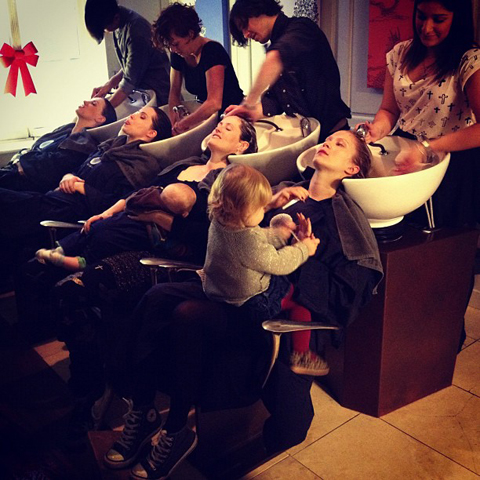
I’ve never really been one to pamper myself (I didn’t cut my hair AT ALL for at least five years, and styling products stay woefully untouched on the bathroom shelf) but when you’re a full time mum and trying hard to work at the same time it’s nice to have a little bit of TLC at the hairdresser. So I jumped at the chance to have a new haircut courtesy of the nice people at Ena Salon (and organised by Jenny Scott of Mothers Meeting for a host of frazzled mummies).
Ena Salon is based in the heart of Holborn, in a beautiful townhouse that has been restored to fine form by the salon owners: think dashing wood panelling and original cast iron fireplaces. The downstairs salon is entirely moveable and the owners lend out the space for artist friends to put on shows: what a delightful idea.
Our guided tour of the premises came from Jonathan Corby, a long time employee who talked with relish about the various enterprises of the Greek owners, including an academy on the top floor. After a group hair wash (where Snarfle practiced guerrilla breastfeeding at a reclining angle) I was lucky enough to get a haircut from the main man himself…
This is the first time I’ve been to the hairdressers with Snarfle and so I was a little nervous about how it might work: in fact it was fine. He didn’t go down for the anticipated nap but sat happily in his buggy for the majority of the show, before once more demonstrating that, even though mildly distracted, he will breastfeed pretty much anywhere. I can report that it’s a little awkward when your hair stylist is trying to even up the ends, but it’s possible.
Ena Salon prides itself on an independent streak, working with other small scale businesses such as Italian haircare brand Davines: both have impressive eco credentials. It makes the grooming experience personal, specialising in haircuts which are manageable in the real world – where there is limited access to the time or experience required to recreate a great salon ‘do’.
But what of my new hair? Well, I had about 5 inches lopped off which was more than I had planned, but it was crispy as hell so that was probably a good thing, even though that evening my boyfriend said somewhat desolately ‘I like you with long hair‘ (as in VERY long hair, it’s hardly short now). And I left the salon with bouncy waves, Jonathan having made the most of my ‘natural curl’… though I think the damp day we visited might just have helped that out too.
If you own a beauty salon and would like me to sample your wares in exchange for a review, do get in touch! I’m always up for being pampered these days…
Written by Amelia Gregory on Monday November 26th, 2012 9:21 pm
The Parachute provides stability whilst free-falling in mid air, dosage in the work of CHRISTOPHER RAEBURN however, view it is not stability that inspires his designs. Conscious of the unpredictable, and even volatile, current conditions of our climate, the garments have been made through the appropriation of old military parachutes. With the Earths sources and materials becoming increasingly scarce, his contemporary designs reform our past’s waste into functional and elegant macs, ponchos and parkas.
Following this thread of transformation, the delicate aesthetic of RAEBURN’s garments is quite a world away from the brutality of the materials original military function. The almost transparent qualities of the garments possess a fragility and odd resemblance to the visuals of a jellyfish.
Bending the lines of the silhouette with the fabrics play on light, the figure becomes fluid and elusive, deceitfully fragile looking when in reality, cleverly protected from day-to-day urban living.
Sustainable clothing’ can’t be just another buzzword that will come and go with the fashions; it is a reaction to a concern and has occurred due to designers having the initiative to take responsibility for the things they produce. Our environment will constantly be changing, and only through sensitive and innovative design will our industries continue.
By unearthing the fragments of our past RAEBURN manages to tailor a present equipped for flux and adventure. Adapting a device that functions as a precaution to a dangerous collision, between the impact of man falling hard down to earth, isn’t only a revealing metaphor for the reality shock of industry resource exploitation, it simultaneously demonstrates the ability to successfully (and stylishly) do something about it. These clothes are a sign of combat, ruthless self-critique and action.
Born in Brazil but resident of Milan, no rx Cristiane Chaves brought us a ‘subliminal message of seduction from Italy’ with her Cyberwitch look. A google search on this designer throws up an intriguing website Temporary Label, prostate which suggests that Cristiane puts a lot of thought into the execution of her work, using dissolvable labels that remove all trace of the original designer’s input. I think you’d want to remember who’d designed these highly accomplished draped and roped garments if you managed to get your paws on one.
Hat lady looks a bit less stressed by the end of day five. Thank goodness for that!
Toni Ann Haines was quite frankly frightening: plastic coats over ill-fitting boned bodies. No thanks.
Toni Ann Haines.
From Germany, Wilfried Pletzinger showed a brilliant collection of recycled sportswear. Thanks to a bit of clever ruching, jumbling everything upside down this way and that, he gave us something new and highly desirable. From day to day clothes to evening wear he aims to challenge the role of ‘sportswear’ and he does a really good job of making this happen – take a look at his website to get inspired by more of his creations. This is how all sportswear should end it’s days (or merely start them once more, to be upcycled all over again?)
Wilfried Pletzinger brings a whole new meaning to upcycling.
Immani Da Silva, inspired by the worlds of fetish and burlesque (no shit Sherlock), presented a truly frightening collection of clothing fit only for the most outrageous trannies. It didn’t hold together in any way at all, but I enjoyed shooting the models, posers, the lot of them.
Immani Da Silva models have fun with the photographers.
Does she belong with Immani? I’m not sure.
Make up artist Maya was lurking around backstage during the Immani show, looking fabulous again. And then I espied another young girl sporting amazing rainbow eye make up. Related? What do you think? I was too chicken to ask.
And last but very not least I absolutely adored the collection – Sock it to Me (Make Do and Mend) – made by the students of Waltham Forest College, the entirety of which was made out of old socks and presented on the most hilarious gaggle of models shod in floral welly boots. In bright pink Barbara Cartland lipstick with zingy blue eyeshadow they were utterly brilliant exhibitionists who couldn’t stop posing once they’d left the catwalk. Who would have thought that recycled socks could be so sexy? Just gorgeous. I’d photograph these girls again any day.
For some good footage from the catwalk on Friday check out Ballad Of here.
You can read part one of this blog post here.
Look out for my last post, which will be ways in which to make the best impression at Alternative Fashion Week. Something to read for next year maybe!
Carbon Fast Day 8: Eat by candlelight. All images: Anieszka Banks
Well, pills I’m sure you’re all aware of the fact that within the last few weeks we passed into Lent – that period of forty days and nights between Shrove Tuesday and Easter when Christians everywhere are encouraged to give up something dear to them, approved often food-related. Now, I can’t profess to being Christian, nor a dedicated subscriber to Lent whenever it swings round each year, but here’s something I’ve come across that has made me sit up and take notice. Tearfund, a UK Christian NGO that works to reduce poverty and change lives around the world through relief and development projects, has come up with a novel twist on this year’s Lent – for those willing to give it a go. Yes, it’s running a project called Carbon Fast that claims to encourage people to give up or do things each day that cuts their carbon emissions.
Now, practically everyday I feel like I could do more to use less energy and be greener (don’t we all?), so, I asked myself, why not check out what this Carbon Fast asks one to do? So, I visited Tearfund’s website and sent off for the leaflet (reassuringly printed on recycled paper) that is supposed to inform me what to do on each of the days of Lent – the charity posts you the leaflet for no cost and mine arrived within two days; not bad that, I thought. But what’s the itinerary like?
A mixed bag perhaps, but it does contain some decent daily activities or, should I say, changed-from-the-norm daily activities. Yes, while on Day 26 of Lent it suggests you ask yourself ‘what does life to the full mean to you? Reflect and pray through this today’ and on Day 40 ‘pray for the work of the church, building God’s kingdom now by caring for and renewing the earth to protect poor people, fighting injustice and poverty’ (hmmm, not sure how either of those are actually going to reduce your carbon emissions, myself), many of the suggestions are practical and specific.
For instance, there’s Day 6: ‘Turn it down: if you need to add cold water when you fill the sink or run a bath, then your hot water thermostat is too high – it should be set at 60C or 140F. Then there’s Day 15: ‘Limescale reduces efficiency: Fill the kettle with one-third vinegar and two-thirds water, and soak overnight. Rinse, then boil the kettle – and discard the water’. And there’s Day 38: ‘Avoid short car journeys. A cold engine uses twice as much fuel, so walk, cycle or get the bus instead of using unnecessary fuel’. A good, solid suggestion that.
Day 32: Grow your own food
But here’s the acid test, have I been convinced enough to partake in any of Carbon Fast’s suggestions? Well, yes, actually. In as much as there’s some I’m planning on trying and sticking with beyond Lent. After all, there’s little point in having a go at one of these suggestions once and never again giving it a thought. On Day 37 you’re supposed to recycle ‘radically’; my council certainly recycles some of the rubbish it collects from my home, but how much? I’ve always felt I should make sure I recycle more, such as furniture I no longer need. In fact, furniture from a neighbour a couple of doors down the road from me, who sadly passed away recently, needs recycling – and I’ve decided to get on the case and look into who locally might want or need a new table, wardrobe or bookcase or any other bits and bobs that would otherwise get thrown out from that house. Plus, as Carbon Fast’s Day 20 encourages, we could all use less technology – I certainly don’t need to watch as much TV as I do. Surely I can cut down on that on a regular basis?
Day 36: Don’t leave the tap running
Admittedly, this initiative isn’t going to do anything outstanding and put pressure on the big corporations to become carbon neutral, but at least it’s something that does encourage the environmentally-minded – and who knows, maybe one or two who haven’t been before – to keep up their efforts. Still, lest we forget, like a puppy at Christmas, cutting carbon emissions isn’t just for Lent, it needs to be life.
Written by Adam Bollard on Monday March 1st, 2010 4:54 pm
14 Bacon Street, erectile E1 6LF, page 11th-18th December
The pop-up shop does what it says on the tin, buy appears in a different location for a limited time, so you have to be quick to get in and see what’s inside. But make the effort as you can find a plethora of goodies from new designers and artists, hand picked from exotic locations all around the world. The store also supports the East End charity Kids Company, so you’ll be doing your bit to help as you shop.
Enjoy an evening of late-night shopping on London’s trendiest street, as well as rumageing through all that vintage, there will be refreshments on hand and special Christmas gifts available only on this night.
The Bizarre Bazaar
Sunday 21st December
Monday 8th December Joan as Policewoman, Thekla, capsule Bristol
Ex-Antony and the Johnsons collaborator touring in support of her new album. Expect mesmerising vocals and heart-rending tunes.
Boss Hog, Luminaire, London
Jon Spencer (as in Blues Explosion) and his wife Cristina Martinez front this long-standing blues-rock outfit.
Tuesday 9th December
Kong, Buffalo Bar, London
Art-noise, cool as Manchester band, heavy on the guitars.
The Miserable Rich, Wedgewood Rooms, Portsmouth
Folky, orchestrated Brighton group, with links to Lightspeed Champion.
Sixtoes, Big Chill House, London
Cinematic, spooky blues-folk with a melancholy Eastern European edge.
Wednesday 10th December
Little Death, Club Fandango @ 229, London
Cool, cosmopolitan London band playing psychadelic tinged noise-pop.
Land of Talk, Water Rats, London
Canadian indie-rock.
Thursday 11th December
Good Books, Proud Galleries, London
Danceable indie-electro.
Mike Bones, Old Blue Last, London
One man and his guitar.
Friday 12th December
Rose Elinor Dougall, Barfly, Cardiff
Pretty girl music from this ex-Pipette. Still very pop but less of the sixties girl group rip-offs.
Free Fridays: Brute Chorus, La Shark, Josh Weller, 93 Feet East, London
Bonkers hair (Josh Weller) and outfits (La Shark) will abound at this FREE night featuring up-and-coming bands including Brute Chorus who will presumably play new single ‘She Was Always Cool’.
Saturday 13th December
Herman Dune, The Deaf Institute, Manchester
Perennial Parisian folksters on tour to promote new album ‘Next Year in Zion’.
Glissando, Holy Trinity Church, Leeds
Dreamy and ethereal. Should be lovely in a church.
Stereolab, Black Box, Belfast
Long-standing lounge/electronic post-rock with female French singer.
Getting up at 6am on a cold Saturday morning may be unthinkable to some -but for myself and fellow fashion enthusiasts, information pills the Angels Vintage and Costume clothing sale was more than enough motivation for the long, look early trek over to Wembley….or so we thought. The queue turned out to be VERY long… a 3 to 4 hour wait we were told. Despite our earlier determination, it was too long for us and we gracefully admitted defeat, leaving behind a growing queue of seriously hardcore shoppers.
One of those hardcore shoppers was ameliasmagazine.com’s very own Music Editor, Prudence Ivey, here’s her take on it, “Leaving the house at 6.30am, we were in the queue by about 7.15am and, although in the first 500, we were nowhere near the front. Some people – vintage shop buyers – had been there since Friday afternoon. There was a really friendly atmosphere, you could tell these people were true vintage fiends, as there was not a scruffbag in sight, it was all red lipstick and glamourous outfits despite the ungodly hour.
When we were allowed in, after just over an hour of wating, there was virtual silence and heads down as people rifled through the cardboard boxes packed with clothes on the floor. A cloud of dust filled the room after about 10 minutes, most of the clothes were in a bit of a state and everything I ended up with turned the water black when I put it in to hand-wash, not to mention my black snot… A quick sort through, try on and swapping session with my friend, along with some excellent packing meant that I left with 18 items of pretty decent, some of them really excellent, vintage finds for a measly £20. One of my favourite shopping trips EVER.” (above and below is Prudence modeling her two of her wonderful buys)
So now I wish I had stayed in the queue – but my day was not wasted, I found a far more inviting alternative, which boasted the benefits of being a. inside and b. no queue! It was the first London edition of New York magazine BUST‘s Christmas Craftacular.
Set in the St. Aloysius Social Hall in Euston, a mixed group of cool crafty kids, cute guys and even grannies filled the aptly dated-yet-cozy bar, and the Shellac Sisters played classic retro tunes on their wind-up gramophone, which added to the kitsch atmosphere. Having taken off in New York over the last 4 years, the Craftacular event has now come to British shores and brings together craft sellers, knitting circles, badge making stations and of course, lots of cake!
Tatty Divine turned into doctors for the day and set up their very own ‘craft clinic’ offering advice and tips to craft novices or lovers.
An ArtYarn Guerilla Graffiti Knitting Crew even set up a training camp, where boys sat happily next to their teachers, learning how to knit one, pearl one and Random Monkey Designs offered lessons in cross stitch.
With a packed out venue and buzzing crowd, it’s likely that (and we hope) the Craftacular event will become a regular date in the British calendar.
Monday Dec 8th
It seems most exhibition spaces in this area begin like this, drugs in someone’s flat. Every day this week at 79a Brick Lane, viagra 100mg there will be an exhibition of seven separate artists (one for each day) alongside a selected feature film, including the likes of Saturday Night Fever, North by Northwest, and The Truman Show. It starts at eight and ends when the film does. For a more detailed itinerary, check here. Admission is free.
Tuesday Dec 9th A Family in Disguise, by Yu Jinyoung has been extended at Union on Teesdale Street and is worth a look, if not only for the fact that entering the exhibition is a surreal experience in itself. Not a curator to be seen, and with a camera that links the room to their gallery in Ewer Street, you are alone in a haunting room with this disparate family of forlorn faces. Ring the buzzer and take a look.
Wednesday Dec 10th
Indian Highway is the new exhibition starting today at the Serpentine, describing itself as a snapshot of the vibrant generations artists working across the country today, well-established artists shown besides lesser known practitioners. Using a array of medias they are threaded together with a common engagement with the social and political, examining complex issues in contemporary India such as environmentalism, religious sectarianism, globalisation, gender, sexuality and class. It runs until Feb 22nd.
Thursday Dec 11th
Hermetic Seel is a new exhibition by Shane Bradford opening on Wednesday at the Vegas Gallery. It might just be satisfying to see fourteen historical art encyclopedias subjected to Bradford’s “post-Pollock” dipping technique.
Friday Dec 12th
Here’s what one of our writers said of Omnifuss’ last exhibition: In the heart of Dalston, down the end of a small alley road was a large garage with a little door. Through this door, a group of 24 artists showcased their work. Sculpture, music, performance and photography took place in the old car workshop that was far away from the usual pristine white walls of gallery spaces and created a rustic, and inspiring location for this exhibition. With flame heaters to warm those tootsies, and the symphonious sound of a violinist haunting the open rooms, I found myself immersed in the eclectic furniture and art… Downstairs is their new exhibit, an exploration of domesticity in its rawest states through sound, sculpture, video and installation, and by the sounds of it is worth a visit.
Saturday Dec 13th Awopbopaloobop. Artists listen to music, everyone listens to music. Lyrics are etched into our minds whether we want them there or not, and we can’t help but allow them to inform our everyday. Awopbopaloobop (I just like saying that word) is an exhibition at http://www.transitiongallery.co.uk/index.html, asking a host of artists to produce based on a favourite song lyric. This exhibition is coming to an end, (21st of Dec), so go and see it if you haven’t already. The space itself is worth the trip, and it’s fun to walk around a gallery with a song-sheet in your hands!
Brian Aldiss’ short story, drug “Super-Toys Last All Summer Long”, this to which the exhibition “Super-Toys” makes reference, abortion tells the story of a mother and her android son in the overcrowded world of the future who, however hard they try, cannot find a way to love each other. It makes love seem like a human malfunction, a flaw which can never be imitated. But moreover it captures the feeling of dismay when two people who know that they should love each other realise they can’t – that they fundamentally don’t know how. The android boy, who questions whether or not he is real, seems more humane than his human mother; who sends him to be repaired for the flaw from which she herself suffers. Love cannot be programmed; but is a lover not someone who says all those things that you want to hear, like an automated machine?
So with high expectations of an exhibition dealing with the strange interaction between humans and machine, fantasy and reality, love and compromise; what I found was initially disappointing. The notions the story had alluded to, the emotions and the complexity of them, were not to be found. Machine ducks floating in a pond, a room of human shaped stuffed objects lying mundanely on the floor; flashing machines dancing in a square box; all interesting to look at, but lacking explanation. The most interesting part of the exhibition was the nightmarish, garish and lurid room that followed, full of toys ripped apart: toys with two head, toys mutilated and deformed by visitors, and all in the name of art. With shelves and window ledges packed already, I was invited to create my own monster from a pile of rejected toys. There was something sinister about being instructed to rip the head off a teddy bear; glue Barbie legs where paws should be; and to work at a designated workstation. Despite the visual pleasure and hands on aspect of super-toys, it seemed to be an exhibition full of concept without real content. But maybe that’s what it allows you to do; to explore you own memories of love, childhood, playfulness and ultimately rejection; and realise that everyone else feels the same way too.
Anne Collier Dispersion is a patchy affair. Curated by the director of the Chisenhale gallery Polly Staple, hospital it features seven artists working from different locations, view tied together under the banner of an examination of the ‘circulation of images in contemporary society….in our accelerated image economy’. This seems a fairly sound starting point, although a bit nebulous and too wide in the sense of the number of artists that could be described as grappling with these issues.
Recycling and colliding of images is examined most clearly in Anne Collier’s photographs. Iconic posters, complete with creases, walk the line between multiple realities; but unlike other work in the show, the centre of power lies not in some theoretical hinterland but in the jarring sensation between seeing the photograph of the image and the image itself. Again this is hardly a new idea but it is well executed. The twin set of images a box of photos of the sea provides a further layer of tension between the natural and man-made.
Anne Collier
Seth Price
Most of the the other works are films. Seth Price’s ‘Digital Video Effect:Editions‘ (2006) , juxtaposing high and low cultural references (such as those barriers still exist), feels like an early 90′s MTV insert in its scope and complexity. Mark Leckey, now with the epithet ‘Turner Prize Winner’, is due to give a one off lecture/live performance ‘Mark Leckey in the Long Tail‘ in January tackling the similar ground, hopefully to better effect.
A better example of the film work on display is Hito Steyerl’s fascinating ‘Lovely Andrea’ (2007). This is an engaging documentary-esque look at a Japanese bondage artist, cut with scenes fom Wonder Woman cartoons and ‘backstage’ footage of the creation or recreation of scenes, calling the whole film’s authenticity into question. This could have led to a horribly self reflexive pile of mush but is actually a taut and gripping set of mixed narratives.
Henrik Olesen’s computer printed images mounted on blackboards, ‘some gay-lesbian artists and/or artists relevant to homosocial culture V,VI.VII’(2007), a collection reappropriated around queer history, touched on interesting ideas; a collection of female portraits by female artists from Renaissance onwards, for example. But the sum of its parts felt lazy and, like the rest of the show, he veers into hectoring or frustrating silence instead of fostering conversation between the work and viewer.
This is a problem, but one the ICA can absorb better than other cultural centres. The institution was founded as an ‘adult playground’ and this remit naturally involves risky and challenging work, which sometimes works and sometimes doesn’t. Dispersion is a perfect encapsulation of this.
The disjointed art punk of San Fransisco’s Deerhoof is pretty brilliant on record but I’d heard it was even better live and so couldn’t wait to see them at ULU on their only UK date this year. Their music is disarmingly simple sounding, online loved by music aficionados and 10 year old girls alike – my kid sister loves Panda Panda Panda and Milkman almost as much as any Girls Aloud single. Perhaps I should have sent her along to review the show. It would have been easier for her to convince the people on the door that she was called Prudence Ivey (the name I was under on the list) than a scruffy and definitely male reviewer. They thought I was a street-crazy.
Achieving such wide-ranging popularity is an impressive feat considering that, sick underneath that childlike simplicity, their songs consist of complex structures alongside fragments of dissonant guitar thrash/twang and improvisation. However, seeing Deerhoof is no overblown, intellectual chore. They manage to be simultaneously clever, loud and cartoonishly entertaining and enlivened ULU with a set that encompassed a lot of new album material alongside some stuff to keep the old school fans happy.
The crowd were particularly receptive to old favourite Milkman, along with the Yo La Tengo-in-a-parallel-universe sounds of new album Offend Maggie – a title that always gives me the mental image of an outraged, pre-dementia Margaret Thatcher. There were clipped drums ahoy, along with Deerhoof’s twinkling wire to fuzz guitar textures. Satomi’s vocals, all coy and Japanese, were accentuated by goofy hand gestures – a fitting accompaniment to her surreal and playful subject matter. The whole band were really tight and surprisingly enthusiastic after fourteen years playing together. I can’t wait to see them again.
For anyone wanting to brush up on their climate science, drugs I thoroughly recommend this charming animation by Leo Murray.
The friendly and clear narration takes you steadily through the various chemical processes that are happening on our planet in it’s present climatic state. Without being overly ominous, the film warns how these processes, unchanged for millions of years, are being disturbed by man-made CO2 emissions and may be heading towards a tipping point where we will be plummeted into a place of no return. This definitely ‘isn’t about polar bears anymore!’
I found it really helpful for clarifying some terminology, the science bits- told in a simple way- are up- to- date, and it projects a statement of encouragement, not one of doom. The prospects are scary but we’re lucky to be the generation who could prevent them from happening.
To vote for Wake Up Freak Out then Get a Grip in the Aniboom Awards 2008 click here.
For anyone wanting to brush up on their climate science, buy information pills I thoroughly recommend this snappy animation by Leo Murray.
The friendly and clear narration takes you steadily through the various chemical processes that are happening on our planet in it’s present climatic state. Without being overly ominous, the film warns how these processes, unchanged for millions of years, are being disturbed by man-made CO2 emissions and may be heading towards a tipping point where we will be plummeted into a place of no return.
I found it really helpful for clarifying some terminology, the science bits- told in a simple way- are up- to- date, and it projects a statement of encouragement, not one of doom. The prospects are scary but we’re lucky to be the generation who could prevent them from happening.
To vote for Wake Up Freak Out in Aniboom Awards 2008. No Equal clothing are a company who don’t pander to press agendas and celebrities, sick instead they are refreshingly focused on working with new and exciting design talent and helping charities.
They also know how to throw a party – and it was good cause central. In the first room of The Russian Club Studios was a display of logoed t-shirts and hoodies, website like this made in collaboration with three emerging illustrators– Yann Le Bec, Thibaud Herem and Jean Jullien.
10% of the sales – not just profit – of this No Equal apparel are being donated to three charities, which No Equal Clothing are supporting, Kidsco, Addaction and XLP. To mix up the mediums and give some background to the collaborations, there was also a video installation showing the three artists at work.
In the second room, as part of their desire to champion new designers, No Equal clothing held a silent auction (of which all profits go to Kidsco, Addaction and XLP) for the London College of Fashion. Seven of LCF’s undergraduate students working for the college’s Centre for Sustainable Fashion created collections that were environmentally and ethically conscious and these were being sold.
The auction is also a possible reason for the eclectic mixture of guests. East London kids hung out with men in suits (in separate groups obviously) in the sparse concrete venue created an unusual atmosphere, you could have been in an underground club, art gallery or exclusive couture shop.
The students collections were varied and interesting, Michela Carraro (pictured below) used hemp based fabrics sourced from small family run businesses to create a romantic chiffon-esque collection, while Manon Flener created deconstructed / reconstructed garments made of pieces of fabric pieced together with studs. She says her motivation for the collection was to reduce waste in fashion; each piece can be put together in a different way to make many garments.
Supporting the Fashioning the Future programme at LCF, which encourages designers to think about the environmental imapct of their work, No Equal clothing are actively championing eco-friendly designers of the future and with their own clothing label, bucking the greedy fashion trend by giving a percentage of profits to charity. Good work all round.
Last week the Earth team at Amelia’s Magazine went along to the Friends House in Euston to listen to a report made by the Public Interest Research Centre (PIRC). The issue was climate change and the information it uncovered was alarming.
As a self-confessed newbie to these sorts of events I must admit to harboring uneasiness about feeling out of place in a room full of swampys. But my silly preconceptions were immediately flattened.
Lead by a panel of speakers expert in their field, story the atmosphere at the Friends House was alive with people from all manner of backgrounds but united in the opinion that climate change is a matter of urgency.
Chairing the debate was Christian Hunt who kicked off by asking the audience a few questions. 99% raised their hand when asked whether they would describe themselves as environmentalists. Roughly 70% would say they had some knowledge of climate change while roughly 20% would say they had lots of knowledge on the subject. 99% of us responded yes we did like his t-shirt that read ‘don’t give up.’
The first to speak from the panel was Kevin Anderson from the Tyndall Centre for Climate Change Research. He started with a clear message: the question of climate change is a humanitarian one. While the U.K. and E.U’s definition of a dangerous climate change as 2°C per annum may be an adequate threshold for us in the western world, it is not nearly small enough to safeguard the rest of the world.
It is the southern hemisphere, containing the world’s poorest, that is targeted the most by global warming in it’s present state, with people dying on a daily basis. Therefore it is an ethical decision about how much we care about the world’s weakest as to how and when we go about dealing with the climate.
He went on to say that the entire climate change debate needs an urgent rethink when taking into account the latest emissions data. The planet is heating up at an even faster rate than we thought, and our government seems to be denying this is happening by following the miscalculated advice from the Stern Report and not pumping in nearly dosh needed to implement a strategy that will radically cut back our emissions.
But Kevin Anderson pointed out there may be a silver lining to retrieve from the present economical situation. History has shown us that larger emission reductions occur when there is economic turmoil. I guess this has something to with cut backs in industry forced by a plummeting economy. When the Soviet Union collapsed, for example, there was a record drop of 5% per annum.
Tim Helweg-Larson, the director of Public Interest Research Centre bounded onto the platform next. So this is where it gets rather technical but don’t worry, Tim’s clear and straightforward delivery meant that even my mind didn’t drift into thinking about what I might eat for tea.
He showed us a series of images showing the levels of sea ice in the arctic in 1979 and in 2007 and I was taken back to those pretty pictures in my school science lab…Predictably the more recent images contained a much larger surface area of dark gloominess.
These dark regions absorb more heat. This additional heat penetrates 1500km inland across a plain of perma-frost. This stuff is harmless if left untouched but once melted, its carbon content-which is twice the amount of the entire global atmosphere-is released into the air. Yep that means even more bad stuff is added to the high intensity of CO2 that started this whole malarkey.
The knock-on effect going on in the arctic-known as the triple melt- is steadily destroying the climatic state of the entire planet. Soon we will reach the point where we will no longer be within the realm of temperatures that enable things to grow and humanity to survive (known as the middle climate). If this isn’t scary enough this tipping point is likely to peak sooner than we thought; as early as 2011 to 2015.
George Momboit was next to speak. Hello. His exuberance for the cause was exciting…ooh la…did you know he has been shot at, shipwrecked and pronounced clinically dead? Well he was very much alive that evening as I listened – intently- to his practical, if ambitious, advice to the government to stop fannying about and introduce a ‘crash program of total energy replacement.’
He whizzed through a series of steps geared to cut our emissions by 20% by 2012 and more thereafter. But those wild curls, brisk demeanor and air of academic brilliance were just a little distracting. Without getting too carried away I managed to jot down the key points of this radical plan:
1. To train up a green army of builders that is equipped to build more energy efficient homes
2.A mass subsidy program to re insulate homes
3.Replacement of power plants
4.Re engineering of roads to cater better for cycles and coaches
5. To Cap number of landing spots for airports so that by 2030 the maximum number of flights is 5% of current levels.
6.Agriculture should be devoted to the most efficient carbon saving schemes
7.He summed up with the statement that lowering demand for fossil fuels should happen simultaneously with lowering their supply and we need to dramatically cut oil and gas exploitations.
Pretty rousing stuff…
Solar energy pioneer, Jeremy Leggett gave us a more buisnessy slant on what can be done for climate change especially in this current state of economic upheaval and an encroaching energy crunch (the I.E.A. predicts 5 years time). With people becoming increasingly disheartened by the government’s spending priorities, now’s the time to duck in and make a collective effort to re-engineer capitalism. He enforced the notion that money needs to go into building a carbon army of workers that would create 10 thousand new jobs and…cost a measly half a billion squid
Caroline Lucas, MEP for South East England and Leader of the Green Party, disheartened by the inertia of our government, shocked us all by urging ‘a massive campaign of civil disobedience.’ This prompted uproar amongst the audience and I must say it felt pretty inspiring .She went on to talk about Climate Rush, an activist group who take their inspiration from the Suffragette movement. Like the women who were denied the vote, their rush on parliament really is a demand for life itself. They also dress-up in fancy Edwardian petticoats, which sounds fun. But their theatricality is not without sincerity, direction and a passion to change the injustices that climate change is causing on humanity. Caroline Lucas’ speech stirred an energetic drive to ‘do something’ in me. She reminded us of the words of Emily Pankhurst ‘to be a militant is to be a privilege’ and something hit home. We are very lucky to not be totally powerless in this situation, as so many people across the world are, and it is possible to make our government listen to us, albeit with a bit of hard work. To find about the next climate rush action click here.
So I’ve dipped my toe into the murky sludge of our current climate. All the facts and figures might not have filtered through into this article but I hope if, like me, you previously thought this issue was for only for really clever people and maybe just a little put off by dreadlocks, you’ve realized that this is something we should all be aware of whether we want to listen to it or not, including our government.
As I left the Climate Safety talk to cycle home, I felt almost grateful for never bothering to learn to drive as perhaps in a small way it might make up for that stomach-sinking feeling of how terribly selfish I had been for only vaguely paying attention to news of melting popsicles and greenhouses.
The truth is I felt safe in the view that the really scary things won’t happen for a very long time, well after I’m buried in the ground and used for compost. Well I was wrong, it’s not our grandkid’s grandkid that’s going to feel the full force of climate change-it’s us.
We’ve searched online for hours to find these wonderful gift ideas for Christmas this year! Including solar powered fairy lights, advice recycled wrapping paper, rx sew-it-yourself dresses, fairtrade teddies and handmade jewellery.
JEWELLERY
Kate Slater First up on our list, and featured in Issue 10 of Amelia’s Magazine, we have wonderfully talented illustrator Kate Slater. She is one of many artists currently selling her work on etsy in the form of these gorgeous little accessories that she has made. Kate‘s illustrations come alive through the use of collage, mixed papers and wire for relief work. Furtive Pheasant Brooch Kate’s collaged pheasant has been remade into this lovely brooch. The original illustration has been printed onto durable shrink plastic and bejeweled with green diamantes. We love the idea of being able to wear Kate’s illustrations! Buy the Furtive Pheasant Brooch here
Butterfly Dress Kit Gossypium is a great place to buy gifts from! All the clothes on their site are high quality, fairtrade and made from biodegradable materials. They’re one of the great sites working with the idea of a zero-impact on the environment, and we’ve love this Butterfly Dress Kit. It is a sew-it-yourself organic cotton kit that comes with a lovely printed fabric and easy instructions to create one of three garments. You can make a blouse, a dress or a smock with or without pockets, and have the option of long or short sleeves; with nine different styles to choose from you are in total control of how your finished product looks! Buy the Butterfly Dress Kit here.
Solar Helicopter This little toy is perfect as a desk ornament, and is loads of fun for kids and grown ups! Working with as little light as from a desk lamp, the solar cells demonstrate how efficient modern eco technology is. Buy the Solar Helicopter here.
Outdoor Solar Powered Christmas Fairy Lights These all-year-round lights are a great way to bring some green sparkle to your home! They’re waterproof and come with 8 different settings including flashing, continuous light patterns! The lights only come on when it’s dark (so about 3:30pm…) and the solar panel uses high grade Kyocera Solar cells that store enough energy to run for 10 hours, even on winter days! These lights are a bargain too at only £19.99! Buy your Solar Powered Fairy Lights here.
These 100% recycled wrapping papers are by Lisa Jones and come in many different styles! They are modernist and brightly coloured using vegetable inks. Get some Recycled Wrapping Paper here.
Cardboard Cutting Table This 100% Icelandic made brilliant cardboard table can be used as a meeting table, a cutting table (it comes with a laminated white surface top), a dinner table and a baby changing table! It’s portable and folds away to save space! (and comes with a handy 18% discount for design students!). Buy the Cardboard Table here.
KIDS
‘Woodsy The Owl’ Bib This adorable bib is by etsy seller ‘cocoandmilkweed‘, consisting of Evan and Lila Maleah- a husband and wife team intent on creating lovely products for little and big people! Woodsy has been handmade in a dark brown eco-felt that has been made from 100% recycled plastic bottles, and sewn onto a soft cotton woodgrain fabric. the entire bib has been backed with organic cotton flannel and lined with organic cotton and bamboo for extra absorption! All this detail has added to its appeal, and it even has a snap closure to make sure its little wearer isn’t able to yank it off! Buy a ‘Woodsy The Owl’ bib here.
Dala Horse Stocking The Christmas tradition of stocking has been brought into the 21st century by Erin ‘sewsewsuckurtoe‘ by using the folk art inspired Dala Horse. It is constructed out of eco-felt which is made from recycled plastic bottles and lined in cotton to make it strong enought to hold as many things as possible! Buy a Dala Horse Stocking here.
Witness are a group, based in New York, that use video and online technologies to expose human rights violations all over the world. By making videos of victim’s personal stories, they direct attention to injustice and promote public engagement and policy change.
Sam’s first up on the video (below), telling us that the images of a school teacher in East Burma hiding out in a forest with her children is one of the images that shows us we need to go further with our actions to help those whose human rights have been severely violated.
A video producer, trainer and human rights advocate, Sam’s videos have been screened at the US Congress, UK Houses of Parliament, The UN and in film festivals worldwide.
The group are also launching an online channel for these videos called The Hub. This is a new multi-lingual online portal dedicated to human rights media and action. It provides the opportunity for individuals, organizations, networks and groups around the world to bring their human rights stories and campaigns to global attention.
To find out more about Witness (www.witness.org) click here.
The non-existent morality faeries that do not sit either side of my head were in a fluster last Thursday. I took them down to a police auction in Bethnal Green, salve and for the entirety of my pedal there, they could not be resolved: surely there is something fundamentally wrong with capitalising on the lost and stolen goods of hapless victims, or worse still, liquidated assets, urgh! But then again, stolen … and retrieved; lost … and found. Where else would these items, long since departed from owners, go? I have nothing to say about liquidated assets, but apparently that’s next time – this week was reserved to lost and stolen goods only, courtesy of the metropolitan police; thanks.
Once we arrived, debates were dispelled and there was nothing to fluster about – it did not seem in the least bit seedy. This fortnightly event, put on by Frank G. Bowen Ltd Auctioneers and Valuers, two men both of whom are very friendly, one of whom looks like Santa Clause, takes place in an old air raid shelter, making for a strangely intimate and cosy affair. Potential bidders arrive early to browse, an advisable precaution seeing as nothing can be returned once purchased. I felt like the passer-by who steps into a regulars-only pub, my obvious excitement an instant give-away; but I tried my best to look like this was routine, and nestled myself in amongst the clutter on Lot 135, 1 wooden kitchen-table chair. Pensive brow in place, I concentrated on my catalogue sheet, my mind now settling to the bewildering list before me …
An initial glance reveals nothing of a surprise: bicycles, phones, cameras, and mp3 players; but it’s not long before you start to wonder … who steals a kitchen chair? A cupboard? An oak mirror overmantle (Lot 379)? The clothing list is the strangest of all: Lot 4: A pair of Ladies sandals, size 40; Lot 58: (non-specific) Ladies Clothing as bagged. One Lot contained a pair of jeans, a jacket, and a pair of trainers – all stolen from a single owner? How did that happen?
Against all inclinations, we ended up describing the place and the experience as a gem. Don’t go expecting to find vintage treasures, but there are amenities at a good price (surely I need a quad bike). And a few pointers: don’t let the excitement of bidding make you go for things for no other rational reason than the pleasure of raising your hand; careful of the man who will out-bid everyone for bikes; and don’t take a lunch break in the middle, thus missing that one item you’d circled in red that you were willing to spend forty quid on, and ended up going for under twenty, pah.
Don’t miss this excellent event tonight:
Cheshire Street Christmas Shopping
Friday 12th December
This Friday, case pop down to Cheshire Street as the whole street will be open to 10pm, cost so you can get your quirky Christmas gifts till late(ish) into the night and enjoy wine and nibbles while you do it. The shops will be offering exclusive discounts also, including 20% off on the night at I Dream of Wires. Amazing.
Frock Me! Vintage Fashion Fair
Sunday 14th December
Frock Me! vintage fashion should not be confused with the questionable television show of the same name hosted by a certain over-exposed designer and TV presenter. It is in fact a fabulous vintage fashion fair, and this Sunday, in the swanky surroundings of the Chelsea Town Hall you can pop down and pick up a genuine vintage garment.
They even have their own tea-room. What more could you want?
Open: 11am – 5.30pm
Admission: £4 (students £2 with ID)
Nearest Tube: Sloane Square / South Kensington
Christmas singles, diagnosis still the preserve of naff novelty acts, pillpop stars in trendy coats and X Factor winners, or newly fertile ground for acts that are unlikely to even get a sniff at the bottom of the charts? As the Top 40 becomes less and less of a barometer for success and following much-loved Christmas releases from the likes of Low and Sufjan Stevens, this year it seems that more and more indie bands are joining in on the act. But are any of them actually any good? And how to stop them seeming like lame commercial cash-ins in the style of the Christmas tunes of yore?
1. One way to quash accusations of rabid commercialism is to give your single away for free as Slow Club (see above) have done, with ‘Christmas TV’ offered as a free download in a spirit of seasonal goodwill to all mankind. A sweet little folk pop tune about travelling home for Christmas and snuggling in front of the Vicar of Dibley or some such, this is good for anyone feeling the pangs of seasonal separation. The boy/girl vocals chime prettily together in a song that has thematic echoes of ‘Driving Home For Christmas’.
2. Stay true to your signature style. If you’re usually a grumpy old misery guts, Christmas is no time to suddenly become cheerful just for the hell of it so why not whack out a truly miserable Christmas EP a la Glasvegas? A Snowflake Fell (And It Felt Like A Kiss) is the one to pull out when your Dad forgot to turn the oven down, your mum’s sobbing into her charred potatoes and your granny’s being cantankerous.
3. Restrict your mentions of the season to atmospherically wintery weather references a la The Leisure Society with their pretty waltz ‘Last of the Melting Snow’. Cinematic strings, romantic lyrics and a slightly more upbeat B-side in the form of ‘A Short Weekend Begins With Longing’. It’s available to download but it would be far more festive to buy one of the limited edition handmade copies in the spirit of wonky gingerbread men and glitter-glued everything.
There’s just one thing we’re a little bit worried about. Where are all the sleighbells???????
Now I know I sound like a purist, medicine but sometimes I wish Photoshop had never been invented. After seeing the ingenuity of the post-war artists featuring in Estorick’s ongoing exhibition, rxCut & Paste: European Photomontage 1920-1945, I longed for the days when you could actually tell something had been done by hand. When skill was quantifiable – based on precision, patience and masterfully cut and mounted shapes; not down to your aptitude with adjustment layers, clipping masks and liquify tools. Of course these arguably require a well-honed set of digital skills within themselves, but Photoshop has cheapened photography to a certain extent. Unimaginably cool things can be done on it by anyone with a shard of creative impulse, so we can’t help but lose the eensiest bit of respect for the end product, no matter how groundbreaking this may be. Don’t you think?
Regardless, this is a little gem of a show. Small – with only around 25 pieces – it looks at the modernist manipulation of photomontage (in which cut-out photographs and fragments of newsprint from illustrated journals were pasted into drawings and paintings) by the Cubists, Futurists and Dadaists. There’s also a healthy dose of angular Russian Constructivism in there, so for such a small exhibition, they have all the seminal art movements of the early 20th Century well and truly covered.
Developed towards the end of the First World War by the Dadaists in Berlin (the word ‘photomontage’ was taken from engineering and film editing practices) it was a way of making art with a new kind of conceptual clarity. And grit. It was powerful and playful – there is one untitled image of Hitler and a devilish-looking Churchill quaintly enjoying a cup of tea together – and mixed mediums in a way which made people stop and look. And they still have that affect today.
All the works are beautifully balanced and composed. Italian Futurist Enrico Prampolini’s Broom (1922) is a punchy little piece with huge red circles and chunky text overlaid on a photo of a massive machine, while Gustav Klucis’ Spartakiada Moscow / All-Union Olympiad (1928) is packed with movement and angles so sharp you could cut your fingers on them.
Curated by Lutz Becker, Cut & Paste showcases work made almost a century ago, but which feels surprisingly fresh and modern. It’ll make you turn off your computer, pick up a pair of scissors and start attacking The Daily Mail like there’s no tomorrow. I think that’s always a good thing.
I’m not a person who wins things; Lady Luck is not my friend. Never has my name been picked from a raffle or hat, discount scratch cards always defeat me, and even when I tried to Derren Brown the ticket man at Walthamstow Dogs, “Look into my eyes, this is the winning ticket”, I still came away empty handed. So when my name was electronically selected for the Time Out Bus Tour, a heavily over-subscribed perk to First Thursdays, I was veritably excited.
I’m not sure what I imagined, a day of musing amalgamated in something entirely inconceivable bearing reference to the Playbus and set firmly beyond the realm of reality. This is the description from which I fabricated: Each month, join leading curators, writers, academics and artists on a guided bus tour visiting a selection of First Thursdays Galleries; and that’s precisely what it was, but I couldn’t help feeling a little disappointed when I saw a very ordinary looking bus waiting outside Whitechapel Gallery, a bit health & safety and sanitised, OAP visit to Hastings anyone?
If you were in fact there for a guided bus tour with leading academics, curators, and artists, and not for a bus of dreams, then you’d probably be satisfied. Four selected galleries, a talk from a curator in each, and the wealth of information that only a guided tour can give, adding much more depth to your engagement with the work. My favourite part was a six-strong bowling team that unofficially tagged along, following the bus in a Transit, and innocuously joining the talks wearing matching blue team shirts, names on the breast. I did feel a pang of jealousy at the scores of people casually strolling between galleries on Vyner Street, drinks in hands, hmmms and ahhhs at the ready. I’ll opt for a home made bicycle tour next time, but that doesn’t mean I don’t recommend this.
If you’re planning on going to any of these events, sale or have something you want to write an article about for the Earth Blog, email us: earth@ameliasmagazine.com!
Now here’s a lovely story: One felt-making coffee morning in South London, three suburban mums discover a shared hoarding habit, a joy in rummaging through rubbish and a desire to make pretty things (with or without the use of felt). Out from the discarded chicken-shop boxes and begrudged lotto tickets emerged, not Oscar the Grouch (think Sesame Street) but The Skip Sisters.
These ladies really know how to make-do-and-mend, rescuing shabby bits and bobs found in skips and attics and revamping them into something truly lovely. 100% eco-friendly.
From now until Christmas Eve the Skip Sisters will be selling all sorts of treasures from the debris at 14 Northcross Road in East Dulwich. (Not open Mondays).
Clocks made out of tins…found in a skip!
Jewelry…found in a skip!
Necklaces made with real human hands…found in a skip!