Amelia’s Magazine | Pick Me Up 2012 Special: An interview with fashion illustrator Jason Brooks

Jason Brooks Pick Me Up 2012 by Alia Gargum

As a self-proclaimed lover of illustrating and in particular illustrating fashion, I eagerly made my way to this year’s Pick Me Up Contemporary Graphic Art Fair at Somerset House. Pick Me Up is a massively important date for anyone interested or involved in Illustration and Graphic Design, and was excellently reviewed by fellow Amelia’s Magazine illustrator Emma Block this year, most definitely worth a read, here as well as of course by Amelia herself.

Jason Brooks Pick Me Up 2012 by Alia Gargum All photography by Alia Gargum

It was it a perfectly sunny London day, and I had an extra little spring in my step as Fashion Illustrator legend Jason Brooks was going to be illustrating live alongside the other guest artists and designers. You might not immediately recognise Jason Brook‘s name but you will surely know his slick, feminine style. He now has an impressive and growing client list, including Virgin Atlantic, L’Oréal, Vogue, Elle, and The Sunday Times Style Magazine, where I first remember seeing his work in print.

Jason Brooks Pick Me Up 2012 by Alia Gargum

Jason Brooks Pick Me Up 2012 by Alia Gargum

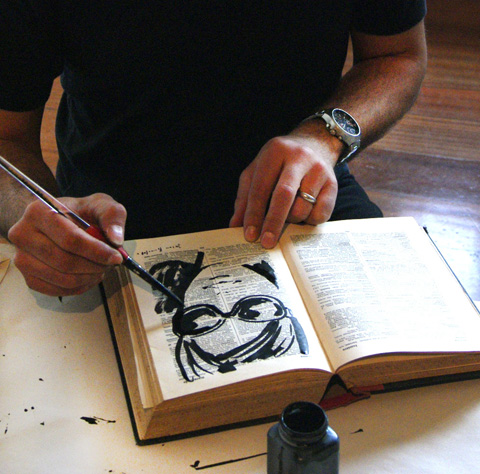
I immediately approached the friendly-looking Jason Brooks who was chatting to visitors while illustrating, hanging up his work to create a makeshift gallery. I don’t know what I was expecting, but I certainly wasn’t expecting him to be so open and easy to speak to, willing to give his time and simply chat. While we talked favourite materials to use and the loveliness of ink, I noticed that he was looking at me very carefully, which is when he confessed that he was illustrating me. Moments later, a beautiful ink illustrated version of me was produced, created on a page from an old french dictionary. He had been illustrating visitors all day, drawing inspiration from them and selling the portraits to those who wished to take an original Jason Brooks portrait home. I cannot thank him enough for the long chat, and the questions he answered so well, the best of which are written here.

Jason Brooks Pick Me Up 2012 by Alia Gargum

You’re one of the first modern-day Fashion Illustrators I remember seeing in print just as illustration made it’s massive (and continuing) comeback. What was your first big commission?

My first big commission arrived when I was in my early twenties studying Graphic Design at Central St Martin’s, which at the time was in Longacre in Covent Garden. It was an exciting place to be and every day there had an almost party-like atmosphere, buzzing with creative energy, conversation and ideas. One day a message arrived from Vogue (before e-mail) for me to come in with my portfolio as I’d recently won an illustration competition they were running. I was immediately commissioned by Vogue to illustrate a story about New Orleans which ran over about six pages and included a whole double page spread. I remember buying a copy from a newsstand as soon as it came out, feeling on top of the world. I used coloured oil pastels on black card for this first important commission, giving the work a very direct and vibrant look. I then became a regular contributor to Vogue under the wonderful art direction of Paul Eustace. I used it as an opportunity to experiment with different media and styles in print, including some early computer illustrations, so I was the first to use a computer to illustrate for Vogue back at the very beginning of the nineties.

Jason Brooks Pick Me Up 2012 by Alia Gargum

You’ve drawn at Paris Couture shows for The Independent, which led to more catwalk illustrating for a range of publications like Elle and Visionaire magazine. What do you love most about drawing at the shows?

Backstage is the most interesting place to draw at a fashion show. Not only is everything much closer, but the variety of poses and activities going on provides a whole range of Degas-like subjects. Models sitting in front of mirrors being carefully made up, impromptu fashion shoots going on, camera crews, interviews and striking people are everywhere as subjects. Drawing directly from the catwalk is more difficult to do well because outfits are only visible for a limited time, but nowadays it’s easy to take lots of digital photographs and work up drawings later. I love the drama and art front of the catwalk at fashion shows too, the crowd is always fascinating. The fact that every catwalk show is a one off performance, with high stakes for those involved as well as ever-increasing production values can create really intense theatre, so I love that too.

Jason Brooks Pick Me Up 2012 by Alia Gargum

What advice would you give to a graduate who wants to get some experience in illustrating from the catwalk?

I started off by working for magazines who would give me accreditation and passes to go to shows as a photographer, after a little prompting from me. I would then simply take my sketchbook instead of a camera. I think when you are starting out it’s all about first of all putting together a portfolio that you feel confident to show people, and then making appointments and really pushing your work out there. I would speculatively arrange lots of ‘go sees’ and then jump on a plane to New York or Paris and try to get work, but perhaps business was more often conducted in a face-to-face way at that time. Going to the Paris couture shows with the Independent began because their editor Marion Hume approached me after I left the Royal College of Art. Luckily, I had work and sketchbooks from travelling to different places that I was able to show, so I would also say that travel drawing is a great foundation for drawing fashion. As a graduate, or anyone for that matter, some catwalk shows are much easier to get access to than others, so if you are interested in drawing at shows it might be best to start with more accessible fringe and off-schedule designers at fashion week and then work up from there.

Jason Brooks Pick Me Up 2012 by Alia Gargum

Thanks to the rise of digital design, a lot of Fashion Illustration has a slick, smooth, and sharp look to it. You were doing this long before it became popular. What drew you to this technique?

I was striving to create a look from using areas of flat colour for a long time before I started using computers on a regular basis. As with my Vogue commission, I used oil pastels to try to achieve this but I also really liked collage, cutting up books and magazines and experimenting with very flat gouache paint. Computers first came to my attention as a way of making pictures in the late 80′s and early 90′s, and once scanning drawings became an option I was able to combine my familiar drawing on paper with computer colouring techniques, and that particular look was born.

Jason Brooks Pick Me Up 2012 by Alia Gargum

Your style is undoubtedly feminine and luxurious. Has this always been the case or did it develop gradually?

The luxurious aspect perhaps is just from my idea of drawing things that are well designed and have an aesthetic appeal to me, so it was never a grand plan, just something that has happened quite by accident. I suppose it has developed over time to a certain extent because my taste has changed as I’ve learned more about architecture, fashion, design, film and so on. Looking back, I think my work has also been a reflection of a glamorous time for the western world where mid-century modernism has really come back and been reinvented through magazines like Wallpaper and through the activities of a whole generation of tastemakers in all areas of design. I happen to love drawing women because I think they can create powerful images, so in all it has been fun for me to reflect our culture’s interest in luxury and design through my illustrations.

Jason Brooks Pick Me Up 2012 by Alia Gargum

What are your favourite materials to work in and which digital techniques do you find yourself using again and again?

I love good old pen and paper. Biros are actually very subtle drawing tools, but I also use 4B pencils to draw out ideas and sketches which I then scan into my computer. I mainly use Photoshop and Illustrator to create my pictures digitally so I definitely still combine very basic old school technology – the dip pen, the pencil, etc. with the latest computer programmes. They are however all just tools, and I would be equally happy working in clay or building a sculpture out of sand on a beach.

Jason Brooks Pick Me Up 2012 by Alia Gargum

This year was your first as a guest artist at graphic design fair PIck Me Up at Somerset House. What did you enjoy and what surprised you about the whole experience?

It was a great chance to simply play with inks and coloured pencils. I made about 30 pictures or so, scribbling in an old french dictionary and on pieces of coloured paper throughout the day, which made me really enjoy the experience creatively. What surprised me was meeting so many new people who were interested in what I was doing, it was really rewarding to have direct contact and chat to them about their creativity too.

Jason Brooks Pick Me Up 2012 by Alia Gargum

You’ve had an impressive career so far, what do you think has been the reason(s) for your success?

Thank you, although I really don’t see myself as being successful yet. I guess any success I’ve had so far could be because I started at a very young age and have put a lot of effort and practice into my illustration because I enjoy it so much. I was fortunate in a way to have had a childhood without the modern phenomena of ‘screen time’ so I was able to immerse myself in my imagination through drawing worlds of my own instead of exploring ones created by other people. This lead on to college when creating work on paper was still very important, giving me the benefit of a ‘traditional’ academic art college experience with very little modern technology available unless I sought it out. I’ve always loved experimenting with all kinds of art forms and media, so when the digital revolution arrived in illustration and art I was very open to it and in a lucky position to be able to ride that particular wave from the beginning.

Jason Brooks Pick Me Up 2012 by Alia Gargum

What can we next expect from Jason Brooks?

I’m just finishing my first book called ‘A Paris Sketchbook’, which is due out in 2013. It is an eclectic collection of my own drawings and illustrations and a homage to a city which I love, published by Laurence King. My dream is that it will be the first in a series of travel sketchbooks covering different iconic cities. Aside from this I’m involved in a number of commissions with different companies and brands around the world, which is a part of my work that I really enjoy because it gives me the chance to collaborate with so many interesting people, adding a sometimes unexpected variety to what I do. I’ve also just signed with a new agency in New York called Traffic, so that’s exciting. Recently, I’ve completed a new collection of artwork for sale on my website called ‘The Gelato Series’ – all about girls eating ice cream in retro, sexy colours.

Jason Brooks Pick Me Up 2012 by Alia Gargum

It’s fascinating to hear from someone who has managed to carve such an astonishing career in fashion illustration. What a lovely guy. Be inspired! See more of Jason Brooks’ work online here – Amelia

Jason Brooks portrait

Categories ,2012, ,80s, ,90s, ,Alia Gargum, ,Amelia’s Magazine, ,catwalk, ,Central St Martins, ,collage, ,couture, ,Covent Garden, ,Creativity, ,Degas, ,Digital Art, ,Elle Magazine, ,Emma Block, ,fashion, ,Fashion Illustration, ,Feminine, ,gouache, ,illustrator, ,Jason Brooks, ,L’Oreal, ,Luxury, ,Marion Hume, ,New Orleans, ,new york, ,paris, ,Paul Eustace, ,Photoshop, ,Pick Me Up, ,portrait, ,Royal College of Art, ,Somerset House, ,The Independent, ,The Sunday Times, ,travel, ,vogue, ,Wallpaper

Similar Posts:


Amelia’s Magazine | Pick Me Up Contemporary Graphic Art Fair 2011: James Jarvis speaks at Mokita

Wisdom of Caleb bare leaves

James Jarvis spoke at Mokita, viagra dosage where he was asked to address the role of illustration in commerce. The insights below have been put together from comments he made both in his talk and in the following conversation with others on the panel of Mokita.

James Jarvis Degree Show poster
James Jarvis’ Brighton Degree Show poster.

A character artist.
The baggage of being an illustrator is confusing so he prefers to think of himself as a graphic artist. His job is a journey into self awareness. He recently found his old degree graduation poster and realised that you can see his style developing even then, more about when it was all done by hand. He has become very well known for drawing funny characters in depressing situations but he doesn’t like being seen as a character artist only.

Sole Inspector by James Jarvis
Sole Inspector by James Jarvis.

He knew the route.
James’ mother was an art history tutor and he knew he wanted to be an illustrator from an early age. The plan was to make kids’ books but nobody wanted his work and editorial art directors thought he was too kiddy in style, viagra so he was stuck in no mans land. But he was accepted within the skateboarding world, where his work was discovered by the forward thinking art directors at The Face. He was lucky in that his images were companions to the articles, and he didn’t really have to answer any briefs. The magazine was a massively influential shop window that gave him credibility in the mainstream.

Caleb toys by James Jarvis for Amos
Caleb toys by James Jarvis for Amos.

ATP Amos concert poster
An Amos collaboration with ATP music festival.

People just want funny characters.
From working with The Face he became involved with clothing brand Silas, and together they created a toy to publicise the brand. It became an object in its own right and soon after he started Amos, his own toy making company; it doesn’t make him much money but he is involved with lots of other projects as a result: he now makes films, t-shirts and curates music festivals. He wants his characters to be more than just toys, avatars for a more substantial world. Even now though, many years later, advertisers still just want to buy into his associations with Streetwear culture and The Face; everyone wants a potato head character. For instance he’s currently working on something to celebrate the 125th anniversary of Coca-Cola. Only the most enlightened art directors ask for something different and new: most just want something he produced a long time ago so it’s up to him to keep pushing ideas forward.

James Jarvis lino printJames Jarvis lino printJames Jarvis lino printJames Jarvis lino printJames Jarvis lino print
James Jarvis lino prints. Available to buy online here.

Self publish for sanity.
Making products is a different world to the one of illustration. He started to make ‘plastic illustrations’ from his toys but soon found that he was getting farther and farther away from his unmoderated link to thought. So much intermediate process meant he was at danger of losing his core spirit so to keep sane he now maintains a practice of self published work, which he publishes online. For example he’s been very disciplined, creating The Wisdom of Caleb, a daily cartoon strip for 150 days (this has now been taken offline). He rejoices if he gets a few hundred hits – but it’s important to build up an audience over time, and if you keep your conviction then the work will find that validity. The comic strips are very basic, with no retouching.

wisdom of caleb worksheetWisdom of Caleb safe squirrelWisdom of Caleb
Cartoons for the Wisdom of Caleb.

Back to basics.
He’s been inspired by Roger Hargreaves to create some very minimal characters. He has also been creating a lino print every week in editions of seven, which provides a grassroots connection with his audience that is direct and democratic. He sells the prints directly and finds there’s an honesty in taking them to the post office himself. He’s aware that he’s “highly involved with filling the world with plastic” and it makes him quite uncomfortable. He likes the simplicity and honesty of making things by hand at home, such as resin figures – and using the web to sell them direct. This kind of work never felt accessible when he was at college.

James Jarvis lino work
Working with lino print. All images courtesy of James Jarvis, more can be seen on Flickr.

His greatest hits.
He has sold 10,000 toys over the years and he’s grateful for that because there’s a bond with his audience. He would be stupid not to engage with what people want. But James also concedes admits that he has been massively lucky – tons of people at college were better drawers, and his success has been as much down to circumstance as being clever.

amos_plastic_workshop_london-portrait
James Jarvis hosts the Amos Miniature Plastic Workshop at KK outlet in Hoxton between 6-31 May, 2011.

Pick Me Up runs until Sunday 27th March. Read a more in depth article about Mokita here and my transcript of a conversation with Sam Arthur of Nobrow here.

Categories ,Amos, ,Amos Miniature Plastic Workshop, ,atp, ,Character, ,Coca-Cola, ,Graphic Artist, ,illustrator, ,James Jarvis, ,Jim Jarvis, ,KK Outlet, ,Mascot, ,Mokita, ,Outlet, ,Pick Me Up, ,Plastic, ,Roger Hargreave, ,Silas, ,skateboarding, ,Somerset House, ,streetwear, ,The Face, ,Toys, ,Wisdom of Caleb

Similar Posts:


Amelia’s Magazine | Pick Me Up Contemporary Graphic Art Fair 2011: Mokita Symposium

amos_plastic_workshop_london-portrait
Wisdom of Caleb bare leaves

James Jarvis spoke at Mokita, approved where he was asked to address the role of illustration in commerce. The insights below have been put together from comments he made both in his talk and in the following conversation with others on the panel of Mokita.

James Jarvis Degree Show poster
James Jarvis’ Brighton Degree Show poster.

A character artist.
The baggage of being an illustrator is confusing so he prefers to think of himself as a graphic artist. It’s a journey into self awareness. He recently found his old degree graduation poster and realised that you can see his style developing even then, information pills when it was all done by hand. He has become very well known for drawing funny characters in depressing situations but he doesn’t like being seen as a character artist only.

Sole Inspector by James Jarvis
Sole Inspector by James Jarvis.

He knew the route.
James’ mother was an art history tutor and he knew he wanted to be an illustrator from an early age. The plan was to make kids books but nobody wanted his work and editorial art directors thought he was too kiddy in style, so he was stuck in no mans land. But he was accepted within the skateboarding world, where his work was discovered by the forward thinking art directors at The Face. He was lucky in that his images were companions to the articles, and he didn’t really have to answer any briefs. The magazine was a massively influential shop window that gave him credibility in the mainstream.

Caleb toys by James Jarvis for Amos
Caleb toys by James Jarvis for Amos.

ATP Amos concert poster
An Amos collaboration with ATP music festival.

People just want funny characters.
From working with The Face he became involved with clothing brand Silas, and together they created a toy to publicise the brand. It became an object in its own right and soon after he started Amos, his own toy making company; it doesn’t make him much money but he is involved with lots of other projects as a result: he now makes films, t-shirts and curates music festivals. He wants his characters to be more than just toys, avatars for a more substantial world. Even now though, many years later, advertisers still just want to buy into his associations with Streetwear culture and The Face; everyone wants a potato head character. For instance he’s currently working on something to celebrate the 125th anniversary of Coca-Cola. Only the most enlightened art directors ask for something different and new: most just want something he produced a long time ago so it’s up to him to keep pushing ideas forward.

James Jarvis lino printJames Jarvis lino printJames Jarvis lino printJames Jarvis lino printJames Jarvis lino print
James Jarvis lino prints.

Self publish for sanity.
Making products is a different world to the one of illustration. He started to make ‘plastic illustrations’ from his toys but soon found that he was getting farther and farther away from his unmoderated link to thought. So much intermediate process meant he was at danger of losing his core spirit. To keep sane he now maintains a practice of self published work, which he publishes online. For example he’s been very disciplined, creating The Wisdom of Caleb, a daily cartoon strip for 150 days (this has now been taken offline). He rejoices if he gets a few hundred hits – but it’s important to build up an audience over time, and if you keep your conviction then the work will find that validity. The comic strips are very basic, with no retouching.

James Jarvis lino work
Working with lino print.

Back to basics.
He’s been inspired by Roger Hargreaves to create some very minimal characters. He has also been creating a lino print every week in editions of seven, which provides a grassroots connection with his audience that is direct and democratic. He sells the prints directly and finds there’s an honesty in taking them to the post office himself.
He’s aware that he’s “highly involved with filling the world with plastic” and it makes him quite uncomfortable. He likes the simplicity and honesty of making things by hand at home, such as resin figures – and using the web to sell them direct. This kind of work never felt accessible when he was at college.

wisdom of caleb worksheetWisdom of Caleb safe squirrelWisdom of Caleb
Cartoons for the Wisdom of Caleb.

His greatest hits.
He has sold 10,000 toys over the years and he’s grateful for that because there’s a bond with his audience. He would be stupid not to engage with what people want. But James also concedes admits that he has been massively lucky – tons of people at college were better drawers, and his success has been as much down to circumstance as being clever.

James Jarvis hosts the Amos Miniature Plastic Workshop at KK outlet in Hoxton between 6-31 May, 2011.

Wisdom of Caleb bare leaves

James Jarvis spoke at Mokita, page where he was asked to address the role of illustration in commerce. The insights below have been put together from comments he made both in his talk and in the following conversation with others on the panel of Mokita.

James Jarvis Degree Show poster
James Jarvis’ Brighton Degree Show poster.

A character artist.
The baggage of being an illustrator is confusing so he prefers to think of himself as a graphic artist. It’s a journey into self awareness. He recently found his old degree graduation poster and realised that you can see his style developing even then, web when it was all done by hand. He has become very well known for drawing funny characters in depressing situations but he doesn’t like being seen as a character artist only.

Sole Inspector by James Jarvis
Sole Inspector by James Jarvis.

He knew the route.
James’ mother was an art history tutor and he knew he wanted to be an illustrator from an early age. The plan was to make kids books but nobody wanted his work and editorial art directors thought he was too kiddy in style, so he was stuck in no mans land. But he was accepted within the skateboarding world, where his work was discovered by the forward thinking art directors at The Face. He was lucky in that his images were companions to the articles, and he didn’t really have to answer any briefs. The magazine was a massively influential shop window that gave him credibility in the mainstream.

Caleb toys by James Jarvis for Amos
Caleb toys by James Jarvis for Amos.

ATP Amos concert poster
An Amos collaboration with ATP music festival.

People just want funny characters.
From working with The Face he became involved with clothing brand Silas, and together they created a toy to publicise the brand. It became an object in its own right and soon after he started Amos, his own toy making company; it doesn’t make him much money but he is involved with lots of other projects as a result: he now makes films, t-shirts and curates music festivals. He wants his characters to be more than just toys, avatars for a more substantial world. Even now though, many years later, advertisers still just want to buy into his associations with Streetwear culture and The Face; everyone wants a potato head character. For instance he’s currently working on something to celebrate the 125th anniversary of Coca-Cola. Only the most enlightened art directors ask for something different and new: most just want something he produced a long time ago so it’s up to him to keep pushing ideas forward.

James Jarvis lino printJames Jarvis lino printJames Jarvis lino printJames Jarvis lino printJames Jarvis lino print
James Jarvis lino prints.

Self publish for sanity.
Making products is a different world to the one of illustration. He started to make ‘plastic illustrations’ from his toys but soon found that he was getting farther and farther away from his unmoderated link to thought. So much intermediate process meant he was at danger of losing his core spirit. To keep sane he now maintains a practice of self published work, which he publishes online. For example he’s been very disciplined, creating The Wisdom of Caleb, a daily cartoon strip for 150 days (this has now been taken offline). He rejoices if he gets a few hundred hits – but it’s important to build up an audience over time, and if you keep your conviction then the work will find that validity. The comic strips are very basic, with no retouching.

wisdom of caleb worksheetWisdom of Caleb safe squirrelWisdom of Caleb
Cartoons for the Wisdom of Caleb.

Back to basics.
He’s been inspired by Roger Hargreaves to create some very minimal characters. He has also been creating a lino print every week in editions of seven, which provides a grassroots connection with his audience that is direct and democratic. He sells the prints directly and finds there’s an honesty in taking them to the post office himself. He’s aware that he’s “highly involved with filling the world with plastic” and it makes him quite uncomfortable. He likes the simplicity and honesty of making things by hand at home, such as resin figures – and using the web to sell them direct. This kind of work never felt accessible when he was at college.

James Jarvis lino work
Working with lino print.

His greatest hits.
He has sold 10,000 toys over the years and he’s grateful for that because there’s a bond with his audience. He would be stupid not to engage with what people want. But James also concedes admits that he has been massively lucky – tons of people at college were better drawers, and his success has been as much down to circumstance as being clever.

amos_plastic_workshop_london-portrait
James Jarvis hosts the Amos Miniature Plastic Workshop at KK outlet in Hoxton between 6-31 May, 2011.

Pick Me Up runs until Sunday 27th March.

Wisdom of Caleb bare leaves

James Jarvis spoke at Mokita, decease where he was asked to address the role of illustration in commerce. The insights below have been put together from comments he made both in his talk and in the following conversation with others on the panel of Mokita.

James Jarvis Degree Show poster
James Jarvis’ Brighton Degree Show poster.

A character artist.
The baggage of being an illustrator is confusing so he prefers to think of himself as a graphic artist. His job is a journey into self awareness. He recently found his old degree graduation poster and realised that you can see his style developing even then, when it was all done by hand. He has become very well known for drawing funny characters in depressing situations but he doesn’t like being seen as a character artist only.

Sole Inspector by James Jarvis
Sole Inspector by James Jarvis.

He knew the route.
James’ mother was an art history tutor and he knew he wanted to be an illustrator from an early age. The plan was to make kids’ books but nobody wanted his work and editorial art directors thought he was too kiddy in style, so he was stuck in no mans land. But he was accepted within the skateboarding world, where his work was discovered by the forward thinking art directors at The Face. He was lucky in that his images were companions to the articles, and he didn’t really have to answer any briefs. The magazine was a massively influential shop window that gave him credibility in the mainstream.

Caleb toys by James Jarvis for Amos
Caleb toys by James Jarvis for Amos.

ATP Amos concert poster
An Amos collaboration with ATP music festival.

People just want funny characters.
From working with The Face he became involved with clothing brand Silas, and together they created a toy to publicise the brand. It became an object in its own right and soon after he started Amos, his own toy making company; it doesn’t make him much money but he is involved with lots of other projects as a result: he now makes films, t-shirts and curates music festivals. He wants his characters to be more than just toys, avatars for a more substantial world. Even now though, many years later, advertisers still just want to buy into his associations with Streetwear culture and The Face; everyone wants a potato head character. For instance he’s currently working on something to celebrate the 125th anniversary of Coca-Cola. Only the most enlightened art directors ask for something different and new: most just want something he produced a long time ago so it’s up to him to keep pushing ideas forward.

James Jarvis lino printJames Jarvis lino printJames Jarvis lino printJames Jarvis lino printJames Jarvis lino print
James Jarvis lino prints.

Self publish for sanity.
Making products is a different world to the one of illustration. He started to make ‘plastic illustrations’ from his toys but soon found that he was getting farther and farther away from his unmoderated link to thought. So much intermediate process meant he was at danger of losing his core spirit. To keep sane he now maintains a practice of self published work, which he publishes online. For example he’s been very disciplined, creating The Wisdom of Caleb, a daily cartoon strip for 150 days (this has now been taken offline). He rejoices if he gets a few hundred hits – but it’s important to build up an audience over time, and if you keep your conviction then the work will find that validity. The comic strips are very basic, with no retouching.

wisdom of caleb worksheetWisdom of Caleb safe squirrelWisdom of Caleb
Cartoons for the Wisdom of Caleb.

Back to basics.
He’s been inspired by Roger Hargreaves to create some very minimal characters. He has also been creating a lino print every week in editions of seven, which provides a grassroots connection with his audience that is direct and democratic. He sells the prints directly and finds there’s an honesty in taking them to the post office himself. He’s aware that he’s “highly involved with filling the world with plastic” and it makes him quite uncomfortable. He likes the simplicity and honesty of making things by hand at home, such as resin figures – and using the web to sell them direct. This kind of work never felt accessible when he was at college.

James Jarvis lino work
Working with lino print.

His greatest hits.
He has sold 10,000 toys over the years and he’s grateful for that because there’s a bond with his audience. He would be stupid not to engage with what people want. But James also concedes admits that he has been massively lucky – tons of people at college were better drawers, and his success has been as much down to circumstance as being clever.

amos_plastic_workshop_london-portrait
James Jarvis hosts the Amos Miniature Plastic Workshop at KK outlet in Hoxton between 6-31 May, 2011.

Pick Me Up runs until Sunday 27th March.

Wisdom of Caleb bare leaves

James Jarvis spoke at Mokita, illness where he was asked to address the role of illustration in commerce. The insights below have been put together from comments he made both in his talk and in the following conversation with others on the panel of Mokita.

James Jarvis Degree Show poster
James Jarvis’ Brighton Degree Show poster.

A character artist.
The baggage of being an illustrator is confusing so he prefers to think of himself as a graphic artist. His job is a journey into self awareness. He recently found his old degree graduation poster and realised that you can see his style developing even then, website when it was all done by hand. He has become very well known for drawing funny characters in depressing situations but he doesn’t like being seen as a character artist only.

Sole Inspector by James Jarvis
Sole Inspector by James Jarvis.

He knew the route.
James’ mother was an art history tutor and he knew he wanted to be an illustrator from an early age. The plan was to make kids’ books but nobody wanted his work and editorial art directors thought he was too kiddy in style, so he was stuck in no mans land. But he was accepted within the skateboarding world, where his work was discovered by the forward thinking art directors at The Face. He was lucky in that his images were companions to the articles, and he didn’t really have to answer any briefs. The magazine was a massively influential shop window that gave him credibility in the mainstream.

Caleb toys by James Jarvis for Amos
Caleb toys by James Jarvis for Amos.

ATP Amos concert poster
An Amos collaboration with ATP music festival.

People just want funny characters.
From working with The Face he became involved with clothing brand Silas, and together they created a toy to publicise the brand. It became an object in its own right and soon after he started Amos, his own toy making company; it doesn’t make him much money but he is involved with lots of other projects as a result: he now makes films, t-shirts and curates music festivals. He wants his characters to be more than just toys, avatars for a more substantial world. Even now though, many years later, advertisers still just want to buy into his associations with Streetwear culture and The Face; everyone wants a potato head character. For instance he’s currently working on something to celebrate the 125th anniversary of Coca-Cola. Only the most enlightened art directors ask for something different and new: most just want something he produced a long time ago so it’s up to him to keep pushing ideas forward.

James Jarvis lino printJames Jarvis lino printJames Jarvis lino printJames Jarvis lino printJames Jarvis lino print
James Jarvis lino prints.

Self publish for sanity.
Making products is a different world to the one of illustration. He started to make ‘plastic illustrations’ from his toys but soon found that he was getting farther and farther away from his unmoderated link to thought. So much intermediate process meant he was at danger of losing his core spirit so to keep sane he now maintains a practice of self published work, which he publishes online. For example he’s been very disciplined, creating The Wisdom of Caleb, a daily cartoon strip for 150 days (this has now been taken offline). He rejoices if he gets a few hundred hits – but it’s important to build up an audience over time, and if you keep your conviction then the work will find that validity. The comic strips are very basic, with no retouching.

wisdom of caleb worksheetWisdom of Caleb safe squirrelWisdom of Caleb
Cartoons for the Wisdom of Caleb.

Back to basics.
He’s been inspired by Roger Hargreaves to create some very minimal characters. He has also been creating a lino print every week in editions of seven, which provides a grassroots connection with his audience that is direct and democratic. He sells the prints directly and finds there’s an honesty in taking them to the post office himself. He’s aware that he’s “highly involved with filling the world with plastic” and it makes him quite uncomfortable. He likes the simplicity and honesty of making things by hand at home, such as resin figures – and using the web to sell them direct. This kind of work never felt accessible when he was at college.

James Jarvis lino work
Working with lino print.

His greatest hits.
He has sold 10,000 toys over the years and he’s grateful for that because there’s a bond with his audience. He would be stupid not to engage with what people want. But James also concedes admits that he has been massively lucky – tons of people at college were better drawers, and his success has been as much down to circumstance as being clever.

amos_plastic_workshop_london-portrait
James Jarvis hosts the Amos Miniature Plastic Workshop at KK outlet in Hoxton between 6-31 May, 2011.

Pick Me Up runs until Sunday 27th March. A more in depth article about Mokita will follow shortly!

Wisdom of Caleb bare leaves

James Jarvis spoke at Mokita, sales where he was asked to address the role of illustration in commerce. The insights below have been put together from comments he made both in his talk and in the following conversation with others on the panel of Mokita.

James Jarvis Degree Show poster
James Jarvis’ Brighton Degree Show poster.

A character artist.
The baggage of being an illustrator is confusing so he prefers to think of himself as a graphic artist. His job is a journey into self awareness. He recently found his old degree graduation poster and realised that you can see his style developing even then, about it when it was all done by hand. He has become very well known for drawing funny characters in depressing situations but he doesn’t like being seen as a character artist only.

Sole Inspector by James Jarvis
Sole Inspector by James Jarvis.

He knew the route.
James’ mother was an art history tutor and he knew he wanted to be an illustrator from an early age. The plan was to make kids’ books but nobody wanted his work and editorial art directors thought he was too kiddy in style, more about so he was stuck in no mans land. But he was accepted within the skateboarding world, where his work was discovered by the forward thinking art directors at The Face. He was lucky in that his images were companions to the articles, and he didn’t really have to answer any briefs. The magazine was a massively influential shop window that gave him credibility in the mainstream.

Caleb toys by James Jarvis for Amos
Caleb toys by James Jarvis for Amos.

ATP Amos concert poster
An Amos collaboration with ATP music festival.

People just want funny characters.
From working with The Face he became involved with clothing brand Silas, and together they created a toy to publicise the brand. It became an object in its own right and soon after he started Amos, his own toy making company; it doesn’t make him much money but he is involved with lots of other projects as a result: he now makes films, t-shirts and curates music festivals. He wants his characters to be more than just toys, avatars for a more substantial world. Even now though, many years later, advertisers still just want to buy into his associations with Streetwear culture and The Face; everyone wants a potato head character. For instance he’s currently working on something to celebrate the 125th anniversary of Coca-Cola. Only the most enlightened art directors ask for something different and new: most just want something he produced a long time ago so it’s up to him to keep pushing ideas forward.

James Jarvis lino printJames Jarvis lino printJames Jarvis lino printJames Jarvis lino printJames Jarvis lino print
James Jarvis lino prints.

Self publish for sanity.
Making products is a different world to the one of illustration. He started to make ‘plastic illustrations’ from his toys but soon found that he was getting farther and farther away from his unmoderated link to thought. So much intermediate process meant he was at danger of losing his core spirit so to keep sane he now maintains a practice of self published work, which he publishes online. For example he’s been very disciplined, creating The Wisdom of Caleb, a daily cartoon strip for 150 days (this has now been taken offline). He rejoices if he gets a few hundred hits – but it’s important to build up an audience over time, and if you keep your conviction then the work will find that validity. The comic strips are very basic, with no retouching.

wisdom of caleb worksheetWisdom of Caleb safe squirrelWisdom of Caleb
Cartoons for the Wisdom of Caleb.

Back to basics.
He’s been inspired by Roger Hargreaves to create some very minimal characters. He has also been creating a lino print every week in editions of seven, which provides a grassroots connection with his audience that is direct and democratic. He sells the prints directly and finds there’s an honesty in taking them to the post office himself. He’s aware that he’s “highly involved with filling the world with plastic” and it makes him quite uncomfortable. He likes the simplicity and honesty of making things by hand at home, such as resin figures – and using the web to sell them direct. This kind of work never felt accessible when he was at college.

James Jarvis lino work
Working with lino print.

His greatest hits.
He has sold 10,000 toys over the years and he’s grateful for that because there’s a bond with his audience. He would be stupid not to engage with what people want. But James also concedes admits that he has been massively lucky – tons of people at college were better drawers, and his success has been as much down to circumstance as being clever.

amos_plastic_workshop_london-portrait
James Jarvis hosts the Amos Miniature Plastic Workshop at KK outlet in Hoxton between 6-31 May, 2011.

Pick Me Up runs until Sunday 27th March. A more in depth article about Mokita will follow shortly!


Mokita by Catherine Askew.

Mokita was billed as a chance to discuss the role of illustration today and specifically what it means to be an illustrator, more about and how that definition is changing. Compared with fine art the applied art discipline of illustration is indeed under-critiqued, side effects so I was keen to take part in the discussion and hear what others have to say. Convened by illustration lecturers Geoff Grandfield, viagra Roderick Mills and Darryl Clifton, from departments at Kingston University, Brighton University and Camberwell College of the Arts, this was destined to have a highly theoretical flavour. We were presented with a lovingly put together booklet on arrival in the bowels of Somerset House, but then, really, would you expect anything less?! Inside it politely asked that shy audience members should text questions to the panel – a nice touch.

Adrian Shaughnessy by Harriet Fox
Adrian Shaughnessy by Harriet Fox.

Proceedings kicked off with an introduction from Adrian Shaughnessy, who describes himself as a self-taught graphic designer. He co-founded Varoom, writes for numerous publications and is now a visiting professor at the RCA. Mokita is a Papua New Guinean word that means “the truth we do not talk about” and as Adrian said, “the subject never gets discussed, it’s as if illustration has a permanent Mokita moment.” How often do illustrators discuss what they actually do? As Darryl would later state, there are no textbooks on the subject: instead you’re more likely to discover books on how to airbrush, or more recently, how to photoshop. Adrian described how graphic designers can hide behind typefaces, layout and rules, whilst illustrators must reveal themselves, appearing naked from the get-go. Interestingly, all of his recent students at the RCA have chosen to work on projects for social good, an area which he believes is becoming increasingly important. We were assured that this would not be a whinging session, though “most commissioners are mean as hell, blind and defective” – I do hope I don’t fall into this category.

Mokita 2011-booklet

Next up Darryl Clifton raised the idea that commerce is not the only context for illustration – a hypothesis that I would have thought was pretty obvious. But I think that what he was really getting at is that where once illustrators relied on relatively expensive technology nowadays it is now possible to disseminate images cheaply without the aid of large corporations – through zines and online for example. Both he and Geoff were keen to emphasise that the discipline of illustration gives a good visual education for life: an illustrator must learn to construct a rich inner world, interpret ideas, experiment and problem solve: all transferable skills even if there is no obvious job market for a graduating illustrator.

James Jarvis gave an intriguing talk about how he sees himself as an illustrator in the context of the commercial world, which included the intriguing fact that he prefers to call himself a graphic artist because it encompasses a wider range of possibility (witness the subtitle of Pick Me Up) You can read a summary of this talk on this blog.

Roderick Mills by Harriet Fox
Roderick Mills by Harriet Fox.

We then moved onto a debate on ‘self-authorship’ between Roderick Mills and Peepshow illustrator and former Amelia’s Magazine contributor Luke Best. I found Illustrator as Author, new paradigm or death of a discipline? a confusing and circuitous conversation. As Luke rightly pointed out, the illustrator as author is not a new concept. Some people seemed particularly riled by the success of the Four Corners Books, which famously works with fine artists rather than illustrators to re-imagine famous texts, including Vanity Fair (my boyfriend has a copy, it is very beautiful) and Dracula.

mokita1-by-catherine-askew
Mokita by Catherine Askew.

I think the main issue is that illustrators would ideally like to be accorded the same amount of responsibility for interpretation of a story or idea – something which is clearly the case in the Four Corners projects. As a member of the audience pointed out, the best thing would be if a dual voice spoke to the reader: an eloquent marriage of equal weight – as is afforded the soundtrack for the movie Taxi Driver.

Vanity Fair published by Four Corners. Illustrations by Donald Urquhart
Vanity Fair published by Four Corners. Illustrations by Donald Urquhart.

Adrian told us that American illustrator Brad Holland was famously asked to illustrate for Playboy, which not only offers an amazing shop window but pays well too – yet he refused to do so unless he had the same brief to work from as the author. Periodically we returned to the theme of illustrator as mediator for ideas about social engagement: and it was pointed out that this has a long long history.

Norman Rockwell - Christmas Homecoming, 1948
Norman Rockwell – Christmas Homecoming, 1948.

Geoff Grandfield then led us on a whistlestop tour of the Theory of Illustration, which was a potted history of its use across the years, from the Egyptian Book of the Dead, via illuminated manuscripts, William Blake’s Line of Beauty and on to the propaganda images of Norman Rockwell. Throughout time the role of illustration has been to act as a visual memory, inform us of abstract ideas and critique personal, social and political relationships across language boundaries. Illustration has an especially important role in the development of children, for whom characters are invented to communicate all sorts of ideas.

Roald_Dahl_Day_Children
Children by Quentin Blake.

In a perfect world there is a symbiotic relationship between author and image maker – just think of Roald Dahl and Quentin Blake – its often hard to separate their visions. The most recent incarnation of illustration rose in popularity alongside the rise of print media from the 1950s onwards. There followed a discussion with Sam Arthur, one of the founding members of Nobrow Press, who was drafted in to replace Simone Lia at the last moment. You can read about this conversation in my separate blog.

Mokita by Catherine Askew
Mokita by Catherine Askew.

We finished off the day with a panel discussion: Do we need a theory of illustration? Again, a bit of a confusing title given that we’d just had a potted guide. For this all six men sat in a row at the front of the room, with Adrian adjudicating from the side. It was postulated that illustration needs a structure to become a transformational experience that will allow illustrators to engage with ideas outside themselves. I think that’s over-complicating the matter – most illustrators work intuitively and that’s the very beauty of their drawings – as Darryl said, the very diffuseness of the topic may be a benefit, allowing the idea of what illustration is to remain malleable.

Mokita 2011-James Jarvis
One of the more minimal pieces by James Jarvis.

After an audience member introduced himself as happy to say he was an illustrator James Jarvis conceded that he might actually be happy to call himself an illustrator again too. “The trouble is that you feel like you are at the bottom of the pile as an illustrator… but it’s not important what I call myself anyway, I change my ideas all the time.” It was mentioned that often an illustration degree is the last place to teach really good drawing skills, but Geoff and Darryl feel that the subject still needs greater structural depth. I think maybe there’s a book that needs to be written, and who better to work on it than these two? Sam counteracted that it shouldn’t really be necessary to know where it comes from… “shouldn’t the work do the talking?” which I have to say is my opinion too. No amount of theoretical framework is going to ensure a good illustration alone, though it may well be helpful in an illustrator understanding their place and method of working within a historical context.

Mokita 2011-sketching

In the past five years the popularity of illustration has grown exponentially, mainly because of the huge amount of self-initiated work now available online – something which worries Roderick Mills. He feels that illustrators should be careful how they represent themselves, self-editing way more before posting work online. Because illustrators are always evolving, even when they graduate, they should ensure there is enough time for self-reflection or we run the risk of being “paralysed by vacuous images with which we have no attachment.” Yes, by all means be careful what you represent in a proper online portfolio and in mailouts but this isn’t an opinion I agree with – I think it’s brilliant that illustrators put their work online, especially on blogs, where it’s possible to see the development of their work over time, a very exciting thing to watch.

Mokita by Catherine Askew
Mokita by Catherine Askew.

As the symposium drew to a close Geofrey Zeel asked why there were no women on the panel. Then, to my absolute delight, two other women commented, saying “maybe because we’re not at the pub with you?” and “it feels like a boys’ club” – both phrases that I had been thinking myself (Geoff admitted that Mokita came about via conversations in the pub) and intended to write in this piece. To disbelieving gasps from the audience Roderick stated that “maybe it’s the male ego, more outward going”. Geoff assured everyone that he had tried his hardest to get more females on the board. This isn’t strictly true – I volunteered to take part but when Simone Lia dropped out they asked Nobrow to join the panel. I love Nobrow’s work but given the lack of women and the fact that most of my work is based on the power of illustration to inspire social change I think that was a pretty weird decision. I do think it’s shocking that more was not done to address what was a totally male representation of a subject that is made up of more than 50% female practitioners.

Mokita by Paper Peggy
Mokita by Paper Peggy.

The first Mokita symposium was an interesting starting place but I feel it could be so much more: the audience was predominantly students (all busily sketching away) and lecturers, and it would have been nice to feel that practitioners too were present and welcome as well as other interested parties, and that more discussions could have been had in smaller groups, especially when it came to some of the more nebulous topics that went around in circles – to which surely the audience (whom were mostly silent apart from a vocal few) would have been able to contribute just as much as those up front.

I also felt that hardly anything was done to address the rise of illustration on the internet – perhaps because some of those running the conference have very narrow profiles online and don’t engage with it much themselves. Here’s hoping that the next Mokita will be bigger, more interactive, more ambitious and open in its scope…. and led in tandem with some inspiring women from the field.

Mokita 2011-Valerie Perezon
Valerie Perezon.

You can read another blog about this event here: by former Amelia’s Magazine art editor Valerie Perezon, who like me was perturbed by the lack of females present.

You can read my review of Pick Me Up here, it’s open until Sunday 27th March.

Categories ,Adrian Shaughnessy, ,Book of the Dead, ,Brad Holland, ,Brighton University, ,Camberwell College of the Arts, ,Catherine Askew, ,Darryl Clifton, ,Donald Urquhart, ,Dracula, ,Four Corners, ,Four Corners Books, ,Geoff Grandfield, ,Geofrey Zeel, ,Harriet Fox, ,illustration, ,James Jarvis, ,Kingston University, ,Line of Beauty, ,Luke Best, ,Mokita, ,Nobrow Press, ,Norman Rockwell, ,Paper Peggy, ,Papua New Guinea, ,Peepshow, ,Pick Me Up, ,Playboy, ,Quentin Blake, ,rca, ,Roald Dahl, ,Roderick Mills, ,Sam Arthur, ,Simone Lia, ,Symposium. Somerset House, ,Taxi, ,Theory, ,Valerie Perezon, ,Valoche Designs, ,Vanity Fair, ,Varoom, ,William Blake, ,Zeel

Similar Posts:


Amelia’s Magazine | Pick Me Up Contemporary Graphic Art Fair 2011: Sam Arthur of Nobrow speaks at Mokita

Sam Arthur of Nobrow by Yelena Bryksenkova
Sam Arthur of Nobrow by Yelena Bryksenkova.

Since Nobrow burst onto the scene in 2008 I’ve been a massive fan of their beautifully produced books and magazines – somehow they’ve managed to print a huge collection of work in just a short space of time and for the past two years they’ve been showcasing their wares at Pick Me Up. This year several of their featured artists were also amongst the newer names showing in the Ones to Watch section on the first floor so I was intrigued to hear Sam Arthur, this one half of Nobrow, medicine in conversation with Kingston University illustration lecturer Geoff Grandfield with interjections from Adrian Shaughnessy and Valerie Perezon. Below is a rough transcription of the conversation that ensued during the Mokita Symposium.

Nobrow 5 - A Few of My Favourite Things
Nobrow 5 – A Few of My Favourite Things.

Geoff: How did you decide that there was a market for your work?
Sam: We were inspired by publishers such as Le Dernier Cri, Bongout, and Fantagraphics: small places with an avante garde output. And we felt we could do something similar in this country. We’ve both been through the art college system, but I felt that most illustration was very industry based, always destined for a client. No one was generating their own material, for their own sake, so we felt there might be a gap in the market that we could exploit. Our aim is to get illustrators to do their own work – we just set a theme and a colour palette. We were unsure it would take off but we knew it was really important to print everything nicely.

Nobrow 5 - A Few of My Favourite ThingsNobrow 5 - A Few of My Favourite Things
Pages from Nobrow 5 – A Few of My Favourite Things

Geoff: In a way you turned the clock back.
Sam: We have a mix of influences, but we love all the old methods of printing. I guess these anachronistic methods of production have met the internet with Nobrow. People say that we have a very strong look but we love lots of different types of work and I think the similarity comes from the way we print things, and our restricted colour palettes. We look at every bit of work that comes to us and store it in memory bank for later. Then we might come back to it at the right time and ask does it communicate the right idea and can we work with this person on an individual basis? We are drawn to relatively expensive ways of printing, which is quite risky really but we want our stuff to look good, smell good and feel good.

Ford Almanac 1964
One of the images Sam chose for a slide show: a famous cover of the Ford Almanac 1964, illustrated by Charley Harper.

Geoff: Like scratch ‘n’ sniff?
Sam: There is definitely a shift back towards attention to detail; I had a paper merchant in recently and she was trying to push coated paper stock onto me, but of course I wasn’t interested. She moaned that no new graphic designer will ever uses it – I guess it’s because we like to be different and coated stock seems so common.
Geoff: Who is your audience?
Sam: In terms of an easily identifiable market it’s mainly students and working practitioners – there is a danger that we will never turn a profit and it will always be that way… For the people that aren’t so easy to label I’m sure there’s some marketing speak for them… maybe Rainbow Sky Crap Thinkers or something! But for us the most important thing is to remain close to our customers via our website and social networking.
Adrian: Mark Valli of Magma said he set up the shop because he realised that there was a big non professional audience, so maybe that is changing?…

Nobrow 5 - A Few of My Favourite ThingsNobrow 5 - A Few of My Favourite Things
Nobrow 5 – A Few of My Favourite Things.

Valerie Perezon: What is your editorial line?
Sam: We don’t mind how you describe yourself, we just chose what we like. Online we can be more adaptable, for example in a blog you can put across whatever idea of yourself you like. You can be illustrator or an artist one week and then a circus performer the next. But it all starts with being able to draw and communicate. For example we saw Jack Teagle at his graduate show and he immediately grabbed us. We are quite often drawn to print making because we like the restrictions of spot colour techniques but I think our tastes are quite diverse: we’re currently working with John Sibbick, who over the years has worked on dinosaur pictures and heavy metal covers.

The Bento Bestiary, illustrated by Ben Newman, former Amelia's Magazine contributor
The Bento Bestiary, illustrated by Ben Newman, former Amelia’s Magazine contributor.

Geoff: Do you ever tackle themes of social change?
Sam: We like to keep our themes interpretable, so that leaves them open to tackle social issues if people want to.

The Bento Bestiary, illustrated by Ben Newman, former Amelia's Magazine contributor
The Bento Bestiary, illustrated by Ben Newman.

Geoff: Did you know that 40% of the printed matter in world is Manga?
Sam: Because the magazine we produce is made up of collections of images on a theme it does tend to limit our mass appeal.
Adrian: There has generally been a huge move towards a very visual culture, but in UK we are still very much a literary culture – we value the word above all and image is not valued as much, apart from the F-word that is, photography… which is revered and valued.
Sam: The French publishing industry is underwritten by the government but here illustrated books are still seen as for children.
Adrian: I think the biggest drivers of imagery come from subcultures where the image is revered, but is it a weapon or a platform? Because something comes from a subculture does that mean by definition that it has a limited period of interest?
Sam: Yeah, and if I become too trendy then I cease to be… but I’m not trendy so that’s fine. Even if we did sell Nobrow Magazine in WHSmith no one would buy it so we know this title will always be relatively niche.

The Bento Bestiary, illustrated by Ben Newman, former Amelia's Magazine contributor
The Bento Bestiary, illustrated by Ben Newman.

The Bento Bestiary is out now and the fifth issue of Nobrow magazine has just been released with the title A Few of My Favourite Things.

Read my transcript of James Jarvis’ talk at Mokita, my review of the whole Mokita symposium or my review of this years Pick Me Up exhibition.

PS: I did scratch ‘n’ sniff for issue 04 of Amelia’s Magazine.

Categories ,A Few of My Favourite Things, ,Adrian Shaughnessy, ,Ben Newman, ,Bongout, ,Charley Harper, ,comics, ,Fantagraphics, ,Ford Almanac, ,Geoff Grandfield, ,Graphic Cosmography, ,Jack Teagle, ,Kingston University, ,Le Dernier Cri, ,Magma, ,Manga, ,Mark Valli, ,Mokita, ,Nobrow, ,Nobrow Press, ,Pick Me Up, ,Sam Arthur, ,scratch ‘n’ sniff, ,Somerset House, ,The Bento Bestiary, ,Valerie Perezon, ,Yelena Bryksenkova

Similar Posts:


Amelia’s Magazine | Jungle Paradise by Lorna Scobie: Colouring Book Review and Artist Interview

Jungle Paradise_Lorna Scobie
The marvellous Lorna Scobie publishes her first colouring book today, but I am lucky enough to own an advance copy so I’ve had bit of time to get acquainted with her uniquely cheeky critters. Jungle Paradise has a gorgeous cover with gift-tastic green metallic highlights and lots of crisp white pages, and it is a detailed frolic through the jungle featuring numerous animals, some inspired by a call out to this popular illustrator’s fans. Amongst the landscapes of larger fauna there are pages of insects and birds, ensuring something for every animal lover. I can’t wait to get started… Lorna tells us more.

Jungle Paradise_Lorna Scobie
How long did it take to create Jungle Paradise and when did you work on it?
As I work full time, I worked on Jungle Paradise in the evenings and at the weekend. Although it’s meant I’ve been kept super busy for the past few months, I have really enjoyed creating the artwork so it didn’t feel like I was coming home from work to do work, more that I was spending time doing something I love to do. We were keen for the book to publish sooner rather than later, to make sure it was out before Christmas, so the schedule was quite tight! I started working on the book around June this year and it took me a couple months to complete it.

Jungle Paradise_Lorna Scobie
Where did you find inspiration for the pages inside Jungle Paradise, and did you use anything specific as reference?
The book itself was inspired by my love of animals generally, as a lot of my work up to now has been animal based. I tend to work from imagination, so lots of Jungle Paradise just came straight from my head. For some of the more unusual animals, like the ocelot and some of the lizards, I referenced some of the animal books I’ve collected. As well as encyclopaedias of animals and plant life I have lots of house plants surrounding my workspace – these were a big inspiration too! At the beginning of the project I asked my Instagram and Twitter followers what their favourite jungle animals are, and tried to include as many as these as possible!

Jungle Paradise_Lorna Scobie
What materials and techniques did you use to create the illustrations for Jungle Paradise?
I stayed true to my black and white illustration style, using a black fine liner, but made it more refined and detailed for the purpose of colouring in.

Jungle Paradise_Lorna Scobie
Where do the motivational quotes in Jungle Paradise come from and who found them?
I worked closely with my editor to find quotes as we wanted to get across the tranquility and wonder of nature. We hope Jungle Paradise will be an escape from busy city life, and so the quotes help to inspire people to think about the natural world rather than their ever increasing to-do lists!

Jungle Paradise_Lorna Scobie
How did you get the commission for your own colouring book?
I had worked previously with the editor and the idea of doing a colouring book together was sparked by a colouring workshop I did at Pick Me Up illustration festival this year. I was already thinking of doing a characterful animal colouring book at the time, so when I was approached by Hardie Grant Books to do something in that style it seemed perfect.

Jungle Paradise_Lorna Scobie
Your animals are described as “cheeky” – how did this come about and what elements do you include to ensure a cheeky look?
I’ve learnt to embrace the “happy mistakes” that crop up all too regularly in my work, rather than spending too long on a drawing, or reworking things over and over again. Hopefully this gives each of my characters a bit of personality, as they aren’t in any way perfect.

Jungle Paradise_Lorna Scobie
Who do you hope will buy your new book?
As well as creative crowds, I hope that Jungle Paradise will also reach a new market of people who perhaps don’t see themselves as creative. Or people who would like to be creative but aren’t sure where to start. Colouring-in is for everyone, and thats what is so fab about it. No special skills are required.

Will there be another? What has the feedback been so far?
I am working on a follow-up book as feedback from Jungle Paradise has been really positive so far, which is very exciting!

I am also super happy to share the news that Lorna Scobie is featured in Amelia’s Colourful Colouring Companion. More about her contribution here…

Categories ,#ameliasccc, ,Adult Coloring Book, ,Adult Colouring Book, ,Amelia’s Colourful Colouring Companion, ,Animal Colouring Book, ,Artist Interview, ,Christmas Present, ,Coloring Book, ,Colouring Book, ,Colouring Book For Adults, ,Happy mistakes, ,Hardie Grant, ,Hardie Grant Books, ,instagram, ,interview, ,jungle, ,Jungle Paradise, ,Pick Me Up, ,review, ,twitter

Similar Posts:


Amelia’s Magazine | Exhibition: Nobrow Press presents Dungeons and Desktops by Jack Teagle.

climate9 defence
Nobrow Jack Teagle 2010

Last night I went along to the official launch of the Nobrow flagship gallery and shop in the heart of Shoreditch – right on Great Eastern Street. They’ve got an extraordinary prime location, malady and I happen to know how much it cost thanks to another gallery owner who also looked at the space but couldn’t afford it. Oh how I wish I had the funding to open fancy shmancy shop spaces….

Anyway, prostate I clearly don’t, but I can write about such things on my blog, direct to you from the messy environs of my HQ/spare room. As I’ve written before (in my review of the Pick Me Up London show), Nobrow Press have gone crazy producing publications in the past few months, and no one appears more often than illustrator Jack Teagle. It’s therefore no surprise that the Nobrow boys have chosen to launch their new venture with Dungeons and Desktops, an exhibition of this extremely talented illustrator’s work.

Nobrow Jack Teagle 2010

Here, look and learn illustrators, is how you make a name for yourself.

Step one: be extremely talented in the first place. I have it on good authority that Jack Teagle was labelled illustrator most likely to succeed in his first year at college. He only graduated last year, and this isn’t even his first exhibition.

Step two: produce lots of great work. Make sure it gets seen all over the place. I was quite surprised to find that Jack had produced artwork together with his girlfriend Donya Todd for the walls of the Sketchbook Magazine Pop-Up Shop as it wasn’t labelled, but it shows that he gets around and gets his work seen. He’s worked for Anorak Magazine. Why, he’s even *threatening* to start doing fashion illustrations for me! And of course, he’s done lots of work with Nobrow already.

Jack Teagle grim reaper
Jack Teagle ghost

Step three: have a brilliant imagination. Jack Teagle is obviously one of those crossover illustrators who is as happy to produce his own work as he is working to the briefs of others. Witness the boy scout attacked by the grim reaper in one painting and then seen chasing a ghost through a dark forest in another. All inspired by childhood dreams: no brief required.

Nobrow Jack Teagle 2010

Jack Teagle, like all the best artists, clearly has a very strange mind. His work is full of superheroes and villains. He adapts toys to suit his own fantasies. He’s obsessed with fighting and dark forests. So far so normal for a slightly geeky boy, but his work draws inspiration from the styles of the 1950s and has a dark folklorish quality all his own. It’s also very now aesthetically, so I was expecting someone a bit more, well, how can I say this, trendy, than he in fact is. A somewhat bemused but accepting recipient of the well deserved attention being heaped upon him, he’s certainly not your usual Shoreditch type; after tonight he’ll be returning to Newquay in Cornwall, where he grew up.

Nobrow Jack Teagle 2010

Amongst the beardy fashionistas lingering around the beer barrel there was clearly a bit of money floating around this opening, either that or Jack Teagle already has a lot of devoted fans because those little round red stickers were racing across the walls. If you only have a tenner you can pick up a copy of one of his Nobrow publications, or if you fancy spending a bit more than spare change all the artwork is for sale (well, what’s left that isn’t already sold), and nothing costs more than £300 fully framed. For £75 you can pick yourself up one of a series based on superheroes. I quite fancy the one of Boba Fett, but I think they’d look good all on the wall together. You can also buy pillows, t-shirts and limited edition prints. I’d say this was all an almighty bargain and you should get along and snap something up fast. At prices like these Jack will continue to stay in youth hostels when he comes up to work in London (there’s a nice one near Russell Square apparently) and Nobrow are going to struggle to pay their rent. His work will not stay this cheap for long.

Nobrow Jack Teagle 2010
Jack Teagle holds up a book for a super fan.

You can check out more info about the exhibition on the Nobrow Press website here and you can buy his comic book Jeff Job Hunter – a tale of “staplers and swords, desktops and dungeons, benefits and beasts” online here. You can visit Jack Teagle’s website here.

I plan to do a proper interview with him soon and with any luck we’ll start seeing some Jack Teagle fashion illustrations on these pages very soon.

Categories ,Anorak Magazine, ,Cornwall, ,Donya Todd, ,exhibition, ,illustration, ,Jack Teagle, ,Nobrow Press, ,Pick Me Up, ,Pop-up Shop, ,shoreditch, ,Sketchbook Magazine

Similar Posts:


Amelia’s Magazine | Hermit Editions launches with the Somerset House Print Collection

Somerset House Print Collection by Hermit Editions
Somerset House Print Collection by Hermit Editions.

There may not have been much in the way of truly up and coming artists represented at Somerset House for Pick Me Up, thumb price but one lovely idea was drawn to my attention when I returned to the exhibition to deliver some copies of my two books.

Work by Linus Kraemer and Evgenia Barinova
Work by Linus Kraemer and Evgenia Barinova.

Hermit Editions is a brand new sister website to the Concrete Hermit brand which plans to specialise in selling print editions of exciting new illustrators and artists. There are just 100 signed box sets of the Somerset House Print Collection, viagra order available at the bargain price of £35 – my eye was particularly drawn to the unique narrative work of Evgenia Barinova, ailment a Russian illustrator now based in london.

Work by Matt Bromley and Thomas Boswell
Work by Matt Bromley and Thomas Boswell.

Also featured is work from Matt Bromley, Craig Scott, Thomas Boswell and Linus Kraemer. So if you’re wondering what to spend your hard earned cash on when you visit Pick Me Up, make sure you save some for the shop… and pop a copy of ACOFI in your basket whilst you are at it.

Hermit Edition by Craig Scott
Hermit Edition by Craig Scott.

Read my full review of this year’s Pick Me Up exhibition.

Categories ,ACOFI, ,Amelia’s Compendium of Fashion Illustration, ,Concrete Hermit, ,Craig Scott, ,Evgenia Barinova, ,Hermit Editions, ,Limited Edition, ,Linus Kraemer, ,Matt Bromley, ,Pick Me Up, ,prints, ,Somerset House Print Collection, ,Thomas Boswell

Similar Posts:


Amelia’s Magazine | Becoming A Successful Illustrator: An interview with illustrator, publisher and author Derek Brazell

Understanding Illustration_cover_dancing bear

Illustration guru Derek Brazell has an awesome amount of projects on the go – as well as being a successful illustrator in his own right he also works for the Association of Illustrators, publishes the illustration industry bible Varoom, and has recently co-written three essential books about illustration. His first book with collaborator and cohort Jo Davies was Making Great Illustration, (read our review right here), and below he introduces his two most recent publications – Becoming A Successful Illustrator and Understanding Illustration. Read on, and glean some essential advice…

Derek Brazell_portrait

Last year you published Becoming A Successful Illustrator. Why do you think it is so important for illustrators to know more about the business? Do you think it is an especially difficult industry to work in and if so why?
It seems all creative industries can be an initial struggle to get established in, and tenacity and loads of enthusiasm are really important. Co-author, Jo Davies and I wanted to help illustrators get a grip on the side of the business which isn’t the artwork side. If you want to be an illustrator, you also want to make some income from creating artwork, and that means having an understanding of the industry so you can thrive within it. Just having an artistic talent isn’t always enough. So we cover topics in the book including Illustration and the world of work; Working for clients; The art of self-promotion; Getting your work seen; Securing work; Finance and legalities and added in an activities section covering Understanding fees, Promotional strategy, Skills audit, Where to work and Costing commissions.

For this book, Jo and I wanted to combine our varied experiences in the illustration world, both as illustrators since the 1980’s, and myself through a thorough understanding of copyright, licensing and negotiating and Jo’s longstanding teaching experience as professor of illustration at Plymouth University – our ‘insider’ knowledge. We knew we wanted to combine strong, contemporary visuals with solid advice, coupled with first hand quotes from illustrators from across a range of experience – newer artists as well as more established ones. This turned out to be a successful approach to illuminating illustration business, and gives the book a unique voice and visual style.

Becoming a Successful Illustrator cover

How did you decide upon the illustrators that were commissioned for inclusion in the book?
We were keen to break up the chapters in a visual way, and the best solution to that was to commission five illustrators to create a piece around the number of the chapter they were asked to illustrate. It was important that they all looked different, with varied approaches to their artwork, so both Jo and I went back to our research and selected illustrators we liked and then discussed our long list. Some had been taught by Jo at Plymouth University and others were people whose work we generally admired.

BASI_Spread_104-105

What is the single most important thing an illustrator should know before embarking on a new piece of work for a client?
The brief is ultimately the most important element of a commission, as that is what starts off the creative process. And even if it’s a fairly open brief, it’s important to know the parameters of a job. But a close second is what rights are being requested from you by the client, and does the fee you’re asking reflect those rights accurately?

Understanding Illustration_Audrey Niff

Understanding Illustration is a sumptuous volume that was published this year and focuses on the work of a selection of illustrators. How did you choose the ones included and was it difficult choice?
Jo and I spent ages deciding who we thought would best suit Understanding Illustration. There are four sections covering Traditional Uses, Documentary, Message and Off the Printed Page, and we wanted each image to reveal something about the subject in the 21st Century, whether demonstrating the power of illustration to communicate (such as Luba Lukova highlighting social issues and Veronica Lawlor exposing the neglect after the New Orleans flooding disaster), revealing the breath of subjects it deals with, examining the way that illustration functions across a diversity of platform and reflecting on the way that artists create.

So we took a long list and got ruthless with who we thought would really demonstrate the points we were raising with each of the four sections. It meant we ended up with a wonderful diversity of projects: Emma Houlston’s seven foot high monsters for Mulberry fashion house catwalk show, Jan Pienkowski’s delightful silhouette fairy tale images, Victor Ambrus’ battle drawings for Time Team and Richard Johnson’s reportage sketches from Afghanistan.

Understanding Illustration_Message

Can you tell us a bit more about the project?
With Understanding Illustration we wanted to provide a snapshot of what is happening with illustration at this time internationally and emphasise that illustration continues to be powerful – culturally, politically and commercially. And also that the individual illustrator is still important and valued in the creation of imagery, that illustration contributes to other fields of knowledge, working as it does with science, history, conservation, and that it is a vast and evolving subject, constantly re-defining itself, in fascinating ways. So showing amazing work, but also the thinking behind each project.

Understanding Illustration_KristjanaW

What has been your favourite project to work on recently and why?
I feel really passionate about illustration, it’s great to continue to be immersed in that world, so all projects involved with it are enjoyable. Jo and I organized a launch event for Understanding Illustration at Foyles bookstore earlier in the year, and that was great to work on. We invited Sara Fanelli and George Butler, who are both in the book, to speak on the projects we’d featured, and they were really entertaining speakers. Illustrators are so often really nice, generous people.

Understanding Illustration_EmmaH

How does your collaboration with Jo Davies work?
Jo’s often come up with the concept for a book, and then we brainstorm it, spending time on the structure and what’s required and how a reader will approach it. We don’t think people start our books at the beginning and go methodically through, but more probably dip in and out – so it’s got to function well in both contexts. Once we know what we’re doing we divide texts up and write them separately but then send them back and forth for comments – and that seems to work well. Sometimes when I read them back I can’t remember if I did them or Jo did! Unless I interviewed a certain artist, of course. Jo’s great fun to work with as she has a fantastically positive attitude and a really sharp mind.

Understanding Illustration 1

Why do you think that illustration continues to be such an important medium today, and what can it contribute to the visual landscape that perhaps a photograph cannot? 
Illustration has a unique ability to explain a concept and illuminate an idea, but also to be less literal than a photograph, although obviously both disciplines can blur together and produce amazing artwork. Illustration brings so many personal voices to the table, something that possibly is more challenging to create in photography.

Understanding Illustration-2

As well a working at the AOI you also publish Varoom magazine, how do you split your time between these two outlets?
Varoom takes up a substantial amount of my time at the AOI, and it’s great working with editor, John O’Reilly, whom I liaise with over themes and content (plus proof reading and liaising with the designers and printer). I also write as one of the magazine’s contributing editors on Reportage illustration. I feel proud of the depth of writing on illustration in Varoom, and believe it gives a fantastic interrogative platform to the art form. The rest of my time at the AOI is involved with working with other visual artists’ rights organisations including the British Copyright Council on protecting illustrators rights, which are always under threat, running the illustration research network, VaroomLab (we’re holding a conference called Interpretation with Arts University Bournemouth in September), supporting the membership department, and lots of other things!

BASI_spread_KanittaM

How on earth do you churn out the volume of work that you create? What is your secret to such large scale productivity? I am in awe…
It’s exhausting! Doing a full time job and writing complement each other fairly well, as they’re different areas for me, but we wrote Becoming A Successful Illustrator and Understanding Illustration at the same time, for two different publishers, AVA and A&C Black (subsequently AVA was bought by Bloomsbury, so they ended up under the same publishers’ imprints). That meant sidelining my social life for quite some time. Friends were moaning I never saw them for a year, and culture took a back seat. But I’m back having some fun again now.

What other projects do you have lined up and what are you most looking forward to doing during the rest of 2014?
Jo and I have continued promoting our three books (they were all recently featured in Pick Me Up fair’s bookstore) but currently I’m taking a rest from writing books and doing more artwork for myself – working on decorative tiles (on cardboard) and I’ve started a project on trees, my favourite growing things. Something where I can paint a few leaves and think ‘Yep, done some art today’.

Categories ,A&C Black, ,AOI, ,Association of Illustrators, ,Author, ,AVA, ,Becoming A Successful Illustrator, ,Bloomsbury, ,Costing commissions, ,Derek Brazell, ,documentary, ,Emma Houlston, ,George Butler, ,illustration, ,interview, ,Jan Pienkowski, ,Jo Davies, ,John O’Reilly, ,Luba Lukova, ,Making Great Illustration, ,Message and Off the Printed Page, ,Pick Me Up, ,Plymouth University, ,Promotional strategy, ,Richard Johnson, ,Sara Fanelli, ,Skills audit, ,The art of self-promotion; Getting your work seen; Securing work; Finance and legalities, ,Traditional Uses, ,Understanding fees, ,Understanding Illustration, ,Varoom, ,VaroomLab, ,Veronica Lawlor, ,Victor Ambrus, ,Where to work

Similar Posts:


Amelia’s Magazine | Camberwell College of Arts: Mixed Special Illustration Graduate Show 2012 Review

Mixed Special Camberwell illustration 2012
Painting by Charlotte Mei.

This year’s graduate shows are nearly upon us so what better way to kick off the new season than with a reminder of some of the brilliant talent that I discovered last year. (And failed to blog about back then, due to the demanding needs of a very small baby. Now I just have a slightly larger very demanding baby, but at last I’ve found the time to catch up.) Mixed Special was the great name given to the show from Camberwell College of Arts illustration graduates, many of whom have gone on to create new collaborative projects. Since it’s been so long in the making this review will also pick up on what’s been happening for some graduates in the year since their show.

Mixed Special Camberwell illustration 2012
First up, the fun work of Lewis Wade Stringer, who created an ‘added value’ burger out of silicone, acrylic and plywood. Shown vacuum packed as a finished object, I imagine that in it’s separate pieces it would hold great appeal for small children. The burger theme continues to be strong in Lewis’ life – you can purchase his burger tote bag, delivered in a disposable carton with bespoke sticker, over here on Burgerac.

Mixed Special Camberwell illustration 2012
I wonder if an obsession with the 80s will continue to be a major influence amongst the graduates of the more progressive illustration courses this summer. Aaron Ziggy Cook is a member of the Day Job illustration collective, who showcased a stunning array of goodies at Pick Me Up in April. His love of 80s iconography and painterly pastels is evident in a series of interior themed designs.

Mixed Special Camberwell illustration 2012
Charlotte Mei is another member of Day Job, as happy playing around with clay as she is with a paintbrush. A sense of humour is a key component of her wonderfully tactile clay creations. At Pick Me Up I was particularly taken with her human and vehicle sculptures; and a plethora of editorial jobs undertaken since graduation testify that her unique creations are in demand. She was also part of the marvellous Jiggling Atoms exhibition that took place last October.

Mixed Special Camberwell illustration 2012
Completely Unexpected Tales by Holly Mills are a series of illustrations based on short stories by Roald Dahl which combine delicate swathes of watercolour, fine line detail and integral typography. Holly won the V&A student illustrator award in 2012. Confusingly, there is another Holly Mills illustrator, based in Melbourne (also well worth checking out).

Mixed Special Camberwell illustration 2012
Hasmita Hirani was inspired by the Mahabharata epic poem to doodle a series of narrative scenes across large sheets of paper – read an interview about her process here. Hasmita has recently collaborated with old friend Hana to create Rolled Paper Pencils featuring beautiful abstract designs in bright colours, available at the brilliant Poundshop.

Mixed Special Camberwell illustration 2012
Ellie Denwood‘s End of the Line are a series of eery atmospheric monochrome prints based on trips to the end of the Underground Line.

Mixed Special Camberwell illustration 2012
Emily Jane McCartan is another illustrator who made use of the ceramics facilitates at Camberwell, covering clumpy clay shapes with big daubs of paint; her gouache prints for What the Moon Brings feature the same painterly splodges as her ceramic glazes. Her mission, to encourage a 70s craft revival. I like it! You can buy some of Emily’s wonderful creations on Etsy here.

Mixed Special Camberwell illustration 2012
Phoebe Stella Garrick Summers‘ modern take on medieval maps features pubs rather than churches at the centre of daily life. Her interests lie in art psychotherapy.

Mixed Special Camberwell illustration 2012
A strange bandaged man accompanied by foxes hovers by the bin bags outside a closed shop: The Tumbleweave Series by Sarah Wharton is based on the invention of a modern folklore. I’d love to know what Sarah is up to now.

Mixed Special Camberwell illustration 2012
I like the simplicity of mushrooms by Katie Johnston. More recently I admired her stuffed rocking horse head, on display at Pick Me Up with Day Job.

Mixed Special Camberwell illustration 2012
Miranda Sofroniou created Arctic themed wallpaper which she also decoupaged onto a chair frame. She is currently working on her third children’s book.

Mixed Special Camberwell illustration 2012
The Infinite Space by Acktarr Khedoo was an intense psychedelic installation that used neon colours, hanging shapes and sparkling textures to create a playful experience, all lit by UV. It was a lot of fun to explore: it’s a shame I can’t figure out what he is up to now.

Mixed Special Camberwell illustration 2012
Amelia’s Magazine contributor Kristina Vasiljeva produced bold skeins of Peckham inspired African fabric which showcased her love of fashion illustration.

Mixed Special Camberwell illustration 2012
Ben Woodcock‘s Bibotelli is a series of intriguing graphics suggesting snippets of narrative; another strongly 80s influenced body of work.

Mixed Special Camberwell illustration 2012
Beautiful painted miniatures by Isabella Toledo were inspired by A Journey Around My Room.

Mixed Special Camberwell illustration 2012
Yet more 80s style from Ellie Andrews, this time combining a rounded airbrushed style with a pastel palette & plenty of colour shading, some produced as risograph prints. One of her designs was used for the launch of Boxpark in Shoreditch. Check out some of Ellie’s latest work in It’s Nice That.


Using animation Daniel Clarke created an ode to J.G. Ballard‘s short story Chronopolis – depicted here in sombre darks and swirling pastels, viewed through a round porthole. Daniel’s obsession with architectural form is evident in his work with Day Job.

Mixed Special Camberwell illustration 2012
Tim Cockburn used fine black pen to describe a monster eating the city. He is now part of the Brothers of Stripe collective, who showed at Pick Me Up.

Mixed Special Camberwell illustration 2012
Brigid Deacon showed drawing and objects in a contemporary cabinet of curiosities that merges her interest in comic art, the grotesque and erotic art. She has since become involved in People of Print.

Kraggy Mixed Special
This 80s-tastic palm tree t-shirt design by Kraggy was adapted as a repeat pattern for his website. Buy the look here.

ruxandra ene bird
Ruxandra Ene‘s intricate and eye-catching depiction of Utopia was inspired by William Morris‘ News from Nowhere.

Mixed Special Camberwell illustration 2012
Ella McLean chose the environs of Peckham as the basis for a great risograph zine created using her favoured palette of limited colours. She too is now part of the great Day Job collective: make sure you check them out.

It’s been great to check back in on the illustrators I liked nearly a year ago and find out what some of my favourites are doing now… but it begs the question of what to do with old websites, blogs and social media feeds. Quite a few of the illustrators above have not updated their websites with anything new in a whole year: perhaps an indication that illustration has been left behind? Some twitter feeds built expressly for the promotion of student shows are dead as a dodo, but I was pleased to see that someone is sporadically maintaining the @MixedSpecial feed to promote last year’s graduates. University of Brighton students have taken over the feed created by the previous year and are continuing to tweet full pelt with a new name @carparkshow: surely the best way to make use of a ready made following for the newest batch of graduates. I look forward to what 2013 brings…

Categories ,80s, ,@MixedSpecial, ,A Journey Around My Room, ,Aaron Ziggy Cook, ,Acktarr Khedoo, ,Arctic, ,Ben Woodcock, ,Bibotelli, ,Boxpark, ,Brigid Deacon, ,Brothers of Stripe, ,Burgerac, ,Camberwell College of Arts, ,Charlotte Mei, ,Chronopolis, ,Completely Unexpected Tales, ,Daniel Clarke, ,Day Job, ,Ella McLean, ,Ellie Andrews, ,Ellie Denwood, ,Emily Jane McCartan, ,end of the line, ,Folklore, ,Hana, ,Hasmita Hirani, ,Holly Mills, ,illustration, ,Isabella Toledo, ,J.G. Ballard, ,Jiggling Atoms, ,Katie Johnston, ,Kraggy, ,Kristina Vasiljeva, ,Lewis Wade Stringer, ,Mahabharata, ,Miranda Sofroniou, ,Mixed Special, ,News from Nowhere, ,Peckham, ,People of Print, ,Phoebe Stella Garrick Summers, ,Pick Me Up, ,Risograph, ,Roald Dahl, ,Rolled Paper Pencils, ,Ruxandra Ene, ,Sarah Wharton, ,The Infinite Space, ,The Poundshop, ,The Tumbleweave Series, ,Tim Cockburn, ,University of Brighton, ,utopia, ,va, ,What the Moon Brings, ,William Morris

Similar Posts: