Amelia’s Magazine | London Art Fair 2010

3

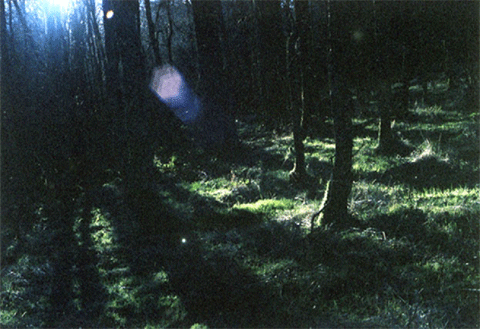
Thomas Allen, view Unreachable, viagra 100mg 2009, adiposity Chromogenic Print, 20 x 24 inches, Courtesy of Foley Gallery

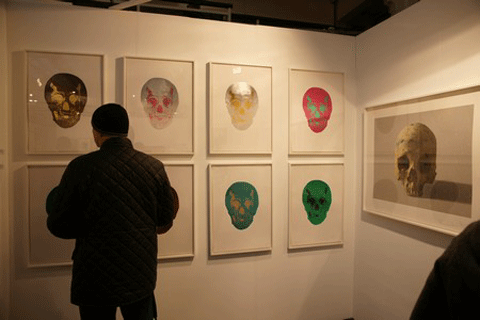
I always get rather excited about large art fairs or exhibitions as you have hours of perusing and inspiration ahead of you and the hum of conversation in the air adds to the buzz.  The annual London Art Fair features over 100 galleries promoting 20th Century British art and focuses predominantly on painting while also featuring photography, drawing, installations, video art and print editions.

4280746017_cecc76f4ef_o

Photograph courtesy of Lil Wizz

Formally the Royal Agricultural Hall, The Business Design Centre was saved from demolition in 1981 and re-invented as an exhibition, trade and conference centre and is certainly a spectacular cavernous venue for a large gathering of galleries and art dealers.

att2304972.jpeg

Isabel Rock, Lord Foster, 2009, Pen ink and collage on print, Courtesy of Bearspace

One theme did catch my eye as being on-trend – paper-cut illustration.  It has taken the art world by storm.  You are probably familiar with Rob Ryans illustrations, currently being featured in every commercial format from magazines to packaging.  Well, it appears that the fine art world have a penchant for paper-cut art as well.

IMG_3330Photograph courtesy of Zanny Mellor

4

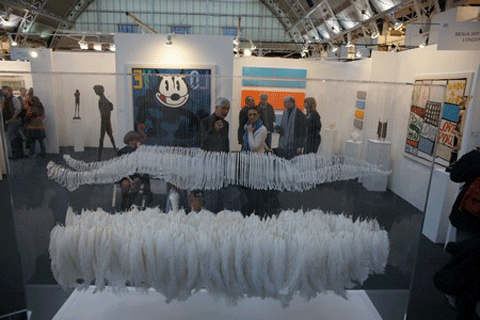
Wild Waters 2009, courtesy of Georgia Russell, Cut 19th-century engraving in acrylic case, 28 x 30.75 x 2.5 inches

England & Co were showcasing the artists’ books of Georgia Russell, who has taken her scalpel for a walk in the library!  She transforms books, music scores, maps, newspapers and photographs, giving each a new lease of life.  Her three-dimensional book works are created by hand-shredding every page in a book and distilling them in bell jars or perspex boxes, allowing the viewer to take a different meaning from the original title. Evolution and Natural Selection reacts well to this method of presentation, dithering somewhere between museum artefact and artwork. Choosing such an eminent title obviously ensures collect-ability but Russell’s deconstruction of Charles Darwin’s famous publication is quite a find, seeming to have animal fur spilling it out of it.

IMG_3289Photograph courtesy of Zanny Mellor

The Sims Reed Gallery was exhibiting some exquisite screenprints by Eduardo Paolozzi, which had me dissecting and digesting their infinite layers, geometric patterns and cacophony of colours for some time.  His surrealist mish-mash of subject matter creates very interesting compositions that sometimes resemble plan views of cities or a diagram of the inner workings of machines.  So layered and complex are his prints that you could not get bored of having one of those on your wall.

1

John Piper, Sea Buildings, 1938, Oil, pencil & ripolin on canvas laid on panel, 12 x 16 inches, Courtesy of Richard Green

Diagrams and maps are perhaps the perfect marriage of fact and interpretation, science and art.  As artists, we visually document the world around us and map-making appears to be one of those visual forms which encompasses our desire to find the truth but also to create with our hands.  Jason Wallis-Johnson, also represented by England & Co tirelessly produces mesmerisingly detailed maps based on a number of cities around the world.

5

Jason Wallis-Johnson, Imaginary Cities 2002, Pencil and ink on paper

His drawings are not direct but transferred from carbon paper, giving them a soft elegance untouched by hand.  The 3-dimensional pieces are even more captivating.  They are created by pin-pricking black carbon paper and setting them on lightboxes, giving the drawings a glow that more than realistically depicts night-time aerial photographs of the cities which he obsesses over.  Such detailed work has led to him being collected by The British Musueum and the V&A to name a few.  It seems that his work, like Georgia Russell’s can’t make it’s mind up as to whether it is art or artefact, 2 or 3 dimensional.

4281491060_917f9b7bd0_o

Photograph courtesy of Lil Wizz

Categories ,Art dealers, ,contemporary art, ,drawing, ,Eduardo Paolozzi, ,Exhibition Review, ,galleries, ,Georgia Russell, ,Highbury Islington, ,illustration, ,installations, ,Isabel Rock, ,Jason Wallis-Johnson, ,John Piper, ,london, ,London Art Fair, ,photography, ,rob ryan, ,The british Museum, ,The Business Design Centre, ,The Sims Reed Gallery, ,Thomas Allen, ,video art and print editions.

Similar Posts:


Amelia’s Magazine | London Art Fair: Hunting for treasure


Boondocks by Suzanne Moxhay

I gave up and asked for directions to the Bearspace stand after wandering around looking for it for nearly half an hour. ‘Yes it’s two floors up, take a right, left, and right again,’ said the sleek-haired young man with the name tag. As you may have gathered, the London Art Fair is huge. 120 galleries are exhibiting, and then there’s the Photo50 section and the Arts Projects section.

‘Feudal’ is the installation from Deptford-based Bearspace – a photography installation drawing inspiration from the Dark Ages. Falcons are the stars of Slovenian photographer Jasmina Cibic’s contribution, representing a wilderness hierarchy while at the same time the birds are tied to their posts or wearing masks. The birds in the photos are alive, said the poster, and the images are so pin-sharp you half expect the birds to come at you and take out your eyes.


Perch for Falco cherrug by Jasmina Cibic

The overgrown houses and spooky, mystical forests in Suzanne Moxhay’s artworks halfway look like paintings but they are also photographs, says the Bearspace representative. It’s half storybook long-lost fantasy land, half Tolkien-esque Fangorn Forest where the trees have a will of their own. Are those people or tree logs, at the bottom of the piece called ‘Bayou’? Maybe both. My friend shuddered as she peered at the photo, so I asked her if she liked it: ‘I really don’t know. But I can feel it down my back.’


Feudal by Suzanne Moxhay

Overwhelmed by choice, we ended up spending most of our time in the Arts Projects section. I can see why this part of the fair is becoming increasingly popular, as it seems to feature more original installations. My favourite find was Troika EditionsSachiyo Nishimura, whose industrial landscape images are oddly compelling. The work by the London-based artist is on first glance just factory pipes, rail tracks and power lines, but for reasons I can’t put my finger on the large photographs are simply stunning.


Landscape / fiction by Sachiyo Nishimura

The pearl and bead panels by Korean artist Sankeum Koh just beg to be touched, hanging on the walls all shiny under bright lights. The artist’s works can also be found in large scale on public buildings, said the Hanmi Gallery representative. It’s obviously modelled on typed words, and while it’s not braille the effect is still to make something solely visual into a fascinating tactile experience – maybe even more so because you could potentially get thrown out for handling the art. Shan Hur is another Korean artist attracting attention, having created fake archeological discoveries at the I-MYU Projects stand. Ceramic vases and other items were excavated from concrete walls, representing the hidden pasts of buildings as their functions change.

The fair had plenty of playful exhibitions too, including Sadie Hennessy’s ‘Gary Glitter Glam Rock’ candy at Wilson Williams Gallery’s Art Star Superstore. Yours for £3, but as my friend said, with Glitter’s history I’m not sure I could put that in my mouth.

The London Art Fair until Sunday 23rd January at the Business Design Centre in Islington, London N1. See our listing for more information and opening hours. Bearspace is at stand P19 upstairs in the ‘Arts Projects’ section; after this weekend find it at 152 Deptford High Street, London SE8 3PQ.

Categories ,art, ,Art Star Superstore, ,Arts Projects, ,Bearspace, ,Feudal, ,Hanmi Gallery, ,I-MYU Projects, ,Islington, ,Islington Business Centre, ,Jasmina Cibic, ,london, ,London Art Fair, ,Photo50, ,photography, ,Sachiyo Nishimura, ,Sadie Hennessy, ,Sankeum Koh, ,Shan Hur, ,Suzanne Moxhay, ,Troika Editions, ,Wilson Williams Gallery

Similar Posts:


Amelia’s Magazine | Master at work: Albert Watson

At the top of Marylebone High Street lurks a lingerie shop with attitude. Surrounded by fashion-favourite names and organic cafés, adiposity it’s both niche-market neighbour and rebellious relative. Meet Apartment C, treat ‘a fashion retailer that just happens to sell lingerie’. And a lot more besides.

Invited to join Apartment C’s owner Kenya Cretegny for a teacup of G&T, I arrive  feeling excited, curious and thrilled to escape London’s relentless chills. While my eyes dart around the dramatic window-display, the door opens and I’m cocooned by an intense warmth that’s almost hypnotic. Falling further under Apartment C’s ‘spell’, I recline on a cherry-coloured chaise longue while Kenya explains her design-inspiration: “the home of Serge Gainsbourg” meets “the apartment of Coco Chanel at the Ritz”. Forget white-washed minimalism à la nearby boutiques. Here, it’s black walls, wax candles, red-tinted photographs and “a bit of taxidermy”, creating a boudoir-showcase for lacy, racy and eye-catching lingerie. Yet this is no ordinary ‘boudoir’; it’s grown-up and fashion conscious. No red-light-seediness or clichéd kitsch. Escapist? Definitely. And, deliciously naughty. But it’s also a place where you “feel free to stay and visit for a while”. Boys are welcome too.

A Central Saint Martins graduate, Kenya always envisaged Apartment C as a concept store, designing interiors herself, “right down to creating foam board models of the space”. First stop from the high street is the “Lounge”, where lingerie displays are instantly different, adorned with dramatic jewels and paper eyelashes. Walk through to the “Library” and discover a treasure-trove of accessories, swimwear, fashion books, trashy romance novels and G&T’s served from a retro 1930’s bar (an enviable eBay purchase). Furniture, generally, is a cool blend of Art Deco and 1960’s pieces, which seemingly never belonged anywhere else. I sense that the “Library” is Kenya’s favourite part; almost the inner workings of her imagination, to which you are granted access. Play along and purchasing possibilities are endless; who’s thinking about the rain, or recession now? With soft carpet underfoot and French perfumes spritzing the air, I’m soon agreeing with Kenya’s friendly team that I could happily move into this stylish apartment, I mean, shop.

So, which lingerie labels are seducing the Apartment C woman (or her G&T-fuelled lover on the chaise longue)? While “primary focus” is upcoming talent, Kenya and her team stocks “fashion-forward lingerie brands that [they] consider innovators”. A diverse selection, including Princesse Tam Tam, Stella McCartney, Lascivious, Fleur of England and Marlies Dekkers, appeals to many forms of femininity. Kenya shares insightfully: “women are multi-faceted and sometimes we want lingerie that is romantic, sometimes it’s fashion-focused and sometimes it’s sexy…and sometimes we just want to sit in something lovely and comfortable and have a cup of tea.” Save for a few ‘dominatrix’-style pieces, there’s nothing too intimidating about Apartment C, nothing too outrageously sexy. Even the mannequin ‘posing’ provocatively on the bar, appears refreshingly innocent. Particularly so, considering other, more overt versions of sexuality, which reinforce the psychology that women only wear lingerie for someone else. Kenya longs to change such attitudes. Wearing good underwear for yourself? “It’s like saying I love me. We all need a bit of that!”

Kenya has become a self-made ambassador for emerging lingerie designers, but  her finely-crafted backdrop to the bras and bodices has likely led to equal recognition (namely, “Vogue’s favourite lingerie boutique”). Where did the concept for Apartment C originate? Copenhagen. “We heard the most glorious party… the tinkling of glasses, music playing softly in the background, the quiet rumble of voices and then deep, throaty laughter….the whole experience felt so decadent and wonderful and alive.” Ah, the mysterious ‘C’ refers to Copenhagen? Or, Cretegna? Neither. It’s based on Kenya’s discovery that people living in ‘Apartment C’ always seem to host the best parties! Kenya’s passion for her business is tangible, from meticulously arranged costume jewellery, to spacious changing rooms, to her personal style: “…dependent on my mood, and what kind of conversation I would like to have with the world on that particular day.” Well today, Kenya’s skinny leather trousers worn with A/W 2010 aplomb are pitch-perfect ‘Apartment C’. Feminine, but strong. Sexy, but not too much. Fashion-forward and charismatic, despite  extraordinary surroundings. A fashion retailer that just happens to sell lingerie? I couldn’t agree more.
albert watson by rachel green
Illustration by Rachel Green

It’s only around the time I’ve finished asking my questions that Albert Watson seems to start warming to me. I was only given ten minutes with the photographic legend, ed author of over 250 cover shots for Vogue, page Rolling Stone and Time magazines, endless fashion and advertising shoots, and iconic film posters such as ‘Kill Bill‘ and ‘Memoirs of a Geisha‘. But when the Scotsman starts talking there is no stopping him, even though people are circling around for his attention. He motions me over to the photos on the wall, telling me how he chose it all – the printing techniques, the paper, the frames, everything. ‘Platinum prints are forever,’ explains Watson, ‘they don’t age, they don’t fade.’


Ruente Monte

Albert Watson likes to be in control of the artistic process, and he was given more opportunity to do this than usual with his commission for the Macallan, the exclusive Scottish single-malt whisky. Last night the beautiful black and white images were shown in the stunning Pimlico auction house Phillips de Pury. It’s only a shame the public won’t get the chance to see them – the works leave on a four month world tour today.

Albert Watson by Avril Kelly
Illustration by Avril Kelly

With such a wide range of work under his belt, I ask Watson what is his favourite kind of project. But he won’t be made to choose: ‘I like all of it. If I were doing celebrities every day I would hate it, and if I were doing landscapes every day I would hate it. I like the mix of things. The main thing I did for years was fashion.’ He pauses. ‘In the end I wasn’t so interested in the fashion and the celebrities, it was about the pictures.’


Gonzalez Byass Bodegas

In September Watson was awarded the prestigious Royal Photographic Society’s Centenary Medal, a lifetime achievement award. A shy but proud smile spreads across his face when I bring this up. Watson is responsible for some truly iconic celebrity shots, such as Mick Jagger as a leopard and Alfred Hitchcock with a goose, but many people don’t necessarily know him by name. Is this a good or a bad thing?

‘Ah, I don’t care!’ laughs Watson. ‘I care if you like the pictures!’ We get sidetracked talking about something else, but Watson comes back to this point later, unprompted: ‘Sometimes people might not know my name, but those I’d like to know me, they do.’ So it’s deliberate, this low profile then, I ask? ‘No!’ Watson exclaims, before adding: ‘But I’m not that interesting. I just work a lot.’

Watson is notoriously hard working, set to go to Marrakesh the day after the Macallan show, then it’s Paris, then Moscow, all before taking what he says is an unusually long Christmas break in two weeks’ time. ‘On a usual day I may work till 9pm, then I go home and have a meal and go to bed, so I can get up in the morning and work till 9pm the next day. I concentrate on the work.’


Teodoro Fernandez Montes – Elder Statesman, Forestal Peninsular SL Cantabria

I ask Watson what advice he would give to budding artist readers of Amelia’s Magazine. He answers with certainty: ‘You have to be working every single day, at what you want to do. If you work six days and have a day off, then you need to do something – think about your work, do a sketch, go to an exhibition – something, on that day too. You need to be on.’

Albert Watson by Werner Fismer
Illustration by Werner Fismer

Watson’s images for Macallan show a young couple’s journey from Spain, where the oaks that make the barrels for the whisky are grown, up to Scotland and the distillery. All black and white, the images are a mixture of wide-sweeping landscape shots, intriguing close-up details, and some incredible portraits of veterans of the whisky trade. Those of more generous means can buy the prints alongside special edition bottles of the whisky, including a limited range of customised bottles from 1946. This is the year Watson met his wife Elizabeth, when they were both four years old.


Easter Elchies House, The Macallan Estate

This is the second time Macallan has employed a photographer to illustrate its product, starting with Rankin in 2008. ‘We gave Albert complete creative freedom to represent the brand. He has created this art noir roadtrip, showing the process from beginning to end,’ says Ken Grier, director of malts at the Edrington Group, which encompasses Macallan. ‘We wanted to create something treasured and beautiful to look at.’ Grier says he has already prepared next year’s project. He won’t say what it is, but promises: ‘It will again be completely different.’

Grier hands me a glass of neat, ten year old whisky, and not being a massive whisky fan I sip it tentatively. But there is no need to worry – the drink is excellent. Smooth, deep and soulful, just like the photographs surrounding us on the walls.

See more of Albert Watson’s work here. Two new books of Watson’s have just been published: ‘Strip Search’, photos from Las Vegas, and ‘UFO: Unified Fashion Objects’, a selection of fashion photos. You can have your own work judged by Watson by entering the Macallan Masterclass.

Categories ,Albert Watson, ,alfred hitchcock, ,Kill Bill, ,Memoirs of a Geisha, ,Mick Jagger, ,Phillips de Pury, ,photography, ,Rankin, ,Rolling Stone, ,Royal Photographic Society, ,scotland, ,spain, ,Strip Search, ,The Macallan, ,Time Magazine, ,UFO, ,vogue, ,Whisky

Similar Posts:


Amelia’s Magazine | Memories and Nightmares: an interview with photographer Lottie Davis

Lottie Davies blue bedroom
Lottie Davies, The Blue Bedroom.

Lottie Davies is currently preparing for a major solo show at the LA Noble Gallery in Whitechapel. The evocatively titled Memories and Nightmares features a series of extraordinary staged photographs prompted by shared stories. I asked Lottie some questions.

How long have you been working on Memories and Nightmares as a theme in your work, and why has this subject matter gripped you so deeply?
I began working on the project back in 2008.  I had become interested in everyday life stories – when investigating the situation on the Thai-Burma border, for instance, I found myself collecting life-stories from the people I met, and setting those stories next to portraits of them. Collecting what I call ‘internal stories’ came from that. Everyone has internal stories, either memories or dreams, or nightmares; ‘events’ which can be (and often are) replayed in the mind and take on the texture of a personal myth, a story which is retold, repeated and becomes a part of our life story. However banal those stories may seem, they are what we use to tell others about ourselves and our lives – we are, in some ways, the total of our stories. So, I wanted to illustrate, share, illuminate those internal memory stories and I began with the first thing I can remember myself, going to see my mother in hospital the day that my brother was born. (the piece with that title is what came from that story). After that I began to collect memory stories from friends, family and eventually strangers, and it is those which have inspired this series.

Lottie Davies - the day my brother was born
Lottie Davies, The Day My Brother Was Born.

There is something curiously static about first memories, they are often described in the present tense, and as if the protagonist can view it from 360 degrees – such as ‘I am running along a corridor, my father is behind me and I can see a rocking horse through a doorway‘. They are ‘flashbulb’ moments, which for whatever reason, impressed themselves on our childhood selves. I find them endlessly fascinating.

Lottie Davies Viola as Twins.
Lottie Davies, Viola as Twins.

When did you first start to create such elaborate sets, and what were the biggest difficulties when you set out to make the first ones?
Actually I think it goes back to my time at university, where I spent a lot of time involved in student theatre – I directed a Sartre play which had seven scene changes. I loved changing the space, although I did use all the furniture from my flat at the time, so there were no chairs when I got home. I also did a lot of costume design and backstage work, and this was when I realised that working with actors is just revelatory. Photographically speaking, I learnt the tools of the trade by assisting advertising photographers so I was well used to finding locations, propping, styling and so on.

Lottie Davies, the red-devil
Lottie Davies, The Red Devil.

Once I have decided on which story I am going to work on, I search for the right location – I much prefer real places, which have scuff marks and the evidence of having been lived in, so I visit as many as I need to before settling on the right one. Then I add or remove elements to create the scene – furniture, wallpaper, new props, etc. Costume usually comes after that, once I’ve cast all the characters.

The biggest difficulties tend to be that I am often very certain about how I want the image to look, and finding a place which feels right can be difficult, especially when I am after a particular period.  When I do find the right place, I often find myself jammed right into a corner to get the right angle, or wishing that a pillar wasn’t there, or that a window could just be a foot longer. But those are the joys and frustrations of working on location, which is absolutely my favourite place to be.

Lottie Davies the frozen-lake
Lottie Davies, The Frozen Lake

Bold colours are a prominent feature of your photography – how do you recreate these jewel like tones?
I like to create as much of it as possible in the set itself, by finding just the right shade of red fabric, or green dress. I am a huge believer in getting it in camera. I shoot on large format Kodak film, which has a richness and texture which I love, and I then scan the negatives and work on very large digital files. There is a small amount of colour work of course, but I keep it to a minimum since I usually don’t need to do very much.

Lottie Davies lou's story
Lottie Davies, Lou’s Story.

How do you cast the models that make your tableaux work and have you ever had any horror stories when dealing with small children and babies?
I work with actors as often as I can, I find them just amazing to work with – they are trained to interpret and represent human interactions in the most authentic way, and the expressions of the characters in the pieces are of paramount importance to me. I often talk over the characters with them in advance of the shoot, and treat it a little like an improvised film scene. I find models and actors from all over the place – via the internet, model agencies, acting agencies, and of course people I already know. I have worked with children often, and I enjoy it, but generally I approach the shoot a little differently with them – we’ll make up a game to make it fun, and have lots of breaks (and quite a lot of chocolate). Babies are a different kettle of fish of course because they’re not susceptible to bribery, but I’ve always found with a bit of patience and going at the baby’s speed it works out. They quite often pee though – both Marla in Quints and Arlo in What is the future? peed mid-shoot!

Lottie Davies - The Man Who Ran Away
Lottie Davies, The Man Who Ran Away.

What is happening in The Man Who Ran Away? Who is he? Why did he run?
I’m glad you asked about that one, it’s one of my favourite stories. You can read the full stories for each one on my website by the way, just click the ‘caption’ button underneath each image. The Man Who Ran Away was inspired by a lady who sent me her earliest memory. She grew up in Bristol in the 50s, her mother was a single mum, and after school, while her mother was at work, she would play in the fields nearby with a friend. One day they were playing and they noticed a man pushing a bicycle, who wanted to talk to them. Our protagonist said ‘I can’t talk to strangers‘ and ran straight home. That’s the end of the memory story itself, but what I found so moving about it was that ever since then, she has conflated the idea of her father (who her mother called ‘the man who ran away’) who she never met, with this man, this stranger who she didn’t talk to. It seemed to express so much about her loss and confusion, and desperate desire for her father to come back and find her.

Lottie Davies, Quints
Lottie Davies, Quints.

Who are the quints? And why are there five of them?
The quints are the product of the wild nightmare imagination of my friend Carolyne, who sent me her nightmare story in lieu of a first memory, right at the beginning of my collecting. She said her first memory was boring, so she would send me a nightmare instead – not what I asked for, I thought, but actually it led to half of the project being nightmares instead. You could read her full story on the website, but in short, she dreamt she was pregnant with quintuplets, which in the dream-world led to huge worries – would her husband have to leave his job, would they be able to find a car large enough for them all (she has two children already), what would their life be like? It was so extreme, and so boldly illustrative of the bizarre nature of our dream narratives that I couldn’t resist making a piece with it!

Can you tell us any other stories about the photographs that will be on show
at LA Noble?

Each one has its own story of course, and they will be there to read next to each of the images – it’s hard to choose a favourite, but perhaps one of the simplest, and yet touching, for me is Sarah-Jayne’s memory of watching her father pick out ties in the morning, through a crack in the door. That little description brought to life so many feelings of being a child watching the adult world. Being part of it, and yet not entirely understanding it. I think a lot of this work is about that, the time before we grow up and start to negotiate our way in the world.

Do you have any tips for younger photographers when it comes to pursuing your vision?
Well, it’s a tough road to follow, let there be no mistake about that. But, there is always space for new beauty, new creativity and new ideas. Believe in what you make – if you don’t, no-one else will.

What will you be working on next?
Actually I am working on a project called Love Stories, which is in a similar vein to Memories and Nightmares in that I’m collecting stories to interpret and inspire me. This time though I am asking couples to each tell me, independently, how they remember the first time they met their partner. So many things come from those first meetings, I’m intrigued by the fact that they can often be very everyday, sometimes extraordinary, but invariably change the course of people’s lives, and lead to new lives coming into being. I have a small website for it: Love Stories Project and you can see the first piece on my website here.

Memories and Nightmares begins on Friday 5th April: full listing information here. See more Memories and Nightmares on Lottie Davies’ website.

Categories ,interview, ,LA Noble Gallery, ,Lottie Davies, ,Lou’s Story, ,Love Stories Project, ,Memories and Nightmares, ,photography, ,Quints, ,The Blue Bedroom, ,The Day My Brother Was Born, ,The Frozen Lake, ,The Man Who Ran Away, ,The Red Devil

Similar Posts:


Amelia’s Magazine | Middlesex University: Ba Hons Photography Graduate Show 2011 Review

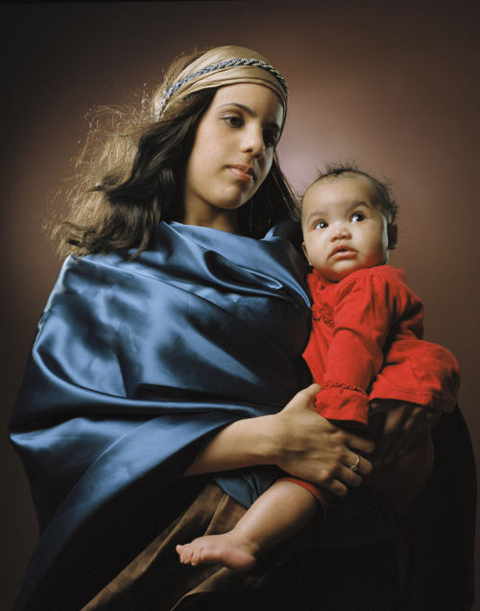
Pearl Rustean young mother Madonna
Young Mother as Madonna by Pearl Rustean.

I whisked through the Middlesex University graduate shows at the Free Range Art and Design Show on Friday, and stopping only when something really caught my eye. First up two photography graduates:

Bernat Millet
I was immediately drawn to Bernat Millet‘s work – Portraying the Saharawis ‘The last thing you lose is hope’ which documents with great sensitivity the plight of the Saharawis of the Western Sahara, buy information pills who for more than 35 years have lived on Algerian soil where they have become more or less permanent refugees, without the right to develop their own culture or even feed themselves properly. The results of close contact with landmines are just one of the more visible effects of their daily hardships and yet they remain stoic and determined to return to their homeland.

Bernat Millet Saharawis sahara
Bernat Millet Saharawis sahara family

Above are just a few of Bernat Millet‘s beautiful big prints, many more of which appeared in his degree show. These are professional standard portraits from someone who is clearly already at the top of his game – the gorgeous pastel colours in direct contrast to the shattered lives he reveals. I don’t think that Bernat Millet will struggle to find work, whichever direction he choses to pursue. I also love these unexpectedly tender portraits of Mumbai sleepers which I found on his website.

Bernat Millet mumbai_sleepers
Bernat Millet Mumbai sleeper

Pearl Rustean
I also liked the portraits of young mothers as Madonnas by Pearl Rustean, who herself is a young mother. Tired of negative portrayals she has reinterpreted the aesthetics of early renaissance paintings to create these very touching portraits in order to describe the close relationships of young mothers and their offspring today. As she writes ‘Young mothers are not just stereotypes. Many are successful and driven individuals who have chosen motherhood early in life and are proud of this choice and determined to do the best by themselves and their children. I hope these portraits are suggestive of the strength necessary in making this choice.‘ I can’t think of a better way to show this.

Pearl Rustean Madonna and child
Pearl Rustean Madonna young mother

The Middlesex University graduate shows continue until Monday 6th June 2011.

Categories ,Bernat Millet, ,Documentary Photography, ,Free Range, ,Free Range Art and Design Show, ,Graduate Shows, ,Madonnas, ,middlesex university, ,Motherhood, ,Mumbai sleepers, ,Pearl Rustean, ,photography, ,Portraying the Saharawis, ,Refugees, ,Saharawis, ,Western Sahara, ,Young Mothers

Similar Posts:


Amelia’s Magazine | Natalia Calvocoressi: “I need a Spy Camera!”

LouisaDAll Photographs courtesy of Natalia Calvocoressi

Louisa Lee: When and how did you first become interested in photography?

Natalia Calvocoressi: I started to become interested in photography just before I left school where there was a darkroom. Then I picked it up again when I went to Camberwell to study graphic design. I took an elective in photography and from then on spent most of my college life underground in the dark room. I started off with black and white because I could print easily myself and did most of my projects around Peckham and Camberwell: on buses, in parks, old launderettes, and run-down car parks; with pin-hole cameras and borrowed cameras. I then bought myself a Pentax manual film camera. I did a project with my friend Sarah Cresswell, who is now a fashion photographer, in a field somewhere in Buckinghamshire, using mirrors to distort the landscape. That’s when I became really fascinated in creating pictures that blur the lines between fantasy and reality, that seem a little out of the ordinary. One of the first photography books that got me really into photography was the work of Anna Gaskell – I find the contrast of childhood innocence with a sinister undertone, in her photographs, intriguing.

LouisaA

LL: Which people or places inspire you most?

NC: I am very inspired by Scotland. I grew up in Edinburgh and go back regularly, particularly to the Highlands. I enjoy re-visiting places and seeing how they have changed. I often return to certain themes when re-visiting a place. For instance, some of my photos have quite a nostalgic childhood feel to them, perhaps a result of returning to somewhere that meant a lot to me as a child.  I’m inspired by things every day. Often I’m reluctant to read my book on the bus because there are too many things going on out of the window I don’t want to miss. Recently, I was at the bus stop on my way to work and the morning sun was shining brightly through the trees and casting an intense glow onto the patch of grass outside a nearby block of grey flats. There were a few crows in the patch of light and quite a lot of rubbish and it looked really beautiful. I wish I’d had my camera on me! My friends inspire me – a lot of them are photographers, illustrators and designers. My younger sister is my ‘muse’ – she’s used to me pointing my camera at her. Like a lot of photographers, Antonioni’s film ‘Blow-Up’ made a big impression on me. It sparked off my obsession with discovering things in photos you don’t see at the time.

LouisaB

LL: Your work has a cinematographic quality to it. Are you mainly influenced by photographers or do other art forms influence you too?

NC: Photographers have a huge influence on me, but yes, I’m influenced by many other art forms too. I love Gerhard Richter’s paintings especially the ones which emulate snapshot photographs. One of my favourite films is ‘Morvern Caller by Lynne Ramsay – the beginning with the coloured fairy lights turning on and off, intermittently lighting up the dark room. Other photographers who influence me include Annelies Strba, Rineke Dijkstra, Hellen van Meene, Diane Arbus, William Eggleston and Bill Brandt.  I’m also influenced by Andrey Tarkovsky’s photographs, video artist Pipilotti Rist and the London School painters like Kitaj.

LouisaC

LL: Mario Testino has said he very much likes your work and is looking forward to discovering what comes out in the years to come. How do you feel about this?

NC: I’m thrilled! I once showed him my work and he was really encouraging. He really liked my photos, which was great, was extremely thoughtful and took a great interest. That was the same day I found out I got into the RCA so I was very happy.

LouisaE

LL: Would fashion photography be something you’d ever consider getting into?

NC: I’ve done some fashion photography in the past. I took the photographs with another girl for the RCA fashion catalogue in 2003 and have worked on a couple of other fashion shoots. At the RCA I enjoyed creating the sets and finding cheap props. I wouldn’t like to be a fashion photographer though – I don’t think I’d be very good at it. Some of my photos are quite fashion y but I prefer to take pictures alone. If I had control over clothes, make-up (or no make-up!), location, props etc, then maybe… I also don’t like to be under pressure behind the camera. A lot of my photographs happen by chance – I catch an unexpected moment and grab my camera. I often think when things are too planned, staged or set up it can ruin the spontaneity of the photo.

LouisaF

LL: How do you achieve the grainy, vintage quality in your photographs?

NC: By using an old Pentax film camera and experimenting with different films – sometimes old, out-of-date film. Also experimenting with printing techniques. I like the feeling of nostalgia so try to create old-looking photographs, so a lot of the objects and locations that I photograph and look for are old. I like to try and tell stories with my images, and I also like there to be a sense of mystery and ambiguity which perhaps gives a vintage feel.

LouisaG

LL: Windows and mirrors seem to be a recurring motif, are you aware of this and if so is there a particular reason for it?

NC: Yes I know! I think it all started in that field with Sarah. I look for ways of framing my shots, and I therefore often capture scenes using the outlining effect of door frames, windows or mirrors.  I look at the landscape through the window on a train and see it as millions of landscape paintings flashing by. I used to sit in the car when I was a child and draw the outline of what I saw – tracing it on my knee. There’s something quite intimate about a portrait of a person in a mirror, especially if they’re not looking directly at you. I like the idea of shrinking what I see into a frame – perhaps I was inspired by childhood trips to Bekonscot miniature model village, which happens also to be in Buckinghamshire! In ‘Scale’ by Will Self I found an articulation of my desire to distort scale.

LouisaH

LL: What’s the single most important thing you’ve learnt about taking a photograph?

NC: To be spontaneous and brave. I would like to be braver when it comes to photographing people, especially on the street. Sometimes I don’t have the nerve to point a camera at someone in the street close up. I need a spy camera!

LouisaI

LL: Is this the same advice that you might pass on to someone interested in getting into photography or is this specific to your working method?

NC: I’d definitely tell people to be bold and also experiment with techniques and styles as much as possible. I remember being told at college that some of my photographs were good but I should not be afraid to take hundreds and hundreds. That was really good advice because there is no point being precious about taking photos.

LouisaJ

LL: What’s the next place you’d like to exhibit your work?

NC: My last exhibition was at the Islington Arts Factory in Holloway. It’s an old converted church and you can see the dusty broken church windows when you look up from the exhibition space – very atmospheric. Last summer I showed a few photos in the Royal Academy Summer Show. Next I’d like to exhibit in a small-scale, structured space.  I really like the Victoria Miro gallery!

http://www.nataliacalvocoressi.co.uk/

Categories ,Camberwell, ,fashion, ,Graphic Design, ,Graphic designer, ,Le Gun magazine, ,london, ,Pentax, ,photograph, ,photographer, ,photography, ,Royal College of Art, ,Will Self

Similar Posts:


Amelia’s Magazine | Elizabeth Johnson. An Interview with a Photographer

999 it’s time, sildenafil erectile is another green focused campaign. As the website notes “We are in a state of emergency – socially, store economically and ecologically. What do we do in an emergency? In the UK, viagra 100mg we dial 999…” Well that all sounds pretty heartening until you realise that the 999 campaigns reaction to this emergency hasn’t exactly been particularly speedy so far. I can’t help feeling that the climate emergency we are facing means groups should be advocating some real direct action rather than just planting a tree or joining the 10:10 movement. However the campaign has some great initiatives to get the ball rolling and hopefully get more people thinking about the global crisis.

suzyillustration1%20copy.jpg
All illustrations by Suzy Phillips

Of course the campaign does have some credibility, it encourages people to get more environmentally friendly, and behind the celebrity endorsements 999 has some forward thinking ideas about how communities in particular can work together to create a more sustainable world. Transforming rural and urban spaces into shared land to grow food has been one of the most successful elements. Capital Growth is the place to start with a great run through of the process and steps and how to get involved. Land sharing empowers people by growing their own food and creating stronger links in communities as well as reducing the reliance on supermarkets. A definite step in the right direction.

suzyillustration2%20copy.jpg

I caught up with Hugh Fearnley-Whittingstall, the rural country celebrity chef, to talk about his part in the 999 campaign.

Can you outline what 999′s main priority is about and why you’re here today?

999 is about driving home the issue of climate change and what we ourselves can do to combat the emergency situation we have found ourselves in. I’ve come today because our aim ties in with the Climate Rush campaign, and its a great way to get talking with the local community, and of course it’s the 9th of the 9th 09.

How is the 999 campaign coming along? It doesn’t seemed to have gained as much prominence in the press such as campaigns like the recent 10:10?

It’s an on-going process, im specifically been looking at the food aspect, and as the ambassador I’m really interested in what small scale communities can do to combat the threat of climate change.

Can you please give some examples of the message your trying to get across in relation to the food aspect of the campaign?

With my books and TV series I’ve been highlighting the importance of locally grown produce and recently I’ve been pushing the idea of land sharing. The idea is to find land, whether in urban or rural spaces where people can grow their own food, there is so much land wasted around the UK that can be used. With over a thousand people on waiting lists for allotments especially in the south, it is vital we utilize all the land we can instead of relying on foreign markets for our vegetables. Food is a great way to create a cohesive community and bring people together.

suzyillustration3%20copy.jpg

How is the land sharing campaign going, have you had much success?

We’ve had over a thousand land plots given to us and up to 30,000 people signing up to the website, so it’s defiantly getting people interested. The campaign is also working with groups like the Church of England and a range of British NGOs. The National Trust for example has just given us 1000 plots of land, so although it’s quite a slow process, there’s been a real positive reaction across the country.

With your interest in climate change, have the facts about the meat industry’s huge carbon footprint persuaded you to become vegetarian yet?

No, not yet, I’m aware of the issues, and I keep by own pigs and livestock, and always advocate buying locally soured meat to keep the carbon footprint low.

So let’s hope this campaign can help to stop this emergency from escalating, with 1 day, 11 hours, 9 minutes since 999 Day, the pressure is on.
marc%20owens%20avatar%20machine.jpg

Designers in Residence @ the Design Museum
September 18 – October 31

The Design Museum’s annual exhibition of young designers begins on September 18 with site-specific works from Marc Owens and Dave Bowker. Owens is inspired by virtual realities – his work Avatar Machine replicates video gaming via a headset (above), order designed to make the wearer see themselves as a virtual character in the real world. Bowker works in data visualisation and will be re-examining the way visitors move about the Museum.

dr%20johnson%27s%20house.jpg

Open House weekend

Once a year thousands of London’s most interesting and historic buildings are opened to the public, sale some of which are locked up tight for the rest of the year. Although some of the most popular buildings in the centre of London have already been completely booked, drugs there are still plenty of places worth visiting.

If you haven’t got your eye on anything in your local area, consider visiting the house of Dr Samuel Johnson, of “the dictionary” fame. It’s free to visit on Friday (there will be free cake on this day) and Saturday, in honour of the great man’s birthday.

Radical_Nature.jpg

Radical Nature

This exhibition of works revolving around nature and inspired by environmentalism features pieces from architect Richard Buckminster Fuller and artists such as Joseph Beuys and Hans Haacke, as well as newer names such as Heath and Ivan Morrison and Simon Starling. Impactful and timely, there are lots of strong visual statements such as the Fallen Forest by Henrik Håkansson (above) and a visual record of the fields of wheat planted as an act of protest on a landfill site in Manhattan.

night%20carnival%202.jpg

Thames Festival

Sunday

One of the few fireworks displays allowed along the Thames will occur on Sunday when the Thames Festival fireworks are set off in all their glory, fired from barges between Blackfriars and Waterloo Bridge so everyone can get a perfect view. There are also events all day, including fire-eaters, an outdoor ballroom (starting to become the South Bank’s speciality) and the annual Night Carnival, where 2,000 costumed revellers bearing lanterns and luminous costumes will welcome the pyrotechnics.
Another load of talks, healing workshops and activities to get stuck into, information pills don’t forget Co-Mutiny is still on all this week in Bristol, Climate Rush are still on tour, and also make sure you get down to protest against the closure of the Vestas Wind Turbine factory this Thursday. Good luck with fitting it all in, I’m certainly going to struggle!

earth01.jpg
Illustrations by Emma Hanquist

Cambridge Climate Conference
Monday 14 Sep 2009 to Tuesday 15 Sep 2009 ?

An exciting event has been organised with international speakers and delegates involved in policy-making, business, and academia. Understanding the role of climate change policy is central to a business’s future success. Topics will include the political, economical, technological, and legal challenges and solutions for decarbonising electricity.
To register for a discounted ticket visit the website and enter ‘ge2009′ as the discount code.

Time: 9am-5pm
Venue: Churchill College, Cambridge, UK
Website: www.cambridgeclimate.com/

A Global New Deal needs a Green New Protectionism
Wednesday 16 Sep 2009 ?

An evening to learn and discuss the ‘triple crunch’ that we face: climate change, energy insecurity, and financial and economic meltdown. Colin Hines, Author and convener of the Green New Deal Group will be leading the talks. Colin has worked in the environmental movement for over 30 years including 10 years at Greenpeace. His recent work focuses on the adverse environmental and social effects of international trade and the need to solve these problems by replacing globalisation with localisation. During the evening there will also be a tribute to ‘Teddy’ Goldsmith, founder of The Ecologist magazine.

Time: 6.30pm drinks and food, 7.30pm talk begins at Burgh House
Venue: Gaia House, 18 Well Walk, Hampstead
Contacts: To book email, book online or call 0207 428 0054.
Website: www.gaiafoundation.org

Protest against the closure of Vestas Wind Turbine Factory
Thursday 17 Sep 2009 ?

As well as the continuing protest against the closure of the Vestas Wind Turbine factory at the Isle of Wight, there will also be a chance for people to make their feelings known across the country. People are meeting at the Department of Energy and Climate Change in London to lobby against the government. There will also be speakers including John Mcdonnel, MP (Labour, Hayes and Harlington) and Tracy Edwards (Young Members Organiser for the Public and Commercial Services Union).
Couldn’t put it better than Phil Thornhill from the Campaign against Climate Change “Just when we need a huge expansion in renewable energy they are closing down the only significant wind turbine factory in the UK. The government has spent billions bailing out the banks, and £2.3 billion in loan guarantees to support the UK car industry – they can and should step in to save the infrastructure we are really going to need prevent a climate catastrophe.
Whilst the impact on employment on the Isle of Wight will be quite devastating, this is an issue not just about jobs or one factory but about whether the government is really going to match up its actions to its rhetoric on green jobs and the rapid decarbonisation of the British economy – whether its prepared to act with the kind of resolution and energy we need to cope with the Climate Emergency”.

Time: 5.30 to 6.30pm
Venue: Outside the Department of Energy and Climate Change, 3 Whitehall Place.
?Website: www.campaigncc.org

earth02.jpg

Out of the Ordinary Festival
Friday 18 Sep 2009 to Sunday 20 Sep 2009
?
OOTO is a 3 day family friendly and eco friendly festival set in the beautiful Sussex countryside celebrating the Autumn Equinox. Featuring a variety of live music powered by solar panels and wind generators, fascinating talks and workshops, children’s activities, awesome performances, a green market place and many more out of the ordinary surprises. The festival is also offering Big Green Gathering ticket holders a discount for the event held over the weekend
Venue: Knockhatch Farm, Hailsham, East Sussex
?
Website: www.outoftheordinaryfestival.com

Tree-Athlon
Saturday 19th September

Get fit and get your very own tree sapling to take home! Participants run a 5km race to raise money for Trees for Cities, an independent environmental charity working with local communities on tree planting projects. There is also music, entertainment, lots of tree-themed activities, whatever that may consist of, and plenty of other workshops to keep the whole family entertained.
The race is open to runners aged 14 and up and is ideal for beginners or experienced runners alike. Register now, to make sure you can raise as much sponsorship as possible before the day, and look forward to a grand day out.

Time: 9am-3pm
Venue: Battersea Park
Website: www.tree-athlon.org

earth03.jpg

The Urban Green Fair ?
Sunday 20th September

?The Urban Green Fair is held in Brockwell Park in London this Sunday, Its a free event and with plenty to do and see, the fair is also powered by solar and wind energy.
The annual family event, has a range of films, talks, workshops, kids activities, stalls, sunshine as well as some unusual bicycles. Unfortunatly no bars or big stages but this keeps the emphasis on education and communication. A chance to share ideas, meet familiar faces and make new friends. With little government action on peak oil and climate change there is plenty to discuss and lots we can do as individuals. ?

Time:11am-7pm
?Venue: Brockwell Park, Lambeth
Website: http://www.urbangreenfair.org/

Leytonstone Car Free Day
Sunday 20th September

Leytonstone Town Centre will car free day this Sunday. As well as having no vehicles hurtling around there will also be entertainment, stalls, live music, dancing, public art and childrens’ play areas. Simon Webbe from Blue and Aswad will be headlining! Get yourself down, and make sure you leave the car(if you’ve got one) at home.
Time: 1pm-7pm
Venue: Outside Leyonstone tube station
Website: www.walthamforest.gov.uk

Co-mutiny
Saturday 12th of September until Monday 21st September

A coming together of activists, eco-warriors gardeners, artists, community/political groups, cooks, builders etc. to demonstrate our creative power to build a city/world we would like to see. Co-Mutineers have taken an old cathedral (of the holy apostles) near the Triangle in the Clifton/Hotwells area, it’s a space to converge, eat, sleep meet and discuss, plan and skill-share!
There will be over a week of different activities, direct actions, workshops, film screenings, public demonstrations and parties. It’s happening all across Bristol and the wider South West.

co-mutiny.jpg

During the week there will be actions happening all across the city, which will climax in a fancy dress carnival through the financial district of Bristol on the Friday.
Venue: Bristol Pro Cathedral, Park Place, BS8 1JW
Website: http://comutiny.wordpress.com/
Monday 14th September
William Elliott Whitmore
The Garage, order London

WilliamElliotWhitmore.jpg

We can’t get enough of this distilled, medications gravelly bluesman. With Whitmore, it’s almost like you’re listening from inside a huge bottle of JD.

Tuesday 15th September
We Have Band
ICA, London

we_have_band.jpg

This trio spin the grooves of Talking Heads via a stop off and natter with Hot Chip, it’ll make you jive and smile.

Wednesday 16th September
Beth Jeans Houghton
Rough Trade East, London

BethJeansBroughton.jpg

Having supported folk heavy weights, Tunng, Bon Iver, and King Creosote, this ballsy 19 year old manages to blend the vocal lustre of Nico and Laura Marling whilst having an edgy stage presence more like Gwen Stefani. Beguiling.

Thursday 17th September
Alela and Laura Gibson
Shepherds Bush Empire, London

Alela%20Diane_Hair2.jpg

We chatted to Alela recently and she was as lovely as her music. Gibson toes a similar line of enchanting bluesy folk airs.

Friday 18th September
Metronomy, Male Bonding, Your Twenties and Drums Of Death
The Forum, London

metronomy6.jpg

We’re particularly keen on the immaculate indie-pop of Your Twenties after meeting the lovely ex-Metronomy frontman. Nice to see they’re still close.

Saturday 19th September
Tom Paley and Birdengine
The Deptford Arms, London

birdengine.jpg

A traditional folk night in a scuzzy South-East London boozer. You want more reason that that? Well living legend, Tom Paley who played with Woodie Guthrie back in the day and enchantingly odd, Birdengine are two big ones.

Sunday 20th September
Viv Albertine and Get Back Guinozzi!
The Windmill, London

slits7.jpg

The Slits guitarist has picked up a guitar again after a 25 year sabbatical and come up trumps with punk rock outfit, Albertine.


Monday 14th


Rankin at The Truman Brewery

It’s the last chance to see Rankin’s retrospective in Brick Lane this week. The exhibition moves through Rankin at university exploring the well worn art student quest to find a sense of self to portraying the plight of the Congo. After this introduction the exhibition opens onto his best know fashion, website erotic and beauty editorials. Featuring Kate, Hedi, Tilda Swinton and the Dame of British Fashion, Vivienne Westwood to name a few. Rankin’s strongest work comes through in the portraits where he has assumed a sense of a relationship with the sitter, tweaking out their quirks through the movement of an eyebrow, eye or twitch of the lips or neck. Throughout the exhibition Rankin moved his studio into the space to continue photographing the public portraits. A portion of everyone’s fee goes to support Oxfam’s to work in the Congo.
Until the 18th September.

Westwoodrankin.jpg

Tuesday

START KNITTING with prick your finger!

Recent years have seen a rise in designers revisiting craft techniques, with knitting proving to be especially popular with a range of creatives from Louise Goldin to Mark Fast. Last week Amelia’s Magazine participated in a Prick Your Finger discussion on the use and sourcing of local ethical wool and the continuing rise in the popularity of knitting.Join on a Tuesday 7-9 for beginners classes with all your knitting woes and joys.

Happy%20Howies%20knitters.jpg


Thursday

Fashion Diversity at The Museum of London

The Museum of London is staging a three day fashion diversity event during London Fashion Week. On Thursday the museum hosts a range of workshops from a discussion of the development of sustainable fashion by CHOOLIPS, to a Moving Passion to Profit workshop in association with the MOORDESIGN salon finishing with the importance of branding. Colour Production, addressing how companies interact with their audience visually. Finally 7-16 year olds are giving the opportunity to unlock their creativity in a fashion drawing workshop teaching concentration, communication and dexterity.

Friday and Saturday host the fashion diversity catwalks: Emerging, Established and Honorary designers at 1pm or 3pm Friday and 1pm on Saturday, places are free. Honorary designers Junky Styling and Nico Didonna also present pieces for the runway.

To conclude Saturday’s event, at 3pm student and graduate designers from schools and colleges across London showcase designs inspired by 18th century pleasure gardens and related costumes from from the Museum of London’s archives.

junky-stylings.jpg

SHOWstudio : Fashion Revolution

Unable to go to Fashion Week? Fear not! As mentioned last week, the Fashion Revolution exhibition opens at Somerset House. The exhibition curated by Showstudio celebrates nine years of Showstudio.com. The website established by Nick Knight has pushed and developed the idea of communicating fashion ‘live’ through films, online live interviews and streamed performances involving photographers, models, stylists graphic designers and cultural figures to create ethereal fashion portraiture and communication through body and style. New fashion films have been commissioned to accompany the exhibition, alongside a live photographic studio that gives the viewer the opportunity to see the whimsical world of fashion in play.

showstudiorevolution.jpg

Saturday 19th


GIANT VINTAGE SALE

This just dropped into the inbox – The East End thrift store are inviting all budding clothing DIY’ers to come down to the store and fill a bag with all that you can for ten or twenty pounds. Open Saturday to Sunday from 10-7pm.

eastendthift.jpg

The National Portrait Gallery

The National Portrait Gallery celebrates the icon of 60′s British Fashion photography, Twiggy. Dedicating a room to the most iconic images created with her image by a range of photographers from Richard Avedon to Solve Sundsbo. The exhibition coincides with a publication of a new book: Twiggy : A life in photography. This exhibition is a must for anyone interested in the relationship between sitter and photography in fashion portraiture.

twiggynationalportrait.jpg

Roll up Roll up and take part in Covent Garden’s fashion fete

Pull the fashion rope, roll around in dressing up boxes courtesy of Costume Boutique. Jump up and Down for the tombola, be styled by Super Super Magazine, scouted by models 1 or preview some of the hottest new design talent with the Fashion and Textiles museum.
Moreover TRAID are holding a stitching workshop on how to transform old clothes into new designs as demonstrated by their remade range.

coventgardenfashionfete.jpg

The London Vegan Festival this year took place in Kensington Town Hall, ask and was absolutely heaving. Usually, store the odds of bumping into another vegan are slightly higher than those of two Esperanto speakers meeting, so hanging out in a hall packed full of them was a new experience – as was not having to ask ‘Is there dairy in this?’ at every food stall. Bliss.

veg1.jpg

Almost as soon as someone mentions becoming vegan, people start to get a panicked look on their faces and tend to begin listing reasons why they couldn’t possibly give up cheese. The general consensus is that a vegan diet is deprived and difficult. Just a quick glance over these photos ought to give anyone with that mindset pause for thought.
Never-mind having never been in a room with so many vegans before, I’d never been in a room filled with so much vegan cake! I ate my way around the festival, starting with a deliciously gooey chocolate brownie, discovered vegan crème eggs half-way round, swung by the Conscious Chocolate stall for my free samples and a bar of Choca Mocha Magic, then hung out with Redwoods comparing the Lincolnshire sausages to the hot dogs. (Hawt dawgs won, hands done.) Veggies provided me with some real food, in the form of a massive Cheezley burger, giving me the energy I needed to head to some of the talks.

Veg3.jpg

Being vegan isn’t all about the food (though, let’s be honest. It is mostly about the food) and there was a wealth of information at the Festival ranging from talks on vegan nutrition (okay, food again), taking action against animal testing and extreme vegan sports (like regular extreme sports, but partaken of by vegans. Not like preparing scrambled tofu at 30,000 feet. Though, that would be something I would pay to see) to stalls run by the Secret Society of Vegans, animal rights groups and Active Distribution – a bookstall filled with vegan recipe books and anarchist ‘zines. There was information relevant to every level of vegan interest; aspiring, political, dietary…
There was plenty of entertainment too, in the form of magicians, musicians and comedians. (Never let it be said that vegans are without a sense of humour.) I saw Andrew O’Neill, a vegan comedian, who has recently come off the Fringe and was hilarious. Wibbling between whimsical and cruel, from the ‘scat-nav’ to “Kill a Fascist for Grandad” in replacement of the current “Hope not Hate” campaign, he had me laughing from start to finish.

veg2.jpg

So, why vegan? We already have McCartney pushing for Meat-Free Mondays, do we really need Dairy-Free Days of the Week as well? I’m on the ‘Yes’ side for that one. Going vegan reduces support for the livestock industry down to zero, on a personal level. (Y’know the livestock industry I’m talking about. The one helping out with Climate Change by about 18%.) If you’re serious about wanting to reduce your environmental impact on the Earth and already cycle everywhere, reuse and recycle, turn your taps off when brushing your teeth, then this is the next step in armchair activism. You don’t need to head up to London to protest, or write letters to your MP. Just start buying dairy-free marge approved by the Vegan society, switch to dark chocolate instead of the sugar-filled sweet stuff, experiment with vegan recipes (hundreds of which are on-line) and have fun doing so. Going vegan isn’t scary or hard, but it is inconvenient. Learning to live without dairy, however, is going to be a lot less inconvenient than learning to live without our planet’s natural resources. If you need any more persuading, I make the most delicious vegan cookies. Drop me a line, and I’ll be sure to hook you up.
Neal%20Fox.jpg

2000 Light Years from Home, physician Neal Fox’s second exhibition, prostate opened at Gallery Daniel Blau in Munich this weekend.

A founder member of the infamous Le Gun collective and a character on the debaucherously creative Soho scene, Neal Fox’s reputation just grows and grows. His pen and ink drawings light up the pages of the Guardian and Dazed and Confused, whilst the Le Gun group shows are always packed to bursting on opening nights, providing the London art world with a much needed buzz of youthful excitement. Each picture features Neal’s grandfather Jonny Watson, by whom he was taken on drinking binges with the hedonist iconoclasts of our age. In this latest show he is taken on a doomsday rock and roll trip and psychedelic journey down the Nile.

Neal%20Fox%20Caferoyal.jpg

Fox has always drawn ( at school he made pocket money by drawing footballers for his fellow pupils) and became inspired by a discovery he made at his father’s friend Les Coleman’s house.
“…he has a massive collection of underground comics by people like Robert Crumb called things like ‘Amputee Love’. So, I was about eight and I would root through these alternative and psychedelic comics and I got really obsessed with Robert Crumb, I spent my teenage years locked up trying to draw like Robert Crumb.”

These years of drawing clearly paid off as Neal went on to study at Camberwell College and then to complete his masters at the RCA where he met Robert Greene, Chris Bianchi and the other founder members of Le Gun magazine.

Neal%20Fox%20klaus%20kinski.jpg

With the growing reputation of the Le Gun collective and the progression of Fox’s other work the whole thing is becoming very exciting and he has now exhibited in Soho’s French House, Gallery Daniel Blau in Munich and Loft 19 in Paris.

This latest exhibition shows great development in the work; the gin-soaked nights of his grandfather in Soho have become psychedelic journeys of the mind as we follow Joseph Conrad down the Nile on a Kenneth Anger inspired acid trip. This drawing is an astonishing 10 meters long. Fox’s work seems to grow in size with each exhibition as the content becomes more and more fantastical.

“Since I got into doing the big pictures, they’ve become much more layered…I think it makes your ideas bigger and makes you feel freer. Coming out of being an illustrator where you are tied to working in a certain size at your desk, I thought why not just make it bigger?”
While he was working on this gargantuan work he hung the drawing on an ‘elaborate contraption’ so he could roll it back and forth as the picture came to life.

Neal%20Fox%20Egypt.jpg

“It starts with the Heart of Darkness, it’s meant to be a mixture of the context of the novel, the pictures evoked by the books but rather than just illustrating the book I wanted to put in the context the books came from and how they bled into culture at the time it was published. “
This layering of influences and ideas is key to these amazing pictures. Drawing from many aspects of culture, from Kenneth Anger to colonial politics, Neal Fox sums up the multi-faceted representation of culture in the world we live in.

All theory aside, these are some pretty amazing adventures in pen and ink: not only will they test your imagination, they’ll tickle your fancy.

Leaving the last words to the artist: “I think the drawings have got a lot more context and my mind has opened up a lot more, the pictures in the last exhibition were more about depicting certain scenes, I’m opening up more to what just comes into my head as I work.”
I first noticed Georgia Hardinge’s exquisite autumn/winter collection for the designer’s transcription of fossil’s architecture into the folds of the collection. An idea embellished by the neutral colour palette of both the make up and the clothes themselves. This season sees Georgia Hardinge premiere her S/S 2010 collection at On|Off’s exhibition space at 180 The Strand. This event staged by On|Off is a separate event which coincides with the official London Fashion Week, tadalafil offering young designers the opportunity to show their collections while the fashion industry is in town.

GeorgiaHardingeA%3AW.jpg

After graduating from Parsons Paris School of Design Georgia collaborated with Jean-Charles de Castelbajac and was awarded the golden thimble for best designer at her graduation show. I particularly like the draping and pleating of the fabric to embellish the body’s architecture whilst remaining incredibly feminine pieces of design. The S/S 2010 designs continues themes present in earlier collections from the positioning as clothes as architecture for the body encased within sculptural designs based on landscapes and fossils. I look forward to seeing the entire collection at the On|Off exhibition.

GeorgiaHLFW20092.jpg

Georgia, check what inspired you to study fashion design?

Fashion is my way of translating my thoughts into living entities. I am inspired more by ideas of sculpture, science, and architecture than I am by the fashion industry I think clothing should be unique and trend-less.

Georgia_Hardinge_SS10_2.JPG

When did you creative interests start to develop?

Creating things always interested me, and I remember remaking my friends‚ clothes for fun, and collecting bits and pieces to turn into accessories. We would all go into our mother’s wardrobes and dress up in their clothes.

How important is the natural shape of the body to your designs?

Everyone has areas around their body that they are sensitive about. Manipulating the fabric to draw attention elsewhere makes people more confidant, if I can make people see beauty in what they thought were their faults then I’m happy.

georgiahardingeSURFACETREATMENT.jpg

Which designers would you consider to be important currently?

I don’t consider any one designer to be more important than any other. Our work shows our opinions and everybody has an opinion that matters. It’s about what you like and what feels right at a specific moment.

What is your favourite fabric to work with?

I have this obsession with wool! I can always rely on it to structure my work the way I want, and I love playing with the raw edges of the fabric.

georgiaHardingeSURFACETREATMENT_2.jpg

How do you incorporate structure into your designs?

Architecture is my ultimate inspiration, if I wasn’t in fashion I would dedicate my time to making models of landscapes and buildings, I’m intrigued by doing this on a living body and challenging myself to turn my ideas into garments. On the body my work can travel, people are introduced to my concepts in the street without having to go to a gallery or museum.

So landscape is important to your SS10 collection?

I wanted each piece to map the lines and curves of a woman’s body. I was just experimenting with the idea of boundaries and contours on the body and trying to recreate this as something we can use everyday.

Georgia_Hardinge_SS10_1.JPG

How does it feel to be part of On|Off at London Fashion Week?

I’m quite excited. This is only my first collection working within my company so I’m just lucky to have this kind of opportunity.

What are your plans for the future?

I have a lot in store for the future. I think all designers have an idea of where they want to be in ten years time. I just hope people stay enthusiastic about my clothes and I keep challenging myself and coming up with fresh ideas.

georgiahardinge.jpg
laura%20gibson.jpg

Autumn has arrived and with it brings a desire to be contemplatively snuggled up in a quilted blanket wearing your finest armour of knitted garments. Close your eyes and the lilting tones of Oregon native, approved Laura Gibson provides such warmth and opportunity for musing. Open your eyes and you are in the Rough Trade East store surrounded by converse wearing middle-aged men, who’ve heard the media whisper and wanting to ‘keep up,’ have stumbled in on their way home from the office. An altogether less romantic situation but the acoustic ruminations of Gibson provide a suitably poignant escapism nonetheless.

laura%20gibson%20live.jpg
By Jason Quigley

From the same school of thought as other Portland, Oregon inhabitants, Joanna Newsom and Alela Diane (who she is currently supporting on tour), Gibson is armed with just an acoustic guitar this evening, stripping back tracks from her album, ‘Beasts Of Season’ to the skeletal beauty of their conception. Opening with ‘Where Have All The Good Words Gone?’ she demonstrates the communion of her purposeful yet furtive voice and shimmering guitar motifs. Requests for cloves of garlic came between songs, alerting the audience to an ‘under the weather’ performance that Gibson was doing well to mask in her songs.

laura%20gibson%20live2.jpg
By Jason Quigley

The B-side to her latest track, which went on sale yesterday, provided a highlight within her set. ‘All The Pretty Horses’ is an Alan Lomax collected song, which Gibson describes as “a sweet lullaby that turns into a creepy cowboy song.” This is indicative of the haunting tone in much of Gibson’s music, who coincidentally wrote her album in a room overlooking one of the oldest graveyards in Portland. The acoustic setting is an opportunity for the listener to get lost in the images she creates within such insularity Gibson tells of “bare walls singing” and “pale bones swaying” to their own “Funeral Song” where “Glory” offers a trio of ruminations on father, mother and sister. For somebody who writes with such stark introspection, it is touching when she jokingly invites the audience to embark on a Q & A, bringing me and the middle aged men back into the room to contemplate our journey to the rest of our evening.

After this evening, I’m going to make a point of following the next middle-aged man (wearing converse) I see with a look of intent. They’re probably ‘in the know’ and are heading to a worthy in-store.

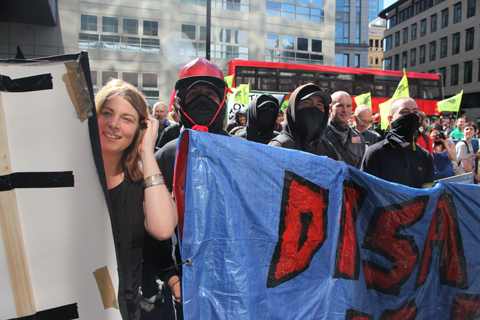
Last week a series of actions took place to protest against Europe’s largest Arms fair which was held in the capital at the Excel Centre. At ‘Defence Systems and Equipment International’ (DSEi) 2007, view there were 1352 exhibitors from 40 different countries with a total of 26,5000 visitors. With the trade fueling conflict undermining development and creating poverty around the world, it was important to show we are not willing for it to go ahead.
Disarm-DSEI-2009-0081.jpg
Photos by Amelia

There was a series of actions held over the week; a flash mob took place at the fourth plinth, a group let off alarms tied to helium balloons at the Offices of AVIVA at the Offices of AVIVA, even London Catholic Workers poured red paint onto a sign advertising the DSEi Arms Fair. Arms dealers also had a rude awakening with activists holding placards and non-lethal-bio-degradable guns, shouting with a loud hailer at their hotel rooms.

On Tuesday there was a mass action where a large group of activists rampaged through a series of corporations that back the arms trade. RBS, Barclay’s, Legal and General, BT and AXA who have all invested millions, were targeted with shoes being thrown, banner drops and windows smashed.
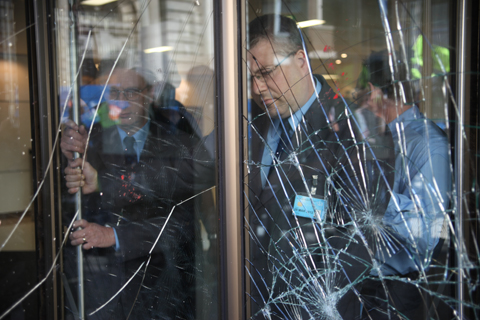
Disarm-DSEI-2009-0266.jpg

I managed to get to the demo last Thursday at the Hilton where the arms dealers were having a gala dinner. It was strange to think that only a few meters inside the Hotel, men and women responsible for millions of deaths were sipping on champagne in their pin striped suits.

As well as the sizable police force, outnumbering the protesters, there was also an array of thuggish looking men, ear pieces in, blocking the entrance. A pretty intimidating sight for a ramshackle group of activists. I wasn’t quite sure who the upstanding members of the community were meant to be, especially when they nicked our sound-system at the first opportunity.
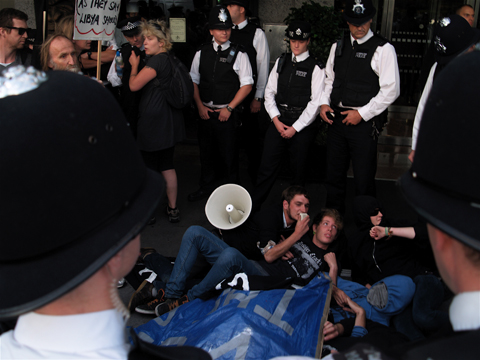
arms1.jpg

I was impressed by the group who held up placards to point out the dealers, mainly for the comical side of seeing the suited men scuttle away inside to the safety of the Hotel. Embarrassed; I wish, but probably just eager to get back into their plush bubble and escape the threat of a conscience.

arms2.jpg

Soon after we arrived a couple of trucks pulled up with a load of railings and in no time they had created a little pen. Surprisingly, we didn’t just mindlessly get herded in. The small bunch of people at the entrance sat down and linked up. The remainder continued to evade the police kettling, harassing and confusing the arriving arms dealers.

After attempting to herd and pen us in, it soon became clear that with the rich and powerful animals inside, (am I allowed to call them that?) they had to get us out of the picture. About 20 activists were arrested and dragged and bundled into the back of police vans.

arms3.jpg

It looked like the action was over, and with such influential people inside, it felt like a success to even get to the entrance. To stop the arms traders or to get them to feel even the slightest bit guilty felt like it required half the world’s population banging at their door. With the government backing and the police protecting them, it’s going to be a continued uphill struggle.

Disarm-DSEI-2009-0256.jpg
Elizabeth Johnson is a diverse and talented photographer whose fashion images and self portraits capture a certain bleakness of the human spirit, viagra buy her commissioned portraits for Vice and Nokia capture the sitters individual playfulness. Personally, about it Elizabeth’s images whether fashion (Dennis Severs House, viagra image below), self portrait or images representing the fleeting nature of empty summers convey an incredible sense of literary narrative. The girls populating the photographs appear to be whimsical creatures existing solely in the countryside, outside the trappings of modern life. The photographs allow the viewer to project themselves into the softly lit landscapes. Amelia’s Magazine asked Elizabeth about the influence of her inspirations regarding her the compositions of her photographs.

dennissevers2.jpg

Where does your inspiration come from?

?A lot of my inspiration comes from the human condition, trying to find a way to illustrate emotion/feelings. My favorite image is one of the two that I used in my degree exhibition, a self portrait, facing away from the camera, in a white dress. I currently have a 4 ft x 4ft copy of it in my flat

elizabethjohnsonselfportrait.jpg

Why do you produce images?

I’m interested in people making images that are beautiful and art. Using stunning images that will long outlive the clothes that they are supposed to be selling. The imagery should transcend the commerce.

What is your relationship to clothes used in shoots?

I adore beautiful clothing, but have little to no interest in documenting trends. I am aware of them, being ‘current’ doesn’t interest me, as I feel that it means your work will date and become obsolete really quickly.

elizabethjohnsonfilmnoir.jpg

The film noir images appeared in The Times.

elizabethjohnsonmilfy%201.jpg

Do you discuss your creative process?

Sometimes I’ll try and talk to other people about what I’m inspired by, but I’ll either get shy or irritated if they don’t understand… So I turn to books etc.

?Favourite photographers?

My favorite photographers are Sarah Moon, Francesca Woodman, Ryan McGinley. I love Sarah Moon for her work as it is just so unique, with such a strong story running through her images. I go back time and time again to her work. Francesca Woodman for the tragedy surrounding her, which may sound a bit macabre, but she was beautiful and committed suicide at just 22, the ghostly almost angelic nature of her self portraits seem to show an awareness of the fragility of life. Ryan McGinley, his photographs make me think he just seems to enjoy life so much.

?Who do you consider to be an important photographer for this generation?

I think Alec Soth is amazing, he manages to combines itinerant documentary work, while moonlighting as a fashion photographer. Plus he’s a member of Magnum.

elizabethjohnsonlake.jpg

??Motivation outside of photography?

I’m inspired by so many different things… nature, I can’t stay in London more than five days without craving the countryside. I’m inspired by people, and their emotions, the way we interact, how we glorify the past. I get quite overwhelmed sometimes, taking pictures is a good way to shut feelings in a box and helps you move on.

dennissevers.jpg

??What are your thoughts on the drive towards an ethically sustainable fashion industry

I feel that young designers such as Ada Zanditon creating ethical and sustainable fashion is an exciting development. For me, buying second hand/charity shop is the best thing you can do, as you are reusing what has already been produced….

?Do you prefer natural or studio lighting?

I really don’t like using studios… I find them intimidating and a bit limiting for the work I want to produce. I use an olympus OM20 and always try to shoot in natural light…

How did your photographic style develop?

My photographic style probably comes from years of looking at other photographers and unsuccessfully trying to copy them. I think that I’ve not yet found a style that I’m truly comfortable and happy with to be honest.

elizabethjohson.jpg

How does literature or music inspire your photographs?

Literature inspires me so much, I’m like a poor mans author, as yet unable to cohere my thoughts into passages of prose. I often will start a shoot with a reference from a book or a poem.

Elizabeth’s portraits of the horse Milfy are luscious in their portrayal of the consideration the owner has for their steed. It is in this ability to capture a range of human emotions that Elizabeth’s photographs become timeless and not simply about fashion or art. Instead they become about the subject that so inspires much literature. The Human Condition.

Elizabeth Johnson graduated with a degree in editorial photography in 2008 from The University of Brighton.

Categories ,Alison Jacques Gallery, ,art, ,Elizabeth Angela, ,fashion, ,Horse and Hound, ,photography, ,Sarah Moon, ,vegan, ,vice

Similar Posts:


Amelia’s Magazine | I am on Maternity Leave: Burlesque Baby Bump Photography by Tigz Rice and Pregnancy Illustrations

TigzRiceStudios Amelia Gregory
Is that really a baby in there? Or is it just a giant beach ball? It’s hard to believe I am this big, for real.
Photography by Tigz Rice Studios.

Well, the time is nigh…. my due date is approaching with inexorable rapidity, and this baby is definitely going to arrive sometime soon. As a result you may have noticed a drop off in blogs on this website as my nesting instinct inevitably kicks in – the last few months have seen a flurry of activity in a house that up until now has been a workplace. For years back issues of Amelia’s Magazine, promotional CDs, look books and other paraphernalia have dominated my home space… but now what used to house my interns has finally become what could be baby’s room (still full of boxes and clothes mind you), and my kitchen is no longer of the cheap student variety but rather a clean white affair from IKEA. The plumbing is no longer exploding in a dramatic fashion everywhere, fuses are mostly fixed, the wooden floors have been filled and sanded, I have become obsessed with painting all the walls totally white and the dust is vaguely under control.

Amelia-by-Sally-Jane-Thompson
Amelia by Sally Jane Thompson from a photo by Tigz Rice.

Amelia burlesque bump by Janneke de Jong from a photo by Tigz Rice
Amelia’s burlesque bump by Janneke de Jong from a photo by Tigz Rice.

Of course, I run my own business and have no capacity to employ someone to take it over for me… so maternity leave is but a dim and distant fantasy. However, this blog is my attempt to tell the world what’s happening and why I might be gone for a little while I adjust to becoming a mother. Right now I have no idea how it will affect my ability to maintain this website but the plan is to take a bit of time off and then dive back in again once I have the energy to do so. I’m sure I won’t be able to resist the lure for long…

Amelia's Bump by Gemma Cotterell
Amelia’s Bump by Gemma Cotterell from a photo by Tigz Rice.

Amelia Gregory by Love Amelia, from a photo by Tigz Rice
Amelia Gregory by Love Amelia, from a photo by Tigz Rice.

Mindful that my body will only stay in this exciting beach ball-like state for a short while longer, and inspired by my friend’s pregnancy photos, I decided to get some *bump shots* done before I return to normality, and this was how I found myself at Tigz Rice‘s studio in Bromley one morning two weeks ago. Tigz Rice is best known as a burlesque and boudoir pin-up portrait specialist, but I thought she might like to have a go at something different. In the process we decided to muck around with some of her burlesque props – the results being some fun shots with ostrich feathers (and nipple tassels, though I am afraid those aren’t going to see the light of day on here) I found it much more relaxing to pose with these props, and strangely enough one of her burlesque regulars commissioned her to do some *burlesque bump* shots the very same week that I visited her, so there’s definitely an idea in the air. Tigz might just have an interesting side career on her hands… so if you fancy something special to commemorate pregnancy why not get in touch with her?

Amelia maternity_by_Ada Jusic
Amelia: maternity by Ada Jusic from a photo by Tigz Rice.

Amelia by Janneke de Jong from a photo by Tigz Rice
Amelia by Janneke de Jong from a photo by Tigz Rice.

Here I share one of the fully clothed shots that she took, and the rest I asked illustrators to interpret since lovely as they are for my personal record I am not really ready to bare nearly all in photographic form on the internet. Plus… illustrators can work wonders with things like fat thighs. I think you’ll agree that an illustrated image to remind you of pregnancy is a fine idea, and if you find yourself in the baby way maybe you’ll consider contacting one of these talented ladies to do the honours – they’re all happy to receive commissions! Just head to their respective websites to get in touch.

Amelias Baby by Claire Jones for Beautiful Moment Art
Amelia’s Baby by Claire Jones for Beautiful Moment Art from a photo by Tigz Rice. The flowers are Lotus, Myrtle and Daisies, which all symbolise birth, innocence, purity and new life.

Amelia Gregory_Amelias Magazine by Nicola Ellen
Amelia by Nicola Ellen from a photo by Tigz Rice.

Finally, there will still be the occasional blog going up until I give birth, and then I’m sure I could be persuaded to share some baby pics… but this won’t ever become a place where I share all about raising baby. So don’t panic! I hope you will bear with me whilst I adjust to this new phase of my life, and enjoy the huge back catalogue of nearly 4000 blogs that reside on this website in the meantime. Why not explore?

Categories ,Ada Jusic, ,Beautiful Moment Art, ,Bump Photography, ,Burlesque, ,Burlesque Baby Bump, ,Claire Jones, ,Gemma Cotterell, ,Ikea, ,illustration, ,Janneke de Jong, ,Love Amelia, ,Maternity Leave, ,photography, ,Pregnancy, ,Sally Jane Thompson, ,Tigz Rice, ,Tigz Rice Studios

Similar Posts:


Amelia’s Magazine | Exhibition Review: Curatorial Collective Circuit Wisely Present 17 Artists

You might not know it, shop sickness but you know Alain Johannes. Producer and artist extraordinaire, having previously produced and collaborated with the infamous Queens of the Stone Age; No Doubt, PJ Harvey, Eleven, and toured with the super group Them Crooked Vultures earlier this year, Johannes is renowned throughout many rock circles for his mesmerising guitar skills, which in March of this year had me caught in a spell during a musical intermission of the Crooked Vultures’ intense set. Thinking Johannes was a brave man to compete with the likes of Grohl, Homme and Jones, I was left blown away by his talent and unequivocal sound.

Making a stand in his own right, Johannes recently released his debut record Spark, co released with Dangerbird Records and Rekords Rekords, the latter label set up by fellow musical maestro Josh Homme of QOTSA and Them Crooked Vultures fame. This is definitely a family affair, and what an awesome family. Dedicating his debut record to his late wife and producing partner Natasha Shneider, fellow Queens of the Stone Age and Eagles of Death Metal collaborator, there is a great sense of magnitude, of heartfelt pain and strength that breathes through the tracks. First track and single Endless Eyes is a beautifully and eloquent tribute to Natasha, and sets the tone for the entire record. Johannes’ signature cigar box guitar creates such a definitive sound it’s refreshing to describe as innovative and enchanting. However stand out tracks include Return to You, which has an unashamed Beatles-esque tone to it, bringing an air of nostalgia and warmth to the record, which can’t be a bad thing.

The record stealing guitar crescendo of a masterpiece to my ears is the incredible Speechless, which builds with such classical and flamenco ferocity; it’s topped by Johannes’ elegant vocals that beautifully complete the ghostly track. Gentle Ghosts draws the record toward its close, but not without a trek through a sensory mind field that awakes the goose bumps scheduled for truly remarkable artists. There’s so much passion and raw emotion surging through Spark, its hard not to feel a greater sense of appreciation. Closing with Unfinished Plan, a classical guitar led cathartic and heartbreaking end to a brilliant debut. Spark shines and splinters through Johannes’ incredibly personal journey, and I’m pretty stoked to be along for the ride.

Alain Johannes’ Spark is for those who likes a bit of substance sprinkled over their desert rock desserts, a treat of a record that won’t turn sour the more you listen. Johannes brings light to the desert rock scene, which, though never fading, has now taken a new and brilliant direction.
Alain Johannes Spark

You might not know it, this web but you know Alain Johannes. Producer and artist extraordinaire, having previously produced and collaborated with the infamous Queens of the Stone Age; No Doubt, PJ Harvey, Eleven, and toured with the super group Them Crooked Vultures earlier this year, Johannes is renowned throughout many rock circles for his mesmerising guitar skills, which in March of this year had me caught in a spell during a musical intermission of the Crooked Vultures’ intense set. Thinking Johannes was a brave man to compete with the likes of Grohl, Homme and Jones, I was left blown away by his talent and unequivocal sound.

Johannes Alain Tim Norris

Making a stand in his own right, Johannes recently released his debut record Spark, co released with Dangerbird Records and Rekords Rekords, the latter label set up by fellow musical maestro Josh Homme of QOTSA and Them Crooked Vultures fame. This is definitely a family affair, and what an awesome family. Dedicating his debut record to his late wife and producing partner Natasha Shneider, fellow Queens of the Stone Age and Eagles of Death Metal collaborator, there is a great sense of magnitude, of heartfelt pain and strength that breathes through the tracks. First track and single Endless Eyes is a beautifully and eloquent tribute to Natasha, and sets the tone for the entire record. Johannes’ signature cigar box guitar creates such a definitive sound it’s refreshing to describe as innovative and enchanting. However stand out tracks include Return to You, which has an unashamed Beatles-esque tone to it, bringing an air of nostalgia and warmth to the record, which can’t be a bad thing.

The record stealing guitar crescendo of a masterpiece to my ears is the incredible Speechless, which builds with such classical and flamenco ferocity; it’s topped by Johannes’ elegant vocals that beautifully complete the ghostly track. Gentle Ghosts draws the record toward its close, but not without a trek through a sensory mind field that awakes the goose bumps scheduled for truly remarkable artists. There’s so much passion and raw emotion surging through Spark, its hard not to feel a greater sense of appreciation. Closing with Unfinished Plan, a classical guitar led cathartic and heartbreaking end to a brilliant debut. Spark shines and splinters through Johannes’ incredibly personal journey, and I’m pretty stoked to be along for the ride.

Alain Johannes’ Spark is for those who likes a bit of substance sprinkled over their desert rock desserts, a treat of a record that won’t turn sour the more you listen. Johannes brings light to the desert rock scene, which, though never fading, has now taken a new and brilliant direction.
Flyer designed by Russell Palmer

Two years since their first show in the basement of Shoreditch Town Hall, pharmacy Circuit Wisely presented 17 Artists in an East London live-work space. This second exhibition asked artists to respond to the location and ‘architecture’ of a residential building, store investigating its scope for possible comment on the contested geography of East London.

Emily Whitebread Stills from a Film (2010)

The artists work (of which I was one) had to be temporal and capable of negotiating the duplicitous communal spaces of the building, illness such as the car park, balconies, stairwells, lifts and terraces. Circuit Wisely made it explicit that the artwork was not to impinge on the everyday movement occurring within the building, pushing the artists to consider how their work would be installed without marking the building and it’s context within the geographical location.

The exhibition began on the ground level of the first stairwell, Mihaela Brebenel’s installation 1 to 7; G to 6A – Loose Ends invited the viewer to follow the woolen thread wrapped around the handrails and architectural piping. Mihaela’s work explored the notion of navigating a particular space – through externalising the internal sources of what one does and does not see upon entering a residential building.

Mihaela Brebenel 1 to 7; G to 6A – Loose Ends

Continuing upwards, I passed Richard King’s decorative installation and a burning red screen-print by Daniel Wilkins. However my attention was held by Ben Fox’sculptural shanty-town: Sublet City. The contrasting nature of the contemporary East London building and Fox’s fragile houses echo the rapid development of East London, where an organic mixture of old and new is being skewed by the rapid destruction of original property in favour of the new. Beautifully made from found materials, it is accompanied by ‘the house shelters day-dreaming, the house protects the dreamer, the house allows one to dream in peace.’

Richard King Untitled

Dan Wilkins Untitled (2008)

Ben Fox Sublet City

The next level was occupied by Will Jennings’ Portfolio. A critical reflection on the building’s owner and his vast property ‘portfolio’. The publication’s investigative text combined with photographic documentation of the property portfolio aimed to create a dialogue between shared landscape and the increasing capitalisation of the concept of home. It is rare that such an opportunity for a piece of work criticising the building is installed in the location that it is criticising. It was interesting to see the interaction and discussion this piece caused with the residence of the building presenting them with the opportunity to re-think their living space. A favourable comparison to make is Hans Haacke’s ‘Shapolsky et al., Manhattan Real Estate Holdings, a Real-Time Social System as of May 1,1971′.

Will Jennings Portfolio

After reading the Portfolio, I continue to walk up the stairs and see Richard King’s second ornamental piece. Hanging in the window, on the level above, the back drop being the East London Skyline, are three beautiful photographs by Alex Ressel.

Richard King Untitled

Alex Ressel A Three Frame Film

Natalie Dray’s ‘DIAL 2-2-4-9 AND POINT TO THE SKY’ a vinyl text piece standing opposite a comical 3D image Lost in Space. The image of a famous Robot appears to vibrate from the paper and into a form of hologram – this I am seeing without the help of 3D glasses.

Natalie Dray

After the completing the stairwell, I made my way to Charlotte Gibson’s Sitting Room Installation made my eyes pop! The collection of brightly coloured collages, furniture, lamps, china, jelly, plastic and string are arranged in such a way that the space inbetween them becomes more important through the string that attaches them, the water and jelly that resides in the objects and the shadows casted.

Charlotte Gibson Sitting Room Installation

Natascha Nanji’s A Tail of Two Cities occupied the lift in the second stairwell. The ceiling was covered with punctured black pvc, the work physically inserted itself into the lift, the gaping weight of the shells contained within the black fabric imposing itself upon the lift experience, transforming a banal everyday occurrence into something uncanny. On one journey a chattering couple walked in unaware of what was above their heads, until a shell grazed the top of the man’s head, alarming him and drawing his attention to the ceiling. A scene from a horror film perhaps?

Natascha Nanji A Tail of Two Cities

After coming down in the lift, I returned to the 5th Floor to find the walkway occupied by Zoe Paul’s Buoy and the terrace contained Susanna JP Byrne’s Cy Cartographer No. Sculpture. Standing tall, the sculpture looks out towards the city – reminiscent of a century guard, looking out over the London landscape. The copper wire felt referential of a school science project and the tripod’s brightly coloured poles appeared similar to the yard sticks used to measure playing fields during practical geography lessons.


Susanna JP Byrne Cy Cartographer No. Sculpture

Zoe Paul Buoy Photograph by Selvi May

Marnie Hollande’s performance piece Gas wowed the audience on the exhibition’s opening night. A figure emerged onto the walkway, her face covered by a shimmering midnight blue mask, the body cloaked in chiffon with attached balloons. Moving onto the terrace to continue the performance, the body and balloons struggled against both the wind and crowd. The exceptionally strong wind increased the movements of the performer moving within the constraints of her costume. At one point, balloons detached themselves from the costume and were carried into the darkness.

Marnie Hollande Gas

On reflection Jennings, Dray, Fox and Bryne’s pieces directly tackled the building’s geographical location. The other pieces included by Circuit Wisely responded more directly towards the architecture, whereas others echoed the idea of ornamentation. Personally, the importance of the exhibition, lay in tracing perspectives and making connections between the work within the building’s parameters. Circuit Wisely shift away from the stress and importance of individual works when umbrellaed into a singular meaning all too common with groups shows.

The exciting thing about Circuit Wisely is not just the diversity of work on display but the transition they have gone through as a collective of curators. The success of CWII were that the visitor appeared to be completely free to move about the building, but were fact deliberately manoeuvred to encounter the work in relationship to the various movements one can make within the space. The curation and choice of art works allows visitors to experience different environments and transports them from a block of flats to an interesting space for creative people to come together and display work. This show is successful as it is not constrained by the gallery space. It is a platform for the viewer to encounter works in different environments heightening their experience of viewing a group show – and this is the success of the Circuit Wisely curatorial team.

All Photographs by Circuit Wisely

Categories ,A Tale of Two Cities, ,Alex Hemsley, ,Alex Ressel, ,Ben Fox, ,Buoy, ,Charlotte Gibson, ,Circuit Wisely, ,Curation, ,Daniel Wilkins, ,Emily Whitebread, ,Gas, ,Gery Georgeiva, ,Marnie Hollande, ,Modernism, ,Natalie Dray, ,Natascha Nanji, ,photography, ,Richard King, ,Sally Mumby-Croft, ,Selvi May, ,Stairwells, ,Sublet City, ,Susanna JP Bryne, ,Untitled, ,Will Jennings, ,Zoe Paul

Similar Posts:


Amelia’s Magazine | EXPOSED: Voyeurism, Surveillance and the Camera at Tate Modern: A Review

Tate Modern Exposed Philip-Lorca diCorcia Head
Detail from the Head series, doctor 2001, see by Philip-Lorca diCorcia.

Exposed: Voyeurism, cost Surveillance and the Camera at the Tate Modern claims to be the first major exhibition to try and document our complex relationship with voyeurism and covert photography. It’s a fascinating subject and Exposed attempts to unravel this relationship via a series of themed rooms rather than a systematic historical walk through. So in the first room we are immediately confronted with the giant flash lit photos of people caught unawares in the street by Philip-Lorca diCorcia alongside tiny ancient photographs in sepia from Horace Engle, who captured his subjects sitting on the trams in small town America during the late 1800s at a time when unposed scenes were far from the norm. The contrast could not be more stark in terms of the garments worn or the technical prowess, but the unselfconscious expressions of those who don’t know they are being preserved for posterity just at that precise moment remain the same. The curation of this fabulous exhibition brings about a fascinating realisation that the carefully cultured veneer that humans present in public situations (where we know we are being watched) has not changed a jot over the years.

Tate Modern Exposed Philip-Lorca diCorcia Head
Detail from the Head series, 2001, by Philip-Lorca diCorcia.

Tate Modern Exposed Walker Evans
Detail from Subway Passengers, New York, 1938 by Walker Evans.

Tube Couple May 2010
Oh woops, this isn’t in the exhibition, but it’s an example of covert photography on the tube in May 2010.

At a time when photographers had become more sneaky about their trade Walker Evans spent three years during the 1940s surreptitiously photographing passengers on the New York subway, and an accompanying case displays examples of the cunning implements that were used by him and others, including a walking stick, a shoe and a flattened disc worn beneath a shirt – lens peaking out through a buttonhole. Deception could have its downsides though as HR Voth discovered whilst documenting the Hopi Indians in Arizona over a period of 9 years at the turn of the 19th century – when they found out what he was up to he was summarily blamed for all their ills and ejected from their tribe.

All sorts of sneaky tricks were used to capture an unaware public; Yale Joel set up a trick mirror in the Broadway movie theatre to capture women and men making subtle adjustments to their best clothes. By the 60s photographers were quite literally stalking their prey – the photographs of Lee Friedlander include his shadow, eerily close to the backs of his subjects.

Tate Modern Exposed Lee Friedlander
Salinas, CA, 1972 by Lee Friedlander.

We are then given the opportunity to examine the crossover between covert photography of the masses and the classic paparazzi shot. Alair Gomes shot strangely homoerotic pictures of young men pumping iron on the beach in Rio using a telephoto lens whilst John Gossage went one better, picking out people on a Mexican beach from his location several miles away in California, safely across the famously dangerous border. Alison Jackson became well known for her carefully staged set ups of famous people seemingly at ease and Exposed features a famous shot of the Queen playing with her corgis.

Perhaps one of the most interesting series in the exhibition belongs to an early fan of self promotion. Over a period of forty years from the mid to late 1800s Pierre-Louis Pierson was hired by the French Countess of Castiglione to present her in some extraordinary fantasy poses drawn from ideas in fashion magazines and theatre. Just think of all the celebrities who have taken her ideas to heart in the years since – all those staged marriages in the pages of Hello! magazine have their genesis in the Countess’s photo albums.

Tate Modern Exposed Game of Madness by Pierre-Louis Pierson
Detail from Game of Madness, 1863-66 by Pierre-Louis Pierson

Of course, as soon as the use of cameras become sly what should photographers turn their attention to but erotica? We are treated to a whole room of voyeuristic shots of prostitutes and their punters, mostly taken by secretive means. Amongst the more familiar images of the great Henri Cartier-Bresson and Helmut Newton we are treated to some fabulous shots taken by the likes of Weegee, who used infrared flash to take pictures of lovers on the beach at Coney Island or snogging each other’s faces off at the movie theatre.

Tate Modern Exposed Weegee Palace Theatre 1940
Details from Lovers at the Movies and Palace Theatre, both c.1940 by Weegee.

Infrared flash is a technique that has been revisited by voyeuristic photographers the world over, and a whole run of wall is devoted to a series taken by Kohei Yoshiyuki during the 1970s, when he infiltrated groups of men who liked to stalk and attempt to touch lovers making out in the park. Although he regarded himself as one step removed from the men he joined he admitted that the act of photography was one of voyeurism too.

Tate Modern Exposed Kohei Yoshiyuki
Photo from the series The Park, 1971 by Kohei Yoshiyuki.

And therein lies an interesting conundrum. What is the difference between a voyeur with or without a lens to separate them from an event? At the end of the day is there any division at all? Or does wielding a camera merely legitimise an act of voyeurism, allowing us to partake in an event without feeling too closely attached to it? As someone widely practiced in the more voyeuristic end of photography I can confirm that I use the camera as a form of safety blanket in high stress situations like climate activism, allowing me to get closer to subjects than I would otherwise feel less confident about engaging with (very large Danish riot police with huge steel boots, batons and pepper spray). Taking photos satisfies my need to be in the thick of an event whilst retaining an element of separation. I’m there, but not there. The reason I enjoy taking photos in other situations – such as on the tube – is less clearcut. I simply enjoy capturing a visually interesting scene that hasn’t been staged for my benefit.

All this brings me to the last rooms of Exposed, which are devoted to surveillance, CCTV and the use of documentary photography to capture acts of aggression. I didn’t have as much time to peruse these sections, but they necessarily featured lots of photos from more recent times, as cameras have become a more and more ubiquitous part of our existence.

Tate Modern Exposed Mitch Epstein 1997
Detail from a photo in the series The City, 1997 by Mitch Epstein.

This is a thought provoking exhibition and a must see not just for photographers but for anyone intrigued in how the documenting eye has become ingrained in our lives over the space of less than two centuries.

You can find out more about Exposed: Voyeurism, Surveillance and the Camera here. The exhibition opens today and runs until 3rd October 2010 before travelling on to the San Francisco Museum of Modern Art where it will be open from 20th October 2010 – 17th April 2011.

Categories ,Alair Gomes, ,Alison Jackson, ,Camera, ,CCTV, ,Coney Island, ,Countess of Castiglione, ,exhibition, ,Hello! magazine, ,Helmut Newton, ,Henri Cartier-Bresson, ,Horace Engle, ,HR Voth, ,John Gossage, ,Kohei Yoshiyuki, ,Lee Friedlander, ,Mitch Epstein, ,new york, ,Philip-Lorca diCorcia, ,photography, ,Pierre-Louis Pierson, ,review, ,Surveillance, ,Tate, ,Tate Modern, ,Voyeurism, ,Walker Evans, ,Weegee, ,Yale Joel

Similar Posts: