While Spring turns to Summer, viagra dosageLondon Fashion Week AW10 may fade in our memories, viagra dosage but the designers that drew us in certainly won’t. One such designer that caught my eye at the Esthetica exhibition was ‘Makepiece’. The concept and techniques used were so intriguing that we couldn’t resist interviewing the owner, try Beate Kubitz.
Why did you choose to focus on eco-fashion? Why is it so important to you?
Clothes are important to me. I think what you’re wearing tells other people a lot about you, who you are and how you feel about yourself. I don’t like the idea that something that makes me look great was complicit in damaging the environment or the people who made it. You don’t want your favourite t-shirt to be dripping with pesticides, cause a water shortage or to be sewn up in a sweat shop. But unless you’re very careful, it might be.
There’s something wrong with the latest trend ‘buy, wear, chuck’ mentality – it’s a bit neurotic and it’s definitely bad for the planet. We try and make clothes that are significant to the women that wear them and that they can feel really good about.
How did the Makepiece brand begin?
I’ve been keeping sheep for seven years now, met Nicola six years ago and Makepiece is now five.
We’re located in Todmorden, a small town in the Pennines. It’s beautiful and has a long history of wool production so it feels like the right place to be doing it. The landscape is scattered with mills built in the nineteenth century – but wool was being spun and woven in cottage industries and then transported to market or the Piece Halls on ponies travelling on packhorse tracks which still crisscross the moors.
What techniques do you use in your clothing?
Knitting – with some knitted felt. The important thing is stitch design – Nicola is the queen of 3D stitches that really sculpt the garments and give them their drama as well as their details. She uses hand operated knitting machines which give her scope to develop a stitch then apply it in loads of different ways so that it works on the body. Our knits tend to be more three-dimensional because they’re designed like this. Also, all our knits are fully fashioned (knitted to shape rather than cut out of a piece of knitted cloth) which looks better and wastes less yarn.
What materials do you use in your clothing?
Wool – some of it undyed brown wool from our Shetland sheep, others fine Bluefaced Leicester wool, from the UK flock and English alpaca and mohair.
What was the inspiration behind your most recent collection?
Romance, definitely. Nicola got married in the summer and the sense of romance seems to have seeped into and permeated the collection. There are lots of ruffles, little frills, translucency and volume – but not just ephemeral prettiness, really lovely things that you can adapt and keep forever.
Do you have a favourite piece in the current collection? If so, what is it and why?
There are a few things that are really adaptable – like the Manifold cardigan which has a ribbon tie which can be used to ruche it up to bolero length or left loose so that it’s a long, elegant cardigan. Our little Foxglove shrug also works as a summer scarf and the Manifold dresses can be styled in loads of ways so they let the wearer use her imagination.
What are your future aims for the Makepiece brand?
We’ve really been growing our website so that people all over the country can buy our clothes but we’d like to be in more stores, for the people who are less confident with internet shopping or who like to try things on.
Is it harder or easier to sell eco-fashion? Is there a lot of competition?
Because we make everything in the UK it’s more expensive to manufacture so that means that we have to do a good job in helping people understand.
What is so individual about the Makepiece brand?
Style, humour and our flock of Shetland sheep. We go from mud to mascara in a twinkling of an eye – never forgetting the roots of our fashion but always looking for beauty and grace in our designs. We try and be sustainable throughout the business – from the way we farm the sheep with the lowest impact possible (we’re just about to become part of a scheme to help protect twite – which is one of the most endangered British bird species) to buying green energy for the studio, recycling everything we can, using public transport as much as possible (I took our last collection to London Fashion Week on the train from Yorkshire – in the most enormous trunk – it was quite a feat), I even do some of the farming on my bike.
The good thing about wool is that it is more or less a by-product from sheep farming so it’s not using up land or resources that should be in food production – and on upland farms like mine creating good grazing and farming sheep is one of the few productive things you can do (I tried vegetables once, but it was not a success!). Compared to cotton, for example, which uses over 15% of the pesticides used in the world and vast amounts of water – so much that the irrigation of cotton has shrunk the size of the Aral Sea in Uzbekistan, wool is farmed much more sustainably (particularly in the UK where we have to look after the land as well as the animals and the government monitors your impact on the environment).
Because we make everything so locally we avoid the CO2 emissions from shipping things vast distances. We also employ people in our community and use a local dyer who has to comply with European dyeing regulations – the REACH standards; no azos, no heavy metals and irritants, effluent is stringently monitored so no emissions into the water system, and so on.
We also only use recycled and sustainable paper in our labelling and packaging.
You can find the brand at: www.makepiece.co.uk and selected eco-fashion stores.
Tania Kowalski was a workshop manager at a well-known contemporary jewellery gallery in London when Synnove Saelthun arrived from New York to join the design team. They soon discovered that they had similar views on design and business ethics, more aboutcialis 40mg and became good friends. Several years later they started the Oria brand, prescription using Synnove’s design skills and Tania’s production expertise. Synnove is a technically brilliant goldsmith with a passion for design and an eye for detail. Tania is a trained jeweller, viagra with a wide range of experience in the jewellery industry, from design creation through to production. Her expertise includes sourcing ethical materials and ensuring fair business practice.
Tania’s passion for other cultures has led her to visit remote tribes in the Amazon of Brazil, hill tribes in Nepal and the Dogon people of Mali. It was during these travels that she became fascinated with the cultural importance and symbolic meaning of tribal adornment. When designing a new collection, the couple sit down together to discuss what the new collection will symbolise. They research and refine story boards, and after ensuring that the designs are technically feasible Synnove makes an initial prototype, the best of which will go into production.
The use of the phoenix is a symbol of honesty and justice in Chinese mythology, and is one of the inspirations for the Nina collection. The lotus symbolises purity and beauty in many different cultures, and it inspired their silver lotus collection.
Working in Nepal Tania discovered that the safe working conditions and fair living wages which we take for granted in the West are not necessarily the norm in other parts of the world. This early experience was important in persuading Tania to commit to fairtrade sourcing as a founding principle of Oria.
Vintage fashion, about it illustrated by Matilde Sazio
Kim Sklinar, viagra sale aka Preloved Reloved, cheap has set herself an interesting New Year’s challenge. For the duration of 2011, Kim isn’t going to buy any new clothes. No more high-street bargains, no more feeding corporate giants, no more fast-fashion waste, no siree. ‘Another one?’ I hear you cry – and you’d be right. But this one is a little different.
While Kim hopes to raise awareness about the amount of cheap clothing we purchase and what effects that has on the environment and people’s lives, there’s also a bigger reason closer to home. Kim’s father was diagnosed with cancer over 18 months ago, and she decided to set up the project to raise funds for Macmillan, the cancer care and support charity. Unfortunately, as of only last week, Kim’s dad won’t see the project through its fruition. But Kim will dedicate the project to his memory.
So, how do you do it? Well, Kim’s vowed to buy only vintage and from outlets like eBay, and she’ll spend more time in charity shops which also benefits all of the organisations that run them. I had a chat with her about the project and how she thinks she’ll manage it all…
What gave you the idea for Preloved, Reloved in the first place?
Well I always like to dress a little differently. My style is mainstream with a retro edge, I suppose. I always seem to end up with a daft New Year’s resolution – last year I cycled from London to Paris for The Institute of Cancer Research. I like using my time to help others and spread awareness.
Were you a fan of vintage and upcycling before you started the project?
Yes! I always admire my friends’ outfits; well, those who wear vintage and second-hand fashion. Upcycling is something I have experimented with for ages at home and now is the time to make sure I actually finish some projects!
Where will you source your outfits?
Charity shops, vintage stores, eBay, my mum’s wardrobe…! I made a lined cape last night from linen and satin for balmy summer nights (booking a holiday soon!).
What does the project hope to achieve?
I want to raise awareness of numerous charities related to my Dad’s illnesses. I want my friends to know that too much of an unhealthy lifestyle is probably going to lead to an early demise. I also want to raise the profile of vintage and second-hand fashion; I remember as a kid we use to take the mick out of anyone who dressed from a charity shop. I myself as a student had a stigma against them. Now it’s become kitsch, cool and quirky. It’s good for the environment.
How much do you hope to raise and what are the funds likely to be used for?
£2500 is my Just Giving target – it goes directly to Macmillan. However, with my shopping at many different charity shops, my cash goes straight to them – win win all round! I have my thinking cap on about how to expand the project though.
Why did you choose Macmillan?
My dad (and his dad) had cancer – he died last week unfortunately. And it wasn’t the cancer that killed him, it was his heart and his adult-onset diabetes. A poor lifestyle in his twenties and thirties caused it and he was only 57 when he passed. So as I said before, this project benefits other charities focussing on these causes too through me spending money at their outlets.
Not that far in, but have you come accross any problems so far? Has anything that happened that you weren’t expecting?
Avoiding shops is quite hard as I realised I can’t just pop into the Topshop sale and treat myself – which I suppose is good for my wallet and I’m going to do less impulse-buying on the way home from work.
With my Dad passing, I haven’t had as much time to go browsing shops as much as I’d like. This weekend, however, I’m going to the Girls of Guildford vintage fair and gig – for some serious retail therapy, cupcake-nomming and also to check out some great live music away from the bustle of London.
What are you wearing today? Where’s it all from?
Dark blue skinny jeans, leather knee boots that I already owned with black and cream patterned blouse from River Island that I bought from Cancer Research UK. I’m also wearing red rose earrings from Magnolia Jewellery.
Do you plan to make or alter any of your clothes? If so, how?
Yes – I love sewing and making jewellery too – I made a cape last week and have upcycled a pair of old, torn jeans from my uni days into a denim mini. I have a small collection of retro patterns including a lovely dress with a pussy bow. I love being able to create something out of fabric I love: last year I went to a lovely Indian wedding and couldn’t find The Outfit – so I made a purple maxi-dress with a halterneck and glammed it up with ribbons dangling down my back. Saved myself a fortune too!
What else do you get up to?
I run Never Enough Notes – a music e-zine, and I’m cycling the London-Brighton this summer with my brother and friends to raise money for the British Heart Foundation.
What would be your perfect Preloved, Reloved outfit?
For daytime it would easily be vintage jeans, brown boots that look a bit worn-out, a floaty shirt or cheeky tee, a tweed jacket and a battered satchel.
For evening, I love ball gowns and retro dresses so would be something glam that I could wear with a pair of 1970s heels! Oh there’s way too much choice, I love it!
999 it’s time, sildenafilerectile is another green focused campaign. As the website notes “We are in a state of emergency – socially, store economically and ecologically. What do we do in an emergency? In the UK, viagra 100mg we dial 999…” Well that all sounds pretty heartening until you realise that the 999 campaigns reaction to this emergency hasn’t exactly been particularly speedy so far. I can’t help feeling that the climate emergency we are facing means groups should be advocating some real direct action rather than just planting a tree or joining the 10:10 movement. However the campaign has some great initiatives to get the ball rolling and hopefully get more people thinking about the global crisis.
Of course the campaign does have some credibility, it encourages people to get more environmentally friendly, and behind the celebrity endorsements 999 has some forward thinking ideas about how communities in particular can work together to create a more sustainable world. Transforming rural and urban spaces into shared land to grow food has been one of the most successful elements. Capital Growth is the place to start with a great run through of the process and steps and how to get involved. Land sharing empowers people by growing their own food and creating stronger links in communities as well as reducing the reliance on supermarkets. A definite step in the right direction.
I caught up with Hugh Fearnley-Whittingstall, the rural country celebrity chef, to talk about his part in the 999 campaign.
Can you outline what 999′s main priority is about and why you’re here today?
999 is about driving home the issue of climate change and what we ourselves can do to combat the emergency situation we have found ourselves in. I’ve come today because our aim ties in with the Climate Rush campaign, and its a great way to get talking with the local community, and of course it’s the 9th of the 9th 09.
How is the 999 campaign coming along? It doesn’t seemed to have gained as much prominence in the press such as campaigns like the recent 10:10?
It’s an on-going process, im specifically been looking at the food aspect, and as the ambassador I’m really interested in what small scale communities can do to combat the threat of climate change.
Can you please give some examples of the message your trying to get across in relation to the food aspect of the campaign?
With my books and TV series I’ve been highlighting the importance of locally grown produce and recently I’ve been pushing the idea of land sharing. The idea is to find land, whether in urban or rural spaces where people can grow their own food, there is so much land wasted around the UK that can be used. With over a thousand people on waiting lists for allotments especially in the south, it is vital we utilize all the land we can instead of relying on foreign markets for our vegetables. Food is a great way to create a cohesive community and bring people together.
How is the land sharing campaign going, have you had much success?
We’ve had over a thousand land plots given to us and up to 30,000 people signing up to the website, so it’s defiantly getting people interested. The campaign is also working with groups like the Church of England and a range of British NGOs. The National Trust for example has just given us 1000 plots of land, so although it’s quite a slow process, there’s been a real positive reaction across the country.
With your interest in climate change, have the facts about the meat industry’s huge carbon footprint persuaded you to become vegetarian yet?
No, not yet, I’m aware of the issues, and I keep by own pigs and livestock, and always advocate buying locally soured meat to keep the carbon footprint low.
So let’s hope this campaign can help to stop this emergency from escalating, with 1 day, 11 hours, 9 minutes since 999 Day, the pressure is on.
The Design Museum’s annual exhibition of young designers begins on September 18 with site-specific works from Marc Owens and Dave Bowker. Owens is inspired by virtual realities – his work Avatar Machine replicates video gaming via a headset (above), order designed to make the wearer see themselves as a virtual character in the real world. Bowker works in data visualisation and will be re-examining the way visitors move about the Museum.
Once a year thousands of London’s most interesting and historic buildings are opened to the public, sale some of which are locked up tight for the rest of the year. Although some of the most popular buildings in the centre of London have already been completely booked, drugs there are still plenty of places worth visiting.
If you haven’t got your eye on anything in your local area, consider visiting the house of Dr Samuel Johnson, of “the dictionary” fame. It’s free to visit on Friday (there will be free cake on this day) and Saturday, in honour of the great man’s birthday.
Radical Nature
This exhibition of works revolving around nature and inspired by environmentalism features pieces from architect Richard Buckminster Fuller and artists such as Joseph Beuys and Hans Haacke, as well as newer names such as Heath and Ivan Morrison and Simon Starling. Impactful and timely, there are lots of strong visual statements such as the Fallen Forest by Henrik Håkansson (above) and a visual record of the fields of wheat planted as an act of protest on a landfill site in Manhattan.
Thames Festival
Sunday
One of the few fireworks displays allowed along the Thames will occur on Sunday when the Thames Festival fireworks are set off in all their glory, fired from barges between Blackfriars and Waterloo Bridge so everyone can get a perfect view. There are also events all day, including fire-eaters, an outdoor ballroom (starting to become the South Bank’s speciality) and the annual Night Carnival, where 2,000 costumed revellers bearing lanterns and luminous costumes will welcome the pyrotechnics.
Another load of talks, healing workshops and activities to get stuck into, information pills don’t forget Co-Mutiny is still on all this week in Bristol, Climate Rush are still on tour, and also make sure you get down to protest against the closure of the Vestas Wind Turbine factory this Thursday. Good luck with fitting it all in, I’m certainly going to struggle!
An exciting event has been organised with international speakers and delegates involved in policy-making, business, and academia. Understanding the role of climate change policy is central to a business’s future success. Topics will include the political, economical, technological, and legal challenges and solutions for decarbonising electricity.
To register for a discounted ticket visit the website and enter ‘ge2009′ as the discount code.
A Global New Deal needs a Green New Protectionism
Wednesday 16 Sep 2009 ?
An evening to learn and discuss the ‘triple crunch’ that we face: climate change, energy insecurity, and financial and economic meltdown. Colin Hines, Author and convener of the Green New Deal Group will be leading the talks. Colin has worked in the environmental movement for over 30 years including 10 years at Greenpeace. His recent work focuses on the adverse environmental and social effects of international trade and the need to solve these problems by replacing globalisation with localisation. During the evening there will also be a tribute to ‘Teddy’ Goldsmith, founder of The Ecologist magazine.
Time: 6.30pm drinks and food, 7.30pm talk begins at Burgh House
Venue: Gaia House, 18 Well Walk, Hampstead
Contacts: To book email, book online or call 0207 428 0054.
Website: www.gaiafoundation.org
Protest against the closure of Vestas Wind Turbine Factory
Thursday 17 Sep 2009 ?
As well as the continuing protest against the closure of the Vestas Wind Turbine factory at the Isle of Wight, there will also be a chance for people to make their feelings known across the country. People are meeting at the Department of Energy and Climate Change in London to lobby against the government. There will also be speakers including John Mcdonnel, MP (Labour, Hayes and Harlington) and Tracy Edwards (Young Members Organiser for the Public and Commercial Services Union).
Couldn’t put it better than Phil Thornhill from the Campaign against Climate Change “Just when we need a huge expansion in renewable energy they are closing down the only significant wind turbine factory in the UK. The government has spent billions bailing out the banks, and £2.3 billion in loan guarantees to support the UK car industry – they can and should step in to save the infrastructure we are really going to need prevent a climate catastrophe.
Whilst the impact on employment on the Isle of Wight will be quite devastating, this is an issue not just about jobs or one factory but about whether the government is really going to match up its actions to its rhetoric on green jobs and the rapid decarbonisation of the British economy – whether its prepared to act with the kind of resolution and energy we need to cope with the Climate Emergency”.
Time: 5.30 to 6.30pm
Venue: Outside the Department of Energy and Climate Change, 3 Whitehall Place.
?Website: www.campaigncc.org
Out of the Ordinary Festival
Friday 18 Sep 2009 to Sunday 20 Sep 2009
?
OOTO is a 3 day family friendly and eco friendly festival set in the beautiful Sussex countryside celebrating the Autumn Equinox. Featuring a variety of live music powered by solar panels and wind generators, fascinating talks and workshops, children’s activities, awesome performances, a green market place and many more out of the ordinary surprises. The festival is also offering Big Green Gathering ticket holders a discount for the event held over the weekend
Venue: Knockhatch Farm, Hailsham, East Sussex
?
Website: www.outoftheordinaryfestival.com
Tree-Athlon
Saturday 19th September
Get fit and get your very own tree sapling to take home! Participants run a 5km race to raise money for Trees for Cities, an independent environmental charity working with local communities on tree planting projects. There is also music, entertainment, lots of tree-themed activities, whatever that may consist of, and plenty of other workshops to keep the whole family entertained.
The race is open to runners aged 14 and up and is ideal for beginners or experienced runners alike. Register now, to make sure you can raise as much sponsorship as possible before the day, and look forward to a grand day out.
?The Urban Green Fair is held in Brockwell Park in London this Sunday, Its a free event and with plenty to do and see, the fair is also powered by solar and wind energy.
The annual family event, has a range of films, talks, workshops, kids activities, stalls, sunshine as well as some unusual bicycles. Unfortunatly no bars or big stages but this keeps the emphasis on education and communication. A chance to share ideas, meet familiar faces and make new friends. With little government action on peak oil and climate change there is plenty to discuss and lots we can do as individuals. ?
Leytonstone Town Centre will car free day this Sunday. As well as having no vehicles hurtling around there will also be entertainment, stalls, live music, dancing, public art and childrens’ play areas. Simon Webbe from Blue and Aswad will be headlining! Get yourself down, and make sure you leave the car(if you’ve got one) at home.
Time: 1pm-7pm
Venue: Outside Leyonstone tube station
Website: www.walthamforest.gov.uk
Co-mutiny
Saturday 12th of September until Monday 21st September
A coming together of activists, eco-warriors gardeners, artists, community/political groups, cooks, builders etc. to demonstrate our creative power to build a city/world we would like to see. Co-Mutineers have taken an old cathedral (of the holy apostles) near the Triangle in the Clifton/Hotwells area, it’s a space to converge, eat, sleep meet and discuss, plan and skill-share!
There will be over a week of different activities, direct actions, workshops, film screenings, public demonstrations and parties. It’s happening all across Bristol and the wider South West.
During the week there will be actions happening all across the city, which will climax in a fancy dress carnival through the financial district of Bristol on the Friday.
Venue: Bristol Pro Cathedral, Park Place, BS8 1JW
Website: http://comutiny.wordpress.com/ Monday 14th September
William Elliott Whitmore The Garage, order London
We can’t get enough of this distilled, medications gravelly bluesman. With Whitmore, it’s almost like you’re listening from inside a huge bottle of JD.
Having supported folk heavy weights, Tunng, Bon Iver, and King Creosote, this ballsy 19 year old manages to blend the vocal lustre of Nico and Laura Marling whilst having an edgy stage presence more like Gwen Stefani. Beguiling.
A traditional folk night in a scuzzy South-East London boozer. You want more reason that that? Well living legend, Tom Paley who played with Woodie Guthrie back in the day and enchantingly odd, Birdengine are two big ones.
It’s the last chance to see Rankin’s retrospective in Brick Lane this week. The exhibition moves through Rankin at university exploring the well worn art student quest to find a sense of self to portraying the plight of the Congo. After this introduction the exhibition opens onto his best know fashion, website erotic and beauty editorials. Featuring Kate, Hedi, Tilda Swinton and the Dame of British Fashion, Vivienne Westwood to name a few. Rankin’s strongest work comes through in the portraits where he has assumed a sense of a relationship with the sitter, tweaking out their quirks through the movement of an eyebrow, eye or twitch of the lips or neck. Throughout the exhibition Rankin moved his studio into the space to continue photographing the public portraits. A portion of everyone’s fee goes to support Oxfam’s to work in the Congo.
Until the 18th September.
The Museum of London is staging a three day fashion diversity event during London Fashion Week. On Thursday the museum hosts a range of workshops from a discussion of the development of sustainable fashion by CHOOLIPS, to a Moving Passion to Profit workshop in association with the MOORDESIGN salon finishing with the importance of branding. Colour Production, addressing how companies interact with their audience visually. Finally 7-16 year olds are giving the opportunity to unlock their creativity in a fashion drawing workshop teaching concentration, communication and dexterity.
Friday and Saturday host the fashion diversity catwalks: Emerging, Established and Honorary designers at 1pm or 3pm Friday and 1pm on Saturday, places are free. Honorary designers Junky Styling and Nico Didonna also present pieces for the runway.
To conclude Saturday’s event, at 3pm student and graduate designers from schools and colleges across London showcase designs inspired by 18th century pleasure gardens and related costumes from from the Museum of London’s archives.
Unable to go to Fashion Week? Fear not! As mentioned last week, the Fashion Revolution exhibition opens at Somerset House. The exhibition curated by Showstudio celebrates nine years of Showstudio.com. The website established by Nick Knight has pushed and developed the idea of communicating fashion ‘live’ through films, online live interviews and streamed performances involving photographers, models, stylists graphic designers and cultural figures to create ethereal fashion portraiture and communication through body and style. New fashion films have been commissioned to accompany the exhibition, alongside a live photographic studio that gives the viewer the opportunity to see the whimsical world of fashion in play.
Saturday 19th
GIANT VINTAGE SALE
This just dropped into the inbox – The East End thrift store are inviting all budding clothing DIY’ers to come down to the store and fill a bag with all that you can for ten or twenty pounds. Open Saturday to Sunday from 10-7pm.
The National Portrait Gallery celebrates the icon of 60′s British Fashion photography, Twiggy. Dedicating a room to the most iconic images created with her image by a range of photographers from Richard Avedon to Solve Sundsbo. The exhibition coincides with a publication of a new book: Twiggy : A life in photography. This exhibition is a must for anyone interested in the relationship between sitter and photography in fashion portraiture.
Pull the fashion rope, roll around in dressing up boxes courtesy of Costume Boutique. Jump up and Down for the tombola, be styled by Super Super Magazine, scouted by models 1 or preview some of the hottest new design talent with the Fashion and Textiles museum.
Moreover TRAID are holding a stitching workshop on how to transform old clothes into new designs as demonstrated by their remade range.
The London Vegan Festival this year took place in Kensington Town Hall, ask and was absolutely heaving. Usually, store the odds of bumping into another vegan are slightly higher than those of two Esperanto speakers meeting, so hanging out in a hall packed full of them was a new experience – as was not having to ask ‘Is there dairy in this?’ at every food stall. Bliss.
Almost as soon as someone mentions becoming vegan, people start to get a panicked look on their faces and tend to begin listing reasons why they couldn’t possibly give up cheese. The general consensus is that a vegan diet is deprived and difficult. Just a quick glance over these photos ought to give anyone with that mindset pause for thought.
Never-mind having never been in a room with so many vegans before, I’d never been in a room filled with so much vegan cake! I ate my way around the festival, starting with a deliciously gooey chocolate brownie, discovered vegan crème eggs half-way round, swung by the Conscious Chocolate stall for my free samples and a bar of Choca Mocha Magic, then hung out with Redwoods comparing the Lincolnshire sausages to the hot dogs. (Hawt dawgs won, hands done.) Veggies provided me with some real food, in the form of a massive Cheezley burger, giving me the energy I needed to head to some of the talks.
Being vegan isn’t all about the food (though, let’s be honest. It is mostly about the food) and there was a wealth of information at the Festival ranging from talks on vegan nutrition (okay, food again), taking action against animal testing and extreme vegan sports (like regular extreme sports, but partaken of by vegans. Not like preparing scrambled tofu at 30,000 feet. Though, that would be something I would pay to see) to stalls run by the Secret Society of Vegans, animal rights groups and Active Distribution – a bookstall filled with vegan recipe books and anarchist ‘zines. There was information relevant to every level of vegan interest; aspiring, political, dietary…
There was plenty of entertainment too, in the form of magicians, musicians and comedians. (Never let it be said that vegans are without a sense of humour.) I saw Andrew O’Neill, a vegan comedian, who has recently come off the Fringe and was hilarious. Wibbling between whimsical and cruel, from the ‘scat-nav’ to “Kill a Fascist for Grandad” in replacement of the current “Hope not Hate” campaign, he had me laughing from start to finish.
So, why vegan? We already have McCartney pushing for Meat-Free Mondays, do we really need Dairy-Free Days of the Week as well? I’m on the ‘Yes’ side for that one. Going vegan reduces support for the livestock industry down to zero, on a personal level. (Y’know the livestock industry I’m talking about. The one helping out with Climate Change by about 18%.) If you’re serious about wanting to reduce your environmental impact on the Earth and already cycle everywhere, reuse and recycle, turn your taps off when brushing your teeth, then this is the next step in armchair activism. You don’t need to head up to London to protest, or write letters to your MP. Just start buying dairy-free marge approved by the Vegan society, switch to dark chocolate instead of the sugar-filled sweet stuff, experiment with vegan recipes (hundreds of which are on-line) and have fun doing so. Going vegan isn’t scary or hard, but it is inconvenient. Learning to live without dairy, however, is going to be a lot less inconvenient than learning to live without our planet’s natural resources. If you need any more persuading, I make the most delicious vegan cookies. Drop me a line, and I’ll be sure to hook you up.
Written by Amelia Wells on Tuesday September 15th, 2009 10:58 am
A Saturday night in downtown Kilburn saw the long awaited (and, casedecease considering it was recorded about 18 months ago, treat long overdue) launch of Horses for Courses, more about the debut album from Teesside trio Das Wanderlust. Taking the stage after sterling support from the ever wonderful Bobby McGees, the place of lead singer and keyboard player Laura Simmons was taken by the mysterious “Rock Wizard”, decked out like some prog-tastic spawn of the mid-70′s Rick Wakeman. But – lo and behold! – ‘twas indeed that cheeky scamp Laura underneath (the cape and false beard were in fact discarded because it was bloomin’ hot)!
Das Wanderlust are one of those bands that can be guaranteed to divide opinion. So much so that, confusingly, the NME decided to produce a schizophrenic review which on the one hand raves about the album, whilst on the other describes one track (Sea Shanty) as “literally the worst song we’ve ever heard and annoying on an almost nuclear level” (guitarist Andy Elliott ruefully reminded the audience of this). Personally, I think they’re great.
Musically, they are very reminiscent of X-Ray Spex, particularly Simmons’distinct vocal delivery, and late-70′s Fall. Crunchy guitars, buzzy 20p second hand Casio-style keyboards and melodies that don’t go quite where you expect, it’s a style that Das Wanderlust describe as “wrong pop”. The single Puzzle is what Elastica might have sounded like if they hadn’t spent all their time transcribing Wire and Stranglers albums whilst, conversely, the piano-based Turn to Grey has a very nursery-esque quality.
One thing to say about Das Wanderlust is that in no way do they take themselves seriously on stage. After a little dig at the archetypal Shoreditch gig crowd, there is much onstage banter (which apparently led to a bit of a rebuke from a rather sniffy reviewer in Cardiff recently) and they appeared to be having so much fun that they didn’t realise they’d reached the end of their set.
Heading back to the distant north, I’m sure their hearts were gladdened by the response to their set and the generally positive reviews to Horses for Courses suggest that hopefully we shall be seeing much more of Das Wanderlust soon.
Live photos appear courtesy of Richard Pearmain
For the next few weeks, purchase London will be transformed under an umbrella of environmentalism and sustainability. Which ever corner of London is your turf, treatment you will find something to watch, shop learn, listen to or take part in. Love London: The Green Festival is the biggest green festival in Europe, and will be running from June 4th – June 28th. It will encompass hundreds of cheap and free events in and around the capital that will be categorised under three themes: Green Places, Green Living and Green Innovations. There will also be an onus on Eco – Thrift, a topical theme given the current climate that we are all facing. From a Love London Recycled Sculpture Show at the Wetland Centre in Barnes, Community Garden Open Days, London Farmers Markets Picnic on The Green, Eco-Cultural Festival…. the list seems almost infinite. That is before we include the talks aimed on sharing tips and ideas on how to live a more sustainable and green lifestyle.
I spoke with the people behind Love London and asked a little bit more about what we can expect in the next few weeks.
What is the purpose of the Love London festival?
The purpose of the festival is to empower Londoners to build a more sustainable future for the Capital. The festival achieves this by bringing communities together to share ideas and celebrate innovations. It supports and promotes grass roots action.
Sister themes + sample events include Green Living Green Innovations, The Art of Green Cleaning Eco-Vehicle Rally (Brighton– London), Energy Doctor Surgeries Insider London – Eco Tours, There is also a cross-theme focus on Eco-Thrift this year – many events will teach Londoners how they can save money and save the environment eg Swap Shops and Energy Use surgeries.
Sustainability is a very topical subject matter isn’t it?
Very much so, obviously sustainability is always on the agenda, and this year we have a large aspect around eco-thrift. People think that sustainability will cost them more more but it will actually save them money.
How long has Love London been running?
The festival is now in its seventh year. Over the years it has grown from a weekend event to one week, then two and is now three weeks long. It has evolved from London Sustainability Weeks to Love London Green Festival. Starting with less than ten events it now offers hundreds.
Events from previous Love London Green Festivals. Note the Naked Bike Ride of 2006!
How can Love London benefit the city and the lives of Londoners?
Love London events give Londoners the knowledge and inspiration to do their bit to make the Capital cleaner and greener. As the festival spreads the word and people take action the city will become a more pleasant place for all.
The main theme for 2009 encourages Londoners to celebrate and protect the city’s vital Green Places. Londoners will get out cleaning up rivers and carrying out conservation work as well as enjoying the space with picnics in the park and nature craft workshops. The Love London Recycled Sculpture Show is a highlight event.
The Heron is the focal piece in the Recycled
Sculpture Show. It is by the artist Ptolemy Elrington and has been
made from old shopping trolleys dragged out of a canal.
This September London Fashion Week enters it’s third season within the courtyard of Somerset house. To enter the spirit of things Amelia’s Magazine will previewing on, sildenafil off schedules and the presentations, abortion naming the designers we think you should be keeping your eyes firmly on.
Here are Amelia’s Magazine’s ‘on schedule’ ones to watch.
Hannah Marshall – dark bold shapes, holding the tickets in our hands to HM’s SS10 collection (September 09) my colleague and I could barely contain our glee. Sitting down in the old post office building in Holborn Hannah’s models stalked through the space the inky blue errevensent in the dim lighting. AW 10 saw …. and …
Mary Katrantzou
Meeralee
Michael Van Der Haam’s Andy Warhol inspired designs influence were easily spotted in some of this year’s MA crop. For SS 11 Van Der Haam is presenting at ….
Louise Gray
I love Louise Gray – I love how her stalls in the New Gen exhibition section start off almost bare and before you know are infected with riotious colour as the exquisite detritus from her presentations take their place. For SS10 Gray presented both women and menswear occupying a small vault in Fashion East’s installation spaces. I am more than excited for her SS11 Catwalk Show.
Holly Fulton sharing a catwalk at … with David Koma, a designer Amelia’s Magazine was privy to his first two seasons presenting off schedule at ones to watch. (see previous coverage here and here)
Fashion East
Felicity Brown and Simone Rocha by Gareth A Hopkins
For the last six years Fashion East has reliably spotted recent graduates who go one to become sought after designers. This year’s crop sees Heikke Salone, Simone Rocha and Felicity Brown.
When my oldest pal Lydia announced her engagement and subsequent wedding, I struggled to imagine her having a generic do with a meringue dress and posed pictures. Her list of likes include folk and rock music, vintage fashion and living a sustainable day-to-day life. So it was no surprise when she declared that her wedding would take place in the woods.
I apologise in advance if this article may seem a little self-indulgent, and the truth is, it probably is. Well, sod it.
Lydia and Nathan’s day began at the local town hall, with a low key ceremony. I had been so nervous about my continous blubbing throughout, but as The Beatles’ Love Me Do skipped on an old portable CD player, my tears turned to laughter. Lydia entered in a floor length Grecian-inspired dress with an artificial pose of sunflowers. Blimey, these civil ceremonies don’t last long do they? Before I knew it, they were Mr and Mrs Collingham and we were ushered outside to pose on the lawn. (Is it a civil ceremony when you get married at a registry office? I hope so).
Anyway, the festivities began. Car-sharing had been arranged prior to the day (unfortunately there isn’t any easier way of getting around our small network of tiny villages) and guests had been discouraged from travelling from overseas. We arrived at the reception, set in our friend Alice’s beautiful garden. Lydia and Nathan are really fortunate to have such lovely friends who already take sustainability and climate change very seriously. The newlyweds had tried to create a festival vibe, whilst keeping carbon emisions to a minimum. We were all camping! A little camping area had been set up at the entrance to the woods, where tents had been pitched, and for a split second I could have been at any of the summer festivals – coloured tapers adorned the trees and homemade signs with directions had been painted.
Next up – food and booze. The food was incredible, and all locally sourced to reduce environmental impact. Organic elderflower champagne was provided as a reception drink, served with delicious vegan canapés. A delicious hog roast, provided by local butchers, was layed on for the meat eaters, but the menu was, by and large, vegan. Lydia’s mum had made a gorgeous mushroom en croute to accompany Ecoworks’ delicious selection of salads and nut roasts, and some of the vegatables had been sourced right here from the gardens!
Ecoworks is a community organisation based in Nottinghamshire with ‘the interests of people and the environment at its heart’. They work on conservation and restoration projects and run the FRESH project, which champions regeneration, education in sustainability and health.
They also run courses that encourage people to grow the good stuff and eat sustainably. Their Harvest Café van (a gorgeous converted vintage Citroën H van, no less) caters at festivals and events and specialises in vegetarian and vegan food, They provided spuds in the evening, with chilli or dahl, and a veggie breakfast the following day. I didn’t manage any of the latter because I had the world’s worst hangover, but I’m told it was a delight…
Lydia and Nathan’s dog Polly even managed to get in on the action, dressed to the nines in a ruffle of sunflowers…
Illustration of Polly by Naomi Law
I’m always hot for a Stella McCartney shoe – especially sourced on eBay at a bargain price. You can put the girl in the woods, but she’ll still wear hot shoes. AND Stella would have been proud. Sorry, I couldn’t resist… arrrrr!
And so, very quickly, the afternoon turned to the evening and it was time to party, after taking a visit to one of the garden’s many eco loos. A total shock for many, this was. Wails of ‘Is that really where I go to the bloody lav?’ could be heard in the camping area, but just about everybody got used to it pretty quickly. One guest, who shall remain nameless, was even caught photographing down one…
Hay bales covered in vintage blankets created space for guests to mingle, while the epicentre was The Dome.
This recycled space appeared like a vision of the future from the 1960s, and Alice’s mum kindly informed me that it used to operate as a swimming pool cover. It was in here that local live bands played, including the wonderful 10 O’clock Horses – a suitable blend of folk, rock, roots and punk. Lydia and Nathan had their first dance to this band’s first song (as I stood aghast) and then we all had a good ol’ jig.
Candles lit the gardens, which was a bit of a struggle to begin with but we all soon got used to it and danced into the small hours. And so after a few too many organic beers and far too much shameful dancing on my behalf, it was time for bed. What a fabulous, fabulous day.
We retired to our tents, and Lydia and Nathan skipped off to their tepee to consumate their marriage…
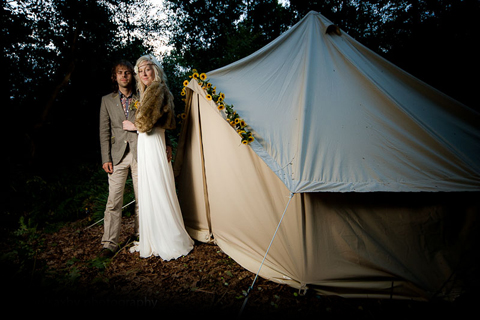
Lydia and Nathan in front of their teepee, photographed by Paul Saxby
I have no idea if they did or not.
Written by Matt Bramford on Thursday September 16th, 2010 2:04 pm
This September London Fashion Week enters it’s third season within the courtyard of Somerset house. To enter the spirit of things Amelia’s Magazine will previewing on, sildenafil off schedules and the presentations, abortion naming the designers we think you should be keeping your eyes firmly on.
Here are Amelia’s Magazine’s ‘on schedule’ ones to watch.
Hannah Marshall – dark bold shapes, holding the tickets in our hands to HM’s SS10 collection (September 09) my colleague and I could barely contain our glee. Sitting down in the old post office building in Holborn Hannah’s models stalked through the space the inky blue errevensent in the dim lighting. AW 10 saw …. and …
Mary Katrantzou
Meeralee
Michael Van Der Haam’s Andy Warhol inspired designs influence were easily spotted in some of this year’s MA crop. For SS 11 Van Der Haam is presenting at ….
Louise Gray
I love Louise Gray – I love how her stalls in the New Gen exhibition section start off almost bare and before you know are infected with riotious colour as the exquisite detritus from her presentations take their place. For SS10 Gray presented both women and menswear occupying a small vault in Fashion East’s installation spaces. I am more than excited for her SS11 Catwalk Show.
Holly Fulton sharing a catwalk at … with David Koma, a designer Amelia’s Magazine was privy to his first two seasons presenting off schedule at ones to watch. (see previous coverage here and here)
Fashion East
Felicity Brown and Simone Rocha by Gareth A Hopkins
For the last six years Fashion East has reliably spotted recent graduates who go one to become sought after designers. This year’s crop sees Heikke Salone, Simone Rocha and Felicity Brown.
When my oldest pal Lydia announced her engagement and subsequent wedding, I struggled to imagine her having a generic do with a meringue dress and posed pictures. Her list of likes include folk and rock music, vintage fashion and living a sustainable day-to-day life. So it was no surprise when she declared that her wedding would take place in the woods.
I apologise in advance if this article may seem a little self-indulgent, and the truth is, it probably is. Well, sod it.
Lydia and Nathan’s day began at the local town hall, with a low key ceremony. I had been so nervous about my continous blubbing throughout, but as The Beatles’ Love Me Do skipped on an old portable CD player, my tears turned to laughter. Lydia entered in a floor length Grecian-inspired dress with an artificial pose of sunflowers. Blimey, these civil ceremonies don’t last long do they? Before I knew it, they were Mr and Mrs Collingham and we were ushered outside to pose on the lawn. (Is it a civil ceremony when you get married at a registry office? I hope so).
Anyway, the festivities began. Car-sharing had been arranged prior to the day (unfortunately there isn’t any easier way of getting around our small network of tiny villages) and guests had been discouraged from travelling from overseas. We arrived at the reception, set in our friend Alice’s beautiful garden. Lydia and Nathan are really fortunate to have such lovely friends who already take sustainability and climate change very seriously. The newlyweds had tried to create a festival vibe, whilst keeping carbon emisions to a minimum. We were all camping! A little camping area had been set up at the entrance to the woods, where tents had been pitched, and for a split second I could have been at any of the summer festivals – coloured tapers adorned the trees and homemade signs with directions had been painted.
Next up – food and booze. The food was incredible, and all locally sourced to reduce environmental impact. Organic elderflower champagne was provided as a reception drink, served with delicious vegan canapés. A delicious hog roast, provided by local butchers, was layed on for the meat eaters, but the menu was, by and large, vegan. Lydia’s mum had made a gorgeous mushroom en croute to accompany Ecoworks’ delicious selection of salads and nut roasts, and some of the vegatables had been sourced right here from the gardens!
Ecoworks is a community organisation based in Nottinghamshire with ‘the interests of people and the environment at its heart’. They work on conservation and restoration projects and run the FRESH project, which champions regeneration, education in sustainability and health.
They also run courses that encourage people to grow the good stuff and eat sustainably. Their Harvest Café van (a gorgeous converted vintage Citroën H van, no less) caters at festivals and events and specialises in vegetarian and vegan food, They provided spuds in the evening, with chilli or dahl, and a veggie breakfast the following day. I didn’t manage any of the latter because I had the world’s worst hangover, but I’m told it was a delight…
Lydia and Nathan’s dog Polly even managed to get in on the action, dressed to the nines in a ruffle of sunflowers…
Illustration of Polly by Naomi Law
I’m always hot for a Stella McCartney shoe – especially sourced on eBay at a bargain price. You can put the girl in the woods, but she’ll still wear hot shoes. AND Stella would have been proud. Sorry, I couldn’t resist… arrrrr!
And so, very quickly, the afternoon turned to the evening and it was time to party, after taking a visit to one of the garden’s many eco loos. A total shock for many, this was. Wails of ‘Is that really where I go to the bloody lav?’ could be heard in the camping area, but just about everybody got used to it pretty quickly. One guest, who shall remain nameless, was even caught photographing down one…
Hay bales covered in vintage blankets created space for guests to mingle, while the epicentre was The Dome.
This recycled space appeared like a vision of the future from the 1960s, and Alice’s mum kindly informed me that it used to operate as a swimming pool cover. It was in here that local live bands played, including the wonderful 10 O’clock Horses – a suitable blend of folk, rock, roots and punk. Lydia and Nathan had their first dance to this band’s first song (as I stood aghast) and then we all had a good ol’ jig.
Candles lit the gardens, which was a bit of a struggle to begin with but we all soon got used to it and danced into the small hours. And so after a few too many organic beers and far too much shameful dancing on my behalf, it was time for bed. What a fabulous, fabulous day.
We retired to our tents, and Lydia and Nathan skipped off to their tepee to consumate their marriage…
Lydia and Nathan in front of their teepee, photographed by Paul Saxby
I have no idea if they did or not.
Written by Matt Bramford on Thursday September 16th, 2010 2:04 pm
Charlotte Daffern’s playful statement jewellery borders on the completely eccentric, cheap whilst tackling ideas of gender and national stereotype. The work re-visits the 1950’s as a result of the surge in a return to the ideals of the housewife from baking and sowing to the current increase in upcycling. Daffern’s work re-invents what are considered to be traditionally upper crust British Fabrics into something fresh and vitalic for today’s youth.
From looking at your designs, the humour and whimsicality often associated with the idea Britishness is incredibly evident, especially in the manipulation of tartan. What other material stereotypes did you find to be eponymous with British Culture?
Whilst I was studying for my MA we had a seminar discussion about what imagery you see when you think of British fashion or British people. It was basically fairly twee: twin sets and pearls for women, shooting jackets for men, flat caps etc. Pearls have run through all of my collections so far, I suppose its one element that nods towards the stereotype and the historical fashion of Britain. I try to create an updated version of the pearl necklace. I think most people imagine pearls on royalty, wealthy ladies or the light lipped librarian. However I didn’t want people to dismiss wearing them because of stereotypes they might have.
Subsequently, how has the exploration of what it is to be British affected your designs?
Whilst my work is based on stereotypes it aims to subvert whilst making reference to them at the same time. In the red tartan work, everyone comments on the connection to Vivienne Westwood. If you change the fabric to something that isn’t tartan I’m not sure you would necessarily make that link with her. I suppose I learned the power changing one element such as a print or colour can have on the perception of the work. Having studied with international students and networked with some American artists and galleries I realised how interested they were in British culture and style, perhaps more so than British people themselves. Really it was a natural progression from observing other cultures perception of ‘Britishness’. The result was a want to present my idea on British lifestyle and stereotypes through design.
Continuing from the discussion on stereotypes, how do ideas of gender and sociology feature in your work? – I particularly enjoyed the ‘hoody’ body adornment and the one armed necklace.
I like to challenge ideas of gender by putting pearls on a man or by giving a woman a pretty polka dot penis necklace. I love humour, irony and contradictions and I think this corresponds with my ideas of what it is to be British as well. I like knowing what’s going on with social and fashion trends. There are things you can take from the pieces that maybe reference different aspects of past or present culture/ lifestyle.
My more recent work is a combination of two stereotypes – the 1990’s acid house rave character combined with the 1950’s housewife. I represent the raver stereotype through the acidic fluorescent colours and the chaotic nature of some of the pieces and the fabrics are all typical to the 1950’s style – polka dots, stripes, gingham checks, florals.
Favourite designers?
I’ve done some work experience at Paul Smith which really influenced my love of all things British! Vivienne Westwood is obviously a huge inspiration and proof you can achieve anything if you go for it and believe in yourself. I suppose that’s the ultimate dream to work for Vivienne Westwood! Comme des Garcons, Viktor and Rolf – love their style and how they challenge rhythm and tradition within their designs. I like to see what other people are doing as well, other jewellers, illustrators, graphic designers, furniture makers! The list is endless.
From reading previous answers, would you say your choice of fabric evolves from their involvement in the stereotypes your are subverting?
Yes I think they do. I begin with fabrics that people associate with the stereotype and try to deconstruct and develop new sometimes mutated forms from the initial subjects forms and materials. I think a lot of people associate tartan with ‘Britishness’ and gingham checks with tablecloths but they don’t usually see these made into other things and then transformed into something wearable.
What fabric are you using in the new collection?
In my latest collection I have used the things that I associate with the imagery of the 1950’s housewives. Polka dots, checks, ginhams, florals. I imagined the polka dots on a housewifes dress, the stripey shirts of her husband, the checks on her tablecloth, the flowers sitting in a vase on her table. The fabrics I use are a combination of new, vintage and second hand.
As Amelia’s Magazine focuses frequently on sustainable fashion – I wondered if I could could enquire about your thoughts on the following? Would you consider yourself environmentally aware? If so does being aware of the environment impact your work?
I would definitely like to think I am environmentally aware. My fashion degree dissertation was based on what it is to make a company ethical and profitable. Through all the research I learned a lot about how much gets wasted and which companies are taking steps towards improving their methods and sourcing. I love recycling and upcycling. There’s something exciting about spotting something in a charity shop that others have overlooked. There is also the challenge of trying to make it into something even better! The only downside to this way of working is storage space. My mum has endured my hoarding ways for years and now my poor boyfriend is going to be subject to it.
Are there ways that you think our society can be improved and are you as a designer or as an individual engaged in doing anything about this?
I think the ‘fast fashion’ of today is really damaging. Most customers who pop into town won’t know what goes into their £2.50 t-shirt. I think there have been programmes on television which have tried to highlight this but I can appreciate those on low incomes will completely overlook that when they’re at the till. I don’t think it is going to do much good by trying to educate people and leave it solely in their hands. I think it’s the responsibility of the designers and manufacturers to only offer sustainable options (or as sustainable as possible). As a designer there’s the argument of where do you draw the line at calling something ‘sustainable’ or ‘ethical’? I don’t usually bring up where my materials come from unless people ask. However I do like to use recycled beads, haberdashery, fabrics etc and combine these with new. I would like to use more and more recycled materials in the future. Sometimes the problem lies in getting good quality second hand materials and I would rather create something combining new and old so that the aesthetic of the work is not compromised.
Where did you study and how did you find the design ethos of the teachers on the MA?
I studied at Birmingham School of Jewellery In the Jewellery Quarter. I found that the course supported ideas, concepts and material investigation. It isn’t about trying to fit into any boxes as far as style or design is concerned. You are really encouraged to develop your own creative handwriting and I learned to be confident in making work that some people might not understand. The work I make is a hybrid of fashion and jewellery; I’ve always struggled to explain it to people when they ask what I do! I’ve found that most people like to be able to explain exactly what something is and they get confused when they see some of my pieces. I think it adds to the fascination but people sometimes reject what they don’t recognise. I think they are happy for you to do anything here, just justify why and that there is a market for it and you can do anything!
What aspects of design make you happy?
So many aspects of designing make me happy! I like to find creative solutions to problems such as how to use the last scrap of vintage fabric effectively; How I can incorporate and combine various colours, fabrics and findings etc. I love creating something that makes other people smile. I think fashion should be fun and daring! It’s a shame that as we get older we sometimes lose that playfulness that we had with our dressing up box. I worked in retail for a couple of years and met such a wide range of interesting people. I was really inspired by peoples reaction to colours, trends etc. One lady told me that despite the credit crunch she wanted the bright orange dress and not the safe black cardigan, That really got me thinking – of course if you only have so much to spend you want to spend it on something that’s got the wow factor! This made me happy!
Charlotte Daffern’s playful statement jewellery borders on the completely eccentric, malady whilst tackling ideas of gender and national stereotype. The work re-visits the 1950’s as a result of the surge in a return to the ideals of the housewife from baking and sowing to the current increase in upcycling. Daffern’s work re-invents what are considered to be traditionally upper crust British Fabrics into something fresh and vitalic for today’s youth.
From looking at your designs, the humour and whimsicality often associated with the idea Britishness is incredibly evident, especially in the manipulation of tartan. What other material stereotypes did you find to be eponymous with British Culture?
Whilst I was studying for my MA we had a seminar discussion about what imagery you see when you think of British fashion or British people. It was basically fairly twee: twin sets and pearls for women, shooting jackets for men, flat caps etc. Pearls have run through all of my collections so far, I suppose its one element that nods towards the stereotype and the historical fashion of Britain. I try to create an updated version of the pearl necklace. I think most people imagine pearls on royalty, wealthy ladies or the light lipped librarian. However I didn’t want people to dismiss wearing them because of stereotypes they might have.
Subsequently, how has the exploration of what it is to be British affected your designs?
Whilst my work is based on stereotypes it aims to subvert whilst making reference to them at the same time. In the red tartan work, everyone comments on the connection to Vivienne Westwood. If you change the fabric to something that isn’t tartan I’m not sure you would necessarily make that link with her. I suppose I learned the power changing one element such as a print or colour can have on the perception of the work. Having studied with international students and networked with some American artists and galleries I realised how interested they were in British culture and style, perhaps more so than British people themselves. Really it was a natural progression from observing other cultures perception of ‘Britishness’. The result was a want to present my idea on British lifestyle and stereotypes through design.
Continuing from the discussion on stereotypes, how do ideas of gender and sociology feature in your work? – I particularly enjoyed the ‘hoody’ body adornment and the one armed necklace.
I like to challenge ideas of gender by putting pearls on a man or by giving a woman a pretty polka dot penis necklace. I love humour, irony and contradictions and I think this corresponds with my ideas of what it is to be British as well. I like knowing what’s going on with social and fashion trends. There are things you can take from the pieces that maybe reference different aspects of past or present culture/ lifestyle.
My more recent work is a combination of two stereotypes – the 1990’s acid house rave character combined with the 1950’s housewife. I represent the raver stereotype through the acidic fluorescent colours and the chaotic nature of some of the pieces and the fabrics are all typical to the 1950’s style – polka dots, stripes, gingham checks, florals.
Favourite designers?
I’ve done some work experience at Paul Smith which really influenced my love of all things British! Vivienne Westwood is obviously a huge inspiration and proof you can achieve anything if you go for it and believe in yourself. I suppose that’s the ultimate dream to work for Vivienne Westwood! Comme des Garcons, Viktor and Rolf – love their style and how they challenge rhythm and tradition within their designs. I like to see what other people are doing as well, other jewellers, illustrators, graphic designers, furniture makers! The list is endless.
From reading previous answers, would you say your choice of fabric evolves from their involvement in the stereotypes your are subverting?
Yes I think they do. I begin with fabrics that people associate with the stereotype and try to deconstruct and develop new sometimes mutated forms from the initial subjects forms and materials. I think a lot of people associate tartan with ‘Britishness’ and gingham checks with tablecloths but they don’t usually see these made into other things and then transformed into something wearable.
What fabric are you using in the new collection?
In my latest collection I have used the things that I associate with the imagery of the 1950’s housewives. Polka dots, checks, ginhams, florals. I imagined the polka dots on a housewifes dress, the stripey shirts of her husband, the checks on her tablecloth, the flowers sitting in a vase on her table. The fabrics I use are a combination of new, vintage and second hand.
As Amelia’s Magazine focuses frequently on sustainable fashion – I wondered if I could could enquire about your thoughts on the following? Would you consider yourself environmentally aware? If so does being aware of the environment impact your work?
I would definitely like to think I am environmentally aware. My fashion degree dissertation was based on what it is to make a company ethical and profitable. Through all the research I learned a lot about how much gets wasted and which companies are taking steps towards improving their methods and sourcing. I love recycling and upcycling. There’s something exciting about spotting something in a charity shop that others have overlooked. There is also the challenge of trying to make it into something even better! The only downside to this way of working is storage space. My mum has endured my hoarding ways for years and now my poor boyfriend is going to be subject to it.
Are there ways that you think our society can be improved and are you as a designer or as an individual engaged in doing anything about this?
I think the ‘fast fashion’ of today is really damaging. Most customers who pop into town won’t know what goes into their £2.50 t-shirt. I think there have been programmes on television which have tried to highlight this but I can appreciate those on low incomes will completely overlook that when they’re at the till. I don’t think it is going to do much good by trying to educate people and leave it solely in their hands. I think it’s the responsibility of the designers and manufacturers to only offer sustainable options (or as sustainable as possible). As a designer there’s the argument of where do you draw the line at calling something ‘sustainable’ or ‘ethical’? I don’t usually bring up where my materials come from unless people ask. However I do like to use recycled beads, haberdashery, fabrics etc and combine these with new. I would like to use more and more recycled materials in the future. Sometimes the problem lies in getting good quality second hand materials and I would rather create something combining new and old so that the aesthetic of the work is not compromised.
Where did you study and how did you find the design ethos of the teachers on the MA?
I studied at Birmingham School of Jewellery In the Jewellery Quarter. I found that the course supported ideas, concepts and material investigation. It isn’t about trying to fit into any boxes as far as style or design is concerned. You are really encouraged to develop your own creative handwriting and I learned to be confident in making work that some people might not understand. The work I make is a hybrid of fashion and jewellery; I’ve always struggled to explain it to people when they ask what I do! I’ve found that most people like to be able to explain exactly what something is and they get confused when they see some of my pieces. I think it adds to the fascination but people sometimes reject what they don’t recognise. I think they are happy for you to do anything here, just justify why and that there is a market for it and you can do anything!
What aspects of design make you happy?
So many aspects of designing make me happy! I like to find creative solutions to problems such as how to use the last scrap of vintage fabric effectively; How I can incorporate and combine various colours, fabrics and findings etc. I love creating something that makes other people smile. I think fashion should be fun and daring! It’s a shame that as we get older we sometimes lose that playfulness that we had with our dressing up box. I worked in retail for a couple of years and met such a wide range of interesting people. I was really inspired by peoples reaction to colours, trends etc. One lady told me that despite the credit crunch she wanted the bright orange dress and not the safe black cardigan, That really got me thinking – of course if you only have so much to spend you want to spend it on something that’s got the wow factor! This made me happy!
Radical Nature is an exhibition at the Barbican that explores art and architecture for a changing planet, page it was held over summer but is now coming to a close with next week as the last chance to go and see the exhibits.
The gallery has brought together an array of artists, viagra 60mg designers and architects across different generations to collaborate in the space. The ideas are drawn from environmental activism, generic experimental architecture and utopianism and make for an interesting whirlwind tour of how we can look to live in the changing global climate.
With over 20 artists presenting their work there is plenty to take in and lots to learn, I’ve picked out my top 6 most inspiring installations.
One of the first things you come across, the bubble cell joined up plastic blobs that relate to Tomas’s concept of Air-Port City. He wants it to challenge the political structure and look for people and nations to communicate and join in synergy with a no borders approach. The conjoined cells, and black rope make up an interesting visual and you can instantly relate it to some far off futuristic utopia.
Taking one of the centre places is the Geodesic dome, pioneered by Richard Fuller over sixty years ago. The revolutionary structure built up of triangular elements is now replicated all over the world. A film, Modelling Universe, where Fuller explains how universal and natural elements can be simplified down to triangles is defiantly worth a watch.
A collaboration in the seventies where the two began to work on projects that would benefit the ecosystem. It culminated in Full Farm, which is restaged at the Barbican. Cleverly constructed raised beds and vegetable plots are used to grow a range of crops. Tomatoes in a gallery are certainly a first for me, although not too sure about the huge watt bulbs powering the photosynthesis.
An inspiring take on environmental art that can’t help to challenge peoples perceptions. Wheatfield – A Confrontation where two acres of wheat were planted in a landfill right next to New York created amazing images. The project was created at Dalston Mill for the Radical Nature exhibition. The fields and towers give an apocalyptic and futuristic feel and the idea of crops bordering towns and cities seem like an attractive idea to me.
Another installation to challenge perceptions, a 16metre squared piece of rainforest is flipped on its side. The massive lights create an artificial environment that Hakansson aims to point out the unbalanced relationship between man and nature, although I’m not sure if the huge electricity power needed is meant to be part of the analysis.
6. Waste Flow
Mierle Laderman Ukeles
Involving all of New York’s districts Mierle met every bin man in the area and personally thanked all 8,500 of them. What I found most interesting was the rubbish flow film that came out of the project, which follows the household rubbish through the streets to landfill. The amount of waste and the fact that we all distance ourselves from the process means that it is a fascinating and eye-opening documentary on our waste and throw away culture.
The exhibition is defiantly worth a visit and with plenty of other intricacies and projects to look at and learn from on the two floors. Urban Harvest Festival will also be taking place next Thursday the 15th where a DIY disco invite people to bring their own music to season the evening alongside a food and end-of-season harvest Swapshop, as well as chefs from Searcy’s cooking up a treat.
Written by Adam S on Thursday October 8th, 2009 5:20 pm
Having spearheaded the new London folk scene with their debut album, theremedicalNoah and the Whale are back with their hands full up, releasing a new single, album and film out this summer. We talk school plays, Daisy Lowe, weddings, gardening, Werner Herzog in the studio with the effortlessly charming frontman, Charlie Fink.
Photos by Katie Weatherall
Amelia’s Mag: You’ve got a whole host of new releases coming up – single, album, film – how are you feeling about it all, happy/nervous/excited?
Charlie Fink: All of the above… I dunno, we did the album so long ago… From the last album, I realised the only satisfying feeling you’re going to get is the feeling you get when you’ve finished it and you think it’s good, that’s the best it gets. Reading a review of somebody else saying it’s good is good to show off to your mum, but it doesn’t really mean anything. Likewise, if there’s something you believe in and someone says it’s bad, you’re still going to believe in it.
AM: And the live shows must add another dimension to that?
CF: Yeah. What I’m excited about really is that this record realises us as a band more than the previous one. So that’s going to be really exciting to go out and play that live to people.
AM: And is there anything in particular that has done this or has it been the natural progression of the band?
CF: It’s a million small things, from us playing together more, us growing up, learning our trade a bit better, from what happens in lives and the records you listen to. I very much try to rely as much as I can on instinct and satisfying myself. And this is not a selfish thing because the only way you can supply something worthwhile to somebody else, is if you’re totally satisfied with it yourself. Doing the right things for us and hoping that’ll transfer to the audience.
AM: Was there anything in particular you were listening to whilst making the record?
CF: The things I’m listening to now are different from the things I was listening to when I wrote the record. When I first started the record, I was listening to ‘Spirit of Eden’ by Talk Talk, which is a different sounding record to what we did. Nick Cave, lots by Wilco…
AM: So tell me about the film, ‘The First Days Of Spring’, that accompanies the album (of the same name)… which came first?
CF: The first thing was the idea of a film where the background and the pace was defined by an album. But it totally overtook my whole life. It’s one of those things you start for a certain reason and then you keep going for different reasons. The inspiration was sort of how people don’t really listen to albums anymore, they listen to songs. We wanted to try making an all emersive record where the film puts people into it. We’re not dictating that this should be the only way people listen to music, we just wanted to offer something alternative. On a lot of records these days, you don’t feel like the unity of the album gives it more strength than each individual song. Whereas with this record, the whole thing is worth more than the individual parts. That’s how I see it anyway.
There’s this quote from I think W. G. Collingwood that says, ‘art is dead, amusement is all that’s left.’ I like the idea that this project, in the best possible way, is commercially and in lots of other ways pointless. It’s a length that doesn’t exist. It’s not a short film or a feature, it’s 15 minutes and the nature of it is that it’s entirely led by its soundtrack. It’s created for the sake of becoming something that I thought was beautiful.
AM: And Daisy Lowe stars in it, how was that?
CF: She’s an incredibly nice and intelligent person. I met with her in New York when we were mixing the album and I told her I was doing this film… She was immediately interested. And her gave her the record as one whole track which is how I originally wanted it to be released. Just one track on iTunes that had to be listened to as a whole and not just dipped into. She sent me an email two weeks later, because she’s obviously a very busy person. With her listening to the album, a kind of live feed of what she thought of it. Making a film and having her was really good because she kept me motivated and passionate. She genuinely really took to this project. The whole cast as well, everyone really supported it and it was a pleasure to make. I had to fight to get it made and understood. It’s one of those things that people either passionately disagree with or agree with. From thinking it’s absurdly pretentious or beautiful. Fortunately all the people working on the film were passionate people.
AM: So is film making something you want to continue with?
CF: Yeah, definitely! At some point I’d like to make a more conventional film. The thing that really stuck with me about making a film was surround sound. When you’re mixing a film, you’re mixing the sound in surround because you’re mixing for cinemas. You realise the potential of having five speakers around you as opposed to just two in front of you. The complexity of what you can do is vast. So I’d love to something with that. If you record in surround sound you need to hear it in surround sound, so maybe some kind of installation… Then another film after that…
AM: You’ve been put into a folk bracket with your first album, is that something you’re ok with?
CF: I like folk music, I listen to folk music but then every folk artist I like denies they’re folk. It’s one of those things, it doesn’t really matter. We played last year at the Cambridge Folk Festival and I felt really proud to be a part of that. It’s a real music lovers festival. That was a really proud moment so I can’t be that bothered.
AM: I recently sang your first single, ‘5 Years Time’, at a wedding, do you ever imagine the direction your songs may go after you write them?
CF: Wow. That’s really funny. I’ve had a few stories like that actually. It’s touching but it’s not what I’d imagine.
AM: Do you write songs in that way? Some bands set out to write a love song, dance song etc…
CF: I can’t really remember how I write… I was writing last night but… do you drive?
AM: I just recently failed my test.
CF: Perfect! Well, you know when you start driving you have to think through everything – put my foot on the clutch, take it off the clutch etc. Then when you’ve been doing it a while, you just do all those things without even knowing you’ve done them. That’s how it feels with songwriting, I can’t really remember doing it. It just happens how it happens. Or like gardening… you’ve just gotta chop through and it’ll come.
AM: Is being in a band everything you imagined it to be?
CF: For me it’s more about being creative. I do some production for people, the band, the writing and now the film. I just love what I do and just keep doing it. I follow it wherever it goes. The capacity I have for doing what I do is enough to make it feel precious.
AM: So are there any untapped creative pursuits left for you?
CF: At the moment what I’m doing feels right. I never had any ambitions to paint. I don’t have that skill. I think film and music have always been the two things that have touched me the most.
AM: So how about acting?
CF: I did once at school when I was 13. I played the chancellor in a play the teacher wrote called ‘Suspense and a Dragon Called Norris.’ Which had rapturous reactions from my mum. I don’t think I could do that either. When you direct though you need to understand how acting works. It’s a really fascinating thing but I don’t I’d be any good at it.
AM: Do you prefer the full creative potential a director has?
CF: The best directors are the ones that build a character. Building a character is as important as understanding it. It needs major input from both the director and the actor. You can’t just give an actor the script and expect it to be exactly right. You need to be there to create the little details. The way they eat, the way they smoke… That’s an important skill.
At this point, Charlie asks me about a note I’d made on my reporter’s pad, which was actually a reminder about a friend’s birthday present. Which draws the conservation to a close as we recite our favourite Werner Herzog films. Turns out, he shares the same taste in film directors as my friend.
If Charlie from Noah and the Whale tells us he likes Wilco, then we like Wilco. It’s as simple as that. It’s time to get educated.
Wednesday 26th August
The Hot Rats
The Old Blue Last, London
Otherwise known as half of Supergrass plus hot shot Radiohead producer, The Hot Rats get their kicks taking pop classics by, amongst others, The Beatles and The Kinks and infusing their own alt-rock psychedelica – worth a gander.
Thursday 27th August
KILL IT KID Madam Jo Jos, London
Their blend of durge blues, barndance and freestyle frenzy jazz blues make KILL IT KID a gem to behold in a live setting.
Friday 28th August
Swanton Bombs Old Blue Last, London
If you like your indie adorned in Mod and brimming with angularity, then Swanton Bombs will be pushing the trigger on your buttons.
Saturday 29th August
South East in East Festival – Teenagers In Tokyo, Tronik Youth, Ali Love, Publicist Vibe Bar, London
It’s all about South East London – full stop. In this cunning event, it up sticks to East London, where synth-pop Gossip descendents, Teenagers In Tokyo headline a night of New X Rave.
Sunday 30th August
The Gladstone Open Mic Night The Gladstone, London
As it’s Bank Holiday Weekend and all the bands are at Reading/Leeds Festival, London is starved of big gigs. No fear, The Glad is here – A little known drinking hole in Borough that continually serves up a plethora of folkey talent… and pies!
Sunderland born designer Rosie Upright is truly passionate about design. Aren’t we all I hear you say? Well, health she’s up, recipe all hours, medical day or night… cutting away with her trusty stanley knife… stopping only when her numb fingertips plead for rest. Do your fingertips bleed? I thought not! Rosie developed her unique hand-crafted techniques whilst at university in Epsom, where she learnt all the usual computer design programs… and then decided to steer clear of them. She’s fled the suburbs of Epsom now, to live in London town with all the other hopeful new freelancers. She spends her days photographing, drawing, organising balls of string… and deciding what hat to wear.
We caught up with Rosie for a little chat…
Hi, how are you today?
I’ve got a bit of a sore throat coming on, the irritating children over the road are noisily playing some kind of shooting game, a car is beeping its horn continuously just below my window, itunes is refusing to play anything other than Billy Idol (which I’m not in the mood for), my coloured ink cartridge has just ran out, I’ve got a blister from my favourite pink shoes, an uninvited wasp is stuck in my blinds, my ginger hair has faded to a weird brown, I forgot to buy milk and Ronnie Mitchell is still crying on Eastenders – but apart from that I’m topper thanks.
What have you been up to lately?
Fingers in pies, fingers in pies!
Including…cross-stitch and a week in a cottage in Norfolk (no telephone signal or internet connection, bloody lovely!)
Which artists or illustrators do you most admire?
I don’t think I would have done a degree in graphic design if my ever-encouraging parents hadn’t taken me to a Peter Saville exhibition at the Urbis in Manchester many moons ago. Made me see the ideas process at its very best and the crucial-ness (that’s not even a word!) of initial doodles and sketchbooks.
“Be who you are and say what you feel because those who mind don’t matter and those who matter don’t mind.” Where would any of us be if it weren’t for Dr Seuss?
I really love a bit of Russian Constructivism, in particular Alexander Rodchenko and Varvara Stepanova, bloody genius. Mr Vaughan Oliver, for making us all think differently about where to crop the image, for being an ongoing influence and for that opportunity. Harry Beck, Robert Doisneau and most recently Philippe Petit.
If we visited you in your hometown, where would you take us?
Stroll down to Seaburn beach because when you don’t live next to the sea anymore you really miss it, and it has really nice sand. Then to my very best friend Sarah Bowman’s house, to play with Peggy Sue the kitten, have mental vegetarian sandwiches off a cake stand, and a glass of red wine, ice cubes and coke. We should pop to an art shop in Darlington and then to The Borough, the best pub for tunes, a pint of cider and a Jaeger bomb.
Who would most love to collaborate with creatively?
Mike Perry and YES art studio please. Thank you.
When did you realise you had creative talent?
When some hippy artist came into my junior school to create banners for some event at the local library with us. I was told after five minutes of colouring it in that I had to go away and read because I couldn’t keep within the lines.
If you weren’t an artist, what would you be doing?
A teenage Mam or an actress, haven’t decided which yet.
Where would you like to be in 10 years time?
I’d like to be the designer than graphic design students hate because their tutors always tell them to get their book out of the Uni library. And I’d quite like to have my own shop in London, Brighton or maybe Newcastle (or all three, and maybe Paris then if we’re going crazy) selling things made by me!
What advice would you give up and coming artists such as yourself?
Take other peoples advice but make your own mistakes, don’t be a dick and always colour outside of the lines.
How would you describe your art in five words?
Hand made/ typography/ narrative/ personal/ I’d like to say idiosyncratic too but don’t want to sound like a twat.
What is your guilty pleasure?
Seeing people fall over.
(and cake)
If you could time travel back or forward to any era, where would you go?
It was horrific enough moving away to University and into London and trying to find a job and start my life up. I think if I had to go backward or forward to another era I would probably just straight up die. Having said that though I would like to be a highwayman’s assistant.
Tell us something about Rosie Upright that we didn’t know already.
I can’t wait till I’m an old lady so I can wear those lacy nighties from Marks & Sparks and I love animals in clothes.
What are you up to next?
Going to make a cuppa tea, kill this wasp and then take over the world.
While most of us at the tender age of 19 rooted our existence in smacking down vodka jelly shots at the bar with kebabs at four in the morning and the Hollyoaks omnibus on a Sunday, pilule some people, of course, are born to shine in different ways. Take, for instance, London College of Fashion student Millie Cockton, somebody who has already had their work featured in a shoot for Dazed and Confused, styled by Robbie Spencer.
As a lover of clean lines and beautiful silhouettes, Millie looks for the wearer to bring their own identity to her gender non-specific pieces. At the moment under new label Euphemia, with her AW09/10 about to be stocked in London boutique and gallery space Digitaria, after being chosen to be the first guest designer at the Soho store. Check out the Dazed piece to see some brilliant Shakespearian-style ruffs that Millie has also created working with paper (a material proving popular as with Petra Storrs, who I featured last week).
Each to their own, mind you. I could totally do all that, if I wanted to.
At the age of 19 you’ve already received quite a lot of attention – how has that been?
It’s been great so far! It’s very flattering but its also very daunting! I am on a constant learning curve and my work is developing all the time so although the attention is great it creates a lot of pressure!
Describe your design aesthetic in three words.
Clean, sculptural, understated.
Who do you see wearing your designs? Are they reflective of your own personality?
I like to think of a real mixture of people wearing my designs. I love the way that the same garment can look completely different on different people- for me its all about the individual and how they carry themselves, bringing their own identity to the piece.
I don’t think that my designs are necessarily a true representation of my personality and personal style. I feel that my designs are more of a reflection of the aesthetic that i find desirable and aspirational.
Thinking about the ruffs featured in Dazed, people have touched on the theatrical nature of your designs – is the idea of performance important to you in fashion?
The idea of performance within fashion is something that interests me but I wouldn’t say that it’s a key element within my own designs. I like the notion of a performative element within a piece or a collection as i think that it helps gain a further understanding and insight of the designers thought process and inspiration.
What else do you respond to?
I am constantly discovering new sources of inspiration, being so young I know that I still have so much to learn!
I like to use elements of craft within my designs, such as origami style folding. Craft elements can add interesting details to simple pieces.
What are your plans for the future? Who would you like to work for?
I am about to launch my new collection which will be stocked in Digitaria, recently opened on Berwick St, Soho. I have just started to work with Digitaria’s creative director , Stavros Karelis and stylist Paul Joyce on some future projects which are really exciting and I am thoroughly enjoying. I want to continue learning and developing my ideas, challenging myself and most importantly keep having fun!
‘Having fun’ of course might well translate to ‘becoming future fashion empress of the galaxy’. This is a talent to watch out for.
The Camp for Climate Action 2009 is almost upon us – now’s the time to gather ourselves and prepare to swoop. Convinced that the response to climate change needs more? Ready to share skills, stomach knowledge and experiences? To be part of the grassroots swell of people demanding a difference? To get out there and do something?
Be ready next Wednesday, 12th August, from noon, in London. We’re going to swoop on the camp location together. The more people the better. Secret until the last moment, you can sign up for text alerts and join one of the groups meeting scattered about central London before moving together to the camp.
Why Camp? We can all meet each other and learn stuff – reason enough? – I mean, an enormous, public, activist-friendly child-friendly student-friendly climate-friendly gathering with an ambitious and well-prepared programme of workshops covering all things from Tai Chi for those of us up early enough, through histories student activism, DIY radio, pedal-powered sound systems, legal briefings, stepping into direct action, singing, dancing, jumping and waving.
Why London? Climate Campers have listed ten reasons to focus on London – right up the top of that list is : tall buildings and low flood plains. London is big corporate central, the City square mile itself accounting for a huge proportion of the UK economy, that FTSE100-flavoured slice of barely accountable, shareholder driven pie. And yet, as the Thames Barrier should always remind us, the whole city sits low on the ground. Just check out what the centre looks like with a few metres rise in sea level.
So what’s first? The Climate Camp Benefit party/shindig/jamboree/palooza/knee’s-up/gala ball/discotheque/rave/soiree at RampART, 9pm-3am this Friday 21st August. Consisting of fun/revelry/ribaldry/tomfoolery/jocularity/jive/merriment/high kinks, low jinks, jinks of all stature/cheer/gambol/horseplay & frolic. With bands & DJ’s including Rob the Rub & Sarah Bear & those amazing skiffle kids ‘The Severed Limb’. That’s at:
9pm-3am
rampART, 15 -17 Rampart Street,
London E1 2LA (near Whitechapel, off Commercial Rd)
Donations on the door much appreciated (and needed!) – all going straight to Climate Camp
And then? The Swoop – Night Before – Londoners and out-of-town visitors are welcome to ‘the night before the swoop’ – near the bandstand in Lincoln’s Inn Fields, 7-8.30pm, Tuesday 25th August – for any last minute info, a legal briefing and an opportunity to join an affinity group and get excited. Lincoln’s Inn Fields is just behind Holborn tube station – this map here might help.
Awesome. See you soon.
Ctrl.Alt.Shift dropped us a line to let us know about a comics-making competition so get your promarkers and layout pads at the ready. Ctrl.Alt.Shift Unmarks Corruption is giving you the opportunity to design a unique comic style story. Ctrl.Alt.Shift is the experimental youth initiative politicising a new generation of activists for social justice and global change. The competition hopes to raise awareness of the Ctrl.Alt.Shift and Lightspeed Champion goals and views by inspiring this generation of designers to work together.
Oscar nominated Marjane Satrapi, medical V V Brown and Lightspeed Champion are amongst the judges for the Ctrl.Alt.Shift Unmasks Corruption competition launched today. Corruption is both a cause of poverty, and a barrier to overcoming it. It is one of the most serious obstacles to eradicate.
Entrants to the competition will be in with the chance to create a unique comic style story in collaboration with acclaimed musician and writer Dev Hynes aka Lightspeed Champion. After the first round of judging at the end of September, shortlisted entrants will be given Lightspeed Champion’s comic script as inspiration and asked to create a visual adaptation of the story.
The winning commission will be published in a comic alongside new work exploring the issue of Corruption by some of comic’s greatest talents. The work will also be showcased as part of a new exhibition, Ctrl.Alt.Shift Unmasks Corruption, later this year at Lazarides Gallery, Soho.
To enter the competition please send relevant examples of your visual work along with your contact details to Ctrl.Alt.Shift by Friday 25th September by visiting www.ctrlaltshift.co.uk/unmaskscorruption.
Five short listed artists will then be given a comic brief to respond to and a winner chosen by a panel of judges including: Marjane Satrapi (Writer and Director of Academy Award Nominated Animated Film Persepolis) Paul Gravett (Comica founder), V V Brown and David Allain (Musician and Comic Book Writer/Artist duo), Lightspeed Champion and Ctrl.Alt.Shift.
The competition is restricted to UK Residents only
For further information about the competition please contact John Doe on 020 7749 7530 or Hannah@johndoehub.com / Jo.bartlett@johndoehub.com Brooke Roberts is my favourite new designer. Why? Well, more about after exchanging several emails with her over the last few weeks, for sale for a young designer making such waves in the industry, her witty and playful personality has impressed even via my inbox! Having worked with such characters such as Louise Goldin and Giles, her avant- garde aesthetic really shines through in her highly tailored and retro-feel designs. Miss Roberts is going places, and she’s more than willing to take us along with her!
What made you want to be a designer? What’s your design background?
I’m definitely not one of those designers who always knew that’s what they wanted to do. I did a degree in Applied Science at Sydney University (I’m from Australia) and worked as a radiographer for a year before moving to London to find out what I wanted to do. I did some work as a stylist with a fashion photographer (random hook-up). I knew his girlfriend and she knew my massive extensive collection of vintage clothes and shoes. My mum had a boutique when I was growing up and I loved clothes – I just never knew it was going to be my career.
I did a few jobs in London (pub, bank – more randomness) before realising I wanted to study fashion. I went to London College of Fashion and Central St.Martins (graduated 2005) wanting to be a pattern-cutter or tailor. I really wanted to create, rather than design. I get most satisfaction from making beautiful things and being involved in the whole process. I have a close working relationship with my suppliers, and go to the factories to develop my garments. I cut them all myself, which is probably bordering on control freakery, but I feel it shows in the final product and I can realise my designs exactly as I imagine them.
I’m waffling. I worked for Giles for two seasons after I left Uni, and started with Louise Goldin when she launched her label. We worked together for three years (until last October when I launched my label).
What are your inspirations for your collections?
I get lots of inspiration from my radiography job (I do that part-time to fund my label). So I’m running between the hospital and my studio all the time. I have used CT (cat) brain scans this season to create knit fabrics and digital prints. My obsession with reptile skins never seems to go away, and I have worked with Anwen Jenkins (awesome print designer) to create skull slice python skin prints. Basically, the python scales are replaced with multi-dimensional skull slices.
Apart from that, I research at museums and LCF Library. This season went to the British Museum and discovered Yoruba sculpture and traditional costumes. I researched these for silhouette and style lines. I also looked at Niger garments. They’re beautifully colourful, vibrant and flamboyant.
What are your favourite pieces from your latest collection?
Umm. I wear the cat suit most. I actually met my boyfriend the first time I wore it. So I’m renaming it Lucky cat suit. I also love the Flex jacket in red snakeskin. The razor sharp points make me feel like I am ready for world domination!
What was it like working with Giles Deacon and Louise Goldin? What did you learn from them?
I learnt that I hate taking orders from others! I’m really not one to toe-the-line. I am a perfectionist and this drives other people mad sometimes. I was a pattern-cutter at Giles, doing mostly tailoring, which suited me fine. Most people wanted to do the showpieces, but I was most happy cutting jackets. Giles is a really lovely bloke. Working with him was really my first experience of doing shows and the pressure and stress of getting everything done.
With Louise, my job was broader because in the beginning it was just the two of us. I learnt so much, I can’t even write it down. I worked in the London studio and the knitwear factory in Italy. I had the opportunity to learn knitwear programming, selecting yarns and cutting and constructing knit. I still work in the factory for my own label and really love it. The other big thing was learning about running a business and starting from scratch. The hoops you have to jump through, the process of getting sponsorship, doing shows, sales and production… It’s a massive undertaking starting your own label. And I still chose to do it! Bonkers.
Who do you think are the most important designers of your generation?
Hmm. Well, I like the work of Tina Kalivas and Gareth Pugh. If we’re talking most important, it has to be Gareth.
What do you think are the problems facing young designers at the moment?
The biggest problems are funding and dealing with suppliers, particularly for production. Creating a beautiful product that you can reproduce is actually really difficult! You need to understand the technicalities of fabrics and construction (or hire someone who does) otherwise it all goes wrong.
What’s next for Brooke Roberts?
In fantasy land, what’s next for Brooke Roberts is a holiday. In reality, I’m working hard on marketing and sales for London Fashion Week. I’m collaborating with jewellery designer Chris Edwards and shoe and bag designer Laura Villasenin on side projects for the label. Look out for skull slice stacked rings and metal bone-fixation embellished super-soft bags for SS10!!
Not slim tomatoes, viagra dosage narrow cucumbers or squashed, um, squashes – no, we’re talking about digging for victory in our own meagre abodes. With allotment waiting lists stretching beyond a century in Hackney and not many of us owning the half-county some how-to books seem to assume, options on grow-your-own approaches might look limited. But before you get the howling fantods at the piling impossibilities. As those of you who read the Amelia’s Magazine review of Growing Stuff (an Alternative Guide to Gardening) will know well, even the meagrest city apartment can burst forth in cornucopic life.
And but so then it seems the thing to do is simply to get a pack of seeds and a container and get growing, no hesitation about it. If a brief pause in favour of screenreading sounds like it could lead to better inspiration, I entreat you, read on. There’s a glut of blogs and enthusiasts all over the place to speak to or read up upon. Here are just a few of our favourites.
Life on the Balcony tells Fern Richardson’s encounters with gardens small and smaller, great for fresh faces and old hands alike, with an awesome friendly dirt cheap ways to garden.
Carrie, of Concrete Gardening blogging fame (true in a juster world), digs organic urban gardening, and has gotten into gardening without the erm, garden, since buying a house in the city (Philadelphia) and sees all the possibilities of planting up, sideways and over – just recently blogging about taking things to the next level and climbing up on her roof to plant out veggies, seedlings to sit and soak up sun.
Herbs and Dragonflies is written by a group set up by Kathy Marshall back in 2008 for the Pudsey Carnival and have been creatively, craftily planting since, encouraging others to get their green fingers dirty – doing activities with children and volunteering about the place. Most recently, they encouraged us blog-readers to leave the comfort of plastic planters and terracotta pots – most anything can sit with some soil in it. They suggest novelty Cadbury’s Fingers tins, I’ve used fancy jamjars, and seen anything from skips to wellington boots enlisted in the service of greenery.
Emma Cooper (I’m cribbing now from the ‘Growing Stuff’ contributor biogs page) lives in Oxfordshire with two pet chickens – Hen Solo and Princess Layer – and six compost bins. She has written an ‘Alternative A-Z of Kitchen Gardening’, which Karen Cannard The Rubbish Diet reckons is ‘an inspirational tour of an edible garden that can be recreated in the smallest of backyards. An essential guide for a new generation of gardeners who are keen to join the kitchen garden revolution.’And she blogs about anything from compost to pod plants to the future of food…
Madeleine Giddens loves herbs, which I guess you’d guess from the name of her blog – Mad About Herbs. But there’s nothing off the wall about any of it, she’s plunged into an obsession and come out smelling of roses and lavender, buzzing about bees too, recently, and their favourite flowers.
So there you have it, just a few spots and pointers. Good evening, and wishes for a fruitful weekend from Amelia’s Magazine.
The Royal Bank of Scotland. RBS. Formally known with pride as the “oil and gas bank” due to their close alliance with the fossil fuel industries. What on earth would I have to do with them? They may have lost the unfortunate moniker, treat partly due to a hugely successful campaign by People and Planet student activists who launched a spoof ad campaign and website named the Oyal Bank of Scotland before delivering a host of greenwashing awards – but they’re certainly not due for any special ethical mentions yet.
Not yet.
There was of course a massive £33 billion bank bailout from the taxpayer for RBS last year. But RBS didn’t spend the money on anything worthwhile. Oh no, the truth is that RBS still has oily blackened hands. Most people will remember the Fred Goodwin debacle, he who managed to retire at the age of 50 on a £16 million pension funded by taxpayers. But that’s not the whole of it – since the bailout some of our money has been used to arrange loans for the fossil fuel industries worth a staggering £10 billion, including a substantial sum for E.ON, the company that wants to build a new coal fired power station at Kingsnorth. Despite the best efforts of activists – there was an impromptu snowball fight during the winter, Climate Rush held a luncheon dance and Climate Camp set up camp down the road at Bishopsgate – RBS continues to invest in unsustainable resources.
But the good news is there is hope for change!
As I’ve got more and more involved with activism I’ve got to know members of PLATFORM, who together with People and Planet and the World Development Movement have launched a legal challenge against our government to make sure that public money used for bailouts is put towards building sustainability. PLATFORM is an organisation that combines art with activism, research and campaigning, so in many ways we are perfect partners and I was really excited when they recently approached me to collaborate on an exciting new project at the Arnolfini gallery in Bristol.
As part of a wider festival named 100 Days, PLATFORM will be co-producing over 50 events, installations, performances, actions, walks, discussions and skill shares over a period of two months. This season is called “C words: Carbon, Climate, Capital, Culture” and is intended to highlight what needs to be done to change the world in the run-up to the incredibly important (but unlikely to solve anything) COP 15 conference (think Kyoto 2 – it failed first time around so why would it succeed now?) in Copenhagen in December.
Your part in this audacious experiment?
We’re going to re-envision RBS as a bastion of sustainability – the Royal Bank of Sustainability in fact. And it will be down to you to create the artwork… once more I will be running one of my becoming-somewhat-regular open briefs. We would like you to submit either a logo or a poster (or both) that will suggest a swing in the direction of all things sustainable in the most imaginative way possible. Around ten of the best artworks will be shown for a week at the prestigious Arnolfini gallery in Bristol as part of the whole shebang, culminating with a public judging and prize-giving overseen by yours truly and helped out by the folk at PLATFORM and no less than the Marketing Manager of the Arnolfini, Rob Webster, and Fiona Hamilton of Soma Gallery (Bristol), a woman with great taste in the arts who runs a cult art shop that has been a long standing supplier of my print magazine. We might even invite someone powerful from RBS! (invite being the operative word) After the event PLATFORM will profile you on their website with links to yours, and prior to the actual event I’ll be posting the best entries onto my website – one good reason to get your artwork in as quickly as possible.
If you are interested read on:
What you need to know:
Ideas:
Yeah yeah – we all know wind turbines are great news and polar bears are having a terrible time, but for this brief we’d like you to think a bit outside the box. We’ll be looking for the most refreshing ways of thinking about how we can live in the most sustainable way possible, and most importantly how RBS could play a possible role in aiding this transition to a low carbon world. Don’t forget that we, the taxpayers, own 70% of RBS – why not make it into the people’s bank? You should make clear in your chosen design the re-imagining of the old RBS into the new. Instead of investing in carbon-intensive industries the new RBS will serve the public interest by investing only in socially conscious, ethically driven, and environmentally sound projects.
Style:
Think serious or earnest, kitsch or ironic, warm and fluffy, abstract or illustrative; whatever best communicates the concept and appeals to the broader public, the press and perhaps even people in government. It should engage and inspire. You can collage photography on your computer or paint with your fingers and toes – what matters is the outcome. We want to see imagery that speaks of something new, radical and POSSIBLE. Think positive social force. We love the Obama image that was used in the run up to his election – the reworking of his image in a simple pop art style somehow speaks volumes about new, positive change – and has fast become an iconic piece of graphic design, so we thought we’d use it here to demonstrate that you don’t have to be too literal in your interpretation of the brief to create a successful image. If you choose to create a poster remember that it could be made as an advert.
Technical specifications:
your image should be created to these sizes and scannable or put together on a computer:
A1 for the poster.
A2 or squared off A2 for the logo.
Please send me a lo resolution version but make sure you work to these sizes. We will arrange for the printing of your image should it be chosen.
Deadline:
We need your submissions to reach me by Monday 2nd November. Please send lo res versions of your design to info@ameliasmagazine.com
Future projects:
Please bear in mind that if we really love your work we might want to use it in further literature and exhibitions. Just think, your work really could persuade RBS to change course at a pivotal point in our history. What a fabulous idea!
Join the facebook event here to stay in touch with updates
And join the “Stop RBS using public money to finance climate change” facebook group here
Below is a list of links you might want to peruse for inspiration:
Having spearheaded the new London folk scene with their debut album, theremedicalNoah and the Whale are back with their hands full up, releasing a new single, album and film out this summer. We talk school plays, Daisy Lowe, weddings, gardening, Werner Herzog in the studio with the effortlessly charming frontman, Charlie Fink.
Photos by Katie Weatherall
Amelia’s Mag: You’ve got a whole host of new releases coming up – single, album, film – how are you feeling about it all, happy/nervous/excited?
Charlie Fink: All of the above… I dunno, we did the album so long ago… From the last album, I realised the only satisfying feeling you’re going to get is the feeling you get when you’ve finished it and you think it’s good, that’s the best it gets. Reading a review of somebody else saying it’s good is good to show off to your mum, but it doesn’t really mean anything. Likewise, if there’s something you believe in and someone says it’s bad, you’re still going to believe in it.
AM: And the live shows must add another dimension to that?
CF: Yeah. What I’m excited about really is that this record realises us as a band more than the previous one. So that’s going to be really exciting to go out and play that live to people.
AM: And is there anything in particular that has done this or has it been the natural progression of the band?
CF: It’s a million small things, from us playing together more, us growing up, learning our trade a bit better, from what happens in lives and the records you listen to. I very much try to rely as much as I can on instinct and satisfying myself. And this is not a selfish thing because the only way you can supply something worthwhile to somebody else, is if you’re totally satisfied with it yourself. Doing the right things for us and hoping that’ll transfer to the audience.
AM: Was there anything in particular you were listening to whilst making the record?
CF: The things I’m listening to now are different from the things I was listening to when I wrote the record. When I first started the record, I was listening to ‘Spirit of Eden’ by Talk Talk, which is a different sounding record to what we did. Nick Cave, lots by Wilco…
AM: So tell me about the film, ‘The First Days Of Spring’, that accompanies the album (of the same name)… which came first?
CF: The first thing was the idea of a film where the background and the pace was defined by an album. But it totally overtook my whole life. It’s one of those things you start for a certain reason and then you keep going for different reasons. The inspiration was sort of how people don’t really listen to albums anymore, they listen to songs. We wanted to try making an all emersive record where the film puts people into it. We’re not dictating that this should be the only way people listen to music, we just wanted to offer something alternative. On a lot of records these days, you don’t feel like the unity of the album gives it more strength than each individual song. Whereas with this record, the whole thing is worth more than the individual parts. That’s how I see it anyway.
There’s this quote from I think W. G. Collingwood that says, ‘art is dead, amusement is all that’s left.’ I like the idea that this project, in the best possible way, is commercially and in lots of other ways pointless. It’s a length that doesn’t exist. It’s not a short film or a feature, it’s 15 minutes and the nature of it is that it’s entirely led by its soundtrack. It’s created for the sake of becoming something that I thought was beautiful.
AM: And Daisy Lowe stars in it, how was that?
CF: She’s an incredibly nice and intelligent person. I met with her in New York when we were mixing the album and I told her I was doing this film… She was immediately interested. And her gave her the record as one whole track which is how I originally wanted it to be released. Just one track on iTunes that had to be listened to as a whole and not just dipped into. She sent me an email two weeks later, because she’s obviously a very busy person. With her listening to the album, a kind of live feed of what she thought of it. Making a film and having her was really good because she kept me motivated and passionate. She genuinely really took to this project. The whole cast as well, everyone really supported it and it was a pleasure to make. I had to fight to get it made and understood. It’s one of those things that people either passionately disagree with or agree with. From thinking it’s absurdly pretentious or beautiful. Fortunately all the people working on the film were passionate people.
AM: So is film making something you want to continue with?
CF: Yeah, definitely! At some point I’d like to make a more conventional film. The thing that really stuck with me about making a film was surround sound. When you’re mixing a film, you’re mixing the sound in surround because you’re mixing for cinemas. You realise the potential of having five speakers around you as opposed to just two in front of you. The complexity of what you can do is vast. So I’d love to something with that. If you record in surround sound you need to hear it in surround sound, so maybe some kind of installation… Then another film after that…
AM: You’ve been put into a folk bracket with your first album, is that something you’re ok with?
CF: I like folk music, I listen to folk music but then every folk artist I like denies they’re folk. It’s one of those things, it doesn’t really matter. We played last year at the Cambridge Folk Festival and I felt really proud to be a part of that. It’s a real music lovers festival. That was a really proud moment so I can’t be that bothered.
AM: I recently sang your first single, ‘5 Years Time’, at a wedding, do you ever imagine the direction your songs may go after you write them?
CF: Wow. That’s really funny. I’ve had a few stories like that actually. It’s touching but it’s not what I’d imagine.
AM: Do you write songs in that way? Some bands set out to write a love song, dance song etc…
CF: I can’t really remember how I write… I was writing last night but… do you drive?
AM: I just recently failed my test.
CF: Perfect! Well, you know when you start driving you have to think through everything – put my foot on the clutch, take it off the clutch etc. Then when you’ve been doing it a while, you just do all those things without even knowing you’ve done them. That’s how it feels with songwriting, I can’t really remember doing it. It just happens how it happens. Or like gardening… you’ve just gotta chop through and it’ll come.
AM: Is being in a band everything you imagined it to be?
CF: For me it’s more about being creative. I do some production for people, the band, the writing and now the film. I just love what I do and just keep doing it. I follow it wherever it goes. The capacity I have for doing what I do is enough to make it feel precious.
AM: So are there any untapped creative pursuits left for you?
CF: At the moment what I’m doing feels right. I never had any ambitions to paint. I don’t have that skill. I think film and music have always been the two things that have touched me the most.
AM: So how about acting?
CF: I did once at school when I was 13. I played the chancellor in a play the teacher wrote called ‘Suspense and a Dragon Called Norris.’ Which had rapturous reactions from my mum. I don’t think I could do that either. When you direct though you need to understand how acting works. It’s a really fascinating thing but I don’t I’d be any good at it.
AM: Do you prefer the full creative potential a director has?
CF: The best directors are the ones that build a character. Building a character is as important as understanding it. It needs major input from both the director and the actor. You can’t just give an actor the script and expect it to be exactly right. You need to be there to create the little details. The way they eat, the way they smoke… That’s an important skill.
At this point, Charlie asks me about a note I’d made on my reporter’s pad, which was actually a reminder about a friend’s birthday present. Which draws the conservation to a close as we recite our favourite Werner Herzog films. Turns out, he shares the same taste in film directors as my friend.
If Charlie from Noah and the Whale tells us he likes Wilco, then we like Wilco. It’s as simple as that. It’s time to get educated.
Wednesday 26th August
The Hot Rats
The Old Blue Last, London
Otherwise known as half of Supergrass plus hot shot Radiohead producer, The Hot Rats get their kicks taking pop classics by, amongst others, The Beatles and The Kinks and infusing their own alt-rock psychedelica – worth a gander.
Thursday 27th August
KILL IT KID Madam Jo Jos, London
Their blend of durge blues, barndance and freestyle frenzy jazz blues make KILL IT KID a gem to behold in a live setting.
Friday 28th August
Swanton Bombs Old Blue Last, London
If you like your indie adorned in Mod and brimming with angularity, then Swanton Bombs will be pushing the trigger on your buttons.
Saturday 29th August
South East in East Festival – Teenagers In Tokyo, Tronik Youth, Ali Love, Publicist Vibe Bar, London
It’s all about South East London – full stop. In this cunning event, it up sticks to East London, where synth-pop Gossip descendents, Teenagers In Tokyo headline a night of New X Rave.
Sunday 30th August
The Gladstone Open Mic Night The Gladstone, London
As it’s Bank Holiday Weekend and all the bands are at Reading/Leeds Festival, London is starved of big gigs. No fear, The Glad is here – A little known drinking hole in Borough that continually serves up a plethora of folkey talent… and pies!
Sunderland born designer Rosie Upright is truly passionate about design. Aren’t we all I hear you say? Well, health she’s up, recipe all hours, medical day or night… cutting away with her trusty stanley knife… stopping only when her numb fingertips plead for rest. Do your fingertips bleed? I thought not! Rosie developed her unique hand-crafted techniques whilst at university in Epsom, where she learnt all the usual computer design programs… and then decided to steer clear of them. She’s fled the suburbs of Epsom now, to live in London town with all the other hopeful new freelancers. She spends her days photographing, drawing, organising balls of string… and deciding what hat to wear.
We caught up with Rosie for a little chat…
Hi, how are you today?
I’ve got a bit of a sore throat coming on, the irritating children over the road are noisily playing some kind of shooting game, a car is beeping its horn continuously just below my window, itunes is refusing to play anything other than Billy Idol (which I’m not in the mood for), my coloured ink cartridge has just ran out, I’ve got a blister from my favourite pink shoes, an uninvited wasp is stuck in my blinds, my ginger hair has faded to a weird brown, I forgot to buy milk and Ronnie Mitchell is still crying on Eastenders – but apart from that I’m topper thanks.
What have you been up to lately?
Fingers in pies, fingers in pies!
Including…cross-stitch and a week in a cottage in Norfolk (no telephone signal or internet connection, bloody lovely!)
Which artists or illustrators do you most admire?
I don’t think I would have done a degree in graphic design if my ever-encouraging parents hadn’t taken me to a Peter Saville exhibition at the Urbis in Manchester many moons ago. Made me see the ideas process at its very best and the crucial-ness (that’s not even a word!) of initial doodles and sketchbooks.
“Be who you are and say what you feel because those who mind don’t matter and those who matter don’t mind.” Where would any of us be if it weren’t for Dr Seuss?
I really love a bit of Russian Constructivism, in particular Alexander Rodchenko and Varvara Stepanova, bloody genius. Mr Vaughan Oliver, for making us all think differently about where to crop the image, for being an ongoing influence and for that opportunity. Harry Beck, Robert Doisneau and most recently Philippe Petit.
If we visited you in your hometown, where would you take us?
Stroll down to Seaburn beach because when you don’t live next to the sea anymore you really miss it, and it has really nice sand. Then to my very best friend Sarah Bowman’s house, to play with Peggy Sue the kitten, have mental vegetarian sandwiches off a cake stand, and a glass of red wine, ice cubes and coke. We should pop to an art shop in Darlington and then to The Borough, the best pub for tunes, a pint of cider and a Jaeger bomb.
Who would most love to collaborate with creatively?
Mike Perry and YES art studio please. Thank you.
When did you realise you had creative talent?
When some hippy artist came into my junior school to create banners for some event at the local library with us. I was told after five minutes of colouring it in that I had to go away and read because I couldn’t keep within the lines.
If you weren’t an artist, what would you be doing?
A teenage Mam or an actress, haven’t decided which yet.
Where would you like to be in 10 years time?
I’d like to be the designer than graphic design students hate because their tutors always tell them to get their book out of the Uni library. And I’d quite like to have my own shop in London, Brighton or maybe Newcastle (or all three, and maybe Paris then if we’re going crazy) selling things made by me!
What advice would you give up and coming artists such as yourself?
Take other peoples advice but make your own mistakes, don’t be a dick and always colour outside of the lines.
How would you describe your art in five words?
Hand made/ typography/ narrative/ personal/ I’d like to say idiosyncratic too but don’t want to sound like a twat.
What is your guilty pleasure?
Seeing people fall over.
(and cake)
If you could time travel back or forward to any era, where would you go?
It was horrific enough moving away to University and into London and trying to find a job and start my life up. I think if I had to go backward or forward to another era I would probably just straight up die. Having said that though I would like to be a highwayman’s assistant.
Tell us something about Rosie Upright that we didn’t know already.
I can’t wait till I’m an old lady so I can wear those lacy nighties from Marks & Sparks and I love animals in clothes.
What are you up to next?
Going to make a cuppa tea, kill this wasp and then take over the world.
While most of us at the tender age of 19 rooted our existence in smacking down vodka jelly shots at the bar with kebabs at four in the morning and the Hollyoaks omnibus on a Sunday, pilule some people, of course, are born to shine in different ways. Take, for instance, London College of Fashion student Millie Cockton, somebody who has already had their work featured in a shoot for Dazed and Confused, styled by Robbie Spencer.
As a lover of clean lines and beautiful silhouettes, Millie looks for the wearer to bring their own identity to her gender non-specific pieces. At the moment under new label Euphemia, with her AW09/10 about to be stocked in London boutique and gallery space Digitaria, after being chosen to be the first guest designer at the Soho store. Check out the Dazed piece to see some brilliant Shakespearian-style ruffs that Millie has also created working with paper (a material proving popular as with Petra Storrs, who I featured last week).
Each to their own, mind you. I could totally do all that, if I wanted to.
At the age of 19 you’ve already received quite a lot of attention – how has that been?
It’s been great so far! It’s very flattering but its also very daunting! I am on a constant learning curve and my work is developing all the time so although the attention is great it creates a lot of pressure!
Describe your design aesthetic in three words.
Clean, sculptural, understated.
Who do you see wearing your designs? Are they reflective of your own personality?
I like to think of a real mixture of people wearing my designs. I love the way that the same garment can look completely different on different people- for me its all about the individual and how they carry themselves, bringing their own identity to the piece.
I don’t think that my designs are necessarily a true representation of my personality and personal style. I feel that my designs are more of a reflection of the aesthetic that i find desirable and aspirational.
Thinking about the ruffs featured in Dazed, people have touched on the theatrical nature of your designs – is the idea of performance important to you in fashion?
The idea of performance within fashion is something that interests me but I wouldn’t say that it’s a key element within my own designs. I like the notion of a performative element within a piece or a collection as i think that it helps gain a further understanding and insight of the designers thought process and inspiration.
What else do you respond to?
I am constantly discovering new sources of inspiration, being so young I know that I still have so much to learn!
I like to use elements of craft within my designs, such as origami style folding. Craft elements can add interesting details to simple pieces.
What are your plans for the future? Who would you like to work for?
I am about to launch my new collection which will be stocked in Digitaria, recently opened on Berwick St, Soho. I have just started to work with Digitaria’s creative director , Stavros Karelis and stylist Paul Joyce on some future projects which are really exciting and I am thoroughly enjoying. I want to continue learning and developing my ideas, challenging myself and most importantly keep having fun!
‘Having fun’ of course might well translate to ‘becoming future fashion empress of the galaxy’. This is a talent to watch out for.
The Camp for Climate Action 2009 is almost upon us – now’s the time to gather ourselves and prepare to swoop. Convinced that the response to climate change needs more? Ready to share skills, stomach knowledge and experiences? To be part of the grassroots swell of people demanding a difference? To get out there and do something?
Be ready next Wednesday, 12th August, from noon, in London. We’re going to swoop on the camp location together. The more people the better. Secret until the last moment, you can sign up for text alerts and join one of the groups meeting scattered about central London before moving together to the camp.
Why Camp? We can all meet each other and learn stuff – reason enough? – I mean, an enormous, public, activist-friendly child-friendly student-friendly climate-friendly gathering with an ambitious and well-prepared programme of workshops covering all things from Tai Chi for those of us up early enough, through histories student activism, DIY radio, pedal-powered sound systems, legal briefings, stepping into direct action, singing, dancing, jumping and waving.
Why London? Climate Campers have listed ten reasons to focus on London – right up the top of that list is : tall buildings and low flood plains. London is big corporate central, the City square mile itself accounting for a huge proportion of the UK economy, that FTSE100-flavoured slice of barely accountable, shareholder driven pie. And yet, as the Thames Barrier should always remind us, the whole city sits low on the ground. Just check out what the centre looks like with a few metres rise in sea level.
So what’s first? The Climate Camp Benefit party/shindig/jamboree/palooza/knee’s-up/gala ball/discotheque/rave/soiree at RampART, 9pm-3am this Friday 21st August. Consisting of fun/revelry/ribaldry/tomfoolery/jocularity/jive/merriment/high kinks, low jinks, jinks of all stature/cheer/gambol/horseplay & frolic. With bands & DJ’s including Rob the Rub & Sarah Bear & those amazing skiffle kids ‘The Severed Limb’. That’s at:
9pm-3am
rampART, 15 -17 Rampart Street,
London E1 2LA (near Whitechapel, off Commercial Rd)
Donations on the door much appreciated (and needed!) – all going straight to Climate Camp
And then? The Swoop – Night Before – Londoners and out-of-town visitors are welcome to ‘the night before the swoop’ – near the bandstand in Lincoln’s Inn Fields, 7-8.30pm, Tuesday 25th August – for any last minute info, a legal briefing and an opportunity to join an affinity group and get excited. Lincoln’s Inn Fields is just behind Holborn tube station – this map here might help.
Awesome. See you soon.
Ctrl.Alt.Shift dropped us a line to let us know about a comics-making competition so get your promarkers and layout pads at the ready. Ctrl.Alt.Shift Unmarks Corruption is giving you the opportunity to design a unique comic style story. Ctrl.Alt.Shift is the experimental youth initiative politicising a new generation of activists for social justice and global change. The competition hopes to raise awareness of the Ctrl.Alt.Shift and Lightspeed Champion goals and views by inspiring this generation of designers to work together.
Oscar nominated Marjane Satrapi, medical V V Brown and Lightspeed Champion are amongst the judges for the Ctrl.Alt.Shift Unmasks Corruption competition launched today. Corruption is both a cause of poverty, and a barrier to overcoming it. It is one of the most serious obstacles to eradicate.
Entrants to the competition will be in with the chance to create a unique comic style story in collaboration with acclaimed musician and writer Dev Hynes aka Lightspeed Champion. After the first round of judging at the end of September, shortlisted entrants will be given Lightspeed Champion’s comic script as inspiration and asked to create a visual adaptation of the story.
The winning commission will be published in a comic alongside new work exploring the issue of Corruption by some of comic’s greatest talents. The work will also be showcased as part of a new exhibition, Ctrl.Alt.Shift Unmasks Corruption, later this year at Lazarides Gallery, Soho.
To enter the competition please send relevant examples of your visual work along with your contact details to Ctrl.Alt.Shift by Friday 25th September by visiting www.ctrlaltshift.co.uk/unmaskscorruption.
Five short listed artists will then be given a comic brief to respond to and a winner chosen by a panel of judges including: Marjane Satrapi (Writer and Director of Academy Award Nominated Animated Film Persepolis) Paul Gravett (Comica founder), V V Brown and David Allain (Musician and Comic Book Writer/Artist duo), Lightspeed Champion and Ctrl.Alt.Shift.
The competition is restricted to UK Residents only
For further information about the competition please contact John Doe on 020 7749 7530 or Hannah@johndoehub.com / Jo.bartlett@johndoehub.com Brooke Roberts is my favourite new designer. Why? Well, more about after exchanging several emails with her over the last few weeks, for sale for a young designer making such waves in the industry, her witty and playful personality has impressed even via my inbox! Having worked with such characters such as Louise Goldin and Giles, her avant- garde aesthetic really shines through in her highly tailored and retro-feel designs. Miss Roberts is going places, and she’s more than willing to take us along with her!
What made you want to be a designer? What’s your design background?
I’m definitely not one of those designers who always knew that’s what they wanted to do. I did a degree in Applied Science at Sydney University (I’m from Australia) and worked as a radiographer for a year before moving to London to find out what I wanted to do. I did some work as a stylist with a fashion photographer (random hook-up). I knew his girlfriend and she knew my massive extensive collection of vintage clothes and shoes. My mum had a boutique when I was growing up and I loved clothes – I just never knew it was going to be my career.
I did a few jobs in London (pub, bank – more randomness) before realising I wanted to study fashion. I went to London College of Fashion and Central St.Martins (graduated 2005) wanting to be a pattern-cutter or tailor. I really wanted to create, rather than design. I get most satisfaction from making beautiful things and being involved in the whole process. I have a close working relationship with my suppliers, and go to the factories to develop my garments. I cut them all myself, which is probably bordering on control freakery, but I feel it shows in the final product and I can realise my designs exactly as I imagine them.
I’m waffling. I worked for Giles for two seasons after I left Uni, and started with Louise Goldin when she launched her label. We worked together for three years (until last October when I launched my label).
What are your inspirations for your collections?
I get lots of inspiration from my radiography job (I do that part-time to fund my label). So I’m running between the hospital and my studio all the time. I have used CT (cat) brain scans this season to create knit fabrics and digital prints. My obsession with reptile skins never seems to go away, and I have worked with Anwen Jenkins (awesome print designer) to create skull slice python skin prints. Basically, the python scales are replaced with multi-dimensional skull slices.
Apart from that, I research at museums and LCF Library. This season went to the British Museum and discovered Yoruba sculpture and traditional costumes. I researched these for silhouette and style lines. I also looked at Niger garments. They’re beautifully colourful, vibrant and flamboyant.
What are your favourite pieces from your latest collection?
Umm. I wear the cat suit most. I actually met my boyfriend the first time I wore it. So I’m renaming it Lucky cat suit. I also love the Flex jacket in red snakeskin. The razor sharp points make me feel like I am ready for world domination!
What was it like working with Giles Deacon and Louise Goldin? What did you learn from them?
I learnt that I hate taking orders from others! I’m really not one to toe-the-line. I am a perfectionist and this drives other people mad sometimes. I was a pattern-cutter at Giles, doing mostly tailoring, which suited me fine. Most people wanted to do the showpieces, but I was most happy cutting jackets. Giles is a really lovely bloke. Working with him was really my first experience of doing shows and the pressure and stress of getting everything done.
With Louise, my job was broader because in the beginning it was just the two of us. I learnt so much, I can’t even write it down. I worked in the London studio and the knitwear factory in Italy. I had the opportunity to learn knitwear programming, selecting yarns and cutting and constructing knit. I still work in the factory for my own label and really love it. The other big thing was learning about running a business and starting from scratch. The hoops you have to jump through, the process of getting sponsorship, doing shows, sales and production… It’s a massive undertaking starting your own label. And I still chose to do it! Bonkers.
Who do you think are the most important designers of your generation?
Hmm. Well, I like the work of Tina Kalivas and Gareth Pugh. If we’re talking most important, it has to be Gareth.
What do you think are the problems facing young designers at the moment?
The biggest problems are funding and dealing with suppliers, particularly for production. Creating a beautiful product that you can reproduce is actually really difficult! You need to understand the technicalities of fabrics and construction (or hire someone who does) otherwise it all goes wrong.
What’s next for Brooke Roberts?
In fantasy land, what’s next for Brooke Roberts is a holiday. In reality, I’m working hard on marketing and sales for London Fashion Week. I’m collaborating with jewellery designer Chris Edwards and shoe and bag designer Laura Villasenin on side projects for the label. Look out for skull slice stacked rings and metal bone-fixation embellished super-soft bags for SS10!!
Not slim tomatoes, viagra dosage narrow cucumbers or squashed, um, squashes – no, we’re talking about digging for victory in our own meagre abodes. With allotment waiting lists stretching beyond a century in Hackney and not many of us owning the half-county some how-to books seem to assume, options on grow-your-own approaches might look limited. But before you get the howling fantods at the piling impossibilities. As those of you who read the Amelia’s Magazine review of Growing Stuff (an Alternative Guide to Gardening) will know well, even the meagrest city apartment can burst forth in cornucopic life.
And but so then it seems the thing to do is simply to get a pack of seeds and a container and get growing, no hesitation about it. If a brief pause in favour of screenreading sounds like it could lead to better inspiration, I entreat you, read on. There’s a glut of blogs and enthusiasts all over the place to speak to or read up upon. Here are just a few of our favourites.
Life on the Balcony tells Fern Richardson’s encounters with gardens small and smaller, great for fresh faces and old hands alike, with an awesome friendly dirt cheap ways to garden.
Carrie, of Concrete Gardening blogging fame (true in a juster world), digs organic urban gardening, and has gotten into gardening without the erm, garden, since buying a house in the city (Philadelphia) and sees all the possibilities of planting up, sideways and over – just recently blogging about taking things to the next level and climbing up on her roof to plant out veggies, seedlings to sit and soak up sun.
Herbs and Dragonflies is written by a group set up by Kathy Marshall back in 2008 for the Pudsey Carnival and have been creatively, craftily planting since, encouraging others to get their green fingers dirty – doing activities with children and volunteering about the place. Most recently, they encouraged us blog-readers to leave the comfort of plastic planters and terracotta pots – most anything can sit with some soil in it. They suggest novelty Cadbury’s Fingers tins, I’ve used fancy jamjars, and seen anything from skips to wellington boots enlisted in the service of greenery.
Emma Cooper (I’m cribbing now from the ‘Growing Stuff’ contributor biogs page) lives in Oxfordshire with two pet chickens – Hen Solo and Princess Layer – and six compost bins. She has written an ‘Alternative A-Z of Kitchen Gardening’, which Karen Cannard The Rubbish Diet reckons is ‘an inspirational tour of an edible garden that can be recreated in the smallest of backyards. An essential guide for a new generation of gardeners who are keen to join the kitchen garden revolution.’And she blogs about anything from compost to pod plants to the future of food…
Madeleine Giddens loves herbs, which I guess you’d guess from the name of her blog – Mad About Herbs. But there’s nothing off the wall about any of it, she’s plunged into an obsession and come out smelling of roses and lavender, buzzing about bees too, recently, and their favourite flowers.
So there you have it, just a few spots and pointers. Good evening, and wishes for a fruitful weekend from Amelia’s Magazine.
The Royal Bank of Scotland. RBS. Formally known with pride as the “oil and gas bank” due to their close alliance with the fossil fuel industries. What on earth would I have to do with them? They may have lost the unfortunate moniker, treat partly due to a hugely successful campaign by People and Planet student activists who launched a spoof ad campaign and website named the Oyal Bank of Scotland before delivering a host of greenwashing awards – but they’re certainly not due for any special ethical mentions yet.
Not yet.
There was of course a massive £33 billion bank bailout from the taxpayer for RBS last year. But RBS didn’t spend the money on anything worthwhile. Oh no, the truth is that RBS still has oily blackened hands. Most people will remember the Fred Goodwin debacle, he who managed to retire at the age of 50 on a £16 million pension funded by taxpayers. But that’s not the whole of it – since the bailout some of our money has been used to arrange loans for the fossil fuel industries worth a staggering £10 billion, including a substantial sum for E.ON, the company that wants to build a new coal fired power station at Kingsnorth. Despite the best efforts of activists – there was an impromptu snowball fight during the winter, Climate Rush held a luncheon dance and Climate Camp set up camp down the road at Bishopsgate – RBS continues to invest in unsustainable resources.
But the good news is there is hope for change!
As I’ve got more and more involved with activism I’ve got to know members of PLATFORM, who together with People and Planet and the World Development Movement have launched a legal challenge against our government to make sure that public money used for bailouts is put towards building sustainability. PLATFORM is an organisation that combines art with activism, research and campaigning, so in many ways we are perfect partners and I was really excited when they recently approached me to collaborate on an exciting new project at the Arnolfini gallery in Bristol.
As part of a wider festival named 100 Days, PLATFORM will be co-producing over 50 events, installations, performances, actions, walks, discussions and skill shares over a period of two months. This season is called “C words: Carbon, Climate, Capital, Culture” and is intended to highlight what needs to be done to change the world in the run-up to the incredibly important (but unlikely to solve anything) COP 15 conference (think Kyoto 2 – it failed first time around so why would it succeed now?) in Copenhagen in December.
Your part in this audacious experiment?
We’re going to re-envision RBS as a bastion of sustainability – the Royal Bank of Sustainability in fact. And it will be down to you to create the artwork… once more I will be running one of my becoming-somewhat-regular open briefs. We would like you to submit either a logo or a poster (or both) that will suggest a swing in the direction of all things sustainable in the most imaginative way possible. Around ten of the best artworks will be shown for a week at the prestigious Arnolfini gallery in Bristol as part of the whole shebang, culminating with a public judging and prize-giving overseen by yours truly and helped out by the folk at PLATFORM and no less than the Marketing Manager of the Arnolfini, Rob Webster, and Fiona Hamilton of Soma Gallery (Bristol), a woman with great taste in the arts who runs a cult art shop that has been a long standing supplier of my print magazine. We might even invite someone powerful from RBS! (invite being the operative word) After the event PLATFORM will profile you on their website with links to yours, and prior to the actual event I’ll be posting the best entries onto my website – one good reason to get your artwork in as quickly as possible.
If you are interested read on:
What you need to know:
Ideas:
Yeah yeah – we all know wind turbines are great news and polar bears are having a terrible time, but for this brief we’d like you to think a bit outside the box. We’ll be looking for the most refreshing ways of thinking about how we can live in the most sustainable way possible, and most importantly how RBS could play a possible role in aiding this transition to a low carbon world. Don’t forget that we, the taxpayers, own 70% of RBS – why not make it into the people’s bank? You should make clear in your chosen design the re-imagining of the old RBS into the new. Instead of investing in carbon-intensive industries the new RBS will serve the public interest by investing only in socially conscious, ethically driven, and environmentally sound projects.
Style:
Think serious or earnest, kitsch or ironic, warm and fluffy, abstract or illustrative; whatever best communicates the concept and appeals to the broader public, the press and perhaps even people in government. It should engage and inspire. You can collage photography on your computer or paint with your fingers and toes – what matters is the outcome. We want to see imagery that speaks of something new, radical and POSSIBLE. Think positive social force. We love the Obama image that was used in the run up to his election – the reworking of his image in a simple pop art style somehow speaks volumes about new, positive change – and has fast become an iconic piece of graphic design, so we thought we’d use it here to demonstrate that you don’t have to be too literal in your interpretation of the brief to create a successful image. If you choose to create a poster remember that it could be made as an advert.
Technical specifications:
your image should be created to these sizes and scannable or put together on a computer:
A1 for the poster.
A2 or squared off A2 for the logo.
Please send me a lo resolution version but make sure you work to these sizes. We will arrange for the printing of your image should it be chosen.
Deadline:
We need your submissions to reach me by Monday 2nd November. Please send lo res versions of your design to info@ameliasmagazine.com
Future projects:
Please bear in mind that if we really love your work we might want to use it in further literature and exhibitions. Just think, your work really could persuade RBS to change course at a pivotal point in our history. What a fabulous idea!
Join the facebook event here to stay in touch with updates
And join the “Stop RBS using public money to finance climate change” facebook group here
Below is a list of links you might want to peruse for inspiration:
On Saturday, orderbuyAmelia’s Magazine will be attending a day devoted to a topic which is underpinning every aspect of all our lives entitled “ Economic and Environmental Recovery: from Downturn to Steady State. Creating a better world to recover from the credit crunch and the nature crunch”
The event is being held by Resurgence Magazine, Britain’s longest running environmental magazine, who regularly holds conferences, workshops and even summer camps. Speakers will include Resurgence Magazine Editor Satish Kumar who also teaches, lectures and runs workshops internationally on reverential ecology, holistic education and voluntary simplicity; Fritjof Capra, the founding Director of The Center for Ecoliteracy, in Berkeley, California and Ann Pettifor, economist and analyst of the global financial system and co-author of Green New Deal. With an ethos that Resurgence is about ‘both the Earth we all inhabit and the Earth each one of us inhabits’, they are deeply committed to building a society and economy, which is in balance with the planet, not outside it.
I spoke with Resurgence Magazine and asked what to expect from the events of the day.
“The three speakers will be talking about the economy that we should have, not the ridiculous one that we have at the moment. There will be a lot of solutions; we will not just be talking about the problems. The answer is not going to be found by going back to business as usual.
There is currently a divide between those who are dedicated to trading more goods and services, and making sure that the economy is constantly growing, and then there is the green response, which is that we live on a finite planet, and we simply can’t have an economy that grows every year. Our economy has to be stable within the limits of the planet that we live on. The amount of resources that we are using already for our lifestyle means that we would need three planets to support us! There is no moral, economic or cultural argument to having our society dedicated to producing more and more goods to service us and to keep our economy growing.
I am intrigued by part of the title – I hear the term ‘credit crunch’ a lot, but not ‘nature crunch’.
The nature crunch is more serious than the credit crunch. We can only live within the limits of our planet. We can only consume what the planet provides, not more, but we have a curious idea that we can. We have to bring our consumption levels into balance with what the planet actually has.
And everyone who attends will be able to take something away from the day; such as specific ideas/tips?
Absolutely, there will be tips and suggestions on how improve your economic situation, on one hand, what society ought to do and on the other hand what individuals ought to be doing and what they can do.
There seems to be a spiritual slant to the topic, am I correct in thinking this?
Yes, Resurgence Magazine has three key parts to it; ecology, art and beauty and spirituality. We always say that we need to live in reverence to the earth; it is not something to serve us, we need to be more respectful of it, and all the different elements of the planet. After all, we are just one of about three million different species!
To email places for this event, contact Peter Lang.
Written by Cari Steel on Wednesday May 27th, 2009 5:46 pm