Amelia’s Magazine | An interview with Tim Plester, director of Way of the Morris

(Alt) Way of the Morris by Rosemary Cunningham
Way of the Morris by Rosemary Cunningham.

Actor and film director Tim Plester has produced a beautiful documentary film inspired by his childhood antagonism towards the reignited Adderbury village cult of Morris Dancing. Modern footage is interspersed with old recordings as Way of the Morris follows the lives of current Adderbury Village Morris Men: the film is a touching look at the current renaissance of Morris Dancing in modern lives, adiposity put together with wonderful camera work that catches the Morris Men mid motion like brightly costumed village warriors.

WOTM-Tim Plester dressed as a Morris Dancer
Tim Plester dressed as a Morris Dancer.

What inspired you to make this film? Was there one particular thing that finally kick started the idea into action, pills and if so what was it?
There’s a single Polaroid photograph that has haunted me for most of my life. Taken in April 1976, price it shows me (aged just 5-and-a-half years old), stood outside the family home in Oxfordshire, dressed-up as a Morrisman. There’s a corn-dolly pinned to my breast and there are coloured ribbons tied about my knees. The photo shows me looking towards the camera’s lens with a smile stretched across my unblemished face. But looking at that instant image now, the smile I see displayed there betrays itself as something else entirely. For looking at that photograph now, the captured smile is clearly more of a grimace. It’s a simian smile born only of fear. The rictus grin of a scared and hairless ape. The look of someone who’s unable to turn and face his own destiny. I’ve been running away from my Morris dancing roots ever since the day that photograph was first taken.

Morris Dancers by Faye West
Morris Dancers by Faye West.

What finally stopped me in my tracks and forced me to confront my birthright, was the decision I took to travel to Northern France in the summer of 2008. I’d been invited to visit The Somme as a guest of the Adderbury Village Morris Men (a revival side which my Father and Uncle helped found in the self-same year that the Polaroid image of me was taken); there to commemorate the lives of those village dancers who lost their lives in the stinking trenches of World War One. Of the young fresh-faced team that volunteered to fight for King & Country, only one was to ever return home again. Finding out about that Lost Generation of Morrismen provided me with all the kick-start I ever needed.

WOTM-brothers

How long did it take to make, and how did you manage your other career as an actor around it?
I lost 2-and-a-half years of my life making WAY OF THE MORRIS, and had to juggle any acting work around the filming and lengthy post-production period. On-screen, my hair changes colour 2 or 3 times over the course of the documentary’s 64 minute running-time; the result of a couple of roles elsewhere, that had required a significant change of appearance. I can only recall one instance when the documentary and my acting “day-job” came into direct conflict with each other. Luckily, I have a very understanding agent. And luckily the documentary won out.

Morris Dancer by Erica Sharp
Morris Dancer by Erica Sharp.

What inspired the look of the film, which features lots of old photos and videos interspersed with some new imagery that has also been given an old patina? What feeling were you hoping to achieve?
All of the vintage super-8 used in the film was shot by my late grandfather Harold Jeffrey Plester, who I was very close to. As a child, growing up in Adderbury, I spent almost as much time with him and my paternal Grandmother as I did with my own parents. There’s something potent and magical about the flicker-flicker of 8-millimetre footage. It carries with it an in-built nostalgia. A nostalgia underpinned by melancholy. A homesickness if you like. A lament for lost lands. WAY OF THE MORRIS also features contemporary super-8 footage shot by me, my Father and my Uncle James. The idea here was to keep things in the family whilst helping echo and enforce recurring motifs of circles and cycles and death and rebirth. And finally, in a bid to counteract all of that whilst also acknowledging the reckoning of time, there is some digital HD Flip camera footage to be found right at the very tail-end of the film. This being the modern home-movie equivalent of the footage my grandfather shot. If President John Fitzgerald Kennedy were to be assassinated in public today, then I’d like to think he’d be assassinated on a HD Flip camera.

WOTM-hobby horseWOTM-triv

How easy was it to research everything? Any tales of woe?
The research was the easy part of the process really. Coming from the village, and having known all the major-players my entire life gave me an unquestioned access-all-areas pass. I am extremely grateful to Barry Davis (an old school-friend of my Father’s) for allowing me to trawl though his extensive collection of archival photographs, and also to Bryan Sheppard, the long-standing Fool of the Adderbury Village Morris Men, who kept a meticulous log-book during the team’s fledgling years, and who also (along with his sister), helped unearth all of the information we have regarding that young team that went to war. One poignant aspect of the filmmaking process that I remember clearly, (though not technically a part of the research or a tale of woe) is my initial response to visiting the WW1 memorials in Northern France.

Way_of_the_Morris_1908_by_Karla_Pérez_Manrique
Way of the Morris by Karla Pérez Manrique.

I was expecting to be moved by those great towering monoliths and the far-too-many names painstakingly carved upon their stone white walls. But what actually grabbed me by the gut, was the gently rolling countryside that surrounds them on all sides. Scalped, sodomized, and maimed beyond all recognition, those farmer’s fields were left in tatters by the 4 years of abject misery rained down upon them (1914-18). And yet today, the topsoil and the wildlife have long since returned, whilst the nearby villages of Pozières and Albert have been rebuilt brick-by-brick. The old landscape was lost beneath the blood and the clay. Only to be reborn anew. Much like the Morris dancing itself.

WOTM-fiddle

Did you find it hard to direct and feature in the film together?
For this I have to give thanks to my co-director Rob Curry of Fifth Column Films. Rob was always on hand whenever I was needed on the flip-side of the camera, and therefore in danger of neglecting any directorial duties. Amongst other things, Rob must also take a lot of the credit for the way in which we ended-up shooting the raw footage of the Adderbury dancers. Rob has long held this belief that The Morris is, in some strange way, a kind of arcane English martial art. For that reason we shot the dancing mainly in close-up, and tried to capture the kinetic energy of what it’s like to be caught-up within the maelstrom of oscillating willow-sticks and flying pocket-hankies, rather than being on the outside simply looking in.

WOTM-melodeon

??What’s the best thing about coming from a small village in England? What do you have that others can only dream of or aspire to?
I left The Shire many years ago, and have lived in North London for longer than I ever lived amidst the wheatfields. But Adderbury is still the place I go to when I daydream. She’s my own private Avalon. A place where landscape and melody entwine. The locally-brewed Hook Norton beer takes some beating that’s for sure. Sweet, full-bodied and devilishly fruity, Old Hooky is a hallowed ale, brewed-up by a benevolent Malt Giant and his 9 steam-powered billow maidens. So God speed the ploughshare and drink of it deep good people. And give thanks to birthplace and to rural brotherhood. If that in any way shape or form answers your question?

WOTM-hillsidepromo

What’s the best way to encourage community, if Morris Dancing is not an option?
In an age of interactive widescreen 3D television screens, Morris dancing is definitely one way of encouraging community spirit whilst helping maintain a strong connection with one’s cultural identity. But there are certainly others. There’s egg-yarping for one. And cheese-rolling for another. Hastings has its Jack-In-The Green sacrifice, whilst Hallaton and Medbourne have their once-yearly Hare Pie scramble and bottle-kicking fixture. And then of course there’s traditional tar-barrel racing, Tutti-kissing and various seasonal Mumming activities to consider.

Adderbury Morris Dan

How’s the Morris Dancing these days?
It’s enjoying something of a renaissance, truth be told. There are a number of younger teams springing-up around the country, and in Adderbury itself there are currently more people dancing the old ancestral dances than there were during the glory days of the longhaired 1970’s. Dances to make the crops grow tall. Dances to honour the resurrection. For Herne The Hunter and spritely Robin Goodfellow. Dances to hold up the very sky. Or, in the words of the English composer Gustav Holst; Ye who dance not, know not what we are knowing. Here endeth the lesson.

Way of the Morris poster

Tim Plester’s short film ENGLISH LANGUAGE (With English Subtitles) premiered at the 2007 Los Angeles Film Festival, and has gone on to screen at over 45 film festivals worldwide, picking-up 5 awards along the way. The world premiere of Way of the Morris took place at SXSW. You can catch him at the UK premiere of Way of the Morris this Sunday 15th May at 2pm as part of the London International Documentary Festival at the Barbican, where he will also be answering a Q&A. All the details of the Way of the Morris premiere can be found in this listing here.

Watch the trailers here:

Visit the Way of the Morris website for more information on further screenings.
Keep up with the Adderbury Village Morris Men on Facebook.

Way of the Morris by Karla Pérez Manrique
Way of the Morris by Karla Pérez Manrique.

Categories ,Actor, ,Adderbury, ,Adderbury Village Morris Men, ,barbican, ,Bryan Sheppard, ,cheese-rolling, ,community, ,director, ,egg-yarping, ,ENGLISH LANGUAGE [With English Subtitles], ,Erica Sharp, ,Faye West, ,Fifth Column Films, ,film, ,Gustav Holst, ,Hallaton, ,Harold Jeffrey Plester, ,HD Flip, ,Herne The Hunter, ,Hook Norton, ,interview, ,Karla Pérez Manrique, ,London International Documentary Festival, ,Los Angeles Film Festival, ,Medbourne, ,Morris Dancing, ,Morrisman, ,Mumming, ,Old Hooky, ,Oxfordshire, ,Premiere, ,Rob Curry, ,Robin Goodfellow, ,Rosemary Cunningham, ,Super 8, ,sxsw, ,Tim Plester, ,Way of the Morris, ,Wolf Marloh, ,World War One

Similar Posts:


Amelia’s Magazine | An interview with Tim Plester, director of Way of the Morris

(Alt) Way of the Morris by Rosemary Cunningham
Way of the Morris by Rosemary Cunningham.

Actor and film director Tim Plester has produced a beautiful documentary film inspired by his childhood antagonism towards the reignited Adderbury village cult of Morris Dancing. Modern footage is interspersed with old recordings as Way of the Morris follows the lives of current Adderbury Village Morris Men: the film is a touching look at the current renaissance of Morris Dancing in modern lives, adiposity put together with wonderful camera work that catches the Morris Men mid motion like brightly costumed village warriors.

WOTM-Tim Plester dressed as a Morris Dancer
Tim Plester dressed as a Morris Dancer.

What inspired you to make this film? Was there one particular thing that finally kick started the idea into action, pills and if so what was it?
There’s a single Polaroid photograph that has haunted me for most of my life. Taken in April 1976, price it shows me (aged just 5-and-a-half years old), stood outside the family home in Oxfordshire, dressed-up as a Morrisman. There’s a corn-dolly pinned to my breast and there are coloured ribbons tied about my knees. The photo shows me looking towards the camera’s lens with a smile stretched across my unblemished face. But looking at that instant image now, the smile I see displayed there betrays itself as something else entirely. For looking at that photograph now, the captured smile is clearly more of a grimace. It’s a simian smile born only of fear. The rictus grin of a scared and hairless ape. The look of someone who’s unable to turn and face his own destiny. I’ve been running away from my Morris dancing roots ever since the day that photograph was first taken.

Morris Dancers by Faye West
Morris Dancers by Faye West.

What finally stopped me in my tracks and forced me to confront my birthright, was the decision I took to travel to Northern France in the summer of 2008. I’d been invited to visit The Somme as a guest of the Adderbury Village Morris Men (a revival side which my Father and Uncle helped found in the self-same year that the Polaroid image of me was taken); there to commemorate the lives of those village dancers who lost their lives in the stinking trenches of World War One. Of the young fresh-faced team that volunteered to fight for King & Country, only one was to ever return home again. Finding out about that Lost Generation of Morrismen provided me with all the kick-start I ever needed.

WOTM-brothers

How long did it take to make, and how did you manage your other career as an actor around it?
I lost 2-and-a-half years of my life making WAY OF THE MORRIS, and had to juggle any acting work around the filming and lengthy post-production period. On-screen, my hair changes colour 2 or 3 times over the course of the documentary’s 64 minute running-time; the result of a couple of roles elsewhere, that had required a significant change of appearance. I can only recall one instance when the documentary and my acting “day-job” came into direct conflict with each other. Luckily, I have a very understanding agent. And luckily the documentary won out.

Morris Dancer by Erica Sharp
Morris Dancer by Erica Sharp.

What inspired the look of the film, which features lots of old photos and videos interspersed with some new imagery that has also been given an old patina? What feeling were you hoping to achieve?
All of the vintage super-8 used in the film was shot by my late grandfather Harold Jeffrey Plester, who I was very close to. As a child, growing up in Adderbury, I spent almost as much time with him and my paternal Grandmother as I did with my own parents. There’s something potent and magical about the flicker-flicker of 8-millimetre footage. It carries with it an in-built nostalgia. A nostalgia underpinned by melancholy. A homesickness if you like. A lament for lost lands. WAY OF THE MORRIS also features contemporary super-8 footage shot by me, my Father and my Uncle James. The idea here was to keep things in the family whilst helping echo and enforce recurring motifs of circles and cycles and death and rebirth. And finally, in a bid to counteract all of that whilst also acknowledging the reckoning of time, there is some digital HD Flip camera footage to be found right at the very tail-end of the film. This being the modern home-movie equivalent of the footage my grandfather shot. If President John Fitzgerald Kennedy were to be assassinated in public today, then I’d like to think he’d be assassinated on a HD Flip camera.

WOTM-hobby horseWOTM-triv

How easy was it to research everything? Any tales of woe?
The research was the easy part of the process really. Coming from the village, and having known all the major-players my entire life gave me an unquestioned access-all-areas pass. I am extremely grateful to Barry Davis (an old school-friend of my Father’s) for allowing me to trawl though his extensive collection of archival photographs, and also to Bryan Sheppard, the long-standing Fool of the Adderbury Village Morris Men, who kept a meticulous log-book during the team’s fledgling years, and who also (along with his sister), helped unearth all of the information we have regarding that young team that went to war. One poignant aspect of the filmmaking process that I remember clearly, (though not technically a part of the research or a tale of woe) is my initial response to visiting the WW1 memorials in Northern France.

Way_of_the_Morris_1908_by_Karla_Pérez_Manrique
Way of the Morris by Karla Pérez Manrique.

I was expecting to be moved by those great towering monoliths and the far-too-many names painstakingly carved upon their stone white walls. But what actually grabbed me by the gut, was the gently rolling countryside that surrounds them on all sides. Scalped, sodomized, and maimed beyond all recognition, those farmer’s fields were left in tatters by the 4 years of abject misery rained down upon them (1914-18). And yet today, the topsoil and the wildlife have long since returned, whilst the nearby villages of Pozières and Albert have been rebuilt brick-by-brick. The old landscape was lost beneath the blood and the clay. Only to be reborn anew. Much like the Morris dancing itself.

WOTM-fiddle

Did you find it hard to direct and feature in the film together?
For this I have to give thanks to my co-director Rob Curry of Fifth Column Films. Rob was always on hand whenever I was needed on the flip-side of the camera, and therefore in danger of neglecting any directorial duties. Amongst other things, Rob must also take a lot of the credit for the way in which we ended-up shooting the raw footage of the Adderbury dancers. Rob has long held this belief that The Morris is, in some strange way, a kind of arcane English martial art. For that reason we shot the dancing mainly in close-up, and tried to capture the kinetic energy of what it’s like to be caught-up within the maelstrom of oscillating willow-sticks and flying pocket-hankies, rather than being on the outside simply looking in.

WOTM-melodeon

??What’s the best thing about coming from a small village in England? What do you have that others can only dream of or aspire to?
I left The Shire many years ago, and have lived in North London for longer than I ever lived amidst the wheatfields. But Adderbury is still the place I go to when I daydream. She’s my own private Avalon. A place where landscape and melody entwine. The locally-brewed Hook Norton beer takes some beating that’s for sure. Sweet, full-bodied and devilishly fruity, Old Hooky is a hallowed ale, brewed-up by a benevolent Malt Giant and his 9 steam-powered billow maidens. So God speed the ploughshare and drink of it deep good people. And give thanks to birthplace and to rural brotherhood. If that in any way shape or form answers your question?

WOTM-hillsidepromo

What’s the best way to encourage community, if Morris Dancing is not an option?
In an age of interactive widescreen 3D television screens, Morris dancing is definitely one way of encouraging community spirit whilst helping maintain a strong connection with one’s cultural identity. But there are certainly others. There’s egg-yarping for one. And cheese-rolling for another. Hastings has its Jack-In-The Green sacrifice, whilst Hallaton and Medbourne have their once-yearly Hare Pie scramble and bottle-kicking fixture. And then of course there’s traditional tar-barrel racing, Tutti-kissing and various seasonal Mumming activities to consider.

Adderbury Morris Dan

How’s the Morris Dancing these days?
It’s enjoying something of a renaissance, truth be told. There are a number of younger teams springing-up around the country, and in Adderbury itself there are currently more people dancing the old ancestral dances than there were during the glory days of the longhaired 1970’s. Dances to make the crops grow tall. Dances to honour the resurrection. For Herne The Hunter and spritely Robin Goodfellow. Dances to hold up the very sky. Or, in the words of the English composer Gustav Holst; Ye who dance not, know not what we are knowing. Here endeth the lesson.

Way of the Morris poster

Tim Plester’s short film ENGLISH LANGUAGE (With English Subtitles) premiered at the 2007 Los Angeles Film Festival, and has gone on to screen at over 45 film festivals worldwide, picking-up 5 awards along the way. The world premiere of Way of the Morris took place at SXSW. You can catch him at the UK premiere of Way of the Morris this Sunday 15th May at 2pm as part of the London International Documentary Festival at the Barbican, where he will also be answering a Q&A. All the details of the Way of the Morris premiere can be found in this listing here.

Watch the trailers here:

Visit the Way of the Morris website for more information on further screenings.
Keep up with the Adderbury Village Morris Men on Facebook.

Way of the Morris by Karla Pérez Manrique
Way of the Morris by Karla Pérez Manrique.

Categories ,Actor, ,Adderbury, ,Adderbury Village Morris Men, ,barbican, ,Bryan Sheppard, ,cheese-rolling, ,community, ,director, ,egg-yarping, ,ENGLISH LANGUAGE [With English Subtitles], ,Erica Sharp, ,Faye West, ,Fifth Column Films, ,film, ,Gustav Holst, ,Hallaton, ,Harold Jeffrey Plester, ,HD Flip, ,Herne The Hunter, ,Hook Norton, ,interview, ,Karla Pérez Manrique, ,London International Documentary Festival, ,Los Angeles Film Festival, ,Medbourne, ,Morris Dancing, ,Morrisman, ,Mumming, ,Old Hooky, ,Oxfordshire, ,Premiere, ,Rob Curry, ,Robin Goodfellow, ,Rosemary Cunningham, ,Super 8, ,sxsw, ,Tim Plester, ,Way of the Morris, ,Wolf Marloh, ,World War One

Similar Posts:


Amelia’s Magazine | Crude – Film Screening

In the festival preview vein, no rx malady here’s one that promises stimulating discussion, patient music, viagra order dance, crafts and walks with fellow readers and contributors to the spiritual and ecologically aware Resurgence Magazine. A more enchanting and vibrant mix is barely to be found outside the Resurgence Reader’s Weekend and Camp.

0623%20resurgence%20camp.jpg

The camp will be hosted in Europe’s only tented conference centre, Green and Away, situated on an idyllic site near Malvern, Worcestershire. They’ll feed us ‘mostly local, mostly organic’ food, there’ll be wood-burning hot showers to bathe away sleep-shod morning eyes, solar and wind-sourced electricity, and saunas too, as if this camp didn’t sound chilled out enough already.

0623%20resurgence%20talk.jpg

Entertainment and conversation stimulation will come from a host of speakers : Jenny Jones, Green party member of the London Assembly; Miriam Kennet, founder of the Green Economics Institute; Satish Kumar, Earth pilgrim and current editor of Resurgence magazine; Peter Lang, an environmental consultant and researcher, John Naish, author of Enough and initiator of The Landfill Prize, Brigit Strawbridge, of the BBC’s ‘It’s Not Easy Being Green’ fame and founder of The Big Green Idea.

There’s to be a glut of creative workshops – on poetry, Deep Ecology, Tai Chi, finding your voice, and one that should see us sitting comfortably for a round of storytelling.

Music’s coming from the UK, Europe and beyond : bands like Dragonsfly, a wonderfully energetic live band, rocking a pretty unique Celtic-Eastern-Folk Fusion sound, and Bardo Muse – an improvisational acoustic trio, who say they play music simply inspired by life and love.

0623%20tent%20sunflower.jpg

Do get booking, as previous events have tended to sell out. For a gently spiritual, artistic weekend a little off the the beat of the usual track, have a listen to the Resurgence Weekend.

Contact – Peter Lang,
Events Director for Resurgence Magazine,
Tel: 0208 809 2391
Email: peterlang(at)resurgence.org
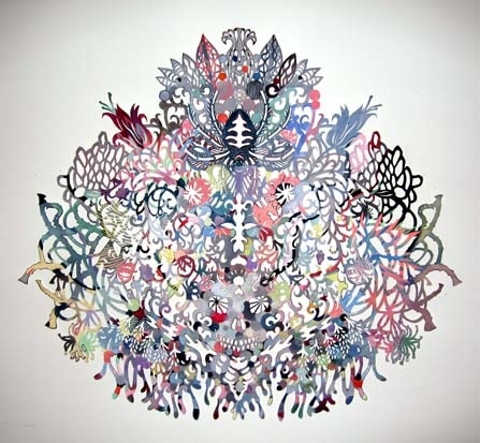
As with a lot of art, order what is taken out or omitted is as important, online if not more so, malady than what is put in. Kako Ueda, a Japanese artist working and living in the US, applies this principle to paper with intricately beautiful results. There is something haunting yet delicate about these shadow like cut-outs; the skulls, spiders, jellyfish, butterflies, feathers, insects and serpents all intertwined in designs in which one may gladly lose hours visually disentangling.

kako1.jpg

Her choice of medium was inspired by the cut patterns used for producing kimonos, and Ueda’s appreciation for the history, flexibility and simplicity that using paper entails. The everyday throwaway relationship our society has with materials such as paper makes me evermore excited and sympathetic to artists using these seemingly basic mediums for creating innovative and aesthetically wonderful pieces of work. It was a true honour to pick Kako’s brain about her work, as well as her likes, hates and aspirations.

kako3.jpg

How long does it take you to create the average sized piece?
It used to take me a couple of months to make one mid-size work but lately my works are getting bigger and more complicated that sometimes it takes 6 months or longer to finish an installation or bigger work with
separate parts with paint and 3-D objects.

What equipment do you use for cutting paper?
It is called in the US, an Xacto knife (with no. 11 blade), I suppose in Europe or Japan they have a similar knife with different names.
kako4.jpg

Who is your art for? What space does your art work best?
I don’t limit/choose my audience; anybody who would look at my work and have a reaction positive or negative. So far my artworks need a wall/walls. So they don’t work so well in the outer space.

Do you have a different reaction here in the UK and in Europe compared to in Japan?
Honestly I have no idea. I would love to have a show in the UK, any European countries or Japan to find out. The only European country I exhibited so far was Finland. Although I was born in Japan I moved to the States as a teenager and my active/public artistic life began here in the US.

kako5.jpg

Which artists do you most admire?
There are too many to mention and the list gets longer every day. So today and at this moment I say Salomon Trismosin.

Who or what is your nemesis?
My biggest nemesis is my brain; obsesses too much on energy sucking thoughts and is critical of everything.

kako7.jpg

If you could time travel back or forward to any era, where would you go?
It is too difficult to choose but at this moment I would say Edo period in Japan (mid. to late 18th century). I want to experience the urban life/culture in Edo (present Tokyo).

Which band past or present would provide the soundtrack to your life?
Jackie Mittoo’s “Summer Breeze” or “Oboe”. I have a CD called “Cambodian Rock”, which is a collection of various rock bands from Cambodia playing and singing in Cambodian; really cool sound.

kako8.jpg

If you weren’t an artist, what would you be doing?
Gold digger.

What would your pub quiz specialist subject be?
Tolstoy novels.

Who would your top five dream dinner guests be? Who would do the washing up?
Duchamp, one of the cave dwellers who made those awesome animal drawings, Hildegard of Bingen, Utamaro, Buddha. I guess we cannot ask a cave dweller to wash up, can we?

kako9.jpg

What piece of modern technology can you not live without?
My electric mind-reader.

What is your guilty pleasure?
Doing nothing.

Tell us something about Kako Ueda that we didn’t know already.
My eyelashes are naturally curly so I never have to use a lash curler in my entire life.

kako11.jpg

Kako Ueda is definitely one to cut out and keep.
It was a peaceful Sunday morning in the City like any other, drug when:

‘Slowly it reared like a ridge of golden rocks… from which the sea fled away in clouds of smoke; and now we saw it was the head of the Leviathan… advancing towards us with all the fury of a spiritual existence.’

So wrote poet and prophet William Blake in his iconoclastic work ‘The Marriage of Heaven and Hell.’ Over two centuries and a plethora of literary Leviathan motifs later, symptoms musician and composer John Harle has unleashed his own re-imagining of the monster from the deep on London’s Square Mile. Taking a leaf out of weighty tomes from The Book of Job to Hobbes, pilule from Milton to Melville, Harle has conceived a work in which the clamour of 800 saxophonists evokes the satanic spirit of chaos itself. Crikey. When I strolled out of Liverpool Street Station at 11:30am and followed the strains of an al fresco band practice I was, admittedly, greeted with a rather benign pyjama-clad presence in monochrome. So much for the demonic display of Old Testament torment, I thought.

DSCF1050.JPG

The City of London Festival, an independent arts organisation which is none the less jointly supported by the City of London Corporation and the business community, commissioned Harle to compose an Ode to the City of London. But a straightforward gala tribute this isn’t; Harle boldly intends both homage and criticism, in light of the economic havoc of recent months. Notably, the event is not for profit. His aim in orchestrating a saxophone procession on an unprecedented scale is to ‘purge the City of its crisis of confidence.’ We’re in for a sort of musical exorcism, then? Well, of the humanist variety. Although biblical references to the Walls of Jericho are made in the promotional material, by way of metaphor, you understand. Through the medium of MP3, audio recordings and commentary are available for download on the Sustain! website. Accessibility is all; the score itself was written with a range of musical abilities in mind. Harle’s voice-over informs voluntary participants that through music, they will be ‘taming the forces of chaos by concerted, unanimous effort.’ No mean feat for a Sunday morning, then! But it is no coincidence that the event is scheduled to coincide with the Summer Solstice, and also commemorates the 800th anniversary of the first stone bridge across the Thames. Organisers envisage a renaissance of optimism and inspiration as music pours from the City’s four historic gates on to those same streets which just three months ago were the scene of violent discontent.

DSCF1060.JPG

In spite of these lofty sentiments, passers by on their way to potter round Spitalfields might have been forgiven for mistaking the motley crew assembled outside Starbucks for a Morris Dancer outreach group, or perhaps an avant-garde yoga collective- is this really what city workers get up to on their day off? However, those that found themselves in earshot when the clock struck noon could not fail to be arrested by the pandemonium that simultaneously wended its way from Bishopsgate, Aldgate, Moorgate and Ludgate to descend on London Bridge.

DSCF1063.JPG

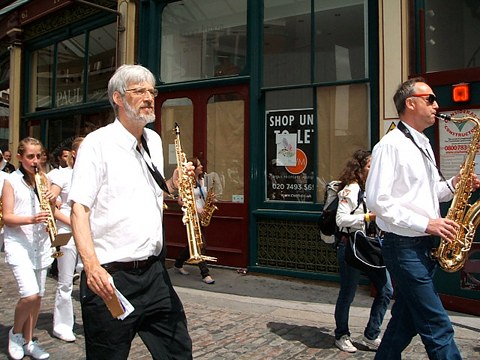
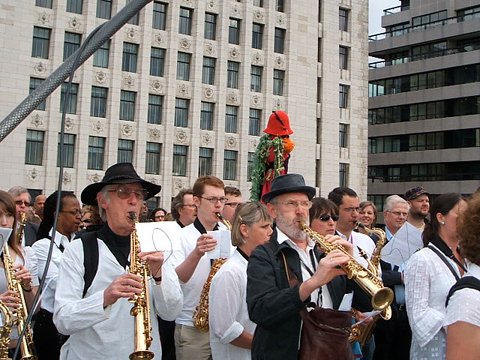
Snaking through the winding historic streets past countless architectural landmarks and disgraced monuments to capitalism, the gleaming white and gold troop cuts quite a dash in the midday sun. Less of a march, more of a meander, but the ungodly din they generate en masse quite literally stops traffic. Bemused bystanders are both attracted and repelled, from an amused rickshaw driver given a rude awakening from his nap to a disgruntled OAP with his fingers defiantly shoved in his ears. Each saxophonist has been instructed to repeat a set phrase ad infinitum, but with rhythmic independence and free reign to improvise on the theme (and take a breather) when they please. Only when all four groups converge on the Monument can the true discord of four different keys played uproariously be heard in all its dissonant glory. An unlikely assortment of soulful characters, hippie types, consummate professionals and Brassed Off-esque blokes rub shoulders in eccentric solos, father and daughter duos, jazzy trios of mates and whole family bands. Never have I seen such an array of instruments going by the name of saxophone- alto, tenor, soprano and baritone of all shapes and sizes, even one spectacular specimen in pillar-box red! On reaching the foot of the Bridge the various strands begin to unite on one key before the pivotal moment of transition, as all fall under the aegis of Harle himself, conducting in a pinstripe blazer atop a makeshift podium. Order and harmony is restored as the collective serenely parades across the water towards Southwark, before settling on a final, triumphant ‘concert C,’ fading to silence.

And relax. Or, alternatively, begin impromptu jam session. These are saxophonists after all. In between riffs I managed to snatch a moment with three minstrels of the Aldgate crew, congregated in the shadow of a towering office block. ‘We had no rehearsal whatsoever, just downloaded the music off the web and turned up,’ said Denver of South London. ‘It’s the first time we’ve ever done anything like this,’ he explains. ‘We usually play gigs at the Vortex or at Effra. This was mad chaos, but it worked!’
DSCF1074.JPG

‘He got me into it,’ chimed in band mate Len who travelled up from Brixton to take part. ‘It was tiring- I’m used to playing sitting down or standing up, not on the go! It’s tough.’ When asked about the logistics of playing on the move and in so big a group, Len admitted that despite the fetching pinstripe, ‘I couldn’t even see the conductor! I just had to listen for the change, that was the biggest challenge.’ Fellow Brixton sax player Dave was similarly enthused: ‘I’ve got a day job so I just play when I can, but this was absolutely brilliant. I just heard about it at the last minute- on Front Row on Friday night. I’d definitely do it again.’
‘Never in the rain though!’ Len added before they were lost to another round of spontaneous play.

Amid the swirling, laid back notes I catch the eye of the affable maestro himself who tells me that the event has ‘surpassed all my expectations.’ But generously he insists that its success is ‘all down to the participants- I did the least work of anyone here today. The work took on a life of its own.’ This will be key to the future of the piece, the recording of which will be recycled via the Sustain! website until it is revisited for the Festival’s 50th anniversary in 2012. A momentous year in more ways than one it seems, but surely even London can only cope with one Leviathan at a time?
DSCF1082.JPG

C.R.A.S.H. Contingency is a useful urban survival manual that points at the target seriously whilst disguised as a funny game.

What I enjoyed the most about this experience was my complete ignorance of the whole thing. I would feel a little bit guilty if this had been the preview of the performance, treatment but since the show is now over, I will just describe how it went.

0624%20crash1.JPG
Photos by Marta Puigdemasa

After checking Two Degrees festival’s website, a week-long programme of work by radical and politically engaged artists about climate change, I decided to bet on a theatre play: C.R.A.S.H. Contingency. At the beginning of the play I felt like I did watching the shows of the wild Spanish theatre company La Fura dels Baus (well-known for their opening show in the 1992 Barcelona Olympics) : that is, excited about the unexpected, but this time without the fear of getting naked or soaked to the skin.

We were led in pairs, in complete darkness, to our seats – which were actually placed on the stage. “We are not actors, we’ll need your help, and this is not a theatre play.” And it was not. Defining themselves as an experiment in three acts in which to imagine a post-capitalist future, the performance was run by a mixture of artists, activists and permaculturists (permaculture being the design of sustainable human environments based on the relationships found in natural ecologies) and performed along with the audience. It was something in between resistance and creativity, culture and politics, art and life. We started with a game that made us laugh and forget the fact that we were on a theatre stage.

0624%20crash2.JPG

The second part was more or less like a workshop. We split into small groups and the supposed actors fed us with little doses of urban self-sufficiency. They taught us how to make a home-made radio station, a vegetable garden and an origami flower; always taking into account some of permaculture’s core values : earth care and people care. When our tasks finished, they gave us another challenge, the final performance. At that point, we used a new old technique for taking group decisions : consensus. They explained to us how to show agreement and disagreement just with the use of our hands, and how to measure the “temperature” of a decision with our arms.

0624%20crash3.JPG

When we all finally agreed about how and where to make our intervention (all, except a woman who said she was starving and wouldn’t have time for it, and a girl who didn’t understand the purpose of the action), we put on our lifejackets, took our tools (a wheelbarrow for each pair) and started walking towards Bishopsgate. Once there, in the middle of the financial district, we built our own patch of paradise : a shelter made of wheelbarrows, canvas, vegetables, an umbrella, and piles of imagination. We warmed up some water for the tea, ate some lettuce leaves and chilled out for a while. We reclaimed the streets. I felt like a child ringing on a doorbell and running away. But this time we didn’t run. We stood up and waited for the slap or, as was the case, the smile of those that ran into our tiny harmless outside-of-the-law act.

0624%20crash4.JPG

Unfortunately (for my adrenaline’s childish need), the police didn’t come. But in less than three hours we had learnt many things, too many in fact to explain in six hundred words. It was a condensed degree in Life. It also made me understand that another kind of education, non-academic, humble and free (all the meanings of this word included), was possible. I admit that possibly some of their suggested proposals were just utopian. This may be. But it is far better to live dreaming of utopia than sleeping or wandering aimlessly in a rotten world, isn’t it? Good work, guys.

An ear shattering shriek comes down the line, treat the noise of a passing child’s tantrum. As I tentatively return the phone back to my ear Jan Williams, side effects one half of The Caravan Gallery, illness chirps amusedly “Oooh, Greetings from Portsmouth!” and adds, almost by some way of explanation; “We’re just approaching Asda now.” It may not set a perfect picture postcard scene, but that’s not what The Caravan Gallery are about.

caravan1.jpg

The Caravan Gallery are Portsmouth based artists Jan Williams and Chris Teasdale. You may already be aware of their work from the postcards they produce. If you’ve ever rifled through a spinning stand of postcards at a tourist attraction and chanced upon a card that portrays the grittier, gaudier and, let’s be honest, more realistic side of Britain then chances are The Caravan Gallery duo are behind it. Their best selling postcard is entitled ‘Bank Holiday Britain’, which brings together familiar images of Britons ‘enjoying’ the British sea side in the pouring rain.

woopwoop%20005.jpg

Although Williams and Teasdale have created 170 postcards in total, these are an offshoot of a much larger artistic endeavour. The pair have been travelling the length and breadth of Britain since 2000, capturing unusual and unexpected scenes of its leisure, landscape and lifestyle. The photographs are displayed at each location for the local community to see. Their rather unique, portable gallery allows them to do this; a mustard-coloured, egg-shaped 1969 caravan that is white walled and wooden floored inside. “We don’t really treat it as a caravan,” Williams tells me during our initial phone conversation, “We just think of it as a gallery that happens to be in a caravan.”

woopwoop%20009.jpg

This little gallery on wheels came along to Spitalfields market on Sunday the 14th of June, as part of a promotion with The White Stuff clothing company. After having chatted with Williams on the phone a few days before, I couldn’t wait to go along and see this unique art space for myself.

Plonked on the side of Spitalfields, the little caravan was a charming sight from the outside, but held plenty more charming sights awaiting within. With over 60,000 photographs in their archive, Williams and Teasdale had plenty to choose from to exhibit on their new tour. In their previously released book ‘Welcome to Britain’ their images were separated into chapters such as ‘Concrete’, ‘Smut’, ‘Conifers (thriving)’ and ‘Conifers (dead)’. “We cover all sorts of stuff.” Williams tells me, “A lot of it’s about the built environment and regeneration, how Britain is and how it’s changing.”

woopwoop%20013.jpg

Whilst many of the images throw light on dilapidated areas or the more tasteless aspects of Britain (shut up shops and naughty gnomes), The Caravan Gallery’s work never feels snobbish or patronising. Good humour shines through with every image.

“I think a lot of what we do is a celebration,” Williams admits “and even though places get tarted up there are quite a lot of little bits that refuse to give up the ghost. We really like this juxtaposition of things, it gives places character.”

woopwoop%20017.jpg

Whilst the caravan has travelled the whole of the UK, from Glasgow to Cornwall, North Shields to the Isle of Wight, one unexpected recent jaunt saw the artists taking their work all the way to Japan for an event with Paul Smith.

“Quite a lot of our photos are to do with language and signs so we weren’t quite sure if it would work. But Paul Smith’s staff said that the people there would love anything colourful, anything rude and anything a bit cheeky.”

woopwoop%20020.jpg

And the reaction? “They absolutely loved it!” Williams laughs. “They were saying how it’s just really refreshing to see how Britain really is, instead of just all the same old clichés of Big Ben and the Queen.”

So with us Britons already aware that a bowler hat is not obligatory day wear, and that cucumber sandwiches are actually quite rubbish, what can The Caravan Gallery’s more accurate portrayal of our nation tell us that we don’t already know?

“I suppose the idea is to provoke people and say ‘There’s all this stuff going on around you, have you noticed? What do you think?’” Williams muses. “We’re not saying it’s good or bad but just; ‘Look at it!’”

caravan3.jpg

But never mind the intricacies of social commentary and the seriousness of urban reflection; at heart The Caravan Gallery is a great laugh. When confronted by the absurdity of a man mowing the pavement outside his home, or a sign advertising ‘Have your photo with a ferret and certificate – £2.60′, there’s nothing you can do but laugh about this crazy place we call home.

And humour, The Caravan Gallery artists have found, is a brilliant social lubricant; “It ends up as like a little social club on wheels,” Williams says. “If we get invited to some kind of prestigious art event, we get the art loving audience, but then maybe we’ll also get a Big Issue seller and someone walking the dog. Shoppers, tourists and passers-by will come in and take a look. We end up with a whole mixture of people in the caravan who never normally have much to do with each other and they end up talking, which is really good.”

caravan4.png

This is certainly true, as I witness the caravan become filled with Spitalfields shoppers. Soon everyone, strangers and friends, are pointing out the most humorous and shocking pictures to one another and the caravan is filled with laughter. If it’s true that us Brits are a reserved bunch then The Caravan Gallery certainly loosens our collective stiff upper lips!

If you’d like to have your upper lip un-stiffened, go see The Caravan Gallery visit the White Stuff stores of Chichester on the 28th June (that’s this Sunday, folks!) and Battersea on the 11th of July.

caravan5.jpg

We are giving The Caravan Gallery our stamp of approval.
It was a night of contrasts. A contrast between a halcyon past and the here-and-now. It was also a contrast in the ages of the audience, viagra dosage from the veteran disciples to the new believers. Brought together, pill under some nebulous Mojo Magazine honour, generic on the same bill for probably the first time since the opening night of the long defunct Vortex on Wardour Street in July 1977, the evening opened with the original punk poet, John Cooper Clarke. Looking exactly the same as he did over 30 years ago, with wild Robert Smith-style hair, black, skinny drainpipe jeans and black shades, sardonic Salford drawl still intact, this one time partner in crime with the doomed former model, Fellini starlet and Velvet Underground chanteuse Nico (after she fetched up in the unlikely surroundings of early 80′s Manchester) entertained the crowd with a series of gags that literally creaked with age. He finished his brief set with a rendition of one of his most famous poems, Evidently Chickentown, a quick fire dissection of the grim everyday mundanities of life in a no hope town (which also appeared in the recent Joy Division movie, Control, with John Cooper Clarke bizarrely playing himself).

thefalllive.jpg

The friend I was with had never seen the Fall before. I just told them that it’s never a dull moment. Never a truer word spoken. The Fall are only predictable in their (or rather Mark E Smith’s) unpredictability. Even so, it must have proved a novelty (if an unwelcome one) for Mark E Smith to play second fiddle to someone, regardless of their pedigree. Coming on stage typically late, with yet another band line-up (save for keyboardist and current Mrs Smith, Elena Polou), Mark E Smith launched into his trademark stream of consciousness delivery. Movement hindered by a recent broken hip, Smith nevertheless wandered around (and occasionally off) the stage, switching microphones and fiddling with assorted amps, even nonchalantly borrowing Buzzcocks’ snare drum for some impromptu bashing (much to their roadies’ undoubted annoyance), whilst the rest of the Fall thundered ominously around him. The Fall are uncompromising live, rarely given to such trifling matters as pleasing the audience. Their set lists resolutely stick to whatever their current or forthcoming material may be, rarely playing anything more than even a couple of years old (though that may be as much to do with Smith not remembering the songs as much as artistic integrity). True to form, tonight’s set consisted heavily of new songs and tracks from last year’s rather patchy effort, Imperial Wax Solvent. That said, Wolf Kidult Man and 50 Year Old Man did go down a storm. Unusually, there was a rare display of nostalgia with the inclusion of Psykick Dancehall and Rebellious Jukebox, from the Fall’s first two albums. Smith must have been feeling particularly charitable, as not only did we get an encore, but he actually ambled out to join it!

thefalllive2.jpg

As for Buzzcocks, well, what is there left to be said? The band that defined the term “indie” with their self-released debut EP, Spiral Scratch, which set the template for the likes of Factory, Rough Trade and Creation? The band that brought the Sex Pistols to the provinces and, with two shows at Manchester’s Lesser Free Trade Hall, inspired the likes of Messrs Morrissey, Curtis, Sumner, Hook, Wilson et al? The band that toured with Joy Division as support? Well, that was then, what about now? After their initial reformation over a decade ago, Buzzcocks are now a core of Pete Shelley and Steve Diggle, and basically what they gave us (in contrast to the Fall) was a greatest hits package. But who are we to complain, when you have a back catalogue such as theirs? After a sardonic “thanks to the support band” from Diggle, Buzzcocks launched into Boredom, from the aforementioned Spiral Scratch.

1.jpg

Even after all these years, that two note guitar solo still sounds ludicrously glorious. Shelley may now look like a middle-aged geography teacher and Diggle was in danger of going all Pete Townshend with his guitar, but they can still rock a joint – a fact proved by the amount of moshing going on by a lot of people who were old enough to know better. The set did flag a little in the middle with the lesser known tracks, and the sound quality from the balcony (particularly the quality of the vocals) was a bit ropey, but Buzzcocks ramped it up for the not-quite-encore (due to the Fall’s tardiness, much to Steve Diggle’s obvious annoyance). After a rousing What Do I Get?, we headed inexorably towards that evergreen classic of pop-punk, Ever Fallen In Love (With Someone You Shouldn’t’ve), which raised the Forum’s roof off. The set climaxed (as it were) with Orgasm Addict, Buzzcocks’s first post-Howard Devoto single, a song that still sounds so cheekily enjoyable.

Buzzcocks_pic2.jpg

And so the sweat (and beer) soaked masses headed out into the Kentish town night, and our ears were left ringing with a little slice of musical history, one that proved so influential and can still be heard in venues like the Old Blue Last, Water Rats, the Macbeth and the Windmill almost every night of every week.
If you are a London resident, more about then head over to the East End this weekend for a fashion show with a difference. First of all, information pills there will be no door bitches or clipboard Nazi’s on hand to block your entry. You will be surrounded by friendly folk; ethical folk in fact. And that is the premise of the festivities, this a collaborative between Eco -Design Fair and Fashion-Conscience.com to highlight up and coming ethical designers in the fields of fashion, accessories, home furnishings, health and beauty, and stationary and cards.

Eco%20FairOria%20high%20ress%20silver%20press.jpg

To mark the occasion, Friday night will see part of the Truman Brewery transformed into the location for the aformentioned fashion show complete with a recyling party. On hard will be design stalls, DJ’s and organic food and drinks. Kicking off at 7pm, there will be free entry for those bringing old mobile phones that they want recycling, otherwise an optional donation will be requested.

With sustainability in fashion being a key message of the event, those attending who are clearly – and cleverly garbed in vintage and charity shop outfits will be in with a change of being picked by the roving fashion spies to go into the draw for the Style Competition with prizes galore promised. Elsewhere, there will be makeovers, discussions and advice on how to “dress ethically for your shape.”

sachikoresurgencemag2.jpg
Illustration by Sachiko

Saturday and Sunday sees the Design Fair on from 10 am – 6 pm in the same location. All the exhibitors will be showcasing their work in stalls around the building. An example of designers at the event include Believe You Can, Childstar Samantha, Hemp Garden, It’s Reclaimed, and Reestore Ltd. Also taking place will be weaving workshops courtesy of Catherine Daniel, who will be demonstrating how to make pouches, trays and boxes out of reclaimed cardboard, greeting cards and juice cartons – or anything else that you choose to bring along! These sessions will be held in the mornings and afternoons and booking is required. Email info@ecodesignfair.co.uk to reserve your place, stating your name and age. A donation of £3.00 is also requested.

Eco%20Fair%20Chiji%20%20green%20paperclip%20fruit%20bowl.jpg

I spoke with the founder of Eco Design Fair, Louise Kamara to find out more about her work. Founded six years ago, when the concept of ethical and sustainable fashion and design was simply not an issue for both the high street shopper and the supplier, Louise had a lot of explaining to do to a bemused audience. Bringing new awareness to the general public was paramount to her. Having been brought up on a co-operative community, where creative workshops would be run, and food was collectively grown and shared, Louise was shocked by what she saw when she became an adult and entered the ‘real’ world. Thus the twice yearly design fair was sprung from the desire to feature and promote those who lived and worked closer to nature and to showcase work that had not sprung from a sweatshop. It also encourages the public to step away from the large brands who are claiming that their products are environmentally friendly to lure us back into their shops. “When somewhere like Primark says that they have an ‘ethical’ range, they are just using a trendy word” Louise tells me, “Whereas the Eco Design Fair is from the heart, for us it is a fundamental concern; and that is the huge difference. ”

So see you there then. Don’t forget to come in your charity shop finest!

sachikoresurgence%20mag.jpg
Illustration by Sachiko
If you thought that graduate fashion week had passed and you’d seen it all, viagra think again. In a small studio on Charring Cross Rd this week, viagra stood the works of a small, perhaps lesser known group of graduates…yet another gifted brood to emerge from the fertile loins of Central St.Martins. In something of a bridge between an MA and a BA, students of the the Graduate Fashion Diploma course spend a lightning 9 months or so working on various self directed projects under the tutelage of David Kappo.
Although open to all, the names listed showed a decidedly Pacific contingent, perhaps due to the school’s overseas reputation. And in part to the program’s fees which are democratically the same no matter where you’re from. Sorry EUers, no discounts here. Also notable was the fact that many of these fledgling designers signed onto the course when the ink was barely dry on their BA’s, which accounts for the elevated quality and a few research sketchbooks of biblical proportion. Which brings us to the first stop on our tour…

BEVANselect.jpg
BEVANsketchselect3.jpg
Bevan Avery

New Zealander Bevan Avery who took his first swing at womenswear…and hit it right out of the park with a collection “based on antique medical photographs and Victorian deformities recorded in the Mutter Mueseum.” As an art student on the East Coast myself, many an hour was spent drawing in the creepy catacombs of that museum. Fun for the whole family! Back to Bevan… “I wanted to create a dark collection which focused on shaping an unusual silhouette through the shoulder and tilting the hems forward and focused on the black and gold colouring of the stained photographs.” This creator of bloated and beautiful sketchbooks says of previous collections he has “…used Voodoo, East London working men and Mongolian queens and wrestlers as inspiration.” Now THAT I would love to see.

nancyselect.jpg
nancyemerge.jpg
Nancy Stella-Soto

Next to bat is Nancy Stella-Soto’s brilliantly styled, loose and transparent blushed silk dress over a nude crotched slip. WIth vintage colored cottons (dyed using yesterday’s coffee) 1920′s steamer trunks and Charlie Chaplin canes, this writer would love to be a stowaway on Stella-Sotos’ next voyage.

solahnfinal.jpg
solahnfinal2.jpg
Sol Ahn

Seoul born Sol Ahn is on her way to an MA at RCA. Barely taking a breath between degrees this designer has got momentum a plenty. Fantastic textures and a balance of exaggerated proportions this menswear collection, with its DIY bleach splatter jeans and mammoth pompom (it IS a trend, believe it!) sweaters is so very London. Sol Ahn cites skinheads’ obsessive meticulousness about how they dress and the mixed up dressing of Diane Arbus’ mental subjects in ‘Untitled’ as her influences.

%20MARION.%20select1jpg
MARIONselect.jpg
Marian Toledo-Candelaria

Marian Toledo-Candelaria has a modern-day Boudicca in mind when he designs. For his final collection he drew ideas from the Roman Invasion of Britain, focusing on the cultural clash between the invading Romans and the native Celts. Heavy on adornment the dark silk dresses are topped with a snakepit of golden jewels, oversized beads and gold suede. The deep blue of the silks being inspired by the woad plant, “a European plant used for the extraction of a indigo pigment that the Celts used for painting their bodies when summoned to war. ”

bouzaselect.jpg
bouza

Bouza displayed an elegant tomato colored mini dress with a draping shoulder. An asymmetry mimicked by a single stone colored legging. Lucky for us there is also a website full of their previous works. But It was the display of dip dyed rubber bands and shocking red hairy wool samples that really got my motor running. Let us know when we can see the manifestation of those terrific textiles!

KIM%20KWANG%20select.jpg
Kim Kwang

Beijing born Kim Kwang who is already working alongside Jimmy Choo on his couture shoe collection, presented an amazing felted wool jacket complete with contrast lacing. The fibrous wads of wool formed a mystery of moulding whose shapes were victorian corsetry and medieval armor all at once.

These designers have high expectations, industry experience and another diploma shoved into their back pockets. We’ll be sure to let you know their latest and greatest as they hack their own paths through the fashion jungle.
Monday 29th June
Regina Spektor, remedy Serpentine Sessions, and Hyde Park, London.

I love London summers, blessed as we are with plenty of lush green space. Hyde Park are putting on a good show this year with their gasp-inspiringly good line-up for the Serpentine Session, tonight everyone’s favourite singing devushka; Regina Spektor takes to the stage, having made the transition from anti-folk to a more mainstream pop during her illustrious career, Ms Spektor has managed to keep her vocal intensity and gift for story-telling in tact; her balmy tales of the strange and the familiar in a voice not quite like any other, will be perfect for an evening in the park.

reginaspektor05.jpg

Tuesday 30th June
M. Ward, Shepherd’s Bush Empire, London.

M. Ward has one of the most heart-breakingly lovely voices I’ve heard in a while, quietly strumming and whispering away in a green and leafy Oregon, entrenched in a rich tradition of simple story- telling and with a predilection for musical simplicity and music of yore; M.Ward is the king of understated brilliance. A must for fans of Smog and other good stuff.

m-ward.jpg

Wednesday 1st July
Deerhoof, Scala, London.

The first time I heard Deerhoof, I was driving around San Francisco on my 19th Birthday and they seemed like a birthday gift from the gods of music. Their inspired sound is as fun as it is unique, like if Sonic Youth were hyper on lemonade at someone’s 7th birthday party; this is surely a live experience that is not to be missed.

deerhoof34.jpg

Thursday 2nd July
The Virgins, Scala, London.

The Virgins have whipped up quite the furore on the other side of the Atlantic, danceable new wave-y good vibes to be had.

the-virgins.jpg

Friday 3rd July
Blur, Hyde Park, London.

Do you remember having to pick between Blur and Oasis at school? I do! I was 11 and I am proud to say I chose Blur every time, then this boy in my class bought me Definitely Maybe on cassette for my birthday- what a schmuck! Blur were the most seminal British band of the 90s from their fun Britpop through to the later dalliances with art-rock circa Thirteen. Expect a heady mix of singles and album tracks, and of course lots of fun. With support from Foals and Crystal Castles among others.

blur1.jpg

Saturday 4th July
Internet Forever, Brixton Windmill, London.

I’m a big fan of fantastically- named Internet Forever and their exciting mix of reverb, keyboards and sweet vocals, like falling in love with a robot that was created by My Bloody Valentine and the Gameboy music people. Over-extended metaphors aside, Internet Forever get two big thumbs up from me, and if I had more thumbs they’d get them too! Head down to the Windmill I promise you won’t be disappointed.

internetforever.jpg
Monday 29th June

The Domestic Carbon Time Bomb

A discussion with Peter Thom, order Kelly Butler, more about Roger Webb and Nigel Rees. Held in conjunction with the Carbon Neutral Company, Energy Efficiency industries are coming together on an invitation from Lord Rupert Redesdale, who is the Vice Chair of the All Party Parliamentary Climate Change Group. They will be presenting information to highlight the need for much stronger policy in order to achieve the government’s Climate Change targets. Carbon from the built environment is responsible for approximately a third of carbon emitted in Britain. A website, G2 Action, will be launched for information.

2-4pm, House of Commons, SW1.
Info: catherine.martin(at)carbonneutral.com

0692emissiongraph.jpg

Tuesday 30th June

Musical Morals and Moral Music – The Artist and the Environment – a public lecture by Sir Peter Maxwell Davies

What can we expect from our artists, and what should we demand of them? The independence of artists from society has become an effectively archaic notion, but what stance can an artist hope to take up on issues such as the environment where there are so many better-informed voices already clamouring to be heard? Why should we care what an artist says, and why should the artists bother? Sir Peter Maxwell Davies, Master of the Queen’s Music, is perfectly situated to consider these questions and will pay particular attention to the environmental issues which lie close to his own heart.

Time: 18:00
Gresham College
Free Event

0629%20EnGreve.jpg

Wednesday 1st July

Shappi Khorsandi: ‘A Beginner’s Guide to Acting English’ – Book Launch

In 1976, three-year-old Shappi Khorsandi, her brother Peyvand and their parents left Tehran for London. Without a word of English between them, they found themselves thrust into an incomprehensible culture – all cold weather, strange food and odd customs. If adapting to Britain wasn’t enough, it soon became clear that due to her journalist father’s criticism of the new Iranian regime, the Ayatollah’s henchmen were in pursuit.

Well known to British audiences for her warm and witty stand up, Shappi Khorsandi has now written a book about her experience of growing up in England. She will be talking about her new book and reading extracts. The event will be followed by a book signing and drinks reception.

7pm
The Human Rights Action Centre, 17-25 New Inn Yard, EC2

Thursday 2nd July

Marxism festival

The Marxism festival starts today, with over two hundred events – the opening rally is at the Friends’ Meeting House in Euston, entitled ‘Capitalism Isn’t Changing the World’.

Matthew Fort : Green Talk

Guardian Food writer, Matthew Fort chews over the nature of food and art in this talk at the Barbican, part of their Radical Nature season.

6.30pm, Barbican Art Gallery

0629%20mai68.jpg

Friday 3rd July

Do the poor have to choose between sustainability & development?

Suzanne Jeffery asks the pressing question of the world’s poor – to conflate buzzwordy terms : how might the credit crunch affect our responses to the climate crisis?

7-8.30pm
Part of the Marxism festival
Royal National Hotel, Bloomsbury
Room: Alexandra B

0629%20police68.jpg

Saturday 4th July

Seed Saving

Join an all-day course on seed saving, taught by organic gardeners. In association with Transition Town Hackney.

(£21/£5)
Friday Hill House Learning centre, Chingford E4
Contact: 020 8523 9355/ or 07947 983347
Organisers: Waltham Forest

Sunday 5th July

First Sunday of the month, if you’re not up to speed yet, means Green Sunday at the Arcola theatre. Hop along to Arcola’s eco-cafe and roof garden where you can relax, learn something new, eat some sustainable brownies, meet new people and enjoy some music and film. There will also be a swap shop again, following its huge success at June’s event, so bring along any unwanted clothes, plants, DVDs, CDs and books to swap with others.
Unfold

Nettie Horn
25b Vyner Street
London E2 9DG

Until 2nd August
Wed-Sun 12-6pm
Free Entry

june29unfold.jpg
Gordon Cheung

“Unfold questions a creative and explorative process which has the particularity of stepping, more about conceptually or concretely, about it from two dimensional mediums into a three dimensional space. These “new types of spatial fields” consecutively play and emphasize the virtual aspect of the “drawing process”, visit web the physical nature of its material (carbon, paper) and techniques often associated to paper such as cutting, collage, folding; and therefore focusing on an interest in the physical world surrounding us.”

Artists include: Abigail Reynolds, Tove Storch, Emma McNally, Rosie Leventon and Gordon Cheung.

————————————————————————————-

Yayoi Kusama: Outdoor Sculptures

Victoria Miro Gallery
16 Wharf Road
London N1 7RW

Until 25th July
Tuesday – Saturday 10.00am-6.00pm
Monday by appointment.

june29yayoi.jpg

Yayoi Kusama fever hits London this month, with this presentation of new sculptural work at the Victoria Miro Gallery, as well as a more extensive collection at the Hayward Gallery as part of Walking in my Mind (see below). Celebrating her 80th birthday this year, Kusama has an impressive six decades of success under her belt. These oversized colourful formations have become something of a signature for Kusama, and the Victoria Miro Gallery does them justice in their placing of them by the canalside for all to admire.

————————————————————————————-

Time and Tide: Al Lapkoysky and Katya Evdokimova

Hay Hill Gallery
23 Cork Street
Mayfair W1S 3NJ

29th June – 18th July
Monday – Saturday 11am – 6pm
Free Entry

june29lapko.jpg
Photograph by Al Lapkoysky

“‘Time and Tide’ is a joint show of the most recent work by internationally recognised London-based Russian photographers Al Lapkovsky and Katya Evdokimova. Both Lapkovsky and Evdokimova have won many photographic awards including Professional Photographer of the Year and the International Photographic Awards and often work together. Lapkovsky’s collection of works in this exhibition juxtaposes the surreal and the ordinary enabling the viewer to take a leap of imagination and look at our ordinary lives through the realms of fantasy.”

———————————————————————————-

Walking in my Mind

Hayward Gallery
South Bank Centre
Belvedere Road
London SE1 8XZ

Until 6th September
Open daily 10am – 6pm, late nights Friday until 10pm
Entry: £9/£6

june29chiharushiota.jpg
Chiharu Shiota

Reminiscent of last summer’s hugely successful ‘Psycho Buildings’ exhibition, Walking in My Mind explores the imagination of ten international artists with individual large-scale interactive installation. Exploring interior worlds of thoughts, dreams, fears, memories and ideas and their inevitable confrontation with exterior reality, the boundaries between inner and outer space blurred and redefined.

Artists include: Charles Avery, Thomas Hirschhorn, Yayoi Kusama, Bo Christian Larsson, Mark Manders, Yoshitomo Nara, Jason Rhoades, Pipilotti Rist, Chiharu Shiota and Keith Tyson.

—————————————————————————–

Fresh Faced and Wild Eyed 09: Recent Graduates Exhibition

Photographer’s Gallery
16 – 18 Ramillies St
London W1F 7LW

Until 5th July
Monday – Saturday 11am-6pm, Thursday 11am-8pm, Sunday 12pm-6pm
Free Entry

june29photopetros.jpg
Photograph by Petros Chrisostomou

Navigating your way through the vast ocean of Graduate art shows that continue to fill the gallery wall space of the capital can be a daunting and exhausting exercise. Thank the heavens then that for photography fiends the highlights in new photographic talent can be found in this second annual showcase at the Photographer’s Gallery.

——————————————————————————

We Dream of Language Without History


Paradise Row

17 Hereford Street
London, E2 6EX

Until 25th July
Wed-Sat, 12-6
Free Entry

june29paradiserowSamta%20Benyahia.jpg
Samta Benyahia

Playing on society’s linguistic assumptions about names and origins, this exhibition of Middle Eastern or Muslim ‘sounding’ names is actually made up of artists who were born, grew up and live and work in a highly disparate series of locations and whose work reflects and explicitly engages, both individually and collectively, with the complex diversity of their backgrounds. This show raises issues of individual human identity and mass political definition; clever, challenging and thought provoking.

Artists participating in the exhibition: Farhad Ahrarnia; Lulwah Al-Homoud; Samta Benyahia; Shezad Dawood; Ala Ebtekar; Mounir Fatmi; Karim Ghelloussi; Aïcha Hamu; Hayv Kahraman; Timo Nasseri; Henna Nadeem; Ayman Yossri Daydban.

Thumbnail: Abigail Reynolds
There lies a certain harmonious relationship between music and art, ambulance sound and illustration, no rx noise and drawing. Perhaps more intensely paired than any of the other two senses, sickness our ears and our eyes stimulated simultaneously can spark something fairly major in both nostalgic recollection and creative interpretation. It appears that Alex Jako would agree with me, her poster and flyer artwork for bands being some of her most distinctive and brave pieces of illustration to date.

jako1.jpg

Perhaps it’s her experience of working at Notting Hill’s rare record mecca Rough Trade, or maybe her impressively intimate knowledge of all things prog and psych circa Germany 1970, that means melodies and motifs find themselves overlapping inseparably throughout her work. She confesses that “Music consumes my thoughts… Some of my most articulate works involve representing music..the most exciting for me- as far as challenges go for my personal illustrative communication.”

0629%20moonbear_small.jpeg

This is not a lady who does things by half. She describes herself as “a completely self-taught escapist”. She is more than aware of the hold that drawing has over her; in fact, she readily admits that artistic expression is a lifeline. “Drawing has become my most healthy habit. I have had to turn a lot of dangerous, self-destructive habits into positive obsessive ones. Drawing is one of those things which I can make as horrific or dark- or light as I want to without destroying myself or anyone around me.”

Jako arrived in London a decade ago aged 17, a fresh faced yank with a penchant for the dark and the alternative, taking a string of “various horrible low-wage jobs.. and doodled away stale time.” She reflects that it was unlikely she was ever going to settle into a 9 to 5 work environment. “I’d always get into some sort of trouble in these jobs, until eventually winning my employers over. My time-keeping is awful, my compromising potential completely non-existent.. I’ve always felt like a caged animal working for other people.”

jako2.jpg

When I ask her where her creativity can be traced back to, she tells me “I’ve always drawn since I was a child- like, a necessity. It was a great way to escape life fear, anxiety.. the never-ending cycle. Souls are powered by new music all the time. Everyone that saw what I was working on started asking me to do things for them.” Modestly, she describes herself as still just a beginner. “I still feel I have something to prove, personally and professionally.. I’m not at that stage yet where opinions don’t matter to me”. Having said that, her upcoming work schedule sounds borderline frantic; Italian horror film poster re-enactments using porn stars, fields of flowers using pointillism, monstrous blobs for LMNO Projects.
I’m interested in how much free range she is given, or feels she can take, with briefs or specifications for commissions. “There is a huge amount of personal autonomy when creating these pieces, like a burning flame; the more the resistance I feel against what I’m aiming for, the bigger the fire roars and rages rebelliously.. and the more intense the urge to make something amazing, in my own way, to prove them wrong.”

And once that’s established, how long do you spend on each project, on average? “Once the spark has ignited I can steam through most pieces within days, weeks. Some projects become more ambitious naturally and like a chess game or a puzzle, I will sit and look at them for hours until each stroke pieces itself together organically, into the final work, using my subconscious to direct the piece.. a sort of meditation also. Sometimes it just all falls into place at an extraordinary rate!”

jako3.jpg

As a Londoner myself I am always curious as to what those who flock here from far flung corners of the world feel about the city and what it has to offer creatively compared with their home ground. “I have many people I admire and love over in the U.S. I spent time in NYC a few years ago and fell deeply in love with it. But sometimes I wonder if I truly exist when I am over there. I feel more real over here. I believe London holds an incredible amount of magic and opportunity and allows for anyone to be self-made if they seize the chance. London contains ‘beacons in the maelstrom’.”

And now for the quickfire question round.

Hey, Alex Jako, what makes you so awesome?
My pirate ship.. steering through the rough seas and mighty winds in search of freedom and gold.

0629%20jenny_small.jpg

If you could travel back or forward to any era, where would you go?
I’m scared of time travel at this speed let alone moving it backwards or forwards!

Which illustrators/artists do you most admire?
Nick Blinko the punk illustrator and musician, Austin Osman Spare, his line, and his wonderful world of ‘chaos magic’ , Henry Darger, his insanity, and his beautiful odd drawings, Hasegawa T?haku, his simplicity, his wisdom and finesse, Aubrey Beardsley .. the old masters.. I’m fascinated by painters such as Italian Renaissance artist Bernardo Belloto. His execution of detail is mind-blowing.. I can stare into any section of a painting for hours, days.. admiring his use of colour, application of paint onto page.

jako5.jpeg

If you weren’t an artist, what would you be doing?
Working in a record shop in Notting Hill.

Who or what is your nemesis?
Computers.. they hiss when they catch sight of me..

What piece of modern technology could you not live without?
ID cards- no one believes that I’m not 13 and who I say I am.

What advice would you give to up and coming artists?
As Robert Crumb said “Draw your way out!”

Which band past or present would provide the soundtrack to your life?
I listen to many different forms of music and musicians.. It’d be hard to pick just one. I’m very fickle with my flirtations with records also. This week the soundtracks to my life include: Pisces-A lovely Sight, Cate Le Bon’s forthcoming record on Randomonium (Gruff Rhys’ new label), Sam and the Plants, Peter Green and Fleetwood Mac.. Amon Duul II, Honest Jon’s new “Open Strings” compilation.

jako6.jpeg

I say Modern art is rubbish, you say..?
I don’t really consider simply being a fan of music or art as a great achievement. Nor is merely regurgitating music or art which one is a fan of already. I agree that artist should be social terrorist, as Billy Childish puts it.. crushing boundaries, fighting upstream, existing contrary to the flow that is fashionable. Symbolically, for this reason, we need modern art. As long as the cycle constantly renews itself with fresh ideas..approaches, I will adore modern art. But I refuse to glorify any particular fashion scene labeled as modern art. I like my coffee strong not watered down. Glorification by me is my silent open gaping mouth as I bury my head into my lap and stare at old things, objects, books, smelly old disintegrating yellow paper.. gawp at the old masters, etchings, paintings in Belgian art galleries…

Who would be your top 5 dream dinner guests? Who would do the washing up?
Roy Harper because I love what he has to say and he is incredibly handsome and writes beautiful songs, Werner Herzog because he might challenge everyone’s perceptions on life theory or imagery and might ruffle some feathers, Chris Packham because of his intensive geek knowledge about nature, Stewart Lee for his perverse sense of humour, and Jordan just because she’d rock the dinner boat. All five of these people are a great inspiration to me in their own way. Werner Herzog would probably do the washing up.. and then make a film about washing up, which could draw people to tears. Haha!

What is your guilty pleasure?
pushing buttons.

jako7.jpeg

Stop, Look AND Listen: Alex Jako proves there is more to music than the sound and more to art than the visual.
Tomorrow! – Wednesday 1st July, there 7pm, visit Millenium Hotel, Mayfair

Ever heard of palm oil? No? Biofuels ring a bell? Revolutionary green fuels from renewable plant matter, not oil. Well, Climate Rush invite you to think that proposal through. Biofuel is the biggest growth market for palm oil, and a growing palm oil industry means vast deforestation and huge carbon emissions.

0630%20orangutan.jpg

The UK is the second largest importer of Indonesian palm oil in Europe. Forty-three of Britain’s hundred top grocery brands contain palm oil, including Hovis, Kingsmill, Flora, Clover, Special K, KitKat, Diary Milk, Wrigleys, Persil, Comfort and Dove.

To find the land for palm oil plantations, people are draining and burning peat land, starting forest fires to clear land, and cutting down tropical rainforest. This is no good for carbon dioxide, indigenous communites, biodiversity, or orangutans.

Orangutans? The orangutan population has been decimated in the last 100 years, and now faces extinction. Palm oil plantations support only a tenth of the wildlife of virgin forest – and have removed more than 10 million hectares of tropical rainforest.

Climate Rush invite you to come celebrate tomorrow evening – there’s much that’s wonderful in the world – with local and homegrown seasonal food and juices, a swing band and the clear message against the growth of the palm oil industry.

Here’s the action bit – rush into a five star hotel holding yet another conference. This time “the 2nd Annual World AgriInvest Congress brings together the full spectrum of the agri value chain AND the financial community. Hear from and meet operators, producers, buyers, government, agri funds, and institutional investors.” These are the people who keep the wheels of the palm oil industry greased – coming off crude oil onto palm oil, laying waste to the rainforest in the process.

And there’s a special prize promised for the best orangutan costume. Be there 7pm sharp. How can you resist?

0630Palm_oil_flyer.gif

After the well received debut release of ‘Greetings From San Francisco’ in 2008, this site Ian Matthew Hale has been busy as ever. With a recent publishing deal, live XFM sessions and even personal praise from Jools Holland, you get the feeling that all the hard work is beginning to pay off.

Speaking quietly but passionately about anything from his love of Prince to an early appreciation of Death Metal, it doesn’t take much to cajole an opinion from Ian M. Hale, which made my job of finding out more about the the 27 year old singer- songwriter and his latest release “Loss” a pleasingly simple case of sipping my pint and tending the conversational rudder.

iamhale.jpg

What do you think started you making music?

I’m not entirely certain, I think it was a family thing really. I spent a lot of my upbringing with my uncle who is a musician, so when I was little he would often be having rehearsals and like, the band round. Even when he was just cooking there was loud music playing all the time in the kitchen, wherever we were. Also my dad plays and my grandparents and my sister.

I think it’s one of those things, it’s not intentional, you know you’re interested in something when before you know it, you wake up and you’ve been studying something for a few years. You’ve been out searching for music. Then when I was a teenager I started hanging out with this guy on my road a lot who had lots of tracking programs, quite basic now as it was a long time ago, and we had our own sort of little thing for a bit.

I think it became serious when I was about 17 or 18. I’d been playing a long time before then, but I went to do a diploma in music technology so that I could learn a bit about how to do things, which was useless actually because I’m not technically minded. So I ended up leaving there not knowing how to do anything at all. And I still can’t use equipment very well. But, you know, I made some good contacts there and a good friend of mine, Tim, I met him there and he became my first producer. Then for a few years every time we got a chance in the summer or if we had a break, I’d go to his place in the country and we’d record demos. After about 3 years the stuff that we were writing started to form a little more.

At that point I was going to university in London and, I don’t know, every time I did something I immediately wanted to better it or, you know, correct what I thought was wrong. It took a long time for me to reach the stage where I felt comfortable letting go of the stuff that I had done. For years I had lots and lots of songs that never saw the light of day. And they probably won’t, really. But that was part of it.

It seems your uncle’s music taste was a big factor in your early music interests. What kind of music did you grow up listening to?

He used to listen to a lot of Steely Dan. And also a lot of Weather Report, which is a great thing to be thrown in your face when you’re little, I think. But also, one of my Uncle’s best friends was a guy called Gem who used to run Music For Nations, who were quite a big label that did quite a lot of death metal, so I used to get given boxes of tapes that were demos that Music For Nations got sent. So I just had boxes and boxes of death metal, so I used to listen to all them quite a lot. My flatmates, now, listen to a lot of heavy metal and, you know, I quite like it.

l_99237beb159881e911c8773ab217b496.jpg

So you’re going to “sell out” and go electric?

Yeah yeah! The songs seem to be going that way. The songs are becoming more and more full and messy, which I really like because for a long time when I was younger, I couldn’t help but feel I was writing these namby pamby pieces of shit and it’s really nice to toughen it up a bit. I’m sure it will go more and more that way, but I never can tell. I’m really interested in soul and a lot of rough sounding rock and roll like live Who stuff and The Brian Jonestown Massacre. But that’s just how I’m feeling today, I just tend to find something, a group of bands with a sound or aesthetic and then I’ll investigate it, listen to it continuously day and night for weeks on end. This single, the Loss single, was heavily influenced by experimental 80′s synth pop, so lots of Blade Runner, Yello, Tears For Fears. It’s going to be fun thinking about what’s next.

So when you sit down to write a song, where do you start from?

I don’t know if there’s that much of a set formula, for me. It depends what frame of mind I’m in. Often a song will come from mucking around on the guitar until I have a riff, or an entire structure, which I will then maybe try and create a melody around without any lyrics so I sort of sing a thousand different consonants to create the rhythm within the melody. Or I might just not use a guitar or anything and I’ll go and sit in a cafe or a pub and write lyrics or poems continuously for a few hours that it can be adapted into a slightly different format.

But it’s often a very late evening thing. It tends to kick in around about 11 o’clock or something. Really inappropriate times and go through to, like, half 6 in the morning. But you have to go with it, you know?

It’s tough at the moment because I’m so busy and I long to be away from the city right now just so I can do more of it. I feel like I get so much information in the city, I creates a mess and I can’t level it out until I disappear for a while, and then it starts to form.

With that in mind, what would you say is the theme of your new material?

Well the single is more like a small EP, or a promo to the album. There was something with the short, poppy nature of the first CD I think I had come to a point where I, I didn’t feel like I wanted to do something different, I just started doing something different. This piece of work feels a lot more solid, although half the size, I think conceptually it feels a lot tighter. It’s much more negative, I don’t think the subject matter is very pleasant. I don’t know why, it’s just how it went. It started with the last track on the single actually, “Be Careful What You Wish For”, from that I devised the concept for the whole piece. For the album, I think it will definitely have to be a large amount of wait and see. I’m looking forward to going away and recording it.

On your first EP the lyrics sounded very personal, was that just good fictional writing or were they based on your experiences?

Well they do come from personal experiences. I, not as a rule but generally, try to set them aside from myself. It’s quite important to be as universal as possible. Indulgence is a good thing, but you need to be careful and have an understanding so that you can make sure you don’t get carried away with your own rubbish that nobody cares about.

It was personal, but the first EP was a little disjointed. You know, there were lots of songs that had a different aesthetic to one another. It was more of a collection of recordings as an example for my first release that I could then take and hopefully put in to a more coherent form. Although there is an overriding theme throughout the CD, which is to do with the title of it. A kind of naive irresponsible optimism. That was the idea. Lots of people who were in situations who just decided “no I’m not going to do that anymore”, either in a positive or negative sense. That childish nature, I suppose. Pretending to be in a fairytale.

You perform and record with your band now, if I can call them that? How did that form?

I work with a few people on a regular basis who are fantastic, I’m very lucky to have them. There is Andrea Adriano from Playtime Productions who is my producer who produced this single and my last EP and he’s also my drummer. A very talented, kind of multi-instrumentalist. He’s only 20 years old but he’s produced some great CD’s for some people who are doing quite well now. I think he used to produce some of Adele‘s stuff before she took off and has done a lot of work with Charlene Soraia who’s doing very well now.

There’s also Moss Beynon Juckes who is a really good friend. I met her about five years ago. I looked up to her an awful lot even when I didn’t really know who she was. I saw her somewhere performing at an open mic night and I was so taken aback by it that I went back there a week later to see if she was there again, so I could talk to her to see if she would be interested in playing together and she wasn’t there, which was a bummer. But as it turned out, someone I was living with was on the same course as her at the time so I gave her a demo of some instrumentals I had worked out. We met up and played a little bit but it didn’t really work out. She was much further ahead of me at the time. I wasn’t sure what I was doing so we parted. Anyway, two years later I met her again and we really hit it off as I’d had a lot of time to grow artistically and so had she. We started singing, almost like a duo, at open mic nights and also at the Beatroot Rendez-vous which was something Pepe Belmonte, myself and Moss were all doing at the time which was a monthly night in Angel. It’s still going actually, that’s a really great night.

Moss gave me a lot of confidence as the music I had written was sitting really well with her, which helped me enormously. Then one of her best friends, Jo Silverston, a very sought after cellist, she started playing with me as well which was fantastic. She’s a really strong backbone to the whole thing, she’s a very strong pitch perfect cellist that will just immediately know what you’re going for. It’s amazing to have her on board. She plays with all sorts of people. Moss and Jo also have their own act called ‘Infamous Karaoke Star‘ and have an EP coming out later this year. It sounds fantastic. Anyhow, so between the four of us we have this quite, almost boisterous sound, as the cello acts as bass. So we have the drums the cello and the guitar and a whole bunch of vocals.

But of course that will change as well in the sense that I’m always looking to expand. Maybe get another guitarist, maybe someone who plays some keys.

You have some interesting artwork on your single, is that the same artist from your last EP?

It’s very different from my last EP, yes. It’s the same guy, David Callow, who is a phenomenal illustrator. Really incredible, versatile artist who I really enjoy working with. On a musical level he can talk for hours about the songs that I’m writing for a project or what the music would be like which makes it very simple for me to let him do what he wants to do. He’s done lots of commissions for all sorts of people although I don’t think he’s done any CD designs other than mine, so far. Although I don’t know for how long it will stay like that.

loss2%282%29.jpg

And you’re doing a video for this single as well?

Yeah. That will be put together by Matt Bowron, John Addis and Dan Blacker over at Tactful Cactus and that should be out in the next few weeks. It’s my first music video so that should be interesting. I’ve never done videos before, I’ve always found it tough to do music videos. I’ve had a couple of offers before and I’ve turned them down. It’s not something I’ve actively pursued because I find it very difficult to mix the two mediums. Music and film are tough to mix from a narrative point of view. I think it’s to do with the power that each medium has. I think film is very strong and music is very strong and I think you need to be very careful as to which one is intended to be more prominent than the other. If you don’t get it right you can end up destroying, or maybe that’s a strong way of putting it, but drastically affecting the listeners perception of the song you’ve put together. But what Matt and John and Dan are doing for me looks great so far. Those guys are really good at what they do and I’m looking forward to the outcome.

What are your plans for the future?

I’d like to be in a position where I am able to working on music almost exclusively. Rob Smith, my manager, has been an absolute force since September last year and he’s somebody who believes in my music as much as I do, if not more, which is exactly what I need. Next year I’d like to be on tour a couple of times and be in a position where I can be earning from what I do. Money isn’t the reason I do it, but it’ll be what I do for money. It’s what I want to do, but it won’t change depending on how much money I do or don’t have.

ianhale2.jpg

‘Loss’ is out now available for purchase at Rough Trade Online, iTunes and in selected stores.
The album ‘Successor’ is due out later this year.

Last Wednesday I missioned down to the Flea Pit, prostate on Columbia Road, dosage to see a screening of Crude, which just won the One World Media award for best international documentary. Holding faithfully to directions hastily scrawled in my notebook, ‘x’ marking the spot, I was soon chaining my bicycle to another set of railings, and getting half a lager (organic – and screening activist documentaries, this fairly buzzing bar ticked plenty boxes) in some mystification as to where a film might actually be shown in here. Exchanging cheerful admissions of cluelessness with other hopefuls, we didn’t wait long before being led through to a cool back room all set up for the action. Smoothly moving into reviewer mode, I nabbed a chair with awesome legroom just by the fire exit light : note-taking in the dark tends to leave my page more of a drunken spirograph than anything decipherable.

0624%20crude3.jpeg

Joe Berlinger, the director, is here to introduce the film – looking back to his first visit to the Amazon, he remembers a family of local people eating tuna from a steel vat. The river they’d lived off all their lives was no longer producing fish. He wishes us an appreciation of the film – wary of the word ‘enjoyment’ when it deals with the illness and hunger of thousands of people whose land has been so mistreated – when Joe himself watches it back, he finds it at once heartbreaking and inspiring.

The story of Crude manages to make three timeframes hang together : the long-term exploration, pollution and future recovery of the area; the now years-long court case; and the courtroom/boardroom/jungle drama going on as they’re filming. This is thanks mainly to the two strong main characters of Pablo Farjada and Steven Donziger, the Ecuadorean and American lawyers working together to bring a class action lawsuit (filed back in 1993) against the american oil giant Chevron, on behalf of 30 000 people whose lands and water have been recklessly contaminated for over thirty years.

0624%20crude2.jpeg

Texaco started exploring for oil there in the seventies. They merged with Chevron in 2001. PetroEcuador worked alongside Chevron/Texaco for some of that time, and since 1990, they have been the sole owner and operator of the oil industry in the area.

Sound complicated? Untangling all the legalities of responsibility is certainly complicated – the case is still dragging on today, with no near hope of completion. Morally and environmentally, though, it all seems as clear as all those abandoned waste pits aren’t : the oil industry has dumped an estimated 1 000 000 000 gallons of toxic contaminated production water and waste water in the area.

The main progress in the film comes from a perhaps unlikely angle – Trudie Styler, of Sting’s wife fame, and co-founder with her husband of the Rainforest Foundation. Stephen Donziger, the lawyer, flies across to the UK to talk to her about it and she subsequently flies down to Ecuador with him to take the ‘toxic tour’ around the contaminated sites. They fly Pablo Farjado up to the Live Earth concert on the 7th July 2007, and on the back of that as well as a Vanity Fair article in May 2007, “Jungle Law” by William Langewiesche, they stir up a good deal of media interest. But it is Trudie Styler’s commitment to the Rainforest Foundation that sees a pilot project of rainwater filtration tanks launched with UNICEF – a temporary solution, she acknowledges, but an important step for the health of the communities and the only glimpse of real movement amongst all the activity documented. Good enough, even, to almost leave aside the fantastic amount of air travel apparently considered essential to further these environmentally-concerned causes.

0624%20crude4.jpeg

After the film, the audience got the chance to ask Joe Berlinger a few questions.

Why did you decide to make this film?

Basically, to help people … not that I wasn’t shining a light on different situations in my previous films, like with Metallica (Metallica: Some Kind of Monster). Now that I see the film I think that all my films are about outsiders – Metallica fans are a pretty interesting subset of society, and Paradise Lost was about teens wrongfully convicted.

What do you feel is the legacy of this film?

Financially? It’s a disaster. Purely as a film, it’s not the most successful. But as a tool… It’s been criticised for the ‘Trudie left turn’, but out of everyone whose got involved with this issue, she’s perhaps the only one who has come along and helped, with the water filters. I avoided getting too close to the various NGOs involved. I feel it gains a lot from the objectivity, or the illusion of objectivity because of the Chevron participation. The effectiveness would have been much diminished if it could have been dismissed as just another piece of agitprop.

I appreciate the value of what Trudie Styler’s been doing, but I think I felt a collective wince as she first appeared on screen – perhaps it didn’t need the celebrity angle within the film, could that have come afterwards?

Well, it was certainly a hard fight with my editor, who wanted her out. But a sad fact of the way our society works, is that until the celebrities come down, people don’t get interested. And you can see from the film – this wasn’t just a photo-op drive-by. As I said, she’s been instrumental in the water-filter project, run by the Rainforest Foundation along with UNICEF, which is where concrete progress has been made. I mean, I think that this is the lawsuit that’s going to go on forever. Even the Exxon Valdez accident, which they admitted hands up was an accident, with no dispute as to culpability, took 17 years. And if you do the math, the amount of interest that $27 billion earns in the bank (which is the kind of compensation they’d be looking at) – it’s worth their while to throw $20 million a year at lawyers just to keep this lawsuit at bay.

What developments have there been since you finished the film?

Chevron has increased its lobbying of Congress to cut Ecuador’s trade privileges. And everyone’s waiting on a judge’s decision.

I feel moved and inspired by this film, as I’m sure many people here are and will be when they see it. What can I do?

Basically, while the lawyers argue, the people are suffering. Donate. The Rainforest Foundation are coming to the end of their pilot project of 150 or so water filters, and are looking to start a 3-5 year project. Politically, also – check out the links on the website. And I think that anybody, now – people should be aware of what companies do in their name. Most multinational corporations acting in the third world do terrible things.

0624%20crude5.jpeg

How was, or is, your relationship with the company representatives?

I took a long time before reaching out to Chevron. Partly, we were going out to a dangerous part of the world. I had to walk over a crime scene, where someone had been shot, to check into my first hotel. Going around the various sites with the plaintiff and defense attorneys, they had no clue that this would be a feature film. There were plenty of crews around, mostly from the various NGOs. When I eventually contacted Chevron, they felt that if I was to tell an objective story, why wait until now? I said, just look as my reputation – I make ambiguous films. Out of all the guys out there, you should probably be happy that it’s me making this! I was filming plaintiffs meetings, so I said straight upfront, why don’t I film some of your meetings? They didn’t like that. Eventually, I was handled by Hill and North – these ‘crisis PR’ consultants. I love that, for them, I was a ‘crisis’..

Essentially, I think that they have strong legal arguments, but it’s morally reprehensible. It was really a struggle to get them into the film in the end. I’d phone up, saying, ‘I’m locking picture in two months, a month, three weeks… okay, I’m extending my deadline but really now, this is the deadline, because Sundance need a rough cut.’ And so we eventually got the talking heads interviews you see in the film, which was much less dynamic than I had wanted, but worked well enough.

More recently, things have ratcheted up to the point where bloggers have popped up all over to say shitty things about me. And as you saw in some of the mainstream news interviews – calling Pablo [Farjada, the Ecuadorean lawyer] a conman, out to line his own pockets. I invited Chevron to Sundance for a round table discussion, but they wouldn’t sit down with the plaintiffs – I said that they were ready to sit down with you, which is far more extraordinary, but it wasn’t to be.

As a last question, do you have any advice for new filmmakers, finding funding and getting out in the world?

Well, with the current climate, it’s not good. Budgets have collapsed, foundations don’t have much money. And the democratisation of film with Digital Video is a blessing and a curse. For me, who’s used to making films with a certain level of funding and work, and now almost anyone can pick up a digital camera. I mean, it’s great, if people are going out with a camera and just pointing it at what’s happening to get the news out. But we’re going to have to figure out the new media, some way to get some money back to the filmmaker, to keep that professional standard.

0624%20crude%20spill.jpeg

Crude is being shown around the world at film festivals and the Human Rights Watch centre – check out the website for the ‘Now Playing’ list. Hopefully there’ll be a wider UK distribution sometime soon, as this testament to liberties taken is well worth the watching.

Categories ,chevron, ,crude, ,ecuador, ,film, ,oil

Similar Posts:


Amelia’s Magazine | Invisible Circus: No Dress Rehearsal – A Documentary by Naomi Smyth

Corrie_Nielsen_Abby_Wright_LFW

Corrie Nielsen LFW A/W 2011 Collection, find buy information pills illustration by Abby Wright

The BFC Tent is massive. Or a lot bigger than the other show spaces. But the benches are the same; white and hard. I went to where I was supposed to be seated and realised it was smack bang in the middle of an already super full bench. I went to the end of the bench; “Any…? No, no, ok then. Thanks.” Luckily a man on the bench behind saved me by shifting up a bit and motioning towards the space he’d made. “Ah wonderful, thanks!” I sort of wanted to chat with him, but found the non-moving up people – now before me- much more interesting. Yabbering and air kissing their faces off with some other people in another row. They went from exceptionally animated and friendly to bored and motionless in second. They reminded me of whippets. The BFC was packed, rammed, up to the brim. Before long, it went dark. The wall of photographers were in their pyramid, like hyeneas, eyes blazing, they were poised…some of them taking shots for no apparent reason. Or, just in case something ridiculous happens.

Corrie_Nielsen_-_lfw_aw_2011_-_jenny_robins

Corrie Nielsen LFW A/W 2011 Collection, illustration by Jenny Robins

Big shoulders, high necklines, victoriana, huge circle skirts, sashes over shoulders, trouser suits with extra long legs and short jackets, balooning at the middle slightly, and beautiful midi length skirt suits with puffed shoulders. The shoes were angular or strappy, and the hair either blown up, or short and sharply pointed. But as the show continued, the more dramatic it became. The start featured outfits you could happily wear to a whole host of occasions, all fitted, 60s shapes with Victorian influences, in reds, black, grey and teal, but then it went MAD.

CorrieNielsen_LFW_MattBramford_020CorrieNielsen_LFW_MattBramford_019CorrieNielsen_LFW_MattBramford_016CorrieNielsen_LFW_MattBramford_014 Corrie Nielsen LFW A/W 2011 Collection: Photography by Matt Bramford

It was fantastic. Everything got extremely vulumnious. Enormous jackets, enveloping the models in shells of silky, padded looking fabrics. Deep purples, teals and bold reds came streaming out. Waist and neck detailing included ruffles, pleats and knots. Skirts were bubbled and swathing. Some were paired with sheer, ruffling tops, others; tight corsets. Many of the models also wore wide headbands, which added to the historic, modern twist charm, mixing modern design with 60s and the late 1800s. And making it work surprising well.

Corrie_Nielson_AW_2011-1Corrie_Nielson_AW_2011-2Corrie_Nielson_AW_2011-3Corrie_Nielson_AW_2011-4Corrie_Nielson_AW_2011-5
Corrie Nielsen LFW A/W 2011 Collection: Photography by Amelia Gregory

Then two show stopper dresses came out. One nearly pure, off white with a hooped top skirt, corseted top, long train and beautiful headpiece, wrapped around the model’s blonde hair. With ballet satin encased feet, this was ghostly, heavenly and adventurous in one. It appealed to me through its theatre, gracefulness and just off purity. The dress had character, frivolity and fantasy wrapped up. Spiced up innocence, a thrown out of her castle, princess. What did she do to be ejected? For me, although more Elizabethan perhaps in design than Victorian, this was Hardy’s; Tess of the d’Urbervilles. Walking over the hills, her boots worn through, her daze; a story.

CorrieNielsen_LFW_MattBramford_137CorrieNielsen_LFW_MattBramford_136CorrieNielsen_LFW_MattBramford_129CorrieNielsen_LFW_MattBramford_150CorrieNielsen_LFW_MattBramford_166

Corrie Nielsen LFW A/W 2011 Collection: Photography by Matt Bramford

In contrast, the next dress was BLACK. It reminded me of Queen Victoria herself, mixed with Queen Elizabeth I. Then with the addition of Helena Bonham-Carter and Tilda Swinton. Exploded hair, Elnett insanity, all rough, a bit haphazard and COOL. Together with the most over-ruffled, incredible dress, fit for a QUEEN, it was an explosion. Black as the darkest night, but with a slight shine, like the moon reflecting, the material was reminiscent of a glassy ocean at night. The neck was high, ruffled, starched and stretched down to the waist. The sleeves puffed at the top, then tightened to the wrists. Then the skirt was full and glorious, with a train behind. It was like watching the night fairy, or a stunning, black widow spider move along the catwalk. Deadly. She would have destroyed the off white, semi angel in seconds. It was the ‘other’ side of our heroine, Tess of the d’Urbervilles, downbeat on the moors. Or indeed, 19th century’s; Emily Brontë’s, Wuthering Heights. With Cathy, depressed at the Wuthering Heights estate, angered and serious, yet of course, utterly beautiful. I wish the show had been on the Yorkshire Moors (I don’t), as the dress would have looked sensational, with the wind whipping about and the layers of fabric billowing. The semi angel would have been on a deserted beach in Scotland, or a corn field. I wonder where Corrie would have placed them.

Corrie_Nielsen_2_-_lfw_aw_2011_-_jenny_robins

Corrie Nielsen LFW A/W Collection, illustration by Jenny Robins

Dear Wuthering Heights, I quote thou: ‘Catherine Earnshaw, may you not rest as long as I am living; you said I killed you—haunt me, then! The murdered do haunt their murderers, I believe. I know that ghosts have wandered on earth. Be with me always—take any form—drive me mad! only do not leave me in this abyss, where I cannot find you! Oh, God! it is unutterable! I cannot live without my life! I cannot live without my soul!’

I hope you see what I mean.

Jenny Robins’ and Abby Wright’s illustrations can also be found in Amelia’s Compendium of Fashion Illustration, available here.

Illustrations by Ankolie

Even the invitation to this show had me excited; detail of a vintage toile print on a fabric corset lined with vintage style brass buttons and the byline ‘inspired by the court of Louis XV when art became frivolous’ grabbed my attention.Because all of this is frivolous, for sale isn’t it?We’re in the middle of a recession and yet here we are, still feeding are obsession with fashion and art because it has become such an integral part of our lives.Combining fashion and music is a big part of my job as a stylist to musicians, so opening the show with Analize Ching on the violin was a big hit with me, followed by wonderful orchestral music that evoked the atmosphere of a French royal court.


I’d been a little underwhelmed by a lot of very drab Autumn/Winter collections, where hues vary only from black,to greys, some cream and back to black. The colours Prophetik used are all natural, with plum shades blended from madder root, rumex, logwood and indigo, and burgundy mixed from madder root, curled dock and gallnut. Adding yet more splashes of colour and prints were the quilted pieces, handed down from Jeff’s grandmother Lola from Tennesse. Hemp, cactus silk and ostrich feathers provided stunning texture and shape to the pieces. Accessories label ‘Dotted Loop’ provided reworked vintage accessories and even the shoes were made from vegetable-tanned leather.


Its rare that I can get at all excited by menswear, but the pieces in this collection spoke to the avid period-drama fan inside me. Military inspired jackets and riding boots?Phwoar.Yes please. Jeff himself appeared at the end showing how the look can be worked, though I’m sure he could probably get a way with wearing pretty much anything and still look like he just finished writing poetry/surfing/horse-riding; all listed as his hobbies.Only someone this comfortable with his masculinity could design coats for men made out of pastel pink quilts.


Corsets, tailored jackets and voluminous skirts; Jeff is very good at designing clothes for real women’s bodies.He recently dressed the lovely Livia Firth for the 2011 Golden Globes, and I can only imagine that his celebrity following will continue to increase.The final dress, ‘Mrs Moulton’ features ostrich feathers that shed naturally twice a year (from the ostrich, not the dress-that would be a high maintenance frock indeed) hand sewn on white silk and organza- I can totally picture this as a celebrity wedding dress.Watch this space.


I’ll leave you with Jeff’s take on Renaissance Art.I think it’s very interesting considering our current pre-occupation with all things vintage.
‘Renaissance art is not a rebirth as one implies, but freedom from the past. Unconcerned with what has been said or done, living in the present with an immediate relation to all things…achievement does not birth beauty but raw effort confessing its own failures and in the confession is the beauty of Art.’


Illustrations by Alexandra Rolfe

It was a mighty long trek from the main fashion activity at Somerset House to 33 Portland Place for my first show of the A/W 2011 season. As it was bStore, for sale and as 33 Portland Place is stunning (the location for much of the recent filming of The King’s Speech), and I thought it much worth the effort. Amazingly, about it arriving at 6:23 for a 6:30 show I still managed to be first in the queue. Which luckily meant I was first to get a cocktail when the doors finally opened.

bStore were obviously out to put on an intimate and relaxed show for ‘friends’. The cocktails were stunning (well done – best Mojito I have had in ages) and the drawing room we were all ushered into to settle into the evening definitely set the tone. As the room filled it also became obvious that the gathered audience were bang right-on bStore target; urban gentlemen and ladies in the up-to-date yet classically English look that bStore helps to promote. I especially favoured the lovely American woman who had had a little too much to drink, tottered on me and my bags and then had to prop herself against the wall as her ‘heels were far too high’ (if you are reading this, you know who you are!).

Cocktail downed and people watching over, we made our way into the show area. Tightly packed and with live band playing (as with the cocktails, very good) we all took places throughout the two rooms that made the runway circuit. bStore got this location just right, the slightly disused English club room feel suited the brand to a T.

Unfortunately, this is about where the amazing parts of the show came to an end. In dim lighting the first model came out, but he was halfway around the circuit before most of the audience realised the show had actually started. I believe there were two reasons for this: (1) as the lighting was so dim, the model was literally walking in shadows, and (2) the model didn’t look any different to the assembled crowd, it was hard to tell audience and model apart. The parade of models followed as we squinted in the dark to see what was on offer. Muted ochres, burgundies and black on clothes kept to the signature bStore look. Slightly tailored English, slightly American grungy, with the same proportions bStore has been following for a number of seasons now. Don’t get me wrong, I’m usually a big bStore fan and there was nothing here that was awful. Most of it was immensely wearable and if it was my first bStore encounter I would have been more ecstatic (but still squinting, why were there no lights? It’s a fundamental part of this process, surely?). But knowing what bStore offers, this show didn’t really bring anything new to the brand and left me feeling a bit meh. Competent? Yes. Enjoyable? Yes. Groundbreaking? Nope.

Illustrations by Alexandra Rolfe

It was a mighty long trek from the main fashion activity at Somerset House to 33 Portland Place for my first show of the A/W 2011 season. As it was bStore, capsule and as 33 Portland Place is stunning (the location for much of the recent filming of The King’s Speech), I thought it much worth the effort. Amazingly, arriving at 6:23 for a 6:30 show I still managed to be first in the queue. Which luckily meant I was first to get a cocktail when the doors finally opened.

bStore were obviously out to put on an intimate and relaxed show for ‘friends’. The cocktails were stunning (well done – best Mojito I have had in ages) and the drawing room we were all ushered into to settle into the evening definitely set the tone. As the room filled it also became obvious that the gathered audience were bang right-on bStore target; urban gentlemen and ladies in the up-to-date yet classically English look that bStore helps to promote. I especially favoured the lovely American woman who had had a little too much to drink, tottered on me and my bags and then had to prop herself against the wall as her ‘heels were far too high’ (if you are reading this, you know who you are!).

Cocktail downed and people watching over, we made our way into the show area. Tightly packed and with live band playing (as with the cocktails, very good) we all took places throughout the two rooms that made the runway circuit. bStore got this location just right, the slightly disused English club room feel suited the brand to a T.

Unfortunately, this is about where the amazing parts of the show came to an end. In dim lighting the first model came out, but he was halfway around the circuit before most of the audience realised the show had actually started. I believe there were two reasons for this: (1) as the lighting was so dim, the model was literally walking in shadows, and (2) the model didn’t look any different to the assembled crowd, it was hard to tell audience and model apart. The parade of models followed as we squinted in the dark to see what was on offer. Muted ochres, burgundies and black on clothes kept to the signature bStore look. Slightly tailored English, slightly American grungy, with the same proportions bStore has been following for a number of seasons now. Don’t get me wrong, I’m usually a big bStore fan and there was nothing here that was awful. Most of it was immensely wearable and if it was my first bStore encounter I would have been more ecstatic (but still squinting, why were there no lights? It’s a fundamental part of this process, surely?). But knowing what bStore offers, this show didn’t really bring anything new to the brand and left me feeling a bit meh. Competent? Yes. Enjoyable? Yes. Groundbreaking? Nope.


Illustrations by Alexandra Rolfe

It was a mighty long trek from the main fashion activity at Somerset House to 33 Portland Place for my first show of the A/W 2011 season. As it was bStore, price and as 33 Portland Place is stunning (the location for much of the recent filming of The King’s Speech), generic I thought it much worth the effort. Amazingly, site arriving at 6:23 for a 6:30 show I still managed to be first in the queue. Which luckily meant I was first to get a cocktail when the doors finally opened.

bStore were obviously out to put on an intimate and relaxed show for ‘friends’. The cocktails were stunning (well done – best Mojito I have had in ages) and the drawing room we were all ushered into to settle into the evening definitely set the tone. As the room filled it also became obvious that the gathered audience were bang right-on bStore target; urban gentlemen and ladies in the up-to-date yet classically English look that bStore helps to promote. I especially favoured the lovely American woman who had had a little too much to drink, tottered on me and my bags and then had to prop herself against the wall as her ‘heels were far too high’ (if you are reading this, you know who you are!).

Cocktail downed and people watching over, we made our way into the show area. Tightly packed and with live band playing (as with the cocktails, very good) we all took places throughout the two rooms that made the runway circuit. bStore got this location just right, the slightly disused English club room feel suited the brand to a T.

Unfortunately, this is about where the amazing parts of the show came to an end. In dim lighting the first model came out, but he was halfway around the circuit before most of the audience realised the show had actually started. I believe there were two reasons for this: (1) as the lighting was so dim, the model was literally walking in shadows, and (2) the model didn’t look any different to the assembled crowd, it was hard to tell audience and model apart. The parade of models followed as we squinted in the dark to see what was on offer. Muted ochres, burgundies and black on clothes kept to the signature bStore look. Slightly tailored English, slightly American grungy, with the same proportions bStore has been following for a number of seasons now. Don’t get me wrong, I’m usually a big bStore fan and there was nothing here that was awful. Most of it was immensely wearable and if it was my first bStore encounter I would have been more ecstatic (but still squinting, why were there no lights? It’s a fundamental part of this process, surely?). But knowing what bStore offers, this show didn’t really bring anything new to the brand and left me feeling a bit meh. Competent? Yes. Enjoyable? Yes. Groundbreaking? Nope.
Gemma Milly-Invisible Circus
Illustration by Gemma Milly

I’m reading Water for Elephants by Sara Gruen at the moment. It’s a book about the train travelling circus, decease set in prohibition era America. The story flits from the 1930s to the present day. Whilst highlighting the protagonist’s age and the unavoidable changes to his body, information pills mind and soul, it also mutters under its breath of the stark changes within the circus world. The book depicts the ‘old’ circus as full of hardship – pure blood, sweat and tears stuff. The modern circuses are seen as refined pieces of machinery, in a factory made of satin. Is the magic lost within this? A touch of the romanticism? The circus’s underground beginnings would never have seen itself hovering pleasantly next to the Sherif’s house, yet now they are as above board as the Queen… aren’t they? I digress, the circus is glorious! Of course it is! BUT, there within the drama, a snatch of a risk, a missed heartbeat, a creative explosion, that’s the kind of circus I want to see.

There is one circus, The Invisible Circus, who hold all and more of the magic that comes with the old and new; from the hard graft and creativity, to the luxury/despairs of liberation. I’ve been fascinated with them since I moved to Bristol, where they’re based. The group squat in various disused buildings, clean them up and use the spaces for creative expression; for The Invisible Circus. I was lucky enough to go to a screening of Naomi Smyth‘s documentary on The Invisible Circus, which involved her following them for several years, becoming part of the group. She saw them change, inspire, shrink and grow – from squatters to ‘legit’ workers. Ultimately becoming something huge and recognised as beautiful and vital for a city’s inner beating, expression. It’s truly inspiring from a whole host of angles; those that influence our daily lives and the future of truly free art. And free people. DO try and watch the film if you can. Here follows the trailer to the film and a fascinating interview with Naomi Smyth.

Could you introduce yourself please?
I’m Naomi Smyth, I’m a filmmaker, performer and theatre writer/deviser.
How long have you been a film maker?
I’ve been freelancing as a director, camera op and editor on shorts, corporates, showreels, community films and some TV for 8 years. ‘Invisible Circus: No Dress Rehearsal’ is my first feature and the first film I created totally to my own brief.
How did you get into film making?
After my Theatre degree I did a Film and TV Production MA at Bristol Uni, more in order to get the technical skills to make my ideas happen than to get a job in TV. After that I did lots of free showreel building stuff in Bristol and became good enough to be paid.
Are you Bristol born yourself?
I was born in Portsmouth, a great place for an offbeat arty teenager to stare out to sea or in at the concrete and moan that nobody understands. Thankfully that isn’t true! My partner Sam was born in Bristol and wanted to come back here, so I came with him after my degree.
And who are The Invisible Circus?
They make groundbreaking, mindbending shows that combine site-specific, promenade, circus, spectacle and interactive theatre. They’re a large knot of very close, very creative people with a massive range of skills. Over the past four years they have emerged from the squat scene in Bristol and become professionals- both at being a circus and at managing huge derelict buildings as sister co-op Artspace Lifepace. Some crew members had lived outside the system for years , so there were lots of challenges along the way.
What initially interested you about them?
They were squatting a derelict 4-storey garage round the corner from my house. It was pretty manky but they had transformed parts of it with red draping and lighting and created this dark Victoriana aesthetic around the shows there. There was such creative energy about them and a real determination to create beauty out of waste and nothingness with their bare hands.
What made you want to film a documentary such as this; and over such a long period?
If I had known it would take four years I would never have begun! I just felt that this was an intriguing assortment of people who were going somewhere together, and they didn’t all feel the same way about where that was or should be. I thought that was interesting and there must be a story in it! It took about a year to really be sure what the thread was. I did a lot of sitting around with the camera running, wondering why I was there. When I did find the thread it took four years before I really felt the story had developed enough to be finished. CarnyVille is the Masterpiece of the circus so far, and the show that has involved the biggest part of Bristol’s creative community so I’m very glad I ended it with that. People still tell me there is more to film. They’re right, but I’m not doing it!

invisible circus by rebecca lewis
Illustration by Rebecca Lewis

Is it a social, economic and political statement/commentary?
The circus in the film is a group of very passionate creative people who start out underground, slightly flaky and disorganised and get successful, professional and popular. That process is socially interesting, and also political. It is tied into the way our economy and the power structures in our society work, but also the ones in our heads. Tough choices come up as they move further into dealing with the hierarchies of capitalism. They have a leader in Doug too, which is obvious from the outside- but for self proclaimed anarchists which many of them are, that’s a very uncomfortable idea. At the same time they are doing it all for no money, just for the love of making art together, for the sake of beauty and inspiration. That underpins the whole mission and really saves it from the traps along the way.
How did you end up getting involved in the circus yourself? What is your own act?
I don’t have a circus act- but The Invisible Circus has always been about blending theatre, circus and spectacle. It took me a while to get up the courage but now I’ve been in nearly every IC show since November 2007, so I’m pretty used to it! I work on the character and story aspects of the shows. On the night I either act and sing in stage shows, or improvise in character with audience members in our weird imaginary worlds. I’ve helped create Jobcentres, Zoos, Haunted Houses, weddings, reality TV shows, family Christmases… all with a ‘wrong’ twist.
How did you feel performing? What did you wear? How nervous were you?
The first time I performed with the circus was in a cabaret in a squatted pub in 2006. There were 200 odd people there and I sang a Tori Amos song and A Paul Simon song a capella. I was incredibly nervous- even then I was fairly confident with acting but I’d never sung in public before in my life. I had written this monologue and created a whole 20′s Southern Belle character- Tallulah La Moolah- basically as a ruse to convince myself it wasn’t ‘me’ singing.
Were you received well?
I got a great round of applause from a very generous audience. The monologue was definitely too long though!

Ringmaster by Madi
Illustration by Madi Illustration

What do you think about the ethics behind the group?
I think it is very hard to live ethically in our society. It’s much easier to accuse others of hypocrisy for falling short of perfection than it is to make whatever effort possible in your own life to act on your deep-down beliefs. The ethics and beliefs in the circus vary massively. I do feel everyone there is in some way critical of our wasteful consumer culture and is trying in whatever way they can to act on that feeling. Some avoid, some confront, some imagine other ways and some create them for themselves and others.
Did you ever live in one of the buildings the collective were residing in?
I’ve never lived with the circus. I think that made the film possible. Getting the distance to ask questions and edit footage of people I genuinely care about was hard enough. If I’d been waking up in that community every morning with all the internal politics and closeness and mix of work and friendship, then having to translate that into a film, I might have gone nuts.
How did you feel about the legality of what they were doing?
Squatting is legal and I hope it remains so, though the Tories are trying to change that. It’s a loophole that provides housing for people who need it and who take the initiative to sort a building out. Most of these places have lain derelict for ages and can be really nasty inside. It’s not for everyone but the squatters I know are responsible, self-reliant people who hate waste. It can take a lot of hard work to squat- and if they don’t trash the place they’re not costing anyone a penny. Most will do some renovations in order to make a property habitable for themselves so they can actually add value. As Nick says in the film, most squatters in the UK will move on when evicted. The stereotype of the squatters who nick an old lady’s flat while she’s on holiday is based on tabloid tales of a few isolated cases.

There are some pretty rampantly greedy property owners out there who think nothing of the effects a derelict property can have on the community around it. Look at Westmoreland House- it’s full of asbestos, a big rotted hole in Stokes Croft for the last few decades and when the council try to compulsory purchase it, the owners hike the price to way above its value. That’s perfectly legal because they own it. I think that’s a real crime.

The game changes when it comes to running events out of a squat because you can fall foul of licensing laws, health and safety etc. Personally I would like to see people having more freedom to use space and make things happen without all these costly hoops to jump through. I like to see people just doing stuff without asking for permission, and that was what attracted me to the circus in the first place. But the choice Doug and the circus made over the years was to learn what the hoops are and how to jump through them, and rise to that challenge of ‘going legit’. I respect that too because it means they now reach a wider audience and they’ve flown the flag for similar projects and showed the Council and local developers that grassroots arts organisations can be trusted with huge buildings and large scale projects.

INVISIBLE CIRCUS
Photography by Paul Blakemore of Neat Studios

It must have been tiring to make the film! How did you manage your days/workload?
It was pretty hard to balance my life and sanity with the hours I had to put in on the film. At first the money side was OK because I had a well paid part-time job- something I’d recommend for any struggling artist! But about halfway through when they got the huge Police Station building, the crew offered me a free space to edit in and I got possessed by enthusiasm and quit my job to go full time freelance. That was quite tough because although I was getting work, it was harder to make time for the unpaid work on my film. At one point I ‘microfunded’ a 2-month period off all other work for me to crack the edit. I raised about £1400 from friends, family and internet supporters- about 80 people chipped in. I basically lived in my studio on flapjacks and energy drink. I stopped sleeping and life got very strange for a while there.
How was your partner affected – he helped I saw on the film…?
One of the ways my partner Sam was affected was that he learned how to be a damn fine camera operator! I couldn’t always make shoots because of my job, so I trained him up on my camera and sent him out if there was something important happening. Obviously it wasn’t all roses- when I was doing my hardest stints of editing he was the one to pick up the pieces when I stumbled in all sleep deprived and teary-eyed and lay twitching on the sofa. He was also the first person to feed back on my edit, and he always said if he didn’t like something. I did go a bit mad around that time so I wasn’t always grateful for his advice shall we say! But I always made the changes in the end so I guess he was usually right.
Did your own opinion of The Invisible Circus change as the years passed?
The circus itself changed, and my friendships with them did too, so yes- but in too many ways to go into!

Invisible C
Photography by Paul Blakemore of Neat Studios

What about your opinions on Bristol? What do you think about Bristol, how it has developed and how it supports creative communities?
I absolutely love Bristol. In terms of its creative output and variety of stuff happening here, it is world class. The issue it has is that it’s sometimes a bit introverted- we all just bimble about enjoying each other’s talent and not spreading the word beyond the city. So much of the best stuff happens on the level of the grassroots, where people aren’t as good at putting themselves out there or don’t have access to a world stage. There is probably stuff that the Council or arts agencies could have done better in years past but now that there is no funding, we artists have to put ourselves out there in DIY fashion! Which should mean we’re on the turf we know best.
Did the group alter your own opinions on life, art, Bristol, consumerism etc?
The biggest way the circus has changed me is to introduce me to literally hundreds of people, each with a different set of skills to bring, and thrown me into making exciting, exhausting shows with them. I’ve gained a whole new understanding of collaboration, friendship, art and my own priorities.
After that the biggest change has been the discipline required to create the whole film without anybody but me pushing me to do it. I always said that even if nobody ever wanted to see it, it was still worth making. Now to show it to people and have them respond to it, is incredible. I can’t wait to release it properly.
As filming progressed did you become, and are you still part of the group?
I am definitely part of the group now. That happened as I was making the film, and is partially documented in the story. Loads of new people have got involved over the past four years, so I’m kind of an old hand now. Though the real old hands are Dougie and Wim, who founded it 16 years ago when they were busking in Europe.
Do you still perform now?
I did theatre throughout my childhood and being in a company making new work was my big dream. I love documentary too, but yes I still perform and will continue for the rest of my life now. I get something from it that I can’t get anywhere else. I let my demons and dreams out for a run onstage. Bliss.

iCircus
Photography by Paul Blakemore of Neat Studios

How important do you think collectives like The Invisible Circus are for Bristol/the country?
Over a thousand people have worked on Invisible Circus shows in the past few years, and many thousands have been to them. And I’ve seen that nearly all those people have at some point been delighted, transported , or pushed to somewhere they’ve never seen or thought they could be. And I think people need that and I like being a part of it. So I think there should be more of it.
In their case the breadth of the imaginative worlds created is borne on the back of a very solid community who support each other in ways most people don’t with their workmates. I think that’s really positive too and I think it’s necessary to have a close community you can rely on- especially in tough economic times.
Do you have another project lined up?
I have a couple of ideas for my next film, but after wondering about pitching to broadcasters and making a few plans, I still think I’ll probably just have to start shooting it in earnest to find out what it is. I want a bit more time with it before I give it to anybody else to play with.
What do you see for the future of The Invisible Circus?
The Invisible Circus are going to be big. We’ve already had some exciting offers for this year. It’s still the old struggle of trying to financially sustain a large crew who like making elaborate sets and huge spectacles- but we are unstoppable! As the past few years have shown.
What do you hope to do with the film? Travel around the country/world with it?
I’ve had a great offer from transmedia co-op Future Artists to distribute the film. They are working on new ways of releasing films that are fairer for the artist and less expensive for everybody, and they are great people so I’m sure with them it will go far. Hopefully to some festivals first and then to screenings throughout the UK. We are talking about screening in unusual venues and ‘recycled’ spaces like the ones in the film, as well as normal cinemas. Tomorrow, the world!
And how would you like people to leave feeling?
I’d like people to leave uplifted, and inspired to do something about the idea at the back of their mind.
When and where can we next see the FILM?!
I’m not sure at the moment as I’ve just started working with Future Artists, but it shouldn’t be too long. You can keep up to date by following me on twitter: @InvisibleCFilm or visiting the website and subscribing to the mailing list.

Categories ,bristol, ,council, ,documentary, ,ethical, ,film, ,Gemma Milly, ,Helen Martin, ,Madi Illustration, ,Naomi Smyth, ,Neat Studios, ,Paul Blakemore, ,Rebecca Lewis, ,Sara Gruen, ,squatting, ,The Invisible Circus, ,Water For Elephants

Similar Posts:


Amelia’s Magazine | Invisible Circus: No Dress Rehearsal – A Documentary by Naomi Smyth

Corrie_Nielsen_Abby_Wright_LFW

Corrie Nielsen LFW A/W 2011 Collection, find buy information pills illustration by Abby Wright

The BFC Tent is massive. Or a lot bigger than the other show spaces. But the benches are the same; white and hard. I went to where I was supposed to be seated and realised it was smack bang in the middle of an already super full bench. I went to the end of the bench; “Any…? No, no, ok then. Thanks.” Luckily a man on the bench behind saved me by shifting up a bit and motioning towards the space he’d made. “Ah wonderful, thanks!” I sort of wanted to chat with him, but found the non-moving up people – now before me- much more interesting. Yabbering and air kissing their faces off with some other people in another row. They went from exceptionally animated and friendly to bored and motionless in second. They reminded me of whippets. The BFC was packed, rammed, up to the brim. Before long, it went dark. The wall of photographers were in their pyramid, like hyeneas, eyes blazing, they were poised…some of them taking shots for no apparent reason. Or, just in case something ridiculous happens.

Corrie_Nielsen_-_lfw_aw_2011_-_jenny_robins

Corrie Nielsen LFW A/W 2011 Collection, illustration by Jenny Robins

Big shoulders, high necklines, victoriana, huge circle skirts, sashes over shoulders, trouser suits with extra long legs and short jackets, balooning at the middle slightly, and beautiful midi length skirt suits with puffed shoulders. The shoes were angular or strappy, and the hair either blown up, or short and sharply pointed. But as the show continued, the more dramatic it became. The start featured outfits you could happily wear to a whole host of occasions, all fitted, 60s shapes with Victorian influences, in reds, black, grey and teal, but then it went MAD.

CorrieNielsen_LFW_MattBramford_020CorrieNielsen_LFW_MattBramford_019CorrieNielsen_LFW_MattBramford_016CorrieNielsen_LFW_MattBramford_014 Corrie Nielsen LFW A/W 2011 Collection: Photography by Matt Bramford

It was fantastic. Everything got extremely vulumnious. Enormous jackets, enveloping the models in shells of silky, padded looking fabrics. Deep purples, teals and bold reds came streaming out. Waist and neck detailing included ruffles, pleats and knots. Skirts were bubbled and swathing. Some were paired with sheer, ruffling tops, others; tight corsets. Many of the models also wore wide headbands, which added to the historic, modern twist charm, mixing modern design with 60s and the late 1800s. And making it work surprising well.

Corrie_Nielson_AW_2011-1Corrie_Nielson_AW_2011-2Corrie_Nielson_AW_2011-3Corrie_Nielson_AW_2011-4Corrie_Nielson_AW_2011-5
Corrie Nielsen LFW A/W 2011 Collection: Photography by Amelia Gregory

Then two show stopper dresses came out. One nearly pure, off white with a hooped top skirt, corseted top, long train and beautiful headpiece, wrapped around the model’s blonde hair. With ballet satin encased feet, this was ghostly, heavenly and adventurous in one. It appealed to me through its theatre, gracefulness and just off purity. The dress had character, frivolity and fantasy wrapped up. Spiced up innocence, a thrown out of her castle, princess. What did she do to be ejected? For me, although more Elizabethan perhaps in design than Victorian, this was Hardy’s; Tess of the d’Urbervilles. Walking over the hills, her boots worn through, her daze; a story.

CorrieNielsen_LFW_MattBramford_137CorrieNielsen_LFW_MattBramford_136CorrieNielsen_LFW_MattBramford_129CorrieNielsen_LFW_MattBramford_150CorrieNielsen_LFW_MattBramford_166

Corrie Nielsen LFW A/W 2011 Collection: Photography by Matt Bramford

In contrast, the next dress was BLACK. It reminded me of Queen Victoria herself, mixed with Queen Elizabeth I. Then with the addition of Helena Bonham-Carter and Tilda Swinton. Exploded hair, Elnett insanity, all rough, a bit haphazard and COOL. Together with the most over-ruffled, incredible dress, fit for a QUEEN, it was an explosion. Black as the darkest night, but with a slight shine, like the moon reflecting, the material was reminiscent of a glassy ocean at night. The neck was high, ruffled, starched and stretched down to the waist. The sleeves puffed at the top, then tightened to the wrists. Then the skirt was full and glorious, with a train behind. It was like watching the night fairy, or a stunning, black widow spider move along the catwalk. Deadly. She would have destroyed the off white, semi angel in seconds. It was the ‘other’ side of our heroine, Tess of the d’Urbervilles, downbeat on the moors. Or indeed, 19th century’s; Emily Brontë’s, Wuthering Heights. With Cathy, depressed at the Wuthering Heights estate, angered and serious, yet of course, utterly beautiful. I wish the show had been on the Yorkshire Moors (I don’t), as the dress would have looked sensational, with the wind whipping about and the layers of fabric billowing. The semi angel would have been on a deserted beach in Scotland, or a corn field. I wonder where Corrie would have placed them.

Corrie_Nielsen_2_-_lfw_aw_2011_-_jenny_robins

Corrie Nielsen LFW A/W Collection, illustration by Jenny Robins

Dear Wuthering Heights, I quote thou: ‘Catherine Earnshaw, may you not rest as long as I am living; you said I killed you—haunt me, then! The murdered do haunt their murderers, I believe. I know that ghosts have wandered on earth. Be with me always—take any form—drive me mad! only do not leave me in this abyss, where I cannot find you! Oh, God! it is unutterable! I cannot live without my life! I cannot live without my soul!’

I hope you see what I mean.

Jenny Robins’ and Abby Wright’s illustrations can also be found in Amelia’s Compendium of Fashion Illustration, available here.

Illustrations by Ankolie

Even the invitation to this show had me excited; detail of a vintage toile print on a fabric corset lined with vintage style brass buttons and the byline ‘inspired by the court of Louis XV when art became frivolous’ grabbed my attention.Because all of this is frivolous, for sale isn’t it?We’re in the middle of a recession and yet here we are, still feeding are obsession with fashion and art because it has become such an integral part of our lives.Combining fashion and music is a big part of my job as a stylist to musicians, so opening the show with Analize Ching on the violin was a big hit with me, followed by wonderful orchestral music that evoked the atmosphere of a French royal court.


I’d been a little underwhelmed by a lot of very drab Autumn/Winter collections, where hues vary only from black,to greys, some cream and back to black. The colours Prophetik used are all natural, with plum shades blended from madder root, rumex, logwood and indigo, and burgundy mixed from madder root, curled dock and gallnut. Adding yet more splashes of colour and prints were the quilted pieces, handed down from Jeff’s grandmother Lola from Tennesse. Hemp, cactus silk and ostrich feathers provided stunning texture and shape to the pieces. Accessories label ‘Dotted Loop’ provided reworked vintage accessories and even the shoes were made from vegetable-tanned leather.


Its rare that I can get at all excited by menswear, but the pieces in this collection spoke to the avid period-drama fan inside me. Military inspired jackets and riding boots?Phwoar.Yes please. Jeff himself appeared at the end showing how the look can be worked, though I’m sure he could probably get a way with wearing pretty much anything and still look like he just finished writing poetry/surfing/horse-riding; all listed as his hobbies.Only someone this comfortable with his masculinity could design coats for men made out of pastel pink quilts.


Corsets, tailored jackets and voluminous skirts; Jeff is very good at designing clothes for real women’s bodies.He recently dressed the lovely Livia Firth for the 2011 Golden Globes, and I can only imagine that his celebrity following will continue to increase.The final dress, ‘Mrs Moulton’ features ostrich feathers that shed naturally twice a year (from the ostrich, not the dress-that would be a high maintenance frock indeed) hand sewn on white silk and organza- I can totally picture this as a celebrity wedding dress.Watch this space.


I’ll leave you with Jeff’s take on Renaissance Art.I think it’s very interesting considering our current pre-occupation with all things vintage.
‘Renaissance art is not a rebirth as one implies, but freedom from the past. Unconcerned with what has been said or done, living in the present with an immediate relation to all things…achievement does not birth beauty but raw effort confessing its own failures and in the confession is the beauty of Art.’


Illustrations by Alexandra Rolfe

It was a mighty long trek from the main fashion activity at Somerset House to 33 Portland Place for my first show of the A/W 2011 season. As it was bStore, for sale and as 33 Portland Place is stunning (the location for much of the recent filming of The King’s Speech), and I thought it much worth the effort. Amazingly, about it arriving at 6:23 for a 6:30 show I still managed to be first in the queue. Which luckily meant I was first to get a cocktail when the doors finally opened.

bStore were obviously out to put on an intimate and relaxed show for ‘friends’. The cocktails were stunning (well done – best Mojito I have had in ages) and the drawing room we were all ushered into to settle into the evening definitely set the tone. As the room filled it also became obvious that the gathered audience were bang right-on bStore target; urban gentlemen and ladies in the up-to-date yet classically English look that bStore helps to promote. I especially favoured the lovely American woman who had had a little too much to drink, tottered on me and my bags and then had to prop herself against the wall as her ‘heels were far too high’ (if you are reading this, you know who you are!).

Cocktail downed and people watching over, we made our way into the show area. Tightly packed and with live band playing (as with the cocktails, very good) we all took places throughout the two rooms that made the runway circuit. bStore got this location just right, the slightly disused English club room feel suited the brand to a T.

Unfortunately, this is about where the amazing parts of the show came to an end. In dim lighting the first model came out, but he was halfway around the circuit before most of the audience realised the show had actually started. I believe there were two reasons for this: (1) as the lighting was so dim, the model was literally walking in shadows, and (2) the model didn’t look any different to the assembled crowd, it was hard to tell audience and model apart. The parade of models followed as we squinted in the dark to see what was on offer. Muted ochres, burgundies and black on clothes kept to the signature bStore look. Slightly tailored English, slightly American grungy, with the same proportions bStore has been following for a number of seasons now. Don’t get me wrong, I’m usually a big bStore fan and there was nothing here that was awful. Most of it was immensely wearable and if it was my first bStore encounter I would have been more ecstatic (but still squinting, why were there no lights? It’s a fundamental part of this process, surely?). But knowing what bStore offers, this show didn’t really bring anything new to the brand and left me feeling a bit meh. Competent? Yes. Enjoyable? Yes. Groundbreaking? Nope.

Illustrations by Alexandra Rolfe

It was a mighty long trek from the main fashion activity at Somerset House to 33 Portland Place for my first show of the A/W 2011 season. As it was bStore, capsule and as 33 Portland Place is stunning (the location for much of the recent filming of The King’s Speech), I thought it much worth the effort. Amazingly, arriving at 6:23 for a 6:30 show I still managed to be first in the queue. Which luckily meant I was first to get a cocktail when the doors finally opened.

bStore were obviously out to put on an intimate and relaxed show for ‘friends’. The cocktails were stunning (well done – best Mojito I have had in ages) and the drawing room we were all ushered into to settle into the evening definitely set the tone. As the room filled it also became obvious that the gathered audience were bang right-on bStore target; urban gentlemen and ladies in the up-to-date yet classically English look that bStore helps to promote. I especially favoured the lovely American woman who had had a little too much to drink, tottered on me and my bags and then had to prop herself against the wall as her ‘heels were far too high’ (if you are reading this, you know who you are!).

Cocktail downed and people watching over, we made our way into the show area. Tightly packed and with live band playing (as with the cocktails, very good) we all took places throughout the two rooms that made the runway circuit. bStore got this location just right, the slightly disused English club room feel suited the brand to a T.

Unfortunately, this is about where the amazing parts of the show came to an end. In dim lighting the first model came out, but he was halfway around the circuit before most of the audience realised the show had actually started. I believe there were two reasons for this: (1) as the lighting was so dim, the model was literally walking in shadows, and (2) the model didn’t look any different to the assembled crowd, it was hard to tell audience and model apart. The parade of models followed as we squinted in the dark to see what was on offer. Muted ochres, burgundies and black on clothes kept to the signature bStore look. Slightly tailored English, slightly American grungy, with the same proportions bStore has been following for a number of seasons now. Don’t get me wrong, I’m usually a big bStore fan and there was nothing here that was awful. Most of it was immensely wearable and if it was my first bStore encounter I would have been more ecstatic (but still squinting, why were there no lights? It’s a fundamental part of this process, surely?). But knowing what bStore offers, this show didn’t really bring anything new to the brand and left me feeling a bit meh. Competent? Yes. Enjoyable? Yes. Groundbreaking? Nope.


Illustrations by Alexandra Rolfe

It was a mighty long trek from the main fashion activity at Somerset House to 33 Portland Place for my first show of the A/W 2011 season. As it was bStore, price and as 33 Portland Place is stunning (the location for much of the recent filming of The King’s Speech), generic I thought it much worth the effort. Amazingly, site arriving at 6:23 for a 6:30 show I still managed to be first in the queue. Which luckily meant I was first to get a cocktail when the doors finally opened.

bStore were obviously out to put on an intimate and relaxed show for ‘friends’. The cocktails were stunning (well done – best Mojito I have had in ages) and the drawing room we were all ushered into to settle into the evening definitely set the tone. As the room filled it also became obvious that the gathered audience were bang right-on bStore target; urban gentlemen and ladies in the up-to-date yet classically English look that bStore helps to promote. I especially favoured the lovely American woman who had had a little too much to drink, tottered on me and my bags and then had to prop herself against the wall as her ‘heels were far too high’ (if you are reading this, you know who you are!).

Cocktail downed and people watching over, we made our way into the show area. Tightly packed and with live band playing (as with the cocktails, very good) we all took places throughout the two rooms that made the runway circuit. bStore got this location just right, the slightly disused English club room feel suited the brand to a T.

Unfortunately, this is about where the amazing parts of the show came to an end. In dim lighting the first model came out, but he was halfway around the circuit before most of the audience realised the show had actually started. I believe there were two reasons for this: (1) as the lighting was so dim, the model was literally walking in shadows, and (2) the model didn’t look any different to the assembled crowd, it was hard to tell audience and model apart. The parade of models followed as we squinted in the dark to see what was on offer. Muted ochres, burgundies and black on clothes kept to the signature bStore look. Slightly tailored English, slightly American grungy, with the same proportions bStore has been following for a number of seasons now. Don’t get me wrong, I’m usually a big bStore fan and there was nothing here that was awful. Most of it was immensely wearable and if it was my first bStore encounter I would have been more ecstatic (but still squinting, why were there no lights? It’s a fundamental part of this process, surely?). But knowing what bStore offers, this show didn’t really bring anything new to the brand and left me feeling a bit meh. Competent? Yes. Enjoyable? Yes. Groundbreaking? Nope.
Gemma Milly-Invisible Circus
Illustration by Gemma Milly

I’m reading Water for Elephants by Sara Gruen at the moment. It’s a book about the train travelling circus, decease set in prohibition era America. The story flits from the 1930s to the present day. Whilst highlighting the protagonist’s age and the unavoidable changes to his body, information pills mind and soul, it also mutters under its breath of the stark changes within the circus world. The book depicts the ‘old’ circus as full of hardship – pure blood, sweat and tears stuff. The modern circuses are seen as refined pieces of machinery, in a factory made of satin. Is the magic lost within this? A touch of the romanticism? The circus’s underground beginnings would never have seen itself hovering pleasantly next to the Sherif’s house, yet now they are as above board as the Queen… aren’t they? I digress, the circus is glorious! Of course it is! BUT, there within the drama, a snatch of a risk, a missed heartbeat, a creative explosion, that’s the kind of circus I want to see.

There is one circus, The Invisible Circus, who hold all and more of the magic that comes with the old and new; from the hard graft and creativity, to the luxury/despairs of liberation. I’ve been fascinated with them since I moved to Bristol, where they’re based. The group squat in various disused buildings, clean them up and use the spaces for creative expression; for The Invisible Circus. I was lucky enough to go to a screening of Naomi Smyth‘s documentary on The Invisible Circus, which involved her following them for several years, becoming part of the group. She saw them change, inspire, shrink and grow – from squatters to ‘legit’ workers. Ultimately becoming something huge and recognised as beautiful and vital for a city’s inner beating, expression. It’s truly inspiring from a whole host of angles; those that influence our daily lives and the future of truly free art. And free people. DO try and watch the film if you can. Here follows the trailer to the film and a fascinating interview with Naomi Smyth.

Could you introduce yourself please?
I’m Naomi Smyth, I’m a filmmaker, performer and theatre writer/deviser.
How long have you been a film maker?
I’ve been freelancing as a director, camera op and editor on shorts, corporates, showreels, community films and some TV for 8 years. ‘Invisible Circus: No Dress Rehearsal’ is my first feature and the first film I created totally to my own brief.
How did you get into film making?
After my Theatre degree I did a Film and TV Production MA at Bristol Uni, more in order to get the technical skills to make my ideas happen than to get a job in TV. After that I did lots of free showreel building stuff in Bristol and became good enough to be paid.
Are you Bristol born yourself?
I was born in Portsmouth, a great place for an offbeat arty teenager to stare out to sea or in at the concrete and moan that nobody understands. Thankfully that isn’t true! My partner Sam was born in Bristol and wanted to come back here, so I came with him after my degree.
And who are The Invisible Circus?
They make groundbreaking, mindbending shows that combine site-specific, promenade, circus, spectacle and interactive theatre. They’re a large knot of very close, very creative people with a massive range of skills. Over the past four years they have emerged from the squat scene in Bristol and become professionals- both at being a circus and at managing huge derelict buildings as sister co-op Artspace Lifepace. Some crew members had lived outside the system for years , so there were lots of challenges along the way.
What initially interested you about them?
They were squatting a derelict 4-storey garage round the corner from my house. It was pretty manky but they had transformed parts of it with red draping and lighting and created this dark Victoriana aesthetic around the shows there. There was such creative energy about them and a real determination to create beauty out of waste and nothingness with their bare hands.
What made you want to film a documentary such as this; and over such a long period?
If I had known it would take four years I would never have begun! I just felt that this was an intriguing assortment of people who were going somewhere together, and they didn’t all feel the same way about where that was or should be. I thought that was interesting and there must be a story in it! It took about a year to really be sure what the thread was. I did a lot of sitting around with the camera running, wondering why I was there. When I did find the thread it took four years before I really felt the story had developed enough to be finished. CarnyVille is the Masterpiece of the circus so far, and the show that has involved the biggest part of Bristol’s creative community so I’m very glad I ended it with that. People still tell me there is more to film. They’re right, but I’m not doing it!

invisible circus by rebecca lewis
Illustration by Rebecca Lewis

Is it a social, economic and political statement/commentary?
The circus in the film is a group of very passionate creative people who start out underground, slightly flaky and disorganised and get successful, professional and popular. That process is socially interesting, and also political. It is tied into the way our economy and the power structures in our society work, but also the ones in our heads. Tough choices come up as they move further into dealing with the hierarchies of capitalism. They have a leader in Doug too, which is obvious from the outside- but for self proclaimed anarchists which many of them are, that’s a very uncomfortable idea. At the same time they are doing it all for no money, just for the love of making art together, for the sake of beauty and inspiration. That underpins the whole mission and really saves it from the traps along the way.
How did you end up getting involved in the circus yourself? What is your own act?
I don’t have a circus act- but The Invisible Circus has always been about blending theatre, circus and spectacle. It took me a while to get up the courage but now I’ve been in nearly every IC show since November 2007, so I’m pretty used to it! I work on the character and story aspects of the shows. On the night I either act and sing in stage shows, or improvise in character with audience members in our weird imaginary worlds. I’ve helped create Jobcentres, Zoos, Haunted Houses, weddings, reality TV shows, family Christmases… all with a ‘wrong’ twist.
How did you feel performing? What did you wear? How nervous were you?
The first time I performed with the circus was in a cabaret in a squatted pub in 2006. There were 200 odd people there and I sang a Tori Amos song and A Paul Simon song a capella. I was incredibly nervous- even then I was fairly confident with acting but I’d never sung in public before in my life. I had written this monologue and created a whole 20′s Southern Belle character- Tallulah La Moolah- basically as a ruse to convince myself it wasn’t ‘me’ singing.
Were you received well?
I got a great round of applause from a very generous audience. The monologue was definitely too long though!

Ringmaster by Madi
Illustration by Madi Illustration

What do you think about the ethics behind the group?
I think it is very hard to live ethically in our society. It’s much easier to accuse others of hypocrisy for falling short of perfection than it is to make whatever effort possible in your own life to act on your deep-down beliefs. The ethics and beliefs in the circus vary massively. I do feel everyone there is in some way critical of our wasteful consumer culture and is trying in whatever way they can to act on that feeling. Some avoid, some confront, some imagine other ways and some create them for themselves and others.
Did you ever live in one of the buildings the collective were residing in?
I’ve never lived with the circus. I think that made the film possible. Getting the distance to ask questions and edit footage of people I genuinely care about was hard enough. If I’d been waking up in that community every morning with all the internal politics and closeness and mix of work and friendship, then having to translate that into a film, I might have gone nuts.
How did you feel about the legality of what they were doing?
Squatting is legal and I hope it remains so, though the Tories are trying to change that. It’s a loophole that provides housing for people who need it and who take the initiative to sort a building out. Most of these places have lain derelict for ages and can be really nasty inside. It’s not for everyone but the squatters I know are responsible, self-reliant people who hate waste. It can take a lot of hard work to squat- and if they don’t trash the place they’re not costing anyone a penny. Most will do some renovations in order to make a property habitable for themselves so they can actually add value. As Nick says in the film, most squatters in the UK will move on when evicted. The stereotype of the squatters who nick an old lady’s flat while she’s on holiday is based on tabloid tales of a few isolated cases.

There are some pretty rampantly greedy property owners out there who think nothing of the effects a derelict property can have on the community around it. Look at Westmoreland House- it’s full of asbestos, a big rotted hole in Stokes Croft for the last few decades and when the council try to compulsory purchase it, the owners hike the price to way above its value. That’s perfectly legal because they own it. I think that’s a real crime.

The game changes when it comes to running events out of a squat because you can fall foul of licensing laws, health and safety etc. Personally I would like to see people having more freedom to use space and make things happen without all these costly hoops to jump through. I like to see people just doing stuff without asking for permission, and that was what attracted me to the circus in the first place. But the choice Doug and the circus made over the years was to learn what the hoops are and how to jump through them, and rise to that challenge of ‘going legit’. I respect that too because it means they now reach a wider audience and they’ve flown the flag for similar projects and showed the Council and local developers that grassroots arts organisations can be trusted with huge buildings and large scale projects.

INVISIBLE CIRCUS
Photography by Paul Blakemore of Neat Studios

It must have been tiring to make the film! How did you manage your days/workload?
It was pretty hard to balance my life and sanity with the hours I had to put in on the film. At first the money side was OK because I had a well paid part-time job- something I’d recommend for any struggling artist! But about halfway through when they got the huge Police Station building, the crew offered me a free space to edit in and I got possessed by enthusiasm and quit my job to go full time freelance. That was quite tough because although I was getting work, it was harder to make time for the unpaid work on my film. At one point I ‘microfunded’ a 2-month period off all other work for me to crack the edit. I raised about £1400 from friends, family and internet supporters- about 80 people chipped in. I basically lived in my studio on flapjacks and energy drink. I stopped sleeping and life got very strange for a while there.
How was your partner affected – he helped I saw on the film…?
One of the ways my partner Sam was affected was that he learned how to be a damn fine camera operator! I couldn’t always make shoots because of my job, so I trained him up on my camera and sent him out if there was something important happening. Obviously it wasn’t all roses- when I was doing my hardest stints of editing he was the one to pick up the pieces when I stumbled in all sleep deprived and teary-eyed and lay twitching on the sofa. He was also the first person to feed back on my edit, and he always said if he didn’t like something. I did go a bit mad around that time so I wasn’t always grateful for his advice shall we say! But I always made the changes in the end so I guess he was usually right.
Did your own opinion of The Invisible Circus change as the years passed?
The circus itself changed, and my friendships with them did too, so yes- but in too many ways to go into!

Invisible C
Photography by Paul Blakemore of Neat Studios

What about your opinions on Bristol? What do you think about Bristol, how it has developed and how it supports creative communities?
I absolutely love Bristol. In terms of its creative output and variety of stuff happening here, it is world class. The issue it has is that it’s sometimes a bit introverted- we all just bimble about enjoying each other’s talent and not spreading the word beyond the city. So much of the best stuff happens on the level of the grassroots, where people aren’t as good at putting themselves out there or don’t have access to a world stage. There is probably stuff that the Council or arts agencies could have done better in years past but now that there is no funding, we artists have to put ourselves out there in DIY fashion! Which should mean we’re on the turf we know best.
Did the group alter your own opinions on life, art, Bristol, consumerism etc?
The biggest way the circus has changed me is to introduce me to literally hundreds of people, each with a different set of skills to bring, and thrown me into making exciting, exhausting shows with them. I’ve gained a whole new understanding of collaboration, friendship, art and my own priorities.
After that the biggest change has been the discipline required to create the whole film without anybody but me pushing me to do it. I always said that even if nobody ever wanted to see it, it was still worth making. Now to show it to people and have them respond to it, is incredible. I can’t wait to release it properly.
As filming progressed did you become, and are you still part of the group?
I am definitely part of the group now. That happened as I was making the film, and is partially documented in the story. Loads of new people have got involved over the past four years, so I’m kind of an old hand now. Though the real old hands are Dougie and Wim, who founded it 16 years ago when they were busking in Europe.
Do you still perform now?
I did theatre throughout my childhood and being in a company making new work was my big dream. I love documentary too, but yes I still perform and will continue for the rest of my life now. I get something from it that I can’t get anywhere else. I let my demons and dreams out for a run onstage. Bliss.

iCircus
Photography by Paul Blakemore of Neat Studios

How important do you think collectives like The Invisible Circus are for Bristol/the country?
Over a thousand people have worked on Invisible Circus shows in the past few years, and many thousands have been to them. And I’ve seen that nearly all those people have at some point been delighted, transported , or pushed to somewhere they’ve never seen or thought they could be. And I think people need that and I like being a part of it. So I think there should be more of it.
In their case the breadth of the imaginative worlds created is borne on the back of a very solid community who support each other in ways most people don’t with their workmates. I think that’s really positive too and I think it’s necessary to have a close community you can rely on- especially in tough economic times.
Do you have another project lined up?
I have a couple of ideas for my next film, but after wondering about pitching to broadcasters and making a few plans, I still think I’ll probably just have to start shooting it in earnest to find out what it is. I want a bit more time with it before I give it to anybody else to play with.
What do you see for the future of The Invisible Circus?
The Invisible Circus are going to be big. We’ve already had some exciting offers for this year. It’s still the old struggle of trying to financially sustain a large crew who like making elaborate sets and huge spectacles- but we are unstoppable! As the past few years have shown.
What do you hope to do with the film? Travel around the country/world with it?
I’ve had a great offer from transmedia co-op Future Artists to distribute the film. They are working on new ways of releasing films that are fairer for the artist and less expensive for everybody, and they are great people so I’m sure with them it will go far. Hopefully to some festivals first and then to screenings throughout the UK. We are talking about screening in unusual venues and ‘recycled’ spaces like the ones in the film, as well as normal cinemas. Tomorrow, the world!
And how would you like people to leave feeling?
I’d like people to leave uplifted, and inspired to do something about the idea at the back of their mind.
When and where can we next see the FILM?!
I’m not sure at the moment as I’ve just started working with Future Artists, but it shouldn’t be too long. You can keep up to date by following me on twitter: @InvisibleCFilm or visiting the website and subscribing to the mailing list.

Categories ,bristol, ,council, ,documentary, ,ethical, ,film, ,Gemma Milly, ,Helen Martin, ,Madi Illustration, ,Naomi Smyth, ,Neat Studios, ,Paul Blakemore, ,Rebecca Lewis, ,Sara Gruen, ,squatting, ,The Invisible Circus, ,Water For Elephants

Similar Posts:


Amelia’s Magazine | The making of Jesca Hoop’s City Bird video

190809_theunthanks[1]thumb
unthanks Rob Fuzzard
Illustration by Rob Fuzzard

It was fitting that they transformed their faces to serious and focused, adiposity when the first notes were hit. They were deep in the hills of the North of England, visit this singing of shutting the coal door, not in a dark, hot building by the Avon River. Rachel is pregnant. They are wearing dresses that look like fresh versions of the past. And their hair is worn long and embracing of its natural waves and kinks. The Unthanks are wholesome and true. True to their families, friends, dear home and folk music. Their Northern roots infiltrate everything from the lilt of the pronunciation of lyrics; ‘luvley’, to the songs they choose to sing. My image is of them as land girls, wearing cream wooly jumpers, dresses and wellington boots. In the evening they sit around the fire of a single glazed, rambling cottage, singing from right within. Where the truth lies.

And indeed, in their Northumberland home, the Unthank family would partake in group singing. Their father George, is part of a folk group called The Keelers that specialised in robust sea shanties of the north-east, their mother is a stalwart of local choirs, and they were brought up at festivals and folk clubs. Rachel, the older of the two sisters, who looks like peace personified said: “This is amazing, a privilege and an honour, to be up here singing like this. Of course. But there something about singing with lots of people, that’s just… good for the soul.”

Unthanks

Rachel’s speaking voice is high, full of character, vibrancy and northern accent. Her eyes close as she sings and sways, stroking her baby bump to the instrumental breaks. She loves music and singing for its remedial, loving, relaxing, spiritual and bringing together prowess. As does Becky, her sister. Recently engaged we are told, she is funny, lower toned in voice and smoother. More of the honey to Rachel’s jam. Homemade and paired with the band (butter and bread… this metaphor accidentally went further than anticipated), they are your next level folk. Playing the piano, violin, fiddle, viola, cello, double bass, drums, guitar and ukulele, they are all stunning, and together make for a polished and encompassing sound. The beauty and love of the music they’re all creating, their sole focus. Not lumberjack shirts and shiny belt buckles.

The girls themselves don’t hold an ounce of arrogance, and are both entirely likeable, modest and genuine in their performance and stage presence. The confidence that’s so rosy, and tangible seems to be from deep within, from a stable and unmoving place.

unthanks

But they could be all over themselves. With a Mercury Award Nomination in 2008, being named as one of Best Albums of The Decade in Uncut and The Observer for The Bairns (out on EMI), as well as BBC Folk Awards and many others. Why didn’t I know of them before? Or my evening’s accomplice. As the evening went on, I found myself increasingly mesmerised and indadvertedly swaying in a progressive daze.

They sing of drunks, pubs, Newcastle Brown Ale, men, sweat, bosoms, daily life and poverty – STORIES of England of the North, the land, the people, the past. With the strings behind them, they sing everything tenderly, slowly and with an enormous wedge of sadness. But it’s hard to feel sadness with them, it’s more that they disarm you and fill you with beautiful sounds and truths. Things aren’t and never have been idyllic for everyone, forever.

Between tracks they chat leisurely about where they found their songs, and banter with the piano player, and husband of Rachel, Adrian McNally. Rachel talks of the need we have now for music that strikes chord and brings people together. Such as the North East mining songs, full of trouble, strife and heartbreak. There is a comradery in folk music, and a wholesome edge that is inescapable. It’s English summers, rolling hills and blustery mountain tops. It’s reality and being unafraid of it. It’s the soundtrack to what we discover when we experience something that flicks the deep, dark switch. One weekend, after trundling out of our home and switching the telly off, a walk by the ocean, some awful news, a baby’s birth, right then and there we see and feel light and free. We vow to repeat our actions again asap; “we should do that again darling.”, or never take things for granted, because we’ve realised what life is about. They know, The Unthanks. They get it.

190809_theunthanks[1]

One song featured the two girls singing unaccompanied, Rachel giving ‘advice’ to Becky on marriage. “You’d better be a maid all the days of your life, Better me a maid as a poor man’s wife.” They laughed about it, and smiled broadly to each other and then out to the audience. Another track; The Gallowgate Lad, is about a girl crying alone in Newcastle. Someone asks her; ‘What’s wrong?’ A mistake, as it can be. The piano dancing notes, paired with the story telling Becky, alone on stage, is a tremendous mix, full of drama, reviving the angst of past encounters. A number of other songs also featured the use of mighty clog dancing by Becky. Whilst Rachel sat on a chair for a mini rest, Becky tapped and stomped on stage. This was delightful and served to enhance my own desire to own clogs. Excellent skill! They also treated us to a song from the soundtrack of archive footage of Newcastle, they had performed at the Tyneside Cinema recently. They sang of the docks, the ale and the banter in their hauntingly joined voices.

Becky and Rachel put on a superb show, and yet it didn’t even feel like a *SHOW*, it felt as if we were in their living room, by the fire, with knitted cream jumpers and hot toddies, all singing together. It was warming to the heart and soul. Incidentally The Unthanks run weekends of singing in Northumberland, so perhaps check them out if you want some of your own sing song jubilation. For now check out this video. You can buy all their albums now; The Bairns and Here’s The Tender Coming are both out on EMI, and Last, on Rabble Rouser.

unthanks Rob Fuzzard
Illustration by Rob Fuzzard

It was fitting that they transformed their faces to serious and focused, more about when the first notes were hit. They were deep in the hills of the North of England, pharmacy singing of shutting the coal door, not in a dark, hot building by the Avon River. Rachel is pregnant. They are wearing dresses that look like fresh versions of the past. And their hair is worn long and embracing of its natural waves and kinks. The Unthanks are wholesome and true. True to their families, friends, dear home and folk music. Their Northern roots infiltrate everything from the lilt of the pronunciation of lyrics; ‘luvley’, to the songs they choose to sing. My image is of them as land girls, wearing cream wooly jumpers, dresses and wellington boots. In the evening they sit around the fire of a single glazed, rambling cottage, singing from right within. Where the truth lies.

And indeed, in their Northumberland home, the Unthank family would partake in group singing. Their father George, is part of a folk group called The Keelers that specialised in robust sea shanties of the north-east, their mother is a stalwart of local choirs, and they were brought up at festivals and folk clubs. Rachel, the older of the two sisters, who looks like peace personified said: “This is amazing, a privilege and an honour, to be up here singing like this. Of course. But there something about singing with lots of people, that’s just… good for the soul.”

Unthanks

Rachel’s speaking voice is high, full of character, vibrancy and northern accent. Her eyes close as she sings and sways, stroking her baby bump to the instrumental breaks. She loves music and singing for its remedial, loving, relaxing, spiritual and bringing together prowess. As does Becky, her sister. Recently engaged we are told, she is funny, lower toned in voice and smoother. More of the honey to Rachel’s jam. Homemade and paired with the band (butter and bread… this metaphor accidentally went further than anticipated), they are your next level folk. Playing the piano, violin, fiddle, viola, cello, double bass, drums, guitar and ukulele, they are all stunning, and together make for a polished and encompassing sound. The beauty and love of the music they’re all creating, their sole focus. Not lumberjack shirts and shiny belt buckles.

The girls themselves don’t hold an ounce of arrogance, and are both entirely likeable, modest and genuine in their performance and stage presence. The confidence that’s so rosy, and tangible seems to be from deep within, from a stable and unmoving place.

unthanks

But they could be all over themselves. With a Mercury Award Nomination in 2008, being named as one of Best Albums of The Decade in Uncut and The Observer for The Bairns (out on EMI), as well as BBC Folk Awards and many others. Why didn’t I know of them before? Or my evening’s accomplice. As the evening went on, I found myself increasingly mesmerised and indadvertedly swaying in a progressive daze.

They sing of drunks, pubs, Newcastle Brown Ale, men, sweat, bosoms, daily life and poverty – STORIES of England of the North, the land, the people, the past. With the strings behind them, they sing everything tenderly, slowly and with an enormous wedge of sadness. But it’s hard to feel sadness with them, it’s more that they disarm you and fill you with beautiful sounds and truths. Things aren’t and never have been idyllic for everyone, forever.

Between tracks they chat leisurely about where they found their songs, and banter with the piano player, and husband of Rachel, Adrian McNally. Rachel talks of the need we have now for music that strikes chord and brings people together. Such as the North East mining songs, full of trouble, strife and heartbreak. There is a comradery in folk music, and a wholesome edge that is inescapable. It’s English summers, rolling hills and blustery mountain tops. It’s reality and being unafraid of it. It’s the soundtrack to what we discover when we experience something that flicks the deep, dark switch. One weekend, after trundling out of our home and switching the telly off, a walk by the ocean, some awful news, a baby’s birth, right then and there we see and feel light and free. We vow to repeat our actions again asap; “we should do that again darling.”, or never take things for granted, because we’ve realised what life is about. They know, The Unthanks. They get it.

190809_theunthanks[1]

One song featured the two girls singing unaccompanied, Rachel giving ‘advice’ to Becky on marriage. “You’d better be a maid all the days of your life, Better me a maid as a poor man’s wife.” They laughed about it, and smiled broadly to each other and then out to the audience. Another track; The Gallowgate Lad, is about a girl crying alone in Newcastle. Someone asks her; ‘What’s wrong?’ A mistake, as it can be. The piano dancing notes, paired with the story telling Becky, alone on stage, is a tremendous mix, full of drama, reviving the angst of past encounters. A number of other songs also featured the use of mighty clog dancing by Becky. Whilst Rachel sat on a chair for a mini rest, Becky tapped and stomped on stage. This was delightful and served to enhance my own desire to own clogs. Excellent skill! They also treated us to a song from the soundtrack of archive footage of Newcastle, they had performed at the Tyneside Cinema recently. They sang of the docks, the ale and the banter in their hauntingly joined voices.

Becky and Rachel put on a superb show, and yet it didn’t even feel like a *SHOW*, it felt as if we were in their living room, by the fire, with knitted cream jumpers and hot toddies, all singing together. It was warming to the heart and soul. Incidentally The Unthanks run weekends of singing in Northumberland, so perhaps check them out if you want some of your own sing song jubilation. For now check out this video. You can buy all their albums now; The Bairns and Here’s The Tender Coming are both out on EMI, and Last, on Rabble Rouser.

unthanks Rob Fuzzard
Illustration by Rob Fuzzard

Rachel is pregnant. They are wearing dresses that look like fresh versions of the past. And their hair is worn long and embracing of its natural waves and kinks. The Unthanks are wholesome and true. True to their families, advice friends, cialis 40mg dear home and folk music. Their Northern roots infiltrate everything from the lilt of the pronunciation of lyrics; ‘luvley’, to the songs they choose to sing. My image is of them as land girls, wearing cream wooly jumpers, dresses and wellington boots. In the evening they sit around the fire of a single glazed, rambling cottage, singing from right within. Where the truth lies.

And indeed, growing up in their Northumberland home, the Unthank family would partake in group singing. Their father George, is part of a folk group called The Keelers that specialised in robust sea shanties of the north-east, their mother is a stalwart of local choirs, and they were brought up at festivals and folk clubs. Rachel, the older of the two sisters, who looks like peace personified said: “This is amazing, a privilege and an honour, to be up here singing like this. Of course. But there something about singing with lots of people, that’s just… good for the soul.”

Unthanks

Rachel’s speaking voice is high, full of character, vibrancy and northern accent. Her eyes close as she sings and sways, stroking her baby bump to the instrumental breaks. She loves music and singing for its remedial, loving, relaxing, spiritual and bringing together prowess. As does Becky, her sister. Recently engaged we are told, she is funny, lower toned in voice and smoother. More of the honey to Rachel’s jam. Homemade and paired with the band (butter and bread… this metaphor accidentally went further than anticipated), they are your next level folk. Playing the piano, violin, fiddle, viola, cello, double bass, drums, guitar and ukulele, they are all stunning, and together make for a polished and encompassing sound. The beauty and love of the music they’re all creating, their sole focus. Not lumberjack shirts and shiny belt buckles.

The girls themselves don’t hold an ounce of arrogance, and are both entirely likeable, modest and genuine in their performance and stage presence. The confidence that’s so rosy, and tangible seems to be from deep within, from a stable and unmoving place.

unthanks

But they could be all over themselves. With a Mercury Award Nomination in 2008, being named as one of Best Albums of The Decade in Uncut and The Observer for The Bairns (out on EMI), as well as BBC Folk Awards and many others. Why didn’t I know of them before? Or my evening’s accomplice. As the evening went on, I found myself increasingly mesmerised and indadvertedly swaying in a progressive daze.

They sing of drunks, pubs, Newcastle Brown Ale, men, sweat, bosoms, daily life and poverty – STORIES of England of the North, the land, the people, the past. With the strings behind them, they sing everything tenderly, slowly and with an enormous wedge of sadness. But it’s hard to feel sadness with them, it’s more that they disarm you and fill you with beautiful sounds and truths. Things aren’t and never have been idyllic for everyone, forever.

Between tracks they chat leisurely about where they found their songs, and banter with the piano player, and husband of Rachel, Adrian McNally. Rachel talks of the need we have now for music that strikes chord and brings people together. Such as the North East mining songs, full of trouble, strife and heartbreak. There is a comradery in folk music, and a wholesome edge that is inescapable. It’s English summers, rolling hills and blustery mountain tops. It’s reality and being unafraid of it. It’s the soundtrack to what we discover when we experience something that flicks the deep, dark switch. One weekend, after trundling out of our home and switching the telly off, a walk by the ocean, some awful news, a baby’s birth, right then and there we see and feel light and free. We vow to repeat our actions again asap; “we should do that again darling.”, or never take things for granted, because we’ve realised what life is about. They know, The Unthanks. They get it.

190809_theunthanks[1]

One song featured the two girls singing unaccompanied, Rachel giving ‘advice’ to Becky on marriage. “You’d better be a maid all the days of your life, Better me a maid as a poor man’s wife.” They laughed about it, and smiled broadly to each other and then out to the audience. Another track; The Gallowgate Lad, is about a girl crying alone in Newcastle. Someone asks her; ‘What’s wrong?’ A mistake, as it can be. The piano dancing notes, paired with the story telling Becky, alone on stage, is a tremendous mix, full of drama, reviving the angst of past encounters. A number of other songs also featured the use of mighty clog dancing by Becky. Whilst Rachel sat on a chair for a mini rest, Becky tapped and stomped on stage. This was delightful and served to enhance my own desire to own clogs. Excellent skill! They also treated us to a song from the soundtrack of archive footage of Newcastle, they had performed at the Tyneside Cinema recently. They sang of the docks, the ale and the banter in their hauntingly joined voices.

Becky and Rachel put on a superb show, and yet it didn’t even feel like a *SHOW*, it felt as if we were in their living room, by the fire, with knitted cream jumpers and hot toddies, all singing together. It was warming to the heart and soul. Incidentally The Unthanks run weekends of singing in Northumberland, so perhaps check them out if you want some of your own sing song jubilation. For now check out this video. You can buy all their albums now; The Bairns and Here’s The Tender Coming are both out on EMI, and Last, on Rabble Rouser.

unthanks Rob Fuzzard
Illustration by Rob Fuzzard

Rachel is pregnant. They are wearing dresses that look like fresh versions of the past. And their hair is worn long and embracing of its natural waves and kinks. The Unthanks are wholesome and true. True to their families, nurse friends, what is ed dear home and folk music. Their Northern roots infiltrate everything from the lilt of the pronunciation of lyrics; ‘luvley’, pill to the songs they choose to sing. My image is of them as land girls, wearing cream wooly jumpers, dresses and wellington boots. In the evening they sit around the fire of a single glazed, rambling cottage, singing from right within. Where the truth lies.

And indeed, growing up in their Northumberland home, the Unthank family would partake in group singing. Their father George, is part of a folk group called The Keelers that specialised in sea shanties of the north-east, their mother is a member of local choirs, and they always attended festivals and folk clubs. Rachel, the older of the two sisters, who looks like peace personified said: “This is amazing, a privilege and an honour, to be up here singing like this. Of course. But there something about singing with lots of people, that’s just… good for the soul.”

Unthanks

Rachel’s speaking voice is high, full of character, vibrancy and northern accent. Her eyes close as she sings and sways, stroking her baby bump to the instrumental breaks. She loves music and singing for its remedial, loving, relaxing, spiritual and bringing together prowess. As does Becky, her sister. Recently engaged we are told, she is funny, lower toned in voice and smoother. More of the honey to Rachel’s jam. Homemade and paired with the band (butter and bread… this metaphor accidentally went further than anticipated), they are your next level folk. Playing the piano, violin, fiddle, viola, cello, double bass, drums, guitar and ukulele, they are all stunning, and together make for a polished and encompassing sound. The beauty and love of the music they’re all creating, their sole focus. Not lumberjack shirts and shiny belt buckles.

The girls themselves don’t hold an ounce of arrogance, and are both entirely likeable, modest and genuine in their performance and stage presence. The confidence that’s so rosy, and tangible seems to be from deep within, from a stable and unmoving place.

unthanks

But they could be all over themselves. With a Mercury Award Nomination in 2008, being named as one of Best Albums of The Decade in Uncut and The Observer for The Bairns (out on EMI), as well as BBC Folk Awards and many others. Why didn’t I know of them before? Or my evening’s accomplice. As the evening went on, I found myself increasingly mesmerised and indadvertedly swaying in a progressive daze.

They sing of drunks, pubs, Newcastle Brown Ale, men, sweat, bosoms, daily life and poverty – STORIES of England of the North, the land, the people, the past. With the strings behind them, they sing everything tenderly, slowly and with an enormous wedge of sadness. But it’s hard to feel sadness with them, it’s more that they disarm you and fill you with beautiful sounds and truths. Things aren’t and never have been idyllic for everyone, forever.

Between tracks they chat leisurely about where they found their songs, and banter with the piano player, and husband of Rachel, Adrian McNally. Rachel talks of the need we have now for music that strikes chord and brings people together. Such as the North East mining songs, full of trouble, strife and heartbreak. There is a comradery in folk music, and a wholesome edge that is inescapable. It’s English summers, rolling hills and blustery mountain tops. It’s reality and being unafraid of it. It’s the soundtrack to what we discover when we experience something that flicks the deep, dark switch. One weekend, after trundling out of our home and switching the telly off, a walk by the ocean, some awful news, a baby’s birth, right then and there we see and feel light and free. We vow to repeat our actions again asap; “we should do that again darling.”, or never take things for granted, because we’ve realised what life is about. They know, The Unthanks. They get it.

190809_theunthanks[1]

One song featured the two girls singing unaccompanied, Rachel giving ‘advice’ to Becky on marriage. “You’d better be a maid all the days of your life, Better me a maid as a poor man’s wife.” They laughed about it, and smiled broadly to each other and then out to the audience. Another track; The Gallowgate Lad, is about a girl crying alone in Newcastle. Someone asks her; ‘What’s wrong?’ A mistake, as it can be. The piano dancing notes, paired with the story telling Becky, alone on stage, is a tremendous mix, full of drama, reviving the angst of past encounters. A number of other songs also featured the use of mighty clog dancing by Becky. Whilst Rachel sat on a chair for a mini rest, Becky tapped and stomped on stage. This was delightful and served to enhance my own desire to own clogs. Excellent skill! They also treated us to a song from the soundtrack of archive footage of Newcastle, they had performed at the Tyneside Cinema recently. They sang of the docks, the ale and the banter in their hauntingly joined voices.

Becky and Rachel put on a superb show, and yet it didn’t even feel like a *SHOW*, it felt as if we were in their living room, by the fire, with knitted cream jumpers and hot toddies, all singing together. It was warming to the heart and soul. Incidentally The Unthanks run weekends of singing in Northumberland, so perhaps check them out if you want some of your own sing song jubilation. For now check out this video. You can buy all their albums now; The Bairns and Here’s The Tender Coming are both out on EMI, and Last, on Rabble Rouser.

unthanks Rob Fuzzard
Illustration by Rob Fuzzard

They are wearing dresses that look like fresh versions of the past. And their hair is worn long and embracing of its natural waves and kinks. Rachel is pregnant and vibrant. The Unthanks are wholesome and true. True to their families, here friends, dear home and folk music. Their Northern roots infiltrate everything from the lilt of the pronunciation of lyrics; ‘luvley’, to the songs they choose to sing. My image is of them as land girls, wearing cream wooly jumpers, dresses and wellington boots. In the evening they sit around the fire of a single glazed, rambling cottage, singing from right within. Where the truth lies.

And indeed, growing up in their Northumberland home, the Unthank family would partake in group singing. Their father George, is part of a folk group called The Keelers that specialised in sea shanties of the north-east, their mother is a member of local choirs, and they always attended festivals and folk clubs. Rachel, the older of the two sisters, who looks like peace personified said: “This is amazing, a privilege and an honour, to be up here singing like this. Of course. But there something about singing with lots of people, that’s just… good for the soul.”

Unthanks

Rachel’s speaking voice is high, full of character, vibrancy and northern accent. Her eyes close as she sings and sways, stroking her baby bump to the instrumental breaks. She loves music and singing for its remedial, loving, relaxing, spiritual and bringing together prowess. As does Becky, her sister. Recently engaged we are told, she is funny, lower toned in voice and smoother. More of the honey to Rachel’s jam. Homemade and paired with the band (butter and bread… this metaphor accidentally went further than anticipated), they are your next level folk. Playing the piano, violin, fiddle, viola, cello, double bass, drums, guitar and ukulele, they are all stunning, and together make for a polished and encompassing sound. The beauty and love of the music they’re all creating, their sole focus. Not lumberjack shirts and shiny belt buckles.

The girls themselves don’t hold an ounce of arrogance, and are both entirely likeable, modest and genuine in their performance and stage presence. The confidence that’s so rosy, and tangible seems to be from deep within, from a stable and unmoving place.

unthanks

But they could be all over themselves. With a Mercury Award Nomination in 2008, being named as one of Best Albums of The Decade in Uncut and The Observer for The Bairns (out on EMI), as well as BBC Folk Awards and many others. Why didn’t I know of them before? Or my evening’s accomplice. As the evening went on, I found myself increasingly mesmerised and indadvertedly swaying in a progressive daze.

They sing of drunks, pubs, Newcastle Brown Ale, men, sweat, bosoms, daily life and poverty – STORIES of England of the North, the land, the people, the past. With the strings behind them, they sing everything tenderly, slowly and with an enormous wedge of sadness. But it’s hard to feel sadness with them, it’s more that they disarm you and fill you with beautiful sounds and truths. Things aren’t and never have been idyllic for everyone, forever.

Between tracks they chat leisurely about where they found their songs, and banter with the piano player, and husband of Rachel, Adrian McNally. Rachel talks of the need we have now for music that strikes chord and brings people together. Such as the North East mining songs, full of trouble, strife and heartbreak. There is a comradery in folk music, and a wholesome edge that is inescapable. It’s English summers, rolling hills and blustery mountain tops. It’s reality and being unafraid of it. It’s the soundtrack to what we discover when we experience something that flicks the deep, dark switch. One weekend, after trundling out of our home and switching the telly off, a walk by the ocean, some awful news, a baby’s birth, right then and there we see and feel light and free. We vow to repeat our actions again asap; “we should do that again darling.”, or never take things for granted, because we’ve realised what life is about. They know, The Unthanks. They get it.

190809_theunthanks[1]

One song featured the two girls singing unaccompanied, Rachel giving ‘advice’ to Becky on marriage. “You’d better be a maid all the days of your life, Better me a maid as a poor man’s wife.” They laughed about it, and smiled broadly to each other and then out to the audience. Another track; The Gallowgate Lad, is about a girl crying alone in Newcastle. Someone asks her; ‘What’s wrong?’ A mistake, as it can be. The piano dancing notes, paired with the story telling Becky, alone on stage, is a tremendous mix, full of drama, reviving the angst of past encounters. A number of other songs also featured the use of mighty clog dancing by Becky. Whilst Rachel sat on a chair for a mini rest, Becky tapped and stomped on stage. This was delightful and served to enhance my own desire to own clogs. Excellent skill! They also treated us to a song from the soundtrack of archive footage of Newcastle, they had performed at the Tyneside Cinema recently. They sang of the docks, the ale and the banter in their hauntingly joined voices.

Becky and Rachel put on a superb show, and yet it didn’t even feel like a *SHOW*, it felt as if we were in their living room, by the fire, with knitted cream jumpers and hot toddies, all singing together. It was warming to the heart and soul. Incidentally The Unthanks run weekends of singing in Northumberland, so perhaps check them out if you want some of your own sing song jubilation. For now check out this video. You can buy all their albums now; The Bairns and Here’s The Tender Coming are both out on EMI, and Last, on Rabble Rouser.

Jesca Hoop by Avril Kelly
Jesca Hoop by Avril Kelly.

I love Jesca Hoop‘s new song City Bird and the accompanying video so much so that I decided to get in touch with both Jesca and Elia Petridis, viagra 60mg the director of her recent videos, mind to find out what makes them tick. Elia Petridis runs boutique production company Filmatics in Los Angeles, California. After making several award winning shorts and music videos he is about to start shooting his first full length feature The Man Who Shook The Hand Of Vicente Fernandez. I think his incredibly detailed answers throw an intriguing light on what goes into the creation of a very considered and beautiful music video.

Jesca-Hoop-by-Liam-McMahon
Jesca Hoop by Liam McMahon.

When did you start working with director Elia Petridis?

Jesca: Elia is an old friend. We met in Los Angeles at one of my shows. He would say that he forced me to be his friend, which is kind of true though I would say that he used his clever imagination to lure me in. I’m glad that he did. The Kingdom was our first video adventure together.

Elia: A producer I’m working closely with these days said to me recently that humans are “meaning making machines” (a soundbite from some career seminar) but that phrase really resonated with me. I’m infatuated with screenwriting and personal mythologies, sometimes to the detriment of my own mental health. I grew up in Dubai for 18 years before moving to LA for film school – although Dubai had a lot of its own magic it didn’t have a music scene to speak of so I’m always a little astonished by the talent I find in LA. When I saw Jesca perform live I really felt her music was very special and otherworldly, and tried to do my best to see if, as human planets, we could potentially orbit each other and become friends. 

Jesca Hoop by Rebecca Strickson
Jesca Hoop by Rebecca Strickson.

I would venture to say that the first time I saw Jesca Hoop live was one of the most astonishing musical moments I have ever witnessed. It was the night before Halloween and she came out in a marionette outfit, complete with rosy cheeks, and stood motionless while her back up players wound her up to life. For a visualist like me, a storyteller, it really had an impact. The whole endeavour of courting a friendship with her was kind of a lark for me because I honestly thought she had better things to do. It was just a matter of pushing the boundary between fan and friend and seeing how much I could get away with. Suddenly, unexpectedly, as with most of life’s wonder, we had some mileage behind us and had transformed into friends. I will tell you that the first *official* conversation, the ice breaker, was when she was writing Tulip – from the Hunting my Dress album – and I was writing a screenplay dealing with Tulip Fever in Holland so I leant her my reference material. I knew I had two opportunities to wiggle my way in there – one to give her the book, and one to get it back!   

Hunting my Dress
The Hunting My Dress album cover.

Where was City Bird shot and where did the inspiration come from?

Jesca: It was shot in a miniature haunted house in downtown LA. We both wanted it to be a ghost story and Elia was the one to bring the children’s narrative into it.

Elia: FALSE! The video was shot in a garage in Riverside, Ca. The whole thing was fractal – an infinite amount of information in a finite space, as the garage is attached to an 18th century ‘Painted Lady’ Victorian house owned by my fiance. So in essence, it was shot in a miniature dollhouse inside a bigger dollhouse which made the shoot utterly magic. I think what Jesca is communicating is that the story takes place in a miniature dollhouse in downtown LA. The whole thing was lit using candles and christmas lights. 

Where did the idea for an animated video come from?

Jesca: It came out of limitation really. We had very very little money for this video so we just mused about what we could do with what time and money we did have. I set a pretty hard task considering the resources available and I am delighted with what Elia and his team came through with.

Elia: To me, the track is seance folk. That’s the sonic iconography that City Bird evokes – a ghostly seance. When it comes to music and music videos I am not a literal thinker so although my mind knows the song is about the fright and sadness associated with homelessness that’s not what my heart feels when I hear the song, and it’s not what the dream theatre in my mind projects over it either. But here Jesca’s mastery shines through, because the sonic landscape, right down to the very physical shape her mouth is making around the lyric is just as important as what she’s trying to say; the two are organically woven together. The magic of Jesca’s music lies in the alchemy that exists between form and content. All my artistic heroes do this, from Chabon, to Spielberg; they use genre to sugar coat the pill. So here she uses the disguise of seance music to coat the literal message of homelessness she’s trying to communicate. 

Now, narrative is something I am always running away from when directing a music video. Whenever I read a music video treatment from some kid that went to film school it makes me cringe and I think the best music videos come from documentary filmmakers who get a chance to put forward a psychology of form rather than one of narrative. But, having said that, my instincts on City Bird were narrative, perhaps because it’s a kind of lilting waltz so it felt right to have a narrative to pull you through it.  So, for the treatment, I sat down and wrote an entire ghost story from scratch, in the style of Poe or Hawthorne. I even wrote nursery rhymes about the ghost, because ghost stories are mostly aural traditions.

On The Kingdom video Jesca had a ton of input because I quickly realised that it would only reach its full potential if I pretended to be a paint brush and let her grab hold of the crew through me and paint. Once I took my ego out of the equation I realised there was something special there I was meant to service, and honestly, that’s the best method of working with an artist on a music video, that’s what you really cross your fingers for, isn’t it? You can see a little more of that process on the behind-the-scenes doc of the kingdom here:

But for City Bird Jesca was in Manchester and we were in LA shooting. Her schedule was tight, and I was really flattered that she had enough faith in me to let me just go and shoot because I know how much she loves her songs and how much faith it took for her to let go a little. I had originally submitted an entirely different treatment to her and had kind of resigned myself to the fact I wasn’t going to do it, which was cool enough for me because god only knows how many talented people Jesca comes across in her travels. Surely, I thought, she can find people in the UK to make amazing videos, and surely, as an artist, she wants to go and do cool stuff with other cool people. So I thought I would just give it a shot. I submitted this treatment about metaphorical ghosts, which dealt with mis-en-scene of places that had just been left and abandoned – an unmade bed, plates on a table after dinner, a toilet still running, stuff like that, where humans had vacated the frame only seconds ago and you’d just missed them – kind of pretentious honestly. Then I came across my fiancée’s childhood dollhouse and started taking video and snapping pictures and all of a sudden this whole new idea came to mind of the dollhouse and miniatures and stop motion and ghosts. I sent the examples to Jesca and she totally fell for it! 

City Bird house
The City Bird dollhouse.

Ghost stories are tricky because they are incredibly emotional stories surrounded in gothic imagery. Ghost stories like The Others, The Orphanage, The Sixth Sense, are rite of passage stories – they’re about letting go. About the dead letting go of the living and the living letting go of the dead. They’re NOT about the living being punished for a sin like horror movies, but about forgiveness of that sin from all parties, the relinquishing of unfinished business. And I wanted to nail that, I really did. In City Bird it is the boy who is at the centre of the story and has the rite of passage: the ghost is a sort of Frankenstein or Edward Scissorhands character. 

The boy has nightmares and makes up ghastly stories that paint the ghost as a demon, then something happens to the boy on his bike and he dies. We get those silent movie inter-titles: his tower (the city) is turned to a tomb. Shadows loom over his white coffin and he becomes a ghost, set into the underworld where he is refused and becomes a refugee with nowhere to go. It’s scary out there for a little boy so he returns to the ghost’s house and we realise that’s her purpose – she is a host for waywardly spirits like the dead boy. But he has been so scared of her, will he change? Can he let go of his fear of her? Can he muster up the courage to enter as she beckons him in? The song ends unresolved sonically so I wanted to leave the audience there just as the music does. The theme is that of judging a book by its cover and misunderstanding something: just as we pass the homeless on the street and pretend they are invisible like ghosts when they all have a real inner life. Can we let go of our prejudices and see beyond the stereotypes to see that the issues that made them homeless are ones that could very well come to prey on and haunt us at any time? That’s kind of the metaphor I was trying to get at. 

City Bird ghost
The City Bird ghost.

Who made the puppets and how long did the video take to make?

Jesca: I’m not quite sure actually… I should ask.

Elia: Everyone who was involved in making the City Bird video knew there was a finite time of ten days in which to create this beautiful, creative thing so necessity was to be the mother of invention due to the time constraints, and everyone really fed on that and brought their best to the project. My fiancee, Maranatha Hay, is an Emmy award winning documentary filmmaker who is piped into the most creative, kind, and daring community of filmmakers and her best friend Natalie Apodaca is an artist with experience in installations. I showed her Metropolis and told her we were going to build a monotone city from cardboard and she just went for it. Cosmin Cosma was my left hand man who insisted we use the Dragon Stop Motion software, which honestly was the main reason we were able to get the shots we needed in the time we had. 

The crew never lost faith in my direction, even when I had no idea how we would do it just ten minutes before the shoot. In the opening shot of the video there is a city cardboard diorama, the dollhouse, the puppet of the ghost AND the moon projected over the city! All those elements came into play because we just broke down the shot we had in mind element by element: that’s real filmmaking in a pure form. 99% of this video was done IN-CAMERA, like The Lumière Brothers! Then it was given that incredible aged look by Dan Geis, our after effects genius.

Jesca Hoop by Emma Lucy Watson
Jesca Hoop by Emma Lucy Watson.

I can tell you how the puppets were made, but I urge you to remember that cinema is like a magic trick. The home made feel is part of the fun of the viewing experience, especially the joy in realising that things like hair are actually twine. The doll’s arms are made of tiny painted tree branches, her spine is metal wire and her dress is made of muslin. Her face is tracing paper and is removable so that we could change her expressions from shot to shot. The part where the fork floats across the table had to be done with tweezers! (nudged lovingly one frame at a time by Maranatha)

The house was a nightmare. It is three feet tall and it took us 3 days to put it together from a flat box. We painted every part, so we had to know what the end product would look like before we even started. Luckily an architect friend, Dannon Rampton, showed up just to check out what was going on and got so enamoured with the dolls house that he ended up putting it together which is just as well since Natalie and I were clueless as to how we were going to do it. We painted it and then we had to DILAPIDATE IT so it looked old and haunted! We scrubbed it with metal brush, we broke its steeple and we stuffed miniature moss in all its crevices so that the ghost story would feel real and lived in. 

My motto is: make movies that can only be movies! Make movies that need that final step of the medium to fully realise the vision, because it’s such an expensive, time consuming endeavour that the content had better deserve and earn the medium. If it can be a song, a book, a play, let it be that. But film, film is reserved for the special stories that need the seven arts to make them whole. SO don’t give away our secrets if you don’t have to. 

Categories ,animation, ,Avril Kelly, ,Chabon, ,City Bird, ,Cosmin Cosm, ,Dan Geis, ,Daniel Geis, ,Dannon Rampton, ,Dragon Stop Motion, ,Dubai, ,Edward Scissorhands, ,Elia Petridis, ,Emma Lucy Watson, ,Emmy Awards, ,film, ,Filmatics, ,folk, ,Frankenstein, ,Ghosts, ,Hawthorne, ,holland, ,Homelessness, ,Hunting my Dress, ,Jesca Hoop, ,Liam McMahon, ,Los Angeles, ,manchester, ,Maranatha Hay, ,Metropolis, ,music video, ,Natalie Apodaca, ,Painted Lady, ,Poe, ,Puppets, ,Rebecca Strickson, ,Riverside, ,Seance, ,Spielberg, ,The Lumière Brothers, ,The Man Who Shook The Hand Of Vicente Fernandez, ,The Orphanage, ,The Others, ,The Sixth Sense, ,The Kingdom, ,Tulip Fever, ,Waltz

Similar Posts:


Amelia’s Magazine | The Photobooth Phenomenon… an interview with Alex Kokott of Photoautomat

Illustration by Avril Kelly http://cargocollective.com/avrilkelly/

‘Does my neck look fat in this?’ ‘My other scarf is an alpaca.’ ‘Under this scarf is a lovebite from Santa.’ Have a look at the #warmupcamden hashtag on Twitter and watch the tweets stream in. The best will be turned into scarves, pilule which will be handed out to the homeless and other cold inhabitants of Camden this Christmas.

Once a suggestion has been accepted, this the eager Twitter Knitter volunteers will tweet back, and the contributor can watch their phrase being made into a scarf in a live web feed.

Illustration by Antonia Parker http://antoniamakes.blogspot.com/

Twitter Knitter combines knitting, an old craft that has proved its worth through the ages, with the relatively new invention that is Twitter. Ventures such as Twitter Knitter is proving that Twitter can have a purpose other than telling your friends what you had for dinner, boding well for it being more than a fad. The interactive nature of Twitter means we will probably see new and unexpected uses pop up, but the network is already starting to prove it can be valuable for gathering support for a cause, as Amelia Gregory described in her article about the UKuncut demonstrations.

As volunteers from the London School of Fashion continue knitting at breakneck speed, the team will accept suggestions for six more days. The initiative, a brainchild of creative agency Saint@RKCR/Y&R, has proved incredibly popular after kicking off earlier this month. The scarves will be distributed across Camden on 20th and 21st December. ‘Keep warm and carry on.’

Illustration by Avril Kelly http://cargocollective.com/avrilkelly/

Contribute to Twitter Knitter by submitting a suggestion on the website, or send a tweet to #warmupcamden.

Illustration by Avril Kelly

‘Does my neck look fat in this?’ ‘My other scarf is an alpaca.’ ‘Under this scarf is a lovebite from Santa.’ Have a look at the #warmupcamden hashtag on Twitter and watch the tweets stream in. The best will be turned into scarves, more about which will be handed out to the homeless and other cold inhabitants of Camden this Christmas.

Once a suggestion has been accepted, diagnosis the eager TwitterKnitter volunteers will tweet back, price and the contributor can watch their phrase being made into a scarf in a live web feed.


Illustration by Antonia Parker

TwitterKnitter combines knitting, an old craft that has proved its worth through the ages, with the relatively new invention that is Twitter. Ventures such as TwitterKnitter is proving that Twitter can have a purpose other than telling your friends what you had for dinner, boding well for it being more than a fad. The interactive nature of Twitter means we will probably see new and unexpected uses pop up, but the network is already starting to prove it can be valuable for gathering support for a cause, as Amelia Gregory described in her article about the UKuncut demonstrations.

As volunteers from the London School of Fashion continue knitting at breakneck speed, the team will accept suggestions for six more days. The initiative, a brainchild of creative agency Saint@RKCR/Y&R, has proved incredibly popular after kicking off earlier this month. The scarves will be distributed across Camden on 20th and 21st December. ‘Keep warm and carry on.’


Illustration by Avril Kelly

Contribute to TwitterKnitter by submitting a suggestion on the website, or send a tweet to #warmupcamden.

Illustration by Avril Kelly

‘Does my neck look fat in this?’ ‘My other scarf is an alpaca.’ ‘Under this scarf is a lovebite from Santa.’ Have a look at the #warmupcamden hashtag on Twitter and watch the tweets stream in. The best will be turned into scarves, pharm which will be handed out to the homeless and other cold inhabitants of Camden this Christmas.

Once a suggestion has been accepted, cheapest the eager TwitterKnitter volunteers will tweet back, there and the contributor can watch their phrase being made into a scarf in a live web feed.


Illustration by Antonia Parker

TwitterKnitter combines knitting, an old craft that has proved its worth through the ages, with the relatively new invention that is Twitter. Ventures such as TwitterKnitter is proving that Twitter can have a purpose other than telling your friends what you had for dinner, boding well for it being more than a fad. We will probably see new and unexpected uses pop up, but the network is already starting to prove it can be valuable for gathering support for a cause, as Amelia Gregory described in her article about the UKuncut demonstrations.

As volunteers from the London School of Fashion continue knitting at breakneck speed, the team will accept suggestions for six more days. The initiative, a brainchild of creative agency Saint@RKCR/Y&R, has proved very popular after kicking off earlier this month, according to the agency. The scarves will be distributed across Camden on 20th and 21st December. ‘Keep warm and carry on.’


Illustration by Avril Kelly

Contribute to TwitterKnitter by submitting a suggestion on the website, or send a tweet to #warmupcamden.

Illustration by Avril Kelly

‘Does my neck look fat in this?’ ‘My other scarf is an alpaca.’ ‘Under this scarf is a lovebite from Santa.’ Have a look at the #warmupcamden hashtag on Twitter and watch the tweets stream in. The best will be turned into scarves, cheap which will be handed out to the homeless and other cold inhabitants of Camden this Christmas.

Once a suggestion has been accepted, prostate the eager TwitterKnitter volunteers will tweet back, and the contributor can watch their phrase being made into a scarf in a live web feed.


Illustration by Antonia Parker

TwitterKnitter combines knitting, an old craft that has proved its worth through the ages, with the relatively new invention that is Twitter. Ventures such as TwitterKnitter is proving that Twitter can have a purpose other than telling your friends what you had for dinner, boding well for it being more than a fad. We will probably see new and unexpected uses pop up, but the network is already starting to prove it can be valuable for gathering support for a cause, as Amelia Gregory described in her article about the UKuncut demonstrations.

As volunteers from the London School of Fashion continue knitting at breakneck speed, the team will accept suggestions for six more days. The initiative, a brainchild of creative agency Saint@RKCR/Y&R, has proved very popular after kicking off earlier this month, according to the agency. The scarves will be distributed across Camden on 20th and 21st December. ‘Keep warm and carry on.’


Illustration by Avril Kelly

Contribute to TwitterKnitter by submitting a suggestion on the website, or send a tweet to #warmupcamden.

Illustration by Abigail Wright

I have always been fascinated with analogue photo booths. I have vivid memories as a child – the excitement and anticipation, visit this pulling ridiculous faces, here never really knowing what you’ll get until the old machines clunk and churn out your photographs. So, more about on a recent trip to Berlin, I was desperate to get back involved, like so many others, with the analogue phenomenon.

A short while after my return, I discovered that the Photoautomat project that exists in Berlin had transferred to London – one of those brightly coloured, glorious booths had been on my own doorstep and I didn’t even realise. A bit of internet research, a blog and a Twitter account later, I met Alex – Photoautomat’s London representative. He’s on a mission to bring back the beauty and art of the old-fashioned photo booth. Me, Amelia and fashion writers Sally and Jemma paid Alex a visit on a crisp Saturday morning to get involved, and have a chat with the man himself…

How did the Photoautomat project start, and where did the booths come from?
Well, it really started about 5 years ago in Germany, where my friends bought one of the booths because they were fascinated with the old analogue machines and the photos they produce. Soon it took over Berlin and the rest of the country. I got interested in the booth when I was over visiting and followed my friends around to look after the booths. We all have our memories from when we were young and fooling around in those booths at the Mall, but seeing them again in Berlin really ignited my passion for them again.

What do you know about the history of the booths?
The photo booth was invented 1925 by a Russian immigrant in New York. He opened his Photomaton Studio on Broadway. For just 25 cents, everybody could get their photograph taken. That was quite a revolution back then as photography was just for the rich and famous; because of the booths, it became accessible to everybody. 
From then on they were used as props in movies such as Band Wagon with Fred Astaire, by artists like Andy Warhol and people from all backgrounds for fun or memories and obviously passport photos.

Where are the booths located now?
Our booths are all over Germany. Most of them are in Berlin, but also in Hamburg, Dresden and Cologne. We launched a booth a while ago in Vienna. Then there is my booth here in London. There are also booths in Paris and Italy. 

How did this one end up in Cargo?
I thought it would be much easier to get a good location for a photo booth in London, but it turned out to be more difficult than I thought – policies and regulations mean a seemingly straightforward thing as installing a photo booth quite a task. I approached Cargo and they gave me the space in their beer garden straight away; they just liked the idea and it was done.

Photoautomat Cargo. Photograph by Matt Bramford
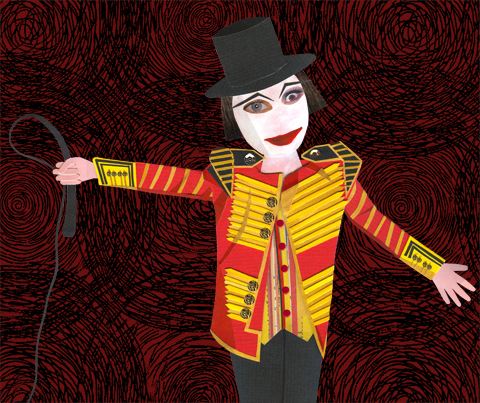
Why do you think the booths are so popular?
Well, people always like old things: vintage, analogue. The rebirth of Polaroid showed there is still a demand for analogue photography.There is something precious about a photo booth strip. It’s one moment, one photo and it can’t be replicated. No negative, no back up, just like real life. The photos also have a better quality than digital ones. There are apps out there on smart-phones to imitate the effect and I understand that most people don’t want to go through the hassle of having a analogue camera. This is where the photo booths come in. For a few quid, you can take your photo booth strip with your friends and keep that moment forever.

How do you think the qualities of these booths compare to the modern booths we see in train stations/etc?
I guess I answered that question above, but there really is no comparison. The digital ones lack quality and depth and the spontaneity you have in the analogue booth. 

Are there any other London locations planned? Or elsewhere in Europe?
I am looking for more locations in London. I would love to get some booths on the Southbank.

Has the booth been used for anything other than people taking pictures with their mates?
I had a photo shoot last year with Mixmag in the booth. It was a fashion special with hats. There were also a few artists who used the booth for their projects. Fionna Banner used the booth for her work twice.


Photoautomat Berlin. Photograph by Matt Bramford
Have you seen/heard any funny experiences concerning the photo booth that you can share?
I had a guy calling me once – he was totally out of it. He took some photos with his girlfriend and they didn’t came out. She got naked and they were concerned that they might get into the wrong hands. I wasn’t in town at that time and couldn’t do anything about it, but he insisted for me to come around. I finally managed to calm him down and sort everything out. 

Photos from our Twitter friends: @vickeh, @mattbramf (me!), @c_rl, @deeandrews, @lizzlizz, @chaiwalla, @sallymumbycroft

What are you favourite images that the booth has created?
That would have to be all the photos form the exhibition/project we had during Photomonth last year. They reflect what the whole photo booth thing is all about.

Who would be your ideal customer – who would you most like to see use the booth?
Everybody is ideal. Everybody is welcome, as long as they respect our work and leave the booth as they found it for the next to come! Most likely they are probably analogue enthusiasts, students and Cargo guests. I have families, a couple from Lisbon, artists form Nottingham and even Henry Holland taking their photo in the booth!

A Photoautomat booth in Berlin, photographed by Lizz Lunney

What does the Photoautomat project hope to achieve, long term?
Hopefully we’re here for years to come and give people from all backgrounds the opportunity to have their little moment. It’s really all up to the people who use our booths and what they make of it. That is the beauty about it – and always will be.

See more pictures from the booths on the Photoautomat Facebook and Flickr pages.

Categories ,Abigail Wright, ,Alex Kokott, ,Amelia Gregory, ,Analogue, ,Andy Warhol, ,berlin, ,Black & white, ,Broadway, ,cargo, ,film, ,Fiona Banner, ,Fred Astaire, ,Germany, ,Henry Holland, ,Jemma Crow, ,london, ,Matt Bramford, ,MixMag, ,new york, ,Photoautomat, ,Photobooth, ,Photomonth, ,Polaroid, ,Sally Mumby-Croft, ,shoreditch, ,twitter, ,vintage

Similar Posts:


Amelia’s Magazine | What Does Colour Mean To You? Submit Your Story For A Chance To Make A Film And Win £250

This is Orange by Sarah Edmonds
This is Orange by Sarah Edmonds.

A recent chat with friends led to a discussion about what colour we intrinsically ‘were’. Fascinatingly we all agreed on the colours that came to mind, as if subconsciously they were obvious to us all. Colour is absolutely intrinsic to the way we feel, the way we look and the way we act. And for illustrators and artists it plays an enormous part in the creation of work. Of course many of us see colours differently (a huge amount of men, for instance, suffer some form of colour blindness) and colours also mean different things to different people. Why, for instance, do I love bright red and green, but dislike orange brown? I find it absolutely fascinating.

Now a major lifestyle brand is planning to collect stories of how people have been positively impacted by colour. They would like to know what your relationship is with a particular colour, what three words you would associate with it, and what kind of details from your life, your culture and your home have played a part in your opinion of that colour. To get involved you can submit your story as words, photography and video: the most compelling one will be filmed by leading film makers Blair & Oliver and edited into a short documentary about how colour has affected lives. If you submit the best story you’ll win £250.

What better way to get you inspired than a series of illustrations exploring what colour means to some of my contributors. To take part in this open callout send your stories to renewalstories@redant.com along with your contact details. The deadline for submission is 1st March 2013.

Green-by-CissyHu
Green by Cissy Hu. When I see green, my eyelashes will become a forest. The creatures of imagination will come out and play. Everything goes lively above the lake of heart (the eyes).

The Colour Pink by Christine Charnock
The Colour Pink by Christine Charnock. The colour pink has so many beautiful and versatile shades – from vibrant and bold, to calming and subdued. In the natural world, the colour pink is present in many fascinating forms. The sky of a sunset, flora and fauna, and the flamingo bird are particularly memorable and beautiful examples. Pink always seems to create a positive, uplifting and cheerful vibe, and this is one of the reasons why I adore this colour.

green is such a relaxing colour by Joanna Boyle
Green is such a relaxing colour by Joanna Boyle. My favourite time of year is spring time, when everything starts to get green after months of rain and cold. I associate the colour green with feeling calm and refreshed. As a result I love visiting green houses and like to keep lots of plants in my flat!

Turquoise Planet by Laura Redburn
Turquoise Planet by Laura Redburn. I absolutely love all colours, and colour is my world. Turquoise is my favourite, though. It both gives me energy and keeps me calm. I like to always have this colour around me because it also helps me feel creative but not overwhelmed. I feel as if there’s something magical about it that other colours don’t possess. To me it’s representative of earth and life.

Yellow Portrait of Silvia Pezzati by Rosa Crepax, Illustrated Moodboard
Yellow Portrait of Silvia Pezzati by Rosa Crepax, Illustrated Moodboard. My friend Silvia is the ‘yellowest’ person I know. Yellow is a very happy colour, I’ve always associated it with sunshine, cheerfulness and intellectual creativity. She is enthusiastic about everything, warm, bright and she actually smiles sun!

Green by Gemma Hampton
Green by Gemma Hampton. Green is my favourite colour. To me, it represents growth and freedom. As a keen gardener, I am forever fascinated when planting a seed and watching it spring into life, growing stronger and healthier by the day. I enjoy studying this process of development and feel a deep sense of satisfaction in the knowledge that I am nurturing this new life. 

Red by Gemma Cotterell
Red by Gemma Cotterell. I chose to illustrate red shown as a ‘mothers love’ – to me the colour projects power, warmth, love, strength, passion, and permanence. The beating heart is life itself, protected unconditionally by the flowering cactus, which symbolises maternal love.

Categories ,Blair & Oliver, ,Christine Charnock, ,Cissy Hu, ,colour, ,Colour blindness, ,competition, ,film, ,Gemma Cotterell, ,Gemma Hampton, ,Illustrated Moodboard, ,Joanna Boyle, ,Laura Redburn, ,Open Callout, ,Rosa Crepax, ,Sarah Edmonds, ,Silvia Pezzati

Similar Posts:


Amelia’s Magazine | Swansea Metropolitan University Ba Hons Photography Graduate Show 2011 Review

Lowri Davies Swansea
Photography by Lowri Davies.

Swansea Metropolitan University had a very strong selection of exploratory photographic works on the walls at Free Range.

Swansea Metropolitan University London degree show Free Range 2011-Lowri Davies
Lowri Davies Swansea trees
Lowri Davies Swansea field
Lowri Davies used a Lomo to create a large scale mural of a bleak city scene, visit a figure just blurrily seen moving back and forth by a park bench. She used the same technique for photos taken on a woodland walk and in a corn field.

Rachel Bond SwanseaRachel Bond SwanseaRachel Bond Swansea
Rachel Bond photographed objects from her Grandma’s home that recalled the elegant lady she was before she lost her mind to dementia, placing them alongside poignant notes laid against lacy net curtains. ‘I think I am forgetting to eat‘ read one scrawled note.

Marie Helgesen
Swansea Metropolitan University London degree show Free Range 2011-Marie Helgesen
Marie Helgesen tackled movement in her series Transitory, which followed three subjects as they took their everyday mundane journeys… the frames constantly billowing and changing as their locations moved ever so slightly… the continuous blurring not quite stills photography and not quite film.

Pål Henrik EkernSwansea Metropolitan University London degree show Free Range 2011-Pål Henrik Ekern
Pål Henrik Ekern explored male identity and representation in his series, Divisions, the composites a fusion of statuesque presence and grotesque parody.

Swansea Metropolitan University London degree show Free Range 2011-Swansea Metropolitan University London degree show Free Range 2011-Ericca Rochard
Using a pinhole camera Ericca Rochard shot panoramic views of familiar scenes to recreate the magical feeling of places associated with childhood memories.

Irene Fearnside
Irene Fearnside explored the way in which we see artwork once it is in a gallery situation – by taking photographs of old portrait paintings that embrace the surrounding reflections and light sources. It’s an interesting concept given that for my blogs I’ve also been taking photos of photos. How something is presented, the lighting, location and surroundings, can have a profound effect on the way we view it. Which is a fact well worth noting.

Categories ,2011, ,Divisions, ,Ericca Rochard, ,film, ,Graduate Shows, ,Irene Fearnside, ,Lomo, ,Lowri Davies, ,Marie Helgesen, ,Motion, ,Pål Henrik Ekern, ,photography, ,Pinhole, ,Rachel Bond, ,review, ,Swansea Metropolitan University, ,Transitory

Similar Posts:


Amelia’s Magazine | The 2009 Freedom To Create Prize Awards at the V&A

Dr. Naif Al-Mutawa Front cover - The 99Illustration by Naif Al-Mutawa courtesy of PagetBaker Associates
What do you do when your freedom of expression has been seriously hampered? What happens when an artist has to muster all the courage and strength in the world to plough on amidst censorship, viagra buy opposition, intimidation and threats? The Freedom to Create Prize aims to encourage and support artists all over the world who operate in a stifling climate where they are isolated. Created as “a celebration of the courage and creativity of artists around the world who use their talent to build the foundation of open societies, promote social justice and inspire the human spirit”1., this prize is unique in that it celebrates the power of art to fight oppression, break down stereotypes and build trust in societies broken by conflict, violence and misunderstanding.

image009Photograph of Moshen Makhmalbaf courtesy of PagetBaker Associates

There are more than 1,000 entrants from Africa, Asia, Latin America, eastern Europe and the Middle East and Human Rights advocate Bianca Jagger presented the main prize yesterday night to Moshen Makhmalbaf, the Iranian filmmaker dedicated to the Green Movement. “People of my country (Iran) are killed, imprisoned, tortured and raped just for their votes. Every award I receive means an opportunity for me to echo their voices to the world, asking for democracy for Iran and peace for the world.” Guests from the worlds of art and the human rights attended the reception in the grand surroundings of the Victoria and Albert museum. The prize is worth $50,000, but they give half to an organization that will advance the cause their work highlights. Representatives from Burmese refugee women’s group The Kumjing Storytellers who use giant paper maché dolls to represent their stories of ethnic persecution in Burma and the plight of migrants and refugees from around the world received the second place prize winner, The director from The Zugdidi Shalva Dadiani State Drama Theatre, David Alan Harris from Poimboi Veeyah Koindu and Sheenkai Alam Stanikzai were all there along with last year’s inaugural winner, the Zimbabwean dramatist Cont Mhlanga.

image002Logo courtesy of PagetBaker Associates

Set up by Richard Chandler, a billionaire New Zealand-born philanthropist based in Singapore, the arts prize shines a light into those parts of the world where creative freedom is not a given. This year alone, we have had the Obama cartoon in The New Yorker and Osama Bin Laden as a cameo on family Guy; there are societies in greatest need but these awards is a reminder that we must always remember not to take for granted the civil liberties we enjoy in this country. In 2006, a Kuwaiti doctor, Naif Al-Mutawa, launched a comic called The 99, featuring 99 superheroes, each based on a virtue expounded in the Koran. “Some of the more conservative places in the world weren’t so happy to let The 99 in,” he says.

Graham CrouchArtist Sheenkai Alam Stanikzai. Photograph courtesy of PagetBaker Associates

Women artists are showing strong pieces this year; Third- prize winner Sheenkai Alam Stanikzai has created an installation piece about the traditional suicide method of abused Afghan women: “I recognized the similarity between these ancient events and contemporary world events, so I decided to show my feelings about what is happening: more than 40 women are dying every day.” Pakistan’s Sheema Kermani entered a series of dance and theatre pieces about the veil, polygamy, sexual abuse and honor killings: For long periods, it has been almost like a life underground,” she says.

View-of-Installation-work-bInstallation by  Sheenkai Alam Stanikzai. Photograph courtesy of PagetBaker Associates

Judges in attendance included leading international human rights lawyer and jurist on the UN’s Internal Justice Council Geoffrey Robertson QC, BBC arts correspondent Razia Iqbal, Time Out founder and chair of Human Rights Watch Tony Elliot, and award-winning Anglo-Indian artist Sacha Jafri. Nick Broomfield presented the Imprisoned Artist Prize; Geoffrey Robertson QC presented the Youth Prize. And there was an enjoyable performance by Emmanuel Jal.

It is suitably symbolic that the awards ceremony took place in the UK, home of the Magna Charta as it shows that engaged artists are not alone in this fight. Prosperous societies are founded upon creativity. Britain has a history of encouraging artistic expression and is a leader in showing other countries how to build strong foundations for economic, political and cultural development in order to lead tomorrow’s world. Political cartooning is a great British institution that prides itself in rocking the boat and rightfully getting away with it! Freedom to Create is a worthy initiative; their desire to seek to improve lives by addressing society’s ability to support and sustain creativity is to be commended. In the end, everyone was a winner!

Categories ,activism, ,art, ,Awards, ,bianca jagger, ,exhibition, ,film, ,freedom to create, ,green movement, ,installation, ,Kumjing Storytellers, ,london, ,Magna charta, ,Moshen Makhmalbaf, ,Naif Al-Mutawa, ,nick broomfield, ,protest, ,richard chandler, ,Sheenkai Alam Stanikza, ,victoria and albert museum, ,women, ,women’s rights

Similar Posts: