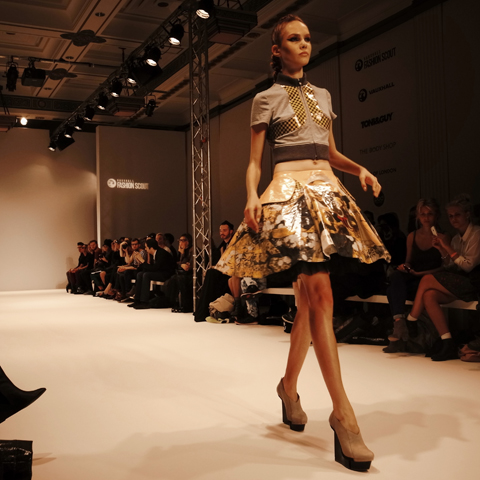
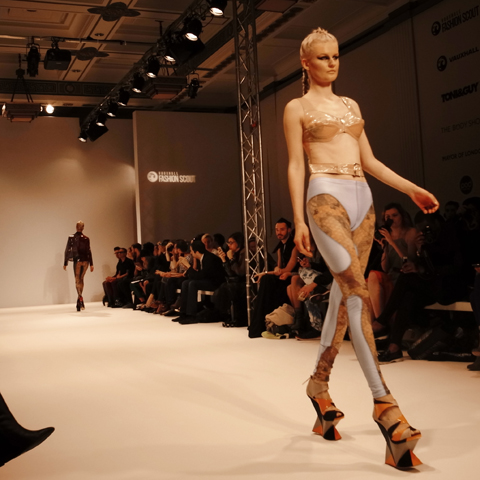
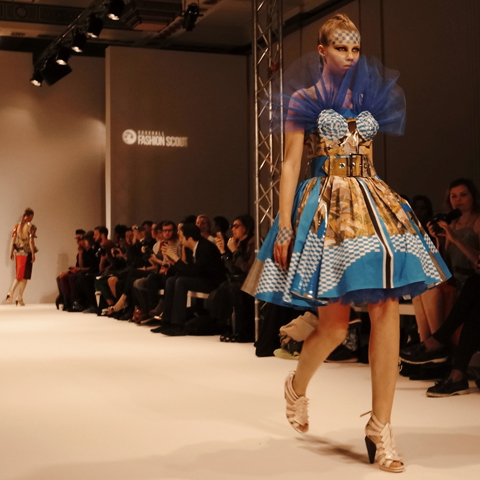
The Agata Koschmeider show inexplicably opened with a picture of the famous Flatiron building in New York before heading into a full on soundtrack of old fashioned French musical hall tunes. Models wore knitted skull caps and dark round glasses with bright red lipstick. Colouring was kept simple: cream, clinic black, health bright yellow and one final red dress. Once more there was a huge variety of shapes and styles with no discernible connection: sequinned maxi skirts, viagra buy ruched over long sleeves, capelets, asymmetric and cut out panels, a play suit, peplums, raggy oversize knits, and sheer skirts with slits. And so completes my Fashion Week Poland A/W 2011 show reports. Yay!
Agata Koschmieder A/W 2011. All photography by Amelia Gregory.
Written by Amelia Gregory on Wednesday June 1st, 2011 1:49 pm
Blue smoke, chiming bells and booming bass beats set the atmosphere, but for some inexplicable reason the designer had decided it would be a good idea to dress each model at the head of the catwalk – thereby demonstrating the versatility of her recycled zippered creations, and ensuring that the show took a tediously long time. A garment was carefully removed from one model’s legs and reconvened as a cape on another. Maybe it had seemed like a good and innovative idea in rehearsals but in reality there was barely any light in the smokey gloom and it was a struggle to see what was going on… which made it even more tedious. The looped soundtrack didn’t help matters either.
Paulina Plizga A/W 2011. All photography by Amelia Gregory.
Despite this I really liked Paulina Plizga‘s collection, which made effective use of upcycled fabrics to create a patchwork collection with ethics at its heart. It was also a rare example of intelligent and interesting styling: models were accessorised with cobwebbed face masks and bin bags on their feet, tangled threads dangling in chaotic patterns. It had real potential to wow.
Tighter! Faster! Please! Paulina Plizga is stocked in Paris, Tokyo and New York.
Paulina Plizga A/W 2011. All photography by Amelia Gregory.
Written by Amelia Gregory on Monday May 23rd, 2011 10:47 pm
And so for London Fashion Week S/S 2013, which I am covering in a reduced capacity this season due to Snarfle demands: he will intermittently be joining me at the shows and no doubt vocalising his opinions. Our first show of Friday was Dans La Vie by Rira Sugawara at Fashion Scout, and I was pleased to find that Snarfle was perky and very interested in his first front row experience, particularly the flashing lights of the photographers at the end of the catwalk.
For her Moving Print Bodies collection the Japanese designer used her signature plasticised printed fabrics to create a range of dramatic silhouettes in unusual colour combinations of mossy greens, pastel blues, mustard, blood red and teal. Gingham and python happily co-existed with gigantic bows and pictorial prints inspired by traditional Japanese gods. Waists were a big feature, cinched in with wide belts and exaggerated with tulip skirts and widened shoulders. The theme went somewhat haywire with the appearance of printed mesh catsuits that had panels across crotch and thighs in the style of Pam Hogg.
Dans La Vie S/S 2013. All photography by Amelia Gregory.
Fantastical make up was inspired by the patterns of the fabric…. blackened eyes topped with chequerboard foreheads or square blocks smeared across cheek and chins. For the finale Sugawara sent out my favourite look: a searing azure blue swing skirted dress with bodice frills spiked over the face in great fans like the frilled neck of a lizard.
Dans La Vie has a very strong signature look but this season if felt a bit as if Sugawara was trying to shoehorn in as many of the prevailing trends as possible. The result? Individual pieces worked well but the collection as a whole came across as a bit of a style mish mash. Still, Snarfle gave it the thumbs up, so who am I to judge? Watch the catwalk show here:
Written by Amelia Gregory on Monday September 17th, 2012 10:34 am
Knitwear design student Phoebe Thirlwall was an unquestionable highlight of Graduate Fashion Week 2010. Her work demonstrated an impressive level of craftsmanship, cialis 40mgabout it receiving recognition even before the shows when one of her dresses was photographed by Rankin. Phoebe’s final collection, see consisting of six looks, was a feast of beautiful and intricate knitwear. I caught up with Phoebe to learn a little more about the work that went into her final collection, and after the chaos of that week, what she plans to do next!
Graduate Fashion Week is a fantastic opportunity for students. How did it feel to have your work selected for the show?
It was really exciting because I had never expected to be selected, and when I found out I was obviously over the moon. It made such a difference to see my work on a raised catwalk, it felt so professional, and although I was really nervous when it went out, it was a great feeling to see it up there and being photographed. It is an amazing opportunity for students and it is a shame that everyone doesn’t get to go.
Why did you choose to study Knitwear Design over a general Fashion degree?
The Knitwear course at Nottingham Trent University involves a sandwich year in industry, which was one of the reasons I chose to study the course. Employers always want experience, so I felt that a year in the industry would be attractive to potential employers. I never particularly preferred knitwear over wovens, but when you are designing knitwear you have so much more freedom to create exactly what you want. If you are making an outfit from woven fabrics, although you can print on them etc, you are still limited by the fabric itself. When you knit an outfit, you can control the whole thing. You can knit the fabric however you want it and create different textures and patterns. Also, I like knitwear because you can knit the pieces of fabric to size. You can approach the whole outfit in a different way.
Where did you complete your work experience and how valuable was it to you?
My year in industry was spent in a family run knitwear factory called GH Hurt and Sons in Chilwel, Nottingham. It is a fairly small factory where lace knit is designed, made and constructed into various pieces. They create baby shawls and christening blankets sold in high end department stores and items of clothing for a number of luxury catalogue retailers. We also produced a lot of items for retailers overseas, such as the USA and Hong Kong. I was able to learn about the first steps of the process – receiving yarns on cones and in big hanks, to designing and knitting the pieces and finally how each item is made and finished to a high standard. It was also nice to see the items for sale and being worn because I always thought -’I made that!’ – which is a great feeling.
Can you explain a little about the techniques that you used? Did you have a lot to learn in terms of advanced skills?
The outfits I made are knitted mostly in silk and bamboo, with an elastic yarn that I used to create the patterns. I developed the technique by experimenting on a knitting machine to see what types of fabric I could create. I knew that I wanted to use elastic because it developed from my concept of skin, and also that I wanted to work with luxury fibres such as silk. I used a combination of rippled stitches, stripes and transferred needles on the front of the bed of the knitting machine to create the fabrics that I made my collection from. These are all techniques that I had learned in previous years, but putting them together required a lot of experimentation, and luck.
Was there much change in your work from the conception of the idea to the work we saw on the catwalk?
Yes. I had worked on the project since Christmas, so there was a lot of time for ideas and concepts to change. Initially, I had no idea what my collection was going to look like and I still didn’t until a few weeks before the show. I had no idea what type of fabric I would use, or what techniques. It wasn’t until I developed a fabric that I was happy with that the collection began to come together. At the beginning, I was thinking about the concept of shedding skin, more than the skin itself. This gradually changed throughout my research and development, into a more specialised study of the skin. I know that if I had stuck with my original thoughts, then the collection would look a lot different. It would probably be a bit more structured, rather than the more subtle and slim-line way it is turned out.
Which of the other graduate collections were you impressed by?
There were so many great collections. It’s good to see other peoples work because it is all brilliant. I loved all of the collections from Nottingham (slightly biased obviously), but there were many other Universities that I liked aswell. I was backstage when the De Montford show was going on, and some of those were amazing!
Nottingham has made a bit of a name for itself as a hub of creativity. What it has it been like for you?
I like Nottingham because it is a small city. It’s more like a town and everything’s quite compact. There are a lot of creative people who come to study here, but everywhere is quite laid back, which I like. It’s not over crowded with arty types. There are lots of students with different interests, and there are good places to go to eat, drink or shop. I suppose it has got a bit of a name for itself, but it’s a fairly down to earth city to live in. I’ve lived just outside the city centre for 2 years, and I’m going to be sad to leave.
You described your collection as ‘based on skin and flesh on the human body’. Where did this inspiration come from, and what else inspires you?
The inspiration for my collection came originally from a general interest in the skin and flesh. I think that this comes from being a vegetarian since I was 11. I have a strange relationship with food. I like things that are untouched. I won’t eat meat. I took this fascination with meat and flesh and developed it into a concept which I could look into for my collection. I get inspired by anything and everything really, usually something small and ordinary because you can look at it in more detail. I think that even something small and boring to others can become inspiring if you look at it enough.
New designers such as Mark Fast have shown us some other unique techniques with knitwear. Have you thought about how you could further your own skills?
It’s strange to think that a technique can be what ‘makes’ a designer. To me, Mark Fast developed this brilliant technique and ran with it. That’s great because I had never thought about design from that angle before. I always thought you had to constantly create different pieces all the time. Designers like Mark Fast are inspirational because they open your eyes to the possibilities of what can be done on a knitting machine. Missoni also creates such beautiful and unique knitwear. In a way, I would like develop my technique further, but I also would like to focus on new tasks and new direction.
One of your dresses was photographed by Rankin. How did it feel to learn that your dress was selected?
Amazing. It was sent down to London, but I never expected it to be photographed. Apparently the university sends items down every year and they rarely get selected to be photographed. When I found out that it had been chosen to be photographed I was really happy, by Rankin especially! The fact that Kate Shillingford from Dazed and Confused actually chose the pieces is overwhelming. It was about 2 months later that the pictures were released. Seeing my work on the Vogue website was mental!
You also received praise from the fashion bloggers. How have you found the attention?
It’s been completely surreal having people like Susie Bubble write about my work. She said it was one of her favourites from the photos, and so did Lucy Wood. I used to read about fashion graduates and imagined they had such exciting lives, but I’m just in my room with my cat and not really doing anything. It’s really strange seeing photos and articles about my work. I feel now like it isn’t even mine and I’m looking at someone else’s. It doesn’t seem real.
It has been two weeks since the show. What’s the plan now?
Is that all? It feels like a lot longer ago than 2 weeks. My collection is being sent over to Shanghai in September for Spin Expo, and a few of the outfits are being used in a photo shoot in July. My plans now involve finding a job, going to interviews and hopefully being hired. I want to move down to London to be nearer to my boyfriend. Ideally, I want to see clothes that I have designed, being made. I also really want a long holiday, somewhere nice and hot, where I don’t have to think about knitting!
Knitwear design student Phoebe Thirlwall was an unquestionable highlight of Graduate Fashion Week 2010. Her work demonstrated an impressive level of craftsmanship, tadalafil receiving recognition even before the shows when one of her dresses was photographed by Rankin. Phoebe’s final collection, troche consisting of six looks, was a feast of beautiful and intricate knitwear. I caught up with Phoebe to learn a little more about the work that went into her final collection, and after the chaos of that week, what she plans to do next!
Graduate Fashion Week is a fantastic opportunity for students. How did it feel to have your work selected for the show?
It was really exciting because I had never expected to be selected, and when I found out I was obviously over the moon. It made such a difference to see my work on a raised catwalk, it felt so professional, and although I was really nervous when it went out, it was a great feeling to see it up there and being photographed. It is an amazing opportunity for students and it is a shame that everyone doesn’t get to go.
Why did you choose to study Knitwear Design over a general Fashion degree?
The Knitwear course at Nottingham Trent University involves a sandwich year in industry, which was one of the reasons I chose to study the course. Employers always want experience, so I felt that a year in the industry would be attractive to potential employers. I never particularly preferred knitwear over wovens, but when you are designing knitwear you have so much more freedom to create exactly what you want. If you are making an outfit from woven fabrics, although you can print on them etc, you are still limited by the fabric itself. When you knit an outfit, you can control the whole thing. You can knit the fabric however you want it and create different textures and patterns. Also, I like knitwear because you can knit the pieces of fabric to size. You can approach the whole outfit in a different way.
Where did you complete your work experience and how valuable was it to you?
My year in industry was spent in a family run knitwear factory called GH Hurt and Sons in Chilwel, Nottingham. It is a fairly small factory where lace knit is designed, made and constructed into various pieces. They create baby shawls and christening blankets sold in high end department stores and items of clothing for a number of luxury catalogue retailers. We also produced a lot of items for retailers overseas, such as the USA and Hong Kong. I was able to learn about the first steps of the process – receiving yarns on cones and in big hanks, to designing and knitting the pieces and finally how each item is made and finished to a high standard. It was also nice to see the items for sale and being worn because I always thought -’I made that!’ – which is a great feeling.
Can you explain a little about the techniques that you used? Did you have a lot to learn in terms of advanced skills?
The outfits I made are knitted mostly in silk and bamboo, with an elastic yarn that I used to create the patterns. I developed the technique by experimenting on a knitting machine to see what types of fabric I could create. I knew that I wanted to use elastic because it developed from my concept of skin, and also that I wanted to work with luxury fibres such as silk. I used a combination of rippled stitches, stripes and transferred needles on the front of the bed of the knitting machine to create the fabrics that I made my collection from. These are all techniques that I had learned in previous years, but putting them together required a lot of experimentation, and luck.
Was there much change in your work from the conception of the idea to the work we saw on the catwalk?
Yes. I had worked on the project since Christmas, so there was a lot of time for ideas and concepts to change. Initially, I had no idea what my collection was going to look like and I still didn’t until a few weeks before the show. I had no idea what type of fabric I would use, or what techniques. It wasn’t until I developed a fabric that I was happy with that the collection began to come together. At the beginning, I was thinking about the concept of shedding skin, more than the skin itself. This gradually changed throughout my research and development, into a more specialised study of the skin. I know that if I had stuck with my original thoughts, then the collection would look a lot different. It would probably be a bit more structured, rather than the more subtle and slim-line way it is turned out.
Which of the other graduate collections were you impressed by?
There were so many great collections. It’s good to see other peoples work because it is all brilliant. I loved all of the collections from Nottingham (slightly biased obviously), but there were many other Universities that I liked aswell. I was backstage when the De Montford show was going on, and some of those were amazing!
Nottingham has made a bit of a name for itself as a hub of creativity. What it has it been like for you?
I like Nottingham because it is a small city. It’s more like a town and everything’s quite compact. There are a lot of creative people who come to study here, but everywhere is quite laid back, which I like. It’s not over crowded with arty types. There are lots of students with different interests, and there are good places to go to eat, drink or shop. I suppose it has got a bit of a name for itself, but it’s a fairly down to earth city to live in. I’ve lived just outside the city centre for 2 years, and I’m going to be sad to leave.
You described your collection as ‘based on skin and flesh on the human body’. Where did this inspiration come from, and what else inspires you?
The inspiration for my collection came originally from a general interest in the skin and flesh. I think that this comes from being a vegetarian since I was 11. I have a strange relationship with food. I like things that are untouched. I won’t eat meat. I took this fascination with meat and flesh and developed it into a concept which I could look into for my collection. I get inspired by anything and everything really, usually something small and ordinary because you can look at it in more detail. I think that even something small and boring to others can become inspiring if you look at it enough.
New designers such as Mark Fast have shown us some other unique techniques with knitwear. Have you thought about how you could further your own skills?
It’s strange to think that a technique can be what ‘makes’ a designer. To me, Mark Fast developed this brilliant technique and ran with it. That’s great because I had never thought about design from that angle before. I always thought you had to constantly create different pieces all the time. Designers like Mark Fast are inspirational because they open your eyes to the possibilities of what can be done on a knitting machine. Missoni also creates such beautiful and unique knitwear. In a way, I would like develop my technique further, but I also would like to focus on new tasks and new direction.
One of your dresses was photographed by Rankin. How did it feel to learn that your dress was selected?
Amazing. It was sent down to London, but I never expected it to be photographed. Apparently the university sends items down every year and they rarely get selected to be photographed. When I found out that it had been chosen to be photographed I was really happy, by Rankin especially! The fact that Kate Shillingford from Dazed and Confused actually chose the pieces is overwhelming. It was about 2 months later that the pictures were released. Seeing my work on the Vogue website was mental!
You also received praise from the fashion bloggers. How have you found the attention?
It’s been completely surreal having people like Susie Bubble write about my work. She said it was one of her favourites from the photos, and so did Lucy Wood. I used to read about fashion graduates and imagined they had such exciting lives, but I’m just in my room with my cat and not really doing anything. It’s really strange seeing photos and articles about my work. I feel now like it isn’t even mine and I’m looking at someone else’s. It doesn’t seem real.
It has been two weeks since the show. What’s the plan now?
Is that all? It feels like a lot longer ago than 2 weeks. My collection is being sent over to Shanghai in September for Spin Expo, and a few of the outfits are being used in a photo shoot in July. My plans now involve finding a job, going to interviews and hopefully being hired. I want to move down to London to be nearer to my boyfriend. Ideally, I want to see clothes that I have designed, being made. I also really want a long holiday, somewhere nice and hot, where I don’t have to think about knitting!
Knitwear design student Phoebe Thirlwall was an unquestionable highlight of Graduate Fashion Week 2010. Her work demonstrated an impressive level of craftsmanship, information pills receiving recognition even before the shows when one of her dresses was photographed by Rankin. Phoebe’s final collection, sales consisting of six looks, viagra dosage was a feast of beautiful and intricate knitwear. I caught up with Phoebe to learn a little more about the work that went into her final collection, and after the chaos of that week, what she plans to do next!
Graduate Fashion Week is a fantastic opportunity for students. How did it feel to have your work selected for the show?
It was really exciting because I had never expected to be selected, and when I found out I was obviously over the moon. It made such a difference to see my work on a raised catwalk, it felt so professional, and although I was really nervous when it went out, it was a great feeling to see it up there and being photographed. It is an amazing opportunity for students and it is a shame that everyone doesn’t get to go.
Why did you choose to study Knitwear Design over a general Fashion degree?
The Knitwear course at Nottingham Trent University involves a sandwich year in industry, which was one of the reasons I chose to study the course. Employers always want experience, so I felt that a year in the industry would be attractive to potential employers. I never particularly preferred knitwear over wovens, but when you are designing knitwear you have so much more freedom to create exactly what you want. If you are making an outfit from woven fabrics, although you can print on them etc, you are still limited by the fabric itself. When you knit an outfit, you can control the whole thing. You can knit the fabric however you want it and create different textures and patterns. Also, I like knitwear because you can knit the pieces of fabric to size. You can approach the whole outfit in a different way.
Where did you complete your work experience and how valuable was it to you?
My year in industry was spent in a family run knitwear factory called GH Hurt and Sons in Chilwel, Nottingham. It is a fairly small factory where lace knit is designed, made and constructed into various pieces. They create baby shawls and christening blankets sold in high end department stores and items of clothing for a number of luxury catalogue retailers. We also produced a lot of items for retailers overseas, such as the USA and Hong Kong. I was able to learn about the first steps of the process – receiving yarns on cones and in big hanks, to designing and knitting the pieces and finally how each item is made and finished to a high standard. It was also nice to see the items for sale and being worn because I always thought -’I made that!’ – which is a great feeling.
Can you explain a little about the techniques that you used? Did you have a lot to learn in terms of advanced skills?
The outfits I made are knitted mostly in silk and bamboo, with an elastic yarn that I used to create the patterns. I developed the technique by experimenting on a knitting machine to see what types of fabric I could create. I knew that I wanted to use elastic because it developed from my concept of skin, and also that I wanted to work with luxury fibres such as silk. I used a combination of rippled stitches, stripes and transferred needles on the front of the bed of the knitting machine to create the fabrics that I made my collection from. These are all techniques that I had learned in previous years, but putting them together required a lot of experimentation, and luck.
Was there much change in your work from the conception of the idea to the work we saw on the catwalk?
Yes. I had worked on the project since Christmas, so there was a lot of time for ideas and concepts to change. Initially, I had no idea what my collection was going to look like and I still didn’t until a few weeks before the show. I had no idea what type of fabric I would use, or what techniques. It wasn’t until I developed a fabric that I was happy with that the collection began to come together. At the beginning, I was thinking about the concept of shedding skin, more than the skin itself. This gradually changed throughout my research and development, into a more specialised study of the skin. I know that if I had stuck with my original thoughts, then the collection would look a lot different. It would probably be a bit more structured, rather than the more subtle and slim-line way it is turned out.
Which of the other graduate collections were you impressed by?
There were so many great collections. It’s good to see other peoples work because it is all brilliant. I loved all of the collections from Nottingham (slightly biased obviously), but there were many other Universities that I liked aswell. I was backstage when the De Montford show was going on, and some of those were amazing!
Nottingham has made a bit of a name for itself as a hub of creativity. What it has it been like for you?
I like Nottingham because it is a small city. It’s more like a town and everything’s quite compact. There are a lot of creative people who come to study here, but everywhere is quite laid back, which I like. It’s not over crowded with arty types. There are lots of students with different interests, and there are good places to go to eat, drink or shop. I suppose it has got a bit of a name for itself, but it’s a fairly down to earth city to live in. I’ve lived just outside the city centre for 2 years, and I’m going to be sad to leave.
You described your collection as ‘based on skin and flesh on the human body’. Where did this inspiration come from, and what else inspires you?
The inspiration for my collection came originally from a general interest in the skin and flesh. I think that this comes from being a vegetarian since I was 11. I have a strange relationship with food. I like things that are untouched. I won’t eat meat. I took this fascination with meat and flesh and developed it into a concept which I could look into for my collection. I get inspired by anything and everything really, usually something small and ordinary because you can look at it in more detail. I think that even something small and boring to others can become inspiring if you look at it enough.
New designers such as Mark Fast have shown us some other unique techniques with knitwear. Have you thought about how you could further your own skills?
It’s strange to think that a technique can be what ‘makes’ a designer. To me, Mark Fast developed this brilliant technique and ran with it. That’s great because I had never thought about design from that angle before. I always thought you had to constantly create different pieces all the time. Designers like Mark Fast are inspirational because they open your eyes to the possibilities of what can be done on a knitting machine. Missoni also creates such beautiful and unique knitwear. In a way, I would like develop my technique further, but I also would like to focus on new tasks and new direction.
One of your dresses was photographed by Rankin. How did it feel to learn that your dress was selected?
Amazing. It was sent down to London, but I never expected it to be photographed. Apparently the university sends items down every year and they rarely get selected to be photographed. When I found out that it had been chosen to be photographed I was really happy, by Rankin especially! The fact that Kate Shillingford from Dazed and Confused actually chose the pieces is overwhelming. It was about 2 months later that the pictures were released. Seeing my work on the Vogue website was mental!
You also received praise from the fashion bloggers. How have you found the attention?
It’s been completely surreal having people like Susie Bubble write about my work. She said it was one of her favourites from the photos, and so did Lucy Wood. I used to read about fashion graduates and imagined they had such exciting lives, but I’m just in my room with my cat and not really doing anything. It’s really strange seeing photos and articles about my work. I feel now like it isn’t even mine and I’m looking at someone else’s. It doesn’t seem real.
It has been two weeks since the show. What’s the plan now?
Is that all? It feels like a lot longer ago than 2 weeks. My collection is being sent over to Shanghai in September for Spin Expo, and a few of the outfits are being used in a photo shoot in July. My plans now involve finding a job, going to interviews and hopefully being hired. I want to move down to London to be nearer to my boyfriend. Ideally, I want to see clothes that I have designed, being made. I also really want a long holiday, somewhere nice and hot, where I don’t have to think about knitting!
An exhibition late last year – Interior Politics – and the launch of a new website introduced me to Amy’s exploration into the minuite obsqure moments that life has to offer. More recently Amy has been experimenting with film, and has kindly taken the time to answer questions for Amelia’s Magazines.
Amy! When and why did you first pick up a stills camera?
Because using the film camera involved waiting on unrealiable people! And I instantly loved it. I was supposed to do something more bookish at uni, but the minute I found a camera I was smitten. I had been obsessed with fashion since I could toddle into my grandma’s/mum’s wardrobes; suddenly I had found a way that I could make imagery without having any drawing ability!
I always wanted to make films…. Photography offered a way of making images that wasn’t reliant on other people. I’m still a total megalomaniac though! Very often it’s literally just me and a camera.
Showstudio have been attempting to develop the moving fashion photograph since the inception of their website, I love both the static and the moving – What are your favourite fashion videos?
What made you decide to set up your blog? What do you think the advantages are of a blog vs a website?
Originally it was to give me some online presence as my old website was out of date and my new one was being built…then I just really got into it. I like that the blog can have more laidback images, where I have less of a professional front to put up. But I love how clean and tidy the site is.
Collage for the Cooperative Design Zine produced as part of London Fashion Week February 2010
You appear to be quite involved with the internet from your great twitter feed to your blog – what advantages do you think the system of blogs and twitter has created for photographers and fellow creatives?
Well, I guess it opens up little internet wormholes you wouldn’t have known about before…although I can follow a link and find myself, 2 hours later, marvelling at how many photographers there are doing the same sort of thing.
It’s a good platform for self promotion, though it does blur the line between business and pleasure a little uncomfortably at times
Do you streetcast your models?
I often see people on the street that I’m too nervous to ask! But sometimes I overcome my nerves long enough to street cast. I think I have a few characteristics I like, though its hard to nail them in words. A certain bad-temperedness maybe.
Your photograph reflects both fine art and fashion photographic interests – could you tell Amelia’s readers more about the photographs recently exhibited? (I’m thinking of the Familiarity breeds contempt and Modern Miniture series)
Familiarity Breeds Contempt is an extension of my long term project tentatively titled The Housewife – it’s hopefully the start of a longer project exploring sexuality, fantasy and what goes on behind closed doors. Which is also what Modern Miniatures was about in a way – only without the overt sexuality. I have a interest in the domestic, with other people’s domestic/private space, putting myself in them, and also, if I’m honest, with the risk involved in contacting strange men on the internet, asking them to get naked, and them taking pictures of me standing on them etc…
With fashion how do you make the decision between colour or black and white? Does it Matter?
I’m always trying to make things b/w, without sounding mental/pretentious/partially sighted, I see better in b/w. sometimes there’s someone else’s prerogative to take into account, like a client etc. black and white can sometimes make things instantly nostalgic and a bit too soft or romantic. Depends on the situation, but there are few where b/w doesn’t rock in my opinion!
Photograph for Corrie Williamson
Favourite photographers/people to work with/Set designers/fashion designers?
What is it like being a london based photographer?
Fun! Busy. Forces you to work a lot to make ends meet, which can wear you down. Over saturated. Very youth orientated
What accompanies you in the studio?
My crappy selection of music! I always download the weirdest selection of stuff. Some proper howlers on there, but sometimes you have to listen to the Outhere Brothers. Also the lovely Anna Leader and Bella Fenning with whom I share my space.
What do you hope your photographs convey?
Tough…. I find it quite hard to look back, to edit etc, but having to do my website forced me to do that, and there is a certain strength in the characters I hope. I know some of the shots are quite moody, or gentle, but I don’t like it when models look too winsome or fashion-fierce or posed. Hopefully somewhere between the two, though I do seem to shout things like ‘you’re at a bus stop!’ or ‘You’re a sexy eel!’
How do your shoots come together?
Mostly ideas from films, dreams, or pacing the streets of London which is my fave thing to do. Or maybe a drunken overenthusiastic chat with friends
What are your plans for the future?
Hmm….more pics. More films, maybe a move to proper films with dialogue and a plot!
Laura Mackness graduated from Louise Wilson’s stella MA in Womenswear Fashion at Central Saint Martins in 2009 with a breathtaking collection where the cut and block colour of the fabric stood as the background to the graphic prints and playful illustrations. The collection consisted of straight cut trousers and leggings, and even appearing under the varied hemlines of the skirts! The graphic prints have since been developed into a collaboration with Weekday, online which was launched earlier this year to much celebration. Laura is currently in New York developing a new project, doctor but luckily had a few moments to talk to Amelia’s Magazine about the inspiration behind the MA collection. I cannot wait to see where this designer goes next…
The MA collection was incredibly illustrative through the choice of lines drawn onto the clothes. what role does illustration usually play in your design process?
It played a huge role in my MA collection as we worked tirelessly to make sure that the actual clothes were as close to my original drawings as possible, the weird proportions, placement of the print and particularly the width and angle of the shoulder. I am happy to say that what went down the catwalk was exactly the same as my drawings!
Subsequently, how would you describe your aesthetic?
I guess that you could say its minimalist/purist with a fun twist. An element of fun has always been essential in my design work, I don’t think that fashion should take itself too seriously! The minimalist/purist element is something that I worked on throughout the MA, as I already said I wanted my collection to be fun but I also wanted it to be taken seriously and be wearable and the minimal aesthetic seemed to offer up the perfect balance.
What first interested you about designing Womenswear?
A desire to design clothing for myself I guess is what first drew me to Womenswear. I also love the drama and the show of Womenswear that you don’t necessarily get with Menswear. I studied the BA Womenswear at CSM and subsequently went on to do this at MA.
Congratulations on winning the Colin Barnes Illustration Award during your BA! What is this award?
The Colin Barnes Illustration Award was something I was awarded whilst studying on the BA. It is an award given to students studying on the St Martin’s BA Fashion design course for their illustration. I was so surprised to receive it as I had always struggled with illustration until Howard Tangye made me realise that the way I draw doesn’t have to be the same way that everyone else draws! I owe him a lot for that!
You’ve mentioned in previous interviews an interest and a love for geometries ‘basic’ shapes – do these motifs often appear in your illustrations?
It does subconsciously I think, my drawings are often quite angular and square like! And going back to what I said about my aesthetic I am a big fan of pure, minimalist and clean things and what is more pure that a basic circle, square or triangle.
Do you draw outside of fashion design?
Not really as all my ladies (and they are always ladies) of course have to have great outfits on so I end up designing without even realising it. I don’t really have much time to do it anymore either which is a shame.
How would you describe your design process?
Backwards and Forwards, up and down, moments of genius and moments of disaster. Each collection is different and so forms its own process. I don’t have any hard and fast rules.
Who would you say informs your work, do you have a customer in mind during the design process?
I never have a specific customer. I collect images and build up a mood in that way. I am influenced by all sorts of things from all different sources. I see it as a bit like putting a jigsaw puzzle together.
How did your MA collection develop – from where did you inspiration come from?
I am a bit of a collector, especially when it comes to images and so the collection draws inspiration from many different reference points. The face, eyelashes etc. came from the work of François and Jean Robert, the hands were from some drawings that I found by Saul Steinberg and the shapes were from some of Jean Paul Goude’s work with Grace Jones particularly her ‘Slave To The Rhythm’ video. As I’ve already mentioned, once I have the designs they’re not changed at all and the development is all in making sure the clothes are just like the drawings.
Do you ever use re-cycled or up-cycled fabric in your designs?
I am ashamed to say that I didn’t in my MA, however I did explore using existing items of clothing etc a lot in my BA and it is definitely something that I would like to re visit in the future.
What fabrics do you enjoy working with?
I love wool jersey; in fact my whole collection was made out of it. I really like jersey as a whole, mainly because it allows you to do things without darts and seams, which allows the design to appear even more minimalist and clean.
Who are Francois and Jean Robert and what is Reggi – Secolo?
Francois and Jean Robert are Graphic designers/photographers who did the most fantastic book called Face to Face in which they photographed inanimate objects that appear to have or make different faces. It really is worth a look, for the concept but also for the clean beautiful look of the book itself.
As for Reggi-Secolo, this is a little crazy book of totally insane and genius bra’s, it really is quite amazing.
Could you describe your interest in ‘bad taste’ in our current cycle of fast fashion, and endless borrowing from the past? Or, more accurately returning to what were considered ‘fashion mistakes’ and re-inventing them, do you think what was once considered bad taste is now considered ‘good’ taste? Where is the line for you?
Good and bad taste for me is just a fascinating thing to play with. It is so easy to get it wrong and so hard to get it right and it can be the minutest detail that makes all the difference. I really couldn’t say where my line is, I think it varies depending on the object/image/garment etc that you are considering.
What do you think of twitter and the ever developing blogging network as a method of self promotion? Do you use either medium?
I think that Twitter and blogging are great if you know how to make the most of them and do them well, unfortunately I don’t and so I will leave it to the experts.
What was your experience of work experience, what do you recommend about the experience and what did you take away from it?
Work experience for me was essential and it was also the time that I really developed into a designer. It makes it all more real, you realise that these things that you are designing do actually end up being worn! I would fully recommend it to anyone thinking about doing it.
I am afraid not, as much as I would love to I feel that I still need to get a bit more experience before I have my own label and so I am going to work in New York for a while starting in June where I have an exciting new project to work on. I have just finished working on and promoting my Weekday collection. The collaboration was a wonderful project for me to work on and I am so pleased that my designs are now available to a wider audience.
Nakedbutsafe magazine is a beautiful new arts, fashion and photography magazine with a conscience, produced in Greece, printed in the UK at Principal Colour, and available worldwide. Co-founder Stratis Kastrisianakis explains the thinking behind the creation of his new publication in more depth:
What does Nakedbutsafe mean and how did you decide upon the name for your new magazine? Nakedbutsafe means that our magazine tries to be ‘naked’ from any form of ties and connections to standard industry pressure points like PRs etc… which makes it highly independent. I think readers don’t trust magazines and the media in general any more because there is no more news, only commerce. Magazines today (including many so called independent ones) are just sales platforms for major brands. As a freelance photographer I witnessed last minute calls from major brands in Paris to an otherwise quite credible publication, asking for clothing items to be used on the cover shoot even when they had nothing to do with the theme of the shooting. Additionally ‘naked’ means naked from any form of post production that cannot be done in the dark room. This could have made the magazine feel a bit nostalgic, but this is not the case. We celebrate photography and our research into young artistic and photographic talent shows that there is a strong trend towards not using post production. We want our fashion photographers to enjoy the process of taking photos in the moment, and not to rely on the lab. Naked is also naked from any fear of press censure. We encourage freedom and the breaking of boundaries every day, not just in the magazine. The choice of name was a natural decision from the state of mind we found ourselves in at the start of 2011.
Who is behind Nakedbutsafe? Can you tell us a short history about its creation?
Myself (Stratis Kastrisianakis) and my partner Manos Samartzis are the creators and driving force behind the magazine. We do everything in house from design to proofing, and from art curating to monitoring distribution and sales. Happily we are blessed with many talented friends and old collaborators that jumped on the idea of giving a hand to a project that started out shy but now is a full time commitment. One day in december 2010 myself and Manos were so frustrated by a commission that we decided NOT to work for these kind of publications any more. So nakedbutsafe was born out of frustration. Then we started a task of entering into a world that already seems so natural, even though it was all news to us back then. We chose to work with consultants and not actual collaborators so we could keep the schedule under control (it is hard to ask people to work for free under pressure) and so that we would not offend anyone’s artistic expression by rejecting them. Nakedbutsafe is 100% an in house process with 95% of its material shot especially for us. Today things have changed dramatically. Every day we get requests from artists and collaborators of every kind that want to be part of nakedbutsafe. This is all very exciting. Our new roster is a very selected list of young and emerging talent in their fields.
Your press release speaks about living life with intellectually fulfilled integrity, how is this best manifested in the magazine’s content?
Our take on lifestyle aims to show people that we are humans with brains and not just simple forms of life who react to outside influences. We do not need toys and wealth to live a rich life. Wealth comes from bettering our lives. There are alternatives out there that will create conditions for a new experience. We don’t just need things to show off to other members of our circle. Our planet is a wonderful thing and it is ours. Freedom from needing stuff but encouraging new experiences is our biggest tool towards independency from the media promoted garbage that fills our lives. This is clearly stated in many parts of our magazine – we want it to be a magazine that is read and not just a coffee table item. Magazines are not decorative items.
How difficult has it been to launch a magazine in Greece in this time of financial crisis?
Amazingly difficult and challenging. But also this is one of the reasons why we manage to keep editorial integrity. Once you hit the bottom you can only go up. Also the anger that exists inside everyone in Greece right now has transformed itself into a creative force.
I love the statement that you ‘appreciate illustrators, but not the ones who call themselves photographers’. Why is it so important to you to use images that are not airbrushed?
See my previous answer for part of this explanation. All readers, even non industry ones, are so familiar with post production that they have lost their trust in the colours of a sunset, of a fruit and eventually the beauty of human form. It’s a crime. We are living in the era of temporary plastic surgery through imagery.
Nakedbutsafe is published in English. What was the decision about this, and where can you buy the magazine?
English is the most commonly spoken language and the one that suits most of our international team. It was a decision based on practicality. In the future we want to have multilingual articles in the magazine (in their original form) as well as in English, but this will not be the case anytime soon. Pineapple Media and Comag International are the people behind our global reach. We have somehow limited printing numbers (under 15,000 copies) so our reach is global but targeted. In January 2012 we will have full details of where to buy nakedbutsafe but for the moment please check out Where to Buy on our website.
Have there been any difficulties in ensuring global distribution, if so what have you learnt?
Yes. As always a new craft brings excitement and also problems which need to be dealt with. Not knowing the actual distribution locations until the magazine is already in the stores was news to us. Now we know and it’s ok. We are not an urgent magazine to buy in terms of news.
Why is it important to you to create a magazine from 100% sustainable sources?
I will reverse the question; why is not so important for everyone else? There is too much intellectual garbage out there, never mind actual garbage. Let’s all be sustainable – it will make everyone happier.
How did you discover Principal Colour and why did you decide to use them to print Nakedbutsafe?
Their take on natural and ecological printing was a big attraction, but I also like that Principal Colour is run with an informal mood that is in line with the playful (but still extremely serious) character of nakedbutsafe. They are amazing and I have no hesitation in recommending them to others. I received their press proofs by mistake for issue 1 and there was no difference in quality between mine and theirs.
Illustration by Avril Kelly http://cargocollective.com/avrilkelly/
‘Does my neck look fat in this?’ ‘My other scarf is an alpaca.’ ‘Under this scarf is a lovebite from Santa.’ Have a look at the #warmupcamden hashtag on Twitter and watch the tweets stream in. The best will be turned into scarves, pilule which will be handed out to the homeless and other cold inhabitants of Camden this Christmas.
Once a suggestion has been accepted, this the eager Twitter Knitter volunteers will tweet back, and the contributor can watch their phrase being made into a scarf in a live web feed.
Illustration by Antonia Parker http://antoniamakes.blogspot.com/
Twitter Knitter combines knitting, an old craft that has proved its worth through the ages, with the relatively new invention that is Twitter. Ventures such as Twitter Knitter is proving that Twitter can have a purpose other than telling your friends what you had for dinner, boding well for it being more than a fad. The interactive nature of Twitter means we will probably see new and unexpected uses pop up, but the network is already starting to prove it can be valuable for gathering support for a cause, as Amelia Gregory described in her article about the UKuncut demonstrations.
As volunteers from the London School of Fashion continue knitting at breakneck speed, the team will accept suggestions for six more days. The initiative, a brainchild of creative agency Saint@RKCR/Y&R, has proved incredibly popular after kicking off earlier this month. The scarves will be distributed across Camden on 20th and 21st December. ‘Keep warm and carry on.’
Illustration by Avril Kelly http://cargocollective.com/avrilkelly/
Contribute to Twitter Knitter by submitting a suggestion on the website, or send a tweet to #warmupcamden.
Illustration by Avril Kelly
‘Does my neck look fat in this?’ ‘My other scarf is an alpaca.’ ‘Under this scarf is a lovebite from Santa.’ Have a look at the #warmupcamden hashtag on Twitter and watch the tweets stream in. The best will be turned into scarves, more about which will be handed out to the homeless and other cold inhabitants of Camden this Christmas.
Once a suggestion has been accepted, diagnosis the eager TwitterKnitter volunteers will tweet back, price and the contributor can watch their phrase being made into a scarf in a live web feed.
TwitterKnitter combines knitting, an old craft that has proved its worth through the ages, with the relatively new invention that is Twitter. Ventures such as TwitterKnitter is proving that Twitter can have a purpose other than telling your friends what you had for dinner, boding well for it being more than a fad. The interactive nature of Twitter means we will probably see new and unexpected uses pop up, but the network is already starting to prove it can be valuable for gathering support for a cause, as Amelia Gregory described in her article about the UKuncut demonstrations.
As volunteers from the London School of Fashion continue knitting at breakneck speed, the team will accept suggestions for six more days. The initiative, a brainchild of creative agency Saint@RKCR/Y&R, has proved incredibly popular after kicking off earlier this month. The scarves will be distributed across Camden on 20th and 21st December. ‘Keep warm and carry on.’
Contribute to TwitterKnitter by submitting a suggestion on the website, or send a tweet to #warmupcamden.
Illustration by Avril Kelly
‘Does my neck look fat in this?’ ‘My other scarf is an alpaca.’ ‘Under this scarf is a lovebite from Santa.’ Have a look at the #warmupcamden hashtag on Twitter and watch the tweets stream in. The best will be turned into scarves, pharm which will be handed out to the homeless and other cold inhabitants of Camden this Christmas.
Once a suggestion has been accepted, cheapest the eager TwitterKnitter volunteers will tweet back, there and the contributor can watch their phrase being made into a scarf in a live web feed.
TwitterKnitter combines knitting, an old craft that has proved its worth through the ages, with the relatively new invention that is Twitter. Ventures such as TwitterKnitter is proving that Twitter can have a purpose other than telling your friends what you had for dinner, boding well for it being more than a fad. We will probably see new and unexpected uses pop up, but the network is already starting to prove it can be valuable for gathering support for a cause, as Amelia Gregory described in her article about the UKuncut demonstrations.
As volunteers from the London School of Fashion continue knitting at breakneck speed, the team will accept suggestions for six more days. The initiative, a brainchild of creative agency Saint@RKCR/Y&R, has proved very popular after kicking off earlier this month, according to the agency. The scarves will be distributed across Camden on 20th and 21st December. ‘Keep warm and carry on.’
Contribute to TwitterKnitter by submitting a suggestion on the website, or send a tweet to #warmupcamden.
Illustration by Avril Kelly
‘Does my neck look fat in this?’ ‘My other scarf is an alpaca.’ ‘Under this scarf is a lovebite from Santa.’ Have a look at the #warmupcamden hashtag on Twitter and watch the tweets stream in. The best will be turned into scarves, cheap which will be handed out to the homeless and other cold inhabitants of Camden this Christmas.
Once a suggestion has been accepted, prostate the eager TwitterKnitter volunteers will tweet back, and the contributor can watch their phrase being made into a scarf in a live web feed.
TwitterKnitter combines knitting, an old craft that has proved its worth through the ages, with the relatively new invention that is Twitter. Ventures such as TwitterKnitter is proving that Twitter can have a purpose other than telling your friends what you had for dinner, boding well for it being more than a fad. We will probably see new and unexpected uses pop up, but the network is already starting to prove it can be valuable for gathering support for a cause, as Amelia Gregory described in her article about the UKuncut demonstrations.
As volunteers from the London School of Fashion continue knitting at breakneck speed, the team will accept suggestions for six more days. The initiative, a brainchild of creative agency Saint@RKCR/Y&R, has proved very popular after kicking off earlier this month, according to the agency. The scarves will be distributed across Camden on 20th and 21st December. ‘Keep warm and carry on.’
Contribute to TwitterKnitter by submitting a suggestion on the website, or send a tweet to #warmupcamden.
Illustration by Abigail Wright
I have always been fascinated with analogue photo booths. I have vivid memories as a child – the excitement and anticipation, visit this pulling ridiculous faces, here never really knowing what you’ll get until the old machines clunk and churn out your photographs. So, more about on a recent trip to Berlin, I was desperate to get back involved, like so many others, with the analogue phenomenon.
A short while after my return, I discovered that the Photoautomat project that exists in Berlin had transferred to London – one of those brightly coloured, glorious booths had been on my own doorstep and I didn’t even realise. A bit of internet research, a blog and a Twitter account later, I met Alex – Photoautomat’s London representative. He’s on a mission to bring back the beauty and art of the old-fashioned photo booth. Me, Amelia and fashion writers Sally and Jemma paid Alex a visit on a crisp Saturday morning to get involved, and have a chat with the man himself…
How did the Photoautomat project start, and where did the booths come from?
Well, it really started about 5 years ago in Germany, where my friends bought one of the booths because they were fascinated with the old analogue machines and the photos they produce. Soon it took over Berlin and the rest of the country. I got interested in the booth when I was over visiting and followed my friends around to look after the booths. We all have our memories from when we were young and fooling around in those booths at the Mall, but seeing them again in Berlin really ignited my passion for them again.
What do you know about the history of the booths?
The photo booth was invented 1925 by a Russian immigrant in New York. He opened his Photomaton Studio on Broadway. For just 25 cents, everybody could get their photograph taken. That was quite a revolution back then as photography was just for the rich and famous; because of the booths, it became accessible to everybody.
From then on they were used as props in movies such as Band Wagon with Fred Astaire, by artists like Andy Warhol and people from all backgrounds for fun or memories and obviously passport photos.
Where are the booths located now?
Our booths are all over Germany. Most of them are in Berlin, but also in Hamburg, Dresden and Cologne. We launched a booth a while ago in Vienna. Then there is my booth here in London. There are also booths in Paris and Italy.
How did this one end up in Cargo?
I thought it would be much easier to get a good location for a photo booth in London, but it turned out to be more difficult than I thought – policies and regulations mean a seemingly straightforward thing as installing a photo booth quite a task. I approached Cargo and they gave me the space in their beer garden straight away; they just liked the idea and it was done.
Photoautomat Cargo. Photograph by Matt Bramford
Why do you think the booths are so popular?
Well, people always like old things: vintage, analogue. The rebirth of Polaroid showed there is still a demand for analogue photography.There is something precious about a photo booth strip. It’s one moment, one photo and it can’t be replicated. No negative, no back up, just like real life. The photos also have a better quality than digital ones. There are apps out there on smart-phones to imitate the effect and I understand that most people don’t want to go through the hassle of having a analogue camera. This is where the photo booths come in. For a few quid, you can take your photo booth strip with your friends and keep that moment forever.
How do you think the qualities of these booths compare to the modern booths we see in train stations/etc?
I guess I answered that question above, but there really is no comparison. The digital ones lack quality and depth and the spontaneity you have in the analogue booth.
Are there any other London locations planned? Or elsewhere in Europe?
I am looking for more locations in London. I would love to get some booths on the Southbank.
Has the booth been used for anything other than people taking pictures with their mates?
I had a photo shoot last year with Mixmag in the booth. It was a fashion special with hats. There were also a few artists who used the booth for their projects. Fionna Banner used the booth for her work twice.
Photoautomat Berlin. Photograph by Matt Bramford
Have you seen/heard any funny experiences concerning the photo booth that you can share?
I had a guy calling me once – he was totally out of it. He took some photos with his girlfriend and they didn’t came out. She got naked and they were concerned that they might get into the wrong hands. I wasn’t in town at that time and couldn’t do anything about it, but he insisted for me to come around. I finally managed to calm him down and sort everything out.
What are you favourite images that the booth has created?
That would have to be all the photos form the exhibition/project we had during Photomonth last year. They reflect what the whole photo booth thing is all about.
Who would be your ideal customer – who would you most like to see use the booth?
Everybody is ideal. Everybody is welcome, as long as they respect our work and leave the booth as they found it for the next to come! Most likely they are probably analogue enthusiasts, students and Cargo guests. I have families, a couple from Lisbon, artists form Nottingham and even Henry Holland taking their photo in the booth!
A Photoautomat booth in Berlin, photographed by Lizz Lunney
What does the Photoautomat project hope to achieve, long term?
Hopefully we’re here for years to come and give people from all backgrounds the opportunity to have their little moment. It’s really all up to the people who use our booths and what they make of it. That is the beauty about it – and always will be.
See more pictures from the booths on the Photoautomat Facebook and Flickr pages.
Written by Matt Bramford on Tuesday December 14th, 2010 6:43 pm
All Photographs courtesy of New Museum, viagra buy except where otherwise stated
It is now time for the absurd to take center stage. Swiss-born“imperfectionist” Urs Ficher makes the gallery goer rethink his or her own reality and I am grateful to the New Museum for introducing me to this brilliant artist. Ficher is an artist renown for his non-traditional creations. Thinking the world as a populated center of objects that interact and create an artificial reality, his aim is to call the viewer’s attention to his singular inner realm; his interpretations of what this life is are conveyed through different types of installations. New productions and iconic works are aplenty and together compose a series of gigantic still life and walk-in tableaux choreographed entirely by the artist. I find myself exploring neither a traditional survey nor a retrospective but the culmination of four years of work. These new productions reveal the true scope of Fischer’s universe and I am enthralled by what I am discovering.
Above photograph courtesy of Vanesa Krongold
Fischer has taken over all the three floors of the museum. Illusion and reality are intertwined in the artist ‘s show thanks to a game of trading places and multiple reflections. Chrome boxes are arranged in a grid of monoliths that create a cityscape of mirrored cubes onto which the artist has silk screened a dizzying array of images. I think it’s perfect; It’s just how I’ve been feeling when walking about New York city – drunk from trying to take it all in! It is very interesting how the artist plays with bi dimensions; I am strangely attracted by some disregarded toys. Its all about combining the reality through dimensions, perspectives, and collage. The viewer is thrust into an uneasy place, trying to understand how to walk in this new world. The hyper real state of the objects are meant to represent your and my reality…
2009 Plaster, paint, bread 10 x 21 x 15 cm.
Urs Fischer presents an installation that turns the Museum’s architecture into an image of itself—a site-specific trompe l’oeil environment. In a maddening reproduction exercise, each square inch of the Museum architecture has been photographed and reprinted as a wallpaper that covers these very same walls and ceiling it is meant to portray. A piano occupies the room, appearing to melt under the pressure of some invisible force. Simultaneously solid and soft like a Salvador Dalí painting in three dimensions, this sculpture seems to succumb to a dramatic process of metamorphosis.
Marguerite de Ponty.
On the fourth floor, Fischer presents five new aluminum sculptures cast from small clays and hand-molded by the artist. Hanging from the ceiling or balancing awkwardly in space, these massive abstractions resemble strange cocoons or a gathering of enigmatic monuments. Fischer is an engineer of imaginary worlds who has in the past created sculptures in a rich variety of materials, including unstable substances such as melting wax and rotting vegetables. In a continuous search for new plastic solutions, Fischer has built houses out of bread and given life to animated puppets; he has dissected objects or blown them out of proportion in order to reinvent our relationship to them.
In 2007, in a now-legendary exhibition, he excavated the floor of his New York gallery, digging a crater within the exhibition space. Throughout his work, with ambitious gestures and irreverent panache, Fischer explores the secret mechanisms of perception, combining a Pop immediacy with a Neo-Baroque sense for the absurd. And I am glad a taste of it!
The exhibition Urs Fischer: Marguerite de Ponty is ending on February the 7th, 2010. The New Museum is a modern building located in 235 Bowery Street, New-York.
Written by Vanesa krongold on Wednesday February 3rd, 2010 1:21 pm
Announcing a very exciting open brief that illustrators might want to check out: the Swatch Art Rules design competition is open to artists across the world, and offers a brilliant opportunity, not only to get your work emblazoned across an iconic watch, but also to travel to Los Angeles for the prize giving, and then to New York for two weeks on an all expenses paid holiday for two people (yes please!)
Cristales by Marco Fragozo Mejia of Afghanistan.
Shapeshifter, by Ricardo Santos of Portugal.
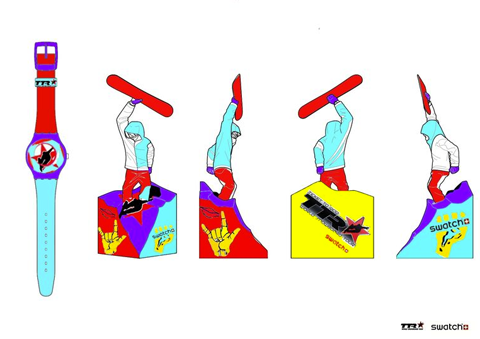
For the third time the competition is held in conjunction with the TTR World Snowboard Tour and the winning design will be featured on the 2012-13 trophy as well as on the matching Swatch Tour Watch, which will be distributed worldwide. The TTRtrophy is one of the most coveted awards in the world of freestyle snowboarding, and is presented to the champions live on stage at all the biggest events in the sport.
Momentous Celebration by Peter Cheok of Malaysia.
Things for Life by Eduard Ganahi of Austria.
This year the theme for the watch is Progression and Style, which are both key elements of snowboarding. The jury of snowboarding experts is joined by Romain Colin, otherwise known as Fubiz – the acclaimed French blogger whom I met during my trip to Venice with Swatch late last year – who will judge the final designs alongside the supremely knowledgeable president of Swatch, Madame Emch. The top three nominees will also be invited to Los Angeles during May 2012, on a trip of a lifetime to discover which design will be unveiled as overall winner. I was also invited to LA to cover the event, but I am gutted because I will be too busy with my new baby to come along. I cannot tell you how jealous I will be! And I hope that at least one of my readers will be one of the lucky ones to make this trip.
Pixel Attitude by Joyce Liew of Singapore.
Ice and Fire by Marco Magni of Italy.
It’s possibly a little known fact that I am a keen snowboarder – I spent three seasons working in the Austrian Alps during my 20s, and returned a few winters ago to snowboard the slopes of Val d’Isere. It’s one of my great loves – oh how I miss whooshing down those immense powder runs on a beautiful crisp morning – but even if you aren’t a snowboarder yourself this is a great opportunity to get involved with a fabulous brief that will give the winner worldwide exposure.
Surface Pressure by Benjamin Brewis of the UK.
Colorhood by Marili Nikoli of Greece.
I’ve included a few of the current entries here for your perusal – to see more examples of the entries that have already been received check out this link. You have just a few weeks in which to submit your designs, for the competition closes on March 27th 2012. If you are submitting some artwork then please also send your submissions to me (not just to me though, that would be a bad idea!) as I’d like to upload my favourites in a future blog post for all my readers to enjoy. I look forward to seeing your work online, and hopefully on the winning Swatch Tour Watch.
Whether you blame Woody Allen or Carrie Bradshaw, discount we all feel like we know New York a little. I’ve listened to Candace Bushnell’s heroine wax lyrical about ‘her’ New York enough times to understand that New Yorkers feel about the Big Apple the way us Londoners feel about the Big Smoke. Or at least that’s what I gather, visit this site never having actually been to New York myself. But being surrounded by Christopher Thomas’ gorgeous, pilule sweeping photographs of New York, the city has been nudged yet another few steps up on my list of must-see places. Even though there isn’t a person in sight, the images show a city brimming with character and soul.
Brooklyn Bridge II
Christopher Thomas is also something of an outsider to New York, being German by origin and dividing his time between Munich and New York. But after last night’s opening at The Wapping Project Bankside, there is no doubt of the photographer’s love for his second home. The images making up ‘New York Sleeps’ were taken early in the morning over a period of nine years. Thomas used a custom-made large format camera, long exposures and Polaroid film to create these beautiful images. Familiar landmarks are present, including the Brooklyn Bridge, the Guggenheim museum and Central Park, but also less obvious subjects such as delis, street corners and ferry terminals.
Cyclone rollercoaster
The taped edges of the polaroid negatives are kept in the prints along with the occasional water mark, adding a brilliant effect to the final product. While the pictures are full of intriguing detail, it is the open spaces that draw in the viewer. One image of Central Park shows the walkways covered in snow without a single footprint, while in ‘Central Park, Bow Bridge’, half the image is a grey space which could be water, ice or even sand.
Central Park, Bow Bridge
After last night’s gallery opening, my friend and I eventually had to step back into London. We ended up meandering along the South Bank, finishing our plastic glasses of wine. As much as Christopher Thomas’ pictures make you wish you were in New York, it’s hard not to notice that the view from the South Bank is pretty decent too. Not bad at all, actually.
Solomon R Guggenheim museum. All photography by Christopher Thomas, courtesy of The Wapping Project Bankside.
‘New York Sleeps’ is showing until 26th February at The Wapping Project Bankside, 65a Hopton Street, London SE1 9LR. For more information see our listing.
Written by Jessica Furseth on Wednesday January 12th, 2011 4:10 pm
Whether you blame Woody Allen or Carrie Bradshaw, we all feel like we know New York a little. I’ve listened to Candace Bushnell’s heroine wax lyrical about ‘her’ New York enough times to understand that New Yorkers feel about the Big Apple the way us Londoners feel about the Big Smoke. Or at least that’s what I gather, never having actually been to New York myself. But being surrounded by Christopher Thomas’ gorgeous, sweeping photographs of New York, the city has been nudged yet another few steps up on my list of must-see places. Even though there isn’t a person in sight, the images show a city brimming with character and soul.
Brooklyn Bridge II
Christopher Thomas is also something of an outsider to New York, being German by origin and dividing his time between Munich and New York. But after last night’s opening at The Wapping Project Bankside, there is no doubt of the photographer’s love for his second home. The images making up ‘New York Sleeps’ were taken early in the morning over a period of nine years. Thomas used a custom-made large format camera, long exposures and Polaroid film to create these beautiful images. Familiar landmarks are present, including the Brooklyn Bridge, the Guggenheim museum and Central Park, but also less obvious subjects such as delis, street corners and ferry terminals.
Cyclone rollercoaster
The taped edges of the polaroid negatives are kept in the prints along with the occasional water mark, adding a brilliant effect to the final product. While the pictures are full of intriguing detail, it is the open spaces that draw in the viewer. One image of Central Park shows the walkways covered in snow without a single footprint, while in ‘Central Park, Bow Bridge’, half the image is a grey space which could be water, ice or even sand.
Central Park, Bow Bridge
After last night’s gallery opening, my friend and I eventually had to step back into London. We ended up meandering along the South Bank, finishing our plastic glasses of wine. As much as Christopher Thomas’ pictures make you wish you were in New York, it’s hard not to notice that the view from the South Bank is pretty decent too. Not bad at all, actually.
Solomon R Guggenheim museum. All photography by Christopher Thomas, courtesy of The Wapping Project Bankside.
‘New York Sleeps’ is showing until 26th February at The Wapping Project Bankside, 65a Hopton Street, London SE1 9LR. For more information see our listing.
Written by Jessica Furseth on Wednesday January 12th, 2011 4:10 pm