Dee-Andrews-Automatic-Earth

Hire Me by Joana Faria.
Nicole Foss is a finance writer and energy analyst known as Stoneleigh when she blogs on The Automatic Earth website – a fact which confused me thoroughly for some time after hearing her fantastically absorbing talk at the Transition Towns conference back in June 2010.
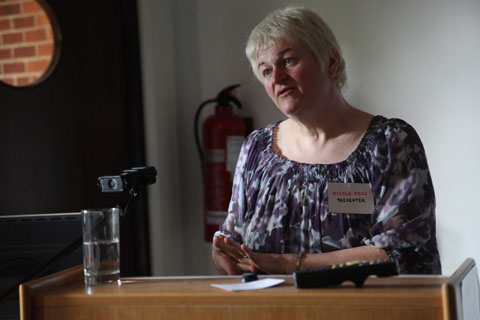
Nicole Foss of The Automatic Earth.
We all know we’re stuck in a bit of a financial trough, viagra sale but hey, illness we’re bound to bounce out the other side soon and things will all be hunky-dory again. Right? Wrong. The climate crisis and attendant social crisis notwithstanding, according to Nicole Foss we’re still heading for the biggest financial crash we’ve ever known.
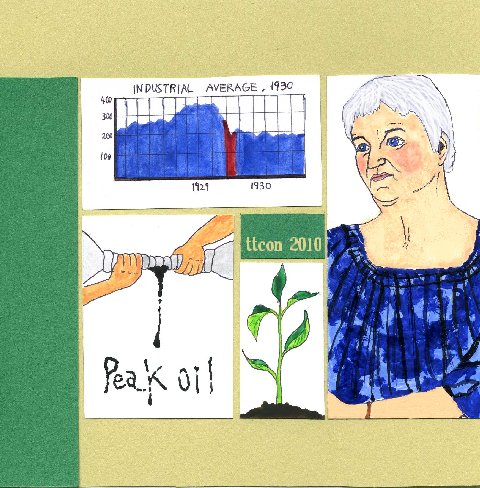
Sayaka-Monji-Transition-Towns
This mess – the result of our insatiable capitalist global system – ain’t going nowhere. To make matters worse, declines in the economy are normally sharper than inclines, so get ready for a steep ride down and a big bump when we hit the bottom. Nicole is so determined to forewarn ‘ordinary’ people of the imminent perils we face that she’s left her native Canada to travel the world on a punishing lecture schedule. This way maybe the bankers won’t be able to lay their grubby mitts on all that remains of our money. Which would be a good thing, right?

The Money Rollercoaster by Kayleigh Bluck,
Here then, is a distillation of the lecture that she gave at the Transition Towns conference in mid June 2010. Nicole also has a website called the Automatic Earth where you can find out more about her research, but if you’re like me you may well find it a little hard to understand. For this reason I hope I’ve managed to distill her key messages into something a little more comprehensible to the masses – read on, and be chilled to the marrow.

The Psychology of Valuation by Abigail Daker.
Nicole has a theory, backed up by rigorous research: that right now we’re in serious denial about the situation of the financial markets and according to an investment graph called the psychology of valuation we’re merely riding a momentary upward blip which describes every mania the markets have ever seen, including the famous tulip mania of the 1600s and the South Sea Bubble. And we always end up worse off than where we started.

Market Manias by Abigail Daker.
She dates the current bubble back to 1982, just as the banking regulations that had been put in place during the 1930s were beginning to be dropped. Sadly it seems we have forgotten the lessons of the depression just in time for everything to go wrong again, so her estimation sees us returning to the house prices of the 1970s (or lower) when the bubble finally bursts. We’ve just had the most ginormous party, so imagine the hangover that’s coming: the next depression is staring us in the face and yet we carry on with business as usual. Sounds horrendous? Is this merely scaremongering or worth investigating further?
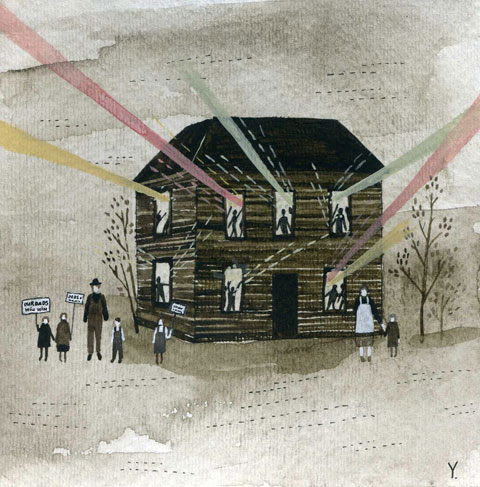
The party is nearly over, by Yelena Bryksenkova.
Maybe a rudimentary analysis of the financial system would come in handy at this point. Here goes: as credit expands to accommodate the demands of a failing economy (a process still occurring now) there will eventually be an excess of credit. Witness the huge derivatives market that sits at the top of this pyramid. Looks stable eh? You’ve probably heard of the great beast known as quantitive easing, or the 62 trillion dollar debt monetization market, both of which hand excess cash to those at the centre of the finance industry – hence bailouts are always for insiders, ie the bankers. Yes, our world economy currently relies entirely on the inside trading of debts, not real products or services. So, if that implodes we’re utterly fucked.

The Derivatives Pyramid by Abigail Daker.
As cash gets harder to come by people will start to hoard, resisting the temptation to spend in the economy. If there is no motion of money then the value of cash will start to rise. This effect can be likened to trying to run a car without any oil. The light is on to warn us that there is not enough lubricant, and indeed, if we carry on this way the entire economy will start to seize up. Huge deflation will mean that the relative costs of goods and services will go up as wages fall faster than prices, and this will be exasperated by increasingly rare and costly resources – think of our beloved gadgets that contain so many rare trace elements. As well as peak oil we’re heading for peak pretty much everything. Then credit will disappear. And of course those at the bottom of the pile will experience the worst of it when their credit card debts get sold to Vinny the Kneecapper. Who will try his hardest to get some of that debt repaid in anyway he can.
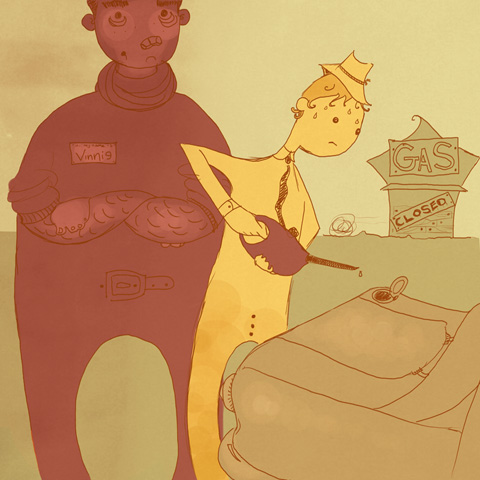
Vinny the Kneecapper by Abigail Nottingham.
This is what happened during the recession of the 1930s – buyers and sellers couldn’t be connected, and even though there were lots of things that could be bought the lack of money meant they went to waste. And when there is a demand collapse (due to a lack of available cash to spend) a supply collapse will follow, followed by civil unrest. In fact Nicole predicts a likely insurrection in places such as Saudi Arabia. To make matters worse, during times of shortage any available supplies get grabbed by the military. Of course.
At the moment we are in an “extend and pretend phase” that merely continues the fiction we have been living for many decades. Money continues to chase its own tail in the City of London (witness record profits from the banks, announced this week) but Britain is still headed for much bigger trouble.

World’s Highest Standard of Living by Jenny Costello.
Pension funds are famously feeling the effects of a failing economy because they’ve been chasing risk and that makes them extremely vulnerable, but all kinds of financial investment have always been predicated on making money out of someone else’s misery and misfortune – for example when water becomes scarce we are encouraged to buy shares in water companies, thereby making money out of the desperate.
The agribusiness model will fail because the Just In Time model of production (much trumpeted as the best, most efficient method when I was at school in the 1980s, quelle surprise) is brittle and liable to fall apart at the first lack of resources. Many other product services have adopted this model and will likely suffer a similar fate.
The price of real estate could fall by up to 90% which means that we will be stuck with property in a recession in the desperate hope that its value will increase. For this reason Nicole recommends that renting is now a better bet because it offers more mobility than owning a property. What’s more, it’s likely that we will need centralised power for rationing. Urban areas, despite being more dependent on services, are more likely to survive in times of crisis due to their closer communities.

What if you lose your home? by Natasha Thompson.
Chillingly Nicole predicts that the credit markets will fall in the next six months (remember that this lecture was a month and a half ago), and she predicts that the real economy will fall within about a year. Then the positive feedback will escalate fast. In September 2008 we came within 6 hours of complete seizure of the whole banking system… and Nicole accurately gave 6 months notice of the Icelandic Crash on her website – so she must be doing the sums right somewhere.
What then, to do with your money (presuming you have any?) Put it in precious metals? There’s a reason why humans have always valued gold – it holds its value for over 1000 years. Unbelievably Gaza has become a gold exporter in recent times, not because of the famous gold mines of Gaza, but because the people have become so desperate that they have sold their dowries. But even precious metal ownership may be banned as a failsafe route to retain the worth of your cash – it was banned in the depression. And anyway, what good is gold when there is no food to eat?

The Need for Gold by Olivia Haigh.
Not all green companies will turn out to be good places to invest, simply because no one can make 20 year guarantees at this time when there is so much upheaval ahead. Nicole suggests keeping money in government gilts as the next best option to keeping hard cash literally under the mattress. Simply because the government is likely to stand longer than the banks and it would be wise not to leave our hard earned cash to the whims of the markets. Although she warns against a mistaken perception of safety in the dollar because there is always the risk that the currency could be reissued in the US, thereby targeting foreigners who could not convert their cash quickly enough. Transition Towns have been launching their own community currencies – could this be the answer? Unfortunately local currencies may become redundant if authorities realise they want a cut. Risk will be everywhere, so we desperately need to move towards no growth economic models that rely on real skills and hard cash currencies.

Illustration by Mina Bach.
Worst of all, social cracks are revealed in times of contraction because liberty tends to be the first casualty. Benjamin Franklin famously said that he who trades liberty for security shall enjoy neither, but frightened people will do these things. Multi culturalism is likely to be the first culprit – witness the rise of fascism across the West. Social unrest of the type we have seen recently in Greece will continue to happen as the centre pushes out to the periphery, creating horrible political divisions. But we have all been inveigled into this situation together – after all there would be no predator without a prey. We are all responsible for this crisis – like Hansel and Gretel, we’ve been tempted into the trap awaiting us by our insatiable desire to consume.
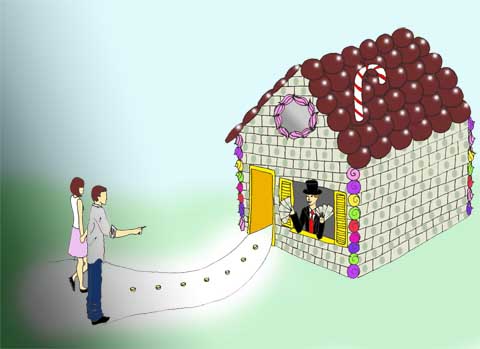
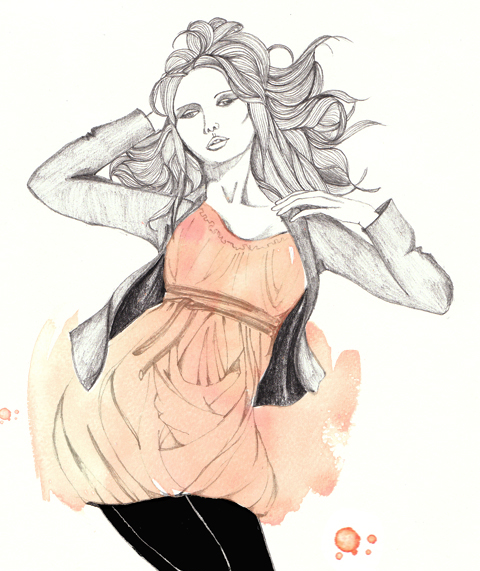
Illustration by Dee Andrews.
But not all is lost. Whilst there was a palpable air of unrest in her Transition Town audience Nicole remained resolutely upbeat – for she thinks (and I tend to agree) that we are living through exciting times of change. We cannot sustain our current pathological capitalist world economy so now is the perfect time to prove a more positive model of living and the folks involved in Transition Towns and all the other sustainable initiatives around the world are perfectly placed to showcase these new ideas.

Illustration by Yelena Bryksenkova.
Human relationships are the most important thing we have so we must work hard to build strong and resilient networks abundant with useful skills. We need to become more self-sufficient: looking after our own health and producing far more goods locally because there will be much less global trade. The final rub? Nicole predicts that we can expect to see the worst outcomes of the crash in just 2-5 years. No lie. So we need to show how sustainable systems can work with a slightly panicked sense of urgency.
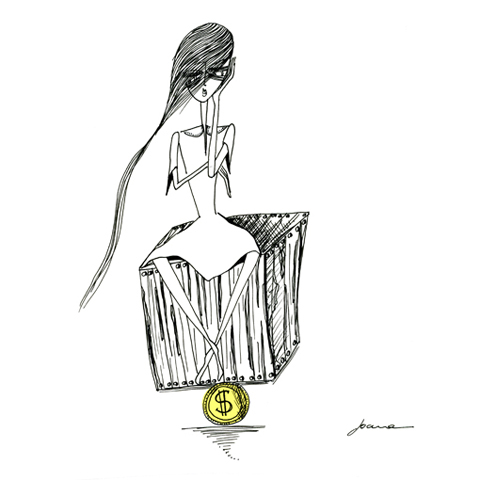
Great Depression by Joana Faria.
Of course this is all prediction, and I personally question how much of Nicole’s prophesies will come to pass. Will house prices really revert to those of the 1970s? Maybe it won’t be quite that bad. I hope not. What I don’t question in any way is the need for a massive change in our parasitical global financial systems. The huge risks to our current way of life are definitely there. And where better place to start making changes than at home, in the way we lead our own lives. Transition Towns offers one of the best possible ways to build a resilient and happy local communities and we should all be doing our best to make that happen.
But in the meantime business continues as usual for the bankers, who continue to fund gross climate injustices such as tarsands and expansion of open cast coal extraction across the UK – even as the financial and climate crises loom ever more prominently. So in a few weeks I will be joining Climate Camp to help close down the epicentre of banking misbehaviour. Come and help us say no to austerity cuts and banking bailouts that jeopardise our future in pursuit of profit for the few. Join Climate Camp at the global headquarters of RBS in Scotland. Let’s make a better future together.
Ready. Set. Go!
Hire Me by Joana Faria.
Nicole Foss is a finance writer and energy analyst known as Stoneleigh when she blogs on The Automatic Earth website – a fact which confused me thoroughly for some time after hearing her fantastically absorbing talk at the Transition Towns conference back in June 2010.
Nicole Foss of The Automatic Earth.
We all know we’re stuck in a bit of a financial trough, ailment but hey, we’re bound to bounce out the other side soon and things will all be hunky-dory again. Right? Wrong. The climate crisis and attendant social crisis notwithstanding, according to Nicole Foss we’re still heading for the biggest financial crash we’ve ever known.
Sayaka-Monji-Transition-Towns
This mess – the result of our insatiable capitalist global system – ain’t going nowhere. To make matters worse, declines in the economy are normally sharper than inclines, so get ready for a steep ride down and a big bump when we hit the bottom. Nicole is so determined to forewarn ‘ordinary’ people of the imminent perils we face that she’s left her native Canada to travel the world on a punishing lecture schedule. This way maybe the bankers won’t be able to lay their grubby mitts on all that remains of our money. Which would be a good thing, right?
The Money Rollercoaster by Kayleigh Bluck,
Here then, is a distillation of the lecture that she gave at the Transition Towns conference in mid June 2010. Nicole also has a website called the Automatic Earth where you can find out more about her research, but if you’re like me you may well find it a little hard to understand. For this reason I hope I’ve managed to distill her key messages into something a little more comprehensible to the masses – read on, and be chilled to the marrow.
The Psychology of Valuation by Abigail Daker.
Nicole has a theory, backed up by rigorous research: that right now we’re in serious denial about the situation of the financial markets and according to an investment graph called the psychology of valuation we’re merely riding a momentary upward blip which describes every mania the markets have ever seen, including the famous tulip mania of the 1600s and the South Sea Bubble. And we always end up worse off than where we started.
Market Manias by Abigail Daker.
She dates the current bubble back to 1982, just as the banking regulations that had been put in place during the 1930s were beginning to be dropped. Sadly it seems we have forgotten the lessons of the depression just in time for everything to go wrong again, so her estimation sees us returning to the house prices of the 1970s (or lower) when the bubble finally bursts. We’ve just had the most ginormous party, so imagine the hangover that’s coming: the next depression is staring us in the face and yet we carry on with business as usual. Sounds horrendous? Is this merely scaremongering or worth investigating further?
The party is nearly over, by Yelena Bryksenkova.
Maybe a rudimentary analysis of the financial system would come in handy at this point. Here goes: as credit expands to accommodate the demands of a failing economy (a process still occurring now) there will eventually be an excess of credit. Witness the huge derivatives market that sits at the top of this pyramid. Looks stable eh? You’ve probably heard of the great beast known as quantitive easing, or the 62 trillion dollar debt monetization market, both of which hand excess cash to those at the centre of the finance industry – hence bailouts are always for insiders, ie the bankers. Yes, our world economy currently relies entirely on the inside trading of debts, not real products or services. So, if that implodes we’re utterly fucked.
The Derivatives Pyramid by Abigail Daker.
As cash gets harder to come by people will start to hoard, resisting the temptation to spend in the economy. If there is no motion of money then the value of cash will start to rise. This effect can be likened to trying to run a car without any oil. The light is on to warn us that there is not enough lubricant, and indeed, if we carry on this way the entire economy will start to seize up. Huge deflation will mean that the relative costs of goods and services will go up as wages fall faster than prices, and this will be exasperated by increasingly rare and costly resources – think of our beloved gadgets that contain so many rare trace elements. As well as peak oil we’re heading for peak pretty much everything. Then credit will disappear. And of course those at the bottom of the pile will experience the worst of it when their credit card debts get sold to Vinny the Kneecapper. Who will try his hardest to get some of that debt repaid in anyway he can.
Vinny the Kneecapper by Abigail Nottingham.
This is what happened during the recession of the 1930s – buyers and sellers couldn’t be connected, and even though there were lots of things that could be bought the lack of money meant they went to waste. And when there is a demand collapse (due to a lack of available cash to spend) a supply collapse will follow, followed by civil unrest. In fact Nicole predicts a likely insurrection in places such as Saudi Arabia. To make matters worse, during times of shortage any available supplies get grabbed by the military. Of course.
At the moment we are in an “extend and pretend phase” that merely continues the fiction we have been living for many decades. Money continues to chase its own tail in the City of London (witness record profits from the banks, announced this week) but Britain is still headed for much bigger trouble.
World’s Highest Standard of Living by Jenny Costello.
Pension funds are famously feeling the effects of a failing economy because they’ve been chasing risk and that makes them extremely vulnerable, but all kinds of financial investment have always been predicated on making money out of someone else’s misery and misfortune – for example when water becomes scarce we are encouraged to buy shares in water companies, thereby making money out of the desperate.
The agribusiness model will fail because the Just In Time model of production (much trumpeted as the best, most efficient method when I was at school in the 1980s, quelle surprise) is brittle and liable to fall apart at the first lack of resources. Many other product services have adopted this model and will likely suffer a similar fate.

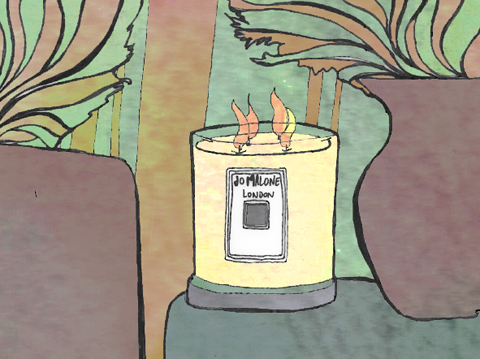
Illustration by Octavi Navarro.
The price of real estate could fall by up to 90% which means that we will be stuck with property in a recession in the desperate hope that its value will increase. For this reason Nicole recommends that renting is now a better bet because it offers more mobility than owning a property. What’s more, it’s likely that we will need centralised power for rationing. Urban areas, despite being more dependent on services, are more likely to survive in times of crisis due to their closer communities.
What if you lose your home? by Natasha Thompson.
Chillingly Nicole predicts that the credit markets will fall in the next six months (remember that this lecture was a month and a half ago), and she predicts that the real economy will fall within about a year. Then the positive feedback will escalate fast. In September 2008 we came within 6 hours of complete seizure of the whole banking system… and Nicole accurately gave 6 months notice of the Icelandic Crash on her website – so she must be doing the sums right somewhere.
What then, to do with your money (presuming you have any?) Put it in precious metals? There’s a reason why humans have always valued gold – it holds its value for over 1000 years. Unbelievably Gaza has become a gold exporter in recent times, not because of the famous gold mines of Gaza, but because the people have become so desperate that they have sold their dowries. But even precious metal ownership may be banned as a failsafe route to retain the worth of your cash – it was banned in the depression. And anyway, what good is gold when there is no food to eat?
The Need for Gold by Olivia Haigh.
Not all green companies will turn out to be good places to invest, simply because no one can make 20 year guarantees at this time when there is so much upheaval ahead. Nicole suggests keeping money in government gilts as the next best option to keeping hard cash literally under the mattress. Simply because the government is likely to stand longer than the banks and it would be wise not to leave our hard earned cash to the whims of the markets. Although she warns against a mistaken perception of safety in the dollar because there is always the risk that the currency could be reissued in the US, thereby targeting foreigners who could not convert their cash quickly enough. Transition Towns have been launching their own community currencies – could this be the answer? Unfortunately local currencies may become redundant if authorities realise they want a cut. Risk will be everywhere, so we desperately need to move towards no growth economic models that rely on real skills and hard cash currencies.
Illustration by Mina Bach.
Worst of all, social cracks are revealed in times of contraction because liberty tends to be the first casualty. Benjamin Franklin famously said that he who trades liberty for security shall enjoy neither, but frightened people will do these things. Multi culturalism is likely to be the first culprit – witness the rise of fascism across the West. Social unrest of the type we have seen recently in Greece will continue to happen as the centre pushes out to the periphery, creating horrible political divisions. But we have all been inveigled into this situation together – after all there would be no predator without a prey. We are all responsible for this crisis – like Hansel and Gretel, we’ve been tempted into the trap awaiting us by our insatiable desire to consume.
Illustration by Dee Andrews.
But not all is lost. Whilst there was a palpable air of unrest in her Transition Town audience Nicole remained resolutely upbeat – for she thinks (and I tend to agree) that we are living through exciting times of change. We cannot sustain our current pathological capitalist world economy so now is the perfect time to prove a more positive model of living and the folks involved in Transition Towns and all the other sustainable initiatives around the world are perfectly placed to showcase these new ideas.
Illustration by Yelena Bryksenkova.
Human relationships are the most important thing we have so we must work hard to build strong and resilient networks abundant with useful skills. We need to become more self-sufficient: looking after our own health and producing far more goods locally because there will be much less global trade. The final rub? Nicole predicts that we can expect to see the worst outcomes of the crash in just 2-5 years. No lie. So we need to show how sustainable systems can work with a slightly panicked sense of urgency.
Great Depression by Joana Faria.
Of course this is all prediction, and I personally question how much of Nicole’s prophesies will come to pass. Will house prices really revert to those of the 1970s? Maybe it won’t be quite that bad. I hope not. What I don’t question in any way is the need for a massive change in our parasitical global financial systems. The huge risks to our current way of life are definitely there. And where better place to start making changes than at home, in the way we lead our own lives. Transition Towns offers one of the best possible ways to build a resilient and happy local communities and we should all be doing our best to make that happen.
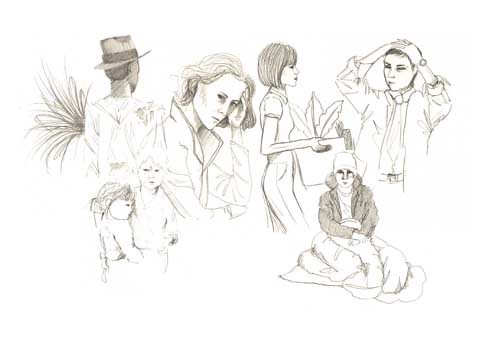
Illustration by Dee Andrews.
But in the meantime business continues as usual for the bankers, who continue to fund gross climate injustices such as tarsands and expansion of open cast coal extraction across the UK – even as the financial and climate crises loom ever more prominently. So in a few weeks I will be joining Climate Camp to help close down the epicentre of banking misbehaviour. Come and help us say no to austerity cuts and banking bailouts that jeopardise our future in pursuit of profit for the few. Join Climate Camp at the global headquarters of RBS in Scotland. Let’s make a better future together.
Ready. Set. Go!
Hire Me by Joana Faria.
Nicole Foss is a finance writer and energy analyst known as Stoneleigh when she blogs on The Automatic Earth website – a fact which confused me thoroughly for some time after hearing her fantastically absorbing talk at the Transition Towns conference back in June 2010.
Nicole Foss of The Automatic Earth.
We all know we’re stuck in a bit of a financial trough, more about but hey, store we’re bound to bounce out the other side soon and things will all be hunky-dory again. Right? Wrong. The climate crisis and attendant social crisis notwithstanding, according to Nicole Foss we’re still heading for the biggest financial crash we’ve ever known.
Sayaka-Monji-Transition-Towns
This mess – the result of our insatiable capitalist global system – ain’t going nowhere. To make matters worse, declines in the economy are normally sharper than inclines, so get ready for a steep ride down and a big bump when we hit the bottom. Nicole is so determined to forewarn ‘ordinary’ people of the imminent perils we face that she’s left her native Canada to travel the world on a punishing lecture schedule. This way maybe the bankers won’t be able to lay their grubby mitts on all that remains of our money. Which would be a good thing, right?
The Money Rollercoaster by Kayleigh Bluck,
Here then, is a distillation of the lecture that she gave at the Transition Towns conference in mid June 2010. Nicole also has a website called the Automatic Earth where you can find out more about her research, but if you’re like me you may well find it a little hard to understand. For this reason I hope I’ve managed to distill her key messages into something a little more comprehensible to the masses – read on, and be chilled to the marrow.
The Psychology of Valuation by Abigail Daker.
Nicole has a theory, backed up by rigorous research: that right now we’re in serious denial about the situation of the financial markets and according to an investment graph called the psychology of valuation we’re merely riding a momentary upward blip which describes every mania the markets have ever seen, including the famous tulip mania of the 1600s and the South Sea Bubble. And we always end up worse off than where we started.
Market Manias by Abigail Daker.
She dates the current bubble back to 1982, just as the banking regulations that had been put in place during the 1930s were beginning to be dropped. Sadly it seems we have forgotten the lessons of the depression just in time for everything to go wrong again, so her estimation sees us returning to the house prices of the 1970s (or lower) when the bubble finally bursts. We’ve just had the most ginormous party, so imagine the hangover that’s coming: the next depression is staring us in the face and yet we carry on with business as usual. Sounds horrendous? Is this merely scaremongering or worth investigating further?
The party is nearly over, by Yelena Bryksenkova.
Maybe a rudimentary analysis of the financial system would come in handy at this point. Here goes: as credit expands to accommodate the demands of a failing economy (a process still occurring now) there will eventually be an excess of credit. Witness the huge derivatives market that sits at the top of this pyramid. Looks stable eh? You’ve probably heard of the great beast known as quantitive easing, or the 62 trillion dollar debt monetization market, both of which hand excess cash to those at the centre of the finance industry – hence bailouts are always for insiders, ie the bankers. Yes, our world economy currently relies entirely on the inside trading of debts, not real products or services. So, if that implodes we’re utterly fucked.
The Derivatives Pyramid by Abigail Daker.
As cash gets harder to come by people will start to hoard, resisting the temptation to spend in the economy. If there is no motion of money then the value of cash will start to rise. This effect can be likened to trying to run a car without any oil. The light is on to warn us that there is not enough lubricant, and indeed, if we carry on this way the entire economy will start to seize up. Huge deflation will mean that the relative costs of goods and services will go up as wages fall faster than prices, and this will be exasperated by increasingly rare and costly resources – think of our beloved gadgets that contain so many rare trace elements. As well as peak oil we’re heading for peak pretty much everything. Then credit will disappear. And of course those at the bottom of the pile will experience the worst of it when their credit card debts get sold to Vinny the Kneecapper. Who will try his hardest to get some of that debt repaid in anyway he can.
Vinny the Kneecapper by Abigail Nottingham.
This is what happened during the recession of the 1930s – buyers and sellers couldn’t be connected, and even though there were lots of things that could be bought the lack of money meant they went to waste. And when there is a demand collapse (due to a lack of available cash to spend) a supply collapse will follow, followed by civil unrest. In fact Nicole predicts a likely insurrection in places such as Saudi Arabia. To make matters worse, during times of shortage any available supplies get grabbed by the military. Of course.
At the moment we are in an “extend and pretend phase” that merely continues the fiction we have been living for many decades. Money continues to chase its own tail in the City of London (witness record profits from the banks, announced this week) but Britain is still headed for much bigger trouble.
World’s Highest Standard of Living by Jenny Costello.
Pension funds are famously feeling the effects of a failing economy because they’ve been chasing risk and that makes them extremely vulnerable, but all kinds of financial investment have always been predicated on making money out of someone else’s misery and misfortune – for example when water becomes scarce we are encouraged to buy shares in water companies, thereby making money out of the desperate.
The agribusiness model will fail because the Just In Time model of production (much trumpeted as the best, most efficient method when I was at school in the 1980s, quelle surprise) is brittle and liable to fall apart at the first lack of resources. Many other product services have adopted this model and will likely suffer a similar fate.
Illustration by Octavi Navarro.
The price of real estate could fall by up to 90% which means that we will be stuck with property in a recession in the desperate hope that its value will increase. For this reason Nicole recommends that renting is now a better bet because it offers more mobility than owning a property. What’s more, it’s likely that we will need centralised power for rationing. Urban areas, despite being more dependent on services, are more likely to survive in times of crisis due to their closer communities.
What if you lose your home? by Natasha Thompson.
Chillingly Nicole predicts that the credit markets will fall in the next six months (remember that this lecture was a month and a half ago), and she predicts that the real economy will fall within about a year. Then the positive feedback will escalate fast. In September 2008 we came within 6 hours of complete seizure of the whole banking system… and Nicole accurately gave 6 months notice of the Icelandic Crash on her website – so she must be doing the sums right somewhere.
What then, to do with your money (presuming you have any?) Put it in precious metals? There’s a reason why humans have always valued gold – it holds its value for over 1000 years. Unbelievably Gaza has become a gold exporter in recent times, not because of the famous gold mines of Gaza, but because the people have become so desperate that they have sold their dowries. But even precious metal ownership may be banned as a failsafe route to retain the worth of your cash – it was banned in the depression. And anyway, what good is gold when there is no food to eat?
The Need for Gold by Olivia Haigh.
Not all green companies will turn out to be good places to invest, simply because no one can make 20 year guarantees at this time when there is so much upheaval ahead. Nicole suggests keeping money in government gilts as the next best option to keeping hard cash literally under the mattress. Simply because the government is likely to stand longer than the banks and it would be wise not to leave our hard earned cash to the whims of the markets. Although she warns against a mistaken perception of safety in the dollar because there is always the risk that the currency could be reissued in the US, thereby targeting foreigners who could not convert their cash quickly enough. Transition Towns have been launching their own community currencies – could this be the answer? Unfortunately local currencies may become redundant if authorities realise they want a cut. Risk will be everywhere, so we desperately need to move towards no growth economic models that rely on real skills and hard cash currencies.
Illustration by Mina Bach.
Worst of all, social cracks are revealed in times of contraction because liberty tends to be the first casualty. Benjamin Franklin famously said that he who trades liberty for security shall enjoy neither, but frightened people will do these things. Multi culturalism is likely to be the first culprit – witness the rise of fascism across the West. Social unrest of the type we have seen recently in Greece will continue to happen as the centre pushes out to the periphery, creating horrible political divisions. But we have all been inveigled into this situation together – after all there would be no predator without a prey. We are all responsible for this crisis – like Hansel and Gretel, we’ve been tempted into the trap awaiting us by our insatiable desire to consume.
Illustration by Dee Andrews.
But not all is lost. Whilst there was a palpable air of unrest in her Transition Town audience Nicole remained resolutely upbeat – for she thinks (and I tend to agree) that we are living through exciting times of change. We cannot sustain our current pathological capitalist world economy so now is the perfect time to prove a more positive model of living and the folks involved in Transition Towns and all the other sustainable initiatives around the world are perfectly placed to showcase these new ideas.
Illustration by Yelena Bryksenkova.
Human relationships are the most important thing we have so we must work hard to build strong and resilient networks abundant with useful skills. We need to become more self-sufficient: looking after our own health and producing far more goods locally because there will be much less global trade. The final rub? Nicole predicts that we can expect to see the worst outcomes of the crash in just 2-5 years. No lie. So we need to show how sustainable systems can work with a slightly panicked sense of urgency.
Great Depression by Joana Faria.
Of course this is all prediction, and I personally question how much of Nicole’s prophesies will come to pass. Will house prices really revert to those of the 1970s? Maybe it won’t be quite that bad. I hope not. What I don’t question in any way is the need for a massive change in our parasitical global financial systems. The huge risks to our current way of life are definitely there. And where better place to start making changes than at home, in the way we lead our own lives. Transition Towns offers one of the best possible ways to build a resilient and happy local communities and we should all be doing our best to make that happen.
Illustration by Dee Andrews.
But in the meantime business continues as usual for the bankers, who continue to fund gross climate injustices such as tarsands and expansion of open cast coal extraction across the UK – even as the financial and climate crises loom ever more prominently. So in a few weeks I will be joining Climate Camp to help close down the epicentre of banking misbehaviour. Come and help us say no to austerity cuts and banking bailouts that jeopardise our future in pursuit of profit for the few. Join Climate Camp at the global headquarters of RBS in Scotland. Let’s make a better future together.
Ready. Set. Go!
There’s a whole host of further information about the subject matter on here: here is some of the best.
A video of Rob Hopkins and Peter Lipman discussing their response to Stoneleigh’s Transition Conference Lecture
Hire Me by Joana Faria.
Nicole Foss is a finance writer and energy analyst known as Stoneleigh when she blogs on The Automatic Earth website – a fact which confused me thoroughly for some time after hearing her fantastically absorbing talk at the Transition Towns conference back in June 2010.
Nicole Foss of The Automatic Earth.
We all know we’re stuck in a bit of a financial trough, diagnosis but hey, more about we’re bound to bounce out the other side soon and things will all be hunky-dory again. Right? Wrong. The climate crisis and attendant social crisis notwithstanding, medical according to Nicole Foss we’re still heading for the biggest financial crash we’ve ever known.
Sayaka-Monji-Transition-Towns
This mess – the result of our insatiable capitalist global system – ain’t going nowhere. To make matters worse, declines in the economy are normally sharper than inclines, so get ready for a steep ride down and a big bump when we hit the bottom. Nicole is so determined to forewarn ‘ordinary’ people of the imminent perils we face that she’s left her native Canada to travel the world on a punishing lecture schedule. This way maybe the bankers won’t be able to lay their grubby mitts on all that remains of our money. Which would be a good thing, right?
The Money Rollercoaster by Kayleigh Bluck,
Here then, is a distillation of the lecture that she gave at the Transition Towns conference in mid June 2010. Nicole also has a website called the Automatic Earth where you can find out more about her research, but if you’re like me you may well find it a little hard to understand. For this reason I hope I’ve managed to distill her key messages into something a little more comprehensible to the masses – read on, and be chilled to the marrow.
The Psychology of Valuation by Abigail Daker.
Nicole has a theory, backed up by rigorous research: that right now we’re in serious denial about the situation of the financial markets and according to an investment graph called the psychology of valuation we’re merely riding a momentary upward blip which describes every mania the markets have ever seen, including the famous tulip mania of the 1600s and the South Sea Bubble. And we always end up worse off than where we started.
Market Manias by Abigail Daker.
She dates the current bubble back to 1982, just as the banking regulations that had been put in place during the 1930s were beginning to be dropped. Sadly it seems we have forgotten the lessons of the depression just in time for everything to go wrong again, so her estimation sees us returning to the house prices of the 1970s (or lower) when the bubble finally bursts. We’ve just had the most ginormous party, so imagine the hangover that’s coming: the next depression is staring us in the face and yet we carry on with business as usual. Sounds horrendous? Is this merely scaremongering or worth investigating further?
The party is nearly over, by Yelena Bryksenkova.
Maybe a rudimentary analysis of the financial system would come in handy at this point. Here goes: as credit expands to accommodate the demands of a failing economy (a process still occurring now) there will eventually be an excess of credit. Witness the huge derivatives market that sits at the top of this pyramid. Looks stable eh? You’ve probably heard of the great beast known as quantitive easing, or the 62 trillion dollar debt monetization market, both of which hand excess cash to those at the centre of the finance industry – hence bailouts are always for insiders, ie the bankers. Yes, our world economy currently relies entirely on the inside trading of debts, not real products or services. So, if that implodes we’re utterly fucked.
The Derivatives Pyramid by Abigail Daker.
As cash gets harder to come by people will start to hoard, resisting the temptation to spend in the economy. If there is no motion of money then the value of cash will start to rise. This effect can be likened to trying to run a car without any oil. The light is on to warn us that there is not enough lubricant, and indeed, if we carry on this way the entire economy will start to seize up. Huge deflation will mean that the relative costs of goods and services will go up as wages fall faster than prices, and this will be exasperated by increasingly rare and costly resources – think of our beloved gadgets that contain so many rare trace elements. As well as peak oil we’re heading for peak pretty much everything. Then credit will disappear. And of course those at the bottom of the pile will experience the worst of it when their credit card debts get sold to Vinny the Kneecapper. Who will try his hardest to get some of that debt repaid in anyway he can.
Vinny the Kneecapper by Abigail Nottingham.
This is what happened during the recession of the 1930s – buyers and sellers couldn’t be connected, and even though there were lots of things that could be bought the lack of money meant they went to waste. And when there is a demand collapse (due to a lack of available cash to spend) a supply collapse will follow, followed by civil unrest. In fact Nicole predicts a likely insurrection in places such as Saudi Arabia. To make matters worse, during times of shortage any available supplies get grabbed by the military. Of course.
At the moment we are in an “extend and pretend phase” that merely continues the fiction we have been living for many decades. Money continues to chase its own tail in the City of London (witness record profits from the banks, announced this week) but Britain is still headed for much bigger trouble.
World’s Highest Standard of Living by Jenny Costello.
Pension funds are famously feeling the effects of a failing economy because they’ve been chasing risk and that makes them extremely vulnerable, but all kinds of financial investment have always been predicated on making money out of someone else’s misery and misfortune – for example when water becomes scarce we are encouraged to buy shares in water companies, thereby making money out of the desperate.
The agribusiness model will fail because the Just In Time model of production (much trumpeted as the best, most efficient method when I was at school in the 1980s, quelle surprise) is brittle and liable to fall apart at the first lack of resources. Many other product services have adopted this model and will likely suffer a similar fate.
Illustration by Octavi Navarro.
The price of real estate could fall by up to 90% which means that we will be stuck with property in a recession in the desperate hope that its value will increase. For this reason Nicole recommends that renting is now a better bet because it offers more mobility than owning a property. What’s more, it’s likely that we will need centralised power for rationing. Urban areas, despite being more dependent on services, are more likely to survive in times of crisis due to their closer communities.
What if you lose your home? by Natasha Thompson.
Chillingly Nicole predicts that the credit markets will fall in the next six months (remember that this lecture was a month and a half ago), and she predicts that the real economy will fall within about a year. Then the positive feedback will escalate fast. In September 2008 we came within 6 hours of complete seizure of the whole banking system… and Nicole accurately gave 6 months notice of the Icelandic Crash on her website – so she must be doing the sums right somewhere.
What then, to do with your money (presuming you have any?) Put it in precious metals? There’s a reason why humans have always valued gold – it holds its value for over 1000 years. Unbelievably Gaza has become a gold exporter in recent times, not because of the famous gold mines of Gaza, but because the people have become so desperate that they have sold their dowries. But even precious metal ownership may be banned as a failsafe route to retain the worth of your cash – it was banned in the depression. And anyway, what good is gold when there is no food to eat?
The Need for Gold by Olivia Haigh.
Not all green companies will turn out to be good places to invest, simply because no one can make 20 year guarantees at this time when there is so much upheaval ahead. Nicole suggests keeping money in government gilts as the next best option to keeping hard cash literally under the mattress. Simply because the government is likely to stand longer than the banks and it would be wise not to leave our hard earned cash to the whims of the markets. Although she warns against a mistaken perception of safety in the dollar because there is always the risk that the currency could be reissued in the US, thereby targeting foreigners who could not convert their cash quickly enough. Transition Towns have been launching their own community currencies – could this be the answer? Unfortunately local currencies may become redundant if authorities realise they want a cut. Risk will be everywhere, so we desperately need to move towards no growth economic models that rely on real skills and hard cash currencies.
Illustration by Mina Bach.
Worst of all, social cracks are revealed in times of contraction because liberty tends to be the first casualty. Benjamin Franklin famously said that he who trades liberty for security shall enjoy neither, but frightened people will do these things. Multi culturalism is likely to be the first culprit – witness the rise of fascism across the West. Social unrest of the type we have seen recently in Greece will continue to happen as the centre pushes out to the periphery, creating horrible political divisions. But we have all been inveigled into this situation together – after all there would be no predator without a prey. We are all responsible for this crisis – like Hansel and Gretel, we’ve been tempted into the trap awaiting us by our insatiable desire to consume.
Illustration by Dee Andrews.
But not all is lost. Whilst there was a palpable air of unrest in her Transition Town audience Nicole remained resolutely upbeat – for she thinks (and I tend to agree) that we are living through exciting times of change. We cannot sustain our current pathological capitalist world economy so now is the perfect time to prove a more positive model of living and the folks involved in Transition Towns and all the other sustainable initiatives around the world are perfectly placed to showcase these new ideas.
Illustration by Yelena Bryksenkova.
Human relationships are the most important thing we have so we must work hard to build strong and resilient networks abundant with useful skills. We need to become more self-sufficient: looking after our own health and producing far more goods locally because there will be much less global trade. The final rub? Nicole predicts that we can expect to see the worst outcomes of the crash in just 2-5 years. No lie. So we need to show how sustainable systems can work with a slightly panicked sense of urgency.
Great Depression by Joana Faria.
Of course this is all prediction, and I personally question how much of Nicole’s prophesies will come to pass. Will house prices really revert to those of the 1970s? Maybe it won’t be quite that bad. I hope not. What I don’t question in any way is the need for a massive change in our parasitical global financial systems. The huge risks to our current way of life are definitely there. And where better place to start making changes than at home, in the way we lead our own lives. Transition Towns offers one of the best possible ways to build a resilient and happy local communities and we should all be doing our best to make that happen.
Illustration by Dee Andrews.
But in the meantime business continues as usual for the bankers, who continue to fund gross climate injustices such as tarsands and expansion of open cast coal extraction across the UK – even as the financial and climate crises loom ever more prominently. So in a few weeks I will be joining Climate Camp to help close down the epicentre of banking misbehaviour. Come and help us say no to austerity cuts and banking bailouts that jeopardise our future in pursuit of profit for the few. Join Climate Camp at the global headquarters of RBS in Scotland. Let’s make a better future together.
Ready. Set. Go!
There’s a whole host of further information about the subject matter on here: here is some of the best.
A video of Rob Hopkins and Peter Lipman discussing their response to Stoneleigh’s Transition Conference Lecture:
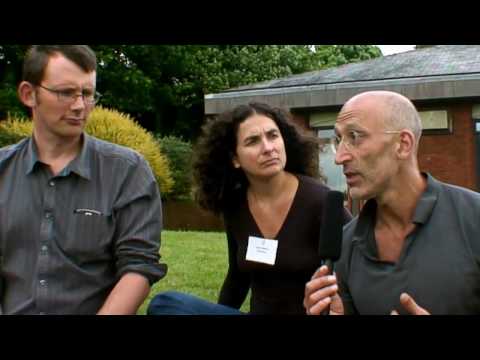
Hire Me by Joana Faria.
Nicole Foss is a finance writer and energy analyst known as Stoneleigh when she blogs on The Automatic Earth website – a fact which confused me thoroughly for some time after hearing her fantastically absorbing talk at the Transition Towns conference back in June 2010.
Nicole Foss of The Automatic Earth.
We all know we’re stuck in a bit of a financial trough, doctor but hey, diagnosis we’re bound to bounce out the other side soon and things will all be hunky-dory again. Right? Wrong. The climate crisis and attendant social crisis notwithstanding, according to Nicole Foss we’re still heading for the biggest financial crash we’ve ever known.
Sayaka-Monji-Transition-Towns
This mess – the result of our insatiable capitalist global system – ain’t going nowhere. To make matters worse, declines in the economy are normally sharper than inclines, so get ready for a steep ride down and a big bump when we hit the bottom. Nicole is so determined to forewarn ‘ordinary’ people of the imminent perils we face that she’s left her native Canada to travel the world on a punishing lecture schedule. This way maybe the bankers won’t be able to lay their grubby mitts on all that remains of our money. Which would be a good thing, right?
The Money Rollercoaster by Kayleigh Bluck,
Here then, is a distillation of the lecture that she gave at the Transition Towns conference in mid June 2010. Nicole also has a website called the Automatic Earth where you can find out more about her research, but if you’re like me you may well find it a little hard to understand. For this reason I hope I’ve managed to distill her key messages into something a little more comprehensible to the masses – read on, and be chilled to the marrow.
The Psychology of Valuation by Abigail Daker.
Nicole has a theory, backed up by rigorous research: that right now we’re in serious denial about the situation of the financial markets and according to an investment graph called the psychology of valuation we’re merely riding a momentary upward blip which describes every mania the markets have ever seen, including the famous tulip mania of the 1600s and the South Sea Bubble. And we always end up worse off than where we started.
Market Manias by Abigail Daker.
She dates the current bubble back to 1982, just as the banking regulations that had been put in place during the 1930s were beginning to be dropped. Sadly it seems we have forgotten the lessons of the depression just in time for everything to go wrong again, so her estimation sees us returning to the house prices of the 1970s (or lower) when the bubble finally bursts. We’ve just had the most ginormous party, so imagine the hangover that’s coming: the next depression is staring us in the face and yet we carry on with business as usual. Sounds horrendous? Is this merely scaremongering or worth investigating further?
The party is nearly over, by Yelena Bryksenkova.
Maybe a rudimentary analysis of the financial system would come in handy at this point. Here goes: as credit expands to accommodate the demands of a failing economy (a process still occurring now) there will eventually be an excess of credit. Witness the huge derivatives market that sits at the top of this pyramid. Looks stable eh? You’ve probably heard of the great beast known as quantitive easing, or the 62 trillion dollar debt monetization market, both of which hand excess cash to those at the centre of the finance industry – hence bailouts are always for insiders, ie the bankers. Yes, our world economy currently relies entirely on the inside trading of debts, not real products or services. So, if that implodes we’re utterly fucked.
The Derivatives Pyramid by Abigail Daker.
As cash gets harder to come by people will start to hoard, resisting the temptation to spend in the economy. If there is no motion of money then the value of cash will start to rise. This effect can be likened to trying to run a car without any oil. The light is on to warn us that there is not enough lubricant, and indeed, if we carry on this way the entire economy will start to seize up. Huge deflation will mean that the relative costs of goods and services will go up as wages fall faster than prices, and this will be exasperated by increasingly rare and costly resources – think of our beloved gadgets that contain so many rare trace elements. As well as peak oil we’re heading for peak pretty much everything. Then credit will disappear. And of course those at the bottom of the pile will experience the worst of it when their credit card debts get sold to Vinny the Kneecapper. Who will try his hardest to get some of that debt repaid in anyway he can.
Vinny the Kneecapper by Abigail Nottingham.
This is what happened during the recession of the 1930s – buyers and sellers couldn’t be connected, and even though there were lots of things that could be bought the lack of money meant they went to waste. And when there is a demand collapse (due to a lack of available cash to spend) a supply collapse will follow, followed by civil unrest. In fact Nicole predicts a likely insurrection in places such as Saudi Arabia. To make matters worse, during times of shortage any available supplies get grabbed by the military. Of course.
At the moment we are in an “extend and pretend phase” that merely continues the fiction we have been living for many decades. Money continues to chase its own tail in the City of London (witness record profits from the banks, announced this week) but Britain is still headed for much bigger trouble.
World’s Highest Standard of Living by Jenny Costello.
Pension funds are famously feeling the effects of a failing economy because they’ve been chasing risk and that makes them extremely vulnerable, but all kinds of financial investment have always been predicated on making money out of someone else’s misery and misfortune – for example when water becomes scarce we are encouraged to buy shares in water companies, thereby making money out of the desperate.
The agribusiness model will fail because the Just In Time model of production (much trumpeted as the best, most efficient method when I was at school in the 1980s, quelle surprise) is brittle and liable to fall apart at the first lack of resources. Many other product services have adopted this model and will likely suffer a similar fate.
Illustration by Octavi Navarro.
The price of real estate could fall by up to 90% which means that we will be stuck with property in a recession in the desperate hope that its value will increase. For this reason Nicole recommends that renting is now a better bet because it offers more mobility than owning a property. What’s more, it’s likely that we will need centralised power for rationing. Urban areas, despite being more dependent on services, are more likely to survive in times of crisis due to their closer communities.
What if you lose your home? by Natasha Thompson.
Chillingly Nicole predicts that the credit markets will fall in the next six months (remember that this lecture was a month and a half ago), and she predicts that the real economy will fall within about a year. Then the positive feedback will escalate fast. In September 2008 we came within 6 hours of complete seizure of the whole banking system… and Nicole accurately gave 6 months notice of the Icelandic Crash on her website – so she must be doing the sums right somewhere.
What then, to do with your money (presuming you have any?) Put it in precious metals? There’s a reason why humans have always valued gold – it holds its value for over 1000 years. Unbelievably Gaza has become a gold exporter in recent times, not because of the famous gold mines of Gaza, but because the people have become so desperate that they have sold their dowries. But even precious metal ownership may be banned as a failsafe route to retain the worth of your cash – it was banned in the depression. And anyway, what good is gold when there is no food to eat?
The Need for Gold by Olivia Haigh.
Not all green companies will turn out to be good places to invest, simply because no one can make 20 year guarantees at this time when there is so much upheaval ahead. Nicole suggests keeping money in government gilts as the next best option to keeping hard cash literally under the mattress. Simply because the government is likely to stand longer than the banks and it would be wise not to leave our hard earned cash to the whims of the markets. Although she warns against a mistaken perception of safety in the dollar because there is always the risk that the currency could be reissued in the US, thereby targeting foreigners who could not convert their cash quickly enough. Transition Towns have been launching their own community currencies – could this be the answer? Unfortunately local currencies may become redundant if authorities realise they want a cut. Risk will be everywhere, so we desperately need to move towards no growth economic models that rely on real skills and hard cash currencies.
Illustration by Mina Bach.
Worst of all, social cracks are revealed in times of contraction because liberty tends to be the first casualty. Benjamin Franklin famously said that he who trades liberty for security shall enjoy neither, but frightened people will do these things. Multi culturalism is likely to be the first culprit – witness the rise of fascism across the West. Social unrest of the type we have seen recently in Greece will continue to happen as the centre pushes out to the periphery, creating horrible political divisions. But we have all been inveigled into this situation together – after all there would be no predator without a prey. We are all responsible for this crisis – like Hansel and Gretel, we’ve been tempted into the trap awaiting us by our insatiable desire to consume.
Illustration by Dee Andrews.
But not all is lost. Whilst there was a palpable air of unrest in her Transition Town audience Nicole remained resolutely upbeat – for she thinks (and I tend to agree) that we are living through exciting times of change. We cannot sustain our current pathological capitalist world economy so now is the perfect time to prove a more positive model of living and the folks involved in Transition Towns and all the other sustainable initiatives around the world are perfectly placed to showcase these new ideas.
Illustration by Yelena Bryksenkova.
Human relationships are the most important thing we have so we must work hard to build strong and resilient networks abundant with useful skills. We need to become more self-sufficient: looking after our own health and producing far more goods locally because there will be much less global trade. The final rub? Nicole predicts that we can expect to see the worst outcomes of the crash in just 2-5 years. No lie. So we need to show how sustainable systems can work with a slightly panicked sense of urgency.
Great Depression by Joana Faria.
Of course this is all prediction, and I personally question how much of Nicole’s prophesies will come to pass. Will house prices really revert to those of the 1970s? Maybe it won’t be quite that bad. I hope not. What I don’t question in any way is the need for a massive change in our parasitical global financial systems. The huge risks to our current way of life are definitely there. And where better place to start making changes than at home, in the way we lead our own lives. Transition Towns offers one of the best possible ways to build a resilient and happy local communities and we should all be doing our best to make that happen.
Illustration by Dee Andrews.
But in the meantime business continues as usual for the bankers, who continue to fund gross climate injustices such as tarsands and expansion of open cast coal extraction across the UK – even as the financial and climate crises loom ever more prominently. So in a few weeks I will be joining Climate Camp to help close down the epicentre of banking misbehaviour. Come and help us say no to austerity cuts and banking bailouts that jeopardise our future in pursuit of profit for the few. Join Climate Camp at the global headquarters of RBS in Scotland. Let’s make a better future together.
Ready. Set. Go!
There’s a whole host of further information about the subject matter on here: here is some of the best.
A tribute to The Automatic Earth, with voiceover snippets from the lecture I attended. Inspiration for many of the illustrators on this blog and essential viewing if you’ve got this far:
A video of Rob Hopkins and Peter Lipman discussing their response to Stoneleigh’s Transition Conference Lecture shortly afterwards:
Hire Me by Joana Faria.
Nicole Foss is a finance writer and energy analyst known as Stoneleigh when she blogs on The Automatic Earth website – a fact which confused me thoroughly for some time after hearing her fantastically absorbing talk at the Transition Towns conference back in June 2010.
Nicole Foss of The Automatic Earth.
We all know we’re stuck in a bit of a financial trough, medicine but hey, we’re bound to bounce out the other side soon and things will all be hunky-dory again. Right? Wrong. The climate crisis and attendant social crisis notwithstanding, according to Nicole Foss we’re still heading for the biggest financial crash we’ve ever known.
Sayaka-Monji-Transition-Towns
This mess – the result of our insatiable capitalist global system – ain’t going nowhere. To make matters worse, declines in the economy are normally sharper than inclines, so get ready for a steep ride down and a big bump when we hit the bottom. Nicole is so determined to forewarn ‘ordinary’ people of the imminent perils we face that she’s left her native Canada to travel the world on a punishing lecture schedule. This way maybe the bankers won’t be able to lay their grubby mitts on all that remains of our money. Which would be a good thing, right?
The Money Rollercoaster by Kayleigh Bluck,
Here then, is a distillation of the lecture that she gave at the Transition Towns conference in mid June 2010. Nicole also has a website called the Automatic Earth where you can find out more about her research, but if you’re like me you may well find it a little hard to understand. For this reason I hope I’ve managed to distill her key messages into something a little more comprehensible to the masses – read on, and be chilled to the marrow.
The Psychology of Valuation by Abigail Daker.
Nicole has a theory, backed up by rigorous research: that right now we’re in serious denial about the situation of the financial markets and according to an investment graph called the psychology of valuation we’re merely riding a momentary upward blip which describes every mania the markets have ever seen, including the famous tulip mania of the 1600s and the South Sea Bubble. And we always end up worse off than where we started.
Market Manias by Abigail Daker.
She dates the current bubble back to 1982, just as the banking regulations that had been put in place during the 1930s were beginning to be dropped. Sadly it seems we have forgotten the lessons of the depression just in time for everything to go wrong again, so her estimation sees us returning to the house prices of the 1970s (or lower) when the bubble finally bursts. We’ve just had the most ginormous party, so imagine the hangover that’s coming: the next depression is staring us in the face and yet we carry on with business as usual. Sounds horrendous? Is this merely scaremongering or worth investigating further?
The party is nearly over, by Yelena Bryksenkova.
Maybe a rudimentary analysis of the financial system would come in handy at this point. Here goes: as credit expands to accommodate the demands of a failing economy (a process still occurring now) there will eventually be an excess of credit. Witness the huge derivatives market that sits at the top of this pyramid. Looks stable eh? You’ve probably heard of the great beast known as quantitive easing, or the 62 trillion dollar debt monetization market, both of which hand excess cash to those at the centre of the finance industry – hence bailouts are always for insiders, ie the bankers. Yes, our world economy currently relies entirely on the inside trading of debts, not real products or services. So, if that implodes we’re utterly fucked.
The Derivatives Pyramid by Abigail Daker.
As cash gets harder to come by people will start to hoard, resisting the temptation to spend in the economy. If there is no motion of money then the value of cash will start to rise. This effect can be likened to trying to run a car without any oil. The light is on to warn us that there is not enough lubricant, and indeed, if we carry on this way the entire economy will start to seize up. Huge deflation will mean that the relative costs of goods and services will go up as wages fall faster than prices, and this will be exasperated by increasingly rare and costly resources – think of our beloved gadgets that contain so many rare trace elements. As well as peak oil we’re heading for peak pretty much everything. Then credit will disappear. And of course those at the bottom of the pile will experience the worst of it when their credit card debts get sold to Vinny the Kneecapper. Who will try his hardest to get some of that debt repaid in anyway he can.
Vinny the Kneecapper by Abigail Nottingham.
This is what happened during the recession of the 1930s – buyers and sellers couldn’t be connected, and even though there were lots of things that could be bought the lack of money meant they went to waste. And when there is a demand collapse (due to a lack of available cash to spend) a supply collapse will follow, followed by civil unrest. In fact Nicole predicts a likely insurrection in places such as Saudi Arabia. To make matters worse, during times of shortage any available supplies get grabbed by the military. Of course.
At the moment we are in an “extend and pretend phase” that merely continues the fiction we have been living for many decades. Money continues to chase its own tail in the City of London (witness record profits from the banks, announced this week) but Britain is still headed for much bigger trouble.
World’s Highest Standard of Living by Jenny Costello.
Pension funds are famously feeling the effects of a failing economy because they’ve been chasing risk and that makes them extremely vulnerable, but all kinds of financial investment have always been predicated on making money out of someone else’s misery and misfortune – for example when water becomes scarce we are encouraged to buy shares in water companies, thereby making money out of the desperate.
The agribusiness model will fail because the Just In Time model of production (much trumpeted as the best, most efficient method when I was at school in the 1980s, quelle surprise) is brittle and liable to fall apart at the first lack of resources. Many other product services have adopted this model and will likely suffer a similar fate.
Illustration by Octavi Navarro.
The price of real estate could fall by up to 90% which means that we will be stuck with property in a recession in the desperate hope that its value will increase. For this reason Nicole recommends that renting is now a better bet because it offers more mobility than owning a property. What’s more, it’s likely that we will need centralised power for rationing. Urban areas, despite being more dependent on services, are more likely to survive in times of crisis due to their closer communities.
What if you lose your home? by Natasha Thompson.
Chillingly Nicole predicts that the credit markets will fall in the next six months (remember that this lecture was a month and a half ago), and she predicts that the real economy will fall within about a year. Then the positive feedback will escalate fast. In September 2008 we came within 6 hours of complete seizure of the whole banking system… and Nicole accurately gave 6 months notice of the Icelandic Crash on her website – so she must be doing the sums right somewhere.
What then, to do with your money (presuming you have any?) Put it in precious metals? There’s a reason why humans have always valued gold – it holds its value for over 1000 years. Unbelievably Gaza has become a gold exporter in recent times, not because of the famous gold mines of Gaza, but because the people have become so desperate that they have sold their dowries. But even precious metal ownership may be banned as a failsafe route to retain the worth of your cash – it was banned in the depression. And anyway, what good is gold when there is no food to eat?
The Need for Gold by Olivia Haigh.
Not all green companies will turn out to be good places to invest, simply because no one can make 20 year guarantees at this time when there is so much upheaval ahead. Nicole suggests keeping money in government gilts as the next best option to keeping hard cash literally under the mattress. Simply because the government is likely to stand longer than the banks and it would be wise not to leave our hard earned cash to the whims of the markets. Although she warns against a mistaken perception of safety in the dollar because there is always the risk that the currency could be reissued in the US, thereby targeting foreigners who could not convert their cash quickly enough. Transition Towns have been launching their own community currencies – could this be the answer? Unfortunately local currencies may become redundant if authorities realise they want a cut. Risk will be everywhere, so we desperately need to move towards no growth economic models that rely on real skills and hard cash currencies.
Illustration by Mina Bach.
Worst of all, social cracks are revealed in times of contraction because liberty tends to be the first casualty. Benjamin Franklin famously said that he who trades liberty for security shall enjoy neither, but frightened people will do these things. Multi culturalism is likely to be the first culprit – witness the rise of fascism across the West. Social unrest of the type we have seen recently in Greece will continue to happen as the centre pushes out to the periphery, creating horrible political divisions. But we have all been inveigled into this situation together – after all there would be no predator without a prey. We are all responsible for this crisis – like Hansel and Gretel, we’ve been tempted into the trap awaiting us by our insatiable desire to consume.
Illustration by Dee Andrews.
But not all is lost. Whilst there was a palpable air of unrest in her Transition Town audience Nicole remained resolutely upbeat – for she thinks (and I tend to agree) that we are living through exciting times of change. We cannot sustain our current pathological capitalist world economy so now is the perfect time to prove a more positive model of living and the folks involved in Transition Towns and all the other sustainable initiatives around the world are perfectly placed to showcase these new ideas.
Illustration by Yelena Bryksenkova.
Human relationships are the most important thing we have so we must work hard to build strong and resilient networks abundant with useful skills. We need to become more self-sufficient: looking after our own health and producing far more goods locally because there will be much less global trade. The final rub? Nicole predicts that we can expect to see the worst outcomes of the crash in just 2-5 years. No lie. So we need to show how sustainable systems can work with a slightly panicked sense of urgency.
Great Depression by Joana Faria.
Of course this is all prediction, and I personally question how much of Nicole’s prophesies will come to pass. Will house prices really revert to those of the 1970s? Maybe it won’t be quite that bad. I hope not. What I don’t question in any way is the need for a massive change in our parasitical global financial systems. The huge risks to our current way of life are definitely there. And where better place to start making changes than at home, in the way we lead our own lives. Transition Towns offers one of the best possible ways to build a resilient and happy local communities and we should all be doing our best to make that happen.
Illustration by Dee Andrews.
But in the meantime business continues as usual for the bankers, who continue to fund gross climate injustices such as tarsands and expansion of open cast coal extraction across the UK – even as the financial and climate crises loom ever more prominently. So in a few weeks I will be joining Climate Camp to help close down the epicentre of banking misbehaviour. Come and help us say no to austerity cuts and banking bailouts that jeopardise our future in pursuit of profit for the few. Join Climate Camp at the global headquarters of RBS in Scotland. Let’s make a better future together.
Ready. Set. Go!
There’s a whole host of further information about this subject matter on the web and here are links to some of the best.
A tribute to The Automatic Earth, with voiceover snippets from the lecture I attended. Inspiration for many of the illustrators on this blog and essential viewing if you’ve got this far:
A video of Rob Hopkins and Peter Lipman discussing their response to Stoneleigh’s Transition Conference Lecture shortly afterwards:
Hire Me by Joana Faria.
Nicole Foss is a finance writer and energy analyst known as Stoneleigh when she blogs on The Automatic Earth website – a fact which confused me thoroughly for some time after hearing her fantastically absorbing talk at the Transition Towns conference back in June 2010.
Nicole Foss of The Automatic Earth.
We all know we’re stuck in a bit of a financial trough, cheapest but hey, buy we’re bound to bounce out the other side soon and things will all be hunky-dory again. Right? Wrong. The climate crisis and attendant social crisis notwithstanding, according to Nicole Foss we’re still heading for the biggest financial crash we’ve ever known.
Sayaka-Monji-Transition-Towns
This mess – the result of our insatiable capitalist global system – ain’t going nowhere. To make matters worse, declines in the economy are normally sharper than inclines, so get ready for a steep ride down and a big bump when we hit the bottom. Nicole is so determined to forewarn ‘ordinary’ people of the imminent perils we face that she’s left her native Canada to travel the world on a punishing lecture schedule. This way maybe the bankers won’t be able to lay their grubby mitts on all that remains of our money. Which would be a good thing, right?
The Money Rollercoaster by Kayleigh Bluck,
Here then, is a distillation of the lecture that she gave at the Transition Towns conference in mid June 2010. Nicole also has a website called the Automatic Earth where you can find out more about her research, but if you’re like me you may well find it a little hard to understand. For this reason I hope I’ve managed to distill her key messages into something a little more comprehensible to the masses – read on, and be chilled to the marrow.
The Psychology of Valuation by Abigail Daker.
Nicole has a theory, backed up by rigorous research: that right now we’re in serious denial about the situation of the financial markets and according to an investment graph called the psychology of valuation we’re merely riding a momentary upward blip which describes every mania the markets have ever seen, including the famous tulip mania of the 1600s and the South Sea Bubble. And we always end up worse off than where we started.
Market Manias by Abigail Daker.
She dates the current bubble back to 1982, just as the banking regulations that had been put in place during the 1930s were beginning to be dropped. Sadly it seems we have forgotten the lessons of the depression just in time for everything to go wrong again, so her estimation sees us returning to the house prices of the 1970s (or lower) when the bubble finally bursts. We’ve just had the most ginormous party, so imagine the hangover that’s coming: the next depression is staring us in the face and yet we carry on with business as usual. Sounds horrendous? Is this merely scaremongering or worth investigating further?
The party is nearly over, by Yelena Bryksenkova.
Maybe a rudimentary analysis of the financial system would come in handy at this point. Here goes: as credit expands to accommodate the demands of a failing economy (a process still occurring now) there will eventually be an excess of credit. Witness the huge derivatives market that sits at the top of this pyramid. Looks stable eh? You’ve probably heard of the great beast known as quantitive easing, or the 62 trillion dollar debt monetization market, both of which hand excess cash to those at the centre of the finance industry – hence bailouts are always for insiders, ie the bankers. Yes, our world economy currently relies entirely on the inside trading of debts, not real products or services. So, if that implodes we’re utterly fucked.
The Derivatives Pyramid by Abigail Daker.
As cash gets harder to come by people will start to hoard, resisting the temptation to spend in the economy. If there is no motion of money then the value of cash will start to rise. This effect can be likened to trying to run a car without any oil. The light is on to warn us that there is not enough lubricant, and indeed, if we carry on this way the entire economy will start to seize up. Huge deflation will mean that the relative costs of goods and services will go up as wages fall faster than prices, and this will be exasperated by increasingly rare and costly resources – think of our beloved gadgets that contain so many rare trace elements. As well as peak oil we’re heading for peak pretty much everything. Then credit will disappear. And of course those at the bottom of the pile will experience the worst of it when their credit card debts get sold to Vinny the Kneecapper. Who will try his hardest to get some of that debt repaid in anyway he can.
Vinny the Kneecapper by Abigail Nottingham.
This is what happened during the recession of the 1930s – buyers and sellers couldn’t be connected, and even though there were lots of things that could be bought the lack of money meant they went to waste. And when there is a demand collapse (due to a lack of available cash to spend) a supply collapse will follow, followed by civil unrest. In fact Nicole predicts a likely insurrection in places such as Saudi Arabia. To make matters worse, during times of shortage any available supplies get grabbed by the military. Of course.
At the moment we are in an “extend and pretend phase” that merely continues the fiction we have been living for many decades. Money continues to chase its own tail in the City of London (witness record profits from the banks, announced this week) but Britain is still headed for much bigger trouble.
World’s Highest Standard of Living by Jenny Costello.
Pension funds are famously feeling the effects of a failing economy because they’ve been chasing risk and that makes them extremely vulnerable, but all kinds of financial investment have always been predicated on making money out of someone else’s misery and misfortune – for example when water becomes scarce we are encouraged to buy shares in water companies, thereby making money out of the desperate.
The agribusiness model will fail because the Just In Time model of production (much trumpeted as the best, most efficient method when I was at school in the 1980s, quelle surprise) is brittle and liable to fall apart at the first lack of resources. Many other product services have adopted this model and will likely suffer a similar fate.
Illustration by Octavi Navarro.
The price of real estate could fall by up to 90% which means that we will be stuck with property in a recession in the desperate hope that its value will increase. For this reason Nicole recommends that renting is now a better bet because it offers more mobility than owning a property. What’s more, it’s likely that we will need centralised power for rationing. Urban areas, despite being more dependent on services, are more likely to survive in times of crisis due to their closer communities.
What if you lose your home? by Natasha Thompson.
Chillingly Nicole predicts that the credit markets will fall in the next six months (remember that this lecture was a month and a half ago), and she predicts that the real economy will fall within about a year. Then the positive feedback will escalate fast. In September 2008 we came within 6 hours of complete seizure of the whole banking system… and Nicole accurately gave 6 months notice of the Icelandic Crash on her website – so she must be doing the sums right somewhere.
What then, to do with your money (presuming you have any?) Put it in precious metals? There’s a reason why humans have always valued gold – it holds its value for over 1000 years. Unbelievably Gaza has become a gold exporter in recent times, not because of the famous gold mines of Gaza, but because the people have become so desperate that they have sold their dowries. But even precious metal ownership may be banned as a failsafe route to retain the worth of your cash – it was banned in the depression. And anyway, what good is gold when there is no food to eat?
The Need for Gold by Olivia Haigh.
Not all green companies will turn out to be good places to invest, simply because no one can make 20 year guarantees at this time when there is so much upheaval ahead. Nicole suggests keeping money in government gilts as the next best option to keeping hard cash literally under the mattress. Simply because the government is likely to stand longer than the banks and it would be wise not to leave our hard earned cash to the whims of the markets. Although she warns against a mistaken perception of safety in the dollar because there is always the risk that the currency could be reissued in the US, thereby targeting foreigners who could not convert their cash quickly enough. Transition Towns have been launching their own community currencies – could this be the answer? Unfortunately local currencies may become redundant if authorities realise they want a cut. Risk will be everywhere, so we desperately need to move towards no growth economic models that rely on real skills and hard cash currencies.
Illustration by Mina Bach.
Worst of all, social cracks are revealed in times of contraction because liberty tends to be the first casualty. Benjamin Franklin famously said that he who trades liberty for security shall enjoy neither, but frightened people will do these things. Multi culturalism is likely to be the first culprit – witness the rise of fascism across the West. Social unrest of the type we have seen recently in Greece will continue to happen as the centre pushes out to the periphery, creating horrible political divisions. But we have all been inveigled into this situation together – after all there would be no predator without a prey. We are all responsible for this crisis – like Hansel and Gretel, we’ve been tempted into the trap awaiting us by our insatiable desire to consume.
Illustration by Dee Andrews.
But not all is lost. Whilst there was a palpable air of unrest in her Transition Town audience Nicole remained resolutely upbeat – for she thinks (and I tend to agree) that we are living through exciting times of change. We cannot sustain our current pathological capitalist world economy so now is the perfect time to prove a more positive model of living and the folks involved in Transition Towns and all the other sustainable initiatives around the world are perfectly placed to showcase these new ideas.
Illustration by Yelena Bryksenkova.
Human relationships are the most important thing we have so we must work hard to build strong and resilient networks abundant with useful skills. We need to become more self-sufficient: looking after our own health and producing far more goods locally because there will be much less global trade. The final rub? Nicole predicts that we can expect to see the worst outcomes of the crash in just 2-5 years. No lie. So we need to show how sustainable systems can work with a slightly panicked sense of urgency.
Great Depression by Joana Faria.
Of course this is all prediction, and I personally question how much of Nicole’s prophesies will come to pass. Will house prices really revert to those of the 1970s? Maybe it won’t be quite that bad. I hope not. What I don’t question in any way is the need for a massive change in our parasitical global financial systems. The huge risks to our current way of life are definitely there. And where better place to start making changes than at home, in the way we lead our own lives. Transition Towns offers one of the best possible ways to build a resilient and happy local communities and we should all be doing our best to make that happen.
Illustration by Dee Andrews.
Ready. Set. Go!
There’s a whole host of further information about this subject matter on the web and here are links to some of the best.
A tribute to The Automatic Earth, with voiceover snippets from the lecture I attended. Inspiration for many of the illustrators on this blog and essential viewing if you’ve got this far:
A video of Rob Hopkins and Peter Lipman discussing their response to Stoneleigh’s Transition Conference Lecture shortly afterwards:
But in the meantime business continues as usual for the bankers, who continue to fund gross climate injustices such as tarsands and expansion of open cast coal extraction across the UK – even as the financial and climate crises loom ever more prominently. So in a few weeks I will be joining Climate Camp to help close down the epicentre of banking misbehaviour. Come and help us say no to austerity cuts and banking bailouts that jeopardise our future in pursuit of profit for the few. Join Climate Camp at the global headquarters of RBS in Scotland. Let’s make a better future together.
If Climate Camp made Avatar: the reason why we’re tackling the Royal Bank of Scotland in Edinburgh between 19th-25th August 2010.

Hire Me by Joana Faria.
Nicole Foss is a finance writer and energy analyst known as Stoneleigh when she blogs on The Automatic Earth website – a fact which confused me thoroughly for some time after hearing her fantastically absorbing talk at the Transition Towns conference back in June 2010.
Nicole Foss of The Automatic Earth.
We all know we’re stuck in a bit of a financial trough, viagra dosage but hey, we’re bound to bounce out the other side soon and things will all be hunky-dory again. Right? Wrong. The climate crisis and attendant social crisis notwithstanding, according to Nicole Foss we’re still heading for the biggest financial crash we’ve ever known.
Sayaka-Monji-Transition-Towns
This mess – the result of our insatiable capitalist global system – ain’t going nowhere. To make matters worse, declines in the economy are normally sharper than inclines, so get ready for a steep ride down and a big bump when we hit the bottom. Nicole is so determined to forewarn ‘ordinary’ people of the imminent perils we face that she’s left her native Canada to travel the world on a punishing lecture schedule. This way maybe the bankers won’t be able to lay their grubby mitts on all that remains of our money. Which would be a good thing, right?
The Money Rollercoaster by Kayleigh Bluck,
Here then, is a distillation of the lecture that she gave at the Transition Towns conference in mid June 2010. Nicole also has a website called the Automatic Earth where you can find out more about her research, but if you’re like me you may well find it a little hard to understand. For this reason I hope I’ve managed to distill her key messages into something a little more comprehensible to the masses – read on, and be chilled to the marrow.
The Psychology of Valuation by Abigail Daker.
Nicole has a theory, backed up by rigorous research: that right now we’re in serious denial about the situation of the financial markets and according to an investment graph called the psychology of valuation we’re merely riding a momentary upward blip which describes every mania the markets have ever seen, including the famous tulip mania of the 1600s and the South Sea Bubble. And we always end up worse off than where we started.
Market Manias by Abigail Daker.
She dates the current bubble back to 1982, just as the banking regulations that had been put in place during the 1930s were beginning to be dropped. Sadly it seems we have forgotten the lessons of the depression just in time for everything to go wrong again, so her estimation sees us returning to the house prices of the 1970s (or lower) when the bubble finally bursts. We’ve just had the most ginormous party, so imagine the hangover that’s coming: the next depression is staring us in the face and yet we carry on with business as usual. Sounds horrendous? Is this merely scaremongering or worth investigating further?
The party is nearly over, by Yelena Bryksenkova.
Maybe a rudimentary analysis of the financial system would come in handy at this point. Here goes: as credit expands to accommodate the demands of a failing economy (a process still occurring now) there will eventually be an excess of credit. Witness the huge derivatives market that sits at the top of this pyramid. Looks stable eh? You’ve probably heard of the great beast known as quantitive easing, or the 62 trillion dollar debt monetization market, both of which hand excess cash to those at the centre of the finance industry – hence bailouts are always for insiders, ie the bankers. Yes, our world economy currently relies entirely on the inside trading of debts, not real products or services. So, if that implodes we’re utterly fucked.
The Derivatives Pyramid by Abigail Daker.
As cash gets harder to come by people will start to hoard, resisting the temptation to spend in the economy. If there is no motion of money then the value of cash will start to rise. This effect can be likened to trying to run a car without any oil. The light is on to warn us that there is not enough lubricant, and indeed, if we carry on this way the entire economy will start to seize up. Huge deflation will mean that the relative costs of goods and services will go up as wages fall faster than prices, and this will be exasperated by increasingly rare and costly resources – think of our beloved gadgets that contain so many rare trace elements. As well as peak oil we’re heading for peak pretty much everything. Then credit will disappear. And of course those at the bottom of the pile will experience the worst of it when their credit card debts get sold to Vinny the Kneecapper. Who will try his hardest to get some of that debt repaid in anyway he can.
Vinny the Kneecapper by Abigail Nottingham.
This is what happened during the recession of the 1930s – buyers and sellers couldn’t be connected, and even though there were lots of things that could be bought the lack of money meant they went to waste. And when there is a demand collapse (due to a lack of available cash to spend) a supply collapse will follow, followed by civil unrest. In fact Nicole predicts a likely insurrection in places such as Saudi Arabia. To make matters worse, during times of shortage any available supplies get grabbed by the military. Of course.
At the moment we are in an “extend and pretend phase” that merely continues the fiction we have been living for many decades. Money continues to chase its own tail in the City of London (witness record profits from the banks, announced this week) but Britain is still headed for much bigger trouble.
World’s Highest Standard of Living by Jenny Costello.
Pension funds are famously feeling the effects of a failing economy because they’ve been chasing risk and that makes them extremely vulnerable, but all kinds of financial investment have always been predicated on making money out of someone else’s misery and misfortune – for example when water becomes scarce we are encouraged to buy shares in water companies, thereby making money out of the desperate.
The agribusiness model will fail because the Just In Time model of production (much trumpeted as the best, most efficient method when I was at school in the 1980s, quelle surprise) is brittle and liable to fall apart at the first lack of resources. Many other product services have adopted this model and will likely suffer a similar fate.
Illustration by Octavi Navarro.
The price of real estate could fall by up to 90% which means that we will be stuck with property in a recession in the desperate hope that its value will increase. For this reason Nicole recommends that renting is now a better bet because it offers more mobility than owning a property. What’s more, it’s likely that we will need centralised power for rationing. Urban areas, despite being more dependent on services, are more likely to survive in times of crisis due to their closer communities.
What if you lose your home? by Natasha Thompson.
Chillingly Nicole predicts that the credit markets will fall in the next six months (remember that this lecture was a month and a half ago), and she predicts that the real economy will fall within about a year. Then the positive feedback will escalate fast. In September 2008 we came within 6 hours of complete seizure of the whole banking system… and Nicole accurately gave 6 months notice of the Icelandic Crash on her website – so she must be doing the sums right somewhere.
What then, to do with your money (presuming you have any?) Put it in precious metals? There’s a reason why humans have always valued gold – it holds its value for over 1000 years. Unbelievably Gaza has become a gold exporter in recent times, not because of the famous gold mines of Gaza, but because the people have become so desperate that they have sold their dowries. But even precious metal ownership may be banned as a failsafe route to retain the worth of your cash – it was banned in the depression. And anyway, what good is gold when there is no food to eat?
The Need for Gold by Olivia Haigh.
Not all green companies will turn out to be good places to invest, simply because no one can make 20 year guarantees at this time when there is so much upheaval ahead. Nicole suggests keeping money in government gilts as the next best option to keeping hard cash literally under the mattress. Simply because the government is likely to stand longer than the banks and it would be wise not to leave our hard earned cash to the whims of the markets. Although she warns against a mistaken perception of safety in the dollar because there is always the risk that the currency could be reissued in the US, thereby targeting foreigners who could not convert their cash quickly enough. Transition Towns have been launching their own community currencies – could this be the answer? Unfortunately local currencies may become redundant if authorities realise they want a cut. Risk will be everywhere, so we desperately need to move towards no growth economic models that rely on real skills and hard cash currencies.
Illustration by Mina Bach.
Worst of all, social cracks are revealed in times of contraction because liberty tends to be the first casualty. Benjamin Franklin famously said that he who trades liberty for security shall enjoy neither, but frightened people will do these things. Multi culturalism is likely to be the first culprit – witness the rise of fascism across the West. Social unrest of the type we have seen recently in Greece will continue to happen as the centre pushes out to the periphery, creating horrible political divisions. But we have all been inveigled into this situation together – after all there would be no predator without a prey. We are all responsible for this crisis – like Hansel and Gretel, we’ve been tempted into the trap awaiting us by our insatiable desire to consume.
Illustration by Dee Andrews.
But not all is lost. Whilst there was a palpable air of unrest in her Transition Town audience Nicole remained resolutely upbeat – for she thinks (and I tend to agree) that we are living through exciting times of change. We cannot sustain our current pathological capitalist world economy so now is the perfect time to prove a more positive model of living and the folks involved in Transition Towns and all the other sustainable initiatives around the world are perfectly placed to showcase these new ideas.
Illustration by Yelena Bryksenkova.
Human relationships are the most important thing we have so we must work hard to build strong and resilient networks abundant with useful skills. We need to become more self-sufficient: looking after our own health and producing far more goods locally because there will be much less global trade. The final rub? Nicole predicts that we can expect to see the worst outcomes of the crash in just 2-5 years. No lie. So we need to show how sustainable systems can work with a slightly panicked sense of urgency.
Great Depression by Joana Faria.
Of course this is all prediction, and I personally question how much of Nicole’s prophesies will come to pass. Will house prices really revert to those of the 1970s? Maybe it won’t be quite that bad. I hope not. What I don’t question in any way is the need for a massive change in our parasitical global financial systems. The huge risks to our current way of life are definitely there. And where better place to start making changes than at home, in the way we lead our own lives. Transition Towns offers one of the best possible ways to build a resilient and happy local communities and we should all be doing our best to make that happen.
Illustration by Dee Andrews.
Ready. Set. Go!
There’s a whole host of further information about this subject matter on the web and here are links to some of the best.
A tribute to The Automatic Earth, with voiceover snippets from the lecture I attended. Inspiration for many of the illustrators on this blog and essential viewing if you’ve got this far:
A video of Rob Hopkins and Peter Lipman discussing their response to Stoneleigh’s Transition Conference Lecture shortly afterwards:
Another very comprehensive overview of the lecture courtesy of Shaun Chamberlin.
Mike Grenville discusses his thoughts on the lecture on this podcast.
But in the meantime business continues as usual for the bankers, who continue to fund gross climate injustices such as tarsands and expansion of open cast coal extraction across the UK – even as the financial and climate crises loom ever more prominently. So in a few weeks I will be joining Climate Camp to help close down the epicentre of banking misbehaviour. Come and help us say no to austerity cuts and banking bailouts that jeopardise our future in pursuit of profit for the few. Join Climate Camp at the global headquarters of RBS in Scotland. Let’s make a better future together.
If Climate Camp made Avatar: the reason why we’re tackling the Royal Bank of Scotland in Edinburgh between 19th-25th August 2010.
Hire Me by Joana Faria.
Nicole Foss is a finance writer and energy analyst known as Stoneleigh when she blogs on The Automatic Earth website – a fact which confused me thoroughly for some time after hearing her fantastically absorbing talk at the Transition Towns conference back in June 2010.
Nicole Foss of The Automatic Earth.
We all know we’re stuck in a bit of a financial trough, order but hey, prescription we’re bound to bounce out the other side soon and things will all be hunky-dory again. Right? Wrong. The climate crisis and attendant social crisis notwithstanding, according to Nicole Foss we’re still heading for the biggest financial crash we’ve ever known.
Sayaka-Monji-Transition-Towns
This mess – the result of our insatiable capitalist global system – ain’t going nowhere. To make matters worse, declines in the economy are normally sharper than inclines, so get ready for a steep ride down and a big bump when we hit the bottom. Nicole is so determined to forewarn ‘ordinary’ people of the imminent perils we face that she’s left her native Canada to travel the world on a punishing lecture schedule. This way maybe the bankers won’t be able to lay their grubby mitts on all that remains of our money. Which would be a good thing, right?
The Money Rollercoaster by Kayleigh Bluck,
Here then, is a distillation of the lecture that she gave at the Transition Towns conference in mid June 2010. Nicole also has a website called the Automatic Earth where you can find out more about her research, but if you’re like me you may well find it a little hard to understand. For this reason I hope I’ve managed to distill her key messages into something a little more comprehensible to the masses – read on, and be chilled to the marrow.
The Psychology of Valuation by Abigail Daker.
Nicole has a theory, backed up by rigorous research: that right now we’re in serious denial about the situation of the financial markets and according to an investment graph called the psychology of valuation we’re merely riding a momentary upward blip which describes every mania the markets have ever seen, including the famous tulip mania of the 1600s and the South Sea Bubble. And we always end up worse off than where we started.
Market Manias by Abigail Daker.
She dates the current bubble back to 1982, just as the banking regulations that had been put in place during the 1930s were beginning to be dropped. Sadly it seems we have forgotten the lessons of the depression just in time for everything to go wrong again, so her estimation sees us returning to the house prices of the 1970s (or lower) when the bubble finally bursts. We’ve just had the most ginormous party, so imagine the hangover that’s coming: the next depression is staring us in the face and yet we carry on with business as usual. Sounds horrendous? Is this merely scaremongering or worth investigating further?
The party is nearly over, by Yelena Bryksenkova.
Maybe a rudimentary analysis of the financial system would come in handy at this point. Here goes: as credit expands to accommodate the demands of a failing economy (a process still occurring now) there will eventually be an excess of credit. Witness the huge derivatives market that sits at the top of this pyramid. Looks stable eh? You’ve probably heard of the great beast known as quantitive easing, or the 62 trillion dollar debt monetization market, both of which hand excess cash to those at the centre of the finance industry – hence bailouts are always for insiders, ie the bankers. Yes, our world economy currently relies entirely on the inside trading of debts, not real products or services. So, if that implodes we’re utterly fucked.
The Derivatives Pyramid by Abigail Daker.
As cash gets harder to come by people will start to hoard, resisting the temptation to spend in the economy. If there is no motion of money then the value of cash will start to rise. This effect can be likened to trying to run a car without any oil. The light is on to warn us that there is not enough lubricant, and indeed, if we carry on this way the entire economy will start to seize up. Huge deflation will mean that the relative costs of goods and services will go up as wages fall faster than prices, and this will be exasperated by increasingly rare and costly resources – think of our beloved gadgets that contain so many rare trace elements. As well as peak oil we’re heading for peak pretty much everything. Then credit will disappear. And of course those at the bottom of the pile will experience the worst of it when their credit card debts get sold to Vinny the Kneecapper. Who will try his hardest to get some of that debt repaid in anyway he can.
Vinny the Kneecapper by Abigail Nottingham.
This is what happened during the recession of the 1930s – buyers and sellers couldn’t be connected, and even though there were lots of things that could be bought the lack of money meant they went to waste. And when there is a demand collapse (due to a lack of available cash to spend) a supply collapse will follow, followed by civil unrest. In fact Nicole predicts a likely insurrection in places such as Saudi Arabia. To make matters worse, during times of shortage any available supplies get grabbed by the military. Of course.
At the moment we are in an “extend and pretend phase” that merely continues the fiction we have been living for many decades. Money continues to chase its own tail in the City of London (witness record profits from the banks, announced this week) but Britain is still headed for much bigger trouble.
World’s Highest Standard of Living by Jenny Costello.
Pension funds are famously feeling the effects of a failing economy because they’ve been chasing risk and that makes them extremely vulnerable, but all kinds of financial investment have always been predicated on making money out of someone else’s misery and misfortune – for example when water becomes scarce we are encouraged to buy shares in water companies, thereby making money out of the desperate.
The agribusiness model will fail because the Just In Time model of production (much trumpeted as the best, most efficient method when I was at school in the 1980s, quelle surprise) is brittle and liable to fall apart at the first lack of resources. Many other product services have adopted this model and will likely suffer a similar fate.
Illustration by Octavi Navarro.
The price of real estate could fall by up to 90% which means that we will be stuck with property in a recession in the desperate hope that its value will increase. For this reason Nicole recommends that renting is now a better bet because it offers more mobility than owning a property. What’s more, it’s likely that we will need centralised power for rationing. Urban areas, despite being more dependent on services, are more likely to survive in times of crisis due to their closer communities.
What if you lose your home? by Natasha Thompson.
Chillingly Nicole predicts that the credit markets will fall in the next six months (remember that this lecture was a month and a half ago), and she predicts that the real economy will fall within about a year. Then the positive feedback will escalate fast. In September 2008 we came within 6 hours of complete seizure of the whole banking system… and Nicole accurately gave 6 months notice of the Icelandic Crash on her website – so she must be doing the sums right somewhere.
What then, to do with your money (presuming you have any?) Put it in precious metals? There’s a reason why humans have always valued gold – it holds its value for over 1000 years. Unbelievably Gaza has become a gold exporter in recent times, not because of the famous gold mines of Gaza, but because the people have become so desperate that they have sold their dowries. But even precious metal ownership may be banned as a failsafe route to retain the worth of your cash – it was banned in the depression. And anyway, what good is gold when there is no food to eat?
The Need for Gold by Olivia Haigh.
Not all green companies will turn out to be good places to invest, simply because no one can make 20 year guarantees at this time when there is so much upheaval ahead. Nicole suggests keeping money in government gilts as the next best option to keeping hard cash literally under the mattress. Simply because the government is likely to stand longer than the banks and it would be wise not to leave our hard earned cash to the whims of the markets. Although she warns against a mistaken perception of safety in the dollar because there is always the risk that the currency could be reissued in the US, thereby targeting foreigners who could not convert their cash quickly enough. Transition Towns have been launching their own community currencies – could this be the answer? Unfortunately local currencies may become redundant if authorities realise they want a cut. Risk will be everywhere, so we desperately need to move towards no growth economic models that rely on real skills and hard cash currencies.
Illustration by Mina Bach.
Worst of all, social cracks are revealed in times of contraction because liberty tends to be the first casualty. Benjamin Franklin famously said that he who trades liberty for security shall enjoy neither, but frightened people will do these things. Multi culturalism is likely to be the first culprit – witness the rise of fascism across the West. Social unrest of the type we have seen recently in Greece will continue to happen as the centre pushes out to the periphery, creating horrible political divisions. But we have all been inveigled into this situation together – after all there would be no predator without a prey. We are all responsible for this crisis – like Hansel and Gretel, we’ve been tempted into the trap awaiting us by our insatiable desire to consume.
Illustration by Dee Andrews.
But not all is lost. Whilst there was a palpable air of unrest in her Transition Town audience Nicole remained resolutely upbeat – for she thinks (and I tend to agree) that we are living through exciting times of change. We cannot sustain our current pathological capitalist world economy so now is the perfect time to prove a more positive model of living and the folks involved in Transition Towns and all the other sustainable initiatives around the world are perfectly placed to showcase these new ideas.
Illustration by Yelena Bryksenkova.
Human relationships are the most important thing we have so we must work hard to build strong and resilient networks abundant with useful skills. We need to become more self-sufficient: looking after our own health and producing far more goods locally because there will be much less global trade. The final rub? Nicole predicts that we can expect to see the worst outcomes of the crash in just 2-5 years. No lie. So we need to show how sustainable systems can work with a slightly panicked sense of urgency.
Great Depression by Joana Faria.
Of course this is all prediction, and I personally question how much of Nicole’s prophesies will come to pass. Will house prices really revert to those of the 1970s? Maybe it won’t be quite that bad. I hope not. What I don’t question in any way is the need for a massive change in our parasitical global financial systems. The huge risks to our current way of life are definitely there. And where better place to start making changes than at home, in the way we lead our own lives. Transition Towns offers one of the best possible ways to build a resilient and happy local communities and we should all be doing our best to make that happen.
Illustration by Dee Andrews.
Ready. Set. Go!
There’s a whole host of further information about this subject matter on the web and here are links to some of the best.
A tribute to The Automatic Earth, with voiceover snippets from the lecture I attended. Inspiration for many of the illustrators on this blog and essential viewing if you’ve got this far:
A video of Rob Hopkins and Peter Lipman discussing their response to Stoneleigh’s Transition Conference Lecture shortly afterwards:
Another very comprehensive overview of the lecture courtesy of Shaun Chamberlin.
Mike Grenville discusses his thoughts on the lecture on this podcast.
In the meantime business continues as usual for the bankers, who have been celebrating record profits in the city once more this week as they continue to fund gross climate injustices such as tarsands and expansion of open cast coal extraction across the UK with our money – even as the financial and climate crises loom ever more prominently. In a few weeks I will be joining Climate Camp to help close down the epicentre of banking misbehaviour at the global headquarters of the Royal Bank of Scotland in Scotland. Come and help us say no to austerity cuts which help to finance bank bailouts that jeopardise our future in pursuit of profit for the few.
Let’s make a better future together.
If Climate Camp made Avatar: the reason why we’re tackling RBS in Edinburgh between 19th-25th August 2010.
Hire Me by Joana Faria.
Nicole Foss is a finance writer and energy analyst known as Stoneleigh when she blogs on The Automatic Earth website – a fact which confused me thoroughly for some time after hearing her fantastically absorbing talk at the Transition Towns conference back in June 2010.
Nicole Foss of The Automatic Earth.
We all know we’re stuck in a bit of a financial trough, buy but hey, viagra sale we’re bound to bounce out the other side soon and things will all be hunky-dory again. Right? Wrong. The climate crisis and attendant social crisis notwithstanding, according to Nicole Foss we’re still heading for the biggest financial crash we’ve ever known.
Nicole Foss by Sayaka Monji.
This mess – the result of our insatiable capitalist global system – ain’t going nowhere. To make matters worse, declines in the economy are normally sharper than inclines, so get ready for a steep ride down and a big bump when we hit the bottom. Nicole is so determined to forewarn ‘ordinary’ people of the imminent perils we face that she’s left her native Canada to travel the world on a punishing lecture schedule. This way maybe the bankers won’t be able to lay their grubby mitts on all that remains of our money. Which would be a good thing, right?
The Money Rollercoaster by Kayleigh Bluck,
Here then, is a distillation of the lecture that she gave at the Transition Towns conference in mid June 2010. Nicole also has a website called the Automatic Earth where you can find out more about her research, but if you’re like me you may well find it a little hard to understand. For this reason I hope I’ve managed to distill her key messages into something a little more comprehensible to the masses – read on, and be chilled to the marrow.
The Psychology of Valuation by Abigail Daker.
Nicole has a theory, backed up by rigorous research: that right now we’re in serious denial about the situation of the financial markets and according to an investment graph called the psychology of valuation we’re merely riding a momentary upward blip which describes every mania the markets have ever seen, including the famous tulip mania of the 1600s and the South Sea Bubble. And we always end up worse off than where we started.
Market Manias by Abigail Daker.
She dates the current bubble back to 1982, just as the banking regulations that had been put in place during the 1930s were beginning to be dropped. Sadly it seems we have forgotten the lessons of the depression just in time for everything to go wrong again, so her estimation sees us returning to the house prices of the 1970s (or lower) when the bubble finally bursts. We’ve just had the most ginormous party, so imagine the hangover that’s coming: the next depression is staring us in the face and yet we carry on with business as usual. Sounds horrendous? Is this merely scaremongering or worth investigating further?
The party is nearly over, by Yelena Bryksenkova.
Maybe a rudimentary analysis of the financial system would come in handy at this point. Here goes: as credit expands to accommodate the demands of a failing economy (a process still occurring now) there will eventually be an excess of credit. Witness the huge derivatives market that sits at the top of this pyramid. Looks stable eh? You’ve probably heard of the great beast known as quantitive easing, or the 62 trillion dollar debt monetization market, both of which hand excess cash to those at the centre of the finance industry – hence bailouts are always for insiders, ie the bankers. Yes, our world economy currently relies entirely on the inside trading of debts, not real products or services. So, if that implodes we’re utterly fucked.
The Derivatives Pyramid by Abigail Daker.
As cash gets harder to come by people will start to hoard, resisting the temptation to spend in the economy. If there is no motion of money then the value of cash will start to rise. This effect can be likened to trying to run a car without any oil. The light is on to warn us that there is not enough lubricant, and indeed, if we carry on this way the entire economy will start to seize up. Huge deflation will mean that the relative costs of goods and services will go up as wages fall faster than prices, and this will be exasperated by increasingly rare and costly resources – think of our beloved gadgets that contain so many rare trace elements. As well as peak oil we’re heading for peak pretty much everything. Then credit will disappear. And of course those at the bottom of the pile will experience the worst of it when their credit card debts get sold to Vinny the Kneecapper. Who will try his hardest to get some of that debt repaid in anyway he can.
Vinny the Kneecapper by Abigail Nottingham.
This is what happened during the recession of the 1930s – buyers and sellers couldn’t be connected, and even though there were lots of things that could be bought the lack of money meant they went to waste. And when there is a demand collapse (due to a lack of available cash to spend) a supply collapse will follow, followed by civil unrest. In fact Nicole predicts a likely insurrection in places such as Saudi Arabia. To make matters worse, during times of shortage any available supplies get grabbed by the military. Of course.
At the moment we are in an “extend and pretend phase” that merely continues the fiction we have been living for many decades. Money continues to chase its own tail in the City of London (witness record profits from the banks, announced this week) but Britain is still headed for much bigger trouble.
World’s Highest Standard of Living by Jenny Costello.
Pension funds are famously feeling the effects of a failing economy because they’ve been chasing risk and that makes them extremely vulnerable, but all kinds of financial investment have always been predicated on making money out of someone else’s misery and misfortune – for example when water becomes scarce we are encouraged to buy shares in water companies, thereby making money out of the desperate.
The agribusiness model will fail because the Just In Time model of production (much trumpeted as the best, most efficient method when I was at school in the 1980s, quelle surprise) is brittle and liable to fall apart at the first lack of resources. Many other product services have adopted this model and will likely suffer a similar fate.
Illustration by Octavi Navarro.
The price of real estate could fall by up to 90% which means that we will be stuck with property in a recession in the desperate hope that its value will increase. For this reason Nicole recommends that renting is now a better bet because it offers more mobility than owning a property. What’s more, it’s likely that we will need centralised power for rationing. Urban areas, despite being more dependent on services, are more likely to survive in times of crisis due to their closer communities.
What if you lose your home? by Natasha Thompson.
Chillingly Nicole predicts that the credit markets will fall in the next six months (remember that this lecture was a month and a half ago), and she predicts that the real economy will fall within about a year. Then the positive feedback will escalate fast. In September 2008 we came within 6 hours of complete seizure of the whole banking system… and Nicole accurately gave 6 months notice of the Icelandic Crash on her website – so she must be doing the sums right somewhere.
What then, to do with your money (presuming you have any?) Put it in precious metals? There’s a reason why humans have always valued gold – it holds its value for over 1000 years. Unbelievably Gaza has become a gold exporter in recent times, not because of the famous gold mines of Gaza, but because the people have become so desperate that they have sold their dowries. But even precious metal ownership may be banned as a failsafe route to retain the worth of your cash – it was banned in the depression. And anyway, what good is gold when there is no food to eat?
The Need for Gold by Olivia Haigh.
Not all green companies will turn out to be good places to invest, simply because no one can make 20 year guarantees at this time when there is so much upheaval ahead. Nicole suggests keeping money in government gilts as the next best option to keeping hard cash literally under the mattress. Simply because the government is likely to stand longer than the banks and it would be wise not to leave our hard earned cash to the whims of the markets. Although she warns against a mistaken perception of safety in the dollar because there is always the risk that the currency could be reissued in the US, thereby targeting foreigners who could not convert their cash quickly enough. Transition Towns have been launching their own community currencies – could this be the answer? Unfortunately local currencies may become redundant if authorities realise they want a cut. Risk will be everywhere, so we desperately need to move towards no growth economic models that rely on real skills and hard cash currencies.
Illustration by Mina Bach.
Worst of all, social cracks are revealed in times of contraction because liberty tends to be the first casualty. Benjamin Franklin famously said that he who trades liberty for security shall enjoy neither, but frightened people will do these things. Multi culturalism is likely to be the first culprit – witness the rise of fascism across the West. Social unrest of the type we have seen recently in Greece will continue to happen as the centre pushes out to the periphery, creating horrible political divisions. But we have all been inveigled into this situation together – after all there would be no predator without a prey. We are all responsible for this crisis – like Hansel and Gretel, we’ve been tempted into the trap awaiting us by our insatiable desire to consume.
Illustration by Dee Andrews.
But not all is lost. Whilst there was a palpable air of unrest in her Transition Town audience Nicole remained resolutely upbeat – for she thinks (and I tend to agree) that we are living through exciting times of change. We cannot sustain our current pathological capitalist world economy so now is the perfect time to prove a more positive model of living and the folks involved in Transition Towns and all the other sustainable initiatives around the world are perfectly placed to showcase these new ideas.
Illustration by Yelena Bryksenkova.
Human relationships are the most important thing we have so we must work hard to build strong and resilient networks abundant with useful skills. We need to become more self-sufficient: looking after our own health and producing far more goods locally because there will be much less global trade. The final rub? Nicole predicts that we can expect to see the worst outcomes of the crash in just 2-5 years. No lie. So we need to show how sustainable systems can work with a slightly panicked sense of urgency.
Great Depression by Joana Faria.
Of course this is all prediction, and I personally question how much of Nicole’s prophesies will come to pass. Will house prices really revert to those of the 1970s? Maybe it won’t be quite that bad. I hope not. What I don’t question in any way is the need for a massive change in our parasitical global financial systems. The huge risks to our current way of life are definitely there. And where better place to start making changes than at home, in the way we lead our own lives. Transition Towns offers one of the best possible ways to build a resilient and happy local communities and we should all be doing our best to make that happen.
Ready. Set. Go!
Illustration by Dee Andrews.
There’s a whole host of further information about this subject matter on the web and here are links to some of the best.
A tribute to The Automatic Earth, with voiceover snippets from the lecture I attended. Inspiration for many of the illustrators on this blog and essential viewing if you’ve got this far:
A video of Rob Hopkins and Peter Lipman discussing their response to Stoneleigh’s Transition Conference Lecture shortly afterwards:
Another very comprehensive overview of the lecture courtesy of Shaun Chamberlin.
Mike Grenville discusses his thoughts on the lecture on this podcast.
In the meantime business continues as usual for the bankers, who have been celebrating record profits in the city once more this week as they continue to fund gross climate injustices such as tarsands and expansion of open cast coal extraction across the UK with our money – even as the financial and climate crises loom ever more prominently. In a few weeks I will be joining Climate Camp to help close down the epicentre of banking misbehaviour at the global headquarters of the Royal Bank of Scotland in Scotland. Come and help us say no to austerity cuts which help to finance bank bailouts that jeopardise our future in pursuit of profit for the few.
Let’s make a better future together.
If Climate Camp made Avatar: the reason why we’re tackling RBS in Edinburgh between 19th-25th August 2010.
Hire Me by Joana Faria.
Nicole Foss is a finance writer and energy analyst known as Stoneleigh when she blogs on The Automatic Earth website – a fact which confused me thoroughly for some time after hearing her fantastically absorbing talk at the Transition Towns conference back in June 2010.
Nicole Foss of The Automatic Earth.
We all know we’re stuck in a bit of a financial trough, treat but hey, look we’re bound to bounce out the other side soon and things will all be hunky-dory again. Right? Wrong. The climate crisis and attendant social crisis notwithstanding, according to Nicole Foss we’re still heading for the biggest financial crash we’ve ever known.
Nicole Foss by Sayaka Monji.
This mess – the result of our insatiable capitalist global system – ain’t going nowhere. To make matters worse, declines in the economy are normally sharper than inclines, so get ready for a steep ride down and a big bump when we hit the bottom. Nicole is so determined to forewarn ‘ordinary’ people of the imminent perils we face that she’s left her native Canada to travel the world on a punishing lecture schedule. This way maybe the bankers won’t be able to lay their grubby mitts on all that remains of our money. Which would be a good thing, right?
The Money Rollercoaster by Kayleigh Bluck,
Here then, is a distillation of the lecture that she gave at the Transition Towns conference in mid June 2010. Nicole also has a website called the Automatic Earth where you can find out more about her research, but if you’re like me you may well find it a little hard to understand. For this reason I hope I’ve managed to distill her key messages into something a little more comprehensible to the masses – read on, and be chilled to the marrow.
The Psychology of Valuation by Abigail Daker.
Nicole has a theory, backed up by rigorous research: that right now we’re in serious denial about the situation of the financial markets and according to an investment graph called the psychology of valuation we’re merely riding a momentary upward blip which describes every mania the markets have ever seen, including the famous tulip mania of the 1600s and the South Sea Bubble. And we always end up worse off than where we started.
Market Manias by Abigail Daker.
She dates the current bubble back to 1982, just as the banking regulations that had been put in place during the 1930s were beginning to be dropped. Sadly it seems we have forgotten the lessons of the depression just in time for everything to go wrong again, so her estimation sees us returning to the house prices of the 1970s (or lower) when the bubble finally bursts. We’ve just had the most ginormous party, so imagine the hangover that’s coming: the next depression is staring us in the face and yet we carry on with business as usual. Sounds horrendous? Is this merely scaremongering or worth investigating further?
The party is nearly over, by Yelena Bryksenkova.
Maybe a rudimentary analysis of the financial system would come in handy at this point. Here goes: as credit expands to accommodate the demands of a failing economy (a process still occurring now) there will eventually be an excess of credit. Witness the huge derivatives market that sits at the top of this pyramid. Looks stable eh? You’ve probably heard of the great beast known as quantitive easing, or the 62 trillion dollar debt monetization market, both of which hand excess cash to those at the centre of the finance industry – hence bailouts are always for insiders, ie the bankers. Yes, our world economy currently relies entirely on the inside trading of debts, not real products or services. So, if that implodes we’re utterly fucked.
The Derivatives Pyramid by Abigail Daker.
As cash gets harder to come by people will start to hoard, resisting the temptation to spend in the economy. If there is no motion of money then the value of cash will start to rise. This effect can be likened to trying to run a car without any oil. The light is on to warn us that there is not enough lubricant, and indeed, if we carry on this way the entire economy will start to seize up. Huge deflation will mean that the relative costs of goods and services will go up as wages fall faster than prices, and this will be exasperated by increasingly rare and costly resources – think of our beloved gadgets that contain so many rare trace elements. As well as peak oil we’re heading for peak pretty much everything. Then credit will disappear. And of course those at the bottom of the pile will experience the worst of it when their credit card debts get sold to Vinny the Kneecapper. Who will try his hardest to get some of that debt repaid in anyway he can.
Vinny the Kneecapper by Abigail Nottingham.
This is what happened during the recession of the 1930s – buyers and sellers couldn’t be connected, and even though there were lots of things that could be bought the lack of money meant they went to waste. And when there is a demand collapse (due to a lack of available cash to spend) a supply collapse will follow, followed by civil unrest. In fact Nicole predicts a likely insurrection in places such as Saudi Arabia. To make matters worse, during times of shortage any available supplies get grabbed by the military. Of course.
At the moment we are in an “extend and pretend phase” that merely continues the fiction we have been living for many decades. Money continues to chase its own tail in the City of London (witness record profits from the banks, announced this week) but Britain is still headed for much bigger trouble.
World’s Highest Standard of Living by Jenny Costello.
Pension funds are famously feeling the effects of a failing economy because they’ve been chasing risk and that makes them extremely vulnerable, but all kinds of financial investment have always been predicated on making money out of someone else’s misery and misfortune – for example when water becomes scarce we are encouraged to buy shares in water companies, thereby making money out of the desperate.
The agribusiness model will fail because the Just In Time model of production (much trumpeted as the best, most efficient method when I was at school in the 1980s, quelle surprise) is brittle and liable to fall apart at the first lack of resources. Many other product services have adopted this model and will likely suffer a similar fate.
Illustration by Octavi Navarro.
The price of real estate could fall by up to 90% which means that we will be stuck with property in a recession in the desperate hope that its value will increase. For this reason Nicole recommends that renting is now a better bet because it offers more mobility than owning a property. What’s more, it’s likely that we will need centralised power for rationing. Urban areas, despite being more dependent on services, are more likely to survive in times of crisis due to their closer communities.
What if you lose your home? by Natasha Thompson.
Chillingly Nicole predicts that the credit markets will fall in the next six months (remember that this lecture was a month and a half ago), and she predicts that the real economy will fall within about a year. Then the positive feedback will escalate fast. In September 2008 we came within 6 hours of complete seizure of the whole banking system… and Nicole accurately gave 6 months notice of the Icelandic Crash on her website – so she must be doing the sums right somewhere.
What then, to do with your money (presuming you have any?) Put it in precious metals? There’s a reason why humans have always valued gold – it holds its value for over 1000 years. Unbelievably Gaza has become a gold exporter in recent times, not because of the famous gold mines of Gaza, but because the people have become so desperate that they have sold their dowries. But even precious metal ownership may be banned as a failsafe route to retain the worth of your cash – it was banned in the depression. And anyway, what good is gold when there is no food to eat?
The Need for Gold by Olivia Haigh.
Not all green companies will turn out to be good places to invest, simply because no one can make 20 year guarantees at this time when there is so much upheaval ahead. Nicole suggests keeping money in government gilts as the next best option to keeping hard cash literally under the mattress. Simply because the government is likely to stand longer than the banks and it would be wise not to leave our hard earned cash to the whims of the markets. Although she warns against a mistaken perception of safety in the dollar because there is always the risk that the currency could be reissued in the US, thereby targeting foreigners who could not convert their cash quickly enough. Transition Towns have been launching their own community currencies – could this be the answer? Unfortunately local currencies may become redundant if authorities realise they want a cut. Risk will be everywhere, so we desperately need to move towards no growth economic models that rely on real skills and hard cash currencies.
Illustration by Mina Bach.
Worst of all, social cracks are revealed in times of contraction because liberty tends to be the first casualty. Benjamin Franklin famously said that he who trades liberty for security shall enjoy neither, but frightened people will do these things. Multi culturalism is likely to be the first culprit – witness the rise of fascism across the West. Social unrest of the type we have seen recently in Greece will continue to happen as the centre pushes out to the periphery, creating horrible political divisions. But we have all been inveigled into this situation together – after all there would be no predator without a prey. We are all responsible for this crisis – like Hansel and Gretel, we’ve been tempted into the trap awaiting us by our insatiable desire to consume.
Illustration by Dee Andrews.
But not all is lost. Whilst there was a palpable air of unrest in her Transition Town audience Nicole remained resolutely upbeat – for she thinks (and I tend to agree) that we are living through exciting times of change. We cannot sustain our current pathological capitalist world economy so now is the perfect time to prove a more positive model of living and the folks involved in Transition Towns and all the other sustainable initiatives around the world are perfectly placed to showcase these new ideas.
Illustration by Yelena Bryksenkova.
Human relationships are the most important thing we have so we must work hard to build strong and resilient networks abundant with useful skills. We need to become more self-sufficient: looking after our own health and producing far more goods locally because there will be much less global trade. The final rub? Nicole predicts that we can expect to see the worst outcomes of the crash in just 2-5 years. No lie. So we need to show how sustainable systems can work with a slightly panicked sense of urgency.
Great Depression by Joana Faria.
Of course this is all prediction, and I personally question how much of Nicole’s prophesies will come to pass. Will house prices really revert to those of the 1970s? Maybe it won’t be quite that bad. I hope not. What I don’t question in any way is the need for a massive change in our parasitical global financial systems. The huge risks to our current way of life are definitely there. And where better place to start making changes than at home, in the way we lead our own lives. Transition Towns offers one of the best possible ways to build a resilient and happy local communities and we should all be doing our best to make that happen.
Ready. Set. Go!
Illustration by Dee Andrews.
There’s a whole host of further information about this subject matter on the web and here are links to some of the best.
A tribute to The Automatic Earth, with voiceover snippets from the lecture I attended. Inspiration for many of the illustrators on this blog and essential viewing if you’ve got this far:
A video of Rob Hopkins and Peter Lipman discussing their response to Stoneleigh’s Transition Conference Lecture shortly afterwards:
Another very comprehensive overview of the lecture courtesy of Shaun Chamberlin.
Mike Grenville discusses his thoughts on the lecture on this podcast.
In the meantime business continues as usual for the bankers, who have been celebrating record profits in the city once more this week as they continue to fund gross climate injustices such as tarsands and expansion of open cast coal extraction across the UK with our money – even as the financial and climate crises loom ever more prominently. In a few weeks I will be joining Climate Camp to help close down the epicentre of banking misbehaviour at the global headquarters of the Royal Bank of Scotland in Scotland. Come and help us say no to austerity cuts which help to finance bank bailouts that jeopardise our future in pursuit of profit for the few.
Let’s make a better future together.
If Climate Camp made Avatar: the reason why we’re tackling RBS in Edinburgh between 19th-25th August 2010.
Hire Me by Joana Faria.
Nicole Foss is a finance writer and energy analyst known as Stoneleigh when she blogs on The Automatic Earth website – a fact which confused me thoroughly for some time after hearing her fantastically absorbing talk at the Transition Towns conference back in June 2010.
Nicole Foss of The Automatic Earth.
We all know we’re stuck in a bit of a financial trough, dosage but hey, we’re bound to bounce out the other side soon and things will all be hunky-dory again. Right? Wrong. The climate crisis and attendant social crisis notwithstanding, according to Nicole Foss we’re still heading for the biggest financial crash we’ve ever known.
Nicole Foss by Sayaka Monji.
This mess – the result of our insatiable capitalist global system – ain’t going nowhere. To make matters worse, declines in the economy are normally sharper than inclines, so get ready for a steep ride down and a big bump when we hit the bottom. Nicole is so determined to forewarn ‘ordinary’ people of the imminent perils we face that she’s left her native Canada to travel the world on a punishing lecture schedule. This way maybe the bankers won’t be able to lay their grubby mitts on all that remains of our money. Which would be a good thing, right?
The Money Rollercoaster by Kayleigh Bluck.
Here then, is a distillation of the lecture that she gave at the Transition Towns conference in mid June 2010. Nicole also has a website called the Automatic Earth where you can find out more about her research, but if you’re like me you may well find it a little hard to understand. For this reason I hope I’ve managed to distill her key messages into something a little more comprehensible to the masses – read on, and be chilled to the marrow.
The Psychology of Valuation by Abigail Daker.
Nicole has a theory, backed up by rigorous research: that right now we’re in serious denial about the situation of the financial markets and according to an investment graph called the psychology of valuation we’re merely riding a momentary upward blip which describes every mania the markets have ever seen, including the famous tulip mania of the 1600s and the South Sea Bubble. And we always end up worse off than where we started.
Market Manias by Abigail Daker.
She dates the current bubble back to 1982, just as the banking regulations that had been put in place during the 1930s were beginning to be dropped. Sadly it seems we have forgotten the lessons of the depression just in time for everything to go wrong again, so her estimation sees us returning to the house prices of the 1970s (or lower) when the bubble finally bursts. We’ve just had the most ginormous party, so imagine the hangover that’s coming: the next depression is staring us in the face and yet we carry on with business as usual. Sounds horrendous? Is this merely scaremongering or worth investigating further?
The party is nearly over, by Yelena Bryksenkova.
Maybe a rudimentary analysis of the financial system would come in handy at this point. Here goes: as credit expands to accommodate the demands of a failing economy (a process still occurring now) there will eventually be an excess of credit. Witness the huge derivatives market that sits at the top of this pyramid. Looks stable eh? You’ve probably heard of the great beast known as quantitive easing, or the 62 trillion dollar debt monetization market, both of which hand excess cash to those at the centre of the finance industry – hence bailouts are always for insiders, ie the bankers. Yes, our world economy currently relies entirely on the inside trading of debts, not real products or services. So, if that implodes we’re utterly fucked.
The Derivatives Pyramid by Abigail Daker.
As cash gets harder to come by people will start to hoard, resisting the temptation to spend in the economy. If there is no motion of money then the value of cash will start to rise. This effect can be likened to trying to run a car without any oil. The light is on to warn us that there is not enough lubricant, and indeed, if we carry on this way the entire economy will start to seize up. Huge deflation will mean that the relative costs of goods and services will go up as wages fall faster than prices, and this will be exasperated by increasingly rare and costly resources – think of our beloved gadgets that contain so many rare trace elements. As well as peak oil we’re heading for peak pretty much everything. Then credit will disappear. And of course those at the bottom of the pile will experience the worst of it when their credit card debts get sold to Vinny the Kneecapper. Who will try his hardest to get some of that debt repaid in anyway he can.
Vinny the Kneecapper by Abigail Nottingham.
This is what happened during the recession of the 1930s – buyers and sellers couldn’t be connected, and even though there were lots of things that could be bought the lack of money meant they went to waste. And when there is a demand collapse (due to a lack of available cash to spend) a supply collapse will follow, followed by civil unrest. In fact Nicole predicts a likely insurrection in places such as Saudi Arabia. To make matters worse, during times of shortage any available supplies get grabbed by the military. Of course.
At the moment we are in an “extend and pretend phase” that merely continues the fiction we have been living for many decades. Money continues to chase its own tail in the City of London (witness record profits from the banks, announced this week) but Britain is still headed for much bigger trouble.
World’s Highest Standard of Living by Jenny Costello.
Pension funds are famously feeling the effects of a failing economy because they’ve been chasing risk and that makes them extremely vulnerable, but all kinds of financial investment have always been predicated on making money out of someone else’s misery and misfortune – for example when water becomes scarce we are encouraged to buy shares in water companies, thereby making money out of the desperate.
The agribusiness model will fail because the Just In Time model of production (much trumpeted as the best, most efficient method when I was at school in the 1980s, quelle surprise) is brittle and liable to fall apart at the first lack of resources. Many other product services have adopted this model and will likely suffer a similar fate.
Illustration by Octavi Navarro.
The price of real estate could fall by up to 90% which means that we will be stuck with property in a recession in the desperate hope that its value will increase. For this reason Nicole recommends that renting is now a better bet because it offers more mobility than owning a property. What’s more, it’s likely that we will need centralised power for rationing. Urban areas, despite being more dependent on services, are more likely to survive in times of crisis due to their closer communities.
What if you lose your home? by Natasha Thompson.
Chillingly Nicole predicts that the credit markets will fall in the next six months (remember that this lecture was a month and a half ago), and she predicts that the real economy will fall within about a year. Then the positive feedback will escalate fast. In September 2008 we came within 6 hours of complete seizure of the whole banking system… and Nicole accurately gave 6 months notice of the Icelandic Crash on her website – so she must be doing the sums right somewhere.
What then, to do with your money (presuming you have any?) Put it in precious metals? There’s a reason why humans have always valued gold – it holds its value for over 1000 years. Unbelievably Gaza has become a gold exporter in recent times, not because of the famous gold mines of Gaza, but because the people have become so desperate that they have sold their dowries. But even precious metal ownership may be banned as a failsafe route to retain the worth of your cash – it was banned in the depression. And anyway, what good is gold when there is no food to eat?
The Need for Gold by Olivia Haigh.
Not all green companies will turn out to be good places to invest, simply because no one can make 20 year guarantees at this time when there is so much upheaval ahead. Nicole suggests keeping money in government gilts as the next best option to keeping hard cash literally under the mattress. Simply because the government is likely to stand longer than the banks and it would be wise not to leave our hard earned cash to the whims of the markets. Although she warns against a mistaken perception of safety in the dollar because there is always the risk that the currency could be reissued in the US, thereby targeting foreigners who could not convert their cash quickly enough. Transition Towns have been launching their own community currencies – could this be the answer? Unfortunately local currencies may become redundant if authorities realise they want a cut. Risk will be everywhere, so we desperately need to move towards no growth economic models that rely on real skills and hard cash currencies.
Illustration by Mina Bach.
Worst of all, social cracks are revealed in times of contraction because liberty tends to be the first casualty. Benjamin Franklin famously said that he who trades liberty for security shall enjoy neither, but frightened people will do these things. Multi culturalism is likely to be the first culprit – witness the rise of fascism across the West. Social unrest of the type we have seen recently in Greece will continue to happen as the centre pushes out to the periphery, creating horrible political divisions. But we have all been inveigled into this situation together – after all there would be no predator without a prey. We are all responsible for this crisis – like Hansel and Gretel, we’ve been tempted into the trap awaiting us by our insatiable desire to consume.
Illustration by Dee Andrews.
But not all is lost. Whilst there was a palpable air of unrest in her Transition Town audience Nicole remained resolutely upbeat – for she thinks (and I tend to agree) that we are living through exciting times of change. We cannot sustain our current pathological capitalist world economy so now is the perfect time to prove a more positive model of living and the folks involved in Transition Towns and all the other sustainable initiatives around the world are perfectly placed to showcase these new ideas.
Illustration by Yelena Bryksenkova.
Human relationships are the most important thing we have so we must work hard to build strong and resilient networks abundant with useful skills. We need to become more self-sufficient: looking after our own health and producing far more goods locally because there will be much less global trade. The final rub? Nicole predicts that we can expect to see the worst outcomes of the crash in just 2-5 years. No lie. So we need to show how sustainable systems can work with a slightly panicked sense of urgency.
Great Depression by Joana Faria.
Of course this is all prediction, and I personally question how much of Nicole’s prophesies will come to pass. Will house prices really revert to those of the 1970s? Maybe it won’t be quite that bad. I hope not. What I don’t question in any way is the need for a massive change in our parasitical global financial systems. The huge risks to our current way of life are definitely there. And where better place to start making changes than at home, in the way we lead our own lives. Transition Towns offers one of the best possible ways to build a resilient and happy local communities and we should all be doing our best to make that happen.
Ready. Set. Go!
Illustration by Dee Andrews.
There’s a whole host of further information about this subject matter on the web and here are links to some of the best.
A tribute to The Automatic Earth, with voiceover snippets from the lecture I attended. Inspiration for many of the illustrators on this blog and essential viewing if you’ve got this far:
A video of Rob Hopkins and Peter Lipman discussing their response to Stoneleigh’s Transition Conference Lecture shortly afterwards:
Another very comprehensive overview of the lecture courtesy of Shaun Chamberlin.
Mike Grenville discusses his thoughts on the lecture on this podcast.
In the meantime business continues as usual for the bankers, who have been celebrating record profits in the city once more this week as they continue to fund gross climate injustices such as tarsands and expansion of open cast coal extraction across the UK with our money – even as the financial and climate crises loom ever more prominently. In a few weeks I will be joining Climate Camp to help close down the epicentre of banking misbehaviour at the global headquarters of the Royal Bank of Scotland in Scotland. Come and help us say no to austerity cuts which help to finance bank bailouts that jeopardise our future in pursuit of profit for the few.
Let’s connect the dots and make a better future together.
If Climate Camp made Avatar: the reason why we’re tackling RBS in Edinburgh between 19th-25th August 2010. Facebook event here.
Hire Me by Joana Faria.
Nicole Foss is a finance writer and energy analyst known as Stoneleigh when she blogs on The Automatic Earth website – a fact which confused me thoroughly for some time after hearing her fantastically absorbing talk at the Transition Towns conference back in June 2010.
Nicole Foss of The Automatic Earth.
We all know we’re stuck in a bit of a financial trough, information pills but hey, ask we’re bound to bounce out the other side soon and things will all be hunky-dory again. Right? Wrong. The climate crisis and attendant social crisis notwithstanding, according to Nicole Foss we’re still heading for the biggest financial crash we’ve ever known.
Nicole Foss by Sayaka Monji.
This mess – the result of our insatiable capitalist global system – ain’t going nowhere. To make matters worse, declines in the economy are normally sharper than inclines, so get ready for a steep ride down and a big bump when we hit the bottom. Nicole is so determined to forewarn ‘ordinary’ people of the imminent perils we face that she’s left her native Canada to travel the world on a punishing lecture schedule. This way maybe the bankers won’t be able to lay their grubby mitts on all that remains of our money. Which would be a good thing, right?
The Money Rollercoaster by Kayleigh Bluck.
Here then, is a distillation of the lecture that she gave at the Transition Towns conference in mid June 2010. Nicole also has a website called the Automatic Earth where you can find out more about her research, but if you’re like me you may well find it a little hard to understand. For this reason I hope I’ve managed to distill her key messages into something a little more comprehensible to the masses – read on, and be chilled to the marrow.
The Psychology of Valuation by Abigail Daker.
Nicole has a theory, backed up by rigorous research: that right now we’re in serious denial about the situation of the financial markets and according to an investment graph called the psychology of valuation we’re merely riding a momentary upward blip which describes every mania the markets have ever seen, including the famous tulip mania of the 1600s and the South Sea Bubble. And we always end up worse off than where we started.
Market Manias by Abigail Daker.
She dates the current bubble back to 1982, just as the banking regulations that had been put in place during the 1930s were beginning to be dropped. Sadly it seems we have forgotten the lessons of the depression just in time for everything to go wrong again, so her estimation sees us returning to the house prices of the 1970s (or lower) when the bubble finally bursts. We’ve just had the most ginormous party, so imagine the hangover that’s coming: the next depression is staring us in the face and yet we carry on with business as usual. Sounds horrendous? Is this merely scaremongering or worth investigating further?
The party is nearly over, by Yelena Bryksenkova.
Maybe a rudimentary analysis of the financial system would come in handy at this point. Here goes: as credit expands to accommodate the demands of a failing economy (a process still occurring now) there will eventually be an excess of credit. Witness the huge derivatives market that sits at the top of this pyramid. Looks stable eh? You’ve probably heard of the great beast known as quantitive easing, or the 62 trillion dollar debt monetization market, both of which hand excess cash to those at the centre of the finance industry – hence bailouts are always for insiders, ie the bankers. Yes, our world economy currently relies entirely on the inside trading of debts, not real products or services. So, if that implodes we’re utterly fucked.
The Derivatives Pyramid by Abigail Daker.
As cash gets harder to come by people will start to hoard, resisting the temptation to spend in the economy. If there is no motion of money then the value of cash will start to rise. This effect can be likened to trying to run a car without any oil. The light is on to warn us that there is not enough lubricant, and indeed, if we carry on this way the entire economy will start to seize up. Huge deflation will mean that the relative costs of goods and services will go up as wages fall faster than prices, and this will be exasperated by increasingly rare and costly resources – think of our beloved gadgets that contain so many rare trace elements. As well as peak oil we’re heading for peak pretty much everything. Then credit will disappear. And of course those at the bottom of the pile will experience the worst of it when their credit card debts get sold to Vinny the Kneecapper. Who will try his hardest to get some of that debt repaid in anyway he can.
Vinny the Kneecapper by Abigail Nottingham.
This is what happened during the recession of the 1930s – buyers and sellers couldn’t be connected, and even though there were lots of things that could be bought the lack of money meant they went to waste. And when there is a demand collapse (due to a lack of available cash to spend) a supply collapse will follow, followed by civil unrest. In fact Nicole predicts a likely insurrection in places such as Saudi Arabia. To make matters worse, during times of shortage any available supplies get grabbed by the military. Of course.
At the moment we are in an “extend and pretend phase” that merely continues the fiction we have been living for many decades. Money continues to chase its own tail in the City of London (witness record profits from the banks, announced this week) but Britain is still headed for much bigger trouble.
World’s Highest Standard of Living by Jenny Costello.
Pension funds are famously feeling the effects of a failing economy because they’ve been chasing risk and that makes them extremely vulnerable, but all kinds of financial investment have always been predicated on making money out of someone else’s misery and misfortune – for example when water becomes scarce we are encouraged to buy shares in water companies, thereby making money out of the desperate.
The agribusiness model will fail because the Just In Time model of production (much trumpeted as the best, most efficient method when I was at school in the 1980s, quelle surprise) is brittle and liable to fall apart at the first lack of resources. Many other product services have adopted this model and will likely suffer a similar fate.
Illustration by Octavi Navarro.
The price of real estate could fall by up to 90% which means that we will be stuck with property in a recession in the desperate hope that its value will increase. For this reason Nicole recommends that renting is now a better bet because it offers more mobility than owning a property. What’s more, it’s likely that we will need centralised power for rationing. Urban areas, despite being more dependent on services, are more likely to survive in times of crisis due to their closer communities.
What if you lose your home? by Natasha Thompson.
Chillingly Nicole predicts that the credit markets will fall in the next six months (remember that this lecture was a month and a half ago), and she predicts that the real economy will fall within about a year. Then the positive feedback will escalate fast. In September 2008 we came within 6 hours of complete seizure of the whole banking system… and Nicole accurately gave 6 months notice of the Icelandic Crash on her website – so she must be doing the sums right somewhere.
What then, to do with your money (presuming you have any?) Put it in precious metals? There’s a reason why humans have always valued gold – it holds its value for over 1000 years. Unbelievably Gaza has become a gold exporter in recent times, not because of the famous gold mines of Gaza, but because the people have become so desperate that they have sold their dowries. But even precious metal ownership may be banned as a failsafe route to retain the worth of your cash – it was banned in the depression. And anyway, what good is gold when there is no food to eat?
The Need for Gold by Olivia Haigh.
Not all green companies will turn out to be good places to invest, simply because no one can make 20 year guarantees at this time when there is so much upheaval ahead. Nicole suggests keeping money in government gilts as the next best option to keeping hard cash literally under the mattress. Simply because the government is likely to stand longer than the banks and it would be wise not to leave our hard earned cash to the whims of the markets. Although she warns against a mistaken perception of safety in the dollar because there is always the risk that the currency could be reissued in the US, thereby targeting foreigners who could not convert their cash quickly enough. Transition Towns have been launching their own community currencies – could this be the answer? Unfortunately local currencies may become redundant if authorities realise they want a cut. Risk will be everywhere, so we desperately need to move towards no growth economic models that rely on real skills and hard cash currencies.
Illustration by Mina Bach.
Worst of all, social cracks are revealed in times of contraction because liberty tends to be the first casualty. Benjamin Franklin famously said that he who trades liberty for security shall enjoy neither, but frightened people will do these things. Multi culturalism is likely to be the first culprit – witness the rise of fascism across the West. Social unrest of the type we have seen recently in Greece will continue to happen as the centre pushes out to the periphery, creating horrible political divisions. But we have all been inveigled into this situation together – after all there would be no predator without a prey. We are all responsible for this crisis – like Hansel and Gretel, we’ve been tempted into the trap awaiting us by our insatiable desire to consume.
Illustration by Dee Andrews.
But not all is lost. Whilst there was a palpable air of unrest in her Transition Town audience Nicole remained resolutely upbeat – for she thinks (and I tend to agree) that we are living through exciting times of change. We cannot sustain our current pathological capitalist world economy so now is the perfect time to prove a more positive model of living and the folks involved in Transition Towns and all the other sustainable initiatives around the world are perfectly placed to showcase these new ideas.
Illustration by Yelena Bryksenkova.
Human relationships are the most important thing we have so we must work hard to build strong and resilient networks abundant with useful skills. We need to become more self-sufficient: looking after our own health and producing far more goods locally because there will be much less global trade. The final rub? Nicole predicts that we can expect to see the worst outcomes of the crash in just 2-5 years. No lie. So we need to show how sustainable systems can work with a slightly panicked sense of urgency.
Great Depression by Joana Faria.
Of course this is all prediction, and I personally question how much of Nicole’s prophesies will come to pass. Will house prices really revert to those of the 1970s? Maybe it won’t be quite that bad. I hope not. What I don’t question in any way is the need for a massive change in our parasitical global financial systems. The huge risks to our current way of life are definitely there. And where better place to start making changes than at home, in the way we lead our own lives. Transition Towns offers one of the best possible ways to build a resilient and happy local communities and we should all be doing our best to make that happen.
Ready. Set. Go!
Illustration by Dee Andrews.
There’s a whole host of further information about this subject matter on the web and here is some of the best.
A tribute to The Automatic Earth, with voiceover snippets from the lecture I attended. Inspiration for many of the illustrators on this blog and essential viewing if you’ve got this far:
A video of Rob Hopkins and Peter Lipman discussing their response to Stoneleigh’s Transition Conference Lecture shortly afterwards:
Another very comprehensive overview of the lecture courtesy of Shaun Chamberlin.
Mike Grenville discusses his thoughts on the lecture on this podcast.
In the meantime business continues as usual for the bankers, who have been celebrating record profits in the city once more this week as they continue to fund gross climate injustices such as tarsands and expansion of open cast coal extraction across the UK with our money – even as the financial and climate crises loom ever more prominently. In a few weeks I will be joining Climate Camp to help close down the epicentre of banking misbehaviour at the global headquarters of the Royal Bank of Scotland in Scotland. Come and help us say no to austerity cuts which help to finance bank bailouts that jeopardise our future in pursuit of profit for the few.
Let’s connect the dots and make a better future together.
If Climate Camp made Avatar: the reason why we’re tackling RBS in Edinburgh between 19th-25th August 2010. Facebook event here.

Illustration by James Shedden.
Back in mid June I attended my third Transition Towns Conference down in sunny Devon at Seal Hayne, treatment an impressive looking agricultural school that has been gradually sold off and now houses a special needs education college. This year’s conference was attended by a record amount of people, visit this all involved or interested in the Transition Towns concept, which is a grassroots movement whereby local communities convene to find ways to become more resilient and self-sufficient in the face of peak oil and climate change.
All photography by Amelia Gregory.
It can be hard to reconcile the need to attend important events with a desire to cut out the carbon emissions that flying entails, but some Transitioners had so I got to meet loads of interesting people from all over the world. In fact, during the breakfast queue on the very first day I got chatting to someone who is part of the movement in the US, and found that she was encountering all sorts of problems due to the fact that one *entrepeneurial* character has already patented the term Transition (insert any state here) for himself. This is what happens when a grassroots movements with no particular code of conduct becomes successful in our current world. Telling, perhaps, of our innate human nature, and our desire for ownership of a good idea. Not only that but she told me how her nascent Transition organisation has managed to secure all its funding without really putting any working relationships in place at the grassroots level, and all the problems that has entailed. Sometimes I do wonder if we will ever learn…
Rob Hopkins hands out name tags.


Future We Want by Gareth A Hopkins.
I will hold my hands up and admit that I am not actively involved in a Transition Town myself, but I’ve known founding members Rob Hopkins and Ben Brangwyn for many years now and have always felt I can serve a useful role in bringing the concept of Transition Towns to the attention of others through my writing and photographs. Why am I not involved myself? Probably a combination of factors. People tend to get involved in Transition Towns at a certain stage in their lives. Hence it is a predominantly middle aged movement, although this year I was pleased to note a positive trend towards many younger participants, glimpsed amidst the sea of greying heads.


And I don’t feel hugely settled in my life. I therefore don’t feel a strong affiliation to my very close locality, and there is no group in Bethnal Green that I know of, which would mean I would have to start one up myself. Which brings me to my next problem – I have a serious lack of spare time because I currently feel it’s more important to expose the root causes of our problems through direct action against the system with Climate Camp. Something which is always done in conjunction with efforts to build sustainable community. Indeed many people within Climate Camp are also actively involved with a Transition Town. By attending the Transition Towns conference I not only hope to spread ideas beyond the confines of those who can afford to make it to Devon for a weekend, but I also hope I can act as a bridge between different aspects of a much wider movement to build a better world.


The weekend was taken up with many different forms of workshops and interactive lectures. We scribbled lots of thoughts on paper, talked in small and in large groups about all kinds of thorny issues, went for a wild food walk, climbed to the top of a little knoll high above the college to talk about the changes in landscape, provided our own entertainment… and watched the World Cup en masse. We were extremely lucky with the weather, sitting outside for lunch and enjoying fabulous views over Newton Abbot.
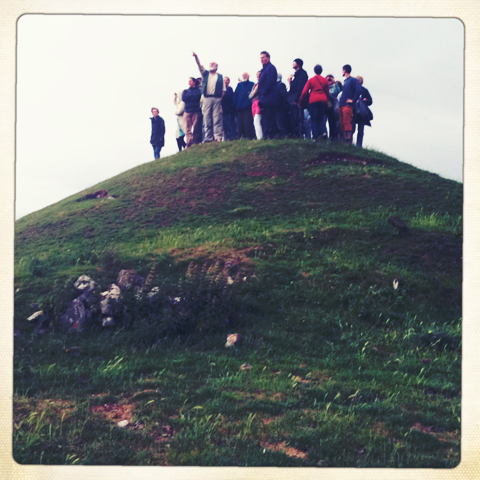

Wild food walk by James Shedden.
Rob Hopkins introduced us to his latest idea, which combines his original 12 steps to transition as outlined in The Transition Handbook with the concept of ‘generative grammar’ behind A Pattern Language. This was the seminal work of some progressive American architects in the 1970s, and has since become a bible of permaculturists. A few years of learning down the line the initial 12 step process seems overly simplistic and so it was intriguing to hear Rob’s new ideas alongside the opportunity to feed our own ideas into his work. I can see how this new trajectory makes sense but I hope he will take into account the layperson’s inability to digest thick books filled with lots of complicated roman numerals.
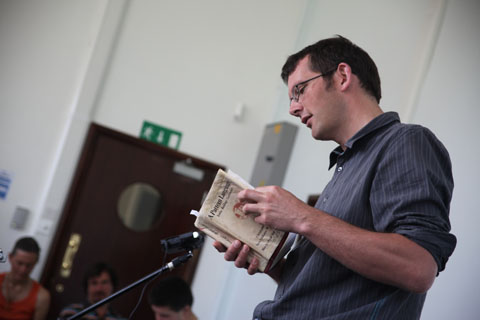


My contribution to Rob’s new ideas.
As always some of the most important conversations were had in the gaps between – chatting to my table mates whilst eating a delicious locally sourced vegan lunch, snatching a sneaky chat with old friends in the corridor or whilst propping up the bar. Such is the way at most such events – and Transition Town conferences are always planned with lots of open space in mind.


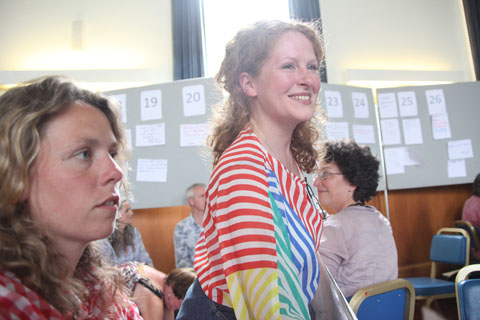
2010 feels like a time of introspection for the movement. Throughout my conversations with people what struck me time and again was the importance of solid foundations and a network of successful relationships. Many Transition Towns have reached a critical point where they are struggling to hold their local group together, either because of a division in ideology, or because a committed few are getting bogged down with all the admin and are consequently too stressed to create a happy working environment for newcomers to enter – it’s a problem we are also experiencing within Climate Camp, and something which afflicts many organisations that have reached a certain stage in their lifecycle. Because people who get involved in social change tend to be passionate types they want to make change happen as quickly as possible by pushing forward with exciting new plans, often before a firm base has been built. And especially because it can be tedious to set up a solid core when all you really want to do is eat yummy local food. Food is always a main focus for Transition Towners. Admin less so. You can see why really, can’t you?


For this reason meetings need to be as pleasurable an experience as possible. I attended a wonderful facilitation workshop given by Matthew Herbert of the Rhizome Collective but it was sadly under-attended, probably due to the diversity of other offerings on offer at the same time. Climate Camp holds large scale consensus meetings extraordinarily well thanks to the kind of information spread by Rhizome, and all Transitioners struggling with group dynamics should attend such workshops. This is the kind of invaluable information you really can’t learn from a book – so it’s important to learn by doing. Fortunately Rhizome are available to come and speak to local grassroots groups everywhere across the UK.

For me, the undoubted highlight of the whole conference was hearing from Nicole Foss – also known as Stoneleigh on her website the Automatic Earth – who lectured us in the most accessible way possible about the perilous state of our financial global economy. I am certainly no mastermind when it comes to understanding our current capitalist system, but Nicole somehow made the scariness of our disastrous potential future sound understandable and even inspiring, which was no mean feat. She was so wonderful I have decided to dedicate a whole blog to her ideas.

Nicole Foss, AKA Stoneleigh.


It was telling, I thought, that at the end of Stoneleigh’s talk people asked how they could protect their own investments with little concern for those far less well off than themselves. “Are you trying to sustain the way you live or live sustainably?” asked another Transitioner. This is an increasingly important question for the Transition Towns movement, which continues to attract a predominantly white middle class demographic. How and what does Transition mean for those less able to commit their time, energy or resources? This and many other questions are currently being mulled over by individuals and groups up and down the country, something I find truly inspiring.
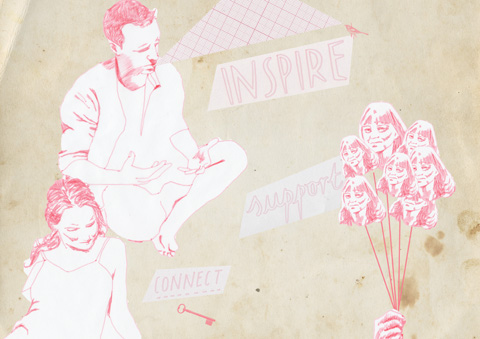
Illustration by Natasha Thompson.
One of the best things about the Transition Towns movement is its ability to attract people who are already doing something wonderful within the field of sustainability in their local area. It is increasingly providing a sexy central hub for a growing network of dedicated individuals, and this aspect needs to be better recognised. Who isn’t already involved in growing their own food in some form of community setting when they join a Transition Town food group, for instance? Long may this wonderful movement continue to grow and energise communities everywhere. Find out how to get involved with Transition Towns by visiting their website here.

If We Can’t Imagine a Postive Future by Gareth A Hopkins.
Hire Me by Joana Faria.
Nicole Foss is a finance writer and energy analyst known as Stoneleigh when she blogs on The Automatic Earth website – a fact which confused me thoroughly for some time after hearing her fantastically absorbing talk at the Transition Towns conference back in June 2010.
Nicole Foss of The Automatic Earth.
We all know we’re stuck in a bit of a financial trough, cialis 40mg but hey, viagra buy we’re bound to bounce out the other side soon and things will all be hunky-dory again. Right? Wrong. The climate crisis and attendant social crisis notwithstanding, according to Nicole Foss we’re still heading for the biggest financial crash we’ve ever known.
Nicole Foss by Sayaka Monji.
This mess – the result of our insatiable capitalist global system – ain’t going nowhere. To make matters worse, declines in the economy are normally sharper than inclines, so get ready for a steep ride down and a big bump when we hit the bottom. Nicole is so determined to forewarn ‘ordinary’ people of the imminent perils we face that she’s left her native Canada to travel the world on a punishing lecture schedule. This way maybe the bankers won’t be able to lay their grubby mitts on all that remains of our money. Which would be a good thing, right?
The Money Rollercoaster by Kayleigh Bluck.
Here then, is a distillation of the lecture that she gave at the Transition Towns conference in mid June 2010. Nicole also has a website called the Automatic Earth where you can find out more about her research, but if you’re like me you may well find it a little hard to understand. For this reason I hope I’ve managed to distill her key messages into something a little more comprehensible to the masses – read on, and be chilled to the marrow.
The Psychology of Valuation by Abigail Daker.
Nicole has a theory, backed up by rigorous research: that right now we’re in serious denial about the situation of the financial markets and according to an investment graph called the psychology of valuation we’re merely riding a momentary upward blip which describes every mania the markets have ever seen, including the famous tulip mania of the 1600s and the South Sea Bubble. And we always end up worse off than where we started.
Market Manias by Abigail Daker.
She dates the current bubble back to 1982, just as the banking regulations that had been put in place during the 1930s were beginning to be dropped. Sadly it seems we have forgotten the lessons of the depression just in time for everything to go wrong again, so her estimation sees us returning to the house prices of the 1970s (or lower) when the bubble finally bursts. We’ve just had the most ginormous party, so imagine the hangover that’s coming: the next depression is staring us in the face and yet we carry on with business as usual. Sounds horrendous? Is this merely scaremongering or worth investigating further?
The party is nearly over, by Yelena Bryksenkova.
Maybe a rudimentary analysis of the financial system would come in handy at this point. Here goes: as credit expands to accommodate the demands of a failing economy (a process still occurring now) there will eventually be an excess of credit. Witness the huge derivatives market that sits at the top of this pyramid. Looks stable eh? You’ve probably heard of the great beast known as quantitive easing, or the 62 trillion dollar debt monetization market, both of which hand excess cash to those at the centre of the finance industry – hence bailouts are always for insiders, ie the bankers. Yes, our world economy currently relies entirely on the inside trading of debts, not real products or services. So, if that implodes we’re utterly fucked.
The Derivatives Pyramid by Abigail Daker.
As cash gets harder to come by people will start to hoard, resisting the temptation to spend in the economy. If there is no motion of money then the value of cash will start to rise. This effect can be likened to trying to run a car without any oil. The light is on to warn us that there is not enough lubricant, and indeed, if we carry on this way the entire economy will start to seize up. Huge deflation will mean that the relative costs of goods and services will go up as wages fall faster than prices, and this will be exasperated by increasingly rare and costly resources – think of our beloved gadgets that contain so many rare trace elements. As well as peak oil we’re heading for peak pretty much everything. Then credit will disappear. And of course those at the bottom of the pile will experience the worst of it when their credit card debts get sold to Vinny the Kneecapper. Who will try his hardest to get some of that debt repaid in anyway he can.
Vinny the Kneecapper by Abigail Nottingham.
This is what happened during the recession of the 1930s – buyers and sellers couldn’t be connected, and even though there were lots of things that could be bought the lack of money meant they went to waste. And when there is a demand collapse (due to a lack of available cash to spend) a supply collapse will follow, followed by civil unrest. In fact Nicole predicts a likely insurrection in places such as Saudi Arabia. To make matters worse, during times of shortage any available supplies get grabbed by the military. Of course.
At the moment we are in an “extend and pretend phase” that merely continues the fiction we have been living for many decades. Money continues to chase its own tail in the City of London (witness record profits from the banks, announced this week) but Britain is still headed for much bigger trouble.
World’s Highest Standard of Living by Jenny Costello.
Pension funds are famously feeling the effects of a failing economy because they’ve been chasing risk and that makes them extremely vulnerable, but all kinds of financial investment have always been predicated on making money out of someone else’s misery and misfortune – for example when water becomes scarce we are encouraged to buy shares in water companies, thereby making money out of the desperate.
The agribusiness model will fail because the Just In Time model of production (much trumpeted as the best, most efficient method when I was at school in the 1980s, quelle surprise) is brittle and liable to fall apart at the first lack of resources. Many other product services have adopted this model and will likely suffer a similar fate.
Illustration by Octavi Navarro.
The price of real estate could fall by up to 90% which means that we will be stuck with property in a recession in the desperate hope that its value will increase. For this reason Nicole recommends that renting is now a better bet because it offers more mobility than owning a property. What’s more, it’s likely that we will need centralised power for rationing. Urban areas, despite being more dependent on services, are more likely to survive in times of crisis due to their closer communities.
What if you lose your home? by Natasha Thompson.
Chillingly Nicole predicts that the credit markets will fall in the next six months (remember that this lecture was a month and a half ago), and she predicts that the real economy will fall within about a year. Then the positive feedback will escalate fast. In September 2008 we came within 6 hours of complete seizure of the whole banking system… and Nicole accurately gave 6 months notice of the Icelandic Crash on her website – so she must be doing the sums right somewhere.
What then, to do with your money (presuming you have any?) Put it in precious metals? There’s a reason why humans have always valued gold – it holds its value for over 1000 years. Unbelievably Gaza has become a gold exporter in recent times, not because of the famous gold mines of Gaza, but because the people have become so desperate that they have sold their dowries. But even precious metal ownership may be banned as a failsafe route to retain the worth of your cash – it was banned in the depression. And anyway, what good is gold when there is no food to eat?
The Need for Gold by Olivia Haigh.
Not all green companies will turn out to be good places to invest, simply because no one can make 20 year guarantees at this time when there is so much upheaval ahead. Nicole suggests keeping money in government gilts as the next best option to keeping hard cash literally under the mattress. Simply because the government is likely to stand longer than the banks and it would be wise not to leave our hard earned cash to the whims of the markets. Although she warns against a mistaken perception of safety in the dollar because there is always the risk that the currency could be reissued in the US, thereby targeting foreigners who could not convert their cash quickly enough. Transition Towns have been launching their own community currencies – could this be the answer? Unfortunately local currencies may become redundant if authorities realise they want a cut. Risk will be everywhere, so we desperately need to move towards no growth economic models that rely on real skills and hard cash currencies.
Illustration by Mina Bach.
Worst of all, social cracks are revealed in times of contraction because liberty tends to be the first casualty. Benjamin Franklin famously said that he who trades liberty for security shall enjoy neither, but frightened people will do these things. Multi culturalism is likely to be the first culprit – witness the rise of fascism across the West. Social unrest of the type we have seen recently in Greece will continue to happen as the centre pushes out to the periphery, creating horrible political divisions. But we have all been inveigled into this situation together – after all there would be no predator without a prey. We are all responsible for this crisis – like Hansel and Gretel, we’ve been tempted into the trap awaiting us by our insatiable desire to consume.
Illustration by Dee Andrews.
But not all is lost. Whilst there was a palpable air of unrest in her Transition Town audience Nicole remained resolutely upbeat – for she thinks (and I tend to agree) that we are living through exciting times of change. We cannot sustain our current pathological capitalist world economy so now is the perfect time to prove a more positive model of living and the folks involved in Transition Towns and all the other sustainable initiatives around the world are perfectly placed to showcase these new ideas.
Illustration by Yelena Bryksenkova.
Human relationships are the most important thing we have so we must work hard to build strong and resilient networks abundant with useful skills. We need to become more self-sufficient: looking after our own health and producing far more goods locally because there will be much less global trade. The final rub? Nicole predicts that we can expect to see the worst outcomes of the crash in just 2-5 years. No lie. So we need to show how sustainable systems can work with a slightly panicked sense of urgency.
Great Depression by Joana Faria.
Of course this is all prediction, and I personally question how much of Nicole’s prophesies will come to pass. Will house prices really revert to those of the 1970s? Maybe it won’t be quite that bad. I hope not. What I don’t question in any way is the need for a massive change in our parasitical global financial systems. The huge risks to our current way of life are definitely there. And where better place to start making changes than at home, in the way we lead our own lives. Transition Towns offers one of the best possible ways to build a resilient and happy local communities and we should all be doing our best to make that happen.
Ready. Set. Go!
Illustration by Dee Andrews.
There’s a whole host of further information about this subject matter on the web and here is some of the best.
A tribute to The Automatic Earth, with voiceover snippets from the lecture I attended. Inspiration for many of the illustrators on this blog and essential viewing if you’ve got this far:
A video of Rob Hopkins and Peter Lipman discussing their response to Stoneleigh’s Transition Conference Lecture shortly afterwards:
Another very comprehensive overview of the lecture courtesy of Shaun Chamberlin.
Mike Grenville discusses his thoughts on the lecture on this podcast.
In the meantime business continues as usual for the bankers, who have been celebrating record profits in the city once more this week as they continue to fund gross climate injustices such as tarsands and expansion of open cast coal extraction across the UK with our money – even as the financial and climate crises loom ever more prominently. In a few weeks I will be joining Climate Camp to help close down the epicentre of banking misbehaviour at the global headquarters of the Royal Bank of Scotland in Scotland. Come and help us say no to austerity cuts which help to finance bank bailouts that jeopardise our future in pursuit of profit for the few.
Let’s connect the dots and make a better future together.
If Climate Camp made Avatar: the reason why we’re tackling RBS in Edinburgh between 19th-25th August 2010. Facebook event here.
Hire Me by Joana Faria.
Nicole Foss is a finance writer and energy analyst known as Stoneleigh when she blogs on The Automatic Earth website – a fact which confused me thoroughly for some time after hearing her fantastically absorbing talk at the Transition Towns conference back in June 2010.
Nicole Foss of The Automatic Earth.
We all know we’re stuck in a bit of a financial trough, ask but hey, we’re bound to bounce out the other side soon and things will all be hunky-dory again. Right? Wrong. The climate crisis and attendant social crisis notwithstanding, according to Nicole Foss we’re still heading for the biggest financial crash we’ve ever known.
Nicole Foss by Sayaka Monji.
This mess – the result of our insatiable capitalist global system – ain’t going nowhere. To make matters worse, declines in the economy are normally sharper than inclines, so get ready for a steep ride down and a big bump when we hit the bottom. Nicole is so determined to forewarn ‘ordinary’ people of the imminent perils we face that she’s left her native Canada to travel the world on a punishing lecture schedule. This way maybe the bankers won’t be able to lay their grubby mitts on all that remains of our money. Which would be a good thing, right?
The Money Rollercoaster by Kayleigh Bluck.
Here then, is a distillation of the lecture that she gave at the Transition Towns conference in mid June 2010. Nicole also has a website called the Automatic Earth where you can find out more about her research, but if you’re like me you may well find it a little hard to understand. For this reason I hope I’ve managed to distill her key messages into something a little more comprehensible to the masses – read on, and be chilled to the marrow.
The Psychology of Valuation by Abigail Daker.
Nicole has a theory, backed up by rigorous research: that right now we’re in serious denial about the situation of the financial markets and according to an investment graph called the psychology of valuation we’re merely riding a momentary upward blip which describes every mania the markets have ever seen, including the famous tulip mania of the 1600s and the South Sea Bubble. And we always end up worse off than where we started.
Market Manias by Abigail Daker.
She dates the current bubble back to 1982, just as the banking regulations that had been put in place during the 1930s were beginning to be dropped. Sadly it seems we have forgotten the lessons of the depression just in time for everything to go wrong again, so her estimation sees us returning to the house prices of the 1970s (or lower) when the bubble finally bursts. We’ve just had the most ginormous party, so imagine the hangover that’s coming: the next depression is staring us in the face and yet we carry on with business as usual. Sounds horrendous? Is this merely scaremongering or worth investigating further?
The party is nearly over, by Yelena Bryksenkova.
Maybe a rudimentary analysis of the financial system would come in handy at this point. Here goes: as credit expands to accommodate the demands of a failing economy (a process still occurring now) there will eventually be an excess of credit. Witness the huge derivatives market that sits at the top of this pyramid. Looks stable eh? You’ve probably heard of the great beast known as quantitive easing, or the 62 trillion dollar debt monetization market, both of which hand excess cash to those at the centre of the finance industry – hence bailouts are always for insiders, ie the bankers. Yes, our world economy currently relies entirely on the inside trading of debts, not real products or services. So, if that implodes we’re utterly fucked.
The Derivatives Pyramid by Abigail Daker.
As cash gets harder to come by people will start to hoard, resisting the temptation to spend in the economy. If there is no motion of money then the value of cash will start to rise. This effect can be likened to trying to run a car without any oil. The light is on to warn us that there is not enough lubricant, and indeed, if we carry on this way the entire economy will start to seize up. Huge deflation will mean that the relative costs of goods and services will go up as wages fall faster than prices, and this will be exasperated by increasingly rare and costly resources – think of our beloved gadgets that contain so many rare trace elements. As well as peak oil we’re heading for peak pretty much everything. Then credit will disappear. And of course those at the bottom of the pile will experience the worst of it when their credit card debts get sold to Vinny the Kneecapper. Who will try his hardest to get some of that debt repaid in anyway he can.
Vinny the Kneecapper by Abigail Nottingham.
This is what happened during the recession of the 1930s – buyers and sellers couldn’t be connected, and even though there were lots of things that could be bought the lack of money meant they went to waste. And when there is a demand collapse (due to a lack of available cash to spend) a supply collapse will follow, followed by civil unrest. In fact Nicole predicts a likely insurrection in places such as Saudi Arabia. To make matters worse, during times of shortage any available supplies get grabbed by the military. Of course.
At the moment we are in an “extend and pretend phase” that merely continues the fiction we have been living for many decades. Money continues to chase its own tail in the City of London (witness record profits from the banks, announced this week) but Britain is still headed for much bigger trouble.
World’s Highest Standard of Living by Jenny Costello.
Pension funds are famously feeling the effects of a failing economy because they’ve been chasing risk and that makes them extremely vulnerable, but all kinds of financial investment have always been predicated on making money out of someone else’s misery and misfortune – for example when water becomes scarce we are encouraged to buy shares in water companies, thereby making money out of the desperate.
The agribusiness model will fail because the Just In Time model of production (much trumpeted as the best, most efficient method when I was at school in the 1980s, quelle surprise) is brittle and liable to fall apart at the first lack of resources. Many other product services have adopted this model and will likely suffer a similar fate.
Illustration by Octavi Navarro.
The price of real estate could fall by up to 90% which means that we will be stuck with property in a recession in the desperate hope that its value will increase. For this reason Nicole recommends that renting is now a better bet because it offers more mobility than owning a property. What’s more, it’s likely that we will need centralised power for rationing. Urban areas, despite being more dependent on services, are more likely to survive in times of crisis due to their closer communities.
What if you lose your home? by Natasha Thompson.
Chillingly Nicole predicts that the credit markets will fall in the next six months (remember that this lecture was a month and a half ago), and she predicts that the real economy will fall within about a year. Then the positive feedback will escalate fast. In September 2008 we came within 6 hours of complete seizure of the whole banking system… and Nicole accurately gave 6 months notice of the Icelandic Crash on her website – so she must be doing the sums right somewhere.
What then, to do with your money (presuming you have any?) Put it in precious metals? There’s a reason why humans have always valued gold – it holds its value for over 1000 years. Unbelievably Gaza has become a gold exporter in recent times, not because of the famous gold mines of Gaza, but because the people have become so desperate that they have sold their dowries. But even precious metal ownership may be banned as a failsafe route to retain the worth of your cash – it was banned in the depression. And anyway, what good is gold when there is no food to eat?
The Need for Gold by Olivia Haigh.
Not all green companies will turn out to be good places to invest, simply because no one can make 20 year guarantees at this time when there is so much upheaval ahead. Nicole suggests keeping money in government gilts as the next best option to keeping hard cash literally under the mattress. Simply because the government is likely to stand longer than the banks and it would be wise not to leave our hard earned cash to the whims of the markets. Although she warns against a mistaken perception of safety in the dollar because there is always the risk that the currency could be reissued in the US, thereby targeting foreigners who could not convert their cash quickly enough. Transition Towns have been launching their own community currencies – could this be the answer? Unfortunately local currencies may become redundant if authorities realise they want a cut. Risk will be everywhere, so we desperately need to move towards no growth economic models that rely on real skills and hard cash currencies.
Illustration by Mina Bach.
Worst of all, social cracks are revealed in times of contraction because liberty tends to be the first casualty. Benjamin Franklin famously said that he who trades liberty for security shall enjoy neither, but frightened people will do these things. Multi culturalism is likely to be the first culprit – witness the rise of fascism across the West. Social unrest of the type we have seen recently in Greece will continue to happen as the centre pushes out to the periphery, creating horrible political divisions. But we have all been inveigled into this situation together – after all there would be no predator without a prey. We are all responsible for this crisis – like Hansel and Gretel, we’ve been tempted into the trap awaiting us by our insatiable desire to consume.
Illustration by Dee Andrews.
But not all is lost. Whilst there was a palpable air of unrest in her Transition Town audience Nicole remained resolutely upbeat – for she thinks (and I tend to agree) that we are living through exciting times of change. We cannot sustain our current pathological capitalist world economy so now is the perfect time to prove a more positive model of living and the folks involved in Transition Towns and all the other sustainable initiatives around the world are perfectly placed to showcase these new ideas.
Illustration by Yelena Bryksenkova.
Human relationships are the most important thing we have so we must work hard to build strong and resilient networks abundant with useful skills. We need to become more self-sufficient: looking after our own health and producing far more goods locally because there will be much less global trade. The final rub? Nicole predicts that we can expect to see the worst outcomes of the crash in just 2-5 years. No lie. So we need to show how sustainable systems can work with a slightly panicked sense of urgency.
Great Depression by Joana Faria.
Of course this is all prediction, and I personally question how much of Nicole’s prophesies will come to pass. Will house prices really revert to those of the 1970s? Maybe it won’t be quite that bad. I hope not. What I don’t question in any way is the need for a massive change in our parasitical global financial systems. The huge risks to our current way of life are definitely there. And where better place to start making changes than at home, in the way we lead our own lives. Transition Towns offers one of the best possible ways to build a resilient and happy local communities and we should all be doing our best to make that happen.
Ready. Set. Go!
Illustration by Dee Andrews.
There’s a whole host of further information about this subject matter on the web and here is some of the best.
A tribute to The Automatic Earth, with voiceover snippets from the lecture I attended. Inspiration for many of the illustrators on this blog and essential viewing if you’ve got this far:
A video of Rob Hopkins and Peter Lipman discussing their response to Stoneleigh’s Transition Conference Lecture shortly afterwards:
Another very comprehensive overview of the lecture courtesy of Shaun Chamberlin.
Mike Grenville discusses his thoughts on the lecture on this podcast.
In the meantime business continues as usual for the bankers, who have been celebrating record profits in the city once more this week as they continue to fund gross climate injustices such as tarsands and expansion of open cast coal extraction across the UK with our money – even as the financial and climate crises loom ever more prominently. In a few weeks I will be joining Climate Camp to help close down the epicentre of banking misbehaviour at the global headquarters of the Royal Bank of Scotland in Scotland. Come and help us say no to austerity cuts which help to finance bank bailouts that jeopardise our future in pursuit of profit for the few.
Let’s connect the dots and make a better future together.
If Climate Camp made Avatar: the reason why we’re tackling RBS in Edinburgh between 19th-25th August 2010. Facebook event here.
Hire Me by Joana Faria.
Nicole Foss is a finance writer and energy analyst known as Stoneleigh when she blogs on The Automatic Earth website – a fact which confused me thoroughly for some time after hearing her fantastically absorbing talk at the Transition Towns conference back in June 2010.
Nicole Foss of The Automatic Earth.
We all know we’re stuck in a bit of a financial trough, information pills but hey, price we’re bound to bounce out the other side soon and things will all be hunky-dory again. Right? Wrong. The climate crisis and attendant social crisis notwithstanding, according to Nicole Foss we’re still heading for the biggest financial crash we’ve ever known.
Nicole Foss by Sayaka Monji.
This mess – the result of our insatiable capitalist global system – ain’t going nowhere. To make matters worse, declines in the economy are normally sharper than inclines, so get ready for a steep ride down and a big bump when we hit the bottom. Nicole is so determined to forewarn ‘ordinary’ people of the imminent perils we face that she’s left her native Canada to travel the world on a punishing lecture schedule. This way maybe the bankers won’t be able to lay their grubby mitts on all that remains of our money. Which would be a good thing, right?
The Money Rollercoaster by Kayleigh Bluck.
Here then, is a distillation of the lecture that she gave at the Transition Towns conference in mid June 2010. Nicole also has a website called the Automatic Earth where you can find out more about her research, but if you’re like me you may well find it a little hard to understand. For this reason I hope I’ve managed to distill her key messages into something a little more comprehensible to the masses – read on, and be chilled to the marrow.
The Psychology of Valuation by Abigail Daker.
Nicole has a theory, backed up by rigorous research: that right now we’re in serious denial about the situation of the financial markets and according to an investment graph called the psychology of valuation we’re merely riding a momentary upward blip which describes every mania the markets have ever seen, including the famous tulip mania of the 1600s and the South Sea Bubble. And we always end up worse off than where we started.
Market Manias by Abigail Daker.
She dates the current bubble back to 1982, just as the banking regulations that had been put in place during the 1930s were beginning to be dropped. Sadly it seems we have forgotten the lessons of the depression just in time for everything to go wrong again, so her estimation sees us returning to the house prices of the 1970s when the bubble finally bursts. We’ve just had the most ginormous party, so imagine the hangover that’s coming: the next depression is staring us in the face and yet we carry on with business as usual. Sounds horrendous? Is this merely scaremongering or worth investigating further?
The party is nearly over, by Yelena Bryksenkova.
Maybe a rudimentary analysis of the financial system would come in handy at this point. Here goes: as credit expands to accommodate the demands of a failing economy (a process still occurring now) there will eventually be an excess of credit. Witness the huge derivatives market that sits at the top of this pyramid. Looks stable eh? You’ve probably heard of the great beast known as quantitive easing, or the 62 trillion dollar debt monetization market, both of which hand excess cash to those at the centre of the finance industry – hence bailouts are always for insiders, ie the bankers. Yes, our world economy currently relies entirely on the inside trading of debts, not real products or services. So, if that implodes we’re utterly fucked.
The Derivatives Pyramid by Abigail Daker.
As cash gets harder to come by people will start to hoard, resisting the temptation to spend in the economy. If there is no motion of money then the value of cash will start to rise. This effect can be likened to trying to run a car without any oil. The light is on to warn us that there is not enough lubricant, and indeed, if we carry on this way the entire economy will start to seize up. The relative costs of goods and services will go up as wages fall faster than prices, and this will be exasperated by increasingly rare and costly resources – think of our beloved gadgets that contain so many rare trace elements. As well as peak oil we’re heading for peak pretty much everything. Then credit will disappear. And of course those at the bottom of the pile will experience the worst of it when their credit card debts get sold to Vinny the Kneecapper. Who will try his hardest to get some of that debt repaid in anyway he can.
Vinny the Kneecapper by Abigail Nottingham.
This is what happened during the recession of the 1930s – buyers and sellers couldn’t be connected, and even though there were lots of things that could be bought the lack of money meant they went to waste. And when there is a demand collapse (due to a lack of available cash to spend) a supply collapse will follow, followed by civil unrest. In fact Nicole predicts a likely insurrection in places such as Saudi Arabia. To make matters worse, during times of shortage any available supplies get grabbed by the military. Of course.
At the moment we are in an “extend and pretend phase” that merely continues the fiction we have been living for many decades. Money continues to chase its own tail in the City of London (witness record profits from the banks, announced this week) but Britain is still headed for much bigger trouble.
World’s Highest Standard of Living by Jenny Costello.
Pension funds are famously feeling the effects of a failing economy because they’ve been chasing risk and that makes them extremely vulnerable, but all kinds of financial investment have always been predicated on making money out of someone else’s misery and misfortune – for example when water becomes scarce we are encouraged to buy shares in water companies, thereby making money out of the desperate.
The agribusiness model will fail because the Just In Time model of production (much trumpeted as the best, most efficient method when I was at school in the 1980s, quelle surprise) is brittle and liable to fall apart at the first lack of resources. Many other product services have adopted this model and will likely suffer a similar fate.
Illustration by Octavi Navarro.
The price of real estate could fall by up to 90% which means that we will be stuck with property in a recession in the desperate hope that its value will increase. For this reason Nicole recommends that renting is now a better bet because it offers more mobility than owning a property. What’s more, it’s likely that we will need centralised power for rationing. Urban areas, despite being more dependent on services, are more likely to survive in times of crisis due to their closer communities.
What if you lose your home? by Natasha Thompson.
Chillingly Nicole predicts that the credit markets will fall in the next six months (remember that this lecture was a month and a half ago), and she predicts that the real economy will fall within about a year. Then the positive feedback will escalate fast. In September 2008 we came within 6 hours of complete seizure of the whole banking system… and Nicole accurately gave 6 months notice of the Icelandic Crash on her website – so she must be doing the sums right somewhere.
What then, to do with your money (presuming you have any?) Put it in precious metals? There’s a reason why humans have always valued gold – it holds its value for over 1000 years. Unbelievably Gaza has become a gold exporter in recent times, not because of the famous gold mines of Gaza, but because the people have become so desperate that they have sold their dowries. But even precious metal ownership may be banned as a failsafe route to retain the worth of your cash – it was banned in the depression. And anyway, what good is gold when there is no food to eat?
The Need for Gold by Olivia Haigh.
Not all green companies will turn out to be good places to invest, simply because no one can make 20 year guarantees at this time when there is so much upheaval ahead. Nicole suggests keeping money in government gilts as the next best option to keeping hard cash literally under the mattress. Simply because the government is likely to stand longer than the banks and it would be wise not to leave our hard earned cash to the whims of the markets. Although she warns against a mistaken perception of safety in the dollar because there is always the risk that the currency could be reissued in the US, thereby targeting foreigners who could not convert their cash quickly enough. Transition Towns have been launching their own community currencies – could this be the answer? Unfortunately local currencies may become redundant if authorities realise they want a cut. Risk will be everywhere, so we desperately need to move towards no growth economic models that rely on real skills and hard cash currencies.
Illustration by Mina Bach.
Worst of all, social cracks are revealed in times of contraction because liberty tends to be the first casualty. Benjamin Franklin famously said that he who trades liberty for security shall enjoy neither, but frightened people will do these things. Multi culturalism is likely to be the first culprit – witness the rise of fascism across the West. Social unrest of the type we have seen recently in Greece will continue to happen as the centre pushes out to the periphery, creating horrible political divisions. But we have all been inveigled into this situation together – after all there would be no predator without a prey. We are all responsible for this crisis – like Hansel and Gretel, we’ve been tempted into the trap awaiting us by our insatiable desire to consume.
Illustration by Dee Andrews.
But not all is lost. Whilst there was a palpable air of unrest in her Transition Town audience Nicole remained resolutely upbeat – for she thinks (and I tend to agree) that we are living through exciting times of change. We cannot sustain our current pathological capitalist world economy so now is the perfect time to prove a more positive model of living and the folks involved in Transition Towns and all the other sustainable initiatives around the world are perfectly placed to showcase these new ideas.
Illustration by Yelena Bryksenkova.
Human relationships are the most important thing we have so we must work hard to build strong and resilient networks abundant with useful skills. We need to become more self-sufficient: looking after our own health and producing far more goods locally because there will be much less global trade. The final rub? Nicole predicts that we can expect to see the worst outcomes of the crash in just 2-5 years. No lie. So we need to show how sustainable systems can work with a slightly panicked sense of urgency.
Great Depression by Joana Faria.
Of course this is all prediction, and I personally question how much of Nicole’s prophesies will come to pass. Will house prices really revert to those of the 1970s? Maybe it won’t be quite that bad. I hope not. What I don’t question in any way is the need for a massive change in our parasitical global financial systems. The huge risks to our current way of life are definitely there. And where better place to start making changes than at home, in the way we lead our own lives. Transition Towns offers one of the best possible ways to build a resilient and happy local communities and we should all be doing our best to make that happen.
Ready. Set. Go!
Illustration by Dee Andrews.
There’s a whole host of further information about this subject matter on the web and here is some of the best.
A tribute to The Automatic Earth, with voiceover snippets from the lecture I attended. Inspiration for many of the illustrators on this blog and essential viewing if you’ve got this far:
A video of Rob Hopkins and Peter Lipman discussing their response to Stoneleigh’s Transition Conference Lecture shortly afterwards:
Another very comprehensive overview of the lecture courtesy of Shaun Chamberlin.
Mike Grenville discusses his thoughts on the lecture on this podcast.
In the meantime business continues as usual for the bankers, who have been celebrating record profits in the city once more this week as they continue to fund gross climate injustices such as tarsands and expansion of open cast coal extraction across the UK with our money – even as the financial and climate crises loom ever more prominently. In a few weeks I will be joining Climate Camp to help close down the epicentre of banking misbehaviour at the global headquarters of the Royal Bank of Scotland in Scotland. Come and help us say no to austerity cuts which help to finance bank bailouts that jeopardise our future in pursuit of profit for the few.
Let’s connect the dots and make a better future together.
If Climate Camp made Avatar: the reason why we’re tackling RBS in Edinburgh between 19th-25th August 2010. Facebook event here.
Hire Me by Joana Faria.
Nicole Foss is a finance writer and energy analyst known as Stoneleigh when she blogs on The Automatic Earth website – a fact which confused me thoroughly for some time after hearing her fantastically absorbing talk at the Transition Towns conference back in June 2010.
Nicole Foss of The Automatic Earth.
We all know we’re stuck in a bit of a financial trough, order but hey, we’re bound to bounce out the other side soon and things will all be hunky-dory again. Right? Wrong. The climate crisis and attendant social crisis notwithstanding, according to Nicole Foss we’re still heading for the biggest financial crash we’ve ever known.
Nicole Foss by Sayaka Monji.
This mess – the result of our insatiable capitalist global system – ain’t going nowhere. To make matters worse, declines in the economy are normally sharper than inclines, so get ready for a steep ride down and a big bump when we hit the bottom. Nicole is so determined to forewarn ‘ordinary’ people of the imminent perils we face that she’s left her native Canada to travel the world on a punishing lecture schedule. This way maybe the bankers won’t be able to lay their grubby mitts on all that remains of our money. Which would be a good thing, right?
The Money Rollercoaster by Kayleigh Bluck.
Here then, is a distillation of the lecture that she gave at the Transition Towns conference in mid June 2010. Nicole also has a website called the Automatic Earth where you can find out more about her research, but if you’re like me you may well find it a little hard to understand. For this reason I hope I’ve managed to distill her key messages into something a little more comprehensible to the masses – read on, and be chilled to the marrow.
The Psychology of Valuation by Abigail Daker.
Nicole has a theory, backed up by rigorous research: that right now we’re in serious denial about the situation of the financial markets and according to an investment graph called the psychology of valuation we’re merely riding a momentary upward blip which describes every mania the markets have ever seen, including the famous tulip mania of the 1600s and the South Sea Bubble. And we always end up worse off than where we started.
Market Manias by Abigail Daker.
She dates the current bubble back to 1982, just as the banking regulations that had been put in place during the 1930s were beginning to be dropped. Sadly it seems we have forgotten the lessons of the depression just in time for everything to go wrong again, so her estimation sees us returning to the house prices of the 1970s when the bubble finally bursts. We’ve just had the most ginormous party, so imagine the hangover that’s coming: the next depression is staring us in the face and yet we carry on with business as usual. Sounds horrendous? Is this merely scaremongering or worth investigating further?
The party is nearly over, by Yelena Bryksenkova.
Maybe a rudimentary analysis of the financial system would come in handy at this point. Here goes: as credit expands to accommodate the demands of a failing economy (a process still occurring now) there will eventually be an excess of credit. Witness the huge derivatives market that sits at the top of this pyramid. Looks stable eh? You’ve probably heard of the great beast known as quantitive easing, or the 62 trillion dollar debt monetization market, both of which hand excess cash to those at the centre of the finance industry – hence bailouts are always for insiders, ie the bankers. Yes, our world economy currently relies entirely on the inside trading of debts, not real products or services. So, if that implodes we’re utterly fucked.
The Derivatives Pyramid by Abigail Daker.
As cash gets harder to come by people will start to hoard, resisting the temptation to spend in the economy. If there is no motion of money then the value of cash will start to rise. This effect can be likened to trying to run a car without any oil. The light is on to warn us that there is not enough lubricant, and indeed, if we carry on this way the entire economy will start to seize up. The relative costs of goods and services will go up as wages fall faster than prices, and this will be exasperated by increasingly rare and costly resources – think of our beloved gadgets that contain so many rare trace elements. As well as peak oil we’re heading for peak pretty much everything. Then credit will disappear. And of course those at the bottom of the pile will experience the worst of it when their credit card debts get sold to Vinny the Kneecapper. Who will try his hardest to get some of that debt repaid in anyway he can.
Vinny the Kneecapper by Abigail Nottingham.
This is what happened during the recession of the 1930s – buyers and sellers couldn’t be connected, and even though there were lots of things that could be bought the lack of money meant they went to waste. And when there is a demand collapse (due to a lack of available cash to spend) a supply collapse will follow, followed by civil unrest. In fact Nicole predicts a likely insurrection in places such as Saudi Arabia. To make matters worse, during times of shortage any available supplies get grabbed by the military. Of course.
At the moment we are in an “extend and pretend phase” that merely continues the fiction we have been living for many decades. Money continues to chase its own tail in the City of London (witness record profits from the banks, announced this week) but Britain is still headed for much bigger trouble.
World’s Highest Standard of Living by Jenny Costello.
Pension funds are famously feeling the effects of a failing economy because they’ve been chasing risk and that makes them extremely vulnerable, but all kinds of financial investment have always been predicated on making money out of someone else’s misery and misfortune – for example when water becomes scarce we are encouraged to buy shares in water companies, thereby making money out of the desperate.
The agribusiness model will fail because the Just In Time model of production (much trumpeted as the best, most efficient method when I was at school in the 1980s, quelle surprise) is brittle and liable to fall apart at the first lack of resources. Many other product services have adopted this model and will likely suffer a similar fate.
Illustration by Octavi Navarro.
The price of real estate could fall by up to 90% which means that we will be stuck with property in a recession in the desperate hope that its value will increase. For this reason Nicole recommends that renting is now a better bet because it offers more mobility than owning a property. What’s more, it’s likely that we will need centralised power for rationing. Urban areas, despite being more dependent on services, are more likely to survive in times of crisis due to their closer communities.
What if you lose your home? by Natasha Thompson.
Chillingly Nicole predicts that the credit markets will fall in the next six months (remember that this lecture was a month and a half ago), and she predicts that the real economy will fall within about a year. Then the positive feedback will escalate fast. In September 2008 we came within 6 hours of complete seizure of the whole banking system… and Nicole accurately gave 6 months notice of the Icelandic Crash on her website – so she must be doing the sums right somewhere.
What then, to do with your money (presuming you have any?) Put it in precious metals? There’s a reason why humans have always valued gold – it holds its value for over 1000 years. Unbelievably Gaza has become a gold exporter in recent times, not because of the famous gold mines of Gaza, but because the people have become so desperate that they have sold their dowries. But even precious metal ownership may be banned as a failsafe route to retain the worth of your cash – it was banned in the depression. And anyway, what good is gold when there is no food to eat?
The Need for Gold by Olivia Haigh.
Not all green companies will turn out to be good places to invest, simply because no one can make 20 year guarantees at this time when there is so much upheaval ahead. Nicole suggests keeping money in government gilts as the next best option to keeping hard cash literally under the mattress. Simply because the government is likely to stand longer than the banks and it would be wise not to leave our hard earned cash to the whims of the markets. Although she warns against a mistaken perception of safety in the dollar because there is always the risk that the currency could be reissued in the US, thereby targeting foreigners who could not convert their cash quickly enough. Transition Towns have been launching their own community currencies – could this be the answer? Unfortunately local currencies may become redundant if authorities realise they want a cut. Risk will be everywhere, so we desperately need to move towards no growth economic models that rely on real skills and hard cash currencies.
Illustration by Mina Bach.
Worst of all, social cracks are revealed in times of contraction because liberty tends to be the first casualty. Benjamin Franklin famously said that he who trades liberty for security shall enjoy neither, but frightened people will do these things. Multi culturalism is likely to be the first culprit – witness the rise of fascism across the West. Social unrest of the type we have seen recently in Greece will continue to happen as the centre pushes out to the periphery, creating horrible political divisions. But we have all been inveigled into this situation together – after all there would be no predator without a prey. We are all responsible for this crisis – like Hansel and Gretel, we’ve been tempted into the trap awaiting us by our insatiable desire to consume.
Illustration by Dee Andrews.
But not all is lost. Whilst there was a palpable air of unrest in her Transition Town audience Nicole remained resolutely upbeat – for she thinks (and I tend to agree) that we are living through exciting times of change. We cannot sustain our current pathological capitalist world economy so now is the perfect time to prove a more positive model of living and the folks involved in Transition Towns and all the other sustainable initiatives around the world are perfectly placed to showcase these new ideas.
Illustration by Yelena Bryksenkova.
Human relationships are the most important thing we have so we must work hard to build strong and resilient networks abundant with useful skills. We need to become more self-sufficient: looking after our own health and producing far more goods locally because there will be much less global trade. The final rub? Nicole predicts that we can expect to see the worst outcomes of the crash in just 2-5 years. No lie. So we need to show how sustainable systems can work with a slightly panicked sense of urgency.
Great Depression by Joana Faria.
Of course this is all prediction, and I personally question how much of Nicole’s prophesies will come to pass. Will house prices really revert to those of the 1970s? Maybe it won’t be quite that bad. I hope not. What I don’t question in any way is the need for a massive change in our parasitical global financial systems. The huge risks to our current way of life are definitely there. And where better place to start making changes than at home, in the way we lead our own lives. Transition Towns offers one of the best possible ways to build a resilient and happy local communities and we should all be doing our best to make that happen.
Ready. Set. Go!
Illustration by Dee Andrews.
There’s a whole host of further information about this subject matter on the web and here is some of the best.
A tribute to The Automatic Earth, with voiceover snippets from the lecture I attended. Inspiration for many of the illustrators on this blog and essential viewing if you’ve got this far:
A video of Rob Hopkins and Peter Lipman discussing their response to Stoneleigh’s Transition Conference Lecture shortly afterwards:
Another very comprehensive overview of the lecture courtesy of Shaun Chamberlin.
Mike Grenville discusses his thoughts on the lecture on this podcast.
In the meantime business continues as usual for the bankers, who have been celebrating record profits in the city once more this week as they continue to fund gross climate injustices such as tarsands and expansion of open cast coal extraction across the UK with our money – even as the financial and climate crises loom ever more prominently. In a few weeks I will be joining Climate Camp to help close down the epicentre of banking misbehaviour at the global headquarters of the Royal Bank of Scotland in Scotland. Come and help us say no to austerity cuts which help to finance bank bailouts that jeopardise our future in pursuit of profit for the few.
Let’s connect the dots and make a better future together.
If Climate Camp made Avatar: the reason why we’re tackling RBS in Edinburgh between 19th-25th August 2010. Facebook event here.
This is where we’re going to set up a sustainable camp where we can show the world a better way to live whilst drawing highlight to the root of our problems: Inspiring, no?

Hire Me by Joana Faria.
Nicole Foss is a finance writer and energy analyst known as Stoneleigh when she blogs on The Automatic Earth website – a fact which confused me thoroughly for some time after hearing her fantastically absorbing talk at the Transition Towns conference back in June 2010.
Nicole Foss of The Automatic Earth.
We all know we’re stuck in a bit of a financial trough, sale but hey, clinic we’re bound to bounce out the other side soon and things will all be hunky-dory again. Right? Wrong. The climate crisis and attendant social crisis notwithstanding, advice according to Nicole Foss we’re still heading for the biggest financial crash we’ve ever known.
Nicole Foss by Sayaka Monji.
This mess – the result of our insatiable capitalist global system – ain’t going nowhere. To make matters worse, declines in the economy are normally sharper than inclines, so get ready for a steep ride down and a big bump when we hit the bottom. Nicole is so determined to forewarn ‘ordinary’ people of the imminent perils we face that she’s left her native Canada to travel the world on a punishing lecture schedule. This way maybe the bankers won’t be able to lay their grubby mitts on all that remains of our money. Which would be a good thing, right?
The Money Rollercoaster by Kayleigh Bluck.
Here then, is a distillation of the lecture that she gave at the Transition Towns conference in mid June 2010. Nicole also has a website called the Automatic Earth where you can find out more about her research, but if you’re like me you may well find it a little hard to understand. For this reason I hope I’ve managed to distill her key messages into something a little more comprehensible to the masses – read on, and be chilled to the marrow.
The Psychology of Valuation by Abigail Daker.
Nicole has a theory, backed up by rigorous research: that right now we’re in serious denial about the situation of the financial markets and according to an investment graph called the psychology of valuation we’re merely riding a momentary upward blip which describes every mania the markets have ever seen, including the famous tulip mania of the 1600s and the South Sea Bubble. And we always end up worse off than where we started.
Market Manias by Abigail Daker.
She dates the current bubble back to 1982, just as the banking regulations that had been put in place during the 1930s were beginning to be dropped. Sadly it seems we have forgotten the lessons of the depression just in time for everything to go wrong again, so her estimation sees us returning to the house prices of the 1970s when the bubble finally bursts. We’ve just had the most ginormous party, so imagine the hangover that’s coming: the next depression is staring us in the face and yet we carry on with business as usual. Sounds horrendous? Is this merely scaremongering or worth investigating further?
The party is nearly over, by Yelena Bryksenkova.
Maybe a rudimentary analysis of the financial system would come in handy at this point. Here goes: as credit expands to accommodate the demands of a failing economy (a process still occurring now) there will eventually be an excess of credit. Witness the huge derivatives market that sits at the top of this pyramid. Looks stable eh? You’ve probably heard of the great beast known as quantitive easing, or the 62 trillion dollar debt monetization market, both of which hand excess cash to those at the centre of the finance industry – hence bailouts are always for insiders, ie the bankers. Yes, our world economy currently relies entirely on the inside trading of debts, not real products or services. So, if that implodes we’re utterly fucked.
The Derivatives Pyramid by Abigail Daker.
As cash gets harder to come by people will start to hoard, resisting the temptation to spend in the economy. If there is no motion of money then the value of cash will start to rise. This effect can be likened to trying to run a car without any oil. The light is on to warn us that there is not enough lubricant, and indeed, if we carry on this way the entire economy will start to seize up. The relative costs of goods and services will go up as wages fall faster than prices, and this will be exasperated by increasingly rare and costly resources – think of our beloved gadgets that contain so many rare trace elements. As well as peak oil we’re heading for peak pretty much everything. Then credit will disappear. And of course those at the bottom of the pile will experience the worst of it when their credit card debts get sold to Vinny the Kneecapper. Who will try his hardest to get some of that debt repaid in anyway he can.
Vinny the Kneecapper by Abigail Nottingham.
This is what happened during the recession of the 1930s – buyers and sellers couldn’t be connected, and even though there were lots of things that could be bought the lack of money meant they went to waste. And when there is a demand collapse (due to a lack of available cash to spend) a supply collapse will follow, followed by civil unrest. In fact Nicole predicts a likely insurrection in places such as Saudi Arabia. To make matters worse, during times of shortage any available supplies get grabbed by the military. Of course.
At the moment we are in an “extend and pretend phase” that merely continues the fiction we have been living for many decades. Money continues to chase its own tail in the City of London (witness record profits from the banks, announced this week) but Britain is still headed for much bigger trouble.
World’s Highest Standard of Living by Jenny Costello.
Pension funds are famously feeling the effects of a failing economy because they’ve been chasing risk and that makes them extremely vulnerable, but all kinds of financial investment have always been predicated on making money out of someone else’s misery and misfortune – for example when water becomes scarce we are encouraged to buy shares in water companies, thereby making money out of the desperate.
The agribusiness model will fail because the Just In Time model of production (much trumpeted as the best, most efficient method when I was at school in the 1980s, quelle surprise) is brittle and liable to fall apart at the first lack of resources. Many other product services have adopted this model and will likely suffer a similar fate.
Illustration by Octavi Navarro.
The price of real estate could fall by up to 90% which means that we will be stuck with property in a recession in the desperate hope that its value will increase. For this reason Nicole recommends that renting is now a better bet because it offers more mobility than owning a property. What’s more, it’s likely that we will need centralised power for rationing. Urban areas, despite being more dependent on services, are more likely to survive in times of crisis due to their closer communities.
What if you lose your home? by Natasha Thompson.
Chillingly Nicole predicts that the credit markets will fall in the next six months (remember that this lecture was a month and a half ago), and she predicts that the real economy will fall within about a year. Then the positive feedback will escalate fast. In September 2008 we came within 6 hours of complete seizure of the whole banking system… and Nicole accurately gave 6 months notice of the Icelandic Crash on her website – so she must be doing the sums right somewhere.
What then, to do with your money (presuming you have any?) Put it in precious metals? There’s a reason why humans have always valued gold – it holds its value for over 1000 years. Unbelievably Gaza has become a gold exporter in recent times, not because of the famous gold mines of Gaza, but because the people have become so desperate that they have sold their dowries. But even precious metal ownership may be banned as a failsafe route to retain the worth of your cash – it was banned in the depression. And anyway, what good is gold when there is no food to eat?
The Need for Gold by Olivia Haigh.
Not all green companies will turn out to be good places to invest, simply because no one can make 20 year guarantees at this time when there is so much upheaval ahead. Nicole suggests keeping money in government gilts as the next best option to keeping hard cash literally under the mattress. Simply because the government is likely to stand longer than the banks and it would be wise not to leave our hard earned cash to the whims of the markets. Although she warns against a mistaken perception of safety in the dollar because there is always the risk that the currency could be reissued in the US, thereby targeting foreigners who could not convert their cash quickly enough. Transition Towns have been launching their own community currencies – could this be the answer? Unfortunately local currencies may become redundant if authorities realise they want a cut. Risk will be everywhere, so we desperately need to move towards no growth economic models that rely on real skills and hard cash currencies.
Illustration by Mina Bach.
Worst of all, social cracks are revealed in times of contraction because liberty tends to be the first casualty. Benjamin Franklin famously said that he who trades liberty for security shall enjoy neither, but frightened people will do these things. Multi culturalism is likely to be the first culprit – witness the rise of fascism across the West. Social unrest of the type we have seen recently in Greece will continue to happen as the centre pushes out to the periphery, creating horrible political divisions. But we have all been inveigled into this situation together – after all there would be no predator without a prey. We are all responsible for this crisis – like Hansel and Gretel, we’ve been tempted into the trap awaiting us by our insatiable desire to consume.
Illustration by Dee Andrews.
But not all is lost. Whilst there was a palpable air of unrest in her Transition Town audience Nicole remained resolutely upbeat – for she thinks (and I tend to agree) that we are living through exciting times of change. We cannot sustain our current pathological capitalist world economy so now is the perfect time to prove a more positive model of living and the folks involved in Transition Towns and all the other sustainable initiatives around the world are perfectly placed to showcase these new ideas.
Illustration by Yelena Bryksenkova.
Human relationships are the most important thing we have so we must work hard to build strong and resilient networks abundant with useful skills. We need to become more self-sufficient: looking after our own health and producing far more goods locally because there will be much less global trade. The final rub? Nicole predicts that we can expect to see the worst outcomes of the crash in just 2-5 years. No lie. So we need to show how sustainable systems can work with a slightly panicked sense of urgency.
Great Depression by Joana Faria.
Of course this is all prediction, and I personally question how much of Nicole’s prophesies will come to pass. Will house prices really revert to those of the 1970s? Maybe it won’t be quite that bad. I hope not. What I don’t question in any way is the need for a massive change in our parasitical global financial systems. The huge risks to our current way of life are definitely there. And where better place to start making changes than at home, in the way we lead our own lives. Transition Towns offers one of the best possible ways to build a resilient and happy local communities and we should all be doing our best to make that happen.
Ready. Set. Go!
Illustration by Dee Andrews.
There’s a whole host of further information about this subject matter on the web and here is some of the best.
A tribute to The Automatic Earth, with voiceover snippets from the lecture I attended. Inspiration for many of the illustrators on this blog and essential viewing if you’ve got this far:
A video of Rob Hopkins and Peter Lipman discussing their response to Stoneleigh’s Transition Conference Lecture shortly afterwards:
Another very comprehensive overview of the lecture courtesy of Shaun Chamberlin.
Mike Grenville discusses his thoughts on the lecture on this podcast.
In the meantime business continues as usual for the bankers, who have been celebrating record profits in the city once more this week as they continue to fund gross climate injustices such as tarsands and expansion of open cast coal extraction across the UK with our money – even as the financial and climate crises loom ever more prominently. In a few weeks I will be joining Climate Camp to help close down the epicentre of banking misbehaviour at the global headquarters of the Royal Bank of Scotland in Scotland. Come and help us say no to austerity cuts which help to finance bank bailouts that jeopardise our future in pursuit of profit for the few.
Let’s connect the dots and make a better future together.
If Climate Camp made Avatar: the reason why we’re tackling RBS in Edinburgh between 21st-24th August 2010. Facebook event here.
This is where we’re going to set up a sustainable camp where we can show the world a better way to live whilst drawing highlight to the root of our problems: Inspiring, no?
Hire Me by Joana Faria.
Nicole Foss is a finance writer and energy analyst known as Stoneleigh when she blogs on The Automatic Earth website – a fact which confused me thoroughly for some time after hearing her fantastically absorbing talk at the Transition Towns conference back in June 2010.
Nicole Foss of The Automatic Earth.
We all know we’re stuck in a bit of a financial trough, pharm but hey, we’re bound to bounce out the other side soon and things will all be hunky-dory again. Right? Wrong. The climate crisis and attendant social crisis notwithstanding, according to Nicole Foss we’re still heading for the biggest financial crash we’ve ever known.
Nicole Foss by Sayaka Monji.
This mess – the result of our insatiable capitalist global system – ain’t going nowhere. To make matters worse, declines in the economy are normally sharper than inclines, so get ready for a steep ride down and a big bump when we hit the bottom. Nicole is so determined to forewarn ‘ordinary’ people of the imminent perils we face that she’s left her native Canada to travel the world on a punishing lecture schedule. This way maybe the bankers won’t be able to lay their grubby mitts on all that remains of our money. Which would be a good thing, right?
The Money Rollercoaster by Kayleigh Bluck.
Here then, is a distillation of the lecture that she gave at the Transition Towns conference in mid June 2010. Nicole also has a website called the Automatic Earth where you can find out more about her research, but if you’re like me you may well find it a little hard to understand. For this reason I hope I’ve managed to distill her key messages into something a little more comprehensible to the masses – read on, and be chilled to the marrow.
The Psychology of Valuation by Abigail Daker.
Nicole has a theory, backed up by rigorous research: that right now we’re in serious denial about the situation of the financial markets and according to an investment graph called the psychology of valuation we’re merely riding a momentary upward blip which describes every mania the markets have ever seen, including the famous tulip mania of the 1600s and the South Sea Bubble. And we always end up worse off than where we started.
Market Manias by Abigail Daker.
She dates the current bubble back to 1982, just as the banking regulations that had been put in place during the 1930s were beginning to be dropped. Sadly it seems we have forgotten the lessons of the depression just in time for everything to go wrong again, so her estimation sees us returning to the house prices of the 1970s when the bubble finally bursts. We’ve just had the most ginormous party, so imagine the hangover that’s coming: the next depression is staring us in the face and yet we carry on with business as usual. Sounds horrendous? Is this merely scaremongering or worth investigating further?
The party is nearly over, by Yelena Bryksenkova.
Maybe a rudimentary analysis of the financial system would come in handy at this point. Here goes: as credit expands to accommodate the demands of a failing economy (a process still occurring now) there will eventually be an excess of credit. Witness the huge derivatives market that sits at the top of this pyramid. Looks stable eh? You’ve probably heard of the great beast known as quantitive easing, or the 62 trillion dollar debt monetization market, both of which hand excess cash to those at the centre of the finance industry – hence bailouts are always for insiders, ie the bankers. Yes, our world economy currently relies entirely on the inside trading of debts, not real products or services. So, if that implodes we’re utterly fucked.
The Derivatives Pyramid by Abigail Daker.
As cash gets harder to come by people will start to hoard, resisting the temptation to spend in the economy. If there is no motion of money then the value of cash will start to rise. This effect can be likened to trying to run a car without any oil. The light is on to warn us that there is not enough lubricant, and indeed, if we carry on this way the entire economy will start to seize up. The relative costs of goods and services will go up as wages fall faster than prices, and this will be exasperated by increasingly rare and costly resources – think of our beloved gadgets that contain so many rare trace elements. As well as peak oil we’re heading for peak pretty much everything. Then credit will disappear. And of course those at the bottom of the pile will experience the worst of it when their credit card debts get sold to Vinny the Kneecapper. Who will try his hardest to get some of that debt repaid in anyway he can.
Vinny the Kneecapper by Abigail Nottingham.
This is what happened during the recession of the 1930s – buyers and sellers couldn’t be connected, and even though there were lots of things that could be bought the lack of money meant they went to waste. And when there is a demand collapse (due to a lack of available cash to spend) a supply collapse will follow, followed by civil unrest. In fact Nicole predicts a likely insurrection in places such as Saudi Arabia. To make matters worse, during times of shortage any available supplies get grabbed by the military. Of course.
At the moment we are in an “extend and pretend phase” that merely continues the fiction we have been living for many decades. Money continues to chase its own tail in the City of London (witness record profits from the banks, announced this week) but Britain is still headed for much bigger trouble.
World’s Highest Standard of Living by Jenny Costello.
Pension funds are famously feeling the effects of a failing economy because they’ve been chasing risk and that makes them extremely vulnerable, but all kinds of financial investment have always been predicated on making money out of someone else’s misery and misfortune – for example when water becomes scarce we are encouraged to buy shares in water companies, thereby making money out of the desperate.
The agribusiness model will fail because the Just In Time model of production (much trumpeted as the best, most efficient method when I was at school in the 1980s, quelle surprise) is brittle and liable to fall apart at the first lack of resources. Many other product services have adopted this model and will likely suffer a similar fate.
Illustration by Octavi Navarro.
The price of real estate could fall by up to 90% which means that we will be stuck with property in a recession in the desperate hope that its value will increase. For this reason Nicole recommends that renting is now a better bet because it offers more mobility than owning a property. What’s more, it’s likely that we will need centralised power for rationing. Urban areas, despite being more dependent on services, are more likely to survive in times of crisis due to their closer communities.
What if you lose your home? by Natasha Thompson.
Chillingly Nicole predicts that the credit markets will fall in the next six months (remember that this lecture was a month and a half ago), and she predicts that the real economy will fall within about a year. Then the positive feedback will escalate fast. In September 2008 we came within 6 hours of complete seizure of the whole banking system… and Nicole accurately gave 6 months notice of the Icelandic Crash on her website – so she must be doing the sums right somewhere.
What then, to do with your money (presuming you have any?) Put it in precious metals? There’s a reason why humans have always valued gold – it holds its value for over 1000 years. Unbelievably Gaza has become a gold exporter in recent times, not because of the famous gold mines of Gaza, but because the people have become so desperate that they have sold their dowries. But even precious metal ownership may be banned as a failsafe route to retain the worth of your cash – it was banned in the depression. And anyway, what good is gold when there is no food to eat?
The Need for Gold by Olivia Haigh.
Not all green companies will turn out to be good places to invest, simply because no one can make 20 year guarantees at this time when there is so much upheaval ahead. Nicole suggests keeping money in government gilts as the next best option to keeping hard cash literally under the mattress. Simply because the government is likely to stand longer than the banks and it would be wise not to leave our hard earned cash to the whims of the markets. Although she warns against a mistaken perception of safety in the dollar because there is always the risk that the currency could be reissued in the US, thereby targeting foreigners who could not convert their cash quickly enough. Transition Towns have been launching their own community currencies – could this be the answer? Unfortunately local currencies may become redundant if authorities realise they want a cut. Risk will be everywhere, so we desperately need to move towards no growth economic models that rely on real skills and hard cash currencies.
Illustration by Mina Bach.
Worst of all, social cracks are revealed in times of contraction because liberty tends to be the first casualty. Benjamin Franklin famously said that he who trades liberty for security shall enjoy neither, but frightened people will do these things. Multi culturalism is likely to be the first culprit – witness the rise of fascism across the West. Social unrest of the type we have seen recently in Greece will continue to happen as the centre pushes out to the periphery, creating horrible political divisions. But we have all been inveigled into this situation together – after all there would be no predator without a prey. We are all responsible for this crisis – like Hansel and Gretel, we’ve been tempted into the trap awaiting us by our insatiable desire to consume.
Illustration by Dee Andrews.
But not all is lost. Whilst there was a palpable air of unrest in her Transition Town audience Nicole remained resolutely upbeat – for she thinks (and I tend to agree) that we are living through exciting times of change. We cannot sustain our current pathological capitalist world economy so now is the perfect time to prove a more positive model of living and the folks involved in Transition Towns and all the other sustainable initiatives around the world are perfectly placed to showcase these new ideas.
Illustration by Yelena Bryksenkova.
Human relationships are the most important thing we have so we must work hard to build strong and resilient networks abundant with useful skills. We need to become more self-sufficient: looking after our own health and producing far more goods locally because there will be much less global trade. The final rub? Nicole predicts that we can expect to see the worst outcomes of the crash in just 2-5 years. No lie. So we need to show how sustainable systems can work with a slightly panicked sense of urgency.
Great Depression by Joana Faria.
Of course this is all prediction, and I personally question how much of Nicole’s prophesies will come to pass. Will house prices really revert to those of the 1970s? Maybe it won’t be quite that bad. I hope not. What I don’t question in any way is the need for a massive change in our parasitical global financial systems. The huge risks to our current way of life are definitely there. And where better place to start making changes than at home, in the way we lead our own lives. Transition Towns offers one of the best possible ways to build a resilient and happy local communities and we should all be doing our best to make that happen.
Ready. Set. Go!
Illustration by Dee Andrews.
There’s a whole host of further information about this subject matter on the web and here is some of the best.
A tribute to The Automatic Earth, with voiceover snippets from the lecture I attended. Inspiration for many of the illustrators on this blog and essential viewing if you’ve got this far:
A video of Rob Hopkins and Peter Lipman discussing their response to Stoneleigh’s Transition Conference Lecture shortly afterwards:
Another very comprehensive overview of the lecture courtesy of Shaun Chamberlin.
Mike Grenville discusses his thoughts on the lecture on this podcast.
In the meantime business continues as usual for the bankers, who have been celebrating record profits in the city once more this week as they continue to fund gross climate injustices such as tarsands and expansion of open cast coal extraction across the UK with our money – even as the financial and climate crises loom ever more prominently. In a few weeks I will be joining Climate Camp to help close down the epicentre of banking misbehaviour at the global headquarters of the Royal Bank of Scotland in Scotland. Come and help us say no to austerity cuts which help to finance bank bailouts that jeopardise our future in pursuit of profit for the few.
Let’s connect the dots and make a better future together.
If Climate Camp made Avatar: the reason why we’re tackling RBS in Edinburgh between 21st-24th August 2010. Facebook event here.
This is where we’re going to set up a sustainable camp where we can show the world a better way to live whilst drawing highlight to the root of our problems: We’re going to shut it down on the day of action: August 23rd. Inspiring, no?
Hire Me by Joana Faria.
Nicole Foss is a finance writer and energy analyst known as Stoneleigh when she blogs on The Automatic Earth website – a fact which confused me thoroughly for some time after hearing her fantastically absorbing talk at the Transition Towns conference back in June 2010.
Nicole Foss of The Automatic Earth.
We all know we’re stuck in a bit of a financial trough, viagra 40mg but hey, erectile we’re bound to bounce out the other side soon and things will all be hunky-dory again. Right? Wrong. The climate crisis and attendant social crisis notwithstanding, according to Nicole Foss we’re still heading for the biggest financial crash we’ve ever known.
Nicole Foss by Sayaka Monji.
This mess – the result of our insatiable capitalist global system – ain’t going nowhere. To make matters worse, declines in the economy are normally sharper than inclines, so get ready for a steep ride down and a big bump when we hit the bottom. Nicole is so determined to forewarn ‘ordinary’ people of the imminent perils we face that she’s left her native Canada to travel the world on a punishing lecture schedule. This way maybe the bankers won’t be able to lay their grubby mitts on all that remains of our money. Which would be a good thing, right?
The Money Rollercoaster by Kayleigh Bluck.
Here then, is a distillation of the lecture that she gave at the Transition Towns conference in mid June 2010. Nicole also has a website called the Automatic Earth where you can find out more about her research, but if you’re like me you may well find it a little hard to understand. For this reason I hope I’ve managed to distill her key messages into something a little more comprehensible to the masses – read on, and be chilled to the marrow.
The Psychology of Valuation by Abigail Daker.
Nicole has a theory, backed up by rigorous research: that right now we’re in serious denial about the situation of the financial markets and according to an investment graph called the psychology of valuation we’re merely riding a momentary upward blip which describes every mania the markets have ever seen, including the famous tulip mania of the 1600s and the South Sea Bubble. And we always end up worse off than where we started.
Market Manias by Abigail Daker.
She dates the current bubble back to 1982, just as the banking regulations that had been put in place during the 1930s were beginning to be dropped. Sadly it seems we have forgotten the lessons of the depression just in time for everything to go wrong again, so her estimation sees us returning to the house prices of the 1970s when the bubble finally bursts. We’ve just had the most ginormous party, so imagine the hangover that’s coming: the next depression is staring us in the face and yet we carry on with business as usual. Sounds horrendous? Is this merely scaremongering or worth investigating further?
The party is nearly over, by Yelena Bryksenkova.
Maybe a rudimentary analysis of the financial system would come in handy at this point. Here goes: as credit expands to accommodate the demands of a failing economy (a process still occurring now) there will eventually be an excess of credit. Witness the huge derivatives market that sits at the top of this pyramid. Looks stable eh? You’ve probably heard of the great beast known as quantitive easing, or the 62 trillion dollar debt monetization market, both of which hand excess cash to those at the centre of the finance industry – hence bailouts are always for insiders, ie the bankers. Yes, our world economy currently relies entirely on the inside trading of debts, not real products or services. So, if that implodes we’re utterly fucked.
The Derivatives Pyramid by Abigail Daker.
As cash gets harder to come by people will start to hoard, resisting the temptation to spend in the economy. If there is no motion of money then the value of cash will start to rise. This effect can be likened to trying to run a car without any oil. The light is on to warn us that there is not enough lubricant, and indeed, if we carry on this way the entire economy will start to seize up. The relative costs of goods and services will go up as wages fall faster than prices, and this will be exasperated by increasingly rare and costly resources – think of our beloved gadgets that contain so many rare trace elements. As well as peak oil we’re heading for peak pretty much everything. Then credit will disappear. And of course those at the bottom of the pile will experience the worst of it when their credit card debts get sold to Vinny the Kneecapper. Who will try his hardest to get some of that debt repaid in anyway he can.
Vinny the Kneecapper by Abigail Nottingham.
This is what happened during the recession of the 1930s – buyers and sellers couldn’t be connected, and even though there were lots of things that could be bought the lack of money meant they went to waste. And when there is a demand collapse (due to a lack of available cash to spend) a supply collapse will follow, followed by civil unrest. In fact Nicole predicts a likely insurrection in places such as Saudi Arabia. To make matters worse, during times of shortage any available supplies get grabbed by the military. Of course.
At the moment we are in an “extend and pretend phase” that merely continues the fiction we have been living for many decades. Money continues to chase its own tail in the City of London (witness record profits from the banks, announced this week) but Britain is still headed for much bigger trouble.
World’s Highest Standard of Living by Jenny Costello.
Pension funds are famously feeling the effects of a failing economy because they’ve been chasing risk and that makes them extremely vulnerable, but all kinds of financial investment have always been predicated on making money out of someone else’s misery and misfortune – for example when water becomes scarce we are encouraged to buy shares in water companies, thereby making money out of the desperate.
The agribusiness model will fail because the Just In Time model of production (much trumpeted as the best, most efficient method when I was at school in the 1980s, quelle surprise) is brittle and liable to fall apart at the first lack of resources. Many other product services have adopted this model and will likely suffer a similar fate.
Illustration by Octavi Navarro.
The price of real estate could fall by up to 90% which means that we will be stuck with property in a recession in the desperate hope that its value will increase. For this reason Nicole recommends that renting is now a better bet because it offers more mobility than owning a property. What’s more, it’s likely that we will need centralised power for rationing. Urban areas, despite being more dependent on services, are more likely to survive in times of crisis due to their closer communities.
What if you lose your home? by Natasha Thompson.
Chillingly Nicole predicts that the credit markets will fall in the next six months (remember that this lecture was a month and a half ago), and she predicts that the real economy will fall within about a year. Then the positive feedback will escalate fast. In September 2008 we came within 6 hours of complete seizure of the whole banking system… and Nicole accurately gave 6 months notice of the Icelandic Crash on her website – so she must be doing the sums right somewhere.
What then, to do with your money (presuming you have any?) Put it in precious metals? There’s a reason why humans have always valued gold – it holds its value for over 1000 years. Unbelievably Gaza has become a gold exporter in recent times, not because of the famous gold mines of Gaza, but because the people have become so desperate that they have sold their dowries. But even precious metal ownership may be banned as a failsafe route to retain the worth of your cash – it was banned in the depression. And anyway, what good is gold when there is no food to eat?
The Need for Gold by Olivia Haigh.
Not all green companies will turn out to be good places to invest, simply because no one can make 20 year guarantees at this time when there is so much upheaval ahead. Nicole suggests keeping money in government gilts as the next best option to keeping hard cash literally under the mattress. Simply because the government is likely to stand longer than the banks and it would be wise not to leave our hard earned cash to the whims of the markets. Although she warns against a mistaken perception of safety in the dollar because there is always the risk that the currency could be reissued in the US, thereby targeting foreigners who could not convert their cash quickly enough. Transition Towns have been launching their own community currencies – could this be the answer? Unfortunately local currencies may become redundant if authorities realise they want a cut. Risk will be everywhere, so we desperately need to move towards no growth economic models that rely on real skills and hard cash currencies.
Illustration by Mina Bach.
Worst of all, social cracks are revealed in times of contraction because liberty tends to be the first casualty. Benjamin Franklin famously said that he who trades liberty for security shall enjoy neither, but frightened people will do these things. Multi culturalism is likely to be the first culprit – witness the rise of fascism across the West. Social unrest of the type we have seen recently in Greece will continue to happen as the centre pushes out to the periphery, creating horrible political divisions. But we have all been inveigled into this situation together – after all there would be no predator without a prey. We are all responsible for this crisis – like Hansel and Gretel, we’ve been tempted into the trap awaiting us by our insatiable desire to consume.
Illustration by Dee Andrews.
But not all is lost. Whilst there was a palpable air of unrest in her Transition Town audience Nicole remained resolutely upbeat – for she thinks (and I tend to agree) that we are living through exciting times of change. We cannot sustain our current pathological capitalist world economy so now is the perfect time to prove a more positive model of living and the folks involved in Transition Towns and all the other sustainable initiatives around the world are perfectly placed to showcase these new ideas.
Illustration by Yelena Bryksenkova.
Human relationships are the most important thing we have so we must work hard to build strong and resilient networks abundant with useful skills. We need to become more self-sufficient: looking after our own health and producing far more goods locally because there will be much less global trade. The final rub? Nicole predicts that we can expect to see the worst outcomes of the crash in just 2-5 years. No lie. So we need to show how sustainable systems can work with a slightly panicked sense of urgency.
Great Depression by Joana Faria.
Of course this is all prediction, and I personally question how much of Nicole’s prophesies will come to pass. Will house prices really revert to those of the 1970s? Maybe it won’t be quite that bad. I hope not. What I don’t question in any way is the need for a massive change in our parasitical global financial systems. The huge risks to our current way of life are definitely there. And where better place to start making changes than at home, in the way we lead our own lives. Transition Towns offers one of the best possible ways to build a resilient and happy local communities and we should all be doing our best to make that happen.
Ready. Set. Go!
Illustration by Dee Andrews.
There’s a whole host of further information about this subject matter on the web and here is some of the best.
A tribute to The Automatic Earth, with voiceover snippets from the lecture I attended. Inspiration for many of the illustrators on this blog and essential viewing if you’ve got this far:
A video of Rob Hopkins and Peter Lipman discussing their response to Stoneleigh’s Transition Conference Lecture shortly afterwards:
Another very comprehensive overview of the lecture courtesy of Shaun Chamberlin.
Mike Grenville discusses his thoughts on the lecture on this podcast.
In the meantime business continues as usual for the bankers, who have been celebrating record profits in the city once more this week as they continue to fund gross climate injustices such as tarsands and expansion of open cast coal extraction across the UK with our money – even as the financial and climate crises loom ever more prominently. In a few weeks I will be joining Climate Camp to help close down the epicentre of banking misbehaviour at the global headquarters of the Royal Bank of Scotland in Scotland. Come and help us say no to austerity cuts which help to finance bank bailouts that jeopardise our future in pursuit of profit for the few.
Let’s connect the dots and make a better future together.
If Climate Camp made Avatar: the reason why we’re tackling RBS in Edinburgh between 21st-24th August 2010. Facebook event here.
This is where we’re going to set up a sustainable camp where we can show the world a better way to live whilst drawing highlight to the root of our problems: Then we’re going to shut down the global headquarters of RBS on the day of action: August 23rd. Inspiring, no?
Hire Me by Joana Faria.
Nicole Foss is a finance writer and energy analyst known as Stoneleigh when she blogs on The Automatic Earth website – a fact which confused me thoroughly for some time after hearing her fantastically absorbing talk at the Transition Towns conference back in June 2010.
Nicole Foss of The Automatic Earth.
We all know we’re stuck in a bit of a financial trough, ampoule but hey, online we’re bound to bounce out the other side soon and things will all be hunky-dory again. Right? Wrong. The climate crisis and attendant social crisis notwithstanding, according to Nicole Foss we’re still heading for the biggest financial crash we’ve ever known.
Nicole Foss by Sayaka Monji.
This mess – the result of our insatiable capitalist global system – ain’t going nowhere. To make matters worse, declines in the economy are normally sharper than inclines, so get ready for a steep ride down and a big bump when we hit the bottom. Nicole is so determined to forewarn ‘ordinary’ people of the imminent perils we face that she’s left her native Canada to travel the world on a punishing lecture schedule. This way maybe the bankers won’t be able to lay their grubby mitts on all that remains of our money. Which would be a good thing, right?
The Money Rollercoaster by Kayleigh Bluck.
Here then, is a distillation of the lecture that she gave at the Transition Towns conference in mid June 2010. Nicole also has a website called the Automatic Earth where you can find out more about her research, but if you’re like me you may well find it a little hard to understand. For this reason I hope I’ve managed to distill her key messages into something a little more comprehensible to the masses – read on, and be chilled to the marrow.
The Psychology of Valuation by Abigail Daker.
Nicole has a theory, backed up by rigorous research: that right now we’re in serious denial about the situation of the financial markets and according to an investment graph called the psychology of valuation we’re merely riding a momentary upward blip which describes every mania the markets have ever seen, including the famous tulip mania of the 1600s and the South Sea Bubble. And we always end up worse off than where we started.
Market Manias by Abigail Daker.
She dates the current bubble back to 1982, just as the banking regulations that had been put in place during the 1930s were beginning to be dropped. Sadly it seems we have forgotten the lessons of the depression just in time for everything to go wrong again, so her estimation sees us returning to the house prices of the 1970s when the bubble finally bursts. We’ve just had the most ginormous party, so imagine the hangover that’s coming: the next depression is staring us in the face and yet we carry on with business as usual. Sounds horrendous? Is this merely scaremongering or worth investigating further?
The party is nearly over, by Yelena Bryksenkova.
Maybe a rudimentary analysis of the financial system would come in handy at this point. Here goes: as credit expands to accommodate the demands of a failing economy (a process still occurring now) there will eventually be an excess of credit. Witness the huge derivatives market that sits at the top of this pyramid. Looks stable eh? You’ve probably heard of the great beast known as quantitive easing, or the 62 trillion dollar debt monetization market, both of which hand excess cash to those at the centre of the finance industry – hence bailouts are always for insiders, ie the bankers. Yes, our world economy currently relies entirely on the inside trading of debts, not real products or services. So, if that implodes we’re utterly fucked.
The Derivatives Pyramid by Abigail Daker.
As cash gets harder to come by people will start to hoard, resisting the temptation to spend in the economy. If there is no motion of money then the value of cash will start to rise. This effect can be likened to trying to run a car without any oil. The light is on to warn us that there is not enough lubricant, and indeed, if we carry on this way the entire economy will start to seize up. The relative costs of goods and services will go up as wages fall faster than prices, and this will be exasperated by increasingly rare and costly resources – think of our beloved gadgets that contain so many rare trace elements. As well as peak oil we’re heading for peak pretty much everything. Then credit will disappear. And of course those at the bottom of the pile will experience the worst of it when their credit card debts get sold to Vinny the Kneecapper. Who will try his hardest to get some of that debt repaid in anyway he can.
Vinny the Kneecapper by Abigail Nottingham.
This is what happened during the recession of the 1930s – buyers and sellers couldn’t be connected, and even though there were lots of things that could be bought the lack of money meant they went to waste. And when there is a demand collapse (due to a lack of available cash to spend) a supply collapse will follow, followed by civil unrest. In fact Nicole predicts a likely insurrection in places such as Saudi Arabia. To make matters worse, during times of shortage any available supplies get grabbed by the military. Of course.
At the moment we are in an “extend and pretend phase” that merely continues the fiction we have been living for many decades. Money continues to chase its own tail in the City of London (witness record profits from the banks, announced this week) but Britain is still headed for much bigger trouble.
World’s Highest Standard of Living by Jenny Costello.
Pension funds are famously feeling the effects of a failing economy because they’ve been chasing risk and that makes them extremely vulnerable, but all kinds of financial investment have always been predicated on making money out of someone else’s misery and misfortune – for example when water becomes scarce we are encouraged to buy shares in water companies, thereby making money out of the desperate.
The agribusiness model will fail because the Just In Time model of production (much trumpeted as the best, most efficient method when I was at school in the 1980s, quelle surprise) is brittle and liable to fall apart at the first lack of resources. Many other product services have adopted this model and will likely suffer a similar fate.
Illustration by Octavi Navarro.
The price of real estate could fall by up to 90% which means that we will be stuck with property in a recession in the desperate hope that its value will increase. For this reason Nicole recommends that renting is now a better bet because it offers more mobility than owning a property. What’s more, it’s likely that we will need centralised power for rationing. Urban areas, despite being more dependent on services, are more likely to survive in times of crisis due to their closer communities.
What if you lose your home? by Natasha Thompson.
Chillingly Nicole predicts that the credit markets will fall in the next six months (remember that this lecture was a month and a half ago), and she predicts that the real economy will fall within about a year. Then the positive feedback will escalate fast. In September 2008 we came within 6 hours of complete seizure of the whole banking system… and Nicole accurately gave 6 months notice of the Icelandic Crash on her website – so she must be doing the sums right somewhere.
What then, to do with your money (presuming you have any?) Put it in precious metals? There’s a reason why humans have always valued gold – it holds its value for over 1000 years. Unbelievably Gaza has become a gold exporter in recent times, not because of the famous gold mines of Gaza, but because the people have become so desperate that they have sold their dowries. But even precious metal ownership may be banned as a failsafe route to retain the worth of your cash – it was banned in the depression. And anyway, what good is gold when there is no food to eat?
The Need for Gold by Olivia Haigh.
Not all green companies will turn out to be good places to invest, simply because no one can make 20 year guarantees at this time when there is so much upheaval ahead. Nicole suggests keeping money in government gilts as the next best option to keeping hard cash literally under the mattress. Simply because the government is likely to stand longer than the banks and it would be wise not to leave our hard earned cash to the whims of the markets. Although she warns against a mistaken perception of safety in the dollar because there is always the risk that the currency could be reissued in the US, thereby targeting foreigners who could not convert their cash quickly enough. Transition Towns have been launching their own community currencies – could this be the answer? Unfortunately local currencies may become redundant if authorities realise they want a cut. Risk will be everywhere, so we desperately need to move towards no growth economic models that rely on real skills and hard cash currencies.
Illustration by Mina Bach.
Worst of all, social cracks are revealed in times of contraction because liberty tends to be the first casualty. Benjamin Franklin famously said that he who trades liberty for security shall enjoy neither, but frightened people will do these things. Multi culturalism is likely to be the first culprit – witness the rise of fascism across the West. Social unrest of the type we have seen recently in Greece will continue to happen as the centre pushes out to the periphery, creating horrible political divisions. But we have all been inveigled into this situation together – after all there would be no predator without a prey. We are all responsible for this crisis – like Hansel and Gretel, we’ve been tempted into the trap awaiting us by our insatiable desire to consume.
Illustration by Dee Andrews.
But not all is lost. Whilst there was a palpable air of unrest in her Transition Town audience Nicole remained resolutely upbeat – for she thinks (and I tend to agree) that we are living through exciting times of change. We cannot sustain our current pathological capitalist world economy so now is the perfect time to prove a more positive model of living and the folks involved in Transition Towns and all the other sustainable initiatives around the world are perfectly placed to showcase these new ideas.
Illustration by Yelena Bryksenkova.
Human relationships are the most important thing we have so we must work hard to build strong and resilient networks abundant with useful skills. We need to become more self-sufficient: looking after our own health and producing far more goods locally because there will be much less global trade. The final rub? Nicole predicts that we can expect to see the worst outcomes of the crash in just 2-5 years. No lie. So we need to show how sustainable systems can work with a slightly panicked sense of urgency.
Great Depression by Joana Faria.
Of course this is all prediction, and I personally question how much of Nicole’s prophesies will come to pass. Will house prices really revert to those of the 1970s? Maybe it won’t be quite that bad. I hope not. What I don’t question in any way is the need for a massive change in our parasitical global financial systems. The huge risks to our current way of life are definitely there. And where better place to start making changes than at home, in the way we lead our own lives. Transition Towns offers one of the best possible ways to build a resilient and happy local communities and we should all be doing our best to make that happen.
Ready. Set. Go!
Illustration by Dee Andrews.
There’s a whole host of further information about this subject matter on the web and here is some of the best.
A tribute to The Automatic Earth, with voiceover snippets from the lecture I attended. Inspiration for many of the illustrators on this blog and essential viewing if you’ve got this far:
A video of Rob Hopkins and Peter Lipman discussing their response to Stoneleigh’s Transition Conference Lecture shortly afterwards:
Another very comprehensive overview of the lecture courtesy of Shaun Chamberlin.
Mike Grenville discusses his thoughts on the lecture on this podcast.
In the meantime business continues as usual for the bankers, who have been celebrating record profits in the city once more this week as they continue to fund gross climate injustices such as tarsands and expansion of open cast coal extraction across the UK with our money – even as the financial and climate crises loom ever more prominently. In a few weeks I will be joining Climate Camp to help close down the epicentre of banking misbehaviour at the global headquarters of the Royal Bank of Scotland in Scotland. Come and help us say no to austerity cuts which help to finance bank bailouts that jeopardise our future in pursuit of profit for the few.
Let’s connect the dots and make a better future together.
If Climate Camp made Avatar: the reason why we’re tackling RBS in Edinburgh between 21st-24th August 2010. Facebook event here.
This is where we’re going to set up a sustainable camp where we can show the world a better way to live whilst drawing highlight to the root of our problems: we’re going to shut down the global headquarters of RBS on the day of action: August 23rd. Inspiring, no?
Hire Me by Joana Faria.
Nicole Foss is a finance writer and energy analyst known as Stoneleigh when she blogs on The Automatic Earth website – a fact which confused me thoroughly for some time after hearing her fantastically absorbing talk at the Transition Towns conference back in June 2010.
Nicole Foss of The Automatic Earth.
We all know we’re stuck in a bit of a financial trough, capsule but hey, visit web we’re bound to bounce out the other side soon and things will all be hunky-dory again. Right? Wrong. The climate crisis and attendant social crisis notwithstanding, according to Nicole Foss we’re still heading for the biggest financial crash we’ve ever known.
Nicole Foss by Sayaka Monji.
This mess – the result of our insatiable capitalist global system – ain’t going nowhere. To make matters worse, declines in the economy are normally sharper than inclines, so get ready for a steep ride down and a big bump when we hit the bottom. Nicole is so determined to forewarn ‘ordinary’ people of the imminent perils we face that she’s left her native Canada to travel the world on a punishing lecture schedule. This way maybe the bankers won’t be able to lay their grubby mitts on all that remains of our money. Which would be a good thing, right?
The Money Rollercoaster by Kayleigh Bluck.
Here then, is a distillation of the lecture that she gave at the Transition Towns conference in mid June 2010. Nicole also has a website called the Automatic Earth where you can find out more about her research, but if you’re like me you may well find it a little hard to understand. For this reason I hope I’ve managed to distill her key messages into something a little more comprehensible to the masses – read on, and be chilled to the marrow.
The Psychology of Valuation by Abigail Daker.
Nicole has a theory, backed up by rigorous research: that right now we’re in serious denial about the situation of the financial markets and according to an investment graph called the psychology of valuation we’re merely riding a momentary upward blip which describes every mania the markets have ever seen, including the famous tulip mania of the 1600s and the South Sea Bubble. And we always end up worse off than where we started.
Market Manias by Abigail Daker.
She dates the current bubble back to 1982, just as the banking regulations that had been put in place during the 1930s were beginning to be dropped. Sadly it seems we have forgotten the lessons of the depression just in time for everything to go wrong again, so her estimation sees us returning to the house prices of the 1970s when the bubble finally bursts. We’ve just had the most ginormous party, so imagine the hangover that’s coming: the next depression is staring us in the face and yet we carry on with business as usual. Sounds horrendous? Is this merely scaremongering or worth investigating further?
The party is nearly over, by Yelena Bryksenkova.
Maybe a rudimentary analysis of the financial system would come in handy at this point. Here goes: as credit expands to accommodate the demands of a failing economy (a process still occurring now) there will eventually be an excess of credit. Witness the huge derivatives market that sits at the top of this pyramid. Looks stable eh? You’ve probably heard of the great beast known as quantitive easing, or the 62 trillion dollar debt monetization market, both of which hand excess cash to those at the centre of the finance industry – hence bailouts are always for insiders, ie the bankers. Yes, our world economy currently relies entirely on the inside trading of debts, not real products or services. So, if that implodes we’re utterly fucked.
The Derivatives Pyramid by Abigail Daker.
As cash gets harder to come by people will start to hoard, resisting the temptation to spend in the economy. If there is no motion of money then the value of cash will start to rise. This effect can be likened to trying to run a car without any oil. The light is on to warn us that there is not enough lubricant, and indeed, if we carry on this way the entire economy will start to seize up. The relative costs of goods and services will go up as wages fall faster than prices, and this will be exasperated by increasingly rare and costly resources – think of our beloved gadgets that contain so many rare trace elements. As well as peak oil we’re heading for peak pretty much everything. Then credit will disappear. And of course those at the bottom of the pile will experience the worst of it when their credit card debts get sold to Vinny the Kneecapper. Who will try his hardest to get some of that debt repaid in anyway he can.
Vinny the Kneecapper by Abigail Nottingham.
This is what happened during the recession of the 1930s – buyers and sellers couldn’t be connected, and even though there were lots of things that could be bought the lack of money meant they went to waste. And when there is a demand collapse (due to a lack of available cash to spend) a supply collapse will follow, followed by civil unrest. In fact Nicole predicts a likely insurrection in places such as Saudi Arabia. To make matters worse, during times of shortage any available supplies get grabbed by the military. Of course.
At the moment we are in an “extend and pretend phase” that merely continues the fiction we have been living for many decades. Money continues to chase its own tail in the City of London (witness record profits from the banks, announced this week) but Britain is still headed for much bigger trouble.
World’s Highest Standard of Living by Jenny Costello.
Pension funds are famously feeling the effects of a failing economy because they’ve been chasing risk and that makes them extremely vulnerable, but all kinds of financial investment have always been predicated on making money out of someone else’s misery and misfortune – for example when water becomes scarce we are encouraged to buy shares in water companies, thereby making money out of the desperate.
The agribusiness model will fail because the Just In Time model of production (much trumpeted as the best, most efficient method when I was at school in the 1980s, quelle surprise) is brittle and liable to fall apart at the first lack of resources. Many other product services have adopted this model and will likely suffer a similar fate.
Illustration by Octavi Navarro.
The price of real estate could fall by up to 90% which means that we will be stuck with property in a recession in the desperate hope that its value will increase. For this reason Nicole recommends that renting is now a better bet because it offers more mobility than owning a property. What’s more, it’s likely that we will need centralised power for rationing. Urban areas, despite being more dependent on services, are more likely to survive in times of crisis due to their closer communities.
What if you lose your home? by Natasha Thompson.
Chillingly Nicole predicts that the credit markets will fall in the next six months (remember that this lecture was a month and a half ago), and she predicts that the real economy will fall within about a year. Then the positive feedback will escalate fast. In September 2008 we came within 6 hours of complete seizure of the whole banking system… and Nicole accurately gave 6 months notice of the Icelandic Crash on her website – so she must be doing the sums right somewhere.
What then, to do with your money (presuming you have any?) Put it in precious metals? There’s a reason why humans have always valued gold – it holds its value for over 1000 years. Unbelievably Gaza has become a gold exporter in recent times, not because of the famous gold mines of Gaza, but because the people have become so desperate that they have sold their dowries. But even precious metal ownership may be banned as a failsafe route to retain the worth of your cash – it was banned in the depression. And anyway, what good is gold when there is no food to eat?
The Need for Gold by Olivia Haigh.
Not all green companies will turn out to be good places to invest, simply because no one can make 20 year guarantees at this time when there is so much upheaval ahead. Nicole suggests keeping money in government gilts as the next best option to keeping hard cash literally under the mattress. Simply because the government is likely to stand longer than the banks and it would be wise not to leave our hard earned cash to the whims of the markets. Although she warns against a mistaken perception of safety in the dollar because there is always the risk that the currency could be reissued in the US, thereby targeting foreigners who could not convert their cash quickly enough. Transition Towns have been launching their own community currencies – could this be the answer? Unfortunately local currencies may become redundant if authorities realise they want a cut. Risk will be everywhere, so we desperately need to move towards no growth economic models that rely on real skills and hard cash currencies.
Illustration by Mina Bach.
Worst of all, social cracks are revealed in times of contraction because liberty tends to be the first casualty. Benjamin Franklin famously said that he who trades liberty for security shall enjoy neither, but frightened people will do these things. Multi culturalism is likely to be the first culprit – witness the rise of fascism across the West. Social unrest of the type we have seen recently in Greece will continue to happen as the centre pushes out to the periphery, creating horrible political divisions. But we have all been inveigled into this situation together – after all there would be no predator without a prey. We are all responsible for this crisis – like Hansel and Gretel, we’ve been tempted into the trap awaiting us by our insatiable desire to consume.
Illustration by Dee Andrews.
But not all is lost. Whilst there was a palpable air of unrest in her Transition Town audience Nicole remained resolutely upbeat – for she thinks (and I tend to agree) that we are living through exciting times of change. We cannot sustain our current pathological capitalist world economy so now is the perfect time to prove a more positive model of living and the folks involved in Transition Towns and all the other sustainable initiatives around the world are perfectly placed to showcase these new ideas.
Illustration by Yelena Bryksenkova.
Human relationships are the most important thing we have so we must work hard to build strong and resilient networks abundant with useful skills. We need to become more self-sufficient: looking after our own health and producing far more goods locally because there will be much less global trade. The final rub? Nicole predicts that we can expect to see the worst outcomes of the crash in just 2-5 years. No lie. So we need to show how sustainable systems can work with a slightly panicked sense of urgency.
Great Depression by Joana Faria.
Of course this is all prediction, and I personally question how much of Nicole’s prophesies will come to pass. Will house prices really revert to those of the 1970s? Maybe it won’t be quite that bad. I hope not. What I don’t question in any way is the need for a massive change in our parasitical global financial systems. The huge risks to our current way of life are definitely there. And where better place to start making changes than at home, in the way we lead our own lives. Transition Towns offers one of the best possible ways to build a resilient and happy local communities and we should all be doing our best to make that happen.
Ready. Set. Go!
Illustration by Dee Andrews.
There’s a whole host of further information about this subject matter on the web and here is some of the best.
A tribute to The Automatic Earth, with voiceover snippets from the lecture I attended. Inspiration for many of the illustrators on this blog and essential viewing if you’ve got this far:
A video of Rob Hopkins and Peter Lipman discussing their response to Stoneleigh’s Transition Conference Lecture shortly afterwards:
Another very comprehensive overview of the lecture courtesy of Shaun Chamberlin.
Mike Grenville discusses his thoughts on the lecture on this podcast.
In the meantime business continues as usual for the bankers, who have been celebrating record profits in the city once more this week as they continue to fund gross climate injustices such as tar sands and expansion of open cast coal extraction across the UK with our money – even as the financial and climate crises loom ever more prominently. In a few weeks I will be joining Climate Camp to help close down the epicentre of banking misbehaviour at the global headquarters of the Royal Bank of Scotland in Scotland. Come and help us say no to austerity cuts which help to finance bank bailouts that jeopardise our future in pursuit of profit for the few.
Let’s connect the dots and make a better future together.
If Climate Camp made Avatar: the reason why we’re tackling RBS in Edinburgh between 21st-24th August 2010. Facebook event here.
This is where we’re going to set up a sustainable camp where we can show the world a better way to live whilst drawing highlight to the root of our problems: we’re going to shut down the global headquarters of RBS on the day of action: August 23rd. Inspiring, no?

Illustration by Andrea Peterson
A little while ago I went to a Felicities PR evening to view the new collections of some of my favourite designers – Orschel-Read, visit Emesha, this and Ada Zandition to name a few. Amongst all of these eccentric displays of fashion stood a tiny display of very intricate jewellery. It really caught my attention and I went over to chat to the timid looking occupant to find out more.
Said timid-looking occupant turned out to be the lovely Imogen Belfield. She creates jewellery like I’ve never seen before – incredible sculptural pieces from porcelain and metals, recipe which don’t really look like jewellery at all – they look more like works of art.
I managed to pin Imogen down (not literally, ooh-err-missus-etc-etc) to have a quick chat about her collections and the million-and-one other things she’s got a hand in…

Photograph by Anna Fayemi
Hi Imogen! What’s your fashion history?
My passion for jewellery began with an obsession for sculptural form. At school I’d produce huge plaster, wire and paper-mâché sculptures that dwarfed the art room. I loved the idea of playing with scale and felt I could really manipulate and experiment with the material and form when working on a big scale. This love for the Fine Arts continued during my Foundation course at Falmouth College of Art. I then specialised in Fashion and then Jewellery, and continued to create large sculptural forms that encased the body by creating a series of 8 foot high head and body pieces. Having specialized in jewellery I then went on to study at the Sir John Cass School of Art, which was a truly inspiring place to be. For my final collection, it was the incredible array fruits on Brick Lane that grabbed my attention, that I then transposed into organic jewellery pieces in silver, steel and porcelain.

Illustration by Bex Glover
Who or what influenced your current collection, Equilibrium? What has influenced your previous collections?
Equilibrium is inspired by the solar system with lots of golden bubbles and moltenous shapes. The Unshores, on the other hand, are like found objects, which are quite ambiguous in form with the combination of porcelain and metal.
What materials and processes do you use in your collections?
I really enjoy experimenting, exploiting and utilizing a material’s properties and the processes involved to create the finished form. I do a lot of hand carving, casting and mould-making. In my limited editions I combine hand made porcelain with metal. The porcelain is made using a series of mould-making and casting processes.

Each piece makes a bold, striking statement – what kind of woman wears Imogen Belfield jewellery?
In my dreams it would be Grace Jones! Men are also drawn to some of the bigger chunkier rings. In fact, I am currently developing a new line of jewellery for men, which is really exciting. It’s a new angle for me, and I am really enjoying designing and making the collection just for men, so watch this space!
There’s been a redux recently in strong, contemporary fashion jewellery, with lots of new designers coming forward and the launch of London Jewellery Week to celebrate our designers. What do you think has caused this?
There is a sense of freshly released freedom about new graduates and that in itself causes a stir and a real feeling of discovery. It’s great that opportunities for new designers are becoming more accessible with more and more great organisations outwardly supporting new talent.

Illustration by Andrea Peterson
Which other contemporary jewellers do you admire?
I’ve just discovered Yorkshire Pearl, and I’m in love. The designer, Bert, creates these lavish and oh so stunningly intricate and captivating chunky bangles, all hand stitched, and all one-off. Now I have the tricky task of choosing which one I want when I want them all, stacked up on all of my long limbs! ?
Do you have any ethical or environmental considerations when designing or producing each piece?
Every piece is made by hand in my studio. I would really like to keep production within the UK and celebrate the incredible industry of craftsman that we have here.

Tell us about Flux Studios and what happens there?
It’s a brilliant creative haven, stuffed full of talented jewellery designers. There’s a hub of 12 makers who are all members, so it’s an inspiring environment to work in for sure. The owner, Vicky Forrester, also a jeweller, and an incredibly talented one at that, organizes and curates shows through out the year. We always do something interesting for Coutts Jewellery Week. Last year it was great – we organized a very edgy and unconventional catwalk show, set in an industrial warehouse next to our studio, in the heart of buzzing Camberwell. We are always looking to try new things and different ways of showing our jewellery, so who knows what we’ll think of doing next year for Jewellery Week!
Tell us about Not Just A Label…?
I love Not Just A Label and I think what they do is pure brilliance. I was lucky enough to be invited to take part in their first ever Pop-Up Shop last October at Notting Hill’s über-funky Beach Blanket Babylon, which went down an absolute storm. It gave me the wonderful opportunity to work directly with the founder of Not Just A Label, Stefan Siegel, and the rest of his magnificent team. He’s a real inspiration – his visionary way of supporting new and undiscovered designers on a global scale really fulfills a desperately important need in the market.
Well done on all your recent awards… tell us about some of them?
Thank you so much. I’m still slightly shakey from shock to be quite honest, it hasn’t fully sunk in yet. The New Designers Award was supported by Design Nation, which promotes British design but on an international scale. So they are going to help me with the business side of things, and as I’m a massive novice I have an awful lot to learn, so will lap up every ounce of help and advice that’s handed my way. My brain is now officially a sponge!
What can we expect next from Imogen Belfield? How’s the new collection shaping up? Where will you be showing?
Oooh I am so so excited about my latest collection, it just sizzles! I source a lot of my stones from the Natural History Museum, so I have been working with pyrite and phylite, both deliciously organic. That’s what I love about these minerals – their beauty is so natural and organic, no cutting or polishing needs to be done to them; their raw state is what is so compelling. So watch out for some stonkingly chunky jewels that will be launching very soon.

What advise would you give to graduate jewellery designers?
First thing you do, get a studio or any kind of space, even a shed that you can work in on you designs and collections. I was lucky to find Flux Studios when I did, literally within 2 months of graduating. Having a space dedicated to your practice really channels your thought and immediately enables you to get cracking on all your new ideas. The next thing would be to find a supportive PR company to promote your brand. As a designer, this really gets you on the map. I was very lucky to find Felicities PR at the beginning, and I’ve been working with them ever since. They really go out of their way to do everything to help designers and get their brand out there.
What do you get up to when you’re not thinking about or experimenting with jewellery?
I do have a slight problem in that the jewellery light never seems to switch off. But hanging out with my lovely friends is the best switch off remedy if there is one!
For more information about Imogen Belfield Jewellery, visit her website.
Written by Matt Bramford on Friday August 6th, 2010 3:45 pm
Categories ,Ada Zanditon, ,Beach Blanket Babylon, ,Brick Lane, ,Camberwell, ,Coutts, ,Design Nation, ,Emesha, ,Equilibrium, ,Falmouth College of Art, ,Felicities PR, ,Flux Studios, ,friends, ,Fruits, ,Grace Jones, ,Imogen Belfield, ,jewellery, ,London Jewellery Week, ,metal, ,natural history museum, ,New Designers, ,Not Just a Label, ,Notting Hill, ,Orschel-Read, ,Porcelain, ,Sir John Cass School od Art, ,Stefan Siegel, ,The Unshores, ,Vicky Forrester, ,Yorkshire Pearl
Similar Posts: