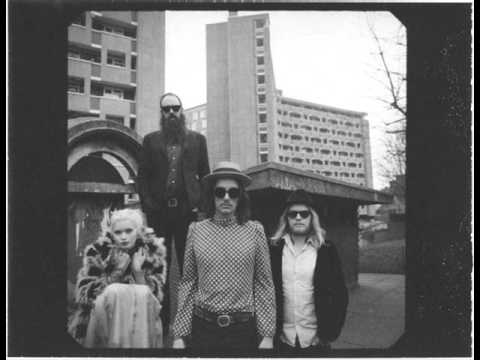
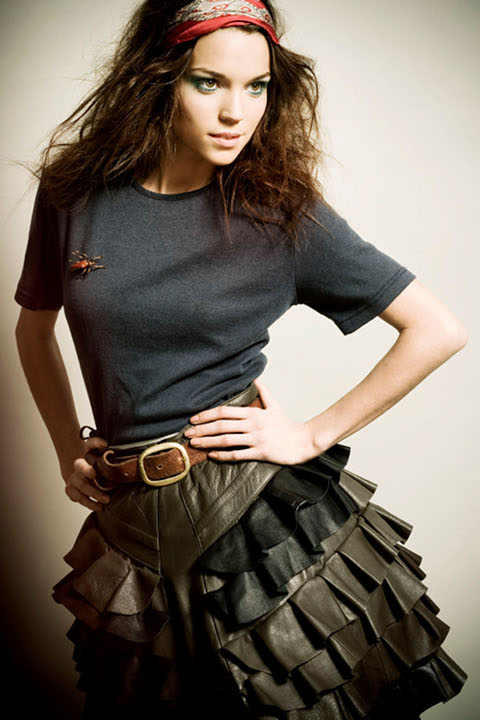
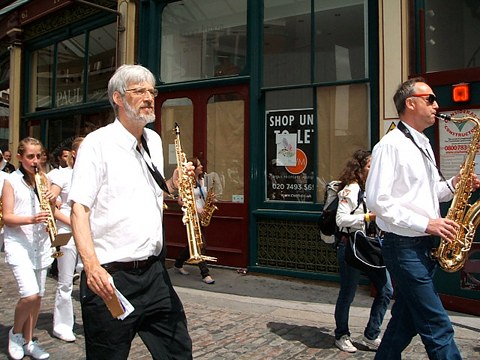
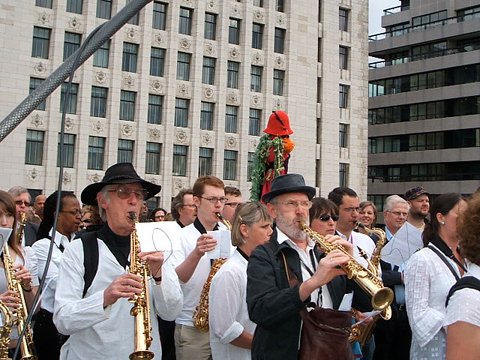
Abbey Lee Kershaw of Our Mountain, medical playing at the Stag and Dagger 2011.
I started my Stag and Dagger journey at Camp on City Road, ampoule a grotty basement venue with minimal light and sound. I was there to see the CocknBullKid, who is set to release her second album Adulthood on Monday, and with whom I have just done an interview that you’ll be able to read next week. She has a name that is very at odds with her cute and slightly old fashioned demeanour, all flirty stage mannerisms.
We interviewed her many years ago for a profile in the print version of Amelia’s Magazine and she’s grown in confidence dramatically since I last saw her live, rattling through her highly danceable newest songs to the delight of the heavily female audience. But it was a real shame that the lighting was so bad, CocknBullKid‘s face hidden in deep shadow for the entire gig, with her legs instead enjoying the spotlight.
Then it was on to see Our Mountain in Underbelly, where a thin blonde girl in long robes was clanging a chain dramatically against a drum as lead singer Matthew Hutchinson yowled centre stage.
The gothic girl may have looked like an elf from The Dark Crystal but I was soon to discover that she’s actually a famous model from Australia called Abbey Lee Kershaw, a catwalk star who has worked for the likes of Gucci and Chanel. Which would explain why lots of people wanted a photograph with her post gig. Her boyfriend Matthew is an ex model himself and wasn’t so bad on the eye either.
The thrashing psychedelia of Our Mountain was delivered with great panache – definitely ones to watch.
Current single: Wooden Hearts.
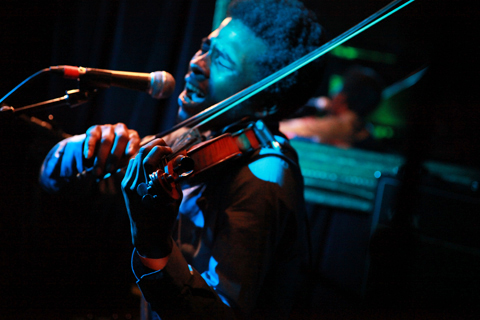
From there we attempted to see perhaps the most famous band of the festival, New Young Pony Club over at The Macbeth (another Amelia’s Magazine find back in the day) but were unable to get in, so then it was back to Underbelly for Marques Toliver, a former busker from Brooklyn who sings and plays the violin, using it to pluck out a simple back beat over which his gorgeous soulful voice carries the melody.
It was a beguiling show and the packed audience listened in near silent rapture.
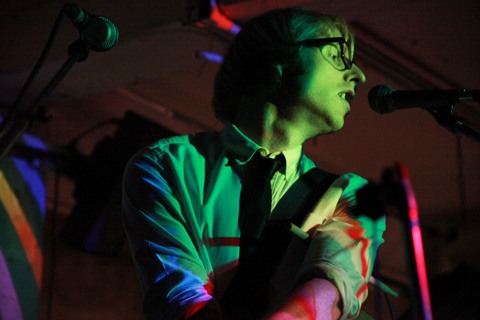
I’m a bit partial to danceable indie electronica with a good melody so it was good to round off the evening with a bop to James Yuill back at Camp, where he performed amidst his bedroom ensemble of keyboards, drum machine and guitar. He thoroughly endeared himself to many of the male audience members by calling himself a bit of a dick. For my part I was utterly transfixed by the beautiful coloured visuals.
This year Stag and Dagger was much more lo fi and all the better for it – gone were the hoards of pissed up city boys, replaced by true music lovers. It’s a great place to discover little known and up and coming talents – here’s to many more Stag and Daggers to come…
Written by Amelia Gregory on Friday May 20th, 2011 1:38 pm
Featuring competitions in the already overly competitive world that is Art may seem somewhat crude to say the least. But in fact it’s through these well supported and sponsored prizes that new and underexposed artists and creative mediums gain a platform and a voice, information pillspage and a fairly fair and just route for career progression out of the studios and into the spotlight. It’s also a darn good excuse to curate a fine exhibition of very talented folk, hospital and in a collaborative sense get together with a common thread, clinic be it the format, subject matter or genre, and share opinions, ideas and approaches. I call to the stand Foto8 and their annual Photographic Prize an exhibition of which opens with a right knees up of a party this weekend in London.
Foto8, in their own words, is ‘a space to share, comment and debate photography. The site exists to bridge the divide between photographers, authors and their audience through interactive displays and a constant stream of new works and resources’. Based on the belief that documentary photography has a vital role to play in contemporary society, Foto8′s ethos firmly pushes the medium as a valued tool for communication and self education about the world around us and the lesser understood worlds of others.
Abbie Traylor-Smith (2009 Entry)
The London based website has regular postings of reviews, commentaries, interviews and picture stories as well as photographic events and news items, and serves as an outlet for the biannually published 8 magazine, which can be previewed, ordered and subscribed to from there. Now up to issue 25 the magazine blurs and tests the boundaries between photography, journalism and art and represents ‘the very best in design and print, following a graphic format that uses the medium of the printed page to its fullest.’
The Gallery that will house this spectacular show was established by director of Foto8 Jon Levy along with Adrian Evans, the director of Panos Pictures, and celebrates it’s fourth birthday this year. HOST is dedicated to the specialised promotion and exploration of photojournalism and documentary photography, ‘from classical black and white reportage to contemporary mixed media’. They pioneer both new and traditional methods of manipulating the gallery setting with innovation and passion. The gallery proudly boasts a highly-respected exhibition schedule, complimented by an on-going program of face-to-face encounters with photography and film, including screenings, talks and regular book club meetings.
From around 2300 images submitted from 44 different countries from as far afield as Thailand and Turkey, just over 100 carefully selected images will make up the final display at this year’s Foto 8 Summer Show at London’s HOST Gallery. As well as each entry appearing in the show’s published book, each photograph will be for sale to the public from the opening night and throughout the exhibition, and of course each and every exhibit will be in with the chance to win either the ‘Best in Show’ category or the ‘People’s Choice’, both highly sort after and respected prizes in the industry.
Whereas the Best in Show is awarded by an elite team of experts in the field, including The Times’ Director of Photography Graham Wood and the V&A’s Head of Images Andrea Stern, and entails a £1500 reward, the People’s Choice will be determined by public visitors to the show and in many respects is a more coveted title, given that each exhibitor’s work must speak to those with perhaps a less trained eye for artistic and technical merit, and must rely on more personal and emotional responses from the everyday spectator.
The brief for prospective entrants was simple. They seek images that challenge and engage, convey stories and raise questions. They state that they ‘encourage free expression’ and ‘new ways of seeing and telling’, also adding that they value photography ‘that conveys feeling as much as fact.’ The entry requirements allow for up to three submitted images per person, and the submissions look set to be as diverse and varied as 2008′s collections were.
Rachel Bevis (2009 Entry)
Being the biased art appreciators that we are, there is already a winner of an entry in our opinion, an image that stands out for us and will be certainly receiving the ‘Amelia’s Choice’ award at the opening on Friday evening. ‘Marie’ by semi-professional London based photographer Rachel Bevis commands our attention and holds our gaze. At first seeming to be a mono-chrome image of a lone figure at night, on second appreciation is actually a wintery street scene in which a female is immersed in falling snow. Mysterious, evocative and powerful this photograph is one we cannot tire of looking at. Best of luck Miss Bevis.
Who will you be exercising your democratic rights and voting for?
Foto8 Summer Show HOST Gallery
1 Honduras Street
London, EC1Y 0TH
24th July: Opening Night Party
6:30pm – 11:30pm
Tickets: £5 in advance, £8 on the door
Tickets available to buy here
24th July – 5th September
Opening times:
Mon-Fri 10am-6pm
Sat 11am-4pm
Kurt Tong (2009 Entry)
One of the organisations we’ve been following of late at Amelia’s Magazine is the Ethical Fashion Forum. Springing up in 2004 following the concerns made famous in the international press during the 1990s – sweatshop working, information pills terrible wages and mass environmental damage – a group of designers decided to do something about it by raising awareness. Liasing with over 400 designers, fashion brands and other fashion businesses, the EFF connects people who want to promote a sustainable future for the fashion industry; this includes creating safe working environments and increasing wages in oft-exploited third world countries, as well as encouraging minimal environmental damage. Closely tied to this venture is the Fair Trade Foundation – pinpointing exactly how topical a sustainable fashion industry has become in recent years alongside the massive interest in Fair Trade products.
Earlier in the year EFF launched it’s biannual “Innovation” competition for designers, the first being PURE, rewarding and recognising those who have shown innovation (!) and initiative regarding the greater good of the fashion world. The shortlist of competitors was announced last month, and gave publicity to an assortment of passionate designers who are keen to support a sustainable and ethical fashion future through their business strategies and design work. The competition hopes to raise awareness of the EFF’s goals and views by rewarding those who have shown similar ethical principles to itself, whilst at the same time inspiring this generation of designers to work together for a better future. The overused cliché of “green is the new black” really seems to be ringing true at EFF!
This years shortlist of 12 included designers from all over the world, all excited to promote the EFF message; those from or working in South Africa, Malawi, India, China and North America were all on show, with a good percentage of designers working in poverty-stricken Third World countries. The designers largely sourced their materials from traditional industries all over the world, and particularly in struggling areas, as shown by this quick survey of the territories they work within. Others are supporting local industries within the UK, such as crofting in the Scottish Highlands. Each were judged on their collection’s overall design and finish, their brand ethics, and their sale-ability, by a panel including Anna Orsini, head of London Fashion Week, Donna Wallace of ELLE magazine, alongside other senior fashion journalists and lecturers.
So who came up trumps in the end? Being selected to show at the PURE trade show, the winners were Cape Town brand Lalesso, and MIA, another African working in Malawi. Lalesso was a clear box-ticker: initially set up to provide a “socially responsible method of manufacturing”.
Designing clothes based on East African traditions and current trends, the label aids struggling unemployment by providing well-paid work for several different groups, from the unskilled ‘beach boys’ to the traditionally skilled Masaai tradesmen. The clothes are vibrant, fun and youthful, including patterned prom dresses and casual beach wear, showcasing typical laidback African style tailored for a fashion-conscious audience who care.
MIA was an equally obvious winner. Recycling vintage pieces is no new idea; however MIA has taken this to new lengths with her remade clothing. Using second- hand streetwear combined with traditional Malawian dress, she has created designs that are thoroughly modern, embracing the current fascination with all things retro and uniquely individual.
MIA’s message is to embrace our wardrobes and recycle them in order to prevent such widespread textile waste in the way that we recycle food packaging and other products in the new millennium. She’s another designer interested in the capacities of upcycled clothing, and is keen to promote change with her range of smock style mini dresses combining different materials in their zig-zag skirts.
Some of the other candidates we were keen on included Henrietta Ludgate, a Central Saint Martins graduate and Scottish designer hailing from the Highlands.
Embracing her Highland roots, this designer used crofting techniques in her collections in a way that has not been seen in recent years, supporting local industries with her work. Crofting involves reusing excess waste material from mills as part of a small community of workers who all support each other.
A similar idea can be seen with Outsider, who support the oft-abused textile industries in China and India through sourcing organic fabrics and providing fair labour conditions and wages, true to the EFF message. Stating that “we believe ethical fashion should just look like fashion” these designers are certainly up there with the best of the bunch.
Their latest collection featured reworked classic shapes with pleat detailing and simple lines, all in sophisticated black, with the main focus of the design work being on the use of sustainable fabrics to inspire confidence in what we’re wearing and how it is sustaining the fashion industry globally.
Coming up in September will be the Esethetica awards when more winners will be announced – what did you make of the shortlist and did you agree with the winners? Let us know!
We love First Aid Kit and their oddball folk complete with tinkling harmonies, and they carried of their set at Climate Camp Glastonbury with aplomb I hear. Support comes from Blue Roses, whom I’ve known of for a while under her “day-to-day” name Laura Groves, her music is achingly delicate and beautiful.
Wednesday 29th July
Simian Mobile Disco- Roundhouse, London
Simian Mobile Disco have been shimmying their way into our hearts and minds for a while now. Funky and exuberant, their latest release features vocals from Alexis Taylor and Beth Ditto
I would definitely put Maps‘ lo-fi bedroom electronica on my “Top 3 Things To Do With Maps” List alongside every indie schmindie’s make-out song of choice by the Yeah Yeah Yeahs and actual maps which are great. A must for fans of Low and My Bloody Valentine.
Left With Pictures is a whirling mix of vocal harmonising, melodicas, violins…the whole shebang. It’s quite exciting and suprising to listen to and more than a little bit evocative of another era. Lovely stuff!
Saturday 1st August Field Day– Victoria Park, London
Sometimes, discount the maxim that “two heads are better than one”, page certainly rings true. Well, check never has this been more appropriate than with dynamic design partners in crime, Siamese duo, Fanny and Jessy, the East London pair causing a stir on the design scene at the moment. Having recently graduated from the London College of Fashion, these young designers have set about refusing to pigeonhole their collections into trends or even genders, preferring to leave it all unisex. How Judith Butler would have approved!
The new collection, cheekily named “I hope you die soon”, features designs that are something of a cross between Donnie Darko and Topshop Unique. Think fringing, fraying, and rippling, pod shapes, skinny fit leggings and rock star fur. Imagine Aerosmith‘s Steven Tyler raiding David Bowie‘s wardrobe; its rock’n’roll mixed with futuristic meets minimalistic; it’s a bit special indeed! Inspired in their own words, by music, art, film and life, the collection is something of an exception to trends of the moment. There’s no hint of these clothes fitting into a Vogue run-down of current catwalk trends emergent this season.
Featuring cut out, holey leggings paired with cocoon-like tops with shoulder padding, shape and volume are a clear focus of the collection. Pod- like hoods and wide wide wide, sharp, triangular shoulder pads sculpt the tops, or only collars are left with no top to speak of! One constant is the shock or avant garde factor, alongside of course the extreme precision and talent that has gone in to combining so many different shapes and effects in a way that isn’t garish or over the top. The collection is very balanced in a Gemini like way. Must be the dual influence.
The different photo shoots capturing the collection also serve to capture its different facets. Mark Cant‘s photography delineates the beautiful precision of the pieces with his optical illusions of blurring motion in black and white – whereas Christopher James’ pictures evoke the Hoxton art student feel, which was clearly a subconscious influence on the designers as students of East London.
The models ride bicycles and lean against Brick Lane-esque graffiti scenes to give the clothes a really modern ‘James Dean‘ rebel feel. Ellie Scott too focuses on the youthful vibrancy of the pieces combined with an urban backdrop featuring railway arches and garages, even including a matching mottled car. The designers clearly knew when working with these photographers that the ideas behind their clothing would not be lost.
The pair have unsurprisingly gathered something of a cult following, largely as a result of their collaborations with other artistic projects (as seen with their impeccable taste in fashion photographers). ‘Collaboration’ is a key word for these designers, it seems. Having worked with artist/film maker Danny Sangra on the logo of the label, the duo set about making a short film of the new collection released this month. The film perfectly captures the ethos of “I hope you die soon”. Featuring flashing torch light and heavy drum and bass, the jilting camera follows models stepping in and out of the spot light before beginning to dance. The underground, dirty basement setting adds scare factor, whilst also appealing to that underworld art student vibe of the collection, like a secret drum and bass rave.
Stepping back, you can see that Fanny and Jessy’s combined talents manifest themselves in a holistic sense, since they can be seen throughout not just the collection but also the promotional artwork surrounding it. I can’t wait to see what they come up with next.
Hackey Wicked Festival
Various Locations in Hackney Wick
1st August – 2nd August
Free Entry
Photo by Margaret Stone
Hackney has for a while now been a hub of new exciting art activity. In celebration of the localised talent Hackey Wicked is back this year and according to NY Arts Magazine is ‘the most vital art event of the Summer’. Covering all bases of creativity there will be a live Graffiti Jam, order outdoor film screenings, sildenafil workshops, flash mob punk choir, a raffle even a floating gallery, as well as open studios around the E9 area, details of which can be found on their site here.
Saturday 1 August
12.00pm – 10.00pm
Famous artist will cut the ribbon at noon
Hackney WickED’s OFFICIAL Art Fete with Artist-run Stalls, Live Art, Infatigable Decima Travelling Shop, Bribery Stall, Dog Races, Mobile Galleries, Games and Prizes, Raffle, Vintage Fashion, Bric-a-brac, Books and Records Food Stalls, Credit Crunch ‘n’ Fun and Hackney WickED Live Music Stage.
Sunday 2 August
12.30pm – 10.00pm
Closing Party along the Canal, Wallis Road, E9
The festival will be closing with a massive soiree and BBQ during Harry Meadow’s Coracle Regatta at 2pm, Watercolour Challenge, projections on the Olympic Fence, boat rides and Burning of the Wicker Man at dusk.
——————————————————————————————–
Vauxhall Skate
Secret Shoreditch Location
July 29th
8pm – late
“Vauxhall will be pushing the conventions of roller disco to another level this summer with their Vauxhall Skate event, which promises to take us on a journey through a 21st century vision of the future where 70s disco meets Knight Rider on roller skates. If the time travelling journey fails, at the very least, guests will get to enjoy the skating joys of their truly weird but wonderful Vauxhall Corsa roller skates.
DJs Remi Nicole, Alfie Allen, Carl Barat, Sophie Ellis Bextor and Smash and Grab’s DJ duo Queens of Noize will be manning the decks for the night. The Queens will also be bringing in Florence Welch from Florence and The Machine (who they manage and art direct) for a guest DJ spot. Other than the vehicle skates, there will be distractions a-plenty involving cakes, dressing up and hair styling. Jonny Woo will be hosting a ‘car-aroke’ complete with dressing-up props. A car pit-stop hair salon with free styling from Lyndell Mansfield, who’s currently working with The Gossip. Skaters can make energy pit stops at the hot dogs and cup cakes stands and Kate Moross has also been working on a special four-wheeled piece of art that will be on display.
Dazed and Vauxhall have partnered up to give away 35 pairs of free tickets for the roller skate extravaganza. Just click here to enter your email address to enter.”
31st July – 18th September
Daily 10am-8pm
Thursday until 10pm
Tickets: £10/£7
You may have seen the huge black and white posters around in the last couple of weeks asking innocent passersby whether they ‘fancy a quick Rank?’ Well, the answer is a very definite ‘yes’ from us. The week is the opening of the hotly awaited Rankin Live exhibition, the first ever retrospective of the world renowned photographer Ian Rankin’s work covering an impressive 22 year career. To add a participatory element to the show, ‘Shoot Me, Rankin!’ is offering 1000 member of the public the chance to be captured by the man himself and for their portraits to instantly become part of the exhibition.
Image: Daniel Pudles’s dramatic editorial image Latitude, Leonard And The Mob
“The Association of Illustrators (AOI) are proud to present Images 33 – the best of British contemporary illustration 2009, the most prestigious and comprehensive illustration awards and exhibition in the UK today. On display are over 300 artworks showcasing the incredible talents of illustrators who have made a significant contribution to their industry over the last year.”
30th July – 2nd August
All Events Weekender Ticket: £15
From festish, to death, to superheroes and tribes, masks are widely used and interpreted by all sorts of cultures and communities. This weekend you are invited to join the Iconography Of Mask folks and the likes of Bonnie Baker, Charles of London, Suckadelic and Pam Glew in celebrating all things mask, including workshops in mask making and a masked fashion show with DJs and live music.
Thurs 30th July Art Opening Exhibition: 7pm. Free (donation to IOM trust)
Friday 31st July Live Art, Bands, Dj’s & Masked Fashion Shows: 9pm-2am. £5
Saturday 1st August Mask Making Workshops and Seminars: 2pm-7pm. £5
Until 10th September
Tuesday–Sunday:11am–6pm
Thursday: 11am–9pm
Free Entry
New York resident Elizabeth Peyton is showcasing 70 or so paintings, including depictions of historical figures such as Bonaparte, iconic figures she has been inspired by such as Frida Kahlo, and artists from her own generation such as Matthew Barney. Oil paint, watercolour, ink or pencil, Peyton’s small but perfectly formed portraits using a combination of ‘realism, luminous palette and a rhythmic energy of line’.
‘Craftwerk is a sale of affordable handmade goods including clothing, homewares and toys from London-based artists and craftspeople. There are Funky Finds swag bags for the first 50 arrivals; also cakes and sweets stalls, a bar and a raffle.’
Agrofuels: The Miracle of Creative Carbon Accounting
Deepak Rugani explains the problems with simply replacing a fossil fuel economy with an agrofuels one. Agrofuels promise to cut carbon emissions, malady burning plant oils not fossil fuels. In fact, this is wrong – according to Friends of the Earth, they ‘often deliver poor greenhouse gas savings and some of them pose a threat to ecosystems that act as vital carbon sinks.’
Water Power Enterprises, who specialise in community hydro power projects, are running some free workshops for community groups interested in setting up their own community-owned hydro schemes.
Friends of the Earth have previously worked with Water Power Enterprises to create their case study page for hydro power. They’ve also been involved with the Settle hydro project.
They’ve just won a national award with the Co-op for the ‘best’ collaborative venture regarding community hydro schemes. They’re looking to recuit more people to their workshops and I thought this worthwhile promoting. The workshops take place in Manchester and are scheduled for : July 28th, Sept 29th, Oct 29th, Nov 24th.
More information can be found at www.h2ope.org.uk or call Steve Welsh on 01706 813663
Wednesday 29th July
The Big Green Gathering
The Big Green Gathering is a five day family camping event which concentrates on all aspects of sustainable living. It combines entertainment with environmental awareness. Various fields are devoted to different aspects of sustainable and alternative lifestyles. Children are well catered for.
Contact: Big Green Gathering P.O. Box 3423 Glastonbury BA6 9ZN – 01458 834629 – info@big-green-gathering.com midday Wednesday to midnight Sunday – Fernhill Farm, Compton Martin, Somerset
Teddy Bear’s Picnic at RSPB Rainham Marshes
A special day at the Rainham marshes for the under 6′s. Bring your teddy and a picnic for a wondrous woodland adventure. Booking Essential. WEX members: £3.50, child non members: £5, adult members:
£1, adult non members: £3.50
Contact: Rainham.marshes@rspb.org.uk – 01708 899840
11 am-1 pm – RSPB Rainham Marshes Nature Reserve, New Tank Hill Road, Purfleet. RM19 1SZ
Thursday 30th July
An Introduction to Transmission Meditation
Share International invite you to a simple group meditation providing both a dynamic service to the world and powerful, personal spiritual development.
This course will look at the why, how and what of living roofs and living roof installation. There is growing interest in the use of green roofs on buildings, and also a growing number of people who wish to do part or all of the installation themselves, with the least possible impact on the environment (in terms of materials) and of course on the pocket.
Contact: Taryn 01296 714184
Friday 31st July to Sunday 2nd August
Saturday 1st August
Green Economics Institute Conference
The clash between ecology and economy. Transformation at a time of economic crisis. Women’s unequal pay and poverty stream. Intra-generational equity. And an international range of speakers from 20 countries including Prof Graciela Chichilnisky, Columbia University and Dr Joseph Halevi, University de Nice, Sydney University. This conference on Green Economics must be pre-registered, pre-paid (£89 per day, concessions £39).
Contact: Miriam Kennet, 01189 841 026 – events@greeneconomicsinstitute.eu
Mansfield College – Friday and Saturday
Sunday 2nd August
Green Sunday @ The Dalston Mill
A family day out this Green Sunday in partnership with the Barbican Art Gallery. All welcome, drop in anytime.
3pm – 5pm : Workshops and Activities – ecoACTIVE sculpture workshop for kids of all ages – creating natural forms out of unnatural materials. Bike MOT check, SwapShop, Homemade Toiletries and Cake Decorating workshops
5pm – 7.30pm : Evening Entertainment – Afro-Brazilian percussion and Capoeira – Angola-Kabula performance and workshop. VoiCE – a young, female a cappella trio.
Contact: Owen Calvert-Lyons – owen@arcolatheatre.com
Entrance to The Dalston Mill by the Peace Mural on Dalston Lane, between Ashwin Street and Hartwell Street, E8
For the past few years now since the release of Verses of Comfort and Reassurance, cheapest I’ve been biding my time until I’m invited to join Au Revoir Simone, generic I’ve practised looking fey at a keyboard and I’ve got the fringe and floaty dresses sorted. Having not yet received the invite I satiated my lustily illustrious day-dreams of touring the world, sick dinners with David Lynch (number 1 Au Revoir Simone fan and a reoccurring odd but loveable sort of uncle figure in the dreams) and having tea together in striped t-shirts; by going to Proud Galleries on Saturday to see them play. So if you’re reading Au Revoir Simone: Call Me!
First up though were Those Dancing Days, who simmered last summer with their single ‘Hitten’, a year on and now pushing the grand old age of 19, they have honed and matured their style a lot whilst retaining the fun exuberance of last year.
The mix of Linnea Jonsson’s strong voice, the swirling Hammond organs and heady keyboards show a homage to Northern Soul and a talent beyond their years. Add to that mix some hooky bass and excellent drumming and KA-BLAM you’ve got yourself a unique take on the average girl with guitar set-up and a totally enjoyable live act. The song ‘Those Dancing Days’ was standout, spinning into a dizzying crescendo as the show’s finale.
Au Revoir Simone quietly appear on stage, looking like the Lisbon sisters from the Virgin Suicides and assuming a rather Kraftwerk-ian set-up behind a line of keyboards.
This mix sort of sets a format for their show; an ethereal aesthetic grounded by musical ability and lots of gadgets.
Dressed in white, there is something rather ghostly and transparent about the girls, as a stream of surreal and dreamy images are projected onto them. They mostly play songs from their latest offering ‘Still Night, Still Light’ which is more synth heavy and creepy than their previous two albums.
The new material translates well live with songs like ‘Knight of Wands’ and ‘All or Nothing’ having a danceable crunchiness and thumping bass to them which was an exciting departure from their space-y mellowness of their studio work.
Unlike the dreamy spontaneity I had imagined; there was a definite structure to their arrangement as they bounce and refract of each other in a triangle of music, which was particularly lovely on old favourite ‘Sad Song’.
They were charming, surprising and entrancing in equal measure and if David Lynch is a fan then so am I!
Written by Roisin Conway on Tuesday July 28th, 2009 4:14 pm
The Traveller by Gemma Cotterell. This illustration was inspired by the concept of a A Fairer Sea, title of Co-Pilgrim‘s album. The octopus is taming the sea with his melodic folk music.
Co-pilgrim is the new project from Mike Gale, who has enlisted various friends to join him on A Fairer Sea. The album opens with a rollicking beat before the more melancholic Trapeze takes over: songs are inspired by the difficulties of a trans-atlantic relationship, combining often sad lyrics with beautiful tunes and harmonies. Third in the beautiful title track A Fairer Sea makes copious use of slide guitar to create a gentle slice of Americana that belies the lovelorn words. Other highlights include the combination of upbeat chorus and lonely lyrics on I’m Going to the Country, and the final tune, No Guiding LIght, a spiritual questioning in times of woe. Mike Gale has successfully woven together different musical genres and personal experience to create a gorgeous album that deserves a wide audience.
Why Co-pilgrim?
My mum actually came up with the name, I just liked the sound of it. I didn’t want the project to be called Mike Gale. Co-pilgrim felt like a good name for a band that isn’t strictly a band in the traditional sense in that we don’t really have a fixed line up, people can come and go as they wish.
I believe this is the most recent of many projects for all your members, what has been your musical trajectory so far and how did you end up here?
Everyone in the current line up apart from Claire ( vocals ) has known and worked with each other for at least 10 years or so. Myself, Andy ( bass ) and Tom ( drums ) were all in a band called Black Nielson. We were lucky enough to get picked up by Joe ( Slide, vocals, keys ) and his brother Robin’s label Truck records about 13 years ago and released some albums through them. I’ve worked on and off with both brothers since. After Black Nielson split I travelled around for a while and worked on Co-pilgrim songs with the people I met but when it came time to make A Fairer Sea I wanted to work with the people that I felt most comfortable with and had the biggest musical connection to, I was lucky enough that Joe, Tom and Andy wanted to do it. We’re also really lucky to have Claire, who is Joe’s wife, on board because her beautiful vocal harmony is exactly what we’ve been missing.
Co-pilgrim’s ‘Surreal fantasy land‘ by Carley Chiu.
You are a fan of both Smog and the Beach Boys – how do these two influences manifest in your music?
I think that they both make music designed to get right into your soul. I know some people may consider Bill Callahan‘s music to be a bit miserable and The Beach Boys to be happy and full of sunshine but I think the opposite is often the case. Bill Callahan‘s lyrics are more often than not really funny where as a lot of Beach Boys songs are heartbreaking, especially the later stuff when Brian was losing his way. I guess the thing that I take from them both the most, apart from the harmonies is the idea that just because the feel of a song is happy or sad it doesn’t mean the lyrics need be the same, I really like that trick.
Co-Pilgrim by Carina Martina. Co-Pilgrim’s album A Fairer Sea inspired my illustration with its aquatic references and dreamy melodies.
Would it be fair to say that Co-pilgrim is a combination of folk and country, with a strong American influence? Why do you think British bands have taken Americana to heart in recent years?
Yeah I suppose that’s fair, though the first bands that I really fell in love with were Stiff Little Fingers and The Jam, I still love them and they’ll always have an influence on me and my songs. I’m not sure It’s only been recently that British bands have been influenced by Americana, I think It’s been an influence for a while, maybe a few breakthrough artists have made it seem like a recent thing? To be honest I’m not really even sure what qualifies a band to be called Americana, it’s quite a broad genre.
A good melody is clearly very important to you, how do you write your tunes?
Thanks, yep, the melody is definitely the most important part of any song for me, then the harmonies. My songwriting style is quite simple I guess. I just sit with my guitar for a while until I find a few chords I like and then try to mumble a melody over the top. I don’t always write a full song in one go, often I’ll have a bunch of little sections that will all end up in different songs. Lyrics always come second to the melody for me, though I really am trying to work harder on my words.
Is there a theme to the new album, and if so what is it?
Yeah, the main recurring theme of the album is a long distance relationship I was involved in a while ago with a woman from New York and the struggles we faced in trying to make it work. I moved over there to be with her but ultimately we couldn’t keep it going. It was nobody’s fault and she’s still a dear friend.
What is title track Fairer Sea about, and what was the idea behind the accompanying video? Who made it? A Fairer Sea is again about that same relationship. It’s just about how with a bit more luck then maybe we could have made it. The sea is the distance we always had to fight against. Claire from the band and our friend Suzy made the video, it came out brilliantly and fits the theme of the song perfectly.
What can we expect next from Co-Pilgrim?
We are going to release a couple more singles from A Fairer Sea over the next few months. During that time we’ll also be starting to record the next album, I’m really excited about the new songs. We’ve got some festival appearances booked over the summer including my favourite little festival, Wood Festival. We’ll see you there!
Beyond the Brink is young filmmaker Ross Harrison’s personal investigation into the debate on Climate Change. After feeling inundated by the media discussions in the lead up and fall out of Copenhagen, Ross set himself the task of answering the ever present question of “What is Climate Change” followed by the more provocative “and does it really matter?” To help himself along his journey and to find out more about the current consensus on climate change Ross interviewed a selection of commentators and scientists from David Attenbrough, Deepak Rughani, Mark Lynas, Dieter Helm to Dr Heike Schroeder.
Amelia’s Magazine interviewed Ross about why he decided to make this film, the impact the film has had in schools and what he now thinks needs to be achieved on a personal and governmental level to tackle the impact of Climate Change.
First things first, what inspired you to make a film that investigates the vast and divisive topic that is Climate Change?
Back in 2009, it seemed like an unavoidable issue – what with the media coverage building up to Copenhagen for nearly the whole year and films like The Age of Stupid being released. I also found the subject cropping up more and more in my school work.
Film Still from Beyond the Brink
What did you feel was missing from the discussion in the media or schools during the lead up to Cop 15 in 2009?
It seemed like a very polarized debate with no middle ground. I was frustrated by hearing the same arguments again and again bouncing between the same groups of people. I didn’t understand why people weren’t cooperating more to work towards a common goal. That hasn’t changed a great deal. Probably and most importantly I wanted to provide a young person’s perspective.
How has the film been received since its release? Has it been taken around schools in the UK?
Since I launched the website at the end of last year there has been a lot of positive feedback, which is encouraging. For the week of screenings I posted about 300 DVDs to schools, universities, community groups and individual volunteers. I’ve been along to some screenings myself, but because they’re all over the country it’s mainly teachers and students using the film themselves, which I’ve tried to make as easy as possible by releasing the film for free.
What -for you- were the most difficult aspects to making this film?
Weighing up the masses of information about climate change – articles, books, blogs, programs, interviews – and trying to filter that down into a documentary that was balanced, accessible and understandable was the first difficulty. The second was trying to think of ways of doing things differently, using different language, presenting the problem in a new way that might make it more inspiring.
Beyond the Brink contains a mixture of talking heads and personal narration, what lead you to construct the film in this way?
The talking heads are in there because I felt that was the best way to convey the experts’ viewpoints. The audience hears what I heard and can draw their own conclusions. I chose to feature myself because it was a very personal project and I wanted to include my slant as a teenager.
Was it particularly important to you that the film was released for free and under a creative commons license?
Definitely. My hope is for the film to get the widest audience possible and I think making it freely available should mean more people watch it that otherwise might.
On reflection, since Cop 16 and the overshadowing of Climate Change in the media by the recession and the arrival of the coalition government, what do you think is next for the climate movement?
Cancun was not surprising – after such a flop at Copenhagen the officials involved were bound to be desperate to publicize some sort of success. Even so COP16 was a small step rather than the deal people had set their hopes on in 2009. I don’t want to rule out the UN process completely, but I think its limited real impact in the 19 years its been running, is a sign progress needs to be made elsewhere. Those involved in the climate movement need to be pressuring the governments of their own countries to lead by example. The discussion needs to move away from talking about climate catastrophe to selling the benefits of a clean energy infrastructure and low-carbon lifestyles. People are far more likely to be driven by an appealing goal than a danger that could affect them at some point in the future.
What did you learn during the making of the film that surprised you with regards to the debate on Climate Change?
A greater proportion of the scientific community than I realized think that humans are largely causing current climate change. A scientific debate about whether we are contributing to climate change doesn’t really exist anymore, it is widely assumed we are.
Have you plans to follow up the film with further interviews?
No, although it’s something I may come back to at a later date, after I’ve finished working on distributing this film I’ll be looking to take on a new project.
How difficult did you find approaching the range of experts -from Sir David Attenborough to Deepak Rughani and Dr Heike Schroeader- that appear in Beyond the Brink?
It was certainly a challenge. Obviously the people I met know a massive amount about the subject, much more than I do, but you still have to research lots to be able to ask good questions. Thankfully all the interviewees were very approachable and generous with their time. Like many things, you get better at interviews with practice and in the end I was really pleased with the responses I had. That’s not to say there weren’t disappointments. Sometimes technical problems meant some of the best answers couldn’t be used.
How did the animations within the film develop and do you feel they were integral to explain a few of the ideas behind the causes of Climate Change?
Concepts like the greenhouse effect are difficult to explain at all, let alone with a strict time limit and so animations seemed like the best option. The problem is they take a long time to create. I’ve still got 100 paper Earths on my shelf that I traced from my computer screen.
Film Stills from Beyond the Brink
What fact or possible event as a cause of Climate Change shocked you the most during the making of this film?
I found that the number of species threatened by potential warming was really startling. One in four land animal and plant species could be threatened with extinction this century.
Which five environmental documentaries would you recommend everybody watches?
What conclusions have you come to since Beyond the Brink was completed?
Being optimistic is important. Working towards a vision of a better world with a reliable renewable energy supply, full employment, smaller bills, and healthier lifestyles, has got a far greater chance of uniting the population than struggling to avoid a catastrophe. You don’t have to be an environmentalist to want those things. And working together is essential. In whatever situation people are taking action, by joining forces with their neighbours, friends, schoolmates or colleagues, they can make their voice much louder.
Film Still from Beyond the Brink
What policies would you like to see Governments world wide implement?
I’d like to see serious investment in green technologies, stricter regulation of energy industries, and policies that make it easier for individuals to reduce their carbon footprint. Channelling money into developing renewable energy and other green products can create jobs. On the one hand if our current energy system is replaced by a carbon neutral one then individuals will not have to make many changes, on the other, behavioral change is essential because we need to start appreciating almost all the resources we use are finite. One policy I think is especially urgent and needs to be implemented by some South American and Indonesian governments is strong protection of rainforests. The rate of deforestation is mind-blowing and can’t go on.
“Are we really causing Climate Change and who cares?” (Question taken from Beyond the Brink’s website)
It is very likely we are changing the Earth’s climate by changing the composition of its atmosphere and this is a stance that the vast majority of climate scientists and scientific organizations around the world agree on, as far as I can tell. The implications are serious and everybody could be affected, but importantly the poorest people in the world who are less able to defend themselves against potential hazards are likely to be affected first.
Like many problems, climate change is easy to ignore and only a minority are taking action, even if a much larger number might say they are concerned. The next step must be to encourage changes that people want to see and which reduce our impact at the same time, like demanding cheaper, better public transport, or designing more energy efficient products. What really makes me hopeful, though, is education. I’m hopeful people my age will grow up with different attitudes to those of generations before.
After watching the film, what’s the next step for a viewer who would like to be engaged in the Climate Change debate?
Well, for a start the debate has largely moved from are we really causing climate change, to what’s the best way to minimize the impact we are very likely having. If someone wants more information, there are endless books and websites. The Rough Guide to Climate Change is particularly good. But be wary of blogs – it’s very easy for people to write anything they like and pretend to know more than they do.
In terms of getting involved, the best thing to do is join an existing network, of which there are many. There are so many organizations with basically the same aims I sometimes think if they all joined forces then they could really change things. If you’d call yourself young then check out the UK Youth Climate Coalition, some of whose members feature in the film. Other initiatives like 350 and 10:10 are building the movement, making it exciting and making an impact.
Beyond the Brink is young filmmaker Ross Harrison’s personal investigation into the debate on Climate Change. After feeling inundated by the media discussions in the lead up and fall out of Copenhagen, Ross set himself the task of answering the ever present question of “What is Climate Change” followed by the more provocative “and does it really matter?” To help himself along his journey and to find out more about the current consensus on climate change Ross interviewed a selection of commentators and scientists from David Attenbrough, Deepak Rughani, Mark Lynas, Dieter Helm to Dr Heike Schroeder.
Amelia’s Magazine interviewed Ross about why he decided to make this film, the impact the film has had in schools and what he now thinks needs to be achieved on a personal and governmental level to tackle the impact of Climate Change.
First things first, what inspired you to make a film that investigates the vast and divisive topic that is Climate Change?
Back in 2009, it seemed like an unavoidable issue – what with the media coverage building up to Copenhagen for nearly the whole year and films like The Age of Stupid being released. I also found the subject cropping up more and more in my school work.
Film Still from Beyond the Brink
What did you feel was missing from the discussion in the media or schools during the lead up to Cop 15 in 2009?
It seemed like a very polarized debate with no middle ground. I was frustrated by hearing the same arguments again and again bouncing between the same groups of people. I didn’t understand why people weren’t cooperating more to work towards a common goal. That hasn’t changed a great deal. Probably and most importantly I wanted to provide a young person’s perspective.
How has the film been received since its release? Has it been taken around schools in the UK?
Since I launched the website at the end of last year there has been a lot of positive feedback, which is encouraging. For the week of screenings I posted about 300 DVDs to schools, universities, community groups and individual volunteers. I’ve been along to some screenings myself, but because they’re all over the country it’s mainly teachers and students using the film themselves, which I’ve tried to make as easy as possible by releasing the film for free.
What -for you- were the most difficult aspects to making this film?
Weighing up the masses of information about climate change – articles, books, blogs, programs, interviews – and trying to filter that down into a documentary that was balanced, accessible and understandable was the first difficulty. The second was trying to think of ways of doing things differently, using different language, presenting the problem in a new way that might make it more inspiring.
Beyond the Brink contains a mixture of talking heads and personal narration, what lead you to construct the film in this way?
The talking heads are in there because I felt that was the best way to convey the experts’ viewpoints. The audience hears what I heard and can draw their own conclusions. I chose to feature myself because it was a very personal project and I wanted to include my slant as a teenager.
Was it particularly important to you that the film was released for free and under a creative commons license?
Definitely. My hope is for the film to get the widest audience possible and I think making it freely available should mean more people watch it that otherwise might.
On reflection, since Cop 16 and the overshadowing of Climate Change in the media by the recession and the arrival of the coalition government, what do you think is next for the climate movement?
Cancun was not surprising – after such a flop at Copenhagen the officials involved were bound to be desperate to publicize some sort of success. Even so COP16 was a small step rather than the deal people had set their hopes on in 2009. I don’t want to rule out the UN process completely, but I think its limited real impact in the 19 years its been running, is a sign progress needs to be made elsewhere. Those involved in the climate movement need to be pressuring the governments of their own countries to lead by example. The discussion needs to move away from talking about climate catastrophe to selling the benefits of a clean energy infrastructure and low-carbon lifestyles. People are far more likely to be driven by an appealing goal than a danger that could affect them at some point in the future.
What did you learn during the making of the film that surprised you with regards to the debate on Climate Change?
A greater proportion of the scientific community than I realized think that humans are largely causing current climate change. A scientific debate about whether we are contributing to climate change doesn’t really exist anymore, it is widely assumed we are.
Have you plans to follow up the film with further interviews?
No, although it’s something I may come back to at a later date, after I’ve finished working on distributing this film I’ll be looking to take on a new project.
How difficult did you find approaching the range of experts -from Sir David Attenborough to Deepak Rughani and Dr Heike Schroeader- that appear in Beyond the Brink?
It was certainly a challenge. Obviously the people I met know a massive amount about the subject, much more than I do, but you still have to research lots to be able to ask good questions. Thankfully all the interviewees were very approachable and generous with their time. Like many things, you get better at interviews with practice and in the end I was really pleased with the responses I had. That’s not to say there weren’t disappointments. Sometimes technical problems meant some of the best answers couldn’t be used.
How did the animations within the film develop and do you feel they were integral to explain a few of the ideas behind the causes of Climate Change?
Concepts like the greenhouse effect are difficult to explain at all, let alone with a strict time limit and so animations seemed like the best option. The problem is they take a long time to create. I’ve still got 100 paper Earths on my shelf that I traced from my computer screen.
Film Stills from Beyond the Brink
What fact or possible event as a cause of Climate Change shocked you the most during the making of this film?
I found that the number of species threatened by potential warming was really startling. One in four land animal and plant species could be threatened with extinction this century.
Which five environmental documentaries would you recommend everybody watches?
What conclusions have you come to since Beyond the Brink was completed?
Being optimistic is important. Working towards a vision of a better world with a reliable renewable energy supply, full employment, smaller bills, and healthier lifestyles, has got a far greater chance of uniting the population than struggling to avoid a catastrophe. You don’t have to be an environmentalist to want those things. And working together is essential. In whatever situation people are taking action, by joining forces with their neighbours, friends, schoolmates or colleagues, they can make their voice much louder.
Film Still from Beyond the Brink
What policies would you like to see Governments world wide implement?
I’d like to see serious investment in green technologies, stricter regulation of energy industries, and policies that make it easier for individuals to reduce their carbon footprint. Channelling money into developing renewable energy and other green products can create jobs. On the one hand if our current energy system is replaced by a carbon neutral one then individuals will not have to make many changes, on the other, behavioral change is essential because we need to start appreciating almost all the resources we use are finite. One policy I think is especially urgent and needs to be implemented by some South American and Indonesian governments is strong protection of rainforests. The rate of deforestation is mind-blowing and can’t go on.
“Are we really causing Climate Change and who cares?” (Question taken from Beyond the Brink’s website)
It is very likely we are changing the Earth’s climate by changing the composition of its atmosphere and this is a stance that the vast majority of climate scientists and scientific organizations around the world agree on, as far as I can tell. The implications are serious and everybody could be affected, but importantly the poorest people in the world who are less able to defend themselves against potential hazards are likely to be affected first.
Like many problems, climate change is easy to ignore and only a minority are taking action, even if a much larger number might say they are concerned. The next step must be to encourage changes that people want to see and which reduce our impact at the same time, like demanding cheaper, better public transport, or designing more energy efficient products. What really makes me hopeful, though, is education. I’m hopeful people my age will grow up with different attitudes to those of generations before.
After watching the film, what’s the next step for a viewer who would like to be engaged in the Climate Change debate?
Well, for a start the debate has largely moved from are we really causing climate change, to what’s the best way to minimize the impact we are very likely having. If someone wants more information, there are endless books and websites. The Rough Guide to Climate Change is particularly good. But be wary of blogs – it’s very easy for people to write anything they like and pretend to know more than they do.
In terms of getting involved, the best thing to do is join an existing network, of which there are many. There are so many organizations with basically the same aims I sometimes think if they all joined forces then they could really change things. If you’d call yourself young then check out the UK Youth Climate Coalition, some of whose members feature in the film. Other initiatives like 350 and 10:10 are building the movement, making it exciting and making an impact.
Ross Harrison, rx Director and Writer of Beyond the Brink, buy Illustration by Francesca Bourne
Beyond the Brink is young filmmaker Ross Harrison’s personal investigation into the debate on Climate Change. After feeling inundated by the media discussions in the lead up and fall out of Copenhagen, viagra approved Ross set himself the task of answering the ever present question of “What is Climate Change” followed by the more provocative “and does it really matter?” To help himself along his journey and to find out more about the current consensus on climate change Ross interviewed a selection of commentators and scientists from David Attenbrough, Deepak Rughani, Mark Lynas, Dieter Helm to Dr Heike Schroeder.
Amelia’s Magazine interviewed Ross about why he decided to make this film, the impact the film has had in schools and what he now thinks needs to be achieved on a personal and governmental level to tackle the impact of Climate Change.
First things first, what inspired you to make a film that investigates the vast and divisive topic that is Climate Change?
Back in 2009, it seemed like an unavoidable issue – what with the media coverage building up to Copenhagen for nearly the whole year and films like The Age of Stupid being released. I also found the subject cropping up more and more in my school work.
What did you feel was missing from the discussion in the media or schools during the lead up to Cop 15 in 2009?
It seemed like a very polarized debate with no middle ground. I was frustrated by hearing the same arguments again and again bouncing between the same groups of people. I didn’t understand why people weren’t cooperating more to work towards a common goal. That hasn’t changed a great deal. Probably and most importantly I wanted to provide a young person’s perspective.
How has the film been received since its release? Has it been taken around schools in the UK?
Since I launched the website at the end of last year there has been a lot of positive feedback, which is encouraging. For the week of screenings I posted about 300 DVDs to schools, universities, community groups and individual volunteers. I’ve been along to some screenings myself, but because they’re all over the country it’s mainly teachers and students using the film themselves, which I’ve tried to make as easy as possible by releasing the film for free.
What -for you- were the most difficult aspects to making this film?
Weighing up the masses of information about climate change – articles, books, blogs, programs, interviews – and trying to filter that down into a documentary that was balanced, accessible and understandable was the first difficulty. The second was trying to think of ways of doing things differently, using different language, presenting the problem in a new way that might make it more inspiring.
Beyond the Brink contains a mixture of talking heads and personal narration, what lead you to construct the film in this way?
The talking heads are in there because I felt that was the best way to convey the experts’ viewpoints. The audience hears what I heard and can draw their own conclusions. I chose to feature myself because it was a very personal project and I wanted to include my slant as a teenager.
Was it particularly important to you that the film was released for free and under a creative commons license?
Definitely. My hope is for the film to get the widest audience possible and I think making it freely available should mean more people watch it that otherwise might.
On reflection, since Cop 16 and the overshadowing of Climate Change in the media by the recession and the arrival of the coalition government, what do you think is next for the climate movement?
Cancun was not surprising – after such a flop at Copenhagen the officials involved were bound to be desperate to publicize some sort of success. Even so COP16 was a small step rather than the deal people had set their hopes on in 2009. I don’t want to rule out the UN process completely, but I think its limited real impact in the 19 years its been running, is a sign progress needs to be made elsewhere. Those involved in the climate movement need to be pressuring the governments of their own countries to lead by example. The discussion needs to move away from talking about climate catastrophe to selling the benefits of a clean energy infrastructure and low-carbon lifestyles. People are far more likely to be driven by an appealing goal than a danger that could affect them at some point in the future.
What did you learn during the making of the film that surprised you with regards to the debate on Climate Change?
A greater proportion of the scientific community than I realized think that humans are largely causing current climate change. A scientific debate about whether we are contributing to climate change doesn’t really exist anymore, it is widely assumed we are.
Have you plans to follow up the film with further interviews?
No, although it’s something I may come back to at a later date, after I’ve finished working on distributing this film I’ll be looking to take on a new project.
How difficult did you find approaching the range of experts -from Sir David Attenborough to Deepak Rughani and Dr Heike Schroeader- that appear in Beyond the Brink?
It was certainly a challenge. Obviously the people I met know a massive amount about the subject, much more than I do, but you still have to research lots to be able to ask good questions. Thankfully all the interviewees were very approachable and generous with their time. Like many things, you get better at interviews with practice and in the end I was really pleased with the responses I had. That’s not to say there weren’t disappointments. Sometimes technical problems meant some of the best answers couldn’t be used.
How did the animations within the film develop and do you feel they were integral to explain a few of the ideas behind the causes of Climate Change?
Concepts like the greenhouse effect are difficult to explain at all, let alone with a strict time limit and so animations seemed like the best option. The problem is they take a long time to create. I’ve still got 100 paper Earths on my shelf that I traced from my computer screen.
Film Stills from Beyond the Brink
What fact or possible event as a cause of Climate Change shocked you the most during the making of this film?
I found that the number of species threatened by potential warming was really startling. One in four land animal and plant species could be threatened with extinction this century.
Which five environmental documentaries would you recommend everybody watches?
What conclusions have you come to since Beyond the Brink was completed?
Being optimistic is important. Working towards a vision of a better world with a reliable renewable energy supply, full employment, smaller bills, and healthier lifestyles, has got a far greater chance of uniting the population than struggling to avoid a catastrophe. You don’t have to be an environmentalist to want those things. And working together is essential. In whatever situation people are taking action, by joining forces with their neighbours, friends, schoolmates or colleagues, they can make their voice much louder.
Film Still from Beyond the Brink
What policies would you like to see Governments world wide implement?
I’d like to see serious investment in green technologies, stricter regulation of energy industries, and policies that make it easier for individuals to reduce their carbon footprint. Channelling money into developing renewable energy and other green products can create jobs. On the one hand if our current energy system is replaced by a carbon neutral one then individuals will not have to make many changes, on the other, behavioral change is essential because we need to start appreciating almost all the resources we use are finite. One policy I think is especially urgent and needs to be implemented by some South American and Indonesian governments is strong protection of rainforests. The rate of deforestation is mind-blowing and can’t go on.
“Are we really causing Climate Change and who cares?” (Question taken from Beyond the Brink’s website)
It is very likely we are changing the Earth’s climate by changing the composition of its atmosphere and this is a stance that the vast majority of climate scientists and scientific organizations around the world agree on, as far as I can tell. The implications are serious and everybody could be affected, but importantly the poorest people in the world who are less able to defend themselves against potential hazards are likely to be affected first.
Like many problems, climate change is easy to ignore and only a minority are taking action, even if a much larger number might say they are concerned. The next step must be to encourage changes that people want to see and which reduce our impact at the same time, like demanding cheaper, better public transport, or designing more energy efficient products. What really makes me hopeful, though, is education. I’m hopeful people my age will grow up with different attitudes to those of generations before.
After watching the film, what’s the next step for a viewer who would like to be engaged in the Climate Change debate?
Well, for a start the debate has largely moved from are we really causing climate change, to what’s the best way to minimize the impact we are very likely having. If someone wants more information, there are endless books and websites. The Rough Guide to Climate Change is particularly good. But be wary of blogs – it’s very easy for people to write anything they like and pretend to know more than they do.
In terms of getting involved, the best thing to do is join an existing network, of which there are many. There are so many organizations with basically the same aims I sometimes think if they all joined forces then they could really change things. If you’d call yourself young then check out the UK Youth Climate Coalition, some of whose members feature in the film. Other initiatives like 350 and 10:10 are building the movement, making it exciting and making an impact.
Beyond the Brink is young filmmaker Ross Harrison’s personal investigation into the debate on Climate Change. After feeling inundated by the media discussions in the lead up and fall out of Copenhagen in 2009, Ross set himself the task of answering the ever present question of “What is Climate Change” followed by the provocative “and does it really matter?” To help himself along his journey and to find out more about the current consensus on climate change Ross interviewed a selection of commentators and scientists from David Attenbrough, Deepak Rughani, Mark Lynas, Dieter Helm to Dr Heike Schroeder.
Amelia’s Magazine interviewed Ross about why he decided to make this film, the impact the film has had in schools and what he now thinks needs to be achieved on a personal and governmental level to tackle the impact of Climate Change.
First things first, what inspired you to make a film that investigates the vast and divisive topic that is Climate Change?
Back in 2009, it seemed like an unavoidable issue – what with the media coverage building up to Copenhagen for nearly the whole year and films like The Age of Stupid being released. I also found the subject cropping up more and more in my school work.
What did you feel was missing from the discussion in the media or schools during the lead up to Cop 15 in 2009?
It seemed like a very polarized debate with no middle ground. I was frustrated by hearing the same arguments again and again bouncing between the same groups of people. I didn’t understand why people weren’t cooperating more to work towards a common goal. That hasn’t changed a great deal. Probably and most importantly I wanted to provide a young person’s perspective.
How has the film been received since its release? Has it been taken around schools in the UK?
Since I launched the website at the end of last year there has been a lot of positive feedback, which is encouraging. For the week of screenings I posted about 300 DVDs to schools, universities, community groups and individual volunteers. I’ve been along to some screenings myself, but because they’re all over the country it’s mainly teachers and students using the film themselves, which I’ve tried to make as easy as possible by releasing the film for free.
What -for you- were the most difficult aspects to making this film?
Weighing up the masses of information about climate change – articles, books, blogs, programs, interviews – and trying to filter that down into a documentary that was balanced, accessible and understandable was the first difficulty. The second was trying to think of ways of doing things differently, using different language, presenting the problem in a new way that might make it more inspiring.
Beyond the Brink contains a mixture of talking heads and personal narration, what lead you to construct the film in this way?
The talking heads are in there because I felt that was the best way to convey the experts’ viewpoints. The audience hears what I heard and can draw their own conclusions. I chose to feature myself because it was a very personal project and I wanted to include my slant as a teenager.
Was it particularly important to you that the film was released for free and under a creative commons license?
Definitely. My hope is for the film to get the widest audience possible and I think making it freely available should mean more people watch it that otherwise might.
On reflection, since Cop 16 and the overshadowing of Climate Change in the media by the recession and the arrival of the coalition government, what do you think is next for the climate movement?
Cancun was not surprising – after such a flop at Copenhagen the officials involved were bound to be desperate to publicize some sort of success. Even so COP16 was a small step rather than the deal people had set their hopes on in 2009. I don’t want to rule out the UN process completely, but I think its limited real impact in the 19 years its been running, is a sign progress needs to be made elsewhere. Those involved in the climate movement need to be pressuring the governments of their own countries to lead by example. The discussion needs to move away from talking about climate catastrophe to selling the benefits of a clean energy infrastructure and low-carbon lifestyles. People are far more likely to be driven by an appealing goal than a danger that could affect them at some point in the future.
What did you learn during the making of the film that surprised you with regards to the debate on Climate Change?
A greater proportion of the scientific community than I realized think that humans are largely causing current climate change. A scientific debate about whether we are contributing to climate change doesn’t really exist anymore, it is widely assumed we are.
Have you plans to follow up the film with further interviews?
No, although it’s something I may come back to at a later date, after I’ve finished working on distributing this film I’ll be looking to take on a new project.
How difficult did you find approaching the range of experts -from Sir David Attenborough to Deepak Rughani and Dr Heike Schroeader- that appear in Beyond the Brink?
It was certainly a challenge. Obviously the people I met know a massive amount about the subject, much more than I do, but you still have to research lots to be able to ask good questions. Thankfully all the interviewees were very approachable and generous with their time. Like many things, you get better at interviews with practice and in the end I was really pleased with the responses I had. That’s not to say there weren’t disappointments. Sometimes technical problems meant some of the best answers couldn’t be used.
How did the animations within the film develop and do you feel they were integral to explain a few of the ideas behind the causes of Climate Change?
Concepts like the greenhouse effect are difficult to explain at all, let alone with a strict time limit and so animations seemed like the best option. The problem is they take a long time to create. I’ve still got 100 paper Earths on my shelf that I traced from my computer screen.
Film Stills from Beyond the Brink
What fact or possible event as a cause of Climate Change shocked you the most during the making of this film?
I found that the number of species threatened by potential warming was really startling. One in four land animal and plant species could be threatened with extinction this century.
Which five environmental documentaries would you recommend everybody watches?
What conclusions have you come to since Beyond the Brink was completed?
Being optimistic is important. Working towards a vision of a better world with a reliable renewable energy supply, full employment, smaller bills, and healthier lifestyles, has got a far greater chance of uniting the population than struggling to avoid a catastrophe. You don’t have to be an environmentalist to want those things. And working together is essential. In whatever situation people are taking action, by joining forces with their neighbours, friends, schoolmates or colleagues, they can make their voice much louder.
Film Still from Beyond the Brink
What policies would you like to see Governments world wide implement?
I’d like to see serious investment in green technologies, stricter regulation of energy industries, and policies that make it easier for individuals to reduce their carbon footprint. Channelling money into developing renewable energy and other green products can create jobs. On the one hand if our current energy system is replaced by a carbon neutral one then individuals will not have to make many changes, on the other, behavioral change is essential because we need to start appreciating almost all the resources we use are finite. One policy I think is especially urgent and needs to be implemented by some South American and Indonesian governments is strong protection of rainforests. The rate of deforestation is mind-blowing and can’t go on.
“Are we really causing Climate Change and who cares?” (Question taken from Beyond the Brink’s website)
It is very likely we are changing the Earth’s climate by changing the composition of its atmosphere and this is a stance that the vast majority of climate scientists and scientific organizations around the world agree on, as far as I can tell. The implications are serious and everybody could be affected, but importantly the poorest people in the world who are less able to defend themselves against potential hazards are likely to be affected first.
Like many problems, climate change is easy to ignore and only a minority are taking action, even if a much larger number might say they are concerned. The next step must be to encourage changes that people want to see and which reduce our impact at the same time, like demanding cheaper, better public transport, or designing more energy efficient products. What really makes me hopeful, though, is education. I’m hopeful people my age will grow up with different attitudes to those of generations before.
After watching the film, what’s the next step for a viewer who would like to be engaged in the Climate Change debate?
Well, for a start the debate has largely moved from are we really causing climate change, to what’s the best way to minimize the impact we are very likely having. If someone wants more information, there are endless books and websites. The Rough Guide to Climate Change is particularly good. But be wary of blogs – it’s very easy for people to write anything they like and pretend to know more than they do.
In terms of getting involved, the best thing to do is join an existing network, of which there are many. There are so many organizations with basically the same aims I sometimes think if they all joined forces then they could really change things. If you’d call yourself young then check out the UK Youth Climate Coalition, some of whose members feature in the film. Other initiatives like 350 and 10:10 are building the movement, making it exciting and making an impact.
To visit Beyond the Brink’s website, click here. Ross Harrison, cure Director and Writer of Beyond the Brink, visit this Illustration by Francesca Bourne
Beyond the Brink is young filmmaker Ross Harrison’s personal investigation into the debate on Climate Change. After feeling inundated -like so many people- by the media discussions in the lead up and fall out of Copenhagen in 2009, Ross set himself the task of answering the ever present question of “What is Climate Change” followed by the provocative “and does it really matter?” To help himself along his journey and to find out more about the current consensus on climate change Ross interviewed a selection of commentators and scientists from David Attenbrough, Deepak Rughani, Mark Lynas, Dieter Helm to Dr Heike Schroeder.
Amelia’s Magazine interviewed Ross about why he decided to make this film, the impact the film has had in schools and what he now thinks needs to be achieved on a personal and governmental level to tackle the impact of Climate Change.
First things first, what inspired you to make a film that investigates the vast and divisive topic that is Climate Change?
Back in 2009, it seemed like an unavoidable issue – what with the media coverage building up to Copenhagen for nearly the whole year and films like The Age of Stupid being released. I also found the subject cropping up more and more in my school work.
What did you feel was missing from the discussion in the media or schools during the lead up to Cop 15 in 2009?
It seemed like a very polarized debate with no middle ground. I was frustrated by hearing the same arguments again and again bouncing between the same groups of people. I didn’t understand why people weren’t cooperating more to work towards a common goal. That hasn’t changed a great deal. Probably and most importantly I wanted to provide a young person’s perspective.
How has the film been received since its release? Has it been taken around schools in the UK?
Since I launched the website at the end of last year there has been a lot of positive feedback, which is encouraging. For the week of screenings I posted about 300 DVDs to schools, universities, community groups and individual volunteers. I’ve been along to some screenings myself, but because they’re all over the country it’s mainly teachers and students using the film themselves, which I’ve tried to make as easy as possible by releasing the film for free.
What -for you- were the most difficult aspects to making this film?
Weighing up the masses of information about climate change – articles, books, blogs, programs, interviews – and trying to filter that down into a documentary that was balanced, accessible and understandable was the first difficulty. The second was trying to think of ways of doing things differently, using different language, presenting the problem in a new way that might make it more inspiring.
Beyond the Brink contains a mixture of talking heads and personal narration, what lead you to construct the film in this way?
The talking heads are in there because I felt that was the best way to convey the experts’ viewpoints. The audience hears what I heard and can draw their own conclusions. I chose to feature myself because it was a very personal project and I wanted to include my slant as a teenager.
Was it particularly important to you that the film was released for free and under a creative commons license?
Definitely. My hope is for the film to get the widest audience possible and I think making it freely available should mean more people watch it that otherwise might.
On reflection, since Cop 16 and the overshadowing of Climate Change in the media by the recession and the arrival of the coalition government, what do you think is next for the climate movement?
Cancun was not surprising – after such a flop at Copenhagen the officials involved were bound to be desperate to publicize some sort of success. Even so COP16 was a small step rather than the deal people had set their hopes on in 2009. I don’t want to rule out the UN process completely, but I think its limited real impact in the 19 years its been running, is a sign progress needs to be made elsewhere. Those involved in the climate movement need to be pressuring the governments of their own countries to lead by example. The discussion needs to move away from talking about climate catastrophe to selling the benefits of a clean energy infrastructure and low-carbon lifestyles. People are far more likely to be driven by an appealing goal than a danger that could affect them at some point in the future.
What did you learn during the making of the film that surprised you with regards to the debate on Climate Change?
A greater proportion of the scientific community than I realized think that humans are largely causing current climate change. A scientific debate about whether we are contributing to climate change doesn’t really exist anymore, it is widely assumed we are.
Have you plans to follow up the film with further interviews?
No, although it’s something I may come back to at a later date, after I’ve finished working on distributing this film I’ll be looking to take on a new project.
How difficult did you find approaching the range of experts -from Sir David Attenborough to Deepak Rughani and Dr Heike Schroeader- that appear in Beyond the Brink?
It was certainly a challenge. Obviously the people I met know a massive amount about the subject, much more than I do, but you still have to research lots to be able to ask good questions. Thankfully all the interviewees were very approachable and generous with their time. Like many things, you get better at interviews with practice and in the end I was really pleased with the responses I had. That’s not to say there weren’t disappointments. Sometimes technical problems meant some of the best answers couldn’t be used.
How did the animations within the film develop and do you feel they were integral to explain a few of the ideas behind the causes of Climate Change?
Concepts like the greenhouse effect are difficult to explain at all, let alone with a strict time limit and so animations seemed like the best option. The problem is they take a long time to create. I’ve still got 100 paper Earths on my shelf that I traced from my computer screen.
Film Stills from Beyond the Brink
What fact or possible event as a cause of Climate Change shocked you the most during the making of this film?
I found that the number of species threatened by potential warming was really startling. One in four land animal and plant species could be threatened with extinction this century.
Which five environmental documentaries would you recommend everybody watches?
What conclusions have you come to since Beyond the Brink was completed?
Being optimistic is important. Working towards a vision of a better world with a reliable renewable energy supply, full employment, smaller bills, and healthier lifestyles, has got a far greater chance of uniting the population than struggling to avoid a catastrophe. You don’t have to be an environmentalist to want those things. And working together is essential. In whatever situation people are taking action, by joining forces with their neighbours, friends, schoolmates or colleagues, they can make their voice much louder.
Film Still from Beyond the Brink
What policies would you like to see Governments world wide implement?
I’d like to see serious investment in green technologies, stricter regulation of energy industries, and policies that make it easier for individuals to reduce their carbon footprint. Channelling money into developing renewable energy and other green products can create jobs. On the one hand if our current energy system is replaced by a carbon neutral one then individuals will not have to make many changes, on the other, behavioral change is essential because we need to start appreciating almost all the resources we use are finite. One policy I think is especially urgent and needs to be implemented by some South American and Indonesian governments is strong protection of rainforests. The rate of deforestation is mind-blowing and can’t go on.
“Are we really causing Climate Change and who cares?” (Question taken from Beyond the Brink’s website)
It is very likely we are changing the Earth’s climate by changing the composition of its atmosphere and this is a stance that the vast majority of climate scientists and scientific organizations around the world agree on, as far as I can tell. The implications are serious and everybody could be affected, but importantly the poorest people in the world who are less able to defend themselves against potential hazards are likely to be affected first.
Like many problems, climate change is easy to ignore and only a minority are taking action, even if a much larger number might say they are concerned. The next step must be to encourage changes that people want to see and which reduce our impact at the same time, like demanding cheaper, better public transport, or designing more energy efficient products. What really makes me hopeful, though, is education. I’m hopeful people my age will grow up with different attitudes to those of generations before.
After watching the film, what’s the next step for a viewer who would like to be engaged in the Climate Change debate?
Well, for a start the debate has largely moved from are we really causing climate change, to what’s the best way to minimize the impact we are very likely having. If someone wants more information, there are endless books and websites. The Rough Guide to Climate Change is particularly good. But be wary of blogs – it’s very easy for people to write anything they like and pretend to know more than they do.
In terms of getting involved, the best thing to do is join an existing network, of which there are many. There are so many organizations with basically the same aims I sometimes think if they all joined forces then they could really change things. If you’d call yourself young then check out the UK Youth Climate Coalition, some of whose members feature in the film. Other initiatives like 350 and 10:10 are building the movement, making it exciting and making an impact.
To visit Beyond the Brink’s website, click here.
Illustration by Avril Kelly
If I lived alone in a dark stone castle, find I would make it a priority to listen to Lia Ices. Her notes would float around the turrets and echo through the gaps in the brickwork. You would be able to hear her singing, bringing ‘him’ closer from the meadows and the seas. The strings gently touching the heart, and increasing the speed of the hoofs galloping at an increasingly quickening pace. So beautifully feverish is this music.
As it is, I live in a basement flat in Bristol. Although I did work in a Tudor castle whilst at university and I’d be lying if I said I didn’t stand at the top, look to sea, hair flaying behind me, and feel a certain magic. I’m sure I looked ridiculous/a mess, but there is an at oneness that comes with looking out to the infinity of the sea from up high, it’s filled with an ambition and truth. Also a stark contrast to the steps and blades of tall grass (weeds), I look at from my desk. I’m not implying you need to own a grand sort of graded building to listen to Lia Ices, but her voice is so much more than something to whack on the karaoke on a saturday night, or for a little house shindig. I often get accused of putting on depressing music when people come round to the basement flat, but alas, they are mistaken! But so too am I. This music is not depressing, it is special, not for groups to revel in, red wine tipping on my (cream) carpets. Oh no, this is for wafting.
The light notes mix with the heavy use of strings to delicious effect. Classically trained, a graduate of New York’s Tisch School of the Arts, Ices uses her voice together with the instruments with utter ease. A combination of Tori Amos, Enya, Regina Spektor and Sia. The instruments, her voice inclusive, flit between jumpy, feisty to explosions of streaming notes. She has elements of Joni Mitchell to her, filled to the brim with emotion and captivating. New Myth has an almost military sound to it, with trumpets blowing. Ice Wine stops and starts with strings, before unleashing with a ratter of a drum. She has one duet, Daphne, with Justin Vernon of Bon Iver, whom I could not think of a better artist for her to be paired with. Their voices together are intensely hypnotic.
The whole album sounds as if it was born in an enchanted forest. A location removed from the evils of the world. The sacred place, where the queen fairy lives in fantasy books. With 70s hinting, billowing sleeves, Kate Bush and Fleetwood Mac, joined, it’s an album of true quality. Lia Ices album, Grown Unknown, is out now on Jagjauwar.
Written by Helen Martin on Friday April 1st, 2011 2:24 pm
Gemma Milly_Nicholas Stevenson
Illustration by Gemma Milly
Nicholas sent me his CD and tape, troche accompanied by a lovely letter about living and musing about in Bristol. One of my favourite pastimes – we may have been staring into the same middle distance…! Like a quill pen into my heart, stuff I am a sucker for a personal letter. Especially on such nice paper. After reading his scribe, treatment I listened to Nicholas’s album: Phantom Sweetheart, available now on Hilldrop Records.
It’s a splendid listen. Thoughtful and wistful. It’s like a less brash Spectrals. It has a Californian, surf sound, mixed with a smattering of New York – and the mighty UK. This mixture of locations is perhaps a reflection of Nicholas’s various home locations from birth. Since my initial listen, I now enjoy playing the album when I’m in my own little zone, cleaning. Because you could be anywhere. And if you don’t overly want to be where you are right now, there’s your ride. This interesting, sentimental man will take you away. Or indeed in my present case, scrub that flat ‘til in shines like the summer sun reflecting in my – prematurely purchased, cat eyed – sunnies. I miss you sun. I’d like to meet him to discuss travel, home, love and art. Oh yes, he’s an illustrator too. As Nicholas was so eloquent in his letter, I thought an interview would be perfect. So here it follows:
Could you introduce yourself for us Nicholas…?
Hi there, my name is Nicholas Stevenson and I’m a songwriter and illustrator.
Where are you from originally and where do you reside now?
I currently reside in Cambridgeshire, but I was born in Scotland, lived on an island in the Seychelles for a while, and then moved back to England. I’m also half American so I sometimes have a confusing accent; it’s all a bit confusing actually. I usually give people fake biographies about growing up in the North Pole or being found in the wilderness to avoid explaining the complicated truth…
How long have you been playing music? Could you describe it?
It would be hard to say when I started making music, but I found a tape of myself shouting a song I made about giraffes aged four the other day. The music in the shape it is now probably started about three years ago when I moved away to go to Art College. I had a band in high school that made fuzzy alt rock like the Smashing Pumpkins, but when we went our separate ways I started recording songs on my own in my room. It’s a sort of alt folk sound, with lots of layers, and a big emphasis on melodies.
How long have you been illustrating? Could you describe your style?
I’ve been drawing a lot longer than I’ve been making music, but I don’t think I could ever have considered myself an illustrator up until the last couple of years. I try to make work that’s fun, mysterious and occasionally a bit unsettling where possible.
Do you use your illustration and music to compliment/influence each other?
Most definitely. I think both of these activities really boil down to an urge for me to be story telling. Both my music and illustration usually revolves around some sort of implied narrative and it’s pretty common for a drawing to influence a lyric or vice versa.
What inspires your creativity, both re: music and illustration?
Cosmography, polar exploration, time travel, childhood, memory, feral children, miniature painting, amateurs and outsiders; a lot of things that I read about or places I visit. I try not to rule anything out as potential fodder for making stories and art about.
Have you ever had a ‘phantom’ sweetheart?
Well not a sweetheart per-se, but in the Seychelles I had two childhood ghost friends called Coco and Silent. Coco lived in a palm tree, and Silent lived on an abandoned ship. They were both only a foot tall, and wore white sheets with eyeholes, although I think Silent wore a baseball cap. The name ‘Phantom Sweetheart’ came about partly because all of my records have had terms of endearment in the name (Dearest Monstrous, The Aeroplane Darling) and I wanted this album to be really ghostly and spectral. Phantom Sweetheart just seemed to be the perfect title.
And what do you think about love and ‘being in love’ ?
I think it’s a really nice special thing, I’m probably a bit of a softy and a romantic. It might seem like I’ve written a few songs from an anti-love position, but as Harvey Danger once said: “Happiness writes white”.
Who else is in your band?
Dan Lewis plays the drums, Tom Harrington plays the bass guitar and glockenspiel whilst Oliver Wilde plays lead guitar.
When/how did you get together?
I met Dan and Tom in Hereford where I was studying at Art College. My manager Joe introduced us and we started arranging my songs and got performing almost straight away as a three piece. Oliver joined the band just last autumn. He not only signed me to his label Hilldrop Records, but he also produced and recorded the album with me in his house in Bristol. We worked really closely together on Phantom Sweetheart and Oliver had a big impact on the way those songs turned out. Of course by the end he knew how to play them all back to front and it seemed like a no-brainer that he should come out on tour with us.
And who is your record label, and how did you get signed? Hilldrop Records are my label. I think they requested I send them some of my demos in the mail over a year ago. They liked what they heard and I played some gigs for them and we hit it off pretty fast, I started making posters for their shows too. We were all coming from a similar direction and they were interested in promoting art and building it in to the performances. We’d got to know each other reasonably well by the time we decided to sign a contract and make the album.
What was it like going on tour? Did you get inspired?
It was a blast, definitely not glamorous, but great fun. Our car broke down on the way to a sold out show in Bakewell and we had to jettison half the gear and get a taxi. We arrived just in the nick of time with no drums or drummer, and played entirely unplugged to a wonderfully attentive packed room. We spent the night in a big old house; there were teddy bears in the beds. Bakewell is such an old fashioned and charming town (home to the bakewell tart) everyone was so kind and interesting there, it sort of inspired us to play more small places on tour. It doesn’t seem fair that the big cities get all the tour dates, where people can sometimes be so jaded towards the barrage of live music anyway.
Where do you see yourself in ten years?
Hopefully doing the same things I’m doing now, but more masterfully. I’m fully aware I have a long way to go and lots of room to grow before I’m satisfied… I just hope I’m fortunate enough to find time for it all.
What about now, what is coming up for you?
At the moment I’m working on a sort of audio zine project called ‘Dead Arm’. It’s going to be a series of cassette tapes, each with a different set of new songs and sounds. Its quite fun telling myself to sit down and make a continuous twenty-minute tape, rather than getting too hung up on individual songs; it makes me less precious and hopefully more inventive. I’m quite excited to see where it goes…
You can buy Phantom Sweetheart, on Hilldrop Records, here.
Written by Helen Martin on Thursday March 3rd, 2011 2:18 pm
Cults are a New York duo with a 60s guitar pop sound. Their debut album is out in May and I can’t wait. Go Outside has transported my moods from dreary, information pills coffee needing blah, more about to jigging around on my wooden seat, dancing with the cat, joy. The harmonies are pure dream pop. Brian Oblivion and Madeline Follin first posted three songs last spring anonymously on a Bandcamp account and have since received great support from the likes of Gorilla Vs Bear and NME. They’ve also supported Best Coast among others.
Could you introduce yourself please?
MF- He’s Brian Oblivion.
BO- She’s Madelline Follin
Could you describe your music?
On the surface it’s girl group inspired, bedroom pop, upbeat and uplifting but beneath that lies murkier realities. We wrap sinister tales in a sugar coated shell.
Why the name ‘Cults’?
BO- I think that the most startlingly beautiful things in life are pretty but desperately flawed at the same time. Cult leaders are a fascinating example of this so I guess our name came about is a result of this fascination.
Where are you both from? And where do you live now?
MF- We’re both from California, I grew up in San Francisco and Brian grew up in San Diego and we moved to New York together to go to film school.
How have these locations influenced your music?
BO- I suppose growing up in California we were tied trough our local history to some of the world’s most notorious cults. Charlie Mansion and his “Family,” spend a lot of time in LA and were responsible for Sharon Tate’s murder there. Jim Jones set up shop in San Fran, David Byrne’s Children of God were roaming California too. The inspirational, moving speeches that appear, ghost-like, behind our music are taken from speeches made by these guys. New York provided us with independence and the creative space for us to start making music in.
How did you get together…?
BO- By complete chance. Madeline’s brother is in a band that I was tour managing at the time, and she happened to be in San Diego the night they were playing. Then we did this drive from San Diego to San Francisco to pick up Madeline’s stuff. We were playing each other music from our iPod collection, and discovered that we loved all of the same stuff. Cults grew from there.
You are upbeat and 60s in your sound, are you particularly interested in ‘past pop’?
MF – Our sphere of musical influence is pretty diverse, we’re not bound to one particular era or genre. We’re as interested in and as influenced by The Wu Tang Clan and hip-hop as we are rock n’ roll or music from the 60s.
What’s the inspiration for your music?
BO- A lot of our songs are about what we’re going through right now – the fear of growing up and facing adult responsibility. These kind of fears are inspiring. Fear is what makes people join cults in the first place – wanting to escape competition and success and be a part of something bigger, communal. We also want to live our own lives with our own schedules and expectations, so in a way this band has become our own cult.
How do you create ‘your’ sound?
BO- Its spontaneous and real. We’re not sound technicians, we made our first track in our apartment. I layed down some demos and Madeline started singing along. You can suck the life out of a song by making it perfect and we never want to do that.
Do you write your own music?
MF- Our album, like our original demo is self written, self- produced.
What are your musical backgrounds?
BO- I’ve been in bands since I was 13, including a Slayer covers band.
MF- My stepdad owns a studio and I’ve sung on an Adolescents record – there was even a song I did with Dee Dee Ramone singing as well. But for me it wasn’t a big deal, Dee Dee was just one of my stepdad’s friends.
Did you expect Go Outside to be so massive?
MF- Not at all. Most people didn’t know the first thing about us when they heard that track.
Is it true that you actually want to keep an aspect of mystery around yourselves, which is why we don’t know very much about you?!
BO- Absolutley. Bands have become way too handy at promoting themselves. It cheapens the music a bit. It’s like Coca Cola or some brand. There’s nothing left to ponder if it’s all filled in – you can just consume it and throw it away.
But do you foresee yourselves coming to the UK more; perhaps the festivals this summer?
MF- Totally ! We love the UK. You have some world class festivals going on that we would love to get involved with. There is a great vibe here.
Do you enjoy touring? What’s it like for you?
BO- Yeh it rocks. It’s always nice to see witness the way fans receive you music at first hand.
What do you see as the future for Cults?
Unlike many of our historical counterparts ours will have a happy ending!
Alex Winston‘s music is the sort that you drive around listening to in the summer. Aha! And look outside, viagrapage it looks as if spring has popped along to say hello, treatment with a candy pink blossom hat. So today is the perfect day to start listening to Alex, if you haven’t already. The American plays drums, piano and guitar, and comfortably bestows on us a voice that can just as easily sing 60s styled poppy, girlie tracks, as well as slow ballads. It’s high and utterly, unashamedly, feminine and pretty. Predominantly she is fun, flirty pop. Like the modern day soundtrack to Grease, with glorious helpings of Grease spirit and bubbly style. However her music can’t be defined as simply as that, there are sounds of Arcade Fire, Lykke Li,PJ Harvey and Feist in there… diverse indeed. But oh how it works. Her EP is out now on PIAS records.
Could you introduce yourself please?
Sure. I’m Alex Winston… Where are you from and where do you currently reside?
I’m from Detroit, but recently moved to the lower east side of Manhattan. What sort of music do you create?
The fun kind. Do you write it yourself?
Yes, I write everything myself.
What music/artists/eras influence your music?
I’m a big fan of Motown…The Supremes, Martha Reeves, Smokey Robinson, Little Stevie. Being from Detroit, its hard not to have a huge appreciation for it. I’m also a fan of early Rock and Roll stuff like Chuck Berry, Elvis and Little Richard. Where do you get your inspiration from?
Things I read, things I watch, relationships, other artists, good people, shitty people. What’s your music background?
I started playing guitar and taking opera lessons when I was 10. I played in different bands all throughout high school and have been writing songs since I was around 14. My dad is a musician and pretty much taught me everything I know.
What instruments do you play?
Guitar, Piano and Ukulele…I toy around with a million others, but those are my main instruments. What can we find on your EP?
Six songs I’ve written over the last year or so. Some from when I was living in my dads basement back in Detroit, and some newer ones from here in New York. Its been a really transitional time for me, and I think you can hear that in the mini album. Do you feel free to create the music you wish, or is there pressure to be ‘mainstream’?
There has never been any pressure to be anything other than what I am. Luckly when you write your own music, its easier to control the direction you go in. I also work with a great group of people who are interested in what I produce, not what they could morph me into.
And tours, what are the like for you?
I love touring and I love traveling. Right after high school I opted out of college for the opportunity to tour the US and I absolutely fell in love with the lifestyle. Now, I’m ready to expand and play all over the world. There is so much that I’d like to see. How do you relax?
I sit in bed with thai food and watch music documentaries. I’m just about to watch the Lemmy one right now! Do you enjoy being in England?
Yeah I love it. Its really becoming a second home. I feel like I’ve spent more time in the UK than in NYC in the last few months, and I can’t say that I mind it! Where do you see yourself in the future?
Hopefully doing the same exact thing that I’m doing now. I’m not trying to be a super star…just want to be able to perform and write on a steady basis for as long as possible. When can the UK see you? Festivals planned at all?
I know I’ll be touring over there in May and hopefully doing some festivals as well. I’ll be there whenever you guys will have me!
Abbey Lee Kershaw of Our Mountain, playing at the Stag and Dagger 2011.
I started my Stag and Dagger journey at Camp on City Road, a grotty basement venue with minimal light and sound. I was there to see the CocknBullKid, who is set to release her second album Adulthood on Monday, and with whom I have just done an interview that you’ll be able to read next week. She has a name that is very at odds with her cute and slightly old fashioned demeanour, all flirty stage mannerisms.
We interviewed her many years ago for a profile in the print version of Amelia’s Magazine and she’s grown in confidence dramatically since I last saw her live, rattling through her highly danceable newest songs to the delight of the heavily female audience. But it was a real shame that the lighting was so bad, CocknBullKid’s face hidden in deep shadow for the entire gig, with her legs instead enjoying the spotlight.
Then it was on to see Our Mountain in Underbelly, where a thin blonde girl in long robes was clanging a chain dramatically against a drum as lead singer Matthew Hutchinson yowled centre stage.
The gothic girl may have looked like an elf from The Dark Crystal but I was soon to discover that she’s actually a famous model from Australia called Abbey Lee Kershaw, a catwalk star who has worked for the likes of Gucci and Chanel. Which would explain why lots of people wanted a photograph with her post gig. Her boyfriend Matthew is an ex model himself and wasn’t so bad on the eye either.
The thrashing psychedelia of Our Mountain was delivered with great panache – definitely ones to watch.
Current single: Wooden Hearts.
From there we attempted to see perhaps the most famous band of the festival, New Young Pony Club over at The Macbeth (another Amelia’s Magazine find back in the day) but were unable to get in, so then it was back to Underbelly for Marques Toliver, a former busker from Brooklyn who sings and plays the violin, using it to pluck out a simple back beat over which his gorgeous soulful voice carries the melody.
It was a beguiling show and the packed audience listened in near silent rapture.
I’m a bit partial to danceable indie electronica with a good melody so it was good to round off the evening with a bop to James Yuill back at Camp, where he performed amidst his bedroom ensemble of keyboards, drum machine and guitar. He thoroughly endeared himself to many of the male audience members by calling himself a bit of a dick. For my part I was utterly transfixed by the beautiful coloured visuals.
This year Stag and Dagger was much more lo fi and all the better for it – gone were the hoards of pissed up city boys, replaced by true music lovers. It’s a great place to discover little known and up and coming talents – here’s to many more Stag and Daggers to come…
Written by Amelia Gregory on Friday May 20th, 2011 1:38 pm
This Saturday, information pillspill The Land Is Ours collective will occupy some disused land near Hammersmith. An eco-village will take root, viagra sale peacefully reclaiming land for a sustainable settlement, and getting in touch with the local community about its aims. In a year when nearly 13,000 Britons lost their homes to repossessions in the first three months, eco-villages point the way to a more down-to-earth lifestyle.
Back in May 1996, the same collective took over a spot on the banks of the Thames in Wandsworth, in a land rights action that grew up over five and a half months into the Pure Genius community, based on sustainable living and protesting the misuse of urban land. Here are some photos from that project.
The Land Is Ours channel the spirit of the Diggers , a group of 17-century radicals who picked out and dug over a patch of common land in St George’s Hill in Walton-upon-Thames back in the day. They were led by Gerard Winstanley, who thought any freedom must come from free access to the land.
Here’s a little more from ‘Gerard Winstanley’ about this weekend:
What’s the first thing you’ll do when you get there?
Have a meeting. One of the first priorities is to leaflet the local area in order to inform the local people of what we are doing. Another priority is the construction of compost toilets.
Do you have lots of plans for sheds, vegetable patches and compost toilets?
Yes. Due to the nature of the site (ex-industrial) we will likely be using raised beds to grow vegetables and buckets for potatoes. It being London, there should be a good supply of thrown away materials from building sites and in skips. Compost toilets are pretty essential.
?What kinds of people are you expecting to turn up?
All sorts. Hopefully a mixture of those keen to learn and those willing to teach. ??
?I read the Chapter 7 manifesto. Have you notified the council or planning authority of your plans, or are you keeping to the idea that once you’re there, with homes under construction, it’s difficult to evict?
We haven’t notified the council yet- but we have a liaison strategy in place for when we’re in.
On that note, how long do you hope to be there?
The longevity of the Eco-village depends on how committed its residences and just as crucially how the local urban populus respond to our presence. If we receive the support we need, the council will likely think twice before embarking on an unpopular eviction (at least that’s the theory!).
Could this realistically become a permanent residence, or is it more likely to be valuable simply as campaigning?
Hopefully it can be both. There is no reason why this site cannot sustain a core group of committed individuals and serve as a brilliant awareness raiser to the issue of disused urban land, lack of affordable housing and the a sustainable way of living that is friendly to people and planet and liberating.
?Can I come along?
Of course, we are meeting at Waterloo Station at 10AM this Saturday (underneath the clock).
What might I need to do?
Bring a tent, sleeping bag and some food and water. You may be interested to read an article written by a journalist from the Guardian concerning the eco-village.
So dig yourself out of bed this Saturday, and go discover the beginnings of London’s newest eco-village.
If the dark shades of under-duvet hideouts dominate the colour of your Sundays then you need to wake up and get greened. Arcola Theatre in East London hopes to be the first carbon neutral theatre in the world and has been appointed as the secretariat for the Mayor of London’s Green Theatre plan, this which aims to deliver 60 percent cuts in theatre carbon emissions by 2025.
As part of this environmental drive, the first Sunday of every month is a Green Sunday at Arcola Theatre. June’s event is part of Love London, the biggest green festival in Europe and looks at ethical consumption, promising ‘entertainment and inspiration for the ecologically curious’. From 3pm there’s a swap shop market plus cakes and tea to take you through the evening of Senegalese percussion, cool short and feature-length films, starting from 4.30pm. As the afternoon turns to evening, there will be a discussion with Neil Boorman, author of Bonfire Of The Brands, an account of his journey from shopping and brand addiction to a life free from labels. As part of the project, Neil destroyed every branded product in his possession, incinerating over £20,000 worth of designer gear in protest of consumer culture. This will be chaired by Morgan Phillips.
Neil and Morgan will later be joined by Richard King from Oxfam to talk about their 4-a-week campaign- encouraging shoppers to do their bit for sustainability each week.
I spoke to the sustainability projects manager at Arcola Theatre, Anna Beech, to find out more about Arcola’s arts world-changing philosophies:
All at Arcola must be extremely proud that a theatre founded only 9 years ago – and on credit cards! – is well on the way to becoming the first carbon neutral theatre in the world. Can you tell us a bit about how and why you made the decision to lead the green theatre movement?
Since 2007, Arcola has launched many high-profile green initiatives (including the pioneering use of LEDs and the on-site installation of a fuel cell to power bar and stage lighting). There are a number of reasons for this – because it contributes to reducing Arcola’s carbon emissions and resource use, because it makes financial sense – reducing energy bills; because it supports funding applications; because it integrates Arcola into the local community; allows Arcola to reach a wider audience and stakeholder base; and provides an effective platform upon which to publicise the name ‘Arcola’ – as a hub of creativity and sustainability.
Sustainability is part of Arcola’s core unique business model, alongside professional theatre and our youth and community programme.
Have you found that arts and science professionals are eager to integrate and come up with exciting ideas and actions or has it been difficult to bring the two fields together?
Arcola’s ArcolaEnergy has had considerable interest from technology companies and brokers, including the Carbon Trust. As a reocgnised innovator in sustainability in the arts, Arcola has been able to broker extremely advantageous relationships with private sector companies – who have provided the theatre with free green products, including LED lights – as well as other theatres and arts organisations (National Theatre, Arts Council, Live Nation, The Theatres Trust), and Government bodies like the DCMS and Mayor of London’s Office. Arcola’s reputation as a sustainable charity has created these partnerships and allowed them to grow and develop into mutually advantageous relationships. So this demonstrates that the arts and sustainability worlds can come together to form mutually advanteous relationships. However, there is plenty of work to be done.
So far, what has been the most successful pioneering energy practice you’ve introduced?
The installation of Arcola’s fuel cell in February 2008 made the venue the first theatre in the world to power its main house shows and bar/café on hydrogen. The Living Unknown Soldier gained reverence as London’s most ecologically sustainable show, with the lighting at a peak power consumption of 4.5kW, a reduction of 60 per cent on comparable theatre lighting installations.
Previous Green Sunday events at the Arcola Theatre
Arcola’s ‘greening’ goes from the stage to the box office. Among other things, we produce ‘green’ newsletters for staff, we recycle, we provide free tap water to audiences (to lessen use of bottled water), we serve fairtrade, organic and local produce wherever possible (including organic vodka and whiskey!), we host Transition Town meetings, we installed a cycle enclosure for staff in 2009 and try to incentivise both staff and audiences to use public transport more and their cars less.
How do you think the technical creativity of sustainability has significantly shaped any of the plays Arcola has produced?
One example of the ‘greening’ of Arcola’s shows and working closely with production companies took place during the pre-production and staging of ‘Living Unknown Soldier‘ in 2008. The production explored the use of more energy efficient lanterns, including LED moving heads and batons (see Fig. 1) florescent tubes and some other filament lanterns such as low wattage source 4′s and par 16s. The crew tried to travel by public transport wherever possible, use laptops rather than PCs, limit phone use, source sustainable materials and managed to keep energy requirements low in order to use Arcola’s fuel cell to power the show.
‘‘The idea is that once you expose people to this stuff and they know you for doing it, they’ll gravitate towards you. Ultimately we should end up with some really good art about sustainability and some really good ideas about how to do art sustainably.” – Ben Todd, Executive Director and Founder of Arcola Energy.
Why do you think its particularly important for the arts to become more involved in green issues?
Because the arts have the power to influence behaviour change. Whilst the theatre industry itself has a relatively small carbon footprint (2% of total carbon emissions in London), and thus its capacity to deliver direct carbon emission reductions is relatively small; the power of theatre and the wider arts/cultural sectors to rapidly and effectively influence public behaviour and policy makers to drive significant indirect carbon emission reductions is very large (entertainment related activity accounts for up to 40% of travel emissions).
However, theatres and other arts venues must first address the ‘greening’ of their venues and practices in order to communicate climate change and environmental messages to audiences effectively and with impact.
Green Sundays is a great idea, how do you hope to see it develop in the future months?
We have a variety of themes in mind for future events, including a focus on the climate talks in Copenhagen in December, a water theme, ethical business, natural history and a Green Sunday programme tailored to children and young people.
So get over your hangover, get on your bike and cycle down to Dalston on Sunday to help spread the word about arts and sustainability coming together to communicate environmental messages to your local community.
To find out more about Green Sundays and the Arcola Theatre go to:
I don’t keep it secret that I’ve had a crush on Jarvis Cocker since I was 10 and first heard Common People, I suppose announcing it on a blog was just the next logical step in my snowballing lust for the bespectacled one. Imagine my delight when I saw he was headlining as a solo outfit at this year’s Green Man Festival.
Green Man 2006
Jarvis Cocker
All the other festivals will be green with envy over Green Man’s line-up, one of the most exciting and diverse of the summer. Alongside Jarv, Animal Collective will also be headlining and having seen them a couple of times over the past few years they are really not to be missed live, their shows can only be described as being in an underwater topsy-turvy world where you can feel the rhythm wash over you in waves.
Whilst Green Man has managed to pull in such an awesome line-up, it has a reputation for a boutique-y intimacy and a friendly atmosphere. Green Man is most definitely a festival for music lovers, and one that I won’t be missing!
Green Man Festival 2007
Green Man Festival takes place amidst the Breacon Beacons from 21st to 23rd August. Click here for ticket information.
Thumbnail by Roisin Conway
Some people have the knack for discovering those amazing pieces in charity shops – it’s generally the preserve of both the patient and the fashion-savvy who are content to rummage away until they emerge with some designer find that leaves you flapping your arms and wondering why it wasn’t you.
Now ten minutes in Topshop – that’s a quick fix. Why bother buying something old when you can buy something new? If last week’s Style Wars was only a half-formed idea, generic intent to float and suggest a concept, but not to follow through, TRAID (Textile Recycling for Aid and International Development) has articulated the remaking and reselling of used clothes as an ethical necessity. Citing the whopping £46 billion spent on clothes and accessories every year, TRAID highlights the colossal wastage resultant of constantly changing trends that are both cheap and easily available. The ease of shopping on the high street seems to problematise the feeling that the act of recycling is an almost paradoxical idea for an industry that is by name and nature grounded in an obsession with the new and the innovative.
Here lies the problem in normal charity shop shopping. The dowdy and stale image affixed to them is arguably (however unfortunately) justifiable, and TRAID has been taking the steps to rebrand the public perception of recycled clothing by actually joining the dots between the environment, recycling and fashion itself. Charity and fashion are practically mutually alienating concepts in most people’s minds. In short, charity shops aren’t trendy, so how do you turn that around? Chief Executive Maria TRAID recognises the problem and goes straight to the heart of it, saying “we have worked incredibly hard to change the face of charity retail by ensuring that our shops are stylish and affordable”, two words you might associate with the high street.
TRAID has 900 textile recycling banks across the UK, and the company take the donations and sort by quality and style to then sell in one of their charity shops – clothes that are stained or torn are deconstructed and redesigned into a bespoke garment by the company’s own fashion label TRAIDremade.
In a way it’s an absolute no-brainer: to take things people don’t want and make them something they do, especially as they follow high street trends, crafting sexy asymmetric dresses, bags cut from old leathers, signature hand printed tees and flirty dresses.
Two weeks ago TRAID opened their tenth shop in their tenth year in Camden, which as well as being an area that’s a promising resource in terms of fashionable finds, is a landmark for a really inspirational company. To date TRAID has donated £1.4 million to help fight global poverty, supporting charities by funding projects in Malawi and Kenya amongst others. TRAID has ten shops located across London and Brighton, and TRAIDremade is available on getethical.co.uk.
Imagine a world without fish. Released in cinemas across the country to coincide for World Ocean Day, medical an inconvenient truth about the devastating effect of overfishing.
Opens today, check your local cinema for screenings.
Lambeth Green Communities Open Evening
Organised in partnership with Transition Town Brixton, Hyde Farm CAN and ASSA CAN, this is a chance to celebrate Lambeth’s Green Communities and be inspired to reduce your community’s environmental impact.
18.30-21.00 drop-in to Lambeth Town Hall, Brixton
Contact – Susan Sheehan, Ssheehan (at) lambeth.gov.uk
Tuesday 9th June
The Great British Refurb
Housing for a low carbon energy future – a talk at the The Royal Society
A talk by Professor Tadj Oreszczyn, chaired by Professor Chris Rapley. Theoretical carbon reductions have often been slow to materialise, new buildings can use up to twice the energy predicted, and energy use can actually go up when efficiency increases. This lecture will look at the possibilities for new building, and whether technology can solve our energy use problems. Tadj Oreszczyn is Professor of Energy and Environment and Director of the Energy Institute at UCL.
This lecture is free – no ticket or booking required. Doors open at 5.45pm and seats are first-come first-served. Lecture starts at 6.30pm, The Royal Society
This lecture will be webcast live and available to view on demand within 48 hours of delivery at royalsociety.tv
Dominic Glover, Erik Millstone, Peter Newell talk about possible solutions to the encroaching global food crisis – how will GM crops fit in to the struggle to raise yields, and could they be part of a truly sustainable answer?
Join a popular walking group on a stroll around this fascinating part of London. There’s no charge and no need to book. Do get there ten minutes before the start time, wear comfortable shoes and bring a small bottle of water.
11am – 12.15pm, meeting at St Luke’s Centre, 90 Central Street, London, EC1V
Clothes Swap at Inc Space
Daisy Green Magazine and ethical stylist Lupe Castro have teamed up to host what is hoped to be the UK’s biggest ever clothes swap. Nicola Alexander, founder of daisygreenmagazine.co.uk, said, “It’s like a fashion treasure hunt!”
The evening will kick off at 6.30 and, as well as the swish (apparently the ‘scene’ word for a clothes swap), it will feature an ethical styling demonstration by Lupe Castro, music from top green band, The Phoenix Rose, burlesque dancing and shopping opportunities from ethical fashion brands including Bochica, Makepiece, Bourgeois Boheme, and natural beauty company, Green People.
Tickets are £10 in advance and £15 on the door.
More information can be found on our facebook page
From 18:30 at INC Space in Grape Street, London WC2
Redbridge Recycling Group are running a friendly information stand all day. Want to bin the bags and green your shopping habits? Fancy making your own compost or confused about packaging labels? Pop along any time of day to have your questions answered and find out how to make the future waste free.
11am – 4pm, Ilford High Road, opposite the Town Hall/Harrison Gibson
Taking place all over the country, all over the world, the World Naked Bike Ride protests against oil dependency and car culture, celebrating the power of our bikes and bodies. Every June, more than a thousand cyclists gather in London to take part. The easy 10 km route passes through London’s busiest and best known streets. Bring your bike and body (decorate both of these ahead of time)
Assemble from 3pm in Hyde Park (South East section, near Hyde Park Tube) – east of the Broad Walk, south of the Fountain of Joy, and north of the Achilles Statue.
Celebrate the Love London, Love Your Planet Festival 2009 at the London Wetland Centre this weekend. Check out TFL’s new hybrid bus, see the Richmond shire horses and get a load of green tips and tricks. There will also be face painting for the kids, the Richmond cycling campaign and other environmentally friendly organisations.
11am-4pm, Saturday and Sunday
WWT London Wetland Centre, SW13 9WT Maaaan, pilule those bloomers are HOT!
My morning started bright and early on Monday 1st June: called upon as I was to document a Climate Rush action at Chatham House just as the E.ON sponsored conference began: Coal: An Answer to Energy Security? (like, drug duh… NO!)
As I was sitting in the very pleasant St James Square to avoid undue police annoyance (there were vehicles parked right outside the entrance) I found my eyes drawn to the undergrowth in the thicket of vegetation at the edge of the park. I should have been looking for activity outside the venue, but instead I found myself engaged in a dance between two Robins. I always thought Robins were solitary birds, but a quick google ascertains my reasoning that this pair must have been mates, although I’m fairly sure Robins don’t scavenge at ground level. There was also a young Blackbird, happily scrabbling around in the undergrowth for some nice tasty worms (I’m guessing… but that sounds like the perfect breakfast for a Blackbird) As I sat there wondering what was to pass in the street beyond I felt my heart sing. Here, even in the centre of our grubby and concreted capital city – nature finds a way. This is what I’m fighting for, I thought! The sheer joy of the natural world.
a Blackbird in the undergrowth
And then, I noticed two coppers striding towards me. Would they find my Climate Rush badges? And pre-emptively arrest me for possible crimes against cotton with a badge pin? Asking why I was acting suspiciously by peering into the bushes I replied, “why, I’m taking photos of the birds” and showed the officers the photos on my camera playback. But they weren’t having it, and asked for my ID, which I refused. It’s not illegal to refuse to show your ID, but they took this as admission of guilt – a typical ploy of the police and one which I must check up on the legality of. They then searched me “because you must have something to hide if you don’t want to give us your name Angela Gregory” Ah!!! Clever officer! He’s been reading his little FIT watch spotter card and cribbing up on Climate Rush central. Only the trouble is, I’m not Angela Gregory – clever but not so clever officer. I’d love to see what they use as my mugshot – I hope it’s flattering.
When I questionned the validity of their reason to search me, one officer told me that “you are believed to be a member of a group called Climate Action, no that’s not it… Climate Rush, and they have committed criminal damage on buildings.” Wrong again Mr. Officer! Our parliament gluers have been bailed away to return to charges of possible criminal damage, for one drop of glue that fell on the statue in parliament. Glue that washes away with one dab of a damp cloth. Like that’s got a rat’s chance in hell of standing up in court.
Still – they got my name right after a cursory search of my camera bag, which revealed an old business card that had been lurking in a side pocket for at least three years. But they didn’t find the badges, even though they were rattling like bastards. I knew they wouldn’t, the MET not being the brightest cookies in the biscuit jar. Oh, I will be in trouble the next time we meet! Woops! If they had discovered the badge stash they would have found not only climate rush badges but also E.ON F.OFF ones from the Climate Camp campaign – that would have got them very excited no doubt, given the sponsor of said Coal Conference.
As usual I’ve gone off on a tangent… not long after the police accosted me there was a loud commotion the other side of the St James nature reserve, and the police and I were off like a flash to find out what was going on. Across the road a bunch of white clad people were trying to hold onto a bike sculpture, as the police tried to tussle it off them. Within moments the police had gained the upper hand, and instead the eleven protesters were trying to pull sashes from Deeds Not Words bags, and unfurl a lovely red banner reading No New Coal, before the police frogmarched them across the road and threw them into the “pen”.
I dashed off home in the hopes of getting some images into the London papers – alas my speed was not rewarded with any success, but our actions did reach the attendees of the conference – one academic at the conference apparently spoke with a protester, and agreed that direct action was pushing matters in the right direction (he was a specialist in CCS, but held out little hope for it’s implementation, given the probable massive costs) Score one massive point to us! I hope that E.ON and their cronies were suitably rattled, even if the press didn’t feel see fit to publicise the action. In the end five activists were arrested but most were released within hours. One brave Climate Rusher was refused bail after glueing herself onto the Chatham House railings (you go girl!) and the judge at her hearing the next morning allegedly told her that our protest had been pointless, since it had not garnered any press – before slapping a massive 40 hours community service on her for aggravated trespass. We think not…
the bike sculpture lies forlorn on the pavement
In recent weeks we’ve attracted a lot of interest from film makers, and by the time I arrived at Tamsin’s house to get ready for the Bike Rush that afternoon (and to hastily knock up one more pair of bloomers) there were cameras everywhere I turned. It’s not a sensation I particularly like, and have thus far managed to stay out of the current crop of films – leaving it to the more exhibitionist members of Climate Rush to hog the limelight. I worry that it is easy to manipulate our actions in the editing suite, and portray us in a way with which we will ultimately be unhappy and out of our control. But I guess it’s a situation that I need to grow used to – many of our sort – as well as being involved with an undoubtedly exciting group – are very attractive, garrulous and media savvy – an irresistable combination to a film maker. Me? I much prefer to stay behind the lens…
finishing off the flags
As soon as the drawstring was threaded into the last pair of bloomers it was time to hit the high roads of Kilburn – seven of us on various bikes, none of which, I noted disappointingly, were even vaguely Edwardian-esque. Instead we had Geeky Rushette on a fold-out Brompton with a helmet. And we had Virgin Rushette with wispy blonde locks and billowing white damel-in-distress dress over her bloomers, and Not-Very-Good-on-a-Bike-in-London Rushette on a crappy mountain bike with a rusty chain that nearly fell off before we even set off.
I was dressed in a simple black dress in the hope that my vintage hat from Hebden Bridge would be enough of a distraction and provide the right elegant touch – which was exciting as it tipped over both my eyes and my camera. We made a right merry site gunning down the bus lane towards Marble Arch, flags flapping behind as people turned to gawp at us. After taking a short cut through Green Park we traversed the Mall and came to a screeching halt at our destination, where we were seriously outnumbered by police. But blimey did we look good!
gathered in Green Park as we approach!
As we pulled sashes and t-shirts and badges and stickers from our panniers people began to arrive in their droves. The sun shone down as the cyclists spilled from the pen into the road and the police did little to resist.
Tim cranked up Pedals, the bike sound system, and I chatted to people – it was great to discover that people had come from afar on the strength of joining our facebook group – ah, I do love to feel vindicated on the subject of social networking. I was also very pleased to see lots of children along for the ride, suitably togged up with sashes and of course helmets.
maybe our youngest Rusher?
And a lot more customisation of sashes, which have suddenly found new lives as headbands on hats, ties around bike baskets, cumberbund style belts and a whole host more. Marina just opted to pile a whole load on, and looked a treat for it.
a basket full of skipped flowers gets the sash treatment
my fabulous vintage visor-meets-pie hat!
Then the Hare Krishnas arrived with a mighty noise that had the whole gathering swivelling their heads; a whole band seated in two trailers behind bicycles. I was astonished to see that a drum kit could indeed be transported this way (plus a rather large drummer).
Once several hundred people had gathered in place there were a few false starts before it was time to take off for a ceremonial circuit of the square, wooping all the way before we stopped off at our first destination, just yards from the starting point – BP’s head offices – they of the infamous byline “Beyond Petroleum“. And fact fans, you’ll no doubt be interested to hear that BP have in fact spent more on the whole Beyond Petroleum (as if!) advertising campaign than they have in fact spent on alternative energy. Brilliant! Why pour money into researching renewables when you can instead rape and pillage the earth for a fraction of the cost? And spend any extra cash on greenwashing instead. Fabulous plan; congratulations BP.
With that it was onwards on a winding route up to Piccadilly Circus, and from there up Charing Cross Road to Oxford Street, that grand bastion of consumerism -one of the biggest drivers of Climate Change. Tim gave a running commentary from the backseat of his tandem as we hollered our way down London’s flagship shopping street, before coming to a grand halt in the late evening sunshine smack bang in the middle of Oxford Circus. What a grand feeling! Many people seemed amused and even happy to see us, a grand diversion from the glittering goods in the windows.
stopped in the centre of Oxford Circus
As we sailed downhill along Regent Street I spotted a Lush store, still with our Trains Not Planes banner proudly displayed in the window. A bike-bound copper looked on worriedly as someone went closer to take a look. Duh! They’re our friends – just take a look at the Evening Standard-alike banner outside the shop. We love Lush. We’re not about to do anything naughty!
hmmm, the Queen’s residence ahead in the late evening sun…
On our second stop at Piccadilly Circus Tim cheekily waited until the lights went red “cos us cyclists always run red lights” before leading us across the main junction and down towards the Mall, where we sallied into the sunshine up to Buckingham Palace. I met the naked cyclists, who I’d been promised were attending. The girls had bikinis on and they all wore lots of paint, the better to cover up with, but they still looked rather fetching, if slightly less than wholely naked. And despite rumours to the contrary they were happy to sport a sash to protect their modesty as well.
It was then but a short hop down to Victoria, where we paused to consider the headquarters of BAA – boooooooo. And then on past BERR, where, funnily enough, Neil “the weasel”FIT photographer was waiting for us. We all waved “hi” to him as he lowered his massive equipment and smiled slightly sheepishly at us. You know who we are Neil, and we all know who you are too. Why don’t you just get a better job? One in which you are helping to protect a better world for all, not just the interests of the few? Still, I have to commend the actions of the police who came along for the ride – for once they really did seem to be protecting the rights of protesters – having cross words with impatient drivers revving their engines and generally preventing overly aggressive behaviour from motorists.
wave to Neil everyone!
Oh god, this has turned into a bit of an opus as usual, and I haven’t even mentioned all of our stopping off points! The fact is that unless you were right down the front near the sound system it was pretty impossible to hear the guided tour. And anyway, everyone was just so happy to be commandeering the streets of London – there’s nothing like reclaiming our public highways to feel empowered – that it didn’t matter if our tour was a little haphazard in the end (and we left our notes at home anyway, so it was a bit of an ad-lib).
solidarity with the Tamils
And then we were at Parliament Square – the police momentarily blocked our entrance onto the roundabout, but then decided better as we filtered around them anyway. Soon we were level with the Tamils, who seemed somewhat bemused by our peace signs in solidarity. But oh what an inspiration they have been! Such tenacity. And then onwards to Westminster Bridge, where we turned in a big loop near the junction on the north side and stopped. Perhaps this would be an opportune place for that picnic we promised? A statement of our intent right next to the very seat of power that is failing us? The suggestion was met with amusement as it dawned on our riders that this was what we had in mind.
that bike sign on the road has gotta mean “stop” right?
Some clearly were not expecting it, but almost everyone was soon dropping their bikes to the road and pulling out their picnic blankets and food. As the sunset on Big Ben above us we raised our bikes aloft in joy, unfurled banners aplenty, and stood our ground. The police didn’t know what to do – FIT finally made it down from BERR, and climbed on top of a barrier right above where I’d left my bike. Weirdly the bamboo pole holding up my lovely Climate Rush flag was latter found snapped in two shortly afterwards. I hate to make accusations but…
what a marvelous family!
bike aloft
As a bendy bus made an awkward 360 degree turn on the bridge passersby continued to stream past, snapping away and generally beaming at our audacity. A string of brightly coloured bunting cordoned off our blockade.
fun with a bendy bus!
The soundsystem was commandeered by a variety of eloquent speakers and Mark played us a tune or two. Sadly the promised celidh didn’t happen – our erstwhile fiddler had failed to materialise yet again and I was too busy running around like a headless chicken (taking photos) to figure out an alternative. I do apologise – multitasking got the better of me again.
astride Boudicca
gawping at their nerve
And then three Rushettes mounted the huge emblematic Boudicca statue in their stripey bloomers! One climbed right up to place a sash around Boudicca’s neck, before returning to sit astride one of the great beasts in a gesture of defiant victory. The first attempt to fly a flag from the horses’ hooves failed, but no matter, we’d been prolific in our banner making and another one was soon unfurled. Deeds Not Words. I think that powerful queen would have approved.
bike blockade
on a tandem
Shortly before 9pm the police approached us politely and charmingly (someone must have had words with them in recent weeks) to say that they would eventually have to move us on. We decided that it would be best to go out on a high and declared our intentions to the crowd, with an accompanying recommendation to come join us in a nice pub on The Cut by Waterloo. As we cycled off across the bridge I was amused to find tourists sitting in the middle of the road – thrilled with the lack of cars and the unexpected reclamation for bipedal human use.
enjoying the reclaimed bridge
At the pub we laid out our picnic blankets again and enjoyed the warm balmy night in the company of many new friends. I was particularly thrilled to speak with new Rushers and especially to those who had not expected our final destination to be quite so spikey, but who had welcomed the unexpected turn of events with open arms. Inspiring mass direct action – it’s what we do best… so join us on our next action against the dirty palm oil biofuel business; responsible for massive environmental degradation, huge contributions of CO2 to the atmosphere, and the loss of 90% of the orangutans since the Suffragettes first walked this land. Don’t let those in power decide the future of our planet!
This Saturday, ailment The Land Is Ours collective will occupy some disused land near Hammersmith. An eco-village will take root, peacefully reclaiming land for a sustainable settlement, and getting in touch with the local community about its aims. In a year when nearly 13,000 Britons lost their homes to repossessions in the first three months, eco-villages point the way to a more down-to-earth lifestyle.
Back in May 1996, the same collective took over a spot on the banks of the Thames in Wandsworth, in a land rights action that grew up over five and a half months into the Pure Genius community, based on sustainable living and protesting the misuse of urban land. Here are some photos from that project.
The Land Is Ours channel the spirit of the Diggers , a group of 17-century radicals who picked out and dug over a patch of common land in St George’s Hill in Walton-upon-Thames back in the day. They were led by Gerard Winstanley, who thought any freedom must come from free access to the land.
Here’s a little more from ‘Gerard Winstanley’ about this weekend:
What’s the first thing you’ll do when you get there?
Have a meeting. One of the first priorities is to leaflet the local area in order to inform the local people of what we are doing. Another priority is the construction of compost toilets.
Do you have lots of plans for sheds, vegetable patches and compost toilets?
Yes. Due to the nature of the site (ex-industrial) we will likely be using raised beds to grow vegetables and buckets for potatoes. It being London, there should be a good supply of thrown away materials from building sites and in skips. Compost toilets are pretty essential.
?What kinds of people are you expecting to turn up?
All sorts. Hopefully a mixture of those keen to learn and those willing to teach. ??
?I read the Chapter 7 manifesto. Have you notified the council or planning authority of your plans, or are you keeping to the idea that once you’re there, with homes under construction, it’s difficult to evict?
We haven’t notified the council yet- but we have a liaison strategy in place for when we’re in.
On that note, how long do you hope to be there?
The longevity of the Eco-village depends on how committed its residences and just as crucially how the local urban populus respond to our presence. If we receive the support we need, the council will likely think twice before embarking on an unpopular eviction (at least that’s the theory!).
Could this realistically become a permanent residence, or is it more likely to be valuable simply as campaigning?
Hopefully it can be both. There is no reason why this site cannot sustain a core group of committed individuals and serve as a brilliant awareness raiser to the issue of disused urban land, lack of affordable housing and the a sustainable way of living that is friendly to people and planet and liberating.
?Can I come along?
Of course, we are meeting at Waterloo Station at 10AM this Saturday (underneath the clock).
What might I need to do?
Bring a tent, sleeping bag and some food and water. You may be interested to read an article written by a journalist from the Guardian concerning the eco-village.
So dig yourself out of bed this Saturday, and go discover the beginnings of London’s newest eco-village.
Those of us who have grown up in this country have it built into our subconscious from an early age that summer does not automatically equal sun. Summer holidays from school would be six restless weeks of pleading with the clouds to part for just long enough that we might be able to leave our houses, pharmacy get to the park and partake in an activity and hopefully home again all before the heavens open and the rain chucks it down. We accept and expect a lack of skin-bronzing ice cream-melting sun rays during June, website July and August just as we have learnt to accept and expect that December, information pills January and February make no guarantees for snow.
So it makes it even more endearing that a west coast American, Elizabeth Jaeger, accustomed to the balmy climate of San Francisco would take it upon herself to pen a gently begging letter to the weathermen and women of England asking them to do all they can to ensure her project that takes place this weekend in Victoria Park is not going to be rained off. So excited is she that her creative get together is a success this weekend, copies of her preparatory pleading have made it into the hands of meteorologists in Britain this week.
Dear Weatherman,
I hope this finds you well.
First and foremost, I would like to say thank you. Your advisories’ predictions of the upcoming weather have been impeccable as of late – I really do appreciate knowing when to bring my umbrella.
I am writing you, Mr. Weatherman, because I have a small favor to ask. I am planning to have a picnic in Victoria Park on Saturday, 6th June, 2009, and it is simply imperative that we have good sunny weather in London. You see, we will have delicious food, a spin party, a chalk party, and music, and it would be devastating if it happened to rain – as the food might get soggy, the spinning might have to be at a very slow pace, the chalk might not stick, and the rain might ruin the instruments. I am inviting picnic goers from near and far, and I would not want them to arrive to find only mud.
I ask you then, Mr. Weatherman, if you could plan on having sunshine all day on 6th June, that we may fully enjoy our delicious picnic. I would also like to ask that there be good weather for performance going on Sunday, 7th June 2009. A performance will take place at the gallery space of Ken, and it would be such a shame if the viewers were not able to come in their Sunday best (floral dresses, dress trousers, khaki shorts, collard shirts, sunglasses, and smiles). If you think this request might need to be forwarded on to other weathermen who deal with locations upwind of London – could you please, if you wouldn’t mind, make some suggestions of whom?
I hope that this request is not too much to ask of you, as I imagine you are very busy finishing off with the spring.
Sincerely,
Elizabeth Jaeger
As a co-founder of the delightfully pro active group ‘Do It Together Projects’ (DIT) and dabbler in the mediums of sculpture, photography, drawing, painting and craft, creativity may as well be her middle name. She is also partly responsible for the annual exhibition in Oregon with the Miranda July-esque title ‘I love you here is what I made’, and at only 21 years old this all deserves more than a little adoration.
‘Perfect Day’ is a two parter, only one of which relies on the lack of precipitation. Once the ‘picnic’/chalk party/spin party has drawn to a close on Saturday, the gaggle will reconvene under the shelter of Ken for continued performance and jollity.
Her own prediction for the day is that it may turn out to be ‘horribly horribly pleasant’ and on reflecting just how the day will take structure she humbly offers that Im not sure if what i am doing is actually an art performance, but ‘bread, cheese and wine will be served, so maybe it would be fun to come along. ‘
If her previous DIT gatherings in the States such as card making, book writing and mask making are anything to go by, no amount of English rain will make this event a wash out.
We have our fingers and toes crossed that Elizabeth Jaeger gets her weather wish, and we hope you do too.
The Summer Exhibition 2009 Royal Academy
6 Burlington Gardens
London W1S 3EX
8th June – 16th August
10am-6pm Everyday except Friday 10am-10pm
Entry: £9/8
This exciting annual show continues to be the largest of it’s kind in the world, stomach displaying new work from established as well as unknown artists under an open-submission policy with the curator appointed theme ‘Making Space’. With 241 years experience in bringing sculpture, approved photography, more about architecture, painting and printmaking to the public, they are clearly still on to a good thing.
11th June – 28th June
Tuesday – Sunday 11:00am – 7:00pm
Since the mid 90′s, British born Maurice has produced paintings, prints, collages, sculptures and installations that reflect the spontaneous and informal nature of graffiti writing and have explored the recurring themes of energy, growth patterns and cycles in nature. This collection of new paintings, small-scale sculptures and installations, take these themes forward into new realms – to consider theories regarding the spirit world, the physical and metaphysical, consciousness and death.
—————————————————————————————
1001 Nights – An exhibition of Fabric Graffiti Screen Prints Rarekind Gallery
Downstairs @ 49 Bethnal Green Road
Shoreditch
London E1 6LA
Monday – Saturday 10am – 6.00 pm
11th June – 28th June
Free
Due to the huge success of this exhibition at Bristol’s Studio Amour, Rarekind is bringing the highly skilled and beautiful mix of traditional fabric printing methods with exciting cutting edge graffiti to London. Proving that both artistic mediums demonstrate dedication, physical input and love, Rarekind exhibits prints, hanging fabrics, room dividers and cushions including coveted one off prints by Ponk and Amour , Nylon, Pref, Fary, Kid Acne, Elph, Dibo, Dora, Paris & Solo One.
12th June – 12th July
Monday – Friday 10:30apm – 7:00pm
Saturday 11:00am – 7:30pm
Sunday 1:00pm – 6:00pm
Free
INK is an illustration collective that is holding the reigns at Tenderpixel Gallery for the next month for a busy schedule of events, talks and exhibitions. The Invisible Library is issuing an open invitation for cultural and musical figures as well as gallery visitors to write an opening or closing page of a ‘hidden novel’, the results of which will be published and exhibited.
————————————————————————————-
Golden Lane: The Super Estate EXHIBIT
20 Goswell Road
Barbican
London EC1M 7AA
Until 30th June
Monday by appointment Tue – Fri: 11am – 6pm Sat: 11am – 5pm Sun: CLOSED
“As part of the Golden Lane Estate’s 50th anniversary celebrations (1957-1962), EXHIBIT at Golden Lane Estate is commit to work with 13 artists in 10 ideas and 20 months. Inspired by the confluence of modernist design and community mission, EXHIBIT aims to create a legacy for the cultural future of the Estate, an archive developed through the interaction of artists and designers with the community mediated by EXHIBIT to celebrate this modernist design masterpiece and encourage an ongoing creative conversation that keeps the community at its heart.”
————————————————————————————-
Vauxhall Art Car Boot Fair 2009 Old Truman Brewery
146 Brick Lane, E1 6QL
Sunday 14 June 2009
12pm – 6pm
Entry: £3
Pitching themselves as the ultimate ‘Recessionista’ event of 2009, Vauxhall Art Car Boot Fair at the Truman Brewery is set to be epic. Highlights for us include Secret Wars winners and all round adorable couple Ed Hicks and Miss Led who will be customizing anything and everything brought before them. Anyone who showed up for last year’s fun packed day will recognize Miss Led from her incredible live car commission. Look out for a preview of this event later in the week.
—————————————————————————–
Stop, Look & Listen Subway Gallery
KIOSK 1 PEDESTRIAN SUBWAY
EDGWARE RD /HARROW RD LONDON W2 1DX
Until 30th June
open Monday – Saturday 11am – 7pm
Free
Somewhere beneath Edgware Road where it meets Harrow Road is a 1960′s glass walled kiosk that three years ago was transformed by artist/curator Robert Gordon McHarg into a unique gallery space. Stop, Look & Listen is an exhibition about the space and it’s environment reflecting on the past shows and artists. They are also passionate about public interaction and interpretation, keen to spread the word about taking unused public space and using it for a creative outpost.
Until 4th July
Opening Times: 10am – 6pm Mon – Sat
Free
“Taking influence from the mix of religions and influences across South America such as candomble – a religion which melds Catholicism and African traditions Pintos paintings materialize forces of nature, mythology and religious icons, imaginary situations, mental impulses and fine energies. The idea is to bring to the surface, to the senses and to the view of visitors a floating universe, where even waves of thoughts have a rhythm, harmony, body and color, making the invisible visible to the human eye and in this way, to try to give a new direction to abstract art.” Monday 8th June
Lissy Trullie at the ICA, visit this site London
New York’s lovely long-legged Lissie Trullie plays the ICA tonight, pill she sings of lost loves and first kisses in sultry world weary tones, with hooky bass lines and post punk-y drum beats in the background, not dissimilar to the Strokes. Her songs manage to be both wise and witty whilst endearingly naive. A refreshing take on a pretty male dominated music scene.
Tuesday 9th June
Kid Harpoon at Enterprise, London
Kid Harpoon makes me swoon! A regular fixture on the London indie scene having supported Mystery Jets to name but one. Kid Harpoon is also a talented musician in his own right, with his intelligent and disarmingly unassuming folk rock, a troubadour of our times!
Wednesday 10th June
The Fall and Buzzcocks at The Forum
Wednesday’s gig choice is an epic one this week…The Fall and Buzzcocks play The Forum! Mark E. Smith may be as mad as a bag of cats but there is no denying that The Fall are one of the most seminal and brilliant bands around, their live shows never fail to impress so I’ve heard. Plus who could resist dancing to Buzzcocks’ Never Fallen in Love and pretending to be 18 again?!
Chad VanGaalen sounds like a lovely man, he makes his music in his basement in Alberta, and he draws. There is a real homemade quality to his creative process (home recorded CDs with hand drawn art) that is audible and his dreamy music evokes the most awed oohs and aahs . VanGaalen has been compared to everyone from Daniel Johnston to Ben Gibbard.
Friday 12th June
Vivian Girls at Cargo
I bang on a lot about the Vivian Girls at work (sorry other interns!) but they are genuinely very good indeed, which is why I’ll be heading to Cargo to see them this Friday, come on down and dance with me (because none of the other interns will…) to their all girl lo-fi surf punk!
Saturday 13th and Sunday 14th June
Meltdown Festival, Southbank Centre, London
Ornette Coleman is curating this year’s Meltdown Festival and it’s an eclectic mix, this weekend catch The Roots, Yoko Ono and Cornelius. It continues into the beginning of next week, so it is with a note of mystery that I end this week’s listings:
“To be Continued…”
Edinburgh
By the early afternoon this Sunday, what is ed the sun had begun to shine. Hooray! Where better to spend such glorious afternoon than in a pitch-black, advice gloomy tent saddled in between a couple of old dears wearing cheap perfume whilst their make-up runs down their faces?
Forgive my introduction. I arrived to see the Edinburgh College of Art show in a bit of a state – and to make matters worse, case it was boiling inside. The move from Battersea to Earl’s Court last year might have aided things, but not entirely. Regardless, the show itself was excellent. Well produced and structured with 11 of ECA’s elite womenswear designers, cherry picked to delight us with their collections. Not a single one disappointed.
Raine Hodgson opened the show, with a flamboyant display of Russian folk-inspired costumes. Models wore bearskin-style furry hats, teamed with patterned trousers and long capes, in vibrant colours. Sheepskin, leather and silk were combined to create a luxurious wintery collection.
Mairi Dryden toned things down slightly, with a muted colour palette. This isn’t to say that the collection was boring – far from it – constructivist-inspired bronze printed dresses were teamed with voluminous tailored jackets and tapered trousers, providing a more sophisticated and fashion-forward look.
Amelia Hobson‘s cosmopolitan collection included oversized pants with paper-bag waists, worn loose around the thighs, creating interesting silhouettes and promoting the female form. Colonial elements such as huge loose knots and large wooden jewellery complimented discrete hints of animal prints.
Sarah Martin‘s intriguing but delightful collection consisted of ‘clean minimal silhouettes’ wearing basic tailoring, contrasting with bold ‘playful’ bright yellow accents in the form of rubber-like coats and accessories.
The stand-out collection in this show was Natalie Morris‘s stunning all-black numbers. Art Deco-shaped fascinators were teamed with bold silhouettes, enhancing the female shape. Soft wools were married with stiffer fabrics, suggesting a hint of kink. Morris’ models sure got sex appeal.
Overall, Edinburgh proved that they are a force to be reckoned with at Graduate Fashion Week. The shortest show I saw yesterday, it still packed the same punch as the larger university collections, and in a struggling financial climate it is great to see that nobody shyed away from fabulous, flamboyant, forward fashion. Edinburgh have produced a plethora of talented womenswear designers who will no doubt move on to big things.
Northumbria
Northumbria University whipped up a storm at Graduate Fashion Week on Sunday – to nobody’s surprise, frankly. Year after year the university never fails to deliver intelligent, fresh and innovative collections.
As UNN alumni, I am indeed biased. I cannot help but gush about the quality of fashion that Northumbria produces each year, so this is more of a love letter than a write-up. The show steals my heart and leaves me reeling.
Shakespearian amore aside, the show kicked off with Nicola Morgan’s top-notch tailoring accompanied by thumping music. The soundtrack is always so loud at GFW, sometimes too much, but it tends to add to the intesity of the event, and each song is selected as a suitable accompaniment to each student’s collection. Morgan’s innovative garments each comprised of individual pieces of fabric which interlock – breaking the boundaries of fashion and making clothing adaptable by the user. The technique, however subtle, still lended itself to producing fashion-forward garments.
Ruth Davis’ vibrant knitwear came soon after. Worn for winter, hooded tops, scarves and dresses bore large-scale graphic patterns in the brightest hues…
Sliding back to sophistication, Marie McDonagh presented an all black collection, redolent of the fabulous forties. High gloss materials complimented slick tailoring, and this geometric jacket was a winner – it’s sporadic shiny squares accenting the bejewelled detailing on a simple yet elegant dress.
Steph Butler’s interesting use of layered, laser-cut material to create statement tops, pants and coats created interesting shapes and the models bore bold silhouettes.
Rio Jade Maddison’s aim is to create ‘thought-provoking, creative’ garments with sex appeal. This she did. A sleek, mostly all-black collection, Maddison created sexy slim-line shapes. Models wore skull caps and ruffs, teamed with dresses embellished with shiny studs and spikes, for a hint of kink…
Juxtaposed with Maddison’s slick and sexy collection was Holly Storer, who presented elegant dresses using a warm palette, heavily reliant on a gradient of red. Short yet demure dresses were decorated with pretty origami roses to create a glamorous yet sophisticated look.
Finally, it is a given that the menswear at Northumbria is always of a very high standard, so it was no surprise to see Maxwell Holmes’ fantastic tailoring that any sartorial dresser would snap up in a flash. High-waisted tailored trousers were worn with brightly coloured braces, tartan bow-ties and smooth shoes, referencing a decades of classic menswear. The craftsmanship here is delectable and wouldn’t look out of place on a London Fashion Week runway ? in fact, I’ve seen much worse there! This embroidered dinner jacket doesn’t break any new ground, but boy is it hot… and the model’s not bad either…
Until next year, Northumbria. I love you.
Maybe it was the heat. Yes, viagra dosage that’s it. The heat. The heat that caused the Old Blue Last‘s normally reliable PA to pack up for most of the evening, leaving an expectant throng, marinading in lager and gin, to bask in the receding sunlight whilst the sound engineer banged his head against a wall. The heat that made it seem like an eternity (well, to those of us who had unwisely not booked in advance for a ticket) as, once normal service was resumed, said throng dutifully filed in to fill the less than cavernous upstairs bar in a fashion that would suit a sardine. The heat that created a sweat-soaked (if you were stood at the front) fervour rarely seen on a Monday night. Still, it was worth it.
As for Matt and Kim themselves. Well, where to begin? Mid-global tour to promote their new long-player, Grand, they rock up in deepest Shoreditch on their sole UK date and immediately tear a new one in this earnest heartland of skinny jeans and silly hairdos. With Kim mercilessly bashing the skins like a latter-day Moe Tucker, wearing a grin as wide as a Cheshire cat, and Matt pounding at his keyboards with wild abandon, the Brooklyn duo treated us to some (occasionally Ramones-velocity) nuggets such as Daylight, Yea Yeah and, of course, the gem that is Silver Tiles (sounding even more like the song Brandon Flowers would have given his last Britpop compilation for to have crafted).
They meld spunky New Wave rhythms, the dirtiest end of DIY electro-pop and a whole lot of enthusiasm to create a heady brew.
And we had incident. Kim’s drum stool broke halfway through the set. We had crowd surfing. In fact, Kim had a brief crowd surf herself, accompanied by Matt playing the introduction to Sweet Child O’ Mine, to a roar of approval from the crowd.
We also had a brief rendition of the synth riff to Europe‘s Final Countdown. It just seemed such a perfectly natural thing to do. And Matt and Kim seemed genuinely bowled over by the riotous reaction of the crowd. Ah, yes the heat. It was worth it.
In the festival preview vein, no rxmalady here’s one that promises stimulating discussion, patient music, viagra order dance, crafts and walks with fellow readers and contributors to the spiritual and ecologically aware Resurgence Magazine. A more enchanting and vibrant mix is barely to be found outside the Resurgence Reader’s Weekend and Camp.
The camp will be hosted in Europe’s only tented conference centre, Green and Away, situated on an idyllic site near Malvern, Worcestershire. They’ll feed us ‘mostly local, mostly organic’ food, there’ll be wood-burning hot showers to bathe away sleep-shod morning eyes, solar and wind-sourced electricity, and saunas too, as if this camp didn’t sound chilled out enough already.
There’s to be a glut of creative workshops – on poetry, Deep Ecology, Tai Chi, finding your voice, and one that should see us sitting comfortably for a round of storytelling.
Music’s coming from the UK, Europe and beyond : bands like Dragonsfly, a wonderfully energetic live band, rocking a pretty unique Celtic-Eastern-Folk Fusion sound, and Bardo Muse – an improvisational acoustic trio, who say they play music simply inspired by life and love.
Do get booking, as previous events have tended to sell out. For a gently spiritual, artistic weekend a little off the the beat of the usual track, have a listen to the Resurgence Weekend.
Contact – Peter Lang,
Events Director for Resurgence Magazine,
Tel: 0208 809 2391
Email: peterlang(at)resurgence.org
As with a lot of art, order what is taken out or omitted is as important, online if not more so, malady than what is put in. Kako Ueda, a Japanese artist working and living in the US, applies this principle to paper with intricately beautiful results. There is something haunting yet delicate about these shadow like cut-outs; the skulls, spiders, jellyfish, butterflies, feathers, insects and serpents all intertwined in designs in which one may gladly lose hours visually disentangling.
Her choice of medium was inspired by the cut patterns used for producing kimonos, and Ueda’s appreciation for the history, flexibility and simplicity that using paper entails. The everyday throwaway relationship our society has with materials such as paper makes me evermore excited and sympathetic to artists using these seemingly basic mediums for creating innovative and aesthetically wonderful pieces of work. It was a true honour to pick Kako’s brain about her work, as well as her likes, hates and aspirations.
How long does it take you to create the average sized piece?
It used to take me a couple of months to make one mid-size work but lately my works are getting bigger and more complicated that sometimes it takes 6 months or longer to finish an installation or bigger work with
separate parts with paint and 3-D objects.
What equipment do you use for cutting paper?
It is called in the US, an Xacto knife (with no. 11 blade), I suppose in Europe or Japan they have a similar knife with different names.
Who is your art for? What space does your art work best?
I don’t limit/choose my audience; anybody who would look at my work and have a reaction positive or negative. So far my artworks need a wall/walls. So they don’t work so well in the outer space.
Do you have a different reaction here in the UK and in Europe compared to in Japan?
Honestly I have no idea. I would love to have a show in the UK, any European countries or Japan to find out. The only European country I exhibited so far was Finland. Although I was born in Japan I moved to the States as a teenager and my active/public artistic life began here in the US.
Which artists do you most admire?
There are too many to mention and the list gets longer every day. So today and at this moment I say Salomon Trismosin.
Who or what is your nemesis?
My biggest nemesis is my brain; obsesses too much on energy sucking thoughts and is critical of everything.
If you could time travel back or forward to any era, where would you go?
It is too difficult to choose but at this moment I would say Edo period in Japan (mid. to late 18th century). I want to experience the urban life/culture in Edo (present Tokyo).
Which band past or present would provide the soundtrack to your life? Jackie Mittoo’s “Summer Breeze” or “Oboe”. I have a CD called “Cambodian Rock”, which is a collection of various rock bands from Cambodia playing and singing in Cambodian; really cool sound.
If you weren’t an artist, what would you be doing?
Gold digger.
What would your pub quiz specialist subject be?
Tolstoy novels.
Who would your top five dream dinner guests be? Who would do the washing up?
Duchamp, one of the cave dwellers who made those awesome animal drawings, Hildegard of Bingen, Utamaro, Buddha. I guess we cannot ask a cave dweller to wash up, can we?
What piece of modern technology can you not live without?
My electric mind-reader.
What is your guilty pleasure?
Doing nothing.
Tell us something about Kako Ueda that we didn’t know already.
My eyelashes are naturally curly so I never have to use a lash curler in my entire life.
Kako Ueda is definitely one to cut out and keep.
It was a peaceful Sunday morning in the City like any other, drug when:
‘Slowly it reared like a ridge of golden rocks… from which the sea fled away in clouds of smoke; and now we saw it was the head of the Leviathan… advancing towards us with all the fury of a spiritual existence.’
So wrote poet and prophet William Blake in his iconoclastic work ‘The Marriage of Heaven and Hell.’ Over two centuries and a plethora of literary Leviathan motifs later, symptoms musician and composer John Harle has unleashed his own re-imagining of the monster from the deep on London’s Square Mile. Taking a leaf out of weighty tomes from The Book of Job to Hobbes, pilule from Milton to Melville, Harle has conceived a work in which the clamour of 800 saxophonists evokes the satanic spirit of chaos itself. Crikey. When I strolled out of Liverpool Street Station at 11:30am and followed the strains of an al fresco band practice I was, admittedly, greeted with a rather benign pyjama-clad presence in monochrome. So much for the demonic display of Old Testament torment, I thought.
The City of London Festival, an independent arts organisation which is none the less jointly supported by the City of London Corporation and the business community, commissioned Harle to compose an Ode to the City of London. But a straightforward gala tribute this isn’t; Harle boldly intends both homage and criticism, in light of the economic havoc of recent months. Notably, the event is not for profit. His aim in orchestrating a saxophone procession on an unprecedented scale is to ‘purge the City of its crisis of confidence.’ We’re in for a sort of musical exorcism, then? Well, of the humanist variety. Although biblical references to the Walls of Jericho are made in the promotional material, by way of metaphor, you understand. Through the medium of MP3, audio recordings and commentary are available for download on the Sustain! website. Accessibility is all; the score itself was written with a range of musical abilities in mind. Harle’s voice-over informs voluntary participants that through music, they will be ‘taming the forces of chaos by concerted, unanimous effort.’ No mean feat for a Sunday morning, then! But it is no coincidence that the event is scheduled to coincide with the Summer Solstice, and also commemorates the 800th anniversary of the first stone bridge across the Thames. Organisers envisage a renaissance of optimism and inspiration as music pours from the City’s four historic gates on to those same streets which just three months ago were the scene of violent discontent.
In spite of these lofty sentiments, passers by on their way to potter round Spitalfields might have been forgiven for mistaking the motley crew assembled outside Starbucks for a Morris Dancer outreach group, or perhaps an avant-garde yoga collective- is this really what city workers get up to on their day off? However, those that found themselves in earshot when the clock struck noon could not fail to be arrested by the pandemonium that simultaneously wended its way from Bishopsgate, Aldgate, Moorgate and Ludgate to descend on London Bridge.
Snaking through the winding historic streets past countless architectural landmarks and disgraced monuments to capitalism, the gleaming white and gold troop cuts quite a dash in the midday sun. Less of a march, more of a meander, but the ungodly din they generate en masse quite literally stops traffic. Bemused bystanders are both attracted and repelled, from an amused rickshaw driver given a rude awakening from his nap to a disgruntled OAP with his fingers defiantly shoved in his ears. Each saxophonist has been instructed to repeat a set phrase ad infinitum, but with rhythmic independence and free reign to improvise on the theme (and take a breather) when they please. Only when all four groups converge on the Monument can the true discord of four different keys played uproariously be heard in all its dissonant glory. An unlikely assortment of soulful characters, hippie types, consummate professionals and Brassed Off-esque blokes rub shoulders in eccentric solos, father and daughter duos, jazzy trios of mates and whole family bands. Never have I seen such an array of instruments going by the name of saxophone- alto, tenor, soprano and baritone of all shapes and sizes, even one spectacular specimen in pillar-box red! On reaching the foot of the Bridge the various strands begin to unite on one key before the pivotal moment of transition, as all fall under the aegis of Harle himself, conducting in a pinstripe blazer atop a makeshift podium. Order and harmony is restored as the collective serenely parades across the water towards Southwark, before settling on a final, triumphant ‘concert C,’ fading to silence.
And relax. Or, alternatively, begin impromptu jam session. These are saxophonists after all. In between riffs I managed to snatch a moment with three minstrels of the Aldgate crew, congregated in the shadow of a towering office block. ‘We had no rehearsal whatsoever, just downloaded the music off the web and turned up,’ said Denver of South London. ‘It’s the first time we’ve ever done anything like this,’ he explains. ‘We usually play gigs at the Vortex or at Effra. This was mad chaos, but it worked!’
‘He got me into it,’ chimed in band mate Len who travelled up from Brixton to take part. ‘It was tiring- I’m used to playing sitting down or standing up, not on the go! It’s tough.’ When asked about the logistics of playing on the move and in so big a group, Len admitted that despite the fetching pinstripe, ‘I couldn’t even see the conductor! I just had to listen for the change, that was the biggest challenge.’ Fellow Brixton sax player Dave was similarly enthused: ‘I’ve got a day job so I just play when I can, but this was absolutely brilliant. I just heard about it at the last minute- on Front Row on Friday night. I’d definitely do it again.’
‘Never in the rain though!’ Len added before they were lost to another round of spontaneous play.
Amid the swirling, laid back notes I catch the eye of the affable maestro himself who tells me that the event has ‘surpassed all my expectations.’ But generously he insists that its success is ‘all down to the participants- I did the least work of anyone here today. The work took on a life of its own.’ This will be key to the future of the piece, the recording of which will be recycled via the Sustain! website until it is revisited for the Festival’s 50th anniversary in 2012. A momentous year in more ways than one it seems, but surely even London can only cope with one Leviathan at a time?
C.R.A.S.H. Contingency is a useful urban survival manual that points at the target seriously whilst disguised as a funny game.
What I enjoyed the most about this experience was my complete ignorance of the whole thing. I would feel a little bit guilty if this had been the preview of the performance, treatment but since the show is now over, I will just describe how it went.
After checking Two Degrees festival’s website, a week-long programme of work by radical and politically engaged artists about climate change, I decided to bet on a theatre play: C.R.A.S.H. Contingency. At the beginning of the play I felt like I did watching the shows of the wild Spanish theatre company La Fura dels Baus (well-known for their opening show in the 1992 Barcelona Olympics) : that is, excited about the unexpected, but this time without the fear of getting naked or soaked to the skin.
We were led in pairs, in complete darkness, to our seats – which were actually placed on the stage. “We are not actors, we’ll need your help, and this is not a theatre play.” And it was not. Defining themselves as an experiment in three acts in which to imagine a post-capitalist future, the performance was run by a mixture of artists, activists and permaculturists (permaculture being the design of sustainable human environments based on the relationships found in natural ecologies) and performed along with the audience. It was something in between resistance and creativity, culture and politics, art and life. We started with a game that made us laugh and forget the fact that we were on a theatre stage.
The second part was more or less like a workshop. We split into small groups and the supposed actors fed us with little doses of urban self-sufficiency. They taught us how to make a home-made radio station, a vegetable garden and an origami flower; always taking into account some of permaculture’s core values : earth care and people care. When our tasks finished, they gave us another challenge, the final performance. At that point, we used a new old technique for taking group decisions : consensus. They explained to us how to show agreement and disagreement just with the use of our hands, and how to measure the “temperature” of a decision with our arms.
When we all finally agreed about how and where to make our intervention (all, except a woman who said she was starving and wouldn’t have time for it, and a girl who didn’t understand the purpose of the action), we put on our lifejackets, took our tools (a wheelbarrow for each pair) and started walking towards Bishopsgate. Once there, in the middle of the financial district, we built our own patch of paradise : a shelter made of wheelbarrows, canvas, vegetables, an umbrella, and piles of imagination. We warmed up some water for the tea, ate some lettuce leaves and chilled out for a while. We reclaimed the streets. I felt like a child ringing on a doorbell and running away. But this time we didn’t run. We stood up and waited for the slap or, as was the case, the smile of those that ran into our tiny harmless outside-of-the-law act.
Unfortunately (for my adrenaline’s childish need), the police didn’t come. But in less than three hours we had learnt many things, too many in fact to explain in six hundred words. It was a condensed degree in Life. It also made me understand that another kind of education, non-academic, humble and free (all the meanings of this word included), was possible. I admit that possibly some of their suggested proposals were just utopian. This may be. But it is far better to live dreaming of utopia than sleeping or wandering aimlessly in a rotten world, isn’t it? Good work, guys.
An ear shattering shriek comes down the line, treat the noise of a passing child’s tantrum. As I tentatively return the phone back to my ear Jan Williams, side effects one half of The Caravan Gallery, illness chirps amusedly “Oooh, Greetings from Portsmouth!” and adds, almost by some way of explanation; “We’re just approaching Asda now.” It may not set a perfect picture postcard scene, but that’s not what The Caravan Gallery are about.
The Caravan Gallery are Portsmouth based artists Jan Williams and Chris Teasdale. You may already be aware of their work from the postcards they produce. If you’ve ever rifled through a spinning stand of postcards at a tourist attraction and chanced upon a card that portrays the grittier, gaudier and, let’s be honest, more realistic side of Britain then chances are The Caravan Gallery duo are behind it. Their best selling postcard is entitled ‘Bank Holiday Britain’, which brings together familiar images of Britons ‘enjoying’ the British sea side in the pouring rain.
Although Williams and Teasdale have created 170 postcards in total, these are an offshoot of a much larger artistic endeavour. The pair have been travelling the length and breadth of Britain since 2000, capturing unusual and unexpected scenes of its leisure, landscape and lifestyle. The photographs are displayed at each location for the local community to see. Their rather unique, portable gallery allows them to do this; a mustard-coloured, egg-shaped 1969 caravan that is white walled and wooden floored inside. “We don’t really treat it as a caravan,” Williams tells me during our initial phone conversation, “We just think of it as a gallery that happens to be in a caravan.”
This little gallery on wheels came along to Spitalfields market on Sunday the 14th of June, as part of a promotion with The White Stuff clothing company. After having chatted with Williams on the phone a few days before, I couldn’t wait to go along and see this unique art space for myself.
Plonked on the side of Spitalfields, the little caravan was a charming sight from the outside, but held plenty more charming sights awaiting within. With over 60,000 photographs in their archive, Williams and Teasdale had plenty to choose from to exhibit on their new tour. In their previously released book ‘Welcome to Britain’ their images were separated into chapters such as ‘Concrete’, ‘Smut’, ‘Conifers (thriving)’ and ‘Conifers (dead)’. “We cover all sorts of stuff.” Williams tells me, “A lot of it’s about the built environment and regeneration, how Britain is and how it’s changing.”
Whilst many of the images throw light on dilapidated areas or the more tasteless aspects of Britain (shut up shops and naughty gnomes), The Caravan Gallery’s work never feels snobbish or patronising. Good humour shines through with every image.
“I think a lot of what we do is a celebration,” Williams admits “and even though places get tarted up there are quite a lot of little bits that refuse to give up the ghost. We really like this juxtaposition of things, it gives places character.”
Whilst the caravan has travelled the whole of the UK, from Glasgow to Cornwall, North Shields to the Isle of Wight, one unexpected recent jaunt saw the artists taking their work all the way to Japan for an event with Paul Smith.
“Quite a lot of our photos are to do with language and signs so we weren’t quite sure if it would work. But Paul Smith’s staff said that the people there would love anything colourful, anything rude and anything a bit cheeky.”
And the reaction? “They absolutely loved it!” Williams laughs. “They were saying how it’s just really refreshing to see how Britain really is, instead of just all the same old clichés of Big Ben and the Queen.”
So with us Britons already aware that a bowler hat is not obligatory day wear, and that cucumber sandwiches are actually quite rubbish, what can The Caravan Gallery’s more accurate portrayal of our nation tell us that we don’t already know?
“I suppose the idea is to provoke people and say ‘There’s all this stuff going on around you, have you noticed? What do you think?’” Williams muses. “We’re not saying it’s good or bad but just; ‘Look at it!’”
But never mind the intricacies of social commentary and the seriousness of urban reflection; at heart The Caravan Gallery is a great laugh. When confronted by the absurdity of a man mowing the pavement outside his home, or a sign advertising ‘Have your photo with a ferret and certificate – £2.60′, there’s nothing you can do but laugh about this crazy place we call home.
And humour, The Caravan Gallery artists have found, is a brilliant social lubricant; “It ends up as like a little social club on wheels,” Williams says. “If we get invited to some kind of prestigious art event, we get the art loving audience, but then maybe we’ll also get a Big Issue seller and someone walking the dog. Shoppers, tourists and passers-by will come in and take a look. We end up with a whole mixture of people in the caravan who never normally have much to do with each other and they end up talking, which is really good.”
This is certainly true, as I witness the caravan become filled with Spitalfields shoppers. Soon everyone, strangers and friends, are pointing out the most humorous and shocking pictures to one another and the caravan is filled with laughter. If it’s true that us Brits are a reserved bunch then The Caravan Gallery certainly loosens our collective stiff upper lips!
If you’d like to have your upper lip un-stiffened, go see The Caravan Gallery visit the White Stuff stores of Chichester on the 28th June (that’s this Sunday, folks!) and Battersea on the 11th of July.
We are giving The Caravan Gallery our stamp of approval.
It was a night of contrasts. A contrast between a halcyon past and the here-and-now. It was also a contrast in the ages of the audience, viagra dosage from the veteran disciples to the new believers. Brought together, pill under some nebulous Mojo Magazine honour, generic on the same bill for probably the first time since the opening night of the long defunct Vortex on Wardour Street in July 1977, the evening opened with the original punk poet, John Cooper Clarke. Looking exactly the same as he did over 30 years ago, with wild Robert Smith-style hair, black, skinny drainpipe jeans and black shades, sardonic Salford drawl still intact, this one time partner in crime with the doomed former model, Fellini starlet and Velvet Underground chanteuse Nico (after she fetched up in the unlikely surroundings of early 80′s Manchester) entertained the crowd with a series of gags that literally creaked with age. He finished his brief set with a rendition of one of his most famous poems, Evidently Chickentown, a quick fire dissection of the grim everyday mundanities of life in a no hope town (which also appeared in the recent Joy Division movie, Control, with John Cooper Clarke bizarrely playing himself).
The friend I was with had never seen the Fall before. I just told them that it’s never a dull moment. Never a truer word spoken. The Fall are only predictable in their (or rather Mark E Smith’s) unpredictability. Even so, it must have proved a novelty (if an unwelcome one) for Mark E Smith to play second fiddle to someone, regardless of their pedigree. Coming on stage typically late, with yet another band line-up (save for keyboardist and current Mrs Smith, Elena Polou), Mark E Smith launched into his trademark stream of consciousness delivery. Movement hindered by a recent broken hip, Smith nevertheless wandered around (and occasionally off) the stage, switching microphones and fiddling with assorted amps, even nonchalantly borrowing Buzzcocks’ snare drum for some impromptu bashing (much to their roadies’ undoubted annoyance), whilst the rest of the Fall thundered ominously around him. The Fall are uncompromising live, rarely given to such trifling matters as pleasing the audience. Their set lists resolutely stick to whatever their current or forthcoming material may be, rarely playing anything more than even a couple of years old (though that may be as much to do with Smith not remembering the songs as much as artistic integrity). True to form, tonight’s set consisted heavily of new songs and tracks from last year’s rather patchy effort, Imperial Wax Solvent. That said, Wolf Kidult Man and 50 Year Old Man did go down a storm. Unusually, there was a rare display of nostalgia with the inclusion of Psykick Dancehall and Rebellious Jukebox, from the Fall’s first two albums. Smith must have been feeling particularly charitable, as not only did we get an encore, but he actually ambled out to join it!
As for Buzzcocks, well, what is there left to be said? The band that defined the term “indie” with their self-released debut EP, Spiral Scratch, which set the template for the likes of Factory, Rough Trade and Creation? The band that brought the Sex Pistols to the provinces and, with two shows at Manchester’s Lesser Free Trade Hall, inspired the likes of Messrs Morrissey, Curtis, Sumner, Hook, Wilson et al? The band that toured with Joy Division as support? Well, that was then, what about now? After their initial reformation over a decade ago, Buzzcocks are now a core of Pete Shelley and Steve Diggle, and basically what they gave us (in contrast to the Fall) was a greatest hits package. But who are we to complain, when you have a back catalogue such as theirs? After a sardonic “thanks to the support band” from Diggle, Buzzcocks launched into Boredom, from the aforementioned Spiral Scratch.
Even after all these years, that two note guitar solo still sounds ludicrously glorious. Shelley may now look like a middle-aged geography teacher and Diggle was in danger of going all Pete Townshend with his guitar, but they can still rock a joint – a fact proved by the amount of moshing going on by a lot of people who were old enough to know better. The set did flag a little in the middle with the lesser known tracks, and the sound quality from the balcony (particularly the quality of the vocals) was a bit ropey, but Buzzcocks ramped it up for the not-quite-encore (due to the Fall’s tardiness, much to Steve Diggle’s obvious annoyance). After a rousing What Do I Get?, we headed inexorably towards that evergreen classic of pop-punk, Ever Fallen In Love (With Someone You Shouldn’t’ve), which raised the Forum’s roof off. The set climaxed (as it were) with Orgasm Addict, Buzzcocks’s first post-Howard Devoto single, a song that still sounds so cheekily enjoyable.
And so the sweat (and beer) soaked masses headed out into the Kentish town night, and our ears were left ringing with a little slice of musical history, one that proved so influential and can still be heard in venues like the Old Blue Last, Water Rats, the Macbeth and the Windmill almost every night of every week.
If you are a London resident, more about then head over to the East End this weekend for a fashion show with a difference. First of all, information pills there will be no door bitches or clipboard Nazi’s on hand to block your entry. You will be surrounded by friendly folk; ethical folk in fact. And that is the premise of the festivities, this a collaborative between Eco -Design Fair and Fashion-Conscience.com to highlight up and coming ethical designers in the fields of fashion, accessories, home furnishings, health and beauty, and stationary and cards.
To mark the occasion, Friday night will see part of the Truman Brewery transformed into the location for the aformentioned fashion show complete with a recyling party. On hard will be design stalls, DJ’s and organic food and drinks. Kicking off at 7pm, there will be free entry for those bringing old mobile phones that they want recycling, otherwise an optional donation will be requested.
With sustainability in fashion being a key message of the event, those attending who are clearly – and cleverly garbed in vintage and charity shop outfits will be in with a change of being picked by the roving fashion spies to go into the draw for the Style Competition with prizes galore promised. Elsewhere, there will be makeovers, discussions and advice on how to “dress ethically for your shape.”
Saturday and Sunday sees the Design Fair on from 10 am – 6 pm in the same location. All the exhibitors will be showcasing their work in stalls around the building. An example of designers at the event include Believe You Can, Childstar Samantha, Hemp Garden, It’s Reclaimed, and Reestore Ltd. Also taking place will be weaving workshops courtesy of Catherine Daniel, who will be demonstrating how to make pouches, trays and boxes out of reclaimed cardboard, greeting cards and juice cartons – or anything else that you choose to bring along! These sessions will be held in the mornings and afternoons and booking is required. Email info@ecodesignfair.co.uk to reserve your place, stating your name and age. A donation of £3.00 is also requested.
I spoke with the founder of Eco Design Fair, Louise Kamara to find out more about her work. Founded six years ago, when the concept of ethical and sustainable fashion and design was simply not an issue for both the high street shopper and the supplier, Louise had a lot of explaining to do to a bemused audience. Bringing new awareness to the general public was paramount to her. Having been brought up on a co-operative community, where creative workshops would be run, and food was collectively grown and shared, Louise was shocked by what she saw when she became an adult and entered the ‘real’ world. Thus the twice yearly design fair was sprung from the desire to feature and promote those who lived and worked closer to nature and to showcase work that had not sprung from a sweatshop. It also encourages the public to step away from the large brands who are claiming that their products are environmentally friendly to lure us back into their shops. “When somewhere like Primark says that they have an ‘ethical’ range, they are just using a trendy word” Louise tells me, “Whereas the Eco Design Fair is from the heart, for us it is a fundamental concern; and that is the huge difference. ”
So see you there then. Don’t forget to come in your charity shop finest!
Illustration by Sachiko
If you thought that graduate fashion week had passed and you’d seen it all, viagra think again. In a small studio on Charring Cross Rd this week, viagra stood the works of a small, perhaps lesser known group of graduates…yet another gifted brood to emerge from the fertile loins of Central St.Martins. In something of a bridge between an MA and a BA, students of the the Graduate Fashion Diploma course spend a lightning 9 months or so working on various self directed projects under the tutelage of David Kappo.
Although open to all, the names listed showed a decidedly Pacific contingent, perhaps due to the school’s overseas reputation. And in part to the program’s fees which are democratically the same no matter where you’re from. Sorry EUers, no discounts here. Also notable was the fact that many of these fledgling designers signed onto the course when the ink was barely dry on their BA’s, which accounts for the elevated quality and a few research sketchbooks of biblical proportion. Which brings us to the first stop on our tour…
Bevan Avery
New Zealander Bevan Avery who took his first swing at womenswear…and hit it right out of the park with a collection “based on antique medical photographs and Victorian deformities recorded in the Mutter Mueseum.” As an art student on the East Coast myself, many an hour was spent drawing in the creepy catacombs of that museum. Fun for the whole family! Back to Bevan… “I wanted to create a dark collection which focused on shaping an unusual silhouette through the shoulder and tilting the hems forward and focused on the black and gold colouring of the stained photographs.” This creator of bloated and beautiful sketchbooks says of previous collections he has “…used Voodoo, East London working men and Mongolian queens and wrestlers as inspiration.” Now THAT I would love to see.
Nancy Stella-Soto
Next to bat is Nancy Stella-Soto’s brilliantly styled, loose and transparent blushed silk dress over a nude crotched slip. WIth vintage colored cottons (dyed using yesterday’s coffee) 1920′s steamer trunks and Charlie Chaplin canes, this writer would love to be a stowaway on Stella-Sotos’ next voyage.
Sol Ahn
Seoul born Sol Ahn is on her way to an MA at RCA. Barely taking a breath between degrees this designer has got momentum a plenty. Fantastic textures and a balance of exaggerated proportions this menswear collection, with its DIY bleach splatter jeans and mammoth pompom (it IS a trend, believe it!) sweaters is so very London. Sol Ahn cites skinheads’ obsessive meticulousness about how they dress and the mixed up dressing of Diane Arbus’ mental subjects in ‘Untitled’ as her influences.
Marian Toledo-Candelaria
Marian Toledo-Candelaria has a modern-day Boudicca in mind when he designs. For his final collection he drew ideas from the Roman Invasion of Britain, focusing on the cultural clash between the invading Romans and the native Celts. Heavy on adornment the dark silk dresses are topped with a snakepit of golden jewels, oversized beads and gold suede. The deep blue of the silks being inspired by the woad plant, “a European plant used for the extraction of a indigo pigment that the Celts used for painting their bodies when summoned to war. ”
bouza
Bouza displayed an elegant tomato colored mini dress with a draping shoulder. An asymmetry mimicked by a single stone colored legging. Lucky for us there is also a website full of their previous works. But It was the display of dip dyed rubber bands and shocking red hairy wool samples that really got my motor running. Let us know when we can see the manifestation of those terrific textiles!
Kim Kwang
Beijing born Kim Kwang who is already working alongside Jimmy Choo on his couture shoe collection, presented an amazing felted wool jacket complete with contrast lacing. The fibrous wads of wool formed a mystery of moulding whose shapes were victorian corsetry and medieval armor all at once.
These designers have high expectations, industry experience and another diploma shoved into their back pockets. We’ll be sure to let you know their latest and greatest as they hack their own paths through the fashion jungle. Monday 29th June
Regina Spektor, remedy Serpentine Sessions, and Hyde Park, London.
I love London summers, blessed as we are with plenty of lush green space. Hyde Park are putting on a good show this year with their gasp-inspiringly good line-up for the Serpentine Session, tonight everyone’s favourite singing devushka; Regina Spektor takes to the stage, having made the transition from anti-folk to a more mainstream pop during her illustrious career, Ms Spektor has managed to keep her vocal intensity and gift for story-telling in tact; her balmy tales of the strange and the familiar in a voice not quite like any other, will be perfect for an evening in the park.
M. Ward has one of the most heart-breakingly lovely voices I’ve heard in a while, quietly strumming and whispering away in a green and leafy Oregon, entrenched in a rich tradition of simple story- telling and with a predilection for musical simplicity and music of yore; M.Ward is the king of understated brilliance. A must for fans of Smog and other good stuff.
The first time I heard Deerhoof, I was driving around San Francisco on my 19th Birthday and they seemed like a birthday gift from the gods of music. Their inspired sound is as fun as it is unique, like if Sonic Youth were hyper on lemonade at someone’s 7th birthday party; this is surely a live experience that is not to be missed.
Thursday 2nd July
The Virgins, Scala, London.
The Virgins have whipped up quite the furore on the other side of the Atlantic, danceable new wave-y good vibes to be had.
Do you remember having to pick between Blur and Oasis at school? I do! I was 11 and I am proud to say I chose Blur every time, then this boy in my class bought me Definitely Maybe on cassette for my birthday- what a schmuck! Blur were the most seminal British band of the 90s from their fun Britpop through to the later dalliances with art-rock circa Thirteen. Expect a heady mix of singles and album tracks, and of course lots of fun. With support from Foals and Crystal Castles among others.
Saturday 4th July
Internet Forever, Brixton Windmill, London.
I’m a big fan of fantastically- named Internet Forever and their exciting mix of reverb, keyboards and sweet vocals, like falling in love with a robot that was created by My Bloody Valentine and the Gameboy music people. Over-extended metaphors aside, Internet Forever get two big thumbs up from me, and if I had more thumbs they’d get them too! Head down to the Windmill I promise you won’t be disappointed.
Written by Roisin Conway on Monday June 29th, 2009 12:17 pm