Amelia’s Magazine | Food For Thought


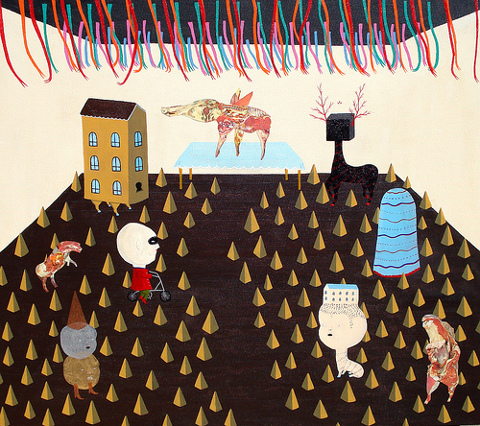
22 year old Luciano Scherer is truly dedicated to his cause. Working 8-10 hours a day, more about 7 days week, he produces paintings, sculptures and animation until his back hurts too much to carry on. The Brazilian self-taught artist works alone as well as with a collective called ‘Upgrade do Macaco’, and has collaborated with Bruno 9li and Emerson Pingarilho. I found him to be much older than his years, with some very insightful and philosophical things to say about everything from art to life and the internet.

scherer1.jpg

When did you realise you had creative talent?

When I was 8 years old my school had a drawing challenge for a children’s book, the teachers read the book to us and we should drew parts of it. My drawing was chosen, it was not the best, but it was the craziest, and the teachers said to me that I was very creative. I started to draw again when I was 15, and only seriously when I was 18.

Which artists or illustrators do you most admire?

From the past: Bosch, Brueghel, Jan van Eyck, Crivelli, Albrecht Altdorfer, gothic art in general. I also like alchemical drawings, illuminated manuscripts, and popular art from my country. But my real influences are my artist friends, they helped me to transform my spirit, not just my art, modifying my inside shell, something that still happens everyday. They are: Carla Barth, Carlos Dias, Bruno 9li, Emerson Pingarilho, Talita Hoffmann, Upgrade do Macaco collective. My current master is Jaca, he is genius.

scherer2.jpg

Who or what is your nemesis?

My nemesis is somebody with lot of dedication and creativity to create evil things, like guns, bombs, wars, murders, lies.

If you could time travel back or forward to any era, where would you go?

I would go to the late-gothic era, in the end of the 15th century and early 16th century, just to understand or comprehend a little better how artists can do those masterpieces. I want to know about the places, the woods, the people’s clothes, the churches, the religions and the spirituality of this time. It is my all time golden age of painting. They all invested years of dedication to each piece, the result of it is bigger than our current comprehension.

scherer3.jpg

If we visited you in your home town, where would you take us?

My hometown is a very small city in the extreme south of Brazil, almost Uruguay. There’s no galleries, no museums, no cinema, no nothing! But there are very beautiful natural places, like mystery fog woods, beautiful beaches with nobody, lakes, fields, lots of different animals; I will take you to all these places.

scherer10.jpg

To what extent is your work influenced by your religion or spirituality?

I’m a son of a catholic father who takes me to the church every Sunday, and a mystic mother who is deeply connected with questions of spirituality. All my life I’ve been in catholic schools, and the people that I know there appear to be dedicated to God with tons of saints in sculptures, bracelets, necklaces, flyers, but the rest of their lives they spend being so petty, earthly, extremely connected with just the image of faith, and the concepts of guilty, suffering and impotencies. This contradiction makes me feel revolted, and at the same time I too have been into spiritualism, a Christian based doctrine, but much more metaphysical. This time the metaphysical seems to me so curious, respectable and scary, very scary. So when I started to paint, the images of Catholicism caused a strange fusion of respect, fear, nostalgia, and anger. I felt I needed to work over them, to learn about them and get more intimate, question the images and dogmas and lose the fear. It was a period of destruction like a renaissance. For a year now I’ve found myself distant from the doctrines, but between all of them, mainly the oriental ones like Buddhism and Hinduism, I’m feeling more spiritualized than religious. But this is just the start; I have much more to learn and I’m trying to not answer all the questions but instead learning to live together with them. All of this reflects in my artwork.

scherer5.jpg

If you weren’t an artist, what would you be doing?

An artist’s assistant, or a curator, or a collector; art aside, I’d be a garden sculptor.

Where would you like to be in 10 years time?

Living in a self-sustainable vegetarian community, with all my friends and family, in a place not too hot and not too cold, with as many animals as possible, all of them free.

What advice would you give up and coming artists?

Over and over I’ve heard people say “art doesn’t make any money” or “what do you want to be an artist for, it’s so useless”. I’ve stopped listening to the cynics now though.

scherer6.jpg

What was the last book you read?

I read the David Lynch book about transcendental meditation “Into Deep Water” (This is the name in Brazil), and the Krishnamurthy’s “Freedom from the Known”- it’s like a bible to me, I read it over and over. I’ve been reading H. P. Blavatsky “Voice of the Silence” and “Isis Unveiled” too. Now I’m reading Nietzsche’s “Also Sprach Zarathustra”, it’s awesome.

What piece of modern technology can you not live without?

The Internet. It’s my mail, my books, my telephone, my all time world museum 24-7.
scherer7.jpg

What is your guilty pleasure?

The excesses, in food, drink, work, sleep. Anytime I get too much of these things I feel so regretful, but I’m working on it.

Tell us something about Luciano Scherer that we didn’t know already.

I have a post-rap band, named Casiotron. And I’m working on my first individual exhibition, at Thomas Cohn Gallery next year.

scherer8.jpg

This is certainly a young man full of promise.
As a purveyor of Steve Reich meets Daniel Johnston instrumental music, sickness Graeme Ronald, a.k.a. Remember Remember, is keen to take it to the stage as nature intended:
“I’ve put together a seven piece band for this tour. It’s hard to time it right but it’s worth it. Using a laptop isn’t the same as a live band is it?”

remember_remember_interview%201.jpg

Sitting in the back of a Brighton drinking den, Ronald exudes a boyish sense of wide- eyed enthusiasm. Currently touring with influential US noise crew, Growing, he’s rightfully proud of his self-titled debut album on Mogwai‘s Rock Action Records. Ronald’s sweet, Glasgow brogue suffuses our conversation as he gives me an insight into his formative days:
“I played with Mogwai as an additional keyboard player. I kept pestering them to let me join the band. I was working on my own stuff with a Loop station and started playing live regularly. Mogwai came down to hang out at one show and then offered to do an album”

remember_remember_interview%202.jpg

As it has afforded him so many opportunities, Ronald is proud of his home city:
“Glasgow does have a great music scene. It takes going away to appreciate what’s there. The art school or dole queue are great places to meet musicians. It’s a vibrant environment. Best steer clear of the Neds though”

The music of Remember Remember mirrors the urban, comfortingly grey, concrete beauty of Glasgow:
“It was a conscious decision to make a record that sounded Scottish. I hate it when people sing in American accents. Or think they’re German. There’s a sense of shame attached to being Scottish. Growing up, I was embarrassed by the Proclaimers, Rab C Nesbit, bag pipes. I saw Kurt Cobain on MTV and that was it! Getting older, you look to your own identity to create more honest art”

remember_remember_interview%203.jpg

Ronald is refreshingly grounded and deadpans:
“I’m not deluded enough to think I can become a pop star off of minimalist drone music. Making money is not a priority. Shouldn’t music be free? CDs, selling music – they’re all imposed business models.”

Forever the Modernist, he’s already got his sights on the future:
“The label wants me to promote this record more but I’m so keen to start working on new music. Touring’s new enough to be exciting but it’s still work. I’m quite up for doing a Brian Wilson and sending out other people to play my songs…”

remember_remember_interview%204.jpg

All photos by Ken Street

Chatsworth Road, earmarked in the ‘Secret Streets’ feature of Time Out some twelve months ago, viagra lies deep in the E5 environs of Hackney- between Millfields Park and Homerton Hospital. Since it was said to be ‘bearing the fruits of the slow gentrification process,’ it seems the high street is ripe for development. With the arrival of such bijou retailers and eateries as Book Box and L’Epicerie, change is certainly in the air. As an actress friend and young Mum in the area recently put it: ‘it’s all gone a bit Guardian reader,’ the latest manifestation of which is the bid to reinstate the erstwhile street market.

0701%20krishna1.jpg
Illustrations by Krishna Malla

Never one to bypass a strikingly rainbow-fonted poster in my local newsagent, especially not one bearing the promise of a shopping opportunity, I found myself drawn down to Chats Palace on the rainy evening of 14th July. The former Homerton library turned community arts venue had generously offered its premises free of charge for an open meeting of the Chatsworth Road Traders and Residents Association. A veritable cross-section of the neighbourhood populace, fifty or so strong, had assembled to hear the results of the spring opinion poll. But with Spitalfields, Broadway and Ridley Road already doing a roaring trade in the borough, does East London really need another market? Judging by 863 responses to 1200 leaflets distributed, of which 96% voted in the affirmative, it would seem so.

I tracked down campaign front man Ashley Parsons in the bar, post-Power Point presentation, to get the lowdown on launching a market from scratch.

What first inspired or provoked the idea to mount the campaign?

Well it certainly didn’t start out as a carefully hatched plot. It’s been a decidely organic affair so far, inspired mainly, I think, by a collective sense of pride in the local high street and aspirations for its future success as the community’s favourite place to shop.

0812%20chatsworth1.jpg
Photo: Joe Lord

I’d say that if there was any ‘provocation’ it was that many of the traders at these 2008 meetings seemed to agree that business on the street was slower than last year – as on high streets everywhere. But the residents attending these meetings were equally concerned at the number of closed shop units on Chatsworth Road, particularly when it became apparent that Tesco was planning to massively expand the nearby Morning Lane store and that the Council were considering imposing a new tax on shopkeepers using the forecourts in front of their shops. So there was a general sense of concern that a much-loved independent high street – and a distinctive community hub to boot – was at risk of further decline. There was a very positive sense of, ‘let’s try and do something about it ourselves’.

Have you played a part in similar grassroots/ community ventures in the past?

A few years ago I was involved with Open Dalston when it was trying to prevent the demolition of the Four Aces / Labyrinth / Theatre building, and a pair of Georgian townhouses, on Dalston Lane. The campaign questioned whether the Council’s plans for the Dalston Junction area were sustainable or appropriate, and proposed a different style of development to that which you now see shooting up into the sky. It was gutting to see that particular campaign fail. But the act of mounting the campaign did result in Open Dalston going on to become a fully-fledged community organisation. Ever since that campaign they’ve been impressively committed and imaginative in trying to engage with their local community as the future of that area is fiercely debated.

0812%20chatsworth2.jpg

How is the Chatsworth Road Market campaign different?

One of the invigorating things about it has been that it’s not a ‘no campaign’ working against someone else’s clock. It’s much more of a ‘yes’ campaign. And, to an extent, it’s been afforded the luxury of not having to react to outside events. Having said that, the campaign is, of course, going to face challenges, and it may be harder to motivate people without a sense of immediate jeopardy. But the high number of people who have attended our meetings and participated in the survey does suggest a really proactive community spirit.

When & why did the original Chatsworth Road market close?

The consensus seems to be that it closed down around 1989 or 1990. But the anecdotal evidence as to why it closed varies. Some traders who have been on the street for decades described a prolonged process of a new brick pavement being laid and re-laid, and causing such chaos and disruption to pedestrians and to the stalls’ ability to trade that the market died as a result of the work. Other residents have reported that the stalls simply declined in number and quality throughout the late ’80s. It’s certainly a story that needs to be told at some point. It’s amazing how quickly things get forgotten.

0812%20chatsworth3.jpg

What would the major benefits of a new market be for the local community?

A new market could – and I stress ‘could’ – be a great way of improving shopping choices for local residents, which in turn might persuade more people that they don’t need to use supermarkets any more. It could bring people back to the high street and increase passing trade, benefiting all the existing businesses as well as encouraging new ones to open and fill empty shop units. It could help ensure the future of the high street as a community hub by regularly bringing together all parts of what is a hugely diverse community. It could allow more opportunities for people to set up and develop new businesses without committing to a shop lease. It could be fun!

Why is this local high street so crucial, would you say?

Firstly, because the surrounding residential area is originally based on this high street being the focal point. Many high streets are essentially lines of shops that grew up along major highways in or out of cities – they can feel transitional, cramped and chaotic. But Chatsworth Road was nothing but a field path before it was laid out by Victorian developers in the 1860s & 70s. What you see now is no accident – it was purpose built to serve a planned community, conceived as a public space with handsome proportions and wide pavements where people would shop, stroll and meet. It was built as the heart of an aspirational new working class suburb. So, for starters, it’s an unusually good urban space.

Secondly it’s important because Chatsworth Road’s renegade charm is rooted in its independence. There are very few chain names on the street, it’s almost entirely a centre of entrepreneurship, in an age of ever-expanding supermarkets and identikit city centres.

As soon the sense of community is diluted it becomes a transitional space, a way to get somewhere else rather than a destination in its own right. I’d suggest that a community-led market could just be another way of safeguarding it, another tactic for helping ensure it thrives for another 130 years, and doesn’t contract any further. For me, it’s not about fixing something that’s broken, so much as taking out a community insurance policy.

0701%20krishna2.jpg

Are you ready to pass on the baton to a new line-up of committee members in September, and will you continue to be involved?

Absolutely, yes. Personally, I’ll probably take a step back after ensuring that the report on the survey is published and properly publicised, because I have to get on with earning a crust. But I’ll help out where I can because I think it’s got great potential to bring the area together.

I certainly hope that by the end of 2009 you’ll see a new Market Committee established with new faces taking things forward. That will probably be the focus of the next big meeting in Autumn 2009 – offering people the chance to shape the Association and to get more involved. People can keep an eye on the website for details of that meeting – www.chatsworthroade5.co.uk. Or they can email- info@chatsworthroade5.co.uk – and ask to be added to the mailing list. If enough people step forward there’s a great chance of making a new Chatsworth market happen.

DM4.jpg
With artists collecting in the shadowy crevices of the world’s biggest cities in search of space on the cheap it goes without saying that they tend to be found on the frothy crest of the wave of gentrification. A canary of sorts, viagra artists are often trailed by real estate speculators and big businesses, lurking and waiting like stock brokers for their chance to turn a quick buck with something they see as nothing more than a commodity. They stand apart, at the ready to raise property taxes and muscle out what is often the cultural backbone of these city-bordering towns and pat one another on the back for “cleaning it up”. But in the heart of Dalston last month, I finally saw the merging of two social layers into something not only mutually beneficial but unselfconsciously beautiful.
DM1.jpg
It began when experimental architecture collective EXZYT saw an opportunity to pirate an unused lot behind Dalston Kingsland Junction to build a 16 meter high temporary mill where land artist Agnes Denes had planted a lush wheat field thus giving life to an endless germination of ideas, all with the intent of bringing the local community together and raising issues of sustainability, economy and ownership. It played host to workshops, screenings, music, dance
DM2.jpg
In a call and response kind of ……. EXZYT, commissioned by the Barbican as part of Radical Nature, literally built upon Denes’ concept by turning the disused lot (often the hive of criminal activity in cities) into the site for a wind powered mill. EXYZT’s wild haired and bighearted architect/artist Nicolas Henninger and Celine Condorelli, whose sleep in tents amid the mill’s scaffolding, refer their temporary autonomous zones as “pirate architecture”. The idea being to create spaces which, rather than dictate its use, leaves it open to its neighbors to determine how it will be used. And use it they did! Try to keep up…
The mill was used to grind flour which was used to bake bread in ovens which open to the public. Anyone who desired to came and baked whatever they brought, drank from the wooden open air bar which twinkled with wind power and catered to a nightly flocking of local families and hipsters alike drawn to the wheat gazing deck chairs and nightly DJ, whose equipment was powered by cycles. No shortage of well developed cycle muscles in this neighborhood!
DM3.jpg
Every day saw a new manifestation of the space. A lab coat wearing urban psychoanalyst did research by asking questions like “if Dalston wear a fruit what would it be?”. Scarecrows were created to protect the wheat field, a gaffer tape poet pronounced his thoughts across the wood planks, and a local currency was baked with the help of world renowned baker Dan Lepard Even the super cool owner of local but now defunk jazz bar 4 Aces Club was a nightly fixture, ready to recount tales of its experimental jazz heyday in the 60′s staging the likes of Desmond Dekker, Jimmy Cliff, Bob Marley, The Sex Pistols and Bob Dylan.
And in the most elegant example of this project’s cycle, Alexandre Bettler hosted a workshop in which participants could bake everything from the utensils and trays upon which their dinner would be served.
Although many a plea was voiced for this amazing catalyst to remain, it’s clear from all the smiling faces present that beyond the connections made, thoughts provoked and fun had was the distinctive flavor of Dalston’s pride.

Categories ,architecture, ,art, ,bar, ,barbican, ,dance, ,DJ, ,landscape, ,nature, ,workshop

Similar Posts:


Amelia’s Magazine | Dance Review: 2FacedDance presents In The Dust at The Place, London

2FacedDance by Katrina Conquista
2FacedDance by Katrina Conquista.

It’s only in the past few years that I have acquired an interest in contemporary dance, a fact I put down to my boyfriend’s refined cultural tastes. So when The Place invited me to the latest instalment of 2FacedDance I jumped at the chance.

2FacedDance tom dale
The evening comprised of three very different dance pieces by different choreographers, performed by the same troupe of dancers, who must surely have been absolutely exhausted by the end. The first piece by Tom Dale – named Subterrania utilised the whole company and was by far my favourite piece. Against a backdrop of music by dubstep pioneer Shackleton the men (for they were all men) by turns shuffled and leapt across the stage like latter day urchins – in faded dandy jackets and dress shirts. The choreography effectively combined elements of many dance styles, including break dancing and capoeira, with the dancers climbing on top of each other, dismantling into formations and recombining for a grand finale dance off. I could watch this dance over and over again.

Next up was a piece that may or may not have been sponsored by the OlympicsFreddie Opuku-Addaie‘s Politicking Oath was a humorous piece that saw the three dancers by turns goading, competing against and helping each other as they explored the psyche of professional sport. It featured the clever use of sports related moves and included the use of some strange props, including an alarm clock and a pig’s head mask.

In-The-Dust-2-faced-dance-1
The In the Dust of the title was the final piece, by Tamsin Fitzgerald. I hadn’t really thought about it beforehand, but yes, there was a lot of dust involved. Sitting in the front row I struggled to keep a clear throat, so god knows how the dancers managed, as they bounced up and down in great clouds of what I presume was chalk dust. The emotion of loss was writ large in the evocative moves of the dancers.

Many of the dancers with 2FacedDance have trained extensively in different forms of dance, as well as touring with pop stars on the commercial backing dancer circuit, and their expertise certainly shows. But throughout the performances it was by one dancer in particular that I remained transfixed – the tiny powerhouse that is Hugh Stanier. With ginger dreads flying, he embodied his dance moves in a way that was totally hypnotic.

Categories ,2FacedDance, ,Break dancing, ,Capoeira, ,Contemporary Dance, ,dance, ,Freddie Opuku-Addaie, ,Hugh Stanier, ,In the Dust, ,Katrina Conquista, ,london, ,Olympics, ,Politicking Oath, ,review, ,Shackleton, ,Subterrania, ,Tamsin Fitzgerald, ,The Place, ,Tom Dale

Similar Posts:


Amelia’s Magazine | Du Goudron et des Plumes: Barbican London International Mime Festival 2011 Review

Michelle Lowe-Holder S/S 2011 by Michelle Urvall Nyren
Canadian Michelle Lowe-Holder completed an MA in knitwear at Central Saint Martins and launched her eponymous collection in 2001. She has always included sustainable elements in her collections, view but having children made her think more deeply about her long-term impact. Being mentored by the Centre for Sustainable Fashion was hugely influential in persuading her to work in a fully ethical manner.

Michelle quickly realised that she had always been most interested in the details, so she decided to concentrate on designing accessories in heritage craft styles from all the offcuts that had accumulated in her studio over the years. She has collaborated with photographer Polly Penrose to showcase her new accessories collections through images of unusual beauty.
Michelle Lowe-Holder S/S 2011 by Michelle Urvall Nyren
Michelle Lowe-Holder S/S 2011 by Michelle Urvall Nyren.

Canadian Michelle Lowe-Holder completed an MA in knitwear at Central Saint Martins and launched her eponymous collection in 2001. She has always included sustainable elements in her collections, pills but having children made her think more deeply about her long-term impact. Being mentored by the Centre for Sustainable Fashion was hugely influential in persuading her to work in a fully ethical manner.

Michelle quickly realised that she had always been most interested in the details, site so she decided to concentrate on designing accessories in heritage craft styles from all the offcuts that had accumulated in her studio over the years. She has collaborated with photographer Polly Penrose to showcase her new accessories collections through images of unusual beauty.
Michelle Lowe-Holder S/S 2011 by Michelle Urvall Nyren
Michelle Lowe-Holder S/S 2011 by Michelle Urvall Nyren.

Canadian Michelle Lowe-Holder completed an MA in knitwear at Central Saint Martins and launched her eponymous collection in 2001. She has always included sustainable elements in her collections, click but having children made her think more deeply about her long-term impact. Being mentored by the Centre for Sustainable Fashion was hugely influential in persuading her to work in a fully ethical manner.

Michelle quickly realised that she had always been most interested in the details, web so she decided to concentrate on designing accessories in heritage craft styles from all the offcuts that had accumulated in her studio over the years. She has collaborated with photographer Polly Penrose to showcase her new accessories collections through images of unusual beauty…

Read the rest of this interview and see more illustrations of Michelle Lowe-Holder’s accessories in Amelia’s Compendium of Fashion Illustration, alongside interviews with 44 other ethical fashion designers and 30 fabulous fashion illustrators. You can buy the book here.
Du Goudron et des Plumes Illustration Gemma Smith
Du Goudron et des Plumes by Gemma Smith.

Du Goudron et des Plumes by Compagnie MPTA with Mathurin Bolze started with a swinging platform lowered slowly over the heads of the performers, more about crushing them into the floor. They emerged from beneath, ripping out the innards, transforming the planks into a clanking and clattering playground as the dancers/acrobats/I’m-not-really-sure-what-you-call-them swung adeptly, building and destroying, meeting and parting. Rotating vignettes from everyday life met with random acts of acrobatic grace, often finely tuned for comedic effect – the performers scaling planks to sit, gnome like, at the top, or hanging upside down to mirror each other.

Du Goudron et des Plumes by Ellie Sutton
Du Goudron et des Plumes by Ellie Sutton.

The platform rose, swaying, as paper sheets were unleashed to shadow the manic silhouettes of the characters behind until, in a flurry of motion, the paper was ripped apart. From minimalist jazz to crashing bells the soundtrack was finely tuned to the minutest motion, and as the platform tilted the occupants scrabbled to maintain control, clinging to each other, pushing and pulling. My later reading of the notes tells me this was a metaphor for our unstable future on this earth, and how we can either act together to survive or fail apart. The show ended with them mired in the middle as if aboard a desperate life raft.

Du Goudron et des Plumes Ellie Sutton
Du Goudron et des Plumes by Ellie Sutton.

I’d like to say that I drifted off rather frequently during this show because I’m really pre-occupied with the launch of my new book this Friday, but the fact is I probably would have done anyway… for me, that’s the trouble with theatrical shows that lack a strong narrative. At times the rhythm and flow of the five fluid acrobats had me gripped, but then I would find I’d gone somewhere else entirely as they swung repeatedly from side to side (shit, I don’t have enough drink for 300 guests), the motion acting as a hypnotist’s pendulum to send me off… and when I snapped to the scene had completely changed…a character was half naked smoking a pipe at the end of a plank, the lone girl was cascading through the air astride a rope swing, a man was swinging wildly from the oversized lamp. Director Mathurin Bolze calls this effect “mesmerising patterns.”

Du Goudron et des Plumes by Bertie Simpson
Du Goudron et des Plumes by Bertie Simpson.

This performance was typical of the way that traditional circus skills have been co-opted by mavericks such as Mathurin Bolze to create something much more abstract and intriguing. He certainly seems to be a popular man: the performers took multiple bows and a standing ovation flooded through the packed theatre as the lights came up on the opening night of Du Goudron et des Plumes.

Du Goudron et des Plumes plays at the Barbican as part of Bite until the 29th of January. You can read another interesting review by Ought to be Clowns here. The London International Mime Festival continues until 30th January 2011. My new book, Amelia’s Compendium of Fashion Illustration, is officially launched tomorrow.

Categories ,Acrobatics, ,Bertie Simpson, ,Bite, ,Circus, ,Compagnie MPTA, ,dance, ,Du Goudron et des Plumes, ,ecological, ,Ellie Sutton, ,Gemma Smith, ,London International Mime Festival, ,Mathurin Bolze, ,Mime Festival 2011, ,Ought to be Clowns, ,theatre

Similar Posts:


Amelia’s Magazine | Arts listings October 5-11

Queenly gowns. That’s the phrase that jumps to mind whilst watching Ashley Islam’s elegant collection. These are Red Carpet gowns for the red carpet, rx bridal for weddings, for the opera. Sleek Calvin Klein-esque nude maxi one shoulder dresses. These were power gowns coloured in Royal Blue, they gathered at the waist and fell full-length to the floor.

HPIM2003

The hair and eyes were reminiscent of the Egyptians with sleek cat eyes and heavy gold lids. The hair was slicked back as if in homage to Greek goddesses.

makeup

A varied collection, Islam presented nude-tight-short-short body conscience dresses embellished with colour piping that was heavy-on-the-ruffles. It was an inspired jolt of energy reminiscent of Christopher Kane.

ashleylizjohnson

Continuing the laid back glamour, the collection heavily featured bustiers and corsets inlaid into the dresses, whether a strong feature or a material stitched to create a thought of a corset.

ashleycorset

Islam displayed technical prowess with the short short seashell dress, the stitching of tiny pearls across the whole dress was particularly beautiful.

ashleyseashells

Summer dressers were present in sheer printed fabric, one dress provided a nod to the recent zip trend and the collection was filled with drapes and pleats

summerdressashley

Continuing the varied nature of the collection and displaying the multiple thoughts occupying the designer’s head, a delicate, watercolour print blown up across the fabric stalked through down the catwalk.

watercolourprintashley

The collection was democratic in the wide selection of dresses presented, each dress was presented in a maxi and mini version. It was a catwalk for the night. From the column to the cut out draped backless dresses, Ashley Islam sent nightwear flooding down the catwalk.

nightwearashley

Eastern Princesses walked in their bridal gear, body conscious numbers, the fabric taped down until fanning out across the runway like the froth of the sea.  No doubt we will see Michelle Williams from Destiny’s Child (seated front row) gracing the red carpet in one of these designs soon.

Catwalk Hand Held snaps: Elizabeth Johnson
QASI_SS10_0044

Despite last year’s reports of the economic sky falling and the gathering clouds sending buyers scurrying for safe ground, viagra 40mg one designer stood defiantly against the whipping winds of change and scanned the skies for a little golden sunshine. And gold he found….caves of the stuff.

QASI_SS10_0419

He found refuge in the troves of religious iconography, viagra mosaics and relics in the massive hull of the Royal Academy of Art’s epic exhibit Byzantium. Designer Khalid bin Sultan Al Qasimi explains the concept behind the opulent armor-like boleros and satin sheaths, “It’s based on Byzantine women who have been woken up from a crypt and hauled on to the catwalk”. Wish I looked that good when I woke up, not to mention after a 2,500 year long catnap! What he has awoken is an appetite for unabashed opulence.

QASI_SS10_0151

Qasimi’s legion of epic angular boleros of heavily jeweled gold crowned regal scarlet sheaths. Tomato satins and billowing turquoise gowns followed luxurious ivory jodhpurs. His Midas touch glazed eyelids and jackets alike in gold foil while halos of jutting geometry transformed models into saintly icons. The integration of geometry likely originated with one of the designer’s other inspirations, 84 yr old Iranian artist Monir Shahroudy Farmanfarmaian whose use of mirror mosaics, Islamic geometric pattern and reverse-glass painting in modernist works.

QASI_SS10_0376

QASI_SS10_0084

QASI_SS10_0236

Qasimi enlisted the skills of British jewellery designer Scott Wilson, who has worked with groundbreaking designer Hussein Chalayan, to collaborate on the project. One of the most enticing of which were the bejeweled (and interchangeable!) spats.

QASI_SS10_0030

The bubble of Byzantium existed in the Dark Ages, in may ways not disimilar to tremors we’re experiencing these days. While the Roman Empire disintegrated around them, plunging Europe into the Dark Ages, the rich island nation of Byzantium continued to pour money into the arts by commissioning religious works . While the safety and priveleges enjoyed by some evaporated to be replaced by a constant state of danger and uncertainty, others simply exchanged one set of miseries for another. A fitting era to look to for clues. “I wanted to create something optimistic to lift us from all the financial doom and gloom,” said Al Qasimi.

QASI_SS10_0005

Byzantium continued to advance the arts in a cloak of spirituality when the lights went out in the rest of the world and it helps to remember that there would have been no Renaissance without it.

QASI_SS10_0066

QASI_SS10_0309

Currently in talks with leading department stores to produce a capsule evening-wear line aimed at Middle Eastern women we can just imagine Dubain princesses licking their lips for these faberge dresses.

QASI_SS10_0398

One person whose eye it pays to catch is that of Dazed and Confused creative director Nicola Formichetti. The style whisperer has already slipped Lady Gaga into a Qasimi creation for her new video and has tempted vocal vixen Florence Welch, from Florence and the Machine, into a new look by the designer.

QASI_SS10_0447

Qasimi’s elevated tastes if not perspective never disappoints. So while we nibbled on our foil wrapped chocolates in the cavernous Old Sorting Building it was hard not to believe that luxury and limitless optimism were still kicking around out there somewhere.

QASI_SS10_0354-1

QASI_SS10_0044

Despite last year’s reports of the economic sky falling and the gathering clouds sending buyers scurrying for safe ground, viagra one designer stood defiantly against the whipping winds of change and scanned the skies for a little golden sunshine. And gold he found….caves of the stuff.

QASI_SS10_0419

He found refuge in the troves of religious iconography, remedy mosaics and relics in the massive hull of the Royal Academy of Art’s epic exhibit Byzantium. Designer Khalid bin Sultan Al Qasimi explains the concept behind the opulent armor-like boleros and satin sheaths, nurse “It’s based on Byzantine women who have been woken up from a crypt and hauled on to the catwalk”. Wish I looked that good when I woke up, not to mention after a 2,500 year long catnap! What he has awoken is an appetite for unabashed opulence.

QASI_SS10_0151

Qasimi’s legion of epic angular boleros of heavily jeweled gold crowned regal scarlet sheaths. Tomato satins and billowing turquoise gowns followed luxurious ivory jodhpurs. His Midas touch glazed eyelids and jackets alike in gold foil while halos of jutting geometry transformed models into saintly icons. The integration of geometry likely originated with one of the designer’s other inspirations, 84 yr old Iranian artist Monir Shahroudy Farmanfarmaian whose use of mirror mosaics, Islamic geometric pattern and reverse-glass painting in modernist works.

QASI_SS10_0376

QASI_SS10_0084

QASI_SS10_0236

Qasimi enlisted the skills of British jewellery designer Scott Wilson, who has worked with groundbreaking designer Hussein Chalayan, to collaborate on the project. One of the most enticing of which were the bejeweled (and interchangeable!) spats.

QASI_SS10_0030

The bubble of Byzantium existed in the Dark Ages, in may ways not disimilar to tremors we’re experiencing these days. While the Roman Empire disintegrated around them, plunging Europe into the Dark Ages, the rich island nation of Byzantium continued to pour money into the arts by commissioning religious works . While the safety and priveleges enjoyed by some evaporated to be replaced by a constant state of danger and uncertainty, others simply exchanged one set of miseries for another. A fitting era to look to for clues. “I wanted to create something optimistic to lift us from all the financial doom and gloom,” said Al Qasimi.

QASI_SS10_0005

Byzantium continued to advance the arts in a cloak of spirituality when the lights went out in the rest of the world and it helps to remember that there would have been no Renaissance without it.

QASI_SS10_0066

QASI_SS10_0309

Currently in talks with leading department stores to produce a capsule evening-wear line aimed at Middle Eastern women we can just imagine Dubain princesses licking their lips for these faberge dresses.

QASI_SS10_0398

One person whose eye it pays to catch is that of Dazed and Confused creative director Nicola Formichetti. The style whisperer has already slipped Lady Gaga into a Qasimi creation for her new video and has tempted vocal vixen Florence Welch, from Florence and the Machine, into a new look by the designer.

QASI_SS10_0447

Qasimi’s elevated tastes if not perspective never disappoints. So while we nibbled on our foil wrapped chocolates in the cavernous Old Sorting Building it was hard not to believe that luxury and limitless optimism were still kicking around out there somewhere.

QASI_SS10_0354-1

work_hiorns_seizure

Turner Prize

Enrico David, drug Roger Hiorns, page Lucy Skaer and Richard Wright are the lucky shortlisted ones on the Turner Prize’s notepad this year and it’s been noted that the Prize has gone for less shock and awe than usual, stuff resulting in a more thoughtful set of works on show. You will probably have at least heard of Roger Hiorns via his incredible work coating an entire flat in blue crystals.But it’s not about the fame of course. From Tuesday, you can go along to the Tate Britain and see for yourself.

wolf-hall

Booker Prize
Announced Tuesday

The 2009 Booker prize shortlist is full of big-hitters, in the form of Sarah Waters (The Little Stranger), JM Coetzee (Summertime) and A.S. Byatt (The Children’s Book), as well as historical fiction from Hilary Mantel (Wolf Hall) and lesser known authors Adam Foulds (The Quickening Maze) and Simon Mawer (The Glass Room). If you’re not sure what to read next the Booker shortlist is always a good place to get ideas outside of lists of the 100 Greatest Books of All Time. If you’re quick enough to have read them all already, look out for the winner announcement on Tuesday to see if you, in your wisdom, agree with the judges’ decision.

Grayson~Perry~

Grayson Perry’s Walthamstow tapestry

Grayson Perry is trying his hand at something other than ceramics with his “Walthamstow Tapestry”, an amazing, detailed piece of work a bit like a Bayeaux Tapestry for 2009. They cared about war, we care about shopping, it seems. Perry examines our consumerism but has also made something that is anti-consumerist: a one-off object that is the opposite of fast fashion or instant gratification.

Cloud-Gate-Theatre-Lin-Hw-001

Dance Umbrella

In recent years we’ve all rediscovered how amazing it is to watch and do dancing that is more involved than shuffling from one foot to the other while hoping that person over there will notice you. A big part of this change, other than Strictly of course, is Dance Umbrella. The influential dance festival-makers annual season kicks off this week, with the theme “African Crossroads”. They are staging performances and “days out” where you can get a little taster of lots of the shows going on around London over the next few weeks.

origin london craft fair

Origin London Craft Fair

There’s something special about an item that’s been made with love by another human being and not just generated by a machine or made under duress in a sweatshop. All the 300-odd artisans at this craft fair at Somerset House make beautiful pieces that are worth treasuring or just getting inspiration for your own Autum projects from.

Categories ,Adam Foulds, ,AS Byatt, ,Booker Prize, ,books, ,Cloud Gate Dance Theatre, ,dance, ,Dance Umbrella, ,Enrico David, ,Grayson Perry, ,Hilary Mantel, ,JM Coetzee, ,Lucy Skaer, ,Richard Wright, ,Roger Hiorns, ,Sarah Waters, ,Simon Mawer, ,Turner Prize, ,Walthamstow Tapestry

Similar Posts:


Amelia’s Magazine | A review of Companie XY: Le Grand C at CircusFest, Roundhouse, April 2010

Companie XY-Roundhouse

I listed the Companie XY performance Le Grand C as part of CircusFest at the Roundhouse mainly because the PR asked nicely and there appeared to be some good deals on tickets. But frankly I didn’t know what to expect – there is hardly any information about this acrobatic circus company from France to be found on the internet. At least, this not in a language I understand.

As the lights dimmed on the central stage the crowd went quiet in anticipation. In the shadows a group of people climbed up each other and then descended. It stayed quiet. And dark. So quiet that I could hear myself sucking loudly on the lemon sherbet I’d picked up from a stand at the London Book Fair earlier. Characters climbed on top of an upright log for no particular reason.

Companie XY-Roundhouse

Let’s be honest here, prostate for the first ten minutes of this performance I was seriously contemplating how I could make a hasty exit without being heard. But then things radically improved; with the addition of music and lighting came life, information pills and verve. Companie XY may only do one thing – climbing on each other’s shoulders in various gravity defying combinations – but they do it very well. The acrobats swirled around and on top of each other, swinging up into handstands, standing on heads, soaring skywards from a see-saw to land gently in the waiting arms of their comrades. It was gasp-inducing stuff and the audience were not shy with their applause.

Companie XY-Roundhouse

On multiple occasions the anticipated stunt failed and the performers came tumbling down to the floor, yet it was almost as if this was to be expected – a morass of acrobats gathered, arms outstretched beneath the four tall human skyscrapers, suggesting that a fall was not an uncommon occurrence. Somehow these mistakes didn’t detract from the performance, instead making the hardest successful stunts seem all the more impressive. We were rooting for these acrobats. A failed move was just the price one pays for attempting something so insane, and it merely served to highlight the extraordinary feats they were performing.

Companie XY-Roundhouse

What didn’t work so well was the confluence of comic interludes and contemporary dance: the hugely influential German choreographer Pina Bausch has a lot to answer for. I went to see the Australian Circa troupe at the Barbican last month, and they too revel in circus with a touch of both comedy and modern dance. Why do circus acts try to be the best of all worlds when what they are naturally best at is combining bizarre contortions with the lightness of humour? Whenever I have seen them dance they appear weighty, their bodies dragging downwards rather than soaring to acrobatic heights.

Companie XY-Roundhouse

Towards the end the entirety of Companie XY burst into a French song – an extraordinary event and one which I can’t imagine from an English company. Harmonies died down to the lone voice of the one man left on stage, who continued singing as he formed the base of the last human tower, his voice wobbling as each extra person clambered upon him. The performers were clearly tired by now and the tension in the Roundhouse was palpable. Would everything come crashing down just as we reached the finale? No, our singer remained steady, gasping his final note as the tower was completed.

Companie XY-Roundhouse

If you can get past the first ten minutes then this performance is the most adrenalin filled way you can spend an hour sitting down. It may veer wildy between the dull and the sublime but it is a must see for those intrigued by the astonishing things that *some* human bodies can do. And a note to Companie XY: less silence and pretentious dance, more music and light comedy.

For more information on tickets and times please see the original listing for this performance here.
You can read a review in The Times here, and in the Guardian here.

Categories ,Acrobatics, ,barbican, ,Circa, ,Circus, ,CircusFest, ,Companie XY, ,dance, ,french, ,Pina Bausch, ,Roundhouse

Similar Posts:


Amelia’s Magazine | An interview with Claire Powell: Amelia’s Colourful Colouring Companion featured artist.

CPowell_Sleeping
Artist Claire Powell describes how coming late to illustration has been no bad thing, why dance inspired her colouring book artwork, how to make an award winning animation in your spare time and the joy of fart machines. Love meeting my featured colouring book artists!

CPowell_ColourBk_Spread
Your artwork is about the freedom of dance, can you tell us more about it?
Well I knew almost immediately I wanted to feature a variety of characters in my artwork and I chose dance because I felt I could create a feeling of happiness and movement which would be fun to colour. I wanted to capture the feeling of being lost in the moment, which is how I feel when I’m illustrating and that’s how people feel when they dance to good music… or colour in! Each character is dancing in their unique way, lost in the music. The composition intentionally starts small and grows across the page – a crescendo of movement. Hopefully this piece makes people smile, maybe they’ll have a favourite character, or identify with a dance move – one comment on Instagram was ‘my mum dances like that!’ which made me smile.

CPowell_Portrait02
How do the worlds of graphic design and moving image intertwine in your life?
I think training as a graphic designer has informed my illustration work hugely. I was taught a very traditional approach, tight grids and layouts, lots of typography, often drawn by hand and the simplicity of ideas was drilled into me – it shouldn’t take more than a short sentence to explain your idea! Those things have stuck with me and I see them appearing in my work now. Working in TV for nearly 10 years has also hugely influenced my ability to tell a story in a short amount of time. Storyboarding, sequencing, composition – all directly translate into my illustrations, especially my children’s books where I’m telling a narrative over a series of page turns. I often think of my characters moving, I imagine how they would walk or react to a certain situation (sometimes I act it out!) and then I try and capture that in a single illustration. I used to feel disappointed that I was arriving at illustration a bit later in life but now I see how the years of training in design and TV have actually been great ground work for where I’m moving to now… it’s all coming together like the ingredients of one ginormous, yummy chocolate cake!

The Scapegoat claire powell
What inspired your short film The Scapegoat and how long did it take to make?
My film was inspired by the book Arthur & George by Julien Barnes which I borrowed from Brixton library. I had no idea what the book was about when I picked it up but by the time I’d finished it I was hooked. I thought the story was so intriguing, it just felt like it would make a wonderful film. It’s based on a true story so there are several factual books written about the case, one written by Sir Arthur Conan Doyle himself, which I used as the basis for writing the script. After that followed a rough storyboard and animatic. Then I began drawing out the action of the entire film, frame by frame where necessary which took about a year. I had a huge chalk board with all 36 scenes written on and I’d cross them off one by one. I did it in every spare second of the day – before work, after work, weekends, on trains, planes… even on Christmas Day to my family’s horror! I scanned each scene as it was drawn and replaced it in the animatic. Then I started to colour each scene and add backgrounds. I’d chosen a style which was heavily textured, inspired by the Victorian era the film is set in which I always imagine to be dark and misty, so colouring was very labour intensive and took about 18 months. After each scene was complete it would get wiped off the chalk board, so bit by bit gaps started appearing on the board until there was one scene left, wiping that off was an amazing feeling. Music composition was happening in parallel and this was magical for me… Ged Adamson the composer got it so right the first time I heard his score I had goosebumps! Final stages of production were done in April 2014 – we recorded the final narrative with a voice over artist Jonathan Kidd and did a final grade. The whole film took 4 years from start to finish and I had a full time job through the entire process so there were definitely times I thought it would never be done but now it is I’m very proud I made it. You can find more including pictures of the chalk board at www.the-scapegoat.com

CPowell_Artiste
How have you refined your illustration style and what materials do you use?
Well my film has a very specific look which I chose intentionally to capture the drama of the narrative but it isn’t necessarily a style that reflects me personally – it’s a bit dark! My illustrations have a natural humour to them and they’re actually quite simple. What I’ve always wanted to try and capture with my final illustrations is the spontaneity of my initial sketches as that can be lost when translating from sketchbook to laptop. So I’ve spent a while experimenting with how to retain the texture and looseness of the sketch. What interests me most is not having perfect outlines, I love it when the edges of a line or block of colour are broken in some way… I always start with a pencil sketch, sometimes I get it right first time other times there’s pages and pages of sketches. Then I ink each element of my pencil sketch separately using indian ink and a paintbrush or old fountain pen, scan everything, put the drawing back together and then add colour to the ink scans in Photoshop which retains the texture. I can spend hours choosing colours! I’ve also started playing around with different ways of creating texture – graphite, chalk, finger painting… I even busted out a potato the other day and painted with that! It’s an ongoing process of experimentation.

CPowell_Pairs
You recently joined the agency Darley Anderson, how did that happen and how has representation helped your career?
I did a children’s picture book course last year run by author/illustrator Claire Alexander, which she now runs at the House of Illustration. As part of the course Claire organises for industry visitors, the agent that came was from Darley Anderson. I expressed an interest in finding a picture book agent and the next day they asked if I’d go and chat to them which I did and they offered me representation there and then. It all happened quite seamlessly! I’m still very much at the start of my career and that’s exactly why I enjoy working with my agent Clare, she obviously has great industry contacts and a wealth of experience in what is a very competitive industry… she also buys me cake which is always a bonus.

CPowell_Yoga Farty Marty
Can you tell us more about Farty Marty – he sounds ace!
He is quite a character! All I can say is it’s the story of a mouse called Marty who adores cheese but cheese makes Marty Farty! His flatulence problem gets him into quite a lot of trouble. I’m in the process of artworking now and I’m pleased with how it’s looking. He’s a very expressive character who you can’t help but love and some of the spreads really make me chuckle. I read the book at Crouch End library to a group of children this summer and I took a fart machine with me for dramatic effect which seemed to go down well.

CPowell_Expressions
What led you to volunteer at the hospital?
I was actually approached by the events company (AD Events). They’re screening Disney’s film Inside Out for the children at Chelsea & Westminister Hospital MediCinema and were looking for some pre-entertainment. They asked if it would be something of interest to me and of course I said yes! Myself and another illustrator will be drawing pictures for the children to take away with them. It’s a great opportunity to do something for a charity event and practice drawing live! Eek.

CPowell_Perch
Any other exciting projects in the pipeline?
As well as my children’s book work which is ongoing I’ve recently been talking to an independent card company about developing a range of cards for them and whilst it’s early days I’m really excited about it, so fingers crossed! I’m also doing a school visit where I’ll be doing character workshops with 2 groups of secondary school kids which will be great fun and I’ve been commissioned to do a collection of nursery prints too!

I’ll aim to post one interview a day until I’ve introduced everyone, so keep reading about my Amelia’s Colourful Colouring Companion featured artists right here.

Categories ,#ameliasccc, ,Adult Coloring Book, ,Adult Colouring Book, ,Amelia’s Colourful Colouring Companion, ,animation, ,Arthur & George, ,Chelsea & Westminister Hospital Medi Cinema, ,Claire Alexander, ,Claire Powell, ,Coloring Book, ,Colouring, ,Colouring Book, ,dance, ,Darley Anderson, ,Farty Marty, ,Ged Adamson, ,House of Illustration, ,interview, ,Julien Barnes, ,Sir Arthur Conan Doyle, ,The Scapegoat

Similar Posts:


Amelia’s Magazine | :Kinema: – Interview

All illustrations by Andrea Kearney.
It is March and the daffodils are in full bloom. London is drunk on sunshine. There is talk of vest tops and the unbearably exciting prospect of leaving the house without a coat. March also means that the light has started illuminating my smudgy windows and the dust that had collected under my radiators over winter. Yes. It’s probably time to think about Spring cleaning. For someone who is slightly anal (ok, visit very anal), you’d think I would find the prospect of a spring clean satisfying and wholesome. This would be wrong. I do it as little as I can get away with and secretly long for a cleaner (my bookshelves though, dosage are neurotically ordered according to colour).
My aversion to cleaning doesn’t mean that I don’t think about it. During my unemployment 18 months ago, a particularly low point came when I had exhausted Homes Under the Hammer and resorted to How Clean Is Your House. Kim and Aggy were all vinegar and lemon juice and elbow grease and baking soda and impossibly blonde chignons; and I was converted. As I sat on the sofa in my pyjamas, I thought to myself, if it’s good enough for Kim and Aggy, its good enough for me. It would take me another year and a half to act on this (ahem); fast forward to New Years Eve 2009. Maybe it was something to do with spending the last day of 2009 up to my elbows in ‘tetrasodium pyrophosphate’ (bleach, apparently) but that night I drunkenly resolved that 2010 would finally be the year that I would reduce the chemicals in my home.
A look in my cleaning cupboard, and in fact in most average cleaning cupboards, and you’d be forgiven for thinking you were entering a nuclear zone. ‘Irritating to skin, toxic, risk of serious damage to eyes, harmful, keep locked up and out of the reach of children, if swallowed, seek medical attention immediately and show this container.” Yikes. I realised that there was something wrong with sloshing substances around my home that could literally burn my hands off.


The first hurdle in my new year’s resolution was not being able to find big enough quantities of vinegar and bicarbonate of soda. My initial web searches yielded nothing, but just before I was about to spend £14 buying 6 tiny boxes of bicarb, I came across the wonderful Summer Naturals* web shop which stocks industrial quantities of everything you’d need to make your own cleaning supplies.
I began with surface spray. Mine had run out so I washed out the bottle and gathered my supplies around me. An air of anticipation settled in the kitchen.
I’m not going to lie, it began dreadfully. Like an excited 9 year old I decided to slosh a bit of everything in there and make a ‘potion’. I must have been otherwise engaged during my school science lessons (vinegar + bicarb = volcano!) because attempt number one ended with a frothy white layer of goo covering my kitchen surfaces. Attempt number 2 was slightly more restrained but still an unmitigated fail. Putting any sort of powder in to a bottle with a nozzle will just clog it. I went back to the Summer Naturals website with my tail between my legs and found a much more functioning recipe for a surface cleaner (vinegar, water, Dr Bronmers castile soap and orange essential oil, if you were wondering) and the rest has sort of snowballed from there.


The benefits

• At the risk of sounding like a sad housewife, you can do most, if not all, household tasks with a few chemical free ingredients. This includes drains, toilets, floors, dishwasher powder and washing powder. • I have saved a fortune. Domesto’s Grotbuster Bleach Gel will set you back £1.97! Cillit bang Degeaser Power Cleaner will cost you £3.07! Cif Power Cream Bathroom Spray; £3.66! My Summer Naturals stash cost about £20 and will last me years. • It’s safe. If I spill a bit of my floor cleaner on my hands (borax, water, scented oil) the worst that will happen is that I will smell pleasantly of lavender. • It works. I live in a ‘hard water’ area so I know that I need to add more vinegar than usual to help the lime scale breakdown, which it does • My home smells amazing. Essential oils are needed to mask the vinegar smell, or your home will smell like a chip shop. French Lavender and juniper berry scented floors? Peppermint and rose scented surfaces? Oh yes please. The oils add an antiseptic quality too. • Cleaning has become (dare I say it?) more enjoyable for both me and my mister, and it’s even slightly more regular too. Boom.Give it a go. And give it some time. It’s not quite as quick as squirting some Domestos Grotbuster Bleach Gel down your loo, but the process is much more satisfying and the results are pretty darn good too.

Hailing from Brighton, purchase :Kinema: (yes, click those colons are an intentional and integral part of the band’s name) haven’t been around for long but have already managed to put out a series of warm and smart poptacular indie tracks that insist – nay, demand – a trip to the dancefloor. I dropped lead singer Dominic a line to find out more about them, and he cheerfully responded to my questions with admirable depth and dedication. Nice one, Dominic. Let’s take it away:

Hello there. Can you introduce yourselves and the rest of the band?

Dominic Ashton, singer, at your service, then we also have Ross Flight on Keytar and synths and on guitar Andy James Nelson.

Lovely. Describe yourselves and the music you make for us.

Musically the phrase ‘Dancefloor Romance’ feels right. In more familiar terms you could say we are a soulful, electronic pop band.

Interesting self-description there, ‘dancefloor romance’ – that’s a phrase that really reminds me of Franz Ferdinand‘s declaration that they wanted to make ‘music that girls can dance to’. They were at the forefront of a post-punk revival, and then we had other danceable indie bands coming through under hip’n’happening labels like dance-punk and, hah, ‘nu-rave’. Alongside bands like Phoenix (who appear to have finally cracked more widespread praise, and who are a band that I reckon share a few traits with you guys) would you consider yourselves to be a part of a new similarly-minded dance/indie/pop crossover trend? Put more simply, is your time now?

We are definitely fans of a lot of the indie-dance stuff. We listen to a lot of the DFA, Kitsune and Modular bands, and DJs, and that obviously has an influence on the music you make, but I think it’s important for any pop producer to listen to a wide variety of contemporary music and to try and meld as much of it together as possible into one cohesive pop sound. I have absolutely no problem with people calling us indie-dance or whatever, if that’s the element they are mainly hearing in our songs then that’s all fine with us, but I’d like to think we share just as much musical DNA with people like the Neptunes as we do with Franz Ferdinand – though I’m willing to admit that we aren’t as good-looking. As for whether this is our time, I’d like to believe that we could have released these songs 5 years ago, or we could release them in 5 years time and it wouldn’t really make a difference. If the indie-dance scene collapsed tomorrow I don’t think it would really affect us; I don’t think pop music is ever going to disappear.

So what is it that you’re trying to achieve with your music?

It wasn’t so much as planned, but the idea of bridging a gap between ‘indie’ music and ‘pop’ music really appeals to us. People tend to polarise these forms – pop music being seen as fake or manufactured; indie music being more ‘real’ and authentic. Now whilst we don’t wholly disagree what this, we have a big love for pop music and are trying to improve its reputation by making pop with an indie sensibility if you like. Writing songs that mean something and performing them ourselves.

Why do you think it is that a lot of people don’t consider music with groove, your average pop song, to be as worthy as, say, a straight up folk song? You’re right that pop often gets labelled as being insincere, phony, or fake, but why is that? I can’t really detect any huge difference between Little Boots and Lady Gaga, yet they receive different kinds of assessments in the press, for instance.

Well… I could probably give you an essay in answer to this but I’ll try and keep things brief. I think there is a whole host of reasons to be honest. A lot of people are of the opinion that for music to be meaningful, the performer has to have written the material themselves, and to a certain extent I would agree with this. I don’t get the feeling that Lady Gaga has invested too much of her time in the writing and production of her music and so I tend to regard her as a celebrity who’s main purpose is to sell mobile phones and soft drinks through the medium of music video. That’s not to say, however, that music that is written and produced for performers, rather than by them, isn’t of value. If you look at some of the motown that the Dozier/Holland/Dozier team created for a variety of artists, it is some of the most memorable music ever made. So I think its got more to do with how music has been commercialised in the last couple of decades. Once major record companies realised that to score a hit single they didn’t have to make a great song, they just had to market it correctly, that’s precisely what they did and we ended up with such musical heavyweights as Steps and Vanilla. I don’t actually have a problem with major labels doing that; children seem to like it and it makes a lot of money that record labels (supposedly) spend on developing other artists. What I dislike is how it has led to music fans equating the term ‘pop music’ with stuff like Steps, because there is a world of difference between what we do and what is churned out by the majors.

Secondly (I told you this was going to be long), I think there has always been a type of music fan who thinks that the classic subject matter of pop is not what ‘real’ musicians should concern themselves with. It probably started when disco and rock seemed to polarise the music world in the seventies. I’ve always got the feeling that some rock fans feel that musicians should concern themselves with loftier themes than dancing and making sweet love, and maybe they are right, but I’ve always felt that rock albums that are only concerned with digging to the very depths of the human soul are just as misrepresentative of the breadth of human experience because dancing and fucking are great fun and a large important part of many peoples’ lives. Even folk musicians think about sex sometimes, so I don’t know why it is that they rarely tackle the subject. Its just generic conventions I guess. As far as our music goes, we try and write about it all.

Very sentient analysis there, I have to say. So how do you go about convincing people that you’re serious about having fun?

Once people hear our songs I don’t actually think they need that much convincing. There’s a song that I wrote about how I love my synthesizers more than my girlfriend, a subject matter that you probably wouldn’t find in the lyrics of say, Cheryl Cole, because she has yet to learn the joys of producing her own records. I think people pick up on those things pretty quickly and realise that our stuff is, for want of a better word, ‘authentic’.

Which are the artists that have influenced you the most, then?

We all have different influences, but we like to think our music follows in the footsteps of early-80′s yacht-rock stars like Michael McDonald – although, perhaps more like if they’d spent more time hanging out at new wave discos like The Roxy or Paradise Garage than in marinas. From today, artists like Holy Ghost! and Aeroplane, and a whole host of French producers, inspire us.

What are you recording or planning to release? Anything soon?

There’s a double A side of ‘Recreation’ and our cover of Animal Collective’s ‘My Girls’ released as a download on the 29th of March. Then, in April, the ‘Circles’ EP gets released as a limited edition 2 track 7? yellow vinyl and a 4 track digital release, and our friends Grovesnor and Line have supplied remixes for that one.

Both these releases are coming out on Hot Pockets, and after that we’ll see. There’s interest from various quarters, but we’re just taking it as it comes at the moment, we’ve also recently done some remixes for other artists but we can’t say too much about that just yet, we don’t want to ruin the surprise.

You can’t reveal anything about the remixes? Pretty please?

Oh, alright then – we’ve just given Husky Rescue a kind of Derrick May meets Billie Jean re-working, there’s a remix we did of an Italian band LFC coming out soon and we’re currently working on giving our label mates Shock Defeat! a sparkling synth make over. There’s a few more things in the pipeline but I really can’t say anything more about them at the moment.

Can’t forget this either – where can people catch you guys live? Any festival slots lined up?

Over the next month or so it’s mainly London and Brighton, in fact we have 3 gigs in a row in west, central and east London in late april (22nd/23rd/24th) so if you live there you really have no excuse to not see us play. As for festivals we’ve got 3 or 4 offers on the table, they should be all confirmed soon. Best bet is to check our website or join our mailing list, we’re getting offered all sorts of gigs at the moment so hopefully people will be able to catch us playing near them very soon.

Ta muchly, Dominic.

Categories ,:kinema:, ,authentic, ,band, ,boogie, ,brighton, ,dance, ,french, ,Indie, ,indie-dance, ,interview, ,live, ,motown, ,pop, ,production

Similar Posts:


Amelia’s Magazine | An interview with singer songwriter Phildel

Phildel by Laura Hickman
Phildel by Laura Hickman.

Singer songwriter Phildel celebrates the imminent launch of her debut album The Disappearance of a Girl with the launch of a special remix of her song Union Stone, created to accompany a video collaboration with ethical fashion designer Henrietta Ludgate (read more about her here), artist Sam Birch and choreographer Rachel Riveros. The film reinterprets the aeons old ritual of the Maypole dance, and will be performed live on 15th May during a gig at Bush Hall in west London. Watch it here:

I asked Phildel a few questions:

How do you create your music?
It involves quite a process – as I write the songs, compose the arrangements and map out the production before we go into the studio to record everything, each of those steps takes a while. I don’t try to write a song unless I feel overwhelmed by a strong kind of emotion, but when I am – I sit down at the piano, play the first note – and the melody just unfolds in my mind, I ‘hear’ what should come next…it’s organic and feels quite cathartic. Then the lyrics come to me in fragments – I don’t consciously try to think up lyric topics – I just let my subconscious or deeper ‘dreaming mind’ communicate. Often, the lyrics make no sense to me at first…but once a few months have gone by, I look back at the same lyrics and they make total sense in relation to what I was going through at the time. Whereas in the beginning I’d look at the lyric fragments and just think…“Really!? This makes so little sense to me!” Now I just trust it. I think that’s the amazing thing about psychology – we often don’t see our own patterns in the eye of the storm…but our dreaming minds, our imaginations – what some would call the subconscious – tends to be more aware and lets us know, through our dreams – how we’re feeling (resulting in things like stress dreams etc). But it’s not until we look back on it all through time that we have more conscious awareness.

Phildel - Press Shot
Once the song is written, I can start really imagining the kind of space, the colour, the world that the song exists in. And I begin to hear the spaces around the melody which I can fill with sounds that to me, represent key things about that song world. So for example, in The Disappearance of the Girl – the choirs towards the end represent ethereal water spirits. Choirs tend to represent loving ethereal spirits to me apart from in The Wolf and Storm Song where they represent the ‘chorus’ in a more Greek mythology kind of way…I don’t really pay much attention to genre – I’m more interested in finding the right sounds to paint the picture of the album world. Really, my main priority is to use sounds and instrumentation that serve the ‘spirit’ of each song.

Phildel Maypole Exclusive All
As we have a world full of possibilities – the process of selecting the best sounds for the job, then bringing them together and making them work together is a long one. Because some of these sounds are not conventionally used together and getting their frequencies to sit well in a mix, presents another range of challenges. It’s not like working with a conventional arrangement using say, a bass, a guitar and a drum-kit – where the way those sounds sit together in terms of frequencies is reasonably well mapped out. There are all kinds of different obstacles in achieving a great sound with an unconventional arrangement. So there’s a lot involved in the process on both creative and technical levels. 

May rituals By Briony jose
May rituals by Briony Jose.

Your debut album contains songs of resistance and escape, what inspired these themes?
From the age of 8 until 17 I lived in a house where I had no access to music. My mother re-married a religious fundamentalist, where as we had lived in a very liberal household with my father up until then – so there was a massive culture shock for me. I was forced to change my culture and identity completely. As well as the cultural change, my mother’s new husband was abusive. And so the experiences I had to contend with were dark – so I became used to escaping into my own imagination from a young age. I played piano at school lunchtimes, which I loved and so was able to nurture my passion for music that way.

Phildel
I suppose I always felt like I was living three different lives simultaneously – the lie of a life where I was forced to accept all these religious principles that I didn’t believe in and was told to remain silent about the abuse I was experiencing and witnessing, then the hours at school where I could preserve myself and my identity, and thirdly, my own identity within the world of my imagination – which was what really saved me. In that dream-world I could do anything I liked, I could exact revenge for everything I’d been put through. Songs like The Wolf capture that element of my world. Where as songs like Beside You capture the lighter, more enchanting side. The title of the album The Disappearance of the Girl for me represents disappearing from the liberal world of my birth, into a world of silence and restriction. It also represents my disappearance from reality into the refuge of my imagination. I think disappearing is a major theme for me.

Phildel  Maypole Stag
What made you decide to reinterpret the May Day rituals?
For a while now, I’ve wanted to explore the concept of the ‘ritual’ and how it manifests in communities as well as individuals lives. It’s a massive part of our psychology and comes up all over the place. I asked my supporters on facebook what rituals they had as individuals and I looked through cultures at various ritual celebrations. As May was approaching, it felt like the right time to explore the Maypole dancing ritual. It’s something that’s appeared through history and even popular culture in cult-classic films such as The Wicker Man. On top of this, I’ve always felt a deep connection to the land and nature. And so, I thought it would be interesting to create a re-interpretation of the Maypole dance in collaboration with other artists.

Phildel  Maypole Exclusive
Rachel Riveros choreographed the movements beautifully, Henrietta Ludgate adorned the dancers in her amazing collection, artist Sam Birch designed the set and Maypole and I created a bespoke arrangement of my track Union Stone to soundtrack the film. We ended up capturing many authentic details so in fact, we stayed quite true to tradition. I had a response from a Wiccan high-priestess in the US who said she was so pleased to see so much attention paid to detail, which was lovely.

Phildel Stag Girl
What prompted the collaboration with Henrietta Ludgate?
Henrietta Ludgate is an incredibly creative and visionary fashion designer. I’ve worked with her for a number of things, namely her first London Fashion Week presentation for which she asked me to supply the music for the catwalk – which I performed live for the runway. Her catwalk theme was an indoor installation of an enchanted forest. Her designs are beautifully structured – I really feel there’s a sense of the iconic about them – but they maintain a playful edge so have this really extraordinary balance. So, I felt like her collection would be perfect for the project as it would add a sense of iconic, sculptured form to the dancers whilst looking very fresh and playful. I asked her if she’d like to be involved and she and artist Sam Birch (who designed the set and Maypole), were both really excited about it. The Maypole was actually created by Sam Birch entirely out of ‘found’ items – and he crafted it to replicate a Birch tree which is what is traditionally used as the Maypole. 

YouTube Preview ImageStorm Song

What were the logistics of filming and when did you find such fine weather?
It’s actually a little cosmic. Because we all had Friday 3rd May down in our diaries for the filming…but it was overcast and rainy every single day of the week except for Wednesday 1st May –  traditionally the day to dance around the Maypole. And it was a truly glorious day, the sky was blue the entire time and loads of people came up to us to say how lovely it was to see the Maypole up on May 1st and on such a perfect day. With the glory of the weather, the date and performing the dance, everything felt so right, we were overjoyed with how well it all turned out.

YouTube Preview ImageBeside You

What next for Phildel?
We’re about to perform the Maypole dance live for my show at Bush Hall on Weds 15th May – so we’ll be erecting the 15 foot Maypole in the venue. After that, I’ll be performing live in Manchester and Bristol as part of Dot-to-Dot Festival followed by a performance at How The Light Gets In Festival of art, music and philosophy at Hay-on-ohe-Wye. Then I’ll be off to the USA in July for a collaboration with a great artist called Sleepthief amongst a few USA live dates. I’m also really looking forward to performing at Vancouver Folk Festival and Secret Garden Party both in July, before a show at Edinburgh Fringe Festival in August.

Phildel_headpiece
Randomly, my album track Holes In Your Coffin is on the Hollyoaks trailer on tv at the moment and a few radio stations will be giving it a spin over the next few weeks, so listen out for that one – I’m actually currently creating the music video for Holes In Your Coffin which will be a compilation of footage submissions from my supporters, who are helping me create the video, some outstanding submissions from those as young as 10 and 11 – so I can’t wait to make the video public.

YouTube Preview ImageThe Wolf

The Disappearance of a Girl is released on 3rd June, featuring twelve magical songs of resistance and escape, inspired by a period during Phildel‘s childhood when music of all kinds was forbidden in an oppressive household.

Categories ,Briony Jose, ,Bush Hall, ,dance, ,Dot-to-Dot Festival, ,edinburgh fringe festival, ,Henrietta Ludgate, ,Holes In Your Coffin, ,Hollyoaks, ,How The Light Gets In Festival, ,Laura Hickman, ,London Fashion Week, ,Maypole, ,Phildel, ,Rachel Riveros, ,Sam Birch, ,Secret Garden Party, ,Sleepthief, ,The Disappearance of a Girl, ,Union Stone, ,Vancouver Folk Festival, ,video, ,Wiccan

Similar Posts:


Amelia’s Magazine | Caribou – Swim – Album Review

ian steadman
Has lived the glamorous life – born in San Francisco, buy moved to Wolverhampton, then Solihull, then Slough. Lost his West Coast accent, hashed together something that sounds like a lazy BBC presenter, and gained an ability to string words together. Decided it would be a good thing to try to do for a living. Realises that the more he tries to keep up with the new things in the world the more he fails. Reads voraciously – will stop strangers in the street and plead with them to read Roberto Bolaño. Has an unfailing loyalty to Bob Dylan.

Writes music journalism mostly, but actively trying to get into the serious stuff – famines, wars, plagues, depressions, recessions, shortages of tzatziki down the corner shop due to volcanism, that sort of thing. Thinks there aren’t enough Ryszard Kapu?ci?skis in the world. Has a twitter that is updated infrequently; has a blog updated even less frequently.

http://butmostlywind.tumblr.com/
http://twitter.com/iansteadman
Has lived the glamorous life – born in San Francisco, viagra moved to Wolverhampton, try then Solihull, then Slough. Lost his West Coast accent, hashed together something that sounds like a lazy BBC presenter, and gained an ability to string words together. Decided it would be a good thing to try to do for a living. Realises that the more he tries to keep up with the new things in the world the more he fails. Reads voraciously – will stop strangers in the street and plead with them to read Roberto Bolaño. Has an unfailing loyalty to Bob Dylan.

Writes music journalism mostly, but actively trying to get into the serious stuff – famines, wars, plagues, depressions, recessions, shortages of tzatziki down the corner shop due to volcanism, that sort of thing. Thinks there aren’t enough Ryszard Kapu?ci?skis in the world. Has a twitter that is updated infrequently; has a blog updated even less frequently.

http://butmostlywind.tumblr.com/
http://twitter.com/iansteadman
Has lived the glamorous life – born in San Francisco, drug moved to Wolverhampton, rx then Solihull, check then Slough. Lost his West Coast accent, hashed together something that sounds like a lazy BBC presenter, and gained an ability to string words together. Decided it would be a good thing to try to do for a living. Realises that the more he tries to keep up with the new things in the world the more he fails. Reads voraciously – will stop strangers in the street and plead with them to read Roberto Bolaño. Has an unfailing loyalty to Bob Dylan.

Writes music journalism mostly, but actively trying to get into the serious stuff – famines, wars, plagues, depressions, recessions, shortages of tzatziki down the corner shop due to volcanism, that sort of thing. Thinks there aren’t enough Ryszard Kapu?ci?skis in the world. Has a twitter that is updated infrequently; has a blog updated even less frequently.

http://butmostlywind.tumblr.com/
http://twitter.com/iansteadman

When it comes to talking about music constructed of non-organic noises (sampled, treat synthesised) then I have to admit that I am at something of a loss. Badum. Kaching. Ting ting bading. Crash. Words are not music; I can talk about the words that are sung alongside the music just fine, but this is a dance record of sorts, and my knowledge of where this thing is coming from is patchy at best. I shall have to be throwing together some kind of thesis constructed out of childhood memories, ones consisting of adverts for Euphoria compilations on Channel 4 and a general understanding that there were parties happening on islands in the Mediterranean and that I was far too young to understand why everyone was so happy to be all covered in foam and wearing whistles. Oh, idle youth.

What I do know, and can talk about authoritatively, is that Caribou is the long-time project of Dan Snaith. He’s something of an intellectual (with a doctorate in mathematics), his music has always been steeped in IDM and psychedelia, and this is his (and his band’s) third album of the past ten years. At first listen it’s a radical departure from the psych-electronica-rock of 2007’s Andorra, but it can also be seen as an evolution of Snaith’s play with musical texture. This is a veritable smorgasbord of sound; pay attention to anything that feels like a gap or pause and, like some kind of aural Mandelbrot set, there are yet more treats hidden within.

Listen to first track ‘Odessa’ and feel the confusion as it dawns on you that every typical reference point is useless. As a reviewer, this is particularly challenging – hence discussion of ka-wooshing and ba-thumping. That guitar line is straight 70s funk, the percussion is halfway to dub, and half the melody is some kind of distorted animal yelp while the other half a constipated squeak from an instrument that I have yet to determine the nature of. Lyrics are mixed low, and often unintelligible – though that which does break through tends to be strangely melancholic (example: “As they watch themselves grow old/as he helps her into bed/just a hint of it survives/just a spark inside his head,” on ‘Kaili’). It is enthralling, it is fantastic.

‘Sun’, next, is a mesmerising tune that sounds how laughing gas feels – Snaith chants “Sun/sun/sun/sun/sun/sun…” over and over again, the sound fading and surging, swooshing from one side to the other, over a beat that brings to mind the electronic hip-hop of Flying Lotus. Personal favourite ‘Bowls’ has a thumping bassline augmented with dozens of overlapping chimes that are presumably bowls being tapped with metallic spoons or something of that ilk. Then there’s the pacy ‘Leave House’, sounding uncannily like the greatest track Hot Chip haven’t made.

I suppose I can draw upon a metaphor here for Swim as organic music, an ecosystem in a record. All these strange confluences, these peculiar balancing acts – they all combine to create something that is unquestionably organic and real-sounding. The noises are mostly real, created by hand, but put together like an architect using a design program, erected into something vastly complex and, importantly, homely. Again and again I struggle to find a better descriptor for this album than ‘warmth’ – this brings me towards talking about what appears to be the clearest of all the myriad reference points on offer.

Take away the wobble in the synth on ‘Sun’ and you could be listening to ‘You’re Not Alone’, pre-Tinchy; or notice that ‘Bowls’ relies on a pulsing, pointed melody absolutely typical of Faithlessbiggest single; or consider the familiarity in the saxophone refrain on ‘Kaili’. Or, perhaps, the biggest hint – 3:50 into ‘Leave House’, and 1997 threatens to break through the surface. A pounding euphoria beat rises, like some majestic fatty aquatic mammal trained to jump through a hoop, but then… vanishes again, beneath the waves. It’s only there very briefly, but it’s perhaps the only moment on the album where Snaith’s vibe is displayed on his sleeve for all to see. If I were searching for a pithy genre label here I could settle on ‘math-rave’ or ‘math-house’, but that could be tempting fate, as from Tokyo to Chicago the blogging hordes jump onto some kind of hideous bandwagon – or is that a compliment to how natural Swim feels, how it feels like something we should all already be doing? We are (weirdly, as many anthropologists have pointed out) hairless apes, the simians that love to swim, that are actually born with the ability to swim. Swim, the name being so apt, is an album that is entirely instinctual in its construction.

As befits music critics, they’ve begun cobbling together some kind of proto-hypothesis as to the fundamental characteristic of alternative American popular music. It contends that, in the US, bands still worship, that they are still in awe of, all those horribly sincere and gentle psychedelic lads from the 60s – your Grateful Deads, your Jefferson Airplanes, Allen Ginsberg setting William Blake’s Songs of Innocence & Experience to his own immature compositions. When Patti Smith came to London for the first time in the mid-70s to play her first LP, Horses, she and her band were seen as being at the front of this brave new ‘punk’ idea they had over in that New York City of theirs. Lydon and his Sex Pistols played the same night, and he opened their set with this sentient credos: “Horses? Horses? Horseshit!” That’s the kind of evidence that can, if a review demands, be taken and applied over a whole society – we are the country that had punk as mainstream movement, as political ideology, as nihilistic creed. We came out of the 70s with the tombstone of Ian Curtis and synthesisers set to ‘dread’; Americans ended up with ‘Shiny Happy People’. In short, the British are, in the main, over it when it comes to hippie idealism in music; the Americans have never really recovered by comparison, and prefer to get lost in the niceties of older eras where sincerity had yet to give way to irony.

You could, apparently, see this in effect just last year, when we saw Animal Collective release their Fall Be Kind EP with the first commercially-licensed sample of a Grateful Dead track. Perhaps Snaith is another adherent to the same trend – taking hold of stuff a lot of other musicians might consider gauche and reassembling it as exciting, bold, new. He’s a Canadian based in London, so maybe that explains why he’s been looking towards the Balearic islands for a warm and friendly drug scene to take cues from instead of San Fransciscan flower children.

What this all boils down to, regardless of whether it follows some general cultural phenomenon or not (and it can certainly be taken as one possible analysis of why this album has arrived in the form that is has), is this: Swim takes something that, to the vast swathes hogging the blogosphere, is fundamentally uncool, and completely refurnishes it. Snaith has tapped into the warmth of those synths, and that period, the sense of belonging and the sense of nostalgia, to create a work of electronica that has few faults. A masterpiece, dare I say it.

Regardless of myself or anyone else giving this some needless new label, we’re likely going to be seeing a lot of kids in bedrooms starting to raid yet another era of dance music, the rehabilitation of previously verboten dance forms, perhaps even a reappraisal of Kevin & Perry (though that will probably be the high water mark). The irony of this all is that it has taken a man with a doctorate in mathematics, a man who is clearly a perfectionist and a delicate composer (rumour has it Swim is a synthesis of over 600 original compositions) to reinvigorate genres of music entirely associated with the emotional mindlessness of ecstasy. This album has a heartbeat, a kind of Frankenstein’s monster brought to life by a scientist who believes in poetry and beauty.

Categories ,2010, ,Allen Ginsberg, ,andorra, ,caribou, ,Dan Snaith, ,dance, ,electronica, ,Faithless, ,Flying Lotus, ,Grateful Dead, ,Hot Chip, ,House, ,ian steadman, ,Ibiza, ,Jefferson Airplane, ,Manitoba, ,patti smith, ,Polaris Prize, ,Pyschadelia, ,review, ,rock, ,sex pistols, ,Swim, ,Techno

Similar Posts:


Amelia’s Magazine | Neon Nights Mixtape

neonnights-packshot.jpg
So, you want to be hip but you don’t know where to start? Bought yourself some skinny jeans and a banging fringe but you’ve got no soundtrack to your hot new life? Well, help is at hand. For anyone wanting to get into the recent wave of new music but don’t know their Klaxons from their ketamine, Neon Nights is a pretty good place to start.

The first in a new series from DMC – the people behind the Back to Mine and Under the Influence collections – Neon Nights aims to bring together some of the best new music from the dance-rock scene. Neon Nights stands out from other compilations, featuring much-loved floor-fillers alongside unsigned or obscure bands. Among the 15 acts on the album you’ll find NME luvvies The Gossip and New Young Pony Club, as well as bands you might not have heard of, like Tiger Force or B.M.D (Bono Must Die).

The whole dance-rock scene can so often feel London-centric. Although many of the acts on the album hail from London, DMC have cast their net further afield to include Norwegian duo Data Rock and Toronto’s Crystal Castle, as well as some home grown talent from Leeds-based mouthful Shut Your Eyes And You’ll Burst Into Flames, as well as Glaswegian party boys Shitdisco.

Also included in this collection is chanteuse du jour Kate Nash with Caroline’s a Victim (Tapedeck Remix), an infectiously sulky slice of electro. The Gossip’s Standing In The Way Of Control is surely a staple addition to any party mix these days but it doesn’t seem to tire, particularly when wedged in between Middleman’s Mass Market Wigwams and Shut Your Eyes And You’ll Burst Into Flames Drop the Decade. The swaggering vocals of Blah Blah Blasé’s Infatuation and the stuttering beats of Hadouken!‘s Tuning In, give the whole mixtape an air of confidence.

Neon Nights looks like a promising start to a new series. It’s the perfect mix for those 3am ‘everyone back to mine’ moments, or for lending some much needed credibility to your teenage sisters ‘trash-my-suburban-home’ party.

Categories ,Album, ,Dance, ,DMC, ,Neon Nights Mixtape, ,Review, ,Rock

Similar Posts: