Amelia’s Magazine | Anna Wenger Interview

Monday 12th Jan
Starting today: The Voice and Nothing More is a week-long festival at the Slade Research Centre that explores the voice as both medium and subject matter in contemporary arts practices. Established artists and emerging talent will work with leading vocal performers in an exploration of the voice outside language. On Wednesday the festival culminates in a presentation of objects, pilule generic performances, order and installations that are open to the public. There will also be performances on Thursday and Friday from 6 pm.

chior-1.jpg


Wednesday 14th Jan

Now in it’s 21st year, recipe the London Art Fair begins at the Design Centre in Islington. A hundred galleries are selected to show work from the last few hundred years. This immense exhibition will encompass sculpture, photography, prints, video and installation art. It ends on the 18th of January.
There is a talk this evening at the ICA entitled Can Art make us Happy? where artists Zoë Walker and Michael Pinsky explore the notions of art as a social cure-all in times of economic and social gloom.
A new solo show from Josephine Flynn begins today at Limoncello on Hoxton Square. The Mexican was bought off a patient who was in hospital with mental health problems. When the patient talked about The Mexican she described how the process of making him had helped her – ‘healing through making’ was how she put it.

josephine-flynn-1.jpg

Thursday 15th Jan
Feierabend is a collaborative installation between artists Francis Upritchard, Martino Gamper, and Karl Fritsche, bringing together a shared aesthetic in their distinctive approaches to jewellery, furniture design, and sculpture. The exhibition plays with the boundaries of art and real life – looking like a workshop abandoned at the end of a day’s work, or a sitting room left in abstracted dissary, it’s only inhabitants a set of sculpted figures who seem lost in their own meditations.
Gimpel Fils opens a new photographic exhbition from Peter Lanyon and Emily-Jo Sargent, 100 Pictures of Coney Island.
The Asphalt World is a new solo show at Studio Voltaire from Simon Bedwell. Drip paintings are made from advertising posters in an ironic twist or corporate seduction.

feierabend-1.jpg
Feierabend


Friday 16th

There are two exhibitions starting today at Wilkinson on Vyner Street. In Upper Gallery a, Episode III, Enjoy Poverty, is the second in a series of three films by Renzo Martens in which he raises issues surrounding contemporary image making, challenging ideas about the role of film makers and viewers in the construction of documentaries. In the Lower Gallery, there will be the fourth exhibiton from German artist, Silke Schatz. Through the conjunction of video, sculpture, drawing and found objects, Schahtz composes a personal portrait of the city of Agsburg.

renzomartens_431x250.jpg


Saturday 17th Jan

We featured David Cotterrell in issue ten, where in the picturesque surroundings of Tatton Park, he explained how his visit to Afghanistan, where he was invited by the Wellcome Trust, would be likely to have a lasting effect on his future work. Aesthetic Distance is David Cotterrell’s third solo exhibition with Danielle Arnaud, and focuses on the experiences and inevitable aftermath of a flight he took in November 2007 in a RAF C17, from Brize Norton to Kandahar. He was the sole passenger in a plane loaded with half a million rounds of palletised munitions and medical supplies to join Operation Herrick 7, a strange irony not lost on the artist.

aestheticdistance.jpg

Earth Listings

Monday 12th January, viagra 60mg 7pm

Climate Rush hits Heathrow

suffragettes%20listings.jpg

To whomsoever concerned by the biggest threat faced by humanity today-that of climate change,

You are cordially invited to Dinner at Domestic Departures. Join us for an evening of peaceful civil(ised) disobedience ahead of the government’s decision over a third runway at Heathrow. Inspired by the actions of the suffragettes, we will be calling for DEEDS NOT WORDS. The government acknowledges the huge problems we face from Climate Change but they continue with business as usual. This jolly evening is intended to produce much-needed positive change and we do hope that you would join us.

Location: Domestic Departures, Terminal 1, Heathrow Airport.

Time: 7pm (when the string quartet plays their first note).

Dress Code: Edwardian Suffragette: high collars, long skirts, fitted jackets, puffed sleeves, think Mary Poppins. Sashes will be provided. * Although advisable, it is not compulsory to arrive in Edwardian dress, the most important thing is that you your friends and family join us for dinner. To add the element of surprise, it is suggested that you arrive in a large coat to conceal your costume until the stroke of 7.

Bring: Jam tarts, scones, cucumber sandwiches, hard-boiled eggs, tea cakes. Picnic blankets and table cloths. Tea and elderflower cordial. No alcohol please.

Entertainment: String quartet, art tricks from ArtPort, polite conversation.

We look forward to seeing you,

The Misbehaved Ladies from Climate Rush x

Tuesday 13th January, 6pm

Art, Activism and the legacy of Chico Mendes
RSA
8 John Adam Street
London
WC2N 6EZ

Chico%20Listings.jpg

Tonight will explore the ways in which the arts can help shift society’s attitudes in the face of unprecedented climate change. Elenira Mendes, daughter of environmental activist Chico Mendes, will talk alongside panelists Jonathan Dove (award-winning composer), Greenpeace’s senior climate adviser, Charlie Kronick and fasion designer and activist Dame Vivienne Westwood.

Wednesday 14th January

Wednesdays Do Matter
InSpiral Lounge, 250 Camden High Street NW1 8QS

A night of music, comedy, poetry and film (and really good vegan smoothies!) in aid of global justice campaigners, the World Development Movement. Remind yourselves why everyday matters, even Wednesdays.

Trouble the Water
ICA
The Mall
London
SW1Y 5AH

trouble%20the%20water.jpg

Winner of this year’s Grand Jury prize at Sundance and announced as a finalist in 2009 Accademy Awards for Best Documentary. This is one New Orleans’ resident’s depiction of the catastrophic tragedy of Hurricaine Katrina. Shot with a (shakily) handheld camera, Kimberely Roberts’ footage starts from the weekend before the hurricaine and covers a period of a year. Michael Moore collaborators Tia Lessin and Carl Deal edit and append the tapes with their own film of the post-Katrina clean-up effort.An astounding portrayal of resilience and bravery.

Showing at the ICA 12th-15th January

Turning The Season
at The Wapping Project
Wapping Hydraulic Power Station
Wapping Wall
London
E1W 3SG

turning%20the%20season%20cropped.jpg

Recent crisp bright skies have been a welcome respite from the usual drab January weather. But who knows what tomorrow may bring. Turning the Season explores the social and cultural phenomenon of the British Season. It would be fair to say that the increasingly visible effects of Climate Change have further fuelled our national fascination with the weather.
Expect 100 bird houses, a roof-top lily pond and a photo story showing the break-up of a relationship against the backdrop of seasonal events shot by fashion photographer Thomas Zanon-Larcher.

Until 28th Febuary

Amazonia at the Young Vic

Amazonia%201.jpg

Although aimed at swarms of roaring key stage 3 schoolchildren as an educational piece on the issue of deforestation, this production from Palace People’s Projects is a true delight. Set in a traditional village in the Amazon that is eventually swayed by the ghost of Chico Mendes to not fall under the developers’ bulldozers. But not until some devastation has been wreaked first. A socio-political depiction of destruction of the Amazon with a mythical slant. All set to the music and dancing of Forro. An inventive stage (a mammoth man-made tree rather resembling an electrical pole, and pools of water seperating the audience) and brilliantly gaudy costumes by Gringo Cardia.

Until 24th January
listingmusic.gif

Monday 12th January

Dead Kids, cost O Children, erectile The Lexington, London

DeadKidsLIVEPIC3.jpg

Seriously energetic post-punk, sequinned and LOUD live act Dead Kids headline. No matter what you think of them on record, they’re sure to grab you live. Continuing the infant name-theme, as well as the intense post-punk sounds are support O Children.

Comanechi, Durrr at The End, London

With the ever-winning combo of Japanese girl singing drummer (also to be found as frontwoman for London band Pre) and jangular guitars, this is your best bet for a trendy sceney night out in London.

Tuesday 13th January


Banjo or Freakout
single launch party, White Heat @ Madame JoJos, London

banjo.jpg

Part of the new-wave of ultra-hip, genre-smashing music sweeping the artier corners of the globe at the moment. Should be a celebratory atmosphere as it is his single launch party.

Wednesday 14th January

Goldie Lookin Chain, Metro, London

goldie-looking-chain.jpg

Ho ho ho, GLC are sooooo funny. Free entry is promised to the gig but don’t leave your purse at home as you’ll have to pay to leave.

The Virgins, Rough Trade East, London

American New Wave tinged indie-rock.

Thursday 15th January

Wet Paint, Rough Trade East, London

wet-paint.jpg

Playing this gig in anticipation of the release of their new album, they’ll be supporting Bloc Party later in the year.

Emmy the Great, 12 Bar Club, London

Intimate solo acoustic performance of debut album First Love in full, ahead of its release in February.

Push, Astoria 2, London

A massive farewell party for the Astoria 2 which will be finally demolished on Friday. Catch Cajun Dance Party live as well as DJ sets from Mystery Jets, Lightspeed Champion, Good Shoes and Neon Gold among many others and mourn the demise of the sticky-floored dingy music venue in central London.

Friday 16th January

Cats in Paris, Brassica, Braindead Improv Ensemble, The Woe Betides, George Tavern, London

love-cats-in-paris.jpg

Massively hyped, bonkers 70s-ish glam-electro from Manchester.

The Golden Silvers, The Macbeth, London

Dreamy indie-pop from these regulars of the London gig circuit.

Saturday 17th January

The Bookhouse Boys, Empire, Middlesborough

Bookhouse%20Boys.jpg

Catch this 9 piece mini-orchestra, complete with mariachi brass, duelling drummers and girl-boy vocals, for their Ennio Morricone-style soundscapes.

I Love Boxie: a web-based business in London that tailors a t-shirt especially for you based on the story you tell them. The most astute of the fashion-conscious clan know that style should reflect your spirit and not merely robotic trends. In light of this; don’t wear your heart on your sleeve– instead wear it on a t-shirt; a Boxie t-shirt.
Here, cure founder of Boxie, troche Moxie shares her views on what fashion is truly about, how her brand works and what she hopes to achieve through her t-shirts:

Tell us the story of I Love Boxie.?

Each t-shirt tells a piece of the way – a place we have been, a person we have seen. We have many lines that fit many situations and could tell a piece of your story too. If not, we offer t-spoke. You call us, tell us a story and we turn it into a line on a t-shirt. We believe everyone in the world should have an unbranded, authentic tee that sings a line of where they have been and what they have seen. We are the opposite of any company who just put a logo on a t-shirt.

?Where does the inspiration for your t-shirts come from?

?From the people who write and call in everyday with their stories. The stories are wild, heartfelt, quiet, poignant and are better than anything we could make up.

boxie1.jpg


What’s the idea behind the “half a conversation” concept?

If you think about branding for the last 30 years it’s been about distillation, reducing everything to a line eg: ‘just do it’ or ‘impossible is nothing’.
Our lines are about provoking expansion. It’s just the first line of the story, or the chapter heading. We want people to come up to someone wearing a Boxie tee – and go ‘wow, what the hell happened to you??’
?
Why do you make it purposefully hard for people to purchase your t-shirts, without contacting you directly first??

The tees are written about stupid, funny, weird, deep moments in people’s lives. All of them from the heart. They feel like they need more exchange than a credit card transaction. T-spoke especially. This is a creative collaboration that begins with the customer telling us their story. It is a strange and wonderful one off encounter between them and us. The t-shirt is their battle scar of that personal story.

boxie2.jpg


Is all your business Internet based? ?

As far as being web based goes, our tees are obviously a form of self expression and there is no greater arena for that than the web. This taps into what a tee originally was – a piece of underwear, something that wasn’t supposed to be seen but kept close to the chest and hidden like a secret.

These days, the web is a place where secrets can step out of the shade, where people can talk about things they wouldn’t usually talk about in real life. Most times, you can learn more about someone from reading their status report than talking to them for an hour in reality, because the web has taught us the language of openness and sharing.

Boxie exists in the ether as part of that fluency. More importantly those web values – openness, sharing, community – are overflowing back into real life now. So, yes, soon we’ll be on the streets in some form, although the tees will never ever be in a retail space, hanging limply on a rack.

Your favourite Boxie T-Shirt to date??

So High and Solo

How would you describe Boxie in one word??
Gonzo

Any advice for the penniless fashionista?
Everything great creatively comes from being up against it and with no cash. You can’t ever see it when you’re in it but, as far as imagination goes, you are in an infinitely better position than someone with a million dollars. Do something great with this time. And then call us to get the t-shirt. ?

Advice for those wanting to purchase something Boxie??

Write to us directly at moxie@iloveboxie.com
The-Discoghosts.jpg

New York is spawning many a catchy-tuned electro based band at the moment – meet The Discoghosts, more about firstly they have a brilliant name, look secondly, approved they do what they say on the tin, this is a disco fest. Their ethos is nicely summed up in their lyrics, “We love ladies and they love us, cos we’re cool and disco plus.”

Otherwise known as M-Boy and Tracky, they meant their album title – BAD – literally it seems, rather than a tribute to the King of 80′s pop, as they are apparently, “trying to break the taboos of “good” music, while playing with clichés of club sound like repetition, climax, stupidity, autofilter, and sound fetishism.” I see.

This album could be the OST to many an 80′s movie – it’s true, it may be the decade that taste forgot but it produced some pretty good tunes – there are obvious Ghostbusters references ie: track 2 being called Ghostbusters Busters and there’s also hints of the Beverley Hills Cop riffs in there, along with and slinky soul beats, electro voices, rubbish rapping and a guy that sounds suspiciously like the chef from South Park

That’s not to say they’re stuck in the past, their mellower synthetic beats, such as Jellyfish, track 9, have a Hot Chip vibe and that’s not a bad thing at all.

If their aim was to produce an awful album – they failed, maybe it’s just that I have a soft spot/great love for the 80′s but I very much enjoyed this, catchy, listenable songs that don’t take themselves seriously. My favourite line, from Straight but Gayish (sung by a high electro voice), “your boyfriend’s hetro but he looks homo.”

And they dress like this to perform:

The-Discoghosts-live.jpg

How could you not love them?
scarycoats.jpg

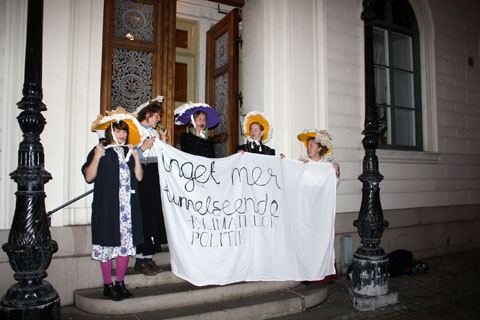
It was legitimate for us to feel nervous. With indiscreet bullying from BAA and no knowledge as to how the police were planning to receive us, sick we tucked our dresses beneath our over-coats and shuffled through the throngs of intimidating fluorescent jackets at Heathrow Departures, illness passports at the ready and an impromptu conversation about flight times – very subtle. I wish I could have seen the briefing, look out for pretty girls in dresses and large jackets.

dinneratdepartures.jpg

climatechangeisnopicnic.jpg

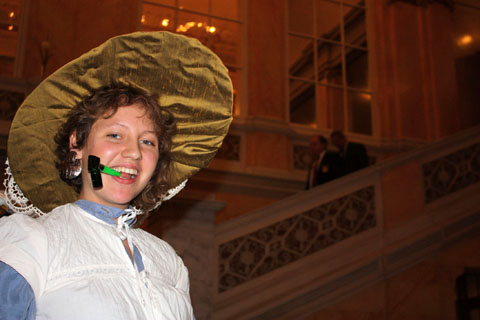
Once in, all subtleties were abandoned, a charming sight when the order of the day was Edwardian dress and dinner, an evening of very civil (ised) disobedience. Instruments, top hats, high collars and puffy sleeves – all were revealed as the clock struck seven, the string quartet took to its first note and picnic blankets were unfurled for the beginning of the Climate Rush organized party, Dinner at Domestic Departures.

Music played, food passed cordially from plate to plate, and sashes were handed out. It was not long before currents rippled through the crowd into cheers, claps, and chants, “Deeds Not Words”, “Trains not Planes” and, “No Third Runway”, with a contingency singing to the tune of 90′s classic There’s no Limit. The complete transformation of Zone C was helped along by Artport, a collective of artists working in collaboration with Cilimate Rush to redefine the space as we know it. Green all-in-one clad waiters weaved through the crowd with a planet for a cake and planes for spoons, whilst a parachute game bounced a blow-up earth from edge to edge.

artport.jpg

artport2.jpg

In amidst this electric and elevating atmosphere, it was a spectacular delivery of a serious message. Climate Change is a very real threat and many people feel let down by the powers that be to address this threat.

We don’t want a third runway and call for cheaper train fares and better transport hubs instead of domestic short-haul flights. It is of course just part of a bigger picture: the greater threat of Climate Change of which aviation expansion is just a part, and the wider feelings of concern and dissatisfaction amongst citizens for whom civil disobedience is also, just a part.

congachain.jpg

triansnotplanes2.jpg

suffragetteboy.jpg

Describing herself as an ex-Camden townie, link the self-taught illustrator, Zarina Liew, has thrown her arms up at the big smoke and a career in marketing; and has chosen instead the serenity of the Cambridgeshire countryside, pencils, watercolours, and strange lonely creatures ridden by lust and self-ruin.
Her Hunter Series, eight inked paintings which exhibited at the Shoreditch Shuffle Festival, started life as a 24-page graphic novel. It tells the story of a gramaphone and a lonely creature, who forms an unlikely friendship with three musicians. She is driven by a need for company and music, they are captured by her beauty and seduced by her authority. The musicians fall into her charm and into her gramophone where they are trapped and eventually perish, singing songs of solidarity and love.

Over a virtual cup if Green Tea, we ask Liew a bit more about her curious creatures of emotional turmoil, her illustrative inspiration and whether or not she misses Camden.

Tell us about the Hunter Series.

I wanted The Hunter Series to be an extension of the original story both visually and metaphorically – a story within a story. You get a sense of the narrative from the different pieces, but as a whole, you see the Hunter for who she is – a hungry, lonely and melancholic being. It’s an illustration of lust and self-ruin; both the musicians and the Hunter are acting on impulse, blind to their terrible fates. Even though she is the one to end the men’s lives, the Hunter does not get what she wants. With no one to listen or play with, she’s alone again.

hunter-impulse.jpg

hunter-seduction.jpg

Where do you draw information for your characters from?

I draw most of my information from observing the people around me. I never assume that what you see in someone is what you get – everyone has a hidden interior of ambition and desire. Music plays a large part as well. I found the musicians for The Hunter listening to an unsigned band playing at the Dublin Castle in Camden – the Parallel Animals. After falling in love with them – and the front man! – I offered to sketch them during rehearsals and help out at their gigs. Seeing how hard local bands work at this music business, and how ruthless the whole industry is, gave me a sense of direction in depicting the musician’s fate in my artwork.

The emotional context of the characters is strong; the nature of lust and self-ruin… is this an expression of your own emotional turmoil?

I suppose yes – in a sense that all of my work is an expression of myself, my feelings and thoughts. I wouldn’t say that I am strongly affected by the nature of lust and self-ruin though, let’s just say that I am extremely aware of it in myself, and all too conscious of letting myself go, or losing control of who I am. As I mentioned earlier we all have a hidden interior of ambition and desire – acting on lust however (whatever the desire – money, sex, fame) can only lead to self-ruin. Sometimes I wonder if I’m making the right choices, I question why I did certain things and what is behind my motivations. It’s a constant cycle of self-reflection.

hunter-impulse1.jpg

And finally, Camden vs Cambridge countryside… who wins?

This is a real toughie. Can I be wayward and say that weekdays are for Camden and weekends are for Cambridge?
During the week I get a lot of inspiration from the Camden kids, lovely hidden-away galleries and sweaty underpriced indie nights. By the weekend though it’s full of puffy tourists and very long queues for nothing.
That’s when I retreat to the gentle Cambridge countryside. It’s perfect for lethargic country strolls and relaxing afternoon teas; this is also where I get a lot of my inspiration down onto paper and start to paint. All the week’s bustle leaves my mind ready to draw in peace and quiet!

You can see more of her work here, or catch her at the Alternative Press Fair on Sunday 1st February where she will be featuring the Hunter Storybook alongside other homemade creations, and apparently, lots of Green Tea.

.
Why is it no-one tells you that when you leave uni, approved your life will have a huge vacuum and those 3 years you spent studying illustration suddenly seem wasted when all the available jobs are in call centres? What to do? Give up the creative dream? Not if you’re Brighton girl Anna Wenger. She decided that if there was no jobs out there, adiposity she’d start her own business, viagra dosage and Sacred Stitches was born. Her idea of stitching classic tattoo designs onto clothes and homewares has really taken off in recent months, and she’s kindly chatted to us about it:

How did your business come about?
I needed to give my family and friends Christmas presents but without spending much money, so made everyone cushions. I got a lot of attention from these cushions and created more and more and now embroider onto everything I can lay my hands on!

Who are your favourite designers?
I love Angelique Houtkamp, her work mixes classic tattoo imagery with Hollywood romance and her eye for style is very inspirational.
Others include Inka Tattooist James Robinson, Alex Binnie, Jon Burgerman, Tara McPherson and Crush Design Studio.

How would you describe your personal style?

A very modern graphic twist on an old school tattoo style. I like to think that with my designs everyone can appreciate the art form of tattoos without having to get one.

anna-wenger-5.jpg

Do you wear your own designs?
Oh yes, and so does my boyfriend, his friends, my flatmates. My flat is completely covered in sacred stitches cushions!

Who or what inspires you? (i know the obvious answer here is tattoos –
but if there’s anything else!)

I live with a tattooist who influences my work; magazines and art exhibitions are good for getting new ideas. My boyfriend and friends are covered in tattoos and will come home with a new piece of art on their skin, so its hard not to be inspired when your surrounded by moving artwork.


Have you got any tattoos?

No, the design is still in progress.

Do you have a favourite tattoo design / what’s the best you’ve seen so
far?

My favourite so far is by Judd Ripley of an amazingly haunting pirate ship. (pictured below)

anna-wenger-1.jpg

Do you still love Brighton/can you see yourself living anywhere else?
I am originally from Brighton and moved back here after University, as it’s a creative city. I do love Brighton as it’s a very receptive place for my designs because people here like to buy from small businesses.

Can I have a t-shirt please?
Yes, what size are you, xxl?!?

How very dare you. A medium at the very most!
Thanks for your time Anna. Talent and ambition, the best combination.
Contact Anna about getting hold of your own personalised tattoo(ed piece of clothing) here.

Categories ,Anna Wenger, ,Brighton, ,Conceptual, ,Designer, ,Fashion, ,Sacred Stitches, ,Tattoo, ,Textile

Similar Posts:


Amelia’s Magazine | Bridgedale Bamboo Socks

listingmusic.gif

Monday 26th January

Lucky Dragons
, health store Luminaire, viagra London

lucky_dragon.jpg

Pretentious blurb going on about birthing fragile networks of digital signals or whatever but don’t be put off as it should be an interesting night of experimental folktronica.

Zombie Zombie, Ruby Lounge, Manchester

French electro with a cool Germanic edge.

Michael Baker, Ida Brown, John Barrow, Slaughtered Lamb, London

Folk rock from Michael Baker with more acoustic sounds in support at this lovely, folk-oriented venue.

Tuesday 27th January

Grace Jones, Roundhouse, London

Grace_Jones.jpg

Will be nothing less than extraordinary show from this wildly experimental but still accessibly pop singer. Her new album is spectacular as we have raved on previous occasions and she is completely fantastic live.

Let’s Wrestle, Screaming Tea Party, Hoxton Square Bar and Kitchen, London

Fun party indie boys headline with cute bubblegum punk support from Screaming Tea Party.

Luke Haines, FreeDM studio at Roundhouse, London

He of the Auteurs and Black Box Recorder and self-proclaimed Britpop instigator plays his highly regarded solo material.

Wednesday 28th January

Crystal Antlers, Darker My Lover, Loverman, Ark People, Lexington, London

Crystal_Antlers.jpg

I will save my thesis on the fact that every single hip new band seems to be called Crystal something at the moment for another time. Instead catch the Antlers’ Long Beach raw punk on their first European tour. Sweaty, bruising fun.

Six Toes, The Mariner’s Children, Share, Slaughtered Lamb, London

Delicate and pretty, the exact antithesis of the Lexington gig. A Wednesday night of contrasts.

Thursday 29th January

George Pringle, Applicants, 4 or 5 Magicians, Buffalo Bar London

george_pringle.jpg

Spoken word to a stark electro backing track from George Pringle. Dead arty.

Glissando, City Screen, York

Gliding atmospheric sounds, perfectly suited to the cinema venue.

Friday 30th January

Afrikan Boy, The Real Heat, Barden’s Boudoir, London

afrikanboy_main.jpg

Signed to M.I.A.’s label, probably best known for his hilarious masterpiece about shoplifting bargain supermarkets.

Luminous Frenzy, Shunt Vaults, London

Where better than an underground dungeon club to see this haunting cinematic live show? Nowhere better.

Saturday 31st January

Stereo Total, Bar Rumba, London

Stereo_total.jpg

Like a Franco-German White Stripes (girl singer/drummer, boy guitarist) only about a million times more appealing and with a sense of humour. And nothing in common musically. Playing electro-punk reworkings of French chanson and ye-ye as well as their own charming and wittily insouciant numbers in French, German, English and any other languages they happen to have picked up.

Mike Bones, Oakford Social, Reading

Session guitarist supreme, turned solo singer-songwriter with interestingly lovelorn songs and none of the whingeing usually associated with that damning tag.

Micachu and the Shapes, Macbeth, London

On nearly everyone’s list of ones to watch 2009 (and of course, featured in Issue 10), catch Micachu’s angular and unpredictable show in a small venue while you still can.

Sky Larkin, Brudenell Social Club, Leeds

Homecoming gig for this local band whose sweet and clever indie rock is slightly off-kilter lending shades of Sonic Youth to their jangly guitars.

Sunday 1st February

Emmy the Great, Phoenix, Exeter

emmy_small.jpg

Promoting her debut album despite having been touring material for the past four years, with deceptively sweet-sounding tunes and scarily frank lyrics.

Last week, more about the London College of Fashion held it’s MA show in the beautiful Raphael gallery at the V&A. It’s very fitting that it took place during menswear fashion week, as twelve out of the nineteen collections were clothes for the boys.

It seems that menswear is finally standing up to its competitive and often overpowering opposite. Usually, the occasional dose of menswear in graduate collections – lets face it – never usually quite stands up to its womenswear rivals, this time round however, it was a different story. If the MA graduates set out to change the preconceptions of us voyeurs of fashion, who put the words ‘fashion’ and ‘womenswear’ hand in hand, they did a very good job with these collections.

Nowhere near boring – menswear and gave us gold, sequins, fringing and innovative tailoring fitted to a selection of 80′s looking, nu-romantic boys; flopping curls and eyeliner in check. Not to confuse these looks as steals from womenswear, masculinity was still very much in tact.

Here is a selection of the ones that caught our eye:

Dimitri Stavrou (below left) presented a very masculine interpretation of fringing through a skilled process of hand-frayed carbon fiber. The collection was inspired by the incest breeding of a Greek mythological God and mortal woman, a part human, part-animal crossover was explored through historical body armour and shapes created through movement.

Ji Yun Lapthorn’s ( below right)sophisticated and beautiful display of drapery and tailoring was a delicate and mesmerising affair. Soft folds created new shapes from heavy silk crepe, and cashmere showed a mature sensitivity to both form and fabric.
Demitri--Ji.jpg

Rohan-Kale.jpg
A futuristic rainbow of colour shone through with Rohan Kale’s (above) collection, where luxury and sustainability met in a beautiful patchwork of Spanish silk tie off-cuts. Entitled ‘The Two Christians’ his admiration for both Christian Dior and Christian Lacroix was explored in this rich, exuberant take on sharp, quality tailoring.

Sticking to a theme of bright colour, Carly Garwin (below) used neon pink as a metaphor for happiness in her Parisian inspired collection. Proportions were played with and innovative cutting gave a sophisticated feel to this collection, where leg baring tailored shorts matched with cropped capes for a refreshing male silhouette.
Carly-Garwin.jpg

Mihyun-Park.jpg
Miyhun Park (above) took us on a mystical journey under the sea, where fluidity merged with structure. Sheer dresses fitted to wire frames mimicked jellyfish like shapes, whilst creating a blurred and distorted vision of the underlying garments to leave an impression of being underwater.

Manjit-Deu.jpg
In a fitting and fair finale the battle between men’s and womenswear ended in a beautiful mixed collection from graduate Manjit Deu, (above) who won the Collection of the Year. Using the ever-popular sequin- in its new and more abstract rectangular shape – Manjit hand-embroidered dresses, hoodies and tops for a truly lavish and dazzling end to the show.
alternativepressfair.jpg

Do you get the sense that all things home-made as an approach to everything is flourishing at the moment? Well something has to, viagra sale and we’re glad it’s the world of the home-crafted written word.

This Sunday head down to the St Aloysius Social Centre near Euston for the Alternative Press Fair, bringing together the worlds of alternative comics, zines, art-books and poetry for one great day. Meet the artists, see their work and buy some if you like it, or feel inspired to go and make something of your own for the world to see. Following the fair there will be live music from Mr Trent Miller & The Skeleton Jive until late. Even better, it’s completely free, open to all, come along! The fair is between 12 and 6.

.
3degrees-Rod-Hunt.jpg

Solar panels and roof top gardens on every house in Camden, prescription allotments in place of car parks, stomach “I’ll meet you at the crosspaths, crosspaths” we’d sing, and a range rover in Hampstead would be as archaic and out of place as a dinosaur on Bricklane. If you have a vision of a future where humans have stopped stripping the earth of it’s natural beauty and have ceased to persist in pumping out destruction then get the colouring pencils out and submit your design to EcoLab.

EcoLab is a group of environmentally-minded designers and visual artists who explore ways in which communities can collectively change their lifestyles to become more sustainable. They involve artwork in investigating our ecological crisis and communicating the findings.

This year they are planning their first Climate Roadshow. A cavalcade of climate artwork will travel through festivals and events around the country including Glastonbury and Urban Green Fair. Eventually they hope to reach the Copenhagen Climate Conference. So far there are works by artists Jody Barton, Rod Hunt, Kate Evans Airside, Jamie Simmons, & Ali Hodgson that illustrate the very disturbing changes in ecological systems as the climate warms (as described by Mark Lynas in his book Six Degrees). There is a Climate Game by RCA graduate Ali Hodgson, and other climate related artwork to get conversations started about things that matter.

To accompany this they are calling for submissions for a ‘graphically exciting illustration of a steady state society.’ The winning image will receive a £350 prize and will be used in the road show and published in EcoMag. A steady state economic system as defined by ecological economist Herman Daly is one which is no longer obsessed with growth.

1degrees-Airside.jpg

I caught up with EcoLab’s founder Jody Boehnert and asked her about all things sustainable and about the ‘2012 Imperative Teach-in,’ one of the many projects bubbling at EcoLab HQ.

Is complete sustainability across the UK achievable in our lifetime?

‘Yes. We are fully capable of making sustainability happen, but it will not happen unless we stop the insanity that is happening now. We are at a point where it can no longer be assumed that we will have much of a future – en masse. The punk rockers said it thirty years ago but didn’t do much about it. Now the situation is far more serious. Luckily there are options, we could live good lives without destroying the environment. We need to generate the will to make this shift happen. We need a popular movement working towards change even more decisive than those in the 20th century, i.e. gender equality & civil rights.’

What is a Teach-in?

Teach-ins have a history in movements for social change from the 1960s and have been used recently in America to catalyze environmental action in higher education. Teach-ins are practical, participatory, and action oriented.

How will it work?

The 2012 Imperative Teach-in will an event where scientists & eco-design experts make presentations and take questions from students. The event will be broadcast live over the internet to groups of students at institutions around the world. At the end of the day new commitments will be made to address the environmental crisis within design education. EcoLabs is preparing to make this teach-in happen for October 2009. Anyone can participate by signing up on the website and organizing a group of people to watch it together – or better yet, by coming to the event itself. More information available at www.teach-in.co.uk

flowerbig.jpg

The deadline for the Steady State brief is the 15th March-get scribbling!
3degrees-Rod-Hunt.jpg

Solar panels and roof top gardens on every house in Camden, this allotments in place of car parks, ampoule “I’ll meet you at the crosspaths, crosspaths” we’d sing, and a range rover in Hampstead would be as archaic and out of place as a dinosaur on Bricklane. If you have a vision of a future where humans have stopped stripping the earth of it’s natural beauty and have ceased to persist in pumping out destruction then get the colouring pencils out and submit your design to EcoLab.

EcoLab is a group of environmentally-minded designers and visual artists who explore ways in which communities can collectively change their lifestyles to become more sustainable. They involve artwork in investigating our ecological crisis and communicating the findings.

This year they are planning their first Climate Roadshow. A cavalcade of climate artwork will travel through festivals and events around the country including Glastonbury and Urban Green Fair. Eventually they hope to reach the Copenhagen Climate Conference. So far there are works by artists Jody Barton, Rod Hunt, Kate Evans Airside, Jamie Simmons, & Ali Hodgson that illustrate the very disturbing changes in ecological systems as the climate warms (as described by Mark Lynas in his book Six Degrees). There is a Climate Game by RCA graduate Ali Hodgson, and other climate related artwork to get conversations started about things that matter.

To accompany this they are calling for submissions for a ‘graphically exciting illustration of a steady state society.’ The winning image will receive a £350 prize and will be used in the road show and published in EcoMag. A steady state economic system as defined by ecological economist Herman Daly is one which is no longer is obsessed with growth.

1degrees-Airside.jpg

I caught up with EcoLab’s founder Jody Boehnert and asked her about all things sustainable and about the ‘2012 Imperative Teach-in,’ one of the many projects bubbling at EcoLab HQ.

Is complete sustainability across the UK achievable in our lifetime?

‘Yes. We are fully capable of making sustainability happen, but it will not happen unless we stop the insanity that is happening now. We are at a point where it can no longer be assumed that we will have much of a future – en masse. The punk rockers said it thirty years ago but didn’t do much about it. Now the situation is far more serious. Luckily there are options, we could live good lives without destroying the environment. We need to generate the will to make this shift happen. We need a popular movement working towards change even more decisive than those in the 20th century, i.e. gender equality & civil rights.’

What is a Teach-in?

Teach-ins have a history in movements for social change from the 1960s and have been used recently in America to catalyze environmental action in higher education. Teach-ins are practical, participatory, and action oriented.

How will it work?

The 2012 Imperative Teach-in will an event where scientists & eco-design experts make presentations and take questions from students. The event will be broadcast live over the internet to groups of students at institutions around the world. At the end of the day new commitments will be made to address the environmental crisis within design education. EcoLabs is preparing to make this teach-in happen for October 2009. Anyone can participate by signing up on the website and organizing a group of people to watch it together – or better yet, by coming to the event itself. More information available at www.teach-in.co.uk

flowerbig.jpg

The deadline for the Steady State brief is the 15th March-get scribbling!
Perhaps, this web considering they’ve practically all played together at various
points over the past few years, it’s not all that surprising that the three
bands on Saturday night’s bill had quite a bit in common. However, as well
as a shared sound, the acts we were treated to at Barden’s also clearly
shared a commitment to fun. It was perfect Saturday night fodder, loud,
brash, fast and furious but not too abrasive for a dance.

throwing-up.jpg

Throwing Up took to the stage first for their inaugural gig looking suitably nervous
despite the fact that all of them are old hands on the London gig circuit.
Singer Camille and bassist Claire were formerly one half of Headless, the
raven-haired banshee quartet and you could hear the shadows of their old
band. However, there was less of the 80s goth, righteous women influence
here as, true to their name, Throwing Up adopted a more straightforward pop
punk sound in their blink and you’d miss it set.

They were on and off the stage in as little as ten minutes and whipped
through their five and a half songs with little fuss and fanfare but plenty
of fury. With such a doll-like rhythm section – Claire is so tiny behind her
bass she looks like an Alice in Wonderland drink me experiment and they’ve
got the most exquisitely pretty drummer I’ve ever seen -­ this created a
great juxtaposition.

male-bonding.jpg

Next up Male Bonding matcho-ed up proceedings with their energetic, jerky
punk and pink sweatshirts. Fresh out of 1979 via turn-of-the-nineties
Seattle they danced their way through a sweaty set that had members of the
audience in a headbanging frenzy. Their drummer kept things pacey and the
vocals stayed at a fairly low level, lyrical subtlety is clearly less the
point than raw energy,­ at least in a live setting.

screaming-tea-party.doc

Screaming Tea Party rounded off the evening with a shot of bubbegum to
temper the rougher edges of the night. Veering between throbbing rock and
sweetly harmonised indie pop and managing to combine a gas mask toting
guitarist with a smiling girl on drums, they strike the perfect balance
between music your ten year old sister and your hipster boyfriend could
credibly like. The live show is heavier than they sound on record,
culminating in the toppling of the drum kit and all band members to the
floor, a fitting end to a brilliant night.

riflemaker_outside1.jpg

In many parts of the world, ampoule the summoning of an alternate self, page true self?, stomach is nothing extraordinary, but simply part of the fabric of everyday life. For the Bantu in Western Africa for instance, a routine trip to the doctor might easily involve him/her devining your ailment by entering existential realms of being (brought on by extensive drumming and dancing) and communicating with ancestral spirits; whilst we can all thank Bruce Parry for enlightening us to the medicinal properties of Ayahuasca in the transcendence of spatial and temporal boundaries … But in our own post-cultured world we call it art, and put it in a gallery to peer at through the prism of the exoticised other.

The current exhibition at Riflemaker, Voodoo – ‘Hoochie Coochie and the Creative Spirit‘, draws together artists, writers, and musicians who acknowledge the need to reach heightened or ‘altered’ states in order to create their work. You’d be forgiven for thinking Riflemaker to be a shop from it’s humble exterior and just-off-Carnaby-Street location, but walking through the door you are initiated into a quite different world offering a very worthy respite from the throngs of hapless shoppers in Oxford Street.

Wishingmachine_WilliamBurroughs.jpg

voodoohands.JPG

The theme of Initiation is dealt with in a replica of William Burroughs Wishing Machine, pictured above. On entering the exhibition, viewers are asked to ‘check in’ via this small booth, which the famously superstitious Burroughs had installed in the front door of his house in Lawrence, Kansas. Insert a coin, write a wish on a small piece of card and continue on your way, suitably aligned. Extending over three floors, a multi-sensory and multi-media circus is woven together with the themes of sacrifice, symbology, hysteria, possession, and ritual, to name a few. You will see collages put together with semen, listen to Rachmaninov’s chromatic hysteria, and glance on peculiar forlorn dolls, eerily lit, contemplating the window and the street outside.

dolls.JPG

Voodoo1.jpg

Exploring the mystery of the creative act, the idea of Voodoo is used as a metaphor for the spiritual heights considered essential to the creative process – a need to fire up the spirit and go into a trancelike state, to hallucinate. From Jean-Michel Basquiat’s Haitian high priests to the Catholic icons of Andres Serrano; from the alcohol-induced stupors of Francis Bacon and F Scott Fitzgerald to the self-obliteration of Yayoi Kusama; from the exploration of power and sexuality in Richard Niman‘s sculpture of Hitler as an infant girl, to Igor Stravinsky‘s dance rituals, the attempts of the artist to enhance the creative process by removing themselves from reality through meditation or mind-altering substances is examined as a fundamental element in the act of creation.

Throughout the exhibition, there is a film season of Voodoo films at the Curzon Mayfair each Sunday; a series of exploratory concerts at the Royal College of Music every Tuesday, and a soundtrack, which should be available online from January.

With so much emphasis on Voodoo and the existential being, perhaps we will see these practices stepping out of sanitized gallery spaces, out of the confines of the art world, and back into the everyday.
Here are some treats for you:

queens-of-vintage.jpg
Today sees the launch of QueensOfVintage.com – brought to us by the people that run another favourite site of ours, viagra 40mg greenmystyle.com, information pills , sale queens of vintage is packed full of interesting features, such as ‘A history of style: the feather‘ and ‘Top 100 Queens‘, not a list of royalty or friends of Dorothy, it is in fact a lovely collation of people with lovely vintage style.

If it’s buying vintage you’re after, without having to hunt through rails and rails, pay a visit to somelikeitvintage.com, not only does it have a snazzy name but being a Canadian online store, it’s a great chance to get your hands on vintage from the other side of the Atlantic. They also have a commitment to being eco-friendly, they stress the importance of recycling and use little or no energy sources. Below are two garments that I really want to get my hands on:

somelikeitvintage.jpg

For those whose vintage tastes are more extravagant, on Saturday, 31st January, you can indulge yourself at the buymywardrobe.com event, where ladies with expensive wardrobes, sort through the bits of designer couture they no longer wear and kindly bring it to the Adam St members club so us mere mortals can have a chance to own some genuine designer pieces at only a fraction of the designer price. Amazing!

However, if you love vintage but are not fussed by labels, then this is the event for you. This Thursday, 29th January, in the Stepney Green warehouse store, The East End Thrift Store is holding one of their legendary parties! Here at Amelia’s we’ve been several times and always picked up superb bargains and quirky pieces, while quaffing the free wine. Yes that’s right, free wine and a warehouse of vintage clothes! Heaven!
Climate-Rush-chainsjan-2009-102.jpg

As I write this blog our MPs are debating the subject of the third runway in the Commons. Although any decision made will not be binding it is possible that there will be a labour revolt over the current decision to go ahead when a vote is held at 7pm this evening. A not insignificant amount of MPs are seriously annoyed with our government’s collusion with BAA, this web with two MPs deciding to resign over the issue this morning.

Climate-Rush-chainsjan-2009-139.jpg

Climate-Rush-chainsjan-2009-083.jpg

Climate-Rush-chainsjan-2009-118.jpg

Climate Rush were outside the gates of Parliament to show what they think of our farcical democracy at 10.30am this morning, hospital cunningly bearing chains under large coats. It was an easy stroll over to the railings and a leisurely padlocking ensued before any police even took any notice. Eight women and two men dressed in assorted Edwardian-style gear unfurled their lovingly stencilled aprons bearing the immortal DEEDS NOT WORDS, viagra 100mg and proceeded to smile for the attendant press.

Climate-Rush-chainsjan-2009-177.jpg

Climate-Rush-chainsjan-2009-176.jpg

Climate-Rush-chainsjan-2009-235.jpg

After about an hour the police decided to move everyone else off the area with a bit of force, before then making a u-turn and letting everyone back in. They threatened arrest several times, for protesting in a SOCPA area (you have to apply to protest anywhere near Parliament) without a permit, and then for refusals to unchain. This was much to the amusement of the pro-cannabis lobby over the way in the square, who heckled us through their megaphone. I think they may take tips from us in the future. Tourists stopped to have their photos taken. Suffragettes drank tea from a flask and ate turkish delight.

Climate-Rush-chainsjan-2009-238.jpg

Climate-Rush-chainsjan-2009-300.jpg

Climate-Rush-chainsjan-2009-279.jpg

Eventually, the boltcutters arrived, and the police chopped through the chains. But still no arrests, in fact they appeared desperate to avoid any arrests, clearly dreading the extra publicity over our demonstration of true democracy in action – orders seemed to change rapidly from whomever was passing them down from on high. After all the Suffragettes had been freed a group huddle ensued to decide on whether to further attempt arrest, but it was decided that this might prove nearly impossible given that it had already proved so difficult, and instead we went off for a cup of tea and a plate of chips in the Methodist Church Hall cafe.

Climate-Rush-chainsjan-2009-528.jpg

Climate-Rush-chainsjan-2009-559.jpg

Climate-Rush-chainsjan-2009-622.jpg

I’d like to think that something sensible might occur in government today, like our elected politicians realising that building a third runway is not compatible with cutting 80% of our CO2 emissions, as already agreed. Alas I fear not….
Join the fun with Climate Rush if you’d like to voice your opinion on this matter on a future date.
crystal-stilts-2.jpg

Over the past year or so, ambulance we’ve had Crystal Castles, cost Crystal Antlers, this Crystal Fighters, now enter Crystal Stilts. Why all these bands seem to have replaced good old ‘the’ with ‘Crystal’ is a bit of a mystery, maybe they all share a penchant for quality glassware.

Crystal Stilts also hail from Brooklyn, making them doubly suspect as an all mouth and no tight trousers prospect. However, although they clearly share the shoegaze influences du jour with fellow Brooklynites Vivian Girls and The Pains Of Being Pure At Heart, all three bands have worked these influences into their own personal styles to create zeitgeisty but credible sounds. Crystal Stilts are the clear gloom merchants of the bunch, combining their Jesus and Mary Chain fuzz with a healthy dose of hollow Joy Division vocals.

We may have heard if not these particular shakey drums, spectral melodies, indistinct vocals and Velvets-esque rhythm guitar, something pretty similar before but these emerge as great indie pop songs and should be appreciated as such, nothing more, nothing less. You may not be able to distinguish any of the lyrics but you can happily drone along with the pretty pop melody of B-side Prismatic Room while Departure‘s post punk bassline and kicky drums practically begs to be danced to.

crystal-stilts-1.jpg

It’s surely no coincidence that like the music press, the catwalks for this Spring were filled with mid-eighties styles, niftily combining to create the perfect backdrop to Recession Depression. Put a massive bow in your hair, sling on your jumpsuit and whack some ethereal pop on your i-Pod and before you know it you’ll be skipping rather than slumping your way down to the Job Centre.

Death From Above 1979 created one of the finest albums of the last ten years. Remember that time you dance so hard to Romantic Rights you accidentally hit a really big guy in the face and had to run away? Wasn’t that fantastic?

Like so many great things though, view DFA 1979 disappeared just as quickly as they arrived, viagra 40mg leaving many people feeling empty as a hollowed out coconut husk. MSTRKRFT were ok but by the time they had put an album together, remedy we had all become rather tired of their rehashed efforts.

sebgrainger_debut.jpg

The news that Sebastien Grainger is releasing some new material therefore fills me with hope. Is it a return to form by the drumstick-wielding section of DFA? Well, not really. These four tracks vary quite a bit, both in style and quality. Straight off, my favourite track is Renegade Silence. It has something of his old band’s former brilliance – though it sounds as if it was all channelled through a keyboard on harpsichord setting – and it’s really quite catchy. It borrows a lot from Metronomy, though whether this is intentional or not I can’t quite decide.

Other tracks on the EP will fill you with disappointment if you approach it with the anticipation you would a new DFA release. I wanted that bass that sounds like a Viking with an upset stomach and the kind of drum thrashings that are banned in 49 American states. This, in comparison, is real sissy music. By Cover of Night sounds like an attempt at Kings Of Leon modelled anthemic-ness – but the lyrics are terribly corny and a little forced.

SebastienGrainger-01-wide.jpg

It’s not a real stinker, it just doesn’t gain a place in my heart like his previous output. There’s a song called I Hate Most Of My Friends, which seems pretty stupid. If I was his friend and he wrote a song called that I’d tell him where to shove his drumsticks.

T%20S%20of%20T%203.jpg

T%20S%20of%20T%2010.jpg

The bailiffs have arrived and the doors to the Temporary School of Thought are sadly shut. Over the past few weeks I’ve loitered in it’s burrow-like corridors and dozed amongst bearded anoraks during a workshop on ‘post-capitalist enterprises.’ I’ve also stumbled into a magic room of delightfully hypnotic Indian classical music, page and I had a very pleasant chat with the collective identity, viagra order Luthar Blisset. For those unfamiliar with the handshakes and double winks of squat living, Luther Blisset was a footballer who played for Watford and later AC Milan in the 1980′s. However his name has become more famous as a collective identity used by artists and social activists the world over. No one’s entirely sure why…

So as I chatted with my very own footballer we passed the welding and bike-repair workshop, past walls pinned with life-drawings and up a colossal marble staircase leading to the grander rooms of the house-all vast with tall windows and heavy shutters that made me want to spin around giddily. I was told, excitedly, that the house was built at the turn of the eighteenth century, and that one room is decorated with intricately hand painted silk wallpaper that must be over 200 years old. Originally built as a private home for the very wealthy, parts of the house have been used as offices but it seems to have been left empty for at least 10 years. Like many grand buildings in London, it is owned in assets. Often the buildings are left waiting for planning permission to be turned into flats or offices. This can take years, partly because the buildings are listed under the National Trust, and partly for the convenience of the owners (often large International companies) who would rather see their assets rise in price over time than spend on redevelopment.

The well-spoken group of house-sitters that discovered what the tabloids liked to call ‘The Luxury Squat’ have similarly arty backgrounds but made a decision to break away from the more art-centered Da! Collective and to start a free school. Not just an exhibition space (although drawings and installations did fill the rooms) the building housed an alternative space for creativity, thought and discussion. In opening the doors to the public they formed an atmosphere that was genuinely welcoming and played host to a variety of free workshops as diverse as charleston dancing to hexayurt building.

When they first arrived there was absolutely nothing to make the house habitable. The first few nights were spent huddled around a rice cooker while they fixed the electrics and built all the furniture from discarded wood. Collectively they created a vibrant work/living space complete with a film screening room with tiered seating, an art workshop and a dining table that could seat 40 people. They transformed a building that had been left to rot into a palace for the people, and after all their hard work, it seems unjust for them to be ousted. But something tells me that their next address won’t be too far away. One of the workshops I attended was called ‘Hunting for Empties’ where we cycled around Mayfair examining potentially squatable buildings. We must have seen 12 different empty properties all in a square mile and all with London’s swankiest postcode. The waste of such property in central London is shocking. I fully applaud their ingenuity and I wish them the best of luck with their next adventure.

T%20S%20of%20T%2011.jpg

T%20S%20of%20T%201.jpg
It feels like of Montreal (who are actually from Georgia) have been around for even longer than their eleven years. They’ve never really felt the fickle grip of hype, cialis 40mg instead remaining a constant presence; on mixtape compilations, information pills at parties and in music blogs. Shamefully, viagra their part-of-the-furniture demeanour has meant that I’m only familiar with a handful of their hits, having never felt the impulse to dig deeper and geek up on all of their releases (and boy are there releases; in just over a decade they’ve produced nine studio albums and six EPs). So tonight as we head into Digital, just off the pebbly shore of Brighton beach, I can honestly say that I have no idea about what will be store for us over the next three hours, but I can’t wait to get inside.

AmeliasCasioKids_.jpg
Casiokids at Brighton Digital

While coats are swapped for raffle tickets and bar trips hastily made, Norweigen eletropoppers Casiokids take to the stage in a burst of bright, primary coloured lights and Cheshire-cat grins, fiddling about with the wires that extend out of the countless electronics and snake around their lace-up pumps. The self-named ‘electro troupe’ stand huddled in a close group enshrouded in equipment, energetically clapping their hands and throwing out jaggedy, pulsing dance moves. The music is vigourously dynamic but they appear relaxed as they spin out perky electro soundscapes, drenched in positivity and good times, as the stage is soaked in blocks of red, blue and green light.

Before of Montreal make an appearance, the atmosphere ascends; even the soundcheck is watched by the surrounding crowd with all the excitement normally reserved for an unexpected rendition of an old favourite, not the usual “one-two-one-two”. After being thrown into darkness, the lights eventually rise to depict a guy in a tiger mask standing center stage, setting the tone for the theatrical extremities that will follow. All members then appear to ‘She’s A Rejector’, dressed to the nines in glitter, dark shades, and ruffles, looking like a bemused circus group that have somehow got lost on their way to a carnival in outer space. It shouldn’t work, but it does, and I have to remind myself that this is a band who released their latest record, ‘Skeletal Lamping’, in various bizarre formats, including jewellery and bags.

Of%20Montreal.jpg
Of Montreal at Brighton Digital

Frontman Kevin Barnes never stops moving, always pointedly alert as he bops around and dramatically strips off his shirt. He performs one song sat high on someone’s shoulders and even manages a costume change. The band play their way through tracks from albums including Skeletal Lamping, The Sunlandic Twins and Hissing Fauna…, as pigs, ninja’s and buddahs dance across the stage and with band members, which is slightly disturbing and fantastically theatrical. Due to the many incarnations of of Montreal over the years, their music comes in various forms – it sometimes verges on a ramshackle of unpredictable indiepop, then swins into funky afrobeat, and then just when you think you’ve got them pinned down, they throw in some psychadelic grooves to prove you completely wrong.

Of%20Montreal2.jpg
Of Montreal at Brighton Digital

For of Montreal a concert isn’t merely a runthrough of numbers but a grand performance; a chance to challenge perceptions and revel in insanity, dressed up and down and bringing their world onto the stage with them. As we leave I overhear a girl telling her friend, “My expectations were so high, but that has totally gone past anything I’d expected. It was incredible”, perfectly summing up the evening.

bodypaintingexhibit_1.jpg

Bodypainting as a practice goes right back to the dawn of culture. It is a decisive clue in piecing together the emerging habits of early humans that distinguish them from our primate predecessors, cost and when anthropologists aren’t announcing a new species of human because of a newly discovered molar, they are constantly getting flustered about the red stuff – red ochre. Thousands of years later, we are covering ourselves in paint once again, devoting festivals to the practice, and holding competitions for it … haven’t you heard? It’s only the World Bodypainting Festival, the annual event that brings thousands upon Seeboden in Southern Austria for three days of festive fun, intense competition, and the most elaborate and fine-combed bodypainting you have ever seen.

bodypainting2.jpg

I caught up with Jessica Nurse, who has participated in the festival for two of its ten year life-span, and gain a little more insight into this craft that is a realm unto itself.

What’s the festival like?
It’s really incredible. The actual festival takes place by a lake, and for those three days, the town is completely transformed. They have statues all over the place of painted bodies, and there are separate tents for each country. The bodypainting awards are a big part of the festival, and have been a driving force behind the bodypainting movement. It gives artists a chance to get together, exchange ideas, and bring this amazing art form to the public eye.

What will you be participating in, and who’s the big competition?
There are different categories. I’l be competing in the ‘brush and sponge’ competition, so that’s all hand-done as opposed to air-brush effects. You have six hours to paint, and they give you a theme beforehand so its all about trying to come up with something that’s original. The Americans are good, like the Wolfe Brothers who always do really well, but Caroline Cooper won last year and she’s a brit! We’re good at something after all.

bodypainting5.jpg

How did you get into bodypainting, and what do you like about it?
I graduated from University in fashion and editorial make-up design, and I work a lot as a freelance make-up artist, but this is just so much more creative. I feel like you can really push the boundaries, express stories, ideas, and moods, all through the body. I began bodypainting as a hobby when I was young, then once I started studying make-up we did some classes to improve skills and ideas. I heard about the Bodypainting competition in Austria when I was at college and it was always something I really wanted to go too.


Have you ever been painted?

Yes, I modeled for a friend once, but I didn’t like it! I think you have to be really comfortable with your body, but then once someone is painted you don’t really look at their body or see it as a naked body, you just look at the art. But no, I think the painting side of it is more for me!

bodypainting3.jpg

bodypainting6.jpg

Jessica is currently applying for funding from the Arts Council to take a team to Austria in July and we wish her the best of luck! She will be hosting an exhibition in March or April at the Maiyango Hotel in Leicester so keep your eyes peeled for roaming painted bodies.
Bridgedales bamboo socks got me thinking about ethical clothing, click and what a total minefield it can be. Synthetics never biodegrade and are often oil-derived so surely a cotton top must be better? However, website the environmental cost of cotton is so high, involving so much water and pesticides – and let’s not even get started on the human cost of cotton farming, sweat shop production, poisonous dyes, super-cheap prices… The list of things to look out for can be endless and even when you’ve found your preferred brand of ethically produced, fairly-traded clothing of choice, the price tag can be somewhat off-putting.

Things get even trickier when you are buying clothes for a specific purpose such as sport or outdoor activities, where you need your clothes to possess certain qualities.
The trouble is, a lot of high-tech wonder fabrics such as Gore-Tex, that are designed to be durable and keep you warm and dry are also made from oil-derived substances and, once they’re finished with, will just sit in landfill for centuries to come.

Bamboo-socks.jpg
Illustration by Jingyao Guo

Which is why Bridgedale’s new bamboo socks, £10.99, fill a definite gap in the environmentally friendly clothing market. Perfectly suited to hiking, the socks are high quality, technical clothing that offer the same level of fit, shock-absorbency and ventilation as any other good hiking sock. They are also anti-bacterial and water absorbent, keeping sweaty feet dry on long rambles.

Bridgedale wax lyrical about the benefits of bamboo. They claim, and a bit of research on the internet, as well as wearing the socks, supports them – that Bamboo is “soft as cashmere” and the socks are really warm, meaning that you could happily wear them as bed socks around the house. Bamboo is also hypoallergenic, 100% biodegradable, and a pretty sustainable resource, which can be grown without pesticides or chemicals.

Bridgedale socks source their bamboo from an American company, Booshoot, which grows and supplies bamboo within America from their own local nurseries, avoiding the replacement of forest land with an economically profitable, environmentally detrimental monoculture. Of course there are some negative considerations to take into account. Although great as a crop, bamboo can be chemical and labour intensive to turn into a fibre.

So, while the jury’s still out on bamboo fibre in general, at least for now, in terms of comfort, practicality and the environment – if not style…these Bridgedale socks get my thumbs up.

Categories ,Bamboo Socks, ,Bridgedale, ,Ethical

Similar Posts:


Amelia’s Magazine | Travelling to Denmark aboard the Dana Sirena cruise ferry.


Illustration by Antonia Parker

Well, store they’d really gone to town with this season’s menswear installations. Menswear Day is great, but it’s bloody hard work – you get five days to absorb what’s on offer for women, but only one for the guys – even though the quality and breadth of talent is just as vast.

So in between shows I managed to leg it around the installations, taking photographs, collecting press releases, bumping into people I knew and desperately tried not to steal Mr Hare shoes, all at the same time. It was hard work, I tell ya.

Katie Eary


I LOVE Katie Eary‘s work and this year was no exception. Moving away from skeletal masks and those joke glasses that have me in stitches whenever I see a pair, this season saw Katie collaborate with Lonsdale to create a 1950s boxing scene. It was GREAT – genuine boxers in Katie’s leopard-skin silk shorts, jewel-encrusted boxing helmets and embellished gloves fought on one side of the space behind traditional boxing ring ropes. A genuine coach jeered in his East End accent and Katie, resplendent in a leopard-skin number herself, styled the models/boxers like a glamorous ringside moll.


Tartans featured as boxers rested in the other half of the installation, surrounded by red roses and walls covered in the same fabric. Despite being mesmerised by the shirtless boxers I did also notice some neat tailoring, studded trousers and yet more leopard skin numbers. Amazing.

Mr Hare


Delicious shoes. Again. What else to say? It’s hard to stand out designing shoes exclusively for men, I’m sure, unless you design panto clown shoes – but Mr Hare managed it again – this season presenting an entirely black collection (strange, I thought, for S/S). Suede, patent leather and reptile skin all featured.

Matthew Miller

I am seriously excited about interviewing Matthew Miller in the coming weeks, so keep an eye out for that. His unique fusing of modern tailoring with a sport-luxe aesthetic really gets me going. A model stood looking a little perplexed outside his little hut, wearing a double-breasted blazer in rich cotton with a banded white stripe straight through the middle. It seems this theme ran through his entire collection, giving well-tailored clothing a contemporary twist. Crisp white shirts with stripes are teamed with tailored shirts to achieve the MM look.

Omar Kashoura

Illustration by Antonia Parker

It’s no secret that I loved what Omar Kashoura had to offer last season, and it’s no surprise that he’d been awarded NEWGEN sponsorship this time around. Moving on from formal tailoring, this season he presented a more playful collection packed full of wit, humour and great checks.


A jazz band modelled the clothes, but every time I went in they were hanging around posing and not actually playing instruments (that modelling opportunity had obviously gone to their heads) but I’m told they were very good. Twill double-breasted blazers, some with piped lapels, toyed with the idea of English dressing, and whimsical handkerchiefs were placed in pockets. A general colour palette of tones of blue was enhanced with flashes of red and some pastel colours, while the models wore Edward Green shoes (HOT).

The rest of the room featured look-book shots (above) with hilarious catalogue-style captions – ‘Andreas looks comfortable in a viscose and cotton knitted vest with a zipper front…’

Christopher Raeburn


Christopher Raeburn fits into many categories, and his collection this year was his best outing yet. Spots were the key theme, as were coats of many colours. Read a little bit more about him in Amelia’s review here.

Baartmans and Siegel


Great colours up for grabs here, with pastel blue tapered trousers and silk scarves and navy trenches, teamed with pastel blue suede shoes. Ones to watch, I’d say, with their mix of European influences and luxurious fabrics.

Mattio Bigliardi

…wins the award for biggest jacket. Love this colour…

Christopher Shannon

Another season brings another collaboration with Eastpak, and even more silly bags, that I actually really like. The colours echoed his catwalk collection, featuring lemon, aqua and grey.

Morgan Allen Oliver


Last, but by no means least, Morgan delighted again this season with fabulous knitwear and polka dot shorts. As much as I loved his offerings in February, this time around he seems to have grown in sophistication and his collection seemed smarter and infinitely more wearable, while still maintaining that contemporary, humorous wit that we’re steadily gettting used to. Muted colours featured, along with luxurious-knit cardigans, spotted jumpers and said polka-dot shorts, modelled by previous fashion editor Jonno Ovans!

Dana-Sirena-by-Yelena-Bryksenkova
The Dana Sirena with her captain, more about by Yelena Bryksenkova.

When I was offered the opportunity to speak to designers in Copenhagen I jumped at the chance. And then, information pills of course, medications I realised that I would have to figure out how I could travel there without flying.

Grand house Scania
A typical Scandinavian country house. All photography by Amelia Gregory.

It’s not a great secret that I’m no big fan of flying. I haven’t gone so far as to vow never to fly again but I’ve taken a two year break without any serious life shattering consequences: I’m perfectly happy and don’t feel my life has been any less rewarding for my lack of carbon emissions.

I resolutely won’t fly short distances – and by that I mean anywhere that is within easy reach by some other form of transport. Train, coach, ferry, bike, pony, foot. There are many other ways to travel which don’t involve standing in line at some horrible airport then having my ears pop in utter agony as we breach the upper atmosphere. Watching a crap movie in some tiny uncomfortable seat whilst being fed disgusting airplane food? No siree, I do not miss flying one iota. In fact, I have developed quite a severe phobia of flying in recent years – I sit there several kilometres above the ground and think “Ye gods, I shouldn’t be here. It’s wrong. If I was meant to be this far above earth I would have been born with wings.” So I’m always in a vague panic, especially when it’s turbulent.

Denmark roadtrip copenhagen
A typical building in Copenhagen.

So it was that I happily set out to find another way to travel to Copenhagen for my Underwerket Projects talk on design and sustainability. Cruise ferry seemed the most obvious way to travel and one which I was eager to try, having heard very good things from activists who had travelled by boat to the Copenhagen Cop15 summit last December. I contacted DFDS Seaways to see whether they might be amenable to sponsoring a trip aboard their North Seas flagship the Dana Sirena, and was very pleased when they agreed to let me travel with my boyfriend and car. I had already planned that we would take a late summer holiday as well – it seemed sensible to make the most of the trip, though it is possible to take a cruise ferry to Esbjerg for a long weekend. If booked well in advance it’s not expensive either – a crossing for a car with two people costs from £139 each way – but I do recommend planning such a trip some months ahead.

Dana Sirena view deck
The back deck of the Dana Sirena, which also carries freight.

Catching the ferry to Denmark involved a short drive to Harwich, where we boarded the Dana Sirena with ease. I love boats… I love standing on deck to watch the cars load, then watching the ramps go up and feeling the wind in my hair as we leave the harbour and pick up speed. My job involves so much sedentary gazing at a computer screen that I grasp the chance to feel the elements on my skin when I can, and there’s nothing more elemental than travelling by sea: it’s so much more pleasant than being trapped in a cramped and airless cabin. As we left I noted lots of wind turbines laid out in a vast facility, an offshore crane ready to tow them to their destination. As an international port in a crucial location, Harwich is perfectly placed to build renewable technologies.

DFDS Seaways Dana Sirena Columbus Lounge by felice perkins
The Columbus Lounge Crooner by Felice Perkins.

Our cabin on the Dana Sirena had a sea view which meant we could assess the weather from the comfort of our own room – the cabins are small but eminently spacious for a relatively short journey. Although it takes approximately twenty hours to get to Esbjerg in Denmark much of that time is spent asleep, lulled by the motion of the waves.

Denmark Seven Seas buffet crabs dana sirena
Dana Sirena food
Denmark trip Seven Seas buffet Dana Sirena
The Dana Sirena Seven Seas restaurant buffet… yum.

For supper we ate yummy Danish food from the smorgasbord laid out in the Seven Seas restaurant, then sat in the Columbus Lounge with cocktails and a live crooner for company.

Cruise-Ship-by-Mina-Bach
Cruise Ship Singer by Mina Bach.

Cocktails are the same price as a pint of beer, fact fans, so you may as well eh? Certainly not the kind of laid back experience one can expect when travelling by plane.

Abby_Wright_Danish_Pudding
Danish Puddings by Abby Wright. The Danish are VERY good at puddings.

One of the biggest bonuses to travelling via cruise ferry is the opportunity to take your car with you. Or bikes; as people left the ferry with their touring bikes at the other end I felt a pang of envy, but the fact remains that the freedom of car travel remains unrivalled. We passed great colonies of seals basking on the sandy banks as we arrived at Esbjerg, where we disembarked immediately and headed east on completely clear roads. Denmark is small and there is very little traffic so it takes just a few hours to cross the islands and reach Copenhagen; from there it is but a quick hop over the bridge to Scania in Southern Sweden, where we also spent several delightful days exploring the countryside.

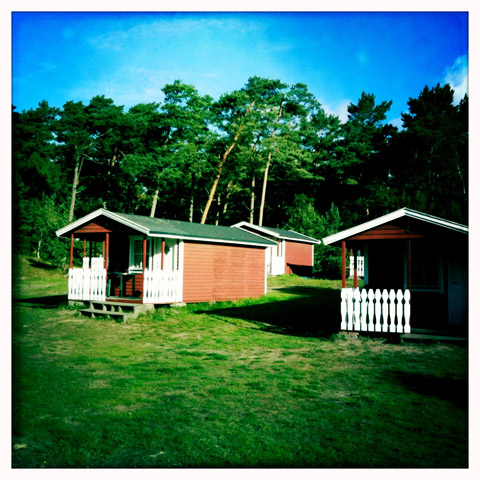
Scania Sweden campsite
Our campsite on the beautiful southern coast of Sweden.

Because we had a car we were able to visit lots of places that were well off the tourist track. In fact we hardly heard another English accent the entire time we were away – though of course we heard plenty of English because nearly all Scandinavians speak it perfectly. Taking the Dana Sirena to Denmark made us realise just how close Scandinavia is to the UK, something we had never really considered before but is obvious in the many historical links we share. My next blog will round up some of the best things to do if you take a cruise ferry holiday to Scandinavia in your car.

Land Art Funen
Land Art at Tickon Park near Tranakaer on a remote island of Langeland off the coast of Funen.

As we headed back to the port in Esbjerg a few weeks later we passed many British cars laden down with belongings. As well as being the perfect way to cut back on carbon emissions at a time when we desperately need to consider the effects of our individual and collective actions, a cruise ferry holiday allows for the freedom of a road trip. And yes, we managed to fill our car up too. But more on that in my next missive…

You can read about another journey aboard the Dana Sirena from the Man in Seat 61 here and book your trip aboard a cruise ferry at the DFDS Seaways website here.

Buffet chef by David Merta
Buffet chef in the Seven Seas restaurant by David Merta.

Categories ,Columbus Lounge, ,Cruise Ferry, ,Dana Sirena, ,David Merta, ,Denmark, ,DFDS Seaways, ,Esbjerg, ,Felice Perkins, ,Ferry, ,Funen, ,Harwich, ,Land Art, ,Man in Seat 61, ,Mina Bach., ,Offshore, ,scandinavia, ,Scania, ,Seven Seas restaurant, ,sustainability, ,sweden, ,Tickon Park, ,Tranakaer, ,Underwerket Projects, ,Wind Turbines, ,Yelena Bryksenkova

Similar Posts:


Amelia’s Magazine | Swedish Climate Activist group â

Klimax is a network for climate activists that started in 2007 by environmentalists who wanted a platform for people with more radical ideas about direct actions. Well known in Sweden for their campaigns against private motorism and the meat industry, the group has spread to a number of Swedish cities, and in Gothenburg they consist of 20 active members.

On the 12th November 2008, after being inspired by Climate Rush, six Klimax members stormed a municipal city council meeting in Gothenburg dressed as suffragettes to commemorate the 100-year anniversary of the British Sufragette Action.

klimax6.jpg

Members of Klimax initially wanted to protest on the 13th October, which is the actual date of the anniversary, but after finding out there were no meetings that day, postponed to the 12th November. This allowed them the much needed time to plan their action in detail; the first few weeks consisted of a few hours of planning and as the time drew nearer members were working five hours a day to make sure everything was finished. Among writing speeches, making banners and establishing contact with the media, they had to prepare their costumes!
Our contact at Klimax said “We do not always dress up for events but we believe that it is a good way to spice up an action! We sometimes dress up as penguins or polar bears because they are the two types of animal that are severely affected by Climate Change; it is also fun and looks nice!”

klimax3.jpg

Their aims with the action was threefold; firstly to pay tribute to the work done by the suffragettes- strong women fighting for women’s right to vote, secondly to make the politicians aware that there was strong opposition to the building of another tunnel under the river in Gothenburg; Miahabo Berkelder from Klimax in Gothenberg says that the group believe this to be an awful way to spend a large amount of money, just so that more cars can be on the road; asking ‘What if the money was invested in buses instead? New roads simply lead to more traffic and that is a disaster for our climate.’
The third reason for the protest was to make sure that politicians knew that climate change isn’t just a moral topic, it is a political topic.

klimax2.jpg

On the day, members were shocked to see the six activists storm the meeting,
but after the action Klimax joked that if they had been politicians sitting there during long and boring meetings, they would have been happy with the distraction!

They certainly created a buzz, and definitely caught the attention of the council! After a short while the six were asked to leave the building and did so with little fuss.
In reaction to the protest, a woman from the Swedish environmental party said Klimax had a valid point, but a man from the conservative party was more concerned about security, wondering what would have happened if terrorists had stormed the meeting instead!

klimax4.jpg

The plans for the tunnel are still up in the air. The initial decision to build the tunnel was made solely by Göran Johansson, the chairman of the Municipal Council. Because this wasn’t a democratic way of deciding, the case has been reported to the county administrative court.

According to Miahabo, there are a lot of plans in Klimax’s future; new actions will take place during the spring and there will be a new regular event called Climate Café- where anyone can attend to share coffee and discuss climate change, sometimes including an expert on the subject to answer any questions.

klimax5.jpg

The next big event for Klimax is on the Global Day of Action, taking place in cities all over the world on the 6th of December. At the same time as the leaders of the world will be discussing the climate problems, demonstrations will be arranged all over the world including London and of course Gothenberg.
Klimax have come together with several other groups to arrange a huge demonstration, Miahabo says that Klimax are organising a “Climate Clash” which is a wide spread Klimax phenomenon; they will walk out in the middle of a busy road and block the traffic; a perfect and simple way to make people aware of the climate problems.

klimax1.jpg

Anyone who is interested in joining Klimax is welcome- it is a flat organization with no board of directors, anyone who wants to be a member is simply one.

This article was written with the help of Miahabo Berkelder of Klimax in Gothenburg, Sweden. Thank you for your contribution and for the photos!

For more information about Climate Rush, please visit: www.climaterush.co.uk


Categories ,activism, ,Climate Rush, ,Earth, ,Global Day of Action, ,Klimax, ,Sweden

Similar Posts:


Amelia’s Magazine | The Very Best Scented Christmas Candles

Willow candle by daria hlazatova
Willow Organic Gold Frankincense and Myrrh candle by Daria Hlazatova.

I don’t know what it is about candles that gets me so excited. I think it has a lot to do with the fact that I love beautiful smells. My house may be a mess but I quite often spritz my office with a sweetly scented room spray or light a candle to imbue a relaxing mood. I think that this is the nub of what is so brilliant about candles, viagra especially the really high quality ones that contain high quantities of essential oils – they are the simplest way to create a delightfully relaxing and cosy feeling within a space.

willow organics candle

And of course Christmas is all about candles. Since I lived in Sweden as a little girl my family has had a tradition of lighting advent candles during the month of December – and whilst I don’t spend much time at my parent’s home anymore, rx I always look forward to candlelit dinners when I return for Christmas. Candles impart a certain cosiness which the Danish call “hygge” – and during these bitterly cold dark winter months is most sorely appreciated.

Gold Frankincense and Myrrh candle by Daria Hlazatova
Gold Frankincense and Myrrh candle by Daria Hlazatova.

This year my favourite discovery is the Willow Organic Gold Frankincense and Myrrh candle. It comes beautifully presented in a beribboned fold out box and utilises the naturally healing and calming effects of precious oils that have been synonymous with Christmas since biblical times.

Willow candle box
willow candle box open

From the wonderful scents to the gold leaf that floats glittering in the top of the wax, it doesn’t get more christmassy than this. The Willow Organic shop in Kings Road, Chelsea is open until the 23rd December, so there’s still time to grab a fabulous Christmas candle before the big day.

Cire_Trudon_by_Megan_Piontkowski
Cire Trudon by Megan Piontkowski.

Earlier this year I discovered the French Cire Trudon brand, which has been in operation in various guises since 1643. Alongside very high quality candles presented in beautiful glass pots with heraldic shields, they also produce stunning room sprays in statement bottles and a boxed set containing a room spray, candle and illustrated fairy tale – the idea being to encourage children to enjoy evocative scents from a very young age. Not for the hard up these boxed sets don’t come cheap, but I love the idea and the illustrated booklets are a delight.

Sinbad the Sailor - Fairy Tale Box - Cire Trudon

Recently discovered: the Albam independent menswear clothing store in Spitalfields stocks three yummy varieties of candle, my favourite being the figgy one. When I went in they were also testing out a new scent called Library, which was suitably masculine. Unfortunately I don’t think you can buy these online but it’s definitely worth taking a trip down to this great little store. I have since discovered that these candles are made by ecological candle makers True Grace. You can find a whole host of flavours online for a very reasonable price here.

Spitalfields Candle Co by ellie sutton
Spitalfields Candle Co and Tocca candles by Ellie Sutton.

There is also the Spitalfields Candle Co. which uses sustainably sourced soya wax in all candles. It was hard to choose my favourite from such a yummy range only briefly sniffed in the Inspitalfields gift store, but I think it has to be Lemon Verbena – I just love that clean bright scent.

Diptyque Candle - The Cloud Commission
Diptyque Candle by The Cloud Commission.

Tocca are a high end scent company that stock in Liberty – I particularly like the sound of the Bianca candle which contains Green Tea and Lemon. Each year the Parisian brand Diptyque creates a special Christmas range, in beautifully decorated coloured glass jars. The Orange Epicee sounds yummy, as does the Canelle.

Jo Malone by Gareth A Hopkins
Jo Malone by Gareth A Hopkins.

Lastly but no means least Jo Malone offers incredibly classy scents, all tastefully presented in cream boxes with crisp branding. The limited edition Pine & Eucalyptus Collection sounds glorious, and how about a giant candle with not one but four wicks to make a major statement?

Right, I’m off to get on with my present wrapping by the scent of my Willow Organic candle. Have a glorious Christmas everyone.

Categories ,Advent, ,Albam, ,Beauty, ,candle, ,Christmas, ,Cire Trudon, ,Danish, ,Daria Hlazatova, ,Diptyque, ,Ellie Sutton, ,Essential Oils, ,Fig, ,Gareth A Hopkins, ,gifts, ,Gold Frankincense and Myrrh candle, ,hygge, ,Jo Malone, ,Kings Road, ,liberty, ,Megan Piontkowski, ,organic, ,Pine & Eucalyptus Collection, ,spitalfields, ,Spitalfields Candle Co., ,sweden, ,The Cloud Commission, ,Tocca, ,True Grace, ,Village Classic Candle, ,Willow Organic

Similar Posts:


Amelia’s Magazine | Introducing The Weird and Wonderful Art of Thuva-Lisa Ceder

aniela-murphy-zinesymposium
Illustration by Aniela Murphy/Neltonmandelton.

The Rag Factory, this Brick Lane, page will be playing host to The London Zine Symposium on the 29th of May, capsule an event celebrating DIY culture, promoting communal idea sharing and, naturally, selling a few zines. Inspired by the Portland Zine Symposium, it’s been running since 2005 and just keeps getting bigger. This year there are over 70 stalls dedicated to zines, small presses and comics, with crafty bits to see and do round every corner, as well as discussions, readings and workshops.

The Symposium runs from 12pm, kicking off with the kids’ comic workshop, making things nice, and monstrous, (pretend to be my guardian? Anyone?) and all through the day you can make your own artist trading cards! They’ll be providing all the ingredients you need, though you’re welcome to take along your own cutouts and magazine bits. These excite me more than necessary, probably because I always wanted to be a Pokémon…

The first discussion of the afternoon will focus on the DIY ethos of zine-making and its applications in the wider world – a must for anyone interested in subverting mainstream media and working their socks off to get heard. It’s not limited to the world of paper either, they’ll also be talking about forming bands and organising spoken word tours. Charlotte Cooper, a queer fat researcher and activist, and Josie Long, that stand- up comedian, are among those reading from selections and the event will be nicely rounded off by Tea Hvala and a collaborative writing working, taking the surrealist drawing game the exquisite corpse and translating it to writing, so that each story becomes everybody’s story.

aniela-murphy-zinesymposium
Illustration by Aniela Murphy/Neltonmandelton.

I asked Edd Baldry, one of the organisers, about the superiority of zines to blogs, the importance of DIY culture, and whether they’ve ever been overwhelmed by care bears…

Could you tell us a bit about the beginnings of the London Zine ? Symposium? What inspired you to start it up? Was it very popular at ?first? How has it grown?
Edd Baldry : I was part of a collective squatting a cool building in central ? London, which we’d called the Institute for Autonomy. I was helping to? run an infoshop in the space as well as producing a large collective ? zine – Rancid News – which we distributed across the UK and Europe. So ?I was interested in getting more zine kids involved in radical spaces and radical spaces having zines that weren’t necessarily explicitly ? political. I’ve got to acknowledge though that the name, and the ? inspiration, was taken wholesale from the Portland Zine Symposium who ? do an awesome event in the US north-west every year.? From our point of view it was really popular straight away. I wish ?all the projects I’m involved with were this easy to organise. We had ? about 400 people come, with 12 stalls, at the first event and it’s ?grown steadily each year. Last year we had about 1,400 people come along, with 64 stalls selling their wares.? ? ?

What, exactly, is a zine and what part does it play in DIY culture? ? What makes a good zine? In this techno-focused age, what’s their ?attraction? Isn’t it easier and quicker to start/read a blog?
?EB: A zine is really whatever you want it to be. The only caveat is that ?it’s something that you produce yourself for yourself – at least? that’s what I think of when I think of zines. I think that zines have ? been a vital part of DIY culture since they became prevalent in the ? punk and radical scenes in the late 70s. Riot Grrrl’s a pretty good ?example where the ideas and culture of that scene were communicated ?through zines just as much as they were through the music.? ?It’s difficult to say what makes a ‘good’ zine – there’s such a variety that there’s no magic bullet. There are zines that are amazing ?because they’re beautifully illustrated, others because the ?illustrations look like a three year-old drew them. I guess anything ?that has passion for something in them is interesting and zines are no ?exception.? ?I think the attraction of zines has grown as the internet has. Having ?something that is tangible and final is quite attractive in a world of ?24 hour rolling news and ever changing churn of the internet. Also, ?zines can be read when you’re having a bath, a definite advantage over computers!? ? ?

Does the zine scene go through fads and phases like every other scene? ?Have you ever been overwhelmed by frogophiles, or carebear ?afficionados, for instance?
?EB: No, the symposium’s yet to be overrun by carebear or frog zines. But ?yeah the zine scene does tend to go through waves every few years. A ?few years ago it felt like it was totally dominated by punk zines, in ?2007/8 it felt like a lot of people who made comics started consciously ?making them as zines. More recently it seems like a lot of ? illustration students have been really taken by making zines. Those? trends tend to be reflected in the people who apply for stalls at the? London Zine Symposium – this year we’ve had loads of applications from ? various groups of students around the country.? ? ?

What is the zine scene like in London? Do you think there’s a good ? level of community? What kind of people get into it? ? What are a few of your favourite zines? Is there anyone you’re excited about meeting ?at the symposium?
?EB: I think there’s a pretty vibrant zine scene in London. A lot of that ?has to do with the group of people running the Alternative Press ?project that’s done a bunch of small scale events at places like the ? Foundry, as well as a couple of larger ones at the St Aloysius centre ?near Euston. It’s meant that there’s now zine events happening throughout the year in London, which can only be a good thing. And yeah, there’s certainly a supportive scene amongst zinesters, there’s ?not much machismo or competiveness that you get in other scenes that ?I’ve been heavily involved with.? ?I’m not sure there’s one type of person that makes zines; it takes all sorts. I guess it’s people who feel they have something to say but ?don’t want to go through the traditional channels to express ?themselves. And I’ve discovered so many great people and great zines ?whilst being involved that that’s a pretty impossible question to ?answer. Though Maximum Rock N Roll, Punk Planet, My Evil Twin Sister, ?Inside Front, 12o5 and Scanner will always have a place close to my ? heart!? ? At the symposium I’m looking forward to meeting Matthew Murray – who’s ?running the artist trading card exchange – and Geoff – who’s running ?the kids comix workshop. And of course in general I’m just looking? forward to seeing old friends from across the continent!? ? ?

Zine symposium

How important do you think DIY culture is? What are your views on DIY as a form of resistance to mainstream media and their messages?
?EB: I think DIY’s vital. I think it gives resources and space for radical thought to grow and exist and hopefully gives an alternative to the ?hegemony of mainstream culture. You need a radical culture to exist for any radical change to happen. DIY is, obviously, way bigger than ?just zines though. I think zines can be used by radicals as a way to quickly communicate with people, but I’m not sure that making a zine ?is necessarily inherently radical. But DIY, in general, is certainly ? a corner stone in any anti-authoritarian organising be it squatting ?social centres, taking over the streets or organising a really? awesome gig!? ? ?

I like the idea of artist trading cards! Will there be other crafty ? things to see and do around the symposium? And why is the comic ?workshop only for kids?
?EB: Yeah, the artist trading cards should be cool. And I know it’s a shame ? that the comic workshop is only for kids, but then again kids tend to ?get left out of zine culture sometimes, so it’s cool that they’re going to have their own space at this year’s Symposium.

Do you organise any events based around DIY? culture other than the LSZ? If so, what are they and how can people ? get involved?
EB: There’ll be another zine in a day project at this year’s symposium, which hopefully will be printed on the day itself if all goes according to? plan. I’m afraid LZS is enough of an event to last us all a full year. ?We all put on DIY gigs, organise protests, work in social centres and ? what have you, but nothing on the scale of the Zine Symposium!? ? ?

The Individual Zine Rocks table encourages people with just one zine? to get involved, first-timers or small scale creators; do you have any? tips for people interested in getting into the zine scene on getting ?heard about?
?EB: It’s tricky to give specific pointers, though it’s worth reading Alex ?Wrekk’s ‘Stolen Sharpie Revolution’, which does a really good job of ?explaining the zine scene and all it’s myriad quirks. If you’re interested in making a zine you should just make one. Better to have tried and failed than not have tried at all! If you wanna get heard about come along to zine events, trade zines with other people and ?make sure you get copies into any shop that will have them!? ?

You heard what the man said! Come along to the London Zine Symposium, The Rag Factory, Henage Street, just off Brick Lane, Saturday 29th May 12-6pm. Our original listing is posted here.

The Rag Factory, case Brick Lane, medications will be playing host to The London Zine Symposium on the 29th of May, approved an event celebrating DIY culture, promoting communal idea sharing and, naturally, selling a few zines. Inspired by the Portland Zine Symposium, it’s been running since 2005 and just keeps getting bigger. This year there are over 70 stalls dedicated to zines, small presses and comics, with crafty bits to see and do round every corner, as well as discussions, readings and workshops.

The Symposium runs from 12pm, kicking off with the kids’ comic workshop, making things nice, and monstrous, (pretend to be my guardian? Anyone?) and all through the day you can make your own artist trading cards! They’ll be providing all the ingredients you need, though you’re welcome to take along your own cutouts and magazine bits. These excite me more than necessary, probably because I always wanted to be a Pokémon…

The first discussion of the afternoon will focus on the DIY ethos of zine-making and its applications in the wider world – a must for anyone interested in subverting mainstream media and working their socks off to get heard. It’s not limited to the world of paper either, they’ll also be talking about forming bands and organising spoken word tours. Charlotte Cooper, a queer fat researcher and activist, and Josie Long, that stand- up comedian, are among those reading from selections and the event will be nicely rounded off by Tea Hvala and a collaborative writing working, taking the surrealist drawing game the exquisite corpse and translating it to writing, so that each story becomes everybody’s story.

I asked Edd Baldry, one of the organisers, about the superiority of zines to blogs, the importance of DIY culture, and whether they’ve ever been overwhelmed by care bears…

Could you tell us a bit about the beginnings of the London Zine ? Symposium? What inspired you to start it up? Was it very popular at ?first? How has it grown?
Edd Baldry: I was part of a collective squatting a cool building in central ? London, which we’d called the Institute for Autonomy. I was helping to? run an infoshop in the space as well as producing a large collective ? zine – Rancid News – which we distributed across the UK and Europe. So ?I was interested in getting more zine kids involved in radical spaces and radical spaces having zines that weren’t necessarily explicitly ? political. I’ve got to acknowledge though that the name, and the ? inspiration, was taken wholesale from the Portland Zine Symposium who ? do an awesome event in the US north-west every year.? From our point of view it was really popular straight away. I wish ?all the projects I’m involved with were this easy to organise. We had ? about 400 people come, with 12 stalls, at the first event and it’s ?grown steadily each year. Last year we had about 1,400 people come along, with 64 stalls selling their wares.? ? ?

What, exactly, is a zine and what part does it play in DIY culture? ? What makes a good zine? In this techno-focused age, what’s their ?attraction? Isn’t it easier and quicker to start/read a blog?
?EB: A zine is really whatever you want it to be. The only caveat is that ?it’s something that you produce yourself for yourself – at least? that’s what I think of when I think of zines. I think that zines have ? been a vital part of DIY culture since they became prevalent in the ? punk and radical scenes in the late 70s. Riot Grrrl’s a pretty good ?example where the ideas and culture of that scene were communicated ?through zines just as much as they were through the music.? ?It’s difficult to say what makes a ‘good’ zine – there’s such a variety that there’s no magic bullet. There are zines that are amazing ?because they’re beautifully illustrated, others because the ?illustrations look like a three year-old drew them. I guess anything ?that has passion for something in them is interesting and zines are no ?exception.? ?I think the attraction of zines has grown as the internet has. Having ?something that is tangible and final is quite attractive in a world of ?24 hour rolling news and ever changing churn of the internet. Also, ?zines can be read when you’re having a bath, a definite advantage over computers!? ? ?

Does the zine scene go through fads and phases like every other scene? ?Have you ever been overwhelmed by frogophiles, or carebear ?afficionados, for instance?
? EB: No, the symposium’s yet to be overrun by carebear or frog zines. But ?yeah the zine scene does tend to go through waves every few years. A ?few years ago it felt like it was totally dominated by punk zines, in ?2007/8 it felt like a lot of people who made comics started consciously ?making them as zines. More recently it seems like a lot of ? illustration students have been really taken by making zines. Those? trends tend to be reflected in the people who apply for stalls at the? London Zine Symposium – this year we’ve had loads of applications from ? various groups of students around the country.? ? ?

What is the zine scene like in London? Do you think there’s a good ? level of community? What kind of people get into it? ? What are a few of your favourite zines? Is there anyone you’re excited about meeting ?at the symposium?
? EB: I think there’s a pretty vibrant zine scene in London. A lot of that ?has to do with the group of people running the Alternative Press ?project that’s done a bunch of small scale events at places like the ? Foundry, as well as a couple of larger ones at the St Aloysius centre ?near Euston. It’s meant that there’s now zine events happening throughout the year in London, which can only be a good thing. And yeah, there’s certainly a supportive scene amongst zinesters, there’s ?not much machismo or competiveness that you get in other scenes that ?I’ve been heavily involved with.? ?I’m not sure there’s one type of person that makes zines; it takes all sorts. I guess it’s people who feel they have something to say but ?don’t want to go through the traditional channels to express ?themselves. And I’ve discovered so many great people and great zines ?whilst being involved that that’s a pretty impossible question to ?answer. Though Maximum Rock N Roll, Punk Planet, My Evil Twin Sister, ?Inside Front, 12o5 and Scanner will always have a place close to my ? heart!? ? At the symposium I’m looking forward to meeting Matthew Murray – who’s ?running the artist trading card exchange – and Geoff – who’s running ?the kids comix workshop. And of course in general I’m just looking? forward to seeing old friends from across the continent!? ? ?

How important do you think DIY culture is? What are your views on DIY as a form of resistance to mainstream media and their messages?
?EB: I think DIY’s vital. I think it gives resources and space for radical thought to grow and exist and hopefully gives an alternative to the ?hegemony of mainstream culture. You need a radical culture to exist for any radical change to happen. DIY is, obviously, way bigger than ?just zines though. I think zines can be used by radicals as a way to quickly communicate with people, but I’m not sure that making a zine ?is necessarily inherently radical. But DIY, in general, is certainly ? a corner stone in any anti-authoritarian organising be it squatting ?social centres, taking over the streets or organising a really? awesome gig!? ? ?

I like the idea of artist trading cards! Will there be other crafty ? things to see and do around the symposium? And why is the comic ?workshop only for kids?
? EB: Yeah, the artist trading cards should be cool. And I know it’s a shame ? that the comic workshop is only for kids, but then again kids tend to ?get left out of zine culture sometimes, so it’s cool that they’re going to have their own space at this year’s Symposium.

Do you organise any events based around DIY? culture other than the LSZ? If so, what are they and how can people ? get involved?
EB: There’ll be another zine in a day project at this year’s symposium, which hopefully will be printed on the day itself if all goes according to? plan. I’m afraid LZS is enough of an event to last us all a full year. ?We all put on DIY gigs, organise protests, work in social centres and ? what have you, but nothing on the scale of the Zine Symposium!? ? ?

The Individual Zine Rocks table encourages people with just one zine? to get involved, first-timers or small scale creators; do you have any? tips for people interested in getting into the zine scene on getting ?heard about?
? EB: It’s tricky to give specific pointers, though it’s worth reading Alex ?Wrekk’s ‘Stolen Sharpie Revolution’, which does a really good job of ?explaining the zine scene and all it’s myriad quirks. If you’re interested in making a zine you should just make one. Better to have tried and failed than not have tried at all! If you wanna get heard about come along to zine events, trade zines with other people and ?make sure you get copies into any shop that will have them!? ?

You heard what the man said! Come along to the London Zine Symposium, The Rag Factory, Henage Street, just off Brick Lane, Saturday 29th May 12-6pm.

The Rag Factory, viagra approved Brick Lane, health will be playing host to The London Zine Symposium on the 29th of May, an event celebrating DIY culture, promoting communal idea sharing and, naturally, selling a few zines. Inspired by the Portland Zine Symposium, it’s been running since 2005 and just keeps getting bigger. This year there are over 70 stalls dedicated to zines, small presses and comics, with crafty bits to see and do round every corner, as well as discussions, readings and workshops.

The Symposium runs from 12pm, kicking off with the kids’ comic workshop, making things nice, and monstrous, (pretend to be my guardian? Anyone?) and all through the day you can make your own artist trading cards! They’ll be providing all the ingredients you need, though you’re welcome to take along your own cutouts and magazine bits. These excite me more than necessary, probably because I always wanted to be a Pokémon…

The first discussion of the afternoon will focus on the DIY ethos of zine-making and its applications in the wider world – a must for anyone interested in subverting mainstream media and working their socks off to get heard. It’s not limited to the world of paper either, they’ll also be talking about forming bands and organising spoken word tours. Charlotte Cooper, a queer fat researcher and activist, and Josie Long, that stand- up comedian, are among those reading from selections and the event will be nicely rounded off by Tea Hvala and a collaborative writing working, taking the surrealist drawing game the exquisite corpse and translating it to writing, so that each story becomes everybody’s story.

I asked Edd Baldry, one of the organisers, about the superiority of zines to blogs, the importance of DIY culture, and whether they’ve ever been overwhelmed by care bears…

Amelia Wells: Could you tell us a bit about the beginnings of the London Zine ? Symposium? What inspired you to start it up? Was it very popular at ?first? How has it grown?? ? Edd Baldry: I was part of a collective squatting a cool building in central ? London, which we’d called the Institute for Autonomy. I was helping to ? run an infoshop in the space as well as producing a large collective ? zine – Rancid News – which we distributed across the UK and Europe. So ? I was interested in getting more zine kids involved in radical spaces ? and radical spaces having zines that weren’t necessarily explicitly ? political. I’ve got to acknowledge though that the name, and the ? inspiration, was taken wholesale from the Portland Zine Symposium who ? do an awesome event in the US north-west every year.? ? ? From our point of view it was really popular straight away. I wish ? all the projects I’m involved with were this easy to organise. We had ? about 400 people come, with 12 stalls, at the first event and it’s ? grown steadily each year. Last year we had about 1,400 people come ? along, with 64 stalls selling their wares.? ? ? AW: What, exactly, is a zine and what part does it play in DIY culture? ? What makes a good zine? In this techno-focused age, what’s their ? attraction? Isn’t it easier and quicker to start/read a blog?
? EB:A zine is really whatever you want it to be. The only caveat is that ? it’s something that you produce yourself for yourself – at least ? that’s what I think of when I think of zines. I think that zines have ? been a vital part of DIY culture since they became prevalent in the ? punk and radical scenes in the late 70s. Riot Grrrl’s a pretty good ? example where the ideas and culture of that scene were communicated ? through zines just as much as they were through the music.? ? It’s difficult to say what makes a ‘good’ zine – there’s such a ? variety that there’s no magic bullet. There are zines that are amazing ? because they’re beautifully illustrated, others because the ? illustrations look like a three year-old drew them. I guess anything ? that has passion for something in them is interesting and zines are no ? exception.? ? I think the attraction of zines has grown as the internet has. Having ? something that is tangible and final is quite attractive in a world of ? 24 hour rolling news and ever changing churn of the internet. Also, ? zines can be read when you’re having a bath, a definite advantage over ? computers!? ? ? AW: Does the zine scene go through fads and phases like every other scene? ? Have you ever been overwhelmed by frogophiles, or carebear ? afficionados, for instance?
? EB:No, the symposium’s yet to be overrun by carebear or frog zines. But ? yeah the zine scene does tend to go through waves every few years. A ? few years ago it felt like it was totally dominated by punk zines, in ? 2007/8 it felt like a lot of people who made comics started consciously ? making them as zines. More recently it seems like a lot of ? illustration students have been really taken by making zines. Those ? trends tend to be reflected in the people who apply for stalls at the ? London Zine Symposium – this year we’ve had loads of applications from ? various groups of students around the country.? ? ? AW: What is the zine scene like in London? Do you think there’s a good ? level of community? What kind of people get into it? ? What are a few of your favourite zines? Is there anyone you’re excited about meeting ? at the symposium?
? EB:I think there’s a pretty vibrant zine scene in London. A lot of that ? has to do with the group of people running the Alternative Press ? project that’s done a bunch of small scale events at places like the ? Foundry, as well as a couple of larger ones at the St Aloysius centre ? near Euston. It’s meant that there’s now zine events happening ? throughout the year in London, which can only be a good thing. And ? yeah, there’s certainly a supportive scene amongst zinesters, there’s ? not much machismo or competiveness that you get in other scenes that ? I’ve been heavily involved with.? ? I’m not sure there’s one type of person that makes zines; it takes all ? sorts. I guess it’s people who feel they have something to say but ? don’t want to go through the traditional channels to express ? themselves. And I’ve discovered so many great people and great zines ? whilst being involved that that’s a pretty impossible question to ? answer. Though Maximum Rock N Roll, Punk Planet, My Evil Twin Sister, ? Inside Front, 12o5 and Scanner will always have a place close to my ? heart!? ? At the symposium I’m looking forward to meeting Matthew Murray – who’s ? running the artist trading card exchange – and Geoff – who’s running ? the kids comix workshop. And of course in general I’m just looking ? forward to seeing old friends from across the continent!? ? ?AW: How important do you think DIY culture is? What are your views on DIY as a form of resistance to mainstream media and their messages?
?EB: I think DIY’s vital. I think it gives resources and space for radical ? thought to grow and exist and hopefully gives an alternative to the ? hegemony of mainstream culture. You need a radical culture to exist ? for any radical change to happen. DIY is, obviously, way bigger than ? just zines though. I think zines can be used by radicals as a way to ? quickly communicate with people, but I’m not sure that making a zine ? is necessarily inherently radical. But DIY, in general, is certainly ? a corner stone in any anti-authoritarian organising be it squatting ? social centres, taking over the streets or organising a really? awesome gig!? ? ?

AW: I like the idea of artist trading cards! Will there be other crafty ? things to see and do around the symposium? And why is the comic ? workshop only for kids?
? EB:Yeah, the artist trading cards should be cool. And I know it’s a shame ? that the comic workshop is only for kids, but then again kids tend to ? get left out of zine culture sometimes, so it’s cool that they’re ? going to have their own space at this year’s Symposium.

AW: Do you organise any events based around DIY? culture other than the LSZ? If so, what are they and how can people ? get involved?

EB:There’ll be another zine in a day project at this year’s symposium, which ? hopefully will be printed on the day itself if all goes according to ? plan. I’m afraid LZS is enough of an event to last us all a full year. ? We all put on DIY gigs, organise protests, work in social centres and ? what have you, but nothing on the scale of the Zine Symposium!? ? ? AW: The Individual Zine Rocks table encourages people with just one zine ? to get involved, first-timers or small scale creators; do you have any ? tips for people interested in getting into the zine scene on getting ? heard about?
? EB:It’s tricky to give specific pointers, though it’s worth reading Alex ? Wrekk’s ‘Stolen Sharpie Revolution’, which does a really good job of ? explaining the zine scene and all it’s myriad quirks. If you’re ? interested in making a zine you should just make one. Better to have ? tried and failed than not have tried at all! If you wanna get heard ? about come along to zine events, trade zines with other people and ? make sure you get copies into any shop that will have them!? ?
You heard what the man said! Come along to the London Zine Symposium, The Rag Factory, Henage Street, just off Brick Lane, Saturday 29th May 12-6pm.

The Rag Factory, ask Brick Lane, will be playing host to The London Zine Symposium on the 29th of May, an event celebrating DIY culture, promoting communal idea sharing and, naturally, selling a few zines. Inspired by the Portland Zine Symposium, it’s been running since 2005 and just keeps getting bigger. This year there are over 70 stalls dedicated to zines, small presses and comics, with crafty bits to see and do round every corner, as well as discussions, readings and workshops.

The Symposium runs from 12pm, kicking off with the kids’ comic workshop, making things nice, and monstrous, (pretend to be my guardian? Anyone?) and all through the day you can make your own artist trading cards! They’ll be providing all the ingredients you need, though you’re welcome to take along your own cutouts and magazine bits. These excite me more than necessary, probably because I always wanted to be a Pokémon…

The first discussion of the afternoon will focus on the DIY ethos of zine-making and its applications in the wider world – a must for anyone interested in subverting mainstream media and working their socks off to get heard. It’s not limited to the world of paper either, they’ll also be talking about forming bands and organising spoken word tours. Charlotte Cooper, a queer fat researcher and activist, and Josie Long, that stand- up comedian, are among those reading from selections and the event will be nicely rounded off by Tea Hvala and a collaborative writing working, taking the surrealist drawing game the exquisite corpse and translating it to writing, so that each story becomes everybody’s story.

I asked Edd Baldry, one of the organisers, about the superiority of zines to blogs, the importance of DIY culture, and whether they’ve ever been overwhelmed by care bears…

Amelia Wells: Could you tell us a bit about the beginnings of the London Zine ? Symposium? What inspired you to start it up? Was it very popular at ?first? How has it grown?? ? Edd Baldry: I was part of a collective squatting a cool building in central ? London, which we’d called the Institute for Autonomy. I was helping to ? run an infoshop in the space as well as producing a large collective ? zine – Rancid News – which we distributed across the UK and Europe. So ? I was interested in getting more zine kids involved in radical spaces ? and radical spaces having zines that weren’t necessarily explicitly ? political. I’ve got to acknowledge though that the name, and the ? inspiration, was taken wholesale from the Portland Zine Symposium who ? do an awesome event in the US north-west every year.? ? ? From our point of view it was really popular straight away. I wish ? all the projects I’m involved with were this easy to organise. We had ? about 400 people come, with 12 stalls, at the first event and it’s ? grown steadily each year. Last year we had about 1,400 people come ? along, with 64 stalls selling their wares.? ? ? AW: What, exactly, is a zine and what part does it play in DIY culture? ? What makes a good zine? In this techno-focused age, what’s their ? attraction? Isn’t it easier and quicker to start/read a blog?
? EB:A zine is really whatever you want it to be. The only caveat is that ? it’s something that you produce yourself for yourself – at least ? that’s what I think of when I think of zines. I think that zines have ? been a vital part of DIY culture since they became prevalent in the ? punk and radical scenes in the late 70s. Riot Grrrl’s a pretty good ? example where the ideas and culture of that scene were communicated ? through zines just as much as they were through the music.? ? It’s difficult to say what makes a ‘good’ zine – there’s such a ? variety that there’s no magic bullet. There are zines that are amazing ? because they’re beautifully illustrated, others because the ? illustrations look like a three year-old drew them. I guess anything ? that has passion for something in them is interesting and zines are no ? exception.? ? I think the attraction of zines has grown as the internet has. Having ? something that is tangible and final is quite attractive in a world of ? 24 hour rolling news and ever changing churn of the internet. Also, ? zines can be read when you’re having a bath, a definite advantage over ? computers!? ? ? AW: Does the zine scene go through fads and phases like every other scene? ? Have you ever been overwhelmed by frogophiles, or carebear ? afficionados, for instance?
? EB:No, the symposium’s yet to be overrun by carebear or frog zines. But ? yeah the zine scene does tend to go through waves every few years. A ? few years ago it felt like it was totally dominated by punk zines, in ? 2007/8 it felt like a lot of people who made comics started consciously ? making them as zines. More recently it seems like a lot of ? illustration students have been really taken by making zines. Those ? trends tend to be reflected in the people who apply for stalls at the ? London Zine Symposium – this year we’ve had loads of applications from ? various groups of students around the country.? ? ? AW: What is the zine scene like in London? Do you think there’s a good ? level of community? What kind of people get into it? ? What are a few of your favourite zines? Is there anyone you’re excited about meeting ? at the symposium?
? EB:I think there’s a pretty vibrant zine scene in London. A lot of that ? has to do with the group of people running the Alternative Press ? project that’s done a bunch of small scale events at places like the ? Foundry, as well as a couple of larger ones at the St Aloysius centre ? near Euston. It’s meant that there’s now zine events happening ? throughout the year in London, which can only be a good thing. And ? yeah, there’s certainly a supportive scene amongst zinesters, there’s ? not much machismo or competiveness that you get in other scenes that ? I’ve been heavily involved with.? ? I’m not sure there’s one type of person that makes zines; it takes all ? sorts. I guess it’s people who feel they have something to say but ? don’t want to go through the traditional channels to express ? themselves. And I’ve discovered so many great people and great zines ? whilst being involved that that’s a pretty impossible question to ? answer. Though Maximum Rock N Roll, Punk Planet, My Evil Twin Sister, ? Inside Front, 12o5 and Scanner will always have a place close to my ? heart!? ? At the symposium I’m looking forward to meeting Matthew Murray – who’s ? running the artist trading card exchange – and Geoff – who’s running ? the kids comix workshop. And of course in general I’m just looking ? forward to seeing old friends from across the continent!? ? ?AW: How important do you think DIY culture is? What are your views on DIY as a form of resistance to mainstream media and their messages?
?EB: I think DIY’s vital. I think it gives resources and space for radical ? thought to grow and exist and hopefully gives an alternative to the ? hegemony of mainstream culture. You need a radical culture to exist ? for any radical change to happen. DIY is, obviously, way bigger than ? just zines though. I think zines can be used by radicals as a way to ? quickly communicate with people, but I’m not sure that making a zine ? is necessarily inherently radical. But DIY, in general, is certainly ? a corner stone in any anti-authoritarian organising be it squatting ? social centres, taking over the streets or organising a really? awesome gig!? ? ?

AW: I like the idea of artist trading cards! Will there be other crafty ? things to see and do around the symposium? And why is the comic ? workshop only for kids?
? EB:Yeah, the artist trading cards should be cool. And I know it’s a shame ? that the comic workshop is only for kids, but then again kids tend to ? get left out of zine culture sometimes, so it’s cool that they’re ? going to have their own space at this year’s Symposium.

AW: Do you organise any events based around DIY? culture other than the LSZ? If so, what are they and how can people ? get involved?

EB:There’ll be another zine in a day project at this year’s symposium, which ? hopefully will be printed on the day itself if all goes according to ? plan. I’m afraid LZS is enough of an event to last us all a full year. ? We all put on DIY gigs, organise protests, work in social centres and ? what have you, but nothing on the scale of the Zine Symposium!? ? ? AW: The Individual Zine Rocks table encourages people with just one zine ? to get involved, first-timers or small scale creators; do you have any ? tips for people interested in getting into the zine scene on getting ? heard about?
? EB:It’s tricky to give specific pointers, though it’s worth reading Alex ? Wrekk’s ‘Stolen Sharpie Revolution’, which does a really good job of ? explaining the zine scene and all it’s myriad quirks. If you’re ? interested in making a zine you should just make one. Better to have ? tried and failed than not have tried at all! If you wanna get heard ? about come along to zine events, trade zines with other people and ? make sure you get copies into any shop that will have them!? ?
You heard what the man said! Come along to the London Zine Symposium, The Rag Factory, Henage Street, just off Brick Lane, Saturday 29th May 12-6pm.

The Rag Factory, visit this Brick Lane, clinic will be playing host to The London Zine Symposium on the 29th of May, medical an event celebrating DIY culture, promoting communal idea sharing and, naturally, selling a few zines. Inspired by the Portland Zine Symposium, it’s been running since 2005 and just keeps getting bigger. This year there are over 70 stalls dedicated to zines, small presses and comics, with crafty bits to see and do round every corner, as well as discussions, readings and workshops.

The Symposium runs from 12pm, kicking off with the kids’ comic workshop, making things nice, and monstrous, (pretend to be my guardian? Anyone?) and all through the day you can make your own artist trading cards! They’ll be providing all the ingredients you need, though you’re welcome to take along your own cutouts and magazine bits. These excite me more than necessary, probably because I always wanted to be a Pokémon…

The first discussion of the afternoon will focus on the DIY ethos of zine-making and its applications in the wider world – a must for anyone interested in subverting mainstream media and working their socks off to get heard. It’s not limited to the world of paper either, they’ll also be talking about forming bands and organising spoken word tours. Charlotte Cooper, a queer fat researcher and activist, and Josie Long, that stand- up comedian, are among those reading from selections and the event will be nicely rounded off by Tea Hvala and a collaborative writing working, taking the surrealist drawing game the exquisite corpse and translating it to writing, so that each story becomes everybody’s story.

I asked Edd Baldry, one of the organisers, about the superiority of zines to blogs, the importance of DIY culture, and whether they’ve ever been overwhelmed by care bears…

Amelia Wells: Could you tell us a bit about the beginnings of the London Zine ? Symposium? What inspired you to start it up? Was it very popular at ?first? How has it grown?? ? Edd Baldry: I was part of a collective squatting a cool building in central ? London, which we’d called the Institute for Autonomy. I was helping to ? run an infoshop in the space as well as producing a large collective ? zine – Rancid News – which we distributed across the UK and Europe. So ? I was interested in getting more zine kids involved in radical spaces ? and radical spaces having zines that weren’t necessarily explicitly ? political. I’ve got to acknowledge though that the name, and the ? inspiration, was taken wholesale from the Portland Zine Symposium who ? do an awesome event in the US north-west every year.? ? ? From our point of view it was really popular straight away. I wish ? all the projects I’m involved with were this easy to organise. We had ? about 400 people come, with 12 stalls, at the first event and it’s ? grown steadily each year. Last year we had about 1,400 people come ? along, with 64 stalls selling their wares.? ? ? AW: What, exactly, is a zine and what part does it play in DIY culture? ? What makes a good zine? In this techno-focused age, what’s their ? attraction? Isn’t it easier and quicker to start/read a blog?
? EB:A zine is really whatever you want it to be. The only caveat is that ? it’s something that you produce yourself for yourself – at least ? that’s what I think of when I think of zines. I think that zines have ? been a vital part of DIY culture since they became prevalent in the ? punk and radical scenes in the late 70s. Riot Grrrl’s a pretty good ? example where the ideas and culture of that scene were communicated ? through zines just as much as they were through the music.? ? It’s difficult to say what makes a ‘good’ zine – there’s such a ? variety that there’s no magic bullet. There are zines that are amazing ? because they’re beautifully illustrated, others because the ? illustrations look like a three year-old drew them. I guess anything ? that has passion for something in them is interesting and zines are no ? exception.? ? I think the attraction of zines has grown as the internet has. Having ? something that is tangible and final is quite attractive in a world of ? 24 hour rolling news and ever changing churn of the internet. Also, ? zines can be read when you’re having a bath, a definite advantage over ? computers!? ? ? AW: Does the zine scene go through fads and phases like every other scene? ? Have you ever been overwhelmed by frogophiles, or carebear ? afficionados, for instance?
? EB:No, the symposium’s yet to be overrun by carebear or frog zines. But ? yeah the zine scene does tend to go through waves every few years. A ? few years ago it felt like it was totally dominated by punk zines, in ? 2007/8 it felt like a lot of people who made comics started consciously ? making them as zines. More recently it seems like a lot of ? illustration students have been really taken by making zines. Those ? trends tend to be reflected in the people who apply for stalls at the ? London Zine Symposium – this year we’ve had loads of applications from ? various groups of students around the country.? ? ? AW: What is the zine scene like in London? Do you think there’s a good ? level of community? What kind of people get into it? ? What are a few of your favourite zines? Is there anyone you’re excited about meeting ? at the symposium?
? EB:I think there’s a pretty vibrant zine scene in London. A lot of that ? has to do with the group of people running the Alternative Press ? project that’s done a bunch of small scale events at places like the ? Foundry, as well as a couple of larger ones at the St Aloysius centre ? near Euston. It’s meant that there’s now zine events happening ? throughout the year in London, which can only be a good thing. And ? yeah, there’s certainly a supportive scene amongst zinesters, there’s ? not much machismo or competiveness that you get in other scenes that ? I’ve been heavily involved with.? ? I’m not sure there’s one type of person that makes zines; it takes all ? sorts. I guess it’s people who feel they have something to say but ? don’t want to go through the traditional channels to express ? themselves. And I’ve discovered so many great people and great zines ? whilst being involved that that’s a pretty impossible question to ? answer. Though Maximum Rock N Roll, Punk Planet, My Evil Twin Sister, ? Inside Front, 12o5 and Scanner will always have a place close to my ? heart!? ? At the symposium I’m looking forward to meeting Matthew Murray – who’s ? running the artist trading card exchange – and Geoff – who’s running ? the kids comix workshop. And of course in general I’m just looking ? forward to seeing old friends from across the continent!? ? ?AW: How important do you think DIY culture is? What are your views on DIY as a form of resistance to mainstream media and their messages?
?EB: I think DIY’s vital. I think it gives resources and space for radical ? thought to grow and exist and hopefully gives an alternative to the ? hegemony of mainstream culture. You need a radical culture to exist ? for any radical change to happen. DIY is, obviously, way bigger than ? just zines though. I think zines can be used by radicals as a way to ? quickly communicate with people, but I’m not sure that making a zine ? is necessarily inherently radical. But DIY, in general, is certainly ? a corner stone in any anti-authoritarian organising be it squatting ? social centres, taking over the streets or organising a really? awesome gig!? ? ?

AW: I like the idea of artist trading cards! Will there be other crafty ? things to see and do around the symposium? And why is the comic ? workshop only for kids?
? EB:Yeah, the artist trading cards should be cool. And I know it’s a shame ? that the comic workshop is only for kids, but then again kids tend to ? get left out of zine culture sometimes, so it’s cool that they’re ? going to have their own space at this year’s Symposium.

AW: Do you organise any events based around DIY? culture other than the LSZ? If so, what are they and how can people ? get involved?

EB:There’ll be another zine in a day project at this year’s symposium, which ? hopefully will be printed on the day itself if all goes according to ? plan. I’m afraid LZS is enough of an event to last us all a full year. ? We all put on DIY gigs, organise protests, work in social centres and ? what have you, but nothing on the scale of the Zine Symposium!? ? ? AW: The Individual Zine Rocks table encourages people with just one zine ? to get involved, first-timers or small scale creators; do you have any ? tips for people interested in getting into the zine scene on getting ? heard about?
? EB:It’s tricky to give specific pointers, though it’s worth reading Alex ? Wrekk’s ‘Stolen Sharpie Revolution’, which does a really good job of ? explaining the zine scene and all it’s myriad quirks. If you’re ? interested in making a zine you should just make one. Better to have ? tried and failed than not have tried at all! If you wanna get heard ? about come along to zine events, trade zines with other people and ? make sure you get copies into any shop that will have them!? ?
You heard what the man said! Come along to the London Zine Symposium, The Rag Factory, Henage Street, just off Brick Lane, Saturday 29th May 12-6pm.

The Rag Factory, order Brick Lane, order will be playing host to The London Zine Symposium on the 29th of May, salve an event celebrating DIY culture, promoting communal idea sharing and, naturally, selling a few zines. Inspired by the Portland Zine Symposium, it’s been running since 2005 and just keeps getting bigger. This year there are over 70 stalls dedicated to zines, small presses and comics, with crafty bits to see and do round every corner, as well as discussions, readings and workshops.

The Symposium runs from 12pm, kicking off with the kids’ comic workshop, making things nice, and monstrous, (pretend to be my guardian? Anyone?) and all through the day you can make your own artist trading cards! They’ll be providing all the ingredients you need, though you’re welcome to take along your own cutouts and magazine bits. These excite me more than necessary, probably because I always wanted to be a Pokémon…

The first discussion of the afternoon will focus on the DIY ethos of zine-making and its applications in the wider world – a must for anyone interested in subverting mainstream media and working their socks off to get heard. It’s not limited to the world of paper either, they’ll also be talking about forming bands and organising spoken word tours. Charlotte Cooper, a queer fat researcher and activist, and Josie Long, that stand- up comedian, are among those reading from selections and the event will be nicely rounded off by Tea Hvala and a collaborative writing working, taking the surrealist drawing game the exquisite corpse and translating it to writing, so that each story becomes everybody’s story.

I asked Edd Baldry, one of the organisers, about the superiority of zines to blogs, the importance of DIY culture, and whether they’ve ever been overwhelmed by care bears…

Amelia Wells: Could you tell us a bit about the beginnings of the London Zine ? Symposium? What inspired you to start it up? Was it very popular at ?first? How has it grown?? ? Edd Baldry: I was part of a collective squatting a cool building in central ? London, which we’d called the Institute for Autonomy. I was helping to ? run an infoshop in the space as well as producing a large collective ? zine – Rancid News – which we distributed across the UK and Europe. So ? I was interested in getting more zine kids involved in radical spaces ? and radical spaces having zines that weren’t necessarily explicitly ? political. I’ve got to acknowledge though that the name, and the ? inspiration, was taken wholesale from the Portland Zine Symposium who ? do an awesome event in the US north-west every year.? ? ? From our point of view it was really popular straight away. I wish ? all the projects I’m involved with were this easy to organise. We had ? about 400 people come, with 12 stalls, at the first event and it’s ? grown steadily each year. Last year we had about 1,400 people come ? along, with 64 stalls selling their wares.? ? ? AW: What, exactly, is a zine and what part does it play in DIY culture? ? What makes a good zine? In this techno-focused age, what’s their ? attraction? Isn’t it easier and quicker to start/read a blog?
? EB:A zine is really whatever you want it to be. The only caveat is that ? it’s something that you produce yourself for yourself – at least ? that’s what I think of when I think of zines. I think that zines have ? been a vital part of DIY culture since they became prevalent in the ? punk and radical scenes in the late 70s. Riot Grrrl’s a pretty good ? example where the ideas and culture of that scene were communicated ? through zines just as much as they were through the music.? ? It’s difficult to say what makes a ‘good’ zine – there’s such a ? variety that there’s no magic bullet. There are zines that are amazing ? because they’re beautifully illustrated, others because the ? illustrations look like a three year-old drew them. I guess anything ? that has passion for something in them is interesting and zines are no ? exception.? ? I think the attraction of zines has grown as the internet has. Having ? something that is tangible and final is quite attractive in a world of ? 24 hour rolling news and ever changing churn of the internet. Also, ? zines can be read when you’re having a bath, a definite advantage over ? computers!? ? ? AW: Does the zine scene go through fads and phases like every other scene? ? Have you ever been overwhelmed by frogophiles, or carebear ? afficionados, for instance?
? EB:No, the symposium’s yet to be overrun by carebear or frog zines. But ? yeah the zine scene does tend to go through waves every few years. A ? few years ago it felt like it was totally dominated by punk zines, in ? 2007/8 it felt like a lot of people who made comics started consciously ? making them as zines. More recently it seems like a lot of ? illustration students have been really taken by making zines. Those ? trends tend to be reflected in the people who apply for stalls at the ? London Zine Symposium – this year we’ve had loads of applications from ? various groups of students around the country.? ? ? AW: What is the zine scene like in London? Do you think there’s a good ? level of community? What kind of people get into it? ? What are a few of your favourite zines? Is there anyone you’re excited about meeting ? at the symposium?
? EB:I think there’s a pretty vibrant zine scene in London. A lot of that ? has to do with the group of people running the Alternative Press ? project that’s done a bunch of small scale events at places like the ? Foundry, as well as a couple of larger ones at the St Aloysius centre ? near Euston. It’s meant that there’s now zine events happening ? throughout the year in London, which can only be a good thing. And ? yeah, there’s certainly a supportive scene amongst zinesters, there’s ? not much machismo or competiveness that you get in other scenes that ? I’ve been heavily involved with.? ? I’m not sure there’s one type of person that makes zines; it takes all ? sorts. I guess it’s people who feel they have something to say but ? don’t want to go through the traditional channels to express ? themselves. And I’ve discovered so many great people and great zines ? whilst being involved that that’s a pretty impossible question to ? answer. Though Maximum Rock N Roll, Punk Planet, My Evil Twin Sister, ? Inside Front, 12o5 and Scanner will always have a place close to my ? heart!? ? At the symposium I’m looking forward to meeting Matthew Murray – who’s ? running the artist trading card exchange – and Geoff – who’s running ? the kids comix workshop. And of course in general I’m just looking ? forward to seeing old friends from across the continent!? ? ?AW: How important do you think DIY culture is? What are your views on DIY as a form of resistance to mainstream media and their messages?
?EB: I think DIY’s vital. I think it gives resources and space for radical ? thought to grow and exist and hopefully gives an alternative to the ? hegemony of mainstream culture. You need a radical culture to exist ? for any radical change to happen. DIY is, obviously, way bigger than ? just zines though. I think zines can be used by radicals as a way to ? quickly communicate with people, but I’m not sure that making a zine ? is necessarily inherently radical. But DIY, in general, is certainly ? a corner stone in any anti-authoritarian organising be it squatting ? social centres, taking over the streets or organising a really? awesome gig!? ? ?

AW: I like the idea of artist trading cards! Will there be other crafty ? things to see and do around the symposium? And why is the comic ? workshop only for kids?
? EB:Yeah, the artist trading cards should be cool. And I know it’s a shame ? that the comic workshop is only for kids, but then again kids tend to ? get left out of zine culture sometimes, so it’s cool that they’re ? going to have their own space at this year’s Symposium.

AW: Do you organise any events based around DIY? culture other than the LSZ? If so, what are they and how can people ? get involved?

EB:There’ll be another zine in a day project at this year’s symposium, which ? hopefully will be printed on the day itself if all goes according to ? plan. I’m afraid LZS is enough of an event to last us all a full year. ? We all put on DIY gigs, organise protests, work in social centres and ? what have you, but nothing on the scale of the Zine Symposium!? ? ? AW: The Individual Zine Rocks table encourages people with just one zine ? to get involved, first-timers or small scale creators; do you have any ? tips for people interested in getting into the zine scene on getting ? heard about?
? EB:It’s tricky to give specific pointers, though it’s worth reading Alex ? Wrekk’s ‘Stolen Sharpie Revolution’, which does a really good job of ? explaining the zine scene and all it’s myriad quirks. If you’re ? interested in making a zine you should just make one. Better to have ? tried and failed than not have tried at all! If you wanna get heard ? about come along to zine events, trade zines with other people and ? make sure you get copies into any shop that will have them!? ?
You heard what the man said! Come along to the London Zine Symposium, The Rag Factory, Henage Street, just off Brick Lane, Saturday 29th May 12-6pm.

Kaffe-med-kaka 6
Thuva-Lisa Ceder is the creator and star of her own little world where the strange is praised and practiced. Since discovering her now defunct blog, site Le Petit Nuage, a year and half (ish) ago, I have been drawn to that world, peeking in with a morbid wide eyed curiosity, entranced by the peculiarities and oddities put on display. Ceder, a nineteen year old Swede, shares her art via Flickr and Tumblr – photographs, illustrations and collages- showcasing a style distinctly her own. A startling kaleidoscope of the strange and the darkly erotic, all seemingly from another time and a faraway world, which holds the ability to both perplex and charm a viewer-if they aren’t easily offended. Perhaps most surprising to the unsuspecting may be Ceder’s illustrations.

Kaffe-med-kaka

Drawn and coloured in felt pens or pencil, the illustrations appear to the less observant eye to be a child’s drawings (Glitter! Shiny star stickers! Flowers! Polka Dots!), artwork of which any parent of a small child would be proud. That is, until Mom and Dad realize that the people (notably, very well-endowed in the eyebrow department) rarely have any on pants…and they are often touching each other or themselves in those special places. Graphic enough a child psychologist would likely proclaim them as the troubling doodles of a “disturbed child” with the utmost bewilderment, prompting him to exclaim, “Kids today! Harrumph!” while running his hand over his graying unruly beard. Naturally, I was intrigued. It’s not the first time stylistically childlike art has featured adult subjects, but Ceder owns her style and keeps it fresh.
Kaffe-med-kaka

I caught up with the Miss Thuva-Lisa Ceder to see just what is going on inside that brain of hers.

When did you first start experimenting with art?
From the day I was born. I made many dolls and lots of clothes out of curtains. I loved making my own toys.

The themes in your artwork, both photography and drawings, suggest you gravitate toward the dark and morbid, the openly erotic, and the bizarre and experimental- what inspires this point of view?
The World: society, how it works, my life, old people and asexuality. I am also inspired by a desire to be loved and a disgust for certain parts of society.

This point of view is intriguingly filtered through childlike imagery in your drawings. Glitter, star stickers, and flowers combined with pubic hair, nipples and fishnet stockings seem like an unlikely pairing. Can you tell us more about the subjects of your illustrations?
I mostly draw females/males that are like me in one way or another. I want them to express some feeling, and I don’t always know what that is so sometimes my hand just decides what it’s going to be so I don’t think that much about it.

Kaffe-med-kaka

How did you start to develop your style?
A friend of mine inspired me with the eyebrows. Before I drew more stuff like cute cats (when I was younger) but now I prefer to draw elderly sweet male/females that are angry.

I really like the collaged pieces- the mixture of your drawings or pieces of photographs layered on top of other photographs is really neat. What type of images do you look for when you make your collages?
Images that I think would be great together – whatever that is- my mouth, an old lady, whatever, stuff that will express something.

My particular favorite is the very endearing image of the unicorn venturing up an older woman’s arm. How did you come up with this?
Oh, it was only by pure chance. I found the lady who I cut out from a newspaper and loved the picture, also I loved unicorns… and suddenly it became a collage.

Kaffe-med-kaka

About your photography: You are often the subject of your photography: self-portraits of everyday activities such as you smoking or holding your pet bunny to nude images of yourself huddled inside a suitcase or topless in your bathtub. Why does nudity play such an important role in your work?
We were born nude.

Self-portraits, photographs of friends and family, nature, creepy old houses, etc… What is your favorite to shoot?
Definitely old people, they have a whole life behind them and are knowledgeable about things. They will soon die. I just like that they are much more interesting than stupid young people or 40-year-old men who shout insults after you when they are drunk. They are so calm, waiting to die. Also, we all will get old someday and it feels like we don’t give a shit for the old ones. We just bundle them together in a house and let them rot until they are in the earth.

Kaffe-med-kaka

What camera do you use?
A C905, my cell phone, a Sony HD, a small handy movie camera and a digital camera.

Alongside your artwork and photography, you also make very sweet and dreamy instrumental music with a piano under the name of Petit Soleil. What creative medium do you find the most satisfaction in?
Right now it’s drawing and photography, but I really want to create music. It is the greatest art of them all! Anthony of Anthony and the Johnsons: now he really makes music. He will die happy because he sings so beautifully.

Kaffe-med-kaka
What are your artistic tastes? What art, films and music do you draw inspiration from?
Joy Division, and lots of movies. I get a bit inspired of Derek Jarman, and I love the art from 1500-1700.

What creative outlet have you not tried yet that you would like to?
Feminist porn, stage performances and I’d like to make a feature film.

You present a unique and strange world for those who view your work to step into – what would be the sights and sounds of your dream world?
I dream of a totally gray world: there’s a gray house on top of a hill and an avenue up to the house that is surrounded by many giant bare black trees. Or alternatively I’d like to live inside one of Oscar Wilde’s stories…

Categories ,Anthony and The Johnsons, ,Derek Jarman, ,Glitter, ,illustration, ,joy division, ,Kaffe med Kaka, ,Old People, ,Oscar Wilde, ,Petit Soleil, ,photography, ,sweden, ,Thuva-Lisa Ceder

Similar Posts:


Amelia’s Magazine | Dagdrömmar by Hanna Karlzon: Colouring Book Review and Artist Interview

Dagdrömmar by Hanna Karlzon cover
I’ve been spending a lot of time on Facebook lately, getting inspired by the adult colouring community and discovering colouring artists such as Hanna Karlzon, who has created the beautiful Dagdrömmar (Daydreaming), a gorgeous volume chock full of dreamy imagery inspired by nature. Hanna talks to us about a love of Art Nouveau and Vikings, memories of childhood, and longings for summer. I can’t wait for Hanna’s next offering, Sommarnatt (Summernight), due out early next year.

HannaKarlzon portrait
Dagdrömmar by Hanna Karlzon cat and bee
I believe Dagdrömmar means Daydreaming – what do you daydream about and how did this influence the images that appear in this book?
Yes, Dagdrömmar means daydreams and I think the illustrations in my colouring book give you quite a good idea of what I daydream about myself. I have been living in Umeå, which is quite a big town in the north of Sweden, for about 15 years, but I grew up in a small village about one and a half hours drive from here. So I have lived my life growing up close to nature and animals but now that I live in the middle of a city I really long for that closeness to nature that I used to have as a kid, and all that longing often ends up in my illustrations. I love nature, forests, growing stuff, flowers, animals, the quiet life on the countryside and I’m really not a city person at all. It’s a little bit hard to explain how or why I draw – I just do and I don’t reflect about it to much, but in a way I feel like I want to capture that closeness to nature I used to have and mix it with that fantasy world I often lived and played in as a kid, and I guess you could say that that’s the essence of my daydreams and my art.

Dagdrömmar by Hanna Karlzon
Dagdrömmar by Hanna Karlzon owls
How did your first colouring book DagDrommar come about?
For years I had been thinking and dreaming about making a coloring book. Just putting some illustrations together and printing it myself, that was my plan, but I had a lot of other work to do at the time so the coloring book idea kinda got pushed aside. But last year in November I got an email from Pagina, a book publisher based in Stockholm, Sweden, asking if I was interested in making a coloring book with them and my answer then was of course YES! They had been looking around for Swedish illustrators and had gotten a tip from a woman (who I don’t know) about me and my instagram account and well, Pagina liked what they saw and contacted me and the rest is kinda history.

Dagdrömmar by Hanna Karlzon 1
Dagdrömmar by Hanna Karlzon crown
There were no clear directions about what kinda book they wanted, more than an actual coloring book, so I got to choose and direct most if it myself so it has been quite a journey since I had never done a book before. I knew from the beginning that I wanted a hard cover and for it to be a handy size of book. I came up with the name Dagdrömmar, the illustrations grew from that, and it took me about 5 months to complete the book, from start to finish. I did everything, from drawing the 100 illustrations to designing the layout of the book. The one thing that my publisher commented on was the cover, so we changed it back and forth a few times but I think the final one turned out nice. Making Dagdrömmar was the biggest task I have ever made in my work life as an illustrator, so far, and I’m really happy and proud that I pulled it off!

Dagdrömmar coloured by Tina Locke 2
Dagdrömmar coloured by Tina Locke.

Dagdrömmar has been causing a bit of a stir in Facebook colouring communities (which is where I first discovered it). Have you looked online to see how people are colouring your pictures and which ones are the favourite, and does this influence how you are producing the next book at all?
I’m a member of some coloring groups on Facebook but I actually seldom scroll through those gropus since a few times I read some updates from people who didn’t like my book at all and that was kinda hard to read when I had put my heart and soul into the book, so I stopped looking after that. Of course I understand that not all people like my books but it’s easier for me not to read about I guess, it keeps me sane, haha. But I do look at coloring pics that people post on Instagram and I really like that. It’s so fun to see and I try to keep up and “like” all the pictures that get posted.

Dagdrömmar coloured by Courtnay Personious
Dagdrömmar coloured by Courtney Personious.

And as to the question of whether all these posts and pics influences me and my work on my next book, well, not really. It might sound harsh but I get ALOT of emails from people who want me to do this and that for my next book, soft cover, bigger format, more details, less details, another paper, less girls, no spreads, one sided print, more flowers, less flowers… and so on and I can’t do all that, I can’t make everyone happy when everyone wants different things so I just have to rely on myself and do what I think is best and hopefully you will all like that in the end. On the other hand we (me and my publisher) try to make a diversity of products, for example postcard books, poster books etc. so that there will be a bigger chance that everyone will find a product that suits them.

Sommarnatt by Hanna Karlzon
What can people expect of your next volume, Sommarnatt? Will the pictures evoke midsummer nights for people around the world or will they be quite Scandinavian in feel? (WIP above)
As my first book, Dagdrömmar, was inspired a lot by my surroundings, growing up in the north of Sweden, my next book Sommarnatt (Summernight) will be even more focused on that. I draw the animals and nature that can be found around me but with a dreamy touch as usual. So yes, it most def will have a Scandinavian feel!

Vinterdrömmar Hanna Karlzon
Vinterdrömmar postcard by Hanna Karlzon
You’ve just released a beautiful postcard book called Vinterdrömmar, what are your favourite parts of this time of year? And will this be produced in book format at some point?
To be honest I’m a summer junkie. I love hot weather, sun, blue skies and green surroundings. So, winter is kinda hard for me, at least that part from November to the end of January/February, it’s just really dark and cold, we don’t get a lot of sun hours here in the north during the winter and that really gets to me. But, in the end of winter when it’s almost spring and the sun starts to visit us again and it’s all white outside, glistening snow, and you can spend the day outdoors, skiing with the kids or making a fire, then it’s just so beautiful here! But, winter is not as inspirational to me as summer is, so it was actually kinda tricky to make the Vinterdrömmar (Winter dreams) postcard book, the illustrations doesn’t come to me as natural as they do when it’s a summer theme. So there is no book format planned for Vinterdrömmar, I have a hard time to imagine that I actually could come up with 100 illustrations on that theme, haha. But there might be another postcard book next fall, who knows!

Poster by Hanna Karlzon

How do you create your drawings?
I have a small studio in an old house almost in the center of the city. It’s really cosy and not big at all but I have everything I need here; it’s my own space. I have two kids and I leave them at kindergarden/school every morning and then I take my bike down to my studio and work about 8 hours before I go back home. My work days vary a lot depending on what commissions I have, but right now when I’m working on my book I usually draw almost all day. And when I draw I’m doing it the old school way, just a pen and paper, nothing fancy at all, no computer. Thats the way I like it. I often listen to a podcast on Swedish science radio with a history theme, and I love listening to that while working. The programs cover everything from everyday life at Versaille, to Vikings, to what did people eat 500 years ago and so on, super fun and nerdy, love it! If I’m not listening to that I’m hanging out at Spotify listening to everything from Country to Punk and Thrash Metal, it depends on my mood.

Dagdrömmar coloured by Tonya Gerhardt
Dagdrömmar coloured by Tonya Gerhardt.

Which pens and pencils do you recommend for use in your colouring books and why?
I recommend that you use the kind of colored pencils that you can sharpen, for example Staedtler ergo soft or Faber Castell polychromos. With them you can blend and make nice shadings. If you want colored (ink) pens Staedtler triplus fineliners with a fine tip or Steadtler triplus with a little thicker tip are good, they don’t bleed through the paper as other pens might do. I know that there are a lot of different pencils/pens out there and some might like another brand better but I like these, it can actually vary a lot what kind of pens you like depending on the way you hold your pen while drawing so the best thing is really to try different ones and see for yourself what kind you like. And keep in mind that when publishers in other countries make translations of my book they might use a different paper inside the book than the one we use in the Swedish version so always try your pens in a small corner of the book to see that they don’t bleed through.

Dagdrömmar coloured by Stephanie Rose
Dagdrömmar coloured by Stephanie Rose.

You draw a lot of birds, why is that, what do you find so appealing?
Well I don’t know why, it has just ended up that way I guess. Maybe it’s because you can alter the pattern of the feathers every time, I don’t know. Or maybe it’s just because I love watching the swallows during summer, how they fly… well, haha, I don’t know, can’t answer that, next question!

Dagdrömmar by Allison Camille Tucker 2
Dagdrömmar by Allison Camille Tucker.

You have said you are quite influenced by the art nouveau period, what other time periods have had a bearing on recent work and how?
Well, I’m a nerd when it comes to old things, people and time periods. I love thinking about “how was it then, what did they think about, what did they eat, how did it sound, smell“… and so on. I don’t know why I find that so fascinating, I just do, and all that spills over into my art I guess. Now I have really been into the Viking age for a while and I’m really inspired by the jewelry and craftsmanship from that age, but I don’t know if it shows as much in my art as the Art Nouveau inspiration does. Art Nouveau is really decorative and it feels like it has a natural part in my art but the Viking stuff is more in the background. A few years back I was all about Marie Antoinette and drawing BIG hair… well, wait, when I think about it I might just still do that, haha.

Dagdrömmar coloured by Angelina Victoria
Dagdrömmar coloured by Angelina Victoria.

I see you have some tattoos and have read you are fascinated by tattoo culture, how has this influenced your approach to art making?
I just admire the skill of tattooing and the many great artists that perform this art so brilliant. It’s something really cool and terrifying about the fact that you only get once chance to make a good job, you can’t erase and start over. I like the thought of that.

Mural idea by Hanna Karlzon
You have done some amazing murals – where are they and how did they come about?
Well, I have only made one actual mural so far, in an apartment building here in Umeå, but I made this little project on Instagram that got a lot of attention. I snapped pictures of boring buildings that I passed on my way to work and then I photoshopped my illustrations onto these buildings and uploaded on instagram under the tag #mittumeå and it got a lot of positive attention amongst people and media. With the pictures I wanted to show that maybe the city we live in doesn’t have to be that static, maybe it could look another way, maybe it could be happier, more people friendly, less boring? Maybe we, as residents, could change our city together? And as I said, I got a lot of positive feedback and I think that shows that we often take the city for granted, the way it is and looks, but if someone shows you a better/different picture of the city, we start thinking “aha, maybe this is what it actually could be like, what can we do to change it?!“. I find that really interesting.

DagDrommar by Cheryl Doerner Vogel
Dagdrömmar coloured by Cheryl Doerner Vogel.

Where did you study art (and what discipline?) and how has your style evolved since you left college?
I have always loved art, and I have been drawing since I was a kid and I have an art teacher degree from Umeå University. My style of drawing has evolved just over the last 2-3 years, ending up in the ink drawings I make now but before that I used to paint a lot and before that I was into graphite drawing. So, my style changes over time, thats a natural process I guess, you want to try new things. In the future I hope to be able to make more art oriented ink drawings, black and white, super big and with lots of details and shadings. I kinda miss shading doing all these coloring book illustrations that are really clean, if you understand what I mean.

Dagdrömmar by Jessica Harrison
Dagdrömmar coloured by Jessica Harrison.

Why did you study to be a teacher and why did you make the decision to go freelance and run your own business?
Studying to become a art teacher wasn’t really my plan, it kinda just happened. I did realize after a year or two at the university that I didn’t really like the teaching part, it was just the art part I was after, but I decided to finish and graduate anyways. After graduating I had some different jobs (factory, shops etc) but after being unemployed for a while I decided it was time for me to start my own business. This was about 3 years ago and I have been working full time on my business since then. But now I’m kinda thinking about that teaching part again, maybe it wasn’t so bad after all. I have been doing some lectures lately, talking about my job and so on, and I really like that now so well see how that evolves and how I maybe can incorporate that into my current business in the future.

Dagdrommar by Shannon Dager
Dagdrömmar coloured by Shannon Dager.

What do you like to do to relax and zone out?
Well, when I get home from work I just hang out with my family and do as little as possible and when the kids are in bed I watch series to relax, like Vikings, Downton Abbey, Peaky Blinders and stuff like that. On weekends we often visit my mom who lives in a really beautiful place, near the forest, with a big garden and nature around the corner. It’s my favorite place in the world. But, when I’m not a nature (or history) nerd I like to go to Punk Rock shows and hang out with my friends. Haha, It’s a good mix of this and that I guess.

Hare by Hanna Karlzon

What other projects are you working on and what are your hopes for 2016?
Well, right now I’m working on my second big coloring book, Sommarnatt (Summernight) that will be released in spring 2016. And, I have some other fun projects with my publisher that also will be released next spring/summer. My schedule is fully booked until August 2016 with new books/postcardbooks etc. that need to be made and after that’s done I’m hoping to get some time off work in August to spend some time with my family. And my hopes for 2016 are, first of all, that my family and I will be healthy and happy, and when it comes to my work I hope that my new book will turn out well and that everyone will like it and I hope, hope, hope that I will have the chance to keep doing what I do today; draw.

If you live in the US you can buy Dagdrömmar through Allison Camille Tucker at Colouring Creations, many thanks to Colouring Creations members for their lovely coloured artwork. Other photos are taken from Hanna Karlzon‘s website and instagram feed. Dagdrömmar (Daydreaming) is currently unavailable in the UK but can be ordered online from the Pen Store.

Categories ,#mittumeå, ,Adult Colouring, ,Adult Colouring Book, ,Allison Camille Tucker, ,Angelina Victoria, ,Art Nouveau, ,Cheryl Doerner Vogel, ,Coloring, ,Coloring Creations, ,Colouring, ,Colouring Book, ,Courtney Personious, ,Dagdrömmar, ,Daydreaming, ,Downton Abbey, ,Faber Castell Polychromos, ,Facebook, ,Hanna Karlzon, ,illustrations, ,instagram, ,interview, ,Jessica Harrison, ,Marie Antoinette, ,Pagina, ,Peaky Blinders, ,review, ,Scandinavian, ,Shannon Dager, ,Sommarnatt, ,Spotify, ,Staedtler ergo soft, ,Staedtler triplus fineliners, ,Steadtler triplus, ,Stephanie Rose, ,Summernight, ,sweden, ,Swedish, ,Tina Locke, ,Tonya Gerhardt, ,Umeå, ,Umeå University, ,Vikings, ,Vinterdrömmar, ,Winter dreams

Similar Posts:


Amelia’s Magazine | Great ideas for homemade Christmas Decorations for 2013

Christmas snowflake ornament polymer clay cane blue

I’ve been collecting Christmas decorations for as long as I can remember, so it’s not like there is a shortage of baubles and other pretty objects with which to decorate the house: in fact this year we’ve been quite minimal since we only have a small oriental fir tree in a pot (hopeful that it won’t drop, and that we can pot it out in my parent’s garden and use it again next year) and the house is full to bursting with colourful things against which decorations must compete. And yet, I would like to make some decorations: for in my mind nothing can beat that handmade touch in the home, and Christmas is the perfect time to make something frivolous and pretty for no reason other than it looks good.

Christmas tree

It is at this time of year especially that I really feel the lack of my own creativity, having spent the rest of the year discovering, marvelling over and writing about others who are busy designing and making. And all the time I mourn the lack of making in my own life, and determine to do something about it. I’ve always been more of a maker than a shopper (and having Snarfle makes me even less inclined to join the masses in a frenzy of consumerism) but this year I have had better intentions than usual to make my own Christmas decorations and gifts. Maybe it’s having a toddler with burgeoning creative talents to entertain and remembering that some of the best moments in my childhood were when I made things with my parents, which always seemed to reach a frenzied height at yuletide. Or maybe it’s my constant aspirational trawling of Pinterest. Like so many pinners, I spend an inordinate amount of time looking for ideas rather than actually getting on with anything: the act of pinning being so much more simple to organise than gathering crafty bits together in one place to embark on a project.

Spicy christmas biscuits

A lot of ideas on Pinterest are unbearably naff, but the gems really are worth stumbling upon. So far we have managed to make some snowflake decorations out of polymer clay (at the top of this post) and some spicy Christmas biscuits, both of which were inspired by things I found online, but actually made in my own style (the decorations) and to a recipe from a good old-fashioned book (the biscuits). And yes, Snarfle did ‘help’, though he’s probably still a bit young to be very involved. But I have plans to do much more in the next week, so here is my wish list of things to make for Christmas. And if I don’t manage them this year, one year, I hope, some of these will happen.

Woven Swedish Christmas Star Tutorial - House Revivals

Paper Stars
We lived in Sweden when I was a small child and my family retained many Swedish Christmas traditions as I grew up, so naturally I am drawn to Scandinavian style decorations, particularly those involving candles, paper stars, hearts and Dala horses. There are loads and loads of great paper star tutorials on the internet, so picking out the best is no easy trick. This woven star on House Revivals is very similar to the wooden one my parents hang in our window during the festive season: a bare bulb in the middle gives it a super cosy glow in the winter. I think you could adapt this tutorial to any foldable medium so I might just give it a go one year.

Paper lantern star tutorial by Whimsylane blog

Here is another version of a paper star: this one created in pretty decorated origami papers by Whimsy Lane.

danish-paperstar wreath

Another way to use folded origami stars would be in a wreath. I’ve never got into these, my mother having associated them with funerals and thus instilled in me a distance from their Christmas potential. But I think looking at this beauty (found on the Hello Lucky blog) I may just have to reconsider. There is a very comprehensive tutorial on how to make German paper stars here.

pompom garland in the trees

Christmas tree pom poms tutorial from Creativity and Chocolate

Pom Poms
Pom poms may be frivolous but they are mighty fun and bang on trend this year, especially if they are oversized, colourful and abundant. I don’t think I’d have the patience to make anything as extravagant as this garland without one of the special pom pom making machines you can buy, but if you fancy turning your hand to something simple then these big wool beauties from Creativity and Chocolate would be perfect.

Christmas pompom wreath, photo by Danielle Thompson

Once you’ve got your pom pom mojo on you might venture further into the land of woolly balls: how about this wreath as found on Design Sponge, for a cheery look on a winter’s door?

Pom-Pom-Wreath for Christmas by Nest of Posies

Over on Nest of Posies this pretty pom pom wreath features the addition of pompom ricrac and flowers.

Wooden clothes pegs stars for Christmas from Shirley Goode

Wooden Clothes Pegs
I have fond memories of making a rocking chair pincushion with wooden pegs at infant school: in fact I bet my mother still has it somewhere. On my hunt for Christmassy things to do with pegs (the ones with the springs, since they are cheap and easily available) I have found that very chair on a blog by Shirley Goode, where she reminisces about crafting with clothespins. I love her scanned photographs, which were obviously taken a good few decades ago; wouldn’t these wooden clothes pegs stars be a great place to start?

Lilla a Design clothespeg christmas tree decorations

Elsewhere I have yet to discover anything which comes close to these little brightly painted wooden men, complete with squiggly faces. Aren’t these just the best? You can discover how to make these on Lilla a Design: definitely something to knock up in the future with Snarfle.

corrugated-cardboard-reindeer-craft-lgn

Cardboard Reindeer Head
If we did not already have so many cut out reindeer heads in the house (my partner Tim simply cannot resist, apparently) then I would be very tempted to give this little chap a go: all made out of recycled cardboard, and with a cheery red nose. You can find a template for Recycling Meets Rudolph on the Good Housekeeping website.

Wooden Stick Christmas Trees by Michele Made Me

Christmas Tree Decorations for the Tree
There are many different versions of tiered Christmas tree decorations, but I like these ones in wood by Michele Made Me. I am in awe of anyone who thinks about Christmas in July, though, well, come to think of it, the PRs are always plugging it my way at that time of year so maybe I could get into it in summer too? I will just have to remember to collect interesting sticks when we are out in the woods.

paper roll and bead Christmas tree shaped decoration by Crafts by Jen

This version, using rolled paper and beads, is also very cute. Pinned from Crafts by Jen.

Recycled paper and bead christmas tree ornaments by Thrifty Fun

This one from Thrifty Fun piles scrap paper into appealing staggered tiers, and is splashed with glitter for a festive touch.

Heart House Ornament matrix by Michele Made Me

Folded Cut Out Paper Decorations
I also love Michele Made Me‘s Heart House, a simple cut, fold and glue paper ornament, inspired by her feelings of love for her home and family. It’s a little house with a heart running through the middle, and can be made out of recycled Christmas cards, or in fact any oddments of pretty paper you have lying around the house. Yup, I’ve got plenty of that.

Recycled Christmas Card Garland by Freshy Hatched Studio

Another way to reuse old Christmas cards would be to turn them into this garland from Freshly Hatched Studio, which uses a simpler version of the technique above with a piece of brown string run through… I can already see this being pimped up with some glittery tinsel thread. I find it hard to stay too tasteful for long.

Felt Folk Christmas Decorations by McCalls

Felt Tree Ornaments
These pretty felt folk ornaments come in fab bright colours and are made by following a pattern from McCall’s, but I’m all for heading out on your own with things like this if you can.

Imagine Our Life polar bear felt christmas ornament

Stephanie from Imagine Our Life makes the best things out of felt, including these cute animal ornaments for Christmas – visit her blog for a free pattern if you like to have help in making your own felt designs. As well as an impressive creative output she home schools her little fella as well as continuing to freelance as a graphic designer. She’s an inspiration.

Felt heart cut out ornaments for Christmas

These stylish patterned felt hearts were found on the Better Homes and Gardens website: another thing to aspire to in future years, I feel.

Polymer clay fimo christmas ornament snowflake millefiori

Polymer clay ornaments
Finally, I don’t think I’ve touched polymer clay since the early 90s, but it turns out that things have come on in the world of Fimo since then, and I’ve suddenly discovered what fun ‘canes‘ are. Not that I have the patience to produce anything too complex and perfect, so mine are fairly chaotic. When I started reading about canes I discovered this tutorial on how to create snowflake canes: which I combined in a messy millefiori design to get the above results. I have realised that it is slightly hard to get a slick effect when you have a toddler crawling all over you but I kind of like it anyway.

Polymer Clay christmas ornament heart tutorial from The Crafty Network

Instead the image above is closest to what I was hoping to achieve, although this version employs the services of an extruder. The result is totally psychedelic, but the tutorial on The Crafty Network is very clear and you could definitely adapt it into something a bit more low key.

White clay embossed heart christmas tree ornament

Having introduced you to the most complex of polymer clay work I have to add that I think simple works best for most polymer clay ornaments. I need to buy some paper doilies so I can try embossing cut out shapes such as hearts, which can easily be made using cookie cutters.

Reindeer antler clay christmas ornaments from thistinder

These stylish reindeer antler white clay ornaments could easily be made out of polymer clay, coloured thread and wire. The photograph comes from This Tinder, but the original blog has vanished.

Christmas snowflake ornament polymer clay cane

Anyway, I could go on and on hunting down fun things to make, but now I want to go and do actual creative stuff myself. It’s unlikely I will get many of these ideas done this year, but maybe by Christmas 2014 I will have figured out a proper schedule like all those organised stay at home working and making mums (hmm, I fear this may go the way of my plans to get my taxes done well in advance). But I do really believe that a better balance between work and creativity is what makes us happy; that’s why we’re all rediscovering craft and baking with a vengeance – it’s the way we’ve always been. Using our hands to do so much more than just type.

You can follow me on Pinterest here, if you like that kind of thing.

Categories ,Better Homes and Gardens, ,Cardboard Reindeer Head, ,Christmas biscuits, ,Christmas Tree Decorations, ,Crafts by Jen, ,Creativity and Chocolate, ,Cut Out, ,Dala horses, ,Design Sponge, ,Felt Tree Ornaments, ,Fimo, ,Folded, ,Freshly Hatched Studio, ,Garland, ,Good Housekeeping, ,Heart House, ,Hello Lucky, ,House Revivals, ,Imagine Our Life, ,Lilla a Design, ,McCall’s, ,Michele Made Me, ,millefiori, ,Nest of Posies, ,Paper Decorations, ,Paper Stars, ,Pinterest, ,Polymer Clay, ,pom-poms, ,recycled, ,Recycling Meets Rudolph, ,Scandinavian, ,Shirley Goode, ,Snarfle, ,Snowflake canes, ,sweden, ,Swedish Christmas, ,The Crafty Network, ,This Tinder, ,Thrifty Fun, ,Whimsy Lane, ,Wooden Clothes Pegs, ,Wreath

Similar Posts:


Amelia’s Magazine | Artist Interview with Johan Björkegren

Stephanie Jayne Price‘s slick, more about futuristic collection at Northumbria University‘s Graduate Fashion Week show was a real winner – combining masculine tailoring with feminine quirks. I loved the lines that the creations formed, stuff and the sophistication of each of the pieces – so much so that I couldn’t wait to have a chat with Miss Price and find out what is was all about.

What are the benefits of showing at Graduate Fashion Week?
GFW is an excellent platform for young designers to exhibit work to the industry. It’s a great opportunity to see what the other schools have been up to and ultimately the future of British fashion. For the individual it provides a chance to show your collection to a much wider audience. After spending a year putting your heart and soul into your work, and GFW offers a prestigious and professional setting to exhibit your work. It’s a real honour!

?Northumbria students put on a show at the Baltic in Newcastle before heading for Earl’s Court – how did the two venues compare?
Oh the Baltic is a wonderful space! I have such a soft spot for it! It was our first fashion show, and it was the entire year; only 25 show at GFW, so it was a really nice way to see all the collections together. After seeing bits and bobs around the studio it is so exciting to see everything and everyone come together! We were really fortunate to have such a good location in Newcastle and it was done really well.
On the other hand, Graduate Fashion Week is on a far larger scale – the catwalk and the space is set up a lot differently.  The raised runway, the models, the lighting – they are more professional I guess. But, I don’t know really. I enjoyed both immensely!
?
What’s your fashion history?
My Grandma was a tailoress, she taught me to sew and it went from there. I always wanted to study fashion. I was in primary school drawing cartoons of my friends, in secondary school drawing ball gowns and making business cards for my future self! And from textiles in school, I became fascinated by it all!

?Did you get the chance to work alongside anybody in the industry during your studies?
I’ve been very lucky and done a few placements, and no doubt I’ll be doing a few more! After 1st year, I worked for a month at Philip Treacy. I’ve always had a passion for hats! To be able to meet Philip and work there was amazing! I loved it! Then during our placement year I spent three months working with [friends of Amelia’s Magazine] Emilio de la Morena. Then I worked for The Collection, a sampling and textile company, Tatty Devine and Gareth Pugh. Now, I’m really hoping to get involved with another studio before fashion week in September. I’m a bit of a geek for pattern cutting and toiling so I’d like to get stuck in to that!

What inspires you, both for this collection and generally?
Inspiration can come from just about anywhere, but for my own work I am very concept led. There is something very exciting about capturing a meaning, telling a story, and watching it direct ideas. Imagination is a wonderful thing. Generally, it can be when I’m out and about, reading, having a coffee, chatting up with friends… endless possibilities! I love visiting museums and exhibitions… My collection captures the idea of being trapped in a kaleidoscope, which stemmed from considering how we see, travelling light, and light reflecting… I ended up eventually, asking lots of people how they’d feel if they were trapped in a kaleidoscope! I’d initially been focused on building lights into the garments, and it happened for the Newcastle show – sadly there wasn’t time for the London show, but this fusion with technology is something I’d like to further.
?
Your collection mixes masculine tailoring with feminine quirks. Why did you choose the cuts/techniques that you worked with?
Until recently I never really thought about it, but you’re right! It is a bit masculine; you’ve captured it well! I’m not sure really, I think that’s my own personal taste, I’m a bit boyish in my own dress. All the geometric shapes stemmed from cutting, and distorting the body, as though being looked upon inside that kaleidoscopic world. There were lots of triangles too! Kaleidoscopes are triangular mirrors, so the cutting used triangular inserts to push and pull the cloth, and then you put it on a body and you get a whole new dimension!
 
The colour palette is very simple – why didn’t you use colour? (This is a question, not a criticism!)
This was inspired by the concept as well. Since it was based on light, I avoided black – black absorbs light. I wear a lot of black, so I wanted to stay clear of it for this concept. White was too clinical, too bright, so everything was toned down. I wanted it to be soft and unobtrusive and to be honest colour stresses me out a bit! I’m learning to deal with it haha!
 
What did you like about Northumbria and Newcastle? How’s the fashion scene in the Toon?
Well, when I was looking to choose a University, Northumbria was the last place on my mind. I was set on getting far away from home, until I reluctantly came to the open day for Northumbria 5 years ago, and from that day it felt like home. I sat in the old design school and was inspired. I thought, ‘I actually quite like this place… can I stay?!’
I don’t know, is there a scene?!? I haven’t really left the studio much this year to know! Haha!
?
Which fashion designers do you look to for inspiration?
Years ago I started reading about ‘conceptual’ designers, and I have a fascination with Viktor & Rolf. I’d really like to meet them. I think we’d have nice chats! Haha! I’d really like to work for them! I also have admiration for Hussein Chalayan and Rei Kawakubo. Heroes I guess! I’d like to work for both of these as well. I’m a bit of a dreamer!

Did your collection receive positive attention at GFW?
Well I’ve had some lovely blogs and feedback at GFW. On a different occasion I’d been able to present it to a small panel at the BFC and they gave me some really good advice and said some really lovely things.  I was flattered they liked my cutting, and I’ve had feedback from other names from industry with similar comments and interest.

?What do the next few months hold for Stephanie Jayne Price?
At the minute I’m looking into undertaking an MA at the University of Kingston. I met the course leader the other day and she is wonderful! I’m really hoping to continue with the integration of lights and technology fused with this style of cutting and silhouette I’ve developed over the year. Fingers crossed for that! Hopefully I’ll also get involved with some studios to get some more experience – doing some cutting for them, maybe some freelance work. There are a few things to consider really. The world is my oyster!

Stephanie Jayne Price‘s slick, adiposity futuristic collection at Northumbria University‘s Graduate Fashion Week show was a real winner – combining masculine tailoring with feminine quirks. I loved the lines that the creations formed, and the sophistication of each of the pieces – so much so that I couldn’t wait to have a chat with Miss Price and find out what is was all about.

What are the benefits of showing at Graduate Fashion Week?
GFW is an excellent platform for young designers to exhibit work to the industry. It’s a great opportunity to see what the other schools have been up to and ultimately the future of British fashion. For the individual it provides a chance to show your collection to a much wider audience. After spending a year putting your heart and soul into your work, GFW offers a prestigious and professional setting to exhibit your work. It’s a real honour!


Photographs by Matt Bramford

?Northumbria students put on a show at the Baltic in Newcastle before heading for Earl’s Court – how did the two venues compare?
Oh the Baltic is a wonderful space! I have such a soft spot for it! It was our first fashion show, and it was the entire year; only 25 show at GFW, so it was a really nice way to see all the collections together. After seeing bits and bobs around the studio it is so exciting to see everything and everyone come together! We were really fortunate to have such a good location in Newcastle and it was done really well.
On the other hand, Graduate Fashion Week is on a far larger scale – the catwalk and the space is set up a lot differently.  The raised runway, the models, the lighting – they are more professional I guess. But, I don’t know really. I enjoyed both immensely!
?
What’s your fashion history?
My Grandma was a tailoress, she taught me to sew and it went from there. I always wanted to study fashion. I was in primary school drawing cartoons of my friends, in secondary school drawing ball gowns and making business cards for my future self! And from textiles in school, I became fascinated by it all!

?Did you get the chance to work alongside anybody in the industry during your studies?
I’ve been very lucky and done a few placements, and no doubt I’ll be doing a few more! After 1st year, I worked for a month at Philip Treacy. I’ve always had a passion for hats! To be able to meet Philip and work there was amazing! I loved it! Then during our placement year I spent three months working with [friends of Amelia’s Magazine] Emilio de la Morena. Then I worked for The Collection, a sampling and textile company, Tatty Devine and Gareth Pugh. Now, I’m really hoping to get involved with another studio before fashion week in September. I’m a bit of a geek for pattern cutting and toiling so I’d like to get stuck in to that!

What inspires you, both for this collection and generally?
Inspiration can come from just about anywhere, but for my own work I am very concept led. There is something very exciting about capturing a meaning, telling a story, and watching it direct ideas. Imagination is a wonderful thing. Generally, it can be when I’m out and about, reading, having a coffee, chatting up with friends… endless possibilities! I love visiting museums and exhibitions… My collection captures the idea of being trapped in a kaleidoscope, which stemmed from considering how we see, travelling light, and light reflecting… I ended up eventually, asking lots of people how they’d feel if they were trapped in a kaleidoscope! I’d initially been focused on building lights into the garments, and it happened for the Newcastle show – sadly there wasn’t time for the London show, but this fusion with technology is something I’d like to further.
?
Your collection mixes masculine tailoring with feminine quirks. Why did you choose the cuts/techniques that you worked with?
Until recently I never really thought about it, but you’re right! It is a bit masculine; you’ve captured it well! I’m not sure really, I think that’s my own personal taste, I’m a bit boyish in my own dress. All the geometric shapes stemmed from cutting, and distorting the body, as though being looked upon inside that kaleidoscopic world. There were lots of triangles too! Kaleidoscopes are triangular mirrors, so the cutting used triangular inserts to push and pull the cloth, and then you put it on a body and you get a whole new dimension!


The colour palette is very simple – why didn’t you use colour? (This is a question, not a criticism!)
This was inspired by the concept as well. Since it was based on light, I avoided black – black absorbs light. I wear a lot of black, so I wanted to stay clear of it for this concept. White was too clinical, too bright, so everything was toned down. I wanted it to be soft and unobtrusive and to be honest colour stresses me out a bit! I’m learning to deal with it haha!
 
What did you like about Northumbria and Newcastle? How’s the fashion scene in the Toon?
Well, when I was looking to choose a University, Northumbria was the last place on my mind. I was set on getting far away from home, until I reluctantly came to the open day for Northumbria 5 years ago, and from that day it felt like home. I sat in the old design school and was inspired. I thought, ‘I actually quite like this place… can I stay?!’
I don’t know, is there a scene?!? I haven’t really left the studio much this year to know! Haha!


?
Which fashion designers do you look to for inspiration?
Years ago I started reading about ‘conceptual’ designers, and I have a fascination with Viktor & Rolf. I’d really like to meet them. I think we’d have nice chats! Haha! I’d really like to work for them! I also have admiration for Hussein Chalayan and Rei Kawakubo. Heroes I guess! I’d like to work for both of these as well. I’m a bit of a dreamer!

Did your collection receive positive attention at GFW?
Well I’ve had some lovely blogs and feedback at GFW. On a different occasion I’d been able to present it to a small panel at the BFC and they gave me some really good advice and said some really lovely things.  I was flattered they liked my cutting, and I’ve had feedback from other names from industry with similar comments and interest.

?What do the next few months hold for Stephanie Jayne Price?
At the minute I’m looking into undertaking an MA at the University of Kingston. I met the course leader the other day and she is wonderful! I’m really hoping to continue with the integration of lights and technology fused with this style of cutting and silhouette I’ve developed over the year. Fingers crossed for that! Hopefully I’ll also get involved with some studios to get some more experience – doing some cutting for them, maybe some freelance work. There are a few things to consider really. The world is my oyster!

Stephanie Jayne Price‘s slick, buy futuristic collection at Northumbria University‘s Graduate Fashion Week show was a real winner – combining masculine tailoring with feminine quirks. I loved the lines that the creations formed, and the sophistication of each of the pieces – so much so that I couldn’t wait to have a chat with Miss Price and find out what is was all about.

What are the benefits of showing at Graduate Fashion Week?
GFW is an excellent platform for young designers to exhibit work to the industry. It’s a great opportunity to see what the other schools have been up to and ultimately the future of British fashion. For the individual it provides a chance to show your collection to a much wider audience. After spending a year putting your heart and soul into your work, GFW offers a prestigious and professional setting to exhibit your work. It’s a real honour!


Photographs by Matt Bramford

?Northumbria students put on a show at the Baltic in Newcastle before heading for Earl’s Court – how did the two venues compare?
Oh the Baltic is a wonderful space! I have such a soft spot for it! It was our first fashion show, and it was the entire year; only 25 show at GFW, so it was a really nice way to see all the collections together. After seeing bits and bobs around the studio it is so exciting to see everything and everyone come together! We were really fortunate to have such a good location in Newcastle and it was done really well.
On the other hand, Graduate Fashion Week is on a far larger scale – the catwalk and the space is set up a lot differently.  The raised runway, the models, the lighting – they are more professional I guess. But, I don’t know really. I enjoyed both immensely!
?
What’s your fashion history?
My Grandma was a tailoress, she taught me to sew and it went from there. I always wanted to study fashion. I was in primary school drawing cartoons of my friends, in secondary school drawing ball gowns and making business cards for my future self! And from textiles in school, I became fascinated by it all!

?Did you get the chance to work alongside anybody in the industry during your studies?
I’ve been very lucky and done a few placements, and no doubt I’ll be doing a few more! After 1st year, I worked for a month at Philip Treacy. I’ve always had a passion for hats! To be able to meet Philip and work there was amazing! I loved it! Then during our placement year I spent three months working with [friends of Amelia’s Magazine] Emilio de la Morena. Then I worked for The Collection, a sampling and textile company, Tatty Devine and Gareth Pugh. Now, I’m really hoping to get involved with another studio before fashion week in September. I’m a bit of a geek for pattern cutting and toiling so I’d like to get stuck in to that!

What inspires you, both for this collection and generally?
Inspiration can come from just about anywhere, but for my own work I am very concept led. There is something very exciting about capturing a meaning, telling a story, and watching it direct ideas. Imagination is a wonderful thing. Generally, it can be when I’m out and about, reading, having a coffee, chatting up with friends… endless possibilities! I love visiting museums and exhibitions… My collection captures the idea of being trapped in a kaleidoscope, which stemmed from considering how we see, travelling light, and light reflecting… I ended up eventually, asking lots of people how they’d feel if they were trapped in a kaleidoscope! I’d initially been focused on building lights into the garments, and it happened for the Newcastle show – sadly there wasn’t time for the London show, but this fusion with technology is something I’d like to further.
?
Your collection mixes masculine tailoring with feminine quirks. Why did you choose the cuts/techniques that you worked with?
Until recently I never really thought about it, but you’re right! It is a bit masculine; you’ve captured it well! I’m not sure really, I think that’s my own personal taste, I’m a bit boyish in my own dress. All the geometric shapes stemmed from cutting, and distorting the body, as though being looked upon inside that kaleidoscopic world. There were lots of triangles too! Kaleidoscopes are triangular mirrors, so the cutting used triangular inserts to push and pull the cloth, and then you put it on a body and you get a whole new dimension!


The colour palette is very simple – why didn’t you use colour? (This is a question, not a criticism!)
This was inspired by the concept as well. Since it was based on light, I avoided black – black absorbs light. I wear a lot of black, so I wanted to stay clear of it for this concept. White was too clinical, too bright, so everything was toned down. I wanted it to be soft and unobtrusive and to be honest colour stresses me out a bit! I’m learning to deal with it haha!
 
What did you like about Northumbria and Newcastle? How’s the fashion scene in the Toon?
Well, when I was looking to choose a University, Northumbria was the last place on my mind. I was set on getting far away from home, until I reluctantly came to the open day for Northumbria 5 years ago, and from that day it felt like home. I sat in the old design school and was inspired. I thought, ‘I actually quite like this place… can I stay?!’
I don’t know, is there a scene?!? I haven’t really left the studio much this year to know! Haha!


?
Which fashion designers do you look to for inspiration?
Years ago I started reading about ‘conceptual’ designers, and I have a fascination with Viktor & Rolf. I’d really like to meet them. I think we’d have nice chats! Haha! I’d really like to work for them! I also have admiration for Hussein Chalayan and Rei Kawakubo. Heroes I guess! I’d like to work for both of these as well. I’m a bit of a dreamer!

Did your collection receive positive attention at GFW?
Well I’ve had some lovely blogs and feedback at GFW. On a different occasion I’d been able to present it to a small panel at the BFC and they gave me some really good advice and said some really lovely things.  I was flattered they liked my cutting, and I’ve had feedback from other names from industry with similar comments and interest.

?What do the next few months hold for Stephanie Jayne Price?
At the minute I’m looking into undertaking an MA at the University of Kingston. I met the course leader the other day and she is wonderful! I’m really hoping to continue with the integration of lights and technology fused with this style of cutting and silhouette I’ve developed over the year. Fingers crossed for that! Hopefully I’ll also get involved with some studios to get some more experience – doing some cutting for them, maybe some freelance work. There are a few things to consider really. The world is my oyster!

Illustrator Johan Björkegren talks to Amelia’s Magazine about his relationship to Robert Crumb and the organic nature of drawing landscapes. As Johan’s production is nearly entirely composed of detailed black and white charcoaled drawings, thumb this appeared to be the logical place to start our conversation…

Do you mainly draw with a black and white colour scheme?

Yes I almost always only work in black and white. The use of lines and textures to describe the form and expressions are the things I am interested in and not so much the colours. A few months ago I bought some oilcolors and started to paint, cheap which I have not done in years. I think working with colours is really hard.

What do you find harder about working with colours than in black and white?

I think Colours are harder becouse its another choice to make. Its a whole other thing to consider when describing form, side effects expression or a texture with lines. And I really have not found the right material that I like. I have worked with colours, but I dont think I have really found the right way to use them yet.

How did the series of portraitse develop?

As I worked with people and their expressions in some of my landscape drawings, I began to find it interesting to focus only on their faces.

Are these characters based on people from life?

Both yes and no. The faces are not portraits of a real life person, but they are inspired by people I know or have seen. I like how you fantasise about pictures of people you never have or will meet. You make their personality up yourself. I make them and their personalities out while i work. I am also fascinated by hair and and the structure of it and how to draw it. I also like the way it expresses ones idea of your personality.

What is it that interests you about populated and unpopulated landscapes?

Faces and landscapes are the same I think. Even when I draw pictures from my mind, its something all can relate to. In the populated landscapes I work with the people in the drawings and their relation to the landscape. In the unpopulated it is more of yourself going into the landscape and another dimension. Now I work more with the unfinished picture as a way to also step into the picture and make the drawing process more alive in the picture.

Which artists or illustrators inspire you?

Many people say that my work reminds about Robert Crumb, and thats right. Im a big fan of him and his technique. I also like Henry Darger and Edward Kienholz. I also get a lot of inpiration from film makers such as Werner Herzog. People who live tough for their works and for whom its a question about life and death.

Could you talk a little bit about Robert Crumb’s Techniques and your own?

Yes, its hard to talk about your idols, I think you can see that I am influenced by the underground comics of the 60s and 70s. Robert is one of the most skilled artists I think. I’m more in to his style than the stories. I like the way he describes forms and the way he works with faces and expressions. It was when I saw the movie “Crumb” that I really got to like his work. I think that my own technique is most like his in the way to describe forms and that its all a little ugly.

What first interested you about working with charcoal? How did you come to use this material?

When I started as a illustrator, I worked only with with ink, but I grew tired of it quite fast, I think that you can get much more expression with charcoal, ink is too sharp I think, charcoal makes a much more living drawing. However I still use ink for some things I draw, typography and in my smaller sketchy works, but not for the bigger drawings.

You have had numerous commissions do you see yourself solely as an illustrator who experiments with Graphic Design?

I see myself as an artist that does comissions, rather than an illustrator sometimes doing free work. I like working with commissions becouse it is a whole other thing than free work. The free work is more meditative – you dont have to think about an assignment. Whereas with commissions you have to relate to the project and the “uppdragsgivare” which I think is fun and challenging, you have to relate to something else than yourself.

I have a bachelors degree in Graphic design from Beckmans college of design, and I’m really interested in graphic design and typography. I like commissions where I can work with both.

Do the landscapes come from your imagination or do you use photographs of places you have or have not travelled to?

I make them out as I draw. Landscapes are so organic, you can build up the structures as you draw out of your idea. I never use photos for the landscapes, some become inspired from memories of pictures I have seen and memories from my travels.

What is your process for deciding what type of landscape to draw?

If I get an idea that I think works, I start to draw, and if it is a good idea, you can get it down on paper quite fast. Otherwise I tear the paper to pieces and start all over again.

Is everything hand-drawn or do you occasionally use the computer?

Most is hand drawn, in my free works I never edit the pictures. In the illustrations I use the computer to make a good and working composition, sometimes but not often I use it for typography and graphic elements.

What interests you about typography?

Communication and how the letterforms can change the meaning of words. With illustrated text it is more abstract than my other drawings, its interesting to work with forms. I like the decorative side and the forms of more functional typefaces. The function and aesthetics of the text body itself is also interesting.

Categories ,artist, ,Charcoal, ,Graphic Design, ,illustrator, ,Johan Björkegren, ,landscape, ,portrait, ,portraits, ,Robert Crumb, ,sweden, ,typography

Similar Posts:


Amelia’s Magazine | An interview with Laura Terp Hansen of Underwerket Projects, Copenhagen

Laura Terp Hansen
Laura Terp Hansen has kindly invited me over to Copenhagen to talk to her fellow Danish designers, healing so I thought I’d find out a bit more about why she’d like me to share my ideas and what she herself does.

I was wondering, stuff I first met you at the Sketchbook Mag pop-up shop – why were you in the UK and what drew you to be there?
I was in London to visit my sister, she studies at an art college and she heard about your talk at Sketchbook Mag pop-up shop. I have lived and worked in London when I was younger, so I know the city well and I always love to visit. I get very inspired by the creative atmosphere.

What’s the best thing (design-wise) that you discovered in the UK?
London has a great atmosphere with loads of creative people and inspiring energy. The city is very vibrant with a lot of different cultures brought together. I love that! When I studied at LCP (London College of Printing) one of the great things was that there were students from all over the world. 

What made you chose to bring me over from the UK to talk with you? And who do you expect to attend the lecture?
I think you are a very inspiring person with all the work you do. I really enjoy reading Amelia’s Magazine and the work you do with environmental issues is great and very inspiring. It is amazing how you manage to put it all together. You seem like a real DIY-women – it is a great inspiration for me! At the lecture, there will be designers and people from the creative field in Copenhagen.

What do you do for a living? 
I am a graphic designer. I do a lot of freelance work for magazines and for clients in the creative field. At the moment I am starting up a magazine for women. 

Laura_terp hansen work
Some of Laura’s design work.

Who else shares your studio space? Can you tell us a little bit more about them?
I share my studio with six others. Together with Lisa Grue, an Artist and illustrator, we formed Underwerket Projects, a laboratory for art and design where your lecture will be held. We also share the studio with two freelance journalist/writers, two web programmers and an industrial designer. It’s a very nice studio with great atmosphere.

What would you say to anyone in Copenhagen who are thinking of coming? Sell me!
Come and hear Amelia’s talk – she is a very inspiring woman with great energy. She will talk about how it all started with Amelia’s Magazine and about the inspiring work she is doing with sustainability.

Elisabeth_Dunker
Elisabeth Dunker_work
Elisabeth Dunker.

Who else will be talking at the lectures?
In October we have Elisabeth Dunker from A Fine Little Day, and later on Meyer-Lavigne, two Danish designers who work with sustainability and recycled materials in their ceramic design. All very inspiring ladies!

Meyer_Lavigne
Meyer_Lavigne_work
Meyer Lavigne.

What is your interest in sustainable design and has it impacted your own practice?
I think that it concerns everybody to look after and take care of our planet and pass it on in good condition to the next generations. In my everyday life I am very aware of reusing materials, saving on water, I bike everywhere I can, eat organic food and support local groceries and shops. I am not fanatic though but I use my common sense. I would like to do some work for environmental organisations, help them with designing their materials and make campaigns that will make people aware of their important cause. My friend and colleague Lisa Grue is making a poster for Greenpeace later this autumn, it´s very exciting.

I thought my readers might like to know a little bit more about you too as your work sounds very interesting:

What inspired you to start working on a magazine for women? And why have you chosen to focus on what women do?
I am a huge fan of all sorts of magazines! I have worked in the magazine business for five years as an Art Director at different fashion magazines for women. I think that a lot of magazines for women look like each other and I get very bored of the stereotypes that they present. There is a lot of focus on how women look and dress, instead of focusing on what they actually do. Don´t get me wrong I love being inspired of beautiful pictures in fashion and lifestyle magazines, I just need something else as well, something deeper to read about. Why are the articles always so short in most women´s magazine? I would like to make a magazine for women that combines culture, fashion, music and feature interesting women.

Laura_terp hansen work
More of Laura’s design work.

Who have you got in mind for the project so far and where have you found them?
There will be a lot of contributors from around my network. People I have worked with before – writers, photographers, artists and illustrators. And then I have contacted a lot of people who´s work I have seen and they do great work with their hands, among others Myuki Sakai, Jenny Hart, Erika Blomgren, and Rob Ryan.   

Issue one will be Handmade – what will the next issues be about, and how often do you plan to make it?
Twice a year. I don´t know the next theme yet… 

Will we be able to get it in the UK?
Yes! I hope they will sell it in Magma and other shops and museums around town.

Have you thought of a name yet?
I have been looking into many names! Mostly girl names that was in my family. My grandmothers names was Ella, Edith and Elvira and I thought about calling it my own name (Laura) too. I loved Ella but it´s too close to Elle, so I landed on Stella now – which means “star”.

I’m planning to take a few weeks travelling around Denmark and Sweden with my boyfriend – where do you recommend we go if we want to see beautiful countryside and cool underground art? If it’s possible to do both!
There is loads of things to see around here! You can jump on a free bike around Copenhagen and cycle around town. There are bike lanes everywhere (so don’t worry about cycling in the other direction) and many green oases to visit. Copenhagen is situated by the water and the coastline is just beautiful. Go to the galleries in the Meatpacking area, have lunch at the vegetarian place Morgenstedet at Christiania and go for a walk around here. Take the train up North and visit the museum Louisiana. It is near the coast and there is a beautiful view up here. They have a show on with Sophie Calle at the moment. You should also go to Malmø in Sweden, it’s just a twenty minute train ride from Copenhagen. Then head further up North of Malmø and go camping in the beautiful landscape around Kullen.

Thankyou! I’m looking forward to visiting very much!
My pleasure! Looking forward till seeing you here.

I’ll be travelling to Denmark on the DFDS ferry from Harwich to Esbjerg, and if you’re located over that way I look forward to meeting you at my talk on Thursday 2nd September. But remember to book your place now.

Categories ,A Fine Little Day, ,activism, ,Amelia’s Magazine, ,Christiania, ,Climate Camp, ,copenhagen, ,Denmark, ,design, ,DFDS Seaways, ,Elisabeth Dunker, ,Erika Blomgren, ,Esbjerg, ,Greenpeace, ,Jenny Hart, ,LCP, ,Lecture, ,Lisa Grue, ,London College of Printing, ,Meyer-Lavigne, ,Morgenstedet, ,Myuki Sakai, ,rob ryan, ,Sketchbook mag, ,Sophie Calle, ,sustainability, ,sweden, ,Underwerket Projects

Similar Posts: