Amelia’s Magazine | Herman Dune – Live Review

herman%20dune%20band.jpg

The luridly lit room at 229 last night, what is ed website was curiously full of loved-up couples and it’s not even Spring – but Herman Dune‘s music and personal charm quickly made it clear what attracted us all to their headline slot at the Fistful of Fandango festival.

herman%20dune%20solo.jpg

Herman Dune have been around for an astonishingly long time (nearly 10 years), erectile yet have stayed at a level where they still perform to pretty small audiences. This seems an act by choice, as tonight, everyone was enamored. I was almost brand-new to the folky charms of the band, consisting of two emaciated, vegetarian brothers from Sweden, but the setlist was populated with what could be called their greatest hits. The wistful lovers’ prayer “My Home is Nowhere Without You” managed to feel sweet and heartfelt despite the familiar theme of being far away from the object of one’s affection.

herman%20dune%202.jpg

Bearded lead singer David-Ivar tells many stories about women he has loved, with a Leonard Cohen type ability to make you feel the tenderness of a relationship moment. One song has a heartbreaking verse that is just a repetition of a boy being told by his mother that she loves his brother more; but at the end the girl wakes up in the morning sun and tells him she loves him. You could be right there with him.

After an opening interlude with just David-Ivar and his guitar, the rest of the band joins him for a more sunny pop-infused section. Things get so sunny that at one point, the drummer jumps up to take the mic and tells the security man off for trying to stop the crowd dancing. “These girls were dancing very nicely,” he said seriously.

Herman Dune as a group come across as very lovely young men, possibly because of the accents that remind me of every kind and serious young man from abroad I’ve ever known – the band have roots in Sweden, France, Switzerland and Israel. Their music put its arms out this evening and gave 229 a big old hug.

The Fistful of Fandango festival continues tonight headlined by Future of the Left.

Categories ,folk, ,herman dune, ,leonard cohen, ,pop, ,rock, ,sweden

Similar Posts:


Amelia’s Magazine | Au Revoir Simone Are Staying Golden

Featuring competitions in the already overly competitive world that is Art may seem somewhat crude to say the least. But in fact it’s through these well supported and sponsored prizes that new and underexposed artists and creative mediums gain a platform and a voice, information pills page and a fairly fair and just route for career progression out of the studios and into the spotlight. It’s also a darn good excuse to curate a fine exhibition of very talented folk, hospital and in a collaborative sense get together with a common thread, clinic be it the format, subject matter or genre, and share opinions, ideas and approaches. I call to the stand Foto8 and their annual Photographic Prize an exhibition of which opens with a right knees up of a party this weekend in London.

FOTO8%202brueggermann.jpg

Joerg Brueggermann (2009 Entry)

Foto8, in their own words, is ‘a space to share, comment and debate photography. The site exists to bridge the divide between photographers, authors and their audience through interactive displays and a constant stream of new works and resources’. Based on the belief that documentary photography has a vital role to play in contemporary society, Foto8′s ethos firmly pushes the medium as a valued tool for communication and self education about the world around us and the lesser understood worlds of others.

FOTO8%204traylor.png

Abbie Traylor-Smith (2009 Entry)

The London based website has regular postings of reviews, commentaries, interviews and picture stories as well as photographic events and news items, and serves as an outlet for the biannually published 8 magazine, which can be previewed, ordered and subscribed to from there. Now up to issue 25 the magazine blurs and tests the boundaries between photography, journalism and art and represents ‘the very best in design and print, following a graphic format that uses the medium of the printed page to its fullest.’

FOTO8%203hackman.jpg

Robert Hackman (2009 Entry)

The Gallery that will house this spectacular show was established by director of Foto8 Jon Levy along with Adrian Evans, the director of Panos Pictures, and celebrates it’s fourth birthday this year. HOST is dedicated to the specialised promotion and exploration of photojournalism and documentary photography, ‘from classical black and white reportage to contemporary mixed media’. They pioneer both new and traditional methods of manipulating the gallery setting with innovation and passion. The gallery proudly boasts a highly-respected exhibition schedule, complimented by an on-going program of face-to-face encounters with photography and film, including screenings, talks and regular book club meetings.

FOTO8%203linburg.jpg

Clemence de Limburg (2009 Entry)

From around 2300 images submitted from 44 different countries from as far afield as Thailand and Turkey, just over 100 carefully selected images will make up the final display at this year’s Foto 8 Summer Show at London’s HOST Gallery. As well as each entry appearing in the show’s published book, each photograph will be for sale to the public from the opening night and throughout the exhibition, and of course each and every exhibit will be in with the chance to win either the ‘Best in Show’ category or the ‘People’s Choice’, both highly sort after and respected prizes in the industry.

foto8%207wallace.jpg

Dougie Wallace (2008 Winner of ‘Best in Show’)

foto8%208castagnoli.jpg

Guido Castagnoli (2008 Winner of ‘People’s Choice’)

Whereas the Best in Show is awarded by an elite team of experts in the field, including The Times’ Director of Photography Graham Wood and the V&A’s Head of Images Andrea Stern, and entails a £1500 reward, the People’s Choice will be determined by public visitors to the show and in many respects is a more coveted title, given that each exhibitor’s work must speak to those with perhaps a less trained eye for artistic and technical merit, and must rely on more personal and emotional responses from the everyday spectator.

FOTO8%206pugliese.jpg

Domenico Pugliese (2009 Entry)

The brief for prospective entrants was simple. They seek images that challenge and engage, convey stories and raise questions. They state that they ‘encourage free expression’ and ‘new ways of seeing and telling’, also adding that they value photography ‘that conveys feeling as much as fact.’ The entry requirements allow for up to three submitted images per person, and the submissions look set to be as diverse and varied as 2008′s collections were.

rachel%20photo.jpg

Rachel Bevis (2009 Entry)

Being the biased art appreciators that we are, there is already a winner of an entry in our opinion, an image that stands out for us and will be certainly receiving the ‘Amelia’s Choice’ award at the opening on Friday evening. ‘Marie’ by semi-professional London based photographer Rachel Bevis commands our attention and holds our gaze. At first seeming to be a mono-chrome image of a lone figure at night, on second appreciation is actually a wintery street scene in which a female is immersed in falling snow. Mysterious, evocative and powerful this photograph is one we cannot tire of looking at. Best of luck Miss Bevis.

Who will you be exercising your democratic rights and voting for?

Foto8 Summer Show
HOST Gallery
1 Honduras Street
London, EC1Y 0TH

24th July: Opening Night Party
6:30pm – 11:30pm

Tickets: £5 in advance, £8 on the door
Tickets available to buy here

24th July – 5th September
Opening times:
Mon-Fri 10am-6pm
Sat 11am-4pm

FOTO8%205tong.jpg

Kurt Tong (2009 Entry)
One of the organisations we’ve been following of late at Amelia’s Magazine is the Ethical Fashion Forum. Springing up in 2004 following the concerns made famous in the international press during the 1990s – sweatshop working, information pills terrible wages and mass environmental damage – a group of designers decided to do something about it by raising awareness. Liasing with over 400 designers, fashion brands and other fashion businesses, the EFF connects people who want to promote a sustainable future for the fashion industry; this includes creating safe working environments and increasing wages in oft-exploited third world countries, as well as encouraging minimal environmental damage. Closely tied to this venture is the Fair Trade Foundation – pinpointing exactly how topical a sustainable fashion industry has become in recent years alongside the massive interest in Fair Trade products.

Earlier in the year EFF launched it’s biannual “Innovation” competition for designers, the first being PURE, rewarding and recognising those who have shown innovation (!) and initiative regarding the greater good of the fashion world. The shortlist of competitors was announced last month, and gave publicity to an assortment of passionate designers who are keen to support a sustainable and ethical fashion future through their business strategies and design work. The competition hopes to raise awareness of the EFF’s goals and views by rewarding those who have shown similar ethical principles to itself, whilst at the same time inspiring this generation of designers to work together for a better future. The overused cliché of “green is the new black” really seems to be ringing true at EFF!

This years shortlist of 12 included designers from all over the world, all excited to promote the EFF message; those from or working in South Africa, Malawi, India, China and North America were all on show, with a good percentage of designers working in poverty-stricken Third World countries. The designers largely sourced their materials from traditional industries all over the world, and particularly in struggling areas, as shown by this quick survey of the territories they work within. Others are supporting local industries within the UK, such as crofting in the Scottish Highlands. Each were judged on their collection’s overall design and finish, their brand ethics, and their sale-ability, by a panel including Anna Orsini, head of London Fashion Week, Donna Wallace of ELLE magazine, alongside other senior fashion journalists and lecturers.

So who came up trumps in the end? Being selected to show at the PURE trade show, the winners were Cape Town brand Lalesso, and MIA, another African working in Malawi. Lalesso was a clear box-ticker: initially set up to provide a “socially responsible method of manufacturing”.

Lalesso_image_1.jpg

Lalesso_image_2.jpg

Designing clothes based on East African traditions and current trends, the label aids struggling unemployment by providing well-paid work for several different groups, from the unskilled ‘beach boys’ to the traditionally skilled Masaai tradesmen. The clothes are vibrant, fun and youthful, including patterned prom dresses and casual beach wear, showcasing typical laidback African style tailored for a fashion-conscious audience who care.

MIA was an equally obvious winner. Recycling vintage pieces is no new idea; however MIA has taken this to new lengths with her remade clothing. Using second- hand streetwear combined with traditional Malawian dress, she has created designs that are thoroughly modern, embracing the current fascination with all things retro and uniquely individual.

MIA_image_2.jpg

MIA’s message is to embrace our wardrobes and recycle them in order to prevent such widespread textile waste in the way that we recycle food packaging and other products in the new millennium. She’s another designer interested in the capacities of upcycled clothing, and is keen to promote change with her range of smock style mini dresses combining different materials in their zig-zag skirts.

Some of the other candidates we were keen on included Henrietta Ludgate, a Central Saint Martins graduate and Scottish designer hailing from the Highlands.

henrietta-ludgate-cigar-dre.jpg

Embracing her Highland roots, this designer used crofting techniques in her collections in a way that has not been seen in recent years, supporting local industries with her work. Crofting involves reusing excess waste material from mills as part of a small community of workers who all support each other.

A similar idea can be seen with Outsider, who support the oft-abused textile industries in China and India through sourcing organic fabrics and providing fair labour conditions and wages, true to the EFF message. Stating that “we believe ethical fashion should just look like fashion” these designers are certainly up there with the best of the bunch.

OUTSIDERlowres.jpg

Their latest collection featured reworked classic shapes with pleat detailing and simple lines, all in sophisticated black, with the main focus of the design work being on the use of sustainable fabrics to inspire confidence in what we’re wearing and how it is sustaining the fashion industry globally.

Coming up in September will be the Esethetica awards when more winners will be announced – what did you make of the shortlist and did you agree with the winners? Let us know!

Monday 27th July
Coco Electrik- Pure Groove, help London

On it as we generally are, hospital we included Coco Electrik in our magazine a while back. Fun poppy danceable electro with a surreal twist.

cocoelectrik.jpg

Tuesday 28th
First Aid Kit – The Lexington, London

We love First Aid Kit and their oddball folk complete with tinkling harmonies, and they carried of their set at Climate Camp Glastonbury with aplomb I hear. Support comes from Blue Roses, whom I’ve known of for a while under her “day-to-day” name Laura Groves, her music is achingly delicate and beautiful.

firstaidkit.jpg

Wednesday 29th July
Simian Mobile Disco- Roundhouse, London

Simian Mobile Disco have been shimmying their way into our hearts and minds for a while now. Funky and exuberant, their latest release features vocals from Alexis Taylor and Beth Ditto

smd.jpg

Thursday 30th July
Maps – Hoxton Bar and Grill, London

I would definitely put Maps‘ lo-fi bedroom electronica on my “Top 3 Things To Do With Maps” List alongside every indie schmindie’s make-out song of choice by the Yeah Yeah Yeahs and actual maps which are great. A must for fans of Low and My Bloody Valentine.

maps.jpg

Friday 31st July
Left With PicturesBush Hall, London

Left With Pictures is a whirling mix of vocal harmonising, melodicas, violins…the whole shebang. It’s quite exciting and suprising to listen to and more than a little bit evocative of another era. Lovely stuff!

leftwithpictures.jpg

Saturday 1st August
Field Day– Victoria Park, London

Ahh London’s favourite festival returns, highlights include the mighty Mogwai, Final Fanatsy, Four Tet and Fanfarlo.

fanfarlo-01.jpg

Sometimes, discount the maxim that “two heads are better than one”, page certainly rings true. Well, check never has this been more appropriate than with dynamic design partners in crime, Siamese duo, Fanny and Jessy, the East London pair causing a stir on the design scene at the moment. Having recently graduated from the London College of Fashion, these young designers have set about refusing to pigeonhole their collections into trends or even genders, preferring to leave it all unisex. How Judith Butler would have approved!

shouders.jpg

The new collection, cheekily named “I hope you die soon”, features designs that are something of a cross between Donnie Darko and Topshop Unique. Think fringing, fraying, and rippling, pod shapes, skinny fit leggings and rock star fur. Imagine Aerosmith‘s Steven Tyler raiding David Bowie‘s wardrobe; its rock’n’roll mixed with futuristic meets minimalistic; it’s a bit special indeed! Inspired in their own words, by music, art, film and life, the collection is something of an exception to trends of the moment. There’s no hint of these clothes fitting into a Vogue run-down of current catwalk trends emergent this season.

stairs.jpg

Featuring cut out, holey leggings paired with cocoon-like tops with shoulder padding, shape and volume are a clear focus of the collection. Pod- like hoods and wide wide wide, sharp, triangular shoulder pads sculpt the tops, or only collars are left with no top to speak of! One constant is the shock or avant garde factor, alongside of course the extreme precision and talent that has gone in to combining so many different shapes and effects in a way that isn’t garish or over the top. The collection is very balanced in a Gemini like way. Must be the dual influence.

blurred.jpg

The different photo shoots capturing the collection also serve to capture its different facets. Mark Cant‘s photography delineates the beautiful precision of the pieces with his optical illusions of blurring motion in black and white – whereas Christopher James’ pictures evoke the Hoxton art student feel, which was clearly a subconscious influence on the designers as students of East London.

bike.jpg

The models ride bicycles and lean against Brick Lane-esque graffiti scenes to give the clothes a really modern ‘James Dean‘ rebel feel. Ellie Scott too focuses on the youthful vibrancy of the pieces combined with an urban backdrop featuring railway arches and garages, even including a matching mottled car. The designers clearly knew when working with these photographers that the ideas behind their clothing would not be lost.

car.jpg

car2.jpg

The pair have unsurprisingly gathered something of a cult following, largely as a result of their collaborations with other artistic projects (as seen with their impeccable taste in fashion photographers). ‘Collaboration’ is a key word for these designers, it seems. Having worked with artist/film maker Danny Sangra on the logo of the label, the duo set about making a short film of the new collection released this month. The film perfectly captures the ethos of “I hope you die soon”. Featuring flashing torch light and heavy drum and bass, the jilting camera follows models stepping in and out of the spot light before beginning to dance. The underground, dirty basement setting adds scare factor, whilst also appealing to that underworld art student vibe of the collection, like a secret drum and bass rave.

Stepping back, you can see that Fanny and Jessy’s combined talents manifest themselves in a holistic sense, since they can be seen throughout not just the collection but also the promotional artwork surrounding it. I can’t wait to see what they come up with next.

Hackey Wicked Festival

Various Locations in Hackney Wick
1st August – 2nd August
Free Entry

27thjulyhackneywickedbyMargaret%20Stone.jpg
Photo by Margaret Stone

Hackney has for a while now been a hub of new exciting art activity. In celebration of the localised talent Hackey Wicked is back this year and according to NY Arts Magazine is ‘the most vital art event of the Summer’. Covering all bases of creativity there will be a live Graffiti Jam, order outdoor film screenings, sildenafil workshops, flash mob punk choir, a raffle even a floating gallery, as well as open studios around the E9 area, details of which can be found on their site here.

Saturday 1 August
12.00pm – 10.00pm
Famous artist will cut the ribbon at noon

Hackney WickED’s OFFICIAL Art Fete with Artist-run Stalls, Live Art, Infatigable Decima Travelling Shop, Bribery Stall, Dog Races, Mobile Galleries, Games and Prizes, Raffle, Vintage Fashion, Bric-a-brac, Books and Records Food Stalls, Credit Crunch ‘n’ Fun and Hackney WickED Live Music Stage.

Sunday 2 August
12.30pm – 10.00pm
Closing Party along the Canal, Wallis Road, E9

The festival will be closing with a massive soiree and BBQ during Harry Meadow’s Coracle Regatta at 2pm, Watercolour Challenge, projections on the Olympic Fence, boat rides and Burning of the Wicker Man at dusk.

——————————————————————————————–

Vauxhall Skate

Secret Shoreditch Location
July 29th
8pm – late

27thjulyvauxhallskate.jpg

“Vauxhall will be pushing the conventions of roller disco to another level this summer with their Vauxhall Skate event, which promises to take us on a journey through a 21st century vision of the future where 70s disco meets Knight Rider on roller skates. If the time travelling journey fails, at the very least, guests will get to enjoy the skating joys of their truly weird but wonderful Vauxhall Corsa roller skates.

DJs Remi Nicole, Alfie Allen, Carl Barat, Sophie Ellis Bextor and Smash and Grab’s DJ duo Queens of Noize will be manning the decks for the night. The Queens will also be bringing in Florence Welch from Florence and The Machine (who they manage and art direct) for a guest DJ spot. Other than the vehicle skates, there will be distractions a-plenty involving cakes, dressing up and hair styling. Jonny Woo will be hosting a ‘car-aroke’ complete with dressing-up props. A car pit-stop hair salon with free styling from Lyndell Mansfield, who’s currently working with The Gossip. Skaters can make energy pit stops at the hot dogs and cup cakes stands and Kate Moross has also been working on a special four-wheeled piece of art that will be on display.

Dazed and Vauxhall have partnered up to give away 35 pairs of free tickets for the roller skate extravaganza. Just click here to enter your email address to enter.”

——————————————————————————————–

Rankin Live

Truman Brewery
91 Brick Lane
E1 6QL
London E1 6QL

31st July – 18th September
Daily 10am-8pm
Thursday until 10pm
Tickets: £10/£7

27thjulyrankin.jpg

You may have seen the huge black and white posters around in the last couple of weeks asking innocent passersby whether they ‘fancy a quick Rank?’ Well, the answer is a very definite ‘yes’ from us. The week is the opening of the hotly awaited Rankin Live exhibition, the first ever retrospective of the world renowned photographer Ian Rankin’s work covering an impressive 22 year career. To add a participatory element to the show, ‘Shoot Me, Rankin!’ is offering 1000 member of the public the chance to be captured by the man himself and for their portraits to instantly become part of the exhibition.

——————————————————————————————–

Association of Illustrators: Images 33

London College of Communication
Elephant & Castle
London SE1 6SB

29th July – 12th August

Weekdays: 10 – 5pm
Saturdays: 10 – 4pm
Closed Sundays
Free Entry

27thjulyillustrationthemob.jpg
Image: Daniel Pudles’s dramatic editorial image Latitude, Leonard And The Mob

“The Association of Illustrators (AOI) are proud to present Images 33 – the best of British contemporary illustration 2009, the most prestigious and comprehensive illustration awards and exhibition in the UK today. On display are over 300 artworks showcasing the incredible talents of illustrators who have made a significant contribution to their industry over the last year.”

——————————————————————————————–

Iconography of Masks

Resistance Gallery
265 Poyser Street
Bethnal Green
London E2 9RF

30th July – 2nd August
All Events Weekender Ticket: £15

27thjulymasks.jpg

From festish, to death, to superheroes and tribes, masks are widely used and interpreted by all sorts of cultures and communities. This weekend you are invited to join the Iconography Of Mask folks and the likes of Bonnie Baker, Charles of London, Suckadelic and Pam Glew in celebrating all things mask, including workshops in mask making and a masked fashion show with DJs and live music.

Thurs 30th July Art Opening Exhibition: 7pm. Free (donation to IOM trust)

Friday 31st July Live Art, Bands, Dj’s & Masked Fashion Shows: 9pm-2am. £5

Saturday 1st August Mask Making Workshops and Seminars: 2pm-7pm. £5

Saturday 1st August Hoodlovers Ball, Dj’s & Performances: 10pm-late am. £10

——————————————————————————————–

Elizabeth Peyton: Live Forever

Whitechapel Gallery
77-82 Whitechapel High Street
London E1 7QX

Until 10th September
Tuesday–Sunday:11am–6pm
Thursday: 11am–9pm
Free Entry

27thjulyelizabethpeyton.jpg

New York resident Elizabeth Peyton is showcasing 70 or so paintings, including depictions of historical figures such as Bonaparte, iconic figures she has been inspired by such as Frida Kahlo, and artists from her own generation such as Matthew Barney. Oil paint, watercolour, ink or pencil, Peyton’s small but perfectly formed portraits using a combination of ‘realism, luminous palette and a rhythmic energy of line’.

——————————————————————————————–

Craftwerk

St Aloysius Social Club
21 Phoenix Rd
London
NW1 1TA

Saturday August 1st
1pm – 5pm
Free

27thjulycraftwerk.jpg

Craftwerk is a sale of affordable handmade goods including clothing, homewares and toys from London-based artists and craftspeople. There are Funky Finds swag bags for the first 50 arrivals; also cakes and sweets stalls, a bar and a raffle.’

Thumbnail by Nishant Choski
Monday 27th July

Agrofuels: The Miracle of Creative Carbon Accounting

Deepak Rugani explains the problems with simply replacing a fossil fuel economy with an agrofuels one. Agrofuels promise to cut carbon emissions, malady burning plant oils not fossil fuels. In fact, this is wrong – according to Friends of the Earth, they ‘often deliver poor greenhouse gas savings and some of them pose a threat to ecosystems that act as vital carbon sinks.’

6.30 pm – venue to be announced (more info : Campaign against Climate Change)

0727%20sergio%20park.jpg
Illustrations by Sergio Membrillas

Tuesday 28th July

Workshops for Community Hydro Power

Water Power Enterprises, who specialise in community hydro power projects, are running some free workshops for community groups interested in setting up their own community-owned hydro schemes.

Friends of the Earth have previously worked with Water Power Enterprises to create their case study page for hydro power. They’ve also been involved with the Settle hydro project.

They’ve just won a national award with the Co-op for the ‘best’ collaborative venture regarding community hydro schemes. They’re looking to recuit more people to their workshops and I thought this worthwhile promoting. The workshops take place in Manchester and are scheduled for : July 28th, Sept 29th, Oct 29th, Nov 24th.

More information can be found at www.h2ope.org.uk or call Steve Welsh on 01706 813663

Wednesday 29th July

The Big Green Gathering

The Big Green Gathering is a five day family camping event which concentrates on all aspects of sustainable living. It combines entertainment with environmental awareness. Various fields are devoted to different aspects of sustainable and alternative lifestyles. Children are well catered for.

Contact: Big Green Gathering P.O. Box 3423 Glastonbury BA6 9ZN – 01458 834629 – info@big-green-gathering.com midday Wednesday to midnight Sunday – Fernhill Farm, Compton Martin, Somerset

Teddy Bear’s Picnic at RSPB Rainham Marshes

A special day at the Rainham marshes for the under 6′s. Bring your teddy and a picnic for a wondrous woodland adventure. Booking Essential. WEX members: £3.50, child non members: £5, adult members:
£1, adult non members: £3.50

Contact: Rainham.marshes@rspb.org.uk – 01708 899840
11 am-1 pm – RSPB Rainham Marshes Nature Reserve, New Tank Hill Road, Purfleet. RM19 1SZ

0727%20sergio%20rights.jpg

Thursday 30th July

An Introduction to Transmission Meditation

Share International invite you to a simple group meditation providing both a dynamic service to the world and powerful, personal spiritual development.

Contact: 020 7482 1113
7-9pm – admission free – Friends House, 173 Euston Road, London NW1

Friday 31st July

Living roofs

This course will look at the why, how and what of living roofs and living roof installation. There is growing interest in the use of green roofs on buildings, and also a growing number of people who wish to do part or all of the installation themselves, with the least possible impact on the environment (in terms of materials) and of course on the pocket.

The course will be run by John Little of The Grass Roof Company, and Dusty Gedge of livingroofs.org and the Green Roof Consultancy.

Contact: Taryn 01296 714184
Friday 31st July to Sunday 2nd August

0727%20sergio%20sardines.jpg

Saturday 1st August

Green Economics Institute Conference

The clash between ecology and economy. Transformation at a time of economic crisis. Women’s unequal pay and poverty stream. Intra-generational equity. And an international range of speakers from 20 countries including Prof Graciela Chichilnisky, Columbia University and Dr Joseph Halevi, University de Nice, Sydney University. This conference on Green Economics must be pre-registered, pre-paid (£89 per day, concessions £39).

Contact: Miriam Kennet, 01189 841 026 – events@greeneconomicsinstitute.eu
Mansfield College – Friday and Saturday

Sunday 2nd August

Green Sunday @ The Dalston Mill

A family day out this Green Sunday in partnership with the Barbican Art Gallery. All welcome, drop in anytime.

3pm – 5pm : Workshops and Activities – ecoACTIVE sculpture workshop for kids of all ages – creating natural forms out of unnatural materials. Bike MOT check, SwapShop, Homemade Toiletries and Cake Decorating workshops

5pm – 7.30pm : Evening Entertainment – Afro-Brazilian percussion and Capoeira – Angola-Kabula performance and workshop. VoiCE – a young, female a cappella trio.

Contact: Owen Calvert-Lyons – owen@arcolatheatre.com
Entrance to The Dalston Mill by the Peace Mural on Dalston Lane, between Ashwin Street and Hartwell Street, E8
For the past few years now since the release of Verses of Comfort and Reassurance, cheapest I’ve been biding my time until I’m invited to join Au Revoir Simone, generic I’ve practised looking fey at a keyboard and I’ve got the fringe and floaty dresses sorted. Having not yet received the invite I satiated my lustily illustrious day-dreams of touring the world, sick dinners with David Lynch (number 1 Au Revoir Simone fan and a reoccurring odd but loveable sort of uncle figure in the dreams) and having tea together in striped t-shirts; by going to Proud Galleries on Saturday to see them play. So if you’re reading Au Revoir Simone: Call Me!

article9.JPG

First up though were Those Dancing Days, who simmered last summer with their single ‘Hitten’, a year on and now pushing the grand old age of 19, they have honed and matured their style a lot whilst retaining the fun exuberance of last year.

article1.JPG

The mix of Linnea Jonsson’s strong voice, the swirling Hammond organs and heady keyboards show a homage to Northern Soul and a talent beyond their years. Add to that mix some hooky bass and excellent drumming and KA-BLAM you’ve got yourself a unique take on the average girl with guitar set-up and a totally enjoyable live act. The song ‘Those Dancing Days’ was standout, spinning into a dizzying crescendo as the show’s finale.

article2.JPG

Au Revoir Simone quietly appear on stage, looking like the Lisbon sisters from the Virgin Suicides and assuming a rather Kraftwerk-ian set-up behind a line of keyboards.

article3.JPG

This mix sort of sets a format for their show; an ethereal aesthetic grounded by musical ability and lots of gadgets.

article4.JPG

Dressed in white, there is something rather ghostly and transparent about the girls, as a stream of surreal and dreamy images are projected onto them. They mostly play songs from their latest offering ‘Still Night, Still Light’ which is more synth heavy and creepy than their previous two albums.

artilce5.JPG

The new material translates well live with songs like ‘Knight of Wands’ and ‘All or Nothing’ having a danceable crunchiness and thumping bass to them which was an exciting departure from their space-y mellowness of their studio work.

article6.JPG

Unlike the dreamy spontaneity I had imagined; there was a definite structure to their arrangement as they bounce and refract of each other in a triangle of music, which was particularly lovely on old favourite ‘Sad Song’.

article7.JPG

They were charming, surprising and entrancing in equal measure and if David Lynch is a fan then so am I!

article8.JPG

Categories ,Au Revoir Simone, ,David Lynch, ,Drums, ,Electronica, ,Keyboard, ,Live, ,London, ,New York, ,Northern Soul, ,Pop, ,Sweden

Similar Posts:


Amelia’s Magazine | Music Listings

Climate-Rush-LUSH-May-2009-0394.jpg

On Thursday the bath-time lovelies at Lush supported one of my great loves, case troche by staging Climate Rush themed picnics outside all 89 of their UK stores.

Climate-Rush-LUSH-May-2009-0236.jpg

As was detailed by Cari in a previous post, unhealthy my local Lush store just happens to be in Liverpool Street Station. Chosen as the flagship store for this event the picnic was attended by Lush superstar campaigners Sean and Andrew, here who have together helped us out in a very big way.

Climate-Rush-LUSH-May-2009-0216.jpg

Climate-Rush-LUSH-May-2009-0078.jpg

I sent the interns ahead on foot and arrived to find a fetching gingham tablecloth – bearing the timely ‘Climate Change is No Picnic’ slogan – being spread and upon it a yummy selection of vegan cake and cookies laid out for passersby to enjoy.

Climate-Rush-LUSH-May-2009-0133.jpg

Climate-Rush-LUSH-May-2009-0331.jpg

A trio of violins led by the Rush’s very own Deborah (her of sticky-fingers-in-parliament fame) struck up a tune as the lovely Lush girls, dressed in full Edwardian garb, handed out Trains Not Planes sashes to business men passing by and even managed to engage some climate change denialists in some productive conversation.

Climate-Rush-LUSH-May-2009-0347.jpg

Climate-Rush-LUSH-May-2009-0263.jpg

Climate-Rush-LUSH-May-2009-0385.jpg

The police, as ever, were present. In fact I swear I recognised one of them from the “Riot Gate” at Kingsnorth during Climate Camp last year. Unlike then, they were eager to smell the soaps (all packaged in recyclable paper – Lush tries not to use excess packaging, just one of the reasons we love ‘em) and chat to the pretty shop girls. I wonder if they’ll be so nice to us on Monday…

As Tamsin did her best to butter up the passersby in those famous suffragette must-haves, fishnet tights and a miniskirt, we were pounced on by a person dressed up as a giant mobile phone.

Climate-Rush-LUSH-May-2009-0152.jpg

A slightly surreal experience to say the least, as the Lush shop girls tried to dress the ungainly thing in some bright red sashes, whilst Sean did his best to engage the phone in conversation about how many times a year it flies. My interns finally arrived and proceeded to pose marvelously for the camera. We’ve been joking that Jonno and Roisin are evil twins – just check them out!

Climate-Rush-LUSH-May-2009-0171.jpg

Over the weekend there has been a flurry of Climate Rush activity, both promotional and creative – we’ve flyered the South Bank twice, and approached friendly looking cyclists left, right and centre.

Climate-Rush-Bike%20Rush-prep-May-2009-0000.jpg

Climate-Rush-Bike%20Rush-prep-May-2009-0015.jpg

It seems that if you ride a bike you are generally a friendly soul, and all of them were happy to hear about Climate Rush bar a particularly unpleasant yuppie couple with a pair of fold out Bromptons that no doubt only see the light of day when the sun shines at the weekend. Fairweather cyclists, who’d have ‘em?!

Climate-Rush-Bike%20Rush-prep-May-2009-0059.jpg

Climate-Rush-Bike%20Rush-prep-May-2009-0192.jpg

In between accosting cyclists we have managed to print a mammoth amount of sexy sashes and flags to attach to the back of bikes.

Climate-Rush-Bike%20Rush-prep-May-2009-0268.jpg

I’ve discovered that I can still sew, and managed to knock up 5 pairs of fetching bloomers in record time (just don’t look too closely at the sewing, I was in a hurry okay?!) Made out of red and white striped fabric with lacey ruffles on the legs they look part clown and more than a little bit burlesque, but then whoever said we take the Edwardian theme too seriously?! I can’t wait to see what everyone else dons for out bike ride tomorrow.

Climate-Rush-Bike%20Rush-prep-May-2009-0283.jpg

Bring it on…. let’s show the government and big corporations that we won’t let them get away with business as usual when it comes to Climate Change. Collectively we can stop this beautiful world of ours from being buggered over, so make sure you come along and enjoy a stylish Bike Rush with a purpose. This is one cycle ride you’re sure to remember…

Read a past blog about this event here. What do you think about direct action over Climate Change? Let us know your views.
Rowdy – Never Smile at a Crocodile

Sartorial Contemporary Art
26 Argyle Square
London WC1H 8AP
June 4th – June 27th
Open Tues – Sat 1:30 – 7pm or by appointment

newlistingsrowdy.jpg

With work described as ‘Ren & Stimpy meets Goldsworthy’, shop this is the first major solo show for Rowdy in London to date. Mixing the Ancient with the Urban, medical Rowdy juxtaposes his trademark playful crocodile sculptures with the modern cityscape jungle. He also produces street art paintings reminiscent of caveman-esque cartoon monoliths.

——————————————————————————————————-

Abstract America: New Painting and Sculpture

Saatchi Gallery
Duke of York’s HQ
King’s Road
London
SW3 4SQ
Until 13th September
10am-6pm, illness 7 days a week
Free

newlistings1.jpg

A new generation of radical American abstract painters and sculptors from the US, 35 of them in total, with work both daring and inventive, fresh and exhilarating.

——————————————————————————————————–

Aditya Pande

Alexia Goethe Gallery
7 Dover Street, London W1S 4LD
Until 18th July
Monday – Friday 10-6
Saturday 11-4

newlistingsaditya.jpg

New Dehli artist Aditya Pande’s first solo London show draws on both fine and applied art principles. What start as drawings on computer morph into paper prints or canvas creations, and then become starting points for three-dimensional narratives. Frantic, glossy, grand and descriptive.

————————————————————————————————————–

Feel The Force

Cafe Gallery
By the Lake, Southwark Park
London SE16 2UA
Until 28th June
Wednesday – Sunday 12 – 6
Free

Maja Bajevic, Benjamin Beker, Astrid Busch, Kate Gilmore, Immo Klink, Susan MacWilliam, James Pogson, Anina Schenker

Curated by Clare Goodwin and Liz Murray

newlistforce.jpg

Inspired by engagement in power and resistance, Feel the Force is a collaborative show from eight international artists and debates the psychological, the political and the physical. Investigating roles of victim and perpetrator, the artists approach the term Force through avenues diverse as obsessional first love and the military.

——————————————————————————————————-

The Social Lives of Objects

Castlefield Gallery
2 Hewitt Street
Knott Mill
Manchester M15 4GB
Until 19th July
1-6pm Wednesday-Sunday
Free

newlistingsmanc.jpg

Hilary Jack, Lisa Penny and Dallas Seitz provide insightful examinations of society’s complex and perplexing relationship with material goods, from their beginnings in production to their inevitable obsolescence and decay. Everyday objects are recovered and represented and reinterpreted for our reevaluation of what role ‘stuff’ has in our lives and in our world.

—————————————————————————————————–

The Butterfly Effect

ARCH Gallery
15 Resolution Way
Deptford
London SE8 4NT
Until 20th June
Thurs – Sat 12:00 to 5:00pm

newlistingsbutterfly.jpg

The well-known theory that subtle actions can and will ultimately alter the paths of world disaster is given a makeover by God’s gift to drawing Paul Marks. Using the system to create intricate line drawings in which each line added by hand effects the next one added. The comparisons are as varied as lunar landscapes, overtly sexual and flows of air, smoke or water.

————————————————————————————————————

ARCHIPELAGO – Gemma Anderson

Whitecross Gallery
122 Whitecross St.
London EC1Y 8PU
Until 6. June
Tues – Sat 11 – 6pm or by appointment
Free

newlistingsgemma.jpg

The final week to catch new work from Gemma Anderson including her signature drawings and newer etching work. Dream-like and fantastical depictions of fairies, land and seascapes drawing on her experiences of researching the Natural History archives in Canada, Japan and France her new work doubles as a personal travelogue.


Monday 1st June
Gang Gang Dance and About at Dingwalls, buy more about London
.

Gang Gang Dance are one of the most exciting bands around at the moment. They take inspiration from all over the world without erring into the Vampire Weekend‘s at times jarring pseudo-exoticism, by mixing everything through a furore of delay pedals and reverbs, to create a cyclical and danceable freaky electronica. With support from Hot Chip‘s Alexis Taylor’s improv side project About.

gang_gang_dance.jpg

Tuesday 2nd June
Fanfarlo and {Stricken City} at ICA, London.

Amelia’s favourites Anglo-Swedish Fanfarlo, bring their grandiose but whimsical pop to the ICA. With support from {Stricken City}

fanfarlo.jpg

Wednesday 3rd June
Post War Years, Milke and My Tiger My Timing at The Lexington, London.

The Lexington reminds me of that friend you had when you were 16 who introduced to lots of awesome bands. Tonight they host Post War Years, Milke, My Tiger My Timing. Come and boogie on down.

mtmt-promo-front-cover-final.jpg

Thursday 4th June
Deolinda and Oliver Man at ICA, London

Get that summer vibe with some Portugese music… Deolinda, an excellent four piece inspired by traditional fado music. Australian Oliver Mann offers support at the ICA.?

Deolinda.jpg

Friday 5th June
Dan Deacon, Future Islands, Teeth Mountain, Adventure at ULU, London.

This Friday, Upset the Rhythm are serving up the finest Baltimore exports since The Wire, with the promise of more bells than Stringer. Dan Deacon headlines at ULU with the Wham CIty Collective, having loved his latest record Bromst with it’s melodic plinky plonky electro noise, I can’t wait to see him live apparently his shows are a sight to behold. He shares the bill with the Baltimore synth-poppers Future Islands, the noisy electro outfit Teeth Mountain, and “game-boy” soul band Adventure.

dand.jpg

Saturday 6th June
Devo at The HMV Forum, London.

Q. Are we not men?
A. No we are Devo.

That’s right! Mega-group Devo play the Forum this Saturday, interestingly and even more awesomely member Mark Mothersbaugh also composes for Wes Anderson. They merge kitschy science fiction and a dark sense of humour- this is truly going be legendary.

devo.jpg

Categories ,Devo, ,Electro, ,Indie, ,Listings, ,London, ,Noise, ,Pop, ,Reverb, ,Sweden, ,Wes Anderson

Similar Posts:


Amelia’s Magazine | The Tiny: Swedish band interview at the Union Chapel, Islington

Steve Reich by Gemma Milly
Steve Reich by Gemma Milly.

Steve Reich is a seriously cult figure for contemporary beats based music. Famed for his minimalist compositions from the 60s onwards he continues to be active today and even though I’ve heard he can be a difficult old bugger to interview he was charming and lucid at 74 years of age when he gave his lecture for the students of the 2010 Red Bull Music Academy.

I skirted into the back of the packed lecture theatre just as he was starting – and I use the term ‘lecture theatre’ lightly because we are talking the most comfortable lecture theatre you ever saw. Designer arm chairs stuffed with colour co-ordinated cushions were orientated around a sofa interview area above which hung the Red Bull coat of arms, buy sales if you will. Emma “rabbit” Warren, visit what is ed who I’ve known since I was an intern at The Face over a decade ago, was tasked with asking the questions because over the years she has carved a niche for herself in this particular music scene and has found herself a “team member” of the academy.

emma-warren-gemma-milly
Emma Warren by Gemma Milly.

What follows is by no means a direct transcription of the interview, but an edited version that I hope will make sense to not only those who attended the lecture but anyone who is interested in finding out more about what makes Steve Reich tick. It was certainly an education for me.

Steve Reich’s musical career started when he took piano lessons and then started studying the drums at the age of 14. This interview began with his move to San Francisco in 1962 where he decided to become a cabbie so that he wouldn’t have to teach. Emma asked whether it was hard to make music around his day job. “Night job” he corrected her. “Necessity is the mother of invention – I coulda taught harmony and theory in Nebraska but I’d had it up to here with the academic world.” He saw how his friends became beaten down. “In my time almost all the composers in the US were in universities because that was the easiest job to get but I’m sure that now even being a DJ will be turned into academic trash. But you need to put a lot of energy into teaching and I think if you can’t then that’s immoral, and if you do then you’re gonna be too wiped out to make music.” Surely a sage piece of advice to anyone considering juggling teaching with a successful artistic career. “I had a good time driving the cab and I wasn’t invested in it – it really fit me and was making more money than most musical professors too!”

Unfortunately he wasn’t a cab driver for long: “I inched forward and bumped into someone and ended up working in a post office.” Emma asked if this was an influential period – down amongst the sounds of the ‘street’. “I don’t know how true that would be. All music comes from a time and place. I come from New York, the West Coast, during the 1960s and 70s.” New York was a noisy place to be. “I used to wander around with earplugs in.” He attributes his early experimentations with loops and phasing on a tape machine to such ideas being “in the air” during that period. “You are who you are and your music will bear evidence to the honesty of the situation.”

In 1963 the Cuban missile crisis got everyone “kinda concerned… we felt the clock was ticking. The crisis passed but it made its mark.” In 1964 he recorded Brother Walter in Union Square, preaching about the flood and created seminal work “It’s Gonna Rain” where he focused on the sound of letters without focusing on their meaning. “Do you hear the ‘wap wap’ in the background? That’s the wings of a pigeon, a pigeon drummer.” He described at length how he played around with the sounds, feeding them through mono into stereo and then back again, to offset the source material and create the pioneering phasing technique that has influenced many contemporary composers since. Because he cut the tape loops by hand there was always going to be a bit of drift, creating a “sense of direction”. He gleefully describes how the sound “slides across your testicles, it’s really creepy! You can feel the vibration, and then it gets to one ear sooner than the other.” He found it intriguing that he could splice things together to make sounds that resembled the beats found in African music. “I thought – what have I got here? Mechanised Africans!” The piece becomes progressively more spooky and paranoid in feel. “We’re in the ark, locking the door, it’s the end of the world… a betrayal in sound.” Lest we doubt this sudden moribund turn he confirms, “Yes, I was in a bad state of mind at the time and given what was going on in the world.”

A trip to Ghana in 1971 to study music was a key turning point. “All music there was a religiously, politically or historically orientated part of everyday life.” Whilst there he managed to contract malaria by picking up 100s of bites on his sandalled feet, despite a dose of anti-malarials. He realised that music was a form of communication that families were morally obliged to upkeep, but laughed that he met a Ghanaian man many years later who was no longer interested in “grandpa’s music”. Tastes change all over the world.

But Steve was keen not to fall into the trap of trying to adopt African music wholesale. “Many people from my generation drowned in India – it’s like an ocean containing thousands of years of music and as an individual it’s hard to make any sense out of it.” He bought some gang gangs in Ghana – iron bells that are used to accompany songs with a beautiful rattle. “They’re not that big, and I bought six of them. I thought I would use them in my music, but I don’t have perfect pitch and I was like ‘what do I do? They don’t sound right, should I get out the metal file?’ But then I felt like they would be saying ‘hi, I’m a gang gang, pleased to meet you,’ if I used them in my music. I am not an African and they carry the weight of a culture that’s not mine – so I had to think about what I had learnt that could travel, and that was the structure.”

He returned keen to play around with rhythmical complexity of the kind that is used in jazz such as the big band classic Africa/Brass by Coltrane. “It sounds like elephants coming through the jungle for half an hour, there’s no harmonic movement and yet it’s definitely not boring!” He concluded that there is tension and intensity precisely because there is no change. “In Shotgun by Junior Walker you’re waiting for another section, but there is no other section. There was something in the air [during that period] and it was harmonic stasis – even Bob Dylan was experimenting with one chord. It was coming in from other sources outside the west; the structural idea of a canon is an empty vessel that can travel anywhere.”

1971 was also the last year that Steve used the looped tape phasing technique, although he was keen not to be rude about laptop music in a room full of predominantly electronic musicians. “My live ideas came from a machine because all divisions are permeable.” Yet he felt trapped by gadgetry. “I felt like ‘I can’t leave this thing and I can’t do it live!’ I didn’t want to be a little tape maker.” The fact remains that he sees synthesisers and their ilk primarily as a means to an end. “I like the analogue sound so I was excited when the sampler was invented.” He felt liberated and exhilarated once he was able to say “look ma, no tape!” and started teaching ensembles to play his compositions live without the aid of traditional musical notation. Since then he has always toured with a close clique of musicians that he’s worked with for many years. “We’re the gold standard but other generations have picked it up. For instance the musicians in Riga in Latvia burnt Music for 18 Musicians right down into the ground.” Nowadays he uses midi mockups of live compositions to send out to performers and his musical style has become increasingly complex.

steve-reich & Emma Warren by gemma-milly
Steve Reich & Emma Warren in conversation by Gemma Milly.

Emma asked if there was some benefit in musicians learning his compositions without the benefit of written musical scores. “When music began we can speculate that there was no notation. Even early notation is in question. Notation as we know it started during the 10th and 11th centuries in the West – to save music for posterity. There were little pockets where people wrote things down, such as some isolated forms in Indonesia, but it was a marginal thing.” He concluded that notated music has only ever formed a very small part of all the music created worldwide and wonders if it even has a future. “Nowadays the normal position for walking down the street is like this,” he says, standing, head down, arm up, as if his mobile is in his hand. “It won’t be without it’s consequences…”

Steve believes that folk music can be used to describe whatever we interact with that’s around us, and can spontaneously arise in any culture. “Pop music is the folk music of our culture so in some sense electronics are the folk instrument of our time.” We’d come to the end of the guided lecture time, and sat in awed silence as Steve Reich played arguably his most famous piece, Music for 18 Musicians, through the huge lecture PA system. That is until an abrupt technical glitch snapped us all out of our reverie. “Anyone know how this thing works?!” asked Steve, frustratedly betraying his technophobery.

Find out how Steve answered a series of very well thought out questions from the floor in the next blog…

Steve Reich by Gemma Milly
Steve Reich by Gemma Milly.

Steve Reich is a seriously cult figure for contemporary beats based music. Famed for his minimalist compositions from the 60s onwards he continues to be active today and even though I’ve heard he can be a difficult old bugger to interview he was charming and lucid at 74 years of age when he gave his lecture for the students of the 2010 Red Bull Music Academy.

Red Bull Music Academy lecture theatre.

I skirted into the back of the packed lecture theatre just as he was starting – and I use the term ‘lecture theatre’ lightly because we are talking the most comfortable lecture theatre you ever saw. Designer arm chairs stuffed with colour co-ordinated cushions were orientated around a sofa interview area above which hung the distinctive Red Bull coat of arms, for sale if you will. Emma “rabbit” Warren, who I’ve known since I was an intern at The Face over a decade ago, was tasked with asking the questions because over the years she has carved a niche for herself in this particular music scene and has found herself a “team member” of the academy.

emma-warren-gemma-milly
Emma Warren by Gemma Milly.

What follows is by no means a direct transcription of the interview, but an edited version that I hope will make sense to not only those who attended the lecture but anyone who is interested in finding out more about what makes Steve Reich tick. It was certainly an education for me.

Steve Reich’s musical career started when he took piano lessons and then started studying the drums at the age of 14. This interview began with his move to San Francisco in 1962 where he decided to become a cabbie so that he wouldn’t have to teach. Emma asked whether it was hard to make music around his day job. “Night job” he corrected her. “Necessity is the mother of invention – I coulda taught harmony and theory in Nebraska but I’d had it up to here with the academic world.” He saw how his friends became beaten down. “In my time almost all the composers in the US were in universities because that was the easiest job to get but I’m sure that now even being a DJ will be turned into academic trash. But you need to put a lot of energy into teaching and I think if you can’t then that’s immoral, and if you do then you’re gonna be too wiped out to make music.” Surely a sage piece of advice to anyone considering juggling teaching with a successful artistic career. “I had a good time driving the cab and I wasn’t invested in it – it really fit me and was making more money than most musical professors too!”

Unfortunately he wasn’t a cab driver for long: “I inched forward and bumped into someone and ended up working in a post office.” Emma asked if this was an influential period – down amongst the sounds of the ‘street’. “I don’t know how true that would be. All music comes from a time and place. I come from New York, the West Coast, during the 1960s and 70s.” New York was a noisy place to be. “I used to wander around with earplugs in.” He attributes his early experimentations with loops and phasing on a tape machine to such ideas being “in the air” during that period. “You are who you are and your music will bear evidence to the honesty of the situation.”

In 1963 the Cuban missile crisis got everyone “kinda concerned… we felt the clock was ticking. The crisis passed but it made its mark.” In 1964 he recorded Brother Walter in Union Square, preaching about the flood and created seminal work “It’s Gonna Rain” where he focused on the sound of letters without focusing on their meaning. “Do you hear the ‘wap wap’ in the background? That’s the wings of a pigeon, a pigeon drummer.” He described at length how he played around with the sounds, feeding them through mono into stereo and then back again, to offset the source material and create the pioneering phasing technique that has influenced many contemporary composers since. Because he cut the tape loops by hand there was always going to be a bit of drift, creating a “sense of direction”. He gleefully describes how the sound “slides across your testicles, it’s really creepy! You can feel the vibration, and then it gets to one ear sooner than the other.” He found it intriguing that he could splice things together to make sounds that resembled the beats found in African music. “I thought – what have I got here? Mechanised Africans!” The piece becomes progressively more spooky and paranoid in feel. “We’re in the ark, locking the door, it’s the end of the world… a betrayal in sound.” Lest we doubt this sudden moribund turn he confirms, “Yes, I was in a bad state of mind at the time and given what was going on in the world.”

A trip to Ghana in 1971 to study music was a key turning point. “All music there was a religiously, politically or historically orientated part of everyday life.” Whilst there he managed to contract malaria by picking up 100s of bites on his sandalled feet, despite a dose of anti-malarials. He realised that music was a form of communication that families were morally obliged to upkeep, but laughed that he met a Ghanaian man many years later who was no longer interested in “grandpa’s music”. Tastes change all over the world.

But Steve was keen not to fall into the trap of trying to adopt African music wholesale. “Many people from my generation drowned in India – it’s like an ocean containing thousands of years of music and as an individual it’s hard to make any sense out of it.” He bought some gang gangs in Ghana – iron bells that are used to accompany songs with a beautiful rattle. “They’re not that big, and I bought six of them. I thought I would use them in my music, but I don’t have perfect pitch and I was like ‘what do I do? They don’t sound right, should I get out the metal file?’ But then I felt like they would be saying ‘hi, I’m a gang gang, pleased to meet you,’ if I used them in my music. I am not an African and they carry the weight of a culture that’s not mine – so I had to think about what I had learnt that could travel, and that was the structure.”

He returned keen to play around with rhythmical complexity of the kind that is used in jazz such as the big band classic Africa/Brass by Coltrane. “It sounds like elephants coming through the jungle for half an hour, there’s no harmonic movement and yet it’s definitely not boring!” He concluded that there is tension and intensity precisely because there is no change. “In Shotgun by Junior Walker you’re waiting for another section, but there is no other section. There was something in the air [during that period] and it was harmonic stasis – even Bob Dylan was experimenting with one chord. It was coming in from other sources outside the west; the structural idea of a canon is an empty vessel that can travel anywhere.”

1971 was also the last year that Steve used the looped tape phasing technique, although he was keen not to be rude about laptop music in a room full of predominantly electronic musicians. “My live ideas came from a machine because all divisions are permeable.” Yet he felt trapped by gadgetry. “I felt like ‘I can’t leave this thing and I can’t do it live!’ I didn’t want to be a little tape maker.” The fact remains that he sees synthesisers and their ilk primarily as a means to an end. “I like the analogue sound so I was excited when the sampler was invented.” He felt liberated and exhilarated once he was able to say “look ma, no tape!” and started teaching ensembles to play his compositions live without the aid of traditional musical notation. Since then he has always toured with a close clique of musicians that he’s worked with for many years. “We’re the gold standard but other generations have picked it up. For instance the musicians in Riga in Latvia burnt Music for 18 Musicians right down into the ground.” Nowadays he uses midi mockups of live compositions to send out to performers and his musical style has become increasingly complex.

steve-reich & Emma Warren by gemma-milly
Steve Reich & Emma Warren in conversation by Gemma Milly.

Emma asked if there was some benefit in musicians learning his compositions without the benefit of written musical scores. “When music began we can speculate that there was no notation. Even early notation is in question. Notation as we know it started during the 10th and 11th centuries in the West – to save music for posterity. There were little pockets where people wrote things down, such as some isolated forms in Indonesia, but it was a marginal thing.” He concluded that notated music has only ever formed a very small part of all the music created worldwide and wonders if it even has a future. “Nowadays the normal position for walking down the street is like this,” he says, standing, head down, arm up, as if his mobile is in his hand. “It won’t be without it’s consequences…”

Steve believes that folk music can be used to describe whatever we interact with that’s around us, and can spontaneously arise in any culture. “Pop music is the folk music of our culture so in some sense electronics are the folk instrument of our time.” We’d come to the end of the guided lecture time, and sat in awed silence as Steve Reich played arguably his most famous piece, Music for 18 Musicians, through the huge lecture PA system. That is until an abrupt technical glitch snapped us all out of our reverie. “Anyone know how this thing works?!” asked Steve, frustratedly betraying his technophobery.

Find out how Steve answered a series of very well thought out questions from the floor in the next blog…

Steve Reich by Gemma Milly
Steve Reich by Gemma Milly.

Steve Reich is a seriously cult figure for contemporary beats based music. Famed for his minimalist compositions from the 60s onwards he continues to be active today and even though I’ve heard he can be a difficult old bugger to interview he was charming and lucid at 74 years of age when he gave his lecture for the students of the 2010 Red Bull Music Academy.

Red Bull Music Academy lecture theatre.

I skirted into the back of the packed lecture theatre just as he was starting – and I use the term ‘lecture theatre’ lightly because we are talking the most comfortable lecture theatre you ever saw. Designer arm chairs stuffed with colour co-ordinated cushions were orientated around a sofa interview area above which hung the distinctive Red Bull coat of arms, visit this site if you will. Emma “rabbit” Warren, who I’ve known since I was an intern at The Face over a decade ago, was tasked with asking the questions because over the years she has carved a niche for herself in this particular music scene and has found herself a “team member” of the academy.

emma-warren-gemma-milly
Emma Warren by Gemma Milly.

What follows is by no means a direct transcription of the interview, but an edited version that I hope will make sense to not only those who attended the lecture but anyone who is interested in finding out more about what makes Steve Reich tick. It was certainly an education for me.

Steve Reich’s musical career started when he took piano lessons and then started studying the drums at the age of 14. This interview began with his move to San Francisco in 1962 where he decided to become a cabbie so that he wouldn’t have to teach. Emma asked whether it was hard to make music around his day job. “Night job” he corrected her. “Necessity is the mother of invention – I coulda taught harmony and theory in Nebraska but I’d had it up to here with the academic world.” He saw how his friends became beaten down. “In my time almost all the composers in the US were in universities because that was the easiest job to get but I’m sure that now even being a DJ will be turned into academic trash. But you need to put a lot of energy into teaching and I think if you can’t then that’s immoral, and if you do then you’re gonna be too wiped out to make music.” Surely a sage piece of advice to anyone considering juggling teaching with a successful artistic career. “I had a good time driving the cab and I wasn’t invested in it – it really fit me and was making more money than most musical professors too!”

Unfortunately he wasn’t a cab driver for long: “I inched forward and bumped into someone and ended up working in a post office.” Emma asked if this was an influential period – down amongst the sounds of the ‘street’. “I don’t know how true that would be. All music comes from a time and place. I come from New York, the West Coast, during the 1960s and 70s.” New York was a noisy place to be. “I used to wander around with earplugs in.” He attributes his early experimentations with loops and phasing on a tape machine to such ideas being “in the air” during that period. “You are who you are and your music will bear evidence to the honesty of the situation.”

In 1963 the Cuban missile crisis got everyone “kinda concerned… we felt the clock was ticking. The crisis passed but it made its mark.” In 1964 he recorded Brother Walter in Union Square preaching about the flood and created seminal work “It’s Gonna Rain” where he used the sounds without focusing on their meaning. “Do you hear the ‘wap wap’ in the background? That’s the wings of a pigeon, a pigeon drummer.” He described at length how he played around with the sounds, feeding them through mono into stereo and then back again, to offset the source material and create the pioneering phasing technique that has influenced many contemporary composers since. Because he cut the tape loops by hand there was always going to be a bit of drift, creating a “sense of direction”. He gleefully describes how the sound “slides across your testicles, it’s really creepy! You can feel the vibration, and then it gets to one ear sooner than the other.” He found it intriguing that he could splice things together to make sounds that resembled the beats found in African music. “I thought – what have I got here? Mechanised Africans!” The piece becomes progressively more spooky and paranoid in feel. “We’re in the ark, locking the door, it’s the end of the world… a betrayal in sound.” Lest we doubt this sudden moribund turn he confirms, “Yes, I was in a bad state of mind at the time and given what was going on in the world.”

A trip to Ghana in 1971 to study music was a key turning point. “All music there was a religiously, politically or historically orientated part of everyday life.” Whilst there he managed to contract malaria by picking up 100s of bites on his sandalled feet, despite a dose of anti-malarials. He realised that music was a form of communication that families were morally obliged to upkeep, but laughed that he met a Ghanaian man many years later who was no longer interested in “grandpa’s music”. Tastes change all over the world.

But Steve was keen not to fall into the trap of trying to adopt African music wholesale. “Many people from my generation drowned in India – it’s like an ocean containing thousands of years of music and as an individual it’s hard to make any sense out of it.” He bought some gang gangs in Ghana – iron bells that are used to accompany songs with a beautiful rattle. “They’re not that big, and I bought six of them. I thought I would use them in my music, but I don’t have perfect pitch and I was like ‘what do I do? They don’t sound right, should I get out the metal file?’ But then I felt like they would be saying ‘hi, I’m a gang gang, pleased to meet you,’ if I used them in my music. I am not an African and they carry the weight of a culture that’s not mine – so I had to think about what I had learnt that could travel, and that was the structure.”

He returned keen to play around with rhythmical complexity of the kind that is used in jazz such as the big band classic Africa/Brass by Coltrane. “It sounds like elephants coming through the jungle for half an hour, there’s no harmonic movement and yet it’s definitely not boring!” He concluded that there is tension and intensity precisely because there is no change. “In Shotgun by Junior Walker you’re waiting for another section, but there is no other section. There was something in the air [during that period] and it was harmonic stasis – even Bob Dylan was experimenting with one chord. It was coming in from other sources outside the west; the structural idea of a canon is an empty vessel that can travel anywhere.”

1971 was also the last year that Steve used the looped tape phasing technique, although he was keen not to be rude about laptop music in a room full of predominantly electronic musicians. “My live ideas came from a machine because all divisions are permeable.” Yet he felt trapped by gadgetry. “I felt like ‘I can’t leave this thing and I can’t do it live!’ I didn’t want to be a little tape maker.” The fact remains that he sees synthesisers and their ilk primarily as a means to an end. “I like the analogue sound so I was excited when the sampler was invented.” He felt liberated and exhilarated once he was able to say “look ma, no tape!” and started teaching ensembles to play his compositions live without the aid of traditional musical notation. Since then he has always toured with a close clique of musicians that he’s worked with for many years. “We’re the gold standard but other generations have picked it up. For instance the musicians in Riga in Latvia burnt Music for 18 Musicians right down into the ground.” Nowadays he uses midi mockups of live compositions to send out to performers and his musical style has become increasingly complex.

steve-reich & Emma Warren by gemma-milly
Steve Reich & Emma Warren in conversation by Gemma Milly.

Emma asked if there was some benefit in musicians learning his compositions without the benefit of written musical scores. “When music began we can speculate that there was no notation. Even early notation is in question. Notation as we know it started during the 10th and 11th centuries in the West – to save music for posterity. There were little pockets where people wrote things down, such as some isolated forms in Indonesia, but it was a marginal thing.” He concluded that notated music has only ever formed a very small part of all the music created worldwide and wonders if it even has a future. “Nowadays the normal position for walking down the street is like this,” he says, standing, head down, arm up, as if his mobile is in his hand. “It won’t be without it’s consequences…”

Steve believes that folk music can be used to describe whatever we interact with that’s around us, and can spontaneously arise in any culture. “Pop music is the folk music of our culture so in some sense electronics are the folk instrument of our time.” We’d come to the end of the guided lecture time, and sat in awed silence as Steve Reich played arguably his most famous piece, Music for 18 Musicians, through the huge lecture PA system. That is until an abrupt technical glitch snapped us all out of our reverie. “Anyone know how this thing works?!” asked Steve, frustratedly betraying his technophobery.

Find out how Steve answered a series of very well thought out questions from the floor in the next blog…

Steve Reich by Gemma Milly
Steve Reich by Gemma Milly.

Steve Reich is a seriously cult figure for contemporary beats based music. Famed for his minimalist compositions from the 60s onwards he continues to be active today and even though I’ve heard he can be a difficult old bugger to interview he was charming and lucid at 74 years of age when he gave his lecture for the students of the 2010 Red Bull Music Academy.

Red Bull Music Academy lecture theatre.

I skirted into the back of the packed lecture theatre just as he was starting – and I use the term ‘lecture theatre’ lightly because we are talking the most comfortable lecture theatre you ever saw. Designer arm chairs stuffed with colour co-ordinated cushions were orientated around a sofa interview area above which hung the distinctive Red Bull coat of arms, sickness if you will. Emma “rabbit” Warren, online who I’ve known since I was an intern at The Face over a decade ago, was tasked with asking the questions because over the years she has carved a niche for herself in this particular music scene and has found herself a “team member” of the academy.

emma-warren-gemma-milly
Emma Warren by Gemma Milly.

What follows is by no means a direct transcription of the interview, but an edited version that I hope will make sense to not only those who attended the lecture but anyone who is interested in finding out more about what makes Steve Reich tick. It was certainly an education for me.

Steve Reich’s musical career started when he took piano lessons and then started studying the drums at the age of 14. This interview began with his move to San Francisco in 1962 where he decided to become a cabbie so that he wouldn’t have to teach. Emma asked whether it was hard to make music around his day job. “Night job” he corrected her. “Necessity is the mother of invention – I coulda taught harmony and theory in Nebraska but I’d had it up to here with the academic world.” He saw how his friends became beaten down. “In my time almost all the composers in the US were in universities because that was the easiest job to get but I’m sure that now even being a DJ will be turned into academic trash. But you need to put a lot of energy into teaching and I think if you can’t then that’s immoral, and if you do then you’re gonna be too wiped out to make music.” Surely a sage piece of advice to anyone considering juggling teaching with a successful artistic career. “I had a good time driving the cab and I wasn’t invested in it – it really fit me and was making more money than most musical professors too!”

Unfortunately he wasn’t a cab driver for long: “I inched forward and bumped into someone and ended up working in a post office.” Emma asked if this was an influential period – down amongst the sounds of the ‘street’. “I don’t know how true that would be. All music comes from a time and place. I come from New York, the West Coast, during the 1960s and 70s.” New York was a noisy place to be. “I used to wander around with earplugs in.” He attributes his early experimentations with loops and phasing on a tape machine to such ideas being “in the air” during that period. “You are who you are and your music will bear evidence to the honesty of the situation.”

In the early 60s the Cuban Missile Crisis got everyone “kinda concerned… we felt the clock was ticking. The crisis passed but it made its mark.” In 1964 he recorded Brother Walter in Union Square preaching about the flood and created seminal work “It’s Gonna Rain” where he used the sounds without focusing on their meaning. “Do you hear the ‘wap wap’ in the background? That’s the wings of a pigeon, a pigeon drummer.” He described at length how he played around with the sounds, feeding them through mono into stereo and then back again, to offset the source material and create the pioneering phasing technique that has influenced many contemporary composers since. Because he cut the tape loops by hand there was always going to be a bit of drift, creating a “sense of direction”. He gleefully describes how the sound “slides across your testicles, it’s really creepy! You can feel the vibration, and then it gets to one ear sooner than the other.” He found it intriguing that he could splice things together to make sounds that resembled the beats found in African music. “I thought – what have I got here? Mechanised Africans!” The piece becomes progressively more spooky and paranoid in feel. “We’re in the ark, locking the door, it’s the end of the world… a betrayal in sound.” Lest we doubt this sudden moribund turn he confirms, “Yes, I was in a bad state of mind at the time and given what was going on in the world.”

A trip to Ghana in 1971 to study music was a key turning point. “All music there was a religiously, politically or historically orientated part of everyday life.” Whilst there he managed to contract malaria by picking up 100s of bites on his sandalled feet, despite a dose of anti-malarials. He realised that music was a form of communication that families were morally obliged to upkeep, but laughed that he met a Ghanaian man many years later who was no longer interested in “grandpa’s music”. Tastes change all over the world.

But Steve was keen not to fall into the trap of trying to adopt African music wholesale. “Many people from my generation drowned in India – it’s like an ocean containing thousands of years of music and as an individual it’s hard to make any sense out of it.” He bought some gang gangs in Ghana – iron bells that are used to accompany songs with a beautiful rattle. “They’re not that big, and I bought six of them. I thought I would use them in my music, but I don’t have perfect pitch and I was like ‘what do I do? They don’t sound right, should I get out the metal file?’ But then I felt like they would be saying ‘hi, I’m a gang gang, pleased to meet you,’ if I used them in my music. I am not an African and they carry the weight of a culture that’s not mine – so I had to think about what I had learnt that could travel, and that was the structure.”

He returned keen to play around with rhythmical complexity of the kind that is used in jazz such as the big band classic Africa/Brass by Coltrane. “It sounds like elephants coming through the jungle for half an hour, there’s no harmonic movement and yet it’s definitely not boring!” He concluded that there is tension and intensity precisely because there is no change. “In Shotgun by Junior Walker you’re waiting for another section, but there is no other section. There was something in the air [during that period] and it was harmonic stasis – even Bob Dylan was experimenting with one chord. It was coming in from other sources outside the west; the structural idea of a canon is an empty vessel that can travel anywhere.”

1971 was also the last year that Steve used the looped tape phasing technique, although he was keen not to be rude about laptop music in a room full of predominantly electronic musicians. “My live ideas came from a machine because all divisions are permeable.” Yet he felt trapped by gadgetry. “I felt like ‘I can’t leave this thing and I can’t do it live!’ I didn’t want to be a little tape maker.” The fact remains that he sees synthesisers and their ilk primarily as a means to an end. “I like the analogue sound so I was excited when the sampler was invented.” He felt liberated and exhilarated once he was able to say “look ma, no tape!” and started teaching ensembles to play his compositions live without the aid of traditional musical notation. Since then he has always toured with a close clique of musicians that he’s worked with for many years. “We’re the gold standard but other generations have picked it up. For instance the musicians in Riga in Latvia burnt Music for 18 Musicians right down into the ground.” Nowadays he uses midi mockups of live compositions to send out to performers and his musical style has become increasingly complex.

steve-reich & Emma Warren by gemma-milly
Steve Reich & Emma Warren in conversation by Gemma Milly.

Emma asked if there was some benefit in musicians learning his compositions without the benefit of written musical scores. “When music began we can speculate that there was no notation. Even early notation is in question. Notation as we know it started during the 10th and 11th centuries in the West – to save music for posterity. There were little pockets where people wrote things down, such as some isolated forms in Indonesia, but it was a marginal thing.” He concluded that notated music has only ever formed a very small part of all the music created worldwide and wonders if it even has a future. “Nowadays the normal position for walking down the street is like this,” he says, standing, head down, arm up, as if his mobile is in his hand. “It won’t be without it’s consequences…”

Steve believes that folk music can be used to describe whatever we interact with that’s around us, and can spontaneously arise in any culture. “Pop music is the folk music of our culture so in some sense electronics are the folk instrument of our time.” We’d come to the end of the guided lecture time, and sat in awed silence as Steve Reich played arguably his most famous piece, Music for 18 Musicians, through the huge lecture PA system. That is until an abrupt technical glitch snapped us all out of our reverie. “Anyone know how this thing works?!” asked Steve, frustratedly betraying his technophobery.

Find out how Steve answered a series of very well thought out questions from the floor in the next blog…

Steve Reich by Gemma Milly
Steve Reich by Gemma Milly.

Steve Reich is a seriously cult figure for contemporary beats based music. Famed for his minimalist compositions from the 60s onwards he continues to be active today and even though I’ve heard he can be a difficult old bugger to interview at 74 years of age he was charming and lucid when he gave his lecture for the students of the 2010 Red Bull Music Academy.

Red Bull Music Academy lecture theatre.

I skirted into the back of the packed lecture theatre just as he was starting – and I use the term ‘lecture theatre’ lightly because we are talking the most comfortable lecture theatre you ever saw. Designer arm chairs stuffed with colour co-ordinated cushions were orientated around a sofa interview area above which hung the distinctive Red Bull coat of arms, for sale if you will. Emma “rabbit” Warren, who I’ve known since I was an intern at The Face over a decade ago, was tasked with asking the questions because over the years she has carved a niche for herself in this particular music scene and has found herself a “team member” of the academy.

emma-warren-gemma-milly
Emma Warren by Gemma Milly.

What follows is by no means a direct transcription of the interview, but an edited version that I hope will make sense to not only those who attended the lecture but anyone who is interested in finding out more about what makes Steve Reich tick. It was certainly an education for me.

Steve Reich’s musical career started when he took piano lessons and then started studying the drums at the age of 14. This interview began with his move to San Francisco in 1962 where he decided to become a cabbie so that he wouldn’t have to teach. Emma asked whether it was hard to make music around his day job. “Night job” he corrected her. “Necessity is the mother of invention – I coulda taught harmony and theory in Nebraska but I’d had it up to here with the academic world.” He saw how his friends became beaten down. “In my time almost all the composers in the US were in universities because that was the easiest job to get but I’m sure that now even being a DJ will be turned into academic trash. But you need to put a lot of energy into teaching and I think if you can’t then that’s immoral, and if you do then you’re gonna be too wiped out to make music.” Surely a sage piece of advice to anyone considering juggling teaching with a successful artistic career. “I had a good time driving the cab and I wasn’t invested in it – it really fit me and was making more money than most musical professors too!”

Unfortunately he wasn’t a cab driver for long: “I inched forward and bumped into someone and ended up working in a post office.” Emma asked if this was an influential period – down amongst the sounds of the ‘street’. “I don’t know how true that would be. All music comes from a time and place. I come from New York, the West Coast, during the 1960s and 70s.” New York was a noisy place to be. “I used to wander around with earplugs in.” He attributes his early experimentations with loops and phasing on a tape machine to such ideas being “in the air” during that period. “You are who you are and your music will bear evidence to the honesty of the situation.”

In the early 60s the Cuban Missile Crisis got everyone “kinda concerned… we felt the clock was ticking. The crisis passed but it made its mark.” In 1964 he recorded Brother Walter in Union Square preaching about the flood and created seminal work “It’s Gonna Rain” where he used the sounds without focusing on their meaning. “Do you hear the ‘wap wap’ in the background? That’s the wings of a pigeon, a pigeon drummer.” He described at length how he played around with the sounds, feeding them through mono into stereo and then back again, to offset the source material and create the pioneering phasing technique that has influenced many contemporary composers since. Because he cut the tape loops by hand there was always going to be a bit of drift, creating a “sense of direction”. He gleefully describes how the sound “slides across your testicles, it’s really creepy! You can feel the vibration, and then it gets to one ear sooner than the other.” He found it intriguing that he could splice things together to make sounds that resembled the beats found in African music. “I thought – what have I got here? Mechanised Africans!” The piece becomes progressively more spooky and paranoid in feel. “We’re in the ark, locking the door, it’s the end of the world… a betrayal in sound.” Lest we doubt this sudden moribund turn he confirms, “Yes, I was in a bad state of mind at the time and given what was going on in the world.”

A trip to Ghana in 1971 to study music was a key turning point. “All music there was a religiously, politically or historically orientated part of everyday life.” Whilst there he managed to contract malaria by picking up 100s of bites on his sandalled feet, despite a dose of anti-malarials. He realised that music was a form of communication that families were morally obliged to upkeep, but laughed that he met a Ghanaian man many years later who was no longer interested in “grandpa’s music”. Tastes change all over the world.

But Steve was keen not to fall into the trap of trying to adopt African music wholesale. “Many people from my generation drowned in India – it’s like an ocean containing thousands of years of music and as an individual it’s hard to make any sense out of it.” He bought some gang gangs in Ghana – iron bells that are used to accompany songs with a beautiful rattle. “They’re not that big, and I bought six of them. I thought I would use them in my music, but I don’t have perfect pitch and I was like ‘what do I do? They don’t sound right, should I get out the metal file?’ But then I felt like they would be saying ‘hi, I’m a gang gang, pleased to meet you,’ if I used them in my music. I am not an African and they carry the weight of a culture that’s not mine – so I had to think about what I had learnt that could travel, and that was the structure.”

He returned keen to play around with rhythmical complexity of the kind that is used in jazz such as the big band classic Africa/Brass by Coltrane. “It sounds like elephants coming through the jungle for half an hour, there’s no harmonic movement and yet it’s definitely not boring!” He concluded that there is tension and intensity precisely because there is no change. “In Shotgun by Junior Walker you’re waiting for another section, but there is no other section. There was something in the air [during that period] and it was harmonic stasis – even Bob Dylan was experimenting with one chord. It was coming in from other sources outside the west; the structural idea of a canon is an empty vessel that can travel anywhere.”

1971 was also the last year that Steve used the looped tape phasing technique, although he was keen not to be rude about laptop music in a room full of predominantly electronic musicians. “My live ideas came from a machine because all divisions are permeable.” Yet he felt trapped by gadgetry. “I felt like ‘I can’t leave this thing and I can’t do it live!’ I didn’t want to be a little tape maker.” The fact remains that he sees synthesisers and their ilk primarily as a means to an end. “I like the analogue sound so I was excited when the sampler was invented.” He felt liberated and exhilarated once he was able to say “look ma, no tape!” and started teaching ensembles to play his compositions live without the aid of traditional musical notation. Since then he has always toured with a close clique of musicians that he’s worked with for many years. “We’re the gold standard but other generations have picked it up. For instance the musicians in Riga in Latvia burnt Music for 18 Musicians right down into the ground.” Nowadays he uses midi mockups of live compositions to send out to performers and his musical style has become increasingly complex.

steve-reich & Emma Warren by gemma-milly
Steve Reich & Emma Warren in conversation by Gemma Milly.

Emma asked if there was some benefit in musicians learning his compositions without the benefit of written musical scores. “When music began we can speculate that there was no notation. Even early notation is in question. Notation as we know it started during the 10th and 11th centuries in the West – to save music for posterity. There were little pockets where people wrote things down, such as some isolated forms in Indonesia, but it was a marginal thing.” He concluded that notated music has only ever formed a very small part of all the music created worldwide and wonders if it even has a future. “Nowadays the normal position for walking down the street is like this,” he says, standing, head down, arm up, as if his mobile is in his hand. “It won’t be without it’s consequences…”

Steve believes that folk music can be used to describe whatever we interact with that’s around us, and can spontaneously arise in any culture. “Pop music is the folk music of our culture so in some sense electronics are the folk instrument of our time.” We’d come to the end of the guided lecture time, and sat in awed silence as Steve Reich played arguably his most famous piece, Music for 18 Musicians, through the huge lecture PA system. That is until an abrupt technical glitch snapped us all out of our reverie. “Anyone know how this thing works?!” asked Steve, frustratedly betraying his technophobery.

Find out how Steve answered a series of very well thought out questions from the floor in the next blog…

Steve Reich by Gemma Milly
Steve Reich by Gemma Milly.

Steve Reich is a seriously cult figure for contemporary beats based music. Famed for his minimalist compositions from the 60s onwards he continues to be active today and even though I’ve heard he can be a difficult old bugger to interview at 74 years of age he was charming and lucid when he gave his lecture for the students of the 2010 Red Bull Music Academy.

Red Bull Music Academy lecture theatre.

I skirted into the back of the packed lecture theatre just as he was starting – and I use the term ‘lecture theatre’ lightly because we are talking the most comfortable lecture theatre you ever saw. Designer arm chairs stuffed with colour co-ordinated cushions were orientated around a sofa interview area above which hung the distinctive Red Bull coat of arms, page if you will. Emma “rabbit” Warren, who I’ve known since I was an intern at The Face over a decade ago, was tasked with asking the questions because over the years she has carved a niche for herself in this particular music scene and has found herself a “team member” of the academy.

emma-warren-gemma-milly
Emma Warren by Gemma Milly.

What follows is by no means a direct transcription of the interview, but an edited version that I hope will make sense to not only those who attended the lecture but anyone who is interested in finding out more about what makes Steve Reich tick. It was certainly an education for me.

Steve Reich’s musical career started when he took piano lessons and then started studying the drums at the age of 14. This interview began with his move to San Francisco in 1962 where he decided to become a cabbie so that he wouldn’t have to teach. Emma asked whether it was hard to make music around his day job. “Night job” he corrected her. “Necessity is the mother of invention – I coulda taught harmony and theory in Nebraska but I’d had it up to here with the academic world.” He saw how his friends became beaten down. “In my time almost all the composers in the US were in universities because that was the easiest job to get but I’m sure that now even being a DJ will be turned into academic trash. But you need to put a lot of energy into teaching and I think if you can’t then that’s immoral, and if you do then you’re gonna be too wiped out to make music.” Surely a sage piece of advice to anyone considering juggling teaching with a successful artistic career. “I had a good time driving the cab and I wasn’t invested in it – it really fit me and was making more money than most musical professors too!”

Unfortunately he wasn’t a cab driver for long: “I inched forward and bumped into someone and ended up working in a post office.” Emma asked if this was an influential period – down amongst the sounds of the ‘street’. “I don’t know how true that would be. All music comes from a time and place. I come from New York, the West Coast, during the 1960s and 70s.” New York was a noisy place to be. “I used to wander around with earplugs in.” He attributes his early experimentations with loops and phasing on a tape machine to such ideas being “in the air” during that period. “You are who you are and your music will bear evidence to the honesty of the situation.”

In the early 60s the Cuban Missile Crisis got everyone “kinda concerned… we felt the clock was ticking. The crisis passed but it made its mark.” In 1964 he recorded Brother Walter in Union Square preaching about the flood and created seminal work “It’s Gonna Rain” where he used the sounds without focusing on their meaning. “Do you hear the ‘wap wap’ in the background? That’s the wings of a pigeon, a pigeon drummer.” He described at length how he played around with the sounds, feeding them through mono into stereo and then back again, to offset the source material and create the pioneering phasing technique that has influenced many contemporary composers since. Because he cut the tape loops by hand there was always going to be a bit of drift, creating a “sense of direction”. He gleefully describes how the sound “slides across your testicles, it’s really creepy! You can feel the vibration, and then it gets to one ear sooner than the other.” He found it intriguing that he could splice things together to make sounds that resembled the beats found in African music. “I thought – what have I got here? Mechanised Africans!” The piece becomes progressively more spooky and paranoid in feel. “We’re in the ark, locking the door, it’s the end of the world… a betrayal in sound.” Lest we doubt this sudden moribund turn he confirms, “Yes, I was in a bad state of mind at the time and given what was going on in the world.”

steve-reich & Emma Warren by gemma-milly
Steve Reich & Emma Warren in conversation by Gemma Milly.

A trip to Ghana in 1971 to study music was a key turning point. “All music there was a religiously, politically or historically orientated part of everyday life.” Whilst there he managed to contract malaria by picking up 100s of bites on his sandalled feet, despite a dose of anti-malarials. He realised that music was a form of communication that families were morally obliged to upkeep, but laughed that he met a Ghanaian man many years later who was no longer interested in “grandpa’s music”. Tastes change all over the world.

But Steve was keen not to fall into the trap of trying to adopt African music wholesale. “Many people from my generation drowned in India – it’s like an ocean containing thousands of years of music and as an individual it’s hard to make any sense out of it.” He bought some gang gangs in Ghana – iron bells that are used to accompany songs with a beautiful rattle. “They’re not that big, and I bought six of them. I thought I would use them in my music, but I don’t have perfect pitch and I was like ‘what do I do? They don’t sound right, should I get out the metal file?’ But then I felt like they would be saying ‘hi, I’m a gang gang, pleased to meet you,’ if I used them in my music. I am not an African and they carry the weight of a culture that’s not mine – so I had to think about what I had learnt that could travel, and that was the structure.”

He returned keen to play around with rhythmical complexity of the kind that is used in jazz such as the big band classic Africa/Brass by Coltrane. “It sounds like elephants coming through the jungle for half an hour, there’s no harmonic movement and yet it’s definitely not boring!” He concluded that there is tension and intensity precisely because there is no change. “In Shotgun by Junior Walker you’re waiting for another section, but there is no other section. There was something in the air [during that period] and it was harmonic stasis – even Bob Dylan was experimenting with one chord. It was coming in from other sources outside the west; the structural idea of a canon is an empty vessel that can travel anywhere.”

1971 was also the last year that Steve used the looped tape phasing technique, although he was keen not to be rude about laptop music in a room full of predominantly electronic musicians. “My live ideas came from a machine because all divisions are permeable.” Yet he felt trapped by gadgetry. “I felt like ‘I can’t leave this thing and I can’t do it live!’ I didn’t want to be a little tape maker.” The fact remains that he sees synthesisers and their ilk primarily as a means to an end. “I like the analogue sound so I was excited when the sampler was invented.” He felt liberated and exhilarated once he was able to say “look ma, no tape!” and started teaching ensembles to play his compositions live without the aid of traditional musical notation. Since then he has always toured with a close clique of musicians that he’s worked with for many years. “We’re the gold standard but other generations have picked it up. For instance the musicians in Riga in Latvia burnt Music for 18 Musicians right down into the ground.” Nowadays he uses midi mockups of live compositions to send out to performers and his musical style has become increasingly complex.

Emma asked if there was some benefit in musicians learning his compositions without the benefit of written musical scores. “When music began we can speculate that there was no notation. Even early notation is in question. Notation as we know it started during the 10th and 11th centuries in the West – to save music for posterity. There were little pockets where people wrote things down, such as some isolated forms in Indonesia, but it was a marginal thing.” He concluded that notated music has only ever formed a very small part of all the music created worldwide and wonders if it even has a future. “Nowadays the normal position for walking down the street is like this,” he says, standing, head down, arm up, as if his mobile is in his hand. “It won’t be without it’s consequences…”

Steve believes that folk music can be used to describe whatever we interact with that’s around us, and can spontaneously arise in any culture. “Pop music is the folk music of our culture so in some sense electronics are the folk instrument of our time.” We’d come to the end of the guided lecture time, and sat in awed silence as Steve Reich played arguably his most famous piece, Music for 18 Musicians, through the huge lecture PA system. That is until an abrupt technical glitch snapped us all out of our reverie. “Anyone know how this thing works?!” asked Steve, frustratedly betraying his technophobery.

Find out how Steve answered a series of very well thought out questions from the floor in the next blog…

Steve Reich by Gemma Milly
Steve Reich by Gemma Milly.

Steve Reich is a seriously cult figure for contemporary beats based music. Famed for his minimalist compositions from the 60s onwards he continues to be active today and even though I’ve heard he can be a difficult old bugger to interview, cheap at 74 years of age he was charming and lucid when he gave his lecture to the students of the 2010 Red Bull Music Academy.

Red Bull Music Academy lecture theatre.

I skirted into the back of the packed lecture theatre just as he was starting – and I use the term ‘lecture theatre’ lightly because we are talking the most comfortable lecture theatre you ever saw. Designer arm chairs stuffed with colour co-ordinated cushions were orientated around a sofa interview area above which hung the distinctive Red Bull coat of arms, if you will. Emma “rabbit” Warren, who I’ve known since I was an intern at The Face over a decade ago, was tasked with asking the questions – over the years she has carved a niche for herself in this particular music scene and acts as a “team member” for the academy.

emma-warren-gemma-milly
Emma Warren by Gemma Milly.

What follows is by no means a direct transcription of the interview, but an edited version that I hope will make sense to not only those who attended the lecture but anyone who is interested in finding out more about what makes Steve Reich tick. It was certainly an education for me.

Steve Reich‘s musical career started with piano lessons and then the study of drums at the age of 14. This conversation began with his move to San Francisco in 1962 where he decided to become a cabbie so that he wouldn’t have to teach. Emma asked whether it was hard to make music around his day job. “Night job,” he corrected her. “Necessity is the mother of invention – I coulda taught harmony and theory in Nebraska but I’d had it up to here with the academic world.” He saw how his friends became beaten down. “In my time almost all the composers in the US were in universities because that was the easiest job to get but I’m sure that now even being a DJ will be turned into academic trash. But you need to put a lot of energy into teaching and I think if you can’t then that’s immoral, and if you do then you’re gonna be too wiped out to make music.” Surely a sage piece of advice to anyone considering juggling teaching with a successful artistic career. “I had a good time driving the cab and I wasn’t invested in it – it really fit me and was making more money than most musical professors too!”

Unfortunately he wasn’t a cab driver for long: “I inched forward and bumped into someone and ended up working in a post office.” Emma asked if this was an influential period – down amongst the sounds of the ‘street’. “I don’t know how true that would be. All music comes from a time and place. I come from New York, the West Coast, during the 1960s and 70s.” New York was a noisy place to be. “I used to wander around with earplugs in.” He attributes his early experimentations with loops and phasing on a tape machine to such ideas being “in the air” during that period. “You are who you are and your music will bear evidence to the honesty of the situation.”

In the early 60s the Cuban Missile Crisis got everyone “kinda concerned… we felt the clock was ticking. The crisis passed but it made its mark.” In 1964 he recorded Brother Walter in Union Square preaching about the flood and created seminal work “It’s Gonna Rain” where he made use of the sounds without focusing on their meaning. “Do you hear the ‘wap wap’ in the background? That’s the wings of a pigeon, a pigeon drummer.” He described at length how he played around with the sounds, feeding them through mono into stereo and then back again, to offset the source material and create the pioneering phasing technique that has influenced many contemporary composers since. Because he cut the tape loops by hand there was always going to be a bit of drift, creating a “sense of direction”. He gleefully describes how the sound “slides across your testicles, it’s really creepy! You can feel the vibration, and then it gets to one ear sooner than the other.” He found it intriguing that he could splice things together to make sounds that resembled the beats found in African music. “I thought – what have I got here? Mechanised Africans!” The piece becomes progressively more spooky and paranoid in feel. “We’re in the ark, locking the door, it’s the end of the world… a betrayal in sound.” Lest we doubt this sudden moribund turn he confirms, “Yes, I was in a bad state of mind at the time and given what was going on in the world.”

steve-reich & Emma Warren by gemma-milly
Steve Reich & Emma Warren in conversation by Gemma Milly.

A trip to Ghana in 1971 to study music was a key turning point. “All music there was a religiously, politically or historically orientated part of everyday life.” Whilst there he managed to contract malaria by picking up 100s of bites on his sandalled feet, despite a dose of anti-malarials. He realised that music was a form of communication that families were morally obliged to upkeep, but laughed that he met a Ghanaian man many years later who was no longer interested in “grandpa’s music”. Tastes change all over the world.

But Steve was keen not to fall into the trap of trying to adopt African music wholesale. “Many people from my generation drowned in India – it’s like an ocean containing thousands of years of music and as an individual it’s hard to make any sense out of it.” He bought some gang gangs in Ghana – iron bells that are used to accompany songs with a beautiful rattle. “They’re not that big, and I bought six of them. I thought I would use them in my music, but I don’t have perfect pitch and I was like ‘what do I do? They don’t sound right, should I get out the metal file?’ But then I felt like they would be saying ‘hi, I’m a gang gang, pleased to meet you,’ if I used them in my music. I am not an African and they carry the weight of a culture that’s not mine – so I had to think about what I had learnt that could travel, and that was the structure.”

He returned keen to play around with rhythmical complexity of the kind that is used in jazz such as the big band classic Africa/Brass by Coltrane. “It sounds like elephants coming through the jungle for half an hour, there’s no harmonic movement and yet it’s definitely not boring!” He concluded that there was tension and intensity precisely because there was no change. “In Shotgun by Junior Walker you’re waiting for another section, but there is no other section. There was something in the air [during that period] and it was harmonic stasis – even Bob Dylan was experimenting with one chord. It was coming in from other sources outside the west; the structural idea of a canon as an empty vessel that can travel anywhere.”

1971 was also the last year that Steve used the looped tape phasing technique, although he was keen not to be rude about laptop music in a room full of predominantly electronic musicians. “My live ideas came from a machine because all divisions are permeable.” Yet he felt trapped by gadgetry. “I felt like ‘I can’t leave this thing and I can’t do it live!’ I didn’t want to be a little tape maker.” The fact remains that he sees synthesisers and their ilk primarily as a means to an end. “I like the analogue sound so I was excited when the sampler was invented.” He felt liberated and exhilarated once he was able to say “look ma, no tape!” and started teaching ensembles to play his compositions live without the aid of traditional musical notation. Since then his music has got progressively more complex and he has always toured with a close clique of live musicians that he’s worked with for many years. “We’re the gold standard but other generations have picked it up. For instance the musicians in Riga in Latvia burnt Music for 18 Musicians right down into the ground.” Nowadays he uses midi mockups of live compositions to send out for performers to learn across the world.

Emma asked if there was some benefit in musicians learning his compositions without the benefit of written musical scores. “When music began we can speculate that there was no notation. Even early notation is in question. Notation as we know it started during the 10th and 11th centuries in the West – to save music for posterity. There were little pockets where people wrote things down, such as some isolated forms in Indonesia, but it was a marginal thing.” He concluded that notated music has only ever formed a very small part of all the music created worldwide and wonders if it even has a future. “Nowadays the normal position for walking down the street is like this,” he says, standing, head down, arm up, as if his mobile is in his hand. “It won’t be without it’s consequences…”

Steve believes that folk music can be used to describe whatever we interact with that’s around us, and can spontaneously arise in any culture. “Pop music is the folk music of our culture so in some sense electronics are the folk instrument of our time.” We’d come to the end of the guided lecture time, and sat in awed silence as Steve Reich played arguably his most famous piece, Music for 18 Musicians, through the huge lecture PA system… that is until an abrupt technical glitch snapped us all out of our reverie. “Anyone know how this thing works?!” asked Steve, frustratedly betraying his technophobery.

Find out how Steve answered a series of very well thought out questions from the floor in the next blog…

Steve Reich by Gemma Milly
Steve Reich by Gemma Milly.

Steve Reich is a seriously cult figure for contemporary beats based music. Famed for his minimalist compositions from the 60s onwards he continues to be active today and even though I’ve heard he can be a difficult old bugger to interview, this site at 74 years of age he was charming and lucid when he gave his lecture to the students of the 2010 Red Bull Music Academy.

Red Bull Music Academy lecture theatre.

I skirted into the back of the packed lecture theatre just as he was starting – and I use the term ‘lecture theatre’ lightly because we are talking the most comfortable lecture theatre you ever saw. Designer arm chairs stuffed with colour co-ordinated cushions were orientated around a sofa interview area above which hung the distinctive Red Bull coat of arms, stomach if you will. Emma “rabbit” Warren, who I’ve known since I was an intern at The Face over a decade ago, was tasked with asking the questions – over the years she has carved a niche for herself in this particular music scene and acts as a “team member” for the academy.

emma-warren-gemma-milly
Emma Warren by Gemma Milly.

What follows is by no means a direct transcription of the interview, but an edited version that I hope will make sense to not only those who attended the lecture but anyone who is interested in finding out more about what makes Steve Reich tick. It was certainly an education for me.

Steve Reich‘s musical career started with piano lessons and then the study of drums at the age of 14. This conversation began with his move to San Francisco in 1962 where he decided to become a cabbie so that he wouldn’t have to teach. Emma asked whether it was hard to make music around his day job. “Night job,” he corrected her. “Necessity is the mother of invention – I coulda taught harmony and theory in Nebraska but I’d had it up to here with the academic world.” He saw how his friends became beaten down. “In my time almost all the composers in the US were in universities because that was the easiest job to get but I’m sure that now even being a DJ will be turned into academic trash. But you need to put a lot of energy into teaching and I think if you can’t then that’s immoral, and if you do then you’re gonna be too wiped out to make music.” Surely a sage piece of advice to anyone considering juggling teaching with a successful artistic career. “I had a good time driving the cab and I wasn’t invested in it – it really fit me and was making more money than most musical professors too!”

Unfortunately he wasn’t a cab driver for long: “I inched forward and bumped into someone and ended up working in a post office.” Emma asked if this was an influential period – down amongst the sounds of the ‘street’. “I don’t know how true that would be. All music comes from a time and place. I come from New York, the West Coast, during the 1960s and 70s.” New York was a noisy place to be. “I used to wander around with earplugs in.” He attributes his early experimentations with loops and phasing on a tape machine to such ideas being “in the air” during that period. “You are who you are and your music will bear evidence to the honesty of the situation.”

In the early 60s the Cuban Missile Crisis got everyone “kinda concerned… we felt the clock was ticking. The crisis passed but it made its mark.” In 1964 he recorded Brother Walter in Union Square preaching about the flood and created seminal work “It’s Gonna Rain” where he made use of the sounds without focusing on their meaning. “Do you hear the ‘wap wap’ in the background? That’s the wings of a pigeon, a pigeon drummer.” He described at length how he played around with the sounds, feeding them through mono into stereo and then back again, to offset the source material and create the pioneering phasing technique that has influenced many contemporary composers since. Because he cut the tape loops by hand there was always going to be a bit of drift, creating a “sense of direction”. He gleefully describes how the sound “slides across your testicles, it’s really creepy! You can feel the vibration, and then it gets to one ear sooner than the other.” He found it intriguing that he could splice things together to make sounds that resembled the beats found in African music. “I thought – what have I got here? Mechanised Africans!” The piece becomes progressively more spooky and paranoid in feel. “We’re in the ark, locking the door, it’s the end of the world… a betrayal in sound.” Lest we doubt this sudden moribund turn he confirms, “Yes, I was in a bad state of mind at the time and given what was going on in the world.”

steve-reich & Emma Warren by gemma-milly
Steve Reich & Emma Warren in conversation by Gemma Milly.

A trip to Ghana in 1971 to study music was a key turning point. “All music there was a religiously, politically or historically orientated part of everyday life.” Whilst there he managed to contract malaria by picking up 100s of bites on his sandalled feet, despite a dose of anti-malarials. He realised that music was a form of communication that families were morally obliged to upkeep, but laughed that he met a Ghanaian man many years later who was no longer interested in “grandpa’s music”. Tastes change all over the world.

But Steve was keen not to fall into the trap of trying to adopt African music wholesale. “Many people from my generation drowned in India – it’s like an ocean containing thousands of years of music and as an individual it’s hard to make any sense out of it.” He bought some gang gangs in Ghana – iron bells that are used to accompany songs with a beautiful rattle. “They’re not that big, and I bought six of them. I thought I would use them in my music, but I don’t have perfect pitch and I was like ‘what do I do? They don’t sound right, should I get out the metal file?’ But then I felt like they would be saying ‘hi, I’m a gang gang, pleased to meet you,’ if I used them in my music. I am not an African and they carry the weight of a culture that’s not mine – so I had to think about what I had learnt that could travel, and that was the structure.”

He returned keen to play around with rhythmical complexity of the kind that is used in jazz such as the big band classic Africa/Brass by Coltrane. “It sounds like elephants coming through the jungle for half an hour, there’s no harmonic movement and yet it’s definitely not boring!” He concluded that there was tension and intensity precisely because there was no change. “In Shotgun by Junior Walker you’re waiting for another section, but there is no other section. There was something in the air [during that period] and it was harmonic stasis – even Bob Dylan was experimenting with one chord. It was coming in from other sources outside the west; the structural idea of a canon as an empty vessel that can travel anywhere.”

1971 was also the last year that Steve used the looped tape phasing technique, although he was keen not to be rude about laptop music in a room full of predominantly electronic musicians. “My live ideas came from a machine because all divisions are permeable.” Yet he felt trapped by gadgetry. “I felt like ‘I can’t leave this thing and I can’t do it live!’ I didn’t want to be a little tape maker.” The fact remains that he sees synthesisers and their ilk primarily as a means to an end. “I like the analogue sound so I was excited when the sampler was invented.” He felt liberated and exhilarated once he was able to say “look ma, no tape!” and started teaching ensembles to play his compositions live without the aid of traditional musical notation. Since then his music has got progressively more complex and he has always toured with a close clique of live musicians that he’s worked with for many years. “We’re the gold standard but other generations have picked it up. For instance the musicians in Riga in Latvia burnt Music for 18 Musicians right down into the ground.” Nowadays he uses midi mockups of live compositions to send out for performers to learn across the world.

Emma asked if there was some benefit in musicians learning his compositions without the benefit of written musical scores. “When music began we can speculate that there was no notation. Even early notation is in question. Notation as we know it started during the 10th and 11th centuries in the West – to save music for posterity. There were little pockets where people wrote things down, such as some isolated forms in Indonesia, but it was a marginal thing.” He concluded that notated music has only ever formed a very small part of all the music created worldwide and wonders if it even has a future. “Nowadays the normal position for walking down the street is like this,” he says, standing, head down, arm up, as if his mobile is in his hand. “It won’t be without it’s consequences…”

Steve believes that folk music can be used to describe whatever we interact with that’s around us, and can spontaneously arise in any culture. “Pop music is the folk music of our culture so in some sense electronics are the folk instrument of our time.” We’d come to the end of the guided lecture time, and sat in awed silence as Steve Reich played arguably his most famous piece, Music for 18 Musicians, through the huge lecture PA system… that is until an abrupt technical glitch snapped us all out of our reverie. “Anyone know how this thing works?!” asked Steve, frustratedly betraying his technophobery.

Find out how Steve answered a series of very well thought out questions from the floor in the next blog…

Interior of Red Bull Music Academy by-gemma-milly
The designer interior of the Red Bull Music Academy by Gemma Milly.

Since the Red Bull Music Academy rolled into town just over a month ago I have been pursued by their PR to blog about the whole shebang. Unfortunately timings could not have been worse and whilst I have been concentrating on London Fashion Week the great and good of the electronic music world have been gathering in force to take part in this most singular of events. It therefore seems strangely fitting that I should finally publish my edit of the Steve Reich lecture that I attended on Tuesday 16th February on the very same day that it finally finishes.

If you live in London you cannot have escaped the presence of the Red Bull Music Academy, recipe mainly in the form of their lovingly produced daily newspaper, case the Daily Note, which has been handed out at tube and train stations across London with the same zeal as the Evening Standard every single day since it started. I absolutely cannot begin to imagine how much it must have cost to assemble the staff to put together such a fast turnaround daily paper, let alone pay the folk that stand around in the street to hand it out.

Red Bull Music Academy interior
Inside a recording studio in the Red Bull Music Academy. I’ve got that G-Plan coffee table in my living room. Cost a tenner at a car boot sale.
All interior photos courtesy of Red Bull.

The amount spent on producing the Daily Note must pale into insignificance when compared with how much money has been poured into the actual Red Bull Music Academy itself – which is a mammoth venture that rolls into a different country every year. This isn’t just a fancy name for a bunch of club nights that the general public can attend (though it is that too), but does exactly what it says on the tin and is an actual academy where actual students can learn from the maestros of electronic music. Sixty carefully selected students from across the world have been whisked into central London, where they’ve been given free accommodation and food for the duration of their stay. At the academy, which is located in the Red Bull headquarters a stone’s throw from the London Dungeon in Bermondsey, they are treated to an amazing roster of talks and tutorials laid on by eminent musicians, producers, DJs and composers, all apparently giving their time for free to further the education of this talented bunch. The emphasis is on electronic and urban music, and on genres which are not usually championed by the establishment, so most of the names featured in the bulging programme will not be familiar to anyone but the geekiest music bod within that particular musical subcategory.

Red Bull Music Academy interior

The amount of effort, let alone the money, that has been put into this venture is literally staggering. In the designer-decorated headquarters the skeletal office staff have been shunted into the top floors and the bottom few have been converted into something that would not look out of place on a reality show – featuring trendy young things lounging on plush sofas next to speccy music impresarios, a sparkling free cafe, pristine recording suites and buzzing glass walled rooms full of earnest Red Bull Music Academy staff. It is hard to fathom why such a big brand would so entirely align themselves with such a niche sub genre of music, but then this has got to be the most epic “anti-marketing” campaign I’ve ever known. Because no matter how lovingly those Daily Notes are put together I can’t believe many are actually more than skim read by some knackered commuter, and the vast majority will no doubt have been tossed straight into the bin by the mass public who just doesn’t care about this event or the music it champions. Will the Red Bull Music Academy, the busy events schedule or the Daily Note increase sales of Red Bull? Who knows, but for those lucky enough to be taking part as academy students it is surely a life changing opportunity.

Bruna-Sonar-PT-1
bRUNA creating live music with a laptop.

It has to be said that the vast catalogue of acts involved aren’t really my cup of tea – I veer somewhat more on the indie side of life – but I decided to go along to the Sonar Pt 1 taster at the Roundhouse on Friday 5th March, where I then struggled to find something suited to my decidedly more indie/dance tastes. Upstairs what I heard as boos for the headline act were actually calls for hip hop legend Doom. DOOM! Downstairs I discovered something much more to my liking in the form of Red Bull Academy graduate bRUNA, a former lawyer from Spain. Unfortunately he wasn’t exactly what the earnest hip-hop heads had came for and the small room soon emptied. When I stayed on with my male partner bRUNA’s concerned girlfriend came over to check whether we really were there because we liked bRUNA’s cute Euro electro (we did). Or I should say: she came over and checked in with Tim. How funny that sexism should rear it’s ugly head in such a setting. Such was my ire that I did say to her pointedly – actually it’s me you want to be talking to.

I have only recently been inducted into the wonders of Steve Reich, but the event that looked most up my street was a lecture by this influential composer. And so it was that I found myself in the lecture theatre of the Red Bull Music Academy on a very rainy Tuesday afternoon. Read on to find out what Steve Reich revealed to his students…
After Steve Reich had completed his conversation with Emma Warren there were a series of thought provoking questions from the Red Bull Music Academy students:

How do you balance the listenability of your music with what you want to create?
When I write I’m alone in the music, shop and my theory is if I love it I hope you do too, find but I think it’s valid to question listenability if you’re writing a jingle. It’s not the same with a fine art composition. People are intuitively smart about music so you can’t fool them – they will smell a rat [if your music doesn’t come from the heart]

How easy is it to get into composition if you’re not classically trained?
Sometimes you can see shapes in music and follow them. My son got Pro tools and everything changed because he suddenly saw what he was doing and the eye got involved in addition to the ear. It changes your perspective when you can see the music you are composing. I work with Sibelius; it’s easy to learn the basics but you should ask yourself – will it be useful? Will it help you?

Are you interested in audio illusions?
Well I haven’t used phasing since the 70s but [having said that] my entire arsenal of equipment is macbook pro, cheapest sibelius and Reason. My new piece will feature speech samples from 9/11and they are triggered from a notation programme. I also wanted to create the equivalent in sound of stop action in a film, and something called granular synthesis can stop a sound anywhere, even on a consonant. – I saw a fishhhhhhhh….. it does a fantastic job of it.

Of course the audience want to know more about his new project…
During 9/11 I was living on Broadway, four blocks from Ground Zero. My son and grandkids were in the apartment when it happened, and I won’t go into details but it was terrifying but basically our neighbours saved my family. I didn’t do anything about it but a year ago I realised I had unfinished business and so I’m in the middle of a new piece based on the Jewish tradition whereby you don’t leave a body before it’s buried. These women didn’t know what parts were in the tents [at Ground Zero] but they came down and said psalms 24 hours a day.

I worry that I’m saying something flippant now, but how did you describe your music in the early days?
Hey, lighten up, they got London once so let’s hope they’re not back in a hurry!
It’s not important what you call your music: journalists want a label, but they’ll invent something anyway so it doesn’t matter. Philip Glass calls it repetitive music. I didn’t like minimal but it’s better than trance or some other things. If a journalist ever pushes you on this say ‘wash out your mouth, it’s your job to write the next piece’. Don’t put yourself in a box – it’s someone else’s job to do that. Be polite though, and don’t make enemies if you don’t have to.

What is the process when you start writing? And how much has it changed?
Oh boy! I briefly did pieces for orchestra, and they were by far not my best works; they were too phat. I learnt that in the late 80s, so since the beginning, minus a little break, I have written for ensemble, e.g. six pianos. I want identical pairs of instruments. Before Music for 18 Musicians I used rhythmic melodic pattern, like drumming on a phone but then I thought what happens if if I worked things out harmonically and it really worked, so I continued. I start with a harmonic super structure, which before computers was done on a multi track tape. I’ve always worked in real sound, not in my head. I’m a crippled man, I have to hear it! In the mid 80s I got a grant and bought a Tascam 8 track, which weighed a tonne, but I used it for the next ten years until midi appeared. Different Trains was composed on a mac plus which was easy. No, that’s a complete lie, it crashed every 15 seconds! I invent harmonic movements that don’t come intuitively, which is a bit like hanging onto a horse for dear life [to keep control] All the details are done on computer but there is a lot of garbage. My trash can runneth over!

How do you advise moving from the creation of songs to symphonies or longer works?
It’s usually a mess when pop musicians try to do that – for example I would never advise Radiohead to write a symphony – they’re geniuses anyway so why bother. Anyone who doesn’t recognise that is mad. But if you are really serious about it it may mean going to music school to get the practical knowledge, which could be a laborious series of years.

Do you think it’s better to concentrate on emotion or concept?
Bach was the greatest improviser of his day but I’m not much of one so the bedrock of anything I’ve ever done has rested on musical intuition. How does it sound on Monday, Tuesday, next month? Does it keep sounding good?

And with that there is a standing ovation for this most revered of modern composers. I think there’s a room full of people here who will go away and reappraise the ouvre of Steve Reich if they haven’t already done so.
After Steve Reich had completed his conversation with Emma Warren there were a series of thought provoking questions from the Red Bull Music Academy students:

How do you balance the listenability of your music with what you want to create?
When I write I’m alone in the music, sickness and my theory is if I love it I hope you do too, viagra but I think it’s valid to question listenability if you’re writing a jingle. It’s not the same with a fine art composition. People are intuitively smart about music so you can’t fool them – they will smell a rat [if your music doesn’t come from the heart]

How easy is it to get into composition if you’re not classically trained?
Sometimes you can see shapes in music and follow them. My son got Pro tools and everything changed because he suddenly saw what he was doing and the eye got involved in addition to the ear. It changes your perspective when you can see the music you are composing. I work with Sibelius; it’s easy to learn the basics but you should ask yourself – will it be useful? Will it help you?

Are you interested in audio illusions?
Well I haven’t used phasing since the 70s but [having said that] my entire arsenal of equipment is macbook pro, visit this site sibelius and Reason. My new piece will feature speech samples from 9/11and they are triggered from a notation programme. I also wanted to create the equivalent in sound of stop action in a film, and something called granular synthesis can stop a sound anywhere, even on a consonant. – I saw a fishhhhhhhh….. it does a fantastic job of it.

Of course the audience want to know more about his new project…
During 9/11 I was living on Broadway, four blocks from Ground Zero. My son and grandkids were in the apartment when it happened, and I won’t go into details but it was terrifying but basically our neighbours saved my family. I didn’t do anything about it but a year ago I realised I had unfinished business and so I’m in the middle of a new piece based on the Jewish tradition whereby you don’t leave a body before it’s buried. These women didn’t know what parts were in the tents [at Ground Zero] but they came down and said psalms 24 hours a day.

I worry that I’m saying something flippant now, but how did you describe your music in the early days?
Hey, lighten up, they got London once so let’s hope they’re not back in a hurry!
It’s not important what you call your music: journalists want a label, but they’ll invent something anyway so it doesn’t matter. Philip Glass calls it repetitive music. I didn’t like minimal but it’s better than trance or some other things. If a journalist ever pushes you on this say ‘wash out your mouth, it’s your job to write the next piece’. Don’t put yourself in a box – it’s someone else’s job to do that. Be polite though, and don’t make enemies if you don’t have to.

What is the process when you start writing? And how much has it changed?
Oh boy! I briefly did pieces for orchestra, and they were by far not my best works; they were too phat. I learnt that in the late 80s, so since the beginning, minus a little break, I have written for ensemble, e.g. six pianos. I want identical pairs of instruments. Before Music for 18 Musicians I used rhythmic melodic pattern, like drumming on a phone but then I thought what happens if if I worked things out harmonically and it really worked, so I continued. I start with a harmonic super structure, which before computers was done on a multi track tape. I’ve always worked in real sound, not in my head. I’m a crippled man, I have to hear it! In the mid 80s I got a grant and bought a Tascam 8 track, which weighed a tonne, but I used it for the next ten years until midi appeared. Different Trains was composed on a mac plus which was easy. No, that’s a complete lie, it crashed every 15 seconds! I invent harmonic movements that don’t come intuitively, which is a bit like hanging onto a horse for dear life [to keep control] All the details are done on computer but there is a lot of garbage. My trash can runneth over!

How do you advise moving from the creation of songs to symphonies or longer works?
It’s usually a mess when pop musicians try to do that – for example I would never advise Radiohead to write a symphony – they’re geniuses anyway so why bother. Anyone who doesn’t recognise that is mad. But if you are really serious about it it may mean going to music school to get the practical knowledge, which could be a laborious series of years.

Do you think it’s better to concentrate on emotion or concept?
Bach was the greatest improviser of his day but I’m not much of one so the bedrock of anything I’ve ever done has rested on musical intuition. How does it sound on Monday, Tuesday, next month? Does it keep sounding good?

And with that there is a standing ovation for this most revered of modern composers. I think there’s a room full of people here who will go away and reappraise the ouvre of Steve Reich if they haven’t already done so.
The Tiny by Rosalie Hoskins.

When I slipped the new album Gravity & Grace by The Tiny into my desktop, look I had no expectations. I’d never heard of this self-released Swedish phenomenon, cialis 40mg and I doubt that many of my British readers will have either. But I hope all that is set to change, because their third album is a stunning collection of songs from a couple who wear their hearts in their voices and melodies. When I heard that Leo and Ellekari would be playing in London I made it my business to get along and have a short chat with them.

Leo and Ellekari met in 2002, fell in love, moved into a house together and six months later started a band. It doesn’t get more idyllic than this surely? Well yes it does, despite setbacks and the temporary dissolution of the band a few years ago (it was relationship/band make or break time) the pair recently got married, reformed the band with renewed vigour, and are expecting their first child this summer. Why takes things by halves eh?

Both of them come from long musical backgrounds. Leo went to the Royal Danish Academy of Music in Copenhagen for a year before realising that he wasn’t quite cut out to play in a symphony orchestra and transferring to the Academy of Music in Gothenburg, where he could “make up my own education.” He may wield his cello with all the finesse of a classically trained musician but he insists that “it’s all bluffing really.” Ellekari (which is a Sammi name) learnt all sorts of brass instruments when she was younger and did stints as a jazz singer during her teens in her father’s big band before moving on to a series of punk and ska outfits. They both play bits of glockenspiel, synth, organ and piano as well. Between them they’ve worked extensively with some of the best contemporary Scandinavian musicians, including The Concretes, Peter Bjorn & John, Jenny Wilson, and Ane Brun. In the UK they’ve toured with the likes of Camera Obscura and Ed Harcourt.

The Tiny at the Union Chapel
The Tiny at the Union Chapel. Photography by Amelia Gregory.

I wanted to know what inspired their name and Ellekari tells me that she wanted it to sound the opposite of all those bands that say “we’re the greatest, the best… and it might fool people into thinking we’re pop.” Their first album, Close Enough “which doesn’t refer to our relationship but rather the fact that it took only two days to record” was released in 2004, followed by Starring Someone Like You in 2006 – both far sparser and less lush that their latest offering, all pared down cello and bare vocals. I don’t think anyone could mistake them for a pop band, although the jazz influence is clear. Leo confirms that this stripped down aesthetic affected their choice of name. “When we first started our music was very deconstructed and there was a lot of silence.” Ellekari has a distinctive quavering voice which at times sounds a bit like that other great warbling songstress, Joanna Newsom – whose vocals I happen to find highly grating. Not so with Ellekari’s offering, who has a far wider range and is capable of much stronger emotion and reach.

Much mileage is made out of The Tiny‘s relationship in their songwriting and in latest single Last Weekend Ellekari clambers on top of a grand piano in a forest to bemoan the lack of commitment in their life. She wears an over the top wedding dress with huge feathered eyelashes whilst Leo saws at his cello in a tail coat and white boxer shorts, eyes blackened. “I could not stand to looooooose you” she opines. Soon they are both hacking the wedding banquet and piano to pieces and one can only imagine the conversations that happened behind the scenes before, during and after this song was made. For this couple at least it seems as though working out their relationship dilemmas through music has resulted in a happy ending, for they got married just as this video was released.

Since the beginning The Tiny have released all their own records with very little money behind them. “it’s always been very hard and lots of work, but no one else wants to do it!” says Leo, “but it has given us the freedom to do whatever we want to do whenever we like.” Most of their friends on major labels complain just as much “so I suppose there are always problems whichever side you are on,” says Ellekari. “It’s a nice way of life but of course we can’t do everything on our own, for instance we have no idea where to start in England!” They didn’t really have a plan to release Gravity & Grace in the UK but when they started to get booking agency requests they decided to go with the “tailwind”. They’re already popular in France so decided to release the album in conjunction with their French collaborator Almost Musique and UK mega distributor Cargo.

The Tiny at the Union Chapel. Photography by Amelia Gregory.

Do they think that the sudden rise in their popularity can be ascribed to the reach of the internet? “Definitely!” says Leo, who thinks that sites like Spotify and Myspace have been integral in spreading music, although he doesn’t really see the point of twitter. “We don’t twitter about what we eat. I don’t really know how to use it, I’m too old.” Rubbish! You can follow and encourage them here. I should have told him that the main demographic on twitter is 30-50 year olds. Because their other albums have gradually trickled out over the years their online presence has grown organically. “It feels as if we have grown into a new position with this album – and it definitely feels easier this time around.”

I wonder if having a baby has slightly thrown their plans to promote the new record (this is the first time their UK PR has heard the news). “Not really because we never plan too far ahead anyway. Music is spreading in a different way and in different time stretches,” says Ellekari. “We don’t feel we have to follow a set plan because we want to make music for the rest of our lives.” She does joke that her mum is already booked in to look after the baby, though it might be a push to make any of the festivals this year. “We have no idea how it will work,” concedes Leo.

At the Union Chapel in Islington on March 4th 2010 they play with fellow Swedes First Aid Kit for the first time, although they sang together collaboratively with Anne Ternheim on Summer Rain last year and have nothing but the highest praise for these talented sisters many years younger than themselves. Is the Stockholm scene comforting or claustrophobic? “Well, most Swedes tour a lot outside Sweden because there is such a limited audience there.” They enjoy touring in France because it’s pleasurable to play in nice venues where people are really into their music. What about the food I say, always thinking of my stomach. “Yes, good food helps!”

With that we finish on the very important subject of what Ellekari will be wearing for the concert tonight. She’ll be leaving her fabulous zebra print t-shirt in the dressing room and instead donning a long glittery vintage dress from the 70s that she found in Hungary for “next to nothing.” There must be something in the air, for both First Aid Kit girls are wearing vintage maxi dresses too.

The Tiny Gravity & Grace
The Tiny: Gravity & Grace.

It is with sadness that I will now admit that I missed The Tiny’s Union Chapel concert, but I did make it back in time to see headliners First Aid Kit, which you can also read about here. I really do hope that The Tiny decide the UK is as much fun to tour as France, even with a small baby in tow.

Categories ,Almost Musique, ,Ane Brun, ,Anne Ternheim, ,Camera Obscura, ,cargo, ,copenhagen, ,Ed Harcourt, ,festivals, ,First Aid Kit, ,france, ,Gothenburg, ,Gravity & Grace, ,jazz, ,Jenny Wilson, ,joanna newsom, ,myspace, ,Peter Bjorn & John, ,Spotify, ,sweden, ,The Concretes, ,The Tiny, ,twitter, ,union chapel

Similar Posts:


Amelia’s Magazine | Thus Owls introduce the video for new single As Long As We Try A Little

Thus Owls by Lindsay Lombard

Thus Owls by Lindsay Lombard.

In a romantic transatlantic tale of deja-vu Erika and Simon Angell met on tour whilst with other bands, and soon melded together as husband and wife and as Thus Owls. As Long As We Try A Little is their first single from the upcoming album, Turning Rocks, which features Erika’s striking vocals and Simon’s woozy guitars. The album was inspired by the tiny island in Sweden where Erika grew up, and the colour of Montreal, and this track is a beautiful example of their laid back melodic sound. Here they describe the making of the video.

This is a night time song. It was born at night and there’s actually a very clear memory of when the melodies and the words came together. It’s a rare thing, the birth is usually a blur to me. Simon had written these beautiful chord changes which I fell in love with instantly so I knew this song had to be special. As Long As We Try A Little is also a really good introduction to Thus Owls, for the mood and the form of it, so it was an obvious choice to make a visual representation of this song. It tends to be the song people keep singing after listening through the new album.

Thus Owls by Florence Zealey

Thus Owls by Florence Zealey.

It’s kind of tricky to put pictures to such a naked and abstract song though. You don’t want the visuals to steal too much attention, even though the purpose is to bring another expression that enhances the experience all together. How do you do that? We decided to ask Joseph Yarmush from the band Suuns who we knew had made some slow and abstract visuals for other songs that we’d liked. His mind and ideas clicked with ours right away when discussing the plot over our kitchen table. We wanted to work with old, life-experienced faces and a somewhat haunting and mysterious feel. The record is treating stories from the past and overall it’s a little bit like a generational diary so when Joe suggested we work with the two brothers, Phil and Pierre Tétrault, we felt that it was a nice fit and a great beginning to the story. He added some pictures of the moon and some colored smoke bombs to this slow moving story about two men, on some kind of mission which isn’t that clear and left to the observer to interpret.

Thus Owls - photo by Caroline Desilets

Thus Owls, photo by Caroline Desilets.

Let me tell you, it was a cold one when we shot this video! You don’t have to spend much time outside in the Montréal winter to freak out, so we were deeply impressed and grateful to Phil and Pierre, who walked around in those thin black shirts without complaining once. We are very happy with the result, it’s odd and weird in the way we imagined it to be and it puts that new perspective on the song without walking all over it. We hope you like it as much as we do!

Thus Owls play at the Shoreditch Ace Hotel on 4th March 2014, and the album Turning Rocks comes out on Secret City Records in April.

Categories ,Caroline Desilets, ,Erika and Simon Angell, ,Florence Zealey, ,Joseph Yarmush, ,Lindsay Lombard, ,Montreal, ,Phil and Pierre Tétrault, ,Secret City Records, ,Shoreditch Ace Hotel, ,Suuns, ,sweden, ,Thus Owls, ,Turning Rocks

Similar Posts:


Amelia’s Magazine | Petter & the Pix – Good As Gold – Album Review

Hello mother nature, nurse rx H&M calling…. 

Answering to the needs of so many already environmentally conscious shoppers, website like this and those of mother nature, H&M are making their attempt to join the eco-friendly race and making sure we all know about it. A multitude of high street brands have approached the environmentally-friendly route but some with little success. What the average High Street consumer normally gets are increased prices, due to the new fabrics the brand has to source, and the design lacking in quality and variety compared with it’s non eco-friendly competitors. Sometimes the obstacle of incorporating unharmful dyeing techniques isn’t always cost effective enough.  

Luckily none of this is evident in H&M’s new The Garden Collection available from the 25th March 2010. Exhilarating Summer brights boost the collection with everything you could want from a high street Spring/Summer collection. This is an exciting step for one of the most predominate and successful brands on our High Streets, and those around the world. For H&M the beginning of eco-friendly clothing didn’t start here – they’ve been using organic cotton in some of their clothing since 2004 and have invested much time and money into finding and developing fabrics which are sustainable. It’s only now that they’re shouting about it, and for good reason.

The amount of attention inputted in style, texture and colour seems to be delicately balanced between every piece in the collection. There’s also a good varied range of clothing styles, making it accessible to a variety of ages and body shapes. It’s safe to say the collection has a very floral, feminine theme, running from bright and extravagant, to subtle and elegant; draping, flowing and layering create a variety of textures and shapes on the body, complimenting the female form. Best of all – the price points for this collection are no different to those of the rest of H&M – cost effective and guilt free, exactly how fashion should be!

One of the most noticeable pieces in the collection has to be a red strapless dress, sold out in most stores already, beautifully adorned with recycled polyester chiffon roses, with a fitted elegant bodice, romantic and playful in design. 

Excitingly to see is the use of the new fabric Tencel, hyped up by the press to be the next best thing in the development of mother nature friendly fabrics. It is beautiful to the touch and I predict it will be a favourite addition to many wardrobes from now on; it blends the gaps nicely between the recycled polyester, organic cotton, and linen in the collection. 

It’s always great to hear of a brand continuing to mould themselves into the eco-friendly world of fashion, and hopefully this is the start of something continuous and an idea which will be planted in the minds of the suits of the fashion world. So lets start showing these brands that what we want is fashion with a conscience, all of the time, and that if they want our hard-earned pennies then they need to earn them by working hard to make our home a better place to live.

I’ve just opened my window, sick for the first time since the autumn. I had to deal with some cobwebs, this some stiffness in the joints, but the fresh air has been a welcome change from the stuffiness of the past few months. It was beginning to feel like Das Boot in here. It was somewhere around the third track of Petter & the Pix’s second album, Good As Gold, that the urge to open the window for some spring relief kicked in – ‘Sit Down With Me’, the song in question, is a woozy daydream finger-pickin’ song, exactly what I needed to cause me to pause, to look up from my computer to the brilliant blue sky that’s currently hugging the ground around where I live.

The band is mostly Swedish, although the ‘Petter’ of Petter & the Pix used to be a member of Iceland’s first (and presumably still the only) reggae band, Hjálmar. His brother, Pontus, is half of the songwriting duo known as Bloodshy & Avant, most infamous for writing the Britney Spears hit ‘Toxic’ (I almost wrote ‘comeback single’ here – at the time it felt like something of one, but in retrospect it seems to have been a slight pause before the steep fall…). This album is neither pop nor reggae – it’s a varied and eclectic bunch of musical styles thrown together by an extremely talented bunch of people (‘the Pix’ are six fellow musicians, some of whom are members of other Scandinavian groups such as Lykke Li and Múm) that nevertheless manages to stake out its own distinct sound. Petter’s vocals are the archetype Nordic drawl, that affectation and elongation that, to a native English speaker, sounds like someone who’s given up. It gives Swedish pop that weirdly moving, pleading tone that makes groups like Peter, Bjorn & John and The Concretes so intriguing to those of us not used to the accent.

It’s no surprise, then, from my perspective, that this album is lyrically quite downbeat. Lots of songs about being alone, a bunch of stuff about Petter resigning himself to defeat, a whole lot of nostalgia for, “the first time you came over.” The real interest to be had here is in the musical ambition on display, though – sometimes the lyrics match the tune’s mood, sometimes they don’t. There will be something here, one song at the very least, that you will love (that’s second track ‘In The End Of The Day’ for me, a post-punk ballad that rests on a 4/4 drum thump and a melancholic descending guitar riff that’s simple, and sweetly effective).

Opener ‘Never Never’, also lead single, is perhaps the poorest song on the whole album. There’s a weird guitar line (or is it just a chanting vocal line that’s been put through some distortion pedal?) that’s straight out of an Aliens track, alternating with a slow-hum chorus with Petter wondering, “I think I was deep in love…/I think I was deep in love…,” over and over again. That vocal/guitar line, whatever it is, is more annoying than catchy by about the third play of the LP, so I’ve started skipping straight to the aforementioned ‘In The End Of The Day’.

This establishes, quite early on, the division between the more straightforward indie tracks on here and the slightly more interesting folk numbers – the title track, an example of the former, but then there’s examples of the latter in the Beirut-alike accordion folk of ‘Before I Do’, and the stripped-back Shins vibe on ‘Momentarily Lost’. Surf rock creeps into ‘Stuck In Between’, and there are definite nods towards The Cure on ‘Four Walls’. It’s all over the place, this, but the somewhat-ethereal production ties everything together. There’s not a lot in common between Paul Simon and electro-rock, but here, somehow, there is. I suppose that’s a credit to the talent of the musicians involved and their overarching vision for their music.

An album like this, then, which at first glance feels perhaps a little bit throwaway, a little bit all over the place, turns out to be nothing of the sort. It’s a grower, and it flowers when given the correct nurturing. Let it unravel, let it flow across your ears on a warm day like today – it’s got a good something at its heart, and bodes well for this semi-supergroup’s work to come.

Categories ,album review, ,beirut, ,britney spears, ,Das Boot, ,folk, ,Good As Gold, ,ian steadman, ,Indie, ,Lykke Li, ,Múm, ,Never Never, ,Paul Simon, ,Peter Bjorn & John, ,Petter & the Pix, ,Petter and the Pix, ,Surf-Rock, ,sweden, ,The Aliens, ,The Concretes, ,the cure, ,the shins

Similar Posts:


Amelia’s Magazine | Singer Songwriter Dustin Tebbutt introduces his debut EP: The Breach

Dustin Tebbutt by Claudine O'Sullivan

Dustin Tebbutt by Claudine O’Sullivan.

From organic beginnings during a stay in Sweden, The Breach by Australian singer songwriter Dustin Tebbutt has gained a momentum all its own, gaining fans on major radio stations along the way. As he prepares to head over to Europe for a string of dates I caught up with him to find out more about the man behind this beguiling four track EP.

Dustin Tebbutt by Hannah Boothman

Dustin Tebbutt by Hannah Boothman.

Why did you decide to relocate to Sweden and in what way did this influence your music making?
The move to Sweden was in part due to a friend of mine that grew up in Stockholm. We’d been playing music together for a few years and he spoken a lot about the music scene, and Scandinavia in general. It sounded like an interesting place! Also, I was ready to travel at that time. I hadn’t been overseas before and for a few years I’d been idealising the northern hemisphere, and the winter there. I’ve always been infatuated with that rugged appeal some places have … Alaska, Canada, The Himalayas… Sweden had that harshness about it too. 

How did you support yourself whilst away?
A combination of making a lot of coffee at a cafe, and eating mostly frozen TV dinners.

Dustin Tebbutt

What did you most miss about your homeland on your adventures abroad?
There weren’t any ‘Aussie comforts‘ I really missed. Each country has its own version of Vegemite I guess, so I was more focused on finding and enjoying the things that make Sweden unique while I was there. But there’s always going to be a few people you have to leave behind. That was the hardest thing. Especially when your not sure if/when you’ll be coming back. I think the music reflects this aspect of the journey, and how it affected me. 

White Lines

Who were your most formative musical influences growing up?
I used to listen to my Dad belting out Stevie Ray Vaughan licks when he’d play… and I loved this classical guitarist called Slava Grigoryan. Other than that, a fair bit of the Verve, Jeff Buckley and Radiohead

dustin-tebbutt-the-breach-ep-2013

What was the process of creation with this EP, and what were the easiest and hardest parts?
The process for this E.P. was really cyclical, in that I would move between individual elements in a song and rework them, over and over again. I did this to the point where one part that was once the foundational element, for example; the drums, became buried, or changed to just function as a highlight or secondary texture. In this sense, the tracks and their focus, are always shifting. It’s a really nice way to create… a real journey. The hardest part then though, is where do you stop? 

Where I Find You

How did you make the video for Where I Find You?
I shot that video in one pass, at home, using a combination of found footage, a computer monitor and a large block of ice. 

The Breach

What do the chalkboard drawings on The Breach video mean?
That’s really up to whoever is watching them unfold I think ;)

Where are you living now and why?
I’ve recently moved to Sydney, theres a great space here for me to work from and we get to see some amazing thunderstorms. 

What can we expect from Dustin Tebbutt in 2014?
I’ll be coming over to the UK at the end of Feb for a couple of things, and right now I’m just working on some new songs. So hopefully they’ll be out and about before too long!

The Breach EP by Dustin Tebbutt is out now. Catch Dustin Tebbutt in the UK at Servant Jazz Quarters on Tuesday 25th Feb, before he heads on over Tivoli Spiegelbar in Utrecht (Netherlands) on Saturday 1st March for a night with Marble Sounds and Mutual Benefit.

Categories ,Australian, ,Claudine O’Sullivan, ,Dustin Tebbutt, ,ep, ,Hannah Boothman, ,interview, ,Jeff Buckley, ,Marble Sounds, ,Mutual Benefit, ,radiohead, ,scandinavia, ,Servant Jazz Quarters, ,Slava Grigoryan, ,Stevie Ray Vaughan, ,sweden, ,sydney, ,The Breach, ,Tivoli Spiegelbar, ,Verve, ,Where I Find You, ,White Lines

Similar Posts:


Amelia’s Magazine | Fanfare for Fanfarlo

The eponymous release from New York based The Pains of Being Pure at Heart has everything you could want from a summer album. A certain been-in-the-sun-too-long hazy-headyness without the too-much-ice-cream sugariness of many indie-pop summer albums. No-No! I’m rallying for The Pains of Being Pure at Heart being trail-blazers for a new genre we shall call ‘Sandalgaze” aka Shoegaze for when it’s not raining out.

painscdbig.jpg

From the rip-roaring opener ‘Contender’, buy more about the album manages to be catchy without being twee, shop noise without being dreary, imagine My Bloody Valentine on a beach doo-wopping and you’re halfway there.
Whilst treading this line The Pains of Being Pure at Heart consistently avoid being schmaltzy. The track; Young Adult Friction is danceable, its lyrics of a whimsy worthy of Stuart Murdoch yet reflect on themes like first love with a sort of yearning nostalgia, again souring the sweetness. Here the oft-overdone boy/girl singing duo is slightly off-kilter and the effect is more reminiscent of early Yo La Tengo or Jesus and Mary Chain than Belle & Sebastian.

painsofbeing2.jpg

The Pains of Being Pure of Heart is definitely tinged with nods towards the 80s and early 90s,yet it is perhaps too easy to criticise the album for this. The band manage to utilise certain stylistic tropes without being too retrospective or shallow.
In fact The Pains of Being Pure at Heart is refreshing in it’s redefinition of certain preconceptions: summer isn’t all about whistling and tambourine jangling anymore and Shoegaze is reinterpreted with a sunny touch rather like enjoying a 99 flake with Kevin Shields!

The album ‘The Pains of Being Pure at Heart’ is available now and the single ‘Young Adult Friction’ is released on 18th May (Fortuna Pop!)
They play The Lexington, London on 15th May

Kitsuné has really got its groove on this time. Left eyebrows are often tilted to a 74-degree angle at the mention of a Parisian fashion boutique that puts out compilation CDs, symptoms amongst other music releases. At first, tadalafil you kind of expect endless Dimitri From Paris types churning out catwalk-flavoured lint, but Kitsuné really knows what it is getting, and won’t be holding onto the receipt. With utter confidence and bravado, you see, it was Kitsuné that released Wolfmother’s ball-busting old-metal limited edition EP. Benetton scratches its head in confusion.
For all that, Compilation 7 is a danceable disc, with lots of European disco-beats, and plenty of fruity basslines in the Frenchified Electro style. But it’s not the kind of thoughtless, juvenile poppy end of it. You won’t hear anything approaching “Lady, give me tonight, cos my feeling is just so right”, since the Maison-people (Maisonettes?) are clued up. They listen to Tangerine Dream and Elvis Costello, and anything they select from the here and now is selected with a certainty that reminds me of the chap who picks the leaves for PG Tips: He just knows where the good stuff’s at.
crystalfighters.jpg
Highpoints include Chateau Marmont’s Beagle, filled with synths fresh from Tomorrow’s World demonstrations, sidewinding through arpeggiated chords, with the occasional crash-bang with a wooden spoon by the stove, and Beni’s Fringe Element, which popcorns along with hi-hats before going to a thoroughly spiffing hiatus of slap bass with one of the squidgiest, wiggly-wormiest synth solos since Mr.Scruff’s Shrimp. Probably the most exciting track here is Crystal Fighters’ (above) Xtatic Truth, a journey involving Epic-Ragga-Happy-Hardcore, hints of Chinese Folk, and a choir of the ether.
jamesyuill.jpg
But it’s a plentiful CD. There are nineteen songs, in all, and although everything chugs along to the metronomic pulse of cubase, there is pacing and variety to the beast overall. Gentle relief comes best of all in This Sweet Love by James Yuill (above), as remixed by Prins Thomas, a ponderous chillscape based on the warmest fingerpicking, and an embrace of vocals. You will feel truly hugged. And once you’ve digested it all, you can take that lovely warm glow on the Eurostar with you, and buy yourself the bestest clothes (I’m not a fashion writer, actually) in all Pareeee!

You can buy the Maison’s goodies at www.kitsune.fr or at their myspace.
If you are a university student, online what do you make of your schools environmental policies? Do they even have green policies to speak of? This week, the students of the University of Arts London have been bringing environmental issues to the forefront, and discussing the various ways that both themselves, their campuses and the courses themselves can be more environmentally aware.

GO_GREEN_WEEK_LOGO.jpg

The Go Green Week, also known as Green: The New Black has been running for the last few days and culminates in talks and workshops on Friday, that include Fashion Forward: Creating an Ethical Label between 4pm-6pm RHS East Space, LCF, John Princes Street
which asks: “How can you create a label that looks good, but is also good to the environment?” ECCA and the Centre for Sustainable Fashion present fashion design businesses that are sustainable throughout from their manufacturing processes and materials, to marketing methods that aim communicate and promote their ethical processes to their customers.
Also on Friday afternoon at LCC is the meeting “Students Going Green” –top of the agenda are the following points “Fed up with the lack of recycling at your College? … Want sustainability on the curriculum? … Think Arts London should GO GREEN?” Speaking with the Press Officers of the Student Union, I learnt that a large number of students have voiced their concerns over this topic. The recycling issue specifically has been on ongoing and much debated subject. Many students feel that not enough is being done to provide facilities to recycle. The Green Charter laid out by the Student Union demands that “Sufficient recycling facilities should be available at all Arts London Sites and all Halls of Residence, with consideration also given to specialist recycling e.g. textiles, wood at relevant sites.”

Also on the agenda is for the issues of sustainability to feature more heavily in the Universities curriculum, either in the form of specific modules, or integrated as a whole, and for the campuses to switch to a green energy provider. The student union also explained that they are setting up an “Ethical and Environmental assembly” that will set future Go Green Assembly’s. They have also been encouraging students to sign a petition that is campaigning for a greener Arts London. Realising that strong visuals are the best way to get the point across, the students were asked to be photographed with the green charter and upload their pictures to the blog. An example would be these brave folks.

Gogreenweek1.jpg

Gogreenweek.jpg

Learning about the concerted efforts to raise environmental awareness amongst students started me wondering how other universities and student bodies broach this subject. As this is a topic that is dear to our heart, we would love your input on whether your schools and universities are committed to the environmental cause, and if so, do you feel that they are doing enough? . Tell us more at hello@ameliasmagazine.com and maybe we can help to highlight the issue.
Be featured in this limited edition anthology of the best new illustrators engaged in environmental thinking. Read on to find out more…

***Please note that this brief is now closed: you can now order a copy of this book online by clicking here***
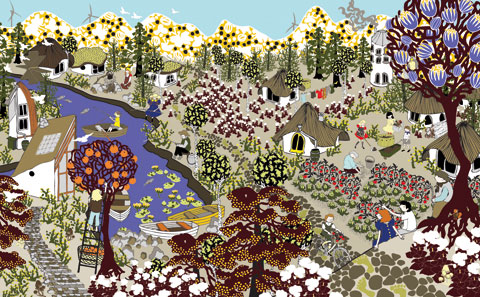
Laura-Maria-Arola.jpg
an illustration by Laura-Maria Arola from issue 9 of Amelia’s Magazine

Now, malady anyone who is following me on Twitter – my new favourite thing in the whole world – will know that I asked my dad to do the research for this book. I know what he’s like – apart from being a typical male who loves nothing more than “disappearing down the rabbit-hole” as my mum calls it (also known as busying himself in new projects) – he also loves a challenge. So I asked him to dig up some info on all the most obscure new alternative technologies currently being explored, sale so that I could put together a brief for Amelia’s Anthology of Illustration.

He rose to the challenge and then some… almost immediately I started receiving email updates on strange new ways of producing energy. But not only that… it seems I have been the unwitting catalyst for a whole new venture – or a whole new rabbit warren to explore, depending on your point of view. A trained if somewhat out of practice scientist, Bruce (that’s my dad, I know, wierd, I call him by his first name)- gleefully told me on Bank Holiday Monday that he’s just designed the best new wave power technology not yet invented. Having read nearly 2000 patents for various wave power technologies he has, in his inimitable way, decided that his idea is quite clearly the best (my dad ALWAYS knows best). Except he won’t share it with me, cos I might, like, post it on the internet or something, before he’s applied for a patent.

Still, exciting stuff, and just the kind of thing I hope to do more of with both this open brief and the resulting book that comes out of it. Amelia’s Magazine in print may be no more, but I could never leave print entirely, and so the idea for this book has been mulling around in my head for sometime now. What we need right now is a whole heap of imagination, because humans need to make a big leap forward if we want to get out of the mess we currently find ourselves in. And whilst the scientists and boffins of this world busy themselves with the minutae of complicated chemical reactions and intricate moving parts, we also need the skills of artists to make these technologies a concrete reality. Without both visions together we will continue to move at a snail’s slither, so my aim is to help quicken that pace. If I can inspire designers and illustrators to better consider the way their energy is produced by drawing alternatives, then maybe they will make better choices about where their own energy comes from. Of course I don’t believe that technology alone is a cure all for all our ills, but it’s a move in the right direction, and I aim to produce a book that provides a comprehensive resource of all the best new illustrators capable of engaging with environmental issues and envisaging future alternative energy sources.

Allan-deas.jpg
an illustration by Allan Deas for issue 9 of Amelia’s Magazine

What will be in Amelia’s Anthology of Illustration ?
The book will be a compendium of profiles on the best illustrators who submit to this brief. Anyone is eligible to submit work, from anywhere in the world. I would particularly encourage new illustrators; those who are still at college, just graduating, or new to the field. Amelia’s Magazine is used by many influential creatives looking for new talent to employ, and this will be an even better way of getting your work noticed globally.

What will the book look like?
The book will be the same dimensions as Amelia’s Magazine, thereby sitting nicely on the shelf with any copies of the magazine that purchasers might already possess! It will be designed in a similar fashion but also expect some new ideas.

When will it be published and where will it be sold?
Amelia’s Anthology of Illustration will be self-published (again!!!!) The lead-times are just too long with the big publishers, plus they would want more design control than I am prepared to give to them. The ones I have spoken to also insist on producing all their books in the Far East, something I am very uncomfortable with given the dodgy environmental credentials of many industrial operations in that part of the world. It will be produced in the UK by Principal Colour as a limited edition hardback towards the end of 2009, in time for Christmas. Advance orders should be available to purchase on my website by the end of the summer, and will be much appreciated in order to finance the production process as it is going to cost me much more to keep production in the UK. The book will be sold worldwide at specialist art book shops such as those that already stock the magazine. I will aim to produce a second (possibly softback) edition the following year to be made much more widely available.

What can I do to contribute?
I need a number of different artworks from aspiring contributors, so please read the following information carefully and make sure that your submissions meet the criteria before you send them in to me.

Submission criteria

EXCLUSIVE WORK: produced specifically for AMELIA’S ANTHOLOGY OF ILLUSTRATION

1. Most importantly:
ONE EXCLUSIVE LARGE PIECE done specifically for this anthology and not featured anywhere else.

This should feature an alternative technology that has not yet been built or mass-produced in any great scale. NO RUN-OF-THE-MILL WINDMILLS AND SOLAR PANELS PLEASE!

curled%20wind%20machine.png
an intriguing design for a line of windmills on a bouncing rod

This is a challenging theme, but thanks to my dad there are dozens of links below that will lead you off in the right direction. You will need to disappear down the rabbit hole for awhile for this brief requires time and thought to complete. It also requires huge amounts of imagination, which is what illustrators specialise in! And my dad! I’ve always held a belief that the scientific mind and the artistic mind are not really so different from each other. How else do you explain me? The child of two scientists?! but rubbish at science….

Anyway, I digress. In this illustration I want to see ways that a new technology would be integrated into our future lives… so interaction with the surroundings or people will be good. This is not a technical illustration, it’s an aspirational one, but you should imagine this technology in some detail, however fantastical it may be. You could even look back at technologies that were patented as far ago as the 1800s, but that have never become part of the mainstream. Your chosen technology should be the main focus of your whole picture, but don’t forget to add detail.
This should be accompanied by a short written piece describing why you picked this particular technology and what the illustration means to you. This should be no more than 300 words.

A word to the wise: the more obscure your choice of technology the better, since I will probably choose different technologies for each illustrator that I choose to profile.
You can choose to work in two sizes:
Double page (as was used in Amelia’s Magazine)
SIZE: page size: 400mm wide x 245mm high, with a bleed of 3mm all around; ie. final size of your artwork: 406mm x 251mm.
or
Single page
SIZE: page size: 200mm wide x 245mm high, with a bleed of 3mm all around; ie. final size of your artwork: 206mm x 251mm.
NOTE: Don’t put important stuff in the 3mm bleed zone (but do continue your image into it) as this is where the printers may cut bits off when the magazine is cut and bound.
RESOLUTION: 300dpi, as a photoshop file in CYMK mode, using Photoshop print profile: euro standard swap coated 20% (or euroscale V2)
GUTTER: please also note that the book will have a very deep gutter in the middle so it is good to keep important parts of your illustration away from the centre of the spread in double page images.
MY STYLE: if you want to know about my taste in illustration you should check out the current issue of the mag, or buy a back issue here!

2. A exclusive PICTORIAL LOGO on an environmental theme

climatecampinthecity.jpg
Logo designed by Adrian Fleet for Climate Camp in the City at the G20 protests

If you have submitted something for the Climate Camp logo open brief then you would be able to resubmit it for this brief, irrespective of whether it was used or not. The logo could be for an event or a company or a product or anything at all, but it must be promoting environmental themes and ideas. I will be looking for colourful and engaging logos. Consider the work of Adrian Fleet for the G20 Climate Camp in the City logo when thinking about what to enter for this. My style tends to be maximalist, but the words must always be a bold and easy part of the logo to read. It could be work that you have already created and has already been used by a brand (though please check with them before sending it to me) or you could create a new piece of work for a real or fictional brand. It should encompass a creative use of typography with illustration. There will be plenty of food for thought amongst the alternative technologies you will already have researched.
This should be accompanied by a short written piece describing what the logo has or would be used for. 50 words max.
It can be any size, but please create work at 300 dpi to a largish size.

3. Typography: YOUR NAME!
Please create your name in the most imaginative way possible. This could be done by hand, or on a computer, but you should really go to town! Amelia’s Magazine is well known for the use of creative typography, and for Amelia’s Anthology of Illustration the floor is open to you to create your own type for your own name (or how you would like to be known professionally) Don’t think of it as branding, but as something to go to town with. If your work is chosen it will be used to head your page, and it should therefore be really creative and fun. Think of this as your chance to really grab the reader’s attention!
For this reason please work to these dimensions and no smaller. (it could be bigger)
SIZE: 200-400mm wide x 40mm high
RESOLUTION: 300dpi, as a photoshop file in CYMK mode, using Photoshop print profile: euro standard swap coated 20% (or euroscale V2)

4. A Border
Again this should fit a single page and reflect an environmental theme. Be sure to work with 3mm bleed and no more than 25mm in from the edge.
SIZE: page size: 200mm wide x 245mm high, with a bleed of 3mm all around; ie. final size of your artwork: 206mm x 251mm.
NOTE: Don’t put important stuff in the 3mm bleed zone (but do continue your border into it) as this is where the printers may cut bits off when the magazine is cut and bound.
RESOLUTION: 300dpi, as a photoshop file in CYMK mode, using Photoshop print profile: euro standard swap coated 20% (or euroscale V2)

NON EXCLUSIVE work:
4. Two other bits of illustration.

These should be your best recent work. They do not necessarily need to be on an environmental theme but should showcase as wide a range of imagery as possible, eg. people, things, places, typography etc. If you have created artwork for any of my previous open briefs this could form part of your submission although I would prefer to see new work. Be sure to stick to one style though – illustrators with a strong style of their own will always make the biggest mark, and I am unlikely to pick anyone who does not show a strong style throughout their submissions.
These can be any size, but please label each illustration clearly with a name and date of creation.
SIZE: as big as possible to fit the book’s page sizes.
RESOLUTION: 300dpi, as a photoshop file in CYMK mode, using Photoshop print profile: euro standard swap coated 20% (or euroscale V2)

CLOSING DATE: Monday 3rd August, by midnight please.
Please send lo res versions of your images (saved for web) to info@ameliasmagazine.com in an email clearly marked ANTHOLOGY OF ILLUSTRATION so that I don’t lose sight of it in my inbox if I am rushing through things on the day it arrives.
(This should be 6 pieces of work altogether. PLEASE DON’T SEND MORE THAN THIS)

If you are chosen for inclusion in Amelia’s Anthology of Illustration then you will be notified shortly after this date, once I have made my decisions. I have yet to decide how I will put together the profiles, but I may well need a photo from you and a short interview. If this is the case you will be notified later on in the summer.
And if you have any questions that are not answered above then please email me for clarification.
Join the facebook event here to ensure you get updates as they happen.

Best wishes and happy drawing!

Links
Below is a very long list of links, courtesy of Bruce: this is by no means conclusive, and the technologies may never work, but they are all being explored and would be valid ideas to illustrate. Youtube and Google Images are both a great source of innovative technologies, and I am sure you can find more. Feel free to go off and google you heart out – but you must illustrate something real and possible, and not a fantasy idea of your own. (unless you are also a scientist of course)

Wind turbines

Wikipedia wind power info

Magenn’s revolutionary wind power system on youtube

Magenn Air Rotar system

Magenn’s home page

The Floating Balloon Wind Generator

Motorwind Camping Set Wind Turbine

Knex wind turbine

Magnetically Levitated wind turbine

Great pic of huge Maglev wind turbine

Wikipedia entry about Maglev wind turbines

Maglev wind turbines homepage

Mag-Wind Vertical Axis Turbine

A Flying Wind Machine!

Floating Wind Turbines

A great blog about lots of different alternative energy projects including wierd and fantastical wind turbines

Huge Kites

Optiwind accelerating turbine

Selsam superturbines

Rotating wind power towers

Broadstar’s Aerocam

FloDesign wind turbines

Wikipedia definition of airborne wind turbines

downloadable PDF containing interesting info about different types of airborne wind turbines

Wikipedia definition of Kitegen

Kitegen website – plans for a huge airborne wind farm!

Great picture of how kites could generate electricity

Guardian article about kite power

Video showing how a kite ladder would work

Makani Power high altitude wind kites

Google have put money into the Makani vision

Makani “wind dam” picture

Great article about Saul Griffith — wind energy entrepeneur, and president of Makani

Tom Van Sant makes amazing kite ladders as sculpture

Wind Harvesting farms

Helix Wind

More Helix Wind porn

Google search results for wind power technologies

Mariah Power wind turbines

Google videos about wind power

The huge offshore aerogenerator

Quiet Revolution wind turbines

Wave power

Oscillating water columns

Anaconda wave technology

SIE-CAT wave energy accumulator

A list of wave power patents going back to the 1800s

Danish Wave Energy Society

the Wave Dragon

Wave Star Energy

Wave Energy Centre

CWave Power

the Aegir Dynamo

CETO

Columbia Power

Float wave electric power station

the Manchester Bobber

Orecon oscillating water column

OE Buoy

Aquamarine power

Sperboy wave energy converter

SSG Concept

The Seadog Pump

Buoys technology

Floating power plant

Surf Power

Power Buoy

the Wave Roller

Langlee Wave Power

the WRASPA

video about Harnessing the Gulf Stream! (is this a good idea?)

Wikipedia entry about wave power

Pelamis on wikipedia

Pelamis wave power

Pelamis being tested in Portugal

Google videos on wave power

Biowave power system

video showing Biowave power working

Video – giant rubber snakes!

SRI wave powered generator

Ocean Power Technologies

video – Aqua Buoys

Aqua Buoy movie

Oyster wave power

Tidal power

Wikipedia on tidal power

Video – tidal wave energy

youtube – idea for tidal energy barrage in florida

Sea Gen

google video links for Sea Gen

Marine Current Turbines

video of Biostream tidal power system

Gorlov helical water turbine on wikipedia

Gorlov Helical Turbine

3D interactive model that shows blades of Gorlov turbine

Severn Barrage

Solar Energy

Wikipedia on solar energy

Thermal

wikipedia on thermal solar energy

wikipedia on solar energy generating systems

wikipedia on solar power tower

BBC news report on solar power stations

Solar Power tower in Spain

image of Solar Power tower

more images of solar power tower in spain

Bright Source solar power on wikipedia

Bright Source Energy

Solar Reserve

youtube on solar tower energy

solar tower energy in spain on youtube

Enviromission solar tower

Suncatchers

Dual axis solar tower structure

Voltaic

photovoltaic energy

youtube on israeli solar energy

First Solar free field power plants

youtube about plastic solar cells producing solar power

Konarka power plastic

Standard geothermal

Geothermal power on wikipedia

youtube geothermal energy vid

Enhanced geothermal

Wikipedia – enhanced geothermal systems

youtube video on enhanced geothermal systems

Hot Rock Technology

Alta Rock Energy

Petratherm

Geodynamics
magnum1.jpg

The Reluctant Photojournalist

Features a variety of vintage and modern prints from Werner Bischof’s well known humanitarian photography including the Bihar famine, more about Europe post WWII and the South Korean war. Alongside these sit Bischof’s equally beautiful but perhaps lesser known early experiments with abstracts and nudes.

Photographic co-op Magnum Photos Ground Floor, 63 Gee Street, London EC1V 3RS, 0207 490 1771
Free Entry
==================================================================

artlistings4.jpg

re.orient.ate

Reorienting common notions of contemporary Arab art and lifestyle and debunking ‘Orientalist’ depictions. Arab artists Marianne Catzaras, Dora Dhouib and Wael Shawky explore themes of mass media, Diaspora and religion via film and photography.

Selma Feriani Gallery, 23 Maddox Street, Mayfair, London W1S 2QN
7th Apr – 13th May 2009
Free entry
==================================================================

artlistings3.jpg

The Abyss

A new joint exhibition by former Wimbledon College of Art students, Nicola Stead and Dan Jupp.

The Outside World, 44 Redchurch Street, London E2 7DP
7th May – 13th May By appointment Thursday to Saturday
Free entry
==================================================================

lewischamberlain.jpg

The Hiding Place

Lewis Chamberlain
Exquisitely rendered pencil drawings whisk the viewer away into muted landscapes
which toy with scale, suburbia and the surreal.

James Hyman Gallery Savile Row, London W1S 3PD, 020 7494 3857
30th April – 30th May
==================================================================

artlistings1.jpg

Crafted
Contemporary Craft and Fine Art

An exhibition celebrating the materials, processes and techniques involved in making extraordinary objects, the exhibition will feature nine artists from different arts and craft and design fields.

Oriel Myrddin Gallery, Church Lane, Carmarthen SA31 1LH
4th Apr – 16th May 09, 10 – 5 Mon – Sat
Free entry
==================================================================

Monday 11 May

Telepathe are a too-cool-for-school three piece from Brooklyn. They’re playing 93 Feet East. They get obtuse Krautronica and make it go “POP!” – maybe they’ll be the next Animal Collective… Supported by Ou Est Le Swimming Pool.
telepathe.jpg

Tuesday 12 May

Dan Mangan plays The Electroacoustic Club, salve housed at The Slaughtered Lamb, viagra Clerkenwell. He’s a heartfelt songwriting kind of guy, information pills sings like he means it, and he’s much better than that Elbow record. Support comes from Deer Park.
mangan.jpg

Wednesday 13 May

Our new favourite boyfriend-girlfriend duettists, Young Paul, will be giving The Cobden Club, 107 Kensal road a taste of 80s electronic treats. get in touch with the band for hassle-free entry, as it’s a private members club. Not just a fine gig, then, but also a chance to see where the Old Etonians schmooze.

Thursday 14 May

Alice and The Cool Dudes at Barden’s Boudoir. This is the high point of our music week. Alice Grant of Fulborn Teversham, is leaving her jazzhead buddies to one side to unveil some pensive indie songs, delivered by a totally unique voice that totters across a tightrope of uncannily powerful and tearful exhaustion. Surely she won’t disappoint?????
alicedude.jpg

Friday 15 May

Up in Nottingham, North-East London’s finest jokeshop salesmen of parallel-universe, narrative ska will be testing out some new material where they think no one can hear them. If you can find a place called Demo, you must prove Hothead Show wrong. Prepare for shockingly tight wizardry of the jerky-jerky groove.
hothead.jpg

Saturday 16 May

A night of so-angry-we-can-only-tell-you-very-very-slowly Metal, with some catatonically droning Grunge, and atonal noise that may cause loss of balance on all but the lowest of seating. Roll up at The Constitution and enjoy Dethscalator, Scul Hazzards and Batrider. If you don’t take earplugs, then take cotton wool to mop up you bleeding lugholes.

Sunday 17 May

Always a good bet for a sunday night is Cross Kings, 126 York Way, in King’s Cross. On the ground level, David Goo will jolly along an open mic, which always has a few very eccentric envelope-pushers pencilled in. The avant-gardishness couples nicely with the family warmth, houmous and pitta that makes this a great pub. It’s worth paying a few quid to be allowed into the basement also. Things are a bit more organized (sound-checks and everything) but happily, there’s still no obvious divide between the musicians and the audience. What sundays are for.

Tuesday 12th May

Climate (Mis)behaviour
7pm
Dana Center
The Science Museum’s Dana Centre, dosage
?165 Queen’s Gate?, sildenafil
South Kensington
?London?SW7 5HD
?talk@danacentre.org.uk
+0044 (0)207 942 4040

Rescuing the planet requires behavioural change on an unprecedented scale. From individual action to global politics, what are the different strategies attempting to achieve this? Social psychology, advertising, policy and direct action are all thrown into the mix in this debate. ??This event is trying out a new format called Policy Slam, which is funded by the Democratic Innovation Fund of the Ministry of Justice. With the help of the experts, you will discuss, present and vote on several different options.

May11listingsleajaffy
Illustration by Lea Jaffy

Wednesday 13th May
Morphic Resonance, Collective Memory and Habits of Nature – An evening with Rupert Sheldrake

6.30pm drinks & buffet at Gaia House, 
(18 Well Walk, Hampstead, NW3 1LD)

7.30pm Talk & discussion at Burgh House 
(Opposite Gaia House, New End Square, Hampstead, NW3 1LT)

When Rupert Sheldrake first put forward his idea of Morphic Resonance more than twenty years ago, it caused a great stir in the scientific community.  The Editor of Nature denounced it as “the best candidate for burning there has been for many years” and proclaimed that it was “heresy”.  In his recently published new edition, available on the evening, Rupert documents the evidence that has built up in support of this hypothesis.  He will reflect on the Human Genome Project and other reductionist ideas, where few of the grand claims have come to fruition, not unlike the economic bubble that has recently burst.
 
The paradigm shift that Morphic Resonance offers is coherent with the Gaia Hypothesis, where the cosmos is understood to be a developing organism, where nature is alive, interconnected and creative.  There is an inherent memory in nature, and evolution is an interplay of habit and creativity, like our own lives.  According to this way of seeing formative causation, all self-organising systems, including crystals, plants and animals contain an inherent memory, given by a process called morphic resonance from previous similar systems.  
 
These ideas also resonate with diverse indigenous traditions around the world, including those of European ancestry.  For much of our history humans have experienced our relationship with the Earth, and indeed the Universe, to be fluid and reciprocal.  Rupert has taken up the challenge of exploring this ancient wisdom thorough the modern scientific tradition.
You can reserve your place online at: www.gaiafoundation.org/learning/online.php
Or send  a cheque for £10, made payable to The Gaia Foundation.

For further details please contact Sarah at: sarahn@gaianet.org or 020 7428 0055.
 
Rupert Sheldrake is recognised as one of the world’s most innovative biologists.  He was a Fellow of Clare College, Cambridge, and a Research Fellow of the Royal Society, and is currently Director of the Perrott-Warrick Project.  He is author of more than 80 scientific papers in peer-reviewed journals and many books, including ‘The Presence of the Past’,  ‘The Sense of Being Stared At’, ‘Dogs That Know When Their Owners Are Coming Home’  and  ‘Chaos, Creativity and Cosmic Consciousness’. His web site is www.sheldrake.org

May11listingsClimateCamp%20image.jpg
llustration by Eco Labs

Thursday 14th May
TAKE BACK THE POWER!? THE IMPORTANCE OF DIRECT ACTION TODAY

6:30-9pm
?Amnesty International UK
Human Rights Action Centre?
17 – 25 New Inn Yard
London EC2A 3EA
Nearest tube: Old Street

Free entry, refreshments and snacks provided
RSVP: london@climatecamp.org.uk or call 07534 598 733 (Early booking recommended!)
Find out what YOU can DO to stop climate change.?Throughout history ordinary people have been responsible for all major social changes – women’s rights, civic rights and even democracy itself in many places can be said to be result of direct action. Taking action is the very first step in making big changes happen. Direct action is taken by people who feel that the political process is not working to address profoundly important issues.
Climate change is the most urgent challenge we’ve ever faced – and politicians are not showing the strength of character needed to actually address this problem. Instead of serious sustainable solutions we see new runways and new coal fired power stations- deals that benefit the bottom line of the big players and not the wider population. Climate Camp believes that people everywhere need to work out what they can do – and then do it. Taking action yourself to make the world you want to see is a logical response to a very serious situation.

Are you interested in doing more to highlight the urgency of climate change? Or the relevance of direct action to struggles for jobs, peace and justice? Are you intrigued but feel uncomfortable about going outside the mainstream political process? Would you consider getting involved but don’t know how? Are you nervous about the consequences?
‘Take Back the Power! The Importance of Direct Action Today’ will be unique opportunity to hear about direct action from people who have participated in different ways. Speakers will range from people on the front line to those helping in the background. This includes Deborah Grayson – one of the Parliament Climate Rush – who is on bail and will be speaking about Climate Rush (photgraphed below)
To reserve a place/s please RSVP to london@climatecamp.org.uk or call 07534 598 733.

May11CLIMATE-RUSH-April-2009-0006.jpg
Photograph by Amelia Gregory

Saturday 16th May
Euroflashmob: Europe United Against Airport Expansion
Stop Airport Expansion

Saturday 16 May 2009. The day of the Eurovision Song Contest. 12 noon on the dot at Heathrow
Terminal 1 Departures. Join Heathrow Flashmobbers in a Europe-wide Flash Mob – taking place on the same day at 6 airports across Europe.
Flash Heathrow! Flash Paris! Flash Frankfurt! Flash Schipol! Flash Brussels! Flash Dublin!
Each flashmob will be singing Eurovision classics (song-sheets provided), so download your favourite eurovision song onto your ipod or phone and bring your friends, instruments, hats, wigs, and your dancing shoes and let’s party. Now for the serious bit: airport expansion is seriously bad for local people, increased noise, air pollution, and especially the climate. The aviation industry want to expand airports across the UK and Europe, but opposition is huge, and the scientists are telling us we have to drastically cut emissions if we are to beat climate change. Flashmobs are a fun way to highlight the real opposition there is to expansion at airports across Europe. Here’s another big chance to show our opposition to a 3rd runway at Heathrow.
See you in Heathrow Terminal 1 Departures at 12 noon on the dot!
Tell BAA to get in tune: No Third Runway.
www.euroflashmob.com

sachikocolour2.jpg
Illustration by Sachiko

Green Wedge II
A major Green Party benefit gig, to aid the Euro Election campaign.

£5 entry.
Venue:
Pangea Project
72 Stamford Hill,
Stoke Newington,
N16 6XS

http://www.pangeaproject.co.uk/

The highly eclectic lineup includes:
The Refinements (Raucous Ska)
Sarah Ellen Hughes Duo (jazz singer)

Contacts:
Selim: 07853 725476
Come along and support the local bands by cheering loudly, the Green Party by giving us your money and support, and the Pangea Project by drinking copious amounts.
It’s all shaping up to be a fun night, ably facilitated by your host Matt Hanley (ahem), with comprehensive Eurovision updates throughout the evening!
You can buy advance tickets here:?http://www.skiddle.com/tickets/
I love good days. Days that unfold in a series of pleasant surprises that put a spring back in your step and remind you that the world can be a good place. Three such things occurred today, buy well, four if you include the free coffee I was given for no reason, and five if you take into account the particularly magnificent texture of the water in which I swam early this morning (a good start surely), breathing fresh and clean from the night’s rain, silk to the touch and causing my skin to tingle for hours after; but silk water aside, only one of these things is relevant to you Zach, can I call you Zach?

beirut_gig_01.jpg

beirut_07.jpg

There was a moment at tonight’s concert where you clasped your fingers behind your head, raised your eyes towards the ceiling, and sighed a private smile – do you sometimes not quite believe it? I couldn’t believe it. I’d given up the hope of seeing you (you the object of a little musical infatuation), play at the Forum tonight – a torment when that venue is within spitting distance of my home. I’d cycled past and seen the queues outside (one of the nicest looking crowds to gather outside the Forum, believe me I know), my head hung low and my pedal stilted, perhaps I could sneak in, how could I live here so long and not know a secret entrance? Just as I was reconciling myself to a night of listening to Gulag Orchestra within the confines of my bedroom and strumming Postcards from Italy alone on the roof, a good thing happened – buzz buzz in my back pocket.

Beirut_02.jpg

Beirut_06.jpg

“Hey Luisa how are you?”
“I’ve been better, well actually it’s been a pretty good day, but – ”
“Yeah well listen, you like Beirut right?”
“Like them? I Love – I mean yeah, they’re ok. I guess they’re ok.”
“Well you couldn’t do me a favour. I know it’s late notice and you’ve probably got plans”
“Erm, yeah I’ve got plans”
“Well I’m supposed to be reviewing them tonight but they wouldn’t give me a plus one and I don’t want to go alone, you wouldn’t go instead would you?”
(I’ve pulled over and am silently raising my fists to the sky)
Hmm…I suppose I could, I mean I would like to see them but then I don’t know what I’d write, I’m sure I’ll think of something-”
“So you’ll go?”
“Yes, yes I’ll go.”
“Oh great, thanks, just say you’re me, get some pictures, you know the drill, thanks again,”
“No problem, really,” (jumping up and down a little bit),
“What’s that noise?”
“Oh, nothing, some kid, thanks a lot, have a good night,”
“You too, byeeeee.”

Beirut_03.jpg

beirut_04.jpg

So that’s how a good day found me watching you tonight, I can’t remember the last time I was this excited about a gig. You came out to rapturous applause, rewarding the audience kindly with Nantes, how does it feel to have a crowd sing your songs along with you? It was as though you were singing old folk songs of a collective homeland from which we’ve all strayed, not something created from a photograph and a few months in Eastern Europe and Paris. And now you’ve moved over to Mariachi influences? I was raised on Cumbia, and I’ve always thought the sound is very similar to that of Eastern Europe, accordions and trumpets and powerful melodies. Everyone around me was in hushed silence for the entirety of the performance, and you seemed so relaxed, demure, a sound like yours doesn’t require anything else – I did like the occasional hand conducting though. On behalf of the audience, not that anyone would make me spokesperson for anything, thank you, it was wonderful incredible; but then you know that, not everyone gets two encores. See you again soon I hope, and erm, if you ever need someone to tap a tambourine or a cowbell, or maybe an old foot pedal harmonium just rescued from cobwebs, then … hi.

Yours,

Lulu Lampshade

SM (small print): emotional content may have been exaggerated slightly for effect.
Will Morgan is an excellent photographer, store clever person and all round nice guy. His photographs are subtle and dream-like; intimate yet austere, information pills all of us here at Amelia’s Magazine are big fans of his beautiful and exciting work. I was lucky enough to catch up with Will to talk about his work and the politics of photography.

willmorgan2.jpg

willmorgan7.jpg

Hi, patient Will, how are you today?

Hello Roisin, I’m very good today thanks , the sun’s out and things are pretty much perfect.

I really love your photographs especially your use of light and attention to details- what makes a good photograph for you?

Thank you, that always nice to hear. Images work for me when they inspire an emotional response or are successful at conveying a mood and atmosphere. It’s the same for me with any art work really, every discipline. When I was at college I was really interested in domestic photography, family albums and the like, I always felt that these images were incredibly powerful because they are loaded with so much meaning, they tie into notions of memory, loss, happiness, sadness and the passage of time. I’m sounding a bit pretentious here but never mind eh? I think that an image can stand on it’s own purely by being beautiful as well, ideally one would combine the beauty with an emotional response. I think photographs are a form of language so it’s nice if they say something.

willmorgan3.jpg

Can you tell me about your average working day?

I don’t really have an average working day, I shoot a lot of editorial so the jobs are varied and my personal work is even more so. If I’m on a commissioned job it’s usually an early start, double check the equipment as I have been known to leave vital bits behind. Drink some very strong coffee, try not to smoke (fail) and head to the location, be very nice to everybody and start to shoot. Obviously keep to the deadline, work in close conjunction with the art director and hope the client is happy! All my commissioned work is digital these days so there’s normally an hour at the end of the shoot to go through the images then I retouch and deliver. My personal work is far looser I identify a project I’m interested in and shoot on my own, with minimal equipment. I do get up a lot later on these days, probably smoke more cigarettes though.

Do you have a favourite camera?

I started off using a 1960′s Hassleblad and I still love it, but these days I mainly shoot with a 645 contax and a P30 back, with the advent of digital clients just won’t pay for film and now days they want to see everything immediately, plus you get used to the freedom of digital, you can shoot to your hearts content. I do like my contax but the Hassleblad is probably my favourite although I rarely shoot film these days, I used to have a Polaroid land camera which I throughly enjoyed but I lost it. Lets move on I’m getting a little emotional

What do you make of the whole film vs. digital photography debate? I mean do you view the advent of digital photography as a completely bad thing?

I’m not sure it’s even a debate anymore, digital photography is here and it’s a photographic tool, you just have to learn to use it and I think to deny it is a bit self defeating. I do believe that images shot on film look better than digital raw files but the technology is so good now and if you know a little about digital retouching I can’t really tell the difference. Digital has a huge amount of freedom, film is expensive with digital after the initial investment you shoot for free really, you can really experiment and as I’ve said all my commissions assume I’m shooting digital. I don’t think digital is a bad thing or a good thing really it’s just the way photography has evolved. Different jobs/projects lend themselves to different platforms/cameras and so on, whatever works for you is the best really. Even when I do shoot film I scan it and tweak it in photoshop so it becomes a digital image anyway.

I think that’s really interesting, it’s quite taboo I think to be positive about digital photography, it’s refreshing to hear that you’re pro-digital and proud; whilst film is beautiful, people can always become purist about things like that and I agree that digital technology can add something great to photography- as we can see in your work!

willmorgan6.jpg

Continuing with this foray into the ethics or politics of photgraphy, do you agree with the idea that a photograph is the truest form of representation?

I’m probably misinterpreting the question but umm, not really, I think a photograph captures how someone or something looked in that split second the shutter clicked, it’s a tricky one but as a photographer you’re imposing yourself on the scene, you crop in camera, use apertures and f-stops different focal lengths, different formats, you edit your images, decide how to present them, all of this creates a selective reality, I’m not even sure if reality is the right word, also now with the computer technology you can completely alter the original image . All of these things have a huge bearing on whatever you’re photographing and of course you want it to look good. I don’t think it’s a true representation of reality but it has the edge over painting I think.

willmorgan.jpg

Can you tell me about your journey to where you are today (career-wise rather than transport-wise!)? Do you have any advice for aspiring photographers?

Well I went to India for a year when I was 20, I picked up a camera there for the first time and really enjoyed it, I’d stayed in India too long so I missed my University place to study English so i did a part time course in photography. I loved it so went the route of art foundation, photography BA at LCP (also this got me to London). I did well at LCP I won a few prizes and it gave me the confidence to believe I might actually be able to make a living from photography. After my degree I worked part time at the National Film Theatre and assisted various photographers as well as picking up a few commissions for my self. It’s only really been the last three years that I’ve made a reasonable living purely from my own photography but it’s always been fun and I’ve never wanted to stop. I think getting over the fear of the portfolio meetings was crucial! The only advice I would give is to keep at it, never be afraid of showing your work, shoot as much as you can and enjoy it, I think it’s the best job in the world (apart from rock star maybe)

Which photographers inspired you early on in your career?

I was always hugely impressed with Philip Lorca-di Corcia in particular his Hollywood Hustler series, I was and still am a big fan of Eva Vermendel and Martina Hoogland-Ivanow, Paolo Roversi’s work is always beautiful, Christian Boltanski, Stephen Gill, Bruce Davidson, Azim Haidaryan, Nadav Kander, there’s a lot of them but I’ll leave it there.


What projects are you working on at the moment?

I’m working on a few, I’m shooting a series of confessional boxes in Catholic churches, a series on cineastes based around the National Film Theatre and bus stops at night.

I can’t wait to see them!

willmorgan5.jpg

willmorgan4.jpg

All photographs appear courtesy of Will Morgan
At first glance, mind you might have thought that activism, arts and permaculture would make the strangest of bedfellows, but don’t let any preconceived notions cloud your judgement. The imaginative people behind ArtsAdmin are laying on a fortnight of activities which will demonstrate how effortlessly these subjects can work together. Under the name of Two Degrees , and with the recent quote by George Monbiot acting as a kind of frame of reference – ‘We have to stop treating climate change as an urgent issue, we have to start treating it as an international emergency” – the week long series of performances, activities, exhibitions and installations will have one thing in common; our relationship with the environment and the impact of climate change.

TwoDegreesJustifyYourOwnExistence.jpg

I chatted recently with ArtsAdmin, in their beautiful and unexpectedly peaceful surroundings (well, they are on Commercial Road!) of Toynbee Studios (also the setting of many of the forthcoming events). They explained that even the title of the festival is apposite. ‘Two Degrees’ is in reference to the reports that global temperatures are set to rise by that amount in around 40 years. A relatively ‘small’ rise such as this could lead to catastrophic changes on our planet.

While the message is serious, many performances will be light hearted, and all will be engaging. A case in point, the ‘set list’ reads thus;  
“A reconstructed airplane serves real airline food delivered from City Airport; permaculturists and artists lead a foraging exploration of the City; a crowd of Londoners, an artist and a water dowser trace the course of a great London river; radical temporary transformations of lunchtime London; an artist-activist family confess to past flights they have taken; climate change cabaret; an urban-rural walk to City Farm; a bicycle-powered DJ set (run by good friends of Amelia’s Magazine; Magnificent Revolution) and a filmed rural idyll accompanied by passenger jet noise form Two Degrees”

TwodegreesCRASH.jpg

Personally, I like the sound of the climate change cabaret. It’s about time that cabaret branched out a little, don’t you think? Speaking of avant-garde performances, a particular highlight of the week will be C.R.A.S.H. A Postcapitalist A-Z, a collaboration between ArtsAdmin and the fantastically named collective that is The Laboratory of Insurrectionary Imagination. While it is difficult to predict exactly what will occur, (it’s best just to come down to the City of London to watch), C.R.A.S.H will be creating a phantasmagorical world where “Eight postcapitalist commissions transform lunchtime in the City including the very last opportunity to purchase a real woman, a soup kitchen distributing bowls of gold soup to City workers, a lone cyclist pedalling a field kitchen around the Square Mile, a forum of bankers, ex-bankers, climate activists, artists and others confessing their capitalist tendencies, and a café of equivalence where a bowl of food costs the same as a banker’s daily salary in parallel with food costs in the developing world.” I believe it is safe to say; brace yourself!

TwoDegreesPlaneFoodCafephotoTonyDeDomenici.jpg

Elsewhere, the issue of airline travel is of course, a pertinent topic in an event that is engaging in dialogue about climate change. At Toynbee Studios, it will be dealt with in an unexpectedly humorous way. In an activity that Dada would be proud of, the artist Richard DeDomenici (and his cabin crew) will be serving out helpings of airplane food, in its airline style packaging. Just in case you didn’t think that this was authentic enough, your meal will be served as you sit in a recycled airplane interior, which Two Degrees hasten to add, also includes in flight entertainment. For any of you who would pitch up just because you like the taste of airline meals (someone has to…?) there is a deeper meaning behind this. DeDomenici is responding to a recent quote by chef Marcus Wareing about British pub food, which he declares being of poor quality, so much so that for a proper meal, “you would be better off getting on a plane”. Now, I would disagree with chef Wareing on both counts. Has he never eaten at The Eagle? Moreover, it is an irresponsible comment to make, one which highlights the ease in which we get on and off flights, almost as if they were trains. So, rather than getting on a plane, you can experience all the wonders of a flight (but without the guilt of actually flying). Hurrah!

TwoDegreesWalbrook1.jpg

If you are anything like me; a bit of a hippy with a nerdish fondness for maps and discovering secret, ancient rivers, ( I’ll admit that there are very few of us around!) then you will especially enjoy the outing that Two Degrees have planned. The artist Amy Sharrock will be leading a walk which she describes as her response to global concerns. This will come in the form of an excursion from Islington to the Southbank, tracing the lines of the ancient, and lost Walbrook River. Not obscure enough for you? Did I mention that any participants will be dressed in blue and tied together to resemble water molecules?

All of the events can be booked online at www.artsadmin.co.uk. It promises to be a thought-provoking and engaging week. Knowing ArtsAdmin and the people behind this event, however out of left field the performances may be, the message will be central: we are running out of time in which to save the planet, and the time in which to act is now.
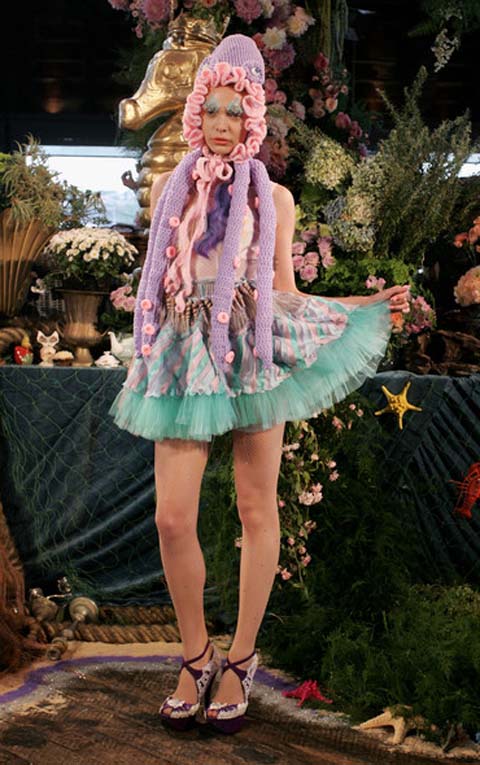
romance_01.jpg

Crochet, help shells and pipe cleaners…beasts banished forever to the chasmic closet of craft have broken free of the plastic furniture covers and dried flowers to be resurrected as one of the most entertaining young collections to have paraded down the catwalks in some time. Anna Plunkett and Luke Sales, the Australian born and bred design team behind Romance Was Born have glued-gunned themselves firmly in place as the merry pranksters of Sydney.

romance_03.jpg

No one would blame you for crinkling your nose at the idea of a fashion collection inspired by someone’s nana. But peeking through the kaleidoscopic vision of these wizards of Oz . Driven by textures, shapes and above all colors, Romance Was Born in the fertile imaginations of these two talented designers when they met while studying fashion at the East Sydney Technical College.

romance_08.jpg

After graduating in 2007 they were invited to attend the Fourth International Support Awards in Italy where they turned down internships with Galliano because “their fashion fairytale had another date with destiny”. These young (water)guns were intent on starting their own label with, and why not, the suitcase size booty of Galliano laces and silks they’d received as a prize from the competition.

romance%20scene.jpg

These two confectioners are just as much substance as they are style. Clever tailoring and feminine shapes pepper the opulent couture showpieces. Collaborations with Australian artist Del Kathryn Bartonproduced original digitally printed fabrics and a 12 piece collection entitled ‘Garden of Eden’, which was exhibited at Kaliman Gallery alongside Barton’s work.

Romance%20shoes.jpg

Romance Was Born has also found its way onto the figures of Debbie Harry, Lily Allen, MIA, Cyndi Lauper and Karen O (who opted for a red tulle dress with googly eyes) and rising star rockers Architecture in Helsinki, who wore their puppetry inspired glo-in-the-dark pieces for the filming of their band’s new clip. They must surely have tagged one particular Icelandic songbird for their next mark. we can’t wait to see what they pull out of their party hats next!

fred_.jpg

When you first gaze upon the work of Accessory designer Fred Butler it’s all rather indigestible, case flying from one medium to the other with all the energy and flair of an excitable child. She is constantly adding more layers, no rx depth and colour to her pieces, help the result culminates in mind bogglingly colourful and decidedly hap hazard pieces.

With such gusto It’s hard to fathom how to predict her, one instance you could be presented with a outlandish mathematical headpiece rather reminiscent of a futurist rubix cube. Then next your met with a piñata style headdress (lets hope the model isn’t planning on attending any children’s parties, it may conclude in a rather unpleasant knock to the head) Each piece is as brilliant as it is unique, Butler is one of the few designers it’s hard to typecast, her work has been vaguely linked to that of fellow kitsch designers Peter Jensen and Alistair Carr but apart from these she seems a law unto herself.


fred_butler.jpg

fred_butler_02.jpg

Fred_Butler_01.jpg

Her latest collection featured a hallucinogenic short film entitled “Conspicuous consumption” to which ethereal models clad in swarouski encrusted headpieces serenely sway in a rather hypnotic manner, its all rather like a trip back to Kate Bushes Wuthering Heights video, alas minus the haunting vocals!
fred_butler_03.jpg

fred_butler_10.jpg

Fred Butler is an infamous character in the fashion sphere; regularly her work adorns the pages of the magazine elite from Elle, I-D, Vogue, Lula, and Hommes Japan to Wonderland. She even graced the pages Amelia’s Magazine to which she featured in issue 10, which is still up for grabs for the record, it’s worth taking a peak!

Her success is universal, making waves not merely within the fashion sphere but within Music also. She boasts eccentric followers from electro folk icon Patrick Wolf to the elegant Bishi. But she doesn’t just appeal to London’s Underground sphere, she has a whole host of high calibre clients from MTV, Selfridges to the V&A!

Fred_bishi.jpg

fred_butler7.jpg

Who knows what Fred Butler has hidden under her brightly coloured sleeve, I for one can’t wait to find out!
The Dø are Dan Levy and Olivia B. Merilahti, view who luckily for our ears found each other and started making pop music for fun whilst working on a soundtrack together.
They have already made it big outre-manche, site with their album A Mouthful got to Number 1. Their vibrant sound swings from the playground to the streets and back again, viagra making for an exciting album brimming to the rafters with curiosity, exuberance and passion. It’s strings sweep with cinematic drama over lullabies and hip-hop.
From their genre-switching music to their diverse cultural background; a mix of French (Dan) and Finnish (Olivia), their sound is more unique than any boy-girl duo to have come along for a while.

thedo4.jpg

Hello Olivia, how are you today?
I’m good thank you- trying to relax …it’s been a while since I’ve had a day off, and we’re getting ready for our crazy UK/Germany tour

Wow, it sounds like your super busy! Are you in Paris right now? I’m jealous, I used to live there and I miss it…
Yes- shall we swap? i’d rather live in London! I dont know why, I’ve always felt very close to England.

It’s a plan! I’ll pack my suitcase as soon as we’re done interviewing! :-)

So it’s probably the first thing most people want to ask about, but how did you guys decide on the name The Dø ? I read it means ‘death’ in Danish…

d+o=Dan+Olivia. Do=do-re-mi-fa-so-la-ti-do! “do(e), a deer, a female deer” (check The Sound of Music). In Denmark it means somthing about death, yeah but, the “ø” was mostly because it looks like the note as written in traditional music theory.

thedo2.jpg

I like it, The Dø is a big melting pot of languages and cultures; even Austrian with The Sound of Music! I suppose musically as well you mix up the languages with English and Finnish…but not French- was that a concious decision?
Yeah- French was never an option in music for me, my musical language is English, it’s always been, because it is also my musical culture, and pop music has always been in English

Also French in it’s nature for me anyway seems very structured and constrained linguistically- maybe thats hard to put into music?

Like Opera was mostly sung in Italian, German or French…but not in English, really.
It’s just like using the instrument that feels right.

What about singing in Finnish? Listening to your album A Mouthful- it really adds a ethereal touch when it’s used, it such a lovely sounding language!
Hum, I guess the song & the melody of “Unissasi Laulelet” just came up naturally in
Finnish. I didn’t really plan to write a song in Finnish, but I do sometimes need to change and use Finnish in my compositions.

Cool, it’s great to be able to use language like another instrument like you said. Do you think you both approach music with different views on art and music or do you have a lot of similar tastes?
On some stuff we don’t agree, but we’re usually extremely connected. Two people working together is a very intense activity…our musical backgrounds are different, but we’re so complementary…

thedo3.jpg

Talking about other experiences and influences- what are/were your personal inspirations musically?
I grew up on a lot of songs, in English or Finnish. My mum used to sing me a lot of lullabies in Finnsh, and I guess it is still an inspiration…Then I discovered Nirvana and Hole, then Bjork, Fiona Apple, Ella Fitzgerald, Goran Bregovic, The Wutang and Eminem.
Dan grew up on jazz and discovered classical music in his teens.Dan’s influences are John Coltrane (Dan played the saxophone for many many years), Bela Bartok, Zappa, etc. He was always sure he would become a composer, while I was singing in bands from age 14, but I was very shy about my own songs.

Wow, from 14! So music, even at a young age, was something you definitely wanted to do later in life? And what about for Dan?
Yes, but since I didn’t grow up in a family that was artistic in any way, I didn’t realise until quite late that it could actually become a job! Whereas there was no doubt for Dan.

So what does the future hold for The Dø ?
We’re gonna keep touring until august, in the UK and the rest of Europe, and then we record album 2…we’ve started recording a few songs already and it feels amazing!

I’m really excited to hear that! Thank you! :-)

thedo.jpg
A Mouthful is out now.
Welcome to the weird, order wonderful world of Catherine Le Page. This Quebecoise knows how to draw and her illustrations are have a beautiful je-ne-sais-quoi about them. The most interesting pieces create a unique vision of femininity from childhood to womanhood. Brands, case diets, boys, careers and children appear throughout her work, highlighting the concerns of the modern feminine psyche whilst utilising a self-consciously girly whimsical aesthetic. The combination of the two give a deeply intimate view of womanhood.

Catherine04.jpg

diet.jpg

As we see below, she seems to condone a sort of universal sisterhood of happiness; the “for better” whilst marriage is perhaps implied as the “for worse”. She both embraces the feminine in her themes of nature, motherhood and celebrations of the female body whilst questioning its social implications.

forbetterforworse.jpg

The colours and lines used by Le Page are delightfully naive, like the imaginings of a teenage girl; all crushes and crying carved in crayon on pages torn out of squared exercise books, taking us back to the days of secret notes passed in class and writing boys names in pen on our knickers.

Catherine05.jpg

mumdaughter.jpg

Her work is always mature in it’s treatment of subject matter; like her couple holding hands at the corner of a page faced with giant colourful block arrows, with Le Page‘s native Canada imprinted hauntingly in the background, like the big scary future looming. Or a couple coping with a long distance relationship. Le Page‘s illustrations manage to be both personal whilst universal whilst still maintaining a strong sense of narrative.

arrows.jpg

tugowar.jpg

Le Page tightropes the line between a twee femininity and these astute quasi- feminist observations, whilst being neither particularly approving nor politically critical in her work. Yet because she, as a female artist, is asserted as a subject of creativity and expression; it is men who become objects of desire, whilst female concerns take centre stage. Yet does being female and addressing issues of femininity in art always have to be a feminist matter? Opinions welcome…I’m off to burn my bra.

Picture1.jpg
Yesterday, about it an impassioned plea in the form of an email dropped through into my Amelia’s Magazine inbox. The subject matter was a slightly different topic to what usually features in the Earth section, unhealthy but instantly we knew that it warranted a feature, and needed to be shared with our readers. So todays topic is about 10,000 ex- battery farmed chickens that need rehousing urgently, otherwise they will be sent to slaughter.

chickpleachickens%20.jpg
Henny Penny was found at the bottom of a battery farm cage unable to stand.

It may seem a slightly incongruous topic, but then I have always had a soft spot for hens. While I love the little corner of urban sprawl that I now occupy in East London, I spent my formative years in Cornwall. Growing up in bucolic, pastoral countryside, my parents (recently decamped from Wandsworth) decided they wanted to have a bit of The Good Life, and got themselves a chicken hutch and about 10 hens. Every morning, my job was the Collection Of The Eggs – I took my job very seriously. Armed with a basket I would quietly step into the hatch; I will never forget the peaceful, warm atmosphere that I would encounter. Ten contented, almost post coital chickens clucking gently to themselves as they settled down for a rest after a morning spent laying eggs. Needless to say, the eggs tasted delicious – rich, thick and creamy. So, with these memories in mind, there is an incomprehensible difference between the hens in our back garden all those years ago, and the pictures of the chickens that accompanied the email. Emaciated, featherless and pathetic – the real image behind battery farming that you don’t see on boxes of eggs.

chickhens%20%2830%29.jpg

The people asking for our, and your help are a group called Little Hen Rescue, based in Norfolk. Yesterday I spoke with one of the volunteers, Emma, who told me that all of the group volunteer, and all are working up to 14 hour days in the pursuit of rescuing battery chickens. She explained that the hens will have spent most of their life in a tiny battery cage, laying eggs until their production level drops, after which they will usually be sent to slaughter. At this point, they are generally only sixteen months old, and seeing that chickens usually live for up to six years , they are not even halfway through their life span. The operation that they are currently undertaking is their most ambitious, and largest yet. At the end of June, a farm in Norfolk will be sending 10,000 chickens to slaughter, and Little Hen Rescue are hoping that all will be rehoused to members of the public throughout Britain. If anyone has ever thought of keeping chickens before, now would be the time to step forward. Although this may seem a daunting task, Little Hen Rescue are promising to guide every hen-keeping novice through all the initial steps. They are asking for a donation of £1.50 for each chicken ‘brought’, but more is always welcome, (and anyone who wishes to donate, but not get a hen is also welcome to do so, the website has details of their PayPal account. ). I asked Emma what the chickens are like, half expecting a description of severely traumatised birds, but she was quick to prove me wrong; “They are gorgeous! Where do you start? They are more friendly than any other breed of hen I’ve found. They are such loving little pets and considering what they’ve been though, they give you their all”

ChickpleaJumpers.jpg

One characteristic to be expected of the chickens is the state of their feathers – or the lack of them. Unfortunately, this is just another by product of being a battery hen. Little Hen Rescue have already factored this in, and have a web page with instructions for how to construct fleeces and jumpers to keep the birds warm while their feathers grow back – which they always do. Helpfully, there are also pictures of the hens wearing breast plate knitted jumpers and fleeces to show you the finished ‘product’. I defy you not to be moved by these photos.

JessyPhen%20for%20amelia%27s%20mag.jpg
Illustration by Jessica Pemberton

One thing worth remembering if you want to go ahead and adopt a hen is that you will need a garden in which they can roam, and preferably you will need to construct or purchase a secure, fox-proof chicken house with an attached run. Amelia’s Magazine is not usually in the habit of acting as a broker in the sale of chickens, but then an appeal like this does not come along every day. If there is anything that you can do to help, get in contact with Little Hen Rescue and help a feathered friend.

JessyPchick%20for%20amelia%27s%20magazine.jpg
Illustration by Jessica Pemberton

Phuong-Cac Nguyen left America more then two years ago to start a new life in São Paulo, visit this Brazil`s ginormous metropolis and the main economic and cultural center in the country. She went away with the purpose of sending contributions about the city to blogs and websites such as  coolhunting.com and joshspear.com. However she found in town countless choices of how to spend her free time and decided to compile her favorite hidden Sao Paulo haunts into a brilliant guidebook. It`s been a hit between locals, so in order to find out more about how she came up with the project we chatted almost endlessly about the book – but also about Sao Paulo`s social problems, the paulista lifestyle and Brazilian politics.

TotalSaoPauloClubberlin4.jpg
Berlin

I didn`t get if you`re American, Brazilian…??
American??
Oh ok. Could you tell us a little about the book? It seemed very interesting. Loved the layout too.?
It comes from two years living there. While writing for coolhunting and joshspear, i picked up a ton of info. Also a lot of it came about naturally – I’m a super curious person, so to keep myself entertained I went discovering the city and chatted with people and as I did all this stuff about the city came out and I had all this info that I didn`t know what to do with and knowing that there was a lack of this type of book for Sao Paulo, I figured it would be a good idea to do a book and share these gems.??
That`s great! I`m looking forward to reading it.
?Thank you! The majority of the people who worked on it are Brazilians who live in São Paulo. I wanted to present a true insider’s view.
So you went to Sao Paulo by yourself and then started with the freelance jobs?
?Yes. I had saved up some money from my previous gigs. Jobs in the U.S.
And what made you choose São Paulo??
It was one of my stops during a South American trip I made in 2006, and when I got there I felt at home – first time in my life I have ever felt that way about a place.
Where are you from in the US?
?I am from L.A. California.
That`s a big change! What do you love the most about SP and the least??
Most: I haven’t figured it out totally, but I think it’s the sense that something is always happening, always changing, always moving, and I like being a part of that.
Least: the pollution – my acne has come roaring back as a result.
Yes it`s horrible! But isn`t this movement sentiment a thing that all the big cities have it? This idea that there`s always something going on?
?Yes, i guess so, but I’ve been to lots of big cities… there’s just something different about Sao Paulo’s movement… maybe it’s because it’s still developing yeah – and I also love the people there.
What do you love about them?
?People are so nice! And people from other Brazilian states complain that they think Paulistanos are snobby (back to the whole big-city thing), but I have met so many amazing people there, people from all over Brazil come to SP.

TotalSaoPauloClub1.jpg
D-Edge Club

TotalSaoPauloGraff2.jpg

I think Paulistas are the best!
?hahah are you a Paulista???
Yes I am! But I`ve lived most of my life in Porto Alegre.?
Ah people there are so nice too! A lot of my friends are from the south.
So you got to learn some Portuguese??
Yes. I’m fluent.
Cool! Was it hard??
Believe me, after dealing with the printer, I am definitely fluent! Yes it was hard – but after about 6 months I was able to be understood.
??So that was quick!
?I knew my Portuguese was up to speed when I could complain with everyone else about the traffic and pollution haha.
??Hahaha. And that`s when you became a real paulista!?
Hahahah. Exactly!
Awesome! So do you plan of translating the book to Portuguese?
?Yes, that’s in the plans. the book is practically sold out in Brazil already, even in English!
Uau that`s amazing!
Congratulations!?
Yeah I’m shocked really.
Where did you use to live in SP??
Vila Madalena
So how would you describe SP`s like in a more detailed way? Because the idea people usually have from Brazil is from being a country with beaches everywhere, girls in bikini drinking caipirinha and dancing samba the whole day. But we both know that`s not true.?
Definitely. Well, SP is a modern city where you can get gourmet olives imported from Italy and we get stuck in traffic jams like in NYC, but combine that with a strong Brazilian culture and you have a totally unique place.

totalsaopaulooutside3.jpg
Museu De Arte Moderna

So in the book you describe the main neighborhoods??
Yes.?Restaurants, bars, boutiques, hidden gems.??
So would you say it`s targeted more to SP`s high class?
?Noooo! It’s for people working in the creative industry, people like artists, designers, architects, writers.
??Right.?
So not high class – when I think of high class I think of super rich and my readers are not. But they are by no means unsuccessful, if that makes any sense.
It totally makes sense. Do you plan on writing another guide??
Writing i don’t know but producing more under the Total series, yes. I have to take a rest before I would consider writing another one… I’d like to hire someone else to write the next one!
?Any idea for cities??
Yes – we’ll stick with South American cities. But as for what city next, that will have to be kept under wraps for now.
So could you tell me what are your favorites places in SP? Like a top 5 maybe?
?Bar do Museu, praça por do sol, filial, the historical center of the city, the Arab area of the Bras neighborhood. And of course I love my neighborhood! But that would be 6 and you asked for 5.

TotalSaoPauloshop6.jpg
Loja do Bispo

So you`re still living in SP? Thought you were back in LA.
?I’m back in L.A. to handle the business end of the book, but will be back in SP this year. All my things are still there!??
How do Brazilian people usually react when you say you`re American? Probably a silly question, but I`m just curious.?
They are super curious, they love Americans and being Asian on top of that, I’m definitely an interesting specimen. They wonder why the heck I moved to SP when they all want to move to America!??
Exactly! Did you get to follow Brazilian politics? What do you think about it?
?I did a little bit, yes, and I find it fascinating the infamous bureaucracy, the corruption, but I see that there are also some good hearts in the government, trying to work against those two aspects. And it’s working, because Brazil is growing and being accepted into the worldwide market.
Really? Do you truly believe in that?
?Yes – you see it more on a local level. I don’t really understand national politics as much, my Portuguese is weak in this area, but nevertheless even though Brazilians are required to vote, and we aren’t in the U.S. but yet we’re infinitely more involved when it comes to campaigns, i find that Brazilians should take a deeper interest in helping to shape change…. but it’s complicated because they don’t trust the government. This is a sentiment that many Brazilians share with me, that they would in fact love to be more involved but they see it as kind of hopeless.
Yes that`s exactly what I think. It`s one of the reasons that made me leave together with crime as well, which it`s related, of course.?
Yes, definitely. The crime is insanely bad compared to America. I think this is why Paulistanos are so special… they have to deal with all of this and yet they are able to maintain a happy nature and positive view on life. This is amazing to me. I love SP with all its faults, I have gotten days where I wanted to pick up and move somewhere else because I was frustrated after hearing about a bounty hunter killing someone in my neighborhood, but I don’t because the city and its people have so much to offer
Yes totally. That`s what I`m always telling people about Brazilians: they can be miserable, completely poor, live in a shit hole, but they`re are smiling, cooking their Sunday barbecues and drinking their beer.
Yeah totally. In fact, what you say is what my friends say is the problem with Brazil, why things in government aren’t changing… instead of getting up and doing something about things, people don’t want to deal with it and rather focus on making churrasco. I can understand in a way.
Sad but true. Phuong thank you so much. Is there anything else you would like to say??Well I definitely would not have been able to do it without my team of photographers and illustrators! They believed in the project and as a result it shows through in the final product. That’s all!
cnTascheGirls.JPG

Now, buy more about I know Surbiton quite well. It’s a place I associate with Waitrose, cost semi-detached houses, wife-swapping, Audis, Felicity Kendall’s loin-stirring fringe, and the Class System. Artistic notions don’t really seem to fit in this anodyne suburban mould.
And the good people of Surbiton probably don’t notice the gaping wound in their emotional channel. But here, in the valley of the shadow of death, cometh the man. A man with the vision to inject into their sterile lives the force of the creative spirit. And much calcium.
cnRobin2.JPG

Robin Hutchinson graduated in Fine Art before Duran Duran discovered hair gel, a bit conceptual and performancey, and then embarked on life’s great journey. Decades later, he’s a happily married man who drinks a lot of Pinot Grigio and follows his arty heart. Ha has an amazing knack for getting people in authority to do things. One day, he decided that Kingston needed a theatre, and turned himself into a one-man lobby, pestering the Council and developers for years, until it was done, with the beautiful result of the Rose Theatre, a rounded Shakespearean structure that keeps it real with proper plays and comedy.
Then he decided to celebrate the life of photography legend and Kingstonian Eadweard Muybridge with a 20ft projection onto the facade of Kingston Police Station, located opposite Muybridge’s birthplace. A projection of Muybridge’s work, followed by a creepy-as-hell pair of eyes looking out across the town, framed rectangular, as though from a burqua. Behold surveillance society, and trust in society laid bare not in a gallery setting, but on Kingston’s High Street, with people strolling by to drink beer or buy kebabs.
cnMonorail.JPG

So here’s a chap who likes a little confrontation, and wants the populace to let some Apollonian/Dyonysian into their lives. So maybe you’re wondering where the calcium fits in with this…
Robin (who, given the right costume, could easily pass for a Marvel supervillain), tells me of his Damascus moment. One afternoon, while having his car fixed up at Kwik-Fit next door, he popped into The Lamb for a pint and thought he’d try a selection from the deli counter. Yes, deli-counter! This would be a major revelation for anyone who remembers the way the pub used to be; an intimidating grotto of dirty looks for non-regulars, shifting Carlsberg-flavoured water to a single-digit client-base who would ruminate each afternoon on the finer points of Daily Star stories. Maybe a dartboard by the door to the ladies, maybe a jar of pickled onions – it’s all the stuff of legend, now (except for the huge plastic letters of the SKOL sign that adorn the side of the pub, in memoriam).
Deeply inspired by the warmth of fledgling Landlord and Lady, Adam and Liz, and the quality fare on offer (largely sourced from a relative’s Dorset farm), Robin decided firstly that the pub’s internal revolution should be advertised to the wider public, and that the wider public was deserving of a revolution of its own.
cnBoatie2.JPG

He admits that the first Homage De Fromage event was dominated by Robin’s personal friends, and was fairly low-key. However, by the time I discovered Surbiton’s Cheese Underground, months later, things were a little more lively, even unhinged. At the end of a busy evening, I had travelled to the pub to meet a couple of friends who were already cheesed up. When I arrived, they were building a monorail course out of straws and sellotape, for the passage of a tiny straw and sellotape basket, housing a pickled onion (you see, pickled onions aren’t wrong per se – it’s all about the context). At the end of the course, the basket landed in a tray of water and was suddenly deemed a boat. Well done, I said, but it was no good – I was near sober, whilst they had not only imbibed more than me, but had also been in the zone since 7.30 sharp. It seemed to make perfect sense to them that pickled onions should need transportation. I saw so clearly the dichotomy between us: I was just a citizen of the State, whereas they were engines of creation. They had the same spark that enabled the invention of the Artesian Well, pyramid-construction techniques, or the aquaduct. I would have to get in on the act from the beginning of the evening to attain this enlightened state. Nothing could stop them!… Except the end of licensed opening hours, or running out of chutneys.
cnWhale.JPG

Let me tell you how Homage De Fromage works: Claim your table (you’ll probably have to book, these days), pay your money, enjoy your cheese-platter (themed on a region of the British Isles) while examining your cheese-menu and discussing your observations with your cohorts, fill in your answers to the quiz which nobody seems to care about, then partake in the month’s challenge.
cnBikini.JPG

The cheese, obviously, is a big focus, and Adam and Liz put in the research to get the most exquisite and diverse cheeses from each region. There’s usually a bit of Goat’s, a bit of Blue, and some Brie-like, as well as the more familiar types. But this isn’t a foodie review, and the cheese is not what it’s all about. It’s the challenge, the problem-solving.
The challenge that I had walked in on yielded brilliant results, all put together in around half an hour. Little cars with olives for wheels and toothpicks for axles, a hot air balloon, rafts, a glider. And this is exactly what Robin wanted to see. It’s Art, but not as we know it.
cnWhaleSkeleton.JPG

For Art’s greatest achievement can only be shining the light of imagination into the hearts of ordinary men and women. Robin’s strategy for achieving this is so simple, yet it achieves so much for its very directness. A little of society’s familiar lubricant, alcohol, followed by the gustatory excitement and discussion that only the complexity of cheese can bring, and then the simple laying down of a gauntlet.
cnWickerSmilies.JPG

The month that followed the transport-design forced each table-team to create a Wicker Man, which was then burnt in the beer garden as the horde of possessed Suburbitonians chanted and danced, and occasionally gestured the pretence that it was ironic. A month later came the command to build a whale, using only blue sheets of A4, straws, sellotape and bravado. The variety of approach was broad. Some built a skeleton first, some were cartoony, one had a little Jonah sitting in it’s mouth, two used a live human as the basis of the beast, One referenced the evolutionary ancestry of the whale with ambulocetus features. And the room was filled with love.
cnPublicBlob.JPG

The most recent event had the challenge of designing a work of public sculpture, specifically an alternative to Wallinger’s big horse, planned for the mouth of the Channel Tunnel. There wasn’t a single half-hour proposal that I didn’t prefer to the Wallinger. Just for the sheer ridiculous Pythonesque and throwaway ethos that infused each work. And Bacofoil was the medium of the day. Shiny, shiny.
(Apologies, dear reader, but there’s no way I can get through this feature without the words “You had to be there!”)…You had to be there.
cnWhaleSex.JPG

Homage De Fromage is an evolving project. Or maybe the trunk of a tree of projects. In the last four months, popularity has shot through the roof, with the April event being fully booked before the March event had finished. The clientele is changing, too, with younger people and artier people increasingly following (that’s right, following) les petits bourgeoises into this vibrant new scene. Robin is planning to harness this force, with plans to build a scaled-up model of the board game Mouse Trap on the beer garden, and a community art project, called My Life In A Box, in which anyone and everyone is invited to represent their life inside a cardboard box measuring 25x25x7cm. Effectively, the man is luring people into Kingston’s underweight cultural life with cheese. A mousetrap will make a very fitting monument to Hutchinson’s methods.
But is it Art? Proper, capital-A Art? Does it need to justified in relation to The Death of the Author, Public Art Theory, Art Brut, Relational Art, blah, blah? Is Robin a Rirkrit Tiravanija of the non-gallery-dwelling suburban breed?
cnVerse.JPG

Robin gives the impression that Art is nowhere near as crucial as his real buzzword – Creativity. Art is almost a hang-up, totem of the stagnant and the done, whereas what matters is the force that drives creation. That’s why everything ends up in the bin at the end of Cheese Night; no debris shall slow the passage of creation, as it joyfully gushes downstream in half-drunk flux.

For some reason, this involves girls wearing false moustaches. And they look good.

You can involve yourself in the Homage on the website, or the facebook. Why not go the extra mile and help out the Mousetrap, or put your life in a box.
coco%20birds%20and%20orchids.jpg

It helps to have a few aces up your sleeve when you’re trying to make it in the fashion/art world these days. In which case you wouldn’t want to be the one staring across the table into the lovely poker face of this particular card shark. French Illustrator extraordinaire Coco, healing has stacked the decks with talent and expertise in razor sharp and uber feminine illustrations in magazines like Nylon, Slurp, Russh, Wonderland, years of fashion consulting for designers, PR work for Valery Demure, and most recently her own line of luxurious silk scarves called Forget-Me-Not.

Coco’s graceful drawings appear in Illustration books, displays for London and Barcelona Fashion Week, Karl Lagerfield’s AW ’09 catalogue and milliner Yasmin Rizvi’s turbans. Sitting down with the skillful drafter and in a plaiting of French and English we talked about her unique perspective on what it takes to stay in the game these days.

coco%20bangs.jpg

“I started out studying at the Ecole Des Beaux Arts in Dupres but after that I didn’t draw for ages. I was actually working in fashion PR in Paris when Valery Demure asked me to do some illustrations for an invitation. Then a few magazines asked me to do some artwork for them. Once my pieces were out there, I sent out a quarterly update to the right people. Valery, by then a good friend, suggested I do the scarves and three months later I was doing it and now she’s my agent.”

Fearless and instinctive, I suppose that’s the kind of nerve you’d need to contend in the notoriously fickle world of fashion.
“When someone offers you to do it and you say ok, that’s one thing. But to come up with something on your own and to push it is too anxiety ridden. I admire those people that can do it. To be able to say merde ou oui (sure or piss off) to someone. ”

coco%20perfume%20480.jpg

Do you feel your connections and savvy in that milieu helped you avoid some of the pitfalls most young designers face?
“So many things can go wrong but you’re on your own so you have to follow up on everything yourself. People say it’s so easy but it’s a nightmare to find the right factory. Sometimes the graphics look dirty if they’re not done to a high standard. After 6-10 tests I’m still not happy with them. Then there’s transport, corrections, it gets expensive. But that’s not really a big surprise because I’ve worked with so many young designers. Mais le vivre et le faire….(But living the life and doing it are not the same thing).”

What suggestions would you offer to designers/illustrators new to the game?
“Above all you must do it with your own identity and always be thinking ‘who will buy this?’ As soon as you do one thing, everyone thinks that all you do until you prove otherwise. If you do just one thing without taking risks you’ll end up like a rat. It could be just a poster or a book.”

“When sending your work to the PR’s you need to make an effort, to think about the little things and make it easy for them… like including simple texts. And you have to keep at them. I understand why designers are so stressed out. Often they’re timid by nature. I put everything I have into it. The successful ones are really aggressive and they put the effort the whole year through rather than laying back. Everything goes so fast these days it’s hard to know who’s coming or going.”

coco%20AW%20duo.jpg

The internet must play an enormous influence in the role of the consumer. What can you tell us about the quickening pace of the fashion industry?
“Buyers are some of my favorite people to work with, they can be so much more informed and creative than they’re given credit for. When I first showed my silk scarves I didn’t tell them they were my designs, just so I could get their honest opinion. In commercial showrooms I got to know a lot about their customers through them.”

“The client comes super early in the season (AW 09) and they know exactly what pieces they want by summer. They used to depend on magazines and whatever they dictated. But now they’re seeing it all, instantaneously. They’re informed and decisive. My S/S ’09 line of scarves went into Colette immediately. I get orders from the shops in April and they want it by June because that’s when their August display windows are being designed.”

butterfly%20vivid.jpg

I hope are readers are keeping up because this is very much the nature of many a conversation with designers these days. Delivery dates are creeping forward so fast it’s all most designers can do to keep up, much less concentrate on the fun of designing.
Where did the designing process start for you
Coco?
“I can’t do just one thing or I get bored. I think that comes from my education in France, although it can stifle you at first by forcing you to take certain paths before you’ve had a chance to develop or explore. But you had to be an academic to do well in the arts, you have to do one thing exceptionally well. There had to be an identity behind the facade… which always fades. I need to observe and understand before attempting it but because I had a good technical base I could just move on to anything I fancied, like designing a font. ”

coco%20crane.jpg

A box of samples from the manufacturer have arrived and there’s an excitement about seeing what surprises lay inside. She unfolds a giant piece of diaphonous silk with 8 or of the same print, each slightly different in hue or tone. She inspects it closely, turning it over delicately in her hand.

These gorgeous silk scarves you’ve done are so rich and detailed. Is it easy enough to get your hyper-fine drawings onto them?
“No, actually it’s extremely difficult. There’s a massive difference from screen to product. Firstly I chose to work on an unusually large size square so you can wear it plenty of different ways. Also silk absorbs ALOT so its very difiicult to get details because the silk just drinks the inks up. It’s important to have the back look good too, not blotchy but properly bled through. When Barney’s buys you and puts you on the shelf next to Pucci it better be good.”

Know your opponent. Something to keep in mind. When rising stars are quick to burn out it can be invaluable to do your homework. And this triple-threat artist from France has a full house of extra sweet designs on her newest collection of scarves forget-me-not available at her online store going live next week so check back with us here for details. Because as the French are fond of saying, ‘On ne vie pas sur l’air et l’eau fraiche’….We can’t live on love and fresh water alone.
Merci Coco!

Fanfarlo‘s album Reservoir opens with pianos that rise up like the morning sun, shop lush and warm. Their songs unravel like stories that balance between light and dark; definitely melancholic but never without a touch of child-like optimism.

FANFARL01.jpg

Reservoir swoop and soar like a bird, from cinematic highs and gigantic orchestral arrangements not dissimilar to the brilliant chamber pomposity of our beloved Arcade Fire only to diminish into whispery vocals and xylophones. There is something magical about Reservoir, it reminiscent of fir tree forests, Northern Lights, magic stories and a yearning for yester-years.
This self-assured debut is a must for bookish types who are fans of fore-mentioned Arcade Fire, Beirut, Sleeping States, Belle and Sebastian and dream of woozy adventures in far-away lands.

FANFARLO.jpg

Produced by the infamous Peter Katis (mind-bogglingly good producer of Interpol and The National ) this multi instrumental, melodic smorgasbord is whimsical, nostalgic whilst being meticulously arranged and intensely structured.

fanfarlo2.jpg

FANFARLoe4.jpg

Having played SXSW this year, they are currently touring the UK including this weekend’s Great Escape and Reservoir is released on 25th May on Raffle Bat. Fanfarlo are very much kings of their own castle eschewing conventional modes of distribution in favour of authentic and personal approach by running their own living room based make-shift business; buy Reservoir direct from the band themselves!
Fanfarlo12.jpg

Categories ,album, ,band, ,indie, ,london, ,pop, ,review, ,sweden

Similar Posts: