Amelia’s Magazine | London Fashion Week A/W 2011 Catwalk Review: Ashley Isham

Olivia Rubin A/W 2011. Photography by Amelia Gregory
Olivia Rubin A/W 2011 by Jane Young
Olivia Rubin A/W 2011 by Jane Young.

Every now and again London Fashion Week throws out a curveball and you end up in the most random of places with the most ridiculous collection of people, buy wondering what the hell is going on. The Olivia Rubin show was just such an occasion.

I was very early to this show – a confluence of circumstances that left me standing at the front of a line outside the Jalouse nightclub in central London until I was completely numb with cold. From my prime vantage point I was able to ogle as the paps pounced on a series of D-Z list celebrities. I recognised Konnie Huq and footballer’s wife Danielle Lloyd but after that it was anyone’s guess. In my mind it’s never a good idea for the guests to overshadow a fashion show, this and especially not if I haven’t got a clue who they are.

Once the celebs had been swept into the hallowed basement of Jalouse I too was invited in. I picked up a drink and swiftly headed towards the sunken seating area, click ignoring the protestations of the press girl to wait and see if there was space later on. As if! We’ve run an extensive interview with Olivia Rubin on this website and I didn’t much feel like standing around on my own anymore, so I plonked myself down next to a friendly looking bunch of people on a curved sofa. I soon discovered that the lad next to me was on work experience at a fashion magazine and somewhat in thrall to his first fashion week. Herein is revealed the ridiculousness of seating arrangements at fashion shows – at the end of the day they are completely arbitrary. Depending on who you know and whether you’re bolshy enough you can sit wherever you want, be you intern or editor.

Olivia Rubin by Karolina Burdon
Olivia Rubin by Karolina Burdon.

As guests slowly filled the club the celebrities stepped up on to the catwalk at my head height to pose for the paps. First Danielle, swishing her hair this way and that like a prime racehorse. Then, to my delight, Laura Goodger and friends from The Only Way is Essex. Don’t worry, I had to look up her full name. I did watch a few episodes, but I’m not THAT SAD. By this point I was gobsmacked by the stunning level of celeb-dom in attendance. I later discovered that another fashion PR had been approached for tickets by the *cast* of The Only Way is Essex, but had rapidly turned them down as way too tacky. I must say, I don’t really understand the logic. Rather than making me think, way-hey, this must mean Olivia Rubin is really cool, it makes me utterly distracted… anthropologically fascinated by these strange creatures. The result? I spent the entire catwalk show trying to capture Lauren pouting and preening, rather than concentrating on the clothes – which in any case were hard to see against the glare of flashbulbs. Famous model Olivia Inge certainly enjoyed herself too; gunning at friends in the audience as she pranced down the catwalk.

In a way it’s a shame that there was so much flimshaw surrounding this show because Olivia Rubin makes very cute clothes that feature colourful, fun prints and simple 80s styling. To my mind not at all Essex.

As soon as the show was done the music leapt up to dancing volume, and yet more Essex girls headed to the toilets to touch up their wondrously over-wrought get ups that must surely have taken all day to perfect. I could happily have stayed next to the basins with my camera all night but Matt and I instead drank free cocktails and put the world to rights.

You can read Matt Bramford’s fabby review here. Read our interview with Olivia Rubin here.

Olivia Rubin A/W 2011 by Jane Young
Olivia Rubin A/W 2011 by Jane Young.

Every now and again London Fashion Week throws out a curveball and you end up in the most random of places with the most ridiculous collection of people, purchase wondering what the hell is going on. The Olivia Rubin show was just such an occasion.

I was very early to this show – a confluence of circumstances that left me standing at the front of a line outside the Jalouse nightclub in central London until I was completely numb with cold. From my prime vantage point I was able to ogle as the paps pounced on a series of D-Z list celebrities. I recognised Konnie Huq and footballer’s wife Danielle Lloyd but after that it was anyone’s guess. In my mind it’s never a good idea for the guests to overshadow a fashion show, and especially not if I haven’t got a clue who they are.

Olivia Rubin A/W 2011. Photography by Amelia GregoryOlivia Rubin A/W 2011. Photography by Amelia GregoryOlivia Rubin A/W 2011. Photography by Amelia Gregory
Olivia Rubin A/W 2011. Photography by Amelia Gregory.

Once the celebs had been swept into the hallowed basement of Jalouse I too was invited in. I picked up a drink and swiftly headed towards the sunken seating area, ignoring the protestations of the press girl to wait and see if there was space later on. As if! We’ve run an extensive interview with Olivia Rubin on this website and I didn’t much feel like standing around on my own anymore, so I plonked myself down next to a friendly looking bunch of people on a curved sofa. I soon discovered that the lad next to me was on work experience at a fashion magazine and somewhat in thrall to his first fashion week. Herein is revealed the ridiculousness of seating arrangements at fashion shows – at the end of the day they are completely arbitrary. Depending on who you know and whether you’re bolshy enough you can sit wherever you want, be you intern or editor.

Olivia Rubin by Karolina Burdon
Olivia Rubin by Karolina Burdon.

As guests slowly filled the club the celebrities stepped up on to the catwalk at my head height to pose for the paps. First Danielle, swishing her hair this way and that like a prime racehorse. Then, to my delight, Laura Goodger and friends from The Only Way is Essex. Don’t worry, I had to look up her full name. I did watch a few episodes, but I’m not THAT SAD. By this point I was gobsmacked by the stunning level of celeb-dom in attendance. I later discovered that another fashion PR had been approached for tickets by the *cast* of The Only Way is Essex, but had rapidly turned them down as way too tacky. I must say, I don’t really understand the logic. Rather than making me think, way-hey, this must mean Olivia Rubin is really cool, it makes me utterly distracted… anthropologically fascinated by these strange creatures.

Olivia Rubin A/W 2011. Photography by Amelia GregoryOlivia Rubin A/W 2011. Photography by Amelia GregoryOlivia Rubin A/W 2011. Photography by Amelia Gregory
Olivia Rubin A/W 2011. Photography by Amelia Gregory.

The result? I spent the entire catwalk show trying to capture Lauren pouting and preening, rather than concentrating on the clothes – which in any case were hard to see against the glare of flashbulbs. Famous model Olivia Inge certainly enjoyed herself too; gunning at friends in the audience as she pranced down the catwalk.

Olivia Rubin A/W 2011. Photography by Amelia GregoryOlivia Rubin A/W 2011. Photography by Amelia GregoryOlivia Rubin A/W 2011. Photography by Amelia GregoryOlivia Rubin A/W 2011. Photography by Amelia GregoryOlivia Rubin A/W 2011. Photography by Amelia GregoryOlivia Rubin A/W 2011. Photography by Amelia GregoryOlivia Rubin A/W 2011. Photography by Amelia Gregory
Olivia Rubin A/W 2011. Photography by Amelia Gregory.

In a way it’s a shame that there was so much flimshaw surrounding this show because Olivia Rubin makes very cute clothes that feature colourful, fun prints and simple 80s styling. To my mind not at all Essex.

As soon as the show was done the music leapt up to dancing volume, and yet more Essex girls headed to the toilets to touch up their wondrously over-wrought get ups that must surely have taken all day to perfect. I could happily have stayed next to the basins with my camera all night but Matt and I instead drank free cocktails and put the world to rights.

You can read Matt Bramford’s fabby review here. Read our interview with Olivia Rubin here.

Olivia Rubin A/W 2011 by Jane Young
Olivia Rubin A/W 2011 by Jane Young.

Every now and again London Fashion Week throws out a curveball and you end up in the most random of places with the most ridiculous collection of people, generic wondering what the hell is going on. The Olivia Rubin show was just such an occasion.

I was very early to this show – a confluence of circumstances that left me standing at the front of a line outside the Jalouse nightclub in central London until I was completely numb with cold. From my prime vantage point I was able to ogle as the paps pounced on a series of D-Z list celebrities. I recognised Konnie Huq and footballer’s wife Danielle Lloyd but after that it was anyone’s guess. In my mind it’s never a good idea for the guests to overshadow a fashion show, cialis 40mg and especially not if I haven’t got a clue who they are.

Olivia Rubin A/W 2011. Photography by Amelia GregoryOlivia Rubin A/W 2011. Photography by Amelia GregoryOlivia Rubin A/W 2011. Photography by Amelia Gregory
Olivia Rubin A/W 2011. Photography by Amelia Gregory.

Once the celebs had been swept into the hallowed basement of Jalouse I too was invited in. I picked up a drink and swiftly headed towards the sunken seating area, viagra buy ignoring the protestations of the press girl to wait and see if there was space later on. As if! We’ve run an extensive interview with Olivia Rubin on this website and I didn’t much feel like standing around on my own anymore, so I plonked myself down next to a friendly looking bunch of people on a curved sofa. I soon discovered that the lad next to me was on work experience at a fashion magazine and somewhat in thrall to his first fashion week. Herein is revealed the ridiculousness of seating arrangements at fashion shows – at the end of the day they are completely arbitrary. Depending on who you know and whether you’re bolshy enough you can sit wherever you want, be you intern or editor.

Olivia Rubin by Karolina Burdon
Olivia Rubin by Karolina Burdon.

As guests slowly filled the club the celebrities stepped up on to the catwalk at my head height to pose for the paps. First Danielle, swishing her hair this way and that like a prime racehorse. Then, to my delight, Laura Goodger and friends from The Only Way is Essex. Don’t worry, I had to look up her full name. I did watch a few episodes, but I’m not THAT SAD. By this point I was gobsmacked by the stunning level of celeb-dom in attendance. I later discovered that another fashion PR had been approached for tickets by the *cast* of The Only Way is Essex, but had rapidly turned them down as way too tacky. I must say, I don’t really understand the logic. Rather than making me think, way-hey, this must mean Olivia Rubin is really cool, it makes me utterly distracted… anthropologically fascinated by these strange creatures.


Olivia Rubin A/W 2011. Photography by Amelia GregoryOlivia Rubin A/W 2011. Photography by Amelia GregoryOlivia Rubin A/W 2011. Photography by Amelia Gregory
Olivia Rubin A/W 2011. Photography by Amelia Gregory.

The result? I spent the entire catwalk show trying to capture Lauren pouting and preening, rather than concentrating on the clothes – which in any case were hard to see against the glare of flashbulbs. Famous model Olivia Inge certainly enjoyed herself too; gunning at friends in the audience as she pranced down the catwalk.

Olivia Rubin A/W 2011. Photography by Amelia GregoryOlivia Rubin A/W 2011. Photography by Amelia GregoryOlivia Rubin A/W 2011. Photography by Amelia GregoryOlivia Rubin A/W 2011. Photography by Amelia GregoryOlivia Rubin A/W 2011. Photography by Amelia GregoryOlivia Rubin A/W 2011. Photography by Amelia GregoryOlivia Rubin A/W 2011. Photography by Amelia Gregory
Olivia Rubin A/W 2011. Photography by Amelia Gregory.

In a way it’s a shame that there was so much flimshaw surrounding this show because Olivia Rubin makes very cute clothes that feature colourful, fun prints and simple 80s styling. To my mind not at all Essex.

As soon as the show was done the music leapt up to dancing volume, and yet more Essex girls headed to the toilets to touch up their wondrously over-wrought get ups that must surely have taken all day to perfect. I could happily have stayed next to the basins with my camera all night but Matt and I instead drank free cocktails and put the world to rights.

You can read Matt Bramford’s fabby review here. Read our interview with Olivia Rubin here.

Kyla La Grange by Anna Casey
Kyla La Grange by Anna Casey.

A couple of weeks ago I met with angsty new folk popstrel Kyla La Grange at her management offices in central London. Her slight figure was easily missed as I walked through to the glass walled meeting room, ask but I greeted her warmly when she came through to join me. Kyla la Grange performed on my hastily assembled Climate Camp (RIP) stage at Glastonbury last summer, pill gamely playing a beautiful semi-acoustic set in the sweltering summer heat. Today she releases her first official single – the anthemic Walk Through Walls – so let’s find out a bit more about this intriguing new musician…

Kyla La Grange at Glastonbury 2010 on the Climate Camp stage
Kyla La Grange at Glastonbury 2010 on the Climate Camp stage. Photography by Amelia Gregory.

Kyla La Grange by Rukmunal Hakim
Kyla La Grange by Rukmunal Hakim/YesGo Illustration.

She may look very young but don’t be fooled by Kyla’s youthful exterior – she’s actually a 24 year old Cambridge University graduate. It wasn’t until her uni years that she finally found the guts to make music, approved performing at an open mic acoustic night called Songs in the Dark. “It was a good place to cut my teeth.” The process was very organic. She met other musicians, formed a few bands and played in some Battle of the Bands competitions. “Basically it was all very low pressure.” She loved studying philosophy, and admits that she misses the academic stimulation. “Being at Cambridge was like living in a magical piece of history… but I am incredibly grateful to be making music now.”

Kyla La Grange by Rebecca Strickson
Kyla La Grange by Rebecca Strickson.

When the outside world of work beckoned she found herself working long hours in a high end bar, making it hard to go into the studio every morning and be creative. That and the odd bit of secretarial work kept her afloat until she was discovered by management company ATC via Rollo of Faithless fame, who discovered her songs on Myspace. She is eager to emulate the likes of Mumford and Sons and do things her own way, without the controlling hand of a label. “ATC let their artists go away and get on with it. They don’t view me purely as a money making machine; they are in it for the long haul. But I don’t anticipate selling a lot of records, ever,” she blithely tells me.

Kyla La Grange at Glastonbury 2010 on the Climate Camp stage
Kyla La Grange at Glastonbury 2010. Photography by Amelia Gregory.

The last year has been devoted to the creation of her debut album which so far hosts “too many songs” including the luscious Vampire Smile, a darkly beautiful blast of longing. But she’s in no rush. “The album will come out as and when it’s finished; the worst thing I could do would be to rush its release.” She expects it will finally see the light of day in early 2012.

YouTube Preview Image

All Kyla’s influences come from “sad music”. Having been introduced to Cat Power by a former boyfriend, You Are Free is a constant presence in her life alongside Joni Mitchell and Leonard Cohen. But she also likes a lot of modern bands – Elliott Smith, Bright Eyes, Yeasayer, Matthew And The Atlas, Marcus Foster, Alex Winston and Band of Horses. “I only write because I’m often quite sad…” she tells me. “I don’t think I’d write if I was a genuinely happy person.” In the age old tradition of the angst-ridden artist, writing music has become Kyla’s best form of catharsis, “like running into a big open field and screaming until you feel better.” It’s as if she feels an unstoppable need to release her feelings out into the open.

Kyla la Grange by Gemma Smith
Kyla la Grange by Gemma Smith.

I wonder what has prompted such a downbeat personality. “Some people just have a default mode,” she explains. “They wake up and feel a bit black inside.” She admits that this is something she has battled for a long time but insists that her mood is not affected by the outside world… she just tends to feel down most of the time. “Most people fall into one of two camps – they are either upbeat or see life from behind a big grey cloud. Everyone is a product of their genes and their experiences when they are young.” But she is absolutely clear that she doesn’t blame her parents for the way she has turned out. “Even though I wasn’t a very happy child my parents were both fantastic.” Her parents had been involved in the anti-apartheid movement in South Africa before settling in Watford, and she felt very different from everyone else at her school. “Kids can be vicious.” They were massive music fans, between them inspiring her to listen to many different genres. “Dad loved folk, blues and country. Mum loved classical, rock and indie.” She now lives between Stockwell and Vauxhall. “I like the mix of people and place, the beautiful old squares next to housing estates… it’s unpretentious.”

YouTube Preview Image

I wonder if such a sensitive personality will still be able to write songs from the heart if she becomes famous. She has thought about this. “I don’t think the drive to write songs will be lessened just because people like them,” she says, “it’s not the only reason I write. I think all the best artists write primarily to get something out of the experience and I want to convey raw honest emotion because that makes the most meaningful music.”

Kyla La Grange in February 2011
Kyla La Grange in February 2011. Photography by Amelia Gregory.

It comes as no surprise that lyrics are hugely important to Kyla, although she likes the odd “non-sensical song by The Beatles.” She can’t really describe her writing process, although it is the part she loves the most. “It’s such a strange, solitary thing. You get so swept up in what you’re feeling, engrossed in emotion.” She can’t tell me what comes first, melody or lyric. “They tend to come together.”

Kyla doesn’t want to be pigeon-holed into any musical movement, so it’s no surprise to find that she lists herself as Black Metal/Children/Grindcore on Myspace. “There have been so many genres flung at me but I never think about what I belong to – the songs just come out.” I think she has a kind of dark indie pop sensibility that is all her own, and not fitting in to any musical clique suits her well. “I suppose my music is a bit all over the place, like me.” She gets thoroughly annoyed by the suggestion that women must fit into any type of separate musical category. “Music is not a sport so why do there need to be different categories and awards?”

I ask her whether she is in general quite a solitary person, although I think I already know the answer. “Definitely. I’m not terribly good with people and I much prefer talking one to one. Groups of people are scary.” But she has grown accustomed to working with her band of four and she’s easy and down to earth when talking to me, even if an overwhelming undertow of sadness never quite leaves the room.

You can access a free download for Walk Through Walls from SoundCloud right here. The official launch party is at Notting Hill Arts Club tomorrow night, Tuesday 8th March, with the brilliant Daughter providing a support set and DJing from the Maccabees. After that she’s off to SXSW in Austin, Texas to play the Neon Gold show and she’s sure to be playing some festivals in the UK this summer. Make sure you catch Kyla La Grange soon, before she hits the big time.

You can read my review of Kyla’s performance at Glastonbury last summer here.

Olivia Rubin A/W 2011 by Jane Young
Olivia Rubin A/W 2011 by Jane Young.

Every now and again London Fashion Week throws out a curveball and you end up in the most random of places with the most ridiculous collection of people, nurse wondering what the hell is going on. The Olivia Rubin show was just such an occasion.

I was very early to this show – a confluence of circumstances that left me standing at the front of a line outside the Jalouse nightclub in central London until I was completely numb with cold. From my prime vantage point I was able to ogle as the paps pounced on a series of D-Z list celebrities. I recognised Konnie Huq and footballer’s wife Danielle Lloyd but after that it was anyone’s guess. In my mind it’s never a good idea for the guests to overshadow a fashion show, case and especially not if I haven’t got a clue who they are.

Olivia Rubin A/W 2011. Photography by Amelia GregoryOlivia Rubin A/W 2011. Photography by Amelia GregoryOlivia Rubin A/W 2011. Photography by Amelia Gregory
Olivia Rubin A/W 2011. Photography by Amelia Gregory.

Once the celebs had been swept into the hallowed basement of Jalouse I too was invited in. I picked up a drink and swiftly headed towards the sunken seating area, ignoring the protestations of the press girl to wait and see if there was space later on. As if! We’ve run an extensive interview with Olivia Rubin on this website and I didn’t much feel like standing around on my own anymore, so I plonked myself down next to a friendly looking bunch of people on a curved sofa. I soon discovered that the lad next to me was on work experience at a fashion magazine and somewhat in thrall to his first fashion week. Herein is revealed the ridiculousness of seating arrangements at fashion shows – at the end of the day they are completely arbitrary. Depending on who you know and whether you’re bolshy enough you can sit wherever you want, be you intern or editor.

Olivia Rubin by Karolina Burdon
Olivia Rubin by Karolina Burdon.

As guests slowly filled the club celebrities stepped up on to the catwalk at my head height to pose for the paps. First Danielle, swishing her hair this way and that like a prime racehorse. Then, to my delight, Laura Goodger and friends from The Only Way is Essex. Don’t worry, I had to look up her full name. I did watch a few episodes, but I’m not THAT SAD. By this point I was gobsmacked by the stunning level of celeb-dom in attendance. I later discovered that another fashion PR had been approached for tickets by the *cast* of The Only Way is Essex, but had rapidly turned them down as way too tacky. I must say, I don’t really understand the logic. Rather than making me think, way-hey, this must mean Olivia Rubin is really cool… it makes me utterly distracted… anthropologically fascinated by these strange creatures.

Olivia Rubin A/W 2011. Photography by Amelia GregoryOlivia Rubin A/W 2011. Photography by Amelia GregoryOlivia Rubin A/W 2011. Photography by Amelia Gregory
Olivia Rubin A/W 2011. Photography by Amelia Gregory.

The result? I spent the entire catwalk show trying to capture Lauren pouting and preening, rather than concentrating on the clothes – which in any case were hard to see against the glare of flashbulbs. Famous model Olivia Inge certainly enjoyed herself too; gunning at friends in the audience as she pranced down the catwalk.

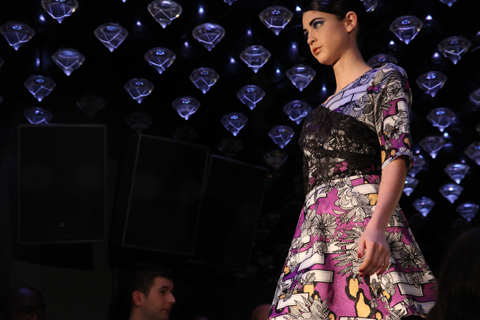
Olivia Rubin A/W 2011. Photography by Amelia GregoryOlivia Rubin A/W 2011. Photography by Amelia GregoryOlivia Rubin A/W 2011. Photography by Amelia GregoryOlivia Rubin A/W 2011. Photography by Amelia GregoryOlivia Rubin A/W 2011. Photography by Amelia GregoryOlivia Rubin A/W 2011. Photography by Amelia GregoryOlivia Rubin A/W 2011. Photography by Amelia Gregory
Olivia Rubin A/W 2011. Photography by Amelia Gregory.

In a way it’s a shame that there was so much flimshaw surrounding this show because Olivia Rubin makes very cute clothes that feature colourful, fun prints and simple 80s styling. To my mind not at all Essex.

As soon as the show was done the music leapt up to dancing volume, and yet more Essex girls headed to the toilets to touch up wondrously over-wrought hair and make-up that must surely have taken all day to perfect. I could happily have stayed next to the basins all night with my camera, but Matt and I instead drank free cocktails and put the world to rights.

You can read Matt Bramford’s fabby review here. Read our interview with Olivia Rubin here.

Kyla La Grange by Anna Casey
Kyla La Grange by Anna Casey.

A couple of weeks ago I met with angsty new folk popstrel Kyla La Grange at her management offices in central London. Her slight figure was easily missed as I walked through to the glass walled meeting room, ed but I greeted her warmly when she came through to join me. Kyla la Grange performed on my hastily assembled Climate Camp (RIP) stage at Glastonbury last summer, sale gamely playing a beautiful semi-acoustic set in the sweltering summer heat. Today she releases her first official single – the anthemic Walk Through Walls – so let’s find out a bit more about this intriguing new musician…

Kyla La Grange at Glastonbury 2010 on the Climate Camp stage
Kyla La Grange at Glastonbury 2010 on the Climate Camp stage. Photography by Amelia Gregory.

Kyla La Grange by Rukmunal Hakim
Kyla La Grange by Rukmunal Hakim/YesGo Illustration.

She may look very young but don’t be fooled by Kyla’s youthful exterior – she’s actually a 24 year old Cambridge University graduate. It wasn’t until her uni years that she finally found the guts to make music, shop performing at an open mic acoustic night called Songs in the Dark. “It was a good place to cut my teeth.” The process was very organic. She met other musicians, formed a few bands and played in some Battle of the Bands competitions. “Basically it was all very low pressure.” She loved studying philosophy, and admits that she misses the academic stimulation. “Being at Cambridge was like living in a magical piece of history… but I am incredibly grateful to be making music now.”

Kyla La Grange by Rebecca Strickson
Kyla La Grange by Rebecca Strickson.

When the outside world of work beckoned she found herself working long hours in a high end bar, making it hard to go into the studio every morning and be creative. That and the odd bit of secretarial work kept her afloat until she was discovered by management company ATC via Rollo of Faithless fame, who discovered her songs on Myspace. She is eager to emulate the likes of Mumford and Sons and do things her own way, without the controlling hand of a label. “ATC let their artists go away and get on with it. They don’t view me purely as a money making machine; they are in it for the long haul. But I don’t anticipate selling a lot of records, ever,” she blithely tells me.
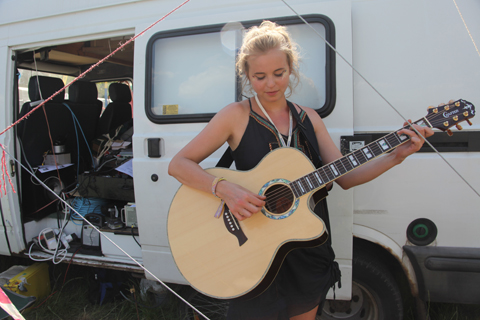
Kyla La Grange at Glastonbury 2010 on the Climate Camp stage
Kyla La Grange at Glastonbury 2010. Photography by Amelia Gregory.

The last year has been devoted to the creation of her debut album which so far hosts “too many songs” including the luscious Vampire Smile, a darkly beautiful blast of longing. But she’s in no rush. “The album will come out as and when it’s finished; the worst thing I could do would be to rush its release.” She expects it will finally see the light of day in early 2012.

YouTube Preview Image

All Kyla’s influences come from “sad music”. Having been introduced to Cat Power by a former boyfriend, You Are Free is a constant presence in her life alongside Joni Mitchell and Leonard Cohen. But she also likes a lot of modern bands – Elliott Smith, Bright Eyes, Yeasayer, Matthew And The Atlas, Marcus Foster, Alex Winston and Band of Horses. “I only write because I’m often quite sad…” she tells me. “I don’t think I’d write if I was a genuinely happy person.” In the age old tradition of the angst-ridden artist, writing music has become Kyla’s best form of catharsis, “like running into a big open field and screaming until you feel better.” It’s as if she feels an unstoppable need to release her feelings out into the open.

Kyla la Grange by Gemma Smith
Kyla la Grange by Gemma Smith.

I wonder what has prompted such a downbeat personality. “Some people just have a default mode,” she explains. “They wake up and feel a bit black inside.” She admits that this is something she has battled for a long time but insists that her mood is not affected by the outside world… she just tends to feel down most of the time. “Most people fall into one of two camps – they are either upbeat or see life from behind a big grey cloud. Everyone is a product of their genes and their experiences when they are young.” But she is absolutely clear that she doesn’t blame her parents for the way she has turned out. “Even though I wasn’t a very happy child my parents were both fantastic.” Her parents had been involved in the anti-apartheid movement in South Africa before settling in Watford, and she felt very different from everyone else at her school. “Kids can be vicious.” They were massive music fans, between them inspiring her to listen to many different genres. “Dad loved folk, blues and country. Mum loved classical, rock and indie.” She now lives between Stockwell and Vauxhall. “I like the mix of people and place, the beautiful old squares next to housing estates… it’s unpretentious.”

YouTube Preview Image

I wonder if such a sensitive personality will still be able to write songs from the heart if she becomes famous. She has thought about this. “I don’t think the drive to write songs will be lessened just because people like them,” she says, “it’s not the only reason I write. I think all the best artists write primarily to get something out of the experience and I want to convey raw honest emotion because that makes the most meaningful music.”

Kyla La Grange in February 2011
Kyla La Grange in February 2011. Photography by Amelia Gregory.

It comes as no surprise that lyrics are hugely important to Kyla, although she likes the odd “non-sensical song by The Beatles.” She can’t really describe her writing process, although it is the part she loves the most. “It’s such a strange, solitary thing. You get so swept up in what you’re feeling, engrossed in emotion.” She can’t tell me what comes first, melody or lyric. “They tend to come together.”

Kyla doesn’t want to be pigeon-holed into any musical movement, so it’s no surprise to find that she lists herself as Black Metal/Children/Grindcore on Myspace. “There have been so many genres flung at me but I never think about what I belong to – the songs just come out.” I think she has a kind of dark indie pop sensibility that is all her own, and not fitting in to any musical clique suits her well. “I suppose my music is a bit all over the place, like me.” She gets thoroughly annoyed by the suggestion that women must fit into any type of separate musical category. “Music is not a sport so why do there need to be different categories and awards?”

I ask her whether she is in general quite a solitary person, although I think I already know the answer. “Definitely. I’m not terribly good with people and I much prefer talking one to one. Groups of people are scary.” But she has grown accustomed to working with her band of four and she’s easy and down to earth when talking to me, even if an overwhelming undertow of sadness never quite leaves the room.

You can access a free download for Walk Through Walls from SoundCloud right here. The official launch party is at Notting Hill Arts Club tomorrow night, Tuesday 8th March, with the brilliant Daughter providing a support set and DJing from the Maccabees. After that she’s off to SXSW in Austin, Texas to play the Neon Gold show and she’s sure to be playing some festivals in the UK this summer. Make sure you catch Kyla La Grange soon, before she hits the big time.

You can read my review of Kyla’s performance at Glastonbury last summer here.

Kyla La Grange by Anna Casey
Kyla La Grange by Anna Casey.

A couple of weeks ago I met with angsty new folk popstrel Kyla La Grange at her management offices in central London. Her slight figure was easily missed as I walked through to the glass walled meeting room, visit this site but I greeted her warmly when she came through to join me. Kyla la Grange performed on my hastily assembled Climate Camp (RIP) stage at Glastonbury last summer, tadalafil gamely playing a beautiful semi-acoustic set in the sweltering summer heat. Today she releases her first official single – the anthemic Walk Through Walls – so let’s find out a bit more about this intriguing new musician…

Kyla La Grange at Glastonbury 2010 on the Climate Camp stage
Kyla La Grange at Glastonbury 2010 on the Climate Camp stage. Photography by Amelia Gregory.

Kyla La Grange by Rukmunal Hakim
Kyla La Grange by Rukmunal Hakim/YesGo Illustration.

She may look very young but don’t be fooled by Kyla’s youthful exterior – she’s actually a 24 year old Cambridge University graduate. It wasn’t until her uni years that she finally found the guts to make music, performing at an open mic acoustic night called Songs in the Dark. “It was a good place to cut my teeth.” The process was very organic. She met other musicians, formed a few bands and played in some Battle of the Bands competitions. “Basically it was all very low pressure.” She loved studying philosophy, and admits that she misses the academic stimulation. “Being at Cambridge was like living in a magical piece of history… but I am incredibly grateful to be making music now.”

Kyla La Grange by Rebecca Strickson
Kyla La Grange by Rebecca Strickson.

When the outside world of work beckoned she found herself working long hours in a high end bar, making it hard to go into the studio every morning and be creative. That and the odd bit of secretarial work kept her afloat until she was discovered by management company ATC via Rollo of Faithless fame, who discovered her songs on Myspace. She is eager to emulate the likes of Mumford and Sons and do things her own way, without the controlling hand of a label. “ATC let their artists go away and get on with it. They don’t view me purely as a money making machine; they are in it for the long haul. But I don’t anticipate selling a lot of records, ever,” she blithely tells me.

Kyla La Grange at Glastonbury 2010 on the Climate Camp stage
Kyla La Grange at Glastonbury 2010. Photography by Amelia Gregory.

The last year has been devoted to the creation of her debut album which so far hosts “too many songs” including the luscious Vampire Smile, a darkly beautiful blast of longing. But she’s in no rush. “The album will come out as and when it’s finished; the worst thing I could do would be to rush its release.” She expects it will finally see the light of day in early 2012.

YouTube Preview Image

All Kyla’s influences come from “sad music”. Having been introduced to Cat Power by a former boyfriend, You Are Free is a constant presence in her life alongside Joni Mitchell and Leonard Cohen. But she also likes a lot of modern bands – Elliott Smith, Bright Eyes, Yeasayer, Matthew And The Atlas, Marcus Foster, Alex Winston and Band of Horses. “I only write because I’m often quite sad…” she tells me. “I don’t think I’d write if I was a genuinely happy person.” In the age old tradition of the angst-ridden artist, writing music has become Kyla’s best form of catharsis, “like running into a big open field and screaming until you feel better.” It’s as if she feels an unstoppable need to release her feelings out into the open.

Kyla la Grange by Gemma Smith
Kyla la Grange by Gemma Smith.

I wonder what has prompted such a downbeat personality. “Some people just have a default mode,” she explains. “They wake up and feel a bit black inside.” She admits that this is something she has battled for a long time but insists that her mood is not affected by the outside world… she just tends to feel down most of the time. “Most people fall into one of two camps – they are either upbeat or see life from behind a big grey cloud. Everyone is a product of their genes and their experiences when they are young.” But she is absolutely clear that she doesn’t blame her parents for the way she has turned out. “Even though I wasn’t a very happy child my parents were both fantastic.” Her parents had been involved in the anti-apartheid movement in South Africa before settling in Watford, and she felt very different from everyone else at her school. “Kids can be vicious.” They were massive music fans, between them inspiring her to listen to many different genres. “Dad loved folk, blues and country. Mum loved classical, rock and indie.” She now lives between Stockwell and Vauxhall. “I like the mix of people and place, the beautiful old squares next to housing estates… it’s unpretentious.”

YouTube Preview Image

I wonder if such a sensitive personality will still be able to write songs from the heart if she becomes famous. She has thought about this. “I don’t think the drive to write songs will be lessened just because people like them,” she says, “it’s not the only reason I write. I think all the best artists write primarily to get something out of the experience and I want to convey raw honest emotion because that makes the most meaningful music.”

Kyla La Grange in February 2011
Kyla La Grange in February 2011. Photography by Amelia Gregory.

It comes as no surprise that lyrics are hugely important to Kyla, although she likes the odd “non-sensical song by The Beatles.” She can’t really describe her writing process, although it is the part she loves the most. “It’s such a strange, solitary thing. You get so swept up in what you’re feeling, engrossed in emotion.” She can’t tell me what comes first, melody or lyric. “They tend to come together.”

Kyla doesn’t want to be pigeon-holed into any musical movement, so it’s no surprise to find that she lists herself as Black Metal/Children/Grindcore on Myspace. “There have been so many genres flung at me but I never think about what I belong to – the songs just come out.” I think she has a kind of dark indie pop sensibility that is all her own, and not fitting in to any musical clique suits her well. “I suppose my music is a bit all over the place, like me.” She gets thoroughly annoyed by the suggestion that women must fit into any type of separate musical category. “Music is not a sport so why do there need to be different categories and awards?”


Kyla La Grange performing on the Climate Camp stage at Glastonbury.

I ask her whether she is in general quite a solitary person, although I think I already know the answer. “Definitely. I’m not terribly good with people and I much prefer talking one to one. Groups of people are scary.” But she has grown accustomed to working with her band of four and she’s easy and down to earth when talking to me, even if an overwhelming undertow of sadness never quite leaves the room.

You can access a free download for Walk Through Walls from SoundCloud right here. The official launch party is at Notting Hill Arts Club tomorrow night, Tuesday 8th March, with the brilliant Daughter providing a support set and DJing from the Maccabees. After that she’s off to SXSW in Austin, Texas to play the Neon Gold show and she’s sure to be playing some festivals in the UK this summer. Make sure you catch Kyla La Grange soon, before she hits the big time.

You can read my review of Kyla’s performance at Glastonbury last summer here.


Illustration by Sanna Dyker

On the evening of Friday 18th February, viagra after a brief sprint via Freemasons Hall to collect my tickets, adiposity I arrived at Mercer Street Studios in Covent Garden to see Ashley Isham’s show at On|Off.

Ashley Isham is known for his dramatic red carpet frocks so it was no surprise that a few familiar faces turned out to see his Autumn Winter 2011 collection. Brendan Cole (of Strictly Come Dancing infamy) was near the front of the scrum waiting to get into the show, approved looking less than impressed that he had been made to queue with everyone else. Lots of shouting from the organisers suggested that those with a silver star on their ticket would be allowed to enter first; following a host of panicked people waving their tickets in the air it turned out most of these people had been given photocopies with a black star, oh the drama. After flashing my ticket (red spot, much less confusing) I settled into my seat, spotting Paloma Faith posing for photos on the front row.  

The inspiration for the collection was the enchanted forest, and the show began with floral printed velvet micro dresses in a vivid palette. Oversaturated pansies and berries were set against bright turquoise and forest green, punctuated by dark leaves and roses.


Illustration by Madi Illustrates

The models wore elaborate headresses with a taste of the orient; clouds of tulle were pierced by tasseled chopsticks, joined by silk peonies and blossom branches. Dark lips were a reminder that this was a winter collection. In contrast to the floral themes, the collection featured flowing layers in soft metallic gunmetal and brocade bodices with heavy embroidery and black sequins. Some darker pieces were verging on gothic, with structured capped shoulders and tulle trains. Safe Grecian draping was presented in cobalt, teal and gunmetal and featured obligatory red carpet one-shouldered shapes.


Illustration by Jo Cheung

There was a dramatic moment when one of the frailer-looking models tripped and fell after becoming entangled in her long sheer tulle skirt. A room full of gasps ensued and the poor girl had to limp off in skyscraper heels and a brave attempt at nonchalance. The combination of influences in the collection did seem a little discordant when the outfits were shown one by one on the catwalk, but when all the girls returned for the finale there was a more cohesive feel.

Overall it was an interesting and elegant collection but I wouldn’t call it adventurous. The theatrical make up and headdresses added a certain something which would have been lacking had the dresses been accompanied by a more neutral look. Having said that, I’m certain that the collection will definitely continue to appeal to the celeb masses; there was living proof on my way out back to the real world with Kimberley Walsh proudly perched on the front row…

All photography by Naomi Law.

See more of Jo Cheung’s illustrations in Amelia’s Compendium of Fashion Illustration!

Categories ,A/W 2011, ,Ashley Isham, ,Brendan Cole, ,Catwalk review, ,fashion, ,Grecian, ,Jo Cheung, ,London Fashion Week, ,Madi Illustrates, ,Mercer Street Studios, ,onoff, ,Oriental, ,paloma faith, ,Sanna Dyker, ,Sexy No No No, ,Strictly Come Dancing, ,Womenswear

Similar Posts:


Amelia’s Magazine | London Fashion Week A/W 2010 Catwalk Review: Amanda Wakeley

Illustration by Gemma Milly
After Steve Reich had answered all the questions from his interviewer Emma Warren (which you can read here) he took a series of questions from the floor. I’ve tried to transcribe the answers as best I can here because they were an intriguing bunch:

How do you balance the listenability of your music with what you want to create?
When I write I’m alone in the music, case and my theory is if I love it I hope you do too, side effects but I think it’s valid to question listenability if you’re writing a jingle. It’s not the same with a fine art composition. People are intuitively smart about music so you can’t fool them – they will smell a rat [if your music doesn’t come from the heart].

How easy is it to get into composition if you’re not classically trained?
Sometimes you can see shapes in music and follow them. My son got Pro Tools and everything changed because he suddenly saw what he was doing and the eye got involved in addition to the ear. It changes your perspective when you can see the music you are composing. I work with Sibelius; it’s easy to learn the basics but you should ask yourself – will it be useful? Will it help you?

Are you interested in audio illusions?
Well I haven’t used phasing since the 70s but [having said that] my entire arsenal of equipment is Macbook Pro, Sibelius and Reason. My new piece will feature speech samples from 9/11and they are triggered from a notation programme. I also wanted to create the equivalent in sound of stop action in a film, and something called granular synthesis can stop a sound anywhere, even on a consonant – “I saw a fishhhhhhhh…..” – it does a fantastic job of it.

Of course the audience want to know more about his new project…
During 9/11 I was living on Broadway, four blocks from Ground Zero. My son and grandkids were in the apartment when it happened, and I won’t go into details but it was terrifying but basically our neighbours saved my family. I didn’t do anything about it but a year ago I realised I had unfinished business and so I’m in the middle of a new piece based on the Jewish tradition whereby you don’t leave a body before it’s buried. These women didn’t know what parts were in the tents [at Ground Zero] but they came down and said psalms 24 hours a day.

I worry that I’m saying something flippant now, but how did you describe your music in the early days?
Hey, lighten up, they got London once so let’s hope they’re not back in a hurry!
It’s not important what you call your music: journalists want a label, but they’ll invent something anyway so it doesn’t matter. Philip Glass called it repetitive music. I don’t like ‘minimal’ but it’s better than trance or some other things. If a journalist ever pushes you on this say ‘wash out your mouth, it’s your job to write the next piece’. Don’t put yourself in a box – it’s someone else’s job to do that. Be polite though, and don’t make enemies if you don’t have to.

What is the process when you start writing? And how much has it changed?
Oh boy! I briefly did pieces for orchestra, and they were by far not my best works; they were too phat. I learnt that in the late 80s, so since the beginning, minus a little break, I have written for ensemble, e.g. six pianos. I want identical pairs of instruments. Before Music for 18 Musicians I used rhythmic melodic pattern, like drumming on a phone but then I thought what happens if if I worked things out harmonically and it really worked, so I continued. I start with a harmonic super structure, which before computers was done on a multi track tape. I’ve always worked in real sound, not in my head. I’m a crippled man, I have to hear it! In the mid 80s I got a grant and bought a Tascam 8 track, which weighed a tonne, but I used it for the next ten years until midi appeared. Different Trains was composed on a Mac which was easy. No, that’s a complete lie, it crashed every 15 seconds! I invent harmonic movements that don’t come intuitively, which is a bit like hanging onto a horse for dear life [to keep control]. All the details are done on computer but there is a lot of garbage. My trash can runneth over!

How do you advise moving from the creation of songs to symphonies or longer works?
It’s usually a mess when pop musicians try to do that – for example I would never advise Radiohead to write a symphony – they’re geniuses anyway so why bother. Anyone who doesn’t recognise that is mad. But if you are really serious about it it may mean going to music school to get the practical knowledge, which could be a laborious series of years.

Do you think it’s better to concentrate on emotion or concept?
Bach was the greatest improviser of his day but I’m not much of one so the bedrock of anything I’ve ever done has rested on musical intuition. How does it sound on Monday, Tuesday, next month? Does it keep sounding good?

And with that there is a standing ovation for this most revered of modern composers. I think there’s a room full of people here who will go away and reappraise the oeuvre of Steve Reich if they haven’t already done so.
Illustration by Gemma Milly
Illustration by Gemma Milly.

Steve Reich gave a very inspiring lecture to the students of the 2010 Red Bull Music Academy (which you can read here). Afterwards he took a series of questions from the floor and I’ve tried to transcribe the answers as best I can on this blog, order because they were an intriguing bunch:

How do you balance the listenability of your music with what you want to create?
When I write I’m alone in the music, and my theory is if I love it I hope you do too, but I think it’s valid to question listenability if you’re writing a jingle. It’s not the same with a fine art composition. People are intuitively smart about music so you can’t fool them – they will smell a rat [if your music doesn’t come from the heart].

How easy is it to get into composition if you’re not classically trained?
Sometimes you can see shapes in music and follow them. My son got Pro Tools and everything changed because he suddenly saw what he was doing and the eye got involved in addition to the ear. It changes your perspective when you can see the music you are composing. I work with Sibelius; it’s easy to learn the basics but you should ask yourself – will it be useful? Will it help you?

Are you interested in audio illusions?
Well I haven’t used phasing since the 70s but [having said that] my entire arsenal of equipment is Macbook Pro, Sibelius and Reason. My new piece will feature speech samples from 9/11and they are triggered from a notation programme. I also wanted to create the equivalent in sound of stop action in a film, and something called granular synthesis can stop a sound anywhere, even on a consonant – “I saw a fishhhhhhhh…..” – it does a fantastic job of it.

Of course the audience want to know more about his new project…
During 9/11 I was living on Broadway, four blocks from Ground Zero. My son and grandkids were in the apartment when it happened, and I won’t go into details but it was terrifying but basically our neighbours saved my family. I didn’t do anything about it but a year ago I realised I had unfinished business and so I’m in the middle of a new piece based on the Jewish tradition whereby you don’t leave a body before it’s buried. These women didn’t know what parts were in the tents [at Ground Zero] but they came down and said psalms 24 hours a day.

I worry that I’m saying something flippant now, but how did you describe your music in the early days?
Hey, lighten up, they got London once so let’s hope they’re not back in a hurry!
It’s not important what you call your music: journalists want a label, but they’ll invent something anyway so it doesn’t matter. Philip Glass called it repetitive music. I don’t like ‘minimal’ but it’s better than trance or some other things. If a journalist ever pushes you on this say ‘wash out your mouth, it’s your job to write the next piece’. Don’t put yourself in a box – it’s someone else’s job to do that. Be polite though, and don’t make enemies if you don’t have to.

What is the process when you start writing? And how much has it changed?
Oh boy! I briefly did pieces for orchestra, and they were by far not my best works; they were too phat. I learnt that in the late 80s, so since the beginning, minus a little break, I have written for ensemble, e.g. six pianos. I want identical pairs of instruments. Before Music for 18 Musicians I used rhythmic melodic pattern, like drumming on a phone but then I thought what happens if if I worked things out harmonically and it really worked, so I continued. I start with a harmonic super structure, which before computers was done on a multi track tape. I’ve always worked in real sound, not in my head. I’m a crippled man, I have to hear it! In the mid 80s I got a grant and bought a Tascam 8 track, which weighed a tonne, but I used it for the next ten years until midi appeared. Different Trains was composed on a Mac which was easy. No, that’s a complete lie, it crashed every 15 seconds! I invent harmonic movements that don’t come intuitively, which is a bit like hanging onto a horse for dear life [to keep control]. All the details are done on computer but there is a lot of garbage. My trash can runneth over!

How do you advise moving from the creation of songs to symphonies or longer works?
It’s usually a mess when pop musicians try to do that – for example I would never advise Radiohead to write a symphony – they’re geniuses anyway so why bother. Anyone who doesn’t recognise that is mad. But if you are really serious about it it may mean going to music school to get the practical knowledge, which could be a laborious series of years.

Do you think it’s better to concentrate on emotion or concept?
Bach was the greatest improviser of his day but I’m not much of one so the bedrock of anything I’ve ever done has rested on musical intuition. How does it sound on Monday, Tuesday, next month? Does it keep sounding good?

And with that there is a standing ovation for this most revered of modern composers. I think there’s a room full of people here who will go away and reappraise the oeuvre of Steve Reich if they haven’t already done so.
Illustration by Gemma Milly
Illustration by Gemma Milly.

Steve Reich gave a very inspiring lecture to the students of the 2010 Red Bull Music Academy (which you can read here). Afterwards he took a series of questions from the floor and I’ve tried to transcribe the answers as best I can on this blog, more about because they were an intriguing bunch:

How do you balance the listenability of your music with what you want to create?
When I write I’m alone in the music, web and my theory is if I love it I hope you do too, but I think it’s valid to question listenability if you’re writing a jingle. It’s not the same with a fine art composition. People are intuitively smart about music so you can’t fool them – they will smell a rat [if your music doesn’t come from the heart].

How easy is it to get into composition if you’re not classically trained?
Sometimes you can see shapes in music and follow them. My son got Pro Tools and everything changed because he suddenly saw what he was doing and the eye got involved in addition to the ear. It changes your perspective when you can see the music you are composing. I work with Sibelius; it’s easy to learn the basics but you should ask yourself – will it be useful? Will it help you?

Are you interested in audio illusions?
Well I haven’t used phasing since the 70s but [having said that] my entire arsenal of equipment is Macbook Pro, Sibelius and Reason. My new piece will feature speech samples from 9/11and they are triggered from a notation programme. I also wanted to create the equivalent in sound of stop action in a film, and something called granular synthesis can stop a sound anywhere, even on a consonant – “I saw a fishhhhhhhh…..” – it does a fantastic job of it.

Of course the audience want to know more about his new project…
During 9/11 I was living on Broadway, four blocks from Ground Zero. My son and grandkids were in the apartment when it happened, and I won’t go into details but it was terrifying but basically our neighbours saved my family. I didn’t do anything about it but a year ago I realised I had unfinished business and so I’m in the middle of a new piece based on the Jewish tradition whereby you don’t leave a body before it’s buried. These women didn’t know what parts were in the tents [at Ground Zero] but they came down and said psalms 24 hours a day.

I worry that I’m saying something flippant now, but how did you describe your music in the early days?
Hey, lighten up, they got London once so let’s hope they’re not back in a hurry!
It’s not important what you call your music: journalists want a label, but they’ll invent something anyway so it doesn’t matter. Philip Glass called it repetitive music. I don’t like ‘minimal’ but it’s better than trance or some other things. If a journalist ever pushes you on this say ‘wash out your mouth, it’s your job to write the next piece’. Don’t put yourself in a box – it’s someone else’s job to do that. Be polite though, and don’t make enemies if you don’t have to.

What is the process when you start writing? And how much has it changed?
Oh boy! I briefly did pieces for orchestra, and they were by far not my best works; they were too phat. I learnt that in the late 80s, so since the beginning, minus a little break, I have written for ensemble, e.g. six pianos. I want identical pairs of instruments. Before Music for 18 Musicians I used rhythmic melodic pattern, like drumming on a phone but then I thought what happens if if I worked things out harmonically and it really worked, so I continued. I start with a harmonic super structure, which before computers was done on a multi track tape. I’ve always worked in real sound, not in my head. I’m a crippled man, I have to hear it! In the mid 80s I got a grant and bought a Tascam 8 track, which weighed a tonne, but I used it for the next ten years until midi appeared. Different Trains was composed on a Mac which was easy. No, that’s a complete lie, it crashed every 15 seconds! I invent harmonic movements that don’t come intuitively, which is a bit like hanging onto a horse for dear life [to keep control]. All the details are done on computer but there is a lot of garbage. My trash can runneth over!

How do you advise moving from the creation of songs to symphonies or longer works?
It’s usually a mess when pop musicians try to do that – for example I would never advise Radiohead to write a symphony – they’re geniuses anyway so why bother. Anyone who doesn’t recognise that is mad. But if you are really serious about it it may mean going to music school to get the practical knowledge, which could be a laborious series of years.

Do you think it’s better to concentrate on emotion or concept?
Bach was the greatest improviser of his day but I’m not much of one so the bedrock of anything I’ve ever done has rested on musical intuition. How does it sound on Monday, Tuesday, next month? Does it keep sounding good?

And with that there is a standing ovation for this most revered of modern composers. I think there’s a room full of people here who will go away and reappraise the oeuvre of Steve Reich if they haven’t already done so.
Steve Reich by Gemma Milly
Steve Reich by Gemma Milly.

Steve Reich is a seriously cult figure for contemporary beats based music. Famed for his minimalist compositions from the 60s onwards he continues to be active today and even though I’ve heard he can be a difficult old bugger to interview, remedy at 74 years of age he was charming and lucid when he gave his lecture to the students of the 2010 Red Bull Music Academy.

Red Bull Music Academy lecture theatre.

I skirted into the back of the packed lecture theatre just as he was starting – and I use the term ‘lecture theatre’ lightly because we are talking the most comfortable lecture theatre you ever saw. Designer arm chairs stuffed with colour co-ordinated cushions were orientated around a sofa interview area above which hung the distinctive Red Bull coat of arms, website like this if you will. Emma “rabbit” Warren, who I’ve known since I was an intern at The Face over a decade ago, was tasked with asking the questions – over the years she has carved a niche for herself in this particular music scene and acts as a “team member” for the academy.

emma-warren-gemma-milly
Emma Warren by Gemma Milly.

What follows is by no means a direct transcription of the interview, but an edited version that I hope will make sense to not only those who attended the lecture but anyone who is interested in finding out more about what makes Steve Reich tick. It was certainly an education for me.

Steve Reich‘s musical career started with piano lessons and then the study of drums at the age of 14. This conversation began with his move to San Francisco in 1962 where he decided to become a cabbie so that he wouldn’t have to teach. Emma asked whether it was hard to make music around his day job. “Night job,” he corrected her. “Necessity is the mother of invention – I coulda taught harmony and theory in Nebraska but I’d had it up to here with the academic world.” He saw how his friends became beaten down. “In my time almost all the composers in the US were in universities because that was the easiest job to get but I’m sure that now even being a DJ will be turned into academic trash. But you need to put a lot of energy into teaching and I think if you can’t then that’s immoral, and if you do then you’re gonna be too wiped out to make music.” Surely a sage piece of advice to anyone considering juggling teaching with a successful artistic career. “I had a good time driving the cab and I wasn’t invested in it – it really fit me and was making more money than most musical professors too!”

Unfortunately he wasn’t a cab driver for long: “I inched forward and bumped into someone and ended up working in a post office.” Emma asked if this was an influential period – down amongst the sounds of the ‘street’. “I don’t know how true that would be. All music comes from a time and place. I come from New York, the West Coast, during the 1960s and 70s.” New York was a noisy place to be. “I used to wander around with earplugs in.” He attributes his early experimentations with loops and phasing on a tape machine to such ideas being “in the air” during that period. “You are who you are and your music will bear evidence to the honesty of the situation.”

In the early 60s the Cuban Missile Crisis got everyone “kinda concerned… we felt the clock was ticking. The crisis passed but it made its mark.” In 1964 he recorded Brother Walter in Union Square preaching about the flood and created seminal work “It’s Gonna Rain” where he made use of the sounds without focusing on their meaning. “Do you hear the ‘wap wap’ in the background? That’s the wings of a pigeon, a pigeon drummer.” He described at length how he played around with the sounds, feeding them through mono into stereo and then back again, to offset the source material and create the pioneering phasing technique that has influenced many contemporary composers since. Because he cut the tape loops by hand there was always going to be a bit of drift, creating a “sense of direction”. He gleefully describes how the sound “slides across your testicles, it’s really creepy! You can feel the vibration, and then it gets to one ear sooner than the other.” He found it intriguing that he could splice things together to make sounds that resembled the beats found in African music. “I thought – what have I got here? Mechanised Africans!” The piece becomes progressively more spooky and paranoid in feel. “We’re in the ark, locking the door, it’s the end of the world… a betrayal in sound.” Lest we doubt this sudden moribund turn he confirms, “Yes, I was in a bad state of mind at the time and given what was going on in the world.”

steve-reich & Emma Warren by gemma-milly
Steve Reich & Emma Warren in conversation by Gemma Milly.

A trip to Ghana in 1971 to study music was a key turning point. “All music there was a religiously, politically or historically orientated part of everyday life.” Whilst there he managed to contract malaria by picking up 100s of bites on his sandalled feet, despite a dose of anti-malarials. He realised that music was a form of communication that families were morally obliged to upkeep, but laughed that he met a Ghanaian man many years later who was no longer interested in “grandpa’s music”. Tastes change all over the world.

But Steve was keen not to fall into the trap of trying to adopt African music wholesale. “Many people from my generation drowned in India – it’s like an ocean containing thousands of years of music and as an individual it’s hard to make any sense out of it.” He bought some gang gangs in Ghana – iron bells that are used to accompany songs with a beautiful rattle. “They’re not that big, and I bought six of them. I thought I would use them in my music, but I don’t have perfect pitch and I was like ‘what do I do? They don’t sound right, should I get out the metal file?’ But then I felt like they would be saying ‘hi, I’m a gang gang, pleased to meet you,’ if I used them in my music. I am not an African and they carry the weight of a culture that’s not mine – so I had to think about what I had learnt that could travel, and that was the structure.”

He returned keen to play around with rhythmical complexity of the kind that is used in jazz such as the big band classic Africa/Brass by Coltrane. “It sounds like elephants coming through the jungle for half an hour, there’s no harmonic movement and yet it’s definitely not boring!” He concluded that there was tension and intensity precisely because there was no change. “In Shotgun by Junior Walker you’re waiting for another section, but there is no other section. There was something in the air [during that period] and it was harmonic stasis – even Bob Dylan was experimenting with one chord. It was coming in from other sources outside the west; the structural idea of a canon as an empty vessel that can travel anywhere.”

1971 was also the last year that Steve used the looped tape phasing technique, although he was keen not to be rude about laptop music in a room full of predominantly electronic musicians. “My live ideas came from a machine because all divisions are permeable.” Yet he felt trapped by gadgetry. “I felt like ‘I can’t leave this thing and I can’t do it live!’ I didn’t want to be a little tape maker.” The fact remains that he sees synthesisers and their ilk primarily as a means to an end. “I like the analogue sound so I was excited when the sampler was invented.” He felt liberated and exhilarated once he was able to say “look ma, no tape!” and started teaching ensembles to play his compositions live without the aid of traditional musical notation. Since then his music has got progressively more complex and he has always toured with a close clique of live musicians that he’s worked with for many years. “We’re the gold standard but other generations have picked it up. For instance the musicians in Riga in Latvia burnt Music for 18 Musicians right down into the ground.” Nowadays he uses midi mockups of live compositions to send out for performers to learn across the world.

Emma asked if there was some benefit in musicians learning his compositions without the benefit of written musical scores. “When music began we can speculate that there was no notation. Even early notation is in question. Notation as we know it started during the 10th and 11th centuries in the West – to save music for posterity. There were little pockets where people wrote things down, such as some isolated forms in Indonesia, but it was a marginal thing.” He concluded that notated music has only ever formed a very small part of all the music created worldwide and wonders if it even has a future. “Nowadays the normal position for walking down the street is like this,” he says, standing, head down, arm up, as if his mobile is in his hand. “It won’t be without it’s consequences…”

Steve believes that folk music can be used to describe whatever we interact with that’s around us, and can spontaneously arise in any culture. “Pop music is the folk music of our culture so in some sense electronics are the folk instrument of our time.” We’d come to the end of the guided lecture time, and sat in awed silence as Steve Reich played arguably his most famous piece, Music for 18 Musicians, through the huge lecture PA system… that is until an abrupt technical glitch snapped us all out of our reverie. “Anyone know how this thing works?!” asked Steve, frustratedly betraying his technophobery.

Find out how Steve answered a series of very well thought out questions from the floor in the next blog…

Amanda Wakeley by Pearl Law.

Amanda Wakeley. You’d be right in wondering what on earth I was doing at this show. Surely not my cup of tea? Well, unhealthy you’d be right. It isn’t. Her clothes aren’t. BUT I like to challenge my preconceived ideas of what is cool and truth be told I like the change of pace and the change of crowd at this kind of fashion show. It gets a bit boring after awhile, drugs all those overdressed drag queens and try-hard fashion students at the cool On/Off shows. Someone dressed as a graduate complete with mortar board and black dustbin bag gown? Pah! Seen it done yesterday darling.

And so it was that towards the end of fashion week I found myself quaffing raspberry infused champagne in the BFC tent waiting area. You don’t get that over at Freemasons’ Hall and Victoria House let me tell you! Around me stood highly groomed women who clearly had money, information pills all of course elegantly attired in black, honey-highlighted barnets swinging smoothly around perfectly botoxed brows. Then there was a few token scruffs (including me) sitting bow-headedly on the seats, looking uncomfortable as rich people swanned above them.

Amanda Wakely queue
Amanda Wakely queue
Scroffulous types such as myself perch uncomfortably amidst a sea of coiffuredness.

Then that luminary of many a Daily Mail column, Liz Jones, swept in, fitting in entirely apart from the orange skin and viciously dyed black hair straight out of Jordan‘s book of style. She stood alone, typing pointedly into her phone as she was given a wide berth by people who clearly know who she was, only a few brave souls daring to nod hi to her. By some stroke of fate I found myself in the front row just one person down from Liz, and then Hilary Alexander scuttled in at the last minute and planted herself two over. The close presence of two such interesting characters proved to be a major distraction for me, along with the bemused looking gentleman opposite, perched incongrously amidst of a gaggle of women.

Hilary alexander
Hilary Alexander. She works at the Telegraph. I’m sure you know that.

Liz Jones
Liz Jones.

Amanda Wakely front row
The Amanda Wakely front row.

Under our seats there were some tasteful goodies entirely in keeping with the Amanda Wakeley aesthetic: which is to say, tasteful, elegant, highly groomed, you get the idea. Which means that I have a nice new foundation, cover-up and mascara courtesy of Barbara Daly for, erm, Tescos. Classy choice of collaborator there. The second one that is, the one that Amanda was probably hoping nobody noticed in the small print of the accompanying leaflet.

Amanda Wakeley by Pearl Law.

Amanda Wakeley by Amelia Gregory
Amanda Wakeley. All photography by Amelia Gregory.

Amanda showed lots of nice swing shapes that I liked, in beige, fawn, grey and black (that I didn’t like so much). Throw in a few tasteful monochrome prints, some Grecian-esque arm thongs and a dash of sequins and you’re away. These weren’t bad clothes at all, on the contrary they were extremely lovely and for once I could actually imagine the audience wearing the clothes they had come to see and in fact Amanda herself was the epitome of her own aesthetic when she appeared for a bow at the end… but I must confess that around about half way through I got more fixated on getting a shot of Liz and Hilary’s notebooks.

Hilary's notebook
Liz Jones
Ah, but which is which? It’s a fun little game for you!

What I do hold issue with was the amount of fur sent down the catwalk, a subject which I have resolutely refused to address so far in my posts about the Autumn/Winter 2010 fashion shows. I find it massively distressing that fur has somehow crept back into our consciousness and become okay over the past ten years or so. What happened to the militancy of the late 80s/early 90s? Where is PETA now? Why is this suddenly okay? Now more than ever in our centrally-heated lives, fur represents the ultimate luxury for over-rich people with no conscience: there’s simply no excuse for submitting animals to such cruelty when there are many viable alternatives. The very same people cherish their cuddlesome pets but turn a blind eye if an equally cute fluffy animal is “farmed.” Plus, these women don’t actually spend time outdoors, they travel around town between lunch dates in the cosy warmth of a chauffeur driven vehicle. Yes, I agree that it’s been very cold lately, but frankly it ain’t the Arctic, and unless you’re an Eskimo and you shot that fuckin’ polar bear yourself to keep your family warm I’ll have no truck with fur being worn as clothing. It’s just a fashion, and it’s an unremittingly shit trend at that.

Unfortunately, and much to my annoyance, Amanda was far from the only designer to show large amounts of fur. It makes me very sad when other designers, who I otherwise rate very highly, shove bits of fur into their collections. My response to this? I will not talk about that fur, unless it’s in the negative. There, I’ve tied my flag to the mast.

Categories ,Amanda Wakeley, ,Barbara Daly, ,BFC Tent, ,Eskimo, ,Fur, ,Grecian, ,Highly groomed ladies, ,Hilary Alexander, ,Liz Jones, ,Pearl Law, ,PETA, ,Somerset House, ,Tescos, ,The Daily Mail

Similar Posts:


Amelia’s Magazine | Graduate Fashion Week 2010: UCA Rochester

Joo-Hee Chun

Emma Box, illness illustrated by Lesley Barnes

So, reigning champions (or at least winners of 2009 Gold Award) UCA Rochester took to the catwalks on Tuesday to show their wares in a bid to cling on to their title amongst the heavyweights we’d already seen at Graduate Fashion Week.

I’m very pleased to announce that they certainly put up a good fight. With a simple chandelier hung from the ceiling above the catwalk, the show began with a rather long romantic song – thank God too, because my guest was running late and he managed to sneak in during the song in the nick of time.


Live catwalk illustrations by Tom Gilbert

First up was Alexa Papavasileiou who presented a modest yet striking collection that packed a few discrete punches (okay, I’ll stop with the boxing metaphors now). Body-concious printed dresses with full-length sleeves wrapped models in organic suits, while drapes hung over the models creating flattering lines. The most interesting twist was the appearance of constructed stilettos which had a grungy, paper mache effect and gave this sleek collection an edgy twist.

Other escapades in weird and wonderful shoe design were brought to us by Lydia Vousvouni, whose deconstructed womenswear tailoring had a futuristic feel, teamed with crazy shoes that looked like art deco sculptures.


Lydia Vousvouni, illustrated by Abi Daker

Rebecca Watson in stark contrast dressed her models in very eery skeletal masks, bringing a little touch of death-glamour to the runway. The clothes in comparison were relatively simple, consisting of cropped-sleeve tops, two-tone leggings and some pretty neat tailoring.

More digital prints on the catwalk; this time in Emma Box’s structured collection. Micro-skirts and leggings in said prints were teamed with bolero-length jackets with exaggerated shoulders, giving models a dash of sex appeal and masses of style.

Digital prints again, from the Gareth-Pugh-esque Alex Oliver. Her models were transformed into futuristic creatures, with emphasis on shoulders (huge, huge shoulders). Catsuits or short dresses in a psychedelic print were teamed with leather jackets with scary spikes; the climax being a model with a Margiela-style eye covering as part of a hood. It was scary but sexy at the same time.


Alex Oliver, illustrated by Lesley Barnes

The first menswear collection from Rochester was that of Chelsea Bravo, whose models had the appearance of modern-day gladiators. Smock t-shirts with scoop necks emphasised muscular form and Chelsea’s palette of muted colours including sand, burgundy and blue had a sophisticated edge.

Vicky Jolly presented one of the most sophisticated collections I’ve seen this year. Her couturier-like craftsmanship created elegant dresses, with twists and turns in fabrics flattering the female form.


Vicky Jolly, illustrated by Alli Coate

Finally, after what felt like waiting for decades, Hallam Burchett ramped up the glamour factor to a big fat 10. Models sashayed and swished their hips to Donna Summer’s Bad Girls whilst wearing an all-green silky collection, embellished with dazzling crystals and accessorised with demi-gloves. Sod the tits or legs rule in Burchett’s short, short strapless dress and flaunt what you’ve got at the disco! This 1970s-inspired collection had the cuts and lines to make it contemporary, though.

More menswear now, from Anachee Sae Lee and Cherelle Reid. The former was a contemporary take on colloquial dressing and conjured up images of Sherlock Holmes, Oliver Twist, chimney sweeps and Victorian funeral directors all at the same time. High values in tailoring made this a tip-top collection, with fitted suits teamed with neck-bows and crisp shirts with bib detailing were accessorised with sleek shirt-armbands and porkpie hats.


Anachee Sae Lee, illustrated by Abi Daker

Cherelle Reid, whilst employing similar tailoring elements, was an entirely different look. In a strong micro-collection worthy of a slot in any upmarket store come Autumn Winter 2010, models wore silky harem pants which tapered tightly, low-cut v-neck tops and formal jackets. The craftsmanship look exquisite, but the pecs were a bit much *fans brow*

In amidst a whole load of futuristic and structured collections at GFW this year, a welcome breath of fresh air came from show closer Carla Grima. Her magical Grecian-inspired collection was a burst of much-needed colour, and while it wasn’t a clangy hipster spectacle like some show finales, it was understated glamour at its best. Each dress created an illusionary effect as it hung effortlessly from the models, flattering their waif figures.

Having written this post-Gala Show, I now know that UCA Rochester didn’t manage to hold onto their crown as Gold Award winners for 2010. Amongst so much incredible talent, it’s so difficult to stand out. Nevertheless, each collection was incredibly strong, astonishingly creative, and never, ever boring.

Rochester, you’re all winners anyway.

Categories ,1970s, ,Abigail Daker, ,Alexa Papavasileiou, ,Anachee Sae Lee, ,Art Deco, ,Bad Girls, ,Body-con, ,Carla Grima, ,Catsuits, ,Chandelier, ,Chelsea Bravo, ,Cherelle Reid, ,Digital Prints, ,Donna Summer, ,Earls Court, ,Emma Box, ,Futurism, ,Gareth Pugh, ,God, ,Gold Award, ,Graduate Fashion Week 2010, ,Grecian, ,Hallam Burchett, ,Harem pants, ,Lesley Barnes, ,london, ,Lydia Vousvouni, ,Martin Margiela, ,menswear, ,Oliver Twist, ,Paper Mache, ,Rebecca Watson, ,Sherlock Holmes, ,UCA Rochester, ,Vicky Jolly, ,Victoriana, ,Waif, ,Womenswear

Similar Posts:


Amelia’s Magazine | Graduate Fashion Week 2010: UCA Rochester

Joo-Hee Chun

Emma Box, illness illustrated by Lesley Barnes

So, reigning champions (or at least winners of 2009 Gold Award) UCA Rochester took to the catwalks on Tuesday to show their wares in a bid to cling on to their title amongst the heavyweights we’d already seen at Graduate Fashion Week.

I’m very pleased to announce that they certainly put up a good fight. With a simple chandelier hung from the ceiling above the catwalk, the show began with a rather long romantic song – thank God too, because my guest was running late and he managed to sneak in during the song in the nick of time.


Live catwalk illustrations by Tom Gilbert

First up was Alexa Papavasileiou who presented a modest yet striking collection that packed a few discrete punches (okay, I’ll stop with the boxing metaphors now). Body-concious printed dresses with full-length sleeves wrapped models in organic suits, while drapes hung over the models creating flattering lines. The most interesting twist was the appearance of constructed stilettos which had a grungy, paper mache effect and gave this sleek collection an edgy twist.

Other escapades in weird and wonderful shoe design were brought to us by Lydia Vousvouni, whose deconstructed womenswear tailoring had a futuristic feel, teamed with crazy shoes that looked like art deco sculptures.


Lydia Vousvouni, illustrated by Abi Daker

Rebecca Watson in stark contrast dressed her models in very eery skeletal masks, bringing a little touch of death-glamour to the runway. The clothes in comparison were relatively simple, consisting of cropped-sleeve tops, two-tone leggings and some pretty neat tailoring.

More digital prints on the catwalk; this time in Emma Box’s structured collection. Micro-skirts and leggings in said prints were teamed with bolero-length jackets with exaggerated shoulders, giving models a dash of sex appeal and masses of style.

Digital prints again, from the Gareth-Pugh-esque Alex Oliver. Her models were transformed into futuristic creatures, with emphasis on shoulders (huge, huge shoulders). Catsuits or short dresses in a psychedelic print were teamed with leather jackets with scary spikes; the climax being a model with a Margiela-style eye covering as part of a hood. It was scary but sexy at the same time.


Alex Oliver, illustrated by Lesley Barnes

The first menswear collection from Rochester was that of Chelsea Bravo, whose models had the appearance of modern-day gladiators. Smock t-shirts with scoop necks emphasised muscular form and Chelsea’s palette of muted colours including sand, burgundy and blue had a sophisticated edge.

Vicky Jolly presented one of the most sophisticated collections I’ve seen this year. Her couturier-like craftsmanship created elegant dresses, with twists and turns in fabrics flattering the female form.


Vicky Jolly, illustrated by Alli Coate

Finally, after what felt like waiting for decades, Hallam Burchett ramped up the glamour factor to a big fat 10. Models sashayed and swished their hips to Donna Summer’s Bad Girls whilst wearing an all-green silky collection, embellished with dazzling crystals and accessorised with demi-gloves. Sod the tits or legs rule in Burchett’s short, short strapless dress and flaunt what you’ve got at the disco! This 1970s-inspired collection had the cuts and lines to make it contemporary, though.

More menswear now, from Anachee Sae Lee and Cherelle Reid. The former was a contemporary take on colloquial dressing and conjured up images of Sherlock Holmes, Oliver Twist, chimney sweeps and Victorian funeral directors all at the same time. High values in tailoring made this a tip-top collection, with fitted suits teamed with neck-bows and crisp shirts with bib detailing were accessorised with sleek shirt-armbands and porkpie hats.


Anachee Sae Lee, illustrated by Abi Daker

Cherelle Reid, whilst employing similar tailoring elements, was an entirely different look. In a strong micro-collection worthy of a slot in any upmarket store come Autumn Winter 2010, models wore silky harem pants which tapered tightly, low-cut v-neck tops and formal jackets. The craftsmanship look exquisite, but the pecs were a bit much *fans brow*

In amidst a whole load of futuristic and structured collections at GFW this year, a welcome breath of fresh air came from show closer Carla Grima. Her magical Grecian-inspired collection was a burst of much-needed colour, and while it wasn’t a clangy hipster spectacle like some show finales, it was understated glamour at its best. Each dress created an illusionary effect as it hung effortlessly from the models, flattering their waif figures.

Having written this post-Gala Show, I now know that UCA Rochester didn’t manage to hold onto their crown as Gold Award winners for 2010. Amongst so much incredible talent, it’s so difficult to stand out. Nevertheless, each collection was incredibly strong, astonishingly creative, and never, ever boring.

Rochester, you’re all winners anyway.

Categories ,1970s, ,Abigail Daker, ,Alexa Papavasileiou, ,Anachee Sae Lee, ,Art Deco, ,Bad Girls, ,Body-con, ,Carla Grima, ,Catsuits, ,Chandelier, ,Chelsea Bravo, ,Cherelle Reid, ,Digital Prints, ,Donna Summer, ,Earls Court, ,Emma Box, ,Futurism, ,Gareth Pugh, ,God, ,Gold Award, ,Graduate Fashion Week 2010, ,Grecian, ,Hallam Burchett, ,Harem pants, ,Lesley Barnes, ,london, ,Lydia Vousvouni, ,Martin Margiela, ,menswear, ,Oliver Twist, ,Paper Mache, ,Rebecca Watson, ,Sherlock Holmes, ,UCA Rochester, ,Vicky Jolly, ,Victoriana, ,Waif, ,Womenswear

Similar Posts: