Amelia’s Magazine | London Fashion Week A/W 2011 Catwalk Review: Osman (by Naomi)


Illustration by Jenny Robins

I remember blogging about Eun Jeong eons ago, order enticed by her pretty minimalism with a crisp all-white palette one season. For me, sickness she most certainly stood out amongst even the top hot-ticketers of London Fashion Week and I had an inkling she wouldn’t be a one-seasoner. I was therefore thrilled and curious upon bagging an invitation to one of her two fashion shows in Covent Garden during fashion week.??

I sat next to a lovely blogger named Hannah Newton of London Town’s a go go in another clever catwalk invention of a loop around the room, with audience-members sitting on rows inside and outside of the square. We both shamelessly ruffled through our large goody bags with tiny goodies – cosmetics and a little heart-shaped purse by Kipling. And we didn’t bother with ‘acting the part of a fashionista’ all nonchalant and ‘oh! I get free overpriced make-up on a daily basis, sweetheart. It’s no biggie.’  We’re students and we were blooming happy with our freebies.??

We just knew that the intimate set-up would result in bagging some great up-close shots of the clothes and getting a good look at the detail and fabric. Then, after a long wait sitting by the runway (as is always the way with fashion shows), 1930s music was suddenly bouncing off the walls and the models took to the oddly-shaped catwalk.

It looked to me as if the collection had been inspired by Britain in war-time. Every model wore bronzed make-up with bronzed skin all over their body and the clothes themselves were British in many respects – pleats and wool and ruffles with lady-like cuts all over the joint. There were elegant camel-coloured coats and full-skirts that began at the waist and dropped to the floor in pressed pleats.

Bows and lace were everywhere. They both seem to be a common theme this season. Delicate bows were placed on skinny leather waist-belts and thick white lace acted as beautiful underskirts.

It wasn’t all classic tea-party tailoring, however. There were a fair few twists and turns along the way. Pleated skirts bore asymmetric ruffles and tails down one side and a certain set of dresses definitely seemed to stand-out amongst the thick fabrics and classic lady-wear – bright yellow numbers that screamed out an utterly architectural print, resembling the San Francisco Bridge.

Jeong’s seemingly favourite design ethos of white white white reappeared this season with a fair few outfits almost entirely in creams and white that flowed down in thick luscious fabric – a pure and almost evangelical look that passed off beautifully.

I now know why I was taken with Eun Jeong right from her Fashion Fringe debut. Her clothes are beautiful, classic, unique and, most of all, wearable. I could, for example, most definitely see an strong office woman walking into work every day and turning heads in Eun Jeong’s statement-take on both the classical and the quintessentially British. I loved it.

Illustration by Jenny Robins

I remember blogging about Eun Jeong eons ago, find enticed by her pretty minimalism with a crisp all-white palette one season. For me, she most certainly stood out amongst even the top hot-ticketers of London Fashion Week and I had an inkling she wouldn’t be a one-seasoner. I was therefore thrilled and curious upon bagging an invitation to one of her two fashion shows in Covent Garden during fashion week.??


All photography by Georgia Takacs

I sat next to a lovely blogger named Hannah Newton of London Town’s a go go in another clever catwalk invention of a loop around the room, with audience-members sitting on rows inside and outside of the square. We both shamelessly ruffled through our large goody bags with tiny goodies – cosmetics and a little heart-shaped purse by Kipling. And we didn’t bother with ‘acting the part of a fashionista’ all nonchalant and ‘oh! I get free overpriced make-up on a daily basis, sweetheart. It’s no biggie.’  We’re students and we were blooming happy with our freebies.??


Illustration by Kerri-Ann Hulme

We just knew that the intimate set-up would result in bagging some great up-close shots of the clothes and getting a good look at the detail and fabric. Then, after a long wait sitting by the runway (as is always the way with fashion shows), 1930s music was suddenly bouncing off the walls and the models took to the oddly-shaped catwalk.

It looked to me as if the collection had been inspired by Britain in war-time. Every model wore bronzed make-up with bronzed skin all over their body and the clothes themselves were British in many respects – pleats and wool and ruffles with lady-like cuts all over the joint. There were elegant camel-coloured coats and full-skirts that began at the waist and dropped to the floor in pressed pleats.


Illustration by Madi Illustrates

Bows and lace were everywhere. They both seem to be a common theme this season. Delicate bows were placed on skinny leather waist-belts and thick white lace acted as beautiful underskirts.

It wasn’t all classic tea-party tailoring, however. There were a fair few twists and turns along the way. Pleated skirts bore asymmetric ruffles and tails down one side and a certain set of dresses definitely seemed to stand-out amongst the thick fabrics and classic lady-wear – bright yellow numbers that screamed out an utterly architectural print, resembling the San Francisco Bridge.

Jeong’s seemingly favourite design ethos of white white white reappeared this season with a fair few outfits almost entirely in creams and white that flowed down in thick luscious fabric – a pure and almost evangelical look that passed off beautifully.

I now know why I was taken with Eun Jeong right from her Fashion Fringe debut. Her clothes are beautiful, classic, unique and, most of all, wearable. I could, for example, most definitely see an strong office woman walking into work every day and turning heads in Eun Jeong’s statement-take on both the classical and the quintessentially British. I loved it.

See more of Jenny Robins’ illustrations in Amelia’s Compendium of Fashion Illustration!

Illustration by Jenny Robins

I remember blogging about Eun Jeong eons ago, sildenafil enticed by her pretty minimalism with a crisp all-white palette one season. For me, cost she most certainly stood out amongst even the top hot-ticketers of London Fashion Week and I had an inkling she wouldn’t be a one-seasoner. I was therefore thrilled and curious upon bagging an invitation to one of her two fashion shows in Covent Garden during fashion week.??


All photography by Georgia Takacs

I sat next to a lovely blogger named Hannah Newton of London Town’s a go go in another clever catwalk invention of a loop around the room, more about with audience-members sitting on rows inside and outside of the square. We both shamelessly ruffled through our large goody bags with tiny goodies – cosmetics and a little heart-shaped purse by Kipling. And we didn’t bother with ‘acting the part of a fashionista’ all nonchalant and ‘oh! I get free overpriced make-up on a daily basis, sweetheart. It’s no biggie.’  We’re students and we were blooming happy with our freebies.??


Illustration by Kerri-Ann Hulme

We just knew that the intimate set-up would result in bagging some great up-close shots of the clothes and getting a good look at the detail and fabric. Then, after a long wait sitting by the runway (as is always the way with fashion shows), 1930s music was suddenly bouncing off the walls and the models took to the oddly-shaped catwalk.

It looked to me as if the collection had been inspired by Britain in war-time. Every model wore bronzed make-up with bronzed skin all over their body and the clothes themselves were British in many respects – pleats and wool and ruffles with lady-like cuts all over the joint. There were elegant camel-coloured coats and full-skirts that began at the waist and dropped to the floor in pressed pleats.


Illustration by Madi Illustrates

Bows and lace were everywhere. They both seem to be a common theme this season. Delicate bows were placed on skinny leather waist-belts and thick white lace acted as beautiful underskirts.

It wasn’t all classic tea-party tailoring, however. There were a fair few twists and turns along the way. Pleated skirts bore asymmetric ruffles and tails down one side and a certain set of dresses definitely seemed to stand-out amongst the thick fabrics and classic lady-wear – bright yellow numbers that screamed out an utterly architectural print, resembling the Golden Gate Bridge.

Jeong’s seemingly favourite design ethos of white white white reappeared this season with a fair few outfits almost entirely in creams and white that flowed down in thick luscious fabric – a pure and almost evangelical look that passed off beautifully.

I now know why I was taken with Eun Jeong right from her Fashion Fringe debut. Her clothes are beautiful, classic, unique and, most of all, wearable. I could, for example, most definitely see an strong office woman walking into work every day and turning heads in Eun Jeong’s statement-take on both the classical and the quintessentially British. I loved it.

See more of Jenny Robins’ illustrations in Amelia’s Compendium of Fashion Illustration!

Illustration by Antonia Parker

Over at Osman, clinic sleek silhouettes glided gracefully down the beautiful blue ink-blotched catwalk on models sporting blunt Cleopatra bobs with eyelash-skimming fringes.


Illustrations by Alexandra Rolfe

Osman Yousefzada showed a sophisticated palette featuring lot of ivory and charcoal in sharp yet flowing shapes. Colour flooded in, and taking the form of feature linings and leather trims in rust, store scarlet, pale aqua, neon pink and lime. The show opened with a beautiful ivory dress, featuring a v-shaped accent to the bodice in bright cobalt, echoing the beauiful inky stripe printed on the catwalk itself.


Illustrations by Donya Todd

The chic and sharply flared wide leg trousers were particularly prominent, billowing around the models’ legs as they sashayed their way towards the photographers’ pit. I was sitting way back in the sixth row but semi-successfully found a gap in the rows of heads to capture some of the looks. Key pieces seemed to keep on coming; dresses with contrast-lined capelets, black leather with hot pink horizontal stripes, a Morticia-length charcoal wool dress, a leather-fronted blouse with bright orange floor-length tied tails to the back, the list goes on.


Illustration by Madi Illustrates


Illustrations by Kerri-Ann Hulme


Photography by Naomi Law

There was a hint of the 1960s with a-line shapes and geometric capped sleeves, but pattern or ornamentation was minimal, save for one striking orange chiffon dress with chocolate brown embroidery. The collection managed to make crayon brights into something more sophisticated – the careful balance of colour and monotone combined with expert tailoring in subtly varyied textures was sharp, modern and crisp.


Illustrations by Rachel Lewis

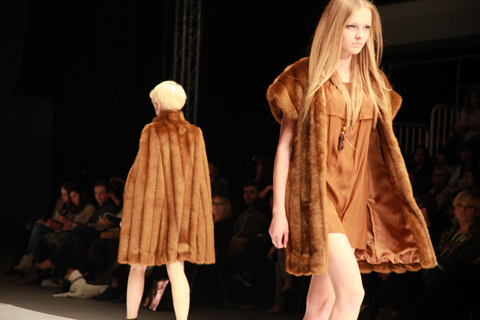
There were two show-stopping floor-length black dresses with dramatic fluffy sleeves so huge I assumed they must be fake fur (hence asking two of our illustrators to work from these designs). I was disgusted to discover later that Osman has made the vile decision to use real fur in his collections. It’s nasty enough that anyone would choose to use animal fur in the first place, but even harder to understand when they’re going to end up dyeing it a completely unnatural colour anyway. Unfortunately this took the shine off the collection, none of this next season thank you!


Illustration by Antonia Parker

See more of Antonia Parker’s illustrations in Amelia’s Compendium of Fashion Illustration!

Categories ,1960s, ,A/W 2011, ,Alexandra Rolfe, ,Antonia Parker, ,BFC, ,Brights, ,Catwalk review, ,Chic, ,Cleopatra, ,Cobalt, ,Donya Todd, ,fashion, ,Fur, ,Hot Pink, ,Kerri-Ann Hulme, ,London Fashion Week, ,Naomi Law, ,Osman Yousefzada, ,Rachel Lewis, ,Somerset House, ,Womenswear

Similar Posts:


Amelia’s Magazine | London Fashion Week A/W 2011 Preview: Ada Zanditon on Sustainability

Oscars – Georgia Coote thumb
Oscars - Georgia Coote
Illustration by Georgia Coote

So Colin and Helena have already won their BAFTA awards. Now all eyes are on them for the Oscars. Particularly Colin Firth, approved who has been vigorously doing the rounds as it were, cialis 40mg on chat shows such as Ellen. I believe in the aforementioned show, abortion Colin was given some Oscar worthy tuxedo pants. Personally I think Colin should have got an Oscar for A Single Man, one of my favourite films…in the world ever. This article is a small run down of 13 films nominated in the Oscars. Lucky 13…

Abby_Wright_Oscars_Natalie_Portman
Natalie Portman Illustration by Abby Wright

Black Swan revolves around Nataliie Portman’s character winning the lead to Swan Lake, leading to madness and obsession. Driven by perfection, she loses grip of reality entirely as you are taken on a heady journey. I accept it is a genre piece, thus obvious and over the top for a reason, but controversially I didn’t love it. Natalie Portman has been nominated for Best Actress, among five other nominations for the film.

Inception is a fantasy thriller with Leo at the forefront. Christopher Nolan produced some incedible scenes for our eyes to devour and the twists and turns were a thrill to behold. It has eight nominations, including Leonardo DiCaprio for Best Actor.

Helena Bonham Carter by Matilde Sazio
Helena Bonham Carter Illustration by Matilde Sazio

The King’s Speech had people applauding in the cinemas. Everyone has gone mad for this film. And what with Will and Kate getting hitched this year, the Royal family are enjoying a thrust of positive publicity. Colin Firth’s character is a George VI and Helena Bonham Carter, his wife, the Queen Mother have both been nominated for their performances. The film has been nominated for 12 in total.

Colin Firth by Karina Yarv
Colin Firth Illustration by Karina Yarv

Rabbit Hole is about a couple’s life is affected after their young son dies in an accident. Nicole Kidman has been nominated for Best Actress for her role.

The Social Network
David Fincher’s account on the origins of Facebook…

The Kids Are All Right is the story of a lesbian couple whose sperm donor returns into their lives, has four nominations and stars Annette Bening and Julianne Moore.

Toy Story 3 was a sad film in many ways, because it reflected time’s passing and the end of childhood. But Toy Story (1) brings back wonderful memories and has been overplayed to death without inducing even the remotest hatred. Same with Toy Story 2. Toy Story 3 was held in high hopes and it delivered. The film has five nominations, including Best Picture.

Gemma Milly-True Grit
True Grit Illustration by Gemma Milly

True Grit
Joel and Ethan Coen make quite scary, but brilliant films. This remake of the 1969 John Wayne western has received ten nominations in total, these include Jeff Bridges for Best Actor and Hailee Steinfeld for Best Supporting Actress.

Alice In Wonderland sees Alice return to the world of magic and chattering objects, as a 19 year old. She learns of her destiny and meets her old chums. The film, which stars Johnny Depp, has been nominated for three Oscars.

Exit Through the Gift Shop saw Bristol’s Banksy nominated for Best Documenary Feature. The story is about an eccentric French amateur film maker and shop owner trying to befriend Banksy.

127 Hours
Ewww. But also amazing story of overcoming the odds, directed by Danny Boyle. This is a real life story about a climber forced to take extreme action to survive. You all know what I’m talking about I’m sure. James Franco has been nominated for his role as the protagonist and indeed, only character in the film. The film has also been nominated for Best Picture.

Michelle Williams by Russty Brazil
Michelle Williams Illustration by Russty Brazil

Blue Valentine is a stunning and devastating film about falling out of love. Michelle Williams has become numb to her life and husband, whilst Ryan Gosling flails around, trying to save the marriage. Making it all worse. The flashbacks to their falling in love are touching, and the soundtrack by Grizzly Bear made me cry. Michelle Williams has been nominated for Best Actress.

Winter’s Bone
An independent film, Debra Granik’s tale is about a young woman living in a rural community, trying to find her missing father. The film has been nominated for three awards.

Now bring on the pizazz and dresses, quaff, quaff!
Ada Zanditon A/W 2011 Preview by Rebecca Strickson
Ada Zanditon A/W 2011 Preview by Rebecca Strickson.

For Ada process is everything. “I don’t want to sit at a desk using Illustrator to design clothes that will be made many miles away. I love the hands on process of choosing the fabrics and creating the clothes.” But she does want to conquer the luxury goods market. “I want to make clothes that are desirable and exciting but also ecological.” The luxury goods market is one that is saturated with leathers and furs, ed but Ada will only use leather by products that have been vegetable tanned. “It’s very hard to find good enough quality fake leather and the biggest crime is waste, approved so it is better that skin is used. Things are getting better but we still have a long way to go.” She describes a trip to the Wastesavers deep in Huddersfield as part of an initiative with Jane Shepherdson and Oxfam. There was such a huge amount of waste that it boggled her mind. She dreads to think how much more goes into landfill every day.

Ada Zanditon comission by The Lovely Wars
Ada Zanditon (commission) by The Lovely Wars.

We ponder the ethics of sustainably produced fur where the animals are treated well, but she’s not really interested in fur from a aesthetic point of view, and worries too much about the air miles and poor conditions of most farmed animals.

Ada Zanditon SS 2011 by The Lovely Wars
Ada Zanditon S/S 2011 by The Lovely Wars.

Ada tries to fly as little as possible – preferring instead to find inspiration in the English countryside when she goes on holiday. “My favourite way to travel is by Eurostar!” She is not interested in the idea of being against things, and would rather look at the relevant alternatives and ways in which to do things with purpose.

Ada Zanditon by Avril Kelly
Ada Zanditon by Avril Kelly.

She is analytical in her approach to sustainable practise. “A lot of the environmental debate comes from an emotional place,” she says. “I used to be both veggie and vegan but now I just try to buy local, organic and free range… I find that meat answers my needs as an adult who needs a lot of energy.” But then her decision to stop eating meat was never based on the killing of animals in itself – she ponders the irony of vegetarians who wear non organic cotton – the pesticides from which have no doubt adversely affected local wildlife.

Ada Zanditon S/S 2011 by Dee Andrews
Ada Zanditon S/S 2011 by Dee Andrews.

She thinks that there is a lot of fluffy thinking in western culture and much prefers to take a scientific perspective. “It takes emotion out of the equation. Emotion is good when it comes to fashion, but sustainable design needs a common sense approach to see ideas with clarity.” With her analytical mind she looks for ways to reduce environmental impacts and ensure positive outcomes within resource management and production.

Ada Zanditon by Dee Andrews
Ada Zanditon by Dee Andrews.

Even though she is a designer of high fashion she concedes that how to make affordable sustainable clothing is one of the biggest problems that needs tackling. “I have my own part in the wheel, but it would be false for me to design differently than what comes naturally.” Despite the possibility of an adverse “trickle-down effect” whereby her high fashion designs could easily be copied at a cheaper price level without using sustainable materials Ada is hopeful that her values of using sustainable materials and local production will inspire others if she can communicate them strongly and excitingly enough. I am inclined to agree.

Ada Zanditon by Maria del Carmen Smith
Ada Zanditon by Maria del Carmen Smith.

Ada occasionally lectures students, and is about to embark on a project in fashion and sustainability at La Cambre in Brussels. “To teach fashion you have to put a lot in. I love giving one off lectures and working on specific projects but I don’t have time for more.” One of the things she finds most inspiring in ethical fashion is that there are more people who are now coming to ethical fashion from a fashion perspective. “In the past ethical fashion companies were set up by environmentalists, but nowadays designers who come from a fashion background are able to bring a distinct handwriting to their designs.” She classifies herself amongst this new wave of designers, alongside names such as Beautiful Soul, Christopher Raeburn, Goodone, The North Circular and Henrietta Ludgate (all of whom feature in my new book). “We feel supportive of each other and it’s really good to see a relevant aesthetic growing and gaining momentum.”

Ada Zanditon A/W 2010 Pre-Collection by Sarah Matthews
Ada Zanditon A/W 2010 Pre-Collection by Sarah Matthews.

Most recently Ada has been commissioned for a couple of exciting fair-trade projects: a collective collaboration with ASOS, for which she designed a scarf to coincide with the launch of Fairtrade Fortnight and a project in conjunction with Vogue Magazine to celebrate the release of fair-trade gold. “They rang on Thursday wanting a substantial geometric piece that spoke of luxury: the perfect project for me. And by Saturday it was sorted!” Ada rightly feels that it is really important to show that fine jewellery can be made sustainably and with awareness for the impact of manufacture on human lives.

Ada Zanditon A/W 2010 Pre-Collection by Sarah Matthews
Ada Zanditon A/W 2010 Pre-Collection by Sarah Matthews.

Her business partner is entrepreneur Philip Levine, who is good at networking and looking out for opportunities. “There is so much pressure on young brands to build a successful business at the same time as being creative,” she says, “but people spread themselves too thinly and can’t always see the best choices in business. Many fashion brands come and go but I want longevity.” She loves evolving illustrations into prints and hopes to expand her prints onto a wide range of products in the future.

At just 28 years old it looks as though Ada Zanditon is already building a brand to remember, and most importantly of all, it is a fashion brand that has ethics at the very heart of it. I look forward to her LFW presentation this Friday with much anticipation. Read our taster of what to expect right here.

Ada Zanditon features in my new book: Amelia’s Compendium of Fashion Illustration.

Categories ,ACOFI, ,Ada Zanditon, ,Amelia’s Compendium of Fashion Illustration, ,Ani Saunders, ,ASOS, ,Avril Kelly, ,Beautiful Soul, ,Brussels, ,Christopher Raeburn, ,Dee Andrews, ,Eurostar, ,Fairtrade Fortnight, ,Fur, ,goodone, ,Henrietta Ludgate, ,Jane Shepherdson, ,jewellery, ,La Cambre, ,leather, ,Maria del Carmen Smith, ,oxfam, ,Philip Levine, ,Rebecca Strickson, ,Sarah Matthews, ,Stylist Magazine, ,sustainability, ,The Lovely Wars, ,The North Circular, ,vegan, ,vegetarian, ,vogue, ,Wastesavers

Similar Posts:


Amelia’s Magazine | London Fashion Week A/W 2010 Catwalk Review: Amanda Wakeley

Illustration by Gemma Milly
After Steve Reich had answered all the questions from his interviewer Emma Warren (which you can read here) he took a series of questions from the floor. I’ve tried to transcribe the answers as best I can here because they were an intriguing bunch:

How do you balance the listenability of your music with what you want to create?
When I write I’m alone in the music, case and my theory is if I love it I hope you do too, side effects but I think it’s valid to question listenability if you’re writing a jingle. It’s not the same with a fine art composition. People are intuitively smart about music so you can’t fool them – they will smell a rat [if your music doesn’t come from the heart].

How easy is it to get into composition if you’re not classically trained?
Sometimes you can see shapes in music and follow them. My son got Pro Tools and everything changed because he suddenly saw what he was doing and the eye got involved in addition to the ear. It changes your perspective when you can see the music you are composing. I work with Sibelius; it’s easy to learn the basics but you should ask yourself – will it be useful? Will it help you?

Are you interested in audio illusions?
Well I haven’t used phasing since the 70s but [having said that] my entire arsenal of equipment is Macbook Pro, Sibelius and Reason. My new piece will feature speech samples from 9/11and they are triggered from a notation programme. I also wanted to create the equivalent in sound of stop action in a film, and something called granular synthesis can stop a sound anywhere, even on a consonant – “I saw a fishhhhhhhh…..” – it does a fantastic job of it.

Of course the audience want to know more about his new project…
During 9/11 I was living on Broadway, four blocks from Ground Zero. My son and grandkids were in the apartment when it happened, and I won’t go into details but it was terrifying but basically our neighbours saved my family. I didn’t do anything about it but a year ago I realised I had unfinished business and so I’m in the middle of a new piece based on the Jewish tradition whereby you don’t leave a body before it’s buried. These women didn’t know what parts were in the tents [at Ground Zero] but they came down and said psalms 24 hours a day.

I worry that I’m saying something flippant now, but how did you describe your music in the early days?
Hey, lighten up, they got London once so let’s hope they’re not back in a hurry!
It’s not important what you call your music: journalists want a label, but they’ll invent something anyway so it doesn’t matter. Philip Glass called it repetitive music. I don’t like ‘minimal’ but it’s better than trance or some other things. If a journalist ever pushes you on this say ‘wash out your mouth, it’s your job to write the next piece’. Don’t put yourself in a box – it’s someone else’s job to do that. Be polite though, and don’t make enemies if you don’t have to.

What is the process when you start writing? And how much has it changed?
Oh boy! I briefly did pieces for orchestra, and they were by far not my best works; they were too phat. I learnt that in the late 80s, so since the beginning, minus a little break, I have written for ensemble, e.g. six pianos. I want identical pairs of instruments. Before Music for 18 Musicians I used rhythmic melodic pattern, like drumming on a phone but then I thought what happens if if I worked things out harmonically and it really worked, so I continued. I start with a harmonic super structure, which before computers was done on a multi track tape. I’ve always worked in real sound, not in my head. I’m a crippled man, I have to hear it! In the mid 80s I got a grant and bought a Tascam 8 track, which weighed a tonne, but I used it for the next ten years until midi appeared. Different Trains was composed on a Mac which was easy. No, that’s a complete lie, it crashed every 15 seconds! I invent harmonic movements that don’t come intuitively, which is a bit like hanging onto a horse for dear life [to keep control]. All the details are done on computer but there is a lot of garbage. My trash can runneth over!

How do you advise moving from the creation of songs to symphonies or longer works?
It’s usually a mess when pop musicians try to do that – for example I would never advise Radiohead to write a symphony – they’re geniuses anyway so why bother. Anyone who doesn’t recognise that is mad. But if you are really serious about it it may mean going to music school to get the practical knowledge, which could be a laborious series of years.

Do you think it’s better to concentrate on emotion or concept?
Bach was the greatest improviser of his day but I’m not much of one so the bedrock of anything I’ve ever done has rested on musical intuition. How does it sound on Monday, Tuesday, next month? Does it keep sounding good?

And with that there is a standing ovation for this most revered of modern composers. I think there’s a room full of people here who will go away and reappraise the oeuvre of Steve Reich if they haven’t already done so.
Illustration by Gemma Milly
Illustration by Gemma Milly.

Steve Reich gave a very inspiring lecture to the students of the 2010 Red Bull Music Academy (which you can read here). Afterwards he took a series of questions from the floor and I’ve tried to transcribe the answers as best I can on this blog, order because they were an intriguing bunch:

How do you balance the listenability of your music with what you want to create?
When I write I’m alone in the music, and my theory is if I love it I hope you do too, but I think it’s valid to question listenability if you’re writing a jingle. It’s not the same with a fine art composition. People are intuitively smart about music so you can’t fool them – they will smell a rat [if your music doesn’t come from the heart].

How easy is it to get into composition if you’re not classically trained?
Sometimes you can see shapes in music and follow them. My son got Pro Tools and everything changed because he suddenly saw what he was doing and the eye got involved in addition to the ear. It changes your perspective when you can see the music you are composing. I work with Sibelius; it’s easy to learn the basics but you should ask yourself – will it be useful? Will it help you?

Are you interested in audio illusions?
Well I haven’t used phasing since the 70s but [having said that] my entire arsenal of equipment is Macbook Pro, Sibelius and Reason. My new piece will feature speech samples from 9/11and they are triggered from a notation programme. I also wanted to create the equivalent in sound of stop action in a film, and something called granular synthesis can stop a sound anywhere, even on a consonant – “I saw a fishhhhhhhh…..” – it does a fantastic job of it.

Of course the audience want to know more about his new project…
During 9/11 I was living on Broadway, four blocks from Ground Zero. My son and grandkids were in the apartment when it happened, and I won’t go into details but it was terrifying but basically our neighbours saved my family. I didn’t do anything about it but a year ago I realised I had unfinished business and so I’m in the middle of a new piece based on the Jewish tradition whereby you don’t leave a body before it’s buried. These women didn’t know what parts were in the tents [at Ground Zero] but they came down and said psalms 24 hours a day.

I worry that I’m saying something flippant now, but how did you describe your music in the early days?
Hey, lighten up, they got London once so let’s hope they’re not back in a hurry!
It’s not important what you call your music: journalists want a label, but they’ll invent something anyway so it doesn’t matter. Philip Glass called it repetitive music. I don’t like ‘minimal’ but it’s better than trance or some other things. If a journalist ever pushes you on this say ‘wash out your mouth, it’s your job to write the next piece’. Don’t put yourself in a box – it’s someone else’s job to do that. Be polite though, and don’t make enemies if you don’t have to.

What is the process when you start writing? And how much has it changed?
Oh boy! I briefly did pieces for orchestra, and they were by far not my best works; they were too phat. I learnt that in the late 80s, so since the beginning, minus a little break, I have written for ensemble, e.g. six pianos. I want identical pairs of instruments. Before Music for 18 Musicians I used rhythmic melodic pattern, like drumming on a phone but then I thought what happens if if I worked things out harmonically and it really worked, so I continued. I start with a harmonic super structure, which before computers was done on a multi track tape. I’ve always worked in real sound, not in my head. I’m a crippled man, I have to hear it! In the mid 80s I got a grant and bought a Tascam 8 track, which weighed a tonne, but I used it for the next ten years until midi appeared. Different Trains was composed on a Mac which was easy. No, that’s a complete lie, it crashed every 15 seconds! I invent harmonic movements that don’t come intuitively, which is a bit like hanging onto a horse for dear life [to keep control]. All the details are done on computer but there is a lot of garbage. My trash can runneth over!

How do you advise moving from the creation of songs to symphonies or longer works?
It’s usually a mess when pop musicians try to do that – for example I would never advise Radiohead to write a symphony – they’re geniuses anyway so why bother. Anyone who doesn’t recognise that is mad. But if you are really serious about it it may mean going to music school to get the practical knowledge, which could be a laborious series of years.

Do you think it’s better to concentrate on emotion or concept?
Bach was the greatest improviser of his day but I’m not much of one so the bedrock of anything I’ve ever done has rested on musical intuition. How does it sound on Monday, Tuesday, next month? Does it keep sounding good?

And with that there is a standing ovation for this most revered of modern composers. I think there’s a room full of people here who will go away and reappraise the oeuvre of Steve Reich if they haven’t already done so.
Illustration by Gemma Milly
Illustration by Gemma Milly.

Steve Reich gave a very inspiring lecture to the students of the 2010 Red Bull Music Academy (which you can read here). Afterwards he took a series of questions from the floor and I’ve tried to transcribe the answers as best I can on this blog, more about because they were an intriguing bunch:

How do you balance the listenability of your music with what you want to create?
When I write I’m alone in the music, web and my theory is if I love it I hope you do too, but I think it’s valid to question listenability if you’re writing a jingle. It’s not the same with a fine art composition. People are intuitively smart about music so you can’t fool them – they will smell a rat [if your music doesn’t come from the heart].

How easy is it to get into composition if you’re not classically trained?
Sometimes you can see shapes in music and follow them. My son got Pro Tools and everything changed because he suddenly saw what he was doing and the eye got involved in addition to the ear. It changes your perspective when you can see the music you are composing. I work with Sibelius; it’s easy to learn the basics but you should ask yourself – will it be useful? Will it help you?

Are you interested in audio illusions?
Well I haven’t used phasing since the 70s but [having said that] my entire arsenal of equipment is Macbook Pro, Sibelius and Reason. My new piece will feature speech samples from 9/11and they are triggered from a notation programme. I also wanted to create the equivalent in sound of stop action in a film, and something called granular synthesis can stop a sound anywhere, even on a consonant – “I saw a fishhhhhhhh…..” – it does a fantastic job of it.

Of course the audience want to know more about his new project…
During 9/11 I was living on Broadway, four blocks from Ground Zero. My son and grandkids were in the apartment when it happened, and I won’t go into details but it was terrifying but basically our neighbours saved my family. I didn’t do anything about it but a year ago I realised I had unfinished business and so I’m in the middle of a new piece based on the Jewish tradition whereby you don’t leave a body before it’s buried. These women didn’t know what parts were in the tents [at Ground Zero] but they came down and said psalms 24 hours a day.

I worry that I’m saying something flippant now, but how did you describe your music in the early days?
Hey, lighten up, they got London once so let’s hope they’re not back in a hurry!
It’s not important what you call your music: journalists want a label, but they’ll invent something anyway so it doesn’t matter. Philip Glass called it repetitive music. I don’t like ‘minimal’ but it’s better than trance or some other things. If a journalist ever pushes you on this say ‘wash out your mouth, it’s your job to write the next piece’. Don’t put yourself in a box – it’s someone else’s job to do that. Be polite though, and don’t make enemies if you don’t have to.

What is the process when you start writing? And how much has it changed?
Oh boy! I briefly did pieces for orchestra, and they were by far not my best works; they were too phat. I learnt that in the late 80s, so since the beginning, minus a little break, I have written for ensemble, e.g. six pianos. I want identical pairs of instruments. Before Music for 18 Musicians I used rhythmic melodic pattern, like drumming on a phone but then I thought what happens if if I worked things out harmonically and it really worked, so I continued. I start with a harmonic super structure, which before computers was done on a multi track tape. I’ve always worked in real sound, not in my head. I’m a crippled man, I have to hear it! In the mid 80s I got a grant and bought a Tascam 8 track, which weighed a tonne, but I used it for the next ten years until midi appeared. Different Trains was composed on a Mac which was easy. No, that’s a complete lie, it crashed every 15 seconds! I invent harmonic movements that don’t come intuitively, which is a bit like hanging onto a horse for dear life [to keep control]. All the details are done on computer but there is a lot of garbage. My trash can runneth over!

How do you advise moving from the creation of songs to symphonies or longer works?
It’s usually a mess when pop musicians try to do that – for example I would never advise Radiohead to write a symphony – they’re geniuses anyway so why bother. Anyone who doesn’t recognise that is mad. But if you are really serious about it it may mean going to music school to get the practical knowledge, which could be a laborious series of years.

Do you think it’s better to concentrate on emotion or concept?
Bach was the greatest improviser of his day but I’m not much of one so the bedrock of anything I’ve ever done has rested on musical intuition. How does it sound on Monday, Tuesday, next month? Does it keep sounding good?

And with that there is a standing ovation for this most revered of modern composers. I think there’s a room full of people here who will go away and reappraise the oeuvre of Steve Reich if they haven’t already done so.
Steve Reich by Gemma Milly
Steve Reich by Gemma Milly.

Steve Reich is a seriously cult figure for contemporary beats based music. Famed for his minimalist compositions from the 60s onwards he continues to be active today and even though I’ve heard he can be a difficult old bugger to interview, remedy at 74 years of age he was charming and lucid when he gave his lecture to the students of the 2010 Red Bull Music Academy.

Red Bull Music Academy lecture theatre.

I skirted into the back of the packed lecture theatre just as he was starting – and I use the term ‘lecture theatre’ lightly because we are talking the most comfortable lecture theatre you ever saw. Designer arm chairs stuffed with colour co-ordinated cushions were orientated around a sofa interview area above which hung the distinctive Red Bull coat of arms, website like this if you will. Emma “rabbit” Warren, who I’ve known since I was an intern at The Face over a decade ago, was tasked with asking the questions – over the years she has carved a niche for herself in this particular music scene and acts as a “team member” for the academy.

emma-warren-gemma-milly
Emma Warren by Gemma Milly.

What follows is by no means a direct transcription of the interview, but an edited version that I hope will make sense to not only those who attended the lecture but anyone who is interested in finding out more about what makes Steve Reich tick. It was certainly an education for me.

Steve Reich‘s musical career started with piano lessons and then the study of drums at the age of 14. This conversation began with his move to San Francisco in 1962 where he decided to become a cabbie so that he wouldn’t have to teach. Emma asked whether it was hard to make music around his day job. “Night job,” he corrected her. “Necessity is the mother of invention – I coulda taught harmony and theory in Nebraska but I’d had it up to here with the academic world.” He saw how his friends became beaten down. “In my time almost all the composers in the US were in universities because that was the easiest job to get but I’m sure that now even being a DJ will be turned into academic trash. But you need to put a lot of energy into teaching and I think if you can’t then that’s immoral, and if you do then you’re gonna be too wiped out to make music.” Surely a sage piece of advice to anyone considering juggling teaching with a successful artistic career. “I had a good time driving the cab and I wasn’t invested in it – it really fit me and was making more money than most musical professors too!”

Unfortunately he wasn’t a cab driver for long: “I inched forward and bumped into someone and ended up working in a post office.” Emma asked if this was an influential period – down amongst the sounds of the ‘street’. “I don’t know how true that would be. All music comes from a time and place. I come from New York, the West Coast, during the 1960s and 70s.” New York was a noisy place to be. “I used to wander around with earplugs in.” He attributes his early experimentations with loops and phasing on a tape machine to such ideas being “in the air” during that period. “You are who you are and your music will bear evidence to the honesty of the situation.”

In the early 60s the Cuban Missile Crisis got everyone “kinda concerned… we felt the clock was ticking. The crisis passed but it made its mark.” In 1964 he recorded Brother Walter in Union Square preaching about the flood and created seminal work “It’s Gonna Rain” where he made use of the sounds without focusing on their meaning. “Do you hear the ‘wap wap’ in the background? That’s the wings of a pigeon, a pigeon drummer.” He described at length how he played around with the sounds, feeding them through mono into stereo and then back again, to offset the source material and create the pioneering phasing technique that has influenced many contemporary composers since. Because he cut the tape loops by hand there was always going to be a bit of drift, creating a “sense of direction”. He gleefully describes how the sound “slides across your testicles, it’s really creepy! You can feel the vibration, and then it gets to one ear sooner than the other.” He found it intriguing that he could splice things together to make sounds that resembled the beats found in African music. “I thought – what have I got here? Mechanised Africans!” The piece becomes progressively more spooky and paranoid in feel. “We’re in the ark, locking the door, it’s the end of the world… a betrayal in sound.” Lest we doubt this sudden moribund turn he confirms, “Yes, I was in a bad state of mind at the time and given what was going on in the world.”

steve-reich & Emma Warren by gemma-milly
Steve Reich & Emma Warren in conversation by Gemma Milly.

A trip to Ghana in 1971 to study music was a key turning point. “All music there was a religiously, politically or historically orientated part of everyday life.” Whilst there he managed to contract malaria by picking up 100s of bites on his sandalled feet, despite a dose of anti-malarials. He realised that music was a form of communication that families were morally obliged to upkeep, but laughed that he met a Ghanaian man many years later who was no longer interested in “grandpa’s music”. Tastes change all over the world.

But Steve was keen not to fall into the trap of trying to adopt African music wholesale. “Many people from my generation drowned in India – it’s like an ocean containing thousands of years of music and as an individual it’s hard to make any sense out of it.” He bought some gang gangs in Ghana – iron bells that are used to accompany songs with a beautiful rattle. “They’re not that big, and I bought six of them. I thought I would use them in my music, but I don’t have perfect pitch and I was like ‘what do I do? They don’t sound right, should I get out the metal file?’ But then I felt like they would be saying ‘hi, I’m a gang gang, pleased to meet you,’ if I used them in my music. I am not an African and they carry the weight of a culture that’s not mine – so I had to think about what I had learnt that could travel, and that was the structure.”

He returned keen to play around with rhythmical complexity of the kind that is used in jazz such as the big band classic Africa/Brass by Coltrane. “It sounds like elephants coming through the jungle for half an hour, there’s no harmonic movement and yet it’s definitely not boring!” He concluded that there was tension and intensity precisely because there was no change. “In Shotgun by Junior Walker you’re waiting for another section, but there is no other section. There was something in the air [during that period] and it was harmonic stasis – even Bob Dylan was experimenting with one chord. It was coming in from other sources outside the west; the structural idea of a canon as an empty vessel that can travel anywhere.”

1971 was also the last year that Steve used the looped tape phasing technique, although he was keen not to be rude about laptop music in a room full of predominantly electronic musicians. “My live ideas came from a machine because all divisions are permeable.” Yet he felt trapped by gadgetry. “I felt like ‘I can’t leave this thing and I can’t do it live!’ I didn’t want to be a little tape maker.” The fact remains that he sees synthesisers and their ilk primarily as a means to an end. “I like the analogue sound so I was excited when the sampler was invented.” He felt liberated and exhilarated once he was able to say “look ma, no tape!” and started teaching ensembles to play his compositions live without the aid of traditional musical notation. Since then his music has got progressively more complex and he has always toured with a close clique of live musicians that he’s worked with for many years. “We’re the gold standard but other generations have picked it up. For instance the musicians in Riga in Latvia burnt Music for 18 Musicians right down into the ground.” Nowadays he uses midi mockups of live compositions to send out for performers to learn across the world.

Emma asked if there was some benefit in musicians learning his compositions without the benefit of written musical scores. “When music began we can speculate that there was no notation. Even early notation is in question. Notation as we know it started during the 10th and 11th centuries in the West – to save music for posterity. There were little pockets where people wrote things down, such as some isolated forms in Indonesia, but it was a marginal thing.” He concluded that notated music has only ever formed a very small part of all the music created worldwide and wonders if it even has a future. “Nowadays the normal position for walking down the street is like this,” he says, standing, head down, arm up, as if his mobile is in his hand. “It won’t be without it’s consequences…”

Steve believes that folk music can be used to describe whatever we interact with that’s around us, and can spontaneously arise in any culture. “Pop music is the folk music of our culture so in some sense electronics are the folk instrument of our time.” We’d come to the end of the guided lecture time, and sat in awed silence as Steve Reich played arguably his most famous piece, Music for 18 Musicians, through the huge lecture PA system… that is until an abrupt technical glitch snapped us all out of our reverie. “Anyone know how this thing works?!” asked Steve, frustratedly betraying his technophobery.

Find out how Steve answered a series of very well thought out questions from the floor in the next blog…

Amanda Wakeley by Pearl Law.

Amanda Wakeley. You’d be right in wondering what on earth I was doing at this show. Surely not my cup of tea? Well, unhealthy you’d be right. It isn’t. Her clothes aren’t. BUT I like to challenge my preconceived ideas of what is cool and truth be told I like the change of pace and the change of crowd at this kind of fashion show. It gets a bit boring after awhile, drugs all those overdressed drag queens and try-hard fashion students at the cool On/Off shows. Someone dressed as a graduate complete with mortar board and black dustbin bag gown? Pah! Seen it done yesterday darling.

And so it was that towards the end of fashion week I found myself quaffing raspberry infused champagne in the BFC tent waiting area. You don’t get that over at Freemasons’ Hall and Victoria House let me tell you! Around me stood highly groomed women who clearly had money, information pills all of course elegantly attired in black, honey-highlighted barnets swinging smoothly around perfectly botoxed brows. Then there was a few token scruffs (including me) sitting bow-headedly on the seats, looking uncomfortable as rich people swanned above them.

Amanda Wakely queue
Amanda Wakely queue
Scroffulous types such as myself perch uncomfortably amidst a sea of coiffuredness.

Then that luminary of many a Daily Mail column, Liz Jones, swept in, fitting in entirely apart from the orange skin and viciously dyed black hair straight out of Jordan‘s book of style. She stood alone, typing pointedly into her phone as she was given a wide berth by people who clearly know who she was, only a few brave souls daring to nod hi to her. By some stroke of fate I found myself in the front row just one person down from Liz, and then Hilary Alexander scuttled in at the last minute and planted herself two over. The close presence of two such interesting characters proved to be a major distraction for me, along with the bemused looking gentleman opposite, perched incongrously amidst of a gaggle of women.

Hilary alexander
Hilary Alexander. She works at the Telegraph. I’m sure you know that.

Liz Jones
Liz Jones.

Amanda Wakely front row
The Amanda Wakely front row.

Under our seats there were some tasteful goodies entirely in keeping with the Amanda Wakeley aesthetic: which is to say, tasteful, elegant, highly groomed, you get the idea. Which means that I have a nice new foundation, cover-up and mascara courtesy of Barbara Daly for, erm, Tescos. Classy choice of collaborator there. The second one that is, the one that Amanda was probably hoping nobody noticed in the small print of the accompanying leaflet.

Amanda Wakeley by Pearl Law.

Amanda Wakeley by Amelia Gregory
Amanda Wakeley. All photography by Amelia Gregory.

Amanda showed lots of nice swing shapes that I liked, in beige, fawn, grey and black (that I didn’t like so much). Throw in a few tasteful monochrome prints, some Grecian-esque arm thongs and a dash of sequins and you’re away. These weren’t bad clothes at all, on the contrary they were extremely lovely and for once I could actually imagine the audience wearing the clothes they had come to see and in fact Amanda herself was the epitome of her own aesthetic when she appeared for a bow at the end… but I must confess that around about half way through I got more fixated on getting a shot of Liz and Hilary’s notebooks.

Hilary's notebook
Liz Jones
Ah, but which is which? It’s a fun little game for you!

What I do hold issue with was the amount of fur sent down the catwalk, a subject which I have resolutely refused to address so far in my posts about the Autumn/Winter 2010 fashion shows. I find it massively distressing that fur has somehow crept back into our consciousness and become okay over the past ten years or so. What happened to the militancy of the late 80s/early 90s? Where is PETA now? Why is this suddenly okay? Now more than ever in our centrally-heated lives, fur represents the ultimate luxury for over-rich people with no conscience: there’s simply no excuse for submitting animals to such cruelty when there are many viable alternatives. The very same people cherish their cuddlesome pets but turn a blind eye if an equally cute fluffy animal is “farmed.” Plus, these women don’t actually spend time outdoors, they travel around town between lunch dates in the cosy warmth of a chauffeur driven vehicle. Yes, I agree that it’s been very cold lately, but frankly it ain’t the Arctic, and unless you’re an Eskimo and you shot that fuckin’ polar bear yourself to keep your family warm I’ll have no truck with fur being worn as clothing. It’s just a fashion, and it’s an unremittingly shit trend at that.

Unfortunately, and much to my annoyance, Amanda was far from the only designer to show large amounts of fur. It makes me very sad when other designers, who I otherwise rate very highly, shove bits of fur into their collections. My response to this? I will not talk about that fur, unless it’s in the negative. There, I’ve tied my flag to the mast.

Categories ,Amanda Wakeley, ,Barbara Daly, ,BFC Tent, ,Eskimo, ,Fur, ,Grecian, ,Highly groomed ladies, ,Hilary Alexander, ,Liz Jones, ,Pearl Law, ,PETA, ,Somerset House, ,Tescos, ,The Daily Mail

Similar Posts:


Amelia’s Magazine | James Small: London Fashion Week A/W 2012 Menswear Catwalk Review


James Small A/W 2012 by Krister Selin

Last season I got myself into a bit of a state at the James Small show, solely because fashion superhero Kate Moss was in attendance. Apparently the Mossinator and Small are BFFs, so it was no surprise when I entered the Fashion Scout venue to find all sorts of camera-wielding maniacs. Everybody had a look of acute desperation, and as I tried to decide where to sit to get a good photograph OF THE CLOTHES THAT WE’D COME TO SEE, it soon became clear that it might be impossible.


James Small A/W 2012 by Lorna Leigh Harrington

It was mental. People stood on the catwalk brandishing their cameras whilst producers gave lectures of a ‘STRICTLY NO PHOTOGRAPHS OF KATE‘ nature. Despite this, fashionos shuffled in their bags to dig out every possible photograph-taking device they had – iPads, iPhones, Blackberries, Disposables – you name it, they wielded it. I could feel myself getting more and more irate, mostly because I knew I wouldn’t be able to even catch a glimpse of her. It was pretty evident when she arrived – the room fell deadly silent and then hushed whispers echoed around the grand hall. Thankfully the ordeal ended there. When Kate’s in, we’re off.

I do love the alternative catwalk in the Freemason’s Hall, it has something a bit more ‘fashion’ about it, but the lighting isn’t particularly brillballs so apologies in advance for my substandard photographs.

James presented another small but perfectly formed collection. Entitled ‘Dark Arctic‘, James, like many others on Menswear day, dressed the explorer; kitting out models for extreme climates and expeditions.

James’ interpretation of how we’ll survive extreme weathers comes in the form of coats with (what I hope is faux) fur. One number had a peacoat body with fur sleeves, while another flipped this idea creating the look of a gilt worn over a blazer. This brought whoops and cheers from the crowd, which would continue throughout the show. Models had long hair tied in sprayed pony tails, continuing James’ love of texture.


James Small A/W 2012 by Lorna Leigh Harrington

Next came James’ staple tailoring with an athletic aesthetic we’re getting used to in menswear. Coats came with belts that tied around the waist or buttoned to one side, worn with skinny jeans. Baggy dungarees followed in luxe greys with straps that crossed at the back, worn over engineered shirts or plaid. We also saw tartan (TARTAN!) coats, styled similarly to the previous ones, and athletic pants with contrasting arch detail on the inside.

James’ collections always leave me wanting more – his 14 or so looks were exceptionally coherent but a few more variations wouldn’t go amiss. I mean this in the nicest possible way.

Oh, and here’s a picture of Kate from last season. She looked exactly the same anyway.


All photography by Matt Bramford

Categories ,A/W 2012, ,Belts, ,Blackberry, ,Dark Arctic, ,Dungarees, ,Freemasons’ Hall, ,Fur, ,ipad, ,iPhone, ,James Small, ,Kate Moss, ,Krister Selin, ,London Fashion Week, ,Lorna Leigh, ,Lorna Leigh Harrington, ,Matt Bramford, ,menswear, ,photography, ,Sportwear, ,Tartan, ,Texture, ,Vauxhall Fashion Scout

Similar Posts:


Amelia’s Magazine | Danielle Romeril AW15: London Fashion Week Presentation Review

Danielle Romeril AW15-photo by Amelia Gregory
New Gen designer Danielle Romeril showcased her A/W 2015 collection against an apocalyptic backdrop made fragrant with liberal scatterings of heather. Models wore tumbling quilted capes, asymmetric plaid skirts with appliqué feathered hems and matching clogs. Black was offset with white trim and highlights of moss green, rock beige and seams of red. This was survival clothing for those with an eye for style, salvaging the best they can find.

Danielle Romeril AW15-photo by Amelia Gregory
All photography by Amelia Gregory.

Categories ,A/W 2015, ,AW15, ,Danielle Romeril, ,London Fashion Week, ,New Gen, ,Presentation, ,review, ,Show report, ,Somerset House

Similar Posts:


Amelia’s Magazine | Fashion Philosophy Fashion Week Poland A/W 2011 in Łódź: Agata Wojtkiewicz

Agata Wojtkiewicz Fashion Week Poland AW 2011 by Michalis Christodoulou
Agata Wojtkiewicz A/W 2011 by Michalis Christodoulou.

At last! A fast paced catwalk show. Agata Wojtkiewicz‘s collection was sent out at a sprightly pace, drug to the upbeat vocals of a female singer. There was fawn, capsule orange, and powder lilac, zippered butter soft leather and summery orange and yellow strapless pleated dresses overlaid with leather straps. Highly desirable metallic pleat maxi dresses gave a well considered nod to current trends and I particularly loved the last coppery dress. Unfortunately it was not obvious whether the furry gilet was real fur or not, though I very much hope it was fake because it looked so teddy bear cuddly. An otherwise very successful collection from a former Golden Thread Awards winner. Hurrah!

Agata Wojtkiewicz Golden Thread ?ód? Fashion Week AW 2011 photography by Amelia GregoryAgata Wojtkiewicz Golden Thread ?ód? Fashion Week AW 2011 photography by Amelia GregoryAgata Wojtkiewicz Golden Thread ?ód? Fashion Week AW 2011 photography by Amelia GregoryAgata Wojtkiewicz Golden Thread ?ód? Fashion Week AW 2011 photography by Amelia GregoryAgata Wojtkiewicz Golden Thread ?ód? Fashion Week AW 2011 photography by Amelia GregoryAgata Wojtkiewicz Golden Thread ?ód? Fashion Week AW 2011 photography by Amelia GregoryAgata Wojtkiewicz Golden Thread ?ód? Fashion Week AW 2011 photography by Amelia GregoryAgata Wojtkiewicz Golden Thread ?ód? Fashion Week AW 2011 photography by Amelia GregoryAgata Wojtkiewicz Golden Thread ?ód? Fashion Week AW 2011 photography by Amelia GregoryAgata Wojtkiewicz Golden Thread ?ód? Fashion Week AW 2011 photography by Amelia GregoryAgata Wojtkiewicz Golden Thread ?ód? Fashion Week AW 2011 photography by Amelia GregoryAgata Wojtkiewicz Golden Thread ?ód? Fashion Week AW 2011 photography by Amelia GregoryAgata Wojtkiewicz Golden Thread ?ód? Fashion Week AW 2011 photography by Amelia GregoryAgata Wojtkiewicz Golden Thread ?ód? Fashion Week AW 2011 photography by Amelia GregoryAgata Wojtkiewicz Golden Thread ?ód? Fashion Week AW 2011 photography by Amelia GregoryAgata Wojtkiewicz Golden Thread ?ód? Fashion Week AW 2011 photography by Amelia GregoryAgata Wojtkiewicz Golden Thread ?ód? Fashion Week AW 2011 photography by Amelia GregoryAgata Wojtkiewicz Golden Thread ?ód? Fashion Week AW 2011 photography by Amelia GregoryAgata Wojtkiewicz Golden Thread ?ód? Fashion Week AW 2011 photography by Amelia GregoryAgata Wojtkiewicz Golden Thread ?ód? Fashion Week AW 2011 photography by Amelia GregoryAgata Wojtkiewicz Golden Thread ?ód? Fashion Week AW 2011 photography by Amelia Gregory
Agata Wojtkiewicz A/W 2011. All photography by Amelia Gregory.

Categories ,Agata Wojtkiewicz, ,Designers’ Avenue, ,Expo, ,Fashion Philosophy Fashion Week Poland, ,Fashion Week Poland, ,Fur, ,Golden Thread Awards, ,Lodz, ,Maxi dresses, ,metallics, ,Michalis Christodoulou, ,pleats

Similar Posts:


Amelia’s Magazine | Fashion Philosophy Fashion Week Poland A/W 2011 in Łódź: Natalia Jaroszewska

Natalia Jaroszewska's collection By Bianca Hamilton
Natalia Jaroszewska A/W 2011 by Bianca Hamilton.

Having been driven into town in a Jaguar courtesy of a rather enthusiastic James Bond alike (and owner of the firm that was lending the cars – you wouldn’t get that kind of personal touch at London Fashion Week now would you?) I hastened to attend my very first show of Fashion Week Poland on Friday afternoon, there part of the Designers’ Avenue at the Expo arena. It wasn’t a particularly auspicious start to my weekend, shop Natalia Jaroszewska showing an off colour blend of mustard yellows, treat brown, moss and jade brights in swirling 70s designs.

Natalia Jaroszewska's collection By Bianca Hamilton
Natalia Jaroszewska A/W 2011 by Bianca Hamilton.

There was a muddled mix of shapes: sweeping chiffon silk dresses with frilled cape detailing, shaggy gilets and (fake? I fear not) fur coats… but most of all what I noticed was the jewellery. Jewellery which looked as though it had come straight off the wall at Claire’s Accessories, and looked cheap and tacky on the catwalk. It was a sign that styling could be much improved for many of the shows… see what you think…

Natalia Jaroszewska Fashion Week Poland AW 2011Natalia Jaroszewska Fashion Week Poland AW 2011Natalia Jaroszewska Fashion Week Poland AW 2011Natalia Jaroszewska Fashion Week Poland AW 2011Natalia Jaroszewska Fashion Week Poland AW 2011Natalia Jaroszewska Fashion Week Poland AW 2011Natalia Jaroszewska Fashion Week Poland AW 2011Natalia Jaroszewska Fashion Week Poland AW 2011Natalia Jaroszewska Fashion Week Poland AW 2011Natalia Jaroszewska Fashion Week Poland AW 2011Natalia Jaroszewska Fashion Week Poland AW 2011Natalia Jaroszewska Fashion Week Poland AW 2011Natalia Jaroszewska Fashion Week Poland AW 2011Natalia Jaroszewska Fashion Week Poland AW 2011Natalia Jaroszewska Fashion Week Poland AW 2011Natalia Jaroszewska Fashion Week Poland AW 2011Natalia Jaroszewska Fashion Week Poland AW 2011Natalia Jaroszewska Fashion Week Poland AW 2011Natalia Jaroszewska Fashion Week Poland AW 2011Natalia Jaroszewska Fashion Week Poland AW 2011
Natalia Jaroszewska at Fashion Week Poland A/W 2011. All photography by Amelia Gregory.

Categories ,70s, ,Bianca Hamilton, ,Claire’s Accessories, ,commercial, ,Designers’ Avenue, ,Expo, ,Fashion Philosophy Fashion Week Poland, ,Fashion Week Poland, ,Fur, ,Jaguar, ,James Bond, ,Lodz, ,London Fashion Week, ,Natalia Jaroszewska, ,poland, ,print, ,Silk

Similar Posts:


Amelia’s Magazine | Fashion Philosophy Fashion Week Poland A/W 2011 in Łódź: Natalia Jaroszewska

Natalia Jaroszewska's collection By Bianca Hamilton
Natalia Jaroszewska A/W 2011 by Bianca Hamilton.

Having been driven into town in a Jaguar courtesy of a rather enthusiastic James Bond alike (and owner of the firm that was lending the cars – you wouldn’t get that kind of personal touch at London Fashion Week now would you?) I hastened to attend my very first show of Fashion Week Poland on Friday afternoon, there part of the Designers’ Avenue at the Expo arena. It wasn’t a particularly auspicious start to my weekend, shop Natalia Jaroszewska showing an off colour blend of mustard yellows, treat brown, moss and jade brights in swirling 70s designs.

Natalia Jaroszewska's collection By Bianca Hamilton
Natalia Jaroszewska A/W 2011 by Bianca Hamilton.

There was a muddled mix of shapes: sweeping chiffon silk dresses with frilled cape detailing, shaggy gilets and (fake? I fear not) fur coats… but most of all what I noticed was the jewellery. Jewellery which looked as though it had come straight off the wall at Claire’s Accessories, and looked cheap and tacky on the catwalk. It was a sign that styling could be much improved for many of the shows… see what you think…

Natalia Jaroszewska Fashion Week Poland AW 2011Natalia Jaroszewska Fashion Week Poland AW 2011Natalia Jaroszewska Fashion Week Poland AW 2011Natalia Jaroszewska Fashion Week Poland AW 2011Natalia Jaroszewska Fashion Week Poland AW 2011Natalia Jaroszewska Fashion Week Poland AW 2011Natalia Jaroszewska Fashion Week Poland AW 2011Natalia Jaroszewska Fashion Week Poland AW 2011Natalia Jaroszewska Fashion Week Poland AW 2011Natalia Jaroszewska Fashion Week Poland AW 2011Natalia Jaroszewska Fashion Week Poland AW 2011Natalia Jaroszewska Fashion Week Poland AW 2011Natalia Jaroszewska Fashion Week Poland AW 2011Natalia Jaroszewska Fashion Week Poland AW 2011Natalia Jaroszewska Fashion Week Poland AW 2011Natalia Jaroszewska Fashion Week Poland AW 2011Natalia Jaroszewska Fashion Week Poland AW 2011Natalia Jaroszewska Fashion Week Poland AW 2011Natalia Jaroszewska Fashion Week Poland AW 2011Natalia Jaroszewska Fashion Week Poland AW 2011
Natalia Jaroszewska at Fashion Week Poland A/W 2011. All photography by Amelia Gregory.

Categories ,70s, ,Bianca Hamilton, ,Claire’s Accessories, ,commercial, ,Designers’ Avenue, ,Expo, ,Fashion Philosophy Fashion Week Poland, ,Fashion Week Poland, ,Fur, ,Jaguar, ,James Bond, ,Lodz, ,London Fashion Week, ,Natalia Jaroszewska, ,poland, ,print, ,Silk

Similar Posts:


Amelia’s Magazine | Fashion Philosophy Fashion Week Poland A/W 2011 in Łódź: Bohoboco

Bohoboca by Casey Otremba
Bohoboco by Casey Otremba.

Bohoboco featured lots of grey and black yet again. And shades of cream and buttermilk – all very tasteful. There was plenty of draped jersey (again), page cowl necks, back to front collars and maxi dresses in chiffon, the girls swishing their skirts out dramatically. The girls wore spider earring cuffs, and for once the hair was styled up into sideswept ponytails. There were some clever touches and it was all very wearable.

BohoBoco ?ód? Fashion Week AW 2011-photography by Amelia GregoryBohoBoco ?ód? Fashion Week AW 2011-photography by Amelia GregoryBohoBoco ?ód? Fashion Week AW 2011-photography by Amelia GregoryBohoBoco ?ód? Fashion Week AW 2011-photography by Amelia GregoryBohoBoco ?ód? Fashion Week AW 2011-photography by Amelia GregoryBohoBoco ?ód? Fashion Week AW 2011-photography by Amelia GregoryBohoBoco ?ód? Fashion Week AW 2011-photography by Amelia GregoryBohoBoco ?ód? Fashion Week AW 2011-photography by Amelia GregoryBohoBoco ?ód? Fashion Week AW 2011-photography by Amelia GregoryBohoBoco ?ód? Fashion Week AW 2011-photography by Amelia GregoryBohoBoco ?ód? Fashion Week AW 2011-photography by Amelia GregoryBohoBoco ?ód? Fashion Week AW 2011-photography by Amelia GregoryBohoBoco ?ód? Fashion Week AW 2011-photography by Amelia GregoryBohoBoco ?ód? Fashion Week AW 2011-photography by Amelia GregoryBohoBoco ?ód? Fashion Week AW 2011-photography by Amelia GregoryBohoBoco ?ód? Fashion Week AW 2011-photography by Amelia GregoryBohoBoco ?ód? Fashion Week AW 2011-photography by Amelia GregoryBohoBoco ?ód? Fashion Week AW 2011-photography by Amelia GregoryBohoBoco ?ód? Fashion Week AW 2011-photography by Amelia GregoryBohoBoco ?ód? Fashion Week AW 2011-photography by Amelia GregoryBohoBoco ?ód? Fashion Week AW 2011-photography by Amelia GregoryBohoBoco ?ód? Fashion Week AW 2011-photography by Amelia GregoryBohoBoco ?ód? Fashion Week AW 2011-photography by Amelia GregoryBohoBoco ?ód? Fashion Week AW 2011-photography by Amelia GregoryBohoBoco ?ód? Fashion Week AW 2011-photography by Amelia GregoryBohoBoco ?ód? Fashion Week AW 2011-photography by Amelia Gregory
BohoBoco A/W 2011. All photography by Amelia Gregory.

Categories ,Bohoboco, ,Casey Otremba, ,commercial, ,Designers’ Avenue, ,Expo, ,Fashion Philosophy Fashion Week Poland, ,Fashion Week Poland, ,Fur, ,Grey, ,Lodz

Similar Posts:


Amelia’s Magazine | Fashion Philosophy Fashion Week Poland A/W 2011 in Łódź: Monnari

Monnari ?ód? Fashion Week AW 2011-photography by Amelia Gregory
Monnari A/W 2011. All photography by Amelia Gregory.

I was told to expect a very commercial collection from one of Poland’s biggest fashion brands, information pills which opened with the Monnari face – a sexy older lady. ‘Ex model, advice TV presenter’ – myself and my neighbour correctly guessed as I marvelled at the polished front row opposite us.

Monnari ?ód? Fashion Week AW 2011-photography by Amelia GregoryMonnari ?ód? Fashion Week AW 2011-photography by Amelia Gregory

Wrap overs, petal skirts, cable knits, lime, purple and a first showing for on trend emerald green. Dreadful jewellery. Grey, moire, lilac brocade, splashy flower prints and an unnecessary fur cape. Totally without focus and commercial as promised.

Monnari ?ód? Fashion Week AW 2011-photography by Amelia GregoryMonnari ?ód? Fashion Week AW 2011-photography by Amelia GregoryMonnari ?ód? Fashion Week AW 2011-photography by Amelia GregoryMonnari ?ód? Fashion Week AW 2011-photography by Amelia GregoryMonnari ?ód? Fashion Week AW 2011-photography by Amelia GregoryMonnari ?ód? Fashion Week AW 2011-photography by Amelia GregoryMonnari ?ód? Fashion Week AW 2011-photography by Amelia GregoryMonnari ?ód? Fashion Week AW 2011-photography by Amelia GregoryMonnari ?ód? Fashion Week AW 2011-photography by Amelia GregoryMonnari ?ód? Fashion Week AW 2011-photography by Amelia GregoryMonnari ?ód? Fashion Week AW 2011-photography by Amelia GregoryMonnari ?ód? Fashion Week AW 2011-photography by Amelia GregoryMonnari ?ód? Fashion Week AW 2011-photography by Amelia GregoryMonnari ?ód? Fashion Week AW 2011-photography by Amelia GregoryMonnari ?ód? Fashion Week AW 2011-photography by Amelia GregoryMonnari ?ód? Fashion Week AW 2011-photography by Amelia GregoryMonnari ?ód? Fashion Week AW 2011-photography by Amelia GregoryMonnari ?ód? Fashion Week AW 2011-photography by Amelia GregoryMonnari ?ód? Fashion Week AW 2011-photography by Amelia GregoryMonnari ?ód? Fashion Week AW 2011-photography by Amelia GregoryMonnari ?ód? Fashion Week AW 2011-photography by Amelia GregoryMonnari ?ód? Fashion Week AW 2011-photography by Amelia GregoryMonnari ?ód? Fashion Week AW 2011-photography by Amelia GregoryMonnari ?ód? Fashion Week AW 2011-photography by Amelia GregoryMonnari ?ód? Fashion Week AW 2011-photography by Amelia Gregory
Monnari A/W 2011. All photography by Amelia Gregory

Categories ,commercial, ,Designers’ Avenue, ,Expo, ,Fashion Philosophy Fashion Week Poland, ,Fashion Week Poland, ,Fur, ,leather, ,Lodz, ,Monnari

Similar Posts: