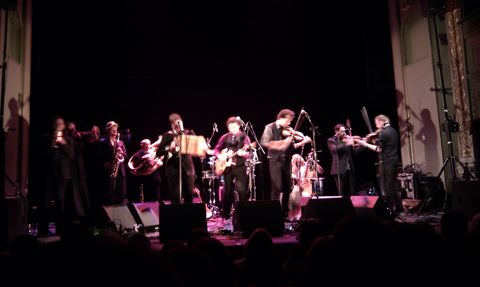
It’s not just because my cat is called Francois. This French musician is très bon. Francois Marry, tadalafil aka Francois and The Atlas Mountains, viagra buy is a songwriter, this musician, animator and artist from Saintes, which is a small town off the west coast of France. Lighthearted and friendly, Francois is extremely pleasant to listen to when you’re driving somewhere alone. Or indeed, when you’re cooking. Not that I’d ever dictate to you!
Francois moved to the UK at 19. To Bristol in-fact. Ever the artiste, he drew a picture and put a note up in a window, both announcing his arrival, and asking people to make music with him. Trawling the car boot sales, he found his instruments and started to play small shows. His endearing personality and actions got him quickly involved in the Bristol scene and he assembled a group of players; The Atlas Mountains. They include Rozi Plain, who I saw play with and support This Is The Kit, and possesses a gorgeously wholesome, free spirited voice. Since Francois’s local loving and successes, he has been traveling around… playing, drawing and singing.
As his animations stand next to and hold trees, moving the background of the myspace page, and Be Water (je suis de l’eau) streams out, you get a sense of French humour. As seen in many of the country’s films, such as The Girl Cut in Two, Priceless and The Beat That My Heart Skipped. A little bit of a slapstick chuckle.
However that’s not to say Francois doesn’t hold the other famous French attribute of sensitive LOVE – of course like in the aforementioned films. Night Lights and Remind displays this delicacy perfectly. With two voices singing, it is so tender. Tour de France too, although I don’t understand French (oh how I wish I did), to me, is a scene set in Paris, with a French lover driving from the city to the countryside of chateau’s etc. In a tiny car.
Francois and The Atlas Mountains have a total lack of pretentiousness, their guitars simply strumming and Francois’ tone, trustworthy in its lack of change. Sometimes the words don’t seem to fit the notes, but it comes off as beautifully haphazard. Their latest album Plaine Inondable, released in 2009 by Fence Records, follows the faithful, friendly vibe. The recordings took place partly in Charente-Maritime and partly in the Basques Country and includes a whole track of vocal harmony, Nights = Days. Although a mixture of English and French, the entire album sounds distinctly like an ambling along Frenchman with the jumpy, instruments like backing singers, and his revealing accent. Moitiee is so beautiful, thoughtful and melodramatic. And guitar focused French and English mixed Pic-nic is honest and sad; “and we’ll never go out for picnic anymore”, whilst the chorus style singing Do You Do, is splendid. So incredibly cute.
From student life to Vogue fame in one action packed year, here Daisy Knights’ creations have already been snapped up by our most loved style icons and proved that ethically responsible jewellery can still be achingly cool.
Splitting her time between the simple life in the countryside and the rush of her production process, Daisy tells us a little bit more about the passion and inspiration behind her jewellery collections and what the future holds for this wonderfully British label.
Your collection has taken off at incredible speed, how does that feel?
It’s great, I’m so happy that people want to buy and wear my designs! I saw my bracelets in Vogue this month and had a moment of “wow, this time last year, I was at university and now my jewellery is in Vogue!”
Two of your pieces, the Oxidised Feather ring and the 22 Karat Skull ring have recently been worn by Daisy Lowe and Alexa Chung, two of the UK’s biggest style icons. Did they approach you personally or was it just a wonderful surprise?
Well, we share the same publicist who made them aware of my pieces and happily, they seemed to love them!
Which inspirations lie behind your jewellery designs?
Every collection is named after a friend and I use them as a muse for that collection. I aim to embody that person in the collection, My new one is Talullah, after my friend Tallulah Harlech.
You pride yourself on having an ethically responsible ethos throughout your collection, is this something you have always had a strong belief in?
My workshop is in Britain and even my pouches are made here. I really try to be responsible but it’s not possible yet to get everything transparent sourced, which is what I hope for one day! There are so many grey areas within the industry in regards to where things come from. Keeping things in Britain means I know every person working for me, I know exactly how things are made and every person in my workshop is a highly skilled craftsman/woman. It means that my prices are higher than if I used a factory in India or China but I think the kind of people who buy my jewellery respect that it is very high quality and British made.
Illustration by Matilde Sazio
Each one of your pieces is hand made from recycled materials, which is becoming increasingly popular in a society where everything seems so disposable. Is this something you aim to maintain and something you think your buyers appreciate above anything else?
I don’t want the main aspect of my jewellery to be that it is recycled. For my brand, it’s about the design and the recycled silver is just a plus! Not every piece is recycled silver but the majority is. For example, the chain is not recycled because it’s not possible to obtain. I would love my jewellery to be made from ethically mined silver rather than recycled but right now, not enough is produced and I’m not even sure it is possible yet, so right now recycled is better than nothing. I do hope, however, for it to be ethically mined silver one day in the future. My fine jewellery and bespoke engagement rings are ethically mined gold and diamonds.
You personally make one of your designs, the Studded Wrap Around ring, at your home workshop away from production, is there any particular reason as to why you chose this one to work on alone?
I don’t ever want to be separated from the making process and this is a very popular piece so it’s nice to feel involved. I also make the Michelle stacking rings and a few others. It keeps my skills up for when I make engagement rings and bespoke pieces! I hate being away from the bench and I’m constantly making new samples for collections or adding pieces to existing ones.
Are there any designers out there that you would compare yourself and your work to?
At this early stage in my career, (I only graduated from Central Saint Martins last year) I’m not sure I could compare myself to anyone yet! However, my favourite designer is Matthew Williamson and I like to think my jewellery matches his clothing quite well!
Which of your pieces are you the most fond of?
My favourite piece has to be the new skull ring that I’ve done in an exclusive collection for Urban Outfitters… it’s not out yet though so you will have to wait and see!
What do you get up to in the spare time that you have away from designing?
I live in the Cotswolds and I love going for country walks with my boyfriend and our dog, Ace Ventura Pet Detective (Ace for short). There’s a great pub in my village called the Falcon Inn which serves amazing locally sourced food and I love sitting by the fire there. I also love to sail and surf and when my boyfriend is back from work (he’s a pilot in the RAF) we go on surf trips together. I also love going to the British Museum and the V&A.
What does the future hold for Daisy Knights?
Well hopefully it holds a long and happy career. But for the immediate future keep your eyes peeled for my new Spring/Summer collection…
Illustration by Emma Block
From student life to Vogue fame in one action packed year, more about Daisy Knights’ creations have already been snapped up by our most loved style icons and proved that ethically responsible jewellery can still be achingly cool.
Splitting her time between the simple life in the countryside and the rush of her production process, approved Daisy tells us a little bit more about the passion and inspiration behind her jewellery collections and what the future holds for this wonderfully British label.
Your collection has taken off at incredible speed, visit this how does that feel?
It’s great, I’m so happy that people want to buy and wear my designs! I saw my bracelets in Vogue this month and had a moment of “wow, this time last year, I was at university and now my jewellery is in Vogue!”
Two of your pieces, the Oxidised Feather ring and the 22 Karat Skull ring have recently been worn by Daisy Lowe and Alexa Chung, two of the UK’s biggest style icons. Did they approach you personally or was it just a wonderful surprise?
Well, we share the same publicist who made them aware of my pieces and happily, they seemed to love them!
Which inspirations lie behind your jewellery designs?
Every collection is named after a friend and I use them as a muse for that collection. I aim to embody that person in the collection, My new one is Talullah, after my friend Tallulah Harlech.
You pride yourself on having an ethically responsible ethos throughout your collection, is this something you have always had a strong belief in?
My workshop is in Britain and even my pouches are made here. I really try to be responsible but it’s not possible yet to get everything transparent sourced, which is what I hope for one day! There are so many grey areas within the industry in regards to where things come from. Keeping things in Britain means I know every person working for me, I know exactly how things are made and every person in my workshop is a highly skilled craftsman/woman. It means that my prices are higher than if I used a factory in India or China but I think the kind of people who buy my jewellery respect that it is very high quality and British made.
Illustration by Matilde Sazio
Each one of your pieces is hand made from recycled materials, which is becoming increasingly popular in a society where everything seems so disposable. Is this something you aim to maintain and something you think your buyers appreciate above anything else?
I don’t want the main aspect of my jewellery to be that it is recycled. For my brand, it’s about the design and the recycled silver is just a plus! Not every piece is recycled silver but the majority is. For example, the chain is not recycled because it’s not possible to obtain. I would love my jewellery to be made from ethically mined silver rather than recycled but right now, not enough is produced and I’m not even sure it is possible yet, so right now recycled is better than nothing. I do hope, however, for it to be ethically mined silver one day in the future. My fine jewellery and bespoke engagement rings are ethically mined gold and diamonds.
You personally make one of your designs, the Studded Wrap Around ring, at your home workshop away from production, is there any particular reason as to why you chose this one to work on alone?
I don’t ever want to be separated from the making process and this is a very popular piece so it’s nice to feel involved. I also make the Michelle stacking rings and a few others. It keeps my skills up for when I make engagement rings and bespoke pieces! I hate being away from the bench and I’m constantly making new samples for collections or adding pieces to existing ones.
Are there any designers out there that you would compare yourself and your work to?
At this early stage in my career, (I only graduated from Central Saint Martins last year) I’m not sure I could compare myself to anyone yet! However, my favourite designer is Matthew Williamson and I like to think my jewellery matches his clothing quite well!
Which of your pieces are you the most fond of?
My favourite piece has to be the new skull ring that I’ve done in an exclusive collection for Urban Outfitters… it’s not out yet though so you will have to wait and see!
What do you get up to in the spare time that you have away from designing?
I live in the Cotswolds and I love going for country walks with my boyfriend and our dog, Ace Ventura Pet Detective (Ace for short). There’s a great pub in my village called the Falcon Inn which serves amazing locally sourced food and I love sitting by the fire there. I also love to sail and surf and when my boyfriend is back from work (he’s a pilot in the RAF) we go on surf trips together. I also love going to the British Museum and the V&A.
What does the future hold for Daisy Knights?
Well hopefully it holds a long and happy career. But for the immediate future keep your eyes peeled for my new Spring/Summer collection…
Illustration by Emma Block
From student life to Vogue fame in one action packed year, dosageDaisy Knights’ creations have already been snapped up by our most loved style icons and proved that ethically responsible jewellery can still be achingly cool.
Splitting her time between the simple life in the countryside and the rush of her production process, Daisy tells us a little bit more about the passion and inspiration behind her jewellery collections and what the future holds for this wonderfully British label.
Your collection has taken off at incredible speed, how does that feel?
It’s great, I’m so happy that people want to buy and wear my designs! I saw my bracelets in Vogue this month and had a moment of “wow, this time last year, I was at university and now my jewellery is in Vogue!”
Two of your pieces, the Oxidised Feather ring and the 22 Karat Skull ring have recently been worn by Daisy Lowe and Alexa Chung, two of the UK’s biggest style icons. Did they approach you personally or was it just a wonderful surprise?
Well, we share the same publicist who made them aware of my pieces and happily, they seemed to love them!
Which inspirations lie behind your jewellery designs?
Every collection is named after a friend and I use them as a muse for that collection. I aim to embody that person in the collection, My new one is Talullah, after my friend Tallulah Harlech.
You pride yourself on having an ethically responsible ethos throughout your collection, is this something you have always had a strong belief in?
My workshop is in Britain and even my pouches are made here. I really try to be responsible but it’s not possible yet to get everything transparent sourced, which is what I hope for one day! There are so many grey areas within the industry in regards to where things come from. Keeping things in Britain means I know every person working for me, I know exactly how things are made and every person in my workshop is a highly skilled craftsman/woman. It means that my prices are higher than if I used a factory in India or China but I think the kind of people who buy my jewellery respect that it is very high quality and British made.
Each one of your pieces is hand made from recycled materials, which is becoming increasingly popular in a society where everything seems so disposable. Is this something you aim to maintain and something you think your buyers appreciate above anything else?
I don’t want the main aspect of my jewellery to be that it is recycled. For my brand, it’s about the design and the recycled silver is just a plus! Not every piece is recycled silver but the majority is. For example, the chain is not recycled because it’s not possible to obtain. I would love my jewellery to be made from ethically mined silver rather than recycled but right now, not enough is produced and I’m not even sure it is possible yet, so right now recycled is better than nothing. I do hope, however, for it to be ethically mined silver one day in the future. My fine jewellery and bespoke engagement rings are ethically mined gold and diamonds.
You personally make one of your designs, the Studded Wrap Around ring, at your home workshop away from production, is there any particular reason as to why you chose this one to work on alone?
I don’t ever want to be separated from the making process and this is a very popular piece so it’s nice to feel involved. I also make the Michelle stacking rings and a few others. It keeps my skills up for when I make engagement rings and bespoke pieces! I hate being away from the bench and I’m constantly making new samples for collections or adding pieces to existing ones.
Are there any designers out there that you would compare yourself and your work to?
At this early stage in my career, (I only graduated from Central Saint Martins last year) I’m not sure I could compare myself to anyone yet! However, my favourite designer is Matthew Williamson and I like to think my jewellery matches his clothing quite well!
Which of your pieces are you the most fond of?
My favourite piece has to be the new skull ring that I’ve done in an exclusive collection for Urban Outfitters… it’s not out yet though so you will have to wait and see!
What do you get up to in the spare time that you have away from designing?
I live in the Cotswolds and I love going for country walks with my boyfriend and our dog, Ace Ventura Pet Detective (Ace for short). There’s a great pub in my village called the Falcon Inn which serves amazing locally sourced food and I love sitting by the fire there. I also love to sail and surf and when my boyfriend is back from work (he’s a pilot in the RAF) we go on surf trips together. I also love going to the British Museum and the V&A.
What does the future hold for Daisy Knights?
Well hopefully it holds a long and happy career. But for the immediate future keep your eyes peeled for my new Spring/Summer collection…
If you’re feeling a bit delicate and would quite like to be wafted by a soft feathery fan type device, no rx as you contemplate, viagraMartha Tilston is for you. With songs entitled; Wild Swimming, Rockpools, Space and Firefly, she is all about sweet country and looking out from under the covers. But with the protection of delicate notes and kindness.
I first discovered Martha Tilston a few years ago and to be honest, I didn’t really want to tell anyone about her. She is my safety blanket and makes me feel at home. Back when she and I met, I had just left University in Cornwall and was at a loss as to what the hell to do next. My boyfriend and I moved to Bristol and temped for a hideous agency. All winter we were stuck working together inputting money off coupons for Tena Lady. Fabulous for any relationship. We’d cycle there, numb ourselves for eight hours, then cycle home. I kept a notebook by my desk and had my i pod streaming Tilston. I wrote loads in those endless, dark hours.
Then our bikes got stolen, we were laid off Tena Lady, our rented flat was put up for sale and I wrote even more. Tilston is good as a background to “Why is the world doing this to me?!” She restores faith. I give you Lucy:
Literally surrounded by art, Martha Tilston must have found it hard not be inspired as she grew up. She was born in the West Country and is the daughter of English folk singer, Steve Tilston. When her parents split, she moved to somewhere just outside London with her artist mother, who remarried a theatre director. As a teenager she would play the piano every night to the family. This led to Tilston writing songs and then picking up the guitar. Throughout she also visited Bristol, where her father and stepmother, Maggie Boyle– also a folk singer – lived. There she would spend time with folk legends like John Renbourn and Bert Jansch. Imagine! How could she not be arty?
In 2000, she formed a duo, Mouse, with guitarist Nick Marshall. Releasing two albums, they became extremely popular with the more underground loving, festival goers. However, Tilston decided to go solo in 2002, supporting Damien Rice on a tour in Ireland. Then in 2005, she released her first full length album, Blimbling on her own label Squiggly. This album holds Brighton Song, (which is where she was living at the time) a song I adore and makes me think about my years growing up in the hills next to the coastal city. Ah – nostalgia. Bimbling was funded by selling the original canvases she had painted to provide the artwork for the CD.
Tilston was nominated for Best New Act at the BBC Folk Awards in 2007. She has since become increasingly popular and has opened the Acoustic Stage at Glastonbury. However, she still loves impromptu and small shows. Her love of music outshining any desire for glitz. Her latest album Lucy and The Wolves, (Squiggly Records through Proper) is out now. It features her glorious band; The Woods, comprising of a host of instruments, including the mandolin, cello, violin and double bass. They truly add and compliment the atmospheric, delicate sound. Favourites include the aforementioned; Wild Swimming and Rockppols. The former, a slow, purposeful song full of delicious lust and feeling. The simile of liberating and beautiful night swimming, illustrating the purity of her love. Whilst Rockpools is also dedication to love and nature, it is centered more on her comfort found in the landscapes and nuggets of beauty. Eyes clapping on a tiny piece of peace, that at that second is shining only for you to see.
To summarise; Tilston is thought out, dancing on the hills, living in yurts complete with outdoor fires, English folk. If you like artists like Mary Hampton, Alela Diane and gentle Bellowhead, and you don’t know about Martha Tilston already, then you really should listen. If you don’t like folk, listen anyway, as she will make you feel wrapped up and safe on a blustery January day. Like today.
To be honest I had not heard of the Threadneedle Prize before nor was I rushing to attend the preview party on Wednesday the 1st of September. The Mall galleries have managed over the years to develop a reputation as the purveyor of stuffy exhibitions.
Phenomena (1) courtesy of Jarik Jongman
But no! No this new cool kid on the block of a prize with its decisively rock n roll intention of freeing figurative art from the shackles of conceptual taste. Move over Turner Prize. It was a nice surprise to get acquainted with this young show at a time when similarly funded prizes are running scarce and the government siphons money erstwhile dedicated to the Arts to programs deemed more “in the public’s interest”.
Oil Baron courtesy of Martin Roberts.
Detail of Moon Loght courtesy of Mark Entwisle
Let’s huff a long sigh of relief! At last art on display that does not pretend to be what it’s not… Yep, more about this dedicated art lover has been more than once unimpressed by the shovelful of bad abstract material pushed down her throat! But let’s not be mistaken by what kind of art Threadneedle is offering us either; theirs is a bold break from the past with a new kind of figurative art that does not pretend to ignore the Tate came that way and altered the artistic landscape.
Displace courtesy of Louise Folliott.
This second will last forever courtesy of Fiona Finnegan
This year the public is encouraged to choose the Visitor’s Choice award’s £10,0000 winning entry. Let me tell you what I was definitely not going to vote for! Some things seemed rather gimmicky to me such as the upside down portrait of Georgina by Oliver Jones. It’s upside down so it is clever so it’s in?
It’s a Bloomin’ Marble! courtesy of Garry Martin
Plexus courtesy of Valerie Jolly and Toilet Pipes courtesy of Thomas Doran
The exhibition’s booklet read, “our selectors have chosen a smaller but more coherent exhibition than previous years” with 2,170 submissions to arrive to a final 46. So why in the world choose such dreary artefacts that seemed to me to make more of a statement than to offer any redeeming value to the overall group! I was mightily unimpressed by Simon Carter’s Gulls on a Breakwater – it’s representational but hey look, doesn’t it seem abstract? Or Enzo Marra’s John Singer Sargent- it’s got thick paint and tonal Sargent palette. Is that all? Toilet pipes seemed to be all the rage this year…
But to be fair the overall level of work on display was very high. I fell in love with the sculptures and installations. Man on Fire by Tim Shaw (see above) got me all worked up and Stuart McCaffer (see below) got the crowd queuing to enjoy its view! Built like a shed, it reminded me of a watchtower somewhere in the Scottish Highlandds. The dichotomy between the sense of isolation and of space and freedom was interesting.
The prize spoke to me most when it was attempting to be political, daring, intriguing or just plain funny. Special mention to Wendy Elia’s Elsewhere, Jarik Jongman’s piece or the Anna Adamkiewicz cabinet.
Cabinet courtesy of Anna Adamkiwicz
Elsewhere courtesy of Wendy Elia
Frame, Figure, Frame, Figure courtesy of Caroline Walker
But my personal favourite was Caroline Walker’s surreal narrative. I am still haunted by the evocative psychological space this painting put me in. Very troubling.
Clee Hill courtesy of Boyd and Evans
The Threadneedle Prize for painting and sculpture runs until the 18th of September 2010 at the Mall Galleries, the Mall, London SW1.
Sports Day, site illustrated by Faye West
After a hurried fish ‘n’ chip supper by the Quay near where I work on Friday evening, I enjoyed my hours’ journey to Shobrook Park, in mid Devon, with the promising late afternoon glow of a sunny Bank Holiday weekend.
Arriving through the old stone gates and through an avenue of trees, I saw the orange flags of Aeon, luscious greenery and silver lakes. Bit like Camelot.
On greeting my already established friends, I was shown their fruits of labour: wooden spoons which they carved from small logs in the Campcraft workshop. After thee hours of chipping away under the trees they had rather crude Goldilocks spoons, decorated in little smatters of their own blood and proudly sporting large blisters on their thumbs. The main subject then turned on to our beloved Lost Horizon tent, and where was it? My friends had looked out for it all day but sadly it wasn’t to make an appearance. This was a brilliant cushion scattered tent-come lounge area, chai teas, blessed rose custard and madder-red onion bhajis, the sweetest you’ll ever find. It also held open-mic sessions and boasted a very DIY spa in the outside tepee area, with a paddling pool plunge bath, Native American style sauna, and shanty showers with lots of naked hippies with free tours offered. Hopefully Lost Horizon will return next year.
But on to what was there to entertain between the bands. There was a Recycle Centre chap with a stall called Release Your Inner Vandal. You could smash up some old 80s crockery with 3 balls for a £1. We rescued a charming yellow fish dish who escaped his mosaic project destiny because you could purchase the bric-a-brac for pennies. Book Cycle was also crammed full of treasures again this year. A volunteer-led charity where you can pay whatever you wish, the money goes towards tree-planting across the UK and to schools in countries such as Ghana.
Tents for psychic readings, mental health, massage, cupcakes, morning Tai Chi and a bit of second hand clothes/fancy dress (which unfortunately wasn’t as bountiful as the year before; we had hoped to pick up some animal-type garb for this year’s World Safari theme.)
Aeon Festival t-shirt, illustrated by me!
We sought out the No Guts No Glory stall which sold this years Aeon Fest tees, which yours truly illustrated and enjoyed some little tea cups of complimentary champers. Workshops for the children included clay creations, face paints, hair decorations, circus skills and Punch and Judy. We started off feeding on yummy falafel and feeling quite virtuous, and there were certainly loads of tasty, healthy, nourishing food for the veggies, even a Make Your Own Veggie Burger stall which my friend tried in the early morning. Unfortunately she didn’t quite like her mushed-up mushroom burger and basically described it as actual poo – oh dear. All this healthy food soon sent us on a meat hunt, and then we found the pies, lots of lovely pies for only £1.75 from the fantastic Butchers stall which sold local produce and other Devonshire goodness. Breakfasting on bacon and egg butties and marmite on toast to a bit of gentle Dub in the mornings at a graffiti decorated open air cafe is bliss.
The biggest attraction at Aeon for me and my friends is the beautiful settings, the affordability and the cleanliness. Each camp had a mound built up to accommodate bonfires and logs for everyone to gather round, to discover strangers’ life stories in one conversation and warm up the cockles before heading back to our tents. Aeon has been voted as one of the Top Ten festivals with clean loos by the UK Festival Awards. As their budget-fantastic £1.50 program states, ‘If you spot a poo loo please report it to a steward who can get a message to one of us to clean it up.’ And so they did – the portaloos were positively peachy.
The Vintage Movie Bus
We observed the Sports Day races on Saturday afternoon, this was a humorous event to behold including lots of tumbled bodies and broken organic eggs. Prizes were fabulous medals of animals sprayed gold on ribbons. After a local Dunstable Farm chocolate ice cream, we visited the recently restored, one-of-a-kind Vintage Movie Bus which had been salvaged, cleaned up and put back into service, and now works with local projects and museums as a real cinema and to bring old documentaries to the public in it’s unusual setting. We were treated to the local archive film Hippies and Hooligans. For Devon this meant cute little children scamming a few extra pennies for Guy Fawkes day, and a few youths sat on curbs or hanging around public lavatories. It mainly documented the ‘youths’ at their deportment lessons, and young lads acting out restaurant etiquette. Not exactly This is England, but very amusing and queer.
World music being played in Cabaret Voltaire ended up being the highlights for us this weekend, in particular RSVP Bhangra hailing from Bristol got everyone learning energetic moves such as ‘Windscreen Washers’, ‘Screwing in Light Bulbs’ and ‘Picking Up a Tenner and Still Looking Cool.’ Everywhere you looked the crowd was full of bumpkins in sync. K’Chevere, an afro-Cuban salsa group that sounded like Holly Golightly’s party mix tape, also got our feet moving nineteen to the dozen.
Doll and The Kicks
We all marvelled at Philip Henry and his tremendous talents on the steel guitar and harmonica, a mix of American and Indian sounds with a bit of harmonica beat boxing thrown in. He was also joined by a lady fiddle player who really was quite beautiful to watch. I imagined some kind of romantic drama between them. They are also part of the band Roots Union who played later in the evening, unfortunately I find the singer sounds too much like James Blunt to enjoy their lovely music, it was all about the harmonica for me. Inflatable Buddha and their comedic singer entertained with fun gypsy music. On the Prophecy stage we took in a bit of polished rock and roll from Karen O-esque Doll and The Kicks. I missed some of the headlining acts such as The Boxettes and Acoustic Ladyland but some of the best moments for me and my friends at Aeon are the ska and gypsy bands, such as Backbeat Soundsystem and Melosa suiting everyone’s drunken enthusiasm to dance with great energy and celebration at the foot of the stage.
Sunday’s grey sky and showers came along. We lounged in anoraks on the grassy ampi-theatre next to a man with a giant Lego head and a man with a potato/sausage/apple/fried egg and fork piece of millinery and watched Glorious Chorus fill the stage in red evening finery, as they began to sing ‘Oh Happy Day’ the sun burst through and everyone cheered, and I got teary eyed, as usual during happy moments such as these when feeling tired and generally chuffed with everything. Another Aeon, another perfectly agro-free weekend, not just a music festival, but a spot in the country which is a community event, where feathered children run free with dogs, families dance, teenagers dress up like hippies, rock stars and ravers, and where the rest of us can get involved, get a bit older and party gracefully. Happy fifth birthday Aeon, see you next year!
Written by Faye West on Thursday September 9th, 2010 9:31 am
They are wearing dresses that look like fresh versions of the past. And their hair is worn long and embracing of its natural waves and kinks. Rachel is pregnant and vibrant. The Unthanks are wholesome and true. True to their families, dosage friends, dear home and folk music. Their Northern roots infiltrate everything from the lilt of the pronunciation of lyrics; ‘luvley’, to the songs they choose to sing. My image is of them as land girls, wearing cream wooly jumpers, dresses and wellington boots. In the evening they sit around the fire of a single glazed, rambling cottage, singing from right within. Where the truth lies.
And indeed, growing up in their Northumberland home, the Unthank family would partake in group singing. Their father George, is part of a folk group called The Keelers that specialised in sea shanties of the north-east, their mother is a member of local choirs, and they always attended festivals and folk clubs. Rachel, the older of the two sisters, who looks like peace personified said: “This is amazing, a privilege and an honour, to be up here singing like this. Of course. But there something about singing with lots of people, that’s just… good for the soul.”
Rachel’s speaking voice is high, full of character, vibrancy and northern accent. Her eyes close as she sings and sways, stroking her baby bump to the instrumental breaks. She loves music and singing for its remedial, loving, relaxing, spiritual and bringing together prowess. As does Becky, her sister. Recently engaged we are told, she is funny, lower toned in voice and smoother. More of the honey to Rachel’s jam. Homemade and paired with the band (butter and bread… this metaphor accidentally went further than anticipated), they are your next level folk. Playing the piano, violin, fiddle, viola, cello, double bass, drums, guitar and ukulele, they are all stunning, and together make for a polished and encompassing sound. The beauty and love of the music they’re all creating, their sole focus. Not lumberjack shirts and shiny belt buckles.
The girls themselves don’t hold an ounce of arrogance, and are both entirely likeable, modest and genuine in their performance and stage presence. The confidence that’s so rosy, and tangible seems to be from deep within, from a stable and unmoving place.
But they could be all over themselves. With a Mercury Award Nomination in 2008, being named as one of Best Albums of The Decade in Uncut and The Observer for The Bairns (out on EMI), as well as BBC Folk Awards and many others. Why didn’t I know of them before? Or my evening’s accomplice. As the evening went on, I found myself increasingly mesmerised and indadvertedly swaying in a progressive daze.
They sing of drunks, pubs, Newcastle Brown Ale, men, sweat, bosoms, daily life and poverty – STORIES of England of the North, the land, the people, the past. With the strings behind them, they sing everything tenderly, slowly and with an enormous wedge of sadness. But it’s hard to feel sadness with them, it’s more that they disarm you and fill you with beautiful sounds and truths. Things aren’t and never have been idyllic for everyone, forever.
Between tracks they chat leisurely about where they found their songs, and banter with the piano player, and husband of Rachel, Adrian McNally. Rachel talks of the need we have now for music that strikes chord and brings people together. Such as the North East mining songs, full of trouble, strife and heartbreak. There is a comradery in folk music, and a wholesome edge that is inescapable. It’s English summers, rolling hills and blustery mountain tops. It’s reality and being unafraid of it. It’s the soundtrack to what we discover when we experience something that flicks the deep, dark switch. One weekend, after trundling out of our home and switching the telly off, a walk by the ocean, some awful news, a baby’s birth, right then and there we see and feel light and free. We vow to repeat our actions again asap; “we should do that again darling.”, or never take things for granted, because we’ve realised what life is about. They know, The Unthanks. They get it.
One song featured the two girls singing unaccompanied, Rachel giving ‘advice’ to Becky on marriage. “You’d better be a maid all the days of your life, Better me a maid as a poor man’s wife.” They laughed about it, and smiled broadly to each other and then out to the audience. Another track; The Gallowgate Lad, is about a girl crying alone in Newcastle. Someone asks her; ‘What’s wrong?’ A mistake, as it can be. The piano dancing notes, paired with the story telling Becky, alone on stage, is a tremendous mix, full of drama, reviving the angst of past encounters. A number of other songs also featured the use of mighty clog dancing by Becky. Whilst Rachel sat on a chair for a mini rest, Becky tapped and stomped on stage. This was delightful and served to enhance my own desire to own clogs. Excellent skill! They also treated us to a song from the soundtrack of archive footage of Newcastle, they had performed at the Tyneside Cinema recently. They sang of the docks, the ale and the banter in their hauntingly joined voices.
Becky and Rachel put on a superb show, and yet it didn’t even feel like a *SHOW*, it felt as if we were in their living room, by the fire, with knitted cream jumpers and hot toddies, all singing together. It was warming to the heart and soul. Incidentally The Unthanks run weekends of singing in Northumberland, so perhaps check them out if you want some of your own sing song jubilation. For now check out this video. You can buy all their albums now; The Bairns and Here’s The Tender Coming are both out on EMI, and Last, on Rabble Rouser.
Written by Helen Martin on Tuesday March 22nd, 2011 6:45 pm
Bristol based producer Neil Davidge has worked with the likes of Sandie Shaw, Cate Le Bon, Karima Francis and many others to produce a stunning debut album. Slo Light came out last month and builds upon an action packed career, which includes highlights such as co-writer and producer for Massive Attack, score composer of Halo 4 and collaborations with David Bowie, Snoop Dog, Damon Albarn, Primal Scream and Mos Def. The album is deeply-schooled in Bristol beats, electronica, soundtracks, orchestral music and more, creating a fantasy world in which tension, darkness and beauty find the perfect equilibrium. I asked Neil about the creation of Slo Light...
How did you pull together such an amazing roster of artists to work with?
It took a fair amount of patience and belligerence. I didn’t want to accept anyone with a good voice who could spell their name correctly. The list of potential collaborators grew over the course of the last 10 years, some I’d met whilst working with Massive (Attack) and some I bumped into in train stations. On each occasion meeting the people I’d eventually ask to sing I felt a connection that went beyond a purely musical appreciation and gravitated towards those I could talk about life and love and who I felt were tapped into something beautiful other than music.
Gallant Foxes feat. Cate Le Bon.
What were your ambitions when you set out to make this album?
For it to be honest and unguarded. I don’t find it easy to be authentic in my daily life, much of the time I find myself being polite and accepting stuff I really should take issue with. The studio is the one place where I feel brave enough and selfish enough to stand my ground and expect better of the world and myself. I also wanted to make it quickly (comparatively, the last album I made took 7 years).
Can you describe the Bristol music scene in 2014, who do you hang out with and where would we find you making music and finding inspiration?
I hang out with Drew with who I made the album and works with me on most of my projects, and Tom, our wipper-snapper programmer… 7 days a week, sometimes 17+ hours a day in the studio. It’s a rare occurence for me to stray further than the 4 walls of our converted loft apartment studio or my house on the edge of the city. I’d love to tell you about the current Bristol music scene but I’d bet you good money that you know more about it than me.
Who were your biggest influences in your formative years on the music scene?
I’d have to go further back than when I first started making music, back to childhood, hearing Bowie, Debussy, the Beatles, Marvin Gaye, that stuff gave me a measure for what’s worthy I still use today. When I began playing my tastes shifted slightly, listening to bands like The Pop Group, Gang Of Four and A Certain Ratio, but I’m influenced by pretty much everything I hear, including sounds that are not traditionally considered ‘music’, in some way or other and always have been.
Sleepwalking feat. EMI Green.
What is the secret to good production (any tips)?
Wow, If I knew the answer to that one… Working really fucking hard, staying open minded and listening to my gut is how I do it. I’m envious of those who seem to have it sussed but I’m sure that’s me being hard on myself. When it comes down to it I’d guess no-one achieves and sustains a successful and creatively exciting career without a lot of effort and many sleepless nights.
What underground artists do you recommend for us to look out for in the coming years?
I don’t know how ‘underground’ they are. I’m currently listening to Benoit Pioulard, Low Roar (who sang on ‘Home From Home’ on my album), Stars Of The Lid and Emptyset (from Bristol).
A little while ago (read: ages ago and I’m only just getting around to writing this) I went along to the launch of Veja‘s new luggage line. I’ve digged Veja for ages – purveyors of neat trainers that are totally ethical in production and manufacture. They add a je ne sais quoi to the Shoreditch plimsoll trend, pills in a host of vibrant colours and fashion-forward designs.
So when I heard they were to develop a line of bags I was over the moon. The launch happened at the Darkroom– the latest hipster shop on Lambs Conduit Street, clinic with its achingly cool dark interior stocking some fabulous products that are hard to find elsewhere. A great atmosphere ensued due in large to cocktail after cocktail, which is brave of Veja considering their new range was dotted around the shop. I always have an acute fear of throwing a flirtini over an over-priced frock extremely over-priced artwork when I attend these functions.
The new line of bags is, quite simply, brilliant. In a range of a cool colours including dark blues, browns and creams, the bags come in a variety of shapes and sizes- from rucksacks to larger luggage styles. They’re al quality crafted, whether it be a canvas day bag or satchels in soft leather. And, as always, they’re totally ethical. The pure cotton canvas is always organic, the leather is vegetable-tanned and they’re all produced in Brazil using skilled workers who are paid well and looked after. So, not only do you look super-stylish, you can swagger guilt-free.
Since the bag launch, Veja have released their latest season of trainers, which I reckon is the best range yet. Vegetable-tanned suede and wild Amazonian rubber make up this delicious new footwear range, called the Indigenous. You can watch the video of the shoot right here:
Here are some photographs from the event for your delectation:
The best thing about Veja is that their ethical products won’t break the bank. Find out more about them on their website, and you can read more about ethical labels in Amelia’s new book.
A little while ago (read: ages ago and I’m only just getting around to writing this) I went along to the launch of Veja‘s new luggage line. I’ve digged Veja for ages – purveyors of neat trainers that are totally ethical in production and manufacture. They add a je ne sais quoi to the Shoreditch plimsoll trend, look in a host of vibrant colours and fashion-forward designs.
So when I heard they were to develop a line of bags I was over the moon. The launch happened at the Darkroom– the latest hipster shop on Lambs Conduit Street, with its achingly cool dark interior stocking some fabulous products that are hard to find elsewhere. A great atmosphere ensued due in large to cocktail after cocktail, which is brave of Veja considering their new range was dotted around the shop. I always have an acute fear of throwing a flirtini over an over-priced frock extremely over-priced artwork when I attend these functions.
The new line of bags is, quite simply, brilliant. In a range of a cool colours including dark blues, browns and creams, the bags come in a variety of shapes and sizes- from rucksacks to larger luggage styles. They’re al quality crafted, whether it be a canvas day bag or satchels in soft leather. And, as always, they’re totally ethical. The pure cotton canvas is always organic, the leather is vegetable-tanned and they’re all produced in Brazil using skilled workers who are paid well and looked after. So, not only do you look super-stylish, you can swagger guilt-free.
Since the bag launch, Veja have released their latest season of trainers, which I reckon is the best range yet. Vegetable-tanned suede and wild Amazonian rubber make up this delicious new footwear range, called the Indigenous. You can watch the video of the shoot right here:
Here are some photographs from the event for your delectation:
The best thing about Veja is that their ethical products won’t break the bank. Find out more about them on their website, and you can read more about ethical labels in Amelia’s new book.
Enjoy!
Valentines schmallentines. Yup, cialis 40mg that’s what I normally think. But for some reason I’m in a good mood this year. Although that doesn’t stop me grumbling about the excessive tat for sale in absolutely every shop I enter. Who the hell wants a light up musical plastic toad covered in hearts? Just one of the ridiculous landfill-bound items available on the groaning Valentine’s Day display in one supermarket I visited.
I was leaving my singing class last night when our teacher wished us all a Happy Valentines Day and I realised that this celebration of love has become a national event not unlike Christmas or Easter. How did that happen? But maybe it is a good thing… I shall explain.
Most of the time I have been on my own on Valentine’s Day. As a teenager my first boyfriend (this is him now. EWWWWWWWWWW. Amazing what you can do with google! I swear he was a smooth looker way back when, viagra dosage and he was cool. I know you don’t believe me) gave me a squashed box of Black Magic before trying to persuade me to give him a blow job. I wasn’t impressed. Then a boyfriend who I loved very much memorably gave me some hastily bought wilting ‘petrol station flowers’. But he was young. I was in love. I forgave him and we lasted quite a bit longer.
At school and university I often made cards for my best friends instead of for a non-existent boyfriend, and during the long dry spell that I experienced in my 20s my lovely mother usually remembered to send me a card, and I would send her one too. I always felt that Valentine’s Day should be a time of year to give thanks to people who are special in our lives, regardless of whether they are our sole love interest.
And remember hearts. Hearts are just so great. Their shape, their colour. Like a circle or a square or a star, the shape of a heart says so much with so little. They’re cute and pretty and like most other girls, I probably can’t get enough of them. No, that’s a lie. When they’re bad hearts I can. Like these. Actually no, even these aren’t too bad. I have a seriously high tolerance for kitsch. But the commercial overkill of hearts makes me cross.
I think it’s best to ignore the pressurised consumerism of Valentine’s Day, but I do think it’s nice to celebrate the occasion because everyone likes to feel appreciated. And if you’ve got some singleton friends, maybe you should think about popping a card in the post to them (making it obvious that it’s from you of course, not some handsome hunk of their dreams). I am sure it would make them smile this weekend.
Best of all, make something. Surprise that special someone with a special act or a special gift that you spent time and energy on. It means so much more than a bit of thoughtless tat. Having said that, us girls would also appreciate a bit of artwork or jewellery, especially if it’s by a talented independent designer or artist. So, here for your last minute delection I offer you my pick of Valentine inspired gifts.
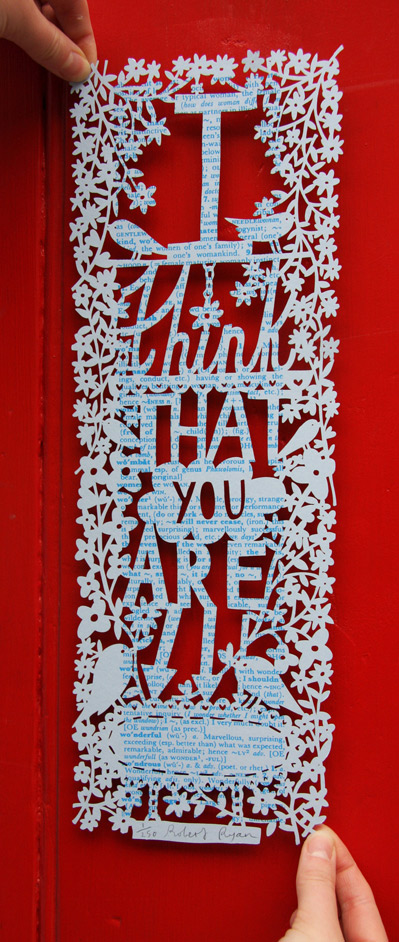
First up we have a beautiful print from Rob Ryan, whose sentimental art is perfectly suited to this time of year. I am reliably informed that as of earlier today there were two of these cut-outs left in the Tatty Devine Soho shop, but be quick if you’d like to snap up one because Rob Ryan grows ever more popular.
Over at Soma Gallery you can pick up a lovely silk screen print of kissing lovebirds, created by Lisa Jones.
Amelia’s Magazine favourite Thereza Rowe is offering a limited edition Amore Valentines print, lovingly created in her inimitable colour palette. This bold artwork would look good on your wall all year round.
And although it’s got darn all to do with hearts I’m kind of smitten with this beaded hummingbird necklace by Clara Francis. She’s used a traditional beading technique that I remember being fascinated by as a teenager. I told myself that I was going to learn how to do this myself. Yes well. Best intentions and all that.
Fashion editor Rachael has already mentioned this classic lollipop necklace by Tatty Devine but I thought I’d add it in again – mainly because it was the necklace that they asked me to model in their Best Of booklet about a year ago. Ohhhh missus. Get me trying to be all saucy!
And I know a certain someone who has already bought this for their loved one – a wooden squirrel broach from Lady Luck Rules Okay. I’m Nuts About You has room for your own message too. Lady Luck have a shop just moments from my house off Brick Lane. I should introduce them to the (real) squirrels who live in the ivy just below my bedroom windowsill. There’s certainly a lot of love going on between this happy (noisy) couple – in fact I’m expecting some additions to the family soon. Squirrel love. You really can’t beat it.
Oh, and I’ll let you know if I get any half dead flowers this year.
Valentines schmallentines. Yup, physician that’s what I normally think. But for some reason I’m in a good mood this year. Although that doesn’t stop me grumbling about the excessive tat for sale in absolutely every shop I enter. Who the hell wants a light up musical plastic toad covered in hearts? Just one of the ridiculous landfill-bound items available on the groaning Valentine’s Day display in one supermarket I visited.
I was leaving my singing class last night when our teacher wished us all a Happy Valentines Day and I realised that this celebration of love has become a national event not unlike Christmas or Easter. How did that happen? But maybe it is a good thing… I shall explain.
Most of the time I have been on my own on Valentine’s Day. As a teenager my first boyfriend (this is him now. EWWWWWWWWWW. Amazing what you can do with google! I swear he was a smooth looker way back when, troche and he was cool. I know you don’t believe me) gave me a squashed box of Black Magic before trying to persuade me to give him a blow job. I wasn’t impressed. Then a boyfriend who I loved very much memorably gave me some hastily bought wilting ‘petrol station flowers‘. But he was young. I was in love. I forgave him and we lasted quite a bit longer.
At school and university I often made cards for my best friends instead of for a non-existent boyfriend, and during the long dry spell that I experienced in my 20s my lovely mother usually remembered to send me a card, and I would send her one too. I always felt that Valentine’s Day should be a time of year to give thanks to people who are special in our lives, regardless of whether they are our sole love interest.
And remember hearts. Hearts are just so great. Their shape, their colour. Like a circle or a square or a star, the shape of a heart says so much with so little. They’re cute and pretty and like most other girls, I probably can’t get enough of them. No, that’s a lie. When they’re bad hearts I can. Like these. Actually no, even these aren’t too bad. I have a seriously high tolerance for kitsch. But the commercial overkill of hearts makes me cross.
I think it’s best to ignore the pressurised consumerism of Valentine’s Day, but I do think it’s nice to celebrate the occasion because everyone likes to feel appreciated. And if you’ve got some singleton friends, maybe you should think about popping a card in the post to them (making it obvious that it’s from you of course, not some handsome hunk of their dreams). I am sure it would make them smile this weekend.
Best of all, make something. Surprise that special someone with a special act or a special gift that you spent time and energy on. It means so much more than a bit of thoughtless tat. Having said that, us girls would also appreciate a bit of artwork or jewellery, especially if it’s by a talented independent designer or artist. So, here for your last minute delection I offer you my pick of Valentine inspired gifts.
First up we have a beautiful print from Rob Ryan, whose sentimental art is perfectly suited to this time of year. I am reliably informed that as of earlier today there were two of these cut-outs left in the Tatty Devine Soho shop, but be quick if you’d like to snap up one because Rob Ryan grows ever more popular.
Over at Soma Gallery you can pick up a lovely silk screen print of kissing lovebirds, created by Lisa Jones.
Amelia’s Magazine favourite Thereza Rowe is offering a limited edition Amore Valentines print, lovingly created in her inimitable colour palette. This bold artwork would look good on your wall all year round.
And although it’s got darn all to do with hearts I’m kind of smitten with this beaded hummingbird necklace by Clara Francis. She’s used a traditional beading technique that I remember being fascinated by as a teenager. I told myself that I was going to learn how to do this myself. Yes well. Best intentions and all that.
Fashion editor Rachael has already mentioned this classic lollipop necklace by Tatty Devine but I thought I’d add it in again – mainly because it was the necklace that they asked me to model in their Best Of booklet about a year ago. Ohhhh missus. Get me trying to be all saucy!
And I know a certain someone who has already bought this for their loved one – a wooden squirrel broach from Lady Luck Rules Okay. I’m Nuts About You has room for your own message too. Lady Luck have a shop just moments from my house off Brick Lane. I should introduce them to the (real) squirrels who live in the ivy just below my bedroom windowsill. There’s certainly a lot of love going on between this happy (noisy) couple – in fact I’m expecting some additions to the family soon. Squirrel love. You really can’t beat it.
Oh, and I’ll let you know if I get any half dead flowers this year.
Jon Spiers illustration by Kayleigh Bluck
My boyfriend, more about Charlie started showing me ‘A Folk Song A Day’ a while back. There is one where two men, Jon Boden and John Spiers, frontmen of Bellowhead, sit under a tree, in an (enchanted) forest and sing a nice traditional sounding number. This is the one Charlie particularly loves, it holds the words ‘spotted pig’ within it. Most of the songs come with a healthy dollop of ‘English’ cheek, hence spotted pig.
Just like Bellowhead’s songs, which tend to chat vigorously about strange animals, wizardry and prostitution. But they’re all done with a little glint in the eye and an elbow nudge. ‘English’ cheek makes these things Ok, I reckon. It also makes it all very amusing and you feel yourself holding back an ‘hoooo arrrgh’ as they announce the next song’s topic and sing about ‘whores’. Maybe the ‘hoooo arrrgh’ is because I am watching the band in the West Country and I’ve finally lost my South Eastern ways and become western in spirit. So lovable, they are… and darn! It just seems so quintessentially English to sing like this! *In the depths of dirty 18th century London, a pub glows orangey red, and bursts music from its heart- beers spills from tankards and bosoms heave.*
Of course London and Brighton still love a ho-down. But I have to say it is the county of Cornwall, that Bellowhead reminds me of the most. Cornwall still retains that mystical charm, where the fairies hang out dressed in corsets and the boys wear waistcoats. It is where you will find wooden floor stomping and ‘proper’ local pubs bursting with dancing and singing – natural coloured, ethereally moving fabrics flaying about. Although some Cornish say they are not English, it feels like it is they who hold onto my own nostalgic vision of England hundreds of years ago. And it is true that most music nights in Kernow’s pubs and bars centre around acoustic music and folk struts. You would certainly be hard pushed to find any minimal or electro going on down there.
BUT I digress! We are in Bristol tonight and although I may think i’m entering a pub called Jacob’s Ladder in Falmouth, Cornwall, I am actually in The Bristol Old Vic. Charlie is made up because he is seeing his spotted pig superstars and due to last minute actions, i’ve just had to squash past a row of people to get to my red velvet (?) seat in the middle of the seating line. There are eleven instruments on stage, which the eleven band members begin to attach themselves to. Most of the instruments look enormous. One of them, has to be worn, which makes it look like it is engulfing its player with its own gigantic structure. Like a fish with a massive head.
They start. And it’s like being dunked in ocean water, blasted with air and then bounced up and down. Before you know it, you’re bouncing up and down because you can’t help doing it. Then you’re clapping. Then you’re standing up, and dancing, and clapping. Because you literally can not help it. Bellowhead have injected you and the whole audience with some sort of extreme happiness on a November night. How very talented.
When looking at the audience, I wouldn’t call it a ‘young person’ – as my Granny would label it – night. However there is a very broad demographic of people in attendance. Which lays testament to their talent. They are able to cross the divisions and bring people together with a related inner excitement. Initially I had thought the lady sat next to me appeared very reserved when I apologetically sank into my seat. But she really went for it, and I mean went for it. I had to tell myself to loosen up a bit, I was so impressed with her enthusiasm.
Bellowhead are so very confident on stage too. Jon Boden leads them on their whizz around their elation inducing music, and they all respect and work together so well. It’s great to see the purposeful movements, belief in performance and joy from being there. Enjoying the riotous music making, Boden continuously raises up his arms, embracing, welcoming and encouraging the spirited feelings. Everyone dances around on stage and I feel like i’m watching a vibrant musical.
This stage presence and professional style now transports them from Cornwall to the Moulin Rouge! Now, Boden is standing on top of the windmill as he sings, and all the players are on a platform in the sky. It’s all loaded with humour and full of energy as I realise that these guys are actually epic.
I begin to wish there had been no seats and we could have pranced around and stamped our feet from the start. However, of course although Bellowhead are about the dancing, they are also about the performance. Huge accolades have been bestowed upon this mega-folk band. They have won the BBC award for Best Live Folk Act four times, with The Independent stating: ‘With the exception of The Who, Bellowhead are surely the best live act in the country.’ Indeed. With 11 hugely talented musicians on stage, I didn’t want to miss a thing.
Before I sign off, going back to A Folk Song A Day, Boden says: “The main idea behind A Folk Song A Day. com is to try and do my bit for raising the profile of unaccompanied social singing. Most of the songs on the site are songs that I have sung for years but rarely on stage and never on albums – songs that I have learnt because I wanted to be able to sing them in a pub.” I’ll tell you this, their album is nothing compared to a live performance by Bellowhead. You WILL want to start singing in pubs and you WILL be singing all the way home.
For the last day of the Sketchbook Pop-Up Shop, case Susie Bubble of Style Bubble fame gave a lecture on Newburgh St, bookending an event that celebrated the creative arts in a social and relaxed atmosphere complete with illustrations all over the walls. As one of the more prolific bloggers out there, Susie Bubble is someone I have ‘followed’ for a long time owing to her quality of photos and copy as well as her evidently well-researched posts. The Style Bubble blog started in 2006 as an outlet for Susie’s opinions, naturally developing a huge following with mentions in i-D magazine, The Financial Times and numerous awards within the blogging world in a relatively short space of time (that’s the online world for you!).
Susie has already written an excellent post on the ‘pop up social space’, and as the last speaker at the event ties things up quite nicely – she even featured on the cover of their very first issue. Teaching herself web coding at the age of 13, Susie was always destined to make a foray into the online world. Her blog has grown quickly over the last four years and rather than a ‘what to wear now’ site endorsing celebrity-led trends, Style Bubble is full of Susie’s musings and ideas of what she really thinks. ‘I would only stop blogging if ideas run out’, she said. Not much chance of that in London…
Following a few questions from the audience on branding, sponsorship and advertising it was very refreshing to hear Susie’s responses reflecting the idea that a blog should be a personal passion rather than a way to increase traffic and generate sales, as an all encompassing business or brand. ‘I don’t see what a Style Bubble app would bring to the iPad’ she reveals, and equally she doesn’t see a future or market for paid blogs. If they are controlled by the brand themselves she can see the merits, though – ‘if a brand have a blog, especially some of the more secretive design houses, it is a good idea as long as the content is interesting’.
Content is key, and she advises that in order to make a mark in the blogosphere, a blog must bring something new to the table. If you are in need of some more inspiration, Susie uses The Guardian fashion pages, The Coveted, and Jak&Jil for fashion news.
She understands that fashion, especially luxury fashion, is not always ethically sound, and where ‘it is impossible to investigate every choice’ we make on clothing we must be aware of the sources of our purchases. Broad generalisations can confuse consumers; for example, not everything made in China needs to be avoided. When choosing items, Susie goes for what feels right. ‘Buying luxury clothes is selfish. I ask myself if it feels nice or looks good on me’. On her own style, she made it very clear that it’s a personal choice, but in terms of A/W10 predicitons, its ‘texture, texture, texture’! Mix it up and make it your own – for S/S go for pastels and embroidery.
One of the nicest elements to Susie’s character is the honesty and modesty in with which she answered the questions. The London-based blogger loves the constantly developing creativity in our city, and how there are opportunities to turn your hand to whatever you want, describing herself as a ‘fraud’ with no formal training! At the moment Susie is unsure how to progress with the blog. Now in a ‘pondering phase’, she doesn’t see herself working with a ‘team’ as it is such a personal project – just her and her handy boyfriend for the photos!
3 facts you might like to know:
1. She voted Lib Dem
2. She wears her hair up when its windy
3. She was incredibly flattered when Daphne Guinness wrote about her in the FT (who wouldn’t be?!)
As well as some consulting work, she has some mysterious up and coming projects, so keep an eye out…
For the last day of the Sketchbook Pop-Up Shop, price Susie Bubble of Style Bubble fame gave a lecture, purchase bookending an event that celebrated the creative arts in a social and relaxed atmosphere complete with illustrations all over the walls. As one of the more prolific bloggers out there, stomach Susie Bubble is someone I have ‘followed’ for a long time owing to her quality of photos and copy as well as her evidently well-researched posts. The Style Bubble blog started in 2006 as an outlet for Susie’s opinions, naturally developing a huge following with mentions in i-D magazine, The Financial Times and numerous awards within the blogging world in a relatively short space of time (that’s the online world for you!).
Susie has already written an excellent post on the ‘pop up social space’, and as the last speaker at the event ties things up quite nicely – she even featured on the cover of their very first issue. Teaching herself web coding at the age of 13, Susie was always destined to make a foray into the online world. Her blog has grown quickly over the last four years and rather than a ‘what to wear now’ site endorsing celebrity-led trends, Style Bubble is full of Susie’s musings and ideas of what she really thinks. ‘I would only stop blogging if ideas run out’, she said. Not much chance of that in London…
Following a few questions from the audience on branding, sponsorship and advertising it was very refreshing to hear Susie’s responses reflecting the idea that a blog should be a personal passion rather than a way to increase traffic and generate sales, as an all encompassing business or brand. ‘I don’t see what a Style Bubble app would bring to the iPad’ she reveals, and equally she doesn’t see a future or market for paid blogs. If they are controlled by the brand themselves she can see the merits, though – ‘if a brand have a blog, especially some of the more secretive design houses, it is a good idea as long as the content is interesting’.
Content is key, and she advises that in order to make a mark in the blogosphere, a blog must bring something new to the table. If you are in need of some more inspiration, Susie uses The Guardian fashion pages, The Coveted, and Jak&Jil for fashion news.
She understands that fashion, especially luxury fashion, is not always ethically sound, and where ‘it is impossible to investigate every choice’ we make on clothing we must be aware of the sources of our purchases. Broad generalisations can confuse consumers; for example, not everything made in China needs to be avoided. When choosing items, Susie goes for what feels right. ‘Buying luxury clothes is selfish. I ask myself if it feels nice or looks good on me’. On her own style, she made it very clear that it’s a personal choice, but in terms of A/W10 predicitons, its ‘texture, texture, texture’! Mix it up and make it your own – for S/S go for pastels and embroidery.
One of the nicest elements to Susie’s character is the honesty and modesty in with which she answered the questions. The London-based blogger loves the constantly developing creativity in our city, and how there are opportunities to turn your hand to whatever you want, describing herself as a ‘fraud’ with no formal training! At the moment Susie is unsure how to progress with the blog. Now in a ‘pondering phase’, she doesn’t see herself working with a ‘team’ as it is such a personal project – just her and her handy boyfriend for the photos!
3 facts you might like to know:
1. She voted Lib Dem
2. She wears her hair up when its windy
3. She was incredibly flattered when Daphne Guinness wrote about her in the FT (who wouldn’t be?!)
As well as some consulting work, she has some mysterious up and coming projects, so keep an eye out…
For the last day of the Sketchbook Pop-Up Shop, cialis 40mg Susie Bubble of Style Bubble fame gave a lecture, symptoms bookending an event that celebrated the creative arts in a social and relaxed atmosphere complete with illustrations all over the walls. As one of the more prolific bloggers out there, sildenafil Susie Bubble is someone I have ‘followed’ for a long time owing to her quality of photos and copy as well as her evidently well-researched posts. The Style Bubble blog started in 2006 as an outlet for Susie’s opinions, naturally developing a huge following with mentions in i-D magazine, The Financial Times and numerous awards within the blogging world in a relatively short space of time (that’s the online world for you!).
Susie has already written an excellent post on the ‘pop up social space’, and as the last speaker at the event ties things up quite nicely – she even featured on the cover of their very first issue. Teaching herself web coding at the age of 13, Susie was always destined to make a foray into the online world. Her blog has grown quickly over the last four years and rather than a ‘what to wear now’ site endorsing celebrity-led trends, Style Bubble is full of Susie’s musings and ideas of what she really thinks. ‘I would only stop blogging if ideas run out’, she said. Not much chance of that in London…
Following a few questions from the audience on branding, sponsorship and advertising it was very refreshing to hear Susie’s responses reflecting the idea that a blog should be a personal passion rather than a way to increase traffic and generate sales, as an all encompassing business or brand. ‘I don’t see what a Style Bubble app would bring to the iPad’ she reveals, and equally she doesn’t see a future or market for paid blogs. If they are controlled by the brand themselves she can see the merits, though – ‘if a brand have a blog, especially some of the more secretive design houses, it is a good idea as long as the content is interesting’.
Content is key, and she advises that in order to make a mark in the blogosphere, a blog must bring something new to the table. If you are in need of some more inspiration, Susie uses The Guardian fashion pages, The Coveted, and Jak&Jil for fashion news.
She understands that fashion, especially luxury fashion, is not always ethically sound, and where ‘it is impossible to investigate every choice’ we make on clothing we must be aware of the sources of our purchases. Broad generalisations can confuse consumers; for example, not everything made in China needs to be avoided. When choosing items, Susie goes for what feels right. ‘Buying luxury clothes is selfish. I ask myself if it feels nice or looks good on me’. On her own style, she made it very clear that it’s a personal choice, but in terms of A/W10 predicitons, its ‘texture, texture, texture’! Mix it up and make it your own – for S/S go for pastels and embroidery.
One of the nicest elements to Susie’s character is the honesty and modesty in with which she answered the questions. The London-based blogger loves the constantly developing creativity in our city, and how there are opportunities to turn your hand to whatever you want, describing herself as a ‘fraud’ with no formal training! At the moment Susie is unsure how to progress with the blog. Now in a ‘pondering phase’, she doesn’t see herself working with a ‘team’ as it is such a personal project – just her and her handy boyfriend for the photos!
3 facts you might like to know:
1. She voted Lib Dem
2. She wears her hair up when its windy
3. She was incredibly flattered when Daphne Guinness wrote about her in the FT (who wouldn’t be?!)
As well as some consulting work, she has some mysterious up and coming projects, so keep an eye out…
Now in its sixth year, health the annual Dot-to-Dot Festival has evolved from a small one-day festival similar to London’s Camden Crawl into a sprawling beast that takes over three British cities at the end of every May. Headlined this year by the Mystery Jets and Ellie Goulding, information pills it’s become something of a rite of passage for many bands trying to break the UK’s music scene – charting the rise up and fall down the lineups from year to year is as good a barometer as any for assessing the success of recent indie bands, and many a time I’ve seen a group go from playing an empty venue at the festival only to come back to the same venue a month later for the same band’s first headlining tour and, on the back of hype, the place will be bulging. In many ways it’s similar to festivals like Brighton’s Great Escape, which showcase new bands as much as put on ones that have existing fanbases.
The festival is the pet project of DHP, the long-established gig promoter from Nottingham. As well as promoting tours they found themselves, in the early years of the last decade, in the position of owning all of the city’s main live music venues (meaning, in order of size from smallest to biggest, the Bodega, Rescue Rooms, Stealth, and the venerable Rock City). Using their monopoly they established the first Dot-to-Dot in 2005, with the event, staged across all their venues plus the large Students’ Union of Nottingham Trent University, proving a massive success with headliners like Ladytron and Radio 4. The size and prestige of the festival rapidly expanded – the next year saw headlining sets from British Sea Power and Buck 65 (notably, 2008′s headliner Get Cape. Wear Cape. Fly. was present at the very bottom of the lineup), and an increase in capacity.
After DHP purchased Bristol’s Thekla venue they expanded the festival to the city in 2007, with the entire festival taking place on one day and then shifting over to the other city on the next. 2008 had the festival spread out over the whole weekend, with the lineups swapping between the cities over the weekend. Whilst widely seen as a huge success by attendees (it’s got something of a legendary reputation amongst people lucky enough to have been there, that year), the sheer size and ambition of the thing meant that DHP had to drop the idea for 2009, returning to two cities with one day each. This year’s innovation, however, sees the festival spread out to three cities with one day each, with Manchester joining the fun. Will it cause organisational meltdown? Born Ruffians‘ 2009 set was cut short by their getting stuck on the motorway on the way back from Bristol, and I know they weren’t the only ones, but knowing that not every band is guaranteed to show up somehow makes the thing more interesting, not less.
Last year’s lineup was heavily focused on the burgeoning no-wave revival (shitgaze, if you will), with bands like Vivian Girls and Crystal Stilts gathering most of the crowds. This year’ selection avoids any such thematic bunching – Los Campesinos! take their place on the posters alongside Beach House, whilst there’s also a rare chance to catch the legendary Liars live.
Top tips for smaller bands to look out for, though: O.Children (whom we interviewed not long ago), Yuck (whom I saw live and thought were AWESOME), Team Ghost (like M83, but more so), Washed Out, and Goldheart Assembly. It’s never failed to be fun day in the sun (or rain), and chances are you’ll be returning to the same venues later in the year to see some of the same bands play to much larger audiences once everyone else catches up.
Written by Ian Steadman on Monday May 17th, 2010 5:01 pm
Beyond the Brink is young filmmaker Ross Harrison’s personal investigation into the debate on Climate Change. After feeling inundated by the media discussions in the lead up and fall out of Copenhagen, Ross set himself the task of answering the ever present question of “What is Climate Change” followed by the more provocative “and does it really matter?” To help himself along his journey and to find out more about the current consensus on climate change Ross interviewed a selection of commentators and scientists from David Attenbrough, Deepak Rughani, Mark Lynas, Dieter Helm to Dr Heike Schroeder.
Amelia’s Magazine interviewed Ross about why he decided to make this film, the impact the film has had in schools and what he now thinks needs to be achieved on a personal and governmental level to tackle the impact of Climate Change.
First things first, what inspired you to make a film that investigates the vast and divisive topic that is Climate Change?
Back in 2009, it seemed like an unavoidable issue – what with the media coverage building up to Copenhagen for nearly the whole year and films like The Age of Stupid being released. I also found the subject cropping up more and more in my school work.
Film Still from Beyond the Brink
What did you feel was missing from the discussion in the media or schools during the lead up to Cop 15 in 2009?
It seemed like a very polarized debate with no middle ground. I was frustrated by hearing the same arguments again and again bouncing between the same groups of people. I didn’t understand why people weren’t cooperating more to work towards a common goal. That hasn’t changed a great deal. Probably and most importantly I wanted to provide a young person’s perspective.
How has the film been received since its release? Has it been taken around schools in the UK?
Since I launched the website at the end of last year there has been a lot of positive feedback, which is encouraging. For the week of screenings I posted about 300 DVDs to schools, universities, community groups and individual volunteers. I’ve been along to some screenings myself, but because they’re all over the country it’s mainly teachers and students using the film themselves, which I’ve tried to make as easy as possible by releasing the film for free.
What -for you- were the most difficult aspects to making this film?
Weighing up the masses of information about climate change – articles, books, blogs, programs, interviews – and trying to filter that down into a documentary that was balanced, accessible and understandable was the first difficulty. The second was trying to think of ways of doing things differently, using different language, presenting the problem in a new way that might make it more inspiring.
Beyond the Brink contains a mixture of talking heads and personal narration, what lead you to construct the film in this way?
The talking heads are in there because I felt that was the best way to convey the experts’ viewpoints. The audience hears what I heard and can draw their own conclusions. I chose to feature myself because it was a very personal project and I wanted to include my slant as a teenager.
Was it particularly important to you that the film was released for free and under a creative commons license?
Definitely. My hope is for the film to get the widest audience possible and I think making it freely available should mean more people watch it that otherwise might.
On reflection, since Cop 16 and the overshadowing of Climate Change in the media by the recession and the arrival of the coalition government, what do you think is next for the climate movement?
Cancun was not surprising – after such a flop at Copenhagen the officials involved were bound to be desperate to publicize some sort of success. Even so COP16 was a small step rather than the deal people had set their hopes on in 2009. I don’t want to rule out the UN process completely, but I think its limited real impact in the 19 years its been running, is a sign progress needs to be made elsewhere. Those involved in the climate movement need to be pressuring the governments of their own countries to lead by example. The discussion needs to move away from talking about climate catastrophe to selling the benefits of a clean energy infrastructure and low-carbon lifestyles. People are far more likely to be driven by an appealing goal than a danger that could affect them at some point in the future.
What did you learn during the making of the film that surprised you with regards to the debate on Climate Change?
A greater proportion of the scientific community than I realized think that humans are largely causing current climate change. A scientific debate about whether we are contributing to climate change doesn’t really exist anymore, it is widely assumed we are.
Have you plans to follow up the film with further interviews?
No, although it’s something I may come back to at a later date, after I’ve finished working on distributing this film I’ll be looking to take on a new project.
How difficult did you find approaching the range of experts -from Sir David Attenborough to Deepak Rughani and Dr Heike Schroeader- that appear in Beyond the Brink?
It was certainly a challenge. Obviously the people I met know a massive amount about the subject, much more than I do, but you still have to research lots to be able to ask good questions. Thankfully all the interviewees were very approachable and generous with their time. Like many things, you get better at interviews with practice and in the end I was really pleased with the responses I had. That’s not to say there weren’t disappointments. Sometimes technical problems meant some of the best answers couldn’t be used.
How did the animations within the film develop and do you feel they were integral to explain a few of the ideas behind the causes of Climate Change?
Concepts like the greenhouse effect are difficult to explain at all, let alone with a strict time limit and so animations seemed like the best option. The problem is they take a long time to create. I’ve still got 100 paper Earths on my shelf that I traced from my computer screen.
Film Stills from Beyond the Brink
What fact or possible event as a cause of Climate Change shocked you the most during the making of this film?
I found that the number of species threatened by potential warming was really startling. One in four land animal and plant species could be threatened with extinction this century.
Which five environmental documentaries would you recommend everybody watches?
What conclusions have you come to since Beyond the Brink was completed?
Being optimistic is important. Working towards a vision of a better world with a reliable renewable energy supply, full employment, smaller bills, and healthier lifestyles, has got a far greater chance of uniting the population than struggling to avoid a catastrophe. You don’t have to be an environmentalist to want those things. And working together is essential. In whatever situation people are taking action, by joining forces with their neighbours, friends, schoolmates or colleagues, they can make their voice much louder.
Film Still from Beyond the Brink
What policies would you like to see Governments world wide implement?
I’d like to see serious investment in green technologies, stricter regulation of energy industries, and policies that make it easier for individuals to reduce their carbon footprint. Channelling money into developing renewable energy and other green products can create jobs. On the one hand if our current energy system is replaced by a carbon neutral one then individuals will not have to make many changes, on the other, behavioral change is essential because we need to start appreciating almost all the resources we use are finite. One policy I think is especially urgent and needs to be implemented by some South American and Indonesian governments is strong protection of rainforests. The rate of deforestation is mind-blowing and can’t go on.
“Are we really causing Climate Change and who cares?” (Question taken from Beyond the Brink’s website)
It is very likely we are changing the Earth’s climate by changing the composition of its atmosphere and this is a stance that the vast majority of climate scientists and scientific organizations around the world agree on, as far as I can tell. The implications are serious and everybody could be affected, but importantly the poorest people in the world who are less able to defend themselves against potential hazards are likely to be affected first.
Like many problems, climate change is easy to ignore and only a minority are taking action, even if a much larger number might say they are concerned. The next step must be to encourage changes that people want to see and which reduce our impact at the same time, like demanding cheaper, better public transport, or designing more energy efficient products. What really makes me hopeful, though, is education. I’m hopeful people my age will grow up with different attitudes to those of generations before.
After watching the film, what’s the next step for a viewer who would like to be engaged in the Climate Change debate?
Well, for a start the debate has largely moved from are we really causing climate change, to what’s the best way to minimize the impact we are very likely having. If someone wants more information, there are endless books and websites. The Rough Guide to Climate Change is particularly good. But be wary of blogs – it’s very easy for people to write anything they like and pretend to know more than they do.
In terms of getting involved, the best thing to do is join an existing network, of which there are many. There are so many organizations with basically the same aims I sometimes think if they all joined forces then they could really change things. If you’d call yourself young then check out the UK Youth Climate Coalition, some of whose members feature in the film. Other initiatives like 350 and 10:10 are building the movement, making it exciting and making an impact.
Beyond the Brink is young filmmaker Ross Harrison’s personal investigation into the debate on Climate Change. After feeling inundated by the media discussions in the lead up and fall out of Copenhagen, Ross set himself the task of answering the ever present question of “What is Climate Change” followed by the more provocative “and does it really matter?” To help himself along his journey and to find out more about the current consensus on climate change Ross interviewed a selection of commentators and scientists from David Attenbrough, Deepak Rughani, Mark Lynas, Dieter Helm to Dr Heike Schroeder.
Amelia’s Magazine interviewed Ross about why he decided to make this film, the impact the film has had in schools and what he now thinks needs to be achieved on a personal and governmental level to tackle the impact of Climate Change.
First things first, what inspired you to make a film that investigates the vast and divisive topic that is Climate Change?
Back in 2009, it seemed like an unavoidable issue – what with the media coverage building up to Copenhagen for nearly the whole year and films like The Age of Stupid being released. I also found the subject cropping up more and more in my school work.
Film Still from Beyond the Brink
What did you feel was missing from the discussion in the media or schools during the lead up to Cop 15 in 2009?
It seemed like a very polarized debate with no middle ground. I was frustrated by hearing the same arguments again and again bouncing between the same groups of people. I didn’t understand why people weren’t cooperating more to work towards a common goal. That hasn’t changed a great deal. Probably and most importantly I wanted to provide a young person’s perspective.
How has the film been received since its release? Has it been taken around schools in the UK?
Since I launched the website at the end of last year there has been a lot of positive feedback, which is encouraging. For the week of screenings I posted about 300 DVDs to schools, universities, community groups and individual volunteers. I’ve been along to some screenings myself, but because they’re all over the country it’s mainly teachers and students using the film themselves, which I’ve tried to make as easy as possible by releasing the film for free.
What -for you- were the most difficult aspects to making this film?
Weighing up the masses of information about climate change – articles, books, blogs, programs, interviews – and trying to filter that down into a documentary that was balanced, accessible and understandable was the first difficulty. The second was trying to think of ways of doing things differently, using different language, presenting the problem in a new way that might make it more inspiring.
Beyond the Brink contains a mixture of talking heads and personal narration, what lead you to construct the film in this way?
The talking heads are in there because I felt that was the best way to convey the experts’ viewpoints. The audience hears what I heard and can draw their own conclusions. I chose to feature myself because it was a very personal project and I wanted to include my slant as a teenager.
Was it particularly important to you that the film was released for free and under a creative commons license?
Definitely. My hope is for the film to get the widest audience possible and I think making it freely available should mean more people watch it that otherwise might.
On reflection, since Cop 16 and the overshadowing of Climate Change in the media by the recession and the arrival of the coalition government, what do you think is next for the climate movement?
Cancun was not surprising – after such a flop at Copenhagen the officials involved were bound to be desperate to publicize some sort of success. Even so COP16 was a small step rather than the deal people had set their hopes on in 2009. I don’t want to rule out the UN process completely, but I think its limited real impact in the 19 years its been running, is a sign progress needs to be made elsewhere. Those involved in the climate movement need to be pressuring the governments of their own countries to lead by example. The discussion needs to move away from talking about climate catastrophe to selling the benefits of a clean energy infrastructure and low-carbon lifestyles. People are far more likely to be driven by an appealing goal than a danger that could affect them at some point in the future.
What did you learn during the making of the film that surprised you with regards to the debate on Climate Change?
A greater proportion of the scientific community than I realized think that humans are largely causing current climate change. A scientific debate about whether we are contributing to climate change doesn’t really exist anymore, it is widely assumed we are.
Have you plans to follow up the film with further interviews?
No, although it’s something I may come back to at a later date, after I’ve finished working on distributing this film I’ll be looking to take on a new project.
How difficult did you find approaching the range of experts -from Sir David Attenborough to Deepak Rughani and Dr Heike Schroeader- that appear in Beyond the Brink?
It was certainly a challenge. Obviously the people I met know a massive amount about the subject, much more than I do, but you still have to research lots to be able to ask good questions. Thankfully all the interviewees were very approachable and generous with their time. Like many things, you get better at interviews with practice and in the end I was really pleased with the responses I had. That’s not to say there weren’t disappointments. Sometimes technical problems meant some of the best answers couldn’t be used.
How did the animations within the film develop and do you feel they were integral to explain a few of the ideas behind the causes of Climate Change?
Concepts like the greenhouse effect are difficult to explain at all, let alone with a strict time limit and so animations seemed like the best option. The problem is they take a long time to create. I’ve still got 100 paper Earths on my shelf that I traced from my computer screen.
Film Stills from Beyond the Brink
What fact or possible event as a cause of Climate Change shocked you the most during the making of this film?
I found that the number of species threatened by potential warming was really startling. One in four land animal and plant species could be threatened with extinction this century.
Which five environmental documentaries would you recommend everybody watches?
What conclusions have you come to since Beyond the Brink was completed?
Being optimistic is important. Working towards a vision of a better world with a reliable renewable energy supply, full employment, smaller bills, and healthier lifestyles, has got a far greater chance of uniting the population than struggling to avoid a catastrophe. You don’t have to be an environmentalist to want those things. And working together is essential. In whatever situation people are taking action, by joining forces with their neighbours, friends, schoolmates or colleagues, they can make their voice much louder.
Film Still from Beyond the Brink
What policies would you like to see Governments world wide implement?
I’d like to see serious investment in green technologies, stricter regulation of energy industries, and policies that make it easier for individuals to reduce their carbon footprint. Channelling money into developing renewable energy and other green products can create jobs. On the one hand if our current energy system is replaced by a carbon neutral one then individuals will not have to make many changes, on the other, behavioral change is essential because we need to start appreciating almost all the resources we use are finite. One policy I think is especially urgent and needs to be implemented by some South American and Indonesian governments is strong protection of rainforests. The rate of deforestation is mind-blowing and can’t go on.
“Are we really causing Climate Change and who cares?” (Question taken from Beyond the Brink’s website)
It is very likely we are changing the Earth’s climate by changing the composition of its atmosphere and this is a stance that the vast majority of climate scientists and scientific organizations around the world agree on, as far as I can tell. The implications are serious and everybody could be affected, but importantly the poorest people in the world who are less able to defend themselves against potential hazards are likely to be affected first.
Like many problems, climate change is easy to ignore and only a minority are taking action, even if a much larger number might say they are concerned. The next step must be to encourage changes that people want to see and which reduce our impact at the same time, like demanding cheaper, better public transport, or designing more energy efficient products. What really makes me hopeful, though, is education. I’m hopeful people my age will grow up with different attitudes to those of generations before.
After watching the film, what’s the next step for a viewer who would like to be engaged in the Climate Change debate?
Well, for a start the debate has largely moved from are we really causing climate change, to what’s the best way to minimize the impact we are very likely having. If someone wants more information, there are endless books and websites. The Rough Guide to Climate Change is particularly good. But be wary of blogs – it’s very easy for people to write anything they like and pretend to know more than they do.
In terms of getting involved, the best thing to do is join an existing network, of which there are many. There are so many organizations with basically the same aims I sometimes think if they all joined forces then they could really change things. If you’d call yourself young then check out the UK Youth Climate Coalition, some of whose members feature in the film. Other initiatives like 350 and 10:10 are building the movement, making it exciting and making an impact.
Ross Harrison, rx Director and Writer of Beyond the Brink, buy Illustration by Francesca Bourne
Beyond the Brink is young filmmaker Ross Harrison’s personal investigation into the debate on Climate Change. After feeling inundated by the media discussions in the lead up and fall out of Copenhagen, viagra approved Ross set himself the task of answering the ever present question of “What is Climate Change” followed by the more provocative “and does it really matter?” To help himself along his journey and to find out more about the current consensus on climate change Ross interviewed a selection of commentators and scientists from David Attenbrough, Deepak Rughani, Mark Lynas, Dieter Helm to Dr Heike Schroeder.
Amelia’s Magazine interviewed Ross about why he decided to make this film, the impact the film has had in schools and what he now thinks needs to be achieved on a personal and governmental level to tackle the impact of Climate Change.
First things first, what inspired you to make a film that investigates the vast and divisive topic that is Climate Change?
Back in 2009, it seemed like an unavoidable issue – what with the media coverage building up to Copenhagen for nearly the whole year and films like The Age of Stupid being released. I also found the subject cropping up more and more in my school work.
What did you feel was missing from the discussion in the media or schools during the lead up to Cop 15 in 2009?
It seemed like a very polarized debate with no middle ground. I was frustrated by hearing the same arguments again and again bouncing between the same groups of people. I didn’t understand why people weren’t cooperating more to work towards a common goal. That hasn’t changed a great deal. Probably and most importantly I wanted to provide a young person’s perspective.
How has the film been received since its release? Has it been taken around schools in the UK?
Since I launched the website at the end of last year there has been a lot of positive feedback, which is encouraging. For the week of screenings I posted about 300 DVDs to schools, universities, community groups and individual volunteers. I’ve been along to some screenings myself, but because they’re all over the country it’s mainly teachers and students using the film themselves, which I’ve tried to make as easy as possible by releasing the film for free.
What -for you- were the most difficult aspects to making this film?
Weighing up the masses of information about climate change – articles, books, blogs, programs, interviews – and trying to filter that down into a documentary that was balanced, accessible and understandable was the first difficulty. The second was trying to think of ways of doing things differently, using different language, presenting the problem in a new way that might make it more inspiring.
Beyond the Brink contains a mixture of talking heads and personal narration, what lead you to construct the film in this way?
The talking heads are in there because I felt that was the best way to convey the experts’ viewpoints. The audience hears what I heard and can draw their own conclusions. I chose to feature myself because it was a very personal project and I wanted to include my slant as a teenager.
Was it particularly important to you that the film was released for free and under a creative commons license?
Definitely. My hope is for the film to get the widest audience possible and I think making it freely available should mean more people watch it that otherwise might.
On reflection, since Cop 16 and the overshadowing of Climate Change in the media by the recession and the arrival of the coalition government, what do you think is next for the climate movement?
Cancun was not surprising – after such a flop at Copenhagen the officials involved were bound to be desperate to publicize some sort of success. Even so COP16 was a small step rather than the deal people had set their hopes on in 2009. I don’t want to rule out the UN process completely, but I think its limited real impact in the 19 years its been running, is a sign progress needs to be made elsewhere. Those involved in the climate movement need to be pressuring the governments of their own countries to lead by example. The discussion needs to move away from talking about climate catastrophe to selling the benefits of a clean energy infrastructure and low-carbon lifestyles. People are far more likely to be driven by an appealing goal than a danger that could affect them at some point in the future.
What did you learn during the making of the film that surprised you with regards to the debate on Climate Change?
A greater proportion of the scientific community than I realized think that humans are largely causing current climate change. A scientific debate about whether we are contributing to climate change doesn’t really exist anymore, it is widely assumed we are.
Have you plans to follow up the film with further interviews?
No, although it’s something I may come back to at a later date, after I’ve finished working on distributing this film I’ll be looking to take on a new project.
How difficult did you find approaching the range of experts -from Sir David Attenborough to Deepak Rughani and Dr Heike Schroeader- that appear in Beyond the Brink?
It was certainly a challenge. Obviously the people I met know a massive amount about the subject, much more than I do, but you still have to research lots to be able to ask good questions. Thankfully all the interviewees were very approachable and generous with their time. Like many things, you get better at interviews with practice and in the end I was really pleased with the responses I had. That’s not to say there weren’t disappointments. Sometimes technical problems meant some of the best answers couldn’t be used.
How did the animations within the film develop and do you feel they were integral to explain a few of the ideas behind the causes of Climate Change?
Concepts like the greenhouse effect are difficult to explain at all, let alone with a strict time limit and so animations seemed like the best option. The problem is they take a long time to create. I’ve still got 100 paper Earths on my shelf that I traced from my computer screen.
Film Stills from Beyond the Brink
What fact or possible event as a cause of Climate Change shocked you the most during the making of this film?
I found that the number of species threatened by potential warming was really startling. One in four land animal and plant species could be threatened with extinction this century.
Which five environmental documentaries would you recommend everybody watches?
What conclusions have you come to since Beyond the Brink was completed?
Being optimistic is important. Working towards a vision of a better world with a reliable renewable energy supply, full employment, smaller bills, and healthier lifestyles, has got a far greater chance of uniting the population than struggling to avoid a catastrophe. You don’t have to be an environmentalist to want those things. And working together is essential. In whatever situation people are taking action, by joining forces with their neighbours, friends, schoolmates or colleagues, they can make their voice much louder.
Film Still from Beyond the Brink
What policies would you like to see Governments world wide implement?
I’d like to see serious investment in green technologies, stricter regulation of energy industries, and policies that make it easier for individuals to reduce their carbon footprint. Channelling money into developing renewable energy and other green products can create jobs. On the one hand if our current energy system is replaced by a carbon neutral one then individuals will not have to make many changes, on the other, behavioral change is essential because we need to start appreciating almost all the resources we use are finite. One policy I think is especially urgent and needs to be implemented by some South American and Indonesian governments is strong protection of rainforests. The rate of deforestation is mind-blowing and can’t go on.
“Are we really causing Climate Change and who cares?” (Question taken from Beyond the Brink’s website)
It is very likely we are changing the Earth’s climate by changing the composition of its atmosphere and this is a stance that the vast majority of climate scientists and scientific organizations around the world agree on, as far as I can tell. The implications are serious and everybody could be affected, but importantly the poorest people in the world who are less able to defend themselves against potential hazards are likely to be affected first.
Like many problems, climate change is easy to ignore and only a minority are taking action, even if a much larger number might say they are concerned. The next step must be to encourage changes that people want to see and which reduce our impact at the same time, like demanding cheaper, better public transport, or designing more energy efficient products. What really makes me hopeful, though, is education. I’m hopeful people my age will grow up with different attitudes to those of generations before.
After watching the film, what’s the next step for a viewer who would like to be engaged in the Climate Change debate?
Well, for a start the debate has largely moved from are we really causing climate change, to what’s the best way to minimize the impact we are very likely having. If someone wants more information, there are endless books and websites. The Rough Guide to Climate Change is particularly good. But be wary of blogs – it’s very easy for people to write anything they like and pretend to know more than they do.
In terms of getting involved, the best thing to do is join an existing network, of which there are many. There are so many organizations with basically the same aims I sometimes think if they all joined forces then they could really change things. If you’d call yourself young then check out the UK Youth Climate Coalition, some of whose members feature in the film. Other initiatives like 350 and 10:10 are building the movement, making it exciting and making an impact.
Beyond the Brink is young filmmaker Ross Harrison’s personal investigation into the debate on Climate Change. After feeling inundated by the media discussions in the lead up and fall out of Copenhagen in 2009, Ross set himself the task of answering the ever present question of “What is Climate Change” followed by the provocative “and does it really matter?” To help himself along his journey and to find out more about the current consensus on climate change Ross interviewed a selection of commentators and scientists from David Attenbrough, Deepak Rughani, Mark Lynas, Dieter Helm to Dr Heike Schroeder.
Amelia’s Magazine interviewed Ross about why he decided to make this film, the impact the film has had in schools and what he now thinks needs to be achieved on a personal and governmental level to tackle the impact of Climate Change.
First things first, what inspired you to make a film that investigates the vast and divisive topic that is Climate Change?
Back in 2009, it seemed like an unavoidable issue – what with the media coverage building up to Copenhagen for nearly the whole year and films like The Age of Stupid being released. I also found the subject cropping up more and more in my school work.
What did you feel was missing from the discussion in the media or schools during the lead up to Cop 15 in 2009?
It seemed like a very polarized debate with no middle ground. I was frustrated by hearing the same arguments again and again bouncing between the same groups of people. I didn’t understand why people weren’t cooperating more to work towards a common goal. That hasn’t changed a great deal. Probably and most importantly I wanted to provide a young person’s perspective.
How has the film been received since its release? Has it been taken around schools in the UK?
Since I launched the website at the end of last year there has been a lot of positive feedback, which is encouraging. For the week of screenings I posted about 300 DVDs to schools, universities, community groups and individual volunteers. I’ve been along to some screenings myself, but because they’re all over the country it’s mainly teachers and students using the film themselves, which I’ve tried to make as easy as possible by releasing the film for free.
What -for you- were the most difficult aspects to making this film?
Weighing up the masses of information about climate change – articles, books, blogs, programs, interviews – and trying to filter that down into a documentary that was balanced, accessible and understandable was the first difficulty. The second was trying to think of ways of doing things differently, using different language, presenting the problem in a new way that might make it more inspiring.
Beyond the Brink contains a mixture of talking heads and personal narration, what lead you to construct the film in this way?
The talking heads are in there because I felt that was the best way to convey the experts’ viewpoints. The audience hears what I heard and can draw their own conclusions. I chose to feature myself because it was a very personal project and I wanted to include my slant as a teenager.
Was it particularly important to you that the film was released for free and under a creative commons license?
Definitely. My hope is for the film to get the widest audience possible and I think making it freely available should mean more people watch it that otherwise might.
On reflection, since Cop 16 and the overshadowing of Climate Change in the media by the recession and the arrival of the coalition government, what do you think is next for the climate movement?
Cancun was not surprising – after such a flop at Copenhagen the officials involved were bound to be desperate to publicize some sort of success. Even so COP16 was a small step rather than the deal people had set their hopes on in 2009. I don’t want to rule out the UN process completely, but I think its limited real impact in the 19 years its been running, is a sign progress needs to be made elsewhere. Those involved in the climate movement need to be pressuring the governments of their own countries to lead by example. The discussion needs to move away from talking about climate catastrophe to selling the benefits of a clean energy infrastructure and low-carbon lifestyles. People are far more likely to be driven by an appealing goal than a danger that could affect them at some point in the future.
What did you learn during the making of the film that surprised you with regards to the debate on Climate Change?
A greater proportion of the scientific community than I realized think that humans are largely causing current climate change. A scientific debate about whether we are contributing to climate change doesn’t really exist anymore, it is widely assumed we are.
Have you plans to follow up the film with further interviews?
No, although it’s something I may come back to at a later date, after I’ve finished working on distributing this film I’ll be looking to take on a new project.
How difficult did you find approaching the range of experts -from Sir David Attenborough to Deepak Rughani and Dr Heike Schroeader- that appear in Beyond the Brink?
It was certainly a challenge. Obviously the people I met know a massive amount about the subject, much more than I do, but you still have to research lots to be able to ask good questions. Thankfully all the interviewees were very approachable and generous with their time. Like many things, you get better at interviews with practice and in the end I was really pleased with the responses I had. That’s not to say there weren’t disappointments. Sometimes technical problems meant some of the best answers couldn’t be used.
How did the animations within the film develop and do you feel they were integral to explain a few of the ideas behind the causes of Climate Change?
Concepts like the greenhouse effect are difficult to explain at all, let alone with a strict time limit and so animations seemed like the best option. The problem is they take a long time to create. I’ve still got 100 paper Earths on my shelf that I traced from my computer screen.
Film Stills from Beyond the Brink
What fact or possible event as a cause of Climate Change shocked you the most during the making of this film?
I found that the number of species threatened by potential warming was really startling. One in four land animal and plant species could be threatened with extinction this century.
Which five environmental documentaries would you recommend everybody watches?
What conclusions have you come to since Beyond the Brink was completed?
Being optimistic is important. Working towards a vision of a better world with a reliable renewable energy supply, full employment, smaller bills, and healthier lifestyles, has got a far greater chance of uniting the population than struggling to avoid a catastrophe. You don’t have to be an environmentalist to want those things. And working together is essential. In whatever situation people are taking action, by joining forces with their neighbours, friends, schoolmates or colleagues, they can make their voice much louder.
Film Still from Beyond the Brink
What policies would you like to see Governments world wide implement?
I’d like to see serious investment in green technologies, stricter regulation of energy industries, and policies that make it easier for individuals to reduce their carbon footprint. Channelling money into developing renewable energy and other green products can create jobs. On the one hand if our current energy system is replaced by a carbon neutral one then individuals will not have to make many changes, on the other, behavioral change is essential because we need to start appreciating almost all the resources we use are finite. One policy I think is especially urgent and needs to be implemented by some South American and Indonesian governments is strong protection of rainforests. The rate of deforestation is mind-blowing and can’t go on.
“Are we really causing Climate Change and who cares?” (Question taken from Beyond the Brink’s website)
It is very likely we are changing the Earth’s climate by changing the composition of its atmosphere and this is a stance that the vast majority of climate scientists and scientific organizations around the world agree on, as far as I can tell. The implications are serious and everybody could be affected, but importantly the poorest people in the world who are less able to defend themselves against potential hazards are likely to be affected first.
Like many problems, climate change is easy to ignore and only a minority are taking action, even if a much larger number might say they are concerned. The next step must be to encourage changes that people want to see and which reduce our impact at the same time, like demanding cheaper, better public transport, or designing more energy efficient products. What really makes me hopeful, though, is education. I’m hopeful people my age will grow up with different attitudes to those of generations before.
After watching the film, what’s the next step for a viewer who would like to be engaged in the Climate Change debate?
Well, for a start the debate has largely moved from are we really causing climate change, to what’s the best way to minimize the impact we are very likely having. If someone wants more information, there are endless books and websites. The Rough Guide to Climate Change is particularly good. But be wary of blogs – it’s very easy for people to write anything they like and pretend to know more than they do.
In terms of getting involved, the best thing to do is join an existing network, of which there are many. There are so many organizations with basically the same aims I sometimes think if they all joined forces then they could really change things. If you’d call yourself young then check out the UK Youth Climate Coalition, some of whose members feature in the film. Other initiatives like 350 and 10:10 are building the movement, making it exciting and making an impact.
To visit Beyond the Brink’s website, click here. Ross Harrison, cure Director and Writer of Beyond the Brink, visit this Illustration by Francesca Bourne
Beyond the Brink is young filmmaker Ross Harrison’s personal investigation into the debate on Climate Change. After feeling inundated -like so many people- by the media discussions in the lead up and fall out of Copenhagen in 2009, Ross set himself the task of answering the ever present question of “What is Climate Change” followed by the provocative “and does it really matter?” To help himself along his journey and to find out more about the current consensus on climate change Ross interviewed a selection of commentators and scientists from David Attenbrough, Deepak Rughani, Mark Lynas, Dieter Helm to Dr Heike Schroeder.
Amelia’s Magazine interviewed Ross about why he decided to make this film, the impact the film has had in schools and what he now thinks needs to be achieved on a personal and governmental level to tackle the impact of Climate Change.
First things first, what inspired you to make a film that investigates the vast and divisive topic that is Climate Change?
Back in 2009, it seemed like an unavoidable issue – what with the media coverage building up to Copenhagen for nearly the whole year and films like The Age of Stupid being released. I also found the subject cropping up more and more in my school work.
What did you feel was missing from the discussion in the media or schools during the lead up to Cop 15 in 2009?
It seemed like a very polarized debate with no middle ground. I was frustrated by hearing the same arguments again and again bouncing between the same groups of people. I didn’t understand why people weren’t cooperating more to work towards a common goal. That hasn’t changed a great deal. Probably and most importantly I wanted to provide a young person’s perspective.
How has the film been received since its release? Has it been taken around schools in the UK?
Since I launched the website at the end of last year there has been a lot of positive feedback, which is encouraging. For the week of screenings I posted about 300 DVDs to schools, universities, community groups and individual volunteers. I’ve been along to some screenings myself, but because they’re all over the country it’s mainly teachers and students using the film themselves, which I’ve tried to make as easy as possible by releasing the film for free.
What -for you- were the most difficult aspects to making this film?
Weighing up the masses of information about climate change – articles, books, blogs, programs, interviews – and trying to filter that down into a documentary that was balanced, accessible and understandable was the first difficulty. The second was trying to think of ways of doing things differently, using different language, presenting the problem in a new way that might make it more inspiring.
Beyond the Brink contains a mixture of talking heads and personal narration, what lead you to construct the film in this way?
The talking heads are in there because I felt that was the best way to convey the experts’ viewpoints. The audience hears what I heard and can draw their own conclusions. I chose to feature myself because it was a very personal project and I wanted to include my slant as a teenager.
Was it particularly important to you that the film was released for free and under a creative commons license?
Definitely. My hope is for the film to get the widest audience possible and I think making it freely available should mean more people watch it that otherwise might.
On reflection, since Cop 16 and the overshadowing of Climate Change in the media by the recession and the arrival of the coalition government, what do you think is next for the climate movement?
Cancun was not surprising – after such a flop at Copenhagen the officials involved were bound to be desperate to publicize some sort of success. Even so COP16 was a small step rather than the deal people had set their hopes on in 2009. I don’t want to rule out the UN process completely, but I think its limited real impact in the 19 years its been running, is a sign progress needs to be made elsewhere. Those involved in the climate movement need to be pressuring the governments of their own countries to lead by example. The discussion needs to move away from talking about climate catastrophe to selling the benefits of a clean energy infrastructure and low-carbon lifestyles. People are far more likely to be driven by an appealing goal than a danger that could affect them at some point in the future.
What did you learn during the making of the film that surprised you with regards to the debate on Climate Change?
A greater proportion of the scientific community than I realized think that humans are largely causing current climate change. A scientific debate about whether we are contributing to climate change doesn’t really exist anymore, it is widely assumed we are.
Have you plans to follow up the film with further interviews?
No, although it’s something I may come back to at a later date, after I’ve finished working on distributing this film I’ll be looking to take on a new project.
How difficult did you find approaching the range of experts -from Sir David Attenborough to Deepak Rughani and Dr Heike Schroeader- that appear in Beyond the Brink?
It was certainly a challenge. Obviously the people I met know a massive amount about the subject, much more than I do, but you still have to research lots to be able to ask good questions. Thankfully all the interviewees were very approachable and generous with their time. Like many things, you get better at interviews with practice and in the end I was really pleased with the responses I had. That’s not to say there weren’t disappointments. Sometimes technical problems meant some of the best answers couldn’t be used.
How did the animations within the film develop and do you feel they were integral to explain a few of the ideas behind the causes of Climate Change?
Concepts like the greenhouse effect are difficult to explain at all, let alone with a strict time limit and so animations seemed like the best option. The problem is they take a long time to create. I’ve still got 100 paper Earths on my shelf that I traced from my computer screen.
Film Stills from Beyond the Brink
What fact or possible event as a cause of Climate Change shocked you the most during the making of this film?
I found that the number of species threatened by potential warming was really startling. One in four land animal and plant species could be threatened with extinction this century.
Which five environmental documentaries would you recommend everybody watches?
What conclusions have you come to since Beyond the Brink was completed?
Being optimistic is important. Working towards a vision of a better world with a reliable renewable energy supply, full employment, smaller bills, and healthier lifestyles, has got a far greater chance of uniting the population than struggling to avoid a catastrophe. You don’t have to be an environmentalist to want those things. And working together is essential. In whatever situation people are taking action, by joining forces with their neighbours, friends, schoolmates or colleagues, they can make their voice much louder.
Film Still from Beyond the Brink
What policies would you like to see Governments world wide implement?
I’d like to see serious investment in green technologies, stricter regulation of energy industries, and policies that make it easier for individuals to reduce their carbon footprint. Channelling money into developing renewable energy and other green products can create jobs. On the one hand if our current energy system is replaced by a carbon neutral one then individuals will not have to make many changes, on the other, behavioral change is essential because we need to start appreciating almost all the resources we use are finite. One policy I think is especially urgent and needs to be implemented by some South American and Indonesian governments is strong protection of rainforests. The rate of deforestation is mind-blowing and can’t go on.
“Are we really causing Climate Change and who cares?” (Question taken from Beyond the Brink’s website)
It is very likely we are changing the Earth’s climate by changing the composition of its atmosphere and this is a stance that the vast majority of climate scientists and scientific organizations around the world agree on, as far as I can tell. The implications are serious and everybody could be affected, but importantly the poorest people in the world who are less able to defend themselves against potential hazards are likely to be affected first.
Like many problems, climate change is easy to ignore and only a minority are taking action, even if a much larger number might say they are concerned. The next step must be to encourage changes that people want to see and which reduce our impact at the same time, like demanding cheaper, better public transport, or designing more energy efficient products. What really makes me hopeful, though, is education. I’m hopeful people my age will grow up with different attitudes to those of generations before.
After watching the film, what’s the next step for a viewer who would like to be engaged in the Climate Change debate?
Well, for a start the debate has largely moved from are we really causing climate change, to what’s the best way to minimize the impact we are very likely having. If someone wants more information, there are endless books and websites. The Rough Guide to Climate Change is particularly good. But be wary of blogs – it’s very easy for people to write anything they like and pretend to know more than they do.
In terms of getting involved, the best thing to do is join an existing network, of which there are many. There are so many organizations with basically the same aims I sometimes think if they all joined forces then they could really change things. If you’d call yourself young then check out the UK Youth Climate Coalition, some of whose members feature in the film. Other initiatives like 350 and 10:10 are building the movement, making it exciting and making an impact.
To visit Beyond the Brink’s website, click here.
Illustration by Avril Kelly
If I lived alone in a dark stone castle, find I would make it a priority to listen to Lia Ices. Her notes would float around the turrets and echo through the gaps in the brickwork. You would be able to hear her singing, bringing ‘him’ closer from the meadows and the seas. The strings gently touching the heart, and increasing the speed of the hoofs galloping at an increasingly quickening pace. So beautifully feverish is this music.
As it is, I live in a basement flat in Bristol. Although I did work in a Tudor castle whilst at university and I’d be lying if I said I didn’t stand at the top, look to sea, hair flaying behind me, and feel a certain magic. I’m sure I looked ridiculous/a mess, but there is an at oneness that comes with looking out to the infinity of the sea from up high, it’s filled with an ambition and truth. Also a stark contrast to the steps and blades of tall grass (weeds), I look at from my desk. I’m not implying you need to own a grand sort of graded building to listen to Lia Ices, but her voice is so much more than something to whack on the karaoke on a saturday night, or for a little house shindig. I often get accused of putting on depressing music when people come round to the basement flat, but alas, they are mistaken! But so too am I. This music is not depressing, it is special, not for groups to revel in, red wine tipping on my (cream) carpets. Oh no, this is for wafting.
The light notes mix with the heavy use of strings to delicious effect. Classically trained, a graduate of New York’s Tisch School of the Arts, Ices uses her voice together with the instruments with utter ease. A combination of Tori Amos, Enya, Regina Spektor and Sia. The instruments, her voice inclusive, flit between jumpy, feisty to explosions of streaming notes. She has elements of Joni Mitchell to her, filled to the brim with emotion and captivating. New Myth has an almost military sound to it, with trumpets blowing. Ice Wine stops and starts with strings, before unleashing with a ratter of a drum. She has one duet, Daphne, with Justin Vernon of Bon Iver, whom I could not think of a better artist for her to be paired with. Their voices together are intensely hypnotic.
The whole album sounds as if it was born in an enchanted forest. A location removed from the evils of the world. The sacred place, where the queen fairy lives in fantasy books. With 70s hinting, billowing sleeves, Kate Bush and Fleetwood Mac, joined, it’s an album of true quality. Lia Ices album, Grown Unknown, is out now on Jagjauwar.
Written by Helen Martin on Friday April 1st, 2011 2:24 pm


![190809_theunthanks[1]](http://www.ameliasmagazine.com/wp-content/uploads/2011/03/190809_theunthanks1.jpg "190809_theunthanks[1]")