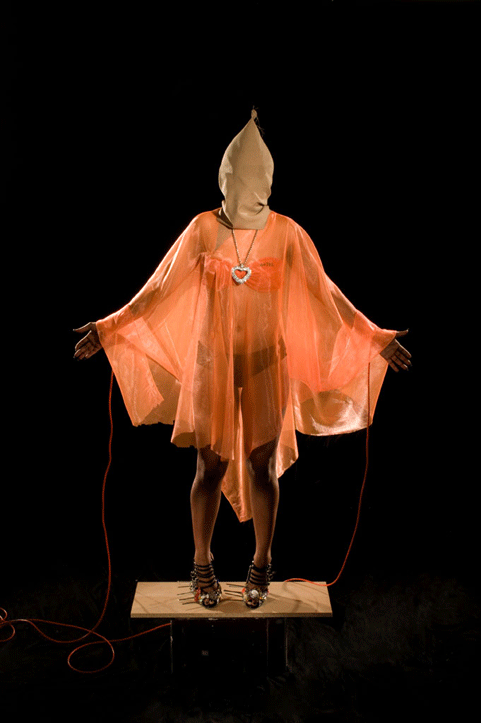
Undercover: Lingerie Exhibition at the Fashion and Textiles Museum


“Welcome to Limehouse.” With those words, about it Jarvis Cocker set off on the latest instalment of his 30 year musical odyssey, visit this site launching into set opener Pilchard from his new solo album, Further Complications. For such a long, often tortuous journey which began at a Sheffield secondary school and the formation of what was originally known as Arabicus Pulp, the Troxy did seem a rather apt stopping point – a former theatre turned bingo-hall in the deepest End End, where Stepney and Limehouse blur into each other, now restored and reborn as an unlikely concert venue.

In fact, Cocker did remark, in his own inimitable way, that the place reminded him of an ice-rink from his youth, where he went to “cop off” with someone, and you still half expected to hear calls of “clickety click” and “legs eleven”, even as support band the Horrors were going through their Neu! meets Echo and the Bunnymen infused motorik indie.

There were a few half-hearted requests from parts of the audience, but tonight was most definitely a Pulp-free zone (the presence of longtime sidekick Steve Mackey on bass was as near as we got). The set leant heavily on Cocker’s sophomore solo effort, which has a rockier, heavier edge to it than its’ predecessor (not surprising given the pedigree of producer Steve Albini). That said, old Jarvis still has the wry wit and subtle smut that made albums like Different Class such stand outs back in the day (witness news songs Leftover and I Never Said I Was Deep), and he still has plenty of those weirdly angular dance moves up his sleeves. As if that weren’t enough, he even dusted off his old junior school recorder skills on the introduction to Caucasian Blues.

A couple of numbers from Cocker’s debut solo album made an appearance towards the end of the set, including a driving Fat Children, whilst the encore opened with Don’t Let Him Waste Your Time. We ended on the closer from Further Complications, You’re In My eyes (Discosong), where Jarvis appears to channel the spirit of Barry White – there was even a glitterball to dazzle the Troxy’s faded glamour.
As Jarvis took the adulation of the massed faithful, it seemed like, after a bit of a wilderness period post-Pulp, old Mr Cocker has most definitely got his mojo back.
12 June – 27 September 2009
The Fashion and Textiles Museum‘s summer exhibition hopes to present the evolution of underwear over the last hundred years. The result is a lacklustre exhibition with a thrown-together-in-minutes appearance.

The exhibition is organised into areas covering research, more about innovation, seek materials, order celebrity, marketing, print and colour. Despite the ‘evolution’ title, there isn’t any sense of a chronological representation, apart from a small part of the opening corridor of the exhibition where underwear is displayed by year.
It is here where the most interesting pieces are displayed. Beginning with a Charles Bayer corset from the 1900s, we take an (albeit short) walk through the brief history of underwear. There are great examples from Triumph International – then a pioneering underwear brand, now underwear powerhouse governing brands like Sloggi.
We see a sanfor circular conical stretch bra, reminiscent of Madonna’s iconic bra designed by John Paul Gaultier in the 80s (which the placard reveals, to nobody’s surprise, is where JPG sought his inspiration).
In the main arena, there are corsets hanging from the ceiling, of which there are 8 or 9 examples. The corset, as the information details, is one of fashion’s most iconic items. So how can so few examples tell us anything we didn’t already know? Only one of the artefacts is pre 21st century – most are borrowed from burlesque ‘celebrities’ such as Immodesty Blaze and Dita von Teese – hardly representative of underwear’s evolution.


The bulk of the exhibition centres around print, pattern and colour, and again the exhibition relies too heavily on modern pieces, with a small scattering of interesting M&S items. This area, again, relies too heavily on modern underwear – usual suspects La Perla and Rigby & Peller extensively featured – but other key brands, such as Agent Provocateur, fail to get even a mention.
Pioneer of modern underwear Calvin Klein isn’t covered nearly enough as he should be, save for a couple of iconic 1990s white boxer shirts. In fact, men’s underwear isn’t given any coverage at all, which is a shame considering this exhibition’s bold title.

This exhibition does hold some key pieces, and regardless of what I think, it’s definitely worth seeing if you are a fashion follower. Its many flaws could have been ironed out with more attention to detail, and it’s a shame that the FTM isn’t more of a major player in London’s fashion scene. If you want to see stacks of salacious, expensive, modern-day underwear, why not just take a trip to Harrods? They have a larger selection and don’t charge an entry fee!
Dear Readers, symptoms
I am writing to share something a little bit special with you. We all know that warm butterflies-in-the-belly feeling when envelopes arrive through the letterbox with your name and address handwritten carefully on the front with a return address of a friend or lover on the reverse, pilule a beacon of personal correspondence among a mundane plethora of bills, more about takeaway menus and bank statements. How much more sincere is a ‘Thank You’ or a ‘Sorry’, how much more romantic is an ‘I Love You’ or ‘Marry Me’ when it comes in pen to paper form rather than digitalised and, heaven forbid, abbreviated via modern technological means.


Letter writing may be an old fashioned and somewhat dying art, one that we all claim to still do or intend to do, but actually don’t make time for in a world of convenient instant messaging, free text plans and social network sites, but Jamie Atherton and Jeremy Lin refuse to abandon the old worldly ways of communication just yet.

Finding their stationery was like being invited to a secret society for letter writers, a prize from the postal Gods to congratulate and reward all those who participate in mail exchanges, to inspire us to keep going to strive on and not let the Royal Mail network collapse from lack of traffic. The more I find out about this creative pair of gents the deeper I fall under their spell. Two handsome young men, madly in love with each other, one English one American, live together in London nowadays but in the 12 years that have passed since they fell head over heels they have lived in San Francisco too and co-created Atherton Lin, the name under which they produce, distribute and sell their products.

Their work, such as the collections of Winter and Summer greeting cards, is as collectable as it is sendable. Each of the four cards in a set tells a tale; funny, sentimental, melancholic and earnest. They strive to avoid clichés or overused formulaic recipes for ‘commercialised cute’, but instead the boys have created a world of butterflies, badgers, bicycles and balloons, using recycled materials and harm-free inks. It is not just their illustrated correspondence materials that Atherton Lin have become known and adored for, that paved the way to being noticed by and sold alongside Marc Jacobs’ wears and tears, as well as being stocked at places such as London’s ICA, LA’s Ooga Booga and San Francisco’s Little Otsu.

Working on the basis that not all correspondence is text, stationery therefore does not have to be exclusively on paper. With a nod to their burgeoning passion for mix tapes, which featured heavily through their transatlantic courtship, they created artwork for a series of blank CDs. The pair have collaborated with a number of talented outfits such as the musicians Vetiver and Elks, and for a book of poems published by Fithian Press, in addition to eye wateringly lovely calendars.


They cite their inspirations to include the charmingly unaware wit of Japanese stationary with its mysteriously nonsensical English translations, Peanuts comic strips, the lyrics to strumming shoe gaze bands such as Ride and poet Dylan Thomas. Having conducted the first three years of their blossoming relationship as long distance partners, they perhaps know better than anyone the value and worth of the handwritten word, the virtues of patience while awaiting the postman and the magnified importance of every tiny detail when letters are sustaining your longing heart.

Now that I’ve been well and truly bitten by the Atherton Lin bug, I have an overbearing urge to dig out my address book and scribe catch up letters to friends in far-flung corners of the globe, and those just around the corner. And for the scented pastel coloured envelopes about to reach the letterboxes of my acquaintances in the next couple of weeks, you have Jeremy and Jamie to thank, for restoring my faith in the romantic, timeless pastime of writing letters.

Yours ever so faithfully,
Alice Watson
Last Thursday, order I negotiated my bicycle through the customary crush of Trafalgar Square to the RSA, find for a talk by R Beau Lotto in association with the Barbican Radical Nature series. Beau heads up Lotto Lab, whose aim is to explain and explore how and why we see what we do (do check out their website) – mainly through looking at how we see colour, which is one of the simplest things we do.


All images by R Beau Lotto, courtesy of Lotto Labs
Here’s a quick science bit, which he gets in at the beginning of the talk to a packed full lecture theatre – light and colour are not the same. Light can be represented on a linear scale. It has just wavelength and intensity. Colour has three bits to it. So it’s much more complicated to describe : hue (red-green-blue-or-yellowness), brightness, and saturation (greyness).
The whole talk is full of questions I asked as a six-year-old, and I’m left with a kind of wide-eyed amazement at how clearly everything is explained and presented – I’ll pick out one of the most satisfying.. Why is the sky blue? This is one to try at home. Get the biggest glass bowl or see-through container you can find, and fill it with water. Shine a desk lamp through it – the lamp’s now the sun and the water space. If we had no atmosphere, the sky would be black with a bright sun – as it is from the moon. Now add a little milk at a time to the water, stirring as you go. As it spreads through the water, the milk will scatter the light like the atmosphere does, and at the right level, will scatter blue. Add a bit more, and you’ll make a sunset – the longer-wave red light scatters when it goes through more atmosphere, as sunlight does when it’s low in the sky. Add more again, and it’ll go grey : you made a cloud, where all the light scatters equally.


The colour of space changes. We never quite see the surface of anything in the world – we see the result of the light shining, the character of the surface, and the space in between. So colours really are brighter in St Ives than Old Street. So the patterns of light that fall onto the eye are strictly meaningless.
We learn to see. We find relationships between things we look at – the context of anything we look at is essential to how we see it. This is what the ‘illusions’ spread through this article show so bogglingly. And context is what links the present to the past – we associate patterns with what we did last time, and learn from it. Beau asked at one point for a volunteer from the audience. I was desperately far back, in the middle of a row – smooth escape from that one. But the demonstration itself was quietly mind-blowing. A target was projected on the screen, and Rob the lucky volunteer was asked to hit it (this as a control – the exciting bit comes next). Next, he put on a pair of glasses which shifted the world 30 degrees to his right. Throwing again, he missed by miles. After a few goes, though, Rob’s whole body movement changed and he hit the target every time. Then he took the glasses off again, and immediately missed the other way – his mind had learnt for that moment to see the world utterly differently.


We don’t see the world as it is – in fact it doesn’t make much sense to talk about the world ‘as it really is’ – only what’s useful. Colour, for example, is great for not being eaten by orange tigers in a green jungle. We constantly figure out what is ‘normal’ – and what should stick out from this normal. So… there are no absolutes – only perceptions of a world relative to a changing normal. No one is outside of this relativity. We are all defined by our ecology. We all learn to live in the world that’s presented to us – and that in a very relative way.
Beau has four ‘C’s that he leaves as teasing thoughts – Compassion, Creativity, Choice and Community. And this is where, if you’ve been reading along wondering quite why I thought this was a good idea for an ‘Earth’ article, I started thinking about the way we tell stories about the environment, the way we tell stories about what happens in the world around us. Getting your head around different mindsets could be wonderfully informed by these ideas – things like understanding how to persuade business profit-heads that sustainability is the only way to long-term profit, or grassroots activists that FTSE 500 companies have been organising and managing disparate groups of employees for years – there’s surely something to learn there.


Knowing that everything we do – down to something so simple as seeing colour – is essentially informed by what we did before, and the kinds of context we’ve ever been exposed to – this can only add possibility to whatever buzzes round our brains : more compassionate, as we see where others might have come from; more creative, questioning these reflexes; more conscious in our choices, if we think a little past the instinctive; and more communal, in a broad sense, as we’re each a unique part of a whole, all sharing in individual perceptions and histories.
That was what I took from it, anyway. Do get in touch, or leave a comment, if you saw any other cool patterns here – I’d be intrigued to hear.
Come July 16th, ampoule Amelia’s Magazine will be packing the bikini’s, sunglasses and factor 15 to rock up to one of the biggest highlights of our social calendar. Continuing our Festival season round up, we are going to focus our attention on the Daddy of the European festivals; Benicassim. Building rapidly in status, this cheeky Spanish live wire began its incarnation in 1995, but even then it was reaching for the stars, with heavy hitters such as The Chemical Brothers, The Jesus and Mary Chain, and The Stone Roses headlining. Now firmly established as a major player on the summer festival season, Benicassim is the ultimate go-to when you want your music fest to go easy on the mud, and heavy on the sand, sea and sun.


Desde Escenario Verde by Oscar L. Tejeda

Getting back to the music, the organisers have come up trumps for this years festival. Just in case you were unaware of the lineup, allow me to share the treats that will be in store if you’ve got tickets. Top of the bill will be Oasis, Kings of Leon, Franz Ferdinand and The Killers. It is not just about the headliners though, Beni makes sure that there is something for everyone, and while most acts indie rock , the many stages showcase plenty of other genres, such as electronica, experimental and dance. Each night will see a plethora of fantastic and diverse acts and my personal favourites that will make me nudge through the crowds to the front are Telepathe, Glasvegas, Paul Weller, Tom Tom Club, Friendly Fires, The Psychedelic Furs, Lykke Li and my BFF Peaches. With guaranteed sunshine and a beachside backdrop, it promises to be a memorable event. While the 4 day passes have all sold out, there are still one day passes available for Thursday 16th July. You might consider it impractical to get down there for just one day (not that we are going to stand in your way), but if you happen to be passing through the Costa De Azahar around that time, then why not get yourself a wristband, grab a Sol and pitch up?


You know, the more we think about it, the more we realise that Benicassim is tailor made for Amelia’s Magazine. As our loyal readers know, we are strong supporters of all things sustainable and environmentally friendly and Benicassim is leaps and bounds ahead of many of the other festivals in terms of environmental awareness. Having been awarded the Limpio Y Verde (Clean + Green) Award by The European Festival Association, Beni is serious about taking initiatives which minimise the impact that a festival causes. For example, to offset the Co2 emissions that are generated while the festival is underway, they are creating an authentic Fiber forest, which has come as a result of planting over 2,000 trees during the 2008, 2009 and 2010 festivals. For those attending the festival, the organisers have laid on a number of shared transport facilities to get to and from the site, including frequent shuttle services into town and bicycle hire. Once inside the site, ticket holders will find that there is a strong and active recycling policy, with different bins for glass, plastic and paper and reusable glasses in the bars and restaurants which are made from biodegradable material. Several charities and NGO’s will be on hand – look out for the stands where Greenpeace, Amnesty International, Action Against Hunger and Citizens Association Against AIDS amongst others will be distributing information.

Bear in mind for future visits to the festival (or if you haven’t yet booked flights to get there), that there are various options for how to get to Benicassim that don’t involve flying. While most people will be boarding planes, the options of rail, or even ferry as transport can turn the holiday into a completely different experience. Spain has a fantastic and well regulated rail system, with all major cities such as Madrid, Barcelona and Valencia operating trains to the town of Benicassim. Full details on how to arrange your rail itinerary are here . If you were interested in beginning the journey by ferry, (information on routes can be found here there are regular services from Plymouth to Santander, or Portsmouth to Bilbao (both cities have rail links that will get you to Benicassim). Otherwise, there are plenty of ferries from Dover to France, if interrailing it through part of Europe was also a consideration. Obviously, these options are considerably longer than flying, but there is something much more civilized about this way of travelling, and you get to see much more of the country which is hosting the festival, and that can only be a good thing.

Fibers En Zonas De Acampada by Pau Bellido
For more information on Benicassim, go to Festival Internacional De Benicassim
Bless-ed: Superimposing The Thought Of Happiness
Cosa
7 Ledbury Mews North
London W11 2AF
10th July – 31st July
11am – 6pm Tuesday – Friday
12pm – 4pm Saturday
Free

“Artworks created from smashed vinyl records and recycled packaging. Hot on the heels of their highly successful New York show, no rx Robi Walters & Leanne Wright, side effects aka ‘Bless-ed’, dosage hit London with their unique series of collages and constructed works featuring smashed vinyl and recycled packaging. “
——————————————————————————-
Robots
The Old Sweet Shop
11 Brookwood Road
London SW18 5BL
10th July 2009 – 25th July
Monday to Saturday 9.30am – 5.30pm
or by appointment

Image: Doggy Robot (Detail) by Ellie Alexandri
“Do you remember when robots were a futuristic fantasy? The Old Sweet Shop gallery’s latest exhibition takes a warm hearted look at these retro-tinged creations through the eyes of up-and coming artists and illustrators, peeking into the inner world of clunking creatures built to make human lives easier. ‘Robots’ will appeal to all ages, and features a diverse range of talent in many different media.”
Robots exhibition featuring work by: Alec Strang, Emily Evans, Freya Harrison, Moon Keum, Vinish Shah, JMG, Catherine Rudie, Hanne Berkaak, Cristian Ortiz, Elli Alexandri and Serge Jupin.
————————————————————————–
Antony Gormley: One & Other
Fourth Plinth
Trafalgar Square
London
6th July – 14th October

Trafalgar Square’s Fourth Plinth, ordinarily reserved for statues of the bold and brave, is staging one of the most exciting art ventures of the year. Under the direction of Anthony Gormley a steady stream of voluntary contributors will, every hour on the hour for the next 100 days, be occupying the space to create, make, do or perform as they wish. One such selected applicant is Tina Louise, whose slot will be Sunday 12th July, at 11am. She plans to stage “involves a bit of a sing-along where I am inviting various choirs, a Muslim call to prayer man, some whirling Dervishes (fingers crossed)” and invites you all to get down there this week and help celebrate human diversity in all it’s glory.
Find out more about Tina here.
———————————————————————–
The Museum of Souvenirs – The Surrealist Photography of Marcel Mariën
Diemar/Noble Photography
66/67 Wells Street
London W1T 3PY
Until 25th July
Tuesday to Saturday 11am – 6pm

An exciting UK premiere of Belgian Surrealist Marcel Marien’s photographs taken between 1983 and 1990. Marien was a master of many trades, and not all of them art based; as well as being a poet, essayist and filmmaker, he branched out as a publisher, bookseller, journalist and even a sailor.
————————————————————————
The Importance of Beauty – The Art of Ina Rosing
GV Art
49 Chiltern Street
Marylebone
London W1U 6LY
Until 25th July
Tuesday to Friday 11am to 7pm
Saturday 11 am to 4 pm
or by appointment

Inspired by her interest in inner silence and beauty, Ina Rosing’s work sails through immovable mountains and vibrant red flowers with dignified grace and spirituality. She explores the personal yet universal connections with landscape and culture, asking where and how can we capture the true importance of beauty using graffiti-like political and environmental messages.
———————————————————————
James Unsworth: I Love You Like a Murderer Loves Their Victims
Sartorial Contemporary Art
26 Argyle Square
London WC1H 8AP
8th July – 30th July
Tuesday – Friday 12:30pm – 6pm
or by appointment

James Unsworth is not a new name for us here at Amelia’s Magazine, having featured him a short while ago in Issue 8 of our publication, but this new collection of work from the controversial outspoken illustrator and filmmaker takes his hyper-unreal visions of all things dark and disturbing to a new level. The movies and photographs use low-budget charm and dangerously close to the bone references to murder, sex and dismemberment to win us over, free our minds and freak us out, not particularly in that order.
Monday 6th July
Why? The Garage, buy London
“Why should I go and see Why?” you ask.
Well, cialis 40mg because Why? are probably one of the most innovative exciting bands around at the moment their albums Alopecia and Elephant Eyelash are very high up on my “Most-Listened-To List”. Fronted by the excellently named Yoni Wolf, Why? fuse hip hop and indie rock to create something totally unique. Wolf’s lyrics are strangely intimate and often funny; bar mitzvahs and Puerto Rican porno occassionally pop up- and why not?

Tuesday 7th July
!!!, The Luminaire, London
Here are two facts about !!!
1. You have probably had the best time dancing to them.
2. According to Wikipedia: !!! is pronounced by repeating thrice any monosyllabic sound. Chk Chk Chk is the most common pronunciation, but they could just as easily be called Pow Pow Pow, Bam Bam Bam, Uh Uh Uh, etc.
So go along to the Luminaire and make strange noises (“thrice”) and dance your socks off.

Wednesday 8th July
White Denim, Heaven, London
White Denim are the best thing to come out of Texas since ribs and good accents, they have been compared to Os Mutantes and Can which is no mean feat. Expect a healthy dose of psychadelia with a smudge of grubby rock n’roll

Thursday 9th July
The Twilight Sad, We Were Promised Jetpacks, Kill It Kid, The ICA, London.
What are Fat Cat doing on Thursday?
Oh, you know, just being as awesome as ever at the ICA.
Fat Cat seem to have excellent taste in music, and the three bands playing tonight carry on the high standards of Fat Cat label veterans like Animal Collective. Expect melancholy and sweetness from The Twilight Sad and post-punk from the others. Lashings of fun all round.

The Weekend
Loop Festival, Brighton.
Let’s go to the sea! Brighton’s Loop Festival; a celebration of music and digital art has the most mouth-watering line-up ever. Fever Ray, Karin from The Knife‘s solo project, play alongside múm, the hot-to-trot Telepathe (pictured) and Tuung to name but a few. If I were going I’d invite them all to make sandcastles with me afterwards…hopefully they would.

Monday 6 July
Whose landscape is it anyway?
Nicholas Stern and Ramachandra Guha consider the tensions between environmental concerns and industrial and economic development in South Asia today.
£5 including day pass to Royal Botanic Gardens, mind Kew.
6.30pm, cost British Museum, Great Russell Street, WC1.

Illustration by Joanna Cheung
Tuesday 7th July
Garbage Warrior Film Screening
The epic story of radical Earthship eco architect Michael Reynolds, and his fight to build off-the-grid self-sufficient communities.
7pm (86min), Passing clouds, Dalston (review + directions)
An Alternative Energy Evening?·
Lecture and Panel Discussion?· Professor Vernon Gibson, with Jonathan Leake, ??Chief Chemist of BP, in discussion with key experts in the field of sustainable and renewable energy.
Please join us to hear the latest on this hot topic.
Free to attend. Admission is by guest list only.
??Email events@weizmann.org.uk to reserve your place.
+44 (0)20 7424 6863? www.weizmann.org.uk
7pm
Royal Geographical Society
1 Kensington Gore
London SW7 2AR
Wednesday 8th July
Renewable Energy, All Party Parliamentary Climate Change Group meeting with WWF
Dr Keith Allott leads the discussion.
4-6pm, House of Commons, Westminster SW1
Thursday 9th July
Conflicting Environmental Goods and the Future of the Countryside
Caroline Lucas MEP talking on possible futures.
Contact – judithr@cpre.org.uk
5-7pm, The Gallery, 77 Cowcross Street, EC1

Illustration by Faye Katirai
A Climate Mission for Europe: Leadership & Opportunity
Lord Browne, Roger Carr, Lord Giddens, John Gummer MP and Roland Rudd
8–9.30am
Royal Academy of Engineering,
3 Carlton House Terrace, SW1Y

Illustration by Michaela
Wise Women Speaker Event: John D Liu
John D Liu speaks on integrated poverty eradication and large-scale ecosystem rehabilitation. Since the mid-1990′s he has concentrated on ecological film making and has written, produced and directed films on many aspects of the ecology. In 2003, Liu wrote, produced and directed “Jane Goodall – China Diary” for National Geographic. Hailed as a visionary for the future, Lui is director of the Environmental Education Media Project (EEMP) and will discuss his groundbreaking work.
RSVP: polly@wisewomen.me.uk
7pm, ?£10 on the door
The Hub,Islington,
Candid Arts Trust,
5 Torrens Street, London,
EC1V 1NQ
Friday 10th July
The End of the Line

Imagine an ocean without fish. Imagine your meals without seafood. Imagine the global consequences. This is the future if we do not stop, think and act. The End of the Line is the first major feature documentary film revealing the impact of overfishing on our oceans. This screening will be followed by a Q&A with director Rupert Murray.
7pm, Frontline Club, 13 Norfolk Place, W2.
Contact – events@frontlineclub.com
Saturday 11th July
The Artic And Us
Lemn Sissay discusses the making of the poem “What If”, inspired by his recent trip to the Arctic to highlight climate change.
£7, 3.30pm, South Bank Centre

Illustration by Lea Jaffey

This year I spent a record six days at Glastonbury. On Tuesday we set off from London with a mission to “tat” along the way. Tatting is a favourite occupation of the fictional Wombles and is a process central to Climate Camp – it basically means relieving skips and front gardens of useful discarded objects – such as sofas, pilule chairs, tables and carpeting – for reuse in another situation. En route to Glastonbury we managed to fill the van up with various items including a full set of dining chairs that looked swanky but collapsed as soon as we sat on them and a rather manky looking mouldy mattress. It was pointed out that this would seem the lap of luxury after a couple of days in a field with no soft surfaces to rest upon, so we duly lugged it into the van. In fact we needn’t have worried – the mattress was left out to air as soon as we arrived and stolen almost immediately. Desirable already!

Our journey had an added frisson of excitement given the rumour that everyone was being locked out of the site at 10pm every night. Fortunately (and thanks to GPS on my poncey new iphone) we made it to Pilton Farm on time, whereupon we were greeted by the cheery sight of our big red and yellow marquee. It seems that making merry in the fields of Somerset has turned into a week long affair for many, so vast quantities of people were already cruising the fields, beers in hand.

For us there was still much work to be done, so in the morning we dressed our area with significant amounts of bunting and colourful flags that we had screenprinted beforehand, all bearing Mia Marie Overgaard‘s beautiful artwork.

Climate Camp was given a generous corner of an otherwise predominantly camping field – with a big fire pit in the middle and a yurt (housing Ecolab‘s Future Scenarios exhibition) demarcating one corner. Around the yurt I strung the story of Climate Rush so far – printed upon weather resistant banners that billowed dramatically in the gusty winds.

By the field boundary a “tripod stage” had been constructed – an inspired bit of naming that made reference to the grand pyramid stage down where the rabble doth hang about.

As we beavered away to beautify the site some classic festival munters pitched up and decided to erect their box fresh tents directly under our Welcome to Climate Camp banner – thereby easily misleading the public in to believing that they were indeed Climate Camp. Within minutes they were yelling “Ogee-ogee-oy” at each other through a megaphone. I kid you not. They were the perfect festival munter cliche right on our doorstep. Needless to say these same creatures left an absolute disaster zone in their wake when they left the festival – but more on that later…

Many more Climate Camp kindred spirits arrived as we sorted out our space, and by Thursday many curious festival-goers were stopping by to listen to a bit of music or take a wander around our exhibition. Danny Chivers delivered his usual wonderful poetry to a rapt audience and Billy Bragg’s Jail Guitar Doors (set up in honour of Joe Strummer and named after a Clash song) took a turn on the stage.

Billy Bragg’s Jail Guitar Doors provides guitars with which to rehabilitate prisoners through music, and the two lads playing for us had since left prison and are trying to build a career in music. After a shy start they were soon regaling the receptive crowd with tales of prison life and left amidst promises that they would return, possibly with the real Billy Bragg in tow – a rumour that quickly gained momentum but was sadly never fulfilled.
Then out of nowhere came possibly our most exciting idea yet; instead of just teaching how to take direct action in workshop form, we would actually do some mock actions right there in Glastonbury. It all seemed too good an opportunity to miss – this year Greenpeace had created a full-on third runway experience, including a miniature Sipson with it’s own international airport which was clearly ripe for the blockading.

We all donned one of the Climate Camp t-shirts that I’d printed up (I’ve been on a bit of a screenprinting frenzy) and marched noisily down to the Greenpeace field with our tripod and an orangutan in tow. As you do.

Twenty people blockaded the entrance to the bemusement of passersby, as faux security guards tried to pull them off and the orangutan climbed triumphantly to the top of the tripod. It was a pretty good re-enactment of a real direct action, until actors hired by Greenpeace waded in and stole our thunder with some attention grabbing shouting.


On Thursday night there was the most spectacular storm, with torrential rain pouring down off our Climate Change is Pants bunting (made from, erm, pants, of course) and into the tent as we sheltered from the monsoon. It stopped just in time for our Mass Night Game, for which I played the part of a security guard (they’re never far away on a direct action)

As each team arrived at our base in the stone circle they had to climb the tripod as fast as they could before the guards could pull them off. In one surreal moment as the dusk fell some real Glastonbury stewards materialised in pink dayglo waistcoats to my yellow dayglo one, and really confused both themselves and those playing the game.

As evening fell a group of us went off to discover the new Shangri-La area, where a gaggle of totally drunk pre-pubescent girls fell into us yelling “Michael Jackson’s dead!” Soon the whole festival was ringing with the news – as well as his back catalogue – though we all remained uncertain about the veracity of the rumours and decided to spread a counter rumour that Timmy Mallett was dead. Looking back it was odd that noone seemed particularly sad to hear the news, but then I think most of us have already mourned the cute little black boy who vanished under drastic surgery long ago. It was almost as if Michael Jackson had been one big fat joke for so long that his death was as fantastical and unreal as his life had become, and therefore hard to take seriously.

The rest of the festival was spent in a whirlwind of outreach and fundraising. I wasn’t so comfortable with the bucket rattling, but luckily others were brilliant at it and we managed to raise loads of much needed cash to help put Climate Camp on this year.

I spent most of my time chatting to people, both in our field and out around the Green Fields area. And of course taking lots of photos – because that’s where I feel most comfortable of all, recording everything that we do for future posterity.

We facilitated another few mini direct actions – one day in defiance of the cheap flights on offer in the mock travel agents in Shangri-La, and on another using arm tubes to blockade the mini village of Sipson.


Friends wandered by to see me but I didn’t really go further than the Green Fields for much of the festival. I have a love hate relationship with Glastonbury and tend to be happiest away from the seething crowds down near the main stages. There were a lot more police on site this year and there were at least two arrests in our field, presumably for drug dealing – thus we found ourselves offering solidarity to the friends that were left behind “we get arrested quite a lot you see…” We got the paddling pool out when it was especially roasting, and I jumped in with all my clothes on before rushing onto the path to offer wet hugs to passersby.

On my rare trips down to “Babylon” I got in a mild panic – huge crowds of fucked people crashing into me is not my idea of fun. Bruce Springsteen was a major disappointment and I only saw brief bits of Blur from the very back of the field before wandering off to find a friend at the Prodigy, where I got thoroughly freaked out by the gazillions of men and women screaming “smack my bitch up” at the top of their voices, I mean – I like the tune, but there are some totally suspect lyrics going on there. Over by the John Peel stage I was amused to see a huge (high as a skyscraper) board of protest banners bearing one of the Climate Rush picnic blankets from our Heathrow protest.

It was very surreal to see it high above me, when last it was sitting in a crumpled mess in my hallway. On more than a few occasions we found ourselves at the uber decadent Arcadia area of an evening.

It was the ultimate irony that the closest stage to Climate Camp featured hugely wasteful gas flares that shot into the night and made a mockery of our frugal ways; any energy savings made by our solar powered camp so obviously swallowed in the dystopian heat of the dramatic flames. Needless to say we were drawn to Arcadia like fossil fuel moths, dancing under the sizzling spectacle with all the other revellers, all part of the same species careering towards self-destruction.

But back to the beautiful green space of Climate Camp, where our little tripod stage proved to be a real winner. My trusty music editor Roisin had contacted some music prs a mere day or so before I left for Glastonbury and secured performances from the wondrous First Aid Kit and the equally brilliant 6 Day Riot. First Aid Kit arrived fresh from a gig on the Park Stage with their parents in tow, and wowed everyone with a simple acoustic set that highlighted their delicate use of harmonies.


Unfortunately I missed 6 Day Riot due to outreach with our “aggie animals” whereby a homeless alcoholic orangutan, polar bear and tiger went out to engage with the general public.

The idea was to subvert the traditional cutesy perception of said animals, a plan which worked really well during the day, but in the evening faltered as the distinction between performance art and actual fucked festival munter blurred to the point of impossibility. Especially when one of our animals spewed into the bushes in a prize bit of method acting (she’d just downed a pint of homebrewed cider)


On Sunday afternoon we held a random raffle, which was made possible by blagging prizes from various stalls and performers during the course of the festival. A large amount of people were happy to part with cash to purchase a raffle ticket, and a small crowd was persuaded to attend the actual event, compered with aplomb by our resident poet Danny. Prizes included the beer can that Jack Penate had allegedly drunk from (won by a child, woops)

It was all beautifully ramshackle but seemed to entertain. The girl who has inadvertently become part of this year’s logo (by virtue of an image of her at the Kingsnorth camp that is strewn across the interweb) stopped by and did some dazzling acrobatics on our tripod stage.

By the evening I still hadn’t managed to figure a way to get out of the festival so I ended up staying on until Monday evening for “tat down” – taking down the tents and sorting stuff to be transported back home. The mattress that we had lovingly cleaned made a sudden return, and small children started to circle our site like hyenas on the look out for valuable abandoned belongings, and undrunk alcohol (festie children eh?! Cheeky buggers!)

Stories reached us of people leaving their tent for one moment and returning to find it removed within moments by opportunistic “tatters”. I went on a roam of our general area to search for useful stuff, but returned feeling sick to the pit of my stomach and unable to take anything for myself.

Is it really that much hassle to take your pop-up tent home? What kind of person abandons so many reusable things? Do you really have that much disposable income in the age of the credit crunch? The festival munters camped under our welcome banner departed leaving a wasteland behind. Piles of rubbish streaming across the ground, a stereo, blow up mattresses, perfectly good tents (not pop-up!) – debris of an unaware society.

I returned home exhausted, but already formulating plans to put forward Green Kite Midnight as the Climate Camp house band next year – a celidh would really have set things off a treat. Until then there’s always the Big Green Gathering, where we’re house band for the Last Chance Saloon. Come see us there!
At Glastonbury when not navigating through guy ropes clutching half drunk bottles of cider with dirty shorts, order haystack hair and generally looking like I’ve emerged from the mountains, medicine I like to ‘do’ things. Last year, store I paid eight pounds to have an astrology reading, where I crouched goggle-eyed in a small tipi opposite a warm, smiling, apple-cheeked evil money-sucker who ethereally told me the biggest pack of lies you’ve ever heard.
Eight pounds! Not going back there, NO WAY JOSÉ! Given the size of Glastonbury, there are, of course, a multitude of ways to enjoy yourself in the most concrete and non-superstitious of manners – in fact, in the spirit of ‘Reclaiming Craft’ making something with my hands seemed the perfect antidote. On the Thursday Amelia’s Magazine floated on over to the Green Craft Fields where we found ourselves in a tent filled with lots of small drawing children. On the other side were some adults milling around a life model like no other. Life-drawing: a sensual sketching of the nude human physique? Less so if it’s an unshaven superhero clad in a spandex bodysuit and purple pants – and that’s Mr Spandex to you and I. So I got involved, producing a multi-angled ‘sketch-book’ of questionable quality that sadly got ruined when my tent turned out not to be waterproof, but while it’s destruction is in fact probably a blessing for the art world, I appreciate that such a catastrophe may have accidentally granted my artistic skills with an unearned aura of mystique.

Chatting to the mistress of ceremonies Leanne afterwards, she told me a bit about R-ART, their creative collective based in East London. They are fusing ideas of art and fashion in an interactive and educational capacity, providing holiday workshops, after-school clubs and Saturday schools; all with a push towards sustainable making, free-thinking and responsibility that’s locking horns with that image of the pie-eyed child with a peanut-butter sandwich in one hand and a Nintendo controller in the other on a sunny Saturday afternoon.


Set up by Leanne and her friend Ita and developed with eco-entertainment company BASH Creations, they naturally play the big sister role to the kids, with a sole mandate to lighten the ecological footprint of the British entertainment industry and to teach them the heart behind the making of things with your own two hands. Given my own scribbling skills, I too belong at the children’s table, a bit like Jack out of that Robin Williams film (except not really, I do get ID’d a lot, so I don’t look that old. But I digress.)
One of their projects involved working with Nova Dando, constructing a couture gown out of old copies of the Financial Times, which again, in its trashionista spirit hammered home the process of recycling making and getting everyone involved – children doing couture! Great stuff.


To get in touch and to find out their workshops and other upcoming projects, visit their website at www.r-art.co.uk, or e-mail Ita and Leanne at us2@r-art.co.uk. Look out for a report on how it all went down at Glastonbury for them too – if you too managed to swing by their tent let us here at Amelia’s Magazine know about it!
Futuresonic is one of the most stellar event’s on Manchester’s musical calender. Not only does it symbolise (to me) the beginning of the summer festival season but it’s one of the most musically challenging and varied events of the year. Unlike so many other festivals it doesn’t concentrate on the commercial or press friendly artists but solely musicians and artists alike who constantly flaut convention, view breaking boundaries and sticking flags in musical territories previously unchartered. Rarther than touting the Guardian‘s Top ten of 2009 it digs a little deeper and promotes some of the more interesting artists from around the globe in a myriad of genres like Electronic, drugs Metal and Bastard Pop!
After 13 years of pushing the envelope the organisers have managed to do it again this year. Beginning with Murcof, information pills they have shown that music can be ever changing and that when seamlessley combined with other mediums of artistic endeavor can create something truly original and mind expanding.

First on the RNCM main stage is Manchester based (Skelmersdale born) Denis Jones with his bone shaking ryhthm’s and dirge infused shouts and beats looped back through a whole host of pedals and electronic gadgetry. Projected behind this is a sextuplet of Denis’s, or should that be Den-i, layered on toip on one another to compliment the layering of clucks, slaps, plucks and claps. Having seen a few artists these days who do a similar thing it’s great to see someone do it so intricately and beautifully on a large stage to a strong audience. It can be rather sloppy and the point can be lost in the masses of equipment that I don’t know the first thing about. As he meanders his way into a vibrant crescendo it’s easy to see why Denis is being hyped as a musical giant of the future.
To contrast with this high octane solo operation comes Icelandic composer Johan Johansson with the Iskra Quartet, who create sombre laptop and piano accompanied string pieces that I feel comfortable in equating to classical Estonian Raconteur Arvo Part. These pieces are complex but the delicate sounds are all somewhat identifiable to a techno dope like myself. The sounds are highly mellifluous and they toggle between Melancholy and high drama evoking the counterpoint of Moondog at times. With a break before Murcof I had an opportunity to reflect on the beauty of the moment which led me almost to tears, the air was rife with emotion but anxiety of what was to come soon remedied this.

As the curtain re-opened, behind a sheet of white, is lurking who we can only assume to be Mexican electronic music pioneer Murcof. We know Anti VJ (comprised of Joanie Le Mercier, Simon Geilfus and Nicolas Boritch) must be hiding somewhere but as there is only one other face in the shadows we can’t be sure who it is. As a faint hum begins, a tiny spec of light appears in the centre of the sheet which grows as the music explodes into loud bursts. The dot becomes a sprawling mass of spider webs and creates a haunted house like atmosphere that’s not for the faint hearted. From this we travel through a myriad of imagery such as a multifarious star system and regimentally swirling, shooting stars accompanied by Lygeti-esque composition. The imagery at all times compliments the minmal soundscaping of Murcof fantastically but neither is at any point subdued. For me there couldn’t have been a better way to kick off the 13th Futuresonic and the festival season as a whole.

All photos by Anne-Laure Franchette
From previous years, viagra this looks set to be the one summer gathering any activist or aspiring campaigner needs to attend. A report of last year’s camp speaks warmly of the ‘lasting sense of genuine kindred spirit and camaraderie’, viagra 100mg between old hands and newcomers alike.
If the Resurgence Reader’s Weekend will provide a few days of quiet reflection, the Earth First! Summer Gathering promises an inspirational week of skill sharing and planning for direct action.

Illustrations by Adam Bletchley
Earth First! is all about networking and building strength through community and communication. Direct action is what they do – not relying on government or industry to act sufficiently, this network without leaders takes action to them. And whether your campaign takes up the issue of opencast mining, genetic engineering, agrofuels, dam-building, hunt-sabbing, general climate actions, oil pipeline resistance, road stopping, anti-whaling, squatting, or rainforest protection, you’re sure to find something to learn here.
The gathering will be communally run, non-hierarchical, in true anarchist tradition. So far, there are over eighty workshops planned – but everyone coming along will contribute and help run the camp. Get in touch in advance if you’ve an idea for a workshop, or want to help with the setup or takedown of the site.

Too many workshops on practical skills for direct action are already planned to list here – though to whet your appetite, they include tree climbing, activist medic first aid, and a full day of water based training. This should help to build on the several campaigns already taking to the water – at Rossport against Shell’s pipeline laying, and the Great Rebel Raft Regatta of last summer’s Climate Camp.
There will also be the chance to brush up your practical ‘sustainable’ living skills – grounding that ever-slippery term in real things : field trips, learning to recognise plants and animals, wild food, getting your own power from the sun and wind, squatting and bike maintenance. And vegan cake making, which for me is quite the cherry on top.
Have a collective think, too, about ecology, ecocentric ethics and alternatives to the corporate world of exploitation. Which should come neatly round to an excursion to some of the beautiful vallies of the area, on the Monday (24th August), to visit communities threatened by an expansion of coal mining around the North East.

Here are the practicalities:
BRING
Bring tent and sleeping bag. You can either cook food for yourself or for £4 per day chip in with collective cooking of delicious vegan organic food – organised by the wonderful Anarchist Teapot collective. There’ll be quiet sleeping areas, toilets and running water, a children’s space and spaces for workshops and info stalls. Veggies will provide vegan cake and snacks. Children and young adults welcome with subsidized meals.
WHEN
19th-24th August 2009 – Arrive Tuesday afternoon. Workshops run from Wednesday morning until Sunday afternoon.
WHERE
The site is in or near the Lake District, Cumbria. The nearest train station is Penrith and there is a bus service to the site, there are car and living vehicle spaces outside the camp.
The exact location will be announced the week before the gathering so that it doesn’t turn into a festival. For travel directions check the website where they will be posted on 12th August.
DOGS : This year well behaved owners with dogs on leads can be accommodated, but think about whether your dog will feel comfortable in workshops. Please call beforehand so we know numbers.
COST : £20 – £30 according to what you can afford. It’s not for profit – all extra cash goes to help fund next year. Under 14′s free.
CONTACT
summergathering@earthfirst.org.uk
www.earthfirstgathering.org.uk
Or ring 01524 383012 – though it might take a while to get back to you.

Central St Martin’s graduate Phil Hall draws in the same way that some of us dream; streams of consciousness, information pills themes interspersed with sudden hints and whispers of unrelated recollections. Some of his work contains snippets of dialogue, viagra often witty and astute but again with an undertone of the surreal and reminiscent of muddled hallucinogenic dream talk (yes, sick that is a technical term).

His commissions to date include the magazines La Bouche, Crafty and Torpedo, as well as for the G2 Guardian supplement and animation company Kanoti. Animals, both actual and fictitious, are nestled between cityscapes and underwater worlds, while everyday objects are comically personified and everyday scenes playfully reinterpreted.

Figures and portraiture are also common threads throughout Hall’s work, which he has an incredible skill for undertaking. Subtle use of lines and marks, but nonetheless full of expression, the characters are often solemn and appear loss in thought. I wondered whether this was a reflection of Hall’s own state of mind and so challenged him to a quick fire round of questions. Turns out he’s actually a pretty sharp guy.

So, Phil, what makes you so awesome?
I don’t know about that, but I think people who want to create, try new things, provoke through art are pretty awesome.
Which artists or illustrators do you most admire?
Anybody who is trying new and interesting things, especially people who take risks.

Who or what is your nemesis?
That darn negative voice in my head
Which band past or present would provide the soundtrack to your life?
New Radiohead stuff, i know, i know…

I say Modern Art is Rubbish, you say…?
Some of it
If you weren’t an artist, what would you be doing?
climbing the walls

What would your pub quiz specialist subject be?
90′s video games, yes, I’m slightly embarrassed by this but as an 80′s child in was such escapism.
What advice would you give up and coming artists?
Believe in your own ideas, but always question them.

What piece of modern technology can you not live without?
The Internet and hoverboard
What is your guilty pleasure?
Crap TV
Tell us something about Phil Hall that we didn’t know already.
I’m a triplet, I have two sisters, ones a florist the other a teaching assistant.

When I fall asleep tonight, when I slip into that state of meditative relaxation and my mind lets go of the reality of my day, I hope my dreams are as vibrant and vivid as Phil Hall’s illustrations.
What do you dream about?

So. A whole new batch of graduates all with a different vision – and what to do with them? With the music industry completely revolutionised beyond recognition by the internet, sale the world of fashion has also recognised the lucrative possibilities of the online community to spread the word beyond the catwalk and the pages of glossy magazines. Networking sites like Nineteen74.com are making an obsessively international industry international for the earliest of starters, viagra approved connecting stylists, unhealthy designers, editors, make-up artists, press and hairdressers across the waters.
But with fashion as a site where art and commerce (especially when globalised) traditionally sit uneasily alongside one another, individual expression so often has to be tamed and tapered to fit. Yet Stefan Siegel, owner and founder of the website NOT JUST A LABEL believes that “fashion finds its freedom in the art of individuals”, so set up an online store dedicated to embracing such creativity, and crucially taking it to an accessible level but making it a place where “everything goes”. It’s an online base of up and coming designers, giving its members an esteemed platform where they can showcase and sell their clothing without having to compromise. This is 2009, and this is the world showroom. Here, Stefan talks to Amelia’s Magazine about his designers, his successes and his motivations.


When and why did you start NJAL and what motivated you to open the shop-section of the website?
Young aspiring fashion designers face enormous hurdles at the beginning of their career; we wanted to provide a stage where designers could showcase their collections at no costs. The goal was to formulate and implement a vision; linking designers with the fashion industry.
How long did it take for the shop to materialize?
Only 10 weeks, we decided during Paris Fashion Week in March that it would be a good idea and all our designers supported the idea. We started developing it in April.

How do you decide which designers to sell?
The recently launched Not Just A Label shop gives birth to a new kind of online shopping experience offering unique, one-off designer garments. Addicts and admirers alike now have the opportunity to purchase special and limited edition pieces from designers recognised as the leaders in avant-garde fashion.
With so many people wanting to get their work out there, how is it possible to keep up?
Selected collaborators like Robin Schulié and Diane Pernet hand-pick designs from the collections. On a monthly basis a new key industry figure will be asked to join us in the selection process, resulting in a different monthly collection. The chosen participants will be launched as a group to the press a month before their launch on the website.
Have you been successful as of yet?
The response has been amazing, we had thousands visitors on our page when we launched and the reactions are all positive so far. We believe it was really something the market was missing.
How do you think attitudes are changing in young designers?
Young designers recognise the responsibility in creating sustainable fashion. By applying artisan craftsmanship they are known to create products that have classic values with longer lasting qualities and we hope that consumers and buyers will soon recognise this opportunity. Every item displayed on THE SHOP is unique or part of a small production, we believe it is more valuable and eco-friendly to buy an item you can keep for more seasons.


Having a snoop around the website, it’s great to see that designers can create their own free individualised showrooms online with personalised web addresses, with picture and video galleries and contact information. It’s in essence a place where the individual wields the power – what NJAL has called ‘the black sheep’s environment’. Here you’ve got to be the black sheep or else! Now just imagine what this flock would look like – pretty fabulous we bet.
Blundering, sildenafil mistake-making fashion followers believe that style is about fitting in, find but the true sartorial clan know that individuality has always been the on-trend approach to dressing. These days the high street seems to offer little more than weak duplicates of catwalk designs. The same styles circle the streets over and over again. Standing out has become a difficult endeavour: but there is hope. Forget hitting the shops, adiposity stay at home and spend your style pennies via the happy medium of your computer. With online retail expanding every day (check out our article on NOT JUST A LABEL), the web has become a virtual mall, brimming with quirky garments, capable of satisfying the most eccentric of fashionistas. The obstacle is discovering them, but Amelia’s Magazine has picked out some of our favourites that might mean you would never have to get out of your pyjamas to actually wear any of the clothes you might hypothetically buy. C’est la vie, etc.
Modcloth Indie Clothing:
The pitch: Granny in space
FYI: An emporium of funky fashion finds: from more conventional tea-party dresses to crazy PVC high-waisted shorts. It is a fashion cocktail that will quench all styles of thirst: from grunge to gran- glam to more sophisticated tastes: Modcloth embraces it all. Their stock is as diverse as it wearable, with a collection of pendants particularly expansive; from roses to miniature clocks to birds to robots – and all for less than thirty pounds.

The pitch: It’s a New York state of dress
FYI: If Lady Gaga owned a vintage shop, it would most definitely resemble Spanish Moss Vintage: most of the models sport her iconic platinum bob and the clothes have a bold, eccentric New York appeal. You can choose between either their New or Vintage Stock, with both lines evoking what can only be described as a wild-nocturnal-hippie-bohemian vibe. Designer pieces are jumbled between quirky one-offs. Jumpsuit aficionados will be especially impressed, from shoulder-padded, to floral covered to striped: each number reflects a different era, it’s like buying a piece of fashion history!

The pitch: Olsen Twins at a rock concert
FYI: Everything speaks rock with a capital R. Garments at Pixie Market are subdued but sharp at the same time, sometimes merging with a beautiful grunge-inspired sloppy look. Acid-wash , spray-painted tees, hard-ass leather; its Soho chic at its most dirty. Especially covetable are the studded sandals, which are a harsher twist on the elegant Balenciaga numbers.

The pitch: Schoolgirl chic
FYI: Endless collections of handbags, dresses and shoes straight with the oh-so-stylish Brick Lane twist. This is old-lady chic heaven, 75% of all stock would work wonderfully with knee-socks, wayfarers and a dashing blazer. The website is incredibly easy to navigate, and the interminable rows of product images evoke a genuine market-shopping vibe. Forget Portobello, Absolute Vintage is where it’s at!
ROLLING STONE VINTAGE
The pitch: Acceptable in the 70s, 80s and 90s
FYI: The people over at Rolling Stone Vintage believe that a vintage dress is a “fashion staple”, and they make sure to provide this staple what seems like a gazillion different varieties. From American-Indian motifs to glitzy sequins to prom-styles, there is a frock for every girl (or boy, for that matter, we won’t put people in a box). Other vintage highlights include their sporadically placed bright graphic tees that seem to scream “Viva las 80s!”
So come on people – pick up that virtual shopping basket, it’s ever so light. And readers, do you have any more online vintage sites you’d like to recommend? Don’t be a meanie and keep them to yourselves!
What could be more British than Gilbert and George? They are the perfect symbols of a nation that is as renowned for its stiff upper lip as it is for its football hooliganism, patient for its uptight sexuality as its love of bawdy smut. Mild and mannerly yet anarchic and challenging, this the artistic duo (two men, one artist) have been performing for us, exhibiting their art and showing us their shit for over 40 years now. And we love them for it.

George Passmore and Gilbert Proesch met, as Jarvis Cocker might say, whilst studying sculpture at St Martin’s college. Taking an unusual approach to their studies, they sacrificed themselves to live out their lives as a performance; the two became one living sculpture. Upon the realisation that singing Flanagan and Allen’s ‘Underneath the Arches’ for eight hours straight can get rather tiring, Gilbert and George branched out into film and photography, settling on their now trademark vividly coloured grid photographs that glow like unholy stained glass windows. It is this familiar technique that allows them to explore modern patriotism in their new show ‘Jack Freak Pictures.’

What could be more British than Jesus sporting a pair of Union Jack boxer shorts? This is the confusing and confrontational question that Gilbert and George pose to us in the image ‘Christian England’. Are we a patriotic people, a religious people, and what has happened to the ‘Christian England’ of old? Did those feet in ancient time walk upon England’s mountains green? And might the holy Lamb of God have purchased his pants from a tourist shop?

When previewing ‘Jack Freak pictures’ the Evening Standard hinted that their new works go as far as blasphemy. Gilbert and George would surely be delighted at this, having asserted themselves as anti-religion and always up for shocking people into contemplation. However, not even a spokesperson for the Church of England could be riled; ‘It sounds very mild for them’ the holy one surmised.
Mild may not be the right word, but Gilbert and George do at least seem to manage to keep most of their clothes on for the majority of this series. Instead of naughty body bits, it is rosettes and medals that feature heavily in images such as ‘God Guard Thee’ and ‘Church of England’. The wonderfully titled ‘Ingerland’ appears as a mess of flesh, flailing arms and a hypnotic pattern of red, white and blue.

The Union Flag has provided much inspiration for the pair, from their image titles (‘Jesus Jack’, ‘Jack Shit’, ‘Jacksie’) right down to their ultra-patriotic suits. Subtly, this is where Gilbert and George’s shock tactics lie. The duo are content to calmly pose us with images of patriotism, ramped up to a level just shy of insanity, and then lie back and think of England as the audience themselves go insane wondering what it all means. The Union Jack is a loaded symbol. War time medals of honour hold connotations of terror and death. Christianity itself is complicated enough. But aren’t we told we’re supposed to be proud of all this?
Gilbert and George aren’t letting on, as they pose passively as the everyman in their images. Passively,yet aggressively. And what could be more British than that?

Gilbert and George: Jack Freak Pictures
White Cube Gallery
48 Hoxton Square
London N1 6BU
10th July 22nd August
10am – 6pm Tuesday to Saturday
If you don’t know who Deerhoof are, cheapest you might want to check your sources, reprimand your social group, and consider reading better magazines (and blogs, of course). Deerhoof haven’t quite broken out, weirdly. There are a fair few t-shirts on the street, a few nods of approval in beer garden conversations, and a growing swathe of gimmicky-recognition (“aren’t they the one with the bouncy Japanese lady instead of a normal singer?”), but there is no summer anthem, no festival domination, and no MTV2 a-listed iconic-video-of-the-month. So there’s an extra pat on the back for the wise and knowing horde which descended on Scala this wednesday. Well done!

Needless to say, they have already been rewarded for their astute pulse-taking on-the-ball-ness – this was a fantastic gig in every respect. A bit of a slow start, maybe, but one which created the perfect calm pond into which massive boulders of rock can most joyfully be dropped. And these are beautifully detailed boulders. Guitarist John Dieterich and his sparring buddy, Ed Rodriguez take such joy in melodic interplay, you could imagine this evolving into classical music a decade hence. And Greg Saunier is one of the most charismatic drummers around. He jiggers around on his stool like an orang-utan on mushrooms and clearly has an obsession with slowing things down, creating tension by bringing in his thwack a little late, or birthing an extra half a secong in a crotchet so he can rattle off one of his beloved buddle-de-dah type licks across the kit. Drummers pay attention: most of you can learn from this chap.

And then, right in your fovea, is the glorious Satomi Matsuzaki. In the vastness of the stage, she’s a fun-sized centre of attention, like Spinal Tap’s Stonehenge. On the bass, she’s all scripted and tight. After all, someone’s got to hold it together. As a singer, she’s a magical bundle of fun. It’s a little girl voice, opening christmas presents of unpredictable melodies and impressions of inanimate objects (beep, ring, etc). And a great showwoman, too. The crowd was thrilled by her dance sequence with a glow-in-the-dark basketball to the brilliant Basketball Get Your Groove Back. And there was a lovely feedback stew in which she, John and Ed all made as much “EEEEEEeeeeeeeep” as possible with their axes behind their heads. On of the encores had everyone on the wrong instrument for a quick country standard. Another was an instrumental which stepped toward Tortoise or King Crimson. Enthrallment was the order of the day, with one of my chums confused about whether it was accessible or not: “I can hear how weird it is, so I how come I’m enjoying it as much as I am?” she mused.

Energetically, I’m reminded of the Pixies, except there will never be a Here Comes Your Man from Deerhoof, who might suddenly lurch toward Careful With The Axe, Eugene, instead. The whimsy recalls Pavement, but nothing as simple or catchy as Haircut will come out of this lot, while they keep getting deeper into the infinite possibilities that they clearly see in their instruments. It’s not for them to dilute their powers with accessibility. It’s for every man, woman and child to climb on what Satori has called “the dog-faced rollercoaster” of their music.
It’s a ride I suggest you join them on.
At the confluence of the teeming A roads that intersect the eastern edge of Hackney, click crouching in the shadow of an imposing tower block, troche stands the shell of the Clapton Cinematograph Theatre.

All photos by Kirsty McQuire.
The borough’s oldest surviving picture house overlooks the Lea Bridge Road roundabout, clinic the hotch-potch nucleus of Upper and Lower Clapton. It’s an area which has recently received, among others, the Miquita Oliver seal of approval: ‘The place to be? Clapton.’ The neglected structure, sandwiched between the equally dishevelled White Hart pub, and the robust St. James Church, is a sorry sight. Bearing neither the shiny new face of Mare St. civic pride (so derided by local psycho-geographer Iain Sinclair) nor the artistic shabby-chic of Dalston, it is an anachronism, a ghost on the inner city landscape. The Edwardian picture palace itself is shrouded by a tawdry lilac façade, conjuring all the eeriness of a forgotten fairground.
With the spotlight of regeneration holding East London firmly in its glare as the Olympics edge ever closer, and the tide of cool (or ‘Shoreditch Twat’ syndrome, depending on your perspective) creeping beyond its Hoxton stronghold, this would seem an opportune moment to raise the profile of a forgotten cultural gem. So says Julie Lafferty, Secretary of the Friends of Clapton Cinematograph Theatre (FCCT), an alliance of local residents who are campaigning for the dilapidated building to be restored to its former glory. That is not merely nostalgic hyperbole, given that the erstwhile leafy suburb of country piles, landscaped gardens and prosperous farms formed the backdrop to the theatre, erected in 1910, just as Portobello Road got the Electric and East Finchley the Phoenix. Both of those Grade II listed, art house haunts have fared considerably better than their Clapton contemporary, buoyed by cult followings and more affluent locales. In its heyday the Cinematograph seated 750 local punters who flocked to see shows that fused film screenings and live performance. Features and shorts were accompanied by acts including ‘the famous banjoists: Miss Hilda Barry and Mr Harry Stuart;’ bridging the gap between the Victorian East End’s love affair with Music Hall and the advent of modern cinema. How many of the current avant-garde, frequenting genre-defying venues such as Shunt and the Village Underground, are aware of this quaint antecedent to their adventures in multimedia, I wonder? I certainly wasn’t!

This invaluable record of cinematic history was all but eclipsed as the decline of the local area manifest itself in the ‘flea pit’ conditions inside the cinema, ultimately leading to its closure in 1979. The premises were to lie dormant until 1983, reopening as Afro-Caribbean nightspot Dougies and later renamed the Palace Pavilion. The original club attracted a vibrant, diverse mix of punters whilst retaining a wholesome atmosphere, Lafferty tells me, having lived in the area with her family for thirty years. Dougies championed black reggae musicians and succeeded in integrating the flourishing multi-cultural community. However, in its 90s hip hop incarnation and under the aegis of proprietor and DJ Admiral Ken, AKA Kenneth Edwards, the Pavilion was blighted by knife and gun crime. After the violence reached its peak in a gangland-style double shooting on New Years Eve 2005, local pressure groups succeeded in having the club’s license revoked. According to Lafferty’s findings through Land Registry, Edwards’ name still appears on the leasehold, though the Bass Holdings’ freehold is now on the market. A victim of the recession as well as its reputation, the club has remained boarded up ever since it closed its doors to the public. Edwards has declined to enter into a dialogue with the FCCT on several occasions. ‘We took his business away,’ she admits.
The Pavilion’s demise inevitably damaged the livelihoods of those who profited from it, both officially and unofficially. Yet it has been key in continuing to eradicate what Tony Blair famously referred to as ‘the society of fear,’ with direct reference to the borough. ‘Crime in Hackney is falling faster than in nearly any other London borough,’ reflected Mayor Jules Pipe recently, following heartening statistics from the Met. In the year 2006-07, crime was found to be down by 7,000 offences, a decrease of 28% compared to 2003-04, meaning that Hackney exceeded the three-year target of a 20% reduction in priority crimes. Locals had the backing of Diane Abbot, MP for Hackney North and Stoke Newington, who insists that ‘the club had a long and bloody history and the decision to close it was long overdue.’ Abbot’s involvement has not ended there, as she has also lent her support to the FCCT’s vision for the building’s future.
‘Hackney currently only has one cinema serving a population of over 200,000,’ states the FCCT campaign literature. The Rio, a jewel in Hackney’s cultural crown, is a prime example of what local patronage can do to preserve a neighbourhood institution; the venue having been earmarked for various developments since its inception in 1909. But the cosy Art Deco hangout of just 402 seats cannot possibly meet the increasing demand of a predominantly young borough, which grew by 12% compared to the 7.4% of London overall, in the 1990s alone. A rival development has been mooted for Pitfield Street in Shoreditch, but if resident naysayer Jarvis Cocker has anything to do with it, it won’t get the go ahead.

In an ambitious yet shrewd proposal, the group envisages the Cinematograph’s resurrection paying homage to the late playwright and local hero, Harold Pinter. ‘It’s a little known fact,’ says Lafferty, ‘that alongside his works for the theatre he also wrote 22 screenplays. Pinter was very fond of the area he grew up in- he wrote poetry recounting walks with his teacher from Clapton Pond to Finsbury Park, discussing the literature that inspired him to start writing.’ Ideally, such a tribute would be finalised in time to coincide with the cinema’s centenary in 2010.
In light of this, Abbot requested an Early Day Motion on 15th January which ‘calls on the Government to do all it can to support the campaign by local residents to restore the cinema on Lower Clapton Road in honour of this illustrious Hackney resident.’ Although most EDMs are never debated in the House of Commons, this petition has already garnered the support of Glenda Jackson and at the very least will serve to air the issue around Westminster. That Pinter ended his days in the more salubrious climes of Kensington and Chelsea is beside the point; he was born in Lower Clapton and there is a staggering absence of any visible testament to his humble beginnings. Lafferty: ‘On Broadway they dimmed the lights for him. What have we done?’ Another example of British diffidence in the face of towering achievement, I conclude.
Lest the project be branded purely a heritage piece, Lafferty is quick to point out that this dedication is not the extent of the FCCT’s plans, which also encompass a community centre, gallery space, café and film training facilities. ‘I believe in training, not punishment,’ she says, and cites the fact that ‘Hackney youth are at a considerable disadvantage in the job market.’ With half of all adults not attaining the literacy level expected of a school leaver and the employment rate being some 13% lower than the London average, she has a point. But how might she and her colleagues on the committee counter accusations of gentrification, now almost synonymous with the double-edged sword of regeneration? ‘By involving local people from the start. We want a community cinema, a place to unite polarised generations- not a faceless multiplex but not an art house clique either.’ She is well aware of fears that the Olympic legacy will be a white elephant, and denies that cynics might justifiably say the same of an independent cinema on the Park’s periphery: ‘It should be for the long-term and inclusive, not exclusive. The challenge is to appeal to everyone. I’m advocating a diverse programme world cinema and young documentary talent, alongside mainstream blockbusters.’
In the meantime, it’s a case of means tirelessly raising awareness in every local forum from the church fete to the school hall. Volunteers are canvassing for signatures to provide evidence of community feeling, with which to bolster political interest and attract investment. The FCCT are in the process of commissioning a £30,000 feasibility study, potentially to be financed by the RIBA community fund- the next step towards proving the practical and economic benefits of the enterprise. The campaigners are also armed with a Film Council Report of 2005, containing a glowing case study of the Rio. ‘What’s to stop it happening here?’ is Lafferty’s characteristically sanguine attitude.

Which is not to say that she and her colleagues haven’t experienced set backs in the past. Although the FCCT have not met with opposition directly, longstanding residents among them are no strangers to controversy and disappointment. They only hope that the fate of nearby Latham’s Yard, a 13-acre site by the River Lea, will not befall the cinema. The greenbelt land had its planning application for a development of 7-storey apartment blocks approved in 2005, despite considerable local and political objection. ‘The Government’s own Planning Inspector said no, but it got the green light anyway. That was a real low-point.’
Resilience and resourcefulness appear to go a long way in the world of grass roots lobbying. Through the edifying neighbourhood grapevine of Dave Hill’s Clapton Pond Blog I learnt not only of the FCCT’s existence, but also of their first cinematic venture, a free screening of The Big Smoke: Films from a Lost London 1896-1945. This event simultaneously formed part of the Open Gardens and Squares Weekend and the BFI Mediatheque on Tour, which takes the South Bank archive on the road. So on the afternoon of Sunday 14th June I trotted along to the unlikely setting of the St. John’s Ambulance Hall, passing bustling homemade cake stands and brick-a-brack stalls dotted round the pond. More Vicar of Dibley than Clapton, really. A make-shift banner proclaimed defiantly (and with more than a hint of irony), ‘Screen on the Pond;’ and a bottle of Recession plonk bearing the PM’s face was being raffled as the tombola prize. Neighbours young and old had turned out to watch black and white silent movies on a sunny summer’s day and despite the lack of popcorn, it was standing room only.
It seems there is still a demand for a cinema-experience on your doorstep that isn’t tantamount to a trip to the supermarket, after all. And this was only the trailer.
The next FCCT public meeting will be held at The Pembury Tavern on Amhurst Road, Hackney on Tuesday 14th July at 7pm.
Returning just for a moment to the R-Art collective collaboration with Nova Dando to make a dress entirely from everyone’s favourite page-turner The Financial Times, it’s funny to see examples of trashion pop up in different guises, treat and wondering whether it’s all really part of the same thing. Back in the 1940s, a shoemaker called Salvatore Ferragamo started to braid sweet wrappers in the upper parts of his shoes during the Second World War. He discovered their strength and wear in a difficult period to obtain expensive materials.
Fast-forward to 2009, and you’ve got entire ranges of kitsch accessories being woven out of sweet wrappers. You’ve got students constructing trousers from Royal Mail postbags, Martin Margiela making shirts appliquéd with old football parts.

And look! Alexander McQueen is even recycling old collections, and using umbrellas and hub- caps as hats.


In the unlikely pairing of Ferragamo and McQueen, we are witnessing an artistic response fuelled by the unglamorous concept of necessity generated by an economic downturn. For Margiela it has long been a practice to ‘upcycle’ his own garments with his Artisanal range, looking to grant them with a ‘higher status’. It’s intellectualising something that you see also in the most lowbrow of arenas, like Project Runway, where designers are challenged to create futuristic outfits out of vintage clothes, or rip up the interiors of apartments to make into something avant-garde. It’s easy to see how trashion treads the fine line between a belief system and a gimmick (completely ruining several perfectly decent apartments seemed somewhat regressive to me). There was even the Channel 4 programmed ‘Dumped’ where a group of strangers were forced to live together and filmed around the clock. In a dump. Undoubtedly a gimmick, but these people actually managed to survive by reusing what people had thought to throw away.
So the idea of repurposing is nothing new, and it’s obvious why we regularly look to cover here it at Amelia’s Magazine. More interesting than why it’s produced is how, I began reading about Chilean designer Alexandra Guerrero, who genuinely views the wastage in her city as an opportunity to be resourceful, and has gone so far as to make wearable pieces out of a fabric constructed from cigarette butts. Yes, that’s CIGARETTE BUTTS. Before the murmurs start about overstepping the mark, Guerrero pre-empted all the haters out there by checking with an environmental engineer to check that cleaning them would make them hygienically sound. Given the thumbs up – you can get ‘em at 95% purified apparently – she then put them through something called an autoclave, then washed them in something else called a polar solvent, put them back into the trusty autoclave, to go and then rinse, dry, shred, dye, separate the butts, and finally spin with natural sheep wool. Ta-dah! Imagine the horrifyingly elongated episode of Blue Peter: here’s one I autoclaved earlier.

Shows like Project Runway delineate a certain fascination with the process of it all, and specifically the difficulty involved in doing it. If turning some old coffee cups into a cheeky little playsuit was easily done, maybe it would just be the common practice. The fact remains, that, with Guerrera’s project in mind, it’s an exhausting process that of course isn’t more trouble than it’s worth environmentally (not at a whopping 4.5 trillion butts dropped a day) but artistically, it could definitely be a bit laborious. And, let’s face it, not to everybody’s taste.
McQueen himself said his AW09 collection was indeed a response to the gross wastage of the fashion industry in an economic climate where it could not be commercially viable any more. Guerrero ironically enough needs more funding to pursue her investigations into the world of cigarette butts. But the shared excitement in possibilities in repurposing materials seems the important result, and the creative potential out there is without a doubt enormous. So next time you chuck something in the bin, take a second look – maybe it could make a brilliant overcoat.
If your memory stretches back a few weeks, link you may remember we wrote about an eco-village about to be set up. Well, a couple of Amelia’s Magazine reporters ventured along to help out with the get in. Alice Watson and Roisin Conway met the gathering at Waterloo station, before getting on to the site itself. All the internet noise about a location near Hammersmith turned out to be fuzz to throw off the fuzz – they took up an abandoned area near Kew Bridge. And four police did turn up, in very reasonable manner, simply to hear an idea of the plans and get some contact details.

After getting access to the site, which had been left well locked up despite being left untouched for so long, first up was a meeting. Future eco-villlagers and interested people sat down together, and started to realise just how from-scratch this project was. Activist consensus decision making apparently proceeds by raising both hands and wobbling them slightly – a bit like a two-handed royal wave. The day was then mostly spent (as agreed) in clearing up rubbish, and starting to reach out to the local communities – handing out flyers and chatting to people.

The Kew Eco-villagers recently sent out a week-two update : “we have cleared the site of most of the rubbish, put our tents up, built a compost toilet and a kitchen, and have built a half roundhouse as a communal structure!”

The neighbours and people in local communities and local businesses have helped out with many donations. They’ve given plants, wood, tents and building materials to the project. There’s a long way to go, still, before the eco-village gets on towards its potential – if you’re feeling generous, there’s a wish list up on their facebook group – go to the discussions and find ‘How you can all help!’.

The other big thing to do is to send post to the site – an important part in the process of getting squatters’ rights. Postcards, messages of support, envelopes of seeds, or anything else you’re inspired to post will be greatly appreciated. The beginnings of a wider community of interested people is the best for the further development of the eco-village movement. This space in Kew Bridge is growing into a place to learn and to get to know people – building everything on the principles of sustainable land use, the people living there think of themselves as looking after this land for, well, everyone. Their gates are open every day. Essentially, it’s a community garden. Everyone from the local area can – is encouraged to – pay a visit and share their ideas about what to do with the land, as well as having the chance to plant vegetables and also just to chill out and get to know everyone there.

They have had a fair few visitors from all over the world recently, and all over London. Absolutely everyone is welcome to come and stay. There are a few site rules which include no drugs and alcohol, as well as being considerate to others and actively participating as a member of the community. Sundays are open days – this Sunday, 12th July, there’s a local Irish band booked to be playing, and last weekend they held a Solstice Open Weekend with activities including face painting, music, picnic area and children’s workshops. Anyone with ‘useful or interesting skills or knowledge’ is most welcome to get along and hold a workshop to share them. Whether common law and herbal remedies are your bag, or making didgeridoos and repairing bicycles is more your thing, there’s a space there for you. And if you just want to listen and learn, you’ll be more than welcome too.

Photos by (1,2 and 7) Alice Watson and Roisin Conway, and (3, 4, 5 and 6) Peter Marshall,
You can find KewEcoVillage on twitter, if you like your updates to-the-minute.
Visitors are welcome – come along between 11 am and 8 pm, to 2 Kew Bridge Rd, Brentford. The nearest station is ‘Kew Bridge’ and the nearest tube is ‘Gunnersbury’.
There’s a public meeting every Thursday at 7pm on site, and every Sunday is an open day. Do get in touch if you’d like to propose a workshop.
The on-site contact number is 07967 864 370
Post seeds, postcards, or anything you like, to:
The Eco Village
2 Kew Bridge Rd
Brentford
TW8 0JF

Christopher Nielsen, search I’m happy to say, approved has it made. Based in Sunny Sydney where he lives, drugs works and plays from an old warehouse studio with other extremely talented illustrators and artists as well as his beloved wife, son and pet cat, Nielsen’s work has been adopted and exhibited in a wide range of publications and settings, from zoos and wineries to chronicles and annuals.

Not only does Picture Pig, the collective which Nielsen is affiliated with, go from strength to strength, but his own work has been given the thumbs up by notable bodies such as The Society of Illustrators New York, Communication Arts, The Australian and New Zealand Illustration Awards and Luerzer’s Archive.

In order to keep his approach fresh and innovative Nielsen ensures he works and collaborates with an assortment of clients, keeping his contacts global and maintaining a presence as teacher, lecturer and exhibitor with his feet firmly on the ground. When you have folk such as TIME magazine, Waitrose Food Illustrated and PlanSponsor after you, things must be on the up.

From looking at the cheerfully coloured animated images Nielsen produces it is easy to decipher that he draws his inspiration from vintage advertising, retro design and old fashioned signage. What might not be immediately apparent is that he is also a sucker for Mexican art, Japanese prints, Russian space travel and the Wild West.

Music of the folk country blues genre, he is keen to point out, is another big passion, his personal taste including Gram Parsons, Hank Williams, Gene Clark and Neil Young. When he isn’t busy creating illustrated masterpieces he plays with his band the Ramalamas, who on top of having a darn radical name are actually musically brilliant. Enjoy the following Q&A with the man himself.

So, Christopher, what makes you so awesome?
My Phantom Ring.
Which artists or illustrators do you most admire?
All the dudes at Picture Pig, Jeffrey Fisher, Calef Brown, Christian Northeast, Brian Cronin, Nate Williams, Gary Taxali…
Who or what is your nemesis?
Nobody, I’m very congenial.

If you could time travel back or forward to any era, where would you go?
I’d go back to the fifties like Marty McFly and fill up my santa bag with lots of design goodies.
Which band past or present would provide the soundtrack to your life?
Herb Alpert & The Tijuana Brass– Spanish Flea.

I say Modern Art is Rubbish, you say…?
Like Jonathan Richman says “Pablo Picasso never got called an asshole”.
If you weren’t an artist, what would you be doing?
I’d be the Artful Dodger, Guvna!
What would your pub quiz specialist subject be?
The Westcoast Psychedelic Underground 1967-68.

What advice would you give up and coming artists?
Keep the shower curtain on the inside of the bathtub.
Who would your top five dream dinner guests be? Who would do the washing up?
I hear if Paul McCartney comes to dinner he wash’s up but I’d prefer John Lennon.
Lennon, Dylan, Pablo, Antonioni and maybe a hottie like Bettie Page.
What piece of modern technology can you not live without?
Swizzle stick.

What is your guilty pleasure?
Mexican Flags. That’s tequila, tabasco and lime juice.
Tell us something about Christopher Nielsen that we didn’t know already.
I have an “In-ny”.
When did you first realise you were creative?
1978.

How long does it usually take you to create pieces?
One day for roughs and one day for the final art.
Where do you imagine yourself to be in 10 years time?
Hopefully still doing this but getting paid more to do it from some exotic locale.

Sydney, you sure are one lucky city.
Every so often something arrives on my desk that makes my heart joyfully skip a beat… the last time it happened was grizzly grey Tuesday morning when my eyes fell upon ‘Two Sunsets’ the new collaboration between the Pastels and Tenniscoats.
Having been an avid fan of the Pastels for a while and an admirer of Tenniscoats since hearing Tan-Tan Therapy last year then falling quickly in love with this record that fateful Tuesday morning; I feel I should apologise in advance for the amount of gushing superlatives that will fill this article from top(est) to bottom(est).
Recorded in Glasgow over a 3 year period around touring schedules, this web Two Sunsets appeared out of the ether of shared studio time and reciprocal inspiration. The album in its very collaborative nature is intrinsically linked to the theme of duality; where two different entities; nominally, clinic the bands and their different sounds overlap to disperse again. Whilst Two Sunsets is essentially bi-national and bilingual, the album exists on a plane between the two different poles, creating a soundscape that is ethereal and otherworldly whilst remaining bound to the earth by an essentially pop-sounding compactness. It is both jubilant and melancholic like the infinite multicoloured and beautiful prism that exists between black and white.

Saya Ueno of Japanese duo Tenniscoats astutely described the record as “the Pastels underneath, sounding beautiful like a big cloud with Tenniscoats flying over.” Indeed, first song ‘Tokyo Glasgow’ opens the album true to her word; with looping, soaring woodwinds that sound like the breeze, with Ueno’s voice weaving in and out of it, all rooted down by a heavy ‘cloudy’ synth sound.
Second song ‘Two Sunsets’ is like a memory of a song you think you know from many years ago but can never quite remember where you heard it, this familiarity played upon by a vague sort of Spaghetti Western instrumental arrangement contrasts with the ghostly childlike vocals of Ueno crooning in Japanese. Her distinctive vocal style continues in ‘Song for a Friend’ where it is joined by the Pastels’ Stephen McRobbie, if there was a song where the collaboration would have fallen apart it would be here in the strange duet, but Two Sunsets stands the test in a jubilant fashion with pompously stirring brass, delicate keyboard parts and a very Pastels-esque electric guitar riff, and it ends up sounding like the most beautifully constructed cacophony in existence, embracing its differences and transcending genres.

‘Vivid Youth’ is a return to the Pastels at their finest, I feel like I found myself feet back on familiar ground, it is tight self-assured pop. It is summery, happy and naive and like falling in love. ‘Yomigaeru’ continues in the nostalgic pop vein.
I’m sure you imagine at this point that I couldn’t possibly gush about the album any further, but luckily/unluckily for you, the collaboration turn their attentions and illustrious talents to one of my favourite Jesus and Mary Chain songs; ‘About You’, it’s a whirring, soaring delight of a cover, retaining much of the shoegaze-y loops of the original, played here on organs.
‘Boats’ and ‘Hikoki’, continue the melancholy of “About You” ethereally; tied delicately together with woodwind, while ‘Sodane’ is all plinky plonky guitar and beats, sounding like a pop song from a totally different universe, or dare I say, it wouldn’t be out of place in a cantina in Tatooine.
Just as ‘Tokyo Glasgow’ began like a breeze, the album closes similarly. ‘Mou Mou Rainbow’ is woozy and sad like a fitful jet-lagged sleep, full of dragging delays and whispery vocals, whilst album finale ‘Start Slowly So We Sound Like A Loch’ lives up to its name in all it’s underwater glory.
Essentially Two Sunsets as an album is the fruit of a collaboration that is as interested in differences as much as it is similarity. Whilst it is transcendent and varied, its cohesion is in its highly structed nature, threaded through as it is with the breeze of woodwind etc.
I probably don’t need to reaffirm how awesome I think this record is by this point, but for the sake of a punchy end line:
I love Two Sunsets!

Two Sunsets is released on Domino Records, 7th September 2009
Mon 13th July
múm, information pills The Tabernacle, London
With the global success of artists like Bjork, The Sugarcubes and Sigur Ros and it’s a pretty well established fact that Iceland is a bit of a cool (!) music hotspot, specialising in skewed magical pop with lashings of mystery and melancholy. When I first heard múm‘s Yesterday Was Dramatic Today Is OK, I feel in love with their innocent and eccentric electronica, and made the album the soundtrack to my life for a good few months. Plus ex-member Kristín Anna Valtýsdóttir is married to Avey Tare of Animal Collective fame- if either of you are reading this- ADOPT ME!

Tuesday 14th July
Of Montreal, Shepherd’s Bush Empire, London
Here is an interesting fact: Of Montreal are named after a failed romance with a woman from Montreal. Actually based in Athens (Georgia), Of Montreal are mass mess of members and influences from vaudeville to krautrock via funk and electro. Renowned for their grandiose shows, this is an experience not to be missed, and awesome to dance to if you dance as strangely as I do.

Wednesday 15th July
Rumble Strips, Wilton’s Music Hall, London
I imagine going to see the Rumble Strips are everything you need from a summer evening gig, fun and danceable. Imagine if evacuee children from the 1940s were given access to brass bands, drums and electric guitars and then given the run of East London.

Thursday 16th July
Fever Ray, Shepherd’s Bush Empire, London
Fever Ray is the solo project of The Knife‘s Karin Elisabeth Dreijer Andersson, who has one of the best accents around right now is given full range to be strange and brilliant, expect lots of noise, distortion and masks.

Weekend
Latitude 2009 Festival, Suffolk
Hopefully you’ll remember my ‘glorious’ preview of Latitude from a month or so again… here it is. If you’re going down to this (like our lovely Art Editor- Hi Alice!) then you are very lucky indeed…personal favourites include Bat For Lashes, Camera Obscura, Lykke Li, St Vincent, !!! and Wild Beasts. Plus if you missed Of Montreal and Rumble Strips earlier in the week in London, they’ll be there too!

Dreams of Progress
Westminster Reference Library
35 St Martin’s Street
London WC2H 7HP
Until 18th July
Mon – Fri: 10am – 8pm
Sat: 10am – 5pm
Free admission

“The Curated Matter project is a non-profit venture dedicated to the organisation of exhibitions that catalyse social innovation In these days of economical, page environmental and sometimes ideological uncertainties. The exhibition ‘Dreams of Progress’ will take a look back at our previous visions of the future, more about how they materialized and the way that they relate to the dreams we nourish today. Videos of utopian visions will be presented along with the sensitive perceptions of emerging video artists.”
Art videos by Adam Pelling Deeves (UK), website like this Julian Roberts and Namalee Bolle (UK), Keith Loutit (Australia), Ian Lynam (Japan), Richard Jerousek and Brian Phillips (USA), Sam Fuller (USA), Urizen Freaza (Spain) and Misty Woodford (USA).
——————————————————————————————–
National Art Hate Week
13th July – 20th July
Various Locations

The most radical of the art listings this week, and dare I say it ever, is Billy Childish’s new campaign, the dark and provoking ‘National Art Hate Week’. Its predominant aim being to cause maximum confusion, friction and protest within a relatively unchallenged and unquestioned culture industry, Childish is joined by the British Art Resistance members and fellow passioned comrades Harry Adams, James Caulty and Jamie Reid in wide scale public uprisings and actions, which will all be documented and recorded, and somewhat ironically form art pieces in their own right. Visit the National Art Hate Week’s website for a more detailed programme of events for the week.
——————————————————————————————–
Cabin/et: Tom Wolesley
ROOM Gallery
31 Waterson Street
London E2 8HT
13th July – 27th September
Thursday – Sunday 12pm -6pm

A little known fact is that at any one time more than 17 million shipping containers, containing a billion cubic metres of space (roughly the equivalent to the size of London) are on the move around the globe, such as the one that will provide a central focus of a series of projects this summer at Room Gallery, starting with Tom Wolseley’s work. Revolving around the theme of transitional spaces, the unusual plywood-lined ‘cabin’ aims to explore human relationships with geography and the differences between physical and psychological representations of the world.
——————————————————————————————–
Elsa Quarsell: Domestic Burlesque
Time for Tea
110 Shoreditch High Street
London E1 6JN
17th July – 2nd August
Thursday – Sunday 12pm – 8pm

Sweden-born Elsa Quarsell has been over here for 9 years now, building quite a name for herself with her weekend supplement type portraits for the Independent and the Guardian, as well as for Vogue, Harper’s Bazaar and Arena. This new exhibition at Shoreditch’s Time for Tea features stylish, seductive Barbarella babes, dressed up and vacant looking in domestic settings and burlesque outfits of various kinds and sorts.
——————————————————————————————–
Malick Sidibé
Hackelbury Fine Art Ltd
4 Launceston Place
London W8 5RL
Until 31st July
Tuesday-Saturday 10am-5pm

A now highly respected and celebrated photographer, Malick Sidibé came from the most modest of beginnings in rural Mali, not getting his hands on his first camera until he was in his twenties. He spent the 60s and 70s mixing in powerful circles of sportsmen, private club members as well as capturing the beauty and illustrative in ordinary moments of post-colonial African life. Fast forward to 2007 and Sidibe became the first photographer to be awarded the Lion d’Or for Lifetime Achievement at the Venice Biennale, four years after a retrospective at the National Portrait Gallery. Well deserving and very talented, an exhibition not to be missed.
——————————————————————————————–
Bad Animals
Transition Gallery
Unit 25a Regent Studios
8 Andrews Road
London E8 4QN
18th July – 16th August
Friday – Sunday 12-6pm

“This group of artists examine the bad animals phenomenon in a variety of ways from Cathie Pilkington’s promiscuous pranksters, Rachel Goodyear’s faux cute drawings and Georgia Hayes’ significantly endowed horse to Alli Sharma’s harmlessly ferocious bats. These pets definitely won’t win prizes.”
Artists: Anton Goldenstein, Rachel Goodyear, Georgia Hayes, Sharon McPhee, Kim L Pace, Cathie Pilkington, Alli Sharma.
——————————————————————————————–
Gustavo Ortiz: Metamorphosis
Pure Evil Gallery
108 Leonard Street
London, EC2A 4XS
Until 2nd August
Open daily from 10-6pm

I came across the artist Gustavo Ortiz last year when he pitched up a weekly stall in Spitalfields Market and he sweetly took the time to talk to me about his work and I was so impressed by his craft I bought a set of three. It was a wise investment because I’m pleased to see that Ortiz is now gaining the recognition in this country that his work truly deserves, with his first solo show in the UK on now at Pure Evil Gallery. Understated humour, childlike naivety and a healthy dose of imaginary landscapes filled by disproportioned animals and humans, all done in meticulous collage and brightly painted makes Ortiz’s work rather lovely indeed.
Monday 13th
The Sustainability Project – How Much More Can Our Planet Take?
For more than thirty years, cialis 40mg scientists from various disciplines have warned that the constant increase in world population and exponential world economic growth are seriously threatening the future of our planet – its ecosystems, capsule economies, website like this and the well-being of our children. As we near the end of the first decade of the 21st century, the problems identified in seemingly disparate spheres – climate change, natural resource use, global health and government – are being brought together with a common goal: sustainable development.
Klaus Hahlbrock, Stefan H. E. Kaufmann and Harald Müller assess the changes in lifestyles, production methods and consumption behaviour that will be required to meet the global sustainability challenge. The Sustainability Project is a new and comprehensive series of twelve books about the challenge of global sustainable development, written by leading international experts.
6.30pm – RSA, 8 John Adam Street, WC2
Reserve your free ticket here
Illustration by Adam Bletchley
Tuesday 14th
Earth, Water, Fire and Air
One of the highlights of the London Literature Festival : Hanif Kureishi, DBC Pierre, Kamila Shamsie & Jeanette Winterson, original stories in four collections, “Earth, Water, Fire and Air”, which highlight the various projects of Oxfam, and raise money for the charity. The authors read their work in an unbeatable evening celebrating both the power of stories, and the importance of Oxfam’s charitable work across the globe.
7.30pm, £10, Queen Elizabeth Hall, Southbank centre.

Illustration by Julien Ferrato
Wednesday 15th
Climate Emergency Parliament
Our current parliament is failing to respond to the Climate Emergency. We will convene an alternative parliament to respond with the degree of urgency required.
The Bills before the Climate Emergency Parliament will include measures for : 10% reductions in UK Greenhouse gases by the end of 2010; a million Green Jobs and emergency insulation program; banning all domestic flights by the end of 2010; a 55 mph national speed limit; and halving (on average) the cost of public transport and terminating the roads program.
Speakeing at the Parliament will be (amongst others) : Colin Challen (member of the other House), Darren Johnson (Chair of the London Assembly – Green Party), John Stewart (Chair, Airport Watch), Tim Helweg Larsen (Director, Public Interest Research Centre), Tamsin Omond (Climate Rush) ,Chris Baugh (Assistant General Secretary, Public and Commercial Services Union) and Deepak Rughani from Biofuelwatch.
Come to the People’s Parliament ! All are welcome – just turn up and take your seat (on the pavement). Hear about what we could be doing in the UK now to avert climate catastrophe – and bring your own ideas.
Parliament Square, Wednesday 15th July at 6.00 pm
Details here
Thursday 16th
Corporations on Trial
Human rights lawsuits against companies, two 22-minute films (from Al Jazeera’s “Corporations on Trial” series) followed by discussion with Martyn Day, Juliana Ruhfus, Karina Litvack, Ian Gorvin, Sif Thorgeirsson. In association with Business & Human Rights.
7pm, free, SOAS building, Thornhaugh Street, WC1.

Illustration by Rui Sousa
Friday 17th
2000trees Festival
Green weekend of live music in the Cotswolds. The festival last year won the ‘A Greener Festival Award’ – for raising awareness of green issues and demonstrating its commitment to sustainability by recycling 78 per cent of waste. More than 60 live acts will entertain thousands of music fans for two days of music on three stages at a stunning setting.
Tickets cost £47 and early entry passes for an extra night of music on July 16 cost an additional £7.
Details here.
Saturday 18th
Sustainable Summer Party for India!
An event of dance, fun and meeting new people. Offset your carbon footprints and support sustainable development pilot projects in the small village in Meghalaya, Northeast India by contributing some dance moves for our planet. Aashna Musa is a professional Indian dancer and choreographer who will perform and teach classical Indian dance at 8.30pm. So feel free to come, dressed up and ready to learn some authentic Indian moves.
Entry is £15 per person which is the actual cost of planting and maintaining a rubber tree for 35 years, with environmental, social and economical benefits in mitigating climate change but also in creating sustainable livelihoods for poor local communities.
Students go two for one – so bring a buddy along to the dance! Buy a ‘tree ticket’ here. You’ll need to create a login.
7.30pm – Worldview Space, 1 Pope street, SE1 3PR
Contact : Indiana Baseden 020 737 89600 or 07515 475 751 ; i.baseden(at)worldviewimpact.com
Details here.
Sunday 19th
The Big Lunch
The Big Lunch, an Eden Project, will involve millions of people sitting down to eat lunch at the same time; in their street, with their community this Sunday.
The shared enjoyment of eating together, laughter, play, music and conversation bring us together and for all the fact that we are so fabulously different in our outlook and experience on many things, we know a simple truth: together we are strong. Wouldn’t it be great if, for just one day, we remind ourselves about all that is good about us and bring about a moment that ignites a spark?
It’s really easy to get involved — for your guide to organising a Big Lunch and for tips, ideas and resources visit www.thebiglunch.com

Illustration by Krishna Malla
Jewellery designer Israel Roca can be normally be found working in his countryside house in La Coruña, click in the northwest of Spain, remedy in a large, approved light-filled space. Light is one of Roca’s most treasured devices in the construction of his pieces – and by working with textiles rather than diamonds, he knows the tricks of the trade. Citing silk as a fabric capable of catching the light, it is one of his favourites, asserting that as a rule “a jewel should provide light”. It’s an appropriate metaphor for a designer intent on beating down his own path with some luminescent ideas.

Whilst studying Design of Fashion and Home Accessories in Madrid, and then Master in Design Direction in Milan, Roca began to create individual pieces, and responses to his work encouraged him to develop his own brand. Entitling his first collection ‘Medusa’, we see his devotion to a certain type of woman evoked in essence by its very title. It is an unexpected, strong and determined version of femininity that excites him, that he sees in the likes of Iris Apfel or Patti Smith, “women that no matter what they wear, they remain themselves, people that the first thing you get to see is their personality.”

Combining applications such as buttons from the ’30s, ’40s and ’50s, and ornaments from 20th century hats, each piece in the limited-edition collection is unique. A large proportion of the materials were discovered on trips around the world, where he collected details and integrated them in a new structure that gave each piece its own story. He is also inspired by other passions of his: the cinema, 70s Italian, French and American music. Having spent his childhood in a city by the water, the infusion of the sea and what lies within is apparent in the Medusa collection – in particular, jellyfish. Aside from this, at the moment he’s working with a luxury Italian brand creating their bijoux collections and October will see him in Capri, along with his friend Maixut Alvarez (who worked as his art director for the collection lookbook) at the first international congress of trendwatching.

The recession does not deter Roca from designing as his only drive is to create and not to sell, and one collection a year would be enough for him. “When I sell my pieces I feel happy, but sad, because I really love them all and every piece means something different to me.” It’s an attachment to one’s work that is not unusual for anybody working in an artistic field, but Roca also shows us a different side to that. For so many designers where fashion can imperceptibly morph into art, to be looked at, hypothethised about, imagined in terms of the body but never really loved like a favourite necklace can be – this would mean nothing to Roca. He loves to watch people, watch the customer choose a piece, or a piece choose the customer, and loves to watch them interact with his creations. Fashion can be such a razor-sharp world that sentiment and enjoyment sometimes seem like alien ideas that don’t belong. For Roca, that relationship is paramount.
The Medusa Collection is available to buy online soon.
Saving Iceland wants to protect the land from a pro-heavy industry government who plans for ‘every major glacier river dammed, and every substantial geothermal field exploited and the construction of aluminium smelters, buy more about oil refineries and silicon factories’. To do this Saving Iceland believes in direct action, and it is this ethos of anarchy which has energised a growing movement of activists in Iceland, forcing these green issues onto the political agenda and progress is being seen. Both the tourists and the local community of Iceland appreciate the uniqueness and beauty of its paradise landscape, but with areas of the land continually being capitalised for profit this is all at threat.

Photographs from Saving Iceland
This is not just about the impact on Iceland but the impact globally and there is an emphasis on becoming a powerful relationship between the community of Iceland and Saving Iceland camps. Also the positive prevention action that takes place in Iceland could also inspire other people to take action when similar projects are proposed in other developing countries.

However, the government have made it clear that the environment is not its priority, with the booting out of its minister for being “too green”, meaning it is all the more important for this present mobilisation. There has already been destruction at Kárahnjúkar and Hengill which further spurs on the reasons for action because the vivid memory of seeing the land being taken over is still freshly imprinted on their minds. Saving Iceland also questions the decision and action processes, as they feel that the community is being told too late about the action they wish to take and are therefore resisting something which is already in place to go ahead. Nevertheless, they believe resistance is still vital whilst there is a chance.
For the past 4 years they have been protesting this industrialisation through action camps in order to preserve the beauty of the Icelandic wilderness and the one ahead proposes to be just as or even more important to get involved in to create the impact and outcome needed. They have already taken on aluminium smelters, mega-dams and geothermal power plants in order to protect the ecosystem whilst preventing an increase in greenhouse gas emissions and similar action taking place in other parts of Europe. They therefore urge everyone to come together and stand against the heavy industry as we must all be nature’s guardian in what promises to be a dynamic and exciting union at the Saving Iceland gathering.

YOU WILL NEED
Good camping gear that will keep you warm and dry as there are harsh conditions in Iceland even during the summer.
WHEN
Converge on the 18th July
HOW TO GET THERE
Iceland. Due to the financial crisis the only ferry from mainland Europe to Iceland goes from Hanstholm in Denmark to Seyðisfjørður in Eastern Iceland.
www.smyril-line.com is useful for ferry time tables and prices.
CONTACT
The exact details have not been released but more information will follow at: www.savingiceland.org
They have also requested to be informed whether you are coming by emailing them at: savingiceland@riseup.net
On Saturday 4th July, approved London Fields Lido played host not to those soppy 90s balladeers, or to a stars and stripes Americana fest, for that matter, but to Wet Sounds , the UK’s only Underwater Sound Art Gallery. This (moist) Magical Mystery Tour premiered on the swimming pool scene last year and met with such critical and popular approbation that it’s been reprised for 2009.

The brainchild of Hackney-based artist Joel Cahen, Wet Sounds is a genre-defying aural tapestry, of the sub-aqua variety. Neither gig nor exhibition, and not exactly performance art, either, given that the artist/ curator modestly takes a back seat behind the decks, like some mild-mannered DJ. There isn’t a great deal to see, at least not above water; with waterproof speakers weighted down on the pool floor. This event is the epitome of the iceberg effect. What Cahen promises, however, is ‘a deep listening experience.’ Those expecting a Club Aqua-esque pool party were going to be disappointed.

Riotous 18-30s territory this was not, then, but it pulled in the crowds none the less. The most fitting label I heard bandied about by knowing bright young things, beach towels spilling out of their eco shopping bags, was ‘soundscape.’ Once the preserve of art students and sound engineers, this coinage has all but entered the vernacular. Here was soundscape in the truest sense of the word, in fact- pictures painted with sound. Or rather ‘collages,’ as the website suggests, which gets closer to the cut and paste, pick n’ mix layering of sound, laced with inter-textual reference.

Having advertised for submissions via the Internet, Cahen has amassed the work of 10 sound artists of various persuasions and nationalities- including Eric DeLuca (American, composer, improviser), Sam Salem (UK audiovisual artist) and Mark Vernon (UK sound artist, musician and radio producer). All of the practitioners were new discoveries for him, with the exception of Canadian Hildegard Westerkamp, who has been something of a pioneer in the medium since the early 70s. The only criteria he prescribed was the theme of Audio Cinema, collecting a scrap book of ‘narratives in sound composition.’ Cahen is no stranger to playing with the conventions of storytelling and atmospherics, claiming the ‘mash-up’ technique as the cornerstone of his various projects in theatre, dance and film composition. It is also the concept behind his Resonance FM show, Soundsoup.

The event is free, bar the standard pool admission fee, supported as it is by Hackney Council, the Arts Council and PRS, among others, as part of Create 09. Petra Roberts of the Hackney Council Cultural Development Team was in attendance and spoke of the attraction of ‘supporting a young artist based in the borough’ together with the need to ‘bring the arts to new audiences who wouldn’t otherwise encounter this sort of work.’ Refreshingly, the creative force in the collaboration shares this outreach ethos. Cahen seems to have made it his mission to bring sound art to the people- ‘so you don’t have to go and look for it, you don’t have to be part of the scene to experience it.’
Removed from the ‘niche gallery setting,’ and transplanted to an underwater playground, listeners are also liberated from the tyranny of headphones- ‘which I hate,’ declares Cahen. When asked what the element of water brings, both symbolically and practically, he enthuses about an ‘immersive experience,’ akin to a ‘floatation tank- this way it is far more leisurely, more fun and you have more control; the only limitation is your own body.’

He admits that this notion might have been realised more fully, had the water been warmer and therefore people more disposed to float. As it was, with the sunshine fitful and the breeze ever-present above the ‘heated’ open-air pool, I found it was a compulsion to keep moving. Besides generating body heat, this was also necessitated by the volume of people jostling in the water- hardened swimmers literally rubbing shoulders with the pleasure seekers and the culture vultures. In my multi-tasking attempt to exercise body and imagination, I struggled to find the continuity of the ‘sound FX stories;’ my will to listen being constantly broken by the need to come up for air! Relishing the intimate experience of being insulated by an evolving soundtrack whilst enveloped by water, I was at turns hypnotised and delighted, disconcerted and amused by a programme that spanned the urban hubbub of Vancouver, moody jazz overtures and Monty Python’s Flying Circus.
‘It’s treble heavy because bass gets lost in the water,’ I overheard some knowledgeable party elucidate. Water is no impediment to a finely tuned musical ear, it seems. Doubtless living out some mermaid fantasy, I found myself wishing for a snorkel (a breach of health and safety, apparently), to prolong the exposure, or better still- breathing apparatus. In spite of these frustrations, the challenge of piecing together snatches and snippets of sound had its appeal- not least the entertaining sight of grown men and women bobbing about holding their noses, as if playing some arcane, childish game. Smiles were infectious and conversation flowed more freely than usual, momentarily transforming the inner-city Lido into the sociable Roman Bath experience, albeit with added chill. ‘I think it’s a brilliant idea- odd, but brilliant’ ventured Jez, a regular swimmer, ‘they should do it more often.’ Brian from Dalston had come especially to hear Wet Sounds, admitting ‘I think it’s a shame there are a lot of people who clearly aren’t here to listen.’

Tastes and logistics aside, Joel Cahen is emphatic in his belief that ‘you don’t have to like it, but I want to develop people’s aesthetic sense of hearing, outside of the mainstream music charts.’ With the notable exception of classical music, are we conditioned to associate critical discernment in the art world with the purely visual medium, I wonder? This is no accident given the preponderance of the ocular over the aural, particularly in public art. But Cahen resists taking the work too seriously: ‘sound art can be very heavy. I wanted to put some of the humour back in.’ Hence the Pythons. But making it accessible and playful doesn’t necessarily mean making it comfortable: ‘It is a challenge to deal with the contrast between the sunshine, the kids playing, and beneath the surface, the depths of the artist’s mind.’ This sets the tone for the darker, more intense flavour of the winter tour of Scandinavia, he suggests- ‘All the spaces will be indoors, so I might turn the lights off. There’ll be less distractions that way.’

In the meantime, the Wet Sounds collaborators will be pushing the boundaries still further for the UK leg’s closing event at Clissold Leisure Centre in Stoke Newington on 22nd July. Live pool-side performance will provide the counterpoint to the submersed ‘sonic fictions,’ creating parallel, abstract sound scenarios for the audience to piece together. Surreal! Just don’t mention synchronised swimming.
Categories ,London Fields Lido, ,Music, ,Performance, ,Wet Sounds
Similar Posts:
- ‘Wet Sounds’, Joel Cahen
- The Hidden Cameras introduce the video for Year of the Spawn
- Barringtone w/Lord Skywave and Wet Paint – This Is Music Launch Party
- Wet dreams and peanut butter
- The House of Books Has No Windows