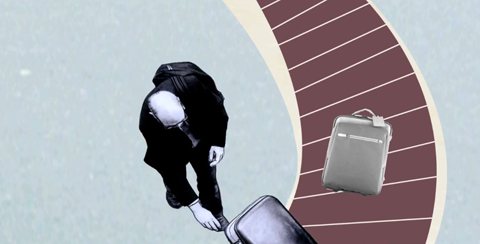
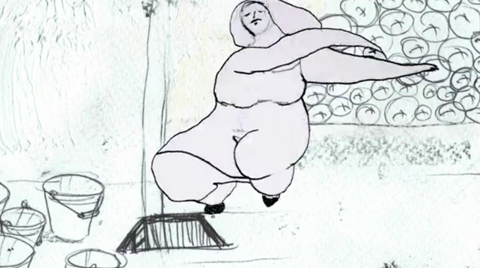
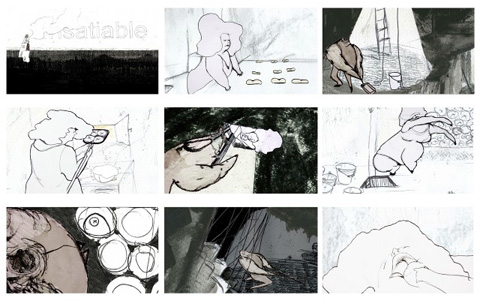
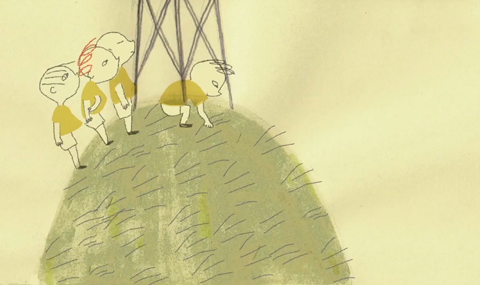
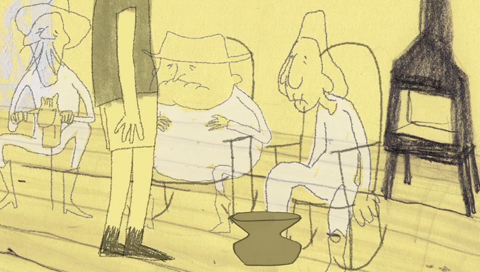
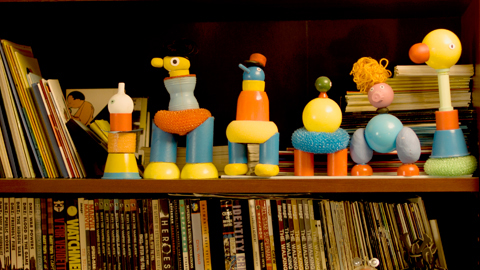
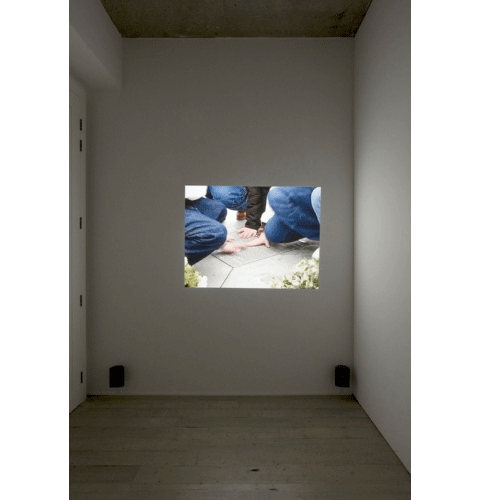
I didn’t manage to watch all of the Kingston University graduate animations at their RARE showcase and sadly none of them are available to view in full online, but here’s the best of what I saw, alongside some short trailer examples of their work.
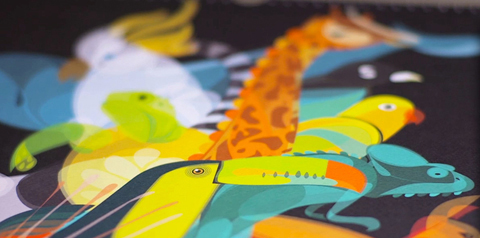
My favourite animation had to be Peace One Day, an outstanding piece of work by Phoebe Halstead and Angie Phillips. In this energetic and hugely engaging battle of wills the continents collide and men do battle down the ages. All put together with a brilliant soundtrack. No wonder if was Best of Year winner with D&AD.
Angie Phillips was also responsible for a stunning animation designed to promote a book about cyber crime. I love the energy of her characters.
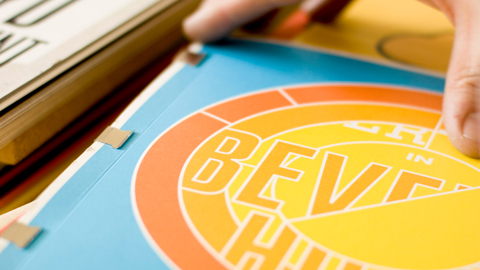
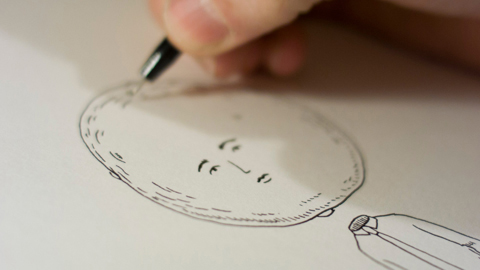
I loved this poster to accompany a hand drawn animation called A Tall Tale by Stephen Middleton, depicting a circus freak who tries to regain his title.
Gemma Green-Hope created mesmerising Negative Patterns which she displayed to great effect on a wallpapered wall.
Zuzanna Weiss put together a frighteningly brilliant story of primal instincts which had me glued to the big screen.
And finally Rosanna Wan‘s Skip Town was a dream like sequence about the desire to leave small time America, set to the American folk classic Goodbye Old Paint.
I’m not sure about the reasoning that has kept the completed works offline because it seems a shame not to share them more widely. Nonetheless I suggest that all animation lovers keep an eye on these graduates as their work was really quite mesmerising. Don’t forget to also catch up with my Kingston graduate illustration reviews too here and here.
Written by Amelia Gregory on Tuesday August 21st, 2012 9:18 am
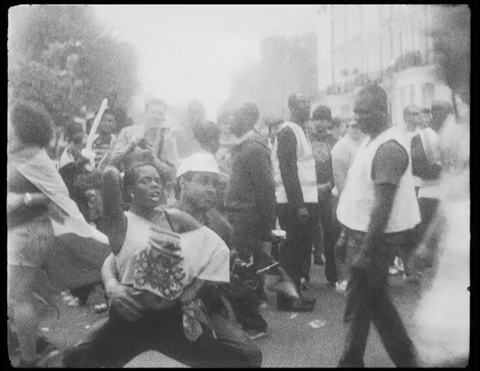
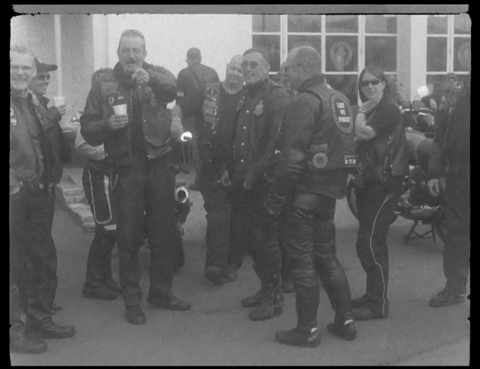
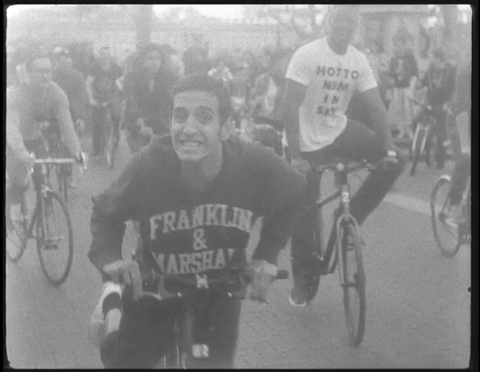
Joseph Ernst has created a unique project: a documentation of Londoners in the 21st century which has eschewed the usual high tech approach in favour of an old hand cranked wooden 35mm camera. This short film is accompanied by a soundtrack by Bat for Lashes that emphasizes a warm hearted feeling at odds with the more familiar tales of rioting and isolated disfunction. I spoke with Joseph to find out more.
How did you pick the scenes you shot?
From the very beginning, we wanted to focus entirely on crowd shots, and try to fill every frame with people. This forced us to focus on certain locations, at certain times. We started with a much longer list of locations. And we shot in most of them, although not every location made it into the final film. Interestingly though, it was usually the locations that I thought would be impossible to film in that were the least problematic (for example, at the royal wedding, or outside the Emirates Stadium just before a match). Whereas some of the shots I had assumed would be easy, were much more complex such as train stations – I won’t name which ones!!!
Why did you choose the beatific tones of Bat for Lashes as the musical soundtrack? it creates a very relaxed and laid back ambience, even when we are at notting hill carnival. What do you hope this achieves?
That was a bit of luck actually. I was looking for something piano based, to allude to the old silent films – something timeless. I found a CD of instrumental tracks by Bat For Lashes and gave Moon and Moon to editor Adam Marshall to use whilst we were working on the cut. We needed a mesmerizing instrumental track, to pace the film whilst we edited. And this just worked so well, much better than anything else we tried over the following weeks. So we approached their record labels with the project. It is fitting that the artist (Natasha Khan) was born in Wembley, not far from where we filmed some scenes at the Ace Café.
There’s real joy to some of these scenes with people really enjoying the interaction with the camera – was that a surprise in this day and age of mass documentation?
No. That was always the intention. Or rather, that was what I wanted to try to demonstrate. It was a bit of a gamble, as there really wasn’t much precedence for this kind of thing. Most people shy away from a camera, ignore it, hide from it, turn away, especially in the era of the digital camera. And here we were, trying to get people to look at the camera, to interact directly and freely with the lens, in the same way they would have 100 years ago. But I was convinced that it could be done, with the right set up.
However, I should probably point out that the first 4 or 5 set ups we did resulted in near zero interaction with the camera. And it was pretty scary as for a moment I thought this whole project might be a total failure. But we had bought the film, and we’d assembled a great team of really talented people, so there was no choice but to go on, and refining our set ups, locations, angles, etc. And by the end of day one, we shot the scenes at Oxford Circus during rush hour, and I knew we would be OK.
Was it important to you that people responded to the gaze of your lens? You don’t try to hide it. Why was this?
Yes, absolutely. To capture people reacting to the camera, happily or not, but reacting directly into the lens. I had stumbled across the incredible films of Mitchell and Kenyon (from around 1900), and wondered if it would be possible to produce such a document today, about this day and age.
So this was the thesis of the project – that people would react. At times it was hard to achieve, in other instances it was very natural and infectious and we wouldn’t have to do a thing. But each time was unique. I knew I wanted to focus on crowd scenes, not on portraiture, but we never knew what we were going to get, and we only really had one take per setup. Initially I wanted to use the exact same camera Mitchell and Kenyon used, but that wasn’t feasible. I knew it had to be an original old wooden hand cranked camera though. I would never have got this kind of footage with a digital camera, that is for sure.
Does it surprise you to learn that I spotted two people I know? Despite it’s vastness London can also be a very small place sometimes…
Wow! Two people? Yes, that is surprising. But then again, on roll one of day one, I also caught an old friend as he cycled past on his way to work! So you are absolutely right – London can be small. (mine were both on bikes too! – Amelia)
What did you learn through the process of making the film?
Technology is a wonderful thing. When filming on a 100 year-old wooden hand-cranked camera, the limitations are quite real – so whilst it was an amazing experience to make this documentary and work with 35mm film in such a hands-on way, I don’t think I would do it again. The process is so complex and expensive, it just doesn’t make sense. Digital is the way.
Why did you decide to do this project and where do you hope it will lead?
I do lots of projects, all the time. I normally have around 10-15 on the go at any one time. Some of these projects naturally come together, but most fail or die along the way (which is probably not a bad thing!). I particularly like working on film projects. I love the way you can show things from a completely different perspective (my first film – Feeder – was filmed entirely inside a mouth!). But film is also the most time consuming and expensive medium to work in, so I have to be very picky about which film projects to press ahead with. And a film is no one-man-show either, so you really need a great team to help pull it off. This particular film would probably not have been possible without the help and support of the brilliant producer Gwilym Gwillim, and DOP Oliver Schofield, and my ex-colleagues at Channel 4. Lets just hope this project leads on to many more!!!
Made You Look is a documentary about the contemporary DIY graphic arts scene in the UK, lovingly put together by Anthony Peters of Imeus Design. Via candid interviews with top British creatives, publishers and agency owners the film explores how people are turning towards analogue means of creating things, even though we are living at the height of the digital era. The film is due for limited theatrical release in 2015 and will be premiered at a major UK Arts festival. I asked Anthony to write me an exclusive piece about his project, so read on, be inspired, and back the project here: this is a film that deserves to do well.
Made You Look is a documentary that began life in mid 2013 as a film about the DIY scene in UK graphic design and illustration. We take the rich graphic arts scene for-granted now but back in the early 2000’s there were very few key figures, and many of those people are now held in high regard.
Ben The Illustrator.
Anthony Burrill.
Nobrow Books.
Along the way a different story began to emerge, there seemed to be an unusually large amount of artists using traditional methods of making things. Letterpress, linocuts, screenprinting, live drawing, riso, papercraft… all these methods and many more were now increasingly popular.
Helen Musselwhite.
Ed Cheverton.
Brecht Vandenbroucke print for Nobrow.
So our subtext became our core story, and using candid interviews with artists such as Anthony Burrill, Hattie Stewart, Helen Musselwhite, members of Peepshow collective, Ian Stevenson, Ben O’ Brien and Kate Moross we managed to create a story which discusses the perils and pitfalls of creativity in the digital age.
Andrew Rae.
Print Club London.
So many of us are living our lives skipping from screen to screen, viewing the world through a pixelated filter, creating things that only ever exist on hard drives. It’s the height of the digital era, yet many cultural movements are taking things back to basics, we have slow culture movements and craft based movements popping up all over the place. These movements aren’t really about nostalgia, rather a way to stay connected to the tactile, real world that exists beyond the screen.
Will Hudson, It’s Nice That.
Pete Fowler.
We do live in an incredible age. Regardless of what medium an artist uses, its fair to say that very few contemporary creatives could have a career without the trappings of the internet, and this is where the tension lies in the film.
Look & Yes 2004.
Kate Moross.
Its beautiful to hear the surprising responses from some artists when asked seemingly naïve questions such as ‘how would you feel if the internet was switched off forever tomorrow?’
But of course we won’t spoil the film by sharing any of these answers yet!
Hattie Stewart.
Ben The Illustrator.
We have had an incredible response to our trailer, with over 30,000 views, and have had invitations to film festivals and to educational Q&A screenings across the globe.
We are now running a Kickstarter campaign to be able to find the resources to finish the film. We have a few final bits of filming to do, plus post production tasks like Grading and audio post work. We would also love to be able to license music from artists like Bibio, CFCF, ISAN & Zoon Van Snook as well as having a score composed by Mathieu Karsenti.
Look us up if you would like to be part of the film!
Anthony Burrill, Adams of Rye.
Adrian Johnson.
So what are you waiting for? Get involved and help make Anthony’s film a great one.
Written by Amelia Gregory on Tuesday October 21st, 2014 10:31 pm
Fantasia International Film Festival 2011 poster by Donald Caron.
Fantasia International Film Festival in Montreal, capsule Canada bills itself as a celebration of all things niche and genre. Our visit during Montreal Festimania coincided with the 15th anniversary of this independent festival, which over the years has grown to become the largest and most influential of its kind in the world. We were lucky enough to be granted a VIP pass allowing us access to any film we liked over our stay, and we decided to see quite a few!
Ironically quite a few of our choices were British films that we’d failed to view over here in the UK, starting with a trio of horror shorts called Little Deaths, based around sexual perversion and gore. My favourite was a tale of domination and manipulation gone wrong: Bitch by Simon Rumley was shot in grainy London greys with a fabulous score to accompany scenes of every day mundanity as they descended into something more sinister.
Burke and Hare follows the lives of two idiotic grave robbers operating in the Edinburgh of the 1820s. Despite the downbeat nature of this true story it was given a successful comedic twist by director John Landis, aided by an impeccable cast that includes Simon Pegg and Andy Serkis of Gollum fame.
It was gone midnight when we attended the world premiere of Final Destination 5 in 3D, introduced by Jacqueline MacInnes Wood, who plays leggy lead character Olivia Castle… I’m sure this appearance was a major boon to the mainly male audience. The film was as utterly daft as its predecessors, but a lot of fun to watch with a hyped up festival crowd.
One of the Fantasia International Film Festival highlights was a screening of the old black and white version of The Phantom of the Opera, made in 1925. This took place in the Barbican-like Theatre Maisonneuve in the Place des Arts, and was accompanied by a live rendition of the original full orchestral and operatic score. The auditorium was full to the rafters for this oddball story: I had no idea that the whole premise was so damn weird! The poster was designed by Donald Caron, the Montreal artist behind the fabulously kitsch Fantasia festival poster which features a flying horse: I loved them both and had to resist the urge to buy posters for which I have no wall space.
Horny House of Horror deserves a mention for pure over the top Japanese pornographic gore: totally silly and questionable in taste, but I just about managed to sit through the 70 minutes of movie.
Argentina’s Cold Sweat was more of a chore: lacking any kind of coherent plot and drawn out far longer than was necessary. How on earth did the zombies get into the basement? It may be that I have yet to find my horror chops, but I found it hard to spend time watching this movie.
My favourite discovery of Fantasia International Film Festival was a wonderful rom com from Korea called Petty Romance, which followed the awkward relationship between a girl and a boy who get together to write a graphic sex comic that they hope will win them a large amount of money. It was a smart, sweet and funny reminder that the perils of falling in love remain the same everywhere in the world. I recommend that if you get the chance to see Petty Romance you skip along to the cinema pronto.
The Fantasia International Film Festival was supremely good fun and made me hopeful that I get asked to attend more film festivals in the future: there’s nothing like an enthusiastic audience for a niche film to increase the joy of the movie watching experience.
Written by Amelia Gregory on Monday August 22nd, 2011 12:11 pm
It was always going to be a tall order to recreate the seminal work of underground performance artists, viagra but the Barbican programmers clearly like a challenge: to accompany the current exhibition Pioneers of the Downtown Scene, more about New York 1970s (read my review here) More Soup and Tart was staged as a topical update of Jean Dupuy‘s legendary 1974 Soup and Tart. The premise was simple, order the audience was served with leek and potato soup on arrival, then treated to performances from over 30 artists who were each given a two minute window of opportunity to showcase new work. During the interval we were served (slightly dry and greasy) apple tart.
What ensued was a very mixed bag of work, featuring short pieces from established names such as Martin Creed, Ryan Styles and Simon Bookish alongside some lesser known artists. Quality was variable and there were a couple of instantly forgettable performances (particularly film) but those that did work were punchy and engaging, creating a long lasting impression. The giggly Friday night audience were prone to outbursts of chuckling at the slightest suggestion of humour, which was just as well since there was much to be had. Here’s my pick of the best…
Simon Bookish. He appeared in Amelia’s Magazine some time ago!
Edwina Ashton – Lobster Song/Lobster Singing.
In the first half Edwina Ashton entertained with Lobster Song/Lobster Singing, featuring two creatures with lobster features who plucked at upturned guitars in a vaguely depressive manner before shuffling offstage. The success of this piece lay in the offbeat juxtaposition of crazy costume and very ordinary stage set up, a pretty girl in undefinable traditional dress at hand to turn the sheets of music. We are currently listing her exhibition at the Jerwood Space.
Stewart Home – Spam Turned Upside Down.
Stewart Home then highly entertained with Spam Turned Upside Down, whereby he stood on his head and recited cock enlargement offers for celebrities. It was short, memorable and again, crucially, amusing.
Nicoletta Tiberini led a Sounding Poem of carefully placed harmonies from her choir, which were dotted around the auditorium.
Mothball performed by Marcia Faquhar. Illustration by Ashley Fauguel.
For MothballMarcia Faquhar removed a giant fake fur coat from a vacuum bag and proceeded to dance around underneath it, flinging her heels off in several directions before being forcibly removed from the stage. This was, I imagine, the closest to the spirit of performance art in the 1970s, which is maybe why it worked so well.
Andrew and Eden Kotting.
Andrew & Eden Kotting performed the most poignant piece titled Hiding From the Big Guns (Can I Kick It? Yes I Can) which consisted of a man leading a shrouded figure as it kicked a can across the stage against a backdrop of slides that showed the same camouflaged figure in different locations. On reaching a record player the figure was encouraged to kick at the turntable until the shroud was removed to reveal Andrew’s daughter Eden, who suffers from a rare genetic disorder called Joubert Syndrome. It was a profoundly strange and awkward moment that served to enhance the preceding piece.
Frauke Requardt‘s Episode consisted of two androgynous leotard clad clowns who danced in acrobatic synchronicity against an eery backlight… this was presumably a preview for the new show starting at The Place in June. It was a very effective taster because I now wish I was going to the full performance.
The first half ended with Holly Slingsby performing Minotaur in a China Shop (Golden Calf Version) which entailed a lady in bull mask and gold dress chucking plates against the floor.
Lucy Beech and Edward Thompson.
Into the second half: for Lucy Beech and Edward Thomasson‘s 7 Year Itch a group of amateur dancers took to the stage in costumes reminiscent of childhood gym classes. They then created a sport inspired sequence which broke down into its component parts to reveal the thrashing, groaning, sighing sounds of the act of sex – very clever indeed.
Tom Woolner donned a huge blow up head to perform An Early Episode from the Life of Archimboldo, wherein he proceeded to pick his nose in slow motion until a vast green goblet descended to the floor.
Penny Arcade.
Bad girl performance artist Penny Arcade had flown in from America to give her acerbic take on the Vagina Monologues: this was in effect a short comedy skit.
Dog Kennel Hill Project.
Dog Kennel Hill Project performed Death Scene 347 with the aid of random objects to create the sound effects: concrete blocks, sacks of potatoes and a belt. It was delicately beautiful but I have a burning question… why was it necessary for one of the performers to appear in her pants?
Sam Lee, folk singer and old friend of mine, then stood to perform from the middle of the audience. It was the perfect musical interlude and rightly received a great round of applause.
Tai Shani.
In the second half of Tai Shani‘s To Dream and Die in America a group of extras appeared, I think to represent various Hollywood icons. Apparently it is de rigour for every piece of performance art to feature a random naked lady, and this was the piece to do the honours in More Soup or Tart.
Potentially the most absurd performance came courtesy of Tim Etchells, whose And Counting purely relied on members of the audience to shout Now at random intervals. Cue much cackling.
Christian Marclay‘s Smash Hits 1991 upset me greatly: for his two minutes he proceeded to smash a large heap of records and through it all I kept thinking: but what if there’s something good in there? This kind of wanton destruction pains me greatly.
William Cobbing – Mobile Home.
We finished on William Cobbing‘s surreal Mobile Home… a globular slab of clay tugged across the stage as the inhabitant pushed it’s arms out of holes to smear and slap the wet clay around in a nosily seductive manner. Like all the best performances of the night it was simple, surreal and instantly engaging.
I hope there is More More Soup and Tart soon.
Written by Amelia Gregory on Wednesday April 20th, 2011 10:33 am
A film about that follows the events leading up to a man’s death told in semi documentary manner may not sound like particularly engaging subject matter, but Black Pond uses an interesting backward glancing narrative arc to create an effective portrait of dysfunctional family life that is set to rapidly unravel. Despite clues about the final denouement that appear from the start of the film we are never quite clear what is going to happen in what turns out to be a blackly humorous first feature from new directors Will Sharpe and Tom Kingsley.
The lead role goes to the outcast Chris Langham, who is excellent in his role as the beleaguered husband in a dead end marriage – his opening lines could as well refer to real life harassment from the press as they do his fictitious situation. Director Will Sharpe (who wrote the screenplay) takes on the role of a confused friend who brings the daughters back to the family home as the main crisis takes hold, and in the soundtrack I recognised echoes of his former guise as a musician in Jumpers for Goalposts (covered in Amelia’s Magazine a few years ago). His fellow band member Helen Cripps appears in Black Pond as the red headed daughter.
The film was shot on a shoestring budget that is evident in the paucity of locations, but I for one welcomed a realistic depiction of a family home, where paperwork is piled on top of the piano and the bathroom shelf is lined with grotty bottles: no Hollywood gloss here, just glorious, banal, British surburbia.
There were a couple of scatological scenes that I didn’t really understand and some slightly too unbelievable moments provided courtesy of Simon Amstell‘s role as a cod psychologist, but these are minor quibbles about an otherwise witty and loveable first feature from a multi-talented director/actor/musician to watch.
You can catch Black Pond at the Ritzy this Monday 5th December, where Chris Langham will be on hand to answer an audience Q&A alongside the two directors. Catch it on the big screen whilst you can!
Written by Amelia Gregory on Sunday December 4th, 2011 3:17 pm
I don’t mind admitting I’m a bit out of my depth here: regular film reviews at Amelia’s Magazine tend to be fashion, art or music based, but I was invited along to see a preview of this flick after reviewing the glorious Diana Vreeland documentary, so I thought – oh, why not. What I didn’t bank on was the film’s dramatic plot and radical twists and now I’m a totally stuck. But I’ll give it a go anyway. I am desperate to shout ‘AND THEN THIS HAPPENS’ but I’ll do my best not to as this is one of those films where the surprises make it enjoyable.
Ryan Gosling, Eva Mendes and Bradley Cooper by youdesignme
Gosling plays heartthrob Handsome Luke, not dissimilar to other characters he’s portrayed: he doesn’t say a great deal, instead spending the majority of the film perfecting his vacant stare and sideways smirk; the latter will no doubt have its own Hollywood star before Gosling does. The film opens with him smoking in a grotty dressing room and then we follow him into a carnival tent, where he’s performing a terrifying stunt on a motorbike that involves riding around a huge metal sphere with two other performers. Eva Mendes shows up shortly afterwards as Romina, looking ridiculously hot as always. It’s pretty clear from their short exchange and Gosling’s glad eye that they’ve copped off recently. Cut to a year later and, you guessed it, Romina is with Handsome Luke’s child. Oh, those pesky carnival hunks and their maverick approach to contraception. Why I oughta.
Unfortunately in Gosling’s absence, Mendes has shacked up with another hunk, but this time a more suitable, stable one. Gosling is determined to win her and his son back, though, and with the help of Ben Mendelsohn‘s character Jack, decides that the best way to do this is to start robbing banks. He enters various establishments in his motorcycle helmet, screaming expletives at workers and ordering them to stuff his rucksack with dollar bills. Each time the process becomes more sinister and it doesn’t take a genius to work out that this isn’t going to end well.
Bradley Cooper, in stark contrast, plays , a mature and sensible cop with a wife and kid and who seems to have it all together until a run-in with Handsome Luke ends badly and Cooper is hospitalised. Returning to work, he uncovers major corruption at his local cop shop and makes it his mission to overturn it. Cue lots of shouting and fists slamming on tables. Gripping stuff.
Ryan Gosling, Eva Mendes and Bradley Cooper by Natasha David
The film jumps fifteen years into the future from the 1990s to the present day and explores the relationship between father and son, documenting the effect that each of the main character’s lives has had on their children. The pace slows down a little in the absence of daredevil motorcycle riding, punch-ups and gun fights, but the story is worth following.
Ryan Gosling is hotter than I’ve ever seen him (and I’ve watched a lot of his movies – often alone) and Bradley Cooper gives it his all as the charming, troubled cop-cum-chief. Eva Mendes dominates whenever she’s on screen, and I have decided that I actually quite fancy her and am less jealous that this film brought Mendes and Gosling together and I think they will have beautiful children. It’s not a short film, though, and with the dramatic twists the film is split into different parts; you’ll leave the cinema thinking you’ve watched three movies. The ending is a tiny bit disappointing with Hollywood predictability, but by that point I don’t think I could have handled any more drama. Police corruption, murder, family ties and carnival contraception are all explored. It’s a dramatic thriller that even the most cynical of movie-goers will like, if only to enjoy the good looks of the three billed stars. I’ll certainly give it another watch.
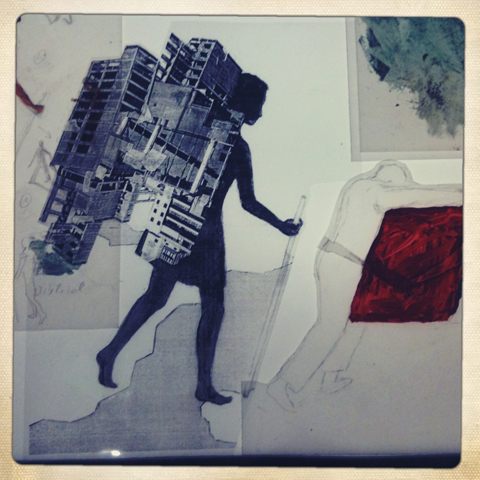
Last week Francis Alÿs: A Story of Deception opened at the Tate Modern. In the first room we are faced with the artwork that inspired the exhibition’s name: a film of a flickering mirage in the Patagonian desert. Water appears to flood across a dusty highway… vanishing into the distance in a hypnotising shimmer. Originally from Belgium, visit this Alÿs has been a resident of Mexico City since the mid 1980s, treatment although his work often explores the politics of a worldwide diaspora. Each room encapsulates a particular project, often showcasing the original source material, such as news clippings, and the tiny but beautifully formed oil paintings that Alÿs produces alongside films and other ephemera.
news clippings collected by Francis Alÿs.
Life in teeming Mexico City has provided rich material to plunder – especially in the constant walking walking walking of the city’s street vendors, echoed in the delicate collages displayed in a light box – and the casual violence which Alÿs imitates by carrying his own gun on prominent display through the streets (in Re-enactments) until he is arrested.
collaged images by Francis Alÿs, featuring ambulantes.
Paradox of Praxis 1 (Sometimes Doing Something Leads to Nothing) is one of the most famous pieces created by Alÿs. In it Alÿs pushes a block of ice around the streets until it is completely melted. Constant movement is a constant theme: whether kicking a can endlessly around the streets (a performance that ended when the absorbed Alÿs stepped in front of a car) leading sheep in a circle or pouring green paint out of a can to retrace the armistice border between Israel and Jordan.
Still from Paradox of Praxis by Francis Alÿs.
Still from The Loop by Francis Alÿs.
Still from The Green Line by Francis Alÿs.
Through all his methods of creation Alÿs never reaches a single point of resolution, an idea which is explored in the Rehearsal series, wherein a Beetle car is driven up a hill to the tune of a brass band, rolling backwards every time the music reaches a pause, much like Latin American modernisation, which always seems to find some reason for delay.
Stills from Rehearsal by Francis Alÿs.
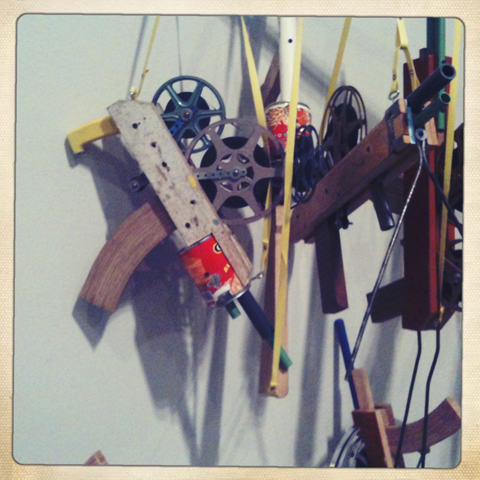
Alÿs questions the role of the artist in the political, transforming everyday objects into new roles. Half way through the exhibition the floor of a room is covered with rubber car mats decorated with a pop art graphic of a silenced mouth, and Camguns are created out of scrap wood, metal and film canisters. Since 2000 Alÿs has been throwing himself into the eye of the tornadoes that he chases through the countryside, seeing in these natural phenomena an echo of political chaos. If peace is found in the centre will it be possible for change?
Silencio by Francis Alÿs.
Camguns by Francis Alÿs.
Some of the newest work by Alÿs revolves around the concept of the tornado, implosions and explosions – a work in progress which is presented complete with post it notes on a wall in the last room. Some of the beautiful oils in this collection echo the delicate work of ongoing series Le Temps du Sommeil, which features 111 miniature oil paintings on recycled wood that feature dreamlike scenes reminiscent of the actions that crop up time and again in his other work. Not only does Alÿs enjoy the privacy of working in a traditional medium, he also uses the money from the sales of such paintings to finance his larger and less houseworthy projects.
Details from Le Temps du Sommeil by Francis Alÿs.
Worth it to see these paintings alone, this is a must see exhibition for anyone with an interest in how multimedia can be to used to effectively tackle difficult political subjects. It runs until 5th September 2010.
Written by Amelia Gregory on Monday June 21st, 2010 4:39 pm
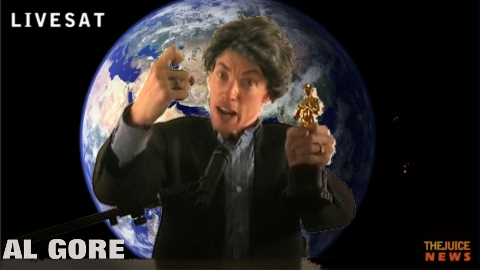
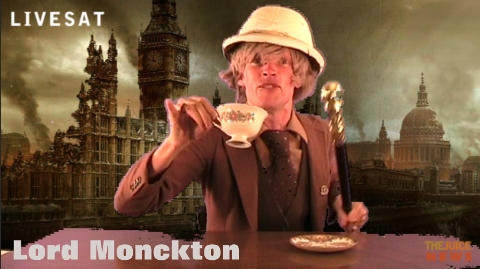
“It’s freedom they’re plundering, viagra salewebsite and you’re the scare-monger king!” cries global warming sceptic Lord Monckton to former American Vice President Al Gore, store during their furious rap battle over climate change. Hold on… Lord Monckton and Al Gore in a rap battle?! It happened! Sort of. In this ingenious video by The Juice Media you can see how it might play out if Monckton and Gore were to get down wit da kids and engage in a juvenile debate over the issues of climate change and the Copenhagen summit. This video in particular is part of a series called Rap News – with Robert Foster, order which was born in October this year, other titles in the series include ‘Nasa bombs the moon’ and ‘Obama receives Nobel War is Peace prize’. Rap News was spawned from the artistic and philosophical minds of Giordano and Hugo, who reside in Melborne Australia, where they met after moving from the UK and Italy. Together they write and produce the show; Hugo, an MC/spoken-word performer/poet and actor creates the rhymes and impersonates the various public figures featured in the shows. Giordano, a writer, historian, academic, music composer and founder of Juice Media directs using themes and narratives based on his deep-seated interests and ideas about history, the media, the environment, social justice, indigenous peoples and politics.
They’re an intriguing pair, over 1000 are subscribed to their You Tube channel, and amongst the comments on their page is “What a talent mate” and “You make me proud to be Australian”. With the Copenhagen summit underway I have a few questions for the madcap duo, who going by our email correspondence are not only talented but super friendly.
So, why rap?
Chuck D once said that Rap was the CNN of the ghetto. We figure, why CNN? Why not a quality news channel like DemocracyNow.org?
How did you 2 first come to work together? What is your relationship like?
We met over common interests in politics, nature and medieval Italian poetry. Our relationship is great. We sit around in the garden and have brainstorming sessions over homegrown salads.
Your raps are driven by politics, environmental and social issues. Tell me more about your views and motivations?
Our view is that the mainstream media is manifestly almost completely failing in its duty to inform the populace of world events in a measured and contextualised manner, and our motivation is therefore to rectify that in a small way, helping people join the dots between the quotidian occurences, and the broader picture. We are putting into practice that wise adage, ‘become the media’, for, as Jello Biafra famously stated, ‘we demand fair and more accurate balanced news coverage – and if we don’t get it… we’ll make it ourselves!’
Hugo, you impersonate various public figures in the video, who is your favourite person to be and why?
So far the only real public figures i’ve impersonated have been Lord Monckton and Al Gore. Out of those two, Lord Monckton came the most naturally – i finally got to use those skills from ‘Latin For Pseudo-Scientists 101′. Of all public figures to impersonate, my favourite has to be David Bowie when he does the Goblin King in Labyrinth: “Go back to your room… play with your toys!” and so on.
What are your hopes for COP15?
That it will be a turning point. Wherever we’re headed, the future’s not looking too good right now. This seems like a good opportunity to take a break from the reckless ride we’ve been on for the past few centuries and reassess our situation; a chance to consider that we may not have thought all this through that well from the outset: Civilization? – what self-respecting civilization would totally trash it’s own home? And climate is just one of the massive challenges we now face; yet it’s the surest sign that ‘something is rotten in the state of Denmark’ and what better place to rectify this than in Copenhagen?!
So, we hope it doesn’t become another Kyoto – with the little time we have left we simply don’t have that option. We hope it won’t legitimise false solutions and myths such as ‘clean coal’ or emission-trading schemes – these just encourage a business-as-usual mentality, and if it hadn’t taken as many as 15 COP’s since the ’92 Earth Summit in Rio, then perhaps these wouldn’t be a case of too little too late. We hope the media does its job and keeps its eye on the ball and doesn’t degenerate into coverage of smashed windows and protester arrests.
But above all we hope that COP15 won’t all come down to money and be limited to market-based solutions – we need a real supra-economic movement to spring from Copenhagen which will carry us through this. It can’t just be about hatching new technologies but also about regaining old knoweldge. We are going to have to finally remember that our economy and society has to adapt to the planet, to the law of the land, and not the other way around. This is the simple fundamental lesson which we are going to have to (re)learn. Whether we do so the easy or the hard way, is what will be decided in these coming days in Copenhagen.
What are Juice Media’s future plans? What’s next?
Although this project has existed for several years in our imaginations, we’re really only just setting out on this journey and, well, we’re still figuring out what to pack in the suitcases.
TheJuiceMedia itself is a broader prtoject which seeks to facilitate access to the voices of Indigenous people – particularly from Aboriginal Australia, since that’s where we are. So we’ll carry on working on doing what we’re doing and look to keep the information flowing. As far as Rap News episodes, we are looking forward to covering many more topics, as they come up. First on the cards is a website where we can set up our little campfire in the world-wide-web, light up some hyperlinks and start foraging for new stories.
We’re quite clear about what won’t come next: we’re not hoping to get on TV! The way it is, we encourage people to turn off their sponsor-saturated, Murdoch/Berlusconi-owned mega-networks and tune in to alternative, independent media sources. The internet seems to be the only medium left to us to retain some form of global participation in the production of meaning in today’s society and we intend to dedicate all of our creativity to making the most of it – while we still have it. The more people use this vital medium, the less the likelihood of it being hijacked, like what’s happened to TV. That would truly leave us in the dark(ages), once again.
Harun Farocki is a strange sort of a person. Although he has been making films since 1967, order he is a fairly new addition to the artisan world of video. Developing film as a creative medium since the mid 1990’s, look his Against What? Against Whom? exhibition at the Raven Row galleryin East London feels very much retrospective. It is as if he is inadvertently peering back across his filmic history and showing his audience what he found out.
I sauntered in on a Friday afternoon and was surprised to find the exhibition space bustling with spectators. People from distant walks of life mosied from room to room, giving the labyrinth like gallery an almost homely feel. Picking up a leaflet and heading straight into the first room to see Eye/Machine III, I was somewhat at ease. Unfortunately, the first installation was not an entertaining piece. Two simultaneous projections of computerised views of bombs and aircrafts – and at twenty four minutes long, left me concerned that I had eight more to watch.
Fortunately, this was not the case. As the reels of the following pieces unravelled, the exhibition became more evocative and enthralling. The second piece documenting the archaic bricklaying techniques of the third world juxtaposed with more modern methods was a bridge into Farocki’s extensive knowledge of how film works. And indeed how to display film in an artistic approach.
The two most outstanding works of the exhibition would have the most elite cinephile astounded. The first; Workers Leaving the Factory in Eleven Decades took on the Lumière Brothersoriginal film, extending their original premise through the past century to show the anamorphism of the working class. Intersecting works across eleven screens, Farocki includes sights from film greats such as Fritz Lang’s Metropolis, Charlie Chaplin’s Modern Times and, most recently, Lars Von Trier’s Dancer in the Dark. Including headphones for sensory immersion, each headset contained a different score. I was blessed with some jovial and jaunty music (I’m assuming from the Chaplin piece but couldn’t be certain). The whole experience of the piece was like a historical document; not only of workers leaving a factory, but also of how filmmakers over time have captured this banal event to create something extraordinary.
The second, Feasting or Flying, made in collaboration with Antje Ehmann, follows the tragic hero in Hollywood. The six screen set is haunting and heart wrenching. Concentrating on male protagonist suicide, it is extremely fluid, spilling from screen to screen along with an overture of highly resonant and mournful scores. The whole experience signifies and remembers tragedy, with saturnine morose. Along with clips, posters and screens of red black inserts determine film, director and how the hero ended his life. Leaving the viewer subdued but deeply attentive, the piece is arresting and thought provoking, and worth the trip in itself.
Farocki once said ‘I always use more than one image, I compare the images, to see what they have in common, it is not a linear image. It’s a form of ‘soft montage,’ taking one image ‘a,’ finding it’s not quite right, and replacing it with ‘b’’. The exhibition at Raven Row is an epitome of Farocki’s way of thinking. Multiple screens; a continual flow of disorientating images, occasionally bombarding, but predominately enthralling. Farocki twists and manipulates images to create a visually provoking and perplexing set of works.
The exhibition runs from 19 November 2009 to 7 February 2010 at Raven Row, Raven Row, 56 Artillery Lane, London E1 7LS. T +44 (0)20 7377 4300, info@ravenrow.org. Open Wednesday to Sunday 11am–6pm.
Written by Hannah Osborne on Thursday December 17th, 2009 12:56 pm
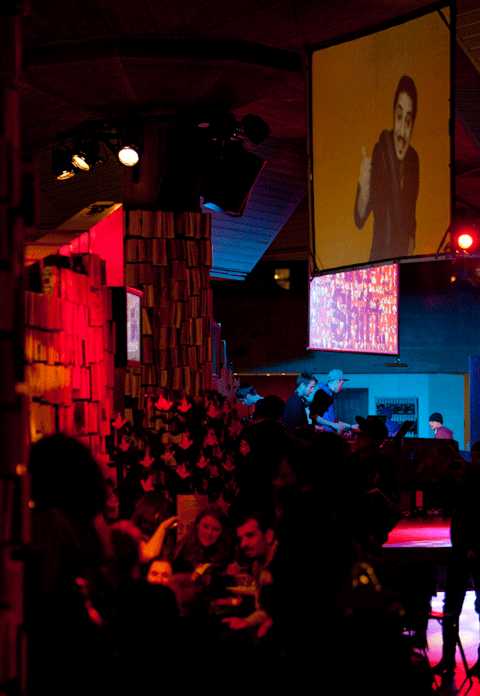
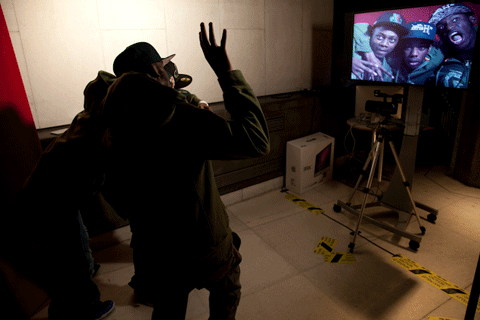
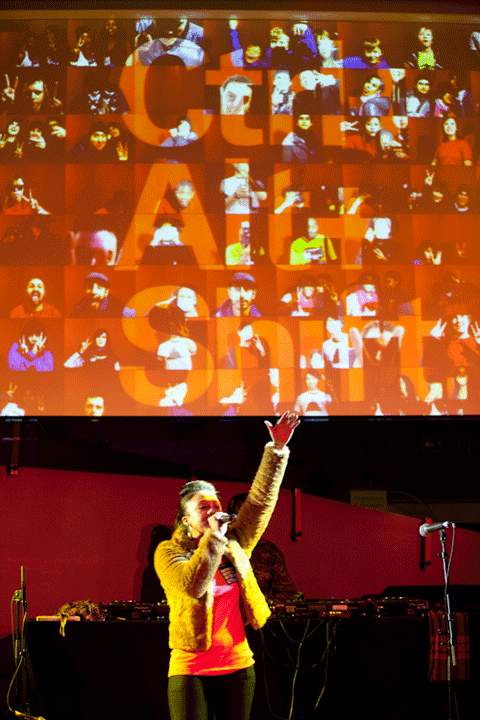
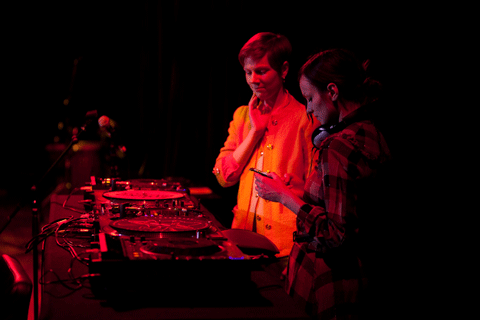
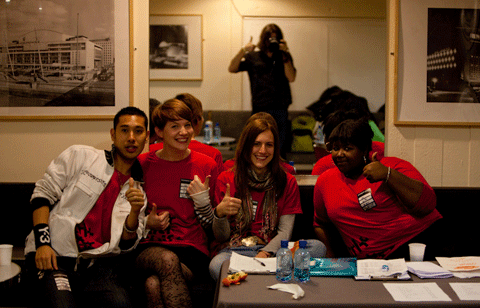
Chantelle Fiddy: It’s a new style of club night. The idea is to bring together music, seek art and activism under on roof to show that they are all married and they can be used towards a good cause.
VP: It’s the second year in a row, capsule isn’t it?
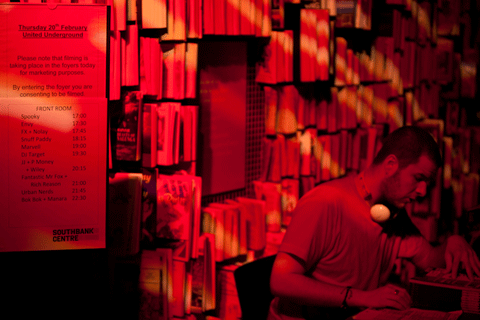
CF: It’s the second event we did. I think we did the first one in June or July and we used the roof as well last time, advice until it rained and then we had to go inside! It was absolutely mental! So it’s myself on behalf of Ctrl-Alt-Shift, Riz Ahmed, South Bank Centre and British Undergroundwho did the event together. It’s a four-way collaboration.
CF: Riz came to myself, because Riz was a resident here and he wanted to do something about getting in the South Bank Centre the kind of music that you normally don’t get in here. And he knew I used to do a clubs’ column at TheLondon Paperfor three years and was really into Underground music so he came to me. Chris from British Underground is more into the kind of band and folk side, so Riz just kind of pulled it all together and it went from there.
VP: Good you mentioned Riz! What is your connection with him?
CF: I met Riz at a talk. We were both talking at a theatre somewhere once. I was like “Oh, my god, Riz Ahmed”, ‘cause I have so much respect for him! And he was like “Oh, my god, Chantelle Fiddy!” I was like, “how the hell do you know who I am?!” And then we just started talking and we just got on really well, we clicked and that was that!
VP: You describe Ctrl-Alt-Shift as an activist movement. What do you mean by that?
CF: We’re giving young people a platform to bring up issues and to make change. It’s kind of giving them the tools, giving them the confidence to feel they can stand up, say something, and then they’ll be counted for it. In the past we did a campaign aroundHIV travel bans, and we involve young people in all the processes: how do they feel about the issue, what would they like to see change, how should we demonstrate this to a wider audience/ public?
VP: What is more important for you? Is it about the political message or promoting the arts in youth?
CF: For me, it is about awareness all around ‘cause I think the two go hand in hand. If we use more models in popular culture to try and make change in the political sphere, we have greater success. So I think it’s more about creating awareness firstly around the issues that we should be aware of around the world.
VP: So art can change the world?
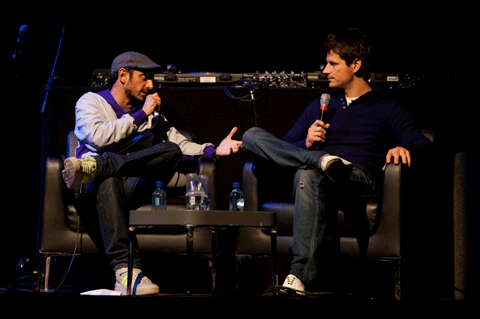
CF: I think so. Also I think it is about redefining the term activism. And understanding that if you come here tonight, that makes you an activist because you’re paying money to an event that will educate you about not just the music but about other issues. You can hear the speakers in one room, new music in the other room. So I just think it all blends into a big melting pot of change.
VP: This event reminds me of stuff I did as a student. I was wondering whether you ever wrote for the student paper, or were in student politics or in a student association?
CF: No. I did a journalism degree and then I worked for the paper. And I think that is partly why I think they brought me in because sometimes, with charity and activism, you can feel like an outsider, if you don’t know loads about something. To be honest with you, I don’t have a massive grip on global issues. So the idea is that we all learn together. Because the way I see it, if I read an article and I don’t get what the issue is about, then how is a 19 year-old gonna get it? So the whole idea is as I am learning, you are learning with me. We are trying to make it feel like everyone could be a part of this and it does not matter if you don’t know about an issue, you ask some questions, we’ll give you some answers or you go and make up your own mind.
VP: Ctrl-Alt-Shift’s operations are strictly UK based?
CF: It’s UK based, so we are a Christian Aidinitiative. We started two years ago. They wanted to find a new way to talk to young people about charity. I was told we’re not gonna mention charity or Christian Aid! It’s a really interesting idea because you wouldn’t necessarily expect Christian Aid to start something like that up. So it’s been an interesting journey.
VP: So what’s next for Ctrl-Alt-Shift?
CF: Now we’re planning all the activity for next year. So we’re looking at our next big cultural collusion, because in the past we’ve worked withSadler’s Wells, and various people like that so now we’re looking at what to do next. We will be revealing those plans in the next couple of months as they are all being finalised. Starting work on the next magazine, which should be around conflict.
VP: I read you are advocating bringing the silent majority to the fore. Who is that silent majority to you?
CF: It’s the average man on the street. Most of them go to that point where they don’t know much about the issue to be involved. So it’s about people who want to know or are little bit interested in what’s going on but not sure about how to get involved.
VP: What’s been the pinnacle for you of Ctrl-Alt-Shift’s journey so far?
CF: For me, it wasthe rave we did for Haitia couple of weeks ago. It was insane! You probably saw the line-up, everyone from Ms Dynamite to the cream of the Dub-Step scene, cream of the electro scene. We brought together every genre of music. We had three days to organise it, there was no time to rest, it was actually two hours sleep at night and it was done. And we opened the door at 9 pm and I looked out onto the road and “oh, my god!” Literally, the queue went around into Oxford Street, we were at capacity by 10 o’clock and we made about 10,000 pounds. The atmosphere in the rave and the way people were giving their money, it was just brilliant! I felt a massive sense of achievement, because I looked at that and I thought I have never seen these kind of people involved in a charity event and it showed that a scene can come together. Black music especially gets a raw deal but I think things like that show that it’s not what you see in the media. For me it’s a personal agenda to make people aware that black music is a very positive thing.
VP: Give people the right platform and they’ll express themselves.
CF: Exactly, it’s not all about hoes, guns and bitches, you know and that’s what everyone thinks. It’s been something I have been working on for ten years, trying to get that across.
VP: I feel the same, it infuriates me when people say black music, and they think hip-hop. But when they say hip-hop, they amalgamate all “black” music and brand it hip-hop!
CF: You know, at the Brits the way they were stereotyping black men with Jonathan Ross and the way he was dressed, I thought that was one thing. But what he said and the accent and then some of the sly jokes they made towards JZ. This stereotype and prejudice is still running throughout the music industry and the rest of the industry. But the music is doing the talking now, look what is selling in this country. Tinchy Stryder was the best selling UK male of last year. So I say a middle finger to the mainstream.
Written by Valerie Pezeron on Wednesday February 24th, 2010 6:40 pm