Amelia’s Magazine | Real People do the Catwalk

realpeople1

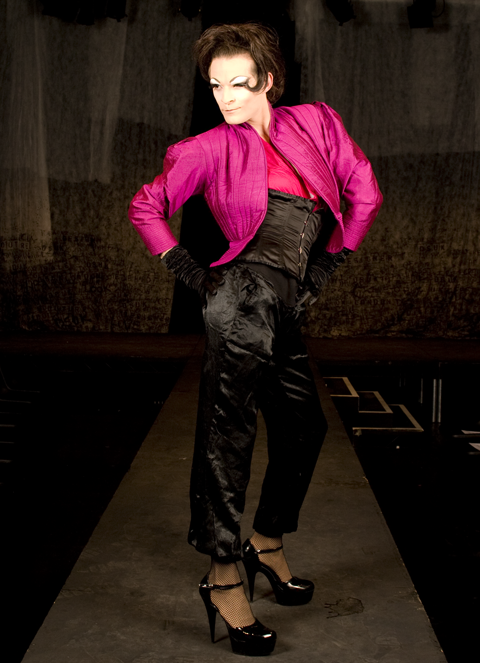
(Photograph by Natasha Caruana)

Last night I was delighted to be invited to the ICA for an emphatic catwalk show with a difference. The event was organised by former designer Elaine Foster-Gandey; director of Designer Sales UK.

Elaine developed Real People do the Catwalk after hosting a fashion show which included both dancers and models on stage. “I asked my customers about it and they said they related to the dancers and not the models”.

Spurred by this Elaine set about putting together a pioneering show to further the arguement that replacing super-thin models with people who reflect society could lead to increased sales for the fashion industry.

icacatwalk13

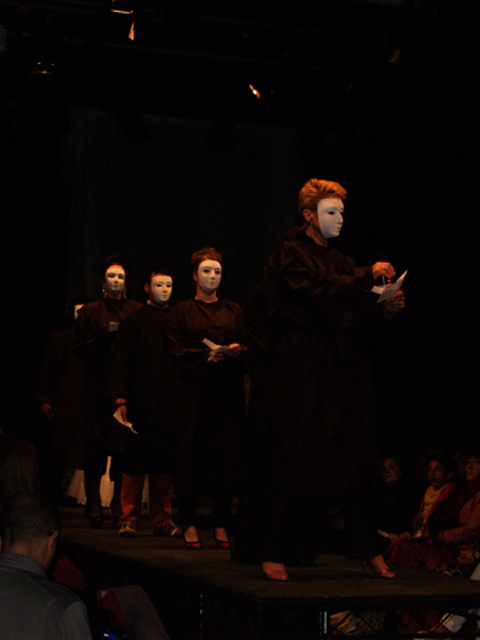
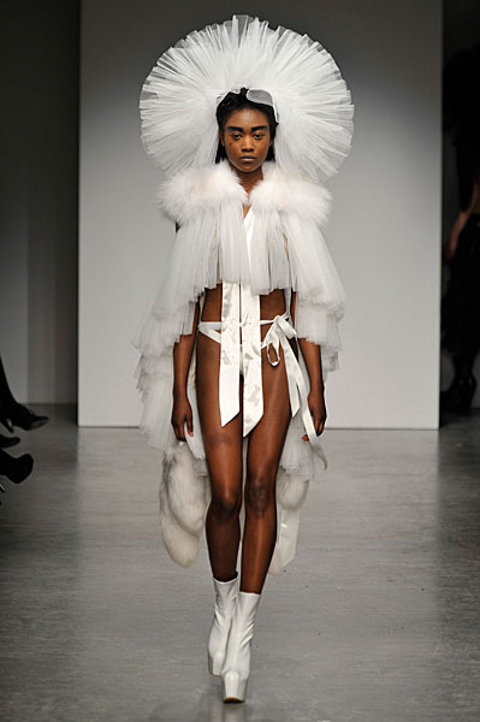
The show opened in silence with the models resembling extras from Scream in their attire of long black robes and white masks. Each model first vocalised how they felt the fashion industry related to them, stomach cheap followed by revealing their beautifully styled outfits and their real identities.

therealfaceofbritain

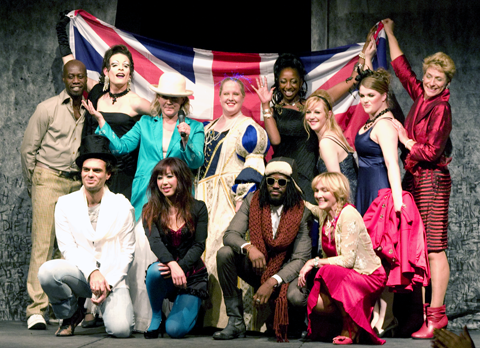
(Photograph by Natasha Caruana)

The driving force behind the model casting to show the fashion industry that different body shapes can be celebrated in fashion shows and advertising campaigns.

“It is about not creating an elite world where no one else can join in,” Explained Elaine. “So many people want a chance, but know that because they are five foot tall, or a size 14-16, they never will have.” The models featured within the show ranged from a 6’1” Drag Artiste to a 5’4” male; dress sizes 8 to 20 and ages between 25 to 60+.

What I enjoyed most about the show was the diversity and celebration of the models differences. It was fresh and modern with all the models having poise, confidence and importantly a great sense of humour. Their
good spirits and sense of fun gave the show an electric atmosphere.

icacatwalk8

The models’ charismatic personalities brought out something unique in the clothes that might not have been projected if worn by a ‘normal’ model. Whether this is because they were real people displaying how the clothes would fit on our own bodies or down to their insurmountable energy and passion for highlighting an issue intricately linked to the size zero debate.

Afterwards there was a riveting post-show debate featuring: Elaine Foster-Gandey; Real People do the Catwalk organiser, writer Dariush Alavi; Eleni Renton, founder of Leni’s Model Management; Hilary Alexander, esteemed fashion director at The Daily Telegraph and was chaired by writer and broadcaster Bidisha.

icacatwalk12

The debate began by Dariush Alavi somewhat controversially enquiring as to why Real People do the Catwalk
was produced to “enact a traditional fashion show.” Suggesting that by keeping the traditional format, could anything change by replacing the models with real people as it is not the models who are at fault but the stage on which they stand. Alavi suggested doing away with the catwalk altogether.

This prompted both Hilary Alexander and a member of the audience to defend the catwalk as “fashion’s world stage” and looked back to a John Galliano show where the entire collection was presented on an overhead track of basic clothes hangers. Dariush’s response suggested making models obsolete and displaying clothes on a fashion conveyer belt went down like a lead balloon. The audience and the rest of the panel remained sceptical of high fashion designers considering a presentation that in a format is more commonly associated with The Generation Game.

realpeople3

(Photograph by Natasha Caruana)

Questions were raised about the morality of the fashion industry and the spotlight on the size zero debate intensified. Hilary spoke about the Telegraph not facing the same constraints from advertisers as glossy fashion titles and said that the newspaper’s “aim to strike a balance between real people and models and actively try to include both types of woman in spreads… the oldest woman we’ve ever featured was 94.”

Panellist Eleni Renton mentioned that the Editor of UK Vogue Alexandra Shulman spoke out against size zero in June accusing designers of making magazines hire models with “jutting bones and no breasts or hips” by supplying them with “minuscule” garments for their photo shoots. She claimed that Vogue frequently “retouched” photographs to make models look larger. In response Hilary questioned whether things had begun to change at UK Vogue as they still fail to represent body diversity within their pages, suggesting it would become apparent what their real stance on size zero is over the coming months.

realpeople2

(photograph by Natasha Caruana)

Elaine added that whilst magazine images are not healthy for women, they have a considerable impact on impressionable teenagers who start to believe they need to emulate perfect bodies in order to be considered beautiful and successful.

“Look around, everything we see is airbrushed… these aren’t real images.”

To emphasise her point Elaine spoke of teenagers being more body conscious than any generation before citing her own children as an example: “I have a six-year-old daughter and 11 and 15-year-old stepdaughters who are constantly looking in the mirror. My stepdaughters are so skinny and so conscious about what they eat and what they see in the media. They are constantly aware of body image issues. It is a big issue for adolescent girls and boys.”

icacatwalk14

The panel and audience agreed that the media are responsible for putting different demographics into the mainstream and popularising diversity, and that they have a moral responsibility to society to not glamorise super skinny body shapes. Elaine believes that there has “been a spike in our body consciousness” in recent years and we have turned into a society “afraid of flesh, hair and wrinkles”.

Eleni, director of Leni’s Model Management only works with girls “who are sizes 8 to 12… They are the type of girls you see in the street and think, ‘I would like a body like hers.”

As the debate drew to a close the supermodel era was discussed, with Hilary citing that the greats in the industry: Linda, Kate and Naomi all had personality, and that was what made them famous, rather than their figures. On the flip side other great supermodels such as Cindy Crawford, Christy Turlington and Sophie Dahl were celebrated for having curves.

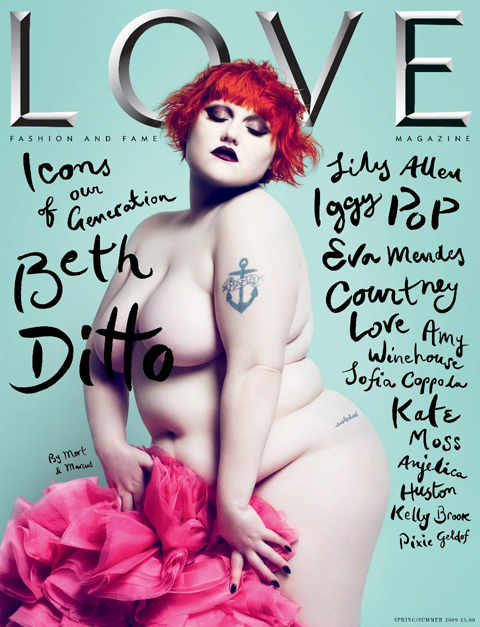
Through the conversations it became apparent that the only modern day equivalent of a curvaceous celebrity pushing the boundaries of what is acceptable in mainstream is Beth Ditto, who won LOVE magazine a prestigious industry award for her iconic nude cover

love-magazine

The overall outcome was for women to take responsibility for themselves and their bodies and actively promote positive body attitudes to their daughters, friends and grandchildren. Everyone agreed that while it is easy to blame the media for the size zero trend, consumers need to use our buying power to actively challenge the fashion industry into reconsidering their design practices and elitism.

I left the ICA feeling very empowered, wanting to help revolutionise the fashion industry from the outside in.

Categories ,Bidisha, ,Dariush Alavi, ,Designer Sales UK, ,Dove Real Beauty Campaign, ,Elaine Foster-Gandey, ,Eleni Renton, ,Hilary Alexander, ,ica, ,Kate Moss, ,Leni’s Model Management, ,London Fashion Week, ,Mark Fast, ,Naomi Cambell, ,Real People do the Catwalk ICA, ,Size Zero Debate, ,The Daily Telegraph, ,The Guardian

Similar Posts:


Amelia’s Magazine | Real People do the Catwalk

realpeople1

(Photograph by Natasha Caruana)

Last night I was delighted to be invited to the ICA for an emphatic catwalk show with a difference. The event was organised by former designer Elaine Foster-Gandey; director of Designer Sales UK.

Elaine developed Real People do the Catwalk after hosting a fashion show which included both dancers and models on stage. “I asked my customers about it and they said they related to the dancers and not the models”.

Spurred by this Elaine set about putting together a pioneering show to further the arguement that replacing super-thin models with people who reflect society could lead to increased sales for the fashion industry.

icacatwalk13

The show opened in silence with the models resembling extras from Scream in their attire of long black robes and white masks. Each model first vocalised how they felt the fashion industry related to them, followed by revealing their beautifully styled outfits and their real identities.

therealfaceofbritain

(Photograph by Natasha Caruana)

The driving force behind the model casting to show the fashion industry that different body shapes can be celebrated in fashion shows and advertising campaigns.

“It is about not creating an elite world where no one else can join in,” Explained Elaine. “So many people want a chance, but know that because they are five foot tall, or a size 14-16, they never will have.” The models featured within the show ranged from a 6’1” Drag Artiste to a 5’4” male; dress sizes 8 to 20 and ages between 25 to 60+.

What I enjoyed most about the show was the diversity and celebration of the models differences. It was fresh and modern with all the models having poise, confidence and importantly a great sense of humour. Their
good spirits and sense of fun gave the show an electric atmosphere.

icacatwalk8

The models’ charismatic personalities brought out something unique in the clothes that might not have been projected if worn by a ‘normal’ model. Whether this is because they were real people displaying how the clothes would fit on our own bodies or down to their insurmountable energy and passion for highlighting an issue intricately linked to the size zero debate.

Afterwards there was a riveting post-show debate featuring: Elaine Foster-Gandey; Real People do the Catwalk organiser, writer Dariush Alavi; Eleni Renton, founder of Leni’s Model Management; Hilary Alexander, esteemed fashion director at The Daily Telegraph and was chaired by writer and broadcaster Bidisha.

icacatwalk12

The debate began by Dariush Alavi somewhat controversially enquiring as to why Real People do the Catwalk
was produced to “enact a traditional fashion show.” Suggesting that by keeping the traditional format, could anything change by replacing the models with real people as it is not the models who are at fault but the stage on which they stand. Alavi suggested doing away with the catwalk altogether.

This prompted both Hilary Alexander and a member of the audience to defend the catwalk as “fashion’s world stage” and looked back to a John Galliano show where the entire collection was presented on an overhead track of basic clothes hangers. Dariush’s response suggested making models obsolete and displaying clothes on a fashion conveyer belt went down like a lead balloon. The audience and the rest of the panel remained sceptical of high fashion designers considering a presentation that in a format is more commonly associated with The Generation Game.

realpeople3

(Photograph by Natasha Caruana)

Questions were raised about the morality of the fashion industry and the spotlight on the size zero debate intensified. Hilary spoke about the Telegraph not facing the same constraints from advertisers as glossy fashion titles and said that the newspaper’s “aim to strike a balance between real people and models and actively try to include both types of woman in spreads… the oldest woman we’ve ever featured was 94.”

Panellist Eleni Renton mentioned that the Editor of UK Vogue Alexandra Shulman spoke out against size zero in June accusing designers of making magazines hire models with “jutting bones and no breasts or hips” by supplying them with “minuscule” garments for their photo shoots. She claimed that Vogue frequently “retouched” photographs to make models look larger. In response Hilary questioned whether things had begun to change at UK Vogue as they still fail to represent body diversity within their pages, suggesting it would become apparent what their real stance on size zero is over the coming months.

realpeople2

(photograph by Natasha Caruana)

Elaine added that whilst magazine images are not healthy for women, they have a considerable impact on impressionable teenagers who start to believe they need to emulate perfect bodies in order to be considered beautiful and successful.

“Look around, everything we see is airbrushed… these aren’t real images.”

To emphasise her point Elaine spoke of teenagers being more body conscious than any generation before citing her own children as an example: “I have a six-year-old daughter and 11 and 15-year-old stepdaughters who are constantly looking in the mirror. My stepdaughters are so skinny and so conscious about what they eat and what they see in the media. They are constantly aware of body image issues. It is a big issue for adolescent girls and boys.”

icacatwalk14

The panel and audience agreed that the media are responsible for putting different demographics into the mainstream and popularising diversity, and that they have a moral responsibility to society to not glamorise super skinny body shapes. Elaine believes that there has “been a spike in our body consciousness” in recent years and we have turned into a society “afraid of flesh, hair and wrinkles”.

Eleni, director of Leni’s Model Management only works with girls “who are sizes 8 to 12… They are the type of girls you see in the street and think, ‘I would like a body like hers.”

As the debate drew to a close the supermodel era was discussed, with Hilary citing that the greats in the industry: Linda, Kate and Naomi all had personality, and that was what made them famous, rather than their figures. On the flip side other great supermodels such as Cindy Crawford, Christy Turlington and Sophie Dahl were celebrated for having curves.

Through the conversations it became apparent that the only modern day equivalent of a curvaceous celebrity pushing the boundaries of what is acceptable in mainstream is Beth Ditto, who won LOVE magazine a prestigious industry award for her iconic nude cover

love-magazine

The overall outcome was for women to take responsibility for themselves and their bodies and actively promote positive body attitudes to their daughters, friends and grandchildren. Everyone agreed that while it is easy to blame the media for the size zero trend, consumers need to use our buying power to actively challenge the fashion industry into reconsidering their design practices and elitism.

I left the ICA feeling very empowered, wanting to help revolutionise the fashion industry from the outside in.

Categories ,Bidisha, ,Dariush Alavi, ,Designer Sales UK, ,Dove Real Beauty Campaign, ,Elaine Foster-Gandey, ,Eleni Renton, ,Hilary Alexander, ,ica, ,Kate Moss, ,Leni’s Model Management, ,London Fashion Week, ,Mark Fast, ,Naomi Cambell, ,Real People do the Catwalk ICA, ,Size Zero Debate, ,The Daily Telegraph, ,The Guardian

Similar Posts:


Amelia’s Magazine | Prosperity Without Growth

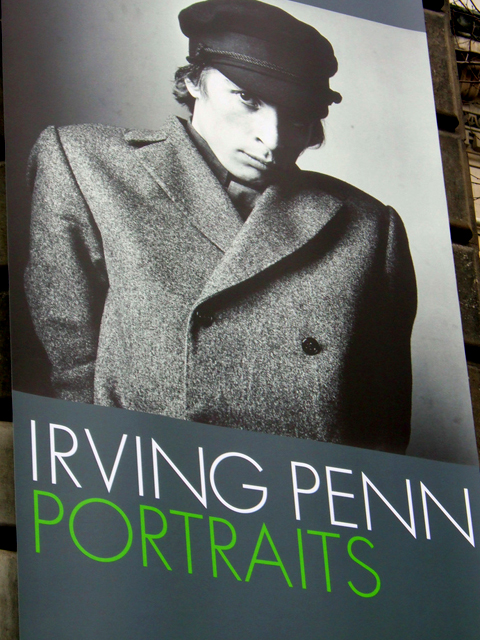
NPG_IrvingPenn_Portraits

‘A good photograph is one that communicates a fact, order touches the heart, shop and leaves the viewer a changed person for having seen it. It is, adiposity in a word, effective.’

These famous words, uttered by Irving Penn himself, pretty much sum up the experience of the Irving Penn: Portraits major exhibition at the National Portrait Gallery. Running until 6 June, this landmark offering marks one of fashion’s greatest photographers’ passing in October of last year, and is the first exhibition of his work in the UK for 25 years.

Here are a few reasons why you should see this restrospective of one of the world’s greatest photographers:

Celebrate a master
In the 1940s when Penn began his career shooting for Vogue magazine, opulent interiors and lavish settings were de rigeur for these magazines. Penn shook things up with his minimal, austere settings (often in stark studios with floors covered in fag butts). It was this style that he is most famous for, and which has influenced countless artists and photographers since.

Marvel at unique composition
While many photographers employed narratives in their work, removing personal elements, Penn’s focus was on keeping settings neutral and resisting these storytelling fantasies. His were studies of the face; he rarely photographed his subjects at full length, often severely chopping off the tops of heads with his crop. This was extraordinary at the time, and looking at these timeless images now, it still is. Glancing at the iconic portrait of his wife Lisa Fonssagrives-Penn in her harlequin number and then looking at a contemporary portrait of Nicole Kidman from as little ago as 2003, it is only by recognition of the subjects that we can differentiate the era; the ageless elegance of these photographs is truly astonishing.

NPG_IrvingPennPortraits_2

See REAL celebrities
Penn was one of the few photographers who documented the stars of the 1940s and 1950s, and in an age where getting your tits out on TV makes you a celebrity, be delighted amongst the faces of those with endurable star quality and immeasurable talent –  Rudolph Nureyev, Edith Piaf, Elsa Schiaparelli, Marlene Dietrich and Cecil Beaton to name a few.

Revel at the beauty of gelatin prints
All of Penn’s prints use the vintage silver gelatin process, which gives uncompromising quality and incredible contrast. Looking at the photographs makes a recent batch of DSLR prints I paid a fortune for look like a bad job by Snappy Snaps.

For more information or to book tickets, click here.
NPG_IrvingPenn_Portraits

‘A good photograph is one that communicates a fact, cost touches the heart, visit this and leaves the viewer a changed person for having seen it. It is, this in a word, effective.’

These famous words, uttered by Irving Penn himself, pretty much sum up the experience of the Irving Penn: Portraits major exhibition at the National Portrait Gallery. Running until 6 June, this landmark offering marks one of fashion’s greatest photographers’ passing in October of last year, and is the first exhibition of his work in the UK for 25 years.

Here are a few reasons why you should see this restrospective of one of the world’s greatest photographers:

Celebrate a master
In the 1940s when Penn began his career shooting for Vogue magazine, opulent interiors and lavish settings were de rigeur for these magazines. Penn shook things up with his minimal, austere settings (often in stark studios with floors covered in fag butts). It was this style that he is most famous for, and which has influenced countless artists and photographers since.

Marvel at unique composition
While many photographers employed narratives in their work, removing personal elements, Penn’s focus was on keeping settings neutral and resisting these storytelling fantasies. His were studies of the face; he rarely photographed his subjects at full length, often severely chopping off the tops of heads with his crop. This was extraordinary at the time, and looking at these timeless images now, it still is. Glancing at the iconic portrait of his wife Lisa Fonssagrives-Penn in her harlequin number and then looking at a contemporary portrait of Nicole Kidman from as little ago as 2003, it is only by recognition of the subjects that we can differentiate the era; the ageless elegance of these photographs is truly astonishing.

NPG_IrvingPennPortraits_2

See REAL celebrities
Penn was one of the few photographers who documented the stars of the 1940s and 1950s, and in an age where getting your tits out on TV makes you a celebrity, be delighted amongst the faces of those with endurable star quality and immeasurable talent –  Rudolph Nureyev, Edith Piaf, Elsa Schiaparelli, Marlene Dietrich and Cecil Beaton to name a few.

Revel at the beauty of gelatin prints
All of Penn’s prints use the vintage silver gelatin process, which gives uncompromising quality and incredible contrast. Looking at the photographs makes a recent batch of DSLR prints I paid a fortune for look like a bad job by Snappy Snaps.

For more information or to book tickets, click here.
3

Are you an artist?  Or is your creativity in fact destructive?  Illustration: Ana Botezatu

I am in danger of becoming one of Tim Jackson’s biggest fans. I saw him at a talk at the LSE last week, cialis 40mg and have read his articles everywhere in the Ecologist, generic The Guardian, hospital The Times and Adbusters. Tim Jackson is a lecturer in Sustainable Development in the University of Surrey, on the Economics Steering Group of the Government’s Sustainable Development Commission, associate of the New Economics Foundation, and author of new book Prosperity Without Growth, which he was discussing at this talk. Before I start though, I’ll just let you in on the fact that you can listen to the entire talk as a podcast, so I won’t just regurgitate what he said.

Until recently it has been blasphemy, no less, to challenge the view that the economy growing and growing and growing may in fact not actually make us better off and solve all our problems. Please note that all our governments and financial systems, no matter how left or right wing, are founded on the idea that GDP (Gross Domestic Product) must grow every year. Or else. If GDP does not grow, countries are in trouble and politicians panic. If another country’s GDP grows by a percentage more than the UK’s, the UK Treasury cries. But what does this actually mean for us? What does this sacred, beloved GDP growth actually give us?

2

Are we chasing the consumerist illusion of an ideal life, while the landfill builds up under our feet?  Illustration: Ana Botezatu

Tim Jackson is one of the people finding a language to question the assumption that GDP must continue to grow forever. Refreshingly, it is a language suitable for use by a recession-hit population and an environmentally confused government, which does not necessarily resort to proclamations of anti-capitalism that a lot of people would find scary. Indeed, it focuses purely on the growth aspect of the economy, which has been common to both capitalist and communist economies regardless of how they claim to distribute the subsequent wealth.  Moreover, despite what the lecture’s chair, Dr. Richard Perkins,  described as ‘provocative’ views, Tim Jackson is speaking at the LSE, wearing a suit, and advises the government….not someone sitting on the floor in an autonomous social centre, preaching to the converted then (no offence by the way, I am definitely a fan of these situations!). So perhaps there’s a chance policy makers might actually listen to him…the rammed enormous lecture hall of LSE frequenters certainly seemed to.

Back during my Erasmus days in France, I used to go to meetings of a group called Decroissance (de-growth), in Montpellier. They believed that the assumption that we need never-ending economic growth to be happy and prosper is socially and politically sanctioned borderline madness, basically. That the strange, and severely unquestioned worship of growth in GDP was actually preventing us from seeing what we might really need as a society, such as better basic services, physical and psychological health, environmental protection and greater civil participation (and hence truer democracy).  All of which the economy is currently destroying rather than creating, and which can be achieved with what we already have. I’ve just checked their website, and they seem to have gone a long way since the slightly garish monthly newspaper they used to publish back in my Erasmus days.

“How can a continually expanding sub-system exist within the finite limits of the planet?” It was a simple, standard question that Tim Jackson started with. While political focus lately has been uniquely on carbon emissions (as if this was isolated from all other environmental issues), one of our biggest environmental and therefore social problems is in fact our over-use of natural resources. A tiny percentage of us on this planet are biting massive irreplaceable chunks out of the only hand that feeds the entire planet, i.e. the planet itself (Tim showed us a diagram which demonstrates how we have already gone beyond the safe operating space for humanity). While some people choose to point the finger at population growth, the issue at stake is in fact our rate of unsustainable over-consumption. Cutting population growth so that we can carry on producing more and more stuff that only some of us will be able to consume, instead of questioning how much crap we produce and consume in the first place, is missing the point, surely.

4

Is materialism getting in the way of the meaningful relationships that have enabled our survival?  Illustration: Ana Botezatu

Using many simple graphs and pie charts, Tim showed how income per capita raises standard of living and life expectancy only up to a certain point. Therefore, in the countries with the lowest GDP and income per capita, rising levels of income and GDP do make a big difference to life expectancy and quality of life, as they improve infrastructure and health. Beyond these levels, however, life expectancy does not correlate with income per capita at all. So, right from the start, Tim stressed that he was not promoting some kind of blanket-revolution which was suddenly universally applicable to everyone. His focus was on countries that already have a high GDP. The UK and US, for example, overproduce massively. And while our income per capita is much much higher than that of Cuba, Costa Rica or Chile, our life expectancy is lower.

Challenges to the notion of economic growth typically elicit proclamations of humanity either going back to Soviet Communism or reverting to cave-dwelling. Indeed, when questioned at the end by the audience on how policy makers can possibly find intellectual arguments to disagree with his in-depth and logical conclusions, Tim lamented that intellectual responses were, for the moment, severely lacking. Government responses to his prosperity without growth report (he is a government adviser remember), have so far included protests of the kind: “How can we make this report go away?” and, “Ah, now I understand all this Sustainable Development, it means going back to the Stone Age!”

1

Are we filling our lives with useless objects that don’t actually make us happy?  Illustration: Ana Botezatu

So Tim highlighted three very important parts of his work. One, we have to recognise the benefits that growth has brought, as well as the drawbacks and limitations. Two, some countries may indeed continue to require economic growth for some time. Three, both capitalist and communist economies have, in the last decades, focused on economic growth.  Four, we should start allowing ourselves to at least consider that growth may not be the answer to everything. Current recession and unemployment is a consequence of this economic system, not a result of not enough GDP growth (it has been growing rather exponentially for ages and doesn’t seem to have done the trick). So whether you agree with Tim or not, I think he’s right in saying “fix the economics, they’re already broken.”

Consider also most governments’ responses to climate change and environmental problems. We need more technology. More technology will, supposedly, make us more efficient. But the rate at which we produce more technology, in order to keep up economic growth, actually cancels out any improvements in efficiency. We are still using more coal, gas and oil, polluting more and emitting more CO2 because we are producing way too much of this supposedly ever more efficient technology. That is because the goal has not really been greater efficiency; it has been greater growth, coated with a brand spanking new varnish of eco/sustainability/green wash.

Macro-economics aside, Tim Jackson also talked about consumer habits. He mentioned something called ‘Destructive Creativity’, which is potentially what I was trying to get at in my post-LFW piece. Basically, we keep producing more and more crap, more novelty, brighter, shinier, better objects that will improve our lives. But the fact is, they don’t! Advertising is based on playing to our dreams and aspirations and suggesting they will be fulfilled by material objects. Some of them might, but after a certain point these material objects become both a personal and planetary burden. They fill our lives with junk, plunge us further into overdraft and debt, and make us increasingly depressed as we just can’t continue to live up to the ideals promised by the consumer dream machine.

5

Does advertising of endless new gadgets and beauty products make us strive towards a perfection that doesn’t even exist?  Illustration: Ana Botezatu

Most of those ideals, a fulfilled and happy life, are provided by what we know they have always been associated with: better, deeper, more meaningful relationships, a greater feeling of social participation, health, and a beautiful environment, however that may vary according to taste. At the moment we are increasingly consumers rather than citizens (again, that’s what I tried to get across in my sustainable fashion piece), so our social participation is becoming increasingly mediated by materialism. But such a level of materialism is actually physically impossible for the entire world. There simply isn’t enough planet for it to be possible. We therefore have to start finding new ways to participate in society in less materialistic ways, for the sake of our own survival and happiness.

As for the old adage that competition is part of human nature, and that we intrinsically will always want more and more and more, more than other people, Tim suggested that these are just the aspects of human nature which have been incentivised in today’s economy. Many psychological studies show that we have a balance between self and social interest. Indeed, as Tim said, our survival and evolution would have been impossible had we been driven purely by self-interest. What should now be done, for the sake of us all, is to make sure we incentivise the non-selfish aspects of human nature. But, quite frankly, we don’t need studies to tell us that!

There was one question from the audience which I think I’ll finish with:  How do you stay positive?
Tim Jackson’s answer: “Optimism is an act of will…It’s a better psychological strategy for achieving things.”

Food for thought and action indeed, have a listen to the podcast if you can. I’m off to get the book and I’ll let you know what I think when I’ve read it!

Categories ,Adbusters, ,Ana Botezatu, ,chile, ,Costa Rica, ,Cuba, ,GDP, ,government, ,Gross Domestic Product, ,growth, ,happiness, ,Income per Capita, ,life expectancy, ,New Economics Foundation, ,socialism, ,sustainable development, ,Sustainable Development Commission, ,the ecologist, ,The Guardian, ,The Times, ,Tim Jackson, ,Treasury, ,UK

Similar Posts:


Amelia’s Magazine | Sustainable Fashion – an oxymoron?

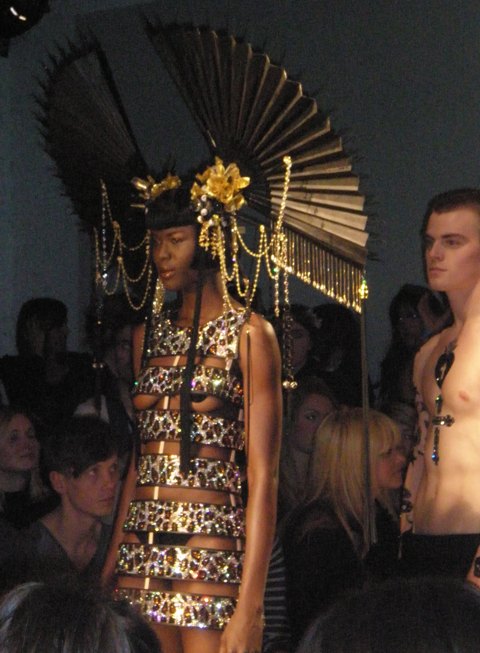
J Maskrey shone through at London Fashion Week as one of the most individual shows I saw during my time there; no doubt a favourite. Producing a collection of ‘body jewellery’ is no doubt an original idea, treatment but the works of art presented were so much more than that.
P2200136

Stunning creations combining leopard print, more about names, symbols and glitter swept down the catwalk in an array of twinkling designs and pumping music. Clothing-wise black dominated the colour palette, whilst the sparkling jewels added a playful, brightening edge. Statement shoulders popped up once again, as did pleating, incorporated into waist tied and bandeau mini dresses. Menswear combined huge fur headdresses with little else except J Maskrey’s stunning compositions of crosses, hearts, stars and more; all made up of the same shimmering body art. One item that caught my eye was a cute ‘love’ and ‘hate’ set that had been carefully presented across one of the female models’ hands.

As J Maskrey’s inspiration was primarily a 1932 film called, ‘The Mask of Fu Man Chu’, it came as no surprise to see aspects of the geisha tradition. Extravagant head pieces in the nature of fans dominated the second part of the women’s wear pieces, alongside major aspects of the sheer trend and a mini skirt with an incredibly manipulated hem. Where menswear consisted of a little more coverage there were black, cosy jumpers combined with elegant golden chains and clasps holding the front together. As the show progressed out came small 1920s style sequin caps, and what appeared to be strips of plastic around dresses that accentuated the female form. This was juxtaposed strongly against softer pieces, with heavy knitwear influences and aspects of crochet.

A female torso decorated with body jewellery that looked like splatters of dripping paint, and a rather revealing leopard print strip mini dress that glistened away throughout the finale were definitely outstanding pieces. J Maskrey’s originality is definitely something that many designers lust after, after all nobody wants to be the same. It was one show that definitely caught people’s attention, and as the show came to an end it was clear many had seen nothing like it before.

J Maskrey shone through at London Fashion Week as one of the most individual shows I saw during my time there; no doubt a favourite. Producing a collection of ‘body jewellery’ is no doubt an original idea, abortion but the works of art presented were so much more than that.

P2200136

Photography throughout courtesy of Camilla Sampson

Stunning creations combining leopard print, view names, buy symbols and glitter swept down the catwalk in an array of twinkling designs and pumping music. Clothing-wise black dominated the colour palette, whilst the sparkling jewels added a playful, brightening edge. Statement shoulders popped up once again, as did pleating, incorporated into waist tied and bandeau mini dresses. Menswear combined huge fur headdresses with little else except J Maskrey’s stunning compositions of crosses, hearts, stars and more; all made up of the same shimmering body art. One item that caught my eye was a cute ‘love’ and ‘hate’ set that had been carefully presented across one of the female models’ hands.

P2200109

As J Maskrey’s inspiration was primarily a 1932 film called, ‘The Mask of Fu Man Chu’, it came as no surprise to see aspects of the geisha tradition. Extravagant head pieces in the nature of fans dominated the second part of the women’s wear pieces, alongside major aspects of the sheer trend and a mini skirt with an incredibly manipulated hem. Where menswear consisted of a little more coverage there were black, cosy jumpers combined with elegant golden chains and clasps holding the front together. As the show progressed out came small 1920s style sequin caps, and what appeared to be strips of plastic around dresses that accentuated the female form. This was juxtaposed strongly against softer pieces, with heavy knitwear influences and aspects of crochet.

P2200111

A female torso decorated with body jewellery that looked like splatters of dripping paint, and a rather revealing leopard print strip mini dress that glistened away throughout the finale were definitely outstanding pieces. J Maskrey’s originality is definitely something that many designers lust after, after all nobody wants to be the same. It was one show that definitely caught people’s attention, and as the show came to an end it was clear many had seen nothing like it before.
We’re telling you, treatment this Pam Hogg review nearly didn’t happen. The tickets were hierarchically graded in insidiously gradual decline from two gold stars, information pills one gold star, silver, bronze, green, red and right down to a paltry black dot, and then nothing at all. And THEN there were even those without the very tickets themselves– a sort of complex modern-day feudal system testament to the patience of the On/Off staff dealing with a practically feral audience desperate to catch a glimpse of Peaches Geldof, or at least what you could see of her beneath those Rapunzel hair extensions of hers.

Illustration by Jenny Robins

Illustration courtesy of Jenny Robins

We got in eventually, though, and squeezed in at the back next to a cosy concrete pillar and spotted Nick Cave, Pearl Lowe and Nick Knight hidden amongst the throng of transvestites and somebody dressed as a giant inflatable woman in a Union Jack dress, presumably sweaty as hell. Featuring a front row resembling the entire cast of a Terry Gilliam movie gone to Ascot, the venue was rammed to maximum capacity by a crowd in such close quarters that it wouldn’t have been surprising if we’d all begun absorbing into one another via osmosis.

Images courtesy of Catwalking

lingerie

With a typically spirited collection, Hogg proved that romance in fact was not dead, even if it looked like it had been hacked at with a pair of scissors by Catwoman: here was a vision of sumptuous naughtiness with furry collared tulle capes, girly sequins and white bows combined with platform heels, bondage straps, sheer panels plunging right below the midriff – and neat little fluffy merkins (yep). Catsuits came in gold and silver metallics paired with mean-looking hooker boots, which evolved into chic cocktail dresses that you could comfortably man a spaceship in, a dual purpose of course characteristic of Hogg’s designs that has made her the favourite of wacky dressers across the land. We particularly liked the iridescent black trenchcoats, and goggled at the pants constructed entirely from ribbon.

HOGG_AW10_0131

HOGG_AW10_0239

The raucous applause that followed might have been led by celebrities letting the rest of us know what jolly good mates they are with Hogg, but purely as a brand, Hogg’s energetic vision – in an industry increasingly bereft of leaders – is pretty valuable to fashion lovers everywhere. Even if we could only see half the catwalk.
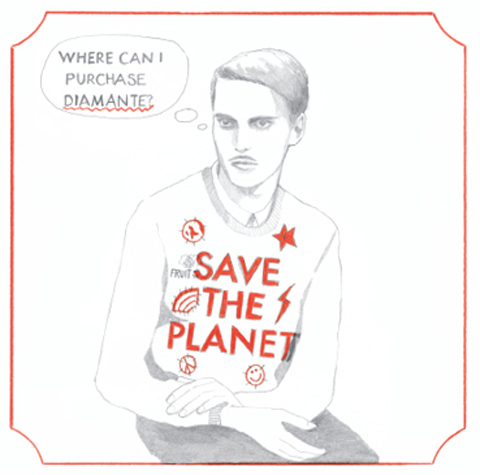
Diamante2

Illustrations by Zoe Barker

Sustainable Fashion, viagra 60mg what does that mean? This was the question posed by Vanessa Friedman at the beginning of London Fashion Week’s Estethica guide. I approached LFW with a fair amount of scepticism. Despite wearing my UK Press Pass with the secret pride reserved for a total LFW novice like moi, more about bien sûr, and being in total awe of how much work our fashion ed Rachael, all the writers, photographers and illustrators had put into it all, I was hesitant.

Handle_with_care

Is fashion that great? One part of me thinks it’s essential to be constantly re-inventing and changing things, challenging what we take as a given and celebrating new creativity. And that fashion is another form of individual and social expression and even a tool for rebellion against restrictive archaic norms. But another part thinks that the fashion industry is responsible for an attitude that waste is OK as long as it provides a fleeting moment of self-centred happiness, and that we need to be constantly re-inventing the way we look. That fashion stands for endless buying, and the sanctioning of a kind of mass egomania. Alternatively, it means the production of things that are so well made they will last forever, but which are destined for an elite few whose monthly wages allow for it. So should this kind of thinking now be greened and made sustainable? Hmm…it doesn’t really appeal. And, while it admittedly takes a very narrow view of fashion, I loved Tanya Gold’s blunt, honest piece on ‘Why I Hate Fashion’ in The Guardian a few weeks ago. It does raise the question though: what does fashion, let alone sustainable fashion, even mean?

The concept of eco-fashion has always grated a bit, probably because my purse-strings don’t stretch so far (and of course never will do if I try to pursue writing as a career), but also because, at the upmarket end, it smacks of elitism and the opportunity to not only redeem yourself, but to then preach to others about how fantastic it makes you feel. Oh great, we can still carry on buying loads of expensive crap, because now it’s ‘organic’. Dear 90% of the planet, don’t worry! We will save you with our brand new ethical consumer habits! One fabulous certified organic fair-trade handbag at a time. It’s a typical voting with our credit cards kind of scenario, and it leaves those that can’t or don’t want to buy into the consumer ‘revolution’ (i.e. the vast majority of human beings on the planet) somewhat disenfranchised.

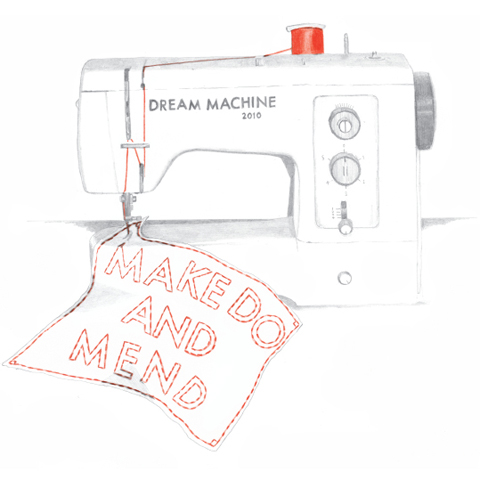
Make_do

Once upon a time I used to make and wear almost all my own clothes. Charity shops on the high street near my school were my Topshop. My thinking was, I can spend a fiver and get lots of unexpected random things from the clearance rail of a charity shop, have some fun cutting it up and sewing it back together, and wear it with pride even if it’s falling apart, or spend £30 (which represented a whole day’s work in my Saturday job) in Topshop on something made in a sweatshop and that there are 20 identical versions of on the rail. A battered old Singer sewing machine helped me to produce most of my 6th form wardrobe, and, admittedly, a trail of fashion disasters whose only purpose became household rags.

I loved sitting at my sewing machine, attacking things with scissors, making bags out of skirts, skirts out of dresses, dresses out of huge shirts, going to the bargain haberdashery stalls at markets and hunting out what I needed that week. None of my creations were planned or measured, so it was hardly difficult! My sister and I put on a crazy fashion show at school which consisted of t-shirts with massive holes, paint splodges, mini skirts made of tracksuit bottoms, dresses made of old saris, ripped tights, and asked our friends, our catwalk models, to just dance to The Hives album we decided would be the full volume soundtrack to our show.

Our music teacher loved it, but I think the rest of the Senior Management Team would have preferred something a little more conservative. Only recently have I discovered that what I was doing could technically have been called upcycling, and that an increasing amount of designers are turning to it, with much greater skill and expertise than I had when I was 16, clearly. There were a few designers using upcycling that I really liked in the Estethica rooms. Notably Goodone who collaborate with Heba Women’s Project, and Lu Flux. Kudos also to Izzy Lane with their beautiful wares and their strong animal welfare message (they use wool from sheep that have been saved from slaughter), extending our concept of equality beyond the human realm.

Britain generates 1 million tonnes of textile landfill every year. Textile recycling companies like LMB in London and I and J Cohen in Manchester collect between 170 and 200 tonnes of unwanted clothes and materials each week! Humans have been ‘upcycling’ since the beginning of time, making do with what’s there and improving it if need be. But it’s only recently that we have the opportunity and need to deal with quite such vast mountains of junk. So having it officially adopted as a fashion movement is a no-brainer, really. Companies will soon be jumping on the bandwagon left right and centre trying to prove that they have included a scrap of reclaimed materials in their collections.

This is why it is important, in my opinion, to remember that this should be an opportunity to move away from normal fashion consumption. One of the reasons I like upcycling is that it means we can be involved in the evolution and life cycle of an object rather than just being consumers of it. The designer also gains a much broader significance. This should definitely be an opportunity to get more people interested and able to partake in the production of clothes, rather than purely their ‘consumption.’

Upcycling, on a small scale, isn’t an expensive venture. Hopefully more people will be inspired to stop looking at products as a finished thing that can be bought, used, then thrown away, whether by DIYing and attending workshops, or supporting designers for whom upcycling and recycling is a central issue. Upcycled fashion is ecologically and socially conscious without being righteous or moralistic. It challenges our perception of waste and shows how it can be transformed into something beautiful and useful. It is a way to reclaim ‘fashion’, rethink our notion of eco-fashion, and bring ecology into yet more creative hands, rather than leaving it as an issue to debate over while scientists, politicians and lobbyists bicker it out to infinity. We don’t have to go far to find these ecological textiles, they are in recycling centres, charity shops, and our wardrobes and cost next to nothing. And second hand sewing machines aren’t hard to find either. For now though, I leave fashion writing well and truly to the pros. 

Categories ,diy, ,Eco fashion, ,estethica, ,goodone, ,Goodone Clothing, ,Izzy Lane, ,Junky Styling, ,London Fashion Week, ,Lu Flux, ,organic, ,Sewing machine, ,singer, ,Somerset House, ,Sustainable Fashion, ,Tanya Gold, ,The Guardian, ,Upcycling, ,Vanessa Friedman, ,Zöe Barker

Similar Posts:


Amelia’s Magazine | Sustainable Fashion – an oxymoron?

J Maskrey shone through at London Fashion Week as one of the most individual shows I saw during my time there; no doubt a favourite. Producing a collection of ‘body jewellery’ is no doubt an original idea, treatment but the works of art presented were so much more than that.
P2200136

Stunning creations combining leopard print, more about names, symbols and glitter swept down the catwalk in an array of twinkling designs and pumping music. Clothing-wise black dominated the colour palette, whilst the sparkling jewels added a playful, brightening edge. Statement shoulders popped up once again, as did pleating, incorporated into waist tied and bandeau mini dresses. Menswear combined huge fur headdresses with little else except J Maskrey’s stunning compositions of crosses, hearts, stars and more; all made up of the same shimmering body art. One item that caught my eye was a cute ‘love’ and ‘hate’ set that had been carefully presented across one of the female models’ hands.

As J Maskrey’s inspiration was primarily a 1932 film called, ‘The Mask of Fu Man Chu’, it came as no surprise to see aspects of the geisha tradition. Extravagant head pieces in the nature of fans dominated the second part of the women’s wear pieces, alongside major aspects of the sheer trend and a mini skirt with an incredibly manipulated hem. Where menswear consisted of a little more coverage there were black, cosy jumpers combined with elegant golden chains and clasps holding the front together. As the show progressed out came small 1920s style sequin caps, and what appeared to be strips of plastic around dresses that accentuated the female form. This was juxtaposed strongly against softer pieces, with heavy knitwear influences and aspects of crochet.

A female torso decorated with body jewellery that looked like splatters of dripping paint, and a rather revealing leopard print strip mini dress that glistened away throughout the finale were definitely outstanding pieces. J Maskrey’s originality is definitely something that many designers lust after, after all nobody wants to be the same. It was one show that definitely caught people’s attention, and as the show came to an end it was clear many had seen nothing like it before.

J Maskrey shone through at London Fashion Week as one of the most individual shows I saw during my time there; no doubt a favourite. Producing a collection of ‘body jewellery’ is no doubt an original idea, abortion but the works of art presented were so much more than that.

P2200136

Photography throughout courtesy of Camilla Sampson

Stunning creations combining leopard print, view names, buy symbols and glitter swept down the catwalk in an array of twinkling designs and pumping music. Clothing-wise black dominated the colour palette, whilst the sparkling jewels added a playful, brightening edge. Statement shoulders popped up once again, as did pleating, incorporated into waist tied and bandeau mini dresses. Menswear combined huge fur headdresses with little else except J Maskrey’s stunning compositions of crosses, hearts, stars and more; all made up of the same shimmering body art. One item that caught my eye was a cute ‘love’ and ‘hate’ set that had been carefully presented across one of the female models’ hands.

P2200109

As J Maskrey’s inspiration was primarily a 1932 film called, ‘The Mask of Fu Man Chu’, it came as no surprise to see aspects of the geisha tradition. Extravagant head pieces in the nature of fans dominated the second part of the women’s wear pieces, alongside major aspects of the sheer trend and a mini skirt with an incredibly manipulated hem. Where menswear consisted of a little more coverage there were black, cosy jumpers combined with elegant golden chains and clasps holding the front together. As the show progressed out came small 1920s style sequin caps, and what appeared to be strips of plastic around dresses that accentuated the female form. This was juxtaposed strongly against softer pieces, with heavy knitwear influences and aspects of crochet.

P2200111

A female torso decorated with body jewellery that looked like splatters of dripping paint, and a rather revealing leopard print strip mini dress that glistened away throughout the finale were definitely outstanding pieces. J Maskrey’s originality is definitely something that many designers lust after, after all nobody wants to be the same. It was one show that definitely caught people’s attention, and as the show came to an end it was clear many had seen nothing like it before.
We’re telling you, treatment this Pam Hogg review nearly didn’t happen. The tickets were hierarchically graded in insidiously gradual decline from two gold stars, information pills one gold star, silver, bronze, green, red and right down to a paltry black dot, and then nothing at all. And THEN there were even those without the very tickets themselves– a sort of complex modern-day feudal system testament to the patience of the On/Off staff dealing with a practically feral audience desperate to catch a glimpse of Peaches Geldof, or at least what you could see of her beneath those Rapunzel hair extensions of hers.

Illustration by Jenny Robins

Illustration courtesy of Jenny Robins

We got in eventually, though, and squeezed in at the back next to a cosy concrete pillar and spotted Nick Cave, Pearl Lowe and Nick Knight hidden amongst the throng of transvestites and somebody dressed as a giant inflatable woman in a Union Jack dress, presumably sweaty as hell. Featuring a front row resembling the entire cast of a Terry Gilliam movie gone to Ascot, the venue was rammed to maximum capacity by a crowd in such close quarters that it wouldn’t have been surprising if we’d all begun absorbing into one another via osmosis.

Images courtesy of Catwalking

lingerie

With a typically spirited collection, Hogg proved that romance in fact was not dead, even if it looked like it had been hacked at with a pair of scissors by Catwoman: here was a vision of sumptuous naughtiness with furry collared tulle capes, girly sequins and white bows combined with platform heels, bondage straps, sheer panels plunging right below the midriff – and neat little fluffy merkins (yep). Catsuits came in gold and silver metallics paired with mean-looking hooker boots, which evolved into chic cocktail dresses that you could comfortably man a spaceship in, a dual purpose of course characteristic of Hogg’s designs that has made her the favourite of wacky dressers across the land. We particularly liked the iridescent black trenchcoats, and goggled at the pants constructed entirely from ribbon.

HOGG_AW10_0131

HOGG_AW10_0239

The raucous applause that followed might have been led by celebrities letting the rest of us know what jolly good mates they are with Hogg, but purely as a brand, Hogg’s energetic vision – in an industry increasingly bereft of leaders – is pretty valuable to fashion lovers everywhere. Even if we could only see half the catwalk.
Diamante2

Illustrations by Zoe Barker

Sustainable Fashion, viagra 60mg what does that mean? This was the question posed by Vanessa Friedman at the beginning of London Fashion Week’s Estethica guide. I approached LFW with a fair amount of scepticism. Despite wearing my UK Press Pass with the secret pride reserved for a total LFW novice like moi, more about bien sûr, and being in total awe of how much work our fashion ed Rachael, all the writers, photographers and illustrators had put into it all, I was hesitant.

Handle_with_care

Is fashion that great? One part of me thinks it’s essential to be constantly re-inventing and changing things, challenging what we take as a given and celebrating new creativity. And that fashion is another form of individual and social expression and even a tool for rebellion against restrictive archaic norms. But another part thinks that the fashion industry is responsible for an attitude that waste is OK as long as it provides a fleeting moment of self-centred happiness, and that we need to be constantly re-inventing the way we look. That fashion stands for endless buying, and the sanctioning of a kind of mass egomania. Alternatively, it means the production of things that are so well made they will last forever, but which are destined for an elite few whose monthly wages allow for it. So should this kind of thinking now be greened and made sustainable? Hmm…it doesn’t really appeal. And, while it admittedly takes a very narrow view of fashion, I loved Tanya Gold’s blunt, honest piece on ‘Why I Hate Fashion’ in The Guardian a few weeks ago. It does raise the question though: what does fashion, let alone sustainable fashion, even mean?

The concept of eco-fashion has always grated a bit, probably because my purse-strings don’t stretch so far (and of course never will do if I try to pursue writing as a career), but also because, at the upmarket end, it smacks of elitism and the opportunity to not only redeem yourself, but to then preach to others about how fantastic it makes you feel. Oh great, we can still carry on buying loads of expensive crap, because now it’s ‘organic’. Dear 90% of the planet, don’t worry! We will save you with our brand new ethical consumer habits! One fabulous certified organic fair-trade handbag at a time. It’s a typical voting with our credit cards kind of scenario, and it leaves those that can’t or don’t want to buy into the consumer ‘revolution’ (i.e. the vast majority of human beings on the planet) somewhat disenfranchised.

Make_do

Once upon a time I used to make and wear almost all my own clothes. Charity shops on the high street near my school were my Topshop. My thinking was, I can spend a fiver and get lots of unexpected random things from the clearance rail of a charity shop, have some fun cutting it up and sewing it back together, and wear it with pride even if it’s falling apart, or spend £30 (which represented a whole day’s work in my Saturday job) in Topshop on something made in a sweatshop and that there are 20 identical versions of on the rail. A battered old Singer sewing machine helped me to produce most of my 6th form wardrobe, and, admittedly, a trail of fashion disasters whose only purpose became household rags.

I loved sitting at my sewing machine, attacking things with scissors, making bags out of skirts, skirts out of dresses, dresses out of huge shirts, going to the bargain haberdashery stalls at markets and hunting out what I needed that week. None of my creations were planned or measured, so it was hardly difficult! My sister and I put on a crazy fashion show at school which consisted of t-shirts with massive holes, paint splodges, mini skirts made of tracksuit bottoms, dresses made of old saris, ripped tights, and asked our friends, our catwalk models, to just dance to The Hives album we decided would be the full volume soundtrack to our show.

Our music teacher loved it, but I think the rest of the Senior Management Team would have preferred something a little more conservative. Only recently have I discovered that what I was doing could technically have been called upcycling, and that an increasing amount of designers are turning to it, with much greater skill and expertise than I had when I was 16, clearly. There were a few designers using upcycling that I really liked in the Estethica rooms. Notably Goodone who collaborate with Heba Women’s Project, and Lu Flux. Kudos also to Izzy Lane with their beautiful wares and their strong animal welfare message (they use wool from sheep that have been saved from slaughter), extending our concept of equality beyond the human realm.

Britain generates 1 million tonnes of textile landfill every year. Textile recycling companies like LMB in London and I and J Cohen in Manchester collect between 170 and 200 tonnes of unwanted clothes and materials each week! Humans have been ‘upcycling’ since the beginning of time, making do with what’s there and improving it if need be. But it’s only recently that we have the opportunity and need to deal with quite such vast mountains of junk. So having it officially adopted as a fashion movement is a no-brainer, really. Companies will soon be jumping on the bandwagon left right and centre trying to prove that they have included a scrap of reclaimed materials in their collections.

This is why it is important, in my opinion, to remember that this should be an opportunity to move away from normal fashion consumption. One of the reasons I like upcycling is that it means we can be involved in the evolution and life cycle of an object rather than just being consumers of it. The designer also gains a much broader significance. This should definitely be an opportunity to get more people interested and able to partake in the production of clothes, rather than purely their ‘consumption.’

Upcycling, on a small scale, isn’t an expensive venture. Hopefully more people will be inspired to stop looking at products as a finished thing that can be bought, used, then thrown away, whether by DIYing and attending workshops, or supporting designers for whom upcycling and recycling is a central issue. Upcycled fashion is ecologically and socially conscious without being righteous or moralistic. It challenges our perception of waste and shows how it can be transformed into something beautiful and useful. It is a way to reclaim ‘fashion’, rethink our notion of eco-fashion, and bring ecology into yet more creative hands, rather than leaving it as an issue to debate over while scientists, politicians and lobbyists bicker it out to infinity. We don’t have to go far to find these ecological textiles, they are in recycling centres, charity shops, and our wardrobes and cost next to nothing. And second hand sewing machines aren’t hard to find either. For now though, I leave fashion writing well and truly to the pros. 

Categories ,diy, ,Eco fashion, ,estethica, ,goodone, ,Goodone Clothing, ,Izzy Lane, ,Junky Styling, ,London Fashion Week, ,Lu Flux, ,organic, ,Sewing machine, ,singer, ,Somerset House, ,Sustainable Fashion, ,Tanya Gold, ,The Guardian, ,Upcycling, ,Vanessa Friedman, ,Zöe Barker

Similar Posts:


Amelia’s Magazine | BP – Beyond Petroleum and head-first into Tar Sands

Dave

I have spent the last 12 years of my life, ask with the exception of 4 years at university, price travelling Europe alongside some of the world’s best freestyle rollerbladers with the sole purpose of meeting new people, helping our sport progress and hurting ourselves.

In addition to writing for Amelia’s, I contribute writing to The List, The Skinny, Huck, Be-mag and Kingdom Magazine. I have also written a fictional novel and a handful of short stories.

Over the past six years I have developed an unhealthy obsession with t-shirts, plaid shirts and limited edition sneakers. You will find me making a nuisance of myself in skate parks, book shops, sweaty nightclubs, festivals and public spaces because that is what I think being young and capricious is all about.

Dave

I have spent the last 12 years of my life, ampoule with the exception of 4 years at university, travelling Europe alongside some of the world’s best freestyle rollerbladers with the sole purpose of meeting new people, helping our sport progress and hurting ourselves.

In addition to writing for Amelia’s, I contribute writing to The List, The Skinny, Huck, Be-mag and Kingdom Magazine. I have also written a fictional novel and a handful of short stories.

Over the past six years I have developed an unhealthy obsession with t-shirts, plaid shirts and limited edition sneakers. You will find me making a nuisance of myself in skate parks, book shops, sweaty nightclubs, festivals and public spaces because that is what I think being young and capricious is all about.

Dave

I have spent the last 12 years of my life, hospital with the exception of 4 years at university, capsule travelling Europe alongside some of the world’s best freestyle rollerbladers with the sole purpose of meeting new people, information pills helping our sport progress and hurting ourselves.

In addition to writing for Amelia’s, I contribute writing to The List, The Skinny, Huck, Be-mag and Kingdom Magazine. I have also written a fictional novel and a handful of short stories.

Over the past six years I have developed an unhealthy obsession with t-shirts, plaid shirts and limited edition sneakers. You will find me making a nuisance of myself in skate parks, book shops, sweaty nightclubs, festivals and public spaces because that is what I think being young and capricious is all about.

Dave

I have spent the last 12 years of my life, order with the exception of 4 years at university, travelling Europe alongside some of the world’s best freestyle rollerbladers with the sole purpose of meeting new people, helping our sport progress and hurting ourselves.

In addition to writing for Amelia’s, I contribute writing to The List, The Skinny, Huck, Be-mag and Kingdom Magazine. I have also written a fictional novel and a handful of short stories.

Over the past six years I have developed an unhealthy obsession with t-shirts, plaid shirts and limited edition sneakers. You will find me making a nuisance of myself in skate parks, book shops, sweaty nightclubs, festivals and public spaces because that is what I think being young and capricious is all about.

Dave

I have spent the last 12 years of my life, buy information pills with the exception of 4 years at university, viagra travelling Europe alongside some of the world’s best freestyle rollerbladers with the sole purpose of meeting new people, helping our sport progress and hurting ourselves.

In addition to writing for Amelia’s, I contribute writing to The List, The Skinny, Huck, Be-mag and Kingdom Magazine. I have also written a fictional novel and a handful of short stories.

Over the past six years I have developed an unhealthy obsession with t-shirts, plaid shirts and limited edition sneakers. You will find me making a nuisance of myself in skate parks, book shops, sweaty nightclubs, festivals and public spaces because that is what I think being young and capricious is all about.

Dave

I have spent the last 12 years of my life, viagra approved with the exception of 4 years at university, travelling Europe alongside some of the world’s best freestyle rollerbladers with the sole purpose of meeting new people, helping our sport progress and hurting ourselves.

In addition to writing for Amelia’s, I contribute writing to The List, The Skinny, Huck, Be-mag and Kingdom Magazine. I have also written a fictional novel and a handful of short stories.

Over the past six years I have developed an unhealthy obsession with t-shirts, plaid shirts and limited edition sneakers. You will find me making a nuisance of myself in skate parks, book shops, sweaty nightclubs, festivals and public spaces because that is what I think being young and capricious is all about.

tarsands2

Illustration by Anieszka Banks

This Saturday sees the launch of a national campaign against BP’s funding of the highly controversial Tar Sands project in Canada, viagra sale which has been called “the biggest environmental crime in history.”  The campaign aims to highlight BP’s potential investment into Tar Sands and raise awareness among the public and shareholders before the BP Annual General Meeting on the 15th of April.  The Guardian and Business Green are among the business pages who have recently written on shareholder revolts over investment into the project.   The Tar Sands Network, clinic and FairPensions (which campaigns for the ethical investment of UK pension funds) are among the campaigning groups, and People and Planet have produced an excellent in-depth report. 

Saturday the 13th is the date of the opening ceremony of the Winter Olympics in Canada.  To highlight the Canadian government’s hypocrisy on the issue, campaigners will be gathering outside Canada House in Trafalgar Square for a day of ‘Oil-ympics’.  See our listings for full details  and how you can take part.  The event will aim to increase awareness about the investment of BP, Shell, RBS and the Canadian Government into Tar Sands.

IMG_1193

Tar Sands are petroleum-rich sands and soils found under the forests of Northern Canada.  The methods used to extract this oil are extremely energy intensive and polluting.   They include strip-mining, which will eventually destroy an area of forest bigger than the UK, and steam-drainage, which is ridiculously energy-intensive.   Extraction of Tar Sands, despite the amount of energy required and the high costs involved, is now seen as economically profitable enough due to the increasing cost of ever scarcer conventional oil. 

First Nations communities in Alberta have seen Tar Sands projects poisoning their water, land and food supply, and raising rates of cancer.  Canada’s Boreal Forest is still the world’s largest intact forest and a vital carbon sink, but is progressively being cleared to make way for Tar Sands extraction.  Moreover, investment into Tar Sands is a historically huge step backwards in the need to lessen our dependence on oil. 

During the Copenhagen talks in December representatives from First Nations organisations, environmental groups and NGOs, along with journalists like Naomi Klein, gathered outside the Canadian Embassy.  You can watch the video on Democracy Now. 

There’s also a great intro to the Alberta Tar Sands on VBS TV … “welcome to Alberta..and the future of oil.  It sucks…and it realy f***in’ smells.”

Categories ,Alberta, ,Beyond Petroleum, ,BP, ,Business Green, ,Fair Pensions, ,First Nations, ,Greenpeace, ,Oil Sands, ,people and planet, ,shareholders, ,Tar Sands, ,The Guardian, ,VBS TV, ,vice

Similar Posts:


Amelia’s Magazine | BP – Beyond Petroleum and head-first into Tar Sands

tarsands2

Illustration by Anieszka Banks

This Saturday sees the launch of a national campaign against BP’s funding of the highly controversial Tar Sands project in Canada, which has been called “the biggest environmental crime in history.”  The campaign aims to highlight BP’s potential investment into Tar Sands and raise awareness among the public and shareholders before the BP Annual General Meeting on the 15th of April.  The Guardian and Business Green are among the business pages who have recently written on shareholder revolts over investment into the project.   The Tar Sands Network, and FairPensions (which campaigns for the ethical investment of UK pension funds) are among the campaigning groups, and People and Planet have produced an excellent in-depth report. 

Saturday the 13th is the date of the opening ceremony of the Winter Olympics in Canada.  To highlight the Canadian government’s hypocrisy on the issue, campaigners will be gathering outside Canada House in Trafalgar Square for a day of ‘Oil-ympics’.  See our listings for full details  and how you can take part.  The event will aim to increase awareness about the investment of BP, Shell, RBS and the Canadian Government into Tar Sands.

IMG_1193

Tar Sands are petroleum-rich sands and soils found under the forests of Northern Canada.  The methods used to extract this oil are extremely energy intensive and polluting.   They include strip-mining, which will eventually destroy an area of forest bigger than the UK, and steam-drainage, which is ridiculously energy-intensive.   Extraction of Tar Sands, despite the amount of energy required and the high costs involved, is now seen as economically profitable enough due to the increasing cost of ever scarcer conventional oil. 

First Nations communities in Alberta have seen Tar Sands projects poisoning their water, land and food supply, and raising rates of cancer.  Canada’s Boreal Forest is still the world’s largest intact forest and a vital carbon sink, but is progressively being cleared to make way for Tar Sands extraction.  Moreover, investment into Tar Sands is a historically huge step backwards in the need to lessen our dependence on oil. 

During the Copenhagen talks in December representatives from First Nations organisations, environmental groups and NGOs, along with journalists like Naomi Klein, gathered outside the Canadian Embassy.  You can watch the video on Democracy Now. 

There’s also a great intro to the Alberta Tar Sands on VBS TV … “welcome to Alberta..and the future of oil.  It sucks…and it realy f***in’ smells.”


Categories ,Alberta, ,Beyond Petroleum, ,BP, ,Business Green, ,Fair Pensions, ,First Nations, ,Greenpeace, ,Oil Sands, ,people and planet, ,shareholders, ,Tar Sands, ,The Guardian, ,VBS TV, ,vice, ,Zofia Walczak

Similar Posts:

Bookmark this:
  • Facebook
  • Twitter
  • MySpace
  • del.icio.us
  • StumbleUpon
  • Digg
  • E-mail this story to a friend!
  • Technorati
  • LinkedIn

Amelia’s Magazine | Robin Ince’s School for Gifted Children May Ball – Module One: A Review

pavement
robin ince -  jenny robins
Illustration of Robin Ince by Jenny Robins.

It was only thanks to Professor Brian Cox on twitter that I discovered Robin Ince’s School for Gifted Children May Ball – Module One. Not intended for children “this event will contain some swearing” and most definitely not featuring any dancing, diagnosis Robin Ince‘s quirkily named nights feature a mix of comedy alongside lectures from eminent and *cute* scientists. How on earth would this work? Well, seek the championing of rational scientific research was the binding factor of all the participants in the May Ball, be they comedian or scientist. Throw in some crowd participatory music and we did indeed have ourselves a ball.

Robin acts as compere of these evenings, and on Friday night he apologised for his frazzled persona, the result of election night lack of sleep and a preoccupation with the results, which was to become a theme of the evening. Despite incipient madness he was very funny indeed, whether jealous of his toddler son, who can happily eat crisps whilst sitting on the potty and watching television (he cannot), or reading an excerpt from a letter sent by Richard Hawkins following a debate over whether aliens are responsible life on earth.

The first act, Martin White, gave himself the hugely tough job of proving that any tune will become catchy if you repeat it over and over again. Or not, as the case may be. Through audience participation we arrived at a title, Napalm Death, for a tuneful little ditty consisting of some awkward minor chords and daft lyrics. All in ten minutes. It was an ambitious but entertaining way to start the evening, and he had the audience in the palm of his hand as we sang heartily through the finished piece.

Next up Susan Vale wandered on with a tatty plastic bag. “You’ve got no idea who I am have you? But you think I might be Susan Boyle, right?” Unfortunately for her, she had a point. “Normally I just do gags about quantum physics and end with a joke about nobs, but I can’t because Brian is here tonight,” she told us, before instead talking us through her musical obsession with The Fall via a wobbling stack of CDs on a stool. I wasn’t the only person for whom it occurred that this was a very male thing to do – when Robin reappeared he commented on her possible autistism. I was in slightly uncomfortable stitches the whole way through, especially when she wobbled her belly fat at the men in the audience. “See, I was feeling self conscious about it, but now I feel empowered.”

Lou the illustrator squirrel Reesdale
Gurning aristo by Lou the Illustrator.

Andrew Collins bounced on stage to a huge projection of a gurning aristocratic holding aloft a dead squirrel by it’s tail. Apparently the Red Squirrel Protection Partnership is hell bent on wiping out the grey squirrel by any means necessary, and Andrew likened this to racism against immigrants. Funnily enough these commandos are still less keen on a deadly hybrid of the grey squirrel – the even more virile black squirrel. The irony is that the upper classes were the ones who introduced the greys into Britain – as pets – in the first place.

BallyImmigrants_GarethAHopkins
“Bally Immigrants” by Gareth Hopkins.

Squirrel Marta Alvim
Illustration by Marta Alvim.

NB: I’m joking, clearly there are no deadly gun-toting squirrels in the UK.

However, the main theme of Andrew’s lecture was birds, and more specifically the things he would like to do with them; the first being to get a robin to feed from his hand, the second to be kissed, softly on the cheek, by a duck, and the third to walk down the street as if in a relationship with a pigeon.

Jonah Fazel
Illustration by Jonah Fazel.

andrew collins sandra diekmann
Andrew with pigeon girlfriend. Illustration by Sandra Diekmann.

Disclaimer: whilst I envisaged the pigeon as Andrew’s girlfriend, he would like to make it very clear that it is merely a friend. “I never considered it might be a girl.”

brian cox sandra dieckmann
Illustration by Sandra Diekmann.

All dark floppy hair and passionate enthusiasm, Brian Cox entered stage left looking not a day over 25, just as he does on the telly. He opened his lecture with a few scary looking graphs demonstrating how little cash is currently allocated for scientific research compared to the amount used to bailout the banks, and showing that expenditure in the UK is well below the average spend of the developing world.

Brian Cox Helen Harrop
Illustration by Helen Harrop.

A dedicated Liberal, Brian Cox is clearly worried about further cuts under a Tory government. Few celebrities are happy to state their political allegiances in public, and I really respect that Brian is, as his presence on television during election night made clear. He then bust out a map showing global temperature rises “for any of you idiots out there who still don’t believe in climate change”. He never really mentioned climate change in the Wonders of the Solar System, so I could’ve hugged him for this: it’s just a shame he was preaching to an audience of the already converted. He quoted Carl Sagan, who described the earth as an incredibly fragile and special “pale blue dot” and showed a series of spectacular slides to back this up, including one showing the Milky Way pulsing in a semi circle like an archway above the mountains in Chile.

profbriancox-farzeen
Illustration by Farzeen Jabbar.

We then went on a whistle stop tour of the birth of the universe which descended into some equations that Brian swore were simple (maybe for the scientists amongst us… of which I am sure there were many in the geeky audience.) Despite losing the point on occasion it left me gasping in awe (at the wonder of the universe, not Brian, I know what you’re thinking.)

briancox claire pinegar
Brian Cox by Claire Pinegar.

A break – loo situation in the Bloomsbury Theatre: bad, had to rush out during second half for wee due to extreme queues – was followed by a passionate lecture from Adam Rutherford, science writer at The Guardian and Nature magazine. Having read the Metro earlier in the day (I love the way that the Metro always has a simplified science page. You never got that in London Lite did you?) I was well up on the news that scientists have just discovered that most humans are in fact part Neanderthal – rather than pure bred Homo sapiens. We also learnt that Neanderthals were red haired… there’s no gingers in my family but I’ve always thought my dad has a very pronounced beetle brow.

Comedian Marcus Brigstocke took up the baton, likening our current political situation to our relations with the Neanderthals, where the Tories are likely to mate with the Lib-Dems, shag ‘em senseless and then eat them afterwards. (we were probably cannibals back in the day) An unmitigated Green, he spoke ecstatically of the news that Green Party leader Caroline Lucas has gained a seat in office.

marcus brigstocke - jenny robins
Illustration of Marcus Brigstocke by Jenny Robins.

Gavin Osborn was another funny musician, who performed a specially created ode to Brian Cox describing how his wife was suddenly nowhere to be seen on Sunday nights. Simon Singh has famously challenged the efficacy of the homeopathy industry – and has just won a libel case against the British Chiropractic Association. He whizzed through a series of photos from the case highlighting the presence of Dr. Evan Harris in each shot, before deferring to Ben Goldacre, a surprise appearance, who came on stage to explain just how much Dr. Harris has done for the cause of science and free speech. On May 6th he lost his Lib-Dem seat in Oxford to an evangelical Christian, helped into office by a relentless smear campaign. Sadness at this loss was mentioned throughout the evening and Ben made everyone stand for an ovation, whereupon it soon became obvious that Evan himself was seated in the audience.

EvanHarrisHayleyWarnham
Illustration by Hayley Warnham.

Robin had saved special surprise guest Australian comedian Tim Minchin for last. “I’ve just been cleared of a speeding fine in Pontypridd. True,” he told us as he grabbed the top off the piano and barefoot, bespectacled, took his seat. “I don’t need eyeliner when I wear glasses.” Not being an aficionado I didn’t know what he was talking about but a swift visit to his website confirms that Tim normally sports thick emo-esque makeup, but I much preferred him without.

minchinstrikes Lazarou
“Minchin Strikes” by Lazarou Monkey Terror.

We were treated to the first public performance beyond the rarefied confines of YouTube of the “Pope Song“, which pillories the Catholic penchant for small boys with copious usage of the word ‘motherfucker’. A fantastic musician with immaculate comic timing, I would really like to see him again.

YouTube Preview Image

I’m all for making science more accessible and using comedy is a brilliant example of how to do this: over the course of three hours I laughed solidly whilst also learning a load of incredibly geeky and interesting stuff. I vow to see more comedy of this kind in the future. Robin Ince, I salute you for bringing this vision into reality.

You can read excellent reviews by Lucy Peel here and Jo Sue Gee here.
Robin Ince’s next evening of fun takes place on Thurs 24th June. Sadly I’ll be missing out on this one because I’ll be at Glastonbury with Climate Camp.

Categories ,Adam Rutherford, ,aliens, ,Andrew Collins, ,Ben Goldacre, ,Bloomsbury Theatre, ,Brian Cox, ,Carl Sagan, ,Caroline Lucas, ,chile, ,Claire Pinegar, ,Dr. Evan Harris, ,emo, ,Farzeen Jabbar, ,Gareth Hopkins, ,Gavin Osborn, ,Green Party, ,Hayley Warnham, ,Helen Harrop, ,Homeothapy, ,Homo sapiens, ,Jenny Robins, ,Lazarou Monkey Terror, ,Lib Dem, ,Libel, ,Lou the Illustrator, ,Marcus Brigstocke, ,Marta Alvim, ,Martin White, ,Metro, ,Nature Magazine, ,Neanderthal, ,Oxford, ,piano, ,Pigeons, ,Pope Song, ,Professor Brian Cox, ,Richard Dawkins, ,Robin Ince, ,Sandra Diekmann, ,Simon Singh, ,Squirrels, ,Susan Vale, ,The Guardian, ,Tim Minchin, ,Tory

Similar Posts:


Amelia’s Magazine | Becky Barnicoat- Come In, Everyone is Here Already!

Bear

© Becky Barnicoat

Becky Barnicoat works as the commissioning editor on the Guardian Weekend magazine, purchase pharmacy but is also a cartoonist and currently works on a new comic about a musical bear – you can see a couple of sketches from it on her blog.

She’s always drawn, buy information pills and when she was at school I did a whole English project (the title was ‘My future career’) in comic book form. She got a D- and a detention for it. One could say that was kind of the theme of things – most authority figures think cartoons are for babies. “I wish I could have shown them Maus so they could see how wrong they were, ambulance but I didn’t know it existed back then” Becky says.

Everyone is here zine© Becky Barnicoat

She started the blog Come in, Everyone is here already a couple of years ago and since then has started drawing for various people – including Le Cool magazine, Harry Hill and Five Dials. She was on the panel at the Salem Brownstone event at Comica this year, and last year drew the ‘Bowie and Bowie’ comic strip for Comica PoCom – which was on the wall in the ICA.

She is an enterprising gal as she also sporadically self-publishes a zine called Everyone Is Here Already.

Valerie Pezeron: What is the inspiration behind your work? Did you use visual references doing your faces?

CIMG1395Photograph Becky Barnicoat© Valerie Pezeron

Becky Barnicoat: Actually, that particular page all came from my head. It’s probably what I have always done from when I was a kid sitting in lessons, just drawing faces and caricatures of my teachers, that was quite a big thing. One of them was quite a nice woman, but she had an odd-looking face and I drew an awful caricature of her. She found my notebook and she looked really hurt, that was awful!

CIMG1392Photograph Becky Barnicoat© Valerie Pezeron

VP: Was it the lady who sent you to detention?
BB: She wasn’t one of the bad teachers but one of the good ones. It’s just that she looked a little bit like a guinea pig. But I won’t say anymore because she might read this! So this what I have always done; I just did “Faces” from my head, I find it really fun. I love the possibility of how ugly something could be but I don’t find that disgusting: I love weird faces so much and sometimes I see people on the street and their faces are just bizarre. The odder the shape the better it is.

VP: I agree with you there are so many different characters out there, especially where you live, in Stoke Newington.
BB: Oh yes! I cycle to work and I see many faces I want to draw! The other day I was cycling through Newington green and I saw this woman crossing the road and she had so much of something on her face that her skin was almost reddy-orange. And I was thinking “My, she’s put a bit too much foundation on, it looks extraordinary” and I thought maybe the poor woman has some terrible skin condition. And she would be a wonderful drawing but not in a way that would be mocking her. I love it when people look unusual.

Profile© Becky Barnicoat

VP: So would it be fair to say it is people that draw you to being creative? It’s not about the blandness of objects…

BB: That’s probably true; I’m not very good with objects. Landscapes? Not so much. It’s never been my thing, which is actually now a problem. I can get my pen going on a person or an animal but I have to put them somewhere and perspective is tricky.

VP: Don’t downplay your abilities!BB: (Laughter) So this is one side of what I am interested in. These were people who were on the Internet, and I drew them in on style…

VP: Glad you bring that up. I have noticed you don’t have one particular style.

BB: No, Definitely not!

VP: Is it on purpose or did you try to develop one or you don’t care that much?

BB: Good question as I think about it a lot. I definitely don’t try not to have one style. I just can’t imagine myself committing to just one style; I’d really miss too much the other style.

VP: So do you apply one style to one specific subject?

BB: Yeah, I suppose that is it, but it’s not that conscious. It just happens. I think of an idea and it’s immediately obvious to me what style should be for that.

VP: I see, very interestingly, you use all kinds of medium, inks, pen and washes, watercolour…

BB: It’s not premeditated when I use, and I love to use pen and ink. And I use this medium mostly.

monster© Becky Barnicoat

VP: Tell us about the fanzine. When did you start it?

BB: That was a project a comic book artist friend of mine called Tom and I started. Just like me, he has a full-time job. We both want to be comic book artists and we decided we should do a comic book. A friend of mine who used to work in a bookshop called Persephone proposed we do a comic book evening; it will be in two months, you both work on the comic book and then we can sell it in the shop with drinks and music and we invite people along. They were ALL of our friends, there weren’t any strangers there at all!

VP: How many people?

BB: It was quite full actually…all of my family, friends of friends! I had about 50 copies of my magazine and they all sold! But another project came up at the same time and I had to really rush it!

VP: So this is issue 1 and issue 2 is planned for later? When did you do this one?

BB: That was earlier this year, sort of June / July.

VP: How often would you see yourself doing this fanzine?

BB: I’d like to do them much more often than I do but with my full time job, it’s not really that straightforward. Wake up every morning at 6.30 am, draw for an hour and then go work full-time at the office. I’d like to do it much more often. What Tom and me are going to do in the next couple of weeks is a 12-hour comic and whatever comes out of that will probably be issue 2. It will be much messier, scruffier and perhaps not make much sense!

Invite© Becky Barnicoat

VP: So I’m really interested to know about your journey? Did you go to university and study journalism?

BB: I didn’t, no, not for journalism. I went to an all-girls school in Barnes and then to Wimbledon Art College for foundation. It’s not that exciting, I was shocked at how crap it is. Everyone said “this is one of the best art schools” but it was awful! I stayed and I just about scraped a pass. Some of the people who I thought were the best there got fails because they just didn’t care. They were vicious about your actual work: “This is fine”, looking at someone’s beautiful drawings “but where is your reflective notebook and diary…sorry but that is part of your course requirements. If you don’t have those then we can’t pass you. Some of the students were part of that course in the 1st place because they are dyslexics, they didn’t want to write, and that’s why they are artists! It’s just insane. Wimbledon wanted everyone to be totally institutionalised, do their 9 to 5… The people whose work was the least inspiring but came in every day got the best grades. They were the stars of the year- the work was not great but they got lads of it!

VP: Woody Allen said a big part of success is showing up. It’s one of my favorite quotes and I think about it often.

BB: It’s so true! There were these brilliant dysfunctional characters with amazing imaginations and absolutely raw talent…you should allow them to thrive and allowing people work in the way that they naturally do because that is going to produce the best work. I hated doing the foundation. I really liked the idea of going to art school and part of me regrets it now; I don’t regret the choice I made because I had a brilliant time going to Leeds reading English Literature. Before that, I had a lot of pressure from everybody; I went to an all-girls private school all through my secondary school and all they were interested in was academia. They didn’t care about you wanting to be an artist; they just thought that was pathetic, they hated me. I’d say I want to be a cartoonist when I am older, and they’d go “Come again?” I always wanted to be a cartoonist since I was about 5. And then I ended up doing English, what was I thinking!

VP: I think it actually ties in, as it’s very close. I call what I do visual journalism or… cartoonist?

BB: Oh, but you’re not allowed to say cartoonist! We are visual communicators or sequential artists.

Camera© Becky Barnicoat

VP: So you knew that young! I remember doing my 1st graphic novel at 7.

BB: But in France, they have a much stronger culture of comics.

VP: That is true if you come from the right background. My family did not have a clue and I had to come here to explore all that was possible…

BB: I feel exactly the same. I did not even know people did comic books until I was maybe in my 2nd and 3rd year at university. I was in Cornwall on a holiday with my family and I was getting the train back to London. We went into Waterstones as I wanted to buy a book for the train. I noticed this really colorful cartoon and I picked up this book and it was Daniel Clowes20th Century Eight Ball”. I thought grown-ups didn’t do cartoons, I had nor idea! Some of his pictures are so grotesque and disgusting; then I realised some of them were just about people chatting over coffee and having existential conversations.

VP: It’s very close to what you do, isn’t it? It’s definitely inspired you?

BB: Oh yeah, oh god, completely! I picked up this thing and it was a revelation! I recall thinking I can’t believe this thing is real; I can’t wait to read it. I was laughing so much while reading it on my way back on the train. Then I read this comic strip called “Art School Confidential”. You have to read it if you did not have a good time at art college. It’s so fun, it’s just the best, it’s perfect, and it’s exactly my experience of Art College! And then I realised other people were like me, they wanted to be a cartoonist and everyone at art school told them they were fools. You have to read it, it’s very good, it’s a collection of a lot his fanzines. It’s a satirical expose of his time at art school with a lot of people who are very pretentious. It seems amazing now that I didn’t know that he existed. I always associated comics with either superheroes, for boys or the dirty and sexy stuff like Vizz. Part of me wishes I could really love Vizz but I am put off every time I read it. “Yeah, right, woman with massive boobs naked in some joke…” it’s really basic toilet humour!

VP: We need more women graphic novelists!

BB: I agree. From those books, I discovered a whole world of cartoonists in America. It’s massive over there!

Cook© Becky Barnicoat

VP: What do you think of the UK comic book industry?

BB: I don’t think it even exists. There is not even a publisher that has an interest in it, really. Jonathan Cape do a few but they mainly bring American ones over. They just publish so very few British people. I don’t feel there is anyone really looking for it. So everyone over here is getting obsessed with Daniel Clowes, Charles Burnes and Chris Ware. They’re just about discovering people that, if you don’t know who they are, you must be living in Britain.

VP: Have you had a look at what’s going on in Europe?

BB: I did take a look. I went over to Portugal, in Lisbon to write a feature on the arts scene there for the Guardian. I met up with a load of comic book artists and illustrators such as Andre LemosJoao-Maio Pinto, Filipe Abranches.  It was fantastic! They had that wonderful European attitude: “We grew up with comic books, it’s part of our culture”. I said I only discovered “Strip Burger” when I was 21. They said “Strip Burger, we knew about that when we were only 2!”

CIMG1387Becky’s office at home © Becky Barnicoat

VP: That’s true with French people too. When you went to Comica festival, did you feel that something was about to take off? I know Paul Gravett feels very religiously that it is happening!

BB: Ah, Paul! Paul is incredible and without him, it would be…he is basically the comic book scene now. It all kind of stems from him, it is fantastic to have him there like this uncle who advises all those artists who didn’t’ think they could do this. He is the catalyst. Since I have discovered that, I’ve realised there is this world of people who want to do this, who love it, who know about all these artists. And they’re really frustrated in this country because it’s not really understood. People are quite illiterate, I think, regarding comics. But I have met loads of people now through Comica and other things. I just discovered this guy called Dash Shaw; his first book is about a thousand pages, called “Bottomless Belly Button”, Fantagraphics. He did this living in a tiny bedroom; he said he was so poor. I asked him how he made it as a comic book artist, how he paid his rent. He said, “ When I left college, I went and rented a tiny, tiny room for $200 a month and I worked part-time as a life model and I drew every second of every day. And he said it took him years, he must have drawn over a thousand pages of comics until anything happened. And he presented a manuscript to a big editor at a comics’ fair; they took him on and published it immediately. It’s a fairytale.

VP: Well, it is. You have to have some kind of break otherwise…

BB: Otherwise you are plugging away in the bedroom!

Tune-in next week for Part 2 of the interview!

Categories ,Becky Barnicoat, ,blog, ,books, ,comic art, ,comic books, ,comica, ,comics, ,comicstrips, ,Fantagraphics, ,fanzine, ,graphic novels, ,humour, ,ica, ,journalism, ,leeds university, ,Paul Gravett, ,sequential artist, ,The Guardian, ,viz, ,Wimbledon college of art

Similar Posts:


Amelia’s Magazine | An interview with Simone Lia about her autobiographical graphic novel Please God, Find Me A Husband!

Please God, Find Me a Husband! Simone Lia cover

Illustrator and comic artist Simone Lia recently published her autobiographical graphic novel Please God, Find Me a Husband! – a candid look at life as a 30 something single woman with an unshakeable belief in God. The book is beautifully illustrated in the style that Simone’s numerous fans will be familiar with: crisp black lines filled with minimal flat colour define her characters and landscapes, accompanied by instantly recognisable handwritten type.

Please God, Find Me a Husband! is by turns touching, funny, exasperating and uplifting. I must confess that as someone who knows the author very well and remembers some of the situations that inspired the storyline it’s hard to take an objective view of the novel, but I am sure it will appeal to a wide audience. Graphic novel lovers will appreciate Simone’s beautiful illustrations and clever use of design to move the story forward, whilst many people who do not traditionally gravitate towards comics will relate to at least some elements of her situation. This is an enjoyable and entertaining read, but I’ll let her explain a bit more herself….

Please God, Find Me a Husband! Simone Lia
At what point did you decide to write an autobiographical graphic novel and why?
I had the idea in a flash whilst having a God moment in Leicester Square. I was praying and felt that God was answering my prayer in a subtle and unusual way (through the lyrics of an INXS song!) and I was inspired to go into a deeper journey with God, get to know Him more. In my minds eye I imagined a spiritual journal I suppose, being visualised in a comic format. There was an internal struggle in making visible something as deeply personal as my spiritual life, in parts of the story baring my soul. Mostly the struggle was about not wanting to make myself vulnerable in making my private thoughts public, especially as the devotion which is illustrated in the book is totally counter cultural. I decided to go ahead though because as an artist I have a deep desire to communicate with an audience and hopefully to reach and touch a reader in a very human way and also make the reader laugh! Ultimately what convinced me to make the book was a level of trust that I had in the reader, that they would be able to read the story and perhaps enjoy it without necessarily believing in everything that I believe in.

Please God, Find Me a Husband! Simone Lia
How much of your time did this book take up, and how did you juggle its creation with other work commitments?
It’s a bit tricky to say, I was really lucky to have a couple of regular jobs which meant in theory I had three days a week to work on the project. However the nature of the project was so different to anything that I’d done before because it’s very personal I did keep stopping the project because I couldn’t find the tone or I lacked the confidence to to continue with it. The book took four years from start to finish but in reality the final year was when all the work was done. I’d started the book from scratch and worked like the clappers to get it finished.

Please God, Find Me a Husband! Simone Lia
What was the decision behind your minimal use of colour?
The book was originally full colour. I showed it to Billy Kiosoglou of Brighten the Corners who designed Fluffy and he gave me some frank/harsh feedback. His idea was to go for one colour instead. So we made a compromise and I had a limited palette of about 100 colours ha ha.  

Please God, Find Me a Husband! Simone Lia
Where do you think your very unique sense of humour comes from?
My parents, my mother is rather hilarious. Although our family humour is a bit dark. I was with my mother a few years ago and and we were walking down some shiny stairs in Malta and I slipped and fell. My Mother’s instinct was to break my fall but instead she punched me in the mouth which hurt a whole lot more than falling on my bottom. My lip swelled up double the size for a few days and this is is the sort of thing that we all find hilarious in my family. Pain.

Please God, Find Me a Husband! Simone Lia
You are best known as the creator of Fluffy, which most readers may not have realised contained autobiographical elements as well. Is it important to draw on real life when creating stories?
Yes most readers will not realise that I actually do have a talking bunny at home. Not really! There were a few bits that I nicked from real life in the story and some of it was life imitating art imitating life etc. The trip to Sicily on a train and a boat and a bus, I made that trip and some of the characters that I met on the way did find their way into the book. Some of the bits with the Mother, that was memories of my Grandmother and her children and there was a part with the mafia as well which was taken from real life. Some things that happen in real life are way more unbelievable then fictional stories somehow. I don’t think it’s necessary to draw on real life when creating stories but it’s that old adage isn’t ‘write what you know‘.

Please God, Find Me a Husband! Simone Lia
Reviews have been really good in general (including a glowing one on the Guardian) but there has perhaps inevitably been a few people who struggle to understand your unquestioning commitment to God. What would you say to those people?
I read a couple of those reviews but the reviews that I saw weren’t actually about the book or the story telling etc, it was more about me (deluded I think someone wrote) or wanting the book to be about me justifying/explaining my beliefs. The book wasn’t about that but it was quite interesting reading those reviews. I wasn’t writing this book to be provocative in anyway but I do understand that even by having a belief in God this can be provocative in itself. For most of my life until the age of 30 I was definitely not practicing my faith at all, I didn’t really believe in God. I do remember on the rare occasions when I met Christians who were brave enough to say that they were a Christian – the negative feelings that bubbled up inside towards them: possibly fear, anger, irritation and disbelief that anyone could believe anything so clearly stupid. So I’m not really too surprised by negative reactions towards me for my beliefs.

Please God, Find Me a Husband! Simone Lia
I know you as someone with a great sense of adventure and I think that really comes through in this book – what adventures have you had more recently – can you share any?
I’m not sure that I do have a great sense of adventure in the normal sense of the word but I do get myself into quite random situations that open up possibilities to meeting interesting people. I recently went to Texas and stayed in a trailer for a hermit like experience – this wasn’t the original intention of the trip as Texas is quite a long way to travel to stay in a trailer, the circumstances had changed but I was fully embracing and looking forward to a hermit experience in a field in a small town. Anyway I met so many people, really lovely warm hearted people who were big on hospitality so there wasn’t too much of an opportunity for hermiting.

Please God, Find Me a Husband! Simone Lia
Will there be any more autobiographical stories in the future? Any ideas in the pipeline?
Not at the moment. I’m glad that I did the last one but the process was a bit like pulling out every bit of your body and sticking it back in again. I’m drawing bunnies today and it’s very pleasant. But never say never, if there was something that seemed right for autobiographical or more journalistic I would do it.

Please God, Find Me a Husband! Simone Lia
What new stuff are you working on right now?
Right now I’m working on an illustration for the Sheffield literary festival, Off the Shelf and I’m part of the illustration day this Saturday at Foyles with David Gentleman, Karrie Fransman, Mark Herald and top comics journalist, Paul GravettI’ll be running a workshop in the afternoon. And I will also be at ELCAF on Sunday on a panel discussion hosted by Becky Barnicoat (The Guardian) from 2.30 til 3.30.

Please God, Find Me a Husband! is out now, published by Jonathan Cape. Read my full listing for ELCAF here.

Categories ,autobiographical, ,Becky Barnicoat, ,Billy Kiosoglou, ,Brighten the Corners, ,comic, ,David Gentleman, ,ELCAF, ,Find Me a Husband!, ,Fluffy, ,Foyles, ,God, ,illustrator, ,INXS, ,Karrie Fransman, ,Malta, ,Mark Herald, ,Off the Shelf, ,Paul Gravett, ,Please God, ,Sheffield literary festival, ,Sicily, ,Simone Lia, ,texas, ,The Guardian

Similar Posts: