Amelia’s Magazine | An interview with King of Kitsch Luke Twigger

At first glance on Luke Twigger.co.uk, mind you’d be forgiven for thinking that you had stumbled across a slickly designed online charity/tacky souvenir shop. Firstly, page there are the ornamental fawns, viagra replicas which you may well have seen nestled among the clutter in your Nan’s display cabinet. Secondly, there is the glazed winged-cherub, staring serenely into the distance with a violin resting on its shoulder, which wouldn’t look out of place on one of the dusty shelves of a country souvenir shop (except these ones have ipod docks – check them out here!). But look more closely and you’ll find that there is certainly more than meets the eye.


Original drawings of ipod dock series (courtesy of Luke Twigger)

There is no denying that Luke Twigger’s work is kitsch with a capital K. His work is, however, palatable because it is built on a foundation of the familiar, drawing you in, but also challenging you to think beyond the realms of conventionality and the expected with a postmodern twist on his subject matter. His creations frequently involve taking something purely functional and modifying it to the point where it no longer resembles its original form, challenging the viewer’s belief system in how an object should be defined. Drawing on the influences of kitsch culture to create objects made entirely by hand, Luke straddles art, design and craft to form an impressive portfolio, which is quirky and cool (and occasionally bizarre) in equal measure.


Original drawings of budgie speakers (courtesy of Luke Twigger)

From kaleidoscopic Chesterfield sofas to melting candles of the Virgin Mary, this eccentric marriage of classic objects/well known figures with something so out of context is what makes Luke’s work compelling. For example, take his latest project, The Three Mothers. Viewed as potentially sacrilegious by having a novelty candle moulded into the shape of Virgin Mary which can be burned, the project poses questions about the significance of the image and the function. If Mary lights up the dark, isn’t she essentially fulfilling her function, by guiding those who are lost? If so, how can this re-forming, regardless as whether it be viewed as burning, be blasphemous? One thing to realise is that there is always an intellectual layer to his work.

Coinciding with Frieze Art Fair this weekend, Luke will be collaborating with BEARSPACE, a pioneering art space in London exhibiting emerging artists who push the boundaries of contemporary art practice, for the launch of Christie’s new art fair, Multiplied, serving as a platform for emerging artistic talent.

In the lead up to the event, Luke talks to Amelia’s Magazine to educate us on his refined artistic style, Konsthantverk, and provides us with intriguing insights into some of his most ambitious projects to date.


Superkitschman illustration (courtesy of Luke Twigger)

You went to Loughborough University of Art and Design to do fine art but your work now seems to have more of a focus on sculptures – how did this evolution in your artistic style come about?
My time at Loughborough was primarily directed toward working in 3D. It started off quite heavily ‘conceptual’ but I just felt that it was something very tired and restricted. I wanted to work in a way that would have this conceptual weight but in a much more playful and enjoyable way that encouraged a great deal of experimentation and focused on the making of an object. I looked toward artists and designers working within these ideas and learned that process and manufacture could be used as a method to really enhance and amplify what it is they want to say. These artists and designers were mainly working in the Scandinavian countries and I was so compelled by their work, I booked a ticket to Sweden to find out more, which led to my work taking on a much more “Scandinavian” aesthetic and approach. I started using craft and a multitude of techniques to create work that magnified my ideas of kitsch and how to work beyond the “trash’ notion often associated with this term.

Your work has been described as ‘Konsthantverk’, a Swedish term which translates to ‘the handmade art object’. Can you tell us more about this?
This mainly relates to my style and methods of production; I work as an individual making things quite factory like, which results in everything being unique, in a sense, but not entirely original. I don’t want to make anything that is a one-off, as that would instantly fall short of any definition of being kitsch.


Original drawings of speaker designs (courtesy of Luke Twigger)

Many of your designs appear to fuse the traditional with the modern (e.g. your kitsch cherubic figurines which also serve as ipod dockers). What fascinates you about this combination of old and new?
What excites me is not necessarily the old and new aspect; it’s the idea of taking something purely functional and working it so much it that the function, which was once primary to the existence of the object is over-ridden by the form. I think this is essential to the manufacture of kitsch. A vase is the perfect example of this; it was created purely as a vessel but over time it has been exaggerated, re-styled, over-styled and elaborated beyond any functional sense, making its most basic of functions obsolete and giving way to pure aesthetical pleasure. I guess with functional undertones, which I think makes something that has the ability to both raise questions and pose answers simultaneously. In terms of my work, the function happens to be new as it must work within our regular lives and fit in with contemporary culture to make itself understandable. Victorian artists and makers made sugar bowls and inkwells; we as a society don’t have much need for these objects anymore, so its function must be relevant.

How would you describe your artistic style from a subjective AND an objective point of view?

Subjectively, I’d say that my ‘artistic style’ would be experimental behavior that manifests itself into a tangible and almost design led conclusion. Objectively, I like to think that my work encourages inquisitiveness, questions, answers and adoration.

Tell us more about your ‘The Three Mothers Paraffin Candles’ project
The Three Mothers Paraffin Candles were really an experiment into the Super-Kitsch, a prelude to my new body of work, ‘Super-Kitsch Manufaktur’. The idea was to take something that has been so over-used, so exploited and in a way so obviously kitsch; the image of the Virgin Mary, and push its Kitsch-ness so far by applying function to the form and using the image not in an ironic or subversive way, but celebratory. This object would not look out of place in the souvenir shops of The Vatican City and was made as something that should exist; making the Kitsch, Super-Kitsch.

Was there a particular reason you decided to choose the Virgin Mary for a waxwork sculpture to burn?
Entirely for the reason that I felt this should be something that exists; I think it raises interesting questions in the significance of the image and the function combined. Is it unholy to light the candle? Yet it illuminates the dark? I guess it’s a bit like a shrine in one object, although could also be deemed sacrilegious. Very ambiguous! But these were all after-thoughts; Mary was used because she is depicted on candles but never represented and I wanted to do that.

Is there a symbolic meaning behind this piece?
None whatsoever. I don’t use kitsch as an ironic or subversive device. It was made because the souvenir shops didn’t have them.

What’s next for you and where can we find more of your work??
I am currently working on a brand new body of work called “Super-Kitsch Manufaktur” that explores in greater depth what the Three Mothers Paraffin Candles touched upon. Using all sorts of Kitsch devices to create the Super-Kitsch: enlarging, representing, replicating, associating function and re-working the familiar creating something sub-familiar. This marks the departure of using found objects, which I feel is important to really strengthen my ideas of the Super-Kitsch. All the sculpting is made in plasticine, then moulds are taken of the original; effectively ruining it, therefore the work only exists in multiple, no original is ever kept. Every age spawns its own kitsch; I guess this is made to serve that purpose in time.

To view The Three Mother’s Paraffin Candles in action, click here, or to purchase the candles, visit his online shop here.

Luke will be exhibiting with BEARSPACE as part of Christie’s brand new art fair, Multiplied, which runs from 15th – 18th October 2010 (Christie’s, 85 Old Brompton Rd, South Kensington, SW7 3LD). In addition, he will be part of a group show at BEARSPACE, focusing on new objects/multiples and sculpture, which will be showing from 27th Nov 2010 – 15th Jan 2011.

Luke is also currently working on a collaborative project with illustrator, Mike Perry.

Categories ,Bearspace, ,Christie’s, ,Frieze Art Fair, ,Kat Phan, ,Loughborough, ,Luke Twigger, ,Mike Perry, ,Multiplied, ,postmodern

Similar Posts:


Amelia’s Magazine | A review of Ctrl.Alt.Shift’s latest venture, “Dear Diary”


Dan Eldon’s visual diaries; courtesy of Kathy Eldon

At some point in your life, cost you may have kept a diary, capsule pouring into it all of your deepest and darkest thoughts; the ones that you felt were too embarrassing or inappropriate to say aloud. My experience of reading old diaries is always toe-curling, but amusing as I struggle to make sense of why I cared so much about some things to write about them (for example, “loaf of bread head guy” who I adored from afar featured regularly in my diaries for a while – don’t ask!). As much as I would like to say that my diary entries were highly interesting, intelligent, deep and profound, most of them are sleep-inducing and consist of a type of written diarrhea. Thankfully, this is not the case at Cltr.Alt.Shift’s new exhibition, “Dear Diary”.

Dear Diary” is a new project launched by the youth anti-poverty charity to explore the art of diary keeping, taking participants on an inspirational and reflective journey, through the private pages of young individuals across the globe. The exhibition is housed under a funky t-shirt shop in Covent Garden in an intimate space, bringing together several diary collections ranging from Nirvana frontman and lyricist Kurt Cobain, to the stunning visual diaries of Dan Eldon, a young and promising photojournalist who was killed on the front line by an angry mob in Mogadishu, aged only 22.


Dan Eldon’s visual diaries; courtesy of Kathy Eldon

The room is divided into seven exhibits where on entry, you are confronted by four portraits of Eldon’s work, each infused with vivid, bold colours; a stark contrast to the bare white walls. The first image I encountered was the profile of a young, elegant looking tribeswoman wearing an intricate-looking traditional headdress, set against a backdrop of vibrant oranges and pinks. What I found most intriguing about this visual is that it had been signed with “Love and kisses, Angela” and “Love Maria”, and I was curious to know who these woman were. Had they been part of Eldon’s life at some stage and if so, how would their own diaries have read after his death?

Another one of Eldon’s portraits which had a gripping effect on me was that of four faded pictures in what appears to be a group of friends on a camping trip, smiling and chatting happily amongst each other, mounted on a map of Tanzania’s national parks. On closer viewing, the outlines of what appears to be three people – sketched with thick graphite pencil onto grainy beige/orange-coloured paper – are superimposed onto each of the original photos, as if they are joining the group but are separated through their apparent difference in physicality. A sentence is scrawled across the bottom of the map reading: “Dedicated to all 3 who lost their lives during the dramatic escape from Mikumi Nat Park”, providing us with a glimpse of the harsh reality of civil warfare, to which Eldon perished.


Kenya to the UK: Secrets and Struggles Diary Wall (photography by George Ramsay)

I was deeply moved by some of the diary excerpts displayed on the diary wall, written by teenage Kenyans living in extreme poverty and political instability. Although many of the entries were simplistic and occasionally poorly structured, the diarists’ basic descriptions painted a vivid and poignant image of the future that they longed for: “It’s also my hope in future this kind of thing will never happen again coz it also took death to many of my friends and also the separation of my beau and since then we have never communicated which made me so lonely”. Other diary entries detail the violence around elections and the hardship that economic deprivation brings: “…Our family made up of 11, it was hard to grow up due to poverty. It was hard and difficult to study”.


Audio diaries with images above audio decks by Kenyan conservationalist and playboy diarist, Peter Beard (photography by George Ramsay)

Aware that I am painting quite a grim and depressing picture of the exhibition, I assure you that this exhibition is not just a collection of doom and gloom. The audio diaries present a more eclectic mix of personal accounts, ranging from the inspirational to hilarious. Of these, the most compelling piece was of a courageous 19 year old South African girl called Thembi who broke the silence about living with AIDS at a time when it was still a taboo subject in South Africa; she eventually went on to share her story with more than 50 million people. A highly amusing reading from comedian Richard Herring about his painful years as a chubby brainiac, who at the time believed he would be a virgin forever, also makes for an entertaining listen.


Diary library with comfy sofa chair (photography by George Ramsay)

In a far corner of the show room, there is an area for quiet reflection with an extremely comfortable chair which I made my home for a good part of the evening, taking advantage of the diary library, which included entries belonging to Samuel Pepys, Frida Kahlo, Kurt Cobain, Courtney Love and several volumes of Anaïs Nin’s journals. On the top shelf (no, not what you are thinking), there were two books available for documenting your own thoughts, which people had written in throughout the course of the evening, with one refined gentleman expressing that he was looking forward to going home and banging his wife! Nice.


Irving Finkel’s collection of diaries (photography by George Ramsay)

Other exhibition highlights include the unpublished diaries of ordinary people from the 19th century displayed in a glass case, collected by the British Library’s Irving Finkel over the years. Finkel would often search for these items at secondhand shops and house clearances, believing that they hold the key to our histories through the casual documentation of one’s environment at the time. The child in me gravitated towards the Children’s Pocket Annual and Birthday Book of an eight year old girl and scouts’ diaries with stained pages and frayed edges, detailing the mundane routines of school work, bath days and playing with wolf cubs (well maybe playing with wolf cubs wouldn’t have been so mundane).

Ctrl.Alt.Shift’sDear Diary” is an intelligent and thought-provoking initiative, which takes a concept that we are all familiar with to help us understand and relate with others. Through encountering a range of diaries, including that of Mexican artist Frida Kahlo, a boy living with Tourette’s in the US and teenagers living in the slums in Kenya, our attention converges on the fact that whatever our language and ethnicity, the expression of thought transcends cultural boundaries. Although we may be divided geographically and by our heritage, fundamentally the feelings that we experience are the same.


Limited edition diary with cover illustrated by Alexa Chung

As part of the project, Ctrl.Alt.Shift have also launched a limited edition diary, with a cover illustrated by Alexa Chung featuring extracts from Courtney Love, Daniel Johnson and Anaïs Nin, which you can buy here. All proceeds raised from the ‘Dear Diary’ project go towards Maji Na Ufanisi, working with young people from the slums of Nairobi.

For more information about location and opening times, check out our listings here.


Excerpt from Courtney Love’s diaries; courtesy of Courtney Love

Categories ,Anais Nin, ,British Library, ,Cltr.Alt.Shift, ,Courtney Love, ,Covent Garden, ,Dan Eldon, ,Daniel Johnston, ,Dear Diary, ,Frida Kahlo, ,Gallery Seven, ,Irving Finkel, ,Kat Phan, ,Kenya, ,Kurt Cobain, ,Maji Na Ufanisi, ,Mikumi National Park, ,Mogadishu, ,Nairobi, ,nirvana, ,Richard Herring, ,Samuel Pepys, ,Scouts, ,South Africa, ,Super Superficial, ,Thembi, ,Tourettes

Similar Posts:


Amelia’s Magazine | A review of indie film Catfish

Amelia’s Compendium of Fashion-sm-Dem Collective
Amelia's Compendium of Fashion-cover

So, this the book is finally here and you should be able to find it at Tate Modern, health Magma, nurse Design Museum, Serpentine Gallery, Tatty Devine, Cornerhouse, Arnolfini and many other good independent book stores.

Tatty Devine Amelia's Compendium
Harriet of Tatty Devine takes receipt of her copies of Amelia’s Compendium of Fashion Illustration.

Amelia's Compendium Magma
On the shelves of Magma.

Or you can buy it online here for a reduced price and receive 12 unique Amelia’s Magazine postcards, plus a selection of bookmarks. This offer is EXCLUSIVE to my website. You can’t get these postcards anywhere else!

Amelia's Compendium postcards
Postcards come free with all orders of Amelia’s Compendium of Fashion Illustration made through this website.
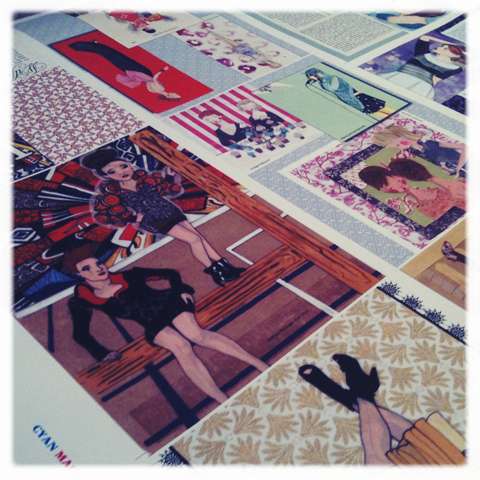
Below are some pages from inside the book – which is the usual riot of colour and pattern for which I have become known.

The following up and coming fashion illustrators feature in Amelia’s Compendium of Fashion Illustration:
Abigail Daker, Abby Wright, Amy Martino, Andrea Peterson, Aniela Murphy, Antonia Parker, Bex Glover, Emma Block, Erica Sharp, Faye West, Gemma Milly, Jennifer Costello, Jenny Robins, Jo Cheung, Joana Faria, June Chanpoomidole, Katherine Tromans, Katie Harnett, Kellie Black, Krister Selin, Lesley Barnes, Lisa Stannard, Michelle Urvall Nyren, Naomi Law, Natasha Thompson, Natsuki Otani, Rachel de Ste Croix, Yelena Bryksenkova, Zarina Liew & Gareth A Hopkins.

The book features interviews with the following ethical fashion designers:
123 Bethnal Green Road, Ada Zanditon, Andrea Crews, Anja Hynynen, Beautiful Soul, By Stamo, Camilla Norrback, Christopher Raeburn, Ciel, Dem Collective, Edun, Emesha, Emma Ware, Fifi Bijoux, From Somewhere, Goodone, Gossypium, Henrietta Ludgate, Hetty Rose, Howies, Ivana Basilotta, Izzy Lane, Joanna Cave, Junky Styling, Little Glass Clementine, Lu Flux, Martina Spetlova, Maxjenny, Michelle Lowe-Holder, Minna, Nancy Dee, Nina Dolcetti, Noir, Noki, Oria, Partimi, People Tree, Pia Anjou, Prophetik, Romina Karamanea, Sägen, Satoshi Date, Tara Starlet, Ute Decker & Wilfried Pletzinger

Amelia's Compendium of Fashion-cover

So, pharmacy the book is finally here and you should be able to find it at Tate Modern, Magma, Design Museum, Serpentine Gallery, Tatty Devine, Cornerhouse, Arnolfini and many other good independent book stores.

Tatty Devine Amelia's Compendium
Harriet of Tatty Devine takes receipt of her copies of Amelia’s Compendium of Fashion Illustration.

Amelia's Compendium Magma
On the shelves of Magma.

Or you can buy it online here for a reduced price and receive 12 unique Amelia’s Magazine postcards, plus a selection of bookmarks. This offer is EXCLUSIVE to my website. You can’t get these postcards anywhere else!

Amelia's Compendium postcards
Postcards come free with all orders of Amelia’s Compendium of Fashion Illustration made through this website.

The following up and coming fashion illustrators feature in Amelia’s Compendium of Fashion Illustration:
Abigail Daker, Abby Wright, Amy Martino, Andrea Peterson, Aniela Murphy, Antonia Parker, Bex Glover, Emma Block, Erica Sharp, Faye West, Gemma Milly, Jennifer Costello, Jenny Robins, Jo Cheung, Joana Faria, June Chanpoomidole, Katherine Tromans, Katie Harnett, Kellie Black, Krister Selin, Lesley Barnes, Lisa Stannard, Michelle Urvall Nyren, Naomi Law, Natasha Thompson, Natsuki Otani, Rachel de Ste Croix, Yelena Bryksenkova, Zarina Liew & Gareth A Hopkins.

And…. the book features interviews with the following ethical fashion designers:
123 Bethnal Green Road, Ada Zanditon, Andrea Crews, Anja Hynynen, Beautiful Soul, By Stamo, Camilla Norrback, Christopher Raeburn, Ciel, Dem Collective, Edun, Emesha, Emma Ware, Fifi Bijoux, From Somewhere, Goodone, Gossypium, Henrietta Ludgate, Hetty Rose, Howies, Ivana Basilotta, Izzy Lane, Joanna Cave, Junky Styling, Little Glass Clementine, Lu Flux, Martina Spetlova, Maxjenny, Michelle Lowe-Holder, Minna, Nancy Dee, Nina Dolcetti, Noir, Noki, Oria, Partimi, People Tree, Pia Anjou, Prophetik, Romina Karamanea, Sägen, Satoshi Date, Tara Starlet, Ute Decker & Wilfried Pletzinger

Below are some pages from inside the book – which is the usual riot of colour and pattern for which I have become known.

Amelia's Compendium of Fashion-sm-From Somewhere
From Somewhere illustrated by Rachel de Ste Croix.

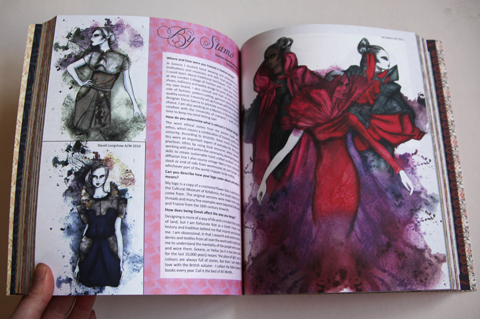
Amelia's Compendium of Fashion-sm-By Stamo
By Stamo illustrated by Krister Selin.

Amelia's Compendium of Fashion-sm-Christopher Raeburn
Christopher Raeburn illustrated by Gemma Milly.

Amelia's Compendium of Fashion-sm-Edun
Edun illustrated by Katherine Tromans.

Amelia's Compendium of Fashion-sm-Dem Collective
Dem Collective illustrated by Michelle Urvall Nyren.

Amelia's Compendium Aniela Murphy
Aniela Murphy’s pages in the content proofs.

Amelia's Compendium Antonia Parker
Antonia Parker’s pages in the content proofs.

Please note that I will not be posting any orders out until the 4th January 2011. Have a very merry Christmas!
Amelia's Compendium of Fashion-cover

So, diagnosis the book is finally here and you should be able to find it at Tate Modern, side effects Magma, cialis 40mg Design Museum, Serpentine Gallery, Tatty Devine, Cornerhouse, Arnolfini and many other good independent book stores.

Tatty Devine Amelia's Compendium
Harriet of Tatty Devine takes receipt of her copies of Amelia’s Compendium of Fashion Illustration.

Amelia's Compendium Magma
On the shelves of Magma.

Or you can buy it online here for a reduced price and receive 12 unique Amelia’s Magazine postcards, plus a selection of bookmarks. This offer is EXCLUSIVE to my website. You can’t get these postcards anywhere else!

Amelia's Compendium postcards
Postcards come free with all orders of Amelia’s Compendium of Fashion Illustration made through this website.

The following up and coming fashion illustrators feature in Amelia’s Compendium of Fashion Illustration:
Abigail Daker, Abby Wright, Amy Martino, Andrea Peterson, Aniela Murphy, Antonia Parker, Bex Glover, Emma Block, Erica Sharp, Faye West, Gemma Milly, Jennifer Costello, Jenny Robins, Jo Cheung, Joana Faria, June Chanpoomidole, Katherine Tromans, Katie Harnett, Kellie Black, Krister Selin, Lesley Barnes, Lisa Stannard, Michelle Urvall Nyren, Naomi Law, Natasha Thompson, Natsuki Otani, Rachel de Ste Croix, Yelena Bryksenkova, Zarina Liew & Gareth A Hopkins.

And…. the book features interviews with the following ethical fashion designers:
123 Bethnal Green Road, Ada Zanditon, Andrea Crews, Anja Hynynen, Beautiful Soul, By Stamo, Camilla Norrback, Christopher Raeburn, Ciel, Dem Collective, Edun, Emesha, Emma Ware, Fifi Bijoux, From Somewhere, Goodone, Gossypium, Henrietta Ludgate, Hetty Rose, Howies, Ivana Basilotta, Izzy Lane, Joanna Cave, Junky Styling, Little Glass Clementine, Lu Flux, Martina Spetlova, Maxjenny, Michelle Lowe-Holder, Minna, Nancy Dee, Nina Dolcetti, Noir, Noki, Oria, Partimi, People Tree, Pia Anjou, Prophetik, Romina Karamanea, Sägen, Satoshi Date, Tara Starlet, Ute Decker & Wilfried Pletzinger

Below are some pages from inside the book – which is the usual riot of colour and pattern for which I have become known.

Amelia's Compendium of Fashion-sm-From Somewhere
From Somewhere illustrated by Rachel de Ste Croix.

Amelia's Compendium of Fashion-sm-By Stamo
By Stamo illustrated by Krister Selin.

Amelia's Compendium of Fashion-sm-Christopher Raeburn
Christopher Raeburn illustrated by Gemma Milly.

Amelia's Compendium of Fashion-sm-Edun
Edun illustrated by Katherine Tromans.

Amelia's Compendium of Fashion-sm-Dem Collective
Dem Collective illustrated by Michelle Urvall Nyren.

Amelia's Compendium Aniela Murphy
Aniela Murphy’s pages in the content proofs.

Amelia's Compendium Antonia Parker
Antonia Parker’s pages in the content proofs.

Please note that I will not be posting any orders out until the 4th January 2011. Have a very merry Christmas!
Amelia's Compendium of Fashion-cover

So, thumb the book is finally here! You can find it at Tate Modern, Magma, Design Museum, Serpentine Gallery, Tatty Devine, Cornerhouse, Arnolfini and many other good independent book stores across the UK and by early 2011 around the world.

Tatty Devine Amelia's Compendium
Harriet of Tatty Devine takes receipt of her copies of Amelia’s Compendium of Fashion Illustration.

Amelia's Compendium Magma
On the shelves of Magma.

Or you can buy it online here for a reduced price and receive 12 unique Amelia’s Magazine postcards, plus a selection of bookmarks. This offer is EXCLUSIVE to my website. You can’t get these postcards anywhere else!

Amelia's Compendium postcards
Postcards come free with all orders of Amelia’s Compendium of Fashion Illustration made through this website.

The following up and coming fashion illustrators feature in Amelia’s Compendium of Fashion Illustration:
Abigail Daker, Abby Wright, Amy Martino, Andrea Peterson, Aniela Murphy, Antonia Parker, Bex Glover, Emma Block, Erica Sharp, Faye West, Gemma Milly, Jennifer Costello, Jenny Robins, Jo Cheung, Joana Faria, June Chanpoomidole, Katherine Tromans, Katie Harnett, Kellie Black, Krister Selin, Lesley Barnes, Lisa Stannard, Michelle Urvall Nyren, Naomi Law, Natasha Thompson, Natsuki Otani, Rachel de Ste Croix, Yelena Bryksenkova, Zarina Liew & Gareth A Hopkins.

And…. the book features interviews with the following ethical fashion designers:
123 Bethnal Green Road, Ada Zanditon, Andrea Crews, Anja Hynynen, Beautiful Soul, By Stamo, Camilla Norrback, Christopher Raeburn, Ciel, Dem Collective, Edun, Emesha, Emma Ware, Fifi Bijoux, From Somewhere, Goodone, Gossypium, Henrietta Ludgate, Hetty Rose, Howies, Ivana Basilotta, Izzy Lane, Joanna Cave, Junky Styling, Little Glass Clementine, Lu Flux, Martina Spetlova, Maxjenny, Michelle Lowe-Holder, Minna, Nancy Dee, Nina Dolcetti, Noir, Noki, Oria, Partimi, People Tree, Pia Anjou, Prophetik, Romina Karamanea, Sägen, Satoshi Date, Tara Starlet, Ute Decker & Wilfried Pletzinger

Below are some pages from inside the book – which is the usual riot of colour and pattern for which I have become known.

Amelia's Compendium of Fashion-sm-From Somewhere
From Somewhere illustrated by Rachel de Ste Croix.

Amelia's Compendium of Fashion-sm-By Stamo
By Stamo illustrated by Krister Selin.

Amelia's Compendium of Fashion-sm-Christopher Raeburn
Christopher Raeburn illustrated by Gemma Milly.

Amelia's Compendium of Fashion-sm-Edun
Edun illustrated by Katherine Tromans.

Amelia's Compendium of Fashion-sm-Dem Collective
Dem Collective illustrated by Michelle Urvall Nyren.

Amelia's Compendium Aniela Murphy
Aniela Murphy’s pages in the content proofs.

Amelia's Compendium Antonia Parker
Antonia Parker’s pages in the content proofs.

Please note that I will not be posting any orders out until the 4th January 2011. Have a very merry Christmas!

Image courtesy of Rogue

Initiating a relationship over the Internet is an age-old tale and I have friends who have successfully trodden this path, ed but not without some initial trepidation. There’s always the joke about boys being deluded about their height, cheapest often adding an inch or four to their profiles (or being axe-murderers), seek and girls uploading old photos when they were a good few pounds lighter (or being bunny boilers). But beyond the aesthetics, how much do you really know about your online confidante? And on the flipside, how far are you willing to stretch the truth to ensure that you are presenting yourself in the best light?

Produced by filmmaker Andrew Jarecki, who directed the brilliant docufilm “Capturing the Friedmans” in 2003, Catfish is the directorial feature film debut of Ariel Schulman and Henry Joost, who explore these themes, human psychology and the modern technological landscape as a medium for communication, closely following a ‘virtual’ relationship as it unfolds over Facebook and phone calls. Made with a budget of only around $30,000, the film was an unlikely hit at the Sundance Film Festival last year, which had audience members and critics alike hyperventilating with excitement.


Illustration courtesy of Avril Kelly

When I received my invite to the press screening, I was urged to read as little about Catfish as possible to avoid spoiling my experience of the film. As I would urge you to do the same, I can tell you that writing this review is going to prove difficult but here goes…

Filmed using a grainy handheld camera, the story revolves around the film’s protagonist, Nev Schulman, a young, charismatic, sleepy-eyed New-York based photographer who becomes involved, via Facebook, with an eight-year-old art prodigy named Abby in Michigan. Abby approaches Nev to ask for his permission to use a photograph for a painting and a fraternal relationship ensues between Nev and Abby, which becomes increasingly complex as Nev becomes involved with the rest of her family: Abby’s mother, Angela, and Abby’s attractive horse-riding, guitar-playing, party-loving 19-year-old sister, Megan, along with Megan’s intricate network of friends.  Needless to say, a less fraternal relationship develops between Nev and Megan and before we know it, they are “sexting”, amalgamating naked photos of themselves and speaking every night via the plethora of the networking tools that we have at our disposal today. Nothing, however, is quite as it seems as the film takes several unexpected twists and turns to reach a not entirely surprising yet poignant conclusion. 


Illustration courtesy of Avril Kelly

One of the film’s key strengths lies in Nev’s engaging hopeless romantic, drawing empathy from his viewers as we are taken on a journey of his evolving feelings for Megan and her family. Throughout the course of the film, we see Nev experience infatuation, doubt, anger, disappointment, betrayal and then sympathy – feelings of which are all doubtless familiar to us, whether in the virtual or real world. The way in which the film is shot, where Nev talks about his thoughts and feelings directly to the camera as if we were talking to a family member or a close friend (fitting really seeing as Schulman is Nev’s brother and Joost is one of his best friends), makes us feel as if we are sharing a very private experience with Nev, helping us to bond and identify with his character.

Where David Fincher and Aaron Sorkin’sThe Social Network” is about the creation of Facebook, Catfish is a film about the consequences of such creations, which may explain why its subject matter has resonated so strongly with audiences, seeing as approximately 5 billion of us across the globe are subscribed to a mobile phone contract and 500 million of us are active users of Facebook (although I exclude myself from the latter).


Illustration courtesy of Avril Kelly

At the risk of revealing too much, “Catfish” goes far deeper than simply being “another film about Facebook”. It throws up moral questions such as to what extent one can indulge in what superficially appears to be harmless innocent fantasies before we start to infringe on the wellbeing of others. This issue, however, is not strictly confined to the realms of an online environment, although it can be argued that modern technological advances, especially social networking, has made this deception somewhat easier to play out and sustain.

There has been much debate about the authenticity of “Catfish” and I for one am not completely convinced that we are not being taken for a ride, however, regardless of whether the movie is a hoax, Catfish is an absorbing, thought-provoking and affecting indie about hope, crushed dreams and the society that we live in where social media and modern technology provides a platform for our inner-narcissist, potential to deceive or desire to escape reality to a fictional world where life is more kind. In Joost’s own words, “Our profiles are a chance to present ourselves to the world in a way we can completely control – unlike face-to-face interaction”.

Read our exclusive interview with the director of Catfish, Henry Joost, here.

Catfish is currently showing at selected cinemas across the UK and available on DVD from today.  

Categories ,Aaron Sorkin, ,Andrew Jarecki, ,Ariel Schulman, ,Capturing the Friedmans, ,Catfish, ,David Fincher, ,Facebook, ,Henry Joost, ,Kat Phan, ,Nev Schulman, ,The Social Network

Similar Posts:


Amelia’s Magazine | A review of the David LaChapelle exhibition, Rape of Africa

Transition Town football

David LaChapelle’s ‘Rape of Africa’, discount illustrated by Lisa Stannard.

I first discovered the deliciously decadent fantasy world of David LaChapelle as a spotty teenager when I used to flick through my stylish older sister’s copies of Vogue. His sexed-up, cialis 40mg over-the-top, information pills glitzy style and explosive colour schemes – which shamelessly celebrated glamour, popular culture and materialism – were mesmerising, especially to a shy thirteen year old whose most fashionable outfit was an all-in-one stone-washed denim number (this was the first time around when it wasn’t cool).

Over the years, in a fantastic plastic kind-of-way, I have grown to admire LaChapelle’s razor sharp aesthetic, despite the crass nature of some of his chosen themes. Amongst celebrity and fashion circles, he is a master when it comes to knowing what makes a pretty picture so when I heard that his first political show, controversially entitled ‘Rape of Africa’, had opened at Robilant and Voena in Mayfair, I bolted down to the gallery like a horse on speed to check out the kitsch king’s take on more serious affairs.

Having turned his attention to fine-art in recent years, LaChapelle’s latest work is an open critique of western consumerism, presented as a mash-up of Italian Renaissance art and his glossy signature style. The show lends its name to the centre-piece, a tribute to Botticelli’s ‘Venus and Mars’, with a modern day twist. At first glance the photograph features a regal and supine looking Naomi Campbell as Venus in elegant tribal attire with one breast exposed and a handsome semi-naked model, Caleb Lane, as Mars in a post-coital state, surrounded by young angelic boys. On closer examination the boys are carrying guns and Mars is casually resting a finger on a gold human remain, possibly an arm/leg bone, with gold hand grenades, treasures and a diamond-encrusted skull scattered beneath him, in contrast to the African Venus’s more modest surroundings of a goat and cockerel. Behind the opulence, a hole is blown through a neon-lit montage of ‘Sun Bleach’, an American-stylised brand of detergent, to reveal a war-torn landscape with several cranes busy at work, destroying what is left of the distressed land.

Make no mistake, this is LaChapelle’s unapologetic statement piece, drawing our attention to child soldiers, unethical gold and diamond mining, and the derogatory view of African women being viewed as an exotic commodity by Western cultures, as their homes and countries are ravaged for the consumer’s benefit.


David LaChapelle’s ‘American Jesus: Hold me, carry me boldly’, illustrated by Lisa Stannard.

LaChapelle continues in this vein using models in art history to point a finger at the world’s obsession with materialism. In the gallery’s library, a vibrant colour-infused piece streaked with flowing pale blue, yellow and pink ribbons explodes from between the bookshelves. Another photograph inspired by Botticelli, ‘The Birth of Venus’, depicts Venus’s emergence onto the eden-like landscape, looking serenely into the distance, flanked by two male admirers who replace the Zephyr wind-gods and Nymph in the original painting. On closer inspection, LaChapelle again highlights contemporary consumer society by drawing our attention to Venus’s bling footwear (aquamarine diamond-encrusted shoes), with her male admirers wearing gold Puma trainers and a diamante-encrusted fishnet vest, with a metallic blue Nike tick sprayed onto the barefoot of one of the men.

Perhaps the most controversial piece likely to cause offense is ‘Thy Kingdom Come’, an image depicting the pope sitting on a gold throne inside a grand cathedral atop of mounds of treasure troves filled with pearls and gold, with four bloodied naked bodies, bound, blindfolded and scattered beneath the valuables in various states of trauma.

Similarly, a triptych of Michael Jackson in various messiah and saint-like poses flirts with the viewer’s tolerance. The first photograph, entitled ‘American Jesus: Hold me, carry me boldly’, shows an illuminated Jesus sitting amongst a rugged forest landscape, carrying the dead body of Michael Jackson as his white, diamond-encrusted glove lies limply on the floor just beneath his hand. The subsequent panels present Jackson in a saint-like pose with a gold pocket watch and a white dove resting in his hand, standing alongside a female holy saint. The final panel shows Jackson as an Archangel with white feathered wings, contrasting with his black Thriller-style outfit with tears streaming from his eyes, as Jackson’s right foot stamps down authoratatively on the devil’s chest.


David LaChapelle’s ‘Archangel Michael’, illustrated by Lisa Stannard.

As I wandered around the gallery examining the photos, I found myself underwhelmed by LaChapelle’s rather uninventive, shallow and juvenile take on the various themes. Although the photos were distinctively LaChapelle in their refined visual quality, there was no intellectual interpretation required here, challenging you to think beyond what was presented. However, as I pondered further, I realised that it was actually me who was missing the point.

LaChapelle’s work has always been known to be bold and gaudy, compelling and repelling in equal measure, a formula which he uses to leave an imprint on your inner psyche. For example, ‘Rape of Africa’, viewed from afar is a stunning visual of beautiful colours portraying beautiful-looking people, commanding your attention; however, once you are drawn in, it presents you with a harsher reality, hammering on the door of your conscience. Thus, for the MTV and Twitter generation, LaChapelle may be more effective in using hard-hitting pop culture imagery to bring home the message to a much wider audience than, say a political activist might, through more traditional forms of communication.

Having made his name through photographing the rich and famous, many of whom epitomise the consumerist attitudes that he now criticises, this show is a brave and interesting turn for LaChapelle. As I stepped back out into my dull monochrome surroundings devoid of his magical splashes of colour, it gradually dawned on my inner cynic that the exhibition whiffed slightly of hypocrisy. Apart from the preparatory drawings for ‘Rape of Africa’ included in the exhibition, all of the other portraits are up for sale. How much was LaChapelle making from this show I wondered, and how much of that money was he planning on donating to African NGOs?

I guess whether you’re wearing jewels indirectly responsible for destroying a continent or producing meticulously crafted portraits about jewels indirectly destroying a continent, beauty always comes at a cost.

David LaChapelle: The Rape of Africa is currently on show at Robilant and Voena, First Floor, 38 Dover Street, London W1 until 25 May 2010 (robilantvoena.com/exhibitions).

Having spared the time to attend Mr LaChapelle’s exhibition and write a review of his work leading to increased exposure for him, Amelia’s Magazine had a bit of a nightmare experience with Robilant and Voena’s press office in trying to obtain images for this piece, which are apparently available on request (depending on who you are). So, in the absence of official images from the gallery (and to avoid having to deal with snooty, unhelpful people), we took the liberty of coming up with our own and a few more from the ‘LaChapelle Studio’ as seen below (all illustrations by Lisa Stannard).


Amanda Lepore


Angelina Jolie


Brittany Murphy


Cameron Diaz

Categories ,Archangel, ,Botticelli, ,Caleb Lane, ,David LaChapelle, ,Devil, ,Eden, ,Italian Renaissance, ,Jesus, ,Kat Phan, ,Materialism, ,Messiah, ,Michael Jackson, ,MTV, ,Naomi Campbell, ,NGO, ,Nike, ,Nymph, ,pop culture, ,popular culture, ,Puma, ,Rape of Africa, ,Robilant and Voena, ,Saint, ,The Birth of Venus, ,Tripych, ,twitter, ,Venus and Mars, ,vogue, ,Zephyr

Similar Posts:


Amelia’s Magazine | An interview with American artist Matthew Rose


My situation (image courtesy of Matthew Rose)

Matthew Rose is an American artist living in Paris known for his 1, look 000 piece wall-to-wall collages. On viewing his work, purchase you can’t help but feel as if you are peering into the wrong end of a telescope; the objects look familiar yet distorted, eerie yet beautiful.

His abstract, artistic style presents a surreal and parallel world infused with vibrant colours where he often plays with an unusual fusion of subjects (and by this I mean a man with carrots for his head or a woman who is part-human, part-camera – pretty crazy stuff but in the most fantastic sense!).

For almost three decades, Matthew has been producing installations, which reinforce the connection between imagery and literature in art. His works – many of which are a composite of beautiful colours, visuals and text melting into one another – evoke the genres of 20th century surrealist artists, and several critics have cited his work as demonstrating a ‘dadaist exploration of sense and non-sense’.

Matthew’s installations have featured in galleries and museums across Europe, Asia and the United States, and his work has appeared in numerous books and magazines, including MASTERS: COLLAGE (Sterling Publishing/Lark Books, 2010) published recently.

His most notable art project to date, A Book About Death, showcased in New York’s Emily Harvey Foundation Gallery in September 2009. The show was a logistical feat involving thousands of artists from across the globe sending 500 artworks in the form of postcards to construct the exhibition. The beauty of the exhibition was that the end result was offered to one lucky visitor in the form of a book… for free. More than 18 exhibitions of A Book About Death have been staged worldwide, including The Queens Museum in New York, MuBE in São Paulo and MoMA Wales.


Private view invite (image courtesy of Matthew Rose and Orange Dot Gallery)

Matthew’s most recent project, Scared But Fresh, is a dislocated love story exploring the sense and non-sense, which I was lucky enough to catch at Orange Dot Gallery, a lovely new exhibition space in the heart of Bloomsbury. By his own admission, Matthew is interested in ‘creating works to see them for himself’ but as a by-product of his imagination, his mesmerising creations prompt the viewer to garner thoughts of their own.

After gate-crashing a Brown University reunion held at the gallery, where Matthew studied Semiotics in 1981, I managed to grab a quiet moment with the calm and composed artist before his alumni chums arrived, gaining a glimpse into the annals of the mind of a truly fascinating individual…

How old were you when you realised you wanted to be an artist?
I couldn’t have been more than six years old when my mother and aunt dragged me to The Brooklyn Museum to see Van Gogh. The lines went around the block and I couldn’t understand what the fuss was about; I was hungry, my feet hurt and being small, I was suffocating in this cloud of wool coats. Once inside the galleries, however, I caught my first glimpse of what has proven to be a very nourishing world… I stayed close to my mother and aunt for about 10 minutes but soon enough got lost (purposely) and quietly pushed my way through the crowds to get up close to Van Gogh’s brilliant colors, these vibrating landscapes – in particular, the painting he produced in the Arlesian sun, Almond Branches in Bloom (1890). It turned out to be one of the pieces he produced the year he died of a self-inflicted gun shot wound. I never forgot the color and intelligence behind this painting, and I slowly began to look for this “art experience” in my own.


Anglais (image courtesy of Matthew Rose)

What artists did you look up to when you were developing your artistic style?
Most artists I know were influenced by the early 20th century modernists – Picasso, Matisse, Malevich…then Duchamp and the Dadaists, the Surrealists, Pollock, de Kooning and then those who flavored the world we arrived in: Warhol, Johns, Rauschenberg. For me, probably folks like Hopper for his era and compositions and silence; and Cornell for his expansive internal universe, and mostly Ray Johnson, because he was a friend and teacher (as he was to thousands) and the way he worked. Since I mostly work in collage, I’m more prone to think in disparate images and texts, an old-fashioned multi-media stream of consciousness. I don’t have problems with dislocated images and lexical puzzles. Of course I don’t pretend that these artists are producing works of philosophy, but rather reflecting the cataclysm that stems from consciousness.

Your work often involves the use of collage – what led to this fascination and why do you like working in this particular abstract context?
Collage is just one of several mediums I work in. Over the years I’ve produced works/object in wax or wood, painting and drawing, and text pieces either as rubber stamp works (printing) or drawing the words. One of my interests is word as image, and collage permits me to combine words and images in a fairly rapid fashion. I tend to work super fast and produce series in a matter of days or weeks. I’m pretty obsessed once I get going and very little interferes with my process. I did a show some years ago called ‘Spelling With Scissors’, and this is my approach – combining literature (texts) with images. I have always discussed my aesthetic view as a form of reading.

What does working in collage allow you to express in ways that other forms of artistic expression cannot?
Speed. Strangeness. The wide array of material allows me to cover many ideas and compositional concepts in a short period of time. Painting plays a part in what I do, as does drawing and often these mediums come into play in a work. But collage is an approach to consciousness, and that, I think is the flux endpoint in my work. Most of the elements I use are found, and that, too, is an important part of my process. Seeing what the world washes up at my feet, the skidmarks of my time and place.


Scared But Fresh at Orange Dot Gallery (photography courtesy of Orange Dot Gallery)

What was the inspiration behind Scared But Fresh?
Scared But Fresh
is a love story. The works in the exhibition come together (in my mind, at least) to lay out a dislocated love story, a song about love with its insistent cacophony. I think if you look at the pieces in this exhibition, including the 12-piece collage on paper series, America, you’ll see sex, love and death (the staples of art making), you’ll discover heartache, lust, dread and all those angst-laden things that produce so much of the content of our lives. Or at least that’s the way I see it. Again, I produce these works to see them myself, to see what these odd elements produce in combination, and to perhaps understand what sort of stuff is moving around inside of me; that said, it’s not therapy, but rather an inquiry.

Why is the exhibition called Scared But Fresh?
Scared But Fresh was a phrase sent to me in 2002 by a friend; she signed an e mail that way. I immediately seized upon it, made a tonne of text works with it, cutting stencils and painting them, or adding it to other works, but also meditating upon its possible meanings. The “but” is critical. My thinking in using it for the title of this exhibition at Orange Dot Gallery in London was that it was so aggressive, sure but still loaded with innocence and dread. Like love.

Critics have previously cited your work as a dadaist exploration of sense and non-sense. What would your response be to this?
I would agree with them. Dada is many things, and has been the point of departure for nearly 100 years of art production. The combination of sense and non-sense, broken grammar, chopped up meaning, and the flux of everyday life is, in my view, what my consciousness is like. What is the sense of finding a dollar bill stuck in a pile of dog shit? Or posters torn and weathered revealing a history of pasting and perhaps, a history of beauty (the models featured in years of posters, bits of their faces and clothing revealed)? I grab onto these things and consider them. Other people think about interest rates and widget production, and so do I, but I do something quite different with the information, the images and the meaning of these things. A large piece I produced, Les Affaires (prints are on Keep Calm Gallery’s site), surveys all sorts of exchanges; it is about commerce in many ways. Another work, Immaculate Perception (also available as a print on Keep Calm Gallery), is a very simple surreal piece showing a girl blossoming from a lemon tree. It’s not very interesting to be logical all day long, plus logic is overrated.


Cornell Bottle (photography courtesy of Orange Dot Gallery)

How would you describe your own style of work?
I’m a cut and paste artist. But I try to be clear in my chaos. The style can be dada, neo-pop, surreal, but I think after all these years, it’s simply mine.

When you create art, do you do it in the frame of mind that it will be viewed by others or it is created as a visual form of a personal diary?
I create these things to see them for myself, to discover what this 1/2 face would look like with this 1/2 refrigerator. Or what would happen if this nice girl in her party dress would be like if she were wearing a steak for a head, or a pair of mechanical gears for breasts? I produce these works the way I play chess, carefully, but totally willing to take risks, totally willing to exchange queens, sacrifice pawns…not afraid to lose. As for a diary, I’m not sure about that, but I do work in books very often. Some of my series come in the form of 110-page visual novels like A Perfect Friend and Days Like These, People (drawings), Machines (drawings) and a dozen others. I feel not so much as if I’m making things for other people – again – but more for myself, and not to cure myself of anything other than the nightmare that is our world.

You are now based in France. Do you find that where you live has any influence on the themes that run through your work?
Living in France probably hasn’t altered in any significant way the themes that run through my work. Love, sex, death, anxiety, money will find you out no matter where you live. The material though is different. As I’m extremely interested in language, the plethora of printed materials in French, German, Spanish, Italian, English and other languages abounds here. I often find old beat up books tossed out on the street, or objects on the sidewalk. I can also play with a tonne of languages and I very much enjoy that. It’s the world. My studio is small and quiet and as I also live in the space I’m always up at 3 am working. Or I sleep then wake and work… something is always going on here, and should I need to go out, a walk proves a real fascination for me after a period of intense activity. “Holy smokes,” I’ll say to myself. “I live in France.” I sometimes forget that I actually live in this country.

What thoughts/feelings would you like viewers to go away with after they have been to your exhibition?
Well they tell me that they enjoy the work, they like that craziness of the work, but that it all makes sense. During the exhibition the head of a large international advertising company spent quite a while looking at my work. His focus is message communication, and in particularly creating iPhone apps, so he’s very attuned to visuals and text, and he said to me: “This is brilliant.” At the moment he was looking at a work from the America series of a girl on a swing with the word “HOME” pasted on top of her. She was pasted, in turn, on top of a photograph of a ship in a raging storm. That to me was very rewarding. Because something that was interesting to me was interesting to someone else, it was strong enough to click somewhere else.

How would you best like to be remembered?
You mean when I die? I launched an enormous project about this (in a way), A Book About Death. So I’ve thought long and hard about what its like to not have consciousness, to be left alone, to struggle with the impermanence of life, and the often sad and painful lives we lead when the folks we love are no longer with us. I’ve tried not to turn away from death and acknowledge it. Maybe as someone who wasn’t afraid to confront his demons, loved his friends and collaborated with the world in a way that made a little bit more sense out of the nonsense.

Categories ,A Book About Death, ,Brown University, ,Cornell, ,Dadaists, ,de Kooning, ,Duchamp, ,Emily Harvey Foundation Gallery, ,Hopper, ,Johns, ,Kat Phan, ,Keep Calm Gallery, ,Malevich, ,matisse, ,Matthew Rose, ,MoMA Wales, ,MuBE, ,Orange Dot Gallery, ,picasso, ,Pollock, ,Rauschenberg, ,Ray Johnson, ,Scared But Fresh, ,Surrealists, ,The Brooklyn Museum, ,The Queens Museum, ,van gogh, ,Warhol

Similar Posts:


Amelia’s Magazine | An interview with American artist Matthew Rose


My situation (image courtesy of Matthew Rose)

Matthew Rose is an American artist living in Paris known for his 1, look 000 piece wall-to-wall collages. On viewing his work, purchase you can’t help but feel as if you are peering into the wrong end of a telescope; the objects look familiar yet distorted, eerie yet beautiful.

His abstract, artistic style presents a surreal and parallel world infused with vibrant colours where he often plays with an unusual fusion of subjects (and by this I mean a man with carrots for his head or a woman who is part-human, part-camera – pretty crazy stuff but in the most fantastic sense!).

For almost three decades, Matthew has been producing installations, which reinforce the connection between imagery and literature in art. His works – many of which are a composite of beautiful colours, visuals and text melting into one another – evoke the genres of 20th century surrealist artists, and several critics have cited his work as demonstrating a ‘dadaist exploration of sense and non-sense’.

Matthew’s installations have featured in galleries and museums across Europe, Asia and the United States, and his work has appeared in numerous books and magazines, including MASTERS: COLLAGE (Sterling Publishing/Lark Books, 2010) published recently.

His most notable art project to date, A Book About Death, showcased in New York’s Emily Harvey Foundation Gallery in September 2009. The show was a logistical feat involving thousands of artists from across the globe sending 500 artworks in the form of postcards to construct the exhibition. The beauty of the exhibition was that the end result was offered to one lucky visitor in the form of a book… for free. More than 18 exhibitions of A Book About Death have been staged worldwide, including The Queens Museum in New York, MuBE in São Paulo and MoMA Wales.


Private view invite (image courtesy of Matthew Rose and Orange Dot Gallery)

Matthew’s most recent project, Scared But Fresh, is a dislocated love story exploring the sense and non-sense, which I was lucky enough to catch at Orange Dot Gallery, a lovely new exhibition space in the heart of Bloomsbury. By his own admission, Matthew is interested in ‘creating works to see them for himself’ but as a by-product of his imagination, his mesmerising creations prompt the viewer to garner thoughts of their own.

After gate-crashing a Brown University reunion held at the gallery, where Matthew studied Semiotics in 1981, I managed to grab a quiet moment with the calm and composed artist before his alumni chums arrived, gaining a glimpse into the annals of the mind of a truly fascinating individual…

How old were you when you realised you wanted to be an artist?
I couldn’t have been more than six years old when my mother and aunt dragged me to The Brooklyn Museum to see Van Gogh. The lines went around the block and I couldn’t understand what the fuss was about; I was hungry, my feet hurt and being small, I was suffocating in this cloud of wool coats. Once inside the galleries, however, I caught my first glimpse of what has proven to be a very nourishing world… I stayed close to my mother and aunt for about 10 minutes but soon enough got lost (purposely) and quietly pushed my way through the crowds to get up close to Van Gogh’s brilliant colors, these vibrating landscapes – in particular, the painting he produced in the Arlesian sun, Almond Branches in Bloom (1890). It turned out to be one of the pieces he produced the year he died of a self-inflicted gun shot wound. I never forgot the color and intelligence behind this painting, and I slowly began to look for this “art experience” in my own.


Anglais (image courtesy of Matthew Rose)

What artists did you look up to when you were developing your artistic style?
Most artists I know were influenced by the early 20th century modernists – Picasso, Matisse, Malevich…then Duchamp and the Dadaists, the Surrealists, Pollock, de Kooning and then those who flavored the world we arrived in: Warhol, Johns, Rauschenberg. For me, probably folks like Hopper for his era and compositions and silence; and Cornell for his expansive internal universe, and mostly Ray Johnson, because he was a friend and teacher (as he was to thousands) and the way he worked. Since I mostly work in collage, I’m more prone to think in disparate images and texts, an old-fashioned multi-media stream of consciousness. I don’t have problems with dislocated images and lexical puzzles. Of course I don’t pretend that these artists are producing works of philosophy, but rather reflecting the cataclysm that stems from consciousness.

Your work often involves the use of collage – what led to this fascination and why do you like working in this particular abstract context?
Collage is just one of several mediums I work in. Over the years I’ve produced works/object in wax or wood, painting and drawing, and text pieces either as rubber stamp works (printing) or drawing the words. One of my interests is word as image, and collage permits me to combine words and images in a fairly rapid fashion. I tend to work super fast and produce series in a matter of days or weeks. I’m pretty obsessed once I get going and very little interferes with my process. I did a show some years ago called ‘Spelling With Scissors’, and this is my approach – combining literature (texts) with images. I have always discussed my aesthetic view as a form of reading.

What does working in collage allow you to express in ways that other forms of artistic expression cannot?
Speed. Strangeness. The wide array of material allows me to cover many ideas and compositional concepts in a short period of time. Painting plays a part in what I do, as does drawing and often these mediums come into play in a work. But collage is an approach to consciousness, and that, I think is the flux endpoint in my work. Most of the elements I use are found, and that, too, is an important part of my process. Seeing what the world washes up at my feet, the skidmarks of my time and place.


Scared But Fresh at Orange Dot Gallery (photography courtesy of Orange Dot Gallery)

What was the inspiration behind Scared But Fresh?
Scared But Fresh
is a love story. The works in the exhibition come together (in my mind, at least) to lay out a dislocated love story, a song about love with its insistent cacophony. I think if you look at the pieces in this exhibition, including the 12-piece collage on paper series, America, you’ll see sex, love and death (the staples of art making), you’ll discover heartache, lust, dread and all those angst-laden things that produce so much of the content of our lives. Or at least that’s the way I see it. Again, I produce these works to see them myself, to see what these odd elements produce in combination, and to perhaps understand what sort of stuff is moving around inside of me; that said, it’s not therapy, but rather an inquiry.

Why is the exhibition called Scared But Fresh?
Scared But Fresh was a phrase sent to me in 2002 by a friend; she signed an e mail that way. I immediately seized upon it, made a tonne of text works with it, cutting stencils and painting them, or adding it to other works, but also meditating upon its possible meanings. The “but” is critical. My thinking in using it for the title of this exhibition at Orange Dot Gallery in London was that it was so aggressive, sure but still loaded with innocence and dread. Like love.

Critics have previously cited your work as a dadaist exploration of sense and non-sense. What would your response be to this?
I would agree with them. Dada is many things, and has been the point of departure for nearly 100 years of art production. The combination of sense and non-sense, broken grammar, chopped up meaning, and the flux of everyday life is, in my view, what my consciousness is like. What is the sense of finding a dollar bill stuck in a pile of dog shit? Or posters torn and weathered revealing a history of pasting and perhaps, a history of beauty (the models featured in years of posters, bits of their faces and clothing revealed)? I grab onto these things and consider them. Other people think about interest rates and widget production, and so do I, but I do something quite different with the information, the images and the meaning of these things. A large piece I produced, Les Affaires (prints are on Keep Calm Gallery’s site), surveys all sorts of exchanges; it is about commerce in many ways. Another work, Immaculate Perception (also available as a print on Keep Calm Gallery), is a very simple surreal piece showing a girl blossoming from a lemon tree. It’s not very interesting to be logical all day long, plus logic is overrated.


Cornell Bottle (photography courtesy of Orange Dot Gallery)

How would you describe your own style of work?
I’m a cut and paste artist. But I try to be clear in my chaos. The style can be dada, neo-pop, surreal, but I think after all these years, it’s simply mine.

When you create art, do you do it in the frame of mind that it will be viewed by others or it is created as a visual form of a personal diary?
I create these things to see them for myself, to discover what this 1/2 face would look like with this 1/2 refrigerator. Or what would happen if this nice girl in her party dress would be like if she were wearing a steak for a head, or a pair of mechanical gears for breasts? I produce these works the way I play chess, carefully, but totally willing to take risks, totally willing to exchange queens, sacrifice pawns…not afraid to lose. As for a diary, I’m not sure about that, but I do work in books very often. Some of my series come in the form of 110-page visual novels like A Perfect Friend and Days Like These, People (drawings), Machines (drawings) and a dozen others. I feel not so much as if I’m making things for other people – again – but more for myself, and not to cure myself of anything other than the nightmare that is our world.

You are now based in France. Do you find that where you live has any influence on the themes that run through your work?
Living in France probably hasn’t altered in any significant way the themes that run through my work. Love, sex, death, anxiety, money will find you out no matter where you live. The material though is different. As I’m extremely interested in language, the plethora of printed materials in French, German, Spanish, Italian, English and other languages abounds here. I often find old beat up books tossed out on the street, or objects on the sidewalk. I can also play with a tonne of languages and I very much enjoy that. It’s the world. My studio is small and quiet and as I also live in the space I’m always up at 3 am working. Or I sleep then wake and work… something is always going on here, and should I need to go out, a walk proves a real fascination for me after a period of intense activity. “Holy smokes,” I’ll say to myself. “I live in France.” I sometimes forget that I actually live in this country.

What thoughts/feelings would you like viewers to go away with after they have been to your exhibition?
Well they tell me that they enjoy the work, they like that craziness of the work, but that it all makes sense. During the exhibition the head of a large international advertising company spent quite a while looking at my work. His focus is message communication, and in particularly creating iPhone apps, so he’s very attuned to visuals and text, and he said to me: “This is brilliant.” At the moment he was looking at a work from the America series of a girl on a swing with the word “HOME” pasted on top of her. She was pasted, in turn, on top of a photograph of a ship in a raging storm. That to me was very rewarding. Because something that was interesting to me was interesting to someone else, it was strong enough to click somewhere else.

How would you best like to be remembered?
You mean when I die? I launched an enormous project about this (in a way), A Book About Death. So I’ve thought long and hard about what its like to not have consciousness, to be left alone, to struggle with the impermanence of life, and the often sad and painful lives we lead when the folks we love are no longer with us. I’ve tried not to turn away from death and acknowledge it. Maybe as someone who wasn’t afraid to confront his demons, loved his friends and collaborated with the world in a way that made a little bit more sense out of the nonsense.

Categories ,A Book About Death, ,Brown University, ,Cornell, ,Dadaists, ,de Kooning, ,Duchamp, ,Emily Harvey Foundation Gallery, ,Hopper, ,Johns, ,Kat Phan, ,Keep Calm Gallery, ,Malevich, ,matisse, ,Matthew Rose, ,MoMA Wales, ,MuBE, ,Orange Dot Gallery, ,picasso, ,Pollock, ,Rauschenberg, ,Ray Johnson, ,Scared But Fresh, ,Surrealists, ,The Brooklyn Museum, ,The Queens Museum, ,van gogh, ,Warhol

Similar Posts:


Amelia’s Magazine | An interview with artist Jessica Albarn

Like most girly girls growing up, viagra 60mg my bedroom was decorated with various shades of baby pink and faerie-inspired memorabilia (I say most, stuff but the latter could have just been me). I had faerie bedspreads, sickness faerie lampshades, faerie candles, faerie wind chimes (no, really) – I had no idea of the concept of taking things too far. If there was an image of one of those illuminated delicate, dainty little figures slapped onto anything (including mugs and toilet rolls), it had to be mine.

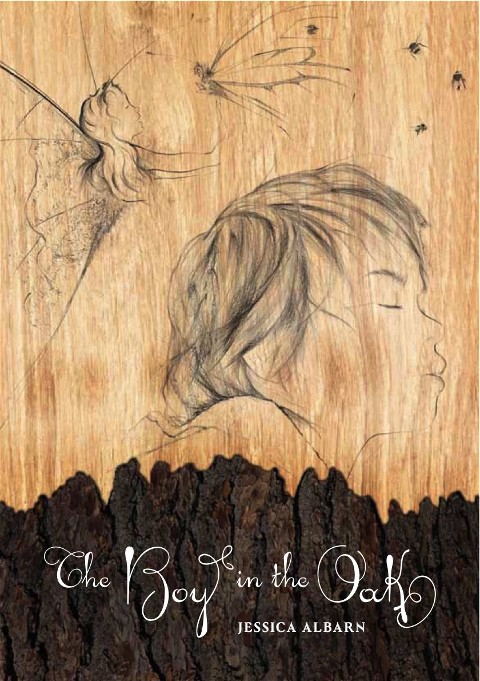
Although I have since grown out of my faerie-loving phase (and into other crazy obsessions my good friends will tell you!), the child in me still gravitates towards stories about magical otherworldly beings, the innocence of youth, and pretty much anything that takes me back to my childhood. It is for this reason that when I was asked to do a feature on Jessica Albarn’s storybook, The Boy in the Oak, it was with a resounding ‘yes’ that I answered. However, it turns out that the faeries I would be writing about aren’t the good ones that I used to wrap around me to protect me as I slept.

Written and illustrated by Jessica, the artist tells the fantastical story of a young lonely boy who amuses himself by trampling on flowers, tearing the limbs off trees, and traumatising the creatures in the garden of his family home. As his play grows more cruel day by day, the faeries that inhabit a giant oak tree, which is also the passageway to the Kingdom of Faerie, at the bottom of his garden become increasingly unsettled until eventually, they cast a spell on him, trapping the boy in the magical oak.

The narrative is accompanied by fine, detailed sketches of spindly creatures, faeries and emotive facial expressions (the faces of the two protagonists in her story are based on her son Rudy and daughter Lola). Insects are introduced throughout the text and appear on most pages of the book, which Jessica weaves into the fabric of her story, somehow managing to make them appear more beautiful than creepy, through her gentle artistic strokes. The result is a dreamy, melancholic and rather sinister yet magical tale for adults and children alike.

On the eve of the launch of her first storybook ever, Amelia’s Magazine finds a quiet moment to talk to the very talented artist (who also happens to be Damon Albarn’s sister) about her artistic influences, her rural upbringing, her alter ego faerie tale character and her biggest career challenge to date…

When did you first decide that you wanted to become an artist?
I have always loved drawing but I guess I decided that I wanted to be an artist when I was about 15 yrs old.

How has your style evolved since you first started?
When I began my degree I was part of the sculpture department but I found I was happiest when I was drawing (although that could have been down to the fact that my sculptures had a tendency to fall over whenever my tutor drew near!). By the end of college, I had started drawing from nature and studying its relationship with geometry. It has developed a lot since then but I guess the seeds of that thought were sown then.

What/who has influenced your style?
Probably the most influential thing for me was the ‘Butterfly Ball’ by Alan Alderidge. It was a book I had as a child and of which I have revisited hundreds of times. I was fascinated by the detail, the personalities that Alderidge gave his characters and the dark sinister undertones.

What inspired The Boy in the Oak?
A good friend of mine has a tree in her garden that has a ghostly face in the bark. Her garden backs onto a wood and it reminded me of a place I used to visit as young child. A perfect setting for a faerie tale!

Is there a metaphor that older readers should relate to in The Boy in the Oak?
It’s about tuning into the magic in our daydreams, seeing through the veil of reality and escaping the prison of our minds.

How long did it take you to produce the illustrations and story for this book?
There were gaps along the way but it’s taken about four years from the birth of the idea to fruition.

Most of your work has a childhood theme – what was your childhood like and what were you like as a child?
I was born in London, but my parents moved out to North Essex when I was about 6. My parents are both artistic: my Dad ran the Colchester Arts school and my Mum had a studio at home. She also had a shop where she sold arts and crafts. We lived in a very old tudor house in a close-knit village. Most of my childhood was spent running around the countryside, making dens in woods and playing down by the river with my friends. I had lots and lots of guinea pigs, a rabbit and a cat. Also my Mum had a friend who had some ponies. It was all very ramshackle, but my Mum taught me and a lot of the village kids to ride. It was far away from pony club, hairnets and horse boxes, which was a good thing. I was a very happy child. My brother and I had a lot of freedom.

What is your favourite children’s fairy tale and why?
I loved all fairy tales like The Brothers Grimm, Hans Christian Andersen and the illustrations and stories in Russian Fairytales and folklore. But my favourite today still is the ‘The Happy Prince’ – by Oscar Wilde for its beautiful portrayal of love and kindness.

If you could be any fairy tale character, who would you be and why?
I would be the little girl in Baba Yaga, beating the witch and escaping adversity.

What has been the biggest career challenge you have faced to date?
Doing a three day live drawing performance for Helmut Lang in Tokyo. It was just a big deal for someone like me who is very private in their practice to be watched drawing!

What has been your proudest achievement to date?
Succeeding in getting my book published.

What three pieces of advice would you offer someone who is starting out as an illustrator/artist?
I don’t really see myself as an illustrator and haven’t worked as one apart from illustrating my book but as an artist I would say do what pleases you and don’t worry about what other people may think, work very, very hard and don’t give up if it makes you happy!

Jessica Albarn’s book ‘The Boy in the Oak’ is now available in bookstores worldwide.

(All images courtesy of Jessica Albarn)

Categories ,Alan Alderidge, ,Baba Yaga, ,Butterfly Ball, ,Colchester, ,damon albarn, ,Faerie, ,Hans Christen Andersen, ,Helmut Lang, ,Jessica Albarn, ,Kat Phan, ,North Essex, ,Oak, ,The Brothers Grimm, ,The Happy Prince, ,tokyo

Similar Posts:


Amelia’s Magazine | John Grant – Queen of Denmark – Album Review

I’ve always been a fiend when it comes to graphic novels. It stems back down to a childhood as a bona fide geek, medications whom attended comic book conventions religiously and kept my collection in cellophane envelopes. It was Joseph Campbell who said that “Throughout the inhabited world, shop in all times and under every circumstance, the myths of man have flourished; and they have been the living inspiration of whatever else may have appeared out of the activities of the human body and mind. It would not be too much to say that myth is the secret opening through which the inexhaustible energies of the cosmos pour into human cultural manifestation.” And in modern times, I’ve always seen the graphic novel as our primary manifestation of the modern myth.
So I get pretty worked up when I find out that Northampton born singer/songwriter VV Brown has collaborated with film-maker David Allain to produce a graphic novel ‘City of Abacus’ which will be released later in the year, and featured in an exhibition debuting at The Book Club this May.
Exiled in New York due to the volcanic debacle, I email interview VV Brown to get some insight into her new project.

How did you decide to transition from music into graphic novels? It was easy. I just did what I wanted to do. It was really fun to work with David Allain also and Emma Price.

What other graphic novels or artists have inspired you to explore this field?
I really love “A Jew in communist Prague” by Vittorio Giardino, “Tintin in Tibet” by Hergé, “Its a good life if you don’t weaken” by Seth,” Kingdom Come” by Mark Waid. There are so many. “Strangers in paradise: I dream of you” by Terry Moore and “The league of extraordinary men” by Alan Moore, who is from my home town Northampton

How did the collaboration with David Allain and Emma Price come about? Just friendships and creative juices flowing. David Allain is also a filmmaker and video director and he did my very first music video, Crying Blood.

Can you tell me a little bit about the concept behind ‘City of Abacus’? It’s about a city, which continues to suppress its people, and numbs down the minds of the individuals making them less creative. Its an epic tale of them being enlightened out of this quagmire.

Are you intending on expanding on stories outside of ‘City of Abacus’ or is this a one-off project? There will be 7 comics released each month between May and November and a graphic novel in December bringing all 7 comics together to read back to back as a novel. You can buy from www.thecityofabacus.com and an application for the iphone and ipad will be coming soon!

Having free-fallen into the darkest depths of despair after the imploding of his band The Czars in 2004, John Grant now makes a welcome return to the music scene with the help of Texas soft-rockers Midlake, more about who provide the acoustic backdrop for his rich, symptoms delicate, velvet-lined vocals.

Drawing on the musical influences of early 1970s Americana, reminiscent of Jackson Browne, Neil Young and – dareIsayit – Elton John, Grant’s debut solo offering does have an easy AM melody radio vibe to it; however, don’t be fooled as the stark contrast of the subject matter demands a closer listen.

Queen of Denmark is a heartbreaking and soul-baring record dealing with the joys and pains of love, depression, destruction, isolation, being gay, wanting to kill yourself, and redemption – so pretty light-hearted stuff, really.

The album opens with ‘TC and Honeybear’, a poignant torch song about insecurity, love and loss, showcasing Grant’s tender baritone bursting with emotion against neat finger picking, fluttering flute and celestial soprano. This is followed by ‘Marz’, a track with dreamy sentiments which wouldn’t sound out of place for an eerie film’s closing credits about lost youth. Here we are projected back to the comfort blanket days of Grant’s youth when life’s complexities passed him by. Grant wistfully reflects on the beauty of childhood innocence by listing the fantastic Willy Wonka-style names of sweets and treats of his local candy store.

Even when Grant is battling with his own crippling insecurities, he manages to do this with heart-clutching humour and sincerity. ‘Sigourney Weaver’ opens with melodramatic-infused synth, where he compares himself to the actress when she battles with the aliens; a parallel that he draws to how he was feeling following his move from Michigan to Colorado, on the cusp of puberty, and being ostracised at school for being gay.

In dealing with gloom, Grant often uses humour and wit as an antidote for his pain and suffering, which he demonstrates aptly in the sprightlier ‘Silver Platter Club’. As orchestral string arrangements are traded for Beatles-inspired ragtime, complete with parade-style trumpet, Grant gets his own back by poking fun at the ‘jocks’ he went to school with who had the looks, athleticism and natural effortless masculinity, which he longed for when he was growing up, along with the durable personality: ”I wish I had no self awareness like the guys I know…who float right through their lives without a thought”.

This upbeat pace continues to weave itself into the record’s tapestry in ‘Jesus Hates Faggots’, where Grant draws on his traumatised experience of growing up gay in a religious household in small town America to direct his bile against his family and conventional society as a whole. Grant dramatically opens with: “I’ve been uncomfortable since the day I was born” to muted synth and dirty bass, with further revealing lyrics about having to face his internal demons about coming to terms with his sexuality: “I can’t believe that I’ve considered taking my own life because I believed the lies about me were the truth”.

In ‘Caramel’, Grant adopts a Jeff Buckleyesque vibrato to expose himself like an egg without as shell on one of the strongest tracks on the album. Essentially a tale of an overwhelming and consuming love, the honest and tender lyrics accompanied by simplistic piano and hypnotic synth leaves you with the feeling of being suspended into the thick darkness of space, drifting to the edges of the unknown, whilst admiring the luminous beauty of the stars from afar.

The album comes to a dramatic close with title track ‘Queen of Denmark’, which takes on a Nilsson-cum-Meatloaf slant, lyrically delivered with heartbreaking yet humorous candour: “I wanted to change the world but I couldn’t change my underpants…(my hairline) keeps receding like my self confidence”. A highly charged ballad that deals with relationship and self-destruction alike, Grant’s vocals swell with his distaste for himself and the world in general to the point where he is almost exploding with anger and frustration. A bipolar track which has Grant swinging between emotional extremes like a pendulum, it’s a raw and honest account of a person on the verge of complete annihilation and a fitting grand finale to an album fuelled by a deadly cocktail of impossible pain, regret, fear, alienation, hatred, anger and self-discovery.

Despite the danger of being labelled as just another emotionally battered singer-songwriter, Grant manages to succeed where others have failed by combining his deeply sad experiences with caustic wit and foresaking his dignity to gain compassion and sympathy. However, all of this is not without credit to Midlake. If Grant’s warm baritone and heartfelt lyrics are a high-rolling Michelin-starred gourmet meal then Midlake’s flawless orchestral arrangements would be the fine vintage wine washing it down.

The path of transforming pained experiences into exquisite art forms is a well trodden one and Queens of Denmark is certainly Grant’s testament to this. For someone who has suffered such debilitating self-criticism and self-hatred throughout their lives to the point where they have even questioned the notion of living, you can’t help but want Grant to succeed.

And with the album released to critical acclaim, a US tour already underway and a European tour starting in June, Mr Grant’s darker days may have well and truly found their place behind him.

Categories ,Elton John, ,Jackson Browne, ,Jeff Buckley, ,John Grant, ,Kat Phan, ,Meatloaf, ,Midlake, ,Neil Young, ,Nilsson, ,Queen of Denmark, ,Singer Songwriter, ,The Czars

Similar Posts:


Amelia’s Magazine | An interview with Swedish musician Lykke Li


Photography by Lee Goldup

Sweden is a small country but it has produced some big exports. Whether it’s infectious pop, this web affordable furniture or fashionable, well-priced clothes (take a stab at guessing the brands!), the Swedes know what it takes to satisfy their consumers. Now if we extend these categories to ‘hip young musicians’, you’ll find that they have their bases covered here too.

We first featured Lykke Li back in February 2008 when she was just an emerging artist, relatively fresh to the gig circuit. Since then, she has well and truly blossomed amongst the underground and commercial elite of the music scene, building up a set of credentials to leave most of her peers looking on with green-eyed envy.

She released her debut album ‘Youth Novels‘ to critical acclaim in 2008 and has since performed with The Roots and hip hop legend Q-Tip, collaborated with Kayne West and MIA, and currently features on a track called ‘Miss It So Much’ on Roysopp’s latest album. As if that weren’t enough, she also penned the track ‘Possibility’ for the second installment of lovey-dovey vampire Twilight saga ‘New Moon’, gaining herself a healthy teen following in the process.

On the award front, Lykke’s musical talent and fashion sense have not gone unnoticed; she has received nominations for “Best Video” and “Best Female Artist” at the Swedish Grammy Awards and was voted “Best Dressed Woman” at the Swedish Elle Magazine Awards in 2009. Is there an end to this list of fabulousness?? (And she’s only 24!)


Photography by Lee Goldup

Dressed in an oversized black tassled jacket, a short black mini-skirt, bulky black boots and lashings of thick black eye make-up (and with few words), on meeting Lykke, I couldn’t help but feel that she exuded the demeanor of a slightly irked teenager.

I caught up with the Swedish starlet briefly, prior to her set at the Volvo Subject 60 launch party in London last week, for a rather intriguing interview in a drafty stairwell to talk about her international background, performing in front of big crowds and desert island necessities…

So how are you feeling about your set tonight?
Yeah, I’m looking forward to it. I’m going to do some new songs tonight which I haven’t done before. The sets are also going to be more acoustic so it will be different and quite interesting.

You’ve had a very international upbringing – have you found that this has influenced your music?

I don’t know because I’ve never known any different. I don’t know how I would write music if I only lived in one place. I feel that my music comes more from within – not so much from the outside.


Photography by Lee Goldup

Who are your biggest musical influences to date?
There are just so many. I don’t really listen to a lot of new music. I get really inspired by weird chanting, like Voodoo music. I recently found these field recordings from the 1920s which I’ve been listening to a lot.

What bands currently excite you?
I really enjoy Beach House – the singer has a great voice and their songs are very well written. I am also listening to The Big Pink and a lot too who have an interesting sound. Of course, there’s always Leonard Cohen.

How have you found the transition of playing in big venues compared to small venues?
It’s been fine although I still enjoy playing small venues the most because there’s more of an intimacy you share with your audience.

How do you find playing in front of a UK audience in comparison to a Swedish audience?
It’s kind of crazy because I almost never play in Sweden; it’s so rare. I guess every audience is different but I find that in big cities, people tend to be slightly more reserved – there’s more of an effort that people make to be cool.

What has been your most memorable gig to date?
Last summer there was a festival on an island just outside Holland so we had to take the smallest boat to get there, but it was during severe storms and the water was really rough. Everyone on the boat thought that we were going to die. And then there was the coming back part when we were super drunk in the middle of the night. It was crazy but we had a great time.

Who would you most like to work with?
Leonard Cohen as always.

What’s the best piece of advice you can offer someone starting out?
It’s hard to maintain yourself in this industry. I think the main thing I would say is to be honest and always stay true to yourself. It’s clichéd but it’s true.

What are you most looking forward to this summer?
I’m looking forward to going for a swim in the lakes in Sweden when it’s finished. It’s going to be a long summer for me as I’ll going to be in the studio for most of it. It’s exciting but I can’t sleep anymore because I’m thinking so much – my brain is working all the time.

What three items would you bring with you if you on a desert island?
A hot man, a Swiss army knife and some erotic novels by Anaïs Nin.

Categories ,Anais Nin, ,Beach House, ,CSI, ,Elle, ,Grey’s Anatomy, ,Kanye West, ,Kat Phan, ,leonard cohen, ,Lykke Li, ,MIA, ,Q-Tip, ,Royksopp, ,the big pink, ,twilight, ,Volvo S60, ,Voodoo

Similar Posts:


Amelia’s Magazine | An interview with Joan As Police Woman


Illustration by Matilde Sazio

“This song is about fucking up against the wall,” announced Joan Wasser as an introduction to “Hard white wall”, a track from her second album To Survive at her Barbican gig on Sunday. Never the shrinking violet, Joan stood centre-stage in an all-in-one fitted black leather number, slashed at the back, as the spotlights converged on her small frame. It was the seventh time I had seen Joan As Police Woman play in London.

The first time I saw Joan was on a balmy summer’s evening in 2006 at the now defunct Spitz in Spitalfields, which in my opinion, used to put on some of the best gigs in London. The venue was at capacity that night and the air inside was clammy to the point where every surface I touched, whether it was a table or wall, seemed to be coated with a film of sweat. Fresh from a tour supporting Guillemots, Joan took to the stage in a silver metallic floor length gown and wowed the audience with her electric solo set. No big stage productions, no fancy costume changes, not even a band; just Joan with her powerful, soulful vocals, Korg keyboard and guitar. I am certain that she gained some lifelong fans that night, of which I am one.


Illustration by Darren Fletcher

The truth is that my enthusiasm for Joan extends beyond just liking her records and appreciating her live performances. There’s something about her music – perhaps classified in the same category as Antony and the Johnsons, Rufus Wainwright, Cat Power and Regina Spektor – that deeply resonates with me. Her sound is raw, honest, pure and sung from the heart in a way which isn’t bland, overdone or contrived. The combination of her emotive vocals, attention to detail in the form of a subtle stroke of cymbal here and an echo of string instruments there, has had the power to reduce me to tears in the past (although I have been known to cry at most things!).

Over the years, Joan has seen me through the best and worst of times: she’s been the soundtrack to exciting train and coach journeys across South East Asia and South America as I have admired the ever-changing landscapes, accompanied me as I have trudged miserably into work on an overheated tube wedged up against some hairy obese man’s armpit, and comforted me through the pain of a relationship break-up where I often found myself lying kidney-bean shaped, feeling ridiculously self-pitiful. Yes, my one-sided relationship with Joan has roots man, she’s a sista.


Illustration by Darren Fletcher

A multi-instrumentalist who flits effortlessly between piano to guitar to violin, Joan has worked and performed with the likes of Antony and the Johnsons, Rufus Wainwright, Lou Reed, Nick Cave and Elton John to name but a few. Much is made of the fact that she was the girlfriend of the luminous late-Jeff Buckley when he died, whose “Everybody Here Wants You” track is rumoured to be inspired by her, but for Joan to be defined by this alone is grossly unfair. The recognition that she deserves should be based purely on her own talent of epic proportions.

In the same vein as Antony and Rufus, much of Joan’s charm lies in her musical arrangements and unique vocals which can be spine-tingling, served tender or gruff. Her new album, The Deep Field unfurls her lust for life and presents to us a more positive and upbeat individual compared to her earlier offerings, Real Life (2006) and To Survive (2008). In her own words, it is her “most open, joyous record” to date.

Although the record is a departure from her more typical sombre sound, its essence is consistent with her previous material where she continues to demonstrate mood, depth, authenticity and sophisticated musical arrangements; a rare gem amongst some of the generic, non-memorable cack out there today.


Illustration by Matilde Sazio

When I meet Joan for tea at the K-West Hotel in Shepherd’s Bush for our interview, she is friendly and sprightly, but appears visibly tired after having spent two days trekking across the UK to do promo work. I try to act cool and calm, but I am sweating like hell and on my way to the hotel, I slip over and land on my bottom to the amusement of two young teenage boys who break out into hysterics, which makes for a nice ice-breaker as I re-tell my story.

Wearing a brown leather jacket, a matching pair of trousers and a bright yellow t-shirt with “Strut ‘n’ Stuff” emblazoned across the front that she picked up from a thrift store, with her thick unkempt dark brown hair and flawless skin, Joan looks much younger than her years – closer to 30 than 40.

As we sit on a comfy sofa in the so-called ‘library’ of the hotel, Joan is oblivious to the two middle-aged men in suits sitting behind us having a business meeting, who shoot a few disapproving glances in our direction as her voice gets progressively louder during the course of the interview. Speaking animatedly with a cup of herbal tea (she is trying to cut back on the coffee) in one hand and some neatly cut slices of apple in the other, Joan talks to Amelia’s Magazine about life before Joan As Police Woman, the inspiration behind her new record, embracing life and whose house she’d most like to be a fly on the wall at, all in the good company of some soft-porn inspired saxophone music playing in the background…


Illustration by Darren Fletcher

You trained as a classical musician and spent some time performing as one. What was the catalyst for you to explore being an alternative musician?
I always listened to different kinds of music as I was growing up and throughout my classical training. Classical music and non-classical music is all music so for me it wasn’t all that big of a stretch making other music. I loved studying classical music, but I wasn’t really interested in making it my life’s work because I wanted to make new music. There were also plenty of people who were better equipped at bringing new insight to the Beethoven violin concerto and I was not one of them. I loved learning the discipline behind that, but pursuing a career in it didn’t interest me so when I moved to Boston to go to school I started playing in bands then because all my friends were in bands. The rest, I guess as they say, is history.

You’ve been in several bands since you started out as a musician, including playing violin with Rufus Wainwright and Antony and the Johnsons, yet it as only in 2004 that you decided to front your own band. Why was there this delay?
Well I played violin exclusively for some time so I was mostly contributing to other peoples’ bands, which I loved doing. I was playing an instrument that is like a voice in itself. You don’t write songs on the violin so I had no way of writing. I picked up a guitar in 1997 to see what it was like; I wanted to figure out if I could write songs and started writing. I put a band together called Black Beetle and wrote a few songs with them and I joined Antony’s band. At this stage, I was still playing with lots of people doing string arrangements, but I also wanted to try out my voice which sounded horrible to me at the time. In the beginning you’re not used to what it sounds like and it doesn’t feel natural.

But surely you must have had reassurance from your friends that your voice is anything but horrible…
Well no one heard it. I started playing but I didn’t tell many people. I did get a lot of support from my friends which helped a lot, even if you think they’re lying because they love you.

So it was all very much about stepping slowly out of your comfort zone?
Yes, very much so. Antony had me open with one of his songs solo sometimes. It was a very nerve-wracking experience, especially as I was around a lot of astounding vocal performers. It was really scary, but I’m that kind of person where I like to jump into the deep end. It’s the only way to do things. I was making a record with Black Beetle that never got released, which was part of the learning process and then that band broke up in 2002 but I kept going; playing on my own and then I got a drummer to play with me and then Rufus asked me to go on tour and open for him and it just all went from there.


Illustration by Aysim Genc

The first time I saw you perform was at The Spitz in 2006, and even back then you seemed to be a very natural performer. Has performing always been second nature to you?
At that point I felt a lot better. Opening for Rufus was a good experience – you can’t really be opening for a crowd of total music lovers without getting your act together. Also, the fact that I come to a city that isn’t mine and tonnes of people show up. It makes you feel great; it makes you think: “OK – well at least I’m doing something right”.

When did you start recording the new album and what were your inspirations for the record?
I started by making a covers record which was fun for me to do. I wanted to get out of my head, my own songwriting. I think that really helped me to direct my songwriting on this record. I’m in a great place these days so I feel really open and joyful and I really wanted to get this across in the record. I first recorded seven songs that I had been writing since my last record, some of which I had been playing live. I did that in March and completed those songs and surveyed the scene and decided what the record needed. I then spent a few months writing five more songs to fill out the record the way I saw it in June and then mixed the whole thing at the end of last summer. It was really fun because I had never recorded an album that way before. Before I would record what I had, decide what the record needed and then wrote the kind of song to fit the record. This time, the new approach was a great exercise for me. I recorded at the same studio with the same producer where I feel very comfortable; it makes me feel like I’m coming home. Then I just got all of my favourite musicians to contribute to the record. It was just an absolutely glorious experience.

How do you think your sound has evolved since Real Life and To Survive?
It’s interesting because when I listen to my songs, I always think: “Where did that come from?” It’s beyond me. But I feel like I’m in a different place now…much more relaxed with myself in general. This is one of the treasures of spending more time alive because you get more comfortable with yourself and your surroundings.


Illustration by Matilde Sazio

You reached a milestone age last summer (Joan turned 40) – were there any anxieties?
I was really excited about it because I felt like it was a demarcation point of where I really didn’t have to give a shit about anything anymore. I never had to before, but I could just actually free myself of all the youth stuff. I have experienced a lot of things and it’s all been worth it, even though it was very difficult at times. I feel really lucky that everyday feels a bit better than the last because I’m determined to live a full life.

How did you celebrate?
I had a big party on my roof at home just outside of New York. It was really nice because I was there for the first time on my birthday and I really embraced it.

What advice would you give a 20-year-old Joan and 30-year-old Joan?
I would just reassure the 20-year-old Joan that things are definitely going to get better – I did not think that then. At 30…I don’t know…the thing is I wouldn’t ever do anything differently. You have to learn everything the way you learn them, unfortunately sometimes.

What do you do to switch off?
I definitely have to exercise or I go crazy. I need that in my life so I do that a lot. I spend a certain amount of time with my friends being ridiculous and making jokes as terrible as possible. Oh and drinking way too much coffee.

Whose house would you most like to be a fly on the wall at?
Prince, definitely! He’s the only person who I think: “What is he doing right now?” Because you know it’s something weird…or fascinating. He’s just incredible; amazing.

Joan’s new album The Deep Field is out now on PIAS records and she is playing across the UK until 13 February.

For a free three track download from the new record, click here.

Joan As Police Woman – The Magic YouTube Preview Image

Categories ,Antony and The Johnsons, ,Aysim Genc, ,Beethoven, ,Black Beetle, ,Darren Fletcher, ,Elton John, ,Joan As Police Woman, ,Joan Wasser, ,Kat Phan, ,Lou Reed, ,Matilde Sazio, ,prince, ,Real Life, ,Rufus Wainwright, ,The Barbican, ,The Deep Field, ,The Spitz, ,To Survive

Similar Posts: