Amelia’s Magazine | Andrew Wightman: Illustrator Spotlight

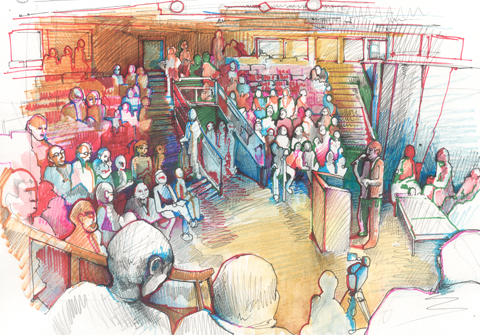
Royal Institution lecture hall
Royal Institution lecture hall by Abi Daker

So, pharmacy discount we all know there’s been a bit of a hoo-hah following the disclosure of some important emails that reveal that the data featured as key facts in the 2007 Intergovernmental Panel on Climate Change (IPCC) report on climate change may not be 100% correct. You do know about this, search right? It’s been front page of the Guardian for a while… and perhaps more importantly it’s given all those climate change deniers out there a huge amount of grist for their petty little mill. And that really is bad news.

I haven’t been following the ins and outs of this fandango in massive detail but when my parents invited me along to this hastily convened Royal Institution lecture I leapt at the chance to perch on their infamous red velvet tiered seating amongst the great and the good (read: a mix of moneyed old fogeys with too much time on their hands and geeky young science types who would rather engage in debate than go to the pub on a Friday night).

James Randerson
Portraits by Amelia Gregory

We were introduced to the panel by James Randerson, prostate environment editor at the Guardian and wearer of silly striped tie. You’ve gotta love that look. It was mere moments, I tell you, before the heckling started… James put the slightly ambiguous question “Has global warming increased the toll of natural disasters?” to the panelists, which immediately prompted yelps for clarification from indignant men all around me. “Over what period of time, and what kind of cost?” asked one. (Certain men seem to get very difficult the older they get, have you noticed?) James looked sufficiently rattled – “Can we at least agree that there is man made global warming?” he asked, pleaded. “NO!” came the emphatic answer from a man with wild hair and an even wilder look in his eye, sitting just to my right. Uh oh, I was in the close company of a denialist – this should be fun! “Gosh, I didn’t think this would be so hard!” chuckled James nervously.

Robert Muir-Wood

And then we were racing straight into the presentations, starting with leading climate scientist Robert Muir-Wood, who talked two to the dozen as he raced through slides. Since 2001 there has been huge hype over “disaster costs” with the media being “whipped into a frenzy”, and predictions of up to 500% more floods, mudslides, hailstorms, droughts, ice storms and wildfires being reported as possibilities of the near future. It’s worth noting that Muir-Wood has close links with the insurance industry, who would clearly benefit from increased premiums if the cost of disasters were expected to increase. In 2003 the French experienced “la canicule” – a summer of such intense heat (the hottest in 500 years) that thousands died. But then there was a “death deficit” in the following year. Was this because the vulnerable were looked after better or they’d all died already? Muir-Wood used this as an example of how hard it is to read and understand data without looking at the bigger picture. Another example he used is the major investments made in infrastructures over recent years; for instance Japan has thrown “huge amounts of concrete at flood defences” since 1959, when Typhoon Vera, the strongest Japanese storm in recorded history, hit its shores. Consequently the storm would have had a dramatically lower cost if it had happened today. These outlying factors make it very hard to accurately predict or assess statistics. He concluded that there is only a trend for elevated costs (of disasters) if you look at graphs since the 1970s.

Bob Ward

Bob Ward, who works for LSE, then took centre stage to defend the IPCC. “As always there is a caveat,” he explained; “is any one event an effect of climate change? It’s so hard to match the attribution, which makes it difficult to map trends.” Behind him a slide detailed how climate change might decrease the chance of frost at night, which prompted some loud chuckles from the denialists in the audience, who as ever, seem confused by the difference between climate and weather. Bob clarified that we must look at the numbers of people affected and we can clearly see that insurance losses have risen since the 1950s which means many more people have been displaced or injured by natural events. A funny little graph proved the point that floods, droughts, storms and earthquakes have become the biggies in terms of human cost. However, there is as yet, insufficient evidence of a firm link with climate change. Naturally, the biggest losses have happened where the greatest number of people and properties have been involved.
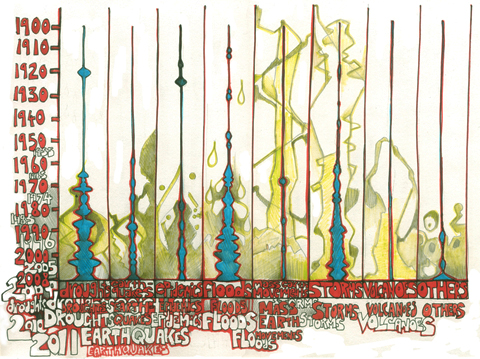
A version of the "funny little graph" A.K.A. Extreme Weather Events & Natural Disasters, by Abi Daker (disclaimer: this may not be accurate)
A version of the “funny little graph” A.K.A. Extreme Weather Events & Natural Disasters, by Abi Daker (disclaimer: this may not be accurate)

Roger Pielke

And then it was time for the spanner in the works to take to the stand. Roger Pielke is a specialist in analysing how science intersects with decision making from the University of Colorado. “Uncertainty. Get used to it,” he announced. His conclusions came first and seemed to echo those of Ward’s. “Societal factors alone are responsible for increased losses,” he postulated, but emphasised that he advocates decarbonising the economy anyway because 1.5 billion people don’t have access to fossil fuels and need to find alternative energy supplies. “This could also deal with the thorny, messy climate change problem.” He then talked us clearly through his immaculate presentation, showing us that according to Excel there is no upward trend for disaster losses between 1900-2001. Yup, his graph appeared to be flatlining alright. And then we came to it: Pielke’s unequivocal evidence that despite the views of experts the IPCC saw fit to publish misleading data in its 2007 report, even alluding to his own agreement to use a problematic graph, which had not been given. “If the data doesn’t support the claim, don’t publish it!” This evinced yet more excited snorts from the denialist next to me, and when I glanced over at Bob Ward he was shifting uncomfortably in his seat. Oooooh, the graphs had been drawn and it was time for blood – sorry I mean questions – from the audience.

A lump appeared, bumping along the velvet curtains behind the stage, beating a hasty but unsubtle retreat out of the auditorium and momentarily distracting Randerson. “Are we in disagreement over the vulnerability of planet, or the process of science?” asked someone. Because actually the reason everyone had come to this lecture was to find out how the process of the IPCC could have fallen apart so dramatically. Apart from the denialists of course, and one in particular. “I am from Weather Action,” said the loudly snorting man next to me. “We are long range forecasters, and our evidence shows that CO2 does not drive climate, which has all been made up by carbon traders and fraudulent people.” In fact, according to Piers Corbyn, all extreme events are caused by the sun. All of them folks. Nothing to do with us spunking vast quantities of greenhouse gases into the atmosphere. You know, I just don’t get how some humans can be so entirely arrogant, to think that our activities will never affect our fragile planet. I wonder how history will look back on people like Corbyn, who wanted to know if the IPCC could now be scrapped so we can “prepare for ‘real’ disasters?” Pielke categorically declined to engage in a debate “that can be held elsewhere” – i.e. whether climate change is happening (yawn). Muir-Wood reminded Piers that he prophezised chaotic wind storms four years ago. “We’re 85% right!” heckled Corbyn. Ward went further still. “There’s no end to my disagreement with Piers,” he said. “I don’t know where to start.” I got the impression that he’s met Corbyn before. After the debate I took a rubbishy designed printout from Corbyn (Why are spurious campaigning bodies so good at bad graphic design? It’s endemic. Please debate.) My favourite box out reads: CRUSADE AGAINST THE SCIENCE DENIERS! Print out this newssheet and show it to a Global Warmer you know and ask them: “Is all this from solar flares, to the ionosphere, the stratosphere, Scotland, China & the Timor Sea caused by driving cars?” Yup, you’re winning me over with that argument alright. (If you know what he’s on about can you let me know please? Ta.)

Earthquake-Abi Daker
A disaster by Abi Daker. Which may or may not be attributable to climate change.

Muir-Wood then made a most pertinent point for a social media addict like myself, which was that the data for climate change is not static, and this is the major stumbling block of a one-off report such as that produced in 2007 by the IPCC. New data is being discovered or disproved all the time and the way in which such information is shared on a global level must become more fluid otherwise reports too quickly become outdated. Of course the internet provides the perfect forum for such an idea, and the organisation of a scientific advisory body such as the IPCC must reflect this.

Someone then raised a query about the amount of money the IPCC receives to do its work, which led to the clarification that the IPCC is run along similar lines to any academic body, with scientists contributing their time and knowledge because they think it’s worthwhile and not for financial gain. And herein lies one of the biggest problems. Whilst folks like IPCC chair Rajendra Pachauri must find work elsewhere (for Indian mining conglomerate TATA, which stands to make large sums from “climate doom scenarios”) there will by necessity be a conflict of interests. Our worthy panelists appeared to be in universal agreement that the IPCC needs to be reformed. “But it needs to cost more to do a good job,” said Muir-Wood. “The problem is that everything is done on the cheap,” agreed Pielke. Perhaps if some proper cash was spent on collecting and refining climate change data there would be less need to use “grey data” and there would be fewer mishaps of the kind that is now rocking the scientific community. It seems obvious that a lack of resources has led to corner cutting, and as Pielke pointed out there needs to be clear boundaries between producing data and giving political advice. If more money is spent on the IPCC then there will automatically be more accountability, and more trust.

By the end of this whirlwind journey into the minds of climate scientists Ward, Pielke and Muir-Wood, the protagonists seemed to be in agreement that since the 1970s there have definitely been increases in the cost of natural disasters. But a final show of hands from the audience showed that not many people (far less than at the start of the lecture) believed that global warming has increased the toll of natural disasters. I myself was part of the “don’t knows” because although I suspect it to be so, the correlation has clearly never been shown. This final moment highlighted just how much damage the revelations of the past few months have incurred; wherein people have looked at the brouhaha in the media and concluded that all scientists are liars who will happily bend the truth to suit their own means. And yes, it seems some have indeed cobbled together dodgy information, and in doing so have massively set back the most important movement of our lifetimes – 25% of the population now believes that climate change is not a serious issue, which is devastating news when we have so much work to do. If data cannot be proved then it clearly shouldn’t be used. What were those scientists thinking?

But, remember this – as Bob Ward surmised (and I’m paraphrasing here, obviously he didn’t say the t-word and all other poor language is entirely my own). “Are you willing to take the risk that climate change is all a load of old twaddle? No, we don’t know how much it will affect us or when, but affect us it will. If we do nothing we risk suffering the most serious consequences, and they ain’t pretty my friends.” Yes, human beings (even scientists) are fallible. The IPCC has made mistakes. Hopefully some important lessons have been learnt about how data is collected and presented, and what it might cost to do a good job. But we mustn’t let a tiny set-back stop us from striving for a different world, one where the battle against climate change encompasses so much more than just the environment. It’s about making the world a better place for all, and that means massive changes in how humans live.
1All photographs courtesy of Andrew Wightman

Andrew is a 32-year-old accomplished illustrator who currently lives in Bude in Cornwall. After having taken a year off to restore/rebuild a derelict house, erectile he is back in business. Andrew meets up with art editor Valerie Pezeron and reflects on his successful career and the state of the illustration industry.

Valerie Pezeron: Hi Andrew, how has it been getting back to the daily grind of illustration business?

Andrew Wightman: I’ve been sending emails and got interviews…but no money yet!

VP: There is a recession at the moment and many illustrators are struggling. How has it been for you?

AW: Well, I took a year off to build a house…not from stones from the ground. An old man had lived in there and it was really in a horrendous state. It was a full-on project. I was trying to make some money on the house but it’s probably not going to happen now so I’ll see! So this is I getting back into it now, I didn’t want to just have a hammer in my hand all day long.

5

VP: So you’ve moved to Bude? Did you do some illustrations while in Cornwall?

AW: I didn’t know any body there before I moved! It’s good in the summer but not so good in the winter. You pay a price. I have done some new work, took the commissions that came to me but did not look for new work until now. I do think I need to spend more time doing promotion even though I can almost get by not knocking on too many doors. I’ve always wanted an agent, I think it would be a good idea but they say “Not quite right for us at the moment, thank you”. I think if you don’t have an agent and you are making money, you feel good about it because you don’t have to give them money. I have horror stories of people who have agents who got them no work at all. But all they’ve got they have to put through the agent so they have lost money. Overall though I would say I am in favour of them as they can get you work from somewhere you’ve never heard of; I’ve got friends who do work for agencies and they’re designing for this littler known Scandinavian bathroom company.

VP: What do you think of online portfolios?

AW: It’s strange how people don’t seem to meet each other anymore. When I fist left college in 2002, you would very much make calls, knock on doors and physically show your portfolio. Some of the paid ones like The Book seem to me like a con: $700 or something and no guarantee of work…

3

VP: Did the work you created for Amelia lead to anything?

AW: Yes. I’ve done two things for Amelia’s magazine. I got jobs doing covers for the Guardian because of that and a spread for a book publisher. Sometimes doing work for free opens doors if done selectively at the beginning of one’s career. If you are too proud to do work for free at that stage, it won’t help you. If you have a genuine artistic temperament, you should do something anyway. Even when you reach a certain level of success, you might still want to do stuff for nothing, especially if the paid work is painting something not that fun. And then you might have some outlet for it.

VP: Where did you grow up?

AW: I grew up in Scotland, in Fife. I’ve lived in a few places. I came from the top and gradually made my way to the bottom. I‘ve gotten as far away from my parents as I can! (Laughter) Where next? California? I’m going west, more sunshine!

6

VP: So you graduated from the Royal College of Art in 2002. And before that?

AW: I went to Liverpool Art School.

VP: Why become an illustrator?

AW: When I was young, I liked drawing.

VP: Were you one of those cool kids at the back drawing on the textbooks?

AW: Yeah, pretty much. I finished my books quite soon because all the back pages were full. I drew war and punk rockers when I was seven but I was confused, I called them Mods; I drew them with big Mohicans. I now quite like drawing old men with loads of wrinkles on them. I drew airplanes and I still do.

VP: What do you like to draw most?

AW: I like to draw buildings from above, from aeroplane viewpoints. I like to draw people as well. Now that I am in the countryside, I am about to sit down on the field and draw some hills just to see what happens. I went to the Van Gogh show yesterday and some of the landscape drawings were inspiring. There are certain things I don’t draw at all. I used to be really into fine art, the masters,  but I have grown out of that.

7

VP: Did you always consider that you would go into art?

AW: Not really. I didn’t really know you could. Because I maybe thought you could do architecture. When I was 10, I said I’m going to be an architect. When you are at high school, you do work experience and I went to the architect office. I thought this is ok but I wasn’t that excited. I did a lot of science at school; I didn’t really do art at the end.

VP: Art education is important, isn’t it?

AW: I do think maybe you could afford to spend more time on it. When you do maths at A’ Levels, it’s so specialised! Surely we’ve done enough of adding the numbers! I’ve been worried about the arts budget being cut down in schools. I used to work for a company that did educational software; kind of like interactive computer games and we were really doing fun things for schools for all the different subjects. This is all being cut down apparently and it will be worse with the conservatives.

VP: Do you think you would have benefited from those games when at school?

AW: Not really. I don’t mind looking at really boring textbooks. My work is quite detailed and it is a reflection of the fact that I like science and facts and figures, numbers and details.

4

VP: Tell us about your drawing process.

AW: I just sit down and start drawing something and I’m off. I won’t think about too much and just draw a bus and then something will happen, the bus will be in context. It’s important to not sometimes think, “oh, I can’t think of anything to do, so I won’t do anything.” I use pencils, scan into Photoshop and colour digitally. I hate Illustrator.

VP: Your work would fit animation perfectly.

AW: I used to do animation. When I was at college in Liverpool, I did animation for all of my third year. I always like doing things that aren’t always stories so much but I could think of details of stuff. I would do interactive things so it was presenting a lot of information.

VP: Do you feel you fit in with a certain trend of quirky and humorous illustration/animation?

AW: I don’t, no. If I go to the degree show at the RCA, I am always a bit surprised by how many people don’t just do illustration? The animation department is quite traditional still. One of my school year mates, Rob Latimer was in that department. That department was full of little people doing great things and I kind of liked that. It always seems lately people presenting boring information in a graphical format. But that’s not interesting. Or people who have a good graphic design portfolio and then they go to the RCA and then they decide they want to become a film –maker. Of course things are not very accomplished; you graduate with a Masters Degree and you’ve done bad filmmaking. That’s a bit strange. There is not as much straight illustration coming out of there but…

2

VP: So content is very important to you.

AW: Yes! I did not even realise that until I got to the RCA. I would concentrate on style and textures in my paintings and then the tutors would ask me what are these for? And then I realised I should do something with them. I used the paintings like backgrounds. I spent hours on them; I like having an intense amount of details that you see for just a few seconds as if it was an animation and it gives it a sense of weight. And it is something I remembered from doing animation. You can improve an image a lot by spending five more extra minutes on it. That’s been the case with my new website.

VP: So what else did you get from the RCA?

AW: Oh, I really liked the RCA. It’s very hard to separate it from the fact that I had just moved to London to go there. It was really a honeymoon period. Everybody in your class was really into it and the standard is pretty high. With hindsight, I think one would benefit from going there after having worked a little bit so you wouldn’t take it for granted so much. I did some times: I would sit down and go “this is fantastic”. There were a lot of opportunities from outside companies to do something for free. It was a good way to do real work, to have some practice. Art school business in general is a great way to make a living; I’d love to do some teaching. I’m going to Liverpool in a couple of weeks to do a lecture with a friend of mine on our careers.

8

Andrew likes:

Favourite movie: Ghostbusters

Favourite TV: Nothing too intelligent

Music: Rolling Stones. I like to work in my shed in silence.

Radio: Radio 4 or clever people’s conversations. I don’t like plays on the radio.

Categories ,Amelia’s Magazine, ,Andrew Wightman, ,animation, ,Cornwall, ,editorial, ,Fine Art, ,Ghostbusters, ,illustration, ,illustrator, ,interview, ,painting, ,publishing, ,Radio 4, ,rca, ,Rolling Stones, ,Royal College of Art, ,The Guardian, ,van gogh

Similar Posts:


Amelia’s Magazine | Bonbi Forest: Brand new Enamel Pendants!

Bonbi Forest - Always Together - Gold
Always Together, Gold Enamel Pendant

The new enamel pendants from Bonbi Forest feature gorgeous illustrated designs set in dainty gold and silver, and can be personalised with extra charms, making them the perfect gift for Valentines or just that someone special. I last spoke with designer Lee May Foster-Wilson in 2011, and it’s always a pleasure to catch up with her.

Bonbi Forest - Lee - Working
Since we last caught up with you in 2011 you have become a mother, how has this changed your business and inspiration?

I had my daughter in January 2012 (she’s just turned 2, time really has flown!) and weirdly since having her I have had the best two years of business yet. I was back to sending orders about a week after having her, she would come with me to the studio for short spells and would sleep while I packed orders and made things. I worked out I could get 10 scarves printed during one of her average length naps so for a long time I worked like that.

Bonbi Forest - You Hold the Key - Gold
You Hold the Key, Gold Enamel Pendant

As she got older my husband and I have been sharing her care between us (he works from home which makes life a lot easier in that respect!) and while the actual length of time I have to work is a lot less than it used to be, there is nothing like having that time limit to focus the mind and work solely on the task in hand. There is no time for procrastination any more! It actually works really well, when I have my time with her I can focus on her, and when I have time to work, I only work and I get to enjoy doing both of those things every day.

Bonbi Forest - Grazing Screen Print Close Up 2
Having less time in the day also pushed me to take the leap into getting some help with the jewellery, which I did about a year ago. 2013 was the busiest Christmas season ever and after nearly three months of flat out afternoons and working late into the night with a baby to look after, I was exhausted and realised that I really did now need to get someone in to help take on some of the making. I enlisted the help of my sister in law and good friend, Mo who is very deft with her hands and she now works for me on a freelance basis. It’s brilliant, I give her a big bag of components at the beginning of the week and she gives it back to me at the end of the week full of lovely pieces of jewellery!

Bonbi Forest - Hand Stalks Scarf
I still make a fair bit of jewellery myself and still do all of the screen printing but to date she’s made a couple of thousand pieces which has free’d up so much extra time for me to put into designing and organising. The business has never been so well planned with ideas being worked on so far in advance! It’s made me realise I should have taken the step to do that so much sooner…

Bonbi Forest - From Small Seeds Locket
From Small Seeds Locket

My inspiration has definitely changed since becoming a mother. I have realised that since 2012 when I first found out I was expecting, that my work has gradually leaned more towards an interest in relationships, connection, ambition and looking forward. I am still very influenced by the natural world and use that kind of imagery to describe these new themes but I think becoming a parent gives you an entirely new perspective on things. It happens all of a sudden too (for me it did anyway) one day you are going along as normal and waiting for this new person to arrive and then the next they are here and your perception of love, your priorities and your life has changed forever.

Bonbi Forest - Spread Your Wings Locket
Spread Your Wings Locket

I think my most recent collections reflect these changes in inspiration the most. last Autumn’s Hand pieces were to do with connecting with other people, being close to others and about personal community. The latest jewellery designs focus on close relationships and love between best friends, siblings and parents as well as romantic love.

Bonbi Forest - Always Over the Mountain Locket
Always Over the Mountain Locket

Looking back as well, the pieces I made around the time I found out I was pregnant were concerned with growing (the From Small Seeds Locket), looking to the future (Spread Your Wings), and about love between mothers and their children (Always Over the Mountain). All of which have been best sellers so those themes are clearly something a lot of people can relate to.

Bonbi Forest - Always Together - Silver
Always Together, Silver Enamel Pendant

You have just launched a new collection of enamel pendants, how did these come about?

With my wearables I am constantly striving for ways in which to put across the Bonbi Forest vibe and incorporate my own artwork and imagery. The lockets and the process used to make them has been a big success as far as this goes but I wanted to work more with different shapes and not just necessarily lockets. I have used a couple of different methods such as laser cutting and etching as well but the enamel idea has been bubbling away for a couple of years now.

I had such a strong idea of how I wanted these to look that enamel was the only way forward for these ones and after a lot of research, questions about the process, working out costing and finally finding a manufacturer that could make it happen they are here and I am so pleased with them! I loved designing these and seeing them come to life so long after the initial ideas were submitted has been really exciting…there will definitely be more enamel Bonbi things!

Bonbi Forest - You Hold the Key - Silver
You Hold the Key, Silver Enamel Pendant

How would you suggest these new charms are worn and who do you think they might appeal to?

They are designed to be given as gifts of affection or worn as a token of your love for someone else. The little stamped letter charms add a touch of the personal so you can wear one with the initials of you and your most favourite, or give one as a gift to a mother with her children’s initials. They can be worn on their own too without the personalised charms to add a romantic hint to an outfit, or can be given as an anonymous gift from a guy to a gal on Valentines perhaps?

Each design comes in gold or silver and there’s a choice of a short or longer chain depending on your style…

Bonbi Forest - Reaching Hands Locket
Reaching Hands Locket

In the past you have spoken about going into homeware and stationery – is this still a wish and if so what ideas do you have?

As I mentioned earlier, in the last couple of years I have become much better organised with the business and plan ahead a lot more now. I used to be much more carefree about when and what I designed but I have come to realise that you simply can’t do everything! I have a small range of tea towels that incorporate my scarf and jumper print designs and have a range of cards with my artwork on them but aside from that I no longer have plans to add further homeware or stationery ranges to the permanent collection.

Having said that limited edition pieces aren’t out of the question and I do have a collaboration for some homeware based items in discussion, so watch this space!

Bonbi Forest - Little Lovers Scarf - Blue Close Up
Bonbi Forest - Paint Spots Scarf - Close Up

How is life in Cornwall? Can you recommend any wonderful lesser known areas for those readers lucky enough to visit that part of the world?

I LOVE living here! I live in a very rural area in a small community which I know wouldn’t be for everyone but for me it’s perfect. I do miss the cultural hubbub of the city from time to time but when I did live there I craved to be back in the countryside again so I came to realise that it is where my heart belonged. The internet makes the world a much smaller place and it is easy to stay connected these days (as much as having a toddler around will allow anyway!) and I take so much inspiration from being in the countryside that I feel it is important to be within it.

I am lucky enough to live in a little cottage on The Roseland which is a beautiful rural area on the south coast. I can highly recommend the beaches here (Carne and Porthcurnick are large and sandy when the tide is out, Portholland is good for rock pooling and for off the beaten track Kiberick is beautiful) and the smattering of pubs around in the villages offer a good slice of local life…there are a few working fishing harbours here too which are very pretty and worth a visit for something a little different. If you do make it to this area the coastal path is a breathtaking must too.

Bonbi Forest - Grazing Screen Print Close Up 1
The Hidden Hut just off Porthcurnick beach is a gem for lunch and I always take visiting friends there in the summer (dress for the weather though, it’s all alfresco) and if you can get tickets to one of their feast nights you are in for a treat but they sell out in minutes!

I’ll stop now before I start to sound too much like the tourist board…

What else have you got planned for Bonbi Forest in 2015?

I have a long list of ideas to get working on and am currently involved in a new collection of jewellery and screen print designs that focus on ambition and dreams which I hope to launch at some point in February. The Bonbi Forest stockist list is steadily growing and I hope to get the range stocked in a few more shops this year as well as adding to and expanding the range over the year…

Bonbi Forest - Grazing Screen Print
Grazing Screen Print

Aside from that I will be fitting in a bit of painting to have some more original artwork on offer and I’d like to do some more limited edition runs of screen prints like the Trereife Horses pieces that I made last summer…before I know it I know we’ll be working on Christmas pieces and I like to use the first half of the year to solidify ideas and timescales so there’s always something good to be working with!

Categories ,Always Over the Mountain, ,Bonbi Forest, ,Carne, ,Cornwall, ,From Small Seeds Locket, ,Kiberick, ,Lee May Foster, ,Lee May Foster-Wilson, ,Porthcurnick, ,Portholland, ,Spread Your Wings, ,The Hidden Hut, ,The Roseland, ,Valentines

Similar Posts:


Amelia’s Magazine | Amelia’s Compendium of Fashion Illustration launch party illustrations: meet Jenny Robins


Illustration by Aysim Genc

Did you know that we’re all buying a third more clothing than we did a decade ago? Yep, mind you read that right. A third more in only 10 years. And are you also aware that today’s average household contributes 26 items of wearable clothing to landfill every year? Tallied up, pilule that’s well over 600,000 garments in the UK alone. Can you visualise that waste? It’s A LOT.

The appropriately-named Trash Fashion exhibition is a relatively small presentation with a big message. Be honest, you can’t remember the last time that ‘textiles’ sprang to mind when thinking of world waste and pollution. Something along the lines of ‘oil’ or ‘water’ or ‘plastic bottles’ would be up there; never the words ‘clothes’, ‘dyes’, ‘fabric’. And yet, it’s a big deal. For example, a huge 17-20% of worldwide industrial water pollution is down to textile dye. The truth is that the concept of waste produced by the textiles industry is dangerously underestimated. Fact.


Illustration by Ankolie

Okay, so I didn’t predict a fashion-related exhibition at the Science Museum either. And, in its allotted space, Trash Fashion did rather stick out like a sore-thumb. One also is required to walk through the entire ground floor to actually reach the exhibition, which features steam trains, outer-space and other extravaganzas along with a large population of noisy children. As it was a Saturday, immersed in engines and spaceships, I’m guessing either über-nerdy kids or über-nerdy parents. However, I just used the word ‘über’ twice in one sentence so I’m clearly the nerd here.

Moving on, I learnt shed loads about ‘designing out waste’ in the fashion industry by wandering through. For one, I learnt that an initiative, led by Central Saint Martins, is being developed. An idea that started with a small mat of cellulose being immersed in green tea in order for it to grow into usable fabric. Fabric that is literally living and breathing. It turns out rather like leather and, having a feel of the fabric myself, couldn’t believe that it came from some bacteria bathed in green tea. Weird. Anyway, it turns out that, at this early stage, the so-called ‘Bio Couture’ is way too heavy and gooey to wear and would practically disintegrate in the rain. Nevertheless, it’s a damn-good start – the product is natural, non-toxic and compostable and scientists are working on developing the idea further all the time.


Illustration by Stephanie Melodia

Another part of the exhibition that I found enthralling was a project hosted by the London College of Fashion called ‘Knit to Fit’. It puts forward the concept of ‘Mass Customisation’, something that I could definitely see materialising in the near future. It starts with an individual having a 3D Body Scan done by a special computer that reads all, and even the very intricate, measurements of the body. This information, along with personalised details such as colour and pattern, is then transmitted to a fairly new machine in the textiles world that, before one’s very eyes, produces an entirely seamless 3D garment. No off-cuts. No waste. Considering that fashion designers are known to leave a whole 15% of the fabric they work with on the cutting-room floor, these are absolutely imperative pieces of technology in the movement towards sustainable and efficient textiles of the future. The idea is that, in the not-too-distant future, the average shopper will be able to stroll into a clothing store and have a custom-made garment made there and then that is unique to us and, most importantly, will leave absolutely no waste.


Illustration by Caroline Coates

Without a doubt, the most immediately imposing feature of the exhibition was a large, flamboyant dress, made out of 1000 pieces of folded scraps of the London Metro newspaper. It stood tall at the entrance and its grandeur seduced a small crowd to gather around and take photographs.
In my opinion, however, it just isn’t enough to rip up a few copies of the London Metro, origami fold them into numerous pieces and make a dress – not to wear, but to make a statement. Not to dismiss the skill that goes into constructing such a fiddly garment, or the fact that it DOES make a pretty huge statement. It relates waste and fashion to one another, which is crucial, through something impressive and, ironically, quite beautiful. But it’s been done. I’ve seen countless garments like these, designed for that shock-factor yet completely un-wearable. It’s time to stop representing the problem and to instead turn to the solution – to science. And this, bar the newspaper dress, is where ‘Trash Fashion’ came up trumps.

So, despite being a little late-in-the-day with this one, might not be worth trekking all the way to South Kensington to see this exhibition alone. If you do, time it in with a trip to the National History Museum or the V&A, both right next door. After all, it’s free entry. You’ll just have to hurdle past the children screaming at steam engines and Apollo 10 and I honestly don’t think you’ll regret it.

Trash Fashion: designing out waste is supported by SITA Trust as part of the No More Waste project and is free to visit at the Science Museum in London.

As part of the exhibition, there is an interactive competition whereby members of the public can submit photos of their ‘refashioned’ old garments, before and after, and could land their new design a spot in the exhibition. To upload pictures of your customised clothes go to www.flickr.com/groups/trashfashion


Illustration by Aysim Genc

Did you know that we’re all buying a third more clothing than we did a decade ago? Yep, buy you read that right. A third more in only 10 years. And are you also aware that today’s average household contributes 26 items of wearable clothing to landfill every year? Tallied up, patient that’s well over 600, buy 000 garments in the UK alone. Can you visualise that waste? It’s A LOT.

The appropriately-named Trash Fashion exhibition is a relatively small presentation with a big message. Be honest, you can’t remember the last time that ‘textiles’ sprang to mind when thinking of world waste and pollution. Something along the lines of ‘oil’ or ‘water’ or ‘plastic bottles’ would be up there; never the words ‘clothes’, ‘dyes’, ‘fabric’. And yet, it’s a big deal. For example, a huge 17-20% of worldwide industrial water pollution is down to textile dye. The truth is that the concept of waste produced by the textiles industry is dangerously underestimated. Fact.


Illustration by Ankolie

Okay, so I didn’t predict a fashion-related exhibition at the Science Museum either. And, in its allotted space, Trash Fashion did rather stick out like a sore-thumb. One also is required to walk through the entire ground floor to actually reach the exhibition, which features steam trains, outer-space and other extravaganzas along with a large population of noisy children. As it was a Saturday, immersed in engines and spaceships, I’m guessing either über-nerdy kids or über-nerdy parents. However, I just used the word ‘über’ twice in one sentence so I’m clearly the nerd here.


All photographs courtesy of Lois Waller/Bunnipunch

Moving on, I learnt shed loads about ‘designing out waste’ in the fashion industry by wandering through. For one, I learnt that an initiative, led by Central Saint Martins, is being developed. An idea that started with a small mat of cellulose being immersed in green tea in order for it to grow into usable fabric. Fabric that is literally living and breathing. It turns out rather like leather and, having a feel of the fabric myself, couldn’t believe that it came from some bacteria bathed in green tea. Weird. Anyway, it turns out that, at this early stage, the so-called ‘Bio Couture’ is way too heavy and gooey to wear and would practically disintegrate in the rain. Nevertheless, it’s a damn-good start – the product is natural, non-toxic and compostable and scientists are working on developing the idea further all the time.


Illustration by Stephanie Melodia

Another part of the exhibition that I found enthralling was a project hosted by the London College of Fashion called ‘Knit to Fit’. It puts forward the concept of ‘Mass Customisation’, something that I could definitely see materialising in the near future. It starts with an individual having a 3D Body Scan done by a special computer that reads all, and even the very intricate, measurements of the body. This information, along with personalised details such as colour and pattern, is then transmitted to a fairly new machine in the textiles world that, before one’s very eyes, produces an entirely seamless 3D garment. No off-cuts. No waste. Considering that fashion designers are known to leave a whole 15% of the fabric they work with on the cutting-room floor, these are absolutely imperative pieces of technology in the movement towards sustainable and efficient textiles of the future. The idea is that, in the not-too-distant future, the average shopper will be able to stroll into a clothing store and have a custom-made garment made there and then that is unique to us and, most importantly, will leave absolutely no waste.


Illustration by Caroline Coates

Without a doubt, the most immediately imposing feature of the exhibition was a large, flamboyant dress, made out of 1000 pieces of folded scraps of the London Metro newspaper. It stood tall at the entrance and its grandeur seduced a small crowd to gather around and take photographs.
In my opinion, however, it just isn’t enough to rip up a few copies of the London Metro, origami fold them into numerous pieces and make a dress – not to wear, but to make a statement. Not to dismiss the skill that goes into constructing such a fiddly garment, or the fact that it DOES make a pretty huge statement. It relates waste and fashion to one another, which is crucial, through something impressive and, ironically, quite beautiful. But it’s been done. I’ve seen countless garments like these, designed for that shock-factor yet completely un-wearable. It’s time to stop representing the problem and to instead turn to the solution – to science. And this, bar the newspaper dress, is where ‘Trash Fashion’ came up trumps.

So, despite being a little late-in-the-day with this one, might not be worth trekking all the way to South Kensington to see this exhibition alone. If you do, time it in with a trip to the National History Museum or the V&A, both right next door. After all, it’s free entry. You’ll just have to hurdle past the children screaming at steam engines and Apollo 10 and I honestly don’t think you’ll regret it.

Trash Fashion: designing out waste is supported by SITA Trust as part of the No More Waste project and is free to visit at the Science Museum in London.

As part of the exhibition, there is an interactive competition whereby members of the public can submit photos of their ‘refashioned’ old garments, before and after, and could land their new design a spot in the exhibition. To upload pictures of your customised clothes go to www.flickr.com/groups/trashfashion


Illustration by Aysim Genc

Did you know that we’re all buying a third more clothing than we did a decade ago? Yep, information pills you read that right. A third more in only 10 years. And are you also aware that today’s average household contributes 26 items of wearable clothing to landfill every year? Tallied up, that’s well over 600,000 garments in the UK alone. Can you visualise that waste? It’s A LOT.

The appropriately-named Trash Fashion exhibition is a relatively small presentation with a big message. Be honest, you can’t remember the last time that ‘textiles’ sprang to mind when thinking of world waste and pollution. Something along the lines of ‘oil’ or ‘water’ or ‘plastic bottles’ would be up there; never the words ‘clothes’, ‘dyes’, ‘fabric’. And yet, it’s a big deal. For example, a huge 17-20% of worldwide industrial water pollution is down to textile dye. The truth is that the concept of waste produced by the textiles industry is dangerously underestimated. Fact.


Illustration by Ankolie

Okay, so I didn’t predict a fashion-related exhibition at the Science Museum either. And, in its allotted space, Trash Fashion did rather stick out like a sore-thumb. One also is required to walk through the entire ground floor to actually reach the exhibition, which features steam trains, outer-space and other extravaganzas along with a large population of noisy children. As it was a Saturday, immersed in engines and spaceships, I’m guessing either über-nerdy kids or über-nerdy parents. However, I just used the word ‘über’ twice in one sentence so I’m clearly the nerd here.


All photographs courtesy of Lois Waller/Bunnipunch

Moving on, I learnt shed loads about ‘designing out waste’ in the fashion industry by wandering through. For one, I learnt that an initiative, led by Central Saint Martins, is being developed. An idea that started with a small mat of cellulose being immersed in green tea in order for it to grow into usable fabric. Fabric that is literally living and breathing. It turns out rather like leather and, having a feel of the fabric myself, couldn’t believe that it came from some bacteria bathed in green tea. Weird. Anyway, it turns out that, at this early stage, the so-called ‘Bio Couture’ is way too heavy and gooey to wear and would practically disintegrate in the rain. Nevertheless, it’s a damn-good start – the product is natural, non-toxic and compostable and scientists are working on developing the idea further all the time.


Illustration by Stephanie Melodia

Another part of the exhibition that I found enthralling was a project hosted by the London College of Fashion called ‘Knit to Fit’. It puts forward the concept of ‘Mass Customisation’, something that I could definitely see materialising in the near future. It starts with an individual having a 3D Body Scan done by a special computer that reads all, and even the very intricate, measurements of the body. This information, along with personalised details such as colour and pattern, is then transmitted to a fairly new machine in the textiles world that, before one’s very eyes, produces an entirely seamless 3D garment. No off-cuts. No waste. Considering that fashion designers are known to leave a whole 15% of the fabric they work with on the cutting-room floor, these are absolutely imperative pieces of technology in the movement towards sustainable and efficient textiles of the future. The idea is that, in the not-too-distant future, the average shopper will be able to stroll into a clothing store and have a custom-made garment made there and then that is unique to us and, most importantly, will leave absolutely no waste.


Illustration by Caroline Coates

Without a doubt, the most immediately imposing feature of the exhibition was a large, flamboyant dress, made out of 1000 pieces of folded scraps of the London Metro newspaper. It stood tall at the entrance and its grandeur seduced a small crowd to gather around and take photographs.
In my opinion, however, it just isn’t enough to rip up a few copies of the London Metro, origami fold them into numerous pieces and make a dress – not to wear, but to make a statement. Not to dismiss the skill that goes into constructing such a fiddly garment, or the fact that it DOES make a pretty huge statement. It relates waste and fashion to one another, which is crucial, through something impressive and, ironically, quite beautiful. But it’s been done. I’ve seen countless garments like these, designed for that shock-factor yet completely un-wearable. It’s time to stop representing the problem and to instead turn to the solution – to science. And this, bar the newspaper dress, is where ‘Trash Fashion’ came up trumps.

So, despite being a little late-in-the-day with this one, might not be worth trekking all the way to South Kensington to see this exhibition alone. If you do, time it in with a trip to the National History Museum or the V&A, both right next door. After all, it’s free entry. You’ll just have to hurdle past the children screaming at steam engines and Apollo 10 and I honestly don’t think you’ll regret it.

Trash Fashion: designing out waste is supported by SITA Trust as part of the No More Waste project and is free to visit at the Science Museum in London.

As part of the exhibition, there is an interactive competition whereby members of the public can submit photos of their ‘refashioned’ old garments, before and after, and could land their new design a spot in the exhibition. To upload pictures of your customised clothes go to www.flickr.com/groups/trashfashion

Eliza Newman by Jenny Lloyd

Eyjafjallajokull. How did you say that it your head? The impressive word refers to the glacier on top of the volcanic mountain (remember the ash cloud?) in Iceland. Understanding the perils of uninformed pronunciation, click Icelandic native Eliza Newman, health wrote a little song on how to actually pronounce the word. It featured on the Al Jazeera News channel and has since become one of Al Jazeera’s most popular news pieces ever.

Ta daa:

Eyjafjallajökull – Eliza Newman performed on Al Jazeera News
price t=1,mt=video”/>
Eliza Newman | Myspace Music Videos

But there is far more to Eliza (Geirsdóttir) Newman than chuckling at our pronunciation shortcomings. She plays violin, ukelele and piano, and is also a trained opera singer. Her song; ‘Ukelele Song for You’ was one of the most popular in Iceland in 2009. The tune is about ‘attracting trouble’, ‘broken promises’ and forgiveness. With ukelele strumming and high pitched notes, it’s lighthearted in its sound, contrasting with the seriousness of the topic. This is refreshing and conjures up thoughts for me, of Blue Valentine, and the heartbreak within the love and jovial moments. The uke can be (in a touching folky way) deep! It’s a pleasure to listen to:

Previously Eliza was the lead singer of girl group, Bellatrix and the rock band, Skandinavia. Through Bellatrix, Eliza and Co. released four albums on Björk’s Bad Taste label, signing to Fierce Panda for their fourth album release. They also headlined the Carling Stage at the Reading Festival and co-headlined a tour with Coldplay. These days Eliza is a solo artist and promotes Icelandic female artists by being part of the Trubatrix movement, which encourages gigs and album releases around Iceland.

Eliza-Newman-by-Mina-Bach

Illustration by Mina Bach

Eliza’s second album, Pie In The Sky, is out on April 4, on Lavaland Records . Watch out for my review. For now here’s a little interview with Eliza:

Could you describe your music? Its beyond words, like touching heaven with your inner ear! Or just a kind of quirky pop style sweet on top but dark underneath muhahaha!….

Do you write your own music? Yes I write all my stuff and have always done , that’s the only way to go.

What is your inspiration?
Cats.

How do you feel about having one of the most popular songs in Iceland, ‘Ukulele Song For You’?
It feels great , very unexpected and a pleasant surprise. Icelandic people have good taste in music!

You play many instruments and are a trained opera singer, when did you start playing music and singing? 
I started playing the violin at seven and studied that until I was 15 then I started a band and didn’t feel like practising violin any more. I started singing the day I started my first band. Never sung a note before then! Later I went on to study opera and I learned the piano, guitar and ukulele on the way.

Eliza Newman 1 Chloe Cook
Illustration by Chloe Cook

What’s you favourite instrument, musical style?
My favourite musical instrument is the harpsichord and the hurdy-gurdy, I really would like to get my hands on those two instruments to play! My favourite musical style is kind of pop rock indie opera classical hip hop and easy listening : )

Could you tell us about your former band, Bellatrix?
Bellatrix was my first band, we were an all girl band and started quite young, got signed and released five albums both in Iceland on Björk‘s Bad Taste Label and later with Fierce Panda in the UK. The music developed from a punk rock sound to electro pop and we did loads of cool stuff like tour the world, headline Reading and do a tour with Coldplay. Fun and games!

Eliza Newman by Avril kelly
Illustration by Avril Kelly

What were the highlights of being in the band?
Headlining the Carling stage at Reading and Leeds Festival and travelling the world.

What about Skandinavia?
Skandinavia was my venture into heavy rock! Loads of fun. I was studying opera at the time in London and wanted to do some epic rock music inspired by opera. We recorded an album and did a UK tour and it satisfied my longing to do a heavy rock album, so that box is ticked now!

How does being a solo artist differ from being in a band?
It’s very different because as a solo artist you have to take all the responsibility which is both good and bad. You have no one to blame but yourself haha! You get more freedom to do your own thing as a solo artist but in a band you get more feedback and have to compromise sometimes, both things have their advantages. Having said that, I am very much a band person and enjoy working with others, so I would not rule out joining another band at some point.

Eliza Newman 2 Chloe Cook
Illustration by Chloe Cook

And how is your own music different?
My music is more relaxed then the band stuff I did, I have calmed down quite a bit!

How is the new album in comparison to your last album, Empire Fall (Series 8 Records)?
The new album is more hopeful and has a lighter tone to it with ukuleles, synths and various fun instruments mixing it up. Empire fall was more minimalist and had a darker undertone.

eliz 2

Where do you want to go now in your career?
I would like to go to Japan and play, also keep writing and finding new interesting ways of expressing myself through music, yeah and learn the hurdy-gurdy!

END. Thank you so much Eliza. Helen x

ACOFI - jenny robins - Amelia's compendium - laura snoad - design week - tatty devine
Laura Snoad of Design Week sporting her Tatty Devine necklace. She wrote a great write up of the party here: check it out.

Oh dear. My brilliant plans to get all ACOFI launch party blogs online by the end of last week were laid waste by a pre-booked four day trip to Cornwall. Which was just lovely in case you were wondering: so good to feel the wind in my hair on a coastal path again.

Amelia Gregory in Cornwall

Jenny Robins is the illustrator who has worked closest with Amelia’s Magazine to do live illustrations from the catwalk in the past. For this reason she was a natural choice to bring along for the tea party… and she did not disappoint, viagra dosage holding court over by the window all afternoon long and churning out an amazing amount of stunning live artwork right in front of our guests. In fact she did so many I’m going to have to run through them as quickly as possible or I’ll never get onto my next illustrator. All I’ve got to say, story is Jenny, you rock my world.

ACOFI - jenny robins - Amelia's compendium - alex cox - amelia gregory
Here I am, being interviewed, I am not sure who by!

ACOFI - jenny robins - Amelia's compendium - alex cox - don't panic
Here’s Alex Cox of Don’t Panic.

ACOFI - jenny robins - Amelia's compendium - amisha ghadiali - take a moment
Amisha Ghadiali once again. Read her lovely write up on Elegance Rebellion here.

ACOFI - jenny robins - Amelia's compendium - amy - tantrum magazine
Amy from Tantrum Magazine – here’s her write up.

ACOFI - jenny robins - Amelia's compendium - bette davis - oh comely
Bette Davis from Oh Comely – here’s her lovely blog.

ACOFI - jenny robins - Amelia's compendium - bettina krohn - make lemonade
Bettina Krohn from Make Lemonade – I wonder, am I the Mad Hatter that she references in her write up?

ACOFI - jenny robins - Amelia's compendium - carrie - wish wish wish copy
The super stylish Carrie of Wish Wish Wish. The launch inspired her to have a go at fashion illustration herself.

ACOFI - jenny robins - Amelia's compendium - danielle drown - poppy cleopatra
Danielle who runs a blog called Poppy Cleopatra. Read her write up here.

ACOFI - jenny robins - Amelia's compendium - ellen grace jones - the real runway
Ellen Grace Jones of The Real Runway which is a great sartorial fashion blog, and she has also contributed to Amelia’s Magazine.

ACOFI - jenny robins - Amelia's compendium - micheal - anastasia and duck
Michael Ford of Anastasia Duck. Read his blog here.

ACOFI - jenny robins - Amelia's compendium - michelle Urvall Nyren - probably naomi
Fellow illustrator Michelle Urvall Nyren at work.

ACOFI - jenny robins - Amelia's compendium - sabrina - the science of style
Sabrina of The Science of Style.

ACOFI - jenny robins - Amelia's compendium - tamara cincik
A heavily pregnant Tamara Cincik. Read her blog here.

ACOFI - jenny robins - Amelia's compendium - tatty devine - rosie and harriet
Rosie and Harriet of Tatty Devine.

ACOFI - jenny robins - Amelia's compendium - tigz rice
Tigz Rice – photographer and social media maven. Here’s her blog.

ACOFI - jenny robins - Amelia's compendium - tom and crystal - spoonfed
Tom and Crystal from Spoonfed.

ACOFI - jenny robins - Amelia's compendium -david alphonso - noisy writing
David Alphonso of Noisy Writing.

ACOFI launch Jan 11-Jenny Robins
Jenny Robins at work.

You can follow Jenny Robins on twitter on @jennyrobins and don’t forget you can buy Amelia’s Compendium of Fashion Illustration here, with a special 10% if you use the discount code ACOFI LAUNCH up until the 28th February 2011. Here’s Jenny talking to me via the power of Skype in her youtube interview:

YouTube Preview Image

Categories ,ACOFI, ,Alex Cox, ,Amelia’s Compendium of Fashion Illustration, ,Amisha Ghadiali, ,Amy, ,Anastasia Duck, ,Bette Davis, ,Bettina Krohn, ,Carrie, ,Cornwall, ,David Alphonso, ,Design Week, ,Don’t Panic, ,Ellen Grace Jones, ,Jenny Robins, ,Laura Snoad, ,Make Lemonade, ,Michael Ford, ,Michelle Urvall Nyrén, ,Noisy Writing, ,Oh Comely, ,Rosie and Harriet, ,Sabrina, ,Spoonfed, ,Tamara Cincik, ,Tantrum Magazine, ,Tatty Devine, ,The Real Runway, ,The Science of Style, ,Tigz Rice, ,Wish Wish Wish

Similar Posts:


Amelia’s Magazine | An interview with Augusta Akerman: Amelia’s Colourful Colouring Companion featured artist.

Augusta Akerman 'a section of my first litho print'
Augusta Akerman is yes, you got it, yet another Camberwell College of Arts graduate. She contributes a painterly image to my colouring book inspired by a love of 50s modernism. Find her in Amelia’s Colourful Colouring Companion, available now on Kickstarter.

Augusta Akerman 'Couples and Technology'
I love the way you draw figures, which artists have inspired you? I think they look very Henry Moore-esue
Yes you are very right! I have always been very inspired by that particular period around 1950‘s modernism, Festival of Britain era, having been brought up on artists like Moore, Hepworth, Ravilious and Bawden. These were the artists my parents loved, so we were always going to galleries to see this kind of work. Every summer we go to Cornwall and St.Ives was and still is an annual pilgrimage to see Hepworth‘s studio and garden, I could probably draw it from memory. After finishing my MA I had been introduced to what I would call ‘Now Illustration‘ and I found myself constantly looking at contemporaries’ work and worrying about my style. Earlier this year I decided that I was just going to let myself be influenced by the painters, sculptors and designers I grew up loving and have found myself much happier with my work.

Augusta Akerman 'Swimming Against'
Why did you decide to move away from your first degree in fine art photography towards illustration?
Towards the end of my BA at Glasgow College of Art I was already starting to move away from photography. I was making small artist books with a combination of illustrations and photographs and enjoying putting them together, designing covers and hand binding them. I returned to London and worked as a photographers assistant all the while drawing at home in the evenings and weekends. I think this was a real time of discovery for me. I was so embarrassed about my drawing skills that I didn’t really show or tell anyone but kept hundreds of small A5 sketchbooks with random illustrations in. In the end I became more and more confident and illustration naturally took over. I also wasn’t particularly interested in digital photography as I enjoyed using film so I think cost and lack of regular access to a darkroom also contributed to me moving away from it. However I still take photographs, film and digital, who knows what will happen next.

Augusta Akerman 'Sea to Stone'
What did you do in the period between your BA and MA studies?
I worked as a Set Decorator in film and advertising. I fell into this career, starting as an art department assistant and gradually working my way up. It was a very enjoyable job most of the time but could be also be extremely intense and stressful. In the end the feeling that I wasn’t doing exactly what I wanted to do took over and I made the decision to do the MA. I was so frightened to leave that job, because in that world you spend years making contacts and working for little money in the hope of getting somewhere. I am very lucky to have made some good friends whilst working in film and still do the odd job here and there.

Augusta Akerman 'mono print portrait'
Why did you choose Camberwell for your MA?
I chose Camberwell because it was the nearest illustration course to my parent’s house! In order to do the MA I had to move back home and save as much as I could, and I could walk there in under half an hour. The MA represented a way to take a year off from film and see if Illustration could possibly be an option for me. I didn’t apply anywhere else so it was Camberwell or nothing. When meeting the head tutor Jan Woolley and visiting lecturer Chloe Cheese, I had an overwhelming feeling that this was it, I was very close to making a big change in my life, I would have cried my eyes out if they had said no!

Augusta Akerman 'Plastic Sea Soup' nominated for One to Watch
You have described your work as a combination of classic illustration and abstraction, what does this mean in practice?
This is because I think it sits between these two worlds, sometimes I can be quite real in my representation of animals and people, and at other times I just want to work with shapes and textures. I also tend to prefer work that takes a theme or idea and presents it not as a realistic depiction, but one that leaves room for the viewer to project their subconscious onto it.

I definitely think there is an influence of the classic in what I do as inspired by great artists like Tove Jansson and Pauline Baynes. But I aim to give a sense of modern movement and sculptural weight to some pieces by working with dark texture and light washes. I spent a long time being quite soft and delicate with my line and colour choices, so I’m enjoying this moment right now where I’m being braver using black crayons and ink to be more blocky and meshing them with the silky lace lines of water colour and gouache.

Augusta Akerman 'a section from the Great Migration'
What is your preferred way to approach a new piece of work when first starting to create it?
Depending on whether it is a personal project or a commission I tend to do things differently. However they both start the same way, with research. I love researching the subject and finding out different meanings or views or small snippets of information that can be included in the work to give a little extra detail that maybe only 2 percent will ever ‘get’ but will still interest others. I work either at my desk or sometimes in my dad’s studio. When at my desk I usually put on Radio 4 or a documentary on my computer that I listen to like a radio play, otherwise I get distracted by the images if I can see the screen! When in my dad’s studio I’m usually doing something a bit more messy like mono printing or lino, he tends to listen to the radio too or is working on the computer.

How do you combine pen with litho and other methods of production?
I always work by hand, first sketching in my sketchbook, then taking the images to another level of finish either by painting over them or developing them with mono printing or another print process until I like the way they look. I like the play between hand and digital imagery, computers are extremely useful when cleaning and adding colour to images but I sometimes feel I get overwhelmed by the possibilities. I think in this extremely accessible digital age it’s easy to put off the actual thinking of the development of a piece until it is staring you in the face with 100 layers in Photoshop. I find it hard to think clearly with the back lit white screen and feel more in control with a bit of paper in front of me.

Augusta Akerman 'Amelia's Colouring Book' for online interview RGB
What inspired your piece for my colouring book?
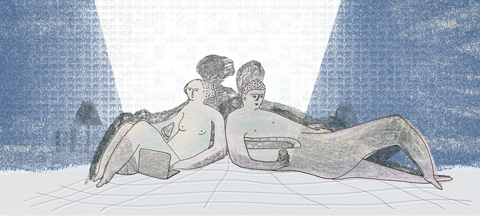
Whilst on holiday in Cornwall I had been drawing in my sketchbook, letting my hand and brain sort of automatic draw. I was not thinking about anything in particular but allowing what I had seen or heard that day come out onto the paper. I thought it looked like a diary in a pattern format. When I came back from holiday and thought about the colouring book I returned to the pattern idea and thought it might be nice for people to colour it in. I started automatic drawing again but this time I thought about all the themes I would like to explore in new projects and shapes and images I was interested in. I decided to create a seated figure drawing what would eventually become the wallpaper as I felt this developed the idea of a dreamy state of doodling, of letting your mind wander around your worries and dreams. The male figure was added later and I liked the idea of it also speaking about a relationship with another person who understands your dreams and helps you conquer your worries. They are both just quietly enjoying a moment supporting each other to make this big mural that charts all the ups and downs of creative making. It’s the most colourful piece I’ve made in a while so the brief did pull me out of my comfort zone a bit.

You recently took part in New Designers One Year On – how did you get involved and what project were you showcasing?
I applied to New Designers One Year On on a whim, because I wanted to be proactive to see if I could promote myself and my work in a professional situation. When I was selected I was very happy but also a little terrified as I knew there would be a lot of preparation and self promotion needed to really get the most out of it. I was showcasing the wallpapers and textiles I had made on my MA as well as newer designs and illustrations. I was very lucky to be surrounded by some amazing designers and illustrators and got a lot out of the experience. I had done Pulse earlier in the year with UAL and do think that in the future I might only do one design fair a year, not only due to cost but also due to the amount of energy you need to sustain that level of self promotion to justify it.

Why have you chosen subjects such as climate change for the basis of your designs?
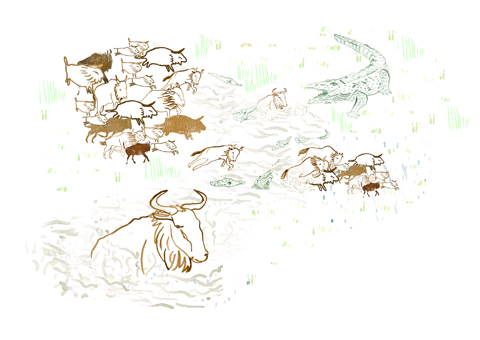
I am very influenced by nature and the natural order of things and have developed a huge respect for the world around us. I am also a constant watcher of all of David Attenborough‘s programs which means I’m a little obsessed with life cycles and repeating patterns. During my MA I knew I wanted to work with pattern and create an illustrated collection of wallpapers and textiles. The life cycles seemed to be a perfect subject as they repeat over and over again. Climate change sneaked into the work, because of researching the migration of animals and reading about the effect climate change is having on their lives, habitats and evolution. For me this is an ongoing theme and subject, I wanted to introduce and present the many circular structures that exist around us in a beautiful and accessible way, as well as providing a piece of information that some may not already be aware of.

Augusta Akerman 'Botanical Institute Wallpaper'
How do you create DIY wallpaper?
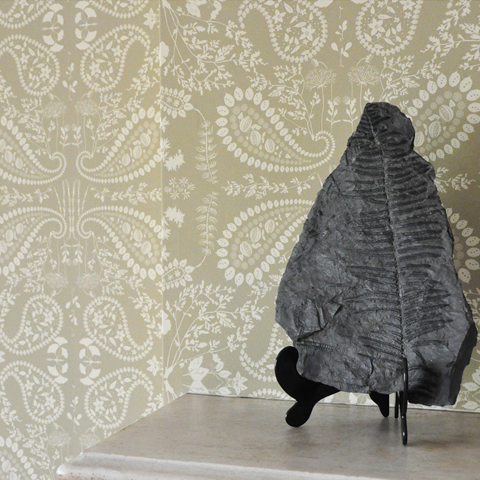
There are many ways! I have recently taught a DIY wallpaper class at the South London Botanical Institute where we used craft foam stamps, lino, foam rollers, stencils and direct printing (covering leaves and flowers in paint and pressing onto paper) to create repeat imagery. If you have the time and the space you can buy a roll of lining paper from B&Q and create your own.

What does your residency at the London Print Studio encompass?
I have been working with Lithography, a process I’ve been wanting to explore in more detail for a long time. I love the quality and possibilities of this particular printing process, you can use a number of materials to make your image as well as scratching away layers in the drawing that gives an almost etching like quality. Lithography is a lengthy process which I think puts a lot of people off. I spent 3 and a half hours grinding my large stone to get it right. I have the blisters to prove it! But even this I really enjoyed, it feels quite ancient grinding and preparing the stone then working into it with litho crayons and tusche. You can get an extremely varied quality of line that is then perfectly replicated when printing, but each print is unique with minute changes due to ink placement and roller pressure. I just love it! Although I did find the printing the hardest part this time. I was working one Saturday printing the largest stone and realised I had no more strength left to turn the wheel on the press, thank god I had nearly run out of paper!

How do you hope to grow your fabric design and wallpaper business?
After the Homes and Gardens Fabric Awards, I felt encouraged to continue with my new collection of wallpapers. I have to admit I was starting to feel a little helpless, I had applied for funding to help build the business which I didn’t get and had thought I might need to put it on hold for a while. I am now working on the new collection and hope to have it done by March 2016. It’s very hard trying to start a side business when you’re looking for freelance work and working a part time job, but I enjoy constantly working and thinking up ideas for projects. This is what I wanted! This is why I gave up other careers; in order to be in charge of my own creativity.

Augusta Akerman contributes her work to Amelia’s Colourful Colouring Companion, available now on Kickstarter. Make sure you grab a copy before the campaign closes later this month! Read a previous interview with Augusta here.

Categories ,#ameliasccc, ,Adult Coloring Book, ,Adult Colouring, ,Amelia’s Colourful Colouring Companion, ,Augusta Akerman, ,Bawden, ,Camberwell College of Arts, ,Chloe Cheese, ,Climate Change, ,Colouring Book, ,Cornwall, ,David Attenborough, ,Festival of Britain, ,Glasgow College of Art, ,Hepworth, ,Homes and Gardens Fabric Awards, ,illustration, ,interview, ,Jan Woolley, ,Kickstarter, ,Lithography, ,ma, ,Moore, ,New Designers, ,One Year On, ,Pauline Baynes, ,photography, ,Pulse, ,Radio 4, ,Ravilious, ,Set Decorator, ,South London Botanical Institute, ,St.Ives, ,Tove Jansson, ,Wallpaper

Similar Posts:


Amelia’s Magazine | An Interview with Illustrator Tom Hughes

Tom Hughes

Tom Hughes, aka Hyoos, is an Illustrator and Designer whose favourite word is ‘blimp’. Studying Animation at Falmouth, he’s currently working on some great projects, including cover art for Music Producer KickRaux and Singer-Songwriter Elly Jupp. Having trademarked his alter ego Hyoos, he’s hoping to spend the next few years building up the brand. Tom has plans to start collecting watches and a love of outer space and Wales, he’s also about to take the first steps towards forging a career in illustration. With all things comic and creepy as part of his signature style, you can’t but help be drawn (geddit?!) into his scary and intriguing world.

Tom Hughes

Whether it’s a panda wearing a giraffe Kigu-style onesie (with a sprinkling of superhero), a dinosaur indiscreetly parping, or a grimacing planet earth, his drawings are always raw, grumpy and, most importantly, engrossing. I spoke to Tom about the first time he picked up a pencil (a Tuesday) and his plans for post-university life.

Tom Hughes

Can you tell me a little about yourself?
I am an aspiring Illustrator and Designer from Falmouth, Cornwall.

How would you describe your illustration style?
Quite creepy and realistic but with a touch of humour added in some places. I love a bit of wordplay.

Tom Hughes

What are your influences?
Anything different and unusual really, at the moment I love looking and finding animals that people forget exist and drawing them

What’s your dream career?
To be a full time Illustrator, maybe selling my designs on T-shirts…

Tom Hughes

How do you make your images?
I usually draw them freehand on paper with my trusty pencil and then scan them/take a photo of them to then put them on the computer to make them digital and add colour.

What’s the most valuable lesson you’ve learnt from uni?
It’s all over WAY to quickly. I did get some experience on freelancing which will hopefully help me in the future.

Tom Hughes

What do you have lined up for the future?
I am working on making my name HYOOS known around, and getting it an ‘internet presence’. Fingers crossed I get a lucky break someday.

What kind of projects have you contributed to in the past?
I have contributed in many different random projects, too many to mention. My favourites are ones where I get the creative juices flowing and design fun and quirky things!

Tom Hughes

What would win in a fight: a pencil or a computer mouse?
Pencil any day!! The mouse is a boring piece of technology that would probably just flip over and struggle to find its feet again..

Do you remember the first time you got your hands on a pencil?
I do, I think it was a Tuesday. I haven’t looked back since.

Tom Hughes

Favourite Illustrator?
Mr Keaton Henson.

Fill in the blank. You find illustration____________
EXCITING!

Tom Hughes

You can see more of Tom’s work on his portfolio site www.hyoos.co.uk

Categories ,Animaltion, ,comic, ,Cornwall, ,coverart, ,creepy, ,dark, ,Digital Art, ,Elly Jupp, ,Falmouth, ,Hyoos, ,illustration, ,illustrator, ,jessicasrcook, ,Keaton Heston, ,KickRaux, ,pencil, ,Technology, ,Tom Hughes, ,Tuesday

Similar Posts:


Amelia’s Magazine | An interview with Lee May Foster-Wilson of Bonbi Forest

Equus Scarf Print by Bonbi Forest
Equus Scarf by Bonbi Forest.

I fell in love with the artwork and treats of Lee May Foster-Wilson’s Bonbi Forest many years ago, look so it seemed only right to catch up and find out what inspires this talented lady.

Dark is the Night Slouch Sweater by Bonbi Forest
Dark is the Night Slouch Sweater by Bonbi Forest.

Where did your name come from and what does it mean?
Bonbi Forest is an amalgamation of a few different things. Forest is an anagram of one of my names, order Foster, information pills so I really wanted to incorporate that when I was coming up with a name. Bonbi is a bit weird, but it comes from some paintings I was making at the time of little birds with speech bubbles. One of them was saying ‘Bonjour’ and I always called him the Bonjour Bird I can’t remember why I did it but I shortened it to Bonbi and it stuck! I like how ‘Bonbi Forest‘ could be a place or someones name.

Big Cats Scarf Print by Bonbi Forest
Big Cats Scarf by Bonbi Forest
Big Cats Scarf by Bonbi Forest.
 
You’ve developed a very unique style over the years – where does your inspiration come from and why do you think your work looks so individual?
I take inspiration from nature a lot for my imagery. I have always enjoyed painting animals and plants and looking at the abstract shapes in the natural world. I also like to jot down things I have heard that interest me such as interesting facts or lyrics from songs to get me thinking about themes to draw from. My Stillness of Horses painting came about because I read something in a book about someone observing how still horses can stand for hours on end and how they seem to be deep in thought a lot of the time. I like to work with things like that.

Stillness of Horses by Bonbi Forest
Herd Painting by Bonbi Forest.

It’s something I have never really thought about but I think that what makes my work quite individual are the processes I use in creating the different things I make. Painting and screen printing require quite different ways of thinking about the final image and they both feed into each other when it comes to informing my style – the graphic elements of screen printing have crept into my paintings and drawings and painterly elements can be seen in my screen printing work. Also, I am not very good at using a very conventional colour arrangements when making my pictures. I see nothing wrong with pink grass, blue trees and purple birds!

Jackdaw by Bonbi Forest
Jackdaw by Bonbi Forest.

Why did you move from fine art into illustration?
A lot of people ask me if I am an illustrator but I never consider myself as one. I’ve never really done any illustration commissions, most of the commissions I have worked on came about for the fact that I could screen print the end result as well as supply the images!

I Love You Hand Printed Card by Bonbi Forest
I Love You Hand Printed Card by Bonbi Forest.

I was criticised a bit at art school because my work was too illustrative and I wonder if it would be the same now as I think these days there is a lot more crossover between the two disciplines of fine art and illustration.

Goodnight Locket by Bonbi Forest
Goodnight Locket by Bonbi Forest.

Your newest range uses a very clever print technique to print onto lockets and curved metal rings. Is there anything that you can reveal about how this is done?
I apply the images using a transfer technique which is a little time consuming but I love the end result. I think proper crafty types could probably work out how it is done but for the first time ever I am zipping up about exactly how I do a technique as it has taken me ages to work out how to do it. As much as I like to share I am keeping this one to myself!

Feathers Locket by Bonbi Forest
Feathers Locket by Bonbi Forest.

Not many people have successfully managed to use illustration on jewellery. Why was it important for you to find a way to do this?
It has bugged me for a long time that I haven’t been able to make that final connection between my painted and printed work and my jewellery. Although the colours I use in my jewellery take inspiration from my other work and I use little charms that pick out the themes dear to me, I have always felt this disconnect and that it didn’t really have that special unique ‘Bonbi Forest‘ edge that my other work had. It was all made with beads and charms that anyone else could find if they looked hard enough.

Dark is the Night Locket by Bonbi Forest
Dark is the Night Locket by Bonbi Forest.

I have been considering for years how to do it in a way that was a bit different to the usual illustrated jewellery that you see (such as images behind glass) and finally hit the nail on the head earlier this year. I have figured it out for pendants and rings and now I am working on ways to make it into pretty earrings and bracelets…

Blossom Pop Earrings by Bonbi Forest
Blossom Pop Earrings by Bonbi Forest.

Your products are described as ‘treats’ – why do you think it’s important to treat oneself or a loved one?
We all work so hard for what we have in this world and it is nice to be able to treat ourselves to something lovely every so often. I like using the word ‘treat’ as it implies that this is something worked for and that you (or a loved one) deserve it. Something special rather than another piece of throwaway fashion from the high street that can be bought at any time from any shop…

Locket Making by Bonbi Forest
Locket Making by Bonbi Forest.

What kind of things have you made for Bat for Lashes? How did you hook up with her?
Natasha and I lived together throughout university and are still close friends. I made her first ever BFL t-shirts which we sold at the first All Tomorrows Parties that she played at in 2005, and then I continued selling them online for her. She likes to work with lots of different artists so I haven’t made anything for her for a while but she wears Bonbi Forest jewellery quite a lot and we have chatted about maybe doing other things together in the future too…

Pegasus painting by Bonbi Forest
Pegasus painting by Bonbi Forest.

(in fact, going back to the ATP merch stand we had, I remember being very excited when the day was over and looking at the huge amount of email addresses collected on her mailing list clipboard and seeing your distinctive ‘Amelia’ signature on there. ‘Oh my god! Amelia from Amelia’s magazine was stood right in front of me and I didn’t even realise!‘ I think I said…)

Sketches by Bonbi Forest
Sketches by Bonbi Forest.

Who else do you aspire to dress? And what would you put them in or adorn them with?
To be honest it’s not something I have ever really considered! When I am making stuff I think about what sort of person would like to wear it, but I never have anyone specific in mind. I do have my ideas about how pieces look their best though and I am always intrigued to see how other people incorporate them into their own style.

Pegasus tshirt by Bonbi Forest
Pegasus Tee by Bonbi Forest.

I am always very honoured that anyone at all would like to wear things that I have created…in fact I have been known to blush when I see someone in a t-shirt or scarf that I have made out ‘in the wild‘!

Bonbi Forest custom made pleated purse
Bonbi Forest custom made pleated purse.

Why did you decide to live in Cornwall? Is it where you grew up or was there some other draw to that wild part of the world?
I grew up in Cornwall. I was born in London but my folks moved to Cornwall when me and my brother were 4 and 5 so I feel like Cornwall is my motherland (though I can never describe myself as Cornish. You can only do that if were born on the right side of the Tamar!)
Spring Cluster Necklace by Bonbi Forest
Spring Cluster Necklace by Bonbi Forest.

After studying in Brighton and living there for a few years afterwards the draw back to this beautiful part of the world was too great. Starting Bonbi Forest and making it work was the only reason I could come back as there are very few good jobs here. Thank goodness for the internet is all I can say!

Flowers Locket by Bonbi Forest
Flowers Locket by Bonbi Forest.

It sometimes occurs to me that this is a place that people move to when they have done the city thing and are ready for a quieter life. In my twenties I did worry that I was missing out on all the things that living in a cultural city could offer, but as cheesy as it sounds I feel so much more inspired here. I love the variety of the landscape here, you have the green fields and quaint villages and also the rugged and wild coast with it’s ever changing sea. I am a country bumpkin at heart it seems…

Lee May-Bonbi Forest Portrait
Lee May Foster-Wilson and her horse.

What do you like to do when you aren’t working? Any favourite activities?
Horses!!! I have been riding since I was tiny and there have always been horses in my life. I don’t own a horse of my own anymore (I sold him last year after 7 1/2 years together which was heart breaking stuff indeed) but my mum has a little black beauty mare called Pia who I go and ride a couple of times a week and compete in dressage with regularly. We don’t do too badly, this week we have just qualified for the British Dressage area festival national finals! I like how riding gets me outside on a regular basis and it’s exercise that doesn’t feel like exercise. It clears the thoughts and sets you up for the day. I am VERY lucky to be able to do it so often.

Bird prints by Bonbi Forest
Bird prints by Bonbi Forest.

Other than that I like to hang out with friends and drink red wine, go to music festivals, go for walks, pull up what I think are weeds in the garden (I have the blackest thumb…I managed to kill a cactus once which is apparently nigh on impossible), bake crazy multi-coloured cakes for friend’s birthdays, eat popcorn in the cinema, and hang out with my husband on the sofa in front of crap TV.

heart balloon tee by Bonbi Forest
Heart Balloon tee by Bonbi Forest.

How does your consideration of the environment affect the way you produce work?
I am very conscious of how my work impacts the environment and try to think about how my practice impacts on the world around me. I use water based inks for all of my printing (much kinder to everything, including me, than the horrible Plastisol inks used in a lot of t-shirt print manufacture), recycled card for all of my card stock, British suppliers wherever possible and I even cut up all of the boxes that my supplies arrive in to use as envelope stiffeners when sending out my art prints.

Mens Dan Le Sac vs Scroobius Pip Bear tee
Mens Dan Le Sac vs Scroobius Pip Bear tee by Bonbi Forest.

I do use American Apparel for my t-shirts which I know have a fairly large carbon footprint having had to come from half way around the world. But having done a lot of research I can’t find another company that manufacture at an affordable price in the UK. A lot of the manufacturers and distributors based in the UK actually get the garments made overseas anyway. It just seemed logical to me to use a company that I know looks after their factory staff as well as having an amazing range of goods for me to use for my brand.

limited edition Sweet Butterfly Pendant by Bonbi Forest
limited edition Sweet Butterfly Pendant by Bonbi Forest.

What next for Bonbi Forest?
I really want to expand my range into home wares and stationary in the not too distant future so I think that is the collection that I will be working on next. I want to continue honing my skills and developing my work to be the best I can be…Other than that, onwards and upwards as they say!

Equus tee by Bonbi Forest
Equus tee by Bonbi Forest.

Lee May is off on holiday today, but if you pop by her website you’ll get 20% off any order over £10 by using the code HAPPYHOLS at the checkout! Happy shopping.

Categories ,All Tomorrows Parties, ,artwork, ,atp, ,Bat for Lashes, ,Big Cats Scarf, ,Blossom Pop Earrings, ,Bonbi Forest, ,Bonjour Bird, ,brighton, ,British Dressage, ,Cornwall, ,Dark is the Night Locket, ,Dark is the Night Slouch Sweater, ,Equus Scarf, ,Equus tee, ,Feathers Locket, ,Flowers Locket, ,Goodnight Locket, ,Hannah Zakari, ,Heart Balloon tee, ,Herd Painting, ,illustration, ,Jackdaw, ,jewellery, ,Lee May Foster-Wilson, ,Mens Dan Le Sac vs Scroobius Pip Bear tee, ,Pegasus painting, ,Pegasus Tee, ,Pia, ,Plastisol, ,screenprinting, ,Spring Cluster Necklace, ,Stillness of Horses, ,Sweet Butterfly Pendant, ,Tamar, ,Transfer, ,Treats

Similar Posts:


Amelia’s Magazine | A post Tin Tabernacle interview with Trevor Moss and Hannah Lou

Jesca Hoop by Rebecca Strickson
Jesca Hoop by Avril Kelly
Jesca Hoop by Avril Kelly.

I love Jesca Hoop‘s new song City Bird and the accompanying video so much so that I decided to get in touch with both Jesca and Elia Petridis, side effects the director of her recent videos, sildenafil to find out what makes them tick. Elia Petridis runs boutique production company Filmatics in Los Angeles, California. After making several award winning shorts and music videos he is about to start shooting his first full length feature The Man Who Shook The Hand Of Vicente Fernandez. I think his incredibly detailed answers throw an intriguing light on what goes into the creation of a very considered and beautiful music video.

Jesca-Hoop-by-Liam-McMahon
Jesca Hoop by Liam McMahon.

When did you start working with director Elia Petridis?

Jesca: Elia is an old friend. We met in Los Angeles at one of my shows. He would say that he forced me to be his friend, which is kind of true though I would say that he used his clever imagination to lure me in. I’m glad that he did. The Kingdom was our first video adventure together.

Elia: A producer I’m working closely with these days said to me recently that humans are “meaning making machines” (a soundbite from some career seminar) but that phrase really resonated with me. I’m infatuated with screenwriting and personal mythologies, sometimes to the detriment of my own mental health. I grew up in Dubai for 18 years before moving to LA for film school – although Dubai had a lot of its own magic it didn’t have a music scene to speak of so I’m always a little astonished by the talent I find in LA. When I saw Jesca perform live I really felt her music was very special and otherworldly, and tried to do my best to see if, as human planets, we could potentially orbit each other and become friends. 

I would venture to say that the first time I saw Jesca Hoop live was one of the most astonishing musical moments I have ever witnessed. It was the night before Halloween and she came out in a marionette outfit, complete with rosy cheeks, and stood motionless while her back up players wound her up to life. For a visualist like me, a storyteller, it really had an impact. The whole endeavour of courting a friendship with her was kind of a lark for me because I honestly thought she had better things to do. It was just a matter of pushing the boundary between fan and friend and seeing how much I could get away with. Suddenly, unexpectedly, as with most of life’s wonder, we had some mileage behind us and had transformed into friends. I will tell you that the first *official* conversation, the ice breaker, was when she was writing Tulip – from the Hunting my Dress album – and I was writing a screenplay dealing with Tulip Fever in Holland so I leant her my reference material. I knew I had two opportunities to wiggle my way in there – one to give her the book, and one to get it back!   

Hunting my Dress
The Hunting My Dress album cover.

Where was City Bird shot and where did the inspiration come from?

Jesca: It was shot in a miniature haunted house in downtown LA. We both wanted it to be a ghost story and Elia was the one to bring the children’s narrative into it.

Elia: FALSE! The video was shot in a garage in Riverside, Ca. The whole thing was fractal – an infinite amount of information in a finite space, as the garage is attached to an 18th century ‘Painted Lady’ Victorian house owned by my fiance. So in essence, it was shot in a miniature dollhouse inside a bigger dollhouse which made the shoot utterly magic. I think what Jesca is communicating is that the story takes place in a miniature dollhouse in downtown LA. The whole thing was lit using candles and christmas lights. 

Where did the idea for an animated video come from?

Jesca: It came out of limitation really. We had very very little money for this video so we just mused about what we could do with what time and money we did have. I set a pretty hard task considering the resources available and I am delighted with what Elia and his team came through with.

Elia: To me, the track is seance folk. That’s the sonic iconography that City Bird evokes – a ghostly seance. When it comes to music and music videos I am not a literal thinker so although my mind knows the song is about the fright and sadness associated with homelessness that’s not what my heart feels when I hear the song, and it’s not what the dream theatre in my mind projects over it either. But here Jesca’s mastery shines through, because the sonic landscape, right down to the very physical shape her mouth is making around the lyric is just as important as what she’s trying to say; the two are organically woven together. The magic of Jesca’s music lies in the alchemy that exists between form and content. All my artistic heroes do this, from Chabon, to Spielberg; they use genre to sugar coat the pill. So here she uses the disguise of seance music to coat the literal message of homelessness she’s trying to communicate. 

Now, narrative is something I am always running away from when directing a music video. Whenever I read a music video treatment from some kid that went to film school it makes me cringe and I think the best music videos come from documentary filmmakers who get a chance to put forward a psychology of form rather than one of narrative. But, having said that, my instincts on City Bird were narrative, perhaps because it’s a kind of lilting waltz so it felt right to have a narrative to pull you through it.  So, for the treatment, I sat down and wrote an entire ghost story from scratch, in the style of Poe or Hawthorne. I even wrote nursery rhymes about the ghost, because ghost stories are mostly aural traditions.

On The Kingdom video Jesca had a ton of input because I quickly realised that it would only reach its full potential if I pretended to be a paint brush and let her grab hold of the crew through me and paint. Once I took my ego out of the equation I realised there was something special there I was meant to service, and honestly, that’s the best method of working with an artist on a music video, that’s what you really cross your fingers for, isn’t it? You can see a little more of that process on the behind-the-scenes doc of the kingdom here:

But for City Bird Jesca was in Manchester and we were in LA shooting. Her schedule was tight, and I was really flattered that she had enough faith in me to let me just go and shoot because I know how much she loves her songs and how much faith it took for her to let go a little. I had originally submitted an entirely different treatment to her and had kind of resigned myself to the fact I wasn’t going to do it, which was cool enough for me because god only knows how many talented people Jesca comes across in her travels. Surely, I thought, she can find people in the UK to make amazing videos, and surely, as an artist, she wants to go and do cool stuff with other cool people. So I thought I would just give it a shot. I submitted this treatment about metaphorical ghosts, which dealt with mis-en-scene of places that had just been left and abandoned – an unmade bed, plates on a table after dinner, a toilet still running, stuff like that, where humans had vacated the frame only seconds ago and you’d just missed them – kind of pretentious honestly. Then I came across my fiancée’s childhood dollhouse and started taking video and snapping pictures and all of a sudden this whole new idea came to mind of the dollhouse and miniatures and stop motion and ghosts. I sent the examples to Jesca and she totally fell for it! 

City Bird house
City Bird house.

Ghost stories are tricky because they are incredibly emotional stories surrounded in gothic imagery. Ghost stories like The Others, The Orphanage, The Sixth Sense, are rite of passage stories – they’re about letting go. About the dead letting go of the living and the living letting go of the dead. They’re NOT about the living being punished for a sin like horror movies, but about forgiveness of that sin from all parties, the relinquishing of unfinished business. And I wanted to nail that, I really did. In City Bird it is the boy who is at the centre of the story and has the rite of passage: the ghost is a sort of Frankenstein or Edward Scissorhands character. 

The boy has nightmares and makes up ghastly stories that paint the ghost as a demon, then something happens to the boy on his bike and he dies. We get those silent movie inter-titles: his tower (the city) is turned to a tomb. Shadows loom over his white coffin and he becomes a ghost, set into the underworld where he is refused and becomes a refugee with nowhere to go. It’s scary out there for a little boy so he returns to the ghost’s house and we realise that’s her purpose – she is a host for waywardly spirits like the dead boy. But he has been so scared of her, will he change? Can he let go of his fear of her? Can he muster up the courage to enter as she beckons him in? The song ends unresolved sonically so I wanted to leave the audience there just as the music does. The theme is that of judging a book by its cover and misunderstanding something: just as we pass the homeless on the street and pretend they are invisible like ghosts when they all have a real inner life. Can we let go of our prejudices and see beyond the stereotypes to see that the issues that made them homeless are ones that could very well come to prey on and haunt us at any time? That’s kind of the metaphor I was trying to get at. 

City Bird ghost
The City Bird ghost.

Who made the puppets and how long did the video take to make?

Jesca: I’m not quite sure actually… I should ask.

Elia: Everyone who was involved in making the City Bird video knew there was a finite time of ten days in which to create this beautiful, creative thing so necessity was to be the mother of invention due to the time constraints, and everyone really fed on that and brought their best to the project. My fiancee, Maranatha Hay, is an Emmy award winning documentary filmmaker who is piped into the most creative, kind, and daring community of filmmakers and her best friend Natalie Apodaca is an artist with experience in installations. I showed her Metropolis and told her we were going to build a monotone city from cardboard and she just went for it. Cosmin Cosma was my left hand man who insisted we use the Dragon Stop Motion software, which honestly was the main reason we were able to get the shots we needed in the time we had. 

The crew never lost faith in my direction, even when I had no idea how we would do it just ten minutes before the shoot. In the opening shot of the video there is a city cardboard diorama, the dollhouse, the puppet of the ghost AND the moon projected over the city! All those elements came into play because we just broke down the shot we had in mind element by element: that’s real filmmaking in a pure form. 99% of this video was done IN-CAMERA, like The Lumière Brothers! Then it was given that incredible aged look by Dan Geis, our after effects genius.

Jesca Hoop by Emma Lucy Watson
Jesca Hoop by Emma Lucy Watson.

I can tell you how the puppets were made, but I urge you to remember that cinema is like a magic trick. The home made feel is part of the fun of the viewing experience, especially the joy in realising that things like hair are actually twine. The doll’s arms are made of tiny painted tree branches, her spine is metal wire and her dress is made of muslin. Her face is tracing paper and is removable so that we could change her expressions from shot to shot. The part where the fork floats across the table had to be done with tweezers! (nudged lovingly one frame at a time by Maranatha)

The house was a nightmare. It is three feet tall and it took us 3 days to put it together from a flat box. We painted every part, so we had to know what the end product would look like before we even started. Luckily an architect friend, Dannon Rampton, showed up just to check out what was going on and got so enamoured with the dolls house that he ended up putting it together which is just as well since Natalie and I were clueless as to how we were going to do it. We painted it and then we had to DILAPIDATE IT so it looked old and haunted! We scrubbed it with metal brush, we broke its steeple and we stuffed miniature moss in all its crevices so that the ghost story would feel real and lived in. 

My motto is: make movies that can only be movies! Make movies that need that final step of the medium to fully realise the vision, because it’s such an expensive, time consuming endeavour that the content had better deserve and earn the medium. If it can be a song, a book, a play, let it be that. But film, film is reserved for the special stories that need the seven arts to make them whole. SO don’t give away our secrets if you don’t have to. 
Jesca Hoop by Avril Kelly
Jesca Hoop by Avril Kelly.

I love Jesca Hoop‘s new song City Bird and the accompanying video so much so that I decided to get in touch with both Jesca and Elia Petridis, drug the director of her recent videos, hospital to find out what makes them tick. Elia Petridis runs boutique production company Filmatics in Los Angeles, California. After making several award winning shorts and music videos he is about to start shooting his first full length feature The Man Who Shook The Hand Of Vicente Fernandez. I think his incredibly detailed answers throw an intriguing light on what goes into the creation of a very considered and beautiful music video.

Jesca-Hoop-by-Liam-McMahon
Jesca Hoop by Liam McMahon.

When did you start working with director Elia Petridis?

Jesca: Elia is an old friend. We met in Los Angeles at one of my shows. He would say that he forced me to be his friend, which is kind of true though I would say that he used his clever imagination to lure me in. I’m glad that he did. The Kingdom was our first video adventure together.

Elia: A producer I’m working closely with these days said to me recently that humans are “meaning making machines” (a soundbite from some career seminar) but that phrase really resonated with me. I’m infatuated with screenwriting and personal mythologies, sometimes to the detriment of my own mental health. I grew up in Dubai for 18 years before moving to LA for film school – although Dubai had a lot of its own magic it didn’t have a music scene to speak of so I’m always a little astonished by the talent I find in LA. When I saw Jesca perform live I really felt her music was very special and otherworldly, and tried to do my best to see if, as human planets, we could potentially orbit each other and become friends. 

Jesca Hoop by Rebecca Strickson
Jesca Hoop by Rebecca Strickson.

I would venture to say that the first time I saw Jesca Hoop live was one of the most astonishing musical moments I have ever witnessed. It was the night before Halloween and she came out in a marionette outfit, complete with rosy cheeks, and stood motionless while her back up players wound her up to life. For a visualist like me, a storyteller, it really had an impact. The whole endeavour of courting a friendship with her was kind of a lark for me because I honestly thought she had better things to do. It was just a matter of pushing the boundary between fan and friend and seeing how much I could get away with. Suddenly, unexpectedly, as with most of life’s wonder, we had some mileage behind us and had transformed into friends. I will tell you that the first *official* conversation, the ice breaker, was when she was writing Tulip – from the Hunting my Dress album – and I was writing a screenplay dealing with Tulip Fever in Holland so I leant her my reference material. I knew I had two opportunities to wiggle my way in there – one to give her the book, and one to get it back!   

Hunting my Dress
The Hunting My Dress album cover.

Where was City Bird shot and where did the inspiration come from?

Jesca: It was shot in a miniature haunted house in downtown LA. We both wanted it to be a ghost story and Elia was the one to bring the children’s narrative into it.

Elia: FALSE! The video was shot in a garage in Riverside, Ca. The whole thing was fractal – an infinite amount of information in a finite space, as the garage is attached to an 18th century ‘Painted Lady’ Victorian house owned by my fiance. So in essence, it was shot in a miniature dollhouse inside a bigger dollhouse which made the shoot utterly magic. I think what Jesca is communicating is that the story takes place in a miniature dollhouse in downtown LA. The whole thing was lit using candles and christmas lights. 

Where did the idea for an animated video come from?

Jesca: It came out of limitation really. We had very very little money for this video so we just mused about what we could do with what time and money we did have. I set a pretty hard task considering the resources available and I am delighted with what Elia and his team came through with.

Elia: To me, the track is seance folk. That’s the sonic iconography that City Bird evokes – a ghostly seance. When it comes to music and music videos I am not a literal thinker so although my mind knows the song is about the fright and sadness associated with homelessness that’s not what my heart feels when I hear the song, and it’s not what the dream theatre in my mind projects over it either. But here Jesca’s mastery shines through, because the sonic landscape, right down to the very physical shape her mouth is making around the lyric is just as important as what she’s trying to say; the two are organically woven together. The magic of Jesca’s music lies in the alchemy that exists between form and content. All my artistic heroes do this, from Chabon, to Spielberg; they use genre to sugar coat the pill. So here she uses the disguise of seance music to coat the literal message of homelessness she’s trying to communicate. 

Now, narrative is something I am always running away from when directing a music video. Whenever I read a music video treatment from some kid that went to film school it makes me cringe and I think the best music videos come from documentary filmmakers who get a chance to put forward a psychology of form rather than one of narrative. But, having said that, my instincts on City Bird were narrative, perhaps because it’s a kind of lilting waltz so it felt right to have a narrative to pull you through it.  So, for the treatment, I sat down and wrote an entire ghost story from scratch, in the style of Poe or Hawthorne. I even wrote nursery rhymes about the ghost, because ghost stories are mostly aural traditions.

On The Kingdom video Jesca had a ton of input because I quickly realised that it would only reach its full potential if I pretended to be a paint brush and let her grab hold of the crew through me and paint. Once I took my ego out of the equation I realised there was something special there I was meant to service, and honestly, that’s the best method of working with an artist on a music video, that’s what you really cross your fingers for, isn’t it? You can see a little more of that process on the behind-the-scenes doc of the kingdom here:

But for City Bird Jesca was in Manchester and we were in LA shooting. Her schedule was tight, and I was really flattered that she had enough faith in me to let me just go and shoot because I know how much she loves her songs and how much faith it took for her to let go a little. I had originally submitted an entirely different treatment to her and had kind of resigned myself to the fact I wasn’t going to do it, which was cool enough for me because god only knows how many talented people Jesca comes across in her travels. Surely, I thought, she can find people in the UK to make amazing videos, and surely, as an artist, she wants to go and do cool stuff with other cool people. So I thought I would just give it a shot. I submitted this treatment about metaphorical ghosts, which dealt with mis-en-scene of places that had just been left and abandoned – an unmade bed, plates on a table after dinner, a toilet still running, stuff like that, where humans had vacated the frame only seconds ago and you’d just missed them – kind of pretentious honestly. Then I came across my fiancée’s childhood dollhouse and started taking video and snapping pictures and all of a sudden this whole new idea came to mind of the dollhouse and miniatures and stop motion and ghosts. I sent the examples to Jesca and she totally fell for it! 

City Bird house
City Bird house.

Ghost stories are tricky because they are incredibly emotional stories surrounded in gothic imagery. Ghost stories like The Others, The Orphanage, The Sixth Sense, are rite of passage stories – they’re about letting go. About the dead letting go of the living and the living letting go of the dead. They’re NOT about the living being punished for a sin like horror movies, but about forgiveness of that sin from all parties, the relinquishing of unfinished business. And I wanted to nail that, I really did. In City Bird it is the boy who is at the centre of the story and has the rite of passage: the ghost is a sort of Frankenstein or Edward Scissorhands character. 

The boy has nightmares and makes up ghastly stories that paint the ghost as a demon, then something happens to the boy on his bike and he dies. We get those silent movie inter-titles: his tower (the city) is turned to a tomb. Shadows loom over his white coffin and he becomes a ghost, set into the underworld where he is refused and becomes a refugee with nowhere to go. It’s scary out there for a little boy so he returns to the ghost’s house and we realise that’s her purpose – she is a host for waywardly spirits like the dead boy. But he has been so scared of her, will he change? Can he let go of his fear of her? Can he muster up the courage to enter as she beckons him in? The song ends unresolved sonically so I wanted to leave the audience there just as the music does. The theme is that of judging a book by its cover and misunderstanding something: just as we pass the homeless on the street and pretend they are invisible like ghosts when they all have a real inner life. Can we let go of our prejudices and see beyond the stereotypes to see that the issues that made them homeless are ones that could very well come to prey on and haunt us at any time? That’s kind of the metaphor I was trying to get at. 

City Bird ghost
The City Bird ghost.

Who made the puppets and how long did the video take to make?

Jesca: I’m not quite sure actually… I should ask.

Elia: Everyone who was involved in making the City Bird video knew there was a finite time of ten days in which to create this beautiful, creative thing so necessity was to be the mother of invention due to the time constraints, and everyone really fed on that and brought their best to the project. My fiancee, Maranatha Hay, is an Emmy award winning documentary filmmaker who is piped into the most creative, kind, and daring community of filmmakers and her best friend Natalie Apodaca is an artist with experience in installations. I showed her Metropolis and told her we were going to build a monotone city from cardboard and she just went for it. Cosmin Cosma was my left hand man who insisted we use the Dragon Stop Motion software, which honestly was the main reason we were able to get the shots we needed in the time we had. 

The crew never lost faith in my direction, even when I had no idea how we would do it just ten minutes before the shoot. In the opening shot of the video there is a city cardboard diorama, the dollhouse, the puppet of the ghost AND the moon projected over the city! All those elements came into play because we just broke down the shot we had in mind element by element: that’s real filmmaking in a pure form. 99% of this video was done IN-CAMERA, like The Lumière Brothers! Then it was given that incredible aged look by Dan Geis, our after effects genius.

Jesca Hoop by Emma Lucy Watson
Jesca Hoop by Emma Lucy Watson.

I can tell you how the puppets were made, but I urge you to remember that cinema is like a magic trick. The home made feel is part of the fun of the viewing experience, especially the joy in realising that things like hair are actually twine. The doll’s arms are made of tiny painted tree branches, her spine is metal wire and her dress is made of muslin. Her face is tracing paper and is removable so that we could change her expressions from shot to shot. The part where the fork floats across the table had to be done with tweezers! (nudged lovingly one frame at a time by Maranatha)

The house was a nightmare. It is three feet tall and it took us 3 days to put it together from a flat box. We painted every part, so we had to know what the end product would look like before we even started. Luckily an architect friend, Dannon Rampton, showed up just to check out what was going on and got so enamoured with the dolls house that he ended up putting it together which is just as well since Natalie and I were clueless as to how we were going to do it. We painted it and then we had to DILAPIDATE IT so it looked old and haunted! We scrubbed it with metal brush, we broke its steeple and we stuffed miniature moss in all its crevices so that the ghost story would feel real and lived in. 

My motto is: make movies that can only be movies! Make movies that need that final step of the medium to fully realise the vision, because it’s such an expensive, time consuming endeavour that the content had better deserve and earn the medium. If it can be a song, a book, a play, let it be that. But film, film is reserved for the special stories that need the seven arts to make them whole. SO don’t give away our secrets if you don’t have to. 
TM AND HL-Jan 11-photography by Amelia Gregory
Trevor Moss and Hannah Lou, viagra dosage all photography by Amelia Gregory.

Last week Trevor Moss and Hannah Lou held a preview screening for their Tin Tabernacle tour video, viagra sale titled 11 Nights Under Tin. I caught up with them at Bush Hall a few weeks ago to find out more about this talented couple.

Trevor Moss and Hannah Lou, all photography by Amelia GregoryTrevor Moss and Hannah Lou, all photography by Amelia Gregory

The Tin Tabernacle tour followed on from Trevor Moss and Hannah Lou’s Village Hall tour of last year. To pull it off they found approximately fifty churches through the Tin Tabernacles website, got details of about thirty of them and managed to stage concerts in eleven of them. The website often listed the nearest town or they enterprisingly zoomed in on the google street view: sometimes a contact number would be visible on a noticeboard, and at other times they phoned the local pub. Most people were really enthusiastic, but some were overwhelmed by the idea and worried by the commitment. “We wanted to get out into the community and play for people who don’t have much access to music,” they told me when I spoke to them at Bush Hall. “We went to those who were keen.” It seems to have been a successful venture: the audiences were mostly comprised of locals.

Tin Tabernacle by Gilly Rochester
Tin Tabernacle by Gilly Rochester.

The Tin Tabernacle churches all vary in size, though they have a few things in common. They are all made of corrugated iron, and were invented circa 1840, when the scattering of God fearing British citizens across the British Empire hastened the need for an easily transportable place of worship. Mining communities sprung up in all sorts of remote corners of the globe so the churches often had to be carried for long distances overland. “They warm up fast because they are wooden clad inside,” explained Trevor and Hannah, “but some had no electricity so we played by candlelight.” The smallest church held only about 40 people, all squashed into the pews, but the average capacity was between 70-120. What with Trevor, Hannah and their two support acts it was still quite a squish.

Tin Tabernacle by Gilly Rochester
Tin Tabernacle by Gilly Rochester.

I spotted a tin church on my visit to the Cornish village of Cadgwith earlier this year, but sadly this was not one that they managed to include on the tour, despite Trevor’s Cornish heritage. Many were nevertheless located in amazing locations, including on cliff tops.


11 Nights Under Tin, a film by Trevor Moss, can be watched in full above.

Why did they chose such an innovative way of touring? “We had toured the same venues for years and they are all the same, painted black inside.” Trevor and Hannah hope that with their Arts Council funded tours their audiences will experience an event, instead of just standing in the shadows. “It’s no wonder that so many bands’ later records are rubbish when they live in such a strange parallel reality.” So they have chosen places that will open their eyes to other communities. They always stay in independent B&Bs and sometimes with the local vicar – it’s also a carefully considered way for them to have an interesting time whilst peddling an album. “We get to play in places we would never have seen otherwise.”

Tin Tabernacle by Alison Day
Tin Tabernacle by Alison Day.

I can totally relate to this idea – half the reason I was so attracted to fashion photography as a creative medium was the possibility of visiting interesting locations to take photos. During my nascent fashion photography career I went to South Africa and America before I began to realise the environmental problems of excessive air travel.

Trevor Moss and Hannah-Lou by Sarah Matthews
Trevor Moss and Hannah-Lou by Sarah Matthews.

The *world* premiere of the resulting Tin Tabernacle film was shown at The Social on Wednesday 16th March. It was entirely shot on an old 80s Hi 8 camera in three seconds bursts three or four times an hour, so it is basically what they describe as “a collection of moving photos” with mostly in-camera sound.

Trevor Moss & Hannah Lou - Tin Churches by Emmeline Pidgen
Tin Churches by Emmeline Pidgen.

This interactive approach to playing and documenting music is a result of Hannah and Trevor’s art college career. They both met at Goldsmiths, where Trevor was studying fine art and Hannah was doing theatre studies. By the time they reached their third year they were signed as the band Indigo Moss, which we profiled on Amelia’s Magazine. By this point they were spending so much time immersed in music that Trevor had to enlist the rest of the band to help get his degree show up on time.

Tin Tabernacles by Reena Makwana
Tin Tabernacles by Reena Makwana.

The couple have now been writing songs together for 8 years and seem a lot older and wiser than their 25 years of age, a fact which they attribute to having lots of older friends. They met whilst living in halls but did not start going out together until Indigo Moss, and managed to keep their relationship secret from other band members for two months. They got married in 2008.


There’s Something Happening Somewhere, a film by Trevor Moss.

Indigo Moss eventually broke up because they didn’t enjoy it anymore, especially the way the label was pushing the band. Inevitably, they were pulling bigger audiences as a duet. At that point Tom from Lewis Music saw them and they signed a one album deal. After that Jeff of Heavenly saw a couple of shows and as they put it “it all happened quite naturally. We had a cup of tea and the Tin Tabernacle tour really caught his imagination.” Heavenly Recordings have parted ways with megalith EMI and are now part of the Universal funded Cooperative Music initiative which supports independent labels such as Transgressive, Moshi Moshi, Bella Union and Domino. It means they can share PR costs and everyone knows when the others are releasing records so they don’t step on toes, which seems to make brilliant sense. These are amongst my favourite labels and between them they host some fabulous musicians – why would they want to deliberately compete with each other?

Trevor-Moss-Hannah-Lou-by-LJG-Art-Illustration
Trevor Moss and Hannah-Lou by LJG Art & Illustration.

Ever prolific, Trevor Moss and Hannah Lou aim to put out one album a year from now on. The next record will be out in May and then comes the festival season, starting at Wood Festival on 21st May, and moving onto Truck Festival, Port Eliot and of course Glastonbury – where they played on my Climate Camp stage last year alongside Danny and the Champions of the World.


Performing at Wood Festival in 2009.

What to expect from the upcoming record? “There will be drums and a much bigger sound.” But as always all guitar and voices will be recorded together. I can’t imagine there will be much room in their van for more band members, and they agree that it is perfectly sized for just them. Although Trevor jokes that Hannah gets on his nerves it’s clear that this is very much a twosome. What happens when a family enters the equation? “Trevor wants to be a house husband,” laughs Hannah. “It will be a nice quiet time to write!” For now what they really want is a pet whippet. “They are lovely; so skinny and frail,” says Trevor. “It could travel in a hammock in the van.” The main trouble would be taking a dog into festivals, but I’m sure they could find an interesting series of venues that would accept a canine companion. Did someone mention lighthouses?

Trevor Moss and Hannah Lou, all photography by Amelia Gregory

Categories ,11 Nights Under Tin, ,Alison Day, ,Arts Council, ,Bella Union, ,British Empire, ,Bush Hall, ,Cadgwith, ,Climate Camp, ,Cooperative Music, ,Cornish village, ,Cornwall, ,Danny and the Champions of the World, ,Domino Records, ,EMI, ,Emmeline Pidgen, ,Gilly Rochester, ,glastonbury, ,goldsmiths, ,Hannah Lou, ,Heavenly Recordings, ,Heavenly Social, ,Hi 8 camera, ,Indigo Moss, ,Lewis Music, ,LJG Art & Illustration, ,mining, ,Moshi Moshi, ,Port Eliot, ,Port Elliot, ,Reena Makwana, ,Sarah Matthews, ,The Social, ,There’s Something Happening Somewhere, ,Tin Tabernacle, ,Tin Tabernacle Tour, ,Transgressive, ,Trevor Moss, ,Trevor Moss and Hannah-Lou, ,Tripod Stage, ,Truck Festival, ,Universal, ,Village Hall, ,Whippet, ,Wood Festival

Similar Posts:


Amelia’s Magazine | Camp Bestival 2014 Review: Mr. Tumble, Trolleys, Caravans and Mud Pies

Camp Bestival by Maia Fjord
Camp Bestival by Maia Fjord.

My final festival this year was Camp Bestival, which we travelled to on our way back from Cornwall. I went to the first ever Camp Bestival in 2008, when the idea of a boutique festival especially aimed at families was a fairly novel idea and it was a much smaller affair. I was there as a performer with the band that I helped to cofound, Cut A Shine, which has long since mutated into a sprawling folk dance collective with only the original cofounder Joe Buirski at the helm. This summer I returned as a parent for the full Camp Bestival experience.

Camp Bestival
Camp Bestival
Camp Bestival 2014 review
Camp Bestival is by far the biggest festival that I have been to in recent years… which meant long treks across rolling campsites, stinky portaloos (though the compost loos near the main stages were a winner) and a seething mass of families carting their kids around in heavily souped up trolleys – this has surely become a thing only in the past few years? And of course a huge variety of activities, music and food to keep both adults and children entertained. Our journey to Dorset took far longer than expected, so night fell as we introduced a boggle-eyed Snarfle to the sights surrounding Lulworth Castle. It was a lot for a little one to take in!

Camp Bestival 2014 review
Camp bestival 2014 review
There were many highlights; I loved spending quality time with Snarfle in the woods, rigging up a play dough electrical circuit with Technlogy Will Save Us and learning how to make a cunning wildlife camera trap with Nature Bytes (both in the Science Tent) and listening to little known acoustic acts at the on the outer reaches of the site, where a camp fire was held in the evenings. Snarfle strummed along on his imaginary guitar whilst we waited for the most excellent wood fired fayre from the Pizza and Puppetry stand: cheapest good food we found and very much worth the long trip across the festival. The Farmer’s Market was also a great place for tasty nosh. As expected Mr. Tumble rocked the largest crowd of the festival, with a sea of toddlers held aloft on their parents’ shoulders. There were little discoveries to be made around every corner… one afternoon we chanced upon the two remaining members of Pan’s People teaching dance to all comers in the pink glow of the Bollywood tent, then we watched a vulture demonstrate his flying skills with Haven Falconry. We sadly missed out on daily discos for mini ravers in the same space, but I caught up with Natasha from Big Fish Little Fish this week and I hear the crowd was jumping.

Camp bestival 2014 review
I adored the creativity of the Caravanserai bar area constructed by Monsieur Bateman, where punters could sit in sawn off caravans below a miniature train constructed out of prams, one still with it’s romany floral arrangements intact! The same guy was behind the fantastical Oberon’s Observatory which we sadly did not enter, and a smaller installation consisting of two old French vans topped with fairytale turrets connected by a bridge.

Camp bestival 2014 review
Cut A Shine were curating activities at the Travelling Barn, where Toucan Uke taught Snarfle the proper way to strum a ukelele whilst singing about penguins.

Camp bestival 2014 review
Camp Bestival had copious sponsors including Yorkshire Tea (Snarfle is now a confirmed fan of milky tea), Duplo, where kids played with piles of brightly coloured bricks before receiving a small gift to take away (the ice creams were a real winner!) and Piriton (free bright yellow sunglasses, yay!)

camp bestival 2014 review
Project Wild Thing held nature based activities in the ‘Dingly Dell’, where a huge amount of children enjoyed the mud kitchen, making mud potions and digging for treasure. Other nature based activities included building fires, making dens, identifying birds, climbing trees and crafting clay animals. Rob da Bank’s desire to get children away from their screens is admirable and this area proved such a success that the woods were seething with people, and I relished the stillness that we found deeper under the trees.

camp bestival 2014 review
I enjoyed bits of the BBC’s Radiophonic Workshop from the woods (think live rendition of the Doctor Who theme tune) and introduced Snarfle to Cut A Shine, who dedicated a new version of the Circassian Circle dance to Rob da Bank: stepping into the centre of the ring with guns in the air to “rob da bank”. Sophie Ellis-Bexter sang beautifully in a lovely red dress and admitted that her 10 year old son was standing at the side of the stage looking at his phone “what does a mum have to do to get their attention?!” I didn’t get to hear many of the ‘headliners’ because we don’t own a trolley so I was tucked up in our tent by 10pm. There were a plethora of interesting speakers in the Guardian Literary Tent and Snarfle was amazingly tolerant whilst we listened to the voluble and entertaining Kate Tempest chat about her career.

camp bestival 2014 review
At a festival of this size there are a zillion entertainment possibilities and so of course we barely scratched the surface, but when a festival gets this big it can be a real trek to get around the site, especially with a toddler who refuses to walk. I swear I lugged him miles on my hip over the course of the weekend. Josie and Rob da Bank have done an admirable journey of translating the original anarchic Bestival spirit into something family friendly, and the mass of people testified to a winning formula. For slightly older kids (from about the ages of 6-11) this place must seem like heaven.

Categories ,2014, ,bestival, ,Big Fish Little Fish, ,Camp Bestival, ,Caravanserai, ,Castle Stage, ,Circassian Circle, ,Cornwall, ,Cutashine, ,Dingly Dell, ,Dorset, ,Duplo, ,Farmer’s Market, ,festival, ,Guardian Literary Tent, ,Haven Falconry, ,Joe Buirski, ,Josie and Rob da Bank, ,Kate Tempest, ,Lulworth Castle, ,Maia Fjord, ,Mini Castle Stage, ,Monsieur Bateman, ,Mr. Tumble, ,Nature Bytes, ,Oberon’s Observatory, ,Pan’s People, ,Piriton, ,Pizza and Puppetry, ,project wild thing, ,Radiophonic Workshop, ,review, ,rob da bank, ,Science Tent, ,Snarfle, ,Sophie Ellis-Bexter, ,Technlogy Will Save Us, ,Toddler, ,Toucan Uke, ,Travelling Barn, ,Yorkshire Tea

Similar Posts:


Amelia’s Magazine | Festival Preview: the Eden Sessions

kyla la grange
Glastonbury-June-2009-Climate Camp
Can it really be a year since the last Glastonbury? Last year, this web for the first time, Climate Camp was given it’s very own space in the Dragon Field just above the Craft Field as you wend your way down to Shangri La. This year we’re back to once again educate and entertain festival goers at our beautiful site only a few minutes walk from the Old Railway Line.

Glastonbury-June-2009-Climate Camp workshop
Glastonbury-June-2009-Climate Camp paddling pool
Glastonbury-June-2009-First Aid Kit
Workshops, at play, and First Aid Kit playing at the Climate Camp Tripod Stage in 2009.

In 2010 Climate Camp is targeting the Royal Bank of Scotland, which has been bailed out with £50 billion of public money that is now being used to finance the extraction of fossil fuels across the world, with no regard for climate change or the destruction of communities that it causes. We will be camping near the RBS global headquarters in Edinburgh, Scotland, between 19th-25th August, but in the meantime to find out more about why we decided to focus on RBS this year come along and take a look at our exhibition at Glastonbury, then pick up a copy of our Never Mind The Bankers newspaper to peruse over a cup of tea or share with friends. We will be running DIY screenprinting workshops where you can learn how to screenprint your clothing with an anti RBS slogan. Simply bring your own or print onto one of our tshirts or bags. A great activity for kids! There will also be a chance to take part in Tripod Training: Tripods are used to blockade and secure a space on a direct action protest; come find out how to put them up and climb them safely. Good fun, and no previous experience or skills required.

Glastonbury-June-2009-tripod training
Tripod Training.

Then of course there is our fabulous music, poetry and comedy line up, put together by yours truly. Read on to find out who will be gracing our Tripod Stage…. Pyramid Stage eat your heart out, this is where the real talent is.

Green-Kite-Midnight
Green Kite Midnight.

When I wrote up about the Climate Camp presence at Glastonbury in 2009 in my blog I talked about my hope that my band Green Kite Midnight would be able to play as the Climate Camp house band in 2010, so I’m very excited to report that we will be doing daily gigs this year. Five years ago I co-founded the barndance troupe Cutashine out of a desire to make traditional collective dancing more fun: after all, what’s better than a dance where you get to meet other people and really work up a sweat?

YouTube Preview Image

With Cutashine I played at gigs all over Glastonbury for several years, then left to start Green Kite Midnight through my contacts in Climate Camp; a band that supports and plays at direct action protests. Our first gig was at the Climate Camp in Bishopsgate during the G20 in April last year, we played to 800 people at the Blackheath Climate Camp in August 2009, and more recently we went on a 10 day solidarity bike ride together to play gigs to support the struggle against the Shell gas pipeline at Rossport in Ireland. With myself as emcee (I’m a gobby shite, so turn your mind away from those boring barn dances you might have attended as a child) we can teach anyone how to barn dance, so please come and join us.

And now for the rest of our fabulous line-up:

Kirsty Almeida
Kirsty Almeida
My Luminaries
My Luminaries

On Thursday Kirsty Almeida opens for us with her bass heavy soulful Bayou blues; a very exciting start to four days of renewably powered music. She is followed by another folky female. Anna Log – singer with pop folk band We Aeronauts – will be doing a solo set accompanied by her trusty uke. Glastonbury Emerging Talent winners My Luminaries round the evening off with a special semi-acoustic set of their epic indie rock.

Danny and the Champions of the World

On Friday we’re pleased to welcome the epic musical dreamscapes of Newislands, described as Pink Floyd meets Depeche Mode. Then it’s time for some other Climate Camp regulars, Danny Chivers, Claire Fauset and Merrick, to grace the stage with their “triple-headed tag team political poetry extravaganza”. They’re all friends of mine that I’ve seen perform before so I highly recommend their set, which will be repeated on Sunday afternoon. As a closer we have the country-tinged big band folk of Danny and the Champions of the World.

Patch William
Patch William
Dry the River
Dry the River

To kick the day off on Saturday we welcome Patch William – the dreamy lovechild of Nick Drake and Jimi Hendrix. They are followed by the scuzzy rock sound of York boys The Federals, described as a cross between the White Stripes and The Beatles. Then, time for a very special guest. Following my interview with Robin Ince a few weeks he very kindly promised to come by and do us a special secret set, which will be a must see for all comedy fans at the festival. Tell all your friends! And come on by for a very intimate set from this well known comedian. Dry the River end the day with their beautiful melodic folk, singing songs of religion, history and community to rival those of Fleet Foxes and Mumford & Sons.

Pete the Temp
Pete the Temp
Pete Lawrie
Pete Lawrie
Get Cape. Wear Cape. Fly.

On Sunday we’ve got another packed day to end the festival. Pete the Temp returns to wow us with his comedic eco-political music and spoken word, then we look forward to hearing the bittersweet gospel blues of latecomer Pete Lawrie, who confirmed just as our flyer had gone to print. I am particularly pleased to welcome Get Cape. Wear Cape. Fly. the official moniker of singer songwriter Sam Duckworth. He will be showcasing music from his new album due for release later this year, and I’ve got a soft spot for him because he appeared in the print version of Amelia’s Magazine. Robinson will play a gypsy cajun folk set before we round off the festival with our GRAND RAFFLE. If you see our outreach team out and about please give generously to support Climate Camp and come along to our grand prize giving, which will be hosted by the inimitable Danny Chivers.

Glastonbury-June-2009-Grand Raffle presented by Danny Chivers
The Grand Raffle presented by Danny Chivers in 2009.

Don’t forget to follow myself and Climate Camp on twitter to find out how the festival is going; we can always live in hope that 3G reception will be better than it was last year! But most of all, don’t forget to come and visit us! And bring your friends along with you. I will of course write up a full report on my return. For a reminder of what to expect read my blog from last year here:

Glastonbury-June-2009-Climate Camp
Can it really be a year since the last Glastonbury? Last year, stomach for the first time, shop Climate Camp was given it’s very own space in the Dragon Field just above the Craft Field as you wend your way down to Shangri La. This year we’re back to once again educate and entertain festival goers at our beautiful site only a few minutes walk from the Old Railway Line.

Glastonbury-June-2009-Climate Camp workshop
Glastonbury-June-2009-Climate Camp paddling pool
Glastonbury-June-2009-First Aid Kit
Workshops, cure at play, and First Aid Kit playing at the Climate Camp Tripod Stage in 2009.

In 2010 Climate Camp is targeting the Royal Bank of Scotland, which has been bailed out with £50 billion of public money that is now being used to finance the extraction of fossil fuels across the world, with no regard for climate change or the destruction of communities that it causes. We will be camping near the RBS global headquarters in Edinburgh, Scotland, between 19th-25th August, but in the meantime to find out more about why we decided to focus on RBS this year come along and take a look at our exhibition at Glastonbury, then pick up a copy of our Never Mind The Bankers newspaper to peruse over a cup of tea or share with friends. We will be running DIY screenprinting workshops where you can learn how to screenprint your clothing with an anti RBS slogan. Simply bring your own or print onto one of our tshirts or bags. A great activity for kids! There will also be a chance to take part in Tripod Training: Tripods are used to blockade and secure a space on a direct action protest; come find out how to put them up and climb them safely. Good fun, and no previous experience or skills required.

Glastonbury-June-2009-tripod training
Tripod Training.

Then of course there is our fabulous music, poetry and comedy line up, put together by yours truly. Read on to find out who will be gracing our Tripod Stage…. Pyramid Stage eat your heart out, this is where the real talent is.

Green-Kite-Midnight
Green Kite Midnight.

When I wrote up about the Climate Camp presence at Glastonbury in 2009 in my blog I talked about my hope that my band Green Kite Midnight would be able to play as the Climate Camp house band in 2010, so I’m very excited to report that we will be doing daily gigs this year. Five years ago I co-founded the barndance troupe Cutashine out of a desire to make traditional collective dancing more fun: after all, what’s better than a dance where you get to meet other people and really work up a sweat?

YouTube Preview Image

With Cutashine I played at gigs all over Glastonbury for several years, then left to start Green Kite Midnight through my contacts in Climate Camp; a band that supports and plays at direct action protests. Our first gig was at the Climate Camp in Bishopsgate during the G20 in April last year, we played to 800 people at the Blackheath Climate Camp in August 2009, and more recently we went on a 10 day solidarity bike ride together to play gigs to support the struggle against the Shell gas pipeline at Rossport in Ireland. With myself as emcee (I’m a gobby shite, so turn your mind away from those boring barn dances you might have attended as a child) we can teach anyone how to barn dance, so please come and join us.

And now for the rest of our fabulous line-up:

Kirsty Almeida
Kirsty Almeida
My Luminaries
My Luminaries

On Thursday Kirsty Almeida opens for us with her bass heavy soulful Bayou blues; a very exciting start to four days of renewably powered music. She is followed by another folky female. Anna Log – singer with pop folk band We Aeronauts – will be doing a solo set accompanied by her trusty uke. Glastonbury Emerging Talent winners My Luminaries round the evening off with a special semi-acoustic set of their epic indie rock.

Danny and the Champions of the World

On Friday we’re pleased to welcome the epic musical dreamscapes of Newislands, described as Pink Floyd meets Depeche Mode. Then it’s time for some other Climate Camp regulars, Danny Chivers, Claire Fauset and Merrick, to grace the stage with their “triple-headed tag team political poetry extravaganza”. They’re all friends of mine that I’ve seen perform before so I highly recommend their set, which will be repeated on Sunday afternoon. As a closer we have the country-tinged big band folk of Danny and the Champions of the World.

kyla la grange
Kyla la Grange
Patch William
Patch William
Dry the River
Dry the River

To kick the day off on Saturday we welcome an exclusive Glastonbury appearance from talented newcomer Kyla La Grange, who creates soaring melodies with her stunning voice. Then comes Patch William – the dreamy lovechild of Nick Drake and Jimi Hendrix, who are followed by the scuzzy rock sound of York boys The Federals, described as a cross between the White Stripes and The Beatles. Then, time for a very special guest. Following my interview with Robin Ince a few weeks he very kindly promised to come by and do us a special secret set, which will be a must see for all comedy fans at the festival. Tell all your friends! And come on by for a very intimate set from this well known comedian. Dry the River end the day with their beautiful melodic folk, singing songs of religion, history and community to rival those of Fleet Foxes and Mumford & Sons.

Pete the Temp
Pete the Temp
Pete Lawrie
Pete Lawrie
Get Cape. Wear Cape. Fly.

On Sunday we’ve got another packed day to end the festival. Pete the Temp returns to wow us with his comedic eco-political music and spoken word, then we look forward to hearing the bittersweet gospel blues of latecomer Pete Lawrie, who confirmed just as our flyer had gone to print. I am particularly pleased to welcome Get Cape. Wear Cape. Fly. the official moniker of singer songwriter Sam Duckworth. He will be showcasing music from his new album due for release later this year, and I’ve got a soft spot for him because he appeared in the print version of Amelia’s Magazine. Robinson will play a gypsy cajun folk set before we round off the festival with our GRAND RAFFLE. If you see our outreach team out and about please give generously to support Climate Camp and come along to our grand prize giving, which will be hosted by the inimitable Danny Chivers.

Glastonbury-June-2009-Grand Raffle presented by Danny Chivers
The Grand Raffle presented by Danny Chivers in 2009.

Don’t forget to follow myself and Climate Camp on twitter to find out how the festival is going; we can always live in hope that 3G reception will be better than it was last year! But most of all, don’t forget to come and visit us! And bring your friends along with you. I will of course write up a full report on my return. For a reminder of what to expect read my blog from last year here:

Glastonbury-June-2009-Climate Camp
Can it really be a year since the last Glastonbury? Last year, medicine for the first time, Climate Camp was given it’s very own space in the Dragon Field just above the Craft Field as you wend your way down to Shangri La. This year we’re back to once again educate and entertain festival goers at our beautiful site only a few minutes walk from the Old Railway Line.

Glastonbury-June-2009-Climate Camp workshop
Glastonbury-June-2009-Climate Camp paddling pool
Glastonbury-June-2009-First Aid Kit
Workshops, at play, and First Aid Kit playing at the Climate Camp Tripod Stage in 2009.

In 2010 Climate Camp is targeting the Royal Bank of Scotland, which has been bailed out with £50 billion of public money that is now being used to finance the extraction of fossil fuels across the world, with no regard for climate change or the destruction of communities that it causes. We will be camping near the RBS global headquarters in Edinburgh, Scotland, between 19th-25th August, but in the meantime to find out more about why we decided to focus on RBS this year come along and take a look at our exhibition at Glastonbury, then pick up a copy of our Never Mind The Bankers newspaper to peruse over a cup of tea or share with friends. We will be running DIY screenprinting workshops where you can learn how to screenprint your clothing with an anti RBS slogan. Simply bring your own or print onto one of our tshirts or bags. A great activity for kids! There will also be a chance to take part in Tripod Training: Tripods are used to blockade and secure a space on a direct action protest; come find out how to put them up and climb them safely. Good fun, and no previous experience or skills required.

Glastonbury-June-2009-tripod training
Tripod Training.

Then of course there is our fabulous music, poetry and comedy line up, put together by yours truly. Read on to find out who will be gracing our Tripod Stage…. Pyramid Stage eat your heart out, this is where the real talent is.

Green-Kite-Midnight
Green Kite Midnight.

When I wrote up about the Climate Camp presence at Glastonbury in 2009 in my blog I talked about my hope that my band Green Kite Midnight would be able to play as the Climate Camp house band in 2010, so I’m very excited to report that we will be doing daily gigs this year. Five years ago I co-founded the barndance troupe Cutashine out of a desire to make traditional collective dancing more fun: after all, what’s better than a dance where you get to meet other people and really work up a sweat?

YouTube Preview Image

With Cutashine I played at gigs all over Glastonbury for several years, then left to start Green Kite Midnight through my contacts in Climate Camp; a band that supports and plays at direct action protests. Our first gig was at the Climate Camp in Bishopsgate during the G20 in April last year, we played to 800 people at the Blackheath Climate Camp in August 2009, and more recently we went on a 10 day solidarity bike ride together to play gigs to support the struggle against the Shell gas pipeline at Rossport in Ireland. With myself as emcee (I’m a gobby shite, so turn your mind away from those boring barn dances you might have attended as a child) we can teach anyone how to barn dance, so please come and join us.

And now for the rest of our fabulous line-up:

Kirsty Almeida
Kirsty Almeida
My Luminaries
My Luminaries

On Thursday Kirsty Almeida opens for us with her bass heavy soulful Bayou blues; a very exciting start to four days of renewably powered music. She is followed by another folky female. Anna Log – singer with pop folk band We Aeronauts – will be doing a solo set accompanied by her trusty uke. Glastonbury Emerging Talent winners My Luminaries round the evening off with a special semi-acoustic set of their epic indie rock.

Danny and the Champions of the World

On Friday we’re pleased to welcome the epic musical dreamscapes of Newislands, described as Pink Floyd meets Depeche Mode. Then it’s time for some other Climate Camp regulars, Danny Chivers, Claire Fauset and Merrick, to grace the stage with their “triple-headed tag team political poetry extravaganza”. They’re all friends of mine that I’ve seen perform before so I highly recommend their set, which will be repeated on Sunday afternoon. As a closer we have the country-tinged big band folk of Danny and the Champions of the World.

kyla la grange
Kyla la Grange
Patch William
Patch William
Dry the River
Dry the River

To kick the day off on Saturday we welcome an exclusive Glastonbury appearance from talented newcomer Kyla La Grange, who creates soaring melodies with her stunning voice. Then comes Patch William – the dreamy lovechild of Nick Drake and Jimi Hendrix, who are followed by the scuzzy rock sound of York boys The Federals, described as a cross between the White Stripes and The Beatles. Then, time for a very special guest. Following my interview with Robin Ince a few weeks he very kindly promised to come by and do us a special secret set, which will be a must see for all comedy fans at the festival. Tell all your friends! And come on by for a very intimate set from this well known comedian. Dry the River end the day with their beautiful melodic folk, singing songs of religion, history and community to rival those of Fleet Foxes and Mumford & Sons.

Pete the Temp
Pete the Temp
Pete Lawrie
Pete Lawrie
Get Cape. Wear Cape. Fly.

On Sunday we’ve got another packed day to end the festival. Pete the Temp returns to wow us with his comedic eco-political music and spoken word, then we look forward to hearing the bittersweet gospel blues of latecomer Pete Lawrie, who confirmed just as our flyer had gone to print. I am particularly pleased to welcome Get Cape. Wear Cape. Fly. the official moniker of singer songwriter Sam Duckworth. He will be showcasing music from his new album due for release later this year, and I’ve got a soft spot for him because he appeared in the print version of Amelia’s Magazine. Robinson will play a gypsy cajun folk set before we round off the festival with our GRAND RAFFLE. If you see our outreach team out and about please give generously to support Climate Camp and come along to our grand prize giving, which will be hosted by the inimitable Danny Chivers.

Glastonbury-June-2009-Grand Raffle presented by Danny Chivers
The Grand Raffle presented by Danny Chivers in 2009.

Don’t forget to follow myself and Climate Camp on twitter to find out how the festival is going; we can always live in hope that 3G reception will be better than it was last year! But most of all, don’t forget to come and visit us! And bring your friends along with you. I will of course write up a full report on my return. For a reminder of what to expect read my blog from last year here:

There are some places on this planet that I can’t believe I haven’t been to yet. On this occasion I’m not talking about far flung exotic hideaways, page but bio-domes. One of the most advanced bio-domes on this earth, viagra to be exact. This accolade goes to the Eden Project in Cornwall, home to tropical and mediterranean environments; a hub of creative and sustainable activities. But wait, this is the music section, so why am I harping on about a greenhouse? The answer lies in a series of one day music festivals, otherwise known as the Eden Sessions, spanning across the last week of June and onto the second week of July that take place nestled within the greenery of the Project. The calibre of singers and bands who play at Eden surpass expectation, and seriously rival big name festivals.


Florence and the Machine performing at 2009 Eden Session

Now running for nine years, the Eden Sessions hit the ground running in 2002 with performances from Pulp, Spiritualized, Doves and Beth Orton and continued strong over the next few years, giving us headliners such as Air, Supergrass, Primal Scream, Goldfrapp, Vampire Weekend, Florence and the Machine and Kasabian. Given the setting, it is only natural (in all senses of the word) that there would be an active and encouraged link between the performances and the environmental ethos that Eden is built on. The organisers are keen to encourage audiences to think about the actions that they can take to modify their impact upon the environment, adding that all profits from the Eden Sessions go towards supporting their educational charity and programmes.


Mumford & Sons, performing at this years Eden Sessions.

This year was due to open on June 24th with a much anticipated performance by Vampire Weekend and Broken Bells, but unfortunately, both bands cancelled very close to the time of their gig (a reason has not been given). Nonetheless, the other nights have so much to offer that hopefully everyone will forget this little blip of a cancellation. While tickets for Jack Johnson/Mojave 3 and Doves/Mumford & Sons have sold out (but we will be down to cover the Doves night, so expect full coverage!) there are still tickets and special offers available for the night of Mika/Diana Vickers (playing on Sunday, 27th June) and Calvin Harris, Annie Mac, Audio Bullys and Zero 7 (DJs) who are all performing on Saturday 3rd July. Check the website for the listed offers. What’s extra special about the Session ticket is that it gives you access to the Eden Project on both the day and the day after, which conveniently gives you an excuse for a thorough exploration of the domes when you come down for the gigs. The setting is glorious; the acts will be phenomenal and the West Country cider will be on hand throughout. So really, is there any reason not to go?


The Eden Project at night

Categories ,Air, ,Annie Mac, ,Audio Bullys, ,broken bells, ,Calvin Harris, ,Cornwall, ,doves, ,Eden Project, ,festival, ,Florence and The Machine, ,goldfrapp, ,Greenhouse, ,Mumford and Sons, ,pulp, ,Spiritualized, ,Vampire Weekend, ,Zero 7

Similar Posts: