Amelia’s Magazine | An interview with Erika Rier: Amelia’s Colourful Colouring Companion featured artist.

Durga-Slaying-the-Buffalo-Demon-Erika-rier
Portland based Erika Rier is a multi disciplinary artist with a unique vision. I am so glad she entered my colouring book open brief, with an amazing and unusual narrative artwork based on the struggle of womankind. Here she talks about her inspiration, how language and place informs her art, and the joy of homeschooling her daughter.

Portrait-erika-rier
How did you find the colouring book open brief and why did you decide to enter your work?
I’ve been following Amelia’s Magazine for ages and had been wanting to contribute to an open brief for some time but the timing was always off. I’d even got a sketch together for the That Which We Do Not Understand brief but was in the middle of a time sensitive project that prevented me from getting my submission done. When I saw the colouring book brief I was so excited. I swear I get at least 2 messages a week from people asking that I do a colouring book. I haven’t had time to draw a whole colouring book but I could definitely manage the two pages for this brief!
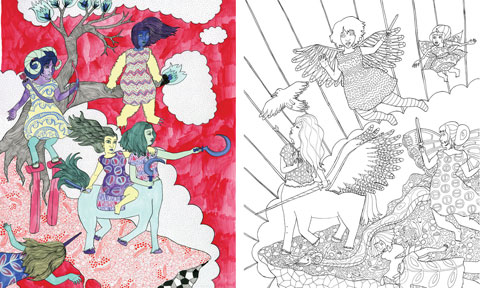
Til-Death-spread-Erika-Rier
What inspired your piece and how does it tie in with ongoing themes in your work?
As soon as I read the brief I knew that I wanted to draw some sort of stand-off between the two pages. I wanted the drawings to work together as a whole but to also work on their own as well. In my self-directed work, I have been exploring themes of violence, war, and struggle. The idea of a standoff definitely played into the themes I’m currently obsessed with. I also draw a lot of strange creatures, women who are half bear or have butterfly wings as well as centaurs and satyrs. I decided one side would be winged creatures facing off against land creatures. While I was working the piece it came to me that the two main figures were obviously at some point best friends, but things had gone south and now they’re battling it out on these two cliffs.
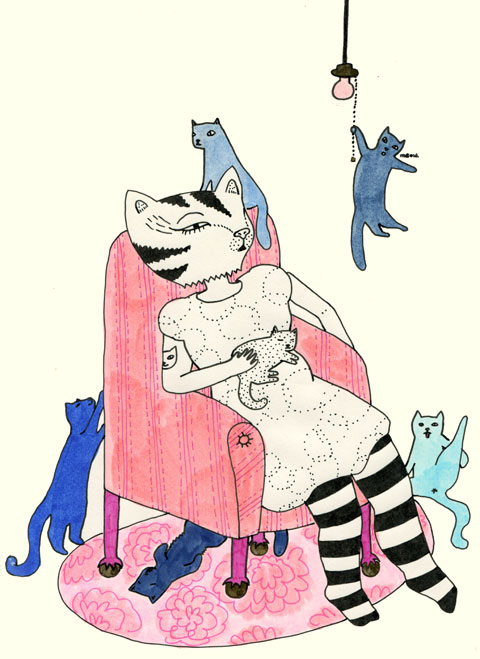
Kitty-Mommy-erika-rier
How has your crafty upbringing affected your current approach to illustration?
I come from a family filled with textile enthusiasts so from a young age developed a passion for sewing, embroidery, and knitting. For a long time I created a line of handmade clothing which I sold in NYC and stores around the country. I love the texture, colors, and patterns in textiles and those are what influence my illustration and drawing the most. I love bringing the flat, repeating patterns of textiles into my drawings, creating landscapes made up of repeating patterns.

I think the biggest thing I’ve gotten from my history of labor intensive craft work that I bring to drawing is patience. Threading a loom or hand stitching a quilt are massive, patience-sucking undertakings that have helped me develop the ability to stick through a very detailed drawing and to spend most of my days sitting at a desk creating work.
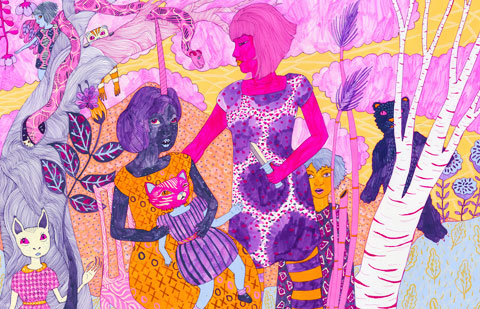
Sit-Still-erika-rier
What does your series Of Monsters & Women explore?
Of Monsters & Women is an open ended, loose series I’ve been working on for most of the year. I’m not even sure when it started, me drawing monsters and battles but now it seems to be the entirety of my self-directed work. In the most basic way these pieces explore struggle. They depict scenes of hybrid creatures and women in battle, often over trivial things. The series is exploring the internal turmoil I experience in my daily life as a woman, mother, and human. I’m also very interested in pushing against the trend in pop culture art of women being depicted as very passive and empty in pretty portraits. Life is full of battles and struggles but art depicting women seems to be all vapid stares, sexy poses, serenity, and/or maternal softness. I want to create art that shows the part of being a woman that is a battle between one’s self and one’s culture.
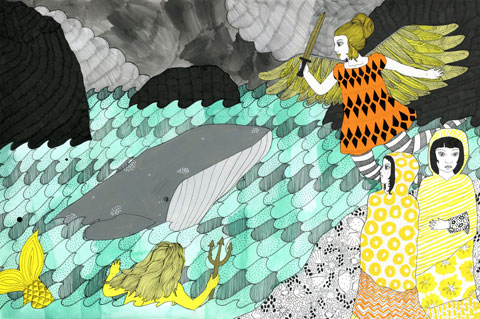
Rest-Area-erika-rier
Why are you learning Norwegian?
When I was very little, my grandmother whom I lived with, had a friend who visited regularly from Norway. She somehow sparked a strong desire to go to Norway in me. I’m not really sure what it is that I find so fascinating, pictures of it remind of where I grew up on the very Northern tip of the state of coastal Maine. I started learning the language so I could visit there but ultimately, after moving around America so much, I feel as though I’d like to live abroad especially in a country where English is not the primary language. I’ve also been learning Spanish because I like the idea of Peru as well. Norwegian though, has totally captured my imagination, I’ve never been so excited about learning a foreign language since I started learning it. The words are at once so familiar and so crazy sounding that I can’t help just saying random sentences just to hear them spoken.
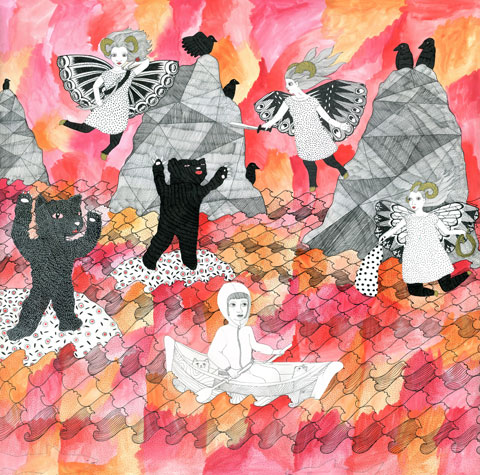
The-Escape-erika-rier
Can you tell us anything about the children’s book you are working on?
Yes! This book has been a long time coming for me. It started with a funny name my daughter called herself when she was very little, the Crispiest Turtle. That name just stuck with me, I wrote it down and doodled some characters of it. She also told me a very enchanting story including a seagull and some very unfortunate whales and octopus. I’ve had a difficult time deciding exactly how to write the story but have finally finished a rough draft which pleases me.
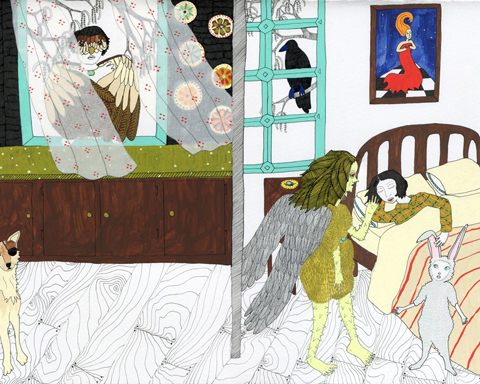
Turquoise-is-for-Protection-erika-rier
You create dream artwork and family portraits to order, what have been the most memorable commissions? (I want one, such a great idea!)
I love creating custom artwork for people, I learn so much about them and their families. One of the first family portraits I did is still one of my favorites. The woman sent me pictures of her family and pets and then a stream of consciousness list of things that were meaningful to her family such as goats, poetry, elephants, mangoes, Hindu goddesses, unicorns, feathers…. The list was quite long but I managed to fit in everything, except for the goats. Another one was a woman who asked if I could read her favorite book and do a drawing of some of the creatures from the book. I just received a new commission to illustrate a story a woman has written for her boyfriend. When it is finished, she’ll have a single copy made and bound to give him for his birthday.

And-the-Boat-That-Goes-erika-rier
Why have you moved so much and what is your favourite bit of America?
I was born in Northern Maine and since then have lived in Vermont, Connecticut, New York City, Arizona, Washington state, and currently reside in Portland, OR. I move for many reasons, it started just to get away from my tumultuous family. Since then it has developed into a desire to experience new places. Lots of people love travelling but I kind of despise travelling. I feel like it gives you such a superficial, romantic view of a place. I love living in a new place and learning all of it’s intimate details. There are also practical reasons. We recently left Washington state and a big part of that was wanting to live someplace with a better public transportation system. I never learned to drive and Portland, OR is much easier to get around without a car.
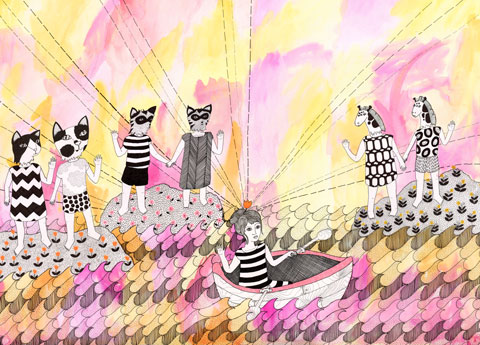
New-Day-erika-rier
How do you fit everything in around family life and how does being a mother inform your work?
It is really hard to fit in everything so there are things I let slide, like cleaning the apartment or having a social life. Right now my family and my art are the most important things in my life so I focus mostly on those and let the other things slide. Attachment parenting has been the thing that I feel like makes my current life possible. My daughter is 12 now and homeschooled. She is a patient, focused, and self-directed young woman and I really feel like attachment parenting is to thank for that. The first 5 years of her life were hard, all I really did was parent, I did draw and sew still but not like I can now. That time I put into attachment parenting has paid off tenfold and helps me to pursue art while raising my daughter the way I’d like to raise her.

Being a mother affects my work so much it’s hard to even tease it out of the whole. Being a mother has changed how I look at the world and how I look at myself. The struggle to bring up a child who can survive in this crazy society but has not lost her magic is the biggest battle I wage everyday. Trying to figure out when to protect my child, when to let her wage her own battles, when to expose her to the ugly parts of life, these are all things that make up my real life battles every day and seep subconsciously into my drawings.

Many thanks for such an informative and interesting interview Erika! I love that my open briefs attract artists from all over the world as well as artists closer to home. Look out for plenty more international talent in Amelia’s Colourful Colouring Companion.

Categories ,Adult Coloring Book, ,Adult Colouring Book, ,Amelia’s Colourful Colouring Companion, ,Attachment Parenting, ,Coloring, ,Coloring Book, ,Colouring Book, ,Crispiest Turtle, ,Erika Rier, ,Homeschooling, ,interview, ,Motherhood, ,Of Monsters & Women, ,OR, ,portland, ,That Which We Do Not Understand

Similar Posts:


Amelia’s Magazine | An interview with Nanna Prieler: Amelia’s Colourful Colouring Companion featured artist.

NANNA Prieler - man vs crab
I discovered Nanna Prieler‘s work on instagram and invited her to submit her work for Amelia’s Colourful Colouring Companion. I’m so glad she took me up on the offer, contributing the engaging Creative Life in her unique style.

Nanna Prieler portrait
Where are you from and where do you live now?
Originally I’m from a small village in the South of Austria. I left my home very early, so that I could attend an art school in Graz, one of the bigger towns in Austria. After my graduation I started working as a graphic designer for several agencies in Vienna. But it was not enough to fulfill me. After a busy day of 8 hours working as a graphic designer, I tirelessy developed my illustrative style. Finally in 2014 I decided to found my own illustration business in my current hometown Vienna. Now I’m very happy that I made this big step.

NANNA Prieler - strangers in the park
Who do you work for and how do you set about finding work?
I’m working for national and international clients in different fields. Fortunately I don’t have to search for work, at the moment. The projects are coming by themselves. But it hasn’t always been like this: I’ve worked a lot and tried to use the internet to spread my work all over the world. I will keep on working hard in the future, but always with a lot of passion. I really love to work as an illustrator and can’t imagine living another life.

NANNA Prieler - Horse dressed as butterfly
I hear you’ve got a children’s book on the way – can you give us a brief glimpse inside?
Yes, at the moment I’m working on a new children’s book called „Ganz schön super“ (in German), which will be published in Spring 2016. That’s quite exciting! Each book is a new challenge. Especially this one because it is a lot of work; I have written and illustrated it myself. The main character is a little cat, which meets a lot of other animals. In short it’s a book about tolerance and acceptance, of course told in a funny way.

NANNA Prieler - travel memories Norway
Where do you find inspiration?
At the beginning I was inspired by amazing illustrators like Blexbolex. He was my first hero in illustration and still gives me so much motivation. Now I’m using instagram and other social media platforms to discover the current flow of illustration. But my favourite source of inspiration is nature, I love drawing outside. There is so much beauty everywhere around, I could draw for hours and never get bored.

NANNA Prieler - Horoscope cancer
How do you put your illustrations together?
My work is a mix of the handmade and digital. For me the sketch is the start and it is the most important part of an illustration. In the next step, it gets scanned and I go over it with the path tool in Photoshop. There I can paste in my typical structure as well. Working with the computer is perfect to try a lot of different colour combinations.

NANNA Prieler - Colouring Book Preview
Can you tell us about the title of your double page and what it means?
The title of my artwork is Creative Life. It’s a composition of an artistic mind’s world.
Living together – creating and inspiring each other. Working on this project was a lot of fun, hopefully that’s noticeable in the illustration.

NANNA Prieler - raspberry
How would you describe your studio space and routine?
My cozy little flat in Vienna is also used as my studio. Working from home is a great opportunity to wear pyjamas during the day! There is no exact daily routine. The work is quite different, that’s the thing I love about being an illustrator. Generally it’s a mix of illustration work, social media, interviews and unfortunately a little bit of bookkeeping as well…

NANNA Prieler - kids
What else do you like to do in your spare time to relax?
I enjoy the amazing peace of nature, as often as possible. Cooking over an open fire, sleeping in a tent and drawing in northern woods – that’s my favorite pastime. In Vienna I try to relax myself with preparing extravagant meals with ingredients in rainbow colors.

NANNA Prieler - Animal pattern
What motto do you live by?
Try to do everything – however small it may be – with love and passion. For me that’s the simple secret for a happy life.

Follow Nanna Prieler on instagram here. She is featured in Amelia’s Colourful Colouring Companion alongside over 40 other international artists, funding for just 8 more hours on Kickstarter today.

Categories ,#ameliasccc, ,Adult Colouring Book, ,Amelia’s Colourful Colouring Companion, ,Blexbolex, ,Coloring, ,Colouring Book, ,Creative Life, ,Graz, ,interview, ,Kickstarter, ,Nanna Prieler, ,Vienna

Similar Posts:


Amelia’s Magazine | An interview with Feronia Parker-Thomas: Amelia’s Colourful Colouring Companion featured artist.

feronia parker thomas
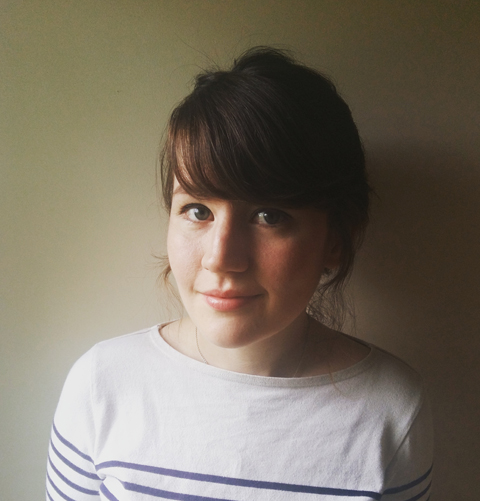
Feronia Parker-Thomas is yet another graduate of Camberwell College of Arts. She is now qualified as a teacher herself, signed to The Bright Agency and has just produced the illustrations for her first children’s book How the Crayons Saved the Rainbow. Her fab piece for Amelia’s Colourful Colouring Companion features one of her favourite animals…

feronia parker thomas
Would it be fair to say that you liked bears? What is it about them that appeals so much?
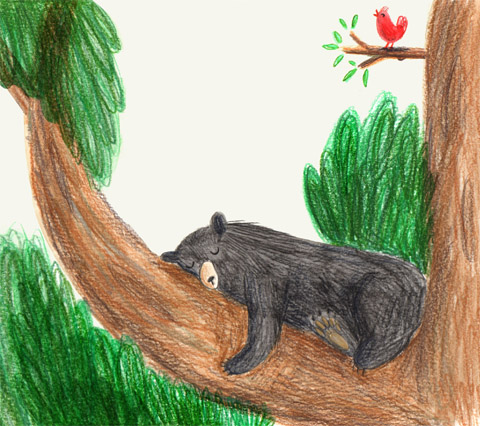
Yes, I am incredibly in love with them! I have done since a young age but have never really thought about why I find them appealing. Thinking about it now, there are two reasons that jump out at me. Firstly, they are lovely to draw, their fur is a fun texture to render and their shape is full of beautiful curves. Secondly, I think humans have always been fascinated with bears; there are examples of bears in prehistoric cave paintings and there are lots of bears in myths and legends. They have quite human features and I think we project whatever we are feeling on to them.

feronia parker thomas
How did you settle on your idea for my colouring book?
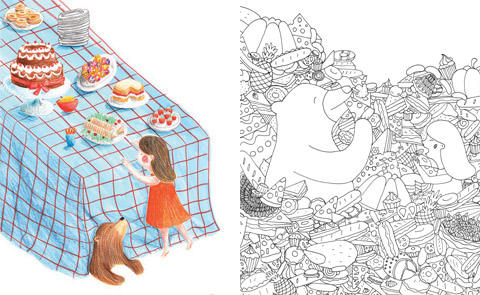
I love picture books and this is the area of illustration I am drawn to and mainly working in, so I wanted to do a narrative piece about a girl and her ‘imaginary’ bear. I was thinking about my sister and I when we were children sitting under tables creating imaginary worlds. I liked the idea that the girl was collecting food for her bear and then we get to see the big feast that ensues.

feronia parker thomas
What is your preferred method of producing an illustration?
I draw out a loose sketch of what the illustration will look like and then flesh it out in pencil, I then use my lightbox and the original as a template. I will usually do a watercolour base and then add pencil over the top for detail. I have dabbled in digital colouring recently but I am still not sure; I like the flexibility that digital can give you, but something doesn’t feel quite right for me. There are some amazing digital illustrators out there doing a much better job that I can! I work in the flat I share with my boyfriend in Streatham, and we have lots of books and plants and artwork on the walls; it is a lovely space with lots of light.

feronia parker thomas
Since graduating from Camberwell College of Arts in 2010 what have you learnt about the business of being an illustrator?
It is a rollercoaster; it has highs and lows. A high has been signing to The Bright Agency, they are going through quite an exciting time at the moment so it is great to be a part of it. I have learnt you have to put yourself out there; your work can’t be found if you are hiding it! If I was to give one piece of advice it would be to join Twitter and Instagram and share your work, get your work seen by anyone. There is a great community of illustrators on Twitter that support each other, it is lovely to be a part of.

feronia parker thomas
Why do you enjoy teaching so much and how do you balance being a teacher with being a working artist?
I love teaching because it forces you to look at art in different ways. It sounds incredibly cheesy but I love seeing the new generation of artists develop (insert puke noise here). The arts in schools are under threat and I think it is important to try and show young people that art can have so many different applications in life, I really enjoy winning round unwilling kids. It has been hard at times to balance the two, especially when you might have a tight deadline, but I love illustrating, so when you love doing something it isn’t hard to motivate yourself.

feronia parker thomas
Can you tell us more about your first picture book? it sounds great!
How the Crayons Saved the Rainbow is about an argument between the Sun and the Clouds. Without them working together there are no rainbows, so some very determined crayons work together to try and fix the problem; it is a great story about team work. The book was really fun to do and took me out of my comfort zone a little because they wanted the illustrations in crayon, which isn’t my usual medium. I had a great working relationship with the author and editor; so it was a really positive experience for my first book.

feronia parker thomas
How is development of your own ideas for a children’s book coming along?
Slowly but surely! I am trying to develop characters for several different ideas at the moment, it is nice to have the freedom to flit backwards and forwards and have space and time to develop. I am huge fan of David Roberts‘ illustrations for Rosie Revere, Engineer and Iggy Peck, Architect. They are wonderfully detailed illustrations, I seem to be drawn to illustrators who use lots of detail. I love Carson Ellis‘ work and Janet Ahlberg‘s illustrations were a favourite of mine as a child. I loved Peepo and The Baby’s Catalogue; I could still look at the Jolly Postman for hours.

feronia parker thomas-highgate
I love your drawings from Highgate Cemetery – what prompted this personal work?
The Transport Museum’s ‘Places and Spaces‘ theme for last year’s Prize for Illustration my starting point for these images. I didn’t end up submitting an illustration in the end but it was great to work to a brief. I am fascinated with cemeteries; I went to Paris last year and spent a large proportion of my time looking around different cemeteries there. In many ways it is an unfinished project, I thought I might do illustrated maps for ‘The Magnificent Seven‘ cemeteries in London but never got round to it; watch this space!

feronia parker thomas-pirate
Who are the Pirate Kids?
The Pirate Kids were two characters I created about a year ago as a portfolio piece. I feel a bit guilty that I haven’t developed them more, at the moment they are frozen in time!

feronia parker thomas
What else do you love to draw and why?
I really enjoy drawing people, I get an intense satisfaction when I do a portrait and it actually looks like the person I have drawn. Last year I did a series of portraits of women I consider to be icons, feminism is an important cause to me and I wanted to celebrate them.

feronia parker thomas
Amelia’s Colourful Colouring Companion will be available to preorder on Kickstarter VERY SOON, so watch this space!

Categories ,#ameliasccc, ,Adult Coloring Book, ,Adult Colouring Book, ,Amelia’s Colourful Colouring Companion, ,bears, ,Camberwell College of Arts, ,Carson Ellis, ,Coloring, ,Colouring, ,David Roberts, ,Feronia Parker Thomas, ,How the Crayons Saved the Rainbow, ,illustration, ,interview, ,Janet Ahlberg, ,Mindful colouring, ,Pirate Kids, ,Places and Spaces, ,The Bright Agency

Similar Posts:


Amelia’s Magazine | An interview with Percie Edgeler: Amelia’s Colourful Colouring Companion featured artist.

percie edgeler
Percie Edgeler is another recent graduate of Camberwell College of Arts, (see also Tiffany Baxter) whose work caught my eye at the graduate shows. She contributes an unusual and wonderful piece for Amelia’s Colourful Colouring Companion inspired by a Japanese folk tale

percie edgeler
What kind of artwork will you be creating on the theme of magic and rituals for your upcoming group exhibition?
I’m not entirely sure yet. I have a few different ideas I need to figure out the layouts for. We’ve been given some guidelines by the lovely people at Treadwell’s Books (the venue) and we can’t have anything three dimensional due to size of the space, so that’s definitely not an option. Luckily it’s with a very friendly group of people from a mix of disciplines, including Tiffany Baxter, who’s being included in the colouring book, and we can share our ideas quite easily and get feedback on what we think is best collectively.

percie edgeler
Why have you decided to push your artwork into 3 dimensions and how are you progressing?
I trained and work now as an illustrator, which most would assume is primarily a two dimensional way of working. Three dimensional work has never been my strong point, and by making ceramics I’m trying to push myself not to be limited to one skill. I guess in part it’s also a question of style: if I’m limiting myself to working in a certain way, my two dimensional work won’t evolve from what it already is because it’s not being challenged. It’s slow progress because I don’t know much about three dimensional forms, but I’m learning. I chose to start with ceramics because to me it seems the most natural. I’ve always worked quite traditionally with my hands, so being able to hold and lump of clay and form it makes more sense to me than any other three dimensional form for now. At the moment everything I try to shape is quite wobbly, I’ve made a fair few wobbly dogs, but they’re getting better over time.

percie edgeler
In what way does the built environment inspire you?
At the risk of being too political, my generation is limited in terms of housing; so it’s hard for us not to notice the built environment more than ever. It’s interesting when you go to other countries and see their architecture how in comparison the UK has a mixture of old and new that is juxtaposed. The spaces in which we work and play can no longer be limited to a building. I’m lucky in that the area I live in is the greenest borough in London, and for me it’s easy to go into a park or field without losing my connection to the city. But now we need more housing and infrastructure, those green areas are increasingly under threat. There’s a balance of being part of something man made and something natural which I really enjoy, though recently in what I’ve been drawing I’ve been erring towards the natural. Often we don’t take the time to consider what’s there already because we’re used to it, and I think now as an adult I appreciate that environment a lot more.

percie edgeler
Why did you decide to focus on a Japanese fairytale for your colouring book page?
There’s something very honest about Japanese folk stories. There’s so many different ones, and in the Japanese culture it’s not just a fairy tale, it’s a part of life, a tale of a time before our time. The way they’re told is mostly through spoken word; more reportage than storytelling like we have in Europe. And the way someone tells a story verbally is very different to how one may draw one, with the storyteller adding their own inflections or details which others may not. That culture of storytelling is still there now, I think; if you read a novel by a contemporary Japanese author, say for instance the ever popular Haruki Murakami, the facts are given with such detail that it’s fascinating. In 1Q84, Murakami writes about two people who have loved each other for years and in one scene they miss each other by minutes. That pure feeling expressed in folk stories is still there, and that’s absolutely lovely. I chose to base the artwork for my colouring book page on a folk tale for this reason. I wanted to give my own take, and share a story in a new way that people could interact with.

percie edgeler
Which cultures are you most enjoying learning the folk tales about and why?
I enjoy learning the folk tales from most cultures, be it from European cultures or further afield. I think my favourite so far is a Maori one talking about how Ta Moko, a form of facial tattooing, came to their tribe as there is no distinguishing between what happened in the story as fact or fiction. Icelandic folk tales are also quite enjoyable as they can be quite traditional by Western standards but also feature dark elements.

percie edgeler
What is it that you love about books and what kind of books do you hope to make yourself one day?
As childrens’ books are an escape. You can live a hundred times through all those characters and have all of those adventures through reading them. As an adult, the same can still apply on some level but they also help to challenge a lot of issues in society and reflect on society at that time. Precisely because of that, my long term goal is to work with books. Every opportunity I’ve had to work with books has just confirmed that. I want to make books for children that they can enjoy, but also want to make them accessible for adults; reading to children and encouraging them to read should be something to have fun with, though very few books achieve that.

percie edgeler
How did you get involved with Four Corners Books and what did you do with them?
Through my university in our final year we had a choice of external projects for a range of different people; e.g. the BBC, Tate Modern, Nexus. I chose the Four Corners one because I wanted to make something outside of my comfort zone of something narrative. By creating animal images from the Edwardian short story of Saki’s Sredni Vashtar, I was pushed to do something different but still work with books and illustration in a way that I felt made the project fun and exciting.

percie edgeler
What happens in your story about a man and a dog?
A boy loses his dog after the dog runs out of the house because the dog is tired of never being played with. The boy, desperately sorry for his actions, chases the dog out and follows him on his adventures around the world only to miss him and his incredible feats each time. It escalates and escalates until eventually, unable to find him, the boy goes home and gives up – but luckily for him, that’s not the end of the story. I don’t want to give too much away because it’s something I definitely want to complete and put out into the world. Maybe that’s a little self indulgent. When I started it for the Macmillan Prize in 2014, I felt like giving up on illustration. It made drawing exciting again and forced me to keep going.

percie edgeler
What was the best thing to come out of your graduate exhibition Rock, Paper, Scissors in Hoxton?
I think the best thing to come out of my graduate exhibition was the experience of doing something on such a large scale. I managed the Kickstarter for it with a small group of people, and that was insanely difficult. We raised about two hundred pounds over what we needed in that in the few hours before it finished, so it allowed us to cover a lot of extras which really made a difference to the exhibition as a whole. Also the venue let me recreate a mural I did inside the university, albeit on a smaller scale, which was really enjoyable. I also ran a paper marbling workshop while there and that was really fun to do, especially with little kids. It was messy though so their parents probably weren’t too pleased!

What else have you been doing this year, it sounds like you’ve been super busy!
Two weeks after I graduated I was offered a job interning at Kritical Mass, a company which works with charities and businesses trying to make a change with their products in a positive way; so through them I’ve been given some work for clients such as BirdLife International which has been great. For them I’ve made a set of illustrations concerning the decline in vulture population which has been really interesting, I’ve learnt a lot from it which I wouldn’t learn in any other job. I’ve been quite lucky this year in that I was also featured in Secret 7” which was held at Somerset House for the first time, and also had work in Belly Kids’ ‘Milhouse From Memory’ exhibition. I have a few projects in the pipelines as well now which are something a bit different to what I’ve done before; so from here I’m interested to see where I can go and what I can do, I’m excited for what’s to come.

Categories ,1Q84, ,26 illustrators, ,Adult Coloring Book, ,Adult Colouring Book, ,BirdLife International, ,Camberwell College of Arts, ,Coloring Book, ,Colouring Book, ,Four Corners Books, ,Haruki Murakami, ,illustration, ,Kickstarter, ,Kritical Mass, ,Macmillan Prize, ,Milhouse From Memory, ,Percie Edgeler, ,Rock Paper Scissors, ,Secret 7”, ,Sredni Vashtar, ,Ta Moko, ,Tiffany Baxter, ,Treadwell’s Books

Similar Posts:


Amelia’s Magazine | An interview with Hannah Rollings: Amelia’s Colourful Colouring Companion featured artist.

Hannah Rollings
Hannah Rollings recently published An Artist Once Said with Michael O’Mara books, a beautiful interactive art book. Her piece for Amelia’s Colourful Colouring Companion follows on from this idea, taking the style and ideas of Henri Rousseau as a starting point.

Hannah Rollings portrait
Your PhD thesis is extremely interesting – can you tell us a bit more about it in layperson’s terms?
I am looking at developing illustrated interactive books or digital outcomes for children aged 8-11 on the subject of woodland stewardship specifically communicating the carbon cycle. I hope to work with children themselves to co-design narratives and resources that they find meaningful.

Dev Hannah Rollings
What draws you to educate youngsters about the natural world, and where did this interest start?
I’ve always enjoyed animal documentaries and used to have a WWF filofax that I used to study and draw from. The outdoors has always been a massive part of my life and has come to mean more to me as I begin to think about what is important in my own life. That natural childlike fascination of learning about things you see or find on a walk in the woods is very liberating and gives me a great sense of freedom that I hope I can communicate to big and small explorers.

Hannah Rollings
You also teach, what do you enjoy most about the engagement with students?
Teaching is a very inspiring conversation as you often question your own thoughts on subjects and it is always a privilege to see someone develop their work and to have a small helping hand in that is very rewarding. It is about asking the right questions at the right time, not necessarily having the answers.

Development Hannah Rollings
Why has academic study in general been so important to your artistic process?
Illustration can be quite an isolated working environment so I have always found that study has given me a good balance to broaden my work and gain critical discussion. Academic study has allowed me the structure and collaboration to develop a more reflective practice, giving me the space and confidence to shape my own direction. I also quite like certificates.

Hannah Rollings
As part of your research you coppiced an ancient woodland – what did you learn from this process?
It was a rollercoaster of an experience: amazing discoveries coupled with the practical difficulties alongside general misunderstandings about coppicing such as often being asked why are you cutting down trees. It was beautiful to see a small coppiced area come back to life through the seasons; the bluebells come up as you’ve given them more light and the butterflies and insects take over while new shoots of tree come up doubling the trees capacity to grow and live on.

Hannah Rollings
What inspired you to create your recently published book “An Artist Once Said”? It’s a beautiful tome.
Whilst lecturing in the studio staff and students would often put on the wall their favourite quotes from artists they admired – each unique and fitting to that persons work – and I thought what a lovely idea for a book. As I often need a creative nudge to get over the blank page.

Diary of a Redundant Cow Shed Hannah Rollings3
What is your favourite way to work?
I love the looseness of inks and watercolour but also find I want to create a little friction and contrast and then that is when collaging on the computer can be very exciting as it allows you to bring very different elements, scale and textures together to experiment and surprise yourself.

What made you want to take part in my colouring book?
My work is focusing on building in interaction and the refreshing menagerie of illustrators and approaches I thought would be very exciting to see and be apart of.

Double Page Hannah Rollings
How did you decide on your theme and realise the image for the colouring book?
I wanted to lead on from an ‘An Artist Once Said’ and had been looking at Henri Rousseau as part of my research in depicting foreign lands that people may not have first hand experience of but have magical naive images of. So I looked at this idea of travel and exploring to discover, as Henri Rousseau himself did to produce beautiful images, through the medium of colouring.

I am so excited that Hannah Rollings is part of Amelia’s Colourful Colouring Companion. Available to pre-order as soon as my Kickstarter campaign is live!

Categories ,#ameliasccc, ,Adult Coloring Book, ,Adult Colouring Book, ,Amelia’s Colourful Colouring Companion, ,An Artist Once Said, ,Coloring, ,Coloring Book, ,Colouring, ,Colouring Book, ,Hannah Rollings, ,Henri Rousseau, ,interview, ,jungle, ,Kickstarter, ,Michael O’Mara, ,PhD

Similar Posts:


Amelia’s Magazine | An interview with Harriet Plaskitt: Amelia’s Colourful Colouring Companion featured artist.

HARRIET PLASKITT RECIPE 2
Harriet Plaskitt contributes a fabulous tableaux featuring food for Amelia’s Colourful Colouring Companion, inspired by her own travails. She tells us more about this, and gaining a brilliant commission for the Stereophonics thanks to Instagram.

HARRIET PLASKITT PORTRAIT
I believe your are most interested in 3 areas of illustration, what are these and why do they interest you the most?
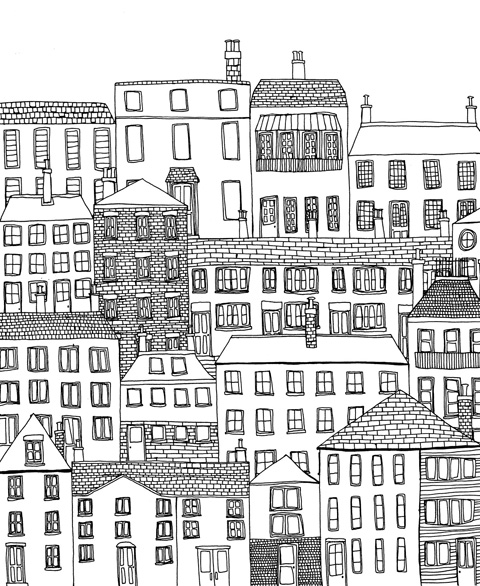
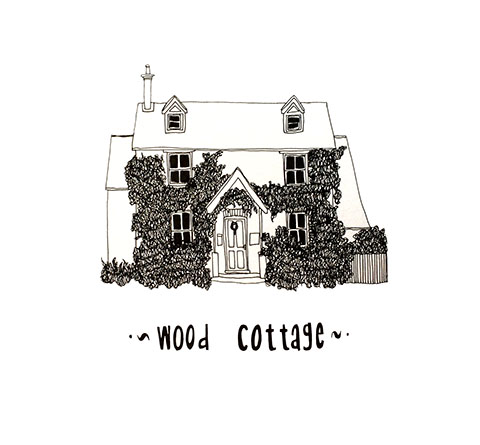
Yes, I tend to draw three main areas, buildings and maps, food and recipes, and hand drawn typography. I enjoy travelling, and like to capture the places I have been by drawing the buildings there. And not just the ornate landmarks, but the ordinary terraces and high streets. Having been recently diagnosed with IBS, I enjoy exploring what meals I can make with the limited and unusual list of foods I can eat. When I was researching this I realised there was a gap in the market for illustrated IBS friendly recipes. Hand drawn typography has always been something that I’ve enjoyed doing, I like creating my own fonts and experimenting with what can and cannot work.

HARRIET PLASKITT - TOWN
What is your preferred way to work?
I like to work at my desk, so that I have all my materials and laptop and printer readily available. I work mainly with a set of Rotring Isograph pens with black ink. I usually draw all the components of my illustrations separately, and then scan them in and compile them on photoshop. If I colour them I either do it with colouring pencils, or on photoshop.

HARRIET PLASKITT HOUSE PORTRAIT
What was the best part of your course at the University of Gloucestershire?
I really enjoyed the independence of being at university. We did a module about promotion and I liked creating a brand for myself, and making promotional items, making sure everything you do looks like it is done by you.

HARRIET PLASKITT DOUBLE PAGE
In what way has your personal life inspired your artwork for my colouring book?
Due to being on a restrictive and unusual diet called FODMAP, I have to be creative and inventive with that I eat. The two pages for the colouring book show what I can eat on one side, and what I can’t eat on the other.

HARRIET PLASKITT STEREOPHONICS 2
How did you get your first commission from the Stereophonics and what was it for?
The wife of the lead singer found my instagram page and commissioned me to do a house portrait. She then showed her husband Kelly my website and he liked my work, so they contacted me to design their logo and do drawings which they used for the album cover and inside the album booklet. It was all very lucky and an amazing experience.

HARRIET PLASKITT QUOTE
How have you become skilled in hand lettering?
I spend a lot of time practicing and experimenting, with different fonts, different materials and different subjects. I also really like discovering other people who do hand drawn typography, and often look through Instagram for inspiration.

HARRIET PLASKITT COPPER CARD
What project have you recently done using the Adana Eight Five printing press?
I recently created a range of hand printed letterpress greetings cards. These are now all in my Etsy shop and include birthday cards, thank you cards and various hello cards. I’ve used colours that you can’t print with digitally, like gold and copper.

How do you motivate yourself to work on personal projects and why are these important to you?
When I get stuck on a commissioned project, I like to do something personal to reinspire me. I think it is really important to keep going with what you want to do, not only because it expands your portfolio, but because you can develop and experiment with your style.

HARRIET PLASKITT - CITY
What quotes from pop songs are you likely to illustrate, and in what context?
I liked the idea of creating a series of ‘motivational’ quotes, that when initially looked at appear to be the normal “live laugh love” etc which are popular at the moment, but instead are quotes from cheesy pop songs, for example S Club 7. I’ve got some ongoing commissions at the moment so this has been put on hold, but I look forward to getting back to it!

Where can we find you online?
Instagram is where I am most active @harrietplaskittillustration. My etsy shop is here and my website is www.hpillustration.co.uk.

Harriet Plaskitt is featured in Amelia’s Colourful Colouring Companion, alongside 40 other fabulous artists, funding now on Kickstarter. Make sure you get a copy or a few as soon as possible!

Categories ,#ameliasccc, ,Adana Eight Five, ,Adult Coloring Book, ,Adult Colouring Book, ,Amelia’s Colourful Colouring Companion, ,Coloring, ,Coloring Book, ,Colouring, ,Colouring Book, ,etsy, ,FODMAP, ,Food, ,Harriet Plaskitt, ,IBS, ,illustration, ,instagram, ,interview, ,Kickstarter, ,Rotring Isograph, ,S Club 7, ,Stereophonics, ,University of Gloucestershire

Similar Posts:


Amelia’s Magazine | An interview with Ignacia Ruiz: Amelia’s Colourful Colouring Companion featured artist.

Ignacia Ruiz
Ignacia Ruiz was born near the Andes but has chosen London as her home. Since graduation from her degree she’s had a packed schedule, featuring in numerous exhibitions but happily finding time to produce some artwork for Amelia’s Colourful Colouring Companion too.

ignacia Ruiz Portrait
What has prompted your lifelong obsession with greenhouses and plants in general?
I think it started with the very first place I lived in. There was a small greenhouse in the centre of the house and I can remember being about 4 years old and going in to water plants with my mum. It always seemed like the most magical place! I think that has remained my impression ever since. Being from the city and surrounded mostly by buildings has made me see plants and greenery as a precious thing.

Ignacia Ruiz
Ignacia Ruiz
You love to sketch on location – how did you set about capturing the hothouse atmosphere of the greenhouse?
For me it was getting the mix of the delicate architecture of the steel frame and glass against the organic structural shapes of the plants themselves. The tropical heat of the greenhouse hopefully comes across on the vivid colours of the plants in the drawings!

Ignacia Ruiz
What was the best bit about growing up in Santiago de Chile?
Weirdly enough I think it was probably the topography of it. You can drive from the city to the seaside in an hour to have a swim and later drive up the snowy mountains all in the same day. The variety of landscapes is lovely. My favourite thing in Santiago is seeing the Andes mountains at sunset. The snow turns red and orange and you can see the beauty of them in stark contrast with the glass and steel of the buildings.

Ignacia Ruiz
Why did you pick London for your study?
Initially I was only coming to London for maybe a year, but a lot happened in that time and I felt like it was the right place for me. I then applied to do the Graphic Design and Illustration BA at Central Saint Martins and got offered a place. That’s when I decided I wanted to stay here and try to develop my career. It’s been going well ever since!

Ignacia Ruiz
How do you translate your location sketches into finished works of art and what is the process?
My sketches are usually very fast and loose, so I like to have finished work that retains some of that quality. I have found that with print methods like linocut and woodcut I can emulate the drawing pen with the chisel. I guess it’s the same idea, just a different tool. I love playing with negative space and the bold flat colour you get with relief printing. I also like the imperfections of the print that relate to the initial rough sketch. I’m not a perfectionist printmaker at all!

Ignacia Ruiz
I believe you’ve just completed a residency in Italy – can you tell us more about this?
Yes, I was very lucky to have been asked by the print studio Opificio della Rosa to come and work in an artist book. I decided to make a reportage project of the area the studio is located in, the Conca Valley. I travelled around with my sketchbook documenting the people and places I encountered. Later I returned to the studio to turn the drawings into woodcuts. It is an ongoing project that will be finished and published in 2016.

Ignacia Ruiz
How did you get the commission to illustrate a Penguin book and what was the process of producing your final artwork?
One of Penguin‘s art editors came to our second year illustration exhibition and liked some of the work I was exhibiting. We kept in touch until finally she said she had a project that would suit my work. It was a book about the planning and logistics of the Crusades. I was so excited, especially since all the research consisted in looking at beautiful period illuminations and films depicting the Crusades. The artwork went through several roughs before it was approved by Penguin and was finally rendered in a woodcut style with thick black outline and very little colour.

Ignacia Ruiz
Can you tell us more about the recent exhibitions you have taken part in?
There has been a few this year apart from my degree show. I had a piece in the AOI’s Places and Spaces exhibition at the London Transport Museum, I did a cover for Alice in Wonderland which was featured at the YCN Student Awards at the Barbican Centre, I had a project about depicting boxers training in a gym in Islington featured in the Reportager Award at the UWE in Bristol and my City linocuts series appeared at the Cheltenham Illustration Awards. It’s been a busy year!

Ignacia Ruiz
What next, will you stay in London and if so why?
I have some commissions and teaching jobs on at the moment so London feels like the right place to be. We shall see what the future brings!

You will be able to own your very own copy of Amelia’s Colourful Colouring Companion featuring the work of Ignacia and many others… just make sure you grab your book once my Kickstarter campaign launches in a few weeks time.

Categories ,#ameliasccc, ,Adult Coloring Book, ,Adult Colouring Book, ,Amelia’s Colourful Colouring Companion, ,AOI, ,Central Saint Martins, ,Cheltenham Illustration Awards, ,Coloring, ,Colouring, ,Conca Valley, ,Crusades, ,Ignacia Ruiz, ,illustation, ,Kickstarter, ,linocut, ,London Transport Museum, ,Opificio della Rosa, ,Penguin, ,Places and Spaces, ,Reportager Award, ,Santiago de Chile, ,woodcut, ,YCN Student Awards

Similar Posts:


Amelia’s Magazine | An interview with Jack Bailey: Amelia’s Colourful Colouring Companion featured artist.

JACK BAILEY illustration
Jack Bailey was one of the fantastic new illustrators I discovered at this year’s New Designers graduate show who answered my callout to take part in the colouring book open brief. His energetic art is created on a large scale then turned into fantastically busy pictures like his colouring book page, inspired by the game of Ultimate Frisbee.

JACK BAILEY illustration
Where do you find inspiration for your characters?
The inspiration for my characters comes from a mix of sketching outdoors and making loose marks on a large sheet of paper. When I apply the loose marks to a piece of paper I relate back to my original outdoor sketches and start to interpret the mark as the shape of a body or a facial expression. The characters barely resemble the original sketches however I find studying from life allows me to interpret the marks made in a variation of forms. Previous to this brief my characters where always produced in colour, so it was fun to experiment in black and white for the colouring page and this is something I have continued doing.

JACK BAILEY illustration
Can you tell us more about what is going on in your artwork for my colouring book? who are all those people?
The piece for the colouring book was inspired by an article I read in the New Yorker about the chances of Ultimate Frisbee becoming an Olympic sport. Immediately, due to the word ‘ultimate’, I imagined a huge, chaotic game of Frisbee where only those playing understood what was going on. Almost like looking at a London underground map for the first time. The characters in the image are the people playing the sport and I packed the image full of people to show its rise in popularity. Unfortunately not many people play Frisbee in Liverpool so I picked up on the dynamic poses through watching youtube videos, which also contributed to the hectic feel of the image.

JACK BAILEY illustration
What led you to study at the Lincoln University and what was the best bit about your course?
In all honesty studying at Lincoln was totally by chance as I was still unsure if I was going to go to university at the time. I attended a university fair in Manchester where I picked up information packs and Lincoln University was one of them. When I got to Lincoln for the interview however I knew it was the place for me. It was quiet enough for me to be able to get on with my work and the old architecture of the city really appealed to me. As well as this everywhere was in walking distance and so really accessible. I guess you could say it was destiny! The best bit of the course for me was having tutors from a variety of backgrounds. It really enhanced a brief when you knew a tutor was passionate about the subject and had experience in the field. Another aspect of the course I enjoyed was the encouragement to try different media and new ways of working. Before the course I believed a single image had to be produced using the same mediums and on a single surface. Now I’ll use a whole bunch of mediums on separate surfaces allowing me to be a lot more expressive and confident in the way I work.

JACK BAILEY illustration
How do you translate your ideas between 2D and 3D artworks?
It works in a similar way to how I translate a sketch from life into one of my characters, in that they often don’t appear anything like the original influence. Between the 2-D and 3-D image they will often only share similar characteristics such as the amount of legs, hair style and facial features. Working in paper mache means capturing a dynamic pose is often difficult. This is why I use string to decorate the creatures. I feel the shape and swirl helps add movement to a static creature.

JACK BAILEY illustration
What is the process of creating your 3D pieces?
To create my 3-D pieces I start with a single sheet of paper, often from an old book as I like the stained colour of the pages. I dip this into a wallpaper paste and begin moulding it into any shape that feels natural. Similar to when I create my characters I try not to think too much about the early steps of the process and make shapes with papier mache whilst not thinking of the end product. This is so I don’t miss out on a nice, natural shape for the character. Once I have combined a few sheets of paper I use this as the body, from here I will refer back to my 2-D character and begin creating a head and other features. I finish by adding a face and decorating it with string and found objects.

JACK BAILEY illustration
Why do you find it easier to work on a large scale?
Working on a large scale is easier for me as I find it enhances my creativity. I find the characters look a lot more natural on large sheets due to me not being worried about them running off the page. The marks I make on large sheets are more expressive and full of energy as it is my whole arm moving the brush, not just my wrist. I also find working on a large scale creates new ideas. The sheets become a visual mind map. If I need a tree for an image, on a small scale I will produce one whereas on a larger scale I will produce as many as I can to fill the length of the sheet. This then becomes a new image for me to play around with.

JACK BAILEY illustration
What is it about drawing buildings that appeals to you?
Mainly that they don’t walk off as I try to draw them! What I enjoy to study on a building is the smaller details, often found towards the tops of buildings. I find the top of buildings to have the most character. There are unusual patterns and decorations, small windows and chimneys. You can interpret these as faces, creating relationships between two buildings or as body parts and the buildings can become giants peeping over trees.

JACK BAILEY illustration
How has living in Liverpool influences your approach?
I think the diversity of Liverpool has influenced my illustrations. The city centre is a collection of classic and modern architecture, renovated buildings and desolate warehouses. I also think it encourages creativity here too, with a variety of contemporary and classical art galleries there are always avenues to explore for inspiration.

JACK BAILEY illustration
Why is your new project with Cygnet Ink inspired by Quentin Blake? what is it you love about his work?
What I love about Quentin Blake’s artwork is the energy and looseness of the characters. Each line contributes to the personality of the character and he includes just enough information in each image to depict a scene. His characters also have a nice balance about them too, the positions are believable and you almost move with the character as you look at it. Blake’s backgrounds are a huge influence to me as he approaches them so cleverly. They depict real environments, but he will leave sections out or use a splash of watercolour to describe an area so the characters are the centre of attention.

JACK BAILEY illustration
You can find Jack Bailey‘s lively art in Amelia’s Colourful Colouring Companion, available soon from Kickstarter, and the ideal present for that special person this Christmas!

Categories ,#ameliasccc, ,Adult Coloring Book, ,Adult Colouring Book, ,Amelia’s Colourful Colouring Companion, ,Coloring, ,Colouring, ,Colouring Book, ,illustration, ,interview, ,Jack Bailey, ,Kickstarter, ,Lincoln University, ,Liverpool, ,New Designers, ,Quentin Blake, ,Ultimate Frisbee

Similar Posts:


Amelia’s Magazine | An interview with Jenny Tang: Amelia’s Colourful Colouring Companion featured artist.

Jenny Tang The Jaguar
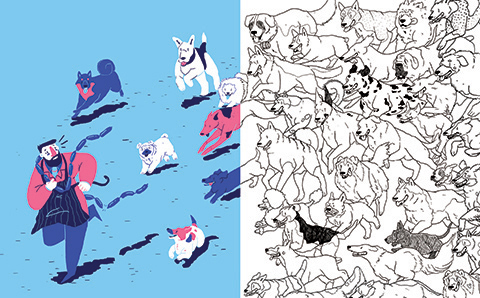
Jenny Tang contributes a vibrant image to Amelia’s Colourful Colouring Companion, featuring loads of excitable dogs chasing some sausages, I love it! Jenny is a recent graduate of Bucks New Uni with a degree in Graphic Arts and would one day like to get into publishing and editorial.

Jenny Tang The Jaguar
Why did you decide to enter an image for the colouring book and what inspired your choice of subject matter?
Well, a while back I had seen the Kickstarter campaign for your 10th anniversary magazine, That Which We Do Not Understand. I was really intrigued by the brief and thought it was a great project (I’m also inexplicably drawn to anything printed with gold). Unfortunately I was a little late to it so I was unable to get involved, however since then I popped in now and again and was delighted to see another interesting open brief; I couldn’t resist! The rest as they say, is history.

I thought about what current colouring books offered and most were of intricate patterns or detailed flora, which were good and all but not really my cup of tea. I love engaging people with characters or stories, so I wanted to create something that a person could use a starting point for their own narrative whilst they were colouring. What are each of the dog’s names? What are their personalities? Who is the pack leader? Will they ever outrun that butcher? I love the playful nature of dogs, which is an aspect I hope to convey in the image as well as encourage readers to be more like them!

Jenny tang dog spread
How did you set about creating your picture?
I always start with thumbnails to explore what ideas might work, one of the first ideas for the brief was lots of cats following a crazy cat lady. When I eventually settled on an idea I sketch it all out and use a light box to line everything. I find that doing line work on another sheet makes clearing up a lot easier as you don’t have to worry about getting rid of the pencil marks. I then scan it in and colour using Photoshop.

Jenny Tang The Interview
Why did you decide to combine studies in illustration and graphic arts and what is your favourite part in the process of creation?
Interesting question, I guess being able to know different skills outside of illustration can only ever be a good thing in my eyes. I originally wanted to be a ‘pure’ graphic designer but my heart never left illustration. I was lucky in that my university course openly encouraged exploring different disciplines and had many students with different ambitions, we had graphic designers, children’s book illustrators; even people that wanted to start their own clothing brand. In terms of graphic design, I loved doing layout, editorial and publishing; learning design for me was pushing what I could do with my illustrations and vice versa. Why just do an illustration when you can create and design your own illustrated publication? The skills were also pretty handy when I had to design my business cards and CV…

My favourite part of the process is sketching, you don’t have to worry much about ‘failing’, it’s the bit where if it ends of looking a bit rubbish you can just hide it away and everyone else is none the wiser. Colouring is starting to become a favourite too, it never used to be; I hated it but after practising and a lot of cajoling from my tutor I’ve gotten better at it and it’s quite satisfying seeing an image come to life.

Jenny Tang Interchange Cover
Can you tell us more about the inspiration behind your Interchange comic strip?
Sure, I was in a long-distance relationship for around 2 years with a charming man from Leeds. I was down South and since neither of us had a car the train was next best option. We saw each other on average 3 days per month, usually the weekend just before or after payday! Subsequently, I had a stack of train tickets which catalogued each time we saw each other and the other places we went to. (One of my favourite tickets is my 1st January ticket to London; we celebrated New Year’s Eve on a Thames boat cruise.) I’m a sucker for soppy stories and have always wanted to create a comic, so armed with a mapped out timeline and plenty of soppy fodder I set about creating Interchange. For those that may be wondering, we’re still happily together and he’s recently moved down!

jenny Tang Garden of Eden an Experimental Illustration
Why do you love rabbits so much?
Since my sister is allergic to cat and dog fur my parents compromised and got us rabbits instead. I’ve always had at least one throughout my childhood, with imaginative names like Blackie, Smudge and Patch. I loved them all to bits and to this day rabbits still incite such a strong dose of cute aggression not many animals can match. I think they’re under appreciated creatures when compared to cats and dogs, but I love the shapes they make and some of the mannerisms they have. For example when a rabbit expresses pure joy they run and jump erratically about, flicking their bodies; rabbit enthusiasts call them ‘binkies’ and it’s so unrestrained that they often land/crash into walls and furniture.

Jenny Tang Fluorescent Animal Posters
Where do you look for inspiration when you are most in need?
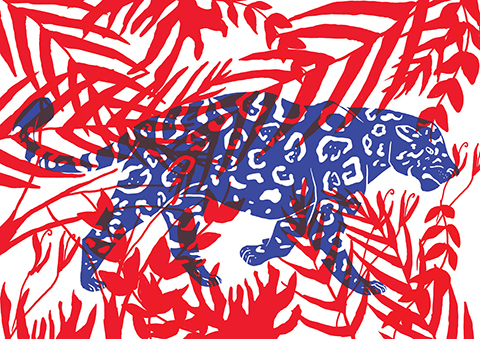
Strange as it may seem, most of the time it’s from reading newspaper articles or watching a documentary. Usually they involve something controversial but not always. The subject matter is always thought-provoking though and gets my mind thinking about the wider world and how I could portray it in a illustration. For example my jaguar illustration was inspired by a National Geographic article called ‘Path of the Jaguar‘ and a more recent documentary I was inspired by was about whether video games really do make people violent. If I get stuck on something more technical like perspectives or backgrounds I look to graphic novels. They are really good for top notch illustration, and they always have interesting compositions and layouts.

Jenny Tang Interchange Artwork
Jenny Tang Interchange Artwork 2
Can you describe the space where you work, what would we find there?
At the moment I’m a bit of an nomad illustrator, I don’t have a permanent studio yet and have to find some pretty, er, interesting places to work at. I’ve drawn on the bus, in bed, on an ironing board, a glass chopping board from that time I tried to make a makeshift light box (it didn’t work out) and occasionally a table when I sneak into the university studio despite graduating. There’s this awkward transitioning period after you graduate for illustrators; do you get a full-time job to be financially secure or do you just go for it and jump straight into freelance? Of course, unless you’re very lucky to already have clients under your belt before you leave university you have that catch 22 of a full-time job with more money but less time to draw or starting freelance with more time but less/no money. There’s this pressure from friends, family and yourself to get your career kick started and I must admit when I see fellow graduates seemingly move straight into the professional sphere I sweat about what I’m not doing. I guess that I’m still trying to figure things out in that department.

However, I am saving up for a studio space and already have optimistic dream of what will go in it. I would love to have a Risograph printer and a bunch of nice looking furniture (probably from Ikea) that will house my growing collection of graphic novels. You’ll probably also find lots of paper and work in progresses dotted around the place, a worn out drawing tablet, a dying succulent and a giant inflatable T-Rex.

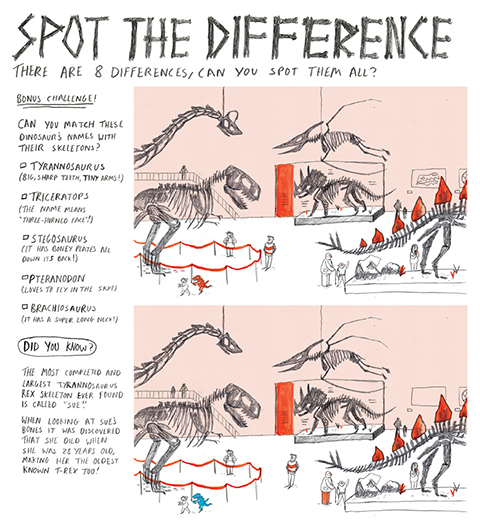
Jenny Tang Spot the Difference Dinosaurs
Jenny tang Spot the Difference Dinosaurs 2
What kind of art do you hope to be making in the future?
At the moment I know I’ve still got a lot to learn and still have an open mind as what to do. However, eventually I would love to become a freelance illustrator or something that would combine both design and illustration together; like children’s publication or editorial. As long as I’m able to draw and design, I’ll know I’ll be a happy person.

Jenny Tang 100 Likes Promo Illustration
Jenny Tang is one of the contibutors to Amelia’s Colourful Colouring Companion, available really really soon on Kickstarter.

Categories ,#ameliasccc, ,Adult Coloring Book, ,Adult Colouring Book, ,Amelia’s Colourful Colouring Companion, ,Bucks New Uni, ,Coloring, ,Coloring Book, ,Colouring, ,Colouring Book, ,illustration, ,interview, ,Jenny Tang, ,Kickstarter, ,Path of the Jaguar, ,Risograph, ,That Which We Do Not Understand

Similar Posts:


Amelia’s Magazine | An interview with Jo Taylor: Amelia’s Colourful Colouring Companion featured artist.

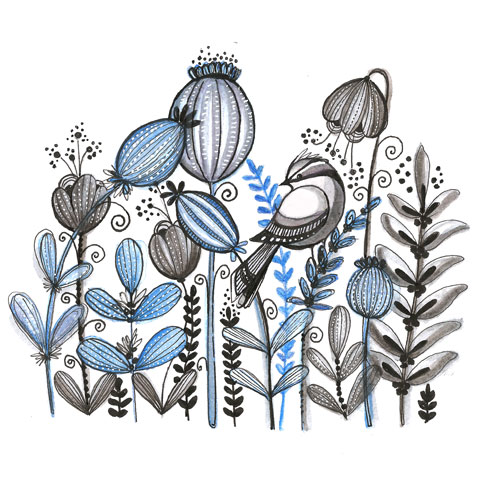
Seeds-and-Pods-Jo-Taylor
Self taught artist Jo Taylor is based in Gloucestershire near the canal, where she creates a diverse range of whimsical illustrations for multiple clients including other colouring book publishers. Her double page of extravagant birds features in Amelia’s Colourful Colouring Companion alongside 43 other artists, available from my Big Cartel shop now. Here she talks countryside inspiration, the joys of a tidy studio and offers inspiring advice to all untrained want-to-be artists.

Me-Drawing-Jo-Taylor
What were your original qualifications and how did you come to make art as an illustrator?
I’ve been working as an illustrator full time since around 2005. I have never had formal training in this field but I’ve always known I had some talent as an artist since I was little. Over the years, prior to being an illustrator, I never really knew what I wanted to do so hopped from college studying computing to working for a computer games company and two web design companies, where I learnt the basics of Photoshop and then on to an art gallery where I started to realise that I could make art that would sell, drawing little pictures in chalk pastel, that they displayed and sold for me. There I also met buyers who were coming to look at the art for use on greetings cards and, through that contact, I had art published on cards and calendars. In early 2000 I was perusing the Writers’ and Artists’ Year Book, on the lookout for more publishers for these. By chance I started reading the section on illustration and thought I’d like to do that as a job. From that point on, I found out as much as I could about it and, in my spare time, I worked on art that I felt would work for an illustration folio. The internet was becoming more and more useful by that time and I joined a brilliant forum. In 2003 I was taken on by an agent who had the foresight to see that my work could eventually be right for the industry and, with her advice, I further improved my folio until regular work started to come in.

Teapots-Jo-Taylor
What advice would you offer someone wanting to enter the illustration industry with no formal training?
There are so many podcasts and blogs giving advice on this subject and probably doing it a lot better than I can. But I would stress that you don‘t need specific qualifications so don’t let not having them stop you. You just need to really, really want to do it and be prepared to put in the time to research and to make art. Podcasts are particularly great because you can listen to advice and work at the same time. When I started illustrating my first job was some black and white drawings for the BBC and I was literally terrified. I have learned so much since then, my drawing skills have improved and I can interpret briefs and produce work much faster but I still have loads to learn. You don’t need to know it all before you start, just get on with it and have fun.
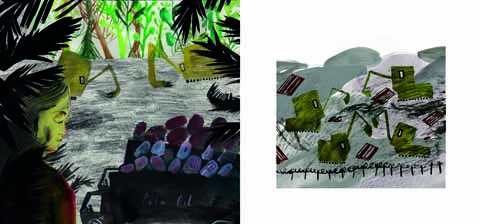
Woodland-Fairy-Jo-Taylor
Where do you live and can you describe what your studio looks like?
I’m really lucky to I have a dedicated studio in my house in Gloucestershire. I live near to the canal and the River Severn and so, although it’s pretty built up with houses on the one side of me, in the other direction it’s beautiful countryside. My studio has been, until recently, a bit chaotic and messy but I’m in the middle of a total makeover. It’s all white walls, wood, natural colours and lots of plants. It’s turning into a lovely space to work in, plus I can actually find things now.

Winter-Seeds-and-Grasses-Jo-Taylor
How does your surroundings influence your work?
I am actually really concentrating on that thought at the moment. As I said, I’ve worked in a muddley, unpretty studio for years but I’m now making into a great space to work and I’m kind of styling it in a way that I hope will inspire my art. As I love drawing organic things I also use the countryside around me to fuel my recent art and I have long walks with my dog every day taking it all in and bringing home bunches of all sorts of plants, grasses and berries. I now want to include local people and places as inspiration for my art as there is so much great stuff to draw.
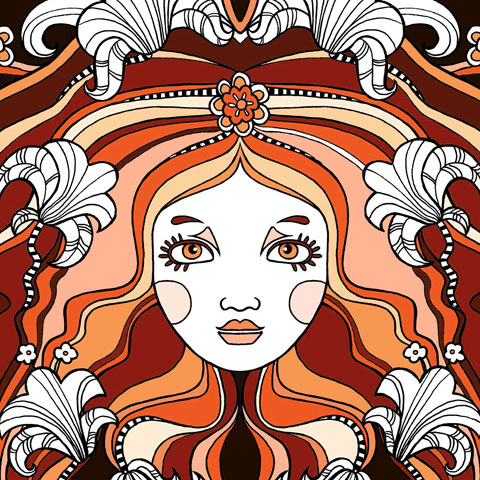
Lavender-Fox-Jo-Taylor
What are your favourite ideas or themes to draw and why?
Plants and flowers, because the lines are gorgeous to draw, I find it almost meditative to make those organic shapes. People – I love people watching and I’m fascinated with the way they decorate themselves, hair, fashion, tattoos, jewellery. Anything organic really, although lately I’m enjoying drawing buildings, now I’ve given myself permission to draw these in my own way rather than with exact perspective and straight lines.

Jo Taylor Double-Page-Spread
What inspired your artwork for my colouring book and how was it made?
I’d been drawing a lot of birds for my daily instagram art and been really enjoying it so I thought I’d continue that theme. I sketched the whole piece up in pencil then, for the black and white side I drew in the lines with a Pitt fine liner then tidied them up in Photoshop. For the colour side I redrew the pencil outline and then coloured it in with a mixture of gouache, felt pens and fine liners.

Blue-Doodle-with-Bird-Jo-Taylor
In what way have you used social media to expand your reach as an artist and do you use it for any other things?
I haven’t used social media half as much as I feel that I should. I do have a website, a Pinterest account, Twitter and a blog but I would like to make more of them. I’ve recently started to regularly put work onto my Instagram account and that has been really useful for making me create work in a new style.

Snippet-from-Sixties-Colouring-Book-Jo-Taylor
You’ve already contributed to other colouring books – how did you get involved with that and what kind of images have you made?
I found colouring book publishers I wanted to work with and sent them in a portfolio. I didn’t actually send black and white line work but my usual coloured illustrations and patterns. I’ve done animals and fashion colouring books for kids. For adults, animals, Scandinavian and Sixties Patterns, Mandalas – and plants and abstract patterns for a selection of calm, soothing type books.

Girls-on-Skateboard-Jo-Taylor
What do you look forward to in 2016?
I’m currently building up a portfolio with an emphasis on beautiful line work and a great palette as I’d love to start working on jobs for magazines and packaging. For the immediate future I have a list of amazing people and businesses I’d like to work with both local and further afield, and my plan is to make that happen.

Me-not-in-my-studio-Jo-Taylor
Fox-Jo-Taylor
How inspiring! Get your copy of Amelia’s Colourful Colouring Companion featuring Jo Taylor from my Big Cartel shop.

Categories ,#ameliasccc, ,Adult Colouring Book, ,Amelia’s Colourful Colouring Companion, ,Big Cartel, ,Colouring Book, ,interview, ,Jo Taylor, ,Writers’ and Artists’ Year Book

Similar Posts: