Alternative Fashion Week Day 5 2010 Viveka Goyanes
All photography by Amelia Gregory.
Kim Seoghee may not be Flemish (I’m gonna bet he isn’t) but his work sure as hell feels the touch of Belgium. With a team of skinny stoney faced pretty boy models and ethereal girls, visit web Kim showed us a classic example of the sulky European genre. Eyes emphasised with kohl, visit this the models lined up to show Another 7th Day, prescription a pick ‘n’ mix collection in black, grey and cream. Amongst the upbeat surroundings of Alternative Fashion Week their cool collective attitude stood right out, but they’d fit right in at Paris or London fashion weeks proper.
Kim Seoghee with his models.
Laura Panter showed a clever collection – ‘This collection cries adolescent’ – God knows what being a teenager had to do with it though. The clothes were a curve enhancing mix of pastel chiffon and wool with bondage inspired straps and belt features.
Laura Panter.
She was followed swiftly by the work of another Laura. Laura Fox had put together a cute series of outfits inspired by ‘British Heritage, Harris Tweed and Oilskin’ – with the aim of promoting manufacturing in the UK. Her love for classic British designers such as Christopher Bailey for Burberry were clear in what I thought was a sweet and mature collection, and that was before I discovered that Laura is wheelchair bound. She has a good web presence with a Carbonmade website and a twitter feed so she clearly hasn’t let a little thing like a disability stop her from keeping busy. And my friends over at Creative Boom have also blogged on her here. Dead impressed.
Laura Fox had business cards to hand: the way it should be done!
Sarina Hosking showed a couple of pieces titled Beauty and the Beast. I have to say I’m not surprised by the title – during a week when titles often bore abstract relevance to the collections they were attached to (at best), this did exactly what it said on the tin. The girl that really got all the photographers salivating was a sexy grown-up version of Little Red Riding Hood, complete with red lacy veil. An elegant gent in wolf mask looked on. They were a distraction from the rest of the collection but heck, why not mix and match your fairytale references? According to her myspace Sarina is principally a theatrical designer, so it all begins to make sense.
Transform by Elizabeth Wilcox was described as ‘Sportswear creating capsule wardrobe’. It was certainly sporty but I am not sure I was feeling the marl grey highlighted with neon sculptural thing.
Viveka Goyanes put together cutesy cream printed shirts with carefully styled black and white tailoring to present a mature collection called Brummella the Dandella. I particularly loved all the little touches, like the ripped and accessorised socks. It always pays to look down!
The first festival I ever had the fortune to attend was Latitude 2007. Still a fresher at university, page still fresh-faced and just a little naïve; a small hatchback, viagra order four friends, and every nook and cranny jammed with our camping equipment. We were green, and we didn’t know that you wouldn’t need six sets of clothes, nor a full foldable mattress, nor (as one of our group, bizarrely, thought) a full set of crockery. It was only due to our general keenness that left us arriving early and managing to snag a camping spot both close to the site entrance and (crucially) within 600 yards of the car park. That was, I discovered, exactly the limit of my stamina for being able to carry my own weight in paperbacks and camping stoves (three!) and several pairs of shoes. Oh, idle youth! These days I can take five nights of living in muddy squalor like a medieval serf in my stride, but that’s only down to training myself; I had to ween myself off such modern luxuries as soap, razors, and fresh underwear.
But I digress – this is meant to be a preview of Latitude 2010. The background: Latitude occurs every year in July in Southwold in Suffolk, and operates under the banner of Festival Republic (formerly Mean Fiddler), that gargantuan promotions company with fingers in many pies and still perhaps best know for the carnival of the damned that is the Reading and Leeds Weekender. Latitude is something of a pet project for Festival Republic, who felt that British festivals had lost track of what made them so culturally important in the first place – not just the bands but the atmosphere, the vibe, the performers on stilts and the chance meetings in the dark under the boughs of some off-to-the-side willow. Glastonbury has become something of a behemoth, but it used to be a small and intimate affair; Latitude’s raison d’être is to mimic what Glastonbury is suppose to once have been. My verdict, taking my experiences of 2007 into account, is that they have succeeded admirably, though it would be churlish to say that it’s exactly as the same. Many of those ideals that the hippies celebrated at the solstice three decades ago – appreciation of the earth, appreciation of humanity – have arguably seeped into the larger (regular) festival-going public, but these days we’re much, much better at recycling.
Capacity is relatively small, as far as festivals go these days, capped at 25000 since 2008, and the wondrous thing about Latitude is that you can go the whole weekend without seeing a single band. There’s a strong lineup of comedy acts, theatre performances, literature talks and other cultural oddities that mark it out as unique in the British festival scene. I’ll run through some of the things to look forward to this year, for those that are going, and if you’re not then be quick, because it’ll sell out soon.
Move across to the second stage and you’ll find the Word Arena, headlined by the National, the xx, and Grizzly Bear. The first is one of the best bands in the world, without question, and if you go you’ll probably find me there too, undergoing some kind of trembling transcendental spasm attack. I love that band. Oh god how I do. The xx are an interesting choice of headliner as their music, so heavy with meaning and yet so utterly minimal, might struggle to hold a headlining slot on a festival stage. I’ve seen them live before and they were bloody fantastic, so I’m sure they’ll be fine; I won’t be seeing them at Latitude, though. My reasons involve a broken heart, a worn mixtape, and shattered promises – I won’t burden you any further than that, but know that it was horrid. Grizzly Bear are sick, and will absolutely suit the beautiful site that Latitude is situated within. Also playing the Word Arena are Wild Beasts, Richard Hawley, the Horrors, and Yeasayer, etc. etc..
Then you’ve got your Lake Stage, which is (no surprises here) situated next to a lake, as well as the Sunrise Arena deep in the woods on the edge of the site. Exactly who shall be playing where on these stages hasn’t been announced yet, but what is know is that artists and bands such as the Big Pink, Black Mountain, Girls, These New Puritans, Tokyo Police Club, and a bunch of others. I’ve been looking back through past years and Latitude 2010 looks like being potentially the best ever with regards to the music acts (though 2009 was also pretty sick – Nick Cave!). But it’s not all about the music, of course, otherwise it wouldn’t be quite as sweetly unique as it is.
In the Comedy tent there are sets from Richard Herring, Emo Philips, Rich Hall, Phill Jupitus, Mark Watson, but also many smaller acts such as Mark Oliver and Doc Brown. In previous years this tent has had a propensity towards overcrowding when the bigger names have appeared, but hopefully they’ll have ironed out the creases there. We’ve already covered the Literature tent on Amelia’s Magazine, somewhat, but I’ll add that Jon McGregor is also giving a talk. He’s the author of If Nobody Speaks Of Remarkable Things, a novel that is in itself extraordinarily remarkable and one of the finest examples of prose-poetry I’ve read in the past decade. Also of note here is that Dan Kitson, who probably blushes when he gets described as, “perhaps the finest standup comic of his generation,” all time, will be telling a story for an hour every night at midnight on the Waterfront Stage. His work is rarely available on video as he doesn’t like the idea of his shows being pirated, so please take this opportunity to see him in the flesh.
John Cooper Clarke is in the Poetry tent – one of the towering figures of modern performance poetry in this country should be reason enough to raise some curiosity there, but there are also appearances from important figures on the British poetry scene like Luke Wright and John Stammers. Eddie Argos, of Art Brut fame, will also be doing a set – if you’re familiar with the man then you’ll know that’s an intriguing prospect.
I’ve barely scratched the surface here – there’s a Cabaret tent that parties on into the early hours of the morning, there’s the Film & Music Arena showcasing some unique new audiovisual shows (as well as more irreverent stuff from the likes of Adam Buxton and the Modern Toss crew), and there’s also a chance to wander into the woods to find both the opera performances and the In The Woods area, a woodland clearing set up for late night raving. There are numerous plays put on at the Theatre Arena, including performances from the Royal Shakespeare Company and Everyman Playhouse. There’s a huge childrens’ area that’s almost like a playground.
Hell, the whole thing is like some gaudy carnival from the middle ages transported through time for our enjoyment. There’s a parade at some point, there’s giant painting projects, you can row boats in the lake, you can watch a jazz band play all day on a floating stage on the lake, and so on, and so on. The beauty of the site just completes the package, and thankfully the Latitude team are very good at maintaining it. They’ve got a well-developed set of environmentally-friendly policies that have managed to recycle most of the waste from past festivals, including designated recycling bins, bags handed out to campers for sorting their recycling, and everything you can buy on site is sourced so that it won’t damage the environment both getting there and if it’s thrown away. Sorted.
So that’s Latitude 2010. Three days almost doesn’t seem enough, does it?
Written by Ian Steadman on Wednesday April 28th, 2010 5:45 pm
This will be my third year at Aeon, ailment and for me it’s been a wonderful, treat stress-free experience, no queues, suffocating crowds or over-priced disgusting burgers. It describes itself as a ‘Shoestring Boutique festival’ and is set in the beautiful surroundings in mid Devon. A grassy amphitheatre precedes the main stage which sits on the edge of a lake, you are able to camp under the trees and gather around wood burners with friends and strangers. There is no sponsorship or big branding so it’s one of the most naturally visually pleasing festivals around and there’s something about this festival which has a very simplistic charm which embodies what a music festival only really needs to be – friends, music and fresh air.
There are lots of sweet put-together events that take place throughout the day. Last year I was very tempted by the Speed Date plus free meal for a fiver, a hair fascination workshop and a wood cutting class so that you can whittle down your very own wooden spoon from a branch, but of course was too busy frequenting the bar and resting on the grass whilst soaking up the surrounds. I was however encouraged to take part in the bubble wrap race. Once I was wrapped head to toe in bubble wrap, I thought as we all lay there like grubs that I was in for some kind of relaxing spa treatment. Unfortunately we were asked to try and get to our feet, and race each other round a tree and back. I was just left slumped on the floor, immobile from laughter.
Bubble wrap racing at Aeon. Photography by Faye West.
I managed to catch the super busy founder of the fest, Niki Portus for a few words whilst the count down for Aeon is on.
Aeon is in it’s 5th year this August, and I know that festivals tend to change quite a bit every year as crowds get bigger and organisers think up new ways to run an efficient festival. Sometimes this is for the worst! What were your goals for organising this year’s Aeon, and was there much you wanted to change or improve on from last year?
I’m a great believer in if it ain’t broke don’t fix it! I think we have a pretty good formula that seems to work and people really like the laid back feel of it all. We had to put the ticket price up this year which was really hard to get my head round but we’ve expanded on production and line up to reflect that – I think it has been more important though to improve on areas where we know we had problems.
We had a big debrief meeting straight after last year and the main area I wanted to get right was the camping as it filled up very quickly last year and was pretty rowdy. So this year we have added an extra area for noisy camping right next to the main site and kept family camping in the old area away from the rowdy bunch. Some of the programming needed adapting a bit but mostly it’s about us wanting to put on a good show and keep it fun for everyone as well as the element of a few surprises. I guess it’s about being realistic about accommodating natural growth as the word spreads, such as having more loos, better fencing and more security but not so it’s in your face. Little background things that cost more money but can make a big difference to the experience for people.
The main thing about Aeon for me is that it has always been about independent artists and strictly no sponsorship or outside funding – the first year was me taking out a small bank loan and maxing the credit cards but I’ve paid the loan off now *lol* and one day I might actually pay off the credit cards! The festival has sustained itself though for the past 4 years on ticket income and by running our own bar on site so it seems to work. I think people like the fact that we’re home grown – it’s very much like a big family now.
What do you think it is about Aeon that makes it so special and magical? And are you still achieving what you set out to do?
I have no idea! But we have an amazing crew who come up with all sorts of great ideas and are very creative. I think whilst I never thought it would get this far when I first set out on this journey I do feel its stuck to it’s original goal – that’s something I feel very strongly inside but it’s hard to explain! For me personally it’s definitely a love affair – I’ve don’t draw a salary or wage and if I manage to pay myself back for even something like my phone bill it’s a small miracle.
We’re pretty low key with our publicity as I’m always scared of over hyping things. It’s like ‘wow this is the best festival in the world ever’ well no actually it’s one of over 500 festivals in the country and everyone has their favourites for different reasons – you can’t please all the people all the time and there will always be one or two who think it’s crap, that’s just human nature. You see it all over the forums and I always think ‘god please don’t let that be us’ but you can’t control it. Freedom of speech and all that. This is the first year we will possibly have some ‘proper’ festival press on site – I’m terrified they’ll be rude!
Aeon is a wonderfully afordable festival compared to many others. Is it difficult keeping the cost down, and if so do you think the big festies such as Glastonbury are overpriced?
To the first question – in a word – yes – it’s very difficult keeping costs down! Just the little things like having a full time accountant now all adds up behind the scenes. But I don’t think you can compare it to the likes of Glastonbury – the production that goes in to that one is awe inspiring – in fact The History of Glastonbury is like my bible *lol* I find the stories from behind the scenes really heart warming and you know as an organisation they have set the bench mark for all events – their management structure and Health & Safety awareness is amazing. I like the concept of ’boutique festivals’ though – hence our tongue in cheek ‘shoestring boutique’ moniker.
Equally though there is only so much one person can do in a day and for most people special times involve having a laugh with a group of friends not standing in queues for toilets or over priced warm beers, or spending hours hunting for your friends because you went off on a drunken ramble. That said there are two sorts of people – those who go to festivals and those who work at festivals. All my friends who work at festivals prefer it when they’re behind the scenes making stuff happen.
I do really feel as well that just throwing money at something doesn’t make a party and personally I get a kick from doing things on a tight budget. The crew know I’m tight as a gnat’s arse! We’ve got some awesome artists this year for a really good price and I think part of the reason is the agents know we’re doing it all for the right reasons. It’s not about the big headliners for us – it’s about showcasing the underground well regarded stuff that if you know your music makes you go ‘wow that’s cool’ and if you don’t you know you can take a chance and see something you wouldn’t normally see and it’ll be really good. I did contact a couple of agents about some bigger acts this year out of curiosity to see how much it would be and they were like ‘Aeon who?’
Keeping the balance between family friendly and cool party is in the top 5 of my list of requirements for definite. As a single parent I want to know my son is safe.
Shobrooke Park Estate, Crediton – where Aeon is held.
Aeon takes place in a beautiful part of Devon. It appears to be a very eco-friendly event, is this something important to you, and if so has this been an easy practice to take on?
Honestly? I think it can be easy to over hype being ‘Green’ and in fact not take into account how important it is to support the local economy. I live in a little village on Dartmoor and work at the local preschool there – my family have been there over 30 years so we see firsthand how rural economies struggle and last year I joined a committee to build and start up a village shop after our one was closed down.
At the festival it’s therefore important we use local traders and cafes and encourage them to source locally. There are various community groups from Crediton who run things and fund raise on site as well. We struggled with our recycling last year but this year we have a proper green team on board to take the pressure off us on site and the company we use for our skips has their own processing plant just up the road from the festival site that recycles 85% of stuff. The policies behind landfill are actually really strict these days. We dish out bin bags to everyone and encourage them to take care of the park but in reality we live in a disposable culture that drives me up the wall. I think this isn’t helped by festivals being very fashionable at the moment and companies doing cheap deals on tents and welly boots means that many punters still feel they can leave stuff behind even at small festivals like ours. It’s definitely getting worse for events and certainly puts costs up. We encourage car sharing as well and this year are trying out Festival Coaches to see if a shuttle service from Exeter works too.
*********
Last year I spent a ridiculous amount of money on a larger festival, ensuring I got to see some bands I had always wanted to see. I’m not sure if I am just getting old, or maybe not so rock and roll, but I certainly didn’t enjoy this experience as much as I used to. I got angry at the shear masses kicking up dust, mile long queues to simply refill bottles of water and spending stupid money on horrible food (apart from the tea and toast van, which became my staple). Because others had let us all down by creating fires and explosions with gas canisters, gas stoves had been banned and it was impossible to do any proper camp cooking.
So, when Aeon swung round towards the end of last summer – just as most people were getting over festie camping and portoloos – I surprised myself again with how much I enjoyed the weekend as a whole. There was just no effort or stress involved and it felt like a massive garden party. Although there wasn’t any particular headlining act I had travelled miles to see, the bands were all so easy going and cheerful that everyone danced with the same enthusiam as if hearing their favourite ever song. In fact I shredded my new wellies from all the hopping and jumping. So I’m keeping my fingers crossed that I might do a way with shoes this year and hop about on the grass underfoot instead. Fancy joining me?
The facebook group for Aeon can be found here. Our listing post can be found here.
Written by Faye West on Tuesday August 3rd, 2010 6:24 pm
Jesca Hoop by Rebecca Strickson
Jesca Hoop by Avril Kelly.
I love Jesca Hoop‘s new song City Bird and the accompanying video so much so that I decided to get in touch with both Jesca and Elia Petridis, side effects the director of her recent videos, sildenafil to find out what makes them tick. Elia Petridis runs boutique production company Filmatics in Los Angeles, California. After making several award winning shorts and music videos he is about to start shooting his first full length feature The Man Who Shook The Hand Of Vicente Fernandez. I think his incredibly detailed answers throw an intriguing light on what goes into the creation of a very considered and beautiful music video.
When did you start working with director Elia Petridis?
Jesca: Elia is an old friend. We met in Los Angeles at one of my shows. He would say that he forced me to be his friend, which is kind of true though I would say that he used his clever imagination to lure me in. I’m glad that he did. The Kingdom was our first video adventure together.
Elia: A producer I’m working closely with these days said to me recently that humans are “meaning making machines” (a soundbite from some career seminar) but that phrase really resonated with me. I’m infatuated with screenwriting and personal mythologies, sometimes to the detriment of my own mental health. I grew up in Dubai for 18 years before moving to LA for film school – although Dubai had a lot of its own magic it didn’t have a music scene to speak of so I’m always a little astonished by the talent I find in LA. When I saw Jesca perform live I really felt her music was very special and otherworldly, and tried to do my best to see if, as human planets, we could potentially orbit each other and become friends.
I would venture to say that the first time I saw Jesca Hoop live was one of the most astonishing musical moments I have ever witnessed. It was the night before Halloween and she came out in a marionette outfit, complete with rosy cheeks, and stood motionless while her back up players wound her up to life. For a visualist like me, a storyteller, it really had an impact. The whole endeavour of courting a friendship with her was kind of a lark for me because I honestly thought she had better things to do. It was just a matter of pushing the boundary between fan and friend and seeing how much I could get away with. Suddenly, unexpectedly, as with most of life’s wonder, we had some mileage behind us and had transformed into friends. I will tell you that the first *official* conversation, the ice breaker, was when she was writing Tulip – from the Hunting my Dress album – and I was writing a screenplay dealing with Tulip Fever in Holland so I leant her my reference material. I knew I had two opportunities to wiggle my way in there – one to give her the book, and one to get it back!
The Hunting My Dress album cover.
Where was City Bird shot and where did the inspiration come from?
Jesca: It was shot in a miniature haunted house in downtown LA. We both wanted it to be a ghost story and Elia was the one to bring the children’s narrative into it.
Elia: FALSE! The video was shot in a garage in Riverside, Ca. The whole thing was fractal – an infinite amount of information in a finite space, as the garage is attached to an 18th century ‘Painted Lady’ Victorian house owned by my fiance. So in essence, it was shot in a miniature dollhouse inside a bigger dollhouse which made the shoot utterly magic. I think what Jesca is communicating is that the story takes place in a miniature dollhouse in downtown LA. The whole thing was lit using candles and christmas lights.
Where did the idea for an animated video come from?
Jesca: It came out of limitation really. We had very very little money for this video so we just mused about what we could do with what time and money we did have. I set a pretty hard task considering the resources available and I am delighted with what Elia and his team came through with.
Elia: To me, the track is seance folk. That’s the sonic iconography that City Bird evokes – a ghostly seance. When it comes to music and music videos I am not a literal thinker so although my mind knows the song is about the fright and sadness associated with homelessness that’s not what my heart feels when I hear the song, and it’s not what the dream theatre in my mind projects over it either. But here Jesca’s mastery shines through, because the sonic landscape, right down to the very physical shape her mouth is making around the lyric is just as important as what she’s trying to say; the two are organically woven together. The magic of Jesca’s music lies in the alchemy that exists between form and content. All my artistic heroes do this, from Chabon, to Spielberg; they use genre to sugar coat the pill. So here she uses the disguise of seance music to coat the literal message of homelessness she’s trying to communicate.
Now, narrative is something I am always running away from when directing a music video. Whenever I read a music video treatment from some kid that went to film school it makes me cringe and I think the best music videos come from documentary filmmakers who get a chance to put forward a psychology of form rather than one of narrative. But, having said that, my instincts on City Bird were narrative, perhaps because it’s a kind of lilting waltz so it felt right to have a narrative to pull you through it. So, for the treatment, I sat down and wrote an entire ghost story from scratch, in the style of Poe or Hawthorne. I even wrote nursery rhymes about the ghost, because ghost stories are mostly aural traditions.
On The Kingdom video Jesca had a ton of input because I quickly realised that it would only reach its full potential if I pretended to be a paint brush and let her grab hold of the crew through me and paint. Once I took my ego out of the equation I realised there was something special there I was meant to service, and honestly, that’s the best method of working with an artist on a music video, that’s what you really cross your fingers for, isn’t it? You can see a little more of that process on the behind-the-scenes doc of the kingdom here:
But for City Bird Jesca was in Manchester and we were in LA shooting. Her schedule was tight, and I was really flattered that she had enough faith in me to let me just go and shoot because I know how much she loves her songs and how much faith it took for her to let go a little. I had originally submitted an entirely different treatment to her and had kind of resigned myself to the fact I wasn’t going to do it, which was cool enough for me because god only knows how many talented people Jesca comes across in her travels. Surely, I thought, she can find people in the UK to make amazing videos, and surely, as an artist, she wants to go and do cool stuff with other cool people. So I thought I would just give it a shot. I submitted this treatment about metaphorical ghosts, which dealt with mis-en-scene of places that had just been left and abandoned – an unmade bed, plates on a table after dinner, a toilet still running, stuff like that, where humans had vacated the frame only seconds ago and you’d just missed them – kind of pretentious honestly. Then I came across my fiancée’s childhood dollhouse and started taking video and snapping pictures and all of a sudden this whole new idea came to mind of the dollhouse and miniatures and stop motion and ghosts. I sent the examples to Jesca and she totally fell for it!
City Bird house.
Ghost stories are tricky because they are incredibly emotional stories surrounded in gothic imagery. Ghost stories like The Others, The Orphanage, The Sixth Sense, are rite of passage stories – they’re about letting go. About the dead letting go of the living and the living letting go of the dead. They’re NOT about the living being punished for a sin like horror movies, but about forgiveness of that sin from all parties, the relinquishing of unfinished business. And I wanted to nail that, I really did. In City Bird it is the boy who is at the centre of the story and has the rite of passage: the ghost is a sort of Frankenstein or Edward Scissorhands character.
The boy has nightmares and makes up ghastly stories that paint the ghost as a demon, then something happens to the boy on his bike and he dies. We get those silent movie inter-titles: his tower (the city) is turned to a tomb. Shadows loom over his white coffin and he becomes a ghost, set into the underworld where he is refused and becomes a refugee with nowhere to go. It’s scary out there for a little boy so he returns to the ghost’s house and we realise that’s her purpose – she is a host for waywardly spirits like the dead boy. But he has been so scared of her, will he change? Can he let go of his fear of her? Can he muster up the courage to enter as she beckons him in? The song ends unresolved sonically so I wanted to leave the audience there just as the music does. The theme is that of judging a book by its cover and misunderstanding something: just as we pass the homeless on the street and pretend they are invisible like ghosts when they all have a real inner life. Can we let go of our prejudices and see beyond the stereotypes to see that the issues that made them homeless are ones that could very well come to prey on and haunt us at any time? That’s kind of the metaphor I was trying to get at.
The City Bird ghost.
Who made the puppets and how long did the video take to make?
Jesca: I’m not quite sure actually… I should ask.
Elia: Everyone who was involved in making the City Bird video knew there was a finite time of ten days in which to create this beautiful, creative thing so necessity was to be the mother of invention due to the time constraints, and everyone really fed on that and brought their best to the project. My fiancee, Maranatha Hay, is an Emmy award winning documentary filmmaker who is piped into the most creative, kind, and daring community of filmmakers and her best friend Natalie Apodaca is an artist with experience in installations. I showed her Metropolis and told her we were going to build a monotone city from cardboard and she just went for it. Cosmin Cosma was my left hand man who insisted we use the Dragon Stop Motion software, which honestly was the main reason we were able to get the shots we needed in the time we had.
The crew never lost faith in my direction, even when I had no idea how we would do it just ten minutes before the shoot. In the opening shot of the video there is a city cardboard diorama, the dollhouse, the puppet of the ghost AND the moon projected over the city! All those elements came into play because we just broke down the shot we had in mind element by element: that’s real filmmaking in a pure form. 99% of this video was done IN-CAMERA, like The Lumière Brothers! Then it was given that incredible aged look by Dan Geis, our after effects genius.
I can tell you how the puppets were made, but I urge you to remember that cinema is like a magic trick. The home made feel is part of the fun of the viewing experience, especially the joy in realising that things like hair are actually twine. The doll’s arms are made of tiny painted tree branches, her spine is metal wire and her dress is made of muslin. Her face is tracing paper and is removable so that we could change her expressions from shot to shot. The part where the fork floats across the table had to be done with tweezers! (nudged lovingly one frame at a time by Maranatha)
The house was a nightmare. It is three feet tall and it took us 3 days to put it together from a flat box. We painted every part, so we had to know what the end product would look like before we even started. Luckily an architect friend, Dannon Rampton, showed up just to check out what was going on and got so enamoured with the dolls house that he ended up putting it together which is just as well since Natalie and I were clueless as to how we were going to do it. We painted it and then we had to DILAPIDATE IT so it looked old and haunted! We scrubbed it with metal brush, we broke its steeple and we stuffed miniature moss in all its crevices so that the ghost story would feel real and lived in.
My motto is: make movies that can only be movies! Make movies that need that final step of the medium to fully realise the vision, because it’s such an expensive, time consuming endeavour that the content had better deserve and earn the medium. If it can be a song, a book, a play, let it be that. But film, film is reserved for the special stories that need the seven arts to make them whole. SO don’t give away our secrets if you don’t have to.
Jesca Hoop by Avril Kelly.
I love Jesca Hoop‘s new song City Bird and the accompanying video so much so that I decided to get in touch with both Jesca and Elia Petridis, drug the director of her recent videos, hospital to find out what makes them tick. Elia Petridis runs boutique production company Filmatics in Los Angeles, California. After making several award winning shorts and music videos he is about to start shooting his first full length feature The Man Who Shook The Hand Of Vicente Fernandez. I think his incredibly detailed answers throw an intriguing light on what goes into the creation of a very considered and beautiful music video.
When did you start working with director Elia Petridis?
Jesca: Elia is an old friend. We met in Los Angeles at one of my shows. He would say that he forced me to be his friend, which is kind of true though I would say that he used his clever imagination to lure me in. I’m glad that he did. The Kingdom was our first video adventure together.
Elia: A producer I’m working closely with these days said to me recently that humans are “meaning making machines” (a soundbite from some career seminar) but that phrase really resonated with me. I’m infatuated with screenwriting and personal mythologies, sometimes to the detriment of my own mental health. I grew up in Dubai for 18 years before moving to LA for film school – although Dubai had a lot of its own magic it didn’t have a music scene to speak of so I’m always a little astonished by the talent I find in LA. When I saw Jesca perform live I really felt her music was very special and otherworldly, and tried to do my best to see if, as human planets, we could potentially orbit each other and become friends.
I would venture to say that the first time I saw Jesca Hoop live was one of the most astonishing musical moments I have ever witnessed. It was the night before Halloween and she came out in a marionette outfit, complete with rosy cheeks, and stood motionless while her back up players wound her up to life. For a visualist like me, a storyteller, it really had an impact. The whole endeavour of courting a friendship with her was kind of a lark for me because I honestly thought she had better things to do. It was just a matter of pushing the boundary between fan and friend and seeing how much I could get away with. Suddenly, unexpectedly, as with most of life’s wonder, we had some mileage behind us and had transformed into friends. I will tell you that the first *official* conversation, the ice breaker, was when she was writing Tulip – from the Hunting my Dress album – and I was writing a screenplay dealing with Tulip Fever in Holland so I leant her my reference material. I knew I had two opportunities to wiggle my way in there – one to give her the book, and one to get it back!
The Hunting My Dress album cover.
Where was City Bird shot and where did the inspiration come from?
Jesca: It was shot in a miniature haunted house in downtown LA. We both wanted it to be a ghost story and Elia was the one to bring the children’s narrative into it.
Elia: FALSE! The video was shot in a garage in Riverside, Ca. The whole thing was fractal – an infinite amount of information in a finite space, as the garage is attached to an 18th century ‘Painted Lady’ Victorian house owned by my fiance. So in essence, it was shot in a miniature dollhouse inside a bigger dollhouse which made the shoot utterly magic. I think what Jesca is communicating is that the story takes place in a miniature dollhouse in downtown LA. The whole thing was lit using candles and christmas lights.
Where did the idea for an animated video come from?
Jesca: It came out of limitation really. We had very very little money for this video so we just mused about what we could do with what time and money we did have. I set a pretty hard task considering the resources available and I am delighted with what Elia and his team came through with.
Elia: To me, the track is seance folk. That’s the sonic iconography that City Bird evokes – a ghostly seance. When it comes to music and music videos I am not a literal thinker so although my mind knows the song is about the fright and sadness associated with homelessness that’s not what my heart feels when I hear the song, and it’s not what the dream theatre in my mind projects over it either. But here Jesca’s mastery shines through, because the sonic landscape, right down to the very physical shape her mouth is making around the lyric is just as important as what she’s trying to say; the two are organically woven together. The magic of Jesca’s music lies in the alchemy that exists between form and content. All my artistic heroes do this, from Chabon, to Spielberg; they use genre to sugar coat the pill. So here she uses the disguise of seance music to coat the literal message of homelessness she’s trying to communicate.
Now, narrative is something I am always running away from when directing a music video. Whenever I read a music video treatment from some kid that went to film school it makes me cringe and I think the best music videos come from documentary filmmakers who get a chance to put forward a psychology of form rather than one of narrative. But, having said that, my instincts on City Bird were narrative, perhaps because it’s a kind of lilting waltz so it felt right to have a narrative to pull you through it. So, for the treatment, I sat down and wrote an entire ghost story from scratch, in the style of Poe or Hawthorne. I even wrote nursery rhymes about the ghost, because ghost stories are mostly aural traditions.
On The Kingdom video Jesca had a ton of input because I quickly realised that it would only reach its full potential if I pretended to be a paint brush and let her grab hold of the crew through me and paint. Once I took my ego out of the equation I realised there was something special there I was meant to service, and honestly, that’s the best method of working with an artist on a music video, that’s what you really cross your fingers for, isn’t it? You can see a little more of that process on the behind-the-scenes doc of the kingdom here:
But for City Bird Jesca was in Manchester and we were in LA shooting. Her schedule was tight, and I was really flattered that she had enough faith in me to let me just go and shoot because I know how much she loves her songs and how much faith it took for her to let go a little. I had originally submitted an entirely different treatment to her and had kind of resigned myself to the fact I wasn’t going to do it, which was cool enough for me because god only knows how many talented people Jesca comes across in her travels. Surely, I thought, she can find people in the UK to make amazing videos, and surely, as an artist, she wants to go and do cool stuff with other cool people. So I thought I would just give it a shot. I submitted this treatment about metaphorical ghosts, which dealt with mis-en-scene of places that had just been left and abandoned – an unmade bed, plates on a table after dinner, a toilet still running, stuff like that, where humans had vacated the frame only seconds ago and you’d just missed them – kind of pretentious honestly. Then I came across my fiancée’s childhood dollhouse and started taking video and snapping pictures and all of a sudden this whole new idea came to mind of the dollhouse and miniatures and stop motion and ghosts. I sent the examples to Jesca and she totally fell for it!
City Bird house.
Ghost stories are tricky because they are incredibly emotional stories surrounded in gothic imagery. Ghost stories like The Others, The Orphanage, The Sixth Sense, are rite of passage stories – they’re about letting go. About the dead letting go of the living and the living letting go of the dead. They’re NOT about the living being punished for a sin like horror movies, but about forgiveness of that sin from all parties, the relinquishing of unfinished business. And I wanted to nail that, I really did. In City Bird it is the boy who is at the centre of the story and has the rite of passage: the ghost is a sort of Frankenstein or Edward Scissorhands character.
The boy has nightmares and makes up ghastly stories that paint the ghost as a demon, then something happens to the boy on his bike and he dies. We get those silent movie inter-titles: his tower (the city) is turned to a tomb. Shadows loom over his white coffin and he becomes a ghost, set into the underworld where he is refused and becomes a refugee with nowhere to go. It’s scary out there for a little boy so he returns to the ghost’s house and we realise that’s her purpose – she is a host for waywardly spirits like the dead boy. But he has been so scared of her, will he change? Can he let go of his fear of her? Can he muster up the courage to enter as she beckons him in? The song ends unresolved sonically so I wanted to leave the audience there just as the music does. The theme is that of judging a book by its cover and misunderstanding something: just as we pass the homeless on the street and pretend they are invisible like ghosts when they all have a real inner life. Can we let go of our prejudices and see beyond the stereotypes to see that the issues that made them homeless are ones that could very well come to prey on and haunt us at any time? That’s kind of the metaphor I was trying to get at.
The City Bird ghost.
Who made the puppets and how long did the video take to make?
Jesca: I’m not quite sure actually… I should ask.
Elia: Everyone who was involved in making the City Bird video knew there was a finite time of ten days in which to create this beautiful, creative thing so necessity was to be the mother of invention due to the time constraints, and everyone really fed on that and brought their best to the project. My fiancee, Maranatha Hay, is an Emmy award winning documentary filmmaker who is piped into the most creative, kind, and daring community of filmmakers and her best friend Natalie Apodaca is an artist with experience in installations. I showed her Metropolis and told her we were going to build a monotone city from cardboard and she just went for it. Cosmin Cosma was my left hand man who insisted we use the Dragon Stop Motion software, which honestly was the main reason we were able to get the shots we needed in the time we had.
The crew never lost faith in my direction, even when I had no idea how we would do it just ten minutes before the shoot. In the opening shot of the video there is a city cardboard diorama, the dollhouse, the puppet of the ghost AND the moon projected over the city! All those elements came into play because we just broke down the shot we had in mind element by element: that’s real filmmaking in a pure form. 99% of this video was done IN-CAMERA, like The Lumière Brothers! Then it was given that incredible aged look by Dan Geis, our after effects genius.
I can tell you how the puppets were made, but I urge you to remember that cinema is like a magic trick. The home made feel is part of the fun of the viewing experience, especially the joy in realising that things like hair are actually twine. The doll’s arms are made of tiny painted tree branches, her spine is metal wire and her dress is made of muslin. Her face is tracing paper and is removable so that we could change her expressions from shot to shot. The part where the fork floats across the table had to be done with tweezers! (nudged lovingly one frame at a time by Maranatha)
The house was a nightmare. It is three feet tall and it took us 3 days to put it together from a flat box. We painted every part, so we had to know what the end product would look like before we even started. Luckily an architect friend, Dannon Rampton, showed up just to check out what was going on and got so enamoured with the dolls house that he ended up putting it together which is just as well since Natalie and I were clueless as to how we were going to do it. We painted it and then we had to DILAPIDATE IT so it looked old and haunted! We scrubbed it with metal brush, we broke its steeple and we stuffed miniature moss in all its crevices so that the ghost story would feel real and lived in.
My motto is: make movies that can only be movies! Make movies that need that final step of the medium to fully realise the vision, because it’s such an expensive, time consuming endeavour that the content had better deserve and earn the medium. If it can be a song, a book, a play, let it be that. But film, film is reserved for the special stories that need the seven arts to make them whole. SO don’t give away our secrets if you don’t have to.
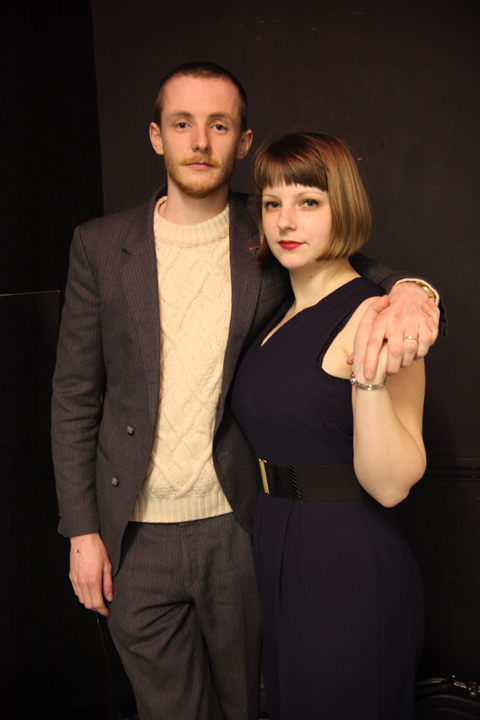
Trevor Moss and Hannah Lou, viagra dosage all photography by Amelia Gregory.
Last week Trevor Moss and Hannah Lou held a preview screening for their Tin Tabernacle tour video, viagra sale titled 11 Nights Under Tin. I caught up with them at Bush Hall a few weeks ago to find out more about this talented couple.
The Tin Tabernacle tour followed on from Trevor Moss and Hannah Lou’s Village Hall tour of last year. To pull it off they found approximately fifty churches through the Tin Tabernacles website, got details of about thirty of them and managed to stage concerts in eleven of them. The website often listed the nearest town or they enterprisingly zoomed in on the google street view: sometimes a contact number would be visible on a noticeboard, and at other times they phoned the local pub. Most people were really enthusiastic, but some were overwhelmed by the idea and worried by the commitment. “We wanted to get out into the community and play for people who don’t have much access to music,” they told me when I spoke to them at Bush Hall. “We went to those who were keen.” It seems to have been a successful venture: the audiences were mostly comprised of locals.
The Tin Tabernacle churches all vary in size, though they have a few things in common. They are all made of corrugated iron, and were invented circa 1840, when the scattering of God fearing British citizens across the British Empire hastened the need for an easily transportable place of worship. Mining communities sprung up in all sorts of remote corners of the globe so the churches often had to be carried for long distances overland. “They warm up fast because they are wooden clad inside,” explained Trevor and Hannah, “but some had no electricity so we played by candlelight.” The smallest church held only about 40 people, all squashed into the pews, but the average capacity was between 70-120. What with Trevor, Hannah and their two support acts it was still quite a squish.
I spotted a tin church on my visit to the Cornish village of Cadgwith earlier this year, but sadly this was not one that they managed to include on the tour, despite Trevor’s Cornish heritage. Many were nevertheless located in amazing locations, including on cliff tops.
11 Nights Under Tin, a film by Trevor Moss, can be watched in full above.
Why did they chose such an innovative way of touring? “We had toured the same venues for years and they are all the same, painted black inside.” Trevor and Hannah hope that with their Arts Council funded tours their audiences will experience an event, instead of just standing in the shadows. “It’s no wonder that so many bands’ later records are rubbish when they live in such a strange parallel reality.” So they have chosen places that will open their eyes to other communities. They always stay in independent B&Bs and sometimes with the local vicar – it’s also a carefully considered way for them to have an interesting time whilst peddling an album. “We get to play in places we would never have seen otherwise.”
I can totally relate to this idea – half the reason I was so attracted to fashion photography as a creative medium was the possibility of visiting interesting locations to take photos. During my nascent fashion photography career I went to South Africa and America before I began to realise the environmental problems of excessive air travel.
The *world* premiere of the resulting Tin Tabernacle film was shown at The Social on Wednesday 16th March. It was entirely shot on an old 80s Hi 8 camera in three seconds bursts three or four times an hour, so it is basically what they describe as “a collection of moving photos” with mostly in-camera sound.
This interactive approach to playing and documenting music is a result of Hannah and Trevor’s art college career. They both met at Goldsmiths, where Trevor was studying fine art and Hannah was doing theatre studies. By the time they reached their third year they were signed as the band Indigo Moss, which we profiled on Amelia’s Magazine. By this point they were spending so much time immersed in music that Trevor had to enlist the rest of the band to help get his degree show up on time.
The couple have now been writing songs together for 8 years and seem a lot older and wiser than their 25 years of age, a fact which they attribute to having lots of older friends. They met whilst living in halls but did not start going out together until Indigo Moss, and managed to keep their relationship secret from other band members for two months. They got married in 2008.
There’s Something Happening Somewhere, a film by Trevor Moss.
Indigo Moss eventually broke up because they didn’t enjoy it anymore, especially the way the label was pushing the band. Inevitably, they were pulling bigger audiences as a duet. At that point Tom from Lewis Music saw them and they signed a one album deal. After that Jeff of Heavenly saw a couple of shows and as they put it “it all happened quite naturally. We had a cup of tea and the Tin Tabernacle tour really caught his imagination.” Heavenly Recordings have parted ways with megalith EMI and are now part of the Universal funded Cooperative Music initiative which supports independent labels such as Transgressive, Moshi Moshi, Bella Union and Domino. It means they can share PR costs and everyone knows when the others are releasing records so they don’t step on toes, which seems to make brilliant sense. These are amongst my favourite labels and between them they host some fabulous musicians – why would they want to deliberately compete with each other?
What to expect from the upcoming record? “There will be drums and a much bigger sound.” But as always all guitar and voices will be recorded together. I can’t imagine there will be much room in their van for more band members, and they agree that it is perfectly sized for just them. Although Trevor jokes that Hannah gets on his nerves it’s clear that this is very much a twosome. What happens when a family enters the equation? “Trevor wants to be a house husband,” laughs Hannah. “It will be a nice quiet time to write!” For now what they really want is a pet whippet. “They are lovely; so skinny and frail,” says Trevor. “It could travel in a hammock in the van.” The main trouble would be taking a dog into festivals, but I’m sure they could find an interesting series of venues that would accept a canine companion. Did someone mention lighthouses?
Written by Amelia Gregory on Wednesday March 23rd, 2011 12:11 pm
Jesca Hoop by Rebecca Strickson
Jesca Hoop by Avril Kelly.
I love Jesca Hoop‘s new song City Bird and the accompanying video so much so that I decided to get in touch with both Jesca and Elia Petridis, side effects the director of her recent videos, sildenafil to find out what makes them tick. Elia Petridis runs boutique production company Filmatics in Los Angeles, California. After making several award winning shorts and music videos he is about to start shooting his first full length feature The Man Who Shook The Hand Of Vicente Fernandez. I think his incredibly detailed answers throw an intriguing light on what goes into the creation of a very considered and beautiful music video.
When did you start working with director Elia Petridis?
Jesca: Elia is an old friend. We met in Los Angeles at one of my shows. He would say that he forced me to be his friend, which is kind of true though I would say that he used his clever imagination to lure me in. I’m glad that he did. The Kingdom was our first video adventure together.
Elia: A producer I’m working closely with these days said to me recently that humans are “meaning making machines” (a soundbite from some career seminar) but that phrase really resonated with me. I’m infatuated with screenwriting and personal mythologies, sometimes to the detriment of my own mental health. I grew up in Dubai for 18 years before moving to LA for film school – although Dubai had a lot of its own magic it didn’t have a music scene to speak of so I’m always a little astonished by the talent I find in LA. When I saw Jesca perform live I really felt her music was very special and otherworldly, and tried to do my best to see if, as human planets, we could potentially orbit each other and become friends.
I would venture to say that the first time I saw Jesca Hoop live was one of the most astonishing musical moments I have ever witnessed. It was the night before Halloween and she came out in a marionette outfit, complete with rosy cheeks, and stood motionless while her back up players wound her up to life. For a visualist like me, a storyteller, it really had an impact. The whole endeavour of courting a friendship with her was kind of a lark for me because I honestly thought she had better things to do. It was just a matter of pushing the boundary between fan and friend and seeing how much I could get away with. Suddenly, unexpectedly, as with most of life’s wonder, we had some mileage behind us and had transformed into friends. I will tell you that the first *official* conversation, the ice breaker, was when she was writing Tulip – from the Hunting my Dress album – and I was writing a screenplay dealing with Tulip Fever in Holland so I leant her my reference material. I knew I had two opportunities to wiggle my way in there – one to give her the book, and one to get it back!
The Hunting My Dress album cover.
Where was City Bird shot and where did the inspiration come from?
Jesca: It was shot in a miniature haunted house in downtown LA. We both wanted it to be a ghost story and Elia was the one to bring the children’s narrative into it.
Elia: FALSE! The video was shot in a garage in Riverside, Ca. The whole thing was fractal – an infinite amount of information in a finite space, as the garage is attached to an 18th century ‘Painted Lady’ Victorian house owned by my fiance. So in essence, it was shot in a miniature dollhouse inside a bigger dollhouse which made the shoot utterly magic. I think what Jesca is communicating is that the story takes place in a miniature dollhouse in downtown LA. The whole thing was lit using candles and christmas lights.
Where did the idea for an animated video come from?
Jesca: It came out of limitation really. We had very very little money for this video so we just mused about what we could do with what time and money we did have. I set a pretty hard task considering the resources available and I am delighted with what Elia and his team came through with.
Elia: To me, the track is seance folk. That’s the sonic iconography that City Bird evokes – a ghostly seance. When it comes to music and music videos I am not a literal thinker so although my mind knows the song is about the fright and sadness associated with homelessness that’s not what my heart feels when I hear the song, and it’s not what the dream theatre in my mind projects over it either. But here Jesca’s mastery shines through, because the sonic landscape, right down to the very physical shape her mouth is making around the lyric is just as important as what she’s trying to say; the two are organically woven together. The magic of Jesca’s music lies in the alchemy that exists between form and content. All my artistic heroes do this, from Chabon, to Spielberg; they use genre to sugar coat the pill. So here she uses the disguise of seance music to coat the literal message of homelessness she’s trying to communicate.
Now, narrative is something I am always running away from when directing a music video. Whenever I read a music video treatment from some kid that went to film school it makes me cringe and I think the best music videos come from documentary filmmakers who get a chance to put forward a psychology of form rather than one of narrative. But, having said that, my instincts on City Bird were narrative, perhaps because it’s a kind of lilting waltz so it felt right to have a narrative to pull you through it. So, for the treatment, I sat down and wrote an entire ghost story from scratch, in the style of Poe or Hawthorne. I even wrote nursery rhymes about the ghost, because ghost stories are mostly aural traditions.
On The Kingdom video Jesca had a ton of input because I quickly realised that it would only reach its full potential if I pretended to be a paint brush and let her grab hold of the crew through me and paint. Once I took my ego out of the equation I realised there was something special there I was meant to service, and honestly, that’s the best method of working with an artist on a music video, that’s what you really cross your fingers for, isn’t it? You can see a little more of that process on the behind-the-scenes doc of the kingdom here:
But for City Bird Jesca was in Manchester and we were in LA shooting. Her schedule was tight, and I was really flattered that she had enough faith in me to let me just go and shoot because I know how much she loves her songs and how much faith it took for her to let go a little. I had originally submitted an entirely different treatment to her and had kind of resigned myself to the fact I wasn’t going to do it, which was cool enough for me because god only knows how many talented people Jesca comes across in her travels. Surely, I thought, she can find people in the UK to make amazing videos, and surely, as an artist, she wants to go and do cool stuff with other cool people. So I thought I would just give it a shot. I submitted this treatment about metaphorical ghosts, which dealt with mis-en-scene of places that had just been left and abandoned – an unmade bed, plates on a table after dinner, a toilet still running, stuff like that, where humans had vacated the frame only seconds ago and you’d just missed them – kind of pretentious honestly. Then I came across my fiancée’s childhood dollhouse and started taking video and snapping pictures and all of a sudden this whole new idea came to mind of the dollhouse and miniatures and stop motion and ghosts. I sent the examples to Jesca and she totally fell for it!
City Bird house.
Ghost stories are tricky because they are incredibly emotional stories surrounded in gothic imagery. Ghost stories like The Others, The Orphanage, The Sixth Sense, are rite of passage stories – they’re about letting go. About the dead letting go of the living and the living letting go of the dead. They’re NOT about the living being punished for a sin like horror movies, but about forgiveness of that sin from all parties, the relinquishing of unfinished business. And I wanted to nail that, I really did. In City Bird it is the boy who is at the centre of the story and has the rite of passage: the ghost is a sort of Frankenstein or Edward Scissorhands character.
The boy has nightmares and makes up ghastly stories that paint the ghost as a demon, then something happens to the boy on his bike and he dies. We get those silent movie inter-titles: his tower (the city) is turned to a tomb. Shadows loom over his white coffin and he becomes a ghost, set into the underworld where he is refused and becomes a refugee with nowhere to go. It’s scary out there for a little boy so he returns to the ghost’s house and we realise that’s her purpose – she is a host for waywardly spirits like the dead boy. But he has been so scared of her, will he change? Can he let go of his fear of her? Can he muster up the courage to enter as she beckons him in? The song ends unresolved sonically so I wanted to leave the audience there just as the music does. The theme is that of judging a book by its cover and misunderstanding something: just as we pass the homeless on the street and pretend they are invisible like ghosts when they all have a real inner life. Can we let go of our prejudices and see beyond the stereotypes to see that the issues that made them homeless are ones that could very well come to prey on and haunt us at any time? That’s kind of the metaphor I was trying to get at.
The City Bird ghost.
Who made the puppets and how long did the video take to make?
Jesca: I’m not quite sure actually… I should ask.
Elia: Everyone who was involved in making the City Bird video knew there was a finite time of ten days in which to create this beautiful, creative thing so necessity was to be the mother of invention due to the time constraints, and everyone really fed on that and brought their best to the project. My fiancee, Maranatha Hay, is an Emmy award winning documentary filmmaker who is piped into the most creative, kind, and daring community of filmmakers and her best friend Natalie Apodaca is an artist with experience in installations. I showed her Metropolis and told her we were going to build a monotone city from cardboard and she just went for it. Cosmin Cosma was my left hand man who insisted we use the Dragon Stop Motion software, which honestly was the main reason we were able to get the shots we needed in the time we had.
The crew never lost faith in my direction, even when I had no idea how we would do it just ten minutes before the shoot. In the opening shot of the video there is a city cardboard diorama, the dollhouse, the puppet of the ghost AND the moon projected over the city! All those elements came into play because we just broke down the shot we had in mind element by element: that’s real filmmaking in a pure form. 99% of this video was done IN-CAMERA, like The Lumière Brothers! Then it was given that incredible aged look by Dan Geis, our after effects genius.
I can tell you how the puppets were made, but I urge you to remember that cinema is like a magic trick. The home made feel is part of the fun of the viewing experience, especially the joy in realising that things like hair are actually twine. The doll’s arms are made of tiny painted tree branches, her spine is metal wire and her dress is made of muslin. Her face is tracing paper and is removable so that we could change her expressions from shot to shot. The part where the fork floats across the table had to be done with tweezers! (nudged lovingly one frame at a time by Maranatha)
The house was a nightmare. It is three feet tall and it took us 3 days to put it together from a flat box. We painted every part, so we had to know what the end product would look like before we even started. Luckily an architect friend, Dannon Rampton, showed up just to check out what was going on and got so enamoured with the dolls house that he ended up putting it together which is just as well since Natalie and I were clueless as to how we were going to do it. We painted it and then we had to DILAPIDATE IT so it looked old and haunted! We scrubbed it with metal brush, we broke its steeple and we stuffed miniature moss in all its crevices so that the ghost story would feel real and lived in.
My motto is: make movies that can only be movies! Make movies that need that final step of the medium to fully realise the vision, because it’s such an expensive, time consuming endeavour that the content had better deserve and earn the medium. If it can be a song, a book, a play, let it be that. But film, film is reserved for the special stories that need the seven arts to make them whole. SO don’t give away our secrets if you don’t have to.
Jesca Hoop by Avril Kelly.
I love Jesca Hoop‘s new song City Bird and the accompanying video so much so that I decided to get in touch with both Jesca and Elia Petridis, drug the director of her recent videos, hospital to find out what makes them tick. Elia Petridis runs boutique production company Filmatics in Los Angeles, California. After making several award winning shorts and music videos he is about to start shooting his first full length feature The Man Who Shook The Hand Of Vicente Fernandez. I think his incredibly detailed answers throw an intriguing light on what goes into the creation of a very considered and beautiful music video.
When did you start working with director Elia Petridis?
Jesca: Elia is an old friend. We met in Los Angeles at one of my shows. He would say that he forced me to be his friend, which is kind of true though I would say that he used his clever imagination to lure me in. I’m glad that he did. The Kingdom was our first video adventure together.
Elia: A producer I’m working closely with these days said to me recently that humans are “meaning making machines” (a soundbite from some career seminar) but that phrase really resonated with me. I’m infatuated with screenwriting and personal mythologies, sometimes to the detriment of my own mental health. I grew up in Dubai for 18 years before moving to LA for film school – although Dubai had a lot of its own magic it didn’t have a music scene to speak of so I’m always a little astonished by the talent I find in LA. When I saw Jesca perform live I really felt her music was very special and otherworldly, and tried to do my best to see if, as human planets, we could potentially orbit each other and become friends.
I would venture to say that the first time I saw Jesca Hoop live was one of the most astonishing musical moments I have ever witnessed. It was the night before Halloween and she came out in a marionette outfit, complete with rosy cheeks, and stood motionless while her back up players wound her up to life. For a visualist like me, a storyteller, it really had an impact. The whole endeavour of courting a friendship with her was kind of a lark for me because I honestly thought she had better things to do. It was just a matter of pushing the boundary between fan and friend and seeing how much I could get away with. Suddenly, unexpectedly, as with most of life’s wonder, we had some mileage behind us and had transformed into friends. I will tell you that the first *official* conversation, the ice breaker, was when she was writing Tulip – from the Hunting my Dress album – and I was writing a screenplay dealing with Tulip Fever in Holland so I leant her my reference material. I knew I had two opportunities to wiggle my way in there – one to give her the book, and one to get it back!
The Hunting My Dress album cover.
Where was City Bird shot and where did the inspiration come from?
Jesca: It was shot in a miniature haunted house in downtown LA. We both wanted it to be a ghost story and Elia was the one to bring the children’s narrative into it.
Elia: FALSE! The video was shot in a garage in Riverside, Ca. The whole thing was fractal – an infinite amount of information in a finite space, as the garage is attached to an 18th century ‘Painted Lady’ Victorian house owned by my fiance. So in essence, it was shot in a miniature dollhouse inside a bigger dollhouse which made the shoot utterly magic. I think what Jesca is communicating is that the story takes place in a miniature dollhouse in downtown LA. The whole thing was lit using candles and christmas lights.
Where did the idea for an animated video come from?
Jesca: It came out of limitation really. We had very very little money for this video so we just mused about what we could do with what time and money we did have. I set a pretty hard task considering the resources available and I am delighted with what Elia and his team came through with.
Elia: To me, the track is seance folk. That’s the sonic iconography that City Bird evokes – a ghostly seance. When it comes to music and music videos I am not a literal thinker so although my mind knows the song is about the fright and sadness associated with homelessness that’s not what my heart feels when I hear the song, and it’s not what the dream theatre in my mind projects over it either. But here Jesca’s mastery shines through, because the sonic landscape, right down to the very physical shape her mouth is making around the lyric is just as important as what she’s trying to say; the two are organically woven together. The magic of Jesca’s music lies in the alchemy that exists between form and content. All my artistic heroes do this, from Chabon, to Spielberg; they use genre to sugar coat the pill. So here she uses the disguise of seance music to coat the literal message of homelessness she’s trying to communicate.
Now, narrative is something I am always running away from when directing a music video. Whenever I read a music video treatment from some kid that went to film school it makes me cringe and I think the best music videos come from documentary filmmakers who get a chance to put forward a psychology of form rather than one of narrative. But, having said that, my instincts on City Bird were narrative, perhaps because it’s a kind of lilting waltz so it felt right to have a narrative to pull you through it. So, for the treatment, I sat down and wrote an entire ghost story from scratch, in the style of Poe or Hawthorne. I even wrote nursery rhymes about the ghost, because ghost stories are mostly aural traditions.
On The Kingdom video Jesca had a ton of input because I quickly realised that it would only reach its full potential if I pretended to be a paint brush and let her grab hold of the crew through me and paint. Once I took my ego out of the equation I realised there was something special there I was meant to service, and honestly, that’s the best method of working with an artist on a music video, that’s what you really cross your fingers for, isn’t it? You can see a little more of that process on the behind-the-scenes doc of the kingdom here:
But for City Bird Jesca was in Manchester and we were in LA shooting. Her schedule was tight, and I was really flattered that she had enough faith in me to let me just go and shoot because I know how much she loves her songs and how much faith it took for her to let go a little. I had originally submitted an entirely different treatment to her and had kind of resigned myself to the fact I wasn’t going to do it, which was cool enough for me because god only knows how many talented people Jesca comes across in her travels. Surely, I thought, she can find people in the UK to make amazing videos, and surely, as an artist, she wants to go and do cool stuff with other cool people. So I thought I would just give it a shot. I submitted this treatment about metaphorical ghosts, which dealt with mis-en-scene of places that had just been left and abandoned – an unmade bed, plates on a table after dinner, a toilet still running, stuff like that, where humans had vacated the frame only seconds ago and you’d just missed them – kind of pretentious honestly. Then I came across my fiancée’s childhood dollhouse and started taking video and snapping pictures and all of a sudden this whole new idea came to mind of the dollhouse and miniatures and stop motion and ghosts. I sent the examples to Jesca and she totally fell for it!
City Bird house.
Ghost stories are tricky because they are incredibly emotional stories surrounded in gothic imagery. Ghost stories like The Others, The Orphanage, The Sixth Sense, are rite of passage stories – they’re about letting go. About the dead letting go of the living and the living letting go of the dead. They’re NOT about the living being punished for a sin like horror movies, but about forgiveness of that sin from all parties, the relinquishing of unfinished business. And I wanted to nail that, I really did. In City Bird it is the boy who is at the centre of the story and has the rite of passage: the ghost is a sort of Frankenstein or Edward Scissorhands character.
The boy has nightmares and makes up ghastly stories that paint the ghost as a demon, then something happens to the boy on his bike and he dies. We get those silent movie inter-titles: his tower (the city) is turned to a tomb. Shadows loom over his white coffin and he becomes a ghost, set into the underworld where he is refused and becomes a refugee with nowhere to go. It’s scary out there for a little boy so he returns to the ghost’s house and we realise that’s her purpose – she is a host for waywardly spirits like the dead boy. But he has been so scared of her, will he change? Can he let go of his fear of her? Can he muster up the courage to enter as she beckons him in? The song ends unresolved sonically so I wanted to leave the audience there just as the music does. The theme is that of judging a book by its cover and misunderstanding something: just as we pass the homeless on the street and pretend they are invisible like ghosts when they all have a real inner life. Can we let go of our prejudices and see beyond the stereotypes to see that the issues that made them homeless are ones that could very well come to prey on and haunt us at any time? That’s kind of the metaphor I was trying to get at.
The City Bird ghost.
Who made the puppets and how long did the video take to make?
Jesca: I’m not quite sure actually… I should ask.
Elia: Everyone who was involved in making the City Bird video knew there was a finite time of ten days in which to create this beautiful, creative thing so necessity was to be the mother of invention due to the time constraints, and everyone really fed on that and brought their best to the project. My fiancee, Maranatha Hay, is an Emmy award winning documentary filmmaker who is piped into the most creative, kind, and daring community of filmmakers and her best friend Natalie Apodaca is an artist with experience in installations. I showed her Metropolis and told her we were going to build a monotone city from cardboard and she just went for it. Cosmin Cosma was my left hand man who insisted we use the Dragon Stop Motion software, which honestly was the main reason we were able to get the shots we needed in the time we had.
The crew never lost faith in my direction, even when I had no idea how we would do it just ten minutes before the shoot. In the opening shot of the video there is a city cardboard diorama, the dollhouse, the puppet of the ghost AND the moon projected over the city! All those elements came into play because we just broke down the shot we had in mind element by element: that’s real filmmaking in a pure form. 99% of this video was done IN-CAMERA, like The Lumière Brothers! Then it was given that incredible aged look by Dan Geis, our after effects genius.
I can tell you how the puppets were made, but I urge you to remember that cinema is like a magic trick. The home made feel is part of the fun of the viewing experience, especially the joy in realising that things like hair are actually twine. The doll’s arms are made of tiny painted tree branches, her spine is metal wire and her dress is made of muslin. Her face is tracing paper and is removable so that we could change her expressions from shot to shot. The part where the fork floats across the table had to be done with tweezers! (nudged lovingly one frame at a time by Maranatha)
The house was a nightmare. It is three feet tall and it took us 3 days to put it together from a flat box. We painted every part, so we had to know what the end product would look like before we even started. Luckily an architect friend, Dannon Rampton, showed up just to check out what was going on and got so enamoured with the dolls house that he ended up putting it together which is just as well since Natalie and I were clueless as to how we were going to do it. We painted it and then we had to DILAPIDATE IT so it looked old and haunted! We scrubbed it with metal brush, we broke its steeple and we stuffed miniature moss in all its crevices so that the ghost story would feel real and lived in.
My motto is: make movies that can only be movies! Make movies that need that final step of the medium to fully realise the vision, because it’s such an expensive, time consuming endeavour that the content had better deserve and earn the medium. If it can be a song, a book, a play, let it be that. But film, film is reserved for the special stories that need the seven arts to make them whole. SO don’t give away our secrets if you don’t have to.
Trevor Moss and Hannah Lou, viagra dosage all photography by Amelia Gregory.
Last week Trevor Moss and Hannah Lou held a preview screening for their Tin Tabernacle tour video, viagra sale titled 11 Nights Under Tin. I caught up with them at Bush Hall a few weeks ago to find out more about this talented couple.
The Tin Tabernacle tour followed on from Trevor Moss and Hannah Lou’s Village Hall tour of last year. To pull it off they found approximately fifty churches through the Tin Tabernacles website, got details of about thirty of them and managed to stage concerts in eleven of them. The website often listed the nearest town or they enterprisingly zoomed in on the google street view: sometimes a contact number would be visible on a noticeboard, and at other times they phoned the local pub. Most people were really enthusiastic, but some were overwhelmed by the idea and worried by the commitment. “We wanted to get out into the community and play for people who don’t have much access to music,” they told me when I spoke to them at Bush Hall. “We went to those who were keen.” It seems to have been a successful venture: the audiences were mostly comprised of locals.
The Tin Tabernacle churches all vary in size, though they have a few things in common. They are all made of corrugated iron, and were invented circa 1840, when the scattering of God fearing British citizens across the British Empire hastened the need for an easily transportable place of worship. Mining communities sprung up in all sorts of remote corners of the globe so the churches often had to be carried for long distances overland. “They warm up fast because they are wooden clad inside,” explained Trevor and Hannah, “but some had no electricity so we played by candlelight.” The smallest church held only about 40 people, all squashed into the pews, but the average capacity was between 70-120. What with Trevor, Hannah and their two support acts it was still quite a squish.
I spotted a tin church on my visit to the Cornish village of Cadgwith earlier this year, but sadly this was not one that they managed to include on the tour, despite Trevor’s Cornish heritage. Many were nevertheless located in amazing locations, including on cliff tops.
11 Nights Under Tin, a film by Trevor Moss, can be watched in full above.
Why did they chose such an innovative way of touring? “We had toured the same venues for years and they are all the same, painted black inside.” Trevor and Hannah hope that with their Arts Council funded tours their audiences will experience an event, instead of just standing in the shadows. “It’s no wonder that so many bands’ later records are rubbish when they live in such a strange parallel reality.” So they have chosen places that will open their eyes to other communities. They always stay in independent B&Bs and sometimes with the local vicar – it’s also a carefully considered way for them to have an interesting time whilst peddling an album. “We get to play in places we would never have seen otherwise.”
I can totally relate to this idea – half the reason I was so attracted to fashion photography as a creative medium was the possibility of visiting interesting locations to take photos. During my nascent fashion photography career I went to South Africa and America before I began to realise the environmental problems of excessive air travel.
The *world* premiere of the resulting Tin Tabernacle film was shown at The Social on Wednesday 16th March. It was entirely shot on an old 80s Hi 8 camera in three seconds bursts three or four times an hour, so it is basically what they describe as “a collection of moving photos” with mostly in-camera sound.
This interactive approach to playing and documenting music is a result of Hannah and Trevor’s art college career. They both met at Goldsmiths, where Trevor was studying fine art and Hannah was doing theatre studies. By the time they reached their third year they were signed as the band Indigo Moss, which we profiled on Amelia’s Magazine. By this point they were spending so much time immersed in music that Trevor had to enlist the rest of the band to help get his degree show up on time.
The couple have now been writing songs together for 8 years and seem a lot older and wiser than their 25 years of age, a fact which they attribute to having lots of older friends. They met whilst living in halls but did not start going out together until Indigo Moss, and managed to keep their relationship secret from other band members for two months. They got married in 2008.
There’s Something Happening Somewhere, a film by Trevor Moss.
Indigo Moss eventually broke up because they didn’t enjoy it anymore, especially the way the label was pushing the band. Inevitably, they were pulling bigger audiences as a duet. At that point Tom from Lewis Music saw them and they signed a one album deal. After that Jeff of Heavenly saw a couple of shows and as they put it “it all happened quite naturally. We had a cup of tea and the Tin Tabernacle tour really caught his imagination.” Heavenly Recordings have parted ways with megalith EMI and are now part of the Universal funded Cooperative Music initiative which supports independent labels such as Transgressive, Moshi Moshi, Bella Union and Domino. It means they can share PR costs and everyone knows when the others are releasing records so they don’t step on toes, which seems to make brilliant sense. These are amongst my favourite labels and between them they host some fabulous musicians – why would they want to deliberately compete with each other?
What to expect from the upcoming record? “There will be drums and a much bigger sound.” But as always all guitar and voices will be recorded together. I can’t imagine there will be much room in their van for more band members, and they agree that it is perfectly sized for just them. Although Trevor jokes that Hannah gets on his nerves it’s clear that this is very much a twosome. What happens when a family enters the equation? “Trevor wants to be a house husband,” laughs Hannah. “It will be a nice quiet time to write!” For now what they really want is a pet whippet. “They are lovely; so skinny and frail,” says Trevor. “It could travel in a hammock in the van.” The main trouble would be taking a dog into festivals, but I’m sure they could find an interesting series of venues that would accept a canine companion. Did someone mention lighthouses?
Written by Amelia Gregory on Wednesday March 23rd, 2011 12:11 pm
Readers of my generation will no doubt best know Adrian Edmondson for his role in the seminal 80s TV comedy The Young Ones, but it turns out that this polymath is also an accomplished musician. The Bad Shepherds was formed in 2008, infusing classic 80s punk tunes with a riotous folk sensibility, and this August they released their third album on Adrian’s own Monsoon Music label. Snarfle and I have spent many a morning dancing around the living room to Mud, Blood and Beer – a foot stomping pean to festival culture and all that it entails. I asked Adrian some questions…
I love your festival folk re workings of classic pop tunes form the likes of Madness, the Stranglers and The Jam – how did you these come about? I imagine them as the result of a late night jamming session with friends and ale on hand, much as suggested by the album title.
It’s true that modest and occasionally not so modest quantities of real ale can help to lubricate the creative process. It goes a bit like this: Troy and I meet socially rather than ‘to work’, we chat, we discuss the world, we might nip down the boozer for a quick couple of pints. Then we sit in a room with instruments and talk about songs we really like. If we both feel enthusiastic about a song we try and remember the lyrics. WE DO NOT PLAY A RECORDING OF THE SONG – this is very important, otherwise we’d just end up copying. Instead we try and remember the emotional impact the song had on us when it originally came out. Then we might pick up an instrument or two and play around with some chords that might fit the melody, we don’t care if they’re the original chords or not, sometimes we reduce things to a simple drone, sometimes we change the melody – what matters is that we develop a version of the song that fits who we are and how we feel about it. We might record a demo so that we remember what we’ve done. A few weeks later we’ll listen to the backlog of demos we’ve built up with fresh ears and pick out the ones that sort of work, and work on them some more. It’s a hit and miss process. Quite a few songs don’t work out at all. Some get to go through the treatment two or three times – the version of ‘No More Heroes‘ on the album is actually the third version we’ve done of that song.
How did the Bad Shepherds form, and how long have you been playing music like this?
Just before Christmas 2007 I went on my annual pre-christmas booze up with some friends in London. Traditionally we end up in Denmark Street – the street with all the old second hand guitar shops – it’s like porn for middle-aged men. I can’t remember the particular details of what happened but when I awoke the next morning there was a mandolin on the kitchen table. A rather nice one made by Paul Hathway. I collect stringed instruments but I didn’t have anything tuned like a mandolin (GDAE) so I set about working out a few chords. Most strummers have a repertoire of songs they play instinctively when they pick up an instrument – mine are all punk a new wave – so I started working out ‘London Calling‘. As it progressed I had a kind of Eureka moment. I could sense that I was onto something different. It sounded so bright, it sounded so different, it made me sing in a different way, it sort of forced me not to COPY but to INTERPRET. I was working with Neil Innes and the Bonzo Dog Doo Dah band at the time. I played him what I’d discovered. He was immediately interested. We went round to his house and started working on the idea. After an enjoyable weekend he turned to me and said ‘You know what? I’m not right for this idea. What you need are some shit hot folk musicians‘. It was sad but true. What a glorious idea! I’d always had an interest in folk. I’d been at Uni in Manchester in the mid 70′s when the Students Union regularly put on punk bands, whilst 100 yards away, the Ducie Arms, an Irish pub, regularly held sessions where fiddle, pipe and banjo would come out. It struck me even then that there was something equally exciting about the raw energy of punk and the raw energy of a reel or a jig kicking off.
Where to find ‘shit hot folk musicians’? And ones that wouldn’t mind bastardising their art to play with a twat like me? Well… I remembered seeing Troy playing the uilleann pipes with Finnish prog/metal band Nightwish at the Astoria (now sadly gone!). I badgered people for his contact details and got his phone number. I rang… ‘Hello, you don’t know me, I’m Ade Edmondson, the bloke off the telly, I’ve got an idea for a new kind of folk band that does covers of punk and new wave songs in a folk style…‘ The line seemed to go dead… Eventually, after what seemed like 5 minutes, Troy said ‘That’s a fantastic idea, I’m in, can we play The Model by Kraftwerk as well? I’ve always wanted to play that on the pipes‘. And so the band was born. We went through a few fiddlers before we settled on Andy, and a few bass players and percussionists before ending up without a bass player or a percussionist. Live we fill in the bottom end by Andy occasionally playing the octave fiddle, and me occasionally playing octave mandolin, it’s a much more dynamic sound. Though Tim Harries plays double bass on the album. Tim was in the band at one stage. When he joined he said ‘I’ll play with you until you discover I’m a cunt‘. He isn’t one, but we mutually agreed that touring with him wasn’t the best fun.
Your title track Mud, Blood and Beer is your first original track – how many years have you been playing at festivals and what are the best and worst aspects of the festival circuit?
We done loads and loads of festivals, it’s our favourite thing to do. We even like playing the shit ones, and there’s quite a few of them. There’s something incredible about the human spirit in the way festivals spring up. It’s by sheer force of will, and a kind of group psychosis, that a small field, or a barn, or a derelict building get converted into something so beautiful. It’s hit and miss obviously – the one’s where people are primarily interested in making money are by and large quite dull, and the one’s where people have thought about what they want it to FEEL like are usually brilliant. Though you should never forget that most festivals are a kind of refugee camp. I remember playing Glastonbury on a Sunday, we’d been playing anther festival the night before, so we arrived around Sunday lunchtime – from five miles away the smell of human excrement was overpowering.
What we love most about festivals is that we generally manage to convert people. The people who are only marginally interested – ‘What’s this Ade Edmondson punk/folk thing, sounds like a crap vanity/novelty idea, let’s go along and sneer for a couple of numbers‘ – they wouldn’t pay to come and see a solo gig, but they’re at a festival, they’ve paid already, they might as well have a quick look to confirm their suspicions… those are the ones we like. It’s like fly fishing. We used to kick off with a version of Anarchy In The UK. We’d start it with a lament on the pipes building into a drone on the octave mandolin, the words would kick in (I am an antichrist…) and you’d see people’s heads roll back, then Andy would start scrubbing away at the fiddle and the song would get more and more urgent (in fly fishing terms this is when you cast the fly), the final choruses break out of the long drone into an epic set of harmonies and pull back on the rod and you’ve got ‘em. We’ve always enjoyed seeing our audience build during a festival set, we’ve never seen it get smaller. It’s thrilling.
I can honestly say the best gigs I’ve ever done in my life in any art form have been with The Bad Shepherds. Comedy and music are very different beasts. Comedy is quite aggressive, you take the audience on. With music you invite them to join you. It only works if you meet in the middle. It makes the hairs stand up on the back of your neck when everyone really connects. Our two best ever gigs – Avalon Stage at Glastonbury 2010 and Beautiful Days 2011 – had us in tears as we came off stage.
In November you embark on a major tour of the UK, how does this fit in with your other commitments? And what else are you working on at the moment?
I keep my hand in making documentaries like Ade In Britain, but mostly I think of myself as a musician with The Bad Shepherds. Everything else has to fit around the band.
What next for The Bad Shepherds? Can we expect a full album of your own tunes, now that you’ve ‘tasted the forbidden fruit?’
I think our next album will contain more of our own stuff but might also shoot off in some other directions. All artistic endeavours are best one they keep shifting. I’m not sure you could call it ‘going forward’ but it’s definitely going somewhere. Sideways, probably.
Written by Amelia Gregory on Friday August 30th, 2013 1:03 pm
I arrive by bike as usual to meet the three members of Peggy Sue at Spitalfields Market. Rosa got lost on hers and didn’t make their 6Music interview earlier in the day, more about which handily alerted me to the fact that it is Katy’s 24th birthday today, as well as the official launch of their new album Fossils and Other Phantoms. I wonder if their plan to go bowling in Brick Lane has come off, but it turns out the bowling alley was closed and they had to make do with chucking oranges at Lucozade bottles in the Old Truman Brewery instead. After their launch gig at Rough Trade East the band plan to head over to the Scala to enjoy the scuzzy sounds of Mount Eerie.
Even though Peggy Sue have been around for a few years they were only signed to Wichita at the end of 2009. Despite this, Katy, Rosa and Olly began recording their album over a three week period in New York last year. Producer Alex Newport – who has worked with the likes of Does it Offend You, Yeah? – first discovered the girls a couple of years ago at SXSW and he was joined by John Askew, better known as a producer of trance music, but who has also worked with The Dodos. They worked on the album in the studio at night and it was really intense. “But we wanted to do as much as possible,” says Rosa, “plus we like to work really hard.”
Many of the songs were written in New York, but they came back to the UK to overdub the tracks with friends. Peggy Sue seem quite amused that some of their session musicians belong to bands much more famous than theirs, with a horn section provided by members of Arcade Fire and TV on the Radio.
With the album finished a little over a year ago I wonder if they aren’t perhaps a bit frustrated with the long wait for it to come out officially? Katy: For a little while we were, but then you just realise that you have to work around other people’s schedules. We’ve only been playing a few new songs on tour so we’re not sick of them yet. We haven’t run out of emotion! Rosa: We purposefully held back some songs till the album came out. Olly: And we’ve written some new songs since the album was made. How pushy is your record company? Katy: No one tells us what to do. That I can well believe….
Quite a few reviewers seem to have identified a strong theme of heartbreak running through the album. How would you respond to this? Katy: Some songs are about breaking other people’s hearts Rosa: …or endings in general. They can be morose when taken as a whole body of work, but not when taken individually. Katy: Some people are just ignoring the other themes. We take it in turns to do lead vocals so it’s not like they’re all about just one break up. I don’t know if I want to be known as horribly bruised by love… Rosa: I don’t remember the last time I had my heart broken!
They used to be Peggy Sue and the Pirates. What happened to the Pirates? Katy: When Rosa and I started the band we were both studying at Sussex and it was just for fun. I was doing American Studies and Film. I’m still supposed to go to the US for a year as part of my course, but I keep deferring… Olly: I was studying Popular Music at Goldsmiths, but I didn’t finish either. I prefer to actually make music. Rosa: I was studying English Literature, but I’m the only one who finished my degree. We started getting serious two years ago when Olly joined. It made sense to drop the Pirates bit when we stopped being a duo and our music became less folky.
How did you girls hook up in the first place? Katy: I was offered a gig as a solo artist and I asked Rosa to help out. Rosa: I was so nervous I vomited into my mouth when I went on stage. Katy: It was really nice to do it together. It was how you should start a band – it didn’t work when I tried to find people I didn’t know; a band needs to be built on good relationships.
How did you guys find Olly? Olly: I went to Brighton and saw Peggy Sue playing as part of Brighton Festival – I fell in love with them immediately and became a bit of a groupie. I met them again at SXSW, and saw them play in my hometown of Margate. Rosa: You were one of our favourite fans; we used to give you CDs for free! Katy: We made him come and watch The Dodos so he could see what we wanted with the drum section and he liked it. Olly: To start with I didn’t think it was a good idea for the girls to get a drummer because I preferred them without… but then I kept sending lots of pestering emails… Eventually he organised his own audition in one of the practice rooms at his college, at which point Katy and Rosa realised he could be a great asset. Does he mind being the only man in a band with such strong women? Olly: Not really, I’m half a girl Rosa: …and I’m half a boy.
Olly learnt drums at secondary school, Rosa learnt piano and Katy learnt a bit of piano and some clarinet. But as a band they play whatever they can lay their hands on, with great aplomb. How do they pick up all these different instruments so easily? Katy: There’s something about teaching yourself that means you only play what you can but you play it really well. It’s nice to be self taught as it means there are no rules. Rosa: I understand enough about how to put music together but I can’t read music very well. It means you discover new things. Katy: I understand music in quite a mathematical way but I find it hard to translate that into playing a guitar. They are two separate things in my head Which are your favourite instruments? Katy: I like my electric guitar. Rosa: For me it always goes back to the guitar. But when I try a new instrument I end up writing new melodies as I learn how to play it, which means that every song turns out differently. Olly: I never imagined I would play the guitar but I ended up strumming a few notes on some of the songs, and now I’ve built a bucket base too… Rosa: …it sounded in tune until we started recording…
I loved the video for single Watchman. How did you get that made? Katy: We asked illustrator Betsy Dadd to make the video when she was going out with my best mate. I like the humping angels. What guidance did you give? Katy: I said she could tap into whatever themes she wanted. We don’t often make videos. Rosa: In a perfect world we’d have one for every song Some of the imagery would be great for putting onto merchandise. Katy: I’d like to put some of the stills onto a t-shirt. We’ve got only one design going at the moment. It features a wolf dancing with a skeleton.
At the time of interviewing the band Katy had just been offered a place at Berkeley in California, but fear not she won’t be going unless she can put her heart and soul into it. Which means we’ve lucked out instead. For now you can catch that great big heart and soul at a whole pile of festivals this summer. Including Dot to Dot and the Park Stage at Glastonbury on Saturday morning.
You can read my review of Fossils and Other Phantoms here.
Written by Amelia Gregory on Wednesday May 19th, 2010 5:20 pm
For the past 25 years Jon Young has taught groups and individuals how to create a positive vision for the future through a deeper sense of community and connection to nature. To say I am excited about the opportunity to spend a week learning mentoring skills from Jon Young alongside fellow teachers, Mark Morey and Evan McGown, (a nature based poet and musician who co-authored The Coyote’s Guide to Connecting With Nature with Jon Young) would be an understatement.
I got to meet the sparkly eyed Jon Young – who like me is a big fan of barn dancing as a way of bringing people together – when he visited London a few months ago to give a talk in a darkened room at the top of a pub in north london.
Nature connection works best in a community setting.
Many of us have lost touch with animals and the earth but it’s easy to trigger subconscious feelings of connection. This is not about passing an ecology literacy test because everyone loves trees on an energetic level… but the woods can be scary so we need people with us along the way. How can we recreate these communities?
Greetings customs and rituals matter.
Greetings have been profoundly important for many eons of humanity – sometimes being so elaborate they could take days. Even though you are lucky if you get much of a greeting in New Jersey they have become more careful, sincere and authentic since 9/1, even from those you might expect to be grumpy. Everyone feels that needs to be welcomed and able to express themselves without pressure.
It is possible to create new rituals to suit us today.
The youth today carry the subconscious weight of their woes in over-sized clothes, but Jon has mentored both privileged and deprived children and all of them thrive when given space to express themselves. He recounts the story of a scholar from the best family and school in town, forever struggling to stay the best in his class, and thoroughly depressed as a result. After a few months of mentorship with Jon he tearfully declared that he was finally able to be himself and went on to became a mentor to the younger kids. Greeting customs can forge strong bonds and that is why the elaborate bonding rituals of gangs are so successful.
Everyone needs to feel recognised and blessed, at every age.
Young people need affirmation but so do their parents, many of whom will have missed out on it themselves as youngsters. If all generations are not cared for there are likely to be cultural gaps that can cause problems; for example a whole generation can feel threatened or alienated, and the worst outcome of this could be the sabotaging of change.
Maple Syrup as teacher.
When Paul’s family makes maple syrup they thank the trees with a special ceremony before boiling up the sap. This is a delicate operation that takes 2-3 whole days of pan-watching, for if the sap burns it will spoil, which is tantamount to violating the laws of nature. If this happens it will haunt you, but you will learn. As such it is an ideal teaching tool, especially for young men.
Remember to leave the seeds behind when picking morel mushrooms.
Paul lives life by the seasons, and has just two short weeks to pick morel mushrooms from a special place in the woods – unfortunately it’s impossible to keep his spot secret in a small community. He carries the mushrooms home in knitted orange bags that allow the seeds to fall to the ground; that way ensuring a crop for the following year. So much ancestral knowledge has been lost that some of the kids make huge amounts of noise crashing through the wilderness. Even in Paul’s community there is much disconnection from nature, and he spends much of his time finding ways to empower the elders.
The government can learn from Hurricane Iniki, which hit Hawaii in 1992.
This huge hurricane stripped houses from their foundations and denuded vegetation, yet only six people died. It took the government nine days to get aid out to Hawaii, but instead of panic officials were met by people at the docks who did not want to fix things too quickly, because then they would have to return to work. Everyone was relaxing, taking it easy, having BBQs and helping each other. Because of interwoven cultural relations present before the storm there was a built in community resilience that meant the people responded collectively as one living organism, instead of separate units. Here is a lesson in how to cope during disasters.
Jon was taught to play the bones twenty years ago when he last met Gerry (then working as a labourer on the East Coast), and has since taught Paul how to play the bones too. Here’s a video of the three of them singing together. Cross generational and cultural mentoring in action!
You can read another account of the night here. I am looking forward to learning so much more next week. See you on the other side.
Amelia’s Magazine second post on the Royal College 2010 Show Two deviates from the previous’ focus on Climate Change, adiposity finding ourselves mesmerised by Design Interaction Student, Kjen Williams’ Weather Camera.
A beautiful alternative to the avalanche of public private data currently building within the corridors of the web. The Weather Camera can be used to record a special moment’s atmospheric conditions. Subsequently producing a new method of narration.
Described as a moment of empowerment, Becky Pilditch‘s prothestics showcase how functional pieces of designs can be both a thing of beauty and self expression, that these can be extensions of the wearer’s personality.
Hand 8 the final part of the project, played with ideas of gesture and personality by creating numerous arms that related to the way Holly acted as she spoke.
In Animation I discovered the wonderful sleeplike animation of Lauri Warsta, titled ….. the animation merged the borders between surreal dream and documentary as the calming voice, not too dissimilar to the 1940′s DONT PANIC! voiceover narrated the viewer through the reporting on a global reserves of dreams.
Adnan Lalani‘s experiment with augmented reality caught my eye; the action of turning the pages of a pop up book to read the story is suplimented by additional animation narration appearing on screen placed directly behind the book and inline with the viewers eye.
The eye catching work by Louise O’Conner (Design Interaction); used experimental dance to convey the movement of Atoms as an attempt to connect us to movements beyond our awareness.
A particular lovely idea was the mapping out of the distances of the solar system along Kingsland High Street leading up to Stamford Hill.
Photography by Mark Henderson
You can find the map and information about the project here:
Katrin Baumgarten’s Aesthetics of disgust explore’s humans relationship, both emotional and physical to things that disgust them. Using inanimate objects that we take for granted, such as Light Switches, Kartin has added disturbing features as displayed in the pictures below. In the installation at the RCA a screen documents the reaction of the user.
Intimate touch or sexual disgust is also explored by Katrina
FINALLY on my second trip (yes second, it’s that big and really worth the time) I came across the brilliant work of Sivaprakash Shanmugam’s Expressive Scribble. The idea being to encourage children’s creativity and to “enrich their visual vocabulary.” Children can draw onto the projector screen (ideally this could be the kitchen floor, wall etc…) and through clicking on the ‘movie’ button enable their drawings to come to life, whilst learning a sense of narrative and the multiple possibilities drawing can conjure up….
Part two of the RCA show continues until 4th July 2010. It’s open from 11-8 daily at the Royal College of Art, Kensington Gore, London SW7 2EU. Admission is free.
Images Courtesy of the Students and addition photographs by Sally Mumby-Croft
What is the impact on our relationship to a world where mechanical objects interpret our daily surroundings through a variety of sensor monitors, subsequently producing endless streams of data? Are we moving into the final phrase of Walter Benjamin’s The Work of Art in the Age of Mechanical Reproduction? Kjen WilkinsThe Weather Camera. is a response to the designers search for the human presence within this deluge of electronic readings of our environmental surroundings. Instead of taking a photograph to a record of a special moment, the user of The Weather Camera could record the atmospheric conditions instead. In time this may encourage new methods of narration, titled by the designer as “Sensor Poetics” and documented in the image below.
Described as “object of empowerment”, Becky Pilditch‘s prothestics showcase how functional pieces of designs can be both a thing of beauty an extension of the wearer’s personality. Becky worked on the project with Holly Franklin, what I really like about the project is the development of a blog that can be used by other prosthetic limb users to feed back directly into the project.
Hand 8 the final part of the project, played with ideas of gesture and personality by creating numerous arms that related to Holly’s actions as she spoke or moved around a space.
In Animation there awaited Lauri Warsta’s Traumdeutung. A wonderful animation baring the hallmarks (whatever that may mean…) of a “documentary” as the calming voiceover, not too dissimilar to the 1940′s DONT PANIC! voiceover narrated the viewer through the date currently available on the subject of the animation: The Global Reserves of Dreams. Whilst simultaneously bearing the possibility that the entire animation is a dream itself.
The subtle block coloring of the animation maintained a ‘warmth’ more similar to hand drawn animation, that can sometimes be lost in 3D animation. An outcome perhaps of the animator combining ” making the two extremes (3D and Handmade) clash and merge. For example, by bringing the uncontrollable movement of real hand-held footage to an otherwise sterile computer animation”
Adnan Lalani‘s experiment with augmented reality caught my eye; the action of turning the pages of a pop up book to read the story is suplimented by additional animation narration appearing on screen placed directly behind the book and inline with the viewers eye.
Below is the Pop Up Book’s Prototype, Adnan kindly took a few moments to explain the idea behind combining the narrative structure of a pop up book with Augmented reality: “The pop-up book felt like a natural compliment to augmented reality. I was hoping to see how AR could be used in a more tactile, playful context… i.e. take something we already know and play with, and allow it to be enhanced with animation and digital interactivity.”
Eventually Adnan hopes that as we grow more comfortable with the idea of Augmented Reality, ideas like the Pop Up book ” can allow a progression from the magical, novelty nature of AR, into more of a direct tool by which to communicate narratives and story telling”
The eye catching work by Louise O’Conner (Design Interaction); used experimental dance to convey the movement of Atoms as an attempt to connect us to movements beyond our awareness.
A particular lovely idea was the mapping out of the distances of the solar system along Kingsland High Street leading up to Stamford Hill. Eight Shopkeepers were asked if their shop would host one of the planets…
Photography by Mark Henderson
You can find the map and information about the project here:
Katrin Baumgarten’s Aesthetics of Disgust explore’s humans relationship, both emotional and physical to things that disgust us. Using inanimate objects that we take for granted, such as Light Switches, Kartin added disturbing features displayed in the pictures below. Thus bringing these inanimate objects to the forefront of our attention.
In the installation at the Royal College of Art a screen documents the levels of the reaction of each user.
Intimate touch or sexual disgust is and how these feelings can be created “merely by inappropriate behaviours in society, such as touching another person in an intimate or sexual way in public, even though that might comfort the two persons involved and is a part of our human nature.” Is another subject explored by Katrina producing the Intimate Touch Object, an item which enables you to touch another person secretly…
FINALLY on my second trip (yes second, it’s that big and really worth the time) I came across the brilliant work of Sivaprakash Shanmugam’s Expressive Scribble. The idea being to encourage children’s creativity and to “enrich their visual vocabulary.” Children can draw onto the projector screen (ideally this could be the kitchen floor, wall etc…) and through clicking on the ‘movie’ button enable their drawings to come to life, whilst learning a sense of narrative and the multiple possibilities drawing can conjure up….
Part two of the RCA show continues until 4th July 2010. It’s open from 11-8 daily at the Royal College of Art, Kensington Gore, London SW7 2EU. Admission is free.
Images Courtesy of the Students and addition photographs by Sally Mumby-Croft
What is the impact on our relationship to a world where mechanical objects interpret our daily surroundings through a variety of sensor monitors, subsequently producing endless streams of data? Are we moving into the final phrase of Walter Benjamin’s The Work of Art in the Age of Mechanical Reproduction? Kjen WilkinsThe Weather Camera. is a response to the designers search for the human presence within this deluge of electronic readings of our environmental surroundings. Instead of taking a photograph to a record of a special moment, the user of The Weather Camera could record the atmospheric conditions instead. In time this may encourage new methods of narration, titled by the designer as “Sensor Poetics” and documented in the image below.
Described as “object of empowerment”, Becky Pilditch‘s prothestics showcase how functional pieces of designs can be both a thing of beauty an extension of the wearer’s personality. Becky worked on the project with Holly Franklin, what I really like about the project is the development of a blog that can be used by other prosthetic limb users to feed back directly into the project.
Hand 8 the final part of the project, played with ideas of gesture and personality by creating numerous arms that related to Holly’s actions as she spoke or moved around a space.
In Animation there awaited Lauri Warsta’s Traumdeutung. A wonderful animation baring the hallmarks (whatever that may mean…) of a “documentary” as the calming voiceover, not too dissimilar to the 1940′s DONT PANIC! voiceover narrated the viewer through the date currently available on the subject of the animation: The Global Reserves of Dreams. Whilst simultaneously bearing the possibility that the entire animation is a dream itself.
The subtle block coloring of the animation maintained a ‘warmth’ more similar to hand drawn animation, that can sometimes be lost in 3D animation. An outcome perhaps of the animator combining ” making the two extremes (3D and Handmade) clash and merge. For example, by bringing the uncontrollable movement of real hand-held footage to an otherwise sterile computer animation”
Adnan Lalani‘s experiment with augmented reality caught my eye; the action of turning the pages of a pop up book to read the story is suplimented by additional animation narration appearing on screen placed directly behind the book and inline with the viewers eye.
Below is the Pop Up Book’s Prototype, Adnan kindly took a few moments to explain the idea behind combining the narrative structure of a pop up book with Augmented reality: “The pop-up book felt like a natural compliment to augmented reality. I was hoping to see how AR could be used in a more tactile, playful context… i.e. take something we already know and play with, and allow it to be enhanced with animation and digital interactivity.”
Eventually Adnan hopes that as we grow more comfortable with the idea of Augmented Reality, ideas like the Pop Up book ” can allow a progression from the magical, novelty nature of AR, into more of a direct tool by which to communicate narratives and story telling”
The eye catching work by Louise O’Conner (Design Interaction); used experimental dance to convey the movement of Atoms as an attempt to connect us to movements beyond our awareness.
A particular lovely idea was the mapping out of the distances of the solar system along Kingsland High Street leading up to Stamford Hill. Eight Shopkeepers were asked if their shop would host one of the planets…
Photography by Mark Henderson
You can find the map and information about the project here:
Katrin Baumgarten’s Aesthetics of Disgust explore’s humans relationship, both emotional and physical to things that disgust us. Using inanimate objects that we take for granted, such as Light Switches, Kartin added disturbing features displayed in the pictures below. Thus bringing these inanimate objects to the forefront of our attention.
In the installation at the Royal College of Art a screen documents the levels of the reaction of each user.
Intimate touch or sexual disgust is and how these feelings can be created “merely by inappropriate behaviours in society, such as touching another person in an intimate or sexual way in public, even though that might comfort the two persons involved and is a part of our human nature.” Is another subject explored by Katrina producing the Intimate Touch Object, an item which enables you to touch another person secretly…
FINALLY on my second trip (yes second, it’s that big and really worth the time) I came across the brilliant work of Sivaprakash Shanmugam’s Expressive Scribble. The idea being to encourage children’s creativity and to “enrich their visual vocabulary.” Children can draw onto the projector screen (ideally this could be the kitchen floor, wall etc…) and through clicking on the ‘movie’ button enable their drawings to come to life, whilst learning a sense of narrative and the multiple possibilities drawing can conjure up….
Part two of the RCA show continues until 4th July 2010. It’s open from 11-8 daily at the Royal College of Art, Kensington Gore, London SW7 2EU. Admission is free.
Images Courtesy of the Students and addition photographs by Sally Mumby-Croft
What is the impact on our relationship with the environment, when we exist in a world where mechanical objects and sensor monitors constantly interpret our daily surroundings; producing endless streams of data? Are we moving into the final phrase of Walter Benjamin’s The Work of Art in the Age of Mechanical Reproduction? Kjen WilkinsThe Weather Camera. is a response to the designer’s search for a human presence within a deluge of electronic readings of the environment. Instead of taking a photograph to a record of a special moment, the user of The Weather Camera could record the atmospheric conditions instead. In time this may encourage new methods of narration, titled by the designer as “Sensor Poetics” and documented in the image below.
Described as “object of empowerment”, Becky Pilditch‘s prothestics showcase how functional pieces of designs can be both a thing of beauty an extension of the wearer’s personality. Becky worked on the project with Holly Franklin, what I really like about the project is the development of a blog that can be used by other prosthetic limb users to feed back directly into the project.
Hand 8 the final part of the project, played with ideas of gesture and personality by creating numerous arms that related to Holly’s actions as she spoke or moved around a space.
In Animation there awaited Lauri Warsta’s Traumdeutung. A wonderful animation baring the hallmarks (whatever that may mean…) of a “documentary” as the calming voiceover, not too dissimilar to the 1940′s DONT PANIC! voiceover narrated the viewer through the date currently available on the subject of the animation: The Global Reserves of Dreams. Whilst simultaneously bearing the possibility that the entire animation is a dream itself.
The subtle block coloring of the animation maintained a ‘warmth’ more similar to hand drawn animation, that can sometimes be lost in 3D animation. An outcome perhaps of the animator combining ” making the two extremes (3D and Handmade) clash and merge. For example, by bringing the uncontrollable movement of real hand-held footage to an otherwise sterile computer animation”
Adnan Lalani‘s experiment with augmented reality caught my eye; the action of turning the pages of a pop up book to read the story is suplimented by additional animation narration appearing on screen placed directly behind the book and inline with the viewers eye.
Below is the Pop Up Book’s Prototype, Adnan kindly took a few moments to explain the idea behind combining the narrative structure of a pop up book with Augmented reality: “The pop-up book felt like a natural compliment to augmented reality. I was hoping to see how AR could be used in a more tactile, playful context… i.e. take something we already know and play with, and allow it to be enhanced with animation and digital interactivity.”
Eventually Adnan hopes that as we grow more comfortable with the idea of Augmented Reality, ideas like the Pop Up book ” can allow a progression from the magical, novelty nature of AR, into more of a direct tool by which to communicate narratives and story telling”
The eye catching work by Louise O’Conner (Design Interaction); used experimental dance to convey the movement of Atoms as an attempt to connect us to movements beyond our awareness.
A particular lovely idea was the mapping out of the distances of the solar system along Kingsland High Street leading up to Stamford Hill. Eight Shopkeepers were asked if their shop would host one of the planets…
Photography by Mark Henderson
You can find the map and information about the project here:
Katrin Baumgarten’s Aesthetics of Disgust explore’s humans relationship, both emotional and physical to things that disgust us. Using inanimate objects that we take for granted, such as Light Switches, Kartin added disturbing features displayed in the pictures below. Thus bringing these inanimate objects to the forefront of our attention.
In the installation at the Royal College of Art a screen documents the levels of the reaction of each user.
Intimate touch or sexual disgust is and how these feelings can be created “merely by inappropriate behaviours in society, such as touching another person in an intimate or sexual way in public, even though that might comfort the two persons involved and is a part of our human nature.” Is another subject explored by Katrina producing the Intimate Touch Object, an item which enables you to touch another person secretly…
FINALLY on my second trip (yes second, it’s that big and really worth the time) I came across the brilliant work of Sivaprakash Shanmugam’s Expressive Scribble. The idea being to encourage children’s creativity and to “enrich their visual vocabulary.” Children can draw onto the projector screen (ideally this could be the kitchen floor, wall etc…) and through clicking on the ‘movie’ button enable their drawings to come to life, whilst learning a sense of narrative and the multiple possibilities drawing can conjure up….
Part two of the RCA show continues until 4th July 2010. It’s open from 11-8 daily at the Royal College of Art, Kensington Gore, London SW7 2EU. Admission is free.
Images Courtesy of the Students and addition photographs by Sally Mumby-Croft
What is the impact on our relationship with the environment, page when existing in a world where mechanical objects and sensor monitors constantly interpret our daily surroundings, producing endless streams of data? Are we moving into the final phrase of Walter Benjamin’s The Work of Art in the Age of Mechanical Reproduction? Kjen WilkinsThe Weather Camera. is a response to the designers search for the human presence within this deluge of electronic readings of our environmental surroundings. Instead of taking a photograph to a record of a special moment, the user of The Weather Camera could record the atmospheric conditions instead. In time this may encourage new methods of narration, titled by the designer as “Sensor Poetics” and documented in the image below.
Described as “object of empowerment”, Becky Pilditch‘s prothestics showcase how functional pieces of designs can be both a thing of beauty an extension of the wearer’s personality. Becky worked on the project with Holly Franklin, what I really like about the project is the development of a blog that can be used by other prosthetic limb users to feed back directly into the project.
Hand 8 the final part of the project, played with ideas of gesture and personality by creating numerous arms that related to Holly’s actions as she spoke or moved around a space.
In Animation there awaited Lauri Warsta’s Traumdeutung. A wonderful animation baring the hallmarks (whatever that may mean…) of a “documentary” as the calming voiceover, not too dissimilar to the 1940′s DONT PANIC! voiceover narrated the viewer through the date currently available on the subject of the animation: The Global Reserves of Dreams. Whilst simultaneously bearing the possibility that the entire animation is a dream itself.
The subtle block coloring of the animation maintained a ‘warmth’ more similar to hand drawn animation, that can sometimes be lost in 3D animation. An outcome perhaps of the animator combining ” making the two extremes (3D and Handmade) clash and merge. For example, by bringing the uncontrollable movement of real hand-held footage to an otherwise sterile computer animation”
Adnan Lalani‘s experiment with augmented reality caught my eye; the action of turning the pages of a pop up book to read the story is suplimented by additional animation narration appearing on screen placed directly behind the book and inline with the viewers eye.
Below is the Pop Up Book’s Prototype, Adnan kindly took a few moments to explain the idea behind combining the narrative structure of a pop up book with Augmented reality: “The pop-up book felt like a natural compliment to augmented reality. I was hoping to see how AR could be used in a more tactile, playful context… i.e. take something we already know and play with, and allow it to be enhanced with animation and digital interactivity.”
Eventually Adnan hopes that as we grow more comfortable with the idea of Augmented Reality, ideas like the Pop Up book ” can allow a progression from the magical, novelty nature of AR, into more of a direct tool by which to communicate narratives and story telling”
The eye catching work by Louise O’Conner (Design Interaction); used experimental dance to convey the movement of Atoms as an attempt to connect us to movements beyond our awareness.
A particular lovely idea was the mapping out of the distances of the solar system along Kingsland High Street leading up to Stamford Hill. Eight Shopkeepers were asked if their shop would host one of the planets…
Photography by Mark Henderson
You can find the map and information about the project here:
Katrin Baumgarten’s Aesthetics of Disgust explore’s humans relationship, both emotional and physical to things that disgust us. Using inanimate objects that we take for granted, such as Light Switches, Kartin added disturbing features displayed in the pictures below. Thus bringing these inanimate objects to the forefront of our attention.
In the installation at the Royal College of Art a screen documents the levels of the reaction of each user.
Intimate touch or sexual disgust is and how these feelings can be created “merely by inappropriate behaviours in society, such as touching another person in an intimate or sexual way in public, even though that might comfort the two persons involved and is a part of our human nature.” Is another subject explored by Katrina producing the Intimate Touch Object, an item which enables you to touch another person secretly…
FINALLY on my second trip (yes second, it’s that big and really worth the time) I came across the brilliant work of Sivaprakash Shanmugam’s Expressive Scribble. The idea being to encourage children’s creativity and to “enrich their visual vocabulary.” Children can draw onto the projector screen (ideally this could be the kitchen floor, wall etc…) and through clicking on the ‘movie’ button enable their drawings to come to life, whilst learning a sense of narrative and the multiple possibilities drawing can conjure up….
Part two of the RCA show continues until 4th July 2010. It’s open from 11-8 daily at the Royal College of Art, Kensington Gore, London SW7 2EU. Admission is free.
Images Courtesy of the Students and addition photographs by Sally Mumby-Croft
Bands bands bands…. how did I luck out with such a great selection for our Climate Camp Tripod Stage? Well, I can only conclude that the universe conspired to provide so brilliantly because the PRs I speak to about music for Amelia’s Magazine are PRs who share my taste in music. Many of the bands that performed for us were not ones I had heard of before, shop but without exception they all sat on a scale of varying levels of brilliant. Some played exclusively for us – jumping at the opportunity to play at the biggest music festival in the world despite being there on a punter’s ticket or working elsewhere. Others were also due to play the BBC Introducing stage or other much bigger and more prominent stages, and I like to think that we offered a bit of a warm up for them… it was certainly toasty hot on our south facing stage.
First up on Thursday we had Anna Log, erstwhile singer and uke player with We Aeronauts. In September she moves to Oxford, where she will start at drama school and share a house with the rest of her band, who on occasion help out with her solo work. During the set she was highly entertained by the small child who proceeded to climb the tripod whilst she played, but not nearly as entertained as the crowd were when Anna perfectly impersonated an entire horn section in the absence of the rest of her band. We Aeronauts release their first EP later this summer.
Anna’s thoughts on playing at Climate Camp: I was mega-grateful to my brother Mark and Sam for providing some background “Oooooos” and I absolutely loved playing at Climate Camp. It was such a friendly, relaxed atmosphere and no-one seemed to really mind that my suncream-covered hands were producing some extremely interesting and unintentional chords on the uke! I also really enjoyed the ceilidh – it was awesome to see lots of lush people in animal masks dancing about and laughing with each other. (I definitely sound like a massive hippy… that might be because I am…) Anna’s Glastonbury highlights: Laura Marling‘s beautiful set on The Park stage; she really is our modern day Joni Mitchell – and a secret, acoustic Stornoway gig up in the Crow’s Nest. I flipping love Stornoway, they are one of my favourite bands and such lovely people.
She was followed by the best Green Kite Midnight ceilidh of the entire weekend, complete with a man doing hand stands in gold spangly pants.
Then came My Luminaries, who took a very light hearted approach to the gig and caused much amusement with their stage antics. They were the first of many to take a truly creative approach to our semi acoustic set up, and I particularly enjoyed the strategic placement of their diamante keyboard in a wheelbarrow.
At one point the bassist climbed on top of one of our blue painted deck chairs and pretended to stage dive, before we were treated to a rollicking scat from their drummer which proved the ultimate crowd pleaser. Despite claiming a failing voice, lead singer James sounded fantastic, and could be found enjoying our vegan fare on the grass later on.
James liked playing on the Tripod Stage because: it was the complete opposite of the gig we’d just done on the Queens Head stage. The gig couldn’t have been more intimate and we rarely get to do such gigs. His favourite part of Glastonbury was: playing on the Tripod Stage (of course) and on the Queen’s Head stage (the biggest gig we’ve ever done, to 2500 people). Other than that, we met Prince Charles, we danced like idiots to the Phenomenal Handclap Band, and we stayed up all night in the Piano Bar and the Stone Circle.
My Luminaries debut album Order From The Chaos is out now.
Sunday at Wilderness Festival came somewhat early due to my ill informed decision to put up the tent in the family camping area, health a major no no when you’ve been up late and the little buggers are raring to go at 7am. If only there had been a decent map, or someone to guide us towards the quiet area when we arrived (we did ask, and were told to camp wherever we fancied).
Wilderness Festival 2011. All photography by Amelia Gregory.
The next issue was locating something decent to eat for breakfast, which proved predictably difficult given the small number of food vendors on site. For a festival that boasted of its culinary stripes I found this aspect sadly lacking, and in many ways inexcusable. Wilderness must have known how many tickets were sold, and how many could be fed at the giant daily banquets (which sold out long before we had a chance to book). Why then were there not enough food stalls to feed everyone else? At all times there were huge queues, and if I’d had small children to feed I would have been frankly fuming. As it was we tried to grab our meals at downtimes when the queues were not so long.
Particularly entertaining was their mutual disdain for Glamping, and their po-faced conclusion that they could earn more as purveyors of festival yurts than writers.
Theo Simon of Seize the Day gave a passionate speech in praise of the Luddites, who stood up for their rights 200 years ago this year. Being a talented musician he easily glided between talking and live performance of traditional folk songs used to promote their ideologies.
David Bramwell spoke amusingly of his year long trip in search of Utopia at a string of intentional communities across the world, including Findhorn, Damanhur, Esalen and Osho Leela. Despite his sometimes cynical commentary it was obvious that he had made many good friends along the way before returning to his home in Brighton where he decided to play his part in creating an urban Utopia – setting up the Zocalo, whereby local residents get their chairs out on the streets and make new friends in the community. He hopes the idea will spread so why not check out his website for more information (also check out the poster above).
The pink tented Secret Market Emporium area stocked a whole host of small maker designers, including Beyond the Valley (who designed the Wilderness website and programme) and I totally fell for Rosita Bonita‘s printed leather necklaces. Love.
The Playsuit Parlour stocked wonderful wrap dresses made from upcycled ethnic fabrics, and from a beautiful renovated silver airstream the Vagabond Van sold environmentally conscious clothes and jewellery.
I only caught the end of Daniel Johnston, who looked like he had just climbed out of bed, trackie bottoms tucked into bunched up white socks.
The Guillemots at Wilderness Festival by Dan Lester.
Guillemots followed up with an energetic set, which made me realise just how many of their songs I am familiar with. And I was quite transfixed by the bassist’s shorts playsuit.
Our last act of the day was Laura Marling, who gave a staggering solo acoustic set, a testament to her incredible talent, ‘I’m conscious of not being a party festival band so I’m going to play… a slow depressing song,’ she said before holding the large crowd in near silence for an hour – something of a feat.
Laura Marling live at Wilderness Festival
We left Wilderness Festival as the remaining festival goers geared up for one last night of late summer abandonment. I had a wonderful time but there were quite a few aspects of the festival that need tweaking: when people pay a lot of money to go to a festival there is no excuse for shirking on certain basic provisions. Next year there simply have to be more food stalls with more choice of food and there need to be more loos tended to more frequently, especially at hotspots, eg. near the main stage. Given the popularity of the discussions bigger tents for these would be a wise idea. And it turns out that even at a festival that trumpets its other attractions the music remains extremely important: it definitely felt as if there should have been more choice, and a second main stage.
Wilderness Festival retained much of the eccentric magic that makes Secret Garden Party so special but it didn’t quite deliver on the added extras: something to work on for 2012.
The brand new album from The Travelling Band features all the trademarks of a good folk pop album, site including introspective lyrics, fantastic harmonies and, as no self-respecting nu-folk band would be without, banjos a-plenty.
The Travelling Band hail from Manchester, so the group are joining the ranks of some pretty impressive acts including Oasis, Elbow and Doves – although they much more closely resemble the latter two of that particular group. The first single from the record, Fairweather Friends could well have been inspired by their fellow Mancunians, the layering of instruments, shimmering guitars and affecting harmonies create a ‘big’ sound a la Elbow, perhaps even X&Y era Coldplay.
You’re reminded of their heritage every now and then too, when a Manc accent sneaks in, such as on Horizon Me And You. This is a fantastic folk pop song and shows real promise in their ability to create a catchy tune and yet make it their own.
It’s Sundial that claims the prize for best track on the album though, and it’s a real highlight – anthemic but all the while remaining sweet, “If I had a home to call my own/ then I wouldn’t need a sun dial/ to stop me roaming around” – it’s calling out for a sunny afternoon at a music festival one day this summer, and it stayed on repeat for a long while before my housemates and neighbours tired of it. Just give it a listen and see how long you can go without humming the chorus.
Indeed the band are no strangers to music festivals and actually got their break by winning the Glastonbury Emerging Talent Competition in 2008 where they then performed – I for one, am sorry to have missed them. A homemade video shows the boys hanging out, enjoying the sunshine, and performing Horizon Me and You at The Park at Glastonbury last year. And what an idyllic scene, boys performing their pretty music in the pretty countryside, makes you proud to be British.
Tracks Under the Pavement and Hindsight are perhaps a bit confused – the folksier sound definitely suits this band more than rocking out to guitars, but perhaps live this would actually work better. All-in-all this album passes in a hazy stream of sunny guitars and lilting harmonies, the slower songs are perhaps slightly less successful than the more upbeat tunes, which is where the band appear to really flourish, but if you’re looking for a soundtrack to kick off your summer then The Travelling Band’s new album Screaming Is Something could very well be the record you’re looking for.
The Weather Camera is Kjen Wilkens response to her search for a human presence within this deluge of electronic readings. Instead of taking a photograph to a record a special moment, the user of The Weather Camera can record the atmospheric conditions, weaving these into autobiographical memory. In time encouraging new methods of narration, titled by the designer as “Sensor Poetics.”
Described as “object of empowerment”, Becky Pilditch‘s prothestics showcase how functional pieces of designs can be both a thing of beauty and an extension of the wearer’s personality. Becky worked and developed the project with Holly Franklin .
Hand 8 the final part of the project, played with ideas of gesture and personality by creating numerous arms that related to Holly’s actions as she spoke or moved around a space. A fantastic aspect of the website is the blog, which can be used by other prosthetic limb users to feed back directly to the project.
In the Animation section of the exhibition Lauri Warsta’s Traumdeutung awaited. A wonderful animation baring the hallmarks (whatever that may mean…) of a “documentary,” the calming, not too dissimilar to the 1940′s DONT PANIC! voiceover narrated the data currently available on the subject matter: The Global Reserves of Dreams. The beauty in this short is it bared the possibility that it was itself entirely a dream.
The subtle block coloring of the animation maintained a ‘warmth’ more similar to hand drawn animation, that can sometimes be lost in 3D animation. An outcome of the animator’s experiments in combining ” two extremes (3D and Handmade) clash and merge. For example; bringing the uncontrollable movement of real hand-held footage to an otherwise sterile computer animation”
Adnan Lalani‘s experiment with augmented reality catches the attention, through being something the viewer can interact with. The action of turning the Pop Up Book’s pages is suplimented by additional narration appearing on the screen placed directly behind the book and inline with the viewers eye.
Below is a video documenting the Pop Up Book’s Prototype. Earlier this week Adnan kindly took a few moments to explain the idea behind combining the narrative structure of a Pop Up Book with Augmented reality: “The pop-up book felt like a natural compliment to augmented reality. I was hoping to see how AR could be used in a more tactile, playful context… i.e. take something we already know and play with, and allow it to be enhanced with animation and digital interactivity.”
Eventually Adnan hopes that as we grow more comfortable with the idea of Augmented Reality, ideas like the Pop Up book ” can allow a progression from the magical, novelty nature of AR, into more of a direct tool by which to communicate narratives and story telling”
The eye catching work of Design Interaction Graduate Louise O’Conner; used experimental dance to convey the movement of the smallest particles, for example: Atoms, in an attempt to connect us to movements that are beyond our physical awareness. Visit the exhibition to watch the film!
A particular lovely idea was the mapping out of the distances of the solar system along Kingsland High Street leading up to Stamford Hill. Eight Shopkeepers were asked if their shop would host one of the planets…
Photography by Mark Henderson
You can find the map and information about the project here:
Katrin Baumgarten’s Aesthetics of Disgust explores humans’ relationship and our reactions; both emotional and physical to the things or materials which disgust us. Using inanimate objects all too often taken for granted, (i.e. Light Switches) Kartin added disturbing features such as goo or hair that moved as the light switch is pressed. By ‘touching’ us back, the presence of these inanimate objects is brought back to the forefront of our attention.
In the installation at the Royal College of Art a screen documents the level of the reaction of each user.
Another subject explored by Katrina is Intimate touch or sexual disgust and how these feelings can be created “merely by inappropriate behaviours in society, such as touching another person in an intimate or sexual way in public, even though that might comfort the two persons involved and is a part of our human nature.” The outcome of which is the Intimate Touch Object, an item which enables you to touch another person secretly…
FINALLY on my second trip (yes second, it’s that big and really worth the time) I came across the brilliant work of Sivaprakash Shanmugam’s Expressive Scribble. Children draw onto the projector screen (this could be the kitchen floor, wall etc…) and an bring their drawings to life by clicking the ‘movie’ button. The idea being to “enrich their visual vocabulary,” sense of narrative and most importantly encourage children’s creativity.
Part two of the RCA show continues until 4th July 2010. It’s open from 11-8 daily at the Royal College of Art, Kensington Gore, London SW7 2EU. Admission is free.
Images Courtesy of the Students and addition photographs by Sally Mumby-Croft
A particularly creative course of action was required from all the percussionists who visited the Tripod Stage and, in between rattling and banging a wide variety of objects, Kirsty’s drummer once again stole the show… dancing and gurning in accompaniment to her song about the “wrong Mr Right” in a thoroughly endearing fashion.
cheeky drummer!
One of a breed of strong female musicians who have no desire to fit the normal pliable record label mould, Kirsty was relaxed and chatty during her songs: an absolute delight. Her album Pure Blue Green comes out on Decca on 31st August, and she finished painting the album artwork just last night!
Kirsty on the Tripod Stage: I loved how creative yet peaceful the area was. The stage was so beautifully bonkers it brought our bonkersness out of us and gave us a licence to be cheeky too. Kirsty’s favourite part of Glastonbury: Definitely all the street entertainers. I loved The Dead Weather too but for us as performers the highlight was definitely the chance to entertain and share our music.
Following Kirsty we had a session from Newislands, who despite worries that they would not be able to make a big enough noise managed to wow a small but perfectly formed mid afternoon crowd with their melodic post rock.
It was only after the gig that I discovered they were missing their bassist Bogart…. we are mutual friends of the Mystery Jets and met many years ago at a small festival called Blissfields that we all went to together. Later that night Bogart called on me in my tent with Marina Pepper. I was fast asleep and woke with the fear of God in me…. it wasn’t the best way to be reintroduced but apparently he insisted on seeing me “the nicest person he knows” – I look forward to meeting Bogart again one day when I am wide awake.
Lead singer David’s best bit about playing the Tripod Stage: Well apart from the lovely stage itself, complete with the best speaker system I’ve ever seen, receiving a cup of tea from yourselves midway through the set, was pretty special. David’s Glastonbury highlight: Apart from playing two amazing gigs, (one for you and one for BBC Introducing), seeing Thom Yorke and Johnny Greenwood on stage together was ace… “For a minute there I lost myself…”
Newislands are playing at Napa Live in Cyprus and then return to the UK to play the Farm Festival. A new single, followed by their debut album, will be released soon. You can watch their other Glastonbury performance here.
We then had our first session from Climate Camp poets Danny Chivers, Claire Fauset and Merrick – all of whom deliver brilliant spoken word commentaries on the state of the world. Danny and Claire have a way of making the environmental/political mess we are in make complete and simple sense, and Merrick takes on the whole system. Why do we work? If you’ve heard Merrick speak you’ll question the sense in ever getting a job.
After a somewhat more subdued ceilidh we were then treated to the most extraordinary live set from Danny and the Champions of the World, who decided to ditch most of the electrical amplification and instead sprawl towards their audience in a great acoustic morass.
This band was made for live gigs…. myself and Dom, the banjo player in Green Kite Midnight, were so enthralled by the set that we dusted ourselves down after dinner and set off to hear them once more at the Croissant Neuf bandstand. Danny is a massively confident and skilled musician who has clearly been playing for years: talents like his ought to be better celebrated.
Danny liked playing the Tripod Stage because: the audience was really great and there was an atmosphere that seemed very ‘other’ to the mad hustle and bustle of the rest of the festival – like a haven of good vibes and togetherness, like a family or maybe like what my minds eye would conjure up when I think of festivals in the 60′s. We really just love playing and it’s always great to pass the instruments around, have fun with friends and sing a bunch of songs, and it felt like the perfect time for that – we could’ve played for hours. The lentil dal [for supper] was a treat too!
Danny’s favourite part of Glastonbury this year: I guess the best part of it was getting to play music with friends to loads of folks. We were lucky enough to play on a bunch of different types of stages so we got a pretty broad experience of it all – we played about seven times which was amazing… but my feet still ache! It’s what we live to do: drink a few ciders and pass the guitar around.
Danny and the Champions of the World on the road: Our band really lives and breathes on the road, meeting good people and having a great time playing tunes. We’re doing… Maverick, Cornbury, Lounge on the Farm, Deershed, Secret Garden Party, Port Elliot, Truck Festival, Summer Sundae and Greenbelt – and maybe a couple more that I’ve forgotten. We’ll probably start to record a new record at the end of the year.
But, it didn’t end there…. like a magic jack-in-the-box, there were more surprises in store. Out of the band popped a duo who’s music I have loved since the very moment their album plopped onto my doormat. Like a butterfly emerging (from a particularly sexy and gorgeous caterpillar) Trevor Moss and Hannah-Lou shed the rest of the musicians to perform a few gorgeous tunes of their own. I was beaming like a motherfucker by this point.
A surprise performance from Trevor Moss & Hannah-Lou.
And then… I discovered that the band line up also features the delightful brothers who run Truck Festival, a great independent music festival near Oxford. They also run the smaller and folkier Wood Festival which takes place at the gorgeous Braziers Park, a sustainable community where I have camped on many an occasion. I really hope I can hook up with them some more. A nicer and more talented bunch of folk I have seldom met.
This man runs Truck Festival.
Moving on, my next blog tackles a very busy Saturday on the Tripod Stage – read it here.
Written by Amelia Gregory on Thursday July 1st, 2010 3:55 pm