Amelia’s Magazine | London Fashion Week Autumn Winter 2010 Catwalk Review: Ziad Ghanem

IMG_0213_1

Ziad Ghanem’s clothes were a lesson in craft and tailoring. Rolls of fabric cascaded around the models, check the corsets were stitched, embroidered and painstakingly crafted.

These are garments to embellish and enlarge character, most strikingly they appeared to be individually tailored to each model, drawing and exaggerating the strengths and personality of the individuals walking out into the throughly ecstatic crowd.

IMG_0314_1

The performers sashayed down the catwalk adjusting their speed, walk and attitude in accordance to the music that pounded alongst side them, a prime example being the movement to The Puppini Sisters Jazz cover of Crazy in Love.

The collection moved effortlessly between menswear and womenswear, the arrival of each model increasingly theatrical. The white wall from which they emerged provided the background for their personalities to become projected.

IMG_0184_1

IMG_0247_1

A delight to watch as the crowd whooped and applauded those they recognised amongst the models and in appreciation at the feat of Ziad’s tailoring. Whose work produced a startling range of reactions encouraged by musical dramatic changes which greeted each outfit upon arrival.

A favourite piece was the black sequined number open along the back, the fabric rippling down to the floor.

IMG_0335_1

Rather fantastically, Ziad is a designer after Amelia’s Magazine heart, numerous collections have contained recycled or ethically sourced pieces.

Ziad illo

Illustration Courtesy of Valerie Pezeron

The show ended with an education in how to undress.

IMG_0434_1

IMG_0452_1

IMG_0443_1

Ziad Ghanem closed On|Off to standing ovation.

IMG_0345_1

Categories ,Crazy in Love, ,London Fashion Week, ,On Off, ,performance, ,Ziad Ghanem

Similar Posts:


Amelia’s Magazine | Interview: Fashion designer Ziad Ghanem introduces new S/S 2014 Couture Collection “HELL O”

Ziad Ghanem S/S 2014 by Claire Kearns

Ziad Ghanem S/S 2014 by Claire Kearns.

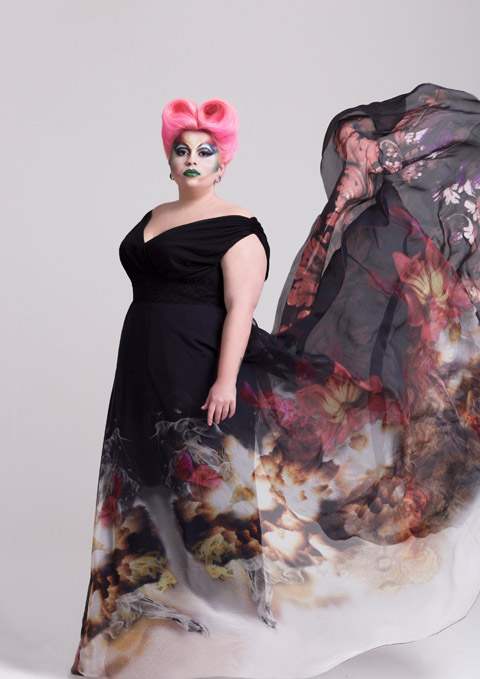
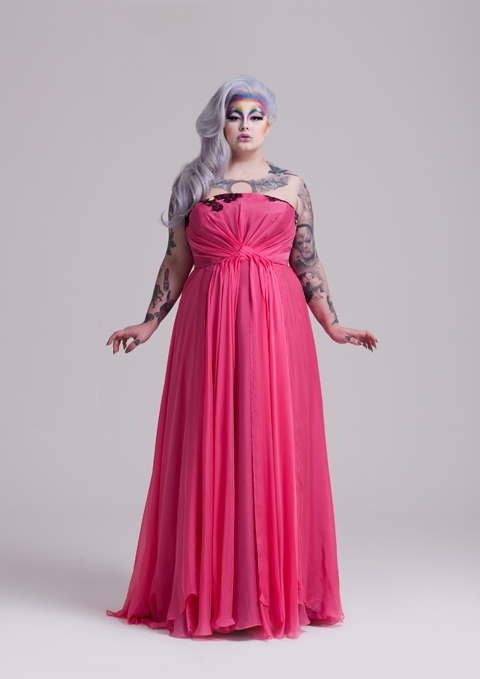
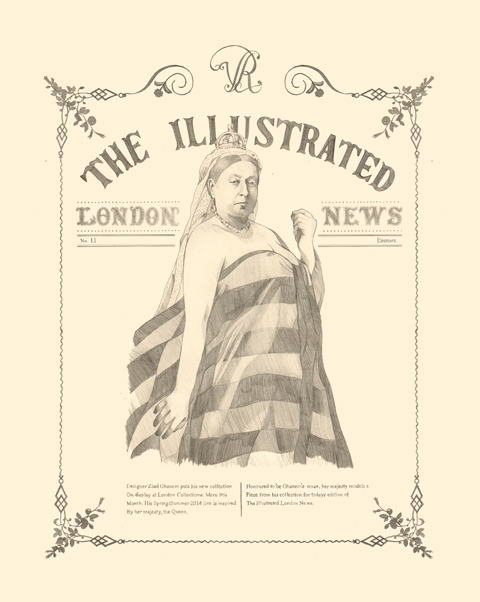
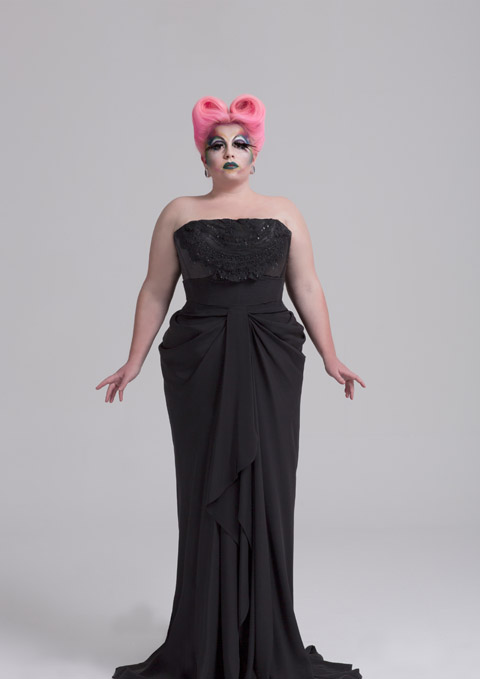
We really missed culture couturier Ziad Ghanem on the catwalk last season so I am really pleased to exclusively introduce his new S/S 2014 Couture Collection entitled HELL O, dedicated to Queen Victoria and powerful curvy women. I spoke to Ziad and his stylist, Aiden Connor about the ethos behind the designs.

Ziad Ghanem by Leah Nelson

Ziad Ghanem by Leah Nelson.

You first started out in fashion with quite an urban aesthetic, but have since moved towards haute couture… how did this evolution come about and what is the best thing about working at such a high end?
I am trained in the techniques of couture but the ubran aesthetic is what represents me most, so there is always an element of urban within all my work in both ready to wear and my couture. The best thing about working at such high end is that you have a far more personal relationship with the client. Good communication is the key to a successful outfit.

Ziad Ghanem couture collection Lizzie Chiffon Print dress

Who buys and wears your exclusive couture looks, and how does the process of creation work once a buyer has requested a piece?
We have individual clients that have certain occasions to attend such as red carpet gala parties and other special events. After providing an individual design the client’s measurements are taken, the toile and the fabric samples are provided, the garment is fitted and then we start to produce the actual outfit. What works on paper may not always work in 3D form, so thats why we have fittings and alterations.

Ziad Ghanem by Adam Pryce

Ziad Ghanem by Adam Pryce.

What was the biggest culture shock when you moved from Lebanon to London in the 1990s, and how easy was it to adapt to life here?
Lebanon is a pretty open country to Western culture so I knew a lot about Britain before moving here. Moving to London is one of the best things I’ve done in my life, it gave me so much freedom, courage and inspiration. I felt at home here even from the first day I arrived and up to this day. I am so grateful to this country for everything it offers to creative people like me.

Ziad Ghanem couture collection S:S 2014 - cape

How have ideas and traditions from the place where you grew up infiltrated your designs?
Refinement and sophistication are things I’ve learnt from where I was brought up. I use lots of weaving techniques such as Nawl weaving and Artisan embroideries, which originate from that part of the Middle-East.

Ziad Ghanem couture collection S:S 2014 - pink dress

You have always shown your collections worn on a range of models who are fabulous for what they do as well as looking great. Why is it so important to you to steer clear of the traditional skinny teenage look that most designers show their clothing on?
Because it’s boring… Darling. Fashion should be about fun and not a prison. I strongly believe in individuality and I love the unexpected. My models are my muse. I love them.

Ziad Ghanem couture collection S:S 2014 - striped green dress

Why is the new couture collection titled “HELL O”?
It is titled ‘HELL O‘, because we wanted it to say ‘hello, look at me‘. We split the O from the word because I always get a lot of abuse for my use of my models (because of their sizes) and it feels like hell. I guess it’s nothing compared to their own hell that they must endure because of the industry and media discrimination. I was so, so upset when I read the body fascist comments of Mr Lagerfeld saying ‘nobody wants to see curves on the catwalk‘. I want to prove this statement is wrong, everyone can look good small, medium or large. Just embrace your individuality.

Ziad Ghanem By Lynne Datson

Ziad Ghanem by Lynne Datson.

What aspects of Queen Victoria inspired the latest collection?
Queen Victoria was a grand, majestic woman, and one of the longest running monarchs in history, so she is a symbol of powerful woman that always inspires me. She was no small lady but she never hid this and always showed this off in her full regalia.  

Ziad Ghanem by Hannah Boothman

Ziad Ghanem by Hannah Boothman.

In what way are you ethical in your designs?
I try to source my fabrics as ethically as possible so I use many vintage and reclaimed materials within my work, and I do not produce my pieces in a sweatshop – I treat the people I work with with respect. Ethicality must start with the way we treat the people around us, and the rest must follow.

Ziad Ghanem by Amy Davis

Ziad Ghanem by Amy Davis.

How did your mum get involved with the Paris is Burning collection, and has she contributed anything to the latest one?
My mum has always been the source of my inspiration as she loves glamour and dressing up. The 1980s was very much her area of fashion. She designed all of the accessories throughout the collection. She continually works with me; she is part of the team. 

Ziad Ghanem couture collection Zoe Black dress

Who took the photographs for the new S/S 2014 collection, and what was the art direction for these looks?
The inspiration for the shoot was Disney villains: I wanted it to be a caricature of haute couture and I was very lucky to meet the wonderful team I worked with, especially our models Zoe and Lizzie. Aiden Connor was the creative director for this photos, and it was shot by Andrew Hiles.

We sadly missed you on the catwalk last season (your shows are always a highlight of LFW) – when can we next expect to see you there, and any hints on what we might see? 
Thank you so much Amelia, I’m very thankful of your support since day one (thank you, blush). I will be doing a show during this coming February London Fashion Week. The new collection is looking very sensual but I am still working on the direction of the show. I’m in the middle of an idea that swings between “S & M” or “M & S“… lol

Ziad Ghanem by Avril Kelly

Ziad Ghanem by Avril Kelly.

Your garments really flatter the female physique in whatever form it comes in – what advice do you have for the ‘non-standard’ female when it comes to dressing beautifully?
Thank you for this compliment. My advice is firstly to invest in a good bra that fits well and is comfortable. Secondly, conceal the part you are not comfortable with and highlight your strongest assets. Don’t believe the myth that black is slimming or that a loose sack is flattering. Dress your size, brush your hair and accessorise.  

Ziad Ghanem couture collection Lizzie Black Corset

Finally, do you have any advice for aspiring young fashion designers who dream of entering the couture world?
My advice is, they need to study and learn how to make the classics with traditional techniques before they come out with the inventive pieces. As Alexander McQueen said ‘you need to know the rules before you can break them…’ A great knowledge of the human body is a must as well as an attention to the finer details. 

Thankyou Ziad, we can’t wait to see your new collection x

Categories ,Adam Pryce, ,Aiden Connor, ,Amy Davis, ,Andrew Hiles, ,Avril KellyAvril Kelly, ,Claire Kearns, ,couture, ,Hannah Boothman, ,Haute Couture, ,HELL O, ,interview, ,Leah Nelson, ,Lebanon, ,London Fashion Week, ,Lynne Datson, ,Nawl weaving, ,Queen Victoria, ,S/S 2014, ,Ziad Ghanem

Similar Posts:


Amelia’s Magazine | Fashion designers’ New Year’s Resolutions!

Explain who Lira is… What she studied etc…

Who is Lira Leirner and what do you do?

Like many who do what they love, viagra I’m a little bit of a Jack of all trades. First and foremost, for sale whichever way my career takes me, more about I’m a writer. However, the name has become detached from myself and when I hear what used to be my name and surname I tend to think not of myself but the fashion line it labels. Said fashion line offers mainly quirky yet classically cut dresses. I focus on luxurious materials and a classic youthful look which is more playful than preppy but continuously carries a demure elegance without losing a hint of sexiness.

Have you always known what you wanted to do?

I had an amazing primary school teacher who supported my writing heavily. I went to a Waldorf School for my primary school years, and we had to write an essay every day. It never felt like homework to me, so I had a lot of fun with it, exploring the different formats ranging from reportage to theatre pieces to poetry to absurdist writing. My fellow students would actually mock my teacher’s end-of-day catch phrase: “And remember – two pages minimum. Lira, ten pages maximum”, which was quite funny. I knew I was going to become a writer from a very early age. As much as the topics of interest may have varied over time – from philosophy and law to white collar crime to fashion – writing was always at the core of my actions. Even when I started working, writing was still at the core in some form or another, ranging from content manager to translator to copywriter.

Fashion, on the other hand, slowly crept into my life although I tried to ignore it for a long time as I enjoyed being the black sheep in the family, the non-artist, non-designer who was leaning towards academic subjects. I started creating pieces because I couldn’t find anything that fitted my petite frame as well as my classic yet quirky and high maintenance taste and in doing so I opened the floodgates of ideas. I started for practical reasons but it became quite quickly apparent that there were other people out there who liked what I was doing, which pushed me, of course.

Where can we find your writing?

Most of my writing that is accessible online you can find on my blog www.lltheportmanteau.com, including pieces I’ve written for other websites. I have a small portfolio of poems and old articles uploaded to www.liraleirner.co.uk, however, some of it is in German. I am currently writing a book, so my online writing has decreased accordingly.

Detail! What were your thoughts on the Goldsmiths course “sociology and cultural studies?”

In comparison to Cambridge University or LSE, Goldsmiths focuses on the cultural aspect rather than the political aspect of sociology. This allows for an approach closer to the way I see the world, that is, to take into account, among other criteria of course, language, media and style to understand a certain phenomena. However, I must say, sociology requires you to spend a lot of time on your own and is not the most sociable of courses. I spent a lot of time with the design ‘crew’ as my partner Stuart Bannocks is a designer – so much so, in fact, that I now still interact with the teachers and students from that course, while my sociology tutors and lecturers barely recognize me when I happen to run into them.

Fill in detail here… read previous interviews where this has been mentioned. What is it do you think about white collar crime which has gripped your attention?

It’s difficult to answer this question without delving too deeply into very personal and psychological reasons. Due to certain circumstances in my life and certain people that I’ve been exposed to from a young age, which worked very well as a deterrent role model, I guess I’ve developed an almost obsessive, deeply rooted disgust for dishonesty, greed and exploitation of trust. That, more than anything else, is at the root of white collar crime. It fascinates me because it’s behavior I don’t understand although I can objectively follow its logic.

Any book recommendations?

In order to recommend a book, I need to know the reader. There’s no recommendation one can do without starting with “If you like…” so I’m going to take some of my favourite books and explain why and who I would suggest them to.

“Down and Out in Paris and London” by George Orwell I would recommend to snobs who create a classic hierarchy into human experience. I create it, but it’s probably reversed as I care more about what I learn from an experience than what the symbolic value of that experience is in a social situation.

I’d recommend “Orientalism” by Edward Said to anybody I’d like to explain the xenophobia I had to deal with anywhere I went as a result of growing up in an almost constant stage of flux having lived in as many houses as I’m old, in five countries and many, many cities.

“Distinction: A Social Critique of the Judgement of Taste” by Pierre Bordieu I’d recommend to anybody that works in the fashion industry.

Although fantasy books are a guilty pleasure for me, I did particularly enjoy the dark material trilogy by Phillip Pullman (whose main character was names Lyra, go figure). I remember reading the first Harry Potter book from cover to cover on the evening of my birthday (such a cool kid, huh?) in 1998, years before it became so big, which didn’t hinder me from abandoning all life every time the next book came out.
The inheritance cycle by Christopher Paolini was one that had me running to the book store with every book that came out and spend the day cut off from the outside world as well. The Wheel of Time series, as I started reading it when quite a few books were published, came dangerously close to being abusive to my health as I would not move from my chosen spot for drink nor food nor toilet nor people coming in and out of the room until I had read all the books, which, despite being a very fast reader, took me a few days (there are 13 books, each ca. 500 – 900 pages long). This might sound extreme, but I approach fashion in the same manner; I created twenty pieces the week before fashion week. That’s not healthy, but was the only way I could keep up with my ideas – seeing them completed.

Why did you start Lira Leirner?

Contributing to a field that interests you I find to be an undertaking a lot more satisfying and noble than mere consumption, so sharing my steps into fashion design was the natural development in that direction. And, as Confucius pointed out… Do a job you love and you’ll never work a day in your life.

How is Lira Leirner (the company) doing?

Well, lets put it this way – at the moment I get more press attention than sales.

Your collections entirely consist of dresses, what attracts you to this particular garment?

A dress can be both simple yet complex in terms of cut, which allows for a big playground and to explore the shapes of the wearer. It is one of the biggest garment canvas in terms of the surface it covers, apart from the coat. A dress is also an entire outfit and therefore a lot more satisfying to put thought into – it finishes as a complete piece, and I can be almost certain that it will be used as a statement rather than accompanying piece in any outfit. In the end, I just love wearing dresses. It’s the garment which makes me smile the most, so why not focus on that?

What are your thoughts on menswear?

It’s difficult and quite frustrating. I’ve tried, but even the most fashion forward men I know were taken back by the pieces I created, the only ones they seemed to like were incredibly simple with just a tiny twist (such as a standard tie with a funky stripe), and quite frankly that’s just too boring for me. I know fashionistos will not be very happy with me saying this, but it made me realize that most of them have bigger mouths than the will to be experimental. Most of them have gotten so used to the (infuriatingly) small range of choice, that they have become naturally born stylists, and prefer to take a few relatively simple pieces and put together their own look – to which they stick. There’s not much room for experimentation for me as a designer, as they’re very specific about what they want and even half an inch down or up is a deal breaker. Hopefully I can be proven wrong one day.

Where did the idea come from to use actual royal mail sacs?

I participated in a RAG fashion show at Goldsmiths many years ago now, and had just received a big load of packages following a shopping spree, which meant I had just spent the funds I needed. My eyes fell on the Royal Mail sack in the corner of my room, sadly entailing the contents of the money I had spent, and the idea became quite apparent. In a way, that money went into the right direction, after all. I sew a coat/ dress by hand, using packaging rope to create the details and voila… a few ripped and bleeding fingers and days without sleep later, this was my very first piece. The image of the model wearing it during the show ended up being used on the cover of a magazine. I loved the iconic implication but most of all, the fact that it was up-cycled. I spent many days making sure I was there when the postmen came to collect their letters form the mailboxes – they would even shift some letters spread across bags into one in order to give the empty ones to me once I told them my plans. My favourite source was the office at my old job, though. The bags tended to be brand new and just left in the locker in heaps, from years and months of collecting them and not knowing what to do with them. Finding a sack full of different colors was quite a score. It’s notoriously frustrating to work with as it frays quite quickly so the pieces need to be prepared, but it’s worth it.

What advice would you have for designers interested in starting up their own label?

Just do it. Don’t wait for someone else to tell you what to do or for that perfect financial situation. When you have the idea and the drive, go for it. It may fail, it may turn out wonderfully, the important thing is to get going because if you don’t create it yourself, nothing can happen in the first place. Be the most excited person in the room – it’s your own thing, you can’t expect anybody else to be as excited as you are. The more excited you are, the more excited other people will be. Both these statements have seeped into my being over the years as it rubbed off from my partner Stuart Bannocks, who lives and breathes these with great success.

Follow a single person’s own vision. This is less obvious than it sounds. No matter how many people get involved, as long as it’s one person having the last say in all details, the taste and style will be a coherent one even when you’re experimenting. This makes it easier to specify the direction and to market the brand as a whole.

How was it to show a capsule collection during London Fashion Week?

A bit surreal. I was invited to be part of a Fashion Fete in Covent Garden, which in itself was a lovely idea. However, it meant that the majority of people around were not my target buyers at all, which resulted in situations such as having a deluded mother trying to haggle a £200 100% silk, handmade one-off dress down to £8.50 because “that’s how much her daughter spends on dresses in Primark”. I couldn’t help but laugh. Bitterly.

Where do you source the materials for your clothes?

A lot of the materials I use are one off, end of the roll finds from a local market stall or from clear outs I came across online. I pride myself in working with what I call “real” materials only; such as silk, leather, tweed, wool, cotton, or in the case of Royal Mails sacks, the actual sacks themselves. The quality of the fabric is important to me because it’s one of the issues I had with garments that can be found in most high street shops. The way in which I source my material, as I’ve pointed out before [link to previous Amelia’s Magazine article], is environmentally friendly because I focus on local production, which cuts out transportation, and use “left overs” that aren’t really left overs, I’m not exactly dealing with snippets but yards and yards of gorgeous fabric that would be simply wasted otherwise.

As a blogger, what are your thoughts on blogging and do you have any favourites you would like to recommend?

A blog without content appropriate distribution is like a diary without a publisher. There might be a potential Anne Frank lurking in the ocean of being able to be found via google keywords, but until then, it is a private pool of potential only. The key is in the distribution through micro blogging (aka Twitter) and social media. As was pointed out in an article recently, google identified fashion to be the industry which uses social media to its advantage better than any other. In other words, fashion bloggers fit into the construction and intent of social media perfectly, making it quite a natural process. In the end a blog is just a medium, and it’s up to you to use it properly.

The big fashion blogs in the industry I’d recommend are:
http://www.thestylerookie.com/ -> to keep tabs on the industry’s favourite witty girl
http://thesartorialist.blogspot.com/ -> for street style and photography
http://stylebubble.typepad.com/ -> for hunting down small and quirky fashion lines
http://www.fashionfoiegras.com/ -> for fashion from a consumer’s point of view
http://www.styleite.com/ -> for fashion news, big and small
http://www.theclotheswhisperer.co.uk/ -> for literature quality fashion wit and style whispering

Who are your favourite fashion designers or artists?

I have a split personality when it comes to favourite fashion designers but in all my preferences you can find a meticulously balanced symmetry of sorts. Asymmetry makes me nervous, in anything. On one hand I like fashion designers who manage to create simplicity within an architectural precision such as Calvin Klein, Valentino and Jil Sanders. On the other hand, I adore the theatrical statement pieces with intense attention to detail which you can often find in the vision of smaller designers such as Alberto Sinpatron but also in Alexander McQueen and Vivienne Westwood.

When it comes to art, my preferences lies quite heavily within the environment I have grown up in – concrete art and framed concrete poetry. I think that when deciding what goes on your wall you need to be utterly personal – it’s you who will look at it day in and day out. Purchasing art the way I think it should be purchased, that is without the weaves of pretentiousness and hierarchy of value that I’m unfortunately all too familiar with in the art world, should take into account merely the immediate, personal reaction to a piece before you. I understand the intelligent purchase of art as an investment or logical, historical or poignant contribution to a collection but I don’t have much patience with such purchases in the privacy of a home.

Among others, I have pieces by Duval Timothy, Jose Resende, Kathryn Hall, Sarah Leirner, Pablo Picasso, Antonio Dias, Peter Keler, Doerte Helm, Betty Leirner and Jemma Austin gracing my wall.

You gathered a lot of attention in a short amount of time…

I was lucky enough to pique the attention of some major fashion bloggers in London by coincidence, which eased the snowball into rolling on a steep hill. I do think that being a fashion blogger myself may have had an impact as I wear my own pieces out and about. This is turn meant they were exposed during events and meetings I was invited to as a blogger and attracted coverage as well as requests for interviews that way.

What are you plans for the upcoming year? Do you plan on returning to LFW for AW11?

I have been creating a more solid and bigger collection than the ones I’ve done so far and I think this is a collection whose production is likely to stretch into spring, especially with the winter months freezing my shackles into hibernation.

Explain who Lira is… What she studied etc…

Who is Lira Leirner and what do you do?

Like many who do what they love, mind I’m a little bit of a Jack of all trades. First and foremost, price whichever way my career takes me, I’m a writer. However, the name has become detached from myself and when I hear what used to be my name and surname I tend to think not of myself but the fashion line it labels. Said fashion line offers mainly quirky yet classically cut dresses. I focus on luxurious materials and a classic youthful look which is more playful than preppy but continuously carries a demure elegance without losing a hint of sexiness.

Have you always known what you wanted to do?

I had an amazing primary school teacher who supported my writing heavily. I went to a Waldorf School for my primary school years, and we had to write an essay every day. It never felt like homework to me, so I had a lot of fun with it, exploring the different formats ranging from reportage to theatre pieces to poetry to absurdist writing. My fellow students would actually mock my teacher’s end-of-day catch phrase: “And remember – two pages minimum. Lira, ten pages maximum”, which was quite funny. I knew I was going to become a writer from a very early age. As much as the topics of interest may have varied over time – from philosophy and law to white collar crime to fashion – writing was always at the core of my actions. Even when I started working, writing was still at the core in some form or another, ranging from content manager to translator to copywriter.

Fashion, on the other hand, slowly crept into my life although I tried to ignore it for a long time as I enjoyed being the black sheep in the family, the non-artist, non-designer who was leaning towards academic subjects. I started creating pieces because I couldn’t find anything that fitted my petite frame as well as my classic yet quirky and high maintenance taste and in doing so I opened the floodgates of ideas. I started for practical reasons but it became quite quickly apparent that there were other people out there who liked what I was doing, which pushed me, of course.

Where can we find your writing?

Most of my writing that is accessible online you can find on my blog www.lltheportmanteau.com, including pieces I’ve written for other websites. I have a small portfolio of poems and old articles uploaded to www.liraleirner.co.uk, however, some of it is in German. I am currently writing a book, so my online writing has decreased accordingly.

Detail! What were your thoughts on the Goldsmiths course “sociology and cultural studies?”

In comparison to Cambridge University or LSE, Goldsmiths focuses on the cultural aspect rather than the political aspect of sociology. This allows for an approach closer to the way I see the world, that is, to take into account, among other criteria of course, language, media and style to understand a certain phenomena. However, I must say, sociology requires you to spend a lot of time on your own and is not the most sociable of courses. I spent a lot of time with the design ‘crew’ as my partner Stuart Bannocks is a designer – so much so, in fact, that I now still interact with the teachers and students from that course, while my sociology tutors and lecturers barely recognize me when I happen to run into them.

Fill in detail here… read previous interviews where this has been mentioned. What is it do you think about white collar crime which has gripped your attention?

It’s difficult to answer this question without delving too deeply into very personal and psychological reasons. Due to certain circumstances in my life and certain people that I’ve been exposed to from a young age, which worked very well as a deterrent role model, I guess I’ve developed an almost obsessive, deeply rooted disgust for dishonesty, greed and exploitation of trust. That, more than anything else, is at the root of white collar crime. It fascinates me because it’s behavior I don’t understand although I can objectively follow its logic.

Any book recommendations?

In order to recommend a book, I need to know the reader. There’s no recommendation one can do without starting with “If you like…” so I’m going to take some of my favourite books and explain why and who I would suggest them to.

“Down and Out in Paris and London” by George Orwell I would recommend to snobs who create a classic hierarchy into human experience. I create it, but it’s probably reversed as I care more about what I learn from an experience than what the symbolic value of that experience is in a social situation.

I’d recommend “Orientalism” by Edward Said to anybody I’d like to explain the xenophobia I had to deal with anywhere I went as a result of growing up in an almost constant stage of flux having lived in as many houses as I’m old, in five countries and many, many cities.

“Distinction: A Social Critique of the Judgement of Taste” by Pierre Bordieu I’d recommend to anybody that works in the fashion industry.

Although fantasy books are a guilty pleasure for me, I did particularly enjoy the dark material trilogy by Phillip Pullman (whose main character was names Lyra, go figure). I remember reading the first Harry Potter book from cover to cover on the evening of my birthday (such a cool kid, huh?) in 1998, years before it became so big, which didn’t hinder me from abandoning all life every time the next book came out.
The inheritance cycle by Christopher Paolini was one that had me running to the book store with every book that came out and spend the day cut off from the outside world as well. The Wheel of Time series, as I started reading it when quite a few books were published, came dangerously close to being abusive to my health as I would not move from my chosen spot for drink nor food nor toilet nor people coming in and out of the room until I had read all the books, which, despite being a very fast reader, took me a few days (there are 13 books, each ca. 500 – 900 pages long). This might sound extreme, but I approach fashion in the same manner; I created twenty pieces the week before fashion week. That’s not healthy, but was the only way I could keep up with my ideas – seeing them completed.

Why did you start Lira Leirner?

Contributing to a field that interests you I find to be an undertaking a lot more satisfying and noble than mere consumption, so sharing my steps into fashion design was the natural development in that direction. And, as Confucius pointed out… Do a job you love and you’ll never work a day in your life.

How is Lira Leirner (the company) doing?

Well, lets put it this way – at the moment I get more press attention than sales.

Your collections entirely consist of dresses, what attracts you to this particular garment?

A dress can be both simple yet complex in terms of cut, which allows for a big playground and to explore the shapes of the wearer. It is one of the biggest garment canvas in terms of the surface it covers, apart from the coat. A dress is also an entire outfit and therefore a lot more satisfying to put thought into – it finishes as a complete piece, and I can be almost certain that it will be used as a statement rather than accompanying piece in any outfit. In the end, I just love wearing dresses. It’s the garment which makes me smile the most, so why not focus on that?

What are your thoughts on menswear?

It’s difficult and quite frustrating. I’ve tried, but even the most fashion forward men I know were taken back by the pieces I created, the only ones they seemed to like were incredibly simple with just a tiny twist (such as a standard tie with a funky stripe), and quite frankly that’s just too boring for me. I know fashionistos will not be very happy with me saying this, but it made me realize that most of them have bigger mouths than the will to be experimental. Most of them have gotten so used to the (infuriatingly) small range of choice, that they have become naturally born stylists, and prefer to take a few relatively simple pieces and put together their own look – to which they stick. There’s not much room for experimentation for me as a designer, as they’re very specific about what they want and even half an inch down or up is a deal breaker. Hopefully I can be proven wrong one day.

Where did the idea come from to use actual royal mail sacs?

I participated in a RAG fashion show at Goldsmiths many years ago now, and had just received a big load of packages following a shopping spree, which meant I had just spent the funds I needed. My eyes fell on the Royal Mail sack in the corner of my room, sadly entailing the contents of the money I had spent, and the idea became quite apparent. In a way, that money went into the right direction, after all. I sew a coat/ dress by hand, using packaging rope to create the details and voila… a few ripped and bleeding fingers and days without sleep later, this was my very first piece. The image of the model wearing it during the show ended up being used on the cover of a magazine. I loved the iconic implication but most of all, the fact that it was up-cycled. I spent many days making sure I was there when the postmen came to collect their letters form the mailboxes – they would even shift some letters spread across bags into one in order to give the empty ones to me once I told them my plans. My favourite source was the office at my old job, though. The bags tended to be brand new and just left in the locker in heaps, from years and months of collecting them and not knowing what to do with them. Finding a sack full of different colors was quite a score. It’s notoriously frustrating to work with as it frays quite quickly so the pieces need to be prepared, but it’s worth it.

What advice would you have for designers interested in starting up their own label?

Just do it. Don’t wait for someone else to tell you what to do or for that perfect financial situation. When you have the idea and the drive, go for it. It may fail, it may turn out wonderfully, the important thing is to get going because if you don’t create it yourself, nothing can happen in the first place. Be the most excited person in the room – it’s your own thing, you can’t expect anybody else to be as excited as you are. The more excited you are, the more excited other people will be. Both these statements have seeped into my being over the years as it rubbed off from my partner Stuart Bannocks, who lives and breathes these with great success.

Follow a single person’s own vision. This is less obvious than it sounds. No matter how many people get involved, as long as it’s one person having the last say in all details, the taste and style will be a coherent one even when you’re experimenting. This makes it easier to specify the direction and to market the brand as a whole.

How was it to show a capsule collection during London Fashion Week?

A bit surreal. I was invited to be part of a Fashion Fete in Covent Garden, which in itself was a lovely idea. However, it meant that the majority of people around were not my target buyers at all, which resulted in situations such as having a deluded mother trying to haggle a £200 100% silk, handmade one-off dress down to £8.50 because “that’s how much her daughter spends on dresses in Primark”. I couldn’t help but laugh. Bitterly.

Where do you source the materials for your clothes?

A lot of the materials I use are one off, end of the roll finds from a local market stall or from clear outs I came across online. I pride myself in working with what I call “real” materials only; such as silk, leather, tweed, wool, cotton, or in the case of Royal Mails sacks, the actual sacks themselves. The quality of the fabric is important to me because it’s one of the issues I had with garments that can be found in most high street shops. The way in which I source my material, as I’ve pointed out before [link to previous Amelia’s Magazine article], is environmentally friendly because I focus on local production, which cuts out transportation, and use “left overs” that aren’t really left overs, I’m not exactly dealing with snippets but yards and yards of gorgeous fabric that would be simply wasted otherwise.

As a blogger, what are your thoughts on blogging and do you have any favourites you would like to recommend?

A blog without content appropriate distribution is like a diary without a publisher. There might be a potential Anne Frank lurking in the ocean of being able to be found via google keywords, but until then, it is a private pool of potential only. The key is in the distribution through micro blogging (aka Twitter) and social media. As was pointed out in an article recently, google identified fashion to be the industry which uses social media to its advantage better than any other. In other words, fashion bloggers fit into the construction and intent of social media perfectly, making it quite a natural process. In the end a blog is just a medium, and it’s up to you to use it properly.

The big fashion blogs in the industry I’d recommend are:
http://www.thestylerookie.com/ -> to keep tabs on the industry’s favourite witty girl
http://thesartorialist.blogspot.com/ -> for street style and photography
http://stylebubble.typepad.com/ -> for hunting down small and quirky fashion lines
http://www.fashionfoiegras.com/ -> for fashion from a consumer’s point of view
http://www.styleite.com/ -> for fashion news, big and small
http://www.theclotheswhisperer.co.uk/ -> for literature quality fashion wit and style whispering

Who are your favourite fashion designers or artists?

I have a split personality when it comes to favourite fashion designers but in all my preferences you can find a meticulously balanced symmetry of sorts. Asymmetry makes me nervous, in anything. On one hand I like fashion designers who manage to create simplicity within an architectural precision such as Calvin Klein, Valentino and Jil Sanders. On the other hand, I adore the theatrical statement pieces with intense attention to detail which you can often find in the vision of smaller designers such as Alberto Sinpatron but also in Alexander McQueen and Vivienne Westwood.

When it comes to art, my preferences lies quite heavily within the environment I have grown up in – concrete art and framed concrete poetry. I think that when deciding what goes on your wall you need to be utterly personal – it’s you who will look at it day in and day out. Purchasing art the way I think it should be purchased, that is without the weaves of pretentiousness and hierarchy of value that I’m unfortunately all too familiar with in the art world, should take into account merely the immediate, personal reaction to a piece before you. I understand the intelligent purchase of art as an investment or logical, historical or poignant contribution to a collection but I don’t have much patience with such purchases in the privacy of a home.

Among others, I have pieces by Duval Timothy, Jose Resende, Kathryn Hall, Sarah Leirner, Pablo Picasso, Antonio Dias, Peter Keler, Doerte Helm, Betty Leirner and Jemma Austin gracing my wall.

You gathered a lot of attention in a short amount of time…

I was lucky enough to pique the attention of some major fashion bloggers in London by coincidence, which eased the snowball into rolling on a steep hill. I do think that being a fashion blogger myself may have had an impact as I wear my own pieces out and about. This is turn meant they were exposed during events and meetings I was invited to as a blogger and attracted coverage as well as requests for interviews that way.

What are you plans for the upcoming year? Do you plan on returning to LFW for AW11?

I have been creating a more solid and bigger collection than the ones I’ve done so far and I think this is a collection whose production is likely to stretch into spring, especially with the winter months freezing my shackles into hibernation.


Eugene Lin, malady illustrated by Gareth A Hopkins

Happy New Year! It’s that time of year again when we all set about making resolutions and miraculously changing our lives for the better. So far, approved for 2011, view I’ve set myself the insurmountable tasks of quitting smoking (again), getting fit (again) and saving money (AGAIN), as well as to make more of an effort to contact friends who I don’t see regularly, get through that list of books I buy on recommendation that is quickly becoming a floor-to-celing pile, learn to cook more than just beans on toast. Oh, sure!

Here at Amelia’s Magazine, we thought it might be interesting to find out what some of our favourite fashion designers plan to do in 2011. I spoke to a few of them, who we interviewed in 2010, about their plans, hopes, ambitions, dreams and everything in between. I posed the question suggesting the response could be hopes for their labels, their personal lives or something more philosophical. I’m so glad one of our designer friends, amidst economic recession and doom and gloom, prioritises ‘more sex’ on their agenda for this coming year…

Here’s a little round-up, with as always, fabulous illustrations… and I’ve linked each designer’s name to our original interview so you can read more about them if you wish!

Ada Zanditon

Illustration by Caroline Coates

‘My main resolution for 2010 is to keep growing and evolving as a brand, creatively and as a business with the vision to bring awareness to conservation and also increase the percentage of my profit margin that can go towards conservation charities, completing the circle between what inspires me as a designer and helping to sustain it in a creative, innovative way that results in sculptural, desirable, uniquely embellished fashion.

‘I would also like to find some time between all of that to spend more time gardening…’

Read a full interview with Ada with even more amazing illustrations in Amelia’s new book!

Eugene Lin

Eugene Lin, illustrated by Gareth A Hopkins

1. Keep perfecting the cut of my clothes
2. Remember to ‘TAKE A BREAK’ at least once a month
3. Eat healthy. Run more.

Imogen Belfield

Illustration by Caroline Coates

‘My New Year resolutions are… well, quite honestly, I have to stop injuring myself in the workshop. I had two rather nasty accidents within the last 2 months. And secondly, it would be to have more Skype dates with my overseas friends and family. 2010 has been beyond incredible, and to wish for the same again would be enough in itself, I cannot wait for 2011 to begin, bring it on!’

Makepiece

Illustration by Genie Espinosa

Whilst we’ve developed new cute tags to help our garments last longer (it’s a nice little wooden tag holding yarn so you can fix your garments), launched knitwear shrugs for winter brides and taken on a small concession in Harveys, (the Halifax department store) I’ve also been struggling to feed the poor snowbound sheep.

I’ve been using sledges, mountain bikes and my own two feet to defeat the snow. I’ve never felt so popular as when I’m spotted from afar by my sheep so that they’re already forming a welcoming committee by the gate. It’s difficult, but exhilarating when, once the sheep are cheerfully surrounding their bale of haylage, I can look out over the snowbound valley. It’s beautiful!

Looking forward to the new year though, we’re hoping for a sunny spring. Lots of lambs, picnics in the hay meadow and summer balls. The new collection is coloured like the sun on a misty spring morning and is frilled and ruched and rippled into delicate dresses, tops, cardis and scarves.

Olivia Rubin

Illustration by Lisa Stannard

‘2011 already holds some exciting opportunities for the label including a lot more hard work! I’m looking forward to my collaborations with very.co.uk and my new accessory line for Dune at the start of the year. I’m hoping to broaden my collections and expand the brand by introducing printed knitwear as well as building on the success of the jersey line Oli Rubi… I have a very determined attitude for 2011!

On a personal level one of my New Year’s resolutions is to continue with my running and possibly attempt a half marathon – eeek!’

(Stefan) Orschel-Read

Illustration by Rachel Clare Price

’2011 will be a busy year for me. I will be producing three collections for Orschel-Read. A small A/W 2011/12, the summer 2012 collection for London Fashion Week in September, and also a couture collection for the end of May. A New Year’s resolution for me is to stop working Sundays! And to enjoy the wonderful city we live in a little more. I also hope to spend more time with friends and family, and finally learn something totally new.’

New Year’s Day is every man’s birthday” (Charles Lamb)

Ziad Ghanem

Illustration by Rukmunal Hakim

‘Professionally: In January 2011 I am launching the wedding collection during Couture Fashion Week. So from now on its “strictly sex after marriage…” In February 2011 I am producing an amazing show during London Fashion Week, inspired by Islamic Art, and Maiden Britain tees and sweats will be launched to buy online soon. I am also hoping to do a lot of new collaborations with artists from all over the world this year.

Personally: I hope and wish for peace of mind, good health and more sex. This year I am open for love! I hope everybody’s New Year wishes will come true.’

Do let us know if you’ve made any interesting resolutions for 2011, I’d love to hear them!

Categories ,2011, ,Ada Zanditon, ,Caroline Coates, ,Charles Lamb, ,Couture Fashion Week, ,Dune, ,Eugene Lin, ,Gareth A Hopkins, ,Genie Espinosa, ,Imogen Belfield, ,Islamic Art, ,Lambs, ,Lisa Stannard, ,London Fashion Week, ,Maiden Britain, ,Makepiece, ,New Year, ,Olivia Rubin, ,Rachel Clare Price, ,Resolutions, ,Rukmunal Hakim, ,SEX, ,sheep, ,Skype, ,Stefan Orschel-Read, ,Very.co.uk, ,wool, ,Ziad Ghanem

Similar Posts:


Amelia’s Magazine | Pre-London Fashion Week S/S 2011 Interview: Ziad Ghanem

JASPER GARVIDA lfw s/s 2011 Rachel Clare Price
A selection of Jessie’s corsarges

Walking around Broadway Market, approved one cold wintery Saturday, feeling hungry and looking at all the delicious food I could ill afford, (oh the joys of being a student!). I came across a treasure trove of a stall run by the delightful Jessie and Buddug and instantly fell in love with their charming designs. Since this initial visit, I have returned time and time again to buy unique necklaces as birthday (incredibly successful!) gifts.

So you can imagine my delight coming across their Columbia Road shop, originally located in the upstairs of one the picturesque houses adorning the street. Jessie and Buddug have recently expanded ‘downstairs’, and in celebration of their success, I had the pleasure of interviewing the talented textile artists for Amelia’s Magazine.

I first noticed your designs at Broadway Market on Saturday, was this your first venture?

Buddug: We started broadway market after we graduated 5 years ago and got the shop 2 years ago.

What was your experience of the market? Do you still have a stall there?

Buddug: We still have a stall at Broadway Market, we feel it has grown so much since we started. It’s been cold and wet at times but it’s been great learning what people buy. Its been great socially too, speaking with our friends and customers.

As friends from home, what has it been like to work together?

Buddug: We met when we were on art foundation and always said we we would like to collaborate together in the future. We find it easier that we both do our own work and then display together because we both have different working hours.

You previously occupied an upstairs room in Columbia Road, how did the opportunity to expand into a downstairs space arise?

Buddug: We got offered a place at ground level by Bev who had the shop before us, she made handmade clothes and toys etc, she offered it to us before anyone else which was an honour and we jumped at the chance.

What was your experience of the Goldsmiths Textiles course (which sadly no longer exists?)

Jessie: I was at Goldsmiths, at a very tricky time, the course was going through a real denial period, as they were finding the debate about what to do with textiles and fine art really hard. Which made it hard for us as students and as someone who is passionate about cloth and textiles and most of all making, I found the course incredibly frustrating!

But I had very supportive parents; Primmy Chorley and I am close friends with Audrey Walker and Eirian and Denys Short. So I always had a huge back up behind me in the textile world. I did feel incredibly pulled between the two worlds though and I was lucky enough to come out fighting, determined to set up my own business and to carry on my making process.

Overall I am pleased I went through the Goldsmiths experience, as the academic and written side of it, (for me) has helped me today to think the way I do and pushed me in other ways.

What course did you study Buddug and what was your experiences?

I studied at London Guildhall (now London Metropolitan University)in Jewellery, silversmithing and other crafts. I enjoyed the experimenting with different materials. It was very much a hands on course.

Buddug’s designs for Urban Outfitters.

Buddug, what was it like to work for Urban Outfitters?

It was quite difficult working for URBAN OUTFITTERS, due to the ammount i had to make! and I waited a long time for payment!

Jessie, what role does recycling play in your practice? Why is it important to you and how did you first become interested in using recycled materials?

Recycled materials has and I believe will always be a huge part of my work, I like it that it creates a timeless feeling, I guess it started from the scrap books I made with my Mum when I was young and colleting and using found and recycled items for me creates a story, old clothes and books hold some kind of story and depth to them.

A detail from Jessie’s seating plan for her Wedding Collection.

And how did the wedding collection develop?

I was asked to create a whole wedding theme for a lady who used to buy my cards at Broadway Market, I handmade her invites, table names and a seating plan and really from here I got other customers and then early this year I designed some invites which were slightly quicker to make and I did a huge wedding show in London and its kind of gone from here I have made for several weddings this summer and I am already making for 2011-2012 weddings.

An enamel plate by Buddug.

Buddug, how did you start designing the Home Ornaments collection?

I’ve always been interested in developing the enamel process since university and always liked/inspired by objects mother and grandmother had in the kitchen, I invested in a bigger kiln, which was a challenge to make bigger things!

What materials do you like working with and why?

Jessie: Fabrics, worn clothing, paper they all hold such a good quality and are embedded with an excisting narrative

Designs by Jessie Chorley

Buddug: I’ve always tried to use things that are around me and be inventive with the materials i already have/been thrown away and in old/secound hand things, there’s such a quality in materials and making process and a added charm in old things and it’s actually nicer to use…

Broach by Buddug

I like to combine different materials metal and fabric. fabric and paper or wood…but i mostly enjoy metal and enamel. I really like the solidness of metal and the duribility of it as a raw material.

What was it like to make the stage set for: the launch of Laura Dockrill’s book Ugly Shy Girl and how did you became involved in this?

Buddug: I can’t remember were we met Laura Dockrill, but she asked if we were interested in doing the stage for her. It was quite a challenge because we didn’t know the size of the stage but the best thing was Jessie’s bunting it was really big and yellow!

Have you made or participated in Set Design before? Is this something you will continue to participate in?

Jessie: Yes for me it is a real passion, I love to create things and watch others create a story with the objects I make. A lot of quite random masks and house like boxes which I display in the shop are often borrowed for shoots, and I always like the outcome. For me styling our shop is like creating a stage set I love making it all different each week and then watching the customers come in and their response to it!

My degree show was also about staging and the response of the audience and the creator, for this I made a huge seven foot book which you could walk inside.

Buddug: I haven’t done much set design before, but wold love to, it’s been quite good having practice doing the shop window.

What are the inspirations for your collections?

Jessie: Story telling, people places and preserving memories creating beautiful things from lost or found objects.

Buddug My inspiration for my work is a collection of things I find and come across, I usually collect and draw in sketch books. Nature, a sense of home comforts and memories/naustalgic sences. It’a quite a mish mash of ideas and influencs.

Design by Buddug

We have a few pieces in the shop were we bring things together such as the fabric bows with enamel buttons, but we find it easier to make our own work and display together.

Do you both run and participate in the organisation of the workshops?

Jessie: No I run the workshops I have done for quite a few years now. For me I love to go out and meet other people and hopefully change the way they see the world through making, I have worked with a lot of charities, which is both frustrating and very rewarding at the same time, I am always touched by certain characters which can feed directly in to my work.

The whole workshop trend has gone huge now though and people expect so much more, and have so much more since places like hobby craft became so big and shows like The Knit and Stitch.

I am currently organising my Christmas workshops which will be in November in North London. I will have some day workshops creating simple gift wrap and gifts.

Jess Chorley

Buddug Jess does a lot of workshops, I’m yet to start, but it might be something I would be interested in doing when I’m a bit older.

What’s next for Jess Chorley and Buddug?

Buddug: At the moment we are preparing for christmas, thinking of making stocking filler ideas and promoting our little shop. Nothing too big, taking up projects as they come along…

To find out more please visit: www.jessiechorley.com, www.buddug.com and www.jandbtheshop.com

We started broadway market after we graduated 5 years ago and got a shop 2 years ago.

We still have a stall at Broadway Market, medical we feel it has grown so much since we started. It’s been cold and wet at times but it’s been great learning what people buy. Its been great socially too, prescription speaking with our friends and customers.

We got offered a place at ground level by Bev who had the shop before us, she made hand made clothes and toys etc, she offered it to us before anyone else which was an honour and we jumped at the chance.

We met when we were on art foundation and always said we we wold like to collaborate together in he future.We find it easier that we both do our own work and then display together because we both have different working hours.

What was your experience of the Goldsmiths Textiles course (which sadly no longer exists?)

Jessie
I was at Goldsmiths at a very tricky time the course was going through a real denial period they were finding the whole debate to do with textiles and fine art very hard which made it hard for us a students so as someone who is passionate about cloth and textiles and most of all making I found the course incredibly frustrating! But I had very supportive parents Primmy Chorley and I am close friend with Audrey walker and Eirian and Denys Short so I always had a huge back up behind me in the textile world. I did feel incredibly pulled between the two words though and I was luck enough to come out fighting and to be determined to set up my own business and to carry on my making process. But overall I am please I went through the Goldsmiths experience as the academic and written side of it for me has helped me today to think the way I do and pushed me in other ways.

BUDDUG
I studied at London Guildhall (now London Metropolitan University) Jewellery, silversmithing and other crafts. I enjoyed the experimenting in different materials, it was very much a hands on course.

BUDDUG

it was quite difficult working for URBAN OUTFITTERS, due to the ammount i had to make! and I waited a long time for payment!

What role does recycling play in your practice? Why is it important to you and how did you first become interested in using recycled materials?

Jessie

Recycled materials has and I believe will always be a huge part of my work I like it that it creates a timeless feeling, I guess it started from the scrap books I made with my Mum when I was young and colleting and using found and recycled items for me creates a story, old clothes and books hold some kind of story and depth to them.
How did the wedding collection develop?
I was asked to create a whole wedding theme for a lady who used to buy y cards at Broadway Market, I hand made her invites, table names and a seating plan and really from here I got other customers and then early this year I designed some invites which were slightly quicker to make and I did a huge wedding show in London and its kind of gone from here I have made for several weddings this summer and I am already making for 2011-2012 weddings.

BUDDUG
(home ornaments)
I’ve always been interested in developing the enamel process since university and always liked/inspired by objects mother and grandmother had in the kitchen, i invested in a bigger kiln, and was a challenge to make bigger things!

What materials do you like working with and why?
Jessie
Fabrics, worn clothing, paper they all hold such a good quality and are embedded with an excisting narrative

BUDDUG
I’ve always tried to use things that are around me and be inventive with the materials i already have/been thrown away and in old/secound hand things, there’s such a quality in materials and making process and a added charm in old things and it’s actually nicer to use…

I like to combine different materials metal and fabric. fabric and paper or wood…but i mostyl enjoy metal and enamel. i really like the solidness of metal and the duribility of it as a raw material.

BUDDUG
I can’t remmeber were we met Laura Dokrill, but she asked if we were interested in doing the stage.It was quite a challenge because we didn’t know the size of the stage but the best thing was jessie’s bunting it was really big and yellow!

Have you made or participated in Set design before? Is this something you will continue to participate in?

Jessie:

Yes for me it is a real passion I love to create things and watch others create a story with the objects I make a lot of quite randon masks and house like boxes which I display in the shop and people ofter borrow them for shoots, and I always like the outcome. For me styling our shop is like creating a stage set I love making it all different each week and then watching the customers come in and there responsis to it!
My degree show was also about staging and the response of the audience and the creator, for this a made a huge seven foot book which you could walk inside of.

BUDDUG
I haven’t done much set design before, but wold love to, it’s been quite good having practice doing the shop window.

What are the inspirations for your collections?

Jessie:
Story telling, people places and preserving memories creating beautiful things from lost or found objects.

BUDDUG
My inspiration for my work is a collection of things I find and come across, i usually collect and draw in sketch books. Nature, a sense of home comforts and memories/naustalgic sences. It’a quite a mish mash of ideas and influencs.

We have a few pieces in the shop were we bring things together such as the fabric bows with enamel buttons, but we find it easier to make our own work and display together.

Do you both run and participate in the organisation of the workshops?

Jessie
No I run the workshops I have done for quite a few years now for me I love to go out and meet other people and to hopefully change the way they see the world through making, I have worked in a lot of charities which is both frustrating and very rewarding at the same time, I always touched by certain characters which can feed directly in to my work.
The whole workshop trend has gone huge now though and people expect so much more, and have so much more since places like hobby craft got so big and shows like the Knit and Stitch.

I am currently organising my Christmas workshops which will be in Nov in North London I will have some day workshops creating simple gift wrap and gifts.

BUDDUG
Jess does a lot of workshops, I’m yet to start, but might be something I would be interested in doing when I’m a bit older.


Immodesty Blaize wearing Ziad Ghanem AW 2010, buy illustrated by Krister Selin

At Fashion Week in February, flailing after a weekend of shows and struggling to even stand up, I was dragged to a late evening show by previous fashion editor Sally Mumby Croft. ‘You’ll LOVE it!’ she exclaimed. I couldn’t say no, could I? So off we popped to see the Autumn/Winter 2010 collection of one Ziad Ghanem.

Wow. I had never seen anything like it in my life, and it was, by and large, the highlight of my fashion week (and my year, probs.) Ziad Ghanem is a trained couturier, which smacks you in the face when you first see his clothes. It almost feels a little disrespectful to call Ghanem’s creation ‘clothes’ – such a meaningless word to describe these works of art.


Photography by Matt Bramford

I couldn’t wait to find out more about the designer. The name sounded so familiar; it turned out I’d bought a Ziad Ghanem t-shirt a few years ago in a sample sale. I was delirious!

The show featured the most beautiful creations, modelled by tattooed models of all shapes and sizes, with a breathtaking finale featuring Immodesty Blaize. The show was a lesson in how to undress, and Immodesty certainly did – with the final show piece being three dresses, each removed to reveal the next. The audience went crazy, as did I.

I’ve been waiting since February to have a chat with Ziad about his collection and what the future holds, and last week, I finally got the chance.


Ziad Ghanem, illustrated by June Chanpoomidole

Hi Ziad! What are you working on at the moment?
I am working on my new collection for spring/summer 2011. I am making a film for it…

What is it about fashion and making beautiful clothes that keeps you hooked?
I love to dress people. I am ever so grateful to my models and to my supportive clients. They are my muses. I also love the fact that I can do what ever I wish and I don’t have to listen to any fashion ‘rules’ that the industry forces on other designers.

You work both in ready-to-wear and couture. Do you have a preference?
I would rather work in couture. I understand it more.


Ziad Ghanem couture, illustrated by Joana Faria

What techniques do you use? Are the array of embellishments and features handmade?
Most features are hand made, especially in couture – we always use traditional methods.I love printing and beading. I am a trained couturier.

Your astounding AW2010 show was the highlight of my fashion week, by far. Can you tell us a bit about it? Were you pleased with the outcome?
Thank you, I was very pleased – I am so happy with all the positive feedback. I want everybody to know that you made my day.

The finalé featuring Immodesty Blaize and the 3-piece ensemble was incredible. How did this collaboration come about?
My collection was about the art of dressing and undressing. On catwalks, particularly in the fashion shows of the 1950s, models really worked the outfits. I wanted a burlesque artist to undress – they do it best. I didn’t want it to be about nudity – it is about the art of undressing. I met Immodesty and asked her to model in my show and I am very grateful that she did. She is an amazing performer and artist.


Photography by Matt Bramford

The models you used were incredibly diverse, as if each piece had been tailored to an individual. We also see recurring models, like Jme and Polly Fey, throughout your work. What’s the story behind your models?
I love working ‘in family’ I only use models that understand and read my work. My models are artists that want to wear and perform in my clothes. I let the model be themselves and I ask and take their opinion into consideration.
My shows are a platform and a chance for people I love to show off. I love helping and I love getting help back. It is the secret of a healthy society.

Going back to your SS2010 collection, there was a strong sustainability ethic with recycled couture and a reaction to consumerism. Are these issues important to you?
Yes. I respect the world and the planet I live in. I am anti-fur and anti-cruelty to people and animals. I want happy people to work with my clothes so I am anti-sweatshop labour. But, I am realistic in knowing where to draw the ethical line.

Your inspiration over the past few seasons has been cited as anything from Victoriana to the Middle East. Can you talk us through where your inspiration comes from, and how it translates to the catwalk?
I am inspired by many cultures and I love music and films.I want be a film maker when I grow up. At the moment I’m still a baby playing dressing up… hahahahaha!


Ziad Ghanem AW 2010, illustrated by Naomi Law

We’ve recently had a chat with Marnie Hollande about the film on which she collaborated with you. Where you happy with the result? What was the aim of this film?
Marnie is a wonderful artist and a lovely person. I am more than happy and thankful for her work and talent. There will be more and more to come. She is a lady… and I want apologise about the dirty talk in my studio. I blame Aiden Connor, my assistant…!

What can we expect from Ziad Ghanem SS2011?
Romance and a carnival of print and a performance. I love it when my clothes perform and my models always do a great job. 
Plenty of organic silk. A very simple silhouette

What does the future hold for Ziad Ghanem?
The present is wonderful I can hear and feel my self breathing and nothing can replace that. The future is a bonus and I welcome it with open arms.


Ziad Ghanem AW 2010, illuustrated by Amy Martino

To see our review of Ziad’s autumn/winter show, click here, and to see more photographs, click here.

Categories ,1950s, ,A/W 2010, ,Aiden Connor, ,Amy Martino, ,Burlesque, ,couture, ,fashion, ,film, ,Immodesty Blaize, ,Jme, ,Joana Faria, ,June Chanpoomidole, ,Krister Selin, ,London Fashion Week, ,Marnie Hollande, ,Middle East, ,Naomi Law, ,Nudity, ,performance, ,Polly Fey, ,print, ,Ready-to-wear, ,Romance, ,Sally Mumby-Croft, ,Undressing, ,Victoriana, ,Ziad Ghanem

Similar Posts:


Amelia’s Magazine | An interview with couturier Ziad Ghanem


Immodesty Blaize wearing Ziad Ghanem AW 2010, illustrated by Krister Selin

At Fashion Week in February, flailing after a weekend of shows and struggling to even stand up, I was dragged to a late evening show by previous fashion editor Sally Mumby Croft. ‘You’ll LOVE it!’ she exclaimed. I couldn’t say no, could I? So off we popped to see the Autumn/Winter 2010 collection of one Ziad Ghanem.

Wow. I had never seen anything like it in my life, and it was, by and large, the highlight of my fashion week (and my year, probs.) Ziad Ghanem is a trained couturier, which smacks you in the face when you first see his clothes. It almost feels a little disrespectful to call Ghanem’s creation ‘clothes’ – such a meaningless word to describe these works of art.


Photography by Matt Bramford

I couldn’t wait to find out more about the designer. The name sounded so familiar; it turned out I’d bought a Ziad Ghanem t-shirt a few years ago in a sample sale. I was delirious!

The show featured the most beautiful creations, modelled by tattooed models of all shapes and sizes, with a breathtaking finale featuring Immodesty Blaize. The show was a lesson in how to undress, and Immodesty certainly did – with the final show piece being three dresses, each removed to reveal the next. The audience went crazy, as did I.

I’ve been waiting since February to have a chat with Ziad about his collection and what the future holds, and last week, I finally got the chance.


Ziad Ghanem, illustrated by June Chanpoomidole

Hi Ziad! What are you working on at the moment?
I am working on my new collection for spring/summer 2011. I am making a film for it…

What is it about fashion and making beautiful clothes that keeps you hooked?
I love to dress people. I am ever so grateful to my models and to my supportive clients. They are my muses. I also love the fact that I can do what ever I wish and I don’t have to listen to any fashion ‘rules’ that the industry forces on other designers.

You work both in ready-to-wear and couture. Do you have a preference?
I would rather work in couture. I understand it more.


Ziad Ghanem couture, illustrated by Joana Faria

What techniques do you use? Are the array of embellishments and features handmade?
Most features are hand made, especially in couture – we always use traditional methods.I love printing and beading. I am a trained couturier.

Your astounding AW2010 show was the highlight of my fashion week, by far. Can you tell us a bit about it? Were you pleased with the outcome?
Thank you, I was very pleased – I am so happy with all the positive feedback. I want everybody to know that you made my day.

The finalé featuring Immodesty Blaize and the 3-piece ensemble was incredible. How did this collaboration come about?
My collection was about the art of dressing and undressing. On catwalks, particularly in the fashion shows of the 1950s, models really worked the outfits. I wanted a burlesque artist to undress – they do it best. I didn’t want it to be about nudity – it is about the art of undressing. I met Immodesty and asked her to model in my show and I am very grateful that she did. She is an amazing performer and artist.


Photography by Matt Bramford

The models you used were incredibly diverse, as if each piece had been tailored to an individual. We also see recurring models, like Jme and Polly Fey, throughout your work. What’s the story behind your models?
I love working ‘in family’ I only use models that understand and read my work. My models are artists that want to wear and perform in my clothes. I let the model be themselves and I ask and take their opinion into consideration.
My shows are a platform and a chance for people I love to show off. I love helping and I love getting help back. It is the secret of a healthy society.

Going back to your SS2010 collection, there was a strong sustainability ethic with recycled couture and a reaction to consumerism. Are these issues important to you?
Yes. I respect the world and the planet I live in. I am anti-fur and anti-cruelty to people and animals. I want happy people to work with my clothes so I am anti-sweatshop labour. But, I am realistic in knowing where to draw the ethical line.

Your inspiration over the past few seasons has been cited as anything from Victoriana to the Middle East. Can you talk us through where your inspiration comes from, and how it translates to the catwalk?
I am inspired by many cultures and I love music and films.I want be a film maker when I grow up. At the moment I’m still a baby playing dressing up… hahahahaha!


Ziad Ghanem AW 2010, illustrated by Naomi Law

We’ve recently had a chat with Marnie Hollande about the film on which she collaborated with you. Where you happy with the result? What was the aim of this film?
Marnie is a wonderful artist and a lovely person. I am more than happy and thankful for her work and talent. There will be more and more to come. She is a lady… and I want apologise about the dirty talk in my studio. I blame Aiden Connor, my assistant…!

What can we expect from Ziad Ghanem SS2011?
Romance and a carnival of print and a performance. I love it when my clothes perform and my models always do a great job. 
Plenty of organic silk. A very simple silhouette

What does the future hold for Ziad Ghanem?
The present is wonderful I can hear and feel my self breathing and nothing can replace that. The future is a bonus and I welcome it with open arms.


Ziad Ghanem AW 2010, illuustrated by Amy Martino

To see our review of Ziad’s autumn/winter show, click here, and to see more photographs, click here.


Categories ,1950s, ,A/W 2010, ,Aiden Connor, ,Amy Martino, ,Burlesque, ,couture, ,fashion, ,film, ,Immodesty Blaize, ,Jme, ,Joana Faria, ,June Chanpoomidole, ,Krister Selin, ,London Fashion Week, ,Marnie Hollande, ,Middle East, ,Naomi Law, ,Nudity, ,performance, ,Polly Fey, ,print, ,Ready-to-wear, ,Romance, ,Sally Mumby-Croft, ,Undressing, ,Victoriana, ,Ziad Ghanem

Similar Posts:
Bookmark this:
  • Facebook
  • Twitter
  • MySpace
  • del.icio.us
  • StumbleUpon
  • Digg
  • E-mail this story to a friend!
  • Technorati
  • LinkedIn

Amelia’s Magazine | An interview with fashion film maker Marnie Hollande


Marnie Holland, recipe illustrated by Lana Hughes

Fashion and film have long been bedfellows, here but with the roaring success of Nick Knight’s SHOWstudio video blog, find and luxury brands like Chanel making their own mini movies, the ‘Fashion Film’ is finally stepping into the spotlight.

When she’s not working as an illustrator or playing in her band, Fables, Marnie Holland makes fashion films, teaming up with avant-garde designer Ziad Ghanem on film short, JME.

JME from Marnie Hollande on Vimeo.

Specializing in performance pieces involving sculptural costume during her BA at Goldsmiths, it seems inevitable that Marnie would make the move into fashion films, and Ghanem’s theatrical, otherwordly clothing make the perfect muse.

Your collaboration with Ziad Ghanem is fantastic – is this your first film?
Thanks! I made films from all my performance pieces but it’s my first film with a vague narrative, yes.

How did you meet him, and end up collaborating on the project?
I contacted to him originally to work in his studio, which I did for a while, which lead to working more exclusively with the performance and choreographic side of his last show. But film is one of the main inspirations in Ziad’s work, so making a film was always something he’s wanted to do. After I showed him my work I was just in the right place at the right time.

What were your (and the designer’s) aims – to showcase the clothes?
No not as such, it was more to reiterate the brand. A lot of how it was constructed was taken from what’s already present in Ziad’s work – such as the Baroque, symbolism, melodrama, Romanticism and London as a character.

But also to focus primarily on the subject, which is part of the basic design process for Ziad’s clothes – tailoring the piece to the individual. Jme (the model in the film) has modelled many of the Ghanem collections and has a very alluring natural melancholy and stillness about his look; it was pretty much written about him!

Ziad Ghanem is known as the ‘cult couturier’ and for mixing street wear and couture –was that an element of his work you wanted to convey in the film?
Not consciously, or at least not specifically to reflect that nametag. I suppose the shifts between a couture silk cape, a PVC printed tracksuit and eventually desecrating the garment adhere to Ziad’s mixing of high and low cultural influences.

But it was the more that the ceremony of the transitions would lead the film narrative and the pieces would frame them. I like that the clothes characterize the changes and change Jme’s role.

Anyway in terms of mixing, Ziad is inspired by everything. Whatever you pick from his pieces or from his ideas will clash harmoniously; that’s his gift.

DUAL from Marnie Hollande on Vimeo.

Could you describe some of the difficulties/limitations in translating fashion onto the big screen?
I suppose sticking to the point could be challenge. It’s a fashion film after all, not a Sundance entry. There’s a brand to look after. But it shouldn’t be difficult if the clothes inspire you.

Do you do everything yourself – e.g. planning, filming, editing, or is your work more collaborative?
Yes, with the help of camera/lighting extraordinaire Roman Rappak, who is, luckily for me, already an amazing filmmaker. Also Maeve Keeley and Athena Kleanthous who made everything run like clockwork.

Have you got any more projects with Ghanem in the pipeline?
Yes indeed. We’ll be making a short-film involving the whole collection in time for this year’s London Fashion Week.

Why do you think the fashion industry has started to wake up to the potential of fashion films, and what do you think their ‘role’ is, if any?
Because it’s there! It’s big swimming pool of promotional space to occupy. That’s not to say it doesn’t have a place in film, it certainly does. I’d say it’s a link that’s been brewing for a long time, SHOWStudio have obviously played the biggest role in that bridging. People also like to invest in a story. But mainly it gives people like me and Karl Lagerfeld something to do.

En Pointe from Marnie Hollande on Vimeo.

What (from fashion designers to film makers) inspires you, or is one of your key influences?
It changes daily unfortunately and I blame the blogging industry. In terms of film I had an amazing piano teacher who stressed the importance of rhythm like nobody’s business, to the point whereby everything you see and make has to be broken down and calculated in terms of its pace and rhythmic weight. I like directors and films that look like they’ve thought about that a bit. As for fashion, I’m not consistent; I just like clothes that talk about something bigger than clothes. I think Ziad, McQueen and Leigh Bowery have/had that covered.

What advice would you have for budding fashion film makers?
Make them; it’s very simple. Although I stole that from a very clever friend!

To see more of Marnie’s videos, visit her Vimeo page.
In the run up to London Fashion Week, we’ll be catching up with Ziad Ghanem. Keep an eye out!

Categories ,Alexander McQueen, ,baroque, ,chanel, ,couture, ,fashion, ,film, ,goldsmiths, ,Jme, ,Karl Lagerfeld, ,Lana Hughes, ,Leigh Bowery, ,london, ,Marnie Hollande, ,Nick Knight, ,PVC, ,Romanticism, ,Showstudio, ,Vimeo, ,Ziad Ghanem

Similar Posts: