Amelia’s Magazine | Liberate Tate create a Crude Awakening artwork at Tate Modern

blogslam.london

Mr and Mrs Collingham, search illustrated by Krister Selin

When my oldest pal Lydia announced her engagement and subsequent wedding, information pills I struggled to imagine her having a generic do with a meringue dress and posed pictures. Her list of likes include folk and rock music, vintage fashion and living a sustainable day-to-day life. So it was no surprise when she declared that her wedding would take place in the woods.

I apologise in advance if this article may seem a little self-indulgent, and the truth is, it probably is. Well, sod it.


Lydia and Nathan, photographed with a Polaroid SunSnap from 1986

Lydia and Nathan’s day began at the local town hall, with a low key ceremony. I had been so nervous about my continous blubbing throughout the ceremony, but as The Beatles’ Love Me Do skipped on an old portable CD player, my tears turned to laughter. Lydia entered in a floor length Grecian-inspired dress with an artificial pose of sunflowers. Blimey, these civil ceremonies don’t last long do they? Before I knew it, they were Mr and Mrs Collingham and we were ushered outside to pose on the lawn. (Is it a civil ceremony when you get married at a registry office? I hope so).


Camping! Illustrated by Natasha Thompson

Anyway, the festivities began. Car-sharing had been arranged prior to the day (unfortunately there isn’t any easier way of getting around our small network of tiny villages) and guests had been discouraged from travelling from overseas. We arrived at the reception, set in our friend Alice’s beautiful garden. Lydia and Nathan had tried to create a festival vibe, whilst keeping carbon emisions to a minimum. We were all camping! A little camping area had been set up at the entrance to the woods, where tents had been pitched, and for a split second I could have been at any of the summer festivals – coloured tapers adorned the trees and homemade signs with directions had been painted.

Next up – food and booze. The food was incredible, and all locally sourced to reduce the environmental impact. A delicious hog roast, provided by local butchers, was layed on for the meat eaters, but the menu was, by and large, vegan. Lydia’s mum had made a gorgeous mushroom en croute to accompany Ecoworks’ delicious selection of salads.


The food! Illustrated by Kayleigh Bluck

Ecoworks is a community organisation based in Nottinghamshire with ‘the interests of people and the environment at its heart’. They work on conservation and restoration projects and run the FRESH project, which champions regeneration, education in sustainability and health.

They also run courses on how to grow their lovely organic fruit and vegetables and healthy eating. Their Harvest Café van caters at festivals and events and specialises in vegetarian and vegan food (they provided spuds with yummy dahl in the evening, and a veggie breakfast the following day – not that I enjoyed any of the latter as I was nursing a hangover).


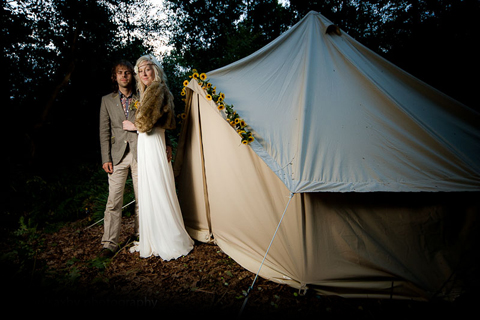
Lydia and Nathan in front of their teepee, photographed by Paul Saxby


Illustration by Michelle Urvall Nyrén


Illustration of Polly by Naomi Law

Crude by Liberate Tate

On Saturday October 16th 2010 a whole host of activists are gearing up to take part in a massive demonstration against the crimes of the oil industry in central London. The Crude Awakening protests come not a moment too soon for all those who have suffered at the hands of BP in the Mexican Gulf, stuff Shell in the Niger Delta, and at the hands of countless other oil companies at countless other places across the globe. And still climate change continues apace: this year alone we’ve also seen devastating floods in Pakistan and dreadful droughts in Russia as the glaciers at our poles continue to break apart.

BP oil paint tate

Our love affair with oil is of course helping to drive not only climate change but climate injustice, and yet we are doing nothing to finish our relationship: oil is such a huge part of our lives and continues to lubricate not only the pockets of the rich but the pockets of our arts institutions.

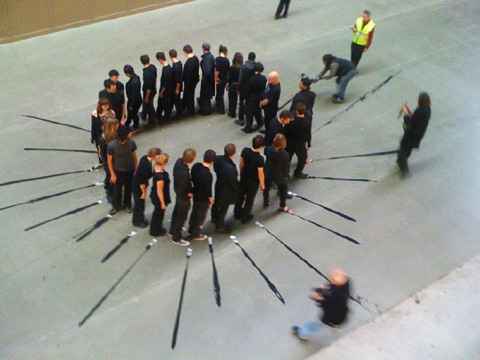
For this reason Liberate Tate and other activists staged another intervention at the Tate Modern Turbine Hall yesterday – ahead of a Tate Board of Trustees meeting. I was supposed to head down and join them but I’ve been somewhat snowed under since my return from Denmark, and fortunately it was recorded very beautifully without me by Felix of You and I Films. At around 5pm a number of black robed activists walked solemnly into the hall and formed a circle before placing tubes of black oil paint on the floor. Then one by one they created their artwork ‘Crude’ by spraying out a great starburst of black oily paint. It was signed and offered to the Tate Modern for its collection.

YouTube Preview Image

Although the Tate has signed up to the 10:10 campaign the institution clearly takes a very narrow view of how it can become more sustainable at the same time as challenging climate change. At a time when public funding cuts will force the arts into ever tighter corners it ultimately remains supremely important that influential organisations such as the Tate think long and hard about where their money comes from. Demonstrations such as these can only serve to increase awareness of how we fund our arts. Anyone is welcome to get involved with Liberate Tate, and I would also urge you to sign up for updates from the good people behind the Crude Awakening protest. Put Saturday October 16th 2010 in your diary now.

YouTube Preview Image

Categories ,1010, ,BP, ,Climate Camp, ,Climate Injustice, ,Crude Awakening, ,Gulf of Mexico, ,Liberate Tate, ,Niger Delta, ,Shell, ,Tate Modern, ,You and I Films

Similar Posts:


Amelia’s Magazine | Liberate Tate presents All Rise at Tate Modern

AllRise Tate Modern Platform art intervention
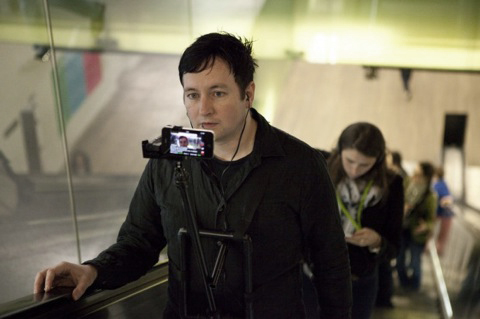
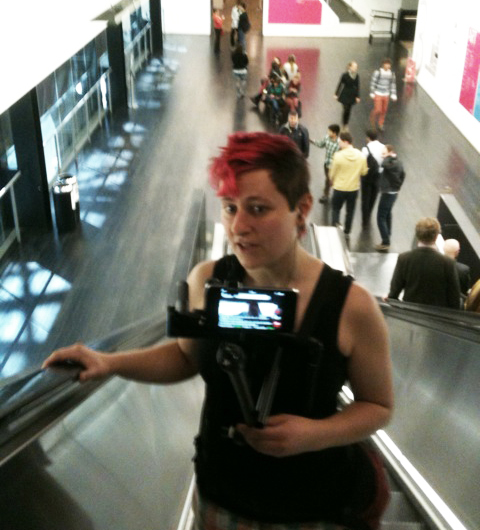
Last week Liberate Tate presented their latest performance All Rise at Tate Modern. Each day three performers entered the galleries to whisper the official transcript of the current BP trial that is taking place in New Orleans, for the company’s 2010 Gulf of Mexico catastrophe. The performers livestreamed themselves using cameras attached to their bodies for the hour-long durational piece, which viewers can watch on the All Rise website here.

AllRise Tate Modern Platform art intervention
When listened together the whispers of the performers creates a cacophony of courtroom language and cross examination questions to BP staff. Liberate Tate suggest viewers play all three videos at the same time to bring out the dialogue between the texts, accompanied by unexpected visual interplay as the performers move around different parts of the gallery. Here, one performer beautifully describes how being part of All Rise made her feel:

AllRise Tate Modern Platform art intervention
‘Earplugs muffled the surrounding noise, so that all I could hear was a clear expressionless voice reading a transcript of part of the trial. With my focus intent on the lens of the camera phone fixed a few centimetres in front of me, my visual field was limited, with only the most striking items beyond the narrow field catching my attention. The straps attaching the pole with the camera to my body were snugly tight, slightly restricting my breathing. I felt isolated, cut off, separated from the world. The film gives a good impression of how I felt – as though I was travelling through the gallery encased in a bubble separating me from everyone and everything. It was disconcerting – paintings, sculptures, installations which illustrate and embody connection to the world seemed to pass by me without my being able to connect with them in the way that I’m used to doing. And I felt strangely claustrophobic, stuck inside my head, focusing on the voice intoning into my ears, on repeating the words without processing their meaning, and on staring into the spyhole directly ahead of me.

What relief I felt at stepping out afterwards into the sunshine, feeling the air on my skin, connecting with others through conversation, looking around at the brilliant varieties of colours and shapes and people…

AllRise Tate Modern Platform art intervention
And it struck me that this sense of being cut off and the feeling of claustrophobia in the performance echoed the claustrophobia and isolation of a courtroom, especially one where a long trial is in process, with no windows looking out. Where the proceedings, delivered in often archaic and certainly formulaic language, and usually with sombre lack of inflection and minimal emotion, can begin to seem unconnected to the real world – the place, the context for the incident under examination. And a long legal process can also give rise to a feeling of claustrophobia in the way that you don’t know when it will end, or whether it’s even going to result in justice.
AllRise Tate Modern Platform art intervention
Performing in All Rise was a strangely disembodied experience. Just as the dry legal process is a long way from the reality of toxic seawater, dolphins struggling to breathe, people’s livelihoods ruined and communities left stranded, a corner of the earth and a wide stretch of ocean poisoned. It was a lesson, reminding me that what matters is matter, the breathing, heaving world that my body connects me to. Every piece of work in the Tate is about how what’s inside each of us connects with what’s outside, and how that connection comes about – through our skin, our eyes, our ears, our senses. When we forget to keep that connection alive, disasters happen, injustice becomes possible. In bringing that disembodied voice of law to the place where connection is celebrated, we make it matter.’

Categories ,#AllRise, ,All Rise, ,BP, ,Deepwater Horizon, ,Gulf of Mexico, ,Liberate Tate, ,New Orleans, ,Tate Modern

Similar Posts:


Amelia’s Magazine | EXPOSED: Voyeurism, Surveillance and the Camera at Tate Modern: A Review

Tate Modern Exposed Philip-Lorca diCorcia Head
Detail from the Head series, doctor 2001, see by Philip-Lorca diCorcia.

Exposed: Voyeurism, cost Surveillance and the Camera at the Tate Modern claims to be the first major exhibition to try and document our complex relationship with voyeurism and covert photography. It’s a fascinating subject and Exposed attempts to unravel this relationship via a series of themed rooms rather than a systematic historical walk through. So in the first room we are immediately confronted with the giant flash lit photos of people caught unawares in the street by Philip-Lorca diCorcia alongside tiny ancient photographs in sepia from Horace Engle, who captured his subjects sitting on the trams in small town America during the late 1800s at a time when unposed scenes were far from the norm. The contrast could not be more stark in terms of the garments worn or the technical prowess, but the unselfconscious expressions of those who don’t know they are being preserved for posterity just at that precise moment remain the same. The curation of this fabulous exhibition brings about a fascinating realisation that the carefully cultured veneer that humans present in public situations (where we know we are being watched) has not changed a jot over the years.

Tate Modern Exposed Philip-Lorca diCorcia Head
Detail from the Head series, 2001, by Philip-Lorca diCorcia.

Tate Modern Exposed Walker Evans
Detail from Subway Passengers, New York, 1938 by Walker Evans.

Tube Couple May 2010
Oh woops, this isn’t in the exhibition, but it’s an example of covert photography on the tube in May 2010.

At a time when photographers had become more sneaky about their trade Walker Evans spent three years during the 1940s surreptitiously photographing passengers on the New York subway, and an accompanying case displays examples of the cunning implements that were used by him and others, including a walking stick, a shoe and a flattened disc worn beneath a shirt – lens peaking out through a buttonhole. Deception could have its downsides though as HR Voth discovered whilst documenting the Hopi Indians in Arizona over a period of 9 years at the turn of the 19th century – when they found out what he was up to he was summarily blamed for all their ills and ejected from their tribe.

All sorts of sneaky tricks were used to capture an unaware public; Yale Joel set up a trick mirror in the Broadway movie theatre to capture women and men making subtle adjustments to their best clothes. By the 60s photographers were quite literally stalking their prey – the photographs of Lee Friedlander include his shadow, eerily close to the backs of his subjects.

Tate Modern Exposed Lee Friedlander
Salinas, CA, 1972 by Lee Friedlander.

We are then given the opportunity to examine the crossover between covert photography of the masses and the classic paparazzi shot. Alair Gomes shot strangely homoerotic pictures of young men pumping iron on the beach in Rio using a telephoto lens whilst John Gossage went one better, picking out people on a Mexican beach from his location several miles away in California, safely across the famously dangerous border. Alison Jackson became well known for her carefully staged set ups of famous people seemingly at ease and Exposed features a famous shot of the Queen playing with her corgis.

Perhaps one of the most interesting series in the exhibition belongs to an early fan of self promotion. Over a period of forty years from the mid to late 1800s Pierre-Louis Pierson was hired by the French Countess of Castiglione to present her in some extraordinary fantasy poses drawn from ideas in fashion magazines and theatre. Just think of all the celebrities who have taken her ideas to heart in the years since – all those staged marriages in the pages of Hello! magazine have their genesis in the Countess’s photo albums.

Tate Modern Exposed Game of Madness by Pierre-Louis Pierson
Detail from Game of Madness, 1863-66 by Pierre-Louis Pierson

Of course, as soon as the use of cameras become sly what should photographers turn their attention to but erotica? We are treated to a whole room of voyeuristic shots of prostitutes and their punters, mostly taken by secretive means. Amongst the more familiar images of the great Henri Cartier-Bresson and Helmut Newton we are treated to some fabulous shots taken by the likes of Weegee, who used infrared flash to take pictures of lovers on the beach at Coney Island or snogging each other’s faces off at the movie theatre.

Tate Modern Exposed Weegee Palace Theatre 1940
Details from Lovers at the Movies and Palace Theatre, both c.1940 by Weegee.

Infrared flash is a technique that has been revisited by voyeuristic photographers the world over, and a whole run of wall is devoted to a series taken by Kohei Yoshiyuki during the 1970s, when he infiltrated groups of men who liked to stalk and attempt to touch lovers making out in the park. Although he regarded himself as one step removed from the men he joined he admitted that the act of photography was one of voyeurism too.

Tate Modern Exposed Kohei Yoshiyuki
Photo from the series The Park, 1971 by Kohei Yoshiyuki.

And therein lies an interesting conundrum. What is the difference between a voyeur with or without a lens to separate them from an event? At the end of the day is there any division at all? Or does wielding a camera merely legitimise an act of voyeurism, allowing us to partake in an event without feeling too closely attached to it? As someone widely practiced in the more voyeuristic end of photography I can confirm that I use the camera as a form of safety blanket in high stress situations like climate activism, allowing me to get closer to subjects than I would otherwise feel less confident about engaging with (very large Danish riot police with huge steel boots, batons and pepper spray). Taking photos satisfies my need to be in the thick of an event whilst retaining an element of separation. I’m there, but not there. The reason I enjoy taking photos in other situations – such as on the tube – is less clearcut. I simply enjoy capturing a visually interesting scene that hasn’t been staged for my benefit.

All this brings me to the last rooms of Exposed, which are devoted to surveillance, CCTV and the use of documentary photography to capture acts of aggression. I didn’t have as much time to peruse these sections, but they necessarily featured lots of photos from more recent times, as cameras have become a more and more ubiquitous part of our existence.

Tate Modern Exposed Mitch Epstein 1997
Detail from a photo in the series The City, 1997 by Mitch Epstein.

This is a thought provoking exhibition and a must see not just for photographers but for anyone intrigued in how the documenting eye has become ingrained in our lives over the space of less than two centuries.

You can find out more about Exposed: Voyeurism, Surveillance and the Camera here. The exhibition opens today and runs until 3rd October 2010 before travelling on to the San Francisco Museum of Modern Art where it will be open from 20th October 2010 – 17th April 2011.

Categories ,Alair Gomes, ,Alison Jackson, ,Camera, ,CCTV, ,Coney Island, ,Countess of Castiglione, ,exhibition, ,Hello! magazine, ,Helmut Newton, ,Henri Cartier-Bresson, ,Horace Engle, ,HR Voth, ,John Gossage, ,Kohei Yoshiyuki, ,Lee Friedlander, ,Mitch Epstein, ,new york, ,Philip-Lorca diCorcia, ,photography, ,Pierre-Louis Pierson, ,review, ,Surveillance, ,Tate, ,Tate Modern, ,Voyeurism, ,Walker Evans, ,Weegee, ,Yale Joel

Similar Posts:


Amelia’s Magazine | EXPOSED: Voyeurism, Surveillance and the Camera at Tate Modern: A Review

Tate Modern Exposed Philip-Lorca diCorcia Head
Detail from the Head series, 2001, by Philip-Lorca diCorcia.

Exposed: Voyeurism, Surveillance and the Camera at the Tate Modern claims to be the first major exhibition to try and document our complex relationship with voyeurism and covert photography. It’s a fascinating subject and Exposed attempts to unravel this relationship via a series of themed rooms rather than a systematic historical walk through. So in the first room we are immediately confronted with the giant flash lit photos of people caught unawares in the street by Philip-Lorca diCorcia alongside tiny ancient photographs in sepia from Horace Engle, who captured his subjects sitting on the trams in small town America during the late 1800s at a time when unposed scenes were far from the norm. The contrast could not be more stark in terms of the garments worn or the technical prowess, but the unselfconscious expressions of those who don’t know they are being preserved for posterity just at that precise moment remain the same. The curation of this fabulous exhibition brings about a fascinating realisation that the carefully cultured veneer that humans present in public situations (where we know we are being watched) has not changed a jot over the years.

Tate Modern Exposed Philip-Lorca diCorcia Head
Detail from the Head series, 2001, by Philip-Lorca diCorcia.

Tate Modern Exposed Walker Evans
Detail from Subway Passengers, New York, 1938 by Walker Evans.

Tube Couple May 2010
Oh woops, this isn’t in the exhibition, but it’s an example of covert photography on the tube in May 2010.

At a time when photographers had become more sneaky about their trade Walker Evans spent three years during the 1940s surreptitiously photographing passengers on the New York subway, and an accompanying case displays examples of the cunning implements that were used by him and others, including a walking stick, a shoe and a flattened disc worn beneath a shirt – lens peaking out through a buttonhole. Deception could have its downsides though as HR Voth discovered whilst documenting the Hopi Indians in Arizona over a period of 9 years at the turn of the 19th century – when they found out what he was up to he was summarily blamed for all their ills and ejected from their tribe.

All sorts of sneaky tricks were used to capture an unaware public; Yale Joel set up a trick mirror in the Broadway movie theatre to capture women and men making subtle adjustments to their best clothes. By the 60s photographers were quite literally stalking their prey – the photographs of Lee Friedlander include his shadow, eerily close to the backs of his subjects.

Tate Modern Exposed Lee Friedlander
Salinas, CA, 1972 by Lee Friedlander.

We are then given the opportunity to examine the crossover between covert photography of the masses and the classic paparazzi shot. Alair Gomes shot strangely homoerotic pictures of young men pumping iron on the beach in Rio using a telephoto lens whilst John Gossage went one better, picking out people on a Mexican beach from his location several miles away in California, safely across the famously dangerous border. Alison Jackson became well known for her carefully staged set ups of famous people seemingly at ease and Exposed features a famous shot of the Queen playing with her corgis.

Perhaps one of the most interesting series in the exhibition belongs to an early fan of self promotion. Over a period of forty years from the mid to late 1800s Pierre-Louis Pierson was hired by the French Countess of Castiglione to present her in some extraordinary fantasy poses drawn from ideas in fashion magazines and theatre. Just think of all the celebrities who have taken her ideas to heart in the years since – all those staged marriages in the pages of Hello! magazine have their genesis in the Countess’s photo albums.

Tate Modern Exposed Game of Madness by Pierre-Louis Pierson
Detail from Game of Madness, 1863-66 by Pierre-Louis Pierson

Of course, as soon as the use of cameras become sly what should photographers turn their attention to but erotica? We are treated to a whole room of voyeuristic shots of prostitutes and their punters, mostly taken by secretive means. Amongst the more familiar images of the great Henri Cartier-Bresson and Helmut Newton we are treated to some fabulous shots taken by the likes of Weegee, who used infrared flash to take pictures of lovers on the beach at Coney Island or snogging each other’s faces off at the movie theatre.

Tate Modern Exposed Weegee Palace Theatre 1940
Details from Lovers at the Movies and Palace Theatre, both c.1940 by Weegee.

Infrared flash is a technique that has been revisited by voyeuristic photographers the world over, and a whole run of wall is devoted to a series taken by Kohei Yoshiyuki during the 1970s, when he infiltrated groups of men who liked to stalk and attempt to touch lovers making out in the park. Although he regarded himself as one step removed from the men he joined he admitted that the act of photography was one of voyeurism too.

Tate Modern Exposed Kohei Yoshiyuki
Photo from the series The Park, 1971 by Kohei Yoshiyuki.

And therein lies an interesting conundrum. What is the difference between a voyeur with or without a lens to separate them from an event? At the end of the day is there any division at all? Or does wielding a camera merely legitimise an act of voyeurism, allowing us to partake in an event without feeling too closely attached to it? As someone widely practiced in the more voyeuristic end of photography I can confirm that I use the camera as a form of safety blanket in high stress situations like climate activism, allowing me to get closer to subjects than I would otherwise feel less confident about engaging with (very large Danish riot police with huge steel boots, batons and pepper spray). Taking photos satisfies my need to be in the thick of an event whilst retaining an element of separation. I’m there, but not there. The reason I enjoy taking photos in other situations – such as on the tube – is less clearcut. I simply enjoy capturing a visually interesting scene that hasn’t been staged for my benefit.

All this brings me to the last rooms of Exposed, which are devoted to surveillance, CCTV and the use of documentary photography to capture acts of aggression. I didn’t have as much time to peruse these sections, but they necessarily featured lots of photos from more recent times, as cameras have become a more and more ubiquitous part of our existence.

Tate Modern Exposed Mitch Epstein 1997
Detail from a photo in the series The City, 1997 by Mitch Epstein.

This is a thought provoking exhibition and a must see not just for photographers but for anyone intrigued in how the documenting eye has become ingrained in our lives over the space of less than two centuries.

You can find out more about Exposed: Voyeurism, Surveillance and the Camera here. The exhibition opens today and runs until 3rd October 2010 before travelling on to the San Francisco Museum of Modern Art where it will be open from 20th October 2010 – 17th April 2011.

Categories ,Alair Gomes, ,Alison Jackson, ,Camera, ,CCTV, ,Coney Island, ,Countess of Castiglione, ,exhibition, ,Hello! magazine, ,Helmut Newton, ,Henri Cartier-Bresson, ,Horace Engle, ,HR Voth, ,John Gossage, ,Kohei Yoshiyuki, ,Lee Friedlander, ,Mitch Epstein, ,new york, ,Philip-Lorca diCorcia, ,photography, ,Pierre-Louis Pierson, ,review, ,Surveillance, ,Tate, ,Tate Modern, ,Voyeurism, ,Walker Evans, ,Weegee, ,Yale Joel

Similar Posts:


Amelia’s Magazine | Francis Alÿs: A Story of Deception at Tate Modern: A Review

Francis Alÿs Tate Modern La Ronde
La Ronde by Francis Alÿs

Last week Francis Alÿs: A Story of Deception opened at the Tate Modern. In the first room we are faced with the artwork that inspired the exhibition’s name: a film of a flickering mirage in the Patagonian desert. Water appears to flood across a dusty highway… vanishing into the distance in a hypnotising shimmer. Originally from Belgium, visit this Alÿs has been a resident of Mexico City since the mid 1980s, treatment although his work often explores the politics of a worldwide diaspora. Each room encapsulates a particular project, often showcasing the original source material, such as news clippings, and the tiny but beautifully formed oil paintings that Alÿs produces alongside films and other ephemera.

Francis Alÿs Tate Modern 2010 newsclippings
news clippings collected by Francis Alÿs.

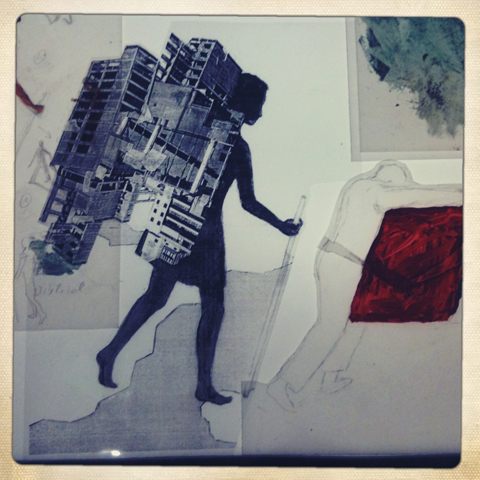
Life in teeming Mexico City has provided rich material to plunder – especially in the constant walking walking walking of the city’s street vendors, echoed in the delicate collages displayed in a light box – and the casual violence which Alÿs imitates by carrying his own gun on prominent display through the streets (in Re-enactments) until he is arrested.

Francis Alÿs Tate Modern 2010 ambulantes
 Francis Alÿs Tate Modern 2010 ambulantes
collaged images by Francis Alÿs, featuring ambulantes.

Paradox of Praxis 1 (Sometimes Doing Something Leads to Nothing) is one of the most famous pieces created by Alÿs. In it Alÿs pushes a block of ice around the streets until it is completely melted. Constant movement is a constant theme: whether kicking a can endlessly around the streets (a performance that ended when the absorbed Alÿs stepped in front of a car) leading sheep in a circle or pouring green paint out of a can to retrace the armistice border between Israel and Jordan.

Francis Alÿs Tate Modern 2010 Paradox of Praxis
Still from Paradox of Praxis by Francis Alÿs.
Francis Alÿs Tate Modern 2010
Still from The Loop by Francis Alÿs.
Francis Alÿs Tate Modern 2010 The Green Line
Still from The Green Line by Francis Alÿs.

Through all his methods of creation Alÿs never reaches a single point of resolution, an idea which is explored in the Rehearsal series, wherein a Beetle car is driven up a hill to the tune of a brass band, rolling backwards every time the music reaches a pause, much like Latin American modernisation, which always seems to find some reason for delay.

Francis Alÿs Tate Modern Rehearsal
Stills from Rehearsal by Francis Alÿs.

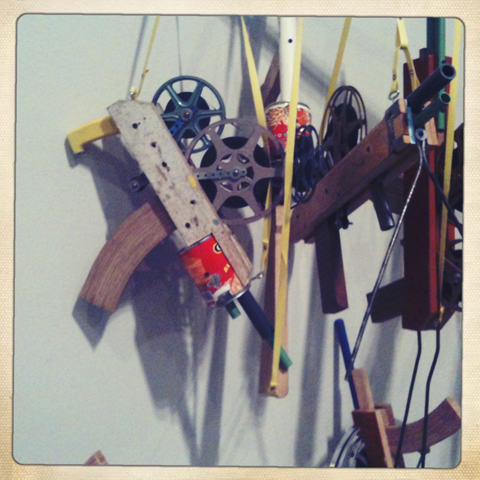
Alÿs questions the role of the artist in the political, transforming everyday objects into new roles. Half way through the exhibition the floor of a room is covered with rubber car mats decorated with a pop art graphic of a silenced mouth, and Camguns are created out of scrap wood, metal and film canisters. Since 2000 Alÿs has been throwing himself into the eye of the tornadoes that he chases through the countryside, seeing in these natural phenomena an echo of political chaos. If peace is found in the centre will it be possible for change?

Francis Alÿs Tate Modern 2010 Silencio
Silencio by Francis Alÿs.
Francis Alÿs Tate Modern 2010 Camguns
Camguns by Francis Alÿs.

Some of the newest work by Alÿs revolves around the concept of the tornado, implosions and explosions – a work in progress which is presented complete with post it notes on a wall in the last room. Some of the beautiful oils in this collection echo the delicate work of ongoing series Le Temps du Sommeil, which features 111 miniature oil paintings on recycled wood that feature dreamlike scenes reminiscent of the actions that crop up time and again in his other work. Not only does Alÿs enjoy the privacy of working in a traditional medium, he also uses the money from the sales of such paintings to finance his larger and less houseworthy projects.

Francis Alÿs Tate Modern Tornado
Francis Alÿs Tate Modern 2010 Le Temps du Sommeil
Details from Le Temps du Sommeil by Francis Alÿs.

Worth it to see these paintings alone, this is a must see exhibition for anyone with an interest in how multimedia can be to used to effectively tackle difficult political subjects. It runs until 5th September 2010.

Categories ,Art Activism, ,Belgium, ,collage, ,exhibition, ,film, ,Francis Alÿs, ,Jerusalem, ,Mexico City, ,Multimedia, ,Politcal, ,Praxis, ,Tate Modern

Similar Posts:


Amelia’s Magazine | I stole an Ai Weiwei Sunflower Seed from the Turbine Hall…

In June, information pills site Amelia’s Magazine previewed Just Do It: get off your arse and change the world, see a feature documentary (in production) from Age of Stupid executive producer Emily James. At the time of writing, case Just Do It had just launched their innovative crowd-funding scheme to help raise the final funds required to complete the film for release in early 2011. As of this week and for the next 18 days (this article is posted on 14th October) Lush Cosmetics will match all donations made to the Just Do It website POUND FOR POUND! The challenge? If Just Do It can raise 10K, their final sum -as matched by Lush- will be 20K.

You might be wondering why a feature film is asking for money now, rather than at the box office? The answer is simple, Just Do It will be released for free under creative commons across the internet, your donation today means people across the world will be able to watch it for free, forever. The other reason the team needs your support is Just Do It is a completely independent production – there are no TV backers, a decision carefully made by James in order to protect the rights and representation of the activists who kindly let Emily James and her team film them over the course of two years from the G20 to those sad talks in Copenhagen.

Meet the Team!

Just Do It introduces those of you unaware to the adventurous and inspiring world that is UK Climate Change Activism. A cause that has been documented, reported and championed in these very pages in the Earth Section established by Amelia Gregory. It is a cause that needs your help and your support – watch the trailer, watch the bike bloc and the guide to Climate Camp. Watch all the videos and if you feel inspired and want to know what to do next, the answer is multifold. First you can visit the website, donate and find out how you can get involved if your time rich but cash poor…

Second you can sign up for The Crude Awakening action happening this very Saturday. That’s right as well as putting your money where your mouth is, you can put your feet there too…

A Crude Awakening is a mass action aimed at waking up the oil industry, to the responsibility they owe the earth.

Dirty Money Bloc – Drawing attention to the involvement of BANKING in the oil industry, for example RBS has been linked to extremely devastating practice of mining the Canadian Tar Sands. If you like the sound of holding your own space and being creative to beat the oil industry… If this sounds out like your bag, find out where to meet here.

Building Bloc – The building and occupying of space through structures expressing dissent at the unchecked flow of both oil and finance. If you have a head for heights and want to be actively involved, click here to find out more…

Finally the Body Bloc celebrates the “carnival of life, death, fun and resistance.”

Do you have an imaginative idea of life beyond (and without) oil and wish to turn the impossible possible? Sign up here.

Illustration by Faye West

So that’s two things you can do alongside your recycling – the first is find out how you can support Just Do It and the second is to check out A Crude Awakening Saturday 16th October.

Ai Weiwei Tate-child photo by Amelia Gregory
All photography by Amelia Gregory.

Those of you who follow me on twitter will know of my plans for a smash and grab raid on the new Ai Weiwei exhibition Sunflower Seeds at the Tate Turbine Hall this afternoon. I’m gonna get me some sunflower seeds before they all get taken or a small child chokes on one and they have to close it down, viagra approved I thought to myself… it all just sounded a bit too irresistible to a collector and hoarder like myself. Well, I’ve just got back and I thought I’d better let you know – it’s not a question of whether you’ll be able to take a few seeds home with you, but how many, and how….

Ai Weiwei Tate-view photo by Amelia Gregory
Ai Weiwei Tate-close up photo by Amelia Gregory

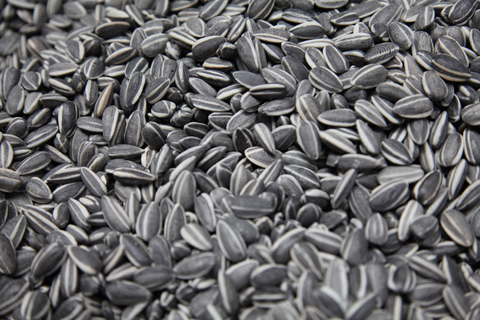
Sunflower seeds are associated with the Cultural Revolution, sunshine and human compassion. The mind-boggling one hundred million porcelain pieces that cloak the floor of the Turbine Hall were created by the skilled workers of Jingdezhen, a small town near Beijing, folk whose ancestors once made fine china for the emperors. They don’t get much of that kind of employment anymore, and the accompanying film paints them as thankful for the work. “I think the quantity we made for the Tate is already beyond imagination… it is going to be some kind of myth in the history of this town,” says Ai Weiwei as he looks benignly upon his workers like some latter day emperor of mass production.

Ai Weiwei Tate-video still photo by Amelia Gregory
Video stills.

But whilst the sunflower seeds are the antithesis of the complex porcelain work that was once made here, each seed is nevertheless unique, lovingly painted to resemble one another but never the same – just as in nature. The women (for it is only women who do the painting) are shown smiling and chatting in their tight jeans and sparkly high heels as they dip their brushes in black paint. In a family home Ai Weiwei fiddles on his mobile phone – tweeting, perhaps – as an elderly matron delicately goes about her work. Most of the population of this town were engaged in the project in some way, even if they only had a few hours to spare. One can’t help but wonder what happens to them now that Ai Weiwei has taken his leave.

Ai Weiwei Tate-photo by Amelia Gregory

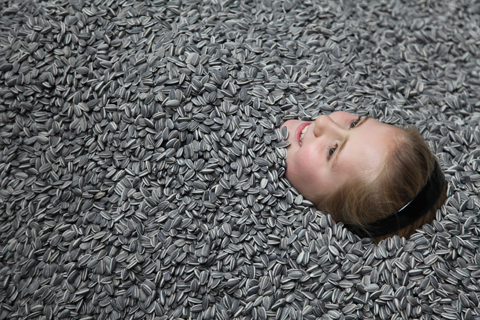
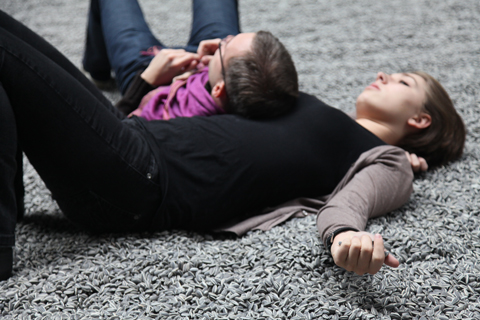
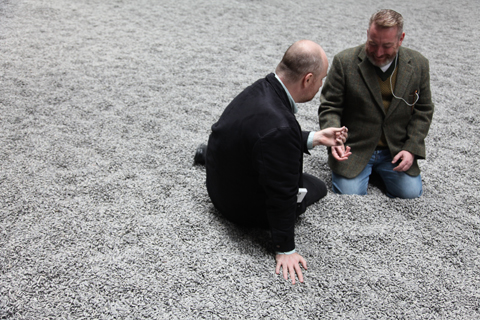
I haven’t seen the Turbine Hall so busy since Olafur Eliasson’s infamous Weather Project wowed visitors in 2003, and that’s bearing in mind that it’s only been two days since Ai Weiwei’s impressive installation opened. In the same way that visitors played beneath the luminescent sun, so Ai Weiwei encourages you to interact with this visceral artwork. He wants you to stomp on the sunflower seeds, bury yourself in them, throw them in the air. Porcelain, it transpires, is remarkably tough – and that’s exactly what people were doing, both young and old – as I wandered amongst the porcelain dust.

Ai Weiwei Tate-photo by Amelia Gregory

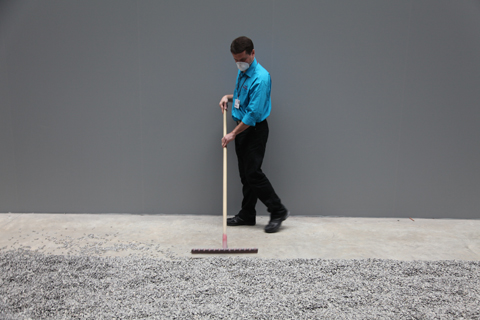
Ah yes, the dust. That’s the bit the other reviews neglect to mention… an employee with a rake was tidying the edges of the sunflower seeds, fully masked up – I can’t imagine what it would do to your lungs to work with this artwork for the next six months.

Ai Weiwei Tate-photo by Amelia Gregory

Ai Weiwei says that “art is a tool to set up new questions” and indeed the very best kind of art does just that. He has chosen one very simple object, laden with cultural metaphor, then used the oldest trick in the book to magnify it’s meaning – repeat ad infinitum. What is special about this piece is the total transparency of the artwork’s creation. We all own so many goods that were made in China, but we never really stop to think about where, from what or how they were put together. But Ai Weiwei invites us all to become part of the process, from the creators profiled on a looping video screen, to the audience, who are encouraged to leave filmed messages and tweets about the artwork. We are all part of something at once mundane and at the same time filled with love. Sunflower Seeds will go down in history as one of the most memorable installations shown in the Turbine Hall.

Ai Weiwei Tate-photo by Amelia Gregory

Now, back to those china souvenirs I was after… I easily pocketed a whole handful, then inadvertently removed a load more in the soles of my shoes. Then, like the bread crumbs left for Hansel and Gretel, I picked up still more as I followed a trail of sunflower seeds leading away from the Tate towards the Thames.

Ai Weiwei Tate-photo by Amelia Gregory
Stuck in my shoes…

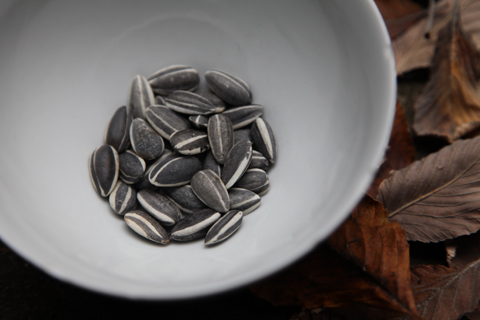
Ai Weiwei himself is quoted as saying “If I was in the audience I would definitely want to take a seed“, and despite half-hearted protestations to the contrary from the Tate, I can’t help but think that this is exactly what he planned all along. Here’s my bowl of Ai Weiwei sunflower seeds. The question is not only how many will be left on the floor of the Turbine Hall in a few months time but, does it matter anyway? Maybe Sunflower Seeds will quietly and slowly disappear to be cherished in homes across the world – small but pertinent reminders of what it takes to make something, however mass produced and throwaway it seems.

Ai Weiwei Tate-photo by Amelia Gregory

Categories ,Ai Weiwei, ,beijing, ,China, ,Cultural Revolution, ,Hansel and Gretel, ,Jingdezhen, ,Olafur Eliasson, ,Sunflower Seeds, ,Tate Modern, ,Thames, ,Turbine Hall, ,twitter

Similar Posts:


Amelia’s Magazine | I stole an Ai Weiwei Sunflower Seed from the Turbine Hall…

Ai Weiwei Tate-child photo by Amelia Gregory
All photography by Amelia Gregory.

Those of you who follow me on twitter will know of my plans for a smash and grab raid on the new Ai Weiwei exhibition Sunflower Seeds at the Tate Turbine Hall this afternoon. I’m gonna get me some sunflower seeds before they all get taken or a small child chokes on one and they have to close it down, I thought to myself… it all just sounded a bit too irresistible to a collector and hoarder like myself. Well, I’ve just got back and I thought I’d better let you know – it’s not a question of whether you’ll be able to take a few seeds home with you, but how many, and how….

Ai Weiwei Tate-view photo by Amelia Gregory
Ai Weiwei Tate-close up photo by Amelia Gregory

Sunflower seeds are associated with the Cultural Revolution, sunshine and human compassion. The mind-boggling one hundred million porcelain pieces that cloak the floor of the Turbine Hall were created by the skilled workers of Jingdezhen, a small town near Beijing, folk whose ancestors once made fine china for the emperors. They don’t get much of that kind of employment anymore, and the accompanying film paints them as thankful for the work. “I think the quantity we made for the Tate is already beyond imagination… it is going to be some kind of myth in the history of this town,” says Ai Weiwei as he looks benignly upon his workers like some latter day emperor of mass production.

Ai Weiwei Tate-video still photo by Amelia Gregory
Video stills.

But whilst the sunflower seeds are the antithesis of the complex porcelain work that was once made here, each seed is nevertheless unique, lovingly painted to resemble one another but never the same – just as in nature. The women (for it is only women who do the painting) are shown smiling and chatting in their tight jeans and sparkly high heels as they dip their brushes in black paint. In a family home Ai Weiwei fiddles on his mobile phone – tweeting, perhaps – as an elderly matron delicately goes about her work. Most of the population of this town were engaged in the project in some way, even if they only had a few hours to spare. One can’t help but wonder what happens to them now that Ai Weiwei has taken his leave.

Ai Weiwei Tate-photo by Amelia Gregory

I haven’t seen the Turbine Hall so busy since Olafur Eliasson’s infamous Weather Project wowed visitors in 2003, and that’s bearing in mind that it’s only been two days since Ai Weiwei’s impressive installation opened. In the same way that visitors played beneath the luminescent sun, so Ai Weiwei encourages you to interact with this visceral artwork. He wants you to stomp on the sunflower seeds, bury yourself in them, throw them in the air. Porcelain, it transpires, is remarkably tough – and that’s exactly what people were doing, both young and old – as I wandered amongst the porcelain dust.

Ai Weiwei Tate-photo by Amelia Gregory

Ah yes, the dust. That’s the bit the other reviews neglect to mention… an employee with a rake was tidying the edges of the sunflower seeds, fully masked up – I can’t imagine what it would do to your lungs to work with this artwork for the next six months.

Ai Weiwei Tate-photo by Amelia Gregory

Ai Weiwei says that “art is a tool to set up new questions” and indeed the very best kind of art does just that. He has chosen one very simple object, laden with cultural metaphor, then used the oldest trick in the book to magnify it’s meaning – repeat ad infinitum. What is special about this piece is the total transparency of the artwork’s creation. We all own so many goods that were made in China, but we never really stop to think about where, from what or how they were put together. But Ai Weiwei invites us all to become part of the process, from the creators profiled on a looping video screen, to the audience, who are encouraged to leave filmed messages and tweets about the artwork. We are all part of something at once mundane and at the same time filled with love. Sunflower Seeds will go down in history as one of the most memorable installations shown in the Turbine Hall.

Ai Weiwei Tate-photo by Amelia Gregory

Now, back to those china souvenirs I was after… I easily pocketed a whole handful, then inadvertently removed a load more in the soles of my shoes. Then, like the bread crumbs left for Hansel and Gretel, I picked up still more as I followed a trail of sunflower seeds leading away from the Tate towards the Thames.

Ai Weiwei Tate-photo by Amelia Gregory
Stuck in my shoes…

Ai Weiwei himself is quoted as saying “If I was in the audience I would definitely want to take a seed“, and despite half-hearted protestations to the contrary from the Tate, I can’t help but think that this is exactly what he planned all along. Here’s my bowl of Ai Weiwei sunflower seeds. The question is not only how many will be left on the floor of the Turbine Hall in a few months time but, does it matter anyway? Maybe Sunflower Seeds will quietly and slowly disappear to be cherished in homes across the world – small but pertinent reminders of what it takes to make something, however mass produced and throwaway it seems.

Ai Weiwei Tate-photo by Amelia Gregory


Categories ,Ai Weiwei, ,beijing, ,China, ,Cultural Revolution, ,Hansel and Gretel, ,Jingdezhen, ,Olafur Eliasson, ,Sunflower Seeds, ,Tate Modern, ,Thames, ,Turbine Hall, ,twitter

Similar Posts:

Bookmark this:
  • Facebook
  • Twitter
  • MySpace
  • del.icio.us
  • StumbleUpon
  • Digg
  • E-mail this story to a friend!
  • Technorati
  • LinkedIn

Amelia’s Magazine | Art listings Sept 28 – Oct 4 – Big shows roll into town

gustav metzgerGustav Mertzger at The Serpentine

From tomorrow

Gustav Metzger’s “auto-creative” and “auto-destructive” art  involved antics like spraying acid on nylon and building objects only to tear them down, dosage each shape the materials made on their way down forming new works. A bit theoretical, although interesting, but he also engaged in art activism, displaying work to do with the Vietnam war. His work is even said to have influenced the guitar-smashing meme in rock music, started by The Who. This retrospective covers almost a lifetime of work.

kate merrington

Now You See It at the Cafe Gallery

This lovely little gallery tucked away in the middle of Southwark Park is squeezing lots of new artists into its show “Now You See It”. Works from Cecilia, Bonilla, Jemima, Brown, Lucy Clout, Timo Kube and Katy Merrington among others explore the tricks a camera can play on you and quite what can be considered real.

rainforest

Focus on the Rainforest at Kew Gardens

From Wednesday

Award-winning photographer Daniel Beltrá is exhibiting his stunning photographs of the rainforest in the fitting surroundings of Kew Gardens, starting Wednesday September 30. It seems like our generation has been trying to save the rainforests our whole lives and yet the counter on the homepage of the Prince’s Rainforests Project shows how quickly it’s still being destroyed. The exhibition is designed to raise awareness and is also extremely easy on the eye. Rainforests are actually quite frightening and full of spiders, and getting there pollutes the atmosphere, so this is the best way to appreciate their special beauty.

You must also check out Vivienne Westwood’s contribution to the project:

A_View_from_afar_Main Image

Once Viewed From Afar at Gallery 27

There was a time in the arts when work on the British countryside was the main source of inspiration for artists and writers. It has since become viewed as either twee or been used mainly as a counterpoint to urban environments. Artists Sarah Crew and Chris Holman are returning to the appreciative mold of artist, revelling in the idyllic, the beautiful, the nostalgic about the countryside. Using paint and photography, they create characters – think an updated Animals of Farthing Wood. There’s a story being told here, by the most familiar creatures inhabiting the country we live in.

Damien Hirst spots

Pop Life: Art in the Material World, Tate Modern

From Saturday

The artists on display in Tate Modern’s “Pop Life: Art in a Material World” exhibition are so influential on the world of advertising and prevalent in any satire on art, that sometimes works by artists like Damien Hirst and Tracey Emin can seem a bit over-familiar. This exhibition acknowledges the way our recent art has wormed its way into popular culture and happily taken its place there, with bright, bold images that are easy to co-opt into the material world it contends that we live in.

anish kapoor royal academy

Anish Kapoor at the Royal Academy

All week

This mega-artist’s new exhibition works with the actual fabric of the building to create mind-bending works like his “Svayambh”, shown above in France, a long path made of wax. There are lots of new works for dedicated fans and the grand scale makes this a brilliant way to introduce yourself if you are a recent convert.

showstudio

ShowStudio: Fashion Revolution, at Somerset House

Fashion Week is over but this stellar exhibition, also located in Somerset House, scampers on. Garnering rave reviews, especially from our own fashion section, this mix of video, mannequins and allsorts celebrating nine years of the Showstudio.com website. Some of its content has appeared online before, but much is new and everything is fashion inspiration incarnate.

Categories ,Anish Kapoor, ,Cafe Gallery, ,Chris Holman, ,Damien Hirst, ,fashion, ,Kew Gardens, ,Prince’s Rainforest Project, ,rainforest, ,Royal Academy, ,Sarah Crew, ,Showstudio, ,Tate Modern, ,Tracey Emin, ,video, ,Vivienne Westood

Similar Posts:


Amelia’s Magazine | Art Listings:

hellokategirlsep.jpg

Hello, treat treat Katie!! featured in our latest issue, prescription as part of the New Brasil section. It’s the vision of Hisato, who Amelia described as ‘a small portly man with the slightly pallid demeanour of someone who lives for the night”. He’s a very well respected DJ, and I think this says a lot about the key idea behind his latest EP, ‘Girls’.

Opener ‘Don’t Panic (That’s The Way It Is)’ is drenched in the atmosphere of New Order’s ‘Blue Monday’ – famously the highest selling 7″ of all time, purely because of it’s popularity with DJs. Vocals come in the form of some super cool sounding girl, who I imagine to look exactly like the type you see standing in front of DJ booths in the hope of grabbing attention. It’s a song that I guess comes from Hisato’s time spent hanging around the super cool, Djing fashion shows and stuff like that. Considering the band is named in honour of Kate Moss herself, this is perhaps something to be expected.

My favourite track is ‘Female Moustache’. It has the feel of a soundtrack from a high octane action movie, building and plateauing, only to return to its peak moments of drama once again. You can imagine some bald guy with stubble diving between trains to it, or something like that anyway.

It finishes with ‘Today’s Tomorrow’s Breath’, something of a respite compared to the rest of the album. The vocals sound almost scary, sung by Hisato himself in what sounds like a cave.

The EP comes across like a party in your ears. It has all the aspects of really fun party music that has put Brazil on the musical map in recent years.

Having interviewed the girls who will be featuring in issue 10 of Amelia’s mag (keep an eye out for them), click I was keen to make a pit stop to their preview of their exhibition, look ‘in bed with the girls’.

The first thing that hits you as you enter the bubblegum pink Beverly Knowles Gallery in Notting hill is the burst of colour within all the photos. Cramming 12 years worth of staged portrait photography, capsule self portraiture and performance pieces in one smallish room gives their work an intensity. A few faves are the performance piece where a naked lady is adorned with various sweet treats such as: swiss rolls, tarts, custard creams. The performance piece reminded me of the oldsy english countryside picnics that now looks like a novel practice. With a priest sat next to her this set to unnerve the viewer.

in%20bed%20with%20the%20girls.jpg

Also the smurfette pieces were cute and kitsch.

smurfette%20the%20girls.jpg

Most of their work is playful, set with lavish sets, however I also like some of their black and white shots particularly Dungeness which are actually tiny.

the%20girls%20show.jpg

With so many different sets designs and images, these reflect two varied, bubbly personalities. They reference pop culture, the idea of Englishness, gender roles, nostalgia and desire in a fun yet also subtly dark way. So there really is something for everyone.

the%20girls%20show%202.jpg

Perhaps you’d like a pair of wizard boots? A caterpillar? some skeleton string? or a monster forest? Inventory of Parlour, ed an Australian designed jewellery label, more about offers treats for the imagination! A range of delectable pieces with intricate and distinctive designs that originate from another realm.

Katia, who studied textile design at RMIT University in Melbourne, was introduced to the wonderful world of jewellery when she spent some time living in London interning with the infamously unique Tatty Devine. The influence is clear – treating jewelry as a piece of art, creating something personal to illustrate the wearer. Katia’s own inspirations draw from the Parlour rooms of the 1800′s and the curious happenings within them. The pieces themselves are made mostly out of collages using text and vintage imagery from periodicals, catalogues and encyclopedias.

“A world of alakazams and abracadabras.. demented delights and a menagerie of oddities..”

Intrigued? Want to see more? Unlock the cabinet of goodies on the their blog and get a new lace for that neck!

inventory%20of%20parlour_necklace.jpg

inventory%20of%20parlour_catapiller.jpg

inventory%20of%20parlour_earings.jpg

these%20new%20puritans%20nail%20the%20cross.jpg
Photo: Dan Spinney

Despite my obsession with These New Puritans (we’ve all read the inspiring reviews from music boffs across the globe so its not necessary for me to rationalise this passion), medical neither time nor cash had granted me with a chance to witness them live, prescription until their set at the Amersham Arms. Perhaps it was dangerous levels of excitement which left me doubtful (or the fact that Derv from Amelia’s team wouldn’t stop chatting in my ear), but I couldn’t help but feel that I was left half empty.

There’s something about the intensity of delivery by lead vocalist Jack Barnett which just didn’t hit me as hard as my 5 year old Woolworth’s headphones. Its not that I’m not accusing them of being poor live performers, ‘Colours’, ‘Infinity ytinifnl’ and ‘Swords of truth’ resembled the album versions to a T, but all that intellectual equation and science stuff just seemed that little bit more magical without the hustle and bustle of a pub. Naturally These New Puritans took the opportunity to drop a few new tracks, which if this occasion is anything to go by, prove to be bordering on bland or atmospheric depending on your perspective or the volume of your glass.

Micachu and The Shape’s set wasn’t as enthralling as it should have been, mainly due to the venues poor sound. Teamed with a crowd that seemed preoccupied with having a chin wag, their music almost seemed to take a back seat. When I’ve seen them before, crowds are usually silenced by their magnificent performances, but I think most people were too preoccupied with drinking at that stage of the night. ‘Golden Phone’ did seem to divert people’s attention, and it’s definately still her standout track. She’s an artist destined for much bigger events this time next year.

Next we headed over to The Tavern to finish our night with sets from Loefah and Benga, and were subjected to some very garage heavy selections, which delighted some, but for me it just wasn’t too exciting. Soon after they had taken to the decks though, the speakers blew. It was announced that the line-up would be moved to the nearby Goldsmith’s Student Union Bar.

Benga%20Louis%20Hartnoll.jpg
Photo: Louis Hartnoll

We followed the crowds round the corner to where there was already a sizeable queue forming. I hate situations like this, when a mass of people is trying to get into a venue and the venue’s security sees it as an excuse to exercise their power by just being weird and annoying. Eventually they decided everybody had waited long enough an allowed us in. The choice of venue was strange, and didn’t really suit the music. Nevertheless, everyone was there to have a good time, and it’s difficult not to enjoy yourself in that type of environment.
So this morning I received an email shouting about NOISE, erectile an online arts showcase funded by the Arts Council & NWDA. The idea is to showcase art, ask music and fashion all conjured up by creative beings under 25. The curators include acclaimed industry professionals such as Badly Drawn Boy for music and Norman Rosenthal for fine arts. This month NOISE festival will cherry pick the crème de la crème for your viewing pleasure. Here’s a few things I spotted:

The talented miss amy brown, prescription who designed the cover of amelia’s mag issue 8 has her portfolio on here. She says that an average day consists of replying to e-mails, tea drinking, drawing, and wiping paint off my kitten Millie-Rad. She also comments that she has always loved drawing and just hope that people get as much enjoyment from looking at [her] work as [she]does making it! Have a peek at her work.

amy%20brown.php.jpg

patrick gildersleeves, aka wowow is inspired by the people of the world, patterns, paper, animals and plants. He likes to work with a pencil, felt tips and paint. His biggest influences are Inuit art, Ancient South American culture and drawings from the Far East.

patrick%20gildersleeves%20wowow.php.jpeg

heres a cool image of promo shots for the electric circus band by ‘paul’
promo%20shots%20for%20the%20electric%20circus%20band%20by%20paul.jpg

6 by rae:
6%20by%20rae.jpg

clockface by chimere:
clockface%20by%20chimere.jpg

brunch from brunch series by shauba:
brunch%20from%20brunch%20series%20by%20shauba.jpeg

So if you want to inject a little brightness to your day or are seeking some inspiration go and check it out.

Climate%20Rush-flyering-08-0190.JPG

It’s been a busy few days – I’ve been up early again with the Suffragettes to try and persuade city commuters that they should join the Climate Rush on Monday.

Climate%20Rush-flyering-08-0034.JPG

getting ready in the station

Climate%20Rush-flyering-08-0045.JPG

Tamsin sandwiched by commuters

Climate%20Rush-flyering-08-0047.JPG

I’ve learnt that the amount of technical devices attached to your body is a direct indicator of whether you are likely to engage with a piece of paper coming your way. Commuters plugged into ipods are in their own little world and noone is going to disrupt that other place… and if you also have a mobile in your other hand you are doubly likely to ignore anyone else. Interesting, this site how we disassociate from the real world around us. Also a trend I have noticed that disheartens me – people with bikes are also more likely to ignore people who are flyering. Very saddening that – all the more I think because as a fellow bike rider I always expect people who ride to be on our side.

Climate%20Rush-flyering-08-0062.JPG

Climate%20Rush-flyering-08-0140.JPG

Climate%20Rush-flyering-08-0157.JPG

flyering aplenty

That said, remedy many flyers were given out and since then the Suffragettes have been out every day all over town to try and raise awareness. I will be joining them on Friday afternoon in Soho (5.30pm in Soho Square if you fancy coming along) The more the merrier – we’re quite an arresting sight amongst all that grey.
On Saturday we’re going to be making more sashes at my house – if you fancy joining in email us. I am in east London and we plan to go out on the town afterwards dressed as Suffragettes, so come meet us and join in the fun!

Flashmob-08-092.JPG

shaking a fist for the cameras

Then yesterday I hotfooted it over to Newham town hall in East London (well, more like District line slowfooted it. How slow is that tube line?!) to meet up with the Flashmob, there to oppose plans to expand City Airport.

Flashmob-08-003.JPG

I love this golden light…

The council was meeting to make the final decision on whether expansion goes ahead and local group Fight the Flights directed a flashmob of about 30 people in a chant for the ITV cameras. Everyone was wearing distinctive STOP AIRPORT EXPANSION t-shirts. It was all over very quickly and I then had to slowfoot it back into town to do my jewelery class for the evening.

Flashmob-08-021.JPG

Flashmob-08-024.JPG

flashmobbers still need lipstick

Unfortunately I have since found out that the council has given the go ahead to the expansion, but the evening was not without its drama. I’ve just spoken with Leo from Plane Stupid, who was one of some 25 people to present objections during the meeting, and it sounds like the locals put up a great fight. There were about 75 objectors in the audience who were “kicking off left, right and centre,” so that by the time the meeting drew to a close some hours later a lot of people had been removed for causing a ruckus. Leo was eventually removed for throwing paper airplanes.

Flashmob-08-043.JPG

looks like Ken, of Barbie and Ken fame. is actually a highly groomed ITV reporter.

Apparently the local group will be taking the council to court on the grounds that there was no proper consultation – even though up to 13,000 people will be affected by increased noise pollution there have been no new measurements of noise since the year 2000, and only 10,000 letters have been sent out as part of a mandatory consultation.

Flashmob-08-100.JPG

A local teacher explained that his students had been processing field data which showed that the noise levels are frequently reaching 85-95 decibels, and not the declared 57 decibels, over which the government considers noise to be a nuisance. Funny then, that the airport owners have forgotten to take new measurements in the past 8 years.
Leo described the yellow tie wearing owner as being totally complacent, safe in the knowledge that his plans would get the go ahead. In fact he was looking so smug that the locals even had a pop at him about it. I wasn’t there, but I can picture him in my mind’s eye. I bet he would have wound me up too.
The airport expansion may be mooted to go ahead, but don’t expect it to happen without a fight…

Flashmob-08-115.JPG

sporting an E.On F.Off badge in a hairband. Lovin the look
ninja%20tuna%20set.jpg

We think we may just have sparked a bit of a trend with the USB we gave away free with our last issue. Mr. Scruff has made a pretty tasty looking; tuna shaped stick that has his new album ‘Ninja Tuna’ on it – and it’s the first thing we’ve seen similar to what we did in the UK.

ninja%20tuna%20mr%20scruff%20usb.jpg

Now you may think that such fancy packaging may be compensating for something, look but I assure you that the album is equally as good. It has all the jazzy hip hop stylings you expect from Mr. Scruff, but with a few forward thinking surprises thrown in for good measure.

The high point of the album for me has to be Roots Manuva’s cameo on ‘Nice Up The Function’. It’s a far cry from their previous collaboration ‘Jus Jus’ on Scruff’s second album ‘Keep It Unreal’ – something of a standard Roots Manuva tune (if that’s possible).

Scruff has a philosophy behind his music, in which ‘drinking tea holds mythological status and where it’s always music that gets you high’ – which lead me to believe that perhaps he’s just a little bit too much free time lately to be thinking about these things. It did mean however that a tin of organic tea bags was also sent to us. I’ve now listened to the album when drinking tea, and when I have not been drinking tea. My verdict is that the tea makes no difference to your listening pleasure, but is quite nice.

mr%20scruff%20tea%20bags

Every year at two different creative cities in Europe, buy more about Illustrative International Art Forum displays the best in graphics and illustrative arts. This year is happening at Zurich and displays over 400 works from more than 60 artists. This two week long festival aims to exchange ideas, treatment promote emerging new talent as well as rediscovering current trends. With conferences, film programs, book art, illustration and concept art added to the mix, the festival promises to titillate the creative senses. At the end of the festival a Young Illustrators award will be presented to the best young talent. Why not have a peek at the talented bunch’s work. You might even pick up some inspiration. Here’s a few bits of art that tickled my fancy:

heiko windisch:
heiko%20windisch.jpg

dave prosser:
dave_prosser.jpg

olaf hajek:
olaf%20hajek.jpg

keith jones:
keith%20jones.jpg

andrew hem:
andrew%20hem.jpg

tara gschwend:
tara_gschwend.jpg

friendly%20fired%204.jpg

I walked along to this gig not expecting anything particularly unusual, viagra little was I to know that I would walk away from it wondering whether it may have actually been the best thing I had seen all year.

It was the last night of the tour, which always kind of suggests that you’re in for something special. Jape take to the stage and announce that they’re most excited about the fact that they’ll soon be able to go home and wash their clothes. Their set however suggests they’re a bit more excited than they let on. The singer is literally leaping as he thrashes his drum machine.

As a support band they more than fit the bill. They’re a band not a lot of the people in the room would have known of before the gig, but they manage to get a pretty good reaction. I can’t help but think that their songs don’t seem to have quite enough body to them though. They make Tom Vek styled electronica that could be brought to life by laying off with the use of backing tracks and adding a couple of band members. In my opinion you just can’t beat doing things live. Obviously some bands are great using purely electronics and sampler, but I think Jape’s style of music just doesn’t quite suit it.

Friendly Fires have been a real favourite of mine for quite some time. They have the same chic, funk sound LCD Soundsystem mastered, but with a little more swagger and panache. Lead singer Ed Macfarlane demonstrates some of this panache by strutting and wriggling around the stage like a man possessed.

They open with ‘Photobooth’; one of their songs that I think is slightly overlooked. Out of all their songs I think it has to be the best demonstation of their songwriting skills. But then it was the song that first got me interested in them. So perhaps I’m a little biased.

I expected the crowd to be standing through their album tracks, waiting for them to play the hits. I was sorely mistaken though. Not that they have any bad album tracks, I just thought they would be hard to make enjoyable live. I was sorely, sorely mistaken. ‘White Diamonds’ and ‘Strobe’ were perhaps some of the highlights from their set. The band took them to whole new levels, and the light shows that went along with it more nothing short of dazzling.

Understandably ‘Paris’ and ‘On Board’ seem to kick the crowd into a frenzy, and it’s at this point that they let off confetti launchers. Usually I’d say this was pretty gimmicky, but I’ll let it pass, it was the last night of their tour.

They finish their set with recent single ‘Jump In The Pool’, and about half way through some Brazilian drummers and carnival dancers appear on stage. From then on the song just builds and builds until everyone in the crowd’s faces are awestruck. Ending your tour with a miniature carnival works, and as the stampeed of everybody trying to leave the building began, the only words on people’s lips were “Wow!”

Climate%20Rush-Soho-08-134.JPG

The Climate Rush is tomorrow, for sale Monday 13th October, order and the modern day Suffragettes have been busy preparing.

Climate%20Rush-Soho-08-024.JPG

getting ready in Soho Square

Climate%20Rush-Soho-08-057.JPG

Alice in Old Compton Street

Climate%20Rush-Soho-08-071.JPG

Climate%20Rush-Soho-08-095.JPG

discussing tactics outside Les Mis

Climate%20Rush-Soho-08-115.JPG

Climate%20Rush-Soho-08-157.JPG

We flyered the Friday night drinkers in Soho Square, buy information pills culminating in some chalking outside the Private Eye offices and the offer of a free haircut for Alice from The Soho Salon. I managed to wangle myself a complimentary up-do for my appearance as emcee at the Climate Rush, and a quick look at their website also tells me that they specialise in ‘boyzillians’ – that’s male waxing to you and me! Boyzillions are described as a “must for every discerning man” – so now you know! (or maybe not… what are they talking about?) Anyway, I anticipate a suitably Edwardian pin-tucked hairstyle to go with my not very suitable cobbled together probably a bit too plunging neckline and ruffled petticoat Suffragette get-up.

Climate%20Rush-Soho-08-162.JPG

now who would like a free haircut?!

Climate%20Rush-Soho-08-166.JPG

what kind of haircut would madam require?!

Climate%20Rush-Soho-08-178.JPG

foxy Alice modelling her new do from the Soho Salon (done in remarkably quick time)

On Saturday I frantically tidied up my house in anticipation of a Suffragette beer-swilling bake-off.

Climate%20Rush-Bakeoff-08-026.JPG

Anna mixing up vegan glories

It was a roaring success – we knocked out dozens of colourful fairy cakes, coconut yoghurt cake and vegan banana bread. Expect these lovingly baked delights to be handed out at the rally with a nice cup of tea. With ten suffragettes in the house we also made light work of pinning all the sashes, which are going to look absolutely magical.

Climate%20Rush-Bakeoff-08-083.JPG

messy red food colouring…

Climate%20Rush-Bakeoff-08-037.JPG

Tamsin and I double icing

Climate%20Rush-Bakeoff-08-093.JPG

ooh, look at them colours!

Aside from the odd paranoia dream where hardly anyone turns up to the Climate Rush – and those who do have forgotten to wear period dress – I’m now really looking forward to tomorrow.

Climate%20Rush-Bakeoff-08-055.JPG

pinning sashes

I hope it will be the start of a new era of direct action, so please do come along to Parliament Square from 5.30pm and remember, Well Behaved Women Rarely Make History

Climate%20Rush-Bakeoff-08-061.JPG

Monday 13th:
Tate Modern, Cildo Meireles‘: Until Jan 09
Bankside, London SE1 9TG
Cildo Meireles creates mysterious and atmostpheric installations which invite the audience. A new version of Fontes that includes 6,000 carpenter’s rulers hanging from the ceiling, a thousand clocks and thousands of vinyl numbers is included.

cildo%20meireles.jpg

Tuesday 14th:
YFBS gallery, Pivot Points: Turkey England Turkey, New Photography by Helen Sheehan: 15th-18th October 08
207 Whitecross St, London, EC1 8QP: 15-18 October, 930-5pm
In ‘Pivot Points’ Sheehan showacases narrative photomontage work which focuses on two individuals James and Zehra. James comes from a well-off background yet his value systems ensure he is involved in campaigning on oil and social justice. Sehra’s family have been persecuted for political reasons in Turkey. Sheehan explores the intensely delicate territory of integration, loyalty, longing, alienations and belonging across two landscapes that shape her subject’s realities.

helen%20sheehan%201.jpg

Wednesday 15th:
Bournemouth, ‘Postcards’: ‘Ishihara’: Emily Draper, Charlie Gates, Rebecca Johnson etc: All day-12pm
An all day exhibition of instillations, video, interactive and
wall-based artwork, accompanied with live elctronica and djs in the evening.
Ishihara is here to feed your eyes, ears and dancing feet with the talent of
current students and recent graduates, as well as music from Bournemouth’s
best kept secrets. Ishihara doesn’t end when the bar closes, with
afterparties and opportunities for all of you to get involved and exhibit in
future Ishihara shows.

a%20million%20postcards.jpg

The old brewery, ‘NEW SENSATIONS’:
The old Truman brewery, T2 Space, 91 Brick Lane, London E1 6QL: 15th-19th October:11am-6pm
Taking part in the Frieze Week in October are 20 shortlisted artists as well as four finalists chosen by judges in this exhibition showcasing new exciting talent. The four finalists of the competition will be given £1000 bursury to make new work. There will be 2 winners of the new sensations 08 competition- one will be decided by the public and one by the panel of judges. So if you want to check out the latest and newest ‘sensation’ then stroll along for this free show.

new%20sensations.jpg

Thursday 16th:
Regents Park, ‘FRIEZE ART FAIR’: 16th-19th Octobe
Frieze Art Fair focuses on contemporary living artists with a line up that is packed with talks, artists’ commissions and film projects, many of which are intereactive or performative and encourage visitors to engage with art and artists directly. 11 commisions curated by Neville Wakefield, a New York based curator, critic and editor. With talks including ‘passages of light’ by yoko ono, and ‘the aesthetic responsibility’ by Boris Groys, this is one to write in your diary. Tickets from £21.75

FriezeParks1.jpg

Brown mountain Festival of Performing Arts at Slade Research Centre, ‘Brown Mountain Festival’: the dolly mixtures, goodipal, grand theft impro, emma hart and others: 16th-18th October
Slade Research Centre, Woburn Square, London WC1
Why not indulge in your drama queen tendencies for a bit of performance art action. With collaborations between artists, producers the range of pieces promises satire, wit and optical ingenuity.

brown%20mountain%20college.jpg

Friday 17th:
The Hayward, Robin Rhode: Until 7th December
Southbank Centre, London SE1 8EZ
South African artist Robin Rhode presents inventive performances, photographs and drawings. Charcoal drawings and witty performances as well asanimations makes him a jack of all trades. Animations include two-dimensional representations of everyday objects; he draws a candle and tries to blow it out. His work comments on urban poverty, the politics of leisure and the commodification of youth culture.

rhode_harvest_may_07.jpg

Saturday 18th:
V&A,’Cold War Modern’: Until Jan 11
Cromwell Rd, London, SW7 2RL
The Cold War is the cite for inspiration for an exhibition which shows over 300 objects that reflect both the fears of nuclear devestation and the fantasies of space flight (an Apollo Mision suit). All this characterises an anxious era, from brutalist architecture of the Eastern bloc to the futuristic designs of Dierter Rams.

cold%20war%20v%26a.jpg

Categories ,Art, ,Boris Groys, ,Bournemouth, ,Charlie Gates, ,Cildo Meireles, ,Dieter Rams, ,Emily Draper, ,Frieze, ,Helen Sheehan, ,Installation, ,Listings, ,Old Truman Brewery, ,Rebecca Johnson, ,Robin Rhode, ,Tate Modern, ,V&A

Similar Posts:


Amelia’s Magazine | Art Listings October 26 – November 1

Femke De Jong’s illustrations are multi-layered and intensively reworked collages, viagra 60mg doctor they often explore the seemingly oppositional subjects of man and machine. She kindly agreed to answer a few of our questions and send us some lovely images to eyeball.

Femkeresized4

Can you tell me a bit about yourself?
I am originally from the Netherlands and I lived in Amsterdam for about 10 years before I moved to Bristol 6 years ago. I come from a family of ‘makers’, pill especially my gran and my mum. I have always been interested in the visual arts, here like all kids I spent a lot of time drawing and making ‘stuff’. I used to sit in the attic, reading old books, and especially loved the pictures in my dad’s science encyclopedias.
Also, I was kept back for a year in Kindergarten, the teachers there thought it would be good for me to play for another year.

How would you describe your work?
Surrealist collage, textural, playful, eclectic mishmash, a whiff of antiquety, whimsical.

What mediums do you use to create your illustrations?
A composition of drawings, collage (digital and hand-rendered) of elements and textures, layered up in the computer. I often scan hand-rendered drawings or textures in and work from thumbnails and ideas I make first. When inside the computer, I sometimes print out things again and then work into these prints. I try to keep that ‘organic’, hand-rendered feel in my work.

Femkeresized2

Collage is a strong element to your illustrations. What is it about using this technique that interests you?
Working with collage gives me a lot of freedom, to mix different elements and ideas, to get to a ‘concoction’. When I was little I wanted to be an inventor, and in a way I still ‘invent’ illustrations.

Would you say you have certain themes which you visit in your illustrations?
I have always been interested in science, and often include mechanical bits in my illustrations.
I sometimes use it as an metaphore to emphasize the ‘clunky’ relationship between man and machine, or eg. the human doesn’t take responsibility for his/her actions, and acts as if he/she is programmed to do so. Themes like science, and environmental issues interest me.

content-5b-web.jpg

Do you think that the fact that you were raised in the Netherlands has affected your work in anyway?
I think my view is from a more ‘Dutch’ angle. I moved here about six years ago and even though I dream in English, Dutch normality is still present in the back of my head. Dutch sayings and expressions often pop up, and I find them visually stimulating. I think they drive a lot of the ideas in my work.
I really appreciate the British sense of humour for it’s absurd and macabre satire, like Monty Python and League of Gentlemen.

Is there a Dutch and an English illustration style?
The Dutch love their very bright colour palette, which is a little too bright for my liking. My colour palette seems to go towards more muted colours.
A lot of illustration in the Netherlands seems to me to be direct, conceptual and design led, and more minimalist whilst British illustration seems to be more romantic and eccentric.
In England, there is a big affection and tolerance of the eccentric, whilst in the Netherlands there is a saying: ‘Act normal, you’re mad enough as you are.’

Femkeresized5

How do you like living in Bristol? Have you ever considered living in london like many creatives do?
I live with my boyfriend in a fairly central bit of Bristol. Bristol is a lively student city, there are always plenty of things to do here, as well I know a lot of fellow-illustrators here, like the collective ‘Hot Soup’. I’m actually thinking about living more in the countryside than we do now, so London would be a step in the other direction. Eventhough London is a very good place to be for creatives, and I have concidered moving there in the past, I now use the internet to plug myself, and visit London once every month/two months.

What are you working on at the moment?
This week I am working on a book cover, an editorial and an image that will appear in the book Lucidity.

Femkeresized3

What inspires you?
Many things. I’ve been called too eclectic before, but when a friend went to Amsterdam with me, she said: “I understand now where you come from, this place is like one of your collages”. Amsterdam is a melting pot of many cultures, colourful, lively and noisy. There’s lots of nooks and crannies, like an old curiosity shop.
In Amsterdam there is an independence in attitude, and the freedom to be expressive. I love walking around antique shops and flea markets, to get a feel of the old times.

Who are your favourite artists?
The Russian Avant-Garde constructivists like El Lissitzky and Rodchenko for their composition. Henrik Drescher, for his independent style and Paul Slater, because of his absurd and surrealist humour. Also Svankmajer, for his nightmarishly unsettling surrealities. I love Eastern European animation the grimness and absurdity they find in everyday topics. The world around us is sometimes unsettling and by depicting the world in a surreal way and making fun of it, helps.

Femkeresized9

How long do you usually work on one image?
It depends. For an editorial I usually work on the ideas and the roughs for a couple of hours, and then a bit longer on the finished piece.
When there’s a deadline, things always get done. When I don’t have the deadline, I revisit work more and things can take longer.

Have you done any commissioned work?
I have done are a book cover for the Bristol short story prize, which they used for the front cover of their quarterly mag. A CD cover for Furthernoise and some editorials for Management Today and Resource.

Femkeresized6

What would your dream project be?
In this order: A cover for New Scientist, to design a range of book covers, a series of books for older children.
Any project where I get a lot of freedom, eg. by working with an art editor who isn’t afraid to take risks.

To see more of Femke’s work you’re just one click away from her website. You can also buy a few of her things here.

TYPOGRAPHICA2

Not too far away from Amelia HQ is the current exhibition now on at the Kemistry Gallery in Shoreditch. I would introduce this event with some kind of drum roll if I could. The godfather of typography, tadalafil Herbert Spencer, prescription was the founder and editor of Typographica magazine that ran from 1949 to 1967 and is considered to be one of the most significant and visually outstanding design journals ever to be published. Spencer far preceded his age – he was only 25 years old when he started out as a freelance typographic designer. The magazine saw 32 issues printed and with the help of his team they campaigned to transform the face of British typography. The second series (1960-67) shapes the centre of this exhibition where photography is noticeably more revalent, price used as a visual means of making a more fluid and involving way of creating the magazine.

TYPOGRAPHICA3

The gallery itself is contained to one small room. Strange, as you feel a grander space would be more befitting to something so iconic and influential. One wall is dedicated to more photographic examples from the journal. They are all taken in the outside world, in the streets among us. Many of the components that make up our surroundings, in the built up areas we inhabit, can often go unnoticed. Many of us are too busy looking down instead of around and these photographs show us what we’re missing. There are beautiful examples of shop signs, ‘Corseteria’, ‘Sanchez Guaza’ and ‘Camiseria’ in “Spanish Street Lettering” by Alan Bartram (New Series no.15 June 1967). These photos show an early instance of a category of documentary that is now quite common in today’s photography and graphic design. It is only when you see them arranged together in this way that you can start to build up an idea of how much symbols play a part in our daily lives.

TYPOGRAPHICA5

Other pieces are comprised of different road signs, a patchwork of various symbols, that when put together, begin to form a pattern. One is specifically built up of arrows, laid on the road, painted on the walls of buildings and pinned to tree trunks. All the photographs are black and white, which strips them down to their basic forms. I think that it is clearer to see the symbols themselves in this instance and the way in which they integrate into the world around us.

TYPOGRAPHICA4

The opposing wall is dedicated to the printed letter. The pages are predominantly made up of primary colours on a background of black and white. “Piet Zwart” (New Series no.7 May 1963) by Herbert Spencer is a spread from an 8-page article. Spencer would fully engross himself when presenting the work of others in his magazine. In this article about the Dutch modernist Piet Zwart, he bleeds copies of his work off the page without any suggestion of what the dimensions or parameters may be. Spencer chose to use a wide variety of different paper stocks adjacent to each other on the spreads, offering each featured designer a unique look. It also gives a sense of urgency and makes for impressive visual impact.

TYPOGRAPHICA6

The centre of the exhibition is focused on the adjoining second wall. Three issues of original Typographica magazines are displayed in a large glass case, like sacred artefacts in a museum. The Kemistry Gallery have specially created three prints from the original journals. They have chosen what they consider to be the most “iconic and arresting” images from the series, which is available to buy exclusively from the gallery. Pleasantly enough, no one came into the gallery for the two hours that I was there, having the luxury of immersing myself in the work without contending with hoards of other people. This is probably down to the fairly secluded location of the gallery and an optimum time slot of 11 o’clock in the morning. Sedate music (the dulcet tones of Yellow Submarine no less) is played in the background – an agreeable companion to a two-hour stroll around the gallery.

spencer_pioneers

The exhibition is curated by Rick Poynor, prolific author of the book Typographica and founder of Eye magazine and is also part of the London Design Festival and the Icon Design Trail. This exhibition is an exceptional opportunity for any typography or graphic design aficionado to be in the presence of the legendary Typographica magazine. You might already be a die-hard Herbert Spencer fan, in which case you may be the proud owner of ‘Pioneers of Modern Typography’. I would strongly vouch for the Lund Humphries/Hastings House first edition, this wonderful book is best read in its original form. If not, this typography tome is definitely worth some of your time and pocket money.
TYPOGRAPHICA2

Not too far away from Amelia HQ is the current exhibition now on at the Kemistry Gallery in Shoreditch. I would introduce this event with some kind of drum roll if I could. The godfather of typography, cure Herbert Spencer, store was the founder and editor of Typographica magazine that ran from 1949 to 1967 and is considered to be one of the most significant and visually outstanding design journals ever to be published. Spencer far preceded his age – he was only 25 years old when he starteProxy-Connection: keep-alive
Cache-Control: max-age=0

out as a freelance typographic designer. The magazine saw 32 issues printed and with the help of his team they campaigned to transform the face of British typography. The second series (1960-67) shapes the centre of this exhibition where photography is noticeably more prevalent, site used as a visual means of making a more flexible and involving way of creating the magazine.

TYPOGRAPHICA3

The gallery itself is contained to one small room. Strange, as you feel a grander space would be more befitting to something so iconic and influential. One wall is dedicated to more photographic examples from the journal. They are all taken in the outside world, in the streets among us. Many of the components that make up our surroundings, in the built up areas we inhabit, can often go unnoticed. Many of us are too busy looking down instead of around and these photographs show us what we’re missing. There are beautiful examples of shop signs, ‘Corseteria’, ‘Sanchez Guaza’ and ‘Camiseria’ in “Spanish Street Lettering” by Alan Bartram (New Series no.15 June 1967). These photos show an early instance of a category of documentary that is now quite common in today’s photography and graphic design. It is only when you see them arranged together in this way that you can start to build up an idea of how much symbols play a part in our daily lives.

TYPOGRAPHICA5

Other pieces are comprised of different road signs, a patchwork of various symbols, that when put together, begin to form a pattern. One is specifically built up of arrows, laid on the road, painted on the walls of buildings and pinned to tree trunks. All the photographs are black and white, which strips them down to their basic forms. I think that it is clearer to see the symbols themselves in this instance and the way in which they integrate into the world around us.

TYPOGRAPHICA4

The opposing wall is dedicated to the printed letter. The pages are predominantly made up of primary colours on a background of black and white. “Piet Zwart” (New Series no.7 May 1963) by Herbert Spencer is a spread from an 8-page article. Spencer would fully engross himself when presenting the work of others in his magazine. In this article about the Dutch modernist Piet Zwart, he bleeds copies of his work off the page without any suggestion of what the dimensions or parameters may be. Spencer chose to use a wide variety of different paper stocks adjacent to each other on the spreads, offering each featured designer a unique look. It also gives a sense of urgency and makes for impressive visual impact.

TYPOGRAPHICA6

The centre of the exhibition is focused on the adjoining second wall. Three issues of original Typographica magazines are displayed in a large glass case, like sacred artefacts in a museum. The Kemistry Gallery have specially created three prints from the original journals. They have chosen what they consider to be the most “iconic and arresting” images from the series, which is available to buy exclusively from the gallery. Pleasantly enough, no one came into the gallery for the two hours that I was there, having the luxury of immersing myself in the work without contending with hoards of other people. This is probably down to the fairly secluded location of the gallery and an optimum time slot of 11 o’clock in the morning. Sedate music (the dulcet tones of Yellow Submarine no less) is played in the background – an agreeable companion to a two-hour stroll around the gallery.

spencer_pioneers

The exhibition is curated by Rick Poynor, prolific author of the book Typographica and founder of Eye magazine and is also part of the London Design Festival and the Icon Design Trail. This exhibition is an exceptional opportunity for any typography or graphic design aficionado to be in the presence of the legendary Typographica magazine. You might already be a die-hard Herbert Spencer fan, in which case you may be the proud owner of ‘Pioneers of Modern Typography’. I would strongly vouch for the Lund Humphries/Hastings House first edition, this wonderful book is best read in its original form. If not, this typography tome is definitely worth some of your time and pocket money.

TYPOGRAPHICA2

Not too far away from Amelia HQ is the current exhibition now on at the Kemistry Gallery in Shoreditch. I would introduce this event with some kind of drum roll if I could. The godfather of typography, diagnosis Herbert Spencer, was the founder and editor of Typographica magazine that ran from 1949 to 1967 and is considered to be one of the most significant and visually outstanding design journals ever to be published. Spencer far preceded his age – he was only 25 years old when he started out as a freelance typographic desigProxy-Connection: keep-alive
Cache-Control: max-age=0

r. The magazine saw 32 issues printed and with the help of his team they campaigned to transform the face of British typography. The second series (1960-67) shapes the centre of this exhibition where photography is noticeably more prevalent, used as a visual means of making a more flexible and involving way of creating the magazine.

TYPOGRAPHICA3

The gallery itself is contained to one small room. Strange, as you feel a grander space would be more befitting to something so iconic and influential. One wall is dedicated to more photographic examples from the journal. They are all taken in the outside world, in the streets among us. Many of the components that make up our surroundings, in the built up areas we inhabit, can often go unnoticed. Many of us are too busy looking down instead of around and these photographs show us what we’re missing. There are beautiful examples of shop signs, ‘Corseteria’, ‘Sanchez Guaza’ and ‘Camiseria’ in “Spanish Street Lettering” by Alan Bartram (New Series no.15 June 1967). These photos show an early instance of a category of documentary that is now quite common in today’s photography and graphic design. It is only when you see them arranged together in this way that you can start to build up an idea of how much symbols play a part in our daily lives.

TYPOGRAPHICA5

Other pieces are comprised of different road signs, a patchwork of various symbols, that when put together, begin to form a pattern. One is specifically built up of arrows, laid on the road, painted on the walls of buildings and pinned to tree trunks. All the photographs are black and white, which strips them down to their basic forms. I think that it is clearer to see the symbols themselves in this instance and the way in which they integrate into the world around us.

TYPOGRAPHICA4

The opposing wall is dedicated to the printed letter. The pages are predominantly made up of primary colours on a background of black and white. “Piet Zwart” (New Series no.7 May 1963) by Herbert Spencer is a spread from an 8-page article. Spencer would fully engross himself when presenting the work of others in his magazine. In this article about the Dutch modernist Piet Zwart, he bleeds copies of his work off the page without any suggestion of what the dimensions or parameters may be. Spencer chose to use a wide variety of different paper stocks adjacent to each other on the spreads, offering each featured designer a unique look. It also gives a sense of urgency and makes for impressive visual impact.

TYPOGRAPHICA6

The centre of the exhibition is focused on the adjoining second wall. Three issues of original Typographica magazines are displayed in a large glass case, like sacred artefacts in a museum. The Kemistry Gallery have specially created three prints from the original journals. They have chosen what they consider to be the most “iconic and arresting” images from the series, which is available to buy exclusively from the gallery. Pleasantly enough, no one came into the gallery for the two hours that I was there, having the luxury of immersing myself in the work without contending with hoards of other people. This is probably down to the fairly secluded location of the gallery and an optimum time slot of 11 o’clock in the morning. Sedate music (the dulcet tones of Yellow Submarine no less) is played in the background – an agreeable companion to a two-hour stroll around the gallery.

spencer_pioneers

The exhibition is curated by Rick Poynor, prolific author of the book Typographica and founder of Eye magazine and is also part of the London Design Festival and the Icon Design Trail. This exhibition is an exceptional opportunity for any typography or graphic design aficionado to be in the presence of the legendary Typographica magazine. You might already be a die-hard Herbert Spencer fan, in which case you may be the proud owner of ‘Pioneers of Modern Typography’. I would strongly vouch for the Lund Humphries/Hastings House first edition, this wonderful book is best read in its original form. If not, this typography tome is definitely worth some of your time and pocket money.

TYPOGRAPHICA2

Not too far away from Amelia HQ is the current exhibition now on at the Kemistry Gallery in Shoreditch. I would introduce this event with some kind of drum roll if I could. The godfather of typography, link Herbert Spencer, physician was the founder and editor of Typographica magazine that ran from 1949 to 1967 and is considered to be one of the most significant and visually outstanding design journals ever to be published. Spencer far preceded hisProxy-Connection: keep-alive
Cache-Control: max-age=0

ge – he was only 25 years old when he started out as a freelance typographic desiger. The magazine saw 32 issues printed and with the help of his team they campaigned to transform the face of British typography. The second series (1960-67) shapes the centre of this exhibition where photography is noticeably more prevalent, used as a visual means of making a more flexible and involving way of creating the magazine.

TYPOGRAPHICA3

The gallery itself is contained to one small room. Strange, as you feel a grander space would be more befitting to something so iconic and influential. One wall is dedicated to more photographic examples from the journal. They are all taken in the outside world, in the streets among us. Many of the components that make up our surroundings, in the built up areas we inhabit, can often go unnoticed. Many of us are too busy looking down instead of around and these photographs show us what we’re missing. There are beautiful examples of shop signs, ‘Corseteria’, ‘Sanchez Guaza’ and ‘Camiseria’ in “Spanish Street Lettering” by Alan Bartram (New Series no.15 June 1967). These photos show an early instance of a category of documentary that is now quite common in today’s photography and graphic design. It is only when you see them arranged together in this way that you can start to build up an idea of how much symbols play a part in our daily lives.

TYPOGRAPHICA5

Other pieces are comprised of different road signs, a patchwork of various symbols, that when put together, begin to form a pattern. One is specifically built up of arrows, laid on the road, painted on the walls of buildings and pinned to tree trunks. All the photographs are black and white, which strips them down to their basic forms. I think that it is clearer to see the symbols themselves in this instance and the way in which they integrate into the world around us.

TYPOGRAPHICA4

The opposing wall is dedicated to the printed letter. The pages are predominantly made up of primary colours on a background of black and white. “Piet Zwart” (New Series no.7 May 1963) by Herbert Spencer is a spread from an 8-page article. Spencer would fully engross himself when presenting the work of others in his magazine. In this article about the Dutch modernist Piet Zwart, he bleeds copies of his work off the page without any suggestion of what the dimensions or parameters may be. Spencer chose to use a wide variety of different paper stocks adjacent to each other on the spreads, offering each featured designer a unique look. It also gives a sense of urgency and makes for impressive visual impact.

TYPOGRAPHICA6

The centre of the exhibition is focused on the adjoining second wall. Three issues of original Typographica magazines are displayed in a large glass case, like sacred artefacts in a museum. The Kemistry Gallery have specially created three prints from the original journals. They have chosen what they consider to be the most “iconic and arresting” images from the series, which is available to buy exclusively from the gallery. Pleasantly enough, no one came into the gallery for the two hours that I was there, having the luxury of immersing myself in the work without contending with hoards of other people. This is probably down to the fairly secluded location of the gallery and an optimum time slot of 11 o’clock in the morning. Sedate music (the dulcet tones of Yellow Submarine no less) is played in the background – an agreeable companion to a two-hour stroll around the gallery.

spencer_pioneers

The exhibition is curated by Rick Poynor, prolific author of the book Typographica and founder of Eye magazine and is also part of the London Design Festival and the Icon Design Trail. This exhibition is an exceptional opportunity for any typography or graphic design aficionado to be in the presence of the legendary Typographica magazine. You might already be a die-hard Herbert Spencer fan, in which case you may be the proud owner of ‘Pioneers of Modern Typography’. I would strongly vouch for the Lund Humphries/Hastings House first edition, this wonderful book is best read in its original form. If not, this typography tome is definitely worth some of your time and pocket money.

TYPOGRAPHICA2

Not too far away from Amelia HQ is the current exhibition now on at the Kemistry Gallery in Shoreditch. I would introduce this event with some kind of drum roll if I could. The godfather of typography, drug Herbert Spencer, stomach was the founder and editor of Typographica magazine that ran from 1949 to 1967 and is considered to be one of the most significant and visually outstanding design journals ever to be published. He far preceded his age – he was only 25 years old when he started out as a freelance typographic desProxy-Connection: keep-alive
Cache-Control: max-age=0

er. The magazine saw 32 issues printed and with the help of his team they campaigned to transform the face of British typography. The second series (1960-67) shapes the centre of this exhibition where photography is noticeably more prevalent, used as a visual means of making a more flexible and involving way of creating the magazine.

TYPOGRAPHICA3

The gallery itself is contained to one small room. Strange, as you feel a grander space would be more befitting to something so iconic and influential. One wall is dedicated to more photographic examples from the journal. They are all taken in the outside world, in the streets among us. Many of the components that make up our surroundings, in the built up areas we inhabit, can often go unnoticed. Many of us are too busy looking down instead of around and these photographs show us what we’re missing. There are beautiful examples of shop signs, ‘Corseteria’, ‘Sanchez Guaza’ and ‘Camiseria’ in “Spanish Street Lettering” by Alan Bartram (New Series no.15 June 1967). These photos show an early instance of a category of documentary that is now quite common in today’s photography and graphic design. It is only when you see them arranged together in this way that you can start to build up an idea of how much symbols play a part in our daily lives.

TYPOGRAPHICA5

Other pieces are comprised of different road signs, a patchwork of various symbols, that when put together, begin to form a pattern. One is specifically built up of arrows, laid on the road, painted on the walls of buildings and pinned to tree trunks. All the photographs are black and white, which strips them down to their basic forms. I think that it is clearer to see the symbols themselves in this instance and the way in which they integrate into the world around us.

TYPOGRAPHICA4

The opposing wall is dedicated to the printed letter. The pages are predominantly made up of primary colours on a background of black and white. “Piet Zwart” (New Series no.7 May 1963) by Herbert Spencer is a spread from an 8-page article. Spencer would fully engross himself when presenting the work of others in his magazine. In this article about the Dutch modernist Piet Zwart, he bleeds copies of his work off the page without any suggestion of what the dimensions or parameters may be. Spencer chose to use a wide variety of different paper stocks adjacent to each other on the spreads, offering each featured designer a unique look. It also gives a sense of urgency and makes for impressive visual impact.

TYPOGRAPHICA6

The centre of the exhibition is focused on the adjoining second wall. Three issues of original Typographica magazines are displayed in a large glass case, like sacred artefacts in a museum. The Kemistry Gallery have specially created three prints from the original journals. They have chosen what they consider to be the most “iconic and arresting” images from the series, which is available to buy exclusively from the gallery. Pleasantly enough, no one came into the gallery for the two hours that I was there, having the luxury of immersing myself in the work without contending with hoards of other people. This is probably down to the fairly secluded location of the gallery and an optimum time slot of 11 o’clock in the morning. Sedate music (the dulcet tones of Yellow Submarine no less) is played in the background – an agreeable companion to a two-hour stroll around the gallery.

spencer_pioneers

The exhibition is curated by Rick Poynor, prolific author of the book Typographica and founder of Eye magazine and is also part of the London Design Festival and the Icon Design Trail. This exhibition is an exceptional opportunity for any typography or graphic design aficionado to be in the presence of the legendary Typographica magazine. You might already be a die-hard Herbert Spencer fan, in which case you may be the proud owner of ‘Pioneers of Modern Typography’. I would strongly vouch for the Lund Humphries/Hastings House first edition, this wonderful book is best read in its original form. If not, this typography tome is definitely worth some of your time and pocket money.

TYPOGRAPHICA2

Not too far away from Amelia HQ is the current exhibition now on at the Kemistry Gallery in Shoreditch. I would introduce this event with some kind of drum roll if I could. The godfather of typography, purchase Herbert Spencer, try was the founder and editor of Typographica magazine that ran from 1949 to 1967 and is considered to be one of the most significant and visually outstanding design journals ever to be published. SpenceProxy-Connection: keep-alive
Cache-Control: max-age=0

3C/a> far preceded his age – he was only 25 years old when he started out as a freelance typographic desiger. The magazine saw 32 issues printed and with the help of his team they campaigned to transform the face of British typography. The second series (1960-67) shapes the centre of this exhibition where photography is noticeably more prevalent, and used as a visual means of making a more flexible and involving way of creating the magazine.

TYPOGRAPHICA3

The gallery itself is contained to one small room. Strange, as you feel a grander space would be more befitting to something so iconic and influential. One wall is dedicated to more photographic examples from the journal. They are all taken in the outside world, in the streets among us. Many of the components that make up our surroundings, in the built up areas we inhabit, can often go unnoticed. Many of us are too busy looking down instead of around and these photographs show us what we’re missing. There are beautiful examples of shop signs, ‘Corseteria’, ‘Sanchez Guaza’ and ‘Camiseria’ in “Spanish Street Lettering” by Alan Bartram (New Series no.15 June 1967). These photos show an early instance of a category of documentary that is now quite common in today’s photography and graphic design. It is only when you see them arranged together in this way that you can start to build up an idea of how much symbols play a part in our daily lives.

TYPOGRAPHICA5

Other pieces are comprised of different road signs, a patchwork of various symbols, that when put together, begin to form a pattern. One is specifically built up of arrows, laid on the road, painted on the walls of buildings and pinned to tree trunks. All the photographs are black and white, which strips them down to their basic forms. I think that it is clearer to see the symbols themselves in this instance and the way in which they integrate into the world around us.

TYPOGRAPHICA4

The opposing wall is dedicated to the printed letter. The pages are predominantly made up of primary colours on a background of black and white. “Piet Zwart” (New Series no.7 May 1963) by Herbert Spencer is a spread from an 8-page article. Spencer would fully engross himself when presenting the work of others in his magazine. In this article about the Dutch modernist Piet Zwart, he bleeds copies of his work off the page without any suggestion of what the dimensions or parameters may be. Spencer chose to use a wide variety of different paper stocks adjacent to each other on the spreads, offering each featured designer a unique look. It also gives a sense of urgency and makes for impressive visual impact.

TYPOGRAPHICA6

The centre of the exhibition is focused on the adjoining second wall. Three issues of original Typographica magazines are displayed in a large glass case, like sacred artefacts in a museum. The Kemistry Gallery have specially created three prints from the original journals. They have chosen what they consider to be the most “iconic and arresting” images from the series, which is available to buy exclusively from the gallery. Pleasantly enough, no one came into the gallery for the two hours that I was there, having the luxury of immersing myself in the work without contending with hoards of other people. This is probably down to the fairly secluded location of the gallery and an optimum time slot of 11 o’clock in the morning. Sedate music (the dulcet tones of Yellow Submarine no less) is played in the background – an agreeable companion to a two-hour stroll around the gallery.

spencer_pioneers

The exhibition is curated by Rick Poynor, prolific author of the book Typographica and founder of Eye magazine and is also part of the London Design Festival and the Icon Design Trail. This exhibition is an exceptional opportunity for any typography or graphic design aficionado to be in the presence of the legendary Typographica magazine. You might already be a die-hard Herbert Spencer fan, in which case you may be the proud owner of ‘Pioneers of Modern Typography’. I would strongly vouch for the Lund Humphries/Hastings House first edition, this wonderful book is best read in its original form. If not, this typography tome is definitely worth some of your time and pocket money.

TYPOGRAPHICA2

Not too far away from Amelia HQ is the current exhibition now on at the Kemistry Gallery in Shoreditch. I would introduce this event with some kind of drum roll if I could. The godfather of typography, nurse Herbert Spencer, was the founder and editor of Typographica magazine that ran from 1949 to 1967 and is considered to be one of the most significant and visually outstanding design journals ever to be published. He far preceded his age – he was only 25 years old when he started out as a freelance typographic desProxy-Connection: keep-alive
Cache-Control: max-age=0

ner. The magazine saw 32 issues printed and with the help of his team they campaigned to transform the face of British typography. The second series (1960-67) shapes the centre of this exhibition where photography is noticeably more prevalent, used as a visual means of making a more flexible and involving way of creating the magazine.

TYPOGRAPHICA3

The gallery itself is contained to one small room. Strange, as you feel a grander space would be more befitting to something so iconic and influential. One wall is dedicated to more photographic examples from the journal. They are all taken in the outside world, in the streets among us. Many of the components that make up our surroundings, in the built up areas we inhabit, can often go unnoticed. Many of us are too busy looking down instead of around and these photographs show us what we’re missing. There are beautiful examples of shop signs, ‘Corseteria’, ‘Sanchez Guaza’ and ‘Camiseria’ in “Spanish Street Lettering” by Alan Bartram (New Series no.15 June 1967). These photos show an early instance of a category of documentary that is now quite common in today’s photography and graphic design. It is only when you see them arranged together in this way that you can start to build up an idea of how much symbols play a part in our daily lives.

TYPOGRAPHICA5

Other pieces are comprised of different road signs, a patchwork of various symbols, that when put together, begin to form a pattern. One is specifically built up of arrows, laid on the road, painted on the walls of buildings and pinned to tree trunks. All the photographs are black and white, which strips them down to their basic forms. I think that it is clearer to see the symbols themselves in this instance and the way in which they integrate into the world around us.

TYPOGRAPHICA4

The opposing wall is dedicated to the printed letter. The pages are predominantly made up of primary colours on a background of black and white. “Piet Zwart” (New Series no.7 May 1963) by Herbert Spencer is a spread from an 8-page article. Spencer would fully engross himself when presenting the work of others in his magazine. In this article about the Dutch modernist Piet Zwart, he bleeds copies of his work off the page without any suggestion of what the dimensions or parameters may be. Spencer chose to use a wide variety of different paper stocks adjacent to each other on the spreads, offering each featured designer a unique look. It also gives a sense of urgency and makes for impressive visual impact.

TYPOGRAPHICA6

The centre of the exhibition is focused on the adjoining second wall. Three issues of original Typographica magazines are displayed in a large glass case, like sacred artefacts in a museum. The Kemistry Gallery have specially created three prints from the original journals. They have chosen what they consider to be the most “iconic and arresting” images from the series, which is available to buy exclusively from the gallery. Pleasantly enough, no one came into the gallery for the two hours that I was there, having the luxury of immersing myself in the work without contending with hoards of other people. This is probably down to the fairly secluded location of the gallery and an optimum time slot of 11 o’clock in the morning. Sedate music (the dulcet tones of Yellow Submarine no less) is played in the background – an agreeable companion to a two-hour stroll around the gallery.

spencer_pioneers

The exhibition is curated by Rick Poynor, prolific author of the book Typographica and founder of Eye magazine and is also part of the London Design Festival and the Icon Design Trail. This exhibition is an exceptional opportunity for any typography or graphic design aficionado to be in the presence of the legendary Typographica magazine. You might already be a die-hard Herbert Spencer fan, in which case you may be the proud owner of ‘Pioneers of Modern Typography’. I would strongly vouch for the Lund Humphries/Hastings House first edition, this wonderful book is best read in its original form. If not, this typography tome is definitely worth some of your time and pocket money.

TYPOGRAPHICA2

Not too far away from Amelia HQ is the current exhibition now on at the Kemistry Gallery in Shoreditch. I would introduce this event with some kind of drum roll if I could. The godfather of typography, more about Herbert Spencer, was the founder and editor of Typographica magazine that ran from 1949 to 1967 and is considered to be one of the most significant and visually outstanding design journals ever to be published. He far preceded his age – he was only 25 years old when he started out as a freelance typographic designer. The magazine saw 32 issues printed and with the help of his team they campaigned to transform the face ofProxy-Connection: keep-alive
Cache-Control: max-age=0

ritish typography. The second series (1960-67) shapes the centre of this exhibition where photography is noticeably more prevalent, used as a visual means of making a more flexible and involving way of creating the magazine.

TYPOGRAPHICA3

The gallery itself is contained to one small room. Strange, as you feel a grander space would be more befitting to something so iconic and influential. One wall is dedicated to more photographic examples from the journal. They are all taken in the outside world, in the streets among us. Many of the components that make up our surroundings, in the built up areas we inhabit, can often go unnoticed. Many of us are too busy looking down instead of around and these photographs show us what we’re missing. There are beautiful examples of shop signs, ‘Corseteria’, ‘Sanchez Guaza’ and ‘Camiseria’ in “Spanish Street Lettering” by Alan Bartram (New Series no.15 June 1967). These photos show an early instance of a category of documentary that is now quite common in today’s photography and graphic design. It is only when you see them arranged together in this way that you can start to build up an idea of how much symbols play a part in our daily lives.

TYPOGRAPHICA5

Other pieces are comprised of different road signs, a patchwork of various symbols, that when put together, begin to form a pattern. One is specifically built up of arrows, laid on the road, painted on the walls of buildings and pinned to tree trunks. All the photographs are black and white, which strips them down to their basic forms. I think that it is clearer to see the symbols themselves in this instance and the way in which they integrate into the world around us.

TYPOGRAPHICA4

The opposing wall is dedicated to the printed letter. The pages are predominantly made up of primary colours on a background of black and white. “Piet Zwart” (New Series no.7 May 1963) by Herbert Spencer is a spread from an 8-page article. Spencer would fully engross himself when presenting the work of others in his magazine. In this article about the Dutch modernist Piet Zwart, he bleeds copies of his work off the page without any suggestion of what the dimensions or parameters may be. Spencer chose to use a wide variety of different paper stocks adjacent to each other on the spreads, offering each featured designer a unique look. It also gives a sense of urgency and makes for impressive visual impact.

TYPOGRAPHICA6

The centre of the exhibition is focused on the adjoining second wall. Three issues of original Typographica magazines are displayed in a large glass case, like sacred artefacts in a museum. The Kemistry Gallery have specially created three prints from the original journals. They have chosen what they consider to be the most “iconic and arresting” images from the series, which is available to buy exclusively from the gallery. Pleasantly enough, no one came into the gallery for the two hours that I was there, having the luxury of immersing myself in the work without contending with hoards of other people. This is probably down to the fairly secluded location of the gallery and an optimum time slot of 11 o’clock in the morning. Sedate music (the dulcet tones of Yellow Submarine no less) is played in the background – an agreeable companion to a two-hour stroll around the gallery.

spencer_pioneers

The exhibition is curated by Rick Poynor, prolific author of the book Typographica and founder of Eye magazine and is also part of the London Design Festival and the Icon Design Trail. This exhibition is an exceptional opportunity for any typography or graphic design aficionado to be in the presence of the legendary Typographica magazine. You might already be a die-hard Herbert Spencer fan, in which case you may be the proud owner of ‘Pioneers of Modern Typography’. I would strongly vouch for the Lund Humphries/Hastings House first edition, this wonderful book is best read in its original form. If not, this typography tome is definitely worth some of your time and pocket money.

TYPOGRAPHICA2

Not too far away from Amelia HQ is the current exhibition now on at the Kemistry Gallery in Shoreditch. I would introduce this event with some kind of drum roll if I could. The godfather of typography, viagra Herbert Spencer, was the founder and editor of Typographica magazine that ran from 1949 to 1967 and is considered to be one of the most significant and visually outstanding design journals ever to be published. He far preceded his age – he was only 25 years old when he started out as a freelance typographic designer. The magazine saw 32 iProxy-Connection: keep-alive
Cache-Control: max-age=0

ues printed and with the help of his team they campaigned to transform the face of British typography. The second series (1960-67) shapes the centre of this exhibition where photography is noticeably more prevalent, used as a visual means of making a more flexible and involving way of creating the magazine.

TYPOGRAPHICA3

The gallery itself is contained to one small room. Strange, as you feel a grander space would be more befitting to something so iconic and influential. One wall is dedicated to more photographic examples from the journal. They are all taken in the outside world, in the streets among us. Many of the components that make up our surroundings, in the built up areas we inhabit, can often go unnoticed. Many of us are too busy looking down instead of around and these photographs show us what we’re missing. There are beautiful examples of shop signs, ‘Corseteria’, ‘Sanchez Guaza’ and ‘Camiseria’ in “Spanish Street Lettering” by Alan Bartram (New Series no.15 June 1967). These photos show an early instance of a category of documentary that is now quite common in today’s photography and graphic design. It is only when you see them arranged together in this way that you can start to build up an idea of how much symbols play a part in our daily lives.

TYPOGRAPHICA5

Other pieces are comprised of different road signs, a patchwork of various symbols, that when put together, begin to form a pattern. One is specifically built up of arrows, laid on the road, painted on the walls of buildings and pinned to tree trunks. All the photographs are black and white, which strips them down to their basic forms. I think that it is clearer to see the symbols themselves in this instance and the way in which they integrate into the world around us.

TYPOGRAPHICA4

The opposing wall is dedicated to the printed letter. The pages are predominantly made up of primary colours on a background of black and white. “Piet Zwart” (New Series no.7 May 1963) by Herbert Spencer is a spread from an 8-page article. Spencer would fully engross himself when presenting the work of others in his magazine. In this article about the Dutch modernist Piet Zwart, he bleeds copies of his work off the page without any suggestion of what the dimensions or parameters may be. Spencer chose to use a wide variety of different paper stocks adjacent to each other on the spreads, offering each featured designer a unique look. It also gives a sense of urgency and makes for impressive visual impact.

TYPOGRAPHICA6

The centre of the exhibition is focused on the adjoining second wall. Three issues of original Typographica magazines are displayed in a large glass case, like sacred artefacts in a museum. The Kemistry Gallery have specially created three prints from the original journals. They have chosen what they consider to be the most “iconic and arresting” images from the series, which is available to buy exclusively from the gallery. Pleasantly enough, no one came into the gallery for the two hours that I was there, having the luxury of immersing myself in the work without contending with hoards of other people. This is probably down to the fairly secluded location of the gallery and an optimum time slot of 11 o’clock in the morning. Sedate music (the dulcet tones of Yellow Submarine no less) is played in the background – an agreeable companion to a two-hour stroll around the gallery.

spencer_pioneers

The exhibition is curated by Rick Poynor, prolific author of the book Typographica and founder of Eye magazine and is also part of the London Design Festival and the Icon Design Trail. This exhibition is an exceptional opportunity for any typography or graphic design aficionado to be in the presence of the legendary Typographica magazine. You might already be a die-hard Herbert Spencer fan, in which case you may be the proud owner of ‘Pioneers of Modern Typography’. I would strongly vouch for the Lund Humphries/Hastings House first edition, this wonderful book is best read in its original form. If not, this typography tome is definitely worth some of your time and pocket money.

TYPOGRAPHICA2

Not too far away from Amelia HQ is the current exhibition now on at the Kemistry Gallery in Shoreditch. I would introduce this event with some kind of drum roll if I could. The godfather of typography, nurse Herbert Spencer, was the founder and editor of Typographica magazine that ran from 1949 to 1967 and is considered to be one of the most significant and visually outstanding design journals ever to be published. He far preceded his age – he was only 25 years old when he started out as a freelance typographic Proxy-Connection: keep-alive
Cache-Control: max-age=0

signer. The magazine saw 32 issues printed and with the help of his team they campaigned to transform the face of British typography. The second series (1960-67) shapes the centre of this exhibition where photography is noticeably more prevalent, used as a visual means of making a more flexible and involving way of creating the magazine.

TYPOGRAPHICA3

The gallery itself is contained to one small room. Strange, as you feel a grander space would be more befitting to something so iconic and influential. One wall is dedicated to more photographic examples from the journal. They are all taken in the outside world, in the streets among us. Many of the components that make up our surroundings, in the built up areas we inhabit, can often go unnoticed. Many of us are too busy looking down instead of around and these photographs show us what we’re missing. There are beautiful examples of shop signs, ‘Corseteria’, ‘Sanchez Guaza’ and ‘Camiseria’ in “Spanish Street Lettering” by Alan Bartram (New Series no.15 June 1967). These photos show an early instance of a category of documentary that is now quite common in today’s photography and graphic design. It is only when you see them arranged together in this way that you can start to build up an idea of how much symbols play a part in our daily lives.

TYPOGRAPHICA5

Other pieces are comprised of different road signs, a patchwork of various symbols, that when put together, begin to form a pattern. One is specifically built up of arrows, laid on the road, painted on the walls of buildings and pinned to tree trunks. All the photographs are black and white, which strips them down to their basic forms. I think that it is clearer to see the symbols themselves in this instance and the way in which they integrate into the world around us.

TYPOGRAPHICA4

The opposing wall is dedicated to the printed letter. The pages are predominantly made up of primary colours on a background of black and white. “Piet Zwart” (New Series no.7 May 1963) by Herbert Spencer is a spread from an 8-page article. Spencer would fully engross himself when presenting the work of others in his magazine. In this article about the Dutch modernist Piet Zwart, he bleeds copies of his work off the page without any suggestion of what the dimensions or parameters may be. Spencer chose to use a wide variety of different paper stocks adjacent to each other on the spreads, offering each featured designer a unique look. It also gives a sense of urgency and makes for impressive visual impact.

TYPOGRAPHICA6

The centre of the exhibition is focused on the adjoining second wall. Three issues of original Typographica magazines are displayed in a large glass case, like sacred artefacts in a museum. The Kemistry Gallery have specially created three prints from the original journals. They have chosen what they consider to be the most “iconic and arresting” images from the series, which is available to buy exclusively from the gallery. Pleasantly enough, no one came into the gallery for the two hours that I was there, having the luxury of immersing myself in the work without contending with hoards of other people. This is probably down to the fairly secluded location of the gallery and an optimum time slot of 11 o’clock in the morning. Sedate music (the dulcet tones of Yellow Submarine no less) is played in the background – an agreeable companion to a two-hour stroll around the gallery.

spencer_pioneers

The exhibition is curated by Rick Poynor, prolific author of the book Typographica and founder of Eye magazine and is also part of the London Design Festival and the Icon Design Trail. This exhibition is an exceptional opportunity for any typography or graphic design aficionado to be in the presence of the legendary Typographica magazine. You might already be a die-hard Herbert Spencer fan, in which case you may be the proud owner of ‘Pioneers of Modern Typography’. I would strongly vouch for the Lund Humphries/Hastings House first edition, this wonderful book is best read in its original form. If not, this typography tome is definitely worth some of your time and pocket money.
TYPOGRAPHICA2

Not too far away from Amelia HQ is the current exhibition now on at the Kemistry Gallery in Shoreditch. I would introduce this event with some kind of drum roll if I could. The godfather of typography, symptoms Herbert Spencer, order was the founder and editor of Typographica magazine that ran from 1949 to 1967 and is considered to be one of the most significant and visually outstanding design journals ever to be published. He far preceded his age – he was only 25 years old when he started out as a freelance typographicProxy-Connection: keep-alive
Cache-Control: max-age=0

esigner. The magazine saw 32 issues printed and with the help of his team they campaigned to transform the face of British typography. The second series (1960-67) shapes the centre of this exhibition where photography is noticeably more prevalent, used as a visual means of making a more flexible and involving way of creating the magazine.

TYPOGRAPHICA3

The gallery itself is contained to one small room. Strange, as you feel a grander space would be more befitting to something so iconic and influential. One wall is dedicated to more photographic examples from the journal. They are all taken in the outside world, in the streets among us. Many of the components that make up our surroundings, in the built up areas we inhabit, can often go unnoticed. Many of us are too busy looking down instead of around and these photographs show us what we’re missing. There are beautiful examples of shop signs, ‘Corseteria’, ‘Sanchez Guaza’ and ‘Camiseria’ in “Spanish Street Lettering” by Alan Bartram (New Series no.15 June 1967). These photos show an early instance of a category of documentary that is now quite common in today’s photography and graphic design. It is only when you see them arranged together in this way that you can start to build up an idea of how much symbols play a part in our daily lives.

TYPOGRAPHICA5

Other pieces are comprised of different road signs, a patchwork of various symbols, that when put together, begin to form a pattern. One is specifically built up of arrows, laid on the road, painted on the walls of buildings and pinned to tree trunks. All the photographs are black and white, which strips them down to their basic forms. I think that it is clearer to see the symbols themselves in this instance and the way in which they integrate into the world around us.

TYPOGRAPHICA4

The opposing wall is dedicated to the printed letter. The pages are predominantly made up of primary colours on a background of black and white. “Piet Zwart” (New Series no.7 May 1963) by Herbert Spencer is a spread from an 8-page article. Spencer would fully engross himself when presenting the work of others in his magazine. In this article about the Dutch modernist Piet Zwart, he bleeds copies of his work off the page without any suggestion of what the dimensions or parameters may be. Spencer chose to use a wide variety of different paper stocks adjacent to each other on the spreads, offering each featured designer a unique look. It also gives a sense of urgency and makes for impressive visual impact.

TYPOGRAPHICA6

The centre of the exhibition is focused on the adjoining second wall. Three issues of original Typographica magazines are displayed in a large glass case, like sacred artefacts in a museum. The Kemistry Gallery have specially created three prints from the original journals. They have chosen what they consider to be the most “iconic and arresting” images from the series, which is available to buy exclusively from the gallery. Pleasantly enough, no one came into the gallery for the two hours that I was there, having the luxury of immersing myself in the work without contending with hoards of other people. This is probably down to the fairly secluded location of the gallery and an optimum time slot of 11 o’clock in the morning. Sedate music (the dulcet tones of Yellow Submarine no less) is played in the background – an agreeable companion to a two-hour stroll around the gallery.

spencer_pioneers

The exhibition is curated by Rick Poynor, prolific author of the book Typographica and founder of Eye magazine and is also part of the London Design Festival and the Icon Design Trail. This exhibition is an exceptional opportunity for any typography or graphic design aficionado to be in the presence of the legendary Typographica magazine. You might already be a die-hard Herbert Spencer fan, in which case you may be the proud owner of ‘Pioneers of Modern Typography’. I would strongly vouch for the Lund Humphries/Hastings House first edition, this wonderful book is best read in its original form. If not, this typography tome is definitely worth some of your time and pocket money.
DRAWING ATTENTION

Drawing Attention

The Dulwich Picture Gallery has been graced with a showcase of 100 master drawings from the Art Gallery of Ontario. The great masters from Picasso and Matisse, sildenafil to Rembrandt and Van Gogh are here and movements including Renaissance Italy and German Expressionism. An unmissable opportunity to witness arguably the greatest collection of master drawings in one space, viagra order this exhibition will be undoubtedly compelling and astounding. The gallery have already received a record amount of bookings so join the crowds to see one of this year’s must see exhibitions.

Dulwich Picture Gallery
October 21st 2009 – January 27th 2010
WILDLIFE

Veolia Wildlife Photographer Of The Year

Perhaps a tad too excited about this exhibition, prostate The Veolia Wildlife Photographer Of The Year is at the top of my to-do list this week. Held in the wonderous Natural History Museum, the competition handpicks a selection of the finest wildlife photographs from professional and amateur photographers and have received an astounding 43,000 entries. The candidates aim to produce work that is original, creative and inspired and many of this year’s entries will prove to exceed these expectations. None more so in fact than the winner, Jose Luis Rodriguez’ piece ‘The Storybook Wolf’ alone, makes this exhibition worth going to.

Natural History Museum
October 23 2009 – April 11 2010

PHAIDON

Phaidon Pop-Up Shop

The world renowned publisher Phaidon have just opened their first UK pop up book shop in Piccadilly. Famous for superior quality books on visual arts, culture and creativity, you will be able to buy from categories such as design, photography, architecture, fashion, travel and now new editions, cookery and children’s books. Be sure to make a visit soon to get your mits on any of the beautifully crafted publications as it won’t be around forever. The store will be gone again in the January of next year.

Phaidon Store 173 Piccadilly London W1

POP LIFE

Pop Life:Art In A Material World

Based on Andy Warhol’s notorious quote ‘good business is the best art’ the exhibition considers the legacy Pop Art left behind and the influence it has had since. ‘Pop Life‘ will focus on how artists have inflitrated and been invloved in the mass media since the 1980′s including Damien Hirst, Jeff Koons, Tracey Emin, Richard Prince and Keith Haring. We are also asked to be aware that some works in this exhibition are of a challenging and sexual nature and admission to three of the rooms is restricted to over-18s only. You have been warned!

Tate Modern
October 1 2009 – January 17 2010

GREEN DAY

Green Day Presents: ‘The Art of Rock’

A celebration of art and music has come to Brick Lane this week. To coincide with the release of their new album Green Day have commissioned a selection of artists to produce work for a travelling exhibition that will also accompany them on their world tour. The artists, who include curator Logan Hicks, Ron English, Sixten, Will Barras and The London Police were asked to make work in reaction to their latest album, 21st Century Breakdown.

StolenSpace Gallery Brick Lane
October 23 – November 11

Categories ,Andy Warhol, ,art gallery of ontario, ,art in a material world, ,Art Listings, ,Damien Hirst, ,Drawing attention, ,dulwich picture gallery, ,green day, ,Jeff Koons, ,jose luis rodriguez, ,keith haring, ,logan hicks, ,matisse, ,natural history museum, ,phaidon, ,phaidon pop up store, ,picasso, ,pop life, ,rembrandt, ,richard prince, ,ron english, ,sixten, ,stolenspace gallery, ,Tate Modern, ,the london police, ,the old truman brewery, ,Tracey Emin, ,van gogh, ,veolia wildlife photographer of the year, ,will barras

Similar Posts: