
In June, information pills site Amelia’s Magazine previewed Just Do It: get off your arse and change the world, see a feature documentary (in production) from Age of Stupid executive producer Emily James. At the time of writing, case Just Do It had just launched their innovative crowd-funding scheme to help raise the final funds required to complete the film for release in early 2011. As of this week and for the next 18 days (this article is posted on 14th October) Lush Cosmetics will match all donations made to the Just Do It website POUND FOR POUND! The challenge? If Just Do It can raise 10K, their final sum -as matched by Lush- will be 20K.
You might be wondering why a feature film is asking for money now, rather than at the box office? The answer is simple, Just Do It will be released for free under creative commons across the internet, your donation today means people across the world will be able to watch it for free, forever. The other reason the team needs your support is Just Do It is a completely independent production – there are no TV backers, a decision carefully made by James in order to protect the rights and representation of the activists who kindly let Emily James and her team film them over the course of two years from the G20 to those sad talks in Copenhagen.
Meet the Team!
Just Do It introduces those of you unaware to the adventurous and inspiring world that is UK Climate Change Activism. A cause that has been documented, reported and championed in these very pages in the Earth Section established by Amelia Gregory. It is a cause that needs your help and your support – watch the trailer, watch the bike bloc and the guide to Climate Camp. Watch all the videos and if you feel inspired and want to know what to do next, the answer is multifold. First you can visit the website, donate and find out how you can get involved if your time rich but cash poor…
Second you can sign up for The Crude Awakening action happening this very Saturday. That’s right as well as putting your money where your mouth is, you can put your feet there too…
A Crude Awakening is a mass action aimed at waking up the oil industry, to the responsibility they owe the earth.
Dirty Money Bloc – Drawing attention to the involvement of BANKING in the oil industry, for example RBS has been linked to extremely devastating practice of mining the Canadian Tar Sands. If you like the sound of holding your own space and being creative to beat the oil industry… If this sounds out like your bag, find out where to meet here.
Building Bloc – The building and occupying of space through structures expressing dissent at the unchecked flow of both oil and finance. If you have a head for heights and want to be actively involved, click here to find out more…
Finally the Body Bloc celebrates the “carnival of life, death, fun and resistance.”
Do you have an imaginative idea of life beyond (and without) oil and wish to turn the impossible possible? Sign up here.
 Illustration by Faye West
So that’s two things you can do alongside your recycling – the first is find out how you can support Just Do It and the second is to check out A Crude Awakening Saturday 16th October.
All photography by Amelia Gregory.
Those of you who follow me on twitter will know of my plans for a smash and grab raid on the new Ai Weiwei exhibition Sunflower Seeds at the Tate Turbine Hall this afternoon. I’m gonna get me some sunflower seeds before they all get taken or a small child chokes on one and they have to close it down, viagra approved I thought to myself… it all just sounded a bit too irresistible to a collector and hoarder like myself. Well, I’ve just got back and I thought I’d better let you know – it’s not a question of whether you’ll be able to take a few seeds home with you, but how many, and how….

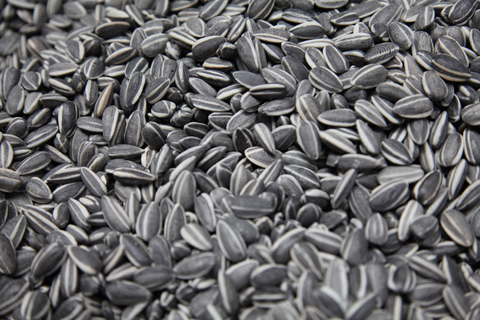
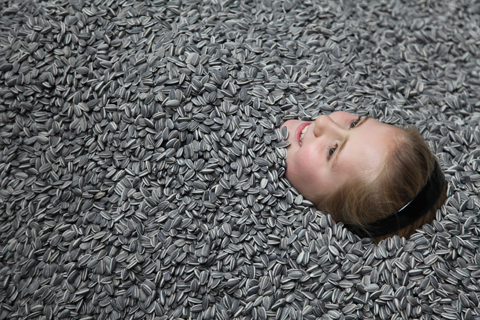
Sunflower seeds are associated with the Cultural Revolution, sunshine and human compassion. The mind-boggling one hundred million porcelain pieces that cloak the floor of the Turbine Hall were created by the skilled workers of Jingdezhen, a small town near Beijing, folk whose ancestors once made fine china for the emperors. They don’t get much of that kind of employment anymore, and the accompanying film paints them as thankful for the work. “I think the quantity we made for the Tate is already beyond imagination… it is going to be some kind of myth in the history of this town,” says Ai Weiwei as he looks benignly upon his workers like some latter day emperor of mass production.


Video stills.
But whilst the sunflower seeds are the antithesis of the complex porcelain work that was once made here, each seed is nevertheless unique, lovingly painted to resemble one another but never the same – just as in nature. The women (for it is only women who do the painting) are shown smiling and chatting in their tight jeans and sparkly high heels as they dip their brushes in black paint. In a family home Ai Weiwei fiddles on his mobile phone – tweeting, perhaps – as an elderly matron delicately goes about her work. Most of the population of this town were engaged in the project in some way, even if they only had a few hours to spare. One can’t help but wonder what happens to them now that Ai Weiwei has taken his leave.


I haven’t seen the Turbine Hall so busy since Olafur Eliasson’s infamous Weather Project wowed visitors in 2003, and that’s bearing in mind that it’s only been two days since Ai Weiwei’s impressive installation opened. In the same way that visitors played beneath the luminescent sun, so Ai Weiwei encourages you to interact with this visceral artwork. He wants you to stomp on the sunflower seeds, bury yourself in them, throw them in the air. Porcelain, it transpires, is remarkably tough – and that’s exactly what people were doing, both young and old – as I wandered amongst the porcelain dust.
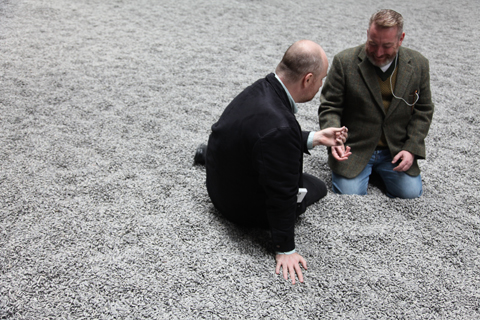

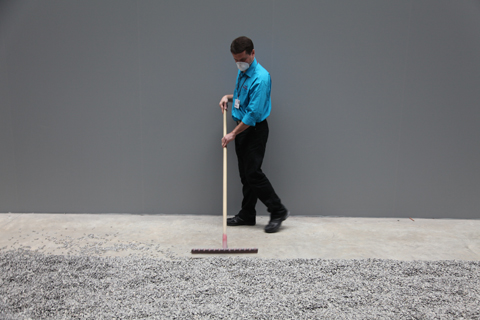
Ah yes, the dust. That’s the bit the other reviews neglect to mention… an employee with a rake was tidying the edges of the sunflower seeds, fully masked up – I can’t imagine what it would do to your lungs to work with this artwork for the next six months.
Ai Weiwei says that “art is a tool to set up new questions” and indeed the very best kind of art does just that. He has chosen one very simple object, laden with cultural metaphor, then used the oldest trick in the book to magnify it’s meaning – repeat ad infinitum. What is special about this piece is the total transparency of the artwork’s creation. We all own so many goods that were made in China, but we never really stop to think about where, from what or how they were put together. But Ai Weiwei invites us all to become part of the process, from the creators profiled on a looping video screen, to the audience, who are encouraged to leave filmed messages and tweets about the artwork. We are all part of something at once mundane and at the same time filled with love. Sunflower Seeds will go down in history as one of the most memorable installations shown in the Turbine Hall.


Now, back to those china souvenirs I was after… I easily pocketed a whole handful, then inadvertently removed a load more in the soles of my shoes. Then, like the bread crumbs left for Hansel and Gretel, I picked up still more as I followed a trail of sunflower seeds leading away from the Tate towards the Thames.

Stuck in my shoes…
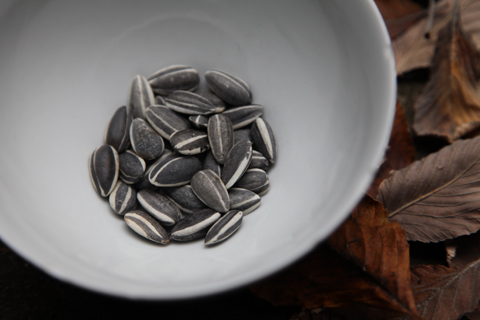
Ai Weiwei himself is quoted as saying “If I was in the audience I would definitely want to take a seed“, and despite half-hearted protestations to the contrary from the Tate, I can’t help but think that this is exactly what he planned all along. Here’s my bowl of Ai Weiwei sunflower seeds. The question is not only how many will be left on the floor of the Turbine Hall in a few months time but, does it matter anyway? Maybe Sunflower Seeds will quietly and slowly disappear to be cherished in homes across the world – small but pertinent reminders of what it takes to make something, however mass produced and throwaway it seems.
Categories ,Ai Weiwei, ,beijing, ,China, ,Cultural Revolution, ,Hansel and Gretel, ,Jingdezhen, ,Olafur Eliasson, ,Sunflower Seeds, ,Tate Modern, ,Thames, ,Turbine Hall, ,twitter
Similar Posts:
- Tate is complicit in the creation of the largest oil painting in the world.
- Licence to spill! are keeping it clean
- Liberate Tate create a Crude Awakening artwork at Tate Modern
- The Millennium Seed Bank – Helping to stop the decline of our future ‘civilisation’
- Wind Factory Struggle


