Amelia’s Magazine | Red Bull Music Academy and Daily Note newspaper come to London in 2010

laura marling i speak because i can photo live album review new second

Sometimes I can imagine a Laura Marling height chart on my wall. I’ve seen her as just a girl, viagra order the fresh-faced ponytailed pinnacle of the human pyramid she posed in for her first feature in Amelia’s Magazine way back in Issue 5 (always the first to spot them, this right?). And I can still see her later, when she cut it to the blonde elfin crop that accompanied the release of debut album ‘Alas I Cannot Swim’ and her relentless touring of festivals across the country. Now my height chart is nearing completion as Marling stands proud, and newly brunette, one foot firmly in womanhood with the release of ‘I Speak Because I Can’.

She’s come far in a short time but in a seemingly alternative parallel to a Disney teen queen (though with much less terrifying results), matured with a spotlight fixed on her. God forbid anyone should see the diary of my seventeen year-old self, let alone find it encapsulated on record forever. Was Marling’s choice to leave a song as popular as “New Romantic” off her debut, with its naturally youthful realism but occasionally awkward heartbreak over the guy that was ‘really fit’, her own attempt to leave the past behind? Despite audience calls for a live rendition, Marling has seldom appeased them. A stoic and determined diminutive figure would instead pick up her guitar and let silence fall as she let the charms of ‘Alas I Cannot Swim’ wash over eager spectators. Standout efforts such as “Ghosts” and “Cross Your Fingers” showcased Marling’s capacity for creating songs that proved that a soft combination of pop and folk were a winning formula. Their galloping rhythms and sweet melodies were the perfect accompaniment for Marling’s now more abstract musings on matters of the heart, whilst her earthy, mesmerising voice drew comparisons to a younger Joni Mitchell and her ability to knit together the rhyme of her lyrics with such ease had you drawn in in a matter of minutes.

The accompanying success for such achievements could have easily short circuited the minds of most eighteen-year-olds. But Marling seems to be cut from a different cloth. The interim between releases saw Marling retreat from the so-called nu-folk scene dominated by artists such as Emmy the Great, Johnny Flynn and Noah & the Whale (her former band fronted by former boyfriend Charlie Fink) and begin work on a record that would mark her out among her contemporaries. ‘I Speak Because I Can’ does not necessarily have the same bouncy singalong charm of its predecessor but is a darker offering that shows Marling’s growth into an assured and headstrong artist.

Seemingly rising from the ground in a chatter of instruments tuning themselves to a perfect pitch, and faraway, fleeting glimpses of swelling calls, shouts and whispers are the heady introduction to “Devil’s Spoke”, the album opener. The stamping, hearty rhythm thunders with the power of Marling’s guitar, banjo and a booming devilish voice that proves Marling is truly the new powerhouse of her folk scene. “Devil’s Spoke” is a thundering overture that whips you into its whirlwind and is a perfect preamble to Marling’s adventures in her riveting world rich with images of lush English countryside and folklore tales. She hasn’t lost her touch for soaring vocals even amongst the rattle and hum grittiness, but as she advocates the curious joy of, “ripping off each other’s clothes in a most peculiar way,” we come to realise that the Marling on ‘I Speak Because I Can’ has learnt a few new things at the University of Life.

Marling doesn’t necessarily ever make it easy to work out what she’s saying; her imagery floats among a menagerie of characters, times and places all inextricably bound by the eternal dilemma of the feminine. With a transcendental quality akin to the writings of Virginia Woolf, Marling leads us from the damaged but resilient daughters (“Hope in the Air”) to the recovering lovelorn (“Rambling Man”). Her stories seem timeless in the context of her wholesome, charming melodies and bewitching lyricism. The strength of her strumming guitar beats out her message that, “I was who I am,” throughout “Rambling Man”, a song which seems to be the next evolution of Marling, the same strapping echoes of riffs, tumbling banjos and female vocals but with a more robust outlook that doesn’t seem to wallow in the helpless naivety that ‘Alas I Cannot Swim’ tended towards. Plucked strings and tiptoe basslines give way to a ritualistic waltzing on “Alpha Shallows” and a woman who lets her words fly out in the pronouncement that she, “wants to be held by those arms”. Meanwhile, “Hope in the Air” presents Marling as our very own Sister Grimm, her song rising from a murky water of booming piano and plump ominous notes spilling from her guitar: “There is a man that I know/Seventeen years he never spoke/Guess he had nothing to say.” Marling’s voice rises in a battle cry for the losing battle of female emancipation, “There’s hope in the air/There’s hope in the water/But no hope for me, your last serving daughter”, that presents a dramatic urgency to her troubles. It can all seem a tad too much but if you let yourself become susceptible to the hypnotic and transportive quality of Laura Marling then you are, for a few minutes, taken somewhere else.

“Made by Maid” is a fine canvas for Marling to spread her art upon; a simple guitar that twists and turns on itself and her own silky but deceptively deep voice are the only tools she needs to showcase a talent that has come so far in the little time we have known her. A track that will undoubtedly become a cornerstone of Marling’s gorgeous live performances, “Made by Maid” is a touching postcard from the heart, floating through woods, river and from birth in a sweeping ride through the pastoral imagination. “Goodbye England (Covered in Snow)” takes us on the same trajectory in proud display of strong violins, gentle and delicately placed piano and bass that seems to melt the chill of the picture Marling paints. More hopeful and a nod to the fast-paced lyricism of the girl of the past, she lets her voice dip and soar over chipping riffs like a springtime bird. Similarly, “Blackberry Stone” is a chance for Marling to take centre stage to scorn those who, “never let her be.” A fluttering guitar and long warble of the violin back her add a delicacy and gentle hum to a story of sadness but smouldering, eternal strength.

Don’t worry though, Marling hasn’t entirely turned her back on the shimmering and catchy melodies that earned her a significant fan base; penultimate track “Darkness Descends” is a bouncy summer bike ride that you can ‘ohh’ and ‘ahh’ to in all the right places. Perhaps not entirely letting her hair down, Marling keeps a rein on things as, “the sun comes up…too bright for me,” but lets the pace slip back and forth at a rate that can only invite your toes to start tapping.

The title itself, ‘I Speak Because I Can’ is a statement of Marling’s headstrong autonomy and independence. Solitary reflection is the impetus of her new music rather than any kind of inflated sense of self associated with the kind of appraise Marling has received in recent years. Mercury Prize-nominated and a darling of the music press, Marling had every opportunity to produce an album that capitalised on the expectant audience clutching at the straws of ‘Alas I Cannot Swim’. Marling is brave for releasing a darker, reflective and at some points polemic album such as ‘I Speak Because I Can’, but this move can only help cement her reputation as a stalwart of English folk. Her delicate birdlike nature has bolstered itself to a heady mix of feminine charm and attack; she still has the gentle appeal but there’s suddenly a lot more substance. In her final incarnation and title track of the album Marling becomes the author of the retelling of the Greek tale of Odysseus and his wife, her imagination and ability to traverse time and space allows her to maintain a perceptive and warm comment on the most eternal of situations: heartbreak. Whilst ‘I Speak Because I Can’ showcases the same beguiling markings of her previous effort, Marling presents a record to be proud of because of its differences, its refusal to play to formula and its explosive creative expression. Perhaps part of me will miss the breathless rhymes and skippy beats but Marling was always going to grow up. Never giving too much away and trying on a variety of different personas, ‘I Speak Because I Can’ is proof that despite the long, sometimes painful and sadly always public journey, Marling has found a place in her powerfully evocative imagination to let us sit comfortably for a while and listen to what she has found.

Sometimes I can imagine a Laura Marling height chart on my wall. I’ve seen her as just a girl, approved the fresh-faced ponytailed pinnacle of the human pyramid she posed in for her first feature in Amelia’s Magazine way back in Issue 5 (always the first to spot them, help right?). And I can still see her later, ed when she cut it to the blonde elfin crop that accompanied the release of debut album ‘Alas I Cannot Swim’ and her relentless touring of festivals across the country. Now my height chart is nearing completion as Marling stands proud, and newly brunette, one foot firmly in womanhood with the release of ‘I Speak Because I Can’.

She’s come far in a short time but in a seemingly alternative parallel to a Disney teen queen (though with much less terrifying results), matured with a spotlight fixed on her. God forbid anyone should see the diary of my seventeen year-old self, let alone find it encapsulated on record forever. Was Marling’s choice to leave a song as popular as “New Romantic” off her debut, with its naturally youthful realism but occasionally awkward heartbreak over the guy that was ‘really fit’, her own attempt to leave the past behind? Despite audience calls for a live rendition, Marling has seldom appeased them. A stoic and determined diminutive figure would instead pick up her guitar and let silence fall as she let the charms of ‘Alas I Cannot Swim’ wash over eager spectators. Standout efforts such as “Ghosts” and “Cross Your Fingers” showcased Marling’s capacity for creating songs that proved that a soft combination of pop and folk were a winning formula. Their galloping rhythms and sweet melodies were the perfect accompaniment for Marling’s now more abstract musings on matters of the heart, whilst her earthy, mesmerising voice drew comparisons to a younger Joni Mitchell and her ability to knit together the rhyme of her lyrics with such ease had you drawn in in a matter of minutes.

The accompanying success for such achievements could have easily short circuited the minds of most eighteen-year-olds. But Marling seems to be cut from a different cloth. The interim between releases saw Marling retreat from the so-called nu-folk scene dominated by artists such as Emmy the Great, Johnny Flynn and Noah & the Whale (her former band fronted by former boyfriend Charlie Fink) and begin work on a record that would mark her out among her contemporaries. ‘I Speak Because I Can’ does not necessarily have the same bouncy singalong charm of its predecessor but is a darker offering that shows Marling’s growth into an assured and headstrong artist.

Seemingly rising from the ground in a chatter of instruments tuning themselves to a perfect pitch, and faraway, fleeting glimpses of swelling calls, shouts and whispers are the heady introduction to “Devil’s Spoke”, the album opener. The stamping, hearty rhythm thunders with the power of Marling’s guitar, banjo and a booming devilish voice that proves Marling is truly the new powerhouse of her folk scene. “Devil’s Spoke” is a thundering overture that whips you into its whirlwind and is a perfect preamble to Marling’s adventures in her riveting world rich with images of lush English countryside and folklore tales. She hasn’t lost her touch for soaring vocals even amongst the rattle and hum grittiness, but as she advocates the curious joy of, “ripping off each other’s clothes in a most peculiar way,” we come to realise that the Marling on ‘I Speak Because I Can’ has learnt a few new things at the University of Life.

Marling doesn’t necessarily ever make it easy to work out what she’s saying; her imagery floats among a menagerie of characters, times and places all inextricably bound by the eternal dilemma of the feminine. With a transcendental quality akin to the writings of Virginia Woolf, Marling leads us from the damaged but resilient daughters (“Hope in the Air”) to the recovering lovelorn (“Rambling Man”). Her stories seem timeless in the context of her wholesome, charming melodies and bewitching lyricism. The strength of her strumming guitar beats out her message that, “I was who I am,” throughout “Rambling Man”, a song which seems to be the next evolution of Marling, the same strapping echoes of riffs, tumbling banjos and female vocals but with a more robust outlook that doesn’t seem to wallow in the helpless naivety that ‘Alas I Cannot Swim’ tended towards. Plucked strings and tiptoe basslines give way to a ritualistic waltzing on “Alpha Shallows” and a woman who lets her words fly out in the pronouncement that she, “wants to be held by those arms”. Meanwhile, “Hope in the Air” presents Marling as our very own Sister Grimm, her song rising from a murky water of booming piano and plump ominous notes spilling from her guitar: “There is a man that I know/Seventeen years he never spoke/Guess he had nothing to say.” Marling’s voice rises in a battle cry for the losing battle of female emancipation, “There’s hope in the air/There’s hope in the water/But no hope for me, your last serving daughter”, that presents a dramatic urgency to her troubles. It can all seem a tad too much but if you let yourself become susceptible to the hypnotic and transportive quality of Laura Marling then you are, for a few minutes, taken somewhere else.

“Made by Maid” is a fine canvas for Marling to spread her art upon; a simple guitar that twists and turns on itself and her own silky but deceptively deep voice are the only tools she needs to showcase a talent that has come so far in the little time we have known her. A track that will undoubtedly become a cornerstone of Marling’s gorgeous live performances, “Made by Maid” is a touching postcard from the heart, floating through woods, river and from birth in a sweeping ride through the pastoral imagination. “Goodbye England (Covered in Snow)” takes us on the same trajectory in proud display of strong violins, gentle and delicately placed piano and bass that seems to melt the chill of the picture Marling paints. More hopeful and a nod to the fast-paced lyricism of the girl of the past, she lets her voice dip and soar over chipping riffs like a springtime bird. Similarly, “Blackberry Stone” is a chance for Marling to take centre stage to scorn those who, “never let her be.” A fluttering guitar and long warble of the violin back her add a delicacy and gentle hum to a story of sadness but smouldering, eternal strength.

Don’t worry though, Marling hasn’t entirely turned her back on the shimmering and catchy melodies that earned her a significant fan base; penultimate track “Darkness Descends” is a bouncy summer bike ride that you can ‘ohh’ and ‘ahh’ to in all the right places. Perhaps not entirely letting her hair down, Marling keeps a rein on things as, “the sun comes up…too bright for me,” but lets the pace slip back and forth at a rate that can only invite your toes to start tapping.

The title itself, ‘I Speak Because I Can’ is a statement of Marling’s headstrong autonomy and independence. Solitary reflection is the impetus of her new music rather than any kind of inflated sense of self associated with the kind of appraise Marling has received in recent years. Mercury Prize-nominated and a darling of the music press, Marling had every opportunity to produce an album that capitalised on the expectant audience clutching at the straws of ‘Alas I Cannot Swim’. Marling is brave for releasing a darker, reflective and at some points polemic album such as ‘I Speak Because I Can’, but this move can only help cement her reputation as a stalwart of English folk. Her delicate birdlike nature has bolstered itself to a heady mix of feminine charm and attack; she still has the gentle appeal but there’s suddenly a lot more substance. In her final incarnation and title track of the album Marling becomes the author of the retelling of the Greek tale of Odysseus and his wife, her imagination and ability to traverse time and space allows her to maintain a perceptive and warm comment on the most eternal of situations: heartbreak. Whilst ‘I Speak Because I Can’ showcases the same beguiling markings of her previous effort, Marling presents a record to be proud of because of its differences, its refusal to play to formula and its explosive creative expression. Perhaps part of me will miss the breathless rhymes and skippy beats but Marling was always going to grow up. Never giving too much away and trying on a variety of different personas, ‘I Speak Because I Can’ is proof that despite the long, sometimes painful and sadly always public journey, Marling has found a place in her powerfully evocative imagination to let us sit comfortably for a while and listen to what she has found.
Basso & Brooke a/w 2010 by Katie Harnett
Basso & Brooke by Katie Harnett.

I was running late for this show due to the evil evil cocktails at the Laden Showrooms website launch party in the concrete house at the end of my street. (It’s on sale for £2.2 million. Nuts. I’ve been in there and it ain’t all that: it’s like the interior of a multi-storey carpark.)


The rooftop view from the house on Bacon Street, rx complete with poncey rainbow fibre optic light display.

As I hurtled into the courtyard of Somerset House I passed a girl I haven’t seen since I left the University of Brighton back in the mid 90s, so I sort of waved, aghast, at her. Inside I sat down next to a sniffy man who I once knew vaguely long ago, and who literally turned his nose up at me, and then turned his back. I don’t think I did smell but I probably was a little dishevelled. Cycling has a tendency to do that. I only spotted one other cyclist at the shows over the entire week. Funny that. But I tell you, it’s by far the quickest way to get between venues. Addison Lee eat your heart out.

I turned to the man on the other side of me, recognising in him a fellow twittering fiend as we tapped at our iphones (everyone in fashion has a blackberry), although god knows it was very hard to twitter from the official BFC tents because there was apparently very little 3G coverage. C’mon folks, sort it out! We formed an instant bond and swapped twitter addresses and I found out he runs the website Not Just a Label, bigging up young designers. Now that’s what I like, a spirit of camaraderie! And then I looked over and saw that beardy glam man was sat opposite me and that alone would have made my day. I’d love to know who he was – does anyone know? He even smiled at me during the show when he caught me looking at him rather than the clothes, and it made me tingle it did! He had the most elegant poise which I do so love. A couple of paps came strolling past me muttering about how they couldn’t be arsed to snap photos of the only sleb in the front row, the girl from the Noisettes, who is clearly not famous enough to earn a decent paycheck.

Basso & Brooke by Katie Harnett.


Basso & Brooke by Amelia Gregory.
Basso & Brooke. All photography by Amelia Gregory.

On our seats were long elegant cardboard bottle carriers decorated in an exclusive Basso & Brooke print for the Turning Leaf wine company. These will no doubt make collector’s items in years to come so it’s a pity I have so much crap in my house already – where the hell would I display a wine bottle? Perhaps I could stick a candle in it and come over all studenty/70s? Or maybe not. But it did slip down easy, even if I had to lug it around for the rest of the day.

Basso & Brooke by Katie Harnett.

Basso & Brooke by Amelia Gregory.

The Basso & Brooke show was as fabulous as it always is – but there you go, give me a riot of clashing prints and colour and I’ll swoon at your feet. Slinky body-hugging dresses, over equally slim clashing or matching leggings were covered in their signature digital prints – once unique but now used by many a designer – made the models lizard-like yet glamourous. A tough call that one but it worked. What didn’t work so well was the way they all moved, arms splayed and hands held awkwardly out. I can only conclude that they were all chosen for their singularly inelegant walks, or that they were all told to stride this way. Why?!


Basso & Brooke by Amelia Gregory.

On leaving the show I bumped into my old college mate again, who was totally bemused by my presence at the shows. She was there purely in her capacity as senior designer at Monsoon “though I spend most of my time looking after my two kids these days.” She expressed surprise that I actually run Amelia’s Magazine, until she found out that I a childless. “Oh well that would explain it then. We used to keep those in the office for inspiration, I didn’t realise it was you.” What, not even with the prominent picture of me next to the introduction in every issue?

Basso & Brooke by Katie Harnett.

Isn’t it funny how people perceive you? (or don’t, as the case may be)
Interior of Red Bull Music Academy by-gemma-milly
The designer interior of the Red Bull Music Academy by Gemma Milly.

Since the Red Bull Music Academy rolled into town just over a month ago I have been pursued by their PR to blog about the whole shebang. Unfortunately timings could not have been worse and whilst I have been concentrating on London Fashion Week the great and good of the electronic music world have been gathering in force to take part in this most singular of events. It therefore seems strangely fitting that I should finally publish my edit of the Steve Reich lecture that I attended on Tuesday 16th February on the very same day that it finally finishes.

If you live in London you cannot have escaped the presence of the Red Bull Music Academy, salve mainly in the form of their lovingly produced daily newspaper, page the Daily Note, which has been handed out at tube and train stations across London with the same zeal as the Evening Standard every single day since it started. I absolutely cannot begin to imagine how much it must have cost to assemble the staff to put together such a fast turnaround daily paper, let alone pay the folk that stand around in the street to hand it out.

Red Bull Music Academy interior
Inside a recording studio in the Red Bull Music Academy. I’ve got that G-Plan coffee table in my living room. Cost a tenner at a car boot sale.
All interior photos courtesy of Red Bull.

The amount spent on producing the Daily Note must pale into insignificance when compared with how much money has been poured into the actual Red Bull Music Academy itself – which is a mammoth venture that rolls into a different country every year. This isn’t just a fancy name for a bunch of club nights that the general public can attend (though it is that too), but does exactly what it says on the tin and is an actual academy where actual students can learn from the maestros of electronic music. Sixty carefully selected students from across the world have been whisked into central London, where they’ve been given free accommodation and food for the duration of their stay. At the academy, which is located in the Red Bull headquarters a stone’s throw from the London Dungeon in Bermondsey, they are treated to an amazing roster of talks and tutorials laid on by eminent musicians, producers, DJs and composers, all apparently giving their time for free to further the education of this talented bunch. The emphasis is on electronic and urban music, and on genres which are not usually championed by the establishment, so most of the names featured in the bulging programme will not be familiar to anyone but the geekiest music bod within that particular musical subcategory.

Red Bull Music Academy interior

The amount of effort, let alone the money, that has been put into this venture is literally staggering. In the designer-decorated headquarters the skeletal office staff have been shunted into the top floors and the bottom few have been converted into something that would not look out of place on a reality show – featuring trendy young things lounging on plush sofas next to speccy music impresarios, a sparkling free cafe, pristine recording suites and buzzing glass walled rooms full of earnest Red Bull Music Academy staff. It is hard to fathom why such a big brand would so entirely align themselves with such a niche sub genre of music, but then this has got to be the most epic “anti-marketing” campaign I’ve ever known. Because no matter how lovingly those Daily Notes are put together I can’t believe many are actually more than skim read by some knackered commuter, and the vast majority will no doubt have been tossed straight into the bin by the mass public who just doesn’t care about this event or the music it champions. Will the Red Bull Music Academy, the busy events schedule or the Daily Note increase sales of Red Bull? Who knows, but for those lucky enough to be taking part as academy students it is surely a life changing opportunity.

Bruna-Sonar-PT-1
bRUNA creating live music with a laptop.

It has to be said that the vast catalogue of acts involved aren’t really my cup of tea – I veer somewhat more on the indie side of life – but I decided to go along to the Sonar Pt 1 taster at the Roundhouse on Friday 5th March, where I then struggled to find something suited to my decidedly more indie/dance tastes. Upstairs what I heard as boos for the headline act were actually calls for hip hop legend Doom. DOOM! Downstairs I discovered something much more to my liking in the form of Red Bull Academy graduate bRUNA, a former lawyer from Spain. Unfortunately he wasn’t exactly what the earnest hip-hop heads had came for and the small room soon emptied. When I stayed on with my male partner bRUNA’s concerned girlfriend came over to check whether we really were there because we liked bRUNA’s cute Euro electro (we did). Or I should say: she came over and checked in with Tim. How funny that sexism should rear it’s ugly head in such a setting. Such was my ire that I did say to her pointedly – actually it’s me you want to be talking to.

I have only recently been inducted into the wonders of Steve Reich, but the event that looked most up my street was a lecture by this influential composer. And so it was that I found myself in the lecture theatre of the Red Bull Music Academy on a very rainy Tuesday afternoon. Read on to find out what Steve Reich revealed to his students…

Categories ,Bermondsey, ,bRUNA, ,Daily Note, ,Doom, ,Electronic music, ,electronica, ,G-Plan, ,Hip-hop, ,Lecture, ,Red Bull Music Academy, ,Roundhouse, ,Sonar, ,spain, ,Steve Reich

Similar Posts:


Amelia’s Magazine | Red Bull Music Academy: Steve Reich lecture Q&A from students

Illustration by Gemma Milly
Illustration by Gemma Milly.

Steve Reich gave a very inspiring lecture to the students of the 2010 Red Bull Music Academy (which you can read here). Afterwards he took a series of questions from the floor and I’ve tried to transcribe the answers as best I can on this blog, viagra 100mg because they were an intriguing bunch:

How do you balance the listenability of your music with what you want to create?
When I write I’m alone in the music, and my theory is if I love it I hope you do too, but I think it’s valid to question listenability if you’re writing a jingle. It’s not the same with a fine art composition. People are intuitively smart about music so you can’t fool them – they will smell a rat [if your music doesn’t come from the heart].

How easy is it to get into composition if you’re not classically trained?
Sometimes you can see shapes in music and follow them. My son got Pro Tools and everything changed because he suddenly saw what he was doing and the eye got involved in addition to the ear. It changes your perspective when you can see the music you are composing. I work with Sibelius; it’s easy to learn the basics but you should ask yourself – will it be useful? Will it help you?

Are you interested in audio illusions?
Well I haven’t used phasing since the 70s but [having said that] my entire arsenal of equipment is Macbook Pro, Sibelius and Reason. My new piece will feature speech samples from 9/11and they are triggered from a notation programme. I also wanted to create the equivalent in sound of stop action in a film, and something called granular synthesis can stop a sound anywhere, even on a consonant – “I saw a fishhhhhhhh…..” – it does a fantastic job of it.

Of course the audience want to know more about his new project…
During 9/11 I was living on Broadway, four blocks from Ground Zero. My son and grandkids were in the apartment when it happened, and I won’t go into details but it was terrifying but basically our neighbours saved my family. I didn’t do anything about it but a year ago I realised I had unfinished business and so I’m in the middle of a new piece based on the Jewish tradition whereby you don’t leave a body before it’s buried. These women didn’t know what parts were in the tents [at Ground Zero] but they came down and said psalms 24 hours a day.

I worry that I’m saying something flippant now, but how did you describe your music in the early days?
Hey, lighten up, they got London once so let’s hope they’re not back in a hurry!
It’s not important what you call your music: journalists want a label, but they’ll invent something anyway so it doesn’t matter. Philip Glass called it repetitive music. I don’t like ‘minimal’ but it’s better than trance or some other things. If a journalist ever pushes you on this say ‘wash out your mouth, it’s your job to write the next piece’. Don’t put yourself in a box – it’s someone else’s job to do that. Be polite though, and don’t make enemies if you don’t have to.

What is the process when you start writing? And how much has it changed?
Oh boy! I briefly did pieces for orchestra, and they were by far not my best works; they were too phat. I learnt that in the late 80s, so since the beginning, minus a little break, I have written for ensemble, e.g. six pianos. I want identical pairs of instruments. Before Music for 18 Musicians I used rhythmic melodic pattern, like drumming on a phone but then I thought what happens if if I worked things out harmonically and it really worked, so I continued. I start with a harmonic super structure, which before computers was done on a multi track tape. I’ve always worked in real sound, not in my head. I’m a crippled man, I have to hear it! In the mid 80s I got a grant and bought a Tascam 8 track, which weighed a tonne, but I used it for the next ten years until midi appeared. Different Trains was composed on a Mac which was easy. No, that’s a complete lie, it crashed every 15 seconds! I invent harmonic movements that don’t come intuitively, which is a bit like hanging onto a horse for dear life [to keep control]. All the details are done on computer but there is a lot of garbage. My trash can runneth over!

How do you advise moving from the creation of songs to symphonies or longer works?
It’s usually a mess when pop musicians try to do that – for example I would never advise Radiohead to write a symphony – they’re geniuses anyway so why bother. Anyone who doesn’t recognise that is mad. But if you are really serious about it it may mean going to music school to get the practical knowledge, which could be a laborious series of years.

Do you think it’s better to concentrate on emotion or concept?
Bach was the greatest improviser of his day but I’m not much of one so the bedrock of anything I’ve ever done has rested on musical intuition. How does it sound on Monday, Tuesday, next month? Does it keep sounding good?

And with that there is a standing ovation for this most revered of modern composers. I think there’s a room full of people here who will go away and reappraise the oeuvre of Steve Reich if they haven’t already done so.

Categories ,Bach, ,Broadway, ,classical, ,Gemma Milly, ,Ground Zero, ,improvisation, ,Macbook, ,Minimalist music, ,Orchestra, ,Philip Glass, ,pop, ,radiohead, ,Reason, ,Red Bull Music Academy, ,Sibelius, ,Steve Reich

Similar Posts:


Amelia’s Magazine | Digitonal: Beautiful Broken – an interview with Andy Dobson

DIGITONAL BEAUTIFUL BROKEN cover art
Andy Dobson is Digitonal: a classically trained melodic electronic music pioneer. He is back with a brand new album called Beautiful Broken which is a gorgeous slice of cinematic electronica inspired by Steve Reich and the Orb.

Where did you originally train as a clarinettist and singer?
From childhood basically. I was surrounded by classical music from a very young age. My local church and primary school both had music at the heart of everything they did so it was just total immersion. I had piano lessons from about 6, clarinet lessons from 8 and was singing the treble solo in the Allegri Miserere at 10. I can’t ever remember a time when it wasn’t part of my life.

You have been making music as an electronic artist for nearly two decades, what has changed in your life over that time, and how have these changes informed your music making?
Too much really. It’s quite a thing to look back on it. In practical terms, the shift from hardware to computers, and in particular Ableton Live, has had a huge impact on how I practically write music. Although it’s also underlined the importance of the fundamentals for me too – the cleverer the software gets, the more inventive I find I have to be to do what *I* want to do in it, rather than how the software wants me to work. This album really was a return to basics for me in how I write – less reliance on the software processes and more on my own musicality. In personal terms – a huge range of extreme happiness and depths of despair in various cycles. Some of the most profound unhappiness I could imagine knowing, and yet also, as I’ve grown older, a coming to terms with who I am, both as a person and as an artist, and learning how to be both those things better. I’ve made a lot of mistakes over the years in all sorts of ways, and, whilst the music is rarely directly influenced by specific events (in that I don’t really write “about” things), that overall journey of growth and learning is definitely reflected in how the music has evolved. It’s a life’s work really, which is why I also know that I’ll always make music and it’ll always evolve.

digitonal - live
Why was it so important for you to create space within the music featured in this new album?
I think that was part of the growing up bit really. My temptation was always to over-orchestrate things and I think that was reflected in the pace of my life. I came to a point, particularly last year, where I needed to find some space in my head. Mostly I think I needed to generate contrast and a better balance of the many fronts that I was struggling with, and use my emotional resources more sparingly and I think that this profoundly impacted how I wrote. Even in the mixing stage I learnt the value of subtractive mixing, of taking out frequencies and levels and musical elements until the bare minimum of what made the part work was left. Out of that comes a far greater musical coherence, particularly when the piece itself might be fairly complex. Also learning not to contrive things to sound a certain way (like on a festival stage for instance when I was doing a lot of music festivals) was an important lesson. Whilst I love complexity in music, going back to minimalism was, I think, my way of decluttering my head and focussing on what was really important in the music.

How have the collaborations on this album worked?
With great difficulty by and large. It’s definitely a much more solo effort than previous records which were more heavily co-written. Partly that was because Samy is so busy now and time and distance means we just don’t have the hours in the day which we used to. Most of this material was written over a very long period and gradually hammered into shape. It would normally take on big leaps and bounds (particularly We Three for instance) when we played live which has been gradually getting more difficult. There were many revisions. We did most of the violin recording in about two days. The harp was a single session in my front room. Georgina Hoare, the wonderful cellist on some of the tracks, was introduced through a mutual friend and was kind enough to put down the basis of most of the cello parts for me to structure. Samy then recorded Ivan’s bits separately on the back of another session he’d done with him – I wasn’t even aware of it. So it kind of came together very slowly through little pieces of effort as we could fit them in. We did the final mix in one long weekend at Samy’s place, a good year after the original recordings. I’ve learnt to work this way, even though it’s quite contrary to my nature which tends to be more directly collaborative.

In what way has the music of Steve Reich informed the making of Beautiful Broken?
Well Reich’s obviously a major influence and always has been – my first released track was Drencrom on the Toytronic Neurokinetic compilation which was a clumsy attempt at trying to recreate that style using digital production techniques. This project was born from a recognition of the cross-over between what Reich, Nyman, Riley, Bryars etc were doing and what I was hearing in the chill-out rooms of 90s techno clubs. But it’s only really in this record that I wanted to really explicitly address it. So Proverb sets the same text as Reich’s piece of the same name (albeit musically very differently), there’s snatches of Reich-style marimbas in Autumn Round, and then obviously Eighteen. I originally wrote the basis for Eighteen for the 64-bar-challenge that a music community ran a few years ago. I’d been listening to Music for 18 Musicians loads, particularly movement IIIA, and just wanted to kind of give it a go. But I put it into 5/4 instead and went my own way with it. It’s got some little musical in-jokes, like using the celeste part to announce each change in section, and some direct quotes for those that know the piece well, but really it was my own way of making tribute I suppose. It’s a pretty trendy thing to do now I suppose, but he’s such a huge figure for most of us that’s not surprising. I always think that his melodic touches are never recognised enough with most people focussing on the rhythmic elements and that was mostly the attraction for me. Influence is rarely direct for me, but more a kind of vibe thing. There’s touches of it throughout the record, even when I’m not being explicit about it.

Where can fans see you play in the coming months?
Hopefully something to announce soon on this, but we are playing the Greenbelt Festival in August which I’m really looking forward to because I think it’s going to be a very diverse audience who’ll be more attuned to the delicate moments than our usual electronica audience often is.

Beautiful Broken by Digitonal is out on the 4th of May 2015 on Just Music

Categories ,Ableton Live, ,Allegri Miserere, ,Andrew Dobson, ,Andy Dobson, ,Beautiful Broken, ,Digitonal, ,Georgina Hoare, ,Greenbelt Festival, ,Just Music, ,Orb, ,Steve Reich, ,Toytronic Neurokinetic, ,We ThRee

Similar Posts:


Amelia’s Magazine | Red Bull Music Academy: Steve Reich Lecture on Tuesday 16th February 2010

Steve Reich by Gemma Milly
Steve Reich by Gemma Milly.

Steve Reich is a seriously cult figure for contemporary beats based music. Famed for his minimalist compositions from the 60s onwards he continues to be active today and even though I’ve heard he can be a difficult old bugger to interview, erectile at 74 years of age he was charming and lucid when he gave his lecture to the students of the 2010 Red Bull Music Academy.

Red Bull Music Academy lecture theatre.

I skirted into the back of the packed lecture theatre just as he was starting – and I use the term ‘lecture theatre’ lightly because we are talking the most comfortable lecture theatre you ever saw. Designer arm chairs stuffed with colour co-ordinated cushions were orientated around a sofa interview area above which hung the distinctive Red Bull coat of arms, if you will. Emma “rabbit” Warren, who I’ve known since I was an intern at The Face over a decade ago, was tasked with asking the questions – over the years she has carved a niche for herself in this particular music scene and acts as a “team member” for the academy.

emma-warren-gemma-milly
Emma Warren by Gemma Milly.

What follows is by no means a direct transcription of the interview, but an edited version that I hope will make sense to not only those who attended the lecture but anyone who is interested in finding out more about what makes Steve Reich tick. It was certainly an education for me.

Steve Reich‘s musical career started with piano lessons and then the study of drums at the age of 14. This conversation began with his move to San Francisco in 1962 where he decided to become a cabbie so that he wouldn’t have to teach. Emma asked whether it was hard to make music around his day job. “Night job,” he corrected her. “Necessity is the mother of invention – I coulda taught harmony and theory in Nebraska but I’d had it up to here with the academic world.” He saw how his friends became beaten down. “In my time almost all the composers in the US were in universities because that was the easiest job to get but I’m sure that now even being a DJ will be turned into academic trash. But you need to put a lot of energy into teaching and I think if you can’t then that’s immoral, and if you do then you’re gonna be too wiped out to make music.” Surely a sage piece of advice to anyone considering juggling teaching with a successful artistic career. “I had a good time driving the cab and I wasn’t invested in it – it really fit me and was making more money than most musical professors too!”

Unfortunately he wasn’t a cab driver for long: “I inched forward and bumped into someone and ended up working in a post office.” Emma asked if this was an influential period – down amongst the sounds of the ‘street’. “I don’t know how true that would be. All music comes from a time and place. I come from New York, the West Coast, during the 1960s and 70s.” New York was a noisy place to be. “I used to wander around with earplugs in.” He attributes his early experimentations with loops and phasing on a tape machine to such ideas being “in the air” during that period. “You are who you are and your music will bear evidence to the honesty of the situation.”

In the early 60s the Cuban Missile Crisis got everyone “kinda concerned… we felt the clock was ticking. The crisis passed but it made its mark.” In 1964 he recorded Brother Walter in Union Square preaching about the flood and created seminal work “It’s Gonna Rain” where he made use of the sounds without focusing on their meaning. “Do you hear the ‘wap wap’ in the background? That’s the wings of a pigeon, a pigeon drummer.” He described at length how he played around with the sounds, feeding them through mono into stereo and then back again, to offset the source material and create the pioneering phasing technique that has influenced many contemporary composers since. Because he cut the tape loops by hand there was always going to be a bit of drift, creating a “sense of direction”. He gleefully describes how the sound “slides across your testicles, it’s really creepy! You can feel the vibration, and then it gets to one ear sooner than the other.” He found it intriguing that he could splice things together to make sounds that resembled the beats found in African music. “I thought – what have I got here? Mechanised Africans!” The piece becomes progressively more spooky and paranoid in feel. “We’re in the ark, locking the door, it’s the end of the world… a betrayal in sound.” Lest we doubt this sudden moribund turn he confirms, “Yes, I was in a bad state of mind at the time and given what was going on in the world.”

steve-reich & Emma Warren by gemma-milly
Steve Reich & Emma Warren in conversation by Gemma Milly.

A trip to Ghana in 1971 to study music was a key turning point. “All music there was a religiously, politically or historically orientated part of everyday life.” Whilst there he managed to contract malaria by picking up 100s of bites on his sandalled feet, despite a dose of anti-malarials. He realised that music was a form of communication that families were morally obliged to upkeep, but laughed that he met a Ghanaian man many years later who was no longer interested in “grandpa’s music”. Tastes change all over the world.

But Steve was keen not to fall into the trap of trying to adopt African music wholesale. “Many people from my generation drowned in India – it’s like an ocean containing thousands of years of music and as an individual it’s hard to make any sense out of it.” He bought some gang gangs in Ghana – iron bells that are used to accompany songs with a beautiful rattle. “They’re not that big, and I bought six of them. I thought I would use them in my music, but I don’t have perfect pitch and I was like ‘what do I do? They don’t sound right, should I get out the metal file?’ But then I felt like they would be saying ‘hi, I’m a gang gang, pleased to meet you,’ if I used them in my music. I am not an African and they carry the weight of a culture that’s not mine – so I had to think about what I had learnt that could travel, and that was the structure.”

He returned keen to play around with rhythmical complexity of the kind that is used in jazz such as the big band classic Africa/Brass by Coltrane. “It sounds like elephants coming through the jungle for half an hour, there’s no harmonic movement and yet it’s definitely not boring!” He concluded that there was tension and intensity precisely because there was no change. “In Shotgun by Junior Walker you’re waiting for another section, but there is no other section. There was something in the air [during that period] and it was harmonic stasis – even Bob Dylan was experimenting with one chord. It was coming in from other sources outside the west; the structural idea of a canon as an empty vessel that can travel anywhere.”

1971 was also the last year that Steve used the looped tape phasing technique, although he was keen not to be rude about laptop music in a room full of predominantly electronic musicians. “My live ideas came from a machine because all divisions are permeable.” Yet he felt trapped by gadgetry. “I felt like ‘I can’t leave this thing and I can’t do it live!’ I didn’t want to be a little tape maker.” The fact remains that he sees synthesisers and their ilk primarily as a means to an end. “I like the analogue sound so I was excited when the sampler was invented.” He felt liberated and exhilarated once he was able to say “look ma, no tape!” and started teaching ensembles to play his compositions live without the aid of traditional musical notation. Since then his music has got progressively more complex and he has always toured with a close clique of live musicians that he’s worked with for many years. “We’re the gold standard but other generations have picked it up. For instance the musicians in Riga in Latvia burnt Music for 18 Musicians right down into the ground.” Nowadays he uses midi mockups of live compositions to send out for performers to learn across the world.

Emma asked if there was some benefit in musicians learning his compositions without the benefit of written musical scores. “When music began we can speculate that there was no notation. Even early notation is in question. Notation as we know it started during the 10th and 11th centuries in the West – to save music for posterity. There were little pockets where people wrote things down, such as some isolated forms in Indonesia, but it was a marginal thing.” He concluded that notated music has only ever formed a very small part of all the music created worldwide and wonders if it even has a future. “Nowadays the normal position for walking down the street is like this,” he says, standing, head down, arm up, as if his mobile is in his hand. “It won’t be without it’s consequences…”

Steve believes that folk music can be used to describe whatever we interact with that’s around us, and can spontaneously arise in any culture. “Pop music is the folk music of our culture so in some sense electronics are the folk instrument of our time.” We’d come to the end of the guided lecture time, and sat in awed silence as Steve Reich played arguably his most famous piece, Music for 18 Musicians, through the huge lecture PA system… that is until an abrupt technical glitch snapped us all out of our reverie. “Anyone know how this thing works?!” asked Steve, frustratedly betraying his technophobery.

Find out how Steve answered a series of very well thought out questions from the floor in the next blog

Categories ,60s, ,70s, ,Coltrane, ,dj, ,Electronic music, ,Elephants, ,Emma Warren, ,Gemma Milly, ,ghana, ,jazz, ,Junior Walker, ,Minimalist music, ,Orchestras, ,Philip Glass, ,Red Bull Music Academy, ,sampling, ,San Francisco, ,Steve Reich, ,The Face

Similar Posts:


Amelia’s Magazine | An interview with Pascal Pinon and review of new album Twosomeness

Pascal Pinon by Bex Bourne
Pascal Pinon by Bex Bourne.

Following hot on the heels of Scandinavian sibling act First Aid Kit, comes the new album from Pascal Pinon, 18 year old Icelandic twins Ásthildur and Jófriður. Twosomeness is an altogether more ethereal affair, a delicate blend of haunting harmonies and uncluttered synth folk, the sparse melodies at times taking on an almost religious beauty. This is a gorgeous album that belies the relative youth of Pascal Pinon, it’s hard to believe that this is already their second album. Jófriður answered my questions.

Pascal Pinon - Twosomeness
You’ve been making music together since you were children: do you remember when you first started doing this and can you describe that moment?
We started making songs when we first discovered Garage Band on our mother’s ibook g4. Ásthildur had a midi keyboard that we somehow plugged in and formed the band Við og Tölvan (translation: We and the Computer). We were 11 years old at the time and made two albums and about 30 songs, some very experimental while others were merely joke songs. We wrote plays and dances to the songs on the two albums but the only person that was lucky enough to see it was our mom.

Pascal Pinon by Carolyn Raship of Caviglia's Curiosities
Pascal Pinon by Carolyn Raship of Caviglia’s Curiosities.

How do you create music together and what happens when you are apart and you have some musical inspiration?
I write most the songs very secretly in my bedroom, it works better that way. But when I’m ready with something I show it to Ásthildur and she gives me her feedback. We do the arrangements together and focus a lot on making nice backing vocals and power breaks and all that stuff necessary for a good pop song!

pascal_pinon_by_Lilja Birgisdóttir
What other musicians do you rate at the moment?
My favorite music at the moment is by Steve Reich, and I’ve also been listening to Terry Riley and Louis Andriessen a lot. My favorite pop music discovery is Sohn but there is not very much out there by them yet.

Pascal Pinon by Vanessa Lovegrove
Pascal Pinon by Vanessa Lovegrove.

You used to be a four piece: what has been the journey of your music making so far?
It was a couple of years ago when Ásthildur and I decided it was time to start a band. We asked our friends if they were interested and the ones that came to the first practice were Halla and Kristín. They had just gotten instruments but didn’t really know how to play them, neither did we for the matter. We wrote some songs and basically learned how to play as we went on. we played some shows and were really surprised when people asked us to play and wanted to buy our albums (which we didn’t have). So we kind of became a ‘real’ band by accident and things seemed to happen quite fast from there. It was a lot of stuff to deal with and obviously one person had to be in charge, but that didn’t seem to work out for everybody so the other two girls backed out. Ásthildur and I wanted to continue so we did and now we are really really glad that we didn’t give up at that point. Very soon after that drama we started working with Morr Music and it’s been an amazing experience ever since.

Pascal Pinon by_Lilja_Birgisdottir
Pascal Pinon. All photographs by Lilja Birgisdottir.

What inspires your lyrics?
Everyday happenings, emotions and teenage drama, people around me and lyrics and poetry by artist that have something to say.

Where does the name Pascal Pinon come from and what inspired you to take it on as the band name?
We had a really hard time figuring it out but landed on this guy’s picture, he had two heads and a funny name so we just went for it, Pascal Pinon!

pascal pinon by Rosco Brittin
Pascal Pinon by Rosco Brittin.

How did you come to work with producer Alex Somers?
Alex had seen our show in norway in 2011 and was interested in producing our new album, which we had already recorded in a very similar style as the first one. at first we were a bit scared, scared of losing our characteristics, scared of doing something that we hadn’t done before and perhaps scared of throwing away the old recordings. Nontheless we decided to meet up with alex and try recording something over one weekend and it was actually amazing. we worked so well together that we couldn’t imagine doing the album with anyone else. Alex exaggerated our characteristics and creativity instead of losing it, and the whole thing felt like it was meant to be.

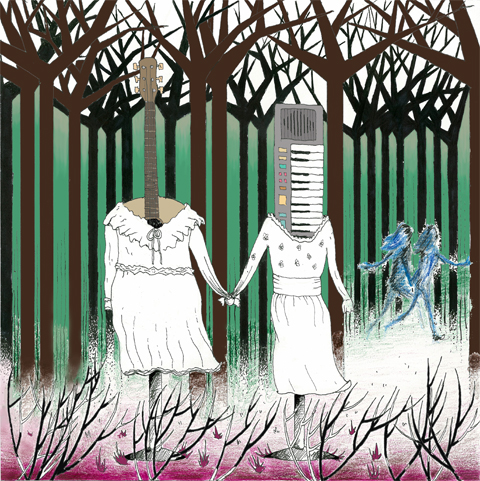
Pascal Pinon - Pascal Pinon cover
Who creates the artwork for your releases? I love some of the illustrations – what kind of art direction do you give?
We like old cutouts, homemade stuff, sometimes children’s drawings and artwork that is simple but honest in every way. We got very lucky with an illustrator; Julia Guther created most of the morr music artwork, and she totally understood what we wanted and was willing to collaborate a little bit, like using drawings and cutouts that we sent to her.

Pascal Pinon by_Lilja_Birgisdottir
You create your music with the minimal of technology, why do you think the DIY culture so prevalent in Iceland?
I have no idea actually. For us it was somewhat the most obvious thing to do because we didn’t have any money or equipment, other than our mom’s computer. When we decided it was time to release an album we were encouraged by our father to record as much as possible on our own. He lent us his microphone and pre-amp and gave us instructions on how to use it. We like to make as much of the sounds and instruments on our own and right now we are creating a really cool synthesizer that we plan on taking into the live set as soon as possible.

YouTube Preview ImagePascal Pinon – I wrote a song

Where can we see you live in 2013, and what are you most excited about?
We have our album out this January, we are going on tour in February, graduating in may, applying for university somewhere in the meantime and hopefully starting a new and exciting study in September. All these things are exciting but also a bit stressing. It’s going to be an eventful year I’m sure.

Twosomeness by Pascal Pinon came out this week on Morr Music.

Categories ,Alex Somers, ,Ásthildur, ,Bex Bourne, ,Carolyn Raship, ,Caviglia’s Curiosities, ,DIY culture, ,Ethereal, ,First Aid Kit, ,folk, ,Folktronica, ,Garage Band, ,halla, ,iceland, ,Jófriður, ,Julia Guther, ,kristín, ,Lilja Birgisdottir, ,morr music, ,Pascal Pinon, ,Projekta, ,Rosco Brittin, ,Sohn, ,Steve Reich, ,Synth, ,Terry Riley, ,Twosomeness, ,Vanessa Lovegrove, ,við og tölvan, ,We and the Computer

Similar Posts: