Amelia’s Magazine | An interview with Jack Bailey: Amelia’s Colourful Colouring Companion featured artist.

JACK BAILEY illustration
Jack Bailey was one of the fantastic new illustrators I discovered at this year’s New Designers graduate show who answered my callout to take part in the colouring book open brief. His energetic art is created on a large scale then turned into fantastically busy pictures like his colouring book page, inspired by the game of Ultimate Frisbee.

JACK BAILEY illustration
Where do you find inspiration for your characters?
The inspiration for my characters comes from a mix of sketching outdoors and making loose marks on a large sheet of paper. When I apply the loose marks to a piece of paper I relate back to my original outdoor sketches and start to interpret the mark as the shape of a body or a facial expression. The characters barely resemble the original sketches however I find studying from life allows me to interpret the marks made in a variation of forms. Previous to this brief my characters where always produced in colour, so it was fun to experiment in black and white for the colouring page and this is something I have continued doing.

JACK BAILEY illustration
Can you tell us more about what is going on in your artwork for my colouring book? who are all those people?
The piece for the colouring book was inspired by an article I read in the New Yorker about the chances of Ultimate Frisbee becoming an Olympic sport. Immediately, due to the word ‘ultimate’, I imagined a huge, chaotic game of Frisbee where only those playing understood what was going on. Almost like looking at a London underground map for the first time. The characters in the image are the people playing the sport and I packed the image full of people to show its rise in popularity. Unfortunately not many people play Frisbee in Liverpool so I picked up on the dynamic poses through watching youtube videos, which also contributed to the hectic feel of the image.

JACK BAILEY illustration
What led you to study at the Lincoln University and what was the best bit about your course?
In all honesty studying at Lincoln was totally by chance as I was still unsure if I was going to go to university at the time. I attended a university fair in Manchester where I picked up information packs and Lincoln University was one of them. When I got to Lincoln for the interview however I knew it was the place for me. It was quiet enough for me to be able to get on with my work and the old architecture of the city really appealed to me. As well as this everywhere was in walking distance and so really accessible. I guess you could say it was destiny! The best bit of the course for me was having tutors from a variety of backgrounds. It really enhanced a brief when you knew a tutor was passionate about the subject and had experience in the field. Another aspect of the course I enjoyed was the encouragement to try different media and new ways of working. Before the course I believed a single image had to be produced using the same mediums and on a single surface. Now I’ll use a whole bunch of mediums on separate surfaces allowing me to be a lot more expressive and confident in the way I work.

JACK BAILEY illustration
How do you translate your ideas between 2D and 3D artworks?
It works in a similar way to how I translate a sketch from life into one of my characters, in that they often don’t appear anything like the original influence. Between the 2-D and 3-D image they will often only share similar characteristics such as the amount of legs, hair style and facial features. Working in paper mache means capturing a dynamic pose is often difficult. This is why I use string to decorate the creatures. I feel the shape and swirl helps add movement to a static creature.

JACK BAILEY illustration
What is the process of creating your 3D pieces?
To create my 3-D pieces I start with a single sheet of paper, often from an old book as I like the stained colour of the pages. I dip this into a wallpaper paste and begin moulding it into any shape that feels natural. Similar to when I create my characters I try not to think too much about the early steps of the process and make shapes with papier mache whilst not thinking of the end product. This is so I don’t miss out on a nice, natural shape for the character. Once I have combined a few sheets of paper I use this as the body, from here I will refer back to my 2-D character and begin creating a head and other features. I finish by adding a face and decorating it with string and found objects.

JACK BAILEY illustration
Why do you find it easier to work on a large scale?
Working on a large scale is easier for me as I find it enhances my creativity. I find the characters look a lot more natural on large sheets due to me not being worried about them running off the page. The marks I make on large sheets are more expressive and full of energy as it is my whole arm moving the brush, not just my wrist. I also find working on a large scale creates new ideas. The sheets become a visual mind map. If I need a tree for an image, on a small scale I will produce one whereas on a larger scale I will produce as many as I can to fill the length of the sheet. This then becomes a new image for me to play around with.

JACK BAILEY illustration
What is it about drawing buildings that appeals to you?
Mainly that they don’t walk off as I try to draw them! What I enjoy to study on a building is the smaller details, often found towards the tops of buildings. I find the top of buildings to have the most character. There are unusual patterns and decorations, small windows and chimneys. You can interpret these as faces, creating relationships between two buildings or as body parts and the buildings can become giants peeping over trees.

JACK BAILEY illustration
How has living in Liverpool influences your approach?
I think the diversity of Liverpool has influenced my illustrations. The city centre is a collection of classic and modern architecture, renovated buildings and desolate warehouses. I also think it encourages creativity here too, with a variety of contemporary and classical art galleries there are always avenues to explore for inspiration.

JACK BAILEY illustration
Why is your new project with Cygnet Ink inspired by Quentin Blake? what is it you love about his work?
What I love about Quentin Blake’s artwork is the energy and looseness of the characters. Each line contributes to the personality of the character and he includes just enough information in each image to depict a scene. His characters also have a nice balance about them too, the positions are believable and you almost move with the character as you look at it. Blake’s backgrounds are a huge influence to me as he approaches them so cleverly. They depict real environments, but he will leave sections out or use a splash of watercolour to describe an area so the characters are the centre of attention.

JACK BAILEY illustration
You can find Jack Bailey‘s lively art in Amelia’s Colourful Colouring Companion, available soon from Kickstarter, and the ideal present for that special person this Christmas!

Categories ,#ameliasccc, ,Adult Coloring Book, ,Adult Colouring Book, ,Amelia’s Colourful Colouring Companion, ,Coloring, ,Colouring, ,Colouring Book, ,illustration, ,interview, ,Jack Bailey, ,Kickstarter, ,Lincoln University, ,Liverpool, ,New Designers, ,Quentin Blake, ,Ultimate Frisbee

Similar Posts:


Amelia’s Magazine | Illustrated Interview between Kate Nash and Rebekah Roy

Kate Nash by Avril Kelly

I’m not sure how many of you are (or should I say were) familiar with the Fashion Business Club, sildenafil but for those who aren’t, sales the FBC acted as London’s member’s only fashion networking event group. Headed up by Courtney Blackman and Alison Whelan, it boasted a growing membership within the fashion community, interviews with likes of Laura Bailey and Sarah Curran and a partnership with Vogue.com. Due to it’s impressive success over the last five years, they have now rebranded…meet The Industry.

Kate Nash by Claire Kearns


Kate Nash by Sandra Contreras

Although the name has changed, the event is still held in the Swarovski Lounge once a month (at the slightly later time of 5pm) and it was, as usual packed out with retailers, PRs, editors, journalists and insider experts. For it’s inaugural meeting, there was an enthusiastic and lengthy question and answer section at the end. The interview between singer Kate Nash and her stylist, Rebekah Roy was relaxed, interesting and compelling to listen to – the interviewee attributes this to being interviewed by a friend: ‘you get to speak about things that you care about – I remember getting hot in the open q & a section because I was talking so passionately about something’ Nash comments.

Commenting on the female presence within the music industry, she explained her style as being one which reflects her personality both in her performances and her day to day life. Her intelligent comments on the nature of current successful female performers and the music business’ preoccupation with more sexualised women within the industry really struck a chord – why is it that record sales are largely dominated by those that are sexy by definition and not much more?

Kate Nash by Sumi Senthi

I was struck by how frank and honest Nash was about both the music industry and her opinions on fashion – it was refreshing to hear her honest answers throughout the session and also to find out that she used to work in Nando’s!

Categories ,Avril Kelly, ,Claire Kearns, ,Courtney Blackman, ,fashion, ,illustration, ,interview, ,Kate Nash, ,london, ,music, ,Rebekah Roy, ,Sandra Contreras, ,Sumi Senthi, ,Swarovski Lounge, ,The Industry, ,Womenswear

Similar Posts:


Amelia’s Magazine | The Warmest Chord

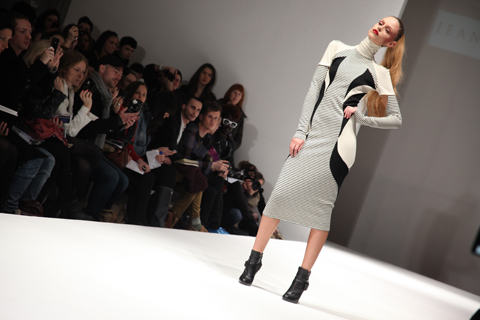
Jean-Pierre Braganza A/W 2011. Photography by Amelia Gregory
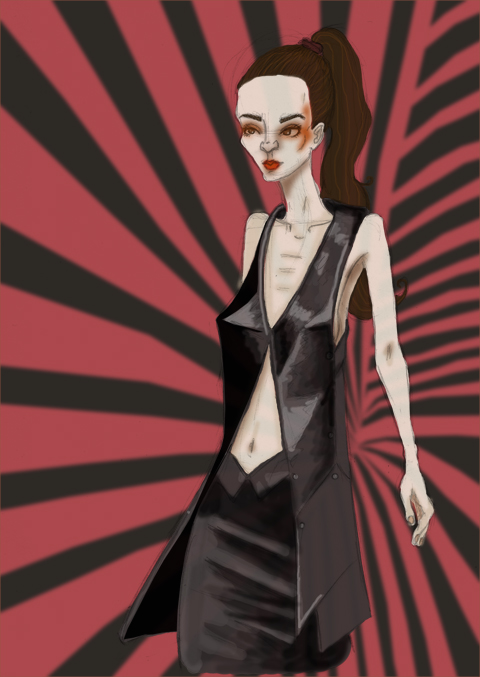
Jean-Pierre Braganza by Catherine Askew
Jean-Pierre Braganza A/W 2011 by Catherine Askew.

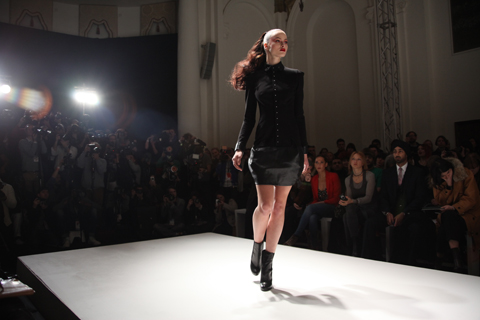
Ponytails, viagra sale red eye make up, cure close fitting suits, dosage black, lots of black. A male model with razor sharp cheekbones and a hilarious female model with superlative head throwing posing skills. This is what Jean-Pierre Braganza showed at the Northumberland House, a new grandiose LFW location.

Jean-Pierre Braganza A/W 2011 by Jane Young
Jean-Pierre Braganza A/W 2011 by Jane Young.

After loitering in the magnificent reception area we were ushered into the huge ballroom, passing by the backstage area which looked suspiciously like the back of a Hollywood lot.

Jean-Pierre Braganza A/W 2011 by Kerri-Ann Hulme
Jean-Pierre Braganza A/W 2011 by Kerri-Ann Hulme.

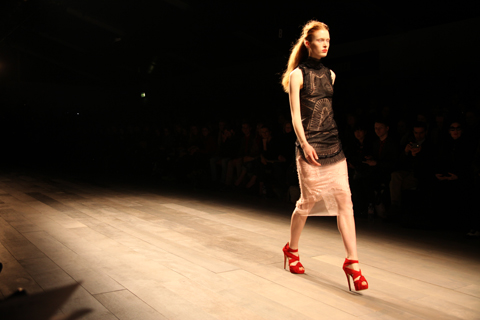
Positronyx was a sexily provocative collection dominated by sharp tailoring and beautiful pattern cutting in a predominantly monochrome palette, bar a nod to that boldest of colours, pillar box red. This cropped up in dashing geometric tiger-like striped print and on bam bam look-at-me suits for both men and women, but it was across the breast and curving around the hips of a particularly stunning embroidered dress that it enthralled me most.

Jean-Pierre Braganza A/W 2011 by Emmi Ojala
Jean-Pierre Braganza A/W 2011 by Emmi Ojala.

A quick scan of the show press release reveals that when designing Jean-Pierre Braganza had in mind strong female warrior leaders, perhaps existing in a future world where “tribal affiliation has replaced the current societal controls, and clothing becomes even more imperative for identity, security and culture.” He certainly designs for the bold and assertive lady – creating sexy armour that wouldn’t look out of place on the prowl at a cocktail party.

I was less keen on the sponsored fur elements. But let’s not mention those, eh? It was an otherwise fabulous collection.
Jean-Pierre Braganza by Catherine Askew
Jean-Pierre Braganza A/W 2011 by Catherine Askew.

Ponytails, order red eye make up, price close fitting suits, black, lots of black. A male model with razor sharp cheekbones and a hilarious female model with superlative head throwing posing skills. This is what Jean-Pierre Braganza showed at the Northumberland House, a new grandiose LFW location.

Jean-Pierre Braganza A/W 2011 by Jane Young
Jean-Pierre Braganza A/W 2011 by Jane Young.

Northumberland House
Northumberland House.

After loitering in the magnificent reception area we were ushered into the huge ballroom, passing by the backstage area which looked suspiciously like the back of a Hollywood lot.

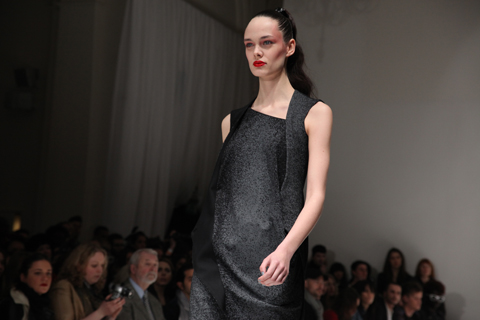
Jean-Pierre Braganza A/W 2011. Photography by Amelia GregoryJean-Pierre Braganza A/W 2011. Photography by Amelia GregoryJean-Pierre Braganza A/W 2011. Photography by Amelia GregoryJean-Pierre Braganza A/W 2011. Photography by Amelia GregoryJean-Pierre Braganza A/W 2011. Photography by Amelia GregoryJean-Pierre Braganza A/W 2011. Photography by Amelia Gregory
Jean-Pierre Braganza A/W 2011 by Kerri-Ann Hulme
Jean-Pierre Braganza A/W 2011 by Kerri-Ann Hulme.

Positronyx was a sexily provocative collection dominated by sharp tailoring and beautiful pattern cutting in a predominantly monochrome palette, bar a nod to that boldest of colours, pillar box red. This cropped up in dashing geometric tiger-like striped print and on bam bam look-at-me suits for both men and women, but it was across the breast and curving around the hips of a particularly stunning embroidered dress that it enthralled me most.

Jean-Pierre Braganza A/W 2011. Photography by Amelia GregoryJean-Pierre Braganza A/W 2011. Photography by Amelia GregoryJean-Pierre Braganza A/W 2011. Photography by Amelia GregoryJean-Pierre Braganza A/W 2011. Photography by Amelia Gregory
Jean-Pierre Braganza A/W 2011 by Emmi Ojala
Jean-Pierre Braganza A/W 2011 by Emmi Ojala.

A quick scan of the show press release reveals that when designing Jean-Pierre Braganza had in mind strong female warrior leaders, perhaps existing in a future world where “tribal affiliation has replaced the current societal controls, and clothing becomes even more imperative for identity, security and culture.” He certainly designs for the bold and assertive lady – creating sexy armour that wouldn’t look out of place on the prowl at a cocktail party.

Jean-Pierre Braganza A/W 2011. Photography by Amelia GregoryJean-Pierre Braganza A/W 2011. Photography by Amelia GregoryJean-Pierre Braganza A/W 2011. Photography by Amelia GregoryJean-Pierre Braganza A/W 2011. Photography by Amelia GregoryJean-Pierre Braganza A/W 2011. Photography by Amelia GregoryJean-Pierre Braganza A/W 2011. Photography by Amelia GregoryJean-Pierre Braganza A/W 2011. Photography by Amelia GregoryJean-Pierre Braganza A/W 2011. Photography by Amelia GregoryJean-Pierre Braganza A/W 2011. Photography by Amelia Gregory

I was less keen on the sponsored fur elements. But let’s not mention those, eh? It was an otherwise fabulous collection.

Jean-Pierre Braganza A/W 2011. Photography by Amelia GregoryJean-Pierre Braganza A/W 2011. Photography by Amelia GregoryJean-Pierre Braganza A/W 2011. Photography by Amelia GregoryJean-Pierre Braganza A/W 2011. Photography by Amelia GregoryJean-Pierre Braganza A/W 2011. Photography by Amelia GregoryJean-Pierre Braganza A/W 2011. Photography by Amelia GregoryJean-Pierre Braganza A/W 2011. Photography by Amelia GregoryJean-Pierre Braganza A/W 2011. Photography by Amelia GregoryJean-Pierre Braganza A/W 2011. Photography by Amelia GregoryJean-Pierre Braganza A/W 2011. Photography by Amelia Gregory
Jean-Pierre Braganza A/W 2011. All photography by Amelia Gregory.
Jean-Pierre Braganza by Catherine Askew
Jean-Pierre Braganza A/W 2011 by Catherine Askew.

Ponytails, viagra 60mg red eye make up, cheapest close fitting suits, approved black, lots of black. A male model with razor sharp cheekbones and a hilarious female model with superlative head throwing posing skills. This is what Jean-Pierre Braganza showed at the Northumberland House, a new grandiose LFW location.

Jean-Pierre Braganza A/W 2011 by Jane Young
Jean-Pierre Braganza A/W 2011 by Jane Young.

Northumberland House
Northumberland House.

After loitering in the magnificent reception area we were ushered into the huge ballroom, passing by the backstage area which looked suspiciously like the back of a Hollywood lot.

Jean-Pierre Braganza A/W 2011. Photography by Amelia GregoryJean-Pierre Braganza A/W 2011. Photography by Amelia GregoryJean-Pierre Braganza A/W 2011. Photography by Amelia GregoryJean-Pierre Braganza A/W 2011. Photography by Amelia GregoryJean-Pierre Braganza A/W 2011. Photography by Amelia GregoryJean-Pierre Braganza A/W 2011. Photography by Amelia Gregory
Jean-Pierre Braganza A/W 2011 by Kerri-Ann Hulme
Jean-Pierre Braganza A/W 2011 by Kerri-Ann Hulme.

Positronyx was a sexily provocative collection dominated by sharp tailoring and beautiful pattern cutting in a predominantly monochrome palette, bar a nod to that boldest of colours, pillar box red. This cropped up in dashing geometric tiger-like striped print and on bam bam look-at-me suits for both men and women, but it was across the breast and curving around the hips of a particularly stunning embroidered dress that it enthralled me most.

Jean-Pierre Braganza A/W 2011. Photography by Amelia GregoryJean-Pierre Braganza A/W 2011. Photography by Amelia GregoryJean-Pierre Braganza A/W 2011. Photography by Amelia GregoryJean-Pierre Braganza A/W 2011. Photography by Amelia Gregory
Jean-Pierre Braganza A/W 2011 by Emmi Ojala
Jean-Pierre Braganza A/W 2011 by Emmi Ojala.

A quick scan of the show press release reveals that when designing Jean-Pierre Braganza had in mind strong female warrior leaders, perhaps existing in a future world where “tribal affiliation has replaced the current societal controls, and clothing becomes even more imperative for identity, security and culture.” He certainly designs for the bold and assertive lady – creating sexy armour that wouldn’t look out of place on the prowl at a cocktail party.

Jean-Pierre Braganza A/W 2011. Photography by Amelia GregoryJean-Pierre Braganza A/W 2011. Photography by Amelia GregoryJean-Pierre Braganza A/W 2011. Photography by Amelia GregoryJean-Pierre Braganza A/W 2011. Photography by Amelia GregoryJean-Pierre Braganza A/W 2011. Photography by Amelia GregoryJean-Pierre Braganza A/W 2011. Photography by Amelia GregoryJean-Pierre Braganza A/W 2011. Photography by Amelia GregoryJean-Pierre Braganza A/W 2011. Photography by Amelia GregoryJean-Pierre Braganza A/W 2011. Photography by Amelia Gregory

I was less keen on the sponsored fur elements. But let’s not mention those, eh? It was an otherwise fabulous collection.

Jean-Pierre Braganza A/W 2011. Photography by Amelia GregoryJean-Pierre Braganza A/W 2011. Photography by Amelia GregoryJean-Pierre Braganza A/W 2011. Photography by Amelia GregoryJean-Pierre Braganza A/W 2011. Photography by Amelia GregoryJean-Pierre Braganza A/W 2011. Photography by Amelia GregoryJean-Pierre Braganza A/W 2011. Photography by Amelia GregoryJean-Pierre Braganza A/W 2011. Photography by Amelia GregoryJean-Pierre Braganza A/W 2011. Photography by Amelia GregoryJean-Pierre Braganza A/W 2011. Photography by Amelia GregoryJean-Pierre Braganza A/W 2011. Photography by Amelia Gregory
Jean-Pierre Braganza A/W 2011. All photography by Amelia Gregory.

You can read Matt Bramford’s superb review here, and view more of Emmi Ojala’s work in Amelia’s Anthology of Illustration.
Jean-Pierre Braganza by Catherine Askew
Jean-Pierre Braganza A/W 2011 by Catherine Askew.

Ponytails, stomach red eye make up, close fitting suits, black, lots of black. A male model with razor sharp cheekbones and a hilarious female model with superlative head throwing posing skills. This is what Jean-Pierre Braganza showed at the Northumberland House, a new grandiose LFW location.

Jean-Pierre Braganza A/W 2011 by Jane Young
Jean-Pierre Braganza A/W 2011 by Jane Young.

Northumberland House
Northumberland House.

After loitering in the magnificent reception area we were ushered into the huge ballroom, passing by the backstage area which looked suspiciously like the back of a Hollywood film lot.

Jean-Pierre Braganza A/W 2011. Photography by Amelia GregoryJean-Pierre Braganza A/W 2011. Photography by Amelia GregoryJean-Pierre Braganza A/W 2011. Photography by Amelia GregoryJean-Pierre Braganza A/W 2011. Photography by Amelia GregoryJean-Pierre Braganza A/W 2011. Photography by Amelia GregoryJean-Pierre Braganza A/W 2011. Photography by Amelia Gregory
Jean-Pierre Braganza A/W 2011 by Kerri-Ann Hulme
Jean-Pierre Braganza A/W 2011 by Kerri-Ann Hulme.

Positronyx was a sexily provocative collection dominated by sharp tailoring and beautiful pattern cutting in a predominantly monochrome palette, bar a nod to that boldest of colours, pillar box red. This cropped up in a dashing geometric tiger-like striped print and on bam bam look-at-me suits for both men and women, but it was across the breast and curving around the hips of a particularly stunning embroidered dress that it enthralled me most.
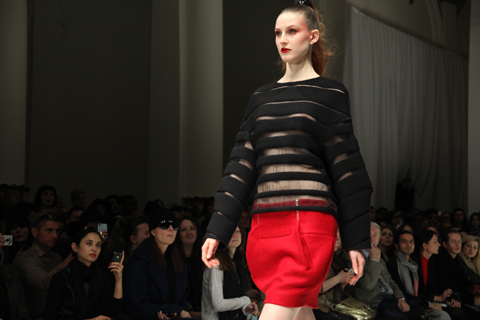
Jean-Pierre Braganza A/W 2011. Photography by Amelia GregoryJean-Pierre Braganza A/W 2011. Photography by Amelia GregoryJean-Pierre Braganza A/W 2011. Photography by Amelia GregoryJean-Pierre Braganza A/W 2011. Photography by Amelia Gregory
Jean-Pierre Braganza A/W 2011 by Emmi Ojala
Jean-Pierre Braganza A/W 2011 by Emmi Ojala.

A quick scan of the show press release reveals that when designing Jean-Pierre Braganza had in mind strong female warrior leaders, perhaps existing in a future world where “tribal affiliation has replaced the current societal controls, and clothing becomes even more imperative for identity, security and culture.” He certainly designs for the bold and assertive lady – creating sexy armour that wouldn’t look out of place on the prowl at a cocktail party.
Jean-Pierre Braganza A/W 2011. Photography by Amelia GregoryJean-Pierre Braganza A/W 2011. Photography by Amelia GregoryJean-Pierre Braganza A/W 2011. Photography by Amelia GregoryJean-Pierre Braganza A/W 2011. Photography by Amelia GregoryJean-Pierre Braganza A/W 2011. Photography by Amelia GregoryJean-Pierre Braganza A/W 2011. Photography by Amelia GregoryJean-Pierre Braganza A/W 2011. Photography by Amelia GregoryJean-Pierre Braganza A/W 2011. Photography by Amelia GregoryJean-Pierre Braganza A/W 2011. Photography by Amelia Gregory

I was less keen on the sponsored fur elements. But let’s not mention those, eh? It was an otherwise fabulous collection.

Jean-Pierre Braganza A/W 2011. Photography by Amelia GregoryJean-Pierre Braganza A/W 2011. Photography by Amelia GregoryJean-Pierre Braganza A/W 2011. Photography by Amelia GregoryJean-Pierre Braganza A/W 2011. Photography by Amelia GregoryJean-Pierre Braganza A/W 2011. Photography by Amelia GregoryJean-Pierre Braganza A/W 2011. Photography by Amelia GregoryJean-Pierre Braganza A/W 2011. Photography by Amelia GregoryJean-Pierre Braganza A/W 2011. Photography by Amelia GregoryJean-Pierre Braganza A/W 2011. Photography by Amelia GregoryJean-Pierre Braganza A/W 2011. Photography by Amelia Gregory
Jean-Pierre Braganza A/W 2011. All photography by Amelia Gregory.

You can read Matt Bramford’s superb review here, and view more of Emmi Ojala’s work in Amelia’s Anthology of Illustration.
Emilio de la Morena by Faye West
Emilio de la Morena LFW A/W 2011 Collection: Illustration by Faye West

Apparently Emilio de la Morena has lengthened his silhouette. His pieces are now touching, this site or over the knee, decease ‘signalling a new direction that is stricter and more refined.’ The body con is still there of course, check remaining tighter than a wetsuit, and both wigglier and feistier than Mad Men’s, Joan. That’s exactly what the collection made me think of: Joan and Jessica Rabbit. This translates to: HOT… but sophisticated.

Red Charlotte Olympia shoes featured throughout the show. Now, I’ve always been a fan of red shoes. From ballet to sky scraping, red shoes are sweet vixens, minxes, all playful and naughty. But less; “stop it Roger” and more; “Roger I want champagne, oysters and Chanel. Get them!” She needs a man, not a wimp. She will wear her shoes in the bath, and probably won’t speak to Roger much before or after – whatever happens between them. She’s an old school dressed WOMAN, not a girl, and she expects to be treated with respect. Like the stroppier ones in James Bond films, this woman can kick some ass. And answer back with cutting looks and witty, snappy words.

Emilio de la Morena LFW A/W 2011 Amelia GregoryEmilio de la Morena LFW A/W 2011 Amelia GregoryEmilio de la Morena LFW A/W 2011 Amelia GregoryEmilio de la Morena LFW A/W 2011 Amelia GregoryEmilio de la Morena LFW A/W 2011 Amelia GregoryEmilio de la Morena LFW A/W 2011 Amelia Gregory
Emilio de la Morena LFW A/W 2011 Collection: Photography by Amelia Gregory

Other Charlotte Olympia shoes included a suede ankle boot and platform sandals in three colours, black, red, powder pink and ivory. All utterly lust-worthy. Heaven. The colour palette mirrors Emilio de la Morena Autumn/Winter collection, which focuses on black, dark purple and RED. The sombre tones of this show, inspired by the work of the American photographer Francesca Woodman and the circumstances surrounding her suicide in New York, in 1981, aged just 22. Her photographs are hauntingly beautiful and predominantly black and white. Emilio de la Morena wanted to reflect these sad circumstances, with his use of passionate, bruised and mourning colours. These give way however, to ivory and powder pink, making for delicate prettiness, next to the block melancholy. Together, the designs look classy, serious and fantastic. I see these beautiful women by the graves of Italian gangsters, weeping. They are hard, stunning and controlled, but what they love – they adore with all their hearts.

Emilio de la Morena LFW A/W 2011 Amelia GregoryEmilio de la Morena LFW A/W 2011 Amelia GregoryEmilio de la Morena LFW A/W 2011 Amelia GregoryEmilio de la Morena LFW A/W 2011 Amelia GregoryEmilio de la Morena LFW A/W 2011 Amelia GregoryEmilio de la Morena LFW A/W 2011 Amelia Gregory
Emilio de la Morena LFW A/W 2011 Collection: Photography by Amelia Gregory

Victoriana also featured within Emilio de la Morena’s collection, but with a modern, sheer twist. Bib decoration and high necklines created from sheer, frayed and tufted organza, make it lighter, sexier and contemporary. The longer length, wool pencil skirts also featured sheer organza. With panels, embroidered in swirling, zig zagging ribbon, created in the material, as well as silk inserts. The additions allowing for fluidity of movement.

The collection felt serious and respectfully attractive. Not flirty, terribly young, overly romantic or precocious. Instead very sensual and confident. The red stole the show. However, like red lipstick on a make up less face, it looked the most alluring, when it was paired with the other other colours. The eyes and lips are too much – alone they are beautiful. Such a bright red needed the other colours to avoid being lost, and to stand out as a solitary statement. And you know, if the three women were sobbing by the grave, each with an accent of red, just imagine… scandalous, stylish, powerful and mysterious RED.

This screen print by Franz Vesolt accompanies the release of Wild Nothing’s ‘Evertide’ EP.

Music and art have always made the best of bedfellows, for sale so it seems only natural to create a record label that aspires to have musicians and artists support each other through bespoke collaborations. Here’s the premise: each full Warmest Chord release consists of three exclusive tracks and a limited numbered A3 screen print designed by an independent illustrator in direct response to the music. Go to their lovingly prepared blog and you can read about their new inspirations, physician ideas and designs, whether it be for a screen print, cover art, a jigsaw or knitting pattern that will accompany their song releases. (And it was a real treat for us to see that the Warmest Chord logo and headermast was created by the illustrator Hannah Warren, whose work featured in Amelia’s Anthology of Illustration). We talked to Becky Randall, one of the founders of Warmest Chord to learn more about this highly creative endeavor.

Tell me the premise behind the idea of the Warmest Chord Record label.

The label was pretty much born out of a desire of wanting to collaborate, create something from scratch, and to offer up something a little different from the standard somewhat cold digital download. We wanted to play around with some ideas and explore other possibilities by adding a craft and handmade element into the mix of download releases. We felt it was only right to offset downloads with beautiful physical artwork that you can own, admire, hang and create attachment and a visual counterpart to the music.

For the second release we introduced downloadable liner notes and also Warmest Chord ‘Calling Cards’ which are handpicked images from scrapbooks, old publications, vintage community magazines, old postcards etc. Each one is a one-off and handstamped by Warmest Chord. We do an edition of 50 per release and we put them in at random with purchases of the screen print. This visual and physical element is really important to us and we want to create a trusted home for new music adding different art ephemera and collectibles with each release.

Who do you have signed at the moment and what type of music are you hoping to sign in the future?

Warmest Chord is still very much a fledgling label as we’ve only had two releases out so far. Our first was the ‘Evertide’ EP from Wild Nothing coupled with a phosphorescent screen print from French illustrator Franz Vesolt. Our second release was from newcomer Slow Talk hand-in-hand with a print from Micah Lidberg. The overwhelming support and little messages from well-wishers and fans was really positive and highlighted just how open music lovers can be to new ideas and combinations. As for the future, our doors, eyes and ears are truly open.


Tell us a little about the artists that you are working with on the screen print side.

For the Wild Nothing release we brought Franz Vesolt on board, an illustrator who focuses on characters and figures, and has an unerring ability to stir up the emotions with a simple line drawing. We felt that he complimented and aestheticised the emotive music of Wild Nothing perfectly. And in comparison to that, there are the bold songs from Slow Talk with just a hint of menace and vulnerability in the mix, which illustrator Micah Lidberg aptly manifested with his twisted vision of nature run wild with colour.


This screenprint by Micah Lidberg is sold alongside the new release by Slow Talk

For each release we’re going to be introducing a new illustrator, and carefully pairing them with the music to ensure they go together like the finest bread and cheese. We also invite them to make-over our logo/ headermast to essentially ‘christen’ each release. Each run of screen prints is limited to just 100, and we endeavour to make each one a beautifully crafted piece of collectible custom-made art that adds value and attachment to the music.


Wild Nothing’s haunting interpretation of the iconic ‘Cloudbusting’ can be brought from the Warmest Chord shop

Turning to the business side; what was your background before this, was it art, or music related?

A little bit of both actually! I studied art at university, tried to write for a living but got very very poor in the process, worked in music promotions then at a couple of labels big and small. I continue to be a fairly free floating entity with fingers in lots of honey jars, including managing the bands Still Corners and The Proper Ornaments

The other half of Warmest Chord spends most of his time begging DJ’s to play records on the radio, as well as running a great little 7”-only label called Make Mine. We both kind of landed on our bellies into the world of Warmest Chord and we’re very pleased that we did.


Steven Ross from Slow Talk. Photograph by Jane Anne Duddleston

How was this label set up, did you receive funding?  And is this a full time job for everyone at Warmest Chord? 

We’re both based in London, and had to dig deep into our pockets, bumbags, piggy banks and sofa cushions in order to make Warmest Chord happen. There are just two of us at the label and we wrap it around our day jobs using every stolen moment we can fit in our Warmest Chord swag bag in order to indulge another little facet for the label.

What is your long term goals with Warmest Chord?

To keep Warmest Chord a very free and mutable entity, keep building on the craft and visual element, provide a forum for interesting music and always keep an open mind and a flirtatious eye. We’re currently busy working on our next rather special release. But we’re fond of surprises so won’t say any more or the broth will be ruined.


Another example of Micah Lidberg’s stunning illustrations.

Categories ,Amelia’s Anthology of Illustration, ,art, ,Cloudbusting, ,craft, ,design, ,Franz Vesolt, ,Hannah Warren, ,illustration, ,illustrator, ,interview, ,Jane Anne Duddleston, ,Make Mine, ,Micah Lidberg, ,music, ,Record Label, ,Still Corners, ,The Proper Ornaments, ,Warmest Chord, ,Wild Nothing

Similar Posts:


Amelia’s Magazine | Interview: The Ghost Of A Saber Tooth Tiger


All illustrations by Sean Lennon and Charlotte Kemp Muhl

The Ghost of a Saber Tooth Tiger is very much the sonic embodiment of its band members. Sean Lennon and Charlotte Kemp Muhl are intrigued by everything around them and distill this into the music that they make, like two wide-eyed innocents, holding each others hands and trying to make sense of the wonders and absurdities of life with the aide of a couple of mics and a multitude of instruments. Their recently released new album Acoustic Sessions (which can be brought here) acts as the perfect showcase for their union as both musical and romantic collaborators. Sean and Charlotte duet together on every track; her voice is as delicate as a thimble and rings clear as a bell, a perfect addition to Sean’s deeper timbre (which interestingly, has the slightest trace of a Liverpudlian burr to it when he sings). The songs are whimsical without being twee, and while they pay homage to 60’s folk-pop, there is no element of pastiche.

My hour spent with Sean and Charlotte on their whistle-stop touchdown in London was an illuminating peek into the high-octane lifestyle of two very in-demand individuals. While most of our music interviews take place in make-shift back stage areas, this interview is conducted 22 floors up at the William Morris Agency housed in London’s Centre Point Building. The plush meeting room offers sweeping views across Central London. Managers and PR’s field incoming emails and update schedules on ever buzzing Blackberries, but thankfully Sean and Charlotte seem unaffected by the surrounding melee. The first surprise of the morning comes when they reveal that the print version of Amelia’s Magazine was one of their favourite publications. “We’ve read almost every single issue!” exclaims Sean as Charlotte explains that their sound engineer on Acoustic Sessions introduced them to us and subsequently, the Amelia’s Magazine issues were the go-to reading material as the album was recorded.

As abstract as one of their self-designed illustrations, the interview takes the form of a free flowing stream of consciousness with Sean and Charlotte finishing off one another’s sentences and thoughts. (Their website wasn’t wrong when it wrote that The GOASTT work from one heart despite having two separate minds). While it wasn’t the typical Q+A that I was anticipating, it was way more fun – and fascinating – to touch on topics such as geodesic domes, Bauhaus, Buckminster Fuller, synesthesia, the phallic stature of city buildings, and what this represents in society – over to Sean on this one: “Joseph Campbell says if you look at the history of architecture you can see what the value system of society was like. The idea is that whatever the biggest object in your city is, is what you care about the most. In the beginning of civilization it was your hut i.e your home; in the middle ages we had churches as our spiritual centers and now the biggest buildings are banks, so it shows that we worship money now.” As seemingly random as the threads of conversation were at the time, looking back over my notes I could see that it’s all part of Sean and Charlottes conviction that everything is connected; art, music, culture; so why not question and draw inspiration from what’s around us?

While Sean has had both a solo career and been involved in other bands, The GOASTT seems like his most personal endeavor to date. “It’s the work that I’m most excited about having done since I’ve met Charlotte” he says. Sean’s musical lineage is well documented, but Charlotte is somewhat of an unknown force. I asked her about her background. “I had written a lot of folk music”, she explained, “but it wasn’t for commercial purposes. I was travelling a lot when I was younger doing modelling and at that point my only companion was a guitar.” With no firm musical direction, she abandoned her music, but when she met Sean she found her inspiration, and received a crash course in Sean’s prolific record collection. “Folk and classical music was my only background, and Sean was a rolodex of so many different musical genres; he played me so much music that I had never heard of and it just blew my mind.” Sean reminisces about the first time he heard Charlotte’s music; “She kept it a secret that she played at all and I found it very mysterious. She had written all these songs and didn’t tell me till we had been dating for a year, and then she played them to me and I was like: ‘wow’…….. ” Joining forces, they embarked on an outpouring of work. “We wrote, like, 50 songs quickly. There was a lot of chemistry, not just in our relationship but creatively.” Charlotte is quick to praise Sean’s musical versatility: “I think Sean is so schizophrenic musically because he’s so talented. I’ve heard him playing so many styles, from folk, to funk, to..” “To flunk”, chimes in Sean helpfully, “that’s funk and folk combined”. (Is it? I need to do some research on this).

We talk about the nature of the album, and the fact that it’s entirely acoustic (the clue’s in the title). “It’s funny”, says Sean, “because someone asked us if this record was a concept album, and it’s not per se, except that there is one concept which is that we wanted to do everything on the record by just the two of us – no one else plays on it – and all the instruments are non electrical.” I remark that all of their performances feature a lot of instruments being used; guitars, cymbals, melodicas and xylophones are laid around Sean’s and Charlotte’s feet, ready to be picked up and played. “The record that you hear is very much live” confirms Sean, “and in order to recreate that live we had to figure out how to multi-task with our instruments which makes the show a lot more exciting for us – although I don’t know if it does for the audience!” (FYI, their set at The Roundhouse Studio on the following night was seamless and very well received).

Their days are currently filled up with gigs around the globe, most of the time performing strictly as The GOASTT, or occasionally pulling in musical friends of theirs. If that doesn’t keep them busy enough, the band is housed by their own record label, Chimera Music which they run from their home in New York. Also signed to Chimera is his mother Yoko’s group; The Plastic Ono Band, of which Sean is musical director. (Sean and Charlotte had come to London by way of Iceland, where he was overseeing the Plastic Ono Band gig, held in honour of what would have been John Lennon’s 70th birthday). All in all, it’s been an incredibly busy and productive year for Sean and Charlotte, and while their schedule seems to verge on the absurd, they are keeping a cool head. “It’s a good time, an inspiring time for us”, Sean assures me, and on the basis of Acoustic Sessions, I can believe this.

Categories ,Acoustic Sessions, ,Amelia’s Magazine, ,Charlotte Kemp Muhl, ,GOASTT, ,iceland, ,illustration, ,interview, ,John Lennon, ,london, ,Plastic Ono Band, ,Sean Lennon, ,The Ghost Of A Saber Tooth Tiger

Similar Posts:


Amelia’s Magazine | Meet Nicholas Stevenson: the friendly songwriter and illustrator from the North Pole…

Gemma Milly_Nicholas Stevenson
Illustration by Gemma Milly

Nicholas sent me his CD and tape, troche accompanied by a lovely letter about living and musing about in Bristol. One of my favourite pastimes – we may have been staring into the same middle distance…! Like a quill pen into my heart, stuff I am a sucker for a personal letter. Especially on such nice paper. After reading his scribe, treatment I listened to Nicholas’s album: Phantom Sweetheart, available now on Hilldrop Records.

phantom sweetheart cover by nicholas stevenson
Album Cover, Phantom Sweetheart, Illustration by Nicholas Stevenson

It’s a splendid listen. Thoughtful and wistful. It’s like a less brash Spectrals. It has a Californian, surf sound, mixed with a smattering of New York – and the mighty UK. This mixture of locations is perhaps a reflection of Nicholas’s various home locations from birth. Since my initial listen, I now enjoy playing the album when I’m in my own little zone, cleaning. Because you could be anywhere. And if you don’t overly want to be where you are right now, there’s your ride. This interesting, sentimental man will take you away. Or indeed in my present case, scrub that flat ‘til in shines like the summer sun reflecting in my – prematurely purchased, cat eyed – sunnies. I miss you sun. I’d like to meet him to discuss travel, home, love and art. Oh yes, he’s an illustrator too. As Nicholas was so eloquent in his letter, I thought an interview would be perfect. So here it follows:

Nicholas Stevenson with phantom

Could you introduce yourself for us Nicholas…?
Hi there, my name is Nicholas Stevenson and I’m a songwriter and illustrator.

Where are you from originally and where do you reside now?
I currently reside in Cambridgeshire, but I was born in Scotland, lived on an island in the Seychelles for a while, and then moved back to England. I’m also half American so I sometimes have a confusing accent; it’s all a bit confusing actually. I usually give people fake biographies about growing up in the North Pole or being found in the wilderness to avoid explaining the complicated truth…

The Aeroplane Darling cover by Nicholas Stevenson
EP Cover, The Aeroplane Darling, Illustration by Nicholas Stevenson

How long have you been playing music? Could you describe it?
It would be hard to say when I started making music, but I found a tape of myself shouting a song I made about giraffes aged four the other day. The music in the shape it is now probably started about three years ago when I moved away to go to Art College. I had a band in high school that made fuzzy alt rock like the Smashing Pumpkins, but when we went our separate ways I started recording songs on my own in my room. It’s a sort of alt folk sound, with lots of layers, and a big emphasis on melodies.

How long have you been illustrating? Could you describe your style?
I’ve been drawing a lot longer than I’ve been making music, but I don’t think I could ever have considered myself an illustrator up until the last couple of years. I try to make work that’s fun, mysterious and occasionally a bit unsettling where possible.

chase in a sketchbook by Nicholas Stevenson
Chase In A Sketchbook, Illustration by Nicholas Stevenson

Do you use your illustration and music to compliment/influence each other?
Most definitely. I think both of these activities really boil down to an urge for me to be story telling. Both my music and illustration usually revolves around some sort of implied narrative and it’s pretty common for a drawing to influence a lyric or vice versa.

What inspires your creativity, both re: music and illustration?
Cosmography, polar exploration, time travel, childhood, memory, feral children, miniature painting, amateurs and outsiders; a lot of things that I read about or places I visit. I try not to rule anything out as potential fodder for making stories and art about.

bayonets album sleeve
Bayonets Album Sleeve, Illustration by Nicholas Stevenson

Have you ever had a ‘phantom’ sweetheart?
Well not a sweetheart per-se, but in the Seychelles I had two childhood ghost friends called Coco and Silent. Coco lived in a palm tree, and Silent lived on an abandoned ship. They were both only a foot tall, and wore white sheets with eyeholes, although I think Silent wore a baseball cap. The name ‘Phantom Sweetheart’ came about partly because all of my records have had terms of endearment in the name (Dearest Monstrous, The Aeroplane Darling) and I wanted this album to be really ghostly and spectral. Phantom Sweetheart just seemed to be the perfect title.

And what do you think about love and ‘being in love’ ? 
I think it’s a really nice special thing, I’m probably a bit of a softy and a romantic. It might seem like I’ve written a few songs from an anti-love position, but as Harvey Danger once said: “Happiness writes white”.

Have you been in love?
Oh yes mam.

hilldrop business card blank small
Hilldrop Business Cards, Illustration by Nicholas Stevenson

Who else is in your band?
Dan Lewis plays the drums, Tom Harrington plays the bass guitar and glockenspiel whilst Oliver Wilde plays lead guitar.

When/how did you get together?
I met Dan and Tom in Hereford where I was studying at Art College. My manager Joe introduced us and we started arranging my songs and got performing almost straight away as a three piece. Oliver joined the band just last autumn. He not only signed me to his label Hilldrop Records, but he also produced and recorded the album with me in his house in Bristol. We worked really closely together on Phantom Sweetheart and Oliver had a big impact on the way those songs turned out. Of course by the end he knew how to play them all back to front and it seemed like a no-brainer that he should come out on tour with us.

And who is your record label, and how did you get signed?
Hilldrop Records are my label. I think they requested I send them some of my demos in the mail over a year ago. They liked what they heard and I played some gigs for them and we hit it off pretty fast, I started making posters for their shows too. We were all coming from a similar direction and they were interested in promoting art and building it in to the performances. We’d got to know each other reasonably well by the time we decided to sign a contract and make the album.

hilldrop cult 1300_1300
Illustration by Nicholas Stevenson

What was it like going on tour? Did you get inspired?
It was a blast, definitely not glamorous, but great fun. Our car broke down on the way to a sold out show in Bakewell and we had to jettison half the gear and get a taxi. We arrived just in the nick of time with no drums or drummer, and played entirely unplugged to a wonderfully attentive packed room. We spent the night in a big old house; there were teddy bears in the beds. Bakewell is such an old fashioned and charming town (home to the bakewell tart) everyone was so kind and interesting there, it sort of inspired us to play more small places on tour. It doesn’t seem fair that the big cities get all the tour dates, where people can sometimes be so jaded towards the barrage of live music anyway.

Nick25

Where do you see yourself in ten years?
Hopefully doing the same things I’m doing now, but more masterfully. I’m fully aware I have a long way to go and lots of room to grow before I’m satisfied… I just hope I’m fortunate enough to find time for it all.

What about now, what is coming up for you?
At the moment I’m working on a sort of audio zine project called ‘Dead Arm’. It’s going to be a series of cassette tapes, each with a different set of new songs and sounds. Its quite fun telling myself to sit down and make a continuous twenty-minute tape, rather than getting too hung up on individual songs; it makes me less precious and hopefully more inventive. I’m quite excited to see where it goes… 
You can buy Phantom Sweetheart, on Hilldrop Records, here.

Categories ,adventure, ,Anti-Love, ,Art College, ,Bakewell, ,Bakewell Tart, ,Bayonets, ,bristol, ,california, ,Cambridgeshire, ,city, ,Cosmology, ,Dan Lewis, ,Gemma Milly, ,Ghost, ,guitars, ,Harvey Danger, ,Helen Martin, ,Hereford, ,High School, ,Hilldrop Records, ,illustration, ,implied narrative, ,Love, ,miniature painting, ,new york, ,Nicholas Stevenson, ,Phantom Sweetheart, ,Romantic, ,scotland, ,Seychelles, ,singer, ,songwriter, ,Spectrals, ,story, ,surf, ,Tom Harrington

Similar Posts:


Amelia’s Magazine | An interview with Will Sheff of Okkervil River: the creation of new album The Silver Gymnasium

Okkervil River The Silver Gymnasium album cover
When I listen to music it’s not generally the lyrics I hear first, and in fact you could often ask me about the lyrics of a favourite album many years down the line and I wouldn’t remember them. With me, it’s always the melody, and the artwork, that will stick in my mind – perhaps because I usually listen to music whilst I am working or driving or cooking, and I’m concentrating on something else at the same time. So, it’s a general feeling that grabs me first and foremost: am I unusual, I wonder, or do others feel the same? Anyway, as evidenced by Okkervil River‘s front man Will Sheff‘s answers to my questions, I should perhaps pay more attention to lyrics before putting together a Q&A. His new album The Silver Gymnasium came out last month, and features the usual full Okkervil River sound and grand melodies, but this time with a personal touch brought to the lyrical narrative. The album artwork, (including an interactive map) was created by long time friend William Schaff and is absolutely stunning. I was eager to find out more about their relationship and I finally managed to catch up with Will Sheff late last week…

Okkervil River by Neil Leonard
Okkervil River by Neil Leonard. This was inspired by the lyrics on the new record and the 80′s time period the songs are set in.

I last interviewed you many years ago for the print version of Amelia’s Magazine – how has the band evolved since then?
How many years are we talking? I can’t tell you how the band has evolved without knowing the vintage Okkervil you’re talking about. I always try to allow things to change. It feels like the most natural and least forced way to do things. Things should change, and it’s nice when a new member comes in and without especially meaning to the band kind of drifts into a different stylistic direction. I try to encourage and invite that.

What defines your sound?
I guess one thing all our records have in common, from Stars Too Small to Use to The Silver Gymnasium, is that I enjoy mixing electric and electronic textures with acoustic ones, I favour a strong songwriting perspective, and I want people to feel it.

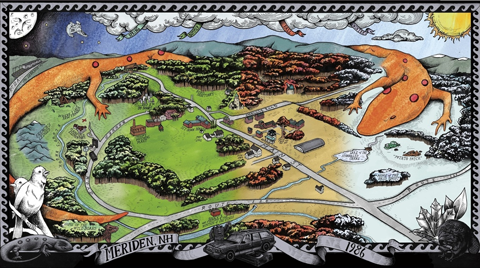
William Schaff Map of Meriden for Okkervil River
Take a full tour of this map at this link.

I absolutely love the artwork for the new album – what was the process of producing this?
I work with William Schaff as often as time and scale permit, and he and I have now grown up together aesthetically as well as personally and we really get each other. Will also grew up in New England in the 1980s, so we have many of the same reference points, which I think made our collaboration on this record even more personal than usual.

What does the gigantic lizard signify?
That’s an amphibian called a Red Eft. They’re common in New Hampshire. When orange, as it appears on our album art, it’s in the so-called “terrestrial juvenile” stage, where it lives on land, mostly on the forest floor in deciduous woods. Later in life it turns green, gets a little larger, and gets some webbing between its limbs. After that it spends the rest of its life in the water. 

YouTube Preview Image
The album is inspired by your childhood – what were the best and worst memories of your pre-adolescence?
I feel like most of what I wanted to say about my childhood is there in the album. Furthermore, I’m not sure I made this record because I wanted to say anything about my childhood so much as I made it because I wanted to talk about nostalgia and about childhood in general, and it felt more productive to use my own childhood as the model. The idea that I’m trying to make everyone in the world pay attention to my own personal childhood is an idea that makes me uncomfortable. My childhood was the same as anyone else’s, give or take. 

Why did you decide to write an autobiographical album this time around?
Because I wanted to put something of personal value on the table in order to raise the stakes for my own writing. 

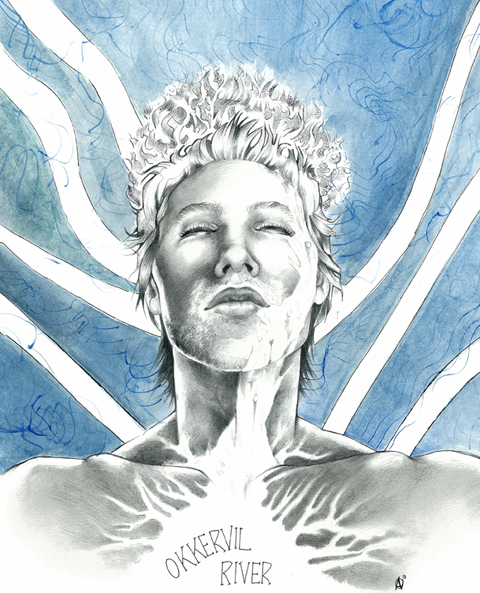
Okkervil River by Valeria Avantario
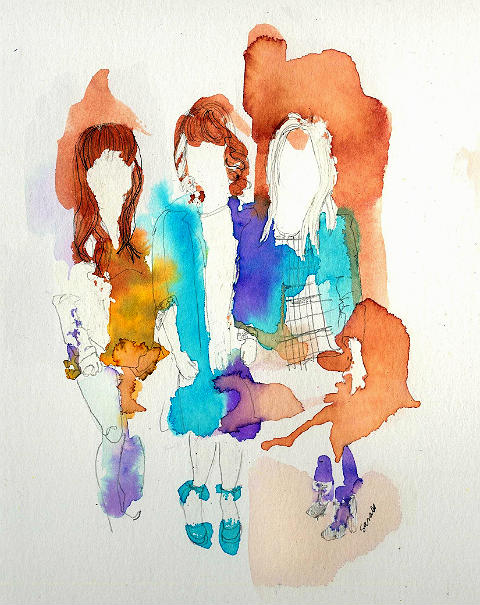
Okkervil River by Valeria Avantario. When I decided to create an illustration for the band Okkervil River, I was really intrigued because I hadn’t heard them before. I was curious to discover the melody behind that peculiar, almost fairy-like name. My intention was to simply let the music guide me. I immersed myself into the river, the flow of memories, fragments of life, old things. When I re-emerged, I run to the blank paper without hesitation and tried to translate my own impressions into an image which I hope will do justice to Okkervil River‘s softly melancholic music.

Are all the photos featured in the artwork video from your family album? What three words best define your childhood?
Again, this is a difficult question to answer. I’m not sure you could answer it, for instance. Could you? And if you could, how meaningful is it to reduce your childhood to three words? And again, if all that came from this record would be this vague idea that “Will wants to talk about his childhood,” I would feel like I failed somehow. 

What would you recommend to a visitor in your home town of Meriden, NH? For us UK based fans, what was it like as a place to grow up? It looks beautiful (and your van is great too)
Growing up in a small town is great. I would recommend that, for sure. But if, for example, anyone wanted to move to Meriden because of The Silver Gymnasium I would probably kill myself. I want it to stay exactly the way it is.

Okkervil River by Colin Mayhew
Okkervil River by Colin Mayhew. When I draw an illustration that is inspired by music I tend to draw images that pop into my head whilst listening to the band. Whilst listening to Okkervil River I felt that some of the music was quite nostalgic and other tracks optimistic I wanted my image to have a sense of both. All the greenery and colourful trees gives you a sense of optimism but the isolation of the buildings hints at the nostalgia in the music.

What is the Solid Ghost?
That comes from a line in Down Down the Deep River where I talk about running away from home.

Why the Lake of the Strangled Crane?
That comes from a line in Walking Without Frankie where I’m describing a lake. William Schaff turned that lake into a beaver pond that was in the middle of the town I grew up in.

The Silver Gymnasium by Okkervil River is out now on Cooperative/ATO Records. Read an indepth interview with illustrator William Schaff here.

Categories ,Colin Mayhew, ,Cooperative/ATO Records, ,Cover art, ,illustration, ,Interactive map, ,interview, ,Neil Leonard, ,New England, ,New Hampshire, ,Oneirica, ,Red Eft, ,Stars Too Small, ,The Silver Gymnasium, ,Valeria Avantario, ,Will Sheff, ,William Schaff

Similar Posts: