

Fifteen typefaces designed for commercial use, seek 2010 (A2-TYPE, doctor London)
On a bitingly chilly but sunny Saturday afternoon, sildenafil I sauntered down to the A2/SW/HK design studio in the heart of Hoxton to meet Henrik Kubel, one half of the talented A2/SW/HK duo. With a blink-and-you’ll-miss-it entrance, the studio is housed on the third floor of an old textile warehouse, exuding understated coolness. On entering, I feel as if I have reached some kind of design nirvana where the huge windows splash a radiant bright light onto the pristine white walls, furniture and Macs. I quickly glance around the room to see work tops sprawled with rolled up papers and intricate-looking sketches; a vintage Remington Standard typewriter nestles comfortably amongst a collection of art titles on the glossy white shelves – the mother of type. Standing tall and smart-nonchalantly dressed in a well-fitted navy blue jacket with a thin red trimming, off-white shirt and faded blue jeans, Kubel looks picture-perfect in his surroundings.

Zadie Smith: On Beauty, 2005—06 (Penguin Books, New York); hardback and paperback cover designs including bespoke typefaces
For typography and branding enthusiasts, viewing the latest A2/SW/HK typeface collection that recently launched online is the equivalent of setting a restrained, hyperactive child free in a sweet shop. Spanning over 15 years of work, the array of fonts range from the delicate, swirling Zadie, commissioned by Penguin Books New York for the US version of the novel On Beauty by Zadie Smith (hence the name), to the heavier, more robust Impacto, which cuts a dashing and authorative figure, as its name suggests. Similar to walking into a department store to choose an appropriate outfit for a function, A2/SW/HK have meticulously crafted a typeface for every occasion, depending on the message and feeling the consumer would like to convey.

Impacto typeface, 2010 (A2-TYPE, London); bespoke typefaces
The impressive collection comprises of 15 typefaces, many of which have multiple weights (fonts), with each font containing 256 characters. Overall, there are 53 fonts to marvel at totaling 13,568 individual glyphs (these include all members of the alphabet, diacritics, numbers, symbols and punctuations).

Psycho Buildings, 2008 (Hayward Gallery, London); art direction, bespoke typefaces and design
The typefaces were previously designed for bespoke projects across various media platforms including print, screen and interiors, however, the launch of the collection in their entirety means that, for the first time ever, the fonts are available for general use. “The typefaces can be used for any type of advertising now; even by two different fashion brands if they want,” says Kubel. “A typeface can work for many people in different ways, depending on who the creative director is and how they choose to use it. You’d be surprised at how many times a single typeface can be used to present different meanings for different jobs.”


Lisson Gallery, 2008 (Lisson Gallery, London); redesign of existing identity
Although A2/SW/HK is essentially a two-man strong team, don’t be fooled by their size. Formed in 2000, the pair have worked with a number of leading national and international clients, providing design consultancy, art direction, brand identity, website design and bespoke typography. Their recent client list includes Hayward Gallery, Lisson Gallery, Tate, Design Museum London, Phaidon Press, Faber & Faber, Penguin Press New York, Royal Mail, Danish Post, Vogue UK and MoMA. “I don’t see ourselves in the category of a small business,” says Kubel. “We are a creative design studio and it doesn’t matter whether we are ten people or two people. If you look at big businesses, they might have a work force of fifteen people but from a creative point of view there’s only two. We’re very self-sufficient.”

Fabric of Fashion, 2001 (British Council, London); bespoke typefaces and design
Born in Denmark, Kubel was exposed to art from an early age (his mother was an artist and encouraged painting) and developed a passion for type at the age of eleven when he discovered graffiti. In 1997, after graduating from Denmark’s Design School in Copenhagen, Kubel moved to London to do his Masters at the Royal College of Art where he met his design and business partner Scott Williams. “When Scott and I graduated, we just thought ‘lets do our own thing’ which is ridiculous now come to think of it. We had no network, no clients, no idea of anything – all we had was our creativity.” Yet following their graduation, with minimal resources, their gritty determination and hard work led to them being selected by highly acclaimed visual communications magazine Creative Review to feature in their annual ‘Creative Futures’ show, an initiative showcasing the most promising graduates to watch from across the country.

Radical Fashion, 2001 (V&A Museum, London); art direction, bespoke typefaces and design
Although Kubel downplays his and Williams’ achievement, attributing their selection by Creative Review to ‘just luck’, it is clear the raw talent that the duo possessed was enough to capture the attention of a representative at the British Council who subsequently signed them up to their first ever commission. “We ran a very successful project called Fabric of Fashion in 2001 and at the opening of the show, we met one of the editors who worked at the V&A so landed our next stint, which was about radical fashion – it was all very exclusive.” Post-radical fashion, more commissions ensued and as word got out of the duo’s work and their creative circles widened, their client list began to grow.

Samuel Beckett, complete works, 2009—2010 (Faber & Faber, London); cover design & bespoke typefaces
With an eclectic (and damn cool) portfolio which includes the cover design and bespoke typefaces for the complete works of Samuel Beckett (2009-2010; commissioned by Faber and Faber), sheet and typeface designs for Ian Fleming’s James Bond limited edition stamps (2008; commissioned by Royal Mail UK), and the ‘Reading Room’ exhibition design and print campaign for the Turner Prize Exhibition (2002-2007; commissioned by Tate Britain), which also made the front page of The Independent, to name a few, it is a collaboration with Margaret Calvert, an old tutor of Kubel’s at the Royal College of Art, on the New Rail Alphabet, which he names as being one of his career highlights. A revival of the British Rail alphabet originally designed by Calvert in 1965, which was used nationwide with British Rail, BAA and the NHS, was digitised, updated and re-launched in 2009 with a family of six weights.
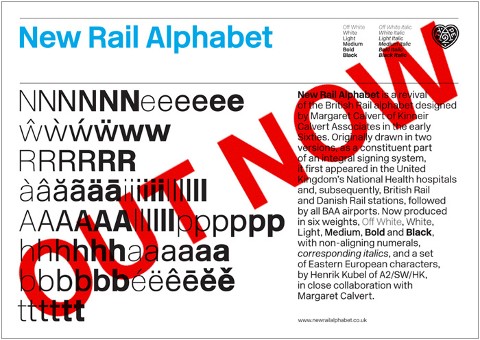
New Rail Alphabet, 2009 (A2-TYPE, London); typeface in six weights; designed in close collaboration with Margaret Calvert
In the higher echelons of the graphic design industry, A2/SW/HK’s work has not gone unnoticed. They have picked up a plethora of global accolades along the way including awards from The International Society of Typographers, British Design & Art Directors and Art Directors Club of New York. In 2007, Kubel and Williams received recognition as members of the prestigious Alliance Graphique Internationale, which is a testament to years of tireless dedication to their craft, talent and skill.
Despite a well-decorated mantelpiece, complacency is not something that festers within the fabric of Kubel’s work ethic. “We may have achieved a lot but it doesn’t get any easier. You’re always judged by your last piece of work and I’m worried about looking back at my career and not being happy with the work I’ve produced.” He pauses briefly before calmly adding: “But there are only a few pieces that I feel this way about. Overall, I’m pretty happy with the work we’ve done and don’t mind looking back.”

Ian Fleming’s James Bond, 2008 (Royal Mail, UK); miniature sheet design and bespoke typeface
The weekend that I meet Kubel, he is in particularly fine form. Earlier in the week, he received news that he had been awarded a three-year working grant by the Danish Art Foundation, which is one of the most sought for and prestigious working grants awarded by the Nordic country for exceptional quality of artistic production and artistic talent. Kubel has worked almost non-stop over the past decade, and the grant means that he can now afford to invest some time in himself, creating more headspace for new ideas. “I shed a tear when I found out and called my mom; imagine how proud she is?” he says with a content but tired smile.

Turner Prize Exhibition design, 2002—07 (Tate Britain, London); art direction, design and bespoke typeface
In an industry which constantly strives to be ‘achingly hip’ and ‘cutting-edge’, A2/SW/HK’s approach to their work is refreshingly non-pretentious, which is what many of their clients may find appealing. “It’s the thinking and sensibility behind the solutions that makes us strong. I don’t see us as being ‘trendy’ but I don’t see us as being ‘old fashioned’ either – we are probably somewhere in between,” Kubel expresses. “We don’t work to trends, we work on what we feel best complements our clients’ brand values.”


Ergonomics — Real Design, 2009—2010 (Design Museum, London); exhibition identity, applied graphics and brochure including bespoke display typeface; exhibition design by Michael Marriot; photography courtesy of Luke Hayes & A2/SW/HK
In the design and communication industries, the choice of type may have many different connotations and certain typefaces are chosen to represent a brand because they effectively embody the product’s philosophy. This may, in turn, help to explain why we have a certain affinity for some brands more than others. For A2/SW/HK, understanding this psychological aspect of branding is the crux of their trade. “Typography is hugely important. Everything you look at contains letters – it’s used for direction, it’s used for instruction, it’s everywhere. If you can’t read and write you’re lost, aren’t you? That’s what binds society together, it’s communication.”
In a market that already contains 200,000 typefaces, does Kubel think there will be a day when the typeface market will be saturated and there will be no more typefaces to explore? “It’s already saturated but that doesn’t mean you should stop designing. It’s been said many times before, we need new films, new music, new exhibitions, new chairs, new painters and we need new typefaces.”

Summer of Love: Art of the Psychedelic Era, 2005 (Tate Liverpool); art direction, design and bespoke typeface
During the course of the interview, Kubel shows me some of his sketch books, a collection of sketches and scribbles, images torn out of newspapers/magazines, and various other eclectic items which looks like an art project in itself. “It’s very personal but this is how I keep my inspiration and ideas,” he says. As we talk at his spotless white ‘consultation’ table, there is a moment when I mentally take a snapshot of him casually drawing a letter ‘R’ with a graphite pencil on a sheet of paper in front of him. The letter is so perfectly formed that it looks as if it has been produced with a Letraset font style pack, with angles and lines drawn like a ruler has been pressed against their edges – I couldn’t help but comment. “People say that if you spend 10,000 hours on something, you become a master…,” he coolly replies. “…I’ve probably spent 8,000 drawing typefaces.”

A2/SW/HK Process AGI Poster, 2010

Typography Workshop Posters, 2000—06 (Buckinghamshire Chilterns University College); posters (40+ in series)
Kubel strikes me as somewhat of a paradoxical figure, humble yet self-assured, content yet massively ambitious. Speaking of his life prior to London, he says: “I remember when I was at the Danish Design School and we visited the Royal College (of Arts) and I knew I wanted to get in. I knew I wanted to go to London, learn the language and find someone to set up a design studio with. I was very naïve.” Naïve he may have been but in effect, he has achieved everything he set out to do – and then some. Having realised his dream of studying at the Royal College of Arts, he now teaches at the world-renowned institution twice a month. “My students are scarily talented – I am teaching my competitors of the future but I was taught there myself. The Royal College means a lot to me and I will give back as much as I can for as long as I can.”

Cold War Modern, Design 1945—1970, 2008 (V&A Museum, London); art direction and bespoke typefaces
As our interview draws to a close, and my mind is buzzing with more questions about typefaces and I entertain myself with the thought that on some level, humans and fonts are quite similar in relation to their variety, heritage and what they stand for, I ask Kubel which font he thinks would best describe him. He ponders for a moment, cocking his head to one side and glances out of the window onto the terrace, which is beginning to speckle with raindrops, to gather his thoughts. “You’d have to put a lot of typefaces together to describe me; I’m not one, I’m very broad,” he says with a glimmer of mischief in his eye. “I draw all styles, from very eclectic to very bland; it’s me and my personality. I’m a chameleon typeface.”
The new A2/SW/HK typeface collection is now available online and can be found here.
A2/SW/HK have also teamed up with Playtype who will releasing additional fonts from the A2/SW/HK library in December 2010.
Categories ,A2/SW/HK, ,Alliance Graphique Internationale, ,Art Directors Club of New York, ,baa, ,British Design & Art Directors, ,British Rail, ,British Rail Alphabet, ,Creative Futures, ,Creative Review, ,Danish Art Foundation, ,Denmark’s Design School, ,Design Museum London, ,Faber & Faber, ,Hayward Gallery, ,Henrik Kubel, ,Ian Fleming, ,James Bond, ,Kat Phan, ,Lisson Gallery, ,Margaret Calvert, ,New Rail Alphabet, ,NHS, ,On Beauty, ,Penguin Books, ,Phaidon Press, ,Playtype, ,Remington Standard, ,Royal College of Art, ,Royal Mail, ,Scott Williams, ,Tate, ,The Independent, ,The International Society of Typographers, ,Turner Prize Exhibition, ,Vogue UK, ,Zadie Smith
Similar Posts:
- Future of Fashion
- Who’s the Man? exhibition and an interview with the artist, Rudy de Belgeonne
- Art Exhibition Preview: PayneShurvell present 4×4
- Art Listings
- Royal College of Art MA Degree Show 2011 Review: Product Design


