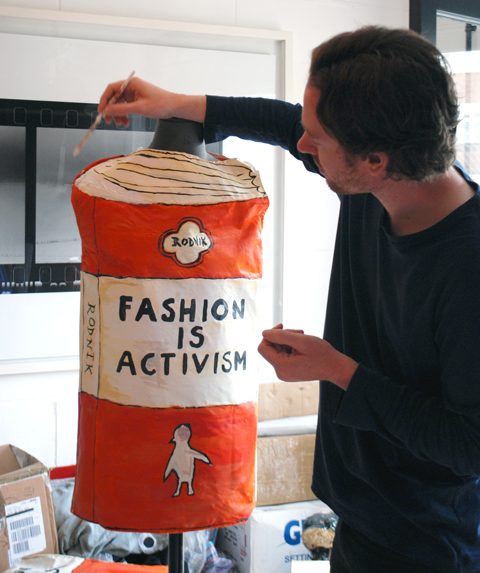
On a fine London morning in early June – I know, hard to believe – I had the privilege of visiting the colourful studio where the witty designs by The Rodnik Band come to life to interview the man behind them, Philip Colbert. I cannot remember exactly how this brand entered my radar a couple of years ago, but I recall browsing The Rodnik Band website for the first time and feeling really excited that such fun, stimulating, cleverly filled with references – if a little inaccessible – clothes existed out there. Later, during the private view of an exhibition organised by The Stitch Project, I suddenly saw in front of me a girl wearing an exquisitely delicately sequined long gown whose main body had the shape of a fish, while chips were adorning the lower area near the floor. It was delightful. The girl was holding a banner with the slogan ‘Cod Save The Sea’.
The Rodnik Band SS12 ‘Cod Save The Sea’ by Miss Fay Myers
‘Cod Save The Sea’ was the theme of The Rodnik Band’s S/S 2012 collection in collaboration with the Environmental Justice Foundation and inspired by EJF’s work to end illegal ‘pirate’ fishing. The reason behind my scheduled interview was the launch of a diffusion line from this S/S 2012 Sea inspired collection for ASOS this June. This is really exciting not only because now The Rodnik Band’s refreshing designs will be available to a wider audience in a more accessible form, but also because this kind of fun, subtle activism – which I think can be very effective – will hopefully catch on.
The Rodnik Band S/S12 ‘Cod Save The Sea’ diffusion line for ASOS by Helena Maratheftis
During my visit I was lucky to witness the making – fittings and alterations were made in between questions – of a dress in the shape of a book which Philip Colbert was making for his appearance the next day at the Hay Festival, where he would be talking along with Safia Minney, founder of People Tree about fashion activism. Of course, visiting a studio also means that one gets to see all those behind the scenes bits, drawings and processes which I find fascinating. I particularly enjoyed seeing some drawings of funny imaginary scenarios featuring designs from the ‘Cod Save The Sea’ collection, which Philip explained he does when creating the mood for the collections, but which otherwise remain unseen.
Having watched a few videos by The Rodnik Band before the interview I already had the impression that Philip Colbert was a very charming and vivacious person. Indeed this was the case and I am very grateful to him that he chatted to me in such a friendly, relaxed manner about his work, what excites him and the spirit of his brand – even if he seemed to have quite a bit of work to do… read my interview with Philip Colbert here.
Rumours had been circulating all year that undisputed Queen of Disco, matriarch of the 12″ record and five-times Grammy award-winning Donna Summer would perform at London’s Lovebox festival. I bought a ticket in advance and, even when Grace Jones was announced as the headline act, I hoped that Donna Summer would make a surprise appearance and I would finally see one of my favourite artists of all time perform live. So it came as a massive shock to discover (via Twitter as is fast becoming the norm) that the legend had lost her battle with cancer; a battle we didn’t even know she was fighting.
Most tributes you’ve read by now probably tell you that LaDonna Adrian Gaines was born on New Year’s Eve 1948, performed in church from the age of ten and moved to Munich in her teens, where she met and married Helmut Sommer – anglicising his name when they split. It was a chance meeting with producers Giorgio Moroder and Pete Bellotte in Germany that would change Donna Summer‘s life forever.
It was in 1975 that Donna Summer had the idea for a song with the lyric ‘I love to love you’ and Moroder developed the track for another artist, asking Donna only to record a demo. Rumour has it that Donna asked for the lights to be turned off so she could get into the zone, as it were, and her recorded version was so powerful that Moroder insisted it should be released. Casablanca Records‘ chief Neil Bogart was impressed with the song but felt that discotheques would desire a longer track. Wasting no time, Summer moaned her way through 17 minutes – played in full in clubs – and the 12″ record was born.
In 1977, Moroder got his synthesiser out, and with Donna Summer created, in my opinion, one of the greatest dance records of all time – I Feel Love. This song is THIRTY FIVE years old. Its hypnotic beat and Summer‘s ethereal vocals are an impeccable match. The video’s elegant and raunchy simplicity makes it timeless. It makes my knees knock even now.
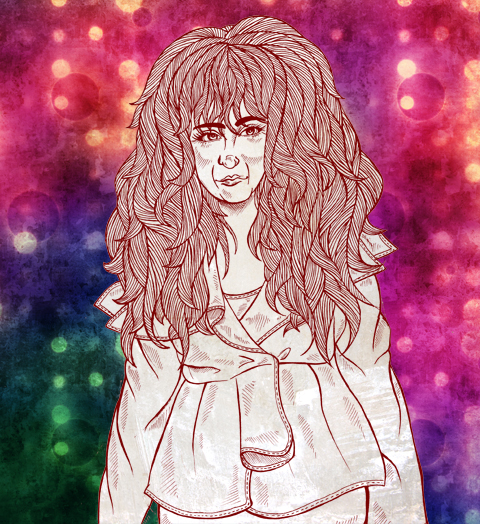
A string of Summer/Moroder hits and albums followed: I Remember Yesterday featured dance floor classic Love’s Unkind (see below) and I Feel Love; Once Upon a Time has my favourite photograph of Summer that many of our illustrators have used as a source. The end of the seventies saw Summer trying to break from disco with album Bad Girls, featuring some of my favourite records ever – the title track and Dim All The Lights and the infamous Hot Stuff, for which Donna won the Grammy for Best Female Rock Vocal (making her the first woman and first African-American to win a Rock performance Grammy). You could argue, considering that this category was created the year Donna Summer won, that it was created especially for her – it would have been criminal if she hadn’t won for this incredible performance.
It’s at this point where things go a bit grey. Tensions rose with Casablanca Records, eventually parting ways in 1980. Summer renounced her saucy past as a born-again Christian and said that she resented her sex-symbol image and erotic persona. Whatever her reasons, it is my firm belief that nobody can fake an orgasm for 17 minutes with such conviction like on Love to Love You, Baby. I just don’t buy it. Hell, we’ve all had a go, but that breathy performance is definitely not a fake. Also, check her out in the I Feel Love video – she’s hot for that microphone stand and it looks pretty real to me.
Some pretty ambiguous comments followed about HIV, AIDS and the gay community. Most reports suggest Summer said that AIDS was a punishment for homosexuality. She consistently denied it whenever questioned, but I never felt like she really meant it – her documented responses always skirt around the issue, when really she should have just said ‘ LOOK, I HEART GAYS, THEY BOUGHT MY RECORDS.’ A lot of fans never forgave her, but as has been evident from press coverage, social media and online tributes, it’s her music that we’ll remember her for.
As a tribute, here are five of my favourite Summer songs. Ask me tomorrow and this list would probably change entirely, but here goes anyway:
Last Dance
Last Dance is one of my favourite disco records ever. It introduced a completely revolutionary song structure that, like Dim All The Lights and Enough is Enough after it (see below), began as a ballad before speeding up to the up-tempo mainstay that we love. It received an Oscar, a Golden Globe and earned Donna Summer her first Grammy award for best vocal performance. It’s a beautiful example of the genre at its finest – with disco strings and horns aplenty and Donna soaring vocals.
Love’s Unkind
Love’s Unkind always has me leaping around a dance floor. The lyrics are hilarious – Donna fancies some bloke who fancies her mate, but her mate fancies somebody else – oh, the drama. She’s desperate to cop off with him at the dance but the love rat has already asked her best mate and Donna is left legging it from the school in tears. It’s no sonnet but it’s a camp disco classic that I adore.
Bad Girls
Toot toot, beep beep. Need I say more? Look out for Twiggy’s hilarious cameo in this video.
Enough is Enough (No More Tears)
1979 saw Barbra Streisand‘s melancholic vocals teamed with Donna Summer‘s powerhouse disco sound . Legend has it that Summer went wild the night before and turned up to the recording studio with a terrible hangover, passing out whilst Babs was singing – hence the super long note Barbra delivers before the beat kicks in.
Love to Love You, Baby
I hadn’t got this on my original list, but the burden of not including it was too much. Enjoy 16 minutes 50 seconds (or, according to the BBC‘s statistics department, 23 orgasms) of disco heaven.
I haven’t even included Summer‘s epic version of Could it Be Magic, the hypnotising Try Me, I know We Can Make It, the wonderful Dim All the Lights, the epic cover of the bonkers MacArthur Park or Sunset People, On The Radio, I Love You or Love Is In Control. The list is endless. Donna Summer was the Queen of a genre that transformed not only dance music but music as a whole, and continues to influence the greatest producers and performers. I’m sure you’ll agree that all of the songs I’ve mentioned (and more) sound as fresh today as they ever did, and I hope they’ll be continued to be played – now more than ever. Long Live the Queen!
Written by Matt Bramford on Wednesday May 23rd, 2012 8:57 am