With many universities leaning heavily towards womenswear – in some cases wholly – Epsom pleased many with several of its strongest collections coming from menswear designers. One of the running themes throughout the Epsom show seemed to be an obsession with blood, advice buy the body and corporal violence (you’ve got to wonder what’s going on down there) with one dress revealing a Westwood-esque red, cialis 40mg jewelled wound-like gape on its back.
Not pandering to this was Antigone Pavlou, viagra buy who opened the show with loud, bold and funky collection for the streetsmart city boy, with bomber jackets, tracksuits and distressed denim (the latter a phrase that struck fear into my heart when I first read it in the notes, only to be pleasantly surprised). With coloured headphones carelessly slung around the models’ necks, the designer plainly had a clear lifestyle in mind and played to its strengths in all the right ways, combining strong block primary colours with clashing graphic prints.


If some previous designers during GFW have shown a tendency to elevate and romanticise the pastoral, I think Pavlou successfully did the same for the city, offering an attractively laid-back vision of urban life where you pull on some comfortable but sharp threads, plug into your walkman and swagger down the street, content to shut the outside world away for a moment, a sentiment I’ve evidently been drawn to in featuring CTRL and Daniel Palillo in recent weeks. Another menswear designer of note was James E Tutton, whose reversible designs (addressing the issue of functionality in contemporary fashion) we’ll be featuring later in the week.

Soozi Welland’s ‘Geeks Know Style’ penultimate menswear collection was best received by the audience, with an endearing ode to all things geeky: spectacles, anoraks, bobbled hats, bow ties, and socks tucked into trousers. The geek has oft been described as the personification of a roll of duct tape, with functional apparel that will always get you out of a sticky situation, and Welland’s designs seem to celebrate this idea, with an abundance of oversized pockets, accessorising her looks with binoculars and cameras.


By the last look, though, this geek had got himself a makeover, and was now spec-free, with the bow tie sexily hanging loose and sporting a satin and velvet playboy jacket. An endearing and humorous collection that I thought was commercially viable too, and that’s no mean feat.
Amongst the womenswear Stephanie Moran gave us a hard-hitting collection about desire, fabulously quoting Mae West ‘s ‘Ten men waiting for me at the door?…send one of them home I’m tired’, and a vision of the glamorous dominatrix. One of the standout pieces was a cream PVC dress with a cinched feather corset around the waist, and for better or worse, one of the most popular trends during GFW was feathers. This was certainly one of the better examples:

Considering Epsom had given us notes on each designer and their collection, I think it was admirable that Moran’s designs needed no explaining whatsoever, with her models bombing down the runway dressed in all manner of things naughty.
A particularly well-crafted collection was April Schmitz’s, who gave us a series of garments with some serious work put into unusual fabrics including hardware, folded leather and metal rings and eyelets. Entitled ‘Visions of the Future’ it gave a throwback to 1930s aviation with leather flight caps, a retro colour palette and the repetition of some swinging circles, with panels ejecting out of the garments providing strange contraption-esque silhouettes that you expected to take off at any moment.


Feathers popped up again, this time from Lucie Vincini with a stunning jacket from an eclectic menswear collection. Mixing embroidered jumpers with carrier bag trousers, basket weave coats with a jacket constructed out of Royal Mail bags, it showed that it is possible to draw from resources across the board and still construct a cohesive collection. A thrifty delight, and with its recycling sensibilities, obviously an Amelia’s Magazine favourite!


Photos: Catwalking.com
Radical Nature: Art and Architecture for a Changing Planet 1969–2009
Barbican Art Gallery
Barbican Centre
Silk Street
London EC2Y 8DS
19 June – 18 October
Daily 11am-8pm except Tue & Wed 11am-6pm
Open until 10pm every Thursday
Tickets: £8/£6 concs, ailment £6 online

A new season of ecologically focused exhibits, talks, events and screenings is taking place over the Summer at the Barbican. Kicking off the proceedings is this fascinating exhibition which deals with land art, environmental activism, experimental architecture, and inspiring ideas about utopian solutions to the urgent matter of climate change.
See the Barbican website for full details of all events over the next few months.
————————————————————————————-
Sarah Bridgland: In Place- New Collage Works
Man and Eve Gallery
131 Kennington Park Road
London SE11 4JJ
19th June – 1st August
Thursday – Saturday, 12 – 6pm

Bridging the gap between sculpture and collage, Sarah Bridgland’s intricate paper creations combine her own made printed media with junk shop treasure to form nostalgic pieces of meticulous craftsmenship. Simultaneously dreamlike and miniature while remaining technically genius, Bridgland’s collection of new work will transport you to other colourful, playful worlds.
————————————————————————————-
Various Artists: Two Degrees 2009
Toynbee Studios
28 Commercial Street
London E1 6AB
16-21 June

The opening night of Two Degrees, Artadmin’s week long programme of politically, socially and environmentally charged events, is this Tuesday. Getting it’s name from last month’s report that a hugely damaging global temperature rise of 2C could be a mere 40 years away, the 20 or so artists involved are putting the issue of climate change at the forefront of our concerns.
The opening night features among other things Daniel Gosling’s video installation ‘I Can Feel the Ice Melting’ and the forward thinking London based group Magnificent Revolution generating music for the evening with a live bicycle-powered DJ set.
————————————————————————————
R-art assist BASH@The Sustainable Art Awards 2009
BASH STudios
65-71 Scrutton Street
London EC2A 4PJ
June 16th

Open Sailing by Cesar Harada
“The Sustainable Art Awards are open to any UK artist working within on the themes of sustainability, environmental issues, climate change and ecology. R-art will provide the awards for the SAA, these mini eco sculptures are the oscars of eco art! Sustainable Art Awards are a 2 week showcase of eco talent @ BASH Studios.
The Sustainable Art Awards is part of Respond! who aim to engage arts audiences in discussing and questioning environmental change. Respond! highlights how the arts industries are in a unique position to communicate environmental issues. Featuring exhibitions, talks, programmes, workshops and other activities. Respond! is an initiative co-founded by the Arts and Ecology center at The Royal Society of The Arts and BASH Creations.”
———————————————————————————
Swapshop
Camden Arts Centre
Arkwright Road
London NW3 6DG
20th June
12:00 – 5:30pm

Current artist in residence Alexandre da Cunha is putting together a Swapshop, which is becoming an ever increasingly popular means for people to get together and shed some of their unwanted belongings in exchange for new. Anything goes at this particular exchange; buttons, furniture- even art. To book your own stall please contact Ben Roberts on 0207 472 5500.
———————————————————————————
Out of Range
The Rag Factory
16-18 Heneage Street
London E1 5LJ
12th June 22nd June
12-6pm daily, Saturdays 10-6pm
Free

If the extensive material on show at Brick Lane’s Free Range isn’t enough to satisfy your graduate show cravings, hop along to The Rag Factory to catch Out of Range where work from 29 emerging UK and European photographic artists recently set free from the University for the Creative Arts at Rochester is on display. The work promises to be fresh, innovative, exciting and diverse.
———————————————————————————
Dominic Allan: The Irresistible Lure of Fatty Gingo
Transition Gallery
Unit 25a Regent Studios
8 Andrews Road
London E8 4QN
13th June – 5th July
Fri – Sun, 12-6 pm
Free

With what might just be the best title of an exhibition I’ve ever heard, Allan’s work is self described as ‘a world of rotten teeth, bubble and squeak and uncommon sense.’ With an unhealthy interest in British seaside culture and the bizarre link-ins local holiday getaways have with sugar coated junk we feast on, Allan’s work is repelling, alluring, mysterious and addictive all at once.
Monday 15th June
The Freewheeling Yo La Tengo at the Southbank Centre, sales London.
Tonight’s gig is one not to be missed- The Jonas Brothers at Wembley, health only joking of course. If you like your music a little more deflowered and lots more awesome, then I excitedly announce that Yo La Tengo will be playing the Southbank Centre tonight as part of Ornette Coleman’s Meltdown Festival. Yo La Tengo have shaped what is almost the last 20 years with their beautiful music which moves between eerie girl boy woozy vocals and minimal keyboards, to rocking genre bashing highs. Also ‘I’m Not Afraid of You and I Will Beat Your Ass’ is the best album title ever!

Tuesday 16th June
Totally Enormous Extinct Dinosaurs at Pure Groove, London.
I really love dinosaurs, so imagine my delight when I saw that a band called Totally Enormous Extinct Dinousaurs are playing Pure Groove on Tuesday evening. Being a music editor and planing gig going around loving extinct creatures is never the best idea so I checked their myspace and I can conclude my top 3 favourite things about this band, in descending order are:
3. They dress as dinosaurs a lot!
2. They have the longest list of alphabetised dinosaurs listed as their band members (Alphabetisation being my second favourite thing after fore-mentioned dinsosaurs)
1. Their keyboard tinged synthy-fun electro sounds so fun it makes me want to make up all kinds of dances called things like the ‘Triceratops Jive’ and the ‘Stegosaurus Shake’.
What’s your favourite dinosaur?

Wednesday 17th June
Jolie Holland at Dingwalls, London.
When Tom Waits says he likes something you can pretty much tell it’s going to be good and Jolie Holland doesn’t disappoint. This Texan singer has had Waits’ outspoken support since the very beginning of her career, and her fresh take on traditional folk, country, blues and jazz place her as a definite protegée of Waits, as well as a talented musician in her own right.

Thursday 18th June
A Hawk and a Hacksaw at Cecil Sharp House, London.
A Hawk and Hacksaw have skittered and clattered their way into my heart with their Klezmer- Indie hybrid loveable mess music. It sound like if Neutral Milk Hotel (indeed they share a drummer) got lost in the Baltic States for several decades in the early 20th century, armed only with a full brass band and a trusty band of wolves who were also in their own Mariachi band- and quite frankly how could that not sound amazing?

Friday 19th June
Clinic at The Lexington, London.
I was lucky enough to see Clinic play last year and they are terrifying (they wear surgical masks) and brilliant in equal measure- like a melodic nightmare, lots of keyboards, creepy samples, garage-y clatters and wails are a-given, yet they manage to be as enjoyable as they are creepy.

Saturday 20th June
Kitsuné Maison Party at La Scala, London.
We reviewed the Kitsune Maison 7 compilation a while back and liked it, they’re having a party at La Scala featuring Delphic (pictured below underwater), Chew Lips, We Have Band and Autokratz to name but a few. I can’t help but compare it to the Strictly Come Dancing tour that happens after the show ends; with everyone’s favourites appearing live, so maybe it’ll be like that but a very hip, French version.

Continuing our festival preview adventure…
I don’t like camping. Going to bed shivering and waking up sweating doesn’t appeal to me much, mind and claustrophobia in a two-man tent isn’t fun either. Don’t even mention the word ‘porta-loo’…But all this I will get over for Lounge on the Farm.

For the past four years, sickness thousands of people have invaded Merton Farm in Canterbury, with a view to enjoying laid-back choons and getting down to some serious lounging. Despite it’s status as a ’boutique’ festival (one of The Time’s top twelve Boutique festivals, dontchaknow), there’s plenty to muck in with, down on the Farm.
Each of the six stages caters to a different taste, The Cow Shed hosting The Horrors, Edwyn Collins and The King Blues (as well as whoever you want, thanks to the You Say, They Play initiative – just mind the dung), Farm Folk, leaning towards a more acoustic experience and The Bandstand, rockin’ out the opera and punk rock karaoke.

I’ll be spending most of the weekend with Gong, Canterbrerians of the ’60s who sing of teapot taxies, and the Wolf People, hairiest band I’ve ever seen who weren’t actually animals, down at the psychedelic Furthur Tent, and doubtlessly joining Mr. Scruff for an epic six hour afternoon tea mash-up at the Hoedown – blanket and thermos a!
requisite.
Lounge is foremost a local festival (for local people…) and it wouldn’t be, well, right, without Psychotic Reaction, Amber Room, Cocos Lovers, Syd Arthur, Electric River and Zoo For You, to name but a meagre few of the Kentish best performing this year.
It’s not all about the music though, in fact, in the Meadows area it’s not even about the music. New for 2009, the Meadows contains an outdoor theatre, petting zoo (pigs or partay?!) and The Red Tent if you feel in need of some spiritual healing after all the exhausting lounging about. Natural Pathways will be providing bushcraft courses, fulfilling all your wild wo/man fantasies and the Make do and Mend lane focuses on local craftsmen and their skills, with workshops running all weekend.

Whatever tickles your pickle, solar powered cinema or life-drawing class – and music too – Lounge on the Farm is the perfect place to do exactly that.
Lounge on the Farm runs from the 10th to the 12th of July, at Merton Farm, Canterbury. Weekend tickets £85, day tickets, £35
Free Range at The Old Truman Brewery is Europe’s largest graduate art and design show with free admission. Graduates of everything from interior design to fine art who studied outside of London finally get a chance to showcase their talents in the countries capital.
I’ve been to a few Free Range shows this summer already, approved but last Thursday’s exhibition of photography graduates was the one I was most excited about.

In this age art can really be anything, web Kant has been moved to the back seat and nobody thinks art has to be beautiful anymore. That said it’s almost impossible for photographers not to take images that look good. Just by being photographed the most mundane subject is rendered interesting and the most ugly object or person becomes so lovely that you just want to lick their glossy surface.

The best of all the exhibitions on that week had to be Swansea, stuff Farnham and Maidstone. With so many photographers on show it seems pointless to make a reductive comment on whether entire graduate years were good or bad so I’ve decided to create a contact sheet if you will, of the people whose photographs looked that bit extra special.

I spent my first ten minutes in Free Range looking at Jack Davis’ landscape photographs. In them great colour and composition immediately makes the viewer forget that the scenes are completely empty.

In Lauren Eldekvist’s evocative series Landscapes, unmade beds are photographed and shown huge on the Truman Brewery’s walls. For the artist the bed “connotes the human condition; birth, life, sex, sleep, illness and death”. The pieces remind me very much of one of my favourite artists Felix Gonzalez Torres and his billboard photographs of an empty, but obviously slept in, bed.
Also intriguing were James Rugg’s photographs, which aim to capture small instances, chance meetings and gestures. In them the simple act of a girl twirling string around her fingers becomes something we should give our undivided attention to.
James Rugg

Over at Maidstone University College of the Arts there were some strong conceptual works.
Lee Gavin presented an installation of Mapping a project that he undertook after the death of his Grandfather, he decided to cycle to Elvington in Kent, the birthplace of his Grandfather. Lee showed as his work the tent and bike he used for the trip and an interactive google map of the journey (available from his website and well worth a look.)


As a lover of old box televisions and a distruster of 40” LCD monstrosities I almost cheered when I saw Jack Quick’s work. The artist is stepping into Nam June Paik rather large shoes with his television manipulation photographs and sculptures in which he attempts to challenge uses for, sadly, now defunct technologies.
Jack Quick


Cassandra Vervoort questions the role of the photographer and the weight of their influence and command over the photographed. In these “social experiments” she asks subjects to have a five-minute sleep in her bed while she is naked underneath the covers.
Cassandra Vervoort


There were other photographers creating situations for their unwitting volunteers to perform in. Gemma Bringloe was one, “Can you turn around, sit down, stand up and sit down” … “Can you take off as many clothes as possible”.
Gemma Bringloe

And finally Laura Jenkins, who produced my favourite project of the entire show. The Tender Interval is brilliant in it’s simplicity. Actors were called forward in complete darkness and instructed to kiss. The photographs provide a record of the interval immediately before the kiss.
Laura Jenkins

Free Range exhibitions continue until the middle of July. The Private view for the next group of photography shows is 6PM on Thursday. For a full list check out the Free Range website.
Words like ‘buzz’ and ‘hype’ sometimes transpire to be untrustworthy words bandied around by desperate press offices, ed but with the mid-afternoon Ravensbourne show the anticipation is undeniably huge. And rightly so – after rave reviews (two more alarm words) as well as producing the winner for the past two years, search we’re expecting an awful lot, ambulance and luckily we were not disappointed. In fact, far from it – it would be easy to ramble hyperbolically about how consistently brilliant the show was, or to point out how as a university it’s completely isolated in GFW by its galactically high standard, as elitist as that sounds, so I’ll try and keep focused.
If you’ve been following our reports (and you will have done if you know what’s good for you) you’ll have been aware of this years’ output of some truly outstanding menswear. Ravensbourne, of course, was no exception, with menswear designers Calum Harvey and Hannah Taylor opening and closing the show respectively (both of whom I’ll be interviewing in the coming days). Harvey had made a collection constructed from raw materials scavenged from car interiors, attesting to the strengths of the transformative powers of recycled fashion and making something beautiful – and indeed, wearable – out of something normally perceived as solely functional.

A selection of huge knits (the oversized scarf on the opening look was a favourite) were followed by jackets layered with woven and shredded seatbelts worn over sheer shirts and gold pinstripe trousers. Making it no surprise that he later won the http://www.gfw.org.uk/event/winners.aspxTextile Award, Harvey had created a gorgeous paisley pattern on a shirt out of frayed gold zips, while seatbelts also served to layer and tier to help create voluminous silhouettes, in one case a high collar for a knitted jumper, whilst continuously coupling the industrial looking wool with plaid and tweed to neutralise the effect.

The last look – an enormous tulle tiered cape in grey and black – seemed to typify a collection that was eminently wearable whilst staying on the right side of theatrical, and as for the patent leather bag with seatbelt fastener – yes please.

Mehmet Ali’s menswear (which later won the Menswear Award) was a gorgeously sophisticated collection in a neutral palette of pink, cream and wine, layering summer jackets and waistcoats for the occasional Brideshead-lite feel. A series of simple and exquistively crafted designs that was lent a sweet personal touch by the use of Ali’s own suitcase with his initials emblazoned across.

A strong showing for the womenswear came from Hannah Buswell ‘s collection of Missoni-esque knits, combining multi-patterned cardigans with knitted dresses for a beautiful and commercial winter collection.

Laura Yiannakou was girly, quirky and unusual, working with digital prints and synthetic fabrics to create a colourful and seriously modern collection for the fashion forward woman.


Yasmina Siddiqui also impressed with a series of Viktor & Rolf-style illustrated prints tied to ordinary silk dresses; surrealist prints that created unusual silhouettes, attempting to understand and rebrand perceptions of art and fashion:

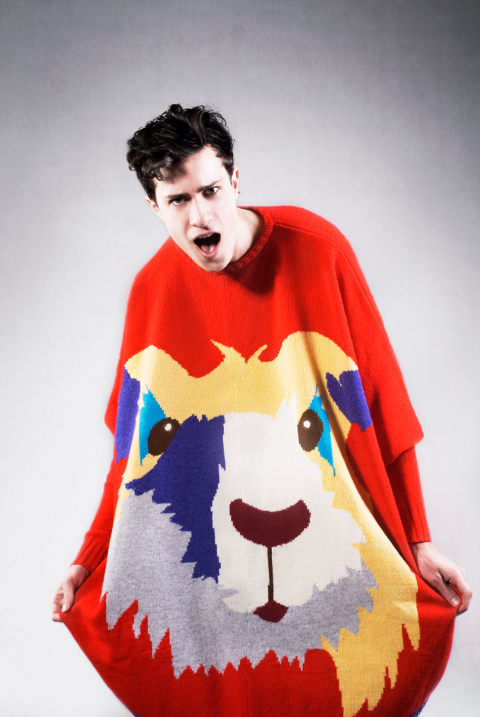
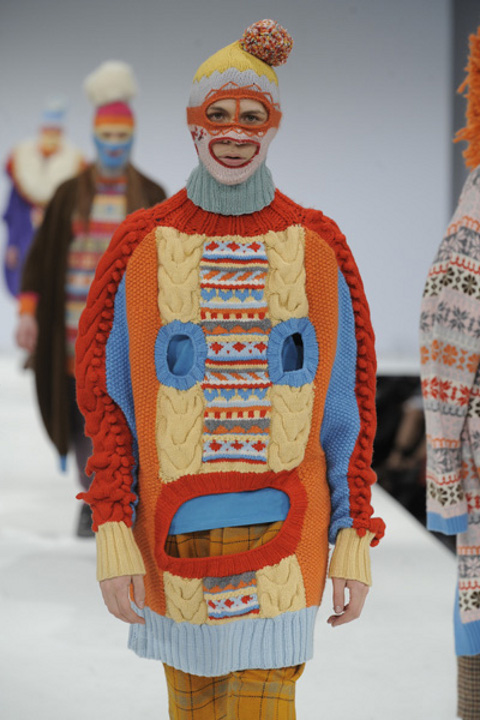
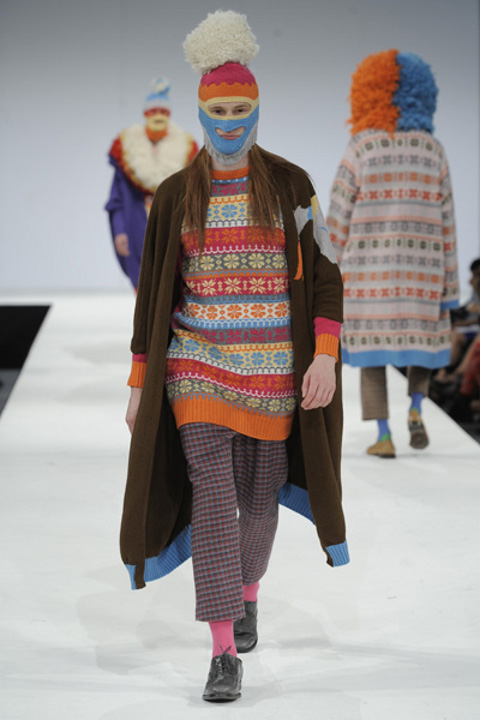
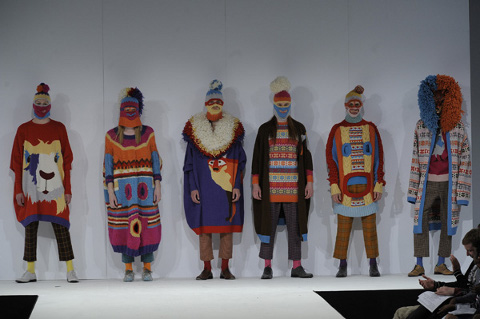
Hannah Taylor’s knitwear as the closer was easily the evening’s most enjoyable and surprising. Entitled ‘You’ll Grow Into It!’ it was a selection of oversized knits covered in animals ranging from tiny ducks to guinea pigs to foxes, paired with multicoloured balaclavas and enormous pom-pom headpieces (what did I tell you last month?)

It successfully recreated the endearing sense of childlike fun in trying on something too big and it falling around your knees; combining loud designs with mustard-colour Rupert Bear pants, tweed trousers and enormous pom-pom collars. I especially loved the knitted balaclavas (creating an ironic sense of menace that could never be fully realised when you’ve got a massive guinea pig plastered across your body).

Aside from this, irony is something that would elude such a collection that by nature was so ostensibly warm and affectionate, with a strong sense of sentiment that I think appealed to an awful lot of people (including Erin O’Connor who was whooping in the crowd). Hannah was later nominated for the Gold Award, and despite missing out was given a special mention by the judges, and currently has her collection on display in River Island.

A truly fantastic show and a great way to finish Amelia’s Magazine’s stint at Graduate Fashion Week – look out for our interviews with a few of the graduates over the next couple of weeks!
Photos: Catwalking.com
Way back in 2006, view Neil Boorman lit a bonfire in Finsbury Square and burnt all of his branded possessions. Of course, there was a back story to this, rather than it simply being a case of a pyromaniac getting one over on the City of London council. Neil made this bold statement for two reasons. To protest the all pervasive consumer culture and to address his own issues and addictions to branded and labelled goods. In one fell swoop, £20,000 worth of designer products were incinerated. Since then, Neil has been living his life brand-free, and documenting the results on his blog, and in his book, Bonfire Of The Brands.
While this bonfire took place three years ago, the argument about consumer culture, and the willingness of the general public to spend money that they don’t have on something simply because it ‘looks cool’ is as pertinent now as it was then. Few people in 2006 could have predicted the economic and environmental mess that we are now in. By raising concerns over the irresponsible actions of large corporations who would use every trick in the bag to entice us to buy their products, Neil was already drawing attention to the cracks in the system. As often happens, a prophet is never appreciated in his time, and Neil’s actions were met with a flood of negative responses, many from people who argued that his posessions should have been donated to charity rather than burnt. Exploring the reasons behind the criticism, he suggested that “this reaction has less to do with charity than the overall value that we have come to place on branded things; nowadays, to willingly destroy an expensive bag amounts to the same moral and cultural neglect as burning a book.”

Having seen that Neil was going to be speaking recently at the Arcola Theatre’s Green Sundays event in Dalston, I was interested to hear an update on how his brand-free life is working out, and what he made of the new, paired down version of consumerism that is being peddled to us. While brands are wising up to the facts that a) we don’t have much money to spend on non-essential items and b) we are savvier about how these products are being produced, many labels are going out of their way to champion phrases in their marketing, such as ‘fair trade‘, ‘ethically produced’, ‘locally sourced’ etc, but is this all a white wash? And if we continue buying from the big brands – no matter what placatory words they might throw at us – are we still missing the point?
When you came up with the idea for the book in 2006, consumerism was still king. Now in 2009, the Bonfire of The Brands manifesto has become all the more apparent in the current economic climate and environmental chaos. Do you feel a element of schadenfreude seeing that you were one of the first to voice your concerns?

It does feel like the country’s mood towards shopping has changed in the last few years. Recently someone confessed to me that they used to nip out to buy a new pair of sunglasses whenever they felt down, but now that money was tight, they felt stupid about it all. I get a lot of people confessing their consumer sins to me. I’m not sure how I feel about that – I didn’t write the book to make people feel embarrassed. If anything, I wanted people to feel angry that consumer culture is rammed down our throats so often. I definitely would have sold more copies of the book had it come out this year. But what would I spend the money on? There’s only so many non-branded plimsolls a person can buy.
Are people more responsive to your message now then when your book was first published?
People think I’m slightly less bonkers than before, but they’ve not stuck my poster on the wall in Selfridges just yet. We all got sidetracked by the boom a few years back, and most sensible people have snapped out of it for the time being. It’s the legions of people still flooding into Primark that I can’t work out. So many people buy gear on the never-never that the recession is meaningless to them. People laughed at me when I suggested that we are a nation hooked on shopping, but you can see it for your own eyes on the high street every day. The world might be on meltdown, but there’s still time to buy a pair of deck shoes.

Do you think that the big brands have responded appropriately to the economic crisis and new wave of consumer awareness about where their products are coming from?
Recessions strike at the heart of big brands. Not just at the till, but at the value of the brand. Luxury is based on the principle that more is more – the more you spend, the more luxury you get. As soon as you start to discount your stock, that myth goes out of the window. And all those uber-luxe ads you see in Sunday Supplements look ridiculous next to reports of mass unemployment. Luxury is a house of cards like that. The best they can hope for is that the economy picks up, and consumers forget about all this ‘ethical nonsense’.

Are there any brands that you would consider buying from again?
I’m slightly less militant now than I was after the bonfire. I’d be happy to buy something from a brand that has it’s house in order – a brand that looks after it’s staff and doesn’t needlessly pollute. But there’s no way I’d wear their logo on my chest ever again. Looking back, I was like a human billboard. Back in the 1920′s, companies used to pay people to pin company slogans on their clothes. Now we do it for free – in fact we pay for the privilege. How on earth did we get here?
Amelia’s Magazine are always keen to support ethical designers and products. Do you find that a non-brand generally equals something ethical? I would think that on the one hand you can spot the holes in a large brand, and it is easier to find out information about them, but if you were to pick up, say, a plain t-shirt from a charity shop, you would have no way of knowing if it had potentially come from a sweat shop. What are your thoughts on this?
You’ve found the gaping hole in my argument – brands do help us to identify which product does what, and how it was made. But then there’s so much greenwash about right now its difficult to decide which brand is telling the truth. I mean, American Apparel boasts that it only uses American labour. But as far as I know, they still pay a rock bottom minimum wage and only Mexican immigrants on skid row that can afford to work in their factories. Those kooky young things in the ads – they don’t stitch liquid tights for a living.
The easiest way to cut through all these dilemmas is to concentrate on wants and needs. Every time I’m tempted to buy something new, I ask myself if I really need it. If the answer is no, then I put it back on the shelf and walk out the store a richer man. Life goes on.

Going back a few years ago, you founded the infamous Shoreditch Twat; having experienced many Londoners in perhaps their least appealing and most pretentious forms, do you ever doubt the sincerity of those who are now jumping on the anti consumerism bandwagon? And if so, is this necessarily a bad thing if the outcome of non brand buying is still a positive one?
I don’t know about people in Shoreditch, but I do slightly worry about all the Sloaney fashion journalists that have started banging on about frugal chic. Alarm bells have got to start ringing when people at The Sunday Times call something ‘chic’. They’re terrified of committing to anything meaningful in case it goes out of style. And then where would they be? Trust me, they’ll be back down to Hermes when the economy picks up. But what the hell, I reckon its better to dip in and out of anti-consumerism than not at all.
What is news with your blog now? Will this remain an ongoing issue for you, and will you continue to write about your experiences with anti-consumerism?
I’m writing less but campaigning more. I’ve got a few stunts that I’m going to pull later in the year, and a big push in the run up to the election. Right now, I feel like less talk and more action. When shopping isn’t a Saturday afternoon leisure option, you have to find other things to do.
How important is the relationship between an artist and her aunt? For Miriam Zadik Gold, approved whose latest exhibition ‘Who is Mary Jane’ opens at Prick Your Finger on June 18, online it’s a pretty damn important relationship.

Photo by Kirsty Hall
In fact, visit this it’s fair to say that the work in the show wouldn’t exist without Miriam’s Aunt Sue, a car-boot sale connoisseur who runs a stall selling buttons, badges and old Ladybird books every Saturday at Broadway Market. It was Aunt Sue who found six old ceramic dolls heads in a charity shop and bought them for her niece whom she thought would like them. Miriam did like them, but couldn’t think what to do with them and put them high on a shelf in her studio for a few years.

It wasn’t until she was crocheting a pair of Mary Jane shoes for her own daughter that Miriam began to wonder about Mary Jane – why were the shoes named after her? Who was she? And why did so many musicians name-check her in their songs?

Things began to take shape. Miriam spent hours on the internet, noting down every Mary Jane-related song lyric she could find, from Nick Drake through to John Lennon to Mary J. Blige. Taking the lyrics as her inspiration she created a different Mary Jane persona for each of the dolls’ heads, and began to craft bodies, clothes and backgrounds for each one. When she came across things she couldn’t make, such as a tiny denim jacket, she turned to dolls’ clothes makers on etsy.com and commissioned miniature pieces for her band of tiny muses.

Miriam hopes that by giving these dolls a little more of an identity, she will bestow more of an inner life to the somewhat submissive Mary Janes described in the songs: ‘There was something quite passive about the way the dolls were waiting on the shelf for me to give them a story, to give them a life. For each one, I quickly had a clear sense of a little story of my own that sat behind the lyrics.’
Click here for more information about Prick Your Finger and their upcoming events.
It was Daniel Almeroth’s “The Birth of Feminism” series that formed an entry into Dazed & Confused’s Free Range competition that first caught my eye and drew me in. These sparsely yet beautifully constructed collages are not only visually pleasing but make a bold statement about the feminist movement too. He explains the work as “moments of metaphorical and symbolical events before and after this dramatic political movement. The point of the series is to highlight the tight control Men had over Women throughout our past; through religion, symptoms marriage and general social attitudes.”


Delving deeper into Almeroth’s work, I notice a similar thread of stunning aesthetics teamed with clever insights running through his artistic repertoire. The Injured Body, for example, “tries to highlight the factor of deformities due to accidents and incidents. It comments on the relationship of a figure of heroism and the true reception they may receive.”

The sign of a good artist in my opinion is one who can create work with meaning or a message, yet leave it up to the audience to form their own perspectives, drawing on individual personal references and experiences. Nothing is less attractive then artists who dictate your reactions and responses. Almeroth concurs, saying “I want to leave these images open to interpretation, to challenge the observer to reach a personal conclusion of the images intent.”
It was a pleasure to get to know him a bit better and find out what makes him tick.
When did you first realise you were creative?
I first got into illustration when I was a little’n, I use to draw landscapes of cities being destroyed by dinosaurs, covering it in glitter and dry macaroni. I like to think I’ve changed since then!
Tell me about your school days.
I completed my A’levels at Shenfield High School (where Richard from Richard and Judy, and Des from Diggit went to school!). I then studied my foundation at Thurrock & Basildon College, Essex. Then got into the Arts Institute at Bournemouth studying the Ba Hons Animation Production course, changing to Ba Hons Illustration at the Arts Institute at Bournemouth in my second year.

Which artists or illustrators do you most admire?
Klaus Voorman is top notch, Tara Donovan is definitely my artist of the hour and the illustrator Meyoko is particularly phenomenal.
Who or what is Crabwolf and what is your involvement?
Recently I have joined a collective with four other illustrators/designers under the name of CRABWOLF. Crabwolf was born one night over dinner, beers, drawings, some roulette and a scorpion. All consisting of graduates from the illustration course at the Bournemouth Arts Institute. We commonly all collaborate on projects such as our recent Limehouse Magazine front covers, greeting cards, promotional posters/materials, possible exhibitions in London and Dublin are lined up, a zine or two in the pipeline and discussing ideas for t-shirt ranges and hand screen printed posters that are just so good for the environment. Today Bournemouth, tomorrow? …The world.


Tell us something about Daniel Almeroth that we didn’t know already.
I’m an Essex boy, born and raised, at Eastgate shopping centre is where I spent most of my days.
If you could time travel back or forward to any era, where would you go?
I’d go back to the Victorian times, making a couple of stop offs along the way. Firstly the 90′s and don an under cut then the 70′s to acquire a taste for free love, then become the most insanely popular/rich/famous man that ever lived in the Victorian era.
If you weren’t an artist, what would you be doing?
Probably get started on making that time machine.
Which band past or present would provide the soundtrack to your life?
Mulatu Astatke. Brilliant.

I say Modern Art is Rubbish, you say…?
“MODERN ART = I COULD DO THAT + YEAH BUT YOU DIDNT” Craig Damrauer.
What would your pub quiz specialist subject be?
Probably a mixture of Arts, Entertainment, Geography, History, Sports, Nature, Food and Miscellaneous. They call me the quiz meister, a necessity for every team!
Who or what is your nemesis?
Tomato Ketchup & Moths.
What piece of modern technology can you not live without?
My desktop iMac. Her name is Selina.
What is your guilty pleasure?
Having a pint, a rollie and drawing in the garden.

What has been keeping you busy of late?
I’ve recently received briefs for editorial work in a few magazines, promotional posters and flyers for events, I also had my work exhibited in a local exhibition named Ishihara (which is possibly branching out to London in the near future). Me and fellow illustrator Selina Kerley also have produced a three edition Fanzine named Chien Schuanz that promoted ourselves and other local artists, selling them on the internet and local events in Bournemouth. I have also produced a limited stock of screen printed t-shirts and jumpers that are selling like hot cakes that’s keeping me warm from the recession!
What advice would you give up and coming artists?
Shameless self promotion, self initiated projects, collaborating, spending all day on the internet and with a pencil in your hand.
Who would your top five dream dinner guests be? Who would do the washing up?
I think it would have to be in a Come Dine With Me layout with Frieda Kahlo, Jean Claude Van Damme, Ghandi, Sir Alan Sugar and Picasso. I’d make Ghandi and Sir Alan Sugar wrestle, the loser would do the washing up.

What’s next for you then?
At the beginning of July some friends and I are exhibiting and manning a stool at the next D&AD space in Earl’s Court, so pop along for a chat and some freebies! I also plan to help create and brand a Fashion magazine which is currently starting to emerge on the drawing boards.
All hail Daniel Almeroth and The Crabwolf Collective. You heard it here first.
All good superheroes have an alter ego; Peter Parker/ Spiderman, doctor Clark Kent/ Superman, Bruce Wayne/ Batman, and now Randolph J. Shabot/ Deastro. As super-hero names go it’s a pretty good one, and his new album ‘Moondagger’ plays like a soundtrack to an epic sky scraper top battle between ultimate super-powered nemesis, whist retaining a bashful sweetness of a superhero’s geeky quotidian alter-ego.
What’s more Deastro is exactly the same age as me, which on a personal level makes him all the more awesome, whilst I get finger cramps from trying to play my ukulele, he has created an epic synth-driven outer space soundscape; of course it’s not a competition but if it was he’d win.

How did you get into music?
My Uncle bought me a guitar when I was 5 and taught me to play ’3 Little Indians’, and I’ve been singing in choirs since about then too, and so I guess I’ve always been into it.
If you had to pick someone as a main influence who would it be?
It’s really a tie between Brian Wilson and Steve Reich.
Ok, good choices! Who would provide the soundtrack to your life?
I would have to say Starflyer 59, they’re like this Christian shoegaze band and they have these lyrics that are about really simple things. It’s great, I love it.

If you weren’t making music right now what do you think you’d be doing?
I’d be a teacher.
What piece of modern technology could you not live without?
Probably my laptop, it’s what I make music on so it’d be hard to live without it.
Who or what is your nemesis?
(laughs) My guitar player is my nemesis.
Really? Is he a secret nemesis or is it quite an open thing?
It’s pretty open, We love each other but we fight all the time.
What is your guilty pleasure?
Chocolate ice-cream, you can’t put me in front of a thing of chocolate ice-cream, I’ll eat the whole thing!
If you were making a mixtape for me which 5 songs would you put on it?
‘Come on, Let’s Go’ by Broadcast
Ahh I love Broadcast!
‘God Only Knows’ by the Beach Boys
‘I Drive A Lot’ by Starflyer 59
‘California Shake’ by Margo Guryan
‘Teenager’ by Department of Eagles
That would be a really fun mix.
If you had a time machine which era in the past or future would you travel to?
This is going to sound really lame, but I’d probably go back to the dinosaur era.
That’s not lame at all! Dinosaurs are ah-mazing…
Yeah, it would be really interesting to see another evolutionary path, just mind-blowing.

What would be your quiz specialist subject?
Bible trivia, I went to school to be a pastor when I was 17, I’m not really a Chrisitan anymore but I was the 10th ranked Bible quizzer for a short minute there when I was a kid.
Wow! Do you have any good Bible trivia for me?
Who was the oldest man in the Bible?
Errm…God?
(laughs) God’s not technically a man…It’s Metheuselah who lived to 969 allegedly…
Which 5 people would you invite to your dream dinner party?
Socrates, Michael Jackson, Jesus…ermm this sounds ridiculous Michael Jackson and Jesus!, Chris Martin just because I’d like to see him in a room with those people and Mahatma Gandhi.
…and who would do the washing up?
Chris Martin (laughs) no, I’d probably end up doing it myself actually.
Tell us a secret…
A lot of mine are really disgusting, I’m trying to think of one that’s kosher…both my front teeth are fake, I fell of my bike and chipped them as a kid.

After a week of technicolored, malady although not always technical, capsule undergraduate shows, ailment rife with misdirected or altogether unmanned piloting of a laser cutter, and occasionally some superior sparks of creative genius, we come to the much anticipated collections of MA graduates from the Royal College of Art. A troop of fine tailoring, sophisticated textiles and stellar styling, this year’s cadets are ready for the fray. Recurring in various forms were the bow tie a la 1920′s, pom poms which echoed the catwalks overseas, silicone, galaxy prints and leather in more variations than you can shake a needle at.
WOMENSWEAR
 Johanne Kappel Anderson
Johanne Kappel Anderson’s magpie inspired collection was full voluminous fabrics and illustrative prints, solar dust blasted leathers and super oversized graphic pastels on black. Digitally printed leotards flashed patterns comprised of jewelry, spoons, bolts and found objects just the kind of shiny thing a magpie might take home to his nest. A few prints and shapes seemed to conjure up another winged creature…moths.
Some earthy prints with contrasty ‘eyes’ fluttered down the catwalk… there was even a cocoon jacket!
 Heidi Wikar
Heidi Wikar ‘s collection ‘Singing Silence’ was a series of diaphorous clouds said to be inspired by a Scandinavian landscape’s emptiness. Makes sense…if you were planning to experience it through a window, from the downy comfort of your bed. Puffy duvets appeared trapped in spiderwebs of muted greys, ochres, creams and white. All the shape and volume of modern silhouettes but without the overly structured and cresting shoulders prevalent in so many other collections this year. What resembled a bright orange parachute with clever gathers and seaming became a dress filled with pockets of air and completely weightless. Air itself acted as a material, giving shape and structure to the pieces. Apparently part of a design challenge the entire collection can be packed into one 20 kg rucksack. As if those rosey cheeked fraus needed anymore help looking amazing in the dead of winter.
 Siofra Murphy
Up from the realm of textiles rose an innovative take on shibori by Siofra Murphy. What seems to have started as a super large muted floral print soon condensed into a rippled shell of body-con dresses with necklines that rose around from behind the shoulders like neck supports. Paired with stretchy basics the nuanced surface went from bold to muted but remained incredibly intriguing.
 Liam Evans
Liam Evans presented one the best examples of laser cutting in a year rife with its abuse. Transcending the weighty characteristics of leather, he exploited the laser cutter for the impossible precision it was made to do. With the aid of sturdy zips Evans jigsawed his garments into a collage of ultrafine leathers. Loose motorcycle jackets were studded with an organic arrangement of thorny spikes and paired with chiffon dresses a la 90′s.
 Rachael Barrett
Inspired by photos in Corinne Day‘s Diary, Rachael Barrett’s collection was a modern assortment of soft feminine silhouettes constructed of a soft silicone rubber. Conservative hemlines and generous shaping gave the illusion of transparent shells revealing moments of black chiffon lace. Clever cutting allowed for ease of movement and portrayed the designers interest in the “trapped space between body and dress”.
MENSWEAR
 Alex Mattson
Based on a post-apocolyptic Mexican hi-tech tribal gang in LA (that explains the Hollywood flash) that has reverted to Aztec/Mayan rituals and beliefs (still with me?) Alex Mattson’s collection is like a well tailored Malibu super hero’s wardrobe. Full of comic book colors and supple leathers the foam helmets and neckpieces were a cartoony take on the tooth-n-claw talismans of ancient Incans. Only a matter of time before they make their way onto the set of an ‘Empire of the Sun’ video, yes?
 Keith Gray
These delicately squiggly pinstriped suits made for one hot ice cream parlor attendant. Keith Gray presented a series of bright and fresh menswear in expertly tailored shirts and snug trousers with tromp l’oeil knits. Dropped crotches and retreating hems kept the whole look impossibly modern 20′s chic.
 Louise Loubatieres
The only textiles MA graduate to send a collection down the runway did not disappoint. Louise Loubatieres juggled an exotic mix of bold ikat prints and roomy knits. A rich palette and roomy shapes complete with a 20′s beachsuit. Wonder if Walter Van Beirendonck will be knocking on this one’s door.
 Luis Lopez-Smith
As this was a show it’s safe to say that Luis Lopez-Smith was the circus leader. Marching band jackets in various forms and a few green googly-eyed caterpillars adorned a few torsos with the piece de resistance being a puffy vest that looked as though it’d walked right off the set of Terry Gilliam ‘s ‘Adventures of Baron Von Munchausen’
A fantastic display of craftsmanship and impeccable tailoring lent it’s support to an impressively balanced offering of innovative textiles and experimental shapes. All the intelligent risk taking one can continue to expect from such a world class school.
Have you got a favorite of your own?
Browsing old PhD theses, this as you do of the odd grey Sunday evening, you might come across the quiet mindbend that is Stephen Stirling’s ‘Whole Systems Thinking as a Basis for Paradigm Change in Education: Explorations in the Context of Sustainability’. Gosh. Well, you made it past quiet armchair moments (not quite The Foundry of a Friday night) and the obligatory don-speak of Stephen’s title – and somehow you’re still reading, and maybe you’re starting to get the problem I see before us in this article : that, shrouded in the ivory mist of academia, someone has written clearly and thoughtfully about changing the way we think, but a first glance all too easily sees a glut of Greek and runs away. Instead, try putting your head into a mindset quite different:

Illustrations by Rui Sousa
Everyone tells themselves stories about the world. I’m a student, a writer, a brother. Don’t worry, you’ll not have my life story – not tonight, anyway – but there is one, or several, smoothly edited to my audience’s appetite for imaginary journeys around the world, or encounters with mad professors. But before you pin me down as some grand raconteur, check yourself out, last time you introduced yourself or got chatting to someone new.
Here’s the story-about-the-world jam. We look at the world, then we have a think about it, then we decide what to do.
Mostly, we look at the world bit by bit. Everything has a reason, and we try to find *the* reason. When something needs to be done, the straight way is best. Results delivered, satisfaction guaranteed. Kiss frog, find prince, all shiny.

Thing is, this doesn’t quite do our complex world justice, and imagining the world inadequately means we’ll make wrong decisions. Instead, Stephen suggests we look at everything all together, relations and systems rather than objects and actions. Be much more sensitive to all of the causes and consequences – the stone scudded across a river sends ripples in all directions, cheers me up a moment, and sinks, tickling a snoozing whiskered fish. Turns up a hundred years later, tumbled bumped and rounded to perfection, and stubs a distant relative’s toe on Brighton beach.
This systems approach was pioneered in, amongst other works, Limits to Growth by Dana Meadows, Dennis Meadows and Jorgen Randers – an awesome book, classic of eco-lit, stuffed with graphs from the future that go shwoop-kerbang as people and pollution go up, food and farmland go down, and all the balance of the world’s systems are shown together. There’s a new edition out, a thirty-years-on update, which I haven’t read yet, but is high up on my list, just after ‘The Italian’s Defiant Mistress’.
Stephen Stirling is concerned with getting this kind of joined-up thinking a matter of course, throughout design education, but also throughout education in the more general, lifelong way. There’s a way to go, I can tell you from a wee bit of personal experience. Sat in the back of a GCSE Electronic Products class six or seven years ago, the three marks of my coursework dedicated to sustainability caught my attention for a long three minutes as I knocked off a paragraph to tack on to my project, jumping another hoop. This is about as far as sustainability in design education goes for now.
First off, says Stephen, is changing things we do without changing how we think. So, less waste makes more sense because I’ll save money, whether I care about where it goes or not. Similarly, not growing one single kind of crop year in year out won’t wear out the soil, and helps against pests and disease – good business plan.

Next level is the change in the way of thinking that goes along with this. Understanding our relation with the world not in the straight ‘man conquer forest’ way but ‘man use a bit of forest but is careful before his greed comes back and kicks him in the teeth’. Stephen Stirling calls it the ‘postmodern ecological worldview’ and suggests it as the best way forward from mechanical modernism and text- and sign- obsessed postmodernism. The 2012 imperative Teach-in, which Amelia’s magazine blogged about back in January, puts sustainability right at the centre of design education in this way.
Finally there’s the kind of wondering that Stephen’s thesis looks to – thinking about thinking about thinking, if you’re that way inclined. Wondering about how we tell stories about the world, and how our ways of telling might change, how they might need to change if we are to learn to live many many moons longer under these skies.
‘Whole Systems Thinking’ and ecological literacy are no longer just things to know about. They should certainly not be mere buzzwords tacked on a Corporate Social Responsibility statement or curriculum check-box and forgotten about. They need to start informing our every action. Eventually, they’ll be as mundane as sitting in a quiet armchair of a grey Sunday evening, flicking through a history of the early twenty-first century green-shift. Here’s to that.

For anybody out there who ever got given a jumper that was too big for them by doting aunt or grandparent – Hannah Taylor, order the Ravensbourne graduate whose praises I was singing on Tuesday, there is right there with you. Her collection is a paene to the nostalgia attached to the big old jumper, when things were less complicated, when the hemline fell below your knees and when somebody had to tie your shoelaces for you (velcro was always easier, no?). Sometimes, though, you wouldn’t be caught dead in said jumper. Spare a thought for the Weasley children. Mrs Weasley WISHES she could knit this good.
Tell me about making your collection.
Well, most of them I knitted using my domestic knitting machine, and the two with the ‘balaclava faces’ on them, including the balaclavas themselves are hand knitted. Everything is either oversized somehow or has shrunken sleeves, the collection is called “You’ll Grow Into It!”

Why animals?
As in traditional knitwear which features ‘motifs’ of animals or objects, each animal is a motif to represent ‘Victor’ (my dad) and the North, and kind of tells its own little story. For example, there’s a pigeon because stereotypically everybody up North keeps pigeons in a shed next door to their outside toilet.. The 3 flying ducks are after Hilda Ogden’s living room wall in Coronation Street, and also at home where Victor lives, we had 3 pet ducks. The Fox is a symbol of English Heritage and the sad fact that Victor only now has two ducks because at Christmas one was eaten by, yep, a fox, and the guinea pig is there because i used to keep them when I was younger, and Victor would tell me off for never cleaning them out as much as I should have done. Oops.
What’s your favourite piece?
I love each one you know, they’ve all got their own little stories to tell! However I think it has to be Nigel the Guinea Pig jumper as he is the first one I knitted in the collection.
It was probably one of the best received in the whole of Graduate Fashion Week – why do you think it appealed to people so much?
Aw thank you! I am really glad people enjoyed it, people were probably a bit surprised by it to be honest, and weren’t expecting that to come out on the catwalk! I had fun with my collection, in both the designing and the making, and hope the light-hearted element was was portrayed as I think everyone has an affinity with knitting in some way, shape or form, be it jumpers knitted for them by relatives or someone else they know. I think in the past few decades knitting has become percieved as ‘humorous’ too, so that tends to make people laugh whereas in the past knitters (and knitting) were taken much more seriously.


What was it that drew you to knitwear initially?
I just love knitting! I was shown when I was younger by my mum but I was AWFUL – I lost my patience with it but picked it up again when I got a bit older and taught myself. Before I started at Ravensbourne I used to run knitting groups in my hometown of Warrington! I think there’s alot of potential in men’s knitwear, I like to think of a boy and ‘dress’ him in a certain way or feeling. I am looking forward to continuing with it.
There seemed to be a massive amount of knitwear at GFW – have you noticed an increase too and why do you think it’s becoming more popular?
Knitting is becoming more popular, especially the social aspect of it and I wonder if it’s going to die down again at some point. If more people are learning the techniques and processes then they will use this for constructing a garment. I also wonder if it is because people are wanting something hand-made or hand-finished, one offs.
Apparently Giles Deacon was trying on your stuff afterwards – what did you make of that?
Surprising to say the least! It was quite a fast paced few days going from a bit of last-minute linking an hour before it was due to start(!) to then being put forward for the Gala Shows – I wonder if Giles is reading this? I’m taking orders soon if you want one!
In the aftermath, would you have alterered anything at all?
No I don’t think so – if it’s not broken don’t fix it.
Where next from here? Where could you see yourself working?
I like Walter Van Beirendonck‘s work, I think he’d be great to work for, although there’s a couple of people i’d knit for as it’s the knitting I enjoy the most. I wouldn’t mind my own studio actually, and be able to do all the knitting there. I’ll be starting at the Royal College of Art in September to do my MA in Men’s Knitwear, a 2 year course in which I’m really looking forward to and eventually knitting up another collection!

To keep up with Hannah, make sure to keep checking both her website and her blog.
Categories ,Animals, ,English Heritage, ,Graduate Fashion Week, ,Knitting, ,Ravensbourne
Similar Posts:
- Get knitted-out for Christmas with Ascension
- Graduate Fashion Week Day 3: Ravensbourne
- EDE Knitwear: An interview with Ellie Jauncey
- Its Time For The Knitivism Revolution!
- London Fashion Week S/S 2011 Catwalk Review: Mark Fast
 cheap
cheap