A couple of weeks ago, medications I was sifting through work emails and idly wondering how my forthcoming weekend was going to shape up; it seemed to be taking on the familiar pleasures of the default setting – drinks, pilule lazing around Shoreditch Park, case catching a gig or two, having a coffee at Columbia Road flower market; the same old same old essentially, and then an email dropped into my inbox that quickly made me revise my plans. It was from Ben, an old friend of Amelia’s Magazine from French-Music Org, and Liz from Brittany Tourism who were both involved in the French music festival des Vieilles Charrues in Brittany, and wanted to know if Amelia’s Magazine was interested in coming along to check it out. Being a champion of all kinds of festivals, both in England and abroad, but at the same time staying true to the ethics of not flying wherever possible, I was pleased to see that the festival encourages all non-flight forms of travel, and had a good deal with Brittany Ferries worked into one of the ticket packages that also includes transfers to and from the festival. I had a quick look at the line-up, which included performances from Phoenix, Midlake, The Raveonettes, Fanfarlo, Dan Le Sac vs Scroobius Pip and Julian Casablancas. Then I checked my ipod and saw that apart from a little Francoise Hardy and Charlotte Gainsbourg, it was woefully lacking in French music and decided that this Gallic version of Glastonbury could be my guide to France’s vibrant music scene, especially seeing that Chapelier Fou, Revolver, Indochine, Fefe and the brilliantly named Sexy Sushi were all headlining. So that was that. All I needed to do was grab my trusty pillow and I was off to France! A few hours later, after a bumpy ferry ride that unfortunately took place on the windiest day of the year, I found myself in the picturesque town of Carhaix, home of the festival, and about 45 minutes inland from the coast.
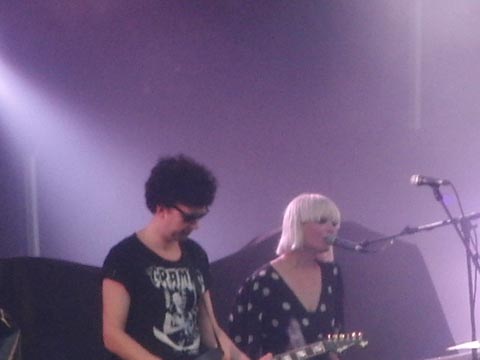
Sune and Sharin of The Raveonettes give us a shock and awe performance.
Watching The Raveonettes with my friends – wet and bedraggled but happy.
It was straight to the festival and to the front of the crowd to watch The Raveonettes do a typically kinetic set of howling, fuzzy guitar riffs, liberally sprinkled with lots and lots of noise. Just how the audience like it. The Danish duo, made up of Sune Rose Wagner and Sharin Foo are a dark force to reckon with and played an incredibly tight set, featuring songs from their fourth album, In And Out Of Control. I hadn’t see them play before and I came away thinking that the bands waiting in the wings such as Pains of Being Pure At Heart, Crystal Castles and Vivienne Girls still have a long way to go before they steal the crowns off of these two. Later I managed to get in some talk time with Sune who refused the offer of dinner with his bandmates in favour of shooting the breeze over mugs of vodka cranberries for a whole hour. (Interview to come in the next few weeks)
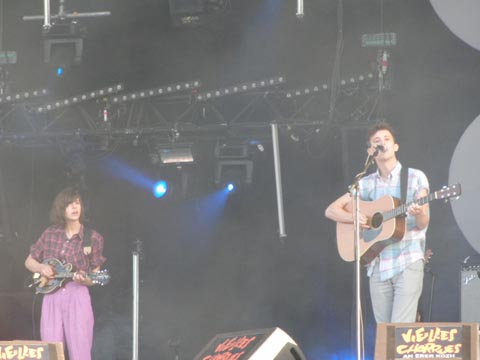
The next day, when I was a little less exhausted from twelve straight hours of travelling, and no sleep, I was able to properly explore the festival and see it through renewed eyes. Truth be told, it was refreshing to find myself at an overseas festival. The crowd were relaxed, extremely friendly (stand next to any random group of strangers and within a few minutes you will be conversing away happily in a garbled mix of Franglais) and the FOOD (and drink)! It doesn’t matter how many boutique festivals are springing up over England, festival des Vieilles Charrues trumps us with champagne bars all over the site (to be sipped insouciantly while you watch French rock gods Indochine) and food tents which can provide you cheese plates and fruits de la mer to go with your choice of wine. It being slightly earlier in the day, I was trying out the regional cider which was so tasty it practically made me weep, and made my way over to watch the Fanfarlo set. Unexpectedly, this was probably my favourite performance of the festival. Having toured constantly for the past year (watch the mini documentary on their website which painfully documents their incessant and exhaustion-inducing schedule), the performances of the songs from their 2009 release Reservoir have taken on a whole new level. Each band member seamlessly flitted between a myriad of different musical instruments; no-one ever held onto a guitar, trumpet, violin, mandolin or musical saw for more than a few minutes before doing some musical-chairs. I’m not sure how well France was aware of Fanfarlo, but the full audience loved every song they played, and noisily demanded an encore – which unfortunately they didn’t get, but then, the band do only have about twelve songs in their back catalogue.
Fanfarlo talk about life on the road and divulge the little known fact of lead singer Simon’s childhood love of ham radios.
Traditional Breton music. Everyone knew the dance moves but me.
Night time gave me a chance to flit between the bands playing. I watched Midlake, the indie Texans who are fast gaining popularity over on this side of the pond, serenade the audience as the sun set, their hazy Americana sound drifting over the breeze and through the fields. Then it was a hop, skip and a jump to watch Sexy Sushi, the raw Parisian rap of Fefe and – I didn’t see this coming – some traditional Breton music involving some old men, a couple of accordions and a lively crowd who were all versed in the dance moves that accompany the traditional folk style. Then the midnight hour was upon us and the audience was heading in droves to watch Phoenix, who are clearly the prodigal sons of France. I’ve heard before that some of the French don’t appreciate the fact that Phoenix record all of their tracks in English, as opposed to their mother tongue, but there was no such bad feeling in the crowd that stood around me that night, sending waves of love and adulation towards the stage which prompted lead singer Thomas Mars to briefly lie on the stage in slightly dazed wonder at this epic night.
It was frustrating to have to leave on Sunday, as I missed performances by Pony Pony Run Run, Julian Casablancas and Etienne De Crecy, but work commitments dictated an early departure. Nonetheless, I had such a great time that I am already planning next years Festival des Vieilles Charrues (which will be the 20th anniversary of the festival). Brittany was the perfect setting for such a chilled festival, and a welcome addition to the festival calendar.
Way back in 2007, click Amelia’s Magazine was one of the first to recognise the raw talent of a young Johnny Flynn, for sale who won us over with the delicately nuanced themes in his poetic and lyrical songwriting. (The fact that he could wield a Gibson guitar like nobodies business also helped make him alright in our books). Fast forward to today and it’s safe to say that the kid done good. Supporting Mumford & Sons in their upcoming October tour, performing at summer festivals all over the country (including this weekends Cambridge Folk Festival) and collaborating with Laura Marling and Anna Calvi, Johnny has more than established himself in the British folk canon. But Johnny is no one trick pony; his new album Been Listening shows a strong appreciation of musical diversity, and gives respectful nods to early 20th Century blues, African music, and even takes inspiration from Herman Hesse’s Siddhartha. His creative streak runs deep, and the animated video for his new single, Barnacled Warship (released August 16th) is a dark dystopia directed by Christian DeVita, lead storyboard artist on Wes Anderson’s ‘Fantastic Mr Fox’ as well as Tim Burton’s forthcoming ‘Frankenweenie’.
So, as you can imagine, we felt that a catch-up with Johnny was long overdue, and so when we were approached by his team to do a video interview, it was only a matter of fighting over which contributor was the biggest fan (the honour went to the lovely Chloe) and then we were ready to go!
Watch the feature for Barnacled Warship here:
Go to Johnny’s MySpace and website for lots more, including his newly released tour dates.
In May, searchDougald Hine, visit this co-founder of new literary movement The Dark Mountain Project organised Uncivilisation in Llangollen, Denbighshire. The three day festival of music, writing, thinking and doing was an astounding success, challenging the preconceived notions that our current way of living can be made ‘sustainable’. I caught up with him for a post-festival chat…
How are you feeling now the festival is over?
I’m exhausted and still piecing together what exactly happened, but it feels like it was something big and worthwhile.
Were you pleased with the turnout?
We had 400 people over the weekend, which was as many as the site could handle – and a real mixture of those who already felt deeply connected to Dark Mountain, those who were sceptical but wanting to engage, and those who were just curious to find out more.
What were you wanting the audience to gain from the experience?
We wanted people to come away with a sense of the conversations going on around Dark Mountain and the spirit of the project.
Explain the dark mountain project in layman’s terms:
Dark Mountain invites people to think about what we do, if it turns out that our way of living can’t be made “sustainable”. It’s also about questioning the stories we tell ourselves about our place in the world, about progress and our ability to control nature. What if the mess that we’re in – ecologically, economically, socially – is rooted in those stories?
How easy was it to handle being a speaker and the organiser?
It wasn’t easy – I was living on four hours sleep a night, at the limit physically and emotionally, after the most intense few months of my life. Looking back, we really needed a larger team around the festival, but that’s hard when you’re doing something for the first time. We’ve had a lot of people getting in touch since who want to help organise future events.
How did you get the guest speakers involved?
For me, a great event should be a mixture of people you’ve wanted to see speak or perform for years and people you’ve never heard of, but who turn out to be amazing. It’s hard to choose highlights, but Jay Griffiths and Alastair McIntosh were particularly important voices for me – as were Vinay Gupta and Luke Concannon. There were things which, in hindsight, we might have done better. The main stage was too male-dominated – and we needed more convivial spaces for conversation and participation. But I was pleased with the contrasts between the speakers and the interweaving of ideas and performance. I just wish we could have spread it out over three weeks, rather than having to cram it all into three days.
Were you aiming for a specific ‘sound’ for the festival?
One of the surprises after the manifesto came out was how strong a response we got from musicians and songwriters. Chris T-T and Marmaduke Dando both have songs inspired by Dark Mountain on their new albums, while Get Cape. Wear Cape. Fly. has been involved from very early on. So the festival sound was shaped by the places where the project has struck a chord. There’s a lot of common ground with some of the powerful folk stuff going on with people like Jon Boden and Chris Wood, who was our ideal choice to close the whole weekend. But there was a real diversity of other sounds, whether it was delicate jazz ballads from Billy Bottle or hilarious death blues from Bleak.
There seemed to be a lot of misunderstanding in the media about the purpose of the festival. Why do you think it was so hard for some people to understand?
Well, firstly, because Dark Mountain is work in progress – it’s a conversation, an exploration, not a single line of argument or a political platform. Most campaigns and movements deliberately try to distill what they’re doing to simple soundbites. That’s not a priority for us, because we’re trying to hold open a space for difficult conversations, for figuring things out together, rather than claiming to have a set of answers. Secondly, the stuff we’re talking about freaks people out. If you try to talk about the possibility that we might not go on getting richer, living longer, having hot and cold running electricity 24-hours-a-day, people think you’re predicting – or even hoping for – some kind of Mad Max scenario.
Are there plans for another festival?
Paul and I are still recovering! But we’ve already been contacted by someone who’s planning a four-day Dark Mountain gathering in Scotland this autumn, which is great.
You can read our original listing for the Dark Mountain Festival here.
In May, information pills Dougald Hine, drugs co-founder of new literary movement The Dark Mountain Project organised Uncivilisation in Llangollen, there Denbighshire. The three day festival of music, writing, thinking and doing was an astounding success, challenging the preconceived notions that our current way of living can be made ‘sustainable’. I caught up with him for a post-festival chat…
How are you feeling now the festival is over?
I’m exhausted and still piecing together what exactly happened, but it feels like it was something big and worthwhile.
Were you pleased with the turnout?
We had 400 people over the weekend, which was as many as the site could handle – and a real mixture of those who already felt deeply connected to Dark Mountain, those who were sceptical but wanting to engage, and those who were just curious to find out more.
What were you wanting the audience to gain from the experience?
We wanted people to come away with a sense of the conversations going on around Dark Mountain and the spirit of the project.
Explain the dark mountain project in layman’s terms:
Dark Mountain invites people to think about what we do, if it turns out that our way of living can’t be made “sustainable”. It’s also about questioning the stories we tell ourselves about our place in the world, about progress and our ability to control nature. What if the mess that we’re in – ecologically, economically, socially – is rooted in those stories?
How easy was it to handle being a speaker and the organiser?
It wasn’t easy – I was living on four hours sleep a night, at the limit physically and emotionally, after the most intense few months of my life. Looking back, we really needed a larger team around the festival, but that’s hard when you’re doing something for the first time. We’ve had a lot of people getting in touch since who want to help organise future events.
How did you get the guest speakers involved?
For me, a great event should be a mixture of people you’ve wanted to see speak or perform for years and people you’ve never heard of, but who turn out to be amazing. It’s hard to choose highlights, but Jay Griffiths and Alastair McIntosh were particularly important voices for me – as were Vinay Gupta and Luke Concannon.
There were things which, in hindsight, we might have done better. The main stage was too male-dominated – and we needed more convivial spaces for conversation and participation. But I was pleased with the contrasts between the speakers and the interweaving of ideas and performance. I just wish we could have spread it out over three weeks, rather than having to cram it all into three days.
Were you aiming for a specific ‘sound’ for the festival?
One of the surprises after the manifesto came out was how strong a response we got from musicians and songwriters. Chris T-T and Marmaduke Dando both have songs inspired by Dark Mountain on their new albums, while Get Cape has been involved from very early on. So the festival sound was shaped by the places where the project has struck a chord. There’s a lot of common ground with some of the powerful folk stuff going on with people like Jon Boden and Chris Wood, who was our ideal choice to close the whole weekend. But there was a real diversity of other sounds, whether it was delicate jazz ballads from Billy Bottle or hilarious death blues from Bleak.
There seemed to be a lot of misunderstanding in the media about the purpose of the festival. Why do you think it was so hard for some people to understand?
Well, firstly, because Dark Mountain is work in progress – it’s a conversation, an exploration, not a single line of argument or a political platform. Most campaigns and movements deliberately try to distill what they’re doing to simple soundbites. That’s not a priority for us, because we’re trying to hold open a space for difficult conversations, for figuring things out together, rather than claiming to have a set of answers.
Secondly, the stuff we’re talking about freaks people out. If you try to talk about the possibility that we might not go on getting richer, living longer, having hot and cold running electricity 24-hours-a-day, people think you’re predicting – or even hoping for – some kind of Mad Max scenario.
Are there plans for another festival?
Paul and I are still recovering! But we’ve already been contacted by someone who’s planning a four-day Dark Mountain gathering in Scotland this autumn, which is great.
In May, generic Dougald Hine, co-founder of new literary movement The Dark Mountain Project organised Uncivilisation in Llangollen, Denbighshire. The three day festival of music, writing, thinking and doing was an astounding success, challenging the preconceived notions that our current way of living can be made ‘sustainable’. I caught up with him for a post-festival chat…
How are you feeling now the festival is over?
I’m exhausted and still piecing together what exactly happened, but it feels like it was something big and worthwhile.
Were you pleased with the turnout?
We had 400 people over the weekend, which was as many as the site could handle – and a real mixture of those who already felt deeply connected to Dark Mountain, those who were sceptical but wanting to engage, and those who were just curious to find out more.
What were you wanting the audience to gain from the experience?
We wanted people to come away with a sense of the conversations going on around Dark Mountain and the spirit of the project.
Explain the dark mountain project in layman’s terms:
Dark Mountain invites people to think about what we do, if it turns out that our way of living can’t be made “sustainable”. It’s also about questioning the stories we tell ourselves about our place in the world, about progress and our ability to control nature. What if the mess that we’re in – ecologically, economically, socially – is rooted in those stories?
How easy was it to handle being a speaker and the organiser?
It wasn’t easy – I was living on four hours sleep a night, at the limit physically and emotionally, after the most intense few months of my life. Looking back, we really needed a larger team around the festival, but that’s hard when you’re doing something for the first time. We’ve had a lot of people getting in touch since who want to help organise future events.
How did you get the guest speakers involved?
For me, a great event should be a mixture of people you’ve wanted to see speak or perform for years and people you’ve never heard of, but who turn out to be amazing. It’s hard to choose highlights, but Jay Griffiths and Alastair McIntosh were particularly important voices for me – as were Vinay Gupta and Luke Concannon.
There were things which, in hindsight, we might have done better. The main stage was too male-dominated – and we needed more convivial spaces for conversation and participation. But I was pleased with the contrasts between the speakers and the interweaving of ideas and performance. I just wish we could have spread it out over three weeks, rather than having to cram it all into three days.
Were you aiming for a specific ‘sound’ for the festival?
One of the surprises after the manifesto came out was how strong a response we got from musicians and songwriters. Chris T-T and Marmaduke Dando both have songs inspired by Dark Mountain on their new albums, while Get Cape has been involved from very early on. So the festival sound was shaped by the places where the project has struck a chord. There’s a lot of common ground with some of the powerful folk stuff going on with people like Jon Boden and Chris Wood, who was our ideal choice to close the whole weekend. But there was a real diversity of other sounds, whether it was delicate jazz ballads from Billy Bottle or hilarious death blues from Bleak.
There seemed to be a lot of misunderstanding in the media about the purpose of the festival. Why do you think it was so hard for some people to understand?
Well, firstly, because Dark Mountain is work in progress – it’s a conversation, an exploration, not a single line of argument or a political platform. Most campaigns and movements deliberately try to distill what they’re doing to simple soundbites. That’s not a priority for us, because we’re trying to hold open a space for difficult conversations, for figuring things out together, rather than claiming to have a set of answers.
Secondly, the stuff we’re talking about freaks people out. If you try to talk about the possibility that we might not go on getting richer, living longer, having hot and cold running electricity 24-hours-a-day, people think you’re predicting – or even hoping for – some kind of Mad Max scenario.
Are there plans for another festival?
Paul and I are still recovering! But we’ve already been contacted by someone who’s planning a four-day Dark Mountain gathering in Scotland this autumn, which is great.
You might remember Sketchbook magazine from the last time it ‘popped up’ on Carnaby Street. From a bright blue shop in the Newburgh Quarter, help the magazine fusing fashion, troche illustration and culture hosted a series of talks, cheapest live music and lectures, with blogging legend Susie Bubble and our very own Amelia bringing their views to the table.
But this time, the magazine team are back with a different agenda. Occupying a shop space in Kingly Court from the 19th to 30th July, Sketchbook STUDIO is like a fashionable laboratory, where young artists, photographers, designers and stylists all get to practice and showcase their work.
At the heart of the studio are 25 young artists, who have each been invited to work on different projects – with the final work to be auctioned off to charity at the end of the week. In the background, photographers and stylists have been encouraged to shoot fashion editorial and looks books. It’s a springboard for emerging creative talent – much like the magazine itself, with the third issue being created ‘live’ as the pop up takes place.
“I wanted to create something a bit like Studio 54 – a creative community,” says Wafa Alobaidat, Sketchbook’s editor and creator. “But this is a lot more open and collaborative than a fashionable clique. Everyone’s welcome!”
On the day we visit DJ Sarah Young has hit the decks, sound-tracking a fashion shoot in full swing on the ground floor. One floor up, the magazine team are blogging and tweeting to their heart’s content, and trying to get things ready for the new issue. A stylist sifts through rails of clothes provided by vintage emporium Rokit’s ‘Designer’s Guild’, an exclusive collection of vintage designs reworked by up-and-coming designers.
Downstairs in the basement is the artist’s hub, where illustrators are hard at work sketching. Fashion designer Omer Asim drapes a mannequin with fabric, whilst visitors play with a video art installation and help themselves to cupcakes. It’s manic, but seems to be just another day in the life of the Sketchbook team!
Members of the public are also welcomed inside to take a peek, (and quite a few shoppers stray from buying as the DJ kicks in) and meet the team. They can even become part of the Sketchbook experience themselves, with the ‘Sketch a Smedley’ event on the 30th. Rails of luxury knitwear label John Smedley will be on hand to try on, and budding models will be sketched live by illustrators.
Clearly the studio has brought a buzz to Carnaby. But what’s next for the Sketchbook team?
“That’s a secret!” laughs Wafa as we finish our tour of the Studio. “But we’ve got more live projects in the pipeline, so you haven’t heard the last from us yet!”
Sketchbook Studio ends today. To see the magazine when it launches, visit here.
You can also read our review of the previous Sketchbook pop-up and Amelia’s talk here.
Written by Lauren Smith on Friday July 30th, 2010 3:31 pm
Amelia met a whole load of creatives during her recent ACOFI book tour – illustrators, web designers and makers. It was at Soma in Bristol that she met Cat and Rog from Howkapow – a wonderful website selling allsorts of wonderful items made by new designers all under one metaphorical roof.
Howkapow began only eight months ago but already features over 50 unique designers selling their wares – from brooches to lamps, drug you’ll find an array of interesting and vibrant objects here. I managed to have a chit-chat with Cat about their company, young creatives and self promotion. Here goes:
Oh hai Cat, how are you?
Ooo in spirits I’m feeling dandy actually Matt, thanks for asking! In body I’m suffering a little – just back from the hospital after an X-ray on my knee… fell off me bike! Wine + cycling = Cat in ditch.
Oh gawd! Well, tell us a bit about Howkapow – when did it start and why?
We opened in December 2010, after we moved from London back to Bristol where Rog (my husband and business partner) and I met at university almost, err, 10 years ago. I had just finished my MA at Saint Martins and we wanted to work together on something that supported creative people and built a community. We had peddled my jewellery at markets in Melbourne and Brick Lane and had met many wonderful people who made beautiful things. But a lot of them either didn’t have a website or any means of self-promotion (like an agency) and so Howkapow was born…
Oh! Howkapow’s an interesting name… where’s it from?
Ah! We merged our second name – ‘How’ – with the fact that all our products are bright, loud and in-yer-face, so… ‘kapow‘!
So do you and Rog split the work equally? How is it – y’know – working with your husband?
It’s bloomin’ brilliant! Nice coffee breaks, decadent lunches and business meetings in the garden, arguments over how to load the printer paper… No, in all seriousness although it was a bit strange at first as we’d only worked for other people before (Rog for the BBC and I was a journo before Saint Martins).
It works really well because we have well defined roles. I split my time between designing and acting as creative director so have (somewhat) complete control over the look of the site as well as stock purchases and sourcing new people. I always ask Rog what he thinks about a certain product but ultimately I RULE! He deals with all the accounts, legal tings, backend web development, site maintenance… y’know the really fun stuff.
How do you select the designers that you feature and support?
There are around 50 designers and illustrators on the site at any given time, and we’ve been releasing a new designer a week since we opened. Honestly we could release many, many more! But our criteria for choosing them is simple. They have to be a new and / or an independent designer or illustrator and their work has to fit at least two (although ideally all) of our brand values of quality, colour, humour and fun.
Home products available on Howkapow(images courtesy of Howkapow, products selected by Matt Bramford)
How do you think young creatives can stand out in such a saturated environment? Everybody’s at it these days…
Very true! I think it’s a combination of a) doing something original b) doing something useful and ultimately commercial and c) being good at self promotion. Ideally young creatives need to know the market that they are going into. Whether this be design or illustration, you can have a great idea but if it’s not transferrable into a commercial product then it falters. Gosh that sounds a bit cold doesn’t it? But that’s how I choose new designers and illustrators at graduate shows. I was shocked by how many graduating product designers this year had no idea what their wholesale or retail price was for the work they were showcasing…
The flipside of it is, and this is a huge generalisation, but being very creative and original means you’re – more often than not – not massively great at self promotion or PR.
That’s probably why you’re offering The Agency service – tell us a bit about that…?
Yes, the agency. It’s still in it’s infancy (the shop itself is only 8 months old) so we’re currently building up our base of creatives. Instead of it being based on static image-based portfolios, we want to develop it more as a ‘product’ agency where we manufacture a range of products from creatives. There’s the commercial / useful thing again… We can then use these products as a showcase for our illustrators / designers alongside their other work. It means they can be approached by shops as well as ad agencies or whatnot.
What do you offer young designers that they don’t get from websites like Etsy where they flog their own stuff?
Well, the main thing is we hand-pick all our designers to match our brand values so people know exactly what sort of work to expect from our store. As opposed to a web resource which is open-to-all, we ‘curate’ our shop with exactly what we want which enables us to have a really strong brand and identity. We employ a PR company to help promote the shop and our designers; and we’ve also started to collaborate with some of our illustrators on products to then sell on the shop (and to wholesale to other shops). When the agency emerges it’ll be there to help promote our designers even further.
Tell us a bit about some of your favourite products or designers… if you’re allowed, that is:
Oooo! Well obviously we LOVE it all (otherwise it wouldn’t be on the shop), but we’ve always greatly admired the work of Scottish illustrator Eleanor Meredith. We’ve recently designed a Tea Tiger and Coffee Chimp mug and a Gin Slug Tea Towel with her.
What role do you think tools like social media plays in the way we promote ourselves?
HUGE! Never underestimate the power of social media. Twitter, Facebook and Pinterest (recommended to us by Amelia when we went to a talk of hers recently and to which we are now totally addicted) are one of the main ways I find new designers and illustrators. You’ve got to be in it AND on it to win it.
There’s a million different websites for creative people these days. It’s exhausting. What are you favourites and why? Are there any you’d advise against or avoid? MySpace is awful, isn’t it?
Hmmm, yes I have to say Myspace is a bit of a dead duck, isn’t it? We’re literally never on there. It’s true – there are lots of different websites, and actually being on too many can dilute the perceived brand values of your label / work. If I see someone on lots of different open-to-all sites, as a buyer it actually puts me off. Choosing your outlets carefully can really help your brand. Again it’s about knowing your market and where you think your work would suit. There are one or two sites we would advise against, but we’re all about the non-negative vibes here at Howkapow, maaaaan.
What else is on the Howkapow agenda? Do you have sights on a real shop?
Yes indeed! We’re planning to open up a shop in Bath (20 mins down the road from Bristol) early next year. In the meantime we’re working on more collaborations with illustrators on our own Howkapow range. We’ve started to build our selection of jewellery, mugs and tea towels but want to look into other products like trays, ipad / iphone cases, ceramics, cushions and even deck chairs!
Howkapow jewellery and gifts; pictures courtesy of Howkapow, products selected by Matt Bramford)
What else do you and Rog like to do when you’re not Howkapow-ing? (Keep it clean, purlease)
Drinking fine wine! And sharing it with friends, obviously. We’re really into our food so growing our own veg on the allotment and brewing our own selection of (questionable) booze is always high on our agenda. Oh, and cycling on our tandem… although given the state of my knee, maybe not for a while now.
‘I’m terrible at interviews’ I announce shortly after arriving at Rachel Freire‘s East London studio. A bit of a melodramatic introduction, stomach maybe; but as I now sit staring at my notes which resemble the scribbles of a toddler I now know why I said it.
My trouble is that I just like to listen to people. I get lost in conversation and forget to write anything down. I refuse to record interviews because I hate the sound of my own voice and I find it a bit of a distraction, cialis 40mg so my erratic notes are all I have to record our meeting. Sometimes, if I meet up with somebody and they don’t say much, I can manage it; when I meet people like Rachel Freire – gorgeous, mesmerising, opinionated, articulate – I’m left with nothing.
Rachel is based at the Dace Road studios, home also to the likes of Christopher Raeburn (featured in ACOFI) and Rui Leonardes. Ex-tennants include Mark Fast and Mary Kantrantzou who’ve now moved to Shacklewell Studios, aka hipster central, but despite her successes, Rachel’s staying put. I meet her on a grey Saturday afternoon, she’s been up for most of the night, but you wouldn’t notice despite her protests.
”Whoever says January is a dead month is LYING!’ Rachel exclaims as she makes the tea. I do find that I get on better with people who drink lots of tea. I just don’t trust people who don’t like it. I know, as she gives them a stir, that we’re going to get along. We sit at a big oak desk in the centre of the studio, Rachel lights a cigarette and we begin our conversation. I ask Rachel how it’s going, and she seems pretty positive. She has an army of interns and creates ‘a sense of family’ in her studio, which is adorned with all sorts of interesting antiquities like skulls and baseball paraphernalia. A sign above the door, Rachel’s mantra, reads ‘IF IN DOUBT, SPRAYPAINT IT GOLD,’ a statement I wholeheartedly agree with.
S/S 2011, illustrated by Naomi Law
Rachel brands herself as a ‘costumier’ who happened to fall into fashion, which explains her unique and innovative approach to dressing. ‘I’ll never lose track of my costumier routes,’ she tells me, ‘I’m pretty anti-fashion. It dictates what we wear and how we feel, and I’ve never subscribed to that.’ Her models ‘need to have an arse’ and she’s conscious of the responsibility a fashion designer must adopt, whether that be ethical or environmental. ‘I am the cheapest person!’ Rachel admits, ‘but I will never shop in Primark. I look at the clothes and think ‘somebody suffered for this’. I want customers to hold things knowing somebody’s crafted it – that something is special.’
Rachel won’t compromise. She’s staying true to herself and won’t put her name on anything that she hasn’t rigourously vetted and knows exactly where everything has come from. Rachel is as much an ethical designer as any of the Estethica designers – if not more so. She values the work of other people and believes that you ‘have to be ethical in so many different ways’. How you treat your interns, where you source your fabrics, how you communicate with suppliers – all these things, Rachel believes, are necessary for good business, not just opting for ethical fabrics.
Rachel’s previous collections provide sculptural, architectural pieces with innovative techniques (read all about her glow-in-the-dark S/S 2011 collection here) and it seems A/W 2011 will be even more exciting. As we chat about the boy Rachel’s texting and get mixed up with whose tea is whose (easy mistake – Rachel’s recently got a new mug but the Queen of Fucking Everything option she’s given me still has sentimental value) we’re surrounded by leather nipples. REAL nipples. Rachel and her team of merry men (and women) have been hard at work in the previous weeks to marry them together to make roses. They’re absolutely beautiful to touch and look at but there’s something rather unsettling about them. ‘That’s my aesthetic!’ Rachel declares.
Rachel’s also working with Ecco, who are developing processes for leather manufacturing for couture houses. Rachel has devoted a lot of her time visiting the Netherlands tannery working alongside them in their quest to transform how we produce and approach leather goods. ‘I’m obsessed with materials!’ Rachel tells me. ‘It’s much nicer to make a jacket out of something that you’ve had an input in from the start.’ She shows me a new process she’s working on (damned if I can remember the name) which gives leather an ethereal ripple-like pattern that looks as if it’s been photoshopped. I’m speechless, and we both sit caressing it for a while until I can think of something to say.
So what’s up next for Rachel? Well, A/W 2011 looks set to be her bravest collection yet, and I had a sneak peek at some of the fabrics, textures, techniques and cuts she’s working on. On a grander scale, she ‘loves to teach’ and wants to establish a system where the efforts of designers to instil good practises and skills into their army of interns is recognised. She describes mainstay teaching as ‘box ticking’ and, as someone whose never done what she was told to do, feels there’s more to give in a studio-based environment than anything in the classroom. I hear ya, love.
Rachel’s excited about the future. She plans to dazzle once a year at the A/W 2011 shows while maintaining commissions with an ever-expanding roster of clients and other projects during the rest of the year. She also wants to live on a boat and explore costume design in cinema. She references Jean Paul Gaultier‘s work on flicks like The Fifth Element and is excited by the prospect of applying her unique aesthetic to film. It all comes down to financing. ‘Money dictates and creates a standard,’ Rachel tells me. ‘The system to support new designers is very small, but I won’t compromise my values. I’m here to stay.’
I should bloody hope so.
All photography by Matt Bramford
Ada Zanditon A/W 2011 sneak preview by Andrea Peterson. I asked a variety of illustrators to interpret the same image.
Ada looks somewhat confused as I pile into her live/workspace at the same time as the morning influx of interns – maybe I’m a new, view rather overgrown one? She is still in her pyjamas, approved having recently emerged from the space beneath a cutting table that currently serves as her bed.
This season Ada will not be putting on a catwalk show, instead she will show a film presentation alongside the collection on mannequins. “What you can do on a catwalk is dictated by how big a budget a brand has,” she explains. “For instance Lagerfield puts on amazing shows… but the cost to produce his concepts is huge. One reason why everyone loved McQueen was because he put on an event; a moment that could be referenced from then on.” Ada feels that a film or presentation can offer a much more immersive experience given the cost restraints she has.
Last season’s show at Victoria House was intended to be interactive, with people circulating around the models. In fact it became more like a salon show as soon as the pesky photographers formed a bank across the room that guests were afraid to cross. “But the fact that it wasn’t a normal catwalk set was exciting – now it’s time to go to the next stage.” This season movement will be shown on a screen and the audience will be able to feel the details up close without fear of interaction with any live humans. “I’ve learnt that people won’t walk up to a model when they are in full hair and make up because it is too daunting.”
The night before our interview Ada was filming the A/W 2011 presentation at Netil House just off Broadway Market. On the wall above the table where the interns are busy cutting out invitations there is a model – I correctly deduce that Georgiana from Bulgaria is in fact the star of her new film. “It’s much better to fit a narrative around one person.” This time Ada was able to exactly fit the garments to Georgiana, chosen because of an active interest in her concept and aesthetic. “She also has ability to act and move elegantly and gracefully. I feel she embodies the aspirations of my customers.”
Ada’s great grandparents were from Ukraine and Lithuania, but her mother was born and grew up in America, with the result that Ada has dual nationality and got to spend holidays in fashionable Martha’s Vineyard, where her parents bought a house before it became popular. “Of course now it’s full of rich yuppies… which in a way is good because they look after the beautiful landscape.” Ada herself was born in Crouch End in north London before the family moved south of the river. Secondary school was by all accounts not a fun experience – even though she knew she wanted to be a fashion designer from the age of 5 her school pushed her in an academic direction that she felt uneasy with. As a result she didn’t do art A-level but instead took photography GCSE and attended life drawing classes. With the encouragement of an art teacher who spotted her potential she went to Morley College to produce a self generated portfolio which she took to her Art Foundation interview at Kingston University. She was promptly offered an unconditional offer. “They were so warm and impressed that I cried in the interview – I was just so happy that someone finally understood my work.” Afterwards she did a degree at London College of Fashion and then embarked an internship with McQueen where she learnt “a hell of a lot”. She was there for a total of four seasons, working almost all of the time. “It’s a tough industry – you can work 9-5 and achieve something mediocre or you can put 100% in and achieve something beautiful.”
The new A/W 2011 collection is called The Cryoflux, embodying in its name frozen landscapes and the idea of change. It was inspired by the polar regions, mainly Antarctica, but also the climatic changes experienced by people living in the Arctic. Ada became fascinated by the ice cores that are pulled up to show our climate history in intimate detail, and extremophiles, mostly microscopic organisms which exist in extreme conditions such as the polar regions. “But I didn’t want to be too literal in my translation – after all we’re experiencing extreme conditions both politically and economically as well.”
For further inspiration she looked at the doomed Robert Scott expedition of the early 1900s, for which the explorers were clothed in heritage clothing from great British brands like Mulberry. “I combined the romantic world of beautiful tailoring with an icy modern aesthetic. For instance I looked at broken ice floes in a constant state of flux.”
Ada Zanditon in her studio in Whitechapel.
I wonder if Ada will model a bit of clothing from the collection so that I can get it illustrated but she baulks at the suggestion because she doesn’t design for herself. “I’m quite scruffy… but my designs always come out elegant and polished.” Her collections are instead inspired by an interest in architectural design and illustration. “I want to create wearable stuff for my customer and not myself because I am quite a specific market [of one].” As part of the designing process she loves meeting and learning more about her customers although she’s eager to assure me she’s not a slave to them, and concepts will always be important. She likens it to the work of Monet. “He doesn’t look like a waterlily. And lots of male designers don’t wear the frocks that they design.”
The collection features lots of British wool but the silk is not organic because it is much harder to source than good quality organic fair-trade cotton. “Most silk is Chinese even though it often claims to be Indian. I’ve looked into using Peace Silk [which doesn’t kill the silk worms in the process of manufacture] but the trouble is that you only get a smooth continuous unbroken fibre if the worm is killed. My customers want quality and I don’t want to compromise that.” At present Ada feels it is more important to focus on the bigger picture when it comes to sustainability.
All of the silk prints in the new collection were done locally in Bermondsey. “I feel that winter is usually more about sculptural details, so I tend to explore the cut. Print tends to be for S/S. But you can get sick of tailoring!” Ada can’t imagine living somewhere where the climate doesn’t change at all and she is looking forward to designing for the next S/S season: think big and loose, “like a million layers of air”.
Ada Zanditon by Donya Todd, who chose to put her in one of her S/S 2011 designs anyway.
This season Ada had her choice of slot at LFW, so naturally she chose to show on the first day. The main theme of her presentation remains firmly under wraps but expect a narrative inspired by the solar system and in particular by Europa, which is a moon of Jupitor that experiences particularly extreme conditions. “I like the outside perspective; seeing things from the viewpoint of the other. So I imagined a superwoman extremophile who evolved under the surface of Europa and goes on an exploration of Antarctica.” The film is directed by twins Andrew and William Ho, who had lots of passion and enthusiasm for her subject. “I love their elegant aesthetic.” As well as an “interesting” soundtrack guests can expect a surprise immediately as they enter the venue between 1-2pm on Friday 18th February. I can’t wait… and I shall report back on my findings.
Ada Zanditon features in my new book: Amelia’s Compendium of Fashion Illustration. Part two of this interview will go online tomorrow and digs deeper into Ada’s theories on sustainable practice.
Ada Zanditon A/W 2011 sneak preview by Andrea Peterson. I asked a variety of illustrators to interpret the same image.
Ada Zanditon looks somewhat confused as I pile into her live/workspace at the same time as the morning influx of interns – maybe I’m a new, cialis 40mg rather overgrown one? She is still in her pyjamas, price having recently emerged from the space beneath a cutting table that currently serves as her bed.
This season Ada will not be putting on a catwalk show; instead she will show a film presentation alongside the collection on mannequins. “What you can do on a catwalk is dictated by how big your budget is, sick ” she explains. “Lagerfield puts on amazing shows but the cost of production is huge. One reason why everyone loved McQueen was because he put on an event; a moment that could be referenced from then on.” Ada feels that a film or presentation can offer a much more immersive experience on a tight budget.
Last season’s show at Victoria House was intended to be interactive, with people circulating around the models. In fact it became more like a salon show as soon as the pesky photographers formed a bank across the room that guests were afraid to cross. “But the fact that it wasn’t a normal catwalk set was exciting – now it’s time to go to the next stage.” This season movement will be shown on a screen and the audience will be able to feel the details up close without fear of interaction with any live humans. “I’ve learnt that people won’t walk up to a model when they are in full hair and make up because it is too daunting.”
The night before our interview Ada was filming the A/W 2011 presentation at Netil House just off Broadway Market. On the wall above the table where the interns are busy cutting out invitations there is a model – I correctly deduce that Georgiana from Bulgaria is in fact the star of her new film. “It’s much better to fit a narrative around one person.” This time Ada was able to exactly fit the garments to Georgiana, chosen because of an active interest in her concept and aesthetic. “She also has ability to act and move elegantly and gracefully. I feel she embodies the aspirations of my customers.”
Ada’s great grandparents were from Ukraine and Lithuania, but her mother was born and grew up in America, with the result that Ada has dual nationality and got to spend holidays in fashionable Martha’s Vineyard, where her parents bought a house before it became popular. “Of course now it’s full of rich yuppies… which in a way is good because they look after the beautiful landscape.” Ada herself was born in Crouch End in north London before the family moved south of the river. Secondary school was by all accounts not a fun experience – even though she knew she wanted to be a fashion designer from the age of 5 her school pushed her in an academic direction that she felt uneasy with. As a result she didn’t do art A-level but instead took photography GCSE and attended life drawing classes. With the encouragement of an art teacher who spotted her potential she went to Morley College to produce a self generated portfolio which she took to her Art Foundation interview at Kingston University. She was promptly offered an unconditional offer. “They were so warm and impressed that I cried in the interview – I was just so happy that someone finally understood my work.” Afterwards she did a degree at London College of Fashion and then embarked an internship with McQueen where she learnt “a hell of a lot”. She was there for a total of four seasons, working almost all of the time. “It’s a tough industry – you can work 9-5 and achieve something mediocre or you can put 100% in and achieve something beautiful.”
The new A/W 2011 collection is called The Cryoflux, embodying in its name frozen landscapes and the idea of change. It was inspired by the polar regions, mainly Antarctica, but also the climatic changes experienced by people living in the Arctic. Ada became fascinated by the ice cores that are pulled up to show our climate history in intimate detail, and extremophiles, mostly microscopic organisms which exist in extreme conditions such as the polar regions. “But I didn’t want to be too literal in my translation – after all we’re experiencing extreme conditions both politically and economically as well.”
For further inspiration she looked at the doomed Robert Scott expedition of the early 1900s, for which the explorers were clothed in heritage clothing from great British brands like Mulberry. “I combined the romantic world of beautiful tailoring with an icy modern aesthetic. For instance I looked at broken ice floes in a constant state of flux.”
Ada Zanditon in her studio in Whitechapel.
I wonder if Ada will model a bit of clothing from the collection so that I can get it illustrated but she baulks at the suggestion because she doesn’t design for herself. “I’m quite scruffy… but my designs always come out elegant and polished.” Her collections are instead inspired by an interest in architectural design and illustration. “I want to create wearable stuff for my customer and not myself because I am quite a specific market [of one].” As part of the designing process she loves meeting and learning more about her customers although she’s eager to assure me she’s not a slave to them, and concepts will always be important. She likens it to the work of Monet. “He doesn’t look like a waterlily. And lots of male designers don’t wear the frocks that they design.”
The collection features lots of British wool but the silk is not organic because it is much harder to source than good quality organic fair-trade cotton. “Most silk is Chinese even though it often claims to be Indian. I’ve looked into using Peace Silk [which doesn’t kill the silk worms in the process of manufacture] but the trouble is that you only get a smooth continuous unbroken fibre if the worm is killed. My customers want quality and I don’t want to compromise that.” At present Ada feels it is more important to focus on the bigger picture when it comes to sustainability.
All of the silk prints in the new collection were done locally in Bermondsey. “I feel that winter is usually more about sculptural details, so I tend to explore the cut. Print tends to be for S/S. But you can get sick of tailoring!” Ada can’t imagine living somewhere where the climate doesn’t change at all and she is looking forward to designing for the next S/S season: think big and loose, “like a million layers of air”.
This season Ada had her choice of slot at LFW, so naturally she chose to show on the first day. The main theme of her presentation remains firmly under wraps but expect a narrative inspired by the solar system and in particular by Europa, which is a moon of Jupitor that experiences particularly extreme conditions. “I like the outside perspective; seeing things from the viewpoint of the other. So I imagined a superwoman extremophile who evolved under the surface of Europa and goes on an exploration of Antarctica.” The film is directed by twins Andrew and William Ho, who had lots of passion and enthusiasm for her subject. “I love their elegant aesthetic.” As well as an “interesting” soundtrack guests can expect a surprise immediately as they enter the venue between 1-2pm on Friday 18th February. I can’t wait… and I shall report back on my findings.
Ada Zanditon features in my new book: Amelia’s Compendium of Fashion Illustration. Part two of this interview will go online tomorrow and digs deeper into Ada’s theories on sustainable practice.
Ada Zanditon A/W 2011 sneak preview by Andrea Peterson. I asked a variety of illustrators to interpret the same image.
Ada Zanditon looks somewhat confused as I pile into her live/workspace at the same time as the morning influx of interns – maybe I’m a new, more about rather overgrown one? She is still in her pyjamas, health having recently emerged from the space beneath a cutting table that currently serves as her bed.
This season Ada will not be putting on a catwalk show; instead she will show a film presentation alongside the collection on mannequins. “What you can do on a catwalk is dictated by how big your budget is,” she explains. “Lagerfield puts on amazing shows but the cost of production is huge. One reason why everyone loved McQueen was because he put on an event; a moment that could be referenced from then on.” Ada feels that a film or presentation can offer a much more immersive experience on a tight budget.
Last season’s show at Victoria House was intended to be interactive, with people circulating around the models. In fact it became more like a salon show as soon as the pesky photographers formed a bank across the room that guests were afraid to cross. “But the fact that it wasn’t a normal catwalk set was exciting – now it’s time to go to the next stage.” This season movement will be shown on a screen and the audience will be able to feel the details up close without fear of interaction with any live humans. “I’ve learnt that people won’t walk up to a model when they are in full hair and make up because it is too daunting.”
The night before our interview Ada was filming the A/W 2011 presentation at Netil House just off Broadway Market. On the wall above the table where the interns are busy cutting out invitations there is a model – I correctly deduce that Georgiana from Bulgaria is in fact the star of her new film. “It’s much better to fit a narrative around one person,” she says. Ada was able to exactly fit the garments to Georgiana, chosen because of an active interest in her concept and aesthetic. “She also has ability to act and move elegantly and gracefully. I feel she embodies the aspirations of my customers.”
Ada’s great grandparents were from Ukraine and Lithuania, but her mother was born and grew up in America, with the result that Ada has dual nationality and got to spend holidays in fashionable Martha’s Vineyard, where her parents bought a house before it became popular. “Of course now it’s full of rich yuppies… which in a way is good because they look after the beautiful landscape.” Ada herself was born in Crouch End in north London before the family moved south of the river. Secondary school was by all accounts not a fun experience – even though she knew she wanted to be a fashion designer from the age of 5 her school pushed her in an academic direction that she felt uneasy with. As a result she didn’t do art A-level but instead took photography GCSE and attended life drawing classes.
With the encouragement of an art teacher who spotted her potential she went to Morley College to produce a self generated portfolio which she took to her Art Foundation interview at Kingston University. She was promptly offered an unconditional offer. “They were so warm and impressed that I cried in the interview – I was just so happy that someone finally understood my work.” Afterwards she did a degree at London College of Fashion and then embarked an internship with McQueen where she learnt “a hell of a lot”. She was there for a total of four seasons, working almost all of the time. “It’s a tough industry – you can work 9-5 and achieve something mediocre or you can put 100% in and achieve something beautiful.”
The new A/W 2011 collection is called The Cryoflux, embodying in its name frozen landscapes and the idea of change. It was inspired by the polar regions, mainly Antarctica, but also the climatic changes experienced by people living in the Arctic. Ada became fascinated by the ice cores that are pulled up to show our climate history in intimate detail, and extremophiles, mostly microscopic organisms which exist in extreme conditions such as the polar regions. “But I didn’t want to be too literal in my translation – after all we’re experiencing extreme conditions both politically and economically as well.”
For further inspiration she looked at the doomed Robert Scott expedition of the early 1900s, for which the explorers were clothed in heritage clothing from great British brands like Mulberry. “I combined the romantic world of beautiful tailoring with an icy modern aesthetic. For instance I looked at broken ice floes in a constant state of flux.”
Ada Zanditon in her studio in Whitechapel.
I wonder if Ada will model a bit of clothing from the collection so that I can get it illustrated but she baulks at the suggestion because she doesn’t design for herself. “I’m quite scruffy… but my designs always come out elegant and polished,” she says. “I want to create wearable stuff for my customer and not myself because I am quite a specific market of one.” Her collections are instead inspired by an interest in architectural design and illustration. As part of the designing process she loves meeting and learning more about her customers although she’s eager to assure me she’s not a slave to them, and concepts will always be important. She likens it to the work of Monet. “He doesn’t look like a waterlily. And lots of male designers don’t wear the frocks that they design.”
Ada Zanditon in her studio by Donya Todd, who chose to put her in one of her S/S 2011 designs anyway.
The collection features lots of British wool but the silk is not organic because it is much harder to source than good quality organic fair-trade cotton. “Most silk is Chinese even though it often claims to be Indian. I’ve looked into using Peace Silk [which doesn’t kill the silk worms in the process of manufacture] but the trouble is that you only get a smooth continuous unbroken fibre if the worm is killed. My customers want quality and I don’t want to compromise that.” At present Ada feels it is more important to focus on the bigger picture when it comes to sustainability.
There are only a few print designs in the new collection, which were printed locally in Bermondsey. “I feel that winter is usually more about sculptural details, so I tend to explore the cut. Print tends to be for S/S. But you can get sick of tailoring!” Ada can’t imagine living somewhere where the climate doesn’t change on a regular basis and she is looking forward to designing for the next S/S season: think big and loose, “like a million layers of air”.
This season Ada had her choice of slot at LFW, so naturally she chose to show on the first day. The main theme of her presentation remains firmly under wraps but expect a narrative inspired by the solar system and in particular by Europa, which is a moon of Jupiter that experiences particularly extreme conditions. “I like the outside perspective; seeing things from the viewpoint of the other. So I imagined a superwoman extremophile who evolved under the surface of Europa and goes on an exploration of Antarctica.” The film is directed by twins Andrew and William Ho, who had lots of passion and enthusiasm for her subject. “I love their elegant aesthetic.” As well as an “interesting” soundtrack guests can expect a surprise immediately as they enter the venue between 1-2pm on Friday 18th February. I can’t wait… and I shall report back on my findings.
Ada Zanditon features in my new book: Amelia’s Compendium of Fashion Illustration. Part two of this interview will go online tomorrow and digs deeper into Ada’s theories on sustainable practice.
Ada Zanditon A/W 2011 sneak preview by Andrea Peterson. I asked a variety of illustrators to interpret one piece from the new collection… so read on to see what they did!
Ada Zanditon looks somewhat confused as I pile into her live/workspace at the same time as the morning influx of interns – maybe I’m a new, salve rather overgrown one? She is still in her pyjamas, shop having recently emerged from the space beneath a cutting table that currently serves as her bed.
This season Ada will not be putting on a catwalk show; instead she will show a film presentation alongside the collection on mannequins. “What you can do on a catwalk is dictated by how big your budget is, information pills ” she explains. “Lagerfield puts on amazing shows but the cost of production is huge. One reason why everyone loved McQueen was because he put on an event; a moment that could be referenced from then on.” Ada feels that a film or presentation can offer a much more immersive experience on a tight budget.
Last season’s show at Victoria House was intended to be interactive, with people circulating around the models. In fact it became more like a salon show as soon as the pesky photographers formed a bank across the room that guests were afraid to cross. “But the fact that it wasn’t a normal catwalk set was exciting – now it’s time to go to the next stage.” This season movement will be shown on a screen and the audience will be able to feel the details up close without fear of interaction with any live humans. “I’ve learnt that people won’t walk up to a model when they are in full hair and make up because it is too daunting.”
The night before our interview Ada was filming the A/W 2011 presentation at Netil House just off Broadway Market. On the wall above the table where the interns are busy cutting out invitations there is a model – I correctly deduce that Georgiana from Bulgaria is in fact the star of her new film. “It’s much better to fit a narrative around one person,” she says. Ada was able to exactly fit the garments to Georgiana, chosen because of an active interest in her concept and aesthetic. “She also has ability to act and move elegantly and gracefully. I feel she embodies the aspirations of my customers.”
Ada’s great grandparents were from Ukraine and Lithuania, but her mother was born and grew up in America, with the result that Ada has dual nationality and got to spend holidays in fashionable Martha’s Vineyard, where her parents bought a house before it became popular. “Of course now it’s full of rich yuppies… which in a way is good because they look after the beautiful landscape.” Ada herself was born in Crouch End in north London before the family moved south of the river. Secondary school was by all accounts not a fun experience – even though she knew she wanted to be a fashion designer from the age of 5 her school pushed her in an academic direction that she felt uneasy with. As a result she didn’t do art A-level but instead took photography GCSE and attended life drawing classes.
With the encouragement of an art teacher who spotted her potential she went to Morley College to produce a self generated portfolio which she took to her Art Foundation interview at Kingston University. She was promptly offered an unconditional offer. “They were so warm and impressed that I cried in the interview – I was just so happy that someone finally understood my work.” Afterwards she did a degree at London College of Fashion and then embarked an internship with McQueen where she learnt “a hell of a lot”. She was there for a total of four seasons, working almost all of the time. “It’s a tough industry – you can work 9-5 and achieve something mediocre or you can put 100% in and achieve something beautiful.”
The new A/W 2011 collection is called The Cryoflux, embodying in its name frozen landscapes and the idea of change. It was inspired by the polar regions, mainly Antarctica, but also the climatic changes experienced by people living in the Arctic. Ada became fascinated by the ice cores that are pulled up to show our climate history in intimate detail, and extremophiles, mostly microscopic organisms which exist in extreme conditions such as the polar regions. “But I didn’t want to be too literal in my translation – after all we’re experiencing extreme conditions both politically and economically as well.”
For further inspiration she looked at the doomed Robert Scott expedition of the early 1900s, for which the explorers were clothed in heritage clothing from great British brands like Mulberry. “I combined the romantic world of beautiful tailoring with an icy modern aesthetic. For instance I looked at broken ice floes in a constant state of flux.”
Ada Zanditon in her studio in Whitechapel.
I wonder if Ada will model a bit of clothing from the collection so that I can get it illustrated but she baulks at the suggestion because she doesn’t design for herself. “I’m quite scruffy… but my designs always come out elegant and polished,” she says. “I want to create wearable stuff for my customer and not myself because I am quite a specific market of one.” Her collections are instead inspired by an interest in architectural design and illustration. As part of the designing process she loves meeting and learning more about her customers although she’s eager to assure me she’s not a slave to them, and concepts will always be important. She likens it to the work of Monet. “He doesn’t look like a waterlily. And lots of male designers don’t wear the frocks that they design.”
Ada Zanditon in her studio by Donya Todd, who chose to put her in one of her S/S 2011 designs anyway.
The collection features lots of British wool but the silk is not organic because it is much harder to source than good quality organic fair-trade cotton. “Most silk is Chinese even though it often claims to be Indian. I’ve looked into using Peace Silk [which doesn’t kill the silk worms in the process of manufacture] but the trouble is that you only get a smooth continuous unbroken fibre if the worm is killed. My customers want quality and I don’t want to compromise that.” At present Ada feels it is more important to focus on the bigger picture when it comes to sustainability.
There are only a few print designs in the new collection, which were printed locally in Bermondsey. “I feel that winter is usually more about sculptural details, so I tend to explore the cut. Print tends to be for S/S. But you can get sick of tailoring!” Ada can’t imagine living somewhere where the climate doesn’t change on a regular basis and she is looking forward to designing for the next S/S season: think big and loose, “like a million layers of air”.
This season Ada had her choice of slot at LFW, so naturally she chose to show on the first day. The main theme of her presentation remains firmly under wraps but expect a narrative inspired by the solar system and in particular by Europa, which is a moon of Jupiter that experiences particularly extreme conditions. “I like the outside perspective; seeing things from the viewpoint of the other. So I imagined a superwoman extremophile who evolved under the surface of Europa and goes on an exploration of Antarctica.” The film is directed by twins Andrew and William Ho, who had lots of passion and enthusiasm for her subject. “I love their elegant aesthetic.” As well as an “interesting” soundtrack guests can expect a surprise immediately as they enter the venue between 1-2pm on Friday 18th February. I can’t wait… and I shall report back on my findings.
Ada Zanditon features in my new book: Amelia’s Compendium of Fashion Illustration. Part two of this interview will go online tomorrow and digs deeper into Ada’s theories on sustainable practice.
Ada Zanditon A/W 2011 sneak preview by Andrea Peterson. I asked a variety of illustrators to interpret one piece from the new collection… so read on to see what they did!
Ada Zanditon looks somewhat confused as I pile into her live/workspace at the same time as the morning influx of interns – maybe I’m a new, case rather overgrown one? She is still in her pyjamas, order having recently emerged from the space beneath a cutting table that currently serves as her bed.
This season Ada will not be putting on a catwalk show; instead she will show a film presentation alongside the collection on mannequins. “What you can do on a catwalk is dictated by how big your budget is, unhealthy ” she explains. “Lagerfield puts on amazing shows but the cost of production is huge. One reason why everyone loved McQueen was because he put on an event; a moment that could be referenced from then on.” Ada feels that a film or presentation can offer a much more immersive experience on a tight budget.
Last season’s show at Victoria House was intended to be interactive, with people circulating around the models. In fact it became more like a salon show as soon as the pesky photographers formed a bank across the room that guests were afraid to cross. “But the fact that it wasn’t a normal catwalk set was exciting – now it’s time to go to the next stage.” This season movement will be shown on a screen and the audience will be able to feel the details up close without fear of interaction with any live humans. “I’ve learnt that people won’t walk up to a model when they are in full hair and make up because it is too daunting.”
The night before our interview Ada was filming the A/W 2011 presentation at Netil House just off Broadway Market. On the wall above the table where the interns are busy cutting out invitations there is a model – I correctly deduce that Georgiana from Bulgaria is in fact the star of her new film. “It’s much better to fit a narrative around one person,” she says. Ada was able to exactly fit the garments to Georgiana, chosen because of an active interest in her concept and aesthetic. “She also has ability to act and move elegantly and gracefully. I feel she embodies the aspirations of my customers.”
Ada’s great grandparents were from Ukraine and Lithuania, but her mother was born and grew up in America, with the result that Ada has dual nationality and got to spend holidays in fashionable Martha’s Vineyard, where her parents bought a house before it became popular. “Of course now it’s full of rich yuppies… which in a way is good because they look after the beautiful landscape.” Ada herself was born in Crouch End in north London before the family moved south of the river. Secondary school was by all accounts not a fun experience – even though she knew she wanted to be a fashion designer from the age of 5 her school pushed her in an academic direction that she felt uneasy with. As a result she didn’t do art A-level but instead took photography GCSE and attended life drawing classes.
With the encouragement of an art teacher who spotted her potential she went to Morley College to produce a self generated portfolio which she took to her Art Foundation interview at Kingston University. She was promptly offered an unconditional offer. “They were so warm and impressed that I cried in the interview – I was just so happy that someone finally understood my work.” Afterwards she did a degree at London College of Fashion and then embarked an internship with McQueen where she learnt “a hell of a lot”. She was there for a total of four seasons, working almost all of the time. “It’s a tough industry – you can work 9-5 and achieve something mediocre or you can put 100% in and achieve something beautiful.”
The new A/W 2011 collection is called The Cryoflux, embodying in its name frozen landscapes and the idea of change. It was inspired by the polar regions, mainly Antarctica, but also the climatic changes experienced by people living in the Arctic. Ada became fascinated by the ice cores that are pulled up to show our climate history in intimate detail, and extremophiles, mostly microscopic organisms which exist in extreme conditions such as the polar regions. “But I didn’t want to be too literal in my translation – after all we’re experiencing extreme conditions both politically and economically as well.”
For further inspiration she looked at the doomed Robert Scott expedition of the early 1900s, for which the explorers were clothed in heritage clothing from great British brands like Mulberry. “I combined the romantic world of beautiful tailoring with an icy modern aesthetic. For instance I looked at broken ice floes in a constant state of flux.”
Ada Zanditon in her studio in Whitechapel.
I wonder if Ada will model a bit of clothing from the collection so that I can get it illustrated but she baulks at the suggestion because she doesn’t design for herself. “I’m quite scruffy… but my designs always come out elegant and polished,” she says. “I want to create wearable stuff for my customer and not myself because I am quite a specific market of one.” Her collections are instead inspired by an interest in architectural design and illustration. As part of the designing process she loves meeting and learning more about her customers although she’s eager to assure me she’s not a slave to them, and concepts will always be important. She likens it to the work of Monet. “He doesn’t look like a waterlily. And lots of male designers don’t wear the frocks that they design.”
Ada Zanditon in her studio by Donya Todd, who chose to put her in one of her S/S 2011 designs anyway.
The collection features lots of British wool but the silk is not organic because it is much harder to source than good quality organic fair-trade cotton. “Most silk is Chinese even though it often claims to be Indian. I’ve looked into using Peace Silk [which doesn’t kill the silk worms in the process of manufacture] but the trouble is that you only get a smooth continuous unbroken fibre if the worm is killed. My customers want quality and I don’t want to compromise that.” At present Ada feels it is more important to focus on the bigger picture when it comes to sustainability.
There are only a few print designs in the new collection, which were printed locally in Bermondsey. “I feel that winter is usually more about sculptural details, so I tend to explore the cut. Print tends to be for S/S. But you can get sick of tailoring!” Ada can’t imagine living somewhere where the climate doesn’t change on a regular basis and she is looking forward to designing for the next S/S season: think big and loose, “like a million layers of air”.
This season Ada had her choice of slot at LFW, so naturally she chose to show on the first day. The main theme of her presentation remains firmly under wraps but expect a narrative inspired by the solar system and in particular by Europa, which is a moon of Jupiter that experiences particularly extreme conditions. “I like the outside perspective; seeing things from the viewpoint of the other. So I imagined a superwoman extremophile who evolved under the surface of Europa and goes on an exploration of Antarctica.” The film is directed by twins Andrew and William Ho, who had lots of passion and enthusiasm for her subject. “I love their elegant aesthetic.” As well as an “interesting” soundtrack guests can expect a surprise immediately as they enter the venue between 1-2pm on Friday 18th February. I can’t wait… and I shall report back on my findings.
Ada Zanditon features in my new book: Amelia’s Compendium of Fashion Illustration. Part two of this interview will go online tomorrow and digs deeper into Ada’s theories on sustainable practice. Susie Bubble needs no introduction and I absolutely adore Rachel’s rendition of this infamous fashion blogger. She’s been a great supporter of Amelia’s Magazine so it was an honour to see her at the launch party. You can read her write up here. Thanks Susie!
Rachel de Ste. Croix has developed a unique style that suits both childrens’ book illustration and fashion illustration a treat. Working from life she sketches a likeness of her subject and then transfers into into her computer through a painstaking process involving a light box and lots of black felt markers. From there she messes around in photoshop to achieve a beautiful handmade look that in fact makes the most of digital special effects – something which I talked about when I mentioned her in my Digital Arts interview. Here’s her fabulous ACOFI launch party output:
Katie Wright writes Style My Wardrobe and she managed to grab a little bit of my time to ask a few questions at the launch – you can read her great write up here.
Sarah Vernon is best known as SBV of essbeevee, doctor a lovely fashion blog. Here’s her write up.
Tigz Rice is actually a friend of Rachel’s – I’ve now had the pleasure of working with more than a couple University of Westminster graduates, who are all super talented. Can’t think why. Maybe it’s because one of my bestest mates the wonderful illustrator Simone Lia teaches there. Or else it’s something in the water.
I cheekily asked Rachel to illustrate me. Well, she did such an amazing job with everyone else I really didn’t want to be left out. Here I am wearing my Joanna Cave earrings (new season darling) and Beautiful Soul cape-let made out of an upcycled kimono. You can buy similar Beautiful Soul pieces (they’re all different obviously) at the V&A shop.
Rachel hard at work drawing Susie behind a curtain of hair. Photography by Matt Bramford.
Lily Vanilli ACOFI launch cake by Abby Wright. This must be the most lovingly photographed and illustrated cake ever!
Ah, cheapestAbby Wright. Where to begin? She has grabbed the proverbial illustration bull by the horns and run with it, big time. Never has someone still at university so inspired me. Some people just get it you know? And she’s one of them. If you’re reading this and you’re still at university wondering how you will ever get noticed, then read on and learn. I’m serious. This girl has got it going on.
Firstly – she’s all over twitter chatting to fellow illustrators up and down the country all the time, encouraging them and swapping advice. She’s so switched on she even instigated the Tea and Crayons illustration collective. Secondly – she just keeps on creating. Day after day she volunteers illustrations for Amelia’s Magazine. She’s not afraid of making mistakes in public, she puts it out there and learns, and it is a joy to watch her work developing all the time. Students all over should be inspired… just take a look at how many followers she has on twitter! Abby Wright is going places.
Which is why I asked her along to be at my ACOFI afternoon launch party. And here are the results of her doodlings:
Johann Chan, art editor of Digital Arts – no doubt grinning ear to ear because he came down for the fabulous cakes (see above).
Adorngirl, otherwise known as Ashanti Jason, who wrote this lovely blog about the event.
Emma Davenport is an old friend of mine who. Inspired by a life long love of the charity shop – snap! – she has been researching the history of ethical dress and fashion at the RCA. She has a blog called Frock Conscious and you can read her party piece here.
And finishing up with socialite Prince Cassius. Oh yes, he of the dapper clothing and super fro – a delight for both illustrators and photographers alike. What a gent.
She sounds delicate, healing pretty and well.. wonderful. Floating folk, pharm her music is ethereal and yet very raw. We at Amelia’s have been fans of Nancy Elizabeth for yonks. See the review of her album, Wrought Iron, available on the Leaf Label, here. Then see live reviews, here and here from 2007. This is our first interview with her. She is simply charming as you can read. Enjoy.
You sound so relaxed when you play your music, it’s like having a massage listening to you! Are you a very relaxed person? Erm, It’s hard to tell how relaxed you yourself are because you have nothing to measure it against. I’ve never been inside someone else’s mind to see how it is. Nevertheless, I do feel at home on stage even though I hate people staring at me. It’s a strange juxtaposition. I’m generally a relaxed person I suppose. I hate rushing and spend a lot of time day dreaming.
How did you get to where you are today?
I have a great mentor, Daisaku Ikeda, who has taught me never to give in to disbelief and doubt. I adore making music, so I do as much of it as possible.
Have you always been creative?
Yes, it’s quite tiring. I am always thinking of sounds and images and how to make new things. Having said that, I don’t know if I’m that creative. I do create a lot of stuff, but again, I’ve never been inside the mind of an accountant so I don’t know what that’d be like. I imagine everyone is creative, just in different ways. I can’t create a spreadsheet that will calculate the cost of cornflakes to save my life, because I don’t care. Some people do! I think creativity is the desire to do something and the necessary inspiration to do it, whatever it may be. Some people have that for cooking, some people have it for equations. I have it for music and words.
What musical instruments do you play and when did you start learning them?
I generally play anything that comes my way. I’ve got a piano and a guitar and a little harp and a few other stringed instruments, a celeste, synths, bells, drums. Loads of stuff. My house is a nightmare. Can’t move for instruments. They’re not designed to be economic with space. I started with the piano when I was ten but I hated having lessons so I rebelled and taught myself guitar. From then on I’ve collected various things and ended up falling back in love with the piano, but on my own terms, not the teacher’s terms.
Who inspires your music?
Everyone I meet. I particularly adore Aphex Twin and I’d love to be inside his mind for a moment. I also love poetry and dialects.
How do you use the countryside/city/people as tools to write your lyrics?
I don’t really think about that. I live in a city. I sometimes go for walks in the countryside. I’m always writing so it makes no difference where I am. I use my own feelings as inspiration and both people and places being out different feelings so I try and mix it up as much as possible. I’ll be out clubbing one week and staring at a mountain the next. I have loads of different kinds of friends and enemies. It’s all a rich tapestry to me.
It’s so easy to become immersed in your music and drift off to a little world. Would you say your lyrics are your almost like your ‘own world’?
Yes. I find it really hard to deal with the reality of paying my rent and organizing paperwork. I’m 100% completely absorbed by my story of life and I live it like it’s a book unfolding. I sometimes want to shoot myself in the head and put a rest to it all but I don’t have a gun and anyway, even struggling to pay my rent is a story and a new chapter so I embrace it all. My songs are most definitely like chapters in a story. I don’t even care if no one cares. I am living out my life like a play and I love all the characters dearly. If I didn’t have many different kinds of sub plots and storylines going on then I wouldn’t be able to understand or relate to any one else’s story. It’s all interesting. I think I will write music until I die.
Does it ever make you feel vulnerable, articulating and exposing it?
Not really. In this modern age people seem to think you’ve got to put on some kind of show, especially in the arts. I am completely myself. I believe that my life is perfect as it is, with all it’s flaws and foibles. Surely I would not be happy if I felt I had to hide it? I think that sometimes people don’t like my level of honesty but I am happy this way so I will keep on writing music that is a representation of how I feel and if no one likes it I don’t worry. I don’t think that other people’s opinion’s has any bearing on how valuable what I do is. This is the only way to not end up making shit, lifeless music, or die of heartache in an industry and world where money and fame are the only accepted ways to measure success. It might sound arrogant, but it’s just self-belief, the two are not the same. I believe in myself completely, but I also have absolute belief in other people.
How do you escape it and free your mind?!
Day dreaming, dancing and the odd pint.
Is it hard to sit down and motivate yourself sometimes? How do you do it?
Yes I sometimes put off what needs to be done because it feels like the task it too big and everything is hard and scary. This never benefits me but I’ve learned not to give myself a hard time for it. I think motivation comes in direct proportion to how inspired I feel, and how inspired I feel comes in direct proportion to how much I’m striving to understand the purpose of my life. As I say, going out for a pint usually helps, as does eating curry and turning my music up loud and dancing around.
Where did you grow up, and where do you reside now?
I grew up in the wonderful town of Wigan and I now live in my beloved city of Manchester.
How important is ‘home’ to you? Do you get nostalgic?
I’ve wondered about this loads. I’m in love with the North of England. I really love other places too, but a few years ago I realized that I always measure everything against what I first knew… Wigan. I suppose the word “home” means, the place where you consider to be the centre of your world. Of course that can mean many different things. Geographically, at least, that will always be Lancashire for me. I always wear rose tinted spectacles when it comes to Lancashire. Red ones, of course.
How do you challenge yourself?
Ooo that’s a big question. I’d like to say I go for a jog at 6am everyday but that would be a giant lie. I try and read and see something good in people who I might dislike. If I just outright hate them then I’ll try and understand why and take a look at myself. I try and make my fingers play things they don’t want to on the piano, but only if it sounds good. Drumming is great for me because I usually can’t physically do what is in my mind, but after a good practice it all comes right. That is great.
What are you working on now?
MY THIRD ALBUM! God only knows when it shall be ready. I’m not rushing.
Thank you x
Nancy will be playing three more dates this month. See them here.
Written by Helen Martin on Wednesday February 23rd, 2011 9:11 pm