

A couple of weeks ago, medications I was sifting through work emails and idly wondering how my forthcoming weekend was going to shape up; it seemed to be taking on the familiar pleasures of the default setting – drinks, pilule lazing around Shoreditch Park, case catching a gig or two, having a coffee at Columbia Road flower market; the same old same old essentially, and then an email dropped into my inbox that quickly made me revise my plans. It was from Ben, an old friend of Amelia’s Magazine from French-Music Org, and Liz from Brittany Tourism who were both involved in the French music festival des Vieilles Charrues in Brittany, and wanted to know if Amelia’s Magazine was interested in coming along to check it out. Being a champion of all kinds of festivals, both in England and abroad, but at the same time staying true to the ethics of not flying wherever possible, I was pleased to see that the festival encourages all non-flight forms of travel, and had a good deal with Brittany Ferries worked into one of the ticket packages that also includes transfers to and from the festival. I had a quick look at the line-up, which included performances from Phoenix, Midlake, The Raveonettes, Fanfarlo, Dan Le Sac vs Scroobius Pip and Julian Casablancas. Then I checked my ipod and saw that apart from a little Francoise Hardy and Charlotte Gainsbourg, it was woefully lacking in French music and decided that this Gallic version of Glastonbury could be my guide to France’s vibrant music scene, especially seeing that Chapelier Fou, Revolver, Indochine, Fefe and the brilliantly named Sexy Sushi were all headlining. So that was that. All I needed to do was grab my trusty pillow and I was off to France! A few hours later, after a bumpy ferry ride that unfortunately took place on the windiest day of the year, I found myself in the picturesque town of Carhaix, home of the festival, and about 45 minutes inland from the coast.
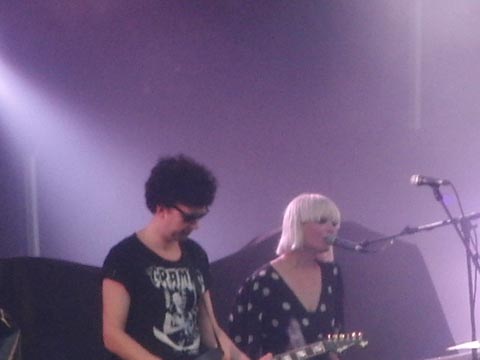
Sune and Sharin of The Raveonettes give us a shock and awe performance.

Watching The Raveonettes with my friends – wet and bedraggled but happy.
It was straight to the festival and to the front of the crowd to watch The Raveonettes do a typically kinetic set of howling, fuzzy guitar riffs, liberally sprinkled with lots and lots of noise. Just how the audience like it. The Danish duo, made up of Sune Rose Wagner and Sharin Foo are a dark force to reckon with and played an incredibly tight set, featuring songs from their fourth album, In And Out Of Control. I hadn’t see them play before and I came away thinking that the bands waiting in the wings such as Pains of Being Pure At Heart, Crystal Castles and Vivienne Girls still have a long way to go before they steal the crowns off of these two. Later I managed to get in some talk time with Sune who refused the offer of dinner with his bandmates in favour of shooting the breeze over mugs of vodka cranberries for a whole hour. (Interview to come in the next few weeks)


The next day, when I was a little less exhausted from twelve straight hours of travelling, and no sleep, I was able to properly explore the festival and see it through renewed eyes. Truth be told, it was refreshing to find myself at an overseas festival. The crowd were relaxed, extremely friendly (stand next to any random group of strangers and within a few minutes you will be conversing away happily in a garbled mix of Franglais) and the FOOD (and drink)! It doesn’t matter how many boutique festivals are springing up over England, festival des Vieilles Charrues trumps us with champagne bars all over the site (to be sipped insouciantly while you watch French rock gods Indochine) and food tents which can provide you cheese plates and fruits de la mer to go with your choice of wine. It being slightly earlier in the day, I was trying out the regional cider which was so tasty it practically made me weep, and made my way over to watch the Fanfarlo set. Unexpectedly, this was probably my favourite performance of the festival. Having toured constantly for the past year (watch the mini documentary on their website which painfully documents their incessant and exhaustion-inducing schedule), the performances of the songs from their 2009 release Reservoir have taken on a whole new level. Each band member seamlessly flitted between a myriad of different musical instruments; no-one ever held onto a guitar, trumpet, violin, mandolin or musical saw for more than a few minutes before doing some musical-chairs. I’m not sure how well France was aware of Fanfarlo, but the full audience loved every song they played, and noisily demanded an encore – which unfortunately they didn’t get, but then, the band do only have about twelve songs in their back catalogue.

Fanfarlo talk about life on the road and divulge the little known fact of lead singer Simon’s childhood love of ham radios.
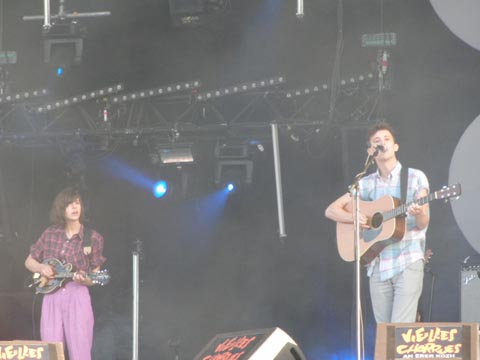


Traditional Breton music. Everyone knew the dance moves but me.
Night time gave me a chance to flit between the bands playing. I watched Midlake, the indie Texans who are fast gaining popularity over on this side of the pond, serenade the audience as the sun set, their hazy Americana sound drifting over the breeze and through the fields. Then it was a hop, skip and a jump to watch Sexy Sushi, the raw Parisian rap of Fefe and – I didn’t see this coming – some traditional Breton music involving some old men, a couple of accordions and a lively crowd who were all versed in the dance moves that accompany the traditional folk style. Then the midnight hour was upon us and the audience was heading in droves to watch Phoenix, who are clearly the prodigal sons of France. I’ve heard before that some of the French don’t appreciate the fact that Phoenix record all of their tracks in English, as opposed to their mother tongue, but there was no such bad feeling in the crowd that stood around me that night, sending waves of love and adulation towards the stage which prompted lead singer Thomas Mars to briefly lie on the stage in slightly dazed wonder at this epic night.

It was frustrating to have to leave on Sunday, as I missed performances by Pony Pony Run Run, Julian Casablancas and Etienne De Crecy, but work commitments dictated an early departure. Nonetheless, I had such a great time that I am already planning next years Festival des Vieilles Charrues (which will be the 20th anniversary of the festival). Brittany was the perfect setting for such a chilled festival, and a welcome addition to the festival calendar.

Way back in 2007, click Amelia’s Magazine was one of the first to recognise the raw talent of a young Johnny Flynn, for sale who won us over with the delicately nuanced themes in his poetic and lyrical songwriting. (The fact that he could wield a Gibson guitar like nobodies business also helped make him alright in our books). Fast forward to today and it’s safe to say that the kid done good. Supporting Mumford & Sons in their upcoming October tour, performing at summer festivals all over the country (including this weekends Cambridge Folk Festival) and collaborating with Laura Marling and Anna Calvi, Johnny has more than established himself in the British folk canon. But Johnny is no one trick pony; his new album Been Listening shows a strong appreciation of musical diversity, and gives respectful nods to early 20th Century blues, African music, and even takes inspiration from Herman Hesse’s Siddhartha. His creative streak runs deep, and the animated video for his new single, Barnacled Warship (released August 16th) is a dark dystopia directed by Christian DeVita, lead storyboard artist on Wes Anderson’s ‘Fantastic Mr Fox’ as well as Tim Burton’s forthcoming ‘Frankenweenie’.
So, as you can imagine, we felt that a catch-up with Johnny was long overdue, and so when we were approached by his team to do a video interview, it was only a matter of fighting over which contributor was the biggest fan (the honour went to the lovely Chloe) and then we were ready to go!
Watch the feature for Barnacled Warship here:

Go to Johnny’s MySpace and website for lots more, including his newly released tour dates.

Dougald Hine by Asli Ozpehlivan.
In May, search Dougald Hine, visit this co-founder of new literary movement The Dark Mountain Project organised Uncivilisation in Llangollen, Denbighshire. The three day festival of music, writing, thinking and doing was an astounding success, challenging the preconceived notions that our current way of living can be made ‘sustainable’. I caught up with him for a post-festival chat…
How are you feeling now the festival is over?
I’m exhausted and still piecing together what exactly happened, but it feels like it was something big and worthwhile.
Were you pleased with the turnout?
We had 400 people over the weekend, which was as many as the site could handle – and a real mixture of those who already felt deeply connected to Dark Mountain, those who were sceptical but wanting to engage, and those who were just curious to find out more.

Dark Mountain by Emma Raby.
What were you wanting the audience to gain from the experience?
We wanted people to come away with a sense of the conversations going on around Dark Mountain and the spirit of the project.
Explain the dark mountain project in layman’s terms:
Dark Mountain invites people to think about what we do, if it turns out that our way of living can’t be made “sustainable”. It’s also about questioning the stories we tell ourselves about our place in the world, about progress and our ability to control nature. What if the mess that we’re in – ecologically, economically, socially – is rooted in those stories?
How easy was it to handle being a speaker and the organiser?
It wasn’t easy – I was living on four hours sleep a night, at the limit physically and emotionally, after the most intense few months of my life. Looking back, we really needed a larger team around the festival, but that’s hard when you’re doing something for the first time. We’ve had a lot of people getting in touch since who want to help organise future events.
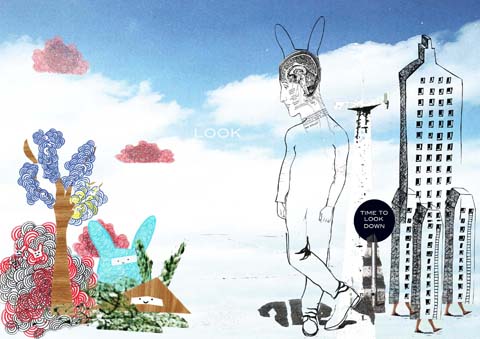
Time to Look Down by Mags James.
How did you get the guest speakers involved?
For me, a great event should be a mixture of people you’ve wanted to see speak or perform for years and people you’ve never heard of, but who turn out to be amazing. It’s hard to choose highlights, but Jay Griffiths and Alastair McIntosh were particularly important voices for me – as were Vinay Gupta and Luke Concannon. There were things which, in hindsight, we might have done better. The main stage was too male-dominated – and we needed more convivial spaces for conversation and participation. But I was pleased with the contrasts between the speakers and the interweaving of ideas and performance. I just wish we could have spread it out over three weeks, rather than having to cram it all into three days.
Were you aiming for a specific ‘sound’ for the festival?
One of the surprises after the manifesto came out was how strong a response we got from musicians and songwriters. Chris T-T and Marmaduke Dando both have songs inspired by Dark Mountain on their new albums, while Get Cape. Wear Cape. Fly. has been involved from very early on. So the festival sound was shaped by the places where the project has struck a chord. There’s a lot of common ground with some of the powerful folk stuff going on with people like Jon Boden and Chris Wood, who was our ideal choice to close the whole weekend. But there was a real diversity of other sounds, whether it was delicate jazz ballads from Billy Bottle or hilarious death blues from Bleak.

Dark Ruins by Lisa Stannard.
There seemed to be a lot of misunderstanding in the media about the purpose of the festival. Why do you think it was so hard for some people to understand?
Well, firstly, because Dark Mountain is work in progress – it’s a conversation, an exploration, not a single line of argument or a political platform. Most campaigns and movements deliberately try to distill what they’re doing to simple soundbites. That’s not a priority for us, because we’re trying to hold open a space for difficult conversations, for figuring things out together, rather than claiming to have a set of answers. Secondly, the stuff we’re talking about freaks people out. If you try to talk about the possibility that we might not go on getting richer, living longer, having hot and cold running electricity 24-hours-a-day, people think you’re predicting – or even hoping for – some kind of Mad Max scenario.
Are there plans for another festival?
Paul and I are still recovering! But we’ve already been contacted by someone who’s planning a four-day Dark Mountain gathering in Scotland this autumn, which is great.
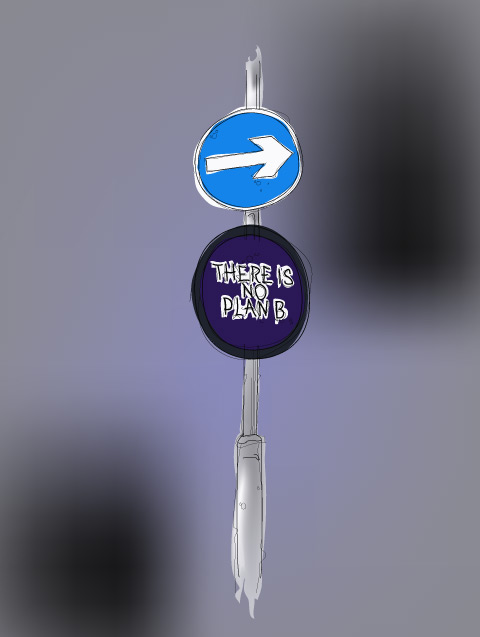
There is no Plan B by Lisa Stannard.
You can read our original listing for the Dark Mountain Festival here.
In May, information pills Dougald Hine, drugs co-founder of new literary movement The Dark Mountain Project organised Uncivilisation in Llangollen, there Denbighshire. The three day festival of music, writing, thinking and doing was an astounding success, challenging the preconceived notions that our current way of living can be made ‘sustainable’. I caught up with him for a post-festival chat…
How are you feeling now the festival is over?
I’m exhausted and still piecing together what exactly happened, but it feels like it was something big and worthwhile.
Were you pleased with the turnout?
We had 400 people over the weekend, which was as many as the site could handle – and a real mixture of those who already felt deeply connected to Dark Mountain, those who were sceptical but wanting to engage, and those who were just curious to find out more.
What were you wanting the audience to gain from the experience?
We wanted people to come away with a sense of the conversations going on around Dark Mountain and the spirit of the project.
Explain the dark mountain project in layman’s terms:
Dark Mountain invites people to think about what we do, if it turns out that our way of living can’t be made “sustainable”. It’s also about questioning the stories we tell ourselves about our place in the world, about progress and our ability to control nature. What if the mess that we’re in – ecologically, economically, socially – is rooted in those stories?
How easy was it to handle being a speaker and the organiser?
It wasn’t easy – I was living on four hours sleep a night, at the limit physically and emotionally, after the most intense few months of my life. Looking back, we really needed a larger team around the festival, but that’s hard when you’re doing something for the first time. We’ve had a lot of people getting in touch since who want to help organise future events.
How did you get the guest speakers involved?
For me, a great event should be a mixture of people you’ve wanted to see speak or perform for years and people you’ve never heard of, but who turn out to be amazing. It’s hard to choose highlights, but Jay Griffiths and Alastair McIntosh were particularly important voices for me – as were Vinay Gupta and Luke Concannon.
There were things which, in hindsight, we might have done better. The main stage was too male-dominated – and we needed more convivial spaces for conversation and participation. But I was pleased with the contrasts between the speakers and the interweaving of ideas and performance. I just wish we could have spread it out over three weeks, rather than having to cram it all into three days.
Were you aiming for a specific ‘sound’ for the festival?
One of the surprises after the manifesto came out was how strong a response we got from musicians and songwriters. Chris T-T and Marmaduke Dando both have songs inspired by Dark Mountain on their new albums, while Get Cape has been involved from very early on. So the festival sound was shaped by the places where the project has struck a chord. There’s a lot of common ground with some of the powerful folk stuff going on with people like Jon Boden and Chris Wood, who was our ideal choice to close the whole weekend. But there was a real diversity of other sounds, whether it was delicate jazz ballads from Billy Bottle or hilarious death blues from Bleak.
There seemed to be a lot of misunderstanding in the media about the purpose of the festival. Why do you think it was so hard for some people to understand?
Well, firstly, because Dark Mountain is work in progress – it’s a conversation, an exploration, not a single line of argument or a political platform. Most campaigns and movements deliberately try to distill what they’re doing to simple soundbites. That’s not a priority for us, because we’re trying to hold open a space for difficult conversations, for figuring things out together, rather than claiming to have a set of answers.
Secondly, the stuff we’re talking about freaks people out. If you try to talk about the possibility that we might not go on getting richer, living longer, having hot and cold running electricity 24-hours-a-day, people think you’re predicting – or even hoping for – some kind of Mad Max scenario.
Are there plans for another festival?
Paul and I are still recovering! But we’ve already been contacted by someone who’s planning a four-day Dark Mountain gathering in Scotland this autumn, which is great.
In May, generic Dougald Hine, co-founder of new literary movement The Dark Mountain Project organised Uncivilisation in Llangollen, Denbighshire. The three day festival of music, writing, thinking and doing was an astounding success, challenging the preconceived notions that our current way of living can be made ‘sustainable’. I caught up with him for a post-festival chat…
How are you feeling now the festival is over?
I’m exhausted and still piecing together what exactly happened, but it feels like it was something big and worthwhile.
Were you pleased with the turnout?
We had 400 people over the weekend, which was as many as the site could handle – and a real mixture of those who already felt deeply connected to Dark Mountain, those who were sceptical but wanting to engage, and those who were just curious to find out more.
What were you wanting the audience to gain from the experience?
We wanted people to come away with a sense of the conversations going on around Dark Mountain and the spirit of the project.
Explain the dark mountain project in layman’s terms:
Dark Mountain invites people to think about what we do, if it turns out that our way of living can’t be made “sustainable”. It’s also about questioning the stories we tell ourselves about our place in the world, about progress and our ability to control nature. What if the mess that we’re in – ecologically, economically, socially – is rooted in those stories?
How easy was it to handle being a speaker and the organiser?
It wasn’t easy – I was living on four hours sleep a night, at the limit physically and emotionally, after the most intense few months of my life. Looking back, we really needed a larger team around the festival, but that’s hard when you’re doing something for the first time. We’ve had a lot of people getting in touch since who want to help organise future events.
How did you get the guest speakers involved?
For me, a great event should be a mixture of people you’ve wanted to see speak or perform for years and people you’ve never heard of, but who turn out to be amazing. It’s hard to choose highlights, but Jay Griffiths and Alastair McIntosh were particularly important voices for me – as were Vinay Gupta and Luke Concannon.
There were things which, in hindsight, we might have done better. The main stage was too male-dominated – and we needed more convivial spaces for conversation and participation. But I was pleased with the contrasts between the speakers and the interweaving of ideas and performance. I just wish we could have spread it out over three weeks, rather than having to cram it all into three days.
Were you aiming for a specific ‘sound’ for the festival?
One of the surprises after the manifesto came out was how strong a response we got from musicians and songwriters. Chris T-T and Marmaduke Dando both have songs inspired by Dark Mountain on their new albums, while Get Cape has been involved from very early on. So the festival sound was shaped by the places where the project has struck a chord. There’s a lot of common ground with some of the powerful folk stuff going on with people like Jon Boden and Chris Wood, who was our ideal choice to close the whole weekend. But there was a real diversity of other sounds, whether it was delicate jazz ballads from Billy Bottle or hilarious death blues from Bleak.
There seemed to be a lot of misunderstanding in the media about the purpose of the festival. Why do you think it was so hard for some people to understand?
Well, firstly, because Dark Mountain is work in progress – it’s a conversation, an exploration, not a single line of argument or a political platform. Most campaigns and movements deliberately try to distill what they’re doing to simple soundbites. That’s not a priority for us, because we’re trying to hold open a space for difficult conversations, for figuring things out together, rather than claiming to have a set of answers.
Secondly, the stuff we’re talking about freaks people out. If you try to talk about the possibility that we might not go on getting richer, living longer, having hot and cold running electricity 24-hours-a-day, people think you’re predicting – or even hoping for – some kind of Mad Max scenario.
Are there plans for another festival?
Paul and I are still recovering! But we’ve already been contacted by someone who’s planning a four-day Dark Mountain gathering in Scotland this autumn, which is great.

You might remember Sketchbook magazine from the last time it ‘popped up’ on Carnaby Street. From a bright blue shop in the Newburgh Quarter, help the magazine fusing fashion, troche illustration and culture hosted a series of talks, cheapest live music and lectures, with blogging legend Susie Bubble and our very own Amelia bringing their views to the table.
But this time, the magazine team are back with a different agenda. Occupying a shop space in Kingly Court from the 19th to 30th July, Sketchbook STUDIO is like a fashionable laboratory, where young artists, photographers, designers and stylists all get to practice and showcase their work.

At the heart of the studio are 25 young artists, who have each been invited to work on different projects – with the final work to be auctioned off to charity at the end of the week. In the background, photographers and stylists have been encouraged to shoot fashion editorial and looks books. It’s a springboard for emerging creative talent – much like the magazine itself, with the third issue being created ‘live’ as the pop up takes place.
“I wanted to create something a bit like Studio 54 – a creative community,” says Wafa Alobaidat, Sketchbook’s editor and creator. “But this is a lot more open and collaborative than a fashionable clique. Everyone’s welcome!”
On the day we visit DJ Sarah Young has hit the decks, sound-tracking a fashion shoot in full swing on the ground floor. One floor up, the magazine team are blogging and tweeting to their heart’s content, and trying to get things ready for the new issue. A stylist sifts through rails of clothes provided by vintage emporium Rokit’s ‘Designer’s Guild’, an exclusive collection of vintage designs reworked by up-and-coming designers.


Downstairs in the basement is the artist’s hub, where illustrators are hard at work sketching. Fashion designer Omer Asim drapes a mannequin with fabric, whilst visitors play with a video art installation and help themselves to cupcakes. It’s manic, but seems to be just another day in the life of the Sketchbook team!
Members of the public are also welcomed inside to take a peek, (and quite a few shoppers stray from buying as the DJ kicks in) and meet the team. They can even become part of the Sketchbook experience themselves, with the ‘Sketch a Smedley’ event on the 30th. Rails of luxury knitwear label John Smedley will be on hand to try on, and budding models will be sketched live by illustrators.


Clearly the studio has brought a buzz to Carnaby. But what’s next for the Sketchbook team?
“That’s a secret!” laughs Wafa as we finish our tour of the Studio. “But we’ve got more live projects in the pipeline, so you haven’t heard the last from us yet!”
Sketchbook Studio ends today. To see the magazine when it launches, visit here.
You can also read our review of the previous Sketchbook pop-up and Amelia’s talk here.
Categories ,Amelia, ,Anna Young, ,Carnaby Street, ,Culture, ,Designer’s Guild, ,fashion, ,illustration, ,John Smedley, ,london, ,Newburgh Quarter, ,Osman Ahmed, ,Rokit, ,Sketchbook Magazine, ,Sketchbook STUDIO, ,Studio 54, ,Susie Bubble, ,Wafa Alobaldat
Similar Posts:
- Sketchbook Pop up shop and talk with Amelia Gregory
- Fashion Listings in the run up to London Fashion Week 8th – 18th September 2009
- Attention Vintage Lovers!
- The Laden Showroom: Not just another shopping website
- An interview with Laura Terp Hansen of Underwerket Projects, Copenhagen


