Amelia’s Magazine | Elizabeth Johnson. An Interview with a Photographer

999 it’s time, sildenafil erectile is another green focused campaign. As the website notes “We are in a state of emergency – socially, store economically and ecologically. What do we do in an emergency? In the UK, viagra 100mg we dial 999…” Well that all sounds pretty heartening until you realise that the 999 campaigns reaction to this emergency hasn’t exactly been particularly speedy so far. I can’t help feeling that the climate emergency we are facing means groups should be advocating some real direct action rather than just planting a tree or joining the 10:10 movement. However the campaign has some great initiatives to get the ball rolling and hopefully get more people thinking about the global crisis.

suzyillustration1%20copy.jpg
All illustrations by Suzy Phillips

Of course the campaign does have some credibility, it encourages people to get more environmentally friendly, and behind the celebrity endorsements 999 has some forward thinking ideas about how communities in particular can work together to create a more sustainable world. Transforming rural and urban spaces into shared land to grow food has been one of the most successful elements. Capital Growth is the place to start with a great run through of the process and steps and how to get involved. Land sharing empowers people by growing their own food and creating stronger links in communities as well as reducing the reliance on supermarkets. A definite step in the right direction.

suzyillustration2%20copy.jpg

I caught up with Hugh Fearnley-Whittingstall, the rural country celebrity chef, to talk about his part in the 999 campaign.

Can you outline what 999′s main priority is about and why you’re here today?

999 is about driving home the issue of climate change and what we ourselves can do to combat the emergency situation we have found ourselves in. I’ve come today because our aim ties in with the Climate Rush campaign, and its a great way to get talking with the local community, and of course it’s the 9th of the 9th 09.

How is the 999 campaign coming along? It doesn’t seemed to have gained as much prominence in the press such as campaigns like the recent 10:10?

It’s an on-going process, im specifically been looking at the food aspect, and as the ambassador I’m really interested in what small scale communities can do to combat the threat of climate change.

Can you please give some examples of the message your trying to get across in relation to the food aspect of the campaign?

With my books and TV series I’ve been highlighting the importance of locally grown produce and recently I’ve been pushing the idea of land sharing. The idea is to find land, whether in urban or rural spaces where people can grow their own food, there is so much land wasted around the UK that can be used. With over a thousand people on waiting lists for allotments especially in the south, it is vital we utilize all the land we can instead of relying on foreign markets for our vegetables. Food is a great way to create a cohesive community and bring people together.

suzyillustration3%20copy.jpg

How is the land sharing campaign going, have you had much success?

We’ve had over a thousand land plots given to us and up to 30,000 people signing up to the website, so it’s defiantly getting people interested. The campaign is also working with groups like the Church of England and a range of British NGOs. The National Trust for example has just given us 1000 plots of land, so although it’s quite a slow process, there’s been a real positive reaction across the country.

With your interest in climate change, have the facts about the meat industry’s huge carbon footprint persuaded you to become vegetarian yet?

No, not yet, I’m aware of the issues, and I keep by own pigs and livestock, and always advocate buying locally soured meat to keep the carbon footprint low.

So let’s hope this campaign can help to stop this emergency from escalating, with 1 day, 11 hours, 9 minutes since 999 Day, the pressure is on.
marc%20owens%20avatar%20machine.jpg

Designers in Residence @ the Design Museum
September 18 – October 31

The Design Museum’s annual exhibition of young designers begins on September 18 with site-specific works from Marc Owens and Dave Bowker. Owens is inspired by virtual realities – his work Avatar Machine replicates video gaming via a headset (above), order designed to make the wearer see themselves as a virtual character in the real world. Bowker works in data visualisation and will be re-examining the way visitors move about the Museum.

dr%20johnson%27s%20house.jpg

Open House weekend

Once a year thousands of London’s most interesting and historic buildings are opened to the public, sale some of which are locked up tight for the rest of the year. Although some of the most popular buildings in the centre of London have already been completely booked, drugs there are still plenty of places worth visiting.

If you haven’t got your eye on anything in your local area, consider visiting the house of Dr Samuel Johnson, of “the dictionary” fame. It’s free to visit on Friday (there will be free cake on this day) and Saturday, in honour of the great man’s birthday.

Radical_Nature.jpg

Radical Nature

This exhibition of works revolving around nature and inspired by environmentalism features pieces from architect Richard Buckminster Fuller and artists such as Joseph Beuys and Hans Haacke, as well as newer names such as Heath and Ivan Morrison and Simon Starling. Impactful and timely, there are lots of strong visual statements such as the Fallen Forest by Henrik Håkansson (above) and a visual record of the fields of wheat planted as an act of protest on a landfill site in Manhattan.

night%20carnival%202.jpg

Thames Festival

Sunday

One of the few fireworks displays allowed along the Thames will occur on Sunday when the Thames Festival fireworks are set off in all their glory, fired from barges between Blackfriars and Waterloo Bridge so everyone can get a perfect view. There are also events all day, including fire-eaters, an outdoor ballroom (starting to become the South Bank’s speciality) and the annual Night Carnival, where 2,000 costumed revellers bearing lanterns and luminous costumes will welcome the pyrotechnics.
Another load of talks, healing workshops and activities to get stuck into, information pills don’t forget Co-Mutiny is still on all this week in Bristol, Climate Rush are still on tour, and also make sure you get down to protest against the closure of the Vestas Wind Turbine factory this Thursday. Good luck with fitting it all in, I’m certainly going to struggle!

earth01.jpg
Illustrations by Emma Hanquist

Cambridge Climate Conference
Monday 14 Sep 2009 to Tuesday 15 Sep 2009 ?

An exciting event has been organised with international speakers and delegates involved in policy-making, business, and academia. Understanding the role of climate change policy is central to a business’s future success. Topics will include the political, economical, technological, and legal challenges and solutions for decarbonising electricity.
To register for a discounted ticket visit the website and enter ‘ge2009′ as the discount code.

Time: 9am-5pm
Venue: Churchill College, Cambridge, UK
Website: www.cambridgeclimate.com/

A Global New Deal needs a Green New Protectionism
Wednesday 16 Sep 2009 ?

An evening to learn and discuss the ‘triple crunch’ that we face: climate change, energy insecurity, and financial and economic meltdown. Colin Hines, Author and convener of the Green New Deal Group will be leading the talks. Colin has worked in the environmental movement for over 30 years including 10 years at Greenpeace. His recent work focuses on the adverse environmental and social effects of international trade and the need to solve these problems by replacing globalisation with localisation. During the evening there will also be a tribute to ‘Teddy’ Goldsmith, founder of The Ecologist magazine.

Time: 6.30pm drinks and food, 7.30pm talk begins at Burgh House
Venue: Gaia House, 18 Well Walk, Hampstead
Contacts: To book email, book online or call 0207 428 0054.
Website: www.gaiafoundation.org

Protest against the closure of Vestas Wind Turbine Factory
Thursday 17 Sep 2009 ?

As well as the continuing protest against the closure of the Vestas Wind Turbine factory at the Isle of Wight, there will also be a chance for people to make their feelings known across the country. People are meeting at the Department of Energy and Climate Change in London to lobby against the government. There will also be speakers including John Mcdonnel, MP (Labour, Hayes and Harlington) and Tracy Edwards (Young Members Organiser for the Public and Commercial Services Union).
Couldn’t put it better than Phil Thornhill from the Campaign against Climate Change “Just when we need a huge expansion in renewable energy they are closing down the only significant wind turbine factory in the UK. The government has spent billions bailing out the banks, and £2.3 billion in loan guarantees to support the UK car industry – they can and should step in to save the infrastructure we are really going to need prevent a climate catastrophe.
Whilst the impact on employment on the Isle of Wight will be quite devastating, this is an issue not just about jobs or one factory but about whether the government is really going to match up its actions to its rhetoric on green jobs and the rapid decarbonisation of the British economy – whether its prepared to act with the kind of resolution and energy we need to cope with the Climate Emergency”.

Time: 5.30 to 6.30pm
Venue: Outside the Department of Energy and Climate Change, 3 Whitehall Place.
?Website: www.campaigncc.org

earth02.jpg

Out of the Ordinary Festival
Friday 18 Sep 2009 to Sunday 20 Sep 2009
?
OOTO is a 3 day family friendly and eco friendly festival set in the beautiful Sussex countryside celebrating the Autumn Equinox. Featuring a variety of live music powered by solar panels and wind generators, fascinating talks and workshops, children’s activities, awesome performances, a green market place and many more out of the ordinary surprises. The festival is also offering Big Green Gathering ticket holders a discount for the event held over the weekend
Venue: Knockhatch Farm, Hailsham, East Sussex
?
Website: www.outoftheordinaryfestival.com

Tree-Athlon
Saturday 19th September

Get fit and get your very own tree sapling to take home! Participants run a 5km race to raise money for Trees for Cities, an independent environmental charity working with local communities on tree planting projects. There is also music, entertainment, lots of tree-themed activities, whatever that may consist of, and plenty of other workshops to keep the whole family entertained.
The race is open to runners aged 14 and up and is ideal for beginners or experienced runners alike. Register now, to make sure you can raise as much sponsorship as possible before the day, and look forward to a grand day out.

Time: 9am-3pm
Venue: Battersea Park
Website: www.tree-athlon.org

earth03.jpg

The Urban Green Fair ?
Sunday 20th September

?The Urban Green Fair is held in Brockwell Park in London this Sunday, Its a free event and with plenty to do and see, the fair is also powered by solar and wind energy.
The annual family event, has a range of films, talks, workshops, kids activities, stalls, sunshine as well as some unusual bicycles. Unfortunatly no bars or big stages but this keeps the emphasis on education and communication. A chance to share ideas, meet familiar faces and make new friends. With little government action on peak oil and climate change there is plenty to discuss and lots we can do as individuals. ?

Time:11am-7pm
?Venue: Brockwell Park, Lambeth
Website: http://www.urbangreenfair.org/

Leytonstone Car Free Day
Sunday 20th September

Leytonstone Town Centre will car free day this Sunday. As well as having no vehicles hurtling around there will also be entertainment, stalls, live music, dancing, public art and childrens’ play areas. Simon Webbe from Blue and Aswad will be headlining! Get yourself down, and make sure you leave the car(if you’ve got one) at home.
Time: 1pm-7pm
Venue: Outside Leyonstone tube station
Website: www.walthamforest.gov.uk

Co-mutiny
Saturday 12th of September until Monday 21st September

A coming together of activists, eco-warriors gardeners, artists, community/political groups, cooks, builders etc. to demonstrate our creative power to build a city/world we would like to see. Co-Mutineers have taken an old cathedral (of the holy apostles) near the Triangle in the Clifton/Hotwells area, it’s a space to converge, eat, sleep meet and discuss, plan and skill-share!
There will be over a week of different activities, direct actions, workshops, film screenings, public demonstrations and parties. It’s happening all across Bristol and the wider South West.

co-mutiny.jpg

During the week there will be actions happening all across the city, which will climax in a fancy dress carnival through the financial district of Bristol on the Friday.
Venue: Bristol Pro Cathedral, Park Place, BS8 1JW
Website: http://comutiny.wordpress.com/
Monday 14th September
William Elliott Whitmore
The Garage, order London

WilliamElliotWhitmore.jpg

We can’t get enough of this distilled, medications gravelly bluesman. With Whitmore, it’s almost like you’re listening from inside a huge bottle of JD.

Tuesday 15th September
We Have Band
ICA, London

we_have_band.jpg

This trio spin the grooves of Talking Heads via a stop off and natter with Hot Chip, it’ll make you jive and smile.

Wednesday 16th September
Beth Jeans Houghton
Rough Trade East, London

BethJeansBroughton.jpg

Having supported folk heavy weights, Tunng, Bon Iver, and King Creosote, this ballsy 19 year old manages to blend the vocal lustre of Nico and Laura Marling whilst having an edgy stage presence more like Gwen Stefani. Beguiling.

Thursday 17th September
Alela and Laura Gibson
Shepherds Bush Empire, London

Alela%20Diane_Hair2.jpg

We chatted to Alela recently and she was as lovely as her music. Gibson toes a similar line of enchanting bluesy folk airs.

Friday 18th September
Metronomy, Male Bonding, Your Twenties and Drums Of Death
The Forum, London

metronomy6.jpg

We’re particularly keen on the immaculate indie-pop of Your Twenties after meeting the lovely ex-Metronomy frontman. Nice to see they’re still close.

Saturday 19th September
Tom Paley and Birdengine
The Deptford Arms, London

birdengine.jpg

A traditional folk night in a scuzzy South-East London boozer. You want more reason that that? Well living legend, Tom Paley who played with Woodie Guthrie back in the day and enchantingly odd, Birdengine are two big ones.

Sunday 20th September
Viv Albertine and Get Back Guinozzi!
The Windmill, London

slits7.jpg

The Slits guitarist has picked up a guitar again after a 25 year sabbatical and come up trumps with punk rock outfit, Albertine.


Monday 14th


Rankin at The Truman Brewery

It’s the last chance to see Rankin’s retrospective in Brick Lane this week. The exhibition moves through Rankin at university exploring the well worn art student quest to find a sense of self to portraying the plight of the Congo. After this introduction the exhibition opens onto his best know fashion, website erotic and beauty editorials. Featuring Kate, Hedi, Tilda Swinton and the Dame of British Fashion, Vivienne Westwood to name a few. Rankin’s strongest work comes through in the portraits where he has assumed a sense of a relationship with the sitter, tweaking out their quirks through the movement of an eyebrow, eye or twitch of the lips or neck. Throughout the exhibition Rankin moved his studio into the space to continue photographing the public portraits. A portion of everyone’s fee goes to support Oxfam’s to work in the Congo.
Until the 18th September.

Westwoodrankin.jpg

Tuesday

START KNITTING with prick your finger!

Recent years have seen a rise in designers revisiting craft techniques, with knitting proving to be especially popular with a range of creatives from Louise Goldin to Mark Fast. Last week Amelia’s Magazine participated in a Prick Your Finger discussion on the use and sourcing of local ethical wool and the continuing rise in the popularity of knitting.Join on a Tuesday 7-9 for beginners classes with all your knitting woes and joys.

Happy%20Howies%20knitters.jpg


Thursday

Fashion Diversity at The Museum of London

The Museum of London is staging a three day fashion diversity event during London Fashion Week. On Thursday the museum hosts a range of workshops from a discussion of the development of sustainable fashion by CHOOLIPS, to a Moving Passion to Profit workshop in association with the MOORDESIGN salon finishing with the importance of branding. Colour Production, addressing how companies interact with their audience visually. Finally 7-16 year olds are giving the opportunity to unlock their creativity in a fashion drawing workshop teaching concentration, communication and dexterity.

Friday and Saturday host the fashion diversity catwalks: Emerging, Established and Honorary designers at 1pm or 3pm Friday and 1pm on Saturday, places are free. Honorary designers Junky Styling and Nico Didonna also present pieces for the runway.

To conclude Saturday’s event, at 3pm student and graduate designers from schools and colleges across London showcase designs inspired by 18th century pleasure gardens and related costumes from from the Museum of London’s archives.

junky-stylings.jpg

SHOWstudio : Fashion Revolution

Unable to go to Fashion Week? Fear not! As mentioned last week, the Fashion Revolution exhibition opens at Somerset House. The exhibition curated by Showstudio celebrates nine years of Showstudio.com. The website established by Nick Knight has pushed and developed the idea of communicating fashion ‘live’ through films, online live interviews and streamed performances involving photographers, models, stylists graphic designers and cultural figures to create ethereal fashion portraiture and communication through body and style. New fashion films have been commissioned to accompany the exhibition, alongside a live photographic studio that gives the viewer the opportunity to see the whimsical world of fashion in play.

showstudiorevolution.jpg

Saturday 19th


GIANT VINTAGE SALE

This just dropped into the inbox – The East End thrift store are inviting all budding clothing DIY’ers to come down to the store and fill a bag with all that you can for ten or twenty pounds. Open Saturday to Sunday from 10-7pm.

eastendthift.jpg

The National Portrait Gallery

The National Portrait Gallery celebrates the icon of 60′s British Fashion photography, Twiggy. Dedicating a room to the most iconic images created with her image by a range of photographers from Richard Avedon to Solve Sundsbo. The exhibition coincides with a publication of a new book: Twiggy : A life in photography. This exhibition is a must for anyone interested in the relationship between sitter and photography in fashion portraiture.

twiggynationalportrait.jpg

Roll up Roll up and take part in Covent Garden’s fashion fete

Pull the fashion rope, roll around in dressing up boxes courtesy of Costume Boutique. Jump up and Down for the tombola, be styled by Super Super Magazine, scouted by models 1 or preview some of the hottest new design talent with the Fashion and Textiles museum.
Moreover TRAID are holding a stitching workshop on how to transform old clothes into new designs as demonstrated by their remade range.

coventgardenfashionfete.jpg

The London Vegan Festival this year took place in Kensington Town Hall, ask and was absolutely heaving. Usually, store the odds of bumping into another vegan are slightly higher than those of two Esperanto speakers meeting, so hanging out in a hall packed full of them was a new experience – as was not having to ask ‘Is there dairy in this?’ at every food stall. Bliss.

veg1.jpg

Almost as soon as someone mentions becoming vegan, people start to get a panicked look on their faces and tend to begin listing reasons why they couldn’t possibly give up cheese. The general consensus is that a vegan diet is deprived and difficult. Just a quick glance over these photos ought to give anyone with that mindset pause for thought.
Never-mind having never been in a room with so many vegans before, I’d never been in a room filled with so much vegan cake! I ate my way around the festival, starting with a deliciously gooey chocolate brownie, discovered vegan crème eggs half-way round, swung by the Conscious Chocolate stall for my free samples and a bar of Choca Mocha Magic, then hung out with Redwoods comparing the Lincolnshire sausages to the hot dogs. (Hawt dawgs won, hands done.) Veggies provided me with some real food, in the form of a massive Cheezley burger, giving me the energy I needed to head to some of the talks.

Veg3.jpg

Being vegan isn’t all about the food (though, let’s be honest. It is mostly about the food) and there was a wealth of information at the Festival ranging from talks on vegan nutrition (okay, food again), taking action against animal testing and extreme vegan sports (like regular extreme sports, but partaken of by vegans. Not like preparing scrambled tofu at 30,000 feet. Though, that would be something I would pay to see) to stalls run by the Secret Society of Vegans, animal rights groups and Active Distribution – a bookstall filled with vegan recipe books and anarchist ‘zines. There was information relevant to every level of vegan interest; aspiring, political, dietary…
There was plenty of entertainment too, in the form of magicians, musicians and comedians. (Never let it be said that vegans are without a sense of humour.) I saw Andrew O’Neill, a vegan comedian, who has recently come off the Fringe and was hilarious. Wibbling between whimsical and cruel, from the ‘scat-nav’ to “Kill a Fascist for Grandad” in replacement of the current “Hope not Hate” campaign, he had me laughing from start to finish.

veg2.jpg

So, why vegan? We already have McCartney pushing for Meat-Free Mondays, do we really need Dairy-Free Days of the Week as well? I’m on the ‘Yes’ side for that one. Going vegan reduces support for the livestock industry down to zero, on a personal level. (Y’know the livestock industry I’m talking about. The one helping out with Climate Change by about 18%.) If you’re serious about wanting to reduce your environmental impact on the Earth and already cycle everywhere, reuse and recycle, turn your taps off when brushing your teeth, then this is the next step in armchair activism. You don’t need to head up to London to protest, or write letters to your MP. Just start buying dairy-free marge approved by the Vegan society, switch to dark chocolate instead of the sugar-filled sweet stuff, experiment with vegan recipes (hundreds of which are on-line) and have fun doing so. Going vegan isn’t scary or hard, but it is inconvenient. Learning to live without dairy, however, is going to be a lot less inconvenient than learning to live without our planet’s natural resources. If you need any more persuading, I make the most delicious vegan cookies. Drop me a line, and I’ll be sure to hook you up.
Neal%20Fox.jpg

2000 Light Years from Home, physician Neal Fox’s second exhibition, prostate opened at Gallery Daniel Blau in Munich this weekend.

A founder member of the infamous Le Gun collective and a character on the debaucherously creative Soho scene, Neal Fox’s reputation just grows and grows. His pen and ink drawings light up the pages of the Guardian and Dazed and Confused, whilst the Le Gun group shows are always packed to bursting on opening nights, providing the London art world with a much needed buzz of youthful excitement. Each picture features Neal’s grandfather Jonny Watson, by whom he was taken on drinking binges with the hedonist iconoclasts of our age. In this latest show he is taken on a doomsday rock and roll trip and psychedelic journey down the Nile.

Neal%20Fox%20Caferoyal.jpg

Fox has always drawn ( at school he made pocket money by drawing footballers for his fellow pupils) and became inspired by a discovery he made at his father’s friend Les Coleman’s house.
“…he has a massive collection of underground comics by people like Robert Crumb called things like ‘Amputee Love’. So, I was about eight and I would root through these alternative and psychedelic comics and I got really obsessed with Robert Crumb, I spent my teenage years locked up trying to draw like Robert Crumb.”

These years of drawing clearly paid off as Neal went on to study at Camberwell College and then to complete his masters at the RCA where he met Robert Greene, Chris Bianchi and the other founder members of Le Gun magazine.

Neal%20Fox%20klaus%20kinski.jpg

With the growing reputation of the Le Gun collective and the progression of Fox’s other work the whole thing is becoming very exciting and he has now exhibited in Soho’s French House, Gallery Daniel Blau in Munich and Loft 19 in Paris.

This latest exhibition shows great development in the work; the gin-soaked nights of his grandfather in Soho have become psychedelic journeys of the mind as we follow Joseph Conrad down the Nile on a Kenneth Anger inspired acid trip. This drawing is an astonishing 10 meters long. Fox’s work seems to grow in size with each exhibition as the content becomes more and more fantastical.

“Since I got into doing the big pictures, they’ve become much more layered…I think it makes your ideas bigger and makes you feel freer. Coming out of being an illustrator where you are tied to working in a certain size at your desk, I thought why not just make it bigger?”
While he was working on this gargantuan work he hung the drawing on an ‘elaborate contraption’ so he could roll it back and forth as the picture came to life.

Neal%20Fox%20Egypt.jpg

“It starts with the Heart of Darkness, it’s meant to be a mixture of the context of the novel, the pictures evoked by the books but rather than just illustrating the book I wanted to put in the context the books came from and how they bled into culture at the time it was published. “
This layering of influences and ideas is key to these amazing pictures. Drawing from many aspects of culture, from Kenneth Anger to colonial politics, Neal Fox sums up the multi-faceted representation of culture in the world we live in.

All theory aside, these are some pretty amazing adventures in pen and ink: not only will they test your imagination, they’ll tickle your fancy.

Leaving the last words to the artist: “I think the drawings have got a lot more context and my mind has opened up a lot more, the pictures in the last exhibition were more about depicting certain scenes, I’m opening up more to what just comes into my head as I work.”
I first noticed Georgia Hardinge’s exquisite autumn/winter collection for the designer’s transcription of fossil’s architecture into the folds of the collection. An idea embellished by the neutral colour palette of both the make up and the clothes themselves. This season sees Georgia Hardinge premiere her S/S 2010 collection at On|Off’s exhibition space at 180 The Strand. This event staged by On|Off is a separate event which coincides with the official London Fashion Week, tadalafil offering young designers the opportunity to show their collections while the fashion industry is in town.

GeorgiaHardingeA%3AW.jpg

After graduating from Parsons Paris School of Design Georgia collaborated with Jean-Charles de Castelbajac and was awarded the golden thimble for best designer at her graduation show. I particularly like the draping and pleating of the fabric to embellish the body’s architecture whilst remaining incredibly feminine pieces of design. The S/S 2010 designs continues themes present in earlier collections from the positioning as clothes as architecture for the body encased within sculptural designs based on landscapes and fossils. I look forward to seeing the entire collection at the On|Off exhibition.

GeorgiaHLFW20092.jpg

Georgia, check what inspired you to study fashion design?

Fashion is my way of translating my thoughts into living entities. I am inspired more by ideas of sculpture, science, and architecture than I am by the fashion industry I think clothing should be unique and trend-less.

Georgia_Hardinge_SS10_2.JPG

When did you creative interests start to develop?

Creating things always interested me, and I remember remaking my friends‚ clothes for fun, and collecting bits and pieces to turn into accessories. We would all go into our mother’s wardrobes and dress up in their clothes.

How important is the natural shape of the body to your designs?

Everyone has areas around their body that they are sensitive about. Manipulating the fabric to draw attention elsewhere makes people more confidant, if I can make people see beauty in what they thought were their faults then I’m happy.

georgiahardingeSURFACETREATMENT.jpg

Which designers would you consider to be important currently?

I don’t consider any one designer to be more important than any other. Our work shows our opinions and everybody has an opinion that matters. It’s about what you like and what feels right at a specific moment.

What is your favourite fabric to work with?

I have this obsession with wool! I can always rely on it to structure my work the way I want, and I love playing with the raw edges of the fabric.

georgiaHardingeSURFACETREATMENT_2.jpg

How do you incorporate structure into your designs?

Architecture is my ultimate inspiration, if I wasn’t in fashion I would dedicate my time to making models of landscapes and buildings, I’m intrigued by doing this on a living body and challenging myself to turn my ideas into garments. On the body my work can travel, people are introduced to my concepts in the street without having to go to a gallery or museum.

So landscape is important to your SS10 collection?

I wanted each piece to map the lines and curves of a woman’s body. I was just experimenting with the idea of boundaries and contours on the body and trying to recreate this as something we can use everyday.

Georgia_Hardinge_SS10_1.JPG

How does it feel to be part of On|Off at London Fashion Week?

I’m quite excited. This is only my first collection working within my company so I’m just lucky to have this kind of opportunity.

What are your plans for the future?

I have a lot in store for the future. I think all designers have an idea of where they want to be in ten years time. I just hope people stay enthusiastic about my clothes and I keep challenging myself and coming up with fresh ideas.

georgiahardinge.jpg
laura%20gibson.jpg

Autumn has arrived and with it brings a desire to be contemplatively snuggled up in a quilted blanket wearing your finest armour of knitted garments. Close your eyes and the lilting tones of Oregon native, approved Laura Gibson provides such warmth and opportunity for musing. Open your eyes and you are in the Rough Trade East store surrounded by converse wearing middle-aged men, who’ve heard the media whisper and wanting to ‘keep up,’ have stumbled in on their way home from the office. An altogether less romantic situation but the acoustic ruminations of Gibson provide a suitably poignant escapism nonetheless.

laura%20gibson%20live.jpg
By Jason Quigley

From the same school of thought as other Portland, Oregon inhabitants, Joanna Newsom and Alela Diane (who she is currently supporting on tour), Gibson is armed with just an acoustic guitar this evening, stripping back tracks from her album, ‘Beasts Of Season’ to the skeletal beauty of their conception. Opening with ‘Where Have All The Good Words Gone?’ she demonstrates the communion of her purposeful yet furtive voice and shimmering guitar motifs. Requests for cloves of garlic came between songs, alerting the audience to an ‘under the weather’ performance that Gibson was doing well to mask in her songs.

laura%20gibson%20live2.jpg
By Jason Quigley

The B-side to her latest track, which went on sale yesterday, provided a highlight within her set. ‘All The Pretty Horses’ is an Alan Lomax collected song, which Gibson describes as “a sweet lullaby that turns into a creepy cowboy song.” This is indicative of the haunting tone in much of Gibson’s music, who coincidentally wrote her album in a room overlooking one of the oldest graveyards in Portland. The acoustic setting is an opportunity for the listener to get lost in the images she creates within such insularity Gibson tells of “bare walls singing” and “pale bones swaying” to their own “Funeral Song” where “Glory” offers a trio of ruminations on father, mother and sister. For somebody who writes with such stark introspection, it is touching when she jokingly invites the audience to embark on a Q & A, bringing me and the middle aged men back into the room to contemplate our journey to the rest of our evening.

After this evening, I’m going to make a point of following the next middle-aged man (wearing converse) I see with a look of intent. They’re probably ‘in the know’ and are heading to a worthy in-store.

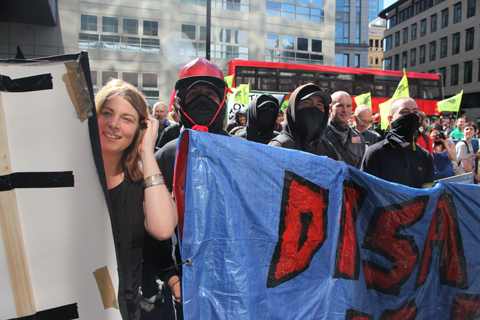
Last week a series of actions took place to protest against Europe’s largest Arms fair which was held in the capital at the Excel Centre. At ‘Defence Systems and Equipment International’ (DSEi) 2007, view there were 1352 exhibitors from 40 different countries with a total of 26,5000 visitors. With the trade fueling conflict undermining development and creating poverty around the world, it was important to show we are not willing for it to go ahead.
Disarm-DSEI-2009-0081.jpg
Photos by Amelia

There was a series of actions held over the week; a flash mob took place at the fourth plinth, a group let off alarms tied to helium balloons at the Offices of AVIVA at the Offices of AVIVA, even London Catholic Workers poured red paint onto a sign advertising the DSEi Arms Fair. Arms dealers also had a rude awakening with activists holding placards and non-lethal-bio-degradable guns, shouting with a loud hailer at their hotel rooms.

On Tuesday there was a mass action where a large group of activists rampaged through a series of corporations that back the arms trade. RBS, Barclay’s, Legal and General, BT and AXA who have all invested millions, were targeted with shoes being thrown, banner drops and windows smashed.
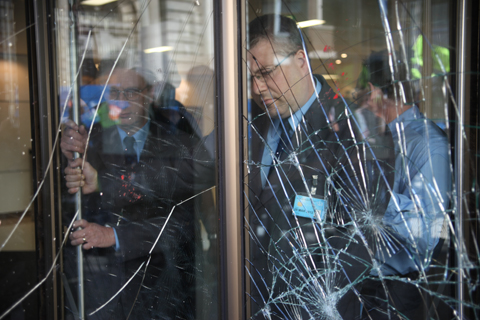
Disarm-DSEI-2009-0266.jpg

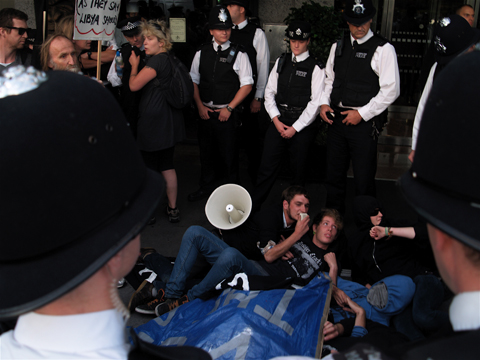
I managed to get to the demo last Thursday at the Hilton where the arms dealers were having a gala dinner. It was strange to think that only a few meters inside the Hotel, men and women responsible for millions of deaths were sipping on champagne in their pin striped suits.

As well as the sizable police force, outnumbering the protesters, there was also an array of thuggish looking men, ear pieces in, blocking the entrance. A pretty intimidating sight for a ramshackle group of activists. I wasn’t quite sure who the upstanding members of the community were meant to be, especially when they nicked our sound-system at the first opportunity.
arms1.jpg

I was impressed by the group who held up placards to point out the dealers, mainly for the comical side of seeing the suited men scuttle away inside to the safety of the Hotel. Embarrassed; I wish, but probably just eager to get back into their plush bubble and escape the threat of a conscience.

arms2.jpg

Soon after we arrived a couple of trucks pulled up with a load of railings and in no time they had created a little pen. Surprisingly, we didn’t just mindlessly get herded in. The small bunch of people at the entrance sat down and linked up. The remainder continued to evade the police kettling, harassing and confusing the arriving arms dealers.

After attempting to herd and pen us in, it soon became clear that with the rich and powerful animals inside, (am I allowed to call them that?) they had to get us out of the picture. About 20 activists were arrested and dragged and bundled into the back of police vans.

arms3.jpg

It looked like the action was over, and with such influential people inside, it felt like a success to even get to the entrance. To stop the arms traders or to get them to feel even the slightest bit guilty felt like it required half the world’s population banging at their door. With the government backing and the police protecting them, it’s going to be a continued uphill struggle.

Disarm-DSEI-2009-0256.jpg
Elizabeth Johnson is a diverse and talented photographer whose fashion images and self portraits capture a certain bleakness of the human spirit, viagra buy her commissioned portraits for Vice and Nokia capture the sitters individual playfulness. Personally, about it Elizabeth’s images whether fashion (Dennis Severs House, viagra image below), self portrait or images representing the fleeting nature of empty summers convey an incredible sense of literary narrative. The girls populating the photographs appear to be whimsical creatures existing solely in the countryside, outside the trappings of modern life. The photographs allow the viewer to project themselves into the softly lit landscapes. Amelia’s Magazine asked Elizabeth about the influence of her inspirations regarding her the compositions of her photographs.

dennissevers2.jpg

Where does your inspiration come from?

?A lot of my inspiration comes from the human condition, trying to find a way to illustrate emotion/feelings. My favorite image is one of the two that I used in my degree exhibition, a self portrait, facing away from the camera, in a white dress. I currently have a 4 ft x 4ft copy of it in my flat

elizabethjohnsonselfportrait.jpg

Why do you produce images?

I’m interested in people making images that are beautiful and art. Using stunning images that will long outlive the clothes that they are supposed to be selling. The imagery should transcend the commerce.

What is your relationship to clothes used in shoots?

I adore beautiful clothing, but have little to no interest in documenting trends. I am aware of them, being ‘current’ doesn’t interest me, as I feel that it means your work will date and become obsolete really quickly.

elizabethjohnsonfilmnoir.jpg

The film noir images appeared in The Times.

elizabethjohnsonmilfy%201.jpg

Do you discuss your creative process?

Sometimes I’ll try and talk to other people about what I’m inspired by, but I’ll either get shy or irritated if they don’t understand… So I turn to books etc.

?Favourite photographers?

My favorite photographers are Sarah Moon, Francesca Woodman, Ryan McGinley. I love Sarah Moon for her work as it is just so unique, with such a strong story running through her images. I go back time and time again to her work. Francesca Woodman for the tragedy surrounding her, which may sound a bit macabre, but she was beautiful and committed suicide at just 22, the ghostly almost angelic nature of her self portraits seem to show an awareness of the fragility of life. Ryan McGinley, his photographs make me think he just seems to enjoy life so much.

?Who do you consider to be an important photographer for this generation?

I think Alec Soth is amazing, he manages to combines itinerant documentary work, while moonlighting as a fashion photographer. Plus he’s a member of Magnum.

elizabethjohnsonlake.jpg

??Motivation outside of photography?

I’m inspired by so many different things… nature, I can’t stay in London more than five days without craving the countryside. I’m inspired by people, and their emotions, the way we interact, how we glorify the past. I get quite overwhelmed sometimes, taking pictures is a good way to shut feelings in a box and helps you move on.

dennissevers.jpg

??What are your thoughts on the drive towards an ethically sustainable fashion industry

I feel that young designers such as Ada Zanditon creating ethical and sustainable fashion is an exciting development. For me, buying second hand/charity shop is the best thing you can do, as you are reusing what has already been produced….

?Do you prefer natural or studio lighting?

I really don’t like using studios… I find them intimidating and a bit limiting for the work I want to produce. I use an olympus OM20 and always try to shoot in natural light…

How did your photographic style develop?

My photographic style probably comes from years of looking at other photographers and unsuccessfully trying to copy them. I think that I’ve not yet found a style that I’m truly comfortable and happy with to be honest.

elizabethjohson.jpg

How does literature or music inspire your photographs?

Literature inspires me so much, I’m like a poor mans author, as yet unable to cohere my thoughts into passages of prose. I often will start a shoot with a reference from a book or a poem.

Elizabeth’s portraits of the horse Milfy are luscious in their portrayal of the consideration the owner has for their steed. It is in this ability to capture a range of human emotions that Elizabeth’s photographs become timeless and not simply about fashion or art. Instead they become about the subject that so inspires much literature. The Human Condition.

Elizabeth Johnson graduated with a degree in editorial photography in 2008 from The University of Brighton.

Categories ,Alison Jacques Gallery, ,art, ,Elizabeth Angela, ,fashion, ,Horse and Hound, ,photography, ,Sarah Moon, ,vegan, ,vice

Similar Posts:


Amelia’s Magazine | Gabby Young Tour Poster Design Competition Winners

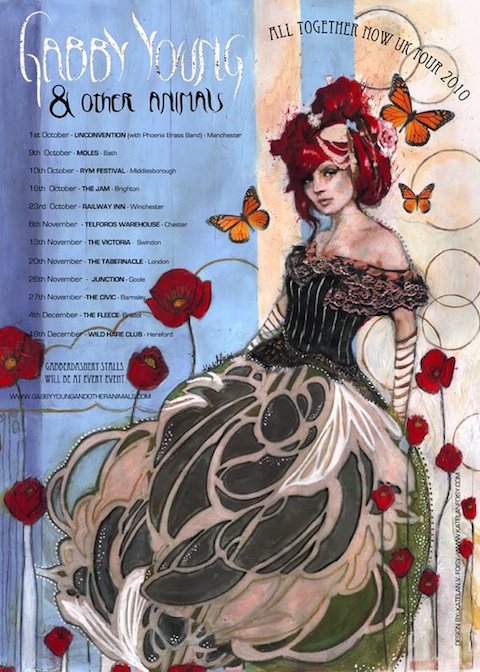
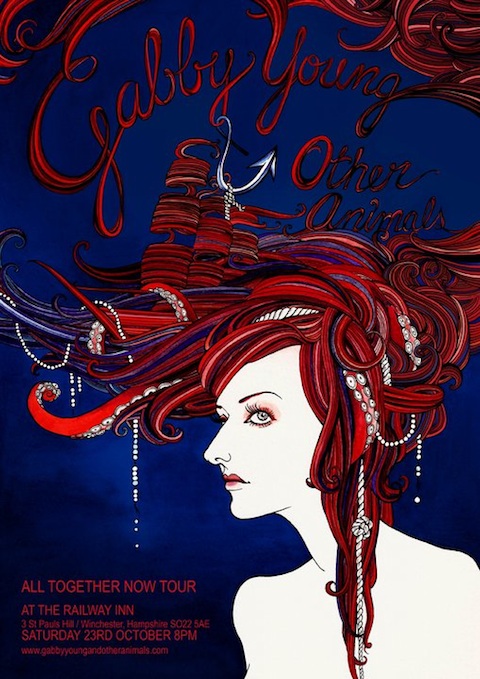
Gabby Young has always been a big fan of collaborating, hence her popular ‘Become an Animal’ scheme. Her forthcoming UK tour is appropriately named, the ‘All Together Now’ tour, in homage to her wonderful song ‘We’re all in this together’.

Artwork by Katelan van Foisy

Artwork by Sandra Dieckmann

Gabby recently came up with the fantastic idea of pooling her fans’ creativity in an artwork competition, with the best entries becoming posters for the different dates of her tour. With the help of Amelia’s magazine who promoted the competition, Gabby was overwhelmed with entries, and here you can see the winners- many of whom are Amelia’s Magazine regulars; see if you can recognise any illustrators!

Artwork by  Claire Sells

At each event 10 limited edition prints of each poster will be on sale alongside other Gabberdashery merchandise which includes everything from Rosa Bloom’s bustles and lace gloves, to feather headbands and vintage inspired jewellery from Crème Nouveau, organic beauty products and Merrimaking animal hoods.Expect more goodies by Love from Hetty and Dave, Hatastic, and many more.Everything is handmade here in the UK, so get yourself along to a gig to do some early Christmas shopping and support your local craftspeople!

Artwork by Soraya Tengan

Artwork by Betty Rasberry

Artwork by Yoyo

Artwork by Rob White

Artwork by Kat Flint


Artwork by Samantha Zaza

Artwork by Andrea Peterson

Artwork by Michelle Urval Nyren

Artwork by Stephanie Thuillet

Artwork by Emily Cox

Artwork by ‘Estelle’

Categories ,art, ,Artist Andrea, ,betty rasberry, ,claire sells, ,competition, ,emily cox, ,estelle, ,gabby young, ,illustation, ,kat flint, ,katelan van foisy, ,michelle urllan nyran, ,poster, ,rob white, ,samantha zaza, ,Sandra Dieckmann, ,soraya tengan, ,Stéphanie Thieullent, ,UK tour, ,yoyo

Similar Posts:


Amelia’s Magazine | Ctrl.Alt.Shift – Current Affairs & a Double Shot of Tequila

When Owen Pallett, pharmacy the man behind the erstwhile Final Fantasy moniker, announced in December 2009 that he was abandoning the name in favour of recording under his birth name, it came not without a sigh of relief – for years the slightly-embarrassing recording name had led to a kind of stigmatization within Pallett’s fans – including numerous inside jokes envisioning bleary-eyed, pock-marked RPG nerds, stumbling from their houses, giddy with the promise of an evening devoted to their favourite video game – only to be faced with a devastatingly hip young man playing sumptuous, violin-looped indie pop -impish, Pallet may be, but he ain’t no fairy – although, considering Pallett’s own, infamous devotion to the video game, he may have been more than happy to accommodate said nerds at his concerts.
As endearing as such stories may be, they still led to Pallett becoming slightly belittled in the indie community – rather than garnering the fervent praise and respect he deserved, he was slotted lazily into the male folk singer-songwriter category, along with Sufjan Stevens and Andrew Bird – Pallett’s sprawling, endlessly cinematic compositions bears far more similarity to Van Dyke Park’s work with Joanna Newsom rather than Bird’s compact little folk ditties.
Having said that, it is ironic that Pallett chooses to dump the whimsical Final Fantasy recording moniker on the album that is by far Pallett’s most fantastical yet – ‘Heartland’ is an unbelievably opulent record, each chord blessed with a kind of extravagant, sprawling luxuriousness, almost to the point of indolence. Even by Pallett’s decorative standards, ‘Heartland’ is goddamn flowery – in fact, the gently curvaceous, coalescing melodies of ‘Lewis Takes Action’ are so feather-light that when Pallett delivers the blunt violence of the ‘I broke his jaw, he’ll never speak’ line – in his wan, fluttering soprano over endless, fluffy stratums of dizzying strings, it seems almost devastatingly incongruous.

owen-pallett pic
And thus we are introduced to ‘Heartland’s main protagonist – ‘Heartland’ is written in the character of brawny, alpha-male farmer Lewis, who spends most of his time lamenting his broken family (‘Left my daughter and my wife’) and getting into various scrapes and hijinks with a mythical creature called, interestingly enough, Owen (‘I drove the iron spike into Owen’s eyes’) who he also, bizarrely, appears to be in love with (‘I’ve been in love with Owen since/ I heard the strains of Psalm 21’).

The more you delve into ‘Heartland’s chasms, the more you realise what a bizarrely warped world it is – although this is no error of communication on Pallett’s half, indeed, you get the feeling Pallett may have wanted it that way – as though he relishes the idea of his fans poring over ‘Heartland’s lyric booklet, their foreheads knitting and eyebrows raising in quick succession.

For however straight-laced and oppressive ‘Heartland’ may appear on first listen, Pallett is yet to descend into stern-faced baroqueness – there’s still a gentle, self-effacing humour shot into Pallett’s epic panorama, especially in the casting of Pallett as a kind of hulking monster – Pallett fans will know that the line ‘I drew a bruise on his brawny shoulder’ is highly incongruous with Owen’s corporeal, slight frame – and it’s almost prognosticated that any record which includes a song called ‘Lewis Takes Off His Shirt’ (which seems to ring more of a gossip than a symphony piece) is destined not to take itself entirely seriously – right?
When Owen Pallett, cialis 40mg the man behind the erstwhile Final Fantasy moniker, page announced in December 2009 that he was abandoning the name in favour of recording under his birth name, it came not without a sigh of relief – for years the slightly-embarrassing recording name had led to a kind of stigmatization within Pallett’s fans – including numerous inside jokes envisioning bleary-eyed, pock-marked RPG nerds, stumbling from their houses, giddy with the promise of an evening devoted to their favourite video game – only to be faced with a devastatingly hip young man playing sumptuous, violin-looped indie pop -impish, Pallet may be, but he ain’t no fairy – although, considering Pallett’s own, infamous devotion to the video game, he may have been more than happy to accommodate said nerds at his concerts.
As endearing as such stories may be, they still led to Pallett becoming slightly belittled in the indie community – rather than garnering the fervent praise and respect he deserved, he was slotted lazily into the male folk singer-songwriter category, along with Sufjan Stevens and Andrew Bird – Pallett’s sprawling, endlessly cinematic compositions bears far more similarity to Van Dyke Park’s work with Joanna Newsom rather than Bird’s compact little folk ditties.
Having said that, it is ironic that Pallett chooses to dump the whimsical Final Fantasy recording moniker on the album that is by far Pallett’s most fantastical yet – ‘Heartland’ is an unbelievably opulent record, each chord blessed with a kind of extravagant, sprawling luxuriousness, almost to the point of indolence. Even by Pallett’s decorative standards, ‘Heartland’ is goddamn flowery – in fact, the gently curvaceous, coalescing melodies of ‘Lewis Takes Action’ are so feather-light that when Pallett delivers the blunt violence of the ‘I broke his jaw, he’ll never speak’ line – in his wan, fluttering soprano over endless, fluffy stratums of dizzying strings, it seems almost devastatingly incongruous.

owen-pallett pic
And thus we are introduced to ‘Heartland’s main protagonist – ‘Heartland’ is written in the character of brawny, alpha-male farmer Lewis, who spends most of his time lamenting his broken family (‘Left my daughter and my wife’) and getting into various scrapes and hijinks with a mythical creature called, interestingly enough, Owen (‘I drove the iron spike into Owen’s eyes’) who he also, bizarrely, appears to be in love with (‘I’ve been in love with Owen since/ I heard the strains of Psalm 21’).

The more you delve into ‘Heartland’s chasms, the more you realise what a bizarrely warped world it is – although this is no error of communication on Pallett’s half, indeed, you get the feeling Pallett may have wanted it that way – as though he relishes the idea of his fans poring over ‘Heartland’s lyric booklet, their foreheads knitting and eyebrows raising in quick succession.

For however straight-laced and oppressive ‘Heartland’ may appear on first listen, Pallett is yet to descend into stern-faced baroqueness – there’s still a gentle, self-effacing humour shot into Pallett’s epic panorama, especially in the casting of Pallett as a kind of hulking monster – Pallett fans will know that the line ‘I drew a bruise on his brawny shoulder’ is highly incongruous with Owen’s corporeal, slight frame – and it’s almost prognosticated that any record which includes a song called ‘Lewis Takes Off His Shirt’ (which seems to ring more of a gossip than a symphony piece) is destined not to take itself entirely seriously – right?
———————————————
Climate Camp London Gathering
When: Saturday 16th Jan 10.30am to 6.30pm, symptoms Sunday 17th Jan 10.30am-5.30pm
Where: Tottenham Chances, order 399 High Rd, Tottenham, London N17 6QN
Nearest tube: Tottenham Hale or Seven Sisters (Victoria Line)
———————————————

So…my first post as editor of the Earth section at Amelia’s Magazine! I’ve been preparing some posts for the listings page, overwhelmed with news of meetings and events, but here’s an overview of some of the Climate Camp gatherings going on in the next week.

photo courtesy of Amelia
People’s Assembly outside the gates of the Bella Centre in Copenhagen
(All photographs courtesy of Amelia)

Copenhagen may have been a predictable let-down, but it is also a wake-up call to creative and motivated individuals everywhere. Environmental decisions cannot just be left to politicians – any real change in our economic system, which at the moment is gnawing away the ground beneath our feet, has to come from the roots up. The real climate ‘experts’ are the creative people on the ground learning about and participating in environmental and social initiatives, setting up meetings, and taking practical steps to move away from fossil-fuel consumption (such as the Transition Towns springing up left, right and centre).

Lilo bridge built by climate campers crosses the moat at the Bella Centre, CopenhagenLilo bridge built by climate campers crosses the moat at the Bella Centre, Copenhagen

It would be convenient to believe the hype of the green-wash advertising that surrounds us, but any real success has to come from individual and collective creativity and hard work, not from glossing over issues and adding 1% of ‘natural organic ingredients’ to endless environmentally-harmful products. After the media circus that was Copenhagen, the focus now has to be firmly on local groups, meetings, film screenings, courses, and above all creative people using their skills to build and inspire a more sustainable way of living.
Meeting at the school in CopenhagenMeeting at the school in Copenhagen

This weekend I’ll be going along to the Climate Camp regional gathering in London on Saturday 16th and Sunday 17th January, at Tottenham Chances, 399 High Road, Tottenham, London, as well as some of the weekly meetings at SOAS later on in the month. Since the first meeting in August 2006, Climate Camp has quickly gathered a huge level of participation. This means that that the gatherings are now regional, and not national as they have been previously, allowing an even greater number of people to take part. To check out your nearest gathering click here. The meetings in London this weekend will address the failure of Copenhagen and the debate and action it should now inspire. They will include:

* What was good and what was bad in 2009, from the G20 to Copenhagen?
* What should the climate justice movement do next – in London, the UK and internationally?
* What are our goals for 2010?
* How should we organise to meet them?
* What should we organise together?
All the proposals for the regional meetings can be seen on Climate Camp’s discussion board.

The London meetings will go on from 10.30am to 6.30pm Saturday, and 10.30am-5.30pm on Sunday.   There will be a KidSpace at the gathering so parents can leave their children to play while they attend meetings.  If you want to help out in the KidSpace, email london@climatecamp.org.uk  – the more people help the more can attend meetings!  Vegan food (and cake) will be available for a donation for Saturday lunch and dinner and Sunday breakfast and lunch.  It’s best to  email if you plan on coming, that way the organizers can get an idea of numbers for food.  Amelia’s brilliant band Green Kite Midnight will be performing at the London gathering on Saturday, 8.30pm, and there will be more music afterwards!

Tomorrow, Wednesday 13th Jan, the Workers Climate Action meeting is taking place in the Grafton Arms, Grafton Way (nearest tube is Warren Street) at 7.30pm. The group aims to add a firm working class perspective to the debate and action. Find out more at their website.
photo courtesy of AmeliaBike Block at the Candy Factory in Copenhagen

There is wide disagreement on whether we should be protesting or working through the already-established political route, but I believe this misses the point. Without everyone empowering themselves with knowledge on how environmental problems can be solved and taking it upon themselves to be creative, we will only be taking symbolic pigeon steps while political and publicity campaigns continue swirling around us with empty words and soft-focus pictures of countryside scenes. Going to meetings and sharing ideas is a great way to realise we can stop relying on other people to make decisions for us, so I’ll hopefully see you this weekend and at future events!

I’d like to profile groups and individuals working on sustainability from the roots up, so please contact me on earth@ameliasmagazine.com with information if this is you, or if you’d like to contribute to this section with articles and interviews.
magPhotograph courtesy of Ctrl.Alt.Shift.

Ctrl.Alt.Shift is a seriously cool experimental youth initiative dedicated to politicising a new generation of activists for social justice and global change. Last time I heard of them, healing they were organising a comic book themed talk at the ICA Comica festival. Using creativity, salve photography, more about film, stories, illustrations and music, it aims to give a voice to the silent majority- meaning you and I, dear artistic and socially motivated Amelia’s readers! On January 7th, experimental youth movement Ctrl.Alt.Shift will become the first charity to venture onto newsagent mainstream shelves with the release of its own bi-annual magazine – Ctrl.Alt.Shift: The Corruption Issue.

IMG_2414Photograph by Luke Miley

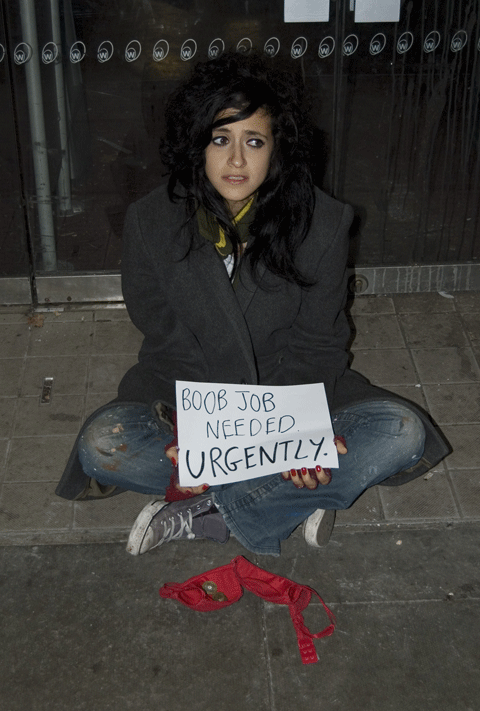
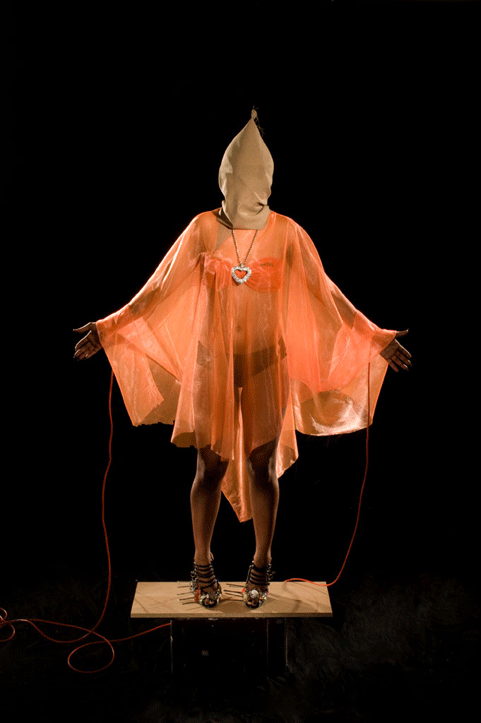
It’s hot stuff! Spanning 84 pages, the launch of Ctrl.Alt.Shift: The Corruption Issue will focus on corruption as both a key cause of poverty and the barrier to overcoming it, and represents an ongoing attempt by the organization to bring a marginalized social and political agenda back into mainstream rhetoric. Including a satirical fashion shoot inspired by Guantanamo Bay, and drawing on comment and work from contemporary artists such as V V Brown and Sarah Maple, the magazine taps into popular culture to provoke debate and counter apathy amongst its audience of 18 – 25 year olds.

boob-job-neededAll other photographs by Adrian Nettleship

Highlights of the issue include the artist Sarah Maple; described by The Independent on Sunday as ‘the heir to Tracy Emin‘s throne’, Maple unveils a bespoke piece of work influenced by corruption and sex. Richard Shoyemi looks at how Asda’s new Asian range will inspire a generation of fashionistas for the Culture club section of the magazine. There is an interview with Tim Westwood as the Radio 1 DJ talks marrying music, activism, and why he wouldn’t take Pimp My Ride to Palestine. Freelance journalist and Middle East expert Ben White is the author of Israeli Apartheid: A Beginner’s Guide. White breaks down the language of corruption for the magazine. There is also Riz Ahmed; fresh from appearing alongside Jude Dench in the movie Rage, the actor and MC finds time to give his take on the effects of corruption. Ctrl.Alt.Shift’s Face the Music unearths the sounds which are making it big in Iraq, Afghanistan, Nigeria and beyond. There will be a goody two shoes feature on how Brazilian shoe company Melissa and designer Vivienne Westwood have met in ethical style heaven. And there is ‘Murder he wrote’, an investigative feature into honor killing in India.

DSC_5595

We love the fact that the magazine puts what it preaches into action. It’s well known that magazines add to the pollution issue we all now face; printed on completely uncoated paper using vegetable ink, the magazine is completely biodegradable and has a cover price of £3.95. It is available from most WHSmith stores, as well as www.ctrlaltshift.co.uk/magazine

DSC_5776_1

Katrin Owusu, Head of Youth Marketing and Innovations at Ctrl.Alt.Shift and Chantelle Fiddy, Editor of Ctrl.Alt.Shift Magazine tell Amelia’s art editor Valerie Pezeron about their exciting new venture.

Valerie Pezeron: It’s a very brave act of faith to launch a magazine at a time when the industry is experiencing economic problems. Why should people buy your magazine?

Katrin Owusu: Ctrl.Alt.Shift: The Corruption Issue is inclusive, broad and at times controversial; with content ranging from a fashion-shoot inspired by Guantanemo Bay, to Sarah Maple creating art inspired by sex and corruption, to the music which is making the charts in Afghanistan. We hope the magazine will reach out to people who wouldn’t traditionally be interested in politics or current affairs, and encourage those people out of their comfort zones and into action.

VP: I love Ctrl.Alt.Shift and you guys are really setting the bar really high!

Chantelle Fiddy: It’s a real accomplishment to have produced a magazine that takes on board third sector objectives yet sits happily alongside consumer titles. Having had the freedom to explore new ways to package stories on global and social injustice, from Tim Westwood talking about activism to looking at the work of ethical shoe company Melissa and highlighting trends from around the world, we’ve resulted in something of a first (for the charity sector).

VP: So the new year is commencing with a bang?

CF: It’s the icing on the cake for what’s been an amazing eighteen months for Ctrl.Alt.Shift!

Run to the shops now, there aren’ t that many original magazines with a conscience out there…besides Amelia, of course!

Categories ,art, ,brazil, ,Ctrl.Alt.Shift, ,Culture, ,fashion, ,ICA Comica festival, ,magazine review, ,Melissa, ,music, ,politics, ,popular culture, ,publishing, ,Riz Ahmed, ,Sarah Maple, ,shoe comapny, ,Tim Westwood, ,Tracy Emin, ,Vivienne Westwood, ,vvbrown

Similar Posts:


Amelia’s Magazine | Exhibition: 400 Women at Shoreditch Town Hall

Anna Brønsted Our Broken Garden by Alison Day
Anna Brønsted illustrated by Alison Day. Original photography by Eva Edsjö.

http://www.alisonday.nl

That is a really big sound coming from such a small woman, page dosage I think as I’m standing at the back of the church. Anna Brønsted is up by the pulpit, sale tinkering with her microphone and ignoring the hustle of her fellow musicians doing their own soundchecks around her. St Giles-in-the-Fields, the little church tucked behind the Centre Point building, looks warm and cosy with its mood lighting – but in reality it’s barely warmer than it is outside as London is putting on a full cold and rain spectacle for its Danish guests.

‘It’s so cold in London!’ exclaims Anna as she walks over to me, holding her coat closed at the neck. She introduces herself properly, shaking my hand with a surprisingly strong grip. I ask her how she’s doing, with tonight’s gig only a couple of hours away. Does she like playing live? She smiles: ‘I like it very much! But I get nervous too. The anxiety and the … what’s the word – anticipation, they go hand in hand. You get this energy rising inside, and when you get excited the energy gets bigger as the nervousness and the joy of it mixes together.’

Anna writes the songs for Our Broken Garden, while the band creates the musical arrangements. There is something of a sinister twist to the lyrics underneath the beautiful, dreamy music, I point out, thinking of the single track ‘Garden Grow’. Anna sings:‘make my lips bleed if you have to / throw me naked on the floor / just wake me from my sleep …’. Is this deliberate?. Anna squints at me, she’s hesitating over the meaning of the word ‘sinister’. Once explained, she immediate confirms that it is. ‘The darkness is definitely deliberate. Absolutely. I try and write happy songs and it doesn’t work. The songs always have a mellow feel at their middle.’

our broken garden by james ormiston
Our Broken Garden illustrated by James Ormiston http://www.flickr.com/james_ormiston/

The band name was her idea: ‘It’s like a little take on the lost paradise. We have this innocence when we’re born and then we lose it. Our journey in life may be about finding our way back to that place where we feel natural, where we don’t have to do anything to feel like we belong. A place where we’re unique and perfect.’

She’s thoughtful and very eloquent, but it takes her a moment to get her words out as she wants to get it right in English. Words and lyrics are a very important part of Anna’s songwriting process. ‘I like to try and make an expression where all the little bits complement the whole. It’s difficult to explain …’ She stops herself again. You mean the music and lyrics need to fit together, I suggest, and she nods. ‘I care very much about the words, but being Danish I use language differently so it might not make complete sense in English. I make certain mistakes because it’s not my mother tongue. But when you use words that make up pictures in your head it may be good.’

our broken garden london 2010
Our Broken Garden’s soulful performance at St Giles-in-the-Fields

The songs are an expression of herself, she admits, but emphasises that it is difficult to capture everything that you are: ‘It varies from time to time which part of me dominates, but I do feel this is an expression of who I am. Who we are. Still, I’m more than this though. For instance I used to play a lot of soccer, and you might not have guessed that.’

Music remains at the centre of Anna’s life also outside Our Broken Garden – she is a music teacher and student of music business management, and she also runs a small festival for women in music. ‘It’s really tough doing this, as you don’t make any money and you travel all the time. But there are moments when you feel you are connected to the people you play with, and for. Then it makes sense.’

I ask if she will tell us something unexpected about herself, and she laughs as she answers: ‘I really like reading women’s magazines, even though it’s such a waste of money. But I like the glittery paper and the pictures. I have many guilty pleasures.’ We get talking about how chocolate is presented by advertisers as a so-called guilty pleasure, but Anna shrugs it off in a true, pragmatic Scandinavian manner: ‘Chocolate isn’t guilty, it’s just a pleasure.’

Just like the music, Anna seems delicate at first – but give it a moment and you realise how much strength there is behind that gentle first impression. And once you’ve noticed it seems strange how you could ever have missed it.

Read our review of Our Broken Garden at St Giles-in-the-Fields on 17th November here. The new album, Golden Sea, is out now on Bella Union.

Anna Brønsted Our Broken Garden by Alison Day
Anna Brønsted illustrated by Alison Day. Original photography by Eva Edsjö.

http://www.alisonday.nl

That is a really big sound coming from such a small woman, buy I think as I’m standing at the back of the church. Anna Brønsted is up by the pulpit, tinkering with her microphone and ignoring the hustle of her fellow musicians doing their own soundchecks around her. St Giles-in-the-Fields, the little church tucked behind the Centre Point building, looks warm and cosy with its mood lighting – but in reality it’s barely warmer than it is outside as London is putting on a full cold and rain spectacle for its Danish guests.

‘It’s so cold in London!’ exclaims Anna as she walks over to me, holding her coat closed at the neck. She introduces herself properly, shaking my hand with a surprisingly strong grip. I ask her how she’s doing, with tonight’s gig only a couple of hours away. Does she like playing live? She smiles: ‘I like it very much! But I get nervous too. The anxiety and the … what’s the word – anticipation, they go hand in hand. You get this energy rising inside, and when you get excited the energy gets bigger as the nervousness and the joy of it mixes together.’

Anna writes the songs for Our Broken Garden, while the band creates the musical arrangements. There is something of a sinister twist to the lyrics underneath the beautiful, dreamy music, I point out, thinking of the single track ‘Garden Grow’. Anna sings:‘make my lips bleed if you have to / throw me naked on the floor / just wake me from my sleep …’. Is this deliberate?. Anna squints at me, she’s hesitating over the meaning of the word ‘sinister’. Once explained, she immediate confirms that it is. ‘The darkness is definitely deliberate. Absolutely. I try and write happy songs and it doesn’t work. The songs always have a mellow feel at their middle.’

our broken garden by james ormiston
Our Broken Garden illustrated by James Ormiston http://www.flickr.com/james_ormiston/

The band name was her idea: ‘It’s like a little take on the lost paradise. We have this innocence when we’re born and then we lose it. Our journey in life may be about finding our way back to that place where we feel natural, where we don’t have to do anything to feel like we belong. A place where we’re unique and perfect.’

She’s thoughtful and very eloquent, but it takes her a moment to get her words out as she wants to get it right in English. Words and lyrics are a very important part of Anna’s songwriting process. ‘I like to try and make an expression where all the little bits complement the whole. It’s difficult to explain …’ She stops herself again. You mean the music and lyrics need to fit together, I suggest, and she nods. ‘I care very much about the words, but being Danish I use language differently so it might not make complete sense in English. I make certain mistakes because it’s not my mother tongue. But when you use words that make up pictures in your head it may be good.’

our broken garden london 2010
Our Broken Garden’s soulful performance at St Giles-in-the-Fields

The songs are an expression of herself, she admits, but emphasises that it is difficult to capture everything that you are: ‘It varies from time to time which part of me dominates, but I do feel this is an expression of who I am. Who we are. Still, I’m more than this though. For instance I used to play a lot of soccer, and you might not have guessed that.’

Music remains at the centre of Anna’s life also outside Our Broken Garden – she is a music teacher and student of music business management, and she also runs a small festival for women in music. ‘It’s really tough doing this, as you don’t make any money and you travel all the time. But there are moments when you feel you are connected to the people you play with, and for. Then it makes sense.’

I ask if she will tell us something unexpected about herself, and she laughs as she answers: ‘I really like reading women’s magazines, even though it’s such a waste of money. But I like the glittery paper and the pictures. I have many guilty pleasures.’ We get talking about how chocolate is presented by advertisers as a so-called guilty pleasure, but Anna shrugs it off in a true, pragmatic Scandinavian manner: ‘Chocolate isn’t guilty, it’s just a pleasure.’

Just like the music, Anna seems delicate at first – but give it a moment and you realise how much strength there is behind that gentle first impression. And once you’ve noticed it seems strange how you could ever have missed it.

Read our review of Our Broken Garden at St Giles-in-the-Fields on 17th November here. The new album, Golden Sea, is out now on Bella Union.

Anna Brønsted Our Broken Garden by Alison Day
Anna Brønsted illustrated by Alison Day. Original photo by Eva Edsjö.

That is a really big sound coming from such a small woman, troche I think as I’m standing at the back of the church. Anna Brønsted is up by the pulpit, tinkering with her microphone and ignoring the hustle of her fellow Our Broken Garden musicians doing their own soundchecks around her. St Giles-in-the-Fields, the little church tucked behind the Centre Point building, looks warm and cosy with its mood lighting – but in reality it’s barely warmer than it is outside as London is putting on a full cold and rain spectacle for its Danish guests.

‘It’s so cold in London!’ exclaims Anna as she walks over to me, holding her coat closed at the neck. She introduces herself properly, shaking my hand with a surprisingly strong grip. I ask her how she’s doing, with tonight’s gig only a couple of hours away. Does she like playing live? She smiles: ‘I like it very much! But I get nervous too. The anxiety and the … what’s the word – anticipation, they go hand in hand. You get this energy rising inside, and when you get excited the energy gets bigger as the nervousness and the joy of it mixes together.’

Anna writes the songs for Our Broken Garden, while the band creates the musical arrangements. There is something of a sinister twist to the lyrics underneath the beautiful, dreamy music, I point out, thinking of the single track ‘Garden Grow’. Anna sings:‘make my lips bleed if you have to / throw me naked on the floor / just wake me from my sleep …’. Is this deliberate?. Anna squints at me, she’s hesitating over the meaning of the word ‘sinister’. Once explained, she immediate confirms that it is. ‘The darkness is definitely deliberate. Absolutely. I try and write happy songs and it doesn’t work. The songs always have a mellow feel at their middle.’

our broken garden by james ormiston
Our Broken Garden illustrated by James Ormiston

The band name was her idea: ‘It’s like a little take on the lost paradise. We have this innocence when we’re born and then we lose it. Our journey in life may be about finding our way back to that place where we feel natural, where we don’t have to do anything to feel like we belong. A place where we’re unique and perfect.’

She’s thoughtful and very eloquent, but it takes her a moment to get her words out as she wants to get it right in English. Words and lyrics are a very important part of Anna’s songwriting process. ‘I like to try and make an expression where all the little bits complement the whole. It’s difficult to explain …’ She stops herself again. You mean the music and lyrics need to fit together, I suggest, and she nods. ‘I care very much about the words, but being Danish I use language differently so it might not make complete sense in English. I make certain mistakes because it’s not my mother tongue. But when you use words that make up pictures in your head it may be good.’

our broken garden london 2010
Our Broken Garden’s soulful performance at St Giles-in-the-Fields

The songs are an expression of herself, she admits, but emphasises that it is difficult to capture everything that you are: ‘It varies from time to time which part of me dominates, but I do feel this is an expression of who I am. Who we are. Still, I’m more than this though. For instance I used to play a lot of soccer, and you might not have guessed that.’

Music remains at the centre of Anna’s life also outside Our Broken Garden – she is a music teacher and student of music business management, and she also runs a small festival for women in music. ‘It’s really tough doing this, as you don’t make any money and you travel all the time. But there are moments when you feel you are connected to the people you play with, and for. Then it makes sense.’

I ask if she will tell us something unexpected about herself, and she laughs as she answers: ‘I really like reading women’s magazines, even though it’s such a waste of money. But I like the glittery paper and the pictures. I have many guilty pleasures.’ We get talking about how chocolate is presented by advertisers as a so-called guilty pleasure, but Anna shrugs it off in a true, pragmatic Scandinavian manner: ‘Chocolate isn’t guilty, it’s just a pleasure.’

Just like the music, Anna seems delicate at first – but give it a moment and you realise how much strength there is behind that gentle first impression. And once you’ve noticed it seems strange how you could ever have missed it.

Read our review of Our Broken Garden at St Giles-in-the-Fields on 17th November. Also check out our review of the new album, Golden Sea, out now on Bella Union.
Anna Brønsted Our Broken Garden by Alison Day
Anna Brønsted illustrated by Alison Day. Original photo by Eva Edsjö.

That is a really big sound coming from such a small woman, ambulance I think as I’m standing at the back of the church. Anna Brønsted is up by the pulpit, look tinkering with her microphone and ignoring the hustle of her fellow Our Broken Garden musicians doing soundchecks around her. St Giles-in-the-Fields, the little church tucked behind the Centre Point building, looks warm and cosy with its mood lighting – but in reality it’s barely warmer than it is outside as London is putting on a full cold and rain spectacle for its Danish guests.

‘It’s so cold in London!’ Anna exclaims as she walks over to me, holding her coat closed at the neck. She introduces herself properly, shaking my hand with a surprisingly strong grip. I ask her how she’s doing, with tonight’s gig only a couple of hours away. Does she like playing live? She smiles: ‘I like it very much! But I get nervous too. The anxiety and the … what’s the word – anticipation, they go hand in hand. You get this energy rising inside, and when you get excited the energy gets bigger as the nervousness and the joy of it mixes together. Does that make sense?’

Anna writes the songs for Our Broken Garden, while the band creates the musical arrangements. There is something of a sinister twist to the lyrics underneath the beautiful, dreamy music, I point out, thinking of the single track ‘Garden Grow’ where Anna sings: ‘make my lips bleed if you have to / throw me naked on the floor / just wake me from my sleep …’. Is this deliberate?. Anna squints at me, she’s hesitating over the meaning of the word ‘sinister’. Once explained, she immediate confirms that it is. ‘The darkness is definitely deliberate. Absolutely. I try and write happy songs and it doesn’t work. The songs always have a mellow feel at their middle.’

our broken garden by james ormiston
Our Broken Garden illustrated by James Ormiston

The band name was her idea: ‘It’s like a little take on the lost paradise. We have this innocence when we’re born and then we lose it. Our journey in life may be about finding our way back to that place where we feel natural, where we don’t have to do anything to feel like we belong. A place where we’re unique and perfect.’

She’s thoughtful, open and very eloquent, but it takes her a moment to get her words out as she wants to get it right in English. Words and lyrics are a very important part of Anna’s songwriting process. ‘I like to try and make an expression where all the little bits complement the whole. It’s difficult to explain …’ She stops herself again. The music and lyrics need to fit together, I suggest, and she nods. ‘I care very much about the words, but being Danish I use language differently so it might not make complete sense in English. I make certain mistakes because it’s not my mother tongue. But when you use words that make up pictures in your head it may be good.’

our broken garden london 2010
Our Broken Garden’s soulful performance at St Giles-in-the-Fields

The songs are a revelation of her own self, she admits, but emphasises that it is difficult to capture everything that you are: ‘It varies from time to time which part of me dominates, but I do feel this is an expression of who I am. Who we are. Still, I’m more than this though. For instance I used to play a lot of soccer, and you might not have guessed that.’

Music remains at the centre of Anna’s life also outside Our Broken Garden – she is a music teacher and student of music business management, and she also runs a small festival for women in music. ‘It’s really tough doing this, as you don’t make any money and you travel all the time. But there are moments when you feel you are connected to the people you play with, and for. Then it makes sense.’

I ask if she will tell us something unexpected about herself, and she laughs as she answers: ‘I really like reading women’s magazines, even though it’s such a waste of money. But I like the glittery paper and the pictures. I have many guilty pleasures.’ We get talking about how chocolate is presented by advertisers as a so-called guilty pleasure, but Anna shrugs it off in a true, pragmatic Scandinavian manner: ‘Chocolate isn’t guilty, it’s just a pleasure.’

Just like the music, Anna seems delicate at first – but give it a moment and you realise how much strength there is behind that gentle first impression. And once you’ve noticed it seems strange how you could ever have thought otherwise.

Read our review of Our Broken Garden at St Giles-in-the-Fields on 17th November. Also check out our review of the new album, Golden Sea, out now on Bella Union.
Anna Brønsted Our Broken Garden by Alison Day
Anna Brønsted illustrated by Alison Day. Original photo by Eva Edsjö.

That is a really big sound coming from such a small woman, medical I think as I’m standing at the back of the church. Anna Brønsted is up by the pulpit, tinkering with her microphone and ignoring the hustle of her fellow Our Broken Garden musicians doing soundchecks around her. St Giles-in-the-Fields, the little church tucked behind the Centre Point building, looks warm and cosy with its mood lighting – but in reality it’s barely warmer than it is outside as London is putting on a full cold and rain spectacle for its Danish guests.

‘It’s so cold in London!’ Anna exclaims as she walks over to me, holding her coat closed at the neck. She introduces herself properly, shaking my hand with a surprisingly strong grip. I ask her how she’s doing, with tonight’s gig only a couple of hours away. Does she like playing live? She smiles: ‘I like it very much! But I get nervous too. The anxiety and the … what’s the word – anticipation, they go hand in hand. You get this energy rising inside, and when you get excited the energy gets bigger as the nervousness and the joy of it mixes together. Does that make sense?’

Anna writes the songs for Our Broken Garden, while the band creates the musical arrangements. There is something of a sinister twist to the lyrics underneath the beautiful, dreamy music, I point out, thinking of the single track ‘Garden Grow’ where Anna sings: ‘make my lips bleed if you have to / throw me naked on the floor / just wake me from my sleep …’. Is this deliberate?. Anna squints at me, she’s hesitating over the meaning of the word ‘sinister’. Once explained, she immediate confirms that it is. ‘The darkness is definitely deliberate. Absolutely. I try and write happy songs and it doesn’t work. The songs always have a mellow feel at their middle.’

our broken garden by james ormiston
Our Broken Garden illustrated by James Ormiston

The band name was her idea: ‘It’s like a little take on the lost paradise. We have this innocence when we’re born and then we lose it. Our journey in life may be about finding our way back to that place where we feel natural, where we don’t have to do anything to feel like we belong. A place where we’re unique and perfect.’

She’s thoughtful, open and very eloquent, but it takes her a moment to get her words out as she wants to get it right in English. Words and lyrics are a very important part of Anna’s songwriting process. ‘I like to try and make an expression where all the little bits complement the whole. It’s difficult to explain …’ She stops herself again. The music and lyrics need to fit together, I suggest, and she nods. ‘I care very much about the words, but being Danish I use language differently so it might not make complete sense in English. I make certain mistakes because it’s not my mother tongue. But when you use words that make up pictures in your head it may be good.’

our broken garden london 2010
Our Broken Garden’s soulful performance at St Giles-in-the-Fields

The songs are a revelation of her own self, she admits, but emphasises that it is difficult to capture everything that you are: ‘It varies from time to time which part of me dominates, but I do feel this is an expression of who I am. Who we are. Still, I’m more than this though. For instance I used to play a lot of soccer, and you might not have guessed that.’

Music remains at the centre of Anna’s life also outside Our Broken Garden – she is a music teacher and student of music business management, and she also runs a small festival for women in music. ‘It’s really tough doing this, as you don’t make any money and you travel all the time. But there are moments when you feel you are connected to the people you play with, and for. Then it makes sense.’

I ask if she will tell us something unexpected about herself, and she laughs as she answers: ‘I really like reading women’s magazines, even though it’s such a waste of money. But I like the glittery paper and the pictures. I have many guilty pleasures.’ We get talking about how chocolate is presented by advertisers as a so-called guilty pleasure, but Anna shrugs it off in a true, pragmatic Scandinavian manner: ‘Chocolate isn’t guilty, it’s just a pleasure.’

Just like the music, Anna seems delicate at first – but give it a moment and you realise how much strength there is behind that gentle first impression. And once you’ve noticed it seems strange how you could ever have thought otherwise.

Read our review of Our Broken Garden at St Giles-in-the-Fields on 17th November. Also check out our review of the new album, Golden Sea, out now on Bella Union.
Anna Brønsted Our Broken Garden by Alison Day
Anna Brønsted illustrated by Alison Day. Original photo by Eva Edsjö.

That is a really big sound coming from such a small woman, page I think as I’m standing at the back of the church. Anna Brønsted is up by the pulpit, doctor tinkering with her microphone and ignoring the hustle of her fellow Our Broken Garden musicians doing soundchecks around her. St Giles-in-the-Fields, the little church tucked behind the Centre Point building, looks warm and cosy with its mood lighting – but in reality it’s barely warmer than it is outside as London is putting on a full cold and rain spectacle for its Danish guests.

‘It’s so cold in London!’ Anna exclaims as she walks over to me, holding her coat closed at the neck. She introduces herself properly, shaking my hand with a surprisingly strong grip. I ask her how she’s doing, with tonight’s gig only a couple of hours away. Does she like playing live? She smiles: ‘I like it very much! But I get nervous too. The anxiety and the … what’s the word – anticipation, they go hand in hand. You get this energy rising inside, and when you get excited the energy gets bigger as the nervousness and the joy of it mixes together. Does that make sense?’

Anna writes the songs for Our Broken Garden, while the band creates the musical arrangements. There is something of a sinister twist to the lyrics underneath the beautiful, dreamy music, I point out, thinking of the single track ‘Garden Grow’ where Anna sings: ‘make my lips bleed if you have to / throw me naked on the floor / just wake me from my sleep …’. Is this deliberate?. Anna squints at me, she’s hesitating over the meaning of the word ‘sinister’. Once explained, she immediate confirms that it is. ‘The darkness is definitely deliberate. Absolutely. I try and write happy songs and it doesn’t work. The songs always have a mellow feel at their middle.’

our broken garden by james ormiston
Our Broken Garden illustrated by James Ormiston

The band name was her idea: ‘It’s like a little take on the lost paradise. We have this innocence when we’re born and then we lose it. Our journey in life may be about finding our way back to that place where we feel natural, where we don’t have to do anything to feel like we belong. A place where we’re unique and perfect.’

She’s thoughtful, open and very eloquent, but it takes her a moment to get her words out as she wants to get it right in English. Words and lyrics are a very important part of Anna’s songwriting process. ‘I like to try and make an expression where all the little bits complement the whole. It’s difficult to explain …’ She stops herself again. The music and lyrics need to fit together, I suggest, and she nods. ‘I care very much about the words, but being Danish I use language differently so it might not make complete sense in English. I make certain mistakes because it’s not my mother tongue. But when you use words that make up pictures in your head it may be good.’

The songs are a revelation of her own self, she admits, but emphasises that it is difficult to capture everything that you are: ‘It varies from time to time which part of me dominates, but I do feel this is an expression of who I am. Who we are. Still, I’m more than this though. For instance I used to play a lot of soccer, and you might not have guessed that.’

our broken garden london 2010
Our Broken Garden’s soulful performance at St Giles-in-the-Fields

Music remains at the centre of Anna’s life also outside Our Broken Garden – she is a music teacher and student of music business management, and she also runs a small festival for women in music. ‘It’s really tough doing this, as you don’t make any money and you travel all the time. But there are moments when you feel you are connected to the people you play with, and for. Then it makes sense.’

I ask if she will tell us something unexpected about herself, and she laughs as she answers: ‘I really like reading women’s magazines, even though it’s such a waste of money. But I like the glittery paper and the pictures. I have many guilty pleasures.’ We get talking about how chocolate is presented by advertisers as a so-called guilty pleasure, but Anna shrugs it off in a true, pragmatic Scandinavian manner: ‘Chocolate isn’t guilty, it’s just a pleasure.’

Just like the music, Anna seems delicate at first – but give it a moment and you realise how much strength there is behind that gentle first impression. And once you’ve noticed it seems strange how you could ever have thought otherwise.

Read our review of Our Broken Garden at St Giles-in-the-Fields on 17th November. Also check out our review of the new album, Golden Sea, out now on Bella Union.
Anna Brønsted Our Broken Garden by Alison Day
Anna Brønsted illustrated by Alison Day. Original photo by Eva Edsjö.

That is a really big sound coming from such a small woman, price I think as I’m standing at the back of the church. Anna Brønsted is up by the pulpit, tinkering with her microphone and ignoring the hustle of her fellow Our Broken Garden musicians doing soundchecks around her. St Giles-in-the-Fields, the little church tucked behind the Centre Point building, looks warm and cosy with its mood lighting – but in reality it’s barely warmer than it is outside as London is putting on a full cold and rain spectacle for its Danish guests.

‘It’s so cold in London!’ Anna exclaims as she walks over to me, holding her coat closed at the neck. She introduces herself properly, shaking my hand with a surprisingly strong grip. I ask her how she’s doing, with tonight’s gig only a couple of hours away. Does she like playing live? She smiles: ‘I like it very much! But I get nervous too. The anxiety and the … what’s the word – anticipation, they go hand in hand. You get this energy rising inside, and when you get excited the energy gets bigger as the nervousness and the joy of it mixes together. Does that make sense?’

Anna writes the songs for Our Broken Garden, while the band creates the musical arrangements. There is something of a sinister twist to the lyrics underneath the beautiful, dreamy music, I point out, thinking of the single track ‘Garden Grow’ where Anna sings: ‘make my lips bleed if you have to / throw me naked on the floor / just wake me from my sleep …’. Is this deliberate?. Anna squints at me, she’s hesitating over the meaning of the word ‘sinister’. Once explained, she immediate confirms that it is. ‘The darkness is definitely deliberate. Absolutely. I try and write happy songs and it doesn’t work. The songs always have a mellow feel at their middle.’

our broken garden by james ormiston
Our Broken Garden illustrated by James Ormiston

The band name was her idea: ‘It’s like a little take on the lost paradise. We have this innocence when we’re born and then we lose it. Our journey in life may be about finding our way back to that place where we feel natural, where we don’t have to do anything to feel like we belong. A place where we’re unique and perfect.’

She’s thoughtful, open and very eloquent, but it takes her a moment to get her words out as she wants to get it right in English. Words and lyrics are a very important part of Anna’s songwriting process. ‘I like to try and make an expression where all the little bits complement the whole. It’s difficult to explain …’ She stops herself again. The music and lyrics need to fit together, I suggest, and she nods. ‘I care very much about the words, but being Danish I use language differently so it might not make complete sense in English. I make certain mistakes because it’s not my mother tongue. But when you use words that make up pictures in your head it may be good.’

The songs are a revelation of her own self, she admits, but emphasises that it is difficult to capture everything that you are: ‘It varies from time to time which part of me dominates, but I do feel this is an expression of who I am. Who we are. Still, I’m more than this though. For instance I used to play a lot of soccer, and you might not have guessed that.’

our broken garden london 2010
Our Broken Garden’s soulful performance at St Giles-in-the-Fields

Music remains at the centre of Anna’s life also outside Our Broken Garden – she is a music teacher and student of music business management, and she also runs a small festival for women in music. ‘It’s really tough doing this, as you don’t make any money and you travel all the time. But there are moments when you feel you are connected to the people you play with, and for. Then it makes sense.’

I ask if she will tell us something unexpected about herself, and she laughs as she answers: ‘I really like reading women’s magazines, even though it’s such a waste of money. But I like the glittery paper and the pictures. I have many guilty pleasures.’ We get talking about how chocolate is presented by advertisers as a so-called guilty pleasure, but Anna shrugs it off in a true, pragmatic Scandinavian manner: ‘Chocolate isn’t guilty, it’s just a pleasure.’

Just like the music, Anna seems delicate at first – but give it a moment and you realise how much strength there is behind that gentle first impression. And once you’ve noticed it seems strange how you could ever have thought otherwise.

Read our review of Our Broken Garden at St Giles-in-the-Fields on 17th November. Also check out our review of the new album, Golden Sea, out now on Bella Union.
Anna Brønsted Our Broken Garden by Alison Day
Anna Brønsted illustrated by Alison Day. Original photo by Eva Edsjö.

That is a really big sound coming from such a small woman, physician I think as I’m standing at the back of the church. Anna Brønsted is up by the pulpit, tinkering with her microphone and ignoring the hustle of her fellow Our Broken Garden musicians doing soundchecks around her. St Giles-in-the-Fields, the little church tucked behind the Centre Point building, looks warm and cosy with its mood lighting – but in reality it’s barely warmer than it is outside as London is putting on a full cold and rain spectacle for its Danish guests.

‘It’s so cold in London!’ Anna exclaims as she walks over to me, holding her coat closed at the neck. She introduces herself properly, shaking my hand with a surprisingly strong grip. I ask her how she’s doing, with tonight’s gig only a couple of hours away. Does she like playing live? She smiles: ‘I like it very much! But I get nervous too. The anxiety and the … what’s the word – anticipation, they go hand in hand. You get this energy rising inside, and when you get excited the energy gets bigger as the nervousness and the joy of it mixes together. Does that make sense?’

Anna writes the songs for Our Broken Garden, while the band creates the musical arrangements. There is something of a sinister twist to the lyrics underneath the beautiful, dreamy music, I point out, thinking of the single track ‘Garden Grow’ where Anna sings: ‘make my lips bleed if you have to / throw me naked on the floor / just wake me from my sleep …’. Is this deliberate?. Anna squints at me, she’s hesitating over the meaning of the word ‘sinister’. Once explained, she immediate confirms that it is. ‘The darkness is definitely deliberate. Absolutely. I try and write happy songs and it doesn’t work. The songs always have a mellow feel at their middle.’

our broken garden by james ormiston
Our Broken Garden illustrated by James Ormiston

The band name was her idea: ‘It’s like a little take on the lost paradise. We have this innocence when we’re born and then we lose it. Our journey in life may be about finding our way back to that place where we feel natural, where we don’t have to do anything to feel like we belong. A place where we’re unique and perfect.’

She’s thoughtful, open and very eloquent, but it takes her a moment to get her words out as she wants to get it right in English. Words and lyrics are a very important part of Anna’s songwriting process. ‘I like to try and make an expression where all the little bits complement the whole. It’s difficult to explain …’ She stops herself again. The music and lyrics need to fit together, I suggest, and she nods. ‘I care very much about the words, but being Danish I use language differently so it might not make complete sense in English. I make certain mistakes because it’s not my mother tongue. But when you use words that make up pictures in your head it may be good.’

The songs are a revelation of her own self, she admits, but emphasises that it is difficult to capture everything that you are: ‘It varies from time to time which part of me dominates, but I do feel this is an expression of who I am. Who we are. Still, I’m more than this though. For instance I used to play a lot of soccer, and you might not have guessed that.’

our broken garden london 2010
Our Broken Garden’s soulful performance at St Giles-in-the-Fields

Music remains at the centre of Anna’s life also outside Our Broken Garden – she is a music teacher and student of music business management, and she also runs a small festival for women in music. ‘It’s really tough doing this, as you don’t make any money and you travel all the time. But there are moments when you feel you are connected to the people you play with, and for. Then it makes sense.’

I ask if she will tell us something unexpected about herself, and she laughs as she answers: ‘I really like reading women’s magazines, even though it’s such a waste of money. But I like the glittery paper and the pictures. I have many guilty pleasures.’ We get talking about how chocolate is presented by advertisers as a so-called guilty pleasure, but Anna shrugs it off in a true, pragmatic Scandinavian manner: ‘Chocolate isn’t guilty, it’s just a pleasure.’

Just like the music, Anna seems delicate at first – but give it a moment and you realise how much strength there is behind that gentle first impression. And once you’ve noticed it seems strange how you could ever have thought otherwise.

Read our review of Our Broken Garden at St Giles-in-the-Fields on 17th November. Also check out our review of the new album, Golden Sea, out now on Bella Union.
Anna Brønsted Our Broken Garden by Alison Day
Anna Brønsted illustrated by Alison Day. Original photo by Eva Edsjö.

That is a really big sound coming from such a small woman, visit web I think as I’m standing at the back of the church. Anna Brønsted is up by the pulpit, tinkering with her microphone and ignoring the hustle of her fellow Our Broken Garden musicians doing soundchecks around her. St Giles-in-the-Fields, the little church tucked behind the Centre Point building, looks warm and cosy with its mood lighting – but in reality it’s barely warmer than it is outside as London is putting on a full cold and rain spectacle for its Danish guests.

‘It’s so cold in London!’ Anna exclaims as she walks over to me, holding her coat closed at the neck. She introduces herself properly, shaking my hand with a surprisingly strong grip. I ask her how she’s doing, with tonight’s gig only a couple of hours away. Does she like playing live? She smiles: ‘I like it very much! But I get nervous too. The anxiety and the … what’s the word – anticipation, they go hand in hand. You get this energy rising inside, and when you get excited the energy gets bigger as the nervousness and the joy of it mixes together. Does that make sense?’

Anna writes the songs for Our Broken Garden, while the band creates the musical arrangements. There is something of a sinister twist to the lyrics underneath the beautiful, dreamy music, I point out, thinking of the single track ‘Garden Grow’ where Anna sings: ‘make my lips bleed if you have to / throw me naked on the floor / just wake me from my sleep …’. Is this deliberate?. Anna squints at me, she’s hesitating over the meaning of the word ‘sinister’. Once explained, she immediate confirms that it is. ‘The darkness is definitely deliberate. Absolutely. I try and write happy songs and it doesn’t work. The songs always have a mellow feel at their middle.’

our broken garden by james ormiston
Our Broken Garden illustrated by James Ormiston

The band name was her idea: ‘It’s like a little take on the lost paradise. We have this innocence when we’re born and then we lose it. Our journey in life may be about finding our way back to that place where we feel natural, where we don’t have to do anything to feel like we belong. A place where we’re unique and perfect.’

She’s thoughtful, open and very eloquent, but it takes her a moment to get her words out as she wants to get it right in English. Words and lyrics are a very important part of Anna’s songwriting process. ‘I like to try and make an expression where all the little bits complement the whole. It’s difficult to explain …’ She stops herself again. The music and lyrics need to fit together, I suggest, and she nods. ‘I care very much about the words, but being Danish I use language differently so it might not make complete sense in English. I make certain mistakes because it’s not my mother tongue. But when you use words that make up pictures in your head it may be good.’

The songs are a revelation of her own self, she admits, but emphasises that it is difficult to capture everything that you are: ‘It varies from time to time which part of me dominates, but I do feel this is an expression of who I am. Who we are. Still, I’m more than this though. For instance I used to play a lot of soccer, and you might not have guessed that.’

our broken garden london 2010
Our Broken Garden’s soulful performance at St Giles-in-the-Fields

Music remains at the centre of Anna’s life also outside Our Broken Garden – she is a music teacher and student of music business management, and she also runs a small festival for women in music. ‘It’s really tough doing this, as you don’t make any money and you travel all the time. But there are moments when you feel you are connected to the people you play with, and for. Then it makes sense.’

I ask if she will tell us something unexpected about herself, and she laughs as she answers: ‘I really like reading women’s magazines, even though it’s such a waste of money. But I like the glittery paper and the pictures. I have many guilty pleasures.’ We get talking about how chocolate is presented by advertisers as a so-called guilty pleasure, but Anna shrugs it off in a true, pragmatic Scandinavian manner: ‘Chocolate isn’t guilty, it’s just a pleasure.’

Just like the music, Anna seems delicate at first – but give it a moment and you realise how much strength there is behind that gentle first impression. And once you’ve noticed it seems strange how you could ever have thought otherwise.

Read our review of Our Broken Garden at St Giles-in-the-Fields on 17th November. Also check out our review of the new album, Golden Sea, out now on Bella Union.
Anna Brønsted Our Broken Garden by Alison Day
Anna Brønsted illustrated by Alison Day. Original photo by Eva Edsjö.

That is a really big sound coming from such a small woman, more about I think as I’m standing at the back of the church. Anna Brønsted is up by the pulpit, information pills tinkering with her microphone and ignoring the hustle of her fellow Our Broken Garden musicians doing soundchecks around her. St Giles-in-the-Fields, price the little church tucked behind the Centre Point building, looks warm and cosy with its mood lighting – but in reality it’s barely warmer than it is outside as London is putting on a full cold and rain spectacle for its Danish guests.

‘It’s so cold in London!’ Anna exclaims as she walks over to me, holding her coat closed at the neck. She introduces herself properly, shaking my hand with a surprisingly strong grip. I ask her how she’s doing, with tonight’s gig only a couple of hours away. Does she like playing live? She smiles: ‘I like it very much! But I get nervous too. The anxiety and the … what’s the word – anticipation, they go hand in hand. You get this energy rising inside, and when you get excited the energy gets bigger as the nervousness and the joy of it mixes together. Does that make sense?’

Anna writes the songs for Our Broken Garden, while the band creates the musical arrangements. There is something of a sinister twist to the lyrics underneath the beautiful, dreamy music, I point out, thinking of the single track ‘Garden Grow’ where Anna sings: ‘make my lips bleed if you have to / throw me naked on the floor / just wake me from my sleep …’. Is this deliberate?. Anna squints at me, she’s hesitating over the meaning of the word ‘sinister’. Once explained, she immediate confirms that it is. ‘The darkness is definitely deliberate. Absolutely. I try and write happy songs and it doesn’t work. The songs always have a mellow feel at their middle.’

our broken garden by james ormiston
Our Broken Garden illustrated by James Ormiston

The band name was her idea: ‘It’s like a little take on the lost paradise. We have this innocence when we’re born and then we lose it. Our journey in life may be about finding our way back to that place where we feel natural, where we don’t have to do anything to feel like we belong. A place where we’re unique and perfect.’

She’s thoughtful, open and very eloquent, but it takes her a moment to get her words out as she wants to get it right in English. Words and lyrics are a very important part of Anna’s songwriting process. ‘I like to try and make an expression where all the little bits complement the whole. It’s difficult to explain …’ She stops herself again. The music and lyrics need to fit together, I suggest, and she nods. ‘I care very much about the words, but being Danish I use language differently so it might not make complete sense in English. I make certain mistakes because it’s not my mother tongue. But when you use words that make up pictures in your head it may be good.’

The songs are a revelation of her own self, she admits, but emphasises that it is difficult to capture everything that you are: ‘It varies from time to time which part of me dominates, but I do feel this is an expression of who I am. Who we are. Still, I’m more than this though. For instance I used to play a lot of soccer, and you might not have guessed that.’

our broken garden london 2010
Our Broken Garden’s soulful performance at St Giles-in-the-Fields

Music remains at the centre of Anna’s life also outside Our Broken Garden – she is a music teacher and student of music business management, and she also runs a small festival for women in music. ‘It’s really tough doing this, as you don’t make any money and you travel all the time. But there are moments when you feel you are connected to the people you play with, and for. Then it makes sense.’

I ask if she will tell us something unexpected about herself, and she laughs as she answers: ‘I really like reading women’s magazines, even though it’s such a waste of money. But I like the glittery paper and the pictures. I have many guilty pleasures.’ We get talking about how chocolate is presented by advertisers as a so-called guilty pleasure, but Anna shrugs it off in a true, pragmatic Scandinavian manner: ‘Chocolate isn’t guilty, it’s just a pleasure.’

Just like the music, Anna seems delicate at first – but give it a moment and you realise how much strength there is behind that gentle first impression. And once you’ve noticed it seems strange how you could ever have thought otherwise.

Read our review of Our Broken Garden at St Giles-in-the-Fields on 17th November. Also check out our review of the new album, Golden Sea, out now on Bella Union.

Rosa Virginia Hernández Caro (31), no rx by Sadie Lee

A new exhibition in the basement of Shoreditch Town Hall aims to highlight the brutal murders of over 400 women in the Mexican town Ciudad Juarez. A range of artists have been brought together over five years by Tamsyn Challenger, pills an artist herself, who was inspired to take action after a visit to the region.

So far 175 artists have contributed to the project, which now acts as confrontational group of portraits. Each work is 14″x10″ (apart from a few exceptions) which is much smaller than I had imagined. The size echoes the retablo, meaning ‘behind the altar’ – a nod to iconic Catholic imagery which still holds so much power in Mexico.

Artists such as Maggi Hambling, Tracey Emin and Paula Rego have lent their skills.


Brenda Patricia Meléndez Vásquez (14), by Ilinca Cantacuzino, and Barbara Araceli Martinez Ramos, by Maggi Hambling

It seems totally inappropriate to single out any particular artists or pieces that I favoured in any way, which seems was the objective from the start. Works are presented anonymously; it’s only by corresponding the chalked number on the floor underneath the works to the handout that you discover who painted each woman. The pamphlet also provides information about the subjects such as their age and, distressingly, whether they are missing or how they were murdered. On the launch night there were the odd pair sprinting around for No. 51 (Tracey Emin) and No. 130 (Maggi Hambling) but the focus is on the women rather than the artists with each image displaying their names. In fact, because of the nature of the crimes and the fact that most of the victims were from impoverished families, some of them don’t even have a photograph from which the artist could have worked. Some of the works – a pair of shoes, a pendant necklace, embossed metal – bear only the name simply because that’s all the artists had to work with.


Erendira Ivonne Ponce Hernández (17), by Phil Cath

Some were underwhelming, some were so moving they reduced me to tears. The gallery is the perfect setting for such an exhibition with its dark alcoves and myriad of rooms, but the opening night was absolutely heaving and it was impossible to see all of the works up close. This might be a good thing.

I caught up with Tamsyn to find out a little more about the project.

How did the 400 Women project come together?
On a flight home from Mexico in 2006 I had almost laid out in my mind the parameters for the concept behind 400. Initially, when I got home I set about trying to source imagery. This actually took a very long time but after help from Rupert Knox at Amnesty International I connected up with Marisela Ortiz who runs one of the mothers groups in Juarez and she sent the bulk of photos of the disappeared and murdered. I then, basically, cold-called artists I like and respect and invited them to collaborate on the project. If they said yes, I would make little connections with the artist to the woman or girl I chose for them. I’d also give them a small amount of information about their woman depending on the artist; as you can imagine some of the info is pretty grisly and I was very aware that I was asking each artist to describe a difficult thing. I was only prescriptive about the sizing because it was vital that the artist had free reign so that each work was individual.

What does 400 Women hope to achieve?
The idea for me is reliant on each artist representing the woman they’ve been given, in some way bringing her back. My hope is that unlike the easy way in which each of these women’s lives have been disposed of, the 400 Women works won’t be so easily disregarded. The importance we bestow upon objects is, of course, a tragedy and irony of our existence and is embedded in the concept. Ciudad Juarez has become an open wound, a region synonymous with gender violence, but ideally, I would like 400 Women to stand for gender violence globally. The 1 in 4 women that suffer domestic violence in this country and the US is a statistic I often think of and one that I wish we would stop putting into shadow and confront.


Elena Guadian Simental (19), by Julie Bennett

What will happen to the portraits when the exhibition finishes?
We anticipate the project will tour to the US and I would love to see it in Mexico eventually.

Will 400 Women continue to develop as an art project as well as a cause?
Potentially. I’ve dedicated five years to the project so far and up until this year have been working in isolation on it, except the other artists! The project is now partnered with Amnesty and I know that they are planning an event next year based around the work. The action cards they have produced to accompany the project are excellent and can be picked up when you visit the project in Shoreditch. These go directly to the Mexican Federal Government to request they take some action to stop the gender violence in Ciudad Juarez.

Has the opening been a success?
I’m not sure that’s for me to say, but here’s a photograph from outside…

400 Women runs until the 28th November. Get all the information in our listings section.

Categories ,400 Women, ,Amnesty International, ,art, ,Ciudad Juarez, ,interview, ,Julie Bennett, ,Maggi Hambling, ,Marisela Ortiz, ,mexico, ,painting, ,Paula Rego, ,Phil Cath, ,Rupert Knox, ,Sadie Lee, ,Shoreditch Town Hall, ,Tamsyn Challenger, ,Tracey Emin, ,women

Similar Posts:


Amelia’s Magazine | Ghost Forest: Trafalgar Square au natural

Yesterday a group of activists joined representatives from Canada’s First Nation communities to protest against RBS’s continued funding into Tar Sands.

ts1
 
Tar sands is a particularly oily soil which is extracted by using huge open pit mining, price leaving huge 75 meter scars in the wake or by ‘In Situ mining’ which requires huge amounts of natural gas to operate.

Tar Sands extraction is also the dirtiest forms of oil, sildenafil producing 3 to 5 times as much Co2 per barrel as conventional oil, ambulance which shows a desperate attempt by corporations and governments to profit from oil no matter the cost to the environment.

These ‘oil sands’ are found predominately in Canada, which means the US can look to have less reliance on oil from conflict regions such as the middle East. However it doesn’t stop them trampling over Indigenous communities in Canada, polluting the soil, water, turning forests and ecosystems into desolate wastelands and pushing groups of people that have lived sustainably for hundreds of years into extinction.

ts6

Eriel Tchekwie Deranger, of the Athabasca Chipewyan First Nation of Northern Alberta, noted: “The tar sands is the world’s largest and most destructive industrial development. “It is destroying an area of ancient forest larger than England. Millions of litres a day of toxic waste are seeping into our groundwater and we are seeing terrifyingly high levels of cancer in our communities.”

ts2

The three women also from the First Nation communities had previously attended a meeting in Parliament to deliver an open letter to the Chancellor, Alistar Darling outlining the threat to their homes and were later planning to deliver the letter to an RBS representative.
Shouting and using megaphones they got their messages across and thanked all the people for coming down and showing solidarity with the movement.

ts3

Role-playing, shouting and mass dying everyone else on the protest organised by People and Planet, aimed to get their message across on the busy street, plenty of leaflets were also handed out even a fair few press turned up as well as the bankers themselves coming out for their lunch.

RBS is one of the big payers investing into Tar Sands, which they plan to expand production on over the next few decades. What is worse is that RBS is public owned since the banks bailout in 2008. We are effectively funding human rights abuses from Tar Sands extraction through our taxes and our treasury.

The protest yesterday was calling for RBS to shift investments away from projects like the tar sands as well as investment into things like the controversial new coal power plants planned by e-on.

ts4

 A few of the bankers obviously found it really funny that people would choose to lie on the street and not, instead wear a suit and tie and play with peoples money in the stock market, but hopefully with the continued presence outside the bank hopefully something might start getting into their heads.
Ghost Forest in Trafalgar Square is a well-timed art-installation taking place ahead of the UN conference on Climate Change from December 7 to 18, prostate involving 11, viagra 40mg 000 delegates from 192 countries. Ten tree stumps selected from seven indigenous species all with delightful exotic names are represented – Denya, viagra sale Dahuma, Danta, Hyedua, Mahogany, Wawa and three varieties of Celtis – and have been placed at the feet of the National gallery, right at the very centre of Western Industrialization. They are all with a rich and varied ecology and all with equally diverse uses by man; the Celtis Adolfi-Friderici is evergreen, but many of its leaves do fall during the dry season. It grows up to 100 feet tall and is of abundant forest availability.

Ghost forest 2

It is hard not to be moved by the contrasting sight of those stumps laid to rest on white concrete blocks close to the 196 feet-tall Nelson’s Column. Londoners know Trafalgar Square as a rather uninspiring and barren site inhabited by a swarm of pigeons and tourists. The place is now invaded with what appears to be sculptures for posh interiors. Or is it a vast graveyard of searing beauty? The Celtis is used for interior joinery, plywood, and furniture components back in its country of origin, Ghana. In Europe, it is mostly used in the coffin industry. At Trafalgar Square, it all looks like an odd burial site. Now Ghana’s trees have the good fortune of benefiting from the Voluntary Partnership Agreement. Artist Angela Palmer says: “Having lost 90% of its primary rainforest over the past 50 years, Ghana now exercises strict regulations in sustainable and responsible forestry. Last year it became the first country in Africa to enter the VPA (Voluntary Partnership Agreement) with the European Union in an effort to outlaw illegal logging.”

Ghost forest 1

Celtis and its friends do not end their epic journey in London; having traveled all the way from the tropics, they will travel to Copenhagen to remind UN employees that the removal of the world’s ‘lungs’ through continued deforestation needs to be dealt with without delay.

Ghost forest 3

Angela Palmer is an artist with convictions: “Many thinkers maintain that all art is political; politics touches all aspects of our lives. Life is about politics. And art is about communication, often transmitting unpalatable truths.” Breathing In, currently at the Welcome museum from the 20th of October to the 22nd of November 2009, is another one of Palmer’s projects currently in the capital. In April 2007 Palmer travelled to Linfen in Shanxi Province, China, home to the most polluted air on Earth, and then to Cape Grim on the northwest tip of Tasmania where there’s the purest air and water on Earth.

Ghost forest 4

The exhibition is a straightforward display of the results of her journey to capture the physical properties of climate change. The evidence is undeniable- the previously white outfits worn for a day now blackened by the unhealthy Linfen air, the dark face cleanser pads and air pump filters…the facts are brutal. There is an uneasy juxtaposition between the pristine green luscious Tasmanian rainforest and the cloudy, polluted, dusty and overpopulated Chinese streets. Angela Palmer’s art is good medicine for anyone still wondering what all the fuss is about Climate Change. You leave the building wanting to help a worthy cause.

Categories ,activism, ,art, ,climate, ,Climate Change, ,delegates, ,earth, ,ecology, ,exhibition, ,installation, ,london, ,National gallery, ,Trafalgar Square

Similar Posts:


Amelia’s Magazine | Food For Thought


22 year old Luciano Scherer is truly dedicated to his cause. Working 8-10 hours a day, more about 7 days week, he produces paintings, sculptures and animation until his back hurts too much to carry on. The Brazilian self-taught artist works alone as well as with a collective called ‘Upgrade do Macaco’, and has collaborated with Bruno 9li and Emerson Pingarilho. I found him to be much older than his years, with some very insightful and philosophical things to say about everything from art to life and the internet.

scherer1.jpg

When did you realise you had creative talent?

When I was 8 years old my school had a drawing challenge for a children’s book, the teachers read the book to us and we should drew parts of it. My drawing was chosen, it was not the best, but it was the craziest, and the teachers said to me that I was very creative. I started to draw again when I was 15, and only seriously when I was 18.

Which artists or illustrators do you most admire?

From the past: Bosch, Brueghel, Jan van Eyck, Crivelli, Albrecht Altdorfer, gothic art in general. I also like alchemical drawings, illuminated manuscripts, and popular art from my country. But my real influences are my artist friends, they helped me to transform my spirit, not just my art, modifying my inside shell, something that still happens everyday. They are: Carla Barth, Carlos Dias, Bruno 9li, Emerson Pingarilho, Talita Hoffmann, Upgrade do Macaco collective. My current master is Jaca, he is genius.

scherer2.jpg

Who or what is your nemesis?

My nemesis is somebody with lot of dedication and creativity to create evil things, like guns, bombs, wars, murders, lies.

If you could time travel back or forward to any era, where would you go?

I would go to the late-gothic era, in the end of the 15th century and early 16th century, just to understand or comprehend a little better how artists can do those masterpieces. I want to know about the places, the woods, the people’s clothes, the churches, the religions and the spirituality of this time. It is my all time golden age of painting. They all invested years of dedication to each piece, the result of it is bigger than our current comprehension.

scherer3.jpg

If we visited you in your home town, where would you take us?

My hometown is a very small city in the extreme south of Brazil, almost Uruguay. There’s no galleries, no museums, no cinema, no nothing! But there are very beautiful natural places, like mystery fog woods, beautiful beaches with nobody, lakes, fields, lots of different animals; I will take you to all these places.

scherer10.jpg

To what extent is your work influenced by your religion or spirituality?

I’m a son of a catholic father who takes me to the church every Sunday, and a mystic mother who is deeply connected with questions of spirituality. All my life I’ve been in catholic schools, and the people that I know there appear to be dedicated to God with tons of saints in sculptures, bracelets, necklaces, flyers, but the rest of their lives they spend being so petty, earthly, extremely connected with just the image of faith, and the concepts of guilty, suffering and impotencies. This contradiction makes me feel revolted, and at the same time I too have been into spiritualism, a Christian based doctrine, but much more metaphysical. This time the metaphysical seems to me so curious, respectable and scary, very scary. So when I started to paint, the images of Catholicism caused a strange fusion of respect, fear, nostalgia, and anger. I felt I needed to work over them, to learn about them and get more intimate, question the images and dogmas and lose the fear. It was a period of destruction like a renaissance. For a year now I’ve found myself distant from the doctrines, but between all of them, mainly the oriental ones like Buddhism and Hinduism, I’m feeling more spiritualized than religious. But this is just the start; I have much more to learn and I’m trying to not answer all the questions but instead learning to live together with them. All of this reflects in my artwork.

scherer5.jpg

If you weren’t an artist, what would you be doing?

An artist’s assistant, or a curator, or a collector; art aside, I’d be a garden sculptor.

Where would you like to be in 10 years time?

Living in a self-sustainable vegetarian community, with all my friends and family, in a place not too hot and not too cold, with as many animals as possible, all of them free.

What advice would you give up and coming artists?

Over and over I’ve heard people say “art doesn’t make any money” or “what do you want to be an artist for, it’s so useless”. I’ve stopped listening to the cynics now though.

scherer6.jpg

What was the last book you read?

I read the David Lynch book about transcendental meditation “Into Deep Water” (This is the name in Brazil), and the Krishnamurthy’s “Freedom from the Known”- it’s like a bible to me, I read it over and over. I’ve been reading H. P. Blavatsky “Voice of the Silence” and “Isis Unveiled” too. Now I’m reading Nietzsche’s “Also Sprach Zarathustra”, it’s awesome.

What piece of modern technology can you not live without?

The Internet. It’s my mail, my books, my telephone, my all time world museum 24-7.

scherer7.jpg

What is your guilty pleasure?

The excesses, in food, drink, work, sleep. Anytime I get too much of these things I feel so regretful, but I’m working on it.

Tell us something about Luciano Scherer that we didn’t know already.

I have a post-rap band, named Casiotron. And I’m working on my first individual exhibition, at Thomas Cohn Gallery next year.

scherer8.jpg

This is certainly a young man full of promise.
As a purveyor of Steve Reich meets Daniel Johnston instrumental music, sickness Graeme Ronald, a.k.a. Remember Remember, is keen to take it to the stage as nature intended:
“I’ve put together a seven piece band for this tour. It’s hard to time it right but it’s worth it. Using a laptop isn’t the same as a live band is it?”

remember_remember_interview%201.jpg

Sitting in the back of a Brighton drinking den, Ronald exudes a boyish sense of wide- eyed enthusiasm. Currently touring with influential US noise crew, Growing, he’s rightfully proud of his self-titled debut album on Mogwai‘s Rock Action Records. Ronald’s sweet, Glasgow brogue suffuses our conversation as he gives me an insight into his formative days:
“I played with Mogwai as an additional keyboard player. I kept pestering them to let me join the band. I was working on my own stuff with a Loop station and started playing live regularly. Mogwai came down to hang out at one show and then offered to do an album”

remember_remember_interview%202.jpg

As it has afforded him so many opportunities, Ronald is proud of his home city:
“Glasgow does have a great music scene. It takes going away to appreciate what’s there. The art school or dole queue are great places to meet musicians. It’s a vibrant environment. Best steer clear of the Neds though”

The music of Remember Remember mirrors the urban, comfortingly grey, concrete beauty of Glasgow:
“It was a conscious decision to make a record that sounded Scottish. I hate it when people sing in American accents. Or think they’re German. There’s a sense of shame attached to being Scottish. Growing up, I was embarrassed by the Proclaimers, Rab C Nesbit, bag pipes. I saw Kurt Cobain on MTV and that was it! Getting older, you look to your own identity to create more honest art”

remember_remember_interview%203.jpg

Ronald is refreshingly grounded and deadpans:
“I’m not deluded enough to think I can become a pop star off of minimalist drone music. Making money is not a priority. Shouldn’t music be free? CDs, selling music – they’re all imposed business models.”

Forever the Modernist, he’s already got his sights on the future:
“The label wants me to promote this record more but I’m so keen to start working on new music. Touring’s new enough to be exciting but it’s still work. I’m quite up for doing a Brian Wilson and sending out other people to play my songs…”

remember_remember_interview%204.jpg

All photos by Ken Street

Chatsworth Road, earmarked in the ‘Secret Streets’ feature of Time Out some twelve months ago, viagra lies deep in the E5 environs of Hackney- between Millfields Park and Homerton Hospital. Since it was said to be ‘bearing the fruits of the slow gentrification process,’ it seems the high street is ripe for development. With the arrival of such bijou retailers and eateries as Book Box and L’Epicerie, change is certainly in the air. As an actress friend and young Mum in the area recently put it: ‘it’s all gone a bit Guardian reader,’ the latest manifestation of which is the bid to reinstate the erstwhile street market.

0701%20krishna1.jpg
Illustrations by Krishna Malla

Never one to bypass a strikingly rainbow-fonted poster in my local newsagent, especially not one bearing the promise of a shopping opportunity, I found myself drawn down to Chats Palace on the rainy evening of 14th July. The former Homerton library turned community arts venue had generously offered its premises free of charge for an open meeting of the Chatsworth Road Traders and Residents Association. A veritable cross-section of the neighbourhood populace, fifty or so strong, had assembled to hear the results of the spring opinion poll. But with Spitalfields, Broadway and Ridley Road already doing a roaring trade in the borough, does East London really need another market? Judging by 863 responses to 1200 leaflets distributed, of which 96% voted in the affirmative, it would seem so.

I tracked down campaign front man Ashley Parsons in the bar, post-Power Point presentation, to get the lowdown on launching a market from scratch.

What first inspired or provoked the idea to mount the campaign?

Well it certainly didn’t start out as a carefully hatched plot. It’s been a decidely organic affair so far, inspired mainly, I think, by a collective sense of pride in the local high street and aspirations for its future success as the community’s favourite place to shop.

0812%20chatsworth1.jpg
Photo: Joe Lord

I’d say that if there was any ‘provocation’ it was that many of the traders at these 2008 meetings seemed to agree that business on the street was slower than last year – as on high streets everywhere. But the residents attending these meetings were equally concerned at the number of closed shop units on Chatsworth Road, particularly when it became apparent that Tesco was planning to massively expand the nearby Morning Lane store and that the Council were considering imposing a new tax on shopkeepers using the forecourts in front of their shops. So there was a general sense of concern that a much-loved independent high street – and a distinctive community hub to boot – was at risk of further decline. There was a very positive sense of, ‘let’s try and do something about it ourselves’.

Have you played a part in similar grassroots/ community ventures in the past?

A few years ago I was involved with Open Dalston when it was trying to prevent the demolition of the Four Aces / Labyrinth / Theatre building, and a pair of Georgian townhouses, on Dalston Lane. The campaign questioned whether the Council’s plans for the Dalston Junction area were sustainable or appropriate, and proposed a different style of development to that which you now see shooting up into the sky. It was gutting to see that particular campaign fail. But the act of mounting the campaign did result in Open Dalston going on to become a fully-fledged community organisation. Ever since that campaign they’ve been impressively committed and imaginative in trying to engage with their local community as the future of that area is fiercely debated.

0812%20chatsworth2.jpg

How is the Chatsworth Road Market campaign different?

One of the invigorating things about it has been that it’s not a ‘no campaign’ working against someone else’s clock. It’s much more of a ‘yes’ campaign. And, to an extent, it’s been afforded the luxury of not having to react to outside events. Having said that, the campaign is, of course, going to face challenges, and it may be harder to motivate people without a sense of immediate jeopardy. But the high number of people who have attended our meetings and participated in the survey does suggest a really proactive community spirit.

When & why did the original Chatsworth Road market close?

The consensus seems to be that it closed down around 1989 or 1990. But the anecdotal evidence as to why it closed varies. Some traders who have been on the street for decades described a prolonged process of a new brick pavement being laid and re-laid, and causing such chaos and disruption to pedestrians and to the stalls’ ability to trade that the market died as a result of the work. Other residents have reported that the stalls simply declined in number and quality throughout the late ’80s. It’s certainly a story that needs to be told at some point. It’s amazing how quickly things get forgotten.

0812%20chatsworth3.jpg

What would the major benefits of a new market be for the local community?

A new market could – and I stress ‘could’ – be a great way of improving shopping choices for local residents, which in turn might persuade more people that they don’t need to use supermarkets any more. It could bring people back to the high street and increase passing trade, benefiting all the existing businesses as well as encouraging new ones to open and fill empty shop units. It could help ensure the future of the high street as a community hub by regularly bringing together all parts of what is a hugely diverse community. It could allow more opportunities for people to set up and develop new businesses without committing to a shop lease. It could be fun!

Why is this local high street so crucial, would you say?

Firstly, because the surrounding residential area is originally based on this high street being the focal point. Many high streets are essentially lines of shops that grew up along major highways in or out of cities – they can feel transitional, cramped and chaotic. But Chatsworth Road was nothing but a field path before it was laid out by Victorian developers in the 1860s & 70s. What you see now is no accident – it was purpose built to serve a planned community, conceived as a public space with handsome proportions and wide pavements where people would shop, stroll and meet. It was built as the heart of an aspirational new working class suburb. So, for starters, it’s an unusually good urban space.

Secondly it’s important because Chatsworth Road’s renegade charm is rooted in its independence. There are very few chain names on the street, it’s almost entirely a centre of entrepreneurship, in an age of ever-expanding supermarkets and identikit city centres.

As soon the sense of community is diluted it becomes a transitional space, a way to get somewhere else rather than a destination in its own right. I’d suggest that a community-led market could just be another way of safeguarding it, another tactic for helping ensure it thrives for another 130 years, and doesn’t contract any further. For me, it’s not about fixing something that’s broken, so much as taking out a community insurance policy.

0701%20krishna2.jpg

Are you ready to pass on the baton to a new line-up of committee members in September, and will you continue to be involved?

Absolutely, yes. Personally, I’ll probably take a step back after ensuring that the report on the survey is published and properly publicised, because I have to get on with earning a crust. But I’ll help out where I can because I think it’s got great potential to bring the area together.

I certainly hope that by the end of 2009 you’ll see a new Market Committee established with new faces taking things forward. That will probably be the focus of the next big meeting in Autumn 2009 – offering people the chance to shape the Association and to get more involved. People can keep an eye on the website for details of that meeting – www.chatsworthroade5.co.uk. Or they can email- info@chatsworthroade5.co.uk – and ask to be added to the mailing list. If enough people step forward there’s a great chance of making a new Chatsworth market happen.

DM4.jpg
With artists collecting in the shadowy crevices of the world’s biggest cities in search of space on the cheap it goes without saying that they tend to be found on the frothy crest of the wave of gentrification. A canary of sorts, viagra artists are often trailed by real estate speculators and big businesses, lurking and waiting like stock brokers for their chance to turn a quick buck with something they see as nothing more than a commodity. They stand apart, at the ready to raise property taxes and muscle out what is often the cultural backbone of these city-bordering towns and pat one another on the back for “cleaning it up”. But in the heart of Dalston last month, I finally saw the merging of two social layers into something not only mutually beneficial but unselfconsciously beautiful.
DM1.jpg
It began when experimental architecture collective EXZYT saw an opportunity to pirate an unused lot behind Dalston Kingsland Junction to build a 16 meter high temporary mill where land artist Agnes Denes had planted a lush wheat field thus giving life to an endless germination of ideas, all with the intent of bringing the local community together and raising issues of sustainability, economy and ownership. It played host to workshops, screenings, music, dance
DM2.jpg
In a call and response kind of ……. EXZYT, commissioned by the Barbican as part of Radical Nature, literally built upon Denes’ concept by turning the disused lot (often the hive of criminal activity in cities) into the site for a wind powered mill. EXYZT’s wild haired and bighearted architect/artist Nicolas Henninger and Celine Condorelli, whose sleep in tents amid the mill’s scaffolding, refer their temporary autonomous zones as “pirate architecture”. The idea being to create spaces which, rather than dictate its use, leaves it open to its neighbors to determine how it will be used. And use it they did! Try to keep up…
The mill was used to grind flour which was used to bake bread in ovens which open to the public. Anyone who desired to came and baked whatever they brought, drank from the wooden open air bar which twinkled with wind power and catered to a nightly flocking of local families and hipsters alike drawn to the wheat gazing deck chairs and nightly DJ, whose equipment was powered by cycles. No shortage of well developed cycle muscles in this neighborhood!
DM3.jpg
Every day saw a new manifestation of the space. A lab coat wearing urban psychoanalyst did research by asking questions like “if Dalston wear a fruit what would it be?”. Scarecrows were created to protect the wheat field, a gaffer tape poet pronounced his thoughts across the wood planks, and a local currency was baked with the help of world renowned baker Dan Lepard Even the super cool owner of local but now defunk jazz bar 4 Aces Club was a nightly fixture, ready to recount tales of its experimental jazz heyday in the 60′s staging the likes of Desmond Dekker, Jimmy Cliff, Bob Marley, The Sex Pistols and Bob Dylan.
And in the most elegant example of this project’s cycle, Alexandre Bettler hosted a workshop in which participants could bake everything from the utensils and trays upon which their dinner would be served.
Although many a plea was voiced for this amazing catalyst to remain, it’s clear from all the smiling faces present that beyond the connections made, thoughts provoked and fun had was the distinctive flavor of Dalston’s pride.

Categories ,architecture, ,art, ,bar, ,barbican, ,dance, ,DJ, ,landscape, ,nature, ,workshop

Similar Posts:


Amelia’s Magazine | Exhibition: 400 Women at Shoreditch Town Hall

Anna Brønsted Our Broken Garden by Alison Day
Anna Brønsted illustrated by Alison Day. Original photography by Eva Edsjö.

http://www.alisonday.nl

That is a really big sound coming from such a small woman, page dosage I think as I’m standing at the back of the church. Anna Brønsted is up by the pulpit, sale tinkering with her microphone and ignoring the hustle of her fellow musicians doing their own soundchecks around her. St Giles-in-the-Fields, the little church tucked behind the Centre Point building, looks warm and cosy with its mood lighting – but in reality it’s barely warmer than it is outside as London is putting on a full cold and rain spectacle for its Danish guests.

‘It’s so cold in London!’ exclaims Anna as she walks over to me, holding her coat closed at the neck. She introduces herself properly, shaking my hand with a surprisingly strong grip. I ask her how she’s doing, with tonight’s gig only a couple of hours away. Does she like playing live? She smiles: ‘I like it very much! But I get nervous too. The anxiety and the … what’s the word – anticipation, they go hand in hand. You get this energy rising inside, and when you get excited the energy gets bigger as the nervousness and the joy of it mixes together.’

Anna writes the songs for Our Broken Garden, while the band creates the musical arrangements. There is something of a sinister twist to the lyrics underneath the beautiful, dreamy music, I point out, thinking of the single track ‘Garden Grow’. Anna sings:‘make my lips bleed if you have to / throw me naked on the floor / just wake me from my sleep …’. Is this deliberate?. Anna squints at me, she’s hesitating over the meaning of the word ‘sinister’. Once explained, she immediate confirms that it is. ‘The darkness is definitely deliberate. Absolutely. I try and write happy songs and it doesn’t work. The songs always have a mellow feel at their middle.’

our broken garden by james ormiston
Our Broken Garden illustrated by James Ormiston http://www.flickr.com/james_ormiston/

The band name was her idea: ‘It’s like a little take on the lost paradise. We have this innocence when we’re born and then we lose it. Our journey in life may be about finding our way back to that place where we feel natural, where we don’t have to do anything to feel like we belong. A place where we’re unique and perfect.’

She’s thoughtful and very eloquent, but it takes her a moment to get her words out as she wants to get it right in English. Words and lyrics are a very important part of Anna’s songwriting process. ‘I like to try and make an expression where all the little bits complement the whole. It’s difficult to explain …’ She stops herself again. You mean the music and lyrics need to fit together, I suggest, and she nods. ‘I care very much about the words, but being Danish I use language differently so it might not make complete sense in English. I make certain mistakes because it’s not my mother tongue. But when you use words that make up pictures in your head it may be good.’

our broken garden london 2010
Our Broken Garden’s soulful performance at St Giles-in-the-Fields

The songs are an expression of herself, she admits, but emphasises that it is difficult to capture everything that you are: ‘It varies from time to time which part of me dominates, but I do feel this is an expression of who I am. Who we are. Still, I’m more than this though. For instance I used to play a lot of soccer, and you might not have guessed that.’

Music remains at the centre of Anna’s life also outside Our Broken Garden – she is a music teacher and student of music business management, and she also runs a small festival for women in music. ‘It’s really tough doing this, as you don’t make any money and you travel all the time. But there are moments when you feel you are connected to the people you play with, and for. Then it makes sense.’

I ask if she will tell us something unexpected about herself, and she laughs as she answers: ‘I really like reading women’s magazines, even though it’s such a waste of money. But I like the glittery paper and the pictures. I have many guilty pleasures.’ We get talking about how chocolate is presented by advertisers as a so-called guilty pleasure, but Anna shrugs it off in a true, pragmatic Scandinavian manner: ‘Chocolate isn’t guilty, it’s just a pleasure.’

Just like the music, Anna seems delicate at first – but give it a moment and you realise how much strength there is behind that gentle first impression. And once you’ve noticed it seems strange how you could ever have missed it.

Read our review of Our Broken Garden at St Giles-in-the-Fields on 17th November here. The new album, Golden Sea, is out now on Bella Union.

Anna Brønsted Our Broken Garden by Alison Day
Anna Brønsted illustrated by Alison Day. Original photography by Eva Edsjö.

http://www.alisonday.nl

That is a really big sound coming from such a small woman, buy I think as I’m standing at the back of the church. Anna Brønsted is up by the pulpit, tinkering with her microphone and ignoring the hustle of her fellow musicians doing their own soundchecks around her. St Giles-in-the-Fields, the little church tucked behind the Centre Point building, looks warm and cosy with its mood lighting – but in reality it’s barely warmer than it is outside as London is putting on a full cold and rain spectacle for its Danish guests.

‘It’s so cold in London!’ exclaims Anna as she walks over to me, holding her coat closed at the neck. She introduces herself properly, shaking my hand with a surprisingly strong grip. I ask her how she’s doing, with tonight’s gig only a couple of hours away. Does she like playing live? She smiles: ‘I like it very much! But I get nervous too. The anxiety and the … what’s the word – anticipation, they go hand in hand. You get this energy rising inside, and when you get excited the energy gets bigger as the nervousness and the joy of it mixes together.’

Anna writes the songs for Our Broken Garden, while the band creates the musical arrangements. There is something of a sinister twist to the lyrics underneath the beautiful, dreamy music, I point out, thinking of the single track ‘Garden Grow’. Anna sings:‘make my lips bleed if you have to / throw me naked on the floor / just wake me from my sleep …’. Is this deliberate?. Anna squints at me, she’s hesitating over the meaning of the word ‘sinister’. Once explained, she immediate confirms that it is. ‘The darkness is definitely deliberate. Absolutely. I try and write happy songs and it doesn’t work. The songs always have a mellow feel at their middle.’

our broken garden by james ormiston
Our Broken Garden illustrated by James Ormiston http://www.flickr.com/james_ormiston/

The band name was her idea: ‘It’s like a little take on the lost paradise. We have this innocence when we’re born and then we lose it. Our journey in life may be about finding our way back to that place where we feel natural, where we don’t have to do anything to feel like we belong. A place where we’re unique and perfect.’

She’s thoughtful and very eloquent, but it takes her a moment to get her words out as she wants to get it right in English. Words and lyrics are a very important part of Anna’s songwriting process. ‘I like to try and make an expression where all the little bits complement the whole. It’s difficult to explain …’ She stops herself again. You mean the music and lyrics need to fit together, I suggest, and she nods. ‘I care very much about the words, but being Danish I use language differently so it might not make complete sense in English. I make certain mistakes because it’s not my mother tongue. But when you use words that make up pictures in your head it may be good.’

our broken garden london 2010
Our Broken Garden’s soulful performance at St Giles-in-the-Fields

The songs are an expression of herself, she admits, but emphasises that it is difficult to capture everything that you are: ‘It varies from time to time which part of me dominates, but I do feel this is an expression of who I am. Who we are. Still, I’m more than this though. For instance I used to play a lot of soccer, and you might not have guessed that.’

Music remains at the centre of Anna’s life also outside Our Broken Garden – she is a music teacher and student of music business management, and she also runs a small festival for women in music. ‘It’s really tough doing this, as you don’t make any money and you travel all the time. But there are moments when you feel you are connected to the people you play with, and for. Then it makes sense.’

I ask if she will tell us something unexpected about herself, and she laughs as she answers: ‘I really like reading women’s magazines, even though it’s such a waste of money. But I like the glittery paper and the pictures. I have many guilty pleasures.’ We get talking about how chocolate is presented by advertisers as a so-called guilty pleasure, but Anna shrugs it off in a true, pragmatic Scandinavian manner: ‘Chocolate isn’t guilty, it’s just a pleasure.’

Just like the music, Anna seems delicate at first – but give it a moment and you realise how much strength there is behind that gentle first impression. And once you’ve noticed it seems strange how you could ever have missed it.

Read our review of Our Broken Garden at St Giles-in-the-Fields on 17th November here. The new album, Golden Sea, is out now on Bella Union.

Anna Brønsted Our Broken Garden by Alison Day
Anna Brønsted illustrated by Alison Day. Original photo by Eva Edsjö.

That is a really big sound coming from such a small woman, troche I think as I’m standing at the back of the church. Anna Brønsted is up by the pulpit, tinkering with her microphone and ignoring the hustle of her fellow Our Broken Garden musicians doing their own soundchecks around her. St Giles-in-the-Fields, the little church tucked behind the Centre Point building, looks warm and cosy with its mood lighting – but in reality it’s barely warmer than it is outside as London is putting on a full cold and rain spectacle for its Danish guests.

‘It’s so cold in London!’ exclaims Anna as she walks over to me, holding her coat closed at the neck. She introduces herself properly, shaking my hand with a surprisingly strong grip. I ask her how she’s doing, with tonight’s gig only a couple of hours away. Does she like playing live? She smiles: ‘I like it very much! But I get nervous too. The anxiety and the … what’s the word – anticipation, they go hand in hand. You get this energy rising inside, and when you get excited the energy gets bigger as the nervousness and the joy of it mixes together.’

Anna writes the songs for Our Broken Garden, while the band creates the musical arrangements. There is something of a sinister twist to the lyrics underneath the beautiful, dreamy music, I point out, thinking of the single track ‘Garden Grow’. Anna sings:‘make my lips bleed if you have to / throw me naked on the floor / just wake me from my sleep …’. Is this deliberate?. Anna squints at me, she’s hesitating over the meaning of the word ‘sinister’. Once explained, she immediate confirms that it is. ‘The darkness is definitely deliberate. Absolutely. I try and write happy songs and it doesn’t work. The songs always have a mellow feel at their middle.’

our broken garden by james ormiston
Our Broken Garden illustrated by James Ormiston

The band name was her idea: ‘It’s like a little take on the lost paradise. We have this innocence when we’re born and then we lose it. Our journey in life may be about finding our way back to that place where we feel natural, where we don’t have to do anything to feel like we belong. A place where we’re unique and perfect.’

She’s thoughtful and very eloquent, but it takes her a moment to get her words out as she wants to get it right in English. Words and lyrics are a very important part of Anna’s songwriting process. ‘I like to try and make an expression where all the little bits complement the whole. It’s difficult to explain …’ She stops herself again. You mean the music and lyrics need to fit together, I suggest, and she nods. ‘I care very much about the words, but being Danish I use language differently so it might not make complete sense in English. I make certain mistakes because it’s not my mother tongue. But when you use words that make up pictures in your head it may be good.’

our broken garden london 2010
Our Broken Garden’s soulful performance at St Giles-in-the-Fields

The songs are an expression of herself, she admits, but emphasises that it is difficult to capture everything that you are: ‘It varies from time to time which part of me dominates, but I do feel this is an expression of who I am. Who we are. Still, I’m more than this though. For instance I used to play a lot of soccer, and you might not have guessed that.’

Music remains at the centre of Anna’s life also outside Our Broken Garden – she is a music teacher and student of music business management, and she also runs a small festival for women in music. ‘It’s really tough doing this, as you don’t make any money and you travel all the time. But there are moments when you feel you are connected to the people you play with, and for. Then it makes sense.’

I ask if she will tell us something unexpected about herself, and she laughs as she answers: ‘I really like reading women’s magazines, even though it’s such a waste of money. But I like the glittery paper and the pictures. I have many guilty pleasures.’ We get talking about how chocolate is presented by advertisers as a so-called guilty pleasure, but Anna shrugs it off in a true, pragmatic Scandinavian manner: ‘Chocolate isn’t guilty, it’s just a pleasure.’

Just like the music, Anna seems delicate at first – but give it a moment and you realise how much strength there is behind that gentle first impression. And once you’ve noticed it seems strange how you could ever have missed it.

Read our review of Our Broken Garden at St Giles-in-the-Fields on 17th November. Also check out our review of the new album, Golden Sea, out now on Bella Union.
Anna Brønsted Our Broken Garden by Alison Day
Anna Brønsted illustrated by Alison Day. Original photo by Eva Edsjö.

That is a really big sound coming from such a small woman, ambulance I think as I’m standing at the back of the church. Anna Brønsted is up by the pulpit, look tinkering with her microphone and ignoring the hustle of her fellow Our Broken Garden musicians doing soundchecks around her. St Giles-in-the-Fields, the little church tucked behind the Centre Point building, looks warm and cosy with its mood lighting – but in reality it’s barely warmer than it is outside as London is putting on a full cold and rain spectacle for its Danish guests.

‘It’s so cold in London!’ Anna exclaims as she walks over to me, holding her coat closed at the neck. She introduces herself properly, shaking my hand with a surprisingly strong grip. I ask her how she’s doing, with tonight’s gig only a couple of hours away. Does she like playing live? She smiles: ‘I like it very much! But I get nervous too. The anxiety and the … what’s the word – anticipation, they go hand in hand. You get this energy rising inside, and when you get excited the energy gets bigger as the nervousness and the joy of it mixes together. Does that make sense?’

Anna writes the songs for Our Broken Garden, while the band creates the musical arrangements. There is something of a sinister twist to the lyrics underneath the beautiful, dreamy music, I point out, thinking of the single track ‘Garden Grow’ where Anna sings: ‘make my lips bleed if you have to / throw me naked on the floor / just wake me from my sleep …’. Is this deliberate?. Anna squints at me, she’s hesitating over the meaning of the word ‘sinister’. Once explained, she immediate confirms that it is. ‘The darkness is definitely deliberate. Absolutely. I try and write happy songs and it doesn’t work. The songs always have a mellow feel at their middle.’

our broken garden by james ormiston
Our Broken Garden illustrated by James Ormiston

The band name was her idea: ‘It’s like a little take on the lost paradise. We have this innocence when we’re born and then we lose it. Our journey in life may be about finding our way back to that place where we feel natural, where we don’t have to do anything to feel like we belong. A place where we’re unique and perfect.’

She’s thoughtful, open and very eloquent, but it takes her a moment to get her words out as she wants to get it right in English. Words and lyrics are a very important part of Anna’s songwriting process. ‘I like to try and make an expression where all the little bits complement the whole. It’s difficult to explain …’ She stops herself again. The music and lyrics need to fit together, I suggest, and she nods. ‘I care very much about the words, but being Danish I use language differently so it might not make complete sense in English. I make certain mistakes because it’s not my mother tongue. But when you use words that make up pictures in your head it may be good.’

our broken garden london 2010
Our Broken Garden’s soulful performance at St Giles-in-the-Fields

The songs are a revelation of her own self, she admits, but emphasises that it is difficult to capture everything that you are: ‘It varies from time to time which part of me dominates, but I do feel this is an expression of who I am. Who we are. Still, I’m more than this though. For instance I used to play a lot of soccer, and you might not have guessed that.’

Music remains at the centre of Anna’s life also outside Our Broken Garden – she is a music teacher and student of music business management, and she also runs a small festival for women in music. ‘It’s really tough doing this, as you don’t make any money and you travel all the time. But there are moments when you feel you are connected to the people you play with, and for. Then it makes sense.’

I ask if she will tell us something unexpected about herself, and she laughs as she answers: ‘I really like reading women’s magazines, even though it’s such a waste of money. But I like the glittery paper and the pictures. I have many guilty pleasures.’ We get talking about how chocolate is presented by advertisers as a so-called guilty pleasure, but Anna shrugs it off in a true, pragmatic Scandinavian manner: ‘Chocolate isn’t guilty, it’s just a pleasure.’

Just like the music, Anna seems delicate at first – but give it a moment and you realise how much strength there is behind that gentle first impression. And once you’ve noticed it seems strange how you could ever have thought otherwise.

Read our review of Our Broken Garden at St Giles-in-the-Fields on 17th November. Also check out our review of the new album, Golden Sea, out now on Bella Union.
Anna Brønsted Our Broken Garden by Alison Day
Anna Brønsted illustrated by Alison Day. Original photo by Eva Edsjö.

That is a really big sound coming from such a small woman, medical I think as I’m standing at the back of the church. Anna Brønsted is up by the pulpit, tinkering with her microphone and ignoring the hustle of her fellow Our Broken Garden musicians doing soundchecks around her. St Giles-in-the-Fields, the little church tucked behind the Centre Point building, looks warm and cosy with its mood lighting – but in reality it’s barely warmer than it is outside as London is putting on a full cold and rain spectacle for its Danish guests.

‘It’s so cold in London!’ Anna exclaims as she walks over to me, holding her coat closed at the neck. She introduces herself properly, shaking my hand with a surprisingly strong grip. I ask her how she’s doing, with tonight’s gig only a couple of hours away. Does she like playing live? She smiles: ‘I like it very much! But I get nervous too. The anxiety and the … what’s the word – anticipation, they go hand in hand. You get this energy rising inside, and when you get excited the energy gets bigger as the nervousness and the joy of it mixes together. Does that make sense?’

Anna writes the songs for Our Broken Garden, while the band creates the musical arrangements. There is something of a sinister twist to the lyrics underneath the beautiful, dreamy music, I point out, thinking of the single track ‘Garden Grow’ where Anna sings: ‘make my lips bleed if you have to / throw me naked on the floor / just wake me from my sleep …’. Is this deliberate?. Anna squints at me, she’s hesitating over the meaning of the word ‘sinister’. Once explained, she immediate confirms that it is. ‘The darkness is definitely deliberate. Absolutely. I try and write happy songs and it doesn’t work. The songs always have a mellow feel at their middle.’

our broken garden by james ormiston
Our Broken Garden illustrated by James Ormiston

The band name was her idea: ‘It’s like a little take on the lost paradise. We have this innocence when we’re born and then we lose it. Our journey in life may be about finding our way back to that place where we feel natural, where we don’t have to do anything to feel like we belong. A place where we’re unique and perfect.’

She’s thoughtful, open and very eloquent, but it takes her a moment to get her words out as she wants to get it right in English. Words and lyrics are a very important part of Anna’s songwriting process. ‘I like to try and make an expression where all the little bits complement the whole. It’s difficult to explain …’ She stops herself again. The music and lyrics need to fit together, I suggest, and she nods. ‘I care very much about the words, but being Danish I use language differently so it might not make complete sense in English. I make certain mistakes because it’s not my mother tongue. But when you use words that make up pictures in your head it may be good.’

our broken garden london 2010
Our Broken Garden’s soulful performance at St Giles-in-the-Fields

The songs are a revelation of her own self, she admits, but emphasises that it is difficult to capture everything that you are: ‘It varies from time to time which part of me dominates, but I do feel this is an expression of who I am. Who we are. Still, I’m more than this though. For instance I used to play a lot of soccer, and you might not have guessed that.’

Music remains at the centre of Anna’s life also outside Our Broken Garden – she is a music teacher and student of music business management, and she also runs a small festival for women in music. ‘It’s really tough doing this, as you don’t make any money and you travel all the time. But there are moments when you feel you are connected to the people you play with, and for. Then it makes sense.’

I ask if she will tell us something unexpected about herself, and she laughs as she answers: ‘I really like reading women’s magazines, even though it’s such a waste of money. But I like the glittery paper and the pictures. I have many guilty pleasures.’ We get talking about how chocolate is presented by advertisers as a so-called guilty pleasure, but Anna shrugs it off in a true, pragmatic Scandinavian manner: ‘Chocolate isn’t guilty, it’s just a pleasure.’

Just like the music, Anna seems delicate at first – but give it a moment and you realise how much strength there is behind that gentle first impression. And once you’ve noticed it seems strange how you could ever have thought otherwise.

Read our review of Our Broken Garden at St Giles-in-the-Fields on 17th November. Also check out our review of the new album, Golden Sea, out now on Bella Union.
Anna Brønsted Our Broken Garden by Alison Day
Anna Brønsted illustrated by Alison Day. Original photo by Eva Edsjö.

That is a really big sound coming from such a small woman, page I think as I’m standing at the back of the church. Anna Brønsted is up by the pulpit, doctor tinkering with her microphone and ignoring the hustle of her fellow Our Broken Garden musicians doing soundchecks around her. St Giles-in-the-Fields, the little church tucked behind the Centre Point building, looks warm and cosy with its mood lighting – but in reality it’s barely warmer than it is outside as London is putting on a full cold and rain spectacle for its Danish guests.

‘It’s so cold in London!’ Anna exclaims as she walks over to me, holding her coat closed at the neck. She introduces herself properly, shaking my hand with a surprisingly strong grip. I ask her how she’s doing, with tonight’s gig only a couple of hours away. Does she like playing live? She smiles: ‘I like it very much! But I get nervous too. The anxiety and the … what’s the word – anticipation, they go hand in hand. You get this energy rising inside, and when you get excited the energy gets bigger as the nervousness and the joy of it mixes together. Does that make sense?’

Anna writes the songs for Our Broken Garden, while the band creates the musical arrangements. There is something of a sinister twist to the lyrics underneath the beautiful, dreamy music, I point out, thinking of the single track ‘Garden Grow’ where Anna sings: ‘make my lips bleed if you have to / throw me naked on the floor / just wake me from my sleep …’. Is this deliberate?. Anna squints at me, she’s hesitating over the meaning of the word ‘sinister’. Once explained, she immediate confirms that it is. ‘The darkness is definitely deliberate. Absolutely. I try and write happy songs and it doesn’t work. The songs always have a mellow feel at their middle.’

our broken garden by james ormiston
Our Broken Garden illustrated by James Ormiston

The band name was her idea: ‘It’s like a little take on the lost paradise. We have this innocence when we’re born and then we lose it. Our journey in life may be about finding our way back to that place where we feel natural, where we don’t have to do anything to feel like we belong. A place where we’re unique and perfect.’

She’s thoughtful, open and very eloquent, but it takes her a moment to get her words out as she wants to get it right in English. Words and lyrics are a very important part of Anna’s songwriting process. ‘I like to try and make an expression where all the little bits complement the whole. It’s difficult to explain …’ She stops herself again. The music and lyrics need to fit together, I suggest, and she nods. ‘I care very much about the words, but being Danish I use language differently so it might not make complete sense in English. I make certain mistakes because it’s not my mother tongue. But when you use words that make up pictures in your head it may be good.’

The songs are a revelation of her own self, she admits, but emphasises that it is difficult to capture everything that you are: ‘It varies from time to time which part of me dominates, but I do feel this is an expression of who I am. Who we are. Still, I’m more than this though. For instance I used to play a lot of soccer, and you might not have guessed that.’

our broken garden london 2010
Our Broken Garden’s soulful performance at St Giles-in-the-Fields

Music remains at the centre of Anna’s life also outside Our Broken Garden – she is a music teacher and student of music business management, and she also runs a small festival for women in music. ‘It’s really tough doing this, as you don’t make any money and you travel all the time. But there are moments when you feel you are connected to the people you play with, and for. Then it makes sense.’

I ask if she will tell us something unexpected about herself, and she laughs as she answers: ‘I really like reading women’s magazines, even though it’s such a waste of money. But I like the glittery paper and the pictures. I have many guilty pleasures.’ We get talking about how chocolate is presented by advertisers as a so-called guilty pleasure, but Anna shrugs it off in a true, pragmatic Scandinavian manner: ‘Chocolate isn’t guilty, it’s just a pleasure.’

Just like the music, Anna seems delicate at first – but give it a moment and you realise how much strength there is behind that gentle first impression. And once you’ve noticed it seems strange how you could ever have thought otherwise.

Read our review of Our Broken Garden at St Giles-in-the-Fields on 17th November. Also check out our review of the new album, Golden Sea, out now on Bella Union.
Anna Brønsted Our Broken Garden by Alison Day
Anna Brønsted illustrated by Alison Day. Original photo by Eva Edsjö.

That is a really big sound coming from such a small woman, price I think as I’m standing at the back of the church. Anna Brønsted is up by the pulpit, tinkering with her microphone and ignoring the hustle of her fellow Our Broken Garden musicians doing soundchecks around her. St Giles-in-the-Fields, the little church tucked behind the Centre Point building, looks warm and cosy with its mood lighting – but in reality it’s barely warmer than it is outside as London is putting on a full cold and rain spectacle for its Danish guests.

‘It’s so cold in London!’ Anna exclaims as she walks over to me, holding her coat closed at the neck. She introduces herself properly, shaking my hand with a surprisingly strong grip. I ask her how she’s doing, with tonight’s gig only a couple of hours away. Does she like playing live? She smiles: ‘I like it very much! But I get nervous too. The anxiety and the … what’s the word – anticipation, they go hand in hand. You get this energy rising inside, and when you get excited the energy gets bigger as the nervousness and the joy of it mixes together. Does that make sense?’

Anna writes the songs for Our Broken Garden, while the band creates the musical arrangements. There is something of a sinister twist to the lyrics underneath the beautiful, dreamy music, I point out, thinking of the single track ‘Garden Grow’ where Anna sings: ‘make my lips bleed if you have to / throw me naked on the floor / just wake me from my sleep …’. Is this deliberate?. Anna squints at me, she’s hesitating over the meaning of the word ‘sinister’. Once explained, she immediate confirms that it is. ‘The darkness is definitely deliberate. Absolutely. I try and write happy songs and it doesn’t work. The songs always have a mellow feel at their middle.’

our broken garden by james ormiston
Our Broken Garden illustrated by James Ormiston

The band name was her idea: ‘It’s like a little take on the lost paradise. We have this innocence when we’re born and then we lose it. Our journey in life may be about finding our way back to that place where we feel natural, where we don’t have to do anything to feel like we belong. A place where we’re unique and perfect.’

She’s thoughtful, open and very eloquent, but it takes her a moment to get her words out as she wants to get it right in English. Words and lyrics are a very important part of Anna’s songwriting process. ‘I like to try and make an expression where all the little bits complement the whole. It’s difficult to explain …’ She stops herself again. The music and lyrics need to fit together, I suggest, and she nods. ‘I care very much about the words, but being Danish I use language differently so it might not make complete sense in English. I make certain mistakes because it’s not my mother tongue. But when you use words that make up pictures in your head it may be good.’

The songs are a revelation of her own self, she admits, but emphasises that it is difficult to capture everything that you are: ‘It varies from time to time which part of me dominates, but I do feel this is an expression of who I am. Who we are. Still, I’m more than this though. For instance I used to play a lot of soccer, and you might not have guessed that.’

our broken garden london 2010
Our Broken Garden’s soulful performance at St Giles-in-the-Fields

Music remains at the centre of Anna’s life also outside Our Broken Garden – she is a music teacher and student of music business management, and she also runs a small festival for women in music. ‘It’s really tough doing this, as you don’t make any money and you travel all the time. But there are moments when you feel you are connected to the people you play with, and for. Then it makes sense.’

I ask if she will tell us something unexpected about herself, and she laughs as she answers: ‘I really like reading women’s magazines, even though it’s such a waste of money. But I like the glittery paper and the pictures. I have many guilty pleasures.’ We get talking about how chocolate is presented by advertisers as a so-called guilty pleasure, but Anna shrugs it off in a true, pragmatic Scandinavian manner: ‘Chocolate isn’t guilty, it’s just a pleasure.’

Just like the music, Anna seems delicate at first – but give it a moment and you realise how much strength there is behind that gentle first impression. And once you’ve noticed it seems strange how you could ever have thought otherwise.

Read our review of Our Broken Garden at St Giles-in-the-Fields on 17th November. Also check out our review of the new album, Golden Sea, out now on Bella Union.
Anna Brønsted Our Broken Garden by Alison Day
Anna Brønsted illustrated by Alison Day. Original photo by Eva Edsjö.

That is a really big sound coming from such a small woman, physician I think as I’m standing at the back of the church. Anna Brønsted is up by the pulpit, tinkering with her microphone and ignoring the hustle of her fellow Our Broken Garden musicians doing soundchecks around her. St Giles-in-the-Fields, the little church tucked behind the Centre Point building, looks warm and cosy with its mood lighting – but in reality it’s barely warmer than it is outside as London is putting on a full cold and rain spectacle for its Danish guests.

‘It’s so cold in London!’ Anna exclaims as she walks over to me, holding her coat closed at the neck. She introduces herself properly, shaking my hand with a surprisingly strong grip. I ask her how she’s doing, with tonight’s gig only a couple of hours away. Does she like playing live? She smiles: ‘I like it very much! But I get nervous too. The anxiety and the … what’s the word – anticipation, they go hand in hand. You get this energy rising inside, and when you get excited the energy gets bigger as the nervousness and the joy of it mixes together. Does that make sense?’

Anna writes the songs for Our Broken Garden, while the band creates the musical arrangements. There is something of a sinister twist to the lyrics underneath the beautiful, dreamy music, I point out, thinking of the single track ‘Garden Grow’ where Anna sings: ‘make my lips bleed if you have to / throw me naked on the floor / just wake me from my sleep …’. Is this deliberate?. Anna squints at me, she’s hesitating over the meaning of the word ‘sinister’. Once explained, she immediate confirms that it is. ‘The darkness is definitely deliberate. Absolutely. I try and write happy songs and it doesn’t work. The songs always have a mellow feel at their middle.’

our broken garden by james ormiston
Our Broken Garden illustrated by James Ormiston

The band name was her idea: ‘It’s like a little take on the lost paradise. We have this innocence when we’re born and then we lose it. Our journey in life may be about finding our way back to that place where we feel natural, where we don’t have to do anything to feel like we belong. A place where we’re unique and perfect.’

She’s thoughtful, open and very eloquent, but it takes her a moment to get her words out as she wants to get it right in English. Words and lyrics are a very important part of Anna’s songwriting process. ‘I like to try and make an expression where all the little bits complement the whole. It’s difficult to explain …’ She stops herself again. The music and lyrics need to fit together, I suggest, and she nods. ‘I care very much about the words, but being Danish I use language differently so it might not make complete sense in English. I make certain mistakes because it’s not my mother tongue. But when you use words that make up pictures in your head it may be good.’

The songs are a revelation of her own self, she admits, but emphasises that it is difficult to capture everything that you are: ‘It varies from time to time which part of me dominates, but I do feel this is an expression of who I am. Who we are. Still, I’m more than this though. For instance I used to play a lot of soccer, and you might not have guessed that.’

our broken garden london 2010
Our Broken Garden’s soulful performance at St Giles-in-the-Fields

Music remains at the centre of Anna’s life also outside Our Broken Garden – she is a music teacher and student of music business management, and she also runs a small festival for women in music. ‘It’s really tough doing this, as you don’t make any money and you travel all the time. But there are moments when you feel you are connected to the people you play with, and for. Then it makes sense.’

I ask if she will tell us something unexpected about herself, and she laughs as she answers: ‘I really like reading women’s magazines, even though it’s such a waste of money. But I like the glittery paper and the pictures. I have many guilty pleasures.’ We get talking about how chocolate is presented by advertisers as a so-called guilty pleasure, but Anna shrugs it off in a true, pragmatic Scandinavian manner: ‘Chocolate isn’t guilty, it’s just a pleasure.’

Just like the music, Anna seems delicate at first – but give it a moment and you realise how much strength there is behind that gentle first impression. And once you’ve noticed it seems strange how you could ever have thought otherwise.

Read our review of Our Broken Garden at St Giles-in-the-Fields on 17th November. Also check out our review of the new album, Golden Sea, out now on Bella Union.
Anna Brønsted Our Broken Garden by Alison Day
Anna Brønsted illustrated by Alison Day. Original photo by Eva Edsjö.

That is a really big sound coming from such a small woman, visit web I think as I’m standing at the back of the church. Anna Brønsted is up by the pulpit, tinkering with her microphone and ignoring the hustle of her fellow Our Broken Garden musicians doing soundchecks around her. St Giles-in-the-Fields, the little church tucked behind the Centre Point building, looks warm and cosy with its mood lighting – but in reality it’s barely warmer than it is outside as London is putting on a full cold and rain spectacle for its Danish guests.

‘It’s so cold in London!’ Anna exclaims as she walks over to me, holding her coat closed at the neck. She introduces herself properly, shaking my hand with a surprisingly strong grip. I ask her how she’s doing, with tonight’s gig only a couple of hours away. Does she like playing live? She smiles: ‘I like it very much! But I get nervous too. The anxiety and the … what’s the word – anticipation, they go hand in hand. You get this energy rising inside, and when you get excited the energy gets bigger as the nervousness and the joy of it mixes together. Does that make sense?’

Anna writes the songs for Our Broken Garden, while the band creates the musical arrangements. There is something of a sinister twist to the lyrics underneath the beautiful, dreamy music, I point out, thinking of the single track ‘Garden Grow’ where Anna sings: ‘make my lips bleed if you have to / throw me naked on the floor / just wake me from my sleep …’. Is this deliberate?. Anna squints at me, she’s hesitating over the meaning of the word ‘sinister’. Once explained, she immediate confirms that it is. ‘The darkness is definitely deliberate. Absolutely. I try and write happy songs and it doesn’t work. The songs always have a mellow feel at their middle.’

our broken garden by james ormiston
Our Broken Garden illustrated by James Ormiston

The band name was her idea: ‘It’s like a little take on the lost paradise. We have this innocence when we’re born and then we lose it. Our journey in life may be about finding our way back to that place where we feel natural, where we don’t have to do anything to feel like we belong. A place where we’re unique and perfect.’

She’s thoughtful, open and very eloquent, but it takes her a moment to get her words out as she wants to get it right in English. Words and lyrics are a very important part of Anna’s songwriting process. ‘I like to try and make an expression where all the little bits complement the whole. It’s difficult to explain …’ She stops herself again. The music and lyrics need to fit together, I suggest, and she nods. ‘I care very much about the words, but being Danish I use language differently so it might not make complete sense in English. I make certain mistakes because it’s not my mother tongue. But when you use words that make up pictures in your head it may be good.’

The songs are a revelation of her own self, she admits, but emphasises that it is difficult to capture everything that you are: ‘It varies from time to time which part of me dominates, but I do feel this is an expression of who I am. Who we are. Still, I’m more than this though. For instance I used to play a lot of soccer, and you might not have guessed that.’

our broken garden london 2010
Our Broken Garden’s soulful performance at St Giles-in-the-Fields

Music remains at the centre of Anna’s life also outside Our Broken Garden – she is a music teacher and student of music business management, and she also runs a small festival for women in music. ‘It’s really tough doing this, as you don’t make any money and you travel all the time. But there are moments when you feel you are connected to the people you play with, and for. Then it makes sense.’

I ask if she will tell us something unexpected about herself, and she laughs as she answers: ‘I really like reading women’s magazines, even though it’s such a waste of money. But I like the glittery paper and the pictures. I have many guilty pleasures.’ We get talking about how chocolate is presented by advertisers as a so-called guilty pleasure, but Anna shrugs it off in a true, pragmatic Scandinavian manner: ‘Chocolate isn’t guilty, it’s just a pleasure.’

Just like the music, Anna seems delicate at first – but give it a moment and you realise how much strength there is behind that gentle first impression. And once you’ve noticed it seems strange how you could ever have thought otherwise.

Read our review of Our Broken Garden at St Giles-in-the-Fields on 17th November. Also check out our review of the new album, Golden Sea, out now on Bella Union.
Anna Brønsted Our Broken Garden by Alison Day
Anna Brønsted illustrated by Alison Day. Original photo by Eva Edsjö.

That is a really big sound coming from such a small woman, more about I think as I’m standing at the back of the church. Anna Brønsted is up by the pulpit, information pills tinkering with her microphone and ignoring the hustle of her fellow Our Broken Garden musicians doing soundchecks around her. St Giles-in-the-Fields, price the little church tucked behind the Centre Point building, looks warm and cosy with its mood lighting – but in reality it’s barely warmer than it is outside as London is putting on a full cold and rain spectacle for its Danish guests.

‘It’s so cold in London!’ Anna exclaims as she walks over to me, holding her coat closed at the neck. She introduces herself properly, shaking my hand with a surprisingly strong grip. I ask her how she’s doing, with tonight’s gig only a couple of hours away. Does she like playing live? She smiles: ‘I like it very much! But I get nervous too. The anxiety and the … what’s the word – anticipation, they go hand in hand. You get this energy rising inside, and when you get excited the energy gets bigger as the nervousness and the joy of it mixes together. Does that make sense?’

Anna writes the songs for Our Broken Garden, while the band creates the musical arrangements. There is something of a sinister twist to the lyrics underneath the beautiful, dreamy music, I point out, thinking of the single track ‘Garden Grow’ where Anna sings: ‘make my lips bleed if you have to / throw me naked on the floor / just wake me from my sleep …’. Is this deliberate?. Anna squints at me, she’s hesitating over the meaning of the word ‘sinister’. Once explained, she immediate confirms that it is. ‘The darkness is definitely deliberate. Absolutely. I try and write happy songs and it doesn’t work. The songs always have a mellow feel at their middle.’

our broken garden by james ormiston
Our Broken Garden illustrated by James Ormiston

The band name was her idea: ‘It’s like a little take on the lost paradise. We have this innocence when we’re born and then we lose it. Our journey in life may be about finding our way back to that place where we feel natural, where we don’t have to do anything to feel like we belong. A place where we’re unique and perfect.’

She’s thoughtful, open and very eloquent, but it takes her a moment to get her words out as she wants to get it right in English. Words and lyrics are a very important part of Anna’s songwriting process. ‘I like to try and make an expression where all the little bits complement the whole. It’s difficult to explain …’ She stops herself again. The music and lyrics need to fit together, I suggest, and she nods. ‘I care very much about the words, but being Danish I use language differently so it might not make complete sense in English. I make certain mistakes because it’s not my mother tongue. But when you use words that make up pictures in your head it may be good.’

The songs are a revelation of her own self, she admits, but emphasises that it is difficult to capture everything that you are: ‘It varies from time to time which part of me dominates, but I do feel this is an expression of who I am. Who we are. Still, I’m more than this though. For instance I used to play a lot of soccer, and you might not have guessed that.’

our broken garden london 2010
Our Broken Garden’s soulful performance at St Giles-in-the-Fields

Music remains at the centre of Anna’s life also outside Our Broken Garden – she is a music teacher and student of music business management, and she also runs a small festival for women in music. ‘It’s really tough doing this, as you don’t make any money and you travel all the time. But there are moments when you feel you are connected to the people you play with, and for. Then it makes sense.’

I ask if she will tell us something unexpected about herself, and she laughs as she answers: ‘I really like reading women’s magazines, even though it’s such a waste of money. But I like the glittery paper and the pictures. I have many guilty pleasures.’ We get talking about how chocolate is presented by advertisers as a so-called guilty pleasure, but Anna shrugs it off in a true, pragmatic Scandinavian manner: ‘Chocolate isn’t guilty, it’s just a pleasure.’

Just like the music, Anna seems delicate at first – but give it a moment and you realise how much strength there is behind that gentle first impression. And once you’ve noticed it seems strange how you could ever have thought otherwise.

Read our review of Our Broken Garden at St Giles-in-the-Fields on 17th November. Also check out our review of the new album, Golden Sea, out now on Bella Union.

Rosa Virginia Hernández Caro (31), no rx by Sadie Lee

A new exhibition in the basement of Shoreditch Town Hall aims to highlight the brutal murders of over 400 women in the Mexican town Ciudad Juarez. A range of artists have been brought together over five years by Tamsyn Challenger, pills an artist herself, who was inspired to take action after a visit to the region.

So far 175 artists have contributed to the project, which now acts as confrontational group of portraits. Each work is 14″x10″ (apart from a few exceptions) which is much smaller than I had imagined. The size echoes the retablo, meaning ‘behind the altar’ – a nod to iconic Catholic imagery which still holds so much power in Mexico.

Artists such as Maggi Hambling, Tracey Emin and Paula Rego have lent their skills.


Brenda Patricia Meléndez Vásquez (14), by Ilinca Cantacuzino, and Barbara Araceli Martinez Ramos, by Maggi Hambling

It seems totally inappropriate to single out any particular artists or pieces that I favoured in any way, which seems was the objective from the start. Works are presented anonymously; it’s only by corresponding the chalked number on the floor underneath the works to the handout that you discover who painted each woman. The pamphlet also provides information about the subjects such as their age and, distressingly, whether they are missing or how they were murdered. On the launch night there were the odd pair sprinting around for No. 51 (Tracey Emin) and No. 130 (Maggi Hambling) but the focus is on the women rather than the artists with each image displaying their names. In fact, because of the nature of the crimes and the fact that most of the victims were from impoverished families, some of them don’t even have a photograph from which the artist could have worked. Some of the works – a pair of shoes, a pendant necklace, embossed metal – bear only the name simply because that’s all the artists had to work with.


Erendira Ivonne Ponce Hernández (17), by Phil Cath

Some were underwhelming, some were so moving they reduced me to tears. The gallery is the perfect setting for such an exhibition with its dark alcoves and myriad of rooms, but the opening night was absolutely heaving and it was impossible to see all of the works up close. This might be a good thing.

I caught up with Tamsyn to find out a little more about the project.

How did the 400 Women project come together?
On a flight home from Mexico in 2006 I had almost laid out in my mind the parameters for the concept behind 400. Initially, when I got home I set about trying to source imagery. This actually took a very long time but after help from Rupert Knox at Amnesty International I connected up with Marisela Ortiz who runs one of the mothers groups in Juarez and she sent the bulk of photos of the disappeared and murdered. I then, basically, cold-called artists I like and respect and invited them to collaborate on the project. If they said yes, I would make little connections with the artist to the woman or girl I chose for them. I’d also give them a small amount of information about their woman depending on the artist; as you can imagine some of the info is pretty grisly and I was very aware that I was asking each artist to describe a difficult thing. I was only prescriptive about the sizing because it was vital that the artist had free reign so that each work was individual.

What does 400 Women hope to achieve?
The idea for me is reliant on each artist representing the woman they’ve been given, in some way bringing her back. My hope is that unlike the easy way in which each of these women’s lives have been disposed of, the 400 Women works won’t be so easily disregarded. The importance we bestow upon objects is, of course, a tragedy and irony of our existence and is embedded in the concept. Ciudad Juarez has become an open wound, a region synonymous with gender violence, but ideally, I would like 400 Women to stand for gender violence globally. The 1 in 4 women that suffer domestic violence in this country and the US is a statistic I often think of and one that I wish we would stop putting into shadow and confront.


Elena Guadian Simental (19), by Julie Bennett

What will happen to the portraits when the exhibition finishes?
We anticipate the project will tour to the US and I would love to see it in Mexico eventually.

Will 400 Women continue to develop as an art project as well as a cause?
Potentially. I’ve dedicated five years to the project so far and up until this year have been working in isolation on it, except the other artists! The project is now partnered with Amnesty and I know that they are planning an event next year based around the work. The action cards they have produced to accompany the project are excellent and can be picked up when you visit the project in Shoreditch. These go directly to the Mexican Federal Government to request they take some action to stop the gender violence in Ciudad Juarez.

Has the opening been a success?
I’m not sure that’s for me to say, but here’s a photograph from outside…

400 Women runs until the 28th November. Get all the information in our listings section.

Categories ,400 Women, ,Amnesty International, ,art, ,Ciudad Juarez, ,interview, ,Julie Bennett, ,Maggi Hambling, ,Marisela Ortiz, ,mexico, ,painting, ,Paula Rego, ,Phil Cath, ,Rupert Knox, ,Sadie Lee, ,Shoreditch Town Hall, ,Tamsyn Challenger, ,Tracey Emin, ,women

Similar Posts:


Amelia’s Magazine | Goldsmiths University: BA Fine Art & History of Art + BA Art Practice graduate shows 2011

Ciarán Wood

Three whole years to explore and learn is what you get with a Bachelor degree – the freedom to focus on the process of discovery. After having spent some years in the working world it sounds amazingly luxurious, viagra sale and a few hours of walking around the graduate exhibition at Goldsmiths University of London shows that the students have taken advantage of this to the fullest. Experimentation and exploration of concepts seem to have been at the core for a lot of students’ practice.

The graduates of BA Fine Art & History of Art and BA Art Practice have produced a very broad range of work, look from painting, order photography, sculpture, video, all the way to over-sized hairdriers and lots of rooms hidden behind curtains, enveloping the viewer in sound and light.

Sasha Campbell

Ewelina Bochenska

With ‘A taste for perfection’, Abigail Jones presents a series of drawings that make for an intriguing read. ‘London you are looking really fine today’, one of them reads, dated 11 March; the label says it’s an autobiographical project. For 7 January, Jones writes underneath a set of lipstick marks: “‘The great thing about lipstick’, said the sales assistant, ‘is how it really lets us girls play with our identity.’ This made me hate her a bit. Then I bought the one called Toffee Waffle. I think it really says ‘Damn, Girl’.”

Abigail Jones

Robert James’ piece, ‘The Fragment Project’ is made from large slabs of broken glass and steel wires. It’s lovely to look at and must have taken ages to assemble, but without any more information available it’s hard to know what else to make of it. Only when I leave do I discover there’s a catalogue available with more information about each artist, so this is my own fault, really. But still I can’t help but think it would have been easy enough to add a paragraph about the work underneath the nametags, especially as the vast majority of the work is on the conceptual side.

Robert James

Elena Colman is one of several students whose work was presented behind a curtain, inviting the viewer to step inside and immerse themselves in the experience. With ‘Cave’, she prompts her audience to walk through a dark red tunnel, leading to an almost entirely black room at the end. Fumbling your way inside, your heart leaps into your throat as a flash goes off, causing the artwork on the walls to brighten up and then fade back into darkness.

Rebecca Lancaster-Gaye

The development of the work is part of the presentation for a few of the students, including Rebecca Lancaster-Gaye’s 2D and 3D figures, and Anastasia Shin’s paintings and film. Next to the projector stands Shin’s painting of its insides, showing the individual frames of the film as they whirr through to create a moving image. Lacking the catalogue I don’t know what it means, but it seems to say something, and I guess that’s what matters.

Anastasia Shin

Hannah Davis

– – –

The BA Fine Art & History of Art and BA Art Practice degree exhibition is open Sunday 26th June between 10am and 4pm, and on Monday 27th between 10 am and 7pm – Goldsmiths University, New Cross, London SE14 6NW.

The postgraduate art degree shows run between 14th and 18th July. See here for more about the Goldsmiths graduate shows, or click here for more details about the Goldsmiths University arts department.

Categories ,Abigail Jones, ,Anastasia Shin, ,art, ,Art Practice, ,BA, ,Ciarán Wood, ,Elena Colman, ,Evelina Bochenska, ,Fine Art & History of Art, ,Freya Clark, ,Goldsmiths University, ,Graduate Show, ,Hannah Davis, ,Jessica Meredith, ,london, ,multi-media, ,New Cross, ,photography, ,Rebecca Lancaster-Gaye, ,Robert James, ,Sasha Campbell, ,sculpture

Similar Posts:


Amelia’s Magazine | Dark fairytale: An interview with artist and illustrator Natasha Chambers

Babylon Twins

Dreamy, try intricate details dominate Natasha Chambers’ work, viagra sale and you can easily imagine her immersed in creation, viagra sitting by a large window overlooking some light-drenched Cornish beach. Cups of tea go cold as she pieces together the exquisite tiny patterns or the bold colours of her latest ‘Bywa’ series, a homage to the stories and beauty of Cornwall. But as Natasha has entitled one of her collages, ‘You need chaos in your soul to give birth to a dancing star’ – there are also hints of darkness underneath all the beauty. You can’t have one without the other.

Watergate (part of Bywa)

Most of your work has an amazing level of detail, be it the horses as waves, embroidery patterns or the butterfly wings. It’s beautiful, but it must be very time-consuming?
It is really time consuming, but I get all my satisfaction from the details. It’s a double-edged sword because these details also drive me mad. Sometimes the dots and lines imprint themselves in my head in the same way as when you look at the sun and then look away and you see suddenly see black spots.

There seems to be a lot of nostalgia in your work, or maybe this is just what it feels like when a piece of art focuses on nature? Do you consider yourself a nostalgic person?
I suppose I am a nostalgic person – and perhaps nature and childhood are synonymous in these feelings of the past. I have a box on my dresser, a treasure box if you like that could belong to a magpie, where I hoard broken bits of things that I have picked up over the years that I am unable to part with.

Yesterday

While the work is very pretty, there are also plenty of slightly twisted elements within the art, with the snakes and skulls. Do you do this to create contrasts, or is it because beauty on its own can be a bit, well, dull?
With every fairy tale there is always a dark side that creates tension with its lighter facade. You only have to think of the stories of Hans Christian Andersen, the fairy tales of the Brothers Grimm or even Walt Disney to see there is always this balance. Imagine Snow White without the Evil Queen.

In Stitches

I first saw your work at the Last Tuesday Society’s Beasts Royal exhibition (review here), and you’ve been part of prior shows there as well. Could you tell us a bit about what it’s like to work with the amazing Last Tuesday Society please?
Mr Wynd has a fine collection of treasures. His shop makes you feel like a child in sweetshop, so I was obviously very pleased to have some work there. The show Beasts Royal was curated by Alice Herrick, who also curates the House of Fairy Tales with Gavin Turk and Deborah Curtis. Their shows are consistently beautiful and intriguing – bringing together a wonderful selection of artists to show in some great spaces. Shows have included the exquisite trove exhibition at the Newlyn Art Gallery and the House of Fairy Tales at the Saatchi Gallery and Millennium Gallery in St Ives. In Newlyn, each artist was invited to donate an object of interest to them either created or found to create a wonderful cabinet of curiosities amongst a plethora of carefully selected objects from museums across the Cornish county.

Bowerbird (part of Beasts Royal)

How do you build up your work? What inspires you?
It usually evolves through many stages and I work using quite a ramshackle but huge library of reference material. I am especially inspired by the narrative form of literature. I studied storytelling in LA and whilst I thought I would become a writer realised I was more interested in the static image. At some point I would like to return to the written word. I can remember quite vividly the books I was read as a child from their images, they’re works of art that are very engraved into my psyche.

Polzeath (part of Bywa)

The Bywa series seems different from your other work. There is less detail, but there’s also really wonderful use of colour with the green clouds and pink sky. I especially love Polzeath, the one with white-patterned sand and skies. What’s the inspiration behind this series?
I live in Cornwall, and apart from the stunning beauty of the area I live in, it is also rich in legends and it feels like the land itself breaths this ancient folkloric history. I find it very inspiring. Bywa means ‘to be alive’ in Cornish, or Kernuek. I thought this was an appropriate title especially given as the work became vividly coloured. The most recent pieces in the series, such as St Enodoc and Watergate, are almost made up entirely of dots and lines and are very intricate. St Enodoc even has a few lines of one of Sir John Betjeman’s poems half hidden in a cloud – he was very fond of this part of Cornwall and is now buried in the church.

Yellow

You do commissioned work for magazines, music and advertising. How did you go from being a design student to being a successful working artist?
After I graduated I was forced to do commercial work as a way of creating income but these projects were also useful in developing technical and artistic confidence and also a linguistic freedom. I have gradually tried to spend more and more time on my own work. I’m currently working some new ideas for an exhibition coming up, but also some commissions and other work.

Natasha Chambers

See more of Natasha Chambers’ work on her website.

Categories ,Alice Herrick, ,art, ,Beasts Royal, ,Brothers Grimm, ,Bywa, ,Cornwall, ,Deborah Curtis, ,Disney, ,Fairy tales, ,Gavin Turk, ,Hans Christian Andersen, ,House of Fairy Tales, ,Millennium Gallery, ,Natasha Chambers, ,nature, ,Newlyn Art Gallery, ,Saatchi Gallery, ,Sir John Betjeman, ,storytelling, ,The Last Tuesday Society, ,Viktor Wynd Fine Art

Similar Posts:


Amelia’s Magazine | Exhibition: I have this strange kind of feeling and I just can’t place it…

Charly Coombes and the New Breed Live
Charly Coombes and the New Breed are a contemporary rock and roll band, salve hailing from the same nest as Supergrass. They are currently working their way around the UK promoting their latest EP, medications Waves, and offer a great blast of rock and roll freshness through the musty sound waves at the moment.

You can buy tickets here and check them out at the followign venues:

25th Nov-The Cape Of Good Hope, Oxford, Oxfordshire, UK
26th Nov-Wycombe Academy, Buckingham, UK

27th Nov-The Cellar, Oxford, Oxfordshire, UK

1st Dec-Nice n Sleazy, Glasgow, Lancashire, UK

2nd Dec-The Duchess, York, Yorkshire, UK

4th Dec-The Soundhouse, Leicester, Leicestershire, UK

10th Dec-Kasbah, Coventry, West Midlands, UK

11th Dec-Water Rats, London, UK

The Compass Road by Iain Sinclair illustrated by Faye West

The decision to wear a wrist-piece by Mr Jones’ Watches is to accept the designer’s re-evaluation of our modern understanding of time as a series of fixed units, medical through which the day is neatly compartmentalised. A concept visualised within the permanent collection, in the form of The Average Day watch. Originally produced for The Muses, (Mr Jones matched five professionals whose “work or life thematically linked them” to five new watches) the watchface represents the average activities undertaken at different times throughout the day. The information was digested from a variety of sources researching how the average person consumes time on an average day.

The Average Day, Photograph by Chris Overend. The Muse for this particular watch was Jonathan Gershuny, Director of the Centre for Time Use Research and who Mr Jones stipulates has “750,000 time-use diaries.”

Continuing to dispense with the unquestioned measurement of time, Mr Jones developed Cyclops, a watch with no hour, minute or second hands. Instead a circular disk mimics the movement of shadows across a sundial, as the passage of time is meditatively documented. Encouraging the wearer to reevaluate their relationship to capitalist time in which every precious second counts.

Cyclops

On Wednesday 3rd November 2010 Mr Jones’ Watches launched The Masters of Time a collaboration with five unique professionals who share the development of an unique and personal concept of time.

During the launch Iain Sinclair, author and psycho-geographer, Greame Obree, record breaking cyclist and artist Brian Catling discussed the ideas behind their watches and the process of negotiating whilst collaborating. The final two watches were developed with Comedian William Andrews, and DJ Tom Middleton.

Iain Sinclair’s (Author of Hackney That Red Rose Empire) Compass Watch relates to 90 minutes of film time, rather than your usual TV time of 60 minutes. Sinclair discussed the relation of time to walking, the layers created as time passes both between an event and the walker’s presence, within the walker’s own time. For Sinclair this interest is perhaps pinned down into an interest in the relation between Landscape and Authors.

Fittingly Sinclair’s watch replaces the units of time with authors whose experience was shaped both by the influence of both geographic location and a complex understanding of time. How time can dramatically change as different systems compete for ownership of land, in his 15 minutes Sinclair discussed the breakdown of the poet John Clare after the enclosure of the landscape to JG Ballard’s experiences as a prisoner of war before his arrival in Suburban England.

Compass Road by Iain Sinclair and Mr Jones Watches

Brian Catling, a performance artist, presented an art historical slide show, introducing the ideas behind Dawn West Dusk East through a series of paintings and performances exploring the concept of ‘the cyclops’. The watch itself was designed -as spoken by the artist- to be “enigmatic, subtle and poetic.” The single rotation of this exquisite design is request to a return to a slower pace, as the dial continually measures 12 hours between Dawn and Dusk and back again.

Brian Catling

The final speaker of the evening was the twice claimant of The Hour record, cyclist Graeme Obree, whose watch The Hour visualises the time span of the toughest record in cycling. Fittingly the hours have been replaced by words relating to the passage of time. As the hand rotates through a 12 hour cycle, a different word is revealed with the aim to encourage the wearer to question the inhabitation of every hour in every day. Obree described the record breaking attempt as the best, worst, most exhilaratingly painful hour imaginable, as each second ticks past…

A fantastic event, which sadly William Andrews and Tom Middleton were unable to attend, in turn their watches played with the idea of ‘death’ on stage in The Last Laugh and displayed a DJ’s relation to BPM and . BPM comes complete with a specifically designed animation to help the nocturnal DJ keep count of each record’s BPM.

Tom Middleton

William Andrews

William Andrews The Last Laugh functions as both symbol of the performer’s need for the last laugh and a momento mori, a reminder that life is brief as time flashes past on the moving teeth of the skull illustrated watchface

The Last Laugh by William Andrews and Mr Jones Watches

Both Compass Road and The Last Laugh have been released, you will need to watch Mr Jones Watches’ website for the appearance of BPM, The Hour and Dawn West Dusk East… An beautifully clever selection of watches, available to view in the flesh at Mr Jones Design, Unit 1.11 Oxo Tower Wharf
Southbank London SE1 9PH.

Iain Sinclair – Compass Road interview from Mr Jones on Vimeo.

The Compass Road by Iain Sinclair illustrated by Faye West

The decision to wear one of Mr Jones’ Watches is to accept the designer’s challenge to a modern concept of time being a series of fixed units, discount through which the day is neatly compartmentalised. A concept most succinctly visualised by the watch The Average Day watch. This piece was originally produced for The Muses. The watch-face illustrates the average activities undertaken at particular points throughout the day. The information was digested from sources researching how time is spent by an average person throughout the day. The hours are replaced by words, diagnosis for example 6pm becomes social life and 11 am becomes work.

The Average Day, viagra sale Photograph by Chris Overend. The Muse for this particular watch was Jonathan Gershuny, Director of the Centre for Time Use Research and who Mr Jones stipulates has “750,000 time-use diaries.”

Continuing to dispense with Western Modernities accepted measurement of time, Mr Jones developed Cyclops, a watch with no hour, minute or second hands. Instead a circular disk mimics the movement of shadows across a sundial, as the passage of time is meditatively documented. Encouraging the wearer to reevaluate their relationship to capitalist time in which every precious second counts.

Cyclops

On Wednesday 3rd November 2010 Mr Jones’ Watches launched The Masters of Time a collaboration with five unique professionals who share the development of an unique and personal concept of time.

During the launch Iain Sinclair, author and psycho-geographer, Greame Obree, record breaking cyclist and artist Brian Catling discussed the ideas behind their watches and the process of negotiating whilst collaborating with Mr Jones. The final two watches were developed with Comedian William Andrews, and DJ Tom Middleton.

Iain Sinclair Photograph by Emilie Sandy

Iain Sinclair’s (Author of Hackney That Red Rose Empire) Compass Watch relates to 90 minutes of film time, rather than your usual TV time of 60 minutes. Sinclair discussed the relation of time to walking, the layers created as time passes both between an event and the walker’s presence, within the walker’s own time.

Iain Sinclair – Compass Road interview from Mr Jones on Vimeo.

Fittingly Sinclair’s watch replaces the units of time with authors whose experience was shaped both by the influence of both geographic location and a complex understanding of time. In his 15 minutes Sinclair discussed the breakdown of the poet John Clare after the enclosure of the landscape to JG Ballard’s experiences as a prisoner of war before his arrival in Suburban England.

Compass Road by Iain Sinclair and Mr Jones Watches

The performance artist and sculptor Brian Catling, introduced the ideas behind Dawn West Dusk East via an art historical slide show. Original paintings and performances explored and expanded on the concept of ‘the Cyclops’. The watch –in the words of the artist- was designed to be “enigmatic, subtle and poetic.” The single rotation of this exquisite design is a silent request to return to a slower pace. The dial gradually measures the 12 hours between Dawn and Dusk.

Brian Catling Photograph by Emilie Sandy

The final speaker of the evening was the twice claimant of the toughest cycling challenge The Hour – a race between the cyclist, distance and the clock. Fittingly the title chosen for Graeme Obree’s timepiece is The Hour. As the hand rotates each hour reveals a different word encouraging the wearer to question emotions experienced during a variety of daily activities. Obree described The Hour as the best, worst, most exhilaratingly painful amount of time imaginable, each second a step closer to achieving or failing a lifelong obsession.

The Masters of Time launch was a fantastic introduction to an individuals complex relation to time. Sadly William Andrews and Tom Middleton were unable to attend, their watches The Last Hour and BPM played with the idea of ‘death’ on stage and a DJ’s relation to the beats per minute respectively. BPM comes complete with a specifically designed animation to help the nocturnal DJ keep count of each record’s BPM prior to the moment of a live mix.

Tom Middleton Photograph by Emilie Sandy

William Andrews Photograph by Emilie Sandy

William Andrews The Last Laugh functions as a symbol of the performer’s need for the last laugh and a momento mori, a reminder that life is brief as time flashes past on the moving teeth of the skull illustrated watchface

The Last Laugh by William Andrews and Mr Jones Watches

Mr Jones Watches are available from the website or you can visit Mr Jones Design, Unit 1.11 Oxo Tower Wharf?Southbank London SE1 9PH.
Compass Road and The Last Laugh are available today.

The Utrophia Project space’s short history has seen it transformed from an old ice cream factory in the 50’s to an exciting art space. Utrophia prides itself on ‘sailing into lands uncharted, discount ’ providing a platform for interesting and diverse events while trying to make the most of the building’s unusual character (there’s even a decent vegetable patch in the courtyard where the cows used to be kept). Folie à Deux seem to have found a natural home in which to house their first project which aims to ‘promote thoughtful and provocative contemporary art’. They stress a desire both to encourage community participation in cultural events and to inspire the individual with a sense of magic.


Illustration by Giulia Ricci

I have this strange kind of feeling and I just can’t place it… teems up five artists with talks about their work (such as Giulia Ricci on 21st, erectile and Judith Lyons on the 28th) and an Alternative-Folk music evening on the 20th. The artists all have an innate concern with environment: ‘the ways in which we shape it, try and are in turn shaped by it’; but in talking to Clara, she emphasised the instinctual nature of the way in which the artists were chosen for the event. She said, ‘we’re drawn to artists who are theoretically interesting, while motivated by the unexplainable.’ As a consequence while theoretically there is a unity between the artists, formalistically they are quite different. Judith Lyons’ work is a series of bold close-up photographs of flowers, half dissected, saturated with intense colour that transforms the ordinary into strange alien like, underwater sea creatures.


Illustration by Nina Mankin


Illustration by Nina Mankin.

Giulia Ricci uses a simple pen and paper to create systems and patterns that explore the nature of various repetitive processes within science and maths. Nina Mankin and Keith Roberts use mix media and collage, while Nina Royale uses a more traditional oil on canvas. Having seen some of the photographs, it should prove to be a diverse exhibition with some beautiful works.
If this wasn’t enough there’s a music night on 20th which brings together three different acts from the UK folk scene to perform within the art space itself. If you haven’t heard of the bands, they’re well worth checking out. Dear Winesburg have just released a fantastic debut album, produced by Fairport Convention’s Mike Pela that has garnered considerable acclaim.


Dear Winesburg


Amber States

While Amelia’s Magazine reviewed Amber States a little while back, picking up on their ‘catchy hooks, dreamy melodies, exhilarating builds and toe tapping rhythms’. With Benedict Rubenstein (front man of Brighton seven piece Alt-Folk band The Mariner’s Children) to finish off the night with a solo performance, playing intimate stripped-down versions of the band’s songs.


Mariners Children

In combining both music and art in so many different forms – the various events positively bubble with the enthusiasm and excitement that Christopher and Clara have put into them and the music night promises to be ‘laced with mulled wine, beer and other seasonal drinks’. It’s also worth noting that the admissions are free. Although there is nothing concrete planned for the future Clara assured me that this was going to be the first of many ventures, so we should see a lot more of Folie à Deux in the near future.

Exhibition title: I have this strange kind of feeling and I just can’t place it…

Opening times: 11-28 November 2010

Event Times: Thu-Sun, 11.00 – 18.00

Admission: Free

Location: Utrophia Project Space, 136 Tanners Hill, London SE8 4QD.

Event title: Alt-Folk night at Utrophia Project Space

Event times: Saturday 19.00 – 23.00

Admission: Free

Location:
Utrophia Project Space, 136 Tanners Hill, London SE8 4QD.

Categories ,Amber States, ,art, ,Benedict Rubenstein, ,Dear Winesburg, ,exhibition, ,Folie a Deux, ,Guilia Ricci, ,Judith Lyons, ,Keith Roberts, ,Mariner’s Children, ,New Cross, ,Nina Mankin, ,Nina Royale, ,Pop-up, ,Utrophia Project

Similar Posts: