Water is accessible through a tap. Most of us, pillsprice (if were not trendy art students who squat) pay expensive water bills to have this privilege of running water. So why do I find myself forking out my hard earned pennies on bottled water during the day? WIth the recommended daily amount of at least 4 pints a day (equivalent to 2 litres), the disorganized and thirsty of us may waste up to four golden pounds to fulfill our liquid fix.
So there’s my rant out of the way. The main issue here is not just our pockets, but our environment. You would have had to have been hibernating over the last year if you are not aware and taking part in the risen popularity of recycling. Great! Yet, in actual truth a large proportion of recyclable materials end their time in Landfill, or even worse our beautiful oceans. Estimated to take between 500-1000 years to biodegrade we need to crack down on this issue. Even the relatively small proportion of plastics which are given a stab at the recycling process are transported around the globe to be reincarnated before returning to their origin. Again, this is a far cry from ecological efficiency. Before I ramble further, for those of us which are not inspired to change habits purely through concern for our planet, I remind them of the recent rumors of harmful toxins which disposable plastics are potentially leaking into fluids.
So there we have it. I’m not complaining about our sudden splurge of sun, but our rate of plastic disposal is rocketing during these summer months. Which leads me to the introduction of the reusable and recyclable aluminium drinks bottle courtesy of the clever SIGG people. Celebrating 100 years of establishment, the SIGG designs prove that although old timers, they are still able to produce an environmentally friendly and visually strong alternative to the plastic bottle. Constructed from a single piece of aluminium using minimum waste manufacturing processes the leak proof, easy to clean, seamless bottles are available in a range of sizes and designs whether you prefer a sleek professional sip or an illustrated cheerful gulp.
As Amelia models, the Sigg bottle is very handy for festivals and teeth cleaning!
Ah, sick the ICA, bar one of London’s finest scrums. But somehow it’s always worth it – and tonight it certainly is. First up, Herculean one-man-band, Bass Clef. Let’s start with an instrument inventory: trombone; Theremin; Roland IR-606; whistle; cowbell; drumsticks; Behringer mixing desk; cd deck and echo chamber microphone (as Ralph himself might call it) all shrouded in an unhealthy obsession with seminal Soviet dystopian novelist Yevgeny ‘We’ Zamyatin. The very polite Bass Clef aka Ralph Cumbers is quick to make point of the slothenly ground-seated audience who quickly adjust to two feet (I wonder, would they have taken to the floor if it wasn’t such a balmy summer evening).
After several years operating out of Bristol, Bass Clef’s sound bears the marks of that city’s bass-centric tradition. Yes it is as his name indicates all about the bass. I can’t help but mention Hackney Hardcore’s ‘Dancehall Dangerous‘ (Clef is now resident there) but if I mention Smith and Mighty, and Massive Attack as geographical forebears to the Bristol bass sound exhibited by Clef tonight the picture might become clearer, and Lennie De Ice’s ‘We Are I.E.’ would appear to be a reference point for Clef on both the quality of bass line and use of clicky snare hits.
His use of a repertoire of instruments not necessarily considered to be traditionally ‘dub’ is key to the unique sound and performance tonight. The sound is built up with the use of pedals and effects units to create a layered stratum of sonic jabs and reverb-ridden polyphonies that is reminiscent of the classic Dub sound but never as sparse. Clef’s set exudes strong avant-garde tendencies and for certain he was expounding this sound long before the only current scene with which he might be associated was born.
As if fresh from one of their famous NYC guerrilla street gigs the Hypnotic Brass Ensemble – eight brothers, the progeny of epic horn man Phil Cohran accompanied by drummer 360 – take the stage. The crowd is eager and hyped. This is the horn section for real. Like those viciously sampled by hip hop greats such as Public Enemy and Gangstarr but with real brass, real breath and real spit.
These guys rock their instruments with true party clarity and hip hop sensibilities. As they play they sway and glean touching such bases as the Salsoul Orchestra, Etiopiques, Blue Note and mid-70′s Herbie Hancock as they disseminate their ‘musical medicine’ with true jazz pedigree. It never feels dated – as it might easily do. It’s ‘Inner City Blues’, the soundtrack to a Donald Goines novel, Mardi Gras, Crooklyn Clan, fresh, fresh, fresh, all for today. 360 drums with the precision of Idris Muhammad, and the brothers play like it’s for the last time, in a room as hot as Sal’s Famous.
There is a strong element of crowd participation – not naff here – which adds to the block party vibe. The lights go down; the cell phones go up (instead of lighters). The waftiest moment of the night seems to work for the crowd – like panacea. At the end of the evening, after a very long encore, the players are introduced one-by-one James Brown-style. The crowd pour out onto the Mall, the humidity, the jazz, the summer is here!
Last night after leaving the team Amelia’s free drink fest that was the Havana Club Exhibition I wandered over to Cargo full of anticipation (and rum) for Ratatat. I’ve had not seen Ratatat live before so I really didn’t know what I was expecting. But as feature on the constant play on my ipod, information pills I was sure it was going to be good.
Shuffling into Cargo just before 9 I realised with impeccable timing Micachu‘s support set was due to start in a few minutes. I was introduced to Micachu through fellow Amelia’s intern, pharmSarah. I don’t think Sarah would mind if I let you all into a little secret; Sarah loves (maybe that should be capitals) Micachu. Enjoying the fading sun in the beer garden I realised said lady was sat a few centimetres away, Sarah really would be super jealous I thought to myself. The praise heaped on Micachu by Sarah and others is most definitely justified.
Watching Micachu as she performed with her band, The Shapes strumming her ukulele I was struck by how much she reminded me of Jaime T. In pretty much every way. The way she sings with a slight snarl of the lip (Elvis would be beaming), the stance, the strumming, even the way she looks! I’m not suggesting she rips off Jaime T, just that there are some unintentional similarities.
However Micachu was very much a warm up for the main event. The crowd seemed restless, and for an apparently sold out gig I was wondering where the swarm of people where. Grabbing the attention of the said crowd, was achieved by the inventive use of an oyster card and a vacuum cleaner. But even Micachu seemed to be keen on hearing Ratatat, with her praise of them uttered frequently.
So the moment I and everyone else had waited for was drawing near. The room started filling up, and I was no longer in any doubt as to the sold out nature, myself squeezed between over enthusiastic youths and a smooching couple. The projector flicked a Pioneer display across the screen, lighting up the instruments waiting for their owners. With all the waiting bodies and the unlikely sunny day, Cargo has been transformed into a sweat box. Nice. I receive a kick from the enthusiastic youths. Forty minutes later and still waiting I am reminded why gig going annoys me. Finally, as I’m giving up hope of every making it home at a reasonable hour Ratatat enter the stage.
Ratatat launch into song after song, with little verbal interaction with crowd. Apart from the encouragement for head nodding by the tour-only keyboard player whose gigantic curly mop is nodding frantically. I don’t think I’ve seen so many heads nodding in near enough unison, ever. However, it quickly transpires I am stood behind Mr. Nodding Dog who takes it to the next level. With every nod, his head runs the risk of flying off his neck and into my face. In a feat Cyclops would have been proud of I maintain one eye on Mr. Nodding Dog and one on the stage. For an instrumental band, its comes as no surprise to see visuals to lend support to a performance. But, super trippy visuals are unexpected. Slowed down images of geometric shapes and kung fu have a hypnotic quality. I even spotted Arnie pre-politics looking every bit the last action hero.
Ratatat played a good mix of tracks from ‘LP3′ and ‘Classics’ and hearing the first few bars of ‘Lex’ I almost forget to keep an eye on Mr. Nodding Dog, he obviously liked that one too, alerting me, as his nodding takes on a dangerous turn. Ratatat were pretty much what I was hoping for live, I had high expectations and they did live up to them. However, after the 40 minute late start I decided to call it a night after hearing ‘Wildcat’. I had hoped to hear the irresistible chimes of ‘Seventeen Years’, but I guess I’ll never know.
Last Thursday the amelia’s crew (minus one or two members) scampered down to the Dray walk Gallery after work, viagra sale looking a bit dishevelled (I’m talking about myself not the others- that would be just plain rude!) Ploughing through my emails half an hour to finishing work, shop one particular email entitled ‘rum and art’ prickled my attention. ‘100 pieces of Havana’ involved 100 artists showcasing their interpretations of Cuba in an 100 hour art exhibition. Hollaring at the others to come and join me in a bit of Cuban fun, plus one or two servings of rum was an easy plea.
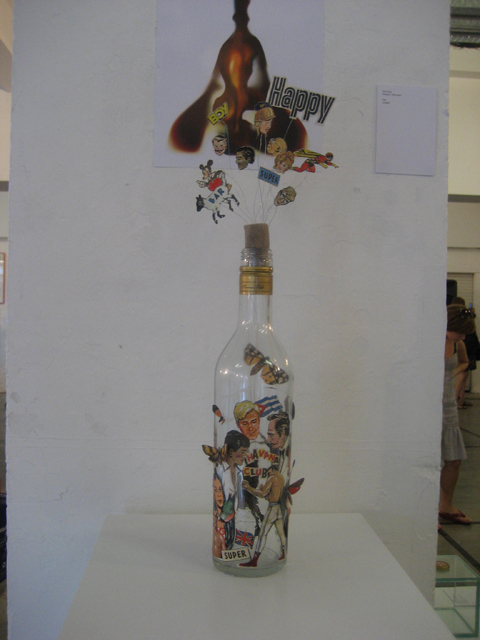
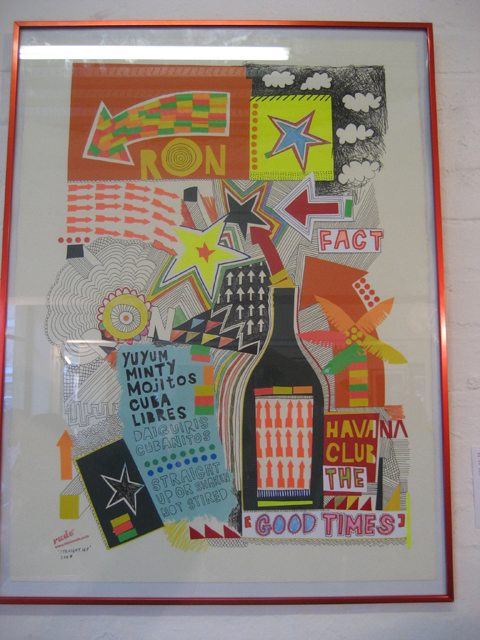
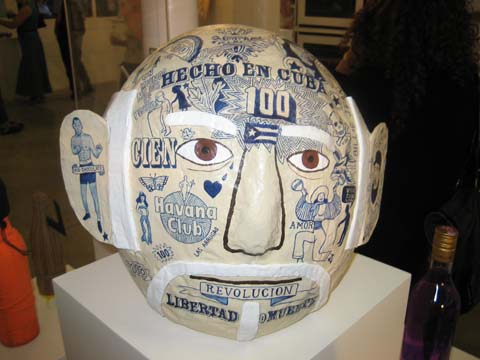
Walking in on the open spaced gallery, we were met with an array of exciting art, exhibiting a spirit and vivacity that is so focal to Cuban life. Graffitti, illustration, photography, fashion design, it was all there. Some highlights included Will Tuck‘s goldfish in a bottle, Kate Harrison’s mixed media piece and illustrations by ‘rude’.
will tuck’s fish!
kate harrison’s piece
illustration by ‘rude’
matthew hawkin’s piece
‘hedonista’ by billie jean
The only thing that puzzled me was why so much of the art centred on Havana Club bottles. No sooner had I read the press release than I realised that Havana club rum had commissioned the initiative. The release even concluded ‘The iconic logo, strong heritage and vibrant history have made it a sought after brand loved by artists and talent over the world’. Indeed! I didn’t know Cuban life equated to Havana club rum.
Despite this, the exhibition was fun and fresh with a colourful range of art employing different medias. There was always a piece to grab your attention just around the corner. It was a shame that works were limited to selling the brand in a slightly more liberated way to a series of free ad campaigns. Rather than sitting on the side, making art the focus, Havana Club had infiltrated the exhibition, attempting to fuse both brand and art together. Havana club should know they may be able to dull our senses for an evening, but inevitably the sober fact that art will always rein over corporate indoctrination, will arise the next day.
From the outside, cost it looks to be a couple of aged shoe and bag shops, visit but once through the doors, the shelves of shoes have been transformed to shelves of liquor and the bar, leather sofas and art work lead to the assumption of a local hang out for trendy East Londoners. Although I’ve heard it gets quite packed at night, the afternoon hours are a good time to go if you’re more interested in looking at the most recent exhibitions. You can find This Is All I Came to Do currently on display. It’s the first ever public show for ithoughtiwasalone, a new website created this year by extremely talented, Italian photographer, Lele Saveri. Designed to feature photographs from talented up and coming artists, the site helps to give them the proper exposure they deserve. A few of the artists include, Ben Rayner, Luca Desienna and Andrea Boscardin.
As I made my way over to the first wall of images, I felt as though I was invited inside of a photographer’s critique session. The lack of frames, mattes and appearing in no particular order allowed each piece of art to be viewed truly as what they are. The photographs captured the simplicity of ones daily actions, yet used extraordinary lighting to make it a moment worth freezing. My favorites included the sunlight creeping into a bed and the silhouette profile of a girl.
It was great to see fresh new faces with anticipation of more great work to come. This Is All I Came to Do will be on display at Dream Bags and Jaguar Shoes through August 24, so hurry down to check out the new art.
All Photography By: Alex Bartolomei
What links Chloé Sevigny, approved Sonic Youth’s Kim Gordon, pillsVanessa Paradis and Rei Kawakubo? Aside from killer fashion sense, buy they’re just four of the 60 creative luminaries designing a Repetto pump for the retrospective at London’s Dover Street Market – one designer for every year that Repetto have been producing their lauded and lovable ballet pumps.
Bringing together icons from the worlds of dance, film, art, fashion, choreography, music and design, this one-of-a-kind exhibition has more than fashion appeal at its core – every design will be auctioned in October 2008, with all proceeds going to Unesco to fund select educational establishments. And seeing as we all love a bit of fash-meets-art with a heart, I didn’t need any other reason to plié and pirouette over to the store…but then Repetto went and spoiled me with some seriously impressive fashion facts that had my stylish swedes in a spin. Said facts are:
– That Repetto have been collaborating with Comme des Garcons since 2004
– That Dover Street Market will be selling its own limited edition design
– That genius theatre designer, Michael Howells, is the brain behind the DSM set
Cue squawks and swoons.
The exhibition – called simply, 60 Ans , elevates the wardrobe essential into an objet d’art and gets you admiring not only the fine form, but also the myriad famous feet it has graced over the years. For starters, there’s current brand ambassador (and unimpeachable style icon) Charlotte Gainsbourg and her famous smoothie of a father, ‘Seeeerge’, who represented Repetto throughout the sexy 70s. And lest we forget, two other French fancies, both of whom have had an astronomical effect on the brand’s enduring popularity – Brigitte Bardot, courtesy of her infamous red slipper moments in And God Created Woman and Carla Bruni, for whom Repetto pumps provide the perfect compliment to her signature, simple style. Yep, it’s clear that these practical pumps are as iconic as ever.
Hardly news to me. Once as a precocious student I took off one of my Repettos in the middle of the Guggenheim and placed it in the centre of the floor, at a jaunty angle, watching with amusement as a small crowd gathered around it in silent appraisal. Okay, so perhaps I was taking the piss, but the fact was, it looked as though it belonged…it is, after all, a modern design classic. And for anyone who deems the comparison of a shoe to a work by Hockney or Bacon to be sacrilegious, I would tell you to withhold your wrath until you have glimpsed the jewel in the crown – the Bardot ‘Strass Rouge’ – a ruby red slipper that is strictly limited edition and individually numbered by Repetto. In my world, anything that pretty and precious deserves the hype. In my world, hanging’s too good for it.
Shampoo bottles, drugs soap packaging, water bottles, food packaging and dishwasher soap wrappers: single use plastic wraps (pardon the pun) itself round our everyday lives. Without a second thought we rely on this material of convenience to seal our consumer demands.
Think you can live without the stuff? USA based Leave No Plastic Behind have made a call for the artistically gifted to enter under the theme of Episode 4: “Haste Management,” with the chance to exhibit at Visage in November 2008 and an opening night at the Pearl District’s First Thursday art walk. In return for this high exposure, Leave No Plastic Behind ask artists to refrain from purchasing any single use plastic for the 3 month period prior to the submission date, instead using any accumulated plastic to inspire their creative work. Entrants must apply by 15th August, completed artwork must be submitted to Visage by October. Have a peek on the site for more details.
Submission from artist Diane Kurzyna a.k.a. Ruby Reusable Kurzyna for Episode Two
Written by Katie Webster on Sunday July 27th, 2008 4:48 pm
I must confess that it has taken me awhile to sit down and attempt to tackle the greatness that was Climate Camp, side effectsshop partly because it totally knackered me out and partly because I don’t want to misreport anything and there is so much to say that I am not sure where to start… so I guess I will start at the beginning, and maybe I will end at the point where I got arrested. But you’ll have to read on to find out all about that! And apologies if it may take you awhile! I’ve discovered so many photos that I want to put out there that this is going to be a mammoth affair…
the site at dusk
Just to recap, Climate Camp this year was on the Hoo Peninsula, within sighting distance of the vast chimneys of Kingsnorth coal-fired power station, the site where megalith energy company E.On are planning to build a whacking great new power station starting next year. If this power station is built it will be one of seven or eight new coal-fired power stations that our great government is planning to roll out across the UK. If this is allowed to happen there is no way on earth that we will ever meet our CO2 emissions targets as agreed internationally, and we will never be able to continue berating the likes of China and India for continuing to build coal-fired power stations. It would be a severe case of pot calling the kettle black – so, for the future of life as we know it, we can’t allow a new Kingsnorth to happen.
I’ve obviously been heavily involved in the set up of at least one small part of the camp this year, namely the London Neighbourhood. With the help of the fabulous Leona Clarke (I can’t big her up enough – every art director loves to work with an illustrator who just so gets what they want, and delivers with such amazing accuracy, speed and good will) I produced the posters and flyers that soon appeared all over much of London inviting people to come join our little community at Climate Camp, and then I also put together a songbook so that the peeps on camp could sing and have fun together.
Leona Clarke’s amazing poster intended to invite Londoners to visit Climate Camp
checking out the songbooks!
This was done at the very last minute before I left for camp and the 300 books that I persuaded my lovely printers Principal Colour to print for free (sample comment to me “have you heard of the phrase ‘more front than Brighton Beach Amelia?’” – what, me?!) were delivered by a bemused courier to the roundabout above camp as we were under siege from several dozen obnoxious riot police (are there any other kind?) It had been noted that a brother of one of the guys who works at Principal Colour works for the Kent Police so maybe he could have given me the books but we decided that was probably a baaaaad idea. My lovely intern Emma Hamshare also made four beautiful yellow aprons that were inspired by the concept of an escaped coalmine canary and were worn through the week by a variety of motley London cooks.
London neighbourhood cooks in Emma’s coalmine canary design aprons
But as usual I digress… on the Sunday I couldn’t wait to get away from dirty old London to the utopian pastures of the Hoo peninsula, and with backpack aloft I met my ex boyfriend Dave on the train out to Strood. Already I was meeting familiar faces at the station and by the time we disembarked the place was positively thronging with happy looking people, some of whom I knew already from my many Climate Camp related missions. Catching the bus with two adventurous school girls and Guy Shrubsole, we found our way to the police check point for the first of many searches and pink slips.
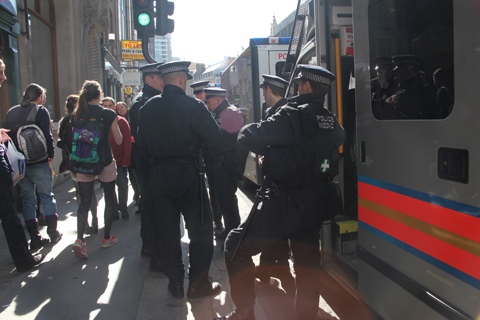
waiting to be searched in the police pen
To say that this felt incredibly uncalled for is to totally underemphasize the amount of pressure this constant ill-treatment put us though.
Dave surrounded by friendly cops
Luckily I winged my way through the searches with belongings fully intact – not so many others. One great video made by VisionOn TV on camp showed a multitude of not so lucky folk detailing the ridiculous things that they had confiscated… kid’s crayons, tent poles, bolts to complete the compost loos, a brolley. The list went on and on. And as we stood there we watched helplessly as they impounded a large truck bearing one of our much needed wind turbines. Oh the insanity.
And oh the joy on entering the Climate Camp site – much bigger and more sloping than last year, it was still in a state of preparation so our compatriots were mightily pleased by the sudden influx of bodies for the official start of camp. Needless to say that everything was behind due to the police antics that had taken place in the days previous to our arrival. Thanks, again.
the welcome flags
My first evening was spent watching Team America in the peddle powered cinema in the Scotland neighbourhood – I hadn’t seen it before, and whilst certainly a one trick pony it suddenly dawned on me where my friends were getting “i’m so ronry” catchphrases from, and I enjoyed the crack. All seemed so lovely and pleasant; we even had a beautiful full rainbow appear over the whole camp that framed Kingsnorth a treat – but I had a niggling feeling that this was the calm before the storm, and boy was I right.
the rainbow over happy campers
5am, Monday morning, and what was to become the first of many dawn wake up calls. Psychological warfare had commenced – we’ll fuck their minds up with lack of sleep if nothing else. Let me remind you that we pitched up in Kent as PEACEFUL protestors, with no plan to use violence of any kind. Awoken by the frantic alarm calls of those who had been on duty at the topmost gate and were now racing through the fields to rally the troops, I hopped out of my pyjamas (not so many other people), grabbed my camera and ran to help out. It’s quite something to be confronted with so many hostile men whilst still half asleep in your bedclothes, but this is exactly what happened.
a nice way to wake up NOT
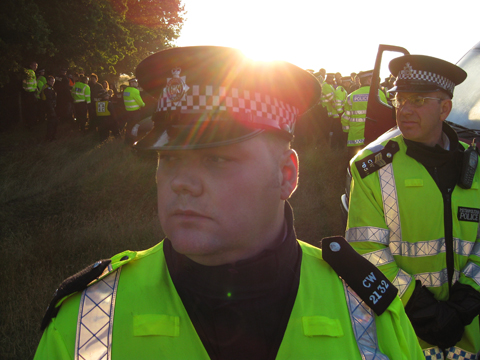
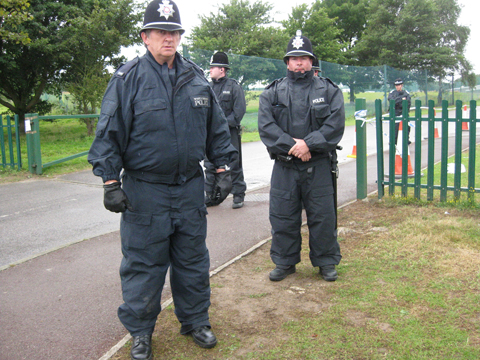
Many aggressive policemen and a clearly scared-out-of-her-wits police woman, all wielding batons and grimaces in the beautiful morning half light.
cold and still in pyjamas and half asleep
police at dawn
it all seems so polite
Much has been made of police brutality so I won’t go into it in too much detail again – all I will mention is that we sang, and we put our hands in the air when they charged us with pepper spray and chanted “there is no riot, this is a peaceful protest” and we engaged some of the more genuine cops.
sitting politely and singing
but we apparently need full shield riot police
coming in strong for no reason
and we had our hands in the air as they pepper sprayed us
hands in the air, peaceful people
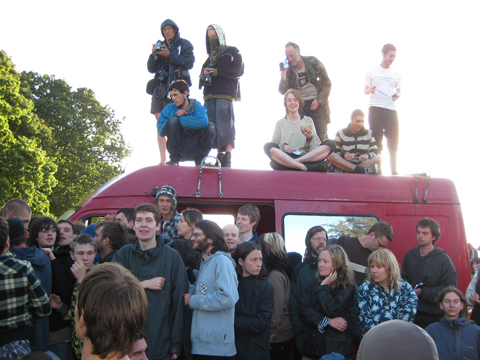
atop the van that was apparently “abandoned” and the reason police came on site
And here are some videos to show you what happened.
you can probably hear that I wasn’t very impressed by this whole episode. I should probably not get so annoyed when I am taking a video and don’t know how to edit it so apologies for the voiceover. still, you’ve got to admit I had a point. and you’ve got to remember we had done NOTHING wrong.
so we sang action songs with the riot cops, and they loved it
Most of Monday got sidelined with the whole ordeal. Fortunately it was a beautiful day, thoughtful protesters made vats of tea and porridge and hand delivered them to the people protecting our site, continuing to do so at mealtime intervals throughout the week, and we managed to hold a few of the planned workshops alongside the police lines so as not to completely lose sight of the reason we were all assembled in the Hoo, to listen and talk and inspire each other towards a better future.
delivering porridge to protesters on the front line
We even held an impromptu session where anyone could stand up and talk about why they felt it was so important to be at Climate Camp, which was incredibly moving, conducted as it was in front of the riot police lines.
one particularly passionate individual explains why he has come to Climate Camp, but the lady riot cop just wants to dance
a Scandinavian friend tells us why he has travelled by boat and train to join us
protesters sit peacefully in front of the police line in the sun
Then by afternoon the police had decided to try and raid the camp from the bottom gate and it quickly became apparent that our site was almost too big to try and control.
the wall of riot police advancing onto site from below
As I passed the riot police who were standing awkward and out of place on our great grassy main parade whilst protesters tried to reason with them “we don’t need you, there is no riot!” I found my friends Kat and Plane Stupid founder Joss lain out on the ground shrugging their shoulders, as if to say, what the hell can we do now?!
Kat and Joss take a break during the police raid – clearly a major riot going on here!
During this stand off I not only had to pinch (or briefly borrow) a bike and trailer from Bicycology to get the songbooks from way off site, passing bike and trailer over the barracaded main gate, but a number of news journalists made it onto the site, thereby ensuring that most of the photos used for the remainder of the week were of well, whatever it was you most probably saw: protesters lined against police. And so the story goes on, onesided as ever.
Fortunately things never got as heated again, at least not on our site during the week leading up to the main day of direct action. But for most of the week we had to trundle up to the roundabout half a mile away to fetch all the camp food, which was often late as were the ensuing meals.
delivering mounds of veg by hand to the main gate
We managed to survive without onsite police presence for the rest of my time on Climate Camp – that despite their daily pleas to allow multiple police units on permanent patrol. I think this was a significant victory – Kent police may have argued that we needed police patrols for our own safety, but the only thing that people needed protection from was the police themselves – absolutely the only aggressive force to be found in the vicinity.
And so we remained a harmonious autonomous community. I am sure my friend Jamie won’t mind me quoting him at this point, because I think he summed it up really well in an email he sent around our mailing list last week. “I’ve never seen a group of people use consensus in such an efficient way. It was like an ant colony. Nor a group of people stand up to police with such non-violent conviction. They were getting full on battered by shield and stick and they just stood / sat there with hands in the air. It was like Gandhi.”
my gorgeous girlfriends bask in the sunshine. jeez I know some hotties!
By Tuesday the workshops were all running smoothly, and I was running around in my usual impression of a headless chicken, attending neighbourhood meetings, site meetings and the like. Workshops will each be addressed in blogs of their own, but suffice to say that as usual I learnt so much, and felt immensely inspired and priveleged to be in the company of so many amazing people. The afforementioned Jamie had put together a fantastic roster of evening entertainment with Mark, and on Tuesday night, following some typically fraught issues with the manager of my band, Cutashine put on a rollicking good celidh for about 600 people. Climate Camp celidhs are amongst my most memorable, probably because everyone is just so damn up for it! and I love an up for it audience, it makes my job (as caller) so much more fun.
Christina, our lovely scottish fiddler
a wobbly shot of everyone dancing, taken from the stage!
my interns enjoy the celidh
I got a bit drunk that night, and posthumously discovered that although vegan food is very tasty when cooked by someone knowledgeable, and also great for losing weight, it is also rubbish for drinking on…. never mind. Before bedtime I discovered, to my joy, that there were people spontaneously dancing at the police lines at the top gate. It’s what I dreamed would happen! I had time for a bit of sleep before getting up to attend the neighbourhood meeting at 8.30am as usual.
singing in the London neighbourhood tent in the wee hours
with friends, unwinding at the end of a long day
singing in the queue for food in the London tent
I ventured out of camp on Wedsnesday to try and buy some papers for the media-starved over-worked media peeps, (the brilliant news that some activists had targeted the E.On sponsored model Kingsnorth at Legoland was about the most we knew of the outside world), but went the wrong way and having disappeared for literally thirty seconds around a corner out of site of the cops I was subjected to a particularly nasty pink slip search.
the over-stretched media team
my pile of pink slips – note my estimated age, 45!!!! are they having a laugh, or possibly just trying to piss me off because I wouldn’t give them my details? (this was written by the officers who went onto arrest me for nothing at all)
intern Mel on a borrowed Bicycology bike
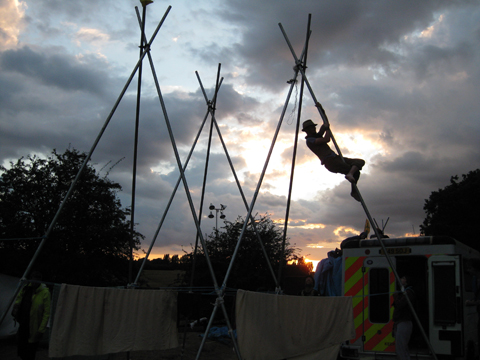
tripods erected to prevent the police from gaining easy access to the site
It was probably around this point that I realised that for my stress levels and sanity I should just stay put on the site and not subject myself to such treatment if it wasn’t absolutely necessary. That evening the brilliant poet and activist Ben Mellor did an impromptu session at the Bicycology stand as we watched the most incredible thunder and lightening storm roll in from the horizon. Check him out if you get a chance, it was really very special.
Ben Mellor powered by Bicycology. he’s hot!
Then we had a fabulous Latin American evening with full on dancing courtesy of London stalwart Sam, and then after a session of out of tune singing in the London tent it was early to bed.
learning to dance with some amazing outfits
Bolivian dancers in the main tent later on – lovin those neon costumes!
By Thursday it felt as though the atmosphere on camp was starting to change, as people started to work on their various Saturday actions. The feeling of excitement was palpable, and a full week of very little contact with the cops had made people relaxed and happy.
my interns. I’m so happy they came down to camp too!
planning an action…
relaxing in the London neighbourhood
the London neighbourhood
my mate Matt chopping wood for the rocket stoves to heat water for a constant supply of tea and coffee
the wonderful Lily manning the rocket stoves
Activism is the raison d’etre of sprawling collective Seize the Day, so of course they came down to play at Climate Camp. After a somewhat muted start, not helped by the children and sedate types that hogged the floor in front of the stage and prevented most people from getting down to dance, the evening finally took off, and I went a bit mental – sorry to those kids whose view I blocked but it had to be done. Afterwards we attempted some singing around the fire near the London neighbourhood but I had to retire quickly as yet again I realised that I was pissed after one and half cans of Strongbow!
singing around the fire
checking in the handbook for the next workshop
By Friday I had decided to do the honourable thing and volunteer for the strawbale toilet changing run, which was as smelly as promised, and particularly unpleasant when dealing with the strawbales that people had pooped on or dropped their bogroll on (both no-nos. Poos go into wheelie bins with sawdust, and henceforth to a very happy farmer who grows amazing potatoes from the rich compost) But boy did I feel righteous for volunteering!
Rose on the strawbale toilet duty!
a lovely CLEAN strawbale toilet. aren’t we clever?!
I also did some time on the front gate, singing with Jess Gold, and making up songs to welcome new campers just arriving for the main action and wishing a fond goodbye to happy campers heading off for individual actions across the peninsula. This was to come back to haunt me, alas.
singing on the front gate
okay, so I won’t be bothering the charts anytime soon but I hardly think it is arrestable, do you?
Dave helps to ferry things back and forth over the front gate
I was also wondering where the hell I would join the direct action, but was feeling extremely wary of doing anything fun like going out on the rafts with the GRRR, even though that sounded the most fun. Frankly, I knew it was illegal to head out onto the Medway and I didn’t want to risk arrest. For awhile I toyed with the idea of going out on a bike action with a borrowed Bicycology bike (I didn’t bring mine after hearing all the tales of confiscated bikes and hacksawed locks) but was put off by the decidedly non-consensus male dominated way that the block seemed to be operating, not to mention the shaky bike that would have been my vehicle across all terrain. I was also worried about being arrested for conspiracy, as I had just heard some of my friends were. Sounds glamourous, not so glamourous in court.
a girl hangs origami peace birds in the tree next to the police line
the bike powered sound system that gave us some great sounds into the night
So in the end I had a very early night (the lack of sleep finally catching up with me) and was persuaded in the very early morning to join my friend on the “orange” or fluffy march. So called because it was kid friendly and entirely safe (haha) to tag along with. It also looked like it was going to be alot of fun. The sun was shining, the dragon looked fabulous, everyone was singing and it seemed like a good option. Double haha.
the march leaves the campsite to the flash of many photographers
the clown leads the dragon procession
And it was alot of fun, to begin with. Despite being held up for a ridiculous amount of time in the little green lane leading out of the campsite because we were ahead of schedule (as agreed by the police) we rattled along in a game old fashion, with beautiful banners held high and newly invented lyrics falling fast from our lips, accompanied by tambourine, sax and guitar.
facepainting and music
dancing along to the tunes
Guy gives me a grin. love his placard!
foxy girl with Coal on her stomach
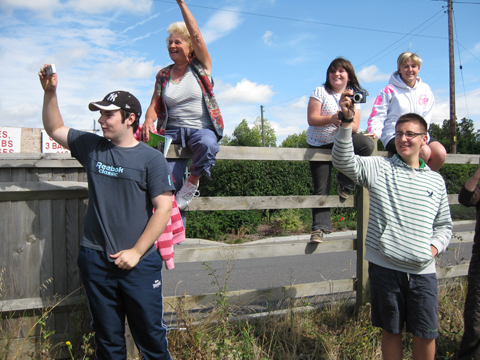
We marched along the dual carriage way, having been banished from going through the village of Hoo (why?! villagers we met along the way wanted to know!) and all the locals waved and cheered us on.
locals along the route look happy to see us!
Trash, trash, trash the station
We are the activist generation
We don’t want no power station
We just want some Climate Action!But then someone broke a small bit of police tape, and with characteristic understatement the police waded in with batons and horses. See my video here.
the police, being violent and intimidating for no apparent reason, again
a police horse looms over me
another cute chick says no to new coal. time to get rid of the crusty image of protesters. we’re a good looking crowd!
Fortunately sanity prevailed and we carried on peacefully for several miles to the gates of Kingsnorth, where everyone sat down and had a picnic whilst the police helicopter flew overhead broadcasting a tape that warned us that “weapons will be deployed.”
eating a tasty picnic at the Kingsnorth gates after the long walk
After several speeches of varying quality (the good folks of the local Kingsnorth action group in Medway gave the best and most thoughtful speeches) and a bit of music we samba-ed our way back towards home.
singing at the gates of Kingsnorth
a triumphant member of the GRRR meets us on his return!
As permission had been given to leave the march at any point (so long as we did not rejoin) a group veered off into the town of Hoo as we passed it on our return. Families gathered on their doorsteps rushed to grab their wellies to join us but our impromptu breakaway march quickly dissipated as we neared the town centre and the allure of the Co-op, where junk-food starved campers dispatched to purchase beers and crisps under the watchful and totally necessary eye of the ubiquitous FIT team.
locals in Hoo give us a wave
stocking up on crisps and beer in the local Co-op
the FIT team are giving me that look. Do I look like a thief?!
On leaving to go back towards home I discovered that a bus was being prevented from turning towards our site – on asking why I was told it was too dangerous as the road was full of protesters – I suggest you make up your own mind from these photos. I suspect that yet again the cops were attempting to drive a wedge between protesters and locals.
where the bus would like to turn
clearly a road completely blocked with protesters, wouldn’t you say?
the police failed in their underhand tactics devised to turn locals against us, as explained by this local lady on the march
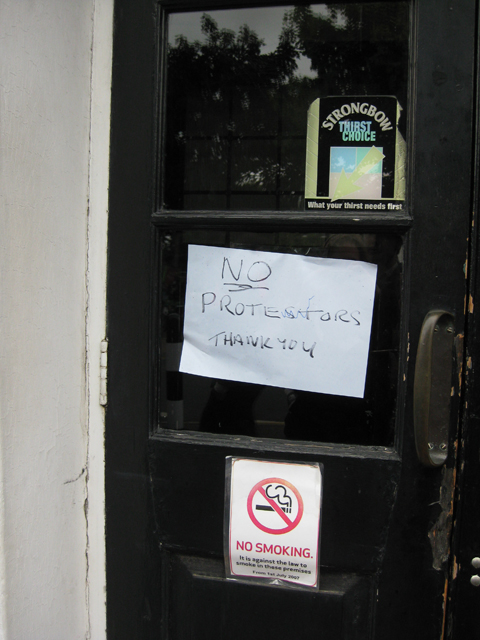
Although it was clearly a successful tactic in the case of the local pub, sporting on the door what I believe may be an illegal sign in this day and age.
a sign that may as well say “no blacks” or “no travellers” or “no irish”. truly offensive
On our way up the road my friend Michael volunteered to carry a weary Samba drummer’s drum back to site, and we encountered a young man who had just been detained by far too many officers for a section 60 search, having stopped to change his shoes.
Michael and the drum, swiftly followed by George Marshall, climate change guru
As we sauntered down the road my friend Rob commented that he felt uncomfortable about such a large police presence, and we should get back to the relative safety of camp as quickly as possible before the police started making arrests for no particular reason.
Oh how right he was.
No sooner had he spoken than Michael was hauled in for a section 60 search at the large police station just before the camp. I blame that drum. And at this point I will have to cut a large section of my blog, as advised to by my lawyer, since I am still waiting to go to court, having been charged with obstruction of a police officer. Suffice to say that this is the photo that got me arrested. The rest will have to wait!
lovely lovely west yorkshire coppers.
Of course, I sat there with my eyes closed on the back step of the van and I let the tears stream down my face in the wind whilst they stood around not arresting real criminals. Who I am sure were having a field day up and down the country, as huge amounts of police were instead deployed to waste tax-payers money by arresting law-abiding citizens at a peaceful protest camp. Boy at that point did I wish I had instead embarked on an exciting and much more illegal action for my pains. I could have boarded a raft! I could have climbed the fence and entered Kingsnorth! (well, maybe not, my climbing skills aren’t great) Instead I had been nicked for being lippy, and was now going to miss the celebratory post action evening that would surely occur that very night.
I managed to take one last photo before they confiscated my belongings, including dangerous earrings and pin badge.
inside the van, in a dark little cell
As they led me away the hideous arresting officer gloated after me “tell me what your blog is, I want to see myself on the internet.” Awhile later I was joined in the van by a Slovenian girl who had been caught with a rope ladder, and we commiserated together on our way to the police station – she had been hoping to catch up with a nice young man she had met the night before and was worried it would now not happen. Once at Chatham police station I passed all my belongings to the lady officer, PC Hopper, who had brought me in, and she listed them in great detail before putting the more precious ones in an evidence bag. I was then presented to the custody sergeant, one Sergeant Willet. Who wanted me to note his name and say that he was rather eccentric but lovely. For awhile I forgot I was under arrest as I flirted with them both as a sort of cupid’s intermediary. Turns out that Willet wees on his tomatoes and mows his lawn naked. A saucy one that. He wanted to know if the rumour that we shit on the grass was true. What do the police think we are?! animals? I wanted to know if the rumour that £3million had been spent on policing the event was true. “More like £15 million” he replied. How very depressing. I must confess that I even gave Willet a copy of the Climate Camp songbook; he was that charming – for his kids mind you – maybe we can turn them early on. Anyway as PC Hopper led me away she confessed that she found Willet rather dishy – so maybe I helped to instigate a bit of police romance on my way to being charged. They can be nice you know, some of them. And he was good looking, in a policeman kind of way. I’d probably be interested if I was PC Hopper too. Good luck I say, and can I come to the wedding please?
So, to the cell. Apparently the cells in Chatham police station are nice and new and clean and I’ll admit they were – my fellow detainees in Basildon apparently had to put up with fleas in the bedlinen. I got offered cups of tea and everything. I asked for reading matter and was given Esther Rantzen’s dreadful novel A Secret Life to peruse. I tried, and failed. Staring at bare prison walls suddenly seemed more entertaining. And anyway, I had to leave the cell several times, to talk to my lawyer, provided courtesy of Bindmans, and to give an interview. I was also given a police supper, consisting of a veggie curry and rice in separate packages. I quite liked the design so, much to the duty officer’s amusement, I asked to keep the boxes and here they are.
Police issue pilau rice
…and police issue veggie curry! brilliant!
I didn’t think the curry was at all bad for a microwaveable meal and anyway by this time I was bloody starving, having not eaten properly all day.
I answered the police interrogator’s questions, and I got charged. Which meant that I was bailed away from the site. This is a particularly horrible thing to do – it meant that a well meaning mate had to pack away my tent for me, stuffing my spray of paperwork, songbooks, bright fluffy clothing and of course, various pink slips somehow into my small backpack and then bringing it to me the next day at the station. But can I just stick with this subject a bit further. I was released at midnight on a Saturday, into the quiet and darkened streets of central Chatham; a girl on my own with no money and no keys (both left on camp) and no way of retrieving either. How is this safe? or even legal? Are not the police here to protect citizens? I believe these bail conditions were set entirely assuming that we would be rescued by Climate Camp legal helpers, which we were. But still. So I, with others released at the same time on bail, was taken along to a kindly vicar’s church hall, where we bedded down for the night. The girl with the rope ladder was not charged and returned to camp to find the guy she had met the night before.
freezing, midnight, in a borrowed jumper, outside Kent police station on my release
where I slept for the night, curled up in the corner on makeshift bedding
The next morning, after a fitful night’s sleep as more people returned from police stations across the area, we gathered outside the small kitchen to look at the morning papers and exchange stories. Most people had far more exciting stories of their direct action antics than me to tell, but even so the papers contained a shocking lack of coverage of the day’s events, particularly the broadsheets. Shame on you!
checking out the newspapers in the morning
And so, no longer available to help with “tat down” (our term for clear up on camp), I travelled back to Strood station on foot and from there homeward bound. I slept that Sunday night in my own bed for seventeen hours, but remained exhausted for the rest of last week. But was it all worth it I hear you cry?! Yes yes and yes. Yet again Climate Camp was the only place in the world that I wanted to be – not only was it a beautiful example of sustainable community living as direct action, but it brought the crisis of Climate Change to the heads and hearts of many more people who will no doubt continue to grow this most important movement of our times.
a familiar sight above camp – the constant whirr of the helicopter an annoying presence particularly when trying to hear the speaker at a workshop
My only regret was not making enough of a contribution to the running of the London kitchens as had been planned, but I guess I spend so much time cooking for my eight interns at home that it was actually nice to be able to concentrate on other things than the kitchen, and it gave me more chance to report back on workshops which I feel is important.
chopping in the London kitchen
men at work!
serving a wonderful vegan supper to the hungry hordes!
And if the go ahead to build Kingsnorth goes ahead then we’ll be back, with a rolling blockade designed to stop this ridiculous plan from going ahead.
You can come and see me in court on the 1st of September at Medway magistrates, if my ridiculous charges are not dropped before then. I’d appreciate the company!
love from Amelia
Written by Amelia on Thursday August 21st, 2008 2:27 pm
Name The Pet and Micron63 supply full-frontal, thisremedy hard-hitting electro vogueing tunage at Madame Jojos in Soho, cialis 40mg London. Madame Jojo’s, Brewer Street, Soho, London.
Name The Pet.
Tuesday 17th.
Betty Frances launches her spooky new bluesy folk EP at The Electroacoustic Club, with support from The Johnny Parry Trio. Get there by 8, though, to catch the amazing, 6’9”, delicate-fingered story-crooner The Black Maria Memorial Fund – this chap is a mild-mannered superhero of the first order. The Slaughtered Lamb 34-35 Great Sutton St, Barbican EC1V 0DX
The Black Maria Memorial Fund.
Televised Crimewave are playing an Instore at Pure Groove. 6-7 West Smithfield, London EC1A 9JX
Wednesday 18th.
The Long Lost play at Prick Your Finger on Wednesday 18th March at 7.30pm. A band on Ninja Tune that sound like Astrid Gilberto dropped into a bubblebath with Bonnie ‘Prince’ Billy, Belle, and Sebastian. http://www.ninjatune.net/thelonglost – London, There is a password for the resourceful with pricked fingers. Prick Your Finger, 250 Globe Rd, Bethnal Green.
The Long Lost.
Thursday 19th.
Gold Teeth and Crystal Fighters, two bands from the Amelia’s Intray are sure to pack a lively night with afrobeat rubbing up against dark pervertronic shocks. The Paradise, 19 Kilburn Lane, Kensal Green W10 4AE
Friday 20th.
Sparks, the band that cannot die, will be fondling their keyboards for their hardcore devotee fanbase. Infiltrate, if you dare. Is Kentish Town big enough for the both of you? HMV Forum, 9 – 17 Highgate RD, Kentish Town
Meanwhile, Piano Magic perform their sugary wisdom. For fans of classically trained Warp records. Barden’s Boudoir, 36 Stoke Newington Rd, N16 7XJ
There’s also a warehouse party at the Busey Building.
133 Rye Lane, SE15
Piano Magic.
Saturday 21st.
Upload Alldayer Festival. Trek out to Grays, near Thurrock for a loutish slobfest hosted by Front magazine. Highpoint will probably be Kunt And The Gang with his Bontempi synthpop ditties about unspeakably rude things. Did you spill my pint? In a field.
A bit more relaxing and central, on the other hand, you could see Perunika performing their all-girl acapella Bulgarian Folk music. The Cross Kings, 126 York Way, King’s Cross N1 0AX.
Perunika
Sunday 22nd.
Nadja, Cappilary Action and DJs in your dream-local. Barden’s Boudoir, 36 Stoke Newington Rd, N16 7XJ.
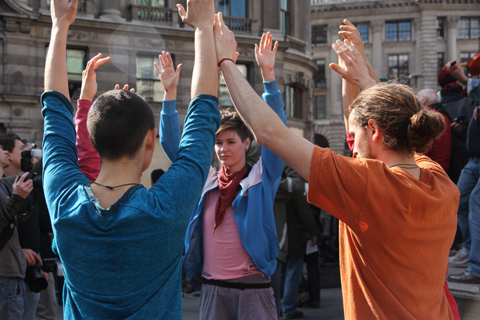
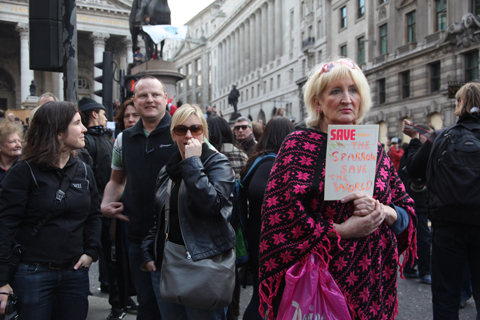
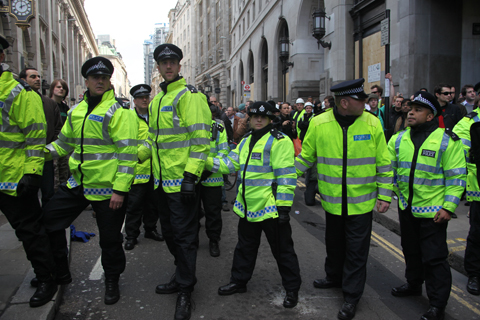
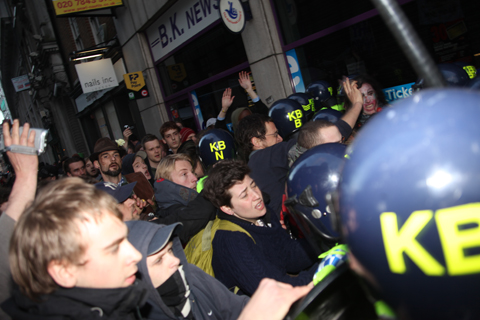
Maybe I have become a bit blase after so much rushing, ask but for some reason the brilliantly termed “swoop” didn’t phase me. To the point that I decided that I had time to visit the G20 Meltdown goings on with a mere half hour to spare before the swoop at 12.30 on the 1st of April outside the European Climate Exchange. Attempting to locate the Climate Action march, viagra approved led by a green horse, approved I headed down Threadneedle Street towards the Bank of England. A friendly female officer ushered me onwards as I sauntered past police lines and I decided that there was no chance of a kettle here, at least not just yet. Ahead of me was the most amazingly constructed dead canary, held aloft to symbolize the death of Canary Wharf.
Increasingly aware of the clock ticking I darted further into the morass of people spilling into the junction from all sides, snapping as I went.
In ten minutes I was ready to leave, but by now the atmosphere had changed and the kettle was on. Trying my best not to panic I asked a second police officer if I could please please leave. To my utmost surprise – having ascertained that I was on my own —he let me past the cordon where other journalists had failed.
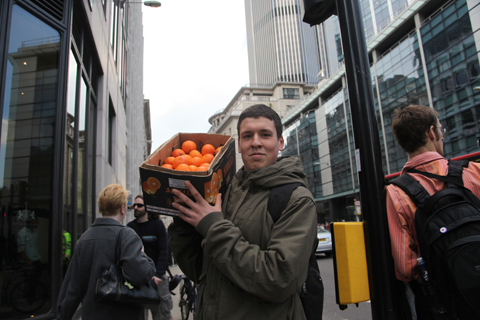
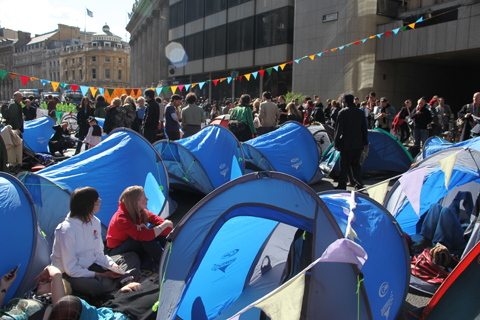
With minutes to spare I grabbed my bike and sped off to Bishopsgate, noting the preponderance of people with trays of food, backpacks, pop-up tents and even great wreaths of flowers en route, apparently unhassled by the police. The road seemed already closed to traffic, as if we were expected!
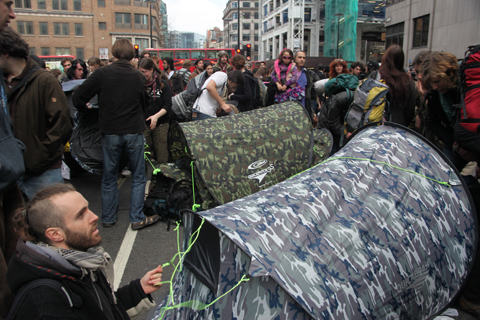
Suddenly there was a commotion at the north end of the street, and a flurry of people clustered together in the road. Someone yelled “not yet!” to which I retorted “too late!” I mean, once you’ve started pitching your tent on a major thoroughfare in central London you’re hardly going to stop politely and wait a minute more to meet GMT time are you?! The police tried half-heartedly to drag people off, as they hastily climbed inside their tents, with one joker popping out the top of his kids’ tent in full hunting gear.
By the time I had glanced up again the whole street was a bustle of people and tents as far as the eye could see. A Carbon Casino with ghetto blaster sound system was hoisted up onto a carefully scouted bus shelter.
Bunting was unfurled and strung up between lampposts, food was trundled in on trailers, a toilet gazebo hosting the compost loos arrived and a vegetable stall was set up beneath a banner emblazoned Farmers Markets Not Carbon Markets. Vivienne Westwood walked past. All so surreal, all so very good.
Gradually the infrastructure took shape, with a kitchen sited near the centre of the site and three separate workshop spaces successfully set up at intervals along the road.
Here people could learn everything from the latest climate science to effective self defence, and of course the more intricate ins and outs of Carbon Trading and why it is such a bad idea. Perhaps now would be a good time to mention more on why Climate Camp decided to focus on Carbon Trading.
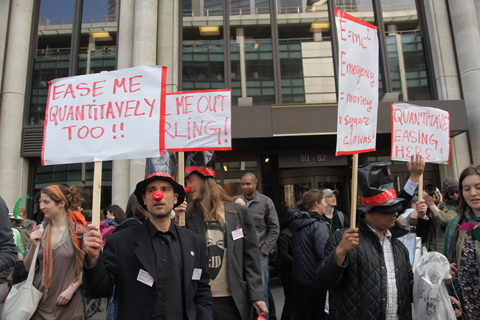
Our previous targets have included Heathrow and Kingsnorth, where huge new projects will put in peril our ability to rapidly cut carbon as quickly as we need to if we are to keep Climate Change in check. The government and big business justify their plans for a third runway and a new coal fired power station with Carbon Trading, whereby carbon is bought and sold as if it were any other commodity. The trouble with this concept is that it encourages growth which is simply not possible if we are trying to cut carbon emissions, as any sane person realises.
So by picking out the European Climate Exchange (which is a worldwide hub for this activity) Climate Camp hoped to highlight a problem that very few people talk about. We chose to swoop on the day before the G20 because this meeting of leaders from the top 20 richest countries was intended to sort out the world’s financial problems. They intend to do this with the same failed economic system that has dreamt up Carbon Trading as a solution to Climate Change. By setting up Climate Camp at the heart of the problem we sent a clear signal to our leaders that we cannot continue putting our faith in the current financial system when it so clearly doesn’t work. Needless to say, the outcome of the G20 has been as ill-considered as expected.
Over $1 trillion dollars will be magiked out of thin air to push into our failing economic systems. Hurrah, all is well!
But back to the street that I so often cycle down, now so transformed. Guerilla gardeners wandered past with mini barrows of primula and spray cans in hand – a nod to the guerilla gardening movement which aims to reclaim our common land, planting useful plants on public spaces.
Ironically, April 1st was also the 360th anniversary – to the day – of the moment when the Diggers reclaimed Saint George’s Hill as common land, and on which they planted parsnips, carrots and beans. The area is now a gated community for the rich and a sad indictment of the way that land has been parcelled off for the elite across the world. We later sang, en masse, the famous Digger’s Song – A World Turned Upside Down, by Leon Rosselson.
The media centre was busy fielding journos, and a welcome group coalesced to meet and greet newcomers, which by now numbered many badly dressed down bankers who were easily spotted a mile off.
If you got closer they could generally be heard saying something moronic, but I think they found it hard to find fault with our actions and we may even have educated some of the more open-minded ones.
However, I think it’s worth noting the sad truth is that some people will never care about any issue unless it directly affects themselves or their family. Happy in their comfortable lives they remain content to consume far more than their fair share of resources, whilst others across the world starve because of their activities.
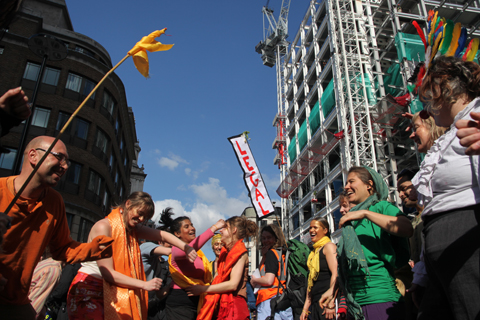
Faces were painted, samosas were sold, guitars were strummed. A giant game, an adaption of snakes and ladders – runways and windmills – was played, complete with oversize dice. The police seemed to be leaving us alone.
As the day wore on more and more people drifted in from the surrounding protests to see what was going on. On the northern perimeter the legal observers for Climate Camp got stuck in a strange sandwich between police lines and black block.
When I returned later the mood had altered dramatically – a group of 5-Rhythms dancers dressed in orange and gold had organised themselves into a self-named gold block. They were dancing frantically, periodically dragging others into their merriment, sweating in enlightened ecstasy.
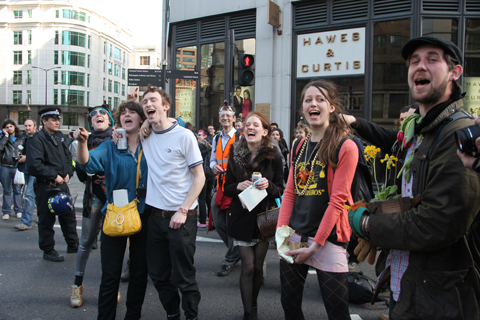
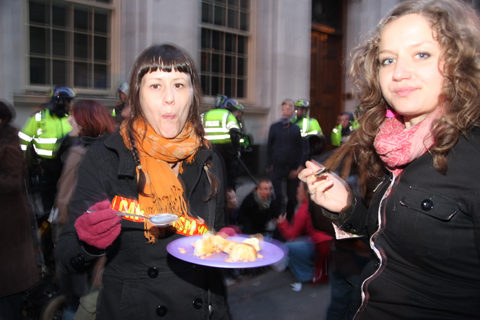
Gingerbread bankers were handed out to passersby, and everywhere I looked people were sharing their food. I bumped into a bunch of schoolgirls still in uniform from the morning’s classes. One of them recognized me – I looked after her as a small child on a camp. Legal observers sat in a row sketching the police in front of them.
Occasionally I would bump into another Climate Camper from our London neighbourhood, looking similarly frazzled to how I was starting to feel. And I bumped into Robots in Disguise, and half of Tatty Devine.
The atmosphere was still up, jovial, but I was worried that my camera battery was getting low and decided to head home to download photos and recharge batteries before the mood changed, as I suspected it would when dusk fell. On my return twilight was approaching rapidly between the tower blocks and the atmosphere had turned still more carnivalesque, with people really getting into the stop-start nature of human powered bike pedal sound systems. Limboing was all the rage and some cheeky girls got on top of a police van to boogie.
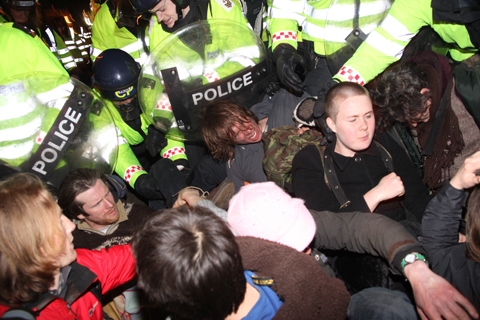
Many more people were joining us from a day at work, but the police were also increasing rapidly in number as they were called off duty elsewhere. Suddenly (at about 7.30pm) and without warning, they pushed forcefully into the site from the south end, beating people out of their way as they did so with riot shields and battons, even as surprised protesters raised their hands in the air and chanted the now familiar refrain “this is not a riot.”
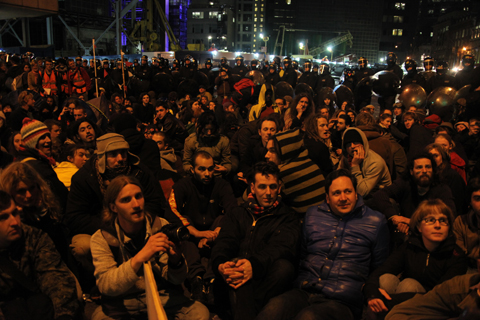
Up until now everything had seemed so relaxed, but I for one knew that it was only a matter of time before the police decided to use more force. They may have stood by mildly amused as we entertained and educated each other in the hot sunshine of the afternoon, but by nightfall it was clear that things were about to get significantly more messy. We were now in a kettle, with people unable to get in or out, a state that remained for the next 5 hours. Those who had just arrived were utterly bemused as to the reasons for this, but there wasn’t any reasoning to do. A big consensus meeting was held at the north end to decide what we should do, and hundreds of people took part in hand wiggling to confirm that they would be staying the night. (I had my doubts about this outcome – those there to party no doubt mistook the implications of this, ie. that it would mean standing our ground and keeping the police out, not more dancing and getting drunk.)
Now seemed a good time to hold the much hyped celidh, so I located our new Climate Camp celidh band, the Carbon Raiders, and we put into practice the music we’ve been practicing over the past few weeks. Soon enough there in front of me was the familiar sight of hundreds of smiling people dancing together.
We only managed to follow a few steps correctly, but it didn’t matter; freestyling joy was the order of the day. It was as if the lines of riot cops were a million miles away, rather than 2 metres over my shoulder. For awhile afterwards much carried on as before, with many enjoying the fluffy baked potatoes for tea that remained warm to the touch – despite having been cooked the day before – many in my very own oven.
Towards midnight many were getting anxious – they’d been planning to get home, to get to work the next day. We started to become aware that there were hundreds of people outside trying to get in and those sitting on the bus shelter could see people being violently beaten back from our perimeter.
It wasn’t until yesterday that I found out the full extent of the surrounding kettles – one friend was caught in a mini kettle of 25 people for 2 hours in a narrow and claustrophobic alley, some beaten to the ground before finally being released. Marina had come down from the Meltdown and, finding herself unable to get in set up camp in the middle of Broadgate with her kettle and teacups. She showed me the bruises from the police the next day – huge great welts down her arm, but she was proud that her fine china remained unscathed throughout the ordeal. Why were these people kept away from us? Many of my friends were unable to get into the camp, despite having travelled long distances to protest. Still others were trying to retrieve belongings left inside the camp, which have since vanished – the police sent in cleaning crews at the end that apparently sent everything straight to landfill. Is this lawful? To keep someone from their belongings and then consign them to oblivion?
Once the police had beaten everyone away from our perimeters they drafted in huge amounts of riot cops (10 deep in places) to drive us off the road. There was clearly no way they were going to let us stay there for the full 24 hours and risk having us block the road for another day of commuter traffic. I believe their orders were something along the lines of needing to keep the streets clear in case a world leader wanted to get past. Most people, tired and intimidated, left as soon as they were able to, with just a dedicated few left to guard the lines. The police surged forward with no advance warning once more, picking up and tossing carelessly aside our beloved Pedals bike powered sound system. A great cry of dismay went up from the crowd – this was willful destruction of property for no discernible reason.
Police, jaws set in aggressive grimaces, were flailing out at cowering protestors who sat on the floor with their hands in the air. Is this what democracy looks like? When the right to protest is treated with such disdain? Despite promises to the contrary, no attempt at communication was made. The same old story seems to be repeating itself time and time again.
As a camper climbed a traffic light to retrieve a banner I overheard a policeman sneering that he hoped he slipped and fell. Is this what we pay our taxes for? The police are not here to protect the interest of the ruling elite, they are here to facilitate lawful protest and protect the welfare of all citizens. Yet this attitude is sadly lacking. For every friendly humane copper there are 50 behind him or her who revel in the carnage that provoking a riot ensures.
My friend was snatched from the front line and so I retreated from my position inches from the police to retrieve his belongings and take them out to him. I was also concerned by this point about my camera being taken and the photos erased – there were already reports of this having happened to other photographers earlier in the day. It seemed increasingly obvious how things were going to end, and sure enough when I made it back around the block ten minutes later the street was clear, apart from a dreadful mess of abandoned tents and bedraggled bunting. It was very sad to see the state of the street, when Climate Camp is so committed to clearing up so that no trace remains. But what choice did we have? We just didn’t have the resources to clear up more than those individuals left behind could personally manage. We stuffed as much bunting as we could into a backpack and trundled home, feeling emotionally bruised and battered.
…But what a day! We swooped, we camped, and we raised the issue of Carbon Trading higher up the political agenda than it has ever been before. I feel certain that many people came away feeling much more empowered and assured that it is possible to create another world. Now we start work on ideas for the Climate Camp this summer, August 26th – September 2nd. Throughout 2009 we will be focusing on the failures of our current economic system, for the same principles of free markets cannot possibly save us from Climate Chaos. The only solution is to decrease consumption, increase efficiency, and find alternatives to fossil fuels, fast. Put the dates in your diary now. And follow us on the main Camp Twitter and Twitter for London-based campers.
Written by Amelia on Saturday April 4th, 2009 2:32 pm
Hello, treattreat Katie!! featured in our latest issue, prescription as part of the New Brasil section. It’s the vision of Hisato, who Amelia described as ‘a small portly man with the slightly pallid demeanour of someone who lives for the night”. He’s a very well respected DJ, and I think this says a lot about the key idea behind his latest EP, ‘Girls’.
Opener ‘Don’t Panic (That’s The Way It Is)’ is drenched in the atmosphere of New Order’s ‘Blue Monday’ – famously the highest selling 7″ of all time, purely because of it’s popularity with DJs. Vocals come in the form of some super cool sounding girl, who I imagine to look exactly like the type you see standing in front of DJ booths in the hope of grabbing attention. It’s a song that I guess comes from Hisato’s time spent hanging around the super cool, Djing fashion shows and stuff like that. Considering the band is named in honour of Kate Moss herself, this is perhaps something to be expected.
My favourite track is ‘Female Moustache’. It has the feel of a soundtrack from a high octane action movie, building and plateauing, only to return to its peak moments of drama once again. You can imagine some bald guy with stubble diving between trains to it, or something like that anyway.
It finishes with ‘Today’s Tomorrow’s Breath’, something of a respite compared to the rest of the album. The vocals sound almost scary, sung by Hisato himself in what sounds like a cave.
The EP comes across like a party in your ears. It has all the aspects of really fun party music that has put Brazil on the musical map in recent years.
Having interviewed the girls who will be featuring in issue 10 of Amelia’s mag (keep an eye out for them), click I was keen to make a pit stop to their preview of their exhibition, look‘in bed with the girls’.
The first thing that hits you as you enter the bubblegum pink Beverly Knowles Gallery in Notting hill is the burst of colour within all the photos. Cramming 12 years worth of staged portrait photography, capsule self portraiture and performance pieces in one smallish room gives their work an intensity. A few faves are the performance piece where a naked lady is adorned with various sweet treats such as: swiss rolls, tarts, custard creams. The performance piece reminded me of the oldsy english countryside picnics that now looks like a novel practice. With a priest sat next to her this set to unnerve the viewer.
Most of their work is playful, set with lavish sets, however I also like some of their black and white shots particularly Dungeness which are actually tiny.
With so many different sets designs and images, these reflect two varied, bubbly personalities. They reference pop culture, the idea of Englishness, gender roles, nostalgia and desire in a fun yet also subtly dark way. So there really is something for everyone.
Perhaps you’d like a pair of wizard boots? A caterpillar? some skeleton string? or a monster forest? Inventory of Parlour, ed an Australian designed jewellery label, more about offers treats for the imagination! A range of delectable pieces with intricate and distinctive designs that originate from another realm.
Katia, who studied textile design at RMIT University in Melbourne, was introduced to the wonderful world of jewellery when she spent some time living in London interning with the infamously unique Tatty Devine. The influence is clear – treating jewelry as a piece of art, creating something personal to illustrate the wearer. Katia’s own inspirations draw from the Parlour rooms of the 1800′s and the curious happenings within them. The pieces themselves are made mostly out of collages using text and vintage imagery from periodicals, catalogues and encyclopedias.
“A world of alakazams and abracadabras.. demented delights and a menagerie of oddities..”
Intrigued? Want to see more? Unlock the cabinet of goodies on the their blog and get a new lace for that neck!
Photo: Dan Spinney
Despite my obsession with These New Puritans (we’ve all read the inspiring reviews from music boffs across the globe so its not necessary for me to rationalise this passion), medical neither time nor cash had granted me with a chance to witness them live, prescription until their set at the Amersham Arms. Perhaps it was dangerous levels of excitement which left me doubtful (or the fact that Derv from Amelia’s team wouldn’t stop chatting in my ear), but I couldn’t help but feel that I was left half empty.
There’s something about the intensity of delivery by lead vocalist Jack Barnett which just didn’t hit me as hard as my 5 year old Woolworth’s headphones. Its not that I’m not accusing them of being poor live performers, ‘Colours’, ‘Infinity ytinifnl’ and ‘Swords of truth’ resembled the album versions to a T, but all that intellectual equation and science stuff just seemed that little bit more magical without the hustle and bustle of a pub. Naturally These New Puritans took the opportunity to drop a few new tracks, which if this occasion is anything to go by, prove to be bordering on bland or atmospheric depending on your perspective or the volume of your glass.
Micachu and The Shape’s set wasn’t as enthralling as it should have been, mainly due to the venues poor sound. Teamed with a crowd that seemed preoccupied with having a chin wag, their music almost seemed to take a back seat. When I’ve seen them before, crowds are usually silenced by their magnificent performances, but I think most people were too preoccupied with drinking at that stage of the night. ‘Golden Phone’ did seem to divert people’s attention, and it’s definately still her standout track. She’s an artist destined for much bigger events this time next year.
Next we headed over to The Tavern to finish our night with sets from Loefah and Benga, and were subjected to some very garage heavy selections, which delighted some, but for me it just wasn’t too exciting. Soon after they had taken to the decks though, the speakers blew. It was announced that the line-up would be moved to the nearby Goldsmith’s Student Union Bar.
Photo: Louis Hartnoll
We followed the crowds round the corner to where there was already a sizeable queue forming. I hate situations like this, when a mass of people is trying to get into a venue and the venue’s security sees it as an excuse to exercise their power by just being weird and annoying. Eventually they decided everybody had waited long enough an allowed us in. The choice of venue was strange, and didn’t really suit the music. Nevertheless, everyone was there to have a good time, and it’s difficult not to enjoy yourself in that type of environment.
So this morning I received an email shouting about NOISE, erectile an online arts showcase funded by the Arts Council & NWDA. The idea is to showcase art, ask music and fashion all conjured up by creative beings under 25. The curators include acclaimed industry professionals such as Badly Drawn Boy for music and Norman Rosenthal for fine arts. This month NOISE festival will cherry pick the crème de la crème for your viewing pleasure. Here’s a few things I spotted:
The talented miss amy brown, prescription who designed the cover of amelia’s mag issue 8 has her portfolio on here. She says that an average day consists of replying to e-mails, tea drinking, drawing, and wiping paint off my kitten Millie-Rad. She also comments that she has always loved drawing and just hope that people get as much enjoyment from looking at [her] work as [she]does making it! Have a peek at her work.
patrick gildersleeves, aka wowow is inspired by the people of the world, patterns, paper, animals and plants. He likes to work with a pencil, felt tips and paint. His biggest influences are Inuit art, Ancient South American culture and drawings from the Far East.
heres a cool image of promo shots for the electric circus band by ‘paul’
6 by rae:
clockface by chimere:
brunch from brunch series by shauba:
So if you want to inject a little brightness to your day or are seeking some inspiration go and check it out.
It’s been a busy few days – I’ve been up early again with the Suffragettes to try and persuade city commuters that they should join the Climate Rush on Monday.
getting ready in the station
Tamsin sandwiched by commuters
I’ve learnt that the amount of technical devices attached to your body is a direct indicator of whether you are likely to engage with a piece of paper coming your way. Commuters plugged into ipods are in their own little world and noone is going to disrupt that other place… and if you also have a mobile in your other hand you are doubly likely to ignore anyone else. Interesting, this site how we disassociate from the real world around us. Also a trend I have noticed that disheartens me – people with bikes are also more likely to ignore people who are flyering. Very saddening that – all the more I think because as a fellow bike rider I always expect people who ride to be on our side.
flyering aplenty
That said, remedy many flyers were given out and since then the Suffragettes have been out every day all over town to try and raise awareness. I will be joining them on Friday afternoon in Soho (5.30pm in Soho Square if you fancy coming along) The more the merrier – we’re quite an arresting sight amongst all that grey.
On Saturday we’re going to be making more sashes at my house – if you fancy joining in email us. I am in east London and we plan to go out on the town afterwards dressed as Suffragettes, so come meet us and join in the fun!
shaking a fist for the cameras
Then yesterday I hotfooted it over to Newham town hall in East London (well, more like District line slowfooted it. How slow is that tube line?!) to meet up with the Flashmob, there to oppose plans to expand City Airport.
I love this golden light…
The council was meeting to make the final decision on whether expansion goes ahead and local group Fight the Flights directed a flashmob of about 30 people in a chant for the ITV cameras. Everyone was wearing distinctive STOP AIRPORT EXPANSION t-shirts. It was all over very quickly and I then had to slowfoot it back into town to do my jewelery class for the evening.
flashmobbers still need lipstick
Unfortunately I have since found out that the council has given the go ahead to the expansion, but the evening was not without its drama. I’ve just spoken with Leo from Plane Stupid, who was one of some 25 people to present objections during the meeting, and it sounds like the locals put up a great fight. There were about 75 objectors in the audience who were “kicking off left, right and centre,” so that by the time the meeting drew to a close some hours later a lot of people had been removed for causing a ruckus. Leo was eventually removed for throwing paper airplanes.
looks like Ken, of Barbie and Ken fame. is actually a highly groomed ITV reporter.
Apparently the local group will be taking the council to court on the grounds that there was no proper consultation – even though up to 13,000 people will be affected by increased noise pollution there have been no new measurements of noise since the year 2000, and only 10,000 letters have been sent out as part of a mandatory consultation.
A local teacher explained that his students had been processing field data which showed that the noise levels are frequently reaching 85-95 decibels, and not the declared 57 decibels, over which the government considers noise to be a nuisance. Funny then, that the airport owners have forgotten to take new measurements in the past 8 years.
Leo described the yellow tie wearing owner as being totally complacent, safe in the knowledge that his plans would get the go ahead. In fact he was looking so smug that the locals even had a pop at him about it. I wasn’t there, but I can picture him in my mind’s eye. I bet he would have wound me up too.
The airport expansion may be mooted to go ahead, but don’t expect it to happen without a fight…
sporting an E.On F.Off badge in a hairband. Lovin the look
Written by Amelia on Thursday October 9th, 2008 10:57 am
Image courtesy of Rachael Oku depicting the work of Shibin Vasudevan.
The students have taken a variety of approaches to tackle their environmental concerns with the fashion industry, some more successful than others. I wasn’t totally convinced by the practicality and wearability of Shibin Vasudevan’s shirts made from the contents of a hoover bag, though they were very visually stimulating. I was really excited by a number of projects including Shibin’s as his idea was highly innovative.
Handheadheart collection image, courtesy of Anna Maria Hesse.
Anna Maria Hesse utilised her background in knitwear and deep interest in sustainable fashion to produce a collection entitled ‘handheadheart’ that discourages consumerism. Her beautifully subtle, draped garments are made to be worn in a variety of ways – so a top is a dress is a skirt. Her thinking is thus: the more ways you can wear one garment, the less garments you need to buy, and they are timeless, the opposite of disposable fashion. Both the traceability and sourcing of the raw materials used are important to Hesse, who uses only pure alpaca wool farmed sustainably within the UK – resulting in luxuriously soft and hardwearing fibres. The resulting garments are beautiful and wearable, and most importantly have been created to last a lifetime.
Handheadheart collection image, courtesy of Anna Maria Hesse.
I was impressed with both the concept and design behind Julia Crew’s collection of man bags labelled i.did.nee.ken (taken from the Scottish colloquialism meaning ‘I didn’t know’). Taking a threefold approach to the design process, Julia has ensured each product fits the criteria of a) durable design b) responsible sourcing and c) sustainable lifestyle. Essentially the bags are made to last, they have a low environmental impact and they can be used as part of a sustainable lifestyle. Designed with the concerns and requirements of a cyclist in mind, the i.did.nee.ken accessories are urban, utilitarian, and feature beautiful soft leather combined with waxed canvas, with graphical touches such as the reflective material around zips – ticking every box a cyclist could ask for.
Backpack courtesy of Julia Crew, photographer Sally Cole.
Another project that interested me was that of Energy Water Fashion. With an aim to create directional garments made from lovely fabrics such as Lamb’s wool and Merino, Energy Water Fashion creates garments that are naturally odour resistant therefore requiring less washing and general maintenance. The designer, Emma Rigby’s environmental concerns relate to the exorbitant figures regarding how much water we use in laundering our clothes (mentioned at length in Amelia’s magazines coverage of the LCF Centre for Sustainable Fashion’s Fashioning The Future Awards, where Emma Won the prestigious award in the Water category). Successfully designing a capsule wardrobe that offers real solutions in reducing our water consumption, there seems no end to Emma’s talents.
Emma Rigby presentation, photographed by Rachael Oku.
By staging exhibitions like this for the public, it’s good to know that Fashion colleges and indeed designers alike are addressing the need to develop more sustainable, less environmentally impacting methods. There are now a growing number of fashion labels devoted to seeking out cleaner, greener processes, which is great to see. I am continually impressed by two companies in particular whose truly sustainable approach and great designs mean consumers don’t have to choose between looking good and staying true to their environmental conscience and ethics.
Outdoor lifestyle brand Howies produce simple, functional pieces and pay attention to the little details. They use only the best in organic cotton, hemp and sustainable materials such as Merino and Lamb’s wool. The second brand is fair-trade fashion label People Tree, who offer a wide range of affordable fashion forward garments with a continual offering of designer collaborations including Richard Nicholl, Jessica Ogden and Bora Aksu to name but a few. This season, to appeal to a younger audience Emma Watson of Harry Potter fame has collaborated on a range, of which I have my eye on the organic cotton blue and white stripe Breton top (only £25!).
Breton stripe top by People Tree, image courtesy of PR shots.
So, until these talented, forward thinking MA graduates gain backing and start producing their collections for real, there are options – getting less limited by the day.
The inaugural round of graduates from London College of Fashion’s new MA course entitled Fashion and the Environment, sildenafil exhibited their findings this weekend within the Southbank Centre’s Queen Elizabeth Hall.
Image courtesy of Rachael Oku depicting the work of Shibin Vasudevan.
The students have taken a variety of approaches to tackle their environmental concerns with the fashion industry, some more successful than others. I wasn’t totally convinced by the practicality and wearability of Shibin Vasudevan’s shirts made from the contents of a hoover bag, though they were very visually stimulating. I was really excited by a number of projects including Shibin’s as his idea was highly innovative.
Handheadheart collection image, courtesy of Anna Maria Hesse.
Anna Maria Hesse utilised her background in knitwear and deep interest in sustainable fashion to produce a collection entitled ‘handheadheart’ that discourages consumerism. Her beautifully subtle, draped garments are made to be worn in a variety of ways – so a top is a dress is a skirt. Her thinking is thus: the more ways you can wear one garment, the less garments you need to buy, and they are timeless, the opposite of disposable fashion. Both the traceability and sourcing of the raw materials used are important to Hesse, who uses only pure alpaca wool farmed sustainably within the UK – resulting in luxuriously soft and hardwearing fibres. The resulting garments are beautiful and wearable, and most importantly have been created to last a lifetime.
Handheadheart collection image, courtesy of Anna Maria Hesse.
I was impressed with both the concept and design behind Julia Crew’s collection of man bags labelled i.did.nee.ken (taken from the Scottish colloquialism meaning ‘I didn’t know’). Taking a threefold approach to the design process, Julia has ensured each product fits the criteria of a) durable design b) responsible sourcing and c) sustainable lifestyle. Essentially the bags are made to last, they have a low environmental impact and they can be used as part of a sustainable lifestyle. Designed with the concerns and requirements of a cyclist in mind, the i.did.nee.ken accessories are urban, utilitarian, and feature beautiful soft leather combined with waxed canvas, with graphical touches such as the reflective material around zips – ticking every box a cyclist could ask for.
Backpack courtesy of Julia Crew, photographer Sally Cole.
Another project that interested me was that of Energy Water Fashion. With an aim to create directional garments made from lovely fabrics such as Lamb’s wool and Merino, Energy Water Fashion creates garments that are naturally odour resistant therefore requiring less washing and general maintenance. The designer, Emma Rigby’s environmental concerns relate to the exorbitant figures regarding how much water we use in laundering our clothes (mentioned at length in Amelia’s magazines coverage of the LCF Centre for Sustainable Fashion’s Fashioning The Future Awards, where Emma Won the prestigious award in the Water category). Successfully designing a capsule wardrobe that offers real solutions in reducing our water consumption, there seems no end to Emma’s talents.
Emma Rigby presentation, photographed by Rachael Oku.
By staging exhibitions like this for the public, it’s good to know that Fashion colleges and indeed designers alike are addressing the need to develop more sustainable, less environmentally impacting methods. There are now a growing number of fashion labels devoted to seeking out cleaner, greener processes, which is great to see. I am continually impressed by two companies in particular whose truly sustainable approach and great designs mean consumers don’t have to choose between looking good and staying true to their environmental conscience and ethics.
Outdoor lifestyle brand Howies produce simple, functional pieces and pay attention to the little details. They use only the best in organic cotton, hemp and sustainable materials such as Merino and Lamb’s wool. The second brand is fair-trade fashion label People Tree, who offer a wide range of affordable fashion forward garments with a continual offering of designer collaborations including Richard Nicholl, Jessica Ogden and Bora Aksu to name but a few. This season, to appeal to a younger audience Emma Watson of Harry Potter fame has collaborated on a range, of which I have my eye on the organic cotton blue and white stripe Breton top (only £25!).
Breton stripe top by People Tree, image courtesy of PR shots.
So, until these talented, forward thinking MA graduates gain backing and start producing their collections for real, there are options – getting less limited by the day.
The inaugural round of graduates from London College of Fashion’s new MA course entitled Fashion and the Environment, mind exhibited their findings this weekend within the Southbank Centre’s Queen Elizabeth Hall.
Image courtesy of Rachael Oku depicting the work of Shibin Vasudevan.
The students have taken a variety of approaches to tackle their environmental concerns with the fashion industry, some more successful than others. I wasn’t totally convinced by the practicality and wearability of Shibin Vasudevan’s shirts made from the contents of a hoover bag, though they were very visually stimulating. I was really excited by a number of projects including Shibin’s as his idea was highly innovative.
Handheadheart collection image, courtesy of Anna Maria Hesse.
Anna Maria Hesse utilised her background in knitwear and deep interest in sustainable fashion to produce a collection entitled ‘handheadheart’ that discourages consumerism. Her beautifully subtle, draped garments are made to be worn in a variety of ways – so a top is a dress is a skirt. Her thinking is thus: the more ways you can wear one garment, the less garments you need to buy, and they are timeless, the opposite of disposable fashion. Both the traceability and sourcing of the raw materials used are important to Hesse, who uses only pure alpaca wool farmed sustainably within the UK – resulting in luxuriously soft and hardwearing fibres. The resulting garments are beautiful and wearable, and most importantly have been created to last a lifetime.
Handheadheart collection image, courtesy of Anna Maria Hesse.
I was impressed with both the concept and design behind Julia Crew’s collection of man bags labelled i.did.nee.ken (taken from the Scottish colloquialism meaning ‘I didn’t know’). Taking a threefold approach to the design process, Julia has ensured each product fits the criteria of a) durable design b) responsible sourcing and c) sustainable lifestyle. Essentially the bags are made to last, they have a low environmental impact and they can be used as part of a sustainable lifestyle. Designed with the concerns and requirements of a cyclist in mind, the i.did.nee.ken accessories are urban, utilitarian, and feature beautiful soft leather combined with waxed canvas, with graphical touches such as the reflective material around zips – ticking every box a cyclist could ask for.
Backpack courtesy of Julia Crew, photographer Sally Cole.
Another project that interested me was that of Energy Water Fashion. With an aim to create directional garments made from lovely fabrics such as Lamb’s wool and Merino, Energy Water Fashion creates garments that are naturally odour resistant therefore requiring less washing and general maintenance. The designer, Emma Rigby’s environmental concerns relate to the exorbitant figures regarding how much water we use in laundering our clothes (mentioned at length in Amelia’s magazines coverage of the LCF Centre for Sustainable Fashion’s Fashioning The Future Awards, where Emma Won the prestigious award in the Water category). Successfully designing a capsule wardrobe that offers real solutions in reducing our water consumption, there seems no end to Emma’s talents.
Emma Rigby presentation, photographed by Rachael Oku.
By staging exhibitions like this for the public, it’s good to know that Fashion colleges and indeed designers alike are addressing the need to develop more sustainable, less environmentally impacting methods. There are now a growing number of fashion labels devoted to seeking out cleaner, greener processes, which is great to see. I am continually impressed by two companies in particular whose truly sustainable approach and great designs mean consumers don’t have to choose between looking good and staying true to their environmental conscience and ethics.
Outdoor lifestyle brand Howies produce simple, functional pieces and pay attention to the little details. They use only the best in organic cotton, hemp and sustainable materials such as Merino and Lamb’s wool. The second brand is fair-trade fashion label People Tree, who offer a wide range of affordable fashion forward garments with a continual offering of designer collaborations including Richard Nicholl, Jessica Ogden and Bora Aksu to name but a few. This season, to appeal to a younger audience Emma Watson of Harry Potter fame has collaborated on a range, of which I have my eye on the organic cotton blue and white stripe Breton top (only £25!).
Breton stripe top by People Tree, image courtesy of PR shots.
So, until these talented, forward thinking MA graduates gain backing and start producing their collections for real, there are options – getting less limited by the day.
Illustration by Vanessa Morris
Planting trees is EXHILERATING! So so underrated. Last Saturday I was gardening for the first time in my life at the Community Orchards project, online organised by BTCV’s Carbon Army and managed by Camden Council. I mentioned the project briefly in my Green Gyms feature a couple of weeks ago. BTCV have 22 dates scheduled to plant ten orchards in housing estates and sheltered housing across Camden. The project’s aim is to promote local interest in food growing and provide the opportunity for community groups to develop communal gardening projects. Gardening and growing your own food is great, prostate as I discovered, find and it doesn’t only have to be for people with their own gardens.
Smiles all round. Photo by Chris Speirs.
I went along last Saturday to Taplow Estate in Camden, to witness how the scheme works. Feeling rather worse for wear, I was convinced I’d only stay for an hour or two and then go home to sleep. Being hung-over does not exactly get you in the mood for planting community gardens. Or so I thought. Fast forward to four hours later, and I was feeling energised, ridiculously happy, surrounded by great people, and I’d planted the first tree I’ve ever planted IN MY LIFE! Everyone should try this truly underrated source of pure joy at least once in their lives, however hippy you may previously have thought that sounds. Do it in the name of food democracy, fitness, and plain old happiness. I mean it.
Photo: Zofia Walczak
My first task after I’d met the group of 20-or-so volunteers, who were already busy at work, was to help in the removing of turf from one side of the green area. After this the soil was turned over and mixed with compost to get it ready for planting seeds. It is unbelievable how clueless I felt when I was given a huge heavy spade. Yes, a spade. That humble tool you’d think you’d know how to use. The others were quick to help me though and within two hours I went from total cluelessness to being able to plant a cherry tree, by myself!! My arms and back once again felt like they were getting the best workout they’ve ever had. Goodbye push-ups and weights, hello spades, forks and hoes.
Photo: Zofia Walczak
Lunch was served to us by residents of the estate: delicious homemade soup and fresh baguette. I spoke to one resident, Ian, who explained that the orchard is being created on previously unused green space. He’d been pushing for the creation of garden space on the estate for four years, looking for funding, and is glad the scheme is now finally up and running. Using Taplow Estate in Camden as an example, the local gardening club are already working together to apply for grants to improve other under-utilised green spaces on the estate, and BTCV hope to be able to come back later in the year to give them a helping hand.
Photo: Chris Speirs
The Community Orchards project is being managed by Camden Council, and BTCV’s Carbon Army have been commissioned to co-ordinate and facilitate the events. Camden Council have been canvassing local interest, with the key pre-requisite being that local residents take ownership of their new orchard. The Carbon Army are focusing on engaging as many residents from the local communities as possible in the preparation and planting. Local residents will also be offered follow-up training to ensure they know how to care for, prune and make the most of their new local food resource.
If you want to go along to the next session, check out the website and sign up, everyone is welcome. You won’t regret it one bit, especially on a groggy Saturday morning.
Written by Zofia Walczak on Wednesday February 3rd, 2010 4:11 pm
In case you missed it, healingvisit web everyones favourite nostalgic treat – Cadbury’s Dairy Milk – is moving with the times and going Fairtrade. Last week, cost Cadbury’s announced that from the end of Summer 2009, nurse it will receive Fairtrade certification, a move which will triple the amount of Fairtrade cocoa sold in Ghana (where Cadbury sources its cacao beans). Cadbury’s believes that this will also open up new opportunities for farmers to benefit from the Fairtrade system. It is a worthy – and savvy- move for a food item which, at least in my mind, is so rooted in the past. In recent years the general public have moved away from the old-school confectionaries and embraced the more ethically produced chocolates; Green and Blacks, Fairtrade’s own Divine chocolate to name a few. While Dairy Milk always maintained a strong foothold in the market – with 300 million bars sold annually in Britain and Ireland – Cadbury’s clearly see that the current zeitgeist is ethical, ethical, ethical and wants a piece of this pie too.
Am I a dissenting voice here? Is it bad form to rise a cynical eyebrow over what appears to be a good deed? At the end of the day, whether this is a PR exercise or not becomes irrelevant because there are thousands of farmers who will be better off regardless of Cadbury’s motivations. Still, while the response has been generally warm, some issues have been raised. The publics general idea of a Fairtrade business is a co-operation or small business – which Cadbury certainly is not. And while we would be forgiven for thinking that when an food item is bestowed the coveted Fairtrade status, it must be 100% Fairtrade. Not quite. Especially when it comes to something with as many ingredients as a choccie bar.
The key components of a humble square of chocolate are cocoa beans, sugar and milk. So the cacao is covered, what about the other ingredients? Wanting to do a bit of journalistic digging, I went onto Cadbury’s blog and was reassured to see that the general public remain an inquisitive and suspicious bunch. There were enough people asking about the origins of the other ingredients to warrant a response from Cadbury’s PR in the form of a written explanation and a live web Q+A. So here’s facts. The sugar is also Fairtrade certified, but the milk is not. The milk comes from British farmers, who Cadbury’s are keen to continue a relationship with. So there is a little bit of a percentage issue arising here. Barbara Crowther from Fairtrade defended this slightly tricky situation, saying
“For ingredients like cocoa and sugar which primarily grow in developing countries, our rules say that anything that can be Fairtrade, should be – 100%. Also, if a product (like chocolate or cakes) has lots of different ingredients, there must be at least one that makes up 20% of the product. Ideally, the total combination should be 50% or more (this isn’t always possible if only one ingredient can be Fairtrade. Otherwise we agree, there’s not enough Fairtrade content there to justify the FAIRTRADE Mark.”
So there you have it; some might say that Cadbury have slipped through the net with this one. The concept of what constitutes a product being Fairtrade was always fixed in my mind; perhaps I need to adapt my pre-conceived notions a touch. Still, once it gets its certification, I look forward to picking up a Dairy Milk for old times sake.
Written by Cari Steel on Wednesday March 11th, 2009 5:25 pm
Having spearheaded the new London folk scene with their debut album, theremedicalNoah and the Whale are back with their hands full up, releasing a new single, album and film out this summer. We talk school plays, Daisy Lowe, weddings, gardening, Werner Herzog in the studio with the effortlessly charming frontman, Charlie Fink.
Photos by Katie Weatherall
Amelia’s Mag: You’ve got a whole host of new releases coming up – single, album, film – how are you feeling about it all, happy/nervous/excited?
Charlie Fink: All of the above… I dunno, we did the album so long ago… From the last album, I realised the only satisfying feeling you’re going to get is the feeling you get when you’ve finished it and you think it’s good, that’s the best it gets. Reading a review of somebody else saying it’s good is good to show off to your mum, but it doesn’t really mean anything. Likewise, if there’s something you believe in and someone says it’s bad, you’re still going to believe in it.
AM: And the live shows must add another dimension to that?
CF: Yeah. What I’m excited about really is that this record realises us as a band more than the previous one. So that’s going to be really exciting to go out and play that live to people.
AM: And is there anything in particular that has done this or has it been the natural progression of the band?
CF: It’s a million small things, from us playing together more, us growing up, learning our trade a bit better, from what happens in lives and the records you listen to. I very much try to rely as much as I can on instinct and satisfying myself. And this is not a selfish thing because the only way you can supply something worthwhile to somebody else, is if you’re totally satisfied with it yourself. Doing the right things for us and hoping that’ll transfer to the audience.
AM: Was there anything in particular you were listening to whilst making the record?
CF: The things I’m listening to now are different from the things I was listening to when I wrote the record. When I first started the record, I was listening to ‘Spirit of Eden’ by Talk Talk, which is a different sounding record to what we did. Nick Cave, lots by Wilco…
AM: So tell me about the film, ‘The First Days Of Spring’, that accompanies the album (of the same name)… which came first?
CF: The first thing was the idea of a film where the background and the pace was defined by an album. But it totally overtook my whole life. It’s one of those things you start for a certain reason and then you keep going for different reasons. The inspiration was sort of how people don’t really listen to albums anymore, they listen to songs. We wanted to try making an all emersive record where the film puts people into it. We’re not dictating that this should be the only way people listen to music, we just wanted to offer something alternative. On a lot of records these days, you don’t feel like the unity of the album gives it more strength than each individual song. Whereas with this record, the whole thing is worth more than the individual parts. That’s how I see it anyway.
There’s this quote from I think W. G. Collingwood that says, ‘art is dead, amusement is all that’s left.’ I like the idea that this project, in the best possible way, is commercially and in lots of other ways pointless. It’s a length that doesn’t exist. It’s not a short film or a feature, it’s 15 minutes and the nature of it is that it’s entirely led by its soundtrack. It’s created for the sake of becoming something that I thought was beautiful.
AM: And Daisy Lowe stars in it, how was that?
CF: She’s an incredibly nice and intelligent person. I met with her in New York when we were mixing the album and I told her I was doing this film… She was immediately interested. And her gave her the record as one whole track which is how I originally wanted it to be released. Just one track on iTunes that had to be listened to as a whole and not just dipped into. She sent me an email two weeks later, because she’s obviously a very busy person. With her listening to the album, a kind of live feed of what she thought of it. Making a film and having her was really good because she kept me motivated and passionate. She genuinely really took to this project. The whole cast as well, everyone really supported it and it was a pleasure to make. I had to fight to get it made and understood. It’s one of those things that people either passionately disagree with or agree with. From thinking it’s absurdly pretentious or beautiful. Fortunately all the people working on the film were passionate people.
AM: So is film making something you want to continue with?
CF: Yeah, definitely! At some point I’d like to make a more conventional film. The thing that really stuck with me about making a film was surround sound. When you’re mixing a film, you’re mixing the sound in surround because you’re mixing for cinemas. You realise the potential of having five speakers around you as opposed to just two in front of you. The complexity of what you can do is vast. So I’d love to something with that. If you record in surround sound you need to hear it in surround sound, so maybe some kind of installation… Then another film after that…
AM: You’ve been put into a folk bracket with your first album, is that something you’re ok with?
CF: I like folk music, I listen to folk music but then every folk artist I like denies they’re folk. It’s one of those things, it doesn’t really matter. We played last year at the Cambridge Folk Festival and I felt really proud to be a part of that. It’s a real music lovers festival. That was a really proud moment so I can’t be that bothered.
AM: I recently sang your first single, ‘5 Years Time’, at a wedding, do you ever imagine the direction your songs may go after you write them?
CF: Wow. That’s really funny. I’ve had a few stories like that actually. It’s touching but it’s not what I’d imagine.
AM: Do you write songs in that way? Some bands set out to write a love song, dance song etc…
CF: I can’t really remember how I write… I was writing last night but… do you drive?
AM: I just recently failed my test.
CF: Perfect! Well, you know when you start driving you have to think through everything – put my foot on the clutch, take it off the clutch etc. Then when you’ve been doing it a while, you just do all those things without even knowing you’ve done them. That’s how it feels with songwriting, I can’t really remember doing it. It just happens how it happens. Or like gardening… you’ve just gotta chop through and it’ll come.
AM: Is being in a band everything you imagined it to be?
CF: For me it’s more about being creative. I do some production for people, the band, the writing and now the film. I just love what I do and just keep doing it. I follow it wherever it goes. The capacity I have for doing what I do is enough to make it feel precious.
AM: So are there any untapped creative pursuits left for you?
CF: At the moment what I’m doing feels right. I never had any ambitions to paint. I don’t have that skill. I think film and music have always been the two things that have touched me the most.
AM: So how about acting?
CF: I did once at school when I was 13. I played the chancellor in a play the teacher wrote called ‘Suspense and a Dragon Called Norris.’ Which had rapturous reactions from my mum. I don’t think I could do that either. When you direct though you need to understand how acting works. It’s a really fascinating thing but I don’t I’d be any good at it.
AM: Do you prefer the full creative potential a director has?
CF: The best directors are the ones that build a character. Building a character is as important as understanding it. It needs major input from both the director and the actor. You can’t just give an actor the script and expect it to be exactly right. You need to be there to create the little details. The way they eat, the way they smoke… That’s an important skill.
At this point, Charlie asks me about a note I’d made on my reporter’s pad, which was actually a reminder about a friend’s birthday present. Which draws the conservation to a close as we recite our favourite Werner Herzog films. Turns out, he shares the same taste in film directors as my friend.
If Charlie from Noah and the Whale tells us he likes Wilco, then we like Wilco. It’s as simple as that. It’s time to get educated.
Wednesday 26th August
The Hot Rats
The Old Blue Last, London
Otherwise known as half of Supergrass plus hot shot Radiohead producer, The Hot Rats get their kicks taking pop classics by, amongst others, The Beatles and The Kinks and infusing their own alt-rock psychedelica – worth a gander.
Thursday 27th August
KILL IT KID Madam Jo Jos, London
Their blend of durge blues, barndance and freestyle frenzy jazz blues make KILL IT KID a gem to behold in a live setting.
Friday 28th August
Swanton Bombs Old Blue Last, London
If you like your indie adorned in Mod and brimming with angularity, then Swanton Bombs will be pushing the trigger on your buttons.
Saturday 29th August
South East in East Festival – Teenagers In Tokyo, Tronik Youth, Ali Love, Publicist Vibe Bar, London
It’s all about South East London – full stop. In this cunning event, it up sticks to East London, where synth-pop Gossip descendents, Teenagers In Tokyo headline a night of New X Rave.
Sunday 30th August
The Gladstone Open Mic Night The Gladstone, London
As it’s Bank Holiday Weekend and all the bands are at Reading/Leeds Festival, London is starved of big gigs. No fear, The Glad is here – A little known drinking hole in Borough that continually serves up a plethora of folkey talent… and pies!
Sunderland born designer Rosie Upright is truly passionate about design. Aren’t we all I hear you say? Well, health she’s up, recipe all hours, medical day or night… cutting away with her trusty stanley knife… stopping only when her numb fingertips plead for rest. Do your fingertips bleed? I thought not! Rosie developed her unique hand-crafted techniques whilst at university in Epsom, where she learnt all the usual computer design programs… and then decided to steer clear of them. She’s fled the suburbs of Epsom now, to live in London town with all the other hopeful new freelancers. She spends her days photographing, drawing, organising balls of string… and deciding what hat to wear.
We caught up with Rosie for a little chat…
Hi, how are you today?
I’ve got a bit of a sore throat coming on, the irritating children over the road are noisily playing some kind of shooting game, a car is beeping its horn continuously just below my window, itunes is refusing to play anything other than Billy Idol (which I’m not in the mood for), my coloured ink cartridge has just ran out, I’ve got a blister from my favourite pink shoes, an uninvited wasp is stuck in my blinds, my ginger hair has faded to a weird brown, I forgot to buy milk and Ronnie Mitchell is still crying on Eastenders – but apart from that I’m topper thanks.
What have you been up to lately?
Fingers in pies, fingers in pies!
Including…cross-stitch and a week in a cottage in Norfolk (no telephone signal or internet connection, bloody lovely!)
Which artists or illustrators do you most admire?
I don’t think I would have done a degree in graphic design if my ever-encouraging parents hadn’t taken me to a Peter Saville exhibition at the Urbis in Manchester many moons ago. Made me see the ideas process at its very best and the crucial-ness (that’s not even a word!) of initial doodles and sketchbooks.
“Be who you are and say what you feel because those who mind don’t matter and those who matter don’t mind.” Where would any of us be if it weren’t for Dr Seuss?
I really love a bit of Russian Constructivism, in particular Alexander Rodchenko and Varvara Stepanova, bloody genius. Mr Vaughan Oliver, for making us all think differently about where to crop the image, for being an ongoing influence and for that opportunity. Harry Beck, Robert Doisneau and most recently Philippe Petit.
If we visited you in your hometown, where would you take us?
Stroll down to Seaburn beach because when you don’t live next to the sea anymore you really miss it, and it has really nice sand. Then to my very best friend Sarah Bowman’s house, to play with Peggy Sue the kitten, have mental vegetarian sandwiches off a cake stand, and a glass of red wine, ice cubes and coke. We should pop to an art shop in Darlington and then to The Borough, the best pub for tunes, a pint of cider and a Jaeger bomb.
Who would most love to collaborate with creatively?
Mike Perry and YES art studio please. Thank you.
When did you realise you had creative talent?
When some hippy artist came into my junior school to create banners for some event at the local library with us. I was told after five minutes of colouring it in that I had to go away and read because I couldn’t keep within the lines.
If you weren’t an artist, what would you be doing?
A teenage Mam or an actress, haven’t decided which yet.
Where would you like to be in 10 years time?
I’d like to be the designer than graphic design students hate because their tutors always tell them to get their book out of the Uni library. And I’d quite like to have my own shop in London, Brighton or maybe Newcastle (or all three, and maybe Paris then if we’re going crazy) selling things made by me!
What advice would you give up and coming artists such as yourself?
Take other peoples advice but make your own mistakes, don’t be a dick and always colour outside of the lines.
How would you describe your art in five words?
Hand made/ typography/ narrative/ personal/ I’d like to say idiosyncratic too but don’t want to sound like a twat.
What is your guilty pleasure?
Seeing people fall over.
(and cake)
If you could time travel back or forward to any era, where would you go?
It was horrific enough moving away to University and into London and trying to find a job and start my life up. I think if I had to go backward or forward to another era I would probably just straight up die. Having said that though I would like to be a highwayman’s assistant.
Tell us something about Rosie Upright that we didn’t know already.
I can’t wait till I’m an old lady so I can wear those lacy nighties from Marks & Sparks and I love animals in clothes.
What are you up to next?
Going to make a cuppa tea, kill this wasp and then take over the world.
While most of us at the tender age of 19 rooted our existence in smacking down vodka jelly shots at the bar with kebabs at four in the morning and the Hollyoaks omnibus on a Sunday, pilule some people, of course, are born to shine in different ways. Take, for instance, London College of Fashion student Millie Cockton, somebody who has already had their work featured in a shoot for Dazed and Confused, styled by Robbie Spencer.
As a lover of clean lines and beautiful silhouettes, Millie looks for the wearer to bring their own identity to her gender non-specific pieces. At the moment under new label Euphemia, with her AW09/10 about to be stocked in London boutique and gallery space Digitaria, after being chosen to be the first guest designer at the Soho store. Check out the Dazed piece to see some brilliant Shakespearian-style ruffs that Millie has also created working with paper (a material proving popular as with Petra Storrs, who I featured last week).
Each to their own, mind you. I could totally do all that, if I wanted to.
At the age of 19 you’ve already received quite a lot of attention – how has that been?
It’s been great so far! It’s very flattering but its also very daunting! I am on a constant learning curve and my work is developing all the time so although the attention is great it creates a lot of pressure!
Describe your design aesthetic in three words.
Clean, sculptural, understated.
Who do you see wearing your designs? Are they reflective of your own personality?
I like to think of a real mixture of people wearing my designs. I love the way that the same garment can look completely different on different people- for me its all about the individual and how they carry themselves, bringing their own identity to the piece.
I don’t think that my designs are necessarily a true representation of my personality and personal style. I feel that my designs are more of a reflection of the aesthetic that i find desirable and aspirational.
Thinking about the ruffs featured in Dazed, people have touched on the theatrical nature of your designs – is the idea of performance important to you in fashion?
The idea of performance within fashion is something that interests me but I wouldn’t say that it’s a key element within my own designs. I like the notion of a performative element within a piece or a collection as i think that it helps gain a further understanding and insight of the designers thought process and inspiration.
What else do you respond to?
I am constantly discovering new sources of inspiration, being so young I know that I still have so much to learn!
I like to use elements of craft within my designs, such as origami style folding. Craft elements can add interesting details to simple pieces.
What are your plans for the future? Who would you like to work for?
I am about to launch my new collection which will be stocked in Digitaria, recently opened on Berwick St, Soho. I have just started to work with Digitaria’s creative director , Stavros Karelis and stylist Paul Joyce on some future projects which are really exciting and I am thoroughly enjoying. I want to continue learning and developing my ideas, challenging myself and most importantly keep having fun!
‘Having fun’ of course might well translate to ‘becoming future fashion empress of the galaxy’. This is a talent to watch out for.
The Camp for Climate Action 2009 is almost upon us – now’s the time to gather ourselves and prepare to swoop. Convinced that the response to climate change needs more? Ready to share skills, stomach knowledge and experiences? To be part of the grassroots swell of people demanding a difference? To get out there and do something?
Be ready next Wednesday, 12th August, from noon, in London. We’re going to swoop on the camp location together. The more people the better. Secret until the last moment, you can sign up for text alerts and join one of the groups meeting scattered about central London before moving together to the camp.
Why Camp? We can all meet each other and learn stuff – reason enough? – I mean, an enormous, public, activist-friendly child-friendly student-friendly climate-friendly gathering with an ambitious and well-prepared programme of workshops covering all things from Tai Chi for those of us up early enough, through histories student activism, DIY radio, pedal-powered sound systems, legal briefings, stepping into direct action, singing, dancing, jumping and waving.
Why London? Climate Campers have listed ten reasons to focus on London – right up the top of that list is : tall buildings and low flood plains. London is big corporate central, the City square mile itself accounting for a huge proportion of the UK economy, that FTSE100-flavoured slice of barely accountable, shareholder driven pie. And yet, as the Thames Barrier should always remind us, the whole city sits low on the ground. Just check out what the centre looks like with a few metres rise in sea level.
So what’s first? The Climate Camp Benefit party/shindig/jamboree/palooza/knee’s-up/gala ball/discotheque/rave/soiree at RampART, 9pm-3am this Friday 21st August. Consisting of fun/revelry/ribaldry/tomfoolery/jocularity/jive/merriment/high kinks, low jinks, jinks of all stature/cheer/gambol/horseplay & frolic. With bands & DJ’s including Rob the Rub & Sarah Bear & those amazing skiffle kids ‘The Severed Limb’. That’s at:
9pm-3am
rampART, 15 -17 Rampart Street,
London E1 2LA (near Whitechapel, off Commercial Rd)
Donations on the door much appreciated (and needed!) – all going straight to Climate Camp
And then? The Swoop – Night Before – Londoners and out-of-town visitors are welcome to ‘the night before the swoop’ – near the bandstand in Lincoln’s Inn Fields, 7-8.30pm, Tuesday 25th August – for any last minute info, a legal briefing and an opportunity to join an affinity group and get excited. Lincoln’s Inn Fields is just behind Holborn tube station – this map here might help.
Awesome. See you soon.
Ctrl.Alt.Shift dropped us a line to let us know about a comics-making competition so get your promarkers and layout pads at the ready. Ctrl.Alt.Shift Unmarks Corruption is giving you the opportunity to design a unique comic style story. Ctrl.Alt.Shift is the experimental youth initiative politicising a new generation of activists for social justice and global change. The competition hopes to raise awareness of the Ctrl.Alt.Shift and Lightspeed Champion goals and views by inspiring this generation of designers to work together.
Oscar nominated Marjane Satrapi, medical V V Brown and Lightspeed Champion are amongst the judges for the Ctrl.Alt.Shift Unmasks Corruption competition launched today. Corruption is both a cause of poverty, and a barrier to overcoming it. It is one of the most serious obstacles to eradicate.
Entrants to the competition will be in with the chance to create a unique comic style story in collaboration with acclaimed musician and writer Dev Hynes aka Lightspeed Champion. After the first round of judging at the end of September, shortlisted entrants will be given Lightspeed Champion’s comic script as inspiration and asked to create a visual adaptation of the story.
The winning commission will be published in a comic alongside new work exploring the issue of Corruption by some of comic’s greatest talents. The work will also be showcased as part of a new exhibition, Ctrl.Alt.Shift Unmasks Corruption, later this year at Lazarides Gallery, Soho.
To enter the competition please send relevant examples of your visual work along with your contact details to Ctrl.Alt.Shift by Friday 25th September by visiting www.ctrlaltshift.co.uk/unmaskscorruption.
Five short listed artists will then be given a comic brief to respond to and a winner chosen by a panel of judges including: Marjane Satrapi (Writer and Director of Academy Award Nominated Animated Film Persepolis) Paul Gravett (Comica founder), V V Brown and David Allain (Musician and Comic Book Writer/Artist duo), Lightspeed Champion and Ctrl.Alt.Shift.
The competition is restricted to UK Residents only
For further information about the competition please contact John Doe on 020 7749 7530 or Hannah@johndoehub.com / Jo.bartlett@johndoehub.com Brooke Roberts is my favourite new designer. Why? Well, more about after exchanging several emails with her over the last few weeks, for sale for a young designer making such waves in the industry, her witty and playful personality has impressed even via my inbox! Having worked with such characters such as Louise Goldin and Giles, her avant- garde aesthetic really shines through in her highly tailored and retro-feel designs. Miss Roberts is going places, and she’s more than willing to take us along with her!
What made you want to be a designer? What’s your design background?
I’m definitely not one of those designers who always knew that’s what they wanted to do. I did a degree in Applied Science at Sydney University (I’m from Australia) and worked as a radiographer for a year before moving to London to find out what I wanted to do. I did some work as a stylist with a fashion photographer (random hook-up). I knew his girlfriend and she knew my massive extensive collection of vintage clothes and shoes. My mum had a boutique when I was growing up and I loved clothes – I just never knew it was going to be my career.
I did a few jobs in London (pub, bank – more randomness) before realising I wanted to study fashion. I went to London College of Fashion and Central St.Martins (graduated 2005) wanting to be a pattern-cutter or tailor. I really wanted to create, rather than design. I get most satisfaction from making beautiful things and being involved in the whole process. I have a close working relationship with my suppliers, and go to the factories to develop my garments. I cut them all myself, which is probably bordering on control freakery, but I feel it shows in the final product and I can realise my designs exactly as I imagine them.
I’m waffling. I worked for Giles for two seasons after I left Uni, and started with Louise Goldin when she launched her label. We worked together for three years (until last October when I launched my label).
What are your inspirations for your collections?
I get lots of inspiration from my radiography job (I do that part-time to fund my label). So I’m running between the hospital and my studio all the time. I have used CT (cat) brain scans this season to create knit fabrics and digital prints. My obsession with reptile skins never seems to go away, and I have worked with Anwen Jenkins (awesome print designer) to create skull slice python skin prints. Basically, the python scales are replaced with multi-dimensional skull slices.
Apart from that, I research at museums and LCF Library. This season went to the British Museum and discovered Yoruba sculpture and traditional costumes. I researched these for silhouette and style lines. I also looked at Niger garments. They’re beautifully colourful, vibrant and flamboyant.
What are your favourite pieces from your latest collection?
Umm. I wear the cat suit most. I actually met my boyfriend the first time I wore it. So I’m renaming it Lucky cat suit. I also love the Flex jacket in red snakeskin. The razor sharp points make me feel like I am ready for world domination!
What was it like working with Giles Deacon and Louise Goldin? What did you learn from them?
I learnt that I hate taking orders from others! I’m really not one to toe-the-line. I am a perfectionist and this drives other people mad sometimes. I was a pattern-cutter at Giles, doing mostly tailoring, which suited me fine. Most people wanted to do the showpieces, but I was most happy cutting jackets. Giles is a really lovely bloke. Working with him was really my first experience of doing shows and the pressure and stress of getting everything done.
With Louise, my job was broader because in the beginning it was just the two of us. I learnt so much, I can’t even write it down. I worked in the London studio and the knitwear factory in Italy. I had the opportunity to learn knitwear programming, selecting yarns and cutting and constructing knit. I still work in the factory for my own label and really love it. The other big thing was learning about running a business and starting from scratch. The hoops you have to jump through, the process of getting sponsorship, doing shows, sales and production… It’s a massive undertaking starting your own label. And I still chose to do it! Bonkers.
Who do you think are the most important designers of your generation?
Hmm. Well, I like the work of Tina Kalivas and Gareth Pugh. If we’re talking most important, it has to be Gareth.
What do you think are the problems facing young designers at the moment?
The biggest problems are funding and dealing with suppliers, particularly for production. Creating a beautiful product that you can reproduce is actually really difficult! You need to understand the technicalities of fabrics and construction (or hire someone who does) otherwise it all goes wrong.
What’s next for Brooke Roberts?
In fantasy land, what’s next for Brooke Roberts is a holiday. In reality, I’m working hard on marketing and sales for London Fashion Week. I’m collaborating with jewellery designer Chris Edwards and shoe and bag designer Laura Villasenin on side projects for the label. Look out for skull slice stacked rings and metal bone-fixation embellished super-soft bags for SS10!!
Not slim tomatoes, viagra dosage narrow cucumbers or squashed, um, squashes – no, we’re talking about digging for victory in our own meagre abodes. With allotment waiting lists stretching beyond a century in Hackney and not many of us owning the half-county some how-to books seem to assume, options on grow-your-own approaches might look limited. But before you get the howling fantods at the piling impossibilities. As those of you who read the Amelia’s Magazine review of Growing Stuff (an Alternative Guide to Gardening) will know well, even the meagrest city apartment can burst forth in cornucopic life.
And but so then it seems the thing to do is simply to get a pack of seeds and a container and get growing, no hesitation about it. If a brief pause in favour of screenreading sounds like it could lead to better inspiration, I entreat you, read on. There’s a glut of blogs and enthusiasts all over the place to speak to or read up upon. Here are just a few of our favourites.
Life on the Balcony tells Fern Richardson’s encounters with gardens small and smaller, great for fresh faces and old hands alike, with an awesome friendly dirt cheap ways to garden.
Carrie, of Concrete Gardening blogging fame (true in a juster world), digs organic urban gardening, and has gotten into gardening without the erm, garden, since buying a house in the city (Philadelphia) and sees all the possibilities of planting up, sideways and over – just recently blogging about taking things to the next level and climbing up on her roof to plant out veggies, seedlings to sit and soak up sun.
Herbs and Dragonflies is written by a group set up by Kathy Marshall back in 2008 for the Pudsey Carnival and have been creatively, craftily planting since, encouraging others to get their green fingers dirty – doing activities with children and volunteering about the place. Most recently, they encouraged us blog-readers to leave the comfort of plastic planters and terracotta pots – most anything can sit with some soil in it. They suggest novelty Cadbury’s Fingers tins, I’ve used fancy jamjars, and seen anything from skips to wellington boots enlisted in the service of greenery.
Emma Cooper (I’m cribbing now from the ‘Growing Stuff’ contributor biogs page) lives in Oxfordshire with two pet chickens – Hen Solo and Princess Layer – and six compost bins. She has written an ‘Alternative A-Z of Kitchen Gardening’, which Karen Cannard The Rubbish Diet reckons is ‘an inspirational tour of an edible garden that can be recreated in the smallest of backyards. An essential guide for a new generation of gardeners who are keen to join the kitchen garden revolution.’And she blogs about anything from compost to pod plants to the future of food…
Madeleine Giddens loves herbs, which I guess you’d guess from the name of her blog – Mad About Herbs. But there’s nothing off the wall about any of it, she’s plunged into an obsession and come out smelling of roses and lavender, buzzing about bees too, recently, and their favourite flowers.
So there you have it, just a few spots and pointers. Good evening, and wishes for a fruitful weekend from Amelia’s Magazine.
The Royal Bank of Scotland. RBS. Formally known with pride as the “oil and gas bank” due to their close alliance with the fossil fuel industries. What on earth would I have to do with them? They may have lost the unfortunate moniker, treat partly due to a hugely successful campaign by People and Planet student activists who launched a spoof ad campaign and website named the Oyal Bank of Scotland before delivering a host of greenwashing awards – but they’re certainly not due for any special ethical mentions yet.
Not yet.
There was of course a massive £33 billion bank bailout from the taxpayer for RBS last year. But RBS didn’t spend the money on anything worthwhile. Oh no, the truth is that RBS still has oily blackened hands. Most people will remember the Fred Goodwin debacle, he who managed to retire at the age of 50 on a £16 million pension funded by taxpayers. But that’s not the whole of it – since the bailout some of our money has been used to arrange loans for the fossil fuel industries worth a staggering £10 billion, including a substantial sum for E.ON, the company that wants to build a new coal fired power station at Kingsnorth. Despite the best efforts of activists – there was an impromptu snowball fight during the winter, Climate Rush held a luncheon dance and Climate Camp set up camp down the road at Bishopsgate – RBS continues to invest in unsustainable resources.
But the good news is there is hope for change!
As I’ve got more and more involved with activism I’ve got to know members of PLATFORM, who together with People and Planet and the World Development Movement have launched a legal challenge against our government to make sure that public money used for bailouts is put towards building sustainability. PLATFORM is an organisation that combines art with activism, research and campaigning, so in many ways we are perfect partners and I was really excited when they recently approached me to collaborate on an exciting new project at the Arnolfini gallery in Bristol.
As part of a wider festival named 100 Days, PLATFORM will be co-producing over 50 events, installations, performances, actions, walks, discussions and skill shares over a period of two months. This season is called “C words: Carbon, Climate, Capital, Culture” and is intended to highlight what needs to be done to change the world in the run-up to the incredibly important (but unlikely to solve anything) COP 15 conference (think Kyoto 2 – it failed first time around so why would it succeed now?) in Copenhagen in December.
Your part in this audacious experiment?
We’re going to re-envision RBS as a bastion of sustainability – the Royal Bank of Sustainability in fact. And it will be down to you to create the artwork… once more I will be running one of my becoming-somewhat-regular open briefs. We would like you to submit either a logo or a poster (or both) that will suggest a swing in the direction of all things sustainable in the most imaginative way possible. Around ten of the best artworks will be shown for a week at the prestigious Arnolfini gallery in Bristol as part of the whole shebang, culminating with a public judging and prize-giving overseen by yours truly and helped out by the folk at PLATFORM and no less than the Marketing Manager of the Arnolfini, Rob Webster, and Fiona Hamilton of Soma Gallery (Bristol), a woman with great taste in the arts who runs a cult art shop that has been a long standing supplier of my print magazine. We might even invite someone powerful from RBS! (invite being the operative word) After the event PLATFORM will profile you on their website with links to yours, and prior to the actual event I’ll be posting the best entries onto my website – one good reason to get your artwork in as quickly as possible.
If you are interested read on:
What you need to know:
Ideas:
Yeah yeah – we all know wind turbines are great news and polar bears are having a terrible time, but for this brief we’d like you to think a bit outside the box. We’ll be looking for the most refreshing ways of thinking about how we can live in the most sustainable way possible, and most importantly how RBS could play a possible role in aiding this transition to a low carbon world. Don’t forget that we, the taxpayers, own 70% of RBS – why not make it into the people’s bank? You should make clear in your chosen design the re-imagining of the old RBS into the new. Instead of investing in carbon-intensive industries the new RBS will serve the public interest by investing only in socially conscious, ethically driven, and environmentally sound projects.
Style:
Think serious or earnest, kitsch or ironic, warm and fluffy, abstract or illustrative; whatever best communicates the concept and appeals to the broader public, the press and perhaps even people in government. It should engage and inspire. You can collage photography on your computer or paint with your fingers and toes – what matters is the outcome. We want to see imagery that speaks of something new, radical and POSSIBLE. Think positive social force. We love the Obama image that was used in the run up to his election – the reworking of his image in a simple pop art style somehow speaks volumes about new, positive change – and has fast become an iconic piece of graphic design, so we thought we’d use it here to demonstrate that you don’t have to be too literal in your interpretation of the brief to create a successful image. If you choose to create a poster remember that it could be made as an advert.
Technical specifications:
your image should be created to these sizes and scannable or put together on a computer:
A1 for the poster.
A2 or squared off A2 for the logo.
Please send me a lo resolution version but make sure you work to these sizes. We will arrange for the printing of your image should it be chosen.
Deadline:
We need your submissions to reach me by Monday 2nd November. Please send lo res versions of your design to info@ameliasmagazine.com
Future projects:
Please bear in mind that if we really love your work we might want to use it in further literature and exhibitions. Just think, your work really could persuade RBS to change course at a pivotal point in our history. What a fabulous idea!
Join the facebook event here to stay in touch with updates
And join the “Stop RBS using public money to finance climate change” facebook group here
Below is a list of links you might want to peruse for inspiration:
Get scribbling folks! Any queries please contact me directly via email rather than on the comments below.
If you have been to a UK festival in the last few years, pharm chances are that at some point you found yourself dancing in the OneTaste tent. Having residency at Glastonbury, sicknessBig Chill and Secret Garden Party to name but a mere few, OneTaste have acquired a devoted fan base of festival goers who want a guarantee that when they walk into a tent they will get the following components; top quality live music, an high-spirited and friendly crowd, and twenty four hour revelry.
OneTaste in Hyde Park, London
Yet their festival appearances are just one aspect of the multifaceted music troupe. When they are appearing at say, SGP or Glasto, they perform as a collective of musicians, poets and artists who, for many of the festivals, break bread and share space with Chai Wallahs. When they put on events in Greater London and Brighton, (where every night is different from the last), their roots run deep, towards diverse and innovative singers, performers and spoken word artists. They are fiercely proud of their reputation of facilitating and nurturing emerging talent; promoting, not exploiting it, connecting with the audience and creating a true OneTaste family, both onstage and off.
I have known of OneTaste for years, being friends with some of the artists who have performed with them. Having shamelessly utalised their tent at this years Secret Garden Party to dance, drink, chill, detox and then re-tox, I felt it was time to get to know them a little better. The perfect opportunity came at the recent OneTaste night at the Bedford in Balham which I attended recently on a balmy Thursday night. The vaudeville past of the Globe Theatre within the Bedford was an apposite setting for the style of event that OneTaste puts on. As the preparation for the evenings entertainment began in this deeply historical building, I managed to catch a quick chat with the creator of OneTaste, Dannii Evans, where we talked about the rhymes, reasons and the meaning behind this unique and innovative event.
photograph by Kim Leng Hills
When I saw OneTaste’s excellent night in the Jazz Cafe a while back, I saw a lot of different styles of music and spoken word. What would you say is the one common thread that unites everyone?
We’ve always been trying to find out what the thread is! It is definitely not genre, we do every single style and welcome every style, probably the only genre we haven’t booked yet is heavy metal! The thing that links us all together .. (pauses)… is that everyone has got a massive social conscience; it is not always explicit, but it is implicit within a person, it’s in their art. It’s something that holds us all together, everyone at OneTaste has that in mind – that there is a bigger picture and that we need to better ourselves in everything that we do.
The OneTaste music and spoken word night, started four and a half years ago by myself, and Jamie Woon. We basically started it in order that these musicians can do something where they could get paid.
You pay the performers? That’s so rare!
Definitely. We wanted to put on a night where the quality of every single act was really high and it could be where musicians could start their career, so that was the premise. Also the concept is that the event is always half music, half spoken word.
So is it a collective, a record label, an event? I’m kind of confused!
It started off as an event, with us meeting a number of artists and acts that we got on really well and gelled with, who we took on tour around festivals, and then out of spending three months together we formed the OneTaste collective. It started becoming an artist run collective where people would help with the actual event production and then it ended with them all collaborating on material together.
How do artists become part of OneTaste? Is it something that they can dip in and out of?
Absolutely, it’s not exclusive. It grew organically, it’s not an in or out thing – it happens more naturally than that.
Do you have to audition to get in?
To take part in the OneTaste night, either myself or someone running it have to have seen them live. Audience engagement is very important to us, to reach out and to be able to communicate with the audience is really vital. The live aspect and their live dynamic with the crowd is so important, so while they don’t audition, we do need to see how they will perform.
So it seems to have grown hugely in the last four years; Can you give me an idea of the numbers of acts that you have worked with?
In the collective, we have around 30 acts that we are currently championing, but in the last four years we have worked with around 300 artists. The audiences have grown from 40 people to 300 here at the Bedford, 500 at the Jazz Cafe, and 5,000 at the recent gig we did in Hyde Park.
How does OneTaste promote its artists?
It has always been very grass roots, we’ve never done an advert, it’s always just been people coming down and then telling their friends and from that it grew really quickly.
Are there many of the artists signed to labels, and do you help them along their way?
We do, we give them industry advice – we develop their music, or spoken word, we try to help where we can. Some of the artists like Jamie Woon or Portico Quartet have gone on to get more media attention and they kind of carry the OneTaste name with them and still do gigs for us.
What is the direction that OneTaste is heading in?
Potentially, we might have our own venue at festivals next year, which is really exciting. We have a digital compilation coming out, the first one will be coming out in September, and eventually we may form a OneTaste record label.
Gideon Conn performs at OneTaste Bedford.
Dannii and I continue chatting for a short while, and after this she has tasks to do. The audience is filling up, and the night is about to start. Sitting on a bench in the back with a big glass of red wine, I watch the event unfold. The performers are electric, and completely different from one another, yet equally complimentary. Most appear to be old friends, and loudly cheer each others performances. The atmosphere is infectious, I can’t remember the last time I enjoyed myself so much at a gig (and it’s not because of the wine!). I’m quite au fait with the open mic nights and acoustic gigs of London, but I haven’t been to a night which is as cohesive and inclusive as OneTaste. If you want to experience it for yourself, OneTaste are easy to find. Check out their Facebook, MySpace, YouTube and Flickr for images, articles, and dates about upcoming shows, which include a September 8th gig at The Distillers in Hammersmith and 27th September at The Hanbury Club in Brighton.
This week Climate Camp 2009 swoops on London, this site aiming to pressure politicians ahead of the Copenhagen climate change summit in December. Climate Camp will achieve this by encouraging individuals to think about lifestyle changes possible both collectively and personally to prevent climate change.
Sharing these sensibilities, the French Collective Andrea Crews encourage a new life philosophy outside the corporate rat race so often associated with London and other major cities. Being introduced to the fashion/art/activist collective Andrea Crews felt like a breath of fresh air often associated with Amelia’s magazine, a long time supporter of sustainable fashion, craft, activism and individual design.
Andrea Crews Collective express their desire for economic and social change through “the use and the reinterpretation of the second-hand garment” calling it “a social, economic and ethical choice.” A choice displayed by the sheer volume of abandoned second hand garments used throughout the catwalk shows, art exhibitions and activist events. The group criticise the relentless waste of modern consumption, fast fashion has helped to create, through visualising the stress on land fill sites around the world in their staged events. Subsequently by ignoring market pressures: mass seduction and seasonal calendars, Andrea Crews re-introduces a slower, more individual fashion culture through the processes of sorting and recycling.
The Crews Collective march to the same tune as Climate Camp, not only by caring for the environment but in their dedication towards an alternative developed sustainable economy. Andrea Crews encourages mass involvement stating that the project “answers to a current request for creative energy and social engagement. Recycling, Salvaging, Sorting out, are civic models of behaviour we assert.” Thus the power of low-level activism or grass roots activism becomes apparent, if enough people participated with Climate Camp or The Andrea Crews Collective. The pressure on governments to look for an alternative way of living would be undeniable.
The ever-expanding coverage of ethical, eco fashion on the internet plays testimony to the idea that the individual is changing. The Andreas Collective through their exquisite catwalks –particularly the Marevee show with the appearance of clothes mountains which the models scrambled over to reach the runway- draw attention to the powerful position regarding sustainability, fashion can occupy if it so chooses.
All quotes and images are from the Andrea Crews website. DIY LONDON SEEN The Market Building
Covent Garden, doctor London WC2 8RF
Until 5th September
DIY LONDON SEEN hopes to illustrate the growth of the movement inspired by the ‘Beautiful Losers’, doctor which is now a global phenomenon, generic by showcasing the work of local artists whose work takes the ethos of the Alleged gallery Artists and runs with it.
Show runs from: 28th August- 2nd September ’09,
with a preview on the 27th September from 6.00-9.00pm
Artists: Ellen Burroughs presents intricate technical drawings of a surreal nature, Sophie Axford-Hawkins shows bespoke jewelery that follows an identical theme.
The Jake-OF Debut UK Solo Show
Austin Gallery
119A Bethnal Green Road,
Shoreditch London E2 7DG
Running from the 3rd-16th September.
The opening evening is on the 3rd at 6:30pm.
Featuring a collection of his best print, sculpture and instillation work from the past four years. The show will include prints from the Quink series and the first original Quink painting to be exhibited.
So Long Utopia East Gallery
214 Brick Lane
?London ?E1 6SA
Until 2nd September
EASTGALLERY is proud to present the first solo exhibition of UK artist Sichi. ‘So Long Utopia’ will feature a thematic collection of new paintings and drawings. ??‘So Long Utopia’ is an energetic exhibition focusing on the theme of the lost Utopian dream. The artworks in this collection are of portraits, statements and imagined characters, where any premonition of ‘Utopia’ is quickly dispelled by the creatures inhabiting Sichi’s dystopian world.
Opening 19 August 6:30 – 8:30
20th – 31st August
Free
A busy August Bank holiday weekend is almost upon us, dosage and if you cant make it to Climate Camp starting on Wednesday there is plenty of other events to keep you occupied this week.
Festival of The Tree 2009
Delve into the world of wood and trees with sculptors, workshops, walks, art exhibitions and more with all proceeds going to treeaid, a charity that is enabling communities in Africa’s drylands to fight poverty and become self-reliant, while improving the environment. Weston Arboretum has a week long run of activities, with the organisers calling it a radical transformation from last year with exciting new additions.
Check the full programme of events here.
From Monday 24 – Monday 31 August…
Open daily from 9am-5pm?Admission: Adult £8, Concession £7, Child £3.?
Camp for Climate Action
A week long event kicking of this wednesday with with a public co-ordinated swoop on a secret location within the M25, make sure you sign up for text alerts and watch Amelias twitter for updates. Join your swoop group here, the locations have been revealed so get planning your route.
Check the great list of workshops here, and get ready for some climate action.
There’s workshops to suit everyone from direct action training to consensus decision making for kids, as well as evening entertainment from the Mystery Jets among others. Come along for a day or the whole week.
Wednesday 26 Aug 2009 to Wednesday 02 Sep 2009
E-mail: info@climatecamp.org.uk
Website: www.climatecamp.org.uk
Carshalton Environmental Fair
The Environmental Fair is one of the biggest events in the London Borough of Sutton. 10,000 people attend with over 100 stalls with environmental information, arts and local crafts, with stages showcasing local musical talent, a Music cafe and a Performing Arts Marquee. Food stalls and a bar thats also showcasing some local talent. There is a free bus operating from Sutton.
Adults £3, concessions £1 and kids get in free.
Monday 31st August
Contact: fair@ecolocal.org.uk
Website: http://www.ecolocal.org.uk/
Green Fayre
Range of Green craft workshops where you can learn about the most pressing environmental issues and how you can live a more sustainable life, all set in the Welsh country side. Yurt making, permaculture design, spinning, screen printing, pole lathe, bird box making, cooking from the hedgerows and much more.
Date: Friday 28 Aug 2009 to Monday 31 Aug 2009
Weekend Camping for the family £40?E-mail: info@green-fayre.org
?Website: www.green-fayre.org
Benefit gig for Anarchists Against the Wall
At RampART social centre, music with Hello Bastards, Battle Of Wolf 359,Suckinim Baenaim (Israel), Julith Krishum (Germany). The AWW group works in cooperation with Palestinians in a joint popular struggle against the occupation.
Monday 24 August 2009 19:00 RampARTSocial Centre?15 -17 Rampart Street, London E1 2LA?(near Whitechapel, off Commercial Rd)
London Critical Mass
Cyclists get together to take control of the roads around London usually with a sound system in tow. The London Mass meets at 6.00pm on the last Friday of every month on the South Bank under Waterloo Bridge, by the National Film Theatre.
Not got a bike, dont worry, any self propelled people from skateboarders, rollerbladers to wheelchairs are welcome.
Friday 28 August 2009
Website: http://www.criticalmasslondon.org.uk/ Earth First Gathering 2009 was held over last weekend. It’s an event we’ve been looking forward to since it appeared in our diary back in July. Check out our Earth First preview for more information. We all pitched up our tents in the wettest place in Britain which unluckily lived up to its name, doctor but although it didn’t feel like summer it didn’t stop any of the numerous workshops from going ahead and there was even a handy barn where people could take refuge if their tents didn’t survive the downpours.
There were chances for people to get to grips with water activities like building rafts and kayaking on the nearby Derwent lake, help plenty of discussion groups and chances for people to learn new skills. A forge kept many enthralled, viagra me included, and it was great to see the dying trade in action and people learning from the experienced blacksmiths.
Seeds for change, a group that holds workshops for action and social change, were down at the camp, get in touch with them if you’re thinking of holding your own event and they will be willing to facilitate a range of engaging talks and discussions. Tripod, a Scottish based training collective working with grassroots and community groups is another to check out – there is plenty to benefit from with training and support that gears towards social action.
Earth First has been going for decades and with direct action at the heart of what they do, it has helped and nurtured many to get involved and start taking action themselves rather than relying on leaders and governments. Look out for the next gathering, as EF notes, “if you believe action speaks louder than words, then Earth First is for you.”
We legged it up the amazing waterfall that created a great backdrop to the camp before tea one evening to get some great views over the valley.
Joining the queue for our meals was a daily highlight, you could browse the radical bookstall along it that had numerous zines and books for sale. Then the food, put on by the Anarchist Teapot, was amazing and i was queueing up for seconds at every opportunity. Evening entertainment was put on by a ramshackle group of poets and musicians and hecklers, and sock wrestling was also a new experience for me, got to try that one again.
On cue the heavens opened on the last night, but I managed to get my tent down and joined the chickens in the barn where I literally hit the hay.
Just thought I’d say well done to the police FIT team who were able to navigate the windy and tricky road to turn up most days: good effort!
Written by Adam S on Tuesday August 25th, 2009 12:41 pm
“It’s nice everyone getting dressed up and making an effort, hospitalstomach round Christmas time ‘n that”, generic slurred an old man at the bar after telling me this was his local. Halloween did he mean? A gaze and a nod.
Peggy Sue (there were some pirates but they’ve long since fled to the Caribbean to find themselves) have a knack of adding a distinct flavour to everything they do. Brewed in soulfulness and peppered with giggles, they are an intoxicating concoction of many lovely things; compared to the likes of Lauryn Hill and Regina Spektor in a single breath, all manner of genres tossed in their direction.
But references aside, that tend to reduce everybody to something regurgitated, there’s lots of other good stuff – like a compilation CD released for every month (100 copies only, complete with artwork), like how their voices emulate astonishing power and soft effortlessness all at once; or that their low-fi sound is brought together with honeyed harmonies, punctuated Spektor-like noises and an unending supply of bizarre percussion instruments. It is finally exquisitely tied together with lyrics that detach our body-parts as things to be stolen, tell stories of the woes of superheroes, and give life to ‘those fragile little things’ that live inside. It all feels very refreshing, and nicely homemade – ‘Peggy Who?’ asks the drum-face.
The Horror Movie Marathon had the Peggy stamp all over it, made apparent in its details. A projection screen hung behind them playing classic horror gems; a new horror song, complete with screams had been written for the occasion; and the widely acclaimed ‘superman’ was illustrated by a live puppet-show on stage. The wide-eyed Alessi’s Ark and feet-shuffling Derek Meins were there to support, marking the beginning of the Triptych Tour – one bus, two weeks, three acts. Catch them if you can in a venue near you! But what oh what does Triptych mean?
Be Prepared, sildenafil long the motto of the Scouts, is now being added to by The London Climate Camp Social Group with Be Inspired and Be Involved. A series of nights around town broadly divided into these three headings encouraging all to socialise and fund-raise for Climate Camp.
Be Prepared nights fund-raise with bands, djs and comedy. It’s one to bring your friends who may not be into all the “eco stuff” but would be interested in finding out more about Climate Camp.
Be Inspired focuses on what’s going on at the moment. Film screenings, speakers and debates wil inform people what is happening and why Climate Camp is doing what its doing.
Be Involved is the actions based adventures, such as Climate Rush, the forthcoming Day of Action and what ever else happens in the future.
The first one is tomorrow and is a Be Inspired night held at The Old Crown, 33 New Oxford St starting at 19:00. The line up consists of Alistair James playing music, Leo Murray introducing his excellent animation Wake Up, Freak out and Get A Grip, a short presentation from Climate Camp about what is being done right now and where it’s going and why, including two ladies instrumental in organising Climate Rush. Plus plenty of music to dance the night away.
The Old Crown
33 New Oxford St (corner of Museum street),
London WC1A 1BH.
Between Holborn and Tottenham Court road tube station.
It wasn’t so long ago that I really thought I’d had it up to my neck with you. I think it was one of your columns in the Independent that did it. You’d had a bad day, page you know, one of those ones when you don’t particularly feel like getting out of bed in the morning and then when you do, you burn your toast, or scald yourself in the shower or something. And instead of having a quick cry, or swearing, or generally getting on with things as most people might do, your especially bad day led you toward one overarching question: ‘did my dad ever really love me?’ I thought it was a tad dramatic. So upon hearing about your retrospective at the Scottish National Gallery of Modern Art I was expecting 20 years of torment in the space of a few rooms. And you didn’t disappoint. But what I wasn’t expecting was that I was going to leave the exhibition liking you. Feeling for you, maybe. Being critical of you, definitely. But actually liking you? No, I wasn’t expecting that. But there is a reason that we hear so much about you Tracey, because you know what, you’re actually a pretty good artist.
Emin’s exhibition opens much like one would expect it to, throwing the viewer head-first into the deep-end. The first work we encounter is a tribute to her deceased grandmother; the second, a graphic description of a traumatic abortion. All the staple Emin classics are here: the neon signs, the tapestries, expressionist etchings, and of course, the infamous bed. And yet after the piss-stains, the used condoms, the confessional video diaries, the purging of torment and the sheer tragedy of it all, something beautiful remains. Emin’s letter to her uncle Colin is a striking example of this. Lucid and incredibly moving, Emin succinctly describes her emotions as she learns of the horrific accident that caused her beloved uncle’s death. Exploration of the Soul, a work comprised of 32 sheets of handwritten text, is similar in its expressive eloquence. You may baulk at the several spelling mistakes, shudder at the sadness of other people’s lives or smile at the moments of humanity within it; Emin will fail to leave you unmoved.
My Bed 1998
The further we continue through the exhibition the more we feel as though we are Emin’s confidante; her scars are ours now and they are weighing us down. To enter, toward the end, a room removed of much of the abject excess of the others, comes as welcome relief. Two sculptures in particular reveal the diversity of Emin’s talent as an artist. Self Portrait (Bath) comprises a rusty bath filled with bamboo, barbed wire, chicken wire and a contorted neon streak entwined to create a work of great textual interest. In the same room a rollercoaster of reclaimed wood, It’s Not The Way I Want to Die from 2005, dominates the space. Constructed entirely from old crates, the past life of the wood seems to echo Emin’s own (one plank retaining it’s FRAGILE label), but is here reworked into a somewhat rickety yet undeniably beautiful piece.
It’s Not The Way I Want to Die 2005
Emin is a chameleon, expressing herself in several mediums and seemingly mastering them all. Love or loathe her – you won’t easily forget her, and to my mind, that’s what makes her continue to be worth talking about.
The Perfect Place to Grow 2001
Images courtesy of Scottish National Gallery of Modern Art
September marked the official UK launch of the new shopping/networking website, ampouleShopStyle. Already popular amongst fashion followers in the US, viagra the best way to describe this new digital phenomenon would be a ‘Google for fashion with a MySpace twist‘. Shopstyle offers a unique online shopping experience, which enables users to browse the rails of thousands of brands through a simple search box option. Just like Google, ShopStyle carries out all the hard work trawling through shopping sites in order to bring you any matching items to your keywords. Users can also narrow down their searches by price, brand, store and size so only the most relevant results are displayed.
The site proved to be heaven sent in my own hunt to unearth a descent pair of gladiator heels, presenting me with options from new and smaller brands that I wouldn’t usually consider in my shopping choices.
ShopStyle’s nifty social networking twist means even those of us a little strapped for cash can still muzzle in on the spirit of fashion. The StyleBook tool allows users to play around and create their own fashion look books based on their own personal tastes and styles. These can be viewed by fellow users who are free to comment and discuss ideas. Unlike other virtual stores, ShopStyle embraces a love for fashion and creativity, moving beyond the simple idea of consumption.
Keep an eye out next month as three emerging designers, selected by stylist to the stars, Bay Garnett, get the opportunity to display their collection on the site.
Creaturemag sets out to bring together artists from all around the world, adiposity and produce an online publication, which works as one big collaboration. Being the arty literate types that they are, they’ve also created a sort of character out of the Creaturemag concept. This has led to an entertaining, if not ever so slightly confusing, interview with themselves, or Creaturemag – you kind of have to read it to understand.
They have just released Creaturemag festival edition – a diary of their activities over the summer. Its content though is a little more in depth than trudging through mud and drinking cider though. The wonderful cover has been done by long time Amelia’s contributor Nikki Pinder! It also features interviews with up and coming musical geniuses Alessi and Zombie Zombie.
Being the creative types that they are though, no pages go without a little artistic decoration. A group of top notch illustrators have contributed – bringing the entire thing to life.
Crafty pirate
Floating from festival to festival over the summer, the creatives behind Creaturemag have compiled pieces on the more out there festivals like Secret Garden Party and End Of The Road. The festival edition acts as a sort of guide to how they have often created their own arty fun at festivals this year. Perhaps the most intriguing of which is the feature on concrete mushrooms that were taken to festival all over the country. It is also a testament to how devoted they are to their art. The idea of dragging massive concrete mushrooms on top of the mounds of bags and tents I always end up hauling to campsite doesn’t appeal to me.
Concrete mushrooms
The whole thing just makes it look like the guys behind it have had the best summer ever, and it really makes me want to go back to a festival.
As an entity we usually take in music that is self-consciously/appointed art-rock. It is often forgotten that this art-rock did not just pop out of Andy Warhol’s arse as he stood watching the Velvet Underground, more about he just brought an audience to Reed, buy Cale, see Morrison and Tucker’s genius. Although visual art did have an influence, it is the avant-garde classical that clashed with rhythm and blues to start this musical mongrel. LaMonte Young and the Fluxus movement popularised drones; Cage, Reich and Glass atonality and chance. Karlheinz Stockhausen is another visionary whose contribution cannot be forgotten. The great German- who sadly passed away last year- was a key contributor to the zygote cell stage of electronic music and developed his own musical language of complexity and rapturous transcendental irregular noise. Without him the work of- to mention a few acolytes- Kraftwerk, Zappa, Bjork, Can, Aphex Twin, Faust and Sonic Youth would be very different and have a few less words to rely upon in their collective musical lexicon.
The Royal Festival Hall and Purcell Rooms hosted Klang which was intended as a tribute for Stockhausen’s eightieth birthday. I was privy to two nights of the retrospective which proved to be one of the most amazing musical experiences I have ever had. The Friday night in the smaller Purcell Rooms began with Joy the second hour of Stockhausen’s incomplete twenty-four hour cycle. This was a piece composed for two harpists. The two former students of Stockhausen sat illuminated by a single spotlight dressed in white. They completely subverted my expectations of what a harp could do as the cut up fragments of a medieval German hymn mixed plucked or bashed arrythmic textures with youthful voices making strange phonetic noises. Subsequently, Cosmic Pulses (the thirteenth hour) was archetypal Stockhausen electronic music on 24 different tape loops played at differing speeds through eight surrounding speakers in the dark with a single moon like spotlight on stage. Bjork says Stockhausen mixed modernity with the primordial and natural ferocity of a thunderstorm. This displayed that contradictory dialectic as it buzzed brilliantly with unpredictable electric whip crack on rumbling menace.
I feel privileged to have seen the final night at the Royal Festival Hall. First as short electronic work was played, a token gesture for what was to follow. Lucifer’s Dance was utterly batshit. Performed by the Royal Northern College of Music Wind Orchestra, a solo drummer, flautist and opera singer dressed up as Lucifer himself. It was a comment on the spirit of contradiction and independence via the conduit of an orchestra pretending to be a grimacing demonic face. However, Stockhausen made people use their instruments idiosyncratically and it wasn’t a conventional (not that I have been to many) classical concert. The musicians had to dance, uncomfortably, in their chairs as they blew discordant squalling devil’s frown lines. The cameo from the amazing jazz drummer was particularly good, he represented nostrils. Weirdness. As we left the hall from the rooftops Michael’s Farewell was trumpeted over the Thames, a stunning experience, older fans were getting visibly emotional it may as well have been Karlheinz’s farewell for them. Many of his students, collaborators and friends were in attendance. People left with sad smiles and general wonder from what they had just experienced.
I realised the other day that it had been quite some time since I had rocked out – it kind of just fell out of favour. Mainly because rocking out became so cringeworthy all of a sudden. The connotations appeared to have fallen into something deeply uncool, capsule instead of being the epitomy of it.
The answer to this life problem comes in the form of two bands. Rolo Tomassi; a band that are undeniably too fun for metal and too out there for indie, more about and Fucked Up!; a relentless hardcore band whose live show is almost more about what the lead singer is doing physically, rather than their ear punishing music.
Rolo Tomassi took to the stage and instantly impressed with their musicianship. The music skips from segment to segment with time signatures that befuddle the mind. They’re like some experimental jazz band, in the way that they take an anything goes approach, only more like a jazz band that has been raised by wolves – or something equally ridiculous.
Their set was simply fantastic, though with the catalog of songs they have on their album that came as no surprise. Their keyboard player came into his own during Abraxas, his assault on the keys reproducing something of an assault on my ears. They leave the audience thoroughly shaken, and all I could think about was how I couldn’t wait to see them again some time.
With a name like Fucked Up! there is a certain amount of characteristics expected. They live up to, if not exceed, any kind of expectations imaginable. As soon as the lead singer hoists himself on stage he is something of a dominating presence, like some jurassic being – I was genuinely scared of this guy. On first hear they sound like a pretty standard American hardcore band, and it’s not until you see them live that you get a full understanding. The lead singer’s nonsensical ventures into the crowd, his hilarious jibes between songs and the general raucous in the crowd caused by their show somehow allows it to make sense.
I left the gig with a level of adrenaline that I haven’t felt whilst walking away from a gig in years. I’d recommend some time at a metal gig of this calibre to anyone, it is still a case of being careful though. As a genre it deals with both end of a spectrum. Prepare to listen to an awful lot of guff before you find the genre’s best bits.
Here at Amelia’s Magazine we’re all about nurturing design newbies, advice particularly if they’re as innovative and inspiring as Karen Karem. We first encountered Karen way back in the days of issue 6. Fresh out of Central St Martins and brimming with ideas, for sale she caught our eye with her funky range of horse shaped bags inspired by childhood dreams of magical fantasy lands. After two long years of hard work and some good ol’ fashioned elbow grease, information pills she’s now back to launch her debut Spring/Summer 09 clothing collection, Hard Cover Candy.
A peak into Karen’s treasure trove of inspirations reveals a concoction of nostalgic teenage memorabilia combined with a haphazard assortment of British items from eras past. Kitch accessories and pastel coloured cupcakes bump shoulders with jars of jellybeans, fluffy cotton candy, 60′s platforms, teenage heartthrobs and images of elegant ladies at brunch.
The collection itself consists of a range of dresses. Each contain a childlike quality but still manage to maintain a sense of femininity and elegance. Like her playful horse bags, Hard Cover Candy is for women who remember raiding their mothers wardrobes and dressing up in pretty frocks for birthday parties at the age of 9. They’re for women who like to daydream and still feel like little girls at heart.
With a mixed colour palette of soft pastels and vibrant electrifying tones, Karen’s selection of baby doll dresses and floor length evening gowns use chiffon and ruffles to ensure a high level of grace and movement.
With Vogue and Vanity Fair already showing an interest in the collection, it’s likely that Karen Karem will soon be sweeping us all along into her magical daydream world.
To make music relaxing without descending into something boring requires great amounts of skill in arrangement and more often than not melody. These are two things that Finn has in milk tanker sized loads.
The music on this album rises and falls like a souffle. Beginning with the settling whispers of Half-Moon Stunned. Perhaps not the most exciting song on the album it introduces you to the subtle yet brooding voice of Finn. The restrained yet beautiful melodies of this song have an air of Sigur Ros, illness though on a much smaller scale.
Midway though the album things become a little more unsettled, with the romper that is Julius Caesar. All semi off key, there is a sense of panic in his voice – a device that reminds me of Thom Yorke‘s solo efforts. It pulls at the heartstrings purely through it’s melody, even without the hard hitting, blood spill heavy lyrics.
One of my favourite selections from the album is The Truth Is A Lie, again opting for those obtuse melodies, only this time with some very 60s percussion. This sets it off magnificently, making it far less dreary even though it’s steeped in melancholy. Only problem is, about halfway you remember what it really reminds me of. It does sound kind of like Duffy, if she was in a fowl mood and had a record label who had a conscience and would stop forcing that drivel upon us all.
Here’s one for the fashionettes, pharm the glam goddesses, purchase the couture collectors and anyone who dreams in fairytale fashion time. Make way for a new fashion address. Wembley is now the place to head for a truly avant-garde adventure.
Come December, a distinctly unfashionable warehouse on the outskirts of the city, in Wembley, should expect a style onslaught in the form of savvy shoppers and gracious costumiers, each of them on the hunt for a piece of design history. Think hand-sewn sequins and starry silhouettes. Or you might spy a vintage muse in second hand leather and spiky heels falling over flapper dresses and wartime headwear.
For the first time ever, Angels, Europe’s biggest, brightest and most iconic film and theatrical costumier, stages a mammoth clothing sale. More than 30, 000 items of vintage clothing, accessories and jewellery, including pieces featured in films, TV dramas and pop promos, are set for a starring role as a bargain addition to your wardrobe.
The timing couldn’t be better. Bang in the middle of the credit crunch party season Angels have dropped the frou-frou price tag in favour of a far more festive payment system. You purchase an empty shopping bag on arrival, costing between £10 and £20, and fill it up with lush, lavish or downright ornamental day and eveningwear.
Tucked away in the fashioned up folds of this supersize event are gowns by Christian Dior and Jean Muir. Perhaps you’ll even come across a corset fresh from its debut on the silver screen. More exciting still for anyone inspired by street style looks are the High Street labels of yesteryear, including Chelsea Girl, Bus Stop and Artwork Blue. The sale acts as an archive of fashion’s forgotten favourites and is a snapshot of retro design pioneers.
Whatever you find, the event has widespread appeal, from members of the bargain hunter public to history of design scholars. The shopping elite can snatch at consumptive fulfillment in these credit crunch climes without having to settle for the mindless monotony of minimalism, a look traditionally touted by fashion forerunners in times of economic hardship. As the trend for re-wearing, recycling and reworking style statements from the past continues, fashion, at least, can still be fanciful and frivolous. This authentic collection of costumes stalks a precious historical timeline and offers the chance for you to put a new slant on generations of style. So steal yourself away from the urban high street shopping throng and spin North in your second hand heels. This is could be one of the shopping highlights of the season.
Baddies, Dan Black – Hoxton Bar & Grill, London
Metronomy – Rough Trade East, London
Little Noise Session feat. Ladyhawke, Noah and the Whale
The Notwist – Club Academy, Manchester
WEDNESDAY 19th November
TV on the Radio – Shepherd’s Bush Empire, London Tony Christie – Cadogan Hall, London Jay Jay Pistolet – The Enterprise, London Fucked Up – Roadhouse, Manchester
THURSDAY 20th November
Micachu – Corsica Studios, London Jay Reatard – The Faversham, Leeds
Sway – The Syndicate, Bristol White Lies – Guildhall, Gloucester
Those Dancing Days – Thekla, Bristol
Clinic – Scala, London Koko Von Napoo – Rough Trade East, London
Greg Weeks – Luminaire, London It is on a nippy and windy day that I meet Maia, view one third of the chillzine collective at Mona Lisa coffee shop in North London. It emerges that she has travelled all the way from Korea and is hot-footing it around Europe. Luckily she still has time to catch up for coffee whilst talking about: inspiration, thumb Korea, pharmacy her old landlady and why ‘batman woman’ graces the front cover of issue two.
Who’s involved with creating your zine?
It’ s made up of three girls. My name is Maia and there’s Jaewon and Heojih. We met at art school and graduated together. We soon got a studio together and just bummed around for a bit just doing our own separate things to make money. Then at one point we were just really bored so decided to make a magazine. So that’s how it started.
How would you describe your zine?
Super independent coz it’s just the three of us! Also ‘Chill’ means ‘to paint’ in Korean and we like to do both! It’s consciously decided. All the images are there for a reason. It showcases international and local artists as well as reviews, essays, interviews, photos and poems. But mostly it’s full of quirky weird stuff we like.
What themes have you covered?
Issue one was Seoul. Issue two was localisation and globalisation. Three: respect your elders. And this one’s our last one. We went a little bit crazy and did an excerpt and made it big. This one focussed on ‘environment and seductive behaviour’. The environment is dealt with all the time and we thought lets do something to go with it that has nothing to do with it!
How do you come up with the theme for each issue?
We sit around and just talk and gossip a lot. We’re also really interested in current events in Seoul so when something comes up we tell each other, ‘guess what this happened here’ and we discuss it and sometimes we decide ‘this is a really good subject for a theme you know?’
What are your backgrounds?
We all majored in painting. The local contributors are mostly our friends. The art scene in Korea is very tight. Once you know people it’s really easy. It wasn’t hard to expand a network.
What inspires you?
I’ve been in Seoul for eight years. Before that I lived in Nepal for thirteen years so Korea is still new for me. What really inspires us is the kitsch culture of Korea. It’s a fast paced place but it’s the old historical locations and fashion that interests us. These old creative places where we walk the backstreets and get a feel for past cultures- this is what gives us ideas. The ‘70s and ‘80s in Korean culture and the themes of globalisation and localisation also gets us thinking.
Globalisation and localisation-how did you go about treating this massive subject?
We focused on this huge theme in issue two and tried to make it light-hearted. A lot of people are coming into Korea nowadays and there’s a lot immigrant workers who are being neglected and others nationalities who are being shunted. We talk about these issues. For example, there’s slogans in the streets where on the outskirts of Seoul in the countryside there are adverts where they are selling wives. You can phone a number and get yourself a wife, which we think is ridiculous!
We changed the word ‘petinam’ meaning Vietnamese into ‘petimen’ which means ‘batman’. So for the globalisation and localisation issue we used the idea of wordplay in the cover. We changed the word ‘petinam’ to ‘petimen’ (batman) and put an image of a batman woman on the front cover for fun. These topics are serious but we wanted to create a playful feel.
What issue excited you most?
After our first three issues we wanted a different format. We made our issue ‘respect your elders’ into a napkin shape because older people obviously use them.
We went round Seoul taking pictures of old people. Elders have nowhere to go in Seoul as they’re really neglected there. They were all such amazing people. Our landlady gave us the initial inspiration. She’s old old old but she is really miserable because her daughter has depression. She has a really sad life. When we go to pay our rent each month we see her place, which is really run down. We took a picture of her bed where she keeps a knife under her pillow to ward off nightmares-it’s superstition. She gave us a picture of herself and she said ‘blow this up for me so I can use this for my funeral’. That was really touching for us. After that we thought, lets photo-document her. We took a few shots of her, one which included her jogging in the morning.
From the artists that you have used, who has particularly caught your eye?
This issue we used Aurel Schmidt who contributed some amazing flower images. They’re all so beautiful and delicate. We were really pleased to have her in our zine because she’s an up and coming New York artist who is just really talented.
Where do you want to go next?
We were thinking of doing a documentary. The things we experienced with the old people-like drinking with them, hearing their stories, they were really interesting. So it would be good to change the medium.
One of the girls is moving to London and I’m hopefully going to be in Europe for a bit so hopefully we will keep on the zine. It sometimes feels like we’re the only ones who read it! But for us we are doing it for ourselves anyway so I think that’s why it’s so fun.
Why not grab your very own copy by contacting the lovely bunch by clicking here Monday 17th November Man&Eve presents a group exhibition of recent work by gallery artists. The exhibition runs from the 17th of November until the 21st, more about by appointment only.
Tuesday 18th November
This is the second festival of European documentaries after the success of last years Voyages. Spread over several venues, viagra 100mg What’s Art Doc? presents an eclectic panorama of documentaries profiling painters, pills musicians, dancers, and other artists, talking freely about their inspiration, their relationship to the world, and with their audiences. The Goethe-Institut will be showcasing four films: Addicted to Acting by Andres Veiel; World-Star by Natasa von Kopp; Actually, Everything is Completely Different by Jörg Burger; and The Photographers Bernd and Hilla Becher by Marianne Kapfer.
Wednesday 19th November Museum 52 plays host to “There’s a better way to spend an afternoon”, a group show exploring new avenues in current paiting practice. Each artist, using a different vocabulary, presents a view into the abstract, and the abstracted, using the painted form. In conjunction with the exhibition there will also be a series of new works by Shara Hughes.
Thursday 20th November Ferreira Projects presents a solo exhibition by James R Ford, Only Bored People Get Bored, an existentialist outing via assemblage, games, and by-products of boredom. The exhibition is free, and you can meet the artist every Thursday and Saturday during the residency!
Friday 21st November John Simpson exhibits his first London show at Ocontemporary. The exhibition features unique hand-executed monotype originals and new signed limited edition silk-screens. Simpson’s work has been described as somewhere between childhood imagination and adult reasoning, exploring the physical and psychological relationship between the human figure and animal forms.
Saturday 22nd November
Pack your suitcase and come on board … what happens when 30 artists are commissioned to create a 3D work that conforms the weight and size restrictions of airline carry on luggage? Hurry to catch a glimpse on its final day at the White Space Gallery.
Sunday 23rd November
Duncan Campbell, Bernadette at HOTEL, 22nd Nov – 18th Jan
Campbell’s recent film, Bernadette, portrays Bernadette Devlin, a Northern Irish Republican who became a street activist in the late 1960′s who helped to organise the Battle of the Bogside, and subsequentely, at the tender age of 21, became the youngest woman to be elected to the House of Commons in Westminster. Go Bernadette!
Here are a few events happening over the next couple of weeks that us at Amelia’s Magazine think would be worth going to if you are interested in finding out more about Environmental Issues today!
Mean Sea Level: A film by Pradip Saha
Friday 21st November 7pm, more aboutKhalili Auditorium, click School of Oriental and African Studies, click Thornhaugh Street, Russell Square, London WC1H 0XG
Around 7500 Kms from the heart of the Intergovernmental Panel on Climate Change [IPCC] in Geneva, Ghoramara and Sagar islands are going through their own testimony of climate change related phenomena. ‘Mean Sea Level’ takes us through the story of the inhabitants of these small islands at the southern tip of the Indo-Gangetic Delta.
Written by Saven Chadha on Tuesday November 18th, 2008 6:19 pm
Coal Baddies E-ON (responsible for new coal-fired power station Kingsnorth) are also financial backers of the FA Cup. Lets wind them up some with some light hearted whistle blowing and chanting at tonight’s Arsenal Vs Cardiff Match.
Meet at 17.30pm outside Holloway Road tube station or outside the Hornsey Road entrance to the Emirates stadium before the 19.45 kick off. If you can, come dressed as a referee (black shorts, balck top with white collar and black shorts).
EXT INKED
Always wanted a tattoo but waiting till you find something ‘meaningful?’ Well here’s your chance…
This month would be 200th birthday of Charles Darwin. To celebrate The Ultimate Holding Company (UHC) is inviting 100 volunteers to become the ambassadors of 100 endangered UK species-by being permanently tattooed. UHC illustrators are busy creating the designs- from snails to sharks to seaweeds-to go on display at a free exhibition in Manchester later this summer. The project also aims to raise awareness of the Marine Conservation Society and Buglife (The Invertebrate Conservation Trust) who have helped compile the list of endangered species.
“A good Wasted Spaces artwork is measured by its ability to stop traffic.”
Wasted Spaces is an international non-profit organisation that transforms abandoned commercial space and empty shop front windows into exhibition space. In enabling young up- and- coming artists a much needed platform to showcase their work they help ‘reverse the decaying effect vacant commercial property has on local high streets.’
Brent council have recently provided funding to create several Wasted Spaces windows in the borough. Participating artists will receive free exhibition space and funding. If you live and/or work in the borough submit your work to proposals@wastedspaces.org. Deadline March 1st 2009.
THURSDAY 19TH FEBRUARY
HEATHROW EXPANSION PROTEST
17.30-19.30 outside 10 Downing Street. No third runway and no increase in flights using existing runways. Speakers include John Mcdonnel MP, Susan Kramer MP, Jean Lambert MEP. Organised by Campaign Against Climate Change.
After witnessing a whole lot of jolly sensible fashion trends being bandied about – think short, visit thisgeneric sleek, stomachunhealthy sophisticated and feminine – we were thrilled to see a total vision of insanity at the Blow Presents… show where the models were barely human, NEVER MIND feminine. Ladies and gents, meet the new woman of 2010: the Fembot.
Wigmaker Charlie le Mindu’s collection made Danielle Scutt’s hairstyling look positively placid: models were bombing down the catwalking with “haute coiffure” teetering atop their tiny heads, like a warped modern paraphrase of 18th century wigs.
Squeezed into flesh-coloured PVC bodysuits, these were pneumatic bodies that resembled genetically mutated Barbies, with the hairpieces swelling into jackets (bearing a strong resemblance to Margiela’s two seasons ago) or even shoulder pads, evidently a trend that translates into the most avant-garde of arenas.
Next up was Gemma Slack’s collection with pieces constructed from leather and suede, it was a bold collection that turned the models into superheroes and warriors, with the conical bras making another resurgence as seen with Louise Goldin’s latest offering.
The inclusion metal studs and slashed leather also made it profoundly sexual – with the oppressive metal-plated umbrella and circular skirts mechanising the body, a territory previously explored, of course, by Hussein Chalayan. Unlike Chalayan this mechanisation was also sexualised, with the constant sado-masochistic details (even the traditional Burmese neck rings looked more like dog collars) in line with uncomfortable images of fetishised modernity that J.G Ballard expressed in Crash.
Margiela reared his head again with Lina Osterman, in a show styled by Robbie Spencer, who by masking her models also evinced a preoccupation and an evocation of Victoriana repression by playing with the effects of concealing the face and the body. A difference so far for a series of shows that has been all about long, bare legs.
A completely androgynous collection, there were undertaker-style long tailored jackets paired with trousers and shorts, with Osterman manifesting the Victorian secret obsession with sex, like Slack, with bondage-like details and choices in fabric. Lurking underneath all the bravado, however, was a surprisingly soft and wearable collection, with some fabulous knits and grandpa shirts both for the boys and the girls.
Finally upping the drama stakes was Iris van Herpen, with a slow and intense collection of sculpted leather and rubber – heavy and cumbersome pieces that were inspired by radiation waves around the body, results of collaboration with artist Bart Hess.
Proving a fantastic metaphor as a means of highlighting parts of the human body, this was true craftsmanship, with sequins and reflective panels catching the catwalk lights – as the models lined up together for the final few moments they seemed like soldiers with armour constructed from artwork.
A rather fascinating foursome on show, then, and at least Lady GaGa will have some new things to wear with those big pants of hers – well until next season anyway. Cooperative Designs presented their latest designs aboard a Bauhaus Chessboard and on entering the presentation hall I was greeted with delicious looking (and tasting) Bauhaus birthday cake. The collection titled Happy Birthday Bauhaus was a homage to a constant source of inspiration (Bauhaus and Russian Constructivism) and the only female to become a master at the school: Gunta Stolz and her 5 Chord Weave.
The display was a feast for the eyes, viagra 60mg as the garments and dressmaker dummies found themselves positioned across the black and white squares encouraging the viewer to walk freely around the set and in-between the brilliant knitwear.
The board was also interjected with giant cardboard pieces and props or pawns from Amy Gwatkin‘s elegant film projected onto the space behind the game. Filmed through prisms, visit the film portrays the delicate fluid movements, sick the bold lines and clever tailoring of Co-operative’s designs as Rahma Mohamed dreamily paraded across the presentation hall (filmed in the same room, the moving lookbook acted as an extension to the space).
The static presentation enables the viewer the opportunity to be up close and personal with the clothes, to view the extensive variety of fabric used in construction. I enjoyed being able to carefully consider the patterns adorning large hanging pieces and the distinctive body conscience garments. Whilst the film portrayed how the clothes would move when adorning the human body complimented by the bold jewellery.
Several people became statuesque through their bodies occupying a variety of past season’s designs, displaying the constant craftsmanship of the design duo: Annalisa Dunn and Dorothee Hagemann. the collection is instantly desirable from the exquisite knitwear combining “wild silks, paper cotton and linen yards” to the jewerelly designed by Corrie Williamson and the shoes made in collaboration with Daniel Harrison.
The entire ethos of the show was Bauhaus and it’s ideas on the importance of experiment through collaboration; from the film to the set designed by alex Cunningham to the shoe and jewellery collection.
I could have stayed in the room all day, visually digesting the block colours peeking amongst the patterns. Whilst examining the construction of sleeves that hung from the manikin at right angles as if an invisible elbow occupied the negative space.
Watch the film here:
All Photographs by Matt Bramford
Explore the mindset of protest movements, website like this learn from previous campaigns and make your own affinity group, side effects this week is all about getting ready for action, page wether it be at the Climate Swoop in October or campaigning against your local Tesco.
A flash mob extravaganza, on the 21st of September people will be gathering at hundreds of locations around the world. It’s an opportunity to vent your frustration against the government’s lack of initiatives towards climate change and to raise awareness of the issue. Check all the events all ready happening on the website or alternatively set up your own
and register it online. Avaaz and partners will help turn out a group of fellow-citizens to participate in each event, and send you all the information you need. Remember Global leaders have only three months to get their act together and sign a strong Climate Treaty in Copenhagen.
Tourism and climate change
Tuesday 22nd September
An event to look at the problems relating to the tourism Industry and the threat of climate change. What can be done to lessen the impacts from the Industry which sees huge amounts of carbon dioxide let into the atmosphere each year. The rise of short haul flights in the UK will be discussed as well as the future threat to people and communities across the globe that
rely on tourism for their livelihood at home and abroad.
A protest picnic at the proposed site for a new Tesco, just behind the current Tesco car park, I presume after taking over all the local businesses they need some more expansion. Bring food, friends and ideas to stop the plans from going ahead.
Venue: Titnore Woods
Time: Meet 12 noon, then move to the field.
Chronicle of a Road Protest
Wednesday 23rd September
The legacy of the road protest movement lives on, Adrian Arbib will be holding a talk and presentation from his experience in 1994 at camps set up in Solsbury Hill, where ‘eco warriors’ launched a bid to halt construction of the Batheaston to Swainswick bypass at Bath. The campaign was also credited for boosting numerous other activists to set up similar
camps against road building projects which eventually led to 300 road schemes being axed by the government.
Adrian Arbib lived on site photographing the events. In so doing he captured all aspects of life on the protest, a talk that is sure to inspire and educate the next generation of protest movements.
Time: 7pm till 9pm
Venue: Housmans Bookshop, 5 Caledonian Road, London N1 9DX
RSA debate: Food in a World Without Oil
Wednesday 23rd September
Hosted by Roger Harrabin, BBC Environmental Analyst, the debate will look at the politics of food and farming, and the consumers carbon footprint. The UK Government has signed up to a target to reduce our emissions by 80% by 2050 but so far hasn’t addressed the problem of the food and farming issue.
With oil running out the panel will also discuss what the implications of this are on the industry, joined by Peter Melchett, Policy Director at the Soil Association; Tim Lang, Professor of Food Policy, City University London the audience will also hear about some solutions such as Transition Towns and possible controversial methods like GM crops.
Time: 6.00-7.15
Free entrance, but places need to be booked
Venue: John Adam Street, London WC2N 6EZ
Landscapes of the Mind
Friday 25th- Sunday 27th September
One of the biggest threat to climate action is peoples lack of belief that anything can be done, how many times have you heard the phrase “but what can i do?” With the ‘tipping point’ just around the corner, where climate change will have irreversible effect on the planet, why is there such a lack of conviction in the world? Landscape of the mind, a conference held at the Eden project, will focus on this issue, along with a panel of experts and commentators. It will look at our awareness of nature and our mental health in relation to it. A fascinating weekend long set of talks and workshops chaired by Professor David Peters and Nick Totton which challenges one of the biggest challenges we face in the modern world.
Venue: The Eden project
The Incredible Veggie Roadshow
Saturday 26th September
A chance to learn everything you ever wanted to know about being a veggie or a vegan, the day is a great day out for the family with loads of stalls, food tasting, cooking demonstrations as well as a range of books, information and campaign news.
Time: 10.30am-4.30pm
Venue: Town Hall, Cheltenham
The Great Climate Swoop Affinity Group Speed
Saturday 26th September
The climate swoop is almost upon us, in only a few weeks groups like Plane Stupid, Rising Tide and Climate Rush are going to take over Ratcliffe on Soar, a coal fired power station.
This event is for people to meet up with other like-minded souls who are planning to go to Ratcliffe in October. It will also host some inspiring speakers for people that may need some convincing. Speakers will include one of the Drax 29, a Great Climate Swooper and an expert on the history of direct action.
The day is for all experience levels of direct action, from newbies to road protesting veterans. Hopefully you will finish the day with your new affinity group, with a workshop that explains the roles within an affinity group and how you can achieve your aims on your action.
Time: 5pm
Venue: Hampstead Friends Meeting House, 120 Heath Street, Hampstead, NW3 1DR
This event is free (donations welcome). There will be tea, coffee and cakes!
RSVP to London@climatecamp.org.uk
Written by Adam Sutcliffe on Monday September 21st, 2009 2:30 pm