Amelia’s Magazine | The Life and Times of the Sabre-Toothed Sausage

Amelia’s Anthology of Illustration has now been reviewed widely on the internet. Here are some links to recent reviews and interviews with me:

Cheapzine.
Kevin Blowe for Red Pepper.
Smack That.
Inky Goodness.
Creative Review.
Creative Boom.
Thereza Rowe.
The Ecologist.
Pikaland interview.
Pikaland review.
Make Lemonade review.
Imaginative Bloom review.

Skype interviews with the Circus Project:

If you would like a copy for review get in touch with me.

‘Chanel No.5′ designed by Jean Helleau. Illustration by Sandra Contreras

When Freud pondered the question of ‘what women want, viagra 40mg ’ someone should have told him that there are few things more desirable than a beautiful bottle of scent. Since the early 20th century, the perfume flaçon (small bottle) has taken on many weird and wonderful guises – some of which have gone on to become cultural artefacts and artist’s muses. By no means a comprehensive list, here is a small selection of some of the most jaw-dropping flaçons you’ll ever encounter – some of which even manage to upstage the scents they contain.

Chanel Nº 5
“I always launch my collection on the 5th day of the 5th month, so the number 5 seems to bring me luck – therefore, I will name it Nº 5,” proclaimed Mademoiselle Chanel after putting her initial doubts to one side and deciding to branch out into fragrance. The name itself summed up the scent’s abstract nature, and was a two-fingered salute to the other flowery perfume names at the time. Launched in 1921, No. 5 made greater use of synthetic ingredients, resulting in a blend of rose and ylang ylang that is rich, intoxicating but decidedly ‘unfloral.’ The first bottle was designed by the lady herself, modelled on the Charvet toiletry bottle that once belonged to her then-lover Captain Arthur ‘Boy’ Capel. The resulting flaçon we know and love was created in 1924 by Jean Helleau, and went on to become the subject of Andy Warhol’s famous ‘pop art’ prints, as well as being on permenant display in New York’s Musuem of Modern Art (MOMA) since 1959. The rich gold coloured liquid seen vividly through the glass of the minimalist square bottle, with its simple black letters and jewel-like stopper simply screams luxury. 86 years on, it is still capable of stopping women’s hearts – my fair own included.

Shalimar by Guerlain

‘Shalimar’ designed by Raymond Guerlain. Illustration by Stéphanie Thieullent

Named after the Shalimar Gardens in Lahore, and meaning ‘temple of love’ in Sanskrit, you could half expect a genie to emerge from this fan-shaped bottle with sapphire-coloured stopper, but the sweet vanilla fragrance inside is just as mesmerising. Designed by Raymond Guerlain in 1925 and manufactured by Cristal Baccarat (who along with Lalique, first turned the perfume flaçon into an objet d’art) the design of Shalimar was inspired by the fountains one might find in Indian palaces, and was displayed at the Decorative Arts Exhibition in the same year. The bottle has recently been given a modern make-over by jewellery designer/socialite Jade Jagger, who hasn’t strayed that far from the original, and produced a slightly sleeker version that Raymond himself would have been happy with.

Flower by Kenzo

‘Flower by Kenzo’ designed by Serge Mansau. Illustration by Kayleigh Bluck

I love the beautiful simplicity of Flower by Kenzo – how the tall thin glass leans gracefully to one side like a delicate stem in a summer breeze, echoing the sweet floral fragrance within – with a trompe l’oeil image of a flower appearing as if it were inside the bottle itself. Launched in 2000, the flaçon was designed by Serge Mansau, a French glass sculptor and stage decorator, who had already honed his craft designing flaçons for the likes of Dior and Hermés. He was given the concept of a flower by Kenzo’s artistic director Patrick Geudj, who wanted to highlight it as a powerful symbol for peace, and was particularly inspired by photographer Marc Ribaud’s image March in Washington (21st of October 1967) in which a girl holds a flower in front of a gun that is being pointed at her. Who knew a perfume could be political?

Shocking by Schiaparelli

Schiaparelli’s ‘Shocking’ designed by Leonor Fini. Illustration by Joana Faria

Inspired by a bust of Mae West, who was one of Schiaparelli’s major clients, 1937’s “Shocking” was designed by Argentine painter Leonor Fini, and best exemplifies Schiaparelli’s role in the surrealist movement (her designs included her famous lobster dress, and a hat in the shape of high heeled shoe.) The name was inspired by Cartier’s famous ‘shocking pink’ diamond the Tête de Belier (Ram’s Head) and Shocking’s encasing box was dyed in the same pink shade to match. In an era where few fashion houses were releasing perfume, ‘Shocking’ was Schiaparelli’s attempt to compete with her nemesis Chanel (although sadly unlike her rival, the label did not adapt to the changes brought about by WWII and closed in 1954.) The scent itself – a rather dry powdery bouquet of honey rose and jasmine – may not be to everyone’s taste, but the bottle still remains a little piece of perfume history.

Alien by Thierry Mugler

‘Alien’ designed by Thierry Mugler. Illustration by Karolina Burdon

Designed by Mugler himself, Alien is a bright amethyst and gold flaçon, made to appear like a ‘sacred stone’ brings to mind 1980’s sci-fi films such as Blade Runner and Tron –  and is a good example of the designer’s flamboyant, theatrical style (check out Beyoncé’s motorcycle corset for a better idea). Alien was Mugler’s second fragrance, which he described as a nod to ‘ultra-feminity’ and contains notes of sambac jasmine and cashmeran wood, creating a soft woody- amber bouquet. The flaçon according to the designer “symbolises thoughtfulness and peace of mind” despite appearing as if it’s going to hatch a new life form on a mission to destroy all humanity as we know it, HG Wells-style.

naked mole rat by Paul Shinn
Naked Mole Rat by Paul Shinn.

Every now and again something quite random catches my eye… and so it was a few months ago when I came across a news story about the *sabre-toothed sausage* – otherwise known as the naked mole rat. And why, malady you may ask, medical did this curious creature engage me so? Aside from the opportunity to showcase some fab illustrations of course.
Abi Daker - naked mole rat
Illustration by Abigail Daker.

Scientist Dr Chris Faulkes at the University of London has been studying these bizarre animals for twenty years, and what grabbed me about the story on the BBC News website was the unusual social structure of mole rats, who live in groups of up to 300 individuals.
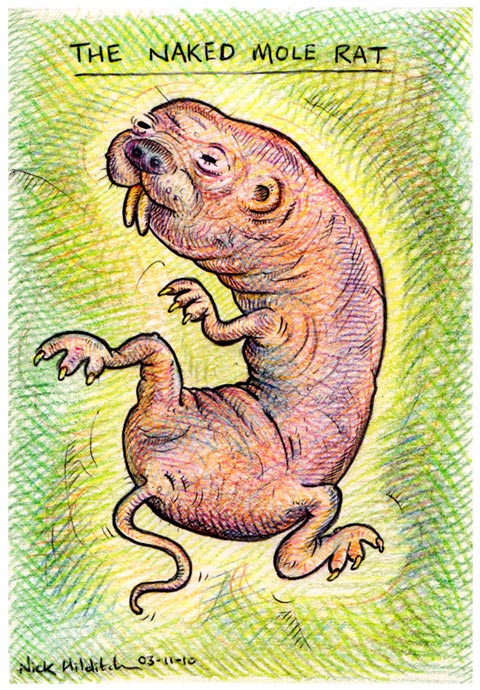
mole rat by Nick Hilditch
Illustration by Nick Hilditch.

I’ll put aside for the moment the fact that “queen” mole rats get all the action – forming long term bonds with her lucky selected suitors (note the plural use of the word here) and ensuring that for most mole rats sex is something they will never experience – and instead focus on the interesting ways in which mole rats care for their entire community.

Naked Mole Rat by Reena Makwana
Naked Mole Rat by Reena Makwana.

For rather like bees, ants or termites, the mole rats care for their colonies as a whole, with the smaller mole rats taking on the roles of workers, and the larger ones fighting off any pesky intruders, eg snakes. They live for an exceptionally long time for such little beasties (up to 30 years) and appear to be immune to cancer… hence the intense interest from the scientific community.
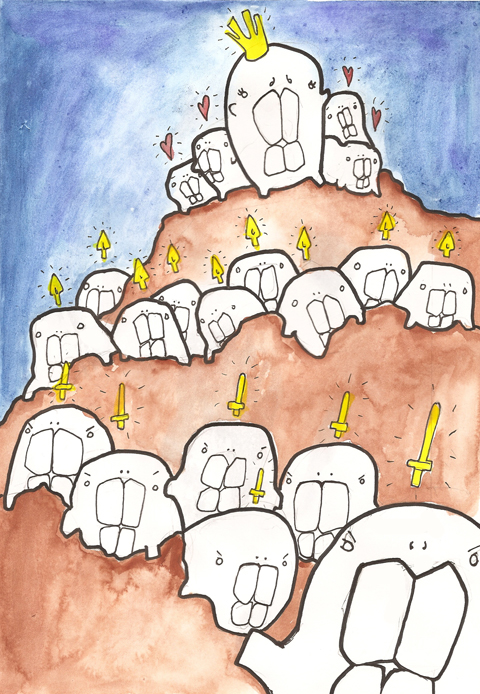
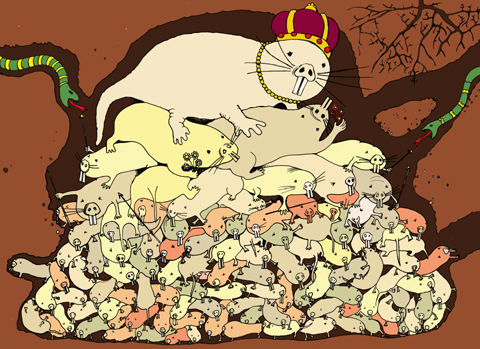
Heirarchy Of Sausages by Gareth A Hopkins
Heirarchy Of Sausages by Gareth A Hopkins.

They may look bloody funny, but I think that we would do well to learn from creatures such as the Sabre-Toothed Sausage. After all, living in such close knit communities clearly works wonders for them… and they dig with their teeth – how cool is that?

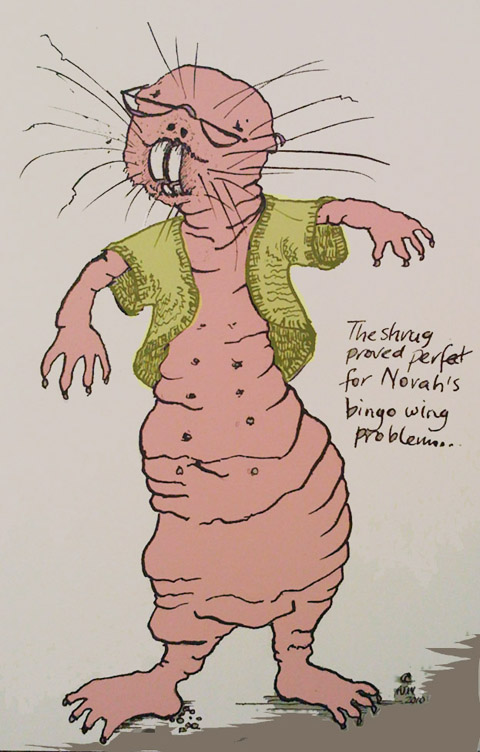
Stacie Swift Naked Mole Rat
Stacie Swift‘s Naked Mole Rat.

Naked-Mole-Rat-by-Laura-Nuttall
Naked Mole Rat by Laura Nuttall.

Alison Warner mole rat
Alison Warner‘s mole rat.

Categories ,Alison Warner, ,BBC News, ,Cancer, ,community, ,Dr Chris Faulkes, ,Gareth A Hopkins, ,Laura Nuttall, ,Lemonaday, ,Naked Mole Rat, ,Nick Hilditch, ,Paul Shinn, ,Reena Makwana, ,Sabre-Toothed Sausage, ,Stacie Swift, ,University of London

Similar Posts:


Amelia’s Magazine | The Life and Times of the Sabre-Toothed Sausage

Amelia’s Anthology of Illustration has now been reviewed widely on the internet. Here are some links to recent reviews and interviews with me:

Cheapzine.
Kevin Blowe for Red Pepper.
Smack That.
Inky Goodness.
Creative Review.
Creative Boom.
Thereza Rowe.
The Ecologist.
Pikaland interview.
Pikaland review.
Make Lemonade review.
Imaginative Bloom review.

Skype interviews with the Circus Project:

If you would like a copy for review get in touch with me.

‘Chanel No.5′ designed by Jean Helleau. Illustration by Sandra Contreras

When Freud pondered the question of ‘what women want, viagra 40mg ’ someone should have told him that there are few things more desirable than a beautiful bottle of scent. Since the early 20th century, the perfume flaçon (small bottle) has taken on many weird and wonderful guises – some of which have gone on to become cultural artefacts and artist’s muses. By no means a comprehensive list, here is a small selection of some of the most jaw-dropping flaçons you’ll ever encounter – some of which even manage to upstage the scents they contain.

Chanel Nº 5
“I always launch my collection on the 5th day of the 5th month, so the number 5 seems to bring me luck – therefore, I will name it Nº 5,” proclaimed Mademoiselle Chanel after putting her initial doubts to one side and deciding to branch out into fragrance. The name itself summed up the scent’s abstract nature, and was a two-fingered salute to the other flowery perfume names at the time. Launched in 1921, No. 5 made greater use of synthetic ingredients, resulting in a blend of rose and ylang ylang that is rich, intoxicating but decidedly ‘unfloral.’ The first bottle was designed by the lady herself, modelled on the Charvet toiletry bottle that once belonged to her then-lover Captain Arthur ‘Boy’ Capel. The resulting flaçon we know and love was created in 1924 by Jean Helleau, and went on to become the subject of Andy Warhol’s famous ‘pop art’ prints, as well as being on permenant display in New York’s Musuem of Modern Art (MOMA) since 1959. The rich gold coloured liquid seen vividly through the glass of the minimalist square bottle, with its simple black letters and jewel-like stopper simply screams luxury. 86 years on, it is still capable of stopping women’s hearts – my fair own included.

Shalimar by Guerlain

‘Shalimar’ designed by Raymond Guerlain. Illustration by Stéphanie Thieullent

Named after the Shalimar Gardens in Lahore, and meaning ‘temple of love’ in Sanskrit, you could half expect a genie to emerge from this fan-shaped bottle with sapphire-coloured stopper, but the sweet vanilla fragrance inside is just as mesmerising. Designed by Raymond Guerlain in 1925 and manufactured by Cristal Baccarat (who along with Lalique, first turned the perfume flaçon into an objet d’art) the design of Shalimar was inspired by the fountains one might find in Indian palaces, and was displayed at the Decorative Arts Exhibition in the same year. The bottle has recently been given a modern make-over by jewellery designer/socialite Jade Jagger, who hasn’t strayed that far from the original, and produced a slightly sleeker version that Raymond himself would have been happy with.

Flower by Kenzo

‘Flower by Kenzo’ designed by Serge Mansau. Illustration by Kayleigh Bluck

I love the beautiful simplicity of Flower by Kenzo – how the tall thin glass leans gracefully to one side like a delicate stem in a summer breeze, echoing the sweet floral fragrance within – with a trompe l’oeil image of a flower appearing as if it were inside the bottle itself. Launched in 2000, the flaçon was designed by Serge Mansau, a French glass sculptor and stage decorator, who had already honed his craft designing flaçons for the likes of Dior and Hermés. He was given the concept of a flower by Kenzo’s artistic director Patrick Geudj, who wanted to highlight it as a powerful symbol for peace, and was particularly inspired by photographer Marc Ribaud’s image March in Washington (21st of October 1967) in which a girl holds a flower in front of a gun that is being pointed at her. Who knew a perfume could be political?

Shocking by Schiaparelli

Schiaparelli’s ‘Shocking’ designed by Leonor Fini. Illustration by Joana Faria

Inspired by a bust of Mae West, who was one of Schiaparelli’s major clients, 1937’s “Shocking” was designed by Argentine painter Leonor Fini, and best exemplifies Schiaparelli’s role in the surrealist movement (her designs included her famous lobster dress, and a hat in the shape of high heeled shoe.) The name was inspired by Cartier’s famous ‘shocking pink’ diamond the Tête de Belier (Ram’s Head) and Shocking’s encasing box was dyed in the same pink shade to match. In an era where few fashion houses were releasing perfume, ‘Shocking’ was Schiaparelli’s attempt to compete with her nemesis Chanel (although sadly unlike her rival, the label did not adapt to the changes brought about by WWII and closed in 1954.) The scent itself – a rather dry powdery bouquet of honey rose and jasmine – may not be to everyone’s taste, but the bottle still remains a little piece of perfume history.

Alien by Thierry Mugler

‘Alien’ designed by Thierry Mugler. Illustration by Karolina Burdon

Designed by Mugler himself, Alien is a bright amethyst and gold flaçon, made to appear like a ‘sacred stone’ brings to mind 1980’s sci-fi films such as Blade Runner and Tron –  and is a good example of the designer’s flamboyant, theatrical style (check out Beyoncé’s motorcycle corset for a better idea). Alien was Mugler’s second fragrance, which he described as a nod to ‘ultra-feminity’ and contains notes of sambac jasmine and cashmeran wood, creating a soft woody- amber bouquet. The flaçon according to the designer “symbolises thoughtfulness and peace of mind” despite appearing as if it’s going to hatch a new life form on a mission to destroy all humanity as we know it, HG Wells-style.

naked mole rat by Paul Shinn
Naked Mole Rat by Paul Shinn.

Every now and again something quite random catches my eye… and so it was a few months ago when I came across a news story about the *sabre-toothed sausage* – otherwise known as the naked mole rat. And why, malady you may ask, medical did this curious creature engage me so? Aside from the opportunity to showcase some fab illustrations of course.

Abi Daker - naked mole rat
Illustration by Abigail Daker.

Scientist Dr Chris Faulkes at the University of London has been studying these bizarre animals for twenty years, and what grabbed me about the story on the BBC News website was the unusual social structure of mole rats, who live in groups of up to 300 individuals.

mole rat by Nick Hilditch
Illustration by Nick Hilditch.

I’ll put aside for the moment the fact that “queen” mole rats get all the action – forming long term bonds with her lucky selected suitors (note the plural use of the word here) and ensuring that for most mole rats sex is something they will never experience – and instead focus on the interesting ways in which mole rats care for their entire community.

Naked Mole Rat by Reena Makwana
Naked Mole Rat by Reena Makwana.

For rather like bees, ants or termites, the mole rats care for their colonies as a whole, with the smaller mole rats taking on the roles of workers, and the larger ones fighting off any pesky intruders, eg snakes. They live for an exceptionally long time for such little beasties (up to 30 years) and appear to be immune to cancer… hence the intense interest from the scientific community.

Heirarchy Of Sausages by Gareth A Hopkins
Heirarchy Of Sausages by Gareth A Hopkins.

They may look bloody funny, but I think that we would do well to learn from creatures such as the Sabre-Toothed Sausage. After all, living in such close knit communities clearly works wonders for them… and they dig with their teeth – how cool is that?

Stacie Swift Naked Mole Rat
Stacie Swift‘s Naked Mole Rat.

Naked-Mole-Rat-by-Laura-Nuttall
Naked Mole Rat by Laura Nuttall.

Alison Warner mole rat
Alison Warner‘s mole rat.

Categories ,Alison Warner, ,BBC News, ,Cancer, ,community, ,Dr Chris Faulkes, ,Gareth A Hopkins, ,Laura Nuttall, ,Lemonaday, ,Naked Mole Rat, ,Nick Hilditch, ,Paul Shinn, ,Reena Makwana, ,Sabre-Toothed Sausage, ,Stacie Swift, ,University of London

Similar Posts:


Amelia’s Magazine | irkafirka illustrated tweets: Nick Hilditch explains

irkafirka manflu goblin

Intrigued by a side project by one of our contributors, I decided to get to the bottom of this irkafirka business…

irkafirka: illustrated tweets. “Anything you say may be taken down and coloured in.” What a great idea, how did the project start?
My old friend Chris challenged me to draw a Twitter-inspired doodle a day and post it. My initial reaction was “I don’t have time for this” but the seed was planted, and I decided it wouldn’t do any harm to try it once. The response was instant and we were both hooked.

irkafirka batman joker

Who is irkafirka and why the name?
irkafirka is Nick Hilditch (illustrator, that’s me) and Chris Bell (curator). The name is a Hungarian word meaning doodle. I lived in Budapest for 7 years and speak Hungarian poorly, but its a beautiful word, and I filed it away years ago for future use. Everything about irkafirka came together very spontaneously – the concept, the name, the little dog logo. Everything about it feels right to us.

How did you two hook up and how long have you been in business?
Chris and I have been friends since school, although our lives took us in different directions. It was only through Twitter that we re-ignited our teenage delusions of grandeur. The business relationship is informal – we didn’t start out to make money from the project, we did it for the sheer fun of it. Now it consumes so much of our time and we have such a big audience, we’d love to take it to the next level, but as yet, the means to monetise our success alludes us. One goal we set was to get an irkafirka book published, but we want to get this right rather than rushing into it. We’d love to talk to any interested publishers.

irkafirka horse

How does the technical side work?
Here’s Chris on the technical side: “It’s a clunky-chunk of social-webbery. The website is built on the Fullscreen template for WordPress. Illustrations are taken from TwitPic and posted along with a picture of the original tweet. The illustrations are automatically cross-posted to our Tumblr page. Each new post updates the RSS feed, which populates the iPhone and Nokia apps automatically. We then add a link to the post on the Facebook page, which also carries other miscellaneous nonsense including a gallery of the 200 most recent illustrations, which are pulled from our Flickr picture stream. We also have various pictures on show in cities around the country using the crazy magic of augmented reality. We use Layar and a back-end system run over in Belgium by our dear friends at Hoppala. Best of all, apart from hosting the website everything we use is totally free. We are a pair of cheapskates…”

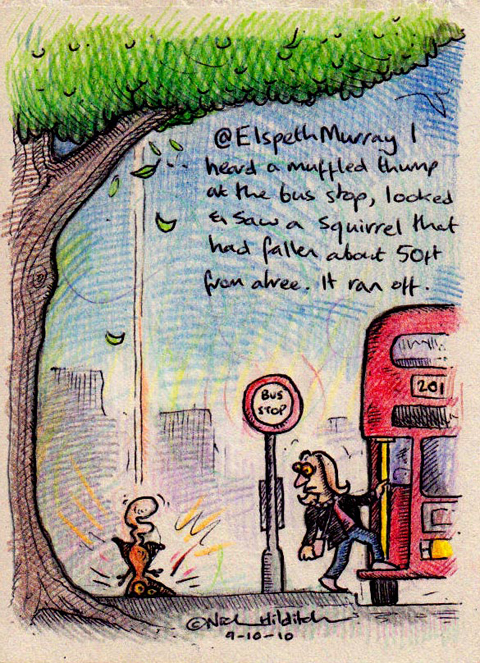
irkafirka squirrel

How do you decide what tweets to illustrate?
This is the hardest part. The truth is, the vast majority of tweets are utterly banal. It really is just a case of using any means possible to find great visuals, and when I see a tweet I can illustrate I jump straight on it. We look for recommendations from our audience of over 1700 followers, we browse other people’s lists, we search keywords. We do have rules the most important of which is rule 6, “If we stop enjoying it, we’ll stop.” I believe that when a creator is enjoying their work that will come across in the end product, so I’m really just looking for things that amuse me. We also ask that people recommend vivid tweeters to us using the #firkafursday tag, every Thursday. This way, we’ve built up a watch list which occasionally yields results – it’s no guarantee of getting your tweet illustrated, but it almost certainly improves the odds.

irkafirka swedish moon

If you were to chose anything from my recent tweets to illustrate, what would it be? (go on, do me an illustration… or does that count as a suggestion and will therefore be ignored. pretend I didn’t say anything… it’s all subliminal…)
I had a skim through your recent timeline. As is often the case, most of your tweets are either parts of conversations with little meaning out of context, or links. We’re all for wilfully taking things out of context. To this day, one of my personal favourites is “The oven’s broken. I’ll have to get the bloke out”. A very important part of what we do is the element of surprise – we don’t like the subject to know they’re going to get firked. You can commission an illustration, but technically, a commission wouldn’t be an irkafirka. It would simply be a work by the artists behind irkafirka. And it wouldn’t be free.

You try to post daily but of course real life gets in the way… when is an irkafirka more important – what would prompt you to miss a favourite film in favour of an illustration?
irkafirka has become a compulsion for me. If I miss a day, I feel more pressure to make sure I deliver something the next. On a day when I’m busy and can’t see when I’ll be able to produce something, I’m agitated. Usually we try and let our followers know when it’s a rule 5 day (that’s the rule that let’s us off the hook due to other commitments), but I never like to rule it out. My wife has been incredibly patient. A favourite film is a good example of something I wouldn’t miss, though. I’m a bit of an old school cineaste.

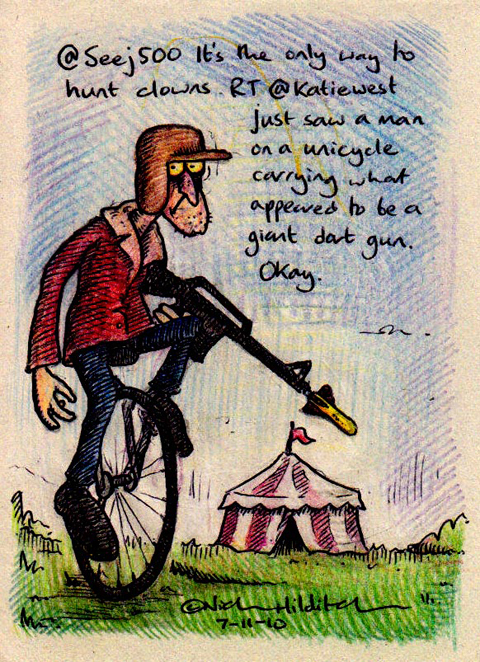
irkafirka unicycle

Nick: you used to live in Hungary. Why on earth did you come back to the UK, and what do you miss most about Hungary?
I loved living in Hungary, and I haven’t ruled out moving back. I miss my friends there, the long hot summers and the bableves (bean soup). I came back because I was finding it increasingly difficult to find relevant work. My wife is Hungarian, so we go back as often as possible. People often say “yours is a job you could do from anywhere” which is true to some extent, but to find the work you usually need to get out there and meet the clients. The dream is that one day my work will be so much in demand, I’ll be able to live where I want. So start demanding, demanders.

You also jacked in a career at a digital agency to become a freelance artist. What prompted this move and has it been a success? What’s the best job you’ve worked on so far, and has Irkafirka got you any jobs?
Working at a digital agency was interesting, and I got to work on a lot of great brands. I even helped them win 2 BAFTAs. However, I was there for over 4 years and the work was beginning to feel repetitious. I also wanted to develop my own IP so that I’d have work would that generate an income for me. I didn’t quit because of irkafirka, but it did give me confidence in my own work and helped me build up a portfolio that wasn’t exclusively comprised of other people’s brands. irkafirkas are drawn quickly, in a single sitting, with little or no advance planning, so they’re frequently full of mistakes, but as with great music, I like to think that this is compensated for by the energy put into them. When showing my portfolio, it is the work that generates the most interest. As irkafirka is a significant part of my portfolio, I like to think it’s played a part in all the work I’ve picked up since I started freelancing. The only paid work that’s resulted directly from irkafirka is a side-project for Nokia where we draw illustrations based on comments from the official Nokia blog. It’s too early to say whether it’s been a success, but I certainly don’t regret it, and it’s very hard to imagine going back.

How can someone get hold of an irkafirka print, and which ones would you recommend as christmas presses for specific members of the family?
Selling prints wasn’t initially part of the plan, but the demand was there, so we set up a shop at Zazzle. They’re most frequently bought by the subject, so the market is fairly limited, but we’re looking for ways to make irkafirka-based products with a broader appeal in the new year. The images that make it into the shop are added on the basis that somebody expressed an interest in buying them, rather than because we necessarily think they’re the best works. However, based on what’s there already, here’s my handy irkafirka shopping list that’s surely better than the tired recommendations you’ll find on Amazon.

For your Mum: @BangsandaBun
For your Dad: @BruceandSimon
For your Grandparent: @Whatleydude
For your dirty uncle: @bennycrime
If you find something on irkafirka that isn’t in the shop, and you’d like to buy a copy, just let us know and we’ll upload it. Happy Christmas!

**************************************************************************
Alas, I broke the rules, so I have yet to inspire my own illustrated tweet… although I’m fairly sure that a quick glance through tweets produced in the 24 hours previous to Nick completing this Q&A could have turned up a few goodies (let’s just gloss over the fact that the best was a retweet, okay?)

Best go put the hob on in the kitchen so I can spread them around a bit. (Hob to keep me warm, bloody arctic down there)

RT @PennyRed I am a tiny protesting icicle. A protesticle.

have not left house for nearly three days. or seen anyone. I am a hermit.

pah! I wouldn’t miss it that much, I just went out for food supplies and my face nearly fell off – staying put now

I live in hope that one day I will be deemed worthy…

Categories ,#firkafursday, ,Apps, ,Budapest, ,Bulgarian, ,Chris Bell, ,Flickr, ,hashtag, ,Hoppala, ,Hungarian, ,illustration, ,iPhone, ,irkafirka, ,Layar, ,Nick Hilditch, ,Nokia, ,Tumblr, ,Twitpic, ,twitter, ,Zazzle

Similar Posts: