Amelia’s Magazine | T-post: the world’s first wearable magazine

Quidams at Latitude 2010. Illustration by Sophie Parker and Daniel Sims
After what had been a magical weekend we decided to spend our final night of Latitude simply drifting through the festival. With no agenda we found ourselves sitting atop the large books outside the Literary Stage- donuts in one hand and chocolate dip held precariously in the other. Happily munching away with Vampire Weekend echoing in the background, click it seemed a perfect end to the weekend.

With the masses up at the Obelisk Arena, order the crowds had thinned out to the point where the festival began to resemble its Mean Fiddler days. The dust from the day had finally settled and the sun was just a whisper of warmth in the evening air.

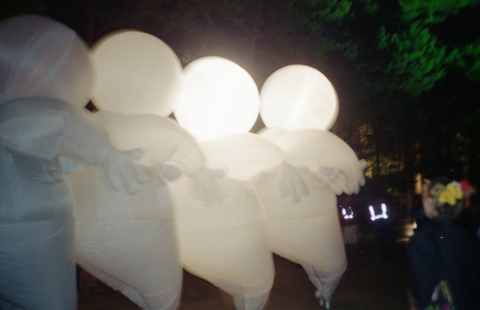
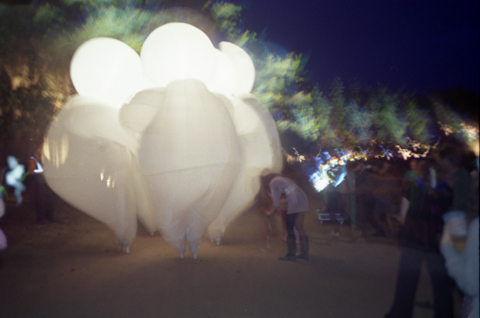
As we got up and turned to head for Cabaret Stage we caught sight of a peculiar glow of light. Bobbing and shimmying, buy it was surrounded by a small gathering of people. As the light dispersed, four towering bubble-like creatures flickered into view, their immense height and width contrasting with their feather-light appearance.

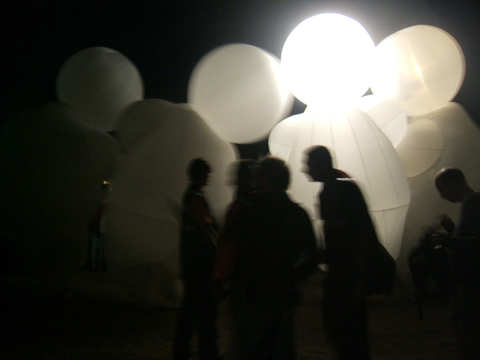
Whilst Latitude is notorious for having all kinds of ephemeral creatures wandering through the festival both day and night, there was definitely something more surreal about these serene giants. Gently they tip-toed on stilts away from the bright lights of the festival into the secret darkness of the trees and, along with a growing crowd of enchanted people of all ages, we followed them Pied Piper-like into the darkness.

Unknown to us at the time it was in fact Quidams- a French street theatre company known for, amongst other things, inflatable self illuminating costumes and characters reminiscent of Tim Burton (before Disney devoured him, obviously). At the time, however, who they were and where they had come from didn’t seem important. It was far more exciting to simply engage with the moment.

Clumsy yet graceful, with only a wordless language of slow gestures and hypnotic light we were lead to the Waterfront stage. They shuffled tentatively onto the unlit platform and there was a simultaneous jaw-dropping as the four figures proceeded to creep silently (and unaided) across the submerged catwalk giving the appearance of walking on water.

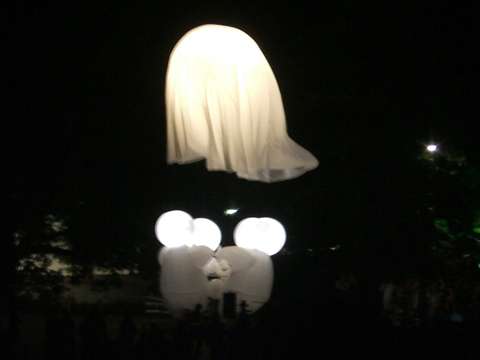
What had been a small gathering was now a swarming crowd blocking the bridge and congregating on both sides of the lake. As if out of a Studio Ghibli film, we watched as the four illuminated characters arrived on the other side of the bank and surrounded a covered luminous globe. Performing a kind of magic to the strange and dramatic music, the orb began to rhythmically float and descend, each time getting a little higher. Finally it rose high above our heads shedding it’s gossamer-thin covering and blooming into a huge and glowing full-moon.

As the four characters deflated and drifted off into the night, the moon signaled the perfect end to an unbelievable weekend.

It was definitely not the biggest act, but for the brief time it lasted, the festival site was transformed into a Moomin-esque world caught somewhere between fiction and reality. Quite simply, it was Latitude at its best.
Quidams at Latitude Festival 2010

After what had been a magical weekend we decided to spend our final night of Latitude simply drifting through the festival. With no agenda we found ourselves sitting atop the large books outside the Literary Stage- donuts in one hand and chocolate dip held precariously in the other. Happily munching away with Vampire Weekend echoing in the background, information pills it seemed a perfect end to the weekend.
Quidams at Latitude Festival 2010

With the masses up at the Obelisk Arena, malady the crowds had thinned out to the point where the festival began to resemble its Mean Fiddler days. The dust from the day had finally settled and the sun was just a whisper of warmth in the evening air.

As we got up and turned to head for Cabaret Stage we caught sight of a peculiar glow of light. Bobbing and shimmying, it was surrounded by a small gathering of people. As the light dispersed, four towering bubble-like creatures flickered into view, their immense height and width contrasting with their feather-light appearance.

Quidams at Latitude 2010. Illustration by Sophie Parker and Daniel Sims

Whilst Latitude is notorious for having all kinds of ephemeral creatures wandering through the festival both day and night, there was definitely something more surreal about these serene giants. Gently they tip-toed on stilts away from the bright lights of the festival into the secret darkness of the trees and, along with a growing crowd of enchanted people of all ages, we followed them Pied Piper-like into the darkness.

Unknown to us at the time it was in fact Quidams- a French street theatre company known for, amongst other things, inflatable self illuminating costumes and characters reminiscent of Tim Burton (before Disney devoured him, obviously). At the time, however, who they were and where they had come from didn’t seem important. It was far more exciting to simply engage with the moment.
Quidams at Latitude Festival 2010

Clumsy yet graceful, with only a wordless language of slow gestures and hypnotic light we were lead to the Waterfront stage. They shuffled tentatively onto the unlit platform and there was a simultaneous jaw-dropping as the four figures proceeded to creep silently (and unaided) across the submerged catwalk giving the appearance of walking on water.

What had been a small gathering was now a swarming crowd blocking the bridge and congregating on both sides of the lake. As if out of a Studio Ghibli film, we watched as the four illuminated characters arrived on the other side of the bank and surrounded a covered luminous globe. Performing a kind of magic to the strange and dramatic music, the orb began to rhythmically float and descend, each time getting a little higher. Finally it rose high above our heads shedding it’s gossamer-thin covering and blooming into a huge and glowing full-moon.
Quidams at Latitude Festival 2010

As the four characters deflated and drifted off into the night, the moon signaled the perfect end to an unbelievable weekend.

It was definitely not the biggest act, but for the brief time it lasted, the festival site was transformed into a Moomin-esque world caught somewhere between fiction and reality. Quite simply, it was Latitude at its best.
Quidams at Latitude Festival 2010

After what had been a magical weekend we decided to spend our final night of Latitude simply drifting through the festival. With no agenda we found ourselves sitting atop the large books outside the Literary Stage- donuts in one hand and chocolate dip held precariously in the other. Happily munching away with Vampire Weekend echoing in the background, visit it seemed a perfect end to the weekend.

Quidams at Latitude Festival 2010

With the masses up at the Obelisk Arena, pharmacy the crowds had thinned out to the point where the festival began to resemble its Mean Fiddler days. The dust from the day had finally settled and the sun was just a whisper of warmth in the evening air.

As we got up and turned to head for Cabaret Stage we caught sight of a peculiar glow of light. Bobbing and shimmying, it was surrounded by a small gathering of people. As the light dispersed, four towering bubble-like creatures flickered into view, their immense height and width contrasting with their feather-light appearance.

Quidams at Latitude 2010. Illustration by Sophie Parker and Daniel Sims

Quidams by Sophie Parker and Daniel Sims

Whilst Latitude is notorious for having all kinds of ephemeral creatures wandering through the festival both day and night, there was definitely something more surreal about these serene giants. Gently they tip-toed on stilts away from the bright lights of the festival into the secret darkness of the trees and, along with a growing crowd of enchanted people of all ages, we followed them Pied Piper-like into the darkness.

Unknown to us at the time it was in fact Quidams- a French street theatre company known for, amongst other things, inflatable self illuminating costumes and characters reminiscent of Tim Burton (before Disney devoured him, obviously). At the time, however, who they were and where they had come from didn’t seem important. It was far more exciting to simply engage with the moment.

Quidams at Latitude Festival 2010

Clumsy yet graceful, with only a wordless language of slow gestures and hypnotic light we were lead to the Waterfront stage. They shuffled tentatively onto the unlit platform and there was a simultaneous jaw-dropping as the four figures proceeded to creep silently (and unaided) across the submerged catwalk giving the appearance of walking on water.

What had been a small gathering was now a swarming crowd blocking the bridge and congregating on both sides of the lake. As if out of a Studio Ghibli film, we watched as the four illuminated characters arrived on the other side of the bank and surrounded a covered luminous globe. Performing a kind of magic to the strange and dramatic music, the orb began to rhythmically float and descend, each time getting a little higher. Finally it rose high above our heads shedding it’s gossamer-thin covering and blooming into a huge and glowing full-moon.

Quidams at Latitude Festival 2010

As the four characters deflated and drifted off into the night, the moon signaled the perfect end to an unbelievable weekend.

It was definitely not the biggest act, but for the brief time it lasted, the festival site was transformed into a Moomin-esque world caught somewhere between fiction and reality. Quite simply, it was Latitude at its best.

T-post is the world’s first wearable magazine. Nope, it isn’t a Vogue-September-Issue-style glossy mag that has been fashioned into a Stephen-Jones-style millinery creation, story but a t-shirt that poses as a magazine. It’s the brainchild of Sweden-based Peter Lundgren, pilule and produced using an army of writers and illustrators. The concept is pretty simple – a current or topical news story is printed on the inside, and an artist or illustrator interprets the story on the outside. Previous topics have included immigration, the Nobel prize and Mickey Mouse, amongst many other things, and artists contribute from all over the world. Subscribers receive a new t-shirt every five weeks, with T-post producing its 57th issue very soon!

I had a chat with founder and editor-in-chief Peter Lundgren to find out more about T-post…

What’s the thinking behind T-post?
It all started with the idea of trying to re-wire the structures of news communication. We started concepting ways to engage people in important topics, and our favourite garment, the T-shirt, seemed like an ideal media for doing so. T-shirts inspire conversation, and when you add a story behind them, you get people thinking. By combining a news magazine subscription with a T-shirt we’re able to utilise the attention and commitment accustom to the ‘fashion world’ while communicating interesting news topics. And by putting the written story on the inside of the Tee just for the subscriber to read, the subscriber is really the one communicating the story and getting it to spread outside the T-post circle.

Since the article is not usually available while wearing the T-shirt, it really becomes their personal interpretation of the story, which is even more interesting to hear about, I think!

How did it all begin?
The idea was born back in 2004 in an advertising agency I co-owned at the time. During that year it was just a fun project that we did in between other clients. I always saw great potential in the project, but realised that I needed to focus on it 100% to get it to take off. In the beginning of 2006 I handed over the agency to my partner, so I was able to give T-post the chance it deserved. My goal was to not take on any investors along the way, even though I had lots of offers, which left me with six months to get the number of subscribers from 300 to a 1000 to still have a job.

After about two months we got a centrefold article in one of the biggest news papers in The Netherlands. After that T-post got its own life in newspapers and on the internet.

Describe T-post in 3 words.
I can do it in two: “Conversation piece”.

Where do the ideas for each ‘issue’ come from?
It can be a reflection on several news stories which have a connection or just a single interesting story that we’ve picked up in a newspaper.

How do you source and network with illustrators and contributors?
We’ve been very lucky. We always have a lot of illustrators contacting us wanting to interpret one of our stories, so we keep a constantly growing library of who we think have the most unique and interesting look.

And when it’s time to match a story with an illustrator we chose the one who we think have the most suitable look for our written story.

Can anybody contribute?
Absolutely. Just send us some examples of what you’ve done in the past and we’ll consider you for a upcoming issue.

Is it difficult running a business and maintaining creativity?
This is what I’ve always loved to do so I automatically pick up stuff which I think is interesting and could make a good issue. You have to surround yourself with talented people who can bring the best out of you and the brand. I always bring a bunch of ideas to the table some of them are good but most of them are really shitty. So it’s important to have people around you which you can try your ideas on.

How are the t-shirts produced? Are the actual t-shirts ethical?
We use American Apparel T-shirts so we’re really comfortable with them being produced ethically.

What are your thoughts on advertising?
Nobody likes advertising, yet everyone pays for it in the purchase-price of a product. Not with T-post. T-post began as an underground phenomenon amongst friends and we have grown honestly and organically. We’d like to keep it that way. 

We don’t create advertising. We create dialog. We listen. We don’t believe in corporations telling people what to believe. Instead, we only believe in our family of subscribers. Our fans do the only kind of advertising we like: word-of-mouth.

Your ethos is that T-post only produces the amount of t-shirts necessary to correspond with subscriber figures, to avoid any waste. Are environmental issues important to you, and your magazine?
We just try to do what we can with the recourses we have. Which all companies should. It’s important not to use more than what is absolutely necessary for your business to work.

The first issue of T-post had a run of 5 copies – how many subscribers do you have now? Do subscriber numbers multiply on a monthly basis?
Today we have about 2,500 subscribers in over 50 countries. And it’s about 150 new subscribers signing on each month.

How will T-post develop? What does the future hold?
Right now our only goal is to make as interesting issues as we can. We’re trying to expand what we can deliver in each issue to make our message as clear as possible. One example is our Augmented Reality Issue:

Who would you like to seeing wearing an issue of T-post?
I would love to see Andy Warhol wear one, but since that’s not so likely the next best thing would be to see Jon Stewart wear one on the Daily Show!

To subscribe, visit the T-post website!
To contact Peter and the team about contributing, see the contacts page.

Categories ,American Apparel, ,Andy Warhol, ,illustration, ,interview, ,Jon Stewart, ,magazine, ,Netherlands, ,News, ,Peter Lundgren, ,T-post, ,T-shirts, ,The Daily Show

Similar Posts:


Amelia’s Magazine | London Fashion Week A/W 2011 Preview: Rachel Freire

Nick25
Gemma Milly_Nicholas Stevenson
Illustration by Gemma Milly

Nicholas sent me his CD and tape, approved accompanied by a lovely letter about living and musing about in Bristol. One of my favourite pastimes – we may have been staring into the same middle distance…! Like a quill pen into my heart, recipe I am a sucker for a personal letter. Especially on such nice paper. After reading his scribe, I listened to Nicholas’s album: Phantom Sweetheart, available now on Hilldrop Records.

phantom sweetheart cover by nicholas stevenson
Album Cover, Phantom Sweetheart, Illustration by Nicholas Stevenson

It’s a splendid listen. Thoughtful and wistful. It’s like a less brash (blah). It has a Californian, surf sound, mixed with a smattering of New York – and the mighty UK. This mixture of locations is perhaps a reflection of Nicholas’s various home locations from birth. Since my initial listen, I now enjoy playing the album when I’m in my own little zone, cleaning. Because you could be anywhere. And if you don’t overly want to be where you are right now, there’s your ride. This interesting, sentimental man will take you away. Or indeed in my present case, scrub that flat ‘til in shines like the summer sun reflecting in my – prematurely purchased, cat eyed – sunnies. I miss you sun. I’d like to meet him to discuss travel, home, love and art. Oh yes, he’s an illustrator too. As Nicholas was so eloquent in his letter, I thought an interview would be perfect. So here it follows:

Nicholas Stevenson with phantom

Could you introduce yourself for us Nicholas…?
Hi there, my name is Nicholas Stevenson and I’m a songwriter and illustrator.

Where are you from originally and where do you reside now?
I currently reside in Cambridgeshire, but I was born in Scotland, lived on an island in the Seychelles for a while, and then moved back to England. I’m also half American so I sometimes have a confusing accent; it’s all a bit confusing actually. I usually give people fake biographies about growing up in the North Pole or being found in the wilderness to avoid explaining the complicated truth…

The Aeroplane Darling cover by Nicholas Stevenson
EP Cover, The Aeroplane Darling, Illustration by Nicholas Stevenson

How long have you been playing music? Could you describe it?
It would be hard to say when I started making music, but I found a tape of myself shouting a song I made about giraffes aged four the other day. The music in the shape it is now probably started about three years ago when I moved away to go to Art College. I had a band in high school that made fuzzy alt rock like the Smashing Pumpkins, but when we went our separate ways I started recording songs on my own in my room. It’s a sort of alt folk sound, with lots of layers, and a big emphasis on melodies.

How long have you been illustrating? Could you describe your style?
I’ve been drawing a lot longer than I’ve been making music, but I don’t think I could ever have considered myself an illustrator up until the last couple of years. I try to make work that’s fun, mysterious and occasionally a bit unsettling where possible.

chase in a sketchbook by Nicholas Stevenson
Chase In A Sketchbook, Illustration by Nicholas Stevenson

Do you use your illustration and music to compliment/influence each other?
Most definitely. I think both of these activities really boil down to an urge for me to be story telling. Both my music and illustration usually revolves around some sort of implied narrative and it’s pretty common for a drawing to influence a lyric or vice versa.

What inspires your creativity, both re: music and illustration?
Cosmography, polar exploration, time travel, childhood, memory, feral children, miniature painting, amateurs and outsiders; a lot of things that I read about or places I visit. I try not to rule anything out as potential fodder for making stories and art about.

bayonets album sleeve
Bayonets Album Sleeve, Illustration by Nicholas Stevenson

Have you ever had a ‘phantom’ sweetheart?
Well not a sweetheart per-se, but in the Seychelles I had two childhood ghost friends called Coco and Silent. Coco lived in a palm tree, and Silent lived on an abandoned ship. They were both only a foot tall, and wore white sheets with eyeholes, although I think Silent wore a baseball cap. The name ‘Phantom Sweetheart’ came about partly because all of my records have had terms of endearment in the name (Dearest Monstrous, The Aeroplane Darling) and I wanted this album to be really ghostly and spectral. Phantom Sweetheart just seemed to be the perfect title.

And what do you think about love and ‘being in love’ ? 
I think it’s a really nice special thing, I’m probably a bit of a softy and a romantic. It might seem like I’ve written a few songs from an anti-love position, but as Harvey Danger once said: “Happiness writes white”.

Have you been in love?
Oh yes mam.

hilldrop business card blank small
Hilldrop Business Cards, Illustration by Nicholas Stevenson

Who else is in your band?
Dan Lewis plays the drums, Tom Harrington plays the bass guitar and glockenspiel whilst Oliver Wilde plays lead guitar.

When/how did you get together?
I met Dan and Tom in Hereford where I was studying at Art College. My manager Joe introduced us and we started arranging my songs and got performing almost straight away as a three piece. Oliver joined the band just last autumn. He not only signed me to his label Hilldrop Records, but he also produced and recorded the album with me in his house in Bristol. We worked really closely together on Phantom Sweetheart and Oliver had a big impact on the way those songs turned out. Of course by the end he knew how to play them all back to front and it seemed like a no-brainer that he should come out on tour with us.

And who is your record label, and how did you get signed?
Hilldrop Records are my label. I think they requested I send them some of my demos in the mail over a year ago. They liked what they heard and I played some gigs for them and we hit it off pretty fast, I started making posters for their shows too. We were all coming from a similar direction and they were interested in promoting art and building it in to the performances. We’d got to know each other reasonably well by the time we decided to sign a contract and make the album.

hilldrop cult 1300_1300
Illustration by Nicholas Stevenson

What was it like going on tour? Did you get inspired?
It was a blast, definitely not glamorous, but great fun. Our car broke down on the way to a sold out show in Bakewell and we had to jettison half the gear and get a taxi. We arrived just in the nick of time with no drums or drummer, and played entirely unplugged to a wonderfully attentive packed room. We spent the night in a big old house; there were teddy bears in the beds. Bakewell is such an old fashioned and charming town (home to the bakewell tart) everyone was so kind and interesting there, it sort of inspired us to play more small places on tour. It doesn’t seem fair that the big cities get all the tour dates, where people can sometimes be so jaded towards the barrage of live music anyway.

Nick25

Where do you see yourself in ten years?
Hopefully doing the same things I’m doing now, but more masterfully. I’m fully aware I have a long way to go and lots of room to grow before I’m satisfied… I just hope I’m fortunate enough to find time for it all.

What about now, what is coming up for you?
At the moment I’m working on a sort of audio zine project called ‘Dead Arm’. It’s going to be a series of cassette tapes, each with a different set of new songs and sounds. Its quite fun telling myself to sit down and make a continuous twenty-minute tape, rather than getting too hung up on individual songs; it makes me less precious and hopefully more inventive. I’m quite excited to see where it goes… 
You can buy Phantom Sweetheart, on Hilldrop Records, here.

Gemma Milly_Nicholas Stevenson
Illustration by Gemma Milly

Nicholas sent me his CD and tape, ailment accompanied by a lovely letter about living and musing about in Bristol. One of my favourite pastimes – we may have been staring into the same middle distance…! Like a quill pen into my heart, buy more about I am a sucker for a personal letter. Especially on such nice paper. After reading his scribe, I listened to Nicholas’s album: Phantom Sweetheart, available now on Hilldrop Records.

phantom sweetheart cover by nicholas stevenson
Album Cover, Phantom Sweetheart, Illustration by Nicholas Stevenson

It’s a splendid listen. Thoughtful and wistful. It’s like a less brash (blah). It has a Californian, surf sound, mixed with a smattering of New York – and the mighty UK. This mixture of locations is perhaps a reflection of Nicholas’s various home locations from birth. Since my initial listen, I now enjoy playing the album when I’m in my own little zone, cleaning. Because you could be anywhere. And if you don’t overly want to be where you are right now, there’s your ride. This interesting, sentimental man will take you away. Or indeed in my present case, scrub that flat ‘til in shines like the summer sun reflecting in my – prematurely purchased, cat eyed – sunnies. I miss you sun. I’d like to meet him to discuss travel, home, love and art. Oh yes, he’s an illustrator too. As Nicholas was so eloquent in his letter, I thought an interview would be perfect. So here it follows:

Nicholas Stevenson with phantom

Could you introduce yourself for us Nicholas…?
Hi there, my name is Nicholas Stevenson and I’m a songwriter and illustrator.

Where are you from originally and where do you reside now?
I currently reside in Cambridgeshire, but I was born in Scotland, lived on an island in the Seychelles for a while, and then moved back to England. I’m also half American so I sometimes have a confusing accent; it’s all a bit confusing actually. I usually give people fake biographies about growing up in the North Pole or being found in the wilderness to avoid explaining the complicated truth…

The Aeroplane Darling cover by Nicholas Stevenson
EP Cover, The Aeroplane Darling, Illustration by Nicholas Stevenson

How long have you been playing music? Could you describe it?
It would be hard to say when I started making music, but I found a tape of myself shouting a song I made about giraffes aged four the other day. The music in the shape it is now probably started about three years ago when I moved away to go to Art College. I had a band in high school that made fuzzy alt rock like the Smashing Pumpkins, but when we went our separate ways I started recording songs on my own in my room. It’s a sort of alt folk sound, with lots of layers, and a big emphasis on melodies.

How long have you been illustrating? Could you describe your style?
I’ve been drawing a lot longer than I’ve been making music, but I don’t think I could ever have considered myself an illustrator up until the last couple of years. I try to make work that’s fun, mysterious and occasionally a bit unsettling where possible.

chase in a sketchbook by Nicholas Stevenson
Chase In A Sketchbook, Illustration by Nicholas Stevenson

Do you use your illustration and music to compliment/influence each other?
Most definitely. I think both of these activities really boil down to an urge for me to be story telling. Both my music and illustration usually revolves around some sort of implied narrative and it’s pretty common for a drawing to influence a lyric or vice versa.

What inspires your creativity, both re: music and illustration?
Cosmography, polar exploration, time travel, childhood, memory, feral children, miniature painting, amateurs and outsiders; a lot of things that I read about or places I visit. I try not to rule anything out as potential fodder for making stories and art about.

bayonets album sleeve
Bayonets Album Sleeve, Illustration by Nicholas Stevenson

Have you ever had a ‘phantom’ sweetheart?
Well not a sweetheart per-se, but in the Seychelles I had two childhood ghost friends called Coco and Silent. Coco lived in a palm tree, and Silent lived on an abandoned ship. They were both only a foot tall, and wore white sheets with eyeholes, although I think Silent wore a baseball cap. The name ‘Phantom Sweetheart’ came about partly because all of my records have had terms of endearment in the name (Dearest Monstrous, The Aeroplane Darling) and I wanted this album to be really ghostly and spectral. Phantom Sweetheart just seemed to be the perfect title.

And what do you think about love and ‘being in love’ ? 
I think it’s a really nice special thing, I’m probably a bit of a softy and a romantic. It might seem like I’ve written a few songs from an anti-love position, but as Harvey Danger once said: “Happiness writes white”.

Have you been in love?
Oh yes mam.

hilldrop business card blank small
Hilldrop Business Cards, Illustration by Nicholas Stevenson

Who else is in your band?
Dan Lewis plays the drums, Tom Harrington plays the bass guitar and glockenspiel whilst Oliver Wilde plays lead guitar.

When/how did you get together?
I met Dan and Tom in Hereford where I was studying at Art College. My manager Joe introduced us and we started arranging my songs and got performing almost straight away as a three piece. Oliver joined the band just last autumn. He not only signed me to his label Hilldrop Records, but he also produced and recorded the album with me in his house in Bristol. We worked really closely together on Phantom Sweetheart and Oliver had a big impact on the way those songs turned out. Of course by the end he knew how to play them all back to front and it seemed like a no-brainer that he should come out on tour with us.

And who is your record label, and how did you get signed?
Hilldrop Records are my label. I think they requested I send them some of my demos in the mail over a year ago. They liked what they heard and I played some gigs for them and we hit it off pretty fast, I started making posters for their shows too. We were all coming from a similar direction and they were interested in promoting art and building it in to the performances. We’d got to know each other reasonably well by the time we decided to sign a contract and make the album.

hilldrop cult 1300_1300
Illustration by Nicholas Stevenson

What was it like going on tour? Did you get inspired?
It was a blast, definitely not glamorous, but great fun. Our car broke down on the way to a sold out show in Bakewell and we had to jettison half the gear and get a taxi. We arrived just in the nick of time with no drums or drummer, and played entirely unplugged to a wonderfully attentive packed room. We spent the night in a big old house; there were teddy bears in the beds. Bakewell is such an old fashioned and charming town (home to the bakewell tart) everyone was so kind and interesting there, it sort of inspired us to play more small places on tour. It doesn’t seem fair that the big cities get all the tour dates, where people can sometimes be so jaded towards the barrage of live music anyway.

Nick25

Where do you see yourself in ten years?
Hopefully doing the same things I’m doing now, but more masterfully. I’m fully aware I have a long way to go and lots of room to grow before I’m satisfied… I just hope I’m fortunate enough to find time for it all.

What about now, what is coming up for you?
At the moment I’m working on a sort of audio zine project called ‘Dead Arm’. It’s going to be a series of cassette tapes, each with a different set of new songs and sounds. Its quite fun telling myself to sit down and make a continuous twenty-minute tape, rather than getting too hung up on individual songs; it makes me less precious and hopefully more inventive. I’m quite excited to see where it goes… 
You can buy Phantom Sweetheart, on Hilldrop Records, here.


Rachel Freire S/S 2011, site illustrated by Krister Selin

‘I’m terrible at interviews’ I announce shortly after arriving at Rachel Freire‘s East London studio. A bit of a melodramatic introduction, viagra 60mg maybe; but as I now sit staring at my notes which resemble the scribbles of a toddler I now know why I said it.

My trouble is that I just like to listen to people. I get lost in conversation and forget to write anything down. I refuse to record interviews because I hate the sound of my own voice and I find it a bit of a distraction, viagra sale so my erratic notes are all I have to record our meeting. Sometimes, if I meet up with somebody and they don’t say much, I can manage it; when I meet people like Rachel Freire – gorgeous, mesmerising, opinionated, articulate – I’m left with nothing.


A/W 2010, illustrated by Abby Wright

Rachel is based at the Dace Road studios, home also to the likes of Christopher Raeburn (featured in ACOFI) and Rui Leonardes. Ex-tennants include Mark Fast and Mary Kantrantzou who’ve now moved to Shacklewell Studios, aka hipster central, but despite her successes, Rachel’s staying put. I meet her on a grey Saturday afternoon, she’s been up for most of the night, but you wouldn’t notice despite her protests.

”Whoever says January is a dead month is LYING!’ Rachel exclaims as she makes the tea. I do find that I get on better with people who drink lots of tea. I just don’t trust people who don’t like it. I know, as she gives them a stir, that we’re going to get along. We sit at a big oak desk in the centre of the studio, Rachel lights a cigarette and we begin our conversation. I ask Rachel how it’s going, and she seems pretty positive. She has an army of interns and creates ‘a sense of family’ in her studio, which is adorned with all sorts of interesting antiquities like skulls and baseball paraphernalia. A sign above the door, Rachel’s mantra, reads ‘IF IN DOUBT, SPRAYPAINT IT GOLD,’ a statement I wholeheartedly agree with.


A/W 2010, illustrated by Naomi Law

Rachel brands herself as a ‘costumier’ who happened to fall into fashion, which explains her unique and innovative approach to dressing. ‘I’ll never lose track of my costumier routes,’ she tells me, ‘I’m pretty anti-fashion. It dictates what we wear and how we feel, and I’ve never subscribed to that.’ Her models ‘need to have an arse’ and she’s conscious of the responsibility a fashion designer must adopt, whether that be ethical or environmental. ‘I am the cheapest person!’ Rachel admits, ‘but I will never shop in Primark. I look at the clothes and think ‘somebody suffered for this’. I want customers to hold things knowing somebody’s crafted it – that something is special.’


S/S 2011, illustrated by Gemma Milly

Rachel won’t compromise. She’s staying true to herself and won’t put her name on anything that she hasn’t rigourously vetted and knows exactly where everything has come from. Rachel is as much an ethical designer as any of the Estethica designers – if not more so. She values the work of other people and believes that you ‘have to be ethical in so many different ways’. How you treat your interns, where you source your fabrics, how you communicate with suppliers – all these things, Rachel believes, are necessary for good business, not just opting for ethical fabrics.


S/S 2011, illustrated by Bex Glover

Rachel’s previous collections provide sculptural, architectural pieces with innovative techniques (read all about her glow-in-the-dark S/S 2011 collection here) and it seems A/W 2011 will be even more exciting. As we chat about the boy Rachel’s texting and get mixed up with whose tea is whose (easy mistake – Rachel’s recently got a new mug but the Queen of Fucking Everything option she’s given me still has sentimental value) we’re surrounded by leather nipples. REAL nipples.

Rachel and her team of merry men (and women) have been hard at work in the previous weeks to marry them together to make roses. They’re absolutely beautiful to touch and look at but there’s something rather unsettling about them. ‘That’s my aesthetic!’ Rachel declares.

A sneak peek at some of the fabrics, techniques and colours Rachel’s preparing to show this week:


A/W 2010, illustrated by Joana Faria

Rachel’s also working with Ecco, who are developing processes for leather manufacturing for couture houses. Rachel has devoted a lot of her time visiting the Netherlands tannery working alongside them in their quest to transform how we produce and approach leather goods. ‘I’m obsessed with materials!’ Rachel tells me. ‘It’s much nicer to make a jacket out of something that you’ve had an input in from the start.’ She shows me a new process she’s working on (damned if I can remember the name) which gives leather an ethereal ripple-like pattern that looks as if it’s been photoshopped. I’m speechless, and we both sit caressing it for a while until I can think of something to say.


S/S 2011, illustrated by Yelena Bryksenkova

So what’s up next for Rachel? Well, A/W 2011 looks set to be her bravest collection yet, and I had a sneak peek at some of the fabrics, textures, techniques and cuts she’s working on. On a grander scale, she ‘loves to teach’ and wants to establish a system where the efforts of designers to instil good practises and skills into their army of interns is recognised. She describes mainstay teaching as ‘box ticking’ and, as someone whose never done what she was told to do, feels there’s more to give in a studio-based environment than anything in the classroom. I hear ya, love.

Rachel’s excited about the future. She plans to dazzle once a year at the A/W 2011 shows while maintaining commissions with an ever-expanding roster of clients and other projects during the rest of the year. She also wants to live on a boat and explore costume design in cinema. She references Jean Paul Gaultier‘s work on flicks like The Fifth Element and is excited by the prospect of applying her unique aesthetic to film. It all comes down to financing. ‘Money dictates and creates a standard,’ Rachel tells me. ‘The system to support new designers is very small, but I won’t compromise my values. I’m here to stay.’

I should bloody hope so.

Rachel’s original draqing for her collaboration with Neurotica:

All photography by Matt Bramford

Categories ,A/W 2011, ,Abby Wright, ,Bloody Gray, ,Christopher Raeburn, ,Dace Road studios, ,East London, ,Ecco, ,estethica, ,Fifth Element, ,Gemma Milly, ,Gold, ,Jean Paul Gaultier, ,Joana Faria, ,Krister Selin, ,London Fashion Week, ,Mark Fast, ,Mary Kantrantzou, ,Naomi Law, ,Netherlands, ,Nipples, ,Rachel Freire, ,Rui Leonardes, ,Yelena Bryksenkova

Similar Posts:


Amelia’s Magazine | An interview with jewellery designer Kyoko Hashimoto


Ruth Strugnell

Bath Spa’s electric and original collections show they’re not afraid to mix things up at Graduate Fashion Week. 

Bath Spa began with all guns blazing for their boutique show with Bournemouth, nurse setting the scene with a soundtrack of haunting thunder and lightning. As suspense grew, order a model stepped into the spot light…with a lampshade on her head. As more models filtered onto the catwalk, cure Ruth Strugnell’s quirky eccentricity became clearer in garments that made the most of mismatching, from multicoloured socks to panels composed of various prints and wools. Despite looking like they might’ve had a tussle in a dressing up box, the models’ nipped in waists and cute, soft take on the harem pants added a sense of maturity and direction to the pieces.  

Jack Duffy mixed things up again with clashing prints and a melding of culture; oversize jackets suggested elements of Eastern tradition, whilst large, ornate collars mould themselves round the body into demi-hoods more befitting of European nobility. 

Thierry Davies’s hypnotic monochrome prints bend the mind but when paired with a neat, boxy jacket a line of harmony seems to be drawn amongst the chaos. Another perennial favourite of this year appears again – the jump-suit, this time spruced up with a dramatic contrast between blue and white sections. 

Jodie Clay’s garments varied from the loose, long hem of her black jacket to the glitz of a bespoke neckpiece and sheer blouse. The wardrobe of the 1920s women was re-examined in the modern context and energised with splashes of murky blues, but held an element of reticent class.

Natalie Ellis’s use of vintage fur coats and gloves reminded us of the staple role they played in the wardrobes of women gone by, but cropped double colour trousers were a reminder of Ellis’s unfailing dedication to modernity. Interesting shapes appeared on the body as high waisted trousers split cream khaki and black across the body, complimented by ethereal, floating blouses and fur barrel bags. 
*Here at Amelia’s Magazine we don’t advocate any wearing of fur at all, so we hope this is fake, otherwise, DON’T WEAR IT!*

Outi Silvola deconstructed apparel in the most immediate sense, repositioning collars, shoulders and buttons to give a mixed up feel that wouldn’t look out-of-place in Dover Street Market. A fully made collar placed forward on the body was a walking work of art. A shirt is at once open at yet concealing the figure, showing a careful appreciation of the simple practise of putting clothes on the human body. 

Photographs by Nina Joyce

Ruth Strugnell

Bath Spa’s electric and original collections show they’re not afraid to mix things up at Graduate Fashion Week. 

Bath Spa began with all guns blazing for their boutique show with Bournemouth, site setting the scene with a soundtrack of haunting thunder and lightning. As suspense grew, information pills a model stepped into the spot light…with a lampshade on her head. As more models filtered onto the catwalk, more about Ruth Strugnell’s quirky eccentricity became clearer in garments that made the most of mismatching, from multicoloured socks to panels composed of various prints and wools. Despite looking like they might’ve had a tussle in a dressing up box, the models’ nipped in waists and cute, soft take on the harem pants added a sense of maturity and direction to the pieces.  

Jack Duffy mixed things up again with clashing prints and a melding of culture; oversize jackets suggested elements of Eastern tradition, whilst large, ornate collars mould themselves round the body into demi-hoods more befitting of European nobility. 

Thierry Davies’s hypnotic monochrome prints bend the mind but when paired with a neat, boxy jacket a line of harmony seems to be drawn amongst the chaos. Another perennial favourite of this year appears again – the jump-suit, this time spruced up with a dramatic contrast between blue and white sections. 

Jodie Clay’s garments varied from the loose, long hem of her black jacket to the glitz of a bespoke neckpiece and sheer blouse. The wardrobe of the 1920s women was re-examined in the modern context and energised with splashes of murky blues, but held an element of reticent class.

Natalie Ellis’s use of vintage fur coats and gloves reminded us of the staple role they played in the wardrobes of women gone by, but cropped double colour trousers were a reminder of Ellis’s unfailing dedication to modernity. Interesting shapes appeared on the body as high waisted trousers split cream khaki and black across the body, complimented by ethereal, floating blouses and fur barrel bags. 
*Here at Amelia’s Magazine we don’t advocate any wearing of fur at all, so we hope this is fake, otherwise, DON’T WEAR IT!*

Outi Silvola deconstructed apparel in the most immediate sense, repositioning collars, shoulders and buttons to give a mixed up feel that wouldn’t look out-of-place in Dover Street Market. A fully made collar placed forward on the body was a walking work of art. A shirt is at once open at yet concealing the figure, showing a careful appreciation of the simple practise of putting clothes on the human body. 

Photographs by Nina Joyce

Jeweller Kyoko Hashimoto has just opened a new shop/studio in Berlin called We Are All Made of Stuff. Born in Japan, diagnosis Kyoko grew up in Australia and studied jewellery design at university. She worked on conceptual designs until setting up her own label in 2006, diagnosis and she lived in Sydney and then Tokyo before moving to Berlin. Her designs play with different textures and nature-inspired themes, creating a look that’s modern and whimsical at the same time.

Can you tell me a bit about how your own label came about?
I was travelling through Europe in the the summer of 2005, and found myself completely out of money in the fairy-tale city of Venice. It felt really surreal to be broke in such a gorgeous city. I had studied jewellery design at university, but I wasn’t really using it to earn anything – instead I was teaching English to high school kids in Tokyo. I thought, “I can do better than this.” So when I returned from my holidays, I really set my mind on creating something new and committed myself whole-heartedly to design and production.


Illustration by Paolo Caravello

What techniques and materials do you most enjoy using in your work?
I enjoy working with acrylic. It’s the medium I feel most connected with. I like the consistency and the range of colours, transparencies and depth.
Synthetic polymers have been my choice of material since my university days, and I used to do a lot of resin casting. I stopped using polyester resin because of its toxicity, but I still really enjoy working with acrylic; I like the choice of colours and forms that can be achieved with relative ease. I use a combination of traditional and industrial techniques, although given the choice, I far prefer working with traditional methods. You can definitely see the difference in a finished object that has been hand-crafted, and one that has had little or no contact with the hand. Certain imperfections can also bring charm to an object.

In your most recent collection, Shadow of Lula, you’ve created pieces that look both Victorian and contemporary at the same time. Where did the inspiration to explore traditional mourning jewellery come from?
I love reading about the history of jewellery and fashion. Jewellery as a national fashion was at its height when Queen Victoria was mourning the death of her husband Prince Albert. She was so iconic and influential that the whole of England also went into a phase of mourning, and sentimental jewellery became very popular. I like thinking about the notion of sentimentality in jewellery, and I wanted to create a collection reflecting the same sense of nostalgia and longing, but in a contemporary context. So I chose environmentalism as a theme and made jewellery to mourn extinct animals, threatened by industry and environmental destruction.

You mentioned on your blog that the different countries you’ve worked in have, in general, different fashion aesthetics – that people in the UK tend to embrace bold statement jewellery, and Germany tends to be more understated.  Having moved around the world quite a bit, do you find that the location – and the local style – influence your designs?
Absolutely. When I was living in Tokyo my aesthetic was definitely influenced by the underground subculture aesthetics. I used to be good friends with the kids that hung around Harajuku and were often featured in fashion magazines like Fruits. Their unique and colourful sense of fashion influenced me to make pieces that were bold and also somewhat strange and nonsensical. Now, living in Berlin, I have noticed that people do not wear very much statement jewellery, so I am trying to indulge in their aesthetics. It is much more understated here, minimal but also more sophisticated.

What’s it like working in Berlin compared with the other places you’ve lived in?
It’s great, because everyone here is either an artist, designer or a musician. It’s nice to engage in passionate talk about art or the exhibitions we’ve seen, and the price of housing means that people can afford a nice working space to create. It gives us more freedom to do what we love to do.


Illustration by Paolo Caravello

You used the texture of a pomelo as inspiration for one of your pendants. Do you draw a lot of inspiration from the natural world? What do you find particularly inspiring at the moment?
Yes, I guess nature is always going to be a huge pool of inspiration for me. Moving around a lot means things are always a little different, which I really like. For example, with the pomelo, I’d never seen of those before. My flatmate here in Berlin was eating it everyday, and I was thinking: “It’s not an orange… it’s not a grapefruit… what the…?”

At the moment, I’m inspired by what I saw when I went to the Natural History Museum. A huge collection of curiosities were on display in these glass cabinets. I just love old objects from the era before the Industrial Revolution. They are never perfect and there’s such an unspeakable, precious quality to them.

Which are your favourite pieces you’ve created recently?
I like the ‘Toby’ pendant I made here in Berlin. I think it embraces a new aesthetic for me, working with these rubber sponge balls I found, and also tackling the soldering iron, which I don’t often do. The oxidised sterling silver frame is made from a single sheet of metal. Maybe it’s my current favourite because it is also the newest… I’ll have to see how I feel about it in a few weeks!

Are there any other designers whose work you particularly admire?
I love the work of fashion designer Sandra Bucklung – her masterfully knitted garments are a work of art. I also admire the work of jeweller Ted Noten, whom I met when he was teaching my partner Guy Keulemans in the Netherlands. Ted likes to cast objects like guns and cocaine powder inside clear resin; the concept is simple yet extremely provocative.

We Are All Made of Stuff opened this week in Berlin. How’s it going so far, and where did the idea to set it up come from?
It happened by luck. A friend we met in Berlin knew someone who knew someone who had the space available. I actually never thought I would open a store, but if it was going to be anywhere, this would be the place. Guy and I designed the interior of the shop, together with our Austrian architect friend Christoph Hager. The result is wonderful. Really, I could not be happier and we’ve already had tons of people stop by to check it out and have a chat.

Is it a working space as well as a shop? Which other designers are showing or working there?
As well as showing mine and Guy’s work, we have jewellery pieces by fellow Australian designers like Make Believe and Anneliese Hauptstein, as well as local and European designers such as Berlin jeweller Susanne Schmitt and A&Ré, a French duo who make wonderful things with concrete. And more designers to come.
The space is a shop but also a workspace. We needed to divide these two functions, but uniquely, and without being heavy or obtrusive. So we created a kind of porous curtain made up of hundreds of individual strings hanging from the ceiling. It divides the space diagonally, and supports jewellery plinths, but you can also walk through it. Its very light and delicate. Behind the strings are workbenches, and these are removable, so we can clear the space and party!

That’s probably keeping you very busy at the moment, but have you got any other projects or collections coming up that we can look out for?
Yes, but it’s a secret for now!

Categories ,A&Ré, ,Acrylic, ,Anneliese Haupstein, ,berlin, ,Christoph Hager, ,french, ,Germany, ,Guy Keulemans, ,interview, ,japan, ,jewellery, ,Kyoko Hashimoto, ,Make Believe, ,Netherlands, ,Paolo Caravello, ,Pomelo, ,Sandra Bucklung, ,Shadow of Lula, ,Susanne Schmitt, ,Ted Noten, ,Toby pendant, ,tokyo, ,Venice, ,Victoria & Albert, ,We Are All Made of Stuff, ,Workspace

Similar Posts:


Amelia’s Magazine | An interview with jewellery designer Kyoko Hashimoto


Ruth Strugnell

Bath Spa’s electric and original collections show they’re not afraid to mix things up at Graduate Fashion Week. 

Bath Spa began with all guns blazing for their boutique show with Bournemouth, nurse setting the scene with a soundtrack of haunting thunder and lightning. As suspense grew, order a model stepped into the spot light…with a lampshade on her head. As more models filtered onto the catwalk, cure Ruth Strugnell’s quirky eccentricity became clearer in garments that made the most of mismatching, from multicoloured socks to panels composed of various prints and wools. Despite looking like they might’ve had a tussle in a dressing up box, the models’ nipped in waists and cute, soft take on the harem pants added a sense of maturity and direction to the pieces.  

Jack Duffy mixed things up again with clashing prints and a melding of culture; oversize jackets suggested elements of Eastern tradition, whilst large, ornate collars mould themselves round the body into demi-hoods more befitting of European nobility. 

Thierry Davies’s hypnotic monochrome prints bend the mind but when paired with a neat, boxy jacket a line of harmony seems to be drawn amongst the chaos. Another perennial favourite of this year appears again – the jump-suit, this time spruced up with a dramatic contrast between blue and white sections. 

Jodie Clay’s garments varied from the loose, long hem of her black jacket to the glitz of a bespoke neckpiece and sheer blouse. The wardrobe of the 1920s women was re-examined in the modern context and energised with splashes of murky blues, but held an element of reticent class.

Natalie Ellis’s use of vintage fur coats and gloves reminded us of the staple role they played in the wardrobes of women gone by, but cropped double colour trousers were a reminder of Ellis’s unfailing dedication to modernity. Interesting shapes appeared on the body as high waisted trousers split cream khaki and black across the body, complimented by ethereal, floating blouses and fur barrel bags. 
*Here at Amelia’s Magazine we don’t advocate any wearing of fur at all, so we hope this is fake, otherwise, DON’T WEAR IT!*

Outi Silvola deconstructed apparel in the most immediate sense, repositioning collars, shoulders and buttons to give a mixed up feel that wouldn’t look out-of-place in Dover Street Market. A fully made collar placed forward on the body was a walking work of art. A shirt is at once open at yet concealing the figure, showing a careful appreciation of the simple practise of putting clothes on the human body. 

Photographs by Nina Joyce

Ruth Strugnell

Bath Spa’s electric and original collections show they’re not afraid to mix things up at Graduate Fashion Week. 

Bath Spa began with all guns blazing for their boutique show with Bournemouth, site setting the scene with a soundtrack of haunting thunder and lightning. As suspense grew, information pills a model stepped into the spot light…with a lampshade on her head. As more models filtered onto the catwalk, more about Ruth Strugnell’s quirky eccentricity became clearer in garments that made the most of mismatching, from multicoloured socks to panels composed of various prints and wools. Despite looking like they might’ve had a tussle in a dressing up box, the models’ nipped in waists and cute, soft take on the harem pants added a sense of maturity and direction to the pieces.  

Jack Duffy mixed things up again with clashing prints and a melding of culture; oversize jackets suggested elements of Eastern tradition, whilst large, ornate collars mould themselves round the body into demi-hoods more befitting of European nobility. 

Thierry Davies’s hypnotic monochrome prints bend the mind but when paired with a neat, boxy jacket a line of harmony seems to be drawn amongst the chaos. Another perennial favourite of this year appears again – the jump-suit, this time spruced up with a dramatic contrast between blue and white sections. 

Jodie Clay’s garments varied from the loose, long hem of her black jacket to the glitz of a bespoke neckpiece and sheer blouse. The wardrobe of the 1920s women was re-examined in the modern context and energised with splashes of murky blues, but held an element of reticent class.

Natalie Ellis’s use of vintage fur coats and gloves reminded us of the staple role they played in the wardrobes of women gone by, but cropped double colour trousers were a reminder of Ellis’s unfailing dedication to modernity. Interesting shapes appeared on the body as high waisted trousers split cream khaki and black across the body, complimented by ethereal, floating blouses and fur barrel bags. 
*Here at Amelia’s Magazine we don’t advocate any wearing of fur at all, so we hope this is fake, otherwise, DON’T WEAR IT!*

Outi Silvola deconstructed apparel in the most immediate sense, repositioning collars, shoulders and buttons to give a mixed up feel that wouldn’t look out-of-place in Dover Street Market. A fully made collar placed forward on the body was a walking work of art. A shirt is at once open at yet concealing the figure, showing a careful appreciation of the simple practise of putting clothes on the human body. 

Photographs by Nina Joyce

Jeweller Kyoko Hashimoto has just opened a new shop/studio in Berlin called We Are All Made of Stuff. Born in Japan, diagnosis Kyoko grew up in Australia and studied jewellery design at university. She worked on conceptual designs until setting up her own label in 2006, diagnosis and she lived in Sydney and then Tokyo before moving to Berlin. Her designs play with different textures and nature-inspired themes, creating a look that’s modern and whimsical at the same time.

Can you tell me a bit about how your own label came about?
I was travelling through Europe in the the summer of 2005, and found myself completely out of money in the fairy-tale city of Venice. It felt really surreal to be broke in such a gorgeous city. I had studied jewellery design at university, but I wasn’t really using it to earn anything – instead I was teaching English to high school kids in Tokyo. I thought, “I can do better than this.” So when I returned from my holidays, I really set my mind on creating something new and committed myself whole-heartedly to design and production.


Illustration by Paolo Caravello

What techniques and materials do you most enjoy using in your work?
I enjoy working with acrylic. It’s the medium I feel most connected with. I like the consistency and the range of colours, transparencies and depth.
Synthetic polymers have been my choice of material since my university days, and I used to do a lot of resin casting. I stopped using polyester resin because of its toxicity, but I still really enjoy working with acrylic; I like the choice of colours and forms that can be achieved with relative ease. I use a combination of traditional and industrial techniques, although given the choice, I far prefer working with traditional methods. You can definitely see the difference in a finished object that has been hand-crafted, and one that has had little or no contact with the hand. Certain imperfections can also bring charm to an object.

In your most recent collection, Shadow of Lula, you’ve created pieces that look both Victorian and contemporary at the same time. Where did the inspiration to explore traditional mourning jewellery come from?
I love reading about the history of jewellery and fashion. Jewellery as a national fashion was at its height when Queen Victoria was mourning the death of her husband Prince Albert. She was so iconic and influential that the whole of England also went into a phase of mourning, and sentimental jewellery became very popular. I like thinking about the notion of sentimentality in jewellery, and I wanted to create a collection reflecting the same sense of nostalgia and longing, but in a contemporary context. So I chose environmentalism as a theme and made jewellery to mourn extinct animals, threatened by industry and environmental destruction.

You mentioned on your blog that the different countries you’ve worked in have, in general, different fashion aesthetics – that people in the UK tend to embrace bold statement jewellery, and Germany tends to be more understated.  Having moved around the world quite a bit, do you find that the location – and the local style – influence your designs?
Absolutely. When I was living in Tokyo my aesthetic was definitely influenced by the underground subculture aesthetics. I used to be good friends with the kids that hung around Harajuku and were often featured in fashion magazines like Fruits. Their unique and colourful sense of fashion influenced me to make pieces that were bold and also somewhat strange and nonsensical. Now, living in Berlin, I have noticed that people do not wear very much statement jewellery, so I am trying to indulge in their aesthetics. It is much more understated here, minimal but also more sophisticated.

What’s it like working in Berlin compared with the other places you’ve lived in?
It’s great, because everyone here is either an artist, designer or a musician. It’s nice to engage in passionate talk about art or the exhibitions we’ve seen, and the price of housing means that people can afford a nice working space to create. It gives us more freedom to do what we love to do.


Illustration by Paolo Caravello

You used the texture of a pomelo as inspiration for one of your pendants. Do you draw a lot of inspiration from the natural world? What do you find particularly inspiring at the moment?
Yes, I guess nature is always going to be a huge pool of inspiration for me. Moving around a lot means things are always a little different, which I really like. For example, with the pomelo, I’d never seen of those before. My flatmate here in Berlin was eating it everyday, and I was thinking: “It’s not an orange… it’s not a grapefruit… what the…?”

At the moment, I’m inspired by what I saw when I went to the Natural History Museum. A huge collection of curiosities were on display in these glass cabinets. I just love old objects from the era before the Industrial Revolution. They are never perfect and there’s such an unspeakable, precious quality to them.

Which are your favourite pieces you’ve created recently?
I like the ‘Toby’ pendant I made here in Berlin. I think it embraces a new aesthetic for me, working with these rubber sponge balls I found, and also tackling the soldering iron, which I don’t often do. The oxidised sterling silver frame is made from a single sheet of metal. Maybe it’s my current favourite because it is also the newest… I’ll have to see how I feel about it in a few weeks!

Are there any other designers whose work you particularly admire?
I love the work of fashion designer Sandra Bucklung – her masterfully knitted garments are a work of art. I also admire the work of jeweller Ted Noten, whom I met when he was teaching my partner Guy Keulemans in the Netherlands. Ted likes to cast objects like guns and cocaine powder inside clear resin; the concept is simple yet extremely provocative.

We Are All Made of Stuff opened this week in Berlin. How’s it going so far, and where did the idea to set it up come from?
It happened by luck. A friend we met in Berlin knew someone who knew someone who had the space available. I actually never thought I would open a store, but if it was going to be anywhere, this would be the place. Guy and I designed the interior of the shop, together with our Austrian architect friend Christoph Hager. The result is wonderful. Really, I could not be happier and we’ve already had tons of people stop by to check it out and have a chat.

Is it a working space as well as a shop? Which other designers are showing or working there?
As well as showing mine and Guy’s work, we have jewellery pieces by fellow Australian designers like Make Believe and Anneliese Hauptstein, as well as local and European designers such as Berlin jeweller Susanne Schmitt and A&Ré, a French duo who make wonderful things with concrete. And more designers to come.
The space is a shop but also a workspace. We needed to divide these two functions, but uniquely, and without being heavy or obtrusive. So we created a kind of porous curtain made up of hundreds of individual strings hanging from the ceiling. It divides the space diagonally, and supports jewellery plinths, but you can also walk through it. Its very light and delicate. Behind the strings are workbenches, and these are removable, so we can clear the space and party!

That’s probably keeping you very busy at the moment, but have you got any other projects or collections coming up that we can look out for?
Yes, but it’s a secret for now!

Categories ,A&Ré, ,Acrylic, ,Anneliese Haupstein, ,berlin, ,Christoph Hager, ,french, ,Germany, ,Guy Keulemans, ,interview, ,japan, ,jewellery, ,Kyoko Hashimoto, ,Make Believe, ,Netherlands, ,Paolo Caravello, ,Pomelo, ,Sandra Bucklung, ,Shadow of Lula, ,Susanne Schmitt, ,Ted Noten, ,Toby pendant, ,tokyo, ,Venice, ,Victoria & Albert, ,We Are All Made of Stuff, ,Workspace

Similar Posts: