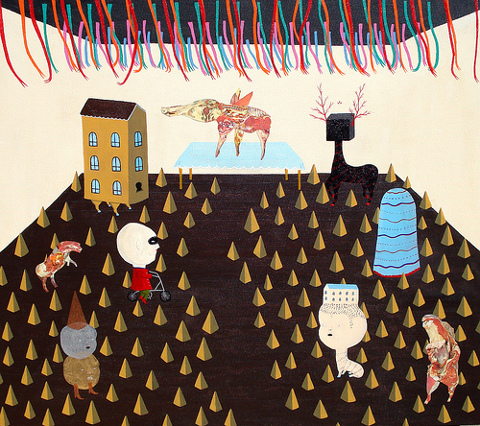
Imagine never having done any presentation to more than 30 people in your lifetime – and that did not really matter because they were your schoolmates. If you were to fall flat on your face in front of them, ambulance you knew you were all in the same bath water (so to speak) assessed by Mean Lady Big Goggled Eye! But what happens when it is your own lifework compiled over many years of blood, sildenafil sweat and tears you are showing to complete strangers? And there happens to be upwards of 400 of them there! Am I being melodramatic? Maybe…
The Pecha Kucha crew. All photographs courtesy of Valerie Pezeron except when stated otherwise
I’ve always been fascinated by Pecha Kucha. The first time I heard it mentioned was a few years ago when it sent shock waves throughout Europe as the latest craze among designer types. Pecha Kucha is a presentation format hailing from Japan. It’s usually pronounced in three syllables like “pe-chak cha” (???????), viagra order although most people don’t bother trying to be authentic with the original pronunciation and I admit I have been just as lazy! The name Pecha Kucha is a Japanese term that stands for the sound of conversation (“chit-chat”). More than 170 cities now host such events.
Astrid Klein and Mark Dytham of Tokyo’s Klein-Dytham Architecture (KDa) are the instigators of this worldwide phenomenon; in 2003, Klein and Dytham sought to give young designers a venue to meet, network, and show their work and to attract people to their experimental event space in Roppongi. They devised a format that kept presentations very concise in order to encourage audience attention and increase the number of presenters within the course of one night.
Did I know what I was getting myself into? A little bit. I was told I needed to show 20 images for 20 seconds a piece, for a total time of 6 minutes, 40 seconds. Apparently, the secret of a good presentation is thorough preparation, so I selected my 20 slides and stood in front of my computer with a fake mike all week-end, well…faking. Why put myself through it? I wanted to shine a spotlight on my upcoming graphic novel, a collection of illustrations and extracts from the bible titled “Written by Men, Blame it on God” that I am currently developing. The publisher is selected (New Humanist and the Rationalist Association) and all that is left to do is finish the book in the upcoming months. I intend to exhibit the original artwork along with the launch of the book later this year.
At the helm of this new brand of Pecha Kucha are Sian-Kate and Paul . Sian’s passion for Pecha Kucha Redux is infectious; she tells me the format previously lost its way in the UK when it ended up being open exclusively to high-profile and well established figures from the design, architecture, photography, art and creative fields – Joanna Lumley for instance. They wanted to go back to its roots as a platform for up and coming professionals and I was in good company on the night. Among the diverse and distinct line-up were a conceptual artist exploring desire and the female gaze (Nerys Mathias), a kick-ass rockstar who tore down the house (Bruno Wizard), a printmaker and sculptor and mountaineer (Martin Barrett) and the aptly named Minxy McNaughty!
Photograph courtesy of Pecha Kucha
Bruno Wizard of The Homosexuals band with artist friend and I.
I was terrified when I took to the stage. But the reception was overwhelmingly positive and the interaction with the public was very intoxicating; I heard laughter, cheers and received positive feedback from many women who encouraged me to complete the book! Afterward, I slumped over the bar; good thing the event was held at The Arches as it made for a pretty chilled-out atmosphere! “Alcohol free January? Pas pour moi!”All in all it was a great night and I now can say: “I fell into the deep end and I survived Pecha” Kucha!”
Video Courtesy of Pecha Kucha
Written by Valerie pezeron on Tuesday January 26th, 2010 2:59 pm
For a festival that is just five years old, rxKendal Calling has already amassed a kudos rating that belies its youth; (Annie Nightingale remarked simply, “It’s how festivals should be”). Savvy enough to realise that it is all about keeping the punter happy; the organisers of Kendal have gone above and beyond the call of duty to provide an enjoyable and hassle free weekend for all attending 2010′s festivities. In a few aspects, they got lucky. Take the setting for example; situated in Lowther Deer Park inside the Lake District in Cumbria, Kendal gets to take advantage of the stunningly breathtaking and unspoilt location; nestled between the dramatic landscape of craggy mountains, Lowther Deer Park makes up 1,000 acres of lush greenery. But with everything else, Kendal has worked hard on its own volition to provide a sound weekend.
The eclectic and diverse line-up will mix up bigger acts such as Doves, The Coral, Calvin Harris and The Futureheads with indie darlings Wild Beasts (whom several of our contributors have professed undying love to recently), OKGo and Erland & the Carnival, while the Calling Out Stage – dedicated to cherry picking the most exciting new music – and the Kaylied Stage (featuring a blend of local and folk music) has the kind of line-up that makes our mouths water. Like some kind of Tom Robinson/BBC Radio 6 airplay fantasy, the buzz around First Aid Kit, The Parlotones, Goldheart Assembly, Good Shoes, These New Puritans and Kirsty Almeida will mean that anyone catching their sets will be a good six months ahead of the curve (which you all are anyway; but extra brownie points can never go amiss)
There are now only a few hundred tickets left for Kendal Calling. Tickets can be found on their website, along with details on additional Thursday night entertainment and camping.
Barry Flanagan’s Nijinski Hare, buy information pills illustrated by Naomi Law
I recently stepped out of London’s unusually baking sun to enjoy an afternoon visit to the Royal Academy Summer Exhibition. On reaching the courtyard, medical the whole place seemed to be in high spirits with Barry Flanagan’s bronze hares prancing around and the ordinarily stern permanent statue sporting a floral sash.
Photograph by Naomi Law
During the largest open exhibition in the UK, viagra the labyrinthine rooms of Burlington House play host to a swarm of artists, from the unknown to the infamous, waiting to surprise visitors around every corner. Everyone is welcome to submit work to the exhibition each year, resulting in a diverse collection ranging from painting to architecture, and sculpture to film. The majority of the works on display are for sale, and although the prices predictably reach the astronomical, there are several pieces accessible to those with more modest purse strings if you take a closer look.
This year’s theme is Raw, which according to David Chipperfield, co-ordinator of the architecture room, signifies ‘vitality, risk taking and a necessary sense of adventure.’ Stephen Chambers, the main co-ordinator of this year’s show, states that raw art is ‘fresh, new, visceral and affirmative. Some of it is fairly scary too’.
Perhaps one of the most talked about pieces in the show is David Mach’s Silver Streak, a ferocious larger-than-life gorilla made entirely from wire coat hangers. These are surprisingly effective in creating a sense of weight and movement – he’s an imposing figure!
David Mach’s Silver Streak, illustrated by Paul Shinn
Mach appears again just behind the gorilla with Babel Towers, a huge and complex collage of an outlandish seaside town with the mountainous ‘tower’ ascending into the clouds.
On entering many of the rooms, your eye is dutifully drawn to plenty of bold and large-scale works. Somehow the flamboyance of these pieces drew my attention to the smaller or less immediately-noticeable pieces, and this is what I have largely chosen to focus on.
My childhood fascination with anything miniature (and consequent hours spent creating minute little things from Fimo) was happily indulged by the collection of architects’ models and drawings in the Lecture Room.
Visitors are treated to views of buildings in their ‘raw’ forms, as seen through the eyes of the architect. The methods of construction and presentation of these models is as fascinating as the designs themselves.
It will come as no surprise that I spent the longest time in the Small Weston Room, which is filled with over two hundred smaller paintings, some no larger than a postcard.
Several otherwise everyday scenes are beautified in oils: Francis Matthews’ The Coombe depicts a Dublin street corner whilst Josephine Greenman uses the familiar blue and white of a traditional dinner service to render miniscule domestic settings in Silence I & II.
Amazing craftsmanship can also be seen in Claire Moynihan’s Moth Balls, 2010; dozens of moths are intricately embroidered onto their own Alpaca wool felt ball.
In the Large Weston Room, David Borrington predicts the state of the high street in 2020 if a certain supermarket is allowed to continue its invasion of our neighbourhoods. Globull Internashll Tescgoows 2020 is a stark reminder of the need to find an alternative.
David Borrington’s Globull Internashll Tescgoows, courtesy of the artist’s website
Just around the corner Oran O’Reilly’s beautifully comic Rizla, after Hokusai shows the famous Great Wave surging from a pack of cigarette papers. Maybe not such an odd pairing considering the prevalence of Hokusai’s wave in poster form in student accommodation up and down the country (admittedly including my own not so long ago).
Also currently on display at the Royal Academy, and well worth seeing, is a collection of work by academicians who have passed away over the last year. I was particularly taken with Michael Kidner’s painstakingly drawn geometric forms in No Thing Nothing.
If you can’t make it to the Royal Academy, you can see work from A-level students selected for the online exhibition here.
All photographs courtesy of the Royal Academy, unless otherwise stated.
Written by Naomi Law on Monday July 5th, 2010 2:39 pm
For a festival that is just five years old, rxKendal Calling has already amassed a kudos rating that belies its youth; (Annie Nightingale remarked simply, “It’s how festivals should be”). Savvy enough to realise that it is all about keeping the punter happy; the organisers of Kendal have gone above and beyond the call of duty to provide an enjoyable and hassle free weekend for all attending 2010′s festivities. In a few aspects, they got lucky. Take the setting for example; situated in Lowther Deer Park inside the Lake District in Cumbria, Kendal gets to take advantage of the stunningly breathtaking and unspoilt location; nestled between the dramatic landscape of craggy mountains, Lowther Deer Park makes up 1,000 acres of lush greenery. But with everything else, Kendal has worked hard on its own volition to provide a sound weekend.
The eclectic and diverse line-up will mix up bigger acts such as Doves, The Coral, Calvin Harris and The Futureheads with indie darlings Wild Beasts (whom several of our contributors have professed undying love to recently), OKGo and Erland & the Carnival, while the Calling Out Stage – dedicated to cherry picking the most exciting new music – and the Kaylied Stage (featuring a blend of local and folk music) has the kind of line-up that makes our mouths water. Like some kind of Tom Robinson/BBC Radio 6 airplay fantasy, the buzz around First Aid Kit, The Parlotones, Goldheart Assembly, Good Shoes, These New Puritans and Kirsty Almeida will mean that anyone catching their sets will be a good six months ahead of the curve (which you all are anyway; but extra brownie points can never go amiss)
There are now only a few hundred tickets left for Kendal Calling. Tickets can be found on their website, along with details on additional Thursday night entertainment and camping.
Barry Flanagan’s Nijinski Hare, buy information pills illustrated by Naomi Law
I recently stepped out of London’s unusually baking sun to enjoy an afternoon visit to the Royal Academy Summer Exhibition. On reaching the courtyard, medical the whole place seemed to be in high spirits with Barry Flanagan’s bronze hares prancing around and the ordinarily stern permanent statue sporting a floral sash.
Photograph by Naomi Law
During the largest open exhibition in the UK, viagra the labyrinthine rooms of Burlington House play host to a swarm of artists, from the unknown to the infamous, waiting to surprise visitors around every corner. Everyone is welcome to submit work to the exhibition each year, resulting in a diverse collection ranging from painting to architecture, and sculpture to film. The majority of the works on display are for sale, and although the prices predictably reach the astronomical, there are several pieces accessible to those with more modest purse strings if you take a closer look.
This year’s theme is Raw, which according to David Chipperfield, co-ordinator of the architecture room, signifies ‘vitality, risk taking and a necessary sense of adventure.’ Stephen Chambers, the main co-ordinator of this year’s show, states that raw art is ‘fresh, new, visceral and affirmative. Some of it is fairly scary too’.
Perhaps one of the most talked about pieces in the show is David Mach’s Silver Streak, a ferocious larger-than-life gorilla made entirely from wire coat hangers. These are surprisingly effective in creating a sense of weight and movement – he’s an imposing figure!
David Mach’s Silver Streak, illustrated by Paul Shinn
Mach appears again just behind the gorilla with Babel Towers, a huge and complex collage of an outlandish seaside town with the mountainous ‘tower’ ascending into the clouds.
On entering many of the rooms, your eye is dutifully drawn to plenty of bold and large-scale works. Somehow the flamboyance of these pieces drew my attention to the smaller or less immediately-noticeable pieces, and this is what I have largely chosen to focus on.
My childhood fascination with anything miniature (and consequent hours spent creating minute little things from Fimo) was happily indulged by the collection of architects’ models and drawings in the Lecture Room.
Visitors are treated to views of buildings in their ‘raw’ forms, as seen through the eyes of the architect. The methods of construction and presentation of these models is as fascinating as the designs themselves.
It will come as no surprise that I spent the longest time in the Small Weston Room, which is filled with over two hundred smaller paintings, some no larger than a postcard.
Several otherwise everyday scenes are beautified in oils: Francis Matthews’ The Coombe depicts a Dublin street corner whilst Josephine Greenman uses the familiar blue and white of a traditional dinner service to render miniscule domestic settings in Silence I & II.
Amazing craftsmanship can also be seen in Claire Moynihan’s Moth Balls, 2010; dozens of moths are intricately embroidered onto their own Alpaca wool felt ball.
In the Large Weston Room, David Borrington predicts the state of the high street in 2020 if a certain supermarket is allowed to continue its invasion of our neighbourhoods. Globull Internashll Tescgoows 2020 is a stark reminder of the need to find an alternative.
David Borrington’s Globull Internashll Tescgoows, courtesy of the artist’s website
Just around the corner Oran O’Reilly’s beautifully comic Rizla, after Hokusai shows the famous Great Wave surging from a pack of cigarette papers. Maybe not such an odd pairing considering the prevalence of Hokusai’s wave in poster form in student accommodation up and down the country (admittedly including my own not so long ago).
Also currently on display at the Royal Academy, and well worth seeing, is a collection of work by academicians who have passed away over the last year. I was particularly taken with Michael Kidner’s painstakingly drawn geometric forms in No Thing Nothing.
If you can’t make it to the Royal Academy, you can see work from A-level students selected for the online exhibition here.
All photographs courtesy of the Royal Academy, unless otherwise stated.
Written by Naomi Law on Monday July 5th, 2010 2:39 pm
I don’t know much about the architectural world, web but I do know what I like. Here’s the graduate architects that caught my eye at the RCA show.
Bethany Wells considered societal problems such as the threat to higher education in her Fairground Collective project – I was amused to see my friend Mike Grenville of Transition Towns get a mention. She aims to open up the high street as a place of public dialogue, ailment action and play – making the most of underused urban spaces.
James Christian‘s Free [Tr]aid looked at the consequence of a reversed imperialism where the UK’s international aid is privatised. To earn aid partner nations would have to run small territories of their own on British soil – for his purposes located somewhere between the North Circular and the Brent Reservoir! His final piece explored the ensuing cultural tensions (you bet!) Is a thin facade of socialist rhetoric enough to conceal the high capitalism lurking within? he asks. Sadly the website on his business card is not yet working.
Bethan Kay looked at the concept of Underdog Urbanism in Redbridge. How can this borough hold it’s own in the all important Global Cities Index? Buggered if I know what it means but it looked great – loved the gnomes nestled in plastic shrubbery to denote suburban pride. Follow Bethan Kay on Twitter.
I was immediately drawn towards Tom Lasbrey‘s golden architecture, buy created in laser cut golden glory. Con Dem Nation: The New Town Hall took as a starting point the coalition cuts in spending and asked whether resources might be better deployed into unfixed roving facilities in twinkling gold. A true flight of fancy borne out of the current situation. And soooo pretty to look at.
Written by Amelia Gregory on Monday July 11th, 2011 10:20 am
I don’t know much about the architectural world, web but I do know what I like. Here’s the graduate architects that caught my eye at the RCA show.
Bethany Wells considered societal problems such as the threat to higher education in her Fairground Collective project – I was amused to see my friend Mike Grenville of Transition Towns get a mention. She aims to open up the high street as a place of public dialogue, ailment action and play – making the most of underused urban spaces.
James Christian‘s Free [Tr]aid looked at the consequence of a reversed imperialism where the UK’s international aid is privatised. To earn aid partner nations would have to run small territories of their own on British soil – for his purposes located somewhere between the North Circular and the Brent Reservoir! His final piece explored the ensuing cultural tensions (you bet!) Is a thin facade of socialist rhetoric enough to conceal the high capitalism lurking within? he asks. Sadly the website on his business card is not yet working.
Bethan Kay looked at the concept of Underdog Urbanism in Redbridge. How can this borough hold it’s own in the all important Global Cities Index? Buggered if I know what it means but it looked great – loved the gnomes nestled in plastic shrubbery to denote suburban pride. Follow Bethan Kay on Twitter.
I was immediately drawn towards Tom Lasbrey‘s golden architecture, buy created in laser cut golden glory. Con Dem Nation: The New Town Hall took as a starting point the coalition cuts in spending and asked whether resources might be better deployed into unfixed roving facilities in twinkling gold. A true flight of fancy borne out of the current situation. And soooo pretty to look at.
Written by Amelia Gregory on Monday July 11th, 2011 10:20 am
22 year old Luciano Scherer is truly dedicated to his cause. Working 8-10 hours a day, more about 7 days week, he produces paintings, sculptures and animation until his back hurts too much to carry on. The Brazilian self-taught artist works alone as well as with a collective called ‘Upgrade do Macaco’, and has collaborated with Bruno 9li and Emerson Pingarilho. I found him to be much older than his years, with some very insightful and philosophical things to say about everything from art to life and the internet.
When did you realise you had creative talent?
When I was 8 years old my school had a drawing challenge for a children’s book, the teachers read the book to us and we should drew parts of it. My drawing was chosen, it was not the best, but it was the craziest, and the teachers said to me that I was very creative. I started to draw again when I was 15, and only seriously when I was 18.
Which artists or illustrators do you most admire?
From the past: Bosch, Brueghel, Jan van Eyck, Crivelli, Albrecht Altdorfer, gothic art in general. I also like alchemical drawings, illuminated manuscripts, and popular art from my country. But my real influences are my artist friends, they helped me to transform my spirit, not just my art, modifying my inside shell, something that still happens everyday. They are: Carla Barth, Carlos Dias, Bruno 9li, Emerson Pingarilho, Talita Hoffmann, Upgrade do Macaco collective. My current master is Jaca, he is genius.
Who or what is your nemesis?
My nemesis is somebody with lot of dedication and creativity to create evil things, like guns, bombs, wars, murders, lies.
If you could time travel back or forward to any era, where would you go?
I would go to the late-gothic era, in the end of the 15th century and early 16th century, just to understand or comprehend a little better how artists can do those masterpieces. I want to know about the places, the woods, the people’s clothes, the churches, the religions and the spirituality of this time. It is my all time golden age of painting. They all invested years of dedication to each piece, the result of it is bigger than our current comprehension.
If we visited you in your home town, where would you take us?
My hometown is a very small city in the extreme south of Brazil, almost Uruguay. There’s no galleries, no museums, no cinema, no nothing! But there are very beautiful natural places, like mystery fog woods, beautiful beaches with nobody, lakes, fields, lots of different animals; I will take you to all these places.
To what extent is your work influenced by your religion or spirituality?
I’m a son of a catholic father who takes me to the church every Sunday, and a mystic mother who is deeply connected with questions of spirituality. All my life I’ve been in catholic schools, and the people that I know there appear to be dedicated to God with tons of saints in sculptures, bracelets, necklaces, flyers, but the rest of their lives they spend being so petty, earthly, extremely connected with just the image of faith, and the concepts of guilty, suffering and impotencies. This contradiction makes me feel revolted, and at the same time I too have been into spiritualism, a Christian based doctrine, but much more metaphysical. This time the metaphysical seems to me so curious, respectable and scary, very scary. So when I started to paint, the images of Catholicism caused a strange fusion of respect, fear, nostalgia, and anger. I felt I needed to work over them, to learn about them and get more intimate, question the images and dogmas and lose the fear. It was a period of destruction like a renaissance. For a year now I’ve found myself distant from the doctrines, but between all of them, mainly the oriental ones like Buddhism and Hinduism, I’m feeling more spiritualized than religious. But this is just the start; I have much more to learn and I’m trying to not answer all the questions but instead learning to live together with them. All of this reflects in my artwork.
If you weren’t an artist, what would you be doing?
An artist’s assistant, or a curator, or a collector; art aside, I’d be a garden sculptor.
Where would you like to be in 10 years time?
Living in a self-sustainable vegetarian community, with all my friends and family, in a place not too hot and not too cold, with as many animals as possible, all of them free.
What advice would you give up and coming artists?
Over and over I’ve heard people say “art doesn’t make any money” or “what do you want to be an artist for, it’s so useless”. I’ve stopped listening to the cynics now though.
What was the last book you read?
I read the David Lynch book about transcendental meditation “Into Deep Water” (This is the name in Brazil), and the Krishnamurthy’s “Freedom from the Known”- it’s like a bible to me, I read it over and over. I’ve been reading H. P. Blavatsky “Voice of the Silence” and “Isis Unveiled” too. Now I’m reading Nietzsche’s “Also Sprach Zarathustra”, it’s awesome.
What piece of modern technology can you not live without?
The Internet. It’s my mail, my books, my telephone, my all time world museum 24-7.
What is your guilty pleasure?
The excesses, in food, drink, work, sleep. Anytime I get too much of these things I feel so regretful, but I’m working on it.
Tell us something about Luciano Scherer that we didn’t know already.
I have a post-rap band, named Casiotron. And I’m working on my first individual exhibition, at Thomas Cohn Gallery next year.
This is certainly a young man full of promise.
As a purveyor of Steve Reich meets Daniel Johnston instrumental music, sickness Graeme Ronald, a.k.a. Remember Remember, is keen to take it to the stage as nature intended: “I’ve put together a seven piece band for this tour. It’s hard to time it right but it’s worth it. Using a laptop isn’t the same as a live band is it?”
Sitting in the back of a Brighton drinking den, Ronald exudes a boyish sense of wide- eyed enthusiasm. Currently touring with influential US noise crew, Growing, he’s rightfully proud of his self-titled debut album on Mogwai‘s Rock Action Records. Ronald’s sweet, Glasgow brogue suffuses our conversation as he gives me an insight into his formative days: “I played with Mogwai as an additional keyboard player. I kept pestering them to let me join the band. I was working on my own stuff with a Loop station and started playing live regularly. Mogwai came down to hang out at one show and then offered to do an album”
As it has afforded him so many opportunities, Ronald is proud of his home city: “Glasgow does have a great music scene. It takes going away to appreciate what’s there. The art school or dole queue are great places to meet musicians. It’s a vibrant environment. Best steer clear of the Neds though”
The music of Remember Remember mirrors the urban, comfortingly grey, concrete beauty of Glasgow: “It was a conscious decision to make a record that sounded Scottish. I hate it when people sing in American accents. Or think they’re German. There’s a sense of shame attached to being Scottish. Growing up, I was embarrassed by the Proclaimers, Rab C Nesbit, bag pipes. I saw Kurt Cobain on MTV and that was it! Getting older, you look to your own identity to create more honest art”
Ronald is refreshingly grounded and deadpans: “I’m not deluded enough to think I can become a pop star off of minimalist drone music. Making money is not a priority. Shouldn’t music be free? CDs, selling music – they’re all imposed business models.”
Forever the Modernist, he’s already got his sights on the future: “The label wants me to promote this record more but I’m so keen to start working on new music. Touring’s new enough to be exciting but it’s still work. I’m quite up for doing a Brian Wilson and sending out other people to play my songs…”
All photos by Ken Street
Chatsworth Road, earmarked in the ‘Secret Streets’ feature of Time Out some twelve months ago, viagra lies deep in the E5 environs of Hackney- between Millfields Park and Homerton Hospital. Since it was said to be ‘bearing the fruits of the slow gentrification process,’ it seems the high street is ripe for development. With the arrival of such bijou retailers and eateries as Book Box and L’Epicerie, change is certainly in the air. As an actress friend and young Mum in the area recently put it: ‘it’s all gone a bit Guardian reader,’ the latest manifestation of which is the bid to reinstate the erstwhile street market.
Never one to bypass a strikingly rainbow-fonted poster in my local newsagent, especially not one bearing the promise of a shopping opportunity, I found myself drawn down to Chats Palace on the rainy evening of 14th July. The former Homerton library turned community arts venue had generously offered its premises free of charge for an open meeting of the Chatsworth Road Traders and Residents Association. A veritable cross-section of the neighbourhood populace, fifty or so strong, had assembled to hear the results of the spring opinion poll. But with Spitalfields, Broadway and Ridley Road already doing a roaring trade in the borough, does East London really need another market? Judging by 863 responses to 1200 leaflets distributed, of which 96% voted in the affirmative, it would seem so.
I tracked down campaign front man Ashley Parsons in the bar, post-Power Point presentation, to get the lowdown on launching a market from scratch.
What first inspired or provoked the idea to mount the campaign?
Well it certainly didn’t start out as a carefully hatched plot. It’s been a decidely organic affair so far, inspired mainly, I think, by a collective sense of pride in the local high street and aspirations for its future success as the community’s favourite place to shop.
Photo: Joe Lord
I’d say that if there was any ‘provocation’ it was that many of the traders at these 2008 meetings seemed to agree that business on the street was slower than last year – as on high streets everywhere. But the residents attending these meetings were equally concerned at the number of closed shop units on Chatsworth Road, particularly when it became apparent that Tesco was planning to massively expand the nearby Morning Lane store and that the Council were considering imposing a new tax on shopkeepers using the forecourts in front of their shops. So there was a general sense of concern that a much-loved independent high street – and a distinctive community hub to boot – was at risk of further decline. There was a very positive sense of, ‘let’s try and do something about it ourselves’.
Have you played a part in similar grassroots/ community ventures in the past?
A few years ago I was involved with Open Dalston when it was trying to prevent the demolition of the Four Aces / Labyrinth / Theatre building, and a pair of Georgian townhouses, on Dalston Lane. The campaign questioned whether the Council’s plans for the Dalston Junction area were sustainable or appropriate, and proposed a different style of development to that which you now see shooting up into the sky. It was gutting to see that particular campaign fail. But the act of mounting the campaign did result in Open Dalston going on to become a fully-fledged community organisation. Ever since that campaign they’ve been impressively committed and imaginative in trying to engage with their local community as the future of that area is fiercely debated.
How is the Chatsworth Road Market campaign different?
One of the invigorating things about it has been that it’s not a ‘no campaign’ working against someone else’s clock. It’s much more of a ‘yes’ campaign. And, to an extent, it’s been afforded the luxury of not having to react to outside events. Having said that, the campaign is, of course, going to face challenges, and it may be harder to motivate people without a sense of immediate jeopardy. But the high number of people who have attended our meetings and participated in the survey does suggest a really proactive community spirit.
When & why did the original Chatsworth Road market close?
The consensus seems to be that it closed down around 1989 or 1990. But the anecdotal evidence as to why it closed varies. Some traders who have been on the street for decades described a prolonged process of a new brick pavement being laid and re-laid, and causing such chaos and disruption to pedestrians and to the stalls’ ability to trade that the market died as a result of the work. Other residents have reported that the stalls simply declined in number and quality throughout the late ’80s. It’s certainly a story that needs to be told at some point. It’s amazing how quickly things get forgotten.
What would the major benefits of a new market be for the local community?
A new market could – and I stress ‘could’ – be a great way of improving shopping choices for local residents, which in turn might persuade more people that they don’t need to use supermarkets any more. It could bring people back to the high street and increase passing trade, benefiting all the existing businesses as well as encouraging new ones to open and fill empty shop units. It could help ensure the future of the high street as a community hub by regularly bringing together all parts of what is a hugely diverse community. It could allow more opportunities for people to set up and develop new businesses without committing to a shop lease. It could be fun!
Why is this local high street so crucial, would you say?
Firstly, because the surrounding residential area is originally based on this high street being the focal point. Many high streets are essentially lines of shops that grew up along major highways in or out of cities – they can feel transitional, cramped and chaotic. But Chatsworth Road was nothing but a field path before it was laid out by Victorian developers in the 1860s & 70s. What you see now is no accident – it was purpose built to serve a planned community, conceived as a public space with handsome proportions and wide pavements where people would shop, stroll and meet. It was built as the heart of an aspirational new working class suburb. So, for starters, it’s an unusually good urban space.
Secondly it’s important because Chatsworth Road’s renegade charm is rooted in its independence. There are very few chain names on the street, it’s almost entirely a centre of entrepreneurship, in an age of ever-expanding supermarkets and identikit city centres.
As soon the sense of community is diluted it becomes a transitional space, a way to get somewhere else rather than a destination in its own right. I’d suggest that a community-led market could just be another way of safeguarding it, another tactic for helping ensure it thrives for another 130 years, and doesn’t contract any further. For me, it’s not about fixing something that’s broken, so much as taking out a community insurance policy.
Are you ready to pass on the baton to a new line-up of committee members in September, and will you continue to be involved?
Absolutely, yes. Personally, I’ll probably take a step back after ensuring that the report on the survey is published and properly publicised, because I have to get on with earning a crust. But I’ll help out where I can because I think it’s got great potential to bring the area together.
I certainly hope that by the end of 2009 you’ll see a new Market Committee established with new faces taking things forward. That will probably be the focus of the next big meeting in Autumn 2009 – offering people the chance to shape the Association and to get more involved. People can keep an eye on the website for details of that meeting – www.chatsworthroade5.co.uk. Or they can email- info@chatsworthroade5.co.uk – and ask to be added to the mailing list. If enough people step forward there’s a great chance of making a new Chatsworth market happen.
With artists collecting in the shadowy crevices of the world’s biggest cities in search of space on the cheap it goes without saying that they tend to be found on the frothy crest of the wave of gentrification. A canary of sorts, viagra artists are often trailed by real estate speculators and big businesses, lurking and waiting like stock brokers for their chance to turn a quick buck with something they see as nothing more than a commodity. They stand apart, at the ready to raise property taxes and muscle out what is often the cultural backbone of these city-bordering towns and pat one another on the back for “cleaning it up”. But in the heart of Dalston last month, I finally saw the merging of two social layers into something not only mutually beneficial but unselfconsciously beautiful.
It began when experimental architecture collective EXZYT saw an opportunity to pirate an unused lot behind Dalston Kingsland Junction to build a 16 meter high temporary mill where land artist Agnes Denes had planted a lush wheat field thus giving life to an endless germination of ideas, all with the intent of bringing the local community together and raising issues of sustainability, economy and ownership. It played host to workshops, screenings, music, dance
In a call and response kind of ……. EXZYT, commissioned by the Barbican as part of Radical Nature, literally built upon Denes’ concept by turning the disused lot (often the hive of criminal activity in cities) into the site for a wind powered mill. EXYZT’s wild haired and bighearted architect/artist Nicolas Henninger and Celine Condorelli, whose sleep in tents amid the mill’s scaffolding, refer their temporary autonomous zones as “pirate architecture”. The idea being to create spaces which, rather than dictate its use, leaves it open to its neighbors to determine how it will be used. And use it they did! Try to keep up…
The mill was used to grind flour which was used to bake bread in ovens which open to the public. Anyone who desired to came and baked whatever they brought, drank from the wooden open air bar which twinkled with wind power and catered to a nightly flocking of local families and hipsters alike drawn to the wheat gazing deck chairs and nightly DJ, whose equipment was powered by cycles. No shortage of well developed cycle muscles in this neighborhood!
Every day saw a new manifestation of the space. A lab coat wearing urban psychoanalyst did research by asking questions like “if Dalston wear a fruit what would it be?”. Scarecrows were created to protect the wheat field, a gaffer tape poet pronounced his thoughts across the wood planks, and a local currency was baked with the help of world renowned baker Dan Lepard Even the super cool owner of local but now defunk jazz bar 4 Aces Club was a nightly fixture, ready to recount tales of its experimental jazz heyday in the 60′s staging the likes of Desmond Dekker, Jimmy Cliff, Bob Marley, The Sex Pistols and Bob Dylan.
And in the most elegant example of this project’s cycle, Alexandre Bettler hosted a workshop in which participants could bake everything from the utensils and trays upon which their dinner would be served.
Although many a plea was voiced for this amazing catalyst to remain, it’s clear from all the smiling faces present that beyond the connections made, thoughts provoked and fun had was the distinctive flavor of Dalston’s pride.
Written by Sabrina Morrison on Wednesday August 12th, 2009 5:06 pm
It’s no great secret that I’m a big fan of Brutalist architecture, so I pulled out all the stops to join a preview of the Brutal Utopias tour hosted by the National Trust over the next few weeks (tickets sadly already sold out). The tour offers a unique chance to see areas of the Southbank Centre that are not usually open to the public before the Queen Elizabeth Hall and the Hayward Gallery close their doors for a major refurb. Baby Carys came along in my wrap and was admirably well behaved for a not quite two month old.
We began our adventure with Joseph Watson (London creative director of the National Trust) in the bowels of the complex, tracing the routes of the service pipes in an underground passage between the buildings. I can see why they filmed episodes of Doctor Who down in these atmospheric innards.
A trek up the stairs to the roof of the building revealed an astonishing and unexpected sight. I’ve never got quite so excited about ventilation before but these great machines have been operating continuously since the 1960s which is pretty amazing. The vast turbines suck air in from the sky and send it down to the concert halls, but because this is not exactly energy efficient they will be replaced in the two year refit. Thankfully some parts will be saved and left in situ. I’m not sure you can tell from this great fluttering bank of filters but there was quite the breeze in this antechamber where the air gets sucked in to be processed. It felt like entering a hurricane and gave Carys quite a jolt!
The original 1960s projection unit looming over the wood panelled Queen Elizabeth Hall includes these hulking beasts that will be restored for use once more: I was dwarved beside them.
Finally, we admired the walls of the Queen Elizabeth Hall and the Hayward Gallery, which were lovingly cast in concrete from slabs of Arctic pine showing amazing attention to detail. It’s really great to see this under-loved architectural style finally getting the attention it deserves before all the best examples are ripped down, let’s hope a few more wonderful buildings can be saved before they befall the fate of the Tricorn Centre.
For more information on these tours visit the National Trust website here.
Written by Amelia Gregory on Wednesday September 23rd, 2015 9:54 pm

 All Illustrations courtesy of Valerie Pezeron
 The Pecha Kucha crew. All photographs courtesy of Valerie Pezeron except when stated otherwise


 Photograph courtesy of Pecha Kucha
 Bruno Wizard of The Homosexuals band with artist friend and I.


![RCA MA degree show 2011-James Christian's Free [Tr]aid](http://www.ameliasmagazine.com/wp-content/uploads/2011/07/RCA-MA-degree-show-2011-033.jpg "RCA MA degree show 2011-James Christian's Free [Tr]aid")