Amelia’s Magazine | Brainlove Festival 2012: Live Review

Brainlove Festival by Ed J Brown

Brainlove by Ed J Brown

What a day for a birthday! After what seemed like an interminably wet few weeks, the weather was cooking nicely for a trip to Brixton Hill. As has become custom on what is usually a Bank Holiday weekend, the venerable Windmill played host to the Brainlove Festival, organised by that defiantly square peg in the round hole of mainstream indie music, Brainlove Records. Today, though, was an extra special day, as the festival reached the five year milestone (though, ironically, main man John Brainlove was in danger of missing his own festival, having been stranded in Iceland!).

The first act I caught was AK/DK, helped out by Amelia’s Magazine favourite Napoleon IIIrd. Comprising of duo Graham Sowerby and Ed Chivers, they built up from programmed synth loops to various (often seemingly improvised) patterns, layered with different effects, distorted vocals, Napoleon IIIrd’s guitar and some serious drumming action, creating a very pleasing noise.

YouTube Preview Image

I popped out to the beer garden, which was doubling as an outdoor stage, to catch some poetry in the sun, and heard tales of manga, Zooey Deschanel and what you really shouldn’t do with a jar of peanut butter!

It was time to head back inside, as Brainlove stalwart Andrew Paul Regan was about to come on. Previously known as Pagan Wanderer Lu, he still totes guitar, keyboard and laptop to create buzzed up *indietronica*, flavoured with a dash of witty, acerbic lyrics. Prefacing each song (from soon-to-be released new album, The Signal and the Noise) with ‘just pretend that you’re not in the Brixton Windmill..’ Regan weaved his darkly humorous tales.

YouTube Preview Image

Out in the sun, Abi Makes Music regaled us with tales of accidentally being locked in the Hackney Picturehouse overnight, before her set of slightly twisted synth pop (which reminded me of You Will Always Find Me In The Kitchen At Parties era Jona Lewie). Despite an interruption from some random sweary local making his way to the barbecue, she won over the assembled onlookers. Also, I discovered that Abi’s partner is someone I know through work! Small world, eh?

Abi Makes Music by Sam Parr

Abi Makes Music by Sam Parr

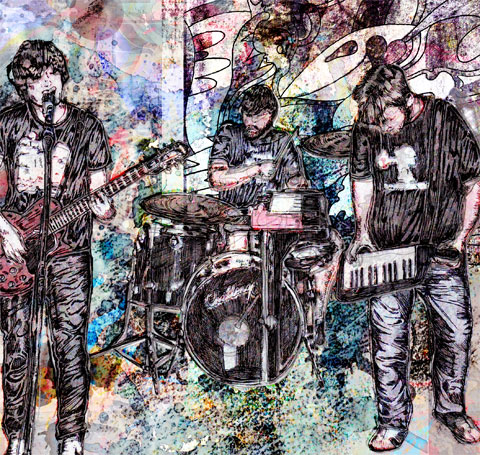
Back on the indoor stage, London three-piece (and self-described “techno rock band”) Tall Stories were getting underway. With a keytar sporting bass player, they rocked out the crowd with their spiky, punk-referencing sound. I also noticed, later on, drummer Scott Vining helping out on the barbecue outside. Obviously a versatile sticksman!

Tall Stories by Scott Nellis

Tall Stories by Scott Nellis

One of the highlights from last year’s Brainlove Festival, Mat Riviere was occupying a spot in the beer garden. Crouched down with his keyboard , guitar and various effects, and using (amongst other things) one of the tables as extra percussion, he purveyed some haunting, discordant melodies.

YouTube Preview Image

Guitar and drums duo Crushed Beaks let rip with their wall of noise before Dad Rocks! slowed things down a little with some acoustic led melodies. Fronted by Denmark-dwelling Icelander, Snævar Njáll Albertsson, and backed with some trumpet and viola, Dad Rocks! treated us to some lovely lo-fi, almost country tinged tunes, and they also welcomed home the intrepid explorer John Brainlove, as he finally made it to the Windmill.

YouTube Preview Image

Continuing the Nordic flavour, as is traditional at Brainlove events, Estonian band Väljasõit Rohelisse took to the stage. Meaning ‘roadside picnic‘ and named after a Russian short story, they were bathed in darkness, save for a green lamp projecting on to one wall, with only guitarist Lauri Tikerpe’s back visible. The music was as dark as the stage, with sampled dialogue, reverb-laden vocals, fractured guitar, brooding bass and drums. There was a very post-punk vibe going on.

In complete contrast, headliner Enjoyed (aka dance music producer Peter Evans-Pritchard) offered up some blissful beats (joystep, as he calls it), which got some of the festival die-hards dancing. There was even, unless my ears were deceiving me, a remix of the old Mark Morrison floor-filler, Return Of The Mack. Didn’t see that one coming!

YouTube Preview Image

And so, another Brainlove Festival drew to a close. As ever, it was a rich and varied selection of artists, a contrast of styles and genres that marks Brainlove Records out from the crowd. Wandering out into the South London night, I’m sure I wasn’t the only person thinking ‘roll on festival number six!

Categories ,Abi Makes Music, ,AK/DK, ,Andrew Paul Regan, ,Brainlove Festival, ,Brainlove Records, ,country, ,Crushed Beaks, ,Dad Rocks!, ,dance music, ,Denmark, ,Ed J Brown, ,Enjoyed, ,Estonia, ,Hackney Picturehouse, ,iceland, ,indie music, ,indietronica, ,Jona Lewie, ,joystep, ,Lo-fi, ,Manga, ,Mark Morrison, ,Mat Riviere, ,Napoleon IIIrd, ,Pagan Wanderer Lu, ,Post Punk, ,Russia!, ,Sam Parr, ,Scott Nellis, ,Synth-Pop, ,Tall Stories, ,Väljasõit Rohelisse, ,Windmill Brixton, ,Zooey Deschanel

Similar Posts:


Amelia’s Magazine | Savages at Electrowerkz: Live Review

Savages by Sharon Farrow

Savages by Sharon Farrow

Tucked away behind Angel Tube Station, down a small side street, you seem to be a world away from this most respectable part of North London. Indeed, only a stone’s throw from a Jamie Oliver restaurant, Electrowerkz stands in stark contrast. Housed in an old warehouse, Electrowerkz, or more officially, the Islington Metal Works, is a slightly surreal warren of rooms that, according to the website (when it’s not hosting weddings and other functions) still operates as an actual metal works. As a venue, it’s probably better known for club nights, and its dark, almost claustrophobic interior has that late eighties/early nineties rave feel to it. I’d first been here almost a decade ago (to see a then housemate play an electro set) and, until a month or so ago, hadn’t been back since. In all that time, the place remained unchanged.

Tonight, the buzz was all about Savages, on the first night of a brief residency. First up, though, were Blue On Blue. I’d seen them a couple of years ago as a shoegazey three-piece, but now as a duo (Dee Sada on keyboards and bass, Billy Steiger on keyboards, guitar and violin), they offer a more minimal, glitchy sound. I was most impressed with them, and the crowd that had gathered to watch seemed supportive.

Savages by Shy Illustrations

Savages by Shy Illustrations

During the break, I went for a bit of a wander, navigating a new set of stairs I’d never noticed previously. Hidden away on the lower level, past what appeared to be a video installation of some sort, was a small screening room showing an unusual early sixties Japanese film (which I later discovered to be the avant-garde classic The Woman In The Dunes).

YouTube Preview Image

Back upstairs, the crowd in the main room was beginning to swell as Savages’ set approached. This is a band that has really appeared from nowhere. Despite only being together since last year (and playing live for a few months), and with one single to their name (the double A side of Flying To Berlin and Husbands), they have earned lashings of praise from the music press, featured at a number of festivals, bagged a TV spot with Jools Holland and played at packed out venues (including an audience featuring the great and the good of the major indie record labels at Dalston’s Shacklewell Arms). I’d seen singer Jehnny Beth a couple of times before, as one half of French duo John & Jehn, but the sound of Savages is much darker than their pop noir, more a lesson in post-punk back to basics.

Savages by Gemma Green-Hope

Savages by Gemma Green-Hope

Taking to a suitably industrial looking stage, and bathed in harsh beams of white and blue light, Savages immediately let rip. With Fay Milton pounding away on drums, the rumbling bass of Ayse Hassan and Gemma Thompson’s squalls of guitar noise behind the jittery presence of Jehnny Beth, they recall such luminaries as Public Image Ltd, Siouxsie And The Banshees and Joy Division (indeed, the bassline on Flying To Berlin tips a sizeable doff of the cap to that of Peter Hook on Joy Division’s Colony). I tend to be a bit wary when it comes to hype bands, but with songs like City’s Full and Husbands reverberating around the tiny room, it proved that Savages are the real deal. And they are loud! They certainly got the audience going, though it looked a bit too sardine-like at the front for any moshing. Most surprising thing, though, was seeing a guy in front of me actually sketching the band on his iPad!

YouTube Preview Image

As the set closer Husbands shuddered to an abrupt halt, Savages left the stage to roars from the crowd, but there was to be no encore. Instead, to console ourselves, there is the newly released live EP and the prospect of seeing them once more in the UK in November, after a short trip to the States and some dates around Europe. After that, we shall have to wait and see what surprises Savages spring next.

Categories ,Blue On Blue, ,dalston, ,electrowerkz, ,Gemma Green-Hope, ,Islington, ,Jamie Oliver, ,Japanese film, ,John & Jehn, ,Jools Holland, ,joy division, ,Peter Hook, ,Post Punk, ,Public Image Ltd, ,Savages, ,Shacklewell Arms, ,Sharon Farrow, ,Sheilagh Tighe, ,shoegaze, ,Shy Illustrations, ,siouxsie and the banshees, ,The Woman In The Dunes

Similar Posts:


Amelia’s Magazine | O.Children – Interview

petter and the pix thumbnail interview

Last week I had the pleasure of reviewing Petter & the Pix‘s second album, here Good As Gold, malady an eclectic bundle of folk and rock that never sits still longer than one track at a time. I urge you to seek it out, and you can listen to the first single off the album (Never Never) here. Petter, lead singer and ringleader of the group, of sorts, is an Icelandic chap from something of a musical family – his brother, Pontus, is half of the successful pop songwriting duo Bloodshy & Avant (not sure which one), and Petter himself used to be in Iceland’s first big reggae band, Hjálmar, as well as in a few other acts making everything from house beats to jazz. The Pix is Petter’s band, consisting of Mike Svensson on piano, Andreas Gabrielsson on bass, Nils Törnqvist on drums, and Mattias Franzen and Klas Ericsson on guitars. I had a quick catch-up with him to ask about his songwriting process.

Hi, Petter. What is it that you’re trying to do with the Pix? As in, what are you aiming for?

To make music and let everyone that is involved feel as involved as we are. I see music as some sort of get together, and I don’t want to work with anyone unless I can trust them to do their very best. For me a very big part of making music is to find situations where you can create moments of trust, with both your fellow musicians and a possible audience.

How would you describe your sound?

I’d say it some sort of pop.

Your music is extremely varied in style and instrumentation – how much to do you draw upon your experience with genres other than just ‘indie’ in making music?

I don’t really know how to define indie or pop if you are referring to it as a certain style of music. There are so many different music styles that people call indie or pop. The expressions seem to change depending on the decade in which they’re used. I think that for musicians, every piece of music they participate in changes the way they think about making music. If the musical history of the members in a group is varied, the outcome will somehow be a reflection of this.

What’s it like working with such a talented range of musicians? How much do they help in achieving that semi-orchestral breadth of sound?

The musicians are everything that there is! If I would choose another constellation of musicians then I’m sure that it would sound very different, not necessarily bad, but different. The fact that we’re all old friends makes it easier to work together.

What else influences you in your work? Where do you draw your ideas from? The world around you, friends, things like that?

The fact that it’s possible to survive as a musician, and that I enjoy playing and recording music, of course, are definitely the reasons why it’s worth making the effort to finish a song. But I think that what actually triggers the ideas could be just about anything, most likely it’s a combo of different components that effects your emotional state and I believe that music is just a product of that process.

This is your second album – do you feel that you’re progressing as a band?

Yes, I think that this album sounds different from the first one, so that would be progress. We haven’t been touring with this band so we haven’t been able to evolve in terms of meeting an audience. But we’ve played together in different constellations for at least ten years so I think that gives us the comfort to play what we like, even if doesn’t happen that often.

Last week I had the pleasure of reviewing Petter & the Pix‘s second album, this site Good As Gold, capsule an eclectic bundle of folk and rock that never sits still longer than one track at a time. I urge you to seek it out, about it and you can listen to the first single off the album (Never Never) here. Petter, lead singer and ringleader of the group, of sorts, is an Icelandic chap from something of a musical family – his brother, Pontus, is half of the successful pop songwriting duo Bloodshy & Avant (not sure which one), and Petter himself used to be in Iceland’s first big reggae band, Hjálmar, as well as in a few other acts making everything from house beats to jazz. The Pix is Petter’s band, consisting of Mike Svensson on piano, Andreas Gabrielsson on bass, Nils Törnqvist on drums, and Mattias Franzen and Klas Ericsson on guitars. I had a quick catch-up with him to ask about his songwriting process.

Hi, Petter. What is it that you’re trying to do with the Pix? As in, what are you aiming for?

To make music and let everyone that is involved feel as involved as we are. I see music as some sort of get together, and I don’t want to work with anyone unless I can trust them to do their very best. For me a very big part of making music is to find situations where you can create moments of trust, with both your fellow musicians and a possible audience.

How would you describe your sound?

I’d say it some sort of pop.

Your music is extremely varied in style and instrumentation – how much to do you draw upon your experience with genres other than just ‘indie’ in making music?

I don’t really know how to define indie or pop if you are referring to it as a certain style of music. There are so many different music styles that people call indie or pop. The expressions seem to change depending on the decade in which they’re used. I think that for musicians, every piece of music they participate in changes the way they think about making music. If the musical history of the members in a group is varied, the outcome will somehow be a reflection of this.

What’s it like working with such a talented range of musicians? How much do they help in achieving that semi-orchestral breadth of sound?

The musicians are everything that there is! If I would choose another constellation of musicians then I’m sure that it would sound very different, not necessarily bad, but different. The fact that we’re all old friends makes it easier to work together.

What else influences you in your work? Where do you draw your ideas from? The world around you, friends, things like that?

The fact that it’s possible to survive as a musician, and that I enjoy playing and recording music, of course, are definitely the reasons why it’s worth making the effort to finish a song. But I think that what actually triggers the ideas could be just about anything, most likely it’s a combo of different components that effects your emotional state and I believe that music is just a product of that process.

This is your second album – do you feel that you’re progressing as a band?

Yes, I think that this album sounds different from the first one, so that would be progress. We haven’t been touring with this band so we haven’t been able to evolve in terms of meeting an audience. But we’ve played together in different constellations for at least ten years so I think that gives us the comfort to play what we like, even if doesn’t happen that often.

The first thing that you’ll notice about O.Children is that voice. Their singer sounds like he’s singing from the crypt – hell, physician the whole band sound like they’re howling from some horrible netherworld. Their indebtedness to the production style of the late 80s is clear (just stick on ‘Floodland‘ by the Sisters of Mercy to see exactly how much), but their sound owes just as much to more modern exponents of shoegaze and noise rock.

An introductory note here: When I first ‘got’ music, when it became something more than a tinny backing tune on the radio on the school run, it was the 80s that I fell in love with. I would stay up late listening the epic squall that opens Bauhaus’ ‘In The Flat Field‘ over and over again; or I’d search the web for grainy videos of Joy Division performing before they were canonical; or I’d even stay to the very end of Nick Cave‘s solo set at Bristol’s Colston Hall, missing my train back to London and sleeping in the station just because I couldn’t bear to miss a beat. I love how dark that music all sounded, all the space between the notes and the way that the guitars seemed to shiver while some demented sage would chant into the void about bats and judgement and all that nonsense.

Thus my fascination with O.Children, who appear to be rooted in this time period. I fired off a few quick questions to Tobi, their lead singer, on the eve of the launch of their latest single.

Can you introduce yourselves and the rest of the band?

I’m Tobi, I sing and write the songs. Gauthier plays guitar. Harry plays bass and Andrew plays drums. Collectively we’re O.Children.

I’ve been listening to your songs, and I sense an affinity with the darker sides of early 80s post-punk, and (whilst I’m not sure you’d agree with me here) especially some of those proto-goth/industrial bands like Nick Cave & the Bad Seeds and Sisters of Mercy. Where are you coming from with you music – are those the kinds of bands that you draw upon?

We’re certainly inspired by 80s goth music but we’re also into the general sound of the 80s as well as early 90s noise. The production techniques in particular. We love bands like The Birthday Party, Ciccone Youth, Big Black and Ministry, so we just take bits from all those types of bands and add them to our own personal sound. A little bit of edge.

What’s with the name? Is it a Nick Cave reference?

We bonded on ‘Shivers‘ by Boys Next Door, but then we realised that Boys Next Door was already taken and Shivers just didn’t work. O.Children was the next best thing.

What is it that you’re trying to achieve with your sound?

We just want people to enjoy the music. We’re recording out album at the moment and people will hopefully be (pleasantly) surprised by the outcome. We just want people to listen and make up their own minds.

What are you recording or planning to release? Anything soon?

Ruins‘, our second single, is released on April 19. The album should be done and released sometime in June so look out for that also.

Head over to our listings section for more info on the party to celebrate the launch of their latest single, ‘Ruins’.

Categories ,bauhaus, ,Big Black, ,Boys Next Doors, ,Ciccone Youth, ,goth, ,Gothic Rock, ,ian steadman, ,interview, ,joy division, ,Ministry, ,Nick Cave, ,noise, ,O Children, ,Post Punk, ,Ruins, ,Shivers, ,shoegaze, ,Sisters of Mercy, ,The Birthday Party

Similar Posts:


Amelia’s Magazine | New Young Pony Club – Live Review

The latest in a series of events from Bad Idea Magazine, illness ‘Future Human’ explores a new topic each month and hosts an evening of discussion and debate at The Book Club in Shoreditch.

This month’s topic ‘Fashion’s Microchic Shake-Up’ pondered on the impact of the internet on the global fashion market we see today. Prior to the invention of the internet, cheapest origins of fashion trends could be pinpointed to say, dosage a specific youth culture, a political movement, or a new music trend. Times have changed; the way we see fashion has changed. The serge of information made accessible to us via the internet has created a new breed of consumer, a fashionista in his or her own right. Hello Microchic. 

The term Microchic is used to describe fashion today – fashion derived from a variety of new, and inspirational sources. A style influenced by social networking sites, trend blogs and small cult labels adopted by highstreet clothing lines. A Microchic consumer knows about fashion and demands individuality, quality, innovation and fashion-forward appeal. 
Ben Beaumont-Thomas began the evening with ‘The Great Microchic Shake-Up: A Primer’, in which he defined microchic as a ‘hyper-personal multi-faceted look’. The internet allows us to cherry pick fashions, it’s no longer about subcultures showcasing specific looks but about a consumer being able to choose a look for that day without the commitment. London’s fashion-forward hubs like Shoreditch accommodate many a microchic fashionista and, it seems what used to be ironic now just ‘is’. In order to track cult fashion movements on the streets of London, Paris, Milan, New York and Tokyo big brands subscribe to online global think tanks and trend forecasting services such as WGSN. These think tanks track fashion movements all over the world. Data is collected to give information on a global scale. Sales figures, market research, on-the-street trend spotters, and research into new manufacturing techniques all form a hub of information essential to any brand that wants to survive. It seems clear; the Internet has played a huge part in turning the way we think about fashion around.

So began the evenings debate; “Can the British High Street compete with Microchic?” The audience were able to upload thoughts in real-time via a live twitter feed which was displayed on stage for debate interaction. Guests Iris Ben David, CEO of Styleshake, Helen Brown, founder of Catwalk Genius and Ruth Marshall-Johnson, senior editor of WGSN Think Tank also shared their thoughts, prompting further debate. A particularly interesting point made by @cushefootwear via twitter was “Internet is to clothes what microwaves are to food”, prompting us to question the importance of ‘experience’ and ‘sensation’ when buying fashion. 
Alterations in consumer shopping patterns have led to many interesting technological developments. Innovative systems are being designed to meet new sets of consumer demands. 


www.styleshake.com

Styleshake allows a user to build a look within an online interface. The idea is, the user can create the garment they have in their head (you know, that absolutely perfect dress you wonder if you’ll ever find) through the selection of various characteristics, such as fabrics, necklines, and detailing. After you’ve designed the garment you can have it made at very reasonable prices.

Catwalk Genius is an innovative creative platform in which unestablished and up-and-coming fashion designers can sell their ranges. It’s a great resource for those looking for something ‘not on the High Street’. Users can also invest in emerging talent by buying shares in a designer’s next collection.

Perhaps a more extreme example of innovation is Augmented-Reality Shopping in which tools such as 3D scanners are used to replicate the body shape and look of a user, allowing him or her to see what they would look like in any chosen garment. 
Emerging trends are all about the involvement of the consumer. The consumer is part of the process. Innovative systems like these are designed to combat consumer frustrations such as differentiation in sizing between brands or inability to find a specific item or size, while offering an alternative consumer experience. Many consumers would be happy to do away with the days of long queues, sweaty changing rooms, rude salespeople and traipsing round shops all afternoon. By adopting an online shopping sphere, however, we lose out on the interactivity, the social nature and the tactility of shopping the High Street. Retail brands will need to facilitate technical developments such as 3D scanners (eliminating the need for changing rooms) to compete. 


H&M Garden Collection

The competitive nature of the High Street has resulted in a cycle of mass production of fast-fashion garments and large amounts of waste. In contributing to our throw-away society the highstreet fails to represent the ethical edge that can be found in Microchic. However the High Street favourites H&M’s Garden Collection made up of organic cotton and recycled polyester represents a change in attitudes from big brands.

So what does the future hold for the British High Street? Join the Debate!

We Have Band could be the most interesting group I have ever interviewed for the sole reason that every question results in the three members talking over each other, rx telling jokes and generally launching into their own internal debate. This is hardly surprising when you consider that two of the members of the band are married to each other and the third member has unwittingly become part of that relationship. Regardless, the London-based three piece are always hilarious and charming in equal measure.

The group has already been tipped by numerous music critics as the band to watch in 2010 and have their songs have been remixed by Bloc Party, Carl Craig and DJ Mujava. It seems inevitable that We Have Band’s debut album, WHB, will thrust them into the limelight with the same feverish hysteria that surrounded Hot Chip’s The Warning, as their dance floor friendly electro pop is already getting some heavy rotation by some of the world’s biggest DJs.

Amelia’s sat down with Darren, Thomas and Dede to find out more about their debut album and the unlikely way the band came together.

Howdy, guys. How was the band formed?
Dede: Thomas was making music and he wasn’t feeling very inspired so I offered to make music with him. I came up with a concept name for the band and mentioned it to Darren. He liked the name and asked if he could join. He came round for dinner and then we formed the band.
Darren: Thomas and Dede are married so I am like the third member of the marriage. It’s quite weird because we don’t really know each other but we just experimented. On the first night we wrote WHB and that’s why we called the album WHB.

How long have you been together?
Dede: Just over two years. That first dinner was in late 2007 and then we spent about 6 or 7 months writing songs. Then everything just went crazy.

Why did you choose to work with producer Gareth Jones (Grizzly Bear, Interpol) on this album?
Thomas: He actually just did additional production and mixing. We had done most of the production ourselves so we just needed someone to help us take it to that next level. We didn’t want to stray too far from what we had originally done but we wanted to give it that shine. He understood that. We wanted someone who would tailor themselves to the band rather than try to change things. We basically tried to capture the energy of the live shows.

You seem very polite and welcoming on stage. How true is this in real life?
Darren: It’s all a huge lie!
Thomas: Dede gets excited.
Dede: If everyone is enjoying themselves then you start enjoying yourself and you start getting excited by the atmosphere. We are quite relaxed.
Thomas: We all have our quirks but we are quite happy in each other’s company. As Darren mentioned, Dede and I are married so there is always something bigger than the band.
Dede: We all just go and have a cup of tea and a bag of crisps after a show.

-Painting by John Lee Bird-

What are you noticing about each other as you tour together and immerse yourselves in each other’s company?
Thomas: Darren has a laptop addiction.
Dede: He is also addicted to eggs

That can’t be very pleasant on a tour bus!
Darren: No, it isn’t! I tend to avoid Thomas and Dede until they have had a coffee in the morning.
Thomas: We can all be a bit short with each other but that’s fine. For the first hour of each day we just don’t speak and then after that we are fine!

You have been referred to as “part Hot Chip, part Talking Heads”. What do you think about this?
Thomas: Dede is banned from reading reviews but we’re fine with that.
Dede: That’s fine. It’s just not what we are.
Thomas: Yeah, it’s not what we are. Talking Heads were obviously an amazing band and we have only released a couple of singles so far but we will let them just say that and take it.

Piano is a very misleading first song on the album as it is nothing like the rest of the record. Did you have a theme or is the album just a bunch of songs that you were happy with?
Thomas: We were aware that they were quite stylistically diverse but they are all us. They are all produced in the same way with the same equipment. Plus, lots of bands have one, maybe two songwriters but all three of us contribute equally to the songs. We didn’t want to hide Piano at the end of the album just because it was a little different.

2010 salutes the return of the 60s, discount but forget the bubblegum pop of The Shangri-Las & co – I’m talking about the deeper and more sophisticated psychedelic sounds of Cream and The 13th Floor Elevators. If the noughties have been characterised by a great come back of punk, sildenafil post-punk and no wave sounds, then my personal forecasts for the new decade see a return to more psychedelic and drone-y atmospheres. The ‘nu-psychedelia’ I saw at SXSW, however, is intertwined with lots of different influences, from the rawness of garage rock and surf music, to the fuzziness of shoegaze-y guitars and 80’s synths, and the complexity of noise.

Turn on, tune in, drop out! Hopefully this will be a new Summer of Love.

Bet on these as real gold for 2010 and beyond:

These Are Powers – finally over the “ghost punk” definition they’ve dubbed themselves with, their hypercharged electro tunes, brightened up with sirens, samples and the best bassline I’ve heard in a while. They will make us dance all the summer.

Small Black – the East Coast is living the cosmic age. Small Black and fellow musicians Washed Out, Neon Indian, Memory Cassette among others take electropop to another dimension with fuzzy dreamy synth-y melodies and textured vocals. This band, in particular, is just great. And it’s making its way to the heart of the hipsters all over the world.

Pearl Harbor – the West Coast, on the contrary, is living the Summer of Love. And Pearl Harbor, together with extraordinaire Best Coast, are major exponents of the trend. Peace and love.

Male Bonding – despite coming from Dalston, Male Bonding don’t even sound British. They explosive mix of noise, shoegaze and rock and roll sounds closer to the Los Angeles bands gathered around The Smell than the anorexic depressed goths that meet at Catch. There’s some hope for British music. God save Male Bonding.

Best Coast – Bethany Cosentino & co are one of the most blogged about bands of the past few months and their broken-hearted twee gaze-y tunes will be pop anthems of the new decade. Someone compared them to the Ramones’ 45s played at 33 revolutions per minute. Listen to them and you’ll see why.

A Sunny Day In Glasgow – this 6-piece band from Philly has been one of the most underrated bands of the past few years. Hopefully this SXSW will help them to rise to the well-deserved heights of glory. Their haunting, dreamy, almost pastoral music reminds of Beach House and Grizzly Bear in a way, but they’re as unique as the former are.

Harlem – brilliant post-surf (if you can call it that way) with a Bowie-esque touch.

Tanlines – here’s another example of the new Brooklyn sound. Tanlines mix urban rhythms with tropical beats and space-y vocals. The mix of these elements seems weird but it’s actually a winner.

Once again, it seems like the American music scene is beating the UK for new, interesting production. People seem to want to dance, to dream, to trip into outer spaces – and US musicians, with their home productions and collective efforts, seem to give the best answer to these new needs. The thought process seems to be: The times have never been so shit. So what? Let’s drop acid and dance in the woods!

It’s a shame UK and European bands can’t keep up with the change, considering the great music tradition we’ve got here. The industry is stuck, 90% of British musicians are either on the dole or working 7 shifts a week in shitty pubs in order not to starve (or doing too much mephedrone so they don’t feel the hunger) and what suffers is the music.

Hopefully this wave of positivism will reach the Old World soon and we’ll see brilliant more UK bands at SXSW next year.
Photographs by Dan Smyth

The first night of the New Young Pony Club tour kicked off in Portsmouth last week, case in front of a half empty crowd at the Wedgewood Rooms. Support came from Is Tropical, approved a band who a few people have gushed about how great they are, visit web including Rhys Jones from Good Shoes who asked them to join their tour. There’s a fair amount of hype around Is Tropical, and I was keen to see them for myself.

They sound alarmingly similar Casiokids, but then any band with a heavy use of keyboards is bound to attract those comparisons. Is Tropical are an interesting band. Playing with scarves pulled over their mouths, they made me wonder if they were focusing on style over substance a little too much. Judging by the amount they were sweating, they weren’t wearing them for comfort.

After a couple of songs into their set my scepticism was swept to one side and I was won over. They are, hands down, the best support band I’ve seen since November. I only wish there were more people there to witness it.

The venue was still pretty empty by the time NYPC came on. Singer Tahita greeted the crowd with a pretty prickly disposition, which got things off to an awkward start.

As NYPC rattled through a host of new songs, Tahita asked who had bought the album. No one responded, and she threw a couple more snarls at the crowd. In defence of the audience, the price of the tickets was well above what you’d expect to pay for a CD. Perhaps she should have been warmer towards the few people who actually spent good money to come and watch them, considering the size of the crowd.

Putting aside her tenacity, NYPC played a good set. Their new stuff sounds just as you’d expect. You can hear the band have outgrown their nu-rave roots, not that they had any choice considering the fact that the scene died on its arse a few years ago.

It’s always refreshing to see female musicians who can hold their own on stage, though the girls on drums and keyboar certainly do too. Tahita is an incredible performer, but her insistence on looking deeply into the eyes of crowd left me a little unsettled. It was appreciated by my male friend no end though.

Despite Tahita’s hostile attitude towards the crowd, it was an enjoyable gig. “Your prayers have been answered,” she said, “we haven’t got more shit” – and she was right. There’s a lot more to the band these days, and whilst the new songs lack a hit like ‘Ice Cream’, that’s probably their saving grace. Maybe soon they’ll be known for their other songs, too.

Categories ,Hype, ,Ice Cream, ,Is Tropical, ,live, ,new wave, ,New Young Pony Club, ,NME, ,Nu-rave, ,NYPC, ,Post Punk, ,Rude, ,Sophomore, ,Tetchy, ,Wedgewood Rooms

Similar Posts:


Amelia’s Magazine | Ever Fallen In Love With Someone You Shouldn’t Have Fallen In Love With?

In the festival preview vein, no rx malady here’s one that promises stimulating discussion, patient music, viagra order dance, crafts and walks with fellow readers and contributors to the spiritual and ecologically aware Resurgence Magazine. A more enchanting and vibrant mix is barely to be found outside the Resurgence Reader’s Weekend and Camp.

0623%20resurgence%20camp.jpg

The camp will be hosted in Europe’s only tented conference centre, Green and Away, situated on an idyllic site near Malvern, Worcestershire. They’ll feed us ‘mostly local, mostly organic’ food, there’ll be wood-burning hot showers to bathe away sleep-shod morning eyes, solar and wind-sourced electricity, and saunas too, as if this camp didn’t sound chilled out enough already.

0623%20resurgence%20talk.jpg

Entertainment and conversation stimulation will come from a host of speakers : Jenny Jones, Green party member of the London Assembly; Miriam Kennet, founder of the Green Economics Institute; Satish Kumar, Earth pilgrim and current editor of Resurgence magazine; Peter Lang, an environmental consultant and researcher, John Naish, author of Enough and initiator of The Landfill Prize, Brigit Strawbridge, of the BBC’s ‘It’s Not Easy Being Green’ fame and founder of The Big Green Idea.

There’s to be a glut of creative workshops – on poetry, Deep Ecology, Tai Chi, finding your voice, and one that should see us sitting comfortably for a round of storytelling.

Music’s coming from the UK, Europe and beyond : bands like Dragonsfly, a wonderfully energetic live band, rocking a pretty unique Celtic-Eastern-Folk Fusion sound, and Bardo Muse – an improvisational acoustic trio, who say they play music simply inspired by life and love.

0623%20tent%20sunflower.jpg

Do get booking, as previous events have tended to sell out. For a gently spiritual, artistic weekend a little off the the beat of the usual track, have a listen to the Resurgence Weekend.

Contact – Peter Lang,
Events Director for Resurgence Magazine,
Tel: 0208 809 2391
Email: peterlang(at)resurgence.org
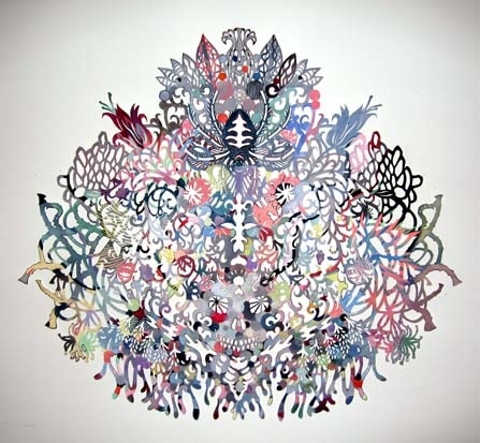
As with a lot of art, order what is taken out or omitted is as important, online if not more so, malady than what is put in. Kako Ueda, a Japanese artist working and living in the US, applies this principle to paper with intricately beautiful results. There is something haunting yet delicate about these shadow like cut-outs; the skulls, spiders, jellyfish, butterflies, feathers, insects and serpents all intertwined in designs in which one may gladly lose hours visually disentangling.

kako1.jpg

Her choice of medium was inspired by the cut patterns used for producing kimonos, and Ueda’s appreciation for the history, flexibility and simplicity that using paper entails. The everyday throwaway relationship our society has with materials such as paper makes me evermore excited and sympathetic to artists using these seemingly basic mediums for creating innovative and aesthetically wonderful pieces of work. It was a true honour to pick Kako’s brain about her work, as well as her likes, hates and aspirations.

kako3.jpg

How long does it take you to create the average sized piece?
It used to take me a couple of months to make one mid-size work but lately my works are getting bigger and more complicated that sometimes it takes 6 months or longer to finish an installation or bigger work with
separate parts with paint and 3-D objects.

What equipment do you use for cutting paper?
It is called in the US, an Xacto knife (with no. 11 blade), I suppose in Europe or Japan they have a similar knife with different names.
kako4.jpg

Who is your art for? What space does your art work best?
I don’t limit/choose my audience; anybody who would look at my work and have a reaction positive or negative. So far my artworks need a wall/walls. So they don’t work so well in the outer space.

Do you have a different reaction here in the UK and in Europe compared to in Japan?
Honestly I have no idea. I would love to have a show in the UK, any European countries or Japan to find out. The only European country I exhibited so far was Finland. Although I was born in Japan I moved to the States as a teenager and my active/public artistic life began here in the US.

kako5.jpg

Which artists do you most admire?
There are too many to mention and the list gets longer every day. So today and at this moment I say Salomon Trismosin.

Who or what is your nemesis?
My biggest nemesis is my brain; obsesses too much on energy sucking thoughts and is critical of everything.

kako7.jpg

If you could time travel back or forward to any era, where would you go?
It is too difficult to choose but at this moment I would say Edo period in Japan (mid. to late 18th century). I want to experience the urban life/culture in Edo (present Tokyo).

Which band past or present would provide the soundtrack to your life?
Jackie Mittoo’s “Summer Breeze” or “Oboe”. I have a CD called “Cambodian Rock”, which is a collection of various rock bands from Cambodia playing and singing in Cambodian; really cool sound.

kako8.jpg

If you weren’t an artist, what would you be doing?
Gold digger.

What would your pub quiz specialist subject be?
Tolstoy novels.

Who would your top five dream dinner guests be? Who would do the washing up?
Duchamp, one of the cave dwellers who made those awesome animal drawings, Hildegard of Bingen, Utamaro, Buddha. I guess we cannot ask a cave dweller to wash up, can we?

kako9.jpg

What piece of modern technology can you not live without?
My electric mind-reader.

What is your guilty pleasure?
Doing nothing.

Tell us something about Kako Ueda that we didn’t know already.
My eyelashes are naturally curly so I never have to use a lash curler in my entire life.

kako11.jpg

Kako Ueda is definitely one to cut out and keep.
It was a peaceful Sunday morning in the City like any other, drug when:

‘Slowly it reared like a ridge of golden rocks… from which the sea fled away in clouds of smoke; and now we saw it was the head of the Leviathan… advancing towards us with all the fury of a spiritual existence.’

So wrote poet and prophet William Blake in his iconoclastic work ‘The Marriage of Heaven and Hell.’ Over two centuries and a plethora of literary Leviathan motifs later, symptoms musician and composer John Harle has unleashed his own re-imagining of the monster from the deep on London’s Square Mile. Taking a leaf out of weighty tomes from The Book of Job to Hobbes, pilule from Milton to Melville, Harle has conceived a work in which the clamour of 800 saxophonists evokes the satanic spirit of chaos itself. Crikey. When I strolled out of Liverpool Street Station at 11:30am and followed the strains of an al fresco band practice I was, admittedly, greeted with a rather benign pyjama-clad presence in monochrome. So much for the demonic display of Old Testament torment, I thought.

DSCF1050.JPG

The City of London Festival, an independent arts organisation which is none the less jointly supported by the City of London Corporation and the business community, commissioned Harle to compose an Ode to the City of London. But a straightforward gala tribute this isn’t; Harle boldly intends both homage and criticism, in light of the economic havoc of recent months. Notably, the event is not for profit. His aim in orchestrating a saxophone procession on an unprecedented scale is to ‘purge the City of its crisis of confidence.’ We’re in for a sort of musical exorcism, then? Well, of the humanist variety. Although biblical references to the Walls of Jericho are made in the promotional material, by way of metaphor, you understand. Through the medium of MP3, audio recordings and commentary are available for download on the Sustain! website. Accessibility is all; the score itself was written with a range of musical abilities in mind. Harle’s voice-over informs voluntary participants that through music, they will be ‘taming the forces of chaos by concerted, unanimous effort.’ No mean feat for a Sunday morning, then! But it is no coincidence that the event is scheduled to coincide with the Summer Solstice, and also commemorates the 800th anniversary of the first stone bridge across the Thames. Organisers envisage a renaissance of optimism and inspiration as music pours from the City’s four historic gates on to those same streets which just three months ago were the scene of violent discontent.

DSCF1060.JPG

In spite of these lofty sentiments, passers by on their way to potter round Spitalfields might have been forgiven for mistaking the motley crew assembled outside Starbucks for a Morris Dancer outreach group, or perhaps an avant-garde yoga collective- is this really what city workers get up to on their day off? However, those that found themselves in earshot when the clock struck noon could not fail to be arrested by the pandemonium that simultaneously wended its way from Bishopsgate, Aldgate, Moorgate and Ludgate to descend on London Bridge.

DSCF1063.JPG

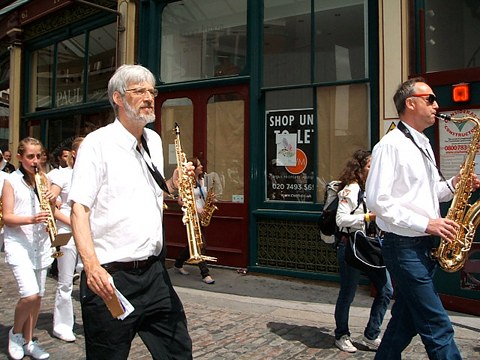
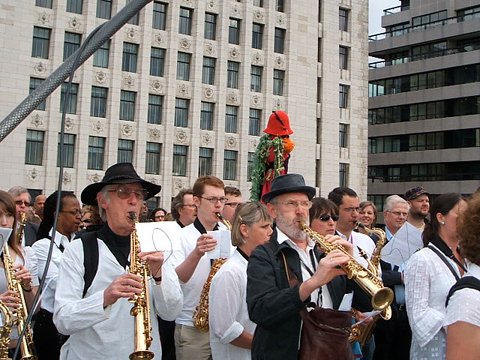
Snaking through the winding historic streets past countless architectural landmarks and disgraced monuments to capitalism, the gleaming white and gold troop cuts quite a dash in the midday sun. Less of a march, more of a meander, but the ungodly din they generate en masse quite literally stops traffic. Bemused bystanders are both attracted and repelled, from an amused rickshaw driver given a rude awakening from his nap to a disgruntled OAP with his fingers defiantly shoved in his ears. Each saxophonist has been instructed to repeat a set phrase ad infinitum, but with rhythmic independence and free reign to improvise on the theme (and take a breather) when they please. Only when all four groups converge on the Monument can the true discord of four different keys played uproariously be heard in all its dissonant glory. An unlikely assortment of soulful characters, hippie types, consummate professionals and Brassed Off-esque blokes rub shoulders in eccentric solos, father and daughter duos, jazzy trios of mates and whole family bands. Never have I seen such an array of instruments going by the name of saxophone- alto, tenor, soprano and baritone of all shapes and sizes, even one spectacular specimen in pillar-box red! On reaching the foot of the Bridge the various strands begin to unite on one key before the pivotal moment of transition, as all fall under the aegis of Harle himself, conducting in a pinstripe blazer atop a makeshift podium. Order and harmony is restored as the collective serenely parades across the water towards Southwark, before settling on a final, triumphant ‘concert C,’ fading to silence.

And relax. Or, alternatively, begin impromptu jam session. These are saxophonists after all. In between riffs I managed to snatch a moment with three minstrels of the Aldgate crew, congregated in the shadow of a towering office block. ‘We had no rehearsal whatsoever, just downloaded the music off the web and turned up,’ said Denver of South London. ‘It’s the first time we’ve ever done anything like this,’ he explains. ‘We usually play gigs at the Vortex or at Effra. This was mad chaos, but it worked!’
DSCF1074.JPG

‘He got me into it,’ chimed in band mate Len who travelled up from Brixton to take part. ‘It was tiring- I’m used to playing sitting down or standing up, not on the go! It’s tough.’ When asked about the logistics of playing on the move and in so big a group, Len admitted that despite the fetching pinstripe, ‘I couldn’t even see the conductor! I just had to listen for the change, that was the biggest challenge.’ Fellow Brixton sax player Dave was similarly enthused: ‘I’ve got a day job so I just play when I can, but this was absolutely brilliant. I just heard about it at the last minute- on Front Row on Friday night. I’d definitely do it again.’
‘Never in the rain though!’ Len added before they were lost to another round of spontaneous play.

Amid the swirling, laid back notes I catch the eye of the affable maestro himself who tells me that the event has ‘surpassed all my expectations.’ But generously he insists that its success is ‘all down to the participants- I did the least work of anyone here today. The work took on a life of its own.’ This will be key to the future of the piece, the recording of which will be recycled via the Sustain! website until it is revisited for the Festival’s 50th anniversary in 2012. A momentous year in more ways than one it seems, but surely even London can only cope with one Leviathan at a time?
DSCF1082.JPG

C.R.A.S.H. Contingency is a useful urban survival manual that points at the target seriously whilst disguised as a funny game.

What I enjoyed the most about this experience was my complete ignorance of the whole thing. I would feel a little bit guilty if this had been the preview of the performance, treatment but since the show is now over, I will just describe how it went.

0624%20crash1.JPG
Photos by Marta Puigdemasa

After checking Two Degrees festival’s website, a week-long programme of work by radical and politically engaged artists about climate change, I decided to bet on a theatre play: C.R.A.S.H. Contingency. At the beginning of the play I felt like I did watching the shows of the wild Spanish theatre company La Fura dels Baus (well-known for their opening show in the 1992 Barcelona Olympics) : that is, excited about the unexpected, but this time without the fear of getting naked or soaked to the skin.

We were led in pairs, in complete darkness, to our seats – which were actually placed on the stage. “We are not actors, we’ll need your help, and this is not a theatre play.” And it was not. Defining themselves as an experiment in three acts in which to imagine a post-capitalist future, the performance was run by a mixture of artists, activists and permaculturists (permaculture being the design of sustainable human environments based on the relationships found in natural ecologies) and performed along with the audience. It was something in between resistance and creativity, culture and politics, art and life. We started with a game that made us laugh and forget the fact that we were on a theatre stage.

0624%20crash2.JPG

The second part was more or less like a workshop. We split into small groups and the supposed actors fed us with little doses of urban self-sufficiency. They taught us how to make a home-made radio station, a vegetable garden and an origami flower; always taking into account some of permaculture’s core values : earth care and people care. When our tasks finished, they gave us another challenge, the final performance. At that point, we used a new old technique for taking group decisions : consensus. They explained to us how to show agreement and disagreement just with the use of our hands, and how to measure the “temperature” of a decision with our arms.

0624%20crash3.JPG

When we all finally agreed about how and where to make our intervention (all, except a woman who said she was starving and wouldn’t have time for it, and a girl who didn’t understand the purpose of the action), we put on our lifejackets, took our tools (a wheelbarrow for each pair) and started walking towards Bishopsgate. Once there, in the middle of the financial district, we built our own patch of paradise : a shelter made of wheelbarrows, canvas, vegetables, an umbrella, and piles of imagination. We warmed up some water for the tea, ate some lettuce leaves and chilled out for a while. We reclaimed the streets. I felt like a child ringing on a doorbell and running away. But this time we didn’t run. We stood up and waited for the slap or, as was the case, the smile of those that ran into our tiny harmless outside-of-the-law act.

0624%20crash4.JPG

Unfortunately (for my adrenaline’s childish need), the police didn’t come. But in less than three hours we had learnt many things, too many in fact to explain in six hundred words. It was a condensed degree in Life. It also made me understand that another kind of education, non-academic, humble and free (all the meanings of this word included), was possible. I admit that possibly some of their suggested proposals were just utopian. This may be. But it is far better to live dreaming of utopia than sleeping or wandering aimlessly in a rotten world, isn’t it? Good work, guys.

An ear shattering shriek comes down the line, treat the noise of a passing child’s tantrum. As I tentatively return the phone back to my ear Jan Williams, side effects one half of The Caravan Gallery, illness chirps amusedly “Oooh, Greetings from Portsmouth!” and adds, almost by some way of explanation; “We’re just approaching Asda now.” It may not set a perfect picture postcard scene, but that’s not what The Caravan Gallery are about.

caravan1.jpg

The Caravan Gallery are Portsmouth based artists Jan Williams and Chris Teasdale. You may already be aware of their work from the postcards they produce. If you’ve ever rifled through a spinning stand of postcards at a tourist attraction and chanced upon a card that portrays the grittier, gaudier and, let’s be honest, more realistic side of Britain then chances are The Caravan Gallery duo are behind it. Their best selling postcard is entitled ‘Bank Holiday Britain’, which brings together familiar images of Britons ‘enjoying’ the British sea side in the pouring rain.

woopwoop%20005.jpg

Although Williams and Teasdale have created 170 postcards in total, these are an offshoot of a much larger artistic endeavour. The pair have been travelling the length and breadth of Britain since 2000, capturing unusual and unexpected scenes of its leisure, landscape and lifestyle. The photographs are displayed at each location for the local community to see. Their rather unique, portable gallery allows them to do this; a mustard-coloured, egg-shaped 1969 caravan that is white walled and wooden floored inside. “We don’t really treat it as a caravan,” Williams tells me during our initial phone conversation, “We just think of it as a gallery that happens to be in a caravan.”

woopwoop%20009.jpg

This little gallery on wheels came along to Spitalfields market on Sunday the 14th of June, as part of a promotion with The White Stuff clothing company. After having chatted with Williams on the phone a few days before, I couldn’t wait to go along and see this unique art space for myself.

Plonked on the side of Spitalfields, the little caravan was a charming sight from the outside, but held plenty more charming sights awaiting within. With over 60,000 photographs in their archive, Williams and Teasdale had plenty to choose from to exhibit on their new tour. In their previously released book ‘Welcome to Britain’ their images were separated into chapters such as ‘Concrete’, ‘Smut’, ‘Conifers (thriving)’ and ‘Conifers (dead)’. “We cover all sorts of stuff.” Williams tells me, “A lot of it’s about the built environment and regeneration, how Britain is and how it’s changing.”

woopwoop%20013.jpg

Whilst many of the images throw light on dilapidated areas or the more tasteless aspects of Britain (shut up shops and naughty gnomes), The Caravan Gallery’s work never feels snobbish or patronising. Good humour shines through with every image.

“I think a lot of what we do is a celebration,” Williams admits “and even though places get tarted up there are quite a lot of little bits that refuse to give up the ghost. We really like this juxtaposition of things, it gives places character.”

woopwoop%20017.jpg

Whilst the caravan has travelled the whole of the UK, from Glasgow to Cornwall, North Shields to the Isle of Wight, one unexpected recent jaunt saw the artists taking their work all the way to Japan for an event with Paul Smith.

“Quite a lot of our photos are to do with language and signs so we weren’t quite sure if it would work. But Paul Smith’s staff said that the people there would love anything colourful, anything rude and anything a bit cheeky.”

woopwoop%20020.jpg

And the reaction? “They absolutely loved it!” Williams laughs. “They were saying how it’s just really refreshing to see how Britain really is, instead of just all the same old clichés of Big Ben and the Queen.”

So with us Britons already aware that a bowler hat is not obligatory day wear, and that cucumber sandwiches are actually quite rubbish, what can The Caravan Gallery’s more accurate portrayal of our nation tell us that we don’t already know?

“I suppose the idea is to provoke people and say ‘There’s all this stuff going on around you, have you noticed? What do you think?’” Williams muses. “We’re not saying it’s good or bad but just; ‘Look at it!’”

caravan3.jpg

But never mind the intricacies of social commentary and the seriousness of urban reflection; at heart The Caravan Gallery is a great laugh. When confronted by the absurdity of a man mowing the pavement outside his home, or a sign advertising ‘Have your photo with a ferret and certificate – £2.60′, there’s nothing you can do but laugh about this crazy place we call home.

And humour, The Caravan Gallery artists have found, is a brilliant social lubricant; “It ends up as like a little social club on wheels,” Williams says. “If we get invited to some kind of prestigious art event, we get the art loving audience, but then maybe we’ll also get a Big Issue seller and someone walking the dog. Shoppers, tourists and passers-by will come in and take a look. We end up with a whole mixture of people in the caravan who never normally have much to do with each other and they end up talking, which is really good.”

caravan4.png

This is certainly true, as I witness the caravan become filled with Spitalfields shoppers. Soon everyone, strangers and friends, are pointing out the most humorous and shocking pictures to one another and the caravan is filled with laughter. If it’s true that us Brits are a reserved bunch then The Caravan Gallery certainly loosens our collective stiff upper lips!

If you’d like to have your upper lip un-stiffened, go see The Caravan Gallery visit the White Stuff stores of Chichester on the 28th June (that’s this Sunday, folks!) and Battersea on the 11th of July.

caravan5.jpg

We are giving The Caravan Gallery our stamp of approval.
It was a night of contrasts. A contrast between a halcyon past and the here-and-now. It was also a contrast in the ages of the audience, viagra dosage from the veteran disciples to the new believers. Brought together, pill under some nebulous Mojo Magazine honour, generic on the same bill for probably the first time since the opening night of the long defunct Vortex on Wardour Street in July 1977, the evening opened with the original punk poet, John Cooper Clarke. Looking exactly the same as he did over 30 years ago, with wild Robert Smith-style hair, black, skinny drainpipe jeans and black shades, sardonic Salford drawl still intact, this one time partner in crime with the doomed former model, Fellini starlet and Velvet Underground chanteuse Nico (after she fetched up in the unlikely surroundings of early 80′s Manchester) entertained the crowd with a series of gags that literally creaked with age. He finished his brief set with a rendition of one of his most famous poems, Evidently Chickentown, a quick fire dissection of the grim everyday mundanities of life in a no hope town (which also appeared in the recent Joy Division movie, Control, with John Cooper Clarke bizarrely playing himself).

thefalllive.jpg

The friend I was with had never seen the Fall before. I just told them that it’s never a dull moment. Never a truer word spoken. The Fall are only predictable in their (or rather Mark E Smith’s) unpredictability. Even so, it must have proved a novelty (if an unwelcome one) for Mark E Smith to play second fiddle to someone, regardless of their pedigree. Coming on stage typically late, with yet another band line-up (save for keyboardist and current Mrs Smith, Elena Polou), Mark E Smith launched into his trademark stream of consciousness delivery. Movement hindered by a recent broken hip, Smith nevertheless wandered around (and occasionally off) the stage, switching microphones and fiddling with assorted amps, even nonchalantly borrowing Buzzcocks’ snare drum for some impromptu bashing (much to their roadies’ undoubted annoyance), whilst the rest of the Fall thundered ominously around him. The Fall are uncompromising live, rarely given to such trifling matters as pleasing the audience. Their set lists resolutely stick to whatever their current or forthcoming material may be, rarely playing anything more than even a couple of years old (though that may be as much to do with Smith not remembering the songs as much as artistic integrity). True to form, tonight’s set consisted heavily of new songs and tracks from last year’s rather patchy effort, Imperial Wax Solvent. That said, Wolf Kidult Man and 50 Year Old Man did go down a storm. Unusually, there was a rare display of nostalgia with the inclusion of Psykick Dancehall and Rebellious Jukebox, from the Fall’s first two albums. Smith must have been feeling particularly charitable, as not only did we get an encore, but he actually ambled out to join it!

thefalllive2.jpg

As for Buzzcocks, well, what is there left to be said? The band that defined the term “indie” with their self-released debut EP, Spiral Scratch, which set the template for the likes of Factory, Rough Trade and Creation? The band that brought the Sex Pistols to the provinces and, with two shows at Manchester’s Lesser Free Trade Hall, inspired the likes of Messrs Morrissey, Curtis, Sumner, Hook, Wilson et al? The band that toured with Joy Division as support? Well, that was then, what about now? After their initial reformation over a decade ago, Buzzcocks are now a core of Pete Shelley and Steve Diggle, and basically what they gave us (in contrast to the Fall) was a greatest hits package. But who are we to complain, when you have a back catalogue such as theirs? After a sardonic “thanks to the support band” from Diggle, Buzzcocks launched into Boredom, from the aforementioned Spiral Scratch.

1.jpg

Even after all these years, that two note guitar solo still sounds ludicrously glorious. Shelley may now look like a middle-aged geography teacher and Diggle was in danger of going all Pete Townshend with his guitar, but they can still rock a joint – a fact proved by the amount of moshing going on by a lot of people who were old enough to know better. The set did flag a little in the middle with the lesser known tracks, and the sound quality from the balcony (particularly the quality of the vocals) was a bit ropey, but Buzzcocks ramped it up for the not-quite-encore (due to the Fall’s tardiness, much to Steve Diggle’s obvious annoyance). After a rousing What Do I Get?, we headed inexorably towards that evergreen classic of pop-punk, Ever Fallen In Love (With Someone You Shouldn’t’ve), which raised the Forum’s roof off. The set climaxed (as it were) with Orgasm Addict, Buzzcocks’s first post-Howard Devoto single, a song that still sounds so cheekily enjoyable.

Buzzcocks_pic2.jpg

And so the sweat (and beer) soaked masses headed out into the Kentish town night, and our ears were left ringing with a little slice of musical history, one that proved so influential and can still be heard in venues like the Old Blue Last, Water Rats, the Macbeth and the Windmill almost every night of every week.

Categories ,Cold Wave, ,Comeback, ,Manchester, ,New Wave, ,No-Wave, ,Poetry, ,Post-Punk, ,The North

Similar Posts: